
Here is the live stream for Presanctified Liturgy – Wednesday April 3 2024 If you need, here are instructions for accessing this content from your phone, tablet, computer, or TV.
Monthly Archives: April 2024
4/7 announcements
April 7, 2024
Third Sunday of Great Lent
Adoration of The Holy Cross
In the middle of Lent, the church sets before us the Cross of Christ. On two other occasions during the year, September 14 and August 1, the cross is presented for our remembrance and veneration. Both these feasts link the Adoration of the Cross to historic events. However, the remembrance of the cross on the third Sunday in Lent prepares us for the commemoration of the crucifixion which is soon to follow in Holy Week, and at the same time, it reminds us that the whole of Lent is a period when we are crucified with Christ. The dominant note on this Sunday, as on the two Sundays preceding, is one of joy and triumph. No separation is made between Christ’s death and His resurrection, but the cross is regarded as an emblem of victory on Calvary as seen in light of the Empty Tomb.
Hebrews 4:14-5:6: Brethren, since we have a great High Priest, Who has passed through the heavens, Jesus the Son of God, let us hold fast the confession. For we do not have a High Priest Who is unable to sympathize with our infirmities, but one Who has been in all points tempted like as we are, yet without sin. Let us therefore draw near with boldness to the throne of grace, that we may receive mercy, and may find grace to help in time of need. For every high priest, being taken from among the people, is appointed on behalf of the people in things pertaining to God, that he may offer up both gifts and sacrifices for sins; who can have compassion on the ignorant and on those who are erring, since he himself also is encompassed with infirmity. Because of this he is bound, as for the people so also for himself, to offer up for sins. And no one takes the honor upon himself, but as being called by God, as was Aaron. So Christ also did not glorify Himself to become a High Priest, but it was by the One saying to Him, “Thou art My Son, today I have begotten Thee.” As He says also in another place, “Thou art a Priest forever, according to the order of Melchizedek.”
Mark 8:34-9:1: The Lord said, “If any man would come after Me, let him deny himself and take up his cross and follow Me. For whoever would save his life will lose it; and whoever loses his life for My sake and the gospel’s will save it. For what does it profit a man to gain the whole world and forfeit his soul? For what can a man give in return for his soul? For whoever is ashamed of Me and My words in this adulterous and sinful generation, of him will the Son of man also be ashamed, when He comes in the glory of His Father with the holy angels.” And Jesus said to them, “Truly, I say to you, there are some standing here who will not taste death before they see the kingdom of God come with power.”
Troparion of the Resurrection: Let the heavens rejoice and the earth be glad; for the Lord hath done a mighty act with his own arm. He hath trampled down death and become the First-born from the dead. He hath delivered us from the depths of hades, granting the world the Great Mercy.
Troparion of the Holy Cross: O Lord, save thy people and bless thine inheritance, granting to thy people victory over all their enemies, and by the power of thy Cross preserving thy kingdom.
Troparion of the Chains of St. Peter: O Holy Apostle, Peter, thou dost preside over the Apostles by the precious chains which thou didst bear. We venerate them with faith and beseech thee that by thine intercessions we be granted the great mercy.
Kontakion of the Sundays of Lent: To thee the champion leader, I thy servant offer thanks for victory, O Theotokos, thou who hast delivered me form terror. As thou hast power invincible, free me from every danger that I may cry unto thee: Rejoice, O bride without bridegroom.
CALENDAR
UNTIL FURTHER NOTICE: All services listed on the calendar will be available through streaming and webcast. (Instructions can be found on the parish website.)
Sunday, April 7 (Third Sunday of Great Lent; Adoration of the Holy Cross)
8:50 a.m. – Orthros (webcast)
9:00 a.m. – Christian Education
10:00 a.m. – Divine Liturgy (webcast)
Monday, April 8
Father Herman off
Tuesday, April 9
NO Services
Wednesday, April 10
6:30 p.m. – Presanctified Liturgy followed by Soup Supper
Thursday, April 11
NO Services
Friday, April 12
6:30 p.m. – Akathist Hymn to the Theotokos
Saturday, April 13
10:00 a.m. – Ladies meet for Akathist followed by Brunch and a talk by
Father Herman
3:30 p.m. – Choir Practice
6:00 p.m. – Great Vespers
Sunday, April 14 (Fourth Sunday of Great Lent; Commemoration of John Climacus)
8:50 a.m. – Orthros
9:00 a.m. – Christian Education
10:00 a.m. – Divine Liturgy (webcast)
SPECIAL ANNOUNCEMENTS
The Eucharist Bread …was offered by Bakers for the Divine Liturgy this morning.
April is Men’s Month in the Archdiocese. Please honor the men of our parish by allowing them to take communion first, beginning with the men in the choir. The men will also be reading the Epistle this month in the Divine Liturgy.
Eucharist Bread Schedule:
Eucharist Bread Coffee Hour
April 7 Baker Dansereau/Alaeetawi
April 14 Lasseter Lockhart/Karam/Snell
April 21 Henderson Henderson/K. Jones/Lavric
April 27 (Sat. a.m.) Algood Ellis/Zouboukos/Waites
(Lazarus Saturday)
April 28 Schelver FISH FRY MEAL
(Palm Sunday) Meadows/Pacurari
Also, please remember that we still need your tithes and offerings which may be placed in the tray that is passed during the Divine Liturgy, in the tithe box at the back of the nave or be mailed to: St. Peter Orthodox Church, P.O. Box 2084, Madison, MS 39130-2084.
Schedule for Epistle Readers – Page numbers refer to the Apostolos (book of the Epistles) located on the Chanters’ stand at the front of the nave. Please be sure to use this book when you read.
Reader Reading Page#
April 7 Reader Basil Baker Heb. 4:14-5:6 285
April 14 Reader Chad Miller Heb. 6:13-20 287
April 21 Brandon Strain Heb. 9:11-14 290
April 27 (Sat. a.m.) Ian Jones Heb. 12:28-13:8 291
April 28 Sam Habeeb Phil. 4:4-9 294
Please remember the following in your prayers: Aidan Milnor, the Milnor family; Lamia Dabit
and her family; Mary Greene (Lee and Kh. Sharon’s sister); Jay and Joanna Davis; Fr. Leo and Kh. Be’Be’ Schelver and their family; Kathy Willingham; Marilyn (Kyriake) Snell; Jack and Jill Weatherly; Lottie Dabbs (Sh. Charlotte Algood’s mother), Sh. Charlotte and their family; Reader Basil and Brenda Baker and their family; Buddy Cooper; Georgia and Bob Buchanan; Fr. Joseph Bittle; Steve and Sheryl Chamblee; Rick Carlton; Very Rev. Fr. Nicholas and Kh. Jan Speier; Dora Lambert (Dimitri Zouboukos’ fiancée); Lee Greene; Joseph, Amanda and Hunter Hines; Fr. John and Kh. Janet Henderson and their family.
Please keep in your prayers all of our catechumens who will be received into the One Holy and Apostolic Church on Great and Holy Saturday this year in your prayers. Those who will be chrismated during the Vesperal Liturgy will be : Ian Walters, Jenny Jones, Jimmy and Gabrielle Jones, Will, Lisa and Rad Lively.
Kh. Janet’s surgery went well this past Tuesday. Please continue to keep her, Fr. John and their family in your thoughts and prayers. Glory to God for all things!
The Ladies raised $1600 in March for the Endowment Fund for Widowed Clergy Wives. Thank you for your support of this worthwhile project.
Akathist and Brunch: On Saturday morning, April 13th, the Ladies will meet for their usual monthly Akathist to the Mother of God, Nurturer of Children at 10:00 a.m. Afterwards, we will have a brunch in the Fellowship Hall and Father Herman will speak to us. Please mark your calendars and plan to attend.
Palm Sunday Fish Fry Meal: Once again we will have our Fish Fry Meal catered by Sal and Phil’s following the Divine Liturgy on Sunday, April 28th. More information on costs, etc. will be available soon. Please sign-up on the sheet located on the bureau in the hallway outside the nave.
Paschal Meal: We will bring baskets of our favorite foods that we have not enjoyed while fasting for this meal. A handout will be available in the next week or so with information about Paschal Baskets. We ask that everyone help with clean-up following this meal (just as we do for our monthly Pot Luck Meals).
The Agape Vespers for Pascha this year will be hosted by Holy Trinity/St. John the Theologian Greek Orthodox Church. Further details and information will be forthcoming.
Registration is open for this year’s Parish Life Conference which will be held June 12-15th in Atlanta at the Hilton Peachtree City Atlanta Hotel and Conference Center and hosted by St. Stephen in Hiram. Please go to the Diocesan website (DOMSE.org) to register for the conference and for the hotel.
There has arisen an issue with the large amount of trash being left in the back area of the church around and inside the playground area over the past several weeks. If everyone would please monitor this situation by making sure no trash is left around the area. Thank you for your help in this matter.
On a related note: Several of the older children have begun to drink coffee on Sunday mornings. Due to the amount of creamer they use, our supply of coffeemate pods are being used up quickly. So, we will be providing a small container of almond milk for them to use in their coffee and the coffeemate pods will be for adults only. Parents please monitor this situation with your children who are allowed to drink coffee. Thank you.
Calendar Items:
* The men of the parish meet for lunch at 11:00 a.m. on the first Thursday of the month.
* The Ladies meet at the church at 10:00 a.m. on the second Saturday of the month to pray the Akathist to the Mother of God, Nurturer of Children on behalf of our children.
* The Ladies meet for lunch at 1:00 p.m. on the last Tuesday of the month.
* During Great Lent we will have the Pre-sanctified Liturgy on Wednesday evenings instead of Daily Vespers. As is our parish custom, we will have pot-luck Soup Suppers afterwards (except for Wednesday, April 17th, when we will have the complete Canon of St. Andrew of Crete with the reading of the Life of St. Mary of Egypt instead of the Pre-sanctified Liturgy).
* Ladies Brunch and Lenten Talk by Father Herman following monthly Akathist on Saturday morning, April 13th.
* The complete Canon of St. Andrew of Crete with the Life of St. Mary of Egypt on Wednesday evening, April 17th, beginning at 6:30 p.m. (NO Soup Supper afterwards).
* Small Complines with the Canon of St. Lazarus on Friday, April 26th (NO Akathist that evening).
* Orthros followed by Divine Liturgy for Lazarus Saturday on April 27th at 9:00 a.m.
* Remaining Stewpot date for 2024 will be November 30th.
Fasting Discipline for April
Beginning with Clean Monday on March 18th, the traditional fasting discipline (no meat, dairy, eggs, fish, wine or oil) is observed on all days of the week until Pascha (except for the Feast of the Annunciation on March 25th and Palm Sunday on April 28th, when fish, wine and oil are permitted).
Major Commemorations for April
April 7 3rd Sunday of Lent; Adoration of the Holy Cross
April 14 4th Sunday of Lent; Commemoration of John Climacus
April 21 5th Sunday of Lent; Commemoration of Mary of Egypt
April 23 Great-martyr George
April 25 Holy Apostle Mark
April 27 Lazarus Saturday
April 28 Palm Sunday
April 29 Great and Holy Monday
April 30 Great and Holy Tuesday
There will be an icon writing workshop at Holy Resurrection July 8-13. The iconographer who will be teaching this class is Theodoros Papadopoulos. Tuition for this class is $780. For further information and enrollment, please visit the website http://www.theodoreicons.com/clinton. Holy Resurrection is only providing space for this class.
Quotable: “Devils take great delight in fullness, and drunkenness and bodily comfort. Fasting possesses great power and it works glorious things.”
+ St. Athanasius the Great
Worship: Sunday, April 14, 2024 (Fourth Sunday of Great Lent; Commemoration of John Climacus)
Scripture: Hebrews 6:13-20; Mark 9:17-31
Celebrant: Father Herman
Epistle Reader: Reader Chad Miller
Prosphora: Lasseter
Coffee Hour: Lockhart/Karam/Snell
Daily Readings for Wednesday, April 03, 2024
3RD WEDNESDAY OF LENT
ABSTAIN FROM MEAT, FISH, DAIRY, EGGS, WINE, OLIVE OIL
Nicetas, Abbot of the Monastery of Medicium, Joseph the Hymnographer, Theodosia and Irene the Martyrs
ISAIAH 10:12-20
When the Lord has finished all his work on Mount Zion and on Jerusalem he will punish the arrogant boasting of the king of Assyria and his haughty pride. For he says: “By the strength of my hand I have done it, and by my wisdom, for I have understanding; I have removed the boundaries of peoples, and have plundered their treasures; like a bull I have brought down those who sat on thrones. My hand has found like a nest the wealth of the peoples; and as men gather eggs that have been forsaken so I have gathered all the earth; and there was none that moved a wing, or opened the mouth, or chirped.” Shall the axe vaunt itself over him who hews with it, or the saw magnify itself against him who wields it? As if a rod should wield him who lifts it, or as if a staff should lift him who is not wood! Therefore the Lord, the LORD of hosts, will send wasting sickness among his stout warriors, and under his glory a burning will be kindled, like the burning of fire. The light of Israel will become a fire, and his Holy One a flame; and it will burn and devour his thorns and briers in one day. The glory of his forest and of his fruitful land the LORD will destroy, both soul and body, and it will be as when a sick man wastes away. The remnant of the trees of his forest will be so few that a child can write them down. In that day the remnant of Israel and the survivors of the house of Jacob will no more lean upon him that smote them, but will lean upon the LORD, the Holy One of Israel, in truth.
GENESIS 7:6-9
Noah was six hundred years old when the flood of waters came upon the earth. And Noah and his sons and his wife and his sons' wives with him went into the ark, to escape the waters of the flood. Of clean animals, and of animals that are not clean, and of birds, and of everything that creeps on the ground, two and two, male and female, went into the ark with Noah, as God had commanded Noah.
PROVERBS 9:12-18
If you are wise, you are wise for yourself; if you scoff, you alone will bear it. A foolish woman is noisy; she is wanton and knows no shame. She sits at the door of her house, she takes a seat on the high places of the town, calling to those who pass by, who are going straight on their way, “Whoever is simple, let him turn in here!” And to him who is without sense she says, “Stolen water is sweet, and bread eaten in secret is pleasant.” But he does not know that the dead are there, that her guests are in the depths of Sheol.
Venerable Niketas the Confessor, Abbot of Medikion
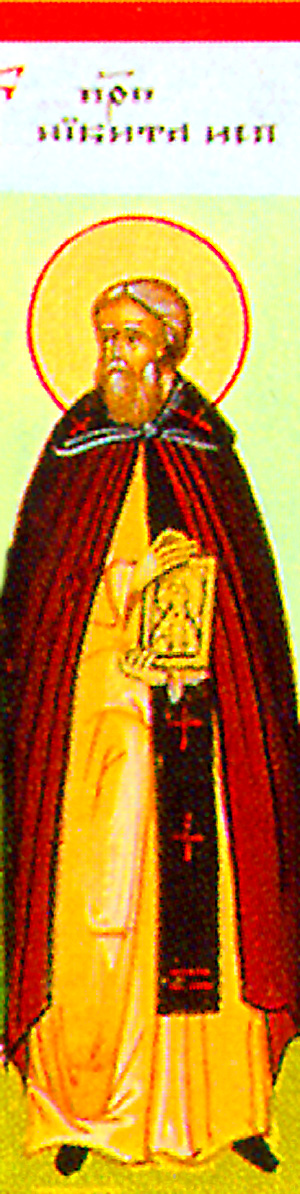
Saint Niketas (Nikḗtas) the Confessor was born in Bithynian Caesarea (northwest Asia Minor) of a pious family. His mother died eight days after his birth, and his father Philaretos became a monk. The child remained in the care of his grandmother, who raised him in a true Christian spirit. From his youth Saint Niketas attended church and was a disciple of the hermit Stephanos. With his blessing, Saint Niketas set off to the Mydicia monastery, where Saint Nikephoros (Nikēphóros) (March 13) was the igumen.
After seven years of virtuous life at the monastery, famed for its strict monastic rule, Saint Niketas was ordained presbyter. Saint Nikephoros, knowing the holy life of the young monk, entrusted to him the guidance of the monastery when he himself became ill.
Not wanting power, Saint Niketas devoted himself to the enlightenment and welfare of the monastery. He guided the brethren by his own example. Soon the fame of the lofty life of its inhabitants of the monastery attracted many seeking salvation. After several years, the number of monks had increased to one hundred.
When Saint Nikephoros departed to the Lord in his old age, the brethren unanimously chose Saint Niketas as igumen.
The Lord granted Saint Niketas the gift of wonderworking. Through his prayer a deaf-mute child received the gift of speech; two demon-possessed women were healed; he restored reason to one who had lost his mind, and many of the sick were healed of their infirmities.
During these years under the emperor Leo the Armenian (813-820), the Iconoclast heresy resurfaced and oppression increased. Orthodox bishops were deposed and banished. At Constantinople a council of heretics was convened in 815, at which they deposed the holy Patriarch Nikephoros (806-815), and in his place they chose the heretical layman Theodotus. They also installed heretics in place of exiled and imprisoned Orthodox bishops.
The emperor summoned all the heads of the monasteries and tried to bring them over to the Iconoclast heresy. Among those summoned was Saint Niketas, who stood firmly for the Orthodox confession. Following his example, all the igumens remained faithful to the veneration of holy icons. Therefore, they threw him into prison. Saint Niketas bravely underwent all the tribulations and encouraged firmness of spirit in the other prisoners.
Then the emperor and the false patriarch Theodotus attempted to trick those who remained faithful to Orthodox teaching. They promised that the emperor would give them their freedom and permit the veneration of the icons on one condition: that they take Communion from the pseudo-patriarch Theodotus.
For a long time the saint had doubts about entering into communion with a heretic, but other prisoners begged him to go along with them. Acceding to their entreaties, Saint Niketas went into the church, where icons were put out to deceive the confessors, and he accepted Communion.
But when he returned to his monastery and saw that the persecution against icons was continuing, he then repented of his deed, returned to Constantinople and fearlessly denounced the Iconoclast heresy. He ignored all the emperor’s threats.
Saint Niketas was again locked up in prison for six years until the death of the emperor Leo the Armenian. Enduring hunger and travail, Saint Niketas worked miracles by the power of his prayers: through his prayer the Phrygian ruler released two captives without ransom; three shipwrecked men for whom Saint Niketas prayed, were thrown up on shore by the waves.
Saint Niketas reposed in the Lord in 824. The saint’s body was buried at the monastery with reverence. Later, his relics became a source of healing for those coming to venerate the holy confessor.
Holy Virgin Martyr Theodosίa of Tyre
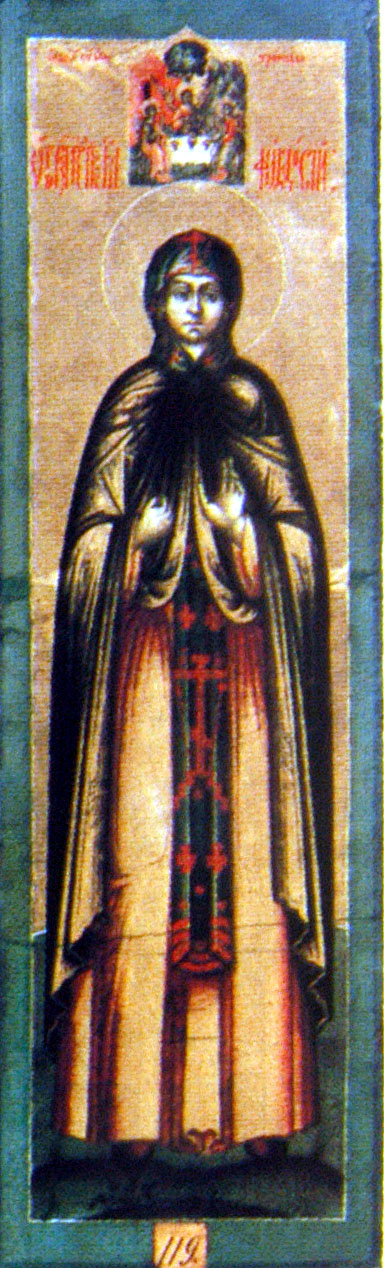
Saint Theodosίa of Tyre lived during the III and IV centuries. Once, during a persecution against Christians, which had already lasted for five years, the seventeen-year-old Theodosίa visited some condemned Christian prisoners in the Praetorium at Caesarea in Palestine. It was the day of Holy Pascha, and the Martyrs were speaking about the Kingdom of God. Saint Theodosίa asked them to remember her when they appeared before the Lord.
When the soldiers saw that the girl had bowed to the prisoners, they seized her and led her before the governor, Urban. The governor urged the Saint to offer sacrifice to the idols, but she refused, professing her faith in Christ. Then she was subjected to cruel tortures; her sides and breasts were raked with iron claws until her bones were exposed. She endured this in silence with astonishing courage. Again Urban told her to sacrifice, but she mocked him saying: “Foolish man, why do you persist? Can you not see that I have received everything I prayed for, and that I am honored to share the fate of these Martyrs for Christ?"
After saying this, she was tormented even more severely than before. The holy virgin was cast into the sea with a stone tied around her neck, but Angels rescued her from the depths. Then they tossed her into the arena to be eaten by wild animals. Seeing that the beasts would not touch her, the soldiers beheaded her.
That night Saint Theodosίa appeared to her parents, who had tried to persuade their daughter not to let herself be tortured. She wore radiant garments, a crown upon her head, and held a luminous gold cross in her hand. She said to them, “Behold the great glory of which you wished to deprive me!”
The Holy Virgin Martyr Theodosίa of Tyre suffered for Christ on April 3 in the year 307 or 308. She is also commemorated on May 29 (the transfer of her relics to Constantinople, and later to Venice).
Martyr Irene
No information available at this time.
Saint Illyricus of Mount Myrsinon in the Peloponnesus

Saint Illyricus the Wonderworker devoted himself to ascetic struggles on Mount Myrsinon in the Peloponnesus. The dates of his birth and death are unknown.
Martyrs Elpidephorus, Dius, Bithonius, and Galycus
The Holy Martyrs Elpidephorus, Dius, Bithonius, and Galycus suffered for their faith in Jesus Christ. They cut off the head of Saint Elpidephorus with a sword, Saint Dius was executed by stoning, Saint Bithonius was drowned in the sea, and Saint Galycus was condemned to be eaten by wild beasts.
“Unfading Flower” Icon of the Mother of God
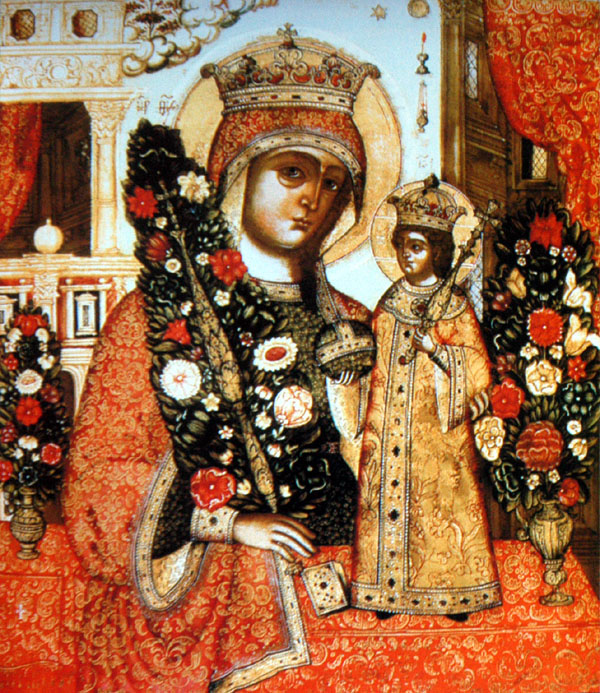
The "Unfading Flower" Icon depicts the Theotokos holding her Divine Son on her right arm, and in her left hand is a bouquet of white lilies. The lilies symbolize the unfading flower of virginity and purity of the Mother of God, to whom the Church sings: “You are the root of virginity and the Unfading Flower of purity.”
In Moscow there are two churches with Icons with this name: the church of the Dormition at Mogil'tsy (December 31), and the Alexeyev Monastery. Other icons of this name are in Kungur (Perm Gubernia); in the former town of Kadome of Tambov Province, namely, in the Merciful Theotokos womens' monastery; and in the Nativity of the Theotokos church of Voronezh.
There is a similar Icon in the church of Saint Nicholas in the village of Budishch (Poltava Gubernia). It resembles a number of very old icons which are also revered in that place. Every year on April 3, many people gather in the village of Budishch to venerate this Icon, along with a copy of the Vladimir Icon of the Mother of God. Several miraculous healings of the sick have occurred before this Icon.
Daily Readings for Tuesday, April 02, 2024
3RD TUESDAY OF LENT
ABSTAIN FROM MEAT, FISH, DAIRY, EGGS, WINE, OLIVE OIL
Titus the Wonderworker, Theodora the Virgin-martyr of Palestine, Amphianos & Aedesios the Martyrs of Lycia
ISAIAH 9:9-10:4
Thus says the LORD: “And all the people will know, Ephraim and the inhabitants of Samaria, who say in pride and in arrogance of heart: ‘The bricks have fallen, but we will build with dressed stones; the sycamores have been cut down, but we will put cedars in their place.'” So the LORD raises adversaries against them, and stirs up their enemies. The Syrians on the east and the Philistines on the west devour Israel with open mouth. For all this his anger is not turned away and his hand is stretched out still. The people did not turn to him who smote them, nor seek the LORD of hosts. So the LORD cut off from Israel head and tail, palm branch and reed in one day – the elder and honored man is the head, and the prophet who teaches lies is the tail; for those who lead this people lead them astray, and those who are led by them are swallowed up. Therefore the Lord does not rejoice over their young men, and has no compassion on their fatherless and widows; for every one is godless and an evildoer, and every mouth speaks folly. For all this his anger is not turned away and his hand is stretched out still. For wickedness burns like a fire, it consumes briers and thorns; it kindles the thickets of the forest, and they roll upward in a column of smoke. Through the wrath of the LORD of hosts the land is burned, and the people are like fuel for the fire; no man spares his brother. They snatch on the right, but are still hungry, and they devour on the left, but are not satisfied; each devours his neighbor’s flesh, Manasseh, Ephraim, and Ephraim, Manasseh, and together they are against Judah. For all this his anger is not turned away and his hand is stretched out still. Woe to those who decree iniquitous decrees, and the writers who keep writing oppression, to turn aside the needy from justice and to rob the poor of my people of their right, that widows may be their spoil, and that they may make the fatherless their prey! What will you do on the day of punishment, in the storm which will come from afar? To whom will you flee for help, and where will you leave your wealth? Nothing remains but to crouch among the prisoners or fall among the slain. For all this his anger is not turned away and his hand is stretched out still.
GENESIS 7:1-5
Then the LORD said to Noah, “Go into the ark, you and all your household, for I have seen that you are righteous before me in this generation. Take with you seven pairs of all clean animals, the male and his mate; and a pair of the animals that are not clean, the male and his mate; and seven pairs of the birds of the air also, male and female, to keep their kind alive upon the face of all the earth. For in seven days I will send rain upon the earth forty days and forty nights; and every living thing that I have made I will blot out from the face of the ground.” And Noah did all that the LORD had commanded him.
PROVERBS 8:32-9:11
And now, my sons, listen to me: happy are those who keep my ways.
Hear instruction and be wise, and do not neglect it.
Happy is the man who listens to me, watching daily at my gates, waiting beside my doors.
For he who finds me finds life and obtains favor from the LORD; but he who misses me injures himself; all who hate me love death."
Wisdom has built her house, she has set up her seven pillars.
She has slaughtered her beasts, she has mixed her wine, she has also set her table. She has sent out her maids to call from the highest places in the town,
Whoever is simple, let him turn in here!" To him who is without sense she says,
Come, eat of my bread and drink of the wine I have mixed.
Leave simpleness, and live, and walk in the way of insight."
He who corrects a scoffer gets himself abuse, and he who reproves a wicked man incurs injury.
Do not reprove a scoffer, or he will hate you; reprove a wise man, and he will love you.
Give instruction to a wise man, and he will be still wiser; teach a righteous man and he will increase in learning.
The fear of the LORD is the beginning of wisdom, and the knowledge of the Holy One is insight.
For by me your days will be multiplied, and years will be added to your life.
Venerable Titus the Wonderworker

From his youth Saint Titus the Wonderworker displayed zeal for the monastic life. He labored in asceticism in the IX century at the Studion Monastery near Constantinople. By his fasting, and meek disposition, Saint Titus gained the love of the brethren, and at their request he was ordained as a Hieromonk.
His soul was filled with fervent love for God and for his neighbor. As the Lord had said to His disciples, "My food is to do the will of him who sent me, and to accomplish his work" (John 4:34). So it was with Saint Titus. His food was to do the will of the heavenly Father in every way, and to utilize his life for the moral and spiritual building of his brethren (I Corinthians 3:9). Because of the purity of his soul and his virtuous life, God rewarded him with the gift of working miracles. Thus, he became the Spiritual Father of many laymen and monks who received benefit from his advice.
Saint Titus defended the Orthodox veneration of the Holy Icons during the Iconoclastic persecution, remaining steadfast in the Faith until the end of his life, then he departed to the Lord.
Martyrs Amphianus and Edesius of Lycia

The Holy Martyrs Amphianus (Apphianus) and Edesius (Aidesius) were brothers. They lived in the city of Patara (province of Lycia) in the family of the pagan governor. They went to the city of Beirut to study the pagan sciences. There they became ardent followers of Christ.
The holy brothers left their pagan parents and went to Alexandrian Caesarea, where they found an instructor, Saint Pamphilius (February 16), and under his guidance they became accomplished in the spiritual life, spending their time in prayer and the study of sacred books.
By decree of the emperor Maximian (305-313), a zealous pagan and cruel persecutor of Christians, all the inhabitants of Caesarea were required to offer public sacrifice. Many Christians, including Saints Amphianus and Edesius, had to hide in order to avoid sacrificing to idols.
When the city prefect of Caesarea was about to offer sacrifice to idols, Saint Amphianus boldly went into the temple, took the prefect’s hand, and urged him to abandon his error and believe in Christ.
By order of the governor, soldiers seized Saint Amphianus, fiercely beat him and then threw him in prison. Two days later they led him to trial, where they beat him with iron rods and burned his body with bundles of flax soaked in oil.
The brave youth, steadfastly confessing his faith in Christ, was then thrown into the sea with a stone about his neck. Suddenly a storm arose, and the waves carried the martyr’s body to shore, where it was buried by Christians.
After a while they freed Saint Edesius and sent him to Alexandria. There he boldly denounced the governor Hierokles for his extreme cruelty towards Christians. Saint Edesius was tortured and then drowned.
Martyr Polycarp of Alexandria
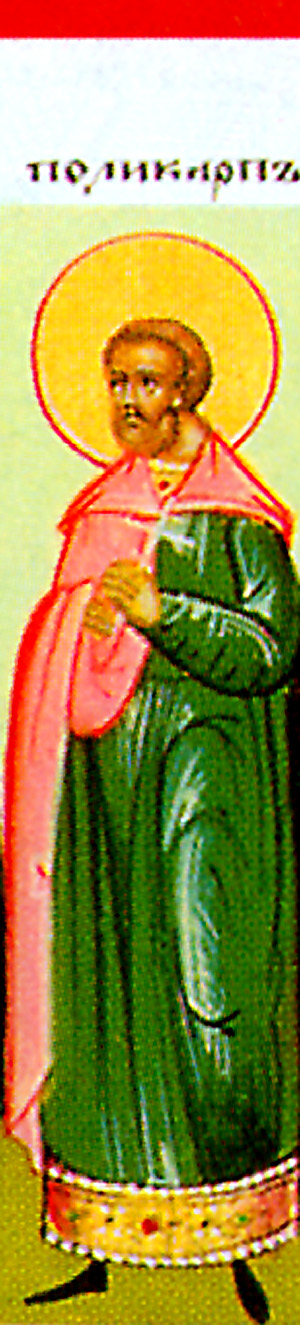
The Holy Martyr Polycarp was killed after he denounced the impious Emperor Maximian (305-313) for shedding the blood of innocent Christians in the city of Alexandria. As a devout Christian who was filled with zeal for God, he could not simply stand by when every day he saw many of the faithful being tortured because they refused to deny Christ.
One day Saint Polycarp saw the ruler sitting in his chair and watching as the blood of Christians flowed like water. The Saint stood before him and questioned him saying, "Why have you so forgotten human nature, you insatiable dog, that you cut down your relatives and fellow countrymen with swords like wood, because they proclaim the one true God and refute the error of idolatry; just as I do, who am a servant of Christ?"
Because he angered the ruler by saying such things, Saint Polycarp was arrested and tortured. Finally, he was beheaded, dying with the name of Christ on his lips. By being cut down like a vine-branch, he offered much fruit to Christ, and received the crown of martyrdom.
Saint George Matskevereli of Georgia

A few biographical details about Saint George of Atsquri have been preserved in the writings of the famous 10th-century Georgian hagiographers George Merchule and Basil of Zarzma.
Saint George of Atsquri lived at the end of the 9th and the beginning of the 10th centuries. A member of the aristocratic and pious Shuartqeli family, Saint George was raised and educated in the environs of Georgia’s renowned Opiza Monastery in Klarjeti.
Four years after the death of the great feudal lord George Chorchaneli, Saint George succeeded him as ruler of the Samtskhe region. At that time a bitter conflict arose over who was the rightful heir to Chorchaneli’s inheritance.
While serving as the chief political leader of Samtskhe, Saint George also directed the region’s spiritual life, wisely administering the ancient Atsquri diocese for many years. According to tradition, the diocese of Atsquri was founded by the holy Apostle Andrew the First-called, who left there the “Not-Made-By-Hands” icon of the Most Holy Theotokos (known as the Atsquri Icon of the Mother of God) as an offering to the Georgian Church.
Though his literary works have not been preserved, Saint George is also commemorated as a great writer of the Church.
In his book The Life of Saint Grigol of Khandzta, Saint George Merchule notes that Saint George of Atsquri made some of the most significant contributions to the biographical writings on Saint Grigol of Khandzta. Saint George of Atsquri was a close companion of Saint Serapion of Zarzma. He was present at his burial and contributed much to the hagiographical writings on his life and works.
Virgin Martyr Theodora of Tyre
Saint Theodora came from Tyre in Phoenicia. When she was seventeen years of age, she was brought before Urban, the ruler of Palestine, who asked her if she really believed in Christ. With remarkable courage, the holy virgin confessed that she truly believed. Then they flayed her sides and her breasts. Afterward, they threw her into the sea, where she surrendered her soul to God, thereby receiving a martyr's crown.
Saint Νikόdēmos of the Holy Mountain thought it very likely that this Saint is the same as Saint Theodosia (May 29), because their Lives are almost identical.
Daily Readings for Monday, April 01, 2024
3RD MONDAY OF LENT
ABSTAIN FROM MEAT, FISH, DAIRY, EGGS, WINE, OLIVE OIL
Mary of Egypt, Euthemios of Suzdal, Gerontios & Vasilides the Martyrs
ISAIAH 8:13-9:7
But the LORD of hosts, him you shall regard as holy; let him be your fear, and let him be your dread. And he will become a sanctuary, and a stone of offense, and a rock of stumbling to both houses of Israel, a trap and a snare to the inhabitants of Jerusalem. And many shall stumble thereon; they shall fall and be broken; they shall be snared and taken.” Bind up the testimony, seal the teaching among my disciples. I will wait for the LORD, who is hiding his face from the house of Jacob, and I will hope in him. Behold, I and the children whom the LORD has given me are signs and portents in Israel from the LORD of hosts, who dwells on Mount Zion. And when they say to you, “Consult the mediums and the wizards who chirp and mutter, ” should not a people consult their God? Should they consult the dead on behalf of the living? To the teaching and to the testimony! Surely for this word which they speak there is no dawn. They will pass through the land, greatly distressed and hungry; and when they are hungry, they will be enraged and will curse their king and their God, and turn their faces upward; and they will look to the earth, but behold, distress and darkness, the gloom of anguish; and they will be thrust into thick darkness. But there will be no gloom for her that was in anguish. In the former time he brought into contempt the land of Zebulun and the land of Naphtali, but in the latter time he will make glorious the way of the sea, the land beyond the Jordan, Galilee of the nations. The people who walked in darkness have seen a great light; those who dwelt in a land of deep darkness, on them has light shined. Thou hast multiplied the nation, thou hast increased its joy; they rejoice before thee as with joy at the harvest, as men rejoice when they divide the spoil. For the yoke of his burden, and the staff for his shoulder, the rod of his oppressor, thou hast broken as on the day of Midian. For every boot of the tramping warrior in battle tumult and every garment rolled in blood will be burned as fuel for the fire. For to us a child is born, to us a son is given; and the government will be upon his shoulder, and his name will be called “Wonderful Counselor, Mighty God, Everlasting Father, Prince of Peace.” Of the increase of his government and of peace there will be no end, upon the throne of David, and over his kingdom, to establish it, and to uphold it with justice and with righteousness from this time forth and for evermore. The zeal of the LORD of hosts will do this.
GENESIS 6:9-22
These are the generations of Noah. Noah was a righteous man, blameless in his generation; Noah walked with God. And Noah had three sons, Shem, Ham, and Japheth. Now the earth was corrupt in God’s sight, and the earth was filled with violence. And God saw the earth, and behold, it was corrupt; for all flesh had corrupted their way upon the earth. And God said to Noah, “I have determined to make an end of all flesh; for the earth is filled with violence through them; behold, I will destroy them with the earth. Make yourself an ark of gopher wood; make rooms in the ark, and cover it inside and out with pitch. This is how you are to make it: the length of the ark three hundred cubits, its breadth fifty cubits, and its height thirty cubits. Make a roof for the ark, and finish it to a cubit above; and set the door of the ark in its side; make it with lower, second, and third decks. For behold, I will bring a flood of waters upon the earth, to destroy all flesh in which is the breath of life from under heaven; everything that is on the earth shall die. But I will establish my covenant with you; and you shall come into the ark, you, your sons, your wife, and your sons’ wives with you. And of every living thing of all flesh, you shall bring two of every sort into the ark, to keep them alive with you; they shall be male and female. Of the birds according to their kinds, and of the animals according to their kinds, of every creeping thing of the ground according to its kind, two of every sort shall come in to you, to keep them alive. Also take with you every sort of food that is eaten, and store it up; and it shall serve as food for you and for them.” Noah did this; he did all that God commanded him.
PROVERBS 8:1-21
Does not wisdom call, does not understanding raise her voice?
On the heights beside the way, in the paths she takes her stand; beside the gates in front of the town, at the entrance of the portals she cries aloud:
To you, O men, I call, and my cry is to the sons of men.
O simple ones, learn prudence; O foolish men, pay attention.
Hear, for I will speak noble things, and from my lips will come what is right; for my mouth will utter truth; wickedness is an abomination to my lips.
All the words of my mouth are righteous; there is nothing twisted or crooked in them.
They are all straight to him who understands and right to those who find knowledge.
Take my instruction instead of silver, and knowledge rather than choice gold; for wisdom is better than jewels, and all that you may desire cannot compare with her.
I, wisdom, dwell in prudence, and I find knowledge and discretion.
The fear of the LORD is hatred of evil. Pride and arrogance and the way of evil and perverted speech I hate.
I have counsel and sound wisdom, I have insight, I have strength.
By me kings reign, and rulers decree what is just; by me princes rule, and nobles govern the earth.
I love those who love me, and those who seek me diligently find me.
Riches and honor are with me, enduring wealth and prosperity.
My fruit is better than gold, even fine gold, and my yield than choice silver.
I walk in the way of righteousness, in the paths of justice, endowing with wealth those who love me, and filling their treasuries.
Venerable Mary of Egypt

Saint Zosimas (April 4) was a monk at a certain Palestinian monastery on the outskirts of Caesarea. Having dwelt at the monastery since his childhood, he lived there in asceticism until he reached the age of fifty-three. Then he was disturbed by the thought that he had attained perfection, and needed no one to instruct him. “Is there a monk anywhere who can show me some form of asceticism that I have not attained? Is there anyone who has surpassed me in spiritual sobriety and deeds?”
Suddenly, an angel of the Lord appeared to him and said, “Zosimas, you have struggled valiantly, as far as this is in the power of man. However, there is no one who is righteous (Rom 3:10). So that you may know how many other ways lead to salvation, leave your native land, like Abraham from the house of his father (Gen 12:1), and go to the monastery by the Jordan.”
Abba Zosimas immediately left the monastery, and following the angel, he went to the Jordan monastery and settled in it.
Here he met Elders who were adept in contemplation, and also in their struggles. Never did anyone utter an idle word. Instead, they sang constantly, and prayed all night long. Abba Zosimas began to imitate the spiritual activity of the holy monks.
Thus much time passed, and the holy Forty Day Fast approached. There was a certain custom at the monastery, which was why God had led Saint Zosimas there. On the First Sunday of Great Lent the igumen served the Divine Liturgy, everyone received the All-Pure Body and Blood of Christ. Afterwards, they went to the trapeza for a small repast, and then assembled once more in church.
The monks prayed and made prostrations, asking forgiveness one of another. Then they made a prostration before the igumen and asked his blessing for the struggle that lay before them. During the Psalm “The Lord is my Light and my Savior, whom shall I fear? The Lord is defender of my life, of whom shall I be afraid?” (Ps 26/27:1), they opened the monastery gate and went off into the wilderness.
Each took with him as much food as he needed, and went into the desert. When their food ran out, they ate roots and desert plants. The monks crossed the Jordan and scattered in various directions, so that no one might see how another fasted or how they spent their time.
The monks returned to the monastery on Palm Sunday, each having his own conscience as a witness of his ascetic struggles. It was a rule of the monastery that no one asked how anyone else had toiled in the desert.
Abba Zosimas, according to the custom of the monastery, went deep into the desert hoping to find someone living there who could benefit him.
He walked into the wilderness for twenty days and then, when he sang the Psalms of the Sixth Hour and made the usual prayers. Suddenly, to the right of the hill where he stood, he saw a human form. He was afraid, thinking that it might be a demonic apparition. Then he guarded himself with the Sign of the Cross, which removed his fear. He turned to the right and saw a form walking southward. The body was black from the blazing sunlight, and the faded short hair was white like a sheep’s fleece. Abba Zosimas rejoiced, since he had not seen any living thing for many days.
The desert-dweller saw Zosimas approaching, and attempted to flee from him. Abba Zosimas, forgetting his age and fatigue, quickened his pace. When he was close enough to be heard, he called out, “Why do you flee from me, a sinful old man? Wait for me, for the love of God.”
The stranger said to him, “Forgive me, Abba Zosimas, but I cannot turn and show my face to you. I am a woman, and as you see, I am naked. If you would grant the request of a sinful woman, throw me your cloak so I might cover my body, and then I can ask for your blessing.”
Then Abba Zosimas was terrified, realizing that she could not have called him by name unless she possessed spiritual insight.
Covered by the cloak, the ascetic turned to Zosimas: “Why do you want to speak with me, a sinful woman? What did you wish to learn from me, you who have not shrunk from such great labors?”
Abba Zosimas fell to the ground and asked for her blessing. She also bowed down before him, and for a long time they remained on the ground each asking the other to bless. Finally, the woman ascetic said: “Abba Zosimas, you must bless and pray, since you are honored with the grace of the priesthood. For many years you have stood before the holy altar, offering the Holy Gifts to the Lord.”
These words frightened Saint Zosimas even more. With tears he said to her, “O Mother! It is clear that you live with God and are dead to this world. You have called me by name and recognized me as a priest, though you have never seen me before. The grace granted you is apparent, therefore bless me, for the Lord’s sake.”
Yielding finally to his entreaties, she said, “Blessed is God, Who cares for the salvation of men.” Abba Zosimas replied, “Amen.” Then they rose to their feet. The woman ascetic again said to the Elder, “Why have you come, Father, to me who am a sinner, bereft of every virtue? Apparently, the grace of the Holy Spirit has brought you to do me a service. But tell me first, Abba, how do the Christians live, how is the Church guided?”
Abba Zosimas answered her, “By your holy prayers God has granted the Church and us all a lasting peace. But fulfill my unworthy request, Mother, and pray for the whole world and for me a sinner, that my wanderings in the desert may not be useless.”
The holy ascetic replied, “You, Abba Zosimas, as a priest, ought to pray for me and for all, for you are called to do this. However, since we must be obedient, I will do as you ask.”
The saint turned toward the East, and raising her eyes to heaven and stretching out her hands, she began to pray in a whisper. She prayed so softly that Abba Zosimas could not hear her words. After a long time, the Elder looked up and saw her standing in the air more than a foot above the ground. Seeing this, Zosimas threw himself down on the ground, weeping and repeating, “Lord, have mercy!”
Then he was tempted by a thought. He wondered if she might not be a spirit, and if her prayer could be insincere. At that moment she turned around, lifted him from the ground and said, “Why do your thoughts confuse you, Abba Zosimas? I am not an apparition. I am a sinful and unworthy woman, though I am guarded by holy Baptism.”
Then she made the Sign of the Cross and said, “May God protect us from the Evil One and his schemes, for fierce is his struggle against us.” Seeing and hearing this, the Elder fell at her feet with tears saying, “I beseech you by Christ our God, do not conceal from me who you are and how you came into this desert. Tell me everything, so that the wondrous works of God may be revealed.”
She replied, “It distresses me, Father, to speak to you about my shameless life. When you hear my story, you might flee from me, as if from a poisonous snake. But I shall tell you everything, Father, concealing nothing. However, I exhort you, cease not to pray for me a sinner, that I may find mercy on the Day of Judgment.
“I was born in Egypt and when I was twelve years old, I left my parents and went to Alexandria. There I lost my chastity and gave myself to unrestrained and insatiable sensuality. For more than seventeen years I lived like that and I did it all for free. Do not think that I refused the money because I was rich. I lived in poverty and worked at spinning flax. To me, life consisted in the satisfaction of my fleshly lust.
“One summer I saw a crowd of people from Libya and Egypt heading toward the sea. They were on their way to Jerusalem for the Feast of the Exaltation of the Holy Cross. I also wanted to sail with them. Since I had no food or money, I offered my body in payment for my passage. And so I embarked on the ship.
“Now, Father, believe me, I am very amazed, that the sea tolerated my wantonness and fornication, that the earth did not open up its mouth and take me down alive into hell, because I had ensnared so many souls. I think that God was seeking my repentance. He did not desire the death of a sinner, but awaited my conversion.
“So I arrived in Jerusalem and spent all the days before the Feast living the same sort of life, and maybe even worse.
“When the holy Feast of the Exaltation of the Venerable Cross of the Lord arrived, I went about as before, looking for young men. At daybreak I saw that everyone was heading to the church, so I went along with the rest. When the hour of the Holy Elevation drew nigh, I was trying to enter into the church with all the people. With great effort I came almost to the doors, and attempted to squeeze inside. Although I stepped up to the threshold, it was as though some force held me back, preventing me from entering. I was brushed aside by the crowd, and found myself standing alone on the porch. I thought that perhaps this happened because of my womanly weakness. I worked my way into the crowd, and again I attempted to elbow people aside. However hard I tried, I could not enter. Just as my feet touched the church threshold, I was stopped. Others entered the church without difficulty, while I alone was not allowed in. This happened three or four times. Finally my strength was exhausted. I went off and stood in a corner of the church portico.
“Then I realized that it was my sins that prevented me from seeing the Life-Creating Wood. The grace of the Lord then touched my heart. I wept and lamented, and I began to beat my breast. Sighing from the depths of my heart, I saw above me an icon of the Most Holy Theotokos. Turning to Her, I prayed: ‘O Lady Virgin, who gave birth in the flesh to God the Word! I know that I am unworthy to look upon your icon. I rightly inspire hatred and disgust before your purity, but I know also that God became Man in order to call sinners to repentance. Help me, O All-Pure One. Let me enter the church. Allow me to behold the Wood upon which the Lord was crucified in the flesh, shedding His Blood for the redemption of sinners, and also for me. Be my witness before Your Son that I will never defile my body again with the impurity of fornication. As soon as I have seen the Cross of your Son, I will renounce the world, and go wherever you lead me.’
“After I had spoken, I felt confidence in the compassion of the Mother of God, and left the spot where I had been praying. I joined those entering the church, and no one pushed me back or prevented me from entering. I went on in fear and trembling, and entered the holy place.
“Thus I also saw the Mysteries of God, and how God accepts the penitent. I fell to the holy ground and kissed it. Then I hastened again to stand before the icon of the Mother of God, where I had given my vow. Bending my knees before the Virgin Theotokos, I prayed:
‘O Lady, you have not rejected my prayer as unworthy. Glory be to God, Who accepts the repentance of sinners. It is time for me to fulfill my vow, which you witnessed. Therefore, O Lady, guide me on the path of repentance.’
“Then I heard a voice from on high: ‘If you cross the Jordan, you will find glorious rest.’
“I immediately believed that this voice was meant for me, and I cried out to the Mother of God: ‘O Lady, do not forsake me!’
“Then I left the church portico and started on my journey. A certain man gave me three coins as I was leaving the church. With them I bought three loaves of bread, and asked the bread merchant the way to the Jordan.
“It was nine o’clock when I saw the Cross. At sunset I reached the church of Saint John the Baptist on the banks of the Jordan. After praying in the church, I went down to the Jordan and washed my face and hands in its water. Then in this same temple of Saint John the Forerunner I received the Life-Creating Mysteries of Christ. Then I ate half of one of my loaves of bread, drank water from the holy Jordan, and slept there that night on the ground. In the morning I found a small boat and crossed the river to the opposite shore. Again I prayed that the Mother of God would lead me where She wished. Then I found myself in this desert.”
Abba Zosimas asked her, “How many years have passed since you began to live in the desert?”
“‘I think,” she replied, “it is forty-seven years since I came from the Holy City.”
Abba Zosimas again asked, “What food do you find here, Mother?”
And she said, “I had with me two and a half loaves of bread when I crossed the Jordan. Soon they dried out and hardened. Eating a little at a time, I finished them after a few years.”
Again Abba Zosimas asked, “Is it possible you have survived for so many years without sickness, and without suffering in any way from such a complete change?”
“Believe me, Abba Zosimas,” the woman said, “I spent seventeen years in this wilderness [after she had spent seventeen years in immorality], fighting wild beasts: mad desires and passions. When I began to eat bread, I thought of the meat and fish which I had in abundance in Egypt. I also missed the wine that I loved so much when I was in the world, while here I did not even have water. I suffered from thirst and hunger. I also had a mad desire for lewd songs. I seemed to hear them, disturbing my heart and my hearing. Weeping and striking myself on the breast, I remembered the vow I had made. At last I beheld a radiant Light shining on me from everywhere. After a violent tempest, a lasting calm ensued.
“Abba, how shall I tell you of the thoughts that urged me on to fornication? A fire seemed to burn within me, awakening in me the desire for embraces. Then I would throw myself to the ground and water it with my tears. I seemed to see the Most Holy Virgin before me, and She seemed to threaten me for not keeping my vow. I lay face downward day and night upon the ground, and would not get up until that blessed Light encircled me, dispelling the evil thoughts that troubled me.
“Thus I lived in this wilderness for the first seventeen years. Darkness after darkness, misery after misery stood about me, a sinner. But from that time until now the Mother of God helps me in everything.”
Abba Zosimas again inquired, “How is it that you require neither food, nor clothing?”
She answered, “After finishing my bread, I lived on herbs and the things one finds in the desert. The clothes I had when I crossed over the Jordan became torn and fell apart. I suffered both from the summer heat, when the blazing heat fell upon me, and from the winter cold, when I shivered from the frost. Many times I fell down upon the earth, as though dead. I struggled with various afflictions and temptations. But from that time until the present day, the power of God has guarded my sinful soul and humble body. I was fed and clothed by the all-powerful word of God, since man does not live by bread alone, but by every word proceeding from the mouth of God (Dt 8:3, Mt.4:4, Luke 4:4), and those who have put off the old man (Col 3:9) have no refuge, hiding themselves in the clefts of the rocks (Job 24:8, Heb 11:38). When I remember from what evil and from what sins the Lord delivered me, I have imperishible food for salvation.”
When Abba Zosimas heard that the holy ascetic quoted the Holy Scripture from memory, from the Books of Moses and Job and from the Psalms of David, he then asked the woman, “Mother, have you read the Psalms and other books?”
She smiled at hearing this question, and answered, “Believe me, I have seen no human face but yours from the time that I crossed over the Jordan. I never learned from books. I have never heard anyone read or sing from them. Perhaps the Word of God, which is alive and acting, teaches man knowledge by itself (Col 3:16, 1 Thess 2:13). This is the end of my story. As I asked when I began, I beg you for the sake of the Incarnate Word of God, holy Abba, pray for me, a sinner.
“Furthermore, I beg you, for the sake of Jesus Christ our Lord and Savior, tell no one what you have heard from me, until God takes me from this earth. Next year, during Great Lent, do not cross the Jordan, as is the custom of your monastery.”
Again Abba Zosimas was amazed, that the practice of his monastery was known to the holy woman ascetic, although he had not said anything to her about this.
“Remain at the monastery,” the woman continued. “Even if you try to leave the monastery, you will not be able to do so. On Great and Holy Thursday, the day of the Lord’s Last Supper, place the Life-Creating Body and Blood of Christ our God in a holy vessel, and bring it to me. Await me on this side of the Jordan, at the edge of the desert, so that I may receive the Holy Mysteries. And say to Abba John, the igumen of your community, ‘Look to yourself and your brothers (1 Tim 4:16), for there is much that needs correction.’ Do not say this to him now, but when the Lord shall indicate.”
Asking for his prayers, the woman turned and vanished into the depths of the desert.
For a whole year Elder Zosimas remained silent, not daring to reveal to anyone what he had seen, and he prayed that the Lord would grant him to see the holy ascetic once more.
When the first week of Great Lent came again, Saint Zosimas was obliged to remain at the monastery because of sickness. Then he remembered the woman’s prophetic words that he would not be able to leave the monastery. After several days went by, Saint Zosimas was healed of his infirmity, but he remained at the monastery until Holy Week.
On Holy Thursday, Abba Zosimas did what he had been ordered to do. He placed some of the Body and Blood of Christ into a chalice, and some food in a small basket. Then he left the monastery and went to the Jordan and waited for the ascetic. The saint seemed tardy, and Abba Zosimas prayed that God would permit him to see the holy woman.
Finally, he saw her standing on the far side of the river. Rejoicing, Saint Zosimas got up and glorified God. Then he wondered how she could cross the Jordan without a boat. She made the Sign of the Cross over the water, then she walked on the water and crossed the Jordan. Abba Zosimas saw her in the moonlight, walking toward him. When the Elder wanted to make prostration before her, she forbade him, crying out, “What are you doing, Abba? You are a priest and you carry the Holy Mysteries of God.”
Reaching the shore, she said to Abba Zosimas, “Bless me, Father.” He answered her with trembling, astonished at what he had seen. “Truly God did not lie when he promised that those who purify themselves will be like Him. Glory to You, O Christ our God, for showing me through your holy servant, how far I am from perfection.”
The woman asked him to recite both the Creed and the “Our Father.” When the prayers were finished, she partook of the Holy Mysteries of Christ. Then she raised her hands to the heavens and said, “Lord, now let Your servant depart in peace, for my eyes have seen Your salvation.”
The saint turned to the Elder and said, “Please, Abba, fulfill another request. Go now to your monastery, and in a year’s time come to the place where we first time spoke.”
He said, “If only it were possible for me to follow you and always see your holy face!”
She replied, “For the Lord’s sake, pray for me and remember my wretchedness.”
Again she made the Sign of the Cross over the Jordan, and walked over the water as before, and disappeared into the desert. Zosimas returned to the monastery with joy and terror, reproaching himself because he had not asked the saint’s name. He hoped to do so the following year.
A year passed, and Abba Zosimas went into the desert. He reached the place where he first saw the holy woman ascetic. She lay dead, with arms folded on her bosom, and her face was turned to the east. Abba Zosimas washed her feet with his tears and kissed them, not daring to touch anything else. For a long while he wept over her and sang the customary Psalms, and said the funeral prayers. He began to wonder whether the saint would want him to bury her or not. Hardly had he thought this, when he saw something written on the ground near her head: “Abba Zosimas, bury on this spot the body of humble Mary. Return to dust what is dust. Pray to the Lord for me. I reposed on the first day of April, on the very night of the saving Passion of Christ, after partaking of the Mystical Supper.”
Reading this note, Abba Zosimas was glad to learn her name. He then realized that Saint Mary, after receiving the Holy Mysteries from his hand, was transported instantaneously to the place where she died, though it had taken him twenty days to travel that distance.
Glorifying God, Abba Zosimas said to himself, “It is time to do what she asks. But how can I dig a grave, with nothing in my hands?” Then he saw a small piece of wood left by some traveler. He picked it up and began to dig. The ground was hard and dry, and he could not dig it. Looking up, Abba Zosimas saw an enormous lion standing by the saint’s body and licking her feet. Fear gripped the Elder, but he guarded himself with the Sign of the Cross, believing that he would remain unharmed through the prayers of the holy woman ascetic. Then the lion came close to the Elder, showing its friendliness with every movement. Abba Zosimas commanded the lion to dig the grave, in order to bury Saint Mary’s body. At his words, the lion dug a hole deep enough to bury the body. Then each went his own way. The lion went into the desert, and Abba Zosimas returned to the monastery, blessing and praising Christ our God.
Arriving at the monastery, Abba Zosimas related to the monks and the igumen, what he had seen and heard from Saint Mary. All were astonished, hearing about the miracles of God. They always remembered Saint Mary with faith and love on the day of her repose.
Abba John, the igumen of the monastery, heeded the words of Saint Mary, and with the help of God corrected the things that were wrong at the monastery. Abba Zosimas lived a God-pleasing life at the monastery, reaching nearly a hundred years of age. There he finished his temporal life, and passed into life eternal.
The monks passed on the life of Saint Mary of Egypt by word of mouth without writing it down.
“I however,” says Saint Sophronius of Jerusalem (March 11), “wrote down the Life of Saint Mary of Egypt as I heard it from the holy Fathers. I have recorded everything, putting the truth above all else.”
“May God, Who works great miracles and bestows gifts on all who turn to Him in faith, reward those who hear or read this account, and those who copy it. May he grant them a blessed portion together with Saint Mary of Egypt and with all the saints who have pleased God by their pious thoughts and works. Let us give glory to God, the Eternal King, that we may find mercy on the Day of Judgment through our Lord Jesus Christ, to Whom is due all glory, honor, majesty and worship together with the Unoriginate Father, and the Most Holy and Life-Creating Spirit, now and ever and unto ages of ages. Amen.”
Venerable Euthymius of Suzdal

Saint Euthymius of Suzdal was born in the year 1316 at Nizhni-Novgorod. From early childhood he was taught his letters and received a spiritual upbringing. He received monastic tonsure at the Nizhegorod Caves monastery under its founder, Saint Dionysius (later the Archbishop of Suzdal, commemorated June 26 and October 15).
The ascetic struggles of Saint Euthymius were so great that Saint Dionysius advised him to lessen them. In 1352 Prince Boris of Suzdal sought to establish a men’s monastery in his city, and he requested the Nizhegorod Caves monastery to send a monk to establish the monastery. The choice of the saintly igumen fell upon Saint Euthymius.
After the arrival of Saint Euthymius in the northern part of the city beyond the Kamenka River, Saint John of Suzdal (October 15) set up a cross on the site of the future monastery cathedral before a tremendous crowd of people. The prince himself began to dig the ground for the foundation, and Saint Euthymius made three grave stones for himself, vowing to remain in the new monastery until the very end of his life.
So, the the Savior-Euthymius monastery was founded, where soon more than three hundred monks gathered under the guidance of the saint. The monastery adopted the cenobitic rule. The saint insisted that each of the monks be prepared to fulfill whatever obedience they were given. Saint Euthymius went often to the Trinity-Sergiev monastery to Saint Sergius of Radonezh (September 25 and July 5). Saint Euthymius was a strict ascetic and a great man of prayer. He toiled incessantly for the benefit of all the brethren. Saint Euthymius died on April 1, 1404.
On July 4, 1507 while a foundation trench was being dug for a new cathedral church, his incorrupt relics were uncovered. The saint was glorified at a Council in 1549.
Martyr Abraham of Bulgaria

The Holy Martyr Abraham the Bulgar, Vladimir Wonderworker, lived during the thirteenth century, and was descended from the Kamska Bulgars and brought up as a Moslem. He was good and kindly towards the destitute, and when the Lord enlightened him with the light of reason, he accepted Christianity.
In the city of Bolgara, on the lower stretches of the Volga, Saint Abraham began to preach to his fellow countrymen about the true God. They seized him and tried to force him to renounce Christ, but the saint remained firm in his confession. They tortured the martyr fiercely and for a long while, but he endured everything with unshakable patience.
On April 1, 1229 they quartered the holy Martyr Abraham, and then cut off his venerable head. Russian Christians living in the city buried the saint’s body in the Christian cemetery. On March 6, 1230, the relics of Saint Abraham were transferred by the Great Prince Saint George Vsevolodovich of Vladimir (February 4) to the Dormition cathedral of the Knyaginin (Princess) monastery. His memory began to be celebrated from that time.
Venerable Gerontius the Canonarch of the Kiev Far Caves

Saint Gerontius lived during the fourteenth century. He was a monk of the Kiev Caves Monastery and fulfilled the obedience of canonarch (leader of church singing). He spent all his life at the monastery, in ascetic deeds of abstinence, obedience, and prayer.
Saint Gerontius was buried in the Far Caves. His memory is celebrated also together with the Synaxis of the Saints of the Far Caves, on August 28.
Venerable Makarios, Igoumen of Pelēketḗ
Saint Makarios (Christóphoros in the world) was born at Constantinople in 785. He lost both his parents when he was still a child, and a pious uncle assumed responsibility for his upbringing and education, and also taught him to love God. In a short time his knowledge of Holy Scripture increased, and he realized that there are earthly and corruptible things, and also things which are heavenly, incorruptible, and eternal.
Since he was drawn to the monastic life, he forsook the world and fled to the monastery of Saint John the Theologian, also called Pelēketḗ, at Triglia of Proussa in Bithynia, where the renowned ascetic, Saint Hilarion (March 28) was the Igoumen. After receiving the monastic tonsure, he was given the name Makarios. The young monk began to engage in ascetical struggles and prayer. Later, by God's will, Saint Makarios was chosen as the Igoumen of the Monastery after Saint Hilarion's repose.
Saint Makarios became a Spiritual Father for all, not only for the monks, but also for the faithful, who flocked to him seeking his advice, his prayers, and for the healing of both soul and body, since God had given him the extraordinary gift (χάρισμα) of working miracles.
Patriarch Tarasios (784 – 806) was aware of the Saint's reputation, so he sent to him to the patrician Paul, who was suffering from an incurable illness. Saint Makarios healed him, and later he healed Paul's wife of the same illness. After that, Patriarch Tarasios took the Saint to Constantinople, and ordained him to the holy priesthood. The holy Elder submitted to the Patriarch's will because, as he said himself, "I hate disobedience and love obedience."
The heresy of iconoclasm erupted during the reign of the Byzantine Emperors Leo V the Armenian (813-820) and Michael II the Stammerer (820-829). Leo exiled the holy Patriarch Nikēphóros, and he had many monks and priests tortured, exiled, or thrown into prison.
Saint Makarios also suffered as a confessor because of his veneration of the Holy Icons. Since he was loved and respected, he was sentenced to prison, where he remained until Leo's death. Emperor Michael the Stammerer succeeded Leo in the year 820, and released the Elder from prison. He was an iconoclast, however; therefore, he tried to flatter the Saint, urging him to condemn the veneration of icons, but he remained steadfast in his faith.
Seeing that torture and threats were ineffective, Michael had the Saint exiled to the small island of Aphousia, which is in the Sea of Marmara, near Alona. There he lived in hardship and deprivation for many years continually giving thanks to God.
Saint Makarios went to the Lord around the year 830, and was succeeded as Igoumen by the monk Sergius the Solitary, who wrote his Life.
Martyrs Gerontius and Basilides

The Martyrs Gerontius and Basilides suffered martyrdom for Christ in the third century. They were beheaded by the sword.
Righteous Achaz (Ahaz)
No information available at this time.
Saint John Shavteli, Bishop of Gaenati and Saint Eulogius, Prophet and Fool-for-Christ of Salosi

The great Georgian hymnographer, philosopher, and orator Saint John of Shavta labored in the 12th and 13th centuries, during the reign of the holy queen Tamar. Few details of his life have been preserved, but we know that he received his education at Gelati Academy, where he studied theology, ancient and Arabic history, philosophy, and literature. He was later tonsured a monk and labored at Vardzia Monastery.
When the Georgian army under the command of Queen Tamar’s husband, Davit Soslan, entered into battle (The Battle of Basiani (ca. 1203)) with the sultan Rukn al-Din, Queen Tamar journeyed to Odzrkhe Monastery to pray for help. Catholicos Tevdore of Kartli and many hierarchs and monastics accompanied her there. Among them, Saint John of Shavta stood out as a wise theologian and philosopher and a brilliant hymnographer.
During the Liturgy at Odzrkhe Monastery a miracle occurred: endowed by God with the gift of prophecy, Saint Eulogius the Fool for-Christ fell to his knees, lifted his hands to the heavens and cried out: “Glory to God! Almighty Christ!…Do not fear the Persians, but rather depart in peace, for the mercy of God has descended upon the house of Tamar!”
Eulogius’s words were clearly a divine revelation. Saint John of Shavta turned to Queen Tamar, rejoicing, “Your Highness! The Almighty has made known to us our victory in the war from the lips of a fool-for-Christ!” Eulogius confided his secret to Saint John: disguised as a fool, he had been concealing his God-given gift. But now it seemed that the gift would become apparent to all, so Eulogius quickly disappeared out of sight to escape the people’s attention.
Saint John of Shavta composed his “Hymns to the Theotokos of Vardzia” in thanksgiving for Georgia’s victory in the Battle of Basiani. He is also recognized as the composer of “Abdul-Messiah,” (Abdul-Messiah: servant of Christ) a famous ode to the holy queen Tamar.
Our Holy Father John of Shavta lived to an advanced age and was canonized soon after his repose.
Venerable Barsanuphius of Optina
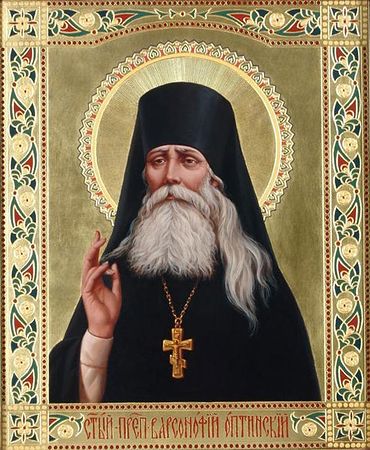
Paul I. Plikhanov was born in the city of Samara on July 5,1845, the son of John and Natalia Plikhanov. His mother died in childbirth, and his father later remarried so that his son would have a mother. Although his stepmother was very strict, she was a real mother to him, and he loved her very much.
As a descendant of the Orenburg Cossacks, Paul was enrolled in the Polotsk Cadet Corps. He completed his studies at the Orenburg Military School and received an officer’s commission. He later graduated from the Petersburg Cossack Staff Officers’ School, and also served at the headquarters of the Kazan military district and eventually rose to the rank of colonel.
Once, as he was sick with pneumonia, Paul sensed that he was about to die. He asked his orderly to read the Gospel to him, and passed out. Then he had a vision in which the heavens seemed to open, and he was afraid because of the great light. His whole sinful life passed before him, and he was overcome with repentance. A voice told him he should go to Optina Monastery, but the doctors did not think he would recover. His health did improve, however, and the colonel visited Optina. In August 1889 the Elder of the Monastery was Saint Ambrose (October 10), who told Paul to set his worldly affairs in order. Two years later, Saint Ambrose blessed him to cut all ties to the world and told him to enter Optina within three months.
It was not easy for the colonel to resign his commission within the specified three month period, because obstacles were placed in his way. In fact, he was offered a promotion to the rank of general, and was asked to delay his retirement. Some people even tried to arrange a marriage for him, laughing at his intention to go to the monastery. Only his stepmother was happy that he wished to become a monk. On the very last day of the three months he concluded his affairs and arrived at Optina. However, Saint Ambrose was already laid out in his coffin in the church.
Saint Anatole I (January 25) succeeded Father Ambrose as Elder, and he assigned Paul to Hieromonk Nectarius (April 29) as his cell attendant. He was accepted as a novice in 1892, and tonsured as a rassophore in 1893. Over the next ten years he advanced through the various stages of monastic life, including ordination as deacon (1902), and as priest (1903). The monk Paul was secretly tonsured into the mantiya in December of 1900 because of a serious illness. When they asked him what name he wished to receive, he said it did not matter. They named him in honor of Saint Barsanuphius of Tver and Kazan (April 11). Although he recovered, they did not give him the mantiya until December of 1902 after the Liturgy when it was revealed that he had been tonsured on his sickbed.
On September 1, 1903 Father Barsanuphius was appointed to assist Elder Joseph, the skete Superior, in the spiritual direction of the skete brethren and the sisters of the Shamordino convent.
At the beginning of the Russo-Japanese war in 1904, Father Barsanuphius was sent to the Far East as a military chaplain, where he ministered to wounded soldiers. The war ended in August 1905, and Saint Barsanuphius returned to Optina on November 1, 1905.
Since Elder Joseph had become too old and frail to administer the skete’s affairs, Father Barsanuphius was appointed as Superior of the skete in his place. Father Barsanuphius soon reestablished order and discipline, paid off debts, repaired buildings, etc. As Superior, he combined strictness with paternal concern and tenderness for those under him.
Saint Barsanuphius, like the other Elders of Optina, possessed the gifts of clairvoyance and of healing people afflicted with physical and spiritual ailments. One of his spiritual sons, Father Innocent Pavlov, recalled his first Confession with the Elder. He became fearful because Father Barsanuphius seemed to know his innermost thoughts, reminding him of people and events which he had forgotten. The saint spoke gently and told him that it was God who had revealed to him these things about Father Innocent. “During my lifetime, do not tell anyone about what you are experiencing now,” he said, “but you may speak of it after my death.”
Saint Barsanuphius loved spiritual books, especially the Lives of the Saints. He often told people that those who read these Lives with faith benefit greatly from doing so. The answers to many of life’s questions can be found by reading the Lives of the Saints, he said. They teach us how to overcome obstacles and difficulties, how to stand firm in our faith, and how to struggle against evil and emerge victorious. Although the Lives of the Saints were widely available, it saddened the Elder that more people did not read them.
Saint Barsanuphius commemorated many saints each day during his Rule of prayer, and this was not accidental. Each saint, he once explained, had some particular importance in his life. If, for example, some significant event took place, he would look to see which saints were commemorated on that day, then he would begin to commemorate them each day. Later he noticed that on their Feast Day, they would often deliver him from some danger or trouble. On December 17, 1891, the commemoration of the Prophet Daniel and the three holy youths, he left Kazan and never returned. That was the day he decided to leave the world, and Saint Barsanuphius felt that God had delivered him from a furnace of passions. Just as the three youths were delivered from the fiery furnace because they would not bow down before idols, the Elder always believed that he left the world unharmed because he refused to bow down before the idols of lust, pride, gluttony, etc.
By 1908, Saint Barsanuphius seemed to fall ill more frequently, and began to speak of his approaching death. In April of that year, someone sent him a package containing the Great Schema. Father Barsanuphius had long desired to be tonsured into the Great Schema before his death, but he had told no one of this except for the archimandrite. Therefore, he regarded this as a sign that he would soon die.
One night in July 1910, the Elder became so ill that he had to leave church during Vigil and return to his cell. The next morning, July 11, he was so weak that he could not sit up by himself. That evening he was tonsured into the Great Schema.
Father Barsanuphius began to recover, but there were new problems in the monastery. New monks came in from spiritually lax environments. They did not understand the ascetical nature of monasticism or the whole notion of eldership, and so they began to clamor for reform and change. They wanted to assume positions of authority, and to close the skete. Because of their complaints, Father Barsanuphius was removed from Optina and assigned as igumen of the Golutvinsky Monastery. When he arrived to take up his duties, Father Barsanuphius found the monastery in a state of physical and spiritual decline. Nevertheless, he did not lose heart, and soon the monastery began to revive. More people began to visit, once they heard that an Optina Elder had come to Goluvinsky, and the monastery’s financial position also began to improve. However, the rebellious brethren caused him great sorrow, and he had to expel some of them
At the beginning of 1913, Saint Barsanuphius became ill again and asked Metropolitan Macarius of Moscow for permission to retire to Optina, but that was not to be. He fell asleep in the Lord on April 1, and his body remained in the church of Golotvino until April 6 (which was also Lazarus Saturday). After the funeral, his body was placed on a train and sent to Optina for burial. The train arrived at Kozelsk Station on April 8, and the coffin was carried to Optina by clergy.
The Moscow Patriarchate authorized local veneration of the Optina Elders on June 13, 1996. The work of uncovering the relics of Saints Leonid, Macarius, Hilarion, Ambrose, Anatole I, Barsanuphius and Anatole II began on June 24/July 7, 1998 and was concluded the next day. However, because of the church Feasts (Nativity of Saint John the Baptist, etc.) associated with the actual dates of the uncovering of the relics, Patriarch Alexey II designated June 27/July 10 as the date for commemorating this event. The relics of the holy Elders now rest in the new church of the Vladimir Icon of the Mother of God.
The Optina Elders were glorified by the Moscow Patriarchate for universal veneration on August 7, 2000.
 Saint Peter Antiochian Orthodox Church