Monthly Archives: April 2024

Holy Week Activities 2024

Saturday April 27

Following the Divine Liturgy children (and adults) we will decorate the large palms with flowers and dye red eggs. We will also read ” The Miracle of the Red Egg.”

Please bring a pair of pruners, some greenery and flowers from your yard (or a shop)and your talents to help prepare for the feast of Palm Sunday.

Palm Sunday April 28

After the Divine Liturgy we will remove the Palms. Families may take them home to enjoy for the week. Please return the plastic containers to the Church.

Holy Thursday May 2

After the Liturgy we need a few ladies to help place the Italien Ruscus on the Bier. Please let Charlotte Algood know if you can help.

Holy Friday May 3

Following the Royal Hours we will decorate the bier, decorate baskets for the Myrrhbearing women and make flower arrangements to go under the icons and for the windows for Pascha. Everyone is welcome ! Please let Charlotte Algood know if you plan to help and if your children are coming. We plan to start around 9:00 depending on the service. Please bring pruners.

Holy Saturday May 4

Following the Divine Liturgy we will decorate the Church for Pascha.

Please come and enjoy these special activities as we prepare to celebrate thr Resurrection of our Lord

Daily Readings for Saturday, April 20, 2024

5TH SATURDAY OF LENT: THE AKATHIST HYMN

ABSTAIN FROM MEAT, FISH, DAIRY, EGGS

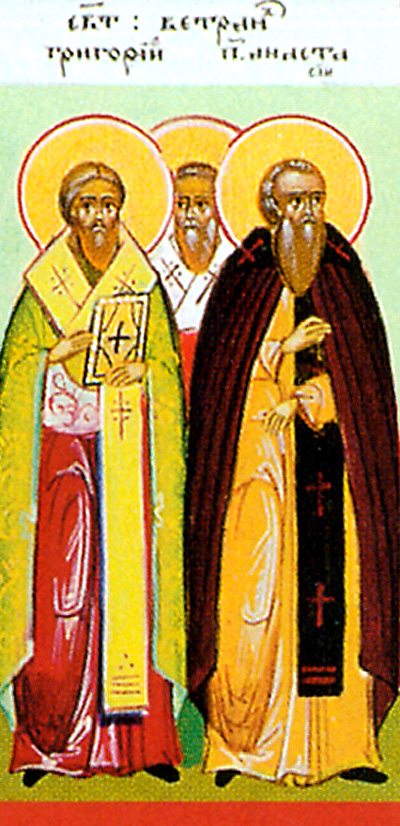
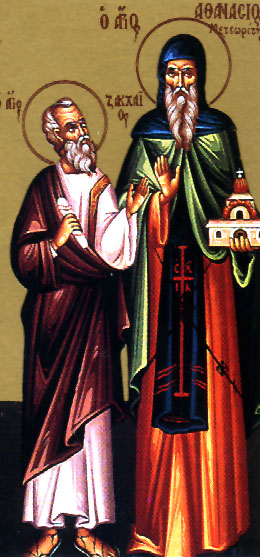
5th Saturday of Lent: The Akathist Hymn, Theodore the Trichinas, Zacchaeus the Apostle of Caesaria, Gregory & Anastasios, Patriarchs of Antioch, Athanasios, Founder of the Monastery of Meteora

ST. PAUL’S LETTER TO THE HEBREWS 9:1-7

BRETHREN, the first covenant had regulations for worship and an earthly sanctuary. For a tent was prepared, the outer one, in which were the lampstand and the table and the bread of the Presence; it is called the Holy Place. Behind the second curtain stood a tent called the Holy of Holies, having the golden altar of incense and the ark of the covenant covered on all sides with gold, which contained a golden urn holding the manna, and Aaron’s rod that budded, and the tables of the covenant; above it were the cherubim of glory overshadowing the mercy seat. Of these things we cannot now speak in detail. These preparations having thus been made, the priests go continually into the outer tent, performing their ritual duties; but into the second only the high priest goes, and he but once a year, and not without taking blood which he offers for himself and for the errors of the people.

LUKE 1:39-49, 56

In those days, Mary arose and went with haste into the hill country, to a city of Judah, and she entered the house of Zacharias and greeted Elizabeth. And when Elizabeth heard the greeting of Mary, the babe leaped in her womb; and Elizabeth was filled with the Holy Spirit and she exclaimed with a loud cry, "Blessed are you among women, and blessed is the fruit of your womb! And why is this granted me, that the mother of my Lord should come to me? For behold, when the voice of your greeting came to my ears, the babe in my womb leaped for joy. And blessed is she who believed that there would be a fulfillment of what was spoken to her from the Lord." And Mary said, "My soul magnifies the Lord, and my spirit rejoices in God my Savior, for he has regarded the low estate of his handmaiden. For behold, henceforth all generations will call me blessed; for he who is mighty has done great things for me, and holy is his name." And Mary remained with her about three months, and returned to her home.

5th Saturday of Great Lent: of the Akathist to the Theotokos

On the Fifth Saturday of Great Lent, the Saturday of the Akathist, we commemorate the “Laudation of the Virgin” Icon of the Most Holy Theotokos.

In 625, when the emperor Heraclius was fighting the Persians, the Khan sent forces to attack Constantinople by land and by sea. Patriarch Sergius urged the people not to lose heart, but to trust in God.

A procession was made around the city with the Cross of the Lord, the robe of the Virgin, the Icon of the Savior not made by hands, and the Hodēgḗtria Icon of the Mother of God. The Patriarch dipped the Virgin’s robe in the sea, and the city’s defenders beat back the Khan’s sea forces. The sea became very rough, and many boats sank. The invaders retreated, and the people of Constantinople gave thanks to God and to His Most Pure Mother.

On two other occasions, in 655 and 705, the Theotokos protected the city from Saracen invaders. A feastday dedicated to the Laudation of the Virgin was established to commemorate these victories. The Akathist to the Mother of God is believed to originate from this period, and its use has spread from Constantinople to other Orthodox lands.

The icon before which the Akathist was sung was given to the Dionysiou Monastery on Mt. Athos by Emperor Alexius Comnenos. There, it began to flow with myrrh. There were at least three wonderworking copies of this icon in Russia before the Revolution.

This icon shows the Mother of God seated on a throne, and surrounded by Prophets with scrolls.

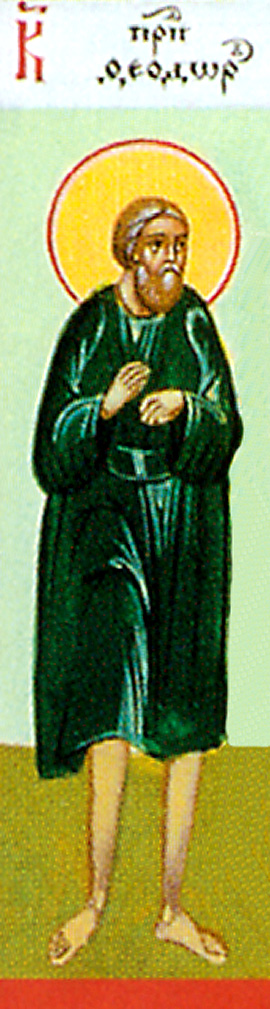
Venerable Theodore Trichinas “the Hair-Shirt Wearer” and Hermit Near Constantinople

Saint Theodore Trichinas was born in Constantinople, the son of wealthy and pious parents. From childhood Saint Theodore was inclined toward monasticism, so he left his home, family, and former life in order to enter a monastery in Thrace. There he began his arduous ascetic struggles. He dressed in a hair-shirt, from which he derived the name “Trichinas,” (or “Hair-Shirt Wearer”). He even slept on a stone in order avoid bodily comfort, and to prevent himself from sleeping too much.

His life was adorned with miracles, and he had the power to heal the sick. He reposed at the end of the fourth century, or the beginning of the fifth century. A healing myrrh flows from his relics.

The name of Saint Theodore Trichinas is one of the most revered in the history of Orthodox monasticism. Saint Joseph the Hymnographer (April 4) has composed a Canon to the saint.

Venerable Alexander, Abbot of Oshevensk

Saint Alexander of Oshevensk (+ 1479) was the founder of the Oshevensk Dormition Monastery and enlightener of the Kargopol area, and was tonsured in the White Lake Monastery. He appeared to Saint Diodorus of George Hill (November 27) in the seventeenth century when his Holy Trinity Monastery ran out of supplies, and the brethren complained because there was nowhere to buy food in the wilderness. Saint Alexander reminded Diodorus of how the Lord had fed the five thousand in the wilderness, and ordered him to go fishing. Saint Diodorus, fearing that the vision was a demonic delusion, ignored it. When Saint Alexander appeared a third time, Diodorus, wishing to test him, asked him to say a prayer. Saint Alexander recited “It is Truly Meet,” and his face shone with a radiant light. The saint revealed himself as Alexander, the igumen of Oshevensk Dormition Monastery, and repeated his order to go fishing. Obeying this command, the monks went out and caught many fish.

Childmartyr Gabriel of Bialystok

Child Martyr Gabriel of Bialystok (+ 1690) was killed in Poland when he was only six years old. One day when his parents were not home, he was lured out of his house by a man named Schutko, and then killed. After thirty years, the martyred child’s body was found to be incorrupt.

Blessed Gregory, Patriarch of Antioch

No information available at this time.

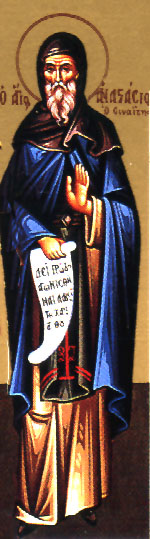
Venerable Anastasius, Abbot of Sinai

Saint Anastasius of Sinai lived in the seventh century, and was one of the great ascetics who flourished on Mt. Sinai.

From his youth, he was raised in great piety and love for God. When he reached manhood, Saint Anastasius left the world and entered a monastery to take upon himself the yoke of Christ (Mt.11:29). Wishing to perfect himself in virtue, he went to Saint Catherine’s Monastery on Mt. Sinai, where Saint John of the Ladder (March 30) was abbot. There he profited from the example of many holy men who were proficient in monasticism.

Because of his humility, Saint Anastasius received wisdom and spiritual discernment from God. He wrote the Lives of several holy Fathers, as well as other spiritually instructive books. In time, he was found worthy of ordination to the holy priesthood.

Following Saint John and his brother George, Saint Anastasius became abbot of Sinai. He was most zealous in his opposition to heresy, exposing it, refuting it, and covering its adherents with shame. He even traveled to Syria, Egypt, and Arabia to uproot heresy and strengthen the Church of Christ.

Saint Anastasius taught that God gives each Christian an angel to care for him throughout his life. However, we can drive our Guardian Angel away by our sins, just as bees are driven away by smoke. While the demons work to deprive us of the heavenly Kingdom, the holy angels guide us to do good. Therefore, only the most foolish individuals would drive away their Guardian Angel from themselves.

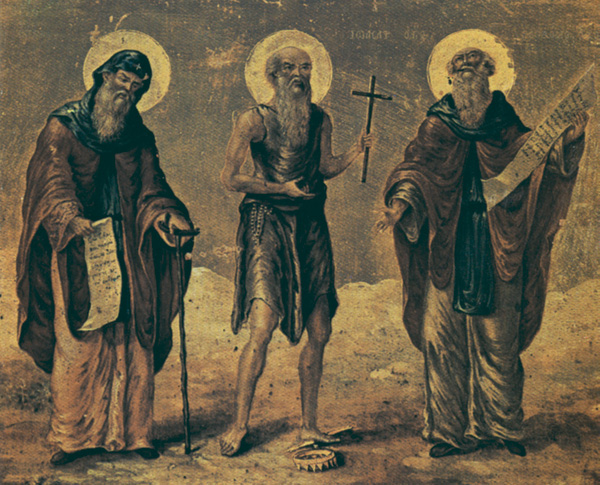
After a long life of faithfully serving God, Saint Anastasius fell asleep in the Lord in the year 685. He and the other ascetics of Mt. Sinai are also commemorated on Bright Wednesday, the Synaxis of the Monastic Fathers of Sinai.

Saint Betran, Bishop of Lesser Scythia

No information available at this time.

Saint Theotimus, Bishop of Lesser Scythia

Saint Theotimus the Scythian was Bishop of Tomis in Scythia. He was a native of Dacia Pontica, and was part Roman. He is believed to have been the teacher of Saint John Cassian (February 29) and Saint Germanus, because he was once living in the same monastery as they were.

Somewhere between 385-390, Saint Theotimus succeeded Saint Germanus as Bishop of Tomis. Saint Jerome mentions him in his book ON ILLUSTRIUS MEN. He describes Saint Theotimus as a good pastor, a wise theologian, and a talented writer. He also says that Saint Theotimus used to write short works in the form of dialogues, which reveal his training in rhetoric and philosophy.

In his writings, Saint Theotimus speaks of the role of the mind and the heart in prayer. Perhaps because of this he is considered to be the Father of the Romanian PHILOKALIA.

Saint Theotimus sometimes endured hardships from wandering barbarians, but he impressed them with the holiness of his life and the miracles he performed. He also had close ties with Saint John Chrysostom, and visited Constantinople at least twice.

Sometime around 410, Saint Theotimus fell asleep in the Lord. Ancient historians also refer to him as “the Philosopher.”

Translation of the relics of Saint Nikolai of Zhicha

No information available at this time.

Saint Joseph of Serbia

No information available at this time.

Apostle Zacchaeus

The holy Apostle Zacchaeus was a rich publican at Jericho. Since he was short of stature, he climbed a sycamore tree in order to see the Savior passing by. After the Ascension of the Lord, Saint Zacchaeus accompanied Saint Peter on his travels. Tradition says he became the Bishop of Caesarea in Palestine, where he died in peace.

The Gospel (Luke 19:1-10) describing Zacchaeus’ encounter with Christ is read on the Sunday before the Triodion begins.

Saint Athanasius of Meteora

Saint Athanasios, the son of wealthy parents, was born in 1302 at Hypátē, the well-known medieval town of New Patras, and was named Andronikos in Holy Baptism. His mother died during childbirth, and after a short time his father also reposed. Thus, young Andronikos lost both of his parents in a very early age. Then he found sympathy, affection, and love from his father's brother, who saw to his education, taking care of all his needs, and taught him to read and write.

After the capture of his hometown by the Catalans in 1318/19, the chief of the Franks took Andronikos into his home. At the first opportunity, Andronikos escaped and was free. He hastened to rejoin his uncle, who had been banished to a distant place. Andronikos found him, and the two booked passage on a ship bound for Thessaloniki. The godly uncle suffered from a chronic joint disease, however, and after some time, he reposed at Akapniou Monastery.

Andronikos then went to live with the imperial secretary of the military command, who became his guardian for a short time. Andronikos wanted to be trained in secular learning and classical studies. Since he had no money to pay the instructors, he would stand outside and listen while the students were being taught. Some of the school's philosophers noticed his love of learning and his eagerness, so they they taught him without asking for a fee.

After benefitting from his teachers' knowledge, Andronikos became quite educated and cultured. Then he decided to go on pilgrimage. When he was seventeen years old, Andronikos traveled to Mount Athos, where he conversed with many holy Fathers, seeking their prayers and blessings. The Athonite Fathers, however, refused to allow the boy to remain, since he was still a beardless youth.

Andronikos made his way to Constantinople, visiting churches, and venerating the relics of the Saints. While there he met several prominent and virtuous Fathers, such as Gregory of Sinai, the future Ecumenical Patriarch Isidore (1347-1350), who supported Saint Gregory Palamas, and then made him Metropolitan of Thessaloniki, Daniel the Hesychast, and other notable persons of the monastic community. With their help he was initiated into the secrets of the hesychastic life and, like a bee, he gathered whatever was useful and necessary to acquire virtue.

He traveled to Crete in 1325 where he stayed for a certain time and lived as an ascetic, receiving hospitality from a virtuous and charitable Cretan man. When he noticed this man was trying to lure him back into the world in order to marry his daughter, he decided to forsake the world. Therefore, he returned to Mount Athos in 1332, by which time he was approximately thirty years old. At Milea on the Holy Mountain he was accepted as a novice by two virtuous anchorites, Gregory and Moses, who had attained the heights of virtue. Subsequently, he was tonsured by Hieromonk Gregory, taking the name Anthony. He quickly distinguished himself and then received his new monastic name of Athanasios when he was tonsured into the Great Schema.

However, the predatory incursions of the Turks and the unfavorable circumstances prevailing at that time forced Saint Athanasios to leave Mount Athos together with his Spiritual Father Gregory, and another disciple, Gabriel. At Thessaloniki and Beroia many important men were willing to give them hospitality, but the two monks did not consent to stay because Athanasios had a great aversion to secular society and to the noise of the city.

So on the advice of Bishop Jacob of Servia (a city between northern Thessaly and southern Macedonia), they went to the Thessalian rocks of Stagoi, which the biographer of Athanasios describes as "the largest and highest rocks created by God since the beginning of the world." Following the bishop's advice they found the rocks, but there was nothing living on them but vultures and crows.

Hieromonk Gregory and Saint Athanasios settled on the rock of Stylos, which today is called the Rock of the Holy Spirit. Gregory remained there for an entire decade. After a certain period of time, Father Athanasios withdrew, with his mentor’s blessing, to a cave in the rock. There in prayer and solitude, he spent his time weaving baskets so that he was never idle, and so he was kept safe from the danger of falling into temptation.

Seeking even more seclusion and serenity, always with Elder Gregory’s blessing, he selected another rock, “a place for anchorites, a rock which rose high into the skies,” where he went around the year 1340, this time for good. The rock is the so-called Platylithos (Wide Rock), which Athanasios himself called Meteoron, a name that was preserved through the centuries, and applied, in general, to the whole complex of the surrounding monasteries which became famous far beyond the borders of Greece.

Equipped with the wings of the Holy Spirit, and with unwavering will and faith, the humble monk Athanasios almost flew, and at last stepped onto this sun-drenched rock, hitherto touched only by the rays of the sun, as it is mentioned in a sigillion (April 1580) of the Ecumenical Patriarch Mētrophánēs III: “Motivated by divine love, the holy monk Athanasios, taking the wings of the Holy Spirit, first flew to this sun-drenched rock which dominated in Stagoi, and justifiably called Meteoron, being the highest of all. There he found a holy place, a true paradise containing, instead of fruit-bearing trees, men who bore the divine fruits of the Holy Spirit."

There Athanasios built his ascetic refuge and organized the first systematic monastic community with a strict cenobitic Rule which he formulated himself. The brotherhood under Athanasios had fourteen members. Initially, the holy anchorite built the church of the Mother of God, to whom he also dedicated the Monastery, as he himself said to his fellow ascetics shortly before his death: “I entrust you to the protection of the Most Holy Theotokos and Ever-Virgin Mary, to whom this Monastery is dedicated.” He built another church in honor of the Transfiguration of Christ, which later became the katholikon of the Monastery and gave it its final name of Transfiguration Monastery, which is preserved until today.

Saint Athanasios made this steep and inaccessible rock into an easy path to our Lord, Who is the Cornerstone of our Church: "This hard stone, Father, you labored hard to make it a path to the Cornerstone."

Today as one climbs up the rocky stairway to the monastery, on the left just before the entrance, one can see the Hermitage of Saint Athanasios within the natural crevice in the rock arranged as a humble and basic dwelling with a small chapel. Here, according to tradition, the holy hermit first lived alone after he had climbed the Wide Rock, and before he built a church on the rocky ledge, with cells for the monks who began to gather there.

As humble as Athanasios had been all his life, he remained an ordinary monk. Perhaps due to his great humility, he did not leave any written texts, although he was very knowledgeable and well educated.

According to his biographer, he reposed peacefully after a brief illness (gall bladder and liver) at the age of seventy-eight, probably in the year 1380, on April 20th. Shortly before his death, Saint Athanasios chose Hieromonk Makarios to be the Spiritual Father of the Great Meteoron after his death: “I command that you have Hieromonk Makarios as the Protos and Spiritual Father. This is because, from the beginning, before I became ill, I entrusted him with the supervision of the daily and practical needs of the Monastery. Now it would be beneficial for him to guide and regulate your spiritual conduct."

Yet this only lasted a short time, since by November 1381 the former king John Urosh, and now the monk Joasaph, assumed the role as successor to Saint Athanasios, with his blessing while alive and with the mutual consent of the entire brotherhood, he became the second founder and builder of the Great Meteoron.

Daily Readings for Friday, April 19, 2024

5TH FRIDAY OF LENT

ABSTAIN FROM MEAT, FISH, DAIRY, EGGS, WINE, OLIVE OIL

The Holy Hieromartyr Paphnutius, Tryphon, Patriarch of Constantinople, George the Confessor, Aelphege the Hieromartyr of Canterbury

ISAIAH 45:11-17

Thus says the LORD, the Holy One of Israel, and his Maker: “Will you question me about my children, or command me concerning the work of my hands? I made the earth, and created man upon it; it was my hands that stretched out the heavens, and I commanded all their host. I have aroused him in righteousness, and I will make straight all his ways; he shall build my city and set my exiles free, not for price or reward, ” says the LORD of hosts. Thus says the LORD: “The wealth of Egypt and the merchandise of Ethiopia, and the Sabeans, men of stature, shall come over to you and be yours, they shall follow you; they shall come over in chains and bow down to you. They will make supplication to you, saying: ‘God is with you only, and there is no other, no god besides him.'” Truly, thou art a God who hidest thyself, O God of Israel, the Savior. All of them are put to shame and confounded, the makers of idols go in confusion together. But Israel is saved by the LORD with everlasting salvation; you shall not be put to shame or confounded to all eternity.

GENESIS 22:1-18

After these things God tested Abraham, and said to him, “Abraham!” And he said, “Here am I.” He said, “Take your son, your only son Isaac, whom you love, and go to the land of Moriah, and offer him there as a burnt offering upon one of the mountains of which I shall tell you.” So Abraham rose early in the morning, saddled his ass, and took two of his young men with him, and his son Isaac; and he cut the wood for the burnt offering, and arose and went to the place of which God had told him. On the third day Abraham lifted up his eyes and saw the place afar off. Then Abraham said to his young men, “Stay here with the ass; I and the lad will go yonder and worship, and come again to you.” And Abraham took the wood of the burnt offering, and laid it on Isaac his son; and he took in his hand the fire and the knife. So they went both of them together. And Isaac said to his father Abraham, “My father! “And he said, “Here am I, my son.” He said, “Behold, the fire and the wood; but where is the lamb for a burnt offering?” Abraham said, “God will provide himself the lamb for a burnt offering, my son.” So they went both of them together. When they came to the place of which God had told him, Abraham built an altar there, and laid the wood in order, and bound Isaac his son, and laid him on the altar, upon the wood. Then Abraham put forth his hand, and took the knife to slay his son. But the angel of the LORD called to him from heaven, and said, “Abraham, Abraham!” And he said, “Here am I.” He said, “Do not lay your hand on the lad or do anything to him; for now I know that you fear God, seeing you have not withheld your son, your only son, from me.” And Abraham lifted up his eyes and looked, and behold, behind him was a ram, caught in a thicket by his horns; and Abraham went and took the ram, and offered it up as a burnt offering instead of his son. So Abraham called the name of that place The LORD will provide; as it is said to this day, “On the mount of the LORD it shall be provided.” And the angel of the LORD called to Abraham a second time from heaven, and said, “By myself I have sworn, says the LORD, because you have done this, and have not withheld your son, your only son, I will indeed bless you, and I will multiply your descendants as the stars of heaven and as the sand which is on the seashore. And your descendants shall possess the gate of their enemies, and by your descendants shall all the nations of the earth bless themselves, because you have obeyed my voice.”

PROVERBS 17:17-18:5

A friend loves at all times, and a brother is born for adversity. A man without sense gives a pledge, and becomes surety in the presence of his neighbor. He who loves transgression loves strife; he who makes his door high seeks destruction. A man of crooked mind does not prosper, and one with a perverse tongue falls into calamity. A stupid son is a grief to a father; and the father of a fool has no joy. A cheerful heart is a good medicine, but a downcast spirit dries up the bones. A wicked man accepts a bribe from the bosom to pervert the ways of justice. A man of understanding sets his face toward wisdom, but the eyes of a fool are on the ends of the earth. A foolish son is a grief to his father and bitterness to her who bore him. To impose a fine on a righteous man is not good; to flog noble men is wrong. He who restrains his words has knowledge, and he who has a cool spirit is a man of understanding. Even a fool who keeps silent is considered wise; when he closes his lips, he is deemed intelligent.
He who is estranged seeks pretexts to break out against all sound judgment. A fool takes no pleasure in understanding, but only in expressing his opinion. When wickedness comes, contempt comes also; and with dishonor comes disgrace. The words of a man's mouth are deep waters; the fountain of wisdom is a gushing stream. It is not good to be partial to a wicked man, or to deprive a righteous man of justice.

Venerable John of the Ancient Caves in Palestine

Saint John of the Ancient Caves is so called because he lived during the eighth century in the Lavra of Saint Chariton (September 28). This was called the “Old,” or ancient cave, since it was one the oldest of the Palestinian monasteries. The Lavra was situated not far from Bethlehem, near the Dead Sea.

Saint John in his early years left the world, went to venerate the holy places of Jerusalem, and settled at the Lavra, where he labored in fasting, vigil, and prayer. He was ordained to the holy priesthood, and glorified by his ascetic life.

Martyrs Christopher, Theonas, and Anthony, at Rome

The Holy Martyrs Christopher, Theonas, and Anthony were officers in the army of the emperor Diocletian (284-305). They were present at the sufferings of the Holy Great Martyr George (April 23), they saw the miracles accomplished by the power of God, and they witnessed Saint George’s faith and unshakable courage.

The soldiers came to believe in the Savior, threw down their golden military belts, and declared themselves Christians in front of the emperor. They were immediately thrown into prison. The next day the emperor urged the former soldiers to renounce Christ, but they firmly confessed their faith and glorified the Savior as the true God.

The emperor ordered that the martyrs be beaten with iron rods, and their bodies to be raked with hooks. The holy martyrs endured all the torments and remained unyielding. Then Diocletian gave orders to burn them. The martyric death of Saints Christopher, Theonas, and Anthony occurred in the year 303.

Hieromartyr Paphnutius of Jerusalem

Hieromartyr Paphnutius of Jerusalem was a bishop. He underwent many sufferings from the pagans and was tortured by fire, wild beasts, and finally was beheaded by the sword.

Some suggest that the hieromartyr Paphnutius was an Egyptian bishop and suffered together with many other Egyptians, exiled to the Palestinian mines during the persecution by Diocletian (284-305).

The myrrh-streaming relics of the hieromartyr were glorified by miracles. The Canon in his honor was composed during the Iconoclast period (before 842). In the final Ode is a petition for the hieromartyr to put an end to the heresy disrupting the Church.

Saint George the Confessor and Bishop of Antioch, in Pisidia

Saint George the Confessor, Bishop of Antioch in Pisidia, lived during the Iconoclast period. In his youth he became a monk, was known for his holiness of life and was made bishop of Antioch in Pisidia.

Saint George was at Constantinople during the iconoclastic persecution under Emperor Leo the Armenian (813-820). He denounced the Iconoclast heresy at a Council of bishops, calling on the emperor to abandon it. When Saint George refused to remove the icons from the church, as ordered by the emperor’s decree, he was exiled to imprisonment (813-820).

Saint Tryphon, Patriarch of Constantinople

Saint Tryphon, Patriarch of Constantinople, was a monk from the time of his youth, distinguished by his meekness, lack of malice, full submission to the will of God, and his firm faith and love for the Church. At this time the emperor Romanus (919-944) ruled in Constantinople. He wanted to elevate his younger son Theophylactus to the patriarchal throne. When Patriarch Stephanos (925-928) died, Theophylactus was only sixteen years old. The emperor then suggested that Saint Tryphon be “locum tenens” of the patriarchal throne until Theophylactus came of age.

Saint Tryphon meekly accepted the burden of patriarchal service and for three years he wisely governed the Church. When Theophylactus turned twenty (931), the emperor told Saint Tryphon to resign the patriarchal throne. Saint Tryphon did not consider it proper to hand over the throne to an inexperienced youth, and he refused to do so. The emperor could not intimidate Saint Tryphon, since his life was blameless. Then Romanus employed the cunning counsels of Bishop Theophilus of Caesarea.

The deceitful bishop went to Saint Tryphon and urged him not to obey the emperor, and not to resign the patriarchal throne. Then Bishop Theophilus craftily obtained Saint Tryphon’s signature on a blank sheet of paper. Not suspecting any treachery, the guileless saint took a clean sheet of paper and wrote: “Tryphon, by the Mercy of God, Archbishop of Constantinople, the New Rome, and Ecumenical Patriarch.”

When they presented this paper to the emperor, he ordered them to write over the saint’s signature: “I hereby resign the position of Patriarch, because I consider myself unworthy of this office.” When this false document was read before the imperial dignitaries, servants removed Saint Tryphon from the patriarchal chambers.

Saint Tryphon patiently endured the injustice done to him, and returned to his own monastery. He lived there as a simple monk for a year before his death (+ 933). His body was taken to Constantinople and buried with the Patriarchs.

Venerable Nikēphóros, Abbot of Catabad

Saint Nikēphóros was born at Constantinople into a rich and illustrious family. His parents, Andrew and Theodora, raised their son in the Christian Faith. After their death, young Nikēphóros distributed all his wealth to the poor and went to Chalcedon. The strict monastic life at the Monastery of Saint Andrew appealed to Nikēphóros, and he remained there with the brethren.

From the very start, the saint displayed unusual fervor in prayer and at work. He had such endurance in asceticism, that soon the igumen sent the saint to a Phoenician island to preach Christ, and he was made igumen of a monastery dedicated to the Most Holy Theotokos.

Saint Nikēphóros lived on the island for thirty-three years, and he brought many pagans to Christ. A church was built on the island on the site of a pagan temple.

Sensing the approach of death, the saint was carried aboard a ship and said to the captain, “I am going to the Lord, but take my body to Chalcedon to the monastery of Saint Andrew.” As soon as he said these words, he died.

The ship sailed to Chalcedon, and the brethren of the monastery of Saint Andrew reverently buried the body of the holy ascetic.

Monastic Martyr Agathangelus of Esphigmenou, Mount Athos

The Monkmartyr Agathangelus, in the world Athanasius, was born in the city of Enos, Thrace, and was raised in a strict Orthodox family. After the death of his parents Constantine and Krystalia, he became a sailor. The Turks wanted to convert the skilled and intelligent youth to Islam, but knew that he would not do so of his own free will. So they arrested him in the city of Smyrna, wounded him and threatened him with death, then demanded that he become a Moslem.

The youth was terrified and promised to do as they asked, hoping to escape from the bullies and then go back on his promise. However, he was unable to do this for a long time. Tormented by pangs of conscience, he was able to quit the city and seek refuge on Mount Athos. Igumen Euthymius of Esphigmenou monastery confessed him and blessed him to become a novice.

Saint Athanasius considered even his most intense efforts insufficient to atone for his sin of apostasy. He believed that he had to suffer martyrdom for Christ, and he began to pray about this.

On the fourth Sunday of Great Lent the nineteen-year-old youth was tonsured as a monk with the name Agathangelus.

Saint Nicholas the Wonderworker appeared to the new monk in a dream and promised to help him. The igumen of the monastery saw this as a special sign, and blessed Saint Agathangelus to bear witness to Christ at Smyrna before those who forced him to become a Moslem.

In the Ottoman courtroom the confessor told how they had compelled him to accept an alien faith. Then he publicly renounced Islam and confessed himself a Christian. They began to cajole and admonish Saint Agathangelus to reconsider his statement. He replied, “I will not give in to you, nor to your threats, nor to your promises. I love only Christ, I follow only Christ, only in my Christ do I hope to know happiness.”

The judge threatened him with death by torture. “I am prepared to endure all for my Christ! I accept every manner of torment with the greatest joy! I ask only that you do not tarry in carrying out your word,” the saint replied.

They bound Saint Agathangelus with heavy chains, hammered his feet into wooden boots, and threw him into prison. With him were two other wrongly condemned Christians. One of them, Nicholas, gave an account of the saint’s martyrdom.

On the following day, Saint Agathangelus was again brought before the judge in fetters. Bravely enduring all the torments which the Turks had readied for him, he again was sent to prison. Nicholas told him that a certain influential man would intervene before the judge for his release, but Saint Agathangelus wrote a note to this man asking that he not attempt to free him, but to pray to God that he be strengthened for martyrdom.

The saint readied himself for the final trial. At midnight, it was revealed to him in a vision that they would execute him no later than five o’clock, and he waited for the appointed hour. At about the fourth hour, a watch was placed over him. Seeing no possibility of converting the confessor from his faith in Christ, the judges decided to execute him. Absorbed in prayer, the martyr did not take notice the preparations for execution, nor the large throng of people.

He was beheaded at the fifth hour of the morning, on April 19, 1818. Christians gathered up the holy relics of the martyr and buried them in the city of Smyrna, in the church of the Great Martyr George.

A portion of the relics of Saint Agathangelus was sent to the Esphigmenou monastery on Mount Athos in 1844.

Venerable Simeon of Philotheou

Saint Simeon the Bare-Foot [Bosoi] was the son of a priest. When he was fifteen years old, he came under the spiritual guidance of Pachomius, the Bishop of Demetriada (Larissa diocese), who tonsured him and ordained him as hierodeacon. Desiring to follow a strict monastic life, Saint Simeon soon went to a monastery near Mount Olympus, and then to Mount Athos, to the Lavra of Saint Athanasius.

By his humility and obedience he gained the respect of the brethren and was ordained hieromonk. After he transferred to the Philotheou monastery, he intensified his God-pleasing labors, he became an example for the brethren, and was unanimously chosen as head of this monastery. Later, through the cunning of the Enemy of mankind, Saint Simeon had to endure the complaints of monks who thought he was too strict.

Leaving it to God to judge the culprits, Saint Simeon left the monastery and went to Mt. Phlamourion on Mt. Pelion. There, in solitude and quiet, with neither roof nor fire, the holy hermit engaged in spiritual struggles dressed in old clothing, with almost no food, in constant prayer either standing or on bended knees. After three years, he was found by certain God-loving people. Inspired with reverence for his way of life, they begged him to allow them to live with him.

After seven years, through the efforts and zeal of Saint Simeon, a monastery was formed. A church was built in honor of the Most Holy Trinity, where he served the Divine Liturgy every day. When the life of the brethren in the wilderness monastery had been put in order, the wise servant left the monastery and began to preach the Word of God in Epirus, Thessaly and Athens.

By his instructions and teaching the saint strengthened the wavering in their faith, and he set those in error on the path to salvation. He made those who were strong in their faith even stronger, and he taught everyone to love one another, and to attend church on Sundays and feastdays.

The boldness of the holy confessor aroused the malice of the opponents of Christianity. In the city of Euripa they slandered Saint Simeon before the city ruler, Ayan, accusing him of converting a Turk to Christianity. The saint was arrested and sentenced to public burning. However, God did not permit the unjust sentence to be carried out.

The condemned one was led to his interrogation in shackles, barefoot [bosoi] and in an old rassa. Saint Simeon, inspired by the Holy Spirit, answered the governor so wisely that Ayan could not impose the death sentence. The saint received his freedom and continued his efforts, sealing his preaching with healings and miracles.

Many followed Saint Simeon and submitted themselves to him. He accepted everyone, blessed them for the monastic life, and sent them to his monastery.

Saint Simeon ended his life at Constantinople. He fell asleep in the Lord and was buried by the Patriarch at Chalke, in a church dedicated to the Most Holy Theotokos. After two years, when the monks of the Phlamourion monastery decided to transfer his holy relics to their monastery, and his grave was opened, an ineffable fragrance came forth, and healings began.

The Life and the Service to Saint Simeon were published at Smyrna in 1646.

Martyr Theodore and those with him

The Holy Martyr Theodore was from Pérgē of Pamphylia and was executed by Emperor Antoninus Pius (138 – 161). Out of pious zeal, Saint Theodore destroyed the idols and temples of the pagans.

He was arrested for this, however, and was later subjected to horrible tortures. They placed him on red hot iron grates, and then his feet were tied to horses which dragged him along the ground. Then they threw him into a fiery furnace with the soldiers Sokrátēs and Dionysios. The pagan priest Dióskoros, after witnessing the Saint's martyrdom, also believed in Christ.

First, Saint Theodore was imprisoned, then they crucified him, and wounded him with arrows for three consecutive days. Thus, Saint Theodore was put to death and received a crown of martyrdom and glory.

After her son's death on the cross, Saint Theodore's mother, Philippa, confessed Christ as the True God, and was killed with a sword.

The Holy Martyr Dióskoros was burnt in the fire, and the Martyrs Sokrátēs and Dionysios were executed by being stabbed with a lance in the furnace.

Daily Readings for Thursday, April 18, 2024

5TH THURSDAY OF LENT: THE GREAT CANON OF SAINT ANDREW OF CRETE

ABSTAIN FROM MEAT, FISH, DAIRY, EGGS, WINE, OLIVE OIL

5th Thursday of Lent: The Great Canon of Saint Andrew of Crete, Holy Father John the Righteous, disciple of St. Gregory of Decapolis, Euthemios the Enlightener of Karelia, Cosmas, Bishop of Calcydon, John the New Martyr of Epiros, Athanasia the Wonderworker of Aegina

ISAIAH 42:5-16

Thus says God, the LORD, who created the heavens and stretched them out, who spread forth the earth and what comes from it, who gives breath to the people upon it and spirit to those who walk in it: "I am the LORD, I have called you in righteousness, I have taken you by the hand and kept you; I have given you as a covenant to the people, a light to the nations, to open the eyes that are blind, to bring out the prisoners from the dungeon, from the prison those who sit in darkness. I am the LORD, that is my name; my glory I give to no other, nor my praise to graven images. Behold, the former things have come to pass, and new things I now declare; before they spring forth I tell you of them." Sing to the LORD a new song, his praise from the end of the earth! Let the sea roar and all that fills it, the coastlands and their inhabitants. Let the desert and its cities lift up their voice, the villages that Kedar inhabits; let the inhabitants of Sela sing for joy, let them shout from the top of the mountains. Let them give glory to the LORD, and declare his praise in the coastlands. The LORD goes forth like a mighty man, like a man of war he stirs up his fury; he cries out, he shouts aloud, he shows himself mighty against his foes. For a long time I have held my peace, I have kept still and restrained myself; now I will cry out like a woman in travail, I will gasp and pant. I will lay waste mountains and hills, and dry up all their herbage; I will turn the rivers into islands, and dry up the pools. And I will lead the blind in a way that they know not, in paths that they have not known I will guide them. I will turn the darkness before them into light, the rough places into level ground. These are the things I will do, and I will not forsake them.

GENESIS 18:20-33

Then the LORD said, “Because the outcry against Sodom and Gomorrah is great and their sin is very grave, I will go down to see whether they have done altogether according to the outcry which has come to me; and if not, I will know.” So the men turned from there, and went toward Sodom; but Abraham still stood before the LORD. Then Abraham drew near, and said, “Wilt thou indeed destroy the righteous with the wicked? Suppose there are fifty righteous within the city; wilt thou then destroy the place and not spare it for the fifty righteous who are in it? Far be it from thee to do such a thing, to slay the righteous with the wicked, so that the righteous fare as the wicked! Far be that from thee! Shall not the Judge of all the earth do right?” And the LORD said, “If I find at Sodom fifty righteous in the city, I will spare the whole place for their sake.” Abraham answered, “Behold, I have taken upon myself to speak to the Lord, I who am but dust and ashes. Suppose five of the fifty righteous are lacking? Wilt thou destroy the whole city for lack of five?” And he said, “I will not destroy it if I find forty-five there.” Again he spoke to him, and said, “Suppose forty are found there.” He answered, “For the sake of forty I will not do it.” Then he said, “Oh let not the Lord be angry, and I will speak. Suppose thirty are found there.” He answered, “I will not do it, if I find thirty there.” He said, “Behold, I have taken upon myself to speak to the Lord. Suppose twenty are found there.” He answered, “For the sake of twenty I will not destroy it.” Then he said, “Oh let not the Lord be angry, and I will speak again but this once. Suppose ten are found there.” He answered, “For the sake of ten I will not destroy it.” And the LORD went his way, when he had finished speaking to Abraham; and Abraham returned to his place.

PROVERBS 16:17-17:17

The highway of the upright turns aside from evil; he who guards his way preserves his life. Pride goes before destruction, and a haughty spirit before a fall. It is better to be of a lowly spirit with the poor than to divide the spoil with the proud. He who gives heed to the word will prosper, and happy is he who trusts in the LORD. The wise of heart is called a man of discernment, and pleasant speech increases persuasiveness. Wisdom is a fountain of life to him who has it, but folly is the chastisement of fools. The mind of the wise makes his speech judicious, and adds persuasiveness to his lips. Pleasant words are like a honeycomb, sweetness to the soul and health to the body. There is a way which seems right to a man, but its end is the way to death. A worker's appetite works for him; his mouth urges him on. A worthless man plots evil, and his speech is like a scorching fire. A perverse man spreads strife, and a whisperer separates close friends. A man of violence entices his neighbor and leads him in a way that is not good. He who winks his eyes plans perverse things, he who compresses his lips brings evil to pass. A hoary head is a crown of glory; it is gained in a righteous life. He who is slow to anger is better than the mighty, and he who rules his spirit than he who takes a city. The lot is cast into the lap, but the decision is wholly from the LORD.
Better is a dry morsel with quiet than a house full of feasting with strife. A slave who deals wisely will rule over a son who acts shamefully, and will share the inheritance as one of the brothers. The crucible is for silver, and the furnace is for gold, and the LORD tries hearts. An evildoer listens to wicked lips; and a liar gives heed to a mischievous tongue. He who mocks the poor insults his Maker; he who is glad at calamity will not go unpunished. Grandchildren are the crown of the aged, and the glory of sons is their fathers. Fine speech is not becoming to a fool; still less is false speech to a prince. A bribe is like a magic stone in the eyes of him who gives it; wherever he turns he prospers. He who forgives an offense seeks love, but he who repeats a matter alienates a friend. A rebuke goes deeper into a man of understanding than a hundred blows into a fool. An evil man seeks only rebellion, and a cruel messenger will be sent against him. Let a man meet a she-bear robbed of her cubs, rather than a fool in his folly. If a man returns evil for good, evil will not depart from his house. The beginning of strife is like letting out water; so quit before the quarrel breaks out. He who justifies the wicked and he who condemns the righteous are both alike an abomination to the LORD. Why should a fool have a price in his hand to buy wisdom, when he has no mind? A friend loves at all times, and a brother is born for adversity.

Venerable John, disciple of Venerable Gregory of Decapolis

Saint John was born at the end of the eighth century. At a young age he became a disciple of Saint Gregory of Decapolis (November 20) and accepted monastic tonsure from him at a monastery in Thessalonica. Under the guidance of this experienced teacher, Saint John attained great spiritual perfection.

When the emperor Leo the Armenian (813-820) renewed the persecution against Orthodox Christians because they venerated the holy icons, Saint Gregory of Decapolis and Saint Joseph the Hymnographer (April 4) and his disciple Saint John went from Thessalonica to Constantinople, to raise opposition to the Iconoclast heresy.

In spite of persecution, Saints Gregory and John fearlessly defended Orthodoxy for several years, and preached the veneration of icons. After many hardships Saint Gregory died (around 820), and soon after, his faithful disciple John also departed to the Lord. Saint Joseph the Hymnographer transferred the relics of Saints Gregory and John and placed them in the church of Saint Nicholas the Wonderworker.

Martyr Victor, and his companions, of Nicomedia

The Holy Martyrs Victor, Zoticus, Acindynus, Zeno, Severian and Caesarius suffered under the emperor Diocletian (284-305) when he began a fierce persecution against Christians. One of the first to suffer was the holy Great Martyr and Victory-Bearer George (April 23). Saint George’s unshakable faith and bravery during his suffering led many pagans to Christ.

The saints were struck with astonishment that Saint George suffered no harm from the wheel of torture, and they declared in the hearing of all that they also believed in Christ. At the judge’s order, the holy martyrs were beheaded at Nicomedia in 303.

Saint Cosmas, Bishop of Chalcedon, and his fellow ascetic, Saint Auxentius

Saint Cosmas, Bishop of Chalcedon, and his companion Saint Auxentius, lived during the ninth century, at a time when the Iconoclasts oppressed the Orthodox. Saint Cosmas while still in his youth had entered a monastery and received monastic tonsure. Later, he was consecrated as Bishop of Chalcedon, and zealously defended the Orthodox Faith against the Iconoclast heretics. Saint Auxentius helped the saint in this struggle.

The Iconoclasts tried in many ways to win the saint over to their side, but he remained faithful to Orthodoxy until the very end. Saint Cosmas did not obey the decree of Emperor Leo the Armenian (813-820) ordering the removal of the holy icons from the churches. For this he was expelled from his See and exiled to prison.

When the saint returned from exile, he and Saint Auxentius continued to defend the veneration of holy icons. At the end of the persecution, Saint Cosmas was weak in body, but remained strong in spirit. Saint Cosmas and Saint Auxentius steadfastly preserved the Orthodox Faith until the end of their lives.

New Martyr John the New of Epirus

The holy martyr John Kulikos was born in the Greek district of Epirus, in the city of Ioannina. His parents were pious, but he was orphaned at an early age, and he went to Constantinople. With the means left him by his parents, he built a small stall in the city bazaar and was occupied with trade.

He loved to work, he honorably filled all his orders, and his business was successful. However, his soul did not yearn for earthly blessings, but for the Kingdom of Heaven.

Saint John lived during difficult times. Constantinople was under the dominion of the Turks, and Christians were subjected to oppressions. Many Christian tradesmen and merchants went over to the Moslem religion. Saint John reproached them for their betrayal of Christ, and he also sustained the unwavering in their faith. The apostates were filled with hatred for Saint John, and they desired his ruin. The saint knew this, but was not afraid. He was willing to suffer for Christ.

On Great and Holy Friday he went to his spiritual Father and asked his blessing to seek martyrdom. The priest counselled the youth to examine himself and to prepare himself by fasting and prayer, so that at the time of torture he would not deny Christ. Saint John prayed ardently to the Lord to strengthen him. At night on Great and Holy Saturday he saw himself in a dream, standing in a fiery furnace and singing praises to the Lord. Interpreting this vision as an indication to go to martyrdom, Saint John received the Holy Mysteries and asked the priest’s blessing.

When Saint John arrived at the market, the vexed tradesmen began to reproach him that he had promised to renounce Christ, but that he was not fulfilling his word. In reply, the martyr declared that he was a Christian and had never renounced, nor would he ever renounce Christ.

Then the envious merchants had him arrested. The judge tried to persuade Saint John to accept Islam, for he respected him as a skilled master craftsman. But the martyr steadfastly confessed himself a Christian. For several days, they wearied him with hunger and thirst, and beat him without mercy. They sentenced the martyr to be burned alive.

Saint John met his sentence with joy. When they led him to the blazing fire, he went boldly into the midst of the flames. The torturers, seeing that Saint John was prepared to die in the fire, pulled him out and beheaded him with the sword (+ 1526). They then threw the martyr’s head and body into the fire.

Christians gathered up the bones of the martyr which remained from the fire, and reverently brought them to the cathedral church.

Venerable Euthymius, Enlightener of Karelia, Finland and the Righteous Anthony and Felix

According to an ancient manuscript Hemerologion (Ημερολογιον), Saint Euthymios was born in the
second half of the XIV century. From his youth, he felt drawn to the monastic life, so when he reached adulthood, he travelled north around the year 1400, in order to live as an Anchorite. Later, about 1410, several disciples came to him, begging him to guide them in the monastic life. On the shores of the White Sea in Karelia, 34 versts from Archangelsk, they built a monastery dedicated to the Holy Wonderworker Saint Nicholas of Myra in Lycia (December 6), with cells for the monks.

At first, nothing seemed to go well for the monks, who had settled in an area inhabited by pagans. Saint Euthymius knew, however, that in the place where they labored, one day the monastic life would be firmly established, and the Faith would flourish.

In 1418, the Venerable Anthony and Felix, the two devout sons of Martha Boretska, the wife of a government official (посадница) from Novgorod, were drowned at the mouth of the North Dvina River while exploring the land. These young brothers were buried at Saint Nicholas monastery. In life, they were distinguished for their works of charity, and their grief-stricken mother asked Saint Euthymius to pray for the sons who had been taken from her. Subsequently, their names were included in the manuscript Lives of the Saints of Saint Nicholas Monastery.

In 1419, the monastery was destroyed by Norwegian invaders, who descended upon the monastery, burned the church, and killed several of the monks. Saint Euthymius decided that he would rebuild the monastery, and Martha Boretska gave a large sum of money for the monastery to be rebuilt over the graves of her sons.

Saint Euthymius reposed peacefully in 1435, and was buried at the monastery in Karelia, as were his disciples Stephen the Ascetic, Isaiah, and Nikanor.

In 1641, Saint Euthymios of Karelia was glorified for his apostolic labors in Karelia, and his holy relics were uncovered in 1647. Now they rest in a hidden place within the monastery.

A Church Service has been composed for Saints Euthymius, Anthony and Felix. They are commemorated on April 18, and again on May 21, the Synaxis of All Saints of Karelia.

“Maximov” Icon of the Mother of God

The Saint Maximus Icon is in the cathedral church of the city of Vladimir. Metropolitan Maximus (December 6), a Greek by birth, painted the Icon in 1299, as he was told to do in a vision while he slept in his cell. When St. Maximus arrived in Vladimir from Kiev, the Mother of God appeared to him in a dream and gave him an omophorion saying, "My servant Maximus, it is good that you have come to visit my city. Take this omophorion and shepherd the rational flock of my city."

When he awoke, he found he was holding an omophorion. The appearance of the Mother of God was regarded as a sign of approval for the transfer of the metropolitan See from Kiev to Vladimir.

A description of this vision was inscribed on the left side of his crypt. The Mother of God is shown in full stature, holding the Divine Child on her left arm. With her right hand, she offers the omophorion to Saint Maximus, who is standing on a pillar. The contrast in the size of their figures is meant to show the difference in their spiritual states. A variant Icon depicts Saint Maximus kneeling at the feet of the Theotokos.

Later, a golden coffer was made, and the omophorion was placed inside. This omophorion was kept in the Vladimir cathedral as a relic for 112 years. It was hidden by the cathedral’s doorkeeper Patrick in 1412 during an invasion by the Tartars, Patrick was killed when he refused to show them where the cathedral's treasures were hidden. The coffer has not yet been found.

This Icon, which measures five feet by two and a half feet, has been glorified by many miracles.

Saint Basil Ratishvili of Georgia

Saint Basil Ratishvili, one of the most prominent figures of the 13th-century Church, was the uncle of Catholicos Ekvtime III. He labored with the other Georgian fathers at the Ivḗron Monastery on Mt. Athos. Endowed with the gift of prophecy, Saint Basil beheld a vision in which the Most Holy Theotokos called upon him to censure King Demetre’s impious rule. (This is actually Saint Demetre the Devoted, who in his youth lived profligately but later laid down his life for his nation.)

Having arrived in Georgia and been brought before the king, the God-fearing father denounced the sovereign’s uncrowned marriage [i.e., a conjugal union without the blessing of the Church]. He promised the king that if he abandoned his present way of life, he would find great happiness and success. Saint Basil also condemned the ungodly ways of Georgia’s apostate feudal lords.

But the king and his court disregarded the virtuous elder’s admonitions, and in response Saint Basil prophesied: “A vicious enemy will kill you, and your kingdom will remain without refuge. Your children will be scattered, your kingdom conquered, and all your wealth seized. Know that, according to the will of the Most Holy Theotokos, everything I have told you will come to pass unless you repent and turn from this way of life. Now I will depart from you in peace.”

Saint Basil returned to Mt. Athos and peacefully reposed at the Ivḗron Monastery.

His vision was fulfilled.

4/21 announcements

April 21, 2024

Fifth Sunday of Great Lent

Commemoration of Mary of Egypt

The facts of the life of St. Mary of Egypt are vague and clouded by time and separation, but the spirit of her story is a clear call to repentance and devotion. According to tradition, Mary was from Alexandria, where she was an actress and courtesan, living a life of sin and infamy. When spiritual intervention forbade her entry to Holy Sepulchre in Jerusalem, she spent the night in penitent prayer. The following morning she was able to enter, whereupon she venerated the cross and immediately removed herself to the life of a penitent and solitary in the Palestinian desert. She remained in isolation for forty-seven years, aided only by monks of the region and God’s grace. Only at her death was she found and given communion by the priest Zosimus. On this last Sunday of Lent, as we prepare for Palm Sunday, Holy Week, and the Great Feast of the eighth and eternal day, we call to mind this holy woman, her fear of the all-powerful God, her recognition of her sin, her repentance, her humility, her faith, and her unwavering intent to seek righteousness and the courts of her King.

Hebrews 9:11-14: Brethren, Christ having appeared a High Priest of the good things to come, through the greater and more perfect tabernacle, not made with hands, that is to say, not of this creation; neither through the blood of goats and calves, but through His own blood, entered in once for all into the holy place, having found eternal redemption. For if the sprinkling of defiled persons with the blood of bulls and goats and with the ashes of a heifer sanctifies for the purification of the flesh, how much more shall the blood of Christ, who through the eternal Spirit offered Himself without blemish to God, purify your conscience from dead works to serve the living God?

Mark 10:32-45: At that time, Jesus took His twelve Disciples, and began to tell them what was to happen to Him, saying, “Behold, we are going up to Jerusalem. And the Son of man will be delivered to the chief priests and the scribes, and they will condemn Him to death, and deliver Him to the Gentiles. And they will mock Him, and scourge Him, and spit upon Him, and kill Him; and after three days He will rise.” And James and John, the sons of Zebedee, came forward to Him, and said to Him, “Teacher, we would that thou shouldest do for us whatsoever we shall desire” And Jesus said to them, “What do you want Me to do for you?” And they said to Him, “Grant us to sit, one at Thy right hand and one at Thy left, in Thy glory.” But Jesus said to them, “You do not know what you are asking. Are you able to drink the cup that I drink, or to be baptized with the baptism with which I am baptized?” And they said to Him, “We are able.” And Jesus said to them, “The cup that I drink you will drink; and with the baptism with which I am baptized, you will be baptized. But to sit at My right hand or at My left is not Mine to grant, but it is for those for whom it has been prepared.” And when the ten heard it, they began to be indignant at James and John. And Jesus called them to Him and said to them, “You know that those who are supposed to rule over the Gentiles lord it over them, and their great men exercise authority over them. But it shall not be so among you; but whoever would be great among you must be your servant, and whoever would be first among you must be servant of all. For the Son of man also came not to be served but to serve, and to give His life as a ransom for many.”

Troparion of the Resurrection: Let us believers praise and worship the Word, co-eternal with the Father and the Spirit, born of the Virgin for our salvation; for he took pleasure in ascending the Cross in the flesh, to suffer death, and to raise the dead by his glorious Resurrection.

Troparion of St. Mary of Egypt: Through thee the divine likeness was securely preserved, O Mother Mary; for thou didst carry the cross and followed Christ. By example and precept thou didst teach us to ignore the body because it is perishable, and to attend to the concerns of the undying soul. Therefore, doth thy soul rejoice with the angels.

Troparion of the Chains of St. Peter: O Holy Apostle, Peter, thou dost preside over the Apostles by the precious chains which thou didst bear. We venerate them with faith and beseech thee that by thine intercessions we be granted the great mercy.

Kontakion of the Theotokos: O undisputed intercessor of Christians, O mediatrix, who is unrejected by the Creator, turn not away from the voice of our petitions though we be sinners; come to us in time, who cry to thee in faith, for thou art good. Hasten to us with intercessions, O Theotokos, who didst ever intercede for those who honor thee.

CALENDAR

UNTIL FURTHER NOTICE: All services listed on the calendar will be available through streaming and webcast. (Instructions can be found on the parish website.)

Sunday, April 21 (Fifth Sunday of Great Lent; Commemoration of Mary of Egypt)

8:50 a.m. – Orthros (webcast)

9:00 a.m. – Christian Education

10:00 a.m. – Divine Liturgy (webcast)

Monday, April 22

Father Herman off

Tuesday, April 23 (Great-martyr George)

NO Services

Wednesday, April 24

6:30 p.m. – Presanctified Liturgy with Soup Supper

Thursday, April 25 (Holy Apostle Mark)

NO Services

Friday, April 26

6:30 p.m. – Small Complines with Canon of St. Lazarus

Saturday, April 27 (Lazarus Saturday)

9:00 a.m. – Orthros followed by Divine Liturgy

3:30 p.m. – Choir Practice

6:00 p.m. – Great Vespers

Sunday, April 28 (Palm Sunday)

8:50 a.m. – Orthros

9:00 a.m. – Christian Education

10:00 a.m. – Divine Liturgy (webcast)

12:00 p.m. – Fish Fry Meal

6:30 p.m. – Bridegroom Matins

SPECIAL ANNOUNCEMENTS

The Eucharist Bread …was offered by Hendersons for the Divine Liturgy this morning.

Eucharist Bread Schedule:

Eucharist Bread Coffee Hour

April 21 Henderson Henderson/K. Jones/Lavric

April 27 (Sat. a.m.) Algood Ellis/Zouboukos/Waites

(Lazarus Saturday)

April 28 Schelver FISH FRY MEAL

(Palm Sunday) Meadows/Pacurari

May 2 (Thurs. a.m.) Jones Meadows

May 4 (Sat. a.m.) Meadows Pigott/Stewart

May 4 (Sat. p.m.) Davis PASCHA BASKETS

(PASCHA) Algood/Schelver/I. Jones

May 12 D. Root Henderson/K. Jones/Lavric

May 19 Karam Dansereau/Alaeetawi

May 26 Brock Lasseter/Miller

Schedule for Epistle Readers – Page numbers refer to the Apostolos (book of the Epistles) located on the Chanters’ stand at the front of the nave. Please be sure to use this book when you read.

Reader Reading Page#

April 21 Brandon Strain Heb. 9:11-14 290

April 27 (Sat. a.m.) Ian Jones Heb. 12:28-13:8 291

April 28 Sam Habeeb Phil. 4:4-9 294

May 2 (Thurs. a.m.) Kh. Sharon Meadows I Cor. 11:23-32 295

May 4 (Sat. a.m.) Brenda Baker Rom. 6:3-11 300

May 4 (Sat. p.m.) Walt Wood Acts 1:1-8 25

May 12 Brandon Strain Acts 5:12-20 32

May 19 Katie Miller Acts 6:1-7 38

May 26 Sam Habeeb Acts 9:32-42 45

Also, please remember that we still need your tithes and offerings which may be placed in the tray that is passed during the Divine Liturgy, in the tithe box at the back of the nave or be mailed to: St. Peter Orthodox Church, P.O. Box 2084, Madison, MS 39130-2084.

Please remember the following in your prayers: Aidan Milnor, the Milnor family; Lamia Dabit

and her family; Mary Greene (Lee and Kh. Sharon’s sister); Jay and Joanna Davis; Fr. Leo and Kh. Be’Be’ Schelver and their family; Kathy Willingham; Marilyn (Kyriake) Snell; Jack and Jill Weatherly; Lottie Dabbs (Sh. Charlotte Algood’s mother), Sh. Charlotte and their family; Reader Basil and Brenda Baker and their family; Buddy Cooper; Georgia and Bob Buchanan; Fr. Joseph Bittle; Steve and Sheryl Chamblee; Rick Carlton; Very Rev. Fr. Nicholas and Kh. Jan Speier; Dora Lambert (Dimitri Zouboukos’ fiancée); Lee Greene; Joseph, Amanda and Hunter Hines; Fr. John and Kh. Janet Henderson and their family.

April is Men’s Month in the Archdiocese. Please allow the men, beginning with the choir, to receive Holy Communion first. The men will also be reading the Epistle this month in the Divine Liturgy.

Kh. Janet is recovering well from surgery last week. The pathology report indicated more involvement with the breast cancer in her left breast. They also identified 6 lymph nodes and removed them. Because of the size of the cancer and the fact that it is in the lymph nodes, it is now classified as Stage 3. She is being referred to Dr. Tammy Young (oncologist) who will coordinate a plan of action to treat her. Fr. John and Kh. Janet are entrusting this situation to God, knowing that He is our great Physician. They are so appreciative of all the prayers offered by the church and thankful for your continued support and intercessions on their behalf.

Please keep in your prayers all of our catechumens who will be received into the One Holy and Apostolic Church on Great and Holy Saturday this year. Those who will be chrismated during the Vesperal Liturgy will be: Ian Walters, Jenny Jones, Jimmy and Gabrielle Jones, Will, Lisa and Rad Lively.

Please be reminded to sign up on the sheet on the bureau in the foyer if you plan to attend the Palm Sunday Fish Meal, which will be catered by Sal and Phil’s again this year. Price per person will be forthcoming.

Paschal Meal: We will bring baskets of our favorite foods that we have not enjoyed while fasting for this meal. A handout will be available in the next week or so with information about Paschal Baskets. We ask that everyone help with clean-up following the meal (just as we do for our monthly Pot Luck Meal).

The Agape Vespers for Pascha this year will be hosted by Holy Trinity/St. John the Theologian Greek Orthodox Church. Further details and information will be forthcoming.

There has arisen an issue with the large amount of trash being left in the back area of the church around and inside the playground area over the past several weeks. If everyone would please monitor this situation by making sure no trash is left around the area. Thank you for your help in this matter.

On a related note: Several of the older children have begun to drink coffee on Sunday mornings. Due to the amount of creamer they use, our supply of coffeemate pods are being used up quickly. So, we will be providing a small container of almond milk for them to use in their coffee and the coffeemate pods will be for adults only. Parents, please monitor this situation with your children who are allowed to drink coffee. Thank you.

Registration is now open for this year’s Parish Life Conference which will be held June 12-15th in Atlanta at the Hilton Peachtree City Atlanta Hotel and Conference Center and hosted by St. Stephen in Hiram. Please go to the Diocesan website (DOMSE.org) to register for the conference and for the hotel.

Calendar Items:

* The men of the parish meet for lunch at 11:00 a.m. on the first Thursday of the month.

* The Ladies meet at the church at 10:00 a.m. on the second Saturday of the month to pray the Akathist to the Mother of God, Nurturer of Children on behalf of our children.

* The Ladies meet for lunch at 1:00 p.m. on the last Tuesday of the month.

* During Great Lent we will have the Pre-sanctified Liturgy on Wednesday evenings instead of Daily Vespers. As is our parish custom, we will have pot-luck Soup Suppers afterwards (except for Wednesday, April 17th, when we will have the complete Canon of St. Andrew of Crete with the reading of the Life of St. Mary of Egypt instead of the Pre-sanctified Liturgy).

* Small Complines with the Canon of St. Lazarus on Friday, April 26th, beginning at 6:30 p.m. (NO Akathist that evening)

* Orthros followed by Divine Liturgy for Lazarus Saturday on April 27th, at 9:00 a.m.

* The schedule of services for Holy Week are as follows:

Sunday, April 28 – Bridegroom Matins, beginning at 6:30 p.m.

Monday, April 29 – Bridegroom Matins, beginning at 6:30 p.m.

Tuesday, April 30 – Bridegroom Matins, beginning at 6:30 p.m.

Wednesday, May 1 – Service of Holy Unction, beginning at 6:30 p.m.

Thursday, May 2 – Vesperal Liturgy of St. Basil, beginning at 7:00 a.m.

– Reading of the 12 Passion Gospels, beginning at 6:30 p.m.

Friday, May 3 – Royal Hours, beginning at 7:00 a.m.

– Taking down from the Cross, beginning at 3:00 p.m.

– Lamentations Service, beginning at 6:30 p.m.

Saturday, May 4 – Vesperal Liturgy with Chrismations, beginning at 9:00 a.m.

– Paschal Service, beginning at 10:30 p.m.
Sunday, May 5 – Agape Vespers at Holy Trinity/St. John the Theologian Greek

Orthodox Church, time TBA

* Remaining Stewpot date for 2024 will be November 30th.

There will be an icon writing workshop at Holy Resurrection July 8-13. The iconographer who will be teaching this class is Theodoros Papadopoulos. Tuition for this class is $780. For further information and enrollment, please visit the website http://www.theodoreicons.com/clinton. Holy Resurrection is only providing space for this class.

Fasting Discipline for April

Beginning with Clean Monday on March 18th, the traditional fasting discipline (no meat, dairy, eggs, fish, wine or oil) is observed on all days of the week until Pascha (except for the Feast of the Annunciation on March 25th and Palm Sunday on April 28th, when fish, wine and oil are permitted).

Major Commemorations for April

April 21 5th Sunday of Lent; Commemoration of Mary of Egypt

April 23 Great-martyr George

April 25 Holy Apostle Mark

April 27 Lazarus Saturday

April 28 Palm Sunday

April 29 Great and Holy Monday

April 30 Great and Holy Tuesday

Quotable: “I think upon that day and hour when we shall all stand naked, like men condemned, before the Judge who accepts no man’s person. Then shall the trumpet sound aloud and the foundations of the earth shall quake, the dead shall rise from the tombs and all shall be gathered together from every generation. Then each man’s secrets will be manifest before thee: and those that have never repented shall weep and lament, departing to the outer fire; but with gladness and rejoicing the company of the righteous shall enter into the heavenly bridal chamber.

How shall it be in that hour and fearful day, when the Judge shall sit on his dread throne! The books shall be opened and men’s actions shall be examined, and the secrets of darkness shall be made public. Angels shall hasten to and fro, gathering all the nations. Come ye and hearken, kings and princes, slaves and free, sinners and righteous, rich and poor: for the Judge comes to pass sentence on the whole inhabited earth. And who shall bear to stand before his face in the presence of the angels, as they call us to account for our actions and our thoughts, whether by night or by day? How shall it be then in that hour! But before the end is here, make haste, my soul, and cry: O God who only art compassionate, turn me back and save me.

Daniel the prophet, a man greatly beloved, when he saw the power of God, cried out: ‘The court sat for judgment, and the books were opened.’ Consider well, my soul: dost thou fast? Then despise not thy neighbor. Dost thou abstain from food? Condemn not thy brother, lest thou be sent away into the fire, there to burn as wax. But may Christ lead thee without stumbling into his kingdom.

Let us cleanse ourselves, brethren, with the queen of the virtues: for behold, she is come, bringing us a wealth of blessings. She quells the uprising of the passions, and reconciled sinners to the Master. Therefore let us welcome her with gladness, and cry aloud to Christ our God: O risen from the dead, who alone art free from sin, guard us uncondemned as we give thee glory.”

– Four Stichera at the Praises, Matins, Meatfare Sunday, Lenten Triodion

Worship: Sunday, April 28, 2024 (Palm Sunday)

Scripture: Phillipians 4:4-9; John 12:1-18

Celebrant: Father Herman

Epistle Reader: Sam Habeeb

Prosphora: Schelver

Coffee Hour: FISH FRY MEAL

Meadows/Pacurari

Daily Readings for Wednesday, April 17, 2024

5TH WEDNESDAY OF LENT

ABSTAIN FROM MEAT, FISH, DAIRY, EGGS, WINE, OLIVE OIL

Symeon the Holy Martyr, Bishop of Persepolis, and those with him, Makarios, Bishop of Corinth, Agapetos of Rome, Hadrian the New-Martyr, Donnan, Abbot of Eigg, and the Monk-Martyrs with him

ISAIAH 41:4-14

Who has performed and done this, calling the generations from the beginning? I, the LORD, the first, and with the last; I am He. The coastlands have seen and are afraid, the ends of the earth tremble; they have drawn near and come. Every one helps his neighbor, and says to his brother, “Take courage!” The craftsman encourages the goldsmith, and he who smoothes with the hammer him who strikes the anvil, saying of the soldering, “It is good” and they fasten it with nails so that it cannot be moved. But you, Israel, my servant, Jacob, whom I have chosen, the offspring of Abraham, my friend; you whom I took from the ends of the earth, and called from its farthest corners, saying to you, “You are my servant, I have chosen you and not cast you off” fear not, for I am with you, be not dismayed, for I am your God; I will strengthen you, I will help you, I will uphold you with my victorious right hand. Behold, all who are incensed against you shall be put to shame and confounded; those who strive against you shall be as nothing and shall perish. You shall seek those who contend with you, but you shall not find them; those who war against you shall be as nothing at all. For I, the LORD your God, hold your right hand; it is I who say to you, “Fear not, I will help you.” Fear not, you worm Jacob, you men of Israel! I will help you, says the LORD; your Redeemer is the Holy One of Israel.

GENESIS 17:1-9

When Abram was ninety-nine years old the LORD appeared to Abram, and said to him, “I am God Almighty; walk before me, and be blameless. And I will make my covenant between me and you, and will multiply you exceedingly.” Then Abram fell on his face; and God said to him, “Behold, my covenant is with you, and you shall be the father of a multitude of nations. No longer shall your name be Abram, but your name shall be Abraham; for I have made you the father of a multitude of nations. I will make you exceedingly fruitful; and I will make nations of you, and kings shall come forth from you. And I will establish my covenant between me and you and your descendants after you throughout their generations for an everlasting covenant, to be God to you and to your descendants after you. And I will give to you, and to your descendants after you, the land of your sojournings, all the land of Canaan, for an everlasting possession; and I will be their God.”

PROVERBS 15:20-16:9

A wise son makes a glad father, but a foolish man despises his mother. Folly is a joy to him who has no sense, but a man of understanding walks aright. Without counsel plans go wrong, but with many advisers they succeed. To make an apt answer is a joy to a man, and a word in season, how good it is! The wise man’s path leads upward to life, that he may avoid Sheol beneath. The LORD tears down the house of the proud, but maintains the widow’s boundaries. The thoughts of the wicked are an abomination to the LORD, the words of the pure are pleasing to him. He who is greedy for unjust gain makes trouble for his household, but he who hates bribes will live. The mind of the righteous ponders how to answer, but the mouth of the wicked pours out evil things. The LORD is far from the wicked, but he hears the prayer of the righteous. The light of the eyes rejoices the heart, and good news refreshes the bones. He whose ear heeds wholesome admonition will abide among the wise. He who ignores instruction despises himself, but he who heeds admonition gains understanding. The fear of the LORD is instruction in wisdom, and humility goes before honor. The plans of the mind belong to man, but the answer of the tongue is from the LORD. All the ways of a man are pure in his own eyes, but the LORD weighs the spirit. Commit your work to the LORD, and your plans will be established. The LORD has made everything for its purpose, even the wicked for the day of trouble. Every one who is arrogant is an abomination to the LORD; be assured, he will not go unpunished. By loyalty and faithfulness iniquity is atoned for, and by the fear of the LORD a man avoids evil. When a man’s ways please the LORD, he makes even his enemies to be at peace with him. Better is a little with righteousness than great revenues with injustice. A man’s mind plans his way, but the LORD directs his steps.

Hieromartyr Simeon, Bishop in Persia, and those with him

The Hieromartyr Simeon, Bishop of Persia, suffered during a persecution against Christians under the Persian emperor Sapor II (310-381). They accused the saint of collaborating with the Roman Empire and of subversive activities against the Persian emperor.

In the year 344, the emperor issued an edict which imposed a heavy tax upon Christians. When some of them refused to pay it, this was regarded as an act of rebellion, so the emperor began a fierce persecution against Christians.

Saint Simeon was brought to trial in iron fetters as a supposed enemy of the Persian realm, together with the two hieromartyrs Habdelai and Ananias. The holy bishop would not even bow to the emperor, who asked why he would not show him the proper respect. The saint answered, “Formerly, I bowed because of your rank, but now, when you ask me to renounce my God and abandon my faith, it is not proper for me to bow to you.”

The emperor urged him to worship the sun, and he threatened to eradicate Christianity in his land if he refused. But neither urgings nor threats could shake the steadfast saint, and they led him off to prison. Along the way the eunuch Usphazanes, a counsellor of the emperor, saw the saint. He stood up and bowed to the bishop, but the saint turned away from him because he, a former Christian, out of fear of the emperor, now worshipped the sun.

The eunuch repented with all his heart, he exchanged his fine attire for coarse garb, and sitting at the doors of the court, he cried out bitterly, “Woe to me, when I stand before my God, from Whom I am cut off. Here was Simeon, and he has turned his back on me!”

The emperor Sapor learned about the grief of his beloved tutor and asked him what had happened. He told the emperor that he bitterly regretted his apostasy and would no more worship the sun, but only the one true God. The emperor was surprised at the old man’s sudden decision, and he urged him not to abjure the gods whom their fathers had reverenced. But Usphazanes was unyielding, and they condemned him to death. Saint Usphazanes asked that the city heralds report that he died not for crimes against the emperor, but for being a Christian. The emperor granted his request.

Saint Simeon also learned about the death of Usphazanes, and he gave thanks to the Lord. When they brought him before the emperor a second time, Saint Simeon again refused to worship the pagan gods and confessed his faith in Christ. The enraged emperor gave orders to behead all the Christians in the prison before the saint’s eyes.

Without fear the Christians went to execution, blessed by the holy hierarch, and they bent their heads beneath the sword. Saint Simeon’s companion, the Priest Habdelai, was also beheaded. When they came to the Priest Ananias, he suddenly trembled. Then one of the dignitaries, Saint Phusicus (Pusicius), a secret Christian, was afraid that Ananias would renounce Christ, and he cried out, “Do not fear the sword, Elder, and you will see the divine light of our Lord Jesus Christ.”

Saint Phusicus betrayed himself by this outburst. The emperor gave orders to pluck out his tongue and to flay the skin off him. Along with Saint Phusicus, his daughter Askitrea was also martyred. Saint Simeon was the last to go before the executioner, and he placed his head on the chopping-block (April 13, 344). Executions continued all during Bright Week until April 23.

Saint Azates the Eunuch, a close official to the emperor, also received the crown of martyrdom, along with Saints Abdechalas, Usthazanes, and Azades. The sources indicate that 1,150 Martyrs perished because they refused to accept the Persian religion.

Saint Akakios, Bishop of Melitēnḗ

Saint Akakios was born into a pious family in the Armenian city of Melitēnḗ. His parents had been childless for a long time. They had prayed for a son, and vowed to dedicate him to God. Therefore, Akakios was given to Bishop Oustrykhios1 of Melitēnḗ (November 7) to serve the Church. Saint Oustrykhios was a firm supporter of Orthodoxy. When the heresy of Macedonius arose, it was Saint Oustrykhios who set forth the Orthodox teaching about the Holy Spirit as the third person of the Holy Trinity, one in essence and indivisible, at the Third Ecumenical Council, which met at Ephesus in the year 381.

The holy hierarch raised Akakios with love, made him a Reader, and later ordained him as a deacon, and then to the holy priesthood. Saint Akakios served the Church well, instructing both adults and children in the Holy Scripture, and in the Orthodox Confession of faith. Among his disciples was Saint Euthymios the Great (January 20).

After the death of Saint Oustrykhios, Saint Akakios was elevated to the hierarchal throne of Melitēnḗ by general acclamation. He governed his diocese wisely, and because of his firm faith, humility and deeds, the Saint received the grace of working miracles. Once, during a dry summer, the Saint served the Liturgy in an open field, suddenly the wine in the Holy Chalice was mixed with the falling rain, which fell throughout the land.

The holy Bishop prayed when the river flooded, and it turned back, rising no higher than the stone which the Saint had placed at the riverbank. On one of the islands of the River Azar, the Saint built a temple in honor of the Most Holy Theotokos, despite opposition from the pagans.

The builders of the church, either by their carelessness or malice, were not diligent in building the dome. During the Liturgy the dome was ready to collapse, and people rushed out of the church in terror. But the Saint halted their flight saying, “The Lord is the defender of my life, of whom shall I be afraid?” (Psalm 26/27:1). The dome remained suspended in the air. Only when the service had ended, and the Saint was the last one to leave the church, did the dome collapse, causing harm to no one. After this, the church was rebuilt.

Saint Akakios participated in the Third Ecumenical Council (431) and he defended the Orthodox teaching of Christ's two natures (divine and human), and of His seedless birth from the Most Holy Virgin Theotokos.

Saint Akakios reposed peacefully around the year 435. He should not be confused with Saint Akakios the Confessor (March 31), who was also a Bishop of Melitēnḗ.


1 Saint Oustrykhios (or Bostrykhios) was one of the 33 Martyrs of Melitēnḗ.

Venerable Zosimas, Abbot of Solovki

Saint Zosimas, the Igumen of Solovki and great luminary of the Russian North, was the founder of cenobitic monasticism on Solovki Island. He was born in the Novgorod diocese, in the village of Tolvui near Lake Onega. From his early years he was raised in piety, and after the death of his parents Gabriel and Barbara, he gave away his possessions and received the monastic tonsure.

In search of a solitary place, he journeyed to the shores of the White Sea, and at the mouth of the Suma he met Saint Herman (July 30), who told him of a desolate sea island, where he had spent six years with Saint Sabbatius (September 27).

About the year 1436, the ascetics crossed the sea and, providentially, they arrived at the Solovki islands. There Saint Zosimas beheld a vision of a beautiful church in the sky. With their own hands the monks built cells and an enclosure, and they began to cultivate the land and to plant seeds.

Once, in late autumn, Saint Herman had to go to the mainland for provisions. Because of the autumn weather he was unable to return. Saint Zosimas remained alone on the island all winter, enduring many temptations in his struggles with the demons. Death by starvation threatened him, but miraculously two strangers appeared and left him a supply of bread, flour and oil. In the spring Saint Herman returned to Solovki with a fisherman named Mark, and he brought supplies of food and some materials to make fishing nets.

When several hermits had gathered on the island, Saint Zosimas built a small wooden church in honor of the Transfiguration of the Lord, and a trapeza. At Saint Zosimas's request, an Igoumen was sent from Novgorod to the newly-formed monastery with an antimension for the church. Thus the renowned Solovki Monastery had its beginning. In the severe conditions of the remote island the monks knew how to economize. But the Igoumens who were sent from Novgorod to Solovki could not endure life under such harsh conditions, and so the brethren chose Saint Zosimas as their Igoumen.

Saint Zosimas occupied himself with building up the inner life of the monastery, and he introduced a strict cenobitic Rule. In 1465 he transferred the relics of Saint Sabbatius to Solovki from the River Vyg. The monastery suffered from the nobles of Novgorod, who confiscated the fish caught by the monks. The saint was obliged to go to Novgorod in order to seek the Archbishop's protection.

Following the Archbishop's advice, he visited the homes of the nobles and asked them not to allow the monastery to suffer harm. The influential and wealthy Martha Boretskaya impiously ordered Saint Zosimas to be thrown out, but then she repented and invited him to a meal. At this meal he suddenly saw that six of the illustrious nobles sat there without their heads. Saint Zosimas told his disciple Daniel about this vision, and predicted the impending death of the nobles. His prediction came to pass in the year 1478, when the six boyars were executed during the capture of Novgorod by Ivan III (1462-1505).

Shortly before his repose, the Saint prepared his own grave, in which he was buried beyond the altar of the Transfiguration church (+ April 17, 1478). Later on, a chapel was built over his relics. His relics and those of Saint Sabbatius were moved to the chapel which was dedicated to them at the Transfiguration cathedral on August 8, 1566.

Many miracles took place when Saint Zosimas and Saint Sabbatius appeared to fishermen who were perishing in the depths of the sea. Saint Zosimas is also considered a patron of bee-keeping and a guardian of beehives; and he is even known as "The Bee-keeper.” Those who are sick often hasten to Saint Zosimas, asking to be healed. The many hospital churches dedicated to him attest to the great healing power of his prayers to God.

Saint Zosimas is also commemorated on August 8, and on the First (1566) and Second (1992) transfers of the relics of Saints Zosimas and Sabbatius.

Uncovering of the relics of Venerable Alexander, Abbot of Svir

Saint Alexander of Svir died on August 30, 1533. His incorrupt relics were uncovered in 1641 during the reconstruction of the Transfiguration cathedral.

On April 17, 1641, the relics of Saint Alexander of Svir were found and examined. The discovery was accompanied by special signs; on April 15 and 16 there was extraordinary thunder and lightning, which ran along the ground above the grave of the holy founder of the monastery. Then during the Divine Liturgy on April 17 (the Saturday of the Righteous Lazarus) the workers were digging a hole for the walls of the new stone church of the Transfiguration of the Lord; and in the altar of the old church they found the Saint's coffin. The ground above it was in the shape of a cave, with nothing to support it.

All the monks came down to see the decayed coffin (only the lower board was well preserved). When Igoumen Abraham removed the top board, a strong fragrance was noticed. The Saint's body was intact, and was clothed in a mantya and the schema. His face was covered, and beneath the schema, part of his beard could be seen; both legs lay as if he were recently deceased, with the right foot upward, and the left foot facing to the side, both feet were in sandals.

From his body emanated a fragrance like myrrh, or flowers. Metropolitan Aphthonios of Novgorod was present at the uncovering of the relics. With reverence and joy, the relics were placed in a new coffin and were taken to the temple of Saint Nicholas the Wonderworker in that same Hermitage.

The monks, who had seen the incorrupt flesh of their heavenly patron, were amazed, and they made a detailed description of the shrine. Particularly surprising was the face, which was so life-like that the Saint seemed asleep. The face matched the icons which had been painted by his contemporaries. The authors of the description also noted the unusual position of the Saint's hands and feet and the amber-yellow color of his skin. Soon the relics were placed in a silver reliquary donated by Tsar Michael, and were moved to the newly rebuilt Transfiguration Cathedral.

At the same time, the commemoration of Saint Alexander was appointed on two dates: August 30, the day of his blessed repose, and April 17, the day of the uncovering of his relics.

The incorrupt relics of the saint were removed from the Svir Monastery by the Bolsheviks on December 20, 1918 after several unsuccessful attempts to confiscate them. There was an infamous campaign to liquidate the relics of the saints which continued from 1919 to 1922. Many relics of Russsian saints were stolen and subjected to “scientific examination” or displayed in antireligious museums. Some were completely destroyed.

Hoping to prove that the relics were fakes, the Soviets conducted many tests. However, the tests only confirmed that the relics were genuine. Finally, the holy relics were sent to Petrograd’s Military Medical Academy. There they remained for nearly eighty years.

A second uncovering of Saint Alexander’s relics took place in December 1997.

The relics were found to be incorrupt, just as they were when they were confiscated. The saint’s appearance matched the description in the records from 1641. Once it was determined that these were in fact the relics of Saint Alexander, Metropolitan Vladimir of Saint Petersburg permitted them to be taken to the church of Saint Sophia and her three daughters Faith, Hope, and Love (September 17) for four months before their return to the Svir Monastery. As people venerated Saint Alexander’s relics they noticed a fragrant myrrh flowing from them.

The holy relics were taken to the Saint Alexander of Svir Monastery in November 1998, and miraculous healings continue to take place before them.

See August 30 for the Life of Saint Alexander.

Martyr Adrian of Corinth

The Holy Martyr Adrian suffered during the time of the reign of the emperor Decius (249-251). Like many other Christians at that time, Saint Adrian was locked up in prison. During a pagan festival they brought out all the Christian prisoners to offer sacrifice to the idols. They ordered Saint Adrian to throw some incense on the coals, but the holy martyr scattered the fire and wrecked the sacrifice. The pagans fell upon him in a rage, beating him with sticks and iron rods, and striking him with stones. Finally, they threw him into a fire, and he won the crown of martyrdom.

Saint Agapitus, Pope of Rome

Saint Agapitus, Bishop of Rome, was a zealous adherent of Orthodoxy. By his pious life he won the general esteem and was elevated to the See of Rome in the year 535.

The Gothic king Theodoric the Great sent Agapitus to Constantinople for peace negotiations. Along the way, Saint Agapitus encountered a man who was lame and mute. He healed him of his lameness, and after receiving the Holy Mysteries the mute one spoke. After arriving in Constantinople, the saint healed a blind beggar.

At that time, a local Council was convened in Constantinople. Saint Agapitus participated in it and zealously defended the Orthodox teaching against the heretic Severus, who taught that the Body of the Lord Jesus Christ was subject to decay similar to every man’s body.

Saint Agapitus died at Constantinople in the year 536.

Venerable Makarius of Corinth

Saint Makarios was born in Trikala, of Corinth in 1731, to devout parents who were descended from the famous Notaras family of Constantinople. His father’s name was George and his mother’s was Anastasia. In Baptism he received the name Michael. His teacher in Kephalonia was named Eustathios. Young Michael was very zealous for the solitary life, and so he left his parents’ house in secret, and went to the Great Cave (Μέγα Σπήλαιον) Monastery. The Monastery was so named because it is the largest monastery of the Peloponnesos, and it was built in front of a cave. His father discovered where he was, however, and had Michael sent back home, where he spent much of his time studying the Divine Scriptures and other edifying books.

Since Corinth had lacked a teacher for a long time, Michael taught the young people for six years without payment. Even when he was very young, it was apparent that he did not care for the material things of this world, but only for spiritual treasures. When his father appointed him as the supervisor of an area where he could become very wealthy, he gave his money to the poor, and his father scolded him.

He excelled as a teacher, and the Corinthians loved him for his exemplary way of life. After the death of His godfather Archbishop Parthenios of Corinth in 1764, they suggested to Patriarch Samuel of Constantinople that he appoint Michael, who was then a layman, as his successor. Thus, he passed through the various degrees of ordination and was consecrated as Archbishop of Corinth by Patriarch Samuel.

The blessed one did not seek the hierarchal office for power, or as a means of acquiring wealth, but out of his paternal concern for the security and the salvation of his flock, for which he would have to render an account to the Lord and God of all. He rid the Church of corrupt and ineffectual priests and replaced them with priests who were virtuous and qualified. Those who were not qualified were sent to monasteries to be educated and trained how to serve.

When the Russo-Turkish War began in 1768, Archbishop Makarios was forced to flee to Zakynthos with his family, and from there to Hydra, where he lived in a monastery. When things settled down, the Holy Synod of Constantinople chose a new Archbishop of Corinth, perhaps because Archbishop Makarios had abandoned his See.1

He visited Hydra and from there he went to Chios. From Chios he went to Mount Athos, fulfilling his persistent and praiseworthy desire to visit the Holy Mountain and to experience its way of life. When the divine Makarios arrived on Mount Athos in 1777, he settled in the kelli2 of Saint Anthony, which belonged to his compatriot Elder David. There he met Saint Νikόdēmos the Hagiorite once again. At that time, the Athonite community was divided by quarrels and controversies over Memorial Services and kollyva. The reason for the dispute was a disagreement about when the departed ought to be commemorated in church.

The Church’s Tradition is to have services for the departed on Saturdays, and that Memorial Services are not permitted on Sundays or Feast Days. Hence, disputes arose out of the intense quarrels and contradictions which also extended to other areas of Church life. The situation there saddened the hierarch. Because of the riots and disturbances on the Holy Mountain, he feared for his own life, and so he returned to Chios. After remaining there for a brief time, he departed for Patmos.

During his stay in Patmos, the Saint sought a permanent residence, and since he was attracted by the location, he founded the Sacred Kathisma3 of All Saints (Ιερό Κάθισμα των Αγίων Πάντων) in 1782.

After the Saint’s father reposed, his two brothers wanted him to act as executor of his will. Saint Makarios gave everything to his brothers without keeping anything for himself. Then he returned to Chios to obtain some letters of recommendation, and went to Smyrna to meet with Prince John Maurogordatos of Moldovo-Vlakhia.4 The Prince knew Saint Makarios by reputation, and therefore he received him with reverence and respect for him as a man of God. Not only was he happy to show him hospitality in his home, but Maurogordatos also contributed money for the publication of The Philokalia, and for the publication of the Holy Catechism of Metropolitan Platon of Moscow.

From Smyrna the Saint returned to Chios. He chose his place of residence at the church of the Holy Apostles Peter and Paul in the north-northwestern edges of Vrontados at the foot of Aippus. He found spiritual peace with Saint Athanasios Parios (who wrote his Life), Saints Nikephoros and Niphon of Chios, Gregory of Nisyros, and Athanasios of Armenia, all of whom had left the Holy Mountain several years earlier, because of the disturbances and scandals over Memorial Services.

Saint Makarios remained in his hermitage on Chios for the rest of his life (1790-1805), engaging in severe ascetical struggles, practicing interior prayer, writing books, confessing and counseling people, instructing them in the Faith, inspiring them to virtue, and helping those in need.

He also prepared several individuals who had denied Christ to go back to the place where they had done this, and confess that they only worshiped Christ, the true God. Of course, the Turks put these New Martyrs to death when they heard such talk, so he encouraged the martyrs by his words, and strengthened them by prayer and fasting, so that they would not lose their courage and deny Christ again.

Saint Makarios departed to the Lord on April 17, 1805. His honorable body was buried in the courtyard of the church of the Holy Apostles Peter and Paul on the south side. The recovery of his relics took place in 1808.


1 It has been suggested that Saint Makarios was replaced because the Turks thought that he encouraged the Greeks in their desire to revolt. In any case, the Saint retained his rank and was permitted to serve unhindered anywhere he wished.

2 A Kelli is a monk’s cell, or a monastic establishment consisting of a building with a chapel in it, and some surrounding land. Usually it is occupied by three monks.

3 In an Orthodox context, a Kathisma refers to a division of the Psalter, a chair or seat, or a monastic establishment, perhaps a type of hermitage.

4 This region is now part of modern Romania.

Daily Readings for Tuesday, April 16, 2024

5TH TUESDAY OF LENT

ABSTAIN FROM MEAT, FISH, DAIRY, EGGS, WINE, OLIVE OIL

Agape, Chionia, and Irene, the Holy Martyrs, Righteous Amphilochios of Patmos, Leonidas and Charissa, Nike, Galene, Kallida, Nounenchia, Vasilissa, and Theodora the Martyrs

ISAIAH 40:18-31

Thus says the LORD: To whom then will you liken God, or what likeness compare with him? The idol! a workman casts it, and a goldsmith overlays it with gold, and casts for it silver chains. He who is impoverished chooses for an offering wood that will not rot; he seeks out a skilful craftsman to set up an image that will not move. Have you not known? Have you not heard? Has it not been told you from the beginning? Have you not understood from the foundations of the earth? It is he who sits above the circle of the earth, and its inhabitants are like grasshoppers; who stretches out the heavens like a curtain, and spreads them like a tent to dwell in; who brings princes to nought, and makes the rulers of the earth as nothing. Scarcely are they planted, scarcely sown, scarcely has their stem taken root in the earth, when he blows upon them, and they wither, and the tempest carries them off like stubble. To whom then will you compare me, that I should be like him? Says the Holy One. Lift up your eyes on high and see: who created these? He who brings out their host by number, calling them all by name; by the greatness of his might, and because he is strong in power not one is missing. Why do you say, O Jacob, and speak, O Israel, “My way is hid from the LORD, and my right is disregarded by my God”? Have you not known? Have you not heard? The LORD is the everlasting God, the Creator of the ends of the earth. He does not faint or grow weary, his understanding is unsearchable. He gives power to the faint, and to him who has no might he increases strength. Even youths shall faint and be weary, and young men shall fall exhausted; but they who wait for the LORD shall renew their strength, they shall mount up with wings like eagles, they shall run and not be weary, they shall walk and not faint.

GENESIS 15:1-15

After these things the word of the LORD came to Abram in a vision, “Fear not, Abram, I am your shield; your reward shall be very great.” But Abram said, “O Lord GOD, what wilt thou give me, for I continue childless, and the heir of my house is Eliezer of Damascus?” And Abram said, “Behold, thou hast given me no offspring; and a slave born in my house will be my heir.” And behold, the word of the LORD came to him, “This man shall not be your heir; your own son shall be your heir.” And he brought him outside and said, “Look toward heaven, and number the stars, if you are able to number them.” Then he said to him, “So shall your descendants be.” And he believed the LORD; and he reckoned it to him as righteousness. And he said to him, “I am the LORD who brought you from Ur of the Chaldeans, to give you this land to possess.” But he said, “O Lord GOD, how am I to know that I shall possess it?” He said to him, “Bring me a heifer three years old, a she-goat three years old, a ram three years old, a turtledove, and a young pigeon.” And he brought him all these, cut them in two, and laid each half over against the other; but he did not cut the birds in two. And when birds of prey came down upon the carcasses, Abram drove them away. As the sun was going down, a deep sleep fell on Abram; and lo, a dread and great darkness fell upon him. Then the LORD said to Abram, “Know of a surety that your descendants will be sojourners in a land that is not theirs, and will be slaves there, and they will be oppressed for four hundred years; but I will bring judgment on the nation which they serve, and afterward they shall come out with great possessions. As for yourself, you shall go to your fathers in peace; you shall be buried in a good old age.

PROVERBS 15:7-19

The lips of the wise spread knowledge; not so the minds of fools. The sacrifice of the wicked is an abomination to the LORD, but the prayer of the upright is his delight. The way of the wicked is an abomination to the LORD, but he loves him who pursues righteousness. There is severe discipline for him who forsakes the way; he who hates reproof will die. Sheol and Abaddon lie open before the LORD, how much more the hearts of men! A scoffer does not like to be reproved; he will not go to the wise. A glad heart makes a cheerful countenance, but by sorrow of heart the spirit is broken. The mind of him who has understanding seeks knowledge, but the mouths of fools feed on folly. All the days of the afflicted are evil, but a cheerful heart has a continual feast. Better is a little with the fear of the LORD than great treasure and trouble with it. Better is a dinner of herbs where love is than a fatted ox and hatred with it. A hot-tempered man stirs up strife, but he who is slow to anger quiets contention. The way of a sluggard is overgrown with thorns, but the path of the upright is a level highway.

Virgin Martyrs Agape, Irene and Chionia, in Illyria

The Holy Martyrs Agape, Irene, and Chionia were sisters who lived at the end of the third century to the beginning of the fourth century, near the Italian city of Aquilea. They were left orphaned at an early age.

The young women led a pious Christian life and they turned down many offers of marriage. Their spiritual guide was the priest Xeno. It was revealed to him in a vision that he would die very soon, and that the holy virgins would suffer martyrdom. Also at Aquilea and having a similar vision was the Great Martyr Anastasia (December 22), who is called “Deliverer from Potions,” because she fearlessly visited Christians in prison, encouraging them and healing them from potions, poisons, and other harmful things. The Great Martyr Anastasia visited the sisters and urged them to endure all things for Christ. Soon what was predicted in the vision came to pass. The priest Zeno died, and the three virgins were arrested and brought to trial before the emperor Diocletian (284-305).

Saint Chionia (“snow” in Greek) preserved the purity of her baptism according to the words of the Prophet-King David, “You will wash me, and I shall be whiter than snow” (Ps. 50/51:7).

Saint Irene (“peace” in Greek) preserved the peace of Christ within herself and manifested it to others, according to the Savior’s word, “My peace I give you” (John 14:27).

Saint Agape (“love” in Greek) loved God with all her heart, and her neighbor as herself (Mt.22:37-39).

Seeing the youthful beauty of the sisters, the emperor urged them to deny Christ and he promised to find them illustrious bridegrooms from his entourage. The holy sisters replied that their only Bridegroom was Christ, for Whom they were ready to suffer. The emperor demanded they renounce Christ, but neither the elder sisters, nor the youngest, would consent. They called the pagan gods mere idols made by human hands, and they preached faith in the true God.

By order of Diocletian, who was leaving for Macedonia, the holy sisters were also to be brought there. And they brought them to the court of the governor Dulcititus.

When he saw the beauty of the holy martyrs, he was aroused with impure passion. He put the sisters under guard, and he told them that they would receive their freedom if they agreed to fulfill his desires. But the holy martyrs replied that they were prepared to die for their Heavenly Bridegroom, Christ.

Then Dulcititus decided to have his way by force. When the holy sisters arose at night to glorify the Lord in prayer, Dulcititus came to the door and tried to enter, but an invisible force prevented him. He staggered about, unable to find his way out. Then he fell down in the kitchen among the cooking utensils, the pots and pans, and he was covered all over with soot. The servants and the soldiers recognized him only with difficulty. When he saw himself in a mirror, he then realized that the holy martyrs had made a fool of him, and he decided to take his revenge on them.

At his court, Dulcititus gave orders to strip the holy martyrs. But the soldiers were not able to do this, no matter how much they tried. Their clothing seemed to be stuck to the bodies of the holy virgins. During the trial Dulcititus suddenly fell asleep, and no one could rouse him. Just as they carried him into his house, he immediately awoke.

When they reported to the emperor Diocletian everything that had happened, he became angry with Dulcititus and he gave the holy virgins over to Sisinius for trial. He began with the youngest sister, Irene. Seeing that she remained unyielding, he sent her to prison and then attempted to sway Saints Chionia and Agape. He also failed to make them renounce Christ, and Sisinius ordered that Saints Agape and Chionia be burned. On hearing the sentence, the sisters gave thanks to the Lord for their crowns of martyrdom. In the fire, Agape and Chionia surrendered their pure souls to the Lord.

When the fire went out, everyone saw that the bodies of the holy martyrs and their clothing had not been scorched by the fire, and their faces were beautiful and peaceful, as if they were asleep. On the day following, Sisinius gave orders to bring Saint Irene to court. He threatened her with the fate of her older sisters and he urged her to renounce Christ. Then he threatened to hand her over for defilement in a brothel. But the holy martyr answered, “Even if my body is defiled by force, my soul will never be defiled by renouncing Christ.”

When the soldiers of Sisinius led Saint Irene to the brothel, two luminous soldiers overtook them and said, “Your master Sisinius commands you to take this virgin to a high mountain and leave her there, and then return to him and report to him that you have fulfilled his command.” And the soldiers did so.

When they reported back to Sisinius, he flew into a rage, since he had given no such orders. The luminous soldiers were angels of God, saving the holy martyr from defilement. Sisinius went to the mountain with a detachment of soldiers and saw Saint Irene on the summit. For a long while they searched for the way to the top, but they could not find it. Then one of the soldiers wounded Saint Irene with an arrow. The martyr cried out to Sisinius, “I mock your impotent malice, and I go my Lord Jesus Christ pure and undefiled.” Having given thanks to the Lord, she lay down upon the ground and surrendered her soul to God on the very day of Holy Pascha (+ 304).

The Great Martyr Anastasia heard about the end of the holy sisters, and she buried their bodies with reverence.

Martyrs Leonidas, Chariessa, Nice, Galina, Kalista, Nunechia, Basilissa, Theodora, and Irene, of Corinth

The Holy Martyr Leonidas and the Holy Martyrs Charissa, Nike (Nika, Victoria), Galina, Kalista (Kalida), Nunekhia, Basilissa, Irene, and Theodora suffered at Corinth in the year 258. They threw them into the sea, but they did not drown. Instead, they walked upon the water as if on dry land, singing spiritual hymns. The torturers overtook them in a ship, tied stones around their necks and drowned them.

Monastic Martyr Christopher of Dionysiou, Mount Athos

No information available at this time.

Hieromartyr Nikḗtas

No information available at this time.

Weeping “Ilyin Chernigov” Icon of the Mother of God

The Ilyin-Chernigov Icon of the Mother of God was painted in the year 1658 by the iconographer Gregory Dubensky (Gennadius in monasticism). Tears flowed from the icon for eight days in 1662, from April 16-24.

In this same year Tatars descended upon Chernigov and devastated it. At midnight they burst into the Trinity monastery, went into the church, overturned all the icons and grabbed all the utensils, but the wonderworking icon and its ornaments remained untouched.

An invisible power held back the impious from the holy icon. Previously, the Queen of Heaven had not permitted the enemy to enter the cave of Saint Anthony of the Caves, where the brethren of the monastery had hidden. The Tatars fled, as though terrified by a vision.

The miracle of the Mother of God and Her Chernigov Icon was described by Saint Demetrius of Rostov (October 28 and September 21) in his book, THE MOISTENED FLEECE [Runo Oroshennoe]. Later on, Saint John of Tobolsk (June 10) also wrote about the Chernigov Icon.

A wonderworking copy of the Chernigov Icon of the Mother of God, in the Gethsemane skete of the Trinity-Sergiev Lavra, was glorified in the year 1869 (September 1).

Tambov (Utkino) Icon of the Mother of God

In 1686, Saint Pitirim (July 28) arrived in Tambov. Along with other holy objects, he brought a copy of the Il'insk-Chernigov Icon of the Mother of God, which was considered to be the patroness of the southwest territory. Therefore, the copy was placed at the southwestern gate of the city. After a while, the Icon was called Tambov, especially since the copy differed slightly from the original Il’insk-Chernigov Icon. On either side of the Virgin, Saint Alexis, the man of God, and Saint Eudokia were depicted. It has been suggested that these were the patron saints of Saint Pitirim’s parents, and it is quite possible that he himself painted the images of these Saints.

Later, on the site of the southwestern city gates, a small wooden church was built and dedicated to the Holy Apostles Peter and Paul. In that church, there was an Icon. When the merchant Ivan Utkin built a stone church in honor of the Protomartyr Archdeacon Stephen with his own funds in 1771, the Tambov Icon was transferred here and placed in the altar above the Table of Oblation. People began to call the church Utkino, after the builder, and subsequently, the Icon was completely forgotten. The Queen of Heaven made them remember her, however.

At the beginning of the XIX century, a certain provincial priest from Kaluga suffered from an affliction in his leg, and he was unable to walk. It was this Icon of the Mother of God which appeared to him in a dream, and a voice told him, “Search for this icon. Pray before it, and you shall be healed.”

After this, the priest obtained some relief from his illness, so that he was able to walk. Right away, he began to search for the Icon he had seen in his dream. After visiting several villages and cities, he finally reached Tambov. He looked in all the churches until he found the Icon from his dream in the altar of the Utkino church. After praying before this Icon, he was completely healed. This incident became widely known in the city, and thereafter several more miraculous cures of the townspeople took place.

The Tambov Icon became known once again, and in 1835, when the old Utkino church was in a terrible state of disrepair, the townspeople requested that the right side altar be dedicated to the Tambov Icon of the Mother of God. Over time, the grateful people of Tambov diligently adorned the Icon. A luxurious silver riza was made, studded with many gems. There were so many cases of healing before the Icon that there was not enough time to record all of them. In 1888, by a decree of the Holy Synod, all the churches of the city were ordered to have a Cross Procession on April 16 in honor of the Tambov Icon. In 1900, the church itself was named for the Theotokos.

After the Russian Revolution, the churches of Tambov were ravaged, and the wonderworking Icon suffered. They removed the riza and picked out the gems, and the Icon itself disappeared without a trace. The city has preserved accounts of the miracles performed by the Icon.