
5TH THURSDAY OF LENT: THE GREAT CANON OF SAINT ANDREW OF CRETE
ABSTAIN FROM MEAT, FISH, DAIRY, EGGS, WINE, OLIVE OIL
5th Thursday of Lent: The Great Canon of Saint Andrew of Crete, Holy Father John the Righteous, disciple of St. Gregory of Decapolis, Euthemios the Enlightener of Karelia, Cosmas, Bishop of Calcydon, John the New Martyr of Epiros, Athanasia the Wonderworker of Aegina
ISAIAH 42:5-16
Thus says God, the LORD, who created the heavens and stretched them out, who spread forth the earth and what comes from it, who gives breath to the people upon it and spirit to those who walk in it: "I am the LORD, I have called you in righteousness, I have taken you by the hand and kept you; I have given you as a covenant to the people, a light to the nations, to open the eyes that are blind, to bring out the prisoners from the dungeon, from the prison those who sit in darkness. I am the LORD, that is my name; my glory I give to no other, nor my praise to graven images. Behold, the former things have come to pass, and new things I now declare; before they spring forth I tell you of them." Sing to the LORD a new song, his praise from the end of the earth! Let the sea roar and all that fills it, the coastlands and their inhabitants. Let the desert and its cities lift up their voice, the villages that Kedar inhabits; let the inhabitants of Sela sing for joy, let them shout from the top of the mountains. Let them give glory to the LORD, and declare his praise in the coastlands. The LORD goes forth like a mighty man, like a man of war he stirs up his fury; he cries out, he shouts aloud, he shows himself mighty against his foes. For a long time I have held my peace, I have kept still and restrained myself; now I will cry out like a woman in travail, I will gasp and pant. I will lay waste mountains and hills, and dry up all their herbage; I will turn the rivers into islands, and dry up the pools. And I will lead the blind in a way that they know not, in paths that they have not known I will guide them. I will turn the darkness before them into light, the rough places into level ground. These are the things I will do, and I will not forsake them.
GENESIS 18:20-33
Then the LORD said, “Because the outcry against Sodom and Gomorrah is great and their sin is very grave, I will go down to see whether they have done altogether according to the outcry which has come to me; and if not, I will know.” So the men turned from there, and went toward Sodom; but Abraham still stood before the LORD. Then Abraham drew near, and said, “Wilt thou indeed destroy the righteous with the wicked? Suppose there are fifty righteous within the city; wilt thou then destroy the place and not spare it for the fifty righteous who are in it? Far be it from thee to do such a thing, to slay the righteous with the wicked, so that the righteous fare as the wicked! Far be that from thee! Shall not the Judge of all the earth do right?” And the LORD said, “If I find at Sodom fifty righteous in the city, I will spare the whole place for their sake.” Abraham answered, “Behold, I have taken upon myself to speak to the Lord, I who am but dust and ashes. Suppose five of the fifty righteous are lacking? Wilt thou destroy the whole city for lack of five?” And he said, “I will not destroy it if I find forty-five there.” Again he spoke to him, and said, “Suppose forty are found there.” He answered, “For the sake of forty I will not do it.” Then he said, “Oh let not the Lord be angry, and I will speak. Suppose thirty are found there.” He answered, “I will not do it, if I find thirty there.” He said, “Behold, I have taken upon myself to speak to the Lord. Suppose twenty are found there.” He answered, “For the sake of twenty I will not destroy it.” Then he said, “Oh let not the Lord be angry, and I will speak again but this once. Suppose ten are found there.” He answered, “For the sake of ten I will not destroy it.” And the LORD went his way, when he had finished speaking to Abraham; and Abraham returned to his place.
PROVERBS 16:17-17:17
The highway of the upright turns aside from evil; he who guards his way preserves his life. Pride goes before destruction, and a haughty spirit before a fall. It is better to be of a lowly spirit with the poor than to divide the spoil with the proud. He who gives heed to the word will prosper, and happy is he who trusts in the LORD. The wise of heart is called a man of discernment, and pleasant speech increases persuasiveness. Wisdom is a fountain of life to him who has it, but folly is the chastisement of fools. The mind of the wise makes his speech judicious, and adds persuasiveness to his lips. Pleasant words are like a honeycomb, sweetness to the soul and health to the body. There is a way which seems right to a man, but its end is the way to death. A worker's appetite works for him; his mouth urges him on. A worthless man plots evil, and his speech is like a scorching fire. A perverse man spreads strife, and a whisperer separates close friends. A man of violence entices his neighbor and leads him in a way that is not good. He who winks his eyes plans perverse things, he who compresses his lips brings evil to pass. A hoary head is a crown of glory; it is gained in a righteous life. He who is slow to anger is better than the mighty, and he who rules his spirit than he who takes a city. The lot is cast into the lap, but the decision is wholly from the LORD.
Better is a dry morsel with quiet than a house full of feasting with strife. A slave who deals wisely will rule over a son who acts shamefully, and will share the inheritance as one of the brothers. The crucible is for silver, and the furnace is for gold, and the LORD tries hearts. An evildoer listens to wicked lips; and a liar gives heed to a mischievous tongue. He who mocks the poor insults his Maker; he who is glad at calamity will not go unpunished. Grandchildren are the crown of the aged, and the glory of sons is their fathers. Fine speech is not becoming to a fool; still less is false speech to a prince. A bribe is like a magic stone in the eyes of him who gives it; wherever he turns he prospers. He who forgives an offense seeks love, but he who repeats a matter alienates a friend. A rebuke goes deeper into a man of understanding than a hundred blows into a fool. An evil man seeks only rebellion, and a cruel messenger will be sent against him. Let a man meet a she-bear robbed of her cubs, rather than a fool in his folly. If a man returns evil for good, evil will not depart from his house. The beginning of strife is like letting out water; so quit before the quarrel breaks out. He who justifies the wicked and he who condemns the righteous are both alike an abomination to the LORD. Why should a fool have a price in his hand to buy wisdom, when he has no mind? A friend loves at all times, and a brother is born for adversity.
Venerable John, disciple of Venerable Gregory of Decapolis

Saint John was born at the end of the eighth century. At a young age he became a disciple of Saint Gregory of Decapolis (November 20) and accepted monastic tonsure from him at a monastery in Thessalonica. Under the guidance of this experienced teacher, Saint John attained great spiritual perfection.
When the emperor Leo the Armenian (813-820) renewed the persecution against Orthodox Christians because they venerated the holy icons, Saint Gregory of Decapolis and Saint Joseph the Hymnographer (April 4) and his disciple Saint John went from Thessalonica to Constantinople, to raise opposition to the Iconoclast heresy.
In spite of persecution, Saints Gregory and John fearlessly defended Orthodoxy for several years, and preached the veneration of icons. After many hardships Saint Gregory died (around 820), and soon after, his faithful disciple John also departed to the Lord. Saint Joseph the Hymnographer transferred the relics of Saints Gregory and John and placed them in the church of Saint Nicholas the Wonderworker.
Martyr Victor, and his companions, of Nicomedia

The Holy Martyrs Victor, Zoticus, Acindynus, Zeno, Severian and Caesarius suffered under the emperor Diocletian (284-305) when he began a fierce persecution against Christians. One of the first to suffer was the holy Great Martyr and Victory-Bearer George (April 23). Saint George’s unshakable faith and bravery during his suffering led many pagans to Christ.
The saints were struck with astonishment that Saint George suffered no harm from the wheel of torture, and they declared in the hearing of all that they also believed in Christ. At the judge’s order, the holy martyrs were beheaded at Nicomedia in 303.
Saint Cosmas, Bishop of Chalcedon, and his fellow ascetic, Saint Auxentius

Saint Cosmas, Bishop of Chalcedon, and his companion Saint Auxentius, lived during the ninth century, at a time when the Iconoclasts oppressed the Orthodox. Saint Cosmas while still in his youth had entered a monastery and received monastic tonsure. Later, he was consecrated as Bishop of Chalcedon, and zealously defended the Orthodox Faith against the Iconoclast heretics. Saint Auxentius helped the saint in this struggle.
The Iconoclasts tried in many ways to win the saint over to their side, but he remained faithful to Orthodoxy until the very end. Saint Cosmas did not obey the decree of Emperor Leo the Armenian (813-820) ordering the removal of the holy icons from the churches. For this he was expelled from his See and exiled to prison.
When the saint returned from exile, he and Saint Auxentius continued to defend the veneration of holy icons. At the end of the persecution, Saint Cosmas was weak in body, but remained strong in spirit. Saint Cosmas and Saint Auxentius steadfastly preserved the Orthodox Faith until the end of their lives.
New Martyr John the New of Epirus
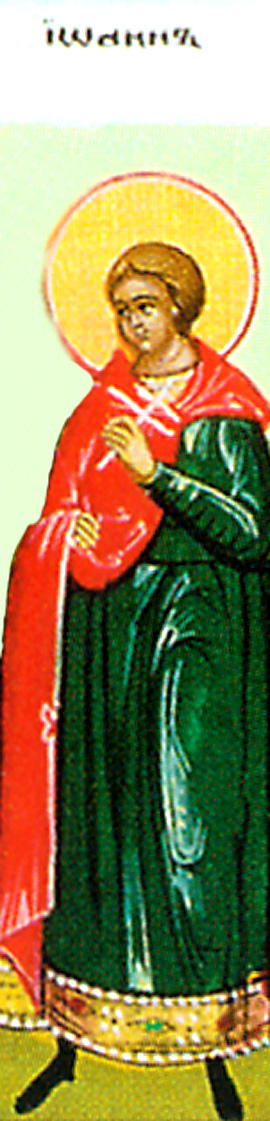
The holy martyr John Kulikos was born in the Greek district of Epirus, in the city of Ioannina. His parents were pious, but he was orphaned at an early age, and he went to Constantinople. With the means left him by his parents, he built a small stall in the city bazaar and was occupied with trade.
He loved to work, he honorably filled all his orders, and his business was successful. However, his soul did not yearn for earthly blessings, but for the Kingdom of Heaven.
Saint John lived during difficult times. Constantinople was under the dominion of the Turks, and Christians were subjected to oppressions. Many Christian tradesmen and merchants went over to the Moslem religion. Saint John reproached them for their betrayal of Christ, and he also sustained the unwavering in their faith. The apostates were filled with hatred for Saint John, and they desired his ruin. The saint knew this, but was not afraid. He was willing to suffer for Christ.
On Great and Holy Friday he went to his spiritual Father and asked his blessing to seek martyrdom. The priest counselled the youth to examine himself and to prepare himself by fasting and prayer, so that at the time of torture he would not deny Christ. Saint John prayed ardently to the Lord to strengthen him. At night on Great and Holy Saturday he saw himself in a dream, standing in a fiery furnace and singing praises to the Lord. Interpreting this vision as an indication to go to martyrdom, Saint John received the Holy Mysteries and asked the priest’s blessing.
When Saint John arrived at the market, the vexed tradesmen began to reproach him that he had promised to renounce Christ, but that he was not fulfilling his word. In reply, the martyr declared that he was a Christian and had never renounced, nor would he ever renounce Christ.
Then the envious merchants had him arrested. The judge tried to persuade Saint John to accept Islam, for he respected him as a skilled master craftsman. But the martyr steadfastly confessed himself a Christian. For several days, they wearied him with hunger and thirst, and beat him without mercy. They sentenced the martyr to be burned alive.
Saint John met his sentence with joy. When they led him to the blazing fire, he went boldly into the midst of the flames. The torturers, seeing that Saint John was prepared to die in the fire, pulled him out and beheaded him with the sword (+ 1526). They then threw the martyr’s head and body into the fire.
Christians gathered up the bones of the martyr which remained from the fire, and reverently brought them to the cathedral church.
Venerable Euthymius, Enlightener of Karelia, Finland and the Righteous Anthony and Felix

According to an ancient manuscript Hemerologion (Ημερολογιον), Saint Euthymios was born in the
second half of the XIV century. From his youth, he felt drawn to the monastic life, so when he reached adulthood, he travelled north around the year 1400, in order to live as an Anchorite. Later, about 1410, several disciples came to him, begging him to guide them in the monastic life. On the shores of the White Sea in Karelia, 34 versts from Archangelsk, they built a monastery dedicated to the Holy Wonderworker Saint Nicholas of Myra in Lycia (December 6), with cells for the monks.
At first, nothing seemed to go well for the monks, who had settled in an area inhabited by pagans. Saint Euthymius knew, however, that in the place where they labored, one day the monastic life would be firmly established, and the Faith would flourish.
In 1418, the Venerable Anthony and Felix, the two devout sons of Martha Boretska, the wife of a government official (посадница) from Novgorod, were drowned at the mouth of the North Dvina River while exploring the land. These young brothers were buried at Saint Nicholas monastery. In life, they were distinguished for their works of charity, and their grief-stricken mother asked Saint Euthymius to pray for the sons who had been taken from her. Subsequently, their names were included in the manuscript Lives of the Saints of Saint Nicholas Monastery.
In 1419, the monastery was destroyed by Norwegian invaders, who descended upon the monastery, burned the church, and killed several of the monks. Saint Euthymius decided that he would rebuild the monastery, and Martha Boretska gave a large sum of money for the monastery to be rebuilt over the graves of her sons.
Saint Euthymius reposed peacefully in 1435, and was buried at the monastery in Karelia, as were his disciples Stephen the Ascetic, Isaiah, and Nikanor.
In 1641, Saint Euthymios of Karelia was glorified for his apostolic labors in Karelia, and his holy relics were uncovered in 1647. Now they rest in a hidden place within the monastery.
A Church Service has been composed for Saints Euthymius, Anthony and Felix. They are commemorated on April 18, and again on May 21, the Synaxis of All Saints of Karelia.
“Maximov” Icon of the Mother of God

The Saint Maximus Icon is in the cathedral church of the city of Vladimir. Metropolitan Maximus (December 6), a Greek by birth, painted the Icon in 1299, as he was told to do in a vision while he slept in his cell. When St. Maximus arrived in Vladimir from Kiev, the Mother of God appeared to him in a dream and gave him an omophorion saying, "My servant Maximus, it is good that you have come to visit my city. Take this omophorion and shepherd the rational flock of my city."
When he awoke, he found he was holding an omophorion. The appearance of the Mother of God was regarded as a sign of approval for the transfer of the metropolitan See from Kiev to Vladimir.
A description of this vision was inscribed on the left side of his crypt. The Mother of God is shown in full stature, holding the Divine Child on her left arm. With her right hand, she offers the omophorion to Saint Maximus, who is standing on a pillar. The contrast in the size of their figures is meant to show the difference in their spiritual states. A variant Icon depicts Saint Maximus kneeling at the feet of the Theotokos.
Later, a golden coffer was made, and the omophorion was placed inside. This omophorion was kept in the Vladimir cathedral as a relic for 112 years. It was hidden by the cathedral’s doorkeeper Patrick in 1412 during an invasion by the Tartars, Patrick was killed when he refused to show them where the cathedral's treasures were hidden. The coffer has not yet been found.
This Icon, which measures five feet by two and a half feet, has been glorified by many miracles.
Saint Basil Ratishvili of Georgia
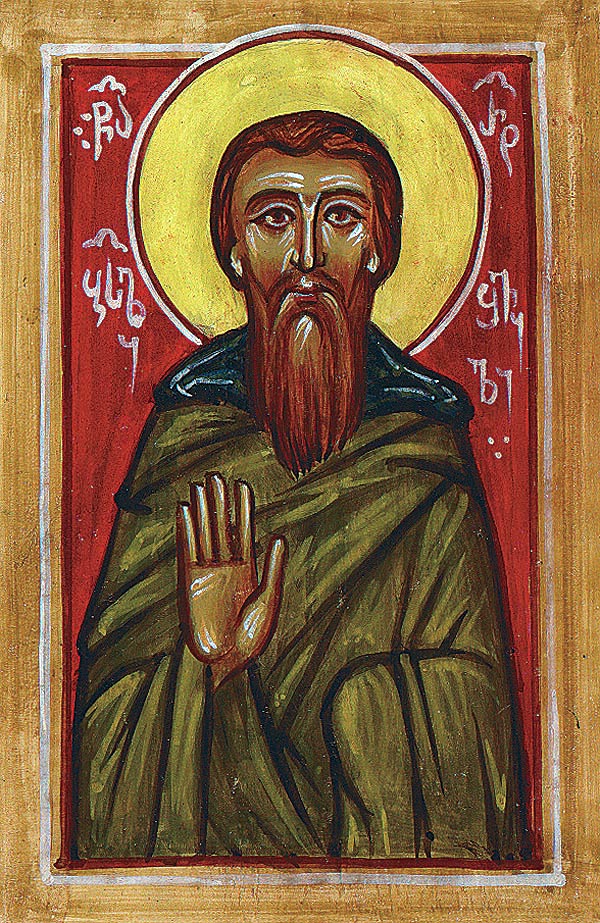
Saint Basil Ratishvili, one of the most prominent figures of the 13th-century Church, was the uncle of Catholicos Ekvtime III. He labored with the other Georgian fathers at the Ivḗron Monastery on Mt. Athos. Endowed with the gift of prophecy, Saint Basil beheld a vision in which the Most Holy Theotokos called upon him to censure King Demetre’s impious rule. (This is actually Saint Demetre the Devoted, who in his youth lived profligately but later laid down his life for his nation.)
Having arrived in Georgia and been brought before the king, the God-fearing father denounced the sovereign’s uncrowned marriage [i.e., a conjugal union without the blessing of the Church]. He promised the king that if he abandoned his present way of life, he would find great happiness and success. Saint Basil also condemned the ungodly ways of Georgia’s apostate feudal lords.
But the king and his court disregarded the virtuous elder’s admonitions, and in response Saint Basil prophesied: “A vicious enemy will kill you, and your kingdom will remain without refuge. Your children will be scattered, your kingdom conquered, and all your wealth seized. Know that, according to the will of the Most Holy Theotokos, everything I have told you will come to pass unless you repent and turn from this way of life. Now I will depart from you in peace.”
Saint Basil returned to Mt. Athos and peacefully reposed at the Ivḗron Monastery.
His vision was fulfilled.
 Saint Peter Antiochian Orthodox Church