
5TH TUESDAY OF LENT
ABSTAIN FROM MEAT, FISH, DAIRY, EGGS, WINE, OLIVE OIL
Agape, Chionia, and Irene, the Holy Martyrs, Righteous Amphilochios of Patmos, Leonidas and Charissa, Nike, Galene, Kallida, Nounenchia, Vasilissa, and Theodora the Martyrs
ISAIAH 40:18-31
Thus says the LORD: To whom then will you liken God, or what likeness compare with him? The idol! a workman casts it, and a goldsmith overlays it with gold, and casts for it silver chains. He who is impoverished chooses for an offering wood that will not rot; he seeks out a skilful craftsman to set up an image that will not move. Have you not known? Have you not heard? Has it not been told you from the beginning? Have you not understood from the foundations of the earth? It is he who sits above the circle of the earth, and its inhabitants are like grasshoppers; who stretches out the heavens like a curtain, and spreads them like a tent to dwell in; who brings princes to nought, and makes the rulers of the earth as nothing. Scarcely are they planted, scarcely sown, scarcely has their stem taken root in the earth, when he blows upon them, and they wither, and the tempest carries them off like stubble. To whom then will you compare me, that I should be like him? Says the Holy One. Lift up your eyes on high and see: who created these? He who brings out their host by number, calling them all by name; by the greatness of his might, and because he is strong in power not one is missing. Why do you say, O Jacob, and speak, O Israel, “My way is hid from the LORD, and my right is disregarded by my God”? Have you not known? Have you not heard? The LORD is the everlasting God, the Creator of the ends of the earth. He does not faint or grow weary, his understanding is unsearchable. He gives power to the faint, and to him who has no might he increases strength. Even youths shall faint and be weary, and young men shall fall exhausted; but they who wait for the LORD shall renew their strength, they shall mount up with wings like eagles, they shall run and not be weary, they shall walk and not faint.
GENESIS 15:1-15
After these things the word of the LORD came to Abram in a vision, “Fear not, Abram, I am your shield; your reward shall be very great.” But Abram said, “O Lord GOD, what wilt thou give me, for I continue childless, and the heir of my house is Eliezer of Damascus?” And Abram said, “Behold, thou hast given me no offspring; and a slave born in my house will be my heir.” And behold, the word of the LORD came to him, “This man shall not be your heir; your own son shall be your heir.” And he brought him outside and said, “Look toward heaven, and number the stars, if you are able to number them.” Then he said to him, “So shall your descendants be.” And he believed the LORD; and he reckoned it to him as righteousness. And he said to him, “I am the LORD who brought you from Ur of the Chaldeans, to give you this land to possess.” But he said, “O Lord GOD, how am I to know that I shall possess it?” He said to him, “Bring me a heifer three years old, a she-goat three years old, a ram three years old, a turtledove, and a young pigeon.” And he brought him all these, cut them in two, and laid each half over against the other; but he did not cut the birds in two. And when birds of prey came down upon the carcasses, Abram drove them away. As the sun was going down, a deep sleep fell on Abram; and lo, a dread and great darkness fell upon him. Then the LORD said to Abram, “Know of a surety that your descendants will be sojourners in a land that is not theirs, and will be slaves there, and they will be oppressed for four hundred years; but I will bring judgment on the nation which they serve, and afterward they shall come out with great possessions. As for yourself, you shall go to your fathers in peace; you shall be buried in a good old age.
PROVERBS 15:7-19
The lips of the wise spread knowledge; not so the minds of fools. The sacrifice of the wicked is an abomination to the LORD, but the prayer of the upright is his delight. The way of the wicked is an abomination to the LORD, but he loves him who pursues righteousness. There is severe discipline for him who forsakes the way; he who hates reproof will die. Sheol and Abaddon lie open before the LORD, how much more the hearts of men! A scoffer does not like to be reproved; he will not go to the wise. A glad heart makes a cheerful countenance, but by sorrow of heart the spirit is broken. The mind of him who has understanding seeks knowledge, but the mouths of fools feed on folly. All the days of the afflicted are evil, but a cheerful heart has a continual feast. Better is a little with the fear of the LORD than great treasure and trouble with it. Better is a dinner of herbs where love is than a fatted ox and hatred with it. A hot-tempered man stirs up strife, but he who is slow to anger quiets contention. The way of a sluggard is overgrown with thorns, but the path of the upright is a level highway.
Virgin Martyrs Agape, Irene and Chionia, in Illyria

The Holy Martyrs Agape, Irene, and Chionia were sisters who lived at the end of the third century to the beginning of the fourth century, near the Italian city of Aquilea. They were left orphaned at an early age.
The young women led a pious Christian life and they turned down many offers of marriage. Their spiritual guide was the priest Xeno. It was revealed to him in a vision that he would die very soon, and that the holy virgins would suffer martyrdom. Also at Aquilea and having a similar vision was the Great Martyr Anastasia (December 22), who is called “Deliverer from Potions,” because she fearlessly visited Christians in prison, encouraging them and healing them from potions, poisons, and other harmful things. The Great Martyr Anastasia visited the sisters and urged them to endure all things for Christ. Soon what was predicted in the vision came to pass. The priest Zeno died, and the three virgins were arrested and brought to trial before the emperor Diocletian (284-305).
Saint Chionia (“snow” in Greek) preserved the purity of her baptism according to the words of the Prophet-King David, “You will wash me, and I shall be whiter than snow” (Ps. 50/51:7).
Saint Irene (“peace” in Greek) preserved the peace of Christ within herself and manifested it to others, according to the Savior’s word, “My peace I give you” (John 14:27).
Saint Agape (“love” in Greek) loved God with all her heart, and her neighbor as herself (Mt.22:37-39).
Seeing the youthful beauty of the sisters, the emperor urged them to deny Christ and he promised to find them illustrious bridegrooms from his entourage. The holy sisters replied that their only Bridegroom was Christ, for Whom they were ready to suffer. The emperor demanded they renounce Christ, but neither the elder sisters, nor the youngest, would consent. They called the pagan gods mere idols made by human hands, and they preached faith in the true God.
By order of Diocletian, who was leaving for Macedonia, the holy sisters were also to be brought there. And they brought them to the court of the governor Dulcititus.
When he saw the beauty of the holy martyrs, he was aroused with impure passion. He put the sisters under guard, and he told them that they would receive their freedom if they agreed to fulfill his desires. But the holy martyrs replied that they were prepared to die for their Heavenly Bridegroom, Christ.
Then Dulcititus decided to have his way by force. When the holy sisters arose at night to glorify the Lord in prayer, Dulcititus came to the door and tried to enter, but an invisible force prevented him. He staggered about, unable to find his way out. Then he fell down in the kitchen among the cooking utensils, the pots and pans, and he was covered all over with soot. The servants and the soldiers recognized him only with difficulty. When he saw himself in a mirror, he then realized that the holy martyrs had made a fool of him, and he decided to take his revenge on them.
At his court, Dulcititus gave orders to strip the holy martyrs. But the soldiers were not able to do this, no matter how much they tried. Their clothing seemed to be stuck to the bodies of the holy virgins. During the trial Dulcititus suddenly fell asleep, and no one could rouse him. Just as they carried him into his house, he immediately awoke.
When they reported to the emperor Diocletian everything that had happened, he became angry with Dulcititus and he gave the holy virgins over to Sisinius for trial. He began with the youngest sister, Irene. Seeing that she remained unyielding, he sent her to prison and then attempted to sway Saints Chionia and Agape. He also failed to make them renounce Christ, and Sisinius ordered that Saints Agape and Chionia be burned. On hearing the sentence, the sisters gave thanks to the Lord for their crowns of martyrdom. In the fire, Agape and Chionia surrendered their pure souls to the Lord.
When the fire went out, everyone saw that the bodies of the holy martyrs and their clothing had not been scorched by the fire, and their faces were beautiful and peaceful, as if they were asleep. On the day following, Sisinius gave orders to bring Saint Irene to court. He threatened her with the fate of her older sisters and he urged her to renounce Christ. Then he threatened to hand her over for defilement in a brothel. But the holy martyr answered, “Even if my body is defiled by force, my soul will never be defiled by renouncing Christ.”
When the soldiers of Sisinius led Saint Irene to the brothel, two luminous soldiers overtook them and said, “Your master Sisinius commands you to take this virgin to a high mountain and leave her there, and then return to him and report to him that you have fulfilled his command.” And the soldiers did so.
When they reported back to Sisinius, he flew into a rage, since he had given no such orders. The luminous soldiers were angels of God, saving the holy martyr from defilement. Sisinius went to the mountain with a detachment of soldiers and saw Saint Irene on the summit. For a long while they searched for the way to the top, but they could not find it. Then one of the soldiers wounded Saint Irene with an arrow. The martyr cried out to Sisinius, “I mock your impotent malice, and I go my Lord Jesus Christ pure and undefiled.” Having given thanks to the Lord, she lay down upon the ground and surrendered her soul to God on the very day of Holy Pascha (+ 304).
The Great Martyr Anastasia heard about the end of the holy sisters, and she buried their bodies with reverence.
Martyrs Leonidas, Chariessa, Nice, Galina, Kalista, Nunechia, Basilissa, Theodora, and Irene, of Corinth
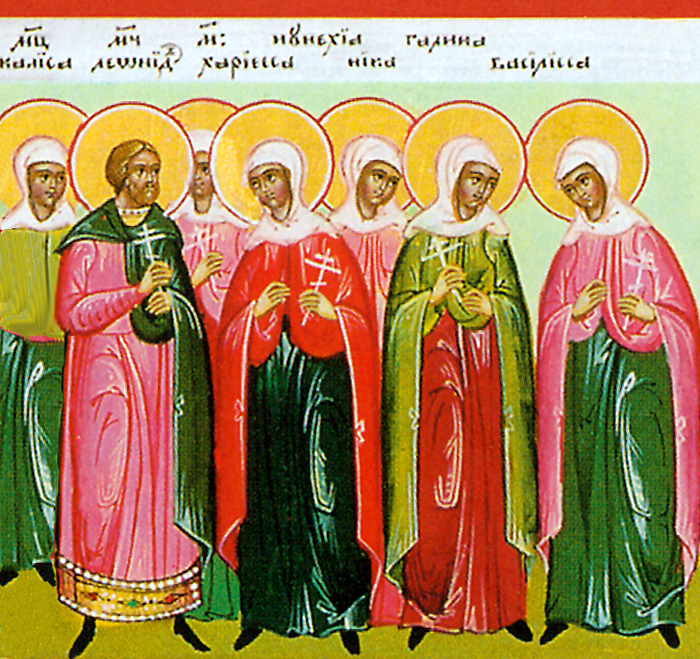
The Holy Martyr Leonidas and the Holy Martyrs Charissa, Nike (Nika, Victoria), Galina, Kalista (Kalida), Nunekhia, Basilissa, Irene, and Theodora suffered at Corinth in the year 258. They threw them into the sea, but they did not drown. Instead, they walked upon the water as if on dry land, singing spiritual hymns. The torturers overtook them in a ship, tied stones around their necks and drowned them.
Monastic Martyr Christopher of Dionysiou, Mount Athos
No information available at this time.
Hieromartyr Nikḗtas
No information available at this time.
Weeping “Ilyin Chernigov” Icon of the Mother of God
The Ilyin-Chernigov Icon of the Mother of God was painted in the year 1658 by the iconographer Gregory Dubensky (Gennadius in monasticism). Tears flowed from the icon for eight days in 1662, from April 16-24.
In this same year Tatars descended upon Chernigov and devastated it. At midnight they burst into the Trinity monastery, went into the church, overturned all the icons and grabbed all the utensils, but the wonderworking icon and its ornaments remained untouched.
An invisible power held back the impious from the holy icon. Previously, the Queen of Heaven had not permitted the enemy to enter the cave of Saint Anthony of the Caves, where the brethren of the monastery had hidden. The Tatars fled, as though terrified by a vision.
The miracle of the Mother of God and Her Chernigov Icon was described by Saint Demetrius of Rostov (October 28 and September 21) in his book, THE MOISTENED FLEECE [Runo Oroshennoe]. Later on, Saint John of Tobolsk (June 10) also wrote about the Chernigov Icon.
A wonderworking copy of the Chernigov Icon of the Mother of God, in the Gethsemane skete of the Trinity-Sergiev Lavra, was glorified in the year 1869 (September 1).
Tambov (Utkino) Icon of the Mother of God

In 1686, Saint Pitirim (July 28) arrived in Tambov. Along with other holy objects, he brought a copy of the Il'insk-Chernigov Icon of the Mother of God, which was considered to be the patroness of the southwest territory. Therefore, the copy was placed at the southwestern gate of the city. After a while, the Icon was called Tambov, especially since the copy differed slightly from the original Il’insk-Chernigov Icon. On either side of the Virgin, Saint Alexis, the man of God, and Saint Eudokia were depicted. It has been suggested that these were the patron saints of Saint Pitirim’s parents, and it is quite possible that he himself painted the images of these Saints.
Later, on the site of the southwestern city gates, a small wooden church was built and dedicated to the Holy Apostles Peter and Paul. In that church, there was an Icon. When the merchant Ivan Utkin built a stone church in honor of the Protomartyr Archdeacon Stephen with his own funds in 1771, the Tambov Icon was transferred here and placed in the altar above the Table of Oblation. People began to call the church Utkino, after the builder, and subsequently, the Icon was completely forgotten. The Queen of Heaven made them remember her, however.
At the beginning of the XIX century, a certain provincial priest from Kaluga suffered from an affliction in his leg, and he was unable to walk. It was this Icon of the Mother of God which appeared to him in a dream, and a voice told him, “Search for this icon. Pray before it, and you shall be healed.”
After this, the priest obtained some relief from his illness, so that he was able to walk. Right away, he began to search for the Icon he had seen in his dream. After visiting several villages and cities, he finally reached Tambov. He looked in all the churches until he found the Icon from his dream in the altar of the Utkino church. After praying before this Icon, he was completely healed. This incident became widely known in the city, and thereafter several more miraculous cures of the townspeople took place.
The Tambov Icon became known once again, and in 1835, when the old Utkino church was in a terrible state of disrepair, the townspeople requested that the right side altar be dedicated to the Tambov Icon of the Mother of God. Over time, the grateful people of Tambov diligently adorned the Icon. A luxurious silver riza was made, studded with many gems. There were so many cases of healing before the Icon that there was not enough time to record all of them. In 1888, by a decree of the Holy Synod, all the churches of the city were ordered to have a Cross Procession on April 16 in honor of the Tambov Icon. In 1900, the church itself was named for the Theotokos.
After the Russian Revolution, the churches of Tambov were ravaged, and the wonderworking Icon suffered. They removed the riza and picked out the gems, and the Icon itself disappeared without a trace. The city has preserved accounts of the miracles performed by the Icon.
 Saint Peter Antiochian Orthodox Church