
3RD WEDNESDAY OF LENT
ABSTAIN FROM MEAT, FISH, DAIRY, EGGS, WINE, OLIVE OIL
Nicetas, Abbot of the Monastery of Medicium, Joseph the Hymnographer, Theodosia and Irene the Martyrs
ISAIAH 10:12-20
When the Lord has finished all his work on Mount Zion and on Jerusalem he will punish the arrogant boasting of the king of Assyria and his haughty pride. For he says: “By the strength of my hand I have done it, and by my wisdom, for I have understanding; I have removed the boundaries of peoples, and have plundered their treasures; like a bull I have brought down those who sat on thrones. My hand has found like a nest the wealth of the peoples; and as men gather eggs that have been forsaken so I have gathered all the earth; and there was none that moved a wing, or opened the mouth, or chirped.” Shall the axe vaunt itself over him who hews with it, or the saw magnify itself against him who wields it? As if a rod should wield him who lifts it, or as if a staff should lift him who is not wood! Therefore the Lord, the LORD of hosts, will send wasting sickness among his stout warriors, and under his glory a burning will be kindled, like the burning of fire. The light of Israel will become a fire, and his Holy One a flame; and it will burn and devour his thorns and briers in one day. The glory of his forest and of his fruitful land the LORD will destroy, both soul and body, and it will be as when a sick man wastes away. The remnant of the trees of his forest will be so few that a child can write them down. In that day the remnant of Israel and the survivors of the house of Jacob will no more lean upon him that smote them, but will lean upon the LORD, the Holy One of Israel, in truth.
GENESIS 7:6-9
Noah was six hundred years old when the flood of waters came upon the earth. And Noah and his sons and his wife and his sons' wives with him went into the ark, to escape the waters of the flood. Of clean animals, and of animals that are not clean, and of birds, and of everything that creeps on the ground, two and two, male and female, went into the ark with Noah, as God had commanded Noah.
PROVERBS 9:12-18
If you are wise, you are wise for yourself; if you scoff, you alone will bear it. A foolish woman is noisy; she is wanton and knows no shame. She sits at the door of her house, she takes a seat on the high places of the town, calling to those who pass by, who are going straight on their way, “Whoever is simple, let him turn in here!” And to him who is without sense she says, “Stolen water is sweet, and bread eaten in secret is pleasant.” But he does not know that the dead are there, that her guests are in the depths of Sheol.
Venerable Niketas the Confessor, Abbot of Medikion
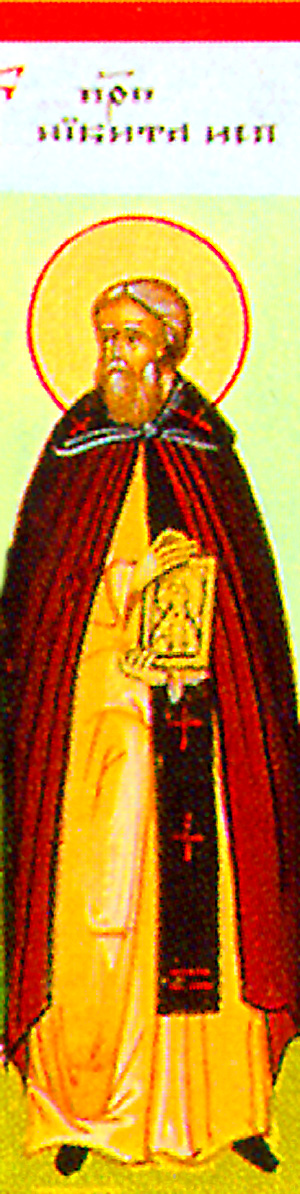
Saint Niketas (Nikḗtas) the Confessor was born in Bithynian Caesarea (northwest Asia Minor) of a pious family. His mother died eight days after his birth, and his father Philaretos became a monk. The child remained in the care of his grandmother, who raised him in a true Christian spirit. From his youth Saint Niketas attended church and was a disciple of the hermit Stephanos. With his blessing, Saint Niketas set off to the Mydicia monastery, where Saint Nikephoros (Nikēphóros) (March 13) was the igumen.
After seven years of virtuous life at the monastery, famed for its strict monastic rule, Saint Niketas was ordained presbyter. Saint Nikephoros, knowing the holy life of the young monk, entrusted to him the guidance of the monastery when he himself became ill.
Not wanting power, Saint Niketas devoted himself to the enlightenment and welfare of the monastery. He guided the brethren by his own example. Soon the fame of the lofty life of its inhabitants of the monastery attracted many seeking salvation. After several years, the number of monks had increased to one hundred.
When Saint Nikephoros departed to the Lord in his old age, the brethren unanimously chose Saint Niketas as igumen.
The Lord granted Saint Niketas the gift of wonderworking. Through his prayer a deaf-mute child received the gift of speech; two demon-possessed women were healed; he restored reason to one who had lost his mind, and many of the sick were healed of their infirmities.
During these years under the emperor Leo the Armenian (813-820), the Iconoclast heresy resurfaced and oppression increased. Orthodox bishops were deposed and banished. At Constantinople a council of heretics was convened in 815, at which they deposed the holy Patriarch Nikephoros (806-815), and in his place they chose the heretical layman Theodotus. They also installed heretics in place of exiled and imprisoned Orthodox bishops.
The emperor summoned all the heads of the monasteries and tried to bring them over to the Iconoclast heresy. Among those summoned was Saint Niketas, who stood firmly for the Orthodox confession. Following his example, all the igumens remained faithful to the veneration of holy icons. Therefore, they threw him into prison. Saint Niketas bravely underwent all the tribulations and encouraged firmness of spirit in the other prisoners.
Then the emperor and the false patriarch Theodotus attempted to trick those who remained faithful to Orthodox teaching. They promised that the emperor would give them their freedom and permit the veneration of the icons on one condition: that they take Communion from the pseudo-patriarch Theodotus.
For a long time the saint had doubts about entering into communion with a heretic, but other prisoners begged him to go along with them. Acceding to their entreaties, Saint Niketas went into the church, where icons were put out to deceive the confessors, and he accepted Communion.
But when he returned to his monastery and saw that the persecution against icons was continuing, he then repented of his deed, returned to Constantinople and fearlessly denounced the Iconoclast heresy. He ignored all the emperor’s threats.
Saint Niketas was again locked up in prison for six years until the death of the emperor Leo the Armenian. Enduring hunger and travail, Saint Niketas worked miracles by the power of his prayers: through his prayer the Phrygian ruler released two captives without ransom; three shipwrecked men for whom Saint Niketas prayed, were thrown up on shore by the waves.
Saint Niketas reposed in the Lord in 824. The saint’s body was buried at the monastery with reverence. Later, his relics became a source of healing for those coming to venerate the holy confessor.
Holy Virgin Martyr Theodosίa of Tyre
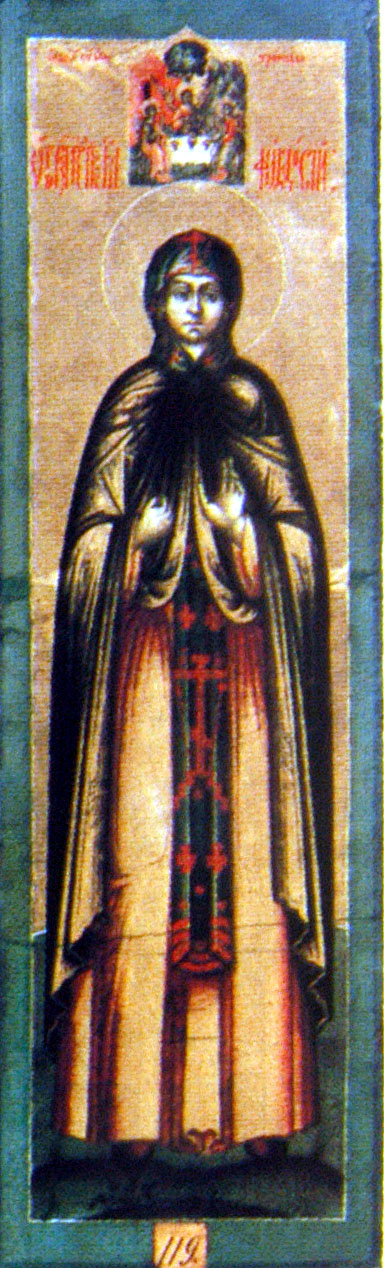
Saint Theodosίa of Tyre lived during the III and IV centuries. Once, during a persecution against Christians, which had already lasted for five years, the seventeen-year-old Theodosίa visited some condemned Christian prisoners in the Praetorium at Caesarea in Palestine. It was the day of Holy Pascha, and the Martyrs were speaking about the Kingdom of God. Saint Theodosίa asked them to remember her when they appeared before the Lord.
When the soldiers saw that the girl had bowed to the prisoners, they seized her and led her before the governor, Urban. The governor urged the Saint to offer sacrifice to the idols, but she refused, professing her faith in Christ. Then she was subjected to cruel tortures; her sides and breasts were raked with iron claws until her bones were exposed. She endured this in silence with astonishing courage. Again Urban told her to sacrifice, but she mocked him saying: “Foolish man, why do you persist? Can you not see that I have received everything I prayed for, and that I am honored to share the fate of these Martyrs for Christ?"
After saying this, she was tormented even more severely than before. The holy virgin was cast into the sea with a stone tied around her neck, but Angels rescued her from the depths. Then they tossed her into the arena to be eaten by wild animals. Seeing that the beasts would not touch her, the soldiers beheaded her.
That night Saint Theodosίa appeared to her parents, who had tried to persuade their daughter not to let herself be tortured. She wore radiant garments, a crown upon her head, and held a luminous gold cross in her hand. She said to them, “Behold the great glory of which you wished to deprive me!”
The Holy Virgin Martyr Theodosίa of Tyre suffered for Christ on April 3 in the year 307 or 308. She is also commemorated on May 29 (the transfer of her relics to Constantinople, and later to Venice).
Martyr Irene
No information available at this time.
Saint Illyricus of Mount Myrsinon in the Peloponnesus

Saint Illyricus the Wonderworker devoted himself to ascetic struggles on Mount Myrsinon in the Peloponnesus. The dates of his birth and death are unknown.
Martyrs Elpidephorus, Dius, Bithonius, and Galycus
The Holy Martyrs Elpidephorus, Dius, Bithonius, and Galycus suffered for their faith in Jesus Christ. They cut off the head of Saint Elpidephorus with a sword, Saint Dius was executed by stoning, Saint Bithonius was drowned in the sea, and Saint Galycus was condemned to be eaten by wild beasts.
“Unfading Flower” Icon of the Mother of God
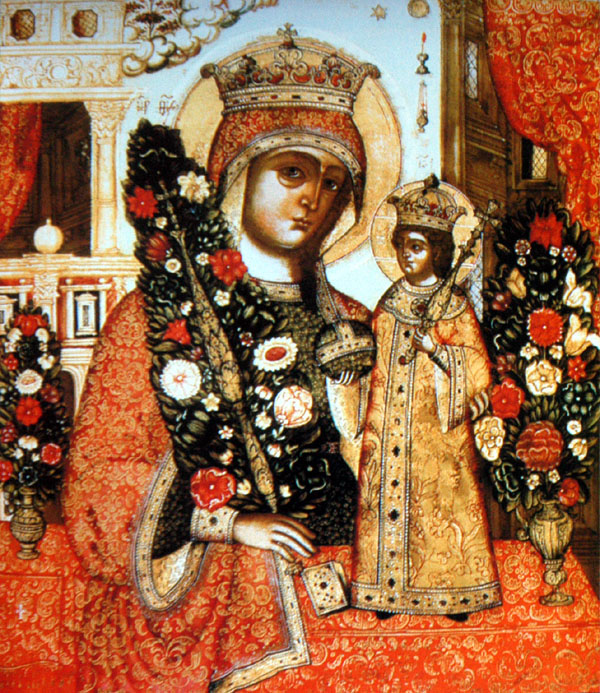
The "Unfading Flower" Icon depicts the Theotokos holding her Divine Son on her right arm, and in her left hand is a bouquet of white lilies. The lilies symbolize the unfading flower of virginity and purity of the Mother of God, to whom the Church sings: “You are the root of virginity and the Unfading Flower of purity.”
In Moscow there are two churches with Icons with this name: the church of the Dormition at Mogil'tsy (December 31), and the Alexeyev Monastery. Other icons of this name are in Kungur (Perm Gubernia); in the former town of Kadome of Tambov Province, namely, in the Merciful Theotokos womens' monastery; and in the Nativity of the Theotokos church of Voronezh.
There is a similar Icon in the church of Saint Nicholas in the village of Budishch (Poltava Gubernia). It resembles a number of very old icons which are also revered in that place. Every year on April 3, many people gather in the village of Budishch to venerate this Icon, along with a copy of the Vladimir Icon of the Mother of God. Several miraculous healings of the sick have occurred before this Icon.
 Saint Peter Antiochian Orthodox Church