
Here is the live stream for Lenten Forgiveness Vespers – Sunday March 17, 2024 If you need, here are instructions for accessing this content from your phone, tablet, computer, or TV.
Monthly Archives: March 2024
Orthros and Divine Liturgy – Sunday March 17, 2024
Here is the live stream for Orthros and Divine Liturgy – Sunday March 17, 2024 If you need, here are instructions for accessing this content from your phone, tablet, computer, or TV.
Daily Readings for Sunday, March 17, 2024
FORGIVENESS SUNDAY
ABSTAIN FROM MEAT
Forgiveness Sunday, Alexis the Man of God, Paul the Righteous Martyr, Patrick the Enlightener of Ireland, Marinos the Martyr, Theocteristos the Confessor
ST. PAUL’S LETTER TO THE ROMANS 13:11-14; 14:1-4
Brethren, salvation is nearer to us now than when we first believed; the night is far gone, the day is at hand. Let us then cast off the works of darkness and put on the armor of light; let us conduct ourselves becomingly as in the day, not in reveling and drunkenness, not in debauchery and licentiousness, not in quarreling and jealousy. But put on the Lord Jesus Christ, and make no provision for the flesh, to gratify its desires.
As for the man who is weak in faith, welcome him, but not for disputes over opinions. One believes he may eat anything, while the weak man eats only vegetables. Let not him who eats despise him who abstains, and let not him who abstains pass judgment on him who eats; for God has welcomed him. Who are you to pass judgment on the servant of another? It is before his own master that he stands or falls. And he will be upheld, for God is able to make him stand.
MATTHEW 6:14-21
The Lord said, "If you forgive men their trespasses, your heavenly Father also will forgive you; but if you do not forgive men their trespasses, neither will your Father forgive your trespasses.
And when you fast, do not look dismal, like the hypocrites, for they disfigure their faces that their fasting may be seen by men. Truly, I say to you, they have received their reward. But when you fast, anoint your head and wash your face, that your fasting may not be seen by men but by your Father who is in secret; and your Father who sees in secret will reward you.
Do not lay up for yourselves treasures on earth, where moth and rust consume and where thieves break in and steal, but lay up for yourselves treasures in heaven, where neither moth nor rust consumes and where thieves do not break in and steal. For where your treasure is, there will your heart be also.
Sunday of Cheesefare: Expulsion of Adam from Paradise
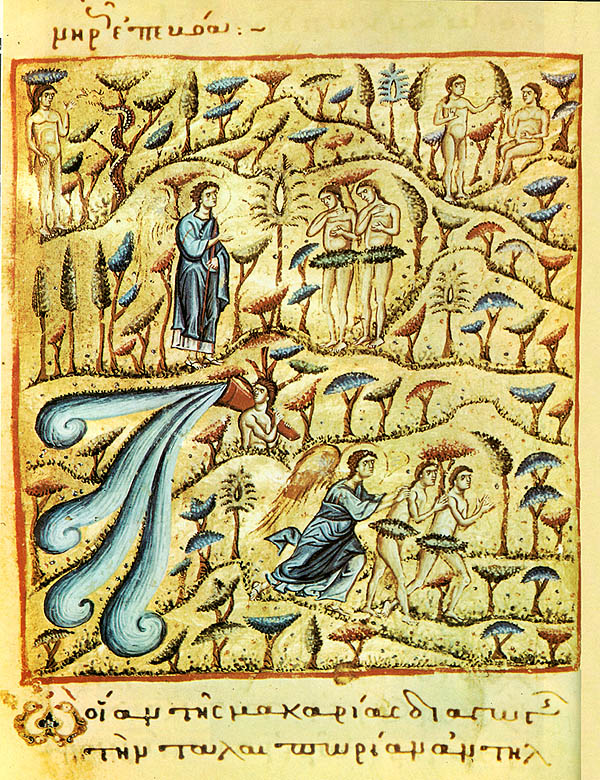
As we begin the Great Fast, the Church reminds us of Adam’s expulsion from Paradise. God commanded Adam to fast (Gen. 2:16), but he did not obey. Because of their disobedience, Adam and Eve were cast out of Eden and lost the life of blessedness, knowledge of God, and communion with Him, for which they were created. Both they and their descendents became heirs of death and corruption.
Let us consider the benefits of fasting, the consequences of disobedience, and recall our fallen state. Today we are invited to cleanse ourselves of evil through fasting and obedience to God. Our fasting should not be a negative thing, a mere abstention from certain foods. It is an opportunity to free ourselves from the sinful desires and urges of our fallen nature, and to nourish our souls with prayer, repentance, to participate in church services, and partake of the life-giving Mysteries of Christ.
At Forgiveness Vespers we sing: “Let us begin the time of fasting in light, preparing ourselves for spiritual efforts. Let us purify our soul, let us purify our body. As we abstain from food, let us abstain from all passion and enjoy the virtues of the spirit….”
Venerable Alexis the Man of God

Saint Alexis was born at Rome into the family of the pious and poverty-loving Euphemianus and Aglais. The couple was childless for a long time and constantly prayed the Lord to grant them a child. And the Lord consoled the couple with the birth of their son Alexis.
At six years of age the child began to read and successfully studied the mundane sciences, but it was with particular diligence that he read Holy Scripture. When he was a young man, he began to imitate his parents: he fasted strictly, distributed alms and beneath his fine clothing he secretly wore a hair shirt. Early on there burned within him the desire to leave the world and serve God. His parents, however, had arranged for Alexis to marry a beautiful and virtuous bride.
On his wedding night, Alexis gave her his ring and his belt (which were very valuable) and said, “Keep these things, Beloved, and may the Lord be with us until His grace provides us with something better.” Secretly leaving his home, he boarded a ship sailing for Mesopotamia.
Arriving in the city of Edessa, where the Icon of the Lord “Not-made-by-Hands” (August 16) was preserved, Alexis sold everything that he had, distributed the money to the poor and began to live near the church of the Most Holy Theotokos under a portico. The saint used a portion of the alms he received to buy bread and water, and he distributed the rest to the aged and infirm. Each Sunday he received the Holy Mysteries.
The parents sought the missing Alexis everywhere, but without success. The servants sent by Euphemianus also arrived in Edessa, but they did not recognize the beggar sitting at the portico as their master. His body was withered by fasting, his comeliness vanished, his stature diminished. The saint recognized them and gave thanks to the Lord that he received alms from his own servants.
The inconsolable mother of Saint Alexis confined herself in her room, incessantly praying for her son. His wife also grieved with her in-laws.
Saint Alexis dwelt in Edessa for seventeen years. Once, the Mother of God spoke to the sacristan of the church where the saint lived: “Lead into My church that Man of God, worthy of the Kingdom of Heaven. His prayer rises up to God like fragrant incense, and the Holy Spirit rests upon him.” The sacristan began to search for such a man, but was not able to find him for a long time. Then he prayed to the Most Holy Theotokos, beseeching Her to clear up his confusion. Again a voice from the icon proclaimed that the Man of God was the beggar who sat in the church portico.
The sacristan found Saint Alexis and brought him into the church. Many recognized him and began to praise him. The saint secretly boarded a ship bound for Cilicia, intending to visit the church of Saint Paul in Tarsus. But God ordained otherwise. A storm took the ship far to the West and it reached the coast of Italy. The saint journeyed to Rome and decided to live in his own house. Unrecognized, he humbly asked his father’s permission to settle in some corner of his courtyard. Euphemianus settled Alexis in a specially constructed cell and gave orders to feed him from his table.
Living at his parental home, the saint continued to fast and he spent day and night at prayer. He humbly endured insults and jeering from the servants of his father. The cell of Alexis was opposite his wife’s windows, and the ascetic suffered grievously when he heard her weeping. Only his immeasurable love for God helped the saint endure this torment. Saint Alexis dwelt at the house of his parents for seventeen years and the Lord revealed to him the day of his death. Then the saint, taking paper and ink, wrote certain things that only his wife and parents would know. He also asked them to forgive him for the pain he had caused them.
On the day of Saint Alexis’ death in 411, Archbishop Innocent (402-417) was serving Liturgy in the presence of the emperor Honorius (395-423). During the services a Voice was heard from the altar: “Come unto Me, all ye who labor and are heavy laden, and I will give you rest” (Mt.11:28). All those present fell to the ground in terror.
The Voice continued: “On Friday morning the Man of God comes forth from the body; have him pray for the city, that you may remain untroubled.” They began to search throughout Rome, but they did not find the saint. Thursday evening the Pope was serving Vigil in the Church of Saint Peter. He asked the Lord to show them where to find the Man of God.
After Liturgy the Voice was heard again in the temple: “Seek the Man of God in the house of Euphemianus.” All hastened there, but the saint was already dead. His face shone like the face of an angel, and his hand clasped the paper, and they were unable to take it. They placed the saint’s body on a cot, covered with costly coverings. The Pope and the Emperor bent their knees and turned to the saint, as to one yet alive, asking him to open his hand. And the saint heard their prayer. When the letter was read, the righteous one’s wife and parents tearfully venerated his holy relics.
The body of the saint was placed in the center of the city. The emperor and the Pope carried the body of the saint into the church, where it remained for a whole week, and then was placed in a marble crypt. A fragrant myrrh began to flow from the holy relics, bestowing healing upon the sick.
The venerable relics of Saint Alexis, the Man of God, were buried in the church of Saint Boniface. The relics were uncovered in the year 1216.
The Life of Saint Alexis, the Man of God, was always very popular in Russia.
Venerable Macarius the Wonderworker, Abbot of Kalyazin
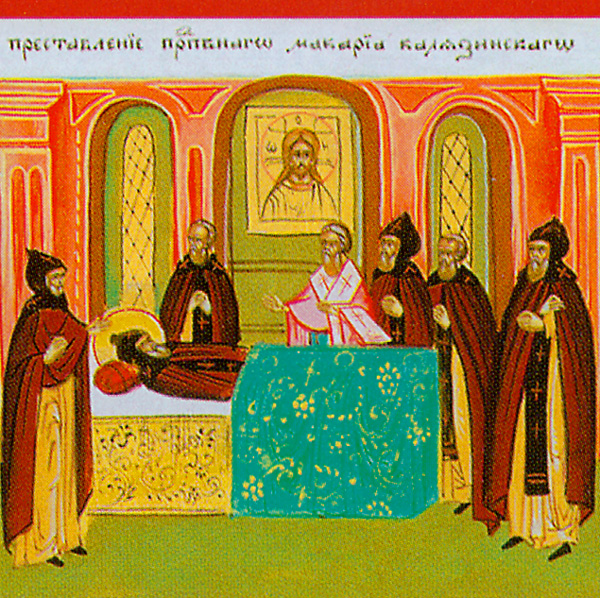
Saint Macarius of Kalyazin (in the world Matthew) was born in 1400 in the village of Gribkovo (Kozhino), near the city of Kashin, into the family of the boyar Basil Kozha. From youth he yearned for monasticism, but he married at the insistence of his parents.
After a year his parents died, and after three more years his wife Elena also reposed. Having nothing to bind him to his former life, Matthew became a monk at the Nikolaev Klobukov monastery. Desiring solitude, he left the city monastery with the abbot’s blessing, and he found a suitable place between two lakes, eighteen versts from Kashin. Here the monk raised a cross and founded a solitary wilderness monastery.
The boyar Ivan Kolyaga, to whom the nearby lands belonged, began to fear that a monastery would grow up there, and that monks would begin to cultivate the wastelands. The Enemy of our salvation planted such spite and enmity in the boyar, that he decided to kill the saint. Suddenly, he was stricken with a grievous illness. Fear of death awakened repentance in the boyar. Ivan Kolyaga was carried to the saint and told him of his evil intent, asking forgiveness.
“God forgive you”, the humble ascetic replied. Wishing to expiate his sin and to help the saint, the boyar gave his lands to the growing monastery. The monks built a temple dedicated to the Most Holy Trinity. Word of the boyar Kolyaga’s conversion brought many people to the monk, seeking salvation. Saint Macarius tonsured Kolyaga and named the monastery Kalyazin for him.
It became necessary to choose an igumen. Saint Macarius was then fifty-three years of age, but he considered himself unworthy of this dignity and he asked each of the older men coming to him to become the monastery’s priest and igumen. Yielding to the common will, the saint was made igumen by Bishop Moses of Tver.* The new igumen prepared for his first service at the altar of God with long solitary prayer, and then communed all the brethren with the Holy Mysteries.
In the rank of igumen, Saint Macarius labored to guide the brethren. The monastery had two chalices, a diskos and two plates fashioned by Saint Macarius on a lathe. He guided not only the monks, but also laypeople coming to the monastery, dealing with both the educated and the simple.
Despite his noble origin and his position of igumen, the saint wore ragged, frayed and patched clothing. In his conduct and his way of life Saint Macarius was so simple that the haughty heretic Vassian, sneeringly called him the “peasant of Kalyazin.” The saint preferred to hear himself mocked rather than praised. He went to solitary places, delighted to be alone with nature. Wild animals, sensing his holiness, walked with him like sheep, they submitted to him, and sometimes took food from him.
The spiritual stature of Saint Macarius was close to the spiritual stature of Saint Paphnutius of Borov (May 1, 1477). Not by chance did Saint Paphnutius’ disciple, Saint Joseph of Volokolamsk (September 9, 1515), visit Saint Macarius in 1478 and write down his impressions of him: “When I arrived at this place,” said Saint Macarius, “seven Elders came with me from the monastery of Klobukov. They were so excellent in virtues, fasting and monastic life, that all the brethren came to them to receive instruction and benefit. They enlightened all and taught them for their benefit. They affirmed the virtuous life, and censured those inclined to misconduct, and neither did they seek to do their own will.”
Though the humble igumen was silent about his own efforts, they were not hidden from Saint Joseph. Perceiving the holiness of the igumen, he accounted him blessed and spoke about the life of the monastery: “Such piety and decorum were in that monastery, where everything was done in harmony with the patristic and communal traditions, that even the great Elder Metrophanes Byvaltsev was amazed. He had just come from Mount Athos, where he spent nine years, and said to the brethren: ‘My efforts and my journey to the Holy Mountain were in vain, because one can find salvation in the Kalyazin monastery. Life here is similar to life in the cenobitic monasteries of the Holy Mountain.’”
From the moment Saint Macarius settled in the wilderness, he did not abandon his strict Rule because of old age. Even during his lifetime the saint repeatedly healed the paralyzed and the demon-possessed.
The saint reposed on March 17, 1483. At the time of his death they found heavy chains on him, about which no one knew. The incorrupt relics of Saint Macarius were uncovered on May 26, 1521 when ditches were dug for a new church. A Council of 1547 established his local festal celebration.
* The successor of Bishop Moses was Saint Macarius’ brother, Bishop Gennadius (Kozhin) (1460-1477). The nephew of Saint Macarius, Saint Paisius of Uglich (January 8 and June 6) was also famed for his sanctity. The Kalyazin monastery had a collection of the sermons of Saint Gregory the Theologian, which Saint Macarius had copied in his own hand.
Martyr Marinus

The Life of Saint Marinus has been preserved in the Byzantine Synaxaristḗs, which states that the Holy Martyr lived during a time when the Church was being persecuted, and that he was a zealous Christian. Therefore, when he saw the pagans offering sacrifices to their false "gods," he destroyed the altar and trampled upon the idols, confessing that he was a Christian. For that reason, he was arrested and beaten with whips, then he was suspended and his sides were raked, and the pagans also knocked out his teeth with stones and dragged him along the ground by his hair. After that, Saint Marinus was bound and brought before the archon, who, after subjecting the Martyr to further tortures, ordered him to be beheaded with a sword.
None of the surviving accounts specify the time and place of Saint Marinus's martyrdom.
Saint Patrick, Bishop of Armagh, Enlightener of Ireland
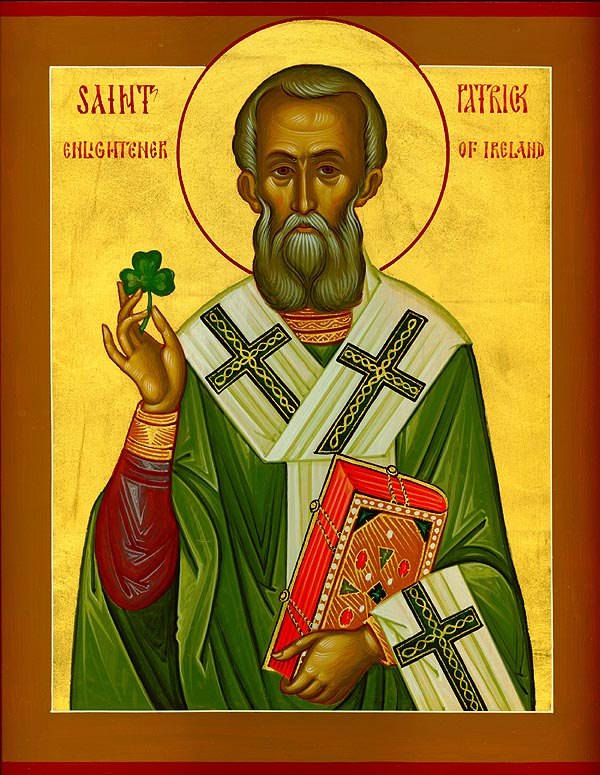
Saint Patrick, the Enlightener of Ireland was born around 385, the son of Calpurnius, a Roman decurion (an official responsible for collecting taxes). He lived in the village of Bannavem Taberniae, which may have been located at the mouth of the Severn River in Wales. The district was raided by pirates when Patrick was sixteen, and he was one of those taken captive. He was brought to Ireland and sold as a slave, and was put to work as a herder of swine on a mountain identified with Slemish in Co. Antrim. During his period of slavery, Patrick acquired a proficiency in the Irish language which was very useful to him in his later mission.
He prayed during his solitude on the mountain, and lived this way for six years. He had two visions. The first told him he would return to his home. The second told him his ship was ready. Setting off on foot, Patrick walked two hundred miles to the coast. There he succeeded in boarding a ship, and returned to his parents in Britain.
Some time later, he went to Gaul and studied for the priesthood at Auxerre under Saint Germanus (July 31). Eventually, he was consecrated as a bishop, and was entrusted with the mission to Ireland, succeeding Saint Palladius (July 7). Saint Palladius did not achieve much success in Ireland. After about a year he went to Scotland, where he died in 432.
Patrick had a dream in which an angel came to him bearing many letters. Selecting one inscribed “The Voice of the Irish,” he heard the Irish entreating him to come back to them.
Although Saint Patrick achieved remarkable results in spreading the Gospel, he was not the first or only missionary in Ireland. He arrived around 432 (though this date is disputed), about a year after Saint Palladius began his mission to Ireland. There were also other missionaries who were active on the southeast coast, but it was Saint Patrick who had the greatest influence and success in preaching the Gospel of Christ. Therefore, he is known as “The Enlightener of Ireland.”
His autobiographical Confession tells of the many trials and disappointments he endured. Patrick had once confided to a friend that he was troubled by a certain sin he had committed before he was fifteen years old. The friend assured him of God’s mercy, and even supported Patrick’s nomination as bishop. Later, he turned against him and revealed what Patrick had told him in an attempt to prevent his consecration. Many years later, Patrick still grieved for his dear friend who had publicly shamed him.
Saint Patrick founded many churches and monasteries across Ireland, but the conversion of the Irish people was no easy task. There was much hostility, and he was assaulted several times. He faced danger, and insults, and he was reproached for being a foreigner and a former slave. There was also a very real possibility that the pagans would try to kill him. Despite many obstacles, he remained faithful to his calling, and he baptized many people into Christ.
The saint’s Epistle to Coroticus is also an authentic work. In it he denounces the attack of Coroticus’ men on one of his congregations. The Breastplate (Lorica) is also attributed to Saint Patrick. In his writings, we can see Saint Patrick’s awareness that he had been called by God, as well as his determination and modesty in undertaking his missionary work. He refers to himself as “a sinner,” “the most ignorant and of least account,” and as someone who was “despised by many.” He ascribes his success to God, rather than to his own talents: “I owe it to God’s grace that through me so many people should be born again to Him.”
By the time he established his episcopal See in Armargh in 444, Saint Patrick had other bishops to assist him, many native priests and deacons, and he encouraged the growth of monasticism.

Saint Patrick is often depicted holding a shamrock, or with snakes fleeing from him. He used the shamrock to illustrate the doctrine of the Holy Trinity. Its three leaves growing out of a single stem helped him to explain the concept of one God in three Persons. Many people now regard the story of Saint Patrick driving all the snakes out of Ireland as having no historical basis.
Saint Patrick died on March 17, 461 (some say 492). There are various accounts of his last days, but they are mostly legendary. Muirchu says that no one knows the place where Saint Patrick is buried. Saint Columba of Iona (June 9) says that the Holy Spirit revealed to him that Patrick was buried at Saul, the site of his first church. A granite slab was placed at his traditional grave site in Downpatrick in 1899.
Hieromartyr Gabriel the Lesser

Saint Gabriel the Lesser was a major figure in the eighteenth-century Georgian Church. Few details of his life are known, but it is evident that the education he received was quite good for the period. Striving toward the monastic life but still living in the world, Gabriel tried in every way to close himself off from the vanity of the world. He kept a small sewing shop in Tbilisi and distributed most of his profits to the poor.
One day Saint Gabriel abandoned his business and set off for the Davit-Gareji Wilderness, where he was tonsured a monk.
Saint Gabriel occupied much of his time with writing, and his works left a significant mark on the spiritual literature of Georgia. He compiled several collections of patristic writings, and he also wrote original works of a theological nature. His original writings include An Explanation of the Hierarchical Liturgy, which describes in detail the meaning of every part of the service, Spiritual Stories of the Pious, The Life and Labors of Venerable Schemamonk Onisphore, A Short Story of Porphyry, and writings on the Nomocanon of the Sixth Ecumenical Council.
Among the brothers at his monastery, Saint Gabriel was distinguished by a remarkable capacity for love and a fervent desire to help others: he helped all, cared for all, and encouraged all. During the Great Fast in 1802, a certain archdeacon came from Tbilisi to Davit-Gareji Monastery, desiring to draw closer to the ascetic way of life. After some time, however, he became anxious to see his family and decided to return home. Saint Gabriel accompanied him on his way, but the two men were suddenly assailed by Dagestanis, and the holy father was killed. The brothers carried his relics back to the monastery and buried them there with great honor.
Great Vespers – Saturday March 16, 2024
Here is the live stream for Great Vespers – Saturday March 16, 2024 If you need, here are instructions for accessing this content from your phone, tablet, computer, or TV.
3/17 announcements
March 17, 2024
Sunday of Forgiveness (Cheese Fare)
Yes, it is that time again. Lent begins on Monday, March 18th, but we begin the preparations for the journey of “bright-sadness” by especially dealing with our hearts and our spiritual condition. In her wisdom the Church is a great aid to us, for the four Sundays before Lent carry special themes that enable us to examine ourselves.
The theme of the Sunday before Lent is FORGIVENESS (cheese fare) and the Gospel lesson is Matthew 6:14-21 which teaches us both of forgiveness and of fasting. “To forgive is to put between me and my enemy the radiant forgiveness of God Himself. To forgive is to reject the hopeless dead-ends of human relations and to refer them to Christ. Forgiveness is truly a breakthrough of the Kingdom into this sinful and fallen world” (Great Lent, Page 28). And to fast is to first fast before God and not men so as to curb the desires and cravings of our fallen nature. This effort can help free us from the dictatorship of the flesh over our spirit, so we can more fully love and forgive.
Romans 13:11-14:4: Brethren, now is our salvation nearer than when we believed. The night is far spent, the day is at hand. Let us therefore cast off the works of darkness, and let us put on the armor of light. Let us walk becomingly, as in the day, not in reveling and drunkenness, not in chambering and licentiousness, not in strife and jealousy. But put on the Lord Jesus Christ, and make no provision for the flesh to fulfill its lusts. But as for the one who is weak in faith, receive him, but not for disputes over opinions. For one believes he may eat anything; but the weak person eats herbs. Let not him who eats despise him who does not eat, and let not him who does not eat judge him who eats; for God has received him. Who are you to be the judge over the servant of a stranger? To his own master he either stands or falls; but he will be made to stand; for God is able to make him stand.
Matthew 6:14-21: The Lord said to His Disciples: If you forgive men their trespasses, your heavenly Father also will forgive you; but if you do not forgive men their trespasses, neither will your Father forgive your trespasses. And when you fast, do not look dismal, like the hypocrites, for they disfigure their faces that their fasting may be seen by men. Truly, I say to you, they have received their reward. But when you fast, anoint your head and wash your face, that your fasting may not be seen by men but by your Father Who is in secret; and your Father Who sees in secret will reward you. Do not lay up for yourselves treasures on earth, where moth and rust consume and where thieves break in and steal, but lay up for yourselves treasures in heaven, where neither moth nor rust consumes and where thieves do not break in and steal. For where your treasure is, there will your heart be also.
Troparion of the Resurrection: O compassionate One, thou didst descend from the heights; thou didst submit to the three-day burial, that thou might deliver us from passion. Thou art our Life and our Resurrection, O Lord, glory to thee.
Troparion of the Chains of St. Peter: O Holy Apostle, Peter, thou dost preside over the Apostles by the precious chains which thou didst bear. We venerate them with faith and beseech thee that by thine intercessions we be granted the great mercy.
Kontakion of Cheese Fare Sunday: O thou who guidest to wisdom, and givest understanding and intelligence, the Instructor of the ignorant and Helper of the poor, strengthen my heart and grant it understanding, O Master. Give me word, O Word of the Father; for behold, I shall not refrain my lips from crying to thee, O merciful One, have mercy upon me who am fallen.
CALENDAR
UNTIL FURTHER NOTICE: All services listed on the calendar will be available through streaming and webcast. (Instructions can be found on the parish website.)
Sunday, March 17 (Sunday of Cheese Fare; Forgiveness Sunday)
8:50 a.m. – Orthros
9:00 a.m. – Christian Education
10:00 a.m. – Divine Liturgy (webcast)
12:00 p.m. – Teen Fundraising Meal
6:30 p.m. – Forgiveness Vespers
Monday, March 18
Father Herman off
6:30 p.m. – Canon of St. Andrew of Crete
Tuesday, March 19
6:30 p.m. – Canon of St. Andrew of Crete
Wednesday, March 20
6:30 p.m. – Presanctified Liturgy followed by Soup Supper
Thursday, March 21
6:30 p.m. – Canon of St. Andrew of Crete
Friday, March 22
6:30 p.m. – Akathist Hymn to the Theotokos
Saturday, March 23
4:30 p.m. – Choir Practice
6:00 p.m. – Great Vespers
Sunday, March 24 (Sunday of Orthodoxy; First Sunday of Great Lent)
8:50 a.m. – Orthros (webcast)
9:00 a.m. – Christian Education
10:00 a.m. – Divine Liturgy (webcast)
(The Procession of the Icons will be done during the Divine Liturgy)
6:00 p.m. – Great Vespers with Litia and Artoklasia for the Feast of Annunciation
At Holy Resurrection Orthodox Church in Clinton
SPECIAL ANNOUNCEMENTS
The Eucharist Bread …was offered by Karams for the Divine Liturgy this morning.
March is Ladies Month in our Archdiocese. Please allow the Ladies to receive Holy Communion first. This month ladies will also be reading the Epistle during the Divine Liturgy.
Eucharist Bread Schedule:
Eucharist Bread Coffee Hour
March 17 Karam TEENS FUNDRAISER MEAL
March 24 Brock Algood/Schelver/I. Jones
March 25 (Mon. a.m.) R. Root Lasseter/Miller
(Feast of the Annunciation)
March 31 Pacurari D. Root/Baker
Schedule for Epistle Readers – Page numbers refer to the Apostolos (book of the Epistles) located on the Chanters’ stand at the front of the nave. Please be sure to use this book when you read.
Reader Reading Page#
March 17 Katie Miller Rom. 13:11-14:4 279
March 24 Anastasia Heb. 11:24-26, 32-40 281
March 25 (Mon. a.m.) Kh. Sharon Meadows Heb. 2:11-18 376
March 31 Brenda Baker Heb. 1:10-2:3 283
Also, please remember that we still need your tithes and offerings which may be placed in the tray that is passed during the Divine Liturgy, in the tithe box at the back of the nave or be mailed to: St. Peter Orthodox Church, P.O. Box 2084, Madison, MS 39130-2084.
Please remember the following in your prayers: Aidan Milnor, the Milnor family; Lamia Dabit
and her family; Mary Greene (Lee and Kh. Sharon’s sister); Jay and Joanna Davis; Fr. Leo and Kh. Be’Be’ Schelver and their family; Kathy Willingham; Marilyn (Kyriake) Snell; Jack and Jill Weatherly; Lottie Dabbs (Sh. Charlotte Algood’s mother), Sh. Charlotte and their family; Reader Basil and Brenda Baker and their family; Buddy Cooper; Georgia and Bob Buchanan; Fr. Joseph Bittle; Steve and Sheryl Chamblee; Rick Carlton; Very Rev. Fr. Nicholas and Kh. Jan Speier; Dora Lambert (Dimitri Zouboukos’ fiancée); Lee Greene; Joseph, Amanda and Hunter Hines; Fr. John and Kh. Janet Henderson and their family.
Congratulations and Many Years! to Sam and Dana Dabit on the baptism of their daughter Samantha yesterday morning. Please keep Samantha, her godmother Tiffany Mychaskiw and the Dabit family in your prayers.
Each year the Metropolitan assigns a project to the Antiochian Women and money is collected during Ladies’ Month. This year the AW Project is to establish an Endowment Fund to assist the widowed Clergy Wives in our Archdiocese. The Ladies of St. Peter will have a donation box available in the Fellowship Hall during Coffee Hour on Sundays for the entire month. Please consider giving generously to this very worthy cause.
Registration is now open for this year’s Parish Life Conference which will be held June 12-15th in Atlanta at the Hilton Peachtree City Atlanta Hotel and Conference Center and hosted by St. Stephen in Hiram. Please go to the Diocesan website (DOMSE.org) to register for the conference and for the hotel.
If your child is registered for summer camp at Camp St. Thekla, please let Father Herman know ASAP so that he can apply for the scholarships through the Order of St. Ignatius by March 31st.
The Church Workday that was scheduled for yesterday has been rescheduled for April. The date will be forthcoming.
The time for the Divine Liturgy for the Feast of the Annunciation on Monday, March 25th has been changed on the calendar from 7:00 a.m. to 9:00 a.m.
There will be an icon writing workshop at Holy Resurrection July 8-13. The iconographer who will be teaching this class is Theodoros Papadopoulos. Tuition for this class is $780. For further information and enrollment, please visit the website http://www.theodoreicons.com/clinton. Holy Resurrection is only providing space for this class.
Calendar Items:
* The men of the parish meet for lunch at 11:00 a.m. on the first Thursday of the month.
* The Ladies meet at the church at 10:00 a.m. on the second Saturday of the month to pray the Akathist to the Mother of God, Nurturer of Children on behalf of our children.
* The Ladies meet for lunch at 1:00 p.m. on the last Tuesday of the month.
* During Great Lent we will have the Pre-sanctified Liturgy on Wednesday evenings instead of Daily Vespers. As is our parish custom, we will have pot-luck Soup Suppers afterwards (except for Wednesday, April 17th, when we will have the complete Canon of St. Andrew of Crete with the reading of the Life of St. Mary of Egypt instead of the Pre-sanctified Liturgy).
* This year the Sunday of Orthodoxy falls on the Paramon (Forefeast)of the Annunciation. So instead of our usual custom, we will have Great Vespers with Litia and Artoklasia for the Feast of the Annunciation with our sister churches at Holy Resurrection Orthodox Church in Clinton, beginning at 6:00 p.m. We will have our usual procession of the icons during our Divine Liturgy on Sunday morning. Please be sure to bring your icons with you to the Liturgy that morning.
* The Feast of the Annunciation will be celebrated with Divine liturgy (only) on Monday morning, March 25th, beginning at 9:00 a.m.
* Stewpot dates for 2024 will be March 30th and November 30th.
Fasting Discipline for March
Beginning with Clean Monday on March 18th, the traditional fasting discipline (no meat, dairy, eggs, fish, wine or oil) is observed on all days of the week until Pascha (except for the Feast of the Annunciation on March 25th and Palm Sunday on April 28th, when fish, wine and oil are permitted).
Major Commemorations for March
March 17 Sunday of Cheesefare
March 18 Clean Monday (Great Lent Begins)
March 24 1st Sunday of Lent; Sunday of Orthodoxy
March 25 Feast of the Annunciation
March 26 Synaxis of the Archangel Gabriel
March 31 2nd Sunday of Lent; Commemoration of Gregory Palamas
Quotable: “Fasting gradually disperses and drives away spiritual darkness and the veil of sin that lies on the soul, just as the sun dispels the mist. Fasting enables us spiritually to see that spiritual air in which Christ, the Sun who knows no setting, does not rise, but shines without ceasing. Fasting, aided by vigil, penetrates and softens hardness of heart. Where once were the vapors of drunkenness it causes fountains of compunction to spring forth.”
-St. Symeon the New Theologian, Discourses XI
Worship: Sunday, March 24, 2024 (First Sunday of Great Lent; Sunday of Orthodoxy)
Scripture: Hebrews11:24-26, 32-40; John1:43-51
Celebrant: Father Herman
Epistle Reader: Anastasia Jones
Prosphora: Brock
Coffee Hour: Algood/Schelver/I. Jones
Daily Readings for Saturday, March 16, 2024
CHEESEFARE SATURDAY
ABSTAIN FROM MEAT
Cheesefare Saturday, Sabine the Martyr of Egypt, Christodulus the Wonderworker of Patmos, Aristovoulos, Apostle of the 70, Julian the Martyr, Romanos the Hieromartyr of Parium
ST. PAUL’S LETTER TO THE GALATIANS 5:22-26; 6:1-2
Brethren, the fruit of the Spirit is love, joy, peace, patience, kindness, goodness, faithfulness, gentleness, self-control; against such there is no law. And those who belong to Christ Jesus have crucified the flesh with its passions and desires. If we live by the Spirit, let us also walk by the Spirit. Let us have no self-conceit, no provoking of one another, no envy of one another. Brethren, if a man is overtaken in any trespass, you who are spiritual should restore him in a spirit of gentleness. Look to yourself, lest you too be tempted. Bear one another’s burdens, and so fulfill the law of Christ.
MATTHEW 6:1-13
The Lord said, "Beware of practicing your piety before men in order to be seen by them; for then you will have no reward from your Father who is in heaven.
Thus, when you give alms, sound no trumpet before you, as the hypocrites do in the synagogues and in the streets, that they may be praised by men. Truly, I say to you, they have received their reward. But when you give alms, do not let your left hand know what your right hand is doing, so that your alms may be in secret; and your Father who sees in secret will reward you.
And when you pray, you must not be like the hypocrites; for they love to stand and pray in the synagogues and at the street corners, that they may be seen by men. Truly, I say to you, they have received their reward. But when you pray, go into your room and shut the door and pray to your Father who is in secret; and your Father who sees in secret will reward you.
And in praying do not heap up empty phrases as the Gentiles do; for they think they will be heard for their many words. Do not be like them, for your Father knows what you need before you ask him. Pray then like this:
Our Father who are in heaven, Hallowed be your name, Your kingdom come, Your will be done, On earth as it is in heaven. Give us this day our daily bread, And forgive us our debts, As we also have forgiven our debtors; And lead us not into temptation, But deliver us from evil. For yours is the kingdom and the power and the glory, for ever. Amen.
Saturday of Cheesefare Commemoration of all our God-bearing Fathers and Mothers who shone forth in asceticism

On this day, we commemorate all the righteous and God-bearing Fathers and Mothers, both known and unknown, who shone forth in asceticism. With these two weeks of Meatfare and Cheesefare, the Church gradually eases us into the full fasting which begins on Monday.
The holy acetics are virtuous men and women who contended against the devil and their own passions. By examining their lives and their struggles against the Enemy, we take courage from the victory they have achieved, and are inspired to imitate their God-pleasing conduct. They also teach us that fasting is not merely abstinence from food, but involves refraining from inappropriate speech and unseemly actions.
Since these holy ascetics share the same human nature that we have, their example is an encouragement to us as we embark on our own spiritual struggles. Their lives are a model for us to follow as we seek to acquire and practice the various virtues and to turn away from everything evil. If we undertake these same struggles of prayer, fasting, and good works, we shall receive from God the same reward they did.
Most of the holy ascetics commemorated today have their own separate Feast Day during the year, while some are remembered only on this day.
Martyr Sabinus of Egypt
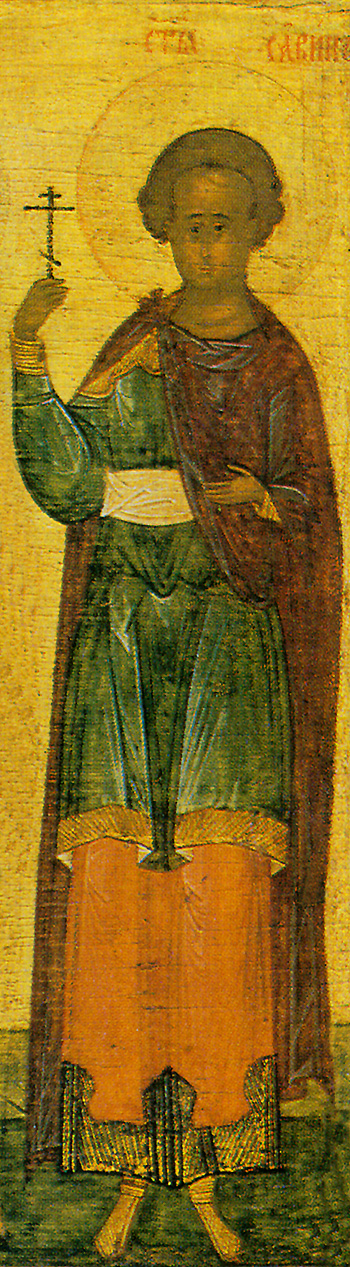
The Holy Martyr Sabinus was administrator of the Egyptian city of Hermopolis. During a persecution of Christians under the emperor Diocletian (284-305), Saint Sabinus and some like-minded companions hid in a remote village.
His hiding place was revealed by a certain ungrateful beggar who had brought him food. The saint used to feed him and help him with money, but the man betrayed him for two pieces of gold. Sabinus was seized with six other Christians, and after torture they were all drowned in the Nile in 287.
Martyr Papas of Lyconia
The Holy Martyr Papas lived in the city of Laranda (Asia Minor) during the reign of Maximian (305-311). They arrested and tortured him for his belief in Christ. His feet were put into boots with sharp nails hammered into the soles, and made to walk. They took him to the city of Diocaesarea and later to Seleucia, Isauria to stand trial.
St Papas died bound to a barren tree, which then became fruitful.
Saint Serapion, Archbishop of Novgorod

Saint Serapion was born in the village of Pekhorka near Moscow, and from a young age he was inclined toward monasticism. According to the wish of his parents, he entered into marriage, and was ordained to the priesthood. A year later he became a widower and was tonsured at the Dubensk Monastery of the Dormition. Because of his virtuous life he was elected as Igumen of the monastery and he labored so much for it that it later became known by his name – Serapion Hermitage.
Desiring to engage in more rigorous ascetical struggles, the Saint resigned his position and entered the Trinity-Sergius Lavra, where he became the Igumen in 1495. The Saint enjoyed the respect of the Great Prince Ivan Vasilyevich, and at his request, the Prince pardoned three convicted boyars who had been condemned to death.
While attending the Council of 1504, Saint Serapion passionately defended the practice of the Church and Monasteries possessing property, as a means of charity. This brought him into conflict with Saint Joseph of Volokolamsk (September 9), who taught that the Church should not own villages and estates.
In 1506 he was consecrated as Archbishop of Novgorod. During a big fire in that city in the year 1508, the Saint tearfully prayed that the Lord would cause it to cease.
Saint Serapion had to endure many troubles. In 1509 he was deprived of his See and exiled to Moscow’s Andronikov Monastery. In 1511 Saint Serapion moved to the Trinity-Sergius Lavra, where he spent the remainder of his life in unceasing meditation and prayer, honored by the Lord with the gifts of discernment and of working miracles.
After being tonsured into the Schema, the hierarch reposed in peace on March 16, 1516. His incorrupt relics were found on April 7,1517, and to this day they rest hidden in Serapion’s Pavilion, at Holy Trinity Cathedral, in Trinity-Sergius Lavra.
The Lord has glorified His saint with the gift of miracles, both during his lifetime and after his death. Once, on the Feast of the Dormition, the saint healed a lame man, who for many years had crawled on his feet and hands and feet, leaning on pieces of wood.
In 1608, during the siege of the Lavra by the Poles, many monks and laymen, who came to the temple to pray for his monastery, saw him in the bishop’s vestments.
Apostle Aristobulus of the Seventy, Bishop of Britain

The Holy Apostle Aristóboulos of the Seventy was born on Cyprus. He and his brother, the Apostle Barnabas (June 11), accompanied Saint Paul on his missionary journeys. Saint Aristóboulos is mentioned by the Apostle Paul in his Epistle to the Romans (Romans 16:10).
There are several conflicting narratives about the hierarch's life before he went to Britain. Some identify him with Zebedee, the father of the Apostles James and John. Others say that he was the father-in-law of the Apostle Peter. Most of these are unreliable, however.
Saint Paul made Aristóboulos a bishop and sent him to preach the Gospel in Britain, Scotland, and Hibernia (Ireland), where he converted many people to Christ. He also had to endure many torments and afflictions from hostile pagans, who beat him and mocked him. Eventually, he won them over and brought them to Christ as well.
Saint Aristóboulos reposed peacefully in Britain among the people he had evangelized. Some sources say he suffered a martyr's death in Wales at an advanced age.
Saint Aristóboulos is also commemorated on October 31 (with Saints Stachys, Apellēs, Amplias, Urban, and Narcissus), and also on the Synaxis of the Seventy Apostles (January 4). In Greek usage he is commemorated on March 15.
Hieromartyr Alexander, Pope of Rome
The Hieromartyr Alexander, Bishop of Rome, served for ten years as the archpastor of Rome. He was burned alive on May 3, 119 by order of the emperor Hadrian (117-138).
Martyr Julian of Anazarbus
The Hieromartyr Julian of Anazarbus suffered for Christ in Antioch, Syria under the emperor Maximian Galerius (305-311). His relics were glorified by miracles in the time of Saint John Chrysostom. Chrysostom mentions the martyr in his 47th homily.
Hieromartyrs Trophimus and Thalus of Laodicea
The Holy Martyrs Trophimus and Thallus, brothers and presbyters of Syria, served in Carian Laodicea. During a persecution under the emperor Diocletian (284-305) and his co-emperor Maximian (284-305), the brothers were taken under guard and brought before the governor Asclepiodotus. He ordered the holy brothers to be stoned, but the stones which they threw at the saints returned and struck those who threw them.
After a second interrogation, the holy brothers were sentenced to be crucified. Going to execution, they glorified God because they were found worthy of dying on a cross, as the Savior did. The holy martyrs of Christ continued to preach from the cross, and their brave mother stood nearby.
A certain Jewess bowed to the saints and cried out, “Blessed is the mother who gave birth to such sons.” When the martyrs surrendered their souls to God, the prison guard said that he saw the souls of the holy brothers being carried upwards to heaven in the company of three angels.
The people stayed with the bodies of the holy martyrs all night, and in the morning the wife of the torturer Asclepiodotus came to the place of execution with her bejeweled veil. She told the people that in a dream she saw the holy martyrs and the angels sent to punish her husband.
The mother of the martyrs and two Christians, Zosimus and Artemon, buried the holy brothers in their native city of Stratonikea, Lydia. The torturer Asclepiodotus soon fell ill and died a horrible death
Saints Pimen of Salosi and Anton Meskhi, Enlighteners of Dagestan and the North Caucasus people
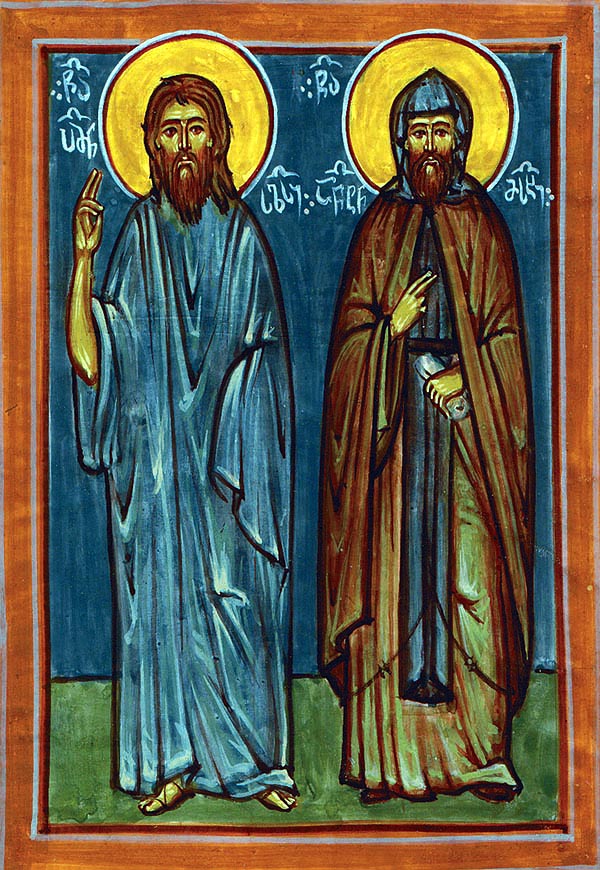
Saint Pimen the Fool-for-Christ and Anton Meskhi (of Meskheti, in southern Georgia) lived in the 13th century, when the Mongols were regularly invading Georgia. The entire country, and the Church in particular, languished under the yoke of Mongol oppression. The Georgian people were once again faced with a terrible choice: to preserve their temporal flesh or attain spiritual salvation. Most would not yield to the temptation of the enemy and chose instead to die as martyrs for Christ.
At that time a monk named Pimen, a fool-for-Christ, labored in the Davit-Gareji Wilderness. His ancestral roots were in the Kakheti region of eastern Georgia. Pimen rebuked kings and condemned the unjust and immoral acts of the nobility. The pious monk Anton Meskhi labored with him.
Enlightened by divine grace, the fathers recognized that the Georgian people were following their king’s poor example. Thus, the monks began a struggle for the spiritual salvation of the nation’s people that demanded the censure of the king. In addition to their labors of foolishness and censuring of kings, the saints preached Christianity among the Dagestani (located to the northeast of Georgia and borders the Caspian Sea).
For their great spiritual achievements and struggles on behalf of godly purity, the Christian Faith, and the spread of the Gospel among the Dagestanis, the Georgian Church has counted Pimen the Fool-for-Christ and Anton Meskhi worthy to be numbered among the saints.
Saint Christódoulos, Wonderworker of Patmos
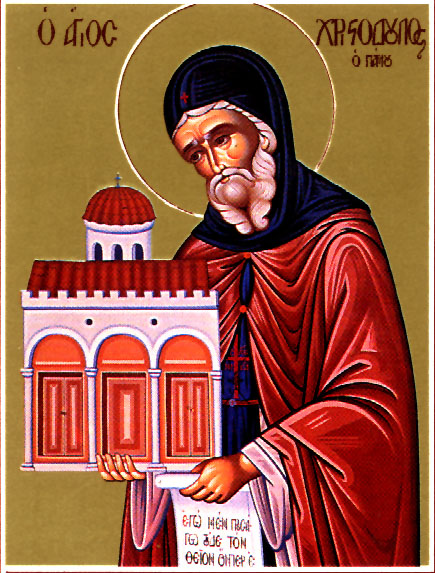
Our Venerable Father Christódoulos 1) was born near Nicaea of Bithynia circa 1020. His parents' names were Theodore and Anna, and their son received the name John in Holy Baptism. He was renowned as an ascetic and a physician throughout the Byzantine Empire.
In 1043 he was tonsured on Mount Olympus, where, under the guidance of the Elders, he received a broad education. After the death of his Spiritual Father, he made a pilgrimage to the holy places in 1045. He visited Rome and Palestine, and he lived in Asia Minor, and on some Greek islands, where he founded several monasteries.
After the Saracen invasion of Palestine, Father Christódoulos left the Holy Land and in 1070 settled on Mount Latmos, in the stavropegial Monastery of the Theotokos in northwestern Karia. Soon he was chosen as the Superior of that monastery. In 1076, Patriarch Cosmas I of Constantinople installed Father Christódoulos as Archimandrite over all the Latmian monasteries. From 1076–1079, he labored to build and fortify monasteries.
In 1079 the Latmian monasteries were destroyed by the Seljuk Turks. The Saint took refuge with his small community in the city of Strovilos on the Aegean coast, where the hermit Arsenios placed him in charge of his monastery. Father Christódoulos soon moved to the nearby island of Kos, the least affected by Muslim incursions. There Arsenios had several estates, and on Mount Pelion, at the latter's suggestion, Christódoulos founded the Kastrian Monastery of the Most Holy Theotokos in 1080.
In 1087, he founded a monastery on the neighboring island of Leros. In addition, during his stay on the island of Kos, Saint Christódoulos organized an expedition to Mount Latmos in order to rescue the books from the monastic community which he had abandoned. These books were sent to the library of the Hagia Sophia in Constantinople for safekeeping.
Seeking greater solitude and austerity, Saint Christódoulos turned his attention to the island of Patmos. He was so struck by the ascetic spirit of these places that he decided to establish a monastery on that island. In 1089, he submitted his first application to Emperor Alexios I Komnenos for a new monastic community on the island of Patmos, in place of the land on the island Kos and on the shores of Karia.
According to a Chrysobull issued in 1088, the Emperor gave the island of Patmos to Father Christódoulos as an eternal, inalienable property, exempting it from all taxes. It forbade government officials to act on the island. In fact, the island was withdrawn from the jurisdiction of the state's administration, and all judicial and administrative power on this island was concentrated in the hands of the Igoumen of the Monastery.
The Venerable one established a monastery on a mountain near the cave, where, according to Tradition, the Holy Apostle John the Theologian received a divine revelation and wrote his prophetic book in the years 68-69. The monastery was built on a rocky ledge, almost in the center of the island, and during the first three years, it had acquired the appearance of a fortress.
However, in the last years of his life, because of the raids of pirates, the Saint was forced to flee Patmos. He and his disciples went to the island of Euboea, where he reposed on March 16,1093. Shortly before his death, he gave his disciples instructions to bury him on the island of Patmos in the Monastery he founded. His disciples took his holy and incorrupt relics and transferred them to his own Monastery, where they remain for the sanctification of those who venerate them with faith.
Saint Christódoulos is also commemorated on October 21 (the transfer of his holy relics).
1 His name means "the servant of Christ."
Saint Ambrose the Confessor

Saint Ambrose the Confessor (in the world Besarion Khelaia) was born in 1861. He received his primary education at the theological school in Samegrelo and graduated from Tbilisi Seminary in 1885. He graduated and was ordained to the priesthood in the same year. Fr. Ambrose served as a priest in Sokhumi (in northwestern Georgia) for eight years, at the same time teaching the Georgian language in schools and directing the activity of various philanthropic societies. In 1896 he was widowed, and in 1897 he enrolled at the Kazan Theological Academy.
While in Kazan, Fr. Ambrose followed both the literary-cultural life of the city and the Georgian national independence movement with great interest. He researched the history of Georgia from primary sources and composed several essays based on his findings. His essay, entitled “The Struggle Between Christianity and Islam in Georgia,” was so compelling to one professor that he recommended that Fr. Ambrose continue exploring this theme and present his research for a master’s degree.
In 1901 Fr. Ambrose completed his studies at the Kazan Theological Academy, and in the same year he was tonsured a monk and returned to Georgia. Together with the greatest sons of his nation, he fought tirelessly for the autocephaly of the Georgian Orthodox Church. As a punishment for his uncompromising commitment to this goal, Fr. Ambrose was exiled to Russia in 1905.
Upon his return to Georgia, he was elevated to the rank of archimandrite and appointed abbot of Chelishi Monastery. Chelishi Monastery had at one time been a center for theological education in Georgia, but many years had passed since then and the monastery’s student body was rapidly shrinking. Before long it would be completely deserted. But with the blessing of Bishop Leonid of Imereti (later Catholicos-Patriarch of All Georgia), Saint Ambrose gathered a number of gifted young people to study at the seminary and began to instruct them in chanting and the reading of the Holy Gospel.
Saint Ambrose devoted much of his time and energy to finding and restoring the old manuscripts of Chelishi Monastery. Once, while passing through the monastery yard, he heard a muted sound coming from beneath the earth. He began to dig at that place and discovered an ancient copy of the Holy Gospels. It was the “Chelishi Gospel,” a famous Georgian relic from the 9th or 10th century.
Soon Saint Ambrose joined the Tbilisi Synodal Council and was enthroned as abbot of Holy Transfiguration Monastery in Tbilisi. But in 1908 he was accused of conspiring in the murder of the exarch Nikon and deprived of the right to serve in the Church. The prosecutors exiled him to the Holy Trinity Monastery in Ryazan, where he spent over a year under strict guard. In 1910 Saint Ambrose was acquitted and again permitted to serve in the Church.
In 1917 Archimandrite Ambrose returned to Georgia and rejoined the struggle for an autocephalous Georgian Church. Within a few months the Church’s autocephaly was proclaimed. He was consecrated Metropolitan of Chqondidi, later to be transferred to the Tskum-Abkhazeti region. In 1921 Saint Ambrose was enthroned Catholicos-Patriarch of All Georgia.
The Soviet government began to persecute the Church not long after Saint Ambrose’s enthronement. Some 1,200 churches were plundered, converted for other purposes, or destroyed. A great number of clergy were arrested, exiled, and later shot to death.
On February 7, 1922, Catholicos-Patriarch Ambrose, the spiritual father and chief shepherd of his nation, sent a memorandum to participants in the Conference of Genoa1 in which he defended the rights of the Georgian Church and nation. Every word of his appeal was permeated with distress for the fate not only of his motherland but of the entire human race. Saint Ambrose assured his audience that a nation and government deprived of Christian virtue would have no future and pleaded for help in this time of misfortune.
The receipt of such a memorandum was unprecedented for the Bolshevik regime, and in response the officials had Saint Ambrose arrested. Nevertheless, he fearlessly criticized the government’s complaisance with acts of crime, injustice, and sacrilege.
In response to one of the Bolshevik interrogations, the patriarch asserted, “Confession of Faith is a spiritual necessity for every nation— persecution increases its necessity. Faith deepens, being contracted and accumulated, and it bursts out with new energy. So it was in the past, and so it will be in our country. Georgia is no exception to this universal law.”
Saint Ambrose spoke these remarkable last words to his persecutors: “My soul belongs to God, my heart to my motherland, and with my flesh you may do whatever you wish.” The court sentenced the Catholicos-Patriarch of All Georgia to seven years, nine months and twenty-eight days in prison.
At the end of 1924 Saint Ambrose and the other members of the Synodal Council were granted amnesty, but their grave experience had already taken its toll. The Georgian flock lost its faithful shepherd in 1927.
In 1995 the life of Catholicos-Patriarch of All Georgia Ambrose (Khelaia) was discussed at an expanded council of the Holy Synod of the Georgian Church. In recognition of his great achievements on behalf of the Church and nation, Ambrose was canonized as “Saint Ambrose the Confessor.”
1 In 1922 representatives of thirty-four nations met in Genoa, Italy to discuss the economic reconstruction of Central and Eastern Europe and to improve relations between the Soviet Union and Western Europe.
Saint Demetrius the Devoted, King of Georgia

Saint Demetre the King, also called “the Devoted,” was a great-grandson of Holy Queen Tamar. God sent Saint Demetre many tribulations during his childhood, thus encouraging him in the Faith from an early age. Demetre was still an infant when the Mongols killed his mother, the pious Queen Gvantsa. His father, King Davit V (1258-1269), died when Demetre was just ten years old.
When he reached the age of twelve, the royal court sent him to the Mongol ordu (the military camp and headquarters of the Mongols). This particular camp of the Ilkhanid Mongols lay in Mughan of Azerbaijan and was ruled by Abaqa Khan (1265-1282). The Ilkhanid Mongols were descendents of Qubilay Khan’s brother Hulegu.
As the Georgians were under Mongol dominion, they asked Abaqa Khan to proclaim Demetre king, and their request was honored.
Filled with virtue, King Demetre ruled the nation in wisdom and kindness. At night he would go out in search of the poor, the infirm, and the orphaned to distribute his wealth to them. The king took advantage of comparatively peaceful periods to build and restore churches and monasteries and to strengthen fortifications.
Many of King Demetre’s lofty goals, however, were never realized, because the khan was constantly calling the Georgian soldiers to arms. A vast number of Georgia’s finest soldiers fought and perished in the khan’s battles. Soon Georgia was exhausted from battle and the sacrifice of her sons’ blood in the wars of foreign nations.
Internal strife began to tear at the Georgian people, and in desperation they began to pillage the lands and villages that belonged to their own Church.
During this difficult time, Demetre yielded to a temptation. Although already joined in a marriage of political convenience, he abducted Natela, the daughter of southern Georgia’s ruler, Beka Jakeli. She bore Demetre a son, whom they named Giorgi. He would later be honored with the title Giorgi V “the Brilliant” (1314-1346).
After the death of Abaqa Khan, his brother, Ahmad Tegüder (1282-1284), was proclaimed khan. In the second year of his reign, Ahmad’s brother, Qongurdam, plotted to overthrow him but failed. A short time later, Abaqa Khan’s son, Arghun (1284-1291), rose up against his uncle and seized the throne. Finally, Bugha Chingsang, the khan’s prime minister, organized a plot against Arghun. On January 17, 1289, Bugha Chingsang was executed along with his fellow conspirators.
Demetre, who had been on friendly terms with the khan, was now summoned to the khan’s ordu as a suspected member of the plot.
King Demetre immediately surmised the reason for this summons: “The khan is very angry and has called me to him,” he told his court. “I am certain he intends to do me evil, but my kingdom will lie defenseless before him if I do not go. How many Christians will die or become his slaves? How many churches will be laid to waste? Truly my life cannot be so valuable that I could live and bear this sin while many Christian souls are left to perish. It is my wish to go to the khan. God’s will be done: if I am killed, I will be certain that my country is saved!”
The royal court tried with all its might to convince Demetre that it was foolish to go, meet certain death, and leave the country without a ruler. Catholicos Abraam alone supported King Demetre’s decision and advised him, “If you sacrifice your own life for your nation, we, the bishops of this land, will bear your sins, and will pray to God that you be numbered among the holy martyrs. For the Lord Himself said, Greater love has no man than this, that a man lay down his life for his friends (John 15:13). And if it is good for a man to lay down his life for just one neighbor, how profitable is it for a man to die for the sake of many?”
Upon hearing these words, the king rejoiced exceedingly and began to prepare for his journey to the Mongol ordu. He took with him Catholicos Abraam, a certain priest Mose, his son Davit, and several members of his court. At the ordu the Mongols could find no fault in the young Georgian king, but they imprisoned him nevertheless. Then a group of Georgian faithful forced their way into the prison to see him and offered to help him escape. The king was deeply moved by their compassion, but nevertheless he told them, “I knew from the beginning the death I would suffer, and I offered my life for this nation. If I escape now, the nation will be destroyed. For what shall it profit a man, if he shall gain the whole world, and lose his own soul? (Mark 8:36).”
The khan ordered his execution. Fully prepared to meet death, King Demetre prayed fervently, received the Holy Gifts, and gave up his soul to the Lord. Those present witnessed a divine miracle: the sun grew dark and an ominous gloom enshrouded the whole city.
The holy relics of the Royal Martyr Demetre were guarded until the catholicos and the priest Mose secretly retrieved the body and, with the help of a group of Tbilisi fishermen, returned the king to his homeland. He was buried in Mtskheta, in the burial vault of his forefathers at Svetitskhoveli Cathedral.
Homily for Sunday, March 10, 2024
Daily Readings for Friday, March 15, 2024
CHEESEFARE FRIDAY
ABSTAIN FROM MEAT
Agapius the Martyr & His Companions, Manuel the New Martyr of Crete, Holy Apostle Aristobulos of the Seventy, Bishop of Britain
ZECHARIAH 8:7-17
Thus says the Lord of hosts: Behold, I will save my people from the east country and from the west country; and I will bring them to dwell in the midst of Jerusalem; and they shall be my people and I will be their God, in faithfulness and in righteousness.
Thus says the Lord of hosts: "Let your hands be strong, you who in these days have been hearing these words from the mouth of the prophets, since the day that the foundation of the house of the Lord of hosts was laid, that the temple might be built. For before those days there was no wage for man or any wage for beast, neither was there any safety from the foe for him who went out or came in; for I set every man against his fellow. But now I will not deal with the remnant of this people as in the former days, says the Lord of hosts. For there shall be a sowing of peace; the vine shall yield its fruit, and the ground shall give its increase, and the heavens shall give their dew; and I will cause the remnant of this people to possess all these things. And as you have been a byword of cursing among the nations, O house of Judah and house of Israel, so will I save you and you shall be a blessing. Fear not, but let your hands be strong.
For thus says the Lord of hosts: "As I purposed to do evil to you, when your fathers provoked me to wrath, and I did not relent, says the Lord of hosts, so again have I purposed in these days to do good to Jerusalem and to the house of Judah; fear not. These are the things that you shall do: Speak the truth to one another, render in your gates judgments that are true and make for peace, do not devise evil in your hearts against one another, and love no false oath, for all these things I hate, says the Lord.
ZECHARIAH 8:19-23
Thus says the Lord of hosts: The fast of the fourth month, and the fast of the fifth, and the fast of the seventh, and the fast of the tenth, shall be to the house of Judah seasons of joy and gladness, and cheerful feasts; therefore love truth and peace.
Thus says the Lord of hosts: Peoples shall yet come, even the inhabitants of many cities; the inhabitants of one city shall go to another, saying, 'Let us go at once to entreat the favor of the Lord, and to seek the Lord of hosts; I am going.' Many peoples and strong nations shall come to seek the Lord of hosts in Jerusalem, and to entreat the favor of the Lord. Thus says the Lord of hosts: In those days ten men from the nations of every tongue shall take hold of the robe of a Jew, saying, 'Let us go with you, for we have heard that God is with you.'
Martyrs Agapius, Publius, Timolaus, Romulus, two named Dionysius, and two named Alexander, at Caesarea in Palestine

The Holy Martyrs Agapius, Publius (Pausis), Timolaus, Romulus, Alexander, Alexander, Dionysius and Dionysius suffered under the emperor Diocletian (284-305) in the city of Palestinian Caesarea. During one of the pagan festivals they began to torture and execute Christians who refused to offer sacrifice to idols.
The Martyr Timolaus (August 19) was sentenced to burning, and the Martyrs Agapius and Thekla (August 19) were sentenced to be torn apart by wild beasts. A group of young Christians: Publius, Timolaus, Alexander, another Alexander, Dionysius, and Romulus, the subdeacon of the Diospolis church decided to confess their faith and suffer for Christ.
As a sign of their voluntary deed they tied their own hands behind their backs and appeared before the governor Urbanus. Seeing their youth, the governor tried to persuade them to reconsider their decision, but in vain. He then threw them in prison, where there were already two Christians, Agapius and his servant Dionysius. All these saints were subjected to terrible tortures and beheaded.
Hieromartyr Alexander of Sίdē, in Pamphylia
The Hieromartyr Alexander was a priest from Sίdē in Pamphylia. He suffered for Christ during a time of persecution in the reign of Emperor Aurelian (270-275). When the ruler Antoninus arrived at Sίdē he ordered Father Alexander to be brought before him for interrogation. He began by asking him, "Who are you?"
The Saint replied, "I am a Christian, a priest, a shepherd of Christ's rational flock."
Antoninus continued, "Where is this flock of Christ?"
The Saint replied, "Christ God created all the people who live in the world; those who believe in Him are the sheep of His flock. Those who have fallen away from their Creator, those such as yourself, who worship idols, which are fashioned by human hands, may not belong to His holy flock. At the Last Judgment, they will be placed on His left side, along with the goats."
The ruler said to him, "Now I am going to torture you for two reasons; first, so that you will show me where to find those who believe in Christ and secondly, so that you can offer sacrifices to our gods."
Again, Antoninus asked Father Alexander, "Who was Christ?"
The Saint replied, "Christ is the Savior of the world, He is Life and Light for those who believe in Him."
Antoninus said: "How can this man who died on a cross be a Savior?"
Saint Alexander declared, "It is indeed marvelous and surprising that He took upon Himself the Cross and death in the flesh of His own will, His Divinity shattered the power of Hades, and released those who were held captive there. He put Death to death, and rose from the dead. Not only did He arise from the dead Himself, He also raised many of the dead with Himself: 'the tombs were opened, and many bodies of the saints who had fallen asleep were raised, and coming out of the tombs after His Resurrection, they went into the holy city and appeared to many' (Matthew 27:52-53). With Himself, Christ has resurrected the entire human race."
Antoninus exclaimed, "Are you mad? How could a tormented Jew, who was unable to help Himself, possibly help others?"
The Saint replied, "It is not I, but you yourself who are mad. You are spiritually blind, therefore you do not understand the mystery of our salvation, accomplished by Christ the Lord."
Then the ruler ordered that Saint Alexander be tortured. He was beaten, tormented on a wheel, and plunged into a vessel of boiling resin and oil, then he was placed in a fiery furnace. By the grace of God, the Saint was preserved unharmed. When he was thrown into the furnace, the wicked tormentors saw in the flames two young men with handsome faces, praising God along with the Holy Martyr. These were Angels, who cooled the flames of the furnace. The people marveled, for they knew that only one man had entered the furnace, and now there were three.
Antoninus, and those who were with him, regarded all these glorious miracles as magic, because they did not believe in the omnipotent power of Christ God. One of the ruler's servants believed in Christ and fell to the ground before the Saint, begging him to take him along with him to be with Christ. Immediately, the tyrant killed his servant with his sword.
When Saint Alexander emerged from the furnace unscathed, Antoninus ordered that he be hanged, and stabbed with sharp iron needles. The Saint was tortured until his body became one large wound. Those who tortured the Saint marveled at his steadfastness, saying, "How can this man endure such torment? His bones have already been exposed."
Afterward, the Saint was tormented in the fire for a second time, but did not suffer any harm from it. Then his body was stabbed with iron needles and his intestines fell out. Then Saint Alexander was thrown to the wild animals to be devoured, but the beasts did not touch him. This sufferer for Christ endured many other bitter torments, but he remained firm and courageous through all of them. Those who witnessed his suffering were astonished by the power of his patience, which surpassed all human understanding. Finally, the Hieromartyr Alexander was beheaded with a sword.
Just as Antoninus left his judgment seat, he was attacked by the demons he had served. His servants carried him to his home, weeping and sobbing all the way. They did not have time to bring him into the house, however, for he had breathed forth his vile soul.
Saint Alexander was taken to the heavenly abodes to dwell with Christ, His Saints, and His Holy Angels. As for Antoninus, he was cast "into the eternal fire prepared for the devil and his angels" (Matthew 25:41).
After the beheading of Saint Alexander, Eustáthios, an honest man, and a Christian, took the much-suffering body of the Holy Martyr and buried him with honor, glorifyng and praising Christ God.
Martyr Nicander of Egypt
The Holy Martyr Nicander suffered in Egypt under the emperor Diocletian (284-305). He was a physician and during a time of persecution he visited Christians in prison. He assisted them, brought them food, and buried the dead.
Once, he came to the place where the bodies of the martyrs were thrown to be eaten by wild beasts. Fearing to bury them by day, he waited for night and buried the bodies under cover of darkness. They discovered Saint Nicander and subjected him to terrible tortures: they skinned him alive and then beheaded him in 302.
Daily Readings for Thursday, March 14, 2024
CHEESEFARE THURSDAY
ABSTAIN FROM MEAT
Benedict the Righteous of Nursia, Euschemon the Confessor, Bishop of Lampasakos
ST. JUDE’S FIRST UNIVERSAL LETTER 1:11-25
Beloved, woe to the ungodly, for they walk in the way of Cain, and abandon themselves for the sake of gain to Balaam's error, and perish in Korah's rebellion. These are blemishes on your love feasts, as they boldly carouse together, looking after themselves; waterless clouds, carried along by winds; fruitless trees in late autumn, twice dead, uprooted; wild waves of the sea, casting up the foam of their own shame; wandering stars for whom the nether gloom of darkness has been reserved for ever.
It was of these also that Enoch in the seventh generation from Adam prophesied, saying, "Behold, the Lord came with his holy myriads, to execute judgment on all, and to convict all the ungodly of all their deeds of ungodliness which they have committed in such an ungodly way, and of all the harsh things which ungodly sinners have spoken against him." These are grumblers, malcontents, following their own passions, loud-mouthed boasters, flattering people to gain advantage.
But you must remember, beloved, the predictions of the apostles of our Lord Jesus Christ; they said to you, "In the last time there will be scoffers, following their own ungodly passions." It is these who set up divisions, worldly people, devoid of the Spirit. But you, beloved, build yourselves up on your most holy faith; pray in the Holy Spirit; keep yourselves in the love of God; wait for the mercy of our Lord Jesus Christ unto eternal life. And convince some, who doubt; save some, by snatching them out of the fire; on some have mercy with fear, hating even the garment spotted by the flesh.
Now to him who is able to keep you from falling and to present you without blemish before the presence of his glory with rejoicing, to the only God, our Savior through Jesus Christ our Lord, be glory, majesty, dominion, and authority, before all time and now and for ever. Amen.
LUKE 23:1-31, 33, 44-56
At that time, the chief priests, the scribes, and elders of the people brought Jesus before Pilate. And they began to accuse him, saying, "We found this man perverting our nation, and forbidding us to give tribute to Caesar, and saying that he himself is Christ a king." And Pilate asked him, "Are you the King of the Jews?" And he answered him, "You have said so." And Pilate said to the chief priests and the multitudes, "I find no crime in this man." But they were urgent, saying, "He stirs up the people, teaching throughout all Judea, from Galilee even to this place.
When Pilate heard this, he asked whether the man was a Galilean. And when he learned that he belonged to Herod's jurisdiction, he sent him over to Herod, who was himself in Jerusalem at that time. When Herod saw Jesus, he was very glad, for he had long desired to see him, because he had heard about him, and he was hoping to see some sign done by him. So he questioned him at some length; but he made no answer. The chief priests and the scribes stood by, vehemently accusing him. And Herod with his soldiers treated him with contempt and mocked him; then, arraying him in gorgeous apparel, he sent him back to Pilate. And Herod and Pilate became friends with each other that very day, for before this they had been at enmity with each other.
Pilate then called together the chief priests and the rulers and the people, and said to them, "You brought me this man as one who was perverting the people; and after examining him before you, behold, I did not find this man guilty of any of your charges against him; neither did Herod, for he sent him back to us. Behold, nothing deserving death has been done by him; I will therefore chastise him and release him." Now he was obliged to release one man to them at the festival.
But they all cried out together, "Away with this man, and release to us Barabbas" — a man who had been thrown into prison for an insurrection started in the city, and for murder. Pilate addressed them once more, desiring to release Jesus; but they shouted out, "Crucify, crucify him!" A third time he said to them, "Why, what evil has he done? I have found in him no crime deserving death; I will therefore chastise him and release him." But they were urgent, demanding with loud cries that he should be crucified. And their voices prevailed. So Pilate gave sentence that their demand should be granted. He released the man who had been thrown into prison for insurrection and murder, whom they asked for; but Jesus he delivered up to their will.
And as they led him away, they seized one Simon of Cyrene, who was coming in from the country, and laid on him the cross, to carry it behind Jesus. And there followed him a great multitude of the people, and of women who bewailed and lamented him. But Jesus turning to them said, "Daughters of Jerusalem, do not weep for me, but weep for yourselves and for your children. For behold, the days are coming when they will say, 'Blessed are the barren, and the wombs that never bore, and the breasts that never gave suck!' Then they will begin to say to the mountains, 'Fall on us'; and to the hills, 'Cover us.' For if they do this when the wood is green, what will happen when it is dry?
And when they came to the place which is called The Skull, there they crucified him, and the criminals, one on the right and one on the left.
It was now about the sixth hour, and there was darkness over the whole land until the ninth hour, while the sun's light failed; and the curtain of the temple was torn in two. Then Jesus, crying with a loud voice, said, "Father, into your hands I commit my spirit!" And having said this he breathed his last. Now when the centurion saw what had taken place, he praised God, and said, "Certainly this man was innocent!" And all the multitudes who assembled to see the sight, when they saw what had taken place, returned home beating their breasts. And all his acquaintances and the women who had followed him from Galilee stood at a distance and saw these things.
Now there was a man named Joseph from the Jewish town of Arimathea. He was a member of the council, a good and righteous man, who had not consented to their purpose and deed, and he was looking for the kingdom of God. This man went to Pilate and asked for the body of Jesus. Then he took it down and wrapped it in a linen shroud, and laid him in a rock hewn tomb, where no one had ever yet been laid. It was the day of Preparation, and the sabbath was beginning. The women who had come with him from Galilee followed, and saw the tomb, and how his body was laid; then they returned, and prepared spices and ointments.
On the sabbath they rested according to the commandment.
Venerable Benedict of Nursia

Saint Benedict, founder of Western monasticism, was born in the Italian city of Nursia in the year 480. When he was fourteen years of age, the saint’s parents sent him to Rome to study. Unsettled by the immorality around him, he decided to devote himself to a different sort of life.
At first Saint Benedict settled near the church of the holy Apostle Peter in the village of Effedum, but news of his ascetic life compelled him to go farther into the mountains. There he encountered the hermit Romanus, who tonsured him into monasticism and directed him to live in a remote cave at Subiaco. From time to time, the hermit would bring him food.
For three years the saint waged a harsh struggle with temptations and conquered them. People soon began to gather to him, thirsting to live under his guidance. The number of disciples grew so much, that the saint divided them into twelve communities. Each community was comprised of twelve monks and was a separate skete. The saint gave each skete an igumen from among his experienced disciples, and only the novice monks remained with Saint Benedict for instruction.
The strict monastic Rule Saint Benedict established for the monks was not accepted by everyone, and more than once he was criticized and abused by dissenters.
Finally he settled in Campagna and on Mount Cassino he founded the Monte Cassino monastery, which for a long time was a center of theological education for the Western Church. The monastery possessed a remarkable library. Saint Benedict wrote his Rule, based on the experience of life of the Eastern desert-dwellers and the precepts of Saint John Cassian the Roman (February 29).
The Rule of Saint Benedict dominated Western monasticism for centuries (by the year 1595 it had appeared in more than 100 editions). The Rule prescribed the renunciation of personal possessions, as well as unconditional obedience, and constant work. It was considered the duty of older monks to teach the younger and to copy ancient manuscripts. This helped to preserve many memorable writings from the first centuries of Christianity.
Every new monk was required to live as a novice for a year, to learn the monastic Rule and to become acclimated to monastic life. Every deed required a blessing. The head of this cenobitic monastery is the igumen. He discerns, teaches, and explains. The igumen solicits the advice of the older, experienced brethren, but he makes the final decisions. Keeping the monastic Rule was strictly binding for everyone and was regarded as an important step on the way to perfection.
Saint Benedict was granted by the Lord the gift of foresight and wonderworking. He healed many by his prayers. The monk foretold the day of his death in 547. The main source for his Life is the second Dialogue of Saint Gregory.
Saint Benedict’s sister, Saint Scholastica (February 10), also became famous for her strict ascetic life and was numbered among the saints.
Saint Theognostus, Metropolitan of Kiev and All Russia

Saint Theognostus the Greek succeeded Saint Peter (August 25 and December 21) as Metropolitan of Moscow and All Russia, holding this office from 1327 until 1353. It was through his influence that the Grand Prince Simeon sent money to the Byzantine Emperor John Cantacuzene for repairs to the Great Church of Hagia Sophia.
Right-believing Great Prince Rostislav-Michael, Prince of Kiev
.jpg)
Saint Rostislav-Michael, Great Prince of Kiev, was the son of the Kievan Great Prince Saint Mstislav the Great (June 14), and the brother of holy Prince Vsevolod-Gabriel (February 11, April 22, and November 27). He was one of the great civil and churchly figures of the mid-twelfth century.
His name is connected with the fortification and rise of Smolensk, and both the Smolensk principality and the Smolensk diocese.
Up until the twelfth century the Smolensk land was part of the Kievan realm. The beginning of its political separation took place in the year 1125, when holy Prince Mstislav the Great, gave Smolensk to his son Rostislav (in Baptism Michael) as an inheritance from his father, the Kievan Great Prince Vladimir Monomakh. Thanks to the work and efforts of Saint Rostislav, the Smolensk principality, which he ruled for more than forty years, expanded and was built up with cities and villages, adorned with churches and monasteries, and became influential in Russian affairs.
Saint Rostislav founded the cities of Rostislavl, Mstislavl, Krichev, Propoisk, and Vasiliev among others. He was the forefather of the Smolensk princely dynasty.
In 1136 Saint Rostislav succeeded in establishing a separate Smolensk diocese. Its first bishop was Manuel, installed between March-May of 1136 by Metropolitan Michael of Kiev. Prince Rostislav issued an edict in the city of Smolensk assuring Bishop Manuel that he would provide him with whatever he needed. On September 30, 1150 Saint Rostislav also ceded Cathedral Hill at Smolensk to the Smolensk diocese, where the Dormition cathedral and other diocesan buildings stood.
Contemporaries thought highly of the church construction of Prince Rostislav. Even the sources that are inclined to report nothing more about it note that “this prince built the church of the Theotokos at Smolensk.” The Dormition cathedral, originally built by his grandfather, Vladimir Monomakh, in the year 1101 was rebuilt and expanded under Prince Rostislav. The rebuilt cathedral was consecrated by Bishop Manuel on the Feast of the Dormition, August 15, 1150. Prince Rostislav was a “builder of the Church” in a far wider sense: he endowed the Smolensk Dormition church of the Mother of God, and transformed it from a city cathedral into the ecclesiastical center of the vast Smolensk diocese.
Holy Prince Rostislav was the builder of the Smolensk Kremlin, and of the Savior cathedral at the Smyadynsk Boris and Gleb monastery, founded on the place of the murder of holy Prince Gleb (September 5). Later his son David, possibly fulfilling the wishes of his father, transferred the old wooden coffins of Saints Boris and Gleb from Kievan Vyshgorod to Smyadyn.
In the decade of the fifties of the twelfth century, Saint Rostislav was drawn into a prolonged struggle for Kiev, which involved representatives of the two strongest princely lines: the Olgovichi and the Monomakhovichi.
On the Monomakhovichi side the major contender to be Great Prince was Rostislav’s uncle, Yurii Dolgoruky. Rostislav, as Prince of Smolensk, was one of the most powerful rulers of the Russian land and had a decisive voice in military and diplomatic negotiations.
For everyone involved in the dispute, Rostislav was both a dangerous opponent and a desired ally, and he was at the center of events. This had a providential significance, since Saint Rostislav distinguished himself by his wisdom regarding the civil realm, by his strict sense of justice and unconditional obedience to elders, and by his deep respect for the Church and its hierarchy. For several generations he was the bearer of the “Russkaya Pravda” (“Russian Truth”) and of Russian propriety.
After the death of his brother Izyaslav (November 13, 1154), Saint Rostislav became Great Prince of Kiev, but he ruled Kiev at the same time with his uncle Vyacheslav Vladimirovich. After the latter’s death, Rostislav returned to Smolensk, ceding the Kiev princedom to his other uncle, Yurii Dolgoruky, and he removed himself from the bloodshed of the princely disputes. He occupied Kiev a second time on April 12, 1159 and he then remained Great Prince until his death (+ 1167). More than once, he had to defend his paternal inheritance with sword in hand.
The years of Saint Rostislav’s rule occurred during one of the most complicated periods in the history of the Russian Church. The elder brother of Rostislav, Izyaslav Mstislavich, a proponent of the autocephaly of the Russian Church, favored the erudite Russian monk Clement Smolyatich for Metropolitan, and wanted him to be made Metropolitan by a council of Russian bishops, without seeking the usual approval from the Patriarch of Constantinople. This occurred in the year 1147.
The Russian hierarchy basically supported Metropolitan Clement and Prince Izyaslav in their struggle for ecclesiastical independence from Constantinople, but several bishops headed by Saint Niphon of Novgorod (April 8), did not recognize the autocephaly of the Russian metropolitanate and shunned communion with it, having transformed their dioceses into independent ecclesial districts, pending the resolution of this question. Bishop Manuel of Smolensk also followed this course. Saint Rostislav understood the danger which lay hidden beneath the idea of Russian autocephaly for these times, which threatened the break-up of Rus. The constant fighting over Kiev among the princes might also lead to a similar fight over the Kievan See among numerous contenders, put forth by one princely group or another.
The premonitions of Saint Rostislav were fully justified. Yurii Dolgoruky, who remained loyal to Constantinople, occupied Kiev in the year 1154. He immediately banished Metropolitan Clement and petitioned Constantinople for a new Metropolitan. This was to be Saint Constantine (June 5), but he arrived in Rus only in the year 1156, six months before the death of Yurii Dolgoruky (+ May 15, 1157). Six months later, when Saint Rostislav’s nephew Mstislav Izyaslavich entered the city on December 22, 1157, Saint Constanine was obliged to flee Kiev, while the deposed Clement Smolyatich returned as Metropolitan. Then a time of disorder began in Russia, for there were two Metropolitans.
All the hierarchy and the clergy came under interdict: the Greek Metropolitan suspended the Russian supporters of Clement, and Clement suspended all the supporters of Constantine. To halt the scandal, Saint Rostislav and Mstislav decided to remove both Metropolitans and petition the Patriarch of Constantinople to appoint a new archpastor for the Russian metropolitan See.
But this compromise did not end the matter. Arriving in Kiev in the autumn of 1161, Metropolitan Theodore died in spring of the following year. Following the example of Saint Andrew Bogoliubsky (July 4), who supported his own fellow ascetic Bishop Theodore to be Metropolitan, Saint Rostislav put forth his own candidate, who turned out to be the much-suffering Clement Smolyatich.
The fact that the Great Prince had changed his attitude toward Metropolitan Clement, shows the influence of the Kiev Caves monastery, and in particular of Archimandrite Polycarp. Archimandrite Polycarp, who followed the traditions of the Caves (in 1165 he became head of the monastery), was personally very close to Saint Rostislav.
Saint Rostislav had the pious custom of inviting the igumen and twelve monks to his own table on the Saturdays and Sundays of Great Lent, and he served them himself. The prince more than once expressed the wish to be tonsured a monk at the monastery of Saints Anthony and Theodosius, and he even gave orders to build a cell for him.
The monks of the Caves, a tremendous spiritual influence in ancient Rus, encouraged the prince to think about the independence of the Russian Church. Moreover, during those years in Rus, there was suspicion regarding the Orthodoxy of the bishops which came from among the Greeks, because of the notorious “Dispute about the Fasts” (the “Leontian Heresy”). Saint Rostislav’s pious intent to obtain the blessing of the Patriarch of Constantinople for Metropolitan Clement came to naught. The Greeks believed that appointing a Metropolitan to the Kiev cathedra was one of their most important prerogatives. This served not only the ecclesiastical, but also the political interests of the Byzantine Empire.
In 1165 a new Greek Metropolitan arrived at Kiev, John IV, and Saint Rostislav accepted him out of humility and churchly obedience. The new Metropolitan, like his predecessor, governed the Russian Church for less than a year (+ 1166). The See of Kiev was again left vacant, and the Great Prince was deprived of the fatherly counsel and spiritual wisdom of a Metropolitan. His sole spiritual solace was the igumen Polycarp and the holy Elders of the Kiev Caves monastery and the Theodorov monastery at Kiev, which had been founded under his father.
Returning from a campaign against Novgorod in the spring of 1167, Saint Rostislav fell ill. When he reached Smolensk, where his son Roman was prince, relatives urged him to remain at Smolensk. But the Great Prince gave orders to take him to Kiev. “If I die along the way,” he declared, “put me in my father’s monastery of Saint Theodore. If God should heal me, through the prayers of His All-Pure Mother and Saint Theodosius, I shall take vows at the monastery of the Caves.”
God did not fulfill Saint Rostislav’s last wish to end his life as a monk of the holy monastery. The holy prince died on the way to Kiev on March 14, 1167. (In other historical sources the year is given as 1168). His body, in accord with his last wishes, was brought to the Kiev Theodosiev monastery.
Saint Euschemon the Confessor, Bishop of Lampsacus
Saint Euschemon the Confessor, Bishop of Lampsacus, lived in Asia Minor on the coastal region of the Dardanelles peninsula, and was known for his virtuous and ascetic life. He suffered for the holy icons under the iconoclast emperor Theophilus (829-842), and having been imprisoned, he was sent into exile and died.
Icon of the Mother of God of Saint Theodore

The Saint Theodore—Kostroma Icon of the Mother of God was painted by the Evangelist Luke, and it closely resembles the Vladimir Icon of the Mother of God.
The Icon received its name from the Great Prince Yaroslav Vsevolodovich (+ 1246), the father of Saint Alexander Nevsky, and in Holy Baptism he was named Theodore in honor of Saint Theodore Stratelates (Stratēlátēs). According to Tradition, the Icon was found by his older brother, Saint George (February 4), in an old wooden chapel near the city of Gorodets. Later, the Saint Theodore—Kostroma Monastery was built on the site. Prince Yaroslav (Theodore) became Great Prince of Vladimir after his brother Saint George perished in battle with the Mongols at the Sit' River. In the year 1238, and he solemnly transferred his brother's relics from Rostov to the Dormition cathedral at Vladimir. Yaroslav (Theodore) gave the Icon which he inherited from his brother to his own son, Saint Alexander Nevsky, who married Princess Bryachislava of Polotsk in that same year.
Prince Yaroslav (Theodore) is renowned in Russian history. He continued with the glorious traditions of his uncle Saint Andrew Bogoliubsky (July 4), and of his father Vsevolod III Big-Nest; and he was connected to almost every significant event in the history of Rus' in the first half of the XIII century. The land was burnt and devastated by the Mongols in 1237-1238. He raised it up from the ashes, rebuilding and beautifying cities, monasteries, and churches. He also restored the cities of Kashin, Uglich, Yaroslavl’, Kostroma, and Gorodets, along the Volga.
Prince Yaroslav (Theodore) founded he church of Saint Theodore Stratelates at Kostroma and the Saint Theodore Monastery near Gorodets, in honor of his patron Saint. For eight years he ruled as Great Prince, but he had to guide the land on a most difficult path, maintaining a military-political balance with the Golden Horde to the east, while mounting an active opposition to Catholic Europe in the west. His closest companion was his son, Saint Alexander Nevsky, who also continued his father's policies.
The Dormition Cathedral was built in Kostroma specifically for the Saint Theodore—Kostroma Icon, with a chapel dedicated to Saint Theodore Stratelates.
Once, as the Tatars approached Kostroma, the Russian militia came out to meet them, carrying with them the Holy Icon of the Mother of God. When the armies stood facing each other, an unknown horseman raced between them. His crimson cloak fluttered in the wind, and his gilded shield shone like the sun. The Russians recognized the Holy Great Martyr Saint Theodore Stratelates, but the Tatars were stricken with terror, and they fled the battlefield. That is how Kostroma was saved.
Another version of this event says that when Khan Batoy of the Golden Horde approached the city of Gorodets, its inhabitants had no time to take their precious Icon with them. In 1239 the residents of Kostroma had seen the Icon being carried through the city by a luminous figure. a warrior whom they took to be Saint Theodore Stratelates.
The wonderworking Saint Theodore—Kostroma Icon of the Mother of God was always with Saint Alexander Nevsky, and he prayed before it. After Saint Alexander died on November 14, 1263 at the Monastery founded by his father, the Icon was taken by his younger brother Basil, as a remembrance of him.
Basil Yaroslavich was the youngest (eighth) son of Yaroslav Sevolodovich. In 1246 after the death of Prince Yaroslav (who was poisoned at Karakorum, the capital city of Mongolia) Basil became the Prince of the Kostroma appanage, the least important of his father’s domains, when he was just five years old, In the year 1272, Basil became Great Prince of Vladimir.
His four years as Great Prince (1272-1276) were filled with fratricidal quarrels. For several years Basil waged war against Novgorod with his unruly nephew Demetrios. After becoming the Great Prince, however, Basil did not travel to Vladimir, but remained under the protection of the wonderworking Icon at Kostroma, regarding this place as safer in case of further outbreaks of strife.
He also had occasion also to defend Rus' against foreign enemies. In 1272, during another Tatar incursion, the Russian army marched from Kostroma to engage them. Following the example of his grandfather, Saint Andrew Bogoliubsky (who took the wonderworking Vladimir Icon of the Mother of God with him on military campaigns), Prince Basil went into battle with the wonderworking Saint Theodore—Kostroma Icon. Bright rays emanated from the holy image and scorched the enemy. The Tatars were defeated and expelled from the land of Rus'.
The Chronicles record that Great Prince Basil had a special love for the Church and for the clergy. After the martyric death of Bishop Mētrophánēs of Vladimir during the siege of Vladimir by Tatars on February 4, 1238, the Vladimir diocese had remained widowed for many years. This saddened Prince Basil. With his participation, a large Church Council was held at Vladimir in 1274. The main reason for this was the episcopal consecration of Saint Serapion (+ July 12, 1275) as Bishop of Vladimir, chosen from the Igoumens of the Monastery of the Caves.
Metropolitan Cyril III († 1282) predided over a Council of Russian hierarchs. The content of the conciliar acts was very broad – it was the first Council in the Russian Church since the Mongol invasion. Many problems and troubles in Church life had accumulated. The Russian Church was just recovering from the disaster that had befallen it. One of its main tasks was to recover a Russian Church literature – the restoration of traditions, and the revival of the ancient Russian “princely structure.” Without books, the Church’s salvific activity would be almost impossible, because books were needed for the Divine Services, for preaching, for the cell Rule of the monks, and so that the faithful could read them at home. Through the efforts of Metropolitan Cyril, Russian Hierarchs, and monastic scribes, this task, the most important for the subsequent Christian enlightenment of Russia, was successfully accomplished. The Council approved a new edition of the Rudder, the canonical basis for Orthodox Church life.
In 1276, Prince Basil completed the course of his life. Most of the important events in his life occured with the blessing of the Saint Theodore Icon of the Mother of God. He died at Kostroma, and there he also found his final resting place. Since that time, the Holy Icon has been kept in the Kostroma cathedral of Saint Theodore Stratelates.
Renewed interest in the Saint Theodore—Kostroma Icon of the Mother of God and the spread of its veneration throughout Russia is connected with the events of the beginning of the XVII century, and the end of the Time of Troubles. In the year 1613, the wonderworking Saint Theodore Icon in the Kostroma cathedral was brought when Michael Romanov became the new Tsar.
This wonderworking Icon is associated with Michael Romanov's election as Tsar. In those significant days, when an All-Russian Council met at Hypatiev Monastery near Kostroma to elect a Tsar, and Michael took refuge there. An embassy was sent begging him to accept. Envoys brought the Vladimir Icon of the Mother of God with them from Moscow, and from Kostroma they brought the Saint Theodore—Kostroma Icon of the Mother of God.
They went to see young Michael's mother, the nun Martha (+ 1645), and asked her to persuade her son to accept the throne. At first his mother refused, saying that Michael was too young. Then the Archbishop of Ryazan took the Saint Theodore Icon of the Mother of God in his hands and addressed Martha and Michael with these words: "Why did these Icons of the Most Holy Theotokos march with us on such a long journey? If you do not obey us, then for the sake of the Mother of God, bow down before her mercy, and do not anger the Lord God."
The Eldress Martha could not go against such words. She fell to her knees before the Saint Theodore Icon and said, "May your will be done, O Sovereign Lady. Into your hands I commend my son. Guide him on the true path, both for his benefit, and that of his country." Thus, the Saint Theodore—Kostroma Icon chose the first Romanov Tsar.
In remembrance of this historic event, March 14 was designated as the annual Feast Day of the Saint Theodore—Kostroma Icon of the Mother of God.
Numerous copies of the Saint Theodore—Kostroma Icon were made, and one of the first was commissioned and brought to Moscow by Tsar Michael’s mother, the nun Martha. From the second half of the XVII century, various copies of the Saint Theodore Icon were enlarged with scenes around the borders, depicting events from the history of the wonderworking Icon.
In the year 1670 Hierodeacon Longinus of the Kostroma-Hypatiev Monastery wrote a “Narrative concerning the Manifestations and Miracles of the Theodore Icon of the Mother of God at Kostroma.” Not all of the information contained in his article is the same as the foregoing, but sometimes a person's memory has its own chronology, and its own laws.
The Saint Theodore—Kostroma Icon is two-sided. On the reverse is an icon of the Holy Great Martyr Paraskevḗ (July 26) depicted in the splendid attire of a princess. It is believed that the image of Saint Paraskevḗ on the reverse of the Icon is connected with Saint Alexander Nevsky's wife. The original icon is kept in the Theophany-Saint Anastasia Convent in Kostroma.
At Tsarskoye Selo the "Sovereign's Saint Theodore Cathedral" was built (1909–1912) in remembrance of the appearance of the Saint Theodore Icon of the Mother of God, with a side chapel dedicated to Saint Alexei, the Metropolitan of Moscow, and a lower cave church in honor of Saint Seraphim of Sarov. By order of Tsar Nicholas II, work on the construction of this church was carried out with particular respect for ancient Russian art. This temple was built on the model of Moscow's Annunciation Cathedral, in its ancient form, and all the decoration in the church was designed in the old Russian style. In the upper church, the icons and utensils were new, but fashioned according to ancient examples; the cave church of Saint Seraphim of Sarov contained authentic antique icons and utensils. This was of great social and educational importance, and it testified to the special patronage which Tsar Nicholas II gave to Old Russian architecture and iconography.
The Saint Theodore Icon of the Most Holy Theotokos is also commemorated on August 16.
Daily Vespers – Wednesday March 13, 2024
Here is the live stream for Daily Vespers – Wednesday March 13, 2024 If you need, here are instructions for accessing this content from your phone, tablet, computer, or TV.
 Saint Peter Antiochian Orthodox Church
You must be logged in to post a comment.