
Here is the live stream for Canon of Saint Andrew – Thursday Mar 21, 2024 If you need, here are instructions for accessing this content from your phone, tablet, computer, or TV.
Monthly Archives: March 2024
Daily Readings for Thursday, March 21, 2024
FIRST THURSDAY OF LENT
ABSTAIN FROM MEAT, FISH, DAIRY, EGGS, WINE, OLIVE OIL
James the Confessor, Thomas I, Patriarch of Constantinople, Philemon and Domninos
ISAIAH 2:11-21
The haughty looks of man shall be brought low, and the pride of men shall be humbled; and the Lord alone will be exalted in that day.
For the Lord of hosts has a day against all that is proud and lofty, against all that is lifted up and high; against all the cedars of Lebanon, lofty and lifted up; and against all the oaks of Bashan; against all the high mountains, and against all the lofty hills; against every high tower, and against every fortified wall; against all the ships of Tarshish, and against all the beautiful craft. And the haughtiness of man shall be humbled, and the pride of men shall be brought low; and the Lord alone will be exalted in that day. And the idols shall utterly pass away. And men shall enter the caves of the rocks and the holes of the ground, from before the terror of the Lord, and from the glory of his majesty, when he rises to terrify the earth.
In that day men will cast forth their idols of silver and their idols of gold, which they made for themselves to worship, to the moles and to the bats, to enter the caverns of the rocks and the clefts of the cliffs, from before the terror of the Lord, and from the glory of his majesty, when he rises to terrify the earth.
GENESIS 2:4-19
These are the generations of the heavens and the earth when they were created.
In the day that the Lord God made the earth and the heavens, when no plant of the field was yet in the earth and no herb of the field had yet sprung up — for the Lord God had not caused it to rain upon the earth, and there was no man to till the ground; but a mist went up from the earth and watered the whole face of the ground — then the Lord God formed man of dust from the ground, and breathed into his nostrils the breath of life; and man became a living being. And the Lord God planted a garden in Eden, in the east; and there he put the man whom he had formed. And out of the ground the Lord God made to grow every tree that is pleasant to the sight and good for food, the tree of life also in the midst of the garden, and the tree of the knowledge of good and evil.
A river flowed out of Eden to water the garden, and there it divided and became four rivers. The name of the first is Pishon; it is the one which flows around the whole land of Hav'ilah, where there is gold; and the gold of that land is good; bdellium and onyx stone are there. The name of the second river is Gihon; it is the one which flows around the whole land of Cush. And the name of the third river is Tigris, which flows east of Assyria. And the fourth river is the Euphra'tes.
The Lord God took the man and put him in the garden of Eden to till it and keep it. And the Lord God commanded the man, saying, "You may freely eat of every tree of the garden; but of the tree of the knowledge of good and evil you shall not eat, for in the day that you eat of it you shall die.
Then the Lord God said, "It is not good that the man should be alone; I will make him a helper fit for him." So out of the ground the Lord God formed every beast of the field and every bird of the air, and brought them to the man to see what he would call them; and whatever the man called every living creature, that was its name.
PROVERBS 3:1-18
My son, do not forget my teaching, but let your heart keep my commandments; for length of days and years of life and abundant welfare will they give you.
Let not loyalty and faithfulness forsake you; bind them about your neck, write them on the tablet of your heart. So you will find favor and good repute in the sight of God and man.
Trust in the Lord with all your heart, and do not rely on your own insight. In all your ways acknowledge him, and he will make straight your paths. Be not wise in your own eyes; fear the Lord, and turn away from evil. It will be healing to your flesh and refreshment to your bones.
Honor the Lord with your substance and with the first fruits of all your produce; then your barns will be filled with plenty, and your vats will be bursting with wine.
My son, do not despise the Lord's discipline or be weary of his reproof, for the Lord reproves him whom he loves, as a father the son in whom he delights.
Happy is the man who finds wisdom, and the man who gets understanding, for the gain from it is better than gain from silver and its profit better than gold. She is more precious than jewels, and nothing you desire can compare with her. Long life is in her right hand; in her left hand are riches and honor. Her ways are ways of pleasantness, and all her paths are peace. She is a tree of life to those who lay hold of her; those who hold her fast are called happy.
Saint James the Confessor, Bishop of Catania

Saint James, Bishop and Confessor was inclined toward the ascetic life from his early years. Saint James left the world and entered the Studite monastery, where he was tonsured. He led a strict life, full of works, fasting and prayer. Pious and well-versed in Holy Scripture, Saint James was elevated to the bishop’s throne of Catania (Sicily).
During the reign of the iconoclast emperor Constantine V Copronymos (741-775), Saint James was repeatedly urged not to venerate the holy icons. They exhausted him in prison, starved him, and beat him, but he bravely endured all these torments. Saint James died in exile.
Saint Cyril, Bishop of Catania

Saint Cyril was born in Antioch. He was a disciple of the Apostle Peter (June 29, January 16), who installed him as Bishop of Catania in Sicily. Saint Cyril wisely guided his flock; he was pious, and the Lord granted him the gift of wonderworking. By his prayer the bitter water in a certain spring lost its bitterness and became drinkable. This miracle converted many pagans to Christianity. Saint Cyril died in old age and was buried in Sicily.
Saint Thomas, Patriarch of Constantinople
Saint Thomas, Patriarch of Constantinople, was at first a deacon, and later under the holy Patriarch John IV the Faster (582-595) he was made “sakellarios” [sacristan] in the Great Church (Hagia Sophia). After the death of holy Patriarch Cyriacus (595-606), Saint Thomas was elevated to the Patriarchal throne in 607. The saint concerned himself in every possible way about the spiritual needs of his flock.
During the patriarchate of Saint Thomas, an ominous portent appeared in the land of Galatia (Asia Minor). The heavy crosses which were carried during church processions began to shake and to strike against each other. The clairvoyant Elder, Saint Theodore Sykeotes (April 22), explained the meaning of this portent. He said that discords and disasters awaited the Church, and the state was in danger of barbarian invasion. Hearing this, the saint became terrified and asked Saint Theodore to pray that God would take his soul before these predictions were fulfilled.
After the death of the holy Patriarch Thomas in 610, disorders started in the Church. Saint Thomas’s successor, Patriarch Sergius (610-638), fell into the Monothelite heresy. Through God’s dispensation, war broke out with Persia, which proved grievous for Byzantium. The Greek regions of Asia Minor were completely devastated, Jerusalem fell, and the Life-Creating Cross of the Lord was captured and taken to Persia. Thus, all the misfortunes portended by the miracle during the church procession came to pass.
Venerable Seraphim of Vyritsa

Basil Muraviev (the future Saint Seraphim) was born in 1865 in the town of Cheremovsky in the Yaroslavl province. His parents, Nicholas and Chione, were peasants. When Basil was ten years old, his father died, and he was left to care for his ailing mother and his sister Olga.
A kind neighbor took Basil with him to Saint Petersburg, and found him a job as a store clerk. The boy had a secret desire to become a monk, so one day he went to the Saint Alexander Nevsky Lavra to speak to one of the Elders about this. The Elder advised him to remain in the world and raise a family, then after their children had grown, he and his wife were to serve God in the monastic life.
Basil accepted these words as the will of God, and so he lived his life as the Elder had directed. Returning to the store, Basil continued to work and send money home to his family. When he was twenty-four years old, Basil married his wife Olga.
He started his own business as a furrier, and became very wealthy. He had a son, Nicholas and a daughter, Olga. After their daughter’s death, Basil and his wife agreed to live together as brother and sister from that time forward.
When he was around thirty, Basil gave away most of his wealth, donating money to various monasteries. When Nicholas was grown, Basil and Olga went to monasteries to serve God. Olga was tonsured in 1919 with the name Christina, and lived in the Resurrection-New Divyevo Monastery in Saint Petersburg. Later, she was tonsured into the schema and was given the name Seraphima. She died in 1945.
We do not know where Basil received monastic tonsure (some say it was on Mt Athos), nor the new name he was given at that time.
In 1927, he arrived at the Saint Alexander Nevsky Lavra, where he became Father Confessor to the monks. There he was tonsured into the schema with the name Seraphim. Soon it became apparent that Saint Seraphim had received from God the gifts of clairvoyance and healing, and many people came to him seeking his help and advice.
Bishop Alexei (Shimansky) of Novgorod came to the Elder in 1927 to ask if he should leave Russia, since many bishops and priests were facing arrest and execution under the Communist yoke. Before the bishop could utter a word, Saint Seraphim said, “Many now wish to leave Russia, but there is nothing to fear. You are needed here. You will become Patriarch and will rule for twenty-five years.”
A time of trial came for the Lavra. Monks were arrested, exiled, and sent to labor camps. Many of them were executed. Beginning in 1929, the Elder was arrested fourteen times. He continued his priestly ministry in the prison camps, where he strengthened and encouraged his fellow-prisoners.
In 1933, the Elder returned from the camps and settled in Vyritsa. This was a very beautiful place with forests and a river, and it was known for its healthy climate. Saint Seraphim’s health had deteriorated in the prison camps, and he had been beaten many times.
A wooden church in honor of the Kazan Icon of the Most Holy Theotokos had been built in Vyritsa in 1913 to commemorate the three hundredth anniversary of the Romanov dynasty. The upper church has two altars: one dedicated to the Kazan Icon, the other to Saint Nicholas. The lower church was dedicated to Saint Seraphim of Sarov.
After he had recovered somewhat, Father Seraphim began to receive visitors who came seeking advice and comfort from him. Many of those afflicted with illness received healing by his prayers. The authorities soon noticed the great numbers of people who came to him. His cell was searched many times, usually at night. Once, the police came to arrest the Elder, but a doctor told them that Father Seraphim would not survive the trip because of his many infirmities. They decided to leave him alone, and so the Lord preserved the life of His servant.
The Germans entered Vyritsa in September of 1941, but no one was harmed, and there was no looting. During the War, Father Seraphim became weak and now served only rarely in the chapel of Saint Seraphim. Starting in 1945, Father Alexei Kibardin began serving in the Kazan church.
By the spring of 1949, Saint Seraphim was very weak and had to remain in bed. Still, he permitted visitors to come to him as before.
Shortly before his death, the Most Holy Theotokos appeared to Saint Seraphim and told him to receive Holy Communion every day. Father Alexei Kibardin would bring him Communion at 2 AM, but once he overslept and did not come until 4 AM. He apologized to the Elder for his tardiness, and noticed that there was a certain radiance around the saint. The Elder said, “Father, do not worry. The holy angels have already brought me Communion.” Seeing his face, Father Alexei knew that this was absolutely true!
The Elder told Father Alexei to go to Moscow and inform Patriarch Alexei I that he would depart to the Lord in two weeks. When Father Alexei relayed the message, the Patriarch turned to the holy icons and crossed himself. When he turned around again, tears were streaming down his cheeks. “I have been Patriarch for four years,” he said. “Twenty-one years remain to me. This is what the holy Elder told me.” Patriarch Alexei died in 1970, just as Saint Seraphim foretold.
Saint Seraphim departed to the Lord on March 21, 1949 (April 3 N.S.). In the hours before his death, he asked that the Akathists to the Most Holy Theotokos, to Saint Seraphim of Sarov, and to Saint Nicholas be read. For a week after his blessed repose, a sweet fragrance permeated Vyritsa.
Saint Seraphim was buried in the cemetery next to the church of the Kazan Icon in Vyritsa. Great throngs of people came for the funeral, and Vyritsa became a place of pilgrimage.
The schemamonk Saint Seraphim was glorified by the Church of Russia in August of 2000.
Saint Serapion, Bishop of Thmuis in Lower Egypt

Saint Serapion lived in Egypt during the fourth century. He is known as “the Sindonite” because wore only rough linen clothing (sindona). From the time of his youth he lived like the birds of the air (Matthew 6:26). He had no shelter, and for several days at a time he would eat no food, because he did not have money to buy bread. When he saw a beggar shivering from the cold, he gave him his sindon, and was left half-naked. He proved to be a prime example of philanthropy and mercy, distributing his own wealth, and whatever his faithful visitors gave him for himself, to the poor. Then he became a monk and lived in the desert of Sketis. He was dedicated to spreading the Word of God in many different ways.
Once he fell into the hands of a bandit, and by his powers of persuasion he managed to turn the tables on him, and made this robber a servant of God. He also managed to convert the Manichean heretic Lakedaimon to Orthodoxy.
A certain Greek philosopher, who wanted to test the monk’s honesty, gave him a gold coin and began to watch him. The Saint went to a bread merchant, took one loaf and gave the gold coin to the merchant, walking away with no idea of the coin’s value.
Saint Serapion led many people to the path of salvation in special ways. Once he sold himself into slavery to a Greek actor who wanted to convert to Christ. The actor was astonished by the righteous one’s holy life, and so he believed and was baptized with his family. He implored Saint Serapion to remain with him, not as a slave, but as a mentor and friend. The monk left, however, without taking the money that was offered to him.
Departing for Rome, Saint Serapion boarded a ship, but did not pay the sailors anything for his passage. At first, they began to reproach him for this, but when they saw that the Elder did not eat anything for five days, they began to feed him for the sake of God, and thereby fulfilled the commandment of the Lord. In Rome, the monk continued to travel, going from house to house, having nothing, gathering only spiritual riches for himself and for his neighbor.
Later he was made Bishop of Thmuis in Lower Egypt. He had been a disciple of Saint Anthony the Great (January 17), and later he wrote A Letter on the Death of Saint Anthony. He was also a friend and supporter of Saint Athanasios of Alexandria (January 18 & May 2). At the end of the nineteenth century a collection of liturgical texts, ascribed to Saint Serapion, was discovered.
In the end he returned to his beloved desert, where he reposed peacefully in deep old age in the year 370, an example for all the monks.
Pre-sanctified Liturgy – Wednesday Mar 20, 2024
Here is the live stream for Pre-sanctified Liturgy – Wednesday Mar 20, 2024 If you need, here are instructions for accessing this content from your phone, tablet, computer, or TV.
3/24 announcements
March 24, 2024
First Sunday of Great Lent
Sunday of Orthodoxy
On the first Sunday of Great Lent, we celebrate the feast of the Triumph of Orthodoxy. This is an historical feast commemorating the restoration of the icons, which had been banned for several decades, to their rightful liturgical use in the year 843 A.D.
The major emphasis of this feast is the victory of the true faith, the victory which always ultimately triumphs. Having completed the first week of our lenten efforts, we are reminded that Christ, the perfect image of God the Father, calls us to personal victory by restoring within ourselves “the image and likeness of God” in which we were first created (Genesis 1:26).
The icons of Our Lord, the Theotokos, and all the saints are images of true humanity, signs of what our eternal calling and vocation really is. They tell us that we are all called to be living icons and imitators of Christ, bearing the likeness of God as gracious vessels of the Holy Spirit.
Hebrews 11:24-26, 32-40: Brethren, by faith Moses, when he was grown up, refused to be called the son of Pharaoh’s daughter; choosing rather to share ill-treatment with the people of God, than to enjoy the pleasures of sin for a season; esteeming the reproach of the Christ greater riches than the treasures of Egypt; for he looked to the recompense of reward. And what more shall I say? For the time would fail me if I tell of Gideon, Barak, Sampson, Jephthah, of David and Samuel and all the prophets, who through faith subdued kingdoms, worked righteousness, obtained promises, stopped the mouths of lions, quenched the power of fire, escaped the edge of the sword, from weakness were made strong, became mighty in war, and turned to flight armies of the aliens. Women received their dead by resurrection, and others were tortured, not accepting their deliverance, that they might obtain a better resurrection. And others suffered mocking and scourging, and even chains and imprisonment. They were stoned, they were sawn asunder, they were tempted, they were slain with the sword; they went about in skins of sheep and goats, being destitute, afflicted, tormented (of whom the world was not worthy), wandering in deserts and mountains, and in dens and caves of the earth. And all these, having obtained a witness through their faith, did not receive the promise, since God had foreseen something better for us, that apart from us they should not be made perfect.
John 1:43-51: At that time, Jesus decided to go to Galilee. And He found Philip and said to him, “Follow Me.” Now Philip was from Bethsaida, the city of Andrew and Peter. Philip found Nathanael, and said to him, “We have found Him of Whom Moses in the Law and also the Prophets wrote, Jesus of Nazareth, the son of Joseph.” Nathanael said to him, “Can anything good come out of Nazareth?” Philip said to him, “Come and see.” Jesus saw Nathanael coming to Him, and said of him, “Behold, an Israelite indeed, in whom is no guile!” Nathanael said to Jesus, “How do you know me?” Jesus answered him, “Before Philip called you, when you were under the fig tree, I saw you.” Nathanael answered Him, “Rabbi, Thou art the Son of God! Thou art the King of Israel!” Jesus answered him, “Because I said to you, I saw you under the fig tree, do you believe? You shall see greater things than these.” And Jesus said to him, “Truly, truly, I say to you, you will see heaven opened, and the angels of God ascending and descending upon the Son of man.”
Troparion of the Resurrection: The stone being sealed by the Jews, and thy pure body being guarded by the soldiers, thou didst arise on the third day, O Saviour, granting life to the world. Wherefore, the heavenly powers acclaimed thee, O Giver of life, crying, Glory to thy Resurrection, O Christ! Glory to thy kingdom! Glory to thy gracious providence, O only Lover of mankind.
Troparion of the Sunday of Orthodoxy: Thy pure image do we venerate, O good One, asking forgiveness of our sins, O Christ our God; for by thine own will thou didst ascend the Cross in thy body, to save thy creatures from the bondage of the enemy. Thou hast truly filled all with joy, since thou didst come, O our Saviour, to save the world.
Troparion of the Chains of St. Peter: O Holy Apostle, Peter, thou dost preside over the Apostles by the precious chains which thou didst bear. We venerate them with faith and beseech thee that by thine intercessions we be granted the great mercy.
Kontakion of the Sundays of Lent: To thee the champion leader, I thy servant offer thanks for victory, O Theotokos, thou who hast delivered me form terror. As thou hast power invincible, free me from every danger that I may cry unto thee: Rejoice, O bride without bridegroom.
CALENDAR
UNTIL FURTHER NOTICE: All services listed on the calendar will be available through streaming and webcast. (Instructions can be found on the parish website.)
Sunday, March 24 (Sunday of Orthodoxy; First Sunday of Great Lent)
8:50 a.m. – Orthros (webcast)
9:00 a.m. – Christian Education
10:00 a.m. – Divine Liturgy (webcast)
(The Procession of the Icons will be done during the Divine Liturgy)
6:00 p.m. – Great Vespers with Litia and Artoklasia for the Feast of Annunciation
At Holy Resurrection Orthodox Church in Clinton
Monday, March 25 (Feast of the Annunciation)
THE SCRIPTURE (Luke 1:26-38): The Angel Gabriel was sent from God to a city of Galilee (the northernmost district of Palestine) named Nazareth, to a virgin betrothed to a man whose name was Joseph, of the house (family) of David; and the virgin’s name was Mary. And he came to her and said, “Rejoice, you who are full of grace, the Lord is with you! Do not be afraid, Mary, for you have found favor with God. And behold you shall conceive in your womb and bear a son, and you shall call His name Jesus. He will be great, and will be called the Son of the Most High, and the Lord God will give to Him the throne of His father (ancestor) David, and He will reign over the house of Jacob (the father of all the tribes of Israel) for ever; and of His kingdom there will be no end.” And Mary said to the Angel, “How can this be, since I have no husband?” And the Angel said to her, “The Holy Spirit will come upon you, and the power of the Most High will overshadow you, therefore the child to be born will be called holy, the Son of God.” And Mary said, “Behold, I am the handmaid (servant) of the Lord; let it be to me according to your word.” And the Angel departed from her.
THE SIGNIFICANCE: This feast commemorates the day when the Archangel Gabriel announced to a young virgin named Mary that she, among all women, had found favor with the Father. She was invited to cooperate with Him for the Incarnation of His pre-eternal Son through the operation of the Holy Spirit. This, “the beginning of our salvation,” was conditioned not only by God’s will and His election of Mary, but also by Mary’s own “YES” to do God’s will – “Behold, I am the handmaid of the Lord; let it be to me according to your word.”
Father Herman off
9:00 a.m. – Divine Liturgy (only) (webcast)
Tuesday, March 26 (Synaxis of the Archangel Gabriel)
NO Services
Wednesday, March 27
6:30 p.m. – Presanctified Liturgy followed by Soup Supper
Thursday, March 28
NO Services
Friday, March 29
6:30 p.m. – Akathist Hymn to the Theotokos
Saturday, March 30
11:30 a.m. – Serving at Stewpot
4:30 p.m. – Choir Practice
6:00 p.m. – Great Vespers
Sunday, March 31 (Second Sunday of Great Lent; Gregory Palamas)
8:50 a.m. – Orthros
9:00 a.m. – Christian Education
10:00 a.m. – Divine Liturgy (webcast)
SPECIAL ANNOUNCEMENTS
The Eucharist Bread …was offered by Brocks for the Divine Liturgy this morning.
March is Ladies Month in our Archdiocese. Please allow the Ladies to receive Holy Communion first. This month ladies will also be reading the Epistle during the Divine Liturgy.
Eucharist Bread Schedule:
Eucharist Bread Coffee Hour
March 24 Brock Algood/Schelver/I. Jones
March 25 (Mon. a.m.) R. Root Lasseter/Miller
(Feast of the Annunciation)
March 31 Pacurari D. Root/Baker
April 7 Lasseter Dansereau/Alaeetawi
April 14 Baker Lockhart/Karam/Snell
April 21 Henderson Henderson/K. Jones/Lavric
April 27 (Sat. a.m.) Algood Ellis/Zouboukos/Waites
(Lazarus Saturday)
April 28 Schelver FISH FRY MEAL
(Palm Sunday) Meadows/Pacurari
Also, please remember that we still need your tithes and offerings which may be placed in the tray that is passed during the Divine Liturgy, in the tithe box at the back of the nave or be mailed to: St. Peter Orthodox Church, P.O. Box 2084, Madison, MS 39130-2084.
Schedule for Epistle Readers – Page numbers refer to the Apostolos (book of the Epistles) located on the Chanters’ stand at the front of the nave. Please be sure to use this book when you read.
Reader Reading Page#
March 24 Anastasia Heb. 11:24-26, 32-40 281
March 25 (Mon. a.m.) Kh. Sharon Meadows Heb. 2:11-18 376
March 31 Brenda Baker Heb. 1:10-2:3 283
April 7 Reader Basil Baker Heb. 4:14-5:6 285
April 14 Reader Chad Miller Heb. 6:13-20 287
April 21 Brandon Strain Heb. 9:11-14 290
April 27 (Sat. a.m.) Ian Jones Heb. 12:28-13:8 291
April 28 Sam Habeeb Phil. 4:4-9 294
Please remember the following in your prayers: Aidan Milnor, the Milnor family; Lamia Dabit
and her family; Mary Greene (Lee and Kh. Sharon’s sister); Jay and Joanna Davis; Fr. Leo and Kh. Be’Be’ Schelver and their family; Kathy Willingham; Marilyn (Kyriake) Snell; Jack and Jill Weatherly; Lottie Dabbs (Sh. Charlotte Algood’s mother), Sh. Charlotte and their family; Reader Basil and Brenda Baker and their family; Buddy Cooper; Georgia and Bob Buchanan; Fr. Joseph Bittle; Steve and Sheryl Chamblee; Rick Carlton; Very Rev. Fr. Nicholas and Kh. Jan Speier; Dora Lambert (Dimitri Zouboukos’ fiancée); Lee Greene; Joseph, Amanda and Hunter Hines; Fr. John and Kh. Janet Henderson and their family.
Each year the Metropolitan assigns a project to the Antiochian Women and money is collected during Ladies’ Month. This year the AW Project is to establish an Endowment Fund to assist the widowed Clergy Wives in our Archdiocese. The Ladies of St. Peter will have a donation box available in the Fellowship Hall during Coffee Hour on Sundays for the entire month. Please consider giving generously to this very worthy cause.
Registration is now open for this year’s Parish Life Conference which will be held June 12-15th in Atlanta at the Hilton Peachtree City Atlanta Hotel and Conference Center and hosted by St. Stephen in Hiram. Please go to the Diocesan website (DOMSE.org) to register for the conference and for the hotel.
If your child is registered for summer camp at Camp St. Thekla, please let Father Herman know ASAP so that he can apply for the scholarships through the Order of St. Ignatius by March 31st.
The Church Workday that was scheduled for yesterday has been rescheduled for April. The date will be forthcoming.
Calendar Items:
* The men of the parish meet for lunch at 11:00 a.m. on the first Thursday of the month.
* The Ladies meet at the church at 10:00 a.m. on the second Saturday of the month to pray the Akathist to the Mother of God, Nurturer of Children on behalf of our children.
* The Ladies meet for lunch at 1:00 p.m. on the last Tuesday of the month.
* During Great Lent we will have the Pre-sanctified Liturgy on Wednesday evenings instead of Daily Vespers. As is our parish custom, we will have pot-luck Soup Suppers afterwards (except for Wednesday, April 17th, when we will have the complete Canon of St. Andrew of Crete with the reading of the Life of St. Mary of Egypt instead of the Pre-sanctified Liturgy).
* This year the Sunday of Orthodoxy falls on the Paramon (Forefeast)of the Annunciation. So instead of our usual custom, we will have Great Vespers with Litia and Artoklasia for the Feast of the Annunciation with our sister churches at Holy Resurrection Orthodox Church in Clinton, beginning at 6:00 p.m. We will have our usual procession of the icons during our Divine Liturgy on Sunday morning. Please be sure to bring your icons with you to the Liturgy that morning.
* The Feast of the Annunciation will be celebrated with Divine liturgy (only) on Monday morning, March 25th, beginning at 9:00 a.m.
* Stewpot dates for 2024 will be March 30th and November 30th.
Fasting Discipline for March
Beginning with Clean Monday on March 18th, the traditional fasting discipline (no meat, dairy, eggs, fish, wine or oil) is observed on all days of the week until Pascha (except for the Feast of the Annunciation on March 25th and Palm Sunday on April 28th, when fish, wine and oil are permitted).
Major Commemorations for March
March 24 1st Sunday of Lent; Sunday of Orthodoxy
March 25 Feast of the Annunciation
March 26 Synaxis of the Archangel Gabriel
March 31 2nd Sunday of Lent; Commemoration of Gregory Palamas
There will be an icon writing workshop at Holy Resurrection July 8-13. The iconographer who will be teaching this class is Theodoros Papadopoulos. Tuition for this class is $780. For further information and enrollment, please visit the website http://www.theodoreicons.com/clinton. Holy Resurrection is only providing space for this class.
Quotable: “Humble yourself and reproach yourself. Do not justify yourself, even if you are absolutely right, for self-justification is not conducive to the healing of our spiritual illness. …If you want to be fragrant, embrace a humble, simple, obedient, and meek spirit. Despise egotism as a stench and stupidity. Your do very well to reproach yourself in everything. This path is most true to the Fathers. Yes, my child, implant this manner of life deeply within your dear little soul and you will benefit enormously.”
Elder Ephraim of the Holy Mountain
Worship: Sunday, March 31, 2024 (Second Sunday of Great Lent; Commemoration of Gregory Palamas)
Scripture: Hebrews 1:10-2:3; Mark 2:1-12
Celebrant: Father Herman
Epistle Reader: Brenda Baker
Prosphora: Pacurari
Coffee Hour: D. Root/Baker
Daily Readings for Wednesday, March 20, 2024
FIRST WEDNESDAY OF LENT
ABSTAIN FROM MEAT, FISH, DAIRY, EGGS, WINE, OLIVE OIL
Righteous Fathers slain at the Monastery of St. Savas, Myron the New Martyr of Crete, Cuthbert the Wonderworker, Bishop of Lindisfarne, Photini the Samaritan Woman
ISAIAH 2:3-11
Thus say the people: "Come, let us go up to the mountain of the Lord, to the house of the God of Jacob; that he may teach us his ways and that we may walk in his paths." For out of Zion shall go forth the law, and the word of the Lord from Jerusalem. He shall judge between the nations, and shall decide for many peoples; and they shall beat their swords into plowshares, and their spears into pruning hooks; nation shall not lift up sword against nation, neither shall they learn war any more.
O house of Jacob, come, let us walk in the light of the Lord.
For thou hast rejected thy people, the house of Jacob, because they are full of diviners from the east and of soothsayers like the Philistines, and they strike hands with foreigners. Their land is filled with silver and gold, and there is no end to their treasures; their land is filled with horses, and there is no end to their chariots. Their land is filled with idols; they bow down to the work of their hands, to what their own fingers have made. So man is humbled, and men are brought low — forgive them not! Enter into the rock, and hide in the dust from before the terror of the Lord, and from the glory of his majesty. The haughty looks of man shall be brought low, and the pride of men shall be humbled; and the Lord alone will be exalted in that day.
GENESIS 1:24-2:3
And God said, "Let the earth bring forth living creatures according to their kinds: cattle and creeping things and beasts of the earth according to their kinds." And it was so. And God made the beasts of the earth according to their kinds and the cattle according to their kinds, and everything that creeps upon the ground according to its kind. And God saw that it was good.
Then God said, "Let us make man in our image, after our likeness; and let them have dominion over the fish of the sea, and over the birds of the air, and over the cattle, and over all the earth, and over every creeping thing that creeps upon the earth." So God created man in his own image, in the image of God he created him; male and female he created them. And God blessed them, and God said to them, "Be fruitful and multiply, and fill the earth and subdue it; and have dominion over the fish of the sea and over the birds of the air and over every living thing that moves upon the earth." And God said, "Behold, I have given you every plant yielding seed which is upon the face of all the earth, and every tree with seed in its fruit; you shall have them for food. And to every beast of the earth, and to every bird of the air, and to everything that creeps on the earth, everything that has the breath of life, I have given every green plant for food." And it was so. And God saw everything that he had made, and behold, it was very good. And there was evening and there was morning, a sixth day.
Thus the heavens and the earth were finished, and all the host of them. And on the seventh day God finished his work which he had done, and he rested on the seventh day from all his work which he had done. So God blessed the seventh day and hallowed it, because on it God rested from all his work which he had done in creation.
PROVERBS 2:1-22
My son, if you receive my words and treasure up my commandments with you, making your ear attentive to wisdom and inclining your heart to understanding; yes, if you cry out for insight and raise your voice for understanding, if you seek it like silver and search for it as for hidden treasures; then you will understand the fear of the Lord and find the knowledge of God. For the Lord gives wisdom; from his mouth come knowledge and understanding; he stores up sound wisdom for the upright; he is a shield to those who walk in integrity, guarding the paths of justice and preserving the way of his saints. Then you will understand righteousness and justice and equity, every good path; for wisdom will come into your heart, and knowledge will be pleasant to your soul; discretion will watch over you; understanding will guard you; delivering you from the way of evil, from men of perverted speech, who forsake the paths of uprightness to walk in the ways of darkness, who rejoice in doing evil and delight in the perverseness of evil; men whose paths are crooked, and who are devious in their ways.
You will be saved from the loose woman, from the adventuress with her smooth words, who forsakes the companion of her youth and forgets the covenant of her God; for her house sinks down to death, and her paths to the shades; none who go to her come back nor do they regain the paths of life.
So you will walk in the way of good men and keep to the paths of the righteous. For the upright will inhabit the land, and men of integrity will remain in it; but the wicked will be cut off from the land, and the treacherous will be rooted out of it.
Martyred Holy Fathers who were slain at the Monastery of Saint Savva

Saints John, Sergius, Patrick and others were slain in the Monastery of Saint Savva. During the VIII century the area around Jerusalem was subjected to frequent incursions by the Saracens. The monastery of Saint Chariton was devastated and fell into ruin. Twice the Saracens tried to plunder the Lavra of Saint Savva the Sanctified, but God’s Providence protected the monastery. But the third time the Saracens came to plunder the monastery the monks would have been able to escape the barbarians by going to Jerusalem, but they decided not to forsake the place where they had sought salvation for so many years.
On March 13, the Saracens broke into the monastery and demanded all the valuables. The monks told them that there was nothing in the monastery but a meager supply of food and old clothing. Then the Saracens began shooting arrows at the monks.
Thirteen men were killed and many wounded, and monastery cells were set afire. The Saracens intended to torch the monastery church, but seeing a throng of people in the distance, they mistook this for an army sent from Jerusalem. The Saracens managed to get away, carrying off the little they were able to plunder. After the enemy fled, Father Thomas, an experienced physician, began to help those who remained alive.
On Great Thursday, March 20, the Saracens again descended upon the Lavra with a larger force and started to beat the monks. The survivors were driven into the church, where they were tortured in order to force them to reveal where any treasure might be hidden. The monastery was surrounded, so no one could save himself by fleeing. The barbarians seized Saint John, a young monk, who had cared for vagrants. They beat him savagely, then they cut the sinews of his hands and feet and dragged him over stones by his feet, which tore the skin from the martyr’s back.
The keeper of the Church vessels, Saint Sergius, hid them and attempted to flee, but he was captured and beheaded. Several of the monks nevertheless managed to hide themselves outside the monastery in a cave, but they were spotted by a sentry on a hill, and they ordered everyone to come out. Inside the cave Saint Patrick whispered to the brethren with him, “Fear not, I will go alone and meet my death. Meanwhile, sit and pray.”
The Saracens asked whether there was anyone else in the cave, and Patrick said that he was alone. They led him to the Lavra, where the captives awaited their fate. The Saracens demanded of them a ransom of 4,000 gold pieces and the sacred vessels. The monks were not able to give such a ransom. Then they led them into the cave of Saint Savva inside the monastery walls. They lit a fire on which they piled up dung in front of the entrance to the cave, hoping to suffocate the monks with the poisonous fumes. Eighteen men perished in the cave, among whom were Saints John and Patrick. The Saracens continued to torture those who were still alive, but got nothing out of them. Finally, they left the monastery.
Later, on the night of Great Friday, the monks hidden in the hills returned to the Lavra, they took up the bodies of the murdered Fathers to the church and buried them there.
The barbarians who plundered the monastery were punished by God. They were stricken with a sudden illness, and they all perished. Their bodies were devoured by wild beasts.
The Saints commemorated today should not be confused with other martyrs of the Saint Savva Lavra, who suffered in 610, and are commemorated on May 16. The two dates reflect separate attacks on the monastery at different times. History tells us that barbarians raided Saint Savva Lavra on several occasions.
Monastic Martyr Euphrosynus of Blue Jay Lake, Novgorod

Saint Euphrosynos of Blue Jay Lake, (Ephraim in the world) was born in Karelia near Lake Ladoga in the second half of the XVI century. When he was young he lived near Valaam Monastery, and later he moved to Novgorod the Great. After spending some time there, the Saint then withdrew to a place on the outskirts of Novgorod – the Bezhetsk “pentary” (one fifth of the “Pyatiny Novgorodskiya,” comprising five outlying districts of Novgorod the Great).
He became a Reader for the Church services in the village of Doloska, twenty versts from the city of Ustiuzhna of Zhelezopolska. He was tonsured at the Tikhvin Dormition Monastery with the name Euphrosynos. After living there for some time, he told the Superior of his desire to go into the wilderness for greater solitude, and a life of fasting and silence. The Superior told him about some of the dangers of the eremetic life, and then gave his blessing. So, in 1600 he began his solitary life in the wild marshlands by the shore of Blue Jay Lake. Here the Saint planted a Cross and dug a cave. He lived here for two years, eating nothing but wild vegetation, berries, and mushrooms.
Unexpectedly, people from neighboring villages found him, and they came to him for instruction, prayer, and spiritual counsel. Several of them remained with him. Soon it became necessary to build a church, where all the brethren could pray together. They cleared the forest, hewed the timber, and built a log church. Since the Elder, out of humility, had not been ordained, the church was consecrated by his fellow ascetic Saint Gurias of Shalatsk (November 15), and dedicated to the Annunciation to the Most Holy Theotokos. This was done with the blessing of Archbishop Isidore of Novgorod (1603-1609). Saint Gurias sometimes visited Blue Jay Lake in order to pray with the brethren, converse with them about spiritual matters, and to give them Holy Communion. On one of these visits Saint Euphrosynos was tonsured into the Great Schema by Saint Gurias.
In 1612, when Polish troops were laying waste to Russia, many people saved their lives by hiding at the Monastery of the Annunciation in the wilderness. On March 19, Saint Euphrosynos revealed to everyone that the Poles were on their way to the monastery, and he advised everyone to flee.
"My brethren and beloved children in Christ, whoever wishes to escape certain death, leave the Monastery of the Mother of God and save yourselves from this great calamity, for it is pleasing to God's righteous judgment that enemies will come soon to this holy place."
Many did not believe him. “Then why don’t you leave this place yourself?” they asked.
The Elder replied, “I have come here to die for Christ.”
Those who obeyed the Saint and left the monastery were spared, but all those who remained met a horrible death.
Saint Jonah was one of the monks at the monastery. Frightened by the Elder's clairvoyant prediction, he wanted to flee with the others, but Saint Euphrosynos held him back, inspiring him with zeal for the house of God.
“Brother Jonah,” he said, "why do you allow faint-hearted fear into your soul? When the battle begins, that is the time for courage. For the love of Christ, let us not be afraid of some passing fear. We have vowed to live and die here in the wilderness. We must be faithful to our vow, made before the Lord. It is different for laymen, who are not bound by a vow. They must spare themselves for the sake of their children.”
Becoming inflamed in spirit, Saint Jonah placed all his hope in God, and decided to die there in the wilderness with his Elder.
After this Saint Euphrosynos clothed himself in the Great Schema, and spent the entire night in prayer. On the following day, March 20, Polish forces descended upon the monastery. In the garb of a Schema-monk, the Saint emerged from his cell and stood beside the Cross he had planted. The enemy said to him, “Old man, give us all the monastery’s possessions."
“All my possessions, and those of this monastery, are in the church of the All-Pure Theotokos,” he replied.
He was referring to spiritual treasures which cannot be stolen (Matthew 6:19-21). Failing to comprehend this, the Poles rushed to the church. One of them drew a sword and struck Saint Euphrosynos. His neck was cut half way through, and the holy Elder fell to the ground dead. When the Poles returned, angry because they had found nothing in the church, one of them struck the Saint's head with an axe. Saint Jonah perished in the attack along with his Elder, and he is also commemorated today with Saint Euphrosynos.
A certain pious Christian, Ioann Suma, had also stayed at the monastery with the monks. When the Poles attacked, he was in the Elder's cell. Despite the grievous wounds he received from these ruffians, Ioann remained alive, but unconscious. After the Poles left, he regained his senses and told his son Emilian what had transpired. From them, the nearby inhabitants learned about the destruction of the monastery and the martyric death of Saint Euphrosynos.
On March 28, the bodies of Saint Euphrosynos, Saint Jonah, and all the others who had perished by the sword, were buried with due reverence by the Cross where they suffered martyrdom.
Thirty-four years after the death of the Saint, a new church was built by a man named Moses, and dedicated to the Most Holy Trinity. With the blessing of Metropolitan Makarios of Novgorod, the incorrupt relics of Saint Euphrosynos were transferred to a new reliquary beneath the belfry on March 25, 1655.
According to the Monastery's records, the Monastic Martyr Euphrosynos was of medium height, with wide shoulders and a broad chest. His hair was brown, with traces of gray. His beard was long, and divided in two at the bottom.
Saint Euphrosynus was glorified by the Russian Orthodox Church on June 29, 1912.
Martyr Photini the Samaritan Woman, her sons, and those with them

The Holy Martyr Photini (Photinḗ/Svetlana) the Samaritan Woman, her sons Victor (named Photinos) and Iosḗs; and her sisters Anatolḗ, Photó, Photida, Paraskevḗ, Kyriakḗ, Nero’s daughter Domnina; and the Martyr Sebastian.
The holy Martyr Photini was the Samaritan Woman, with whom the Savior conversed at Jacob’s Well (John. 4:5-42).
During the time of the Emperor Nero (54-68), who displayed excessive cruelty against Christians, Saint Photini lived in Carthage with her younger son Iosḗs, and fearlessly preached the Gospel there. Her eldest son Victor fought bravely in the Roman army against barbarians, and was appointed as military commander of the city of Attalia (Asia Minor). Later, Nero called him to Italy to arrest and punish Christians.
Sebastian, an official in Italy, said to Saint Victor, “I know that you, your mother and your brother, are followers of Christ. As a friend I advise you to submit to the will of the Emperor. If you inform on any Christians, you will receive their wealth. I shall write to your mother and brother, asking them not to preach Christ in public. Let them practice their faith in secret.”
Saint Victor replied, “I want to be a preacher of Christianity like my mother and brother.” Sebastian said, “O Victor, we all know what woes await you, your mother and brother.” Then Sebastian suddenly felt a sharp pain in his eyes. He was dumbfounded, and his face was somber.
For three days he lay there blind, without uttering a word. On the fourth day he declared, “The God of the Christians is the only true God.” Saint Victor asked why Sebastian had suddenly changed his mind. Sebastian replied, “Because Christ is calling me.” Soon he was baptized, and immediately he regained his sight. After witnessing the miracle Saint Sebastian’s servants were also baptized.
Reports of this reached Nero, and he commanded that the Christians be brought to him at Rome. Then the Lord Himself appeared to the confessors and said, “Fear not, for I am with you. Nero, and all who serve him, shall be vanquished.”
The Lord said to Saint Victor, “From this day forward, your name will be Photinos, because through you, many will be enlightened and will believe in me." The Lord then told the Christians to strengthen and encourage Saint Sebastian to persevere until the end. All these things, and even future events, were revealed to Saint Photini. She left Carthage in the company of several Christians and joined the confessors in Rome.
In Rome the Emperor ordered the Saints to be brought before him and he asked them whether they truly believed in Christ. All the confessors refused to renounce the Savior. Then Nero ordered that the joints of the martyrs' fingers be broken. During their torments, the confessors felt no pain, and their hands remained unharmed.
Nero ordered that Saints Sebastian, Photinos and Iosḗs be blinded and locked up in prison, and Saint Photini and her five sisters Anatolḗ, Photó, Photida, Paraskevḗ and Kyriakḗ were sent to the imperial court under the supervision of Nero’s daughter Domnina. Saint Photinḗ converted both Domnina and all her servants to Christ. She also converted a sorcerer, who had brought her poisoned food.
Three years passed, and Nero sent to the prison for one of his servants, who had been locked up. The messengers reported to him that Saints Sebastian, Photinos and Iosḗs, who had been blinded, had recovered their sight, and that people were visiting them to hear their preaching, and indeed the whole prison had been transformed into a bright and fragrant place where God was glorified.
Nero then commanded the Saints to be crucified, and their naked bodies to be beaten with straps. On the fourth day the Emperor sent servants to see whether the martyrs were still alive. But, approaching the place of the tortures, the servants became blind. An Angel of the Lord freed the martyrs from their crosses and healed them. The Saints took pity on the blinded servants, and restored their sight by their prayers to the Lord. Those who were healed came to believe in Christ and were soon baptized.
Enraged, Nero ordered that the skin to be flayed from from Saint Photini's body, and then to throw her into a well. Sebastian, Photinos and Iosḗs had their legs amputated, and they were thrown to dogs. Then their was skin flayed off. Saint Photini's sisters also suffered terrible torments. Nero ordered soldiers to cut off their breasts, and then to flay their skin. An expert in cruelty, the Emperor prepared the most painful execution for Saint Photida. Her feet were tied to the tops of two trees which had been bent to the ground. When the ropes were cut the trees sprang upright, tearing the martyr apart. The Emperor ordered the others beheaded. Saint Photini was removed from the well and locked up in prison for twenty days.
After this Nero had her brought to him and asked if she would now relent and offer sacrifice to the idols. The courageous Photini spat in the Emperor's face. Mocking him she said, “O most impious of the blind, you profligate and stupid man! Do you think me so deluded that I would consent to renounce my Lord Christ and instead offer sacrifice to idols which are as blind as you are?"
After hearing such words, Nero ordered that the martyr be thrown into the well again. There she surrendered her soul to God (+ ca. 66).
In Greek usage Saint Photini is commemorated on February 26.
In Constantinople there were two churches dedicated to Saint Photini, where many miracles occurred, especially the healing of eye diseases.
The head of Saint Photini is kept at Grigoriou Monastery on Mount Athos.
Virgin Martyrs Alexandra, Claudia, Euphrasia, Matrona, Juliana, Euphemia and Theodosia, of Amisus
The holy virgin martyrs Alexandra, Claudia, Euphrasia, Matrona, Juliania, Euphemia and Theodosia were arrested in the city of Amisa (on the coastal region of the Black Sea) during the persecution against Christians under the emperor Maximian Galerius (305-311). Under interrogation they confessed their faith and were subjected to cruel tortures for this. The malefactors scourged and beat them with rods, and cut off their breasts. After this, they were suspended and torn with sharp hooks. Finally, the holy virgins were burned alive in a red-hot oven (+ 310).
Saint Nikḗtas the Confessor, Archbishop of Apollonias in Bithynia
Saint Nikḗtas the Confessor, Archbishop of Apollonias in Bithynia, was noted for his profound knowledge of Holy Scripture, and was a pious and kindly man. During the reign of the Iconoclast emperor Leo the Armenian (813-820), the saint championed the veneration of holy icons, and so was exiled and died in prison.
Saint Cuthbert, Wonderworker of Britain

Saint Cuthbert, the wonderworker of Britain, was born in Northumbria around 634. Very little information has come down to us about Cuthbert’s early life, but there is a remarkable story of him when he was eight.
As a child, Cuthbert enjoyed games and playing with other children. He could beat anyone his own age, and even some who were older, at running, jumping, wrestling, and other exercises. One day he and some other boys were amusing themselves by standing on their heads with their feet up in the air. A little boy who was about three years old chided Cuthbert for his inappropriate behavior. “Be sensible,” he said, “and give up these foolish pranks.”
Cuthbert and the others ignored him, but the boy began to weep so piteously that it was impossible to quiet him. When they asked him what the matter was, he shouted, “O holy bishop and priest Cuthbert, these unseemly stunts in order to show off your athletic ability do not become you or the dignity of your office.” Cuthbert immediately stopped what he was doing and attempted to comfort the boy.
On the way home, he pondered the meaning of those strange words. From that time forward, Cuthbert became more thoughtful and serious.This incident reveals Saint Cuthbert as God’s chosen vessel (2 Tim. 2:20-21), just like Samuel, David, Jeremiah, John the Baptist, and others who, from an early age, were destined to serve the Lord.
On another occasion, he was suffering from an injured knee. It was quite swollen and the muscles were so contracted that he limped and could scarcely place his foot on the ground. One day a handsome stranger of noble bearing, dressed in white, rode up on horseback to the place where Cuthbert was sitting in the sun beside the house. The stranger asked courteously if the boy would receive him as a guest. Cuthbert said that if only he were not hampered by his injuries, he would not be slow to offer hospitality to his guest.
The man got down from his horse and examined Cuthbert’s knee, advising him to cook up some wheat flour with milk, and to spread the warm paste on his sore knee. After the stranger had gone, it occurred to him that the man was really an angel who had been sent by God. A few days later, he was completely well. From that time forward, as Saint Cuthbert revealed in later years to a few trusted friends, he always received help from angels whenever he prayed to God in desperate situations.
In his prose Life of Saint Cuthbert, Saint Bede of Jarrow (May 27) reminds skeptics that it is not unknown for an angel to appear on horseback, citing 2 Maccabees 11:6-10 and 4 Maccabees 4:10.
While the saint was still young, he would tend his master’s sheep in the Lammermuir hills south of Edinburgh near the River Leader. One night while he was praying, he had a vision of angels taking the soul of Saint Aidan (August 31) to heaven in a fiery sphere. Cuthbert awakened the other shepherds and told them what he had seen. He said that this must have been the soul of a holy bishop or some other great person. A few days later they learned that Bishop Aidan of Lindisfarne had reposed at the very hour that Cuthbert had seen his vision.
As an adult, Saint Cuthbert decided to give up his life in the world and advanced to better things. He entered the monastery at Melrose in the valley of the Tweed, where he was received by the abbot Saint Boisil (February 23). Saint Cuthbert was accepted into the community and devoted himself to serving God. His fasting and vigils were so extraordinary that the other monks marveled at him. He often spent entire nights in prayer, and would not eat anything for days at a time.
Who can describe his angelic life, his purity or his virtue? Much of this is known only to God, for Saint Cuthbert labored in secret in order to avoid the praise of men.
A few years later, Saint Eata (October 26) chose some monks of Melrose to live at the new monastery at Ripon. Among them was Saint Cuthbert. Both Eata and Cuthbert were expelled from Ripon and sent back to Melrose in 661 because they (and some other monks) refused to follow the Roman calculation for the date of Pascha. The Celtic Church, which followed a different, older reckoning, resisted Roman practices for a long time. However, in 664 the Synod of Whitby determined that the Roman customs were superior to those of the Celtic Church, and should be adopted by all. Saint Bede discusses this question in his HISTORY OF THE ENGLISH CHURCH AND PEOPLE (Book III, 25).
Saint Cuthbert was chosen to be abbot of Melrose after the death of Saint Boisil, guiding the brethren by his words and by his example. He made journeys throughout the surrounding area to encourage Christians and to preach the Gospel to those who had never heard it. Sometimes he would be away from the monastery for a month at a time, teaching and preaching. He also worked many miracles, healing the sick and freeing those who were possessed by demons.
In 664, Cuthbert went with Saint Eata to Lindisfarne, and extended his territory to include the inhabitants of Northumberland and Durham. Soon Saint Eata appointed Cuthbert as prior of Lindisfarne (Holy Island). At that time both monasteries were under the jurisdiction of Saint Eata. While at Lindisfarne, Saint Cuthbert continued his habit of visiting the common people in order to inspire them to seek the Kingdom of Heaven.
Though some of the monks prefered their negligent way of life to the monastic rule, Saint Cuthbert gradually brought them around to a better state of mind. At first he had to endure many arguments and insults, but eventually he brought them to obedience through his patience and gentle admonition. He had a great thirst for righteousness, and so he did not hesitate to correct those who did wrong. However, his gentleness made him quick to forgive those who repented. When people confessed to him, he often wept in sympathy with their weakness. He also showed them how to make up for their sins by doing their penances himself.
Saint Cuthbert was a true father to his monks, but his soul longed for complete solitude, so he went to live on a small island (Saint Cuthbert’s Isle), a short distance from Lindisfarne. After gaining victory over the demons through prayer and fasting, the saint decided to move even farther away from his fellow men. In 676, he retired to Inner Farne, an even more remote location. Saint Cuthbert built a small cell which could not be seen from the mainland. A few yards away, he built a guest house for visitors from Lindisfarne. Here he remained for nearly nine years.
A synod at Twyford, with the holy Archbishop Theodore (September 19) presiding, elected Cuthbert Bishop of Hexham in 684. Letters and messengers were sent to inform him of the synod’s decision, but he refused to leave his solitude. King Ecgfrith and Bishop Trumwine (February 10) went to him in person, entreating him in Christ’s name to accept. At last, Saint Cuthbert came forth and went with them to the synod. With great reluctance, he submitted to the will of the synod and accepted the office of bishop. Almost immediately, he exchanged Sees with Saint Eata, and became Bishop of Lindisfarne while Saint Eata went to Hexham.
Bishop Cuthbert remained as humble as he had been before his consecration, avoiding finery and dressing in simple clothing. He fulfilled his office with dignity and graciousness, while continuing to live as a monk. His virtue and holiness of life only served to enhance the authority of his position.
His life as Bishop of Lindisfarne was quite similar to what it had been when he was prior of that monastery. He devoted himself to his flock, preaching and visiting people throughout his diocese, casting out demons, and healing all manner of diseases. He served as a bishop for only two years, however.
Once, Saint Cuthbert was invited to Carlisle to ordain seven deacons to the holy priesthood. The holy priest Hereberht was living in solitude on an island in that vicinity. Hearing that his spiritual friend Cuthbert was staying at Carlisle, he went to see him in order to discuss spiritual matters with him. Saint Cuthbert told him that he should ask him whatever he needed to ask, for they would not see one another in this life again. When he heard that Saint Cuthbert would die soon, Hereberht fell at his feet and wept. By God’s dispensation, the two men would die on the very same day.
Though he was only in his early fifties, Saint Cuthbert felt the time of his death was approaching. He laid aside his archpastoral duties, retiring to the solitude of Inner Farne shortly after the Feast of the Lord’s Nativity in 686 to prepare himself. He was able to receive visitors from Lindisfarne at first, but gradually he weakened and was unable to walk down to the landing stage to greet them.
His last illness came upon him on February 27, 687. The pious priest Herefrith (later the abbot of Lindisfarne) came to visit him that morning. When he was ready to go back, he asked Saint Cuthbert for his blessing to return. The saint replied, “Do as you intend. Get into your boat and return safely home.”
Saint Cuthbert also gave Father Herefrith instructions for his burial. He asked to be laid to rest east of the cross that he himself had set up. He told him where to find a stone coffin hidden under the turf. “Put my body in it,” he said, “and wrap it in the cloth you will find there.” The cloth was a gift from Abbess Verca, but Saint Cuthbert thought it was too fine for him to wear. Out of affection for her, he kept it to be used as his winding sheet.
Father Herefrith wanted to send some of the brethren to look after the dying bishop, but Saint Cuthbert would not permit this. “Go now, and come back at the proper time.”
When Herefrith asked when that time might be, Saint Cuthbert replied, “When God wishes. He will show you.”
Herefrith returned to Lindisfarne and told the brethren to pray for the ailing Cuthbert. Storms prevented the brethren from returning to Inner Farne for five days. When they did land there, they found the saint sitting on the beach by the guest house. He told them he had come out so that when they arrived to take care of him they would not have to go to his cell to find him. He had been sitting there for five days and nights, eating nothing but onions. He also revealed that during those five days he had been more severely assailed by demons than ever before.
This time, Saint Cuthbert consented to have some of the brethren attend him. One of these was his personal servant, the priest Bede. He asked particularly for the monk Walhstod to remain with him to help Bede take care of him. Father Herefrith returned to Lindisfarne and informed the brethren of Cuthbert’s wish to be buried on his island.
Herefrith and the others, however, wanted to bury him in their church with proper honor. Therefore, Herefrith went back to Cuthbert and asked for permission to do this. Saint Cuthbert said that he wanted to be buried there at the site of his spiritual struggles, and he pointed out that the peace of the brethren would be disturbed by the number of pilgrims who would come to Lindisfarne to venerate his tomb.
Herefrith insisted that they would gladly endure the inconvenience out of love for Cuthbert. Finally, the bishop agreed to be buried in the church on Lindisfarne so the monks would always have him with them, and they would also be able to decide which outsiders would be allowed to visit his tomb.
Saint Cuthbert grew weaker and weaker, so the monks carried him back into his cell. No one had ever been inside, so they paused at the door and asked that at least one of them be permitted to see to his needs. Cuthbert asked for Wahlstod to come in with him. Now Wahlstod had suffered from dysentery for a long time. Even though he was sick, he agreed to care for Cuthbert. As soon as he touched the holy bishop, his illness left him. Although he was sick and dying, Saint Cuthbert healed his servant Wahlstod. Remarkably, the holy man’s spiritual power was not impaired by his bodily weakness. About three o’clock in the afternoon Wahlstod came out and announced that the bishop wanted them to come inside.
Father Herefrith asked Cuthbert if he had any final instructions for the monks. He spoke of peace and harmony, warning them to be on guard against those who fostered pride and discord. Although he encouraged them to welcome visitors and offer them hospitality, he also admonished them to have no dealings with heretics or with those who lived evil lives. He told them to learn the teachings of the Fathers and put them into practice, and to adhere to the monastic rule which he had taught them.
After passing the evening in prayer, Saint Cuthbert sat up and received Holy Communion from Father Herefrith. He surrendered his holy soul to God on March 20, 687at the time appointed for the night office
Eleven years later, Saint Cuthbert’s tomb was opened and his relics were found to be incorrupt. In the ninth century, the relics were moved to Norham, then back to Lindisfarne. Because of the threat of Viking raids, Saint Cuthbert’s body was moved from place to place for seven years so that it would not be destroyed by the invaders.
Saint Cuthbert’s relics were moved to Chester-le-Street in 995. They were moved again because of another Viking invasion, and then brought to Durham for safekeeping. Around 1020 the relics of Saints Bede (May 27), Aidan (August 31), Boisil (February 23), Aebbe (August 25), Eadberht (May 6), Aethilwald (February 12), and other saints associated with Saint Cuthbert were also brought to Durham.
The tomb was opened again on August 24, 1104, and the incorrupt and fragrant relics were placed in the newly-completed cathedral. Relics of the other saints mentioned above were placed in various places around the church. The head of Saint Oswald of Northumbria (August 5), however, was left in Saint Cuthbert’s coffin.
In 1537 three commissioners of King Henry VIII came to plunder the tomb and desecrate the relics. Saint Cuthbert’s body was still incorrupt, and was later reburied. The tomb was opened again in 1827. A pile of bones was found in the outer casket, probably the relics of the various saints which had been collected seven centuries before, then replaced after the Protestant commissioners had completed their work.
In the inner casket was a skeleton wrapped in a linen shroud and five robes. In the vestments a gold and garnet cross was found, probably Saint Cuthbert’s pectoral cross. Also found were an ivory comb, a portable wood and silver altar, a stole (epitrachilion), pieces of a carved wooden coffin, and other items. These may be seen today in the Dean and Chapter library of Durham Cathedral. The tomb was opened again in 1899, and a scientific examination determined that the bones were those of a man in his fifties, Cuthbert’s age when he died.
Today Saint Cuthbert’s relics (and the head of Saint Oswald) lie beneath a simple stone slab on the site of the original medieval shrine in the Chapel of the Nine Altars, and Saint Bede’s relics rest at the other end of the cathedral. The relics and the treasures in the Library make Durham an appropriate place for pilgrims to visit.
New Martyr Myron of Crete

No information available at this time.
Canon of St. Andrew of Crete – Tuesday Mar 19, 2024
Here is the live stream for Canon of St. Andrew of Crete – Tuesday Mar 19, 2024 If you need, here are instructions for accessing this content from your phone, tablet, computer, or TV.
Daily Readings for Tuesday, March 19, 2024
FIRST TUESDAY OF LENT
ABSTAIN FROM MEAT, FISH, DAIRY, EGGS, WINE, OLIVE OIL
The Holy Martyrs Chrysanthus and Daria, Demetrios the New Martyr
ISAIAH 1:19-2:3
If you are willing and obedient, you shall eat the good of the land; but if you refuse and rebel, you shall be devoured by the sword; for the mouth of the Lord has spoken.
How the faithful city has become a harlot, she that was full of justice! Righteousness lodged in her, but now murderers. Your silver has become dross, your wine mixed with water. Your princes are rebels and companions of thieves. Every one loves a bribe and runs after gifts. They do not defend the fatherless, and the widow's cause does not come to them.
Therefore the Lord says, the Lord of hosts, the Mighty One of Israel: "Ah, I will vent my wrath on my enemies, and avenge myself on my foes. I will turn my hand against you and will smelt away your dross as with lye and remove all your alloy. And I will restore your judges as at the first, and your counselors as at the beginning. Afterward you shall be called the city of righteousness, the faithful city.
Zion shall be redeemed by justice, and those in her who repent, by righteousness. But rebels and sinners shall be destroyed together, and those who forsake the Lord shall be consumed. For you shall be ashamed of the oaks in which you delighted; and you shall blush for the gardens which you have chosen. For you shall be like an oak whose leaf withers, and like a garden without water. And the strong shall become tow, and his work a spark, and both of them shall burn together, with none to quench them.
The word which Isaiah the son of Amoz saw concerning Judah and Jerusalem. It shall come to pass in the latter days that the mountain of the house of the Lord shall be established as the highest of the mountains, and shall be raised above the hills; and all the nations shall flow to it, and many peoples shall come, and say: "Come, let us go up to the mountain of the Lord, to the house of the God of Jacob; that he may teach us his ways and that we may walk in his paths." For out of Zion shall go forth the law, and the word of the Lord from Jerusalem.
GENESIS 1:14-23
And God said, "Let there be lights in the firmament of the heavens to separate the day from the night; and let them be for signs and for seasons and for days and years, and let them be lights in the firmament of the heavens to give light upon the earth." And it was so. And God made the two great lights, the greater light to rule the day, and the lesser light to rule the night; he made the stars also. And God set them in the firmament of the heavens to give light upon the earth, to rule over the day and over the night, and to separate the light from the darkness. And God saw that it was good. And there was evening and there was morning, a fourth day.
And God said, "Let the waters bring forth swarms of living creatures, and let birds fly above the earth across the firmament of the heavens." So God created the great sea monsters and every living creature that moves, with which the waters swarm, according to their kinds, and every winged bird according to its kind. And God saw that it was good. And God blessed them, saying, "Be fruitful and multiply and fill the waters in the seas, and let birds multiply on the earth." And there was evening and there was morning, a fifth day.
PROVERBS 1:20-33
Wisdom cries aloud in the street; in the markets she raises her voice; on the top of the walls she cries out; at the entrance of the city gates she speaks: "How long, O simple ones, will you love being simple? How long will scoffers delight in their scoffing and fools hate knowledge?
Give heed to my reproof; behold, I will pour out my thoughts to you; I will make my words known to you. Because I have called and you refused to listen, have stretched out my hand and no one has heeded, and you have ignored all my counsel and would have none of my reproof, I also will laugh at your calamity; I will mock when panic strikes you, when panic strikes you like a storm, and your calamity comes like a whirlwind, when distress and anguish come upon you.
Then they will call upon me, but I will not answer; they will seek me diligently but will not find me.
Because they hated knowledge and did not choose the fear of the Lord, would have none of my counsel, and despised all my reproof, therefore they shall eat the fruit of their way and be sated with their own devices.
For the simple are killed by their turning away, and the complacence of fools destroys them; but he who listens to me will dwell secure and will be at ease, without dread of evil.
Martyrs Chrysanthus and Daria, and those with them at Rome
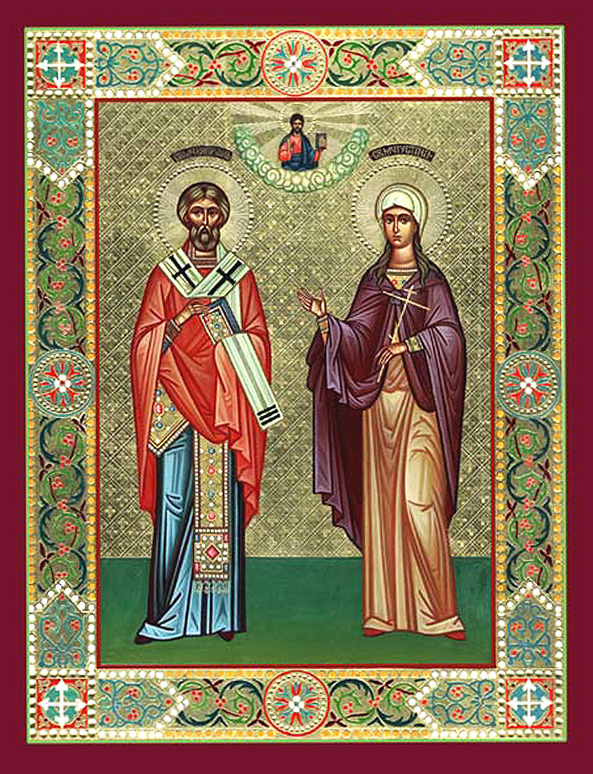
Saint Chrysanthus came from a pagan family who had moved to Rome from Alexandria. He received a fine education, and among the books he read were those in which pagans discussed Christianity. The young man, however, wanted to read books written by Christians themselves. He finally managed to find a copy of the New Testament, which enlightened his rational soul.
Seeking someone to instruct him in the Holy Scriptures, he found the presbyter Carpophoros hiding from persecution, and received holy Baptism from him. After this, he began to preach the Gospel. Chrysanthus’ father tried to turn his son from Christianity, and finally married him to Daria, a priestess of Minerva.
Saint Chrysanthus managed to convert his wife to Christ, and the young couple mutually agreed to lead celibate lives. After the death of the father, they began to live in separate houses. Saint Chrysanthus converted several young men to Christ, and many pious women gathered around Saint Daria.
The people of Rome complained to the eparch Celerinus that Saints Chrysanthus and Daria were preaching celibacy and attracting too many young men and women to monasticism. Saint Chrysanthus was sent to the tribune Claudius for torture.
The torments, however, did not shake the bravery of the young martyr, since the power of God clearly aided him. Struck by this, the tribune Claudius himself came to believe in Christ and accepted holy Baptism together with his wife Hilaria, their sons Jason and Maurus, and all his household and soldiers. When news of this reached the emperor Numerian (283-284), he commanded them all to be executed. The Martyr Claudius was drowned in the sea, and his sons and soldiers were beheaded. Christians buried the bodies of the holy martyrs in a nearby cave, and Saint Hilaria constantly went there to pray. Once, they followed her and led her off for torture. The saint asked that they give her a few moments to pray, and as soon as she finished, she gave up her soul to God. A servant buried the saint in the cave beside her sons.
The torturers sent Saint Daria to a brothel, where she was protected by a lion sent by God. A certain man who tried to defile the saint was knocked to the ground and pinned down by the lion, but the lion did not kill him. The martyr preached to them about Christ and set them to the path of salvation.
They threw Saint Chrysanthus into a foul-smelling pit, into which all the filth of the city flowed. But a heavenly light shone on him, and the pit was filled with a sweet fragrance.
Then the emperor Numerian ordered Saints Chrysanthus and Daria to be turned over to the executioners. After many cruel tortures, the martyrs were buried alive in the ground.
In a cave near the place of execution, Christians began to gather to honor the anniversary of the saints’ martyrdom. They celebrated Church services and partook of the Holy Mysteries. Learning of this, the pagan authorities sealed the entrance to the cave, and those within received the crown of martyrdom. Two of these martyrs are known by name: the Presbyter Diodorus and the Deacon Marianus.
Saint Innocent of Komél and Vologda disciple of Saint Nilus of Sora

Saint Innocent of Komél and Vologda was born in Moscow, and was descended from the Moscow princely family of Okhlyabinin. He became a monk in the Monastery of Saint Cyril of White Lake (June 9), where he was placed under the guidance of Saint Nilus of Sora (May 7).
Saints Innocent and Nilus wandered throughout the East visiting Palestine, Constantinople, and spent several years in the monasteries of Mount Athos. After returning to Rus, the Saints did not return to Saint Cyril of White Lake Monastery, but to solitary cells for monastic seclusion. Seeking a life of solitude, they withdrew into the impassable forest at the Sora River, some fifteen versts from the Monastery. There they set up a cross, dug a well, and built separate cells, after the manner of the skete monasteries. A church was built on a marshy spot, and there the hermits led strict ascetical lives.
Foreseeing his own demise, Saint Nilus sent Saint Innocent to the Nurma River and revealed to him: “God is sending you there, and yours shall be a cenobitic monastery. After my death, my wilderness monastery will remain as it was during my life, with the brothers living separately, each in his own cell.”
After the repose of Saint Nilus, his holy disciple withdrew into the Vologda hinterland and in 1491 he built a cell at the Eda River, which flows into the Nurma. In a short while, disciples began to gather around him. Obeying the last command of his teacher, Saint Innocent did not seek any donations for it.
Saint Innocent labored for thirty years at building his monastery. He left behind instructions for the brethren, based on the works of the Holy Fathers, particularly the writings of Saint Nilus of Sora. Saint Innocent urged them to avoid wrangling and disputes, asking them to preserve love for Christ and spiritual peace.
The Saint forbade young and beardless monks to be accepted and tonsured at his monastery, and he forbade women to enter the monastery. A monk who left the monastery lost his right to a cell, and if he returned, he could occupy it only with the consent of the Igoumen and the brethren. Saint Innocent asked that a future church be dedicated to Saint John the Forerunner, and Baptizer of the Lord, in commemoration of the Third Finding of his Venerable Head (25 May), because Saint John is a patron for all monks and dwellers in the wilderness (later, the monastery was called Holy
Transfiguration after its chief temple).
Saint Innocent went to the Lord on March 19, 1521. In accordance with his last wish, he was buried in a corner of the monastery near a marsh. A stone was placed on his grave inscribed with the year, month and day of his repose.
In the manuals of iconography, Saint Innocent is depicted as medium in stature, and his beard is wider than that of the Hieromartyr Blaise, Bishop of Sebaste (February 11), not forked, with slightly gray hair, wearing monastic robes.
Saint Innocent is also commemorated on the Second Sunday after Pentecost, the Synaxis of All Saints of Mount Athos (movable Feast); and also on the Third Sunday after Pentecost, the Synaxis of All Saints of Novgorod and Vologda (movable Feast).
Martyr Pancharius at Nicomedia
The Holy Martyr Pancharius was a friend of the emperor Diocletian. He abandoned Christianity and became a pagan. His mother and sister sent him a letter in which they urged the apostate to fear God and the dread Last Judgment. Having repented, Saint Pancharius openly confessed his faith before the emperor, for which he suffered torture at Rome. Then he was sent to Nicomedia and beheaded in 303.
Icon of the Mother of God of Lubyatov
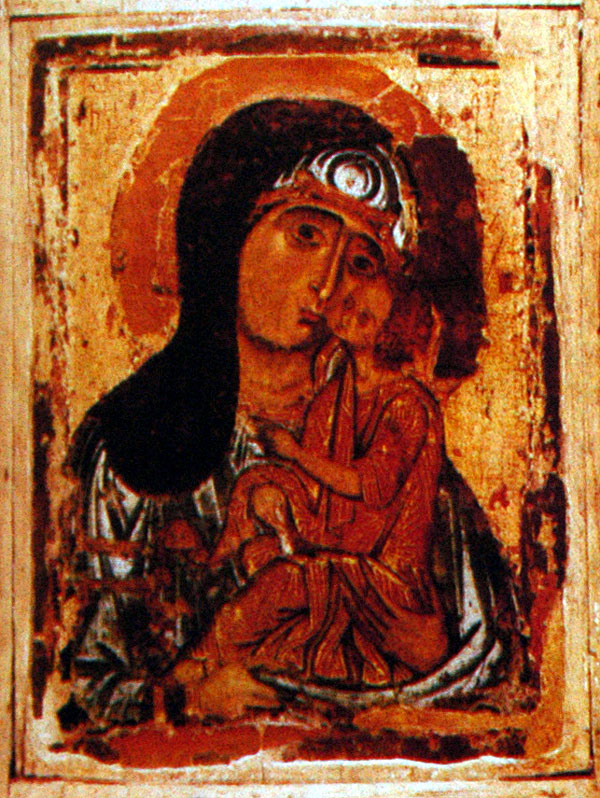
This holy icon, which dates from the fifteenth century, was in the Saint Nicholas monastery church in the Pskov region.
There was once a silver plaque with an inscription from 1890 on the reverse of the icon. It told of how Tsar Ivan the Terrible came to the monastery of Saint Nicholas at Lubyatov during Great Lent in 1570. He had stopped there on his way to punish the people of Pskov, for he believed that they were about to give their allegiance to the Prince of Lithuania.
During the morning service, he happened to gaze at the icon of the Mother of God, and his heart was moved to compunction. “Let the killing stop,” he said. “Put away your swords.”
Soldiers of the Polish king Stephen Batory shot at the icon as they were on their way to attack Pskov in 1581.
Communists confiscated the icon in 1928, and in 1930 it was placed in the Tretiakov Gallery.
The icon has elements from three other types of icons of the Mother of God. Essentially, it belongs to the Eleousa type, like the Vladimir Icon (May 21, June 23, August 26). The gesture of the divine Child resembles the “Sweet-Kissing” or “Tenderness” Icon of Smolensk (March 19), and the scroll seems to come from the Hodēgḗtria Icon (July 28).
“Sweet-Kissing” Icon of the Mother of God of Smolensk

The Smolensk “Tenderness” Icon of the Mother of God manifested itself in the year 1103 at Smolensk. There is another Smolensk “Tenderness” Icon from the vicinity of Okopa (down from Smolensk). This icon was in the encampment of the Russian armies of the military commander Shein, restraining the Polish besiegers from destroying Smolensk for twenty months (1611-1613).
The Mother of God is depicted gazing tenderly at the Divine Child, Who reclines in her lap, resting His head on her left arm. Both of her hands rest just below her neck.
The Savior holds an orb in His right hand, the symbol of sovereignty and power. In some icons, however, the orb is in His left hand.
The nine hundredth anniversary of the Smolensk Tenderness Icon's appearance was observed in 2003.
Canon of St. Andrew of Crete – Monday Mar 18, 2024
Here is the live stream for Canon of St. Andrew of Crete – Monday Mar 18, 2024 If you need, here are instructions for accessing this content from your phone, tablet, computer, or TV.
Homily for Sunday, March 17, 2024
Daily Readings for Monday, March 18, 2024
FIRST MONDAY OF LENT – CLEAN MONDAY
ABSTAIN FROM MEAT, FISH, DAIRY, EGGS, WINE, OLIVE OIL
Cyril, Patriarch of Jerusalem, Trophimos & Eukarpion, Monk-martyrs of Nicomedea, Edward the Martyr, King of England
ISAIAH 1:1-20
The vision of Isaiah the son of Amoz, which he saw concerning Judah and Jerusalem in the days of Uzzi'ah, Jotham, Ahaz, and Hezeki'ah, kings of Judah. Hear, O heavens, and give ear, O earth; for the Lord has spoken: "Sons have I reared and brought up, but they have rebelled against me. The ox knows its owner, and the ass its master's crib; but Israel does not know, my people does not understand.
Ah, sinful nation, a people laden with iniquity, offspring of evildoers, sons who deal corruptly! They have forsaken the Lord, they have despised the Holy One of Israel, they are utterly estranged.
Why will you still be smitten, that you continue to rebel? The whole head is sick, and the whole heart faint. From the sole of the foot even to the head, there is no soundness in it, but bruises and sores and bleeding wounds; they are not pressed out, or bound up, or softened with oil.
Your country lies desolate, your cities are burned with fire; in your very presence aliens devour your land; it is desolate, as overthrown by aliens. And the daughter of Zion is left like a booth in a vineyard, like a lodge in a cucumber field, like a besieged city.
If the Lord of hosts had not left us a few survivors, we should have been like Sodom, and become like Gomor'rah.
Hear the word of the Lord, you rulers of Sodom! Give ear to the teaching of our God, you people of Gomor'rah! "What to me is the multitude of your sacrifices? says the Lord; I have had enough of burnt offerings of rams and the fat of fed beasts; I do not delight in the blood of bulls, or of lambs, or of he-goats.
When you come to appear before me, who requires of you this trampling of my courts? Bring no more vain offerings; incense is an abomination to me. New moon and sabbath and the calling of assemblies — I cannot endure iniquity and solemn assembly. Your new moons and your appointed feasts my soul hates; they have become a burden to me, I am weary of bearing them. When you spread forth your hands, I will hide my eyes from you; even though you make many prayers, I will not listen; your hands are full of blood. Wash yourselves; make yourselves clean; remove the evil of your doings from before my eyes; cease to do evil, learn to do good; seek justice, correct oppression; defend the fatherless, plead for the widow.
Come now, let us reason together, says the Lord: though your sins are like scarlet, they shall be as white as snow; though they are red like crimson, they shall become like wool. If you are willing and obedient, you shall eat the good of the land; But if you refuse and rebel, you shall be devoured by the sword; for the mouth of the Lord has spoken.
GENESIS 1:1-13
In the beginning God created the heavens and the earth. The earth was without form and void, and darkness was upon the face of the deep; and the Spirit of God was moving over the face of the waters.
And God said, "Let there be light" and there was light. And God saw that the light was good; and God separated the light from the darkness. God called the light Day, and the darkness he called Night. And there was evening and there was morning, one day.
And God said, "Let there be a firmament in the midst of the waters, and let it separate the waters from the waters." And God made the firmament and separated the waters which were under the firmament from the waters which were above the firmament. And it was so. And God called the firmament Heaven. And there was evening and there was morning, a second day.
And God said, "Let the waters under the heavens be gathered together into one place, and let the dry land appear." And it was so. God called the dry land Earth, and the waters that were gathered together he called Seas. And God saw that it was good. And God said, "Let the earth put forth vegetation, plants yielding seed, and fruit trees bearing fruit in which is their seed, each according to its kind, upon the earth." And it was so. The earth brought forth vegetation, plants yielding seed according to their own kinds, and trees bearing fruit in which is their seed, each according to its kind. And God saw that it was good. And there was evening and there was morning, a third day.
PROVERBS 1:1-20
The proverbs of Solomon, son of David, king of Israel:
That men may know wisdom and instruction, understand words of insight, receive instruction in wise dealing, righteousness, justice, and equity; that prudence may be given to the simple, knowledge and discretion to the youth — the wise man also may hear and increase in learning, and the man of understanding acquire skill, to understand a proverb and a figure, the words of the wise and their riddles. The fear of the Lord is the beginning of knowledge; fools despise wisdom and instruction.
Hear, my son, your father's instruction, and reject not your mother's teaching; for they are a fair garland for your head, and pendants for your neck. My son, if sinners entice you, do not consent. If they say, "Come with us, let us lie in wait for blood, let us wantonly ambush the innocent; like Sheol let us swallow them alive and whole, like those who go down to the Pit; we shall find all precious goods, we shall fill our houses with spoil; throw in your lot among us, we will all have one purse" — my son, do not walk in the way with them, hold back your foot from their paths; for their feet run to evil, and they make haste to shed blood. For in vain is a net spread in the sight of any bird; but these men lie in wait for their own blood, they set an ambush for their own lives. Such are the ways of all who get gain by violence; it takes away the life of its possessors.
Wisdom cries aloud in the street; in the markets she raises her voice.
Beginning of Great Lent
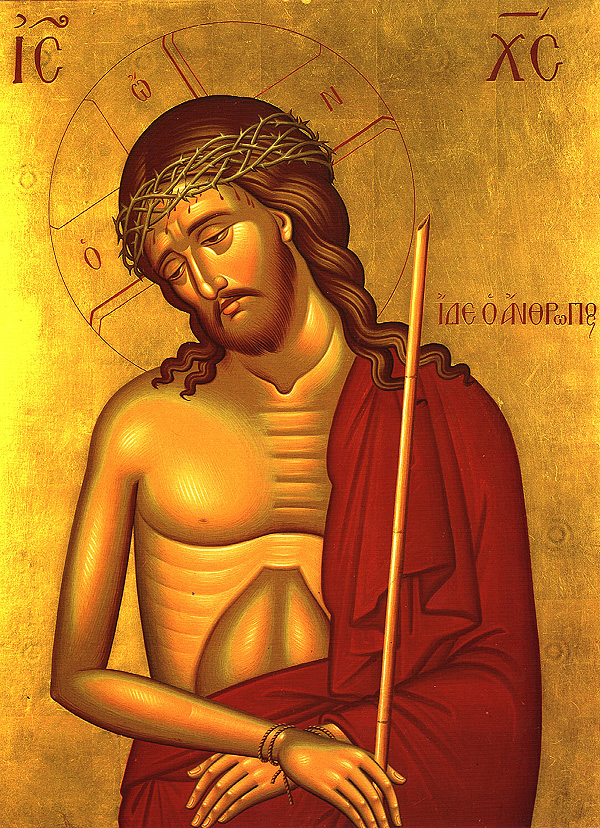
In the Orthodox Church, the last Sunday before Great Lent—the day on which, at Vespers, Lent is liturgically announced and inaugurated—is called Forgiveness Sunday. On the morning of that Sunday, at the Divine Liturgy, we hear the words of Christ:
“If you forgive men their trespasses, your heavenly Father will also forgive you, but if you forgive not men their trespasses, neither will your Father forgive your trespasses…” (Mark 6:14-15).
Then after Vespers—after hearing the announcement of Lent in the Great Prokeimenon: “Turn not away Thy face from Thy child, for I am afflicted! Hear me speedily! Draw near unto my soul and deliver it!”, after making our entrance into Lenten worship, with its special melodies, with the prayer of Saint Ephraim the Syrian, with its prostrations—we ask forgiveness from each other, we perform the rite of forgiveness and reconciliation. And as we approach each other with words of reconciliation, the choir intones the Paschal hymns, filling the church with the anticipation of Paschal joy.
What is the meaning of this rite? Why is it that the Church wants us to begin the Lenten season with forgiveness and reconciliation? These questions are in order because for too many people Lent means primarily, and almost exclusively, a change of diet, the compliance with ecclesiastical regulations concerning fasting. They understand fasting as an end in itself, as a “good deed” required by God and carrying in itself its merit and its reward. But the Church spares no effort in revealing to us that fasting is but a means, one among many, towards a higher goal: the spiritual renewal of man, his return to God, true repentance and, therefore, true reconciliation. The Church spares no effort in warning us against a hypocritical and pharisaic fasting, against the reduction of religion to mere external obligations. As a Lenten hymn says:
“In vain do you rejoice in not eating, O soul!
For you abstain from food,
But from passions you are not purified.
If you persevere in sin, you will perform a useless fast!”
Now, forgiveness stands at the very center of Christian faith and of Christian life because Christianity itself is, above all, the religion of forgiveness. God forgives us, and His forgiveness is in Christ, His Son, whom He sends to us so that by sharing in His humanity we may share in His love and be truly reconciled with God. Indeed, Christianity has no other content but love. And it is primarily the renewal of that love, a growth in it, that we seek in Great Lent, in fasting and prayer, in the entire spirit and the entire effort of that season. Thus, truly forgiveness is both the beginning of, and the proper condition for, the Lenten season.
One may ask, however: Why should I perform this rite when I have no “enemies?” Why should I ask forgiveness from people who have done nothing to me, and whom I hardly know? To ask these questions is to misunderstand the Orthodox teaching concerning forgiveness. It is true that open enmity, personal hatred, real animosity may be absent from our life, though if we experience them, it may be easier for us to repent, for these feelings openly contradict Divine commandments. But the Church reveals to us that there are much subtler ways of offending Divine Love. These are indifference, selfishness, lack of interest in other people, of any real concern for them—in short, that wall which we usually erect around ourselves, thinking that by being “polite” and “friendly” we fulfill God’s commandments. The rite of forgiveness is so important precisely because it makes us realize—be it only for one minute—that our entire relationship to other men is wrong, makes us experience that encounter of one child of God with another, of one person created by God with another, makes us feel that mutual “recognition” which is so terribly lacking in our cold and dehumanized world.
On that unique evening, listening to the joyful Paschal hymns we are called to make a spiritual discovery: to taste of another mode of life and relationship with people, of life whose essence is love. We can discover that always and everywhere Christ, the Divine Love Himself, stands in the midst of us, transforming our mutual alienation into brotherhood. As I advance towards the other, as the other comes to me—we begin to realize that it is Christ who brings us together by His love for both of us.
And because we make this discovery—and because this discovery is that of the Kingdom of God itself: the Kingdom of Peace and Love, of reconciliation with God and, in Him, with all that exists—we hear the hymns of that Feast, which once a year “opens to us the doors of Paradise.” We know why we shall fast and pray, what we shall seek during the long Lenten pilgrimage.
Forgiveness Sunday: the day on which we acquire the power to make our fasting—true fasting; our effort—true effort; our reconciliation with God—true reconciliation.
—Father Alexander Schmemann
Repose of Saint Nikolai of Zhicha

Saint Nikolai of Zhicha, “the Serbian Chrysostom,” was born in Lelich in western Serbia on January 4, 1881 (December 23, 1880 O.S.). His parents were Dragomir and Katherine Velimirovich, who lived on a farm where they raised a large family. His pious mother was a major influence on his spiritual development, teaching him by word and especially by example. As a small child, Nikolai often walked three miles to the Chelije Monastery with his mother to attend services there.
Sickly as a child, Nikolai was not physically strong as an adult. He failed his physical requirements when he applied to the military academy, but his excellent academic qualifications allowed him to enter the Saint Savva Seminary in Belgrade, even before he finished preparatory school.
After graduating from the seminary in 1905, he earned doctoral degrees from the University of Berne in 1908, and from King’s College, Oxford in 1909. When he returned home, he fell ill with dysentery. Vowing to serve God for the rest of his life if he recovered, he was tonsured at the Rakovica Monastery on December 20, 1909 and was also ordained to the holy priesthood.
In 1910 he went to study in Russia to prepare himself for a teaching position at the seminary in Belgrade. At the Theological Academy in Saint Petersburg, the Provost asked him why he had come. He replied, “I wanted to be a shepherd. As a child, I tended my father’s sheep. Now that I am a man, I wish to tend the rational flock of my heavenly Father. I believe that is the way that has been shown to me.” The Provost smiled, pleased by this response, then showed the young man to his quarters.
After completing his studies, he returned to Belgrade and taught philosophy, logic, history, and foreign languages at the seminary. He spoke seven languages, and this ability proved very useful to him throughout his life.
Saint Nikolai was renowned for his sermons, which never lasted more than twenty minutes, and focused on just three main points. He taught people the theology of the Church in a language they could understand, and inspired them to repentance.
At the start of World War I, Archimandrite Nikolai was sent to England on a diplomatic mission to seek help in the struggle of the Serbs against Austria. His doctorate from Oxford gained him an invitation to speak at Westminster Abbey. He remained in England for three short months, but Saint Nikolai left a lasting impression on those who heard him. His writings “The Lord’s Commandments,” and “Meditations on the Lord’s Prayer” impressed many in the Church of England.
Archimandrite Nikolai left England and went to America, where he proved to be a good ambassador for his nation and his Church.
The future saint returned to Serbia in 1919, where he was consecrated as Bishop of Zhicha, and was later transferred to Ochrid. The new hierarch assisted those who were suffering from the ravages of war by establishing orphanages and helping the poor.
Bishop Nikolai took over as leader of Bogomljcki Pokret, a popular movement for spiritual revival which encouraged people to pray and read the Bible. Under the bishop’s direction, it also contributed to a renewal of monasticism. Monasteries were restored and reopened, and this in turn revitalized the spiritual life of the Serbian people.
In 1921, Bishop Nikolai was invited to visit America again and spent two years as a missionary bishop. He gave more than a hundred talks in less than six months, raising funds for his orphanages. Over the next twenty years, he lectured in various churches and universities.
When Germany invaded Yugoslavia on April 6, 1941, Bishop Nikolai, a fearless critic of the Nazis, was arrested and confined in Ljubostir Vojlovici Monastery. In 1944, he and Patriarch Gavrilo were sent to the death camp at Dachau. There he witnessed many atrocities and was tortured himself. When American troops liberated the prisoners in May 1945, the patriarch returned to Yugoslavia, but Bishop Nikolai went to England.
The Communist leader Tito was just coming to power in Yugoslavia, where he persecuted the Church and crushed those who opposed him. Therefore, Bishop Nikolai believed he could serve the Serbian people more effectively by remaining abroad. He went to America in 1946, following a hectic schedule in spite of his health problems which were exacerbated by his time in Dachau. He taught for three years at Saint Savva’s Seminary in Libertyville, IL before he settled at Saint Tikhon’s Monastery in South Canaan, PA in 1951.
He taught at Saint Tikhon’s and also served as the seminary’s Dean and Rector. He was also a guest lecturer at Saint Vladimir’s Seminary in NY, and at Holy Trinity Monastery in Jordanville, NY.
On Saturday March 17, 1956 Bishop Nikolai served his last Liturgy. After the service he went to the trapeza and gave a short talk. As he was leaving, he bowed low and said, “Forgive me, brothers.” This was something unusual which he had not done before.
On March 18, 1956 Saint Nikolai fell asleep in the Lord Whom he had served throughout his life. He was found in his room kneeling in an attitude of prayer. Though he was buried at Saint Savva’s Monastery in Libertyville, IL, he had always expressed a desire to be buried in his homeland. In April of 1991 his relics were transferred to the Chetinje Monastery in Lelich. There he was buried next to his friend and disciple Father Justin Popovich (+ 1979).
English readers are familiar with Saint Nikolai’s Prologue from Ochrid, The Life of Saint Savva, A Treasury of Serbian Spirituality, and other writings which are of great benefit for the whole Church. He thought of his writings as silent sermons addressed to people who would never hear him preach. In his life and writings, the grace of the Holy Spirit shone forth for all to see, but in his humility he considered himself the least of men.
Though he was a native of Serbia, Saint Nikolai has a universal significance for Orthodox Christians in all countries. He was like a candle set upon a candlestick giving light to all (MT 5:15). A spiritual guide and teacher with a magnetic personality, he attracted many people to himself. He also loved them, seeing the image of God in each person he met. He had a special love for children, who hastened to receive his blessing whenever they saw him in the street.
He was a man of compunctionate prayer, and possessesed the gift of tears which purify the soul (Saint John Climacus, LADDER, Step 7). He was a true pastor to his flock protecting them from spiritual wolves, and guiding them on the path to salvation. He has left behind many soul-profiting writings which proclaim the truth of Christ to modern man. In them he exhorts people to love God, and to live a life of virtue and holiness. May we also be found worthy of the Kingdom of Heaven through the prayers of Saint Nikolai, and by the grace of our Lord Jesus Christ, to Whom be glory forever. Amen.
Saint Cyril, Archbishop of Jerusalem

Saint Cyril, Archbishop of Jerusalem, was born in Jerusalem in the year 315 and was raised in strict Christian piety. Upon reaching the age of maturity, he became a monk, and in the year 346 he became a presbyter. In the year 350, upon the death of Archbishop Maximus, he succeeded him on the episcopal throne of Jerusalem.
As Patriarch of Jerusalem, Saint Cyril zealously fought against the heresies of Arius and Macedonius. In so doing, he aroused the animosity of the Arian bishops, who sought to have him deposed and banished from Jerusalem.
There was a miraculous portent in 351 at Jerusalem: at the third hour of the day on the Feast of Pentecost, the Holy Cross appeared in the heavens, shining with a radiant light. It stretched from Golgotha above the Mount of Olives. Saint Cyril reported this portent to the Arian emperor Constantius (351-363), hoping to convert him to Orthodoxy.
The heretic Acacius, deposed by the Council of Sardica, was formerly the Metropolitan of Caesarea, and he collaborated with the emperor to have Saint Cyril removed. An intense famine struck Jerusalem, and Saint Cyril expended all his wealth in charity. But since the famine did not abate, the saint pawned church utensils, and used the money to buy wheat for the starving. The saint’s enemies spread a scandalous rumor that they had seen a woman in the city dancing around in clerical garb. Taking advantage of this rumor, the heretics forcibly expelled the saint.
The saint found shelter with Bishop Silvanus in Tarsus. After this, a local Council was held at Seleucia, at which there were about 150 bishops, and among them Saint Cyril. The heretical Metropolitan Acacius did not want to allow him to take a seat, but the Council would not consent to this. Acacius stormed out of the Council, and before the emperor and the Arian patriarch Eudoxius, he denounced both the Council and Saint Cyril. The emperor had the saint imprisoned.
When the emperor Julian the Apostate (361-363) ascended the throne he repealed all the anti-Orthodox decrees of Constantius, seemingly out of piety. Saint Cyril returned to his own flock. But after a certain while, when Julian had become secure upon the throne, he openly apostasized and renounced Christ. He permitted the Jews to start rebuilding the Temple of Jerusalem that had been destroyed by the Romans, and he even provided them part of the funds for the building from the state treasury.
Saint Cyril predicted that the words of the Savior about the destruction of the Temple down to its very stones (Luke. 21:6) would undoubtedly transpire, and the blasphemous intent of Julian would come to naught. Soon there was such a powerful earthquake, that even the solidly set foundation of the ancient Temple of Solomon shifted in its place, and what had been rebuilt fell down and shattered into dust. When the Jews resumed construction, a fire came down from the heavens and destroyed the tools of the workmen. Great terror seized everyone. On the following night, the Sign of the Cross appeared on the clothing of the Jews, which they could not remove by any means.
After this heavenly confirmation of Saint Cyril’s prediction, they banished him again, and the bishop’s throne was occupied by Saint Cyriacus. But Saint Cyriacus soon suffered a martyr’s death (October 28).
After the emperor Julian perished in 363, Saint Cyril returned to his See, but during the reign of the emperor Valens (364-378) he was exiled for a third time. It was only under the holy emperor Saint Theodosius the Great (379-395) that he finally returned to his archpastoral activity. In 381 Saint Cyril participated in the Second Ecumenical Council, which condemned the heresy of Macedonius and affirmed the Nicea-Constantinople Symbol of Faith (Creed).
Saint Cyril’s works include twenty-three Instructions (Eighteen are Catechetical, intended for those preparing for Baptism, and five are for the newly-baptized) and two discourses on Gospel themes: “On the Paralytic,” and “Concerning the Transformation of Water into Wine at Cana.”
At the heart of the Catechetical Instructions is a detailed explanation of the Symbol of Faith. The saint suggests that a Christian should inscribe the Symbol of Faith upon “the tablets of the heart.”
“The articles of the Faith,” Saint Cyril teaches, “were not written through human cleverness, but they contain everything that is most important in all the Scriptures, in a single teaching of faith. Just as the mustard seed contains all its plethora of branches within its small kernel, so also does the Faith in its several declarations combine all the pious teachings of the Old and the New Testaments.”
Saint Cyril, a great ascetic and a champion of Orthodoxy, died in the year 386.
Martyrs Trophimus and Eucarpus of Nicomedia

The Holy Martyrs Trophimus and Eucarpion were soldiers at Nicomedia during the persecution against Christians under the emperor Diocletian (284-305). They distinguished themselves by their great ferocity in carrying out all of the emperor’s decrees.
Once, when these soldiers had caught up with some Christians, they suddenly saw a large fiery cloud which had come down from the sky, thickening in form as it drew close to them. From out of the cloud came forth a Voice: “Why are you so zealous in threatening My servants? Don’t be deluded! No one can suppress those believing in Me through their own strength. It is better to join them and discover the Heavenly Kingdom yourselves.”

The soldiers fell to the ground in fright, not daring to lift up their eyes, and only said to one another, “Truly this is the great God, Who has manifested Himself to us. We would do well to become His servants.” The Lord then spoke saying, “Rise up, repent, for your sins are forgiven.” As they got up, they beheld within the cloud the image of a Radiant Man and a great multitude standing about Him.
The astonished soldiers cried out with one voice, “Receive us, for our sins are inexpressibly wicked. There is no other God but You, the Creator and true God, and we are not yet numbered among Your servants.” But just as they spoke this, the cloud receded and rose up into the sky.
Spiritually reborn after this miracle, the soldiers released all the jailed Christians from the prisons. For this Saints Trophimus and Eucarpion were handed over to terrible torments: they suspended the saints and tore their bodies with iron hooks. They gave thanks unto God, certain that the Lord would forgive them their former sins. When a fire had been lit, the holy martyrs went willingly into the fire and there gave up their souls to God.
Venerable Aninas of the Euphrates

Saint Aninas was born at Chalcedon into a Christian family. After the death of his parents, he withdrew at age fifteen into a monastery, where he received monastic tonsure. In search of complete solitude, he went off into the heart of the desert where the River Euphrates separates Syria from Persia. There he came upon an Elder named Maium and settled there with him. Both ascetics led a very strict life. During the forty days of the Great Fast they ate nothing, taking delight and joy instead in spiritual nourishment.
Every day Saint Aninas carried drinking water from afar. Once, he returned with full water pitchers earlier than usual, since an angel had filled the vessels with water. The Elder Maium realized that his disciple had attained to high level of spiritual accomplishment, and he in turn asked Saint Aninas to become his guide, but the Saint refused out of humility. Later, the Elder went to a monastery, and Saint Aninas remained alone in the wilderness.
By constant struggles the saint conquered the passions within himself, and he was granted gifts of healing and clairvoyance. Even the wild beasts became docile and served him. Wherever the saint went, two lions followed after him, one of which he had healed of a wound on its paw.
Accounts of the saint spread throughout all the surrounding area, and the sick and those afflicted by evil spirits began to come to him, seeking healing. Several disciples also gathered around the saint. Once, in his seventeenth year as an ascetic, several men had come to the saint and asked for something to quench their thirst. Relying on the power of God, the saint sent one of his disciples to a dried-up well. The well miraculously filled up to its very top, and this water remained for many days. When the water ended, the saint did not dare to ask for a miracle for himself, and so he began to carry water from the Euphrates at night.
Bishop Patrick of Neocaesarea repeatedly visited the monk and ordained him presbyter, although the humble ascetic was resolved not to accept the priestly office. When he learned that the saint himself carried water from a distance, Bishop Patrick twice gave him donkeys, but each time Saint Aninas gave them away to the poor and continued to carry the water himself. Then the bishop ordered that a large well be dug, which they filled from time to time, bringing donkeys from the city.
Saint Aninas discerned the desire of a certain stylite monk, who struggled far from him, to come down off his pillar and make a complaint in court against a robber who had hurt him with a stone. Saint Aninas wrote a letter to the stylite, advising him not to carry out his intent. The letter was brought to the stylite by a trusty lion, and it brought him to his senses.
A certain pious woman, who had fallen ill, went to Saint Aninas to ask for his prayers. Along the way a robber chanced upon her. Since the woman had no money, he decided to assault her and force her into sin. The woman called on the saint’s help and cried out, “Saint Aninas, help me!” Terror suddenly overcame the robber, and he let go of the woman.
The woman went to Saint Aninas and told him everything, and she also received healing. The robber also came to the monk in repentance, was baptized, and then tonsured as a monk. A spear which he had thrust into the ground when he attacked the woman, grew into a mighty oak.
At the age of 110 the saint predicted the time of his death, and he directed his successor as igumen to assemble the brethren.
Before his death, Saint Aninas conversed with the holy Prophets Moses, Aaron and Or [or Hur: Ex. 24:14]. He fell asleep in the Lord saying, “ O Lord, receive my soul.”
Saint Cyril of Astrakhan

No information available at this time.
 Saint Peter Antiochian Orthodox Church
You must be logged in to post a comment.