
FIRST TUESDAY OF LENT
ABSTAIN FROM MEAT, FISH, DAIRY, EGGS, WINE, OLIVE OIL
The Holy Martyrs Chrysanthus and Daria, Demetrios the New Martyr
ISAIAH 1:19-2:3
If you are willing and obedient, you shall eat the good of the land; but if you refuse and rebel, you shall be devoured by the sword; for the mouth of the Lord has spoken.
How the faithful city has become a harlot, she that was full of justice! Righteousness lodged in her, but now murderers. Your silver has become dross, your wine mixed with water. Your princes are rebels and companions of thieves. Every one loves a bribe and runs after gifts. They do not defend the fatherless, and the widow's cause does not come to them.
Therefore the Lord says, the Lord of hosts, the Mighty One of Israel: "Ah, I will vent my wrath on my enemies, and avenge myself on my foes. I will turn my hand against you and will smelt away your dross as with lye and remove all your alloy. And I will restore your judges as at the first, and your counselors as at the beginning. Afterward you shall be called the city of righteousness, the faithful city.
Zion shall be redeemed by justice, and those in her who repent, by righteousness. But rebels and sinners shall be destroyed together, and those who forsake the Lord shall be consumed. For you shall be ashamed of the oaks in which you delighted; and you shall blush for the gardens which you have chosen. For you shall be like an oak whose leaf withers, and like a garden without water. And the strong shall become tow, and his work a spark, and both of them shall burn together, with none to quench them.
The word which Isaiah the son of Amoz saw concerning Judah and Jerusalem. It shall come to pass in the latter days that the mountain of the house of the Lord shall be established as the highest of the mountains, and shall be raised above the hills; and all the nations shall flow to it, and many peoples shall come, and say: "Come, let us go up to the mountain of the Lord, to the house of the God of Jacob; that he may teach us his ways and that we may walk in his paths." For out of Zion shall go forth the law, and the word of the Lord from Jerusalem.
GENESIS 1:14-23
And God said, "Let there be lights in the firmament of the heavens to separate the day from the night; and let them be for signs and for seasons and for days and years, and let them be lights in the firmament of the heavens to give light upon the earth." And it was so. And God made the two great lights, the greater light to rule the day, and the lesser light to rule the night; he made the stars also. And God set them in the firmament of the heavens to give light upon the earth, to rule over the day and over the night, and to separate the light from the darkness. And God saw that it was good. And there was evening and there was morning, a fourth day.
And God said, "Let the waters bring forth swarms of living creatures, and let birds fly above the earth across the firmament of the heavens." So God created the great sea monsters and every living creature that moves, with which the waters swarm, according to their kinds, and every winged bird according to its kind. And God saw that it was good. And God blessed them, saying, "Be fruitful and multiply and fill the waters in the seas, and let birds multiply on the earth." And there was evening and there was morning, a fifth day.
PROVERBS 1:20-33
Wisdom cries aloud in the street; in the markets she raises her voice; on the top of the walls she cries out; at the entrance of the city gates she speaks: "How long, O simple ones, will you love being simple? How long will scoffers delight in their scoffing and fools hate knowledge?
Give heed to my reproof; behold, I will pour out my thoughts to you; I will make my words known to you. Because I have called and you refused to listen, have stretched out my hand and no one has heeded, and you have ignored all my counsel and would have none of my reproof, I also will laugh at your calamity; I will mock when panic strikes you, when panic strikes you like a storm, and your calamity comes like a whirlwind, when distress and anguish come upon you.
Then they will call upon me, but I will not answer; they will seek me diligently but will not find me.
Because they hated knowledge and did not choose the fear of the Lord, would have none of my counsel, and despised all my reproof, therefore they shall eat the fruit of their way and be sated with their own devices.
For the simple are killed by their turning away, and the complacence of fools destroys them; but he who listens to me will dwell secure and will be at ease, without dread of evil.
Martyrs Chrysanthus and Daria, and those with them at Rome
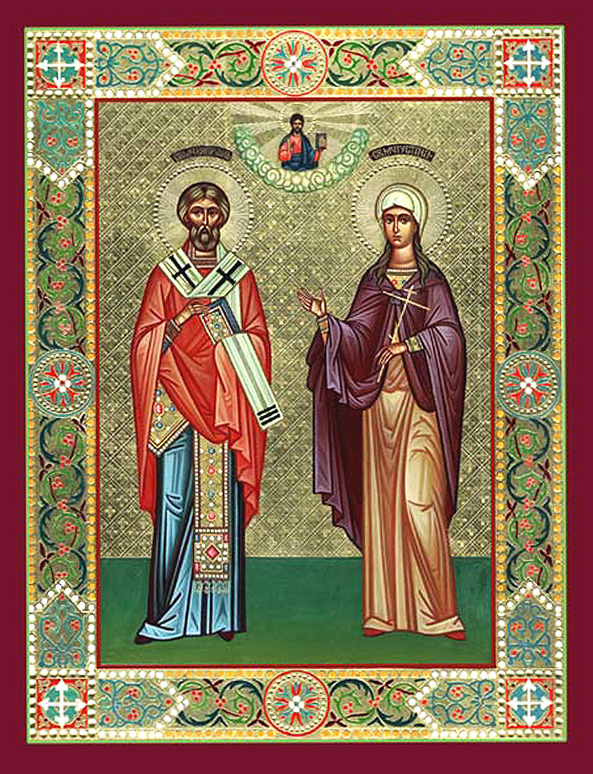
Saint Chrysanthus came from a pagan family who had moved to Rome from Alexandria. He received a fine education, and among the books he read were those in which pagans discussed Christianity. The young man, however, wanted to read books written by Christians themselves. He finally managed to find a copy of the New Testament, which enlightened his rational soul.
Seeking someone to instruct him in the Holy Scriptures, he found the presbyter Carpophoros hiding from persecution, and received holy Baptism from him. After this, he began to preach the Gospel. Chrysanthus’ father tried to turn his son from Christianity, and finally married him to Daria, a priestess of Minerva.
Saint Chrysanthus managed to convert his wife to Christ, and the young couple mutually agreed to lead celibate lives. After the death of the father, they began to live in separate houses. Saint Chrysanthus converted several young men to Christ, and many pious women gathered around Saint Daria.
The people of Rome complained to the eparch Celerinus that Saints Chrysanthus and Daria were preaching celibacy and attracting too many young men and women to monasticism. Saint Chrysanthus was sent to the tribune Claudius for torture.
The torments, however, did not shake the bravery of the young martyr, since the power of God clearly aided him. Struck by this, the tribune Claudius himself came to believe in Christ and accepted holy Baptism together with his wife Hilaria, their sons Jason and Maurus, and all his household and soldiers. When news of this reached the emperor Numerian (283-284), he commanded them all to be executed. The Martyr Claudius was drowned in the sea, and his sons and soldiers were beheaded. Christians buried the bodies of the holy martyrs in a nearby cave, and Saint Hilaria constantly went there to pray. Once, they followed her and led her off for torture. The saint asked that they give her a few moments to pray, and as soon as she finished, she gave up her soul to God. A servant buried the saint in the cave beside her sons.
The torturers sent Saint Daria to a brothel, where she was protected by a lion sent by God. A certain man who tried to defile the saint was knocked to the ground and pinned down by the lion, but the lion did not kill him. The martyr preached to them about Christ and set them to the path of salvation.
They threw Saint Chrysanthus into a foul-smelling pit, into which all the filth of the city flowed. But a heavenly light shone on him, and the pit was filled with a sweet fragrance.
Then the emperor Numerian ordered Saints Chrysanthus and Daria to be turned over to the executioners. After many cruel tortures, the martyrs were buried alive in the ground.
In a cave near the place of execution, Christians began to gather to honor the anniversary of the saints’ martyrdom. They celebrated Church services and partook of the Holy Mysteries. Learning of this, the pagan authorities sealed the entrance to the cave, and those within received the crown of martyrdom. Two of these martyrs are known by name: the Presbyter Diodorus and the Deacon Marianus.
Saint Innocent of Komél and Vologda disciple of Saint Nilus of Sora

Saint Innocent of Komél and Vologda was born in Moscow, and was descended from the Moscow princely family of Okhlyabinin. He became a monk in the Monastery of Saint Cyril of White Lake (June 9), where he was placed under the guidance of Saint Nilus of Sora (May 7).
Saints Innocent and Nilus wandered throughout the East visiting Palestine, Constantinople, and spent several years in the monasteries of Mount Athos. After returning to Rus, the Saints did not return to Saint Cyril of White Lake Monastery, but to solitary cells for monastic seclusion. Seeking a life of solitude, they withdrew into the impassable forest at the Sora River, some fifteen versts from the Monastery. There they set up a cross, dug a well, and built separate cells, after the manner of the skete monasteries. A church was built on a marshy spot, and there the hermits led strict ascetical lives.
Foreseeing his own demise, Saint Nilus sent Saint Innocent to the Nurma River and revealed to him: “God is sending you there, and yours shall be a cenobitic monastery. After my death, my wilderness monastery will remain as it was during my life, with the brothers living separately, each in his own cell.”
After the repose of Saint Nilus, his holy disciple withdrew into the Vologda hinterland and in 1491 he built a cell at the Eda River, which flows into the Nurma. In a short while, disciples began to gather around him. Obeying the last command of his teacher, Saint Innocent did not seek any donations for it.
Saint Innocent labored for thirty years at building his monastery. He left behind instructions for the brethren, based on the works of the Holy Fathers, particularly the writings of Saint Nilus of Sora. Saint Innocent urged them to avoid wrangling and disputes, asking them to preserve love for Christ and spiritual peace.
The Saint forbade young and beardless monks to be accepted and tonsured at his monastery, and he forbade women to enter the monastery. A monk who left the monastery lost his right to a cell, and if he returned, he could occupy it only with the consent of the Igoumen and the brethren. Saint Innocent asked that a future church be dedicated to Saint John the Forerunner, and Baptizer of the Lord, in commemoration of the Third Finding of his Venerable Head (25 May), because Saint John is a patron for all monks and dwellers in the wilderness (later, the monastery was called Holy
Transfiguration after its chief temple).
Saint Innocent went to the Lord on March 19, 1521. In accordance with his last wish, he was buried in a corner of the monastery near a marsh. A stone was placed on his grave inscribed with the year, month and day of his repose.
In the manuals of iconography, Saint Innocent is depicted as medium in stature, and his beard is wider than that of the Hieromartyr Blaise, Bishop of Sebaste (February 11), not forked, with slightly gray hair, wearing monastic robes.
Saint Innocent is also commemorated on the Second Sunday after Pentecost, the Synaxis of All Saints of Mount Athos (movable Feast); and also on the Third Sunday after Pentecost, the Synaxis of All Saints of Novgorod and Vologda (movable Feast).
Martyr Pancharius at Nicomedia
The Holy Martyr Pancharius was a friend of the emperor Diocletian. He abandoned Christianity and became a pagan. His mother and sister sent him a letter in which they urged the apostate to fear God and the dread Last Judgment. Having repented, Saint Pancharius openly confessed his faith before the emperor, for which he suffered torture at Rome. Then he was sent to Nicomedia and beheaded in 303.
Icon of the Mother of God of Lubyatov
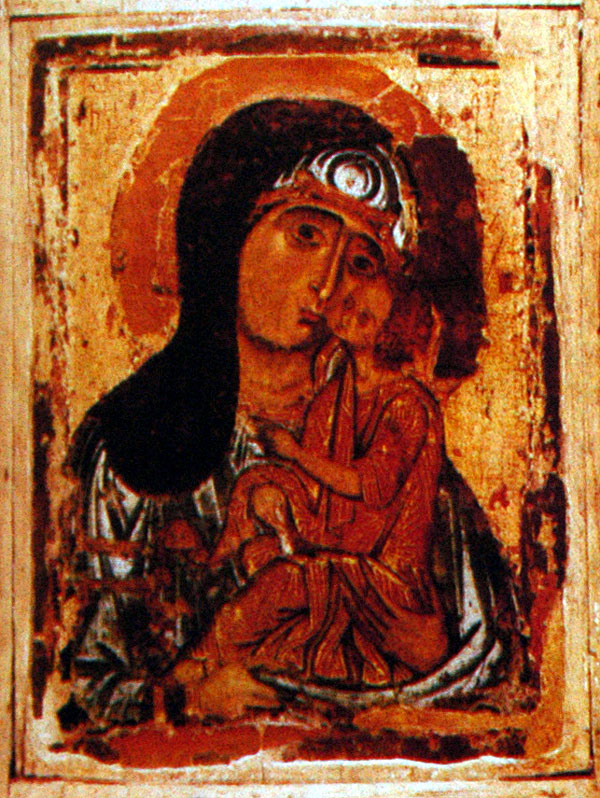
This holy icon, which dates from the fifteenth century, was in the Saint Nicholas monastery church in the Pskov region.
There was once a silver plaque with an inscription from 1890 on the reverse of the icon. It told of how Tsar Ivan the Terrible came to the monastery of Saint Nicholas at Lubyatov during Great Lent in 1570. He had stopped there on his way to punish the people of Pskov, for he believed that they were about to give their allegiance to the Prince of Lithuania.
During the morning service, he happened to gaze at the icon of the Mother of God, and his heart was moved to compunction. “Let the killing stop,” he said. “Put away your swords.”
Soldiers of the Polish king Stephen Batory shot at the icon as they were on their way to attack Pskov in 1581.
Communists confiscated the icon in 1928, and in 1930 it was placed in the Tretiakov Gallery.
The icon has elements from three other types of icons of the Mother of God. Essentially, it belongs to the Eleousa type, like the Vladimir Icon (May 21, June 23, August 26). The gesture of the divine Child resembles the “Sweet-Kissing” or “Tenderness” Icon of Smolensk (March 19), and the scroll seems to come from the Hodēgḗtria Icon (July 28).
“Sweet-Kissing” Icon of the Mother of God of Smolensk

The Smolensk “Tenderness” Icon of the Mother of God manifested itself in the year 1103 at Smolensk. There is another Smolensk “Tenderness” Icon from the vicinity of Okopa (down from Smolensk). This icon was in the encampment of the Russian armies of the military commander Shein, restraining the Polish besiegers from destroying Smolensk for twenty months (1611-1613).
The Mother of God is depicted gazing tenderly at the Divine Child, Who reclines in her lap, resting His head on her left arm. Both of her hands rest just below her neck.
The Savior holds an orb in His right hand, the symbol of sovereignty and power. In some icons, however, the orb is in His left hand.
The nine hundredth anniversary of the Smolensk Tenderness Icon's appearance was observed in 2003.
 Saint Peter Antiochian Orthodox Church