Monthly Archives: February 2024

Daily Readings for Saturday, February 03, 2024

AFTERFEAST OF THE PRESENTATION OF OUR LORD AND SAVIOR IN THE TEMPLE

NO FAST

Afterfeast of the Presentation of Our Lord and Savior in the Temple, The Synaxis of the Holy and Righteous Symeon the God-Receiver and the Holy Prophetess Anna, Stamatios, John, & Nicholas, New Martyrs of Spetses, Synaxis of the Most Holy Theotokos , Nicholas, Archbishop & Enlightener of Japan, Ansgar of Hamburg-Bremen

ST. PAUL’S LETTER TO THE HEBREWS 9:11-14

BRETHREN, when Christ appeared as a high priest of the good things that have come, then through the greater and more perfect tent (not made with hands, that is, not of this creation) he entered once for all into the Holy Place, taking not the blood of goats and calves but his own blood, thus securing an eternal redemption. For if the sprinkling of defiled persons with the blood of goats and bulls and with the ashes of a heifer sanctifies for the purification of the flesh, how much more shall the blood of Christ, who through the eternal Spirit offered himself without blemish to God, purify your conscience from dead works to serve the living God.

LUKE 2:25-38

At that time, there was a man in Jerusalem, whose name was Symeon and this man was righteous and devout, looking for the consolation of Israel, and the Holy Spirit was upon him. And it had been revealed to him by the Holy Spirit that he should not see death before he had seen the Lord's Christ. And inspired by the Spirit he came into the temple; and when the parents brought in the child Jesus, to do for him according to the custom of the law, he took him up in his arms and blessed God and said, "Lord, now let your servant depart in peace, according to your word; for my eyes have seen your salvation which you have prepared in the presence of all peoples, a light for revelation to the Gentiles, and for glory to your people Israel." And his father and his mother marveled at what was said about him; and Symeon blessed them and said to Mary his mother, "Behold, this child is set for the fall and rising of many in Israel, and for a sign that is spoken against (and a sword will pierce through your own soul also), that thoughts out of many hearts may be revealed." And there was a prophetess, Anna, the daughter of Phanuel, of the tribe of Asher; she was of a great age, having lived with her husband seven years from her virginity, and as a widow till she was eighty-four. She did not depart from the temple, worshiping with fasting and prayer night and day. And coming up at that very hour she gave thanks to God, and spoke of him to all who were looking for the redemption of Jerusalem.

Afterfeast of the Meeting of our Lord in the Temple

On this first day of the Afterfeast of the Meeting of the Lord, the Church commemorates the righteous Simeon and Anna the prophetess. The following words are ascribed to Christ in Ode 9 of the Canon: “I am not held by the Elder; it is I Who hold him, for he asks Me for forgiveness.”

Holy, Righteous Simeon the God-Receiver

Righteous Simeon the God-Receiver was, according to the testimony of the holy Evangelist Luke, a just and devout man waiting for the consolation of Israel, and the Holy Spirit was upon him (Luke 2:25). God promised him that he would not die until the promised Messiah, Christ the Lord, came into the world.

Ancient historians tell us that the Egyptian pharaoh Ptolemy II Philadelphus (285-247 B.C.) wished to include texts of Holy Scripture in the famous Library at Alexandria. He invited scholars from Jerusalem, and the Sanhedrin sent their wise men. The Righteous Simeon was one of the seventy scholars who came to Alexandria to translate the Holy Scriptures into Greek. The completed work was called “The Septuagint,” and is the version of the Old Testament used by the Orthodox Church.

Saint Simeon was translating a book of the Prophet Isaiah, and read the words: “Behold, a virgin shall conceive in the womb, and shall bring forth a Son” (Is 7:14). He thought that “virgin” was inaccurate, and he wanted to correct the text to read “woman.” At that moment an angel appeared to him and held back his hand saying, “You shall see these words fulfilled. You shall not die until you behold Christ the Lord born of a pure and spotless Virgin.”

From this day, Saint Simeon lived in expectation of the Promised Messiah. One day, the righteous Elder received a revelation from the Holy Spirit, and came to the Temple. It was on the very day (the fortieth after the Birth of Christ) when the All-Pure Virgin Mary and Saint Joseph had come to the Temple in order to perform the ritual prescribed by Jewish Law.

When Saint Simeon beheld their arrival, the Holy Spirit revealed to him that the divine Child held by the All-Pure Virgin Mary was the Promised Messiah, the Savior of the world. The Elder took the Child in his arms and said, “Lord, now lettest Thou Thy servant depart in peace, according to Thy word, for mine eyes have seen Thy salvation, which Thou hast prepared before the face of all people, a light to enlighten the Gentiles, and the glory of Thy people Israel” (Luke 2:29-32).

There is a Christian epigram (Number 46) in “The Greek Anthology” which is addressed to Saint Simeon. It tells the righteous Elder to receive the Child Who was born before Adam, and Who will deliver Simeon from this life and bring him to eternal life. A similar idea is expressed in the Aposticha (Slavic use) for the Forefeast of the Nativity of the Lord (December 24). There the Mother of God refers to her Son as “older than ancient Adam.”

Simeon blessed the All-Pure Virgin and Saint Joseph, and turning to the Mother of God he said, “Behold, this child is set for the fall and rising again of many in Israel, and for a sign which shall be spoken against. Yea, a sword shall pierce through your own soul also, that the thoughts of many hearts may be revealed” (Luke 2:34-35).

The holy Evangelist continues: “And there was one Anna, a prophetess, the daughter of Phanuel of the tribe of Aser. She was of a great age, and had lived with a husband for seven years from her virginity; and she was a widow of about eighty-four years, who did not leave the temple, but served God with fastings and prayers night and day. And coming at that very hour, also gave thanks to the Lord, and spoke of Him to all those who looked for redemption at Jerusalem” (Luke 2:36-38).

The holy righteous Simeon the God-Receiver died at a great age (Tradition says he was 360). His holy relics were transferred to Constantinople in the sixth century. His grave was seen by the Russian pilgrim Saint Anthony, the future Archbishop of Novgorod (October 8) in 1200.

Holy, Righteous Anna the Prophetess

According to Saint Luke’s Gospel, “And there was one Anna, a prophetess, the daughter of Phanuel of the tribe of Aser. She was of a great age, and had lived with a husband for seven years from her virginity; and she was a widow of about eighty-four years, who did not leave the temple, but served God with fastings and prayers night and day. And coming at that very hour, also gave thanks to the Lord, and spoke of Him to all those who looked for redemption at Jerusalem” (Luke 2:36-38).

Right-Believing Prince Roman of Uglich

The Holy Right-Believing Prince Roman of Uglich, son of Prince Vladimir and Princess Photina of Uglich, and nephew of Saint Basil (Basilko) of Rostov (March 4), was born on October 1, 1235. Upon the death of his father (in 1248) and his older brother Andrew (in 1261), Saint Roman, at the age of twenty-six, took upon himself the governance of Uglich and became a father to his subjects.

He established a poor-house and took in the destitute, who came to him from everywhere. In the principality he built fifteen more churches. Saint Roman was present every day at the divine services, and he often conversed with pious monks.

After the death of his wife in 1280, he devoted himself entirely to ascetic exploits of fasting, prayer and works of righteousness. He built the city Romanov (now Tutaev) on the high bank of the Volga. The holy prince died peacefully on February 3, 1285 and was buried in the Church of the Transfiguration in Uglich.

In 1486, the relics of Saint Roman were found to be incorrupt and were transferred into the new cathedral Church of the Transfiguration. In the year 1595 with the blessing of Patriarch Job in consequence of the fame concerning miracles the relics were witnessed to by the Metropolitan (later Patriarch) Saint Hermogenes (February 17), and Saint Roman was numbered among the saints. In 1609, the holy relics were burned along with the church during an invasion by the Poles.

Prophet Azariah

The Holy Prophet Azariah1 was son of Oded (or Addo) and lived during the reign of King Asa (910-870 B.C. See 2 Chronicles 15:1) who was the son and successor of Abijah in the kingdom of Judah. Azariah came from the land of Sembatha and urged the people not to worship false “gods,” but to remain faithful to the Covenant with the Lord.

Asa worshiped the one true God, and removed the altars of foreign “gods” from his land, tearing down the pillars and cutting down their sacred groves. He told the people to seek earnestly the God of their fathers, and to obey the Law and the Commandments. After removing the pagan altars and idols from all the cities of Judah he commanded his people to fortify their cities with walls and towers.

King Asa had 300,000 warriors in Judah, and 280,000 mighty warriors in the land of Benjamin. According to the narratives of 2 Chronicles chapters 14 and 15, Zerah the Ethiopian2 went out against Judah with a million men.

Asa prayed fervently to God, asking that he might prevail, even against such overwhelming odds. The Lord smote the Ethiopians and Asa’s army pursued them and crushed them. He destroyed their towns and pillaged their cities, and then he returned to Jerusalem.

After King Asa had won the victory, the Spirit of the Lord came upon Azariah. He went out to meet Asa and said, “Hear me, King Asa, and all the people of the tribes of Judah and Benjamin. The Lord will be with you as long as you are with Him, worshiping His name and observing His commandments. When you seek Him you will find Him; but if you forsake Him, He will also forsake you.” These words ought to be esteemed by every State and by all people.

The Prophet Azariah reposed in peace and was buried in his field. In iconography he is depicted as an old man with curly hair. The name Azariah means “whom God helps.”


1 It is said that Azariah was actually son of Ananias (Tobit 5:12); perhaps an error for Zachariah the son of Addo (1 Esdras 6:1).

2 Zerah is a Hebrew name, and is not Ethiopian or Egyptian, as some have said.

Martyrs Papias, Diodorus and Claudianus, at Perge in Pamphylia

Saint Papias was martyred with Saints Claudianus and Diodorus at Perge, Pamphylia in 250.

Saint Savva of Ioannina

It is not known where Saint Savva was born. He lived a life of asceticism in the Holy Monastery of the Honorable Forerunner on an island in the lake of Ioannina around the middle of the XV century. He was the Spiritual Father of Saints Nektarios (+ 1550) and Theophanes (+ 1544), who were descended from the distinguished Apsaras family of the Byzantine Empire. They are commemorated jointly on May 17.

Saint Savva was the son of an aristocratic family, and from an early age he loved the poverty of Jesus Christ. Until his last breath, he lived as a humble and poor hermit. No one ever saw him angry, judgmental, or as a person who remembered wrongs. His heart overflowed with humility, concerning which he himself said: “Humility is the solid and indestructible cornerstone upon which the spiritual life is built.”

He was a hechycast, and his ascetical life was very strict. He prayed every night until morning. His food was plain, and he ate very little. No meat, fish, or cheese ever appeared on his table, and he never poured a drop of oil on his food.

Saint Savva reposed peacefully in 1505. When he delivered his soul to the Lord, an inexpressible fragrance arose from the tabernacle of his body. The saint was buried in the monastery of Honorable Forerunner. A holy relic of the saint is kept and revered in the Roussanou Monastery of the Transfiguration at Meteora.

Martyr Adrian at Caesarea, Cappadocia

Saint Adrian of Baneas of Caesarea in Cappadocia. suffered martyrdom under Governor Firmilianus. He was put to death by the sword, but entered into eternal life.

Martyr Eubulus at Caesarea, Cappadocia

Saint Eubulus, like Saint Adrian, was from Baneas, in Caesarea of Cappadocia. He went to Caesarea to visit Christians in prison, and was arrested by Governor Firmilianus. He was thrown to the wild beasts, and thereby received the crown of martyrdom.

Martyr Blaise of Caesarea, in Cappadocia

Saint Blaise of Caesarea lived in the third century. He was from Caesarea in Cappadocia (Asia Minor) and was a shepherd.

When a persecution against Christians began, Saint Blaise surrendered himself into the hands of the torturers. They subjected him to torture, and beat him with leather thongs, but the Lord healed his wounds. They then threw Blaise into a cauldron of boiling water, but he remained there unharmed. The pagan soldiers, seeing this miracle, came to believe in Christ.

The governor, wishing to show that the martyr remained unharmed because the water had cooled, jumped into the cauldron and died.

Having brought many to faith in Christ, Saint Blaise peacefully surrendered his soul to God. They thrust the saint’s shepherd’s staff into the ground, and it grew up into a large tree, which covered with its branches a church built over his relics.

Saint Simeon, Bishop of Polotsk and Tver

Saint Simeon, Bishop of Tver was descended from the Polotsk princes. He was the seventh bishop of Polotsk and the first bishop of the Tver diocese. The saint’s cathedra was first at Polotsk, but hostile attacks and conflicts with the Lithuanian princes, and the murder of the Polotsk prince (his relative) in 1263, compelled him to move to Tver (Prince Yaroslav Yaroslavich had become Great Prince of Russia, and he chose Tver as his ruling city).

Saint Simeon was well-disposed and kind to the down-trodden and destitute, attentive to the monastic and priestly orders, and a zealous defender of truth.

The Nikonov Chronicle relates that this holy bishop was “knowledgeable about medicine, and well versed in the books of Holy Scripture; he was a teacher, a virtuous man, concerned for the needy, widows and orphans, a defender of the down-trodden and deliverer of the oppressed.”

History preserves for us a conversation of Saint Simeon with Prince Constantine of Polotsk who, wishing to make a jest about his court, asked the saint at supper: “Where shall the courts be in that world?” Simeon answered, “Those courts shall also be where the prince is.”

The prince did not care for this, and he said, “A court might judge unjustly, and take bribes, or torture people, and is it I who do the harm?” The bishop explained to him, “If a prince is good and God-fearing, and is concerned for the people, and loves truth and he appoints good, God-fearing, intelligent and truth-loving men to his council, that prince shall be in Paradise and his court with him. If, however, a prince is without the fear of God, and is not concerned for Christians and does not think of orphans and widows, and if he appoints wicked counselors who lack integrity in order to bring him money, that prince shall be in Hell and his court with him.”

Saint Simeon died on February 3, 1289.

Saint Jacob, Archbishop of Serbia

No information available at this time.

Saint Nicholas of Japan

No information available at this time.

Daily Readings for Friday, February 02, 2024

THE PRESENTATION OF OUR LORD AND SAVIOR IN THE TEMPLE

ABSTAIN FROM MEAT, DAIRY, EGGS

The Presentation of Our Lord and Savior in the Temple, Gabriel the New Martyr of Constantinople, Jordan the New Martyr, Agathadoros the Martyr of Cappadocia

ST. PAUL’S LETTER TO THE HEBREWS 7:7-17

BRETHREN, it is beyond dispute that the inferior is blessed by the superior. Here tithes are received by mortal men; there, by one whom it is testified that he lives. One might even say that Levi himself, who receives tithes, paid tithes through Abraham, for he was still in the loins of his ancestor when Melchizedek met him. Now if perfection had been attainable through the Levitical priesthood (for under it the people received the law), what further need would there have been for another priest to arise after the order of Melchizedek, rather than one named after the order of Aaron? For when there is a change in the priesthood, there is necessarily a change in the law as well. For the one of whom these things are spoken belonged to another tribe, from which no one has ever served at the altar. For it is evident that our Lord was descended from Judah, and in connection with that tribe Moses said nothing about priests. This becomes even more evident when another priest arises in the likeness of Melchizedek, who has become a priest, not according to a legal requirement concerning bodily descent but by the power of an indestructible life. For it is witnessed of him, ‘Thou art a priest for ever, after the order of Melchizedek.’

LUKE 2:22-40

At that time, the parents brought the child Jesus up to Jerusalem to present him to the Lord (as it is written in the law of the Lord, "Every male that opens the womb shall be called holy to the Lord") and to offer a sacrifice according to what is said in the law of the Lord, "a pair of turtle doves, or two young pigeons." Now there was a man in Jerusalem, whose name was Symeon, and this man was righteous and devout, looking for the consolation of Israel, and the Holy Spirit was upon him. And it had been revealed to him by the Holy Spirit that he should not see death before he had seen the Lord's Christ. And inspired by the Spirit he came into the temple; and when the parents brought in the child Jesus, to do for him according to the custom of the law, he took him up in his arms and blessed God and said,
Lord, now let your servant depart in peace, according to your word; for my eyes have seen your salvation which you have prepared in the presence of all peoples, a light for revelation to the Gentiles, and for glory to your people Israel.
And his father and his mother marveled at what was said about him; and Symeon blessed them and said to Mary his mother, "Behold, this child is set for the fall and rising of many in Israel, and for a sign that is spoken against (and a sword will pierce through your own soul also), that thoughts of many hearts may be revealed." And there was a prophetess, Anna, the daughter of Phanuel, of the tribe of Asher; she was of a great age, having lived with her husband seven years from her virginity, and as a widow till she was eighty-four. She did not depart from the temple, worshiping with fasting and prayer night and day. And coming up at that very hour she gave thanks to God, and spoke of him to all who were looking for the redemption of Jerusalem. And when they had performed everything according to the law of the Lord, they returned into Galilee, to their own city, Nazareth. And the child grew and became strong, filled with wisdom; and the favor of God was upon him.

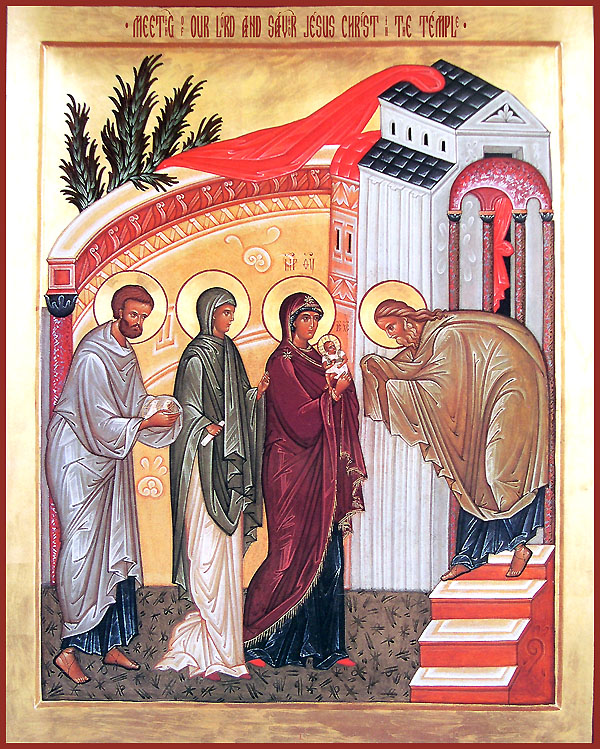
The Meeting of our Lord and Savior Jesus Christ in the Temple

The Meeting of our Lord God and Savior Jesus Christ is described in the third Gospel (Luke 2:22-40). Forty days after His birth the Divine Child was brought to the Temple at Jerusalem to be presented to the Lord. According to the Law of Moses (Lev. 12:2-8), a woman who gave birth to a male child was forbidden to enter the Temple for forty days. At the end of the time of her purification, the mother went to the Temple with the child, to offer a young lamb, two turtledoves, or pigeons to the Lord as a sacrifice. The Most Holy Virgin had no need of purification, since she had given birth to the Source of purity and sanctity. Out of humility, however, she fulfilled the requirements of the Law.

At this time the righteous Elder Simeon (February 3) was living in Jerusalem. It had been revealed to him that he would not die until he beheld the promised Messiah. By divine inspiration, Saint Simeon went to the Temple at the very moment when the Most Holy Theotokos and Saint Joseph had brought the Child Jesus to fulfill the Law.

Saint Simeon received the divine Child in his arms,1 and giving thanks to God, he spoke the words repeated by the Church each evening at Vespers: “Lord, now lettest Thou Thy servant depart in peace, according to Thy word, for mine eyes have seen Thy salvation, which Thou hast prepared before the face of all people, a light to enlighten the Gentiles, and the glory of Thy people Israel” (Luke 2:29-32). Saint Simeon said to the Most Holy Virgin: “Behold, this child is set for the fall and rising again of many in Israel, and for a sign which shall be spoken against. Yea, a sword shall pierce through your own soul also, that the thoughts of many hearts may be revealed” (Luke 2:34-35).

At the Temple was an 84-year-old widow, Saint Anna the Prophetess, the daughter of Phanuel (February 3), “who did not leave the temple, but served God with fasting and prayers night and day." She arrived just when Saint Simeon met the Divine Child. She also gave thanks to the Lord and spoke of Him to all those who were looking for redemption of Jerusalem” (Luke 2:38). In the icon of the Feast she holds a scroll which reads: “This Child has established Heaven and earth.”

Before Christ was born, the righteous men and women lived by faith in the promised Messiah, and awaited His coming. The Righteous Simeon and the Prophetess Anna, the last righteous persons of the Old Testament, were deemed worthy to meet Him in the Temple.

The Feast of the Meeting of the Lord is among the most ancient feasts of the Christian Church. We have sermons by the holy bishops Methodios of Patara (+ 312), Cyril of Jerusalem (+ 360), Gregory the Theologian (+ 389), Amphilokhios of Iconium (+ 394), Gregory of Nyssa (+ 400), and John Chrysostom (+ 407). Despite its early origin, this Feast was not celebrated so splendidly until the VI century.

In 528, during the reign of Justinian, an earthquake killed many people in Antioch. Other misfortunes followed this one. In 541 a terrible plague broke out in Constantinople, carrying off several thousand people each day. During this time of widespread suffering, a solemn prayer service (Litia) for deliverence from evils was celebrated on the Feast of the Meeting of the Lord, and the plague ceased. Giving thanks to God, the Church established a more solemn celebration of this Feast.

Church hymnographers have adorned this Feast with their hymns: Saint Andrew of Crete in the VII century; Saint Cosmas Bishop of Maium, Saint John of Damascus, and Saint Germanus Patriarch of Constantinople in the VIII century; and Saint Joseph, Archbishop of Thessaloniki in the IX century.

Today we also commemorate the Icon of the Most Holy Theotokos known as “the Softening of Evil Hearts” or “Simeon’s Prophecy.” The Mother of God is depicted without her Child, and seven swords piercing her breast: three from the left side, three from the right, and one from below.

A similar Icon, “Of the Seven Swords” (August 13) shows three swords on the left side and four from the right. The "Softening of Evil Hearts” Is also commemorated on August 13.

The Icon “Simeon’s Prophecy” symbolizes the fulfillment of the prophecy of the righteous Elder Simeon: “a sword shall pierce through your own soul” (Luke 2:35).

In Constantinople, the Emperors would celebrate the Feast Day at the Blakhernae church during the All-Night Vigil. This custom continued until the Fall of the Byzantine Empire.


1 For this reason, he is known as the God-Receiver (Θεοδόχος).

Daily Readings for Thursday, February 01, 2024

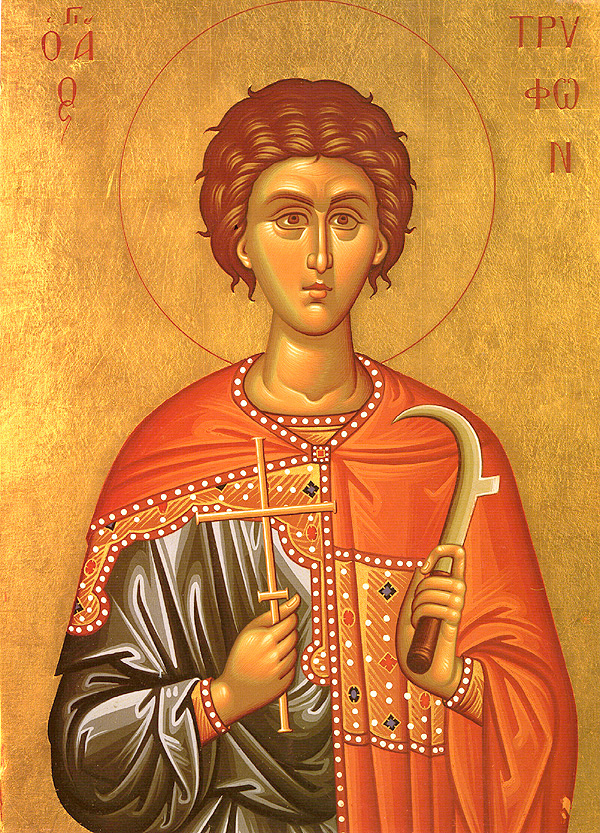
TRYPHO THE MARTYR

NO FAST

Trypho the Martyr, Forefeast of the Presentation of Our Lord and Savior in the Temple, Perpetua & her Companions, Our Holy Father Basil, Archbishop of Thessolonica, Anastasios the New Martyr of Navplion, The Four Martyrs Andrianus, Polyeuktos, Plato and George who contested in Megara, Timothy the Confessor, Bridget of Ireland

ST. PAUL’S LETTER TO THE ROMANS 8:28-39

Brethren, we know that everything works for good with those who love God, who are called according to his purpose. For those whom he foreknew he also predestined to be conformed to the image of his Son, in order that he might be the first-born among many brethren. And those whom he predestined he also called; and those whom he called he also justified; and those whom he justified he also glorified.
What then shall we say to this? If God is for us, who is against us? He who did not spare his own Son but gave him up for us all, will he not also give us all things with him? Who shall bring any charge against God's elect? It is God who justifies; who is to condemn? It is Christ Jesus, who died, yes, who was raised from the dead, who is at the right hand of God, who indeed intercedes for us. Who shall separate us from the love of Christ? Shall tribulation, or distress, or persecution, or famine, or nakedness, or peril, or sword? As it is written, "For thy sake we are being killed all the day long; we are regarded as sheep to be slaughtered." No, in all these things we are more than conquerors through him who loved us. For I am sure that neither death, nor life, nor angels, nor principalities, nor things present, nor things to come, nor powers, nor height, nor depth, nor anything else in all creation, will be able to separate us from the love of God in Christ Jesus our Lord.

LUKE 10:19-21

The Lord said to his disciples, "Behold, I have given you authority to tread upon serpents and scorpions, and over all the power of the enemy; and nothing shall hurt you. Nevertheless do not rejoice in this, that the spirits are subject to you; but rejoice that your names are written in heaven." In that same hour he rejoiced in the Holy Spirit and said, "I thank you, Father, Lord of heaven and earth, that you have hidden these things from the wise and understanding and revealed them to babes; yes, Father, for such was your gracious will.

Forefeast of the Meeting of our Lord in the Temple

The Typikon should be consulted if the Forefeast falls on the Sunday of the Pharisee, the Publican, or Meatfare.

Because of the Forefeast of the Meeting of the Lord, the service to Saint Tryphon (February 1) may be moved to Compline or to another day, as the rector decides, unless the parish is dedicated to Saint Tryphon, or there is a particular devotion to him.

Martyr Tryphon of Lampsacus Near Apamea in Syria

The Martyr Tryphon was born in Phrygia, one of the districts of Asia Minor, in the village of Lampsacus. From his early years the Lord granted him the power to cast out demons and to heal various maladies. He once saved the inhabitants of his native city from starvation. Saint Tryphon, by the power of his prayer, turned back a plague of locusts that were devouring the grain and devastating the fields.

Saint Tryphon gained particular fame by casting out an evil spirit from the daughter of the Roman emperor Gordian (238-244). Helping everyone in distress, he asked only one thing from them: faith in Jesus Christ, by Whose grace he healed them.

When the emperor Decius (249-251) assumed the imperial throne, he began a fierce persecution of Christians. Someone reported to the commander Aquilinus that Saint Tryphon was boldly preaching faith in Christ, and that he led many to Baptism. The saint was arrested and subjected to interrogation, during which he fearlessly confessed his faith.

He was subjected to harsh tortures: they beat him with clubs, raked his body with iron hooks, they scorched his flesh with fire, and led him through the city, after iron nails were hammered into his feet. Saint Tryphon bravely endured all the torments without complaint.

Finally, he was condemned to beheading with a sword. The holy martyr prayed before his execution, thanking God for strengthening him in his sufferings. He also asked the Lord to bless those who should call upon his name for help. Just as the soldiers raised the sword over the head of the holy martyr, he surrendered his soul into the hands of God. This event occurred in the city of Nicea in the year 250.

Christians wrapped the holy body of the martyr in a clean shroud and wanted to bury him in the city of Nicea, where he suffered, but Saint Tryphon in a vision commanded them to take his body to his native land to the village of Lampsacus. Later on, the relics of Saint Tryphon were transferred to Constantinople, and then to Rome.

In Russia, Saint Tryphon is regarded as the patron saint of birds. There is a story that when Tsar Ivan the Terrible was out hunting, his falconer carelessly allowed the Tsar’s favorite falcon to fly away. The Tsar ordered the falconer Tryphon Patrikeiev to find the bird within three days, or else he would be put to death. Tryphon searched all through the forest, but without luck.

On the third day, exhausted by long searching, he returned to Moscow to the place called Marinaya Grove. Overcome with weariness, he lay down to rest, fervently praying to his patron saint, the Martyr Tryphon, for help.

In a dream he saw a youth on a white horse, holding the Tsar’s falcon on his hand. The youth said, “Take the lost bird, go to the Tsar and do not grieve.” When he awakened, the falconer actually spotted the falcon on a pine tree. He took it to the Tsar and told him about the miraculous help he received from the holy Martyr Tryphon. Grateful to Saint Tryphon for saving his life, Tryphon Patrikeiev built a chapel on the spot where the saint appeared. Later on, he also built a church dedicated to the holy Martyr Tryphon in Moscow.

The holy martyr is greatly venerated in the Russian Orthodox Church as the heavenly protector of Moscow. Many Russian icons depict the saint holding a falcon on his arm.

Martyrs Perpetua, a woman of Carthage, and the Catechumens: Saturus, Revocatus, Saturninus, Secundulus and Felicitas

The Holy Martyrs Perpetua, Felicitas and those with them. Vibia Perpetua was from a patrician family, and lived in Carthage. She came to believe in Christ, and was baptized after her arrest as a Christian. A few days later, the twenty-two-year-old woman was taken to prison with her infant son. Arrested with her were her brother Saturus, the servants Felicitas, Revocatus, Saturninus and Secundulus, who were also catechumens.

Despite the exhortations of her father, who persistently appealed to her maternal feelings, the widowed Saint Perpetua refused to offer sacrifice to the pagan gods.

Before their execution, Saints Perpetua and Saturus had visions from God, which strengthened their souls. Saint Felicitas, who was eight months pregnant, gave birth to a baby girl while in prison. She rejoiced because now she would be permitted to die with her companions. There was a law forbidding the execution of pregnant women.

The martyrs were led from the prison into the amphitheatre. Saturninus and Revocatus had to face a leopard and a bear. Saints Perpetua and Felicitas were brought to the arena in nets, and they were pitted against a wild heifer. After being tossed to the ground by the heifer, the two women were led out of the arena. Saturus was bitten by a leopard, but did not die. The martyrs were then led to a certain spot to be killed by the sword. The young gladiator who was to execute Saint Perpetua was inexperienced and did not kill her with the first blow. She herself took his hand and guided it to her throat, and so she received the crown of martyrdom. This occurred in about the year 203.

The amphitheatre where these saints perished is located a few miles from the city of Tunis. In 1881, a room was discovered opposite the modern entrance into the arena. Some say this was a cell where the victims waited to be brought into the arena.

Venerable Peter the Hermit of Galatia Near Antioch, in Syria

Saint Peter of Galatia lived during the IV-V century, and came from the region of the Black Sea. From a young age was distinguished by his fervent piety and his determination to acquire spiritual treasures. When he was seven years old, he went to Galatia and then to Palestine, where his faith grew even stronger. During the second quarter of the IV century, He lived an ascetical life in the mountains, which had been glorified by so many great spiritual athletes and teachers of Christianity.

Saint Peter was able to perform miracles, just as Christ did, so that even his garments had miraculous power, just as the Apostle Paul's handkerchiefs and aprons did (Acts 29:22). It did not take long for his spiritual fruits to be noticed, and many people came to him, reaping valuable advice and solace for the wounds of their souls, which were very difficult to cure.

Because of his great virtue, he also received from God the gift (charism, χάρισμα) of having demons subject to him. He delivered a possessed man named Daniel from the demons, whom he instructed in asceticism, and then accepted him as his co-struggler.

Later, he healed the mother of the historian Bishop Theodoret of Cyrrhus, a devout woman who suffered from an incurable disease in one eye. Hearing about Saint Peter's gift of working miracles, she hoped that he would heal her of this terrible affliction. Theodoret's mother was only twenty-three years old when she went to see him. She was very beautiful, and she wore a lot of make-up, an expensive silk dress, and gold bracelets on her arms, as well as gold rings in her ears. When the holy monk looked at her, he discerned some good soil (Matthew 13:8) in her for a word of profitable instruction, but decided that first he would cure her fondness for fine clothing.

He said, "My child, just as a painter who does not paint according to the rules of his art, but as he pleases, insults the art of painting, so do those who cover their faces with red, white, or black paint, offend the Creator; for in this way they seem to accuse Him of imperfection in His creation, but He has the power to do as He wishes. As the Prophet-King David wrote: 'All that the Lord willed, He created' (Psalm 134/135:6). He gives to everyone everything that is useful, and nothing which is harmful. Do not disfigure the divine image created by God."

The monk's words fell on fertile ground and produced good fruit. The young woman fell at the ascetic's feet and begged him to pray for her and to heal her. Saint Peter replied, "If you have firm faith in God's help, you will be cured of your illness; for God is always ready to grant the petitions of a believing soul."

Then he placed his hand on the afflicted eye and, making the Sign of the Cross, he healed her.

The Saint once blinded a city magistrate, who wanted to rape a certain nun, thereby preventing him from carrying out his unholy desire. Saint Peter performed many other great miracles, as Bishop Theodoret (who wrote his Life) relates.

After living in a God-pleasing manner for ninety-nine years, Saint Peter surrendered his soul to God and received the reward for his spiritual and ascetical labors in the year 429 at the age of 95 (or 99, according to other sources).

In Greek usage, Saint Peter is commemorated on November 25. He should not be confused with the other Saint Peter of Galatia, who lived during the IX century, and is commemorated on October 9.

Venerable Vendemianus the Hermit of Bithynia

Saint Vendemianus (Bendemianus) was born in Myzia. In his youth he was a disciple of Saint Auxentius, one of the Fathers of the Fourth Ecumenical Council. He went to the monastery founded by Saint Auxentius (February 14) on Mount Oxia, not far from Chalcedon (Asia Minor), where he lived in asceticism for forty-two years at the cell of his teacher in the crevice of a cliff. He spent his life in fasting and prayer, and was tempted by demons. Because of his holy life and spiritual struggles, the saint was granted the gift of healing. He died around the year 512.

Venerable Brigid (Bridget) of Ireland

Saint Brigid, “the Mary of the Gael,” was born around 450 in Faughart, about two miles from Dundalk in County Louth. According to Tradition, her father was a pagan named Dubthach, and her mother was Brocessa (Broiseach), one of his slaves.

Even as a child, she was known for her compassion for the poor. She would give away food, clothing, and even her father’s possessions to the poor. One day he took Brigid to the king’s court, leaving her outside to wait for him. He asked the king to buy his daughter from him, since her excessive generosity made her too expensive for him to keep. The king asked to see the girl, so Dubthach led him outside. They were just in time to see her give away her father’s sword to a beggar. This sword had been presented to Dubthach by the king, who said, “I cannot buy a girl who holds us so cheap.”

Saint Brigid received monastic tonsure at the hands of Saint Mael of Ardagh (February 6). Soon after this, she established a monastery on land given to her by the King of Leinster. The land was called Cill Dara (Kildare), or “the church of the oak.” This was the beginning of women’s cenobitic monasticism in Ireland.

The miracles performed by Saint Brigid are too numerous to relate here, but perhaps one story will suffice. One evening the holy abbess was sitting with the blind nun Dara. From sunset to sunrise they spoke of the joys of the Kingdom of Heaven, and of the love of Christ, losing all track of time. Saint Brigid was struck by the beauty of the earth and sky in the morning light. Realizing that Sister Dara was unable to appreciate this beauty, she became very sad. Then she prayed and made the Sign of the Cross over Dara’s eyes. All at once, the blind nun’s eyes were opened and she saw the sun in the east, and the trees and flowers sparkling with dew. She looked for a while, then turned to Saint Brigid and said, “Close my eyes again, dear Mother, for when the world is visible to the eyes, then God is seen less clearly by the soul.” Saint Brigid prayed again, and Dara became blind once more.

Saint Brigid fell asleep in the Lord in the year 523 after receiving Holy Communion from Saint Ninnidh of Inismacsaint (January 18). She was buried at Kildare, but her relics were transferred to Downpatrick during the Viking invasions. It is believed that she was buried in the same grave with Saint Patrick (March 17) and Saint Columba of Iona (June 9).

Late in the thirteenth century, her head was brought to Portugal by three Irish knights on their way to fight in the Holy Land. They left this holy relic in the parish church of Lumiar, about three miles from Lisbon. Portions of the relic were brought back to Ireland in 1929 and placed in a new church of Saint Brigid in Dublin.

The relics of Saint Brigid in Ireland were destroyed in the sixteenth century by Lord Grey during the reign of Henry VIII.

The tradition of making Saint Brigid’s crosses from rushes and hanging them in the home is still followed in Ireland, where devotion to her is still strong. She is also venerated in northern Italy, France, and Wales.

Saint Tryphon, Bishop of Rostov

Saint Tryphon, Bishop of Rostov was head of Moscow’s Novospassky (New Savior) monastery and was confessor to Great Prince Basil the Dark. On May 23, 1462 he was consecrated as Bishop of Rostov by Metropolitan Theodosius of Moscow.

In 1466, he retired to the Savior monastery in Yaroslavl, where he died on December 30, 1468 (certain local documents indicate the year 1466). His commemoration was transferred to February 1, it seems, so that he would be honored with his namesake Saint Tryphon of Lampsacus. Saint Prochorus was also buried at this monastery, as the schemamonk Tryphon, also a Bishop of Rostov, who died in 1328 (September 7).

Icon of the Mother of God “Socola”

The Socola Icon of the Mother of God was in the church of the Transfiguration in the Orthodox Theological Seminary at the Socola Monastery in Romania. In February 1854, it became famous for the remarkable miracle of shedding tears.

After the Divine Liturgy on February 1, 1854, a frightened member of the clerical staff went to Hieromonk Isaiah, the ecclesiarch, and said that he had seen tears on the Icon of the Most Holy Theotokos. Several of those serving ran to the church. There they all witnessed tears running down from the eyes of the Mother of God.
Bishop Philaret Skriban, the rector of the seminary, removed the Icon of the Mother of God from its frame, and carefully examined it. Believing that it may have been sprinkled with holy water for the Feast of Saint Tryphon, the bishop wiped away the tears with a towel, and put the Icon back in its place. Then, after ordering everyone to leave the church, he looked all around the church, and then locked it.

Several hours later, the seminary professors and students went into the church with the rector for Vespers, and all were amazed to see the same miraculous flow of tears from the eyes of the Theotokos depicted on the Icon. Immediately, Bishop Philaret served a Moleben and Akathist to the Mother of God. Soon, all of Romania learned of this miraculous event, and people from all parts of the country began to arrive at the Socola Monastery to venerate the newly-revealed Weeping Icon of the Theotokos. The tears sometimes flowed every day; and sometimes they appeared two, three, or four days apart. As a result, many people were able to see the actual miracle of weeping first hand, and bear witness to it. Those who did not see the actual miracle were convinced that a genuine miracle had taken place because they observed traces of the dried tears on the surface of the Icon.

During the Crimean War (1854-1856), the Principality of Moldavia was occupied by Austrian troops. General Paar, the commanding officer of the Austrian army, heard about the Socola Icon and ordered a staff officer to investigate the reported miracle and to give a report of his results. The Colonel went to the monastery and examined the Icon, which was not weeping at the time. Finding nothing unusual, he returned the Icon to its frame. Taking a lighted candle, he looked carefully at the face of the Virgin. Suddenly, two small shining tears formed in the eyes of the Mother of God, and the tears began to flow. The officer recoiled in terror, and exclaimed, “It is weeping! This is a great miracle! Fathers, pray unto God!”

The Colonel reported what had transpired to his commanding officer. His description of the miraculous flow of tears from the Icon is of unquestionable importance, for he had come to Socola Monastery with no faith that such a miracle was possible. When he left, however, he was convinced that it was an indisputable fact. His was not the only evidence that a true miracle had taken place. There were many other eyewitness accounts, including accounts by individuals whose sincerity there would be no reason to question.

Reports of the weeping Socola Icon also spread to Russia, and some people believe that the weeping icon mentioned in Tolstoy’s “War and Peace“ (Book 5, Ch. 11) may have been based on this Icon.

The account provided by Bishop Melchizedek Ştefănescu of Romania deserves particular attention. He was one of the first to witness this miracle, when he was a professor in the seminary at Socola Monastery. Reminiscing 35 years later about seeing tears flow from the eyes of the Mother of God, the Elder recalled how he had speculated about the reason for its tears. He knew that in times past there had also been such Icons, which wept from time to time, and that such events always presaged difficult trials for Christ’s Church and for the homeland.

History supported the Elder’s conclusion. Soon after the miraculous appearance of the tears, the Moldavian Principalities were subjected to severe trials. Socola Monastery also suffered great hardship. It was as important to Romanians as St. Sergius Lavra is to the Russian people.

Romania’s great religious and educational center was destroyed. The seminary was moved to Iași, and the local instructors and monastics were dispersed. Thus, where the glorious historical seminary had stood, serving for almost a century as a center of religious education, there remained only a small elementary school. When the Seminary moved from Socola to Iași in 1886, the icon was transferred to the new Metropolitan Cathedral in Iași.

The name Socola probably came from a Slavic source, from the word socola, or “hawk” (perhaps because there were many hawks near the monastery).

Saint Seririol of Wales

No information available at this time.
2/4 announcements

February 4, 2024

Thirty-second Sunday after Pentecost

I Timothy 4:9-15: Timothy, my son, the saying is sure and worthy of full acceptance. For to this end we toil and strive, because we have our hope set on the living God, Who is the Savior of all men, especially of those who believe. Command and teach these things. Let no one despise your youth, but set the believers an example in speech and conduct, in love, in faith, in purity. Until I come, attend to the public reading of scripture, to preaching, to teaching. Do not neglect the gift you have, which was given you by prophetic utterance when the council of elders laid their hands upon you. Practice these duties; devote yourself to them, so that all may see your progress.

Luke 19:1-10: At that time, Jesus entered Jericho and was passing through. And there was a man named Zacchaeus; he was a chief tax collector, and rich. And he sought to see Who Jesus was, but could not, on account of the crowd, because he was small of stature. So he ran on ahead and climbed up into a sycamore tree to see Jesus, for He was to pass that way. And when Jesus came to the place, He looked up and said to him, “Zacchaeus, make haste and come down; for I must stay at your house today.” So he made haste and came down, and received Him joyfully. And when they saw it they all murmured, “He has gone in to be the guest of a man who is a sinner.” And Zacchaeus stood and said to the Lord, “Behold, Lord, the half of my goods I give to the poor; and if I have defrauded anyone of anything, I restore it fourfold.” And Jesus said to him, “Today salvation has come to this house, since he also is a son of Abraham; for the Son of man came to seek and to save the lost.”

Troparion of the Resurrection: When thou, O immortal Life, didst humble thyself unto death, then didst thou destroy death by the brightness of thy Godhead; and when thou didst raise the bowels of the earth, then all the heavenly powers exclaimed, O Christ, thou art the Giver of life! Glory to thee, O our God!

Troparion of the Presentation: Rejoice, O Virgin Theotokos, full of grace; for from thee arose the Sun of justice, Christ our God, lighting those who are in darkness. Rejoice and be glad, O righteous old man, carrying in thine arms the Deliverer of our souls, who granteth us resurrection.

Troparion of the Chains of St. Peter: O Holy Apostle, Peter, thou dost preside over the Apostles by the precious chains which thou didst bear. We venerate them with faith and beseech thee that by thine intercessions we be granted the great mercy.

Kontakion of the Presentation: Thou, O Christ God, who by your Birth, didst sanctify the Virgin’s womb, and as is meet, didst bless Simeon’s arms, and didst also come to save us, preserve thy fold in wars, and confirm them whom thou didst love; for thou alone art the Lover of mankind.

CALENDAR

UNTIL FURTHER NOTICE: All services listed on the calendar will be available through streaming and webcast. (Instructions can be found on the parish website.)

Sunday, February 4 (Thirty-second Sunday after Pentecost)

8:50 a.m. – Orthros (webcast)

9:00 a.m. – Christian Education

10:00 a.m. – Divine Liturgy (webcast)

Monday, February 5

Father Herman off

Tuesday, February 6

NO Services

Wednesday, February 7

6:30 p.m. – Daily Vespers

Thursday, February 8

NO Services

6:00 p.m. – Choir Supper at Anjou

Friday, February 9

NO Services

Saturday, February 10 (Hieromartyr Haralampos)

10:00 a.m. – Ladies meet for Akathist

4:30 p.m. – Choir Practice

6:00 p.m. – Great Vespers

Sunday, February 11 (Sixteenth Sunday after Pentecost)

8:50 a.m. – Orthros

9:00 a.m. – Christian Education

10:00 a.m. – Divine Liturgy (webcast)

NO POT LUCK MEAL (Regular Coffee Hour)

SPECIAL ANNOUNCEMENTS

The Eucharist Bread …was offered by Algoods for the Divine Liturgy this morning. The Artos for the Litia and Artoklasia for the feast of the Presentation of the Lord in the Temple this past Thursday evening was offered by the Hendersons.

Also, please remember that we still need your tithes and offerings which may be placed in the tray that is passed during the Divine Liturgy, in the tithe box at the back of the nave or be mailed to: St. Peter Orthodox Church, P.O. Box 2084, Madison, MS 39130-2084.

Eucharist Bread Schedule:

Eucharist Bread Coffee Hour

February 4 Algood Henderson/K. Jones

February 11 Schelver NO POT LUCK MEAL

(Regular Coffee Hour) Dansereau/Alaeetawi

February 18 Morris Lockhart/Karam/Snell

February 25 Jones Lavric/Skirtech/Dabit

Schedule for Epistle Readers – Page numbers refer to the Apostolos (book of the Epistles) located on the Chanters’ stand at the front of the nave. Please be sure to use this book when you read.

Reader Reading Page#

February 4 Brandon Strain I Tim. 4:9-15 252

February 11 Sam Habeeb II Cor. 6:1-10 168

February 18 Ian Jones II Cor. 6:16-7:1 173

February 25 Walt Wood II Tim. 3:10-15 258

We will NOT have our usual Pot Luck Meal next Sunday due to the situation in our kitchen. We will instead have a regular Coffee Hour with Coffee and packaged food items as we have been doing for the past two weeks.

Please remember the following in your prayers: Aidan Milnor, the Milnor family; Lamia Dabit

and her family; Mary Greene (Lee and Kh. Sharon’s sister); Jay and Joanna Davis; Fr. Leo and Kh. Be’Be’ Schelver and their family; Kathy Willingham; Marilyn (Kyriake) Snell; Jack and Jill Weatherly; Lottie Dabbs (Sh. Charlotte Algood’s mother), Sh. Charlotte and their family; Reader Basil and Brenda Baker and their family; Buddy Cooper; Georgia and Bob Buchanan; Fr. Joseph Bittle; Steve and Sheryl Chamblee; Rick Carlton; Very Rev. Fr. Nicholas and Kh. Jan Speier; Dora Lambert (Dimitri Zouboukos’ fiancée); Lee Greene; Joseph, Amanda and Hunter Hines; Fr. John and Kh. Janet Henderson and their family.

Update on Kitchen Repairs: Currently all damage to the kitchen from the water break has been cleaned up. ServPro has finished everything they needed to get done. The insurance adjuster has been out to inspect the damage, and we are now waiting to hear back from contractors to come back in and repair/replace those things that were damaged. We are continuing to have Coffee Hour as we have been. The coffee machines are working and are safe to use for coffee hours. Please do not prepare any type of food in the kitchen until it can be properly sanitized. By God’s grace everything will be back to normal soon.

St. George in Vicksburg is hosting their annual fundraising Lebanese Dinner tomorrow on Monday, February 5th from 11-2 and 4-6, and the cost is $18 per person. The church is located on Washington Street in Vicksburg. This year, for the first time since Co-vid, they will also be offering dine-in for those who would like to enjoy their meal with fellowship.

Camp St. Thekla registration opened on February 1st. If your children are going to camp, please register as soon as possible. If financial help is needed, please let Father Herman or Daniel know. This year the church will not be providing transportation to camp. If you have children going to camp who need a ride, please let Father Herman or Daniel know.

The new date for the Pilgrimage to Holy Dormition will be May 13-17th. A sign-up sheet has been placed on the bureau in the foyer. Please put your name on the list if you think you will be going. More details will be forthcoming.

The book study group with Father John meets every other Sunday in the Fellowship Hall at 5:30 p.m. The next meetings will be February 11th and February 25th. Of course, there may arise a need where these dates are subject to change.

Calendar Items:

* The men of the parish meet for lunch at 11:00 a.m. on the first Thursday of the month.

* The Ladies meet at the church at 10:00 a.m. on the second Saturday of the month to pray the Akathist to the Mother of God, Nurturer of Children on behalf of our children.

* The Ladies meet for lunch at 1:00 p.m. on the last Tuesday of the month.

* Book Study –February 11th and 25th.

* Stewpot dates for 2024 will be March 30th and November 30th.

Fasting Discipline for February

The traditional fasting discipline (no meat, dairy, eggs, fish, wine or oil) is observed on all Wednesdays and Fridays of the month. However, there is a katalysis for fish, wine and oil on Friday, February 2nd (Feast of the Presentation of the Lord in the Temple) and there will be no fasting during the week following the Sunday of the Pharisee and the Publican (February 25th this year).

Major Commemorations for February

February 10 Hieromartyr Haralampos

February 24 The Forerunner (1st and @nd Discoveries)

February 25 Sunday of the Pharisee and the Publican

Quotable: “One should preach not from one’s rational mind but rather from the heart. Only that which is from the heart can touch another heart. One must never attack or oppose anyone. If he who preaches must tell people to keep away from a certain kind of evil, he must do so meekly and humbly, with fear of God.”

Elder Thaddeus, Our Thoughts Determine Our Lives

Worship: Sunday, February 11, 2024 (Sixteenth Sunday after Pentecost)

Scripture: II Corinthians 6:1-10; Matthew 25:14-30

Celebrant: Father Herman

Epistle Reader: Sam Habeeb

Prosphora: Schelver

Coffee Hour: Dansereau/Alaeetawi (Regular Coffee Hour)

NO POT LUCK MEAL (due to kitchen)