Monthly Archives: February 2024

Daily Readings for Friday, February 09, 2024

FRIDAY OF THE 14TH WEEK

ABSTAIN FROM MEAT, FISH, DAIRY, EGGS, WINE, OLIVE OIL

Leavetaking of the Presentation of Our Lord and Savior in the Temple, Nicephoros the Martyr of Antioch, Markellos, Philagrios, & Pankratios the Hieromartyrs, Teilo, Bishop of Llandaff

ST. JAMES’ UNIVERSAL LETTER 2:1-13

Brethren, show no partiality as you hold the faith of our Lord Jesus Christ, the Lord of glory. For if a man with gold rings and in fine clothing comes into your assembly, and a poor man in shabby clothing also comes in, and you pay attention to the one who wears the fine clothing and say, “Have a seat here, please, ” while you say to the poor man, “Stand there, ” or, “Sit at my feet, ” have you not made distinctions among yourselves, and become judges with evil thoughts? Listen, my beloved brethren. Has not God chosen those who are poor in the world to be rich in faith and heirs of the kingdom which he has promised to those who love him? But you have dishonored the poor man. Is it not the rich who oppress you, is it not they who blaspheme the honorable name which was invoked over you? If you really fulfil the royal law, according to the scripture, “You shall love your neighbor as yourself, ” you do well. But if you show partiality, you commit sin, and are convicted by the law as transgressors. For whoever keeps the whole law but fails in one point has become guilty of all of it. For he who said, “Do not commit adultery, ” said also, “Do not kill.” If you do not commit adultery but do kill, you have become a transgressor of the law. So speak and so act as those who are to be judged under the law of liberty. For judgment is without mercy to one who has shown no mercy; yet mercy triumphs over judgment.

MARK 10:24-32

The Lord said to his disciples, "How hard it will be for these who have riches to enter the kingdom of God! It is easier for a camel to go through the eye of a needle than for a rich man to enter the kingdom of God." And they were exceedingly astonished, and said to him, "Then who can be saved?" Jesus looked at them and said, "With men it is impossible, but not with God; for all things are possible with God." Peter began to say to him, "Lo, we have left everything and followed you." Jesus said, "Truly, I say to you, there is no one who has left house or brothers or sisters or mother or father or children or lands, for my sake and for the gospel, who will not receive a hundredfold now in this time, houses and brothers and sisters and mothers and children and lands, with persecutions, and in the age to come eternal life. But many that are first will be last, and the last first." And they were on the road, going up to Jerusalem, and Jesus was walking ahead of them; and they were amazed, and those who followed were afraid.

Leavetaking of the Meeting of our Lord in the Temple

The Leavetaking of the Meeting of the Lord usually falls on February 9, but may be moved if the Feast falls during the period of the Triodion. In that case, the Typikon must be consulted for information on the Leavetaking.

Usually, the entire office of the Feast is repeated except for the Entrance, festal readings, and Litya at Vespers, and the Polyeleos and festal Gospel at Matins. The festal Antiphons are not sung at Liturgy, and the Epistle and Gospel of the day are read.

Martyr Nikephoros of Antioch, in Syria
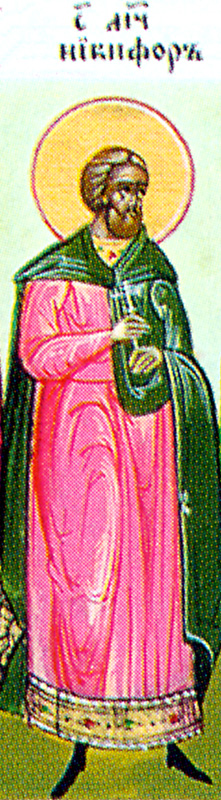
The Holy Martyr Nikephoros (Nikēphóros) lived in the city of Syrian Antioch. In this city lived also the presbyter Sapricius, with whom Nikephoros was very friendly, so that they were considered as brothers. They quarreled because of some disagreement, and their former love changed into enmity and hate.

After a certain time Nikephoros came to his senses, repented of his sin and more than once asked Sapricius, through mutual friends, to forgive him. Sapricius, however, did not wish to forgive him. Nikephoros then went to his former friend and fervently asked forgiveness, but Sapricius was adamant.

At this time the emperors Valerian (253-259) and Gallius (260-268) began to persecute Christians, and one of the first brought before the court was the priest Sapricius. He firmly confessed himself a Christian, underwent tortures for his faith and was condemned to death by beheading with a sword. As they led Sapricius to execution, Nikephoros tearfully implored his forgiveness saying, “O martyr of Christ, forgive me if I have sinned against you in any way.”

The priest Sapricius remained stubborn, and even as he approached death he refused to forgive his fellow Christian. Seeing the hardness of his heart, the Lord withdrew His blessing from Sapricius, and would not let him receive the crown of martyrdom. At the last moment, he suddenly became afraid of death and agreed to offer sacrifice to idols. In vain did Saint Nikephoros urge Sapricius not to lose his reward through apostasy, since he already stood on the threshold of the heavenly Kingdom.

Saint Nikephoros then said to the executioner, “I am a Christian, and I believe in our Lord Jesus Christ. Execute me in place of Sapricius.” The executioners reported this to the governor. He decided to free Sapricius, and to behead Nikephoros in his place. Thus did Saint Nikephoros inherit the Kingdom and receive a martyr’s crown.

Uncovering of the relics of Saint Innocent, Bishop of Irkutsk
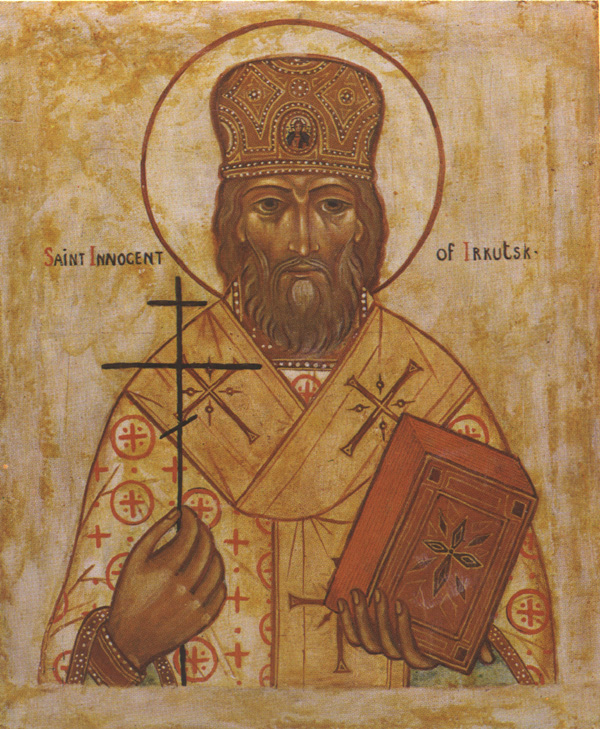
Saint Innocent, the first Bishop of Irkutsk, reposed on November 27, 1831. But because the Kursk Root Icon of the Mother of God is commemorated on that day, his Feast Day is celebrated on November 26.

After the Saint's death, his persecutors received their just retribution. Archimandrite Anthony was discredited in Beijing as unorthodox. He was returned to St. Petersburg, deposed and imprisoned. Soon afterward, the Vice-Governor of Irkutsk was executed for his crimes.

In 1764, the body of Saint Innocent was discovered to be incorrupt during restoration work on the Ascension Monastery’s Tikhvin church. Many miracles occurred not only at Irkutsk, but also in the remote places of Siberia, for those who turned to the Saint in prayer.

In 1783, there was a great fire at Ascension Monastery. Everything that could burn was burnt. However, the old wooden temple, where the Saint's body rested, remained unharmed.

On February 9, 1805, the Most Holy Synod decided to uncover the Hierarch's relics and to number him among the Saints.

On February 2, 1831, the Feast of the Meeting of the Lord, His Grace Bishop Benjamin took Vladyka's holy relics from his tomb and placed them in the midst of the Tikhvin church, and then he served the Divine Liturgy before them. A week later, on February 9, the Hierarch's relics were solemnly transferred from the Tikhvin church to the Ascension Cathedral in a Cross Procession with the wonderworking Kazan Icon of the Mother of God.

In the twenties of the XX century, a period of persecution by the new godless authorities against Christians began. The Superior of Ascension Monastery was arrested, along with other hierarchs of Siberia. In 1921, the Saint's relics were subjected to a sacrilegious medical examination, after which they were taken from the orphaned Monastery, and then they disappeared for a long time.

In 1990, in one of the churches of the city of Yaroslavl, Saint Innocent's relics were discovered in a utility room. A medical examination showed that the body, which was not touched by decay, was that of Saint Innocent. His holy relics were returned to Irkutsk, and today they rest in Znamensky Monastery.

Saint Innocent, the first Bishop of Irkutsk is commemorated on November 26 (the day of his repose), February 9 (the discovery of his relics in 1805), June 10 (Synaxis of the Saints of Siberia), September 2 (the return of his relics to Irkutsk in 1990), on October 10 (Synaxis of the Saints of Volhynia), and on the third Sunday after Pentecost (Synaxis of the Saints of St. Petersburg).

Venerable Pancratius of the Kiev Caves

The holy hieromonk Pancratius performed the divine services with much grace, and received the gift of working miracles. He shared his gifts with those who asked, healing the sick with fasting, prayer, and anointing with holy oil.

Venerable Nikēphóros of Vazheozersk

Saint Nikēphóros of Vazhe Lake came to Saint Alexander of Svir (April 17) in the year 1510 and was warmly received by him. In 1518 he made a visit, with the blessing of his mentor, to Saint Cyril of New Lake (February 4). When Nikēphóros approached New Lake, he was fatigued by his long journey and lay down in the darkness and fell asleep.

Saint Cyril hastened by boat to row across the lake and awoke him. Saint Nikēphóros spent eight days in spiritual conversation with the saint. Nikēphóros then journeyed to Kiev to venerate the relics of the saints of the Caves.

Upon his return, and with the blessing of Saint Alexander, he settled at Vazhe Lake, where Saint Gennadius pursued asceticism. Saint Nikēphóros built the Church of the Transfiguration and a monastery, where he lived until his own death.

In the second half of the nineteenth century, in the Zadne-Nikiforov wilderness, a church was built and dedicated to Saints Nikēphóros and Gennadius of Vazhe Lake. The relics of the saints were put to rest in a hidden place in the monastery they founded.

Venerable Gennadius of Vazheozersk

Saint Gennadius of Vazhe Lake was the son of rich parents but, giving away everything, he became a disciple of Saint Alexander of Svir and lived with him in asceticism as a hermit by the river Svira. Afterwards, with blessing of Saint Alexander, he went to Vazhe Lake, twelve versts from the Svir monastery. And here, having built a cell, he spent his solitary ascetic life with two of his disciples.

Before his death, Saint Gennadius told his disciple, “Here at this place shall be a church and a monastery.” The holy ascetic reposed on January 8, 1516.

Hieromartyrs Marcellus, Bishop of Sicily, Philagrius, Bishop of Cyprus, and Pancratius, Bishop of Taoromina
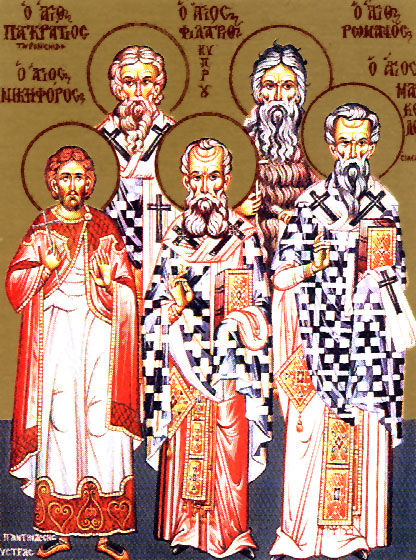
The Hieromartyrs Marcellus, Philagrius and Pancratius were disciples of the holy Apostle Peter and were made bishops by him: Saints Marcellus of Sicily, Philagrius of Cyprus, and Pancratius of Taormina. They were put to death for spreading the faith of Christ among the pagans.

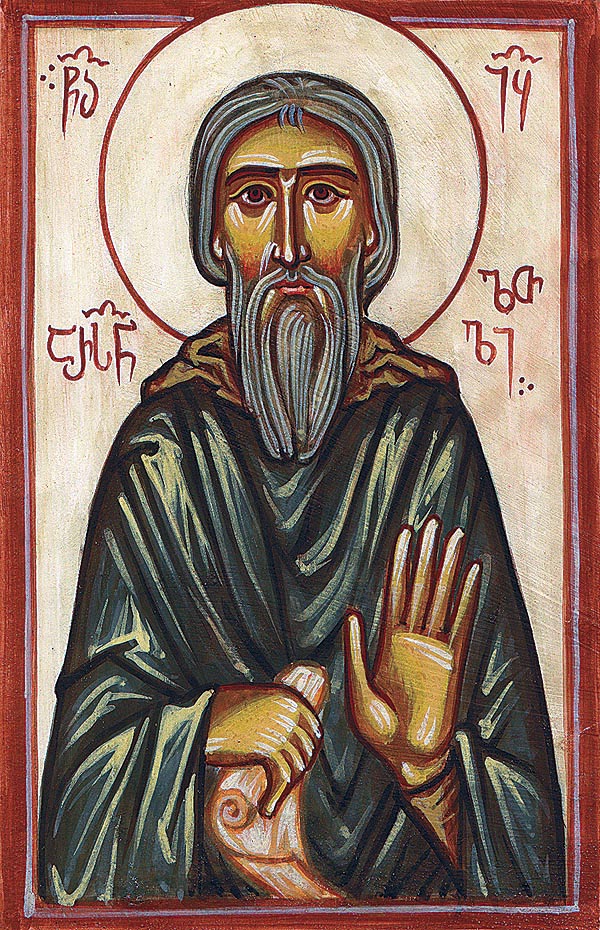
Venerable Shio Mgvime

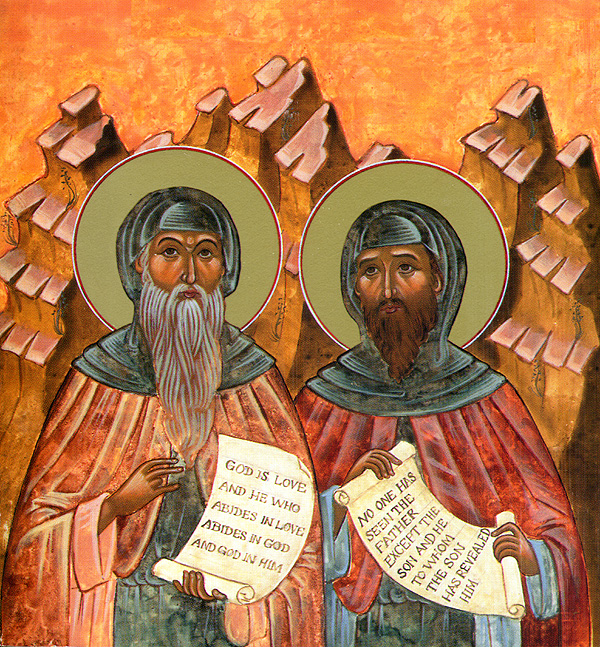
Saint Shio was one of the twelve disciples of Saint John Zedazeni. They were holy Syrian (Cappadocian) ascetics, the founders of Georgian monasticism, who arrived in Georgia from Cappadocia in the mid-sixth century. The holy Thirteen Cappadocian Fathers were actually Georgians, who received their spiritual schooling at the renowned Lavra of Saint Simeon the Stylite and at other monasteries of Syria and Mesopotamia, intending to return to their native land and assist in its Christian enlightenment.

Saint Shio is also commemorated on May 9.

Virgin Martyr Apollonia

Saint Apollonia was an elderly virgin and deaconess of Alexandria, whose martyrdom was described by Saint Dionysius of Alexandria (October 5) in one of his letters.

When Decius became emperor in 249, he launched the greatest attack upon Christianity up to that time, becoming the first emperor to call for its total extermination. Saint Dionysius says that the persecution started at Alexandria a year before it began in other places, incited by a certain “prophet and poet of evil,” who stirred up the people against the Christians.

Backed by the power of the government, the pagans massacred Christians, believing that they were serving their false gods by doing so. The “aged and excellent virgin Apollonia” was seized and struck in the face until all her teeth were knocked out. The mob built a fire outside the city and threatened to burn her alive unless she agreed to worship the idols and sacrifice to the emperor’s genius.

Saint Apollonia asked the pagans to let go of her for a moment so that she could pray. As soon as they did, she leaped into the flames and was consumed, receiving a double crown of martyrdom and virginity. Because of the nature of her torments, she is sometimes depicted with a golden tooth hanging from a necklace, or holding a tooth in a pair of pincers. She is invoked by those suffering from toothache.

Venerable Romanós of Cilicia

Saint Romanós was from the city of Rosón in Cilicia, but he spent his anchoritic life in strict fasting in a cave near Antioch during the V century. There, at the foot of a mountain, he built a small cell, in which he struggled as an ascetic. He wore heavy chains under his hair shirt, and for many years he did not light a fire in his cell.

Because of his most holy life, God granted him the grace of working miracles. Reports of his holiness attracted great crowds of the faithful to him, who asked for his blessing. The Saint healed several persons who suffered from grave illnesses, and through his prayers, many infertile women were able to give birth to healthy children.

The charisma1 of working miracles did not make him proud. Quite the contrary! The Saint often quoted the words of Saint Paul: "Therefore, let anyone who thinks that he stands take heed lest he fall" (I Corinthians 10:12). He also said that it is no great thing to perform miracles, but rather to do works of righteousness and to keep God's commandments.

Thus, after leading a God-pleasing life, Saint Romanós reposed in peace. He is also commemorated on November 27.

Saint Romanós is one of many Saints whose intercession we seek for deliverance from childlessness and barreness. Some of the others are: Saint Stylianos (November 26), Saint Hypatios the Igoumen of Rufinianus in Chalcedon († March 31, 446), Saints Theodore and John (July 12).


1 χάρισματα = Extraordinary powers given to certain individuals by God, enabling them to serve the Church by the grace of the Holy Spirit.

Daily Readings for Thursday, February 08, 2024

THEODORE THE COMMANDER & GREAT MARTYR

NO FAST

Theodore the Commander & Great Martyr, The Holy Prophet Zacharias (Zachariah), Nicephoros & Stephanos the Martyrs, Afterfeast of the Presentation of Our Lord and Savior in the Temple, Cuthman of Steyning

ST. PAUL’S LETTER TO THE EPHESIANS 2:4-10

Brethren, God who is rich in mercy, out of the great love with which he loved us, even when we were dead through our trespasses, made us alive together with Christ (by grace you have been saved), and raised us up with him, and made us sit with him in the heavenly places in Christ Jesus, that in the coming ages he might show the immeasurable riches of his grace in kindness toward us in Christ Jesus. For by grace you have been saved through faith; and this is not your own doing, it is the gift of God: not because of works, lest any man should boast. For we are his workmanship, created in Christ Jesus for good works, which God prepared beforehand, that we should walk in them.

MATTHEW 10:16-22

The Lord said to his disciples, “Behold, I send you out as sheep in the midst of wolves; so be wise as serpents and innocent as doves. Beware of men; for they will deliver you up to councils, and flog you in their synagogues, and you will be dragged before governors and kings for my sake, to bear testimony before them and the Gentiles. When they deliver you up, do not be anxious how you are to speak or what you are to say; for what you are to say will be given to you in that hour; for it is not you who speak, but the Spirit of your Father speaking through you. Brother will deliver up brother to death, and the father his child, and children will rise against parents and have them put to death; and you will be hated by all for my name’s sake. But he who endures to the end will be saved.”

Afterfeast of the Meeting of our Lord in the Temple

The sixth day of the Afterfeast of the Meeting of the Lord falls on February 8. The hymns of the day speak of Christ fulfilling the Law by being brought to the Temple, and of how the Theotokos “reveals to the world its Creator, and the Giver of the Law.”

Greatmartyr Theodore Stratelates “the General”

The Great Martyr Theodore Stratelates came from the city of Euchaita in Asia Minor. He was endowed with many talents, and was handsome in appearance. For his charity God enlightened him with the knowledge of Christian truth. The bravery of the saintly soldier was revealed after he, with the help of God, killed a giant serpent living on a precipice in the outskirts of Euchaita. The serpent had devoured many people and animals, terrorizing the countryside. Saint Theodore armed himself with a sword and vanquished it, glorifying the name of Christ among the people.

For his bravery Saint Theodore was appointed military commander [stratelatos] in the city of Heraclea, where he combined his military service with preaching the Gospel among the pagans subject to him. His gift of persuasion, reinforced by his personal example of Christian life, turned many from their false gods. Soon, nearly all of Heraclea had accepted Christianity.

During this time the emperor Licinius (311-324) began a fierce persecution against Christians. In an effort to stamp out the new faith, he persecuted the enlightened adherents of Christianity, who were perceived as a threat to paganism. Among these was Saint Theodore. Licinius tried to force Saint Theodore to offer sacrifice to the pagan gods. The saint invited Licinius to come to him with his idols so both of them could offer sacrifice before the people.

Blinded by his hatred for Christianity, Licinius trusted the words of the saint, but he was disappointed. Saint Theodore smashed the gold and silver statues into pieces, which he then distributed to the poor. Thus he demonstrated the vain faith in soulless idols, and also displayed Christian charity.

Saint Theodore was arrested and subjected to fierce and refined torture. He was dragged on the ground, beaten with iron rods, had his body pierced with sharp spikes, was burned with fire, and his eyes were plucked out. Finally, he was crucified. Varus, the servant of Saint Theodore, barely had the strength to write down the incredible torments of his master.

God, however, in His great mercy, willed that the death of Saint Theodore should be as fruitful for those near him as his life was. An angel healed the saint’s wounded body and took him down from the cross. In the morning, the imperial soldiers found him alive and unharmed. Seeing with their own eyes the infinite might of the Christian God, they were baptized not far from the place of the unsuccessful execution.

Thus Saint Theodore became “like a day of splendor” for those pagans dwelling in the darkness of idolatary, and he enlightened their souls “with the bright rays of his suffering.” Unwilling to escape martyrdom for Christ, Saint Theodore voluntarily surrendered himself to Licinius, and discouraged the Christians from rising up against the torturer, saying, “Beloved, halt! My Lord Jesus Christ, hanging upon the Cross, restrained the angels and did not permit them to take revenge on the race of man.”

Going to execution, the holy martyr opened up the prison doors with just a word and freed the prisoners from their bonds. People who touched his robe were healed instantly from sicknesses, and freed from demonic possession. By order of the emperor, Saint Theodore was beheaded by the sword. Before his death he told Varus, “ Do not fail to record the day of my death, and bury my body in Euchaita.” He also asked to be remembered each year on this date. Then he bent his neck beneath the sword, and received the crown of martyrdom which he had sought. This occurred on February 8, 319, on a Saturday, at the third hour of the day.

Saint Theodore is regarded as the patron saint of soldiers. He is also commemorated on June 8.

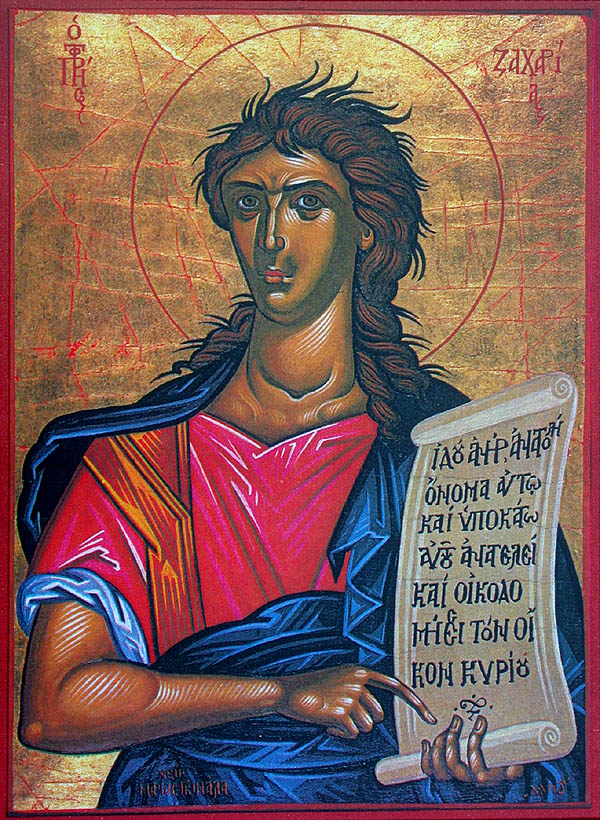
Prophet Zachariah

The Prophet Zachariah the Sickle-Seer the eleventh of the twelve Minor Prophets. He was descended from the tribe of Levi, and seems to have been a priest (Nehemiah 12:4,16). He was called to prophetic service at a young age and became, in the wondrous expression of church hymnology, “a spectator of supra-worldly visions.”

The Book of the Prophet Zachariah contains inspired details about the coming of the Messiah (Zach 6:12); about the last days of the Savior’s earthly life, about the Entry of the Lord into Jerusalem on a young donkey (Zach 9:9); about the betrayal of the Lord for thirty pieces of silver and the purchase of the potter’s field with them (Zach 11:12-13); about the piercing of the Savior’s side (Zach 12:10); about the scattering of the apostles from the Garden of Gethsemane (Zach 13:7); about the eclipse of the sun at the time of the Crucifixion (Zach 14:6-7).

“Enlightened by dawnings all above,” the Prophet Zachariah, “saw the future as it were the present.” According to Tradition, this “most true God-proclaimer” lived to old age and was buried near Jerusalem, beside his illustrious contemporary and companion, the Prophet Haggai (December 16). The title “Sickle-Seer” given Zachariah comes from a vision in which he saw a sickle flying in the air, destroying thieves and perjurors (Zach 5:1-3).

The holy Prophet Zachariah died around 520 B.C. His tomb was discovered in 415 in a village near Eleutheropolis (Sozomen, Hist. Eccles. VI:32, IX:17). At the prophet’s feet was the body of a child dressed in royal accoutrements. His holy relics were transferred to the church of Saint James the Brother of the Lord (October 23) in Constantinople.

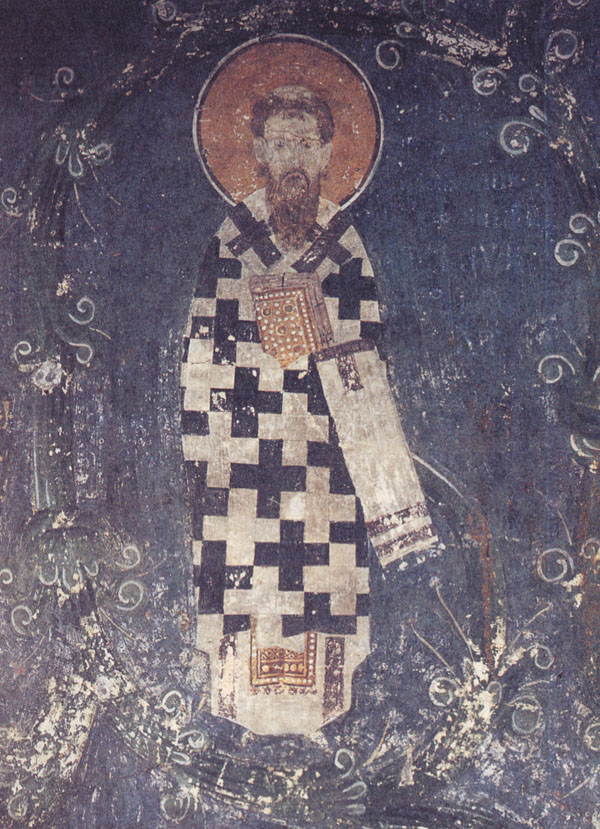
Saint Sava II, Archbishop of Serbia

Born Predislav Nemanjic, the son of Saint-King Stephen Prvovencani the First-Crowned (September 24) and the nephew of Saint Savva I, the first Archbishop of Serbia (January 14), Saint Savva II distinguished himself in monastic life by his ascetic practices, in imitation of his sainted uncle.

He succeeded Saint Arsenius (October 28) as Archbishop of Serbia in 1266. He guided the Church with great love and dedication until his repose, variously dated as 1268, 1269 and 1271. His holy relics are at Pec, the site of the ancient Serbian Patriarchate.

Blessed Liubov (Sukhanovskaya) of Ryazan, Fool for Christ

Liuba Semyonova Sukhanovskaya was born in 1860 in the Ryazan region, in the city of Pronsk, into the family of Semyon and Maria Sukhanovsky, humble and God-fearing people. Later, her younger sister Olga was born.

In 1874, the Sukhanovskys moved to Ryazan and settled in a house on the corner of Vladimir and Resurrection Streets, becoming parishioners of the Entry of the Lord into Jerusalem church. The Lord took special notice of this pious family. The Sukhanovskys lived in poverty, and also had a heavy sorrow. Their beloved daughter Liubushka was paralyzed for fifteen years, and could neither walk nor stand on her own two feet. Her parents taught her to pray and how to read, however. Liuba prayed a great deal and read spiritual books, drawing on these for comfort. In particular, she loved to pray before the family icon of Saint Nicholas. Her pure prayer, and her uncomplaining patience in her illness, were accepted by the Lord, Who revealed His will for Liubushka. One day, when she was alone in the house, the God-pleaser Saint Nicholas appeared before her and said, "Get up, Liuba, go and play the fool!"

Liubushka stood up, which was a great joy for her mother when she returned home. But then her mother realized that the feat of foolishness was very difficult, and she went to the priest for advice. He listened to her and said, "This is God's will! Do not detain your daughter, let her go, let her play the fool! The steps of a man are rightly ordered by the Lord (Psalm 36/37:23). From that time, Liubushka embarked on that very difficult path.

The residents of Ryazan know her as an ascetic who enclosed herself in a wall between the stove and a wall in her house. She stood there for three years, like an ancient stylite, immersed in prayer and in the knowledge of God. Her humility before God's Providence, her patience and heavenly grace helped her to accomplish this unprecedented feat. The Lord prepared her for her contest by her fifteen years of paralysis, just as He did for Saint Elias of Murom (December 19). Three years later, Blessed Liubov, strengthened from above by divine love, left her "torture-chamber" and went out among the people, bearing this love.

Now living in Ryazan away from her relatives, she became a constant intercessor in all the city churches, and above all other monasteries, she loved visiting the Kazan Monastery, where she lived for a long time with some sisters, especially with the Superior, Igoumeness Katherine, who consoled with her sublime discourses. Liubushka was often seen on the street, in the shops of merchants, or in the homes of friends. And her conversations always had some spiritual purpose. The Blessed one prayed for people, giving them good and wise advice, and warning them of dangers. Everyone waited for her impatiently, for honorable people understood that the Lord Himself spoke through Liubushka, and had granted her both clairvoyance and the gift of love.

As with all fools for Christ, her actions were not quite ordinary. For example, the Blessed one would go into the shop of a wealthy merchant and take whatever she needed without asking. The merchant was only too happy about this, for he knew that he would do good business that day. Another time, Liubushka would pass by the shop without stopping, even if she were invited. When she was tired, the Blessed one would sit on someone's porch and be given food. She would accept it from some, but to others she said: "You don't have very much." If she did accept food, she gave it to the needy she met along the way. Poor people and beggars loved her very much.

Being clairvoyant, the Blessed one addressed even strangers by name, and would reply to unspoken questions. More often than not, Liubushka clothed her clairvoyance in a mysterious form, revealing things by means of paper figures. Knowing where her hostess kept scissors and paper, she took them, cut the figures out, and gave them to those for whom they were intended. If someone was about to travel, she would make a horse or a train. If a person was to be married, she would fashion a crown. If someone was about to die, she would cut out a tombstone. Some people feared her predictions and hid the scissors, but the Blessed one just tore the paper with her fingers and still gave the appropriate figures to those for whom they were meant. She made these figures with great skill, and silently she handed them to that person and then left. All of her predictions came true.

Some people, however, did not believe Liubushka, and laughed at her. She endured everything very complacently and patiently, and the smile never left her face. She dressed in very plain clothes, and on her head she wore a kerchief – sometimes blue, or pink. As a child, Liubushka loved the color pink, and she even asked that her coffin be lined with pink cloth when she died.

The Blessed one made predictions not only with paper figures, but also by other means. For example, they mention the following incident. During the Nativity Fast, Liubushka visited the Sh. family, where their grandmother was pouring tea for everyone at 4:00 P.M. At that time, Liubushka came in with a piece of velvet and said: "I was walking past the funeral parlor, where a coffin was being lined, and I took a piece of velvet. Here, take it!" The grandmother was perplexed, but soon they received news that their relative had died, and the velvet was for her coffin. This is how the Blessed one prepared everyone for the sad event.

On another occasion, Blessed Liubushka foretold the fate of two little girls through the icons that she gave them. One received an icon of Saint Alexander Nevsky, and later she married a man named Alexander, and they lived by the Alexander Nevsky train station. The other girl was given an icon of Saint Anna of Kashin, and like that Saint, she too was left as a widow with two children.

The Blessed one foresaw many things at her beloved Kazan Monastery. Once she cut out an entire monastery with scissors. The paper monastery had a fence, a church, and a choir in it. So in this way, she answered a question posed by the sister of a certain novice, who wondered whether she should be a nun. When the time came, this girl did enter the Monastery and, as one who possessed a rare voice (a female bass), she was placed in the choir to chant and read. After the Monastery was closed, she sang in the church until she was quite old.

The Blessed one returned to her home. At that time her grandfather was still alive. One day she arrived when her grandfather's kum1 was in the house, and he decided to joke with her and asked: "Tell us, Liubov Semyonovna, to whom will your house go when you die?" She smiled and replied, "To the soldiers." Everyone laughed at such an unexpected answer. No one could imagine that one day the house would be demolished, and in its place a military warehouse would be built to store equipment. Liuba's sister did not take her seriously either, and only after her death did she realize her mistake, seeing how many people came to accompany Blessed Liuba on her final journey, calling her the holy intercessor of Ryazan.

Before the abdication of the Tsar in 1917, the Blessed one walked through the streets and repeated: "The walls of Jericho are falling, the walls of Jericho are falling." Only later did people realize what that meant.

Three weeks before her death, Liubuska warned her good friend Elizabeth M. about it: "Lizon'ka, I am going to die soon, and you must pray to God for me. Go to my grave and take dirt from it, and line my coffin with pink cloth."

Blessed Liubov reposed on February 8, 1921. Everything was in ruins, the stores were empty, and Elizabeth decided to go to the pharmacy for some gauze at least. And O, the wonder! She was given some pink cloth. The coffin was beautifully decorated, and even ruffles and bows were made. So, to everyone's joy, Liubushka's wish was miraculously fulfilled. When the Blessed one was carried on her final journey, the streets around the funeral procession resembled a living wall of weeping people. Everyone abandoned their businesses in order to bid farewell to the marvelous God-pleaser. Later, over Blessed Liubov's grave, a monument was put up by the efforts of a resident of Ryazan, a Deacon, and others who admired her.

As the years passed, God was gradually displaced from the life and consciousness of formerly devout people who forgot their covenants and their own ancestors. Churches were being closed and destroyed, and priests were tortured and killed. Soon there was only one functioning church in Ryazan – a church dedicated to the "Joy of All Who Sorrow" Icon of the Mother of God. And there was a cemetery. But then few persons visited the cemetery, and Liubushka's grave became overgrown.

One day a certain soldier appeared at the cemetery and began to ask where Blessed Liubushka was buried. He wanted to put up a cross and a metal fence around her grave. This soldier happened to be very sick, but the doctors could not help him. Saint Liubov appeared to him in a dream and said: "Do not grieve or worry, but go to Ryazan, find the grave of Liubov Semyonovna Sukhanovskaya in the cemetery, and enclose it with a fence, and then you shall be healthy and happy."

He did as the Blessed one commanded him to do, and he was healed. He visited her grave every year and had a Panikhida served for her. Thus Saint Liubov came forth once more to the people who had forgotten her, in order to demonstrate that "love never fails" (I Corinthians 13:8).

Many other miracles were performed, and are still being performed, by prayers offered to Blessed Liubov of Ryazan. In 1992, by the diligence of the brethren of Saint John the Theologian Monastery, a chapel was built over her grave, and on June 10/23, 1998, Blessed Liubov was numbered with the Saints of Ryazan (June 23) and her holy relics were transferred to the Saint Nicholas-Yamsk church in Ryazan.


1 Kum = A godparent, or those who hold the crowns at an Orthodox wedding (from the Greek word κουμπάρος).

2/11 announcements

February 11, 2024

Sixteenth Sunday after Pentecost

II Corinthians 6:1-10: Brethren, working together with Him, then, we entreat you not to accept the grace of God in vain. For He says, “At the acceptable time I have listened to you, and helped you on the day of salvation.” Behold, now is the acceptable time; behold, now is the day of salvation. We put no obstacle in anyone’s way, so that no fault may be found with our ministry, but as servants of God we commend ourselves in every way: through great endurance, in afflictions, hardships, calamities, beatings, imprisonments, tumults, labors, watching, hunger; by purity, knowledge, forbearance, kindness, the Holy Spirit, genuine love, truthful speech, and the power of God; with the weapons of righteousness for the right hand and for the left; in honor and dishonor, in ill repute and good repute. We are treated as impostors, and yet are true; as unknown, and yet well known; as dying, and behold we live; as punished, and yet not killed; as sorrowful, yet always rejoicing; as poor, yet making many rich; as having nothing, and yet possessing everything.

Matthew 25:14-30, + Luke 8:8: The Lord spoke this parable: A man going on a journey called his servants and entrusted to them his property; to one he gave five talents, to another two, to another one, to each according to his ability. Then he went away. He who had received the five talents went at once and traded with them; and he made five talents more. So also, he who had the two talents made two talents more. But he who had received the one talent went and dug in the ground and hid his master’s money. Now after a long time the master of those servants came and settled accounts with them. And he who had received the five talents came forward, bringing five talents more, saying: “Master, you delivered to me five talents; here I have made five talents more.” His master said to him, “Well done, good and faithful servant; you have been faithful over a little, I will set you over much; enter into the joy of your master.” And he also who had the two talents came forward, saying: “Master, you delivered to me two talents; here I have made two talents more.” His master said to him, “Well done, good and faithful servant; you have been faithful over a little, I will set you over much; enter into the joy of your master.” He also who had received the one talent came forward, saying: “Master, I knew you to be a hard man, reaping where you did not sow, and gathering where you did not winnow; so I was afraid, and I went and hid your talent in the ground. Here you have what is yours.” But his master answered him, “You wicked and slothful servant! You knew that I reap where I have not sowed, and gather where I have not winnowed? Then you ought to have invested my money with the bankers, and at my coming I should have received what was my own with interest. So take the talent from him, and give it to him who has the ten talents. For to everyone who has will more be given, and he will have abundance; but from him who has not, even what he has will be taken away. And cast the worthless servant into the outer darkness; there men will weep and gnash their teeth.” As Jesus said these things He cried out: “He who has ears to hear, let him hear!”

Troparion of the Resurrection: Let the heavens rejoice and the earth be glad; for the Lord hath done a mighty act with his own arm. He hath trampled down death and become the First-born from the dead. He hath delivered us from the depths of hades, granting the world the Great Mercy.

Troparion of the Heiromartyr Blaise: As a sharer of the ways and a successor to the throne of the Apostles, O inspired of God, thou foundest discipline to be a means of ascent to divine vision. Wherefore, having rightly divided the word of the truth, thou didst also contest for the Faith even unto blood, O Hieromartyr Blaise. Intercede with Christ our God that our souls be saved.

Troparion of the Chains of St. Peter: O Holy Apostle, Peter, thou dost preside over the Apostles by the precious chains which thou didst bear. We venerate them with faith and beseech thee that by thine intercessions we be granted the great mercy.

Kontakion of the Theotokos: O undisputed intercessor of Christians, O mediatrix, who is unrejected by the Creator, turn not away from the voice of our petitions though we be sinners; come to us in time, who cry to thee in faith, for thou art good. Hasten to us with intercessions, O Theotokos, who didst ever intercede for those who honor thee.

CALENDAR

UNTIL FURTHER NOTICE: All services listed on the calendar will be available through streaming and webcast. (Instructions can be found on the parish website.)

Sunday, February 11 (Sixteenth Sunday after Pentecost)

8:50 a.m. – Orthros

9:00 a.m. – Christian Education

10:00 a.m. – Divine Liturgy (webcast)

NO POT LUCK MEAL (Regular Coffee Hour)

5:30 p.m. – Book Study with Fr. John in the Fellowship Hall

Monday, February 12

Father Herman off

Tuesday, February 13

NO Services

Wednesday, February 14

6:30 p.m. – Daily Vespers

Thursday, February 15

NO Services

Friday, February 16

NO Services

Saturday, February 17

4:30 p.m. – Choir Practice

6:00 p.m. – Great Vespers

Sunday, February 18 (Seventeenth Sunday after Pentecost)

8:50 a.m. – Orthros (webcast)

9:00 a.m. – Christian Education

10:00 a.m. – Divine Liturgy (webcast)

SPECIAL ANNOUNCEMENTS

The Eucharist Bread …was offered by Schelvers for the Divine Liturgy this morning.

Eucharist Bread Schedule:

Eucharist Bread Coffee Hour

February 11 Schelver NO POT LUCK MEAL

(Regular Coffee Hour) Dansereau/Alaeetawi

February 18 Morris Lockhart/Karam/Snell

February 25 Jones Lavric/Skirtech/Dabit

Schedule for Epistle Readers – Page numbers refer to the Apostolos (book of the Epistles) located on the Chanters’ stand at the front of the nave. Please be sure to use this book when you read.

Reader Reading Page#

February 11 Sam Habeeb II Cor. 6:1-10 168

February 18 Ian Jones II Cor. 6:16-7:1 173

February 25 Walt Wood II Tim. 3:10-15 258

Also, please remember that we still need your tithes and offerings which may be placed in the tray that is passed during the Divine Liturgy, in the tithe box at the back of the nave or be mailed to: St. Peter Orthodox Church, P.O. Box 2084, Madison, MS 39130-2084.

We will NOT have our usual Pot Luck Meal today due to the situation in our kitchen. We will instead have a regular Coffee Hour with Coffee and packaged food items as we have been doing for the past few weeks.

Please remember the following in your prayers: Aidan Milnor, the Milnor family; Lamia Dabit

and her family; Mary Greene (Lee and Kh. Sharon’s sister); Jay and Joanna Davis; Fr. Leo and Kh. Be’Be’ Schelver and their family; Kathy Willingham; Marilyn (Kyriake) Snell; Jack and Jill Weatherly; Lottie Dabbs (Sh. Charlotte Algood’s mother), Sh. Charlotte and their family; Reader Basil and Brenda Baker and their family; Buddy Cooper; Georgia and Bob Buchanan; Fr. Joseph Bittle; Steve and Sheryl Chamblee; Rick Carlton; Very Rev. Fr. Nicholas and Kh. Jan Speier; Dora Lambert (Dimitri Zouboukos’ fiancée); Lee Greene; Joseph, Amanda and Hunter Hines; Fr. John and Kh. Janet Henderson and their family.

Update on Kitchen Repairs: Currently all damage to the kitchen from the water break has been cleaned up. ServPro has finished everything they needed to get done. The insurance adjuster has been out to inspect the damage, and we are now waiting to hear back from contractors to come back in and repair/replace those things that were damaged. We are continuing to have Coffee Hour as we have been. The coffee machines are working and are safe to use for coffee hours. Please do not prepare any type of food in the kitchen until it can be properly sanitized. By God’s grace everything will be back to normal soon.

Camp St. Thekla registration opened on February 1st. If your children are going to camp, please register as soon as possible. If financial help is needed, please let Father Herman or Daniel know. This year the church will not be providing transportation to camp. If you have children going to camp who need a ride, please let Father Herman or Daniel know.

The new date for the Pilgrimage to Holy Dormition will be May 13-17th. A sign-up sheet has been placed on the bureau in the foyer. Please put your name on the list if you think you will be going. More details will be forthcoming.

The book study group with Father John meets every other Sunday in the Fellowship Hall at 5:30 p.m. The next meetings will be February 11th and February 25th. Of course, there may arise a need where these dates are subject to change.

Calendar Items:

* The men of the parish meet for lunch at 11:00 a.m. on the first Thursday of the month.

* The Ladies meet at the church at 10:00 a.m. on the second Saturday of the month to pray the Akathist to the Mother of God, Nurturer of Children on behalf of our children.

* The Ladies meet for lunch at 1:00 p.m. on the last Tuesday of the month.

* Book Study –February 11th and 25th.

* Stewpot dates for 2024 will be March 30th and November 30th.

Fasting Discipline for February

The traditional fasting discipline (no meat, dairy, eggs, fish, wine or oil) is observed on all Wednesdays and Fridays of the month. However, there is a katalysis for fish, wine and oil on Friday, February 2nd (Feast of the Presentation of the Lord in the Temple) and there will be no fasting during the week following the Sunday of the Pharisee and the Publican (February 25th this year).

Major Commemorations for February

February 24 The Forerunner (1st and @nd Discoveries)

February 25 Sunday of the Pharisee and the Publican

Quotable: “The Christian faith has but one object: the mystery of the dead and risen Christ. But this one mystery of the dead and risen Christ subsists in different modes: it is prefigured in the Old Testament; it is accomplished historically in the earthly life of Christ; it is contained in mystery in the sacraments; it is lived mystically in the souls; it is accomplished socially in the Church; it ends eschatologically in the heavenly kingdom”

Boris Bobrinskoy, The Mystery of the Trinity

Worship: Sunday, February 18, 2024 (Seventeenth Sunday after Pentecost)

Scripture: II Corinthians 6:16-7:1; Matthew 15:21-28

Celebrant: Father Herman

Epistle Reader: Ian Jones

Prosphora: Morris

Coffee Hour: Lockhart/Karam/Snell

Daily Readings for Wednesday, February 07, 2024

WEDNESDAY OF THE 14TH WEEK

ABSTAIN FROM MEAT, FISH, DAIRY, EGGS, WINE, OLIVE OIL

Parthenius, Bishop of Lampsacus, Luke of Mount Stirion, George the New Martyr of Crete, Theopemptos the Martyr & his Companions, The Synaxis of the New Martyrs of Russia, Afterfeast of the Presentation of Our Lord and Savior in the Temple, Richard, King of Wessex

ST. JAMES’ UNIVERSAL LETTER 1:1-18

James, a servant of God and of the Lord Jesus Christ, to the twelve tribes in the Dispersion: Greeting. Count it all joy, my brethren, when you meet various trials, for you know that the testing of your faith produces steadfastness. And let steadfastness have its full effect, that you may be perfect and complete, lacking in nothing. If any of you lacks wisdom, let him ask God, who gives to all men generously and without reproaching, and it will be given him. But let him ask in faith, with no doubting, for he who doubts is like a wave of the sea that is driven and tossed by the wind. For that person must not suppose that a double-minded man, unstable in all his ways, will receive anything from the Lord. Let the lowly brother boast in his exaltation, and the rich in his humiliation, because like the flower of the grass he will pass away. For the sun rises with its scorching heat and withers the grass; its flower falls, and its beauty perishes. So will the rich man fade away in the midst of his pursuits. Blessed is the man who endures trial, for when he has stood the test he will receive the crown of life which God has promised to those who love him. Let no one say when he is tempted, “I am tempted by God” for God cannot be tempted with evil and he himself tempts no one; but each person is tempted when he is lured and enticed by his own desire. Then desire when it has conceived gives birth to sin; and sin when it is full-grown brings forth death. Do not be deceived, my beloved brethren. Every good endowment and every perfect gift is from above, coming down from the Father of lights with whom there is no variation or shadow due to change. Of his own will he brought us forth by the word of truth that we should be a kind of first fruits of his creatures.

MARK 10:11-16

The Lord said, "Whoever divorces his wife and marries another, commits adultery against her; and if she divorces her husband and marries another, she commits adultery." And they were bringing children to him, that he might touch them; and the disciples rebuked them. But when Jesus saw it he was indignant, and said to them, "Let the children come to me, do not hinder them; for to such belongs the kingdom of God. Truly, I say to you, whoever does not receive the kingdom of God like a child shall not enter it." And he took them in his arms and blessed them, laying his hands upon them.

Afterfeast of the Meeting of our Lord in the Temple

The fifth day of the Afterfeast of the Meeting of the Lord falls on February 7.

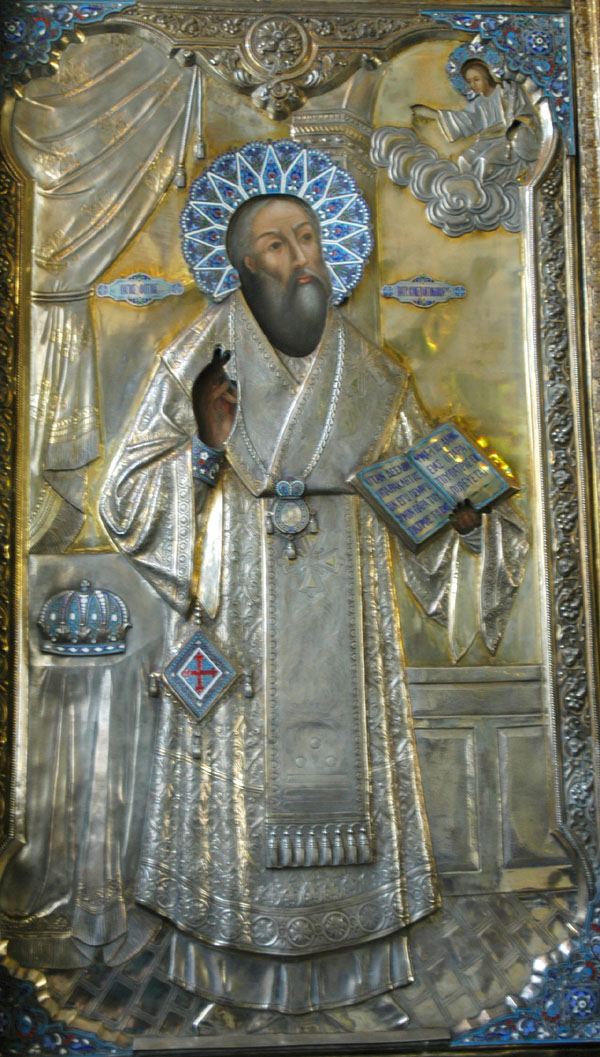
Saint Parthenios, Bishop of Lampsakos

Saint Parthenios, the Bishop of Lampsakos, was from the city of Melitopolis (Asia Minor), where his father Christopher served as a deacon. The young man could not read, but he learned the Holy Scriptures well, by attending the Divine Services in church. He had a kind heart and, when he went fishing, he distributed the proceeds to the poor. Filled with the grace of God from the age of eighteen, Saint Parthenios healed diseases, cast out demons, and worked other miracles in Christ's name.

Learning about the virtuous life of the young man, Bishop Philip of Melitopolis gave him an education. and ordained him as a presbyter. In 325, during the reign of Constantine the Great, Archbishop Achilles of Kyzikos appointed him as Bishop of Lampsakos (in Asia Minor). Many pagans lived in the city, and the Hierarch was diligent in spreading the faith in Christ, and confirming it with many miracles and healings of the sick, according to God's will. People abandoned their pagan beliefs, and Bishop Parthenios visited Emperor Constantine the Great, requesting him to permit the destruction of pagan temples so that Christian churches could be built in their place. The Emperor received him with honor, and gave him a document authorizing him to destroy pagan temples, and provided him with the means to build a church. Returning to Lampsakos, Bishop Parthenios ordered the destruction of the pagan temples and built a beautiful church in the middle of the city.

Finding a large marble stone in one of the ruined temples, suitable for the Holy Altar in the church, the Bishop ordered work to begin on the stone so that it could be put on a wagon and taken to the church. Out of malice, the devil, who was enraged because the stone had been removed from the temple, overturned the wagon, and the stone killed the driver Eutykhianos. Saint Parthenios resurrected him by his prayers, and shamed the devil, who wanted to obstruct God's work.

The Hierarch's mercy was so great that he never refused to heal any of those who came to him, or the people he met on the roads, who were suffering from bodily ailments and possessed by unclean spirits. People stopped going to doctors, because Saint Parthenios freely healed every illness in the name of the Lord Jesus Christ.

By the great power of the name of Christ, the Hierarch cast out many demons from people, houses, and the waters of the sea. When the Bishop exorcised a demon from a certain man who had been possessed since childhood, the unclean spirit begged Saint Parthenios to give him another place to live. The Saint promised to show him such a place and, opening his mouth, he said to the demon: "Come and dwell in me." As if scorched by fire, the demon cried out, "How shall I enter the house of God?" and disappeared into desolate and impassable places. Expelled by the Saint the unclean spirit shouted that Divine fire was driving him into the fire of Gehenna. Thus, by showing people the great power of faith in Christ, the Saint converted many idolaters to the only true God.

The Saint's skull is located in the Monastery of Espigmenou on Mount Athos. Fragments of the Saint's relics are to be found in the Monasteries of the Great Cave at Kalavryta, Rovelistas of Arta, and Kykkos on Cyprus. Part of the Saint's skull is kept in the Holy Monastery of Makrymallē (Μακρυμάλλη). in the Holy Metropolis of Chalkida, in the center of the island of Euboea in Greece.

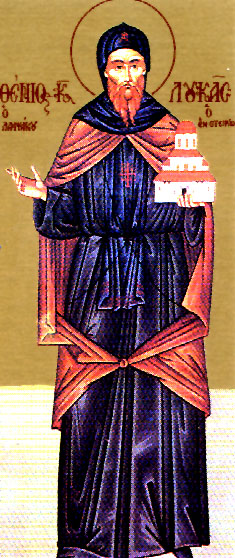
Venerable Luke of Hellas

Saint Luke of Hellas was a native of the Greek village of Kastorion. The son of poor farmers, the saint from childhood had toiled much, working in the fields and shepherding the sheep. He was very obedient to his parents and very temperate in eating. He often gave his own food and clothing to the poor, for which he suffered reproach from his parents. He once gave away almost all the seed which was needed for planting in the fields. The Lord rewarded him for his charity, and the harvest gathered was greater than ever before.

As a child, he prayed fervently and often. His mother saw him more than once standing not on the ground, but in the air while he prayed.

After the death of his father, he left his mother and went to Athens, where he entered a monastery. But through the prayers of his mother, who was very concerned about him, the Lord returned him to his parental home in a miraculous manner. He spent four months there, then with his mother’s blessing he went to a solitary place on a mountain called Ioannou (or Ioannitsa). Here there was a church dedicated to the holy Unmercenaries Cosmas and Damian, where he lived an ascetical life in constant prayer and fasting. He was tonsured there by some Elders who were on pilgrimage. After this, Saint Luke redoubled his ascetic efforts, for which the Lord granted him the gift of foresight.

After a seven years on Ioannou, the saint moved to Corinth because of an invasion of the Bulgarian armies. Hearing about the exploits of a certain stylite at Patras, he went to see him, and remained for ten years to serve the ascetic with humility and obedience. Afterwards, the saint returned again to his native land and again began to pursue asceticism on Mount Ioannou.

The throngs of people flocking there disturbed his quietude, so with the blessing of his Elder Theophylactus, Saint Luke went with his disciple to a still more remote place at Kalamion. After three years, he settled on the desolate and arid island of Ampelon because of an invasion of the Turks. Steiris was another place of his ascetic efforts. Here brethren gathered to the monk, and a small monastery grew up, the church of which was dedicated to the Great Martyr Barbara. Dwelling in the monastery, the saint performed many miracles, healing sicknesses of soul and of body.

Foreseeing his end, the saint confined himself in a cell and for three months prepared for his departure. When asked where he was to be buried, the monk replied, “Throw my body into a ravine to be eaten by wild beasts.” When the brethren begged him to change these instructions, he commanded them to bury his body on the spot where he lay. Raising his eyes to heaven, he said, “Into Thy hands, O Lord, I commend my spirit!”

Saint Luke fell asleep in the Lord on February 7, 946. Later, a church was built over his tomb. Myrrh flowed from his holy relics, and many healings occurred.

1,003 Martyrs of Nicomedia

1003 Martyrs at Nicomedia, were servants of the four dignitaries Bassos, Eusebius, Eutychius and Basilides, who suffered for Christ with their wives (January 5) in the year 303 during the reign of the emperor Diocletian (284-305).

After the martyric death of their masters, the servants decided to follow their example, and they also confessed themselves Christians before Diocletian. Swayed neither by persuasion nor promises nor rewards, 1003 men, women, and small children were cut down by soldiers who formed a tight circle around them so that none of them remained alive.

Martyr Aule

Saint Aule suffered martyrdom in London during Diocletian’s persecution of Christians.

Daily Readings for Tuesday, February 06, 2024

PHOTIUS THE GREAT, PATRIARCH OF CONSTANTINOPLE

NO FAST

Photius the Great, Patriarch of Constantinople, Bucolus, Bishop of Smyrna, Barsanuphius the Great and John of Gaza, Afterfeast of the Presentation of Our Lord and Savior in the Temple, Ilyan of Homs

ST. PAUL’S LETTER TO THE HEBREWS 7:26-28; 8:1-2

Brethren, it was fitting that we should have such a high priest, holy, blameless, unstained, separated from sinners, exalted above the heavens. He has no need, like those high priests, to offer sacrifices daily, first for his own sins and then for those of the people; he did this once for all when he offered up himself. Indeed, the law appoints men in their weakness as high priests, but the word of the oath, which came later than the law, appoints a Son who has been made perfect for ever. Now the point in what we are saying is this: we have such a high priest, one who is seated at the right hand of the throne of the Majesty in heaven, a minister in the sanctuary and the true tent which is set up not by man but by the Lord.

JOHN 10:9-16

The Lord said, "I am the door; if any one enters by me, he will be saved, and will go in and out and find pasture. The thief comes only to steal and kill and destroy; I came that they may have life, and have it abundantly. I am the good shepherd. The good shepherd lays down his life for the sheep. He who is a hireling and not a shepherd, whose own the sheep are not, sees the wolf coming and leaves the sheep and flees; and the wolf snatches them and scatters them. He flees because he is a hireling and cares nothing for the sheep. I am the good shepherd; I know my own and my own know me, as the Father knows me and I know the Father; and I lay down my life for the sheep. And I have other sheep, that are not of this fold; I must bring them also, and they will heed my voice. So there shall be one flock, one shepherd.

Afterfeast of the Meeting of our Lord in the Temple

The fourth day of the Afterfeast of the Meeting of the Lord falls on February 6.

Saint Bucolus, Bishop of Smyrna

Saint Bucolus, Bishop of Smyrna, was a disciple of the holy Apostle and Evangelist John the Theologian, and became the first Bishop of Smyrna (Asia Minor).

By the grace of God, Saint Bucolus converted many of the pagans to Christ and baptized them. As a wise and experienced guide, he defended his flock from the darkness of heresy.

He died in peace between the years 100-105. He entrusted his flock to Saint Polycarp (February 23), one of the Apostolic Fathers, who was also a disciple of the holy Apostle John the Theologian. At the grave of Saint Bucolus grew a myrtle tree, which healed the sick.

Saint Photius, Patriarch of Constantinople

Saint Photius, Patriarch of Constantinople, “the Church’s far-gleaming beacon,” lived during the ninth century, and came from a family of zealous Christians. His father Sergius died as a martyr in defense of holy icons. Saint Photius received an excellent education and, since his family was related to the imperial house, he occupied the position of first state secretary in the Senate. His contemporaries said of him: “He so distinguished himself with knowledge in almost all the secular sciences, that it rightfully might be possible to take into account the glory of his age and compare it with the ancients.”

Michael, the young successor to the throne, and Saint Cyril, the future Enlightener of the Slavs, were taught by him. His deep Christian piety protected Saint Photius from being seduced by the charms of court life. With all his soul, he yearned for monasticism.

In 857 Bardas, who ruled with Emperor Michael, deposed Patriarch Ignatius (October 23) from the See of Constantinople. The bishops, knowing the piety and extensive knowledge of Photius, informed the emperor that he was a man worthy to occupy the archpastoral throne. Saint Photius accepted the proposal with humility. He passed through all the clerical ranks in six days. On the day of the Nativity of Christ, he was consecrated bishop and elevated to the patriarchal throne.

Soon, however, discord arose within the Church, stirred up by the removal of Patriarch Ignatius from office. The Synod of 861 was called to end the unrest, at which the deposition of Ignatius and the installation of Photius as patriarch were confirmed.

Pope Nicholas I, whose envoys were present at this council, hoped that by recognizing Photius as patriarch he could subordinate him to his power. When the new patriarch proved unsubmissive, Nicholas anathematized Photius at a Roman council.

Until the end of his life Saint Photius was a firm opponent of papal intrigues and designs upon the Orthodox Church of the East. In 864, Bulgaria voluntarily converted to Christianity. The Bulgarian prince Boris was baptized by Patriarch Photius himself. Later, Saint Photius sent an archbishop and priests to baptize the Bulgarian people. In 865, Saints Cyril and Methodius were sent to preach Christ in the Slavonic language. However, the partisans of the Pope incited the Bulgarians against the Orthodox missionaries.

The calamitous situation in Bulgaria developed because an invasion by the Germans forced them to seek help in the West, and the Bulgarian prince requested the Pope to send his bishops. When they arrived in Bulgaria, the papal legates began to substitute Latin teachings and customs in place of Orthodox belief and practice. Saint Photius, as a firm defender of truth and denouncer of falsehood, wrote an encyclical informing the Eastern bishops of the Pope’s actions, indicating that the departure of the Roman Church from Orthodoxy was not only in ritual, but also in its confession of faith. A council was convened, censuring the arrogance of the West.

In 867, Basil the Macedonian seized the imperial throne, after murdering the emperor Michael. Saint Photius denounced the murderer and would not permit him to partake of the Holy Mysteries of Christ. Therefore, he was removed from the patriarchal throne and locked in a monastery under guard, and Patriarch Ignatius was restored to his position.

The Synod of 869 met to investigate the conduct of Saint Photius. This council took place with the participation of papal legates, who demanded that the participants sign a document (Libellus) condemning Photius and recognizing the primacy of the Pope. The Eastern bishops would not agree to this, and argued with the legates. Summoned to the council, Saint Photius met all the accusations of the legates with a dignified silence. Only when the judges asked him whether he wished to repent did he reply, “Why do you consider yourselves judges?” After long disputes, the opponents of Photius were victorious. Although their judgment was baseless, they anathematized Patriarch Photius and the bishops defending him. The saint was sent to prison for seven years, and by his own testimony, he thanked the Lord for patiently enduring His judges.

During this time the Latin clergy were expelled from Bulgaria, and Patriarch Ignatius sent his bishops there. In 879, two years after the death of Patriarch Ignatius, another council was summoned (many consider it the Eighth Ecumenical Council), and again Saint Photius was acknowledged as the lawful archpastor of the Church of Constantinople. Pope John VIII, who knew Photius personally, declared through his envoys that the former papal decisions about Photius were annulled. The council acknowledged the unalterable character of the Nicean-Constantinople Creed, rejecting the Latin distortion (“filioque”), and acknowledging the independence and equality of both thrones and both churches (Western and Eastern). The council decided to abolish Latin usages and rituals in the Bulgarian church introduced by the Roman clergy, who ended their activities there.

Under Emperor Basil’s successor, Leo, Saint Photius again endured false denunciations, and was accused of speaking against the emperor. Again deposed from his See in 886, the saint completed the course of his life in 891. He was buried at the monastery of Eremia.

The Orthodox Church venerates Saint Photius as a “pillar and foundation of the Church,” an “inspired guide of the Orthodox,” and a wise theologian. He left behind several works, exposing the errors of the Latins, refuting soul-destroying heresies, explicating Holy Scripture, and exploring many aspects of the Faith.

Venerable Barsanuphius the Great and John the Prophet

Saints Barsanuphius the Great and John the Prophet lived during the sixth century during the reign of the emperor Justinian I (483-565). They lived in asceticism at the monastery of Abba Seridus in Palestine, near the city of Gaza.

Saint Barsanuphius was born in Egypt (the year of his birth is unknown). From his youth, he began to lead an ascetic life. Arriving at the cenobitic monastery of Abba Seridus, he built a small cell outside the monastery. Here he lived in solitude.

Later, Saint John, disciple of Saint Barsanuphius, lived in this cell for eighteen years until his death. Saint John imitated his teacher in silence, ascetic deeds and in virtue. Because of his gift of clairvoyance, he was known as “the Prophet.”

After a certain time, Saint Barsanuphius built another cell near the monastery. At the beginning of his solitude, the monastery sent him only three loaves of bread per week. He dwelt for fifty years in work and ascetic deeds.

When Patriarch Eustochios of Jerusalem heard about the ascetical life of Saint Barsanuphius, it seemed unbelievable to him. He wanted to see Barsanuphius for himself, so he and his companions tried to dig under the wall, and to enter the monk’s cell from beneath. Those attempting to enter were almost burned by flames suddenly bursting forth from the cell.

In his hermitage Saint Barsanuphius devoted himeself entirely to prayer, and he attained a high degree of spiritual perfection. We have manuscript accounts about the life, the deeds and talents of Saints Barsanuphius and John. During the lifetime of Saint Paisius Velichkovsky (November 15), they were translated into the Moldavian and Slavonic languages. The publication of these manuscripts, and also their translation into the Russian language, was done in the nineteenth century by the Elders of Optina’s Entry of the Theotokos Monastery.

The precepts of Saints Barsanuphius and John clearly show the degree of their moral perfection, and their love for people, but contain scant facts about their lives. We do not know exactly when Saint Barsanuphius died. Some sources say the year of his death was 563, others say more cautiously before the year 600.

After spending a long time in seclusion, Saint Barsanuphius thereafter and until the death of Saint John the Prophet began to serve others by instructing them on the path to salvation, as Abba Dorotheus (June 5) testifies. Saint Barsanuphius replied to questioners through Saint John, sometimes instructing him to give the answers, or even through Abba Seridus (August 13), who wrote down the saint’s answers.

In the answers of Saints Barsanuphius and John the Prophet, who were guides in the spiritual life not only for their contemporaries, but also for succeeding generations, it is clearly possible to see the monks’ gradual spiritual ascent “from strength to strength.”

By deeds of fasting, silence, guarding the heart, and unceasing prayer, Saint Barsanuphius attained the heights of humility, reasoning and fiery love. The Lord gave him the gifts of discernment, clairvoyance, and wonderworking. By the power of his prayers, he was able to free the souls of people from sins. Sometimes, he took the sins of others upon himself.

The venerable one knew the dispositions of hearts, therefore he gave advice according to the spiritual state of each person. In the Name of the Lord he raised the dead, he cast out demons, and healed incurable illnesses. Things that he blessed received divine power and grace (for example, kukol or furrow-weed took away a monk’s headache). Even the name of Abba Barsanuphius, when invoked mentally, gave help to those who called upon it.

Through the prayers of Saint Barsanuphius, God sent rain upon the earth, withdrawing His wrath from the multitudes of the people. The saint’s predictions always came true. Thus, he predicted that a certain monk, the Elder Euthymius the Silent, would be placed with him in a single grave, which indeed came to pass.Saint Barsanuphius acquired these gifts after many years of patiently enduring great temptations and illness.

(Besides the Orthodox ascetic Barsanuphius the Great, there was another Barsanuphius, a Monophysite heretic. Sophronius, Patriarch of Jerusalem, anathematized him in his “Confession of Faith,” sent to the Sixth Ecumenical Council).

We do not know when Saint Barsanuphius arrived at the monastery of Abba Seridus, nor anything about the home and family of Saint John the Prophet. Following the instructions of Saint Barsanuphius, John attained the heights of perfection, and became like his teacher in all things. Out of humility, he sent those who came to him with questions to Abba Barsanuphius.

Saint John foresaw and predicted many things, even his own death a week after the death of Abba Seridus. Abba Elian, the young igumen of this monastery, begged John to remain with him for two more weeks, in order to teach him the Rule and how to govern the monastery. Saint John fulfilled his request and died after two weeks.

Saint Barsanuphius the Great survived his disciple and friend, but after St. John's death embraced complete silence and refused to give answers to anyone. These two ascetics have left the soul-profiting book, GUIDANCE TOWARD SPIRITUAL LIFE: ANSWERS TO THE QUESTIONS OF DISCIPLES by the Holy Monastic Fathers Barsanuphius and John as their spiritual legacy. This book was known to many saints who lived at a later time, as evidenced by the wrings of Saint Theodore the Studite (November 11 and January 26), the hieromonk Nikon Chernogorets (+ 1060), Saint Simeon the New Theologian (March 12), and other Orthodox ascetics and writers.

Virgin Martyr Dorothy at Caesarea, in Cappadocia, and those with her

The Holy Martyr Dorothy, the Martyrs Christina, Callista and the Martyr Theophilus lived in Caesarea of Cappadocia and suffered under the emperor Diocletian in either the year 288 or 300.

Saint Dorothy was a pious Christian maiden, distinguished by her great beauty, humility, prudence, and God-given wisdom, which astonished many. Arrested upon orders of the governor Sapricius, she steadfastly confessed her faith in Christ and was subjected to tortures.

Failing to break the will of the saint, the governor sent to her two women, the sisters Christina and Callista, who once were Christians, but fearing torture, they renounced Christ and began to lead impious lives. He ordered them to get Saint Dorothy to offer sacrifice to the pagan gods, but just the reverse happened. Saint Dorothy convinced them that the mercy of God is granted to all who repent, so they corrected themselves and returned to Christ. The tormentors tied them back to back and burned them in a vat of tar. Through martyrdom, Christina and Callista atoned for their sin of apostasy, receiving from God not only forgiveness, but crowns of victory.

Saint Dorothy was again subjected to tortures, but she gladly endured them and accepted the death sentence. She cried out with joy, thanking Christ for calling her to Paradise and to the heavenly bridal chamber. As they led the saint to execution Theophilus, one of the governor’s counselors, laughed and said to her, “Bride of Christ, send me an apple and some roses from the Paradise of your Bridegroom.” The martyr nodded and said, “I shall do that.”

At the place of execution, the saint requested a little time to pray. When she finished the prayer, an angel appeared before her in the form of a handsome child presenting her three apples and three roses on a pure linen cloth. The saint requested that these be given to Theophilus, after which she was beheaded by the sword.

Having received the gracious gift, the recent mocker of Christians was shaken, and he confessed Christ as the true God. His friends were astonished, and wondered whether he were joking, or perhaps mad. He assured them he was not joking. Then they asked the reason for this sudden change. He asked what month it was. “February,” they replied. “In the winter, Cappadocia is covered with ice and frost, and the trees are bare of leaves. What do you think? From where do these apples and flowers come?” After being subjected to cruel tortures, Saint Theophilus was beheaded with a sword.

The relics of Saint Dorothy are in Rome in the church dedicated to her, and her head is also at Rome, in a church of the Mother of God at Trastevero.

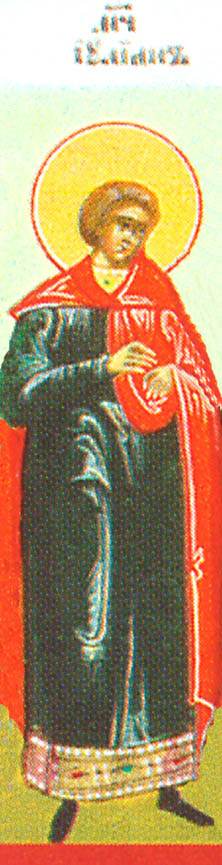
Martyr Julian of Emesa

The Holy Martyr Julian was a native of the Phoenician city of Emesa, and he suffered in the year 312 under the emperor Maximian. He was a skilled physician, and healed illnesses not only of the body but also of the soul, and he converted many people to faith in Christ the Savior.

When they led away the holy Martyrs Bishop Silvanus, Deacon Luke and the Reader Mocius (February 29) to be eaten by wild beasts, Julian encouraged them and urged them not to fear death for the Lord. He was also arrested and put to death. His head, hands and feet were pierced with long nails.

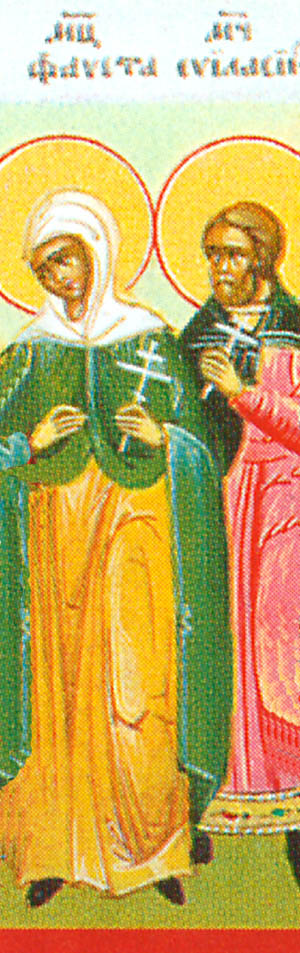
Virgin Martyr Fausta, and Martyrs Evilasius and Maximus, at Cyzicus

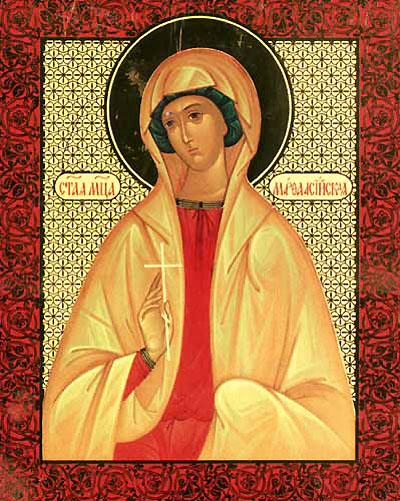
Virgin Martyrs Martha and Mary, and their brother Lycarion, in Egypt

The holy virgin martyrs Martha and Mary were sisters who lived in Asia Minor, and fervently desired to suffer for the Lord Jesus Christ. Once, a pagan military commander marched past their house. The sisters went out to him and loudly declared that they were Christians. At first the commander paid no attention to them, but they persistently shouted after him, repeating their confession.

They were arrested together with their brother Lykarion. All three were crucified, and during the execution their mother came to them, encouraging them in their sufferings for Christ. The sisters were pierced with spears, and Lykarion was beheaded by the sword.

Saint Arsenius of Iqalto, Georgia

Saint Arsen of Iqalto was a translator, researcher, compiler of manuscripts, hymnographer, philosopher, and a great defender of the Georgian Christian Faith. His father was Ibadi Vachnadze, a wise, learned man and a fluent speaker of the Greek language. He directed the academy at Iqalto Monastery and was an instructor of Holy King Davit the Restorer.

Few details about the life of Saint Arsen have been preserved, but we know that he lived in the 11th and 12th centuries and was a younger contemporary of Saint Eprem the Lesser. He received both his primary and higher education in Byzantium, at Mangana Monastery, which had been founded by the Byzantine emperor Constantine IX Monomachus (1042-1055). At the academy he completed one of his most important projects: a translation of the Byzantine historian George Hamartolus’ Chronicle. Hamartolus’ work is a nine-volume account of history from Adam to the year A.D. 842. Also at Mangana, Arsen translated a volume of dogmatic-polemical writings into Georgian and called his work Dogmatikon. In the years that followed, works translated by other authors were added to the book.

After completing his studies at Mangana Monastery, Arsen moved to the Black Mountains near Antioch to continue his labors under the guidance of Saint Eprem the Lesser. Following Saint Eprem’s repose, he returned to Mangana Monastery to continue his translations. In 1114 King Davit the Restorer summoned Arsen back to Georgia, to the Gelati Academy in the west. It was there that he translated The Nomocanon (a Byzantine collection of ecclesiastical law) from the original Greek into Georgian. Arsen later returned to Kakheti in eastern Georgia, where he founded an academy at Iqalto Monastery. He also participated in the Council of Ruisi-Urbnisi, which had been convened by King Davit the Restorer. One of King Davit’s biographers writes that he invited “Arsen of Iqalto, translator and interpreter of the Greek and Georgian languages and enlightener of many churches.”

Arsen was present at the repose of King Davit the Restorer, and it is believed that he composed the king’s epitaph:

I fed seven kings with my wealth,
Drove the Turks, Persians, and Arabs from our borders,
Moved the fish from one river to another,
And, having accomplished all these things,
Lay my hands upon my heart to die.

The “theologian, philosopher, physicist, anatomist, writer of allegories and verses, epic poet, and compiler of Church typika” Arsen was buried in Iqalto next to Saint Zenon, the founder of Iqalto Monastery.

Saint Amand, Abbot of Maastricht

No information available at this time.

Daily Readings for Monday, February 05, 2024

MONDAY OF THE 14TH WEEK

NO FAST

Agatha the Martyr, Polyeuktos, Patriarch Of Constantinople, Antonios the New Martyr of Athens, Theodosios, Archbishop of Chernigov, Afterfeast of the Presentation of Our Lord and Savior in the Temple, Theodosios of Antioch

ST. PAUL’S LETTER TO THE HEBREWS 11:17-31

Brethren, by faith Abraham, when he was tested, offered up Isaac, and he who had received the promises was ready to offer up his only son, of whom it was said, “Through Isaac shall your descendants be named.” He considered that God was able to raise men even from the dead; hence, figuratively speaking, he did not receive him back. By faith Isaac invoked future blessings on Jacob and Esau. By faith Jacob, when dying, blessed each of the sons of Joseph, bowing in worship over the head of his staff. By faith Joseph, at the end of his life, made mention of the exodus of the Israelites and gave directions concerning his bones. By faith Moses, when he was born, was hid for three months by his parents, because they saw that the child was beautiful; and they were not afraid of the king’s edict. By faith Moses, when he was grown up, refused to be called the son of the Pharaoh’s daughter, choosing rather to share ill-treatment with the people of God than to enjoy the fleeting pleasures of sin. He considered abuse suffered for the Christ greater wealth than the treasures of Egypt, for he looked to the reward. By faith he left Egypt, not being afraid of the anger of the king; for he endured as seeing him who is invisible. By faith he kept the Passover and sprinkled the blood, so that the Destroyer of the first-born might not touch them. By faith the people crossed the Red Sea as if on dry land; but the Egyptians, when they attempted to do the same, were drowned. By faith the walls of Jericho fell down after they had been encircled for seven days. By faith Rahab the harlot did not perish with those who were disobedient, because she had given friendly welcome to the spies.

MARK 9:42-50; 10:1

The Lord said, “Whoever causes one of these little ones who believe in me to sin, it would be better for him if a great millstone were hung round his neck and he were thrown into the sea. And if your hand causes you to sin, cut it off; it is better for you to enter life maimed than with two hands to go to hell, to the unquenchable fire, where their worm does not die, and the fire is not quenched. And if your foot causes you to sin, cut it off; it is better for you to enter life lame than with two feet to be thrown into hell, where their worm does not die, and the fire is not quenched. And if your eye causes you to sin, pluck it out; it is better for you to enter the kingdom of God with one eye than with two eyes to be thrown into hell, where their worm does not die, and the fire is not quenched. For every one will be salted with fire and every sacrifice will be salted with salt. Salt is good; but if the salt has lost its saltness, how will you season it? Have salt in yourselves, and be at peace with one another.” And he left there and went to the region of Judea and beyond the Jordan, and crowds gathered to him again; and again, as his custom was, he taught them.

Afterfeast of the Meeting of our Lord in the Temple

The third day of the Afterfeast of the Meeting of the Lord falls on February 5.

Martyr Agatha of Palermo in Sicily

The Holy Virgin Martyr Agatha was the fifteen-year-old daughter of rich and respected Christian parents from the city of Palermo (formerly Panormos) in Sicily. During the persecution under the emperor Decius (249-251), the city prefect of Catania, Quintianus, having heard about Agatha’s wealth and beauty, sent his soldiers after her to bring her to trial as a Christian.

At Catania they housed the saint with a certain rich woman, who had five daughters. They all attempted to tempt Saint Agatha with fine clothes, amusements and entertainment, urging her to offer sacrifice to the pagan gods, but the saint disdained all these things. The more they tried to move her, the more resolute she became. She prayed that she might soon face martyrdom.

During her interrogation under Quintianus, the holy martyr was swayed neither by the flattery, nor by the threats, and she was subjected to cruel torments. They also tried to remove her breasts with metal tongs, and when this failed, they used knives.

The holy Apostle Peter appeared to her in prison and healed her wounds. Saint Agatha was led to torture again, and Quintianus was astonished to see her completely healed, with no trace of cutting. Then the torture began once more.

At this moment an earthquake took place in the city, and many buildings were destroyed. Among those killed were two of Quintianus’s advisors. The terrified inhabitants rushed to Quintianus, demanding an end to Agatha’s tortures. Fearing a revolt by the people, Quintianus sent Saint Agatha back to prison. There the martyr, offering thanks to God, peacefully surrendered her soul to the Lord.

Repose of Saint Theodosius of Chernigov

Saint Theodosius, Archbishop of Chernigov, was born in the seventeenth century at the beginning of the decade of the thirties in Podolsk governance. He was descended from a noble family, the Polonitsky-Uglitskys. His parents were the priest Nikḗtas and Maria. The saint was taught Christian piety in his parents’ home, and this piety remained with him throughout his life.

From childhood he was distinguished by a fervent love for God and zeal for the Church. The innate abilities of the youth came to light in the Kiev Brotherhood school at Kiev’s Theophany monastery. The school was flourishing at the end of the 1640s, when its rectors were Archimandrite Innocent (Gizel), and Igumen Lazar (Baranovich), who later became Archbishop of Chernigov. Among its instructors were: Hieromonk Epiphanius (Slavinetsky), Hieromonk Arsenius (Satanovsky), Bishop Theodosius (Baevsky) of Belorus, Igumen Theodosius (Saphonovich) and Meletius Dzik. These were the enlightened men of those days. The comrades of Saint Theodosius at the school would become future outstanding pastors: Simeon Polotsky, Joannicius Golyatovsky, Anthony Radivillovsky, Barlaam Yasninsky. The Kiev Brotherhood Theophany school was the chief center in the struggle of Orthodoxy against the assaults of Catholic clergy, particularly the Jesuits.

Saint Theodosius grew to spiritual maturity near the relics of Saints Anthony and Theodosius and other God-pleasers of the Kiev Caves, and he tried to imitate their holy life as much as he could. He devoted all his free time to prayer, meditation on God, and the reading of Holy Scripture.

It might be surmised that the saint did not finish the full course of studies, since the school ceased its activity for several years following the devastation of Podolia by the Poles. All his life the saint had a deep regard for the Kiev Brotherhood monastery where he was educated. In the Synodikon of the Kiev-Vydubitsk monastery is the following comment about Saint Theodosius: “He was a man of fine intellect, and generous to the Kiev Brotherhood monastery.”

Upon receiving his education, the future hierarch received monastic tonsure at the Kiev Caves Lavra with the name Theodosius, in honor of Saint Theodosius of the Caves (May 3).

Metropolitan Dionysius (Balaban) of Kiev made him archdeacon of Kiev’s cathedral of Holy Wisdom (Hagia Sophia) , and then appointed him steward of the episcopal household. Soon he left Kiev and went to the distant Krupitsky monastery near Baturino (in the Chernigov diocese), which was famed for its strict monastic life. There he was ordained to the holy priesthood, but remained there only a short time.

In 1662, Saint Theodosius was appointed Igumen of the Korsun monastery in Kiev diocese, and in the year 1664 he was made head of the ancient Kiev-Vydubitsky monastery. This monastery had fallen into the hands of the Uniates and Poles at the beginning of the seventeenth century and was in complete ruin. Thanks to the energy and initiative of Saint Theodosius, the Vydubitsky Mikhailovsk monastery was quickly restored.

He was particularly concerned with the order of church services. He formed an excellent choir, which was famed not only in Little Russia, but also in Moscow. Saint Theodosius sent his singers to Moscow in 1685 to instruct their choirs in Kievan chant.

As a strict ascetic himself, Saint Theodosius was concerned with the spiritual growth of his monks. He founded a small skete on the island of Mikhailovschina, not far from the monastery, for brethren wishing to live in solitude. He appointed the hieromonk Job (Opalinsky), one of the most zealous monks of his monastery, to organize and administer the skete.

Saint Theodosius had to live through some quite difficult days, enduring many sorrows. He and other Igumens were accused by Bishop Methodius of Mstislav and Orshansk of betraying Russia in a supposed correspondence with the enemies of Russia.

On September 20, 1668 Saint Theodosius explained the matter. On November 17, 1668 the lie was exposed, and Saint Theodosius together with the other Igumens were vindicated. Archbishop Lazar (Baranovich) esteemed the high spiritual qualities of Saint Theodosius and befriended him. He called him “a sheep of the flock of Christ, teaching by humility,” and he prophetically expressed the wish that the name of Saint Theodosius might be inscribed in Heaven.

When Archbishop Lazar became locum tenens of Kiev’s Metropolitan See in 1689, he appointed Saint Theodosius as his vicar in Kiev, while he remained at Chernigov. In his capacity as vicar of the locum tenens of the Kiev Metropolitan See, Saint Theodosius had an active role in many churchly events. In 1685 he participated with the right of a decisive vote in the election of Bishop Gideon (Chetverinsky) as Metropolitan of Kiev, and he was sent to Moscow with news of this event with Igumen Jerome (Dubin) of Pereyaslavl . In Moscow, both representatives were received with honor and esteem. Indeed, the result of this delegation was the reuniting of the Kiev Metropolitan See with the Russian Orthodox Church.

In 1688 Saint Theodosius was appointed archimandrite of Chernigov’s Eletsy monastery, replacing the deceased Archimandrite Joannicius (Golyatovsky). In appointing Saint Theodosius, Archbishop Lazar told him to spare no effort in placing the Eletsy monastery in good order. This monastery had not yet been set aright after the expulsion of the Jesuits and Dominicans, and it was in great disorder.

Through the efforts of Saint Theodosius, in his two or three years as igumen, the monastery’s revenues and properties increased, the church of the Dormition was repaired, and the Elets Icon (February 5) was enshrined there.

In his new position, the saint also assisted Archbishop Lazar in many important matters. He participated in drafting a conciliar reply to Patriarch Joachim of Moscow in response to his questions about the attitude of the Kiev Metropolitan See to the Council of Florence, and its judgment on the question of the transformation of the Holy Gifts as accepted by this Florentine Council. When the Patriarch proved to be unsatisfied by these answers, the Baturino Igumen Saint Demetrius (the future Metropolitan of Rostov) was sent to him at the beginning of 1689. Saint Theodosius journeyed with him as the representative of Archbishop Lazar. He was entrusted with the delivery of a letter to the Patriarch, and to clear up the misunderstandings.

Because of his poor health, Archbishop Lazar wished to see Saint Theodosius consecrated to the episcopate, seeing in the saint a worthy successor to himself. On September 11, 1692 the election of Saint Theodosius as Archbishop of Chernigov was confirmed, and he was consecrated in the Dormition cathdral of the Moscow Kremlin two days later.

Little information regarding Saint Theodosius’s administration of the Chernigov diocese has been preserved. The saint worked incessantly to raise the level of true Christian piety in his flock. He also focused on maintaining old monasteries, and founding new communities.

At the very beginning of his episcopate, the the Pecheniksk women’s monastery was established with his blessing, and he himself consecrated the monastery church in honor of the Dormition of the Most Holy Theotokos.

In 1694, a skete was founded near Liubech. The same year, at the Domnitsky men’s monastery, the saint consecrated a temple in honor of the Nativity of the Most Holy Theotokos. In the summer of 1695, he consecrated a majestic temple in honor of the Most Holy Theotokos, on the summit of Boldino Hill, near the ancient monastery of Saint Elias. Under Saint Theodosius there was a special enthusiasm for and strengthening of monasticism in the Chernigov diocese.

The saint also devoted much attention to the clergy, and he tried to choose worthy candidates for the priesthood. He also encouraged the pastoral education of the Chernigov clergy. He invited learned monks from Kiev, among whom was Saint John (Maximovitch), the future Metropolitan of Tobolsk (June 10), and also a helper and successor of Saint Theodosius in organizing the Chernigov clergy school.

Strict uprightness in regard to clergy and flock, deep compassion, concern and Christian love of peace were distinguishing features in the activity of Saint Theodosius. Not only did the Orthodox turn to him for help and advice, but even persons of other confessions.

Saint Theodosius did not remain with his Chernigov flock very long. Sensing the approach of death, he summoned the administrator of the Briansk Svensk monastery, Saint John (Maximovitch), and appointed him Archimandrite of the Chernigov Elets monastery.

Saint Theodosius died on February 5, 1696, and was buried in Chernigov’s Saints Boris and Gleb cathedral church, in a special crypt near the right cleros. His successor Saint John (Maximovitch), who was healed of a grievous illness by Saint Theodosius, later placed a stone plaque over his grave with a poetic inscription in gratitude for the saint’s help. The special grace which Saint Theodosius attained is shown by his ascetic life and his assistance to all who turn to him in prayer.

The glorification of Saint Theodosius occurred on September 9, 1896.

Martyr Theodula of Anazarbus, and the Martyrs Helladius, Macarius and Evagrius, in Cilicia

The Holy martyr Theodula lived in the city of Anazarbus (Asia Minor) during the reign of the Roman emperors Diocletian (284-305) and Maximian (305-311). The prefect of the city, Pelagius, was a very cruel man. His servants sought out Christians throughout the entire region and brought them to trial, where which the imperial edict was read to them, and they were ordered to worship idols.

One day they brought to him a Christian woman named Theodula. She was afraid, not so much of the tortures, but that she might be defiled by the pagans, and so she had offered them much gold. However, the servants would not accept the gold, and they brought her before the prefect. Pelagius asked her name and he ordered her to worship the pagan gods. He threatened her with cruel tortures if she refused. Saint Theodula replied, “I am a Christian. My very name means ‘servant of God,’ and so people call me Theodula. I worship the One True God and will not worship a mere stone.”

Pelagius became furious and he gave orders to begin the tortures. The Lord granted Theodula His help, and she did not feel any pain. Pelagius, however, said this was done by the gods, who had spared Theodula in the hope that she would turn to them.

Saint Theodula said to the prefect, “Where are your gods, who spare me? Show them to me, that I might show honor to them.” They brought her into the temple of the “deified” Roman emperor Hadrian, whom they regarded as a mighty god. The saint however, in praying to the One True God, merely blew a breath at the idol, and it crumbled into dust. Seeing this, Pelagius trembled with fright. If the idol’s destruction was reported to the emperor, he himself would be thrown to the wild beasts. He fell down at the feet of Saint Theodula, begging her to restore the idol, and promised to accept Christianity.

The saint prayed to the Lord Jesus Christ, and the idol again stood in its place, whole and intact. The prefect Pelagius, however, not only did not keep his promise to become a Christian, but instead he began to torture the martyr with an even greater fury.

During these torments a certain fellow named Helladius came up to the prefect, and looking at the captives, he asked to be given the maiden Theodula, promising to make her worship the pagan gods, doing this because he wanted to ingratiate himself with the city prefect and to receive honors.

Helladius subjected Saint Theodula to harsh torments, exceeding Pelagius in cruelty. The saint prayed that God would grant her the ability to persevere. She immediately received help from God and was healed. The tormentor was awestruck, and Saint Theodula admonished him. “Become a Christian,” she said, “and attain eternal honors in the Kingdom of our Lord Jesus Christ, Who shall judge both the living and the dead and render to each man according to his deeds.”

By her prayers and her words, Saint Theodula led Helladius to the knowledge of truth. He believed in Christ and confessed the True God before the prefect. He also received the crown of martyrdom. They cut off his head with a sword, and threw his body into the sea.

Saint Theodula was thrown into a blazing oven, but she remained unharmed. After this, they stretched her out on a metal plate. They poured boiling tar, wax and oil on her, but the red-hot plate shattered into pieces, and the fire scorched many people, including the city prefect Pelagius, who indeed died of fright, but Saint Theodula remained unharmed.

Seeing such a miracle, many people believed in Christ, among whom were the respected citizens Macarius and Evagrius. The pagans continued to torture Christians. They heated an oven and threw Saint Theodula, Macarius, Evagrius and many others who believed in Christ into it. They all suffered martyrdom, and were translated into life immortal.

Icon of the Mother of God “Seeker of the Perishing”

From time immemorial the Russian people, with faith in the all-powerful help of the Most Holy Theotokos, considered the title “Seeker of the Perishing” to refer not only to those who are dying, but to those whose souls are in danger of spiritual death.

There are no reliable accounts of the origin of the “Seeker of the Perishing" Icon. There are, however, several wonderworking icons of this name, through which the Theotokos showed her mercy to persons at the very brink of death.

In the mid-eighteenth century, in the village of Bor (Kaluga Gubernia), the pious peasant Theodotos Obukhov lost his way in a blizzard on the Feast of the Lord’s Baptism. The horse became exhausted and paused on the edge of an impassable ravine. Seeing no way to save himself, Obukhov lay down in his sleigh, where he began to freeze.

In these terrible moments, he prayed with all his being, asking the Queen of Heaven for help, and he vowed that if he were rescued he would have a copy of the “Seeker of the Perishing” Icon painted and donate it to his parish church. She heard his prayer and helped him in a marvelous way. A certain peasant in the nearby village heard a voice outside his window saying, “Take him.” He went out and saw the half-frozen Obukhov on his sleigh. When he recovered his health, Obukhov fulfilled his vow and commissioned a copy of the Icon from the Saint George church in the city of Volkhov (Orlov Gubernia). From that time the Bor “Seeker of the Perishing” Icon was glorified by many manifestations of grace and miracles.

There are other “Seeker of the Perishing” Icons: one manifested itself in 1770 in the village of Malizhino (Kharkov Gubernia), and delivered the people from cholera three times. There was another in the village of Krasnoe (Chernigov Gubernia), and another from Voronezh and Kozlov (Tambov Gubernia). In the year 1835, at the Moscow Alexandrov Orphanage Institute, a church was dedicated to the “Seeker of the Perishing” Icon.

Of particular interest is the “Seeker of the Perishing” Icon in the Church of the Glorious Resurrection in Moscow. This Icon had been transferred from the church of the Nativity of Christ to the Palashev alley. Its final owner had become widowed and was on the verge of complete poverty. Fervent prayer to the Most Holy Theotokos saved him from despair and arranged matters for his daughters. This man felt that he was not worthy to have this wonderworking Icon in his house, so he gave it to the church.

In 1812 the Palashev church was pillaged by the French. The desecrated Icon was found among the rubble, broken into three pieces. After the Icon was found, numerous miracles of healing took place. Brides entering into marriage pray before this Icon so that their marriage might be a happy one. People come to it, overwhelmed by drunkenness, perishing in poverty, or suffering from illness, and they turn to the Icon in prayer as to a Mother with her perishing children.

The Icon has several names. In Slavonic it is called «Взыскание погибших» (Recovery of the Perishing, Seeker of the Perishing, Seeker of the Lost). In Greek it is known as "Ἡ τῶν ἀπολωλότων ἀναζήτησις" (Seeker of the Perishing).

Icon of the Mother of God “Elets-Chernigov”

The Elets-Chernigov (Chernigov Spruce Tree) Icon of the Mother of God appeared on a spruce or fir tree near Chernigov in the year 1060, in the time of Prince Svyatoslav Yaroslavich, as was recorded in the Synodikon of Bishop Zosimus Prokopovich of Chernigov (1655-1657). The icon was placed in a church built in honor of the Elets-Spruce Icon of the Mother of God. Saint Anthony (July 10), while living an ascetical life on the Boldino Heights (1068-1069), had given his blessing to found a monastery at this place.

In 1238 the monastery was pillaged by the Tatars (Mongols), but the icon was hidden inside the monastery walls. In the year 1470, Prince Simeon Olelkovich of Kiev restored the monastery, and they placed the icon in the church.

The ultimate fate of the icon is unclear. According to one tradition, a descendant of the Chernigov princes, Baryatinsky, carried the icon to Moscow in the year 1579, when Chernigov fell into the hands of the Polish King Stephen Bathory. In 1687, Prince Daniel Baryatinsky was returning from a campaign in the Crimea. At Kharkov he fell seriously ill, and before his death he bequeathed the Elets Icon to the nearby Kharkov Dormition church.

According to another tradition, the icon vanished from the monastery when it was sacked in the seventeenth century by the forces of Sigismund III. In 1676, Prince Constantine Ostrozhsky presented the Elets monastery a copy of the Elets Icon of the Mother of God, brought from Vladimir by the Kozel brothers. Archimandrite Joannicius (Golyatovsky) was at this time restoring the monastery and he described numerous miracles of this icon in his book, “Skorbnitsa” (or “Sokrovischnitsa”, i.e. “Consoler” or “Treasury”), published in 1676 in Novgorod.

There is still another Elets Icon of the Mother of God, also appearing in the year 1060. It received its name because it appeared in the city of Elets, in a cathedral church dedicated to the Smolensk Icon of the Mother of God. The feastday of this icon was set for January 11.

Icon of the Mother of God “Divnogorsk”

The Divnogorsk-Sicilian Icon of the Mother of God received the first part of its title from where it was enshrined when it was glorified: the Dormition monastery of Divnogorsk, in the former Ostrogozhsk district in Voronezh governance. Its title of “Sicilian” comes from its place of origin, since by tradition this icon at Diva (i.e. “Wondrous Heights”) was brought from Sicily by the pious monastic Elders Xenophon and Joasaph. They suggest that these saints were Orthodox Greeks by birth, and that they had arrived there not earlier than the end of the fifteenth century. Xenophon and Joasaph founded a monastery at a scenic spot above the River Don, near the confluence of the River Tikha Sosna [Quiet Pine River]. The place was called Wondrous Heights by those struck by the form of the chalk columns throughout the hills.

It is said that Xenophon and Joasaph lived in a cave (where later the church of Saint John the Forerunner was built), and that they carved out the first church in a chalk column, into which also they put the Sicilian Icon of the Mother of God which they had brought with them. Here is where they found their eternal repose.

On the Divnogorsk-Sicilian Icon of the Mother of God, the Theotokos is depicted sitting in the clouds. In Her right hand is a white lily blossom, and with Her left arm She supports the Divine Infant, Who sits upright upon Her knees. The Savior holds a lily blossom in His left hand, and blesses with His right hand. Around the face of the Mother of God are eight angels. The two beneath are shown on bended knee and with hands upraised in prayer. Over the head of the Theotokos is the Holy Spirit in the form of a dove.

The special glorification of the icon began in the year 1831, when cholera was raging. At Korotoyak, 7-8 versts from the monastery, the Most Holy Virgin appeared (as She is depicted in the Divnogorsk Icon) to a certain elderly woman, Ekaterina Kolomenska, in a dream. She commanded that Her icon be brought and a Molieben be served before it. The wonderworking icon was brought to Korotoyak, and after a Molieben before the holy icon, the cholera ceased.

By the intercession of the Mother of God, the city of Ostrogozhsk also was saved from cholera. The people of Korotoyak and Ostrogozhsk were also saved from cholera in 1847 and 1848 through the miraculous intercession of the Mother of God, which occurred after a church procession around these towns with the holy icon.

According to Tradition, the feastday of the wonderworking icon on February 5 was established already at its original habitation by Xenophon and Joasaph.

Daily Readings for Sunday, February 04, 2024

15TH SUNDAY OF MATTHEW

NO FAST

15th Sunday of Matthew, Isidore of Pelusium, Nicholas the Confessor, Hieromartyr Abramius, John the Righteous, Bishop of Irinopolis, Theodosios the Righteous, Joseph the New Martyr of Aleppo, Afterfeast of the Presentation of Our Lord and Savior in the Temple

ST. PAUL’S SECOND LETTER TO THE CORINTHIANS 4:6-15

Brethren, it is the God who said, "Let light shine out of darkness, " who has shone in our hearts to give the light of the knowledge of the glory of God in the face of Christ.
But we have this treasure in earthen vessels, to show that the transcendent power belongs to God and not to us. We are afflicted in every way, but not crushed; perplexed, but not driven to despair; persecuted, but not forsaken; struck down, but not destroyed; always carrying in the body the death of Jesus, so that the life of Jesus may also be manifested in our bodies. For while we live we are always being given up to death for Jesus' sake, so that the life of Jesus may be manifested in our mortal flesh. So death is at work in us, but life in you.
Since we have the same spirit of faith as he had who wrote, "I believed, and so I spoke, " we too believe, and so we speak, knowing that he who raised the Lord Jesus will raise us also with Jesus and bring us with you into his presence. For it is all for your sake, so that as grace extends to more and more people it may increase thanksgiving, to the glory of God.

MATTHEW 22:35-46

At that time, a lawyer came up to Jesus and asked him a question, to test him. "Teacher, which is the great commandment in the law?" And he said to him, "You shall love the Lord your God with all your heart, and with all your soul, and with all your mind. This is the great and first commandment. And a second is like it, You shall love your neighbor as yourself. On these two commandments depend all the law and the prophets.
Now while the Pharisees were gathered together, Jesus asked them a question, saying, "What do you think of the Christ? Whose son is he?" They said to him, "The son of David." He said to them, "How is it then that David, inspired by the Spirit, calls him Lord, saying, 'The Lord said to my Lord, Sit at my right hand, till I put your enemies under your feet'? If David thus calls him Lord, how is he his son?" And no one was able to answer him a word, nor from that day did anyone dare to ask him any more questions.

Afterfeast of the Meeting of our Lord in the Temple

The second day of the Afterfeast of the Meeting of the Lord falls on February 4.

Venerable Isidore of Pelusium

Saint Isidore of Pelusium lived during the fourth-fifth centuries. He was a native of Alexandria, and was raised among pious Christians. He was a relative of Theophilus, Archbishop of Alexandria, and of his successor, Saint Cyril (January 18). While still a youth he quit the world and withdrew to Egypt to Mount Pelusium, which became the site of his monastic efforts.

Saint Isidore’s spiritual wisdom and strict asceticism, combined with his broad learning and innate knowledge of the human soul, enabled him to win the respect and love of his fellow monks in a short time. They chose him as their head and had him ordained a priest (the earliest sources for his life, however, say nothing of him being an igumen).

Following the example of Saint John Chrysostom, whom he had managed to see and hear during a trip to Constantinople, Saint Isidore devoted himself primarily to Christian preaching, that “practical wisdom” which, in his own words, is both “the foundation of the edifice and the edifice itself”, while logic is “its embellishment, and contemplation its crown”.

He was a teacher and a willingly provided counsel for anyone who turned to him for spiritual encouragement, whether it was a simple man, a dignitary, a bishop, the Patriarch of Alexandria, or even the emperor. He left behind about 10,000 letters, of which 2,090 have survived. A large portion of these letters reveal profound theological thought and contain morally edifying interpretations of Holy Scripture. Saint Photius (February 6) calls Isidore a model of priestly and ascetical life, and also a master of style.

Saint Isidore’s love for Saint John Chrysostom resulted in his support of Saint John when he was persecuted by the empress Eudoxia and Archbishop Theophilus. After the death of Saint John, Saint Isidore persuaded Theophilus’ successor Saint Cyril to inscribe the name of Saint John Chrysostom into the Church diptychs as a confessor. Through the initiative of Saint Isidore the Third Ecumenical Council was convened at Ephesus (431), at which the false teaching of Nestorius concerning the person of Jesus Christ was condemned.

Saint Isidore lived into old age and died around the year 436. The Church historian Evagrius (sixth century) writes of Saint Isidore, “his life seemed to everyone the life of an angel upon the earth.” Another historian, Nikēphóros Callistus (ninth century), praises Saint Isidore thus: “He was a vital and inspired pillar of monastic rules and divine vision, and as such he presented a very lofty image of most fervent example and spiritual teaching.”

Right-believing George the Great Prince of Vladimir

Holy Great Prince George was a son of Great Prince Vsevolod, nicknamed “Big Nest.” He was born in the year 1189, and he assumed the great princely throne of Vladimir in 1212. He was distinguished for his military valor and his piety. In the year 1237 the Tatar (Mongol) Horde of Batu descended upon the Russian land. Saint George was compelled to leave the capital city in charge of his sons, and went north to meet up with the other princes.

On March 4, 1238 the Battle at the River Sita was fought, in which the Tatars destroyed the small but valiant company of the Great Prince. The saint himself fell in this fight, and Bishop Cyril buried his body at the Rostov cathedral. Two years later, it was transferred to Vladimir’s Dormition cathedral with great solemnity.

The Church glorification of the saint occurred in 1645.

Venerable Cyril the Wonderworker, Abbot of Novoezersk, Novgorod

Saint Cyril of New Lake was born into a pious family. The Lord marked him as one of the chosen even before he was born. Cyril’s mother was praying in church during the Divine Liturgy, and the infant in her womb cried out, “Holy, Holy, Holy, Lord of Sabaoth!”

From the time of his childhood the saint was fond of solitude and prayer, and he dreamt of monastic life. At fifteen years of age Cyril secretly left his parental home, intending to enter the Pskov Caves monastery. He did not know the way to the monastery, and took nothing from home for the journey. He went his way, putting all his trust in the Lord and His All-Pure Mother. Twenty versts from the city the youth met a magnificent monastic Elder, who led him to the monastery. As he left, he blessed him with the words, “May God bless you, my child, and grant you the angelic schema, and may you be a chosen vessel of the Divine Spirit.” Having said this, the Elder became invisible. The boy realized that this had been a messenger from God, and he gave thanks to the Lord.

The igumen Saint Cornelius (February 20) saw with his clairvoyant eye the grace manifest in the young man. He provided him with much guidance and tonsured him into the monastic schema with the name Cyril. The fifteen-year-old monk astonished the brethren with his efforts. He emaciated the flesh through fasting and prayer, and zealously fulfilled obediences. Day and night he was ready to study the Word of God. Even then he thought to end his days in solitude in the wilderness.

The boy’s parents mourned him as one dead, but once an Elder of the monastery of Saint Cornelius came to them and told them about their son and his life at the monastery. The joyful news confirmed in Cyril’s mother her love for God. She spoke with her husband about leaving to the monastery her portion of the inheritance, then left the world and became a nun with the name Elena (Helen). She died in peace a short time later.

The saint’s father came to the monastery, and Igumen Cornelius told Cyril to meet with him. The saint was troubled, but not daring to disobey the igumen, he fell down at his father’s feet, imploring forgiveness for secretly leaving home. The father forgave his son, and he himself remained at the monastery. Saint Cornelius tonsured him into monasticism with the name Barsanuphius, and gave him to his son for instruction.

Three years later, he peacefully fell asleep in the Lord. His son continued to toil more fervently for the Lord, disdaining his own will, and in was obedient not only to the igumen, but also to the brethren. He thirsted to go about all the Russian land, venerating its holy shrines and to find for himself a wilderness place for a life of silence.

With the blessing of Saint Cornelius, Saint Cyril left the monastery in which he had grown strong spiritually, and he went to the coastal regions, roaming through the forests and the wild places, eating tree roots and berries. The saint spent about twenty years in this difficult exploit of wanderer, and he went to the outskirts of Moscow, Novgorod and Pskov, but he never entered any house nor did he accept alms. He wandered about during the day, and spent his nights at prayer on church porches, and he attended the church services.

Once while at prayer, Saint Cyril saw a heavenly light indicating the direction where he should found a monastery. He set off on his way at once, and having reached the Tikhvin monastery, he spent three days and three nights there in ceaseless prayer to the Most Holy Theotokos. The Mother of God appeared to him in a dream. Showing Her approval of him, She said, “My servant Cyril, pleaser of the Most Holy Trinity, go to the Eastern region of White Lake, and the Lord My Son will show you the place of rest for your old age.”

The saint proceeded to White Lake, weeping copious tears at the miraculous vision. On the lake he saw a small island, from which a pillar of fire rose up to the sky. There, beneath a centuries-old spruce tree, Saint Cyril built a hut, and then set up two cells: one for himself, the other for future brethren. The hermit also constructed two small churches, one in honor of the Resurrection of Christ and the other in honor of the Mother of God Hodēgḗtria. He underwent many temptations from invisible enemies, and from idlers roving about, but he overcame everything by brave endurance and constant prayer. News of his holy life spread everywhere, and brethren gathered around him.

There were many instances of healing through his prayers, and the Lord also granted His saint the gift of foresight. Sensing his impending end, Saint Cyril summoned the brethren. With tears of humility the saint instructed his spiritual children one last time, until his voice gave out. For a long time then he was silent, but suddenly he cried out with loud sobbing, “I go to the Lord unto life eternal, but I entrust you to God the Word and His Grace, bestowing an inheritance and sanctification upon all. May it help you. But I beseech you, do not become lax in fasting and prayers, guard yourself from the snares of the Enemy, and the Lord in His ineffable mercy will not condemn your humility.”

Having said this, the saint gave a final kiss to the brethren, received the Holy Mysteries, signed himself with the Sign of the Cross, and with the words “Glory to God for everything!” he gave up his pure soul to the Lord on February 4, 1532.

Venerable Abraham and Coprius, of Pechenga

Saints Abraham and Coprius of Pechenga in 1492 founded the Savior wilderness monastery at the River Pechenga, in Gryazovetsk district, 21 versts from Vologda. It required great work to bring in the necessities to the wilderness spot, in order to build the monastery and set everything in proper order. The blessed toilers did not spare themselves, zealously living in asceticism until their death.

Martyr Jadorus

Saint Jadorus suffered martyrdom with Saint Isidore (not Isidore of Pelusium) in the reign of Decius (249-251).

Hieromartyr Abramius, Bishop of Arbela in Assyria

The Hieromartyr Abramius, Bishop of Arbela, suffered during a persecution against Christians in Persia under the emperor Sapor II. When they demanded that the saint renounce Christ and worship the sun, he answered, “How foolish to forsake the Creator and instead worship creatures! Isn’t the sun just a creation of my God?”

After this, they fiercely beat and tortured him. Saint Abramius prayed during torture, echoing the words of the Savior: “Lord, do not count this sin against them, for they know not what they do!” The hieromartyr was beheaded by the sword in the village of Felman.

Venerable Nicholas the Confessor, Abbot of Studion

Saint Nicholas the Confessor, Igumen of the Studion Monastery, lived during the ninth century. He was born on the island of Crete in the village of Kedonia into a Christian family. When he was ten, his parents sent him to Constantinople to his uncle, Saint Theophanes (October 11), who was a monk at the Studion monastery. With the approval of Saint Theodore (November 11), the head of the Studion monastery, the boy was enrolled in the monastery school. When he finished school at sixteen years of age, he was tonsured a monk. After several years, he was ordained a priest.

During this time there was a fierce persecution, initiated by the Byzantine emperor Leo the Armenian (813-820), against those who venerated the holy icons. Saint Nicholas and Saint Theodore the Studite were repeatedly locked up in prison, tortured in various ways, and humiliated. However, they zealously continued to defend Orthodoxy.

Under the holy Empress Theodora (February 11), who ruled the realm while her son Michael was still a minor, icon veneration was restored, and a time of relative peace followed. Saint Nicholas returned to the Studite monastery and was chosen its head. But this calm did not last very long.

The Empress Theodora was removed from the throne, and the emperor’s uncle, Bardas, a man who defiled himself by open cohabitation with his son’s wife, came to power. The attempts of Patriarch Ignatius (October 23) to restrain the impiety of Bardas proved unsuccessful. On the contrary, he was deposed from the patriarchal throne and sent into exile.

Unwilling to witness the triumph of iniquity, Saint Nicholas left Constantinople. He spent seven years at various monasteries. Later on, he returned as a prisoner to the Studite monastery, where he spent two years imprisoned, until the death of the emperor Michael (855-867) and Bardas. When the emperor Basil I the Macedonian (867-886) ascended the throne, Saint Nicholas was set free, and again became igumen on the orders of the emperor. Because of his life as a confessor and ascetic he received from God the gift of healing, which continued even after his repose in the year 868.

Saint Evagrisi, disciple of Saint Shio

Saint Evagrisi was born to God-fearing and pious parents who read the Holy Scriptures to him from the earliest years of his childhood. When he reached manhood, Evagrisi became ruler of Tsikhedidi.

One day Evagrisi went hunting in the Sarkineti Mountains where Shio of Mgvime had settled. While he was hunting, his companions dispersed in various directions, and he was left alone to survey his surroundings. There he beheld a bird, resembling a dove, on its way to bring food to Fr. Shio, and noted the place where it landed.

The next day he located the hermit’s cave dwelling.

Astonished at Fr. Shio’s strict asceticism, Saint Evagrisi was filled with holy envy, having a desire to emulate the hermit, and he told him, “God is truly alive. I will not leave you, I will not go back.” Saint Shio advised him to be wary of such an impulsive decision, since it would be quite difficult for a man who had grown up in luxury to suddenly begin a new life in the wilderness. But Evagrisi answered him firmly, “Even if it means I must die here with you today, I will not depart from this place.”

In order to test his faith, Saint Shio entrusted Evagrisi with his staff and instructed him, saying, “Put my staff in the Mtkvari River; it will part the water and clear a path for you to cross. Secure your home and return to me. On your return when you reach the Mtkvari, use my staff again to clear a path for yourself. If it fails, then continue on your way as before. That would mean that it is not God’s will to fulfill your desire.”

Evagrisi obediently took Saint Shio’s staff and touched it to the water of the Mtkvari. The river parted, and he crossed confidently to the other side.

Having returned to the palace, Evagrisi distributed all his possessions to the poor, secured his home, and set off again to find Fr. Shio. He performed the same miracle on his return: the river parted in two, and the faithful Evagrisi passed through.

Fr. Shio tonsured Evagrisi into the monastic life, and the former ruler settled near the holy father’s cave. There he learned to be patient and watchful and how to pray, while acquiring other virtues as fruits of his ascetic labors.

Saint Shio anticipated that the number of monks in the wilderness would multiply, and he built a church for them in a place that God had revealed. The great gifts of the holy fathers were soon made known, and many pilgrims journeyed to the Sarkineti Mountains to receive their blessings. When King Parsman heard, belatedly, that his beloved army chief had been tonsured a monk, he became sorrowful and personally traveled to Saint Shio’s wilderness. His hope was to bring Evagrisi back into the world, but the blessed father responded with monastic composure: “O King! Why are you disturbing me, a man born to serve God, by asking me to become like a dog who returns to his own vomit (c.f. Prov. 26:11)?”

The news of Saint Shio, Evagrisi, and the other holy strugglers spread throughout Georgia, and many laymen were inspired to enter the monastic life.

After many years Saint Shio grew old, and he gathered the brotherhood of monks around him. “You must choose one from among you to lead this community. From now on I will labor in the well that I have prepared for my grave,” he told them. The brothers were exceedingly sorrowful at having to part with their beloved teacher, and in vain they pleaded with him to remain at the monastery. At last they asked Fr. Shio to appoint a successor, and he chose Evagrisi as the monastery’s next abbot.

The humble, gracious Evagrisi objected to this appointment, considering himself unfit to fulfill such a difficult responsibility. He begged Saint Shio to reconsider his decision, but the elder simply responded, “If you consent to our will, you will receive a joyous reward from God: when He returns in His glory, He will repay you for your obedience.”

At last Saint Evagrisi accepted his teacher’s counsel, and he directed the monastery’s activity with the help of God from that day forward.

Monastic Martyr Anthony of Kareotis

Saint Anthony was born in Ukraine and in Holy Baptism he received the name Onouphrios. In his youth he killed a man in a fight. Later, he repented sincerely and wanted to become a monk. Therefore, sometime before 1506, he was brought to Annunciation Monastery in Suprasl, and placed under obedience to the Hieromonk Paphnoutios (+ 1510), who tonsured him with the name Anthony.

The memory of his great sin would not let him rest, however, so he decided to go to Mount Athos to repent. According to his biographer, he lived in the cell of Saint Savva of Serbia at Karyes, known as Typikario. There, contesting strictly, he asked permission to go to a Moslem country and seek martyrdom in order to atone for his sins. His request was denied.

Therefore, he went to Thessaloniki. He entered the church of the Most Holy Theotokos not made by hands, which the Turks had turned into a mosque. He made the Sign of the Cross and began to pray, which caused the Moslems to become outraged. They brought him to the ruler of the city, who tried to persuade him to deny Christ, but without success. He was subjected to horrible torments and then he was put to death by fire. The Turks scattered his ashes so that the Orthodox Christians would not be able to recover his relics and give them an honorable burial.

Saint Anthony received the unfading crown of Martyrdom on February 4, 1516.