
Here is the live stream for Orthros and Divine Liturgy – Sunday Feb. 18, 2024 If you need, here are instructions for accessing this content from your phone, tablet, computer, or TV.
Monthly Archives: February 2024
Homily for Sunday, February 11, 2024
Homily for Sunday, February 04, 2024
Homily for Sunday, January 28, 2024
Homily for Sunday, January 21, 2024
Homily for Sunday, January 14, 2024
Daily Readings for Sunday, February 18, 2024
SUNDAY OF THE CANAANITE
NO FAST
Sunday of the Canaanite, Leo the Great, Pope of Rome, Agapetus the Confessor, Bishop of Sinai, Flavian the Confessor, Patriarch of Constantinople
ST. PAUL’S SECOND LETTER TO THE CORINTHIANS 6:16-18; 7:1
Brethren, you are the temple of the living God; as God said, "I will live in them and move among them, and I will be their God, and they shall be my people. Therefore come out from them, and be separate from them, says the Lord, and touch nothing unclean; then I will welcome you, and I will be a father to you, and you shall be my sons and daughters, says the Lord Almighty.
Since we have these promises, beloved, let us cleanse ourselves from every defilement of body and spirit, and make holiness perfect in the fear of God.
MATTHEW 15:21-28
At that time, Jesus went to the district of Tyre and Sidon. And behold, a Canaanite woman from that region came out and cried, "Have mercy on me, O Lord, Son of David; my daughter is severely possessed by a demon." But he did not answer her a word. And his disciples came and begged him, saying, "Send her away, for she is crying after us." He answered, "I was sent only to the lost sheep of the house of Israel." But she came and knelt before him, saying, "Lord, help me." And he answered, "It is not fair to take the children's bread and throw it to the dogs." She said, "Yes, Lord, yet even the dogs eat the crumbs that fall from their master's table." Then Jesus answered her, "O woman, great is your faith! Be it done for you as you desire." And her daughter was healed instantly.
Sunday of Zacchaeus
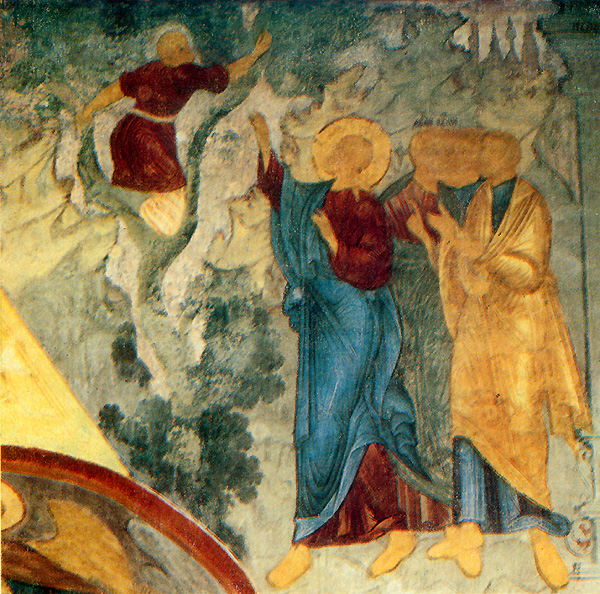
The paschal season of the Church is preceded by the season of Great Lent, which is also preceded by its own liturgical preparation. The first sign of the approach of Great Lent comes five Sundays before its beginning. On this Sunday the Gospel reading is about Zacchaeus the tax-collector. It tells how Christ brought salvation to the sinful man, and how his life was changed simply because he “sought to see who Jesus was” (Luke 19:3). The desire and effort to see Jesus begins the entire movement through Lent towards Pascha. It is the first movement of salvation.
Our lenten journey begins with a recognition of our own sinfulness, just as Zacchaeus recognized his. He promised to make restitution by giving half of his wealth to the poor, and by paying to those he had falsely accused four times as much as they had lost. In this, he went beyond the requirements of the Law (Ex. 22:3-12).
The example of Zacchaeus teaches us that we should turn away from our sins, and atone for them. The real proof of our sorrow and repentance is not just a verbal apology, but when we correct ourselves and try to make amends for the consequences of our evil actions.
We are also assured of God’s mercy and compassion by Christ’s words to Zacchaeus, “Today salvation is come to this house” (Luke 19:9). After the Great Doxology and Trisagion at Sunday Matins (when the Tone of the week is in Tone 1, 3, 5, or 7) we sing the Troparion of the Resurrection: “Today salvation is come to the world, let us sing praises to Him Who arose from the tomb, and is the Author of our life. For having destroyed death by death, He has given us the victory and great mercy.”
Zacchaeus was short, so he climbed a tree in order to see the Lord. All of us have sinned and come short of the glory of God (Rom. 3:23). We are also short in our spiritual stature, therefore we must climb the ladder of the virtues. In other words, we must prepare for spiritual effort and growth.
Saint Zacchaeus is also commemorated on April 20.
Saint Leo the Great, Pope of Rome

Saint Leo I the Great, Pope of Rome (440-461), received a fine and diverse education, which opened for him the possibility of an excellent worldly career. He yearned for the spiritual life, however, and so he chose the path of becoming an archdeacon under holy Pope Sixtus III (432-440), after whose death Saint Leo was chosen as Bishop of Rome in September 440.
These were difficult times for the Church, when heretics assaulted Orthodoxy with their false teachings. Saint Leo combined pastoral solicitude and goodness with an unshakable firmness in the confession of the Faith. He was in particular one of the basic defenders of Orthodoxy against the heresies of Eutyches and Dioscorus, who taught that there was only one nature in the Lord Jesus Christ. He was also a defender against the heresy of Nestorius.
He exerted all his influence to put an end to the unrest by the heretics in the Church, and by his letters to the holy emperors Theodosius II (408-450) and Marcian (450-457), he actively promoted the convening of the Fourth Ecumenical Council, at Chalcedon in 451, to condemn the heresy of the Monophysites.
At the Council at Chalcedon, at which 630 bishops were present, a letter of Saint Leo to the deceased Saint Flavian, Patriarch of Constantinople (447-449) was read. Saint Flavian had suffered for Orthodoxy under the “Robber Council” of Ephesus in the year 449. In the letter of Saint Leo the Orthodox teaching about the two natures [the divine and the human] in the Lord Jesus Christ was set forth. All the bishops present at the Council were in agreement with this teaching, and so the heretics Eutyches and Dioscorus were excommunicated from the Church.
Saint Leo was also a defender of his country against the incursions of barbarians. In 452, by the persuasive power of his words, he stopped Attila the Hun from pillaging Italy. Again in the year 455, when the leader of the Vandals [a Germanic tribe], Henzerich, turned towards Rome, he persuaded him not to pillage the city, burn buildings, nor to spill blood.
He knew the time of his death beforehand, and he prepared himself, with forty days of fasting and prayer, to pass from this world into eternity.
He died in the year 461 and was buried at Rome. His literary and theological legacy is comprised of 96 sermons and 143 letters, of which the best known is his Epistle to Saint Flavian.
Venerable Cosmas of Yakhrom
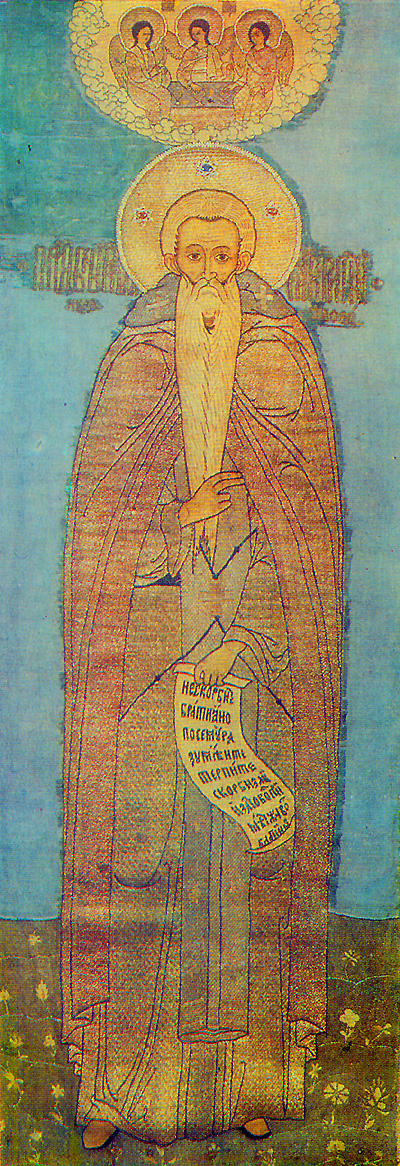
Saint Cosmas of Yakhrom was the servant of a certain Boyar, whom he comforted during his long illness by reading to him from books. And so, travelling from town to town, they happened to stop at the Yakhrom River. Exhausted by their long journey, they fell into a sound sleep. Suddenly, Cosmas was awakened by a vision of extraordinary light. In a tree, Cosmas saw an icon of the Dormition of the Most Holy Theotokos, and he heard a mysterious voice say: "Pay attention, Cosmas, and understand the words of life. Lead a God-pleasing life and seek the joy of the righteous, so that you may receive eternal blessings.”
The voice also commanded him to become a monk and to build a monastery.
Reverently, he took the Icon of the Mother of God and brought it to his sick master. As soon as it was placed on the old man, he was healed of his infirmity. When his term of servitude expired, Saint Cosmas went to the Kiev Caves Lavra. After giving the Icon to the brethren, he was tonsured in that Monastery. After he was tonsured, he astonished even experienced monks by his asceticism. The Saint contested there for many years, and then he had a vision of an Angel telling him to leave the Lavra and to take with him the Icon of the Mother of God which had appeared to him.
He asked the monks for the Icon, and left Kiev, arriving at the place where the wonderworking Icon had appeared to him. There, with the help of some pious donors, he built a temple dedicated to the Dormition of the Mother of God. He remained at the church, engaging in various monastic struggles which he had imposed on himself. Disciples began to gather around the Saint, a Monastery was established, and Saint Cosmas was chosen as its Igoumen. During this time, word of his ascetic struggles even reached the ears of the Great Prince.
Saint Cosmas reposed at an advanced age on February 18, 1492, and was buried in the Monastery which he founded. He is also commemorated on October 14, the Feast of the Yakhrom Icon of the Mother of God.1
1 Many sources indicate that it was an icon of the Dormition of the Most Holy Theotokos which appeared to Saint Cosmas, but only a reputed copy of the Icon has been preserved, which depicts the Mother of God according to the "Tenderness" category of Russian icons.
Saint Agapitos the Confessor and Wonderworker, Bishop of Synnada in Phrygia
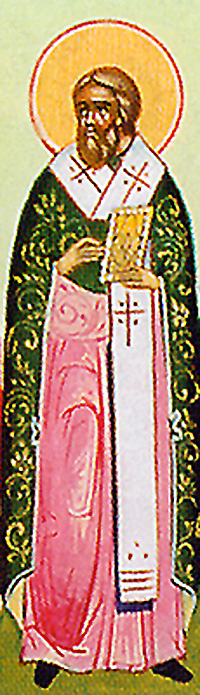
Saint Agapitos came from Cappadocia and was the son of pious and God-loving parents. He lived during the time of the emperors Diocletian (284-305) and Maximian (285-305). At a young age he departed for a monastery near Synnada in Phrygia, where he became a monk. He was loved by the Igumen because of his virtuous life and so he was taught how to read and write. He also received from God the gift of working miracles, performing over a hundred of them. By his prayers he killed a great dragon, which had appeared near the monastery, carrying off both people and animals. This was a great benefit for those who had turned to him for help.
Later on, during the reign of Licinius (308-323) Saint Agapitos was recruited into the army against his will. There he saw the victorious Martyrs Victor, Dorotheos, Theodoulos, Agrippa and many others, being tortured for their faith in Christ. Right away he wanted to join them in their martyrdom. Though they were perfected in Christ by the sword, he was preserved and, by God's providence, he suffered no harm, even though they wounded him with a spear. His life was spared so that he might lead many to salvation.
The holy Emperor Constantine the Great (May 21) heard that Saint Agapitos could heal people by his prayers. The emperor sent him a sick servant, and he was cured. Saint Constantine wished to reward Saint Agapitos, but he asked only that he be discharged from military service and be permitted to return to his monastery. His request was granted, and so he went back to the monastery.
Saint Agapitos devoted himself to the study of the Holy Gospel, and the Bishop of Synnada ordained him to the holy priesthood. After the bishop reposed, Saint Agapitos was chosen to succeed him in this position by the common consent of the clergy and the people.
After governing his flock in a God-pleasing manner, instructing them in the Orthodox Faith, and in virtuous living, Saint Agapitos reposed in peace
Saint Flavian the Confessor, Patriarch of Constantinople
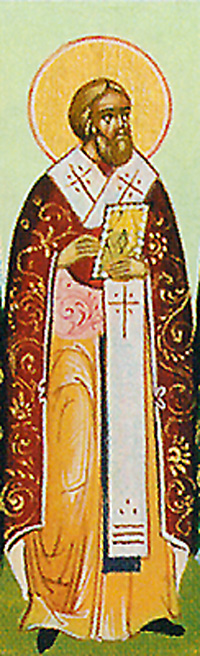
Saint Flavian the Confessor, Patriarch of Constantinople, occupied the patriarchal throne of Constantinople under the holy Emperor Theodosius the Younger (408-450) and his sister the holy Empress Pulcheria (September 10).
At first he was a presbyter and caretaker of church-vessels in the cathedral. He became Patriarch after the death of holy Patriarch Proclus (November 20). During this time, various disturbances and heresies threatened church unity.
In the year 448, Saint Flavian convened a local Council at Constantinople to examine the heresy of Eutyches, which admitted only one nature (the divine) in the Lord Jesus Christ. Persisting in his error, the heretic Eutyches was excommunicated from the Church and deprived of dignity, but Eutyches had a powerful patron in the person of Chrysathios, a eunuch close to the emperor.
Through intrigue Chrysathios brought Bishop Dioscorus of Alexandria over to the side of Eutyches, and obtained permission from the emperor to convene a church council at Ephesus, afterwards known as the “Robber Council.”
Dioscorus presided at this council, gaining the acquittal of Eutyches and the condemnation of Patriarch Flavian by threats and force. Saint Flavian was fiercely beaten up during the sessions of this council by impudent monks led by a certain Barsumas.
Even the impious president of the Robber Council, the heretic Dioscorus, took part in these beatings. After this heavy chains were put upon Saint Flavian, and he was sentenced to banishment at Ephesus. The Lord, however, ended his further suffering, by sending him his death (+ August 449). The holy Empress Pulcheria withdrew from the imperial court. Soon the intrigues of Chrysathios were revealed. The emperor dismissed him, and restored his sister Saint Pulcheria. Through her efforts, the relics of holy Patriarch Flavian were reverently transferred from Ephesus to Constantinople.
Saint Nicholas, Catholicos of Georgia

Nicholas Batonishvili was the son of Levan I, King of Kakheti (1520-1574). He lived during the grievous period of the Persian invasion of eastern Georgia. The young prince chose the path of monastic life and bravely helped his elder brother, King Alexandre II (1574-1605).
Despite his royal blood, he preferred the monk’s habit and the sweet, light yoke of Christ to the glamour and opulence of his inheritance.
According to God’s will, Nicholas was enthroned as Catholicos of All Georgia. The Georgian chronicle Life of Kartli (Kartlis Tskhovreba) relates the date of his enthronement as Saturday, February 28, 1584.
Armed with the highest hierarchical rank, royal blood, and personal integrity, Catholicos Nicholas was an exemplary leader for the Georgian nation. He struggled to plant the seeds of Christian love between countries of like faith.
He corresponded with Patriarch Job of Russia (1586-1590) and even sent him a horse. He also donated a leather-bound illuminated manuscript of the Gospels, copied in 1049, to the Metekhi Church of the Theotokos.
In his book Pilgrimage, the renowned eighteenth-century historian Archbishop Timote (Gabashvili) reports that there is an icon of Holy Catholicos Nicholas hanging in the refectory at the Ivḗron Monastery on Mt. Athos. Bishop Timote also describes another refectory, built by Ashotan Mukhran-Batoni, and notes, “There, I believe, Catholicos Nicholas Batonishvili reposed.”
Saint Theodore (Komogovin) of Serbia
No information available at this time.
Saint Colman of Lindesfarne

No information available at this time.
Great Vespers – Saturday Feb. 17, 2024
Here is the live stream for Great Vespers – Saturday Feb. 17, 2024 If you need, here are instructions for accessing this content from your phone, tablet, computer, or TV.
Daily Readings for Saturday, February 17, 2024
THEODORE THE TYRO, GREAT MARTYR
NO FAST
Theodore the Tyro, Great Martyr, Mariamne, Sister of Apostle Philip, and Equal to the Apostles, Righteous Auxentius, The Pious Rulers Marcian and Pulcheria, Theodore the New Martyr of Byzantium, Hermogenes (Germogen), Patriarch of Moscow
ST. PAUL’S SECOND LETTER TO TIMOTHY 2:1-10
Timothy, my son, be strong in the grace that is in Christ Jesus, and what you have heard from me before many witnesses entrust to faithful men who will be able to teach others also. Share in suffering as a good soldier of Christ Jesus. No soldier on service gets entangled in civilian pursuits, since his aim is to satisfy the one who enlisted him. An athlete is not crowned unless he competes according to the rules. It is the hardworking farmer who ought to have the first share of the crops. Think over what I say, for the Lord will grant you understanding in everything.
Remember Jesus Christ, risen from the dead, descended from David, as preached in my gospel, the gospel for which I am suffering and wearing fetters like a criminal. But the word of God is not fettered. Therefore I endure everything for the sake of the elect, that they also may obtain salvation in Christ Jesus with its eternal glory.
LUKE 20:46-47; 21:1-4
The Lord said to his disciples, “Beware of the scribes, who like to go about in long robes, and love salutations in the market places and the best seats in the synagogues and the places of honor at feasts, who devour widows’ houses and for a pretense make long prayers. They will receive the greater condemnation.” He looked up and saw the rich putting their gifts into the treasury; and he saw a poor widow put in two copper coins. And he said, “Truly, I tell you, this poor widow has put in more than all of them; for they all contributed out of their abundance, but she out of her poverty put in all the living that she had.” Having said this, he proclaimed, “He who has ears let him hear.”
Great Martyr Theodore the Tyro (Recruit)
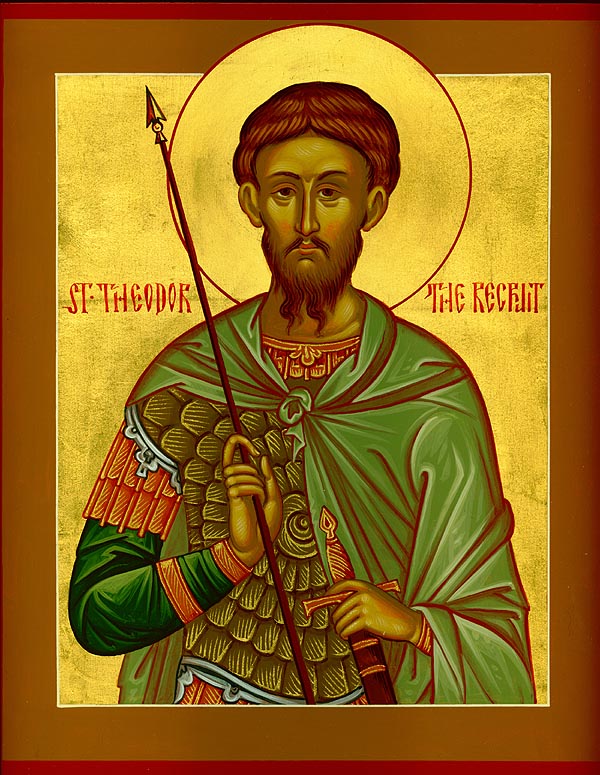
The Holy Great Martyr Theodore the Recruit1 was a soldier in the city of Amáseia in Pontus (Asia Minor) on the coast of the Euxine (Black) Sea, under the command of the Praepositus (regimental commander) Brincus. Saint Theodore was ordered to offer sacrifice to idols, but he proclaimed his faith in Christ the Savior in a loud voice. Brincus gave him a few days to think it over, during which time the Saint prayed.
Theodore was accused of setting a pagan temple on fire and destroying the idol of Rhea, and so he was thrown into prison to be starved to death. The Lord Jesus Christ appeared to him there, comforting and encouraging him. When he was brought before the Governor Publius, Theodore boldly confessed his faith, for which he was subjected to new torments and condemned to be burnt alive. The Great Martyr Theodore mounted an enormous pyre, and after he made the Sign of the Cross, the wood was lit, but the Holy Spirit cooled the flames. Saint Theodore stood in the flames, praising and glorifying God. Then he gave his holy soul into God's hands, and the onlookers saw his soul ascending to Heaven, according to the author of his Life, who was also an eyewitness.
This occurred in about the year 306 under the Roman Emperor Galerius (305-311). Unharmed by the fire, Saint Theodore's body was buried under a widow's house in the city of Eukháϊta, not far from Amáseia. Later, his relics were transferred to Constantinople, to the church which bears his name. His head is in the city of Gaeto, Italy.
Fifty years after the Saint Theodore's martyrdom, Emperor Julian the Apostate (reigned 361-363), planned to commit an outrage upon the Christians during the first week of Great Lent. He ordered the city magistrate of Constantinople to sprinkle all the food in the marketplaces with blood which had been offered to idols. Saint Theodore appeared to Archbishop Eudoxios in a dream, and told him to inform all the Christians that no one should buy anything in the marketplaces, but to eat boiled wheat with honey (kolyva) instead.
In remembrance of this occurrence, the Orthodox Church commemorates the holy Great Martyr Theodore the Recruit each year on the first Saturday of Great Lent. On Friday evening, at the Divine Liturgy of the Presanctified Gifts, after the prayer at the Ambo, the Canon to the Holy Great Martyr Theodore, composed by Saint John of Damascus, is sung. After this, kolyva is blessed and distributed to the faithful. The celebration of the Great Martyr Theodore on the first Saturday of Great Lent was established by Patriarch Nektarios of Constantinople (381-397).
The Troparion to Saint Theodore is very similar to the Troparion for the Prophet Daniel and the Three Holy Youths (on the Sunday Before the Nativity of the Lord). The Kontakion to Saint Theodore, who suffered martyrdom by fire, reminds us that he also had faith as his breastplate (see I Thessalonians 5:8).
In iconography, Saint Theodore the Recruit is depicted in four different ways: either alone in military garb, battling a large snake, or together with Saint Theodore the Commander, standing upright or riding horses. He always wears his military uniform.
We pray to Saint Theodore the Recruit for the recovery of stolen articles.
1 His title comes from the Latin word tiro, because he was a newly-enlisted recruit, not because he came from the city of Tyre, as some misinformed persons imagine.
Hieromartyr Hermogenes, Patriarch of Moscow, Wonderworker of All Russia

The Hieromartyr Hermogenes, Patriarch of Moscow and all Rus, was born in Kazan around 1530, and was descended from the Don Cossacks. According to the Patriarch’s own testimony, he served as priest in Kazan in a church dedicated to Saint Nicholas (December 6 and May 9), near the Kazan bazaar. Soon he became a monk, and from 1582 was archimandrite of the Savior-Transfiguration monastery at Kazan. On May 13, 1589 he was consecrated bishop and became the first Metropolitan of Kazan.
While he was the priest at Saint Nicholas, the wonderworking Kazan Icon of the Mother of God (July 8) was discovered in Kazan in 1579. With the blessing of Archbishop Jeremiah of Kazan, he carried the newly-appeared icon from the place of its discovery to the Church of Saint Nicholas. Having remarkable literary talent, the saint in 1594 compiled an account describing the appearance of the wonderworking icon and the miracles accomplished through it. In 1591 the saint gathered newly-baptized Tatars into the cathedral church and for several days he instructed them in the Faith.
The relics of Saint Germanus, the second archbishop of Kazan (September 25, November 6, and June 23), who died at Moscow on November 6, 1567 during a plague, were transfered and buried in Saint Nicholas Church in 1592. With the blessing of Patriarch Job (1589-1605), Saint Hermogenes reburied the relics at the Sviyazhsk Dormition monastery.
On January 9, 1592 Saint Hermogenes addressed a letter to Patriarch Job, in which he asked for permission to commemorate in his See of Kazan those Orthodox soldiers who gave their lives for the Faith and the nation in a battle against the Tatars. In the past, it was customary to enter into the diptychs the names of all Orthodox warriors who had fallen in battle, and to commemorate them.
At the same time he mentioned three martyrs who had suffered at Kazan for their faith in Christ, one of whom was a Russian named John (January 24) born at Nizhny Novgorod and captured by the Tatars. The other two, Stephen and Peter (March 24), were newly-converted Tatars.
The saint expressed regret that these martyrs were not inserted into the diptychs read on the Sunday of Orthodoxy, and that “Memory Eternal” was not sung for them. In answer to Saint Hermogenes, the Patriarch issued a decree on February 25, which said: “to celebrate at Kazan and throughout all the Kazan metropolitanate a panikhida for all the Orthodox soldiers killed at Kazan and the environs of Kazan, on the Saturday following the Feast of the Protection of the Most Holy Theotokos (October 1), and to inscribe them in the great Synodikon read on the Sunday of Orthodoxy,” and also ordered that the three Kazan martyrs be inscribed in the Synodikon, leaving it to Saint Hermogenes to set the day of their memory. Saint Hermogenes circulated the Patriarchal decree throughout his diocese, and required all the churches and monasteries to serve Liturgies, Panikhidas and Lityas for the three Kazan martyrs on January 24.
Saint Hermogenes displayed zeal in the faith and firmness in the observance of Church traditions, and he devoted himself to the enlightenment of Kazan Tatars with the faith of Christ.
In 1595, with the active participation of the Saint Hermogenes, the relics of the Kazan Wonderworkers Saint Gurias, the first archbishop of Kazan (October 4, December 5, June 20), and Saint Barsanuphius bishop of Tver (October 4, April 11) were discovered and uncovered. Tsar Theodore Ioannovich (1584-1598) had given orders to erect at the Kazan Savior-Transfiguration monastery a new stone church on the site of the first one, where the saints were buried.
When the graves of the saints were discovered, Saint Hermogenes came with a gathering of clergy. He commanded the graves to be opened and, when he saw the incorrupt relics and clothing of the saints, he notified the Patriarch and the Tsar. With the blessing of Patriarch Job and by order of the Tsar, the relics of the newly-appeared wonderworkers were placed in the new church. Saint Hermogenes himself compiled the lives of hierarchs Gurias and Barsanuphius.
Having been found worthy of the patriarchal throne, Metropolitan Hermogenes was elected to the primatial See, and on July 3, 1606 he was installed as Patriarch by the assembly of the holy hierarchs at Moscow’s Dormition cathedral. Metropolitan Isidore handed the Patriarch the staff of the holy hierarch Peter, Moscow Wonderworker (October 5, December 21, August 24), and the Tsar gave as a gift to the new Patriarch a panagia, embellished with precious stones, a white klobuk and staff. In the ancient manner, Patriarch Hermogenes made his entrance riding upon a donkey.
The activity of Patriarch Hermogenes coincided with a difficult period for the Russian state: the appearance of the false Tsarevich Demetrius and the Polish king Sigismund III. The first hierarch devoted all his powers to the service of the Church and the nation.
Patriarch Hermogenes was not alone in this exploit: his self-sacrificing fellow-countrymen followed his example and assisted him. With special inspiration His Holiness the Patriarch stood up against the traitors and enemies of the nation, who wanted to spread Uniatism and Western Catholicism throughout Russia and to wipe out Orthodoxy, while enslaving the Russian nation.
When the imposter arrived at Moscow and settled himself at Tushino, Patriarch Hermogenes sent two letters to the Russian traitors. In one of them he wrote: “…You have forgotten the vows of our Orthodox Faith, in which we are born, baptized, nourished and raised. You have violated your oath and the kissing of the Cross to stand to the death for the house of the Most Holy Theotokos and for the Moscow realm, but have fallen for your false would-be Tsarevich … My soul aches, my heart is sickened, all within me agonizes, and all my frame shudders; I weep and with sobbing I lament: Have mercy, have mercy, brethren and children, on your own souls and your parents departed and living … Consider, how our nation is devastated and plundered by foreigners, who offer insult to the holy icons and churches, and how innocent blood is spilled, crying out to God. Think! Against whom do you take up arms: is it not against God, Who has created you? Is it not against your own brothers? Do you not devastate your own country?… I adjure you in the name of God, give up your undertaking, there is yet time, so that you do not perish in the end.” In the second document the saint appeals: “For the sake of God, come to your senses and turn around, gladden your parents, your wives and children; and we stand to pray God for you…”
Soon the righteous judgment of God fell upon the Brigand of Tushino: he was killed by his own close associates on December 11, 1610. But Moscow continued to remain in peril, since the Poles and traitors, loyal to Sigismund III, remained in the city. The documents sent by Patriarch Hermogenes throughout the cities and villages, exhorted the Russian nation to liberate Moscow from the enemies and to choose a lawful Russian Tsar.
The Muscovites rose up in rebellion, and the Poles burned the city, shutting themselves up in the Kremlin. Together with Russian traitors they forcefully seized Patriarch Hermogenes from the patriarchal throne and imprisoned him in the Chudov monastery.
On Bright Monday in 1611, the Russian militia approached Moscow and began the seige of the Kremlin, which continued for several months. Besieged within the Kremlin, the Poles often sent messengers to the Patriarch with the demand that he order the Russian militia to leave the city, threatening him with execution if he refused.
The saint firmly replied, “What are your threats to me? I fear only God. If all our enemies leave Moscow, I shall bless the Russian militia to withdraw from Moscow; but if you remain here, I shall bless all to stand against you and to die for the Orthodox Faith.”
While still in prison, the hieromartyr Hermogenes sent a final epistle to the Russian nation, blessing the liberating army to fight the invaders. The Russian commanders could not come to an agreement over a way to take the Kremlin and free the Patriarch. He languished more than nine months in dreadful confinement, and on February 17, 1612 he died a martyr’s death from starvation.
The liberation of Russia, for which Saint Hermogenes stood with such indestructible valor, was successfully achieved. The body of the hieromartyr Hermogenes was buried in the Chudov monastery, but in 1654 was transferred to the Moscow Dormition cathedral. The glorification of Patriarch Hermogenes as a saint occurred on May 12, 1913.
Venerable Theodore the Silent of the Kiev Caves

Saint Theodore the Silent of the Caves chose the exploit of silence, in order to dwell constantly in remembrance of God, and to safeguard himself from temptation even by a word. He was glorified by the Lord with the gift of wonderworking. His memory is celebrated also on August 28.
Saint Mariamne the sister of the Apostle Philip

Righteous Mariamne “The Apostolic Virgin” and sister of the holy Apostle Philip (November 14), made a vow of virginity and became the companion of her brother Philip and the holy Apostle Bartholomew (June 11), actively assisting them in their apostolic work.
The Church historian Nikēphóros Callistus describes their successful preaching in the Phrygian city of Hieropolis, where they were arrested and locked up in prison. They put the Apostle Philip to death on a cross, but Saint Mariamne and Saint Bartholomew were set free. Saint Bartholomew went to preach the Gospel in India. Saint Mariamne, after burying the body of Saint Philip, preached the Gospel at Lykaonia (Asia Minor). She died there in peace.
Uncovering of the relics of the Martyr Menas of Alexandria

The Holy Martyr Menas Kallikelados (Well Speaking), an Athenian, died as a martyr with Saints Hermogenes and Eugraphus in about the year 313 (December 10). During the reign of Emperor Basil the Macedonian (867-886), the military commander Marcian discovered the saint’s relics after Saint Menas appeared to a certain pious man in a dream to reveal where they were.
Weeping “Tikhvin” Icon of the Mother of God on Mount Athos

The Weeping Tikhvin Icon of Mt. Athos is to be found behind the altar in the Prophet Elias Skete. On February 17, 1877 (Thursday of the Second Week of Lent) seven monks remained in the church after the Hours had been read. They were astonished to see tears flowing from the right eye of the icon, and collecting on the frame. Then a single large tear came from the left eye.
The monks wiped the tears from the icon’s face, then left the church and locked the doors behind them. Three hours later, they returned for Vespers and saw traces of tears on the icon, and a single tear in the left eye. Again they wiped the tears from the icon, but they did not reappear.
Regarding this manifestation of tears as a sign of mercy from the Mother of God, the monks established an annual commemoration of the icon on February 17. The weeping Tikhvin Icon of Mt. Athos is not to be confused with the original wonderworking Tikhvin Icon (June 26).
Saint Joseph of Dionysiou
Saint Joseph was a monk of Dionysiou Monastery on Mt. Athos, where he shone forth with the virtues of monastic life. He was an iconographer, and he painted the icon of the holy Archangels on the iconostasis of Dionysiou’s main church.
In obedience to the instructions of Igumen Stephen, Saint Joseph traveled to Constantinople with Eudocimus, who had apostasized from Orthodoxy to become a Moslem. Eudocimus repented, and wished to wipe out his sin through martyrdom.
When faced with torture and death, however, the unfortunate Eudocimus denied Christ again, blaming Joseph for turning him from Islam.
Saint Joseph was arrested and threatened with death. In spite of many tortures, he refused to convert to Islam. This holy martyr of Christ was hanged on February 17, 1819, and so he obtained an incorruptible crown of glory.
Some sources list his commemoration on February 17, while others list him on September 14 or October 26.
Saint Auxibius Bishop of Soli, Cyprus
Saint Auxibius was born at Rome in a rich family. He was raised with his brother Tempstagoras, and from an early age he displayed remarkable talents. In the schools of Rome he easily learned the secular sciences. His parents wanted their son to marry. Learning of this, the youth secretly left Rome and journeyed to the East.
Arriving upon the island of Cyprus, he settled in the environs of Limnitis, not far from the city of Soli. By God’s dispensation, he encountered the holy Apostle and Evangelist Mark (September 27, October 30, January 4, April 25), preaching the Word of God at Cyprus. Saint Mark established Auxibius as bishop in the city of Soli, and himself went to preach at Alexandria.
Saint Auxibius went toward the western gates of the city and settled near the pagan temple of Zeus. Gradually he converted the local pagan priest and other idol-worshippers to Christianity. Once, Saint Heraklides (September 17) came to Saint Auxibius. He had been made a bishop in Cyprus earlier by Saint Mark, and he consulted with Saint Auxibius to preach the Gospel of Christ.
One day, Saint Auxibius arrived at the marketplace and began to preach to the people about Christ. Many, seeing the miracles and the signs worked by the saint, believed in Christ. Among the converted were many people from the surrounding villages. One man, by the name of Auxinios, remained with Saint Auxibius and assisted him until the end of his days.
After a certain while Tempstagoras, the brother of Saint Auxibius, came from Rome. He was baptized with his wife, became a priest, and served in one of the churches. Saint Auxibius guided his diocese for fifty years and died peacefully in the year 102, leaving his disciple Auxinios upon the cathedra.
New Martyr Theodore
The Holy New Martyr Theodore was born of pious parents in Neochorion near Constantinople in 1774. He worked in the palace of the Sultan, where he converted to Islam.
When a plague broke out in Constantinople, he realized the gravity of his sin and returned to Christianity. He went to Chios and then to Mytilene, where he confessed Christ before the Moslem authorities. He was imprisoned, tortured, then hanged by the Turks in 1795.
Saint Theodosius the Bulgarian, with his disciple Romanos
Saint Theodosius the Bulgarian and his disciple Romanus. Saint Theodosius began his exploit in the city of Viddino, at the Nikolaev monastery. After the death of the igumen Job he settled near Trnovo, then the capital city of Bulgaria, at the Holy Mountain monastery of the Most Holy Theotokos in search of a spiritual guide.
He left the Holy Mountain monastery and for a long time went from monastery to monastery. Finally, he learned about the desert monastery called “Concealed” where in pursuit of asceticism Saint Gregory of Sinai (August 8) had moved from Athos. Saint Theodosius found in him an experienced guide of the contemplative life. Saint Gregory taught, “Before death we lay in Hades; whoever does not recognize sincerely that he is a sinner, and that the beasts and cattle are more pure, is more wicked than the demons, having become their obedient slave.”
The wilderness monastery of Saint Gregory of Sinai suffered often from robbers. The abbot sent Saint Theodosius to the emperor Alexander with a request to defend the monastery. The pious Bulgarian Tsar, at the request of the ascetic, provided him with the means to surround the monastery with strong walls with towers, and made the monastery secure with land and cattle.
During his final journey to Trnovo on an errand for the abbot to the Tsar, a nobleman asked Saint Theodosius to take him along to the monastery. The holy ascetic brought him to Saint Gregory of Sinai. This was Romanus, who became the sincere and beloved disciple of Saint Theodosius.
After the death of Saint Gregory of Sinai (November 27, 1347), Saint Theodosius refused to become head of the monastery, and he left the monastery with his disciple Romanus for solitary struggles. They founded a monastery on a hill near Trnovo, afterwards called Theodosiev.
Saint Theodosius was famous as a zealous defender of Orthodoxy against many heresies, especially the Bogomils, Judaizers and Messalians. Their false teachings were especially pernicious. The Patriarch and the Tsar rendered great help to Saint Theodosius in the struggle with the heretics. In addition to this, the holy ascetic translated Greek writings into Slavonic.
In 1360, he became grievously ill. Wishing to see his friend Saint Callistus once more, he went to him at Constantinople, entrusting the direction of the monastery to his disciple Romanus.
Saint Theodosius died at Constantinople on February 17, 1362. His disciple Saint Romanus became head of the monastery.
Saint Nicholas Kandaurov

No information available at this time.
Saint Finan of Lindisfarne
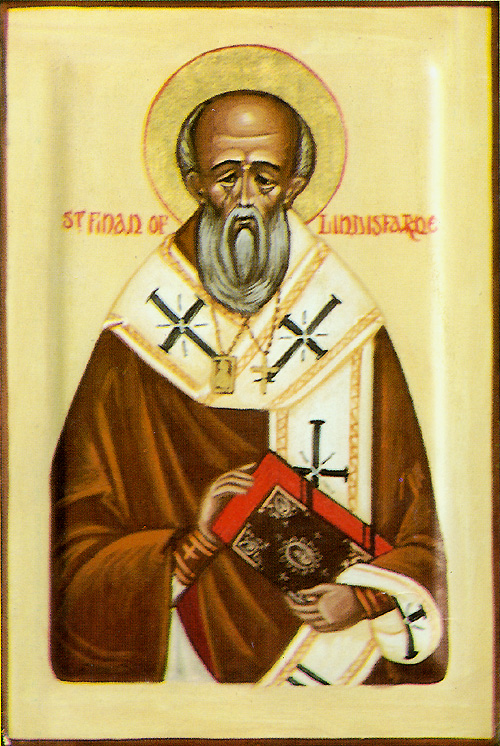
No information available at this time.
Hieromartyr Theodore of Atchara

Holy Hieromartyr Theodore of Atchara belongs to the glorious multitude of Atcharan faithful who were martyred at the hands of the Ottomans.
Saint Theodore was born in the late 18th century. At that time the Ottoman invaders had nearly completed the forced Islamization of the Atcharan region. They had already annihilated those who resisted the conversion and were beginning to evict those who, in spite of their apparent acceptance of Islam, continued to “arouse suspicions.” Some abandoned their native region and fled to foreign lands.
Saint Theodore was born to a family that had been forced into exile. From his childhood he watched his fellow countrymen, who had been forcibly converted to Islam, secretly retain their Christian way of life. It is unclear how the saint’s family settled in Trebizond (modern Trabzon). It is known, however, that Saint Theodore managed to free himself from Islam, receive Christianity, and find refuge at a Georgian monastery in Smyrna (now Izmir). There he was tonsured a monk and later raised to the rank of proigoumenos (deputy abbot). It is also known that Saint Theodore converted his nephew to Christianity during that time.
In 1822 Saint Theodore set out on a pilgrimage to Mt. Athos. But at the same time the Ottomans were attempting to crush the Greek independence movement, and the Holy Mountain was surrounded by Ottoman soldiers. They captured the faithful pilgrim and killed him. Then they tossed the holy martyr’s body into the sea.
The Holy Synod of the Georgian Apostolic Orthodox Church canonized Holy Martyr Theodore on October 17, 2002.
Daily Readings for Friday, February 16, 2024
FRIDAY OF THE 15TH WEEK
ABSTAIN FROM MEAT, FISH, DAIRY, EGGS, WINE, OLIVE OIL
Pamphilus the Martyr & his Companions, Flavianos, Patriarch of Constantinople, Romanos the Younger
ST. PETER’S FIRST UNIVERSAL LETTER 1:1-25; 2:1-10
Peter, an apostle of Jesus Christ, to the exiles of the Dispersion in Pontos, Galatia, Cappadocia, Asia, and Bithynia, chosen and destined by God the Father and sanctified by the Spirit for obedience to Jesus Christ and for sprinkling with his blood:
May grace and peace be multiplied to you. Blessed be the God and Father of our Lord Jesus Christ! By his great mercy we have been born anew to a living hope through the resurrection of Jesus Christ from the dead, and to an inheritance which is imperishable, undefiled, and unfading, kept in heaven for you, who by God's power are guarded through faith for a salvation ready to be revealed in the last time. In this you rejoice, though now for a little while you may have to suffer various trials, so that the genuineness of your faith, more precious than gold which though perishable is tested by fire, may redound to praise and glory and honor at the revelation of Jesus Christ. Without having known him you love him; though you do not now see him you believe in him and rejoice with unutterable and exalted joy. As the outcome of your faith you obtain the salvation of your souls.
The prophets who prophesied of the grace that was to be yours searched and inquired about this salvation; they inquired what person or time was indicated by the Spirit of Christ within them when predicting the sufferings of Christ and the subsequent glory. It was revealed to them that they were serving not themselves but you, in the things which have now been announced to you by those who preached the good news to you through the Holy Spirit sent from heaven, things into which angels long to look.
Therefore gird up your minds, be sober, set your hope fully upon the grace that is coming to you at the revelation of Jesus Christ. As obedient children, do not be conformed to the passions of your former ignorance, but as he who called you is holy, be holy yourselves in all your conduct; since it is written, "You shall be holy, for I am holy." And if you invoke as Father him who judges each one impartially according to his deeds, conduct yourselves with fear throughout the time of your exile. You know that you were ransomed from the futile ways inherited from your fathers, not with perishable things such as silver or gold, but with the precious blood of Christ, like that of a lamb without blemish or spot. He was destined before the foundation of the world but was made manifest at the end of the times for your sake. Through him you have confidence in God, who raised him from the dead and gave him glory, so that your faith and hope are in God.
Having purified your souls by your obedience to the truth for a sincere love of the brethren, love one another earnestly from the heart. You have been born anew, not of perishable seed but of imperishable, through the living and abiding word of God; for "All flesh is like grass and all its glory like the flower of grass. The grass withers, and the flower falls, but the word of the Lord abides for ever." That word is the good news which was preached to you.
So put away all malice and all guile and insincerity and envy and all slander. Like newborn babes, long for the pure spiritual milk, that by it you may grow up to salvation; for you have tasted the kindness of the Lord.
Come to him, to that living stone, rejected by men but in God's sight chosen and precious; and like living stones be yourselves built into a spiritual house, to be a holy priesthood, to offer spiritual sacrifices acceptable to God through Jesus Christ. For it stands in scripture: "Behold, I am laying in Zion a stone, a cornerstone chosen and precious, and he who believes in him will not be put to shame." To you therefore who believe, he is precious, but for those who do not believe, "The very stone which the builders rejected has become the head of the corner, " and "A stone that will make men stumble, a rock that will make them fall"; for they stumble because they disobey the word, as they were destined to do. But you are a chosen race, a royal priesthood, a holy nation, God's own people, that you may declare the wonderful deeds of him who called you out of darkness into his marvelous light. Once you were no people but now you are God's people; once you had not received mercy but now you have received mercy.
MARK 12:1-12
The Lord said this parable, "A man planted a vineyard, and set a hedge around it, and dug a pit for the wine press, and built a tower, and let it out to tenants, and went into another country. When the time came, he sent a servant to the tenants, to get from them some of the fruit of the vineyard. And they took him and beat him, and sent him away empty handed. Again he sent to them another servant, and they wounded him in the head, and treated him shamefully. And he sent another, and him they killed; and so with many others, some they beat and some they killed. He had still one other, a beloved son; finally he sent him to them, saying, 'They will respect my son.' But those tenants said to one another, 'This is the heir; come, let us kill him, and the inheritance will be ours.' And they took him and killed him, and cast him out of the vineyard. What will the owner of the vineyard do? He will come and destroy the tenants, and give the vineyard to others. Have you not read this scripture: 'The very stone which the builders rejected has become the head of the corner; this was the Lord's doing, and it is marvelous in our eyes'?" And they tried to arrest him, but feared the multitude, for they perceived that he had told the parable against them; so they left him and went away.
Martyrs Pamphilius the Presbyter, Valens the Deacon, and those with them, at Caesarea in Palestine

The Holy Martyrs Pamphίlios the Presbyter, Valens the Deacon, Paul, Porphyrios, Séleukos, Theódoulos, Julian, Samuel, Elias, Daniel, Jeremiah, and Isaiah suffered martyrdom during the reign of Emperor Diocletian (284 – 305) at Caesarea in Palestine.
The holy Martyr Pamphίlios, a native of the city of Beirut, was educated at Alexandria, after which he was ordained as a priest at Caesarea. He devoted much labor to collating manuscripts and correcting the copyists' errors in the manuscripts of the New Testament. These texts were copied and distributed to anyone who wanted them. Thus, many pagans were converted to Christ by them.
His works were gathered into the extensive library of spiritual books available for the enlightenment of Christians. Saint Jerome (IV-V century) had deep respect for Saint Pamphίlios and considered himself fortunate to have located and acquired several of his manuscripts.
Actively assisting Saint Pamphίlios in proclaiming the faith in Christ were Saint Valens, a Deacon of the Church, and Elias, a man stooped with age and well-versed in the Holy Scriptures, and Saint Paul, ardent in his faith and love for Christ the Savior. All three were imprisoned for two years by Urban, the governor of Palestinian Caesarea.
During the rule of his successor Firmilian, 130 Christians were sentenced in Egypt and sent to Cilicia (Asia Minor) to work in the gold mines. Five young brothers accompanied them to the place of exile. On their return to Egypt they were detained at Caesarea and thrown into prison for confessing Christ.
These young men appeared before Firmilian, together with those previously imprisoned incarcerated: Saints Pamphίlios, Valens and Paul. The five Egyptian youths took the names of Old Testament Prophets, Elias, Jeremiah, Isaiah, Samuel, and Daniel. Asked where they were from, the youths said that they were citizens of Jerusalem, meaning the heavenly Jerusalem. Firmilian knew nothing of such a city, since Jerusalem had been razed to the ground by Emperor Titus in the year 70. Emperor Hadrian (117-138) built a new city on the site, which was called Aelia Capitolina.
Firmilian tortured the youths for a long time, trying to learn the location of this unknown city, and he tried to persuade them to apostatize. Accomplishing nothing, the governor sentenced them to be beheaded with a sword, along with Pamphίlios, Valens, and Paul.
Before this took place, one of Pamphilios' servants endured suffering. This was the eighteen-year-old youth Porphyrios, who was meek and humble. He had heard the death sentence for the condemned martyrs, and asked the governor for permission to bury the bodies after their execution. Because of this he was also sentenced to death, and was thrown into a fire.
A pious Christian named Séleukos, a former soldier, praised the deeds of the Martyrs. He went to Pamphίlios and told him of the martyric death of Saint Porphyrios. He was arrested by soldiers and, on Firmilian’s orders, he was beheaded with a sword, together with the others.
One of the governor’s servants, Theódoulos, was a man of venerable age, and a secret Christian. He met the Martyrs as they were being led to execution. He embraced them and asked them to pray for him. Soldiers brought him before Firmilian, at whose orders he was crucified.
The young Julian, a native of Cappadocia who had come to Caesarea, saw the bodies of the Saints which had been thrown to wild beasts without burial. Julian knelt down and venerated the bodies of the sufferers. Soldiers apprehended him and took him to the governor, who condemned him to be burnt alive. The bodies of all twelve Martyrs remained unburied for four days, but neither beasts nor birds would touch them. Embarrassed by this situation, the pagans permitted the Christians to take the bodies of the martyrs and bury them.
Although these twelve Martyrs came from various places, they were also united by their love for Christ, and from Him they received unfading crowns of glory.
Saint Maruthas, Bishop of Martyropolis in Mesopotamia
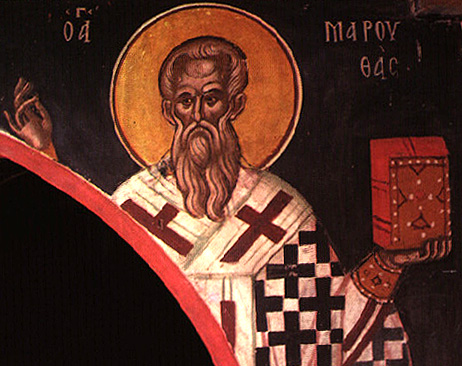
Saint Maruthas was Bishop of Tagrith (Martyropolis), a city which he founded between the Byzantine Empire and Persia. He was famed for his knowledge and his piety, he wrote about the martyrs, and he suffered for his faith in Christ under the Persian emperor Sapor. He also left behind other works in the Syrian language, among which the most famous are: “Commentary on the Gospel,” “Verses of Maruthas,” “Liturgy of Maruthas” and “The 73 Canons of the Ecumenical Council at Nicea” (325) with an account of the acts of the Council.
In the year 381 Saint Maruthas participated in the Second Ecumenical Council at Constantinople, convened against the heresy of Macedonius. In 383, he attended the Council of Antioch against the Messalians.
During the years 403-404 Saint Maruthas set off to Constantinople to plead with the emperor Arcadius to protect Persian Christians. He was twice sent by the emperor Theodosius the Younger to the Shah Izdegerd to secure the peace between the Empire and Persia.
In the year 414 Saint Maruthas, having done his duty as envoy to the court of Izdegerd, persuaded the Shah to a favorable disposition towards Christians, and he assisted greatly in the freedom of Christians in Persia. He rebuilt Christian churches razed during the persecution by the Persian ruler Sapor. He also located relics of saints who had suffered martyrdom and transferred them to Martyropolis. He died there in 422. The relics of Saint Maruthas were later transferred to Egypt and placed in a skete monastery of the Mother of God.
Persian Martyrs in Martyropolis in Mesopotamia
No information available at this time.
Saint Flavian, Archbishop of Antioch
Saint Flavian, Archbishop of Antioch, was a contemporary of Saint John Chrysostom. He attempted to obtain from the emperor Theodosius (379-395) a pardon for the citizens of Antioch, who had angered the emperor by destroying his statue. Saint Flavian’s death was peaceful and without illness. He is also commemorated on September 27.
Saint Nicholas, Equal of the Apostles, Archbishop of Japan

Saint Nicholas, Enlightener of Japan, was born Ivan Dimitrievich Kasatkin on August 1, 1836 in the village of Berezovsk, Belsk district, Smolensk diocese, where his father served as deacon. At the age of five he lost his mother. He completed the Belsk religious school, and afterwards the Smolensk Theological Seminary. In 1857 Ivan Kasatkin entered the Saint Peterburg Theological Academy. On June 24, 1860, in the academy temple of the Twelve Apostles, Bishop Nectarius tonsured him with the name Nicholas.
On June 29, the Feast of the foremost Apostles Peter and Paul, the monk Nicholas was ordained deacon. The next day, on the altar feast of the academy church, he was ordained to the holy priesthood. Later, at his request, Father Nicholas was assigned to Japan as head of the consular church in the city of Hakodate.
At first, the preaching of the Gospel in Japan seemed completely impossible. In Father Nicholas’s own words: “the Japanese of the time looked upon foreigners as beasts, and on Christianity as a villainous sect, to which only villains and sorcerers could belong.” He spent eight years in studying the country, the language, manners and customs of the people among whom he would preach.
In 1868, the flock of Father Nicholas numbered about twenty Japanese. At the end of 1869 Hieromonk Nicholas reported in person to the Synod in Peterburg about his work. A decision was made, on January 14, 1870, to form a special Russian Spiritual Mission for preaching the Word of God among the pagan Japanese. Father Nicholas was elevated to the rank of archimandrite and appointed as head of this Mission.
Returning to Japan after two years in Russia, he transferred some of the responsibility for the Hakodate flock to Hieromonk Anatolius, and began his missionary work in Tokyo. In 1871 there was a persecution of Christians in Hakodate. Many were arrested (among them, the first Japanese Orthodox priest Paul Sawabe). Only in 1873 did the persecution abate somewhat, and the free preaching of Christianity became possible.
In this year Archimandrite Nicholas began the construction of a stone building in Tokyo which housed a church, a school for fifty men, and later a religious school, which became a seminary in 1878.
In 1874, Bishop Paul of Kamchatka arrived in Tokyo to ordain as priests several Japanese candidates recommended by Archimandrite Nicholas. At the Tokyo Mission, there were four schools: for catechists, for women, for church servers, and a seminary. At Hakodate there were two separate schools for boys and girls.
In the second half of 1877, the Mission began regular publication of the journal “Church Herald.” By the year 1878 there already 4115 Christians in Japan, and there were a number of Christian communities. Church services and classes in Japanese, the publication of religious and moral books permitted the Mission to attain such results in a short time. Archimandrite Nicholas petitioned the Holy Synod in December of 1878 to provide a bishop for Japan.
Archimandrite Nicholas was consecrated bishop on March 30, 1880 in the Trinity Cathedral of Alexander Nevsky Lavra. Returning to Japan, he resumed his apostolic work with increased fervor. He completed construction on the Cathedral of the Resurrection of Christ in Tokyo, he translated the service books, and compiled a special Orthodox theological dictionary in the Japanese language.
Great hardship befell the saint and his flock at the time of the Russo-Japanese War. For his ascetic labor during these difficult years, he was elevated to the rank of Archbishop.
In 1911, half a century had passed since the young hieromonk Nicholas had first set foot on Japanese soil. At that time there were 33,017 Christians in 266 communities of the Japanese Orthodox Church, including 1 Archbishop, 1 bishop, 35 priests, 6 deacons, 14 singing instructors, and 116 catechists.
On February 3, 1912, Archbishop Nicholas departed peacefully to the Lord at the age of seventy-six. The Holy Synod of the Russian Orthodox Church glorified him on April 10, 1970, since the saint had long been honored in Japan as a righteous man, and a prayerful intercessor before the Lord.
 Saint Peter Antiochian Orthodox Church
You must be logged in to post a comment.