
WEDNESDAY OF PRODIGAL SON
NO FAST
Basil the Confessor, Jonah the Righteous Martyr of Lerios, Kyranna the New Martyr of Thessaloniki
ST. PETER’S SECOND UNIVERSAL LETTER 3:1-18
Beloved, this is now the second letter that I have written to you, and in both of them I have aroused your sincere mind by way of reminder; that you should remember the predictions of the holy prophets and the commandment of the Lord and Savior through your apostles. First of all you must understand this, that scoffers will come in the last days with scoffing, following their own passions and saying, "Where is the promise of his coming? For ever since the fathers fell asleep, all things have continued as they were from the beginning of creation." They deliberately ignore this fact, that by the word of God heavens existed long ago, and an earth formed out of water and by means of water, through which the world that then existed was deluged with water and perished. But by the same word the heavens and earth that now exist have been stored up for fire, being kept until the day of judgment and destruction of ungodly men.
But do not ignore this one fact, beloved, that with the Lord one day is as a thousand years, and a thousand years as one day. The Lord is not slow about his promise as some count slowness, but is forbearing toward you, not wishing that any should perish, but that all should reach repentance. But the day of the Lord will come like a thief, and then the heavens will pass away with a loud noise, and the elements will be dissolved with fire, and the earth and the works that are upon it will be burned up.
Since all these things are thus to be dissolved, what sort of persons ought you to be in lives of holiness and godliness, waiting for and hastening the coming of the day of God, because of which the heavens will be kindled and dissolved, and the elements will melt with fire! But according to his promise we wait for new heavens and a new earth in which righteousness dwells.
Therefore, beloved, since you wait for these, be zealous to be found by him without spot or blemish, and at peace. And count the forbearance of our Lord as salvation. So also our beloved brother Paul wrote to you according to the wisdom given him, speaking of this as he does in all his letters. There are some things in them hard to understand, which the ignorant and unstable twist to their own destruction, as they do the other scriptures. You therefore, beloved, knowing this beforehand, beware lest you be carried away with the error of lawless men and lose your own stability. But grow in the grace and knowledge of our Lord and Savior Jesus Christ. To him be the glory both now and to the day of eternity. Amen.
MARK 13:24-31
The Lord said to his disciples, “In those days, after that tribulation, the sun will be darkened, and the moon will not give its light, and the stars will be falling from heaven, and the powers in the heavens will be shaken. And then they will see the Son of man coming in clouds with great power and glory. And he will send out the angels, and gather his elect from the four winds, from the ends of the earth to the ends of heaven. From the fig tree learn its lesson: as soon as its branch becomes tender and puts forth its leaves, you know that summer is near. So also, when you see these things taking place, you know he is near, at the very gates. Truly, I say to you, this generation will not pass away before all these things take place. Heaven and earth will pass away, but my words will not pass away.”
Venerable Basil the Confessor, companion of Venerable Procopius at Decapolis
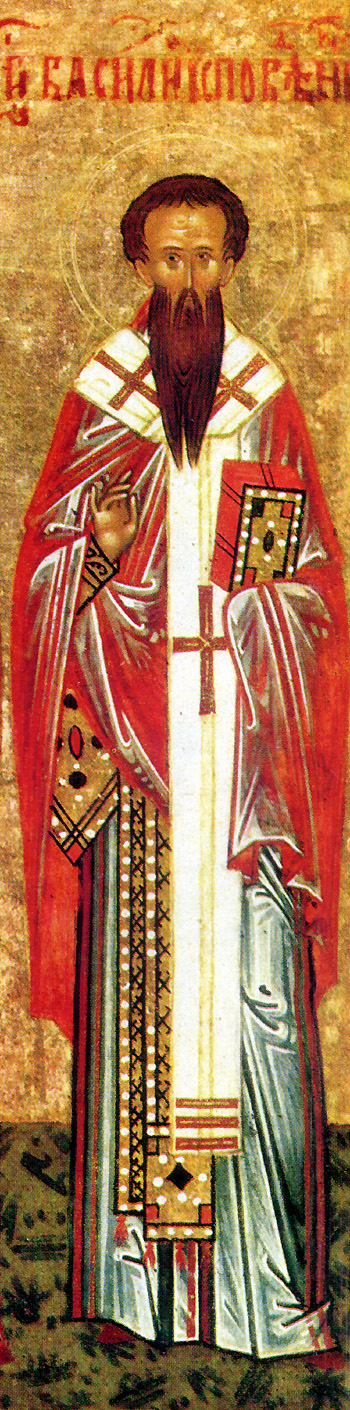
Saint Basil the Confessor was a monk and suffered during the reign of the iconoclast emperor Leo the Isaurian (717-741). When a persecution started against those who venerated holy icons, Saint Basil and his companion Saint Procopius of Decapolis (February 27) were subjected to much torture and locked up in prison. Here both martyrs languished for a long while, until the death of the impious emperor.
When the holy Confessors Basil and Procopius were set free along with other venerators of holy icons, they continued in their monastic struggles, instructing many in the Orthodox Faith and the virtuous life. Saint Basil died peacefully in the year 750.
Blessed Nicholas (Salos) of Pskov the Fool-For-Christ

Blessed Nicholas of Pskov lived the life of a holy fool for more than three decades. Long before his repose, he acquired the grace of the Holy Spirit and was granted the gifts of wonderworking and of prophecy. During his lifetime, the residents of Pskov called him Mikula [Mikola, Nikola] the Fool, and revered him as a Saint, even calling him Saint Mikula.
In February 1570, after a devastating campaign against Novgorod, Tsar Ivan the Terrible decided to attack Pskov, suspecting the inhabitants of treason. As the Pskov Chronicle relates, “the Tsar came … with great ferocity, like a roaring lion,1wanting to tear innocent people apart, and to shed much blood.”
On the first Saturday of Great Lent, the whole city prayed to be delivered from the Tsar’s wrath. Hearing the bell ring for Matins in Pskov, the Tsar’s heart was softened when he read the inscription on the XV century wonderworking Liubyatov Tenderness Icon of the Mother of God (March 19) in the Monastery of Saint Nicholas (the Tsar’s army was at the time). “Be merciful,” he told his soldiers. “Blunt your swords upon the stones, and let there be an end to killing.”
All the inhabitants of Pskov came out upon the streets, and each family knelt at the doors of their houses, holding bread and salt to meet the Tsar. On one of the streets Blessed Nicholas ran toward the Tsar astride a stick as if he were riding a horse, and cried out: “Ivanushko, Ivanushko, eat our bread and salt, but not the blood of Christians."
The Tsar commanded that the holy fool be apprehended, but he disappeared.
Though he had forbidden his men to kill, Ivan still intended to sack the city. The Tsar attended a Moleben at Holy Trinity Cathedral, where he venerated the relics of the right-believing Prince Vsevolod-Gabriel (February 11). He also expressed his wish to receive the blessing of the holy fool Nicholas. The Saint taught the Tsar “by many terrible sayings,” to stop the killing and not to plunder God's holy churches.
He prophesied that when the Tsar left Pskov he would not have a horse to ride. "Leave us, you passer-by," the blessed one said in a stern voice, "go quickly from us. If you hesitate, there will be nothing here for you to flee on."
Tsar Ivan did not listen to him, and he ordered his men to remove the bell from Holy Trinity Cathedral. Then, just as the Saint had predicted, the Tsar’s favorite horse fell dead.
Blessed Nicholas invited the Tsar to visit his cell under the bell tower. When the Tsar arrived at the Saint's cell Nicholas said, “Come in and accept a drink of water from us, there is no reason why you should shun it.” Then the holy fool offered the Tsar a piece of raw meat.
“I am a Christian and I do not eat meat during Lent," Ivan objected.
"But you drink human blood,” Nicholas replied.
Frightened by the fulfillment of the Saint's prophecy and denounced for his wicked deeds, Ivan ordered a stop to the looting and fled from the city. The Oprichniki, witnessing this, wrote: “The mighty tyrant … departed beaten and shamed, driven off as though by an enemy. Thus did a worthless beggar terrify and drive off the Tsar with his multitude of a thousand soldiers.”
Blessed Nicholas fell asleep in the Lord on February 28, 1576 and was buried at Holy Trinity Cathedral in the city he had saved. Such honors were granted only to the Pskov Princes, and later on, to Hierarchs.
The local veneration of the Saint began five years after his death. In the year 1581, when Pskov was besieged by the soldiers of the Polish king Stephen Bathory, the Mother of God appeared to the blacksmith Dorotheos, together with a number of Pskov Saints, praying for the city. Among these was Blessed Nicholas, according to an account concerning the Pskov-Protection Icon of the Mother of God (October 1).
At Holy Trinity cathedral the relics of Blessed Nicholas of Pskov are still venerated, for “by feigning foolishness, he was shown as a glorified citizen of the Heavenly Jerusalem" (Troparion). He also “turned the Tsar’s power from wrath to mercy" (Kontakion).
1 I Peter 5:8
Hieromartyr Proterius, Patriarch of Alexandria

The Hieromartyr Proterius, Patriarch of Alexandria, and those with him. The priest Proterius lived in Alexandria during the patriarchal tenure of Dioscorus (444-451), an adherent of the Monophysite heresy of Eutyches. Proterius fearlessly denounced the heretics and confessed the Orthodox Faith.
In 451 at the Fourth Ecumenical Council of Chalcedon, the heresy of Eutyches was condemned and the teaching of Christ as Perfect God and Perfect Man, existing in these two natures “unconfusedly” and “indivisibly” [and “immutably” and “inseparably”] was set forth. The heretic Dioscorus was deposed and exiled, and Proterius, distinguished for his strict and virtuous life, was placed upon the patriarchal throne of Alexandria.
However, many supporters of Dioscorus remained in Alexandria. Rebelling against the election of Proterius, they rioted and burned the soldiers who were sent out to pacify them. The pious emperor Marcian (450-457) deprived the Alexandrians of all the privileges they were accustomed to, and sent new and reinforced detachments of soldiers. The inhabitants of the city then quieted down and begged Patriarch Proterius to intercede with the emperor to restore their former privileges to them. The kindly saint consented and readily obtained their request.
After the death of Marcian the heretics again raised their heads. Presbyter Menignus (“the Cat”), himself striving for the patriarchal dignity, and taking advantage of the absence of the prefect of the city, was at the head of the rioters. Saint Proterius decided to leave Alexandria, but that night he saw in a dream the holy Prophet Isaiah, who said to him, “Return to the city, I am waiting to take you.” The saint realized that this was a prediction of his martyric end. He returned to Alexandria and concealed himself in a baptistry.
The insolent heretics broke into this refuge and killed the Patriarch and six men who were with him. The fact that it was Holy Saturday and the Canon of Pascha was being sung did not stop them. In their insane hatred they tied a rope to the body of the murdered Patriarch, and dragged it through the streets. They beat and lacerated it, and finally they burned it, scattering the ashes to the wind.
The Orthodox reported this to the holy Emperor Leo (457-474) and Saint Anatolius, Patriarch of Constantinople (July 3). An army arrived at Alexandria, the rebellion was crushed, and Menignus was brought to trial and exiled.
Regarding the death of the Hieromartyr Proterius, four Thracian bishops of his time wrote: “We consider His Holiness Proterius to be in the ranks and choir of the saints, and we beseech God to be compassionate and merciful to us through his prayers.”
Hieromartyr Nestor, Bishop of Magydos in Pamphylia
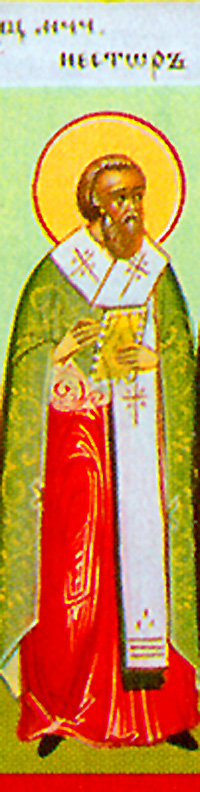
The Hieromartyr Nestor, Bishop of Magydos in Pamphylia During a persecution against Christians under the emperor Decius (249-251), he was arrested while praying in his home. He learned of the suffering awaiting him through a peculiar vision. He saw a lamb prepared for sacrifice.
The ruler of the city of Magydos sent him for trial to Perge. On the way there Saint Nestor was strengthened in spirit when he heard a Voice from Heaven, after which an earthquake occurred. After cruel tortures at Perge the hieromartyr was crucified in the year 250.
Venerable Marina and Kyra of Syria

Saints Marina (Marana) and Kyra (Cyra), sisters by birth, lived during the fourth century in the city of Veria (or Berea) in Syria. Their parents were illustrious and rich, but the sisters left home and departed the city when they had reached maturity.
Having cleared off a small plot of land, the holy virgins sealed up the entrance to their refuge with rocks and clay, leaving only a narrow opening through which food was passed to them. Their little hut had no roof, and so they were exposed to the elements.
On their bodies they wore heavy iron chains and patiently endured hunger. During a three year period, they ate food only once every forty days. Their former servants came to them, wanting to join their ascetic life. The saints put them in a separate hut next to their own enclosure and they spoke to them through a window, exhorting them to deeds of prayer and fasting.

The life of the holy ascetics Marana and Kyra was described by Bishop Theodoret of Cyrrhus in his Religiosa Historica. Out of respect for his hierarchical dignity, the holy virgins allowed him into their dwelling. Theodoret conversed with them and persuaded them to remove the heavy chains they wore under their clothing. Kyra, who was weak in body, was always stooped under their weight and was unable to sit upright. Once he left, however, they resumed wearing the chains.
So they lived in asceticism for forty years. They disturbed their solitude only to make a pilgrimage to Jerusalem to pray at the Sepulchre of the Lord. During their journey (which took twenty days) they ate no food until they had prayed at the Holy Places. On the way back, they also went without eating. They did the same thing at another time, when they journeyed to the grave of the Protomartyr Thekla (September 24) at Seleucia, Isauria.
Saints Marana and Kyra died in about the year 450. Their ascetical life equaled that of the great male ascetics of the desert, and they received the same crown of victory from Christ the Savior.
Venerable Domnica (Domnina) of Syria
Saint Domnica (Domnina) was a Syrian nun, and a companion of Saints Marana and Kyra.
 Saint Peter Antiochian Orthodox Church