
SUNDAY OF THE PUBLICAN AND PHARISEE: TRIODION BEGINS TODAY
NO FAST
Sunday of the Publican and Pharisee: Triodion Begins Today, Tarasius, Patriarch of Constantinople, Reginos, Bishop of Skopelos, Holy Martyr Alexander of Thrace, Markellos, Bishop of Apamea
ST. PAUL’S SECOND LETTER TO TIMOTHY 3:10-15
TIMOTHY, my son, you have observed my teaching, my conduct, my aim in life, my faith, my patience, my love, my steadfastness, my persecutions, my sufferings, what befell me at Antioch, at lconion, and at Lystra, what persecutions I endured; yet from them all the Lord rescued me. Indeed all who desire to live a godly life in Christ Jesus will be persecuted, while evil men and impostors will go on from bad to worse, deceivers and deceived. But as for you, continue in what you have learned and have firmly believed, knowing from whom you learned it and how from childhood you have been acquainted with the sacred writings which are able to instruct you for salvation through faith in Christ Jesus.
LUKE 18:10-14
The Lord said this parable, “Two men went up into the temple to pray, one a Pharisee and the other a tax collector. The Pharisee stood and prayed thus with himself, ‘God, I thank you that I am not like other men, extortioners, unjust, adulterers, or even like this tax collector. I fast twice a week, I give tithes of all that I get.’ But the tax collector, standing far off, would not even lift up his eyes to heaven, but beat his breast, saying, ‘God, be merciful to me a sinner!’ I tell you, this man went down to his house justified rather than the other; for everyone who exalts himself will be humbled, but he who humbles himself will be exalted.”
Sunday of the Publican and the Pharisee Beginning of the Lenten Triodion

The Sunday after the Sunday of Zacchaeus is devoted to the Publican and the Pharisee. At Vespers the night before, the Triodion (the liturgical book used in the services of Great Lent) begins.
Two men went to the Temple to pray. One was a Pharisee who scrupulously observed the requirements of religion: he prayed, fasted, and contributed money to the Temple. These are very good things, and should be imitated by anyone who loves God. We who may not fulfill these requirements as well as the Pharisee did should not feel entitled to criticize him for being faithful. His sin was in looking down on the Publican and feeling justified because of his external religious observances.
The second man was a Publican, a tax-collector who was despised by the people. He, however, displayed humility, and this humility justified him before God (Luke 18:14).
The lesson to be learned is that we possess neither the Pharisee’s religious piety, nor the Publican’s repentance, through which we can be saved. We are called to see ourselves as we really are in the light of Christ’s teaching, asking Him to be merciful to us, deliver us from sin, and to lead us on the path of salvation.
Two weeks before the beginning of the Fast, as part of our preparation for Great Lent, Holy Week, and Pascha, the Church prescribes the reading of Saint Mark's Gospel. From Monday to Friday the focus is on the end times, and the Savior's death and burial.
Saint Tarasius, Archbishop of Constantinople
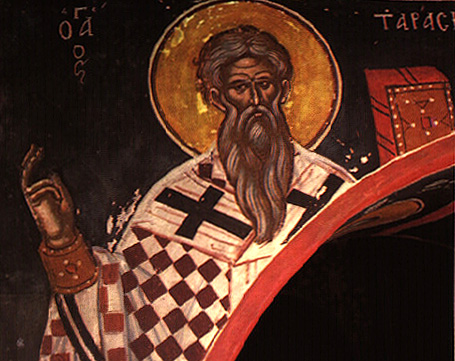
Saint Tarasius, Patriarch of Constantinople was of illustrious lineage. He was born and raised in Constantinople, where he received a fine education. He was rapidly promoted at the court of the emperor Constantine VI Porphyrogenitos (780-797) and Constantine’s mother, the holy Empress Irene (August 7), and the saint attained the rank of senator.
During these times the Church was agitated by the turmoil of the Iconoclast disturbances. The holy Patriarch Paul (August 30) although he had formerly supported Iconoclasm, later repented and resigned his office. He withdrew to a monastery, where he took the schema. When the holy Empress Irene and her son the emperor came to him, Saint Paul told them that the most worthy successor to him would be Saint Tarasius (who at this time was still a layman).
Tarasius refused for a long time, not considering himself worthy of such high office, but he then gave in to the common accord on the condition, that an Ecumenical Council be convened to address the Iconoclast heresy.
Proceeding through all the clerical ranks in a short while, Saint Tarasius was elevated to the patriarchal throne in the year 784. In the year 787 the Seventh Ecumenical Council was convened in the city of Nicea, with Patriarch Tarasius presiding, and 367 bishops attending. The veneration of holy icons was confirmed at the council. Those bishops who repented of their iconoclasm, were again received by the Church.
Saint Tarasius wisely governed the Church for twenty-two years. He led a strict ascetic life. He spent all his money on God-pleasing ends, feeding and giving comfort to the aged, to the impoverished, to widows and orphans, and on Holy Pascha he set out a meal for them, and he served them himself.
The holy Patriarch fearlessly denounced the emperor Constantine Porphyrigenitos when he slandered his spouse, the empress Maria, the granddaughter of Saint Philaretos the Merciful (December 1), so that he could send Maria to a monastery, thus freeing him to marry his own kinswoman. Saint Tarasius resolutely refused to dissolve the marriage of the emperor, for which the saint fell into disgrace. Soon, however, Constantine was deposed by his own mother, the Empress Irene.
Saint Tarasius died in the year 806. Before his death, devils examined his life from the time of his youth, and they tried to get the saint to admit to sins that he had not committed. “I am innocent of that of which you accuse me,” replied the saint, “and you falsely slander me. You have no power over me at all.”
Mourned by the Church, the saint was buried in a monastery he built on the Bosphorus. Many miracles took place at his tomb.
 Saint Peter Antiochian Orthodox Church