
FRIDAY OF THE 15TH WEEK
ABSTAIN FROM MEAT, FISH, DAIRY, EGGS, WINE, OLIVE OIL
Pamphilus the Martyr & his Companions, Flavianos, Patriarch of Constantinople, Romanos the Younger
ST. PETER’S FIRST UNIVERSAL LETTER 1:1-25; 2:1-10
Peter, an apostle of Jesus Christ, to the exiles of the Dispersion in Pontos, Galatia, Cappadocia, Asia, and Bithynia, chosen and destined by God the Father and sanctified by the Spirit for obedience to Jesus Christ and for sprinkling with his blood:
May grace and peace be multiplied to you. Blessed be the God and Father of our Lord Jesus Christ! By his great mercy we have been born anew to a living hope through the resurrection of Jesus Christ from the dead, and to an inheritance which is imperishable, undefiled, and unfading, kept in heaven for you, who by God's power are guarded through faith for a salvation ready to be revealed in the last time. In this you rejoice, though now for a little while you may have to suffer various trials, so that the genuineness of your faith, more precious than gold which though perishable is tested by fire, may redound to praise and glory and honor at the revelation of Jesus Christ. Without having known him you love him; though you do not now see him you believe in him and rejoice with unutterable and exalted joy. As the outcome of your faith you obtain the salvation of your souls.
The prophets who prophesied of the grace that was to be yours searched and inquired about this salvation; they inquired what person or time was indicated by the Spirit of Christ within them when predicting the sufferings of Christ and the subsequent glory. It was revealed to them that they were serving not themselves but you, in the things which have now been announced to you by those who preached the good news to you through the Holy Spirit sent from heaven, things into which angels long to look.
Therefore gird up your minds, be sober, set your hope fully upon the grace that is coming to you at the revelation of Jesus Christ. As obedient children, do not be conformed to the passions of your former ignorance, but as he who called you is holy, be holy yourselves in all your conduct; since it is written, "You shall be holy, for I am holy." And if you invoke as Father him who judges each one impartially according to his deeds, conduct yourselves with fear throughout the time of your exile. You know that you were ransomed from the futile ways inherited from your fathers, not with perishable things such as silver or gold, but with the precious blood of Christ, like that of a lamb without blemish or spot. He was destined before the foundation of the world but was made manifest at the end of the times for your sake. Through him you have confidence in God, who raised him from the dead and gave him glory, so that your faith and hope are in God.
Having purified your souls by your obedience to the truth for a sincere love of the brethren, love one another earnestly from the heart. You have been born anew, not of perishable seed but of imperishable, through the living and abiding word of God; for "All flesh is like grass and all its glory like the flower of grass. The grass withers, and the flower falls, but the word of the Lord abides for ever." That word is the good news which was preached to you.
So put away all malice and all guile and insincerity and envy and all slander. Like newborn babes, long for the pure spiritual milk, that by it you may grow up to salvation; for you have tasted the kindness of the Lord.
Come to him, to that living stone, rejected by men but in God's sight chosen and precious; and like living stones be yourselves built into a spiritual house, to be a holy priesthood, to offer spiritual sacrifices acceptable to God through Jesus Christ. For it stands in scripture: "Behold, I am laying in Zion a stone, a cornerstone chosen and precious, and he who believes in him will not be put to shame." To you therefore who believe, he is precious, but for those who do not believe, "The very stone which the builders rejected has become the head of the corner, " and "A stone that will make men stumble, a rock that will make them fall"; for they stumble because they disobey the word, as they were destined to do. But you are a chosen race, a royal priesthood, a holy nation, God's own people, that you may declare the wonderful deeds of him who called you out of darkness into his marvelous light. Once you were no people but now you are God's people; once you had not received mercy but now you have received mercy.
MARK 12:1-12
The Lord said this parable, "A man planted a vineyard, and set a hedge around it, and dug a pit for the wine press, and built a tower, and let it out to tenants, and went into another country. When the time came, he sent a servant to the tenants, to get from them some of the fruit of the vineyard. And they took him and beat him, and sent him away empty handed. Again he sent to them another servant, and they wounded him in the head, and treated him shamefully. And he sent another, and him they killed; and so with many others, some they beat and some they killed. He had still one other, a beloved son; finally he sent him to them, saying, 'They will respect my son.' But those tenants said to one another, 'This is the heir; come, let us kill him, and the inheritance will be ours.' And they took him and killed him, and cast him out of the vineyard. What will the owner of the vineyard do? He will come and destroy the tenants, and give the vineyard to others. Have you not read this scripture: 'The very stone which the builders rejected has become the head of the corner; this was the Lord's doing, and it is marvelous in our eyes'?" And they tried to arrest him, but feared the multitude, for they perceived that he had told the parable against them; so they left him and went away.
Martyrs Pamphilius the Presbyter, Valens the Deacon, and those with them, at Caesarea in Palestine

The Holy Martyrs Pamphίlios the Presbyter, Valens the Deacon, Paul, Porphyrios, Séleukos, Theódoulos, Julian, Samuel, Elias, Daniel, Jeremiah, and Isaiah suffered martyrdom during the reign of Emperor Diocletian (284 – 305) at Caesarea in Palestine.
The holy Martyr Pamphίlios, a native of the city of Beirut, was educated at Alexandria, after which he was ordained as a priest at Caesarea. He devoted much labor to collating manuscripts and correcting the copyists' errors in the manuscripts of the New Testament. These texts were copied and distributed to anyone who wanted them. Thus, many pagans were converted to Christ by them.
His works were gathered into the extensive library of spiritual books available for the enlightenment of Christians. Saint Jerome (IV-V century) had deep respect for Saint Pamphίlios and considered himself fortunate to have located and acquired several of his manuscripts.
Actively assisting Saint Pamphίlios in proclaiming the faith in Christ were Saint Valens, a Deacon of the Church, and Elias, a man stooped with age and well-versed in the Holy Scriptures, and Saint Paul, ardent in his faith and love for Christ the Savior. All three were imprisoned for two years by Urban, the governor of Palestinian Caesarea.
During the rule of his successor Firmilian, 130 Christians were sentenced in Egypt and sent to Cilicia (Asia Minor) to work in the gold mines. Five young brothers accompanied them to the place of exile. On their return to Egypt they were detained at Caesarea and thrown into prison for confessing Christ.
These young men appeared before Firmilian, together with those previously imprisoned incarcerated: Saints Pamphίlios, Valens and Paul. The five Egyptian youths took the names of Old Testament Prophets, Elias, Jeremiah, Isaiah, Samuel, and Daniel. Asked where they were from, the youths said that they were citizens of Jerusalem, meaning the heavenly Jerusalem. Firmilian knew nothing of such a city, since Jerusalem had been razed to the ground by Emperor Titus in the year 70. Emperor Hadrian (117-138) built a new city on the site, which was called Aelia Capitolina.
Firmilian tortured the youths for a long time, trying to learn the location of this unknown city, and he tried to persuade them to apostatize. Accomplishing nothing, the governor sentenced them to be beheaded with a sword, along with Pamphίlios, Valens, and Paul.
Before this took place, one of Pamphilios' servants endured suffering. This was the eighteen-year-old youth Porphyrios, who was meek and humble. He had heard the death sentence for the condemned martyrs, and asked the governor for permission to bury the bodies after their execution. Because of this he was also sentenced to death, and was thrown into a fire.
A pious Christian named Séleukos, a former soldier, praised the deeds of the Martyrs. He went to Pamphίlios and told him of the martyric death of Saint Porphyrios. He was arrested by soldiers and, on Firmilian’s orders, he was beheaded with a sword, together with the others.
One of the governor’s servants, Theódoulos, was a man of venerable age, and a secret Christian. He met the Martyrs as they were being led to execution. He embraced them and asked them to pray for him. Soldiers brought him before Firmilian, at whose orders he was crucified.
The young Julian, a native of Cappadocia who had come to Caesarea, saw the bodies of the Saints which had been thrown to wild beasts without burial. Julian knelt down and venerated the bodies of the sufferers. Soldiers apprehended him and took him to the governor, who condemned him to be burnt alive. The bodies of all twelve Martyrs remained unburied for four days, but neither beasts nor birds would touch them. Embarrassed by this situation, the pagans permitted the Christians to take the bodies of the martyrs and bury them.
Although these twelve Martyrs came from various places, they were also united by their love for Christ, and from Him they received unfading crowns of glory.
Saint Maruthas, Bishop of Martyropolis in Mesopotamia
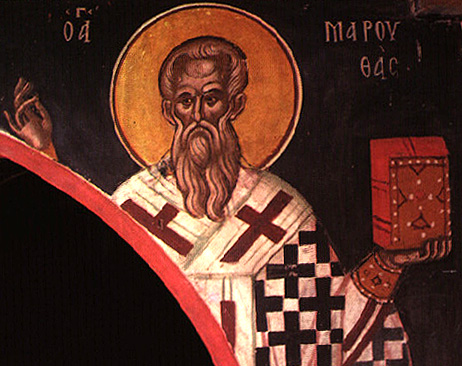
Saint Maruthas was Bishop of Tagrith (Martyropolis), a city which he founded between the Byzantine Empire and Persia. He was famed for his knowledge and his piety, he wrote about the martyrs, and he suffered for his faith in Christ under the Persian emperor Sapor. He also left behind other works in the Syrian language, among which the most famous are: “Commentary on the Gospel,” “Verses of Maruthas,” “Liturgy of Maruthas” and “The 73 Canons of the Ecumenical Council at Nicea” (325) with an account of the acts of the Council.
In the year 381 Saint Maruthas participated in the Second Ecumenical Council at Constantinople, convened against the heresy of Macedonius. In 383, he attended the Council of Antioch against the Messalians.
During the years 403-404 Saint Maruthas set off to Constantinople to plead with the emperor Arcadius to protect Persian Christians. He was twice sent by the emperor Theodosius the Younger to the Shah Izdegerd to secure the peace between the Empire and Persia.
In the year 414 Saint Maruthas, having done his duty as envoy to the court of Izdegerd, persuaded the Shah to a favorable disposition towards Christians, and he assisted greatly in the freedom of Christians in Persia. He rebuilt Christian churches razed during the persecution by the Persian ruler Sapor. He also located relics of saints who had suffered martyrdom and transferred them to Martyropolis. He died there in 422. The relics of Saint Maruthas were later transferred to Egypt and placed in a skete monastery of the Mother of God.
Persian Martyrs in Martyropolis in Mesopotamia
No information available at this time.
Saint Flavian, Archbishop of Antioch
Saint Flavian, Archbishop of Antioch, was a contemporary of Saint John Chrysostom. He attempted to obtain from the emperor Theodosius (379-395) a pardon for the citizens of Antioch, who had angered the emperor by destroying his statue. Saint Flavian’s death was peaceful and without illness. He is also commemorated on September 27.
Saint Nicholas, Equal of the Apostles, Archbishop of Japan

Saint Nicholas, Enlightener of Japan, was born Ivan Dimitrievich Kasatkin on August 1, 1836 in the village of Berezovsk, Belsk district, Smolensk diocese, where his father served as deacon. At the age of five he lost his mother. He completed the Belsk religious school, and afterwards the Smolensk Theological Seminary. In 1857 Ivan Kasatkin entered the Saint Peterburg Theological Academy. On June 24, 1860, in the academy temple of the Twelve Apostles, Bishop Nectarius tonsured him with the name Nicholas.
On June 29, the Feast of the foremost Apostles Peter and Paul, the monk Nicholas was ordained deacon. The next day, on the altar feast of the academy church, he was ordained to the holy priesthood. Later, at his request, Father Nicholas was assigned to Japan as head of the consular church in the city of Hakodate.
At first, the preaching of the Gospel in Japan seemed completely impossible. In Father Nicholas’s own words: “the Japanese of the time looked upon foreigners as beasts, and on Christianity as a villainous sect, to which only villains and sorcerers could belong.” He spent eight years in studying the country, the language, manners and customs of the people among whom he would preach.
In 1868, the flock of Father Nicholas numbered about twenty Japanese. At the end of 1869 Hieromonk Nicholas reported in person to the Synod in Peterburg about his work. A decision was made, on January 14, 1870, to form a special Russian Spiritual Mission for preaching the Word of God among the pagan Japanese. Father Nicholas was elevated to the rank of archimandrite and appointed as head of this Mission.
Returning to Japan after two years in Russia, he transferred some of the responsibility for the Hakodate flock to Hieromonk Anatolius, and began his missionary work in Tokyo. In 1871 there was a persecution of Christians in Hakodate. Many were arrested (among them, the first Japanese Orthodox priest Paul Sawabe). Only in 1873 did the persecution abate somewhat, and the free preaching of Christianity became possible.
In this year Archimandrite Nicholas began the construction of a stone building in Tokyo which housed a church, a school for fifty men, and later a religious school, which became a seminary in 1878.
In 1874, Bishop Paul of Kamchatka arrived in Tokyo to ordain as priests several Japanese candidates recommended by Archimandrite Nicholas. At the Tokyo Mission, there were four schools: for catechists, for women, for church servers, and a seminary. At Hakodate there were two separate schools for boys and girls.
In the second half of 1877, the Mission began regular publication of the journal “Church Herald.” By the year 1878 there already 4115 Christians in Japan, and there were a number of Christian communities. Church services and classes in Japanese, the publication of religious and moral books permitted the Mission to attain such results in a short time. Archimandrite Nicholas petitioned the Holy Synod in December of 1878 to provide a bishop for Japan.
Archimandrite Nicholas was consecrated bishop on March 30, 1880 in the Trinity Cathedral of Alexander Nevsky Lavra. Returning to Japan, he resumed his apostolic work with increased fervor. He completed construction on the Cathedral of the Resurrection of Christ in Tokyo, he translated the service books, and compiled a special Orthodox theological dictionary in the Japanese language.
Great hardship befell the saint and his flock at the time of the Russo-Japanese War. For his ascetic labor during these difficult years, he was elevated to the rank of Archbishop.
In 1911, half a century had passed since the young hieromonk Nicholas had first set foot on Japanese soil. At that time there were 33,017 Christians in 266 communities of the Japanese Orthodox Church, including 1 Archbishop, 1 bishop, 35 priests, 6 deacons, 14 singing instructors, and 116 catechists.
On February 3, 1912, Archbishop Nicholas departed peacefully to the Lord at the age of seventy-six. The Holy Synod of the Russian Orthodox Church glorified him on April 10, 1970, since the saint had long been honored in Japan as a righteous man, and a prayerful intercessor before the Lord.
 Saint Peter Antiochian Orthodox Church