
TUESDAY OF THE 15TH WEEK
NO FAST
Martinian of Palestine, Apostles Aquila and Priscilla, Eulogios, Patriarch of Alexandria, Symeon the Myrrhbearer of Serbia
ST. JAMES’ UNIVERSAL LETTER 3:1-10
Brethren, let not many of you become teachers, for you know that we who teach shall be judged with greater strictness. For we all make many mistakes, and if any one makes no mistakes in what he says he is a perfect man, able to bridle the whole body also. If we put bits into the mouths of horses that they may obey us, we guide their whole bodies. Look at the ships also; though they are so great and are driven by strong winds, they are guided by a very small rudder wherever the will of the pilot directs. So the tongue is a little member and boasts of great things. How great a forest is set ablaze by a small fire! And the tongue is a fire. The tongue is an unrighteous world among our members, staining the whole body, setting on fire the cycle of nature, and set on fire by hell. For every kind of beast and bird, of reptile and sea creature, can be tamed and has been tamed by humankind, but no human being can tame the tongue – a restless evil, full of deadly poison. With it we bless our God and Father, and with it we curse men, who are made in the likeness of God. From the same mouth come blessing and cursing. My brethren, this ought not to be so.
MARK 11:11-23
At that time, Jesus entered Jerusalem, and went into the temple; and when he had looked round at everything, as it was already late, he went out to Bethany with the twelve.
On the following day, when they came from Bethany, he was hungry. And seeing in the distance a fig tree in leaf, he went to see if he could find anything on it. When he came to it, he found nothing but leaves, for it was not the season for figs. And he said to it, "May no one ever eat fruit from you again." And his disciples heard it.
And they came to Jerusalem. And he entered the temple and began to drive out those who sold and those who bought in the temple, and he overturned the tables of the money-changers and the seats of those who sold pigeons; and he would not allow any one to carry anything through the temple. And he taught, and said to them, "Is it not written, 'My house shall be called a house of prayer for all the nations'? But you have made it a den of robbers." And the chief priests and the scribes heard it and sought a way to destroy him; for they feared him, because all the multitude was astonished at his teaching. And when evening came they went out of the city.
As they passed by in the morning, they saw the fig tree withered away to its roots. And Peter remembered and said to him, "Rabbi, look! The fig tree which you cursed has withered." And Jesus answered them, "Have faith in God. Truly, I say to you, whoever says to this mountain, 'Be taken up and cast into the sea, ' and does not doubt in his heart, but believes that what he says will come to pass, it will be done for him.
Saints Martinian, Zoe, and Photina of Caesarea in Palestine

Saint Martinian went to live in the wilderness at the age of eighteen, not far from the city of Caesarea in Palestine. For twenty-five years, he devoted himself to ascetic deeds and silence, and he was granted the gift of healing illnesses and casting out demons. However, the Enemy of the human race would not stop troubling the holy ascetic with various temptations.
One day a prostitute overheard some citizens of Caesarea speaking of Saint Martinian's virtuous life, so she asked them why they were amazed by it. She said that he went to live in the desert because he could not endure the temptations of the flesh in the city. Furthermore, she made a wager with them that she could topple this pillar of virtue with her beauty and seduce him.
She came to him one night, dressed in shabby clothes, pretending that she had lost her way in the storm, and asking for shelter. Reluctantly, the saint allowed her to enter his cell, because he did not wish to be the cause of her death. He went into the inner room of his cell, telling her she would have to leave in the morning. After chanting Psalms according to his Rule, he went to sleep on the floor, but he was disturbed by carnal thoughts. Meanwhile, the wicked guest opened the bag she had been carrying and changed into her beautiful clothes and adorned herself with jewels.
When morning came, Saint Martinian came out to send the woman away. Though he was tempted by the woman’s beauty, he was determined not to fall into sin. Lighting a fire, he stepped into it, saying, “You want me to burn with temptation, but I will not give in to it.. Instead, I choose to burn in this fire in order to preserve my purity and to escape the unquenchable fires of Hell."
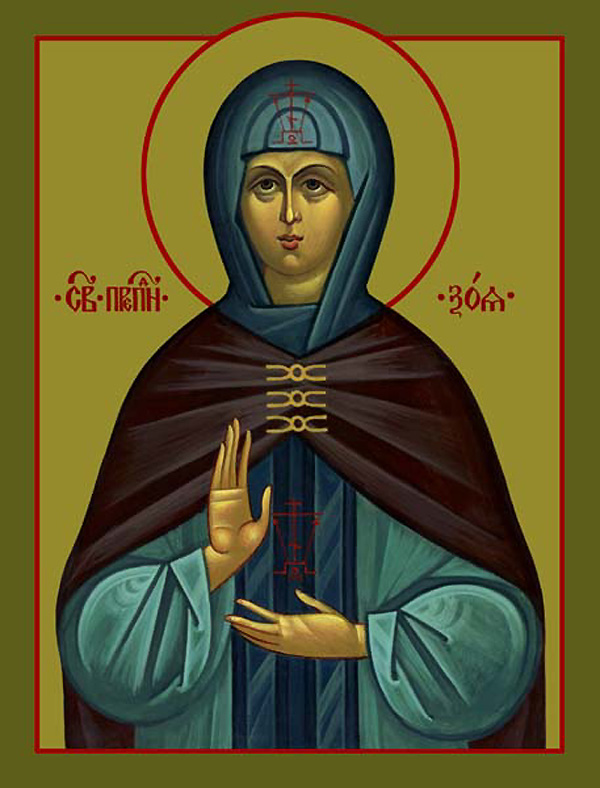
The woman was astonished at the lengths Saint Martinian was willing to go, and she realized how evil she was. She repented and asked the saint to guide her onto the way of salvation. He told her to go to Bethlehem, and enter the convent founded by Saint Paula (January 26). There she lived as a nun for twelve years in strict asceticism until her blessed repose. The woman’s name was Zoe.
After his burns healed, Saint Martinian went to an uninhabited rocky island, and lived on it under the open sky for several years, nourished by the provisions brought by a certain sailor from time to time. In return the monk wove baskets for him.
One day a ship was wrecked by a powerful storm, and a woman named Photina floated to the island on pieces of the wreckage Saint Martinian helped her to survive on the island. “Remain here,” he told her, “for I am leaving you bread and water, and in two months a boat will come and return you to the mainland."
Saint Martinian refused to stay on the island with the woman, believing that it would be better to drown than to burn with lust. He jumped into the sea and swam away, and a pair of dolphins carried him to dry land. Thereafter, Saint Martinian led the life of a wanderer. Later, he came to Athens and fell ill. Sensing the approach of death, he went into a church and lay upon the floor. God revealed to the Bishop of Athens who Saint Martinian was, and the hierarch buried his body with honor. This occurred around the year 422.
As for Saint Photina, she did not board the ship when it came to the island, electing to stay there by herself. She asked the captain of the ship to have his wife bring her men's clothing and some wool, promising to make clothes for his family. She also asked the woman to bring her bread and water in addition to the other supplies.
Saint Photina lived on the island for six years, and then she went to the Lord. Two months after her repose, the captain and his wife found her incorrupt relics and brought them to Caesarea in Palestine. He had a vision which revealed many details of Saint Photina's life, which he shared with the bishop. Then they buried her with great honor and reverence.
Venerable Stephen (in monasticism Simeon), the Myrrhgusher and Prince of Serbia
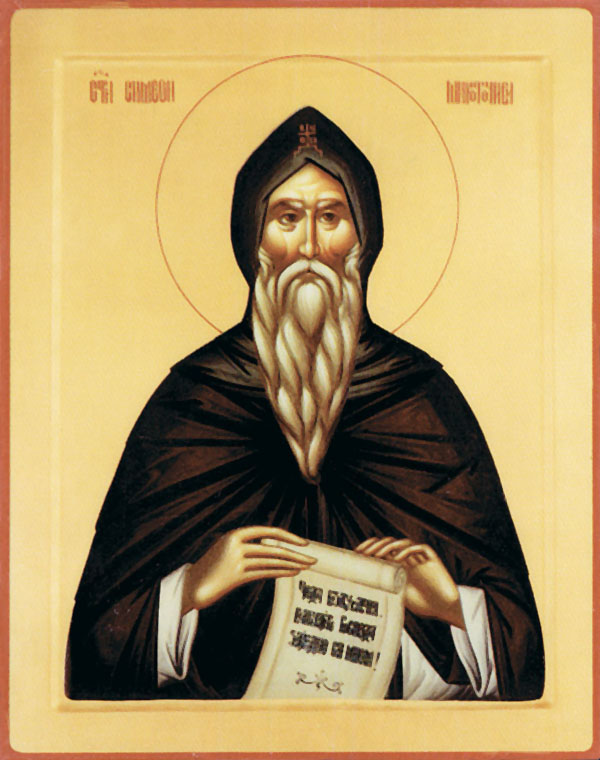
Saint Simeon the Myrrh-Gusher, King of Serbia Stephen Nemanya was the Great Zhupan of Serbia, and lived during the twelfth century. The saint toiled much for his fatherland: he united a large portion of the Serbian lands, and strove for the political independence of his country from the Byzantine Empire. In his zeal for the Orthodox Church, he defended his nation against heresy and false teaching.
At the age of eighty, Stephen went to Mt. Athos, where his son Saint Savva (January 12), was glorified by the holiness of his life. Together they restored the desolate Hilandar monastery, to which monks from various lands began to gather.
Saint Simeon was a great ascetic and wise guide for the monks. He died on February 13, 1200, and his relics began to exude myrrh. Saint Savva transported his father’s relics back to Serbia, and placed them in a church of the Most Holy Theotokos at the River Studenitsa. Saint Simeon had richly adorned this church while he was still ruler of Serbia.
Saint Eulogius, Archbishop of Alexandria

Saint Eulogius, Patriarch of Alexandria, was one of the enlightened hierarchs of the sixth century. At first he was igumen of the monastery of the Mother of God in Antioch, and then in 579 he was chosen as Patriarch of Alexandria, where he served for twenty-seven years. Throughout his life, the saint struggled vigorously against heresies. He was also a friend of Saint Gregory Dialogus (March 12), and some of their correspondence has been preserved.
Saint Eulogius died in 607 or 608. Saint Photius quotes from his writings, which reveal an Orthodox theology of the two natures of our Lord Jesus Christ. Only one of his sermons, for Palm Sunday, has survived in complete form.
Appearance of Christ to Saint Martin of
Tours
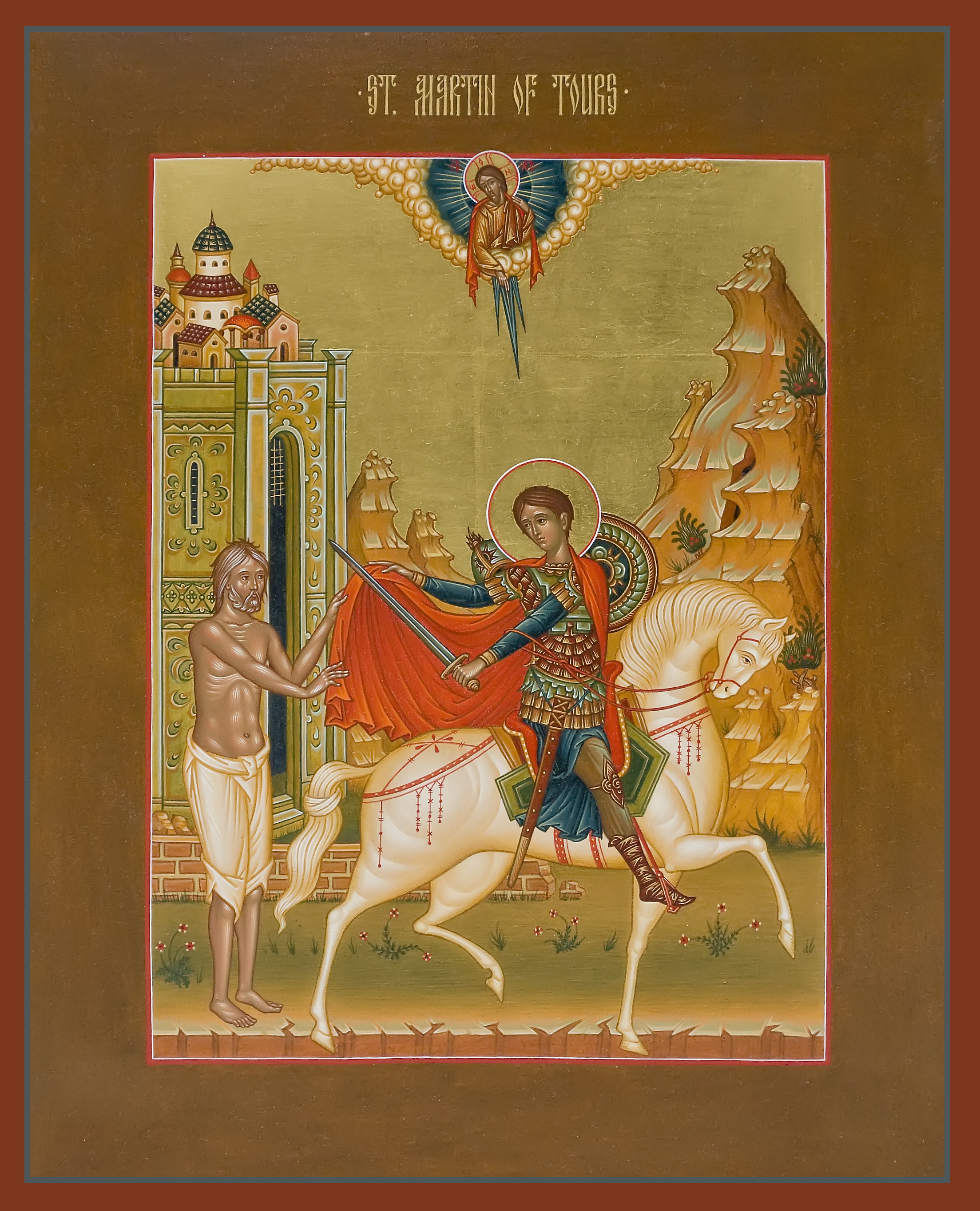
On February 13, the Russian Orthodox Church commemorates the appearance of Christ to Saint Martin of Tours (October 12 and November 11).
From childhood, Saint Martin was known for his compassionate heart and great pity for the poor. When he was twenty-two years old, even before he was baptized, he began to give away all his possessions to those in need, and soon he was left with just one set of clothes and a knife.
Saint Martin, like many young men, had to serve in the army for several years. One day, when the weather was very harsh and unusually cold, he met a man at the city gates of Amiens, almost naked, and begging for alms. Martin saw that people just walked past the man without taking any notice. Since Martin had already given away everything he owned, he had only his cloak and his uniform. No one else would help the beggar, so Martin felt that it was his responsibility to do something for him.
Recalling the Savior's words: "If anyone wishes to judge you and take away your tunic, let him have your cloak as well" (Matthew 5:40), Martin drew his sword and cut his cloak in two. Giving half to the beggar, he wrapped himself in the other half. Seeing him in the torn cloak, those standing by began to laugh at his strange appearance. Others, who had more sense, regretted the fact that they had done nothing for the man, although they could have clothed the beggar without uncovering themselves as Saint Martin did.
That night, in his sleep, Martin saw Christ wearing half of his cloak, which he had given the beggar. The Lord told him to look at Him and to notice that it was the same garment. Then the Savior said to the Angels who surrounded Him, "Martin is still just a catechumen, but he has clothed me in this garment."
Saint Martin did not become puffed up with pride because of this vision. Instead, he saw this as a sign of God's goodness, which confirmed Christ's words: "Truly, I say to you, inasmuch as you did it to one of the least of my brethren, you did it to me" (Matthew 25:40).
Because Saint Martin gave alms throughout his life, he was rewarded with the gift of working miracles. Let us follow his example so that we might be granted a small corner of Paradise.
Saint Seraphima
Saint Seraphima (Euthymia Euthymova Morgacheva, in the world), was born on September 14, 1806 in the village of Ningvo-Lomov in the diocese of Ryazan and lived an ascetical life at a monastery in Sezhenovo, Russia. She departed to the Lord in the year 1877.
Saint George, Archbishop of Mogilev, Belarus
Saint George (in the world Gregory Iosifovich Konissky) was born into a prominent family on November 20, 1717 in the town of Nezin. He studied at the Kiev Theological Academy and became a monk in the Kiev Caves Lavra.
Later he served as Archbishop of Mogilev, Belarus and reposed peacefully in the year 1795.
 Saint Peter Antiochian Orthodox Church