
MONDAY OF THE 15TH WEEK
NO FAST
Meletius, Archbishop of Antioch, Antonius, Archbishop of Constantinople, Meletios of Ypseni, Christos the New Martyr
ST. JAMES’ UNIVERSAL LETTER 2:14-26
Brethren, what does it profit if a man says he has faith but has not works? Can his faith save him? If a brother or sister is ill-clad and in lack of daily food, and one of you says to them, “Go in peace, be warmed and filled, ” without giving them the things needed for the body, what does it profit? So faith by itself, if it has no works, is dead. But some one will say, “You have faith and I have works.” Show me your faith apart from your works, and I by my works will show you my faith. You believe that God is one; you do well. Even the demons believe — and shudder. Do you want to be shown, you shallow man, that faith apart from works is barren? Was not Abraham our father justified by works, when he offered his son Isaac upon the altar? You see that faith was active along with his works, and faith was completed by works, and the scripture was fulfilled which says, “Abraham believed God, and it was reckoned to him as righteousness” and he was called the friend of God. You see that a man is justified by works and not by faith alone. And in the same way was not also Rahab the harlot justified by works when she received the messengers and sent them out another way? For as the body apart from the spirit is dead, so faith apart from works is dead.
MARK 10:46-52
At that time, as Jesus was leaving Jericho with his disciples and a great multitude, Bartimaios, a blind beggar, the son of Timaios, was sitting by the roadside. And when he heard that it was Jesus of Nazareth, he began to cry out and say, “Jesus, Son of David, have mercy on me!” And many rebuked him, telling him to be silent; but he cried out all the more, “Son of David, have mercy on me!” And Jesus stopped and said, “Call him.” And they called the blind man, saying to him, “Take heart; rise, he is calling you.” And throwing off his mantle he sprang up and came to Jesus. And Jesus said to him, “What do you want me to do for you?” And the blind man said to him, “Rabbi, let me receive my sight.” And Jesus said to him, “Go your way; your faith has made you well.” And immediately he received his sight and followed him on the way.
Saint Meletius, Archbishop of Antioch
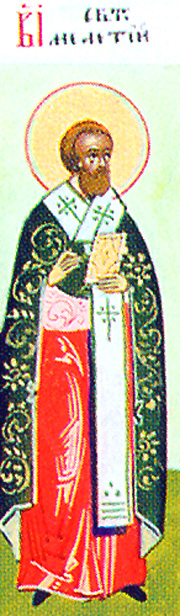
Saint Meletius, Archbishop of Antioch, was Bishop of Sebaste in Armenia (ca. 357), and afterwards he was summoned to Antioch by the emperor Constantius to help combat the Arian heresy, and was appointed to that See.
Saint Meletius struggled zealously against the Arian error, but through the intrigues of the heretics he was thrice deposed from his cathedra by the Emperor Constantius who had become surrounded by the Arians and had accepted their position. In all this Saint Meletius was distinguished by an extraordinary gentleness, and he constantly led his flock by the example of his own virtue and kindly disposition, supposing that the seeds of the true teaching sprout more readily on such soil.
Saint Meletius was the one who ordained the future hierarch Saint Basil the Great as deacon. Saint Meletius also baptized and encouraged another of the greatest luminaries of Orthodoxy, Saint John Chrysostom, who later eulogized his former archpastor.
After Constantius, the throne was occupied by Julian the Apostate, and the saint again was expelled, having to hide himself in secret places for his safety. Returning under the emperor Jovian in the year 363, Saint Meletius wrote his theological treatise, “Exposition of the Faith,” which facilitated the conversion of many of the Arians to Orthodoxy.
In the year 381, under the emperor Theodosius the Great (379-395), the Second Ecumenical Council was convened. In the year 380 the saint had set off on his way to the Second Ecumenical Council at Constantinople, and came to preside over it.
Before the start of the Council, Saint Meletius raised his hand displaying three fingers, and then withdrawing two fingers and leaving one extended he blessed the people, proclaiming: “We understand three hypostases, and we speak about a single nature.” With this declaration, a fire surrounded the saint like lightning. During the Council Saint Meletius fell asleep in the Lord. Saint Gregory of Nyssa honored the memory of the deceased with a eulogy.
Saint Meletius has left treatises on the consubstantiality of the Son of God with the Father, and a letter to the emperor Jovian concerning the Holy Trinity. The relics of Saint Meletius were transferred from Constantinople to Antioch.
Saint Alexei, Metropolitan of Moscow, Wonderworker of All Russia

Saint Alexei, Metropolitan of Moscow and All Russia the Wonderworker (in the world Eleutherios), was born in the year 1292 (or according to another source, 1304) at Moscow into the family of the noble Theodore Byakont, a descendant of the Chernigov princely line.
The Lord revealed to the future Saint his lofty destiny from early childhood. At twelve years of age Eleutherios went to a field and set nets to ensnare birds. He dozed off and suddenly he heard a voice: “Alexei! Why do you labor in vain? You are to be a catcher of men."
From this day on the boy abandoned childish games and spent much time in solitude. He often attended church, and when he was fifteen he decided to become a monk.
In 1320, he entered Moscow’s Theophany Monastery, where he spent more than twelve years in strict monastic struggles. The renowned ascetics of that monastery, the Elders Gerontios and Saint Stephen (July 14), the brother of Saint Sergius of Radonezh, were guides for him and his companions.
Metropolitan Theognostos, who noticed the virtuous life and spiritual gifts of Saint Alexei, bade the future Saint to leave the monastery and manage the ecclesiastical courts. The Saint fulfilled this office for twelve years. Toward the end of 1350, Metropolitan Theognostos had Alexei consecrated as Bishop of Vladimir. Following the Metropolitan's repose in the year 1354, Saint Alexei succeeded him.
During this period the Russian Church was torn by great rifts and quarrels, in part because of the pretensions of Metropolitan Romanos of Lithuania and Volhynia. In 1356, in order to put an end to the troubles and disturbances, the Saint went to Constantinople to see the Ecumenical Patriarch. Patriarch Kallistos gave Saint Alexei the right to be called, and to consider himself, as both Archbishop of Kiev and Great Russia with the title, “Most Venerable Metropolitan and Exarch.”
On his return journey, during a storm at sea, the ship was in danger of sinking. Saint Alexei prayed and vowed to build a temple to the Saint of that day on which the ship should come to shore. The storm subsided, and the ship arrived on August 16.
In spite of problems on every side, Saint Alexei devoted himself to his flock: he appointed bishops, and established cenobitic monasteries (on the model of the Trinity Lavra, founded by Saint Sergius), and he brought order to Russian relations with the Khans of the Horde. Saint Alexei journeyed more than once to the Golden Horde. In 1357 the Khan told the Great Prince that Saint Alexei should come to him and heal the blindness of his wife Taidulla.
“That is beyond my power,” Metropolitan Alexei replied, “but I believe that God, Who gave sight to the blind, will also help me.” By his prayers, and after sprinkling the Khan's wife with holy water, she was healed.
When Great Prince John died, his young son Demetrios (the future saint), then still a minor, was taken under the Saint Alexei's guardianship. The holy Hierarch had much difficulty in reconciling and appeasing the Princes, who obstinately refused to accept Moscow's authority. Nor did Vladyka Metropolitan neglect the work of establishing new monasteries.
In 1361 he founded a Monastery dedicated to the Icon of the Savior Not Made by Hands at the Yauza in Moscow. Andronikos, the disciple of Saint Sergius, was the first Igoumen of the Monastery, thus fulfilling the vow he had made on his return journey from Constantinople, when the ship was in danger.
Metropolitan Alexei also founded the Chudov Monastery1 in the Moscow Kremlin. Ancient monasteries were restored: the Annunciation Monastery at Nizhni-Novgorod, and Saints Constantine and Helen at Vladimir. In 1361 a women’s cenobitic monastery was named for him (Alekse'ev).
Saint Alexei reached the advanced age of seventy-eight, having spent twenty-four years upon the metropolitan cathedra. He reposed on February 12, 1378 and was buried at the Chudov Monastery in accordance with his last wishes. His relics were uncovered in a miraculous manner fifty years later, after which the memory of the great holy Hierarch and intercessor began to be commemorated.
Saint Alexei is also commemorated on May 20 (Recovery of his relics) and on October 5 (Synaxis of the Moscow Hierarchs).
1 The Monastery is dedicated to the Miracle of the Archangel Michael (September 6).
Saint Meletius, Archbishop of Khar'kov and Akhtyrsk

Saint Meletios, Archbishop of Khar'kov and Akhtyrsk (in the world Michael Ivanovich Leontovich), was born on November 6, 1784 in the village of Stara Stanzhara in the Poltava district.
In 1808 Michael Leontovich successfully completed the Ekaterinoslav religious Seminary. Since he was the best student, Archbishop Platon of Ekterinoslav sent him to Peterburg, to the Saint Alexander Nevsky Spiritual Academy.1 Graduating in 1814 with a Master's Degree, he was appointed as adjunct professor of Greek.
On March 11, 1817 they appointed Michael Leontovich as Secretary of the Academy Building Committee.
On July 30, 1817 he was transferred to the Kiev religious Seminary, serving in the position of Inspector, as well as Professor of Church History and Greek. When the Kiev Spiritual Academy opened on September 28, 1819, Michael became its first Inspector.
On February 11, 1820, on the eve of the Feast of Saint Meletios of Antioch, he was tonsured as a monk with the name Meletios, in the kathoikon of the Kiev-Bratsk Monastery, The tonsure was done by Metropolitan Eugene (Bolkhovitnikov). of Kiev. On February 22, 1820 the Monk Meletios was ordained to the diaconate by Metropolitan Eugene, and then as a Hieromonk on February 25.
On August 9, 1821 Hieromonk Meletios was appointed as Rector of the Mogilevsk religious Seminary and head of the Khutynsk Orshansk Monastery, and raised to the dignity of Archimandrite. In August 1823 he was appointed as Rector of the Pskov religious Seminary. On January 24,1824 Archimandrite Meletios was appointed as Rector of the Kiev Spiritual Academy.
In October 1826 the Holy Synod decided to name Archimandrite Meletios as Bishop of Chigirinsk, a vicar of the Kiev Diocese, and head of the Zlatoverkh Mikhailov Monastery. On October 19, 1826 he was elected as bishop, and on October 21, 1826 his consecration took place at Kiev's Holy Wisdom cathedral.
With paternal love, the Saint concerned himself with young foster-children, raising them in a spirit of devotion to the Church of Christ. He paid particular attention to the needy, widows, and orphans. He often visited those in prison and provided them the consolation of Divine Services in the prison churches. He was also concerned about the spiritual nourishment of the brethren of the Mikhailov Monastery. By his edifying discourses and personal example, he inspired the monks with the spirit of true asceticism. Saint Meletios said: "Humility is a protective sword, by which we pass over earth and Hades, to reach Heaven."
In April 1828 Saint Meletios was transferred to the cathedral in Perm.
Strict with himself, the Saint was also strict with others. To prepare candidates for accepting of the dignity of the priesthood, Saint Meletios himself wrote the so‑called "Ordinand's Catechism". In August 1831 Vladika was transferred to the See of Irkutsk, and elevated to the rank of Archbishop.
Vladika Meletios devoted much attention to the enlightenment of the lesser nations of Russia with the light of the Gospel. He founded churches in the north of Kamchatka, in the northeast parts of the Irkutsk Diocese and along the Aldan River, on the tract from Yakutsk to Okhotsk. He often reviewed his wide-spread Diocese, going to the shores of the Okhotsk and Arctic Seas, to the boundaries of North America, where Father John Veniaminov, the reknowned Apostle of Siberia (later known as Saint Innocent), the Apostle to America was.2 Journeying through Siberia and along the shores of the Pacific Ocean, Saint Meletios frequently interacted with the native peoples who professed Lamaism. Gently, he urged them to abandon their errors, and explained the Gospel truths to these pagan peoples: the Tungus, the Buryats, the Kamchadali, and also the inhabitants of the Kurile and Aleutian Islands.
Because of his tireless labors, Vladika's health began to deteriorate, and they transferred him to the Slobodsk-Ukraine See (later the See of Khar'kov and Akhtyrsk) in 1835.
Saint Meletios showed great interest in the institutions of spiritual learning, concerning himself with the life and education of the clergy.
The Archbishop raised questions about reopening the monasteries and spiritual schools which Empress Catherine II had closed. He also devoted much labor to the struggle with the schismatics.
On July 2, 1839 Saint Meletios led the service in the city of Akhtyrsk for the tenth anniversary of the appearance of the wonderworking Akhtyrsk Icon of the Mother of God.
The Saint's blessed repose occurred on the night of February 29, 1840. After receiving Holy Communion, he made the Sign of the Cross, and then he turned to everyone to say, "Forgive me." With those words, he departed to the Lord.
On March 4, 1840 Saint Meletios was buried by Bishop Iliodore of Kursk, in a crypt beneath the Church of the Cross at the Protection Monastery.
Immediately after his death, believers had great faith in the powerful intercession of Saint Meletios with God, and they received healing in sicknesses, comfort in sorrows, and deliverance from difficult circumstances. Believers in Khar'kov placed their trust in Saint Meletios during the terrible days of World War II. With miraculous advice, the Saint foretold the impending deliverance of the city from the enemy.
In 1948, with the blessing of His Holiness Patriarch Alexei, the coffin with the relics of Saint Meletios was transferred to the cathedral of the Annunciation.
On February 21, 1978, the Holy Synod of the Russian Orthodox Church "approved and blessed a Church Service and an Akathist to Saint Meletios, Archbishop of Khar'kov and Akhtyrsk," for use in all churches of the Moscow Patriarchate. The Service and Akathist to the holy Archpastor was composed by Archbishop Νikόdēmos of Khar'kov (later Metropolitan of Leningrad).
The shrine containing the Saint's relics, from which believers receive grace-filled help, the healing of ailments of the soul and body is located in the left (northern) aisle of the cathedral.
Saint Meletios is commemorated on February 12 (his Name Day) and on February 29 (the day of his repose).3
1 A Spiritual Academy ranks higher than a seminary.
2 Saint Innocent is commemorated on March 31 (the day of his repose), and on September 23 (the day of his glorification in 1977.
3 February 28 in non-Leap Years.
Venerable Mary (who was called Marinus), and her father, Venerable Eugene, at Alexandria

Saint Mary and her father Eugene lived at the beginning of the sixth century in Bithynia (northwestern Asia Minor). After the death of his wife, Eugene decided to withdraw to a monastery, but his daughter did not want to be separated from him, and so she accompanied him, dressed as a man. Together they entered a monastery not far from Alexandria, and the daughter received the name Marinus.
Marinus became accomplished in virtue, and distinguished by humility and obedience. After several years, when her father died, she intensified her ascetical efforts and received from the Lord the gift to heal those afflicted by unclean spirits.
One time the “monk” Marinus was sent with other monks to the monastery gardens, and along the way they had to spend the night at an inn. The inn-keeper’s daughter, having sinned with one of the lodgers, denounced Marinus and named “him” as the father of her child. The girl’s father complained to the igumen of the monastery, who expelled the “sinful brother.” The saint spoke not a word in her defense and began to live outside the monastery wall. When the hapless girl gave birth to a boy, the inn-keeper brought it to Marinus. Without a word he put his grandson down before her and left. The saint took the infant and began to raise him.
After three years the brethren begged the igumen to take back the “monk” Marinus into the monastery. The igumen, who very reluctantly gave in to their requests, began to assign Marinus very difficult obediences, which she fulfilled with the greatest of zeal, while also raising her foster child.
Three years later the saint peacefully reposed in her cell. The brethren saw the deceased “monk” and the boy crying over “him”. As they began to dress the saint for burial, her secret was revealed. The igumen of the monastery tearfully asked forgiveness of the departed, and the inn-keeper followed his example.
The body of Saint Mary was reverently buried in the monastery. The inn-keeper’s daughter came to the grave of the saint and openly confessed her sin. Immediately, she was freed from the evil spirit which had been tormenting her. The boy whom the saint was raising later became a monk.
The relics of the saint were transferred to Constantinople, and were carried off to Venice in 1113.
Saint Anthony, Patriarch of Constantinople
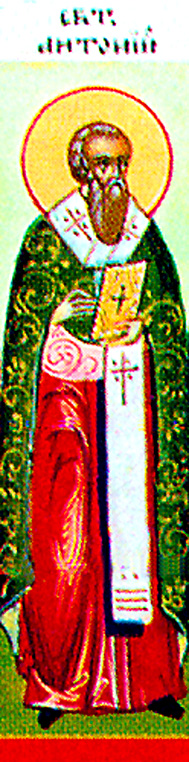
Saint Anthony, Patriarch of Constantinople, was a native of Asia, but lived in Constantinople from his youth. He was born around 829 of rich and pious parents. After the death of his mother, he entered a monastery at the age of twelve, where following the example of the igumen, he spent his nights in prayer and led a strict monastic life.
With the passage of time, and against his will, he was ordained to the holy priesthood. Later, at the insistence of the Patriarch, he was made an igumen. Serving in this rank, he tonsured his own father into monasticism. Saint Anthony was distinguished by his mercy, by his love and concern for the destitute, and he provided generous help to them.
Elevated to the Patriarchal throne at Constantinople in 893, Saint Anthony intensified his care for the destitute, and especially for their spiritual condition. With the assistance of the emperor Leo the Wise, Patriarch Anthony did much good for the Church, and encouraged piety in the people. He also built a monastery over the relics of Saint Kallia (February 12). Despite being stooped over with age, he went around all the churches, fulfilling the command of the Savior to be the servant of all the brethren.
In the year 895, advanced in age, Saint Anthony went peacefully to the Lord.
Saint Kristo the Gardener of Albania

The holy New Martyr Kristo was an Albanian who worked in a vegetable garden. At the age of forty, he decided to go to Constantinople to seek better business opportunities.
One day he was negotiating with a Turk who wished to purchase his entire stock of apples, but they were unable to agree on a price. The Turk became angry and accused Kristo of expressing a desire to become a Moslem. Kristo was brought before the authorities, and false witnesses were found to testify that he had indeed stated his intention to convert.
Kristo declared that he never said that he wished to become a Moslem. His testimony was discounted, however, because he was a Christian, and Moslem witnesses had contradicted him.
The saint was beaten and tortured the next day, but remained steadfast in his confession of Christ. Kaisarios Dapontes, a well known monk and author, visited Saint Kristo and got him freed from the place where he was chained. He brought food for him, but he refused to eat. “Why should I eat?” he asked. “I do not expect to live, so I may as well die hungering and thirsting for Christ.”
Since he refused to abandon the Orthodox Faith, Saint Kristo was sentenced to be beheaded. Before they led him away, Kristo gave Dapontes a metal file and told him to sell it and use the money to have memorial services offered for him.
On February 12, 1748 Saint Kristo the Gardener was beheaded, thereby receiving an imperishable crown of glory from Christ.
Ivḗron Icon of the Mother of God

During the reign of Emperor Theophilos (829-842) the Byzantine Empire was in turmoil because of the heresy of iconoclasm. In accordance with the Emperor’s orders, thousands of soldiers scoured the Empire, searching in every corner, city, and village for any hidden icons.
A pious widow living near the city of Nicaea had concealed an Icon of the Most Holy Theotokos in her home. Before long, the soldiers found it, and one of them stabbed it with his spear. By God’s grace this terrible deed was overshadowed by a miracle: blood began to flow from the wounded face of the Mother of God. The frightened soldiers ran away after witnessing this.
The widow spent the entire night keeping vigil and praying before the Icon of the Most Holy Theotokos. In the morning, by God’s will, she took the Icon to the sea and cast it upon the water. The holy Icon stood upright on the waves and began to drift westward.
Time passed, and one evening (circa 1004), the monks of Ivḗron Monastery on Mount Athos noticed a pillar of light, shining upon the sea like the sun. This miraculous sign lasted for several days, while the Fathers of the Holy Mountain gathered together and marveled. Finally they went down to the edge of the sea, where they beheld the pillar of light standing over the Icon of the Theotokos. When they approached, however, the Icon moved farther out to sea.
At that time a Georgian monk named Gabriel was living at the Ivḗron (Georgian) Monastery. The Theotokos appeared to the Athonite Fathers and told them that only Father Gabriel was worthy to retrieve the holy Icon from the sea. She also appeared to Father Gabriel and told him, “Go into the sea, and walk upon the waves with faith, and everyone shall witness my love and mercy for your Monastery.”
The monks found Father Gabriel and led him down to the sea, chanting hymns, and censing with holy incense. Father Gabriel walked upon the water as if it were dry land, and taking the Icon in his hands, he carried it back to shore. This miracle occurred on Bright Tuesday.
While the monks were celebrating a Service of thanksgiving, a cold, sweet spring miraculously gushed forth from the ground where the Icon was standing. Afterward, they took it into the church and placed in the sanctuary with great reverence.
The next morning one of the monks went to light the lamps in church and discovered that the Icon was no longer where they had put it; now it was on the wall near the entry gate. The monks took it down and returned it to the sanctuary, but the next day the Icon was found once again at the Monastery gate. This miracle recurred several times, until the All-Holy Virgin appeared to Father Gabriel, saying, “Inform the brethren that from now on they must not carry me away. For what I desire is not to be protected by you; but instead I shall protect you, both in this life, and in the age to come. As long as my Icon remains in the Monastery, the grace and mercy of my Son shall never be lacking!”
Filled with great joy, the monks built a small church near the Monastery gate in honor of the Mother of God, and placed the wonderworking Icon inside. This holy Icon came to be known as the “Ivḗron Mother of God” or Πορταΐτισσα in Greek.1 Through the intercession of the Most Holy Theotokos, many miracles have taken place and continue to take place throughout the world.
1 Πορταΐτισσα = The Gate-Keeper.
Saint Prochorus of Georgia

Saint Prochorus the Georgian, a descendant of the noble Shavteli family, was born at the end of the 10th century and grew up in a monastery. When he reached manhood he was ordained a hieromonk and labored for one year at the Lavra of Saint Savva in Jerusalem. Then, with the blessing of his spiritual father Ekvtime Grdzeli, he began the reconstruction of the Holy Cross Georgian Monastery near Jerusalem.
According to tradition, at this spot Abraham’s nephew Lot planted three trees—a cypress, a pine, and a cedar. Eventually these three trees miraculously grew into one large tree. When the Temple of Solomon was being built, this tree was cut down but left unused. It is said that the Cross on which Christ our Savior was crucified was constructed from the wood of this tree.
In the 4th century, the land on which the miraculous tree had grown was presented to Holy King Mirian, the first Christian king of Georgia. Then in the 5th century, during the reign of Holy King Vakhtang Gorgasali, the Holy Cross Monastery was founded on that land. The monastery was destroyed several times between the 7th and 9th centuries.
Finally, in the 11th century, King Bagrat Kuropalates offered much of his wealth to Fr. Prochorus for the restoration of the monastery. Saint Prochorus beautified the monastery, then gathered eighty monks and established the typicon (the monastic rule) for the community in accordance with that of the Saint Savva Lavra.
When Saint Prochorus had labored long and lived to an advanced age, he chose his disciple Giorgi to be the monastery’s next abbot.
Then he departed for the wilderness with two of his disciples, and after some time the righteous monk yielded up his spirit to God.
Beyond this, little is known about the life of Saint Prochorus. According to Georgian researchers and scholars, he was probably born sometime between 985 and 990. He spent the years 1010 to 1015 in Jerusalem, and labored at the Lavra of Saint Savva until 1025. He reposed in the year 1066, between the ages of 76 and 81.
Martyr Nicholas (Nikoloz) Dvali in Jerusalem
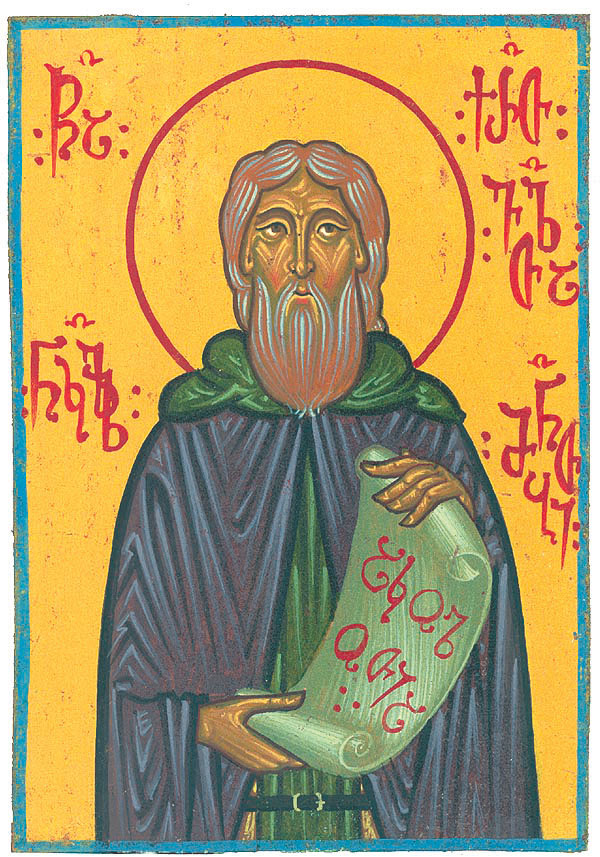
Saint Nikoloz Dvali the Martyr was born at the end of the 13th century to a God-fearing couple who directed his path toward the spiritual life.
At the age of twelve Nikoloz traveled to the Klarjeti Wilderness and was tonsured a monk. From there he made a pilgrimage to Jerusalem and remained in the holy city, settling at the Holy Cross Monastery. Burning with desire for the apostolic life, Monk Nikoloz was determined to die a martyr’s death.
In Jerusalem a group of godless men arrested and tormented Saint Nikoloz for publicly confessing the Christian Faith, but a group of Christians succeeded in rescuing him from prison. Then, in accordance with his abbot’s counsel, Saint Nikoloz relocated to a Georgian monastery on Cyprus. There the pious monk beseeched the Lord to make him worthy of the crown of martyrdom. One day, while he was praying before the icon of Saint John the Baptist, he heard a voice saying, “Nikoloz! Arise and go to Jerusalem. There you will find a Georgian monk who will teach you the way of righteousness and encourage you on the path of martyrdom. He has been appointed to guide you.”
Accordingly, Saint Nikoloz returned to Jerusalem, met the monk whom God had appointed, and informed him of what had been revealed. The Most Holy Theotokos and Saint John the Baptist appeared to Saint Nikoloz’s spiritual father, who had been praying intensely for guidance, and told him that it was the Lord’s will for Nikoloz to journey to Damascus.
While in Damascus, the holy father entered a mosque and openly confessed Christ to be the Savior, reproving those present for their folly. The angry Muslims seized Saint Nikoloz, beat him, and cast him into prison. After a great struggle, the metropolitan and local Christians succeeded in recovering him from captivity, but he immediately returned to the Muslims and began again to denounce their ungodly ways. Again they beat him mercilessly, lashed him five hundred times, and cast him in prison for a second time. But the holy martyr’s wounds were healed through the miraculous intercession of Saint John the Baptist, and after two months he was released from prison.
By chance the emir of the city caught a glimpse of Saint Nikoloz as he was preparing to return to Jerusalem. The emir recognized him and sent him to Dengiz, the emir of emirs. Dengiz flattered him and offered to convert him to Islam, but Saint Nikoloz bravely defended his faith in Christ. In response, Dengiz ordered his execution.
At the hour appointed by Dengiz, the blessed martyr turned to the east, joyfully bowed his neck to the sword, and prayed, “Glory to Thee, O Christ God, Who hast accounted me worthy to die for Thy name’s sake.” The sword pierced his neck, but the severed head glorified God seven times, crying out, “Glory to Thee, O Christ our God!”
The Persians burned the saint’s body, and for three days a pillar of light shone at the place where it lay.
When Saint Nikoloz’s spiritual father heard about his martyrdom, he prayed to God to reveal to him whether Nikoloz would be numbered among the saints. Then one day while he was reading, he saw a vision of a host of saints standing atop a mountain, illumined and surrounded by a cloud of incense. Among them the Great-martyr George shone especially brightly, and he called Saint Nikoloz, saying, “Nikoloz! Come and see the monk, your spiritual father. He has shed many tears for you.”
Nikoloz greeted his spiritual father, saying, “Behold me and the place where I am, and from this day cease your sorrowing for me.”
Saint Nikoloz Dvali was tortured to death on Tuesday, October 19, in the year 1314. The Georgian Church continues to commemorate him on that date.
Saint Bassian of Uglich
Saint Bassian of Uglich was a disciple of Saint Paisius of Uglich (June 6). He was born in the village of Rozhalov, in the Kesov district of the city of Bezhetsk Verkha. He was descended from the Shestikhin princes, whose ancestor was the prince Saint Theodore of Smolensk (September 19).
Saint Bassian came to the Protection monastery when he was thirty-three years of age, and was soon tonsured by Saint Paisius. He fulfilled his obediences without complaint and lived in great abstinence. In 1482, Saint Bassian discovered the Protection Icon of the Most Holy Theotokos. Having spent twenty years at the monastery of Saint Paisius, Saint Bassian then asked a blessing to live in silence. His teacher blessed him saying, “Go my child, be guided by Christ with the blessed yoke of the Lord as it pleases Him. Soon you yourself shall form your own monastery and gather a monastic flock to the glory of the the Most Holy Trinity.”
In 1492 Saint Bassian left the monastery and, after spending time at the Nikolo-Uleimsk monastery, he went to a remote place thirty versts south of Uglich and began to live as a hermit. Soon people learned of his solitary habitation and began to come for advice and guidance.
In 1492, the saint built a wooden church dedicated to the Most Holy Trinity, and soon those wishing to live the monastic life came to be guided by him. Saint Bassian did not cease his relationship with his teacher until the latter’s death, at which he was present together with other disciples.
Having dwelt at the Trinity monastery for seventeen years, Saint Bassian died on February 12, 1509. Three years later, a man named Gerasimus received healing from unclean spirits at his grave, and another fellow named Valerian was healed of palsy.
Saint Bassian was glorified in 1548 at the uncovering of his incorrupt relics, over which a stone crypt was built. Saint Bassian is commemorated twice during the year: on the day of his repose, February 12, and on June 6 with his spiritual teacher Saint Paisius of Uglich.
Martyr Luke (Luka) of Jerusalem, the Georgian
The holy martyr Luka of Jerusalem lived in the 13th century. He was born to an honorable, pious Georgian family by the name of Mukhaisdze. After the repose of Luka’s father, his mother left her children and went to labor at a monastery in Jerusalem.
When Luka reached the age of twenty, he traveled to Jerusalem to visit his mother and venerate the holy places. After spending some time there he decided to remain and be tonsured a monk. He was later ordained a deacon and became fluent in Arabic. Soon the brothers of the monastery recognized his wisdom and asked him to guide them as abbot. For three years Luka directed the monastery in an exemplary manner.
But the devil was envious of the holy father and provoked a certain Shekh-Khidar, an influential Persian at the court of Sultan Penducht [probably Sultan Zakhir-Rukedin-Baibars-Bundukdar of Egypt (1260-1277)] to take up arms against Saint Luka. Sultan Penducht then transferred possession of the Holy Cross Monastery to Shekh-Khidar, who “treated the Georgian monks in a beastly manner and finally ousted them from the monastery altogether.” Fulfilling his God-given duty, the blessed Luka insisted on personally confronting Shekh-Khidar in defense of his brotherhood.
Luka’s Christian brothers and sisters warned him, saying, “Shekh-Khidar is threatening you…. Flee and hide from him!” But Luka paid no heed to their admonitions, certain that it was more fitting to die for Christ than to live for the world. As he had insisted, he himself approached Shekh-Khidar and asked for the release of the imprisoned fathers.
Luka told him that he was prepared to accept any demands. The wicked Persian leader demanded nothing from Luka except that he convert to Islam, promising to make him emir if he consented. When he refused, the furious Shekh-Khidar ordered Saint Luka’s beheading.
After the terrible deed had been performed, Saint Luka’s severed head turned toward the east and gave thanks to God with an expression of pure peace. Soon after, his precious body was set on fire at the command of the bewildered Shekh-Khidar. This occurred in 1277.
 Saint Peter Antiochian Orthodox Church