
Here is the live stream for Orthros and Divine Liturgy – Sun. Dec 3, 2023 If you need, here are instructions for accessing this content from your phone, tablet, computer, or TV.
Monthly Archives: December 2023
Daily Readings for Sunday, December 03, 2023
14TH SUNDAY OF LUKE
ABSTAIN FROM MEAT, DAIRY, EGGS
14th Sunday of Luke, The Holy Prophet Sophonias (Zephaniah), Our Righteous Father John, Bishop and Hesychast, Holy Martyrs Agapius and Seleucius, Theodore, Archbishop of Alexandria, Angelis the New Martyr, Karpos the Hieromartyr
ST. PAUL’S LETTER TO THE EPHESIANS 5:8-19
Brethren, walk as children of light (for the fruit of light is found in all that is good and right and true), and try to learn what is pleasing to the Lord. Take no part in the unfruitful works of darkness, but instead expose them. For it is a shame even to speak of the things that they do in secret; but when anything is exposed by the light it becomes visible, for anything that becomes visible is light. Therefore it is said, “Awake, O sleeper, and arise from the dead, and Christ shall give you light.” Look carefully then how you walk, not as unwise men but as wise, making the most of the time, because the days are evil. Therefore do not be foolish, but understand what the will of the Lord is. And do not get drunk with wine, for that is debauchery; but be filled with the Spirit, addressing one another in psalms and hymns and spiritual songs, singing and making melody to the Lord with all your heart.
LUKE 18:35-43
At that time, as Jesus drew near to Jericho, a blind man was sitting by the roadside begging; and hearing a multitude going by, he inquired what this meant. They told him, "Jesus of Nazareth is passing by." And he cried, "Jesus, Son of David, have mercy on me!" And those who were in front rebuked him, telling him to be silent; but he cried out all the more, "Son of David, have mercy on me!" And Jesus stopped, and commanded him to be brought to him; and when he came near, he asked him, "What do you want me to do for you?" He said, "Lord, let me receive my sight." And Jesus said to him, "Receive your sight; your faith has made you well." And immediately he received his sight and followed him, glorifying God; and all the people, when they saw it, gave praise to God.
Prophet Zephaniah
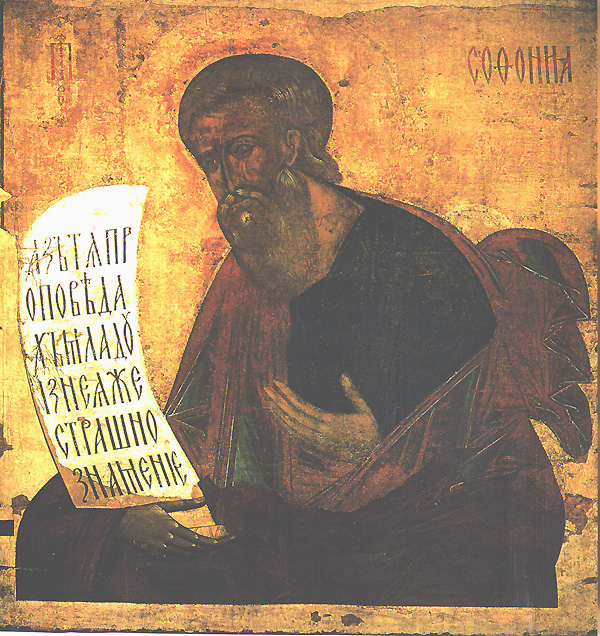
The Prophet Zephaniah (Sophonias) was a contemporary of the Prophet Jeremiah and the Prophetess Oldama. He was from the tribe of Simeon, and was the ninth of the Twelve Minor Prophets of the Old Testament. The prophet lived at the royal court, where he preached repentance and helped King Josiah eliminate idol-worship.
He prophesied about the calamities that were to come for the people of Judea and the surrounding regions: Gaza, Ascalon, Crete, and against the Moabites, the Ammonites and the Ninevites.
Venerable Savva, Igoumen of Zvenigorod, Disciple of Venerable Sergius of Radonezh

Saint Savva of Zvenigorod forsook the world in his early youth, and received the monastic tonsure from Saint Sergius of Radonezh (September 25 and July 5), and was his disciple and fellow-ascetic.
Saint Savva loved solitude, and avoided conversing with people. He lived in constant toil, lamenting the poverty of his soul, and trembling before the judgment of God. He was a model of simplicity and humility, and he attained such a depth of spiritual wisdom that “in the Monastery of Saint Sergius he was the Father Confessor to all the brethren, a venerable and most learned Elder.”
When Great Prince Demetrios of the Don built the Monastery of the Dormition of the Mother of God at the Dubenka River, in gratitude for the victory over Mamai, Savva became the Igoumen, with the blessing of Saint Sergius. Maintaining the simple manner of his life of asceticism, he ate plants, wore coarse clothing and slept on the ground.
When their Igoumen Saint Nikon (November 17) left to go into the wilderness in 1392, the brethren of the Trinity-Saint Sergius Lavra asked Saint Savva to become the Igoumen of the Monastery. He shepherded the flock entrusted to him well, to the best of his ability, helped by the prayers of his Spiritual Father, Saint Sergius. According to Tradition, the well outside the Lavra walls was built while he was Igoumen.
Prince Yuri of Zvenigorod, a godson of Saint Sergius, regarded Saint Savva with much love and esteem. He chose Saint Savva as his Spiritual Father and begged him to come and bestow his blessing upon his entire household. The Saint had hoped to return to his Monastery, but the Prince begged him to stay and establish a new monastery in his homeland, near Zvenigorod, at a place called Storozhev.
Saint Savva acceded to Prince Yuri's request, and praying tearfully before an icon of the Mother of God, he entreated her protection for that site in the wilderness. At Storozhev he built a small wooden church in honor of the Nativity of the Most Holy Theotokos, and nearby a small cell for himself. Here he established a Monastery in 1399, and with paternal love, he accepted all who came seeking a life of quietude and seclusion.
Saint Savva worked very hard to build up the Monastery. He dug a well at the foot of the hill, from which he carried water on his own shoulders. He encircled the Monastery with a wooden palisade, and in a hollow above it, he dug a cell where he could live in solitude.
In 1399 Saint Savva blessed his spiritual son, Prince Yuri, to go on a military campaign, predicting that he would defeat his enemy. Through the prayers of the holy Elder, the Prince's army won a speedy victory. Through the efforts of Saint Savva, a stone church of the Nativity of the Most Holy Theotokos was built to replace the old wooden one.
After appointing his disciple, who was also named Savva, as his successor, Saint Savva went to the Lord at an advanced age on December 3, 1406. News of the holy God-pleaser's repose quickly spread throughout the vicinity, and all the Christ-loving citizens of Zvenigorod, both noble and commoners, gathered for the burial of the departed Saint, bringing with them the infirm and sick. After singing hymns over the deceased, they buried him with honor in the church of the Nativity of the Most Holy Theotokos, which he himself had built.
Veneration of the holy God-pleaser by the local people began immediately after his death. The miraculous curative power issuing from the Saint's grave and his numerous appearances convinced everyone that Igoumen Savva was a Saint. In a letter of 1539 Saint Savva was described as a wonderworker. Tsar Alexei Mikhailovich had a special veneration for him, frequently visiting the Monastery of Saint Savva on foot. Tradition has preserved a remarkable account of how Saint Savva was saved from a ferocious bear.
The Life of Saint Savva, compiled in the XVI century, relates that at the end of the XV century (1480-1490), the Saint appeared to Father Dionysios, the fourth Igoumen of Saint Savva Monastery and said: “Dionysios! Wake up and paint my icon.” When Father Dionysios asked who he was, he replied, “I am Savva, the founder of this abode.”
Father Dionysios had not known the Saint personally, so he summoned Elder Habakkuk, who had known Saint Savva in his youth, hoping to convince himself that his dream was not a delusion. He described the Saint's outward appearance, and Father Habakkuk assured him that the Saint looked exactly as the Igoumen had seen him in his dream. Then Father Dionysios obeyed Saint Savva's order and painted his icon.
Saint Savva was numbered among the Saints at the Moscow Council of 1547. His incorrupt relics were recovered on January 19, 1652.
The first uncovering of the Saint's relics occurred on January 19, 1652; and the second on August 10, 1998.
Saint Theodoulus, Eparch of Constantinople
Saint Theodoulus was an eparch during the reign of Theodosius the Great. He resigned his position because he did not want to be distracted by vain worldly cares.
After his wife’s death, Saint Theodoulus gave his wealth away to the poor and became a monk. He traveled to Edessa and lived on top of a pillar for thirty years, eating only once a week.
Saint Theodoulus the Stylite departed to the Lord around 440.
Venerable John the Silent of Saint Sabbas Monastery
Saint John the Silent was born around 454 in the city of Nicopolis, Armenia into the family of a military commander named Enkratius and his wife Euphemia. The boy began to study Holy Scripture, and he loved solitude and prayer with all his heart.
With the inheritance his parents left him, John built a church dedicated to the Most Holy Theotokos. At eighteen years of age, John became a monk, living an ascetic life of fasting, prayer, and temperance with ten other monks at the church he had founded.
At the request of the citizens of Colonia, the Metropolitan of Sebaste consecrated the twenty-eight-year-old John as Bishop of Colonia. Having assumed the episcopal throne, the saint did not alter his strict ascetic manner of life. Under the influence of the saint his relatives, his brother Pergamios (an associate of the emperors Zeno and Anastasius) and his nephew Theodore (an associate of the emperor Justinian), also lived in a Christian manner.
In John’s tenth year as bishop, the governorship of Armenia was assumed by Pazinikos, the husband of the saint’s sister, Maria. The new governor began to interfere in spiritual and ecclesiastical matters, and there was unrest in the Church. Saint John then went to Constantinople, and through Archbishop Euthymius, he entreated the emperor Zeno to defend the Armenian Church from the evil Governor.
Overwhelmed by worldly quarrels, John secretly left his diocese and sailed to Jerusalem. With tears he besought God to show him a place where he might live and find salvation. A bright star appeared, which led Saint John to the Lavra of Saint Savva.
John, concealing his episcopal rank, was accepted in the community as a simple novice. Under the guidance of the igumen Saint Savva(December 5), Bishop John toiled obediently for more than four years at every task he was assigned. When a guesthouse was built at the Lavra, Saint John served the workers, serving their food and assisting in the construction of the building. When a cenobitic monastery for novices was being built, John was once again assigned to help the workers.
Seeing Saint John’s humility and love of labor, Saint Savva deemed him worthy of ordination to presbyter. Saint John was forced to reveal his rank to Patriarch Elias of Jerusalem (494-517), who told Saint Savva that John could not be ordained. Moreover, he said that John was to live in silence, and that no one should trouble him. Soon the Lord also revealed Saint John’s secret to Saint Savva. Saint John spent four years in his cell, receiving no one and not going out even for church.
Desiring ever greater solitude and increased abstinence, Saint John quit the Lavra and withdrew into the desert, where he spent more than nine years, eating plants and grass. He survived a devastating incursion of the Saracens and did not perish, only because the Lord sent him a defender: a ferocious lion. When the enemy tried to harm the saint, the lion attacked them and they scattered in fright. Tradition speaks of many miracles Saint John performed during this time in the desert.
When Saint Savva returned after an extended stay in Scythopolis, he persuaded Saint John to forsake the wilderness and to live at the monastery. After this, the Lord, in a miraculous way, revealed to everyone at the Lavra that the monk John was actually a bishop.
When Saint John reached age seventy, his holy and God-bearing spiritual Father Saint Savva died. The saint grieved deeply over this, since he was not present at the time. Saint Savva appeared to him in a vision, and having consoled him, he foretold that there would be much toil ahead in the struggle against heresy. Saint John even had to leave his solitude to strengthen the brethren in the struggle with the Origenists.
Saint John the Silent spent sixty-six years at the Lavra of Saint Savva the Sanctified. Through his constant ascetic efforts, by his untiring prayer and humble wisdom, Saint John acquired the grace of the Holy Spirit. At his prayers, many miracles took place, and he was able to discern the secret thoughts of people. He healed the sick and those possessed by demons. Even during his lifetime he saved those who invoked his name from certain destruction. Once, he scattered fig seeds on barren rock, and a beautiful and fruitful tree sprang up. In time, the tree grew so much that it overshadowed the saint’s cell.
Saint John the Silent departed to the Lord in peace at the age of 104.
Hieromartyr Theodore, Archbishop of Alexandria

The Hieromartyr Theodore, Bishop of Alexandria, was born in Egypt in the city of Alexandria. This city was famous for its many martyrs and confessors: from the holy Evangelist Mark, Protomartyr of Alexandria (April 25), to Saint Athanasius the Great (January 18 and May 2), a pillar and confessor of Orthodoxy.
Regrettably, historical records do not give us precise details of Saint Theodore’s life and deeds, but the Church of Christ has preserved the name of the hieromartyr in its diptychs for all time.
A fiery preacher, powerful of word and church activity, Bishop Theodore evoked an angry hatred in the boisterous pagans of Alexandria, who did not like his preaching. During one of his sermons they surrounded and seized the saint. They beat him and jeered at him, but he did not offer resistance. They placed a crown of thorns on his head, and led him through the city.
Then they led him to the seacoast and threw him from a cliff into the sea, but the wind and the waves carried him back to dry land. The astonished pagans brought Saint Theodore to the prefect of the city, who commanded that he be subjected to harsh tortures. Not a word did the torturers hear from the tortured confessor, except his prayer to the Lord. Then the holy martyr was handed over to Roman soldiers and executed in the manner of the Apostle Paul, he was beheaded with a sword.
Monastic Martyr Cosmas of Saint Anne Skete, Mount Athos
Saint Cosmas was a monk of Saint Anne’s Skete on Mount Athos. He was executed in Constantinople on December 3, 1760 when he refused to convert to Islam. The specific details of his martyrdom are not known.
Venerable George of Cernica
Venerable George was born in 1730 to pious Orthodox parents in the town of Sălişte, near Sibiu in Romania. From his youth he was inclined toward the monastic life. However, at that time the Roman Catholic Austrian rulers of Transylvania tried to suppress Orthodoxy, especially Orthodox monasticism, in order to make the faithful unite with them. Therefore, at the age of nineteen, the young man went to Wallachia and came to the Greek Metropolitan Rosca, who was in Bucharest at that time. He became George's Spiritual Father.
Shortly thereafter, in 1750, he accompanied his Spiritual Father to Constantinople, and then to Mount Athos. There he settled at Vatopaidi Monastery, and was tonsured as a monk, and later he was ordained as a deacon. After the repose of his Elder, he became a disciple of Saint Paϊsios Velichkovsky at the Prophet Elias Skete. There, in 1752, Saint Paϊsios tonsured Father George into the Great Schema. Two years later he was ordained as a Hieroschema-monk for the Romanian community at Saint Elias Skete.
During his stay on Mount Athos he advanced with great zeal and much spiritual benefit, on the ladder of spiritual perfection, In 1763, together with sixty-four other disciples, he followed Saint Paϊsios to Dragomirna Monastery in Moldavia. For the next twelve years, he served this Monastery as a Hieromonk, Confessor, and steward.
When Bukovina fell under the power of Roman Catholic Austria in 1775, the Dragomirna brethren, led by Elder Paϊsios, moved to Secu Monastery. In 1779, he followed Saint Paϊsios to Neamț Monastery, where he lived for another two years. In 1781, with the blessing of his Elder he went to Mount Athos again.
On his return to Bucharest, he met Metropolitan Gregory II of Wallachia, who was a disciple of Saint Paϊsios, and his old friend Hieromonk Makarios. After their persistent persuasion, followed by prayer and fasting, and a vision of Saint Nicholas, he agreed to undertake the revival of monastic life at Cernίca Monastery, which was dedicated to Saint Nicholas, and which had been in ruins for more than thirty years. His task was to establish a monastery in this region of Wallachia with a cenobitic Rule, similar to the Athonite and Paisian monasteries.
With the help of the Wallachian ruler Nicholas Mavrogenes and other Christians, Father George began to restore the main church and the cells. He devoted a lot of time to perfecting the spiritual life of the monks. In the monastery the Services were performed every day, along with reading the Holy Scriptures and the works of the Holy Fathers of the Church, and work which was carried out in numerous obediences: including copying manuscripts and physical labor. With his sacrificial and gifted shepherding, he revived the spiritual life at Cernίca Monastery. After just five years, the community grew to 103 monks.
In 1785, Saint George became gravely ill and, expecting his imminent demise, made his will in which he prescribed the proper order of life of the monastic community. However, he soon recovered and continued his pastoral labors.
In view of his successes, in 1793, Metropolitan Philaret II of Wallachia also assigned him to Căldărușani Monastery. From April 1794, Father George lived in both monasteries alternately, appointing Igoumens in them, especially during his absence. In both monasteries he introduced the Athonite-Paisian cenobitic Rule, which included worship seven times a day, frequent Confession, obedience, constant prayer, and a common meal.
Saint George continued to manage both monasteries until the very end of his earthly life. He reposed on December 3, 1806, lamented by the numerous brethren of the two monasteries. He was buried at Cernica Monastery, in front of the church of Saint Lazarus.
After Saint George's repose, he was venerated as a pastor of high spiritual life, the leader of the two great monastic centers of Wallachia, a renewer of the true monastic life of the Athos and Paisian hesychastic tradition. The Elder had many disciples and followers, such as Saint Kallinikos of Cernίca, Hieromonk Makarios and others.
At the meeting of the Holy Synod of the Romanian Orthodox Church on October 20-21, 2005, Elder George was glorified and numbered among the Saints. The formal announcement of his canonization took place at Cernίca Monastery on the day of his commemoration December 3, 2005, with Patriarch Theoktistos of Romania presiding at the Service.
By the decision of the Holy Synod of the Russian Orthodox Church of August 21, 2007, Saint George's name was included in the Synaxarion of the Russian Orthodox Church.
New Martyr Angelos of Chios

No information available at this time.
Great Vespers – Sat. Dec 2, 2023
Here is the live stream for Great Vespers – Sat. Dec 2, 2023 If you need, here are instructions for accessing this content from your phone, tablet, computer, or TV.
Daily Readings for Saturday, December 02, 2023
SATURDAY OF THE 11TH WEEK
ABSTAIN FROM MEAT, DAIRY, EGGS
Habakkuk the Prophet, Our Righteous Father Cyril of Phileus, Myrope the Martyr of Chios, Porphyrios of Kavsokalyvia, Joannicos the Monk of Devich, Theophilos the Hermit
ST. PAUL’S LETTER TO THE GALATIANS 3:8-12
Brethren, the scripture, foreseeing that God would justify the Gentiles by faith, preached the gospel beforehand to Abraham, saying, “in you shall all the nations be blessed.” So then, those who are men of faith are blessed with Abraham who had faith. For all who rely on works of the law are under a curse; for it is written, “Cursed be every one who does not abide by all things written in the book of the law, and do them.” Now it is evident that no man is justified before God by the law; for “the righteous shall live by faith”; but the law does not rest on faith, for “He who does them shall live by them.”
LUKE 12:32-40
The Lord said, “Fear not, little flock, for it is your Father’s good pleasure to give you the Kingdom. Sell your possessions, and give alms; provide yourselves with purses that do not grow old, with a treasure in the heavens that does not fail, where no thief approaches and no moth destroys. For where your treasure is, there will your heart be also. Let your loins be girded and your lamps burning, and be like men who are waiting for their master to come home from the marriage feast, so that they may open to him at once when he comes and knocks. Blessed are those servants whom the master finds awake when he comes; truly, I say to you, he will gird himself and have them sit at table, and he will come and serve them. If he comes in the second watch, or in the third, and finds them so, blessed are those servants! But know this, that if the householder had known at what hour the thief was coming, he would not have left his house to be broken into. You also must be ready; for the Son of man is coming at an unexpected hour.”
Venerable Alexei (Kabalyuk)

Saint Alexei (in the world Alexander Kabalyuk) was a missionary and an outstanding figure of the Orthodox Church of the Czech Lands and Slovakia at the turn of the XIX and XX centuries. He was born on September 1, 1877 into the family of a lumberjack in Transcarpathia, and was named after the Right-believing Prince Alexander Nevsky.
As a young man he became a novice in the Uniate monastery of Kish-Baranya, but soon he went to Mount Athos, to the Russian Monastery of the Great Martyr Panteleimon, where he converted to Orthodoxy. From there he was sent to Russia as a novice in the Monastery of Saint Onoúphrios Yablochinsky in the Kholm region. On May 5, 1910 he was tonsured as a monk, and on August 15, 1910 he was ordained as a Hieromonk.
He returned to Carpatho-Russia and began preaching Orthodoxy among the Uniates. As a result of his missionary activities, by 1912, about 35,000 Uniates had returned to Orthodoxy in the villages of Iza, Velikiye Luchki, Yasinya, Khust, Lipcha, Belki, Ilnitsa, Chumalevo, Tereblya, etc..
When Father Alexei returned to Austria-Hungary, the Catholic authorities conducted the Marmoros-Sigoth trial (1913–1914), where he was accused of "treason" and sentenced to imprisonment in the Thalerhof concentration camp with 95 other Carpatho-Russian Orthodox patriots.
In his closing remarks, Father Alexei expressed the thoughts of all those who were sentenced: "Here is a religious trial… Here, as in a church, there are believers and I, as their priest… We are not to blame for anything. All that we have done was done exclusively for the Orthodox Faith and for the good of the people; therefore the final word in this matter will be spoken by Jesus Christ Himself… If we must suffer, we shall suffer for the sacred things…. There, in heaven, they know that there was only one desire in our hearts: to establish our spiritual life."
On August 17, 1921, Father Alexei was chosen as Igoumen of the Saint Nicholas Monastery in Iza. In 1923 (1925?) he was elevated to the rank of Archimandrite.
In 1944 Father Alexei went to Moscow, as the head of a delegation of the Carpatho-Russians together with Archimandrite Theophanes (Sabov) and Professor P. Linkur, he arrived in Moscow asking them to accept the Carpatho-Russians. He also had an audience with Metropolitan Vladimir and Archbishop Platon, who came from the United States. They advised him to come to America, where there was a large Carpatho-Russian colony, in order to avoid being persecuted by the authorities.
There the venerable one continued his missionary labors, and many thousands of Carpatho-Russians returned to the faith of their Fathers. He was assigned to a parish, but he did not forget his homeland. He carried on a lively correspondence, providing information on the status of the Orthodox movement, and also informed the Orthodox in America, all of whom sided with the sufferers.
He was one of the initiators of the transfer of the Autonomous Carpatho-Russian Orthodox Church from the Serbian Patriarchate to the Moscow Patriarchate and Associations of Serbian and Constantinople Orthodox Jurisdictions of Carpatho-Russia under the authority of the Patriarch of Moscow (Act of October 22, 1945 on the accession of the Mukachevo-Pryashev diocese to the Russian Orthodox Church).
On November 19/December 2, 1947, Saint Alexei reposed at the Dąbok Convent. He was buried in the cemetery of the village of Iza, Khust district in the Transcarpathian region in Ukraine. His relics were recovered on March 12, 1999.
The glorification of the Holy Confessor Alexei of Carpatho-Russia took place on November 21, 2001.
It is very difficult to appreciate all the things Saint Alexei did for his people; many monasteries were opened because of his efforts, and many people came to the true Faith through his sermons and prayers.
Prophet Habakkuk

The Holy Prophet Habakkuk, the eighth of the Twelve Minor Prophets, was descended from the Tribe of Simeon, and he prophesied around 650 B.C.
The Prophet Habakkuk foresaw the destruction of the Jerusalem Temple, the Babylonian Captivity and the later return of the captives to their native land. During the war with the Babylonians the prophet withdrew to Arabia, where the following miracle occurred. When he was bringing dinner to the reapers, he met an angel of the Lord, and instantly by the strength of his spirit he was transported to Babylon, where at the time the Prophet Daniel was languishing in prison. The food intended for the reapers assuaged the hunger of the exhausted Prophet Daniel (Dan. 14:33-37).
After the end of the war with the Babylonians, the Prophet Habakkuk returned to his homeland and died at a great old age. His relics were found at the time of Emperor Theodosius the Younger (408-450), together with the relics of the Prophet Micah (August 14).
The Fourth Ode of the Psalter (“O Lord, I have heard thy report, and was afraid…”) is based on Habakkuk 3:2-19.
Venerable Athanasius “the Resurrected One”, Recluse of the Kiev Near Caves
Saint Athanasius, hermit of the Near Caves of Kiev, was a contemporary of the archimandrite Saint Polycarp (July 24) of the Kiev Caves. Saint Athanasius was grievously ill for a long time. When he died, the brethren prepared him for burial, and on the third day the igumen came to bury him. However, they all saw the dead man alive. He was sitting up and weeping. To all their questions he replied only: “Seek salvation, obey the igumen in everything, repent each hour and pray to our Lord Jesus Christ, to His All-Pure Mother and to Saints Anthony and Theodosius, to allow you to end your life here. Do not ask me anything else, for I must pray” (There is a similar story of Saint Hesychius [October 3] in THE LADDER of Saint John Climacus, Step 6).
After this he lived for twelve years more in solitude in a cave. During that time he spoke not a word to anyone. He wept day and night, and partook of a little bread and water only every other day. Just before his death, he assembled the brethren, and repeated his earlier words to them, and then he peacefully departed unto the Lord (in about the year 1176).
The monk Babylas, who had suffered illness and an infirmity of the legs for many years, was healed at his relics. “As I lay there,” he told the brethren, “I cried out in pain. Suddenly, Saint Athanasius appeared to me and said, ‘Come to me, and I shall heal you.’ I wanted to ask him how and when he had returned here, but he became invisible. I believed his words and asked to be taken to his relics. And indeed, I have been healed.” Saint Athanasius was buried in the Antoniev Cave. His memory is celebrated also on September 28 and on the second Sunday of Great Lent.
Venerable Athanasius the Recluse of the Kiev Caves
Saint Athanasius, Recluse of the Far Caves of Kiev is mentioned in the Fourth Ode of the general Canon of the Monastic Fathers of the Far Caves. The “Sayings and Lives of the Saints Who Repose in the Cave of Saint Theodosius” says that Saint Athanasius had no need of candles in the cave, since a heavenly light shone for him. He grants healing to all who approach him with faith.
The memory of Saint Athanasius is celebrated also on August 28 and on the second Sunday of Great Lent.
Martyr Myrope of Chios

The Holy Martyr Myrope was born in the city of Ephesus at the beginning of the third century. She lost her father at an early age, and her mother raised her in the Christian Faith. Saint Myrope frequently visited the grave of the Martyr Hermione (September 4), daughter of the holy Apostle Philip, took myrrh from her relics, and healed the sick with it.
During the persecution by Decius (249-251), Myrope went with her mother to the island of Chios, where they spent their time in fasting and prayer. Once, by order of the cruel governor of the island, the soldier Isidore (May 14), a man of deep faith and great piety, was martyred. Saint Myrope secretly removed the body of the martyr and buried it. The soldiers, who had been ordered not to allow the Christians to take Isidore’s body, were sentenced to death.
Saint Myrope took pity on the condemned, and she told the soldiers and then the governor what she had done. At the trial she confessed herself a Christian. For this they gave her a fierce beating and then threw her in prison. At midnight, while she was praying, a light shone in the prison. Saint Isidore appeared surrounded by angels, and Saint Myrope surrendered her soul to God. The prison was immediately filled with a sweet fragrance. The pagan guard, trembling at the vision, told this to a priest. Later, he accepted Baptism and a martyric death for his confession of Christ.
Saints John, Heraclemon, Andrew, and Theophilus, of Egypt
Saints John, Heraclemon, Andrew, and Theophilus lived in Egypt in the fourth century, and are mentioned in the life of Saint Onuphrius.
After he had buried Saint Onuphrius, Saint Paphnutius came upon an oasis which impressed him with its beauty and abundance of fruit-bearing trees. Four youths inhabiting this place came to him from out of the wilderness. The youths told Abba Paphnutius that in their childhood they had lived in the city of Oxyrhynchus (Upper Thebaid) and they had studied together. They had burned with the desire to devote their lives to God. Making their plans to go off into the desert, the young men left the city and after several days’ journey, they reached this place. A man radiant with heavenly glory had met them and led them to a desert Elder. “We have lived here six years already,” said the youths. “Our Elder dwelt here one year and then he died. Now we live here alone, we eat the fruit of the trees, and we have water from a spring.” The youths gave him their names, they were Saints John, Andrew, Heraclemon and Theophilus (Dec. 2).
The youths struggled separately the whole week long, but on Saturday and Sunday they gathered at the oasis and offered up common prayer. On these days an angel would appear and commune them with the Holy Mysteries. This time however, for Abba Paphnutius’ sake, they did not go off into the desert, but spent the whole week together at prayer. On the following Saturday and Sunday Saint Paphnutius together with the youths was granted to receive the Holy Mysteries from the hands of the angel and to hear these words, “Receive the Imperishable Food, unending bliss and life eternal, the Body and Blood of the Lord Jesus Christ, our God.”
Saint Paphnutius made bold to ask the angel for permission to remain in the desert to the end of his days. The angel replied that God had decreed another path for him. He was to return to Egypt and tell the Christians of the life of the desert-dwellers.
Having bid farewell to the youths, Saint Paphnutius reached the edge of the wilderness after a three day journey. Here he found a small skete, and the brethren received him with love. Abba Paphnutius related everything that he had learned about the holy Fathers whom he had encountered in the desert. The brethren wrote a detailed account of what Saint Paphnutius said, and deposited it in the church, where all who wished to do so could read it. Saint Paphnutius gave thanks to God, Who had granted him to learn about the exalted lives of the hermits of the Thebaid, and he returned to his own monastery.
Saints John, Heraclemon, Andrew, and Theophilus are also commemorated on June 12 with Saint Onuphrius.
Saint Jesse, Bishop of Tsilkani, Georgia

Saint Jesse of Tsilkani arrived in Georgia in the 6th century with the other Syrian fathers and companions of Saint John of Zedazeni.
At the recommendation of Saint John of Zedazeni, Catholicos Evlavios of Kartli consecrated Saint Jesse as bishop of Tsilkani. The holy father traveled throughout his diocese preaching the Holy Gospel. Passing from city to city, from valley to mountain and back, the kind shepherd worked wonders, healed the infirm, cleansed lepers, cast out demons and raised those who were confined to their beds.
Once, with the blessing of his teacher Saint John of Zedazeni, Saint Jesse performed a miracle to strengthen the people in their Faith. He descended to the bank of the Ksani River, followed by Saint John and a multitude of people. He made the sign of the Cross over the river, touched his staff to the water and commanded: “In the name of our Lord and God Jesus Christ, I command you, river: follow me!” Immediately the river reversed its current and began to flow backwards, following in Saint Jesse’s footsteps right up to Tsilkani Church.
Those living near Mtskheta and Tsilkani who witnessed this miracle glorified the Lord Jesus Christ for bestowing upon one of His children the gift of wonderworking.
When the Lord made known to the saint the day of his repose, he gathered his disciples and church servitors, bade them farewell, blessed them, partook of the Holy Mysteries of Christ, and reposed in peace. His last words were “Lord, into Thy hands I commit my spirit!”
Saint Jesse of Tsilkani is buried in the Tsilkani Church of the Most Holy Theotokos.
Saint Stephen Urosh, King of Serbia

Saint Stephen Urosh, King of Serbia, was son of King Dushan Nemany, and was born in the year 1337. In 1346 he was crowned king. Dushan sought the daughter of the French king for his son, but the Roman Pope insisted that the princess not change from the Latin confession. Dushan did not want to see a Catholic in his family, and because of this Saint Stephen Urosh entered into marriage with the daughter of Vlad, Prince of Walachia.
Upon the death of his father (+ 1355), Saint Stephen Urosh became the independent and actual ruler of Serbia. He was faithful to the Lord; like a father he provided for widows and orphans, he pacified quarrels and maintained peace, he was charitable to the poor, and he defended the downtrodden.
In the interests of peace in Serbia and indeed for the preservation of his own life, Saint Stephen was obliged to flee to his kinsman, Prince Lazar. Saint Stephen’s uncle, Vulkashin, immediately seized the throne, but his fear of rivals gave him no peace. Through his sister, Saint Stephen’s mother, he invited his nephew to come to the city of Skopje, on the pretext of a reconciliation. Greeting him with honor, as Tsar, he invited him to go hunting. When Saint Stephen, weary from the hunt, went off with his horse to a well and bent over to take a sip of water, Vulkashin struck him a mortal blow on the head with a mace.
Venerable Joannicius of Devic

Saint Ioannikios (Janićije) was a Serb from Zeta, near the Adriatic Sea. He was the son of pious and God-fearing parents, and he lived during the reign of the last medieval Serbian ruler, Prince George Branković (1427-1458). From his youth, Saint Ioannikios loved solitude, and as an adolescent he left his parents and made his way to eastern Serbia, where he settled in a wooded area called Chrna Reka (Black River), a few miles from the Ibar River. He found a narrow cave where, according to Tradition, Saint Peter of Koriša (June 5) had struggled during the XIII century.
Saint Ioannikios built a cell and lived there for many years in solitude, fasting, and unceasing prayer. In time, people began coming to him from all over Serbia in order to hear his words, and to receive his blessing. Others were drawn to him because they wanted him to guide them in the monastic life. A community grew around him, and they built a church near his cell. However, when people heard about the holiness of his life, he fled to Drnica and hid himself in the thick forest of Devič. Once again, the Saint lived in solitude, weeping, fasting, struggling with demons, and devoting himself to the unceasing Prayer of the Heart.
One day Prince George brought his terminally ill daughter to him, and the Saint healed her. The Prince wanted to know what he could do to express his gratitude. Saint Ioannikios asked him to built a monastery at Devič and dedicate it to the Entrance of the a Most Holy Theotokos into the Temple (November 21). After a holy and God-pleasing life, Saint Ioannikios reposed on December 2, 1430, when he was almost one hundred years old. His grace-filled and wonderworking relics are kept at the monastery. After his death, many miracles have taken place there, and those who entreat him with faith are healed of their sicknesses and afflictions.
In this monastery there once lived a renowned and godly nun, Sister Euphemia, who is better known in the Kossovo region as Blessed Stoina. She built an Ispostnica (House of Silence) in honor of St. Ioannikios. She fell asleep in the Lord in the year 1895.
Saint Ioannikios still performs miracles, just as he did in his lifetime, five hundred years ago. A certain man from Hercegovina, whose name was Miloš wanted to make a pilgrimage to Jerusalem to venerate the holy places. Just as he was about to embark on his journey, Saint Ioannikios appeared to him in a dream and told him not to go to Jerusalem. "It would be better," the Saint explained, "if you went to Devič and cleaned my church, and put it in order, instead of going to Jerusalem."
Miloš followed the Saint's advice and went to the neglected Devič monastery, cleaned it up, restored it, and gave it new life. He became a monk and remained there until the end of his life.
During the First World War and the Austrian occupation, a Hungarian officer arrived at Devič with some soldiers. He made Igoumen Damaskene take him to the tomb of Saint Ioannikios, and asked him what was under the slab. "It is a holy place," the Igoumen replied.
"What sort of holy place?" the officer asked. "You have some valuables hidden under there, don't you?"
The officer ordered the soldiers to break the slab with pick axes. As they were completing their task, the officer was stricken with pain in the middle of his body. He lay down on a bed and died before that evening. The terrified soldiers abandoned their work and fled from the monastery.
Saint Ioannikios is also commemorated on April 26, the uncovering of his holy relics.
Synaxis of the Gerontissa Icon of the Mother of God
The December 2 Feast Day of the Gerontissa Icon of the Mother of God commemorates a miracle which occurred on the night of December 1, 1948 when the Theotokos saved the Pantokrator Monastery on Mount Athos from a fire. Because of this event, the Icon also came to be known as the “Pyrosoteira” (“Rescuer from fire”).
The Gerontissa Icon is also commemorated on April 4.
Saint Porphyrios, Wonderworker of Kavsokaliva
The Holy Elder Porphyrios (in the world Evangelos Baϊraktaris) was born on February 7, 1906 at Euboia,1 in the village of Agios Ioannis in the province of Karystia. His parents were devout, God-loving people. His father was Leonidas Baϊraktaris, and his mother Eleni was the daughter of Antonios Lambros, who was a psalti in the village and had met Saint Nektarios (November 9) The Saint's family was large and his parents were poor farmers who found it difficult to support themselves. Thus his father was obliged to leave for America, where he worked on the construction of the Panama Canal.
Young Evangelos was the fourth child of the family. He tended sheep on a mountain and attended only one year of elementary school, when he was forced to go to Chalkida to work when he was only seven years old. He worked for two or three years in a shop, then later he went to Piraeus, where he worked for two years in the grocery store owned by a relative.
At the age of twelve he left for the Holy Mountain in secret, desiring to emulate Saint John the Hut Burner (January 15), whom he loved very much, after he had read his Life. God's grace led him to the hermitage of Saint George of Kavsokalyvia where he lived in obedience to two Elders, Panteleimon (who was also a Spiritual Father) and Ioannikios (his brother according to the flesh) who was a priest. Evangelos devoted himself to these two Elders with great love and absolute obedience, and who had a reputation for being unusually austere.
He was tonsured as a monk at the age of fourteen and received the name Nikḗtas. After two years he was tonsured into the Great Schema. A little later, God granted him the gift of clairvoyance.
At the age of nineteen, the Elder became seriously ill, which forced him to leave the Holy Mountain. Then he returned to Euboia, where he lived in the Monastery of Saint Charalambos at Leuka. In 1926, at the age of twenty, he was ordained as a priest at Saint Charalampos of Kymi by Porphyrios III, the Archbishop of Sinai, who gave him the name Porphyrios. At the age of twenty-two he became a Spiritual Father and Confessor. Shortly thereafter, he was elevated to the rank of Archimandrite. Then he worked for a time as a parish priest at Tsakaioi, a village of Euboia.
Father Porphyrios lived for twelve years in the Holy Monastery of Saint Charalampos, ministering to the people as their Spiritual Father and Confessor; and then for three years at Ano Bathia, in the deserted Saint Nicholas Monastery.
On the eve of Greece's entry into World War II in 1940, Elder Porphyrios was sent to Athens, where took up his duties as a priest and a Spiritual Father at the Athens Polyclinic. As he himself said, he lived there for thirty-three years as if it were only one day, devoting himself completely to his spiritual work of relieving the pain and sickness of his patients.
In 1955 he settled in Kallίsia, where he had leased Saint Nicholas Monastery from the Holy Monastery of Penteli, along with the rural area that surrounded it, which he cultivated with great diligence. At the same time, he enjoyed his prolific spiritual work.
In the summer of 1979, he settled in Milesi with the dream of building a monastery. At first he lived in a trailer under adverse conditions, then later in a huge cell of concrete blocks, where he endured the many trials because of his health. In 1984 he moved into a room in a monastery which was being built. Even though the Elder was very sick and blind, he worked unceasingly and tirelessly to complete the work. When the cornerstone of the katholikon of the Monastery of the Transfiguration was laid on February 26, 1990, he was able to see his dream come true.
In the final years of his earthly life he began to prepare for his repose. He wished to retire to the Holy Mountain to his beloved Kavsokaliva, where secretly and quietly, just as he had lived, he would deliver his soul to her Bridegroom. Many times people heard him say, "Now that I have grown old, I want to go and die up there."
Indeed, in June 1991, sensing his death, and not wanting to be buried with honors, he left for the hut of Saint George at Kavsokaliva, where he had been tonsured as a monk 70 years before. At 4:31 on the morning of December 2, 1991, he delivered his soul to the Lord, whom he had loved so much during his lifetime. His last words were those of Christ's prayer, which he loved and so often repeated: "that they all may be one" (John 17:21).
The Canonization of Elder Porphyrios took place during the session of the Holy Synod of the Ecumenical Patriarchate on November 27, 2013.
1 Greek: Εύβοια. Pronounced EV-via.
Daily Readings for Friday, December 01, 2023
FRIDAY OF THE 11TH WEEK
ABSTAIN FROM MEAT, FISH, DAIRY, EGGS, WINE, OLIVE OIL
Nahum the Prophet, Philaret the Merciful of Amnia, Ananias the Persian, Holy Father Theocletus the Wonderworker, Archbishop of Lacedaemonia, Our Holy Fathers Ananius and Solochon, Archbishops of Ephesus
ST. PAUL’S FIRST LETTER TO TIMOTHY 4:4-8, 16
Timothy, my son, everything created by God is good, and nothing is to be rejected if it is received with thanksgiving; for then it is consecrated by the word of God and prayer. If you put these instructions before the brethren, you will be a good minister of Christ Jesus, nourished on the words of the faith and of the good doctrine which you have followed. Have nothing to do with godless and silly myths. Train yourself in godliness; for while bodily training is of some value, godliness is of value in every way, as it holds promise for the present life and also for the life to come. Take heed to yourself and to your teaching; hold to that, for by so doing you will save both yourself and your hearers.
LUKE 20:19-26
At that time, the scribes and the chief priests tried to lay hands on Jesus at that very hour, but they feared the people; for they perceived that he had told this parable against them. So they watched him, and sent spies, who pretended to be sincere, that they might take hold of what he said, so as to deliver him up to the authority and jurisdiction of the governor. They asked him, “Teacher, we know that you speak and teach rightly, and show no partiality, but truly teach the way of God. Is it lawful for us to give tribute to Caesar, or not?” But he perceived their craftiness, and said to them, “Show me a coin. Whose likeness and inscription has it?” They said, “Caesar’s.” He said to them, “Then render to Caesar the things that are Caesar’s, and to God the things that are God’s.” And they were not able in the presence of the people to catch him by what he said; but marveling at his answer they were silent.
Prophet Nahum

The Holy Prophet Nahum, whose name means “God consoles,” was from the village of Elkosh (Galilee). He lived during the seventh century B.C. The Prophet Nahum prophesies the ruin of the Assyrian city of Nineveh because of its iniquity, the destruction of the Israelite kingdom, and the blasphemy of King Sennacherib against God. The Assyrian king Ashurbanipal died in 632 B.C., and over the next two decades, his empire began to crumble. Nineveh fell in 612 B.C.
Nahum differs from most of the prophets in as much as he does not issue any call to repentance, nor does he denounce Israel for infidelity to God.
Details of the prophet’s life are unknown. He died at the age of forty-five, and was buried in his native region. He is the seventh of the Twelve Minor Prophets.
The Prophet Nahum and Saint Nahum of Ochrid (December 23) are invoked for people with mental disorders.
Righteous Philaret the Merciful of Amnia in Asia Minor

Righteous Philaret the Merciful, son of George and Anna, was raised in piety and the fear of God. He lived during the eighth century in the village of Amnia in the Paphlagonian district of Asia Minor. His wife, Theoseba, was from a rich and illustrious family, and they had three children: a son John, and daughters Hypatia and Evanthia.
Philaret was a rich and illustrious dignitary, but he did not hoard his wealth. Knowing that many people suffered from poverty, he remembered the words of the Savior about the dread Last Judgment and about “these least ones” (Mt. 25:40); the Apostle Paul’s reminder that we will take nothing with us from this world (1 Tim 6:7); and the assertion of King David that the righteous would not be forsaken (Ps 36/37:25). Philaret, whose name means “lover of virtue,” was famed for his love for the poor.
One day Ishmaelites [Arabs] attacked Paphlagonia, devastating the land and plundering the estate of Philaret. There remained only two oxen, a donkey, a cow with her calf, some beehives, and the house. But he also shared them with the poor. His wife reproached him for being heartless and unconcerned for his own family. Mildly, yet firmly he endured the reproaches of his wife and the jeers of his children. “I have hidden away riches and treasure,” he told his family, “so much that it would be enough for you to feed and clothe yourselves, even if you lived a hundred years without working.”
The saint’s gifts always brought good to the recipient. Whoever received anything from him found that the gift would multiply, and that person would become rich. Knowing this, a certain man came to Saint Philaret asking for a calf so that he could start a herd. The cow missed its calf and began to bellow. Theoseba said to her husband, “You have no pity on us, you merciless man, but don’t you feel sorry for the cow? You have separated her from her calf.” The saint praised his wife, and agreed that it was not right to separate the cow and the calf. Therefore, he called the poor man to whom he had given the calf and told him to take the cow as well.
That year there was a famine, so Saint Philaret took the donkey and went to borrow six bushels of wheat from a friend of his. When he returned home, a poor man asked him for a little wheat, so he told his wife to give the man a bushel. Theoseba said, “First you must give a bushel to each of us in the family, then you can give away the rest as you choose.” Philaretos then gave the man two bushels of wheat. Theoseba said sarcastically, “Give him half the load so you can share it.” The saint measured out a third bushel and gave it to the man. Then Theoseba said, “Why don’t you give him the bag, too, so he can carry it?” He gave him the bag. The exasperated wife said, “Just to spite me, why not give him all the wheat.” Saint Philaret did so.
Now the man was unable to lift the six bushels of wheat, so Theoseba told her husband to give him the donkey so he could carry the wheat home. Blessing his wife, Philaret gave the donkey to the man, who went home rejoicing. Theoseba and the children wept because they were hungry.
The Lord rewarded Philaret for his generosity: when the last measure of wheat was given away, an old friend sent him forty bushels. Theoseba kept most of the wheat for herself and the children, and the saint gave away his share to the poor and had nothing left. When his wife and children were eating, he would go to them and they gave him some food. Theoseba grumbled saying, “How long are you going to keep that treasure of yours hidden? Take it out so we can buy food with it.”
During this time the Byzantine empress Irene (797-802) was seeking a bride for her son, the future emperor Constantine Porphyrogenitos (780-797). Therefore, emissaries were sent throughout all the Empire to find a suitable girl, and the envoys came to Amneia.
When Philaret and Theoseba learned that these most illustrious guests were to visit their house, Philaret was very happy, but Theoseba was sad, for they did not have enough food. But Philaret told his wife to light the fire and to decorate their home. Their neighbors, knowing that imperial envoys were expected, brought everything required for a rich feast.
The envoys were impressed by the saint’s daughters and granddaughters. Seeing their beauty, their deportment, their clothing, and their admirable qualities, the envoys agreed that Philaret’s granddaughter, Maria was exactly what they were looking for. This Maria exceeded all her rivals in quality and modesty and indeed became Constantine’s wife, and the emperor rewarded Philaret.
Thus fame and riches returned to Philaret. But just as before, this holy lover of the poor generously distributed alms and provided a feast for the poor. He and his family served them at the meal. Everyone was astonished at his humility and said: “This is a man of God, a true disciple of Christ.”
He ordered a servant to take three bags and fill one with gold, one with silver, and one with copper coins. When a beggar approached, Philaret ordered his servant to bring forth one of the bags, whichever God’s providence would ordain. Then he would reach into the bag and give to each person, as much as God willed.
Saint Philaret refused to wear fine clothes, nor would he accept any imperial rank. He said it was enough for him to be called the grandfather of the Empress. The saint reached ninety years of age and knew his end was approaching. He went to the Rodolpheia (“The Judgment”) monastery in Constantinople. He gave some gold to the Abbess and asked her to allow him to be buried there, saying that he would depart this life in ten days.
He returned home and became ill. On the tenth day he summoned his family, he exhorted them to imitate his love for the poor if they desired salvation. Then he fell asleep in the Lord. He died in the year 792 and was buried in the Rodolpheia Judgment monastery in Constantinople.
The appearance of a miracle after his death confirmed the sainthood of Righteous Philaret. As they bore the body of the saint to the cemetery, a certain man, possessed by the devil, followed the funeral procession and tried to overturn the coffin. When they reached the grave, the devil threw the man down on the ground and went out of him. Many other miracles and healings also took place at the grave of the saint.
After the death of the righteous Philaret, his wife Theoseba worked at restoring monasteries and churches devastated during a barbarian invasion.
Martyr Ananias of Persia

While Saint Ananias was being tortured for his belief in Christ, he said, “I see a ladder leading to heaven, and radiant men calling me to a marvelous city of light.”
Venerable Botolph of Iken
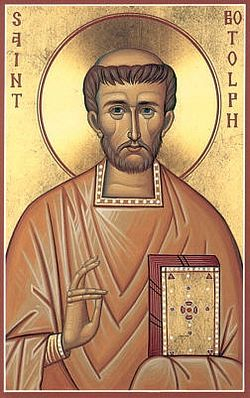
No information available at this time.
 Saint Peter Antiochian Orthodox Church