
FRIDAY OF THE 14TH WEEK
ABSTAIN FROM MEAT, FISH, DAIRY, EGGS, WINE, OLIVE OIL
Forefeast of the Nativity of Our Lord and Savior, Jesus Christ, Anastasia the Great Martyr, Chrysogonos, Theodota, Evodias, & Eutychianus, the Martyrs, The opening of the gates of the Great Church of God
ST. PAUL’S LETTER TO THE HEBREWS 7:18-25
Brethren, a former commandment is set aside because of its weakness and uselessness (for the law made nothing perfect); on the other hand, a better hope is introduced, through which we draw near to God. And it was not without an oath. Those who formerly became priests took their office without an oath, but this one was addressed with an oath, “The Lord has sworn and will not change his mind, ‘Thou art a priest for ever.'” This makes Jesus the surety of a better covenant. The former priests were many in number, because they were prevented by death from continuing in office; but he holds his priesthood permanently, because he continues for ever. Consequently he is able for all time to save those who draw near to God through him, since he always lives to make intercession for them.
MARK 10:24-32
The Lord said to his disciples, "How hard it will be for these who have riches to enter the kingdom of God! It is easier for a camel to go through the eye of a needle than for a rich man to enter the kingdom of God." And they were exceedingly astonished, and said to him, "Then who can be saved?" Jesus looked at them and said, "With men it is impossible, but not with God; for all things are possible with God." Peter began to say to him, "Lo, we have left everything and followed you." Jesus said, "Truly, I say to you, there is no one who has left house or brothers or sisters or mother or father or children or lands, for my sake and for the gospel, who will not receive a hundredfold now in this time, houses and brothers and sisters and mothers and children and lands, with persecutions, and in the age to come eternal life. But many that are first will be last, and the last first." And they were on the road, going up to Jerusalem, and Jesus was walking ahead of them; and they were amazed, and those who followed were afraid.
Forefeast of the Nativity of our Lord
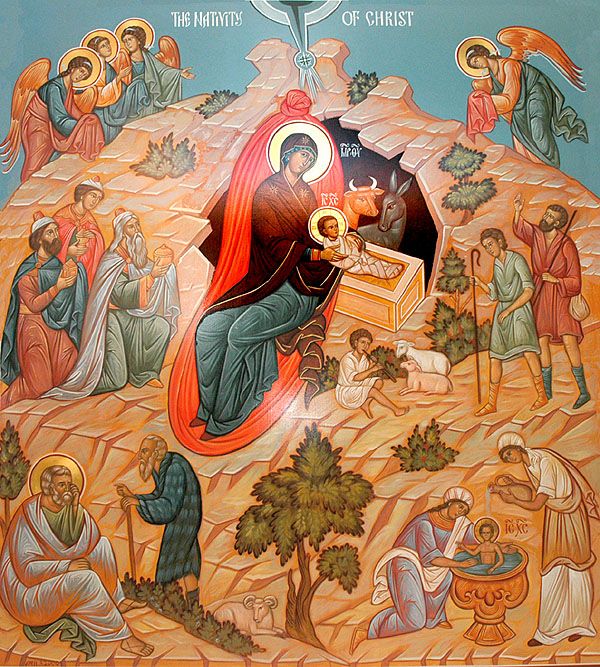
The Forefeast of the Nativity of the Lord begins on December 20. From now on, most of the liturgical hymns will be concerned with the birth of the Savior.
At Vespers for this third day of the prefeast of the Nativity we sing, “Christ is born on earth to crush the power of evil, to enlighten those in darkness, and to free the captives. Let us go forth to meet Him.”
Great Martyr Anastasia the Deliverer from Poisons, her teacher, Martyr Chrysogonos, and many with them

The Great Martyr Anastasia (Anastasía) the Deliverer from Poisons, was a Roman by birth, who suffered for Christ during Diocletian’s persecution of Christians, circa 304. Her father was a pagan, and her mother Fausta was a secret Christian. As a child, Anastasia’s teacher was an educated and pious Christian named Chrysogonos (Chrysógonos). After the death of her mother, Anastasia's father gave her in marriage to a pagan named Publius, but by feigning illness, she preserved her virginity.
Clothing herself in the garb of a beggar, and accompanied by only one servant, she visited the prisons. She fed, treated, and often ransomed captives who were suffering for their faith in Christ. When her servant told Publius about this, he beat his wife and confined her in his house. Then Anastasia began to correspond secretly with Chrysogonos, who told the Saint to be patient, to cleave to the Cross of Christ, and to accept the Lord’s will. He also foretold the impending death of Publius in the ocean. Publius did drown, as he was setting out for Persia with a delegation. After her husband's death, Anastasia distributed her property to the poor and suffering.
Diocletian was informed that the Christians who filled the prisons of Rome stoically endured their torments. He commanded that all of them should be put to death in a single night, and that Chrysogonos be sent to him at Aquileia. Anastasia followed her teacher at a distance.
The Emperor interrogated Chrysógonos personally, but could not make him deny Christ. Therefore, he commanded that he be decapitated and thrown into the sea. The Holy Martyr's body and severed head were carried to shore by the waves. There by Divine Providence, the relics were found by a priest named Zoilos (Zoϊlos), who placed them in a coffer, and concealed them in his home.
Saint Chrysogonos appeared to Zoilos and informed him that three sisters who lived nearby, Agape (Agápē), Chionia (Χιονὶα), and Irene (April 16), would soon suffer martyrdom for Christ. He told him to send Saint Anastasia to them to encourage them. Saint Chrysogonos foretold that Zoilos would also die on the same day. Nine days later, the words of Saint Chrysogonos were fulfilled. Zoilos fell asleep in the Lord, and Saint Anastasia visited the three maidens before their tortures. After these three Martyrs surrendered their souls to God, she buried them.
After carrying out her teacher’s request, the Saint went from city to city ministering to Christian prisoners. Proficient in the medical arts of the time, she zealously cared for captives far and wide, healing their wounds and relieving their suffering. Because of her labors, Saint Anastasia was known as the Deliverer from Potions (Pharmakolytria),1 since by her intercessions she has healed many from the effects of potions, poisons, and other harmful substances.
She made the acquaintance of the pious young widow named Theodótē, finding in her a faithful helper. When it was learned that she was a Christian, Theodote was brought in for questioning. Meanwhile, Saint Anastasia was arrested in Illyricum. This occurred just after all the Christian captives there had been murdered in a single night by Diocletian's order. Saint Anastasia went to one of the prisons, and finding no one there, she began to weep loudly. The jailers realized that she was a Christian and took her to the prefect of that district, who tried to persuade her to deny Christ by threatening her with torture. After his unsuccessful attempts to persuade Anastasia to offer sacrifice to idols, he handed her over to the pagan priest Ulpian in Rome.
The cunning pagan told Saint Anastasia to choose between luxury and riches, or grievous sufferings. He set before her gold, precious stones and fine clothing, as well as fearsome instruments of torture. The crafty man was put to shame by the bride of Christ. Saint Anastasia refused the riches and chose the tools of torture.
But the Lord prolonged the earthly life of the Saint, and Ulpian gave her three days to reconsider. Charmed by Anastasia’s beauty, the pagan priest decided to defile her. However, when he tried to touch her he suddenly became blind. His head began to ache so severely that he screamed like a madman. He asked to be taken to a pagan temple to pray to the idols for help, but on the way he fell down and died.
Saint Anastasia was set free and she and Theodote devoted themselves once more to the care of imprisoned Christians. Before long, Saint Theodote and her three sons received the crown of martyrdom. Her eldest son, Euódos2 stood bravely before the judge and endured his beatings without protest. After much torture, they were all thrown into a red-hot oven.
Saint Anastasia was caught again and condemned to death by starvation. She remained in prison without food for sixty days. Saint Theodote appeared to the Martyr every night and gave her courage. Seeing that hunger caused Saint Anastasia no harm whatsoever, the judge sentenced her to drowning together with other prisoners. Among them was Eutychianos (Εὐτυχιανὸς), who was condemned for his Christian Faith.
The prisoners were put into a boat which went out into the open sea. The soldiers bored holes in the boat and got into a galley. Saint Theodote appeared to the captives and steered the ship to shore. When they reached dry land, 120 men believed in Christ and were baptized by Saints Anastasia and Eutychianos. All were captured and received a martyr’s crown. Saint Anastasia was stretched between four pillars and burned alive. A certain pious woman named Apollinaria buried her body, which was unharmed by the fire, in the garden outside her house.
In the fifth century, Saint Anastasia's relics were transferred to Constantinople, where a church was built and dedicated to her. Later her head and one of her hands were transferred to the Monastery of Saint Anastasia, near Mount Athos.
1 Saint Anastasia's epithet (Ἡ Ἁγία Ἀναστασία ἡ Φαρμακολύτρια) is derived from the verbs φαρμακεύω and λύω which have the following meanings:
- To administer drugs (in order to heal).
- To poison someone. (Revelation 9:21)
- To practice sorcery or idolatry. (Galatians 5:20, Wisdom 12:4; 18:13, Rev. 18:23) etc.
- To season food.
The second part of her title comes from λύω (to loosen, unbind, loosen from bonds, set free, rescue, release.
2 Pronounced Evódos
 Saint Peter Antiochian Orthodox Church