
10TH SUNDAY OF LUKE
ABSTAIN FROM MEAT, DAIRY, EGGS
10th Sunday of Luke, Menas, Hermogenes, & Eugraphos, Martyrs of Alexandria, Thomas the Righteous of Bithynia
ST. PAUL’S LETTER TO THE EPHESIANS 6:10-17
Brethren, be strong in the Lord and in the strength of his might. Put on the whole armor of God, that you may be able to stand against the wiles of the devil. For we are not contending against flesh and blood, but against the principalities, against the powers, against the world rulers of this present darkness, against the spiritual hosts of wickedness in the heavenly places. Therefore take the whole armor of God, that you may be able to withstand in the evil day, and having done all, to stand. Stand, therefore, having girded your loins with truth, and having put on the breastplate of righteousness, and having shod your feet with the equipment of the gospel of peace; besides all these, taking the shield of faith, with which you can quench all the flaming darts of the evil one. And take the helmet of salvation, and the sword of the Spirit, which is the word of God.
LUKE 13:10-17
At that time, Jesus was teaching in one of the synagogues on the sabbath. And there was a woman who had a spirit of infirmity for eighteen years; she was bent over and could not fully straighten herself. And when Jesus saw her, he called her and said to her, "Woman, you are freed from your infirmity." And he laid his hands upon her, and immediately she was made straight, and she praised God. But the ruler of the synagogue, indignant because Jesus had healed on the sabbath, said to the people, "There are six days on which work ought to be done; come on those days and be healed, and not on the sabbath day." Then the Lord answered him, "You hypocrites! Does not each of you on the sabbath untie his ox or his donkey from the manger, and lead it away to water it? And ought not this woman, a daughter of Abraham whom Satan bound for eighteen years, be loosed from this bond on the sabbath day?" As he said this, all his adversaries were put to shame; and all the people rejoiced at all the glorious things that were done by him.
Martyrs Menas, Hermogenes, and Eugraphus, of Alexandria
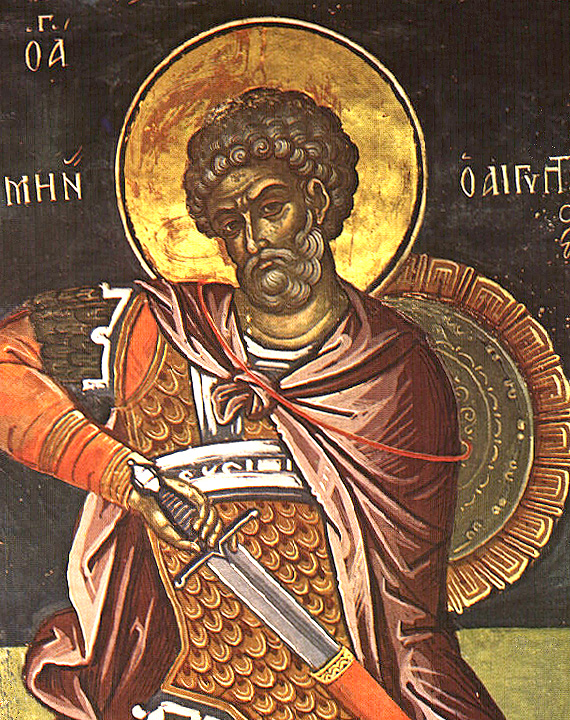
The Holy Martyrs Menas, Hermogenes, and Eugraphus suffered for their faith in Christ under the emperor Maximian (305-313).
Saint Menas was sent by the emperor from Athens to Alexandria to suppress the riots that had arisen between the Christians and the pagans. Distinguished for his gift of eloquence, Menas instead openly began to preach the Christian Faith and he converted many pagans to Christ. Learning of this, Maximian sent Hermogenes to Alexandria to place the saints on trial. Moreover, he gave orders to purge the city of Christians.

Hermogenes, although he was a pagan, was distinguished by his reverent bearing. And struck by the endurance of Saint Menas under torture and by his miraculous healing after the cruel torments, he also came to believe in Christ. Maximian himself then arrived in Alexandria. Neither the astonishing stoic endurance of Saints Menas and Hermogenes under torture, nor even the miracles manifested by God in this city, mollified the emperor. Instead, they vexed him all the more. The emperor personally stabbed Saint Eugraphus, the secretary of Saint Menas, who had declared himself a Christian upon witnessing the endurance of Saints Menas and Hermogenes; and then gave orders to behead the holy Martyrs Menas and Hermogenes.
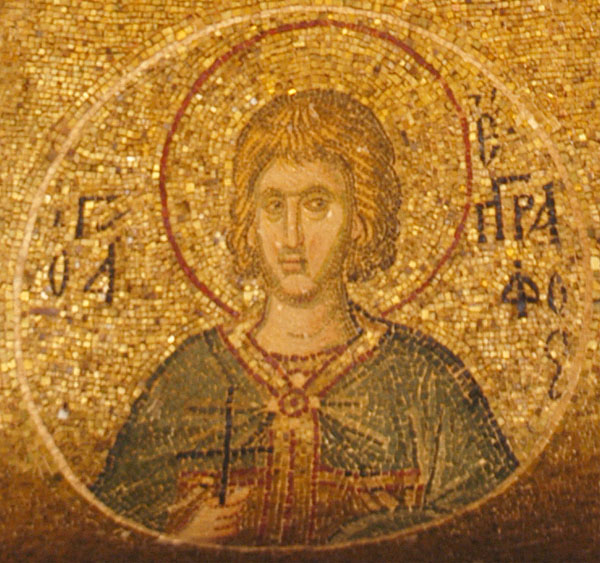
The relics of the holy martyrs, cast into the sea in an iron chest, were afterwards found (see February 17) and transferred to Constantinople in the ninth century. The emperor Justinian built a church in the name of the holy Martyr Menas of Alexandria. Saint Joseph the Hymnographer (April 4) composed a Canon in honor of these holy martyrs.
Saint Joasaph, Bishop of Belgorod

Saint Joasaph was born at Proluka, in the former Poltava governance, on September 8, 1705, the Feast of the Nativity of the Most Holy Theotokos. He was descended from the old and venerable Little Russian (Ukrainian) lineage of the Gorlenkovi. At Baptism he was named Joachim.
In 1712, his father enrolled the seven-year-old Joachim in the Kiev Spiritual Academy. Within the walls of the academy he felt attracted to monastic life. For seven years he studied it further, and finally revealed his intention to his parents.
For a long time his mother and father pleaded with their first-born son not to accept monastic tonsure. But in 1725, unknown to them, he became a “rasophore” (“robe-wearing novice”) with the name Hilarion at the Kiev Mezhigorsk monastery, and on 21 November 1727 he was tonsured in the mantya with the name Joasaph at the Kievo-Bratsk monastery. This event coincided with the completion of his studies at the spiritual academy.
After the death of His Grace Barlaam, the See of Kiev was governed by Archbishop Raphael Zaborovsky. Archbishop Raphael noticed the abilities of the young ascetic and assigned him to greater service to the Church. He was entrusted with the responsibility of the office of examiner of the Kiev archbishopric.
In November 1734, Archbishop Raphael ordained the hierodeacon Joasaph as hieromonk, and he was transferred from the Bratsk monastery school to the Kiev-Sophia archbishop’s house. At the same time, he was appointed a member of the Kiev religious consistory.
In fulfilling the office of examiner, he exerted much effort towards the correction of moral deficiencies among the parish clergy. The saint’s service in the consistory office enabled him to develop his administrative abilities. During this time, he made a good study of the needs of clergy-servers, noting both the good points and the failings of the diocese. His talent for administration was combined with his great spiritual effort. He quickly ascended the ladder of spiritual perfection, which can be seen in his work, “The Conflict of the Seven Venerable Virtues with the Seven Deadly Sins.”
On June 24, 1737 Hieromonk Joasaph was appointed head of the Holy Transfiguration Mgarsk monastery, and elevated to the rank of igumen. Here he worked with all his strength to put the monastery in good order, for it was an old bastion of Orthodoxy in the struggle with the Unia. In this monastery were relics of Saint Athanasius, Patriarch of Constantinople and Wonderworker of Lubny (May 2). Several times Saint Athanasius appeared to Igumen Joasaph, as a sign of his patronal protection.
In 1744 Metropolitan Raphael elevated Igumen Joasaph to the dignity of archimandrite. Towards the end of that same year he was called to Moscow and soon, at the direction of the Most Holy Synod, he was appointed vicar of the Holy Trinity Sergiev Lavra monastery. At this monastery of Saint Sergius he also unstintingly fulfilled obedience to the Church (this year required much exertion for the rebuilding of the monastery after a fire).
On June 2, 1748 at the Peter and Paul cathedral in Peterburg, Archimandrite Joasaph was ordained Bishop of Belgorod. Ascending the archbishop’s throne, Saint Joasaph strictly concerned himself with piety and the condition of the churches, with the proper celebration of divine services, and especially with the moral condition of his flock.
The saint devoted great attention to the education of the clergy, and the correct observance of churchly norms and traditions. Just as before, the saint worked with all his strength in his archpastoral service, without regard for his health.
On the eve of his repose, the saint forbade his cell attendant Stephen to aspire to the priesthood, and he predicted that if he did not obey him, he would meet with an untimely end. To another cell attendant Basil, the saint indicated that he would be a deacon, but would never become a priest. Later, this prediction was fulfilled. Saint Joasaph died on December 10, 1754, and was glorified on September 4, 1911.
Martyr Gemellus of Paphlagonia
The Holy Martyr Gemellus of Paphlagonia was subjected to cruel tortures for his staunch denunciation of the emperor Juilan the Apostate (361-363) in the city of Ancyra (Galatia). A red-hot iron belt was placed around his waist. Then he was ordered to accompany the impious Julian on his journey. When they reached Edessa in Mesopotamia, he was stretched out on the ground and his limbs were pierced with wooden stakes. Then he was hung on a post and mutilated.
Enduring the tortures, the saint continued to revile the emperor. After being subjected to even more horrible torments, they let him go. He was still able to walk and speak, so he went on his way until he met a priest. He entreated the priest to baptize him, and when he emerged from the water, his wounds were all healed.
Hearing of this miracle, Julian ordered that Saint Gemellus be crucified. The victorious athlete of Christ gave up his soul to God, and his body was secretly taken down and buried by Christians.
Venerable Thomas of Bithynia
Saint Thomas Dephourkinos was born in Bithynia. From his youth he was fond of monastic life and entered one of the area monasteries. Later in his life, when the Byzantine official Galoliktos had founded a monastery at the River Sagarisa, Saint Thomas was already an experienced monk, and the brethren chose him as head of the new monastery.
From there Saint Thomas withdrew into the wilderness, where for a long time he labored in solitude. The monk overcame many snares of the devil in the wilderness. The Lord glorified him with the gift of healing and prophecy.
Once, the emperor Leo the Wise (886-911) came to the monastery to Saint Thomas for advice. Not finding the monk at the monastery, the emperor sent his messenger with a letter for him. And just as the messenger arrived at the the Elder’s hut, the saint carried out to him a sealed answer, resolving the emperor’s question. It is not known when Saint Thomas reposed.
Blessed John, King of Serbia, and his parents Stephen and Angelina
The life of the Serbian ruler Stephen Brankovich and his family was filled with instability and misfortune. After Serbia was seized in 1457 by the Turks, the then Serbian ruler’s middle son, Stephen (October 9), distinguished by a meek disposition and fine knowledge of Holy Scripture, went to the capital of Turkey after his sister had been given to Sultan Murat in marriage. Learning that the Turks had burned the Mileshevsk monastery with fanatic cruelty, Saint Stephen rose up to defend Serbia from oppression.
When he married Angelina (July 30), the daughter of the Prince of Albania, the Turks threatened Saint Stephen and his family with punishment. With his wife and three children he was forced to hide first in Albania, and then in Italy, where he died.
Saint Angelina transferred the incorrupt relics of her spouse to Kupinovo. At the end of the fifteenth century a son of the Righteous Stephen and Angelina, Saint John, became ruler of Serbia. The incorrupt relics of Saint John and his parents were afterwards glorified by many miracles.
Venerable Leontios of Achaia
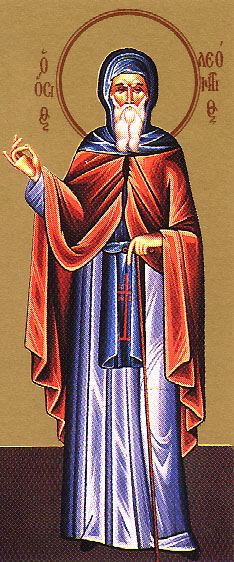
Saint Leontios (Leóntios) was born in Monemvasia in the Pelopónnēsos. His parents were Andrew and Theodora, and he received the name Leon at his Baptism. His father was sufficiently wealthy and a prominent man.
Emperor Andronikos II Palaiológos (1283 – 1328) gave him an important position in the central administration of the Moriᾶ. Therefore Leon received much attention from his parents and studied foreign languages, philosophy, and theology at Constantinople. When his father died, Leon returned to Monemvasia and took care of his mother. Then his mother retired to a monastery and, with her blessing, Leon got married.
He was a model husband, the head of his family, and a good worker. But then he faced some great trials. First his wife died, and then his children. So he decided to become a monk. He was tonsured with the name Leontios, and went to live with an experienced ascetic named Menides, and remained close to him for a long time.
Later he went to the Holy Mountain, where he acquired greater experience and returned to the Pelopónnēsos. He chose to live on a mountain close to Aigialeia, and he went to the cities of Achaia, preaching the Word of God. Nearby there were other zealots of the angelic life. Later, many of them excelled as members of the clergy.
Saint Leontios reposed peacefully and his reputation endured after his death. The brothers Thomas and Anthony Palaiológos built a monastery in honor of the Saint in the place of his ascetical contests, and dedicated it to the Archangel Michael.
In Greek usage Saint Leontios is commemorated on December 11. Most of his Holy Relics are located in the Monastery of the Archangels at Aigialeia.
 Saint Peter Antiochian Orthodox Church