
MONDAY OF THE 10TH WEEK
ABSTAIN FROM MEAT, FISH, DAIRY, EGGS, WINE, OLIVE OIL
The Forefeast of the Presentation of the Theotokos into the Temple, Gregory the Righteous of Decapolis, Proclus, Archbishop of Constantinople
ST. PAUL’S SECOND LETTER TO THE THESSALONIANS 1:1-10
Paul, Silvanus, and Timothy,
To the church of the Thessalonians in God our Father and the Lord Jesus Christ:
Grace to you and peace from God the Father and the Lord Jesus Christ.
We are bound to give thanks to God always for you, brethren, as is fitting, because your faith is growing abundantly, and the love of every one of you for one another is increasing. Therefore we ourselves boast of you in the churches of God for your steadfastness and faith in all your persecutions and in the afflictions which you are enduring.
This is evidence of the righteous judgment of God, that you may be made worthy of the kingdom of God, for which you are suffering – since indeed God deems it just to repay with affliction those who afflict you, and to grant rest with us to you who are afflicted, when the Lord Jesus is revealed from heaven with his mighty angels in flaming fire, inflicting vengeance upon those who do not know God and upon those who do not obey the gospel of our Lord Jesus. They shall suffer the punishment of eternal destruction and exclusion from the presence of the Lord and from the glory of his might, when he comes on that day to be glorified in his saints, and to be marveled at in all who have believed.
LUKE 17:20-25
At that time, when Jesus was asked by the Pharisees when the kingdom of God was coming, he answered them, "The kingdom of God is not coming with signs to be observed; nor will they say, 'Lo, here it is!' or 'There!' for behold, the kingdom of God is in the midst of you." And he said to the disciples, "The days are coming when you will desire to see one of the days of the Son of man, and you will not see it. And they will say to you, 'Lo, there!' or 'Lo, here!' Do not go, do not follow them. For as the lightning flashes and lights up the sky from one side to the other, so will the Son of man be in his day. But first he must suffer many things and be rejected by this generation.
Forefeast of the Entry into the Temple of the Most Holy Theotokos

Today we celebrate the Forefeast of the Entry of the Most Holy Theotokos into the Temple, and tomorrow is the Feast Day itself. A Forefeast is one or more days preceding certain major holidays, in order to prepare the faithful for the celebration of the actual Feast Day. In the Services, hymns describing the festive event are sung.
According to Tradition, the righteous Joachim and Anna, the parents of the Virgin Mary, vowed to dedicate their child to God. When the girl was three years old, her parents brought her to the Temple at Jerusalem holding candles and singing Psalms.
Psalm 44/45: 10-17 foreshadows this event:
"Hear, O daughter, and see, and incline your ear; forget also your people and your father’s house. Because the king has desired your beauty; for he is your Lord. And the daughter of Tyre shall adore with gifts; the rich of the people of the land shall supplicate your countenance. All her glory is that of the daughter of the king of Esebon, robed as she is golden fringed garments, in embroidered clothing; virgins shall be be brought to the king after her, her fellows shall be brought to you. They shall be brought with gladness and exaltation; they shall be led into the king's temple. Instead of your fathers children are born to you; you shall make them princes over all the earth. They shall make mention of your name from generation to generation; therefore shall the nations shall confess you for ever, even forever and ever
She was met by the priests of the Temple and the High Priest Zachariah himself. With no help from anyone else, the girl walked up fifteen steps. Zachariah, the father of Saint John the Baptist, took the Virgin Mary into the Holy of Holies: the most sacred place in the Temple, where she remained until at the age of twelve, when she was betrothed to Saint Joseph. No one could enter there except the High Priest, who entered alone once a year (on the Day of Atonement) to offer the blood of sacrificial animals "for himself, and for the errors of the people" (Hebrews 9:7). But Zachariah was given an extraordinary inspiration for his action. After all, the Virgin herself was to become the Holy of Holies, a living temple, bearing in her womb the Savior of the world.
Venerable Gregory the Decapolite

Saint Gregory was born in the Isaurian city of Decapolis (ten cities) in the VIII century. From his childhood he loved the house of God and the Church Services. He read the Holy Scripture constantly and with reverence. In order to avoid the marriage which his parents had intended for him, he left home and spent his entire life wandering. He travelled to Constantinople, Rome, Corinth, and he lived as an ascetic on Olympus for a while. Saint Gregory preached the Word of God everywhere, denouncing the Iconoclast heresy, and strengthening the faith and courage of the Orthodox, who were persecuted, tortured, and imprisoned by the Iconoclasts.
Through his ascetical struggles and prayers, Saint Gregory attained the gifts of prophecy and working miracles. After overcoming the passions and attaining the height of virtue, he was permitted to hear the angelic singing in praise of the Holy Trinity. Saint Gregory left the monastery of Saint Menas near Thessaloniki, where he had labored for a long time, and he went to Constantinople again in order to combat the Iconoclast heresy. At the capital, a grievous illness undermined his strength, and he went to the Lord in the year 816.
Saint Gregory was buried at a monastery in Constantinople, and many miracles took place at his tomb. As a result, the monks recovered Saint Gregory's holy relics and enshrined them in the church where people could venerate them.
When Constantinople fell to the Turks in 1453, the relics of Saint Gregory were carried to the region of the Danube by a Turkish official. In 1498 Barbu Craiovescu, the Ban of Wallachia heard of the miracles performed by the holy relics and he bought them for a considerable sum of money. Barbu Craiovescu placed the relics in the main church of Bistrița's Dormition Monastery which he founded at Rimnicu Vilcea,1 where they remain to the present day.
A small booklet describing the miracles and healings performed by Saint Gregory the Decapolite in Romania was written by Igoumeness Olga Gologan, who reposed in 1972.
1 Located in Neamț County, Romania.
Saint Proclus, Archbishop of Constantinople

Saint Proclus, Archbishop of Constantinople, from his early years devoted all his time to prayer and the study of Holy Scripture. The Lord granted him the great good fortune to be a disciple of Saint John Chrysostom (November 13), who at first ordained him as a deacon, and then to the holy priesthood. He witnessed the appearance of the Apostle Paul to Saint John Chrysostom. Saint Proclus received from his teacher a profound understanding of Holy Scripture, and learned to elucidate his thoughts in a polished form.
After the exile and death of Saint John Chrysostom, the holy Patriarch of Constantinople Sisinius (426-427) consecrated Saint Proclus as bishop of the city of Kyzikos, but under the influence of Nestorian heretics he was expelled by his flock there.
Saint Proclus then returned to the capital and preached the Word of God in the churches of Constantinople, strengthening listeners in the Orthodox Faith and denouncing the impiety of the heretics. He once preached a sermon before Nestorius in which he fearlessly defended the title “Theotokos” in speaking of the holy Virgin. Upon the death of the Patriarch Saint Sisinius, Saint Proclus was chosen to take his place. Having thus been made Patriarch of Constantinople, he guided the Church over the course of twelve years (434-447). By the efforts of Saint Proclus, the relics of Saint John Chrysostom were transferred from Comana to Constantinople in the time of the holy emperor Saint Theodosius II (408-450).
When Saint Proclus was Patriarch, the Empire suffered destructive earthquakes, lasting for several months. At Bithynia, in the Hellespont, and in Phrygia cities were devastated, rivers disappeared from the face of the earth, and terrible flooding occurred in previously dry places. The people of Constantinople came out of the city with the patriarch and emperor at their head and offered prayers for an end to the unprecedented calamities.
During one prayer service, a boy from the crowd was snatched up into the air by an unseen force and carried up to such a height that he was no longer to be seen by human eyes. Then, whole and unharmed, the child was lowered to the ground and he reported that he heard and he saw the angels glorifying God singing: “Holy God, Holy Mighty, Holy Immortal.” All the people began to sing this Trisagion Prayer, adding to it the refrain, “Have mercy on us!” Then the earthquakes stopped. The Orthodox Church sings still this prayer at divine services to this very day.
The Constantinople flock esteemed their Patriarch for his ascetic life, for his concern about the downtrodden, and for his preaching. Many works of the saint have survived to the present day. Best known are his discourses against the Nestorians, two tracts of the Saint in praise of the Mother of God, and four tracts on the Nativity of Christ, setting forth the Orthodox teaching about the Incarnation of the Son of God. The activity of the holy patriarch in establishing decorum in all the church affairs gained him universal esteem. Surrounded by love and respect, Saint Proclus departed to the Lord after serving as Patriarch for twenty years.
Venerable Diodoros, Igoumen of George Hill

Saint Diodoros (Diódoros) of Yuriegorsk, George Hill (Георгиевского холма) was born in the village of Turchasovo on the Onega River, half-way between Archangelsk and Kargopol. His parents, Hierotheos and Maria, named their son Diomedes. When he was fifteen years old he went on a pilgrimage to Solovki Monastery, and remained there as a novice. When he was nineteen, he was tonsured by Igoumen Anthony, who gave him the name Damian. The new monk was assigned to an experienced Elder for spiritual direction: Hieromonk Joseph of Great Novgorod.
Because of his love for solitude, the holy ascetic left the Monastery frequently and went to a deserted island, where he stayed for several days at a time. Once he remained on the island for forty days, but he did not bring any food or other supplies. He became so exhausted that the brethren found him barely alive. After they brought him back to the Monastery, he received the Holy Mysteries and his health began to improve. He lived with the anchorites on desolate islands, and then he settled at Lake Vodla. There he spent seven years with his disciple Prokhoros.
Resolving to establish a Monastery in honor of the Life-giving Trinity at George Hill, 16.5 miles from Olonets, the venerable one went to Moscow, where he received a charter from Tsar Michael (1613-1645), as well as funds from the Tsar’s mother, the Nun and Eldress Martha. Metropolitan Cyprian of Novgorod provided him with an antimension for the altar, some money, and various supplies for his return trip. He also gave him a document which exempted the Monastery from taxes, and a priest who was to perform the Divine Services in the Monastery church.
On one occasion, Saint Diodoros traveled to Novgorod to collect alms for the Monastery. As he was making his way back to the Monastery, he met a pious man named John. He lived in the village of Amdoma with his young daughter, who was engaged to someone. Speaking with the Saint, John said, "Holy Father, I wish to give my daughter in marriage."
Saint Diodoros was silent for a moment, and then he replied, "O servant of God, wait a while, and then act in the way which is pleasing to God."
The next day, the Saint left for his Monastery. Forty days later, John's daughter reposed as a virgin.
Shortly before his repose, Saint Diodoros had to travel to Kargopol on Monastery business. Taking leave of Hieromonk Joasaph and Elder Prokhoros, he entrusted them with guiding the Monastery. He told Prokhoros of his approaching death. "We shall no longer see each other," he said. "If it is pleasing to the Lord, we will meet in the life to come."
He departed to the Lord on November 27, 1633 and was buried at Kargopol. Two years later his incorrupt body was transferred to Holy Trinity Monastery and was buried by the south wall of the cathedral church.
Saint Diodoros is commemorated on November 20 because the day of his repose coincides with the Feast of the Icon of the Mother of God “Of the Sign.”
His relics rest in a hidden place in his former Monastery (now a parish church). There is a manuscript Service in his honor.
Martyr Dasius of Dorostorum
The Holy Martyr Dasius lived during the third century in the city of Dorostorum on the Danube River. The inhabitants of the city were preparing for a festival in honor of the pagan god Saturn. By custom, thirty days before the celebration they selected a handsome youth, dressed him in fine clothing, accorded him royal honors, and he would go forth in public made up like Saturn. For thirty days, he would indulge in wicked deeds and immoral pleasures. On the day of the feast he was brought before the idols and put to the sword as a sacrifice to Saturn.
The choice of his compatriots fell upon Saint Dasius, since in the city there was not a more handsome youth. Learning of this, the saint said, “If I am fated to die, then it’s better to die for Christ as a Christian.” He openly confessed his faith in Christ before his fellow citizens and refused to take part in the shameful ritual. He denounced the impiety and error of the idolaters and converted many of them to Christ. Therefore, on the orders of the emperors Diocletian (284-305) and Maximian (305-311), he was beheaded after cruel tortures.
Martyrs Eustace, Thespesius, and Anatolius of Nicea
The Holy Martyrs Eustathius, Thespesius and Anatolius, natives of the city of Gangra, were the children of a rich merchant. They were baptized by Bishop Anthimus of Nicomedia (September 3). They died as martyrs at Nicea, after suffering fierce tortures.
Hieromartyrs Nerses and Joseph and many other men and women who suffered with them in Persia
Saint Nerses the bishop suffered for Christ in Persia with his disciple Joseph; Bishops John, Saverius, Isaac and Hypatius; the Martyrs Azades the Eunuch, Savonius, Thekla, Anna and many other men and women. They were executed in 343 during a persecution against Christians under the emperor Sapor II.
Saint Nerses and his disciple Joseph were beheaded; Saint John was stoned. This fate befell also Saints Isaac and Hypatius. Saint Saverius died in prison, and after death they cut off his head. A certain apostate presbyter strangled the Martyr Azades the Eunuch. The Martyrs Savonius, Thekla, Anna and many other men and women also underwent torture, suffering and death for Christ in 343.
Saint Theoctistus the Confessor
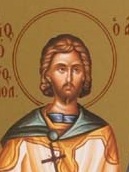
Saint Theoctistus the Confessor was an influential senior Byzantine official during the first half of the 9th century. He was well known for his administrative and political competence, for his involvement in the ending of iconoclasm, and for promoting a major renaissance in education within the Empire.
In 843 AD, Theoctistus prevailed upon the Empress Theodora to officially reintroduce the veneration of icons, ending the second period of official iconoclasm. With the enthronement of a new patriarch, Methodius I, a Synod was convened in Constantinople to condemn iconoclasm — an event that is commemorated as the "Triumph of Orthodoxy." In the same year, Theoctistus invited his nephews, Cyril and Methodius, to the imperial capital to study and to arrange the placement of Methodius as a commander of a Slavic administrative region. He also is credited with initiating a far-reaching educational program and establishing the University of Magnaura.
After a series of long-standing political intrigues involving the imperial family, he was arrested and put to death by his adversaries in 855 AD.
 Saint Peter Antiochian Orthodox Church