Monthly Archives: November 2023

Daily Readings for Thursday, November 30, 2023

ANDREW THE FIRST- CALLED APOSTLE

ABSTAIN FROM MEAT, FISH, DAIRY, EGGS

Andrew the First- Called Apostle, Froumentios, Archbishop of Abyssina, Alexander the Wonderworker, Archbishop of Mithymna

ST. PAUL’S FIRST LETTER TO THE CORINTHIANS 4:9-16

Brethren, God has exhibited us apostles as last of all, like men sentenced to death; because we have become a spectacle to the world, to angels and to men. We are fools for Christ’s sake, but you are wise in Christ. We are weak, but you are strong. You are held in honor, but we in disrepute. To the present hour we hunger and thirst, we are ill-clad and buffeted and homeless, and we labor, working with our own hands. When reviled, we bless; when persecuted, we endure; when slandered, we try to conciliate; we have become, and are now, as the refuse of the world, the off-scouring of all things. I do not write this to make you ashamed, but to admonish you as my beloved children. For though you have countless guides in Christ, you do not have many fathers. For I became your father in Christ Jesus through the gospel. I urge you, then, be imitators of me.

JOHN 1:35-51

At that time, John was standing with two of his disciples; and he looked at Jesus as he walked, and said, "Behold, the Lamb of God!" The two disciples heard him say this, and they followed Jesus. Jesus turned, and saw them following, and said to them, "What do you seek?" And they said to him, "Rabbi" (which means Teacher), "Where are you staying?" He said to them, "Come and see." They came and saw where he was staying; and they stayed with him that day, for it was about the tenth hour. One of the two who heard John speak, and followed him, was Andrew, Simon Peter's brother. He first found his brother Simon, and said to him, "We have found the Messiah" (which means Christ). He brought him to Jesus. Jesus looked at him, and said, "So you are Simon the son of John? You shall be called Cephas" (which means Peter). The next day Jesus decided to go to Galilee. And he found Philip and said to him, "Follow me." Now Philip was from Bethsaida, the city of Andrew and Peter. Philip found Nathanael, and said to him, "We have found him of whom Moses in the law and also the prophets wrote, Jesus of Nazareth, the son of Joseph." Nathanael said to him, "Can anything good come out of Nazareth?" Philip said to him, "Come and see." Jesus saw Nathanael coming to him, and said of him, "Behold, an Israelite indeed, in whom is no guile! " Nathanael said to him, "How do you know me?" Jesus answered him, "Before Philip called you, when you were under the fig tree, I saw you." Nathanael answered him, "Rabbi, you are the Son of God! You are the King of Israel!" Jesus answered him, "Because I said to you, I saw you under the fig tree, do you believe? You shall see greater things than these." And he said to him, "Truly, truly, I say to you, you will see heaven opened, and the angels of God ascending and descending upon the Son of man.

Venerable Sebastian Dabovich

Venerable Sebastian (Dabovich) of Jackson, California was born on June 9, 1863 in San Francisco to Serbian emigrés. Jovan Dabovich studied at the Kiev and St. Petersburg Theological Academies. In 1887, while pursuing his studies at the St. Petersburg Theological Academy, he was tonsured as a monk, and then ordained as a Hierodeacon.

After completing his education, Father Sebastian returned to the United States, where he began to serve at Saint Alexander Nevsky church in San Francisco. On August 16, 1892 he was ordained as a Hieromonk by Bishop Nicholas (Ziorov) of the Diocese of the Aleutians and Alaska, who sent him to Minneapolis to replace Saint Alexis Toth as the priest of Saint Mary's Church. Under Bishop Nicholas's omophorion he carried out a program of educational, missionary, and pastoral work in Washington, California, and Minneapolis. Then he worked in the administration of the North American mission under Saint Tikhon (Belavin), the future Patriarch of Moscow and All Russia, preaching in English, Serbian, and Russian.

In 1894 he built a church for the Serbian community in Jackson, California in honor of Saint Savva of Serbia, which was the first Serbian parish in America. he was assigned to assist at Saint Michael's Cathedral in Sitka, Alaska.

During his lifetime, the missionary priest crossed the Atlantic Ocean fifteen times and the Pacific Ocean nine times, when he needed to visit Serbia and Russia, and also his missionary journeys to Japan, where Father Sebastian met Saint Nicholas (Kasatkin) of Japan.

In 1905 Igoumen Sebastian was appointed to the post of Dean of Serbian churches, and in that same year, by decree of the Synod, he became the head of the Serbian mission. Archbishop Tikhon asked Father Sebastian to head a Serbian Mission in the North American diocese. On August 15, 1905, Archbishop Tikhon elevated him to the rank of Archimandrite for his zealous labors for the Church.

In 1910, Father Sebastian went to Serbia, serving as a chaplain in the Serbian Army during the Second Balkan War (1912-1913), and also during World War I (1914-1918). From 1936 until the end of his earthly life, he lived in retirement at the Saint Savva of Serbia Monastery in Žića. He reposed there on November 17/30, 1940, and Saint Nicholas (Velimirovich) presided at his funeral. In 2007, Venerable Sebastian's relics were reburied in the church of Saint Savva in Jackson, California, which he had founded.

On May 29, 2015 by the decision of the Bishops' Council of the Serbian Orthodox Church, Archimandrite Sebastian was glorified as a Saint.

His formal canonization took place on September 4, 2015, and Patriarch Irinej of Serbia presided at the service in Saint Stephen's Cathedral, Alhambra, California.

Apostle Andrew, the Holy and All-Praised First-Called
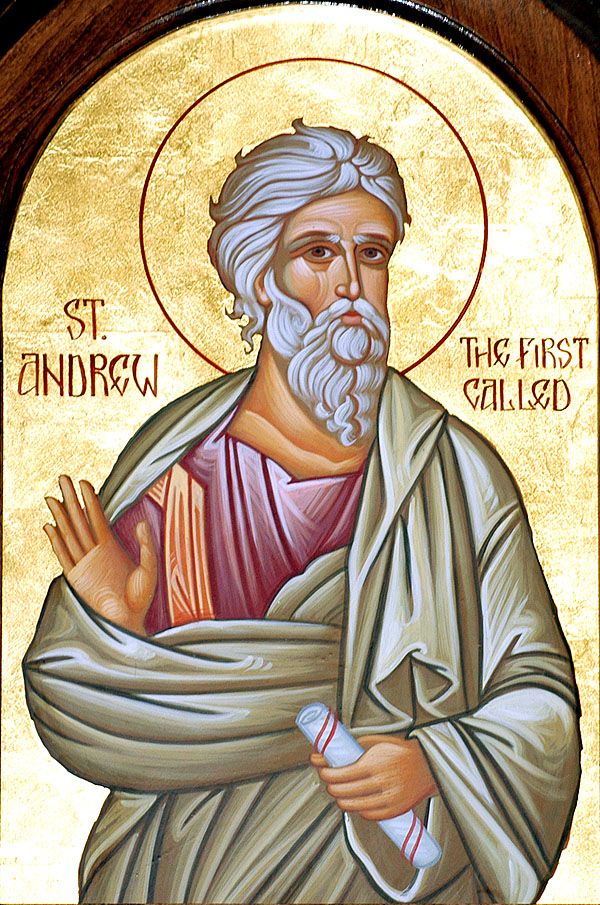
The Holy Apostle Andrew the First-Called was the first of the Apostles to follow Christ, and he later brought his own brother, the holy Apostle Peter, to Christ (John 1:35-42). The future apostle was from Bethsaida, and from his youth he turned with all his soul to God. He did not enter into marriage, and he worked with his brother as a fisherman. When the holy Prophet, Forerunner and Baptist John began to preach, Saint Andrew became his closest disciple. Declaring Christ to be the Lamb of God, Saint John the Baptist himself sent to Christ his own two disciples, the future Apostles Andrew and John the Theologian.

After the Descent of the Holy Spirit upon the Apostles, Saint Andrew went to the Eastern lands preaching the Word of God. He went through Asia Minor, Thrace, Macedonia, he reached the River Danube, went along the coast of the Black Sea, through Crimea, the Black Sea region and along the River Dniepr he climbed to the place where the city of Kiev now stands.

He stopped overnight on the hills of Kiev. Rising in the morning, he said to those disciples that were with him: “See these hills? Upon these hills shall shine forth the beneficence of God, and there will be a great city here, and God shall raise up many churches.” The apostle went up around the hills, blessed them and set up a cross. Having prayed, he went up even further along the Dniepr and reached a settlement of the Slavs, where Novgorod was built. From here the apostle went through the land of the Varangians towards Rome for preaching, and again he returned to Thrace, where in the small village of Byzantium, the future Constantinople, he founded the Church of Christ. The name of the holy Apostle Andrew links the mother, the Church of Constantinople, with her daughter, the Russian Church.

On his journeys the First-Called Apostle endured many sufferings and torments from pagans: they cast him out of their cities and they beat him. In Sinope they pelted him with stones, but remaining unharmed, the persistent disciple of Christ continued to preach to people about the Savior. Through the prayers of the Apostle, the Lord worked miracles. By the labors of the holy Apostle Andrew, Christian Churches were established, for which he provided bishops and clergy. The final city to which the Apostle came was the city of Patra, where he was destined to suffer martyrdom.

The Lord worked many miracles through His disciple in Patra. The infirm were made whole, and the blind received their sight. Through the prayers of the Apostle, the illustrious citizen Sosios recovered from serious illness and Maximilla and Stratokles, the wife and brother of the governor of Patra, were healed. The miracles accomplished by the Apostle and his fiery speech enlightened almost all the citizens of the city of Patra with the true Faith.

Few pagans remained at Patra, but among them was the prefect of the city, Aegeatos. The Apostle Andrew repeatedly turned to him with the words of the Gospel. But even the miracles of the Apostle did not convince Aegeatos. The holy Apostle with love and humility appealed to his soul, striving to reveal to him the Christian mystery of life eternal, through the wonderworking power of the Holy Cross of the Lord. The angry Aegeatos gave orders to crucify the apostle. The pagan thought he might undo Saint Andrew’s preaching if he were to put him to death on the cross.

Saint Andrew the First-Called accepted the decision of the prefect with joy and with prayer to the Lord, and went willingly to the place of execution. In order to prolong the suffering of the saint, Aegeatos gave orders not to nail the saint’s hands and feet, but to tie them to the cross. For two days the apostle taught the citizens who gathered about. The people, in listening to him, with all their souls pitied him and tried to take Saint Andrew down from the cross. Fearing a riot of the people, Aegeatos gave orders to stop the execution. But the holy apostle began to pray that the Lord would grant him death on the cross. Just as the soldiers tried to take hold of the Apostle Andrew, they lost control of their hands. The crucified apostle, having given glory to God, said: “Lord Jesus Christ, receive my spirit.” Then a blazing ray of divine light illumined the cross and the martyr crucified upon it. When the light faded, the holy Apostle Andrew had already given up his holy soul to the Lord. Maximilla, the wife of the prefect, had the body of the saint taken down from the cross, and buried him with honor.

A few centuries later, under the emperor Constantine the Great, the relics of the holy Apostle Andrew were solemnly transferred to Constantinople and placed in the church of the Holy Apostles beside the relics of the holy Evangelist Luke and Saint Paul’s disciple Saint Timothy.

Saint Frumentius, Archbishop of Abyssinia, Ethiopia

Saint Frumentius, Archbishop of Inda (Ethiopia, formerly Abyssinia), was a native of the city of Tyre. While still a child, he came to Abyssinia by divine Providence. Growing up near the imperial court, he became a friend and chief counselor of the Abyssinian emperor, and afterwards tutor to his son, who ascended the throne while still a minor after the death of his father.

With the consent of the new emperor, Saint Frumentius journeyed to his native land and afterwards visited Alexandria and its patriarch, Saint Athanasius the Great (May 2). With the blessing of Saint Athanasius, Frumentius was elevated to become Bishop of Abyssinia and he returned to that country, which had sheltered him from his childhood.

After he returned from his consecration, Saint Frumentius began to perform miracles, bringing many people to the Church. The emperor said to him, “You have lived among us for many years, yet we never saw you perform such wonders. Why is it that you do so now?” The saint replied, “This has nothing to do with me, but is due to the grace of the priesthood.” Then the emperor and many of his subjects received holy Baptism.

Having accomplished the apostolic task of converting the Abyssinian nation to Christ, Saint Frumentius zealously and fruitfully guided the Church entrusted him by God for many years, then peacefully departed to the Lord in great old age.

Entrance of the Apostle Andrew into Georgia
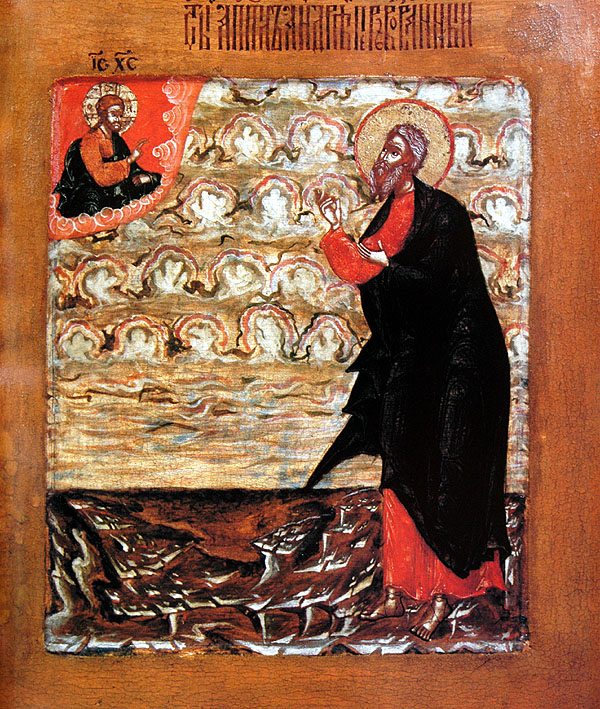
No information available at this time.

Saint Vakhtang Gorgasali, King of Georgia

The holy and right-believing king Vakhtang I ascended the throne of Kartli at the age of fifteen. At that time Kartli was continually being invaded by the Persians from the south and by the Ossetians from the north. The situation was no better in western Georgia: the Byzantines had captured all the lands from Egrisi to Tsikhegoji.

After his coronation, the young King Vakhtang summoned his court and addressed his dedicated servants with great wisdom. He said that the sorrowful circumstances in which the nation had found itself were a manifestation of God’s anger at the sins of the king and the people. He called upon everyone to struggle in unity and selflessness on behalf of the Faith and motherland.

King Vakhtang led a victorious campaign against the Ossetians, freed the captive princess (his older sister), and signed several treaties with the Caucasian mountain tribes to secure their cooperation in the struggle against foreign conquerors. Then he carried out another campaign in western Georgia, freed that region from the Byzantines, reinforced the authority of King Gubaz, and returned in triumph to Kartli.

King Vakhtang was remarkable in faith, wisdom, grace, virtue, and appearance (he towered above all others at a stately seven feet ten inches). He spent many nights in prayer and distributed alms to the poor, in this way dedicating his life to God. King Vakhtang could fight tirelessly in battle. Vested in armor and fully armed, he could carry a war-horse on his shoulders and climb from Mtskheta to the Armazi Fortress in the mountains outside the city. On foot he could outrun a deer. The holy king was judicious in politics, displayed great composure, and preserved a sense of calm even when critical decisions needed to be made.

On the brow of Vakhtang’s military helmet was depicted a wolf, and on the back, a lion. Catching a glimpse of the helmet with the wolf and lion, the Persians would cry out to one another: “Dar’ az gurgsar!” (“Beware of the wolf’s head!”) This was the source of King Vakhtang’s appellation “Gorgasali.”

During King Vakhtang’s reign the Georgian Church was first recognized as autocephalous. When the holy king banished the pagan fire-worshippers from Georgia, he also sent a certain Bishop Michael—who was inclined to the Monophysite heresy, which had been planted in Georgia by the Persians—to Constantinople to be tried by the patriarch. The bishop had disgracefully cursed the king and his army for rising up against the Monophysites. In fact, he was so infuriated that when King Vakhtang approached him to receive his blessing, he kicked him in the mouth and broke several of his teeth.

The patriarch of Constantinople subsequently defrocked Bishop Michael and sent him to a monastery to repent.

More importantly perhaps, the patriarch and the Byzantine emperor then sent to the patriarch of Antioch several clergymen whom King Vakhtang had chosen for consecration. In Antioch the patriarch consecrated twelve of these clergymen as bishops and enthroned a certain Petre as the first Catholicos of Georgia.

Vakhtang fulfilled the will of Holy King Mirian by founding the Georgian Holy Cross Monastery in Jerusalem. In addition, he replaced a wooden church that had been built in Mtskheta at the time of Saint Nino with a church made of stone. During his reign several new dioceses were founded. King Vakhtang built a cathedral in Nikozi (Inner Kartli) and established a new diocese there, to which he translated the holy relics of the Protomartyr Razhden.

King Vakhtang built fortresses at Tukhari, Artanuji, and Akhiza; founded monasteries in Klarjeti at Artanuji, Mere, Shindobi, and Akhiza; and established many other strongholds, churches, and monasteries as well. He built a new royal residence in Ujarma and laid the foundations of the new Georgian capital, Tbilisi. His political creed consisted of three parts: an equal union of the Georgian Church with the Byzantine Church, national independence, and the unity of the Church and nation.

In the year 502 the sixty-year-old King Vakhtang was obliged to defend his country for the last time. In a battle with the Persians he was fatally wounded when a poisoned arrow pierced him under the arm. Before he died, King Vakhtang summoned the clergy, his family and his court and urged them to be strong in the Faith and to seek death for Christ’s sake in order to gain eternal glory.

All of Georgia mourned the passing of the king. His body was moved from the royal residence in Ujarma to Mtskheta, to Svetitskhoveli Cathedral, which he had himself built. There he was buried with great honor.

Some fifteen centuries later, with the blessing of Catholicos-Patriarch Ilia II, an addition was built onto the Sioni Patriarchal Cathedral in Holy King Vakhtang Gorgasali’s name, and a cathedral in his honor was founded in the city of Rustavi.

Hierarch Peter, first Catholicos of Georgia

Saint Peter was the first catholicos of Georgia. He led the Church of Kartli from the 460s through the beginning of the 6th century. According to God’s will, Saint Peter inaugurated the dynasty of the chief shepherds of Georgia.

It is written in the biography of Holy King Vakhtang IV Gorgasali that the king was introduced to Peter, a pupil of Saint Gregory the Theologian, during one of his visits to Byzantium, and he became very close to him. At that time he was also introduced to the future catholicos Samuel.

The close spiritual bond of the holy king and the catholicos, combined with their concerted efforts on behalf of the Church, contributed immeasurably to the establishment of friendly political relations between Georgia and Byzantium and the proclamation of the autocephaly of the Georgian Apostolic Church.

Having returned to his own capital, King Vakhtang sent an envoy to Byzantium to find him a wife. He also sent a request that the hierarch Peter be elevated as catholicos and that the priest Samuel be consecrated bishop. He pleaded with the patriarch to hasten the arrival of Catholicos Peter and the twelve bishops with him.

The patriarch of Constantinople approved King Vakhtang’s request to institute the rank of catholicos of Georgia. Since the Georgian Church was still under the jurisdiction of Antioch, Peter and Samuel were sent to the Antiochian patriarch himself to be elevated. The autocephaly of the Georgian Church was proclaimed upon the arrival of the holy fathers in Georgia.

Saint Peter ruled the Church according to the principle of autocephaly and established a form of self-rule that would later help to increase the authority of the Georgian Apostolic Orthodox Church.

The mutual respect and cooperation of the catholicos and the holy king laid the foundations for future, harmonious relations between secular and Church authorities in Georgia. Their example defined the authority of the Church and a national love and respect for the king.

Peter accompanied Holy King Vakhtang Gorgasali to war with the Persians in 502. It is written that “the fatally wounded king Vakhtang summoned the catholicos, the queen, his sons and all the nobility.” Saint Peter heard the king’s last confession, granted the remission of his sins, presided at his funeral service, and blessed the prince Dachi (502-514) to succeed him as king of Kartli.

Holy Catholicos Peter led the Georgian Church with great wisdom to the end of his days.

The Holy Synod of the Georgian Apostolic Orthodox Church canonized the holy catholicos Peter and the holy catholicos Samuel on October 17, 2002.

Hierarch Samuel, Second Catholicos of Georgia

Saint Samuel ascended the throne of the Apostolic Orthodox Church of Georgia in the 6th century, after the holy catholicos Peter.

Like Saint Peter, Samuel was a native of Byzantium. He arrived with Catholicos Peter in Georgia as a bishop, at the invitation of King Vakhtang Gorgasali and with the blessing of the patriarch of Constantinople.

At that time Svetitskhoveli in Mtskheta was the residence of the catholicos.

After the repose of Catholicos Peter, Samuel succeeded him, and King Dachi “bestowed upon him the city of Mtskheta, according to the will of King Vakhtang.” Saint Samuel led the Georgian Church during the reigns of King Dachi and his son Bakur. He initiated construction of Tsqarostavi Church in the Javakheti region.

What we know of Saint Samuel’s activity paints him as a pastor who demonstrated great foresight and cared deeply about his flock. He was also a close acquaintance of the holy martyr Queen Shushanik.

Saint Samuel faithfully served the Autocephalous Church of Georgia and labored to strengthen the Christian Faith of the Georgian people to the end of his days.

The Holy Synod of the Georgian Apostolic Orthodox Church canonized the holy catholicos Peter and the holy catholicos Samuel on October 17, 2002.

12/3 announcements

December 3, 2023

Twenty-sixth Sunday after Pentecost

Ephesians 5:8-19: Brethren, walk as children of light—for the fruit of light is found in all that is good and right and true—and try to learn what is pleasing to the Lord. Take no part in the unfruitful works of darkness, but instead expose them. For it is a shame even to speak of the things that they do in secret; but when anything is exposed by the light it becomes visible, for anything that becomes visible is light. Therefore, it is said, “Awake, O sleeper, and arise from the dead, and Christ shall give you light.” Look carefully then how you walk, not as unwise men but as wise, making the most of the time, because the days are evil. Therefore, do not be foolish, but understand what the will of the Lord is. And do not get drunk with wine, for that is debauchery; but be filled with the Spirit, addressing one another in psalms and hymns and spiritual songs, singing and making melody to the Lord with all your heart.

Luke 18:35-43: At that time, when Jesus drew near to Jericho, a blind man was sitting by the roadside begging; and hearing a multitude going by, he inquired what this meant. They told him, “Jesus of Nazareth is passing by.” And he cried, “Jesus, Son of David, have mercy on me!” And those who were in front rebuked him, telling him to be silent; but he cried out all the more, “Son of David, have mercy on me!” And Jesus stopped, and commanded him to be brought to him; and when he came near, Jesus asked him, “What do you want me to do for you?” He said, “Lord, let me receive my sight.” And Jesus said to him, “Receive your sight; your faith has made you well.” And immediately he received his sight and followed Jesus, glorifying God; and all the people, when they saw it, gave praise to God.

Troparion of the Resurrection: The stone being sealed by the Jews, and thy pure body being guarded by the soldiers, thou didst arise on the third day, O Saviour, granting life to the world. Wherefore, the heavenly powers acclaimed thee, O Giver of life, crying, Glory to thy Resurrection, O Christ! Glory to thy kingdom! Glory to thy gracious providence, O only Lover of mankind.

Troparion of the Chains of St. Peter: O Holy Apostle, Peter, thou dost preside over the Apostles by the precious chains which thou didst bear. We venerate them with faith and beseech thee that by thine intercessions we be granted the great mercy.

Kontakion Preparatory for Nativity: Today the Virgin comes unto the cave to give birth in an ineffable manner to the Word before the ages. Rejoice, therefore, O universe, when you hear, and glorify with the angels and the shepherds him who shall appear by his own will as a new babe, being God before the ages.

CALENDAR

UNTIL FURTHER NOTICE: All services listed on the calendar will be available through streaming and webcast. (Instructions can be found on the parish website.)

Sunday, December 3 (Twenty-sixth Sunday after Pentecost))

8:50 a.m. – Orthros (webcast)

9:00 a.m. – Christian Education

10:00 a.m. – Divine Liturgy (webcast)

Monday, December 4 (Great-martyr Barbara and Venerable Father John of Damascus)

Father Herman off

Tuesday, December 5 (Sava the Sanctified)

6:30 p.m. – Great Vespers with Litia and Artoklasia

Wednesday, December 6 Nicholas the Wonder-worker of Myra)

6:30 p.m. – Advent Paraklesis

Thursday, December 7

NO Services

11:00 a.m. – Men’s Lunch

Friday, December 8

NO Services

Saturday, December 9

10:00 a.m. – Ladies meet for Akathist

4:30 p.m. – Choir Practice

6:00 p.m. – Great Vespers

Sunday, December 10 (Twenty-fifth Sunday after Pentecost)

8:50 a.m. – Orthros (webcast)

9:00 a.m. – Christian Education

10:00 a.m. – Divine Liturgy (webcast)

12:00 p.m. – Santa Lucia celebration during Coffee Hour

SPECIAL ANNOUNCEMENTS

The Eucharist Bread …was offered by the Algoods for the Divine Liturgy this morning.

Eucharist Bread Schedule:

Eucharist Bread Coffee Hour

December 3 Algood Algood/Schelver/I. Jones

December 5 (Tues. p.m.) Henderson (Artos Bread)

(Feast-day of St. Nicholas the Wonder-worker)

December 10 Schelver Lasseter/Miller

December 17 Morris D. Root/Baker

December 24 (Sun. a.m.) Jones Henderson/K. Jones

December 24 (Sun. p.m.) Meadows Dansereau/Alaeetawi/

(Feast of the Nativity of our Lord) Lockhart/Karam/Snell

December 31 (Sun. a.m.) Davis Lavric/Skirtech/Dabit

December 31 (Sun. p.m.) Baker (Artos Bread)

(Feast of the Circumcision of Christ; Feast-day of St. Basil the Great)

Schedule for Epistle Readers – Page numbers refer to the Apostolos (book of the Epistles) located on the Chanters’ stand at the front of the nave. Please be sure to use this book when you read.

Reader Reading Page#

December 3 Walt Wood Eph. 5:8-19 217

December 10 Reader Basil Baker Eph. 6:10-17 223

December 17 Reader Chad Miller Col. 3:4-11 233

December 24 (Sun. a.m.) Brandon Strain Heb. 11:9-10, 32-40 348

December 24 (Sun. p.m.) Sam Habeeb Gal. 4:4-7 351

December 31 Sh. Charlotte Algood II Tim. 4:5-8 354

Also, please remember that we still need your tithes and offerings which may be placed in the tray that is passed during the Divine Liturgy, in the tithe box at the back of the nave or be mailed to: St. Peter Orthodox Church, P.O. Box 2084, Madison, MS 39130-2084.

Please remember the following in your prayers: Aidan Milnor, the Milnor family; Lamia Dabit and her family; Mary Greene (Lee and Kh. Sharon’s sister); Jay and Joanna Davis; Fr. Leo and Kh. Be’Be’ Schelver and their family; Kathy Willingham; Marilyn (Kyriake) Snell; Jack and Jill Weatherly; Lottie Dabbs (Sh. Charlotte Algood’s mother), Sh. Charlotte and their family; Reader Basil and Brenda Baker and their family; Buddy Cooper; Georgia and Bob Buchanan; Fr. Joseph Bittle; Steve and Sheryl Chamblee; Rick Carlton; Very Rev. Fr. Nicholas and Kh. Jan Speier; Dora Lambert (Dimitri Zouboukos’ fiancée); Lee Greene; Joseph, Amanda and Hunter Hines.

DOMSE Winter Camp: If your child is interested in attending Camp St. Thekla WAMP, February 16-19, 2024, please see Fr. Herman for the link to registration. Please note that the ages for WAMP are 12-17 years of age.

Bible Study: There have been several requests that a Bible Study be started. Fr. Herman has asked Fr. John if he would head this up. If you are interested in attending the Bible Study please place your name on the sign-up sheet on the bureau in the foyer. This is so Fr. Herman and Fr. John will know how many people are interested.

Calendar Items:

* The men of the parish meet for lunch at 11:00 a.m. on the first Thursday of the month.

* The Ladies meet at the church at 10:00 a.m. on the second Saturday of the month to pray the Akathist to the Mother of God, Nurturer of Children on behalf of our children.

* The Ladies meet for lunch at 1:00 p.m. on the last Tuesday of the month.

* The Fast of the Nativity began on November 15th and runs until December 25th. As is our parish custom, we will pray the Paraklesis Service to the Theotokos on Wednesday evenings instead of Daily Vespers during the Fast. However

* The Feast-day of St. Nicholas will be celebrated with Great Vespers with Litia and Artoklasia on Tuesday evening, December 5th, beginning at 6:30 p.m.

* The Festal Orthros and Divine Liturgy for the Feast of the Nativity of our Lord Jesus Christ will be celebrated on Sunday evening, December 24th, beginning at 8:00 p.m. followed by our festal meal.

* We will celebrate the Feast of the Circumcision of the Lord and the Feast-day of St. Basil the Great with Great Vespers with Litia and Artoklasia on Sunday evening, December 31st, beginning at 6:30 p.m.

* His Grace, Bishop NICHOLAS will be making his next Arch-pastoral visit in January. The date is yet to be determined and more information will be forthcoming in the future.

* Stewpot dates for 2024 will be March 30th and November 30th.

Fasting Discipline for December

The Fast of the Nativity began on November 15th. During this fast the traditional fasting (no meat, dairy, eggs, fish, wine or oil) is observed on each day of the week. Note, however, through December 19th there is a katlysis on Tuesdays and Thursdays when wine and oil are permitted, and on Saturdays and Sundays when fish, wine and oil are permitted. There is no fasting of any kind from December 25th through January 4th.

Major Commemorations for December

December 4 Great-martyr Barbara and Venerable John of Damascus

December 5 Sava the Sanctified

December 6 Nicholas the Wonder-worker of Myra

December 9 Conception of the Theotokos

December 12 Spyridon the Wonder-worker

December 13 Herman of Alaska

December 15 Hieromartyr Eleutherios

December 20 Ignatius the God-bearer of Antioch

December 25 The Nativity of our Lord and Savior Jesus Christ

December 26 Synaxis of the Theotokos

December 27 Protomartyr Stephen

A new date for the Pilgrimage to Holy Dormition will be forthcoming. More details will be available at a later date.

Quotable: “Our life depends on the kind of thoughts we nurture. If our thoughts are peaceful, calm, meek, and kind, then that is what our life is like. If our attention is turned to the circumstances in which we live, we are drawn into a whirlpool of thoughts and can have neither peace nor tranquility.”

Elder Thaddeus of Vitovnica

Worship: Sunday, December 10, 2023 (Twenty-seventh Sunday after Pentecost)

Scripture: Ephesians 6:10-17; Luke 13:10-17

Celebrant: Father Herman

Epistle Reader: Reader Basil Baker

Prosphora: Schelver

Coffee Hour: Lasseter/Miller

Daily Readings for Wednesday, November 29, 2023

WEDNESDAY OF THE 11TH WEEK

ABSTAIN FROM MEAT, FISH, DAIRY, EGGS, WINE, OLIVE OIL

Paramonus, Philumenus, and their 370 Companion Martyrs in Bithynia, Our Righteous Father Nicholas, Archbishop of Thessolonica, Hieromartyr Dionysios, Bishop of Corinth, Phaedrus the Martyr

ST. PAUL’S FIRST LETTER TO TIMOTHY 1:18-20; 2:8-15

Timothy, my son, this charge I commit to you in accordance with the prophetic utterances which pointed to you, that inspired by them you may wage the good warfare, holding faith and a good conscience. By rejecting conscience, certain persons have made shipwreck of their faith, among them Hymenaios and Alexander, whom I have delivered to Satan that they may learn not to blaspheme. I desire then that in every place the men should pray, lifting holy hands without anger or quarreling; also that women should adorn themselves modestly and sensibly in seemly apparel, not with braided hair or gold or pearls or costly attire but by good deeds, as befits women who profess religion. Let a woman learn in silence with all submissiveness. I permit no woman to teach or to have authority over men; she is to keep silent. For Adam was formed first, then Eve; and Adam was not deceived, but the woman was deceived and became a transgressor. Yet woman will be saved through bearing children, if she continues in faith and love and holiness, with modesty.

LUKE 20:1-8

At that time, as Jesus was teaching the people in the temple and preaching the gospel, the chief priests and the scribes with the elders came up and said to Him, ‘Tell us by what authority you do these things, or who it is that gave you this authority.’ He answered them, ‘I also will ask you a question; now tell me, was the baptism of John from heaven or from men?’ And they discussed it with one another, saying, ‘If we say, ‘From heaven, ‘ he will say, ‘Why did you not believe him?’ But if we say, ‘From men, ‘ all the people will stone us; for they are convinced that John was a prophet.’ So they answered that they did not know whence it was. And Jesus said to them, ‘Neither will I tell you by what authority I do these things.’

Martyr Paramon and 370 Martyrs in Bithynia

The Holy Martyr Paramon and the 370 Martyrs with him suffered for their faith in Christ in the year 250 during the rule of the emperor Decius (249-251). The governor of the Eastern regions, Aquianus, had locked up 370 Christians in prison, urging them to abjure Christ and instead offer sacrifice to idols.

They subjected the captives to beatings, hoping by torture and the threat of death to persuade them to renounce Christ and worship the pagan gods. One of the local inhabitants, Paramon by name, openly denounced the cruel governor and confessed his faith in the One True God, the Lord Jesus Christ. They beheaded Saint Paramon after fierce tortures, together with the other 370 martyrs.

Martyr Philoumenus of Ancyra

The Holy Martyr Philoumenus suffered for Christ in the year 274, during the persecution against Christians by the emperor Aurelian (270-275). Saint Philoumenus was a bread merchant in Ancyra. Envious persons reported to the governor Felix that Philoumenus was a Christian, and so he came before a judge.

Saint Philoumenus did not renounce Christ. For this they hammered nails into his hands, feet and head, and they forced him to walk. The holy martyr bravely endured the torments and he died from loss of blood, giving up his soul to God.

Martyr Valerian

No information available at this time.

Martyr Phaedrus

No information available at this time.

Venerable Acacius of Sinai, who is mentioned in the Ladder

Saint Acacius of Sinai lived during the sixth century and was a novice at a certain monastery in Asia. The humble monk distinguished himself by his patient and unquestioning obedience to his Elder, a harsh and dissolute man. He forced his disciple to toil excessively, starved him with hunger, and beat him without mercy. Despite such treatment, Saint Acacius meekly endured the affliction and thanked God for everything. Saint Acacius died after suffering these torments for nine years.

Five days after Acacius was buried, his Elder told another Elder about the death of his disciple. The second Elder did not believe that the young monk was dead. They went to the grave of Acacius and the second Elder called out: “Brother Acacius, are you dead?” From the grave a voice replied, “No, Father, how is it possible for an obedient man to die?” The startled Elder of Saint Acacius fell down with tears before the grave, asking forgiveness of his disciple.

After this he repented, constantly saying to the Fathers, “I have committed murder.” He lived in a cell near the grave of Saint Acacius, and he ended his life in prayer and in meekness. Saint John Climacus (March 30) mentions Saint Acacius in The Ladder (Step 4:110) as an example of endurance and obedience, and of the rewards for these virtues.

Saint Acacius is also commemorated on July 7.

Venerable Nectarius the Obedient of the Kiev Near Caves

The Venerable Nektarios struggled in the Kiev Caves Monastery during the XII century. Because of his unquestioning obedience to the older brethren, and for the diligence he showed in his labors, Saint Nektarios was called "the Obedient." He reposed peacefully after a life of much toil and many spiritual struggles. He was buried in the Near Caves of Saint Anthony.

Saint Nektarios is also commemorated on September 28 and on the second Sunday of Great Lent.

Hieromartyr Abibus, Bishop of Nekresi in Georgia

Saint Abibus of Nekresi was one of the Thirteen Syrian Fathers who arrived in Georgia in the 6th century under the leadership of Saint John of Zedazeni.

With the blessing of his instructor, Saint Abibus began his apostolic activity in Nekresi, a village set among the hills in the eastern region of Kakheti. For his virtuous deeds, Saint Abibus was soon consecrated bishop of his diocese.

According to the chronicle Life of Kartli, Saint Abibus converted not only Georgians but also most of the mountain tribes—including the Dagestani/Didoians—to the Christian Faith. Abounding with apostolic zeal, Saint Abibus journeyed throughout the villages of his diocese, preaching the Truth and calling upon all to strengthen the true Faith.

The time that Saint Abibus was serving as bishop coincided with a dark period of Persian rule in eastern Georgia. The Persians exerted every effort to implant their faith—the worship of fire—and everywhere erected altars where the fire burned without ceasing.

Once in the village of Rekhi the holy hierarch, finding a group of fire-worshipers forcing the Georgian faithful to worship the flame, poured water on their fire to extinguish it. The enraged pagan priests bound Saint Abibus, beat him cruelly, locked him up, and reported the incident to the marzban. The marzban ordered that the bishop be brought to him at once.

Saint Abibus was a friend of the holy wonderworker Simeon the Stylite of the Wonderful Mountain. Saint Simeon received a sign from God of the imminent martyrdom of Saint Abibus and, in order to console him, sent him a letter, an evlogia (a blessing—probably a piece of prosphoron or some other holy object) and a staff. While Abibus was being escorted to the marzban, in the village of Ialdo he met a messenger from Antioch who presented him with Saint Simeon’s gifts. The letter and gifts gladdened the holy hierarch and strengthened him for his martyrdom. Then Saint Abibus was approached by a group of Christians who offered to help him escape, but he graciously declined.

Having arrived in Mtskheta, the saint prayed at Svetitskhoveli Cathedral, then requested that the guards permit him to meet with Saint Shio of Mgvime. The Persians granted his request, and the spiritual brothers greeted one another with love and prayed together to the Lord.

Saint Abibus was brought before the dread marzban and asked how he could dare raise his hand against the Persian god. He replied with complete composure, saying, “I did not kill any god; rather I extinguished a fire. Fire is not a god, but a part of nature, which is created by God. Your fire was burning wood, and a little water was enough to extinguish it. The water turned out to be stronger. Your fury amazes me. Isn’t it humiliating to call something a god which has no soul?”

Furious at this response, the marzban ordered the holy hierarch’s execution.

The executioners mercilessly beat the blessed Abibus and shattered his skull with stones. Then they dragged his body through the city, cast it to the beasts, and assigned a guard to ensure that the Christians did not come to steal it. Nevertheless, that night the priests and monks of Rekhi came, took the body of the holy martyr, and buried it with great honor at Samtavisi Monastery (located midway between Mtskheta and Gori).

Many miraculous healings have taken place over the grave of Saint Abibus. During the rule of Prince Stepanoz of Kartli, the incorrupt relics of Saint Abibus were translated from Samtavisi to Samtavro Monastery in Mtskheta, according to the decree of Catholicos Tabori. They were buried under the holy altar at Samtavro Church.

Daily Readings for Tuesday, November 28, 2023

TUESDAY OF THE 11TH WEEK

ABSTAIN FROM MEAT, FISH, DAIRY, EGGS

Stephen the New, Irenarchos & his Companion Martyrs at Sebaste, Auxentius, 16 Martyrs of Tiberioupolis

ST. PAUL’S FIRST LETTER TO TIMOTHY 1:8-14

Timothy, my son, we know that the law is good, if any one uses it lawfully, understanding this, that the law is not laid down for the just but for the lawless and disobedient, for the ungodly and sinners, for the unholy and profane, for murderers of fathers and murderers of mothers, for manslayers, immoral persons, sodomites, kidnapers, liars, perjurers, and whatever else is contrary to sound doctrine, in accordance with the glorious gospel of the blessed God with which I have been entrusted. I thank him who has given me strength for this, Christ Jesus our Lord, because he judged me faithful by appointing me to his service, though I formerly blasphemed and persecuted and insulted him; but I received mercy because I had acted ignorantly in unbelief, and the grace of our Lord overflowed for me with the faith and love that are in Christ Jesus.

LUKE 19:45-48

At that time, Jesus entered the temple and began to drive out those who sold, saying to them, "It is written, 'My house shall be a house of prayer'; but you have made it a den of robbers." And he was teaching daily in the temple. The chief priests and the scribes and the principal men of the people sought to destroy him; but they did not find anything they could do, for all the people hung upon his words.

Monastic Martyr and Confessor Stephen the New

The Monk Martyr and Confessor Stephen the New was born in 715 at Constantinople into a pious Christian family. His parents, having two daughters, prayed the Lord for a son. The mother of the new-born Stephen took him to the Blachernae church of the Most Holy Theotokos and dedicated him to God.

During the reign of the emperor Leo the Isaurian (716-741) there was a persecution against the holy icons and against those venerating them. With the support of the emperor, the adherents of the Iconoclast heresy seized control of the supreme positions of authority in the Empire and in the Church. Persecuted by the powers of this world, Orthodoxy was preserved in monasteries far from the capital, in solitary cells, and in the brave and faithful hearts of its followers.

The Orthodox parents of Saint Stephen, grieved by the prevailing impiety, fled from Constantinople to Bithynia, and they gave over their sixteen-year-old son in obedience to the monk John, who labored in asceticism in a solitary place on the Mount of Saint Auxentius. Saint Stephen dwelt with the venerable monk John for more than fifteen years, devoting himself totally to this spirit-bearing Elder, and learning monastic activity from him. Here Stephen received the news that his father was dead, and his mother and sisters had been tonsured as nuns.

After a certain time his teacher John also died. With deep sorrow Saint Stephen buried his venerable body, and continued with monastic effort in his cave by himself. Soon monks began to come to the ascetic, desiring to learn from him the virtuous and salvific life, and a monastery was established, with Saint Stephen as the igumen. At forty-two years of age Stephen left the monastery he founded, and he went to another mountain, on whose summit he dwelt in deep seclusion in a solitary cell. But here also a community of monks soon gathered, seeking the spiritual guidance of Saint Stephen.

Leo the Isaurian was succeeded by Constantine Copronymos (741-775), a fiercer persecutor of the Orthodox, and an even more zealous iconoclast. The emperor convened an Iconoclast Council, attended by 358 bishops from the Eastern provinces. However, except for Constantine, the Archbishop of Constantinople, illegitimately raised to the patriarchal throne by the power of Copronymos, not one of the other patriarchs participated in the wicked doings of this Council, thus making it less likely to style itself as “ecumenical.” This council of heretics, at the instigation of the emperor and the archbishop, described icons as idols, and pronounced an anathema on all who venerated icons in the Orthodox manner, and it described icon veneration as heresy.

Meanwhile, the monastery of Mount Auxentius and its igumen became known in the capital. They told the emperor about the ascetic life of the monks, about their Orthodox piety, about the igumen Stephen’s gift of wonderworking, and of how Saint Stephen’s fame had spread far beyond the region of the monastery, and that the name of its head was accorded universal respect and love. The saint’s open encouragement of icon veneration and the implied rebuff to the persecutors of Orthodoxy within the monastery of Mount Auxentius especially angered the emperor. Archbishop Constantine realized that in the person of Saint Stephen he had a strong and implacable opponent of his iconoclastic intentions, and he plotted how he might draw him over to his side or else destroy him.

They tried to lure Saint Stephen into the Iconoclast camp, at first with flattery and bribery, then by threats, but in vain. Then they slandered the saint, accusing him of falling into sin with the nun Anna. But his guilt was not proven, since the nun courageously denied any guilt and died under torture and beatings. Finally, the emperor gave orders to lock up the saint in prison, and to destroy his monastery. Iconoclast bishops were sent to Saint Stephen in prison, trying to persuade him of the dogmatic correctness of the Iconoclast position. But the saint easily refuted all the arguments of the heretics and he remained true to Orthodoxy.

Then the emperor ordered that the saint be exiled on one of the islands in the Sea of Marmora. Saint Stephen settled into a cave, and there also his disciples soon gathered. After a certain while the saint left the brethren and took upon himself the exploit of living atop a pillar. News of the stylite Stephen, and the miracles worked by his prayers, spread throughout all the Empire and strengthened the faith and spirit of Orthodoxy in the people.

The emperor gave orders to transfer Saint Stephen to prison on the island of Pharos, and then to bring him to trial. At the trial, the saint refuted the arguments of the heretics sitting in judgment upon him. He explained the dogmatic essence of icon veneration, and he denounced the Iconoclasts because in blaspheming icons, they blasphemed Christ and the Mother of God. As proof, the saint pointed to a golden coin inscribed with the image of the emperor. He asked the judges what would happen to a man who threw the coin to the ground , and then trampled the emperor’s image under his feet. They replied that such a man would certainly be punished for dishonoring the image of the emperor. The saint said that an even greater punishment awaited anyone who would dishonor the image of the King of Heaven and His Saints, and with that he spat on the coin, threw it to the ground, and began to trample it underfoot.

The emperor gave orders to take the saint to prison, where already there were languishing 342 Elders, condemned for the veneration of icons. In this prison Saint Stephen spent eleven months, consoling the imprisoned. The prison became like a monastery, where the usual prayers and hymns were chanted according to the Typikon. The people came to the prison in crowds and asked Saint Stephen to pray for them.

When the emperor learned that the saint had organized a monastery in prison, where they prayed and venerated holy icons, he sent two of his own servants, twin-brothers, to beat the saint to death. When these brothers went to the prison and beheld the face of the monk shining with a divine light, they fell down on their knees before him, asking his forgiveness and prayers, then they told the emperor that his command had been carried out. But the emperor learned the truth and he resorted to yet another lie. Informing his soldiers that the saint was plotting to remove him from the throne, he sent them to the prison. The holy confessor himself came out to the furious soldiers, who seized him and dragged him through the streets of the city. They then threw the lacerated body of the martyr into a pit, where they were wont to bury criminals.

On the following morning a fiery cloud appeared over Mount Auxentius, and then a heavy darkness descended upon the capital, accompanied by hail, which killed many people.

Monastic Martyrs and Confessors Auxentius, Basil, Gregory, another Gregory, John, Andrew, Peter and many others

The Holy Martyrs Stephen, Basil, Gregory, another Gregory, John, Andrew, Peter, and many others suffered for the veneration of holy icons with the Monk Martyr Stephen the New, with whom they languished together in prison. After his martyric death, they were executed.

Martyr Anna

Saint Anna was a noblewoman who sold all her possessions and gave the money to the poor. She received the monastic tonsure from Saint Stephen the New while he was living on Mount Auxentius in Bithynia. He sent her to live in the women’s monastery called Trichinarion (Community of hairshirt-wearers).

When the iconoclasts tried to turn Saint Stephen from venerating the holy icons, they tried flattery, bribery, and threats, but all their efforts were in vain. Then they accused him of visiting the Trichinarion Monastery at night and falling into sin with the nun Anna. Although her own maidservant testified against her (she was promised her freedom and marriage to a nobleman if she did), Saint Anna denied any guilt.

The emperor’s soldiers came to the monastery and seized Saint Anna and brought her before him, but she refused to lie about Saint Stephen. Therefore Emperor Constantine threw her into a dungeon in Constantinople.

The next morning the emperor sat in a public building with an assembled crowd, and had Saint Anna brought to his presence. Since she insisted that both she and Saint Stephen were innocent, the emperor had her stripped naked in the sight of all. During her interrogation, she remained silent. Meanwhile, her maidservant falsely swore that Saint Stephen had sinned with her mistress.

Angered by her refusal to speak, the emperor had Saint Anna stretched out on the ground, where soldiers beat her with rods. During this torment, she said, “I have never sinned with Stephen. Lord, have mercy.” The soldiers continued to beat her until she was almost dead.

The emperor returned to his palace, leaving orders that Saint Anna be imprisoned in one of the city’s abandoned monasteries. There she departed to the Lord, receiving from Him the twin crowns of virginity and martyrdom.

Martyr Irenarchus and Seven Women Martyrs at Sebaste

The Holy Martyr Irenarchus was from Sebaste, Armenia, and lived during the reign of Diocletian (284-305). When he was young, he would minister to the martyrs in prison after they were tortured.

He once saw seven women being tortured for Christ, who bravely endured their torments. Saint Irenarchus marveled at this because they showed great courage in standing up to the tyrant, even though they were weak by nature.

Illumined by divine grace, Saint Irenarchus confessed Christ. First he endured trials by fire and water, then he was beheaded with the seven holy women in the year 303.

Saint Theodore, Archbishop of Rostov

Saint Theodore, Archbishop of Rostov, in the world John, was the son of Stephen (brother of Saint Sergius of Radonezh), who occupied an important post under Prince Andrew of Radonezh. Left a widower, Stephen became a monk, and together with his twelve-year-old son, he went to the monastery to Saint Sergius, who foreseeing the ascetic life of the child John, tonsured him with the name Theodore on the Feast of Saint Theodore the Hair-Shirt Wearer (April 20).

After Theodore attained an appropriate age, he was given a blessing to be ordained to the priesthood. With the blessing of Saint Sergius, Saint Theodore built a church in honor of the Nativity of the Most Holy Theotokos and founded a monastery on the banks of the River Moskva, at the place called Simonovo. Soon the monastery began to attract a throng of people. Saint Theodore built a cell five versts from the Moscow Kremlin, and pursued new ascetical labors, and here disciples gathered around him. Saint Sergius, visiting this place, blessed the founding of a monastery, and Metropolitan Alexis blessed the construction of a church in the name of the Dormition of the Most Holy Theotokos at Novoe Simonovo, which also had its foundations laid in 1379. The old Simonov monastery remained the burial place of monks.

Because of his virtuous life and strict asceticism, Saint Theodore became known in Moscow. The Metropolitan Saint Alexis elevated him to the rank of igumen, and Great Prince Demetrius of the Don chose him as his father confessor. Saint Theodore journeyed to Constantinople several times on church matters for the Russian Metropolitan. On his first journey in 1384, Patriarch Nilus made him an archimandrite. The Simonov monastery was put directly under the Patriarch, thus becoming stavropegial. In 1387, he was consecrated archbishop and occupied the See of Rostov.

Being the igumen, and then the archimandrite of the Simonov monastery, and despite being occupied with churchly matters, Saint Theodore stalwartly guided those in the monastic life and counted many great and famous ascetics among his disciples. Saints Cyril (June 9) and Therapon (May 27), the future founders of two famous White Lake monasteries, were tonsured at the Simonov monastery. Saint Theodore occupied himself with iconography, and he adorned with icons of his own painting both the Simonov monastery, and many Moscow churches.

At Rostov, Archbishop Theodore founded the Nativity of the Virgin monastery.

The blessed death of the saint occurred on November 28, 1394. His relics are in the Rostov Dormition cathedral.

Saint Theodore is also commemorated on May 23.

Martyr Timothy and his companions, at Tiberiopolis

Saint Timothy was a bishop who was imprisoned by Julian the Apostate (331-363) together with his fellow bishop Theodore; the priests Timothy, Peter, John, Sergius, Theodore, Nikēphóros; the deacons Basil and Thomas; the monks Hierotheus, Daniel, Chariton, Socrates, Comasius; and Etymasius. They all suffered martyrdom in Tiberiopolis in 361.

Hieromartyr Metropolitan Seraphim of Chichagov

No information available at this time.

Martyr Hristo of Bulgaria

No information available at this time.

Daily Readings for Monday, November 27, 2023

MONDAY OF THE 11TH WEEK

ABSTAIN FROM MEAT, FISH, DAIRY, EGGS, WINE, OLIVE OIL

James the Great Martyr of Persia, Nathaniel of Nitria & Pinouphrios of Egypt, the Righteous, Gregory of Sinai and his disciple Gerasimos, Arsenios of Rhaxos, James the Wonderworker, Bishop of Rostov

ST. PAUL’S FIRST LETTER TO TIMOTHY 1:1-7

Paul, an apostle of Christ Jesus by command of God our Savior and of Christ Jesus our hope, to Timothy, my true child in the faith: Grace, mercy, and peace from God the Father and Christ Jesus our Lord. As I urged you when I was going to Macedonia, remain at Ephesos that you may charge certain persons not to teach any different doctrine, nor to occupy themselves with myths and endless genealogies which promote speculations rather than the divine training that is in faith; whereas the aim of our charge is love that issues from a pure heart and a good conscience and sincere faith. Certain persons by swerving from these have wandered away into vain discussion, desiring to be teachers of the law, without understanding either what they are saying or the things about which they make assertions.

LUKE 19:37-44

At that time, as Jesus was drawing near, at the descent of the Mount of Olives, the whole multitude of the disciples began to rejoice and praise God with a loud voice for all the mighty works that they had seen, saying, “Blessed is the King who comes in the name of the Lord! Peace in heaven and glory in the highest!” And some of the Pharisees in the multitude said to him, “Teacher, rebuke your disciples.” He answered, “I tell you, if these were silent, the very stones would cry out.” And when he drew near and saw the city he wept over it, saying, “Would that even today you knew the things that make for peace! But now they are hid from your eyes. For the days shall come upon you, when your enemies will cast up a bank about you and surround you, and hem you in on every side, and dash you to the ground, you and your children within you, and they will not leave one stone upon another in you; because you did not know the time of your visitation.”

Greatmartyr James the Persian

The Holy Great Martyr James the Persian (the Sawn-Asunder) was born in the fourth century into a pious Christian family, both wealthy and illustrious. His wife was also a Christian, and the couple raised their children in piety, inspiring in them a love for prayer and the Holy Scriptures. James occupied a high position at the court of the Persian emperor Izdegerd (399-420) and his successor Barakhranes (420-438). But on one of the military campaigns James, seduced by the emperor’s beneficence, was afraid to acknowledge himself a Christian, and so he offered sacrifice to idols with the emperor.

Learning of this, James’ mother and wife wrote him a letter, in which they rebuked him and urged him to repent. Receiving the letter, James realized the gravity of his sin. Faced with the horror of being cut off not only from his family, but also from God Himself, he began to weep loudly, imploring the Lord for forgiveness.

His fellow-soldiers, hearing him pray to the Lord Jesus Christ, reported this to the emperor. Under interrogation, Saint James bravely confessed his faith in the one True God. No amount of urging by the emperor could make him renounce Christ. The emperor then ordered the saint to be put to death.

They began to cut off his fingers and his toes one by one, then his hands and his feet, and then his arms and legs. During the prolonged torture Saint James offered prayers of thanksgiving to the Lord, Who had granted him the possibility of redemption from his sins by enduring these terrible torments. Finally, the martyr was beheaded. Christians gathered up the pieces of his body and buried them with great reverence.

Venerable Palladius of Thessalonica

Born in Thessaloniki, he contended in asceticism in Alexandria at the end of the VI and the beginning of the VII century. His Service is sung at Compline.

This Saint should not be confused with the fourth century Saint Palladius of Galatia (January 28), the author of the Lausiac History, which contains the Lives of the Egyptian ascetics.

Saint James the Wonderworker, Bishop of Rostov

According to a local tradition, Saint James received monastic tonsure at Kopyrsk monastery on the River Ukhtoma, 80 kilometers from Rostov. For a long time he was igumen of this monastery, and in the year 1385 he was made Bishop of Rostov when Pimen was Metropolitan and Demetrius of the Don was Great Prince.

In defending a woman condemned to execution, the saint followed the example of the Savior, inviting whoever considered himself to be without sin to cast the first stone at her (John 8:7), and he then sent the woman forth to repentance. The Prince and the Rostov nobles, disgruntled over the bishop’s judgment, threw Saint James out of Rostov.

Leaving the city, the saint proceeded to Lake Nero, spread his bishop’s mantiya on the water, and having signed himself with the Sign of the Cross, he sailed off on it as if on a boat, guided by the grace of God. Traveling one and a half versts from the city, Saint James emerged on shore at the site of his future monastery. The prince and the people, repenting their actions, besought the saint’s forgiveness. The gentle bishop forgave them, but he did not return again.

On the shore of Lake Nero he made himself a cell and built a small church in honor of the Conception of the Most Holy Theotokos by Righteous Anna, marking the beginning of the Conception-Saint James monastery. Saint James died there on November 27, 1392.

There is a story that Saint James fought against the Iconoclast heresy of a certain fellow named Markian, who appeared in Rostov toward the end of the fourteenth century. The more ancient Lives of our saint do not mention this, and even the great hagiographer Saint Demetrius of Rostov was unaware of it. More recent hagiographers were wont to draw material from the Service to Saint James of Rostov. But the Service itself, preserved in copies from the sixteenth-seventeenth centuries, was compiled by borrowing from the Service to Saint Bucolus (February 6), who struggled against the first century heretic Marcian, and from the Service to Saint Stephen of Surozh (December 15), who contended against the emperor Constantine Kopronymos (741-775).

Saint James is also commemorated on May 23.

Uncovering of the relics of Saint Vsévolod (Gabriel) of Pskov

No information available at this time.

17 Monastic Martyrs in India

These Christian monks are mentioned in The Lives of Saints Barlaam and Ioasaph (November 19), by Saint John of Damascus (December 4). They suffered in the IV century when King Abenner ruled India. He hated Christians because they were converting his people to Christ, and some of them even became monks. The King issued a decree ordering all Christians to renounce their Faith at once, threatening to torture and kill them if they did not comply. He had a special hatred for the monks, and persecuted them without mercy. Some Christians, unable to endure the torments, submitted to the King's decree, but the monks rebuked him for his wickedness. Some of them fled into the deserts and mountains, while others chose martyrdom.

When his son Ioasaph was born, King Abenner rejoiced and prepared a feast for his people. Among the guests were fifty-five astrologers, who were asked to predict the child's future. They spoke in general terms of great riches and power, saying that he would surpass all who had ruled before him. One of them, the wisest of all, said that the child would not succeed Abenner, but instead he would enter a better and greater kingdom. Moreover, the astrologer said that Ioasaph would become a Christian.

When the King heard this he was angry and sorrowful, and took steps to prevent this from happening. He built a huge palace, and kept his son there. He would not permit anyone to approach the child, except for a few carefully chosen instructors. He charged them not to speak to the Prince about unpleasant topics such as death, old age, sickness, poverty, etc. He wanted them to speak to Ioasaph only about pleasant things. Above all, he did not want his son to hear anything about Christ or His doctrines.

When the King learned that there were still some monks left, he commanded heralds to go into the city and throughout the countryside and to proclaim that after three days, no monk would be allowed to live there. If any monks were discovered after that time, they would be executed.

Some years later, the King sent his chief counsellor Arachḗs into the wilderness to search for Saint Barlaam, who had baptized Prince Ioasaph. They searched the deserts and remote places without finding him. They did happen to encounter seventeen monks, however, walking at the foot of a mountain. They were seized by the soldiers, and Arachḗs questioned them about Barlaam, but the monks refused to reveal where he was. Arachḗs said that if they did not bring Barlaam to him, they would die.

The monks replied that they did not fear death, so he tortured them. When he saw that nothing would make them talk, he decided to bring them to the King. Several days afterward, they appeared before Abenner, who subjected them to further torments.

Seeing that nothing would induce them to betray Barlaam, the King had their eyes gouged out, and then cut off their arms and legs. All the while, the monks exhorted one another to accept death for the sake of Christ, and so they received their unfading crowns of glory from the Lord.

Saint John of Damascus compares the seventeen monastic martyrs to the seven holy Maccabees of the Old Testament (August 1).

Venerable Romanós of Cilicia

Saint Romanós was from the city of Rosón in Cilicia, but he spent his anchoritic life in strict fasting in a cave near Antioch during the V century. There, at the foot of a mountain, he built a small cell, in which he struggled as an ascetic. He wore heavy chains under his hair shirt, and for many years he did not light a fire in his cell.

Because of his most holy life, God granted him the grace of working miracles. Reports of his holiness attracted great crowds of the faithful to him, who asked for his blessing. The Saint healed several persons who suffered from grave illnesses, and through his prayers, many infertile women were able to give birth to healthy children.

The charisma1 of working miracles did not make him proud. Quite the contrary! The Saint often quoted the words of Saint Paul: "Therefore, let anyone who thinks that he stands take heed lest he fall" (I Corinthians 10:12). He also said that it is no great thing to perform miracles, but rather to do works of righteousness and to keep God's commandments.

Thus, after leading a God-pleasing life, Saint Romanós reposed in peace. He is also commemorated on February 9.

Saint Romanós is one of many Saints whose intercession we seek for deliverance from childlessness and barreness. Some of the others are: Saint Stylianos (November 26), Saint Hypatios the Igoumen of Rufinianus in Chalcedon († March 31, 446), Saints Theodore and John (July 12).


1 χάρισματα = Extraordinary powers given to certain individuals by God, enabling them to serve the Church by the grace of the Holy Spirit.

Repose of Venerable Diodorus, Igoumen of George Hill

Saint Diodoros (Diódoros) of Yuriegorsk, George Hill (Георгиевского холма) was born in the village of Turchasovo on the Onega River, half-way between Archangelsk and Kargopol. His parents, Hierotheos and Maria, named their son Diomedes. When he was fifteen years old he went on a pilgrimage to Solovki Monastery, and remained there as a novice. When he was nineteen, he was tonsured by Igoumen Anthony, who gave him the name Damian. The new monk was assigned to an experienced Elder for spiritual direction: Hieromonk Joseph of Great Novgorod.

Because of his love for solitude, the holy ascetic left the Monastery frequently and went to a deserted island, where he stayed for several days at a time. Once he remained on the island for forty days, but he did not bring any food or other supplies. He became so exhausted that the brethren found him barely alive. After they brought him back to the Monastery, he received the Holy Mysteries and his health began to improve. He lived with the anchorites on desolate islands, and then he settled at Lake Vodla. There he spent seven years with his disciple Prokhoros.

Resolving to establish a Monastery in honor of the Life-giving Trinity at George Hill, 16.5 miles from Olonets, the venerable one went to Moscow, where he received a charter from Tsar Michael (1613-1645), as well as funds from the Tsar’s mother, the Nun and Eldress Martha. Metropolitan Cyprian of Novgorod provided him with an antimension for the altar, some money, and various supplies for his return trip. He also gave him a document which exempted the Monastery from taxes, and a priest who was to perform the Divine Services in the Monastery church.

On one occasion, Saint Diodoros traveled to Novgorod to collect alms for the Monastery. As he was making his way back to the Monastery, he met a pious man named John. He lived in the village of Amdoma with his young daughter, who was engaged to someone. Speaking with the Saint, John said, "Holy Father, I wish to give my daughter in marriage."

Saint Diodoros was silent for a moment, and then he replied, "O servant of God, wait a while, and then act in the way which is pleasing to God."

The next day, the Saint left for his Monastery. Forty days later, John's daughter reposed as a virgin.

Shortly before his repose, Saint Diodoros had to travel to Kargopol on Monastery business. Taking leave of Hieromonk Joasaph and Elder Prokhoros, he entrusted them with guiding the Monastery. He told Prokhoros of his approaching death. "We shall no longer see each other," he said. "If it is pleasing to the Lord, we will meet in the life to come."

He departed to the Lord on November 27, 1633 and was buried at Kargopol. Two years later his incorrupt body was transferred to Holy Trinity Monastery and was buried by the south wall of the cathedral church.

Saint Diodoros is commemorated on November 20 because the day of his repose coincides with the Feast of the Icon of the Mother of God “Of the Sign.”

His relics rest in a hidden place in his former Monastery (now a parish church). There is a manuscript Service in his honor.

Commemoration of the Weeping Icon of the Mother of God “of the Sign” at Novgorod

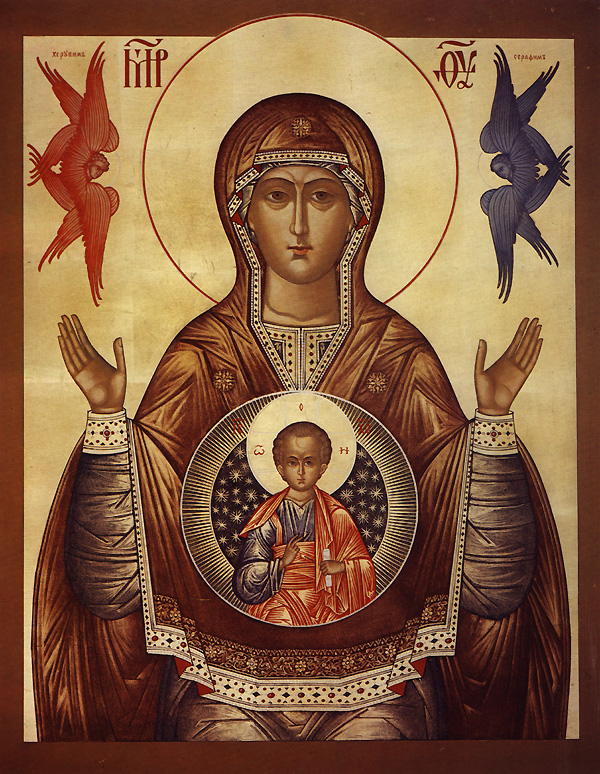
The Icon of the Mother of God “Of the Sign”, depicts the Most Holy Theotokos with prayerfully uplifted hands, and the Divine Infant is at Her bosom in a mandorla (or sphere). This depiction of the Mother of God is regarded as one of the very first of Her iconographic images. In the mausoleum of Saint Agnes at Rome is a depiction of the Mother of God with hands raised in prayer with the Infant Christ sitting upon Her knees. This depiction is ascribed to the fourth century. There is also an ancient Byzantine icon of the Mother of God “Nikopea” from the sixth century, where the Most Holy Theotokos is depicted seated upon a throne and holding in Her hands an oval shield with the image of the Savior Emmanuel.

Icons of the Mother of God, known as “The Sign”, appeared in Russia during the eleventh-twelfth centuries, and were so called because of a miraculous sign from the Novgorod Icon in the year 1170.

In that year the allied forces of Russian appanage princes, headed by a son of Prince Andrew Bogoliubsky of Suzdal, marched to the very walls of Great Novgorod. For the people of Novgorod, their only remaining hope was that God would help them. Day and night they prayed, beseeching the Lord not to forsake them. On the third night Bishop Elias of Novgorod heard a wondrous voice commanding that the icon of the Most Holy Theotokos be taken out of the church of the Savior’s Transfiguration on Ilina street, and carried about on the city walls.

When they carried the icon, the enemy fired a volley of arrows at the procession, and one of them pierced the iconographic face of the Mother of God. Tears trickled from Her eyes, and the icon turned its face towards the city. After this divine Sign an inexpressible terror suddenly fell upon the enemy. They began to strike one another, and taking encouragement from the Lord, the people of Novgorod fearlessly gave battle and won the victory.

In remembrance of the miraculous intercession of the Queen of Heaven, Archbishop Elias established a feastday in honor of the Sign of the Mother of God, which the Russian Church celebrates to the present day. The Athonite hieromonk Pachomius the Logothete, who was present at the festal celebration of the Icon in Russia, composed two Canons for this Feast.

On certain Novgorod Icons of the Sign, the miraculous occurrences of the year 1170 were also depicted. For 186 years afterwards, the wonderworking icon remained in the Savior-Transfiguration church on Ilina street. In 1356 it was transferred to a church built in Novgorod in honor of the Icon of the Most Holy Theotokos “of the Sign,” which became the cathedral church of the monastery of the Sign.

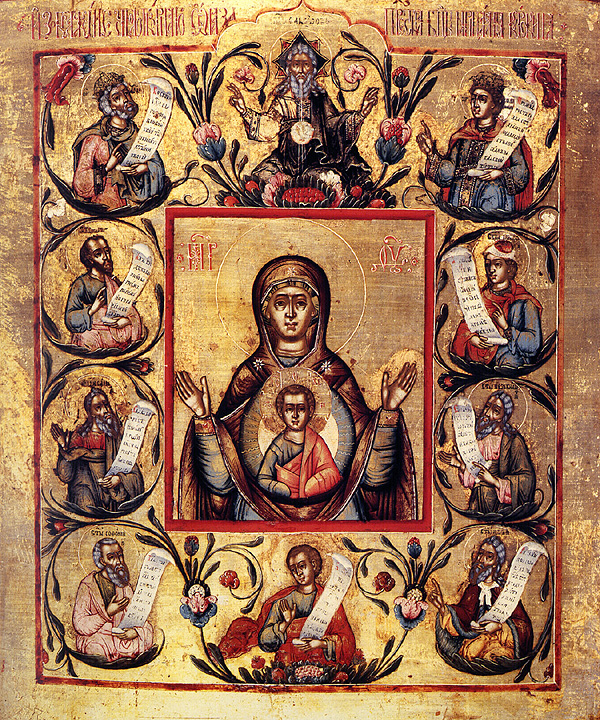
Numerous copies of the Sign Icon are known throughout Russia. Many of them were also glorified by miracles in their local churches, and were then named for the place of the appearance of the miracle. Similar copies of the Sign Icon are the icons of Dionysievo-Glushets, Abalaka (July 20), Kursk, Seraphim-Ponetaev and others.

“Kursk-Root” Icon of the Mother of God

The Kursk Root Icon of the Mother of God “Of the Sign” is one of the most ancient icons of the Russian Church. In the thirteenth century during the Tatar invasion, when all the Russian realm was put to the extremest tribulation, the city of Kursk, ravaged by the Horde of Batu, fell into desolation.

One day in the environs of the city a hunter noticed the ancient icon, lying on a root face downwards to the ground. The hunter lifted it and saw that the image of the icon was similar to the Novgorod “Znamenie” Icon. With the appearance of this icon immediately there appeared its first miracle. Just as the hunter lifted up the holy icon from the earth, right then, at that place where the icon lay, gushed up strongly a spring of pure water. This occurred on September 8, 1259. The hunter decided not to leave the icon in the forest and settled on as a resting place an ancient small chapel, in which he put the newly-appeared image of the Theotokos. Soon inhabitants of the city of Ryla heard about this, and being in location not far away, they began to visit the place of the appearance for venerating the new holy image.

They transferred the icon to Ryla and put it in a new church in honor of the Nativity of the Most Holy Theotokos. But the icon did not long remain there. It disappeared and returned to its former place of appearance. The inhabitants of Ryla repeatedly took it and carried it to the city, but the icon incomprehensibly returned to its former place. Everyone then realized, that the Theotokos preferred the place of appearance of Her Icon. The special help granted by the Mother of God through this icon is bound up with important events in Russian history: with the war of liberation of the Russian nation during the Polish-Lithuanian incursion in 1612, and the 1812 Fatherland war. From the icon several copies were made, which also were glorified.

Icon of the Mother of God of Abalaka

The Abalaka Icon of the Mother of God “Of the Sign” was painted by Matthew, a protodeacon of the Tobolsk cathedral, in honor of Sophia (the Wisdom of God), in fulfillment of a vow by a paralytic peasant Euthymius to rebuild the church at the Abalaka monastery of the Mother of God “of the Sign.” This church was built in 1637 after the Mother of God, accompanied by Saint Nicholas and Saint Mary of Egypt, appeared to the pious widow Maria. After the temple’s Icon “of the Sign” was painted, the paralytic Euthymius was completely healed. Many healings took place during the solemn transfer of the icon to the Abalaka church.

In general appearance, the Abalaka Icon resembles the Novgorod Icon of the Sign, but with this distinction: on the Abalaka Icon, Saint Nicholas and Saint Mary of Egypt stand before the Most Holy Theotokos. Saint Basil of Mangazeya (March 23) is also depicted on this icon. Many wonderworking copies of the Abalaka Icon are venerated throughout Siberia.

The Abalaka Icon “Of the Sign” is also commemorated on July 20.

Saint Theodosius of Trnovo

No information available at this time.

Icon of the Mother of God of Tsarskoe Selo

The Tsarskoe Selo Sign Icon of the Mother of God an ancient wonderworking icon, was brought by way of a present to Tsar Alexis Mikhailovich by one of the Eastern Patriarchs, supposedly by Saint Athanasius of Constantinople (October 28). Tsar Peter I transferred the icon, together with other sacred items from Moscow, to his new capital city.

In the year 1747, a church was built for the icon at Tsarskoe Selo. Moliebens were served before it during times of national catastrophe, for example, during a plague in 1771, and of cholera in 1831. Through the intercession of the Mother of God, the terrible epidemics only barely touched Tsarskoe Selo. Prayers before the Tsarskoe Selo Icon of the Most Holy Theotokos “of the Sign,” were also offered entreating the Mother of God’s help during fires and shipwrecks.

On the icon, Cherubim shade the head of the Mother of God. More recent copies of the icon depict the Apostle Peter, Saints Zachariah, Alexis the Man of God, and Righteous Elizabeth.

“Seraphim-Ponetaevka” Icon of the Mother of God

The Seraphim-Ponetaevka Icon of the Mother of God “of the Sign” was painted in the year 1879 by the nuns of the Seraphim-Ponetaevka women’s monastery, not far from Arzamas, near the village of Ponetaevka. The monastery was named after Saint Seraphim of Sarov by the founder of the monastery, a sister of the Diveyevo community.

Six years after it was painted, the icon became known for its numerous miracles and became the chief holy item of the monastery. When the sisters were praying during the services, they noticed distinct changes in the countenance of the Mother of God: Her All-Pure face became bright and life-like. Numerous pilgrims thronged to the icon, and many were healed from blindness and crippling. In all, about seventy instances of healing were noted.

Daily Readings for Sunday, November 26, 2023

13TH SUNDAY OF LUKE

ABSTAIN FROM MEAT, DAIRY, EGGS

13th Sunday of Luke, Alypius the Stylite of Adrianopolis, Nikon Metanoeite, Stylianos the Monk of Paphlagonia, Akakios of Sinai who is mentioned in The Ladder, George the New Martyr of Chios, Innocent of Irkutsk

ST. PAUL’S LETTER TO THE EPHESIANS 4:1-7

Brethren, I, a prisoner for the Lord, beg you to lead a life worthy of the calling to which you have been called, with all lowliness and meekness, with patience, forbearing one another in love, eager to maintain the unity of the Spirit in the bond of peace. There is one body and one Spirit, just as you were called to the one hope that belongs to your call, one Lord, one faith, one baptism, one God and Father of us all, who is above all and through all and in all. But grace was given to each of us according to the measure of Christ’s gift.

LUKE 18:18-27

At that time, a ruler came to Jesus and asked him, "Good Teacher, what shall I do to inherit eternal life?" And Jesus said to him, "Why do you call me good? No one is good but God alone. You know the commandments: 'Do not commit adultery, Do not kill, Do not steal, Do not bear false witness, Honor your father and mother.' " And he said, "All these I have observed from my youth." And when Jesus heard it, he said to him, "One thing you still lack. Sell all that you have and distribute it to the poor, and you will have treasure in heaven; and come, follow me." But when he heard this he became sad, for he was very rich. Jesus looking at him said, "How hard it is for those who have riches to enter the kingdom of God! For it is easier for a camel to go through the eye of a needle than for a rich man to enter the kingdom of God." Those who heard it said, "Then who can be saved?" But he said, "What is impossible with men is possible with God.

The Righteous Gideon

The Righteous Gideon, whose name means “destroyer,” appears in chapters 6-8 of Judges. He was the son of Joash the Abiezrite. One day, as he was beating out wheat in the wine press, the Angel of the Lord appeared to him and commanded him to deliver Israel from the hand of Midian. Gideon gathered an army of men from various towns to fight the Midianites, then asked God to give him a sign that he would be able to deliver Israel. First, he placed a fleece of wool on the floor of the threshing room. Then he said, “If there is dew on the fleece alone, and if the ground is dry, then I shall know that thou wilt deliver Israel by my hand, as thou hast said.”

The next morning Gideon got up early and squeezed the fleece, wringing out enough water to fill a bowl. Then he asked God to let the fleece remain dry and to let there be dew on the ground. When Gideon saw that this had been done, the powerful warrior of Manasseh led an army of 300 men to victory over the Midianites.

The people entreated him to be their ruler, and also his son and grandson, but he would not agree to this, because the Lord was their ruler. However, Gideon was a Judge for forty years, and during that time the land had rest.

The Righteous Gideon is referenced in Ode 9 of the second Canon for the Feast of the Entry of the Most Holy Theotokos: “Let us all magnify the radiant cloud, in which the Master of all descended, as dew from Heaven upon the fleece” (Judges 6:37). He is also mentioned in Hebrews 11:32 with others “who through faith conquered kingdoms.”

Venerable Alypius the Stylite of Adrianopolis

Saint Alypius the Stylite was born in the city of Adrianopolis in Paphlagonia. His mother, a Christian, was widowed early, and she sent her son to be educated by Bishop Theodore. She distributed her substance to the poor, then began to live an ascetic life near the church as a deaconess.

Saint Alypius, from his early years, wanted to devote his life to God and yearned for the solitary life, although Bishop Theodore would not give him permission to do so. Once, when Saint Alypius was accompanying his bishop to Constantinople, the holy Martyr Euphemia (September 16) appeared to him in a vision, summoning Saint Alypius to return to Adrianopolis and found a church in her name.

With contributions offered by believers in Adrianopolis, Saint Alypius did build a church in the name of the holy Martyr Euphemia, on the site of a dilapidated pagan temple infested by legions of devils. Beside the church, under the open sky, the saint erected a pillar over a pagan tomb. For fifty-three years Saint Alypius struggled upon the pillar, praying to God and teaching those who came to him.

The demons which infested the pagan cemetery fell upon the ascetic by night and pelted him with stones. Saint Alypius, wanted nothing to stand in the way of the attacks of the spirits of darkness, then even took down the boards that served him as a roof, protecting him from the rain and wind. In the face of the saint’s conquering steadfastness, the demons forever fled the place, which had been sanctified by his deed of voluntary martyrdom.

Fourteen years before his death, Saint Alypius was no longer able to stand. He was compelled to lie on his side because of the weakness of his legs, and endured grievous sufferings with humble gratitude. Around the saint’s pillar two monasteries sprang up: a men’s monastery on the one side, and a women’s monastery on the other. Saint Alypius introduced strict monastic rules for both monasteries and he directed both monasteries until his death. Saint Alypius reposed in the year 640, at age 118. The body of the venerable stylite was buried in the church he founded in honor of the holy Martyr Euphemia. The relics of the saint of God healed many of those who came in faith.

Dedication of the Church of the Greatmartyr George at Kiev

The Consecration of the Church of the Great Martyr George at Kiev: Beginning with the holy Prince Vladimir (July 15), it was the pious custom of Russian princes to build a church in honor of their patron saint. Thus, Saint Vladimir (in Baptism Basil) built at Kiev and Vyshgorod temples dedicated to Saint Basil the Great (January 1).

Prince Izyaslav I (1054-1068) (in Baptism Demetrius) built a church and monastery at Kiev in the name of the Holy Great Martyr Demetrius (October 26). Prince Yaroslav the Wise (in Baptism George) started to build a church and men’s monastery in honor of his patron saint, the Holy Great Martyr George (April 23). He also built a church named for his wife’s patron saint, the Holy Great Martyr Irene (May 5). The temple in honor of the Great Martyr George was consecrated by Saint Hilarion, Metropolitan of Kiev (October 21), and a yearly commemoration was established in honor of this event.

Repose of Saint Innocent, first Bishop of Irkutsk

Saint Innocent, Bishop of Irkutsk, (in the world John) was descended from the noble Kulchitsky family. His parents moved from Volhynia to the Chernigov region in the mid-seventeenth century. The saint was born in about the year 1680, and educated at the Kiev Spiritual Academy. He accepted monastic tonsure in 1710 and was appointed an instructor at the Moscow Slavonic-Greek-Latin Academy as prefect and professor of theology.

In 1719 Saint Innocent transferred to the Saint Peterburg Alexander Nevsky Lavra, and was appointed chief naval chaplain. In 1720 he served as vice-regent of the Alexander Nevsky Lavra.

On February 14, 1721, hieromonk Innocent was consecrated as Bishop of Pereyaslavl and appointed to the Peking Spiritual Mission in China. But the Chinese government refused to allow him to enter the country, because the Senate Commission on External Affairs had indiscretely characterized him as “a spiritual personage, a great lord.” The saint was compelled to spend three years at Selingin on the Chinese border, suffering much deprivation because of the uncertainty of his position, and grief from the disarray of the civil government in Siberia. Diplomatic blunders of the Russian Mission in China by Graf Raguzinsky, and intrigues by the Irkutsk archimandrite Anthony Platkovsky led to the appointment of Archimandrite Anthony in China. By decree of the Most Holy Synod Saint Innocent was named in 1727 to be Bishop of Irkutsk and Nerchinsk. And so he entered into the governance of the newly-formed dioceses.

The proximity of the Chinese border, the expanse and sparsely-settled dioceses, the great number of diverse nationalities (Buryat, Mongol, and others), mostly unenlightened by the Christian Faith, the lack of roads and the poverty—all this made Saint Innocent’s pastoral work burdensome and his life full of deprivations. Through a strange oversight of the Senate, he did not receive any money until the time of his death, and he endured extreme want. In these difficult conditions of scant funds, the Irkutsk Ascension monastery still maintained two schools opened under him, one Mongol and the other Russian. The constant concern of the saint was directed towards the schools: the selection of worthy teachers, and providing the necessary books, clothing and other provisions for students.

The saint toiled tirelessly at organizing the diocese, and strengthening its spiritual life. His many sermons, pastoral letters and directives bear witness to this. In his work and deprivations Saint Innocent found spiritual strength, humility, and insight.

In the spring of 1728, the Baikal region began to suffer a drought. Famine from a poor grain harvest had threatened the diocese already back in 1727. With the blessing of the holy hierarch, in May within the churches of Irkutsk and the Irkutsk region they began to include a Molieben for an end to the drought at each Liturgy. On Saturdays they sang an Akathist to the Mother of God, and on Sundays they served a Molieben. “The supplications,” said the saint, “should end on the Feast of Saint Elias” (July 20). Indeed, on that very day a storm raged at Irkutsk with such strong rains, that in the streets of the city water stood up to people’s knees, and thus the drought ended.

Through the efforts of Saint Innocent, construction was started on a stone church to replace the wooden one at the Ascension monastery, and the boundaries of the diocese were expanded to include not only Selingin, but also the Yakutsk and Ilimsk surroundings.

The saint, not noted for robust health, and under the influence of the severe climate and his afflictions, departed to the Lord at a rather young age (51). He reposed on the morning of November 27, 1731.

In the year 1764, the body of the saint was discovered incorrupt during restoration work on the monastery’s Tikhvin church. Many miracles occurred not only at Irkutsk, but also in remote places of Siberia, for those who flocked to the saint with prayer. This moved the Most Holy Synod to uncover the relics and to glorify the saint in the year 1800.

In the year 1804, a feastday was established to celebrate his memory throughout all Russia on November 26, since the Sign Icon of the Mother of God is commemorated on the actual day of his repose (November 27). Saint Innocent is also remembered on February 9.

In 1921, the relics of Saint Innocent were taken from their shrine and placed in a Soviet anti-religious museum. They were moved to another museum in Yaroslav in 1939, and were exhibited as “mummified remains of an unknown man.” In 1990, they were brought to the newly-reopened Tolga Monastery in the Yaroslav diocese. In September of 1990, the holy relics arrived in Irkutsk and were placed in the cathedral, to the joy of all the faithful.

Venerable James the Solitary of Syria

Saint James the Solitary (Hermit) was the disciple of Saint Maron (February 14). He lived in asceticism on a mountain not far from the city of Cyrrhus in Syria. He suffered grievous ills, but he always wore chains, ate food only in the evening, and prayed constantly. By such efforts he attained to high spiritual perfection, receiving from the Lord power over demons, the gift of healing and even of raising the dead. Saint James peacefully fell asleep in the Lord.

Venerable Stylianus of Paphlagonia

Saint Stylianus was born in Paphlagonia of Asia Minor sometime between the fourth and sixth centuries. He inherited a great fortune from his parents when they died, but he did not keep it. He gave it away to the poor according to their need, desiring to help those who were less fortunate.

Stylianus left the city and went to a monastery, where he devoted his life to God. Since he was more zealous and devout than the other monks, he provoked their jealousy and had to leave. He left the monastery to live alone in a cave in the wilderness, where he spent his time in prayer and fasting.

The goodness and piety of the saint soon became evident to the inhabitants of Paphlagonia, and they sought him out to hear his teaching, or to be cured by him. Many were healed of physical and mental illnesses by his prayers.

Saint Stylianus was known for his love of children, and he would heal them of their infirmities. Even after his death, the citizens of Paphlagonia believed that he could cure their children. Whenever a child became sick, an icon of Saint Stylianus was painted and was hung over the child’s bed.

At the hour of his death, the face of Saint Stylianus suddenly became radiant, and an angel appeared to receive his soul.

Known as a protector of children, Saint Stylianus is depicted in iconography holding an infant in his arms. Pious Christians ask him to help and protect their children, and childless women entreat his intercession so that they might have children.

Venerable Nikon “Metanoeite,” the Preacher of Repentance

Saint Nikon Metanoeite (“the Preacher of Repentance”) was born at Pontus Polemoniacus at the beginning of the tenth century. He was the son of a wealthy landowner, and he was given the name Nicetas in Baptism.

Since he had no desire to take over the management of his family’s wealth and estates, Nicetas entered the monastery of Chrysopetro, where he shone forth in prayer and asceticism. When he received the monastic tonsure, he was given the new name Nikon. The new name symbolizes a new life in the Spirit (Romans 7:6), and the birth of the new man (Ephesians 4:24). A monk is expected to stop associating himself with the old personality connected to his former life in the world, and to devote himself entirely to God.

Saint Nikon had a remarkable gift for preaching. When he spoke of virtue and spiritual matters, his listeners were filled with heartfelt compunction and love for God. His words produced such spiritual fruit in those who heard him that he was asked to travel through the eastern regions to preach. He visited Armenia, Crete, Euboea, Aegina, and the Peloponnesus, proclaiming the Gospel of Christ.

“Repent, for the Kingdom of Heaven is at hand.” This was the message of Saint John the Baptist (Matthew 3:2), and of Christ Himself (Matthew 4:17). This was also the message of Saint Nikon. Wherever he went, he would begin his sermons with “Repent,” hence he was called “Nikon Metanoeite,” or “Nikon, the Preacher of Repentance.”

At first, people paid little heed to his message. Then gradually he won their hearts through his preaching, his miracles, and his gentle, loving nature. He stressed the necessity for everyone to repent, warning that those who utter a few sighs and groans and think that they have achieved true repentance have deluded themselves. Saint Nikon told the people that true sorrow for one’s sins is cultivated by prayer, self-denial, almsgiving, ascetical efforts, and by confession to one’s spiritual Father.

After sowing the seeds of piety, Saint Nikon began to see them bear fruit. People started to change their lives, but he urged them to strengthen their souls in virtue and good works so that they would not be overwhelmed by the cares of this world.

Eventually, Saint Nikon settled in a cave outside Sparta. Soon he moved into the city, because so many people were coming to hear him. In the center of Sparta, he built a church dedicated to Christ the Savior. In time a monastery grew up around the church.

Saint Nikon never ceased to preach the Word of God, and to lead people back to the spiritual life of the Church. He also healed the sick, and performed many other miracles.

Saint Nikon fell asleep in the Lord in 998, and his memory was honored by the people around Sparta. During the Turkish occupation of Greece, however, he was all but forgotten, except in Sparta. After the Greek Revolution in 1821, a service to Saint Nikon was composed by Father Daniel Georgopoulos, and was based on the saint’s Life, which had been written by Igumen Gregory of Saint Nikon’s Monastery in 1142.

Saint Nikon was recognized as the patron saint of the diocese of Monemvasia and Lakedaimonia in 1893 when the cathedral church in Sparta was dedicated to Saint Nikon, the Preacher of Repentance.

Saints Athanasios and Theodosios of Cherepovets, disciples of Saint Sergius of Radonezh

Saints Athanasios (nicknamed "the Iron Staff") and Theodosios, were disciples of Saint Sergius of Radonezh, and they settled in the Novgorod region, on the border of Cherepovets, at the confluence of the Yagorba River and the Sheksna. There, in the dense, impenetrable forests, they built a church in honor of the Holy Trinity, and a monastery was also established. Nothing is known for certain about Saint Theodosios, and almost no information has been preserved about Saint Athanasios, because during the Time of Troubles the Monastery was razed almost to the ground, and the written records were destroyed. We do know that the Monastery church built by Saints Athanasios and Theodosios, was dedicated to the Holy Trinity, as well as to Saints Sergius and Nikon of Radonezh. On the basis of this information, it is thought that both Saint Athanasios and Saint Theodosios were tonsured at Trinity-Sergius Monastery, for the ancient hermits used to build monasteries on the model of those in which they became monks.

There is written testimony about these Saints in an inscription in a loose-leaf book from 1568 which reads: "This is the book of the Monastery of the Resurrection of Christ and the Life-giving Trinity, and of our Venerable Fathers Theodosios and Athanasios."

In the the chronicle of the Saints it says: "Venerable Athanasios, called 'Iron Staff,' the disciple of Saint Sergius the Wonderworker; who reposed in the year 1392." The Stroganov Manual of Iconography describes the Saint's appearance: "Venerable Athanasios… a grey beard, narrower and shorter than Blaise's."

Shortly before the arrival of the monks in that region, a chapel was built through the efforts of a merchant. This man decided to build a chapel after a miracle occurred. One day he was transporting goods in a boat, when suddenly in the middle of the day, it grew dark, and the boat ran aground. The frightened merchant began to pray, and soon the darkness lifted, and a nearby mountain was illumined with a bright light. The man climbed the mountain and was so amazed at the beautiful view that he returned to the area and built a chapel the following year.

Very little information about these Saints has come down to us. We know that Saint Athanasios carried an iron staff, and Saint Theodosios may have been the merchant who built the chapel.

In 1764, the Resurrection Monastery was abolished, and its church became a parish church. Since 1780 it has been called the Resurrection Cathedral of the city of Cherepovets. Hidden under this church, the relics of Saint Athanasios and Saint Theodosios now rest. The Cherepovets Resurrection Cathedral also has icons of Saints Athanasios and Theodosios.

The Saints reposed in the year 1388, and were buried in the Monastery’s cathedral church. They are also commemorated on July 5 and September 25.