
MONDAY OF THE 7TH WEEK
NO FAST
The Holy Martyrs Zenobius and His Sister Zenobia, Cleopas and Artemas of the 70 Apostles, Joseph, Patriarch of Constantinople
ST. PAUL’S LETTER TO THE COLOSSIANS 2:13-20
Brethren, you who were dead in trespasses and the uncircumcision of your flesh, Christ made alive together with him, having forgiven us all our trespasses, having canceled the bond which stood against us with its legal demands; this he set aside, nailing it to the cross. He disarmed the principalities and powers and made a public example of them, triumphing over them in him. Therefore let no one pass judgment on you in questions of food and drink or with regard to a festival or a new moon or a sabbath. These are only a shadow of what is to come; but the substance belongs to Christ. Let no one disqualify you, insisting on self-abasement and worship of angels, taking his stand on visions, puffed up without reason by his sensuous mind, and not holding fast to the Head, from whom the whole body, nourished and knit together through its joints and ligaments, grows with a growth that is from God. If with Christ you died to the elemental spirits of the universe, why do you live as if you still belonged to the world?
LUKE 11:29-33
At that time, when the crowds were increasing, Jesus began to say, “This generation is an evil generation; it seeks a sign, but no sign shall be given to it except the sign of Jonah. For as Jonah became a sign to the men of Nineveh, so will the Son of man be to this generation. The queen of the South will arise at the judgment with the men of this generation and condemn them; for she came from the ends of the earth to hear the wisdom of Solomon, and behold, something greater than Solomon is here. The men of Nineveh will arise at the judgment with this generation and condemn it; for they repented at the preaching of Jonah, and behold, something greater than Jonah is here. No one after lighting a lamp puts it in a cellar or under a bushel, but on a stand, that those who enter may see the light.”
Hieromartyr Zenobios and his sister Zenobia, of Aegæ in Cilicia

The Hieromartyr Zenobius, Bishop of Aegea, and his sister Zenobia suffered a martyr’s death in the year 285 in Cilicia. From childhood they were raised in the holy Christian Faith by their parents, and they led pious and chaste lives. In their mature years, shunning the love of money, they distributed away their inherited wealth giving it to the poor. For his beneficence and holy life the Lord rewarded Zenobius with the gift of healing various maladies. He was also chosen bishop of a Christian community in Cilicia.
As bishop, Saint Zenobius zealously spread the Christian Faith among the pagans. When the emperor Diocletian (284-305) began a persecution against Christians, Bishop Zenobius was the first one arrested and brought to trial to the governor Licius. “I shall only speak briefly with you,” said Licius to the saint, “for I propose to grant you life if you worship our gods, or death, if you do not.” The saint answered, “This present life without Christ is death. It is better that I prepare to endure the present torment for my Creator, and then with Him live eternally, than to renounce Him for the sake of the present life, and then be tormented eternally in Hades.”
By order of Licius, they nailed him to a cross and began the torture. The bishop’s sister, seeing him suffering, wanted to stop it. She bravely confessed her own faith in Christ before the governor, therefore, she also was tortured.
By the power of the Lord they remained alive after being placed on a red-hot iron bed, and then in a boiling kettle. The saints were then beheaded. The priest Hermogenes secretly buried the bodies of the martyrs in a single grave.
Saint Zenobius is invoked by those suffering from breast cancer.
Apostle Tertius of the Seventy

Saint Tertius was the second bishop (after Saint Sosipater) in Iconium, where he converted many pagans to Christ, and ended his life as a martyr. The Apostle Paul mentions him in the Epistle to the Romans (Rom. 16:22).
Apostle Mark of the Seventy

Saint Mark, also called John, (Acts 12:12), was a nephew of Saint Barnabas, and was Bishop of Apollonia (Col. 4:10). It was in the house of his mother Maria that the persecuted disciples found shelter after the Ascension of the Lord.
Apostle Justus of the Seventy
Saint Justus, called Barsaba, a son of Saint Joseph the Betrothed, was chosen with Matthias to replace Judas. He was a bishop and died a martyr’s death at Eleutheropolis.
Apostle Artemas of the Seventy
Saint Artemas was bishop of Lystra, Lycia. He died in peace.
Hieromartyr Marcian, Bishop of Syracuse
The Holy Hieromartyr Marcian, Bishop of Syracuse, a disciple of the Apostle Peter, was sent to Sicily. Here he settled in a cave near the city of Syracuse and successfully spread the faith in Christ. He died a martyr. His relics are in the Italian city of Gaeta. The Hieromartyr Marcian is the same person as Saint Marcellus, Bishop of Sicily, commemorated on February 9.
Martyr Eutropia of Alexandria
The Martyr Eutropia suffered for Christ in Alexandria in about the year 250. Often visiting Christians locked up in prison, she encouraged them to endure suffering with patience. For this, the saint was arrested. At her trial she firmly confessed her faith in Christ. As she was being burned with candles, a man appeared beside her and soothed her sufferings. He bedewed her so that she did not feel the heat of the flames. She died after these grievous tortures.
Martyr Anastasia of Thessalonica
Saint Anastasia lived in the second half of the third century during the persecutions of Decius, Gallus, Valerian, and Diocletian. She was executed in Rome between 256-259 after enduring many tortures.
Saint Stephen Milutin of Serbia

Saint Stephen was the younger son of King Stephen Urosh I, and grandson of First-Crowned King Saint Stephen (September 24). He ruled Serbia from 1275 to 1320. Stephen Milutin received the throne from his elder brother Saint Dragutin who, after a short reign, transferred power over to Stephen.
Saint Stephen Milutin, after he became king, bravely defended, by both word and by deed, the Orthodox Serbs and other Orthodox peoples from their enemies. Saint Stephen did not forget to thank the Lord for His beneficence. He built more than forty churches, and also many monasteries and hostels for travelers. The saint particularly concerned himself with the Athonite monasteries.
When the Serbian kingdom fell, the monasteries remained centers of national culture and Orthodoxy for the Serbian nation. Saint Stephen died on October 29, 1320 and was buried at the Bansk monastery. After two years his incorrupt relics were uncovered.
Venerable Dragutin (Theoctistus in Monasticism) of Serbia

Saint Dragutin was the brother of Saint Stephen Milutin, the son of King Stephen Urosh I, and the grandson of First-Crowned King Saint Stephen (September 24). Dragutin, a true Christian, after a short reign, abdicated in favor of his brother Stephen. He withdrew to Srem, secretly living as an ascetic in a grave which he dug with his own hands. During his righteous life, Saint Dragutin toiled much over converting the Bogomil heretics to the true Faith. He surrendered his soul to God on March 2, 1316.
Saint Helen of Serbia
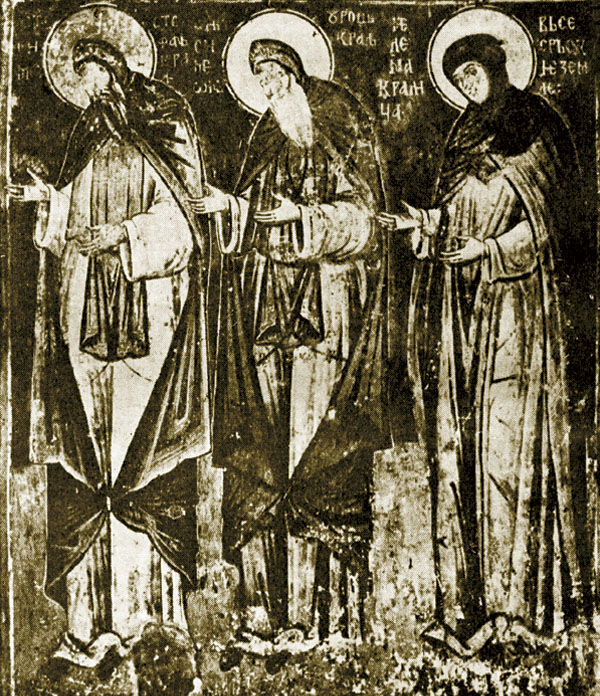
Saint Helen, a pious mother to her sons Stephen Milutin and Dragutin, devoted her whole life to pious deeds after the death of her husband. She built a shelter for the poor, and a monastery for those who wished to live in purity and virginity. Near the city of Spich, she built the Rechesk monastery and endowed it with the necessities.
Before her death, Saint Helen received monastic tonsure and departed to the Lord on February 8, 1306.
Ozeryana Icon of the Mother of God
Not far from Kharkov, in the Transfiguration Kuryazh Monastery, the wonderworking Ozeryana Icon of the Mother of God was kept. According to tradition, the Icon appeared at the end of the XVI century during Tatar raids on Ukraine near the village of Ozeryana – hence the name of the Icon. It is thought that the Icon was was brought to Ukraine from beyond the Dnieper, that is, from Galicia. Later, a Monastery was built on this site, which was also called Ozeryana. Many miracles occurred before the Icon at the Ozeryana Hermitage. But despite this, no one knew just who put the Icon in the Monastery's trapeza church.
It is said that a certain Ukrainian peasant was cutting hay and split the Icon of the Mother of God in half. Realizing that what he had done, though unintentionally, was a terrible thing for him and for those around him, the man took the two halves of the Icon, and reverently placed the Icon in his prayer corner, and lit a candle before it. The next morning he found the Icon intact, and only a thin trace of the break remained.
In 1794, the Ozeryana Icon was transferred to the Kuryazh Monastery, and after it was closed it was kept in the Kharkov church of the Protection for eight years. At the beginning of the XIX century, the Monastery was restored, and the holy Icon of the Mother of God was returned to the Monastery at the request of the brethren.
Many of the faithful from Kharkov and the surrounding villages came to venerate the wonderworking Ozeryana Icon, before which many healings of the afflicted occurred by the fervent prayers of the believers.
Beginning in 1843, the wonderworking Icon of the Most Holy Theotokos was transferred to Kharkov every year on September 30 in a Cross Procession, where it remained all winter. On April 22 the Icon was returned to the Monastery in the same manner.
The Ozeryana Icon was adorned with an expensive riza made of red gold of ancient workmanship. The Icon was painted on canvas using an old Russian painting technique, and it belongs to the Hodegetria (Hodēgḗtria) type.
Unfortunately, during the years of religious oppression in the XX century the Ozeryana Icon, which is considered to be the patroness of Kharkov and the entire Sloboda region of Ukraine, was lost. Only one copy made according to Church canons has been preserved. According to the clergy, it possesses the same miraculous power as the original Icon.
The Ozeryana Icon is also commemorated on April 23 (movable Feast). The Troparion and Kontakion are the same as those for the Jerusalem Icon (October 12).
Saint Jotham Zedgenidze

In 1446 George VIII was crowned ruler of a united Georgian kingdom. Filled with every virtue, the valiant warrior and God-fearing king dedicated the twenty years of his reign to a ceaseless struggle for the reunification of his country. He was constantly warding off foreign invaders, surmounting internal strife, and suffering the betrayal of his fellow countrymen.
One of the separatists was the ruler of Samtskhe, the atabeg Qvarqvare Jakeli II (1451-1498). In 1465 King George led his troops toward southern Georgia to attack the rebellious atabeg.
Near Lake Paravani the traitors dispatched assassins to the king’s camp.
Among those who served in the royal court was a certain Jotham Zedgenidze, a man deeply devoted to his king. He heard about the dreadful conspiracy and warned the king, but the noble and fearless George did not believe that such a loathsome betrayal could ever take place.
Desperate to convince the king of the very real and imminent danger, the devoted Jotham told him, “Allow me to spend this night in your bed and prove the truth of my words!”
Certain that his beloved courtier was mistaken and that his unmeasured love and dedication were the reasons for his suspicions, King George permitted him to spend the night in the royal bed.
The next morning King George entered his tent and found his beloved Jotham lying in a pool of blood. Immediately he began weeping bitterly over his error. He arrested and executed the conspirators and buried his faithful servant with great honor.
The Georgian Church numbers Jotham Zedgenidze among the saints for his devotion to God’s anointed king.
 Saint Peter Antiochian Orthodox Church