
Here is the live stream for Great Vespers – Sat. 9/2/23 If you need, here are instructions for accessing this content from your phone, tablet, computer, or TV.
Monthly Archives: September 2023
Daily Readings for Saturday, September 02, 2023
13TH SATURDAY AFTER PENTECOST
NO FAST
Mammas the Martyr, John the Abstainer, Patriarch of Constantinople, Paul, Patriarch of Constantinople, Cosmas the Hermit, Ammon & Aeithalas the Martyrs of Thrace
ST. PAUL’S LETTER TO THE ROMANS 8:28-39
Brethren, we know that everything works for good with those who love God, who are called according to his purpose. For those whom he foreknew he also predestined to be conformed to the image of his Son, in order that he might be the first-born among many brethren. And those whom he predestined he also called; and those whom he called he also justified; and those whom he justified he also glorified.
What then shall we say to this? If God is for us, who is against us? He who did not spare his own Son but gave him up for us all, will he not also give us all things with him? Who shall bring any charge against God's elect? It is God who justifies; who is to condemn? It is Christ Jesus, who died, yes, who was raised from the dead, who is at the right hand of God, who indeed intercedes for us. Who shall separate us from the love of Christ? Shall tribulation, or distress, or persecution, or famine, or nakedness, or peril, or sword? As it is written, "For thy sake we are being killed all the day long; we are regarded as sheep to be slaughtered." No, in all these things we are more than conquerors through him who loved us. For I am sure that neither death, nor life, nor angels, nor principalities, nor things present, nor things to come, nor powers, nor height, nor depth, nor anything else in all creation, will be able to separate us from the love of God in Christ Jesus our Lord.
MATTHEW 22:15-22
At that time, the Pharisees took counsel against Jesus, how to entangle him in his talk. And they sent their disciples to him, along with the Herodians, saying, “Teacher, we know that you are true, and teach the way of God truthfully, and care for no man; for you do not regard the position of men. Tell us, then, what you think. Is it lawful to pay taxes to Caesar, or not?” But Jesus, aware of their malice, said, “Why put me to the test, you hypocrites? Show me the money for the tax.” And they brought him a coin. And Jesus said to them, “Whose likeness and inscription is this?” They said, “Caesar’s.” Then he said to them, “Render therefore to Caesar the things that are Caesar’s, and to God the things that are God’s.” When they heard it, they marveled; and they left him and went away.
Venerable Anthony of the Kiev Far Caves

Saint Anthony of the Kiev Caves was born in the year 983 at Liubech, not far from Chernigov, and was named Antipas in Baptism. Possessing the fear of God from his youth, he desired to be clothed in the monastic schema. When he reached a mature age, he wandered until he arrived on Mt. Athos, burning with the desire to emulate the deeds of its holy inhabitants. Here he received monastic tonsure, and the young monk pleased God in every aspect of his spiritual struggles on the path of virtue. He particularly excelled in humility and obedience, so that all the monks rejoiced to see his holy life.
The igumen saw in Saint Anthony the great future ascetic, and inspired by God, he sent him back to his native land, saying, “Anthony, it is time for you to guide others in holiness. Return to your own Russian land, and be an example for others. May the blessing of the Holy Mountain be with you.”
Returning to the land of Rus, Anthony began to make the rounds of the monasteries about Kiev, but nowhere did he find that strict life which had drawn him to Mt. Athos.
Through the Providence of God, Anthony came to the hills of Kiev by the banks of the River Dnieper. The forested area near the village of Berestovo reminded him of his beloved Athos. There he found a cave which had been dug out by the Priest Hilarion, who later became Metropolitan of Kiev (October 21). Since he liked the spot, Anthony prayed with tears, “Lord, let the blessing of Mt. Athos be upon this spot, and strengthen me to remain here.” He began to struggle in prayer, fasting, vigil and physical labor. Every other day, or every third day, he would eat only dry bread and a little water. Sometimes he did not eat for a week. People began to come to the ascetic for his blessing and counsel, and some decided to remain with the saint.
Among Anthony’s first disciples was Saint Nikon (March 23), who tonsured Saint Theodosius of the Caves (May 3) at the monastery in the year 1032.
The virtuous life of Saint Anthony illumined the Russian land with the beauty of monasticism. Saint Anthony lovingly received those who yearned for the monastic life. After instructing them how to follow Christ, he asked Saint Nikon to tonsure them. When twelve disciples had gathered about Saint Anthony, the brethren dug a large cave and built a church and cells for the monks within it.
After he appointed Abbot Barlaam to guide the brethren, Saint Anthony withdrew from the monastery. He dug a new cave for himself, then hid himself within it. There too, monks began to settle around him. Afterwards, the saint built a small wooden church in honor of the Dormition of the Mother of God over the Far Caves.
At the insistence of Prince Izyaslav, the igumen Barlaam withdrew to the Dimitriev monastery. With the blessing of Saint Anthony and with the general agreement of the brethren, the meek and humble Theodosius was chosen as igumen. By this time, the number of brethren had already reached a hundred men. The Kiev Great Prince Izyaslav (+ 1078) gave the monks the hill on which the large church and cells were built, with a palisade all around. Thus, the renowned monastery over the caves was established. Describing this, the chronicler remarks that while many monasteries were built by emperors and nobles, they could not compare with those which are built with holy prayers and tears, and by fasting and vigil. Although Saint Anthony had no gold, he built a monastery which became the first spiritual center of Rus.
For his holiness of life, God glorified Saint Anthony with the gift of clairvoyance and wonderworking. One example of this occurred during the construction of the Great Caves church. The Most Holy Theotokos Herself stood before him and Saint Theodosius in the Blachernae church in Constantinople, where they had been miraculously transported without leaving their own monastery. Actually, two angels appeared in Constantinople in their forms (See May 3, the account of the Kiev Caves Icon of the Most Holy Theotokos). Having received gold from the Mother of God, the saints commissioned master architects, who came from Constantinople to the Russian land on the command of the Queen of Heaven to build the church at the Monastery of the Caves. During this appearance, the Mother of God foretold the impending death of Saint Anthony, which occurred on July 10, 1073.
Through Divine Providence, the relics of Saint Anthony remain hidden.
Venerable Theodosius of the Kiev Far Caves

Saint Theodosius of the Caves, was the Father of monasticism in Russia. He was born at Vasilevo, not far from Kiev. From his youth he felt an irresistible attraction for the ascetic life, and led an ascetic lifestyle while still in his parental home. He disdained childish games and attractions, and constantly went to church. He asked his parents to let him study the holy books, and through his ability and rare zeal, he quickly learned to read the books, so that everyone was amazed at his intellect.
When he was fourteen, he lost his father and remained under the supervision of his mother, a strict and domineering woman who loved her son very much. Many times she chastised her son for his yearning for asceticism, but he remained firmly committed to his path.
At the age of twenty-four, he secretly left his parents’ home and Saint Anthony at the Kiev Caves monastery blessed him to receive monastic tonsure with the name Theodosius. After four years his mother found him and with tearfully begged him to return home, but the saint persuaded her to remain in Kiev and to become a nun in the monastery of Saint Nicholas at the Askold cemetery.
Saint Theodosius toiled at the monastery more than others, and he often took upon himself some of the work of the other brethren. He carried water, chopped wood, ground up the grain, and carried the flour to each monk. On cold nights he uncovered his body and let it serve as food for gnats and mosquitoes. His blood flowed, but the saint occupied himself with handicrafts, and sang Psalms. He came to church before anyone else and, standing in one place, he did not leave it until the end of services. He also listened to the readings with particular attention.
In 1054 Saint Theodosius was ordained a hieromonk, and in 1057 he was chosen igumen. The fame of his deeds attracted a number of monks to the monastery, at which he built a new church and cells, and he introduced cenobitic rule of the Studion monastery, a copy of which he commissioned at Constantinople.
As igumen, Saint Theodosius continued his arduous duties at the monastery. He usually ate only dry bread and cooked greens without oil, and spent his nights in prayer without sleep. The brethren often noticed this, although the saint tried to conceal his efforts from others.
No one saw when Saint Theodosius dozed lightly, and usually he rested while sitting. During Great Lent the saint withdrew into a cave near the monastery, where he struggled unseen by anyone. His attire was a coarse hairshirt worn next to his body. He looked so much like a beggar that it was impossible to recognize in this old man the renowned igumen, deeply respected by all who knew him.
Once, Saint Theodosius was returning from visiting the Great Prince Izyaslav. The coachman, not recognizing him, said gruffly, “You, monk, are always on holiday, but I am constantly at work. Take my place, and let me ride in the carriage.” The holy Elder meekly complied and drove the servant. Seeing how nobles along the way bowed to the monk driving the horses, the servant took fright, but the holy ascetic calmed him, and gave him a meal at the monastery. Trusting in God’s help, the saint did not keep a large supply of food at the monastery, and therefore the brethren were in want of their daily bread. Through his prayers, however, unknown benefactors appeared at the monastery and furnished the necessities for the brethren.
The Great Princes, especially Izyaslav, loved to listen to the spiritual discourses of Saint Theodosius. The saint was not afraid to denounce the mighty of this world. Those unjustly condemned always found a defender in him, and judges would review matters at the request of the igumen. He was particularly concerned for the destitute. He built a special courtyard for them at the monastery where anyone in need could receive food and drink. Sensing the approach of death, Saint Theodosius peacefully fell asleep in the Lord in the year 1074. He was buried in a cave which he dug, where he had secluded himself during fasting periods.
The relics of the ascetic were found incorrupt in the year 1091, and Saint Theodosius was glorified as a saint in 1108. Of the written works of Saint Theodosius six discourses, two letters to Great Prince Izyaslav, and a prayer for all Christians have survived to our time.
The Life of Saint Theodosius was written by Saint Nestor the Chronicler (October 27), a disciple of the great Abba, only thirty years after his repose, and it was always one of the favorite readings of the Russian nation. Saint Theodosius is also commemorated on September 28 and May 3.
Martyr Mamas of Caesarea in Cappadocia
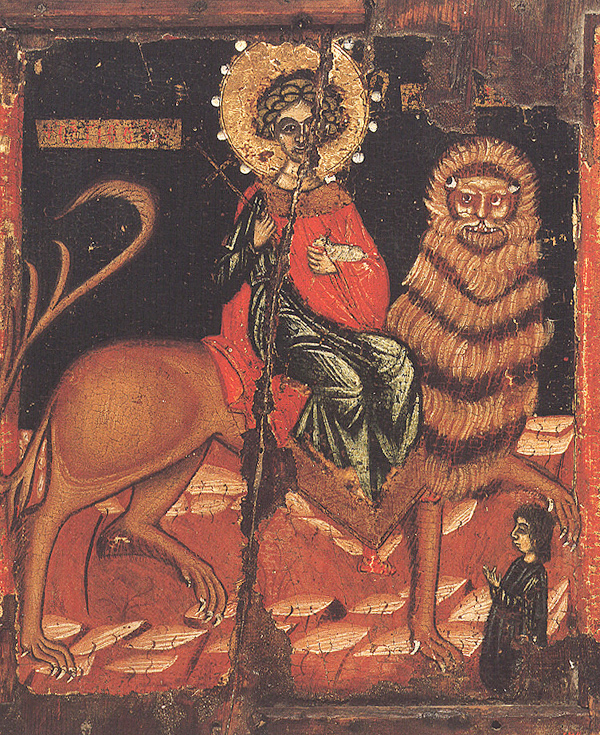
The Holy Great Martyr Mamas was born in Paphlagonia, Asia Minor in the third century of pious and illustrious parents, the Christians Theodotus and Rufina. The parents of the saint were arrested by the pagans for their open confession of their faith and locked up in prison in Caesarea in Cappadocia.
Knowing his own bodily weakness, Theodotus prayed that the Lord would take him before being subjected to tortures. The Lord heard his prayer and he died in prison. Saint Rufina died also after him, after giving birth to a premature son. She entrusted him to God, beseeching Him to be the Protector and Defender of the orphaned infant.
God heard the dying prayer of Saint Rufina: a rich Christian widow named Ammia reverently buried the bodies of Saints Theodotus and Rufina, and she took the boy into her own home and raised him as her own son. Saint Mamas grew up in the Christian Faith. His foster mother concerned herself with the developing of his natural abilities, and early on she sent him off to study his grammar.
The boy learned easily and willingly. He was not of an age of mature judgment but distinguished himself by maturity of mind and of heart. By means of prudent conversations and personal example young Mamas converted many of his own peers to Christianity.
The governor, Democritus, was informed of this, and the fifteen-year-old Mamas was arrested and brought to trial. In deference to his illustrious parentage, Democritus decided not to subject him to torture, but instead sent him off to the emperor Aurelian (270-275). The emperor tried at first kindly, but then with threats to turn Saint Mamas back to the pagan faith, but all in vain. The saint bravely confessed himself a Christian and pointed out the madness of the pagans in their worship of lifeless idols.
Infuriated, the emperor subjected the youth to cruel tortures. They tried to drown the saint, but an angel of the Lord saved Saint Mamas and bade him live on a high mountain in the wilderness, not far from Caesarea. Bowing to the will of God, the saint built a small church there and began to lead a life of strict temperance, in exploits of fasting and prayer.
Soon he received a remarkable power over the forces of nature: wild beasts inhabiting the surrounding wilderness gathered at his abode and listened to the reading of the Holy Gospel. Saint Mamas nourished himself on the milk of wild goats and deer.
The saint did not ignore the needs of his neighbors. Preparing cheese from this milk, he gave it away freely to the poor. Soon the fame of Saint Mamas’s life spread throughout all of Caesarea.
The governor sent a detachment of soldiers to arrest him. When they encountered Saint Mamas on the mountain, the soldiers did not recognize him, and mistook him for a simple shepherd. The saint then invited them to his dwelling, gave them a drink of milk and then told them his name, knowing that death for Christ awaited him. The servant of God told the servant of the Emperor to go on ahead of him into Caesaria, promising that he would soon follow. The soldiers waited for him at the gates of the city, and Saint Mamas, accompanied by a lion, met them there.
Surrendering himself into the hands of the torturers, Saint Mamas was brought to trial under a deputy governor named Alexander, who subjected him to intense and prolonged tortures. They did not break the saint’s will, however. He was strengthened by the words addressed to him from above: “Be strong and take courage, Mamas.”
When they threw Saint Mamas to the wild beasts, these creatures would not touch him. Finally, one of the pagan priests struck him with a trident. Mortally wounded, Saint Mamas went out beyond the city limits. There, in a small stone cave, he gave up his spirit to God, Who in the hearing of all summoned the holy Martyr Mamas into His heavenly habitation. He was buried by believers at the place of his death.
Christians soon began to receive help from him in their afflictions and sorrows. Saint Basil the Great speaks thus about the holy Martyr Mamas in a sermon to the people: “Remember the holy martyr, you who live here and have him as a helper. You who call on his name have been helped by him. Those in error he has guided into life. Those whom he has healed of infirmity, those whose dead children he has restored to life, those whose life he has prolonged: let us all come together as one, and praise the martyr!”
Martyrs Theodotus and Rufina of Caesarea, in Cappadocia
The holy martyrs Theodotus and Rufina were the parents of Saint Mamas. They came from patrician families, and were honored by all for their Christian piety. Alexander, the magistrate of the city of Gangra, summoned them because they refused to obey the imperial decree requiring all citizens to worship the pagan gods. Those who disobeyed would be tortured and put to death.
Since Theodotus refused to comply with this order, Alexander sent him to the governor Faustus in Caesarea of Cappadocia. Alexander could not torture or kill Theodotus because of his noble rank. Faustus, however, had no such scruples. He threw Theodotus into prison as soon as he arrived.
Even though she was pregnant at the time, Rufina followed her husband. She stayed in the prison with Theodotus, where they both suffered for Christ. Fearing that he would not be able to withstand the cruel tortures, Theodotus asked God to take his soul. The Lord heard his prayer and sent him a blessed repose, establishing his soul in the heavenly mansions.
Saint Rufina endured privations and sufferings in prison, and experienced great sorrow at the death of her husband. Because of these things, she gave birth to her child before the proper time. She prayed that God would permit her to follow her husband in death, and that He would also protect her child. Her prayer was also granted, and she gave her virtuous soul into God’s hands.
Saint Mamas was raised by a pious woman named Ammia, or Matrona, who became a second mother to him.
Saint John the Faster, Patriarch of Constantinople
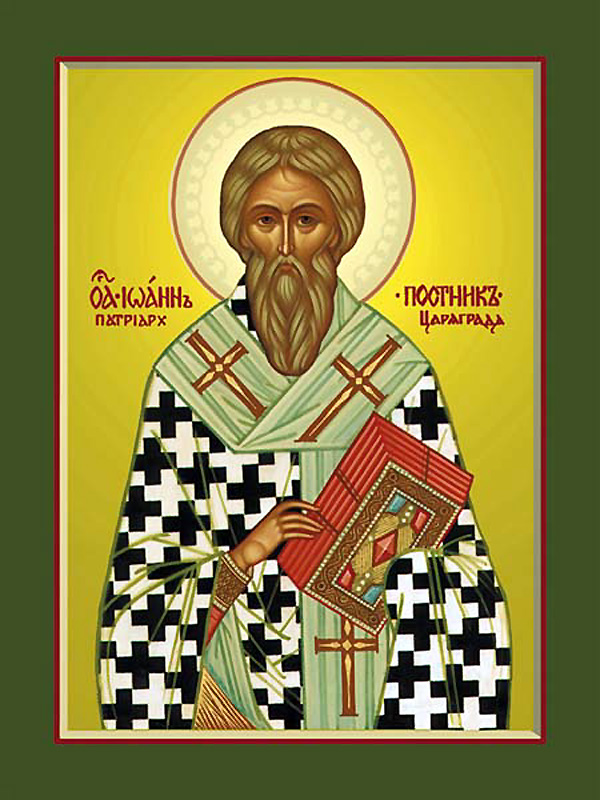
Our Holy Father John was born in Constantinople, the Queen of Cities. At first he worked as a goldsmith, and everyone expected him to continue in that occupation. From his youth, however, he was inclined toward the monastic life. He also possessed a rare gift for continence and a natural love for fasting, and thus he was known as “the Faster.” Because of his reputation for virtue, he was ordained as a deacon by Patriarch John III, and later he received the grace of the priesthood. Saint John was found worthy to behold a vision which showed that he would become be a worthy recipient of God’s grace, for the spiritual enlightenment of his flock. He read the Holy Scriptures and other ecclesiastical books every day, thereby enriching his knowledge.
Once, when he was a young man, John was walking with Eusebius, an old monk from Palestine. Suddenly, a bodiless voice spoke to Eusebius: “Abba, do not walk to the right of the great John.” It was the voice of God, foretelling the great service to which John would shortly be called.
After the death of Patriarch Eutychius, Saint John was chosen to succeed him. He did not want to accept the office, but he was frightened by a heavenly vision, and so he consented. By the example of his own life he taught all believers to restrain their capricious desires and to control themselves. The hierarch was unable to abide his flock’s blatant disregard for the institutions of the Church. When the citizens of Constantinople decided to give in to their passions by attending a horse show in the Hippodrome on eve of the Feast of Pentecost, the hierarch fell on his knees before God and fervently prayed that the Lord would thwart their impious intention. As soon as the people began to make their way to the Hippodrome, a terrible storm arose with thunder, rain and hailstones so that everyone dispersed in fear and came to realize the inappropriateness of such entertainment.
St John was Patriarch of Constantinople from 582 – 595, and was the first to use the title “Ecumenical Patriarch.”
He was a great faster, intercessor and wonderworker right up to the time of his death. Distinguished for his abstinence and prayer, Saint John had such a love for the poor that he refused them nothing from his estate. After his death, his only personal possessions were found to be a wooden spoon, a linen shirt and an old garment. His writings on repentance and Confession are well known.
After a virtuous life of piety, during which he performed many miracles, Saint John reposed on September 2, 595. His grace-filled relics were entombed in the Church of the Holy Apostles.
Saint John is also commemorated on August 30.
3,628 Martyrs who suffered at Nicomedia
The 3,628 Martyrs in Nicomedia suffered under the emperors Diocletian (284-305) and Maximian (305-311). These were Christians who had come from Alexandria. They had come to believe in Christ following the martyrdom of Saint Peter, Archbishop of Alexandria (November 25).
Taking their wives and children with them, they arrived in Nicomedia and voluntarily presented themselves for martyrdom, exclaiming, “We are Christians.” At first, Diocletian tried to persuade them to renounce Christ, but seeing their resolve, he ordered them all to be beheaded, and for their bodies to be thrown into a fiery pit.
Many years later, the relics of the holy martyrs were discovered through various manifestations of grace.
Icon of the Mother of God of Kaluga

The Kaluga Icon of the Mother of God appeared in 1748 in the village of Tinkova, near Kaluga, at the home of the landowner Basil Kondratevich Khitrov. Two servants of Khitrov were cleaning out junk from the attic of his home. One of them, Eudokia, noted for her temper, was given to rough and even indecorous language. Her companion was modest and serious.
They discovered a large package covered in a linen cloth. Undoing it, the girl saw the picture of a woman in dark garments with a book in her hands. Considering it to be the portrait of a woman monastic and wanting to bring Eudokia to her senses, she accused her of being disrespectful to the abbess.
Eudokia jeered at the scolding words of her companion, and becoming increasingly angry, she spit on the picture. Immediately, she became convulsed and fell down senseless. She also became blind and mute. Her frightened companion reported what had happened to the household.
The next night, the Queen of Heaven appeared to Eudokia’s parents and told them that their daughter had behaved impertinently toward Her and She ordered them to serve a Molieben before the insulted icon, then sprinkle the invalid with holy water at the Molieben.
After the Molieben Eudokia recovered, and Khitrov took the wonderworking icon into his own home, where it granted healing to those approaching it with faith. Later, the icon was placed in the parish temple of the Nativity of the Most Holy Theotokos in the village of Kaluga. At the present time it is located in the cathedral church of Kaluga.
Through this icon the Mother of God has repeatedly manifest Her protection of the Russian land during difficult times. The celebration of the Kaluga Icon on September 2 was established in remembrance of the deliverance from a plague in 1771. A second celebration was established October 12, in memory of the preservation of Kaluga from the French invasion of 1812. In 1898, a celebration was established on July 18 in gratitude to the Mother of God for protection against cholera. The icon is also commemorated on the first Sunday of the Apostles’ Fast.
Daily Readings for Friday, September 01, 2023
ECCLESIASTICAL NEW YEAR
ABSTAIN FROM MEAT, FISH, DAIRY, EGGS
Ecclesiastical New Year, Symeon the Stylite, Synaxis of the Recovery of the Icon of the Most Holy Theotokos of Miasenae , The 40 Holy Ascetic Virgin Martyrs of Thrace and their Teacher Ammon the Deacon, Holy Martyrs Calliste and Siblings: Euodus and Hermogenes, Righteous Meletius, The Struggler of the Muioupolis Mountain, Jesus (Joshua) of Navi, Nicholas of Kourtaliotis
ST. PAUL’S FIRST LETTER TO TIMOTHY 2:1-7
Timothy, my son, first of all, I urge that supplications, prayers, intercessions, and thanksgivings be made for all men, for kings and all who are in high positions, that we may lead a quiet and peaceable life, godly and respectful in every way. This is good, and it is acceptable in the sight of God our Savior, who desires all men to be saved and to come to the knowledge of the truth. For there is one God, and there is one mediator between God and men, the man Christ Jesus, who gave himself as a ransom for all, the testimony to which was borne at the proper time. For this I was appointed a preacher and apostle (I am telling the truth, I am not lying), a teacher of the Gentiles in faith and truth.
LUKE 4:16-22
At that time, Jesus came to Nazareth, where he had been brought up; and he went to the synagogue, as his custom was, on the sabbath day. And he stood up to read; and there was given to him the book of the prophet Isaiah. He opened the book and found the place where it was written, "The Spirit of the Lord is upon me, because he has anointed me to preach good news to the poor. He has sent me to proclaim release to the captives and recovering of sight to the blind, to set at liberty those who are oppressed, to proclaim the acceptable year of the Lord." And he closed the book, and gave it back to the attendant, and sat down; and the eyes of all in the synagogue were fixed on him. And he began to say to them, "Today this scripture has been fulfilled in your hearing." And all spoke well of him, and wondered at the gracious words which proceeded out of his mouth.
Church New Year

The first day of the Church New Year is also called the beginning of the Indiction. The term Indiction comes from a Latin word meaning, “to impose.” It was originally applied to the imposition of taxes in Egypt. The first worldwide Indiction was in 312 when the Emperor Constantine (May 21) saw a miraculous vision of the Cross in the sky. Before the introduction of the Julian calendar, Rome began the New Year on September 1.
According to Holy Tradition, Christ entered the synagogue on September 1 to announce His mission to mankind (Luke 4:16-22). Quoting Isaiah 61:1-2, the Savior proclaimed, “The spirit of the Lord is upon Me; because He has anointed Me to preach the gospel to the poor; He has sent Me to proclaim release to captives, and recovering of sight to the blind, to set at liberty those who are oppressed, to proclaim the acceptable year of the Lord…” This scene is depicted in a Vatican manuscript (Vatican, Biblioteca. Cod. Gr. 1613, p.1).
Tradition says that the Hebrews entered the Promised Land in September.
Saint Simeon Stylites, the Elder

Saint Simeon the Stylite was born in the Cappadocian village of Sisan of Christian parents, Sisotian and Martha. At thirteen years of age he began to tend his father’s flock of sheep. He devoted himself attentively and with love to this, his first obedience.
Once, after he heard the Beatitudes in church, he was struck by their profundity. Not trusting to his own immature judgment, he turned therefore with his questions to an experienced Elder. The Elder readily explained to the boy the meaning of what he had heard. The seed fell on good soil, and it strengthened his resolve to serve God.
When Simeon was eighteen, he received monastic tonsure and devoted himself to feats of the strictest abstinence and unceasing prayer. His zeal, beyond the strength of the other monastic brethren, so alarmed the igumen that he told Simeon that to either moderate his ascetic deeds or leave the monastery.
Saint Simeon then withdrew from the monastery and lived in an empty well in the nearby mountains, where he was able to carry out his austere struggles unhindered. After some time, angels appeared in a dream to the igumen, who commanded him to bring back Simeon to the monastery.
The monk, however, did not long remain at the monastery. After a short while he settled into a stony cave, situated not far from the village of Galanissa, and he dwelt there for three years, all the while perfecting himself in monastic feats. Once, he decided to spend the entire forty days of Great Lent without food or drink. With the help of God, the monk endured this strict fast. From that time he abstained from food completely during the entire period of the Great Lent, even from bread and water. For twenty days he prayed while standing, and for twenty days while sitting, so as not to permit the corporeal powers to relax.
A whole crowd of people began to throng to the place of his efforts, wanting to receive healing from sickness and to hear a word of Christian edification. Shunning worldly glory and striving again to find his lost solitude, the monk chose a previously unknown mode of asceticism. He went up a pillar six to eight feet high, and settled upon it in a little cell, devoting himself to intense prayer and fasting.
Reports of Saint Simeon reached the highest church hierarchy and the imperial court. Patriarch Domninos II (441-448) of Antioch visited the monk, celebrated Divine Liturgy on the pillar and communed the ascetic with the Holy Mysteries.
Elders living in the desert heard about Saint Simeon, who had chosen a new and strange form of ascetic striving. Wanting to test the new ascetic and determine whether his extreme ascetic feats were pleasing to God, they sent messengers to him, who in the name of these desert fathers were to bid Saint Simeon to come down from the pillar.
In the case of disobedience they were to forcibly drag him to the ground. But if he was willing to submit, they were to leave him on his pillar. Saint Simeon displayed complete obedience and deep Christian humility. The monks told him to stay where he was, asking God to be his helper.
Saint Simeon endured many temptations, and he invariably gained the victory over them. He relied not on his own weak powers, but on the Lord Himself, Who always came to help him. The monk gradually increased the height of the pillar on which he stood. His final pillar was 80 feet in height. Around him a double wall was raised, which hindered the unruly crowd of people from coming too close and disturbing his prayerful concentration.
Women, in general, were not permitted beyond the wall. The saint did not make an exception even for his own mother, who after long and unsuccessful searches finally succeeded in finding her lost son. He would not see her, saying, “If we are worthy, we shall see one another in the life to come.” Saint Martha submitted to this, remaining at the foot of the pillar in silence and prayer, where she finally died. Saint Simeon asked that her coffin be brought to him. He reverently bid farewell to his dead mother, and a joyful smile appeared on her face.
Saint Simeon spent 80 years in arduous monastic feats, 47 years of which he stood upon the pillar. Many pagans accepted Baptism, struck by the moral staunchness and bodily strength which the Lord bestowed upon His servant.
The first one to learn of the death of the saint was his close disciple Anthony. Concerned that his teacher had not appeared to the people for three days, he went up on the pillar and found the dead body stooped over at prayer. Patriarch Martyrius of Antioch performed the funeral before a huge throng of clergy and people. They buried him near his pillar. At the place of his ascetic deeds, Anthony established a monastery, upon which rested the special blessing of Saint Simeon.
We pray to Saint Simeon for the return to the Church of those who have forsaken Her, or have been separated from Her.
Venerable Martha, mother of Saint Simeon Stylites

Saint Martha lived in Cilicia of Asia Minor during the fourth and fifth centuries, and came from a poor family. She and her husband Sisotion were the parents of Saint Simeon the Stylite.
At the age of eighteen, Simeon received the monastic tonsure without his parents’ knowledge. Many years later, Martha came to the saint’s pillar in order to see him. Simeon sent word to her not to come, for if they were worthy, they would see each other in the life to come. Martha insisted on seeing him, and he had someone tell her to wait for a while in silence. Saint Martha agreed to this, and waited at the foot of the hill where her son’s pillar stood. There she departed to the Lord.
When he heard that his mother had died, Saint Simeon ordered that her body be brought to the foot of his pillar. He prayed over his mother’s body for some time shedding many tears, and witnesses said that a smile appeared on Saint Martha’s face.
Martyr Aithalas of Persia

The Holy Martyr Aithalas the Deacon, by order of the Persian emperor Sapor II, was put to death by stoning in the year 380 for confessing Christ.
Holy Forty Women Martyrs and Martyr Ammon the Deacon, their teacher, at Heraclea in Thrace
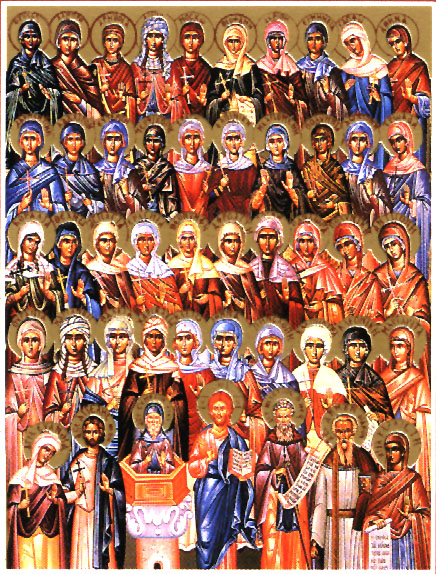
The 40 Holy Virgins and Saint Ammoun the Deacon, were from Adrianopolis in Macedonia. Deacon Ammoun was their guide in Christian Faith. They were captured by Baudos the governor, and were tortured because they would not offer sacrifice to idols.
The holy martyrs endured many cruel torments, which were intended to force them to renounce Christ and worship idols. Later, they were sent to Heraclea in Thrace to appear before the tyrant Licinius. The valiant martyrs remained unshakeable, however.
Saint Ammoun and eight of the virgins were beheaded, ten virgins were burned, six of them died after heated metal balls were put into their mouths, six were stabbed with knives, and the rest were struck in the mouth and stabbed in the heart with swords.
Martyrs Callista and her brothers, Evodius and Hermogenes, at Nicomedia

The Holy Martyrs Callista and her brothers Evodus and Hermogenes, with other Christians of Nicomedia, were brought to trial before the pagan governor for confessing their faith in Christ. Refusing to offer sacrifice to idols, they were cut down by the sword.
Righteous Joshua, son of Nun (Navi)
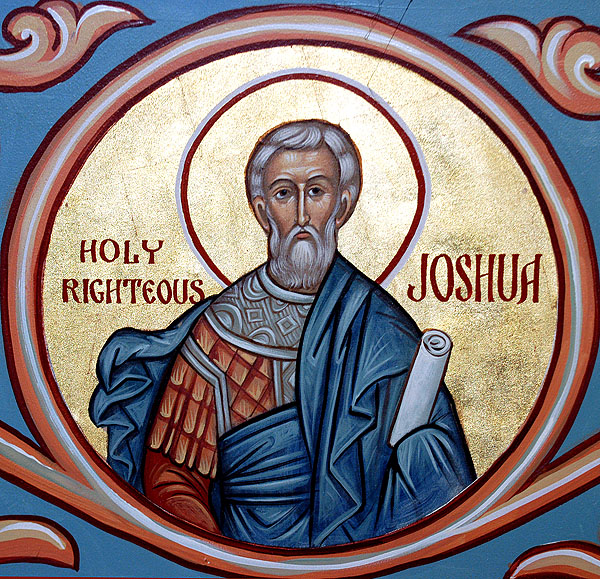
Saint Joshua (Jesus), the son of Navi, was leader of the Israelites after the death of the Prophet Moses. He was born in Egypt around 1654 B.C. and succeeded Moses when he was eighty-five. He ruled the Israelites for twenty-five years.
Joshua conquered the Promised Land, and led the Hebrew nation into it. The Lord worked a great miracle through Joshua. He stopped the Jordan from flowing, allowing the Israelites to cross over on foot as if on dry land (Joshua 3). Saint Michael, the Leader of the Heavenly Hosts, appeared to Joshua (Joshua 5:13-15).
The walls of Jericho fell down by themselves after the Ark of the Covenant was carried around the city for seven days (Joshua 6:20). Finally, during a battle with the enemy, Joshua, by God’s will, halted the motion of the sun (Joshua 10:13) and prolonged the day until victory was won.
After the end of the war, Joshua divided the Promised Land among the Twelve Tribes of Israel. He died at 110 years of age (1544 B.C.), commanding the nation to preserve the Law of Moses. All these events are recounted in the Book of Joshua, the sixth book of the Old Testament.
Finding of the Icon of the Mother of God at the Miasena Monastery
The Miasena Icon of the Most Holy Theotokos was thrown into Lake Zagura in the ninth century in an effort to save it from the iconoclasts. After a long time, the wonderworking icon emerged from the water unharmed and was brought to the Miasena Monastery.
“Chernigov-Gethsemane” Icon of the Mother of God
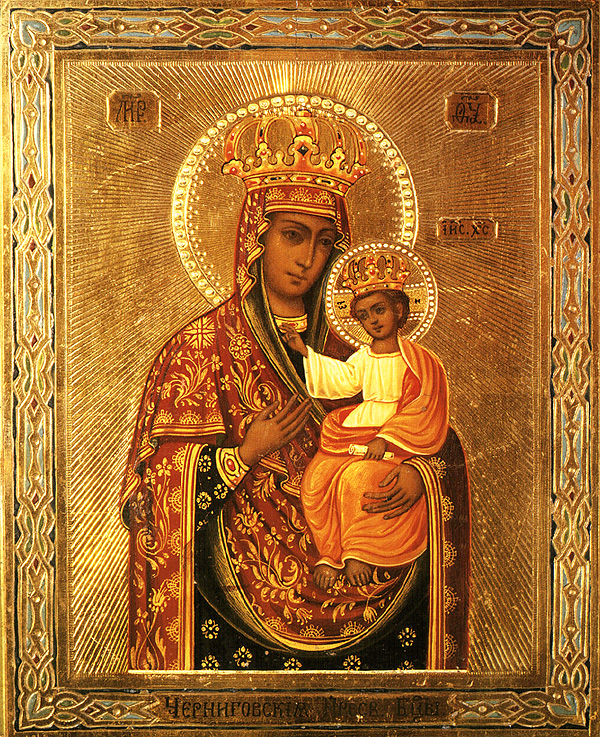
The Chernigov-Gethsemane Icon of the Mother of God is a copy of the famed Ilyin-Chernigov Icon of the Mother of God (April 16), which was to be found at the Trinity-Ilyin monastery near Chernigov on Mount Boldina, and where in the eleventh century Saint Anthony of the Kiev Caves struggled in asceticism.
Saint Demetrius of Rostov described the miracles of this icon in his book THE BEDEWED FLEECE. He wrote in conclusion: “The end of the booklet, but not of the miracles of the Most Holy Theotokos, for who can count them?” The grace-bearing power of this icon is manifest also in its copies.
The Chernigov-Gethsemane Icon of the Mother of God was painted in the mid-eighteenth century and was passed on to the Trinity Sergiev Lavra in 1852 by Alexandra Grigorievna Philippova, who piously kept it for a quarter century. (This icon was given to her by the priest John Alekseev, who received it in turn from one of the monks of the Trinity Sergiev Lavra.)
On the advice of the head of the Lavra, Archimandrite Anthony (+ May 1, 1877), the icon was placed in the newly-consecrated cave church named for Saint Michael, Leader of the Heavenly Hosts, which was consecrated on October 27, 1851 by Saint Philaret, Metropolitan of Moscow (November 19), who assumed an active role in the building of the Gethsemane skete.
In this manner, the icon took in the currents of grace of all the history of the Russian Church, it acquired the blessing of Saint Anthony of the Caves, of Saint Sergius of Radonezh and of his parents Saints Cyril and Maria (September 28), and finally, of the ascetics of the nineteenth century. These spiritual connections providentially come forth through the Chernigov-Gethsemane Icon of the Mother of God.
It is remarkable that the first miracle of this icon was witnessed on the day of the Church New Year, September 1, 1869, when the twenty-eight-year-old peasant of Tula governance, Thekla Adrianova, was healed, after being completely crippled for nine years.
Living at the hostel by the caves, and then at the Lavra during the celebration of the Repose of Saint Sergius (September 25), Thekla recovered completely. Saint Innocent the Metropolitan of Moscow (October 6 and March 31), learned of the miracle from his daughter the nun Polyxeni, treasurer of the Borisov wilderness monastery. On the feast of Saint Sergius, he himself met with Thekla and asked her about the details of the healing. On September 26, 1869 Saint Innocent arrived at the Gethsemane skete and gave the blessing for a Molieben to be served before the glorified icon, while he himself prayed with tears.
By September 26 three healings had occurred already, and a whole series of miracles in November of that same year. The fame of the icon of the Mother of God spread with unusual swiftness. Exhausted by suffering and sickness, thirsting for bodily and spiritual healing, people from every class of society came with firm faith to the wonderworking icon, and the mercy of God did not forsake them.
By the beginning of the twentieth century, more than 100 miracles had been recorded. By its great esteem the icon benefited the ascetics of the Gethsemane skete: the schemamonk Philip (+ May 18, 1868), the founder of the cave monastery, and his three sons, the hieroschemamonks Ignatius (+ 1900), Porphyrius (+ 1905 ?) and Basil (+ April 1, 1915). They preserved accounts of the deep love, which the hieromonk Elder Isidore (+ February 3, 1908) displayed for the Chernigov-Gethsemane Icon.
The initial celebration of the icon was established on April 16, on the day when Ilyin-Cherigov icon was celebrated. Later, it was transferred to September 1, the day of its glorification. At the present time there are copies of the Chernigov-Gethsemane icon at Trinity-Sergiev Lavra. They are found in the temple of Saint Sergius, in the monastery trapeza, and in the portico of the Trinity cathedral, painted by Elders of the Gethsemane skete and the Zosimov wilderness monastery.
Saint Meletius the New

Saint Meletius the New was born in Cappadocia in 1035. Many people regarded him as an imbecile, but God “hath made foolish the wisdom of this world” (I Cor. 1:20), and it has also pleased Him “by the foolishness of preaching to save them that believe” (I Cor. 1:21). So the Lord used the saint to draw many souls to Himself.
Saint Meletius was given the gift of prophecy, and performed many miracles. He built a monastery on Mt. Cytheron in Boeotia in central Greece, which was named for him.
After living as a hermit for many years, Saint Meletius fell asleep in the Lord on Mt. Cytheron in 1105.
“All Blessed” Icon of the Mother of God
(New Monastery of the Transfiguration of the Savior) The original “All Blessed” (Pammakaristos) Icon of the Most Holy Theotokos is in Constantinople in the patriarchal cathedral. It is a mosaic icon dating from the middle of the eleventh century.
In 1905, Patriarch Joachim III presented a copy of the icon to the city of Kazan in Russia.
Venerable Evanthia
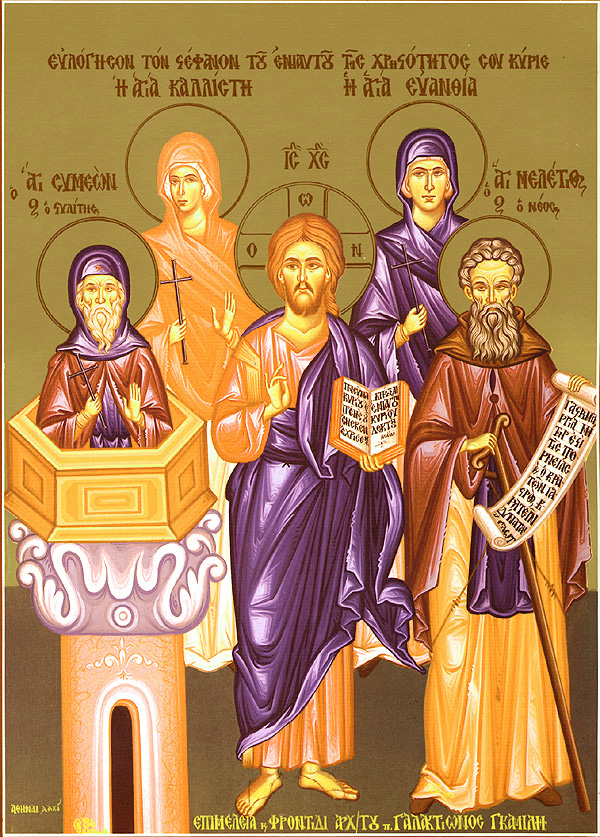
No information available at this time.
 Saint Peter Antiochian Orthodox Church