Here is the homily for Sunday, September 03, 2023.
You can also download the homily here .

MONDAY OF THE 1ST WEEK
NO FAST
Eumenius the Wonderworker, Bishop of Gortynia, Ariadne the Martyr, Afterfeast of the Holy Cross
Brethren, we, like Isaac, are children of promise. But as at that time he who was born according to the flesh persecuted him who was born according to the Spirit, so it is now. But what does the scripture say? “Cast out the slave and her son; for the son of the slave shall not inherit with the son of the free woman.” So, brethren, we are not children of the slave but of the free woman. For freedom Christ has set us free; stand fast therefore, and do not submit again to a yoke of slavery. Now I, Paul, say to you that if you receive circumcision, Christ will be of no advantage to you. I testify again to every man who receives circumcision that he is bound to keep the whole law. You are severed from Christ, you who would be justified by the law; you have fallen away from grace. For through the Spirit, by faith, we wait for the hope of righteousness. For in Christ Jesus neither circumcision nor uncircumcision is of any avail, but faith working through love. You were running well; who hindered you from obeying the truth? This persuasion is not from him who calls you. A little leaven leavens the whole lump. I have confidence in the Lord that you will take no other view than mine; and he who is troubling you will bear his judgment, whoever he is.
At that time, Herod the tetrarch, who had been reproved by John for Herodias, his brother’s wife, and for all the evil things that Herod had done, added this to them all, that he shut up John in prison. Now when all the people were baptized, and when Jesus also had been baptized and was praying, the heaven was opened, and the Holy Spirit descended upon him in bodily form, as a dove, and a voice came from heaven, “You are my beloved Son; with you I am well pleased.”
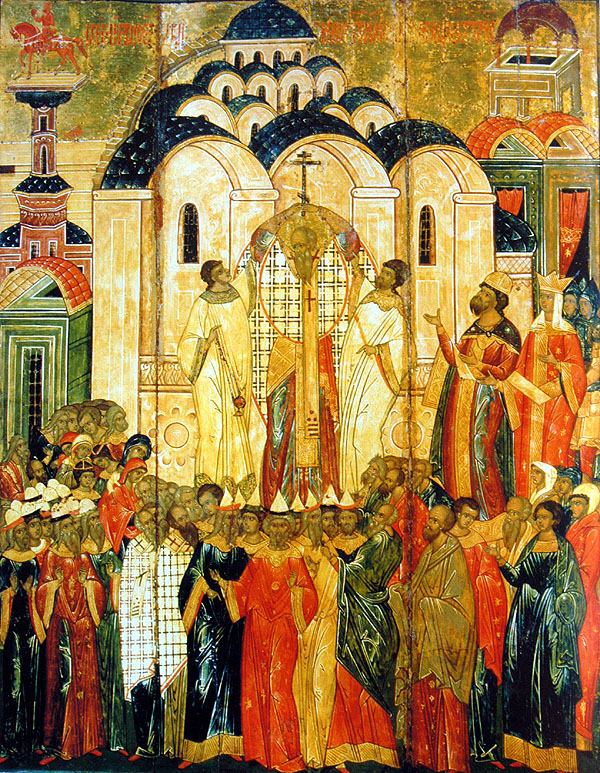
From September 15 until the Leavetaking, we sing “O come, let us worship and fall down before Christ. O son of God crucified in the flesh, save us who sing to Thee: Alleluia” at weekday Liturgies following the Little Entrance.
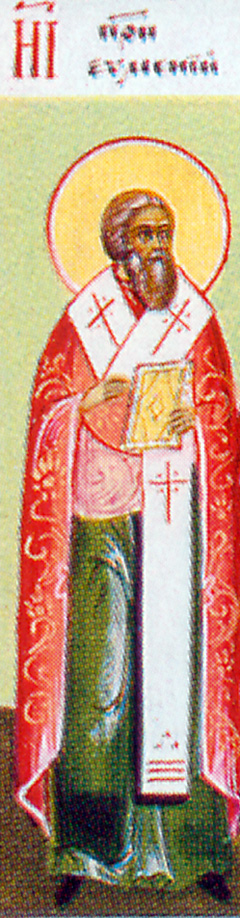
Saint Eumenius from the time of his youth was noted for his virtuous life. He strove to serve the One God and therefore he shunned worldly temptations. Concerned for the salvation of his soul, he distributed all his substance to the poor.
By the blessing of God Saint Eumenius was chosen as Bishop of Gortyna on the island of Crete. The saint, like a compassionate father, comforted his flock in their sorrows, and cared for the orphaned and indigent. His prayers were so strong before God that once, during a drought, he called forth abundant rain upon the earth.
Saint Eumenius wisely and zealously defended the Orthodox Faith against the Monophysite heresy. For his opposition to the heresy the saint was banished to the Thebaid, where he died in the seventh century. His body was then transferred and buried in Gortyna.

The Holy Martyr Ariádnē was a slave of Tertullus, a prominent official of the city of Promissia, Phrygia in the reign of Emperor Hadrian (117–161). Although she was only a slave, Saint Ariádnē was wiser than many noble ladies, who were enslaved by worldly vanities and “every defilement of flesh and spirit" (2 Corinthians 7:1).
Once, on his son's birthday, when her master offered sacrifice to the pagan "gods," his Christian slave Ariádnē refused to participate in the wicked celebration. As a result, she was beaten and, after hanging her up, they raked her body with sharp iron hooks. Then the martyr was thrown into prison and starved for a long time in order to make her worship the idols. Saint Ariádnē, however, persisted in her confession of Christ, and it was impossible to convince her to offer sacrifice.
Realizing that the Saint would not change her mind, they released her. To avoid further pressure, she fled the city, but Tertullus sent men to follow her. Seeing that she was being pursued, the Holy Martyr ran, begging God to protect her from her enemies.
Suddenly, by her prayers, a crevice formed in the mountain, and Saint Ariádnē disappeared into it, and surrendered her soul to God. Other sources say that she fell off a cliff and was killed.

Saint Sophia endured martyrdom with Saints Castor and Irene in Alexandria.

In the 17th century the Persian aggressors razed churches, monasteries, and fortresses and drove out thousands of Georgian families to resettle them in remote provinces of Persia. The deserted territories were settled by Turkic tribes from Central Asia. In the chronicle The Life of Kartli it is written: “The name of Christ was not allowed to be uttered, except in a handful of mountainous regions: Tusheti, Pshavi, and Khevsureti.”
But the All-merciful Lord aroused a strong desire in the valiant prince Bidzina Choloqashvili of Kakheti and, together with Shalva and his uncle Elizbar, princes of Aragvi and Ksani provinces, he led a struggle to liberate Kakheti from the Tatars. (The Persian governor of Kakheti, Salim Khan (1656-1664), had been encouraging the Tatar tribesmen to profane the Christian churches.)
Fearing that the enemy, who had already conquered Kakheti, would soon move in and also dominate Kartli, the princes Bidzina, Shalva, and Elizbar united the forces of those two regions in preparation for the attack.
After much deliberation, Bidzina announced his intention to his father-in-law, Prince Zaal of Aragvi. Zaal’s soul was spiritually pained by the countless misfortunes and injustices his country had suffered, and he quickly pledged his support for the effort. He agreed to participate in the insurrection anonymously, while the Ksani rulers Shalva and Elizbar would command the armies.
On the moonless night of September 15, 1659, the feast of the Alaverdi Church (The feast of Saint Joseph of Alaverdi) the united army of all eastern Georgia assembled and crossed over the mountains, past the village of Akhmeta, and launched a surprise attack on the Persians from Bakhtrioni Fortress and Alaverdi Church. The invader’s armies were so utterly crushed that their leader, Salim Khan, the Persian governor of Kakheti, barely succeeded in escaping from the avengers, after he had abandoned his family and army.
The victorious Georgian army offered prayers of thanksgiving to the Lord God and Great-martyr George, the protector of the Georgian people, who had appeared visibly to all during the battle, riding his white horse like a flash of lightning and leading the Georgians to victory.
The joy was great but short lived. The furious Shah Abbas II (1642-1667) ordered King Vakhtang V of Kartli (1658-1675) to deliver to him those who had instigated the insurrection.
Certain that they would receive no mercy from the shah, Georgia’s heroic liberators nevertheless set out for Persia without complaint. The shah received them with respect and generously bestowed gifts upon them, but then demanded that they renounce the Christian Faith. Neither bribery nor flattery would break their will, so the shah ordered his servants to arrest and torture them, strip off their clothing, and cast them, bound, under the blazing sun. Tormented by thirst and insect stings, the martyrs were periodically tempted to renounce Christ, but with God’s help they resisted every temptation.
Finally the enraged Salim Khan, the vassal of Shah Abbas, ordered the beheading of Elizbar and Shalva, hoping by this to break Bidzina’s resolve. But his efforts were in vain. “There is nothing sweeter than death for Christ’s sake!” Bidzina proclaimed.
The Ksani princes calmly bowed their heads, but the undersized executioners could not reach the stately princes with their swords. So the shah’s henchmen hacked each of the princes in two at the shins, then decapitated them after they had fallen to an accessible height.
But even the murder of his companions would not cause Saint Bidzina’s will to waver. So the enemies resolved to break his will by mockery. They draped the bound prince in a chadar (the veil worn by Muslim women), seated him on a donkey, and paraded him through the streets. Then they began to butcher him alive. One by one they cut off his fingers and toes, then they chopped off his hands and feet, then his arms and legs, until only his head remained unharmed. It was clear from the movement of his lips that the holy martyr was praying.
Then one of the persecutors pierced his heart with a spear. This happened in the year 1661. The mutilated bodies of the holy martyrs remained under the open sky for one day, and no one was permitted to go near them. During the night they were illumined by a brilliant light.
Then a group of Christians secretly buried the saints’ remains. Several years later Saint Shalva’s wife Ketevan and son David sent several of the faithful to Persia to bring back their relics. Crowds of believers gathered at the Kartli border to meet the holy relics and accompany them with hymns of rejoicing to their final resting place at the Ikorta Church of the Archangels.

The Staro Rus Icon of the Mother of God was so named because for a long time it was in Staro Rus, where it had been brought by the Greeks from Olviopolis during the very first period of Christianity in Russia. The icon was in Staro Rus until the seventeenth century. In 1655 during a plague it was revealed to a certain inhabitant of the city of Tikhvin that the pestilence would cease if the wonderworking Staro Rus Icon were transferred there, and the Tikhvin Icon sent to Staro Rus.
After the transfer of the icons the plague ceased, but the people of Tikhvin did not return the icon and only in the eighteenth century did they give permission to make a copy of the Staro Rus Icon, which on May 4, 1768 was sent to Stara Russa. A feast was established in honor of this event. On September 17, 1888 the original was also returned to Staro Rus and a second Feast day established.

The original icon known as “Tselitel’nitsa,” or “The Healer” was from the Tsilkan church in Kartali, Georgia. It was painted at the time of Saint Nino (January 14).
There is another icon with the same name in the Alexeev women’s monastery in Moscow, and many miracles took place before it at the end of the eightheenth century. Saint Demetrius of Rostov (September 21 and October 28) relates a story about this icon in his book THE BEDEWED FLEECE.
A cleric of the Navarninsky church, Vincent Bulvinensky, was in the habit of venerating the icon of the Mother of God whenever he entered the church. He would also recite the following prayer before the icon: “Hail, Virgin Theotokos full of grace, the Lord is with Thee. Blessed is the womb which bore Christ, and the breasts which nourished the Lord God, our Savior.”
In time, he found himself suffering from a dreadful affliction. His tongue began to putrefy, and he passed out from the pain. When he came to himself, he prayed his usual prayer to the Most Holy Theotokos.
As soon as he had finished his prayer, he saw a handsome young man at the head of his bed. The sufferer realized at once that this was his guardian angel. The angel looked at him with pity, calling on the Mother of God to heal him. Suddenly, the Theotokos appeared and healed the sick man who was so devoted to Her. He got out of bed and went to church, taking his place on the cliros for the service. Those present were astonished to see his recovery.
This miracle inspired the painting of “The Healer” icon depicting the Mother of God standing at the bed of the sick man.

Saint Euphrosynē of Suzdal was born in 1212. Although she was a princess, she entered a women’s monastery in Suzdal, where she was tonsured with the name Euphrosynē, in honor of Saint Euphrosynē of Alexandria (September 25).
After her death on September 25, 1250, many miracles took place at her grave. Believers were healed of various infirmities, and their prayers were answered.
On September 18, 1698, with the blessing of Patriarch Adrian, Metropolitan Hilarion of Suzdal glorified the nun Euphrosynē as a saint.
On the night of Pascha, April 8-9, 1805, Saint Hilarion (Ponamarov) was born in Kluch, the third son of Nikḗtas and Euphemia Ponamarov, who named him Rodion in honor of Saint Herodion of the Seventy. He always considered April 8, the day of his patron saint’s commemoration, as his birthday. After Rodion, a son and a daughter were born to the Ponamarovs. The daughter, however, died as a baby.
Nikḗtas Ponamarov worked in town as a tailor, and sometimes his business took him to the homes of the local landowners. Consequently, Rodion seldom saw his father until he was fifteen years old.
Rodion was a quiet, uncoordinated child who did not play much with other children, since they made fun of his clumsiness. Even members of his own family behaved in a rude manner toward him, and seldom showed him any affection. The way he was treated made him thoughtful and introspective.
One winter he was playing in the snow with some friends, using an old board as a sled. The board broke and left Rodion with a permanent scar on the finger of his left hand. Another time he injured himself on a saddle-horn while riding. These injuries also had an effect on his health, which was never robust.
The family moved to the Novopersk region of Voronezh in 1820, and Rodion lived there until he was twenty. He helped his father in his work, and gradually acquired skill as a tailor. His parents wanted him to follow this trade, even though his mother once foretold that he would be a monk. Rodion himself desired the monastic life even as a young child, but now he applied himself to tailoring, for he knew that this handicraft would be very useful in the monastery.
Rodion went to Moscow in December of 1825 in order to learn more about being a tailor, arriving with very little money, and with nowhere to stay. He worked with various tailors, but the work was difficult and he became ill. His poor health, he said in later life, probably saved him from falling into many vices. Having increased his proficiency as a tailor, Rodion left Moscow and returned home.
The family moved again in 1829, this time to Saratov. Rodion was engaged twice, but the Lord did not want him to follow this path. His first fiancée died after a short illness, and Rodion simply lost interest in the second.
Saratov was the home to many sectarians of all sorts, and the future saint became involved with certain activists who tried to refute their false teachings. Rodion’s missionary labors may have influenced many sectarians to return to the Orthodox Church. Because of some misunderstanding, however, Rodion and his friends were put on trial. As a result, the authorities kept Rodion under observation for the next four years. This scrutiny was hard for him to endure, and made it very difficult for him to conduct his affairs.
Through his study of the Holy Scripture and the writings of the holy Fathers, Rodion’s desire to become a monk was reawakened. Therefore, he decided to find the monastery which was most suitable for him. In 1837 and 1838 Rodion visited monasteries at Sarov, Suzdal, Rostov, Tikhvin, Moscow, Pochaev, and other places. Finally, he arrived before the gates of Optina. He was thirty-four years old.
At first, Rodion was placed in a cell next to Father Barlaam, a retired igumen of Valaam Monastery. Father Barlaam was a man of great spiritual stature, who had a profound influence on the young man, and became his first instructor in the Jesus Prayer. In later years, Elder Hilarion recalled visiting Father Barlaam to tell him of the various things he had seen or heard. Father Barlaam would ask, “Is that useful? It would be better for you not to see or hear anything. Try to examine your thoughts and your heart more often.” With his wise counsel, Father Barlaam helped Rodion in his spiritual growth as a monk.
Saint Anthony (August 7), the Superior of the Skete, was transferred to Maloyaroslavets on December 1, 1839. He was replaced by Saint Macarius (September 7), the monastery’s confessor. Rodion was assigned to be his cell attendant, remaining in this obedience until the Elder’s death in 1860. Rodion went to Father Macarius for Confession, and to Saint Leonid (October 11) for the daily revelation of his thoughts. In an effort to cleanse himself of the passions, Rodion renounced his own will and obeyed Elder Macarius in all things.
Father Macarius was very strict with the novices, and would not permit the slightest disobedience. He was never the first to bring up a person’s failures and shortcomings, but waited for him to confess his own negligence. He taught the novices to love their neighbor, and to bear their afflictions with patience.
From the time Rodion came to Optina, he had other obediences in addition to serving as cell attendant to Father Macarius. He also tended the flower and vegetable gardens, and worked as a baker, and a bee-keeper. He carried out every task assigned him without complaint.
While his spiritual progress was hidden from men, it was certainly noticed by the all-seeing God. In due course, he received the monastic tonsure and was given the name Hilarion. Father Macarius recognized his disciple’s spiritual maturity, and predicted that he and Saint Ambrose (October 10) would succeed him as Elders after his death. Elder Macarius therefore entrusted Father Hilarion and Father Ambrose with giving counsel to his many spiritual children.
As the closest disciple of Saint Macarius, Father Hilarion was chosen to be Superior of the Skete, and the monastery’s Father Confessor. He confessed all the brethren entrusted to him five times a year, once during each of the Fasts, and twice during Great Lent. Each monk was questioned about the details of his inner life, and was given advice on how to conduct himself in future. Once he finished hearing the Confession of the monks, Father Hilarion began confessing the nuns, and the men and women who came to him from various places. Although there were many people, Father Hilarion never refused anyone. He rarely gave his own opinion, but quoted from the Scriptures or the writings of the Fathers. Sometimes, he would tell people what Father Macarius had said in similar situations. He was very effective in giving advice, because he always practiced what he preached, and he had already experienced the things that were troubling his spiritual children.
The Elder led people to feel sorrow for their sins, and through his questions he brought them to an awareness of their spiritual state. Sometimes he would help them to remember sins which they had forgotten to confess, sins which might lie at the root of their spiritual infirmity. He gave penances according to a person’s age, health, and circumstances. He might require the penitent to read certain prayers, do prostrations, give alms, and to avoid those habits and amusements which are not fitting for a Christian. Many people received much benefit from confessing to him, and continued to live according to the advice he had given them. Not only were they cured of their spiritual afflictions, but sometimes Father Hilarion also healed them of their physical or mental illness as well.
Father Hilarion, by God’s providence, became seriously ill for two years. All during that time he did not ask God to let him recover. Instead, he asked to be given the patience to help him bear the illness. He received Holy Communion frequently, and twice he was given Holy Unction.
During the last thirty-three days of his life, Father Hilarion partook of the life-giving Mysteries of Christ every day. In the last four weeks of his life, the Elder was unable to lie down in bed because of water in his lungs. Therefore, he remained seated on a couch in front of a portrait of Father Macarius. He experienced great discomfort, and was not able to sleep very well.
Father Hilarion observed the cell rule of prayer until the last moments of his life. Early on the morning of September 18, 1873 he listened to the morning rule being read, and received Holy Communion at 1:00 A.M. Five hours later, he rested from his labors and gave his soul into the hands of God.
It is said that during Father Hilarion’s final illness, Saint Macarius appeared to him many times in his dreams. As he drew closer to death, these appearances became more frequent. He died with his prayer rope in his hands, and was buried next to his beloved Elder, Saint Macarius.
The Moscow Patriarchate authorized local veneration of the Optina Elders on June 13,1996. The work of uncovering the relics of Saints Leonid, Macarius, Hilarion, Ambrose, Anatole I, Barsanuphius and Anatole II began on June 24/July 7, 1998 and was concluded the next day. However, because of the church Feasts (Nativity of Saint John the Baptist, etc.) associated with the actual dates of the uncovering of the relics, Patriarch Alexey II designated June 27/July 10 as the date for commemorating this event. The relics of the holy Elders now rest in the new church of the Vladimir Icon of the Mother of God.
The Optina Elders were glorified by the Moscow Patriarchate for universal veneration on August 7, 2000.
Here is the live stream for Orthros and Divine Liturgy – Sun. 9/17/23 If you need, here are instructions for accessing this content from your phone, tablet, computer, or TV.
SUNDAY AFTER HOLY CROSS
NO FAST
Sunday after Holy Cross, Sophia & her three daughters: Faith, Hope, and Love, Herakleides & Myron, Bishops of Cyprus, Afterfeast of the Holy Cross
Brethren, knowing that a man is not justified by works of the law but through faith in Jesus Christ, even we have believed in Christ Jesus, in order to be justified by faith in Christ, and not by works of the law, because by works of the law shall no one be justified. But if, in our endeavor to be justified in Christ, we ourselves were found to be sinners, is Christ then an agent of sin? Certainly not! But if I build up again those things which I tore down, then I prove myself a transgressor. For I through the law died to the law, that I might live to God. I have been crucified with Christ; it is no longer I who live, but Christ who lives in me; and the life I now live in the flesh I live by faith in the Son of God, who loved me and gave himself for me.
The Lord said: "If anyone wishes to come after me, let him deny himself and take up his cross and follow me. For whoever would save his life will lose it; and whoever loses his life for my sake and the gospel's will save it. For what does it profit a man, to gain the whole world and forfeit his life? For what can a man give in return for his life? For whoever is ashamed of me and my words in this adulterous and sinful generation, of him will the Son of man also be ashamed, when he comes in the glory of his Father with the holy angels." And he said to them, "Truly, I say to you, there are some standing here who will not taste death before they see the kingdom of God come with power.

From September 15 until the Leavetaking, we sing “O come, let us worship and fall down before Christ. O son of God crucified in the flesh, save us who sing to Thee: Alleluia” at weekday Liturgies following the Little Entrance.
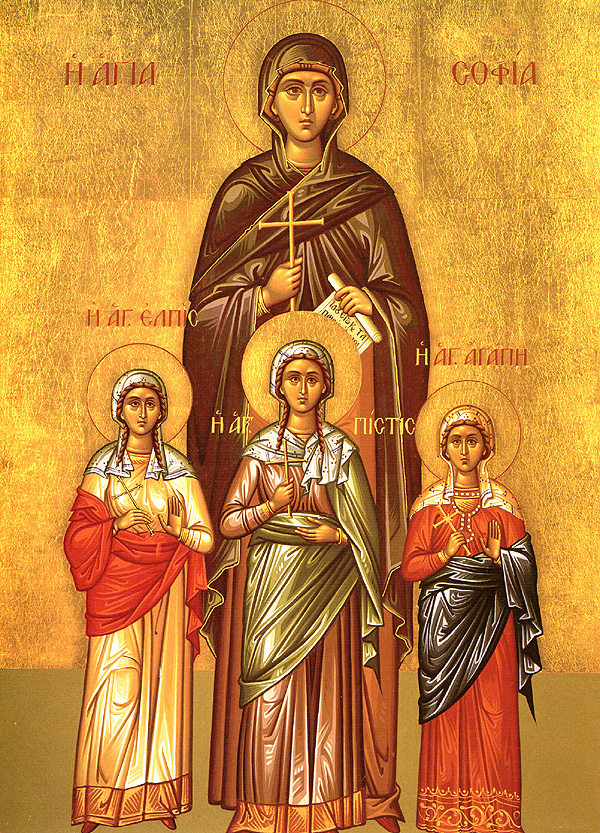
The Holy Martyrs Saint Sophia and her Daughters Faith, Hope and Love were born in Italy. Their mother was a pious Christian widow who named her daughters for the three Christian virtues. Faith was twelve, Hope was ten, and Love was nine. Saint Sophia raised them in the love of the Lord Jesus Christ. Saint Sophia and her daughters did not hide their faith in Christ, but openly confessed it before everyone.
An official named Antiochus denounced them to the emperor Hadrian (117-138), who ordered that they be brought to Rome. Realizing that they would be taken before the emperor, the holy virgins prayed fervently to the Lord Jesus Christ, asking that He give them the strength not to fear torture and death. When the holy virgins and their mother came before the emperor, everyone present was amazed at their composure. They looked as though they had been brought to some happy festival, rather than to torture. Summoning each of the sisters in turn, Hadrian urged them to offer sacrifice to the goddess Artemis. The young girls remained unyielding.
Then the emperor ordered them to be tortured. They burned the holy virgins over an iron grating, then threw them into a red-hot oven, and finally into a cauldron with boiling tar, but the Lord preserved them.
The youngest child, Love, was tied to a wheel and they beat her with rods until her body was covered all over with bloody welts. After undergoing unspeakable torments, the holy virgins glorified their Heavenly Bridegroom and remained steadfast in the Faith.
They subjected Saint Sophia to another grievous torture: the mother was forced to watch the suffering of her daughters. She displayed adamant courage, and urged her daughters to endure their torments for the sake of the Heavenly Bridegroom. All three maidens were beheaded, and joyfully bent their necks beneath the sword.
In order to intensify Saint Sophia’s inner suffering, the emperor permitted her to take the bodies of her daughters. She placed their remains in coffins and loaded them on a wagon. She drove beyond the city limits and reverently buried them on a high hill. Saint Sophia sat there by the graves of her daughters for three days, and finally she gave up her soul to the Lord. Even though she did not suffer for Christ in the flesh, she was not deprived of a martyr’s crown. Instead, she suffered in her heart. Believers buried her body there beside her daughters.
The relics of the holy martyrs have rested at El’zasa, in the church of Esho since the year 777.
The Holy Martyr Theodota, a native of Cappadocia, suffered in the city of Nicea during the reign of the emperor Alexander Severus (222-235). At this time the governor of Cappadocia was a certain Symblicius. They told him that a rich woman named Theodota was confessing Christ. The governor summoned Theodota and for a long time urged her to turn from the true Faith.
Seeing the futility of his attempts, he gave Theodota over to torture. They suspended her and began to rake her with iron hooks, but she did not feel any pain. Then they put her in chains and led her away to a prison cell.
After eight days, when they led the saint out for new tortures, only faint traces of the tortures already endured remained on her body. The governor was amazed and asked, “Who are you?” The saint answered: “Your mind is darkened, but if you were sober, then you would have realized that I am Theodota.”
Symblicius commanded the martyr to be cast into a red-hot furnace. Flames shot out from the furnace and scorched those standing nearby, while those remaining unharmed shut the furnace and scattered in fright. After a certain while, pagan priests came and opened the furnace to scatter the ashes of the martyr, but they too were burned by the flames. Those remaining unhurt saw Saint Theodota unharmed. She stood in the midst of the flames between two youths in white raiment, and was glorifying the Lord. This apparition so terrified the pagans that they fell down as if dead. Later, they returned the saint to prison.
The invincibility of the martyr gave Symblicius no peace. He made a journey to Byzantium, on the return trip he stopped over at Ancyra and tried to get the better of Theodota. He gave orders to throw her all at once onto red-hot iron, but again the martyr remained unharmed.
Then Symblicius gave orders that the saint be taken to Nicea. There, in a pagan temple he wanted to compel her to offer sacrifice to the idols, but through the prayer of the saint, the idols fell and were shattered. The outraged governor gave orders to stretch the martyr out and saw through her body, but here also the power of God preserved the saint. The saw caused Theodota no harm, and the servants became exhausted. Finally, they beheaded the saint. Bishop Sophronius of Nicea buried her body.
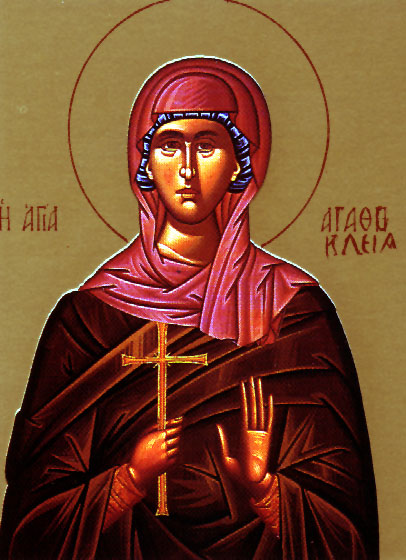
The holy martyr Agathocleia was a servant in the home of a certain Christian named Nicholas. His wife Paulina was a pagan. For eight years Agathocleia underwent abuse from her mistress because of her faith. Paulina fiercely beat the servant, and made her walk barefoot over sharp stones.
Once in a fit of nastiness, Paulina broke her rib with a blow from a hammer, and then cut out her tongue. Nothing could make the saint give in to the demand of her mistress to worship idols. Then Paulina locked the martyr in prison and exhausted her with hunger. But Agathocleia did not perish: birds brought her food each day. Finally, in a fit of evil, Paulina went to the prison and murdered the holy martyr.
The Holy Martyrs Peleus and Nilus, Bishops of Egypt, Presbyter Zeno, Patermuthius, Elias and another 151 Martyrs suffered during the reign of the emperor Maximian Galerius (305-311). The majority of them were Egyptians, but there were also some Palestinians among them. Firmilian, the governor of Palestine, arrested 156 Christians. They gouged out the eyes of the holy martyrs, cut the tendons of their feet, and subjected them to all manner of tortures. They beheaded 100 of the martyrs, and burned the rest.
The Constantinople Icon commemorated today is probably the prototype of another Constantinople Icon (April 25) venerated at Moscow’s Dormition church on Malaya Dimitrovka.
The Makariev “Directress” Icon of the Mother of God appeared during the reign of Prince Basil the Dark (1425-1462) to Saint Macarius the Wonderworker, who labored in asceticism on the desolate shores of the River Unzha.
On September 17, 1442 at about the third hour of the morning, when Saint Macarius was finishing his usual morning Akathist to the Most Holy Theotokos, his cell was illumined suddenly by an unknown light. The monk became confused in spirit and fervently began to pray.
Beyond the cell walls he heard the angelic refrain: “Hail, Full of Grace, O Virgin Mother!” With fear and astonishment the monk went out from his cell and on the northwest horizon he saw the icon of the Mother of God, surrounded by a luminous radiance.
The icon approached towards the cell of the ascetic. With joyful trembling the monk fell to the ground and cried out: “Hail, Mother of God! Hail, Ever-Flowing Fountain issuing salvation to all the world and assuring protection and intercession to all the land of Galicia!”
He reverently took up the icon and placed it in his cell, thus it also came to be named the “Cell-Icon.” Afterwards, the disciples of the monk gave it the title of “Makariev.” On the place of the appearance of the holy icon a monastery was founded, and was also named Makariev. Copies of the Makariev Icon of the Mother of God were made, which became as renowned as the original.
SATURDAY AFTER HOLY CROSS
NO FAST
Saturday after Holy Cross, Euphemia the Great Martyr, Sebastiana, Disciple of St. Paul the Apostle, Dorotheos the Hermit of Egypt, Melitina the Martyr, Afterfeast of the Holy Cross, Ninian the Enlightener of Scotland, Edith the Nun of Wilton Abbey
Brethren, working together with him, we entreat you not to accept the grace of God in vain. For he says, “At the acceptable time I have listened to you, and helped you on the day of salvation.” Behold, now is the acceptable time; behold, now is the day of salvation. We put no obstacle in any one’s way, so that no fault may be found with our ministry, but as servants of God we commend ourselves in every way: through great endurance, in afflictions, hardships, calamities, beatings, imprisonments, tumults, labors, watching, hunger; by purity, knowledge, forbearance, kindness, the Holy Spirit, genuine love, truthful speech, and the power of God; with the weapons of righteousness for the right hand and for the left; in honor and dishonor, in ill repute and good repute. We are treated as impostors, and yet are true; as unknown, and yet well known; as dying, and behold we live; as punished, and yet not killed; as sorrowful, yet always rejoicing; as poor, yet making many rich; as having nothing, and yet possessing everything.
The Lord said to the Jews who came to him, “I go away, and you will seek me and die in your sin; where I am going, you cannot come.” Then said the Jews, “Will he kill himself, since he says, ‘Where I am going, you cannot come’? ” He said to them, “You are from below, I am from above; you are of this world, I am not of this world. I told you that you would die in your sins, for you will die in your sins unless you believe that I am he.” They said to him, “Who are you?” Jesus said to them, “Even what I have told you from the beginning. I have much to say about you and much to judge; but he who sent me is true, and I declare to the world what I have heard from him.” They did not understand that he spoke to them of the Father. So Jesus said, “When you have lifted up the Son of man, then you will know that I am he, and that I do nothing on my own authority but speak thus as the Father taught me. And he who sent me is with me; he has not left me alone, for I always do what is pleasing to him.” As he spoke thus, many believed in him.
From September 15 until the Leavetaking, we sing “O come, let us worship and fall down before Christ. O son of God crucified in the flesh, save us who sing to Thee: Alleluia” at weekday Liturgies following the Little Entrance.

The Holy Great Martyr Euphemia (Euphēmia / Ευφημία) was the daughter of Christian parents, the senator Philophronos and his wife Theodosia. She suffered for Christ in the year 304 in the city of Chalcedon, on the Bosphorus opposite Constantinople, the Queen of Cities.
Priscus, the Proconsul of Chalcedon, issued a decree which required all the inhabitants of Chalcedon and the surrounding area to attend a pagan festival, in order to worship and offer sacrifice to the idol of Ares. He threatened grave torments for anyone who failed to appear. During this impious festival, 49 Christians were hidden in one house, where they worshiped the true God in secret. The young virgin Euphemia was among those who prayed there.
Soon their hiding place was discovered, and they were brought before Priscus to answer the charges against them. For nineteen days the martyrs were subjected to various torments, but none of them wavered in their faith, nor did they consent to offer sacrifice to the idol. The governor, beside himself with rage and not knowing any other way of forcing the Christians to abandon their faith, sent them to Emperor Diocletian for trial. He kept the youngest, the virgin Euphemia, hoping that she would not persevere if she were left all alone.
Separated from her fellow-Christians, Saint Euphemia fervently prayed that the Lord Jesus Christ would strengthen her for her impending ordeal. Priscus urged the Saint to offer sacrifice to the idol, promising her many rewards. When she refused, he ordered that she be tortured.
The martyr was tied to a wheel with sharp knives attached to it, which slashed her body. The Saint prayed aloud, and miraculously, the wheel stopped by itself and would not move despite all the efforts of the executioners. An angel of the Lord, came down from Heaven, removed Euphemia from the wheel, and healed her of her wounds, and the Saint gave thanks to God.
Priscus did not notice the miracle which had taken place, so he ordered the soldiers Victor and Sosthenes to take the Saint to a red-hot furnace. But the soldiers, seeing two Angels in the midst of the flames, refused to carry out the Proconsul's order and declared that they believed in the God Whom Euphemia worshipped. Boldly proclaiming that they were Christians, Victor and Sosthenes awaited punishment. They were sentenced to be devoured by wild beasts. In the arena, they begged God to forgive the sins they had committed, asking the Lord to receive them into the Heavenly Kingdom. A Divine voice was heard, and the two soldiers entered into eternal life. The beasts, however, did not harm their bodies.
Saint Euphemia, cast into the fire by other soldiers, did not suffer. With God's help she emerged unscathed after many other torments. Ascribing these things to sorcery, Priscus ordered a pit to be dug. Filling it with knives, he had it covered over with earth and grass, so that the martyr would not notice this trap.
Once again, Saint Euphemia remained safe, walking over the pit. Finally, she was sentenced to be devoured by wild beasts in the arena. Before her execution the Saint prayed that the Lord would deem her worthy of martyrdom. But none of the bears or lions attacked her, but only licked her feet. Finally, one she-bear wounded her foot, which bled slightly, and the Holy Great Martyr Euphemia died right away. As her soul departed, there was an earthquake. The city was shaken, the walls fell down, and the pagan temples crumbled. As Saint Euphemia lay dead in the sand, the guards and spectators fled in terror, so that the Saint's parents were able to take her body and bury it near Chalcedon.
Later, a majestic church was built over the grave of the Great Martyr Euphemia. The sessions of the Fourth Ecumenical Council took place there in the year 451. At that time, the Holy Great Martyr Euphemia confirmed the Orthodox confession of faith in a miraculous way, exposing the Monophysite heresy. That miracle is commemorated on July 11.
When the Persians captured Chalcedon in the year 617, the relics of the holy Great Martyr Euphemia were transferred to Constantinople (around the year 620). During the Iconoclast heresy, the reliquary containing Saint Euphemia's relics seems to have been thrown into the sea, but pious sailors recovered them. They were brought to the island of Lemnos, and they were returned to Constantinople in 796.
The incorrupt body of Saint Euphemia is in the Patriarchal Church of Saint George at the Phanar in Constantinople. Portions of her relics are to be found in Kykkos Monastery on Cyprus, and in the Saint Alexander Nevsky Lavra at Saint Petersburg.
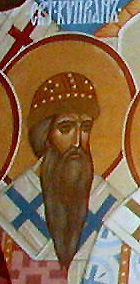
Saint Cyprian, Metropolitan of Kiev and All Russia, was a Serb by origin, and struggled on Mt. Athos. By his pious life and education he came to the attention of Patriarch Philotheus of Constantinople (1354-1355, 1364-1376), who in 1375 consecrated Cyprian as Metropolitan of Kiev and Lithuania.
At the Constantinople Council it was decided to avoid a fragmentation of the Russian metropolia, and that “upon the death of Saint Alexis (February 12), he should become the Metropolitan of All Rus.” At Moscow, Saint Cyprian endured many sorrows from the Great Prince, so at first he lived either in Lithuania or at Constantinople. Only in the year 1390, in the time of Great Prince Basil Dimitrievich, was he accepted as primate at Moscow.
Saint Cyprian concerned himself with the correction of the service books. There are preserved autographic manuscripts of certain Slavonic translations by the saint, witnessing to his great scientific work. And by his pastoral epistles he encouraged the faith of the Church. His activity in the translation of liturgical literature is widely known.

The Holy Martyr Sebastiana was a follower of the holy Apostle Paul. During a persecution against Christians under the emperor Dometian (81-96), she was on trial as a Christian before the governor named Georgios in the city of Marcianopolis in the Mizea region.
Saint Sebastiana firmly confessed her faith in Christ, and for this she was subjected to cruel tortures. At first they beat her, and then they threw her into a red-hot oven, from which she emerged unharmed. They sent the saint to the city of Heraklea, where sentence was pronounced on her a second time.
The governor, named Pompian, gave orders to tie the saint to a tree and lacerate her body with roof-tiles. The martyr remained unbroken in her faith. Then the governor gave her to be eaten by wild beasts. There too, the Lord preserved the holy martyr, and the beasts refused to touch her. Then, by order of the governor, Saint Sebastiana was beheaded. Her body, thrown into the sea, was taken by angels to the island of Rhodes (in Thrace, in the Sea of Marmara).
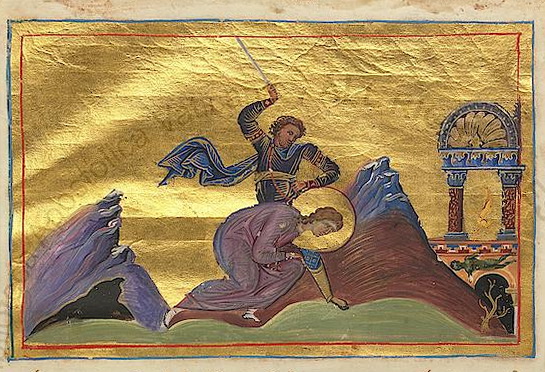
The Holy Martyr Melitinḗ (Μελιτινή, or Μελιτίνη) lived in the city of Markianopolis in Thrace during the reign of Emperor Antoninus Pius (138-161). Antiochus was the ruler of Thrace at that time. Since he was a fierce persecutor of Christians, he ordered that Melitinḗ be arrested, because she was a devout Christian whose fiery preaching converted many pagans to Christ. The Lord blessed her with the gift of wonderworking and, by the power of her prayers, she shattered the idols of Apollo and Herakles. Antiochus tried to make her worship the pagan "gods," but his efforts were in vain.
Since the Saint could not be persuaded to deny Christ, she was handed over to the ruler's wife and some crafty women who tried to win her over her with flattery and kindness. Not only was Saint Melitinḗ not deceived or persuaded by their efforts, she converted the ruler's wife to Christianity. She who tried to conquer Melitinḗ was defeated. She wanted to make Melitinḗ an idolater, but she herself became a Christian. The two women, concealing this from Antiochus, worked together and brought many pagans to Christ.
The madman Antiochus was furious when he learned the truth, and had both women beheaded. Saint Melitinḗ walked bravely to her death, and to everlasting glory as well.
A certain Christian from Macedonia, whose name was Akakios, was passing through Markianopolis on his way back to his own country. Since Saint Melitinḗ's holy relics remained unburied, Akakios asked the ruler for them, intending to bury them in Macedonia. Antiochus did not suspect his godly intention, so he gave him the Saint's body. Akakios took the holy relics and placed them in a chest, and then he left for his own country in haste. While at sea, he became sick and died. The ship put in at a promontory on the island of Limnos in order to bury the Saint's relics. Akakios, who loved the martyrs, was also buried near the tomb of Saint Melitinḗ.

Saints Victor and Sosthenes (Σωσθένης) are mentioned in the Life of the Holy Great Martyr Euphēmia (Ευφημία). The Proconsul Priscus ordered the soldiers Victor and Sosthenes to throw the Saint into a red-hot furnace. In the flames, however, they saw angels who prevented them from touching the Saint. When they refused to carry out the order, they were placed in shackles. Other soldiers, who threw Saint Euphēmia into the fire, were burnt by the flames escaping from the furnace, but inside the furnace, the martyr remained unharmed.
The Proconsul tried to make Victor and Sosthenes bow down to the idols, but they replied that they had come to know the true God. As they were led to the wild beasts, they begged the Lord to forgive the sins they had committed in their pagan delusion. Then a Divine voice came from Heaven, calling them to their rest, and they surrendered their souls to the Lord. The animals did not touch their bodies. Later, the two martyrs were buried secretly by some Christians.
In some calendars, such as the Roman Martyrology, the Saints' day of commemoration is listed as September 10.
Saint Dorotheus, Egyptian Hermit, a native of the Thebaid region in Egypt, labored in asceticism for 60 years in the Skete desert, on the Western side of the River Nile. Palladius, Bishop of Helenopolis and author of the renowned Lausiac History, had been a disciple of Saint Dorotheus in his youth, and has preserved memories of him.
Saint Dorotheus led a austere and ascetic life. After finishing his prayers, he went into the noonday heat to gather stones along the seashore to build cells for the other hermits. By night the saint wove baskets, in exchange for which he received the supplies he needed in order to live.
Food for Saint Dorotheus consisted of bread and the meager grass in the wilderness. Once a day he partook of food and drank a little water. He did not lie down to sleep, but only dozed off sometimes at work, or after eating.
Once, Saint Dorotheus sent his disciple to fetch water, but he returned saying that he saw a snake in the well and that the water in the well was now poisoned. Saint Dorotheus went to the well himself, took up a ladle of water, and making the Sign of the Cross over it he drank it, saying: “Where the Cross is, there the demonic powers do no harm.” Saint Dorotheus died peacefully at an advanced age.
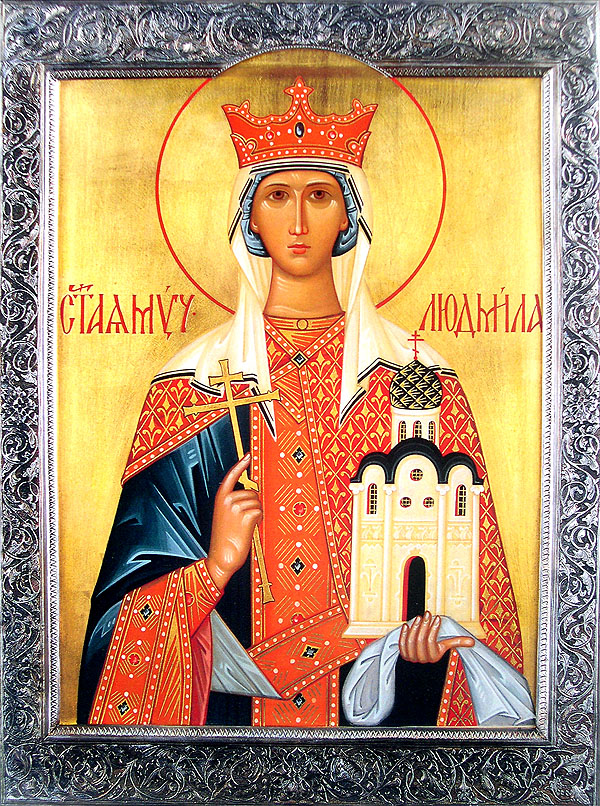
The Holy Martyr Ludmilla, a Czech (Bohemian) princess, was married to the Czech prince Borivoy. Both spouses received holy Baptism from Saint Methodius, Archbishop of Moravia and Enlightener of the Slavs (Comm. 11 May).
As Christians, they showed concern for the enlightening of their subjects with the light of the true Faith, they built churches and invited priests to celebrate the divine services. Prince Borivoy died early at age 36. Saint Ludmilla, as a widow, led an austere, pious life and continued to be concerned for the Church during the reign of her son Bratislav, which lasted for 33 years.
Bratislav was married to Dragomira, with whom he had a son, Wenceslaus (Vyacheslav). After the death of Bratislav, eighteen-year-old Wenceslaus came on the throne. Taking advantage of the inexperience and youth of her son, Dragomira began to introduce pagan manners and customs in the country.
Saint Ludmilla, of course, opposed this. Dragomira came to hate her mother-in-law and tried to destroy her. When Saint Ludmilla moved away to the city of Techin, Dragomira sent two boyars in secret to murder her. Saint Ludmilla was praying at the time, and the two assassins entered the house and carried out Dragomira’s orders.
The relics of the holy Martyr Ludmilla were buried in Techin in the city wall. Numerous healings occurred at her grave. Prince Vyacheslav transferred the body of Saint Ludmilla to the city of Prague and placed it in the church of Saint George.

The holy martyrs Isaac and Joseph the Georgians were born into a Muslim family, but their Georgian mother, a Christian, secretly raised them according to the Christian tradition.
The brothers were so firmly dedicated to the Faith that they journeyed to Byzantium to request that Emperor Nikēphóros I Phocas (802-811) permit them to settle in his capital. The pious ruler extended a warm welcome to the brothers, who were already well known and respected by the nobility of Theodosiopolis (Karnu).
Learning of the brothers’ intention, the emir of Theodosiopolis demanded to know the reason for their journey to Constantinople. The brothers answered him openly, citing their Christian Faith as the reason for their journey. Hearing this, the emir was infuriated, but he did not want to kill the brothers, since they were deeply respected by the people of his city. Instead he resolved to convert them from the Christian Faith.
Isaac and Joseph’s elderly father tearfully pleaded with them to deny Christ, while the emir promised them every honor and reward for betraying Him, and terrible suffering and death in the case of their refusal. But the holy brothers answered the emir, saying, “Remember that the flesh is like grass and every glory of this earth is like a flower that grows in the grass. When the grass withers, the flower also dies (c.f. Isaiah 40:6-7). Your threats of torture and death are for us rather absurd, for neither death, nor life, nor angels, nor principalities, nor powers, nor things present, nor things to come, nor height, nor depth, nor any other creature shall be able to separate us from the love of God which is in Christ Jesus our Lord (Rom. 8:38-9).”
The young men’s boldness enraged the emir, and he ordered his servants to execute them.
Before the holy brothers gave up their souls, they knelt to the ground and prayed: “O Holy King and Father of our Lord Jesus Christ, look down upon Thy servants with mercy and receive us as a holy sacrifice. Number us among Thy martyrs and make us worthy of the crown of righteousness, for every good and perfect gift is from above and comes down from Thee, the Father of lights (c.f. James 1:17)!”
Then they bowed their necks beneath the sword.
The executioners chopped off their heads, leaving their bodies untouched. That night their holy remains shone with a radiant light.
This miracle frightened the godless persecutors, and they ordered the local Christians to bury the holy martyrs’ remains. The local bishop and clergy committed their bodies to the earth with great reverence.
A church was later erected over the place where Saints Isaac and Joseph were laid to rest.

The Support of the Humble Icon of the Mother of God appeared in 1420 in the city of Pskov at Kamennoye (Stony) Lake. The circumstances of its miraculous appearance are not known, but perhaps the Holy Icon was found by the people of Pskov as a consolation for the great calamities they endured during the reign of Basil II, suffering from pestilence and the invasion of the Lithuanian prince Vytautas, who came to conquer Pskov. In the Pskov Chronicle there are two testimonies concerning the Holy Icon.
One of them says: "In the summer of 6934 (1426) behind old Kolozh, at Kamennoye Lake, there was a sign: blood flowed from the Icon of the Most Holy Theotokos on September 16; this miracle occurred because the filthy Prince Vytautas had shed much Christian blood."
In another, more complete reference to the miraculous sign from this Icon, it says: "In the summer of the year, 6934 (1426), there was a sign from the Icon of the Most Holy Theotokos at Kamennoye Lake. At Basil's court blood flowed from the Icon's right eye, and dripped on the place where it stood; the Icon also dripped blood onto a towel as it was being escorted out of Pskov on September 16, the Feast of the Holy Great Martyr Euphēmίa."
Later, the Icon of the Mother of God was transferred to Pskov on September 16, and was placed in the cathedral church of the Life-Giving Trinity. In remembrance of this transfer, a celebration was established for the wonderworking Icon on that day.
In Holy Trinity Cathedral, much revered by the faithful of Pskov, there were many Orthodox shrines, among them the wonderworking Chirsk Icon of the Most Holy Theotokos (July 16), which has been preserved until our time; the Tikhvin Icon of the Mother of God (June 26); and many valuable church utensils, princely charters and other historical and cultural monuments. However, in the inventory of the sacristy of Holy Trinity Cathedral, compiled in the XIX century, there is no mention of the ancient Support of the Humble Icon, for in those days Pskov was often subject to devastating fires. It is likely that the ancient wonderworking Icon of the Mother of God was destroyed during one of those natural disasters.
Few copies of the wonderworking Icon are known. One of them, from the end of the XVII century, is located in Kiev's Florov – Ascension Convent, and the second is in the main church of the men's Monastery dedicated to the Entry of the Most Holy Theotokos into the Temple, at Kiev.
A XIX century copy of this Icon of the Mother of God was donated to the church of the Entry in 1992 by Schema-nun Theodora († 1994), who had it for fifty-five years. The Icon was placed in a special kiot, drawing many of the faithful by its extraordinary beauty. In August of 1993, the faces of the Virgin and her Divine Child were miraculously imprinted on the glass which covered the Icon, but did not come into contact with it. After a comprehensive study, conducted by Kievan scientists, it was discovered that the image on the glass was organic in origin and not man-made. At the same time, they were unable to give a scientific explanation for the miracle which occurred. The glass with its miraculous image was placed in a kiot beside the Support of the Humble Icon.
By an ukaz of the Synod of the Ukrainian Orthodox Church on November 9/ 22, 1995, the Support of the Humble Icon of the Mother of God in Kiev's Monastery of the Entry, was recognized as miraculous.
There are numerous testimonies of those who turned to the Most Holy Theotokos in prayer and received healing, and the Icon is adorned with several votive offerings.
No information available at this time.
Saint Procopius was born in Bohemia, in the village of Hotun. In his dignity of priest he toiled much to spread the Christian Faith in Czechia. By the River Zasava he founded a monastery in the name of Saint John the Forerunner, where he died in the year 1053.
NIKITAS THE GREAT MARTYR
ABSTAIN FROM MEAT, FISH, DAIRY, EGGS, WINE, OLIVE OIL
Nikitas the Great Martyr, Philotheos the Righteous, Bessarion of Larissa, Righteous Father Symeon, Archbishop of Thessolonica, John the New Martyr of Sfakion, Crete, Afterfeast of the Holy Cross, Porphyrios the Actor
Brethren, now I rejoice in my sufferings for your sake, and in my flesh I complete what is lacking in Christ’s afflictions for the sake of his body, that is, the church, of which I became a minister according to the divine office which was given to me for you, to make the word of God fully known, the mystery hidden for ages and generations but now made manifest to his saints. To them God chose to make known how great among the Gentiles are the riches of the glory of this mystery, which is Christ in you, the hope of glory. Him we proclaim, warning every man and teaching every man in all wisdom, that we may present every man mature in Christ. For this I toil, striving with all the energy which he mightily inspires within me. For I want you to know how greatly I strive for you.
The Lord said to his disciples, “Behold, I send you out as sheep in the midst of wolves; so be wise as serpents and innocent as doves. Beware of men; for they will deliver you up to councils, and flog you in their synagogues, and you will be dragged before governors and kings for my sake, to bear testimony before them and the Gentiles. When they deliver you up, do not be anxious how you are to speak or what you are to say; for what you are to say will be given to you in that hour; for it is not you who speak, but the Spirit of your Father speaking through you. Brother will deliver up brother to death, and the father his child, and children will rise against parents and have them put to death; and you will be hated by all for my name’s sake. But he who endures to the end will be saved.”

From September 15 until the Leavetaking, we sing “O come, let us worship and fall down before Christ. O son of God crucified in the flesh, save us who sing to Thee: Alleluia” at weekday Liturgies following the Little Entrance.

The Holy Great Martyr Niketas (Nikḗtas) was a Goth (a Germanic tribe). He was born and lived on the banks of the Danube River, suffering for Christ in the year 372. The Christian Faith was already spreading throughout the territory of the Goths at that time. Saint Niketas believed in Christ and was baptized by the Gothic bishop Theophilos, who participated in the First Ecumenical Council. Pagan Goths started to oppose the spread of Christianity, which resulted in a civil war.
After Fritigern, at the head of a Christian army, defeated the pagan Athanaric, the Christian Faith continued to spread among the Goths. The Arian bishop Ulfilas, the successor to Bishop Theophilos, created a Gothic alphabet and translated many priestly books into the Gothic language. Saint Niketas worked tirelessly among his fellow Goths to teach them about Christ. Through his personal example and inspired words, he brought many of them to the Christian Faith.
After his defeat, however, Athanaric managed to regroup his forces. He returned to his own country and regained his former power. Since he remained a pagan, he continued to hate the Christians and persecuted them, seeking revenge for the humiliation he had endured at their hands.
Saint Niketas had to contend against both visible and invisible enemies. In opposing these invisible enemies, he converted many pagans to Christ, and strengthened the faithful for the contest of martyrdom. Filled with zeal for God, the Saint denounced the persecutor Athanaric for his cruelty and impiety, because he subjected the Christians to severe torments.
Saint Niketas prevailed against both of these enemies. He trampled the devil underfoot, and defeated Athanaric in battle. The cruel tormentor was troubled because he was unable to convert Saint Niketas to his own impiety, and so he resolved to capture the Saint and put him to death.
Saint Niketas endured many tortures, and then he was thrown into a fire. Although his body was not burnt by the fire, he surrendered his soul to God, and his relics were illumined by a radiant light. By night, a Christian named Marianus, took the body of Saint Niketas, and buried it in Cilicia. Afterward, it was transferred to Constantinople. Part of the relics of the Great Martyr Niketas were later given to the monastery of Vysokie Dechani in Serbia. Thus Saint Niketas received an unfading crown of glory from Christ on September 15, 372.
We pray to Saint Niketas for the preservation of children from birth defects.

Saint Acacius the Confessor lived during the Decian persecution, and was Bishop of Melitene, Armenia.
Arrested as a Christian, Saint Acacius was brought before the governor Marcianus, who ordered that he be tortured. He was not put to death, but was set free after a while, bearing the wounds of Christ on his body. He died in peace.
Saint Acacius the Confessor is also commemorated on March 31. He should not be confused with another Saint Acacius of Melitene (April 17) who lived in the fifth century.
The Holy Martyr Theodotus suffered with Saints Maximus and Asklepiodote, at the beginning of the fourth century under the emperor Maximian Galerius (305-311). Eminent citizens of the city of Marcianopolis, Maximus, and Asklepiodote led a devout Christian life. By their example they brought many to faith in Christ and to holy Baptism.
During the persecution Tiris, the governor of Thrace, went around the city subject to him and persecuted those believing in Christ. He summoned Maximus and Asklepiodote before him and demanded they abandon the Christian Faith. When the martyrs refused, he ordered that they be beaten.
Then a certain pious man named Theodotus, began to reproach the governor for his inhumanity and cruelty. They seized him also, and hanging him on a tree, they tortured him with iron hooks. After this, they threw the three martyrs into prison. Tiris traveled for two weeks more and took the holy martyrs along with him.
In the city of Adrianopolis he put them to still greater tortures, commanding that their bodies be scorched with white-hot plates. In the midst of their suffering they heard a Voice from Heaven encouraging them to persevere. After several days of torture they threw the martyrs to be eaten by wild beasts in the circus, but instead the she-bear released upon Saints Maximus and Theodotus began to cuddle up to them.
Saint Asklepiodote was tied to a bull, but she seemed to be rooted to the spot, and did not budge. Tiris resumed the journey and stopped in the village of Saltis before reaching the city of Philippopolis. Again he urged the martyrs to renounce Christ. When they refused, he ordered them to be beheaded. God’s wrath overtook him when a bolt of lightning struck him as he sat upon the judgment seat.
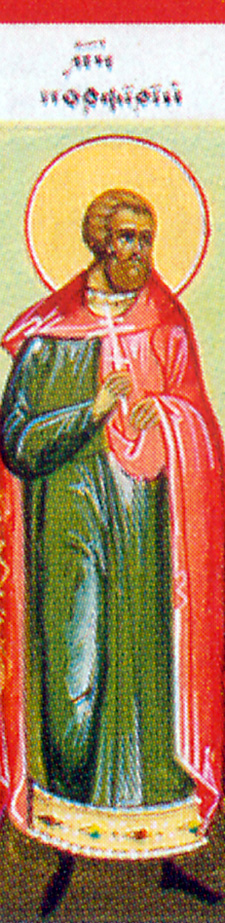
The Holy Martyr Porphyrius suffered during the reign of Julian the Apostate (361-363). Porphyrius was an actor and on the emperor’s birthday he was performing a role at the theater, where he was supposed to mock the mystery of holy Baptism.
During the play Porphyrius was immersed in water and said: “The servant of God, Porphyrius, is baptized in the Name of the Father, and of the Son, and of the Holy Spirit.” Through divine grace, he emerged from the water and confessed himself a Christian. Julian ordered him to be tortured, and after the torments, to be beheaded. This took place in the city of Ephesus in the year 361.

During the reign of Saint Constantine the Great (May 21), Saint Stephen appeared three times to a pious old priest named Lukianos and revealed to him the place where his relics had been hidden. He informed Patriarch John of Jerusalem, who went to the designated spot and found the sacred relics of the Holy Protomartyr Stephen.
When the Saint’s relics were discovered, there was a great earthquake and those who were present noticed a beautiful fragrance suffusing the whole area. It is said that angelic voices were heard from Heaven saying: “Glory to God in the highest, and on earth peace among men of good will” (Luke 2:14). That is to say, “Glory be to God in the highest places of Heaven, and here on this earth troubled by sin, may divine peace reign; for God has demonstrated His good will toward mankind, by the Incarnation of His Son.” Thus, the angels made it clear that the Protomartyr Stephen had endured martyrdom for the love and glory of God.
In 415, the relics of Saints Stephen, Gamaliel, and Νikόdēmos were miraculously discovered and solemnly transferred to Jerusalem by Archbishop John, along with Bishops Eutonius of Sebaste and Eleutherius of Jericho. From that time on, the relics began to work miracles of healing.
Subsequently, in the reign of the holy Emperor Theodosius the Younger (408-450), the relics of the holy Protomartyr Stephen were transferred from Jerusalem to Constantinople and placed in the church dedicated to the holy Deacon Laurence (August 10), and were transferred there on August 2, until a church could be built in honor of Saint Stephen.
Saint Stephen’s right hand is kept in the Serapion Chamber of the Trinity-Sergius Lavra.

The Holy Presbyter and Wonderworker Philotheus lived in the tenth century in the village of Mravin (or Myrmix) located in Bythnia in Asia Minor. He was a married priest, and had children. He devoted himself to deeds of prayer and fasting, and works of charity. Because of his holy life, Saint Philotheus received from God the gift of working miracles. The ascetic continually fed the hungry and helped the needy. Saint Philotheus died in peace. Myrrh flowed from his relics.

Blessed Abba Joseph of Alaverdi was a disciple and companion of Saint John of Zedazeni, who in the 6th century arrived in Georgia with twelve Syrian ascetics to spread the Christian Faith.
With the blessing of his teacher, Fr. Joseph settled in the village of Alaverdi in eastern Georgia. According to tradition, he carried with him a cross formed from the wood of the Life-giving Cross of our Savior.
At that time the region around Alaverdi was deserted and barren. One day the Lord sent a nobleman to hunt in the valley where the pious hermit dwelt among the wild animals. Seeing the saint, the nobleman guessed immediately that before him stood a holy man. He bowed before him, kissed him, and humbly asked what had brought him to this deserted place.
With the help of God, Saint Joseph aroused in the nobleman a divine love and an unquenchable desire for the Truth. The nobleman vowed to erect a church in the Alaverdi Wilderness, and he laid the foundations of Alaverdi Monastery in fulfillment of this vow. Venerable Joseph was overjoyed at the accomplishment of this God-pleasing work.
Soon the people began to hear stories about the holy elder who was laboring in Alaverdi. Crowds of the faithful flocked there to see him with their own eyes and hear the blessed Joseph’s preaching. As a result of his unceasing efforts, unbelief was uprooted, and the divine services of the Church were firmly established in that region. Many of the faithful were so drawn to Abba Joseph’s holy life, boundless love, and miracles that they left the world to join in his labors.
Gradually the number of hermits increased, and a large community was formed. Fr. Joseph was the first abbot of this brotherhood. Utterly exhausted from a life of God-pleasing ascesis and labors, Saint Joseph sensed the approach of death and prepared to stand before the Lord God. He gathered his disciples, blessed them, instructed them for the last time, appointed a new abbot, and peacefully departed to the Lord.
With great honor Fr. Joseph’s disciples buried him at the Alaverdi Church. Many miracles have since occurred over the grave of the venerable elder.

Saint Joseph the New was born in 1568 at Raguza in Dalmatia, and was given the name Jacob at his Baptism. When he was very young, his father died, and he was raised by his mother. At the age of twelve, he was sent to Ochrid to be schooled.
The young Jacob was called to live the monastic life when he was fifteen, and entered the monastery of the Mother of God. After five years, he traveled to Mount Athos, and was tonsured at the Pantokrator Monastery with the new name of Joseph. He fulfilled his various obediences in an exemplary manner, becoming perfected in virtue and holiness. He attained unceasing prayer of the heart, receiving from God the gift of tears. He also performed many miracles, healing the sick and the crippled. Some of the monasteries of the Holy Mountain would send for him so that he could heal those monks who were afflicted with severe bodily suffering.
On July 20, 1650, at the age of eighty-two, Saint Joseph was elected as Metropolitan of Timishoara. He was a wise and good shepherd to his flock, healing their physical and spiritual illnesses. Once he extinguished a fire in the western part of Timishoara by his prayers, when God sent a heavy rainfall.
After three years of archpastoral labors, he retired to the Partosh Monastery, where he was often visited by many of the faithful. The monastery was an important center of church activity in those days, and even had a school for training priests.
Metropolitan Joseph fell asleep in the Lord on August 15, 1656 when he was eighty-eight years old, and he was buried in the monastery church. He is commemorated on September 15.
He worked many miracles during his lifetime, and there are reports that his relics remained incorrupt after his death.
For more than 300 years the monks reverently tended his grave, then at his glorification on October 7, 1956 Saint Joseph’s relics were transferred into the cathedral at Timishoara. The casket containing his holy relics is adorned with carvings depicting scenes from his life.
An Akathist composed to honor Saint Joseph speaks of his many virtues.
Saint Bessarion, Archbishop of Larissa, lived during the sixteenth century and founded the Dusika monastery in Thessaly.
Saint Gerasimus founded a monastery in honor of the Holy Trinity near Makrinitsa in Zagora (Mizia). This monastery received the name Zurvia (Survias).
The New Martyr John was from Crete, and worked as a farmer at New Ephesus (Kusantasi) in Asia Minor. He was a young man, and was engaged to be married.
On August 29, John and two friends from Crete went to a festival to celebrate the Feast of Saint John the Baptist. They were stopped by the Turks, and the two visitors were ordered to pay the head tax. The Cretans refused to pay, and got into a scuffle with the aga’s men. The Turks took a gun belonging to one of the Cretans, but then he grabbed it back from the Moslem. In the confusion, one of the aga’s men was killed and some of the others were stabbed.
Since John was not involved in the incident, he went back to his farm. The brother of the dead Moslem, however, wanted revenge. He knew that John was present when his brother was killed, so he had him arrested. John was thrown into prison, beaten, and was not allowed to have any visitors.
Saint John remained in prison for sixteen days. Then he was given the choice of saving his life by converting to Islam, or to remain a Christian and die. John stated, “I was born as an Orthodox Christian, and I shall die as an Orthodox Christian.”
Since John was an attractive young man, the kadi’s daughter became interested in him. If he were willing to convert, he could marry the girl and enjoy both wealth and position as a member of the kadi’s family. Even this was not enough to make him deny Christ.
Finally the Hagarenes grew tired of trying to convert John, and he was sentenced to death by hanging. As he was led to the place of execution, he kept saying, “Most Holy Theotokos, help me.” He also asked forgiveness of the Christians he met along the way.
Saint John suffered for Christ on September 15, 1811, and received the incorruptible crown of martyrdom. That night the martyr’s body shone with a bright light. After three days, permission was granted to bury his holy relics in the courtyard of the church of Saint George.

This is one of the most ancient icons of the Mother of God. It appeared to the holy martyr Nikḗtas (+ September 15, 372). Saint Nikḗtas, a former soldier, was a disciple of Bishop Theophilos of the Goths. Even before he was baptized, he saw a Child in a dream, holding a Cross in His hand. When he awakened, he thought about this for a long time, but was unable to understand what this vision signified. A Christian girl named Juliana, who had a special revelation from God, told him to look down at his chest.
To his unspeakable surprise, Nikḗtas found an Icon of the Mother of God on his chest. She held her divine Child on her lap, and He was holding a Cross in His hand. "This is the same Icon I saw in my dream," the startled Nikḗtas cried. The appearance of the Icon made such an impression on him that he was baptized right away.
Soon afterward, the persecution of Christians began, and Saint Nikḗtas received the crown of martyrdom along with many other confessors. When he was being led to the place of execution, he had on his chest, under his clothes, the Icon of the Mother of God which had appeared to him.
It was established that the Novonikḗta Icon of the Mother of God should be commemorated on the day of Saint Nikḗtas's martyrdom.
The list of miracles from this Icon is in Moscow, in the court cathedral, which is dedicated to the All-Merciful Savior, at the Gate of Saint Nikḗtas.
September 17, 2023
Sunday after the Elevation of the Holy Cross
Galatians 2:16-20: Brethren, you know that a man is not justified by works of the law but through faith in Jesus Christ. Even we have believed in Christ Jesus, in order to be justified by faith in Christ, and not by works of the law, because by works of the law shall no one be justified. But if, in our endeavor to be justified in Christ, we ourselves were found to be sinners, is Christ then an agent of sin? Certainly not! But if I build up again those things which I tore down, then I prove myself a transgressor. For I through the Law died to the Law, that I might live to God. I have been crucified with Christ; it is no longer I who live, but Christ Who lives in me; and the life I now live in the flesh I live by faith in the Son of God, Who loved me and gave Himself for me.
Mark 8:34-9:1: The Lord said, “If any man would come after Me, let him deny himself and take up his cross and follow Me. For whoever would save his life will lose it; and whoever loses his life for My sake and the Gospel’s will save it. For what does it profit a man, to gain the whole world and forfeit his soul? For what can a man give in return for his soul? For whoever is ashamed of Me and of My words in this adulterous and sinful generation, of him will the Son of man also be ashamed, when He comes in the glory of His Father with the holy angels.” And He said to them, “Truly, I say to you, there are some standing here who will not taste death before they see the Kingdom of God come with power.”
Troparion of the Resurrection: When Mary stood at thy grave looking for thy sacred body, angelic powers shone above thy revered tomb, and the soldiers who were to keep guard became as dead men. Thou led hades captive and wast not tempted thereby. Thou didst meet the Virgin and didst give life to the world; O thou who art risen from the dead! O Lord, glory to thee.
Troparion of the Holy Cross: O Lord, save thy people and bless thine inheritance, granting to thy people victory over all their enemies, and by the power of thy Cross preserving thy kingdom.
Troparion of the Chains of St. Peter: O Holy Apostle, Peter, thou dost preside over the Apostles by the precious chains which thou didst bear. We venerate them with faith and beseech thee that by thine intercessions we be granted the great mercy.
Kontakion of the Holy Cross: Do thou, who of thine own good will wast lifted up upon the Cross, O Christ our God, bestow thy bounties upon the new nation which is called by thy Name; make glad in thy might those who lawfully govern, that with them we may led to victory over our adversaries, having in thine aid a weapon of peace and a trophy invincible.
CALENDAR
UNTIL FURTHER NOTICE: All services listed on the calendar will be available through streaming and webcast. (Instructions can be found on the parish website.)
Sunday, September 17 (Sunday after the Elevation of the Holy Cross)
8:50 a.m.
THE ELEVATION OF THE VENERABLE AND LIFE-GIVING CROSS
ABSTAIN FROM MEAT, FISH, DAIRY, EGGS, WINE, OLIVE OIL
The Elevation of the Venerable and Life-Giving Cross, Commemoration of the 6th Ecumenical Council
Brethren, the word of the cross is folly to those who are perishing, but to us who are being saved it is the power of God. For it is written, “I will destroy the wisdom of the wise, and the cleverness of the clever I will thwart.” Where is the wise man? Where is the scribe? Where is the debater of this age? Has not God made foolish the wisdom of the world? For since, in the wisdom of God, the world did not know God through wisdom, it pleased God through the folly of what we preach to save those who believe. For Jews demand signs and Greeks seek wisdom, but we preach Christ crucified, a stumbling block to Jews and folly to Gentiles, but to those who are called, both Jews and Greeks, Christ the power of God and the wisdom of God.
At that time, when the chief priests and the officers saw him, they cried out, "Crucify him, crucify him!" Pilate said to them, "Take him yourselves and crucify him, for I find no crime in him." The Jews answered him, "We have a law, and by that law he ought to die, because he has made himself the Son of God.
When Pilate heard these words, he was the more afraid; he entered the praetorium again and said to Jesus, "Where are you from?" But Jesus gave no answer. Pilate therefore said to him, "You will not speak to me? Do you not know that I have power to release you, and power to crucify you?" Jesus answered him, "You would have no power over me unless it had been given you from above; therefore he who delivered me to you has the greater sin." When Pilate heard these words, he brought Jesus out and sat down on the judgment seat at a place called the Pavement, and in Hebrew, Gabbatha. Now it was the day of Preparation of the Passover; it was about the sixth hour. He said to the Jews, "Behold your King!" They cried out, "Away with him, away with him, crucify him!" Pilate said to them, "Shall I crucify your King?" The chief priests answered, "We have no king but Caesar." Then he handed him over to them to be crucified. So they took Jesus, and he went out, bearing his own cross, to the place called the place of a skull, which is called in Hebrew Golgotha. There they crucified him, and with him two others, one on either side, and Jesus between them. Pilate also wrote a title and put it on the cross; it read, "Jesus of Nazareth, the King of the Jews." Many of the Jews read this title, for the place where Jesus was crucified was near the city; and it was written in Hebrew, in Latin, and in Greek.
But standing by the cross of Jesus were his mother, and his mother's sister, Mary the wife of Clopas, and Mary Magdalene. When Jesus saw his mother, and the disciple whom he loved standing near, he said to his mother, "Woman, behold your son!" Then he said to the disciple, "Behold your mother!" And from that hour the disciple took her to his own home. Then when Jesus had received the vinegar, he said, "It is finished"; and he bowed his head and gave up his spirit.

The pagan Roman Emperors tried to obliterate the holy places where our Lord Jesus Christ suffered and rose from the dead, so that they would be forgotten. Emperor Hadrian (117-138) ordered that Golgotha and the Lord's Sepulchre be buried, and that a temple in honor of the pagan "goddess" Venus and a statue of Jupiter be placed there.
Pagans gathered at this place and offered sacrifice to idols. Eventually after 300 years, by Divine Providence, the Christian holy places, the Sepulchre of the Lord, and the Life-giving Cross, were discovered and opened for veneration. This took place under Emperor Constantine the Great (306-337) after his victory over Maxentius (in 312), who ruled the Western part of the Roman Empire, and over Licinius, the ruler of its Eastern part. In the year 323 Constantine became the sole ruler of the vast Roman Empire.
In 313 Saint Constantine issued the Edict of Milan, by which Christianity was legalized and persecutions against Christians in the Western half of the Empire were stopped. Although Licinius had signed the Edict of Milan in order to oblige Constantine, he continued his cruel persecutions against Christians. Only after his conclusive defeat did the Edict of Milan extend also to the Eastern part of the Empire. The Holy Equal of the Apostles Emperor Constantine, triumphing over his enemies in three wars, with God’s assistance, had seen the Sign of the Cross in the heavens. Written beneath were the words: “By this you shall conquer.”
Ardently desiring to find the Cross upon which our Lord Jesus Christ was crucified, Saint Constantine sent his mother, the pious Empress Helen (May 21), to Jerusalem, providing her with a letter to Saint Makarios, the Patriarch of Jerusalem. Saint Helen journeyed to the holy places connected with the earthly life of the Savior, building more than 80 churches, at Bethlehem the birthplace of Christ, and on the Mount of Olives where the Lord ascended to Heaven, and at Gethsemane where the Savior prayed before His sufferings, and where the Mother of God was buried after her Dormition.
Although the holy Empress Helen was no longer young, she set about completing the task with enthusiasm. In her search for the Life-giving Cross, she questioned both Christians and Jews, but for a long time her search remained unsuccessful. Finally, she was directed to a certain elderly Jew named Jude who stated that the Cross was buried beneath the temple of Venus. They demolished the pagan temple and, after praying, they began to excavate the ground. Soon the Lord's Tomb was uncovered. Not far from it were three crosses, and a board with the inscription ordered by Pilate, and four nails which had pierced the Lord’s Body (March 6).
In order to discover on which of the three crosses the Savior had been crucified, Patriarch Makarios alternately touched the crosses to a corpse. When the Cross of the Lord touched the dead man, he was restored to life. After witnessing the raising of the dead man, everyone was convinced that the Life-giving Cross had been found.
Christians came in a huge crowds to venerate the Holy Cross, beseeching Saint Makarios to lift the Cross, so that those far off could see it. Then the Patriarch and other spiritual leaders lifted the Holy Cross, and the people prostrated themselves before the Honorable Wood, saying “Lord have mercy." This solemn event occurred in the year 326.
During the discovery of the Life-giving Cross another miracle took place: a woman who was close to death was healed by the shadow of the Holy Cross. The elderly Jude (October 28) and other Jews believed in Christ and were baptized. Jude was given the name Kyriakos, and later he was consecrated as the Bishop of Jerusalem. He suffered a martyr’s death for Christ during the reign of Emperor Julian the Apostate (361-363).
Saint Helen took part of the Life-giving Wood and nails with her to Constantinople. Saint Constantine ordered a majestic and spacious church to built at Jerusalem in honor of the Resurrection of Christ, also including under its roof the Life-giving Tomb of the Lord and Golgotha. The church was built in ten years. Saint Helen did not survive until the dedication of the church, she reposed in the year 327. The church was consecrated on September 13, 335. On the following day, September 14, the festal celebration of the Exaltation of the Honorable and Life-giving Cross was established.
Another event connected to the Cross of the Lord is remembered also on this day: its return to Jerusalem from Persia after a fourteen year captivity. During the reign of the Byzantine Emperor Phokas (602-610) the Persian king Khozróēs II attacked Constantinople defeated the Greek army, plundered Jerusalem, capturing both the Life-giving Cross of the Lord and the Holy Patriarch Zachariah (609-633).
The Cross remained in Persia for fourteen years, and only under Emperor Herakleios (610-641), who defeated Khozróēs and concluded peace with his successor and son Syroes, was the Lord's Cross returned to the Christians.
With great solemnity the Life-giving Cross was transferred to Jerusalem. Emperor Herakleios, wearing a crown and his royal purple garments carried the Cross of Christ. The Emperor was accompanied by Patriarch Zachariah. At the gates by which they ascended Golgotha, the Emperor stopped suddenly and was unable to proceed. The holy Patriarch explained to the Emperor that an Angel of the Lord was blocking his way. Herakleios was told to remove his royal trappings and to walk barefoot, since He Who bore the Cross for the salvation of the world had made His way to Golgotha in all humility. Then Herakleios donned plain clothes, and without further hindrance, carried the Cross of Christ into the church.
In a sermon on the Exaltation of the Cross, Saint Andrew of Crete (July 4) says: “The Cross is exalted, and everything true is gathered together, the Cross is exalted, and the city makes solemn, and the people celebrate the feast."

Saint John Chrysostom died on September 14, 407, but because of the feast of the Exaltation of the Life-Creating Cross of the Lord, the commemoration of the saint was transferred to November 13. On January 27 we commemorate the transfer of the holy relics of Saint John Chrysostom from Comana to Constantinople, and on January 30, the Synaxis of the Three Hierarchs.
No information available at this time.
Saint Joseph was a monk of Dionysiou Monastery on Mt. Athos, where he shone forth with the virtues of monastic life. He was an iconographer, and he painted the icon of the holy Archangels on the iconostasis of Dionysiou’s main church.
In obedience to the instructions of Igumen Stephen, Saint Joseph traveled to Constantinople with Eudocimus, who had apostasized from Orthodoxy to become a Moslem. Eudocimus repented, and wished to wipe out his sin through martyrdom.
When faced with torture and death, however, the unfortunate Eudocimus denied Christ again, blaming Joseph for turning him from Islam.
Saint Joseph was arrested and threatened with death. In spite of many tortures, he refused to convert to Islam. This holy martyr of Christ was hanged on February 17, 1819, and so he obtained an incorruptible crown of glory.
Some sources list his commemoration on February 17, while others list him on September 14 or October 26.

The Lesna Icon of the Mother of God appeared on the Feast of the Universal Exaltation of the Cross in the year 1683 and was found by Alexander Stelmashuk, a shepherd, who had gone into the woods in order to escape the heat. There he saw a small Icon in the branches of a pear tree, emitting a bright radiance. He fell to his knees in reverence, but then he was so overcome with fear that he ran to tell a friend about his discovery. The two shepherds went to the village priest, who went back with them to remove the Icon from the tree. They brought it to an Orthodox church in the village of Bukovich, not far from the town of Lesna.
When news of the Icon's miraculous appearance circulated throughout the surrounding area, Roman Catholic priests decided to use the Icon to convert the Orthodox to Catholicism. In 1686, when they met with opposition from the Orthodox faithful, they removed the Icon by force in 1686 and placed it in the Roman Catholic church at Lesna.
At the beginning of the eighteenth century, Catholic monks founded a large Roman church and monastery at Lesna, where the wonderworking Icon was. In 1863, the monks took part in the Polish revolt, and, by a decree of the Russian government, the Icon was returned to the Orthodox Church. The monastery was closed and turned into an Orthodox women’s monastery in 1885. A new iconostasis was built, but it was only two rows high so that people could see the Lesna Icon hanging in the High Place.
The Icon has worked many miracles, healing the sick, dispelling melancholy, and alleviating every sort of misfortune.
The Lesna Icon of the Mother of God is also commemorated on September 8 and on the Day of the Holy Trinity (Pentecost).

Saint Anthimus of Iberia was one of the most highly educated people of his time. He was fluent in many languages, including Greek, Romanian, Old Slavonic, Arabic, and Turkish and well-versed in theology, literature, and the natural sciences. He was unusually gifted in the fine arts—in painting, engraving, and sculpture in particular. He was famed for his beautiful calligraphy. Finally, Saint Anthimus was a great writer, a renowned orator, and a reformer of the written Romanian language.
Little is known about the youth of Saint Anthimus. He was a native of the Samtskhe region in southern Georgia. His parents, John and Mariam, gave him the name Andria at Baptism. He accompanied King Archil to Russia and helped him to found a Georgian print shop there, but after he returned he was captured by Dagestani robbers and sold into slavery. Through the efforts of Patriarch Dositheus of Jerusalem, Anthimus was finally set free, but he remained in the patriarch’s service in order to further his spiritual education.
Already famed for his paintings, engravings, and calligraphy, Anthimus was asked by Prince Constantine Brincoveanu (1688-1714) of Wallachia (present-day Romania) to travel to his kingdom around the year 1691. After he had arrived in Wallachia, he began to manage a local print shop. The printing industry in that country advanced tremendously at that time, and the chief inspiration and driving force behind the great advances was the Georgian master Anthimus. He succeeded in making Wallachia a center of Christianity and a major publisher of books for all the East.
In 1694 Anthimus was enthroned as abbot of Snagov Monastery (in present-day Romania), where he soon founded a print shop. In the same year his new print shop published Guidelines for the Divine Services on May 21, All Saints’ Day. The book was signed by Subdeacon Michael Ishtvanovich, future founder of the first Georgian print shop.
In 1705 Anthimus, “the chosen among chosen abbots of Wallachia,” was consecrated bishop of Rimnicu Vilcea, and in 1708 he was appointed metropolitan of Hungro-Wallachia. The whole country celebrated his elevation. As one abbot proclaimed: “The divine Anthimus, a great man and son of the wise Iberian nation, has come to Wallachia and enlightened our land. God has granted him an inexhaustible source of wisdom, entrusted him to accomplish great endeavors, and helped to advance our nation by establishing for us a great printing industry.”
Under the direct leadership of Saint Anthimus, more than twenty churches and monasteries were erected in Wallachia. Of particular significance is All Saints’ Monastery, located in the center of Bucharest. The main gates of this monastery were made of oak and carved with traditional Georgian motifs by Saint Anthimus himself. The metropolitan also established rules for the monastery and declared its independence from the Church of Constantinople.
From the day of his consecration, Metropolitan Anthimus fought tirelessly for the liberation of Wallachia from foreign oppressors. On the day he was ordained he addressed his flock: “You have defended the Christian Faith in purity and without fault. Nevertheless, you are surrounded and tightly bound by the violence of other nations. You endure countless deprivations and tribulations from those who dominate this world…. Though I am unworthy and am indeed younger than many of you—like David, I am the youngest among my brothers— the Lord God has anointed me to be your shepherd. Thus I will share in your future trials and griefs and partake in the lot that God has appointed for you.”
His words were prophetic: In 1714 the Turks executed the Wallachian prince Constantine Brincoveanu, and in 1716 they executed Stefan Cantacuzino (1714-1716), the last prince of Wallachia.
In his place they appointed Nicholas Mavrokordatos, a Phanariote (a member of one of the principal Greek families of the Phanar, the Greek quarter of Constantinople, who, as administrators in the civil bureaucracy, exercised great influence in the Ottoman Empire after the Turkish conquest) who concerned himself only with the interests of the Ottoman Empire.
During this difficult time, Anthimus of Iberia gathered around him a group of loyal boyar patriots determined to liberate their country from Turkish and Phanariote domination. But Nicholas Mavrokordatos became suspicious, and he ordered Anthimus to resign as metropolitan. When Anthimus failed to do so, he filed a complaint with Patriarch Jeremiah of Constantinople.
Then a council of bishops, which did not include a single Romanian clergyman, condemned the “conspirator and instigator of revolutionary activity” to anathema and excommunication and declared him unworthy to be called a monk. But Nicholas Mavrokordatos was still unsatisfied and claimed that to deny Anthimus the title of Metropolitan of Hungro-Wallachia was insufficient punishment. He ordered Anthimus to be exiled far from Wallachia, to Saint Catherine’s Monastery on Mt. Sinai. Metropolitan Anthimus, beloved of the Romanian people, was escorted out of the city at night since the conspirators feared the reaction of the people.
But Metropolitan Anthimus never reached Mt. Sinai. On September 14, 1716, a band of Turkish soldiers stabbed Saint Anthimus to death on the bank of the Tundzha (Tunca) River where it flows through Adrianople, not far from Gallipoli, and cast his butchered remains into the river.
Thus ended the earthly life of one more Georgian saint—a man who had dedicated all of his strength, talent, and knowledge to the revival of Christian culture and the strengthening of the Wallachian people in the Orthodox Faith.
In 1992 the Romanian Church canonized Anthimus of Iberia and proclaimed his commemoration day to be September 14, the day of his repose. The Georgian Church commemorates him on June 13.
The Church workday has been rescheduled for Saturday, September 23rd.
 Saint Peter Antiochian Orthodox Church
You must be logged in to post a comment.