Monthly Archives: September 2023

Daily Readings for Sunday, September 24, 2023

1ST SUNDAY OF LUKE

NO FAST

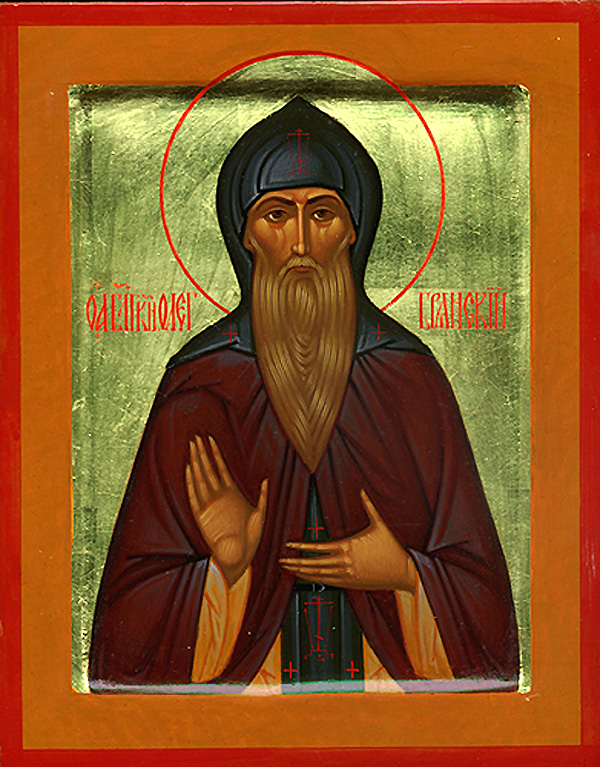
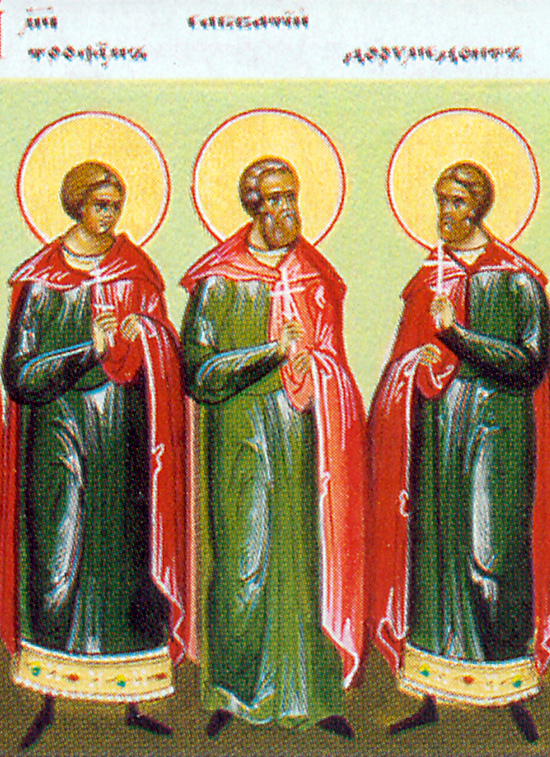
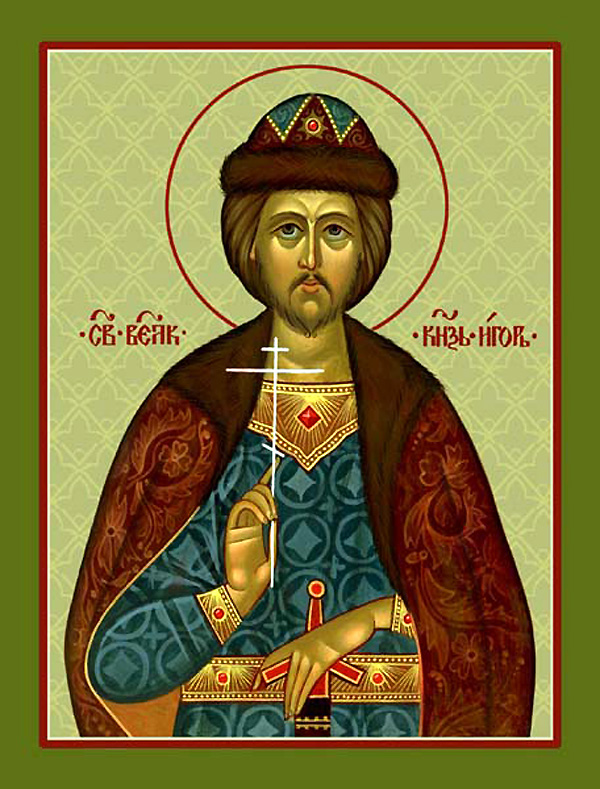
1st Sunday of Luke, Thecla the Protomartyr & Equal to the Apostles, The Commemoration of the Miracle of the Theotokos Myrtidiotissis in Kythyra, Silouan of Athos, Stephen the Martyr, The Most Holy Theotokos of Palianis, Coprios the Righteous, Juvenaly & Peter the Aleut, New Martyrs of Alaska

ST. PAUL’S SECOND LETTER TO TIMOTHY 3:10-15

TIMOTHY, my son, you have observed my teaching, my conduct, my aim in life, my faith, my patience, my love, my steadfastness, my persecutions, my sufferings, what befell me at Antioch, at lconion, and at Lystra, what persecutions I endured; yet from them all the Lord rescued me. Indeed all who desire to live a godly life in Christ Jesus will be persecuted, while evil men and impostors will go on from bad to worse, deceivers and deceived. But as for you, continue in what you have learned and have firmly believed, knowing from whom you learned it and how from childhood you have been acquainted with the sacred writings which are able to instruct you for salvation through faith in Christ Jesus.

LUKE 5:1-11

At that time, as Jesus was standing by the lake of Gennesaret, he saw two boats by the lake; but the fishermen had gone out of them and were washing their nets. Getting into one of the boats, which was Simon’s, he asked him to put out a little from the land. And he sat down and taught the people from the boat. And when he had ceased speaking, he said to Simon, “Put out into the deep and let down your nets for a catch.” And Simon answered, “Master, we toiled all night and took nothing! But at your word I will let down the nets.” And when they had done this, they enclosed a great shoal of fish; and as their nets were breaking, they beckoned to their partners in the other boat to come and help them. And they came and filled both the boats, so that they began to sink. But when Simon Peter saw it, he fell down at Jesus’ knees, saying, “Depart from me, for I am a sinful man, O Lord.” For he was astonished, and all who were with him, at the catch of fish which they had taken; and so also were James and John, sons of Zebedee, who were partners with Simon. And Jesus said to Simon, “Do not be afraid; henceforth you will be catching men.” And when they had brought their boats to land, they left everything and followed him.

Synaxis of All Saints of Alaska
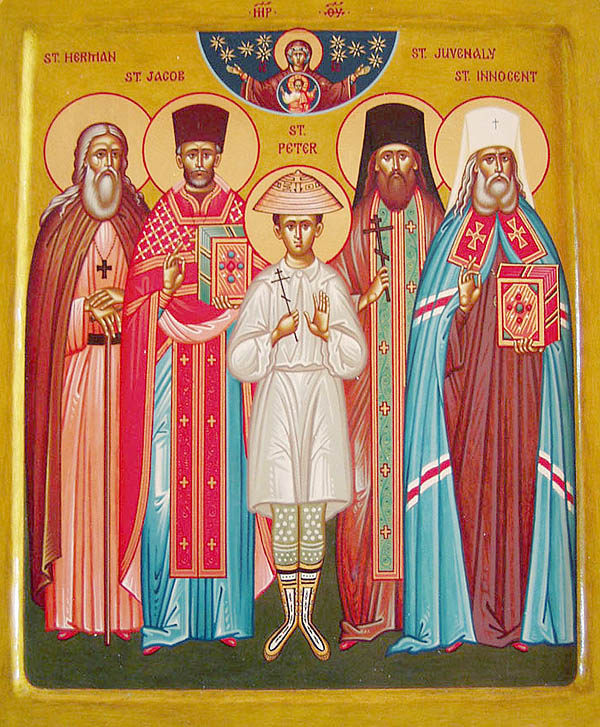
On the anniversary of the arrival of the Russian missionaries in Alaska (1794), we remember the New Martyrs Saint Peter the Aleut, Protomartyr of America, and Saint Juvenal.

Martyr Peter the Aleut

Saint Peter the Aleut is mentioned in the Life of Saint Herman of Alaska (December 13). Simeon Yanovsky (who ended his life as the schemamonk Sergius in the Saint Tikhon of Kaluga Monastery), has left the following account:

“On another occasion I was relating to him how the Spanish in California had imprisoned fourteen Aleuts, and how the Jesuits (actually Franciscans) were forcing all of them to accept the Catholic Faith. But the Aleuts would not agree under any circumstances, saying, ‘We are Christians.’ The Jesuits argued, ‘That’s not true, you are heretics and schismatics. If you do not agree to accept our faith then we will torture all of you to death.’ Then the Aleuts were placed in prisons two to a cell. That evening, the Jesuits came to the prison with lanterns and lighted candles. Again they tried to persuade two Aleuts in the cell to accept the Catholic Faith. ‘We are Christians,’ the Aleuts replied, ‘and we will not change our Faith.’ Then the Jesuits began to torture them, at first the one while his companion was a witness. They cut off one of the joints of his feet, and then the other joint. Then they cut the first joint on the fingers of his hands, and then the other joint. Then they cut off his feet, and his hands. The blood flowed, but the martyr endured all and firmly repeated one thing: ‘I am a Christian.’ He died in such suffering, due to a loss of blood. The Jesuit also promised to torture his comrade to death the next day.

“But that night an order was received from Monterey stating that the imprisoned Aleuts were to be released immediately, and sent there under escort. Therefore, in the morning all were sent to Monterey with the exception of the dead Aleut. This was related to me by a witness, the same Aleut who had escaped torture, and who was the friend of the martyred Aleut. I reported this incident to the authorities in Saint Petersburg. When I finished my story, Father Herman asked, ‘What was the name of the martyred Aleut?’ I answered, ‘Peter. I do not remember his family name.’ The Elder stood reverently before an icon, made the Sign of the Cross and said, ‘Holy New Martyr Peter, pray to God for us!’”

We know very little about Saint Peter, except that he was from Kodiak, and was arrested and put to death by the Spaniards in California because he refused to convert to Catholicism. The circumstances of his martyrdom recall the torture of Saint James the Persian (November 27).

Both in his sufferings and in his steadfast confession of the Faith, Saint Peter is the equal of the martyrs of old, and also of the New Martyrs who have shone forth in more recent times. Now he rejoices with them in the heavenly Kingdom, glorifying God, the Father, the Son, and the Holy Spirit, throughout all ages.

Martyr Juvenal of Alaska

Saint Juvenal, the Protomartyr of America, was born in 1761 in Nerchinsk, Siberia. His secular name was John Feodorovich Hovorukhin, and he was trained as a mining engineer. In a letter to Abbot Nazarius of Valaam (December 13, 1819), Saint Herman says that Saint Juvenal “had been an assistant at our monastery and was a former officer.”

After his wife died in 1791, John entered a monastery at Saint Petersburg (Saint Herman’s Letter of December 13, 1819) and was tonsured with the name Juvenal. Three years later, he went to Alaska as a missionary.

During 1794, the hieromonks Juvenal and Macarius spent two months in the area around Kodiak teaching the inhabitants about Christ and baptizing them. They traveled in small boats of hide in all sorts of weather, dividing up the territory among themselves. Saint Herman tells of a conversation he heard one day as he walked with the hieromonks to a small hill on the south side of the harbor. They sat down facing the sea, and spoke of various things. Soon they began to discuss where each of them should go to preach. Aflame with zeal and eager to set out on their journey, a friendly argument ensued between Father Macarius and Father Juvenal. Father Macarius said he intended to go north to the Aleutian Islands, and then make his way to the Alaskan mainland, where the inhabitants had invited him to visit. The monks had a map of Captain Cook’s which indicated that some Russians were living near a certain river in that particular area, and Father Macarius hoped to find them.

Father Juvenal interrupted, saying that he believed that the Alaskan mainland was his territory. “I beg you to yield to me and not offend me in this,” he told Father Macarius, “since the ship is leaving for Yakutan. I shall begin preaching in the south, proceeding north along the ocean, cross the Kenai peninsula, then from the port there I shall cross to Alaska.”

Father Macarius became sorrowful and said, “No, Father. Do not restrict me in this way. You know the Aleutian chain of islands is joined to Alaska, therefore it belongs to me, and also the whole northern shore. As for you, the southern part of America is sufficient for your whole lifetime, if you please.”

As he listened to their apostolic fervor, Saint Herman says he “went from joy to rapture” (Letter to Abbot Nazarius, May 19, 1795).

In 1795, Father Juvenal baptized over 700 Chugatchi at Nushek, then he crossed Kenai Bay and baptized the local people there. In 1796, according to native oral tradition, Saint Juvenal came to the mouth of the Kuskokwim near the present village of Quinahgak, where he was killed by a hunting party. (There is a forged diary attributed to Ivan Petroff which gives a slanderous version of Father Juvenal’s death, and alleges that he was martyred at Lake Iliamna.)

juvenaly

The precise reason for Saint Juvenal’s murder by the natives is not known. However, they later told Saint Innocent something about his death. They said that Saint Juvenal did not try to defend himself when attacked, nor did he make any attempt to escape. After being struck from behind, he turned to face his attackers and begged them to spare the natives he had baptized.

The natives told Saint Innocent that after they had killed Saint Juvenal, he got up and followed them, urging them to repent. The fell upon him again and gave him a savage beating. Once more, he got to his feet and called them to repentance. This happened several times, then finally the natives hacked him to pieces. Thus, the zealous Hieromonk Juvenal became the first Orthodox Christian in America to receive the crown of martyrdom. His unnamed guide, possibly a Tanaina Indian convert, was also martyred at the same time.

It is said that a local shaman removed Saint Juvenal’s brass pectoral cross from his body and attempted to cast a spell. Unexpectedly, the shaman was lifted up off the ground. He made three more tries with the same result, then concluded that there was a greater power than his own at work here. Years later, a man showed up at the Nushagak Trading Post wearing a brass pectoral cross exactly like the one worn by Saint Juvenal.

A column of light arose from his holy relics and reached up to Heaven. It is not known how long this phenomenon continued.

Saint Juvenal, in his tireless evangelization of the native peoples of Alaska, served the Church more than all the other missionaries combined.

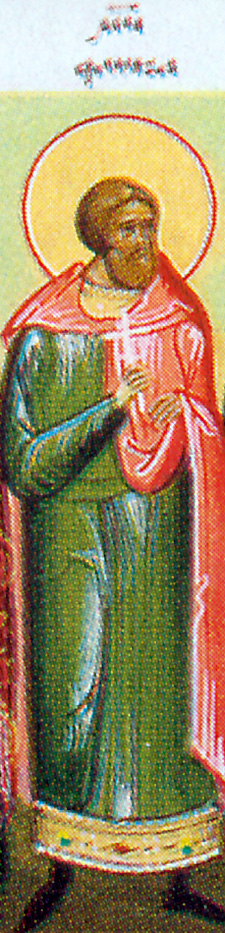
Protomartyr and Equal of the Apostles Thekla

The Holy Protomartyr and Equal of the Apostles Thekla was born in the city of Iconium. She was the daughter of rich and illustrious parents, and she was distinguished by extraordinary beauty. At eighteen years of age they betrothed her to an eminent youth. But after she heard the preaching of the holy Apostle Paul about the Savior, Saint Thekla with all her heart came to love the Lord Jesus Christ, and she steadfastly resolved not to enter into marriage, but rather to devote all her life to preaching the Gospel.

Saint Thekla’s mother was opposed to her daughter’s plans and insisted that she marry her betrothed. Saint Thekla’s fiancé also complained to the prefect of the city about the Apostle Paul, accusing him of turning his bride against him. The prefect locked up Saint Paul in prison.

During the night Saint Thekla secretly ran away from her house, and she bribed the prison guards, giving them all her gold ornaments, and so made her way into the prison to the prisoner. For three days she sat at the feet of the Apostle Paul, listening to his fatherly precepts. Thekla’s disappearance was discovered, and servants were sent out everywhere looking for her. Finally, they found her in the prison and brought her home by force.

At his trial Saint Paul was sentenced to banishment from the city. Again they urged Saint Thekla to consent to the marriage, but she would not change her mind. Neither the tears of her mother, nor her wrath, nor the threats of the prefect could separate Saint Thekla from her love for the Heavenly Bridegroom, the Lord Jesus Christ.

Her mother in a insane rage demanded from the judges a death sentence against her unyielding daughter, and Saint Thekla was sentenced to be burned. Without flinching, the holy martyr went into the fire and made the Sign of the Cross over herself. At this moment the Savior appeared to her, blessing her present deed, and inexpressible joy filled her holy soul.

The flames of the fire shot up high, but the martyr was surrounded by a light and the flames did not touch her. Thunder boomed, and a strong downpour of rain and hail extinguished the fire. The torturers scattered in fear. Saint Thekla, kept safe by the Lord, left the city and with the help of a certain Christian youth, searched for the Apostle Paul. The holy apostle and his companions, among whom was Saint Barnabas, were hidden in a cave not far from the city, praying fervently, that the Lord would strengthen Saint Thekla in her sufferings.

After this, Saint Thekla went with them preaching the Gospel in Antioch. In this city she was pursued by a certain dignitary named Alexander, who was captivated by her beauty. Saint Thekla refused his offer of marriage, and so she was condemned to death for being a Christian. Twice they set loose hungry wild animals upon her, but they would not touch the holy virgin. Instead, they lay down meekly and licked her feet.

The Providence of God preserved the holy martyr unharmed through all her torments. Finally, they tied her to two oxen and began to chase her with red-hot rods, but the strong cords broke asunder like cobwebs, and the oxen ran off, leaving Saint Thekla unharmed. The people began shouting, “Great is the God of the Christians!” The prefect himself became terrified, realizing that the holy martyr was being kept safe by the Almighty God, Whom she served. He then gave orders to set free the servant of God Thekla.

With the blessing of the Apostle Paul, Saint Thekla then settled in a desolate region of Isaurian Seleucia and dwelt there for many years, constantly preaching the Word of God and healing the sick through her prayer. Saint Thekla converted many pagans to Christ, and the Church appropriately names her as “Equal-to-the-Apostles.” Even a pagan priest, trying to assault her purity and punished for his impudence, was brought by her to holy Baptism. More than once the Enemy of the race of man tried to destroy Saint Thekla through people blinded by sin, but the power of God always preserved this faithful servant of Christ.

When Saint Thekla was already a ninety-year-old woman, pagan sorcerers became incensed at her for treating the sick for free. They were unable to comprehend that the saint was healing the sick by the power of the grace of Christ, and they presumed that the virgin-goddess Artemis was her special helper. Envious of Saint Thekla, they sent their followers to defile her. When they came near her, Saint Thekla cried out for help to Christ the Savior, and a rock split open and hid the holy virgin, the bride of Christ. Thus did Saint Thekla offer up her holy soul to the Lord.

The holy Church glorifies the Protomartyr Thekla as “the glory of women and guide for the suffering, opening up the way through every torment.” From of old many churches were dedicated to her, one of which was built at Constantinople by the holy Equal of the Apostles Constantine (May 21). The Protomartyr Thekla, a prayerful intercessor for ascetics, is also invoked during the tonsure of women into monasticism.

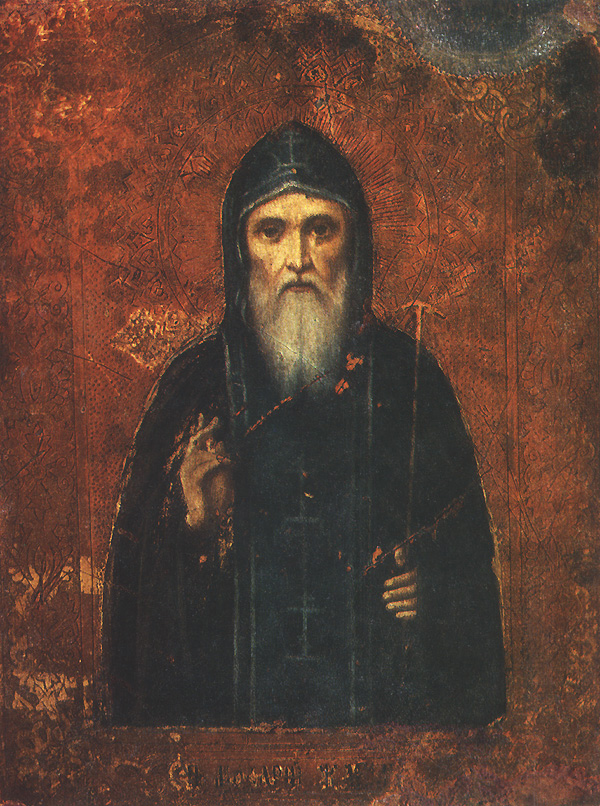
Venerable Nίkander Wonderworker of Pskov

Saint Nίkander (Νίκανδρος) of Pskov was born on July 24, 1507 into a peasant family in the village of Videlebo in the land of Pskov. His parents were called Philip and Anastasia, and in Holy Baptism, he was named Nikon.

From childhood he dreamed of continuing the ascetical contests of his fellow villager, Saint Euphrósynos of the Spaso-Eleazar Monastery (May 15), who lived in the Pskov wilderness. The first of Nikon’s family to enter the Monastery was his older brother Arsenios. After the death of his father, the seventeen-year-old Nikon was able to convince his mother to dispose of her property and enter a convent, where she lived until her repose.

After visiting Pskov's monasteries and venerating the relics of Saint Euphrósynos and his disciple Saint Savva of Krypetsk (August 28), Nikon was firmly convinced of his calling to the monastic life.

In order to be able to read the Word of God, Nikon went to work for a resident of Pskov, whose name was Philip. He rewarded Nikon's diligence by sending him to study with an experienced teacher. Seeing the young man's zeal, the Lord Himself guided him to the place of his podvig.1 While praying in one of the Pskov churches, he heard a voice from the altar commanding him to go to a place in the wilderness, which the Lord would show him through His servant Theodore. The peasant Theodore led him off to the Demyanka River, between Pskov and Porkhov. Afterward, both Philip and Theodore, who helped him attain his goal, would become monks as well. They were tonsured at Krypetsk Monastery with the names Philaret and Theodosios.

After several years of silence and strict asceticism, emaciating his flesh, Nikon went to the Monastery founded by Saint Savva of Krypetsk. The Igoumen, seeing his weakened body, would not agree to accept him right away, fearing that the difficulties of monastic life would be too much for him. Nikon bowed down before the tomb of Saint Savva, and spoke to him as if he were alive, entreating him to accept him into his Monastery. The Igoumen relented and tonsured Nikon with the name Nίkander.

Saint Nίkander endured many temptations and sorrows on his path of asceticism. Blessed Nicholas (February 28) while still at Pskov predicted Father Nίkander's trials in the wilderness. Through the prayers of all the Pskov Saints, as well as those of Saint Alexander of Svir (August 30 and April 17), who appeared to him twice, guiding and strengthening him, Father Nίkander was able to avoid all the manifold snares of the Evil One, by the grace of God.

He overcame the weakness of his flesh, as well as human failings, and diabolical apparitions by the power of prayer. On one occasion he was almost killed by robbers, who stole the only and most precious property for an anchorite – books and icons. By the Saint's prayers, two of them, frightened by the sudden death of their comrade, repented of their wicked deeds and the Elder forgave them.

Saint Nίkander did not remain very long at Krypetsk Monastery, and obtained a blessing to return to his own wilderness. Later, he came to live at Krypetsk Monastery again, where he fulfilled the obediences of ecclesiarch and cellarer. Then he went into the wilderness once more and lived there in fasting and prayer, meditating on the Word of God.

Once a year, during Great Lent, Saint Nίkander visited the Damianov Monastery, where he made his confession and received the Holy Mysteries of Christ. Eight years before his death, he was tonsured into the Great Schema. Many people began coming to him in order to benefit from his counsels, because according to Saint John of the Ladder: “Angels are a light for monks, and the monastic life is a light for all mankind" (Step 26:31). Thus, the faithful turned to Saint Nikander for help, for the Lord had bestowed many gifts of grace upon him.

This dweller in the wilderness took care of all the needs of the visitors and even built a guest house for them, for which he provided heat. The Saint did not permit himself to reveal his spiritual gifts. People sometimes heard him praying in his cell with bitter tears. When he was aware of people nearby, he prayed silently, concealing from them the gift of tears which he had received.

Until the end of his life, Saint Nίkander remained an anchorite in the wilderness, but he left instructions that after his repose, the place of his podvig would not be forsaken, promising his protection to those who would live in a future monastery. The Saint gave his final instructions to Deacon Peter of the Porkhov convent, charging him to build a church at his grave, and to transfer the icon of the Annunciation of the Most Holy Theotokos there from the Tishanka church cemetery.

He knew the day of his own death, predicting that he would die when enemies invaded the land, and he foretold this imminent assault. On September 24, 1581, during an invasion by the army of the Polish king Stephen Bathory, a certain peasant found Saint Nίkander dead. He lay on his bed with his hands crossed on his chest. The clergy and those who revered him came from Pskov, among whom was Deacon Peter, and they performed the service of Christian burial.

In 1584, at the place which Saint Nίkander sanctified by almost half a century of prayer, a monastery was established by a monk named Isaiah, and was known as the Annunciation – Nikandrov Hermitage. Father Isaiah had been healed of a foot ailment after praying to the Saint.

The glorification of Saint Nίkander Nikander took place under Patriarch Joachim in 1696, and festal celebrations were appointed for September 24, the day of his repose; on June 29, the uncovering of his holy relics during the reconstruction of the Monastery's cathedral church; and on the Monastery's temple Feast (the Annunciation to the Most Holy Theotokos). Saint Nίkander is also commemorated on the third Sunday after Pentecost, the Synaxis of the Saints of Novgorod and Pskov (movable Feast).


1 Podvig (по­дви­г = ascetical contest, spiritual struggle)

Monastic Martyr Galacteon of Vologda
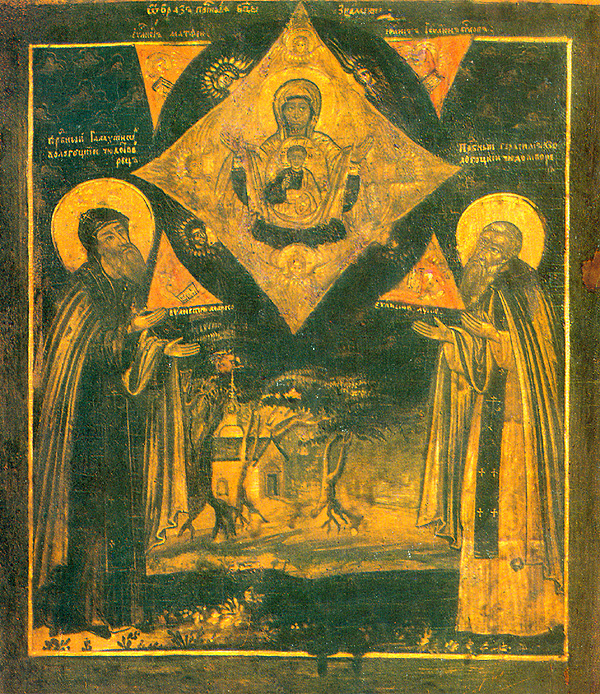
Monkmartyr Galacteon of Vologda: Fearing the wrath of Tsar Ivan the Terrible, kinsmen of the disgraced prince Ivan Ivanovich Belsky secretly brought his seven-year-old son Gabriel to the city of Staritsa. In the years of his growing up, and seeing the malice of the Tsar towards his family, the young prince withdrew to Vologda and lived with a shoemaker, from whom he learned the cobbler’s craft. His marriage did not last long, for his wife soon died, leaving Prince Gabriel to raise his infant daughter.

The adversities of his earthly life strengthened in him the intent to devote himself to God. Having sought out a place at the River Sodima, he dug a pit and made his cell near a church named for the Most Holy Trinity. After being tonsured with the name Galacteon, he began to labor in fasting and prayer. The ascetic did not give up his cobbler’s trade, and the money which he received from the work was divided into three portions. One part he dedicated to God, another portion he gave to the poor, and the third part he kept for his own needs.

Advancing in spiritual life, Saint Galacteon secluded himself in his cell, chaining himself to the wall. God-fearing Christians gave him food through a small window. The ascetic rested little, on his knees and holding on to the chain, and he ate only dry bread and water. In the cell of Saint Galacteon was nothing but the old matting with which he covered himself.

People soon began to come to the hermit for spiritual guidance. He received both the rich and the poor, and his words were filled with spiritual power. He consoled the grieving and brought the proud to their senses. In prayer Saint Galacteon achieved a special spiritual grace.

Once, when the Vologda region had gone a long time without rain, Bishop Anthony came to the church of the Holy Trinity with a church procession and sent a request to the hermit to come and pray with everyone for deliverance from the common woe. Saint Galacteon obediently left his cell and prayed in the church, and the Lord sent abundant rain upon the parched earth.

The ascetic had a revelation from God about impending misfortunes of Vologda. He emerged from his cell in his chains, went to an earthen hut and declared, “Our sins have brought the Poles and Lithuanians upon us. Let there be fasting and prayer, and preparations to build a temple in honor of the Icon of the Mother of God of the Sign (November 27), so that the Heavenly Queen might deliver Vologda from the wrath of God as She did before Novgorod.”

One of those present, Nechai Proskurov, said, “He is concerned not for us, but for himself; he only wants to have a church near him. And what will become of the temple when you die, Elder?”

Saint Galacteon answered gravely, “Wrath is approaching Vologda. As for me, there at my place God is glorified, and there also a monastery will be built.” He also said that the Trinity church built by Nechai would be burned and the house of Nechai laid waste. Passing the church dedicated to Saint Demetrius of Priluki (February 11), he said, “The Wonderworker Demetrius has prayed to the Savior for the city, but they insult him. Around his church they set up shops and hawk their wares. This church will be destroyed.”

The prophecy of the righteous one was soon fulfilled. In September 1612 the Polish and Lithuanians stormed into Vologda, and they killed many of the inhabitants. They defiled and plundered the churches of God, and they set afire the city and its surroundings. As Saint Galacteon predicted, the house and church built by Nechai were burned, as was also the city church named for Saint Demetrius.

Saint Galacteon was murdered by the invaders on September 24, 1612. Pious Christians buried the body of hosiomartyr in his cell. Over the place of his burial miraculous healings began to occur. In the time of Bishop Barlaam (1627-1645), a church was built in honor of the Sign Icon of the Mother of God over the relics of the hosiomartyr Galacteon, and a monastery was founded. With the blessing of Archbishop Marcellus (1645-1663), a cathedral church was built at the monastery in honor of the Holy Spirit, and the monastery took its name from this church.

Venerable Copres of Palestine

Saint Copres was found as a newborn infant by monks of the monastery of Saint Theodosius in Palestine. He lay upon a dung-hill (in Greek “kopria”), where his mother left him during an invasion of the Hagarenes (Moslems).

The monks took the infant, named him Copres, fed him goat’s milk and raised him in their monastery. Saint Copres later accepted monastic tonsure and spent his whole life in his monastery. Having attained to an high degree of virtue and the gift of wonderworking, Saint Copres died peacefully the age of ninety.

Venerable Abramius, Abbot of Mirozh, Pskov

Saint Abramius (Abraham) of Mirozh was the builder and first igumen of the Pskov Savior-Transfiguration monastery on the banks of the River Velika, where it meets the River Mirozha. The Mirozh monastery was founded in about the year 1156, in the time of Svyatopolk Mstislavich, by both Saint Abramius and by Saint Niphon, Bishop of Novgorod (April 8), a brother of the holy Prince Vsevolod-Gabriel (February 11).

This monastery, the most ancient in Pskov, was the first seed of monasticism transported to the Pskov soil from Kiev. On a chalice of Saint Niphon is inscribed: "Holy Bishop Niphon … enthroned, he built many holy monasteries and churches with the approval of Prince Vsevolod of Pskov, and upon the death of Prince Vsevolod he came … to Pskov and constructed … the church of the Transfiguration of the Lord, and a monastery of fame and beauty, and gathered brethren and appointed an igumen."

Toward the end of the nineteenth century, when the Transfiguration cathedral was remodeled, beautiful frescoes of the twelfth century were discovered, and which now receive universal acclaim. Saint Niphon also built a similar church at Ladoga, dedicated to Saint Clement of Rome, but only the foundations have been preserved.

There is little information about the life of Saint Abramius, because the monastery was inside the city walls and it was often laid waste, and served as quarters for enemy soldiers.

Saint Abramius reposed on September 24, 1158. His relics lie beneath a crypt of the cathedral church, dedicated to the Transfiguration of the Lord, in the monastery he built.

Saint Vladislav of Serbia

Holy King Vladislav of Serbia was the son of holy King Stephen, and he reigned for seven years. He was noted for his virtue and charity towards the poor, the vagrant and the misfortunate, and he built a monastery at Milesheva, where he died in 1239 and was buried.

Venerable Dorothy of Kashin

Saint Dorothy of Kashin was born in 1549 of a noble family. No information has come down to us about her name before she became a nun, or the place of her birth. From the age of twelve, she lived in a climate of civil unrest, and the area was subject to rebellion, invasion, and plague.

Later, she was married to Theodore Ladygin, and they lived north of Moscow in the region where the city of Kashin is located. They had a son named Michael. Dorothy’s husband was killed at the beginning of the seventeenth century defending the city in a battle against Polish and Lithuanian invaders. She was close to sixty years old at that time.

After suffering this terrible loss, Saint Dorothy decided to leave the world and enter the women’s monastery of the Meeting of the Lord in Kashin. In this same monastery were the relics of Saint Anna of Kashin (October 2). The monastery had been sacked along with the city, so conditions there were anything but easy.

Saint Dorothy built a small cell in the ruins, and there she engaged in ascetical struggles. She found the Korsun icon of the Mother of God (October 9) in the debris and kept it in her cell. This icon later became known for its miracles.

She did not move to another monastery when she grew older, but preferred to remain in the semi-wilderness around Kashin. She tried to help those who were suffering during this time, encouraging and consoling them. Whatever money she had left after her husband’s death was used to restore the monastery, or to benefit the poor.

Saint Dorothy had once lived in luxury, but now she was reduced to poverty, enduring every affliction and sorrow with great patience. She prayed continually for her husband, her monastery, and the city of Kashin.

Once the danger had passed, the other nuns started coming back to the monastery. Saint Dorothy’s holy and virtuous life also inspired other women to become nuns. They all wanted her as their abbess, but Saint Dorothy refused this office, preferring to live as a humble nun. For the rest of her life, however, she was an example to the sisters.

In 1615, Saint Dorothy received the Great Schema and increased her spiritual efforts. She fell asleep in the Lord when she was about eighty on September 24, 1629 after living in the monastery for more than twenty years.

She was buried on the north side of the monastery church. A white memorial stone was placed over her grave, and the inscription was clearly legible until the twentieth century. Many miracles have taken place at her grave for those who entreat her with faith.

Venerable Silouan of Mount Athos

No information available at this time.

“Mirozh” Icon of the Mother of God

The Mirozh Icon appeared at the Mirozh monastery in the year 1198. But later, during the reign of Ivan the Terrible, at a time when a plague raged at Pskov, an ancient report tells how tears flowed from both eyes of the icon. Many benefits and healings for man occured from the icon of the Mother of God.

The Mirozh Icon is an “Orans” (“Praying”) type. On either side of the Most Holy Theotokos stand the Pskov Saints: on the right, the holy Prince Dovmont-Timothy (May 20); on the left, his wife, the holy nun Martha, in the world named Maria Dimitrievna (November 8, 1300). Tsar Ivan Vasilievich took away the wonderworking icon from Pskov, but at the monastery an exact copy remained: the so-called “Great Panagia” from the Savior-Mirozh monastery.

On September 24, 1567, on the Feast of Saint Abraham at the Mirozh monastery there occurred a miraculous sign from an ancient icon of the Most Holy Theotokos. The celebration of the Mirozh Icon of the Sign was established in that same year, with the blessing of Archbishop Pimen of Novgorod and Pskov. A special service to this icon was composed, and was published in the 1666 MENAION.

Icon of the Mother of God “of the Myrtle Tree”

The Icon of the Most Holy Theotokos “Of the Myrtle Tree” (Myrtidiotissa) is in the monastery church of Myrtides on the Greek island of Kythera. It derives its name from the fact that it was found in a myrtle bush in the fourteenth century.

At that time, a shepherd was tending his sheep in a deserted valley which was filled with myrtle bushes. On September 24, forty days after the Dormition, the Mother of God appeared to him and told him to seek her icon which had been brought to that place many years before.

The shepherd fell to the ground in amazement, praying to the Theotokos. As soon as he got up and turned around, he saw the icon in the branches of a myrtle bush. Weeping for joy, he brought the icon home and told his friends and relatives about how he had found it.

When he awoke the next morning, the shepherd found the icon missing, and thought that perhaps someone had stolen it during the night. With a heavy heart, he led his sheep back to the spot where he had found the icon. To his amazement, he saw the icon once again in the branches of the myrtle bush. Glorifying God, the man took the icon home with him once more. The next morning, it had disappeared just as it had before. When this happened a third time, the shepherd realized that the Mother of God wanted her icon to remain where it had first appeared.

A small church was built to house the icon, and was called “Of the Myrtle Tree,” after the icon. The building was replaced and enlarged over the years, and many miracles took place there.

At the end of the sixteenth century Theodore Koumprianos, a descendant of the shepherd who found the icon, lived in the village of Kousoumari. He was a paralytic, and had an unshakeable faith that the Mother of God would heal him. Each year on September 24 he sent a family member to the church to light candles for him. One year he asked to be carried there by his family so that he might venerate the icon himself. During the Vigil, a great noise was heard coming from the direction of the sea. People fled the church, thinking that pirates were attacking. The paralytic remained in the church by himself, entreating the Mother of God for protection. Suddenly, he heard a voice from the icon telling him to get up and flee. He stood up, and then walked out of the church. Soon he was able to run and catch up with his relatives, who rejoiced upon seeing this miracle. As it turned out, there was no pirate attack, and the noise was regarded as a sign of God’s providence so that the paralytic could remain alone in church with the icon. Since that time the Koumprianos family has celebrated the icon’s Feast Day with a special reverence, since Theodore had been healed on that day.

Some of the other miracles associated with the Most Holy Theotokos and her icon “Of the Myrtle Tree” include protection of the island from the plague, ending the barrenness of a Jewish woman from Alexandria, saving people from death, and many other great wonders.

Pilgrims come to venerate the icon on the Feast of the Dormition (August 15), and also on the day of its discovery (September 24).

Venerable Simon of Serbia

No information available at this time.

Venerable David of Serbia

Saint David, a nephew of holy King Stephen, in the world had the name Demetrius. He built a monastery at Brodarova, at the River Lima, and there he received monastic tonsure with the name David and lived an ascetical life to the end of his days.

Holy King Stephen of Serbia

Holy King Stephen of Serbia was the first ruler of Serbia to be crowned as king. His father was Saint Stephen Nemanya (February 13). King Stephen died in 1224, accepting monastic tonsure with the name Simeon before his death. He was buried in the Studenitsa monastery.

9/24 announcements

September 24, 2023

Proto-martyr Thekla, Equal-to-the-Apostles

II Timothy 3:10-15: Timothy, my son, you have observed my teaching, my conduct, my aim in life, my faith, my patience, my love, my steadfastness, my persecutions, my sufferings, what befell me at Antioch, at Iconium, and at Lystra. What persecutions I endured! Yet from them all, the Lord rescued me. Indeed, all, who desire to live a godly life in Christ Jesus will be persecuted, while evil men and impostors will go on from bad to worse, deceivers and deceived. But as for you, continue in what you have learned and have firmly believed, knowing from whom you learned it and how from childhood you have been acquainted with the sacred writings, which are able to instruct you for salvation through faith in Christ Jesus.

Luke 5:1-11: At that time, Jesus was standing by the lake of Gennesaret. And He saw two boats by the lake; but the fishermen had gone out of them and were washing their nets. Getting into one of the boats, which was Simon’s, Jesus asked him to put out a little from the land. And He sat down and taught the people from the boat. And when Jesus had finished speaking, He said to Simon, “Put out into the deep and let down your nets for a catch.” And Simon answered, “Master, we toiled all night and took nothing! But at Thy word I will let down the nets.” And when they had done this, they enclosed a great shoal of fish; and as their nets were breaking, they beckoned to their partners in the other boat to come and help them. And they came and filled both the boats, so that they began to sink. But when Simon Peter saw it, he fell down at Jesus’ knees, saying, “Depart from me, for I am a sinful man, O Lord.” For he was astonished, and all that were with him, at the catch of fish, which they had taken; and so also were James and John, sons of Zebedee, who were partners with Simon. And Jesus said to Simon, “Do not be afraid; henceforth you will be catching men.” And when they had brought their boats to land, they left everything and followed Him.

Troparion of the Resurrection: Thou didst shatter death by thy Cross; thou didst open paradise to the thief; thou didst turn the mourning of the ointment-bearing women into joy, and didst bid thine Apostles proclaim warning that thou hast risen, O Christ, granting the world Great Mercy.

Troparion of St. Thekla: O glorious Thekla, companion of Paul the divine, thou wast inflamed with the love of thy Creator by the teaching of the divine preacher. Thou didst despise the passing earthly pleasures, and offered thyself to God as an acceptable and pleasing sacrifice, disregarding all suffering. Intercede with Christ thy Groom to grant us His great mercy.

Troparion for Holy Father Silouan: By thy prayers, thou didst receive Christ as thy Master on the path of humility and in thy heart the Holy Spirit witnessed unto thy salvation. For this cause all people called to live in hope now rejoice and celebrate thy memory. O Holy Father Silouan, pray to Christ to save our souls.

Troparion of the Chains of St. Peter: O Holy Apostle, Peter, thou dost preside over the Apostles by the precious chains which thou didst bear. We venerate them with faith and beseech thee that by thine intercessions we be granted the great mercy.

Kontakion of the Theotokos: O undisputed intercessor of Christians, O mediatrix, who is unrejected by the Creator, turn not away from the voice of our petitions though we be sinners; come to us in time, who cry to thee in faith, for thou art good. Hasten to us with intercessions, O Theotokos, who didst ever intercede for those who honor thee.

CALENDAR

UNTIL FURTHER NOTICE: All services listed on the calendar will be available through streaming and webcast. (Instructions can be found on the parish website.)

Sunday, September 24 (Proto-martyr Thekla)

8:50 a.m. – Orthros (webcast)

9:00 a.m. – Christian Education

10:00 a.m. – Divine Liturgy (webcast)

Monday, September 25

Father Herman off

Tuesday, September 26 (Apostle John the Theologian)

NO Services

1:00 p.m. – Ladies’ Lunch

Wednesday, September 27

6:30 p.m. – Daily Vespers

7:30 p.m. – Parish Council Meeting

Thursday, September 28 (Venerable Chariton)

NO Services

Friday, September 29

NO Services

Saturday, September 30

4:45 p.m. – Choir Practice

6:00 p.m. – Great Vespers

Sunday, October 1 (Seventeenth Sunday after Pentecost)

8:50 a.m. – Orthros (webcast)

9:00 a.m. – Christian Education resumes

10:00 a.m. – Divine Liturgy (webcast)

SPECIAL ANNOUNCEMENTS

The Eucharist Bread …was offered by the Algoods for the Divine Liturgy this morning.

Eucharist Bread Schedule:

Eucharist Bread Coffee Hour

September 24 Algood Meadows/Pacurari/Cooper

October 1 Schelver Pigott/Stewart

October 8 Morris POT LUCK MEAL

Algood/Schelver/I. Jones

October 15 K. Jones Lasseter/Miller

October 22 Davis D. Root/Baker

October 29 Meadows Henderson/K. Jones

Please remember the following in your prayers: Aidan Milnor, the Milnor family; Lamia Dabit and her family; Mary Greene (Lee and Kh. Sharon’s sister); Jay and Joanna Davis; Fr. Leo and Kh. Be’Be’ Schelver and their family; Kathy Willingham; Marilyn (Kyriake) Snell; Jack and Jill Weatherly; Lottie Dabbs (Sh. Charlotte Algood’s mother), Sh. Charlotte and their family; Maria Costas (currently at St. Catherine’s Village); Reader Basil and Brenda Baker and their family; Buddy Cooper; Georgia and Bob Buchanan; Fr. Joseph Bittle; Anthony and Athena Zouboukos and Keri Waites; Steve and Sheryl Chamblee; Rick Carlton; Very Rev. Fr. Nicholas and Kh. Jan Speier.

Schedule for Epistle Readers – Page numbers refer to the Apostolos (book of the Epistles) located on the Chanters’ stand at the front of the nave. Please be sure to use this book when you read.

Reader Reading Page#

September 24 Reader Basil Baker II Tim. 3:10-15 258

October 1 Teens TBA II Cor. 6:16-7:1 173

October 8 Teens TBA II Cor. 9:6-11 178

October 15 Teens TBA Titus3:8-15 322

October 22 Teens TBA Gal. 1:11-19 188

October 29 Teens TBA Gal. 2:16-20 193

Also, please remember that we still need your tithes and offerings which may be placed in the tray that is passed during the Divine Liturgy, in the tithe box at the back of the nave or be mailed to: St. Peter Orthodox Church, P.O. Box 2084, Madison, MS 39130-2084.

Father Herman will be in Atlanta for the Diocesan Fall Retreat September 21-23. If you need a priest during this time, please contact Fr. John or Fr. James.

Kh. Nora Bleam (wife of Fr. David Bleam, Pastor of St. Andrew the Apostle in Pensacola, FL) will be at St. Peter October 20-22 for a workshop with our choir.

Save the Date! Dr. Jeanne Constantinou will be here for a talk on November 3. More details will be available as plans are finalized.

October is Teen Month in our Archdiocese. The Teens will be reading the Epistle during the Divine Liturgy for the month.

Parish Directories have been emailed recently. Hard copies are also available on the bureau in the hallway outside the Nave for those who need them.

Directory update: Steve Chamblee’s Phone Number is 601-750-6055

Jack Weatherly’s E-mail is Jackweatherly726@gmail.com.

Calendar Items:

* The men of the parish meet for lunch at 11:30 a.m. on the first Thursday of the month.

* The Ladies meet at the church at 10:00 a.m. on the second Saturday of the month to pray the Akathist to the Mother of God, Nurturer of Children on behalf of our children.

* The Ladies meet for lunch at 1:00 p.m. on the last Tuesday of the month.

Fasting Discipline for September

In September the traditional fasting discipline (no meat, dairy, eggs, fish, wine or oil) is observed on all Wednesdays and Fridays of the month. The Feast of the Elevation of the Cross on the 14th is also a strict fast day.

Major Commemorations for September

September 26 Apostle John the Theologian (repose)

September 28 Venerable Chariton

Happy Birthdays in September:

September 1 – Adelina Lavric (#11!)

September 3 – Lee Greene

– Hannah Strange (#17!)

September 4 – Fr. John Henderson

September 6 – Mary Elizabeth Milnor (#16!)

September 8 – Kh. Nikki Lasseter

September 9 – Rebecca Dansereau

September 10 – Katie Miller (#15!)

September 12 – Aidan Lavric (#8!)

September 15 – Lynda Costas

September 20 – Elias Ephrem Karam (#6!)

September 22 – Mariam Karam (#8!)

Happy Anniversaries in September:

September 27 – Emad and Natalia Alaeetawi (#23!)

Quotable: “Today Alaska rejoices and America celebrates for the New World has been sanctified by martyrdom. Kodiak echoes with songs of thanksgiving, Iliamna and Kenai observe the Festival of Faith. The apostle and martyr Juvenaly is glorified and Peter the Aleut is exalted by his voluntary sacrifice. In their devotion and love for the Lord they willingly endured persecution and death for the Truth. Now in the Kingdom of Heaven they intercede for our souls.”

Troparion of the Martyr Peter the Aleut

Worship: Sunday, October 1, 2023 (Seventeenth Sunday after Pentecost)

Scripture: II Corinthians 6:16-7:1; Luke 6:31-36

Celebrant: Father Herman

Epistle Reader: Teen

Prosphora: Schelver

Coffee Hour: Pigott/Stewart

Daily Readings for Saturday, September 23, 2023

THE CONCEPTION OF ST. JOHN THE BAPTIST

NO FAST

The Conception of St. John the Baptist, Xanthippe & Polyxene the Righteous, John the New Martyr of Epiros, Nicholas the New Martyr

ST. PAUL’S LETTER TO THE GALATIANS 4:22-27

Brethren, Abraham had two sons, one by a slave and one by a free woman. But the son of the slave was born according to the flesh, the son of the free woman through promise. Now this is an allegory: these women are two covenants. One is from Mount Sinai, bearing children for slavery; she is Hagar. Now Hagar is Mount Sinai in Arabia; she corresponds to the present Jerusalem, for she is in slavery with her children. But the Jerusalem above is free, and she is our mother. For it is written, “Rejoice, O barren one who does not bear; break forth and shout, you who are not in travail; for the children of the desolate one are many more than the children of her that is married.”

LUKE 1:5-25

At that time, in the days of Herod, king of Judea, there was a priest named Zacharias, of the division of Abijah; and he had a wife of the daughters of Aaron, and her name was Elizabeth. And they were both righteous before God, walking in all the commandments and ordinances of the Lord blameless. But they had no child, because Elizabeth was barren, and both were advanced in years.
Now while he was serving as priest before God when his division was on duty, according to the custom of the priesthood, it fell to him by lot to enter the temple of the Lord and burn incense. And the whole multitude of the people were praying outside at the hour of incense. And there appeared to him an angel of the Lord standing on the right side of the altar of incense.
And Zacharias was troubled when he saw him, and fear fell upon him. But the angel said to him, "Do not be afraid, Zacharias, for your prayer is heard, and your wife Elizabeth will bear you a son, and you shall call his name John.
And you will have joy and gladness, and many will rejoice at his birth; for he will be great before the Lord, and he shall drink no wine nor strong drink, and he will be filled with the Holy Spirit, even from his mother's womb. And he will turn many of the sons of Israel to the Lord their God, and he will go before him in the spirit and power of Elijah, to turn the hearts of the fathers to the children, and the disobedient to the wisdom of the just, to make ready for the Lord a people prepared." And Zacharias said to the angel, "How shall I know this? For I am an old man, and my wife is advanced in years." And the angel answered him, "I am Gabriel, who stands in the presence of God; and I was sent to speak to you, and to bring you this good news. And behold, you will be silent and unable to speak until the day that these things come to pass, because you did not believe my words, which will be fulfilled in their time." And the people were waiting for Zacharias, and they wondered at his delay in the temple. And when he came out, he could not speak to them, and they perceived that he had seen a vision in the temple; and he made signs to them and remained dumb. And when his time of service was ended, he went to his home.
After these days his wife Elizabeth conceived, and for five months she hid herself, saying, "Thus the Lord has done to me in the days when he looked on me, to take away my reproach among men.

Conception of the Honorable Glorious Prophet, Forerunner and Baptist John

The holy Prophet Malachi prophesied that before the Messiah’s birth His Forerunner would appear, and would indicate His coming. The Jews therefore in awaiting the Messiah also awaited the appearance of His Forerunner.

In a city of the hills of Judea in the land of Palestine lived the righteous priest Saint Zachariah and his wife Saint Elizabeth, zealously observing the commandments of the Lord. The couple, however, had a misfortune: they remained childless in their old age, and they prayed unceasingly to God to grant them a child.

Once, when Saint Zachariah took his turn as priest at the Temple of Jerusalem, he went into the Sanctuary to offer incense. Going behind the veil of the Sanctuary, he beheld an angel of God standing at the right side of the altar of incense.

Saint Zachariah was astonished and halted in fear, but the angel said to him, “Fear not, Zachariah, for your prayer is heard; and your wife Elizabeth will bear you a son, and you shall call his name John.” But Zachariah did not believe the words of the heavenly messenger, and then the angel said to him, “I am Gabriel, who stand in the presence of God; and I was sent to speak to you, and to bring you the good news. Behold, you will be silent and unable to speak until the day that these things come to pass, because you did not believe my words….”

Meanwhile, the people were waiting for Zachariah and they were astonished that he had not come out from the Sanctuary after so long a time. And when he did come out, he was supposed to pronounce a blessing upon the people, but could not do so because he had been struck speechless. When Zachariah explained by gestures that he was unable to speak, the people then understood that he had experienced a vision. The prophecy of the Archangel was fulfilled, and Righteous Elizabeth was delivered from her barrenness, and gave birth to John, the Forerunner and Baptist of the Lord.

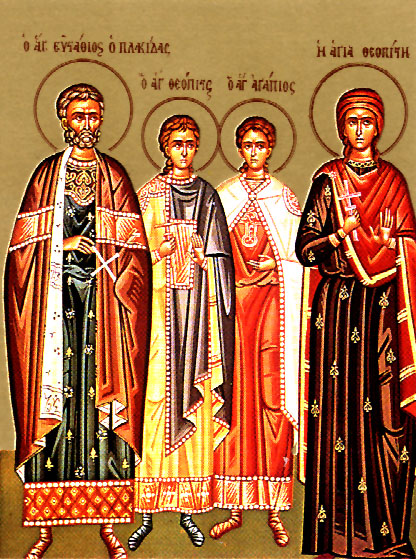
Saints Xanthίppē and Polyxénē of Spain

The righteous women Xanthίppē and Polyxénē were sisters by birth and lived in Spain at the time of the Holy Apostles. They were among the first to hear the divine teaching of Christ the Savior from the Holy Apostle Paul, when he preached in their land (Romans 15:28). Saint Xanthίppē and her husband Probus converted to Christianity, but before her Baptism Saint Polyxénē was abducted by a licentious man, who took her to Greece on a ship. God's grace protected her, however, and did not permit her to be defiled.

Moving around from place to place, Polyxénē heard the preaching of the Apostle Philip in Greece. After her arrival in Greece, Polyxénē turned to the Christians for protection, and they hid her in the city of Patra in Achaia. There she formally accepted Christianity and was baptized by the Holy Apostle Andrew the First-Called (November 30). Saint Polyxénē was a witness to Saint Andrew's miracles, and how patiently he endured his sufferings and death. She stood by the cross upon which they crucified him.

After Saint Andrew's martyric death, Saint Polyxénē returned to Spain, taking with her the Apostle Onḗsimos (February 15) and her traveling companion Rebecca, a Jewish slave, with whom she had been baptized. There she and her older sister Xanthίppē converted many pagans to Christ.

Saint Polyxénē labored for about forty years preaching the Gospel in Spain. Saint Xanthίppē shared in her sister’s work and preached in the populous city of Toledo.

Saint Polyxénē reposed around the year 109, having preserved her virginity until the end of her earthly life.

In Slavic usage Saints Xanthίppē and Polyxénē are commemorated on September 24.

Virgin Martyr Irais (Rhais) of Alexandria

The Holy Martyr Iraida lived at Alexandria. Once, she went to a well to draw water and saw a ship at the shore. On board were a large number of men, women, clergy and monks, all fettered in chains for their confession of the Christian Faith.

Casting aside her water pitcher, the saint voluntarily joined the prisoners for Christ, and fetters were placed on her, too. When the ship arrived in the Egyptian city of Antipolis, Saint Iraida was the first to undergo fierce torments and was beheaded with the sword. After her, the other martyrs sealed their confession of faith in Christ with their blood.

Martyrs Andrew, John, and John’s children: Peter and Antonius, of Syracuse, martyred in Africa

The Holy Martyrs Andrew and John, and John’s children Peter and Antoninus, suffered in the ninth century in the time of the cruel African ruler Ibrahim. After the capture and destruction of the Sicilian city of Syracuse, Ibrahim captured and brought to Africa Saint John and his two children, Peter and Antoninus, whom he compelled to study the Arab language and sciences.

When the youths had grown, Prince Ibrahim was so fond of them for their wisdom and virtuous life, that he named Antoninus his kinsman, and he appointed Peter as his chief steward. Once he learned that the youths secretly confessed faith in Christ, however, Ibrahim flew into a furious rage, ordering them to be bound with iron shackles and beaten with knotted rods.

After prolonged scourging, they put Saint Antoninus on a donkey, tied him on with straps, then drove him through the city, beating and ridiculing him with abuse. The martyr endured all the insults and gave thanks to God. Saint Peter was thrown into prison after a fierce beating with the rods.

An order was issued to arrest John, the father of the holy martyrs. The brutal Ibrahim grabbed him by the neck with his left hand, and with his right he thrust a knife into his throat. They cast the dead body of the father, together with the bodies of his sons, into a large fire.

As for Saint Andrew, the torturer wore him down with hunger, and then ran him through with a spear in the chest. When the martyr prayerfully began to give thanks to God, Ibrahim ran him through a second time. As he lay dying from loss of blood, they beheaded the righteous martyr with a sword.

Icon of the Mother of God of Slovenka

The Slovenka Icon of the Mother of God manifested itself on September 23, 1635 at the village of Slovenka, Kostroma district. A certain hunter while hunting by chance discovered a small rickety church, overgrown with moss. He went inside and saw that all the church utensils had rotted with time, except for the altar icon of the Mother of God, which was perfectly unharmed. A monastery was afterwards built at this place.

Daily Readings for Friday, September 22, 2023

FRIDAY OF THE 1ST WEEK

ABSTAIN FROM MEAT, FISH, DAIRY, EGGS, WINE, OLIVE OIL

Phocas the Martyr, Bishop of Sinope, Phocas the Gardener, Martyrs Isaac, Martin, and the 26 Monk-martyrs of Zographou Monastery

ST. PAUL’S LETTER TO THE EPHESIANS 1:7-17

Brethren, we have redemption through the blood of Christ, the forgiveness of our trespasses, according to the riches of his grace which he lavished upon us. For he has made known to us in all wisdom and insight the mystery of his will, according to his purpose which he set forth in Christ as a plan for the fulness of time, to unite all things in him, things in heaven and things on earth. In him, according to the purpose of him who accomplishes all things according to the counsel of his will, we who first hoped in Christ have been destined and appointed to live for the praise of his glory. In him you also, who have heard the word of truth, the gospel of your salvation, and have believed in him, were sealed with the promised Holy Spirit, which is the guarantee of our inheritance until we acquire possession of it, to the praise of his glory. For this reason, because I have heard of your faith in the Lord Jesus and your love toward all the saints, I do not cease to give thanks for you, remembering you in my prayers, that the God of our Lord Jesus Christ, the Father of glory, may give you a spirit of wisdom and of revelation in the knowledge of him.

LUKE 4:22-30

At that time, the crowd wondered at the gracious words which proceeded out of the mouth of Jesus; and they said, “Is not this Joseph’s son?” And he said to them, “Doubtless you will quote to me this proverb, ‘Physician, heal yourself; what we have heard you did at Capernaum, do here also in your own country.'” And he said, “Truly, I say to you, no prophet is acceptable in his own country. But in truth, I tell you, there were many widows in Israel in the days of Elijah, when the heaven was shut up three years and six months, when there came a great famine over all the land; and Elijah was sent to none of them but only to Zarephath, in the land of Sidon, to a woman who was a widow. And there were many lepers in Israel in the time of the prophet Elisha; and none of them was cleansed but only Naaman the Syrian.” When they heard this, all in the synagogue were filled with wrath. And they rose up and put him out of the city, and led him to the brow of the hill on which their city was built, that they might throw him down headlong. But passing through the midst of them he went away.

Hieromartyr Phocas, Bishop of Sinope

Hieromartyr Phocas was born in the city of Sinope. From youth he led a virtuous Christian life, and in his adult years he became Bishop of Sinope. Saint Phocas converted many pagans to faith in Christ. At the time of a persecution against Christians under the emperor Trajan (98-117), the governor demanded that the saint renounce Christ. After fierce torture they enclosed Saint Phocas in a hot bath, where he died a martyr’s death in the year 117.

In the year 404, the relics of the saint were transferred to Constantinople (July 22).

The Hieromartyr Phocas is especially venerated as a defender against fires, and also as a helper of the drowning.

Prophet Jonah

The Holy Prophet Jonah lived in the eighth century before the birth of Christ and was a successor of the Prophet Elisha. The Book of the Prophet Jonah contains prophecies about the judgments on the Israelite nation, the sufferings of the Savior, the downfall of Jerusalem, and the end of the world. Besides the prophecies, the Book of Jonah relates how he was sent to the Ninevites to preach repentance (Jon. 3: 3-10).

Our Lord Jesus Christ, addressing the Scribes and the Pharisees who demanded a sign from Him, said that no sign would be given except for the sign of the Prophet Jonah, “As Jonah was in the belly of the whale three days and three nights, so also shall the Son of Man be in the heart of the earth three days and three nights” (Mt. 12: 40). From these words the Lord shows clearly the symbolic meaning of the Book of the Prophet Jonah in relation to Christ’s death on the Cross, descent into Hell, and the Resurrection.

Reproaching the lack of penitence and recalcitrance of the Jews, the Lord said, “The Ninevites shall rise in the judgment with this generation and will condemn it, because they repented at the preaching of Jonah; and one greater than Jonah is here” (Mt. 12: 41).

Saint Jonah the Presbyter, father of Saint Theophanes the Hymnographer and Theodore Graptus

Saint Jonah the Presbyter, Father of Saints Theophanes the Hymnographer (October 11) and Theodore the Branded (December 27), lived in Palestine in the late eighth to early ninth centuries.

Saint Jonah lived a virtuous and holy life. He had two sons who were glorified afterwards for their confession of Orthodoxy during the time of the Iconoclast heresy. After the death of his wife, Saint Jonah withdrew to the Lavra of Saint Savva the Sanctified (December 5), where both his sons earlier had been tonsured as monks. Saint Jonah dwelt at the Lavra until his death in the ninth century. The Lord bestowed upon His saint the gift of healing.

Venerable Jonah, Abbot of Yashezersk

Saint Jonah of Yash Lake was born in the village of Shoksha, sixteen versts from the monastery later established by him. The foundation of the monastery took place in 1580, when a wooden church was built in honor of the Annunciation of the Most Holy Theotokos, and eight monks joined together with the monk to labor in asceticism.

Saint Jonah toiled with great concern over the building up of the monastery. Thus, for example, in order to ease the catching of fish, he himself dug a channel from Yash Lake to the nearby Lake Senno. He often rode horseback along the solitary paths of the forest in search of necessities for the monastery.

The ascetic made vessels from wood to be used for the divine services. In time the monk became known for his holy life far beyond the bounds of the monastery. Many pilgrims brought gifts, among which also were Church service books. The boundaries of the monastery expanded, and the number of churches increased. Profound love and reverence for the ascetic were demonstrated by Metropolitan Isidore of Novgorod, by Igumen James of the Solovki monastery, by Saint Irenarchus (July 17), and also by many other contemporaries.

Saint Jonah died at the end of the sixteenth century and was buried in the Annunciation monastery founded by him.

Martyr Phocas the Gardener of Sinope

The Holy Martyr Phocas the Gardener came from the city of Sinope on the southern shore of the Black Sea. Having a small garden, he lived modestly. He sold what he grew, and supported himself on the proceeds. He helped the needy and paid for the housing of vagrants. The Christian piety of the saint had a great influence on other people. Even pagans deferred to him with deep respect. Under his influence they often abandoned their error and accepted the Christian Faith.

The governor of the district, aware that Saint Phocas was spreading Christian teachings, gave orders to find and kill him. The saint himself accidentally came upon those sent after him, and without revealing his name, he courteously received them, fed them and prepared a place for them to spend the night.

At night he went into the garden, then prepared a grave and a place for his burial. He even made arrangements for all his possessions to be distributed to the poor after his death. In the morning Saint Phocas declared to the strangers that it was he for whom they were searching, and told them to fulfill the duty entrusted to them. The visitors were distressed, not wanting to kill the kindly saint. They felt honor bound to spare Saint Phocas, but he would not hear of it, and humbly bent his head beneath the sword.

They buried the holy Martyr Phocas in the grave that he himself had prepared in the garden. The place of his burial was glorified by miracles, and later a church was built there. An accurate account of the martyr’s death was collected by Asterius of Amasea (+ 410). The holy Martyr Phocas is especially venerated by seafarers, and he is called upon by those traveling by sea.

Saint Peter the Tax-Collector

Saint Peter, Former Tax-Collector, was the chief collector of taxes in Africa in the service of the emperor Justinian (527-565). He was a cruel and merciless man.

One day he threw a morsel of bread to a beggar who annoyed him by incessantly begging alms. In a vision Peter saw himself as dead and how the holy Angels weighed his deeds on the scale of the righteous judgment of God. On the side of good deeds nothing was placed except a morsel of bread, thrown at the beggar, but this prevented the opposite side from being pulled down by his vicious deeds.

Peter pondered the meaning of the dream, and thought that if one loaf of bread, thrown involuntarily, was of such help to him, then he might receive much more help for good deeds performed with compassion and from the heart. He repented and completely changed his life. He liberally distributed alms to the needy, and fed and clothed many.

One day, in a dream, Peter saw Jesus Christ. The Lord was dressed in clothes which the saint once gave to a beggar. Peter then distributed his substance to the poor and ordered his slave to sell him into slavery and to give the money to the poor. The slave reluctantly carried out the orders of his master.

For many years Saint Peter worked diligently and humbly for his master. One day he was recognized by tradesmen to whom he had been known earlier. They told the master who his servant was. Having overheard this conversation, the saint quickly fled from the city. In departing, he worked a miracle: the gatekeeper, a deaf-mute slave, was ordered by Saint Peter to open the gates in the name of Jesus Christ. He fulfilled the command, and at once received his hearing and speech. He rushed around everywhere to tell his master and added moreover, that when the saint commanded him to open the gates, fire came forth from his mouth touching his face, after which he began to hear and speak. Everyone went to look for Peter, but the search proved in vain. The saint hid and remained hidden until his death.

The life of Saint Peter was passed along by Saint John the Merciful, Patriarch of Alexandria (November 12), who in turn knew it from a man personally acquainted with the saint.

Saint Peter is commemorated on January 20 according to Greek usage.

Venerable Macarius, Wonderworker of Zhabynka and Belev

No information available at this time.

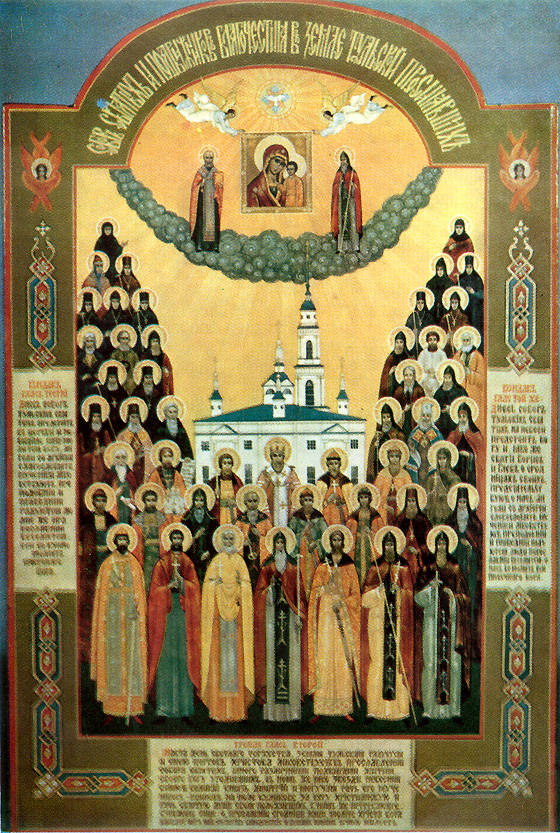
Synaxis of the Saints of Tula

Saint Alexander Nevsky, Great Prince August 30 (translation of relics in 1724), November 22 (his burial in 1263)

Saint Alexander, soldier, schemamonk, disciple of Saint Sergius. September 7 (+1390)

Saint Alexander, soldier, schemamonk, disciple of Saint Sergius. September 7 (+1380)

Saint Boris (Roman in Baptism), Prince, Passion-Bearer. May 2 (transfer of relics in 1072), July 24 (commemorated with Saint Gleb) (+1015)

Saint Gleb (David in Baptism), Prince, Passion-Bearer. May 2 (transfer of relics in 1115), July 24 (commemorated with Saint Boris), September 5 (martyrdom) (+1015)

Saint Demetrius Donskoy, Great Prince. May 19 (+1389)

Saint Igor (George in Baptism, Gabriel in monasticism), Great Prince. June 5 (transfer of relics in 1150), September 19 (+1147)

Saint John I Kalita, Great Prince. (+ 1340, date unknown)

Saint Kushka, Hieromonk of the Kiev Near Caves, hieromartyr. (+ after 1114)

Saint Macarius, abbot of Zhabyn, hieroschemamonk, wonderworker. January 22 (+1623)

Blessed Matrona the Blind of Moscow. April 19 (+1952)

Saint Michael of Chernigov, Great Prince, martyr, wonderworker. February 14 (transfer of relics in 1578), September 20 (martyrdom +1245)

Saint Nikḗtas, Bishop of Belev, hieromartyr (+1938) September 3 (glorification)

Saint Nicola Sviatosha, monk, prince, wonderworker. October 14 (+1143)

Saint Nicholas, Archbishop of Myra in Lycia. May 9 (transfer of relics), December 6 (repose), July 29 (birth).

Saint Nikon, martyr, disciple of Saint Kushka. August 27 (+ after 1114)

Saint Onesimus, Bishop of Tula, New Martyr. February 14 (+1937), September 3 (glorification)

Saint Peter (Pavlushov), hieromartyr November 10, September 3 (glorification)

Saint Pimen, Archbishop of Novgorod (+ 1571, no date)

Saint Theoctistus, Bishop of Chernigov, August 5 (+1123)

Venerable Cosmas of Zographou Monastery, Mount Athos

Saint Cosmas the Anchorite of Zographou Monastery was born into an aristocratic family in Bulgaria toward the end of the XVIII century, and was proficient in Greek as well as Bulgarian. When his parents desired him to get married, he left their home surreptitiously and headed for the far-famed Holy Mountain: Mount Athos. Along the way, the devil tried to thwart the young man's intentions, vexing him with a vision of the infinite abyss of the sea which surrounds the Holy Mountain, but the Saint was able to overcome this demonic temptation with prayer.

Arriving at Zographou Monastery, Saint Cosmas became a novice for a short time, and then he received the monastic tonsure, and was appointed to the position of Ecclesiarch. On the Feast of the Annunciation, Saint Cosmas was astonished to see the Most Holy Theotokos serving the monks of Vatopaidi Monastery, both during the Church Services and in the trapeza.

Because of his virtues, the Superior had the Saint ordained as a deacon, and then as a priest, which inspired him to even greater efforts. Zealous for his salvation, Saint Cosmas prayed to the Mother of God, and was granted a sign of her special favor. He heard her voice emanating from her icon, asking her Son, "How shall Cosmas be saved?" The Lord replied, "He must leave the monastery and live in solitude."

After obtaining the Superior's blessing, Saint Cosmas withdrew into the wilderness, where he lived in a cave. There he confessed those who came to him, and was found worthy of the gift of clairvoyance, working miracles, seeing divine visions, and even predicting the time of his death.

Not long before that day, Christ appeared to Saint Cosmas, informing him that before his departure to the Kingdom of Heaven, Satan and his demonic hosts would attack him and beat him. As he had done at the start of the venerable one's ascetic life, the Enemy of mankind tried once again to turn Saint Cosmas away from his intended path; thus the final days before his death were a grievous trial for him. Prepared to face these trials by the words of the Savior, the Saint endured the fearful demonic assaults. After three days of being severely beaten by the demons, he received the Immaculate Mysteries of Christ. With words of praise on his lips, he departed peacefully to the Lord.

God, Who glorifies those who glorify Him, also glorified Saint Cosmas at the time of his death on September 22, 1323. As he was buried, a multitude of beasts and birds flocked to his cave, as if they sensed the sorrow of the entire Holy Mountain. When the Saint's body was placed in the grave and they began to cover it with dirt, each of the mute creatures uttered a mournful cry, and then returned to the wilderness. In this manner, they paid their final respects to Saint Cosmas.

Forty days later, when the brethren opened the saint’s tomb after the All-night Vigil in order to move his relics to the monastery with honor, they were not to be found. The Lord had hidden them in a miraculous way.

Saint Cosmas is also commemorated on the second Sunday after Pentecost, the Synaxis of All Saints of Mount Athos.

"Hearer" Icon of the Mother of God

This wonderworking Icon is at Zographou Monastery on Mount Athos. The name of the Hearer Icon of the Mother of God (Παναγία Επακούουσα, or Услы́шательница in Russian) is explained by the following miraculous sign.

The venerable Cosmas was living a life of asceticism at Zographou Monastery in the XIV century. When he was still a young man, he visited Vatopaidi Monastery on the Feast of the Annunciation, which is that Monastery's Feast Day. There in the church during the service, and later in the trapeza, he saw a beautiful, majestic woman. Saint Cosmas was astonished and troubled to see her there on Mount Athos, because no woman is permitted to set foot on the Holy Mountain, so he was unable to understand why the monks allowed her to be there. While he was pondering these things, he returned to his Elder, who noticed his disciple's confusion and asked him, "Why are you so sad and pensive?"

Cosmas told him what he had seen at Vatopaidi Monastery, and revealed all of his doubts and thoughts about seeing a woman there with the monks.

"What sort of woman was she," the Elder asked, "and how was she dressed?"

Cosmas described her appearance in detail. Then, with a reproachful sigh, the Elder rebuked his disciple: "Didn't you bother to find out what sort of woman was at the monastery? This was not an ordinary mortal woman; she is the Queen of our Holy Mountain and of all creation herself!"

For some time after this, the venerable Cosmas remained alone in the monastery church, praying fervently before an Icon of the Mother of God. He exclaimed, "Most Holy Theotokos, pray that your Son and God may set me on the path of salvation!"

As soon as he uttered these words, he heard the voice of the Mother of God coming from the Icon and saying, "My Son and my God, teach Your servant how he may be saved."

At once the Lord replied, "Let him leave the monastery to live in solitude and in stillness" (ησυχία).1

With the Superior's blessing, Saint Cosmas left his monastery and went into the wilderness, where he dug a cave out of a cliff, spending the rest of his life there in continuous asceticism. He made great progress in the hesychastic life, and so he was found worthy of the gifts of clairvoyance, working miracles, seeing divine visions, and even predicting the time of his death, which occurred on September 22, 1323.

The Icon before which Saint Cosmas prayed, and from which he heard the voice of the Mother of God, was named "The Hearer," because she heard his prayer. It is still in the katholikon of Zographou Monastery, in the altar, on the eastern wall, which extends into the diakonikon.2


1 In the Lives of the Saints, and the writings of the Holy Fathers, stillness, or quiet, is essential for mental prayer, or prayer of the heart. In order to be effective, the Jesus Prayer requires the greatest inner and outer quiet or stillness. It is also called pure prayer because it presupposes a mind and heart free from fantasies, passions, and thoughts.

2 The διακονικόν is a room on the south side of a church, behind the iconostasis, where vestments, books, charcoal, etc. are stored. There is a sink, towels, and other necessary items used in the services.

Daily Readings for Thursday, September 21, 2023

THURSDAY OF THE 1ST WEEK

NO FAST

Apodosis of the Elevation of the Venerable and Life-Giving Cross, Quadratus the Apostle, Jonah the Prophet, Isaakios & Meletios, Bishops of Cyprus

ST. PAUL’S LETTER TO THE EPHESIANS 1:1-9

Paul, an apostle of Christ Jesus by the will of God, To the saints who are at Ephesos and faithful in Christ Jesus: Grace to you and peace from God our Father and the Lord Jesus Christ. Blessed be the God and Father of our Lord Jesus Christ, who has blessed us in Christ with every spiritual blessing in the heavenly places, even as he chose us in him before the foundation of the world, that we should be holy and blameless before him. He destined us in love to be his sons through Jesus Christ, according to the purpose of his will, to the praise of his glorious grace which he freely bestowed on us in the Beloved. In him we have redemption through his blood, the forgiveness of our trespasses, according to the riches of his grace which he lavished upon us in all wisdom and insight the mystery of his will, according to his purpose.

LUKE 4:16-22

At that time, Jesus came to Nazareth, where he had been brought up; and he went to the synagogue, as his custom was, on the sabbath day. And he stood up to read; and there was given to him the book of the prophet Isaiah. He opened the book and found the place where it was written, "The Spirit of the Lord is upon me, because he has anointed me to preach good news to the poor. He has sent me to proclaim release to the captives and recovering of sight to the blind, to set at liberty those who are oppressed, to proclaim the acceptable year of the Lord." And he closed the book, and gave it back to the attendant, and sat down; and the eyes of all in the synagogue were fixed on him. And he began to say to them, "Today this scripture has been fulfilled in your hearing." And all spoke well of him, and wondered at the gracious words which proceeded out of his mouth.

Leavetaking of the Elevation of the Cross

Because of the Leavetaking of the Elevation of the Cross, the service to Saint Quadratus of the Seventy is sung on September 22.

At the end of Liturgy, the priest comes out from the altar with a censer, preceded by a deacon with a candle. Going to the center of the church, he censes three times around the Cross. He takes the tray with the Cross and places it on his head to carry it into the altar. The deacon goes before him, censing the Cross. After placing the Cross on the altar, the priest censes the four sides of the Holy Table.

Apostle Quadratus of the Seventy

Saint Quadratus, Apostle of the Seventy preached the Word of God at Athens and at Magnesia (eastern peninsula of Thessaly), and was Bishop of Athens. His biographer called him “a morning star” among the clouds of paganism. He converted many pagans to the true faith in Christ the Savior, and his preaching aroused the hatred of the pagans. Once, an angry mob fell upon the saint to pelt him with stones. Preserved by God, Saint Quadratus remained alive, and they threw him into prison, where he died of starvation. His holy body was buried in Magnesia.

In the year 126, Saint Quadratus wrote an Apologia in defence of Christianity. Presented to the emperor Hadrian (117-138), the Apologia affected the persecution of Christians, since the emperor issued a decree saying that no one should be convicted without just cause. This Apologia was known to the historian Eusebius in the fourth century. At the present time, only part of this Apologia survives, quoted by Eusebius: “The deeds of our Savior were always witnessed, because they were true. His healings and raising people from the dead were visible not only when they were healed and raised, but always. They lived not only during the existence of the Savior upon the earth, but they also remained alive long after His departure. Some, indeed, have survived to our own time.”

Saint Quadratus is also commemorated on January 4.

Uncovering of the relics of Saint Demetrius (Dmitri), Metropolitan of Rostov

In 1702, Saint Demetrios, Metropolitan of Rostov, arrived at the Rostov cathedral and also visited the monastery of Saint James, Bishop of Rostov (November 27 and May 23).

He served the Divine Liturgy at the cathedral church of the Conception of the Most Holy Theotokos, after which he indicated to those present the site of his future burial on the right side of the temple. “Behold my resting place,” he said, “here I will settle for eternity.” Saint Demetrios reposed on October 28, 1709.

Contrary to the Saint's wishes, which he had expressed in his will, the clergy and people of Rostov asked the locum tenens of the patriarchal throne, Metropolitan Stephen Yavorsky of Ryazan, who had come for the funeral, to conduct the burial at the city's cathedral church.

Metropolitan Stephen insisted on burying the body of his deceased friend beside Saint Joasaph, who was Saint Demetrios's predecessor. However, a grave was not prepared until the arrival of Metropolitan Stephen, even though about a month had passed since the Saint's death.

Due to the urgent departure of Metropolitan Stephen from Rostov, a hastily constructed wooden frame was placed into the grave, in which the body of the Saint was buried on November 25. This circumstance, foreseen by the Providence of God, led to a quick uncovering of the relics.

In 1752 repairs were being made in the cathedral church of the monastery, and on September 21, the incorrupt body of Saint Demetrios was discovered. The place of burial had been affected by dampness, the oaken coffin and the writing on it were decayed, but the body of the Saint, and even his omophorion, sakkos, mitre and silken prayer rope were preserved undamaged.

After the discovery of his relics, Saint Demetrios began to heal many illnesses, and performed many miracles. When the Holy Synod was informed of these facts, it sent a Commitee: Metropolitan Sylvester of Suzdal and Archimandrite Gabriel of Simonov Monastery, to examine the relics of Bishop Demetrios and to verify the miraculous cures.

Upon the Committee's recommendation, a decree was issued by the Holy Synod on April 29, 1757 numbering Saint Demetrios, Metropolitan of Rostov among the saints, and designating the dates of his commemoration as October 28 (the day of his repose) and September 21 (the uncovering of his relics).

The Church of Russia also commemorates the Hierarchs Demetrios of Rostov, Metrophanes and Tikhon of Voronezh on July 19.

Venerable Daniel, Abbot of Shuzhgorsk, Novgorod

Saint Daniel of Shugh Hill was born in the Moscow dominion in the sixteenth century. He performed his ascetic labors in northern Rus, where he became a monk at the Komel monastery, founded by Saint Cornelius of Komel in 1498.

Saint Daniel left the monastery and continued a solitary ascetic life in the unpopulated and forested White Lake hinterland, on a mountain named Shugh Hill. Here the holy ascetic founded his monastery in honor of the Transfiguration of the Lord. Saint Daniel was buried at a temple in honor of the Transfiguration of the Lord at the monastery that he founded. In 1764, the monastery was turned into a parish.

Venerable Joseph of Zaonikiev Monastery, Vologda

Saint Joseph of Zaonikiev, was named Hilarion in the world, a pious peasant from the village of Obukhovo Kubensk in the region of the Vologda gubernia. For a long time he suffered a disease of the eyes and he fervently prayed for the help of the Lord, to the Most Holy Theotokos, and to the Saints, in particular the holy Unmercenaries Cosmas and Damian.

His prayer was heard, and in 1588, by a revelation of Saint Cosmas, Hilarion went into the forest into a swampy place, to an icon of the Mother of God, from which he received healing. In gratitude the monk cleared a forest thicket at the place of the appearance of the wonderworking icon and built a chapel, in which he placed the icon. He himself settled close by, taking the monastic schema with the name of Joseph.

Afterwards, with the blessing of Saint Anthony, Bishop of Vologda, on the place of Joseph’s ascetic exploits the Zaonikiev monastery emerged, so named from the brigand Anikios who once dwelt in this forest. When the monastery expanded and the number of monks grew, upon the advice of Saint Joseph, Anthony was chosen as igumen. Joseph did not accept the leadership himself out of humility. Since he concealed his own strict exploits from the others, he was perceived as a fool-for-Christ. He stood on his feet at prayer in his chapel, and he went about barefoot in the fierce cold.

Saint Joseph reposed on September 21, 1612 at age 83, and was buried in the monastery founded by him.

Hieromartyr Hypatius, Bishop of Ephesus, and his Presbyter, Andrew

Hieromartyr Hypatius, Bishop of Ephesus, and the Priest Andrew suffered in the eighth century under the iconoclast emperor Leo the Isaurian (717-741). As young men, they studied together in one of the monasteries. Saint Hypatius accepted monasticism, and Saint Andrew became a clergyman and zealously instructed people in the Christian Faith.

When the emperor Leo the Isaurian began to persecute those who venerated holy icons, and the holy icons were thrown out of the churches, to be trampled underfoot and burned, Saints Hypatius and Andrew rose up in defence of icon veneration, urging their flock to maintain faithfulness to Orthodoxy.

The emperor, wanting to persuade the saints, summoned them to him and arranged a debate about the veneration of icons, at which Saints Hypatius and Andrew were consistently able to defend the Orthodox veneration of icons.

They threw the martyrs into prison and for a long time they held them there, hoping that this would force the saints to renounce their convictions, but the saints remained steadfast. Then the emperor gave orders to torture the martyrs. They beat them, flayed the skin and hair from their heads, smeared their beards with tar and set it afire, and they burned holy icons upon the heads of the martyrs.

The saints bore all their tortures patiently and remained alive. The emperor gave orders to drag the saints through the city to be mocked by the people, and only after this to kill them. They threw the bodies of Saints Hypatius and Andrew to be eaten by dogs, but believers reverently gave them burial.

Saint Isaac of Cyprus

No information available at this time.

Saint Meletius, Bishop of Cyprus

No information available at this time.

Martyr Eusebius of Phoenicia

No information available at this time.

Martyr Priscus of Phrygia

No information available at this time.

26 Monastic Martyrs of Zographou, Mount Athos

In July of 1274, the Byzantine Emperor Michael VIII accepted a union with the Roman Church at Lyons, France. Faced with dangers from Charles of Anjou, the Ottoman Turks, and other enemies, the emperor found such an alliance with Rome expedient. The Union of Lyons required the Orthodox to recognize the authority of the Pope, the use of the Filioque in the Creed, and the use of azymes (unleavened bread) in the Liturgy. Patriarch Joseph was deposed because he would not agree to these conditions. The monastic clergy and many of the laity, both at home and in other Orthodox countries, vigorously opposed the Union, denouncing the emperor for his political schemes and for his betrayal of Orthodoxy.

On January 9, 1275 a Liturgy was celebrated in Constantinople in which the Pope was commemorated as “Gregory, the chief pontiff of the Apostolic Church, and Ecumenical Pope.” The emperor’s sister remarked, “It is better that my brother’s empire should perish, rather than the purity of the Orthodox Faith.” Recalling the infamous Crusade of 1204 when Latin crusaders sacked Constantinople, many of the people also preferred to submit to the infidels than to abandon the Orthodox Faith.

Twenty-six martyrs of Zographou Monastery on Mt. Athos were among those who were persecuted by Emperor Michael VIII Paleologos (1261-1282) and Patriarch John Bekkos (1275-1282) because they would not obey the imperial command to recognize the Union of Lyons. They steadfastly kept the teachings of the Fathers of the Church, and fearlessly censured those who accepted Catholic doctrines.

When the authorities came to Mt. Athos to enforce the imperial policy, the monks of Zographou shut themselves up in their monastery. From the tower they reproached those in favor of the Union, calling them lawless men and heretics. The attackers set the monastery on fire and burned the twenty-six martyrs alive.

The names of the martyrs are: Igumen Thomas, the monks Barsanuphius, Cyril, Micah, Simon, Hilarion, James, Job, Cyprian, Savva, James, Martinian, Cosmas, Sergius, Menas, Joasaph, Joannicius, Paul, Anthony, Euthymius, Dometian, Parthenius, and four laymen who died with them.

These holy martyrs are also commemorated on October 10.

Venerable Cosmas the Bulgarian of Zographou, Mount Athos

Saint Cosmas was born in Bulgaria toward the end of the thirteenth century, and entered the Zographou Monastery when he was young.

Distinguishing himself by his ascetical life, he also acquired the virtues of humility and obedience. After a time, Saint Cosmas satisfied his superiors that he had attained a level of experience and perfection in monasticism which would permit him to live in solitude without danger. Saint John of the Ladder (Step 8:18) describes the type of person who should not be permitted to live alone following his own will, and the pitfalls of such a life for those who have not cleansed themselves of the passions. With the blessing of his spiritual Father, Saint Cosmas left the monastery in order to begin even more intense spiritual struggles.

Through humility, the God-pleasing ascetic attained the heights of virtue, regarding all of his own efforts as nothing, and ascribing whatever good he had accomplished to God’s mercy and grace. Therefore, he acquired spiritual gifts from the Lord, including the gift of prophecy.

Saint Cosmas of Zographou fell asleep in the Lord on Mount Athos in 1323.

Saint John of Georgia

Archimandrite John (Basil Maisuradze in the world) was born in the town of Tskhinvali in Samachablo around 1882. He was raised in a peasant family and taught to perform all kinds of handiwork. Basil was barely in his teens when he helped Fr. Spiridon (Ketiladze), the main priest at Betania Monastery, to restore the monastery between 1894 and 1896.

From his youth Basil was eager to enter the monastic life, and in 1903, according to God’s will, he moved to the Skete of Saint John the Theologian at Ivḗron Monastery on Mt. Athos. Among the brothers he was distinguished for his simplicity and obedience. He was tonsured a monk and named John in honor of Saint John the Theologian, whom he revered deeply and sought to emulate.

The monk John was soon ordained to the priesthood. Throughout his life the holy father dedicated himself to serving God and his brothers in Christ in hopes that his own life might be fruitful for them.

Fr. John remained on Mt. Athos for seventeen years. Then, due to the increasingly troubling circumstances there, he left the Holy Mountain with the other Georgian monks sometime between 1920 and 1921. He settled at Armazi Monastery outside of Mtskheta, where the Bolsheviks had left just one monk to labor in solitude. Once a band of armed Chekists broke into the monastery, led both Fr. John and the other monk away, and shot them in the back.

Believing them to be dead, they tossed them in a nearby gorge. A group of people later discovered Fr. John’s nearly lifeless body and brought it to Samtavro Monastery in Mtskheta. The other monk suffered only minor injuries and returned to the monastery on his own.

When his health had been restored, Fr. John went to Betania Monastery, where his first spiritual father was still laboring. He was appointed abbot shortly thereafter. Accustomed to hard work from his childhood, he skillfully administered the agricultural labors of the monastery. When visitors came to the monastery seeking advice or solace, Fr. John welcomed them warmly, spreading a festal meal before them. He enjoyed spending time with his guests, especially with children.

It is said that he always had candy or a special treat to give to the little ones. The children loved him so much that on the feast of Saint John the Theologian, while he was sprinkling the church with holy water, they skipped around him and tried to tousle his hair. The children’s parents were ashamed, but Fr. John cheerfully assured them that it was fitting to be so joyous on a feast day.

Truly Fr. John was endowed with a deep love for young people, and he was also blessed with the divine gifts of prophecy and wonderworking. Once a certain Irakli Ghudushauri, a student at Moscow Theological Seminary, visited him at the monastery. Fr. John received him with exceptional warmth, blessing him with tears of rejoicing. This student would later become Catholicos-Patriarch Ilia II, the beloved shepherd who continues to lead the flock of the Georgian faithful to this very day.

Fr. John disciplined himself severely. He worked hard all day and slept on a single piece of wood. He would spend entire nights praying. Many wondered when he rested and where he had acquired such a seemingly infinite supply of energy.

Occasionally thieves would steal food or domestic animals from the monastery. But the monastery also had many protectors, even within the Soviet government. A group of Christians who worked for the government while secretly practicing their faith supported Fr. John and Fr. George (Mkheidze), explaining and justifying them to the government as “guardians of a national cultural monument.”

Many of the miracles performed by Fr. John are known to us today, though he was wary of receiving honor for his deeds. Frs. John and George healed the deaf, and many of the terminally ill were brought to them for healing. After spending several days in the monastery, the infirm would miraculously be cleansed of their diseases. Fr. John bore the heaviest workload in the monastery. He sympathized deeply with Fr. George, who was ailing physically and unfit for strenuous labor. But Fr. John departed this life before Fr. George. Fr. John became ill and reposed in 1957, at the age of seventy-five. He was buried at Betania Monastery.

Saint George (John) of Georgia

Fr. George (Mkheidze) was born in the village of Skhvava in the Racha region around 1877. He received a military education—a highly esteemed commodity among the Georgian aristocracy—but instead of pursuing a military career in defense of the Russian empire, he dedicated himself to Georgia’s national liberation movement. At one point the pious and learned George worked for Saint Ilia the Righteous as his personal secretary. He often met Saint Ilia’s spiritual father, the holy hierarch Alexandre (Okropiridze), and the holy hieromartyr Nazar (Lezhava), and he was acquainted with other important spiritual leaders of the time as well.

Desiring to sacrifice his life to God, George was tonsured into monasticism by the holy hieromartyr Nazar. His rare character combined a nobleman’s deportment with a monk’s humble asceticism. Fr. George was ordained a priest and soon after elevated to the rank of archimandrite.

Filled with divine love and patriotic sentiment, the holy father willingly endured the heavy burdens and spiritual tribulations afflicting his country at that time.

In 1924, while Fr. George was laboring at Khirsa Monastery in Kakheti in eastern Georgia, an armed Chekist mob broke into the monastery. The perpetrators beat him, cut off his hair, shaved his beard, and threatened to take his life. He sought refuge with his family, but to no avail—his brothers, who were atheists, shaved off his beard while he was sleeping. (One of Fr. George’s brothers later committed suicide, and the other, together with his wife, was shot to death by the Chekists.) In the same year, Fr. George visited Betania Monastery and was introduced to Fr. John (Maisuradze), with whom he would labor for the remainder of his life.

Fr. George’s health was poor, and he was able to perform only the lightest of tasks around the monastery. He tended the vegetable garden and took responsibility for raising the bees. He was extremely generous. At times he would give all the monastery’s food to the needy, assuring Fr. John that God Himself would provide their daily bread.

Tall, thin, and with an upright posture, Fr. George was strict in both appearance and demeanor. He spoke very little with other people, and children did not play with him as they did with Fr. John. Knowing his character, they tried to please him by reciting prayers and behaving themselves. Fr. George did not like to leave the monastery, but it was often necessary for him to travel to Tbilisi to visit his spiritual children— among whom were many secret Christians who worked for the government.

Fr. George was endowed with the gifts of prophecy and healing, but he was careful to hide them. When constrained to reveal them, he would pass them off as though they were nothing extraordinary. Once a certain pilgrim arrived at the monastery and was surprised to discover that Fr. George knew him by name. Sensing his great amazement, Fr. George told the pilgrim that he had attended his baptism some thirty years earlier, thus concealing his God-given gift. Fr. George knew in advance when his nephew was bringing his sisters, whom he had not seen in forty-eight years, to visit him at the monastery during Great Lent.

Enlightened with this foreknowledge, Fr. George prepared fish and a festal meal in honor of the occasion.

The prayers of Fr. George and Fr. John healed the former’s nephew, who was afflicted by a deadly strain of meningitis. They restored hearing to a deaf child and healed many others of their bodily infirmities.

In 1957, when Fr. John reposed in the Lord, Fr. George was tonsured into the great schema. He was given the name John in honor of his newly departed spiritual brother. Fr. George-John now bore full responsibility for the affairs of the monastery. His health deteriorated further under the weight of this heavy yoke. His spiritual children began to come from the city to care for him.

Once a twenty-year-old girl arrived at the monastery, complaining of incessant headaches. She had been told that the water from Betania Monastery would heal her. She remained there for one week and was miraculously healed. When she left to return home, Fr. George-John walked five miles to see her off, in spite of his physical frailty.

The Theotokos appeared to Fr. George-John in a vision and relieved his terrible physical pain. The protomartyr Thekla also appeared to him, presenting him with a bunch of grapes. Several days before his repose, the holy father was in the city when an angel appeared to him and announced his imminent repose. The angel told him to return to the monastery to prepare for his departure from this world.

Saint George-John (Mkheidze) reposed in 1960. He was buried at Betania Monastery, next to Fr. John (Maisuradze). These venerable fathers were canonized on September 18, 2003, at a council of the Holy Synod under the spiritual leadership of His Holiness Ilia II, Catholicos-Patriarch of All Georgia. Frs. John and George-John have been lovingly deemed “one soul in two bodies.”

Daily Readings for Wednesday, September 20, 2023

EUSTATHIUS THE GREAT MARTYR, HIS WIFE AND TWO CHILDREN

ABSTAIN FROM MEAT, FISH, DAIRY, EGGS

Eustathius the Great Martyr, his wife and two children, Our Righteous Father Eustathius, Archbishop of Thessolonica, John the Foreigner, Hilarion the New Martyr of Crete, Afterfeast of the Holy Cross

ST. PAUL’S LETTER TO THE EPHESIANS 6:10-17

Brethren, be strong in the Lord and in the strength of his might. Put on the whole armor of God, that you may be able to stand against the wiles of the devil. For we are not contending against flesh and blood, but against the principalities, against the powers, against the world rulers of this present darkness, against the spiritual hosts of wickedness in the heavenly places. Therefore take the whole armor of God, that you may be able to withstand in the evil day, and having done all, to stand. Stand, therefore, having girded your loins with truth, and having put on the breastplate of righteousness, and having shod your feet with the equipment of the gospel of peace; besides all these, taking the shield of faith, with which you can quench all the flaming darts of the evil one. And take the helmet of salvation, and the sword of the Spirit, which is the word of God.

LUKE 21:12-19

The Lord said to his disciples, "Beware of men who will lay their hands on you and persecute you, delivering you up to the synagogues and prisons, and you will be brought before kings and governors for my name's sake. This will be a time for you to bear testimony. Settle it therefore in your minds, not to meditate beforehand how to answer; for I will give you a mouth and wisdom, which none of your adversaries will be able to withstand or contradict. You will be delivered up even by parents and brothers and kinsmen and friends, and some of you they will put to death; you will be hated by all for my name's sake. But not a hair of your head will perish. By your endurance you will gain your lives.

Afterfeast of the Elevation of the Cross

From September 15 until the Leavetaking, we sing “O come, let us worship and fall down before Christ. O son of God crucified in the flesh, save us who sing to Thee: Alleluia” at weekday Liturgies following the Little Entrance.

Greatmartyr Eustáthios Placidas, with his wife and children, of Rome

Before his Baptism, the Holy Great Martyr Eustáthios was named Plakidas (Πλακίδας). He was a Roman General in the reigns of Emperors Titus (79-81) and Trajan (98-117). Even before he came to know Christ, Plakidas devoted himself to charitable endeavors, helping the poor and destitute. Therefore, the Lord did not allow this virtuous pagan to continue in the darkness of idolatry.

One day, while hunting in a forest, he saw a remarkable stag which stopped now and then to stare at him. Plakidas pursued it on horseback, but could not catch up. The stag jumped over a chasm and stood on the other side facing him. Suddenly, Plakidas saw a radiant Cross between its antlers. The General was astonished to hear a voice coming from the Cross saying, “Why do you pursue me, Plakidas?”

“Who are You, Master?” asked Plakidas. The voice replied, “I am Jesus Christ, Whom you do not know, but by your good deeds, you honor me. I have appeared here on this creature for your sake, to draw you into the net of my love for mankind. It is not fitting that one as righteous as you should worship idols and remain ignorant of the truth. It was to save mankind that I came into the world.”

Plakidas cried out, “Lord, I believe that You are the God of Heaven and earth, the Creator of all things. Master, teach me what I should do.” Again the Lord replied, “Go to the bishop of your country and receive Baptism from him, and he will instruct you.”

Plakidas returned home and joyfully recounted everything to his wife Tatiana. She in turn told him of a strange dream she had the evening before, in which she had been told, “Tomorrow you, your husband and your sons shall come to me and know that I am the true God.” The couple then proceeded to do as they had been told.

They hastened to the Christian bishop, who baptized all their family, and then communed them with the Holy Mysteries. Plakidas was renamed Eustáthios, his wife was called Theopistē, and their children, Agapios and Theopistos.

On the following day, Saint Eustáthios went to the place of his miraculous conversion and there he gave thanks to the Lord for having called him to the path of salvation.

Saint Eustáthios received another a miraculous revelation. The Lord Himself predicted his impending tribulations: “Eustáthios, you shall suffer many misfortunes, as did Job, but in the end you will conquer the devil.”

Soon Saint Eustáthios was afflicted with misfortune: all of his servants died of the plague, and his cattle perished. Brought to ruin, but not despairing in spirit, Saint Eustáthios and his family secretly abandoned their home, to live in poverty unknown, humble, and poor.

They went to Egypt to board a ship bound for Jerusalem. During the voyage the Saint experienced more sorrow. Captivated by Theopistē's beauty, the ship owner cruelly set Eustáthios and his children ashore, keeping the wife for himself.

With great sadness the Saint continued on his way, and new calamity befell him. Coming to a tempestuous river, he went to carry his two sons across in turn. When he brought the first one across, the other was seized by a lion and was carried off into the wilderness. As he turned back to shore, a wolf dragged the other child into the forest.

Saint Eustáthios wept bitterly, but he realized that Divine Providence had sent him these misfortunes in order to test his endurance and devotion to God. Saint Eustáthios prepared himself for even more sorrows, knowing that one who endures temptations and has been tested will receive the crown of life which God has promised to those who love Him (James 1:12).

In the village of Badessos he found work and spent five years in ceaseless toil. Saint Eustáthios did not know at the time that by God's mercy, shepherds and farmers had rescued his sons, and they were living near him. He was also unaware that the impudent shipowner had been struck down with a terrible disease and died, leaving Saint Theopistē untouched. She lived in peace and freedom at the place where the ship landed.

During this time it had become difficult for Emperor Trajan to raise an army for Rome to deal with a rebellion, for the soldiers refused to go into battle without Plakidas. They advised Trajan to send men out to all the cities to search for him.

Antiochos and Akakios, who were friends of Plakidas, sought him in various places. Finally, they arrived in the village where Saint Eustáthios lived. The soldiers found him, but they did not recognize him. They began telling him about the person they sought, asking for his help and promising him a large reward. Saint Eustáthios recognized his friends right away, but he did not disclose his identity to them.

Borrowing money from one of his friends, he prepared a meal for his visitors. As they looked at him, they noticed that he resembled their former commander. When they saw a scar on his shoulder from a deep wound made by a sword, they realized that it was their friend who stood before them. They embraced him with tears and told him why they had been looking for him.

Saint Eustáthios returned to Rome with them and was restored to his former rank. Many new recruits were drafted into the army from all over the Empire. He did not know that the two young soldiers who served him, and whom he loved for their skill and daring, were actually his own sons. They did not realize that they were serving under the command of their own father, nor that they were brothers by birth.

While on campaign, the army led by Eustáthios halted at a certain place. One night, the brothers were talking in their tent. The elder spoke about his life, how he had lost his mother and brother, and how he had been parted from his father. The younger brother then realized that the other man was his own brother, and revealed how he had been rescued from the wolf.

A woman overheard their conversation, since their tent was pitched right next to her house, and she realized that these were her sons. Without identifying herself to them, but not wishing to be separated from them, she went to their general, Saint Eustáthios, and asked that he take her to Rome with him. She said she had been a prisoner, and wanted to go home. Then she came to recognize the general as her husband, and with tears she told him about herself, and about the two soldiers who were their sons. Thus, through God's great mercy, the entire family was reunited.

Soon thereafter, the rebellion was crushed, and Saint Eustáthios returned to Rome with honor and glory. Emperor Trajan had died in the meantime, and his successor Hadrian (117-138) wanted to celebrate the victory with a solemn sacrifice to their "gods." To everyone's amazement, Saint Eustáthios did not go to the pagan temple. The Emperor ordered them to find him and bring him to the temple.

“Why don’t you want to worship the gods?” the Emperor inquired. “You, above all others, should offer thanks to them. Not only did they preserve you in war and grant you victory, but they also helped you to find your wife and children.” Saint Eustáthios replied: “I am a Christian and I glorify and give thanks to Christ, and I offer sacrifice to Him. I owe my life to Him. I do not know or believe in any other God.”

Outraged, the Emperor ordered him to remove his military belt and brought Eustáthios and his family before him. They did not succeed in persuading the steadfast confessors of Christ to offer sacrifice to idols. The Saint's family was sentenced to be torn to pieces by wild beasts, but the animals would not touch the holy martyrs.

Then the cruel Emperor ordered that they be thrown alive into a red-hot brass bull, and Saint Eustáthios, his wife Theopistē, and their sons Agapios and Theopistos suffered martyrdom. Before being placed inside the bull, Saint Eustathios prayed, “Grant, O Lord, Thy grace to our relics, and grant a place in Thy Kingdom to all who call upon us, Though they call upon us when in danger on a river, or on the sea, we entreat Thee to come to their aid.”

Three days later, they opened the brass bull, and the bodies of the holy martyrs were found unscathed. Not one hair of their heads was singed, and their faces shone with an unearthly beauty. Many who witnessed this miracle came to believe in Christ. Some pious Christians buried the bodies of the Saints with all honor and reverence.

Holy Martyr and Confessor Michael and his councilor, Theodore, Wonderworkers of Chernigov

The Holy Right-believing Prince Michael of Chernigov, the son of Vsevolod Olgovich Chermny (+ 1212), was born in 1179 (or 1195). From his childhood Prince Michael was known for his piety and meekness. His health was very poor, but in 1186, trusting in God's mercy, he asked for the holy prayers of Saint Niketas the Stylite of Pereyaslavl (May 24), who was renowned as a fervent intercessor with the Lord. After receiving a wooden staff from the holy ascetic, Michael was healed right away.

In 1223 Prince Michael participated in a council of Russian princes at Kiev, debating whether to help the Polovetsians against the approaching Mongolian Tatar hordes. Upon the death of his uncle, Mstislav of Chernigov at the Battle at the Kalka River in 1223, Saint Michael became the Prince of Chernigov.

In 1225 he was invited to become the Prince of Novgorod. By his sense of justice, compassion, and firmness he won the love and respect of Novgorod's citizens. This was particularly important for the Novgorodians, since Michael's accession as Prince signified the reconciliation of Novgorod with the city of Vladimir’s Holy Great Prince George Vsevolodovich (+ February 4, 1238), whose wife was the Holy Martyr Agatha (+ February 4, 1238), Prince Michael's sister.

Saint Michael did not remain as Prince at Novgorod, and soon he returned to his native Chernigov. To the requests of the Novgorodians that he remain their Prince he replied that Chernigov and Novgorod ought to become kindred lands, and their inhabitants like brothers, and he would forge bonds of friendship for these cities.

The noble Prince diligently concerned himself with the building up of his appenage realm. But this was difficult for him in those troubled times. His activities provoked unrest in Kursk's Prince Oleg, and in 1227 civil strife almost broke out, but Metropolitan Cyril of Kiev reconciled them. In that same year Prince Michael peacefully resolved a dispute between Kiev's Great Prince Vladimir Rurikovich and the Prince of Galich. In 1235 Prince Michael occupied the throne of Kiev.

Troublesome times ensued. In 1238 the Mongol Tatars laid waste to Ryazan, Suzdal, and Vladimir. In 1239 they moved against southern Rus', ravaging the left bank of the Dniepr River, and the lands of Chernigov and Pereyaslavl. By the autumn of 1240 the Mongols were approaching Kiev. The khan’s emissaries proposed that Kiev surrender voluntarily, but the Prince would not negotiate with them.

Prince Michael rode to Hungary, hoping to persuade the Hungarian King Bela to organize allied forces to resist their common enemy. Saint Michael tried to recruit both Poland and the German Emperor into the struggle against the Mongols, but the moment for combined resistance was lost. Rus' was devastated, and then Hungary and Poland. With no foreign support, Prince Michael returned to the ruins of Kiev, and for a time he lived near the city on an island, and then he went back to Chernigov.

The Prince did not abandon hope in the possibility of an united Christian Europe against the Asiatic nomads. In 1245, at the Council of Lyons in France, his co-worker Metropolitan Peter (Akerovich) was sent as emissary by Prince Michael, calling for a crusade to march against the pagan Horde. Catholic Europe, in the persons of its chief spiritual leaders, the Roman Pope and the German Emperor, betrayed the interests of Christianity. The Pope was involved in a war with the German Emperor, and the Germans took advantage of the Mongol invasion to attack Rus' themselves.

In these circumstances affecting Christianity in general, there is a universal significance to the Confessor’s exploit of Saint Michael of Chernigov in the midst of the pagan Horde. In Rus' emissaries of the khan soon appeared, in order to make a census of the Russian population, and to levy taxes.

The Prince was ordered to make full submission to the Tatar khan, and the khan would grant a special charter for his realm. The emissaries told Prince Michael that he must journey to the Horde in order to confirm his right to rule the princedom under the khan’s charter. Seeing the sad plight of Rus', Prince Michael recognized the necessity of obeying the khan, but as a devout Christian he knew that he could not deny his faith before the pagans. He received a blessing from his Spiritual Father, Bishop John, to travel to the Horde and to become a true Confessor for Christ.

Accompanying Prince Michael on his trip to the Horde was his faithful friend and companion, the Boyar Theodore. At the Horde the khan was aware of Prince Michael’s attempts to organize an uprising against the Tatars in concert with Hungary and the other European powers, and the Prince's enemies had long sought an opportunity to destroy him.

In 1246 when Prince Michael and the Boyar Theodore arrived at the Horde, they were instructed on how to approach the khan: they must walk through fire to cleanse themselves of their evil intents, and worship the primal elements – the sun and fire, which the Mongols worshipped as gods. Responding to the priests who commanded them to participate in pagan rituals, the Holy Prince said, “A Christian worships God alone, the Creator of the world, and not creatures."

The khan was informed of the Russian Prince's intransigence, Batu’s attendant El’deg restated the terms: the Prince must obey the demands of the pagan priests, or be put to death. Prince Michael remained steadfast in his faith and declared: “I am prepared to submit to the khan, since God has entrusted him with the destiny of earthly kingdoms, but as a Christian, I cannot worship idols.”

Taking courage from the Lord's words: “Whosoever wishes to save his life shall lose it, and whosoever loses his life for my sake shall find it” (Matthew 16:25), the Holy Prince and his devoted Boyar prepared for their martyric death and received the Holy Mysteries, which their Spiritual Father had given them, foreseeing this possibility. The Tatar executioners seized the Prince and beat him savagely for a long time, until the ground ran crimson with his blood. Finally, Domanus, an apostate from Christianity, beheaded the Holy Martyr.

The Tatars deceitfully promised Saint Theodore great honor and his lord’s princely rank if he would perform the pagan ritual. Saint Theodore was not swayed by this, however, and he followed the example of his Prince. After horrible tortures, he was beheaded as well. The bodies of the holy Passion Bearers were tossed aside to be eaten by dogs, but the Lord preserved them for several days, until some faithful Christians could bury them secretly and with reverence.

Saint Theodore's exploit of a Confessor amazed even his executioners. Convinced of the Russian people’s steadfast fidelity to the Orthodox Faith, and their willingness to die gladly for Christ, the Tatar khans decided not to try God's patience as before, and they ceased requiring Russians to perform any pagan rituals at the Horde. But the struggle of the Russian nation and the Russian Church against the Mongol Yoke continued for a long time. During this struggle the Orthodox Church was adorned with many New Martyrs and Confessors. Great Prince Theodore was poisoned by the Mongols. Among those martyred were Saint Roman of Ryazan (+ 1270), Saint Michael of Tver (+ 1318), his sons Demetrios (+ 1325) and Alexander (+ 1339). All of them took courage from the example and holy prayers of Saint Michael of Chernigov, the Russian Protomartyr of the Horde.

On February 14, 1578, with the blessing of Metropolitan Anthony, Tsar Ivan the Terrible transferred their holy relics to the church which was dedicated to them in Moscow.

In 1770 the relics of Saints Michael and Theodore were brought to the Meeting of the Lord (Сретенский) cathedral, Since November 21, 1774, they have been kept in a secret place in Holy Archangels Cathedral in the Kremlin.

The Lives and Church Service of Saints Michael and Theodore were compiled in the middle of the XVI century by the renowned writer, Saint Zenobios of Otonsk (October 30).

The Prophet-King David wrote, "The generation of the upright shall be blessed (Psalm 111/112:2). This occurred in full measure for Saint Michael. He is at the head of many famous families in Russian history. His children and grandchildren continued Saint Michael's Christian service. The Church also numbers his daughter Saint Euphrosyne of Suzdal (September 25), and his grandson Saint Oleg of Briansk (September 20) among the Saints.

The Holy Martyrs and Confessors Michael and Theodore are commemorated on September 20 (the day of their martyric death); on February 14 (the Translation of their Holy Relics in 1578; and on the Sunday before August 26 (the Synaxis of the Moscow Saints).

Saint Oleg, Prince of Briansk

Holy Prince Oleg Romanovich of Briansk (in Baptism Leontius) was grandson of the holy martyr Prince Michael of Chernigov. According to the chronicle histories, Prince Oleg together with his father, Prince Roman Mikhailovich of Briansk, participated in a war against Lithuania in 1274.

After 1274, he resigned as prince and became a monk with the name Basil at the Briansk monastery of Saints Peter and Paul, built through his generosity. The holy prince died at this monastery as a strict ascetic in the year 1285, and was buried in the monastery church.

Monastic Martyr Hilarion of Saint Anne Skete, Mount Athos

Saint Hilarion was from Heraklion in Crete and his secular name was John. He had five other siblings, John, Polyzoes, George, and two sisters, whose names are unknown. His parents, Francis and Katherine, had raised him with diligence, and he had learned to read and write. When he was a young man, his uncle took him to Constantinople, promising to train him for some occupation.

Although John stayed with him for ten years, his uncle neglected to train him and did little else for him. That is why John was forced to leave his uncle’s house and get a job as the clerk of a merchant from the island of Chios, who came to trust John. One day, the merchant was obliged to leave his shop and travel back to Chios, placing John and another Orthodox Christian employee in charge of the business.

When he returned, the two employees gave their boss an accounting for the time that he was away. The merchant said that he had been cheated, because the money they collected did not correspond to the value of the goods that were sold. Although the merchant did not make an inventory before going to Chios, he estimated that the two clerks were short by thirty grosia. The other employee had been with the merchant for many years, and so all suspicion fell on John. He was told that there would be severe consequences if he did not return the money at once.

Knowing that he was innocent, John asked his uncle to help him, but his uncle refused to see him. In his despair he went to the palace, hoping to see the valide sultana, the Sultan’s mother. First, however, he met the Ethiopian eunuch, Mertzan Aga. It appears that John knew him and told him what had happened. The evil Aga seized this opportunity and told him that if he converted to Islam, he would not be liable to any punishment; moreover, he would receive many riches and honors.

In his fear and anxiety, John accepted. Then he was presented to the Sultan’s mother, who introduced him to the Sultan. Right away, John was circumcised, and was given Muslim clothing and other gifts. In addition, a certain hodja was appointed to instruct him in Islamic teachings.

Three days later, the young man came to himself and repented from his heart when he realized the gravity of his sin. He waited for an opportunity to escape, and after twelve days he managed to board a ship for the Crimea, where he remained for ten months. He knew no peace there because his conscience tormented him for his betrayal of Christ. Therefore, he decided that the only way he could atone for his sin was by the path of martyrdom. Returning to Constantinople, he consulted the renowned Spiritual Fathers, Elder Symeon and Elder Jeremiah. He told them of his intention to confess Christ in the place where he had denied Him. Instead, the Elders advised him to go to Mount Athos for a time.

John did exactly as he was told, and entered Ivḗron Monastery. The Fathers there sent him to the Skete of St. Anna to place himself under the guidance of Hieromonk Bessarion, who had prepared the New Martyr Luke (March 23) for his martyrdom the previous year. The Elder accepted him and gave him a Rule of strict asceticism and fasting. Soon he received the monastic tonsure with the name Hilarion.

One morning, Father Hilarion told his Elder that he was ready to confess Christ, Whom he had denied. The Elder blessed his good intention, and the Saint received the Holy Mysteries. They left for Constantinople together, and then Father Hilarion presented himself to the Aga at the palace.

“Three days after becoming a Muslim,” he said, “I repented of what I had done, and I abandoned the darkness of error and returned to the light of truth, so I curse your religion. I was a Christian, and now I am once more.”

Throwing his turban on the ground, he put on the black monastic skoufia he had concealed under his coat. Seeing the Saint’s resolve, the Aga ordered that he be tortured without mercy. His torments were so severe that all his bones were broken.

Saint Hilarion was beheaded on September 20, 1804, and received two incorruptible crowns from Christ: that of asceticism, and that of martyrdom.

Elder Bessarion was once invited to a Christian home and the children were brought to receive his blessing. One child, a little girl about eight years old, had been possessed by a demon. She turned black, made some erratic movements, and eventually she fell down as if she were dead.The Elder had some of the Saint’s blood with him, but before he could even anoint the girl with it, the demon came out of her, and the child stood up.

Daily Readings for Tuesday, September 19, 2023

TUESDAY OF THE 1ST WEEK

NO FAST

Trophimus, Sabbatius, & Dorymedon the Martyrs, Plato the new Hieromartyr of Patmos, Theodore of Tarsus, Archbishop of Canterbury, Afterfeast of the Holy Cross

ST. PAUL’S LETTER TO THE GALATIANS 5:11-21

Brethren, if I still preach circumcision, why am I still persecuted? In that case the stumbling block of the cross has been removed. I wish those who unsettle you would mutilate themselves! For you were called to freedom, brethren; only do not use your freedom as an opportunity for the flesh, but through love be servants of one another. For the whole law is fulfilled in one word, “You shall love your neighbor as yourself.” But if you bite and devour one another take heed that you are not consumed by one another. But I say, walk by the Spirit, and do not gratify the desires of the flesh. For the desires of the flesh are against the Spirit, and the desires of the Spirit are against the flesh; for these are opposed to each other, to prevent you from doing what you would. But if you are led by the Spirit you are not under the law. Now the works of the flesh are plain: fornication, impurity, licentiousness, idolatry, sorcery, enmity, strife, jealousy, anger, selfishness, dissension, party spirit, envy, murder, drunkenness, carousing, and the like. I warn you, as I warned you before, that those who do such things shall not inherit the kingdom of God.

LUKE 3:23-38, 4:1

At that time, Jesus, when he began his ministry, was about thirty years of age, being the son (as was supposed) of Joseph, the son of Heli, the son of Matthat, the son of Levi, the son of Melchi, the son of Jannai, the son of Joseph, the son of Mattathias, the son of Amos, the son of Nahum, the son of Esli, the son of Naggai, the son of Maath, the son of Mattathias, the son of Semein, the son of Josech, the son of Joda, the son of Joanan, the son of Rhesa, the son of Zerubbabel, the son of Salathiel, the son of Neri, the son of Melchi, the son of Addi, the son of Cosam, the son of Elmadam, the son of Er, the son of Joshua, the son of Eliezer, the son of Jorim, the son of Matthat, the son of Levi, the son of Simeon, the son of Judah, the son of Joseph, the son of Jonam, the son of Eliakim, the son of Melea, the son of Menna, the son of Mattatha, the son of Nathan, the son of David, the son of Jesse, the son of Obed, the son of Boaz, the son of Sala, the son of Nahshon, the son of Amminadab, the son of Admin, the son of Arni, the son of Hezron, the son of Perez, the son of Judah, the son of Jacob, the son of Isaac, the son of Abraham, the son of Terah, the son of Nahor, the son of Serug, the son of Reu, the son of Peleg, the son of Eber, the son of Shelah, the son of Cainan, the son of Arphaxad, the son of Shem, the son of Noah, the son of Lamech, the son of Methuselah, the son of Enoch, the son of Jared, the son of Mahalaleel, the son of Cainan, the son of Enos, the son of Seth, the son of Adam, the son of God. And Jesus, full of the Holy Spirit, returned from the Jordan, and was led by the Spirit in the wilderness.

Afterfeast of the Elevation of the Cross

From September 15 until the Leavetaking, we sing “O come, let us worship and fall down before Christ. O son of God crucified in the flesh, save us who sing to Thee: Alleluia” at weekday Liturgies following the Little Entrance.

Martyrs Trophimus, Sabbatius, and Dorymedon of Synnada

The Holy Martyrs Trophimus, Sabbatius and Dorymedon suffered for Christ during the reign of the Roman emperor Probus (276-282). A pagan festival was being celebrated in the city of Antioch. Sacrificial offerings were brought, the wine was poured, and vile acts were performed. The Christians Trophimus and Sabbatius arrived in the city just as the festival was taking place, and were saddened by this loud and indecent spectacle. They prayed that the Lord would guide the errant on the way of salvation. As they said this, the idolaters noticed their presence. Seeing that the strangers did not worship the idols, they arrested them and took them to the governor.

At their interrogation, the saints firmly confessed their faith. When they were told to renounce Christ, they resolutely refused to do so. Saint Sabbatius died under the fierce torment. Saint Trophimus was sent to the city of Synnada in Phrygia for even more terrible tortures.

For three days Saint Trophimus walked shod in iron sandals with sharp nails, driven on by a cavalry guard. The governor of Frigius, Dionysius, infamous as a torturer and executioner, used all manner of tortures to break the will of the brave Christian. Saint Trophimus merely repeated the words of Scripture: “many afflictions has the righteous one, but from them all will the Lord deliver him” (Ps 33/34:20).

The senator Dorymedon, a secret Christian, visited Saint Trophimus in prison, washing and binding his wounds. When the pagans learned that the senator would not participate in the festival of Castor and Pollux, they asked the reason for his refusal. He said that he was a Christian, and would not attend a festival in honor of the demons. He and Saint Trophimus were thrown to the wild beasts to be eaten by them, but the martyrs remained unharmed. Then they were beheaded with the sword.

Saint Theodore, Prince of Smolensk and Yaroslav, and his sons Saints David and Constantine

The holy right-believing Prince Theodore of Smolensk and Yaroslavl, nicknamed the “Black” [i.e. “dark” or “swarthy”], was born at a terrible time for Rus: the Mongol invasion of 1237-1239. At Baptism he was named for the holy Great Martyr Theodore Stratelates (February 8), who was particularly esteemed by the Russian warrior-princes.

Prince Theodore was famed for his military exploits. The child Theodore was not in the city when, through the prayers of the Most Holy Theotokos, the holy Martyr Mercurius (November 24) delivered Smolensk from being captured by Batu in the year 1239. They had taken him away and hidden him in a safe place during the warfare. In 1240 his father, Prince Rostislav died. He was a great-grandson of the holy Prince Rostislav of Smolensk and Kiev (March 14).

His elder brothers as heirs divided their father’s lands among themselves, allotting to the child Theodore the small holding of Mozhaisk. Here he spent his childhood, and here he studied Holy Scripture, the church services and military science.

In the year 1260, Prince Theodore was married to Maria Vasilievna, daughter of holy Prince Basil of Yaroslavl (July 3), and Theodore became Prince of Yaroslavl. They had a son named Michael, but Saint Theodore was soon widowed. He spent much of his time on military campaigns, and his son was raised by his mother-in-law, Princess Xenia.

In 1277, the allied forces of the Russian princes, in union with the Tatar forces, took part in a campaign in the Osetian land and in the taking of “its famed city Tetyakov.” In this war the allied forces won a complete victory. From the time of Saint Alexander Nevsky (November 23), the khans of the Golden Horde, seeing the uncrushable spiritual and the military strength of Orthodox Russia, were compelled to change their attitude. They began to draw the Russian princes into alliances, and the khans turned to them for military assistance.

The Russian Church made use of these providentially improved relations for the Christian enlightenment of the foreigners. Already in 1261, through the efforts of Saint Alexander Nevsky and Metropolitan Cyril III at Sarai, the capital of the Golden Horde, a diocese of the Russian Orthodox Church was established. In the year 1276, a Constantinople Council presided over by Patriarch John Bekkos (1275-1282) replied to questions of the Russian Bishop Theognostus of Sarai concerning the order for baptizing Tatars, and also for receiving Monophysite and Nestorian Christians among them into Orthodoxy.

During these years Prince Theodore was at the Horde. Having distinguished himself by military exploits on the Osetian campaign, he won the favorable attention of Khan Mengu-Temir, who regarded the Orthodox Church with respect, and who as Khan issued the first decree exempting the church from taxes for Metropolitan Cyril.

The Chronicles say: “The emperor Mengu-Temir and his empress were fond of Prince Theodore Rostislavich, and did not want to permit him return back to Rus because of his bravery and the comeliness of his face.”

Saint Theodore spent three years at the Horde. Finally, “the emperor sent him off with great honor,” and the prince arrived in Yaroslavl. His wife Maria had already died, and in the city Princess Xenia ruled with her grandson Michael. The people of Yaroslavl would not receive the prince returning from the Horde, “not allowing him to enter the city but saying to him, ‘this is Princess Xenia’s city, and Michael is our prince.’”

Saint Theodore had to return to the Horde. The empress, wife of khan Mengu-Temir, “had a great fondness for him and wished for him to marry her own daughter.” Such a marriage had tremendous significance for Rus. For a long time the Khan would not agree to it, regarding the Russian princes as mere vassals or subjects.

To give his daughter in marriage to a Russian prince meant to acknowledge him as an equal. More importantly, it meant that the khan would acknowledge the primacy of Orthodoxy, since before the wedding, the Tatar princess had to accept holy Baptism. The khan went along with this, since an alliance with Russia was very important for him, “and he ordered his daughter to be given to Prince Theodore, and for her to be baptized first, and he commanded that the Orthodox Faith not be insulted.” Thus Saint Theodore was married to the mighty khan's daughter, who was baptized with the name Anna. “The emperor held him in great esteem and commanded that he be seated opposite himself, he built him a palace, and gave him princes and nobles in retinue.”

There at the Golden Horde Saint Theodore’s sons, Prince David and Prince Constantine were also born. The tremendous influence which Saint Theodore gained at the Horde, he used to the glory of the Russian Land and the Russian Church. Orthodoxy gained strength among the Tatars, and the Horde began to adopt Russian customs, morals and piety. Russian merchants, architects, and skilled craftsmen carried Russian culture to the shores of the Don, the Volga, the Urals and even into Mongolia itself.

From this period archeologists find Orthodox icons, and crosses and lampadas, throughout all the former territories of the Golden Horde, since included as part of Russia. So began a great missionary movement of the Russian Church towards the East, and the enlightening of all the tribes with the light of the Gospel truth all the way to the Great Ocean (i.e. the Pacific). Russian Orthodox princes and their retinues, participating as allies in the Mongol campaigns, learned of and became familiar with the boundless expanses of Asia, Siberia and the Far East. In the year 1330, more than thirty years after the death of Saint Theodore, Chinese chronicles mention Russians in Peking.

Saint Theodore lived in Sarai until 1290, when “news reached him from Rus, from the city of Yaroslavl, that his first son, Prince Michael, had died.” Having given the prince rich gifts and a large retinue, the khan sent him back to Rus. Again he became the prince at Yaroslavl. Saint Theodore began zealously to concern himself with strengthening and building up his city and principality. He had a special love for the monastery of the Transfiguration of the Lord.

His fame resounded throughout Rus, and all the princes sought friendship and alliances with him. But most of all, he was fond of the son of Saint Alexander Nevsky, Andrew Alexandrovich, supporting him in all undertakings. When Prince Andrew became Great Prince of Vladimir, he went with him on military campaigns. He was gladdened by the victories, and he grieved over his defeat. In 1296, a bloody fratricidal war was just breaking out between two groups of princes: on the one side was Saint Theodore and Great Prince Andrew, and on the other side, Saint Michael of Tver (November 22) and Saint Daniel of Moscow (March 4). But with the help of God the bloodshed was successfully averted.

At a meeting of the princes (in 1296) Bishop Simeon of Vladimir and Bishop Ishmael of Sarai managed to bring peace to both sides. This fact, that holy Prince Theodore and Bishop Ishmael participated in the meeting, shows that Saint Theodore used all his diplomatic talents and influence at the Horde to establish peace in the Russian Land.

Saint Theodore the Black’s ties to his Smolensk origins were not sundered, though it would have been difficult for him to be Prince of Smolensk. Thus, in the year 1297, Saint Theodore went on a campaign to Smolensk to reclaim his lawful rights to the Smolensk principality, which had been usurped by his nephews. But he did not take the city and become the Prince of Smolensk again.

Soon after this campaign the holy warrior-prince became ill. On September 18, 1299 the saint gave orders that he be carried to the Savior-Transfiguration monastery, and there he received monastic tonsure. Towards the end of the ritual, Saint Theodore asked that the service be interrupted. With the blessing of the igumen, and to grant the wish of the dying prince, they carried him into the monastery courtyard, where a throng of the Yaroslavl people had already gathered. “And the prince repented before all the people, if he had sinned against anyone or held ill-feelings against anyone. He blessed all those who had sinned against him or borne him enmity, and begged their pardon. He accepted his responsibility for all his deeds before God and man.” Only after this did the humble warrior achieve his desire to finish his unusual and much-troubled life’s path by accepting the angelic schema.

All night the igumen and the brethren prayed over the holy prince. At the second hour of the night they began to ring the bell for Matins. Saint Theodore lay silently upon his monk’s cot and received the Holy Mysteries of Christ. When the monks began the third “Glory” of the Psalter, he made the Sign of the Cross and gave up his soul to the Lord. His appearance at the grave was extraordinary: “Wondrous indeed was the appearance of the blessed one. He lay upon the cot not as one dead, but as one alive. His face shone like as the rays of the sun, adorned by his venerable grey hair, bearing witness to his purity of soul and his benevolence.”

After him, his son Saint David (+ 1321) ruled at Yaroslavl. The second of his sons, Constantine, had evidently died earlier. The Church veneration of Prince Theodore in the Yaroslavl region began soon after his death. During the years 1322-1327, Bishop Prochorus of Rostov commissioned the famous Theodorov Gospel, adorned with miniatures, in memory of Saint Theodore. Previously, Bishop Prochorus had been igumen of the Savior-Transfiguration monastery at Yaroslavl. Actually, he knew the holy prince personally, and witnessed his tonsure and public repentance before the people. Historians think that the fine miniatures sewn into this precious manuscript had come from an earlier Gospel owned by Saint Theodore himself, and which he had brought with him to Yaroslavl as a blessing from his native Smolensk.

On March 5, 1463, at Yaroslavl the relics of holy Prince Theodore and his sons, David and Constantine were uncovered. The chronicler, an eyewitness to the event, recorded under that year: “At the city of Yaroslavl in the monastery of the Holy Savior they unearthed three Great Princes: Prince Theodore Rostislavich and his sons David and Constantine, and brought them above the ground. Great Prince Theodore was a man of great stature, and they placed his sons David and Constantine beside him. Their stature was less than his. They had lain in a single grave.” The physical appearance of the holy prince so impressed the eyewitnesses and those present at the uncovering of the relics, that an account of this was entered into the Prologue (lives of saints) in Saint Theodore’s Life, and also into the text of the Manual for Iconographers.

The Life of the holy Prince Theodore the Black was written shortly after the uncovering of the relics, by the hieromonk Anthony of the Yaroslav Savior monastery, with the blessing of the Metropolitan Philip of Moscow and All Rus. Another version of the Life was written by Andrew Yuriev at the Saint Cyril of White Lake monastery. A third and more detailed Life of Saint Theodore was included in the “Book of Ranks of Imperial Geneology,” compiled under Tsar Ivan the Terrible and Metropolitan Macarius.

The Russian people composed spiritual songs about Prince Theodore, which they sang over the centuries in “their destitute wanderings.” The verses glorify the saint’s piety and discernment, beneficence and kind-heartedness, and his concern for building and adorning churches. The complexity of historical destinies, the roughness of the era, the multitude of enemies (not personal, but enemies of Russia and the Church), reveal to us the great exploits of the saintly builders of the Russian Land.

Martyr Zosimas the Hermit of Cilicia

The Martyr Zosimas the Desert Dweller lived during the fourth century. Once, while hunting, Dometian, the governor of Sicily, saw the Elder calmly and amiably conversing with the beasts around him.

Seeing the hunters, the beasts fled. They then interrogated the Elder, asking who he was and why he lived in the wilderness. The Elder answered that he was a Christian called Zosimas, and that he could not live in the city with the enemies of the Lord Jesus Christ. Therefore, he lived alone among the wild animals.

Then Dometian said threateningly: “If you worship the Nazarene, I shall subject you to fierce tortures at Nazareth, and you will renounce Christ.”

When asked what kind of magic he used to tame wild beasts, Saint Zosimas replied, “I am a Christian.” At Nazareth the tortures began. They tied the Elder head downwards, with a large stone around his neck, and they began to lacerate his body with iron hooks.

The torturers taunted the sufferer: “If the beasts do listen to you, tell one of them to come here, and then we will believe in your God.” The holy martyr turned to God in prayer, and suddenly a huge lion came forth.

Everyone fled in terror, and the lion went up to the Elder, and began to lift the stone around the martyr’s neck with its paw in order to ease the suffering of the saint. The governor implored the martyr to keep the lion calm, and he gave orders to untie the saint, and to bring him to the emperor, but Saint Zosimas was already dead, having given up his pure soul to God.

Saint Theodore of Tarsus, Archbishop of Canterbury

Saint Theodore was the eighth Archbishop of Canterbury (668-690), and one of England’s great saints. He was a Greek from Tarsus, the home of Saint Paul. He was a highly-educated monk living in Rome who was quickly advanced through all the clerical ranks and consecrated as Archbishop of Canterbury at the age of sixty-five. Saint Adrian (January 9), an African who was the abbot of a monastery near Naples, was sent to assist Saint Theodore.

Saint Theodore arrived in Kent in 669, when he was almost seventy. In spite of his age, he was quite energetic, traveling throughout England founding churches and consecrating bishops to fill those Sees which were left vacant by an outbreak of plague. He also created new Sees and established a school in Canterbury where Greek was taught.

In Northumbria, Saint Theodore settled a dispute involving episcopal succession. Saint Wilfrid (October 12) had been elected Bishop of Lindisfarne (the See was later transferred to York), and he traveled to Gaul to be consecrated by a Roman bishop, because he would not accept consecration from a Celtic bishop. In the meantime, Saint Chad, or Ceadda (March 2), had been elected and uncanonically consecrated because Wilfrid remained in Gaul for three years. Although Saint Theodore deposed Saint Chad, he recognized his worthiness to be a bishop. He regularized the consecration, then sent Saint Chad to be Bishop of Mercia. Saint Wilfred was restored to his See.

Saint Theodore summoned a council of the entire English Church at Hertford in 672. Not only was this the first church council in England, it was the first assembly of any kind attended by representatives from all over the country. In 679 he convened another synod at Hatfield to maintain the purity of Orthodox doctrine and to condemn the heresy of Monothelitism.

Saint Theodore fell asleep in the Lord in 690, and his body remained incorrupt for a long time. Under his leadership, the English Church became united in a way that the various tribal kingdoms did not. The diocesean structures which he established continue to serve as the basis for church administration in England. He was respected for his administrative skills, and also for his moral and canonical decisions.

Right-believing Great Prince Igor of Kiev and Chernigov

The Holy Prince Igor of Chernigov: The mid-twelfth century was a grievous time of incessant internecine strife over the Kiev principality between two princely factions: the Olegovichi and the Mstislavichi. They were all close relatives, they were all great-grandsons of Yaroslav the Wise. The Mstislavichi were called after their father, Saint Mstislav the Great (April 15), son of Vladimir Monomakh (from whence their other name: “Monomashichi”). The Olegovichi were called after the name of Oleg Sviatoslavich (+ 1115), known as “Gorislavich” because of his bitter [“gore”] fate. Oleg Gorislavich was the son of the Kievan prince Sviatoslav (+ 1076), who participated in the Transfer of the Relics of the holy Passion-Bearers Boris and Gleb in the year 1072 (May 2). Sviatoslav was the owner of two of the most remarkable theological collections of this time — the “Sviatoslav Izbornik [selections from the holy Fathers] of 1073” and the “Izbornik of 1076.”

In certain old Mesyateslovs [Menaia], Prince Sviatoslav himself was esteemed as a saint of God, but particularly famed were his two grandsons: Saint Nicholas Sviatosha (October 14), and Nicholas’s first cousin, the holy Martyr Prince Igor Olegovich, the son of Oleg Gorislavich.

Saint Nicholas Sviatosha and Saint Igor Olegovich represent two different paths of Christian sanctity in ancient Rus. Saint Nicholas forsook the world and his princely duties to become a simple monk. He died in peace, after nearly forty years at the monastery. Saint Igor, involved in the struggle for the Kiev principality by God’s will, would blot out the sin of princely strife by his own martyrdom.

In the year 1138 the Great-principality of Kiev was assumed by Igor’s elder brother, Vsevolod Olegovich (great-grandfather of Saint Michael of Chernigov). Although his rule lasted only a few years and was filled with constant wars, Prince Vsevolod considered Kiev as his own dominion to bequeath [a view partly in conflict with the complex “appanage” system, rotating princes on the basis of seniority], and he decided to bequeath it as an inheritance to his brother Igor. For this he cited the example of Prince Vladimir Monomakh and said, almost as if intentionally provoking the Monomashichei: “Vladimir appointed Mstislav, his son, to follow after him in Kiev, and Mstislav designated his brother Yaropolk. ‘And herewith I declare that if God should take me, I give Kiev over to my brother Igor.’”

The haughty words of Vsevolod, whom the Kievans did not love, became a pretext for inciting enmity against his brother Igor and all the Olegovichi. “We do not want him to inherit,” resolved the Kievan council. The ill-will and arrogance of the prince provoked the ill-will and arrogance of the Kievans. Saint Igor, dragged into the very center of events against his will, became an innocent victim of the growing hatred.

On August 1, 1146 Prince Vsevolod died, and the Kievans kissed the cross, accepting Igor as their new prince. Igor kissed the cross and promised he would rule the people of Kiev justly and defend them. But the Kievan nobles violated their oath of fidelity when they kissed the cross, and immediately invited the Mstislavichi to Kiev with their forces. Beneath Kiev a battle raged between the forces of Prince Igor and those of Izyaslav Mstislavich. Once again breaking their oath, the Kievan forces went to Izyaslav’s side during the battle. For four days Igor Olegovich hid himself in the marshes about Kiev. Then they took him captive, and took him to Kiev and put him in the “blockhouse.” This was on August 13. His princely rule lasted only two weeks.

In order to free a prisoner from the “blockhouse,” a dank log house without windows or doors, it was necessary to “chop” him out of there. The much-suffering Igor fell grievously ill, and they thought that he would die. Under these conditions the enemies of the prince decided “to chop him out” of prison and have him tonsured a schemamonk at the Theodorov monastery. With the help of God, the prince recovered his health. As a monk at the monastery, he spent his time weeping and praying.

The struggle for Kiev continued. Incited by pride and blind hatred, neither side wanted to give in. Determined to wipe out the line of the Olegovichi, and all its princes, the Kievan council in the following year decided to kill the prince-monk.

The Metropolitan and the clergy tried to reason with them and stop them. The prince ruling at Kiev, Izyaslav Mstislavich, and in particular his brother Vladimir, tried to avert this senseless bloodshed, and to save the holy martyr, but they themselves were in danger from the vicious mob.

The mob rushed into church during the Holy Liturgy and seized Igor, who was praying before the icon of the Mother of God, and they dragged him out to kill him. Prince Vladimir halted the mob at the gates of the monastery. Igor said to him: “Brother, will you forsake me?” Vladimir jumped down from his horse, wanting to help, and covered him with his princely cloak while saying to the Kievan people: “Brethren, do not commit murder!” According to the Chronicle, “Vladimir led Igor to his mother’s palace, and they rushed at Vladimir.”

Vladimir succeeded in pushing Igor into the palace and locking the gates. But the people broke down the gates, and seeing Igor “in the lofts,” they dragged the holy martyr down and murdered him on the stairway. The vicious mob was so intense, that they subjected the dead body of the sufferer to further beatings and abuse. Then they dragged him by his feet to the Desyatina (Tithe) church. They threw him on a cart, and then “hung him up in the marketplace.”

Thus did the holy martyr surrender his soul to the Lord, “and he put off the perishable robe of mankind, and was clothed in the imperishable and much-suffering robe of Christ.” When on the evening of the same day the body of Saint Igor was transferred to the church of Saint Michael, “God manifested a great sign, and the candles around him lit by themselves.” On the second morning the holy sufferer was buried in the monastery of Saint Simeon, on the outskirts of Kiev.

In the year 1150, Prince Sviatoslav Olegovich of Chernigov transferred the relics of his brother, Saint Igor, to Chernigov and put them in the cathedral of the Savior. The wonderworking Igorov icon of the Mother of God, before which the martyr prayed before his murder, is in the Dormition church of the Kiev Caves Lavra (the icon is commemorated on June 5).