
10TH SUNDAY OF MATTHEW
ABSTAIN FROM MEAT, FISH, DAIRY, EGGS
10th Sunday of Matthew, Apodosis of the Transfiguration, Maximus the Confessor, Our Righteous Fathers Sergius, Stephanus, Castor and Palamonus, Dorotheus, Abba of Gaza, Tikhon of Zadonsk
ST. PAUL’S FIRST LETTER TO THE CORINTHIANS 4:9-16
Brethren, God has exhibited us apostles as last of all, like men sentenced to death; because we have become a spectacle to the world, to angels and to men. We are fools for Christ’s sake, but you are wise in Christ. We are weak, but you are strong. You are held in honor, but we in disrepute. To the present hour we hunger and thirst, we are ill-clad and buffeted and homeless, and we labor, working with our own hands. When reviled, we bless; when persecuted, we endure; when slandered, we try to conciliate; we have become, and are now, as the refuse of the world, the off-scouring of all things. I do not write this to make you ashamed, but to admonish you as my beloved children. For though you have countless guides in Christ, you do not have many fathers. For I became your father in Christ Jesus through the gospel. I urge you, then, be imitators of me.
MATTHEW 17:14-23
At that time, a man came up to Jesus and kneeling before him said, “Lord, have mercy on my son, for he is an epileptic and he suffers terribly; for often he falls into the fire, and often into the water. And I brought him to your disciples, and they could not heal him.” And Jesus answered, “O faithless and perverse generation, how long am I to be with you? How long am I to bear with you? Bring him here to me.” And Jesus rebuked him, and the demon came out of him, and the boy was cured instantly. Then the disciples came to Jesus privately and said, “Why could we not cast it out?” He said to them, “Because of your little faith. For truly I say to you, if you have faith as a grain of mustard seed, you will say to this mountain, ‘Move hence to yonder place, ‘ and it will move; and nothing will be impossible to you. But this kind never comes out except by prayer and fasting.” As they were gathering in Galilee, Jesus said to them, “The Son of man is to be delivered into the hands of men, and they will kill him, and he will be raised on the third day.”
Leavetaking of the Transfiguration of our Lord

On the Leavetaking of the Transfiguration, all of the service for the Feast is repeated, except for the Entrance at Vespers, the Old Testament readings, Litya, the Polyeleos and Gospel at Matins, and the blessing of grapes at Liturgy. The Gospel and Epistle readings at Liturgy are those prescribed for the day.
The Typikon should be consulted for any possible variations.
Saint Tikhon, Bishop of Voronezh, Wonderworker of Zadonsk and All Russia
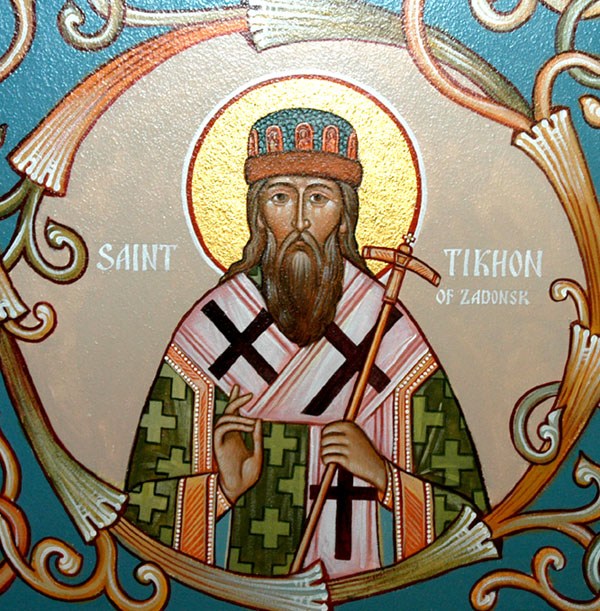
Saint Tikhon of Zadonsk, Bishop of Voronezh (in the world Timothy), was born in the year 1724 in the village of Korotsk in the Novgorod diocese, into the family of the cantor Sabellius Kirillov. (A new family name, Sokolov, was given him afterwards by the head of the Novgorod seminary). His father died when Timothy was a young child, leaving the family in such poverty that his mother was barely able to make ends meet. She wanted to give him to be raised by a neighbor, a coachman, since there was nothing with which to feed the family, but his brother Peter would not permit this. Timothy often worked a whole day with the peasants for a single piece of black bread.
As a thirteen-year-old boy, he was sent to a clergy school near the Novgorod archbishop’s home, and earned his keep by working with the vegetable gardeners. In 1740, he was accepted under a state grant set up for the Novgorod seminary. The youth excelled at his studies. Upon finishing seminary in 1754, he became a teacher there, first in Greek, and later in Rhetoric and Philosophy. In the year 1758, he was tonsured with the name Tikhon. In that same year they appointed him to be prefect of the seminary.
In 1759, they transferred him to Tver, elevating him to be archimandrite of the Zheltikov monastery. Later, they appointed him rector of the Tver seminary and, at the same time, head of the Otroch monastery.
His election as bishop was providential. Metropolitan Demetrius, the presiding member of the Holy Synod, had intended to transfer the young archimandrite to the Trinity-Sergiev Lavra. On the day of Pascha, at Peterburg, Archimandrite Tikhon was one of eight candidates being considered for selection as vicar-bishop for Novogorod. The lot fell on him three times.
On the same day, during the Cherubic Hymn, Bishop Athanasius of Tver, without realizing it, commemorated him as a bishop while cutting out particles from the prosphora at the Table of Oblation. On May 13, 1761 he was consecrated Bishop of Keksgolma and Ladoga (i.e., a vicar bishop of the Novgorod diocese).
In 1763, Saint Tikhon was transferred to the See of Voronezh. During the four and a half years that he administered the Voronezh diocese, Saint Tikhon provided constant edification, both by his life and by his numerous pastoral guidances and soul-saving books. He wrote a whole series of works for pastors:
Concerning the Seven Holy Mysteries
A Supplement to the Priestly Office
Concerning the Mystery of Repentance
An Instruction Concerning Marriage
The saint considered it essential that each priest, deacon and monk have a New Testament, and that he should read it daily. In an Encyclical, he called on pastors to perform the Holy Mysteries with reverence, with the fear of God, and love for one’s neighbor. (An Explanation of Christian Duties was often republished in Moscow and Peterburg during the eighteenth century).
At Voronezh the saint eradicated an ancient pagan custom, the celebration in honor of Yarila (a pagan god associated with the fertility of grain and cattle). In the outlying districts where military units of the Don Cossacks were dispersed, he formed a missionary commission to restore sectarians to the Orthodox Church.
In 1765, Saint Tikhon transformed the Voronezh Slavic-Latin school into a seminary. He invited experienced instructors from Kiev and Kharkhov, and planned the courses for it. He exerted much attention and effort to build up both the churches and the school, and to guide pastors to understand the need for education.
The saint was unflagging in his efforts to administer the vast diocese, and he often spent nights without sleep. In 1767, poor health compelled him to give up running the diocese and withdraw for rest to the Tolshevsk monastery, at a distance 40 versts from Voronezh.
In 1769, the saint transferred to the monastery of the Theotokos in the city of Zadonsk. Having settled into this monastery, Saint Tikhon became a great teacher of the Christian life. With deep wisdom he set forth the ideal of true monasticism in his Rule of Monastic Living and his Guidances to Turn from the Vanity of the World, and in his own life he fulfilled this ideal. He kept strictly to the precepts of the Church. Zealously (almost daily) he visited the temple of God, and he often sang and read in the choir. In time, out of humility, he altogether ceased participating and serving, but merely stood in the altar, reverently making the Sign of the Cross over himself. He loved to read the Lives of the Saints and the works of the Holy Fathers. He knew The Psalter by heart, and he usually read or sang the Psalms on his journeys.
The saint underwent much tribulation because he had to leave his flock. When he recovered his health, he thought about returning to the Novgorod diocese, where Metropolitan Gabriel had invited him to head the Ivḗron Vallaisk monastery. But when his cell-attendant mentioned this to the Elder Aaron, he declared: “Are you mad? The Mother of God does not direct him to move away from here.” The cell-attendant conveyed this to His Grace.
“If that is so,” said the saint “I shall not move away from here,” and he tore up the invitation. Sometimes he journeyed to the village of Lipovka, where he celebrated church services at the Bekhteev house. The saint journeyed also to the Tolshev monastery, which he loved for its solitude.
The fruition of all his spiritual life were the books that the saint wrote while in retirement: A SPIRITUAL TREASURY, GATHERED FROM THE WORLD (1770), and ON TRUE CHRISTIANITY (1776).
The saint lived in very simple circumstances: he slept on straw, covered by a sheepskin coat. His humility was so great that he paid no attention to the workers who laughed at him as he walked about the monastery, pretending that he did not hear it. He used to say, “It is pleasing to God that even the monastery workers mock me, and I deserve it because of my sins.” He often said, “Forgiveness is better than revenge.”
Once, a fool named Kamenev struck the saint on the cheek saying, “Don’t be so haughty.” The saint, accepting this with gratitude, gave the fool three kopeks every day for the rest of his life.
All his life the saint “in troubles, and sorrows, and insults… joyfully endured, mindful that there can be no crown without the victory, nor victory without effort, nor effort without struggle, nor struggle without enemies” (Ode 6 of the Canon).
Strict towards himself, the saint was indulgent towards others. On the Friday before Palm Sunday, he entered the cell of his friend the schemamonk Metrophanes, and he saw him at table together with Cosmas Ignatievich, of whom he was also fond. There was fish on the table, and his friends became upset (fish is not permitted during Lent, except for Feast days). The saint said, “Sit down, for I know you. Love is higher than fasting.” To further calm them, he ate some of their fish soup.
He especially loved the common folk, and comforted them in their grievous lot, interceding with the landowners, and moving them to compassion. He gave away his pension, and gifts from admirers, to the poor.
By his deeds of self-denial and love of soul, the saint advanced in contemplation of Heaven and foresaw the future. In 1778, he had a vision in his sleep: the Mother of God stood in the clouds, and near Her were the Apostles Peter and Paul. On bended knees, the saint prayed to the All-Pure Virgin for the peace of the whole world. The Apostle Paul loudly exclaimed: “When they shall say, peace and safety; then sudden destruction will come upon them” (I Thess. 5:3). The saint fell asleep in trembling and in tears. The following year, he again saw the Mother of God in the air and several people near Her. The saint knelt down, and near him four others in white garments also fell to their knees. The saint entreated the All-Pure Virgin for someone, that She would not leave him (the saint did not tell his cell-attendant who the four people were, nor for whom the request was made). She answered, “Let it be as you ask.”
Saint Tikhon prophesied much about the future, particularly the victory of Russia over the French in 1812. More than once they saw the saint in spiritual rapture, with a transformed and luminous face, but he forbade them to speak about this.
For three years before his repose he prayed each day, “Tell me, O Lord, of my end.” And a quiet voice in the morning dawn said, “It will be on a Sunday.” In that same year, he saw in a dream a beautiful meadow with wondrous palaces upon it. He wanted to go inside, but they said to him: “In three years, you may enter. For now, continue your labors.” After this the saint secluded himself in his cell and admitted only a few friends.
Both clothing and a grave were prepared for the time of his death. He often came to weep over his coffin, while standing hidden from people in a closet. A year and three months before his death, in a vivid dream, it seemed to the saint that he was standing in the monastery church. A priest of his acquaintance was carrying the Divine Infant, covered with a veil, out of the altar through the Royal Doors. The saint approached and kissed the Infant on the right cheek, and he felt himself stricken on the left. Awakening, the saint sensed a numbness in his left cheek, his left leg, and a trembling in his left hand. He accepted this illness with joy.
Shortly before his death, the saint saw in a dream a high and twisting ladder and he heard a command to climb it. “At first, I was afraid because of weakness,” he told his friend Cosmas. “But when I started to go climb, the people standing around the ladder lifted me higher and higher, up to the very clouds.”
“The ladder,” said Cosmas, “is the way to the Heavenly Kingdom. Those who helped were those you have helped by your advice, and they remember you.” The saint said with tears, “I thought so, too. I feel that my end is near.” He frequently received the Holy Mysteries during his illness.
Saint Tikhon died, as was revealed to him, on Sunday August 13, 1783, at the age of fifty-nine. The first uncovering of his relics occurred on May 14, 1846.
Saint Tikhon’s glorification took place on Sunday August 13, 1861.
Translation of the relics of Saint Maximus the Confessor
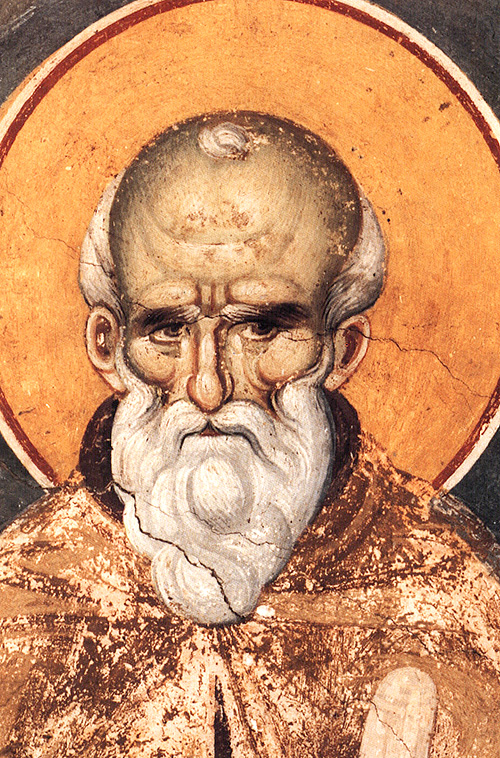
Saint Maximus the Confessor was born in Constantinople around 580 and raised in a pious Christian family. He received an excellent education, studying philosophy, grammar, and rhetoric. He was well-read in the authors of antiquity and he also mastered philosophy and theology. When Saint Maximus entered into government service, he became first secretary (asekretis) and chief counselor to the emperor Heraclius (611-641), who was impressed by his knowledge and virtuous life.
Saint Maximus soon realized that the emperor and many others had been corrupted by the Monothelite heresy, which was spreading rapidly through the East. He resigned from his duties at court, and went to the Chrysopolis monastery (at Skutari on the opposite shore of the Bosphorus), where he received monastic tonsure. Because of his humility and wisdom, he soon won the love of the brethren and was chosen igumen of the monastery after a few years. Even in this position, he remained a simple monk.
In 638, the emperor Heraclius and Patriarch Sergius tried to minimize the importance of differences in belief, and they issued an edict, the “Ekthesis” (“Ekthesis tes pisteos” or “Exposition of Faith”), which decreed that everyone must accept the teaching of one will in the two natures of the Savior. In defending Orthodoxy against the “Ekthesis,” Saint Maximus spoke to people in various occupations and positions, and these conversations were successful. Not only the clergy and the bishops, but also the people and the secular officials felt some sort of invisible attraction to him, as we read in his Life.
When Saint Maximus saw what turmoil this heresy caused in Constantinople and in the East, he decided to leave his monstery and seek refuge in the West, where Monothelitism had been completely rejected. On the way, he visited the bishops of Africa, strengthening them in Orthodoxy, and encouraging them not to be deceived by the cunning arguments of the heretics.
The Fourth Ecumenical Council had condemned the Monophysite heresy, which falsely taught that in the Lord Jesus Christ there was only one nature (the divine). Influenced by this erroneous opinion, the Monothelite heretics said that in Christ there was only one divine will (“thelema”) and only one divine energy (“energia”). Adherents of Monothelitism sought to return by another path to the repudiated Monophysite heresy. Monothelitism found numerous adherents in Armenia, Syria, and Egypt. The heresy, fanned also by nationalistic animosities, became a serious threat to Church unity in the East. The struggle of Orthodoxy with heresy was particularly difficult because in the year 630, three of the patriarchal thrones in the Orthodox East were occupied by Monothelites: Constantinople by Sergius, Antioch by Athanasius, and Alexandria by Cyrus.
Saint Maximus traveled from Alexandria to Crete, where he began his preaching activity. He clashed there with a bishop, who adhered to the heretical opinions of Severus and Nestorius. The saint spent six years in Alexandria and the surrounding area.
Patriarch Sergius died at the end of 638, and the emperor Heraclius also died in 641. The imperial throne was eventually occupied by his grandson Constans II (642-668), an open adherent of the Monothelite heresy. The assaults of the heretics against Orthodoxy intensified. Saint Maximus went to Carthage and he preached there for about five years. When the Monothelite Pyrrhus, the successor of Patriarch Sergius, arrived there after fleeing from Constantinople because of court intrigues, he and Saint Maximus spent many hours in debate. As a result, Pyrrhus publicly acknowledged his error, and was permitted to retain the title of “Patriarch.” He even wrote a book confessing the Orthodox Faith. Saint Maximus and Pyrrhus traveled to Rome to visit Pope Theodore, who received Pyrrhus as the Patriarch of Constantinople.
In the year 647 Saint Maximus returned to Africa. There, at a council of bishops Monotheletism was condemned as a heresy. In 648, a new edict was issued, commissioned by Constans and compiled by Patriarch Paul of Constantinople: the “Typos” (“Typos tes pisteos” or “Pattern of the Faith”), which forbade any further disputes about one will or two wills in the Lord Jesus Christ. Saint Maximus then asked Saint Martin the Confessor (April 14), the successor of Pope Theodore, to examine the question of Monothelitism at a Church Council. The Lateran Council was convened in October of 649. One hundred and fifty Western bishops and thirty-seven representatives from the Orthodox East were present, among them Saint Maximus the Confessor. The Council condemned Monothelitism, and the Typos. The false teachings of Patriarchs Sergius, Paul and Pyrrhus of Constantinople, were also anathematized.
When Constans II received the decisions of the Council, he gave orders to arrest both Pope Martin and Saint Maximus. The emperor’s order was fulfilled only in the year 654. Saint Maximus was accused of treason and locked up in prison. In 656 he was sent to Thrace, and was later brought back to a Constantinople prison.
The saint and two of his disciples were subjected to the cruelest torments. Each one’s tongue was cut out, and his right hand was cut off. Then they were exiled to Skemarum in Scythia, enduring many sufferings and difficulties on the journey.
After three years, the Lord revaled to Saint Maximus the time of his death (August 13, 662). Three candles appeared over the grave of Saint Maximus and burned miraculously. This was a sign that Saint Maximus was a beacon of Orthodoxy during his lifetime, and continues to shine forth as an example of virtue for all. Many healings occurred at his tomb.
In the Greek Prologue, August 13 commemorates the Transfer of the Relics of Saint Maximus from Lazika on the southeast shore of the Black Sea to Constantinople, to the Monastery of the Theotokos at Chrysopolis (where he had been the igumen), across the Bosphoros from Constantinople. This transfer took place after the Sixth Ecumenical Council.
August 13 could also be the date of the saint’s death, however. It is possible that his main commemoration was moved to January 21 because August 13 is the Leavetaking of the Feast of the Transfiguration of the Lord.
Saint Maximus has left to the Church a great theological legacy. His exegetical works contain explanations of difficult passages of Holy Scripture, and include a Commentary on the Lord’s Prayer and on Psalm 59, various “scholia” or “marginalia” (commentaries written in the margin of manuscripts), on treatises of the Hieromartyr Dionysius the Areopagite (October 3) and Saint Gregory the Theologian (January 25). Among the exegetical works of Saint Maximus are his explanation of divine services, entitled “Mystagogia” (“Introduction Concerning the Mystery”).
The dogmatic works of Saint Maximus include the Exposition of his dispute with Pyrrhus, and several tracts and letters to various people. In them are contained explanations of the Orthodox teaching on the Divine Essence and the Persons of the Holy Trinity, on the Incarnation of the Word of God, and on “theosis” (“deification”) of human nature.
“Nothing in theosis is the product of human nature,” Saint Maximus writes in a letter to his friend Thalassius, “for nature cannot comprehend God. It is only the mercy of God that has the capacity to endow theosis unto the existing… In theosis man (the image of God) becomes likened to God, he rejoices in all the plenitude that does not belong to him by nature, because the grace of the Spirit triumphs within him, and because God acts in him” (Letter 22).
Saint Maximus also wrote anthropological works (i.e. concerning man). He deliberates on the nature of the soul and its conscious existence after death. Among his moral compositions, especially important is his “Chapters on Love.” Saint Maximus the Confessor also wrote three hymns in the finest traditions of church hymnography, following the example of Saint Gregory the Theologian.
The theology of Saint Maximus the Confessor, based on the spiritual experience of the knowledge of the great Desert Fathers, and utilizing the skilled art of dialectics worked out by pre-Christian philosophy, was continued and developed in the works of Saint Simeon the New Theologian (March 12), and Saint Gregory Palamas (November 14).
Uncovering of the relics of Venerable Maximus of Moscow the Fool-for-Christ

Saint Maximus of Moscow, the Fool for Christ. Nothing is known about his parents, or the time and place of birth. Saint Maximus chose one of the most difficult and thorny paths to salvation, having taken upon himself the guise of a fool for the sake of Christ. Summer and winter Maximus walked about almost naked, enduring both heat and cold. He had a saying, “The winter is fierce, but Paradise is sweet.”
Russia loved its holy fools, it esteemed their deep humility, it heeded their wisdom, expressed in the proverbial sayings of the people’s language. And everyone heeded the holy fools, from the Great Princes down to the least beggar.
Blessed Maximus lived at a difficult time for the Russian people. Tatar incursions, droughts, and epidemics were endemic and people perished. The saint said to the unfortunate, “Not everything is by the weave of the wool, some is opposite… They have won the fight, submit, and bow lower. Weep not, you who are beaten; but weep, you who are unbeaten. Let us show tolerance, and in this at least, we shall be human. Gradually, even green wood will burn. God will grant salvation if we bear all with patience.”
But the saint did not only speak words of consolation. His angry denunciations frightened the mighty of his world. Blessed Maximus would often say to the rich and illustrious, “The house has an icon corner, but the conscience is for sale. Everyone makes the Sign of the Cross, not everyone prays. God sees every wrong. He will not deceive you, nor will you deceive Him.”
Blessed Maximus died on November 11, 1434 and is buried at the church of the holy Princes Boris and Gleb. Miraculous healings began occurring from the relics of God’s saint. In an encyclical of 1547, Metropolitan Macarius enjoined “the singing and celebration at Moscow for the new Wonderworker Maximus, Fool-for-Christ.” That same year on August 13 the incorrupt relics of Blessed Maximus were uncovered. The church of Saints Boris and Gleb, where the saint was buried, burned in the year 1568. On the site a new church was built, which they consecrated in the name of Saint Maximus, Fool-for-Christ. The venerable relics of Saint Maximus were placed in this church.
Martyr Hippolytus of Rome and those with him: Martyr Concordia, Irenaeus, and Abundius
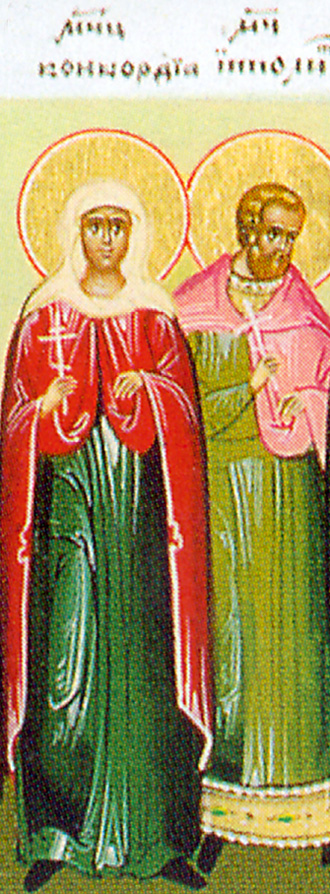
The Martyr Hippolytus was a chief prison guard at Rome under the emperors Decius (249-251) and Valerian (253-259). He was converted to Christ by the Martyr Laurence (August 10), and he buried the martyr’s body.
They informed the emperor of this, and Saint Hippolytus was arrested. Valerian asked: “Are you then a sorcerer, to have stolen away the body of Laurence?” The saint confessed himself a Christian, and they beat him fiercely with rods. His only response was, “I am a Christian.”
The emperor gave orders to clothe Saint Hippolytus in his soldier’s garb, saying, “Be mindful of your calling and be our friend. Offer sacrifice to the gods together with us, just as before.” But the martyr answered, “I am a soldier of Christ, my Savior, and I desire to die for Him.”
They then confiscated all his property, and whipped his foster mother, the Martyr Concordia, with olive switches, and they beheaded all his household before his very eyes. The saint himself was tied to wild horses, which dragged him over the stones to his death. This occurred on August 13, 258, the third day after the martyr’s death of Archdeacon Laurence, just as he had foretold to Saint Hippolytus.
By night the priest Justin buried all the martyrs at the place of execution. However, the body of Saint Concordia had been thrown into an unclean place at Rome. After a while two Christians, the Martyrs Irenaeus and Abundius, learned from a soldier where the body of the martyr had been thrown, and they buried her beside Saint Hippolytus. For this reason, they were drowned on August 26, just as the martyr had been. Christians took up the bodies of the martyrs by night and buried them near the relics of the holy Archdeacon Laurence.
Icon of the Mother of God “of the Passion”

On Tverskaya Street in Moscow there are beautiful buildings, a cathedral, high walls, and a small bell tower with the sonorous bells of the Passion Monastery. This Icon received its name because on either side of the Mother of God two Angels are depicted with the implements of the Lord’s Passion: the Cross, the spear, and the sponge.
A certain pious woman named Katherine1 was the victim of demonic possession after her marriage, After seven years she fell into such despair that she ran off into the forest and more than once she attempted suicide.
Somehow, she came to her senses and begged the Mother of God to deliver her from her affliction. She promised that if she recovered, she would enter a convent. She was healed, but then she forgot her vow for a long time, and remained married, had children and raised them. When she remembered her broken promise at last, she became ill again and took to her bed. At that time, someone approached the doors and made the usual prayer. The doors opened, and the Mother of God entered the room. She was wearing a crimson robe with gold crosses. A young girl accompanied the Sovereign Lady.
The Mother of God said, "Katherine, why didn't you keep your promise to enter a convent and serve my Son and God? Go now and tell everyone about my appearance, and tell them to abstain from malice, envy, drunkenness, and every impurity, and to live in chastity, and to have unfeigned love for one another, and to observe Sundays and Feast Days."
The woman did not obey this order. Then the Mother of God appeared to her twice more, and then Katherine was punished: her head turned to the side, her mouth was twisted, and her body was paralyzed. After this punishment, the Mother of God ordered her to go to Nizhny Novgorod and find a certain iconographer named Gregory, who had painted a Hodēgḗtria Icon. Katherine told Gregory about the apparitions of the Mother of God and, after she saved seven silver coins, she gave them to the iconographer to adorn the Icon. The Theotokos promised to heal her if she did this. Katherine found the iconographer and the Icon, and she was healed.
From that time on, miracles have occurred before this Icon. After this first miracle, it was transferred to the village of Palitsa, in the Nizhny Novgorod Diocese.
In 1641, by command of Tsar Alexei, the Icon was transferred to Moscow. A church was built at the spot where it was met at the Tver gates, and the Icon was placed in it. Then, in 1654, the Passion Convent was built.
The Icon's Feast Day is on August 13, in remembrance its transfer from the village of Palitsa to Moscow in 1641.
The Icon is also commemorated the sixth Sunday after Pascha (Sunday of the Blind Man) in remembrance of the miracles which took place on that day. Copies of the Icon "of the Passion" have been glorified in Moscow's church of the Conception of Saint Anna, and also in the village of Enkaeva in Tambov Diocese.
Lipetsk Icon "of the Passion"
In the city of Lipetsk, Tambov province, in the Nativity of Christ Cathedral, there is a very ancient and revered Icon of the Mother of God "of the Passion" In honor of this Icon, a chapel was built in the cathedral, where it is kept. In bygone years, the inhabitants of Lipetsk often flocked to this shrine with fervent prayer and often received healing from bodily illnesses and consolation in their mental afflictions. But later, they almost forgot their pious custom, and the blessings which the Queen of Heaven bestowed on them, were preserved only in a vague and dark tradition.
In 1831, in the Lipetsk district and in the city of Lipetsk itself, there was severe outbreak of cholera. Then everyone remembered the wonderworking Icon of the Mother of God and appealed to the Mother of God with tears, asking for her help and intercession. As soon as the Icon was taken from the church, it was carried through the city in a Cross Procession and brought into homes, there were not so many deaths, and soon the cholera stopped altogether.
The inhabitants of the city, in gratitude for their deliverance, made a silver riza for the Icon of the Mother of God, and adorned it with various precious stones.
Moscow Icon "of the Passion" in the church of the Conception of the Most Holy Theotokos by the Righteous Anna
On February 20, 1547, during the reign of Ivan the Terrible, near the Conception of the Most Holy Theotokos by the Righteous Anna2 church in Moscow at the corner called Kitai Town, two fires broke out. These fires destroyed many homes, except for one wooden house which remained undamaged by the fire, where the Icon of the Mother of God "of the Passion was kept. Contemporaries and eyewitnesses of this event had no doubt that this wooden house had been preserved only by God's special providence, and that grace was bestowed on it from above, by the Icon of the Mother of God. Soon the news of such a miraculous event reached Ivan the Terrible. The Tsar had the Icon of the Mother of God "of the Passion" brought to the palace, where it became famous because of its many miracles.
Soon, at the Tsar's command, it was moved from the palace to the church of the Conception of the Most Holy Theotokos and placed on the iconostasis, to the left of the royal gates, where it is kept to this day.
"Of the Passion" Icon in the village of Enkaev
Once, during the flooding of Eremshi, or Ermish River, in the village of Enkaev, Temnikovsky district, Tambov province, a serf named Ivan, who belonged to the landowner Nesterov, happened to see an icon floating on the water. It is not known where the Icon of the Mother of God "of the Passion" came from. He took it out of the water and brought it to the landowner Nesterov, who ordered it to be placed on the gates of the manor house. Here those who were blind or somewhat paralyzed received healing after praying before the Icon. After these miraculous events, the Icon of the Mother of God "of the Passion" was moved to the church of the Annunciation at Enkaev. Since that time the Icon has been revealed as wonderworking.
Priluki Icon of the Mother of God "of the Passion"
During his lifetime, Venerable Demetrios († February 11, 1392), founded the famous Savior-Priluki Monastery five versts from Vologda, near a bend in the river of the same name. Now his shrine is in the Monastery he founded, and over it, in a kiot behind glass, there is an ancient Icon of the Mother of God "of the Passion." It is considered to be the Saint's cell icon.
Among other local icons of the Mother of God "of the Passion," we may mention an icon located in the city of Orel, in the church of the Archangel Michael, and another, in the city of Kolomna, Moscow province in the chapel, on Popovskaya Street. All these icons are accurate copies of the ancient wonderworking Icon of the Theotokos, which is now located in Moscow's Passion Monastery.
1 Some sources say the woman's name was Eudoxia.
2 The church's Altar Feast is December 9.
Icon of the Mother of God “of the Seven Arrows”

The “Seven Arrows” Icon of the Mother of God depicts the Virgin’s heart pierced by seven arrows. For a long time the icon was located at the belltower stairway entrance of a church in honor of the Apostle John the Theologian (near Vologda). Since it was face downwards, they mistook the icon for an ordinary board and walked on it. Then a cripple in the city of Kadnikova had a vision that he would receive healing after praying before this icon. They served a Molieben before the newly-discovered icon, after which the sick one became well. The icon was especially glorified in 1830 during a cholera epidemic at Vologda.
Second Finding of the relics of Saint Tikhon, Wonderworker of Zadonsk

No information available at this time.
Icon of the Mother of God of Minsk

The Minsk Icon of the Most Holy Theotokos was brought by the holy Prince Vladimir from Korsun in the Crimea, and placed in Kiev’s Cathedral of the Tithes, where it remained for more than 500 years. The consecration of that church in 996 is commemorated on May 12.
In the year 1500, during the capture of Kiev by Khan Mengli-Gyr, a certain Tatar stripped the riza and other adornments from the Icon, and threw it into the Dniepr River. After a while it was found floating in the Svisloch River near Minsk. Surrounded by an extraordinary light, the Icon was brought to shore and taken to the church of the Nativity of the Most Holy Theotokos, in the castle of the Minsk appanage1 Princes. This occurred on August 13, 1500.
The Minsk Icon was taken to the Uniate Monastery of the Descent of the Holy Spirit in 1616, and was returned to the Orthodox in 1839. The church of the Holy Spirit Monastery then became an Orthodox cathedral, which was dedicated to Saints Peter and Paul. Every Friday, an Akathist is served before the holy Icon, and many miracles have been recorded.2
On the Icon, which is on the left side of the iconostasis, the Mother of God is depicted with the Pre-eternal Child on her left arm. The Icon is painted with egg tempra on a wooden board, and in 1852 it was covered with a silver riza, over the faces of the Mother of God and the Savior, Who holds an orb in His left hand. In some icons, both wear gilded crowns with precious stones. At the bottom of the riza is the following inscription:
"This Icon of the Mother of God with the Child Jesus, was provided by the Great Prince of the Russian land, Saint Vladimir in Kiev, in the Church of the Tithes, and after the devastation of Kiev by the Tatars, it appeared in Minsk on August 13, 1500 on the Svisloch River, and placed in the castle church. Later, it was transferred to the cathedral. In 1852, by the diligence of the Orthodox, it was covered with a new silver riza."
The Minsk Icon, which belongs to the Hodēgḗtria type, is more than four and a half feet tall, and three feet wide.
1 Land or money given by a King or Prince to his younger children as a means of support.
2 In his book БОГОМАТРЬ (The Mother of God), Eugene Poselyanin states that the Akathist to the "Joy of All Who Sorrow" Icon is read before the Minsk Icon every Saturday.
Empress Irene, tonsured Xenia

No information available at this time.
Monastic Martyr Dositheus
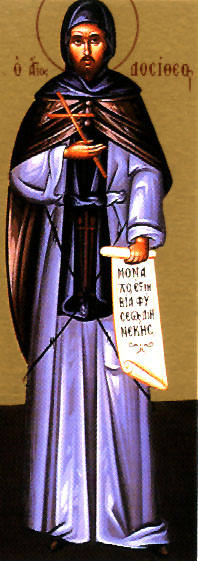
No information available at this time.
 Saint Peter Antiochian Orthodox Church