Romans 15:1-7: Brethren, we who are strong ought to bear the infirmities of the weak, and not to please ourselves. Let each one of us please his neighbor for that which is good for his edification. For Christ also did not please Himself; but, as it is written: “The reproaches of those who reproached Thee fell on Me.” For whatever was written beforehand was written for our learning, that we might have hope, through the patience and comfort of the Scriptures. Now may the God of patience and comfort grant you to be of the same mind with one another, according to Christ Jesus, that with one accord and one mouth you may glorify God, even the Father of our Lord Jesus Christ. Therefore, receive one another, even as Christ has also received you, to the glory of God.
Matthew 9:27-35: At that time, as Jesus passed on from there, two blind men followed him, crying aloud: “Have mercy on us, Son of David.” When He entered the house, the blind men came to Him; and Jesus said to them, “Do you believe that I am able to do this?” They said to Him, “Yes, Lord.” Then He touched their eyes, saying, “According to your faith be it done to you.” And their eyes were opened. And Jesus sternly charged them, “See that no one knows it.” But they went away and spread His fame through all that district. As they were going away, behold, a dumb demoniac was brought to Him. And when the demon had been cast out, the dumb man spoke; and the crowds marveled, saying, “Never was anything like this seen in Israel.” But the Pharisees said, “He casts out demons by the prince of demons.” And Jesus went about all the cities and villages, teaching in their synagogues and preaching the gospel of the kingdom, and healing every disease and every infirmity.
Troparion of the Resurrection: When Mary stood at thy grave looking for thy sacred body, angelic powers shone above thy revered tomb, and the soldiers who were to keep guard became as dead men. Thou led hades captive and wast not tempted thereby. Thou didst meet the Virgin and didst give life to the world; O thou who art risen from the dead! O Lord, glory to thee.
Troparion of the Chains of St. Peter: O Holy Apostle, Peter, thou dost preside over the Apostles by the precious chains which thou didst bear. We venerate them with faith and beseech thee that by thine intercessions we be granted the great mercy.
Kontakion of the Theotokos: O undisputed intercessor of Christians, O mediatrix, who is unrejected by the Creator, turn not away from the voice of our petitions though we be sinners; come to us in time, who cry to thee in faith, for thou art good. Hasten to us with intercessions, O Theotokos, who didst ever intercede for those who honor thee.
CALENDAR
UNTIL FURTHER NOTICE: All services listed on the calendar will be available through streaming and webcast. (Instructions can be found on the parish website.)
ABSTAIN FROM MEAT, FISH, DAIRY, EGGS, WINE, OLIVE OIL
Macrina the Righteous, sister of St. Basil, Dius, Abbot of Antioch, Saint Theodore, Bishop of Edessa, Translation of the Holy Relics of Righteous Seraphim of Sarov
ST. PAUL’S FIRST LETTER TO THE CORINTHIANS 7:12-24
Brethren, if any brother has a wife who is an unbeliever, and she consents to live with him, he should not divorce her. If any woman has a husband who is an unbeliever, and he consents to live with her, she should not divorce him. For the unbelieving husband is consecrated through his wife, and the unbelieving wife is consecrated through her husband. Otherwise, your children would be unclean, but as it is they are holy. But if the unbelieving partner desires to separate, let it be so; in such a case the brother or sister is not bound. For God has called us to peace. Wife, how do you know whether you will save your husband? Husband, how do you know whether you will save your wife? Only, let every one lead the life which the Lord has assigned to him, and in which God has called him. This is my rule in all the churches. Was any one at the time of his call already circumcised? Let him not seek to remove the marks of circumcision. Was any one at the time of his call uncircumcised? Let him not seek circumcision. For neither circumcision counts for anything nor uncircumcision, but keeping the commandments of God. Every one should remain in the state in which he was called. Were you a slave when called? Never mind. But if you can gain your freedom, avail yourself of the opportunity. For he who was called in the Lord as a slave is a freedman of the Lord. Likewise he who was free when called is a slave of Christ. You were bought with a price; do not become slaves of men. So, brethren, in whatever state each was called, there let him remain with God.
MATTHEW 14:35-36;15:1-11
At that time, when the men of Gennesaret recognized Jesus, they sent round to all that region and brought to him all that were sick, and besought him that they might only touch the fringe of his garment; and as many as touched it were made well.
Then Pharisees and scribes came to Jesus from Jerusalem and said, "Why do your disciples transgress the tradition of the elders? For they do not wash their hands when they eat." He answered them, "And why do you transgress the commandment of God for the sake of your tradition? For God commanded, 'Honor your father and your mother, ' and, 'He who speaks evil of father or mother, let him surely die.' But you say, 'If any one tells his father or his mother, What you would have gained from me is given to God, he need not honor his father.' So, for the sake of your tradition, you have made void the word of God. You hypocrites! Well did Isaiah prophesy of you, when he said: 'This people honors me with their lips, but their heart is far from me; in vain do they worship me, teaching as doctrines the precepts of men.' " And he called the people to him and said to them, "Hear and understand: not what goes into the mouth defiles a man, but what comes out of the mouth, this defiles a man.
Uncovering of the relics of Venerable Seraphim of Sarov
Uncovering of the Relics of Saint Seraphim, Wonderworker of Sarov: The glorification of Saint Seraphim of Sarov (January 2), took place in 1903, seventy years after his repose. On July 3, 1903 Metropolitan Anthony of Saint Petersburg, assisted by Bishop Nazarius of Nizhni-Novgorod and Bishop Innocent of Tambov, transferred the saint’s relics from their original burial place to the church of Saints Zosimus and Sabbatius. Tsar Nicholas II and Tsarina Alexandra provided a new cypress coffin to receive the relics. This cypress coffin was then placed inside an oak coffin and remained in the church until the day of the saint’s glorification.
At noon on July 16, the first day of the festivities, Metropolitan Anthony offered a Memorial Service for the ever-memorable Hieromonk Seraphim in the Dormition Cathedral. Services also took place in the monastery’s other churches.
The next day Metropolitan Anthony and Bishop Nazarius served a Memorial Liturgy in the Dormition Cathedral. At 5:00 that afternoon, the bells of Sarov began to ring, announcing the arrival of Tsar Nicholas and his family. Metropolitan Anthony greeted them and then led them to the Dormition Cathedral for a Service of Thanksgiving.
The royal family attended the early Liturgy on July 18th and received the Holy Mysteries. Later that morning, the final Memorial Service for the repose of Hieromonk Seraphim’s soul was offered in the Cathedral. These would be the last prayers offered for him as a departed servant of God. From that time forward, prayers would be addressed to him as a saint. At 6 P.M. the bells rang for Vigil, the first service with hymns honoring Saint Seraphim, and during which his relics would be exposed for public veneration.
At the time of the Litia during Vespers, the saint’s coffin was carried from the church of Saints Zosimus and Sabbatius and into the Dormition Cathedral. Several people were healed of various illnesses during this procession. During Matins, as “Praise ye the Name of the Lord” was sung, the coffin was opened. After the Gospel, Metropolitan Anthony and the other hierarchs kissed the holy relics. They were followed by the royal family, the officiating clergy, and all the people in the cathedral.
On July 19, the saint’s birthday, the late Liturgy began at 8 o’clock. At the Little Entrance, twelve Archimandrites lifted the coffin from the middle of the church, carried it around the altar, then placed it into a special shrine. The long awaited event was accompanied by numerous miraculous healings of the sick, who had gathered at Sarov in large numbers. More than 200,000 people came to Sarov from all across Russia.
The festivities at Sarov came to an end with the dedication of the first two churches to Saint Seraphim. The first church to be consecrated was over his monastic cell in Sarov. The second church was consecrated on July 22 at the Diveyevo convent.
In 1991, Saint Seraphim’s relics were rediscovered after being hidden in a Soviet anti-religious museum for seventy years. Widely esteemed in his lifetime, Saint Seraphim is one of the most beloved saints of the Orthodox Church.
Venerable Macrina, sister of Saint Basil the Great
Saint Macrina was the sister of the holy hierarchs Basil the Great and Gregory of Nyssa, and was born in Cappadocia at the beginning of the fourth century. Her mother, Emilia, saw an angel in a dream, naming her unborn child Thekla, in honor of the holy Protomartyr Thekla. Saint Emilia (January 1) fulfilled the will of God and named her daughter Thekla. Another daughter was named Macrina, in honor of a grandmother, who suffered during the time of persecution under the emperor Maximian Galerius.
Besides Macrina, there were nine other children. Saint Emila herself guided the upbringing and education of her daughter Macrina. She taught her reading and writing in the Scriptural books and Psalms of David, selecting examples from the sacred books which spoke of a pious and God-pleasing life. Saint Emilia taught her daughter to pray and to attend church services. Macrina was also taught the proper knowledge of domestic governance and various handicrafts. She was never left idle and did not participate in childish games or amusements.
When Macrina grew up, her parents betrothed her to a certain pious youth, but the bridegroom soon died. Many young men sought marriage with her, but Macrina refused them all, having chosen the life of a virgin and not wanting to be unfaithful to the memory of her dead fiancé. Saint Macrina lived in the home of her parents, helping them fulfill the household tasks as an overseer together with the servants, and she helped with the upbringing of her younger brothers and sisters. After the death of her father she became the chief support for the family.
When all the children grew up and left the parental home, Saint Macrina convinced her mother, Saint Emilia, to leave the world, to set their slaves free, and to settle in a women’s monastery. Several of their servants followed their example. Having taken monastic vows, they lived together as one family, they prayed together, they worked together, they possessed everything in common, and in this manner of life nothing distinguished one from another.
After the death of her mother, Saint Macrina guided the sisters of the monastery. She enjoyed the deep respect of all who knew her. Strictness towards herself and temperance in everything were characteristic of the saint all her life. She slept on boards and had no possessions. Saint Macrina was granted the gift of wonderworking. There was an instance (told by the sisters of the monastery to Saint Gregory of Nyssa after the death of Saint Macrina), when she healed a girl of an eye-affliction. Through the prayers of the saint, there was no shortage of wheat at her monastery in times of famine.
Saint Macrina died in the year 380, after a final prayer of thanks to the Lord for having received His blessings over all the course of her life. She was buried in the same grave with her parents.
Venerable Dius, Abbot of Antioch
Saint Dius was born in Antioch, Syria towards the end of the fourth century into a pious Christian family. From his youth he was noted for his temperance. He ate food in small quantities, but not every day, and his flesh was humbled by vigil and unceasing prayer. For these deeds the Lord granted Saint Dius dispassion and the gift of wonderworking.
In a vision, the Lord ordered Saint Dius to go to Constantinople and there to serve both Him and the people. Saint Dius settled beyond the city in a solitary place, where people feared to live. Saint Dius bravely contended with the evil spirits which tried to expel him from this place. The Lord heard the prayer of His saint: his staff took root, began to grow and with time was transformed into an immense oak, which stood for a long time even after the death of Saint Dius.
The surrounding inhabitants began to come to the saint for advice and guidance, and they sought healing from illnesses of body and soul. Saint Dius doctored the infirm with prayer, and whatever was offered him he distributed to the poor, the homeless and the sick.
Reports of Saint Dius reached even the emperor Theodosius the Younger. He came to Saint Dius for a blessing together with Patriarch Atticus of Constantinople (406-425). The emperor wanted a monastery to be built on the place of Saint Dius’ efforts, and he provided the means for its construction. The Patriarch ordained the monk as a priest and made him the igumen. Soon numerous monastic brethren gathered to Saint Dius. The monastery was in need of a well, and they dug for a long time without success. Through the prayers of the monk the Lord brought forth a spring of pure water, which soon filled up the entire well. Once, through his prayers, the monk raised up a drowned man. The Lord worked many other miracles through His saint.
In extreme old age Saint Dius became grievously ill. He took his leave of the brethren, received the Holy Mysteries, and lay upon his cot like one dead. At the monastery His Holiness Patriarch Atticus (Comm. on Cheesefare Saturday) came for the funeral service and also Patriarch Alexander of Alexandria, who was then at Constantinople. The holy Elder unexpectedly rose up from his death bed and said, “The Lord has granted me fifteen more years of life.” Great was the joy of the brethren.
Saint Dius did live another fifteen years, helping all with guidance and counsel, healing the sick, and being concerned for the poor and homeless. Shortly before his death, a radiant man in priestly garb appeared to him in the altar of the church and told him of his impending death. Having given thanks to the Lord for this news, Saint Dius quietly died and was buried in his monastery.
Right-believing Prince Roman of Ryazan
The Holy Prince Roman Olegovich of Ryazan was from a line of princes, who during the time of the Tatar (Mongol) Yoke won glory as defenders of the Christian Faith and of their Fatherland. Both his grandfathers perished for the Fatherland in the struggle with Batu.
Raised to love the holy faith (the prince lived in tears and prayers) and his homeland, the prince with all his strength concerned himself about his devastated and oppressed subjects. He defended them from the coercion and plundering of the Khan’s “baskaki” (“tax-collectors”). The “baskaki” hated the saint and they slandered him before the Tatar Khan Mengu-Timur.
Roman Olegovich was summoned to the Horde, where Khan Mengu-Timur declared that he had to choose one of two things: either a martyr’s death or the Tatar faith. The noble prince said that a Christian cannot change from the true Faith to a false one. For his firmness in the confession of faith he was subjected to cruel torments: they cut out his tongue, gouged out his eyes, cut off his ears and lips, chopped off his hands and feet, tore off the skin from his head and, after beheading him, they impaled him upon a spear. This occurred in the year 1270.
The veneration of the royal martyr began immediately with his death. The chronicle says about the saint: “By your suffering, you have gained the Kingdom of Heaven, and a crown from the hand of the Lord, together with your kinsman Michael Vsevolodovich, co-sufferers with Christ for the Orthodox Christian Faith.”
Since 1854, there have been church processions and Moliebens at Ryazan on the Feast day of Saint Roman. A church was consecrated in honor of the holy Prince Roman at Ryazan in 1861.
Venerable Paisius of the Kiev Far Caves
Saint Paisius of the Caves was a monk of the Kiev Caves monastery. From the Canon to the Kiev Caves monks, venerated in the Far Caves, it is known that he was connected by oneness of mind and brotherly love with Saint Mercurius (November 24). Both saints were inseparable, they lived in the same cell, and after death were placed in the same grave. At the present time their relics rest in separate reliquaries.
Blessed Stephen, King of Serbia
Saint Stephen was the son of prince Saint Lazar of Serbia (June 15). In the terrible times of the Turkish Yoke Saint Stephen became the great benefactor of his enslaved countrymen. He built up the city, constructed churches and expended his treasury on the help of the needy. Saint Stephen exceeded many rulers in his wisdom, his charity and his faith. He died peacefully in the year 1427.
Holy Right-believing Princess Militsa of Serbia
Saint Militsa (Milica) was born in 1335, the daughter of Prince Vratko Nemanjić. In Holy Baptism she was named Euphrosynē. Later, she married the Holy Prince Lazarus (Lazar), who was killed during the great Battle of Kosovo (June 15, 1389), which was fought to defend the Holy Church against the Moslems. After her husband's death, she ruled Serbia until her son Stephen the Tall came of age. She also composed several prayers and religious poems, including "A Mother's Prayer" (Молитва матере) and a very touching poem of mourning for her husband, "The Bridegroom of my Widowhood" (Удовству мојему женик).
Saint Militsa founded Ljubostinja monastery around 1390, and there in 1393, she was tonsured as a nun with the name Eugenia. She was concerned about beginning her monastic life as a widow and about being accepted by the other nuns, whose husbands had also fallen on the battlefield. This inspired her to build and support many monasteries and churches.
At the end of her life, Mother Eugenia was tonsured into the Great Schema with the name Euphrosynē.
After her repose on November 11, 1405, Saint Militsa worked many miracles, and her myrrh-streaming relics healed many sick people.
The Russian Orthodox Church commemorates Saint Militsa on July 19, while the Church of Serbia commemorates her on August 30.
Saint Theodore of Edessa, Mesopotamia
The Saint’s father was named Symeon, and his mother’s name was Maria. He received a good education and was distinguished for his philosophical knowledge, as well as for rhetoric.
At the age of ten he was left as an orphan and gave half of his parents’ wealth to his sister, and kept the other half himself. Sharing this with the poor, he departed for Jerusalem. There he venerated the holy places and, when he was nineteen years old, he became a monk in the Lavra of Saint Savva.
Saint Theodore remained there for twenty-four years, leading an ascetic and virtuous life, and became a renowned ascetic. Hearing of his great virtues, the Patriarch of Jerusalem made him Bishop of Edessa in 836. He was an excellent Archpastor, with his vast theological knowledge, his many virtues, and above all, his great love, which he bestowed abundantly upon his flock. At that time Edessa was plagued with many heresies: Arian, Nestorian, Eutychian, etc. The holy hierarch instructed his flock in the Orthodox Faith in order to combat these errors. Saint Theodore also went to see the Persian king in Babylon, asking him to protect the Orthodox Christians of Edessa from the malevolence of the heretics.
The King was very sick, but the Saint healed him and spoke to him about Christ. After many days the King was baptized with the name John. After returning to Edessa, Saint Theodore was informed in a vision that King John and his three bodyguards, who had been baptized with him, proclaimed their faith openly and received the unfading crown of martyrdom.
Sensing the approach of death, Saint Theodore retired to the Lavra of Saint Savva. After calling the clergy and laity of Edessa together and blessing them, he surrendered his holy soul to the Heavenly Father in the year 848.
Bishop Basil of Emessa wrote the Saint’s life in Greek, which is preserved at the Ivḗron Monastery on Mount Athos.
Holy Martyr Emilian, Holy Martyrs Paul, Thea and Valentine, Stephen, Archbishop of Constantinople, Our Holy Father John, Archbishop of Constantinople, Holy New Martyrs Elizabeth the Grand Duchess and the Novice Barbara, Theneva of Glasgow
ST. PAUL’S FIRST LETTER TO THE CORINTHIANS 6:20; 7:1-12
Brethren, glorify God in your body and in your spirit which are from God. Now concerning the matters about which you wrote. It is well for a man not to touch a woman. But because of the temptation to immorality, each man should have his own wife and each woman her own husband. The husband should give to his wife her conjugal rights, and likewise the wife to her husband. For the wife does not rule over her own body, but the husband does; likewise the husband does not rule over his own body, but the wife does. Do not refuse one another except perhaps by agreement for a season, that you may devote yourselves to prayer; but then come together again, lest Satan tempt you through lack of self-control. I say this by way of concession, not of command. I wish that all were as I myself am. But each has his own special gift from God, one of one kind and one of another. To the unmarried and the widows I say that it is well for them to remain single as I do. But if they cannot excercise self-control, they should marry. For it is better to marry than to be aflame with passion. To the married I give charge, not I but the Lord, that the wife should not separate from her husband (but if she does, let her remain single or else be reconciled to her husband) – and that the husband should not divorce the wife. To the rest I say, not the Lord, that if any brother has a wife who is an unbeliever, and she consents to live with him, he should not divorce her.
MATTHEW 14:1-13
At that time, Herod the tetrarch heard about the fame of Jesus; and he said to his servants, "This is John the Baptist; he has been raised from the dead; that is why these powers are at work in him." For Herod had seized John and bound him and put him in prison, for the sake of Herodias, his brother Philip's wife; because John said to him, "It is not lawful for you to have her." And though he wanted to put him to death, he feared the people, because they held him to be a prophet. But when Herod's birthday came, the daughter of Herodias danced before the company and pleased Herod, so that he promised with an oath to give her whatever she might ask. Prompted by her mother, she said, "Give me the head of John the Baptist here on a platter." And the king was sorry; but because of his oaths and his guests he commanded it to be given; he sent and had John beheaded in the prison, and his head was brought on a platter and given to the girl, and she brought it to her mother. And his disciples came and took the body and buried it; and they went and told Jesus. Now when Jesus heard this, he withdrew from there in a boat to a lonely place apart. But when the crowds heard it, they followed him on foot from the towns.
Martyr Emilian of Silistria in Bulgaria
The Holy Martyr Emilian, who was a Slav, suffered for Christ during the reign of Emperor Julian the Apostate (361-363). Julian wanted to restore the cult of the pagan gods throughout the Roman Empire, and he issued an edict, according to which all Christians who failed to honor the pagan gods would be subject to death.
Saint Emilian lived in the Thracian city of Dorostolum on the banks of the River Dunaj (Danube).The imperial edict was read in the city square, but the people of Dorostolum declared that there were no Christians in the city.
Saint Emilian was a slave of a cruel and fanatical idolater, and was a secret Christian. Some sources state that he was the son of a local officer named Sabbatianus. When the father learned that Emilian believed in Christ, he was so enraged that he insulted him with vulgar words and had him whipped. He pointed out that he could expect even worse things to happen to him if he remained a Christian.
Instead of being intimidated by these threats, Saint Emilian’s faith in Christ was strengthened. The next day he went into a pagan temple and smashed the statues with a hammer.
An angry crowd started to beat a certain Christian, who was passing by. Saint Emilian then shouted out loudly that they should not harm that innocent man, since he himself was the one who had damaged the pagan temple.
The saint was seized and brought to Capitolinus the governor for judgment. In spite of further threats, Saint Emilian would not deny Christ. “He is my Lord, and I will never deny Him,” the martyr exclaimed. The governor ordered that Saint Emilian be beaten mercilessly, and then to be burned alive. He did not perish when he was thrown into the fire, but instead the flames consumed many of the pagans who were standing about. When the fire had gone out, Saint Emilian lay down upon the dying embers, and gave up his soul to the Lord. The wife of the pagan ruler was also a secret Christian, and she gathered up the saint’s relics and buried them. Afterward, a church dedicated to the holy Martyr Emilian was built at Constantinople, where his relics were transferred.
Martyr Hyacinthus of Amastridea
The Holy Martyr Hyacinthus was born into a pious Christian family in the city of Amastridea (now Amastra in Anatolia). An angel which appeared gave him his name. As a three-year-old boy Saint Hyacinthus asked God that a dead infant might be resurrected. The Lord hearkened to his childish prayer, and the dead one arose. Both lads afterwards grew up together, and they lived an ascetic life.
Saint Hyacinthus once noticed how the pagans were worshipping a tree, and so he chopped it down. For this they subjected him to harsh tortures. They smashed out all his teeth, and having bound him with rope, they dragged him along the ground and threw him in prison. It was there that the holy sufferer departed to the Lord.
Venerable John the Long-Suffering of the Kiev Near Caves
Saint John the Much-Suffering pursued asceticism at the Kiev Caves Lavra, accepting many sorrows for the sake of virginity.
The ascetic recalled that from the time of his youth he had suffered much, tormented by fleshly lust, and nothing could deliver him from it, neither hunger nor thirst nor heavy chains. He then went into the cave where the relics of Saint Anthony rested, and he fervently prayed to the holy Abba. After a day and a night the much-suffering John heard a voice: “John! It is necessary for you to become a recluse, in order to weaken the vexation by silence and seclusion, and the Lord shall help you by the prayers of His monastic saints.” The saint settled into the cave from that time, and only after thirty years did he conquer the fleshly passions.
Tense and fierce was the struggle upon the thorny way on which the monk went to victory. Sometimes the desire took hold of him to forsake his seclusion, but then he resolved on still greater effort. The holy warrior of Christ dug out a pit and with the onset of Great Lent he climbed into it, and he covered himself up to the shoulders with ground. He spent the whole of Lent in such a position, but the burning of his former passions did not leave him. The enemy of salvation brought terror upon the ascetic, wishing to expel him from the cave: a fearsome serpent, breathing fire and sparks, tried to swallow the saint. For several days these evil doings continued.
On the night of the Resurrection of Christ the serpent seized the head of the monk in its jaws. Then Saint John cried out from the depths of his heart: “O Lord my God and my Savior! Why have You forsaken me? Have mercy upon me, only Lover of Mankind; deliver me from my foul iniquity, so that I am not trapped in the snares of the Evil one. Deliver me from the mouth of my enemy: send down a flash of lightning and drive it away.” Suddenly a bolt of lightning flashed, and the serpent vanished. A Divine light shone upon the ascetic, and a Voice was heard: “John! Here is help for you. Be attentive from now on, that nothing worse happen to you, and that you do not suffer in the age to come.”
The saint prostrated himself and said: “Lord! Why did You leave me for so long in torment?” “I tried you according to the power of your endurance,” was the answer. “I brought upon you temptation, so that you might be purified like gold. It is to the strong and powerful servants that a master assigns the heavy work, and the easy tasks to the infirm and to the weak. Therefore pray to the one buried here (Moses the Hungarian), he can help you in this struggle, for he did greater deeds than Joseph the Fair” (March 31). The monk died in the year 1160, having acquired grace against profligate passions. His holy relics rest in the Caves of Saint Anthony.
We pray to Saint John for deliverance from sexual impurity.
Venerable Pambo the Recluse of the Kiev Far Caves
Hieromonk Pambo, Hermit of the Kiev Caves, was a confessor for the Faith. Captured while on a monastic obedience, he was taken off by Tatars and for many years suffered from them for his refusal to renounce the Christian Faith. The monk was afterwards miraculously transported from captivity and put within his own cell. He died in seclusion in 1241. His relics rest in the Caves of Saint Theodosius.
Venerable Pambo the Hermit of Egypt
Saint Pambo lived the ascetic life in the Nitrian desert in Egypt. Saint Anthony the Great (January 17) said, that the Monk Pambo by the fear of God inspired within himself the Holy Spirit. And the Monk Pimen the Great (August 27) said: “We beheld three things in Father Pambo: hunger every day, silence and handcrafts”. The Monk Theodore the Studite termed Saint Pambo “exalted in deed and in word.”
At the beginning of his monasticism, Saint Pambo heard the verses from the 38th [39th] Psalm of David: “preserve mine path, that I sin not by my tongue”. These words sank deep into his soul, and he attempted to follow them always. Thus, when they asked him about something, he answered only after long pondering and prayer. He would say, “I must think first, and perhaps I can, in time, give an answer, with God’s help.” Saint Pambo was a model of a lover of work for his disciples. Each day he worked until exhausted, and lived by the bread acquired by his own toil.
The disciples of Saint Pambo became great ascetics: Dioscorus, afterwards Bishop of Hermopolis (this Dioscorus, bishop of Hermopolis, is distinguished from another Dioscorus, an arch-heretic and Patriarch of Constantinople who lived rather later and was condemned by the Fourth Ecumenical Council), and also Ammonius, Eusebius and Euthymius, mentioned in the life of Saint John Chrysostom. One time Saint Melania the Younger (December 31) brought Saint Pambo a large amount of silver for the needs of the monastery, but he did not leave off from his work nor even glance at the money that was brought. Only after the incessant requests of Saint Melania did he permit her to give the alms to a certain monastic brother for distribution to the needs of the monastery. Saint Pambo was distinguished by his humility, but together with this he highly esteemed the vocation of monk and he taught the laypeople to be respectful of monastics, who often converse with God.
It was said that sometimes Saint Pambo’s face shone like lightning, as did the face of Moses. Yet, speaking to the brethren who stood about his deathbed, Saint Pambo said: “I go to the Lord as one who has not yet begun to serve Him.” He died at the age of 70.
Grand Duchess Elizabeth
Saint Elizabeth was the older sister of Tsarina Alexandra, and was married to the Grand Duke Sergius, the governor of Moscow. She converted to Orthodoxy from Protestantism of her own free will, and organized women from all levels of society to help the soldiers at the front and in the hospitals.
Grand Duke Sergius was killed by an assassin’s bomb on February 4, 1905, just as Saint Elizabeth was leaving for her workshops. Remarkably, she visited her husband’s killer in prison and urged him to repent.
After this, she began to withdraw from her former social life. She devoted herself to the Convent of Saints Martha and Mary, a community of nuns which focused on worshiping God and also helping the poor. She moved out of the palace into a building she purchased on Ordinka. Women from the nobility, and also from the common people, were attracted to the convent.
Saint Elizabeth nursed sick and wounded soldiers in the hospitals and on the battle front. On Pascha of 1918, the Communists ordered her to leave Moscow, and join the royal family near Ekaterinburg. She left with a novice, Sister Barbara, and an escort of Latvian guards.
After arriving in Ekaterinburg, Saint Elizabeth was denied access to the Tsar’s family. She was placed in a convent, where she was warmly received by the sisters.
At the end of May Saint Elizabeth was moved to nearby Alopaevsk with the Grand Dukes Sergius, John, and Constantine, and the young Count Vladimir Paley. They were all housed in a schoolhouse on the edge of town. Saint Elizabeth was under guard, but was permitted to go to church and work in the garden.
On the night of July 5, they were all taken to a place twelve miles from Alopaevsk, and executed. The Grand Duke Sergius was shot, but the others were thrown down a mineshaft, then grenades were tossed after them. Saint Elizabeth lived for several hours, and could be heard singing hymns.
The bodies of Saint Elizabeth and Saint Barbara were taken to Jerusalem in 1920, and buried in the church of Saint Mary Magdalene.
Nun-martyr Barbara
Saint Barbara died with Saint Elizabeth on July 5, 1918, the day after the murder of Tsar Nicholas and his family. The two nuns were thrown into a mineshaft, and grenades were tossed in after them. Saint Elizabeth remained alive for several hours, and could be heard singing hymns.
The bodies of Saint Barbara and Saint Elizabeth were taken to Jerusalem in 1920, and buried in the church of Saint Mary Magdalene.
Icon of the Mother of God of Tolga
The Tolga Icon of the Most Holy Theotokos appeared on August 8, 1314 to the Rostov hierarch Prochorus (Tryphon in schema). Going about his diocese, the saint visited the environs of White Lake and from there traveled along the banks of the Rivers Sheksna and Volga, to Yaroslavl. Having stopped with the approach of night 7 versts distant from Yaroslavl, at the right bank of the Volga River there flows opposite into it the River Tolga.
At midnight, when everyone was asleep, the saint awoke and saw a bright light illuminating the area. The light proceeded from a fiery column on the other bank of the river, to which there stretched a bridge. Taking up his staff, the saint went across to the other bank, and having approached the fiery column, he beheld on it the icon of the Most Holy Theotokos, suspended in the air. Astonished at the miracle, the saint prayed for a long time, and when he went back, he forgot to take his staff.
The next day, after serving Matins, when Saint Prochorus was preparing to continue his journey by boat, they began to search for his staff, but they were not able to find it anywhere. The saint then remembered that he had forgotten his staff on the other side of the river, where he had gone across on the miraculous bridge. He then revealed what had occurred, and sent servants across on a boat to the other shore. They came back and reported that in the forest they had seen an icon of the Mother of God suspended in the branches of a tree, next to his bishop’s staff.
The saint quickly crossed over with all his retinue to the opposite shore, and he recognized the icon that had appeared to him. Then after fervent prayer before the icon, they cleared the forest at that place, and put down the foundations of a church. When the people of Yaroslavl learned of this, they came out to the indicated spot. By midday the church was already built, and in the evening the saint consecrated it in honor of the Entrance into the Temple of the Most Holy Theotokos, and having installed the icon there he established a Feast on the day of its appearance. Saint Prochorus later built the Tolga monastery near this church. Saint Prochorus died on September 7, 1328.
The Tolga Icon of the Most Holy Theotokos is also commemorated on August 8.
Hieromartyr Kozman
Over the centuries the monastic complex founded by Saint David of Gareji became a spiritual and cultural center for all of Georgia. Many of the faithful flocked there with a desire to serve Christ.
Among them was the hieromonk Kozman, who would end his earthly life as a martyr.
Few details of the life of Holy Martyr Kozman have been preserved. According to the Georgian catholicos Anton, Saint Kozman was a learned and righteous ascetic, well-versed in the canons of the Orthodox Church.
Saint Kozman composed a set of “Hymns to the Great-Martyr Queen Ketevan” but his work has not been preserved. According to the 19th-century historian Platon Ioseliani, Hieromonk Kozman was taken captive and tortured to death in the year 1630, when the Dagestanis were carrying out a raid on the Davit-Gareji Wilderness.
The Holy Great Martyr Marina (Margaret), Veronika & Speratos the Martyrs, Holy Royal Martyrs of Russia, Kenelm, Prince of Mercia
ST. PAUL’S LETTER TO THE GALATIANS 3:23-29; 4:1-5
Brethren, before faith came, we were confined under the law, kept under restraint until faith should be revealed. So that the law was our custodian until Christ came, that we might be justified by faith. But now that faith has come, we are no longer under a custodian; for in Christ Jesus you are all sons of God, through faith. For as many of you as were baptized into Christ have put on Christ. There is neither Jew nor Greek, there is neither slave nor free, there is neither male nor female; for you are all one in Christ Jesus. And if you are Christ’s, then you are Abraham’s offspring, heirs according to promise. I mean that the heir, as long as he is a child, is no better than a slave, though he is the owner of all the estate; but he is under guardians and trustees until the date set by the father. So with us; when we were children, we were slaves to the elemental spirits of the universe. But when the time had fully come, God sent forth his Son, born of a woman, born under the law, to redeem those who were under the law, so that we might receive adoption as sons.
MARK 5:24-34
At that time, a great crowd followed Jesus and thronged about him. And there was a woman who had had a flow of blood for twelve years, and who had suffered much under many physicians, and had spent all that she had, and was no better but rather grew worse. She had heard the reports about Jesus, and came up behind him in the crowd and touched his garment. For she said, “If I touch even his garments, I shall be made well.” And immediately the hemorrhage ceased; and she felt in her body that she was healed of her disease. And Jesus, perceiving in himself that power had gone forth from him, immediately turned about in the crowd, and said, “Who touched my garments?” And his disciples said to him, “You see the crowd pressing around you, and yet you say, ‘Who touched me?'” And he looked around to see who had done it. But the woman, knowing what had been done to her, came in fear and trembling and fell down before him, and told him the whole truth. And he said to her, “Daughter, your faith has made you well; go in peace, and be healed of your disease.”
Greatmartyr Marina (Margaret) of Antioch in Pisidia
The Holy Great Martyr Marina was born in Asia Minor, in the city of Antioch of Pisidia (southern Asia Minor), into the family of a pagan priest. In infancy she lost her mother, and her father gave her into the care of a nursemaid, who raised Marina in the Orthodox Faith. Upon learning that his daughter had become a Christian, the father angrily disowned her. During the time of the persecution against Christians under the emperor Diocletian (284-305), when she was fifteen years old, Saint Marina was arrested and locked up in prison. With firm trust in the will of God and His help, the young prisoner prepared for her impending fate.
The governor Olymbrios, charmed with the beautiful girl, tried to persuade her to renounce the Christian Faith and become his wife. But the saint, unswayed, refused his offers. The vexed governor gave the holy martyr over to torture. Having beaten her fiercely, they fastened the saint with nails to a board and tore at her body with tridents. The governor himself, unable to bear the horror of these tortures, hid his face in his hands. But the holy martyr remained unyielding. Thrown for the night into prison, she was granted heavenly aid and healed of her wounds. They stripped her and tied her to a tree, then burned the martyr with fire. Barely alive, the martyr prayed: “Lord, You have granted me to go through fire for Your Name, grant me also to go through the water of holy Baptism.”
Hearing the word “water”, the governor gave orders to drown the saint in a large cauldron. The martyr besought the Lord that this manner of execution should become for her holy Baptism. When they plunged her into the water, there suddenly shone a light, and a snow-white dove came down from Heaven, bearing in its beak a golden crown. The fetters put upon Saint Marina came apart by themselves. The martyr stood up in the fount of Baptism glorifying the Holy Trinity, Father, Son, and Holy Spirit. Saint Marina emerged from the fount completely healed, without any trace of burns. Amazed at this miracle, the people glorified the True God, and many came to believe. This brought the governor into a rage, and he gave orders to kill anyone who might confess the Name of Christ. 15,000 Christians perished there, and the holy Martyr Marina was beheaded. The sufferings of the Great Martyr Marina were described by an eyewitness of the event, named Theotimos.
Up until the taking of Constantinople by Western crusaders in the year 1204, the relics of the Great Martyr Marina were in the Panteponteia monastery. According to other sources, they were located in Antioch until the year 908 and from there transferred to Italy. Now they are in Athens, in a church dedicated to the holy Virgin Martyr. Her venerable hand was transferred to Mount Athos, to the Batopedi monastery.
Venerable Irenarchus, Abbot of Solovki
Saint Irenarchus of Solovki accepted tonsure at the Solovki monastery, and in his monastic life he zealously imitated the Monks Zosimus (April 17) and Sabbatius (September 27). In 1614, after the death of the igumen Anthony, Irenarchus became his successor. During these times the Solovki monastery held tremendous significance in the defense of Northern Russia from the Swedes and the Danes. The new igumen did much to fortify the monastery. Under the Monk Irenarchus there was constructed a stone wall with turrets, deep ditches dug, and with stones spread out.
Concerned about the external dangers to the monastery, the monk also devoted much attention to fortifying it inwardly and spiritually. Very humble and meek, constantly immersed in thoughts of God, he was zealous for supporting in the monks a true monastic spirit. Under the spiritual guidance of Saint Irenarchus at the Solovki monastery there matured many worthy ascetics. With the blessing of the igumen and under his assistant, Saint Eleazar (January 13), a friend and co-ascetic of the venerable Irenarchus, founded a skete monastery on Anzersk Island.
In an imperial document to the Solovki monastery in the year 1621, the monks were bidden “to live according to the rules of the holy Fathers… and in full obedience to their igumen (Irenarchus) and the elders”.
The last two years of the monk’s life were spent in silent prayer, and he reposed on July 17, 1628.
Translation of the relics of Venerable Lazarus of Mount Galesius near Ephesus
Saint Lazarus the Wonderworker of Mount Galesius near Ephesus was born in Lydia, in the city of Magnesia. An educated young man who loved God, Lazarus became a monk at the monastery of Saint Savva, the founder of great ascetic piety in Palestine. He spent ten years within the walls of the monastery, winning the love and respect of the brethren for his intense monastic struggles.
Ordained to the holy priesthood by the Patriarch of Jerusalem, Saint Lazarus returned to his native country and settled near Ephesus, on desolate Mount Galesius. Here he saw a wondrous vision: a fiery pillar, rising up to the heavens, was encircled by angels singing, “Let God arise and let His enemies be scattered.”
On the place where the saint beheld this vision, he built a church in honor of the Resurrection of Christ and took upon himself the feat of pillar-dwelling. Monks soon began to flock to the great ascetic, thirsting for spiritual nourishment by the divinely-inspired words and blessed example of the saint, and a monastery was established there.
Having received a revelation about the day of his death, the saint told the brethren. Through the tearful prayers of all the monks, the Lord prolonged the earthly life of Saint Lazarus for another fifteen years.
Saint Lazarus died at 72 years of age, in the year 1053. The brethren buried the body of the saint at the pillar upon which he had struggled in asceticism. He was glorified by many miracles after his death.
Saint Lazarus is also commemorated on November 7.
Royal Passionbearers Tsar Nicholas (Nikolai), Tsaritsa Alexandra, Tsarevich Aleksy, Grand Duchesses Olga, Tatiana, Maria, Anastasia
Saint Nicholas, the last Russian Tsar, was born in 1868. As a child, he was very religious, guileless and free from malice.
Nicholas II was crowned as Tsar in 1894, following the death of his father Tsar Alexander. He began his reign with lofty hopes for peace, urging other nations to reduce the size of their armies, and to seek the peaceful settlement of international disputes. The Peace Conference at the Hague in 1899 laid the groundwork for the League of Nations and the United Nations.
He married Princess Alice of Hesse, who converted to Orthodoxy and took the name Alexandra. Their children were Olga (1895), Tatiana (1897), Maria (1899), Anastasia (1901), and Alexis (1904).
The glorification of Saint Seraphim of Sarov took place on July 19, 1903, and Tsar Nicholas attended the ceremonies at Sarov with his family. At that time he was given a letter written by Saint Seraphim more than seventy years before, which seemed to disturb him. Although the Sovereign never revealed the letter’s contents, it is believed that it was a prophecy of the bloodshed that would engulf Russia in less than fifteen years.
Saint Nicholas was executed by the Bolsheviks at Ekaterinburg on July 4, 1918 along with his family and servants. The prisoners were awakened late at night and ordered to get dressed for travel. They went down to the cellar of the home in which they were being held, waiting for the word to leave. The Tsar sat on a chair in the middle of the room holding his son Alexis in his lap, while his wife and daughters stood around them.
The executioners entered the room and read out the order for their execution. Saints Nicholas and Alexandra died under the hail of bullets, but the children did not die right away. They were stabbed and clubbed with the butts of rifles. Their bodies were taken to an abandoned mine, cut into pieces, then piled in front of the mine. Sulphur and gasoline were poured on the bloody mound and set on fire. When the fire went out two days later, whatever remained of the bodies was thrown into the mine and grenades were tossed into it. Then the ground was plowed so that no trace of the disposal of the bodies remained.
Venerable Leonid of Ustnedumsk
Saint Leonid of Ustnedumsk lived in the Poshekhonsk district of Vologda, and he was a farmer by occupation. At age fifty, he saw the Mother of God in a dream, Who directed him to go to the River Dvina to the Morzhevsk Nikolaev hermitage. He was to take from there the Hodēgḗtria Icon of the Mother of God, and build a church for it at the River Luz and Mount Turin.
Saint Leonid decided not to follow the advice of this vision, thinking it simply a dream, and considering himself unworthy. He went to the Kozhe Lake monastery, accepting monastic tonsure there and spending about three years at work and ascetical efforts. From there he transferred to the Solovki monastery and labored there in the bakery.
The miraculous vision was repeated, and Saint Leonid was advised not to oppose God’s will. The venerable one then set off to the Morzhevsk hermitage, and after a year he told Igumen Cornelius (1599-1623) about the command of the Mother of God. Having received from the abbot both a blessing and the Hodēgḗtria icon, the monk reached the River Luz near Mount Turin, 80 versts from the city of Ustiug, and he built himself a hut from brushwood. The local people, fearing that their land would be taken from them for the saint’s monastery, compelled him to resettle up the river in a marshy wilderness spot.
At 30 versts from the city of Lalsk, the Elder constructed a cell and set about building a monastery. For draining the marshes, the ascetic dug three canals, about 2 kilometers in length, from the River Luz to Black Lake, and from Black Lake to Holy Lake, and from there to the Black Rivulet. During this time of heavy work he was bitten by a poisonous snake. Entrusting himself to the will of God, Saint Leonid decided not to seek medical treatment, nor did he think of the consequences. He went to sleep and woke up healthy. In gratitude to the Lord for His mercy, he called the canal the “Nedumaya Reka” (“Unplanned River”), and his monastery the “Ustnedumsk” (“the mouth of the Nedumaya”) monastery.
With the blessing of the Metropolitan Philaret of Rostov (afterwards the Patriarch of All-Russia, 1619-1633), Saint Leonid was ordained hieromonk in 1608. In the newly-built church in honor of the Entrance of the Most Holy Theotokos into the Temple, Hieromonk Leonid installed the Hodēgḗtria icon, as the Mother of God commanded him. Because of his difficult labors on the frontier, called the “Luzsk Permtsa”, which means “the pocket-land of the wild Permians”, it is fitting that Saint Leonid is venerated as one of the first enlighteners of these remote lands.
The monk had many struggles with the severe and inhospitable forces of nature. Although his canal-system had drained the marsh, in times of floodings the River Luz engulfed the monastery. Towards the end of his life the tireless worker undertook construction on a point of land at Black Lake. At the new site a church was built and consecrated in 1652. Saint Leonid died at age 100, on July 17, 1654. He was buried at the monastery church, where for a long time his coarse and heavy hair-shirt was preserved, a reminder of the ascetic toils of the holy saint.
There is a Troparion to Saint Leonid, and his holy icons are in churches at the places of his struggles.
Icon of the Mother of God of Sviatogorsk
The Sviatogorsk Icon of the Mother of God is from the Sviatogorsky Monastery in the province of Pskov. In the year 1563, during the time of Ivan the Terrible, in the environs of Pskov a “Tenderness” Icon of the Most Holy Theotokos appeared to a fifteen-year-old shepherd and fool named Timothy, not far from the stream Lugovitsa. This icon was thereafter situated in the Voronicha parish church of Saint George. The voice from the icon said that after six years the grace of God would shine forth upon this hill.
In 1569 to this same youth upon the Sinicha hill, there appeared a Hodēgḗtria icon of the Mother of God upon a pine tree. Timothy spent forty days at this place in fasting and prayer. The miraculous voice from the icon commanded that the clergy and the people should come to the Sinicha heights with the Tenderness icon on the Friday following the Sunday of All Saints.
When the church procession reached the hill and began the Molieben, a light suddenly shone during the reading of the Gospel. The air was filled with fragrance and everyone saw upon the pine tree the Hodēgḗtria icon. Both holy icons, the Hodēgḗtria and the Tenderness, were put into the church of the Great Martyr George. From them many miraculous signs and healings took place, about which reports were made to Tsar Ivan IV. Through his decree, upon the Sinicha Hill, called from that time the “Svyata” (“Holy”), a chapel was built, into which were transferred the wonderworking icons. But soon, on the Feast of the Protection of the Most Holy Theotokos, when a church procession with icons went to Holy Hill, the chapel suddenly burned that night. The fire destroyed everything else inside, but the holy things remained unharmed.
On this sacred spot they built a stone church in honor of the Dormition of the Most Holy Theotokos, the altar of which stood on the place where the Hodēgḗtria icon had appeared. Both glorified icons were placed into the lower tier of the iconostas: the Hodēgḗtria on the right side (a chapel in honor of which was built in 1770), and the Tenderness on the left (a chapel was built in 1776).
In that same year of 1569 on Holy Hill was founded the Sviatogorsk (“Holy Hill”) Dormition monastery.
Every year, on the first Friday of the Peter and Paul Fast, the icons are conveyed to the Trinity cathedral of the city of Pskov. On the following Sunday, a procession is made with them along the inner walls of the city.
The celebration in honor of the Tenderness icon is March 19, and on the ninth Friday after Pascha. The Hodēgḗtria icon is commemorated on July 17, and on the Feast of the Protection of the Most Holy Theotokos (October 1).
SUNDAY OF THE HOLY FATHERS OF THE 4TH ECUMENICAL COUNCIL
NO FAST
Sunday of the Holy Fathers of the 4th Ecumenical Council, Athenogenes the Holy Martyr of Heracleopolis, Julia the Virgin-martyr of Carthage, 1, 015 Martyrs in Pisidia, Helier the Hermit, Martyr of Jersey
ST. PAUL’S LETTER TO TITUS 3:8-15
Titus, my son, the saying is sure. I desire you to insist on these things, so that those who have believed in God may be careful to apply themselves to good deeds; these are excellent and profitable to men. But avoid stupid controversies, genealogies, dissensions, and quarrels over the law, for they are unprofitable and futile. As for a man who is factious, after admonishing him once or twice, have nothing more to do with him, knowing that such a person is perverted and sinful; he is self-condemned.
When I send Artemas or Tychicos to you, do your best to come to me at Nicopolis, for I have decided to spend the winter there. Do your best to speed Zenas the lawyer and Apollos on their way; see that they lack nothing. And let our people learn to apply themselves to good deeds, so as to help cases of urgent need, and not to be unfruitful.
All who are with me send greeting to you. Greet those who love us in the faith. Grace be with you all. Amen.
MATTHEW 5:14-19
The Lord said to his disciples, “You are the light of the world. A city set on a hill cannot be hid. Nor do men light a lamp and put it under a bushel, but on a stand, and it gives light to all in the house. Let your light so shine before men, that they may see your good works and give glory to your Father who is in heaven. Think not that I have come to abolish the law and the prophets; I have come not to abolish them but to fulfill them. For truly, I say to you, till heaven and earth pass away, not an iota, not a dot, will pass from the law until all is accomplished. Whoever then relaxes one of the least of these commandments and teaches men so, shall be called least in the kingdom of heaven; but he who does them and teaches them shall be called great in the kingdom of heaven.”
Fathers of the First Six Councils
The Commemoration of the Holy Fathers of the First Six Ecumenical Councils.
In the Ninth Article of the Nicea-Constantinople Symbol of Faith proclaimed by the holy Fathers of the First and Second Ecumenical Councils, we confess our faith in “One, Holy, Catholic, and Apostolic Church.” By virtue of the catholic nature of the Church, an Ecumenical Council is the Church’s supreme authority, and possesses the competence to resolve major questions of church life. An Ecumenical Council is comprised of archpastors and pastors of the Church, and representatives of all the local Churches, from every land of the “oikumene” (i.e. from all the whole inhabited world).
The Orthodox Church acknowledges Seven Holy Ecumenical Councils:
The First Ecumenical Council (Nicea I) (May 29, and also on seventh Sunday after Pascha) was convened in the year 325 against the heresy of Arius, in the city of Nicea in Bithynia under Saint Constantine the Great, Equal of the Apostles.
The Second Ecumenical Council (Constantinople I) (May 22) was convened in the year 381 against the heresy of Macedonias, by the emperor Theodosius the Great.
The Third Ecumenical Council (Ephesus) (September 9) was convened in the year 431 against the heresy of Nestorius, in the city of Ephesus by the emperor Theodosius the Younger.
The Fourth Ecumenical Council (Chalcedon) (July 16) was convened in the year 451, against the Monophysite heresy, in the city of Chalcedon under the emperor Marcian.
The Fifth Ecumenical Council (Constnatinople II) (July 25) “Concerning the Three Chapters,” was convened in the year 553, under the emperor Justinian the Great.
The Sixth Ecumenical Council (Constantinople III) (January 23) met during the years 680-681, to fight the Monothelite heresy, under the emperor Constantine Pogonatos.
The fact that the Seventh Ecumenical Council (Nicea II) is not commemorated today testifies to the antiquity of today’s celebration. The Seventh Council, commemorated on the Sunday nearest to October 11, was convened at Nicea in the year 787 against the Iconoclast heresy, under the emperor Constantine and his mother Irene.
The Church venerates the Holy Fathers of the Ecumenical Councils because Christ has established them as “lights upon the earth,” guiding us to the true Faith. “Adorned with the robe of truth,” the doctrine of the Fathers, based upon the preaching of the Apostles, has established one faith for the Church. The Ecumenical Councils, are the highest authority in the Church. Such Councils, guided by the grace of the Holy Spirit, and accepted by the Church, are infallible.
The Orthodox Church’s conciliar definitions of dogma have the highest authority, and such definitions always begin with the Apostolic formula: “It seemed good to the Holy Spirit and to us…” (Acts 15: 28).
The Ecumenical Councils were always convened for a specific reason: to combat false opinions and heresies, and to clarify the Orthodox Church’s teaching. But the Holy Spirit has thus seen fit, that the dogmas, the truths of faith, immutable in their content and scope, constantly and consequently are revealed by the conciliar mind of the Church, and are given precision by the holy Fathers within theological concepts and terms in exactly such measure as is needed by the Church itself for its economy of salvation. The Church, in expounding its dogmas, is dealing with the concerns of a given historical moment, “not revealing everything in haste and thoughtlessly, nor indeed, ultimately hiding something” (Saint Gregory the Theologian).
A brief summary of the dogmatic theology of the First Six Ecumenical Councils is formulated and contained in the First Canon of the Council of Trullo (also known as Quinisext), held in the year 692. The 318 Holy Fathers of the First Ecumenical Council are spoken of in this Canon I of Trullo as having: “with unanimity of faith revealed and declared to us the consubstantiality of the three Persons of the Divine nature and, … instructing the faithful to adore the Father, Son, and Holy Spirit with one worship, they cast down and dispelled the false teaching about different degrees of Divinity.”
The 150 Holy Fathers of the Second Ecumenical Council left their mark on the theology of the Church concerning the Holy Spirit, “repudiating the teaching of Macedonius, as one who wished to divide the inseparable Unity, so that there might be no perfect mystery of our hope.”
The 200 God-bearing Fathers of the Third Ecumenical Council expounded the teaching that “Christ, the Incarnate Son of God is One.” They also confessed that “she who bore Him without seed was the spotless Ever-Virgin, glorifying her as truly the Mother of God.
The 630 Holy Fathers of the Fourth Ecumenical Council decreed that “the One Christ, the Son of God… must be glorified in two natures.”
The 165 God-bearing Holy Fathers of the Fifth Ecumenical Council “in synod anathematized and repudiated Theodore of Mopsuestia (the teacher of Nestorius), and Origen, and Didymus, and Evagrius, renovators of the Hellenic teaching about the transmigration of souls and the transmutation of bodies and the impieties they raised against the resurrection of the dead.”
The 170 Holy Fathers of the Sixth Ecumenical Council “taught that we ought to confess two natural volitions, or two wills [trans. note: one divine, and the other human], and two natural operations (energies) in Him Who was incarnate for our salvation, Jesus Christ, our true God.”
In decisive moments of Church history, the holy Ecumenical Councils promulgated their dogmatic definitions, as trustworthy delimitations in the spiritual battle for the purity of Orthodoxy, which will last until such time, as “all shall come into the unity of faith, and of the knowledge of the Son of God” (Eph. 4: 13). In the struggle with new heresies, the Church does not abandon its former dogmatic concepts nor replace them with some sort of new formulations. The dogmatic formulae of the Holy Ecumenical Councils need never be superseded, they remain always contemporary to the living Tradition of the Church. Therefore the Church proclaims:
“The faith of all in the Church of God hath been glorified by men, which were luminaries in the world, cleaving to the Word of Life, so that it be observed firmly, and that it dwell unshakably until the end of the ages, conjointly with their God-bestown writings and dogmas. We reject and we anathematize all whom they have rejected and anathematized, as being enemies of Truth. And if anyone does not cleave to nor admit the aforementioned pious dogmas, and does not teach or preach accordingly, let him be anathema” (Canon I of the Council of Trullo).
In addition to their dogmatic definitions, the Holy Fathers of the Ecumenical Councils exerted great efforts towards the strengthening of church discipline. Local Councils promulgated their disciplinary canons according to the circumstances of the time and place, frequently differing among themselves in various particulars.
The universal unity of the Orthodox Church required unity also in canonical practice, i.e. a conciliar deliberation and affirmation of the most important canonical norms by the Fathers of the Ecumenical Councils. Thus, according to conciliar judgment, the Church has accepted: 20 Canons from the First, 7 Canons from the Second, 8 Canons from the Third, and 30 Canons from the Fourth Ecumenical Synods. The Fifth and the Sixth Councils concerned themselves only with resolving dogmatic questions, and did not leave behind any disciplinary canons.
The need to establish in codified form the customary practices during the years 451-680, and ultimately to compile a canonical codex for the Orthodox Church, occasioned the convening of a special Council, which was wholly devoted to the general application of churchly rules. This was convened in the year 692. The Council “in the Imperial Palace” or “Under the Arches” (in Greek “en trullo”), came to be called the Council in Trullo. It is also called the “Quinisext” [meaning the “fifth and sixth”], because it is considered to have completed the activities of the Fifth and Sixth Councils, or rather that it was simply a direct continuation of the Sixth Ecumenical Council itself, separated by just a few years.
The Council in Trullo, with its 102 Canons (more than of all the Ecumenical Synods combined), had a tremendous significance in the history of the canonical theology of the Orthodox Church. It might be said that the Fathers of this Council produced a complete compilation of the basic codex from the relevant sources for the Orthodox Church’s canons. Listing through in chronological order, and having been accepted by the Church the Canons of the Holy Apostles, and the Canons of the Holy Ecumenical and the Local Councils and of the holy Fathers, the Trullo Council declared: “Let no one be permitted to alter or to annul the aforementioned canons, nor in place of these put forth, or to accept others, made of spurious inscription” (2nd Canon of the Council in Trullo).
Church canons, sanctified by the authority of the first Six Ecumenical Councils (including the rules of the Seventh Ecumenical Council in 787, and the Constantinople Councils of 861 and 879, which were added later under the holy Patriarch Photius), form the basis of THE RUDDER, or KORMCHAYA KNIGA (a canon law codex known as “Syntagma” or “Nomokanon” in 14 titles). In its repository of grace is expressed a canonical norm, a connection to every era, and a guide for all the local Orthodox Churches in churchly practice.
New historical conditions can lead to the change of some particular external aspect of the life of the Church. This makes creative canonical activity necessary in the conciliar reasoning of the Church, in order to reconcile the external norms of churchly life with historical circumstances. The details of canonical regulation are not fully developed for the various eras of churchly organization all at once. With every push to either forsake the literal meaning of a canon, or to fulfill and develop it, the Church again and again turns for reasoning and guidance to the eternal legacy of the Holy Ecumenical Councils, to the inexhaustable treasury of dogmatic and canonical truths.
Hieromartyr Athenogenes, Bishop of Heracleopolis, and his ten disciples
Hieromartyr Athenogenes and his Ten Disciples suffered for Christ during the persecution of Christians in the city of Sebastea in Cappadocia. The governor Philomachos arranged a large festival in honor of the pagan gods and called upon the citizens of Sebastea to offer sacrifice to the idols. Most of the inhabitants of Sebastea were Christians, and refused to participate in the impious celebration. Soldiers were ordered to kill those who resisted, and so many Christians received a martyr’s crown.
It came to the governor’s attention that Christianity was spreading because of the grace-filled preaching of Bishop Athenogenes. Soldiers were ordered to find the Elder and arrest him. Bishop Athenogenes and ten of his disciples lived in a small monastery not far from the city. The soldiers did not find the bishop there, so they arrested his disciples. The governor ordered that they be bound with chains and thrown into prison.
Saint Athenogenes was arrested when he came to Sebastea to inform the judge that those who had been jailed were innocent. While in prison, Saint Athenogenes encouraged his spiritual children for their impending struggle. Led forth to trial, all the holy martyrs confessed themselves Christians and refused to offer sacrifice to idols.
After undergoing fierce tortures, the disciples of the holy bishop were beheaded. After the execution of the disciples, the executioners were ordered to torture the bishop. Strengthened by the Lord, Saint Athenogenes underwent the tortures with dignity. His only request was that he be executed in the monastery.
Taken to his own monastery, the saint gave thanks to God, and he rejoiced in the sufferings that he had undergone for Him. Saint Athenogenes asked that the Lord would forgive the sins of all those who would remember both him and his disciples.
The Lord granted the saint to hear His Voice before death, announcing the promise given to the penitent thief: “Today you shall be with Me in Paradise.” The hieromartyr willingly bent his neck beneath the sword.
Martyrs Paul and two sisters, Chionia (Thea) and Alevtina (Valentina), at Cæsarea in Palestine
The Holy Martyrs Paul, Alevtina, and Chionia were from Egypt. During the persecution against Christians under the emperor Maximian (305-313), they were taken to Palestinian Caesarea. Without the slightest fear they confessed themselves as followers of Christ. In the year 308 the sisters Alevtina and Chionia were burned, and Paul was beheaded.
Martyr Antiochus the Physician of Sebaste
The Holy Martyr Antiochus, a native of Cappadocian Sebastea, was the brother of the holy Martyr Platon (November 18), and he was a physician. The pagans learned that he was a Christian, and they brought him to trial and subjected him to fierce tortures. Thrown into boiling water, the saint remained unharmed. He was then given over to be eaten by wild beasts, but they did not harm him. Instead, the beasts lay peacefully at his feet.
Through the prayers of the martyr many miracles were worked and the idols crumbled into dust. The pagans beheaded Saint Antiochus. Seeing the guiltless suffering of the saint, Cyriacus, a participant in the execution, was converted to Christ. He confessed his faith in front of everyone and was also beheaded. They buried the martyrs side by side.
Virgin Martyr Julia of Carthage
The Virgin Martyr Julia was born in Carthage into a Christian family. While still a girl she was captured by the Persians. They carried her off to Syria and sold her into slavery. Fulfilling the Christian commandments, Saint Julia faithfully served her master. She preserved herself in purity, kept the fasts and prayed much to God. No amount of urging by her pagan master could turn her to idolatry.
Once the master set off with merchandise for Gaul and took Saint Julia with him. Along the way the ship stopped over at the island of Corsica, and the master decided to take part in a pagan festival, but Julia remained on the ship. The Corsicans plied the merchant and his companions with wine, and when they had fallen into a drunken sleep, they took Julia from the ship. Saint Julia was not afraid to acknowledge that she was a Christian, and the savage pagans crucified her.
An angel of the Lord reported the death of the holy martyr to the monks of a monastery, located on a nearby island. The monks took the body of the saint and buried it in a church in their monastery.
In about the year 763 the relics of the holy Martyr Julia were transferred to a women’s monastery in the city of Breschia (historians give conflicting years of the death of the saint: as either the fifth or seventh century).
New Martyr John of Trnovo
No information available at this time.
Icon of the Mother of God of Chirsk-Pskov
In the XV century, in the territory of the Pskov principality, there was a certain village called Chirsk, or Chersk, where, in the church of the Nativity of Christ, there was a Hodēgḗtria Icon of the Mother of God. In 1420, during the reign of Tsar Basil I of Moscow, and when Archbishop Simeon occupied the See of Novgorod and Pskov, a great disaster broke out over the Pskov region – the plague. People were despondent and sought solace and comfort by praying to God and the Queen of Heaven for help.
On July 16, 1420, as a consolation for the faithful and the encouragement of the faint-hearted, a great Sign took place in the church of the Nativity of Christ at Chirsk: tears flowed from the eyes of the Mother of God on the Icon. News of the miracle spread quickly among the inhabitants of that region, and they began to flock in large numbers to venerate the newly glorified Icon.
Soon Prince Theodore of Pskov was informed of this, so he sent priests to Chirsk, along with many noble and devout persons, with orders to take this Icon and bring it to Pskov. With reverence and solemnity, they obeyed the command of their Prince. At Pskov, when it was learned that the holy Icon was nearing the city, Prince Theodore went out to meet it, with all the clergy and people.
This moment of the meeting was marked by an amazing new miracle: tears began to flow again from the eyes of the Mother of God, even more copiously than before, which was witnessed by all those who were present. The people, trembling at the sight, fell to the ground with tears, crying out: "Lord, have mercy! O Most Holy Sovereign Lady Theotokos, do not forsake us, but help us, your sinful and unworthy servants, and save us!"
The Cross Procession came to a halt, and the priests who carried the Icon served a Moleben of thanksgiving. This wonderworking Icon was brought into the city of Pskov and was placed in the cathedral church of the Life-Giving Trinity, where it remains to this day. Every year, on the Feast of Mid-Pentecost, the Icon is taken from Holy Trinity Cathedral and carried around the city.
The Holy Apostle and Evangelist Luke and Saint Theodosios of the Kiev Caves are depicted on the reverse of the Icon.
The Holy Martyrs Cyricus and His Mother Julitta, Vladimir, Equal-to-the-Apostles of Kiev, The Finding of the Head of St. Matrona of Chios, Donald and his Nine Daughters, Swithun, Bishop of Winchester
ST. PAUL’S FIRST LETTER TO THE CORINTHIANS 13:11-14; 14:1-5
BRETHREN, when I was a child, I spoke like a child, I thought like a child, I reasoned like a child; when I became a man, I gave up childish ways. For now we see in a mirror dimly, but then face to face. Now I know in part; then I shall understand fully, even as I have been fully understood. So faith, hope, love abide, these three; but the greatest of these is love. Make love your aim, and earnestly desire the spiritual gifts, especially that you may prophesy. For one who speaks in a tongue speaks not to men but to God; for no one understands him, but he utters mysteries in the Spirit. On the other hand, he who prophesies speaks to men for their upbuilding and encouragement and consolation. He who speaks in a tongue edifies himself, but he who prophesies edifies the church. Now I want you all to speak in tongues, but even more to prophesy. He who prophesies is greater than he who speaks in tongues, unless some one interprets, so that the church may be edified.
MATTHEW 17:24-27; 18:1-4
At that time, the collectors of the half-shekel tax went up to Peter and said, "Does not your teacher pay the tax?" He said, "Yes." And when he came home, Jesus spoke to him first, saying, "What do you think, Simon? From whom do kings of the earth take toll or tribute? From their sons or from others?" And when he said, "From others, " Jesus said to him, "Then the sons are free. However, not to give offense to them, go to the sea and cast a hook, and take the first fish that comes up, and when you open its mouth you will find a shekel; take that and give it to them for me and for yourself." At that time the disciples came to Jesus, saying, "Who is the greatest in the kingdom of heaven?" And calling to him a child, he put him in the midst of them, and said, "Truly, I say to you, unless you turn and become like children, you will never enter the kingdom of heaven. Whoever humbles himself like this child, he is the greatest in the kingdom of heaven.
Holy Great Prince Vladimir (Basil in Baptism), Equal of the Apostles, and Enlightener of Rus'
The Holy Equal of the Apostles and Great Prince Vladimir, the youngest son of Prince Svyatoslav of Kiev, was born in 963. He was only six years old when his grandmother, the Holy Princess Olga (July 11), who had raised him, reposed, and his father sent him to reign in Novgorod under the tutelage of the voivode Dobryn, his mother's brother. Princess Malusha, who still bore her Scandinavian name Malchrid, was a Christian. After Saint Vladimir converted to Christianity and founded the church of the Tithes at Kiev, she donated her estate to it.
Saint Olga's son Prince Svyatoslav was killed in battle with the Pechenegs three years after his mother's repose. Then his sons' tutors fought a war among themselves. Christian Kiev and pagan Novgorod struggled for supremacy. After the death of his father Svyatoslav in 972, Prince Vladimir of Novgorod was forced to flee to Scandinavia in 976, Vladimir's brother Yaropolk murdered his other brother Oleg of Drelinia and conquered Rus'. For the rest of his life Prince Vladimir mourned their deaths.
At the age of seventeen he began to rule on his own. He spent the first six years of his reign on military campaigns, leading his army personally, reconquering Novgorod from Yaropolk. By 980, Vladimir had consolidated the territory of Kievan Rus' from what is now Belarus, Russia, and Ukraine to the Baltic Sea. In addition, he strengthened the frontiers against the incursions of Bulgarians, Baltic tribes, and Eastern nomads.
All the Slavic tribes from the Carpathians and the Neman, and the city of Gorodyon (Grodno) to Beloozero, Anka and Volga united to form a single whole – the Russian land (Русскую землo), and they were called Russians. In gratitude for his victory at Kiev he set up idols of pagan gods – Perun and Beles – and offered them human sacrifices. In ancient times, the Slavs did not have idols and sacrifices, but adopted them much later from other pagan lands.
In the VI century, the Greeks said of them: "They recognize one God as the Ruler of the whole world." He was called Svarog, which means "blue sky." Perun, Veles, and other, lesser deities were thought to be his children. The Slavs believed in the immortality of the soul and in the afterlife, which predisposed them toward Christianity.
In the year 860 the Russians attacked Constantinople from the sea, but the Greeks immersed the robe of the Most Holy Theotokos in the ocean. The sea became agitated, and the Russian ships were swept away and retreated. After that, they sent an embassy to Constantinople to request Baptism. This was the first Baptism of Rus'.
Also in 860 Saint Cyril, the enlightener of the Slavs, baptized 200 families in the southern Russian steppes. He made his own translation of the Gospel and the Psalter. Metropolitan Michael was sent to care for the converts, and the Prince gathered the people and called them to be baptized. The elders agreed, but they demanded a miracle. They wanted a Gospel book to be thrown into the fire without being burnt. The Gospel was thrown in, the miracle occurred, and the people were baptized. This was the second Baptism of Rus'.
The third took place under Princess Olga. By that time, there were already many Christians in Kiev and there was a church dedicated to the Prophet Elijah. After Saint Olga's repose, the spread of Christianity was halted temporarily, but not for long. The time of Prince Vladimir had come.
In those days, Kiev was a large trading city. Merchants came from all over the world, as well as preachers of various religions. Saint Vladimir wanted to unite his people, not just under one government, but also under one Faith. The Prince sent envoys to various countries to see which religion would be most suitable for his people. When Vladimir's emissaries returned from Constantinople, they told him that when they stood in the church of Hagia Sophia (Holy Wisdom), they did not know "whether they were on earth or in heaven."
Kiev was located on a great waterway from the Varangian region to Constantinople; that is, from Scandinavia to the Byzantine Empire. The proximity of Orthodox Constantinople may have influenced Saint Vladimir, and the memory of Christianity, recently destroyed by Svyatoslav, was revived. According to the XI century writer Jacob Mnikh, the young Prince Vladimir remembered the example of his grandmother, Princess Olga, "the wisest of men," as she was called by her contemporaries. Furthermore, he could not help being influenced by the example of his mother, the Christian Princess Malusha, as well. The heroic death of Holy Protomartyrs Theodore and his son John (July 12) in 983 also made a lasting impression on him.
In one Icelandic saga it is said that in his youth, King Olaf of Norway had lived for a long time at the court of "the Gardarikian king Vol'demar" (Gardarika, that is, the land of cities. The Scandinavians called it Northwestern Russia). When he reached adulthood, he left there on military campaigns, according to the custom of the Scandinavians of that time. While upon the sea, he heard a heavenly voice calling him to Constantinople, where he would come to know the only true God. There he was baptized, and on the way back, he stopped to see King Vol'demar and urged him to convert to Christianity. When he returned from his campaign as a Christian, King Olaf encouraged his people to be baptized.
Prince Vladimir, however, was still a pagan, and he adhered to pagan customs. He also had five wives. How he was brought to Christ, and how his conversion was took place, remains a mystery.
Metropolitan Hilarion († 1053) in his "Word of Law and Grace," addressed the departed Great Prince Vladimir, saying, "How did you believe? How was your mind moved to love what is unseen, and to strive for heavenly things? You have not seen any Apostle who, after coming to your land, inclined your heart to humility. Guided only by your kind heart and sharp mind, you realized that there is one God."
He continued: "Upon him came a visitation of the Most High, and the eye of the All-Merciful God looked upon him; and a thought shone forth in his heart – he realized the futility of idol worship, and sought the one God, the Creator of all things, both visible and invisible. He had heard about the Orthodox, and the strong Christ-loving faith of the Byzantine Empire, who honor the one God in Trinity, and worship Him. When he heard all this, he was aflame in spirit, and with all his heart he longed to be a Christian, and to convert his entire land to Christianity."
As to the reason for the conversion of Saint Vladimir to Christ, another writer of the XI century, Saint Nestor the Chronicler (October 27) states in his Life of Saints Boris and Gleb: "In those years there was a Prince named Vladimir, who ruled the Russian land. He was righteous and merciful to the poor, to orphans, and to widows, but he was a pagan. God intervened and made him a Christian, just like Saint Eustathios Plakidas (September 20). So Prince Vladimir became a Christian, receiving the name Basil at his Baptism."
Although Venerable Nestor the Chronicler pointed out that the Holy Prince Vladimir's experience was similar to that of Saint Eustathios, the exact details are not known. Meanwhile, by the will of God, external events led Saint Vladimir to the fulfillment of his desire. The Byzantine Emperors Constantine and Basil asked Vladimir to help them put down the revolt of Phokas. Vladimir agreed, but asked for the hand of Princess Anna Porphyrogenita, in return. The Emperors agreed, and sent clergy and the sacred utensils required for the Baptism of Rus'.
But when Vladimir defeated Phokas, they did not fulfill their obligations. Then Vladimir conquered Korsun, thereby forcing the Emperors to keep their promise. He returned Korsun to the Greeks as a ransom for his bride. His army was baptized and, according to the "Tale of the Baptism of Russia," he himself was baptized. This was in 988, and the Chronicle says that before Baptism he became blind, but received his sight when he came out of the water. However, Jacob Mnikh (XI century) writes that Vladimir captured Korsun when he was already a Christian, and that he was baptized in 987 at his estate Vasiliev (now Vasilkov).
When Prince Vladimir returned to Kiev, the Orthodox priests who came with him were obviously Bulgarians (Bulgaria was then subject to the Byzantine Empire). They baptized the people of Kiev at the confluence of the river, then called Khreshchatyk, with the Dnieper. They brought with them liturgical books translated into Slavonic by Saints Cyril and Methodios (May 11), the enlighteners of the Slavs. With them was Metropolitan Michael of Kiev (June 15, September 30). At Kiev, where people had heard of Christianity, the Faith was quickly established. In the north, at Novgorod, Rostov, and Murom, paganism lasted longer, and it took a great deal of effort for princes and preachers to uproot it.
Prince Vladimir was twenty-five years old at the Baptism of Rus'. With all the fervor of youth, he began to fulfill the precepts of Christ, especially those about helping the poor, sick and disadvantaged. This assistance was provided on a large scale. Throughout Russia, the poor were sought and were given everything they needed, and the sick also received treatment. During Saint Vladimir's reign, the state served the people, which was very unusual in those days. In ancient times there was no death penalty in Russia. Instead, there was a "penalty," that is, a monetary fine. Saint Vladimir confirmed this custom, saying: "I am afraid of sin." This custom became law and entered the Code of Laws compiled under his son, Great Prince Yaroslav under the name "Russkaya Pravda."
The people loved their Prince, praising him in songs and epics, calling him the Red Sun. Saint Vladimir summoned the elders of the people from all over Russia for meetings and provided feasts for them. The memory of these feasts is also preserved in the epics. He built new cities, such as Volodymyr-Volynsky (where his palace once stood), Vladimir in the land of Suzdal, and others. He strengthened the boundaries of his possessions as a defense against the neighboring pagan tribes. In order to unite Russia, he sent his sons to rule in different cities: at Rostov, Murom, Novgorod, Polotsk, and other places. Soon the influence of the Varangians began to wane, and the importance of the Slavs increased. In Kiev, at the place where the Russian Protomartyrs Theodore and John were murdered, he built the church of the Tithes and dedicated it to the Dormition of the Most Holy Theotokos, donating a tenth of his income for its upkeep.
The Holy Prince Vladimir reposed on July 15, 1015 in his beloved village of Berestov and was buried in the church of the Tithes. A piece of his holy relics was kept in Holy Wisdom Cathedral, established by his son, Great Prince Yaroslav the Wise.
The Feast Day of Saint Vladimir was instituted by Saint Alexander Nevsky (November 23) after May 15, 1240, because of Saint Vladimir's help and intercession at Saint Alexander's renowned victory over the Crusaders at the Neva River. In Russia, the Church veneration of the Holy Prince began much earlier. In Saint Hilarion's "Word of Law and Grace," the holy Prince is called "an apostolic sovereign," similar to Saint Constantine (May 20); and his evangelization of the Russian land is likened to the preaching of the Gospel by the Holy Apostles.
Saint Vladimir is commemorated on July 15 (the day of his repose) and on the second Sunday of Great Lent, along with the Synaxis of the Venerable Fathers of the Kiev Caves, and all Saints who shone forth in Little Russia.
Saint Quiricus (Kḗrykos) and his mother Julitta
The Holy Martyrs Quiricus and Julitta lived in the city of Iconium in the province of Lykaoneia in Asia Minor.
Saint Julitta was a Christian, descended from an illustrious family. Widowed early on, she raised her three-year-old son Quiricus on her own. In those days men, women, and even young children entered the contest and obtained imperishable crowns from Christ. During Emperor Diocletian’s persecution of Christians, Saint Julitta fled the city with her son and two trustworthy handmaidens, leaving behind her home, her property, and her servants.
Concealing her noble rank, she went first to Seleukeίa, and then to Tarsus, where she was recognized, arrested, and brought to trial before the ruler Alexander. Strengthened by the Lord, she answered the judge’s questions, and firmly confessed her faith in Christ.
The ruler ordered Julitta to be stretched out and beaten. During her torments, Saint Julitta kept repeating, “I am a Christian, and I will not offer sacrifice to demons.”
The little boy Quiricus cried when he saw his mother being tortured, and wanted to go to her. The ruler Alexander tried to sit him on his lap, but the boy kicked him in the stomach and shouted, “Let me go to my mother, I am a Christian.”
Infuriated, Alexander took the child by the foot and threw him down the stone steps of the tribunal, and so Saint Quiricus struck his head on the sharp edges and died.
Saint Julitta, seeing the broken body of her son, gave thanks to God that He had allowed her child to be perfected before her, and to receive the unfading crown of martyrdom. After her sides had been raked with hooks, and hot pitch had been poured over her feet, Saint Julitta was beheaded with a sword in the year 304 or 305. Secretly, her two maids buried the bodies of the Martyrs in a field.
The relics of Saints Quiricus and Julitta were uncovered during the reign of Saint Constantine the Great (May 21). A monastery was built near Constantinople in honor of these holy martyrs, and a church was built not far from Jerusalem.
The head of Saint Quiricus is in Grigoriou Monastery on Mount Athos. Portions of the relics of Saint Julitta may be found in the following Monasteries on Mount Athos: the Greatest Lavra, Simonopetra, Xenophontos, and Dionysiou, as well as at Palaiokastro on Kerkyra, and Kykko Monastery on Cyprus.
We pray to Saints Quiricus and Julitta for family happiness, and for the restoration of sick children to health.
Martyr Aboudimos of the Isle of Tenedos
This courageous soldier of Christ was from the island of Tenedos, which lies opposite the renowned city of Troy,
and he was one of the first Christians to be put to death during the persecution of the Church under Diocletian in the early IV century.
Since Saint Aboudimos would not agree to worship idols, or to eat any food which had been sacrificed to them, he was bound and severely beaten. All the while he kept shouting, “I am a Christian.” Then they broke his ribs with iron nails; and when he continued to confess Christ, they beheaded him.
The Saint’s holy relics were seen on the island of Tenedos at the beginning of the XII century by the Russian pilgrim Daniel.
ABSTAIN FROM MEAT, FISH, DAIRY, EGGS, WINE, OLIVE OIL
Aquila the Apostle among the 70, Our Holy Father Joseph the Confessor, Archbishop of Thessalonica, Nicodemus the Righteous of Mount Athos, Peter the New Hieromartyr and the four New Martyrs of Melissourgeio Kissamos, Justus the Martyr
ST. PAUL’S LETTER TO THE ROMANS 16:1-16
Brethren, I commend to you our sister Phoebe, a deaconess of the church at Cenchreai, that you may receive her in the Lord as befits the saints, and help her in whatever she may require from you, for she has been a helper of many and of myself as well. Greet Prisca and Aquila, my fellow workers in Christ Jesus, who risked their necks for my life, to whom not only I but also all the churches of the Gentiles give thanks; greet also the church in their house. Greet my beloved Epainetos, who was the first convert in Asia for Christ. Greet Mary, who has worked hard among you. Greet Andronicos and Junias, my kinsmen and my fellow prisoners; they are men of note among the apostles, and they were in Christ before me. Greet Ampliatos, my beloved in the Lord. Greet Urbanus, our fellow worker in Christ, and my beloved Stachys. Greet Apelles, who is approved in Christ. Greet those who belong to the family of Aristobulos. Greet my kinsman Herodion. Greet those in the Lord who belong to the family of Narcissos. Greet those workers in the Lord, Tryphaina and Tryphosa. Greet the beloved Persis, who has worked hard in the Lord. Greet Rufus, eminent in the Lord, also his mother and mine. Greet Asyncritos, Phlegon, Hermes, Patrobas, Hermas, and the brethren who are with them. Greet Philologos, Julia, Nereus and his sister, and Olympas, and all the saints who are with them. Greet one another with a holy kiss. All the churches of Christ greet you.
MATTHEW 13:44-54
The Lord said this parable, "The kingdom of heaven is like treasure hidden in a field, which a man found and covered up; then in his joy he goes and sells all that he has and buys that field. Again, the kingdom of heaven is like a merchant in search of fine pearls, who, on finding one pearl of great value, went and sold all that he had and bought it. Again, the kingdom of heaven is like a net which was thrown into the sea and gathered fish of every kind; when it was full, men drew it ashore and sat down and sorted the good into vessels but threw away the bad. So it will be at the close of the age. The angels will come out and separate the evil from the righteous, and throw them into the furnace of fire; there men will weep and gnash their teeth. Have you understood all this?" They said to him, "Yes." And he said to them, "Therefore every scribe who has been trained for the kingdom of heaven is like a householder who brings out of his treasure what is new and what is old." And when Jesus had finished these parables, he went away from there, and coming to his own country he taught them in their synagogue.
Apostle Aquila of the Seventy
Saint Aquila, Apostle of the 70: It is possible that he was a disciple of the Apostle Paul, a native of Pontus and a Jew, living in the city of Rome with his wife Priscilla (they are commemorated on February 13 on the Greek Calendar). During the reign of the emperor Claudius (41-54) all the Jews were banished from Rome, so Saint Aquilla and his wife were compelled to leave. They settled in Corinth. A short while later, the holy Apostle Paul arrived there from Athens preaching the Gospel. Having made the acquaintance of Aquila, he began to live at his house and labored together with him, making tents.
Having received Baptism from the Apostle Paul, Aquila and Priscilla bacame his devoted and zealous disciples. They accompanied the apostle to Ephesus. The Apostle Paul instructed them to continue the preaching of the Gospel at Ephesus, and he himself went to Jerusalem, in order to be present for the feast of Pentecost. At Ephesus, Aquila and Priscilla heard the bold preaching of a newcomer from Alexandria, the Jew Apollos. He had been instructed in the fundamentals of the Faith, but knew only the baptism of John the Forerunner. They called him over and explained more precisely about the way of the Lord.
After the death of the emperor Claudius, Jews were permitted to return to Italy, and Aquila and Priscilla then returned to Rome. The Apostle Paul in his Epistle to the Romans recalls his faithful disciples, “Greet Priscilla and Aquila, my coworkers in Christ Jesus, who put forth their heads for my soul, whom I do not alone thank, but also all the Church of the Gentiles and the church of their household” (Rom. 16: 3-4). Saint Aquila did not long dwell in Rome: the Apostle Paul made him a bishop in Asia. Saint Aquila zealously labored at preaching the Gospel in Asia, Achaia and Heraklia. He converted pagans to Christ, he confirmed newly-converted Christians in the faith, he established presbyters and destroyed idols. Saint Priscilla constantly assisted him in the apostolic work. Saint Aquila ended his life a martyr: pagans murdered him. According to the Tradition of the Church, Saint Priscilla was killed together with him.
Venerable Stephen, Abbot of Makhrishche, Vologda
Saint Stephen of Makhra (Makhrishche) was a native of Kiev. He accepted monasticism at the monastery of the Caves, where he spent several years in deeds of obedience and prayer. The oppressions of the Latins compelled him to journey on to Moscow, where Great Prince Ivan II (1353-1359) graciously received him, permitting him to settle in the locale of Makhra not far from Gorodisch, 35 versts from the Sergiev monastery.
Having built himself a cell and spending his life at ascetic labors, and esteeming silence, he did not accept those wishing to join him. But then he yielded to the requests, and in this way, in 1358 he founded a monastery, in which he was established as igumen.
Living near his monastery were the Yurkov brothers. Fearing that the land which they ruled might be given over to the monastery, they threatened to kill the holy ascetic. The admonitions of the monk did not help. Saint Stephen then moved to a different place. Sixty versts north of Vologda, at the River Avnezha, he founded with his disciple Gregory a monastery in the name of the Holy Trinity. Great Prince Demetrius Ioannovich sent books and other liturgical items to the Avnezhsk wilderness, but the venerable Stephen sent them in turn to the Makhra monastery. Having returned to his monastery, Saint Stephen ordered life in it according to a cenobitic Rule.
When Saint Sergius of Radonezh moved from his monastery, in order to find a place for his ascetic deeds, Saint Stephen then received him, and gave the great ascetic Sergius his own disciple Simon, who knew the surrounding area quite well. Saint Sergius settled together with Simon on the island of Kirzhach, where he founded a monastery.
Saint Stephen was strict with himself and indulgent towards others. He worked for the monastery the hardest of all, he zealously guided the brethren to the ways of salvation with gentle and quiet talks, and he wore very old and coarse clothing.
The monk lived to extreme old age, became a schemamonk and died in 1406 on July 14. In 1550 during the construction of a new stone church in the name of the Holy Trinity, his holy relics were found to be incorrupt. They were glorified by blessings of help in various sicknesses and misfortunes for all who called on the name of the saint.
Martyr Justus at Rome
The Holy Martyr Justus was a Roman soldier, to whom the Life-Creating Cross of the Lord appeared in a vision. Justus believed in Christ and gave away his possessions to the poor. By decree of the official of Magnesia, Justus was taken to trial as a Christian. After various tortures, the holy martyr was thrown into a fire and gave up his soul to God, but the flames did not harm his body.
Venerable Hellius of Egypt
Saint Hellius lived and died in the fourth century. He was sent to a monastery when he was still a child. There he was raised in piety, temperance and chastity.
When he grew up, he went into the Egyptian desert, where through his ascetical struggles he attained great proficiency in the spiritual life. He was endowed with the gift of clairvoyance, and he knew all the thoughts and disposition of the monks conversing with him.
Great faith, simplicity of soul and deep humility allowed Saint Hellius to command wild animals. Once, the saint became tired while carrying a heavy load to the monastery. He prayed and called a wild donkey to carry his burden. The donkey meekly carried the load to the place and was set free to return to the wilderness. Another time, when Saint Hellius needed to cross a river and there was no boat, he summoned a crocodile from the water and crossed to the opposite shore while standing on its back.
One of the young novices of the monastery, whom Saint Hellius visited, asked him to take him along into the far desert. Saint Hellius warned him about the great work, exploits and temptations which inevitably beset all the hermits, but since the novice continued fervently to ask, he took him along. On the first night the novice, frightened by terrible visions, ran to Saint Hellius. The monk comforted and calmed him down and ordered him to return. Tracing the Sign of the Cross over the cave, the monk told the young hermit not to fear, because he would not be disturbed by these apparitions any more. Trusting the word of the saint, the novice decided to remain in solitude and afterwards attained such perfection that he, like his teacher Hellius, received food from an angel.
Saint Hellius peacefully entered the heavenly mansions after reaching an advanced age.
Venerable Onesimus of Magnesia
Saint Onesimus the Wonderworker was born in Caesarea in Palestine at the beginning of the fourth century, and entered a monastery in Ephesus.
Later, he founded a monastery at Magnesia and remained there for the rest of his life. He performed many miracles.
Repose of Venerable Nikodemos the Hagiorite
Saint Nikodemos (Νikόdēmos) of the Holy Mountain was born on the Greek island of Naxos in the year 1748, and was named Nicholas in Holy Baptism. As a child he was well-behaved, avoiding bad company and everything which might harm the inner man. He was zealous in his love for that which is good and beneficial, and he loved sacred and secular learning. His first education on Naxos came from the village priest, who taught him to love Christ and His Church. He also assisted the priest during the Divine Liturgy and other Services.
Later Nicholas attended the school at Naxos, where Archimandrite Chrysanthos, the brother of Saint Cosmas Aitolos (August 24), taught him sacred and secular letters.
At the age of twenty-six, he arrived on Mount Athos and was tonsured at Dionysiou Monastery with the name Nikodemos. As his first obedience, Father Nikodemos served as the monastery’s secretary. Two years after entering Dionysiou Monastery, the Metropolitan of Corinth, Saint Makarios Notaras (April 17), arrived there, and assigned the young monk to edit the manuscript of the Philokalia, which he had found in 1777 at Vatopedi Monastery. Editing this book was the beginning of many years of literary activity for Saint Nikodemos. He soon moved to Pantokrator Skḗtē, where he was under obedience to Elder Arsenios of the Pelopónnēsos, under whose guidance he studied Holy Scriptures and the writings of the Holy Fathers.
According to the testimony of his contemporaries, Saint Nikodemos was a simple man, without any malice, unassuming, and distinguished by his profound concentration. He possessed remarkable mental abilities: he knew the Holy Scriptures by heart, and even remembered chapter, verse, and the pages they were on. Moreover, he could recite long passages from the writings of the Holy Fathers from memory.
In 1783 Saint Nikodemos was tonsured into the Great Schema, and spent the next six years in complete silence. On his next visit to Mount Athos, Saint Makarios gave Nikodemos the obedience of editing of the writings of Saint Symeon the New Theologian (printed in three volumes: Syros, 1790). This meant giving up his silence and occupying himself once more with literary work. From that time until his death, he continued to devote himself to such endeavors.
One of the ascetic's remarkable books was his Exomologitarion (Manual of Confession), which was published in 1794. This was the first book of its kind in the Orthodox Church. Drawing from Holy Scripture and from the Fathers of the Church, Saint Nikodemos lists the qualifications a confessor must have, if he is to be a true confessor, and offers advice on how one should prepare for Confession, how to confess, and how one ought to guard himself against sin after Confession.
The Saint also made great contributions by publishing liturgical books. Using materials from the manuscript collections on Mount Athos, he published sixty-two Canons to the Most Holy Theotokos under the title, New Theotokarion (Venice, 1796).
The most wise Nikodemos is also known as a composer and interpreter of hymns. His Canon in honor of the "Quick to Hear” Icon of the Mother of God (November 9) and his “Service and Encomium in Honor of the Fathers who Shone on the Holy Mountain of Athos” are used even beyond the Holy Mountain. Some of his other books include the Heortodromion, an interpretation of the Canons which are sung on Feasts of the Lord and of the Mother of God (Venice,1836), and The New Ladder, an interpretation of the 75 Hymns of Degrees (Anabathmoi) of the liturgical book called the Oktoekhos (Constantinople, 1844).
It is readily apparent that the literary work of Saint Nikodemos was multi-faceted, representing more than half a dozen fields of theology: ascetical-mystical theology, ethics, Canon Law, exegesis, hagiology, liturgics, and hymnography. He wrote the preface to the Philokalia, and brief Lives of the ascetics whose writings are included therein. Among the Saint’s ascetical works, his translation of Lorenzo Scupoli’s book, Unseen Warfare (1796), is well known, and has been translated into Russian, English, and other languages.
Saint Nikodemos had a special love for hagiography, as attested by his work, New Eklogion (Venice, 1803), and his posthumous book, The New Synaxarion (1819). He completed a Modern Greek translation of Saint Paul's Fourteen Epistles in three volumes (1819) as interpreted by the Hierarch Mētrophánēs, by Saint Theophylaktos, the Archbishop of Bulgaria (December 31), and others.
Saint Nikodemos also wrote An Interpretation of Saint Paul's Seven Catholic Epistles (published in Venice in 1806).
In 1799 Nikodemos edited the New Martyrologion, which he and Saint Makarios of Corinth seem to have prepared together in order to demonstrate that the Orthodox Church continues to produce Saints, particularly Martyrs, who were subjected to the same trials, torments, and death as the ancient Martyrs. The example of the Saints whose Lives appear in this book strengthened and encouraged the Orthodox to remain faithful to Christ, and not to convert to the religion of their oppressors.
Saint Nikodemos prepared a new edition of the Pedalion or Rudder, in collaboration with Hieromonk Agapios. This was printed in 1801, and contained the Canons of the Holy Apostles, those of the Holy Ecumenical and Local Synods, and of the Holy Fathers.
His most edifying book, Christian Morality, was published in Venice in 1803. In it he says: "Those monks who are strong in body and in soul … should occasionally go into the world to preach and to counsel. Those who cannot go into the world, either because of the passions that assail them when they are in the midst of society, or because they are physically infirm, should seek the good of their brethren through prayer and by offering counsel to those who visit them, and if they are learned, by writing edifying books."1
Not long before his repose, Father Nikodemos, worn out by his literary work and ascetical struggles, went to live at the Kelli of the iconographers Hieromonks Stephen and Neophytos Skourtaίos, who were brothers by birth. He asked them to help with the publication of his works, because he was hindered by his infirmities.
The day before he went to the Lord, he was able to make his Confession, receive Holy Unction, and then Holy Communion.
His first biographer, Father Euthymios, describes the Saint's repose in this manner: "When the sun rose on the earth that day (Wednesday July 14, 1809), the intelligible sun of the Church set. The fiery pillar, the guide of the New Israel into piety disappeared; the cloud which refreshed those who were melting in the heat of sin, hid itself.”
His many friends and acquaintances mourned, and the words of a certain Christian were typical of the thoughts of many individuals of that time: “Oh, my Fathers, it would have been better for a thousand Christians to have died today, and not Nikodemos.”
Saint Nikodemos reposed peacefully at the age of sixty on July 14, 1809, and was glorified by the Church of Constantinople in 1955.
1 Constantine Cavarnos, Modern Orthodox Saints Volume 3, Saint Nicodemus the Hagiorite, pages 46-47. (Belmont, Massachusetts, 1974).
Synaxis of Archangel Gabriel, Stephen of Mar Sabbas Monastery, Holy Martyr Golinduc, Marcian the Martyr of Iconium, Serapion the Martyr
ST. PAUL’S LETTER TO THE HEBREWS 2:2-10
Brethren, if the message declared by angels was valid and every transgression or disobedience received a just retribution, how shall we escape if we neglect such a great salvation? It was declared at first by the Lord, and it was attested to us by those who heard him, while God also bore witness by signs and wonders and various miracles and by gifts of the Holy Spirit distributed according to his own will. For it was not to angels that God subjected the world to come, of which we are speaking. It has been testified somewhere, “What is man that thou art mindful of him, or the son of man, that thou carest for him? Thou didst make him for a little while lower than the angels, thou hast crowned him with glory and honor, putting everything in subjection under his feet.” Now in putting everything in subjection to him, he left nothing outside his control. As it is, we do not yet see everything in subjection to him. But we see Jesus, who for a little while was made lower than the angels, crowned with glory and honor because of the suffering of death, so that by the grace of God he might taste death for every one. For it was fitting that he, for whom and by whom all things exist, in bringing many sons to glory, should make the pioneer of their salvation perfect through suffering.
LUKE 10:16-21
The Lord said to his disciples, “He who hears you hears me, and he who rejects you rejects me, and he who rejects me rejects him who sent me.” The seventy returned with joy, saying, “Lord, even the demons are subject to us in your name!” And he said to them, “I saw Satan fall like lightning from heaven. Behold, I have given you authority to tread upon serpents and scorpions, and over all the power of the enemy; and nothing shall hurt you. Nevertheless do not rejoice in this, that the spirits are subject to you; but rejoice that your names are written in heaven.” In that same hour he rejoiced in the Holy Spirit and said, “I thank you, Father, Lord of heaven and earth, that you have hidden these things from the wise and understanding and revealed them to babes; yes, Father, for such was your gracious will.”
Synaxis of the Archangel Gabriel
The Synaxis of the Archangel Gabriel is celebrated on the day after the Annunciation, and a second time on July 13. It was instituted in the ninth century, perhaps to celebrate the dedication of a church at Constantinople. Originally, the Feast was observed on October 16 (Juan Mateos, Le Typikon De La Grande Eglise).
An account of the Holy Archangel Gabriel is found under March 26 and November 8.
Venerable Stephen of Saint Savva Monastery
Saint Stephen of Saint Savva’s Monastery, the nephew of Saint John of Damascus (December 4), was born in the year 725. When he was ten years old he entered the Lavra of Saint Savva the Sanctified (December 5) and was tonsured as a monk. He spent his whole life at this monastery, sometimes going out into the desert to live in solitude and devote himself to spiritual struggles.
Saint Stephen’s holy life was so pleasing to God that he was given the gifts of wonderworking and clairvoyance. He also healed the sick, cast out devils, and was able to discern the thoughts of those who came to him for counsel. He fell asleep in the Lord in the year 794, foretelling in advance the day of his death. The Life of Saint Stephen was compiled by his disciple Leontius.
Today’s saint should not be confused with the other Saint Stephen of Saint Savva’s Monastery who is commemorated on October 28.
Saint Julian, Bishop of Cenomanis (Le Mans), Gaul
Saint Julian, Bishop of Cenomanis, was elevated to bishop by the Apostle Peter. Some believe that he is the same person as Simon the Leper (Mark 14:3), receiving the name Julian in Baptism.
The Apostle Peter sent Saint Julian to preach the Gospel in Gaul. He arrived in Cenomanis (the region of the River Po in the north of present day Italy) and settled into a small hut out beyond a city (probably Cremona), and he began to preach among the pagans. The idol-worshippers at first listened to him with distrust, but the preaching of the saint was accompanied by great wonders. By prayer Saint Julian healed many of the sick. Gradually, a great multitude of people began to flock to him, asking for help. In healing bodily infirmities, Saint Julian healed also the souls, enlightening those coming to him by the light of faith in Christ.
In order to quench the thirst of his numerous visitors, Saint Julian, having prayed to the Lord, struck his staff on the ground, and from that dry place there came forth a spring of water. This wonder converted many pagans to Christianity. One time the holy bishop wanted to see the local prince. At the gate of the prince’s dwelling there sat a blind man whom Saint Julian pitied, and having prayed, gave him his sight. The prince came out towards the holy bishop, and having only just learned that he had worked this miracle, he fell down at the feet of the bishop, requesting Baptism. Having catechized the prince and his family, Saint Julian imposed on them a three-day fast, and then he baptized them.
On the example of the prince, the majority of his subjects also converted to Christ. The prince donated his own home to the bishop to build a temple in it, and he provided the Church with means. Saint Julian fervently concerned himself with the spiritual enlightenment of his flock, and he healed the sick as before. Deeply affected by the grief of parents, the holy bishop prayed that God would restore their dead children to life. The holy Bishop Julian remained long on his throne, teaching his flock the way to Heaven. The holy bishop died in extreme old age. To the end of his days he preached about Christ and he completely eradicated idolatry in the land of Cenomanis.
Martyr Serapion
The Holy Martyr Serapion, suffered for Christ before the Emperor Severus (193-211). As a Christian he was brought to judgment before the governor Achilles. The holy martyr firmly proclaimed to the pagans his faith in Christ, and he was subjected to inhuman torments. Afterwards, he was thrown into prison.
Healed by the Lord Jesus Christ, he was brought to the judgment place and he presented himself before the judge completely healthy. The enraged pagans sentenced the saint to be burned alive. In the midst of the flames, he gave up his soul to God (+ ca. 205).
Martyr Marcian of Iconium
The Holy Martyr Marcian, a native of Lycian Iconium, while still at a youthful age converted many to Christ by his fiery preaching. For his zeal the idol-worshippers subjected the saint to bodily punishment, and then sent him to Cappadocia to the governor Perennias. By persuasion and threats, he attempted to turn the youth away from the Truth, Christ.
Saint Marcian fearlessly testified about the truthfulness of the Christian Faith, and he accused Perennias of worshipping inanimate idols. The enraged governor gave orders to subject the saint to severe torments, but in his sufferings the saint remained steadfast in his faithfulness to Christ. They cut off his head while he prayed, giving thanks to God for his fate (+258).
“It Is Truly Meet” (“Axion Estin”) Icon of the Mother of God
The “It is Truly Meet” Icon of the Mother of God is in the high place of the altar of the cathedral church of the Karyes monastery on Mount Athos.
One Saturday night an Elder went to Karyes for the all-night Vigil. He left, instructing his disciple to remain behind and read the service in their cell. As it grew dark, the disciple heard a knock on the door. When he opened the door, he saw an unknown monk who called himself Gabriel, and he invited him to come in. They stood before the icon of the Mother of God and read the service together with reverence and compunction.
During the Ninth Ode of the Canon, the disciple began to sing “My soul magnifies the Lord…” with the Irmos of Saint Cosmas the Hymnographer (October 14), “More honorable than the Cherubim….”
The stranger sang the next verse, “For He has regarded the low estate of His handmaiden….” Then he chanted something the disciple had never heard before, “It is truly meet to bless Thee, O Theotokos, ever-blessed and most pure, and the Mother of our God…” Then he continued with, “More honorable than the Cherubim….”
While the hymn was being sung, the icon of the Theotokos shone with a heavenly light. The disciple was moved by the new version of the familiar hymn, and asked his guest to write the words down for him. When the stranger asked for paper and ink, the disciple said that they did not have any.
The stranger took a roof tile and wrote the words of the hymn on its surface with his finger. The disciple knew then that this was no ordinary monk, but the Archangel Gabriel. The angel said, “Sing in this manner, and all the Orthodox as well.” Then he disappeared, and the icon of the Mother of God continued to radiate light for some time afterward.
The Eleousa Icon of the Mother of God, before which the hymn “It Is Truly Meet” was first sung, was transferred to the katholikon at Karyes. The tile, with the hymn written on it by the Archangel Gabriel, was taken to Constantinople when Saint Nicholas Chrysoberges (December 16) was Patriarch.
Numerous copies of the “It Is Truly Meet” Icon are revered in Russian churches. At the Galerna Harbor of Peterburg a church with five cupolas was built in honor of the Merciful Mother of God, and into it they put a grace-bearing copy of the “It Is Truly Meet” icon sent from Athos.
Saint Just of Penwith
No information available at this time.
Virgin Abbess Sarah of Sketis in Libya
It is written in The Paradise of the Fathers that Mother Sarah spoke these words: “If I were to ask God that all people might be built up through me, I would be found expressing contrition at the door of each one who repents. But I pray to God especially that my heart may be pure with Him and with everyone.”
Once two great Elders and anchorites left Mount Pelusium (in the northeastern Nile Delta) and went to see Amma Sarah. Speaking among themselves they said, “Let us humble this old woman.” When they came to her she said, “Be careful, you may be humbled by the words you have spoken. Behold, anchorites have come to one who is a woman. According to nature, I am a woman, but not according to my worth.”
Once she went to Sketis, and she was offered some food. She did not eat any of the best food however, she ate only the plain food. This was because she did not want to use her journey and her visit as an excuse to relax her fasting. Then they said to her, “Truly, you are like those who dwell at Sketis.”
It was said of Amma Sarah, the ascetic of Sketis, that the blessed one lived above a river for sixty years, but she never looked out from her abode to see it.
Mother Sarah said, “It is a good thing for a person to give alms, even if he does so in order to win the approval of others, because by doing this, he will come to do it for God’s sake.”
Saint Sarah brought many women to monasticism by the example of her holy and God-pleasing life. She reposed in peace in the year 370 at the age of eighty.


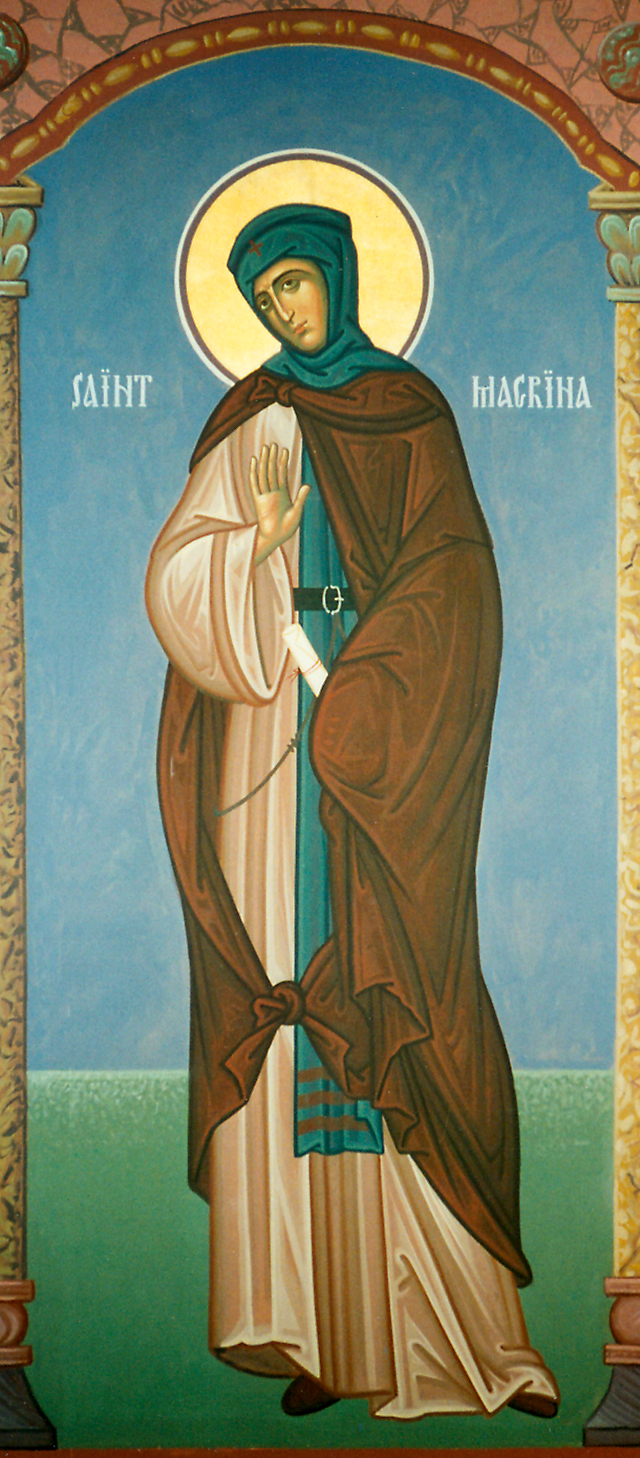


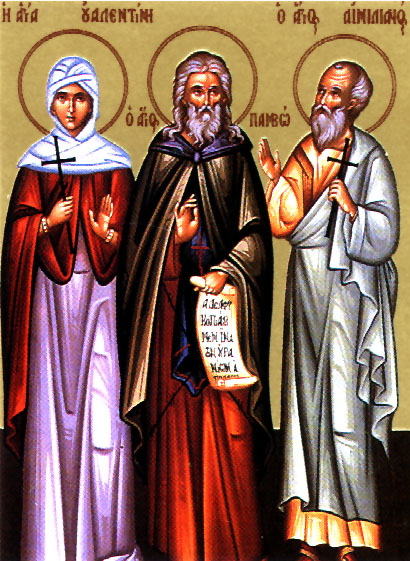
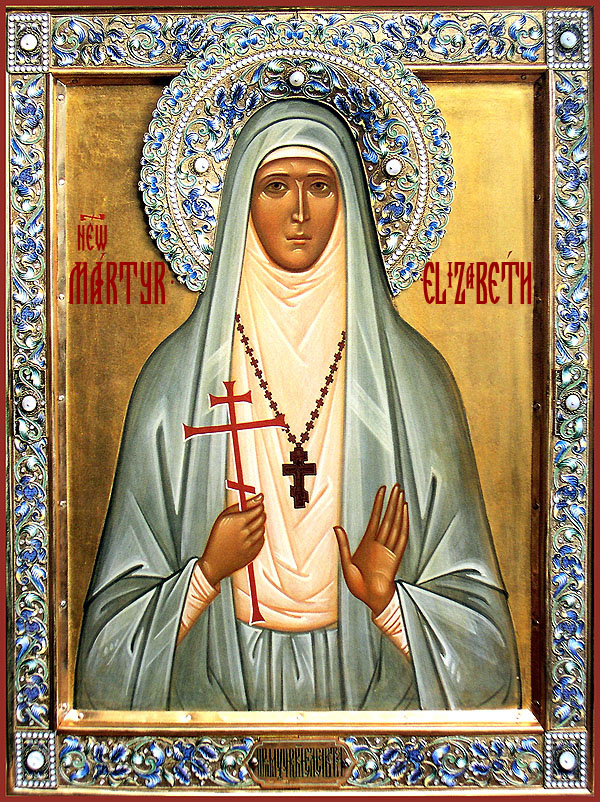


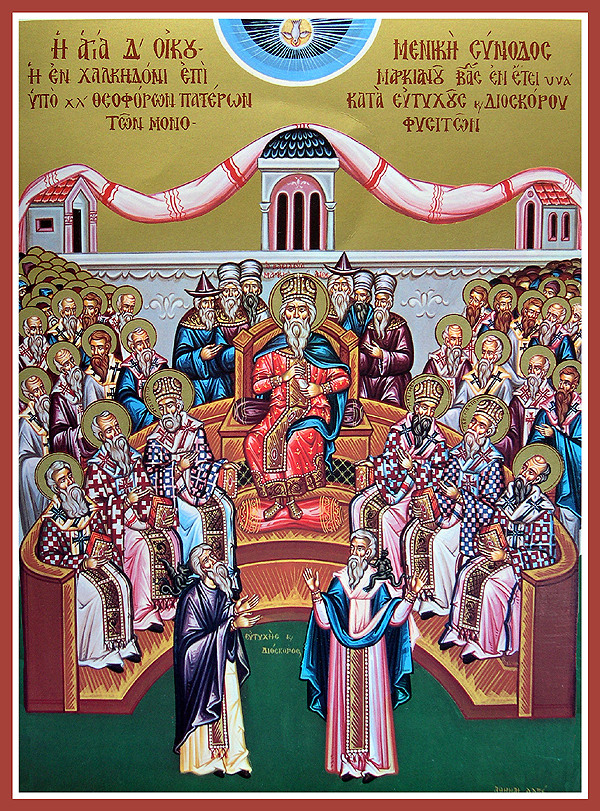


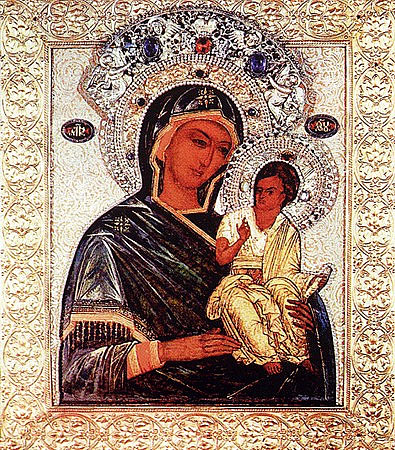


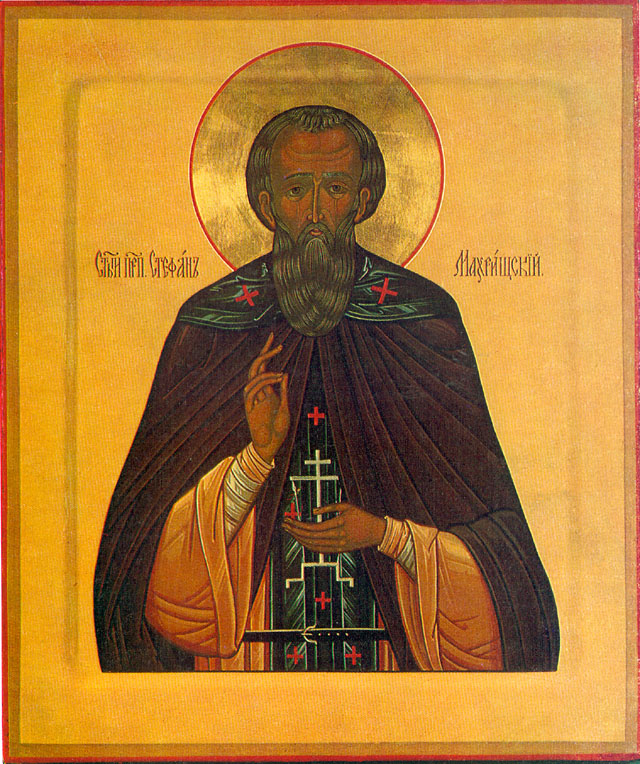


 Saint Peter Antiochian Orthodox Church
You must be logged in to post a comment.