
Here is the live stream for Great Vespers with Litia and Artoklasia – Sat 6/10/23 If you need, here are instructions for accessing this content from your phone, tablet, computer, or TV.
Monthly Archives: June 2023
Daily Readings for Saturday, June 10, 2023
THE APODOSIS OF HOLY PENTECOST
NO FAST
The Apodosis of Holy Pentecost, Alexander and Antonina the Martyrs, Timothy, Bishop of Proussa, Theophanes & Pansemne of Antioch, Our Holy Father Gregory, Bishop of Assos, The Holy Martyrs of China
ST. PAUL’S LETTER TO THE ROMANS 1:7-12
Brethren, grace to you and peace from God our Father and the Lord Jesus Christ. First, I thank my God through Jesus Christ for all of you, because your faith is proclaimed in all the world. For God is my witness, whom I serve with my spirit in the gospel of his Son, that without ceasing I mention you always in my prayers, asking that somehow by God’s will I may now at last succeed in coming to you. For I long to see you, that I may impart to you some spiritual gift to strengthen you, that is, that we may be mutually encouraged by each other’s faith, both yours and mine.
MATTHEW 5:42-48
The Lord said, "Give to him who begs from you, and do not refuse him who would borrow from you. You have heard that it was said, 'You shall love your neighbor and hate your enemy.' But I say to you, Love your enemies and pray for those who persecute you, so that you may be sons of your Father who is in heaven; for he makes his sun rise on the evil and on the good, and sends rain on the just and on the unjust. For if you love those who love you, what reward have you? Do not even the tax collectors do the same? And if you salute only your brethren, what more are you doing than others? Do not even the Gentiles do the same? You, therefore, must be perfect, as your heavenly Father is perfect.
Hieromartyr Timothy, Bishop of Prusa

The Hieromartyr Timothy, Bishop of Prusa (Bithynia), received from the Lord the gift of wonderworking because of his purity and sanctity of life. At Prusa he converted many pagans to the faith in Christ. The emperor Julian the Apostate (361-363), upon hearing about Saint Timothy, had him locked up in prison, but even there also the saint continued to preach the Gospel. Julian forbade him to teach about Jesus Christ, but the saint continued to spread the Christian Faith. Finally, the emperor gave orders to behead the saint. His holy relics were afterwards transferred to Constantinople.
Venerable Silvanus the Schemamonk, of the Kiev Far Caves
The Holy Schemamonk Silvanus of the Kiev Caves labored in asceticism in the Far Caves during the thirteenth and fourteenth centuries. One time, by the power of his prayer, he held fast to the spot robbers, who had come into the monastery garden, and for three days they were not able to move. When they repented, the monk then freed them. The memory of Saint Silvanus is celebrated also on August 28, and on the second Sunday of Great Lent.
Finding of the relics of Saint Basil, Bishop of Ryazan

The Uncovering and Transfer of the Holy Relics of Saint Basil, Bishop of Ryazan (July 3), was done by Archbishop Theodoret of Ryazan (1605-1617). It pleased Divine Providence during the Time of Troubles to glorify Saint Basil. The uncovering of his relics and their transfer into the Ryazan-Dormition (afterwards Nativity) church in the Kremlin of Ryazan-Pereslavl took place on June 10, 1609. This had been the cathedral church from the time of the Ryazan bishop Jonah II (1522-1547). The relics of Saint Basil were placed in a reliquary at the left kleros, beside the iconostasis. A troparion and kontakion were then composed. From that time the name of Saint Basil was “commemorated throughout all the churches of the Ryazan diocese.” People had recourse to him as to “their constant intercessor, a helper in sorrow and peril.” Under Archbishop Moses (1638-1651), a stone crypt was built over the relics of Saint Basil in 1638, and over it was put the Murom Icon of the Most Holy Theotokos “the Supplication of Basil.”
During this period services of thanksgiving to Saint Basil were served in the Ryazan churches. The first solemn celebration of the transfer of the relics of the saint took place on June 10, 1645 under Archbishop Moses. Especially fervent in veneration of the Ryazan hierarch was Archbishop Misael (1651-1655). By his command, in 1653, an inscription was made on a large silver vessel for the blessing of water, “This cup is from Ryazan-Pereslavl, in the cathedral church of the Dormition and the holy Passion-Bearers Boris and Gleb, and our Father among the saints Basil, Bishop of Ryazan, Wonderworker”.
In 1655 Saint Basil was depicted upon a silver cross together with Saint John the Forerunner and Saint Jonah, Metropolitan of Moscow. In 1712 during the time of Metropolitan Stephen Yavorsky, a stone chapel was constructed over the original burial place of Saint Basil, at the Borisoglebsk church , through the zeal of the clerk Nikḗtas Altukhov. In the years 1722-1723 under Tsar Peter I a formal investigation of the saint was conducted, after which Saint Basil was depicted upon an icon together with other Russian saints. Metropolitan Demetrius (Sechenov) of Novgorod, during his time as Bishop of Ryazan (1752-1757) compiled the service to Saint Basil, “having in mind first of all the writing of the troparion, kontakion and canon”.
Through his efforts a new crypt was constructed over the relics of Saint Basil, containing a reliquary with an icon of the saint. In 1782 the reliquary was elegantly adorned by the Archbishop of Ryazan and Zaraisk, Simon (Lagova) (1778-1804). In 1810 under the Ryazan and Zaraisk archbishop Theophylakt (Rusanov), a decree of the Holy Synod was promulgated concerning the celebration of Saint Basil on the Sunday of All Saints. On October 4, 1836 a new memorial was unveiled at the spot of the uncovering of the relics of Saint Basil. It was set up through the zeal of the churchwarden of the Borisoglebsk church, Simeon Panov. In 1871, Archbishop Alexis (Rzhanitsky, 1867-1876) served the Divine Liturgy at the Borisoglebsk church on the Feast day of Saint Basil, July 3, for the first time.
Under Archbishop Palladius (Raev, 1876-1882) the Holy Synod in 1881 appointed the following days for commemoration of Saint Basil: July 3, the day of his blessed repose, and June 10, the day of the transfer of his holy relics. Even today, Saint Basil is especially venerated in the Ryazan lands. In each temple of the Ryazan diocese there is his icon. In the majority of the churches, moreover, is found a mural of the saint sailing along on the water on his mantiya with the Murom Icon of the Mother of God in hand. In the cathedral church each Wednesday evening an Akathist is sung to him.
Saint John Maximovitch, Metropolitan of Tobolsk

Saint John, Metropolitan of Tobolsk and All Siberia, the Wonderwonder, in the world was named John Maximovitch, and he was born in the city of Nezhino in 1651. His father Maxim Vasil’evich and mother Euphrosynē had seven sons, of which John was the eldest. Upon his completion of the Kiev-Mogilyansk College (afterwards the Kiev Spiritual Academy), the future hierarch emerged from it as a teacher of the Latin language. Thereafter, in 1680, he accepted monasticism at the Kiev Caves monastery and became absorbed in inner spiritual activity. With the general consent of the brethren, the young monk was given the obedience of preaching. From this period he demonstrated an exceptional eloquence. He attached a special significance to inner religious knowledge. The chief theme of his life can be defined at a stroke as, “How ought man to conform his will with the will of God?” He developed this theme both in his preachings, and in his subsequent missionary service. In answer to it appeared the work, published towards the end of his long ascetic life, and entitled “Heliotropion” or “Sunflower,” or “Conforming the Human Will to the Divine Will.” Of the many works of the holy Fathers of the Orthodox Church, this work gives a very thorough answer to this great question of Christian soteriology.
In 1688 they sent him on a mission to Moscow. There he was appointed by Patriarch Joachim (1674-1690) as vicar of the Briansk-Svensk monastery, which was then under the Kiev Caves Lavra.
Saint Theodosius, Archbishop of Chernigov, in 1695 shortly before his own death (February 5) appointed Hieromonk John as Archimandrite of the Chernigov Eletsk monastery, and designated him as his successor as bishop. (Saint John revered the memory of Saint Theodosius, believing in the power of his prayerful intercession before the Lord. Because of his faith, he received healing from a serious illness through the prayers of Saint Theodosius. At the very height of the sickness, Saint Theodosius appeared to him and said, “Serve tomorrow, you will be well.” On the following day Saint John, completely well and to the amazement of everyone, served the Divine Liturgy. This miracle of Saint John’s healing marked the beginning of the veneration of Saint Theodosius as a grace-bearing saint of God.)
On January 10, 1697 Patriarch Adrian of Moscow and All Rus (1690-1700) consecrated Archimandrite John as Bishop of Chernigov, in the Dormition cathedral of the Moscow Kremlin.
Upon entering into the administration of the diocese, Bishop John created a Collegium near the archbishop’s cathedral, similar to the Kiev Academy, which the saint intended should serve as an “Athens at Chernigov,” a school of pious enlightenment.
In view of its high level of theological education and training, Saint John’s school received wide renown. In essence, this was the first seminary in Russia. Seminaries on the model of this one began opening in other dioceses of the Russian Church.
The saint also later opened a printing press, at which he and his successors published many works of spiritual and moral content.
The life of Saint John was illumined by lofty virtues, and especially humility. It is reflected also in his works, “The Moral-Didactic Reflector” (Chernigov, 1703 and 1707); “The Alphabet, with Rhymes Added” (1705); “The Virgin Mother of God” (1707); “The Theatre, or Moral-Didactic Disgrace” (1708); “Excursus on Psalm 50” (Chernigov, 1708); “Excursus on the “Our Father” and “The Eight Gospel Beatitudes” (1709); “The Royal Way of the Cross” (Chernigov, 1709); “Thoughts on God to the Benefit of Right-Belief” (1710 and 1711); “Synaxarion Commemoration on the Victory of Poltava” (1710); “The Pilgrim” (in manuscript); “Spiritual Thoughts” (Moscow, 1782).
At Chernigov in 1714 the saint also first published his chief work, written in the Latin language. It was a peculiarity of the graduates of the Kiev school was that they wrote their works in classical Latin. Professor I. A. Maximovich in 1888 translated the “Heliotropion” into the modern Russian language and published it at first in parts in the “Chernigov Diocesan Newsletter”, and later on in a separate book (Kiev, 1896). With his name is connected also “The Latin-Greek-Russian Lexicon.”
Saint John was known to have connections with Mount Athos. He had a special interest in the fate of Russian inhabitants on the Holy Mountain, and sent them substantial material aid during these difficult years. His archbishopal grammota to the Russian monastery of Saint Panteleimon has been preserved, and it testifies to his concern for those on Mount Athos.
On August 14, 1711, after his elevation to the dignity of metropolitan, Saint John arrived at the see of Tobolsk and All Siberia. The saint concerned himself constantly with the enlightening of his diocese. There he continued with his work, started at Chernigov. He improved the school which had been opened by his predecessor, the renowned missionary Metropolitan Philotheus (Leschinsky, + 1727), and he continued the apostolic preaching among the pagans of Siberia, converting many thousands to Christ. In 1714 Saint John set off to Peking to head a mission with Archimandrite Hilarion (Lezhaisky). At Tobolsk he again undertook publishing activity, using the printing press he set up at Chernigov. To this time belongs also the publication by Metropolitan John of the “Heliotropion” in the Slavonic-Russian language (1714), so that the Siberians could also understand it.
The chronicler describes the life of the saint in Siberia: “He was quiet and unpretentious, graciously considerate, sympathetic to the poor, and merciful.” He often helped people secretly, and sometimes in the garb of a simple monk, he would bring generous alms to the homes of the needy saying, “Accept this in the Name of Jesus Christ.” His home at Tobolsk was always open to all those in need of help or a word of comfort. Even on the day he died, June 10, 1715, after Divine Liturgy Saint John had set up a dining-hall at his home for the clergy and the impoverished, and he himself served at table. Later on, having taken his leave of everyone, the saint withdrew to his chambers. When the church bells rang for Vespers, he died at prayer on his knees. The saint was buried in the chapel of Saint John Chrysostom at the Tobolsk Dormition-Sophia cathedral.
Saint John has long been venerated in Siberia. In light of numerous miracles and the longstanding local veneration of Saint John, in 1916 the Church established the all-Russian celebration of the saint on June 10, the day of repose.
Saint John’s memory is fervently kept by Siberians and by all the believing Russian people. He at present rests in the Tobolsk cathedral of the Protection of the Mother of God. The service to him was republished, with the blessing of His Holiness Patriarch Alexis I, by Metropolitan Bartholomew (Gorodtsov) in 1947 at the city of Novosibirsk.
Martyr Alexander and Virgin Martyr Antonina at Constantinople

The Holy Martyrs Alexander and Antonina the Virgin. Saint Antonina was from the city of Krodamos (Asia Minor). She was arrested for being a Christian, and was brought before the governor Festus. He urged her to worship the pagan gods, promising to make her a priestess of the goddess Artemis. But the saint bravely confessed Christ, and she urged the governor to renounce the worship of demons in the form of idols. Festus gave orders to strike the saint on the face and lock her up in prison.
The martyr spent all her time at prayer, she ate and drank nothing, but then she heard the voice of God, “Antonina, fortify yourself with food and be brave, for I am with you.” When they led her before the governor again, the martyr continued to stand up for the Christian Faith and to denounce the pagans.
The governor decided to give the holy virgin over for defilement by soldiers, but the Lord inspired one of them, Saint Alexander, to save the holy virgin. He sought permission to go in to her on the pretext that he might be able to convince her to obey the governor’s will. Saint Alexander then suggested that she put on his military attire and flee. Saint Antonina was afraid, but the Lord ordered her to agree.
No one recognized her dressed as a soldier, and she walked out of prison. The soldiers sent by Festus found Saint Alexander alone in the cell. He would not respond to the questions of the governor, and so he was tortured and mercilessly beaten. Through the inspiration of the Lord Jesus Christ, Saint Antonina also came to stand before Festus.
Soldiers cut off their hands, then they smeared them with pitch and threw them into a pit where a fire was burning. When the fire went out, they threw snakes into the pit, so that Christians would not be able to gather up the bones of the martyrs. Returning home, Festus became numb, and was able neither to eat nor to drink. He died after seven days of terrible torment.
Sts Alexander and Antonina were martyred on May 3, 313. In the Prologue their memory is listed under June 10. The relics of the saints were transferred to Constantinople and placed in the Maximov monastery.
Saint Kanides the Monk of Cappadocia
Saint Kanides was born during the reign of Emperor Theodosios the Great (ca. 379). He was the son of godly parents, Theodotos and Theophano, who lived in Cappadocia. According to Tradition, the Saint’s mother did not eat any fatty foods during the nine months when she was pregnant; and even when the saint was still a child, she was careful about what she ate.
When he was yet a small child, he became attracted to the solitary life, and at the age of seven he went to a mountain where he lived in a cave, fasting and praying. It is said that he ate only one meal of uncooked vegetables per week. Because of the great dampness of this cave, all the hair of his head and his beard fell out.
After living an ascetical and righteous life, he reposed in peace at the age of seventy-three, in the year 460.
Venerable Theophanes and Saint Pansemne of Antioch
Saint Theophanes of Antioch was the son of pagans. At a youthful age he entered into marriage, but after three years his wife died. Saint Theophanes then came to believe in Christ and accepted Baptism. He gave up everything and began to live beyond the city in a manner of self-denial. He zealously taught the keeping of the commandments of God to everyone who came to him. He exhorted people to lead a pure and chaste life, and he condemned the debauchery of the people of Antioch. When Saint Theophanes learned about a certain profligate woman, Pansemne, who was caught up in the snares of the devil, he wanted to save her. Knowing how difficult it would be to fulfill such an intention, and conscious of his own infirmity, Saint Theophanes prayed and he besought the Lord to help him save the sinful woman.
Finally, the saint dressed up in fine clothing, took along much gold and then went to Pansemne. The monk gave her the gold and he asked her to forsake the dissolute life to marry him. Pansemne happily consented and gave him her word to become his wife. The sole condition which Saint Theophanes set for Pansemne was that she should accept Baptism. Because of the attractive marriage offer, Pansemne consented. In preparing her to accept Baptism, Saint Theophanes instructed her in the Christian Faith. He explained that the truth of God does not tolerate sin and corruption, but that the love of God is gracious to those that repent.
Having accepted Baptism, Saint Pansemne by the grace of God was completely reborn as a person. She distributed all the riches that she had acquired through profligacy, and she settled into a hut beside the cell of the monk and began to live the life of an ascetic. After 22 months she died on the very same day as the monk (+ 369).
Saint Bassian, Bishop of Lodi in Lombardy

Saint Bassian, Bishop of Lodi, was a friend of Saint Ambrose, Bishop of Milan (December 7). Saint Bassian’s father governed the Syracuse region (in Sicily) and he prepared his son to follow in his footsteps. He sent him to Rome to receive his education. While still in his childhood Saint Bassian had heard about the Christians and he wanted to learn more about them and become familiar with the Christian Faith. Gordian the priest taught him the essentials of the Christian Faith, and the youth was filled with the desire to accept Baptism. At the time of the performing of the Mystery Saint Bassian beheld an angel in the Baptismal font, holding the garment in which the newly-baptized would be clothed. The saint made bold to ask who he was and where he was from. The angel replied that he was sent from afar to help him fulfill his holy intent to know Christ. Then he became invisible.
Saint Bassian began to lead a strict life, eating little food, and spending his nights at prayer. His servants were astonished at such temperance, and they surmised that he had accepted Christianity. They reported about this to Saint Bassian’s father, who ordered him to return to Syracuse. Praying in the church of Saint John the Theologian, the saint received from the Apostle the command to leave Rome. And so Saint Bassian distributed all his substance to the poor and together with his faithful Christian servant, he set off to Ravenna to his kinsman, Bishop Ursus.
Bishop Ursus set him up at a solitary place outside the city near the church in honor of the Hieromartyr Apollinarius. Saint Bassian quickly advanced spiritually, and soon he was glorified by miracles. During this time a judge had been falsely accused and was sentenced to death by decapitation. Along the way to he prayerfully called out for help to Saint Bassian. When the executioner was already holding the sword over his head, the sword suddenly was knocked from his hands and flew off to the side. This occurred three times. The same thing happened with another executioner. When they reported this to the Emperor, the Emperor set the judge free. He then told how he had been saved through the intercession of Saint Bassian.
The people of the city, believing that the prayer of Saint Bassian was powerful before God, asked Bishop Ursus to ordain him to the priesthood. Upon the death of the bishop of the city of Lodium (Lodi in Liguria, Northern Italy), the priest Clement of the cathedral church had a revelation that Saint Bassian would be chosen Bishop of Lodium. Both Saint Ambrose, Bishop of Milan, and Bishop Ursus officiated at at his consecration.
Saint Bassian taught the people not only by word, but also by deed, providing his flock example of a virtuous life. At Lodi he built a beautiful church dedicated to the holy Apostles. Saint Bassian often exchanged letters with Saint Ambrose, and he was present at his blessed repose, and buried his body.
Saint Bassian died peacefully in the year 430, having served as archbishop for 35 years.
Synaxis of the Saints of Ryzan
Basil: Bishop +1295. April 12, May 21, July 3, Sunday of all Saints.
Boris: (Roman in Baptism), prince and passion-bearer. Commemorated on May 2 (translation of relics) and July 24 (+ 1015).
Constantine (Yaroslav Svyatoslavich of Murom), prince & wonderworker. Commemorated on May 21 (+ 1129).
Febronia (Euphrosynē in monasticism). June 25, 1228.
Gleb: (David in Baptism), prince and passion-bearer. Commemorated on May 2 (translation of relics), July 24, September 5 (martyrdom).
Metropolitan Jonah of Kiev & Moscow (+ 1461), Wonderworker. March 31, May 27 (translation of relics in 1472), June 15.
Juliana of Lazarevo January 2.
Michael of Murom, prince. He was the son of Constantine of Murom. Commemorated on May 21.
Peter (David in monasticism), prince & wonderworker. Commemorated on June 25 (+ 1228).
Roman Olegovich, prince & martyr. Commemorated on July 19 (+ 1270).
Theodore of Murom, prince and wonderworker, the son of Constantine of Murom. May 21.
Synaxis of the Saints of Siberia

Andrew, Igumen of Raphael (Tobolsk). He is commemorated on May 14 (+ 1820)
Anthony, Metropolitan of Tobolsk. He is commemorated on March 27. (+ 1740)
Arethas of Valaam & Verkhoturye. He is commemorated on May 15 (+ 1910)
Barlaam, Archbishop of Tobolsk. He is commemorated on December 27 (+ 1802)
Barlaam, desert-dweller of Chikoysk. He is commemorated on October 5 (+ 1846)
Basil of Mangazea. He is commemorated on March 22 (+1602), May 10 (Translation of his relics in 1670), May 23 (All Saints of Rostov and of Yaroslavl).
Cosmas of Verkhoturye. He is commemorated on November 1 (+ 1706)
Daniel of Achinsk. He is commemorated on April 15 (+ 1843)
Demetrius, Metropolitan of Rostov. He is commemorated on October 28 (+1709) and on September 21 (The uncovering of his relics in 1752)
Domna of Tomsk, Eldress, fool-for-Christ. She is commemorated on December 16 (+ 1872)
Gerasimus, Bishop of Astrakhan and Enotaeva. He is commemorated on June 24 (+1880)
Herman of Alaska. He is commemorated on December 13 (+ 1837) and on July 27/Aug. 9 (His Glorification in 1970)
Innocent, first Bishop of Irkutsk. He is commemorated on November 26 (+ 1731) and on February 9 (The uncovering of his relics in 1805)
Innocent, Metropolitan of Moscow, Enlightener of Alaska & Siberia. He is commemorated on March 31 (+ 1879), on Sept. 23 /Oct. 6 (His glorification in 1977), and on the Sunday before August 26 (All Saints of Moscow)
John, Metropolitan of Tobolsk, wonderworker. He is commemorated on June 10 (+ 1715)
John of Verkhoturye, fool-for-Christ. He is commemorated on April 16 (+ 1701)
Macarius of Altai. He is commemorated on May 16 (+ 1847)
Meletius, Bishop of Kharkov. He is commemorated on February 12 (+ 1840)
Meletius, Bishop of Ryazan. He is commemorated on January 14 (+ 1900)
Misael of Abalatsk, Hieromonk. He is commemorated on December 17 (+ 1797)
Nectarius, Archbishop of Tobolsk. (+ 1666)
Peter, Metropolitan of Tobolsk. He is commemorated on March 4 (+ 1820)
Philaret, Metropolitan of Kiev. He is commemorated on December 2 (+ 1857)
Philotheus, Metropoltian of Tobolsk. He is commemorated on May 31 (+ 1727)
Simeon, Metropolitan of Smolensk. He is commemorated on January 4 (+ 1699)
Simeon of Verkhoturye. He is commemorated on September 12 (The transfer of his relics in 1704), and on December 18 (His glorification in 1694)
Sinesius of Irkutsk. He is commemorated on May 10 (+ 1787)
Sophronius, Bishop & wonderworker of Smolensk. He is commemorated on March 30 (+ 1771) and on June 30 (His glorification in 1918)
Stephen of Omsk. He is commemorated on June 30 (+ 1876)
Theodore Kuzmich, Elder of Tomsk. He is commemorated on January 20 (+ 1864)
Saint Neaniskos the Martyr
Saint Neaniskos lived in the time of Maximius, the ruler of Alexandria. During the persecution of the Church by Emperor Diocletian (284-304), a female slave denounced the most wise and handsome athlete of Christ. The ruler tortured him for seven days in various ways, trying to make him deny Christ. When the tyrant saw that he was unable to do so, he ordered him to be put to death.
As he was led to the place of execution, he noticed the slave girl who betrayed him in the crowd that had followed him. Then Saint Neaniskos made signs for her to approach him, and when she came near he gave her his gold ring as a token of his gratitude; because by her complaint he would now draw near to Christ, Whom he had desired for so long, and he would inherit everlasting life. When they arrived at the place of execution, he prayed for a time, and then they beheaded him.
Daily Readings for Friday, June 09, 2023
1ST FRIDAY AFTER PENTECOST
NO FAST
1st Friday after Pentecost, Cyril, Patriarch of Alexandria, 3 Virgin-martyrs of Chios, 5 Nuns beheaded in Persia: Thecla, Mariamne, Martha, Mary, & Enmatha, Righteous Father Columba of Iona, Righteous Father Cyril of Belozersk
ST. PAUL’S LETTER TO THE ROMANS 2:14-28
Brethren, when Gentiles who have not the law do by nature what the law requires, they are a law to themselves, even though they do not have the law. They show that what the law requires is written on their hearts, while their conscience also bears witness and their conflicting thoughts accuse or perhaps excuse them on that day when, according to my gospel, God judges the secrets of men by Christ Jesus. But if you call yourself a Jew and rely upon the law and boast of your relation to God and know his will and approve what is excellent, because you are instructed in the law, and if you are sure that you are a guide to the blind, a light to those who are in darkness, a corrector of the foolish, a teacher of children, having in the law the embodiment of knowledge and truth – you then who teach others, will you not teach yourself? While you preach against stealing, do you steal? You who say that one must not commit adultery, do you commit adultery? You who abhor idols, do you rob temples? You who boast in the law, do you dishonor God by breaking the law? For, as it is written, “The name of God is blasphemed among the Gentiles because of you.” Circumcision indeed is of value if you obey the law; but if you break the law, your circumcision becomes uncircumcision. So, if a man who is uncircumcised keeps the precepts of the law, will not his uncircumcision be regarded as circumcision? Then those who are physically uncircumcised but keep the law will condemn you who have the written code and circumcision but break the law. For he is not a real Jew who is one outwardly, nor is true circumcision something external and physical.
MATTHEW 5:33-41
The Lord said, “You have heard that it was said to the men of old, ‘You shall not swear falsely, but shall perform to the Lord what you have sworn.’ But I say to you, Do not swear at all, either by heaven, for it is the throne of God, or by the earth, for it is his footstool, or by Jerusalem, for it is the city of the great King. And do not swear by your head, for you cannot make one hair white or black. Let what you say be simply ‘Yes’ or ‘No’; anything more than this comes from evil. You have heard that it was said, ‘An eye for an eye and a tooth for a tooth.’ But I say to you, Do not resist one who is evil. But if any one strikes you on the right cheek, turn to him the other also; and if any one would sue you and take your coat, let him have your cloak as well; and if any one forces you to go one mile, go with him two miles.”
Saint Cyril, Archbishop of Alexandria

Saint Cyril, Archbishop of Alexandria, a distinguished champion of Orthodoxy and a great teacher of the Church, came from an illustrious and pious Christian family. He studied the secular sciences, including philosophy, but most of all he strove to acquire knowledge of the Holy Scriptures and the truths of the Christian Faith. In his youth Cyril entered the monastery of Macarius in the Nitreia hills, where he stayed for six years. Theophilus (385-412), the Patriarch of Alexandria, ordained him as a deacon, numbered him among the clergy and entrusted him to preach.
Upon the death of Patriarch Theophilus, Cyril was unanimously chosen to the patriarchal throne of the Alexandrian Church. He led the struggle against the spread of the Novatian heresy in Alexandria, which taught that any Christian who had fallen away from the Church during a time of persecution, could not be received back into it.
Cyril, seeing the futility of admonishing the heretics, sought their expulsion from Alexandria. The Jews appeared a greater danger for the Church, repeatedly causing riots, accompanied by the brutal killing of Christians. The saint long contended with them. In order to wipe out the remnants of paganism, the saint cast out devils from an ancient pagan temple and built a church on the spot, and the relics of the Holy Unmercenaries Cyrus and John were transferred into it. A more difficult struggle awaited the saint with the emergence of the Nestorian heresy.
Nestorius, a presbyter of the Antiochian Church, was chosen in 428 to the see of Constantinople and there he was able to spread his heretical teaching against the dogma about the uncommingled union of two natures in the Person of the Lord Jesus Christ. Nestorius called the Mother of God not the Theotokos, but rather Christotokos or “Birth-giver of Christ,” implying that she gave birth not to God, but only to the man Christ. The holy Patriarch Cyril repeatedly wrote to Nestorius and pointed out his error, but Nestorius continued to persevere in it. Then the saint sent out epistles against Nestorianism to the clergy of Constantinople and to the holy emperor Theodosius the Younger (408-450), denouncing the heresy. Cyril wrote also to other Churches, to Pope Celestine and to the other Patriarchs, and even to monks of several monasteries, warning of the emergence of a dangerous heresy.
Nestorius started an open persecution against the Orthodox. In his presence one of his partisans, Bishop Dorotheus, pronounced an anathema against anyone who would call the Most Holy Virgin Mary the Theotokos.
Nestorius hated Cyril and brought out against him every kind of slander and fabrication, calling him a heretic. The saint continued to defend Orthodoxy with all his powers. The situation became so aggravated, that it became necessary to call an Ecumenical Council, which convened in the city of Ephesus in the year 431. At the Council 200 bishops arrived from all the Christian Churches. Nestorius, awaiting the arrival of Bishop John of Antioch and other Syrian bishops, did not agree to the opening of the Council. But the Fathers of the Council began the sessions with Cyril presiding. Having examined the teaching of Nestorius, the Council condemned him as a heretic. Nestorius did not submit to the Council, and Bishop John opened a “robber council”, which decreed Cyril a heretic. The unrest increased. By order of the emperor, Patriarch Cyril of Alexandria and Archbishop Memnon of Ephesus were locked in prison, and Nestorius was deposed.
Soon Saints Cyril and Memnon were freed, and the sessions of the Council continued. Nestorius, not submitting himself to the determinations of the Council, was deprived of priestly rank. By order of the emperor he was sent to the faraway place Sasim in the Libyan wilderness, where he died in grievous torments. His tongue, having blasphemed the Mother of God, was overtaken by punishment — in it there developed worms. Even Bishop John of Antioch and the remaining Syrian bishops signed the decrees of the Council of Ephesus.
Cyril guided the Alexandrian Church for 32 years, and towards the end of his life the flock was cleansed of heretics. Gently and cautiously Cyril approached anyone, who by their own simpleness and lack of knowledge, fell into false wisdom. There was a certain Elder, an ascetic of profound life, who incorrectly considered the Old Testament Priest Melchizedek to be the Son of God. Cyril prayed for the Lord to reveal to the Elder the correct way to view the righteous one. After three days the Elder came to Cyril and said that the Lord had revealed to him that Melchizedek was a mere man.
Cyril learned to overcome his prejudice against the memory of the great John Chrysostom (November 13). Theophilus, the Patriarch of Alexandria, and uncle of Cyril, was an antagonist of John, and presided in a council in judgment of him. Cyril thus found himself in a circle antagonistic to John Chrysostom, and involuntarily acquired a prejudice against him. Isidore of Pelusium (February 4) repeatedly wrote to Cyril and urged him to include the name of the great Father of the Church into the diptychs of the saints, but Cyril would not agree.
Once in a dream he saw a wondrous temple, in which the Mother of God was surrounded by a host of angels and saints, in whose number was John Chrysostom. When Cyril wanted to approach the All-Holy Lady and venerate her, John Chrysostom would not let him. The Theotokos asked John to forgive Cyril for having sinned against him through ignorance. Seeing that John hesitated, the Mother of God said, “Forgive him for my sake, since he has labored much for my honor, and has glorified me among the people calling me Theotokos.” John answered, “By your intercession, Lady, I do forgive him,” and then he embraced Cyril with love.
Cyril repented that he had maintained anger against the great saint of God. Having convened all the Egyptian bishops, he celebrated a solemn feast in honor of John Chrysostom.
Cyril died in the year 444, leaving behind many works. In particular, the following ought to be mentioned: commentaries On the Gospel of Luke, On the Gospel of John, On the Epistles of the Apostle Paul to the Corinthians and to the Hebrews; also an Apologia in Defense of Christianity against the Emperor Julian the Apostate (361-363). Of vast significance are his Five Books against Nestorius; a work on the Most Holy Trinity under the title Thesaurus, written against Arius and Eunomios. Also two dogmatic compositions on the Most Holy Trinity, distinguished by a precise exposition of the Orthodox teaching on the Procession of the Holy Spirit. Cyril wrote Against Anthropomorphism for several Egyptians, who through ignorance depicted God in human form. Among Cyril’s works are also the Discussions, among which is the moving and edifying Discourse on the Exodus of the Soul, inserted in the Slavonic “Following Psalter”.
Today we commemorate the repose of this great Father of the Church. He is also remembered on January 18, the date of his flight from Alexandria.
Venerable Cyril, Igoumen of White Lake

Saint Cyril, Igoumen of White Lake, (in the world Cosmas) was born in Moscow of pious parents. In his youth he was left an orphan and lived with his kinsman, the boyar (nobleman) Timothy Vasil’evich Vel’yaminov, in the surroundings of the court of the Great Prince Demetrius Donskoy (1363-1389). Secular life bored the youth. Knowing that Timothy would never consent to Cosmas to become a monk, Saint Stephen of Makhra (July 14), clothed him in the riasson and named him Cyril, leaving the rest to God's will.
Saint Stephen went to see Timothy, who was delighted by his visit. He met his guest at the door, asking for his blessing. The Saint replied, "Cyril, who entreats God for you, blesses you." The boyar asked who this Cyril was. Saint Stephen said, "Cosmas, your former kinsman, but now a monk laboring for the Lord, and praying for you."
At first, the boyar was very angry, and spoke harshly to Saint Stephen, who left the house. Timothy's wife reproached him for offending the Elder. The boyar repented and sent someone to ask him to return. Both men asked forgiveness of one another, and Timothy agreed to let Cosmas fulfill his heart's desire. Saint Stephen rejoiced, and told Cyril the good news. He gave away all his possessions to the poor, keeping nothing for himself.
Before returning to Makhra, Igoumen Stephen brought the new monk to Simonov Monastery, which had been established in a new place by Archimandrite Theodore (November 28), the nephew of Saint Sergius. He accepted Cyril into the Monastery and then tonsured him.
Cyril fulfilled his monastic obediences under the supervision of Elder Michael, who later became the Bishop of Smolensk. By night the Elder read the Psalter, and Cyril bowed and made prostrations, but at the first ringing of the bell, he went to the church for Matins.
He asked the Elder permission to partake of food every second or third day. The experienced Elder did not permit this, but blessed him instead to eat with the brethren, only not to the extent of satiety. Cyril fulfilled his obedience in the bakery: he carried water, chopped firewood, and distributed bread. When Saint Sergius of Radonezh came to the Simonov monastery to see his nephew Theodore, he would seek Cyril in the bakery and converse with him about spiritual matters before seeing anyone else.
After a while, Cyril was transferred from the bakery to the kitchen. He gazed into the burning fire and told himself, “Have patience, Cyril, so that by this fire you might save yourself from the eternal fire." Cyril toiled for nine years in the kitchen and God granted him such a tender heart that he was not able to eat the bread he baked without tears, and all the brethren regarded him not as a man, but as an Angel of God.
Fleeing the glory of man, he began to behave as a fool-for-Christ. As punishment for transgressing against propriety, the Superior of the monastery placed him on bread and water for forty days. Cyril underwent this punishment with joy. But the Saint could not conceal his spirituality, and the experienced Superior discovered that Cyril was not behaving as a fool out of pride, but out of humility. Against his will, they compelled him to accept ordination to the priesthood. When he was not serving in church, Cyril occupied himself with heavy work. When Theodore was made Archbishop of Rostov, the brethren chose Cyril as Archimandrite of the monastery in 1388.
Wealthy and important people began to visit the monk to hear his counsels. This disturbed the Saint's humble spirit. Despite the entreaties of the brethren, he would not remain as Igoumen, but secluded himself in his former cell. Even here he was disturbed by frequent visitors, and he went to the old Simonov Monastery of the Nativity of the Theotokos.
Saint Cyril’s soul yearned for solitude, and he asked the Mother of God to show him a place conducive for salvation. One night he was reading an Akathist in his cell before the Hodēgḗtria icon of the Mother of God, and had just reached the eighth Kontakion, “Seeing the strange Nativity, let us become strangers to the world and transport our minds to Heaven.” Then he heard a voice say, “Go to White Lake (Belozersk), where I have prepared a place for you.”
There at the desolate and sparsely populated White Lake, he found the place which he had seen in the vision. Saint Cyril and his companion Saint Therapon of White Lake and Mozhaisk (May 27), set up a cross and dug a cell in the ground near Mount Myaura at Siversk Lake.
Saint Therapon soon went to another place, and Saint Cyril remained where he was. However, he was not able to live in his underground cell for even one year.
Once Cyril, troubled by a strange dream, lay down to sleep under a pine tree, but just as he closed his eyes, he heard a voice cry, “Run, Cyril!” Cyril barely managed to jump away as the pine tree came crashing down. From this pine tree, the ascetic fashioned a cross.
Another time, Cyril nearly perished from flames and smoke when he was clearing the forest, but God preserved His Saint. A certain peasant attempted to burn down the monk's cell, but try as he might, he did not succeed. Then he repented with tears, and confessed his sin to Cyril, who tonsured him into monasticism.
Two monks whom Cyril loved, Zebediah and Dionysios, came to him from Simonov monastery, and then Nathanael, who afterward was steward of the monastery. Many began to come to him seeking to be tonsured. The holy Elder perceived that his time of silence was ended. In the year 1397 he constructed a temple in honor of the Dormition of the Mother of God.
When the number of brethren had multiplied, the monk gave the monastery a Rule of cenobitic life, which he sanctified by the example of his own life. Thus, no one could talk in church, and no one could leave before the end of services. They also came to venerate the Gospel according to seniority. At meals they sat at their own place, and there was silence. From the trapeza, each went quietly to his own cell. No one was able to receive either letters or gifts without having shown them to Cyril, nor did anyone write a letter without his blessing.
Money was kept in the monastery treasury, and no one had any personal possessions. They went to the trapeza even to drink water. The cells were not locked, and nothing was kept in them but icons and books. In the final years of Saint Cyril’s life, the boyar Roman decided to give the monastery a village and sent the deed. Cyril knew that if the monastery came to possess a village, the brethren would become concerned about the land and settlements would disrupt the monastic solitude, so he refused the gift.
The Lord rewarded His Saint with the gift of clairvoyance and healing. A certain Theodore desired to enter the monastery, but the Enemy of mankind instilled in him such hatred for Cyril that he could not look at him, nor listen to the sound of his voice. He approached Cyril’s cell and, seeing his grey hair, he was not able to say a word from shame. The Saint said to him, “Don’t be sad, my brother, for all are mistaken about me. You alone know the truth and my unworthiness. I am actually a worthless sinner.” Then Cyril blessed Theodore, promising that he would not be troubled by such thoughts in the future. From that time Theodore lived at peace in the monastery.
Once, there was no wine for the Divine Liturgy, and the priest told the Saint about this. Cyril ordered a monk to bring him the empty wine vessel, and when he opened it, it was full of wine. During a time of famine Cyril distributed bread to all the needy and he did not stop, even though the normal reserves hardly sufficed for the brethren. Despite this, the more that bread was distributed, the more it increased. The monks then realized that God would provide for their needs, through the prayers of Saint Cyril.
The Saint calmed a storm on the lake which threatened the fishermen. He predicted that none of the brethren would die until after his death, despite a plague that would rage. Then many would follow after him.
The Saint served his final Divine Liturgy on the day of Pentecost. After giving final instructions to the brethren to preserve love among themselves,1 Saint Cyril reposed in the ninetieth year of his life on June 9, 1427 on the Feast day of his namesake Saint Cyril of Alexandria. Within a year after the Saint's death, more than thirty of the fifty-three brethren reposed. He often appeared to the survivors in dreams, offering advice and guidance.
Saint Cyril loved spiritual enlightenment and he instilled this love in his disciples. In 1635 there were more than two thousand books in the monastery, including sixteen “of the Wonderworker Cyril.” Three of his letters to Russian princes survive down to our time. They are remarkable specimens of his spiritual instruction, love, peace, and consolation.
The veneration of the holy ascetic began not later than 1447-1448. The Life of Saint Cyril was commissioned by Metropolitan Theodosios and Great Prince Basil the Dark. It was written by the Athonite monk Pakhomios the Logothete, who dwelt at the Cyrilov monastery in 1462 and met with many eyewitnesses and disciples of Saint Cyril. He learned the most from Martinian (January 12), who had lived with the Saint from his youth.
1 In the Icon of Saint Cyril, his words appear on the scroll in his hand: "Preserve love among yourselves."
Venerable Alexander, Abbot of Kushta, Vologda

Saint Alexander, Hegoumen of Kushta Monastery in Vologda, was born about the year 1371, and his name in the world was Alexei. He was tonsured at the Savior-Stone (Spaso-Kamen) monastery by Hegoumen Dionysios of the Holy Mountain, who brought the Athonite Rule to the monastery. Later, he became the Archbishop of Rostov. Here Saint Alexander went through all the phases of obedience and strict fasting, and was ordained as a Hieromonk. He was constantly at work or at prayer. The brethren looked upon him as upon an angel of God, and this troubled Saint Alexander. He left the monastery secretly by night and came to the River Syazhem, where there was a thick forest and lake. Here he built a cell and lived his life in prayer and austere abstinence. Little by little, people started coming to him.
Saint Alexander went from this place to the shore of Lake Kuben, at the mouth of the River Kushta. At that time Saint Euthymios (April 11) was living there. Saint Alexander offered to exchange cells with him, and Saint Euthymios agreed to this. When they parted, he gave Saint Alexander his cross as a blessing. The quiet wilderness was very dear to Saint Alexander. Going to the lake, he immersed the cross in the water and prayed to God, asking that he might gather in this place those who were zealous for the way of the Cross. After some time, a certain Elder came to Saint Alexander, with whom he dwelt for five years. When a third brother arrived, Saint Alexander decided to build a church in honor of the Dormition of the Most Holy Theotokos. The saint journeyed to Rostov to see his former Hegoumen, Archbishop Dionysios (1418-1425), who blessed the construction of the temple.
One day, Tatars came when Prince Demetrios of Zaozersk was away, and five of them galloped up to the Kushta monastery. Saint Alexander met them calmly and he blessed them with the cross. The Tatars fell down as if they were dead; and they lay senseless for several hours, after which Saint Alexander roused them from their torpor in the name of the Life-creating Trinity.
When Prince Demetrios reposed, his widow, Princess Maria, who had great respect for Saint Alexander, offered a village for the support of the monastery in remembrance of her husband. Once she came to the monastery and went into the church, where Saint Alexander was reading the Psalter, while insects attacked his bare chest. The monk was distressed by her visit and said, “It is not necessary, O Princess, for you to observe our misery.” The princess humbly asked for pardon. The monk blessed her, but said, “Feed your poverty at home.” When she reached her home, the princess fell sick and asked him to pray for the recovery of her health. Saint Alexander foresaw her end and said, “Let her prepare for that life.” Princess Maria died twenty days later.
Wheat was gathered on the floor of the monastery; and a certain peasant decided to steal a sack, but he was not able to lift it. The saint happened upon him and said, “My son, it is in vain that you try to lift what is beyond your strength.” The astounded thief threw himself at the feet of the venerable one, asking his forgiveness, but Saint Alexander ordered him to add more wheat to the sack. After admonishing him not to steal from others in future, he blessed him to take the sack and to go with God. The peasant easily carried the burden which was blessed, and thanked the generous Elder.
Sensing that the time of his death was near, Saint Alexander said to those dwelling with him, “I am growing weak, but I urge you to endure in this place, preserving humility and mutual love.” On Sunday he served the Divine Liturgy, and partook of the Holy Mysteries. Then he prayed on his knees for himself and for his monastery, and at age of sixty-eight, he peacefully surrendered his soul to the Lord on June 9, 1439.
According to Saint Alexander’s last instructions in his will, his body was placed at the south side of the altar. A year afterward, a Rowan-berry tree grew up over his grave. Once, on the Feast of the Dormition of the Most Holy Theotokos, a peasant child broke off a branch from this tree and suddenly his hand began to hurt. His parents prayed and brought their son to the saint’s grave, and he was healed. From that time people began to pick berries from this tree for healing purposes. His disciples built a heated church in honor of Saint Nicholas over the saint’s grave and it was dedicated on the anniversary of his repose. Many of the sick who were brought to the church said that they saw Saint Alexander and Saint Nicholas praying together, or censing the temple. Many of the sick received healing at Saint Alexander’s grave.
Five Nuns beheaded in Persia: Martyrs Thecla, Mariamne, Martha, Mary, and Ennatha

During the time of the Persian king Saphor II (ca. 330 A.D.), a priest by the name of Paul was living near the village of Aza. He was wealthy and a lover of money, and he had with him five women who had consecrated their virginity to God. Saints Thekla, Mariamne, Martha, Maria, and Ennatha were adorned with the splendor of virtues. They were wealthy, and they entrusted their Spiritual Father with all their money. The greedy man prayed and chanted the Psalms with them, but he kept their money for himself.
When they learned that the priest Paul was rich, the Persians threatened to kill him and the five virgins if he did not deny Christ and give them some of his treasure. Since he preferred earthly riches, he accepted the Persian religion. The holy virgins said that they would rather suffer torture and death than deny Christ. Paul beheaded the women with a sword when they refused to follow his treacherous example. He did not enjoy his wealth for very long, however. The Persians drowned him the following evening in order to obtain all of the money. The holy virgins received their incorruptible crowns of glory from Christ in the year 346.
The five Virgin Martyrs are also commemorated on September 26.
Saint Columba of Iona, Enlightener of Scotland

Saint Columba (or Colum Cille, "the dove of the Church") was of noble birth, a member of the powerful Ui Néill clan, which traced its descent to Niall of the Nine Hostages, who died around the year 450. His parents were Fedelmid mac Ferguso and Eithne. Although it is difficult to determine the date of Saint Columba's birth with any degree of certainty, it is believed that he was born in County Donegal on December 7, 521.
His parents may have been pagans, and named their son Crimthann. He was brought up by a foster-father, according to the custom of that time, a priest named Cruithnechan. We do not know what happened in Saint Columba's life from the time he completed his studies until his departure from Ireland in 563. He may have been baptized with the name Colum, which later became Columba (dove). Some sources state that after being ordained as a priest, Saint Columba preached in Ireland, and established monasteries at Derry and Durrow. It is said that he also founded one hundred churches.
Adomnan says (I: 7) that the Saint left Ireland two years after the Battle of Cúl Dreimhne (561), supposedly for causing the deaths of so many men. Adomnan does not explain why the Saint blamed himself. However, in a different Life of Saint Columba it is stated that there was a dispute between Saints Columba and Finnian of Moville (September 10), concerning the ownership of a copy of Saint Jerome’s Latin Vulgate version of the Bible (some sources say it was a Psalter). The dispute involved the ownership of the copy. Saint Finnian claimed that the copy was his, since he owned the original manuscript. Saint Columba maintained that the copy was his, since he had copied the original. The High King Diarmait mac Cerbaill, who was a pagan, decided in favor of Finnian. He said, "To every cow belongs her calf, therefore to every book belongs its copy."
The Saint is said to have been so angry that he stirred up his relatives of the Uí Néill clan to make war against the High King. The Battle of Cúl Dreimhne led to the loss of many Christian lives. In his remorse, Saint Columba decided that he must gain as many souls for Christ as had been slain on the battlefield.
Adomnan also mentions the Synod of Teltown in County Meath (III:3) which met in 562, one year after the battle, and one year before Saint Columba left Ireland. He declares that "Saint Columba was excommunicated for some trivial and quite excusable offenses by a Synod which, as eventually became known, had acted wrongly. The Saint himself came to the assembly that had been convoked against him."
When Saint Brendan of Birr (November 29) saw Saint Columba approaching at a distance, after the Synod had excommunicated him in absentia, he ran out to meet him, kissing him with reverence. When the members of the Synod saw this they criticized him, saying, "Why did you get up to kiss a man who has been excommunicated?” Saint Brendan replied, “If you had seen what the Lord has deigned to reveal to me today, concerning this chosen one whom you refuse to honor, you would never have excommunicated him. For God does not excommunicate in accordance with your erroneous judgement, but instead, He glorifies him more and more."
Then they became incensed and said that they should like to know just how God had glorified Saint Columba, whom they had excommunicated, as they asserted, with good reason. Saint Brendan replied, "I saw a very bright column of light going before the man of God, whom you despise, and holy angels as his companions traveling over the plain." After hearing this, the Synod dropped the charges and honored Saint Columba with much reverence.
In 563, Saint Columba left Ireland, saying that he wished to be a pilgrim for Christ. Taking twelve companions with him, the Saint settled on the island of Iona, off the southwestern coast of Mull. He prayed that God would permit him to live there for thirty years more, and then call him to the heavenly Kingdom. It is not known whether the island was inhabited when they arrived, but there is archaeological evidence of prehistoric occupation.
After building cells and a chapel, the monks began a period of missionary activity, proclaiming the Gospel, making converts, and founding churches. They sailed to other islands, and even went inland in their labors to bring people to Christ. As a result, Iona became an important center of Christianity for northern England and Scotland. By 574, Abbot Columba had at least one dependency on the island of Hinba. There were others on the various islands, all under the authority of Iona. Saint Columba also maintained ties with his churches in Ireland and people in other places.
There is an account of Saint Columba anointing Aedan mac Gabrain in 574 to succeed King Conall as the King of Dalriada, just as King Saul and King David had been anointed by Samuel. Some regard this as the first time in European history that Christian ritual was used to consecrate a King. There is much debate on the significance of this event, although Saint Columba did have a special relationship with the ruling dynasty of Dalriada.
Adomnan has not written a Saint's Life according to the traditional pattern. Rather than presenting a continuous narrative from birth to death, he describes Saint Columba's prophetic revelations in Book I; his miracles of power in Book II; and his visions of angels in Book III.
In Book III:22, Adomnan relates how Saint Columba beheld the angels who had come to receive his soul in the thirtieth year after his arrival on Iona. Suddenly he raised his eyes to Heaven, and he was filled with great joy and gladness. Then, a moment later, his joy had turned to sorrow. Two monks stood outside his hut when this occurred, and they asked him about it. He told them to go in peace, and not to ask him to tell them the cause of his gladness, nor of his sorrow. They fell to the ground with profuse tears and begged him to reveal what he had been told.
Seeing their distress, the holy Elder said, "Because I love you, I do not wish to grieve you. First, you must promise not to betray to anyone, as long as I am alive, the mystery that you seek to know."
After they had given their word, Saint Columba said that day was exactly thirty years since he had begun to live "in pilgrimage in Britain." He had asked God to call him to Heaven at the end of thirty years. That is why he seemed so glad. He had seen the angels who had been sent to separate his soul from his body, but now they seemed to be delayed. They were waiting on a rock across the Sound from Iona. It was as if they wished to accomplish their task, but they were not permitted to come any closer. Soon they would return to Heaven. Even though he desired to go with them, the prayers of many churches had caused this change in plans. "Even though I do not wish it, I must remain in this flesh four years longer. This sorrowful delay is the cause of my great distress today."
Then the holy Abbot predicted that at the end of four years, he would die suddenly, and without pain, when the angels would come for him again, and he would depart to the Lord. That is precisely what happened.
In April of 597, on the radiant Feast of Christ's Resurrection, Saint Columba was longing to depart from this life in order to be with Him. God would have granted his wish right then, but he did not want to turn the paschal joy of his disciples into sorrow, and so his death was delayed for the sake of the monks.
In May, as the brethren were working on the western side of Iona, Saint Columba was taken there in a cart, for he was then an old man of seventy-five. He began to speak to them of his approaching death, so that they would be prepared. When he told them how his death had been merely postponed in April, they became very sorrowful. The Saint tried to console them as much as he could. Then he looked toward the east and blessed the island, and those who dwelt there. A few days later, during the Sunday liturgy, Saint Columba looked up and his face became suffused with joy and exultation. Only he could see the angel hovering over them inside the church. Then the angel passed right through the roof of the church, leaving no trace of his passing.
When the monks noticed the Elder looking upward they asked him why he seemed so happy. He told them that an angel had been sent to recover a loan, and had been watching and blessing them during the service.
None of the monks understood what sort of loan the angel had been sent to recover, but Saint Columba was referring to his soul, which the angel would take sometime between the following Saturday evening and Sunday morning.
At the end of the week, on Saturday, Saint Columba and his servant Diarmait went to bless the nearest barn. The venerable Elder said that he was glad to know that the monks would have enough bread to last for a year, in case he had to "go away somewhere." Diarmait was saddened by his words and said, "Father, this year you have made us sad too often by speaking frequently about your passing."
Saint Columba said that he would speak more plainly about his departure if Diarmait promised not to tell anyone until after he had reposed. When Diarmait had given his word, the Saint explained that the Sabbath is a day of rest, and on this Saturday he would go the way of his fathers. "I shall go to the Lord when He calls me, in the middle of this night. The Lord Himself has revealed this to me."
At these words, Diarmait began to weep. Then they started back to the monastery, but Saint Columba had to stop and rest when they reached the halfway point. Later, a cross was set up on that spot and set in a millstone. Then a white horse, which used to carry pails of milk to the monastery, came and placed its head on the Saint's bosom. Tears fell from its eyes, and the horse mourned like a person. Diarmait would have driven the horse away, but the Elder stopped him saying, "Leave him alone! Let him who loves us pour out the tears of bitterest mourning here at my breast. Behold, though you have a man's rational soul, you would not know of my departure if I hadn't told you just now. According to His will, the Creator has revealed to this brute and unreasoning animal that his master is going away." Then he blessed the horse as it turned away.
When he returned to the monastery, Saint Columba went to his hut to copy some Psalms. He copied as far as Psalm 33/34:10: "The rich have become poor and hungry; but those who seek the Lord diligently shall not want any good thing." Then he said, "Here at the end of the page I must stop. Let Baithene write what follows."
When he finished writing, Saint Columba went to church for Vespers, and then he returned to his lodging and rested on his bed. Instead of a bed of straw, he always slept upon bare rock, with a stone for his pillow. Then he gave his last instructions to Diarmait, commanding the brethren to love one another, and to follow the example of the Holy Fathers. He continued, "God, Who strengthens the good, will help you, and I, dwelling with Him, shall intercede for you."
When the bell rang for the Midnight Office, Saint Columba hastened to the church before the others, and then he knelt before the altar in prayer. Diarmait, following at a distance, saw the church filled with angelic light around the Saint. As he reached the door, the light vanished, although some of the brethren had seen it as well. Diarmait entered the church and called out in a tearful voice, "Father, where are you?"
The lamps carried by the brethren had not yet been brought into the church. Feeling his way in the dark, Diarmait found the Elder lying before the altar. Raising him a little, he sat by his side and cradled his head on his bosom. The other monks related that before Saint Cuthbert's soul had left his body, he opened his eyes and looked about with joy and gladness upon his face, for he saw angels coming to meet him. Diarmait held up the Saint's right hand to bless the monks. The venerable Father, as much as he could, also moved his hand to bless the brethren, though he was unable to speak. Then at once his soul departed.
Two men had separate visions of the Saint's soul being carried to Heaven by angels. Lugaid mac Tailchain, "a just man and a sage," told a man named Fergnae of his vision. Although Lugaid had never been to Iona, he saw it, in the Spirit, bathed in a bright light. He beheld the radiance of countless angels who had been sent to carry the Saint's soul to Heaven, accompanied by the sweetest songs of the angelic hosts.
Another soldier of Christ, Ernene moccu Fir Roide had a vision at the same hour. When he was an old man, he related it to Adomnan, who was then a young man. Ernene and some other men were fishing in the River Finn, when suddenly, the entire sky lit up. Looking toward the east, they saw a fiery pillar rising upwards and lighting the area like the summer sun at Noon. When the pillar passed out of sight, the darkness returned once more.
After Saint Columba's blessed repose, the Matins hymns were chanted, and his body was carried from the church to his lodging. For three days and nights, the funeral rites were performed in a manner befitting one of his honor and rank. His holy relics were wrapped in linen and placed in the grave with due reverence, from which he shall rise in bright, and everlasting light.
The following miracle is mentioned in Book I:1. In the year 634, at Heavenfield in Northumbria, on the eve of a battle, Saint Columba appeared to Saint Oswald (August 5), revealing his name to the King. He promised to help Saint Oswald, ordering him to march on his enemy Cadwallon that night. He said that the enemy would be put to flight, and that Cadwallon would be delivered into King Oswald's hands. Abbot Failbe, Adomnan's predecessor, told him of this vision, swearing that he had the story from the lips of Saint Oswald himself.
Saint John of Shavta-Gelati
The great Georgian hymnographer, philosopher, and orator Saint John of Shavta labored in the 12th and 13th centuries, during the reign of the holy queen Tamar. Few details of his life have been preserved, but we know that he received his education at Gelati Academy, where he studied theology, ancient and Arabic history, philosophy, and literature. He was later tonsured a monk and labored at Vardzia Monastery.
When the Georgian army under the command of Queen Tamar’s husband, Davit Soslan, entered into battle [The Battle of Basiani (ca. 1203)] with the sultan Rukn al-Din, Queen Tamar journeyed to Odzrkhe Monastery to pray for help. Catholicos Tevdore of Kartli and many hierarchs and monastics accompanied her there. Among them, Saint John of Shavta stood out as a wise theologian and philosopher and a brilliant hymnographer.
During the Liturgy at Odzrkhe Monastery a miracle occurred: endowed by God with the gift of prophecy, Saint Eulogius the Fool for-Christ fell to his knees, lifted his hands to the heavens and cried out: “Glory to God! Almighty Christ!…Do not fear the Persians, but rather depart in peace, for the mercy of God has descended upon the house of Tamar!”
Eulogius’s words were clearly a divine revelation. Saint John of Shavta turned to Queen Tamar, rejoicing, “Your Highness! The Almighty has made known to us our victory in the war from the lips of a fool-for-Christ!” Eulogius confided his secret to Saint John: disguised as a fool, he had been concealing his God-given gift. But now it seemed that the gift would become apparent to all, so Eulogius quickly disappeared out of sight to escape the people’s attention.
Saint John of Shavta composed his “Hymns to the Theotokos of Vardzia” in thanksgiving for Georgia’s victory in the Battle of Basiani. He is also recognized as the composer of “Abdul-Messiah,” (Abdul-Messiah: servant of Christ) a famous ode to the holy queen Tamar.
Our Holy Father John of Shavta lived to an advanced age and was canonized soon after his repose.
Saint David Gareji, and Venerable Lucian, spiritual son of Saint David

Saint David of Gareji was Syrian by birth. The future ascetic became a disciple of Saint John of Zedazeni and journeyed with him to Georgia. Saint David and his spiritual son Lucian settled on a mountain above Tbilisi, the capital of Kartli.
At that time Kartli was constantly under threat of the Persian fire-worshippers. Saint David would spend entire days in prayer, beseeching the Lord for forgiveness of the sins of those who dwelt in the city. When he was finished praying for the day, he would stand on the mountain and bless the whole city. Once a week Saints David and Lucian would go down into the city to preach. A church dedicated to Saint David was later built on the mountain where he labored.
Saint David’s authority and popularity alarmed the fire-worshippers, and they accused him of adultery, in an attempt to discredit him in the eyes of the people. As a “witness” they summoned a certain expectant prostitute, who accused him of being the child’s father. Hoping in God, the holy father touched his staff to the prostitute’s womb and ordered the unborn child to declare the truth. From out of the womb the infant uttered the name of his true father.
Outraged at this slander, the bystanders savagely stoned the woman to death. Saint David pleaded with them to stop, but he was unable to placate the furious crowd. Deeply disturbed by these events, Saint David departed the region with his disciple Lucian.
The holy fathers settled in a small cave in the wilderness and began to spend all their time in prayer. They ate nothing but herbs and the bark of trees. When the herbs withered from the summer heat, the Lord sent them deer. Lucian milked them and brought the milk to Saint David, and when the elder made the sign of the Cross over the milk it was miraculously transformed into cheese.
Shaken by the holy father’s miracle, Lucian told him, “Even if my body rots and wastes away from hunger and thirst, I will not permit myself to fret over the things of this temporal life.”
The fathers kept a strict fast on Wednesdays and Fridays—they ate nothing, and even the deer did not come to them on those days.
A frightful serpent inhabited a cave not far from where they lived and attacked all the animals around it. But at Saint David’s command the serpent deserted that place.
Once local hunters were tracking the fathers’ deer, and they caught sight of Lucian milking them as they stood there quietly, as though they were sheep. The hunters paid great respect to Saint David and, having returned to their homes, reported what they had seen.
Soon the Gareji wilderness filled with people who longed to draw nearer to Christ. A monastery was founded there, and for centuries it stood fast as a center and cornerstone of faith and learning in Georgia.
After some time Saint David set off on a pilgrimage to Jerusalem. He entrusted Lucian to fulfill his responsibilities at the monastery and took some of the other brothers with him. When the pilgrims were approaching the place called the “Ridge of Grace,” from which the holy city of Jerusalem becomes visible, Saint David fell to his knees and glorified God with tears. Judging himself unworthy to follow in the footsteps of Jesus Christ, he was satisfied to gaze upon the city from afar.
Then he stood at the city gates and prayed fervently while his companions entered the Holy City and venerated the holy places. Returning, Saint David took with him three stones from the “Ridge of Grace.” That night an angel appeared to the patriarch of Jerusalem and informed him that a certain pious man named David, who was visiting from afar, had taken with him all the holiness of Jerusalem.
The angel proceeded to tell him that the venerable one had marched through the city of Nablus, clothed in tatters and bearing on his shoulders an old sack in which he carried the three holy stones. The patriarch sent messengers after the stranger with a request that he return two of the stones and take only one for himself. Saint David returned the two stones, but he declined the patriarch’s invitation to visit him. He took the third stone back with him to the monastery, and to this day it has been full of the grace of miraculous healing.
After Saint David brought the miraculous stone from Jerusalem, the number of brothers at the monastery doubled. The venerable father ministered to all of them and encouraged them. He also visited the cells of the elder hermits to offer his solace. In accordance with his will, a monastery in the name of Saint John the Baptist was founded in the place called “Mravalmta” (the Rolling Mountains).
The Lord God informed Saint David of his imminent departure to the Kingdom of Heaven. Then he gathered the fathers of the wilderness and instructed them for the last time not to fall into confusion, but to be firm and ceaselessly entreat the Lord for the salvation of their souls.
He received Holy Communion, lifted up his hands to the Lord, and gave up his spirit.
Saint David’s holy relics have worked many miracles: approaching them, those blind from birth have received their sight. To this day, believers have been healed of every spiritual and bodily affliction at his grave.
6/11 announcements
June 11, 2023
First Sunday after Pentecost
All Saints Sunday
The Church commemorates and remembers all of its saints at three times during the year; in anticipation of Christmas, at the beginning of Lent, and immediately after Pentecost. On all three days we are reminded of the unified body of God’s people and of the holiness they have achieved and for which we strive. These two things are not abnormal and removed from us; they are truth and reality. On this day we are especially reminded of the strength of the saints and their victories, and we move from the day of Pentecost, the empowering presence of the Holy Spirit, to join God’s people in our victorious procession, through purifying trial and sacrifice, to the Day of the Lord.
Hebrews 11:33-12:2: Brethren, all the saints through faith subdued kingdoms, worked righteousness, obtained promises, stopped the mouths of lions, quenched the power of fire, escaped the edge of the sword, from weakness were made strong, became mighty in war, and turned to flight armies of the aliens. Women received their dead by resurrection, and others were tortured, not accepting their deliverance, that they might obtain a better resurrection. And others suffered mocking and scourging, and even chains and imprisonment. They were stoned, they were sawn asunder, they were tempted, they were slain with the sword; they went about in skins of sheep and goats, being destitute, afflicted, tormented (of whom the world was not worthy), wandering in deserts and mountains, and in dens and caves of the earth. And all these, having obtained a witness through their faith, did not receive the promise, since God had foreseen something better for us, that apart from us they should not be made perfect. Therefore, since we are surrounded by so great a cloud of witnesses, let us also lay aside every weight, and sin which does so easily beset us, and let us run with patience the race that is set before us, looking to Jesus the Author and Perfecter of our faith.
Matthew 10:32-33, 37-38; 19:27-30: The Lord said to His disciples, “Everyone who acknowledges Me before men, I also will acknowledge before my Father Who is in heaven; but whoever denies Me before men, I also will deny before My Father Who is in heaven. He who loves father or mother more than Me is not worthy of Me; and he who loves son or daughter more than Me is not worthy of Me; and he who does not take his cross and follow Me is not worthy of Me.” Then Peter said in reply, “Lo, we have left everything and followed Thee. What then shall we have?” Jesus said to them, “Truly, I say to you, in the New World, when the Son of Man shall sit on His glorious throne, you who have followed Me will also sit on twelve thrones, judging the twelve tribes of Israel. And every one who has left houses or brothers or sisters or father or mother or wife or children or lands, for My Name’s sake, will receive a hundred fold, and inherit eternal life. But many that are first will be last, and the last first.”
Troparion of the Resurrection: O compassionate One, thou didst descend from the heights; thou didst submit to the three-day burial, that thou might deliver us from passion. Thou art our Life and our Resurrection, O Lord, glory to thee.
Troparion of All Saints: Thy Church, O Christ God, hast regaled herself in the blood of thy Martyrs throughout all the world, as in porphyry and purple. Through them she lifts her voice, crying, Turn with thy compassion to thy people, and grant peace to thy city, and to the souls the Great Mercy.
Troparion of the Chains of St. Peter: O Holy Apostle, Peter, thou dost preside over the Apostles by the precious chains which thou didst bear. We venerate them with faith and beseech thee that by thine intercessions we be granted the great mercy.
Kontakion of All Saints: To thee, O Lord and Author of all creation, the universe offers as first-fruits of nature the divinity-bearing Martyrs. Wherefore, by their imploring preserve thy Church in perfect safety, for the sake of the Theotokos, O most Merciful.
CALENDAR
UNTIL FURTHER NOTICE: All services listed on the calendar will be available through streaming and webcast. (Instructions can be found on the parish website.)
Sunday, June 11 (Sunday of All Saints)
8:50 a.m.
Daily Readings for Thursday, June 08, 2023
REMOVAL OF THE RELICS OF THEODORE THE COMMANDER
NO FAST
Removal of the Relics of Theodore the Commander, Kalliope the Martyr, Melania the Righteous, Anastasios the New Martyr of Constantinople, Theophanes the New Martyr of Constantinople
ST. PAUL’S LETTER TO THE EPHESIANS 2:4-10
Brethren, God who is rich in mercy, out of the great love with which he loved us, even when we were dead through our trespasses, made us alive together with Christ (by grace you have been saved), and raised us up with him, and made us sit with him in the heavenly places in Christ Jesus, that in the coming ages he might show the immeasurable riches of his grace in kindness toward us in Christ Jesus. For by grace you have been saved through faith; and this is not your own doing, it is the gift of God: not because of works, lest any man should boast. For we are his workmanship, created in Christ Jesus for good works, which God prepared beforehand, that we should walk in them.
MATTHEW 10:16-22
The Lord said to his disciples, “Behold, I send you out as sheep in the midst of wolves; so be wise as serpents and innocent as doves. Beware of men; for they will deliver you up to councils, and flog you in their synagogues, and you will be dragged before governors and kings for my sake, to bear testimony before them and the Gentiles. When they deliver you up, do not be anxious how you are to speak or what you are to say; for what you are to say will be given to you in that hour; for it is not you who speak, but the Spirit of your Father speaking through you. Brother will deliver up brother to death, and the father his child, and children will rise against parents and have them put to death; and you will be hated by all for my name’s sake. But he who endures to the end will be saved.”
Icon of the Mother of God “the Surety of Sinners” in Koretsk
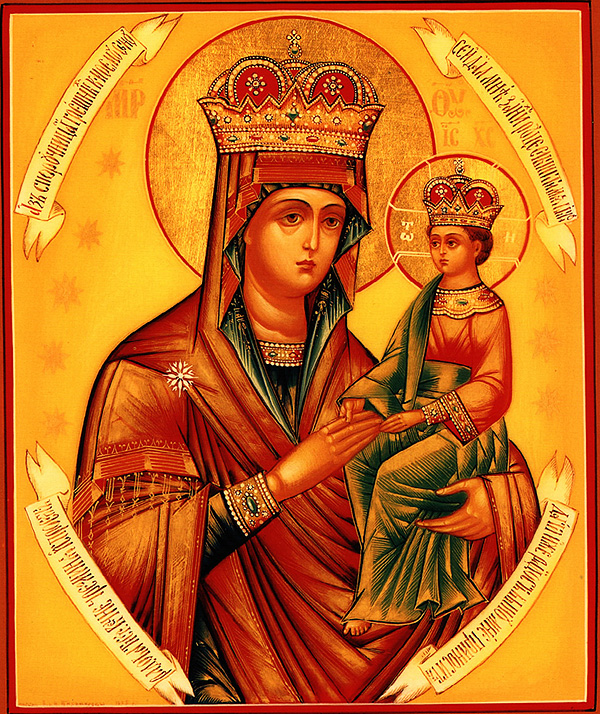
The ancient "Surety of Sinners" Icon of the Mother of God of Korets has been kept in the princely castle of Korets from ancient times, and was called "gracious."
After the death of Samuel, the last of the Orthodox Korets Princes, his brother John offered to let his sister, Igoumeness Seraphima take the Icon from the princely chapel and bring it to Holy Resurrection Maidens' Monastery at Korets. The solemn transfer of the holy Icon took place on Thursday of Pentecost Week in 1622. On this day, a festal celebration was established in honor of the "Surety of Sinners" Icon of the Mother of God of Korets.
On August 12, 1880, the Icon was transferred to Holy Trinity Church then returned to the Monastery and was placed in a carved wooden kiosk at the left front column.
More than once the wonderworking Icon showed gracious help for the suffering – in 1923 on the Feast of the Holy Trinity a young man who was possessed by an unclean spirit was healed before the Icon. The next year, when during the period from the Ascension of the Lord to the Thursday after Pentecost, there were incessant downpours in Volhynia. Miraculously, after a Cross Procession around the temple with the blessed Icon, the rain began to subside.
Many believers who turn to the Queen of Heaven for help and intercession because of some discord, family troubles, and especially when "anguish of the soul" suggests that after praying before the Icon, they receive spiritual relief and peace, for she is truly the "Surety of Sinners."
In the Icon, the Mother of God is depicted holding her Child on her left hand, and He holds her right hand with both of His hands.
The inscription reads: “I am the Surety of Sinners for my Son Who has entrusted me to hear them, and through me, those who bring me the joy of hearing them shall receive everlasting joy."
On August 17, 1998, the Superior of Holy Trinity Korets women's Monastery, Igoumeness Natalia (Ilchuk) petitioned Patriarch Alexei II of Moscow and All Russia to add the Korets Icon to the list of wonderworking Icons of the Mother of God on the Patriarchal Church Calendar. With the Patriarch's blessing, the celebration in honor of the Korets Icon was approved.
In November 2001, an attempt was made to steal the Icon, but the attackers only managed to carry off its valuable riza. People donated money for a new riza to be made, a copy of the the one which was stolen.
The Icon is kept in the Holy Trinity women's Monastery at Korets.
Translation of the relics of the Greatmartyr Theodore Stratelates

The Holy Great Martyr Theodore Stratelates suffered for Christ in Heraklea on February 8, 319. At the time of his sufferings the holy Great Martyr Theodore ordered his servant Varus to bury his body on the estate of his parents in Euchaita. The transfer of the relics of the Great Martyr Theodore took place on June 8, 319.
On this day we also recall a miracle of the icon of the Great Martyr Theodore in a church dedicated to him at a place called Karsat, near Damascus. A group of Saracens had turned this church into their residence. There was a fresco on the wall depicting Theodore. One of the Saracens shot an arrow into the icon of the Great Martyr. From the saint’s face, where the arrow had stuck into the wall, blood flowed before the eyes of everyone. A short while later, the Saracens who had settled in the church killed each other. Accounts of this miracle are given by Saints [or, “by the holy Fathers”] Anastasius of Mt. Sinai (April 20) and John of Damascus (December 4).
Saint Theodore, first Bishop of Rostov and Suzdal
The great wonderworker Saint Theodore, who was a Greek by birth, was the first Bishop of Rostov. He was consecrated as a bishop in the year 991 or 992. At that time, most of the Rostov territory was still pagan, and Saint Theodore worked tirelessly to proclaim the Gospel to the people of that area.
The inhabitants subjected the hierarch to many insults, and they even drove him away on one occasion. Then Saint Theodore moved to Suzdal, where he brought many souls to Christ. He fell asleep in the Lord at Suzdal in 1023, resting from his fruitful apostolic labors. His holy relics are in Suzdal's Nativity of the Most Holy Theotokos Cathedral.
Portions of his holy relics are also kept in two other churches at Suzdal: that of the Kazan Icon, and that of Saints Constantine and Helen.
Saint Theodore is also commemorated at the Synaxis of the Saints of Rostov and Yaroslavl (May 23), and at the Synaxis of the Saints of Vladimir (June 23).
Today's saint should not be confused with Saint Theodore of Rostov (November 28), who reposed in 1395, and was the nephew of Saint Sergius of Radonezh (September 25).
Finding of the Relics of Saints Basil and Constantine, Princes of Yaroslavl
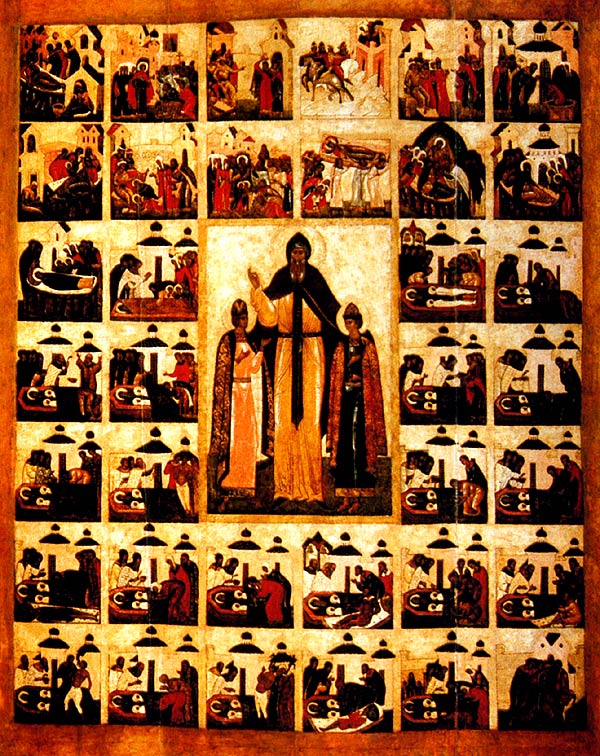
The holy Princes Basil and Constantine Vsevolodovich of Yaroslavl.
In their youth they lost their father, Vsevolod, who fell in battle with the Tatars (Mongols). Saint Basil, the elder brother, succeeded to the throne. As prince, he had to face a multitude of concerns, tasks and sorrows. The city and the villages were devastated from the invasion of the Tatars, many households remained without shelter and food, and he had to concern himself about everything and about everyone. Besides this, it was necessary to gain the good will of the Tatar Khan, and the holy prince more than once journeyed for this reason to the Horde. He suffered also a family misfortune, the loss of his only son.
All his tribulations the holy prince suffered without complaint, and he ruled the princedom, like a true Christian. He did not enter into disputes with other princes, he concerned himself with the unfortunate among his subjects, and he built churches. But soon his life, filled with many sorrows, exhausted the strength of the prince, and he took sick and died in the year 1249.
After him holy Prince Constantine succeeded to the throne. He strove to imitate his brother, but to his great dismay, everywhere he saw pillage and murdering done by the Tatars. In 1257 the Tatars fell upon Yaroslavl itself. The prince came out to fight the enemy, but here in this battle he gave up his life for his country. In the year 1501 the incorrupt relics of the holy princes were uncovered and now rest in the Yaroslav cathedral.
Saint Ephraim, Patriarch of Antioch
Saint Ephraim, Patriarch of Antioch, a Syrian, was a military general under the emperors Anastasius (491-518) and Justin (518-527). The saint was distinguished for his virtue, piety, and compassion for all the destitute.
In the year 526 the Lord punished Antioch for Christians falling into the heresies of Nestorius and Eutyches: an earthquake destroyed this magnificent city. A large number of the inhabitants perished. Patriarch Euphrasios was crushed beneath a fallen column.
The emperor summoned Ephraim to oversee the restoration of the ruined city. Among the workers was a bishop who left his see for unknown reasons. He predicted to Ephraim his election to the patriarchal throne and asked him not to abandon deeds of charity, and to struggle firmly against the heretics. In the year 527 Ephraim was indeed elected to the patriarchal throne. He governed his flock firmly and wisely by the example of his life. He also defended it against heretical teachings through his sermons and letters.
The following event gives some idea of his faith. Near Herakleia was a stylite practicing asceticism, who had fallen into heresy. Learning about the ascetic, Ephraim went to him and urged him to be reunited to the Orthodox Church. The stylite was not agreeable. He decided to frighten the patriarch and he offered to kindle a large bonfire, so that they both might enter the fire. The bonfire was set, but the stylite did not dare to go into it. The patriarch prayed to the Lord Jesus Christ to show that his was the correct faith and, removing his omophorion, he put it in the bonfire. After three hours the firewood was consumed, but the omophorion of the saint was taken out unharmed. The stylite was converted from his heresy and reunited to the Church.
Ephraim fell asleep in the Lord in the year 545 AD.
Among his labors, Ephraim defended the teaching of the Orthodox Church on the union of two natures, the divine and the human, in the Person of our Lord Jesus Christ.
Venerable Zosimus of Phoenicia, Syria
Saint Zosimus of Phoenicia was born in the Syrian village of Synda, near the city of Tyre. He accepted monasticism and was zealous in his fasting, prayer, labors and other virtues. The monk received from God the gift of clairvoyance. When he was at Caesarea, he foresaw the terrible earthquake which destroyed Antioch in the year 526.
Once, the patrician Arkesilaos visited the monk. During this time a messenger informed Arkesilaos that his wife had punctured her eye with a needle and was in terrible pain. But the monk put his guest at ease and said that the holy Bishop John the Chozebite (October 3) had healed his wife.
Zosimus attained such a degree of spiritual accomplishment that wild beasts were submissive to him. Once on the way to Caesarea a hungry lion pounced upon the monk’s donkey, and dragged it away to eat it. Finding the beast, the monk said, “Friend, I have not the strength to carry the load because of old age. You carry it, and then return into the wilderness and again be fierce according to your nature.” The lion meekly carried the load to Caesarea, then the monk set him free.
Icon of the Mother of God of Yaroslavl

The Yaroslavl Icon of the Mother of God became the first wonderworking Icon revealed by the Most Pure Theotokos during the Tatar-Mongol yoke. It was brought to Russia (probably from Kiev) almost immediately after Batu's invasions. In this way, the Icon of the Mother of God visited the Russian land and consoled the Orthodox people in their sorrow. It is significant that this is an icon of the "Tenderness" type, filled with her maternal care and concern.1
The Yaroslavl Icon was brought to that city by the holy right-believing Princes Basil and Constantine (July 3), and the lower church in the temple of the Prophet Elias was consecrated in honor of the wonderworking Yaroslavl Icon of the Mother of God.
In addition to this Icon, there are two more Yaroslavl Icons: the Yaroslavl-Kazan (June 8) and the Yaroslavl-Caves (see May 14).
1 Similarly, during the First World War, the Reigning Icon of the Mother of God (March 2) appeared on the very day that Tsar Nicholas II abdicated in 1917.
Icon of the Mother of God of White Lake

This holy icon belonged to Saint Cyril of White Lake (June 9), and he kept it in his cell.
Saint Cyril was living at the Simonov Monastery, but his soul yearned for solitude, and he asked the Mother of God to show him a place conducive for salvation. One night he was reading an Akathist in his cell before the Hodēgḗtria icon of the Mother of God, and had just reached the eighth Kontakion, “Seeing the strange Nativity, let us become strangers to the world and transport our minds to heaven.” Then he heard a voice say, “Go to White Lake (Belozersk), where I have prepared a place for you.”
He left the Simonov Monastery and at the desolate and sparsely populated White Lake, he found the place which he had seen in the vision. Saint Cyril and his companion Saint Therapon of White Lake and Mozhaisk (May 27), set up a cross and dug a cell in the ground near Mount Myaura at Siversk Lake.
The White Lake Icon is also commemorated on July 28.
Hieromartyr Theodore (Tevdore) of Kvelta

Saint Tevdore was a simple priest who labored in the 16th century in the village of Kvelta. At that time the Ottoman Empire and Persia were locked in a bitter feud over control of the Near East. At the beginning of 1609 the Ottomans conquered first the city of Baghdadi, then part of Samtskhe in southern Georgia. In June of that year they launched an attack on eastern Georgia.
At that time the Georgian ruler was the young King Luarsab II. When the Ottomans penetrated Kartli, the king was absent, abiding in his summer residence, Tskhireti Castle. But the Ottomans knew the location of his castle, and they also knew that his troops were small in number. They plotted to lay siege to the castle, capture the king, and ultimately annex all of Georgia.
The Ottomans quickly crossed the Trialeti mountain range and advanced into Manglisi, pillaging the lands and laying waste to the people as they went. Miraculously, the Manglisi Church of the Most Holy Mother of God remained unharmed. One chronicler wrote: “A dense fog surrounded the church and village, concealing it from the enemy.”
Saint Luarsab had received no warning of the attack, and the enemy was just minutes from his castle.
In the village of Kvelta, not far from Manglisi, the Turks captured the priest Tevdore, a man sincere before God and devoted to his king and motherland. Fr. Tevdore was unable to escape to the woods with the other villagers, so he locked the doors to the church and concealed its sacred treasures. When the Ottoman Turks found Fr. Tevdore, they commanded him to lead them to Tskhireti Castle and threatened to kill him if he refused.
Hoping to deceive them, Tevdore led the Ottomans along a narrow, rocky mountain path away from Tskhireti Castle. Many horses and soldiers fell from the path to their deaths.
But after some time the Ottomans realized that the priest had led them in the wrong direction. Embittered and hungry for revenge, they beheaded Fr. Tevdore.
As a result of Saint Tevdore’s great sacrifice, Saint Luarsab had time to strengthen his fortifications, assemble his armies, and finally annihilate the enemy.
Daily Vespers – Wed 6/7/23
Here is the live stream for Daily Vespers – Wed 6/7/23 If you need, here are instructions for accessing this content from your phone, tablet, computer, or TV.
Daily Readings for Wednesday, June 07, 2023
1ST WEDNESDAY AFTER PENTECOST
NO FAST
1st Wednesday after Pentecost, The Holy Martyr Theodotus of Ancyra, Our Righteous Father Panagis (Paisios) Basias, Tarasios & John the Martyrs, Sebastian the Wonderworker, Zenais the Martyr
ST. PAUL’S LETTER TO THE ROMANS 1:18-27
Brethren, the wrath of God is revealed from heaven against all ungodliness and wickedness of men who by their wickedness suppress the truth. For what can be known about God is plain to them, because God has shown it to them. Ever since the creation of the world his invisible nature, namely, his eternal power and deity, has been clearly perceived in the things that have been made. So they are without excuse; for although they knew God they did not honor him as God or give thanks to him, but they became futile in their thinking and their senseless minds were darkened. Claiming to be wise, they became fools, and exchanged the glory of the immortal God for images resembling mortal man or birds or animals or reptiles. Therefore God gave them up in the lusts of their hearts to impurity, to the dishonoring of their bodies among themselves, because they exchanged the truth about God for a lie and worshiped and served the creature rather than the Creator, who is blessed for ever! Amen. For this reason God gave them up to dishonorable passions. Their women exchanged natural relations for unnatural, and the men likewise gave up natural relations with women and were consumed with passion for one another, men committing shameless acts with men and receiving in their own persons the due penalty for their error.
MATTHEW 5:20-26
The Lord said to his disciples, “Unless your righteousness exceeds that of the scribes and Pharisees, you will never enter the kingdom of heaven. You have heard that it was said to the men of old, ‘You shall not kill; and whoever kills shall be liable to judgment.’ But I say to you that every one who is angry with his brother without cause shall be liable to judgment; whoever insults his brother shall be liable to the council, and whoever says, ‘You fool!’ shall be liable to the hell of fire. So if you are offering your gift at the altar, and there remember that your brother has something against you, leave your gift there before the altar and go; first be reconciled to your brother, and then come and offer your gift. Make friends quickly with your accuser, while you are going with him to court, lest your accuser hand you over to the judge, and the judge to the guard, and you be put in prison; truly, I say to you, you will never get out till you have paid the last penny.”
Hieromartyr Theodotus, Bishop of Ancyra

The Holy Martyr Theodotus lived in Ancyra of Galatia in the third century. He was distinguished by his kindliness and concern. At the height of the persecution under Diocletian (284-305) he provided Christians with everything they needed, and gave them shelter in his home. There they secretly celebrated church services.
Saint Theodotus visited the Christian captives in prison, paid their bail, and reverently buried the bodies of martyrs who had been thrown to the wild beasts. Once he buried the bodies of seven holy women martyrs, who were drowned in the sea (May 18). This was reported to the governor.
After refusing to offer sacrifice to idols, and denouncing the folly of paganism, Saint Theodotus confessed Christ as God, for which they subjected him to terrible tortures and beheaded him with a sword. They wanted to burn the holy martyr’s body, but could not do so because of a storm which had arisen, so they gave his holy relics to a certain Christian for burial.
Saint Theodotus is also commemorated on May 18.
Hieromartyr Marcellinus, Pope of Rome, and those with him
Saint Marcellinus was Pope of Rome during the height of the persecution against Christians under Diocletian and Maximian (284-305), when 17,000 men were martyred a single month. During this time Saint Marcellinus was also arrested. Afraid of the fierce tortures, he burned incense and offered sacrifice to idols. The emperor called him his friend and clothed him in splendid robes. Although he had encouraged others to undergo torture for Christ, he gave in to cowardice. He wept bitterly, filled with remorse.
During this time, a Synod of 180 bishops and presbyters met at the city of Sinuessa (in Campania). Saint Marcellinus appeared at the assembly in penitential sackcloth, his head sprinkled with ashes. He confessed his sin before the delegates and asked them to judge him. The Fathers of the Council said, “Judge yourself! From your lips this sin came forth, from your lips let judgment be pronounced. We know that even Saint Peter denied Christ out of fear, but he wept bitterly for his sin, and received forgiveness from the Lord.”
Then Marcellinus pronounced sentence upon himself, “I strip myself of the priestly dignity, of which I am unworthy. After death, do not bury my body, but instead throw it to the dogs. Cursed be the one who dares to bury it.”
Upon his return to Rome Marcellinus went to the emperor, threw down the fine clothing given him, and said that he regretted his renunciation of Christ. The enraged emperor had him tortured, and sentenced him to death.
Saint Marcellinus prayed to the Lord Jesus Christ, Who mercifully receives sinners who repent, then willingly placed his head beneath the sword. The holy martyrs Claudius, Cyrinus and Antoninus were beheaded with him.
The body of Saint Marcellinus lay for thirty-six days along the wayside. Appearing in a vision to the new bishop Marcellus, the holy Apostle Peter said, “Why have you not buried the body of Marcellinus?”
“I fear his curse,” replied Saint Marcellus.
“Perhaps you do not remember,” said the Apostle Peter, “that it is written: ‘He that humbles himself shall be exalted.’ Therefore, go bury his body with reverence.”
Fulfilling the command of the Apostle Peter, Saint Marcellus buried the body of Saint Marcellinus in a crypt, built for the burial of the bodies of martyrs by the illustrious Priscilla, along the Via Salaria.
Hieromartyr Sisinius the Deacon of Rome and those with him
Saint Sisinius the deacon suffered at Rome along with the hieromartyr Marcellinus, Bishop of Rome, the holy deacon Cyriacus; also Smaragdus, Largus, Apronian, Saturninus, Crescentian, Papias and Maurus and the holy women martyrs Priscilla, Lucy and the Emperor’s daughter Artemia during the persecution of Diocletian and Maximian (284-305) and their successors, Galerius (305-311) and Maxentius (305-312).
The emperor Maximian, ruler of the Western Roman Empire, deprived all Christians of military rank and sent them into penal servitude.
A certain rich Christian, Thrason, sent food and clothing to the prisoners through the Christians Sisinius, Cyriacus, Smaragdus and Largus. Marcellus thanked Thrason for his generosity, and ordained Sisinius and Cyriacus as deacons.
While rendering aid to the captives, Sisinius and Cyriacus also were arrested and condemned to harsh labor. They fulfilled not only their own work quota, but worked also for the dying captive Saturninus. Therefore, Maximian sent Sisinius to Laodicius, the governor of the district.
They locked the saint in prison. The head of the prison, Apronian, summoned Sisinius for interrogation but, seeing his face shine with a heavenly light, he believed in Christ and was baptized. Later, he went with Sisinius to Marcellus and received Chrismation. Marcellus served the Liturgy, and they partook of the Holy Mysteries.
On June 7, Saints Sisinius and Saturninus were brought before Laodicius in the company of Apronian. Apronian confessed that he was a Christian, and was beheaded. Saints Sisinius and Saturninus were thrown into prison. Then Laodicius gave orders to bring them to a pagan temple to offer sacrifice. Saturninus said, “If only the Lord would turn the pagan idols into dust!”
At that very moment the tripods, on which incense burned before the idols, melted. Seeing this miracle, the soldiers Papias and Maurus confessed Christ. After prolonged tortures Sisinius and Saturninus were beheaded, and Papias and Maurus were locked up in prison, where they prayed to receive illumination by holy Baptism. The Lord fulfilled their desire. Leaving the prison without being noticed, they received Baptism from Marcellus and returned to the prison.
At the trial they again confessed themselves Christians and died under terrible tortures. Their holy bodies were buried by the priest John and Thrason.
Saints Cyriacus, Smaragdus, Largus and other Christian prisoners continued to languish at hard labor.
Diocletian’s daughter Artemia suffered from demonic oppression. Having learned that the prisoner Cyriacus could heal infirmities and cast out devils, the emperor summoned him to the sick girl. In gratitude for the healing of his daughter, the emperor freed Cyriacus, Smaragdus and Largus. Soon the emperor sent Cyriacus to Persia to heal the daughter of the Persian emperor.
Upon his return to Rome, Cyriacus was arrested on orders of the emperor Galerius, the son-in-law of Diocletian, who had abdicated and retired as emperor. Galerius was very annoyed at his predecessor because his daughter Artemia had converted to Christianity. He gave orders to drag Cyriacus behind his chariot stripped, bloodied, and in chains, to be shamed and ridiculed by the crowds.
Marcellus denounced the emperor openly before everyone for his cruelty toward innocent Christians. The emperor ordered the holy bishop to be beaten with rods, and dealt severely with him. Saints Cyriacus, Smaragdus, Largus, and another prisoner, Crescentian, died under torture. And at this time the emperor’s daughter Artemia and another twenty-one prisoners were also executed with Cyriacus.
Marcellus was secretly freed by Roman clergy. Exhuming the bodies of the holy martyrs Cyriacus, Smaragdus and Largus, they reburied them on the estates of two Christian women, Priscilla and Lucy, on the outskirts of Rome, after they had transformed Lucy’s house into a church.
Ascending the throne, Maxentius gave orders to destroy the church and turn it into a stockyard, and he sentenced the holy bishop to herd the cattle. Exhausted by hunger and cold, and wearied by the tortures of the soldiers, Marcellus became ill and died in the year 310.
Martyrs Kyriake, Kaleria, and Mary of Caesarea, in Palestine

The holy women martyrs Kyriake, Kaleria (Valeria), and Mary lived in Palestinian Caesarea during the persecution under Diocletian (284-305). Having received instruction in the Christian Faith, they abandoned paganism, settled in a solitary place and spent their lives in prayer, beseeching the Lord that the persecution against Christians would come to an end, and that the Faith of Christ would shine throughout all the world.
The governor tried to force them to worship idols, but they bravely confessed their faith in Christ. For this reason, they were tortured and received the crown of martyrdom.
Martyr Zēnaίda (Zenais) of Caesarea in Palestine

There is very little information about Saint Zēnaίda, except that she was born in 284, in Caesarea of Palestine, and that she was found worthy of the charism of working miracles. She ended the course of her life with a martyric death.
The Byzantine Synaxarion mentions that Saint Zēnaίda's veneration was widespread in Constantinople, where her Synaxis took place on June 6, at a church dedicated to her in the Basilisk district.
There are a number of hagiographic sources which mention the name of Saint Zēnaίda. Among them, a Neapolitan calendar of the IX century (June 7); a printed Greek Menaion (Venice, 1591; and the Synaxaristes of Saint Νikόdēmos of the Holy Mountain.
In the Roman Martyrology of Cardinal Caesar Baronius, Zēnaίda is mistakenly listed under June 5 with the martyrs Valeria, Kyriakḗ, and Maria.
Venerable Daniel of Sketis
Abba Daniel lived in the sixth century, becoming a monk at Sketis when he was a young boy. He was taken prisoner when Sketis was attacked by barbarians, who held him captive for two years. Saint Daniel was was bought by a devout Christian, but then he was recaptured. After six months, while attempting to escape, he struck one of his captors with a stone and killed him, and then he made his escape and returned to Sketis. The sin of murder was a heavy burden on his conscience. Uncertain about what he ought to do, he went to Patriarch Timothy of Alexandria, and asked for his advice.
The Patriarch heard his Confession, but did not give him a penance. Still his conscience continued to trouble him, and he went to Rome to see the Pope. The Pope gave him the same reply as the Patriarch had done. Disappointed, Abba Daniel visited the other Patriarchs in turn, going to Constantinople, Antioch and Jerusalem, confessing to each of them and asking for advice. He found no peace, however. So he returned home to Alexandria and surrendered himself to the civil authorities as a murderer, and was thrown into prison. At his trial before the governor, Daniel told him all that had happened, and begged to be executed, so that his soul might be saved from the eternal fire. The governor was astonished by his story, and said to him, "Go your way, Father, and pray to God for me, and I wish you had killed seven more!"
Still dissatisfied with this, Daniel resolved to take a leper into his cell and care for him until he died, and then he would find another. He did as he had resolved, and in this way brought peace to his conscience.
Once, as Abba Daniel and Abba Ammon were walking together, Abba Ammon said, "When will we sit in our own cell, Father?" Abba Daniel replied, "Who can separate us from God? God is in the cell, and God is also outside of it."
He became so renowned for his virtues that he was named Igoumen of Sketis and he was revered throughout Egypt as "a new Abraham, and the host of Christ." He visited Saint Anastasia the Patrician (March 10) on the day of her death. She had disguised herself as a eunuch and lived in a men's monastery eighteen miles from Sketis. Saint Daniel discovered that she was a woman when he prepared her body for burial.
Abba Daniel encountered saints who wished to remain hidden, such as the Mark the Fool of Alexandria, or the nun at the Ermopoleos Monastery of Abba Jeremiah. She feigned drunkenness, earning the contempt of the other nuns. Saint Daniel and his disciple sought shelter in the monastery, and at night they saw that nun lifting her arms to Heaven, weeping copiously, and making prostrations. The following night they had the Igoumeness watch with them so she could see how that despised nun spent her nights. When her holy life became known, she left the monastery so that she would not be praised by the other nuns.
Saint Daniel is also mentioned in the Life of Saint Thomais, who was killed by her father-in-law because she wished to preserve her chastity (April 13 in Slavic usage, April 14 in Greek usage), in the Life of Saint Eulogios the Hospitable (April 27), in the Life of Saints Andronikos and Athanasia (October 9), as well as in the Life of Abba Doula.
Daily Readings for Tuesday, June 06, 2023
1ST TUESDAY AFTER PENTECOST
NO FAST
1st Tuesday after Pentecost, Hilarion the New of Dalmation Monastery, Bessarion the Wonderworker of Egypt, 5 Virgins of Caesarea: Martha, Mary, Cyris, Valeria & Marcia
ST. PAUL’S LETTER TO THE ROMANS 1:1-7, 13-17
Paul, a servant of Jesus Christ, called to be an apostle, set apart for the gospel of God which he promised beforehand through his prophets in the holy scriptures, the gospel concerning his Son, who was descended from David according to the flesh and designated Son of God in power according to the Spirit of holiness by his resurrection from the dead, Jesus Christ our Lord, through whom we have received grace and apostleship to bring about the obedience of faith for the sake of his name among all the nations, including yourselves who are called to belong to Jesus Christ; To all God’s beloved in Rome, who are called to be saints: Grace to you and peace from God our Father and the Lord Jesus Christ. I want you to know, brethren, that I have often intended to come to you (but thus far have been prevented), in order that I may reap some harvest among you as well as among the rest of the Gentiles. I am under obligation both to Greeks and to barbarians, both to the wise and to the foolish: so I am eager to preach the gospel to you also who are in Rome. For I am not ashamed of the gospel: it is the power of God for salvation to every one who has faith, to the Jew first and also to the Greek. For in it the righteousness of God is revealed through faith for faith; as it is written, “The righteous shall live by faith.”
MATTHEW 4:23-25;5:1-13
At that time, Jesus went about all Galilee, teaching in their synagogues and preaching the gospel of the kingdom and healing every disease and every infirmity among the people. So his fame spread throughout all Syria, and they brought him all the sick, those afflicted with various diseases and pains, demoniacs, epileptics, and paralytics, and he healed them. And great crowds followed him from Galilee and the Dekapolis and Jerusalem and Judea and from beyond the Jordan.
Seeing the crowds, he went up on the mountain, and when he sat down his disciples came to him. And he opened his mouth and taught them, saying:
Blessed are the poor in spirit, for theirs is the kingdom of heaven.
Blessed are those who mourn, for they shall be comforted.
Blessed are the meek, for they shall inherit the earth.
Blessed are those who hunger and thirst for righteousness, for they shall be satisfied.
Blessed are the merciful, for they shall obtain mercy.
Blessed are the pure in heart, for they shall see God.
Blessed are the peacemakers, for they shall be called sons of God.
Blessed are those who are persecuted for righteousness' sake, for theirs is the kingdom of heaven.
Blessed are you when men revile you and persecute you and utter all kinds of evil against you falsely on my account. Rejoice and be glad, for your reward is great in heaven, for so men persecuted the prophets who were before you.
You are the salt of the earth; but if salt has lost its taste, how shall its saltness be restored? It is no longer good for anything except to be thrown out and trodden under foot by men.
Postfeast of Pentecost — 3rd Day of the Trinity
Many of the hymns of Pentecost are repeated in the postfestal services of this week, and references to the Holy Spirit, and to fire, abound. In particular, we are reminded of the Unburnt Bush (Exodus 3:2), the zealous Prophet Elias who ascended to Heaven in a chariot of fire, the three youths in the fiery furnace, and the Lord descending on Mt. Sinai in fire (Exodus 19:18).
As we commemorate the Holy Spirit this week, we look forward to the Sunday of All Saints, those righteous men and women of all nations and in every age, who were perfected and sanctified by the same Holy Spirit.
Venerable Bessarion, Wonderworker of Egypt

Saint Bessarion, Wonderworker of Egypt was an Egyptian. He was baptized while still in his youth, and he led a strict life, striving to preserve the grace given him during Baptism. Seeking to become more closely acquainted with the monastic life, he journeyed to the holy places. He was in Jerusalem, he visited Saint Gerasimus (March 4) in the Jordanian wilderness, he viewed other desert monasteries, and assimilated all the rules of monastic life.
Upon his return, he received monastic tonsure and became a disciple of Saint Isidore of Pelusium (February 4). Saint Bessarion took a vow of silence, and partook of food only once a week. Sometimes he remained without food or drink for forty days. Once, the saint stood motionless for forty days and forty nights without food or sleep, immersed in prayer.
Saint Bessarion received from God the gift of wonderworking. When his disciple was very thirsty, he sweetened bitter water. By his prayer the Lord sent rain upon the earth, and he could cross a river as if on dry land. With a single word he cast out devils, but he did this privately to avoid glory.
His humility was so great that once, when a priest ordered someone from the skete to leave church for having fallen into sin, Bessarion also went with him saying, “I am a sinner, too.” Saint Bessarion slept only while standing or sitting. A large portion of his life was spent under the open sky in prayerful solitude. He peacefully departed to the Lord in his old age.
Venerable Hilarion the New, Abbot of the Dalmatian Monastery
Saint Hilarion the New was born of pious parents, Peter and Theodosia, who raised him in the virtues and instructed him in Holy Scripture. At twelve years of age Saint Hilarion was tonsured as a monk at the Hesychius monastery near Constantinople, and from there he transferred to the Dalmatus monastery, where he received the Great Schema and became a disciple of Saint Gregory the Dekapolite (November 20).
The monk deeply venerated his God-bearing patron Saint Hilarion the Great (October 21), and he strove to imitate his life, so he came to be called Hilarion the New. At the Dalmatus monastery, he was ordained presbyter. After the death of the igumen the brethren wanted to elect Saint Hilarion to this position, but learning of this, he secretly fled to Constantinople.
Then the monks of Dalmatus monastery sent a petition to Patriarch Nikēphóros, asking that Saint Hilarion be assigned as igumen. The Patriarch summoned the saint and persuaded him to give his assent. Saint Hilarion submitted out of holy obedience. For eight years he peacefully guided the monastery, but in the year 813 the iconoclast Leo the Armenian (813-820) occupied the imperial throne. The saint refused to dishonor the holy icons, and he boldly accused the emperor of heresy, for which he endured many torments. They locked him up in prison for awhile, and vexed him with hunger and thirst.
The impious Patriarch Theodotus, who replaced the exiled Patriarch Nikēphóros, caused the monk much suffering in demanding that he abandon Orthodoxy. The monks of the Dalmatus monastery went to the emperor and asked him to release the saint, promising to submit to the imperial will. After they returned to the monastery, however, Saint Hilarion and the monks continued to venerate the holy icons. The enraged emperor again threw the monk into prison. He gave the saint over to torture with all the means at his disposal, hoping to change his mind.
The wrath of God soon overtook the wicked emperor. He was cut down by his own soldiers in church at the very spot where he had once thrown down a holy icon. The new emperor Michael II (820-829) freed Saint Hilarion from his imprisonment, and the saint settled into a monastic cell. Upon the death of Saint Theodore the Studite (November 11), who also suffered for the holy icons, Saint Hilarion beheld holy angels taking the soul of Saint Theodore to Heaven.
Under the iconoclast emperor Theophilus (829-842), Saint Hilarion was again put under guard and beaten terribly, then they confined him on the island of Aphousia.
After the death of Theophilus, the holy empress Saint Theodora (842-855) gave orders to recall the confessors from exile. Saint Hilarion returned to the Dalmatus monastery, again agreeing to be igumen. He departed peacefully in the year 845.
Saint Jonah, Bishop of Perm
Saint Jonah, Bishop of Great Perm, was successor to Saint Pitirim, Bishop of Perm (August 19), who was murdered by the Vogulani in 1455. In the year 1462 Saint Jonah converted the inhabitants of Great Perm to Christ. He journeyed throughout his extensive diocese to spread and consolidate the Christian Faith. The saint reposed on June 6, 1470 and was buried at Ust-Vym at the Annunciation cathedral.
Venerable Paisius, Abbot of Uglich

Saint Paisius of Uglich was igumen of the Protection monastery, near Uglich. He was born in the Tver district near the city of Kashin, and he was a nephew of Saint Macarius of Kalyazin (March 17).
Saint Paisius entered his uncle’s monastery after the death of his parents, when he was just an eleven-year-old child. Under his uncle’s guidance, Saint Paisius led a monastic life of obedience, fasting and prayer, and he was put to work copying soul-saving books.
“A man wondrous of spirit, famed teacher of holiness and most astounding wonderworker, he founded (in 1464) the cenobitic Protection monastery three versts from Uglich at the wish of Prince Andrew, and he was chosen igumen.” Saint Paisius was also “founder and organizer of the holy Nikolsky Grekhozaruchnya monastery in 1489.”
Struggling at the Protection monastery, Saint Paisius lived into old age and died on June 6, 1504. His relics, glorified by miracles, rest beneath a crypt in the Protection monastery.
Saint Paisius is also commemorated on January 8.
Venerable Jonah, Abbot of Klimetzk
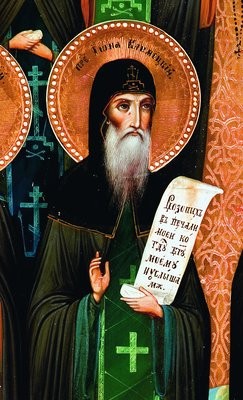
Saint Jonah of Klimetzk, in the world John, became a monk, and founded the Klimetzk Trinity Monastery in fulfillment of a vow.
In 1490 he had been caught by a storm on Lake Onega. When there was no hope for survival, John cried out to the Lord, entreating Him to preserve his life so he might repent and serve God. The boat was thrown onto a sandbar by the waves. There he heard the voice of the Lord commanding him to found a monastery in honor of the Life-Creating Trinity.
He miraculously discovered a holy icon on a juniper tree. The saint fulfilled the will of the Lord and built a monastery with two churches, one dedicated to the Most Holy Trinity and the other in honor of Saint Nicholas, protector of those who sail and those who travel.
Refusing the rank of igumen, Saint Jonah remained a simple monk at the monastery. He died on June 6, 1534. A church was built over his relics, and was dedicated to Saints Zachariah and Elizabeth.
Virgin Martyrs Archelais, Thekla, and Susanna, at Salerno
The Holy Virgin Martyrs Archelais, Thekla and Susanna sought salvation in a small monastery near Rome. During the persecution by Diocletian (284-305), the holy virgins dressed themselves in men’s clothing, cut their hair and went to the Italian province of Campania. Settling in a remote area, they continued to pursue an ascetical life of fasting and prayer. They received the gift of healing from God, and treated the local inhabitants, converting many pagans to Christ.
When the governor of the district heard about them, he had them brought to Salerno. He threatened Saint Archelais with torture and death if she did not offer sacrifice to idols. With firm hope in the Lord, the saint refused to submit to the command, and she denounced the folly of worshipping soulless statues. Then the governor ordered the saint to be torn apart by hungry lions, but the beasts meekly lay at her feet. In a rage the governor ordered the lions to be killed, and locked the holy virgins in prison.
In the morning, having suspended Saint Archelais, the torturers began to rake her with iron utensils and pour hot tar on the wounds. The saint prayed even more loudly, and suddenly a light shone over her and a voice was heard, “Fear not, for I am with you.”
The saint was defended by the power of God. When they wanted to crush her with an immense stone, an angel pushed it to the other side, and it crushed the torturers instead. A judge ordered soldiers to behead the holy virgins, but the soldiers did not dare to put their hands upon the saints. Then Saints Archelais, Thekla and Susanna said to the soldiers, “If you do not fulfill the command, you shall have no respect from us.” The holy martyrs were beheaded in 293.
In the nineteenth century, Saint Susanna appeared to a disciple of Elder Boniface saying, “We must pray to God with the soul, the mind, and the heart.” She is described as a maiden of untold beauty, with a soft, pleasant voice.
Pimenov Icon of the Mother of God
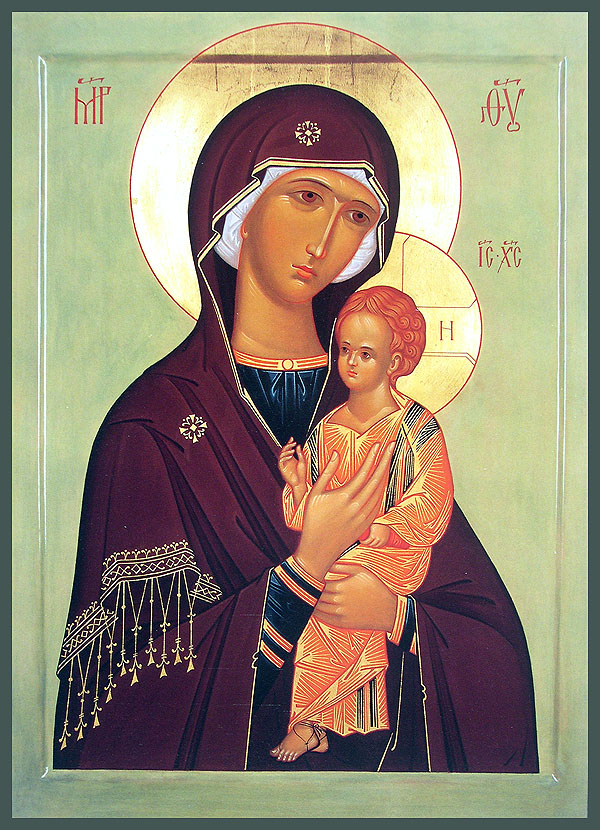
The first mention of the Pimenov Icon dates from the second half of the XVI century. There is a brief chronicler's note for the years 1404-1407 in the book Grades of Royal Genealogy: "A miracle occurred in Moscow at the home of the Tyutryum family, where myron flowed from the icons of the Mother of God and of Saint Nicholas the Wonderworker." This is supplemented by the following information: "Metropolitan Pimen of all Russia brought the miraculous Icon from Constantinople, and for many years it remained in the great cathedral church."
"Tyutryum, a certain well-known merchant, begged the clergy of the cathedral to bring the Icon to his house and serve a Moleben, as is the custom; for because of his faith, he had a great desire to see the Icon of the Mother of God in his home."
This Hodēgḗtria Icon is associated with Metropolitan Pimen of Kiev and all Rus who, according to tradition, brought the wonderworking Icon from Constantinople in 1381 or 1386. At first, the Icon was in the altar of the Dormition cathedral of the Moscow Kremlin, then it was moved to the Annunciation cathedral. Until 1918 it was in the Peace Chamber of the Kremlin palace, and then in the State Historical Museum, from which it was transferred to the Tretyakov Gallery in 1930.
Metropolitan Pimen (circa 1304 – September 11, 1389) was known as Pimen the Greek, and served as Metropolitan of Moscow (technically Metropolitan of Kiev and All Rus') from 1382–1384. He is not numbered among the Saints, however.
Martyr Gelasius

Saint Gelasius, the holy martyr of Christ, lived during a time of fierce persecution. He gave away all his property and possessions to the poor, put on a long white garment, and went to visit those who were facing martyrdom.
Since these Christians had been tortured in various ways, Saint Gelasius kissed their wounds and encouraged them to remain steadfast in their confession of Christ. When the pagans saw him doing this they seized him and brought him before their ruler. When he was questioned he proclaimed Christ as the true God, denouncing the idols as deaf and inanimate objects.
The governor mocked him and had him flogged. Finally, he ordered that the saint’s head be cut off, and so Saint Gelasius received the unfading crown of martyrdom from the Lord.
This saint should not be confused with the third century saint Gelasius (one of the ten martyrs of Crete, commemorated on December 23), Saint Gelasius of Palestine (December 31), nor with Saint Gerasimus the actor of Heliopolis (February 27).
Daily Readings for Monday, June 05, 2023
MONDAY OF THE HOLY SPIRIT
NO FAST
Monday of the Holy Spirit, The Holy Hieromartyr Dorotheus, Bishop of Tyre, Holy Martyrs Nicandrus, Gorgus and Apollonus and those with them, Christophoros & Konon the Martyrs of Rome
ST. PAUL’S LETTER TO THE EPHESIANS 5:8-19
Brethren, walk as children of light (for the fruit of light is found in all that is good and right and true), and try to learn what is pleasing to the Lord. Take no part in the unfruitful works of darkness, but instead expose them. For it is a shame even to speak of the things that they do in secret; but when anything is exposed by the light it becomes visible, for anything that becomes visible is light. Therefore it is said, “Awake, O sleeper, and arise from the dead, and Christ shall give you light.” Look carefully then how you walk, not as unwise men but as wise, making the most of the time, because the days are evil. Therefore do not be foolish, but understand what the will of the Lord is. And do not get drunk with wine, for that is debauchery; but be filled with the Spirit, addressing one another in psalms and hymns and spiritual songs, singing and making melody to the Lord with all your heart.
MATTHEW 18:10-20
The Lord said, "See that you do not despise one of these little ones; for I tell you that in heaven their angels always behold the face of my Father who is in heaven. For the Son of man came to save the lost. What do you think? If a man has a hundred sheep, and one of them has gone astray, does he not leave the ninety-nine on the hills and go in search of the one that went astray? And if he finds it, truly, I say to you, he rejoices over it more than over the ninety-nine that never went astray. So it is not the will of your Father who is in heaven that one of these little ones should perish.
If your brother sins against you, go and tell him his fault, between you and him alone. If he listens to you, you have gained your brother. But if he does not listen, take one or two others along with you, that every word may be confirmed by the evidence of two or three witnesses. If he refuses to listen to them, tell it to the church; and if he refuses to listen even to the church, let him be to you as a Gentile and a tax collector. Truly, I say to you, whatever you bind on earth shall be bound in heaven, and whatever you loose on earth shall be loosed in heaven. Again I say to you, if two of you agree on earth about anything they ask, it will be done for them by my Father in heaven, for where two or three are gathered in my name, there am I in the midst of them.
Postfeast of Pentecost — Day of the Holy Spirit

On the day after every Great Feast, the Orthodox Church honors the one through whom the Feast is made possible. On the day following the Nativity of the Lord, for example, we celebrate the Synaxis of the Most Holy Theotokos (December 26). On the day after Theophany, we commemorate Saint John the Baptist (January 7), and so on.
Today we honor the all-Holy, good, and life-creating Spirit, Who descended upon the Apostles at Pentecost in the form of fiery tongues in fulfillment of the Lord’s promise to send the Comforter to His disciples (JN 14:16). That same Holy Spirit remains within the Church throughout the ages, guiding it “into all truth” (JN 16:13).
One of the hymns at Vespers on Saturday evening tells us that the Holy Spirit “provides all things. He gushes forth prophecy, He perfects the priesthood, … He holds together the whole institution of the Church.”
At Vespers on the day of Pentecost, we hear that the Holy Spirit is “the Fountain of goodness, through Whom the Father is known, and the Son is glorified.” He is “the living Fountain of spiritual gifts” Who “purifies us from our sins.” It is by the Holy Spirit that “the prophets, divine Apostles, and martyrs are crowned.” He is the source of life and of sanctification.
In the services of this day, we sing the same hymns as on Pentecost, except the Canon of the Holy Spirit, which is sung at Compline. The Vigil is not prescribed for the eve of today’s feast. We sing the Great Doxology at Matins, but not the Polyeleos. The Irmos of the Ninth Ode (“Hail, O Queen, glory of mothers and virgins…”) is sung in place of the Song of the Theotokos (“My soul magnifies the Lord…”).
At the Liturgy, the priest or deacon chants the Entrance Verse (“Be exalted in Thy strength, O Lord. We will sing and praise Thy power.”) as on the day of Pentecost. “Holy God” replaces “As many as have been baptized….” The dismissal of Pentecost is also used.
This whole week is fast-free, and the Leave-taking of Pentecost occurs on Saturday.
Hieromartyr Dorotheus, Bishop of Tyre

The Hieromartyr Dorotheus was bishop of the Phoenician city of Tyre, during the time of the persecution against Christians under the emperor Diocletian (284-305). Heeding the words of the Gospel (Mt.10:23), the saint withdrew from Tyre and hid from the persecutors. He returned to Tyre during the reign of Saint Constantine the Great (306-337, May 21), again occupying the bishop’s throne he guided his flock for more than fifty years, and converted many of the pagans to Christianity. When the emperor Julian the Apostate (361-363) began openly to persecute Christians, Saint Dorotheus was already over 100 years old. He withdrew from Tyre to the Myzean city of Udum (present day Bulgarian Varna). Delegates of the emperor arrested him there for his refusal to offer sacrifice to idols. They began to torture the holy Elder, and under torture he surrendered his soul to the Lord (+ ca. 362) at the age of 107.
Some ascribe to Saint Dorotheus the compilation of a work, “The Synopsis”, a collection of sayings, and including lives of the holy prophets and apostles.
Translation of the relics of the Right-believing Igor-George, Tonsured Gabriel, Grand Prince of Chernigov, and Kiev
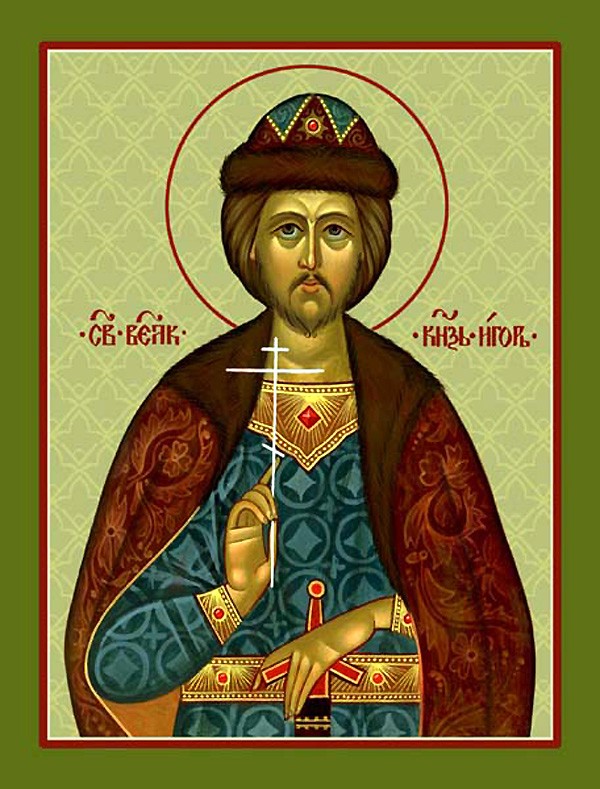
The Transfer of Relics of Saint Igor, Great Prince of Kiev The Kievan Great Prince Igor Ol’govich, in holy Baptism George (September 19), in the year 1146 suffered defeat and was taken captive by prince Izyaslav, who imprisoned him in one of the monasteries of Russian or Southern Pereyaslavl’ (now Pereyaslavl’-Khmel’nitsk). Far removed from the vanities of this world, and grievously ill, he began to repent of his sins and asked permission to be tonsured a monk. On January 5, 1147 Bishop Euthymius of Pereyaslavl’ tonsured him into monasticism with the name Gabriel. Soon he recovered his health and transferred to the Kiev Theodorov monastery, where he became a schemamonk with the name Ignatius, and devoted himself entirely to monastic efforts.
But a storm of fratricidal hatred raged over Kiev. The Chernigov princes, cousins of Igor, plotted to entice Izyaslav of Kiev into a joint campaign with the aim of capturing, or even killing him. The plot was uncovered when the prince was already on the way to Chernigov. The Kievans were in an uproar in learning of the ruse of the Chernigovichi, and they stormed into the place where the innocent Saint Igor was. Saint Igor was brutally murdered on September 19, 1147.
The Lord glorified the sufferer with miracles. With the blessing of Metropolitan Clement Smolyatich, Igumen Ananias of the Theodorov monastery buried the passion-bearer in the church of the Kiev Simonov monastery. On June 5, 1150, when the Kiev throne had become occupied by Yuri Dolgoruky, his confederate and the murdered Igor’s brother, the Chernigov prince Svyatoslav Ol’govich, solemnly transferred the holy relics of Saint Igor to Chernigov his native region, where they were placed into a reliquary in the Savior cathedral church. Then also the Feastday in memory of the saint was established.
Blessed Constantine, Metropolitan of Kiev
In 1147 Saint Igor Ol’govich (September 19, June 5) was defeated and captured by Izyaslav Mstislavich, the grandson of Saint Vladimir (July 15). Izyaslav then replaced Saint Igor as Great Prince.
The See of Kiev had been left vacant after the death of Metropolitan Michael in 1145, and Izyaslav chose the learned Schemamonk Clement of Smolensk to succeed him. He wanted the candidate to be consecrated by bishops in Russia, instead of sending him to Constantinople for consecration. Because of the great distance between Kiev and Constantinople Izyaslav called a council of Russian bishops, and ordered them to consecrate Clement as Metropolitan of Kiev.
Not all of the bishops were in agreement with this plan, notably the holy Archbishop Niphon of Novgorod (April 8). Other hierarchs also refused to participate in the consecration without the blessing of the Patriarch of Constantinople. Clement’s consecration took place in spite of the objections that had been raised.
After Izyaslav’s reign, he was succeeded by Yuri (George) Dolgoruky. This Great Prince regarded the consecration as illegal and uncanonical, and so he sent Saint Constantine (Smolyatich) to Constantinople to be consecrated as Metropolitan of Kiev by the Patriarch. Upon his return to Kiev, Saint Constantine, by the authority of the Patriarch, deposed Clement from his rank, and also deposed those who had been ordained by him.
When the Great Prince Yuri completed the course of his life disputes arose over who should succeed him as Great Prince. There was also disagreement about who was the rightful Metropolitan of Kiev, and Izyaslav’s son Mstislav supported Clement. Therefore, the Russian princes decided that both Clement and Constantine should be deposed, and requested the Patriarch of Constantinople to send them a new Metropolitan for Kiev.
Hoping to put an end to the disputes among the princes, the Patriarch sent Theodore to Kiev as the new Metropolitan. Saint Constantine, wishing to avoid further tumult in the Church, stepped down as Metropolitan and went to Chernigov, where he became gravely ill.
Feeling that he was approaching the end of his life, Saint Constantine composed a Testament, which he entrusted to Bishop Anthony of Chernigov. He also made Bishop Anthony promise that he would fulfill all the directives contained in the Testament after Constantine’s death.
When Saint Constantine reposed in 1159, Bishop Anthony took the Testament to Prince Svyatoslav of Chernigov, broke the seal, and read the document aloud. One of the provisions of the Testament was that Saint Constantine’s body should not be buried, but dragged out of the city to be left as food for dogs. This was because he felt responsible for the discord in the Church.
Everyone who heard the reading of the Testament was filled with horror. Prince Svyatoslav told the bishop to do as he saw fit. Since he had given his promise to Saint Constantine to abide by the terms of the Testament, he did not dare to go back on his word. So the saint’s body was taken from the city and left in a field.
On that very day the sky grew dark over Kiev, and strong winds, earthquakes, thunder and lightning broke out. It is said that eight people were hit by lightning at the same time.
Prince Rostislav of Kiev was in Povari at Vyshgorod at the time. He had received news of the death of Metropolitan Constantine, so he sent messages to the Church of the Holy Wisdom and to other churches, asking for all-night vigils to be conducted throughout the city. He believed that the citizens of Kiev were being punished by the Lord for their sins.
While all of these things were taking place in Kiev, the sun shone brightly in Chernigov. However, three pillars of fire appeared at night over the body of Saint Constantine. Seeing this marvel, many were filled with fear. On the third day that the body lay in the field, Prince Svyatoslav ordered that the body of the Metropolitan be buried with all the honor befitting his rank.
The body of the saint was carried into the city and buried in the church of the Savior, where Saint Igor, who was killed by the inhabitants of Kiev, had also been interred. After the burial of Saint Constantine, peace returned to Kiev, and all the people glorified God.
Repose of Saint Theodore Yaroslavich, older brother of Saint Alexander Nevsky

Holy Prince Theodore of Novgorod, the elder brother of Saint Alexander Nevsky, was born in the year 1218. His princely service to his native land began at a very early age. In 1229 both brothers had been left in Novgorod by their father Yaroslav Vsevolodovich as his representatives. But not even a year passed before the young princes had to quit Novgorod. The turbulent Novgorod people in their “veche” (“government council”) decided to invite another prince. But in the very next year, 1230, during a time of famine and epidemic, the Novgorodians again invited Yaroslav to rule them. On December 30, 1230 he sat as prince in Novgorod for the fourth time, but he remained in the city for only two weeks, when he installed his sons there and went off to Pereyaslavl-Zalessk. In 1232 the fourteen-year-old Theodore was already summoned to serve God not only in prayer, but also by the sword. He took part in a campaign of the Russian troops against the pagan Mordovian princes.
In the year 1233 at the wish of his father he was obliged to enter into marriage with Theodoulia, the daughter of the holy Prince Michael of Chernigov. When the guests had already gathered at the wedding feast, the bridegroom suddenly died. After the unexpected death of her groom, the princess left the world and was tonsured in one of the Suzdal monasteries, famed in her monastic efforts as Saint Euphrosynē of Suzdal (September 25).
Saint Theodore was buried in the Yuriev monastery in Novgorod. In the year 1614 the Swedes, having pillaged the monastery, broke open the tomb of the prince and finding him whole and incorrupt, they mocked the holy relics, and finally abandoned the body in the churchyard. Years later, Metropolitan Isidore of Novgorod transferred the relics to Novgorod’s cathedral of Holy Wisdom (Hagia Sophia), placing them in the chapel of the holy Prophet, Forerunner and Baptist John. There they remained until 1919, when they were removed by the Bolsheviks.
The service to Saint Theodore was compiled in the year 1787 by Metropolitan Gabriel of Petersburg and Novgorod (+ 1801).
Finding of the Relics of Venerable Bassian and Jonah, Monks of Pertominsk
Saints Bassian and Jonah were monks of the Solovki Transfiguration monastery and disciples of Igumen Philip, who later became Metropolitan of Moscow (January 9).
These holy monks were glorified by the Lord after their death in 1561.
Fishermen and sailors came to pray in the chapel, built in 1599 over their grave by the Trinity-Sergiev monastery Elder Mamant. There in 1623 the hieromonk James founded a monastery, called Pertominsk.
Martyrs Marcian, Nicander, Hyperechius, Appolonius, Leonidas, Arius, Gorgias, Pambo, Selenia, and Irene of Egypt
The Holy Martyrs Marcian, Nicander, Hyperechius, Apollonius, Leonidas, Arius, Gorgias, Pambo, and the women martyrs Selenia and Irene were natives of Egypt and suffered during the reign of Maximian (305-311). For their steadfast confession of faith in Christ they were subjected to a fierce scourging. They then threw the sufferers barely alive into prison, where an angel appeared to them and healed their wounds. The holy martyrs died in prison from hunger and thirst.
Venerable Theodore, Wonderworker and Hermit of the Jordan
Saint Theodore the Wonderworker lived during the sixth century. In his youth he forsook the world in order to become a monk, withdrawing into the Jordanian wilderness. He lived a life of asceticism, and so he received from God the gift of wonderworking. Once, while he was journeying to Constantinople by ship, the ship went off course. Soon they ran out of drinking water, and the travelers were nearly dead from thirst. Saint Theodore prayed to God and made the Sign of the Cross over the sea. Then he told the sailors to draw some water from the sea and drink it. When they did so, they discovered that the water was fresh.
The passengers began to thank the saint and to honor him for saving them by providing fresh water. Saint Theodore said that they ought to thank God, who had performed this miracle because of His love for mankind. In his humility, he told them that it was not the result of his unworthy prayers.
Saint Theodore departed to the Lord in the year 583.
Venerable Anubius the Confessor and Anchorite of Egypt
Saint Anubius the Ascetic bravely endured tortures during the time of persecutions against Christians in the fourth century, but he remained alive and withdrew into the wilderness, where he dwelt until old age. He founded a small skete, in which he lived with six monks, one of whom was his brother Saint Pimen the Great (August 27). Once robbers laid waste to the skete, and the monks had to hide themselves in the ruins of a pagan temple, while having given their word not to speak with each other for a week. In the morning all week long Saint Anubius threw a stone at the face of the statue of the pagan god, and in the evening he said to it, “I have sinned.”
At the end of the week the brethren asked Abba Anubius what his actions signified, and the Elder explained that just as the statue did not get angry when he struck it, nor get flattered when he asked forgiveness of it, so the brethren ought to live. Three days before his end Saint Anubius was visited by the desert-dwellers Cyrus, Isaiah, and Paul, who asked the Elder to tell them about his life for the edification of believers. The saint replied, “I do not recall that I did anything great or glorious.” However, swayed by the entreaties of his questioners, in deep humility he related to them that during the time of persecutions he confessed the Name of Christ under torture, after this he had never defiled his lips with a lie, since after he had confessed Truth, he did not want to utter falsehood.
Three days later, Saint Anubius reposed in spiritual joy. The aforementioned Fathers said that they heard the singing of angels who came to receive his soul.
His heart was ever filled with a thirst for communion with the Lord, and he had often seen angels and the holy saints of God standing before the Lord. He also beheld Satan and his angels committed to the eternal flames. He is mentioned in the LAUSIAC HISTORY of Palladius, and his sayings can be found in the Paradise of the Fathers and in the Evergetinos.
Venerable Abba Dorotheus of Palestine
The Holy Abba Dorotheus was a disciple of Saint John the Prophet in the Palestinian monastery of Abba Seridus in the sixth century.
In his youth he had zealously studied secular science. “When I sought worldly knowledge,” wrote the abba, “it was very difficult at first. When I would come to take a book, I was like a man about to touch a wild beast. When I forced myself to study, then God helped me, and diligence became such a habit that I did not know what I ate, what I drank, whether I had slept, nor whether I was warm or not. I was oblivious to all this while reading. I could not be dragged away by my friends for meals, nor would I even talk with them while I was absorbed in reading. When the philosopher let us go, I went home and washed, and ate whatever was prepared for me. After Vespers, I lit a lamp and continued reading until midnight.” — so absorbed was Abba Dorotheus in his studies at that time.
He devoted himself to monastic activity with an even greater zeal. Upon entering the monastery, he says in his tenth Instruction, he decided that his study of virtue ought to be more fervent than his occupation with secular science had been.
One of the first obediences of Abba Dorotheus was to greet and to see to pilgrims arriving at the monastery. It gave him opportunity to converse with people from various different positions in life, bearing all sorts of burdens and tribulations, and contending against manifold temptations. With the means of a certain brother Saint Dorotheus built an infirmary, in which also he served. The holy abba himself described his obedience, “At the time I had only just recovered from a serious illness. Travellers would arrive in the evening, and I spent the evening with them. Then camel drivers would come, and I saw to their needs. It often happened that once I had fallen asleep, other things arose requiring my attention. Then it would be time for Vigil.” Saint Dorotheus asked one of the brethren to wake him up for for Vigil, and another to prevent him from dozing during the service. “Believe me,” said the holy abba, “I revered and honored them as though my salvation depended upon them.”
For ten years Abba Dorotheus was cell-attendant for Saint John the Prophet (Feb. 6). He was happy to serve the Elder in this obedience, even kissing the door to his cell with the same feeling as another might bow down before the holy Cross. Distressed that he was not fulfilling the word of Saint Paul that one must enter the Kingdom of Heaven through many tribulations (Acts 14:22), Abba Dorotheus revealed this thought to the Elder. Saint John replied, “Do not be sad, and do not allow this to distress you. You are in obedience to the Fathers, and this is a fitting delight to the carefree and calm.” Besides the Fathers at the monastery of Abba Seridus, Saint Dorotheus visited and listened to the counsels of other great ascetics of his time, among whom was Abba Zosima.
After the death of Saint John the Prophet, when Abba Barsanuphius took upon himself complete silence, Saint Dorotheus left the monastery of Abba Seridus and founded another monastery, the monks of which he guided until his own death.
Abba Dorotheus wrote 21 Discourses, several Letters, and 87 Questions with written Answers by Saints Barsanuphius the Great and John the Prophet. In manuscript form are 30 Talks on Asceticism, and written counsels of Abba Zosima. The works of Abba Dorotheus are imbued with a deep spiritual wisdom, distinguished by a clear and insightful style, but with a plain and comprehensible expression. The Discourses deal with the inner Christian life, gradually rising up in measure of growth in Christ. The saint resorted often to the advice of the great hierarchs, Saints Basil the Great, Gregory the Theologian, and Gregory of Nyssa. Obedience and humility, the combining of deep love for God with love for neighbor, are virtues without which spiritual life is impossible. This thought pervades all the writings of Abba Dorotheus.
In his writings the personal experience of Abba Dorotheus is felt everywhere. His disciple, Saint Dositheus (February 19), says of him, “Towards the brethren laboring with him he responded with modesty, with humility, and was gracious without arrogance or audacity. He was good-natured and direct, he would engage in a dispute, but always preserved the principle of respect, of good will, and that which is sweeter than honey, oneness of soul, the mother of all virtues.”
The Discourses of Abba Dorotheus are preliminary books for entering upon the path of spiritual action. The simple advice, how to proceed in this or that instance, together with a most subtle analysis of thoughts and stirrings of soul provide guidance for anyone who resolves to read the works of Abba Dorotheus. Monks who begin to read this book, will never part from it throughout their life.
The works of Abba Dorotheus are to be found in every monastery library and are constantly reprinted. In Russia, his soul-profiting Instruction, together with the Replies of the Monks Barsanuphius the Great and John the Prophet, were extensively copied, together with The Ladder of Divine Ascent of Saint John Climacus and the works of Saint Ephraim the Syrian. Saint Cyril of White Lake (June 9), despite his many duties as igumen, with his own hand transcribed the Discourses of Abba Dorotheus, as he did also the Ladder of Divine Ascent.
The Discourses of Abba Dorotheus pertain not only to monks; this book should be read by anyone who aspires to fulfill the commands of Christ.
Saint Peter of Korisha

Saint Peter was born in 1211 in the village of Unjimir between the city of Pech and the Field of Kosovo. As a child, he was meek and humble, and seldom participated in children’s games. At an early age, he and his younger sister Helena devoted themselves to prayer and fasting. When he was ten years old, the future saint told his parents that he wished to serve God by becoming a monk.
Saint Peter’s father died when the boy was fourteen, so he put off his plans to enter the monastery in order to care for his mother and sister. At the same time, he increased his ascetical efforts. When Saint Peter was sixteen, his beloved mother reposed. Determined to enter a monastery, he asked his sister whether she intended to be married, for his conscience would not allow him to abandon her unless he had provided for her. Helena said that it was her wish to preserve her virginity and become a nun. She said she would share his life of prayer and asceticism if only he would take her with him. Peter rejoiced and replied, “May the Lord’s will be done.”
They sold their family possessions and distributed the money to the poor. Traveling to Pec, they reached the Monastery of Saints Peter and Paul. Peter remained here, while Helena entered a nearby women’s monastery. After several years, both were granted permission to live in solitude.
Peter built two cells, one for himself and one for his sister, near the monastery. They spent their time in continual prayer and fasting, freeing themselves from worldly attachments, subduing the flesh, and struggled on the path of salvation.
These two spiritual lamps could not remain hidden for very long. People started coming to them for spiritual counsel and healing. Saint Peter and his sister agreed to avoid the snare of vainglory by moving to a more remote area. They went to Crna Reka (the town of Black River) on the Ibar River.
Saint Peter wished to move even farther into the woods for a life of even greater asceticism, but was reluctant to leave his sister. On the other hand, he was concerned that she might risk her physical and spiritual health if she were to come with him, so he decided to slip away and leave her in order to live alone on a mountain. He did not get very far before she noticed he was gone. She caught up to him and they traveled together to a mountain near the town of Prizren. On top of the mountain was a town called Korisha (modern Kabash), where they stopped to rest. Helena went to sleep there in the grass. Saint Peter wept and made the Sign of the Cross over her, then went off into the forest. When she awoke and found him gone, she wept and called his name. Finally, she went down from the mountain and lived in Prizren for the rest of her life. Saint Helena is also commemorated on June 5 with her brother, Saint Peter.
The holy ascetic lived in a cave near Korisha, where he continued his spiritual struggles in the heat of summer and in the cold of winter. He withstood the temptations and attacks of the demons which assailed him. When this happened, he sang Psalms and hymns all night until the sun came up in the morning. He fervently prayed for God to help and comfort him in his struggles. The Archangel Michael appeared to him and drove away the demons, promising Saint Peter that they would never enter his cell again. The Archangel warned him to be vigilant and to persevere, for the Devil wished to destroy him. After advising the saint to call upon the name of the Lord whenever he was attacked by the forces of evil, the holy Archangel vanished.
Saint Peter still endured temptations, but was victorious against all of them. Realizing his own weakness, he turned to Christ, Who strengthened him and sustained him. After these victories, the Lord consoled him with a vision of the Uncreated Light which lasted several days. From that time forward, Saint Peter was illumined by the grace of God, so no demon ever dared to approach him again.
Before Saint Peter’s death, many monks were sent to him by God, and he guided all of them. He blessed them and tonsured them, and permitted them to live in the caves below his cave. Forseeing the approach of death, he dug out a tomb for himself in the wall of his cell.
Acceding to the wish of his disciples, he told them the story of his life. Then he and his disciples received the Life-Giving Mysteries of Christ. After bidding each brother farewell, he surrendered his soul to God on June 5, 1275.
On the night of his blessed repose, a heavenly light was seen in his cave, and the singing of angels was heard by the other monks. In the morning, Saint Peter’s face shone with radiance, and a sweet fragrance came from his body. After the saint’s burial, many of those who came to his tomb were healed of their physical and spiritual infirmities. Seventy years later, King Dushan built a church at Korisha over Saint Peter’s relics, and dedicated it to the God-bearing ascetic.
The holy relics of Saint Peter were later transferred to the Black River monastery, then to the church of the Archangel Michael in the city of Kalashin.
Many of the icons of Saint Peter proved to be miracle working. The inscription reads: “Saint Peter of Korisha, desert-dweller and wonderworker.”
Icon of the Mother of God of Igor

The Igor Icon of the Mother of God.
The holy Passion-Bearer and Great Prince of Kiev Igor Ol’govich (September 19, 1147), prayed before this icon during the last moments of his life. It was in the chapel of Saint John the Theologian in the Dormition cathedral of the Kiev Caves Lavra. This icon was of old Greek origin, and had an inscription saying that it belonged to Saint Igor.
Great Vespers – Pentecost Kneeling Prayers – Sun 6/4/23
Here is the live stream for Great Vespers – Pentecost Kneeling Prayers – Sun 6/4/23 If you need, here are instructions for accessing this content from your phone, tablet, computer, or TV.
 Saint Peter Antiochian Orthodox Church
You must be logged in to post a comment.