
4TH WEDNESDAY AFTER PENTECOST
ABSTAIN FROM MEAT, FISH, DAIRY, EGGS, WINE, OLIVE OIL
Finding of the Relics of Cyrus and John the Unmercenaries, Sergios the Magister, Pappias the Martyr, Righteous Fathers Sergius and Herman, Founders of Valaam Monastery, Synaxis of the Icon of our Most Holy Lady the Theotokos , Paul the Physician of Corinth
ST. PAUL’S LETTER TO THE ROMANS 11:2-12
Brethren, do you not know what the scripture says of Elijah, how he pleads with God against Israel? “Lord, they have killed thy prophets, they have demolished thy altars, and I alone am left, and they seek my life.” But what is God’s reply to him? “I have kept for myself seven thousand men who have not bowed the knee to Baal.” So too at the present time there is a remnant, chosen by grace. But if it is by grace, it is no longer on the basis of works; otherwise grace would no longer be grace. What then? Israel failed to obtain what it sought. The elect obtained it, but the rest were hardened, as it is written, “God gave them a spirit of stupor, eyes that should not see and ears that should not hear, down to this very day.” And David says, “Let their table become a snare and a trap, a pitfall and a retribution for them; let their eyes be darkened so that they cannot see, and bend their backs for ever.” So I ask, have they stumbled so as to fall? By no means! But through their trespass salvation has come to the Gentiles, so as to make Israel jealous. Now if their trespass means riches for the world, and if their failure means riches for the Gentiles, how much more will their full inclusion mean?
MATTHEW 11:20-26
At that time, the Lord began to upbraid the cities where most of his mighty works had been done, because they did not repent. “Woe to you, Chorazin! woe to you, Bethsaida! for if the mighty works done in you had been done in Tyre and Sidon, they would have repented long ago in sackcloth and ashes. But I tell you, it shall be more tolerable on the day of judgment for Tyre and Sidon than for you. And you, Capernaum, will you be exalted to heaven? You shall be brought down to Hades. For if the mighty works done in you had been done in Sodom, it would have remained until this day. But I tell you that it shall be more tolerable on the day of judgment for the land of Sodom than for you.” At that time Jesus declared, “I thank you, Father, Lord of heaven and earth, that you have hidden these things from the wise and understanding and revealed them to babes; yea, Father, so it was well pleasing before you.”
Translation of the Relics of the holy and wonderworking Unmercenaries Cyrus and John
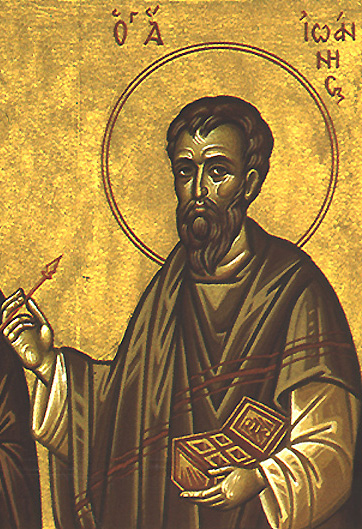
The Transfer of the Relics of the Holy Martyrs, Unmercenaries and Wonderworkers, Cyrus and John from the city of Konopa, near Alexandria (where they suffered in the year 311) to the nearby village of Manuphin, took place in the year 412. This Egyptian village prompted fear in everyone, since in a former time there was a pagan temple inhabited by evil spirits. Patriarch Theophilus (385-412) wanted to cleanse this place of demons, but he died. His wish was fulfilled by his successor in the See of Alexandria, the holy Patriarch Cyril (412-444). He prayed fervently in carrying out this project. An angel of the Lord appeared in a vision to the hierarch and commanded the venerable relics of Saints Cyrus and John be transferred to Manuphin. His Holiness Patriarch Cyril did the angel’s bidding and built a church at Manuphin in the name of the holy martyrs.

From that time this place was purified of the Enemy’s influence, and by the prayers of the holy Martyrs Cyrus and John there began to occur many miracles, healings of the sick and infirm. An account of Saints Cyrus and John is located under January 31.
Venerable Xenophon, Abbot of Robeika, Novgorod

Our holy Father Xenophon of Robeika was the disciple of Saint Barlaam of Khutyn (November 6). He became the third Igoumen of the Khutyn monastery after Igoumen Isidore (+1243), and at the insistence of Saint Anthony of Dymsk (June 24). After resigning as Igoumen, Saint Xenophon would later establish Holy Trinity Monastery on the banks of the Robeika River (not far from Novgorod).
Saint Xenophon's pious disposition was apparent from his earliest years, for he knew that this world will soon pass away. He also knew that this life is filled with sorrow, but after it there shall be everlasting life, which is true, filled with joy and spiritual consolations. With all his heart, mind, and soul, the Venerable one was drawn to the attainment of this eternal, joyous life with the Lord. He tried his best to avoid the sensuality of worldly life, striving only for its higher meaning.
Saint Xenophon settled with Saint Barlaam of Khutyn in the wilderness at the place where Xenophon would shine forth like a pillar of fire. There they put up a cross, built a chapel and a humble dwelling. By the Lord's will, however, the disciple went far away from his Elder to another spot where he could live an ascetical life under harsh conditions. This occurred while they were inspecting the site where they wanted to establish their dwelling.. A terrible storm sprang up, and Saint Xenophon called his Elder to come into the cell and take cover; but the Elder became angry at his disciple, telling him to go on a raft in search of another place for his ascetical struggles, and he gave him a quarter of a loaf of bread.
Saint Xenophon set off on the raft upon the Robeika River, miraculously sailing against the current, and soon he stood upon the shore. He stopped at the place where the raft had stuck, and there he fished, praying that the Lord would strengthen him.
After some time, Saint Xenophon went back to his Spiritual Father Saint Barlaam, asking for forgiveness. He received the Elder's blessing to build a chapel at the place where he now lived. Saint Barlaam blessed him, and in all humility, the disciple went back, set up a cross, and then built a chapel and a small hut for his cell.
Later, after the consecration of the church of Saint Nicholas, Saint Xenophon's monastic community was established in the same remote marshland. Other ascetics of piety began to flock there, but the number of monks was small.
In 1251, Saint Xenophon became the Igoumen of the monastery. Although the monastery was neither wealthy nor distinguished, the monks labored to make it beautiful.
Saint Xenophon reposed peacefully on June 28, 1262. His holy relics rested for many years in the monastery church, which later became a parish.
Venerable Sergius and Herman, Wonderworkers of Valaam
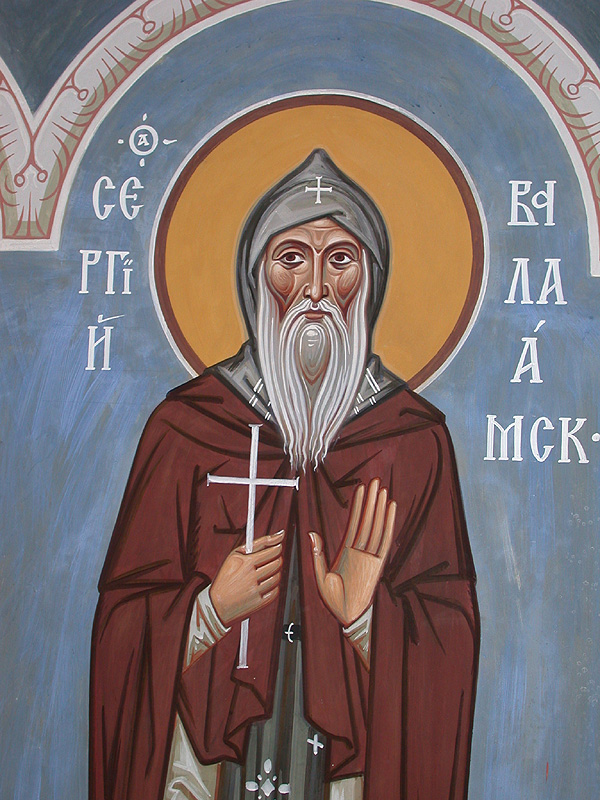
Saints Sergius and Herman settled on the island of Valaam in 1329. The brethren gathered by them spread the light of Orthodoxy in this frontier land. The Karelian people began to regard Christianity with renewed suspicion, with its authority in the fourteenth century being undermined by the Swedes, who sought to spread Catholicism by means of the sword.
Saints Sergius and Herman died about the year 1353. They are also commemorated on September 11 (the translation of their holy relics).

Saint Paul, Physician of Corinth

Saint Paul the Physician, from the city of Corinth, in his youth took monastic tonsure at one of the monasteries. Here the saint toiled much and became an experienced ascetic.
Once Paul, through demonic malice, was slandered by a woman. She came to the monastery with a newborn infant and said, that Saint Paul was the father. The Elder with humility and joy endured the slander, he did not deny it and he took the infant, as though it were his own son. When they began to reproach the saint for breaking his monastic vows, Saint Paul said, “Brethren, let us ask the infant who his father is!” The newborn, pointing his hand at the blacksmith, said, “Here is my father and not the monk Paul.” Seeing this miracle, people bowed down to the Elder, asking forgiveness. From this time Saint Paul received from God the gift of healing the sick, whereby he received the name physician. Saint Paul died at age 70.
Icon of the Mother of God “Of the Three Hands”
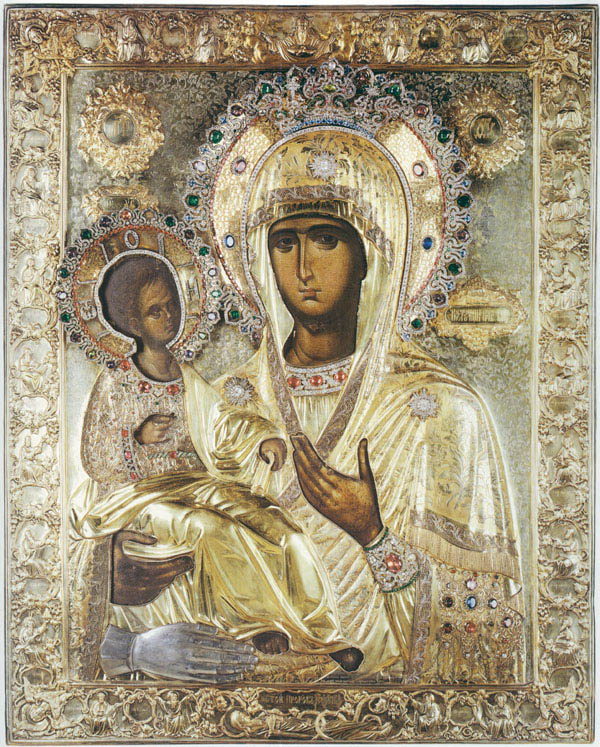
The Icon of the Mother of God, “Of the Three Hands”: In the eighth century during the time of the Iconoclasts, Saint John of Damascus (December 4) was zealous in his veneration of holy icons. Because of this, he was slandered by the emperor and iconoclast Leo III the Isaurian (717-740), who informed the Damascus caliph that Saint John was committing treasonous acts against him. The caliph gave orders to cut off the hand of the monk and take it to the marketplace. Towards evening Saint John, having asked the caliph for the cut-off hand, put it to its joint and fell to the ground before the icon of the Mother of God. The monk begged Our Lady to heal the hand, which had written in defense of Orthodoxy. After long prayer he fell asleep and saw in a dream that the All-Pure Mother of God had turned to him promising him quick healing.
Before this the Mother of God bid him toil without fail with this hand. Having awakened from sleep, Saint John saw that his hand was unharmed. In thankfulness for this healing Saint John placed on the icon a hand fashioned of silver, from which the icon received its name “Of Three Hands.” (Some iconographers, in their ignorance, have mistakenly depicted the Most Holy Theotokos with three arms and three hands.) According to Tradition, Saint John wrote a hymn of thanksgiving to the Mother of God: “All of creation rejoices in You, O Full of Grace,” which appears in place of the hymn “It is Truly Meet” in the Liturgy of Saint Basil the Great.
Saint John Damascene accepted monasticism at the monastery of Saint Savva the Sanctified and there bestowed his wonderworking icon. The Lavra presented the icon “Of Three Hands” in blessing to Saint Savva, Archbishop of Serbia (+ 1237, January 12). During the time of an invasion of Serbia by the Turks, some Christians who wanted to protect the icon, entrusted it to the safekeeping of the Mother of God Herself. They placed it upon a donkey, which without a driver proceeded to Athos and stopped in front of the Hilandar monastery. The monks put the icon in the monastery’s cathedral church (katholikon). During a time of discord over the choice of igumen, the Mother of God deigned to head the monastery Herself, and from that time Her holy icon has occupied the igumen’s place in the temple. At the Hilandar monastery there is chosen only a vicar, and from the holy icon the monks take a blessing for every obedience.
In Greek usage, this Icon is commemorated on June 28; but on July 12 in Slavic usage.
Hieromartyr Basil
The Hieromartyr Basil (Sitnikov) was a deacon of the Dalmatov – Saint Nicholas Church in the province of Perm. He graduated from the three classes of the religious school, and beginning in 1885, he served as a Reader. In 1898, he was ordained as a deacon, serving first at Saint John the Baptist Church in the village of Izyeduga in the Shadrinsk district of the Yekaterinburg diocese. Later, he served in the Church of the Nativity of the Theotokos in the village of Baklanskoye in that same district.
On November 5, 1913, he was transferred to the Saint Nicholas Church in the city of Dalmatov, where he was put to death by the atheists who had come to power. In 1918, after the priests Vladimir Sergeiev and Alexander Sidorov were arrested, Deacon Basil began to reproach the atheists for plundering the property of these arrested shepherds. They took note of this and got their revenge. Deacon Basil Sitnikov was killed on the day after the priests with whom he served, on June 28, 1918.
Holy Martyr Pappias
Numerous Christians were slaughtered during the persecution under Diocletian and Maximian in the early IV century,
and Saint Pappias was one of those arrested for preaching the Gospel. The idol-worshippers tried to force him to
sacrifice to the pagan gods, but he refused to deny Christ. Therefore, he was imprisoned and tortured for several days.
When he remained unshakeable in his faith, he was beheaded, and his soul ascended victoriously into Heaven.
 Saint Peter Antiochian Orthodox Church