
THE APODOSIS OF THE FEAST OF THE HOLY ASCENSION
ABSTAIN FROM MEAT, FISH, DAIRY, EGGS, WINE, OLIVE OIL
The Apodosis of the Feast of the Holy Ascension, Nicephorus the Confessor, Patriarch of Constantinople, Erasmos of Ochrid & his Companion Martyrs, Demetrios the New Martyr of Philadelphia, Constantine the New Martyr of the Hagarenes
ACTS OF THE APOSTLES 27:1-44; 28:1
IN THOSE DAYS, when it was decided that we should sail for Italy, they delivered Paul and some other prisoners to a centurion of the Augustan Cohort, named Julius. And embarking in a ship of Adramyttium, which was about to sail to the ports along the coast of Asia, we put to sea, accompanied by Aristarchos, a Macedonian from Thessalonica. The next day we put in at Sidon; and Julius treated Paul kindly, and gave him leave to go to his friends and be cared for. And putting to sea from there we sailed under the lee of Cyprus, because the winds were against us. And when we had sailed across the sea which is off Cilicia and Pamphylia, we came to Myra in Lycia. There the centurion found a ship of Alexandria sailing for Italy, and put us on board. We sailed slowly for a number of days, and arrived with difficulty off Cnidos, and as the wind did not allow us to go on, we sailed under the lee of Crete off Salmone. Coasting along it with difficulty, we came to a place called Fair Havens, near which was the city of Lasea.
As much time had been lost, and the voyage was already dangerous because the fast had already gone by, Paul advised them, saying, "Sirs, I perceive that the voyage will be with injury and much loss, not only of the cargo and the ship, but also of our lives." But the centurion paid more attention to the captain and to the owner of the ship than to what Paul said. And because the harbor was not suitable to winter in, the majority advised to put to sea from there, on the chance that somehow they could reach Phoenix, a harbor of Crete, looking northeast and southeast, and winter there.
And when the south wind blew gently, supposing that they had obtained their purpose, they weighed anchor and sailed along Crete, close inshore. But soon a tempestuous wind, called the northeaster, struck down from the land; and when the ship was caught and could not face the wind, we gave way to it and were driven. And running under the lee of a small island called Cauda, we managed with difficulty to secure the boat; after hoisting it up, they took measures to undergird the ship; then, fearing that they should run on the Syrtis, they lowered the gear, and so were driven. As we were violently storm-tossed, they began next day to throw cargo overboard; and the third day they cast with their own hands the tackle of the ship. And when neither sun nor stars appeared for many a day, and no small tempest lay on us, all hope of our being saved was at last abandoned.
As they had been long without food, Paul then came forward among them and said, "Men, you should have listened to me, and should not have set sail from Crete and incurred this injury and loss. I now bid you take heart; for there will be no loss of life among you, but only of the ship. For this very night there stood by me an angel of the God to whom I belong and whom I worship, and he said, 'Do not be afraid, Paul; you must stand before Caesar; and lo, God has granted you all those who sail with you.' So take heart, men, for I have faith in God that it will be exactly as I have been told. But we shall have to run on some island.
When the fourteenth night had come, as we were drifting across the sea of Adria, about midnight the sailors suspected that they were nearing land. So they sounded and found twenty fathoms; a little farther on they sounded again and found fifteen fathoms. And fearing that we might run on the rocks, they let out four anchors from the stern, and prayed for the day to come. And as the sailors were seeking to escape from the ship, and had lowered the boat into the sea, under pretense of laying out anchors from the bow, Paul said to the centurion and the soldiers, 'Unless these men stay in the ship, you cannot be saved." Then the soldiers cut away the ropes of the boat, and let it go.
As day was about to dawn, Paul urged them all to take some food, saying, "Today is the fourteenth day that you have continued in suspense and without food, having taken nothing. Therefore I urge you to take some food; it will give you strength, since not a hair is to perish from the head of any of you." And when he had said this, he took bread, and giving thanks to God in the presence of all he broke it and began to eat. Then they all were encouraged and ate some food themselves. (We were in all two hundred and seventy-six persons in the ship.) And when they had eaten enough, they lightened the ship, throwing out the wheat into the sea.
Now when it was day, they did not recognize the land, but they noticed a bay with a beach, on which they planned if possible to bring the ship ashore. So they cast off the anchors and left them in the sea, at the same time loosening the ropes that tied the rudders; then hoisting the foresail to the wind they made for the beach. But striking a shoal they ran the vessel aground; the bow stuck and remained immovable, and the stern was broken up by the surf. The soldiers' plan was to kill the prisoners, lest any should swim away and escape; but the centurion, wishing to save Paul, kept them from carrying out their purpose. He ordered those who could swim to throw themselves overboard first and make for the land, and the rest on planks or on pieces of the ship. And so it was that all escaped to land.
After we had escaped, we then learned that the island was called Malta.
JOHN 17:18-26
At that time, Jesus lifted up his eyes to heaven and said, "As you, Father, did send me into the world, so I have sent them into the world. And for their sake I consecrate myself, that they also may be consecrated in truth.
I do not pray for these only, but also for those who believe in me through their word, that they may all be one; even as you, Father, are in me, and I in you, that they also may be in us, so that the world may believe that you have sent me. The glory which you have given me I have given to them, that they may be one even as we are one, I in them and you in me, that they may become perfectly one, so that the world may know that you have sent me and have loved them even as you have loved me. Father, I desire that they also, whom you have given me, may be with me where I am, to behold my glory which you have given me in your love for me before the foundation of the world. O righteous Father, the world has not known you, but I have known you; and these know that you have sent me. I made known to them your name, and I will make it known, that the love with which you have loved me may be in them, and I in them.
Saint Nikēphóros the Confessor, Patriarch of Constantinople

Saint Nikēphóros was a dignitary at the court of the Empress Irene (797-802). After embracing monasticism, he became widely known for his piety. He assumed the Patriarchal Throne of Constantinople in 806 and became a zealous defender of the holy Icons. In 815, the Iconoclast Emperor Leo the Armenian (813-820) exiled him to Prokonnis, where he fell asleep in the Lord in 828.
Saint Nikēphóros left behind three writings against Iconoclasm.
In 846, the relics of Patriarch Nikēphóros were returned to Constantinople and placed in the Great Church of Hagia Sophia for one day before being transferred to and enshrined in the Church of the Holy Apostles.
New Martyr John the New of Sochi, who suffered at Belgrade
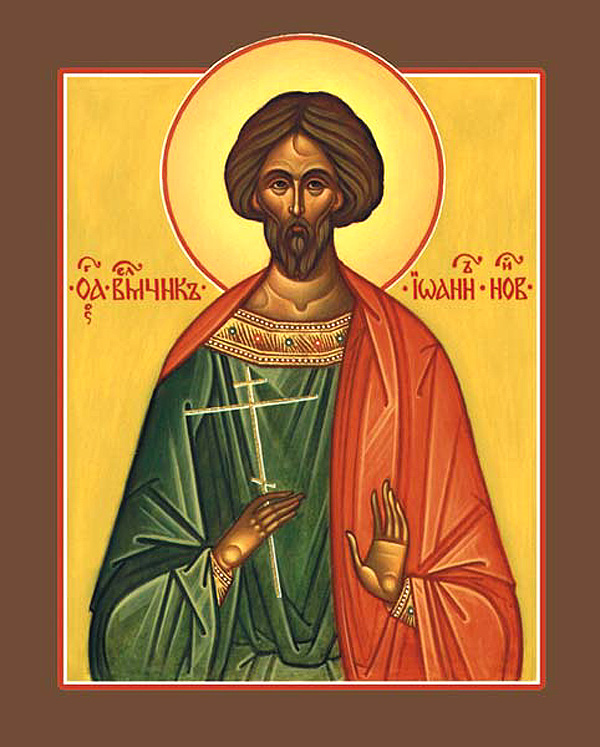
The Holy Great Martyr John the New of Sochi, lived in the fourteenth century in the city of Trebizond. He was a merchant, devout and firm in his Orthodoxy, and generous to the poor.
Once, he happened to be sailing on a ship while pursuing his trading activities. The captain of the ship was not Orthodox, but got into an argument about the Faith with Saint John. Having been vanquished by the saint’s words, the captain resolved to make trouble for him when they got to Belgrade. During the ship’s stay at Belgrade, the captain went to the city ruler, a fire-worshipper, and suggested that on his ship was a studious man who also desired to become a fire-worshipper.
The city ruler invited Saint John to join the fire-worshippers and renounce his faith in Christ.
The saint prayed secretly, calling on the help of Him Who said, “When they shall lead you, and deliver you up, take no thought beforehand what you shall speak, neither do you premeditate; but whatsoever will be given you in that hour, speak that, for it is not you that speaks, but the Holy Spirit” (Mark 13:11). And the Lord gave him the courage and understanding to counter all the claims of the impious and firmly confess himself a Christian. After this, the saint was so fiercely beaten with rods that his entire body was lacerated, and the flesh came off in pieces. The holy martyr thanked God for being found worthy to shed his blood for Him and thereby wash away his sins.
Afterwards they put him in chains and dragged him away to prison. In the morning the city ruler ordered the saint brought forth again. The martyr came before him with a bright and cheerful face. The intrepid martyr absolutely refused to deny Christ, denouncing the governor as a tool of Satan. Then they beat him again with rods, so that all his insides were laid bare.
The gathering crowd could not bear this horrible spectacle and they began to shout angrily, denouncing the governor for tormenting a defenseless man. The governor, having the beating stopped, gave orders to tie the Great Martyr to the tail of a wild horse to drag him by the legs through the streets of the city. Residents of the Jewish quarter particularly scoffed at the martyr and threw stones at him. Finally, someone took a sword and cut off his head.
Saint John’s body with his severed head lay there until evening, and none of the Christians dared to take him away. By night a luminous pillar was seen over him, and a multitude of burning lamps. Three light-bearing men sang Psalms and censed the body of the saint. One of the Jews, thinking that these were Christians coming to take up the remains of the martyr, grabbed a bow and tried to shoot an arrow at them, but he was restrained by the invisible power of God, and became rigid.
In the morning the vision vanished, but the archer continued to stand motionless. Having told the gathering inhabitants of the city about the vision and what was done to him by the command of God, he was freed from his invisible bonds. Having learned about the occurrence, the ruler gave permission to bury the body of the martyr in the local church. This occurred between the years 1330 and 1340. There is some question about the year of the saint’s martyrdom. Saint Νikόdēmos of the Holy Mountain gives the year as 1642, while others say it was 1492.
The captain who had betrayed Saint John repented of his deed, and decided secretly to convey the relics to his own country, but the saint appeared in a dream to the priest of the church, and prevented this. After seventy years the relics were transferred to Sochi, the capital of the Moldo-Valachian principality, and placed in the cathedral church.
Uncovering of the relics of Venerable Juliana, Princess of Vyazma
The relics of the holy Princess Juliana of Vyazma were uncovered in 1819.
Saint Juliana’s body was buried in the Torzhok cathedral on the right side by the south doors in 1407. Later, a tomb for her relics was built at the Savior-Transfiguration cathedral, where she healed many. In connection with the glorification of Saint Juliana on June 2, 1819 a chapel was built on the right-hand side, and dedicated to her
In 1906 church was built and dedicated to Saint Juliana at the cathedral of the Transfiguration of the Lord, where previously there had been a chapel over the saint’s grave.
Saint Juliana is also commemorated on December 21.
Icon of the Mother of God of Kiev-Bratsk

The Kiev-Bratsk Icon of the Mother of God is also commemorated on September 6, May 10, and on Saturday of the Fifth Week of Great Lent.
Venerable Erasmus of Ochrid

No information available at this time.
 Saint Peter Antiochian Orthodox Church