Monthly Archives: May 2023

Daily Readings for Friday, May 19, 2023

5TH FRIDAY AFTER PASCHA

NO FAST

Patrick the Hieromartyr and Bishop of Prusa and His Fellow Martyrs Acacius, Menander, and Polyaenus, Our Righteous Father Memnonus the Wonderworker, Theotima & Kyriake the Martyrs

ACTS OF THE APOSTLES 15:5-12

IN THOSE DAYS, some believers who belonged to the party of the Pharisees rose up, and said, "it is necessary to circumcise them, and to charge them to keep the law of Moses." The apostles and the elders were gathered together to consider this matter. And after there had been much debate, Peter rose and said to them, "Brethren, you know that in the early days God made choice among you, that by my mouth the Gentiles should hear the word of the gospel and believe. And God who knows the heart bore witness to them, giving them the Holy Spirit just as he did to us; and he made no distinction between us and them, but cleansed their hearts by faith. Now therefore why do you make trial of God by putting a yoke upon the neck of the disciples which neither our fathers nor we have been able to bear? But we believe that we shall be saved through the grace of the Lord Jesus, just as they will." And all the assembly kept silence; and they listened to Barnabas and Paul as they related what signs and wonders God had done through them among the Gentiles.

JOHN 10:17-28

The Lord said to the Jews who came to him, "For this reason the Father loves me, because I lay down my life, that I may take it again. No one takes it from me, but I lay it down of my own accord. I have power to lay it down, and I have power to take it again; this charge I have received from my Father."
There was again a division among the Jews because of these words. Many of them said, "He has a demon, and he is mad; why listen to him?" Others said, "These are not the sayings of one who has a demon. Can a demon open the eyes of the blind?
It was the feast of the Dedication at Jerusalem; it was winter, and Jesus was walking in the temple, in the portico of Solomon. So the Jews gathered round him and said to him, "How long will you keep us in suspense? If you are the Christ, tell us plainly." Jesus answered them, "I told you, and you do not believe. The works that I do in my Father's name, they bear witness to me; but you do not believe, because you do not belong to my sheep. My sheep hear my voice, and I know them, and they follow me; and I give them eternal life.

Hieromartyr Patrick, Bishop of Prusa, and his companions

Saint Patrick lived during the first century and was bishop of the city of Prusa in Bythnia (Asia Minor). He openly and boldly preached Christ the Savior, and denounced the error of the pagans. Therefore, he and the priests, Acacius, Menander and Polyainus were arrested, and brought to Julius, the prefect of the city for interrogation.

Julius was going to the hot springs for treatment, and he ordered that the Christian bishop and the priests be brought along after him, bound in iron chains. After he washed in the hot springs, Julius offered sacrifice to his gods. He had Saint Patrick and the other prisoners brought before him, ordering them to offer sacrifice to the pagan gods, threatening punishment if they refused.

Saint Patrick replied, “I am a Christian and I worship the one true God, Jesus Christ, Who has created the heavens and the earth, and these warm springs for the benefit of all mankind.”

Julius had the saint thrown into the hot spring, and with firm faith the martyr prayed, “Lord, Jesus Christ, help Your servant,” and he remained unharmed.

In an impotent rage, Julius ordered Saint Patrick and his three presbyters beheaded. They received their crowns of unfading glory from Christ around the year 100.

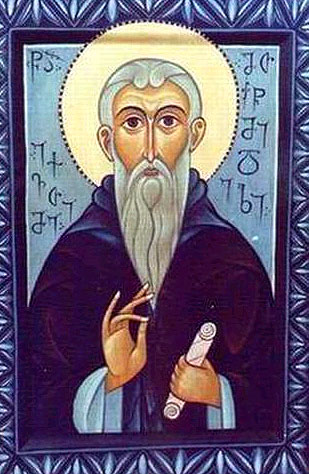
Venerable Cornelius, Abbot of Komel, Vologda

Saint Cornelius of Komel was descended from the boyar (noble) family Kriukov. His brother Lukian served at the court of the Great Prince of Moscow. When Lukian, who was getting old, decided to go to the monastery of Saint Cyril of White Lake, he was followed by Cornelius, who longed for the solitary life from a young age.

After he was tonsured, the young Cornelius began his monastic endeavors with a difficult obedience: he wore heavy chains in the bakery. In his spare time he occupied himself with copying church books. Because of his love for solitude, Saint Cornelius later left the White Lake monastery, and he visited Rostov.

At Novgorod, Saint Gennadius (December 4) attempted to hold on to him, but the ascetic settled in a desolate spot near Novgorod. When people began to visit here also, he moved to the Tver Sabbatiev wilderness monastery. Later, in 1497, he settled in the Komel forest, not far from Vologda, where he built a cell. Monks began to gather around the cell of Saint Cornelius. In 1501 he built a wooden church in honor of the Entry into the Temple of the Most Holy Theotokos. In that year Metropolitan Simon ordained him as hieromonk.

In 1512, when the number of brethren had grown, the saint built a stone church and he compiled a Rule for the brethren, based on the Rules of Saints Joseph of Volokolamsk and Nilus of Sora. This was the third monastic Rule written by Russian saints.

Saint Cornelius of Komel was distinguished by his charity toward the unfortunate, and during a famine he built an orphanage in the monastery courtyard. Because of his love for the poor and orphaned, Saint Cornelius was often granted visions of Saint Anthony the Great (January 17), for whom he had a special reverence. He constructed a church at his monastery in honor of this great ascetic.

The saint’s strictness of life provoked some of the brethren to grumbling, and Saint Cornelius was compelled to leave the monastery. He settled at Lake Sursk, 70 versts from his monastery. At times he also lived at the Trinity-Sergiev Lavra. Interceding for the monks of the Korniliev monastery, Great Prince Basil Ivanovich urged the saint to return to his own monastery. The ascetic gave in, and having returned to his own monastery, he transferred its guidance to his disciple Laurence and shut himself in his cell.

During a Tatar incursion into the Vologda region Saint Cornelius went with the monks to the outskirts of White Lake. The saint died at the age of eighty-two on May 19, 1537. Many disciples of Saint Cornelius were also glorified for their holiness of life: Saints Gennadius of Liubimograd (January 23), Cyril of New Lake (February 4), Herodion of Iloezersk (September 28), Adrian of Poshekhonye (March 5), Laurence and Cassian of Komel (May 16).

The commemoration of Saint Cornelius (May 19) was established on January 25, 1600 by Patriarch Job and a council of bishops. The Life of the saint was written by his disciple Nathaniel in the year 1589. There is a service and an encomium to the saint, and the Rule of Saint Cornelius has been preserved.

Saint Cornelius is also commemorated at the Synaxis of the Saints of Vologda (Third Sunday after Pentecost); and at the Synaxis of the Saints of Tver (the Sunday after June 28).

Venerable Cornelius, Abbot of Paleostrov

Saint Cornelius of Paleostrov and Olonets, born at Pskov, was the founder of monastic life on Pali island in Lake Onega at the end of the fourteenth century. Despite the desolation of the island, brethren soon gathered near him. He built for them a church in honor of the Nativity of the Most Holy Theotokos, and a trapeza church in honor of the holy Prophet Elias.

The saint spent the final years of his life in a cave half a verst from the monastery, in unceasing prayer. The ascetic added the wearing of heavy chains to his struggles.

The saint’s blessed repose occurred around the year 1420. His relics were transferred to the monastery church by his disciple, Saint Abramius of Paleostrov (August 21), who was also glorified by his ascetical life, and was buried in the Paleostrov monastery beside his Elder.

Right-believing John, Prince of Uglich, tonsured as Ignatius

The holy Prince John of Uglich was a devout and God-fearing Christian from his youth. He and his brother Demetrius were thrown into prison by their uncle John, and remained there for thirty-two years.

Before his death, Prince John received monastic tonsure with the name Ignatius. He was known as a wonderworker.

Venerable Sergius of Shukhtom

Saint Sergius (Stephen, in the world) was a Schema-monk of Shukhtom (or Shukhtov) Monastery, located in the village of Shukhtom 50 km from the city of Cherepovets. His Holy Relics were buried under the floor of the monastery church, which later became the Protection parish church when the monastery was abolished.

Some information about the devout and ascetical life of Saint Sergius is given in a lengthy inscription on his tomb. It states that on May 19, 1609, the Feast of the Holy Martyr Patrick, the Bishop of Prussia, the servant of God, Schema-monk Sergius, reposed during the reign of Tsar Basil IV Shuisky, when His Holiness Ermogen (February 17 and May 12) was Patriarch of Moscow. The labor-loving body of Saint Sergius was buried in the chapel of the church of the Life-creating Trinity and the Protection of the Theotokos at Shukhtom, in the region of White Lake.

The Saint was born and raised in Kazan, and from his youth he had a profound reverence for the monastic Life, but considered himself unworthy of it. He spent three years wandering through Palestine, Constantinople, and Greece, worshipping at the holy places, and learning about the monastic life in various countries.

He visited Orthodox shrines from the Holy Land to Solovki Monastery, and his life was very austere. He fasted constantly, allowing himself to sleep only while sitting. Therefore, he received from God the great spiritual gifts of unceasing prayer, clairvoyance, and working miracles.

In 1603, the man of God came to the Vologda region, where he was tonsured with the name Sergius by the Superior, Archimandrite Isaiah of the Cherepovets Monastery of the Resurrection. Later, Father Isaiah painted an icon depicting the Saint's tonsure.

Saint Sergius reposed on May 19, 1609 at the age of seventy-nine, after fifty years of asceticism.

Saint John, Bishop of the Goths in the Crimea

Saint John, Bishop of the Goths, lived during the eighth century. The future saint was born in answer to the fervent prayer of his parents. From an early age, he lived a life of asceticism.

The saint made a pilgrimage to Jerusalem, and spent three years visiting all the holy places. Then he returned to his native country. At that time the emperor Constantine Copronymos the Iconoclast (741-775) banished the Gothic bishop, and the Goths fervently entreated Saint John to become their bishop.

Saint John went to Georgia, which was isolated from the Iconoclast heresy. There he was ordained. Upon his return to the Goths he was soon compelled to depart from them. Hidden away from the pursuing Khazars, he settled at Amastridia, where he dwelt for four years.

Hearing about the death of the Khazar kagan (ruler), the saint said, “After forty days I shall go to be judged with him before Christ the Savior.” Indeed, the saint died forty days later. This took place when he returned to his people, in the year 790.

The saint’s body was conveyed to the Parthenit monastery in the Crimea, at the foot of Mount Ayu-Dag, where the saint once lived in the large church he built in honor of the holy Apostles Peter and Paul.

Saint John, Bishop of the Goths, is also celebrated on June 26.

Right-believing Demetrios Donskoy, Grand Prince of Moscow

The right-believing Great Prince Demetrios of Moscow was born in 1350. His father died when Demetrios was just a young child, and so he was entrusted to the guidance of Saint Alexis of Moscow (February 12). The holy Prince Demetrios combined Christian piety with his remarkable political talents, devoting himself to the unification of the land of Russia and to the emancipation of Russia from the Tatar-Mongol Yoke.

On August 18, 1380, after gathering his forces for a decisive battle with Mamai of the Golden Horde, Saint Demetrios visited Saint Sergius of Radonezh (September 25) in order to receive his blessing. The Elder blessed two monks from his monastery, Schema-monk Andrew [Oslyaba] and Schema-monk Alexander [Peresvet], to go along and help the Prince. He also predicted that Saint Demetrios would be victorious. The Prince left Moscow with his army on August 20, and marched toward Kolomna.

One day, as they made camp before the Battle of Kulikovo, an Icon of St. Nicholas appeared in the air, hovering over a pine tree, and it descended into the hands of Saint Demetrios. There is a later Icon depicting this event, with Saint Demetrios kneeling before the Icon of Saint Nicholas, and laying his gold crown at the roots of the tree.

One of those who fought in the Battle of Kulikovo was a Lithuanian Prince by the name of Montvid Montvilo, who saved the life of Saint Demetrios by shielding him from a Tatar sword with his own body. That night he beheld Saint Nicholas in a dream. The holy wonderworker told him that he had cushioned the blow because Prince Montvilo wore on his chest an Icon of Saint Nicholas, which was a family heirloom. In return for saving the Prince's life, Saint Nicholas told Prince Montvilo that one of his descendants would render great service to Russia.

Over the years, the Lithuanian name Montvilo became the Russian Motovilov. Alexander Motovilov, a descendant of Prince Montvilo, proposed and was rejected by his intended bride Maria, and so he entered a monastery. His obedience was to work in the prosphora bakery, but one day he felt so exhausted that he fell asleep at noon. Saint Nicholas appeared to him and said, "Alexander, your path does not lie in the monastery, but in family life. You will find your happiness with Maria, who turned you down. She will bear you a son, whom you shall name Nicholas. God requires him! I am Saint Nicholas, and I shall be the patron saint of the Motovilov family. I have been so since your ancestor, Prince Montvid Montvilo, served in the army of Prince Demetrios of the Don. During the Battle of Kulikovo, the Tatar warrior who struck down the monks Alexander and Andrew rushed at the Great Prince with his sword, but your ancestor took the blow, and the sword struck my Icon, which he wore on his chest. He would have been killed if I had not cushioned the blow, and then struck down the Tatar by Montvid's hand."

The Icon of Saint Nicholas, which was damaged by the Tatar's sword, was treasured as a holy relic in the family of George Nikolaevich Motovilov.

Nicholas Alexandrovich Motovilov was born on May 3, 1809, and reposed on January 14, 1879. His great service to Russia, of course, was to write down his conversation with Saint Seraphim of Sarov (January 2) about the aim of the Christian life, and how to acquire the grace of the Holy Spirit.

After winning the battle, the Prince ordered a Moleben of Thanksgiving to God and to Saint Nicholas to be served. Later, he built a church and a monastery dedicated to St. Nicholas on that site.

Following his victory at Kulikovo Field, between the Don and Nepryadva Rivers (on September 8, the Great Feast of the Nativity of the Most Holy Theotokos), Prince Demetrios received the honorific "of the Don." He established the Dormition Monastery at the Dubenka River, and the church of the Nativity of the Most Holy Theotokos near the graves of those who died for their country. The Memorial Saturday before the Feast of Saint Demetrios of Thessalonika (October 26) was established in memory of the Orthodox warriors who were killed at Kulikovo Field in the great battle against the Horde.

Saint Demetrios fell asleep in the Lord on May 19, 1389. He was buried in the cathedral of the Archangels in the Moscow Kremlin.

Martyr Caluf of Egypt

The Holy Martyr Caluf the Egyptian lived during the third century, and was from the city of Thebes. For his confession of faith in Christ he was arrested and taken before the prefect of the city. He was suspended head downward, and received a cruel beating. The sufferer repeated, “I endure everything in expectation of the future life.”

They then untied him and urged him to offer sacrifice to idols, but the saint did not consent. Finally, he was thrown into a fire and surrendered his soul to God. This occurred in the year 303.

The holy martyr Caluf suffered during the persecution by the emperor Maximian Hercules, who ruled jointly with Diocletian (284-305).

Entrance of Saint Nino (Nina) the Enlightener into Georgia

The holy Apostles Andrew the First-called and Simon the Canaanite first preached the Christian Faith in Georgia in the 1st century, but at the beginning of the 4th century most of the country was still pagan.

After the Theotokos revealed God’s will for her future, the Equal-to-the-Apostles Nino set off for Georgia to enlighten the Iberian people. She arrived in Armenia with the holy martyrs and virgins Rhipsimia, Gaiana and their fifty companions. The holy virgins were martyred in Armenia and, according to God’s will, Saint Nino journeyed on alone to Lake Paravani, entering Georgia from the Javakheti Mountains. She arrived in the spring, but the weather was unseasonably cold.

The Apostolic Church of Georgia has honored the Entrance of the holy Equal-to-the-Apostles Nino as a major feast day. The Church also commemorates her on January 14, the day of her repose.

Martyr Theotime

There is very little information about Saint Theotime (Θεοτίμη) except that
she was beheaded ca. 311, thereby receiving an incorruptible crown from Christ.

Daily Readings for Thursday, May 18, 2023

5TH THURSDAY AFTER PASCHA

NO FAST

5th Thursday after Pascha, Holy Martyrs: Peter, Dionysius, Andrew, Paul, Christina, Heraclius, Paulinus and Benedimus, Stephen I, Patriarch of Constantinople, Julian the Martyr, Euphrasia the Martyr of Nicea

ACTS OF THE APOSTLES 14:20-28; 15:1-4

IN THOSE DAYS, Paul went on with Barnabas to Derbe. When they had preached the gospel to that city and had made many disciples, they returned to Lystra and to lconion and to Antioch, strengthening the souls of the disciples, exhorting them to continue in the faith, and saying that through many tribulations we must enter the kingdom of God. And when they had appointed elders for them in every church, with prayer and fasting they committed them to the Lord in whom they believed. Then they passed through Pisidia, and came to Pamphylia. And when they had spoken the word in Perga, they went down to Attalia; and from there they sailed to Antioch, where they had been commended to the grace of God for the work which they had fulfilled. And when they arrived, they gathered the church together and declared all that God had done with them, and how he had opened a door of faith to the Gentiles. And they remained no little time with the disciples. But some men came down from Judea and were teaching the brethren, "Unless you are circumcised according to the custom of Moses, you cannot be saved." And when Paul and Barnabas had no small dissension and debate with them, Paul and Barnabas and some of the others were appointed to go up to Jerusalem to the apostles and the elders about this question. So, being sent on their way by the church, they passed through both Phoenicia and Samaria, reporting the conversion of the Gentiles, and they gave great joy to all the brethren. And when they came to Jerusalem, they were welcomed by the church and the apostles and the elders, and they declared all that God had done with them.

JOHN 9:39-10:9

The Lord said to the Jews who came to him, "For judgment I came into this world, that those who do not see may see, and that those who see may become blind." Some of the Pharisees near him heard this, and they said to him, "Are we also blind?" Jesus said to them, "If you were blind, you would have no guilt; but now that you say, 'We see, ' your guilt remains.
Truly, truly, I say to you, he who does not enter the sheepfold by the door but climbs in by another way, that man is a thief and a robber; but he who enters by the door is the shepherd of the sheep. To him the gatekeeper opens; the sheep hear his voice, and he calls his own sheep by name and leads them out. When he has brought out all his own, he goes before them, and the sheep follow him, for they know his voice. A stranger they will not follow, but they will flee from him, for they do not know the voice of strangers." This figure Jesus used with them, but they did not understand what he was saying to them.
So Jesus again said to them, "Truly, truly, I say to you, I am the door of the sheep. All who came before me are thieves and robbers; but the sheep did not heed them. I am the door; if any one enters by me, he will be saved, and will go in and out and find pasture.

Martyr Theodotus of Ancyra, and with him the seven Virgin Martyrs: Alexandra, Tecusa, Claudia, Phaine, Euphraisa, Matrona, and Julia, who suffered under Decius

The Holy Martyr Theodotus and the Holy Seven Virgins Tecusa, Phaine, Claudia, Matrona, Julia, Alexandra and Euphrasia lived during the second half of the third century in the city of Ancyra, Galatia, and died as martyrs for Christ at the beginning of the fourth century. Saint Theodotus was an innkeeper and was married.

Theoteknos, prefect of Ancyra, issued a proclamation informing Christians that they were obliged to offer sacrifice to idols, and if they refused, they would be tortured and killed. Pagans would deliver Christians over to torture, and then divide up their property.

Theodotus was not afraid to bury the remains of holy martyrs, either carrying them off secretly or ransoming them from the soldiers. When the Christian churches at Ancyra were destroyed and closed, the Divine Liturgy was celebrated in his inn. Knowing that martyrdom awaited him, Saint Theodotus predicted to the priest Phrontonos that soon they would bring him the relics of martyrs, at a place chosen by both of them. In surety of his words, Saint Theodotus gave the priest his ring.

At this time, seven holy virgins died for Christ. The eldest, Saint Tecusa, was the aunt of Saint Theodotus. The holy virgins Tecusa, Phaine, Claudia, Matrona, Julia, Alexandra and Euphrasia had dedicated themselves to God from their youth, living in constant prayer, fasting, temperance and good deeds. All of them had attained to an advanced age.

Brought to trial as Christians, the holy virgins bravely confessed their faith in Christ before Theoteknos and were given over to torture, yet remained steadfast. The prefect then gave them to shameless youths for defilement. The holy virgins prayed intensely, asking help from God. Saint Tecusa fell down at the feet of a youth, and pushing back her veil she showed him her grey hair. The young men were startled, and ran off weeping. The prefect then ordered that the saints take part in offering sacrifice to the idols, but again the holy virgins refused. For this they were sentenced to death. A heavy stone was tied to the legs of each, and all seven of the holy virgins were drowned in a lake.

On the following night Saint Tecusa appeared in a dream to Saint Theodotus, asking him to take her body and give it Christian burial. Saint Theodotus, taking with him his friend Polychronius and several other Christians, went to the lake. It was dark, and a torch illumined their way. The holy martyr Sosander appeared in front of the guard who was posted by the pagans at the shore of the lake. The frightened guard ran off in terror.

The Christians found the bodies of the holy martyrs and carried them to church, where they were buried. Learning that the bodies of the holy martyrs had been stolen, the prefect flew into a rage and gave orders to arrest all Christians and torture them. Polychronius also was seized. Unable to endure the torture, he accused Saint Theodotus of stealing the bodies. Saint Theodotus was prepared to die for Christ. Speaking with other Christians, he bequeathed his body to the priest Phrontonos, to whom he had given his ring.

The account of the life and martyrdom of Saint Theodotus and the suffering of the holy virgins was compiled by Nilus, a contemporary and companion of Saint Theodotus. Nilus lived in the city of Ancyra during the persecution of Christians under the emperor Diocletian, and witnessed the saint’s death.

Saint Theodotus is also commemorated on June 7.

Martyrs Peter, Dionysius, Andrew, Paul, and Christina who suffered under Decius

The Holy Martyrs Peter, Dionysius, Andrew, Paul, and Christina suffered under emperor Decius (249-251). Peter suffered in the city of Lampsaka. Brought to trial before the prefect Optimines, he bravely confessed his faith in Christ. They tried to force the youth to deny the Lord and worship the goddess Venus. The martyr refused to do this, declaring for everyone to hear, that a Christian would not bow to the idol of a lecherous woman.

Saint Peter was subjected to fierce tortures, but he endured them with courage, giving thanks to the Lord Jesus Christ for giving him His all-powerful help. Then he was beheaded.

Dionysius, Nikomachus, and two soldiers, Andrew and Paul, who had been transferred from Mesopotamia, were put on trial. They all confessed their faith in Christ and refused to offer sacrifice to idols, so they were tortured. To the great sorrow of all the Christians, Nikomachus did not persevere. He denied the Lord Jesus Christ, and entered a pagan temple to offer sacrifice. He fell down in a terrible frenzy and died foaming at the mouth, tearing the skin from his body with his teeth.

On the following morning, Saints Dionysius, Andrew and Paul were again brought before the prefect. For confessing faith in Christ they were given to the pagans to be put to death. They bound the saints by the feet, dragged them to the place of execution, and stoned them to death.

Saint Christina watched the trial of Dionysius, Nikomachus, Andrew, and Paul, and all that happened. The sixteen-year-old Christina shouted, “Nikomachus, you cursed and lost man! Instead of enduring pain for a single hour, you have made yourself worthy of eternal torment!” The prefect gave orders to seize the holy virgin. Learning that she was a Christian, he gave her to dissolute men for their pleasure.

An angel appeared at the house where they had taken the holy virgin. Frightened by his terrible visage, the men tearfully begged the holy virgin’s forgiveness and asked her to pray that the Lord’s chastisement might not befall them. She was then beheaded by order of the prefect.

Martyrs Simeon, Isaac and Bachtisius, of Persia

The Holy Martyrs Simeon, Isaac and Bachtisius were Christians and lived during the third century in Persia under the emperor Sapor, a fierce persecutor of Christians. They tried to force the saints to deny Christ and be converted to fire-worship. They refused and said, “We will not turn away from the Creator of all, and we will not worship fire or the sun.”

They cruelly tortured the holy martyrs, then threw them into prison, where they were not given food for seven days. Finally, the martyrs were beheaded.

Martyrs Heraclius, Paulinus, and Benedimus

The Holy Martyrs Heraclius, Paulinus and Benedimus suffered for Christ in the city of Athens. They taught the pagans about Christ and urged them to abandon the worship of senseless idols. These chosen vessels of God were brought to trial with their followers who had discerned the true path. After many torments they were thrown into a fiery oven, in which they surrendered their souls to God.

Martyrs David and Tarichan of Georgia

The holy martyrs David and Tarichan were born to Vardan and Tagine, pious Christians and relatives of the king. Vardan died while his sons were still young, and Tagine’s pagan brother Theodosius seized all the family’s possessions.

Concerned that the brothers would eventually claim their legal inheritance, Theodosius resolved to convert his sister and nephews to his own creed. “Leave behind the Faith of the crucified Christ and receive mine and I will adopt your children,” he told Tagine. But Tagine firmly guarded the family against her brother’s evil intent. “It is enough that you have seized my sons’ estate,” she said. “But you cannot seize the inheritance they will receive from their Father in heaven!”

Theodosius was thwarted by his sister’s resoluteness. So instead, he tried to convert his nephews directly. He called them, embraced them warmly, and tempted them with sweets. “Now you are my sons, and everything I have belongs to you,” he told them. “Trust me like obedient sons of a beloved father. Turn from the Faith of your father, and I will show you a better way!”

After a brief silence, the holy youths answered, “We are perfectly content with our father’s Faith and will remain loyal to this Faith until the day our souls depart from our flesh. We are prepared to suffer everything for the love of our Lord and Heavenly Father!”

Theodosius dared not try to sway his nephews since he feared the revenge of the Christian community, so he left them in peace and plotted to murder them in secret. But Tagine sensed that danger was near and escaped with her sons to the region of Tao in the south.

From his spies Theodosius learned that the brothers were now herding sheep at the top of a mountain, and he ordered an ambush. But the brothers heard the noise and saw the armed soldiers before they attacked. David rejoiced upon seeing his uncle and ran toward him, but Theodosius stabbed him before he could embrace him. The holy martyr released his staff from his hand, and when it fell to the ground it was miraculously transformed into a large tree. Two hundred years later a group of Christians chopped the tree down and divided the holy wood among themselves.

Having just witnessed his own brother’s murder, Tarichan raced toward the village of Divri for help. But his pursuers overtook him, stabbed him to death, and ran off. When they returned to Theodosius, they saw that God had punished him by taking away his sight. The soldiers were stunned, and they could neither utter a word nor move from the place of this miracle. After some time Theodosius’ eyes filled with bitter tears, and he was finally moved to repentance.

At first Tagine denounced her brother in a rage, and those who heard the cries of the inconsolable mother wept along with her. But while she was stroking the lifeless bodies of her sons, Theodosius turned to her, saying, “On you has shone the Inextinguishable Light from the Unapproachable and True Light, the Eternal Light. Pray to the holy martyrs that the Lord have mercy on me and make me, the unworthy, worthy of the seal of Christ, the All-merciful God, Who came into the world. Indeed, He is the One True God!” When Tagine heard these words, she recognized that God had received her sons as a holy sacrifice. Filled with new joy, she told her brother, “May God forgive you the murder of my sons!”

Then she took a piece of the earth that had been stained by her son David’s blood and anointed her brother’s eyes. Immediately his sight was restored.

This happened in the year 693. As a witness to the sanctity of His martyrs, our God, Who loves mankind, illumined their bodies with a radiant light each evening when night fell.

Theodosius repented before the catholicos himself. He was baptized into the Christian Faith and erected a church in honor of his nephew Saint David. The mayor of Divri took Saint Tarichan’s holy relics and built a church over them in his name. Blessed Tagine began a new life in the village of Tadzarani and later reposed there.

Daily Readings for Wednesday, May 17, 2023

5TH WEDNESDAY AFTER PASCHA

NO FAST

5th Wednesday after Pascha, The Holy Apostles Andronicus and Junia, Theophanes and Nectarios, Builders of the Holy Monastery of Varlaam of Meteora, Nicholas the Younger who was martyred in Metsovo, Epirus, Theodotos the Martyr of Ancyra & the 7 Virgin-martyrs, Athanasios, Archbishop of Christianopolis, The New Martyrs of Batak, Bulgaria

ACTS OF THE APOSTLES 13:13-24

IN THOSE DAYS, Paul and his company set sail from Paphos, and came to Perga in Pamphylia. And John left them and returned to Jerusalem; but they passed on from Perga and came to Antioch of Pisidia. And on the sabbath day they went into the synagogue and sat down. After the reading of the law and the prophets, the rulers of the synagogue sent to them, saying, ‘Brethren, if you have any word of exhortation for the people, say it.’ So Paul stood up, and motioning with his hand said: ‘Men of Israel, and you that fear God, listen. The God of this people Israel chose our fathers and made the people great during their stay in the land of Egypt, and with uplifted arm he led them out of it. And for about forty years he bore with them in the wilderness. And when he had destroyed seven nations in the land of Canaan, he gave them their land as an inheritance, for about four hundred and fifty years. And after that he gave them judges until Samuel the prophet. Then they asked for a king; and God gave them Saul the son of Kish, a man of the tribe of Benjamin, for forty years. And when he had removed him, he raised up David to be their king; of whom he testified and said, ‘I have found in David the son of Jesse a man after my heart, who will do all my will.’ Of this man’s posterity God has brought to Israel a Savior, Jesus, as he promised. Before his coming John had preached a baptism of repentance to all the people of Israel.’

JOHN 6:5-14

At that time, Jesus, lifting up his eyes and seeing that a multitude was coming to him, said to Philip, "How are we to buy bread, so that these people may eat?" This he said to test him, for he himself knew what he would do. Philip answered him, "Two hundred denarii would not buy enough bread for each of them to get a little." One of his disciples, Andrew, Simon Peter's brother, said to him, "There is a lad here who has five barley loaves and two fish; but what are they among so many?" Jesus said, "Make the people sit down." Now there was much grass in the place; so the men sat down, in number about five thousand. Jesus then took the loaves, and when he had given thanks, he distributed them to those who were seated; so also the fish, as much as they wanted. And when they had eaten their fill, he told his disciples, "Gather up the fragments left over, that nothing may be lost." So they gathered them up and filled twelve baskets with fragments from the five barley loaves, left by those who had eaten. When the people saw the sign which he had done, they said, "This is indeed the prophet who is to come into the world!

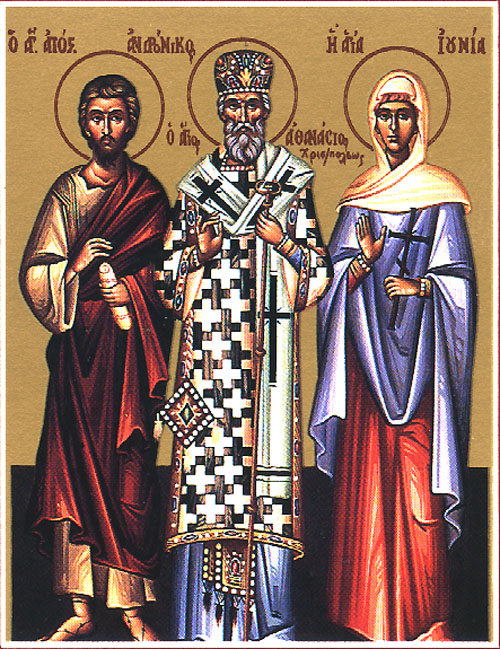
Apostle Andronicus of the Seventy and his fellow-laborer, Junia

Saint Andronicus Apostle of the Seventy and Saint Junia were relatives of the holy Apostle Paul. They labored much, preaching the Gospel to pagans. Saint Paul mentions them in his Epistle to the Romans: “Salute Andronicus and Junia, my kinsmen and fellow prisoners, who are of note among the Apostles, who also were in Christ, before me” (Romans 16:7).

Saint Andronicus was made Bishop of Pannonia, but his preaching also took him and Saint Junia to other lands, far from the boundaries of his diocese. Through the efforts of Saints Andronicus and Junia the Church of Christ was strengthened, pagans were converted to the knowledge of God, many pagan temples closed, and in their place Christian churches were built. The service in honor of these saints states that they suffered martyrdom for Christ.

In the fifth century, during the reign of the emperors Arcadius and Honorius, their holy relics were uncovered on the outskirts of Constantinople together with the relics of other martyrs at the gate of Eugenius (February 22).

It was revealed to the pious cleric Nicholas Kalligraphos that among the relics of these seventeen martyrs were the relics of the holy Apostle Andronicus. Afterwards, a magnificent church was built on this spot.

Saint Euphrosynē, Great Princess of Moscow

Today the Orthodox Church commemorates the tonsure of Saint Euphrosynē of Moscow on
May 17,1407.

After the death of her husband, Saint Demetrios of the Don (May 19) from the wounds he received at the Battle of Kulikovo, the Holy Princess Eudokia refrained from participating directly in the affairs of state; but on her advice, the wonderworking Icon of the Most Holy Theotokos was transferred from Vladimir to Moscow (August 26, 1395) because of the invasion of Khan Tamerlane. Soon afterward, she established a Convent in the palace, dedicating it to the Lord's Ascension.

Though inclined toward the monastic Life, she did not become a nun at that time, since her sons were very young, and instead, she acted as regent. She dressed in royal splendor, attended banquets, and participated in councils. Beneath her expensive clothing, she wore iron chains, concealing her ascetic labors and acts of charity from those around her.

Shortly before her death, an Angel appeared to her and informed her that her earthly life would end very soon. Then she became mute. By signs and gestures she made it known that she wished to have an icon of the Angel painted. When it was finished, Eudokia venerated it, and asked for another one to be painted. Only after the icons of the Archangel Michael were completed did she recognize the Angel who had appeared to her, and then she regained her voice.

The Saint expressed a wish to be tonsured in order to spend her final days in seclusion and prayer. At that time she appeared to a blind man in a dream and promised to heal him.

On May 17, 1407, Princess Eudokia was on her way to the Convent, and the blind man was sitting by the roadside. Hearing her approach, he shouted: "Holy Great Princess, feeder of the poor! You always gave us food and clothing, and you never refused our requests! Do not disregard my petition now, but heal me of my blindness, as you promised in my dream! You told me, ‘Tomorrow I will give you sight.' Now the time has come for you to fulfill your promise."

She continued on her way, seeming not to understand his words, but as she passed by, she brushed him, as if by accident, with the sleeves of her cloak. The man pressed them to his eyes and regained his sight. According to Tradition, thirty people were healed of various illnesses on that day.

Princess Eudokia was tonsured with the name Euphrosynē, which means “joy” or "gladness" in Greek. Her tonsure took place in the wooden church of the Ascension at the Convent.

The Saint reposed seven weeks after entering the Convent, departing to the Lord at the age of fifty-four on July 7, 1407. At her own request, she was buried in the church which she had started to build in the Kremlin, which was dedicated to the Ascension of Christ. Her wonderworking relics remained there until 1929.

She had been buried under the floor of the church with a cover over the grave. In 1922, after the Revolution, this cover was stolen by the Soviets, while Saint Euphrosynē's relics remained in the grave under the floor. In 1929, the government decided to destroy the Ascension Convent. Thanks to the efforts of museum workers, her relics were saved along with the remains of other royal personages interred there. Her relics, however, have yet to be identified and separated from the others. The remains were interred in the Cathedral of the Archangel.

In 2006, construction of a church dedicated to Saint Euphrosynē began in Moscow. It is located on the site of Great Prince Demetrios's palace. When it is completed, there are plans to tranfer her relics to this church.

Saint Euphrosynē is also commemorated on July 7, the day of her blessed repose.

Martyrs Solochon, Pamphamer, and Pamphalon, at Chalcedon

Saint Solochon, a native of Egypt, suffered for Christ during the reign of the emperor Maximian (284-305). The holy martyrs Pamphamirus and Pamphalon also gave their lives for Christ at the same time. All of them served in the imperial army in the regiment of the tribune Campanus.

During the persecution against Christians by the emperors Maximian and Diocletian, Campanus was sent to the city of Chalcedon with his soldiers. All the soldiers of his regiment were required to offer sacrifice in a pagan temple. The three soldiers, Saints Solochon, Pamphamirus and Pamphalon, refused to offer sacrifice to idols, explaining that they worshiped only the true God, the Lord Jesus Christ.

On the orders of Campanus they were subjected to terrible tortures, during which the holy martyrs Pamphamirus and Pamphalon died. Saint Solochon survived the torture and remained alive, glorifying Christ. In great anger, the torturer gave orders to open Saint Solochon’s mouth and force him to drink blood offered to idols. But Saint Solochon clenched his teeth so strongly, that they could not open them even with iron. The sword bent, and the saint broke his bonds and stood before the torturer, continuing to glorify Christ. Saint Solochon heard a voice from the heavens encouraging him to persevere to the end.

The saint endured a merciless beating, after which they dragged him over sharp stones, demanding that he renounce Christ, but the holy martyr remained steadfast. Then he was hung up by one hand, with a heavy weight tied to his leg. Saint Solochon remained in this position for about three hours. When finally they cut the ropes, then to everyone’s surprise, Saint Solochon stood upright on his feet, like a healthy man. Insane with anger, Campanus took a stylus and thrust it into the martyr’s ear.

The sufferer fell down, and Campanus and the soldiers departed, casting him aside. Christians carried the martyr to the house of a certain pious widow and placed him on a cot. The saint ate some food and conversed with the Christians, exhorting them to stand firmly for the Faith, and then after he prayed and lifted up his eyes to heaven, he surrendered his soul to the Lord Jesus Christ.

Saint Stephen, Archbishop of Constantinople

Saint Stephen, Patriarch of Constantinople, was the younger son of Emperor Basil the Macedonian, and was a brother of Emperor Leo the Wise. He was ordained to the priesthood under Patriarch Photius. When Saint Photius was compelled to resign the patriarchal throne in the year 886, Saint Stephen was elevated to the See of Constantinople. The saint vigilantly stood watch over his spiritual flock, he was merciful and interceded for the defenseless, he concerned himself with widows and orphans, and distinguished himself by his temperance. He died peacefully in the year 893 and was buried in the Sikellian monastery.

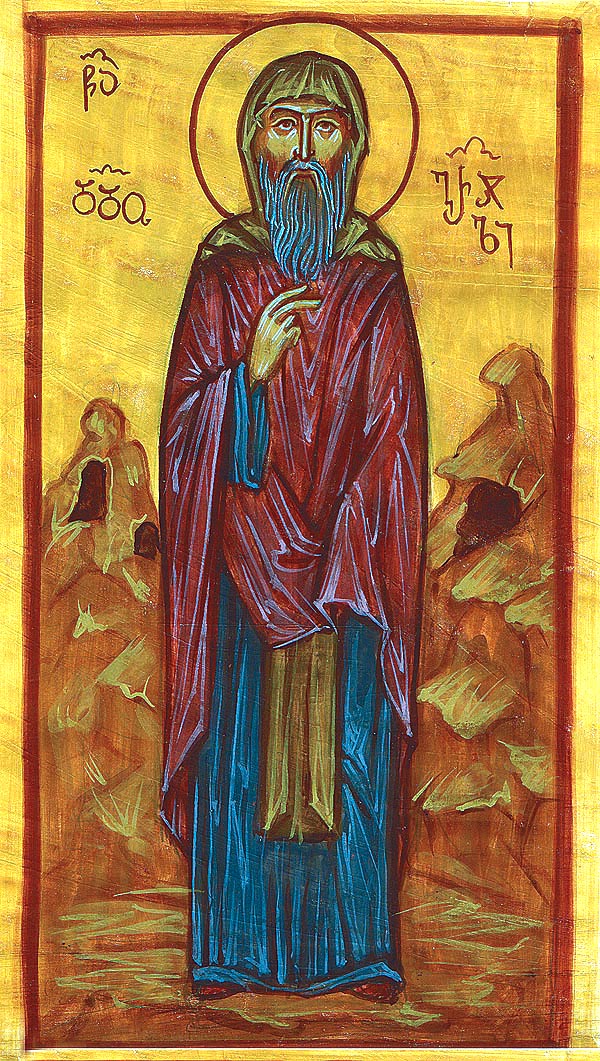
Venerable Dodo of the Saint David-Gareji Monastery, Georgia

A companion of Saint David of Gareji, Saint Dodo belonged to the royal family Andronikashvili. He was tonsured a monk while still a youth, and was endowed with every virtue.

An admirer of poverty and solitude, he labored as a hermit at Ninotsminda in Kakheti.

Having heard about the miracles of David of Gareji, Saint Dodo set off for the Gareji Wilderness to witness them himself. The venerable fathers greeted one another warmly and began laboring there together.

After some time, Saint David became deeply impressed with Dodo’s devotion to the Faith, and he proposed that he take with him some of the other monks and begin to construct cells on the opposite mountain.

The brothers built cells and began to labor there with great ardor. Before long the number of cells had reached two hundred. Saint Dodo isolated himself in a narrow crevice, where there was barely room for one man. Day and night, winter and summer, in the heat and the cold, he prayed with penitent tears for the forgiveness of his sins, the strengthening of the souls of his brothers, and the bolstering of the true Faith throughout the country.

Once Saint David miraculously healed the son of Prince Bubakar of Rustavi. In return, the grateful prince donated food and other necessities to the monks of Gareji Monastery. Saint David took part of his contributions and sent what remained to Saint Dodo. He advised Bubakar to have Saint Dodo baptize him, and Saint Dodo joyously baptized Bubakar, his sons, and all his suite.

Saint Dodo labored to an advanced age in the monastery he had founded and reposed peacefully.

His spiritual sons and companions buried him in the cave where he had labored, and a church was later built over his grave.

Greatmartyr Nicholas of Sofia

No information available at this time.

Saint Athanasius the New, Wonderworker and Archbishop of Christianopolis

No information available at this time.

Transfer of the relics of the Hieromartyr Adrian of Ondrusov, Wonderworker

In the manuscript of the Olonets Trebnik under May 17 it is noted: "Today is the transfer of the relics of Venerable Father Adrian, Igoumen of Saint Nicholas Monastery on Lake Ladoga, on Ondrus Island, in the Olonets district, the new wonderworker. His memory is also celebrated on August 26."

Daily Readings for Tuesday, May 16, 2023

5TH TUESDAY AFTER PASCHA

NO FAST

Theodore the Sanctified, Holy Martyr Peter of Blachernae, Nicholas the Mystic, Patriarch of Constantinople, New Martyr Nicholas of Metsovos (1617), Alexandros, Archbishop of Jerusalem, Brendan the Navigator

ACTS OF THE APOSTLES 12:25; 13:1-12

In those days, Barnabas and Saul returned from Jerusalem when they had fulfilled their mission, bringing with them John whose other name was Mark. Now in the Church at Antioch there were prophets and teachers, Barnabas, Simeon who was called Niger, Lucius of Cyrene, Manaen a member of the court of Herod the tetrarch, and Saul. While they were worshipping the Lord and fasting, the Holy Spirit said, “Set apart for me Barnabas and Saul for the work to which I have called them.” Then after fasting and praying they laid their hands on them and sent them off. So, being sent out by the Holy Spirit, they went down to Seleucia; and from there they sailed to Cyprus. When they arrived at Salamis, they proclaimed the word of God in the synagogues of the Jews. And they had John to assist them. When they had gone through the whole island as far as Paphos, they came upon a certain magician, a Jewish false prophet, named Bar-Jesus. He was with the proconsul, Sergius Paulus, a man of intelligence, who summoned Barnabas and Saul and sought to hear the word of God. But Elymas the magician (for that is the meaning of his name) withstood them, seeking to turn away the proconsul from the faith. But Saul, who is also called Paul, filled with the Holy Spirit, looked intently at him and said, “You son of the devil, you enemy of all righteousness, full of all deceit and villainy, will you not stop making crooked the straight paths of the Lord? And now, behold, the hand of the Lord is upon you, and you shall be blind and unable to see the sun for a time.” Immediately mist and darkness fell upon him and he went about seeking people to lead him by the hand. Then the proconsul believed, when he saw what had occurred, for he was astonished at the teaching of the Lord.

JOHN 8:51-59

The Lord said to the Jews who came to him, "Truly, truly, I say to you, if any one keeps my word, he will never see death." The Jews said to him, "Now we know that you have a demon. Abraham died, as did the prophets; and you say, 'If any one keeps my word, he will never taste death.' Are you greater than our father Abraham, who died? And the prophets died! Who do you claim to be?" Jesus answered, "If I glorify myself, my glory is nothing; it is my Father who glorifies me, of whom you say that he is your God. But you have not known him; I know him. If I said, I do not know him, I should be a liar like you; but I do know him and I keep his word. Your father Abraham rejoiced that he was to see my day; and he saw it and was glad." The Jews then said to him, "You are not yet fifty years old, and have you seen Abraham?" Jesus said to them, "Truly, truly, I say to you, before Abraham was, I am." So they took up stones to throw at him; but Jesus hid himself, and went out of the temple.

Venerable Theodore the Sanctified, disciple of Venerable Pachomius the Great

Saint Theodore was called “Sanctified” because he was the first in his monastery ordained to the priesthood.

Saint Theodore came from Egypt and was the son of rich and illustrious Christian parents. The yearning for monastic life appeared early in him. Once there was a large party at the house of his parents during the feast of Theophany. The boy did not want to take part in the festivities, grieving that because of earthly joys he might be deprived of joys in the life to come. He secretly left home when he was fourteen and entered one of the monasteries.

Hearing about Pachomius the Great, he burned with the desire to see the ascetic. Saint Pachomius received the young man with love, having been informed by God beforehand about his coming. Remaining at the monastery, Saint Theodore quickly succeeded in all his monastic tasks, particularly in the full obedience to his guide, and in his compassion towards the other brethren. Theodore’s mother, learning that he was at the Tabennisi monastery, came to Saint Pachomius with a letter from the bishop, asking to see her son. Saint Theodore did not wish to break his vow to renounce the world, so he refused to meet with his mother.

Seeing Saint Theodore’s strength of mind and ability, Saint Pachomius once told him to instruct the brethren on Holy Scripture. Saint Theodore was then only twenty years old. He obeyed and began to speak, but some of the older brethren took offense that a new monk should teach them, and they departed. Saint Pachomius said to them, “You have given in to the devil and because of your conceit, your efforts will come to naught. You have not rejected Theodore, but rather the Word of God, and have deprived yourselves of the Holy Spirit.”

Saint Pachomius appointed Saint Theodore as overseer of the Tabennisi monastery, and withdrew to a more solitary monastery. Saint Theodore with filial love continued to concern himself over his instructor, and he looked after Saint Pachomius in his final illness, and when the great abba reposed in the Lord, he closed his eyes. After the death of Saint Pachomius, Saint Theodore directed the Tabennisi monastery, and later on he was at the head of all the Thebaid monasteries. Saint Theodore the Sanctified was famed for his holiness of life and a great gift of wonderworking, and he was well known to Saint Athanasius, Patriarch of Alexandria. Saint Theodore reposed in his old age in the year 368.

Translation of the relics of Venerable Ephraim, Abbot of Perekop, Novgorod

The Transfer of the Relics of Saint Ephraim of Perekop occurred on May 16, 1545. This celebration was established at a Moscow Council of the year 1549. Saint Ephraim of Perekop reposed on September 26, 1492. The Life of the saint is found under September 26 .

Venerable Cassian, Abbot of Komel (Vologda)

Saint Cassian of Komel and Vologda was a disciple of Saint Cornelius of Komel (May 19) and he guided the Komel monastery after Saint Cornelius went to Lake Sura. Chosen by the brethren with the blessing of Saint Cornelius, he strove to imitate his teacher in everything, and he strictly observed his monastic Rule.

Saint Cassian instructed the monks in the fear of God to spend their time at prayer, to be concerned about inner activity, and to banish all worldly thoughts, to be sober in thought, to be vigilant in soul and contrite in heart (Chapter 1 of the Rule “On Church Decorum and Communal Prayer”).

Upon the return of Saint Cornelius to the monastery, Saint Cassian joyfully met his teacher, and resigned as igumen, wanting to remain in obedience to the holy Elder as before. Saint Cassian reposed in the year 1537.

Venerable Laurence, Abbot of Komel

Saint Laurence of Komel was a disciple of Saint Cornelius of Komel. In the year 1538, on the recommendation of Saint Cornelius, he was unanimously chosen by the brethren as igumen of the monastery, and he made use of the spiritual counsels and instructions of his teacher.

Learning of the approach of Tatars towards the monastery, and on the advice of Saint Cornelius, igumen Laurence led all the brethren away to a safe place. Later, when the danger had passed, the monks returned to the monastery.

Upon the repose of his teacher, Saint Laurence guided the holy monastery for ten years, devoting himself to its welfare. Seeing the zeal and the love for the Lord in Saint Laurence as head of the Korniliev monastery, the Elder Alexius placed the Koptevo monastery, which he directed, under the Korniliev monastery in 1547.

Even with his many cares, Saint Laurence did not forsake his beloved work of copying books. Saint Laurence reposed in the Lord on May 16, 1548.

Saint Alexander, Archbishop of Jerusalem

The Hieromartyr Alexander, Bishop of Jerusalem, was a disciple of the great teacher and writer of the Church, Clement of Alexandria. At the beginning of the third century he was chosen bishop of Flavia, Cappadocia. He was arrested during the reign of the emperor Septimus Severus (193-211) and spent three years in prison.

After his release from prison he went to Jerusalem to venerate the holy places, and was told to remain there through a divine revelation. In 212 he was chosen as coadministrator with the elderly Patriarch Narcissus, an unusually rare occurrence in the ancient Church. Following the death of Saint Narcissus (August 7), Saint Alexander succeeded him and governed the Church of Jerusalem for thirty-eight years, working for the enlightenment of Christians. He also established the first library of Christian theological works at Jerusalem.

Saint Alexander was arrested during the persecution of the Church under the emperor Decius (249-251). The holy martyr was sent to Cappadocia, where he suffered many tortures. He was condemned to be eaten by wild beasts, but they did not harm him. Saint Alexander was cast into prison, where he surrendered his soul to God in the year 251.

The hieromartyr Alexander is also commemorated on December 12.

Martyrs Vitus, Modestus, and Crescentia, at Lucania

The Holy Martyrs Vitus, Modestus, and Crescentia suffered for Christ during the reign of Emperor Diocletian (284-305).

Saint Vitus was the son of an illustrious Sicilian dignitary, the pagan Gelas. Gelas tried to turn his son from Christianity, but failed. Paternal love then turned to hatred, and he decided to kill Vitus.

In order to save the boy, his tutor Saint Modestus and his governess Saint Crescentia, who were Christians, secretly took him from his parental home. They saw a boat at the river, and an angel entered the boat with them. They reached the Italian district of Lucanium, where the saints lived quietly, hiding from those who would persecute them. The holy youth continued to heal the sick and convert pagans to Christianity. His fame soon spread throughout the region.

Saints Vitus and Modestus went to present themselves before Diocletian, and were thrown into prison. Then the Lord Jesus Christ appeared to the prisoners, strengthening them for their contest. He helped them, and the fetters fell from their hands.

filename

Ascribing the miracle to magic, Diocletian ordered that Saint Vitus be thrown into a cauldron of boiling oil. The saint stood in it as if in cool water, and remained unharmed. Then a fierce lion was set loose. The young man made the Sign of the Cross, and the beast laid at his feet and began to lick them. They tied the holy martyrs to pillars and began to scrape them with iron claws.

Saint Crescentia came out of the crowd of spectators, confessed herself a Christian and reproached the emperor for his cruelty. He also sentenced her to torture.

Saint Vitus called out to God, “O God, save us by Thy power and deliver us.” Then an earthquake struck, and many pagans perished beneath the collapsed buildings. Diocletian fled to his chambers in fear. An angel released the martyrs from the pillars and took them to Lucanium.

Saint Vitus prayed that God would accept their souls in peace and not deprive those who kept their memory of His benefaction. A Voice came from Heaven, “Thy prayer is heard.” Then the saints joyfully surrendered their souls to God.

The holy martyrs Vitus, Modestus and Crescentia suffered for Christ in the year 303. These saints are also commemorated on June 15.

The relics of Saint Vitus were transferred to Prague. The Holy Prince Vyacheslav (Wenceslaus) of the Czechs (September 28) built a church in honor of Saint Vitus, in which he was afterwards buried.

Blessed Child Musa of Rome

Saint Musa lived during the fifth century. She was distinguished for her pure life. Saint Gregory Dialogus included her story in his Dialogues, saying that he had heard these things from Musa’s brother Probus.

The Most Holy Theotokos once appeared to Musa in a dream, surrounded by girls dressed in white. She asked her, “Do you wish to live together with these maidens in my court?”

“Yes, I do,” the girl replied.

“Do not do anything silly, as little girls often do. Avoid frivolity and joking. In thirty days I shall come for you and you will be with us.”

From that moment, Musa’s character was changed. She began to pray earnestly and lived a strict life. In answer to the questions of her astonished parents, Saint Musa told them about the vision.

On the twenty-fifth day the maiden developed a fever, and on the thirtieth day she again saw the Mother of God coming to her with the same girls as before. The blessed child reposed with the words, “I am coming, I am coming to you, my Lady!”

Saint Musa departed this earthly life and was gathered into the heavenly Kingdom, where she glorifies the Father, the Son, and the Holy Spirit unto ages of ages.

Saint George, Bishop of Mitylene

Saint George was made Bishop of Mytilene in the years 820-829, during the Iconoclast controversy. He died in 842 at Mytilene. In the twelfth century his holy relics were seen by the Russian igumen Daniel, who was journeying through the East and recording what he saw on his journey.

Venerable Monastic Martyrs of Saint Savva Lavra

Forty-four monks of the Saint Savva Lavra received the unfading crown of martyrdom about 614, during the reign of the emperor Heraclius (610-641).

The monastery was attacked by Arabs in search of plunder. When they were unable to find the treasure they expected, they became angry and murdered the defenseless Fathers. Some were beheaded, while others were hacked to pieces.

Saint Antiochus (December 24) has preserved an account of the martyrs in his “107th Homily.” Dositheus also mentions them in his Dodekabiblos.

The saints commemorated today should not be confused with other martyrs of the Saint Savva Lavra, who suffered in 796 (March 20). The two dates reflect separate attacks on the monastery at different times. History tells us that barbarians raided the Saint Savva Lavra on several occasions.

Saint Theodore of Vrsac, Serbia

No information available at this time.

New Martyr Vukasin of Klepci, Serbia

No information available at this time.

New Martyr Nicholas of Metsovo

Nicholas Basdanis was born at Metsovo, Epeiros to poor, but devout Orthodox parents. As a young man he went to Trikkala in Thessaly, where he worked as the assistant of a Moslem baker. While there, some Turks tried to convert him to their religion. Yielding to their persistent efforts, he embraced Islam. Later, realizing the gravity of his sin, he returned to Metsovo, and to the Orthodox Church.

Nicholas earned some extra money by taking wood to Trikkala and selling it. This went on for some time, but one day He was recognized by a Moslem barber, who was a friend of the baker. The barber wondered why Nicholas was no longer dressed as a Turk. Stricken with fear, Nicholas gave him the load of wood, promising to bring him more wood every year, if he would keep his secret. The barber agreed, and things continued that way for a long time.

Nicholas was troubled by his conscience, however, and believed that the only way to atone for his denial of Christ was to become a martyr. He spoke of this to his Spiritual Father at the monastery of Meteora, who advised him not to be too hasty in carrying out his intention, lest he should be unable to endure the inevitable torture, and deny Christ once again. Seeing that Nicholas was determined to pursue this course, the priest strengthened him spiritually for the contest.

When Nicholas felt he was ready, he returned to Trikkala to see the barber. The man asked him about the wood he had promised to bring, and Nicholas told him that he had none. Furthermore, he would not be receiving any wood in future. The barber became angry and denounced Nicholas to the authorities, saying that he had rejected Islam. The barber summoned other Turks to take Nicholas to the kadi for interrogation.

In answer to the kadi's questions, Nicholas admitted freely that he had converted to Islam, but then he repented and returned to his Christian Faith. Fearlessly, he told the Moslems that he was born a Christian, and that he intended to die as a Christian, no matter how much they might torture him.

The kadi tried the usual flattery and promises of riches in order to persuade him to return to their religion. When this failed, the kadi threatened him with horrible torments and death if he did not relent. Nicholas refused, and so he was beaten and thrown into prison, where he received nothing to eat or drink for some time.

Twice more, Saint Nicholas was brought before the kadi with the same results. Seeing that he could not be persuaded, the kadi sentenced him to death. A large fire was lit in the marketplace, and the holy martyr was thrown into it on May 16, 1617. Thus, by enduring this fire, Saint Nicholas escaped the fire of Gehenna.

Later, a pious Christian went to that place, hoping to obtain relics. Since the Saint's body was being guarded, the man had to pay a large sum of money to obtain the skull. He took it home and hid it inside a wall so the Moslems would not find it.

In time, an Orthodox Christian named Melandros bought the house. On the night of May 17, 1618, he noticed a bright light shining from the wall of one of the rooms. In the morning, he opened the wall and found the skull of the New Martyr Nicholas. He brought this treasure to Barlaam Monastery at Meteora, where his brother was a monk, and donated the holy relic to the monastery in remembrance of himself, and of his family.

The Holy New Martyr Nicholas, who is also known as Saint Nicholas the Vlach, is commemorated on May 17 in Greek usage.

Saint Brendan the Navigator

No information available at this time.

Daily Readings for Monday, May 15, 2023

5TH MONDAY AFTER PASCHA

NO FAST

Pachomius the Great, Achillius the Wonderworker, Archbishop of Larissa, Placing of the Honorable Head of the Apostle Titus, Barbaros the Myrrhbearer of Kerkyra, Andrew the Hermit & Wonderworker

ACTS OF THE APOSTLES 12:12-17

In those days, Peter went to the house of Mary, the mother of John whose other name was Mark, where many were gathered together and were praying. And when he knocked at the door of the gateway, a maid named Rhoda came to answer. Recognizing Peter’s voice, in her joy she did not open the gate but ran and told that Peter was standing at the gate. They said to her, “You are mad.” But she insisted that it was so. They said, “It is his angel!” But Peter continued knocking; and when they opened, they saw him and were amazed. But motioning to them with his hand to be silent, he described to them how the Lord had brought him out of the prison. And he said, “Tell this to James and to the brethren.” Then he departed and went to another place.

JOHN 8:42-51

The Lord said to the Jews who came to him, "If God were your Father, you would love me, for I proceeded and came forth from God; I came not of my own accord, but he sent me. Why do you not understand what I say? It is because you cannot bear to hear my word. You are of your father the devil, and your will is to do your father's desires. He was a murderer from the beginning, and has nothing to do with the truth, because there is no truth in him. When he lies, he speaks according to his own nature, for he is a liar and the father of lies. But, because I tell the truth, you do not believe me. Which of you convicts me of sin? If I tell the truth, why do you not believe me? He who is of God hears the words of God; the reason why you do not hear them is that you are not of God.
The Jews answered him, "Are we not right in saying that you are a Samaritan and have a demon?" Jesus answered, "I have not a demon; but I honor my Father, and you dishonor me. Yet I do not seek my own glory; there is One who seeks it and he will be the judge. Truly, truly, I say to you, if any one keeps my word, he will never see death.

Venerable Pachomius the Great, Founder of Coenobitic Monasticism

Saint Pachomius the Great was both a model of desert dwelling, and with Saints Anthony the Great (January 17), Macarius the Great (January 19), and Euthymius the Great (January 20), a founder of the cenobitic monastic life in Egypt.

Saint Pachomius was born in the third century in the Thebaid (Upper Egypt). His parents were pagans who gave him an excellent secular education. From his youth he had a good character, and he was prudent and sensible.

When Pachomius reached the age of twenty, he was called up to serve in the army of the emperor Constantine (apparently, in the year 315). They put the new conscripts in a city prison guarded by soldiers. The local Christians fed the soldiers and took care of them.

When the young man learned that these people acted this way because of their love for God, fulfilling His commandment to love their neighbor, this made a deep impression upon his pure soul. Pachomius vowed to become a Christian. Pachomius returned from the army after the victory, received holy Baptism, moved to the lonely settlement of Shenesit, and began to lead a strict ascetic life. Realizing the need for spiritual guidance, he turned to the desert-dweller Palamon. He was accepted by the Elder, and he began to follow the example of his instructor in monastic struggles.

Once, after ten years of asceticism, Saint Pachomius made his way through the desert, and halted at the ruins of the former village of Tabennisi. Here he heard a Voice ordering him to start a monastery at this place. Pachomius told the Elder Palamon of this, and they both regarded the words as a command from God.

They went to Tabennisi and built a small monastic cell. The holy Elder Palamon blessed the foundations of the monastery and predicted its future glory. But soon Palamon departed to the Lord. An angel of God then appeared to Saint Pachomius in the form of a schemamonk and gave him a Rule of monastic life. Soon his older brother John came and settled there with him.

Saint Pachomius endured many temptations and assaults from the Enemy of the race of man, but he resisted all temptations by his prayer and endurance.

Gradually, followers began to gather around Saint Pachomius. Their teacher impressed everyone by his love for work, which enabled him to accomplish all kinds of monastic tasks. He cultivated a garden, he conversed with those seeking guidance, and he tended to the sick.

Saint Pachomius introduced a monastic Rule of cenobitic life, giving everyone the same food and attire. The monks of the monastery fulfilled the obediences assigned them for the common good of the monastery. Among the various obediences was copying books. The monks were not allowed to possess their own money nor to accept anything from their relatives. Saint Pachomius considered that an obedience fulfilled with zeal was greater than fasting or prayer. He also demanded from the monks an exact observance of the monastic Rule, and he chastized slackers.

His sister Maria came to see Saint Pachomius, but the strict ascetic refused to see her. Through the gate keeper, he blessed her to enter upon the path of monastic life, promising his help with this. Maria wept, but did as her brother had ordered. The Tabennisi monks built her a hut on the opposite side of the River Nile. Nuns also began to gather around Maria. Soon a women’s monastery was formed with a strict monastic Rule provided by Saint Pachomius.

The number of monks at the monastery grew quickly, and it became necessary to build seven more monasteries in the vicinity. The number of monks reached 7,000, all under the guidance of Saint Pachomius, who visited all the monasteries and administered them. At the same time Saint Pachomius remained a deeply humble monk, who was always ready to comply with and accept the words of each brother.

Severe and strict towards himself, Saint Pachomius had great kindness and condescension toward the deficiencies of spiritually immature monks. One of the monks was eager for martyrdom, but Saint Pachomius turned him from this desire and instructed him to fulfill his monastic obedience, taming his pride, and training him in humility.

Once, a monk did not heed his advice and left the monastery. He was set upon by brigands, who threatened him with death and forced him to offer sacrifice to the pagan gods. Filled with despair, the monk returned to the monastery. Saint Pachomius ordered him to pray intensely night and day, keep a strict fast and live in complete solitude. The monk followed his advice, and this saved his soul from despair.

The saint taught his spiritual children to avoid judging others, and he himself feared to judge anyone even in thought.

Saint Pachomius cared for the sick monks with special love. He visited them, he cheered the disheartened, he urged them to be thankful to God, and put their hope in His holy will. He relaxed the fasting rule for the sick, if this would help them recover their health. Once, in the saint’s absence, the cook did not prepare any cooked food for the monks, assuming that the brethren loved to fast. Instead of fulfilling his obedience, the cook plaited 500 mats, something which Saint Pachomius had not told him to do. In punishment for his disobedience, all the mats prepared by the cook were burned.

Saint Pachomius always taught the monks to rely only upon God’s help and mercy. It happened that there was a shortage of grain at the monastery. The saint spent the whole night in prayer, and in the morning a large quantity of bread was sent to the monastery from the city, at no charge. The Lord granted Saint Pachomius the gift of wonderworking and healing the sick.

The Lord revealed to him the future of monasticism. The saint learned that future monks would not have such zeal in their struggles as the first generation had, and they would not have experienced guides. Prostrating himself upon the ground, Saint Pachomius wept bitterly, calling out to the Lord and imploring mercy for them. He heard a Voice answer, “Pachomius, be mindful of the mercy of God. The monks of the future shall receive a reward, since they too shall have occasion to suffer the life burdensome for the monk.”

Toward the end of his life Saint Pachomius fell ill from a pestilence that afflicted the region. His closest disciple, Saint Theodore (May 17), tended to him with filial love. Saint Pachomius died around the year 348 at the age of fifty-three, and was buried on a hill near the monastery.

Saint Isaiah the Wonderworker, Bishop of Rostov

Saint Isaiah was born near Kiev to pious parents who raised him in the Orthodox Faith. In his youth, he forsook worldly vanity and entered the Kiev Caves Monastery, where he was tonsured by Saint Theodosios († May 3, 1074). Aflame with love for the Savior, the young monk engaged in the difficult struggles of fasting and prayer. At the same time, he was meek, humble, obedient, non-acquisitive, fraternal, and he mortified the carnal passions through abstinence and patience, as well as the virtues of wisdom, spiritual courage, and chastity. He recalled the words of an ancient Elder: "A man's strength does not depend upon human nature, which is subject to change, but upon resolute intention." Strengthened by God's help, he constantly ascended in spirit to the heavenly Jerusalem.1

News of the young monk Isaiah's ascetical struggles soon spread beyond the Monastery. And when Barlaam, the first Igoumen of the Monastery reposed, a Monastery was built in the courtyard of the Great Prince Iziaslav of Kiev, and dedicated to the Holy Great Martyr Dēmḗtrios. In 1065, Prince Iziaslav asked Saint Theodosios to elevate Father Isaiah to the rank of Igoumen of that Monastery because of his virtuous life. Saint Theodosios gave his blessing, and Father Isaiah became the Igoumen. After receiving this high office, the blessed one was a good mentor for the brethren and a good shepherd of Christ's rational flock. As Igoumen, he always thought of the Lord, and continued to abide in humility and in spiritual and corporeal labors. Seeing such a holy man in his Monastery, Prince Iziaslav rejoiced in spirit, thanking the Lord and Saint Theodosios for granting his desire.

In 1078, Saint Isaiah, who was proficient in piety and filled with divine grace, took part in the joint prayer of the Elders of the Caves for the ascetic Nikḗtas (January 31), who had been deceived by a demon (later he became the Bishop of Novgorod). After the podvig2 of monastic life for three years, and then serving as Igoumen for ten years, Saint Isaiah was called to exercise an apostolic ministry.

In 1078, Saint Isaiah was consecrated as Bishop of Rostov, where there were still many pagans at that time. The Diocese of Rostov encompassed a vast territory which included Yaroslavl, Vladimir, Nizhny Novgorod, Kostroma, Vologda, and part of Moscow, Tver, and Olonets. The pagan inhabitants of the region clung to many superstitions, bloody customs,
divination, and sorcery. The good shepherd Saint Leontius of Rostov († May 23, 1073) labored hard for the enlightenment of the Rostov region, but still more pagans were to be found there by his valiant successor. Saint Isaiah worked zealously, planting the seeds of Orthodoxy among the inhabitants of his large Diocese, he also built a cathedral in Rostov in honor of the Dormition of the Most Holy Theotokos.

According to his ancient Life, Saint Isaiah "found the newly-illumined people, who had not yet been firmly established in the Faith," and so he began to instruct them. He travelled around with apostolic zeal, preaching about Christ in the Diocese of Rostov, persuading them of the folly of idolatry, and destroying the pagan idols. Saint Isaiah begged his flock to remain strong in their faith, and to imitate Christ in their life. He repeated his message everywhere he went: "As many of you who have been baptized into Christ have put on Christ" (Galatians 3:27).

In a stikheron from his Church Service, the spirit of Saint Isaiah's ministry is perfectly expressed: "What shall we call you O Hierarch? Angel, for you lived on earth as one incorporeal; Apostle, for you taught the true Faith to the ends of Russia; Martyr, because for the sake of Christ you fought until death, turning people from the darkness of wickedness and bringing them to the pasture of godly reason."

It was a great consolation to Saint Isaiah to have the Great Prince Vladimir Monomakh participate in his ministry. The Great Prince gave money to build a cathedral at Rostov in honor of the Dormition of the Most Holy Theotokos, in which there was a wonderworking icon painted by Saint Alypios of the Kiev Caves (August 17). Christ's Hierarch Isaiah treated the poor, the unfortunate, and all those in need with love.

The Lord glorified His servant by working many signs and miracles through him. In 1089, "borne on a cloud like the Apostles of old,"3 Bishop Isaiah was able to be present at the consecration of the "heavenly" church of the Dormition of the Mother of God at the Kiev Caves Monastery.

When it was time for the consecration of the Dormition cathedral at the Kiev Caves Lavra, Metropolitan John of Kiev did not have time to invite the God-loving Bishops from distant lands to attend the Service. But his pious wish was granted by an Angel of God who appeared to Bishop Isaiah and told him to attend the ceremony. Then, miraculously, the Angel brought him to the Kiev Caves Lavra, and he was able to participate in the consecration. He himself, marveling at his wondrous journey, told Metropolitan John about it, saying that he did not dare to disobey his order by not coming to the consecration of the temple. The First Hierarch of Russia was amazed by what he heard, for there was no time to invite the Bishops. This miraculous journey was the fruit of Saint Isaiah's obedience and zeal for the church of God. Three bishops, Isaiah of Rostov, Luke of Belgorod, and John of Chernigov, served with Metropolitan John at the consecration of the church of the Dormition of the Most Holy Theotokos on August 14, 1089, and then Bishop Isaiah returned to his flock, which welcomed him with great joy.

After that, Saint Isaiah shepherded his flock of Rostov for less than a year. He departed from this world in the summer after the Nativity of Christ (on May 15, 1090) after thirteen years as a Bishop. The same Angel who bore him to Kiev for the consecration of the church, also carried his soul to dwell in the heavenly abodes for eternity.

The relics of Saint Isaiah were first found together with the relics of Saint Leontius on May 23, 1164. The Holy Right-believing Prince Andrew Bogolyubsky (July 4) laid the foundation for a new stone church in Rostov to replace the wooden one damaged by a fire in 1160. While excavating the foundation under the southern wall, the relics of Saint Isaiah were found. According to ancient Tradition and the Chronicle: "The coffin of blessed Isaiah was found, and when they opened it, they saw the Saint's vestments and body were incorrupt, and they glorified God, Who was pleased to glorify His servant not only in life, but also in death. Though many years had passed, the Hierarch's vestments and his body remained untouched by decay."

The Saint's relics were placed in the church of Saint John, and since the stone church collapsed as soon as it was completed, the relics were moved to the cathedral in 1231 and placed in the narthex, on the right side.

Over the years, however, the memory of Saint Isaiah's miracles was forgotten, so that not even a lamp was lit over his tomb, nor did any priest come with incense to serve a Panikhida for him, because the narthex was always closed. It was not fitting, however, for such a great lamp to remain hidden under a bushel (Matthew 5:15). According to the manuscript Life, "The Archbishop, seeing that the icon of Saint Isaiah was venerated by all, and also his coffin (in the narthex of the cathedral), he summoned the priests on May 17 and opened the coffin of this most wondrous Father. He took him from there in 1474 and placed him in a new coffin with honor, near the southern doors, where he still works miracles of healing."

The first Archbishop of Rostov was Theodore in 1390, and the ecclesiastical veneration of Saint Isaiah began in 1474, at the time of the transfer of his relics to the church. The first written Life of Saint Isaiah also belongs to that same time. In 1722 the relics were moved to a silver casket.

On April 25, 1920, by the decision of the Tenth Rostov District Congress of Soviets, despite the protests of believers, the relics of Saint Isaiah, and the relics of Saints Ignatius and Dēmḗtrios (Tuptalo), Venerable Abraham of Rostov, and Saint Euphrosyne of Polotsk were exhibited naked in the center of the Dormition Cathedral. A week later, the shrines with the relics of the Saints were returned to their places. Subsequently, the relics of Saint Isaiah were placed in a closed wooden shrine in the Dormition Cathedral. At the end of the 1980s, some of the relics were brought to the Trinity-Sergius Lavra, some were given to Archbishop Platon (Udovenko) of Yaroslavl and Rostov. Now the honorable head of Saint Isaiah is kept in the Serapion tent in the Lavra, and a portion of the relics is in Rostov's Dormition Cathedral, in an ark handed over on June 5, 1999 to the diocesan administrator of Yaroslavl and Rostov, Archbishop Micah (Kharkharov).

In the "Iconographer's Manual" a description of the Saint's external appearance is given: "Our Father among the Saints Bishop Isaiah of Rostov, the wonderworker, a pointed beard like that of Saint Blaise. The Saint's phelonion is red, with a green lining, a white omophorion, a white knobuk on his head, and he holds a Gospel in his hands."

Saint Isaiah is also commemorated on May 23, the Synaxis of the Saints of Rostov – Yaroslavl.


1 Hebrews 12:22; Revelation 21:2, 21:10)
2 Podvig = ascetical effort, spiritual struggle.
3 See the Feast of the Dormition on August 15.

The Holy Right-believing Tsarevich Demetrios of Uglich and Moscow

The Holy Right-believing Tsarévitch Demetrios (Dēmḗtrios) of Uglich (Moscow) was born on October 19, 1582. He was the son of Tsar Ivan the Terrible. During the reign of Theodore, the de facto ruler of the Russian state was his brother-in-law, the power-hungry boyar Boris Godunov. After Ivan's death on March 18, 1584, Boris began to eliminate all the nobles who were opposed to him. Then the Tsarévitch Demetrios and his mother, Tsaritsa Maria, were exiled to Uglich. Desiring to become the lawful heir to the Russian throne, Boris Godunov began to act against the Tsarévitch as against a personal enemy. At first he tried to slander the new heir to the throne, spreading false rumors about his alleged illegitimate birth. Then he spread the fallacy that Demetrios had inherited the harshness of his father, the sovereign.

Since these actions did not bring the desired result, the insidious Boris decided to destroy the Tsarévitch by putting poison in his food and drink. Demetrios was not harmed by the poison, however. Then the villain decided on a more direct course of action. He sent Daniel Volokhov, Michael Bityagovsky, and Nikḗtas Katchalov to Uglich to murder the Tsarévitch.

Suspectiing their evil intentions, the widowed Tsaritsa Maria kept a close watch over her son. She would not let him out of the palace, or away from her side. Therefore, the conspirators enlisted the help of the child's nursemaid, Maria Volokhova (Daniel's mother) to accomplish their purpose.

On Saturday, May 15, 1591, the nursemaid brought the boy out to the lower porch. Daniel Volokhov took the child by the hand and asked if he was wearing a new necklace. "No," he replied, "this is an old one."

Suddenly, Daniel slit the Tsarévitch's throat, and the nursemaid began to scream. Daniel, Michael, and Nikḗtas beat her until she was almost dead. Tsaritsa Maria heard the screams and ran outside. She fell upon the lifeless body of her child and began to sob and wail. The sexton rang the alarm bell, and the residents of Uglich hastened to the palace. The angry crowd stoned the murderers and cast their bodies into a pit to be devoured by dogs.

The Tsarévitch's body was placed in a coffin and was brought to Uglich's Cathedral of the Transfiguration. He was not quite nine years old when he was murdered.

Many miracles and healings began to occur at his tomb, most frequently, for people with sore eyes. On June 3, 1606, the holy relics of the martyred Tsarévitch Demetrios were discovered to be incorrupt.

The holy Relics of the Right-believing Tsarévitch Demetrios were transferred from Uglich to Moscow in 1606, and were placed in the Cathedral of the Archangel (Michael) in the Moscow Kremlin, in the chapel of Saint John the Forerunner.

After many miracles from the Saint's relics in 1606, it was decided that the Tsarévitch Demetrios was to be commemorated three times a year – on the day of his birth (October 19), the day of his death (May 15), and the day of the transfer of his relics (June 3).

Venerable Isaiah, Wonderworker of the Kiev Near Caves

Very little information about the life and podvig1 of Saint Isaiah the Wonderworker has been preserved. He contested during the XI – early XII centuries. His life, by which he pleased the Lord, was one of silence and tireless work, for which he is called "a venerable and industrious Elder." In the Service for the Venerable Saints of the Near (Antoniev) Caves, Saint Isaiah is mentioned along with Saints Onuphrios (July 21) and Sylvester (January 2).

"Onuphrios, the lover of silence, and Isaiah, the desert-loving turtle-dove, with the blessed Sylvester, are a triple-stranded sling against the demons, who are driven away by them; for setting the assaults of the passions completely at naught, they received the gift of helping others. Therefore, they are magnified by all" (Ode 9, stikheron 5).

This Saint Isaiah reposed on May 15, 1115, and his relics are in the Near Caves of Saint Anthony. He is not mentioned in the Paterikons, and there is no special Service in his honor. He is commemorated on May 15, September 28, and on the second Sunday of Great Lent.

This Saint Isaiah is commemorated separately on May 15, and should not be confused with his namesake Bishop Isaiah of Rostov, who reposed in 1090.


1 ascetical effort, spiritual struggle.

Venerable Pachomius, Abbot of Nerekhta

Saint Pachomius of Nerekhta, in the world James, was born into the family of a priest at Vladimir on the Klyazma. He was sent to school at the age of seven, since from childhood he knew the Holy Scriptures very well. Finding the bustle of the perishing world burdensome, he was tonsured at the Vladimir Nativity monastery, fulfilling various obediences without complaint.

Yearning for the solitary wilderness life, the ascetic secretly left the monastery and went to the outskirts of Nerekhta. Here, at the River Gridenka, he found a suitable place for a monastery, a raised semi-island in the deep forest. The saint asked the people around Nerekhta to establish and build a monastery in the vicinity of Sypanovo, on the Kostroma frontier. The people of Nerekhta happily consented and helped in the construction of the monastery.

Saint Pachomius painted an icon of the Holy Trinity, and after singing a Molieben he carried it to the place where he was to build the church in the Name of the Holy Trinity. After the church was completed, Saint Pachomius organized the new monastery, which soon began to attract monks.

At the newly-formed monastery the monks had to cultivate the land themselves and feed themselves by the toil of their own hands. The saint set an example for the brethren in this matter.

He died in 1384, advanced in age, and he was buried in the Trinity church he built. One of his disciples, Irenarchus, painted an icon of the saint, and later a crypt was built for his holy relics. The dates of commemoration for Saint Pachomius are on May 15, his Name Day, and on March 23, the day of his repose.

Venerable Silvanus of Nerekhta

No information available at this time.

Venerable Euphrosynus the Wonderworker, Abbot of Pskov

Saint Euphrosynus of Pskov, in the world Eleazar, was born in about the year 1386 in the village of Videlebo, near Pskov, the same village where Saint Nicander of Pskov (September 24) had also been born. His parents wanted Eleazar to marry, but secretly he withdrew to the Snetogorsk monastery (on the Snyatni hill, now in Pskov itself) and there accepted tonsure.

Around the year 1425, searching for a place where he might devote himself to more intense prayer, Saint Euphrosynus with the blessing of the abbot moved to a solitary cell at the River Tolva, not far from Pskov. But concern for the salvation of his neighbor impelled the saint to abandon his wilderness dwelling, and he began to receive everyone who was in need of an experienced Elder and guide. Saint Euphrosynus blessed those coming to him to live according to a skete rule, compiled by himself.

The Rule of Saint Euphrosynus presents a rather generalized advice for monks about proceeding on the monastic path, “how it befits monks to dwell.” He does not address the strict regulation of all aspects of monastic life, as did, for example, the Rule of Saint Joseph of Volokolamsk; there is nothing at all in it concerning the order of divine services.

In 1447 at the request of the brethren, Saint Euphrosynus built a church in honor of the Three Holy Hierarchs Basil the Great, Gregory the Theologian and John Chrysostom, who appeared to him, and also in honor of Saint Onuphrius the Great (June 12). The monastery later received the name Spaso-Eleazarov. Out of humility and his love for the solitary life, the saint did not wish to be igumen, but instead nominated his disciple Ignatius for this office. He then went to live in the forest near a lake.

Saint Euphrosynus died at the advanced age of ninety-five, on May 15, 1481. At his crypt, by order of Archbishop Gennadius of Novgorod, was placed an icon painted by his disciple Ignatius while the saint was still alive. Also included was the last testament of the saint to the brethren on a piece of parchment, stamped with the lead seal of Archbishop Theophilus of Novgorod. This is one of very few surviving wills written by an ascetic in his own hand.

Saint Euphrosynus, the originator of Pskov wilderness life, taught many famed disciples, who also established monasteries, and planted the seeds of monasticism throughout the lands of Pskov. Among the disciples of Saint Euphrosynus were the skete Elders Savva of Krypetsk (August 28; Saint Dositheus of Verkhneostrov (October 8); Saint Onuphrius of Malsk (June 12); Saint Joachim of Opochsk (September 9); Saint Hilarion of Gdovsk (October 21); Saint Chariton of Kudinsk, founder and igumen of a monastery at Lake Kudina near Toroptsa; and the locally venerated brothers from Pskov Ignatius, Charalampos and Pamphilius, buried at the Spaso-Eleazar monastery.

Venerable Serapion of Pskov

Saint Serapion of Pskov was born at Yuriev (now Tartu), which then was under the rule of Germans, who sought to stamp out Orthodoxy. His parents were parishioners of a Russian church in the name of Saint Nicholas.

Saint Serapion was well versed in the Holy Scripture, and more than once he entered into the defense of Orthodoxy. When they wanted to convert him by force to the foreign faith, he departed to the Tolvsk wilderness, not far from Pskov, where the Pskov ascetic monk Euphrosynus (May 15) began his prayerful work.

Under his nurturing, Saint Serapion began to acquire the wisdom of wilderness life. But soon he happened to undergo temptations. Without a blessing, he wanted to leave his guide and to live an ascetic life in complete solitude. But the Lord brought the inexperienced novice to his senses: after he seriously hurt his leg, he repented of his self-will and disobedience and returned to the Elder.

After he received the Great Schema, he dwelt constantly with Saint Euphrosynus for 55 years, strictly keeping the vow of silence. Brethren began gradually to gather around Saint Euphrosynus, for which the Elder built a temple in the name of the Three Hierarchs and gave a skete rule.

Saint Serapion zealously fulfilled everything commanded of him and was a role model for the monks. The monk so strictly fulfilled the monastic vow of uncovetousness, that a copyist of his life called him “an unburied corpse.” He bore every insult with extraordinary humility, always blaming himself alone, and he himself asked forgiveness of his insulter. The monk deeply sensed the power of communal prayers and he said that “the order of the twelve Psalms” sung alone in the cell cannot equal one “Lord, have mercy” sung in church.

Saint Serapion died on September 8, 1480, on the Feast of the Nativity of the Most Holy Theotokos. Since the day of repose of Saint Serapion coincides with one of the twelve Great Feasts, his commemoration is on September 7. A Troparion and Kontakion were composed for the saint.

Saint Euphrosynus himself committed the body of his disciple to the earth. By his fervent deeds he had transformed himself into mere “bones, covered by skin.” Saint Serapion was not separated from his spiritual Father even after death: their holy relics were placed beside each other. A common service was composed to Saints Euphrosynus and Serapion (15 May), wherein Saint Serapion is glorified as the first co-ascetic, “companion and friend” of Saint Euphrosynus.

St Serapion is also commemorated on September 7.

Saint Achilles, Bishop of Larissa

Saint Achilles, Bishop of Larissa, lived during the fourth century, during the reign of Saint Constantine the Great. Glorified for his holiness of life and erudition, he was made Bishop of Larissa in Thessaly.

Saint Achilles participated in the First Ecumenical Council, where he boldly denounced the heretic Arius. In his city he strove to promote Christianity, destroyed idolatrous pagan temples, and he built and adorned churches.

Saint Achilles had the gift of healing sickness, especially demonic possession, and he worked many miracles. The saint died peacefully in about the year 330. His relics have remained in Prespa, in today's Republic of Macedonia, since 978.

Daily Readings for Sunday, May 14, 2023

SUNDAY OF THE SAMARITAN WOMAN

NO FAST

Sunday of the Samaritan Woman, Isidore the Martyr of Chios, Holy Hieromartyr Therapontus, Holy New Martyrs Mark and John, Leontius, Patriarch of Jerusalem, Serapion the Holy Martyr

ACTS OF THE APOSTLES 11:19-30

In those days, those apostles who were scattered because of the persecution that arose over Stephen traveled as far as Phoenicia and Cyprus and Antioch, speaking the word to none except Jews. But there were some of them, men of Cyprus and Cyrene, who on coming to Antioch spoke to the Greeks also, preaching the Lord Jesus. And the hand of the Lord was with them, and a great number that believed turned to the Lord. News of this came to the ears of the church in Jerusalem, and they sent Barnabas to Antioch. When he came and saw the grace of God, he was glad; and he exhorted them all to remain faithful to the Lord with steadfast purpose; for he was a good man, full of the Holy Spirit and of faith. And a large company was added to the Lord. So Barnabas went to Tarsus to look for Saul; and when he had found him, he brought him to Antioch. For a whole year they met with the church, and taught a large company of people; and in Antioch the disciples were for the first time called Christians. Now in these days prophets came down from Jerusalem to Antioch. And one of them named Agabos stood up and foretold by the Spirit that there would be a great famine over all the world; and this took place in the days of Claudius. And the disciples determined, every one according to his ability, to send relief to the brethren who lived in Judea, and they did so, sending it to the elders by the hand of Barnabas and Saul.

JOHN 4:5-42

At that time, Jesus came to a city of Samaria, called Sychar, near the field that Jacob gave to his son Joseph. Jacob's well was there, and so Jesus, wearied as he was with his journey, sat down beside the well. It was about the sixth hour.
There came a woman of Samaria to draw water. Jesus said to her, "Give me a drink." For his disciples had gone away into the city to buy food. The Samaritan woman said to him, "How is it that you, a Jew, ask a drink of me, a woman of Samaria?" For Jews have no dealings with Samaritans. Jesus answered her, "If you knew the gift of God, and who it is that is saying to you, 'Give me a drink, ' you would have asked him and he would have given you living water." The woman said to him, "Sir, you have nothing to draw with, and the well is deep; where do you get that living water? Are you greater than our father Jacob, who gave us the well, and drank from it himself, and his sons, and his cattle?" Jesus said to her, "Everyone who drinks of this water will thirst again, but whoever drinks of the water that I shall give him will never thirst; the water that I shall give him will become in him a spring of water welling up to eternal life." The woman said to him, "Sir, give me this water, that I may not thirst, nor come here to draw.
Jesus said to her, "Go, call your husband, and come here." The woman answered him, "I have no husband." Jesus said to her, "You are right in saying, 'I have no husband'; for you have had five husbands, and he whom you now have is not your husband; this you said truly." The woman said to him, "Sir, I perceive that you are a prophet. Our fathers worshiped on this mountain; and you say that Jerusalem is the place where men ought to worship." Jesus said to her, "Woman, believe me, the hour is coming when neither on this mountain nor in Jerusalem will you worship the Father. You worship what you do not know; we worship what we know, for salvation is from the Jews. But the hour is coming, and now is, when the true worshipers will worship the Father in spirit and truth, for such the Father seeks to worship him. God is spirit, and those who worship him must worship in spirit and truth." The woman said to him, "I know that the Messiah is coming (he who is called Christ); when he comes, he will show us all things." Jesus said to her, "I who speak to you am he.
Just then his disciples came. They marveled that he was talking with a woman, but none said, "What do you wish?" or, "Why are you talking with her?" So the woman left her water jar, and went away into the city and said to the people, "Come, see a man who told me all that I ever did. Can this be the Christ?" They went out of the city and were coming to him.
Meanwhile the disciples besought him, saying "Rabbi, eat." But he said to them, "I have food to eat of which you do not know." So the disciples said to one another, "Has anyone brought him food?" Jesus said to them, "My food is to do the will of him who sent me, and to accomplish his work. Do you not say, 'There are yet four months, then comes the harvest'? I tell you, lift up your eyes, and see how the fields are already white for harvest. He who reaps receives wages, and gathers fruit for eternal life, so that sower and reaper may rejoice together. For here the saying holds true, 'One sows and another reaps.' I sent you to reap that for which you did not labor; others have labored, and you have entered into their labor.
Many Samaritans from that city believed in him because of the woman's testimony. "He told me all that I ever did." So when the Samaritans came to him, they asked him to stay with them; and he stayed there two days. And many more believed because of his word. They said to the woman, "It is no longer because of your words that we believe, for we have heard ourselves, and we know that this is indeed Christ the Savior of the world.

Sunday of the Samaritan Woman

The Holy Martyr Photina (Svetlana) the Samaritan Woman, her sons Victor (named Photinus) and Joses; and her sisters Anatola, Phota, Photis, Paraskevḗ, Kyriake; Nero’s daughter Domnina; and the Martyr Sebastian: The holy Martyr Photina was the Samaritan Woman, with whom the Savior conversed at Jacob’s Well (John. 4:5-42).

During the time of the emperor Nero (54-68), who displayed excessive cruelty against Christians, Saint Photina lived in Carthage with her younger son Joses and fearlessly preached the Gospel there. Her eldest son Victor fought bravely in the Roman army against barbarians, and was appointed military commander in the city of Attalia (Asia Minor). Later, Nero called him to Italy to arrest and punish Christians.

Sebastian, an official in Italy, said to Saint Victor, “I know that you, your mother and your brother, are followers of Christ. As a friend I advise you to submit to the will of the emperor. If you inform on any Christians, you will receive their wealth. I shall write to your mother and brother, asking them not to preach Christ in public. Let them practice their faith in secret.”

Saint Victor replied, “I want to be a preacher of Christianity like my mother and brother.” Sebastian said, “O Victor, we all know what woes await you, your mother and brother.” Then Sebastian suddenly felt a sharp pain in his eyes. He was dumbfounded, and his face was somber.

For three days he lay there blind, without uttering a word. On the fourth day he declared, “The God of the Christians is the only true God.” Saint Victor asked why Sebastian had suddenly changed his mind. Sebastian replied, “Because Christ is calling me.” Soon he was baptized, and immediately regained his sight. Saint Sebastian’s servants, after witnessing the miracle, were also baptized.

Reports of this reached Nero, and he commanded that the Christians be brought to him at Rome. Then the Lord Himself appeared to the confessors and said, “Fear not, for I am with you. Nero, and all who serve him, will be vanquished.” The Lord said to Saint Victor, “From this day forward, your name will be Photinus, because through you, many will be enlightened and will believe in Me.” The Lord then told the Christians to strengthen and encourage Saint Sebastian to peresevere until the end.

All these things, and even future events, were revealed to Saint Photina. She left Carthage in the company of several Christians and joined the confessors in Rome.

At Rome the emperor ordered the saints to be brought before him and he asked them whether they truly believed in Christ. All the confessors refused to renounce the Savior. Then the emperor gave orders to smash the martyrs’ finger joints. During the torments, the confessors felt no pain, and their hands remained unharmed.

Nero ordered that Saints Sebastian, Photinus and Joses be blinded and locked up in prison, and Saint Photina and her five sisters Anatola, Phota, Photis, Paraskevḗ and Kyriake were sent to the imperial court under the supervision of Nero’s daughter Domnina. Saint Photina converted both Domnina and all her servants to Christ. She also converted a sorcerer, who had brought her poisoned food to kill her.

Three years passed, and Nero sent to the prison for one of his servants, who had been locked up. The messengers reported to him that Saints Sebastian, Photinus and Joses, who had been blinded, had completely recovered, and that people were visiting them to hear their preaching, and indeed the whole prison had been transformed into a bright and fragrant place where God was glorified.

Nero then gave orders to crucify the saints, and to beat their naked bodies with straps. On the fourth day the emperor sent servants to see whether the martyrs were still alive. But, approaching the place of the tortures, the servants fell blind. An angel of the Lord freed the martyrs from their crosses and healed them. The saints took pity on the blinded servants, and restored their sight by their prayers to the Lord. Those who were healed came to believe in Christ and were soon baptized.

In an impotent rage Nero gave orders to flay the skin from Saint Photina and to throw the martyr down a well. Sebastian, Photinus and Joses had their legs cut off, and they were thrown to dogs, and then had their skin flayed off. The sisters of Saint Photina also suffered terrible torments. Nero gave orders to cut off their breasts and then to flay their skin. An expert in cruelty, the emperor readied the fiercest execution for Saint Photis: they tied her by the feet to the tops of two bent-over trees. When the ropes were cut the trees sprang upright and tore the martyr apart. The emperor ordered the others beheaded. Saint Photina was removed from the well and locked up in prison for twenty days.

After this Nero had her brought to him and asked if she would now relent and offer sacrifice to the idols. Saint Photina spit in the face of the emperor, and laughing at him, said, “O most impious of the blind, you profligate and stupid man! Do you think me so deluded that I would consent to renounce my Lord Christ and instead offer sacrifice to idols as blind as you?”

Hearing such words, Nero gave orders to again throw the martyr down the well, where she surrendered her soul to God (ca. 66).

On the Greek Calendar, Saint Photina is commemorated on February 26.

Martyrs Isidore and Myrope of Chios

Saint Isidore lived during the reign of Emperor Decius (249-251) and came from Alexandria in Egypt. He was an officer in the Roman Navy when the fleet commanded by Admiral Numerius chanced to be anchored off the Greek island of Chios. There Christianity was not persecuted, and perhaps Saint Isidore was not as cautious as he should have been. Somehow, the centurion Julius discovered that Isidore was a Christian, and denounced him to Admiral Numerius.

The Admiral summoned him in order to determine whether or not the allegation was true. Saint Isidore admitted that he was indeed a Christian, and refused to offer sacrifice to inanimate idols. Numerius urged him to obey the Emperor's decree to offer sacrifice so that he would not be subjected to torture. Saint Isidore replied, "You may be able to kill my body, but you have no power over my soul. The true, living God, Jesus Christ, abides in me; even after my death He shall be with me, and I with Him. I shall abide in Him, and I shall never cease to confess Him while breath still remains in my body."

Saint Isidore was led away to be tortured. In the midst of his suffering, he praised Christ God and mocked the pagan idols. Since Saint Isidore still refused to offer the prescribed sacrifice, he was thrown into prison.

When the Saint's father heard about this, he went to Chios to convince Isidore to deny Christ. He was able to persuade Numerius to place Isidore in his custody, saying that he would try to convert him. The Saint, however, begged his father to open the eyes of his soul and to learn the truth about Christ. His father was most displeased by these words, and he could not accept that his son chose to believe in Christ rather than follow the idolatry of his ancestors. Seeing that Saint Isidore would not change his mind, he disowned him and sent him back to Admiral Numerius, asking him to execute his son right away.

First, the Admiral ordered Isidore to be beaten with whips, and then dragged along over rocky ground. After that, his tongue was cut out. Even without his tongue, Saint Isidore was still able to speak, by the grace of God, and he continued to confess Christ. Meanwhile, God punished Numerius by causing him to loose the power of speech. Finally, the Admiral gave the signal to behead Isidore. When he heard the sentence the holy martyr was overjoyed. Praising God, he was led to the place of execution, where he was beheaded.

After the Saint's martyrdom his body was thrown into a well to be devoured by animals, but two Christians, Saints Ammonios (September 4) and Myrope (December 2) secretly took his body, and buried it in a secret place, with all due honor. The evil Numerius heard that the martyr's body had been stolen and wanted to kill the two guards who had been ordered to prevent the body from being taken. Learning that innocent men would suffer for her good deed, Saint Myrope appeared before the authorities and acknowledged that she had stolen the martyr's body and buried it, but she refused to tell them where.

Numerius commanded that the holy virgin should be whipped, and finally she was confined in a prison, covered with wounds. But the Lord did not leave His martyr without consolation. At midnight a heavenly light illumined the prison, and many angels appeared to her with Saint Isidore in their midst. "Peace be with you, Myrope," he said to her. "God has heard your prayer, and soon you shall be with us and shall receive the crown which has been prepared for you."

The holy martyr rejoiced and surrendered her soul to God at that very moment. A sweet fragrance emanated from her body, filling the entire prison. One of the guards, seeing all of this and smelling the fragrance, told a priest about the vision. He believed in Christ and was baptized. Soon afterward, he also suffered martyrdom. Later, Saint Ammonios himself was put to death in the city of Kyzikos.

Saint Myrope's body was interred beside that of the martyr Isidore, and a chapel was built over the graves. In the fifth century, Saint Markian (January 10), the Oikonomos of the Great Church of Hagia Sophia (Holy Wisdom) in Constantinople, built a chapel by the church of Hagia Eirene (Holy Peace). He also transferred the Saint's skull and a portion of his relics to Constantinople, which he placed in the Church of the Most Holy Theotokos at Peran.

In the sixth century, the existence of the rest of the Saint's relics on the island of Chios, and the numerous miracles which occurred, is affirmed by Saint Gregory of Tours (November 17) in his book Liber in Gloria Martyrum (Book of the Glory of the Martyrs):

"The martyr Isidore is buried on the island of Chios. In the Saint's church there is a well into which he is said to have been thrown. After drinking from the water of this well, possessed people, those with fevers, and others who are sick, are often cured. It is said that believers often see a light there, similar to a burning candle. I myself met a priest who insisted that he had often seen this light from the mouth of the well. On this island a seed is picked from the mastic trees which, so they say, are not found in other regions."

Local tradition agrees that at the place where Saint Isidore was martyred, the mastic trees shed fragrant tears because of the Holy Martyr's suffering. Tradition holds that the mastic, which is a major product of the island of Chios, may be gathered and prepared only from the trees near the site of the Saint's martyrdom.

Venerable Isidore the Fool-For-Christ and Wonderworker of Rostov

Saint Isidore Tverdislov (“Constant of Word”), Fool-for-Christ, Wonderworker of Rostov. He was born in Germany of rich parents. From his youth, he led “an unsullied life and had a compassionate understanding.” Leaving his parental home and “desiring the Kingdom of God,” Saint Isidore distributed his wealth to the poor. Taking up the staff of a wanderer, he visited many lands and cities.

He was raised in Catholicism, and it is not known where he accepted the holy Orthodox Faith. Finally, he arrived in Russia and decided to live in Rostov. Here Saint Isidore, “in filth and snow and rain and cold” and “enduring every outrage,” settled in a rickety wooden hut that he himself had made. He chose a foolish manner of life for the sake of Christ, which Saint Paul describes in his Epistle (1 Cor.4:10-13).

Saint Isidore spent all his time at unceasing prayer, not allowing himsetlf much sleep or rest. “He stood at all night vigil and praise” to dedicate his body “everlastingly to God.”

By day the blessed one made the rounds of the city, acting like a fool. “Like Job of old in his patience,” Blessed Isidore, while still alive, was “an earthly angel and a heavenly man,” “a compassionate soul, and pure of thought, and vigilant heart and faith unassailed, and true love without pretense.” During his life he received the grace to work miracles.

Saint Isidore reposed in the year 1474. They learned of his death only when, passing by his hut, they noticed a special fragrance. At the place of his burial in the city of Rostov the church of the Ascension of the Lord was built, in which his relics rest in a crypt as a source of miracles to the present day.

Blessed Isidore is termed “Tverdislov” [“Constant of Word”] since he spoke constantly. [The title “Tverdislov” seems unique to Saint Isidore. This supplemental account of him is from Bulgakov’s Nastolnaya Kniga (1900).]

Saint Nikḗtas, Bishop of Novgorod, Recluse of the Kiev Far Caves

Saint Nikḗtas, Hermit of the Kiev Caves, Bishop of Novgorod (+1109): The memory of Saint Nikḗtas was celebrated on May 14 at Novgorod, where his relics are located. The saint is also commemorated on January 31, the day of his repose, and on April 30, the day of the Uncovering of his Relics (1558).

Martyr Maximus

The Holy Martyr Maximus suffered under the emperor Decius (249-251). Maximus was a layman and a merchant. He was a devout Christian and he led many pagans to faith in Christ the Savior, and persuaded them to accept Baptism.

Once, when the pagans had gathered to offer a human sacrifice to their gods, Saint Maximus plucked up his courage, unable to bear the sight of such a spectacle, and rushed at them, loudly denouncing their impiety and error, calling the idols soulless creations of mankind. The frenzied pagans stoned the martyr to death.

Venerable Serapion of Egypt

Saint Serapion lived during the fifth century in Egypt. He was called the linen cloth-wearer (Sindonite) since he wore only a coarse linen garb called a “sindon.” From his youth the monk lived like the birds of the air, without a shelter.

For several days at a time he did not eat, not having the means to buy bread. He gave away his sindon to a beggar who was shivering from the cold, and he himself was naked.

A certain Greek philosopher, wishing to test the non-covetousness of the monk, gave him a gold coin and watched him. The saint went to the bakery, bought one loaf of bread, gave the merchant the gold coin and left, having no regard for the value of the money.

Saint Serapion led many on the way of salvation. Once, he was the servant of a Greek actor, whom he converted to Christ. The actor, imitating the example of the holy life of the saint, believed and was baptized together with all his family. He asked Saint Serapion to remain with him not as a servant, but as a guide and friend, but the monk went away, not taking any of the money offered him.

Traveling to Rome, Saint Serapion got on a ship, but paid nothing to the ship owners. At first they began to reproach him for this, but noticing that the Elder had gone five days already without eating, they began to feed him for the sake of God, and in this they fulfilled the command of the Lord.

At Rome, the saint continued to wander about, going from house to house, having nothing, accumulating only spiritual wealth for himself and for his neighbor.

Saint Leontius, Patriarch of Jerusalem

Saint Leontius was Patriarch of Jerusalem from 1223-1261, according to Saint Gregory Palamas (Nov. 14) and Theodore, a monk of Constantinople.

This Life was translated from Greek into the Russian language in an abridged form. It was translated a second time more fully by Saint Νikόdēmos of the Holy Mountain (July 14), who says the death of the Patriarch actually occurred in 1175.

First opening of the relics of Saint Tikhon of Zadonsk

The incorrupt relics of Saint Tikhon of Zadonsk were first uncovered in May 1846, during the construction of the new cathedral at Zadonsk. They were found beneath the altar of the old church.

Saint Tikhon is also commemorated on August 13.

“Sweet-Kissing” Icon of the Mother of God

No information available at this time.

“Yaroslavl-Caves” Icon of the Mother of God

Alexandra Dmitrievna Dobychkina, who was from a middle-class family in Yaroslavl, suffered terribly from spiritual and physical ailments for seventeen years. In 1823 she beheld a vision of a church in which was an Icon of the Mother of God. Offering her heartfelt prayers to the Most Holy Theotokos, she asked to be freed from these afflictions. One day Alexandra had a vision in which she was shown a church where there was a certain Icon of the Mother of God. Then a mysterious voice told her to search for the Icon in that church, and there she would be healed.

On May 1, 1823, Alexandra managed to find the church beside the residence of the Bishop of Yaroslavl. The church was very old, and was dedicated to the Feast of the Procession of the Precious Wood of the Life-giving Cross of the Lord (August 1). Recognizing the church as the one she had seen in her vision, Alexandra went inside to look around. Suddenly, she found herself before an Icon of the Mother of God painted on the wall, the same one she had been shown in the vision. Struck with fear, she fell to the floor with terrible convulsions, and writhed in pain. When these subsided, Alexandra stood up and prayed fervently before the holy Icon. As she prayed, she began to feel relief from her painful torments. The next day she was perfectly well.

From that time, many miraculous cures have taken place before this Icon for those who pray to the Most Holy Theotokos with faith and reverence.

The Yaroslavl-Caves Icon of the Mother of God depicts her seated on a throne with her Divine Child, and it also includes Saints Anthony and Theodosios, the wonderworkers of the Kiev Caves (September 2). Two Angels stand behind the throne on either side.

There are two other Yaroslavl Icons: the first is the famous Yaroslavl Icon (June 8), which is of the Eleousa (Tenderness) type, and dates from the XIII century. The second is the Yaroslavl-Kazan Icon, which was revealed on July 8,1588.

New Martyr Raiko (John) of Bulgaria

No information available at this time.

Hieromartyr Therapontus of Cyprus

No information available at this time.

Daily Readings for Saturday, May 13, 2023

4TH SATURDAY AFTER PASCHA

NO FAST

The Holy Martyr Glyceria, Sergios the Confessor, Alexandros the Martyr, Pausikakos, Bishop of Synnada

ACTS OF THE APOSTLES 12:1-11

About that time, Herod the king laid violent hands upon some who belonged to the church. He killed James the brother of John with the sword; and when he saw that it pleased the Jews, he proceeded to arrest Peter also. This was during the days of Unleavened Bread. And when he had seized him, he put him in prison, and delivered him to four squads of soldiers to guard him, intending after the Passover to bring him out to the people. So Peter was kept in prison; but earnest prayer for him was made to God by the Church.
The very night when Herod was about to bring him out, Peter was sleeping between two soldiers, bound with two chains, and sentries before the door were guarding the prison; and behold, an angel of the Lord appeared, and a light shone in the cell; and he struck Peter on the side and woke him, saying, "Get up quickly." And the chains fell off his hands. And the angel said to him, "Wrap your mantle around you and follow me." And he went out and followed him; he did not know that what was done by the angel was real, but thought he was seeing a vision. When they had passed the first and the second guard, they came to the iron gate leading into the city. It opened to them of its own accord, and they went out and passed on through one street; and immediately the angel left him. And Peter came to himself, and said, "Now I am sure that the Lord has sent his angel and rescued me from the hand of Herod and from all that the Jewish people were expecting.

JOHN 8:31-42

The Lord said to the Jews who had believed in him, "If you continue in my word, you are truly my disciples, and you will know the truth, and the truth will make you free." They answered him, "We are descendants of Abraham, and have never been in bondage to any one. How is it that you say, 'You will be made free'?
Jesus answered them, "Truly, truly, I say to you, every one who commits sin is a slave to sin. The slave does not continue in the house for ever; the son continues for ever. So if the Son makes you free, you will be free indeed. I know that you are descendants of Abraham; yet you seek to kill me, because my word finds no place in you. I speak of what I have seen with my Father, and you do what you have heard from your father.
They answered him, "Abraham is our father." Jesus said to them, "If you were Abraham's children, you would do what Abraham did, but now you seek to kill me, a man who has told you the truth which I heard from God; this is not what Abraham did. You do what your father did." They said to him, "We were not born of fornication; we have one Father, even God." Jesus said to them, "If God were your Father, you would love me, for I proceeded and came forth from God; I came not of my own accord, but he sent me.

New Martyrs and Confessors of Butovo

On the fourth Saturday of Pascha, the Russian Orthodox Church commemorates the Synaxis of the New Martyrs and Confessors who suffered at Butovo (Бутово). This movable feast was added to the Menaion of the Russian Orthodox Church, with the blessing of His Holiness Patriarch Alexei II of Moscow and All Russia on September 3, 2003.

The Butovo landfill is currently located within Moscow, it is a place of mass graves of the victims of Soviet repressions during the 1930s and early 1950s.

At present, about a thousand persons are known to have been shot at the Butovo landfill for their confession of the Orthodox Faith. By the summer of 2003, 255 of them were canonized by the Russian Orthodox Church.

There is no other place in Russia where the relics of so many Saints have been gathered together.

The Butovo landfill is located on the land of the former estate of Drozhino, known since the XVI century. The last owner of the estate was I. I. Zimin, the older brother of S. I. Zimin, the owner of the Moscow private opera.

Virgin Martyr Glyceria at Heraclea

Saint Glyceria suffered as a martyr for her faith in Christ in the second century, during a persecution against Christians under the emperor Antoninus (138-161). She came from an illustrious family, and her father Macarius was a high-ranking Roman official. Later, the family moved to the Thracian city of Trajanopolis.

Saint Glyceria lost both her father and mother at an early age. Falling in with Christians, she converted to the true Faith, and she visited the church every day. Sabinus, the prefect of Trajanopolis, received the imperial edict ordering Christians to offer sacrifice to the idols, and so he designated a certain day for the inhabitants of the city to worship the idol Zeus.

Saint Glyceria firmly resolved to suffer for Christ. She told the Christians of her intention, and she begged them to pray that the Lord would give her the strength to undergo the sufferings. On the appointed day Saint Glyceria made the Sign of the Cross on her forehead, and went into the pagan temple.

The saint stood on a raised spot in the rays of the sun, and removed the veil from her head, showing the holy Cross traced on her forehead. She prayed fervently to God to bring the pagans to their senses and destroy the stone idol of Zeus. Suddenly thunder was heard, and the statue of Zeus crashed to the floor and smashed into little pieces.

In a rage, the prefect Sabinus and the pagan priests commanded the people to pelt Saint Glyceria with stones, but the stones did not touch the saint. They locked Saint Glyceria in prison, where the Christian priest Philokrates came to her and encouraged the martyr in the struggle before her.

In the morning, when the tortures had started, suddenly an angel appeared in the midst of the torturers, and they fell to the ground, overcome with terror. When the vision vanished, Sabinus, who was hardly able to speak, ordered them to throw the saint into prison.

They shut the door securely and sealed it with the prefect’s own ring, so that no one could get in to her. While she was in prison, angels of God brought Saint Glyceria food and drink. Many days afterwards, Sabinus came to the prison and he himself removed the seal. Going in to the saint, he was shaken when he saw her alive and well.

Setting off for the city of Heraclea in Thrace, Sabinus gave orders to bring Saint Glyceria there also. The Christians of Heraclea came out to meet her with Bishop Dometius at their head, and he prayed that the Lord would strengthen the saint to endure martyrdom.

At Heraclea they cast Saint Glyceria into a red-hot furnace, but the fire was extinguished at once. Then the prefect, in a mindless fury, gave orders to rip the skin from Saint Glyceria’s head. Then they threw the martyr into prison onto sharp stones. She prayed incessantly, and at midnight an angel appeared in the prison and healed her of her wounds.

When the jailer Laodicius came for the saint in the morning, he did not recognize her. Thinking that the martyr had been taken away, he feared he would be punished for letting her escape. He wanted to kill himself, but Saint Glyceria stopped him. Shaken by the miracle, Laodicius believed in the true God, and he entreated the saint to pray that he might suffer and die for Christ with her.

“Follow Christ and you will be saved,” the holy martyr replied. Laodicius placed upon himself the chains with which the saint was bound, and at the trial he told the prefect and everyone present about the miraculous healing of Saint Glyceria by an angel, then he confessed himself a Christian.

The newly chosen one of God was beheaded by the sword. Christians secretly took up his remains, and reverently buried them. Saint Glyceria was sentenced to be eaten by wild beasts. She went to execution with great joy, but the lioness set loose upon the saint meekly crawled up to her and lay at her feet.

Finally, the saint prayed to the Lord, imploring that He take her unto Himself. In answer she heard a Voice from Heaven, summoning her to heavenly bliss. At that moment, another lioness was set loose upon the saint. It pounced upon the martyr and killed her, but did not tear her apart. Bishop Dometius and the Christians of Heraclea reverently buried the holy martyr Glyceria. She suffered for Christ around the year 177. Her holy relics were glorified with a flow of healing myrrh.

Saint Glyceria, whose name means “sweetness,” now rejoices in the unending sweetness of the heavenly Kingdom.

Martyr Laodicius the Keeper of the Prison

Saint Glyceria was tortured at Heraclea in Thrace during a persecution against Christians under the emperor Antoninus (138-161).The martyr was then thrown into prison onto sharp stones. She prayed incessantly, and at midnight an angel appeared in the prison and healed her of her wounds.

When the jailer Laodicius came for the saint in the morning, he did not recognize her. Thinking that the martyr had been taken away, he feared he would be punished for letting her escape. He wanted to kill himself, but Saint Glyceria stopped him. Shaken by the miracle, Laodicius believed in the true God, and he entreated the saint to pray that he might suffer and die for Christ with her.

“Follow Christ and you will be saved,” the holy martyr replied. Laodicius placed upon himself the chains with which the saint was bound, and at the trial he told the prefect and everyone present about the miraculous healing of Saint Glyceria by an angel, then he confessed himself a Christian.

The newly chosen one of God was beheaded by the sword. Christians secretly took up his remains, and reverently buried them.

Righteous Virgin Glykerίa of Novgorod

The scarcity of information about Saint Glykeria (Γλυκερία) indicates that she kept the details of her life and ascetical struggles hidden from those around her. She was the daughter of Panteleimon, an official of Legoscha Street in Great Novgorod.

On July 14, 1572, her body was found incorrupt, fifty years after her repose. An old woman named Nastasia told Archbishop Leonid of Novgorod that she had received healing fifty years before, when Saint Glykeria was buried. The second Novgorod Chronicle states that her tomb was discovered behind the stone church of the Holy Martyrs Florus and Laurus, and that her relics were incorrupt. Afterward, Archbishop Leonid solemnly placed the Saint's relics in the church of Saints Florus and Laurus.

On the same day, at the Righteous one's tomb, the four-year-old son of Bogdan Suvorov was healed of an illness, after which other miraculous healings occurred. These were the basis for her canonization.

The Holy Virgin Glykeria is depicted on an ancient icon of the Novgorod wonderworkers. At the top of the icon, Sophia, the Wisdom of God, is depicted. Next we see the Mother of God and Saint John the Forerunner; then there are six rows of Novgorod Saints. In the fourth row is Venerable Anna of Novgorod (February 10). The Righteous Glykeria is in the sixth row.

In the middle of the XIX century, a chapel dedicated to Saint Glykeria was built in the Tikhvin church of Moscow's Simonov Monastery.

Venerable Macarius, Archimandrite of Obruch

The Relics of the Hieromartyr Macarius, Archimandrite of Kanev, were transferred on May 13, 1688 from Kanev to the city of Pereslavl because of the threat of enemy invasion. The main Feast commemorating Saint Macarius is on September 7.

Martyr Alexander of Rome

The Holy Martyr Alexander suffered for Christ at the beginning of the fourth century. He was a soldier serving in the regiment of the tribune Tiberian at Rome. When he was eighteen, the Roman emperor Maximian Hercules (284-305) issued an edict that all citizens were to go to the temple of Jupiter outside the city on a designated day to offer sacrifice.

The tribune Tiberian assembled his soldiers and he ordered them to go to this festival, but Alexander, raised from childhood in the Christian Faith, refused and said that he would not offer sacrifice to devils. Tiberian reported to the emperor Maximian that there was a soldier in his regiment who was a Christian. Soldiers were immediately sent to arrest Alexander.

Alexander was asleep, but an angel woke him and warned him of his impending martyrdom, saying that he would be with him during this time. When the soldiers arrived, Alexander came out to meet them. His face shone with a light so bright that the soldiers fell to the ground when they saw him. The saint upbraided them and told them to carry out their orders.

Standing before Maximian, Saint Alexander boldly confessed his faith in Christ and he refused to worship the idols. He said that he was not afraid of the emperor, nor of his threats. The emperor tried to persuade the young man with promises of honors, but Alexander remained steadfast in his confession, and denounced the emperor and all the pagans. They tortured the holy martyr, but he bravely endured all the sufferings.

Maximian remanded Saint Alexander to the tribune Tiberian, who was being sent to Thrace to persecute Christians there. So they brought the martyr to Thrace, fettered in chains. At this time an angel told Saint Alexander’s mother, Pimenia, of her son’s martyrdom. Pimenia found her son in Carthage, where he stood before Tiberian and again he steadfastly confessed himself a Christian.

They subjected him to torture before the eyes of his mother, and then they took the prisoner on his final journey, walking behind Tiberian’s chariot. The brave Pimenia asked the soldiers to let her go to her son, and she encouraged him to undergo torments for Christ. The soldiers were astonished at the stoic strength of the martyr and they said one to another, “Great is the God of the Christians!”

The angel appeared to the martyr several times, strengthening him. By night a fearsome angel appeared to Tiberian with sword in hand, and commanded the tribune to hasten to Byzantium, since the martyr’s end was drawing near. Tiberian hurried on his way.

In the city of Philippopolis, Tiberian retried Saint Alexander in the presence of the city dignitaries gathered for this event. At this trial Saint Alexander remained steadfast. During his grievous journey the holy martyr had been repeatedly subjected to cruel tortures. He was strengthened by God, however, and he endured all the torments.

He gave strength to the soldiers weakened by thirst, asking the Lord to provide a spring of water for them. During the journey, the martyr prayed beneath a tree, asking for strength in his sufferings, and the fruit and leaves of this tree received a curative power. At a place named Burtodexion, the saint again met his mother Pimenia, who fell weeping at his feet. The holy martyr said to her, “Do not weep , my mother, for the day after tomorrow, the Lord shall help me finish matters.”

In the city of Drizipera Tiberian imposed the death sentence on the saint. The holy martyr gave thanks to the Lord for giving him the strength to endure all the torments, and to accept martyrdom. The soldier who was supposed to carry out the execution asked the saint’s forgiveness, and for a long time he could not bring himself to raise his sword, for he saw angels waiting to take the soul of the martyr.

The saint prayed and asked God to remove the angels, since he wanted to go to the Lord. Only then was the executioner able to cut off the saint’s holy head. The saint’s body was cast into a river, but four dogs dragged it out of the water, and they would not let anyone near it, until Saint Alexander’s mother Pimenia came. She took up the remains of her martyred son and reverently buried them near the River Ergina.

Healings began to take place at the grave of Saint Alexander. Soon the holy martyr appeared to his mother in a dream, in which he comforted her and said that soon she too would be transported to the heavenly habitations.

Saint Pausicacus, Bishop of Synnada

Saint Pausicacus, Bishop of Synnada, lived at the end of the sixth century in the Syrian city of Apamea. He had been raised in the Christian Faith by his pious parents, and he began to lead an ascetic life of prayer, vigil and fasting in his youth.

The Lord gave him the gift of healing sicknesses of both soul and body. Patriarch Cyriacus of Constantinople (591-606) consecrated Saint Pausicacus as Bishop of Synnada. Saint Pausicacus wanted neither heretics nor dissolute people in his flock. He constantly taught his flock about the virtuous life, and his discourse was always powerful and lively.

Having come to Constantinople on affairs of the Church, he healed the emperor Mauricius of sickness, and on his return journey he asked the Lord for water to quench the thirst of his companions. After the prayer of the saint, a spring of pure water sprang up from the ground. Saint Pausicacus died peacefully in the year 606.

Saint George the Confessor, with his wife and children, of Constantinople

The Holy Confessor George suffered for the veneration of holy icons at Constantinople in the first half of the ninth century. The emperor Theophilus demanded that Saint George renounce the veneration of holy icons, but the brave confessor refused the order and told the impious emperor that in venerating holy icons, we offer worship to their eternal Prototype [i.e. Christ the Logos].

For his disobedience, the emperor ordered Saint George’s property to be taken away and seized, and to drag him through the streets of Constantinople with a rope about his neck, and then cast him into prison. After this, Saint George was sent into exile with his wife Irene and their children. Saint George died after suffering many afflictions in exile.

Saint Irene, with her husband and children, of Constantinople

Saint Irene lived in Constantinople in the first half of the ninth century. When her husband Saint George was sent into exile because he venerated the holy icons, she and their children went with him.

Saint Euthymius the New, Founder of the Ivḗron Monastery, and his fellow Georgian Saints of Mount Athos

Our holy Father Euthymius was from the town of Tao in Georgia . He was the son of pious, noble and wealthy parents. When his father renounced the temporal and perishable splendor and glory of this world, preferring poverty in Christ which leads to heavenly riches, he donned the angelic schema of a monk, changed his name to John, and moved to Constantinople. Euthymius, who was still quite small, stayed with his grandfather (though some sources say that Euthymius was left with John’s brother-in-law) a man renowned in glory and in virtue, who raised the child in the instruction and admonition of the Lord. After a little time had passed, he took Euthymius with him, and they went to Constantinople looking for John. When he found him, he urged him with many words and tears to come back to his country. Not only was John not persuaded by this, he tried in every way to keep his son with him, thereby causing the boy’s grandfather great sadness.

Since they quarreled a great deal about this, and because John tried to take his son and his father would not allow him to do this, the Emperor Nikephorus Phokas (r. 963-969) learned of it, and commanded that both men appear before him and bring Euthymius with them. After the three presented themselves to the Emperor and he had heard the argument they had about the youth, the sovereign decreed that neither of them should take him by force. They were to leave it to God to decide what to do with him. He also told them to let the youth go to whomever he freely chose to go. He ran at once into his father’s arms, though he had never seen or known him until that moment. This action evoked wonder and tears in all those who were present.

The blessed John received his son as if from the hands of God and soon clothed him in the monastic schema, then gave him to teachers in order to be educated. The good Euthymius, having a sharp mind, much fervor and diligence, soon learned worldly wisdom and also the inner wisdom of God from his instructors. So he appeared as a river of the teachings of the Spirit. After this, he fell gravely ill, but he recovered through the care and help of the Most Holy Lady Theotokos. He excelled in virtue, wisdom, and grace, and in many other wondrous things from which it was apparent to all what sort of prodigy he would become.

The blessed one despised the glory of men as something contrary to the glory of God, so he left and went to Mount Athos with his father John. After meeting Saint Athanasius (July 5), they desired to live with him in the holy Lavra. The divine Athanasius, seeing with the clear-sighted eye of his soul the grace of the Holy Spirit dwelling in Euthymius, urged him to receive the dignity of the priesthood. At first he did not wish to do so, saying that he was not worthy of it. Finally, he obeyed the words of the holy Athanasius and was ordained as a priest. From that time he began to add struggles upon struggles, abstinence on top of abstinence, and greatly increased all the virtues that he had. As a result, he became a vessel of the All-Holy Spirit, and translated all the Holy Scriptures into the Georgian language. He also wrote many books filled with his teachings on morality and virtue. Saint George of Mount Athos (May 13 & June 27), the author of the Life of Saint Euthymius, says that the saint translated the Holy Scriptures, and more than fifty other works, into the Georgian language. He also rebuilt many churches and hospitals, and adorned the Holy Mountain with hermitages.

With what words can one describe worthily the kindness which he showed toward all or his incomparable humility when for fourteen years he cared for the great Athanasius and his father who were ill? Once these two had gone to the Lord, the blessed Euthymius was given the protection of the Holy Lavra, and not just the Lavra, but all of the Holy Mountain . In this he was willing and quick in his dual healing of the souls and bodies of the brethren. His divine mouth always spouted forth rivers of wisdom and instruction to the glory of God. Since he was overcome by the love of extreme tranquility, he made his cousin George the igumen of the Lavra. Euthymius remained alone, pleasing God night and day. No one knew of his spiritual struggles and their fruits, because he strove to accomplish them in secret, so that no one should know of them but God, Who wished to reveal the many accomplishments by which His servant shone forth.

Once there was a drought on the Holy Mountain, and all the Fathers were immeasurably sad because of the lack of water, so they begged the saint to pray to God about this. The blessed one was persuaded only with great difficulty. He climbed to the chapel of the Prophet Elias, which is near the Holy Monastery of Ivḗron, praying with tears to the All-Merciful God, offering to Him the rational and bloodless Sacrifice. Immediately, so much rain fell that the ground was saturated. Everybody glorified God, Who glorifies those who glorify Him.

It is customary for the monks on the Holy Mountain to ascend to the summit of the mountain during the all-radiant Feast of the Transfiguration of the Savior (August 6), and to serve the all-night Vigil. The next day they celebrated the Divine Liturgy, and then came back down. Once, when this Great Feast had arrived, Euthymius ascended the mountain with many others just when it time for the Divine Liturgy to be celebrated. With one voice they all begged him to serve the Divine Liturgy and he fulfilled their request with great humility.

He came to the exclamation where the priest says, “Singing the triumphant hymn, shouting, proclaiming, and saying….” Suddenly a blinding light flashed about all of them and the earth quaked, and everyone fell face down upon the ground. Only the blessed Euthymius remained standing motionless before the altar, appearing as a pillar of fire. This wondrous event made him even more renowned everywhere.

When the Archbishop of Cyprus departed unto the Lord, the Emperor Basil II (976-1025) sent envoys with letters, fervently entreating Euthymius to accept the position. The saint would not even consent to hear the whole message, saying that he was not worthy of the appointment. Indeed, he said, he felt more worthy to be shepherded than to shepherd others. So Euthymius, in a God-pleasing manner, remained alone in stillness and quiet both day and night. In his heart was rooted humility, the mother of all virtues.

Meanwhile, the apostate devil, who always bears malice and works against all good and God-pleasing works, could not tolerate seeing the saint’s virtues. He progressed each day and was very pleasing to God, and everything he did was for the glory of Christ God.

The devil grieved out of envy and malice and so found a man who, by his dress, appeared to be a monk, but who had a defiled and unclean heart. Since this man was such a suitable dwelling place, the devil entered into him and persuaded him to kill the saint. The devil whispered into his ears, just as he had whispered to Eve of old, “If you kill this Euthymius, I give you my word that you will receive great favor.”

The wretched one was willing to commit this act of murder. He got his knife ready and he climbed to the tower where the saint had his cell. Seeing that the man was completely dominated by the devil, and that he held a knife in his hand, the saint’s disciple closed the door to the cell and would not let him in. The murderer, not finding the saint in order to satisfy the rage which overcame him, immediately wounded the disciple and left that place amidst wild cries and shouts. He encountered another disciple of the saint and attacked him in the same manner. He went a little farther, and then fell face down on the ground. After confessing his sin and revealing all the words that the devil had spoken to him, he violently gave up his foul soul. By the grace of the Holy Spirit, the saint recognized that the accident which had befallen his disciples occurred with the devil’s collaboration. Quickly he descended from the tower, hastening to perfect his disciples with the Great monastic schema. Shortly after he tonsured them, they both departed unto the Lord.

The devil could not stand to see the saint’s accomplishments which he performed for the glory of God. Therefore, he incited a gardener to slay the saint. The man had the knife ready, and approached the saint, stabbing him in the abdomen, but the saint remained unharmed. The edge of the knife bent like wax, and the hand that struck the saint withered and remained unmoving. Falling at the saint’s feet, the gardener confessed the demon’s plan, and he pleaded earnestly with Euthymius for forgiveness and healing. Being compassionate, the saint entreated God on his behalf, and so the gardener received both spiritual and bodily health.

What words suffice to recount the virtues of the saint, the sympathy he had for all, his compassion, his cheerfulness, his lack of anger, his tranquility, his all-night vigils, his ceaseless prayer, and his humility, the poor quality of his food and clothing which inured his body to hardship? He also wore heavy iron chains on his body. To put it plainly, he was truly an angel in an earthly body, an unwavering beacon to the world, reflecting in his own person the word of life.

Because there are scandals everywhere, and the earth is the principal place for scandal, some troubles also occurred on the Holy Mountain . Because of this, the Fathers pleaded with the saint to go to Constantinople to ask for an imperial decree to put an end to the scandals, and to restore peace on Mount Athos. Heeding their words, the blessed one went to Constantinople. The whole Senate and the nobility received him with great courtesy and much reverence. At once, his request was granted.

One day, the blessed one was riding a mule through Constantinople . He and another monk were going to the section of the city called Platia for some necessities. A beggar sat in the road asking for alms. Seeing him, the saint felt compassion and was about to give him something. The mule he was riding became startled when it saw the beggar, and it became wild. Violently carrying the saint away, the mule galloped off and did not halt until it had thrown the saint to the ground and crushed him. Some Christians ran and picked him up, bringing him back to the home where he was staying. A few days later, on May 13, 1028 he received the Holy Mysteries, and then gave his holy soul into the hands of God. During the burial of his holy body, many healings and miracles took place. These were seen as proof of his holiness and boldness before God, and they were performed for the glory of the Lord.

Later, his holy relics were moved to the Holy Mountain , and were buried in the venerable monastery of the honorable, glorious prophet, Forerunner, and Baptist John. Later, the monastery was renamed the Ivḗron (Georgian) Monastery which had been rebuilt by the blessed Euthymius to the glory of the Father, and the Son, and the Holy Spirit, one Godhead, to Whom is due glory, honor and worship, now and ever, and unto ages of ages. Amen.

Monastic Martyr John of the Ivḗron Monastery on Mount Athos

No information available at this time.

Monastic Martyr George of the Ivḗron Monastery on Mount Athos

No information available at this time.

Monastic Martyr Gabriel of the Ivḗron Monastery on Mount Athos

No information available at this time.

Martyrs killed by the Latins at the Ivḗron Monastery on Mount Athos

Georgian monks began to settle on Mt. Athos in the middle of the 10th century, and a Georgian monastery, Ivḗron, was founded there not long after.

At that time foreign armies were constantly invading Mt. Athos. In the 13th century the Crusaders stormed through the region, and between 1259 and 1306 the pope’s private army devastated Mt. Athos several times. Monks of Zographou and Vatopedi monasteries and the Protaton were martyred for the Orthodox Faith, and the monks of the Ivḗron Monastery eventually met the same fate.

During this period Georgian and Greek ascetics labored together at the Ivḗron Monastery, and many young ascetics of the new generation began to arrive from Georgia.

The Crusaders demanded that the Ivḗron monks convert to Catholicism and acknowledge the primacy of the Roman pope. But the monks condemned their fallacies and anathematized the doctrine of the Catholics.

According to the Patericon of Athos, the Ivḗron monks were forcibly expelled from their monastery. Nearly two hundred elderly monks were goaded like animals onto a ship that was subsequently sunk in the depths of the sea. The younger, healthier monks were deported to Italy and sold as slaves to the Jews.

Some sources claim this tragedy took place in the year 1259, while others record that the Georgian monks of the Holy Mountain were subject to the Latin persecutions over the course of four years, from 1276 to 1280.