
FATHERS OF THE 1ST COUNCIL
NO FAST
Fathers of the 1st Council, Hieromartyr Eutychius, Bishop of Melitene, Nikitas, Bishop of Chalcedon, Helikonis the Martyr, Heladios the Hieromartyr of the East, Zacharias the New Martyr
ACTS OF THE APOSTLES 20:16-18, 28-36
IN THOSE DAYS, Paul had decided to sail past Ephesos, so that he might not have to spend time in Asia; for he was hastening to be at Jerusalem, if possible, on the day of Pentecost. And from Miletos he sent to Ephesos and called to him the elders of the church. And when they came to him, he said to them: "Take heed to yourselves and to all the flock, in which the Holy Spirit has made you overseers, to care for the church of God which he obtained with the blood of his own Son. I know that after my departure fierce wolves will come in among you, not sparing the flock; and from among your own selves will arise men speaking perverse things, to draw away the disciples after them. Therefore be alert, remembering that for three years I did not cease night or day to admonish every one with tears. And now I commend you to God and to the word of his grace, which is able to build you up and to give you the inheritance among all those who are sanctified. I coveted no one's silver or gold or apparel. You yourselves know that these hands ministered to my necessities, and to those who were with me. In all things I have shown you that by so toiling one must help the weak, remembering the words of the Lord Jesus, how he said, 'it is more blessed to give than to receive.' " And when he had spoken thus, he knelt down and prayed with them all.
JOHN 17:1-13
At that time, Jesus lifted up his eyes to heaven and said, "Father, the hour has come; glorify your Son that the Son may glorify you, since you have given him power over all flesh, to give eternal life to all whom you have given him. And this is eternal life, that they know you the only true God, and Jesus Christ whom you have sent. I glorified you on earth, having accomplished the work which you gave me to do; and now, Father, you glorify me in your own presence with the glory which I had with you before the world was made.
I have manifested your name to the men whom you gave me out of the world; yours they were, and you gave them to me, and they have kept your word. Now they know that everything that you have given me is from you; for I have given them the words which you gave me, and they have received them and know in truth that I came from you; and they have believed that you did send me. I am praying for them; I am not praying for the world but for those whom you have given me, for they are mine; all mine are yours, and yours are mine, and I am glorified in them. And now I am no more in the world, but they are in the world, and I am coming to you. Holy Father, keep them in your name, which you have given me, that they may be one, even as we are one. While I was with them, I kept them in your name, which you have given me; I have guarded them, and none of them is lost but the son of perdition, that the scripture might be fulfilled. But now I am coming to you; and these things I speak in the world, that they may have my joy fulfilled in themselves.
Commemoration of the Holy Fathers of the First Ecumenical Council
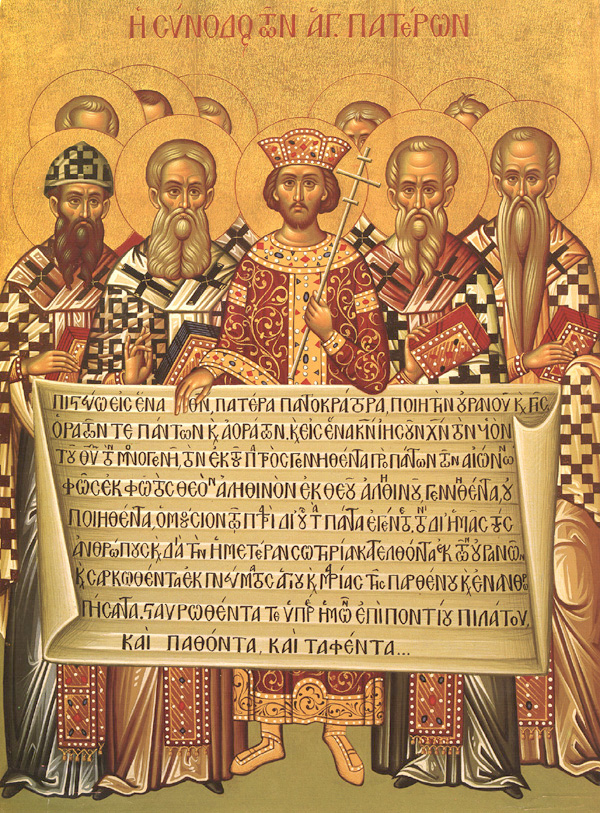
On the seventh Sunday of Pascha, we commemorate the holy God-bearing Fathers of the First Ecumenical Council.
The Commemoration of the First Ecumenical Council has been celebrated by the Church of Christ from ancient times. The Lord Jesus Christ left the Church a great promise, “I will build My Church, and the gates of hell shall not prevail against it” (Mt. 16:18). Although the Church of Christ on earth will pass through difficult struggles with the Enemy of salvation, it will emerge victorious. The holy martyrs bore witness to the truth of the Savior’s words, enduring suffering and death for confessing Christ, but the persecutor’s sword is shattered by the Cross of Christ.
Persecution of Christians ceased during the fourth century, but heresies arose within the Church itself. One of the most pernicious of these heresies was Arianism. Arius, a priest of Alexandria, was a man of immense pride and ambition. In denying the divine nature of Jesus Christ and His equality with God the Father, Arius falsely taught that the Savior is not consubstantial with the Father, but is only a created being.
A local Council, convened with Patriarch Alexander of Alexandria presiding, condemned the false teachings of Arius. However, Arius would not submit to the authority of the Church. He wrote to many bishops, denouncing the decrees of the local Council. He spread his false teaching throughout the East, receiving support from certain Eastern bishops.
Investigating these dissentions, the holy emperor Constantine (May 21) consulted Bishop Hosius of Cordova (Aug. 27), who assured him that the heresy of Arius was directed against the most fundamental dogma of Christ’s Church, and so he decided to convene an Ecumenical Council. In the year 325, 318 bishops representing Christian Churches from various lands gathered together at Nicea.
Among the assembled bishops were many confessors who had suffered during the persecutions, and who bore the marks of torture upon their bodies. Also participating in the Council were several great luminaries of the Church: Saint Nicholas, Archbishop of Myra in Lycia (December 6 and May 9), Saint Spyridon, Bishop of Tremithos (December 12), and others venerated by the Church as holy Fathers.
With Patriarch Alexander of Alexandria came his deacon, Athanasius [who later became Patriarch of Alexandria (May 2 and January 18)]. He is called “the Great,” for he was a zealous champion for the purity of Orthodoxy. In the Sixth Ode of the Canon for today’s Feast, he is referred to as “the thirteenth Apostle.”
The emperor Constantine presided over the sessions of the Council. In his speech, responding to the welcome by Bishop Eusebius of Caesarea, he said, “God has helped me cast down the impious might of the persecutors, but more distressful for me than any blood spilled in battle is for a soldier, is the internal strife in the Church of God, for it is more ruinous.”
Arius, with seventeen bishops among his supporters, remained arrogant, but his teaching was repudiated and he was excommunicated from the Church. In his speech, the holy deacon Athanasius conclusively refuted the blasphemous opinions of Arius. The heresiarch Arius is depicted in iconography sitting on Satan’s knees, or in the mouth of the Beast of the Deep (Rev. 13).
The Fathers of the Council declined to accept a Symbol of Faith (Creed) proposed by the Arians. Instead, they affirmed the Orthodox Symbol of Faith. Saint Constantine asked the Council to insert into the text of the Symbol of Faith the word “consubstantial,” which he had heard in the speeches of the bishops. The Fathers of the Council unanimously accepted this suggestion.
In the Nicean Creed, the holy Fathers set forth and confirmed the Apostolic teachings about Christ’s divine nature. The heresy of Arius was exposed and repudiated as an error of haughty reason. After resolving this chief dogmatic question, the Council also issued Twelve Canons on questions of churchly administration and discipline. Also decided was the date for the celebration of Holy Pascha. By decision of the Council, Holy Pascha should not be celebrated by Christians on the same day with the Jewish Passover, but on the first Sunday after the first full moon of the vernal equinox (which occured on March 22 in 325).
The First Ecumenical Council is also commemorated on May 29.
Saint Nikḗtas, Bishop of Chalcedon
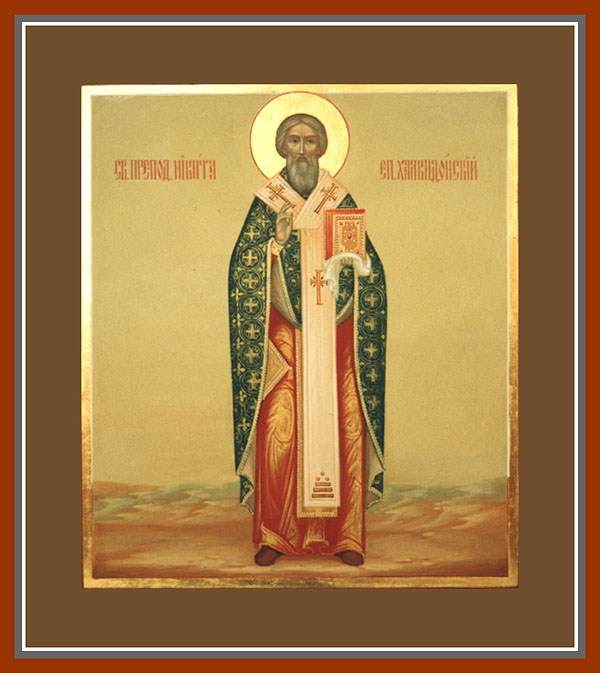
Saint Nikḗtas, Bishop of Chalcedon, lived during the second half of the eighth century. For his God-pleasing life he was consecrated as Bishop of Chalcedon.
Saint Nikḗtas distinguished himself by his charity, he always helped the poor, he lodged travelers in his home, he cared for orphans and widows, and he interceded for those who had been wronged.
During the reign of the iconoclast Leo the Armenian (813-820), Saint Nikḗtas bravely denounced the Iconoclast heresy and urged his flock to venerate the holy icons of Christ, the Theotokos, and the saints. Saint Nikḗtas endured much suffering from the impious emperor and his like-minded cohorts. He was subjected to tortures and sent off to exile.
The holy confessor Nikḗtas died at the beginning of the ninth century. From his relics occurred many miracles of healing. The Canon of the service, written by the priest Joseph of Constantinople, also includes Saint Nikḗtas’s brother, Saint Ignatius, among the saints.
Saint Ignatius the Wonderworker, Bishop of Rostov
Saint Ignatius was Bishop of Rostov, and shepherded his flock for twenty-six years. After his death on May 28, 1288, his body was brought to the church. Some people saw him leave his coffin, and float in the air above the church. He blessed the people and the city, then went back to his coffin.
Many miracles took place at his grave.
Saint Eutychius, Bishop of Melitene
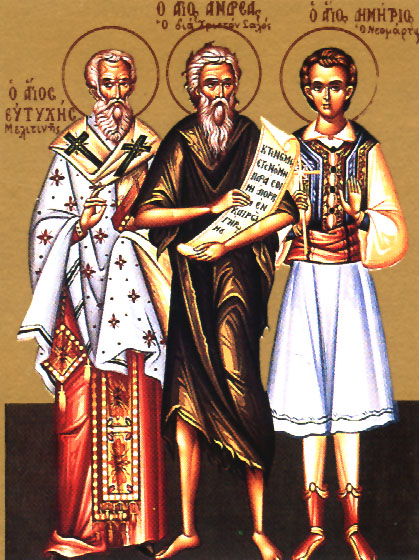
The Hieromartyr Eutychius, Bishop of Melitene, was a co-worker with the Holy Apostles, and he suffered for Christ in the city of Melitene during the first century.
Martyr Heliconis of Thessalonica
The Holy Martyr Heliconis lived during the third century in the city of Thessalonica. Saint Heliconis arrived in the city of Corinth during a persecution of Christians, and urged the pagans to stop serving senseless idols and instead to worship the one true God, the Creator of the universe.
She was arrested and brought before the governor Perinus, who vainly attempted to persuade the saint to offer sacrifice to idols, both by flattery and by threats. The holy martyr was subjected to tortures, but she bravely endured them. Then they threw her into a hot furnace, but she emerged from it unharmed, because an angel of the Lord had cooled the flames.
Thinking the saint was a sorceress, the governor invented new torments for her. They tore the skin from her head, and burned her breasts and head with fire. After halting the torture, the judge again attempted to urge Saint Heliconis to offer sacrifice to the idols, promising her honors and the title of priestess. The saint seemed to consent, and the pagan priests and the people led her to the pagan temple with the sounds of trumpet and drum.
At the saint’s request, they left her there alone. Saint Heliconis, filled with heroic strength, cast down and smashed all the idols. When some time had passed, the pagan priests entered their temple. Seeing the destruction, they were even more enraged and cursed the holy virgin shouting, “Put the sorceress to death!” They beat the holy martyr, and then they threw her into prison, where she spent five days.
Christ the Savior and the holy Archangels Michael and Gabriel appeared to the holy martyr in prison and healed her of her wounds. Finally, they sent the saint to be torn apart by wild beasts. They set loose three hungry lions upon her, but the beasts came up to the martyr meekly and lay down at her feet. The pagan mob shouted and cried, “Death to the sorceress.”
But at this point the lions jumped out of the arena and pounced on the people, who fled in terror. Not knowing what else to do, the governor ordered that Saint Heliconis be beheaded. The saint went to execution with joy and heard a Voice summoning her to the heavenly habitations.
She contested in the year 244, and her body was reverently buried by Christians.
Hieromartyr Helladius, Bishop in the East

The Hieromartyr Helladius the Bishop was thrown into fire because of his faith in Christ, but he remained unharmed. He died as a martyr from the terrible beating inflicted upon him.
In the Service to Saint Helladius it is said that the Lord Jesus Christ visited him in prison and healed him of his wounds. According to certain sources, Saint Helladius suffered under the Persians during their invasion into the Eastern part of the Roman Empire in the fourth century.
Saint Germanus, Bishop of Paris
Saint Germanus was born near Autun in 496. He was abbot of Saint Symphorian’s monastery at Autun, and was made Bishop of Paris around 536. He was tireless and courageous in his efforts to end civil strife and to restrain the viciousness of the Frankish kings, though he was not very successful in this. Saint Radegund (August 13) appealed to him for protection from her cruel husband King Chlotar I.
Saint Germanus founded a monastery at Paris, and was buried in its church after his death in 576. This is the renowned monastery of Saint Germaine-des-Pres.
Icon of the Mother of God “The Softening of Evil Hearts”

The “Softener (or “Consoler”) of Evil Hearts” Icon of the Mother of God is similar to the “Seven Arrows” Icon (August 13). It depicts the Theotokos with seven swords piercing her heart (Luke 2:35). There are three swords on the right side, three on the left, and one from below. In Holy Scripture the
number seven indicates wholeness, completeness, and fullness. In this case, it represents the fullness of sorrow, grief, and pain which the Most Holy Theotokos endured during her earthly life. The icon appears to be of Western origin.
The “Softener of Evil Hearts” Icon is also commemorated on the Sunday of All Saints.
Saint Sophronius the Bulgarian
The Venerable Sophronios (Stephen in the world) was from the village of Penkovts (Пенкьовци) in Bulgaria, and lived during the XV and XVI centuries. He was a Hieromonk at the Penkovsky Monastery near Sofia. Learning that Turkish invaders were about to attack the monastery, he fled to Vlahia (in what is now Romania) and lived in a monastery near the Danube River.
Later, the Saint devoted himself to continual ascetical labors of fasting, vigil, and prayer, in the monastic community of Rusensk, which may have been founded by Saint Joachim (January 18), the Patriarch of Trnovo.
Saint Sophronios reposed peacefully on May 28, 1510, and was known for his philanthropy and almsgiving. Some sources say that he was murdered by a servant, and that after three years his relics were found incorrupt.
New Martyr Demetrius
No information available at this time.
Icon of the Mother of God of Nicea

The Nicaea Icon of the Mother of God appeared in the city of Nicaea in Asia Minor in the year 304, as the city was under siege. One of the soldiers, whose name was Constantine, saw the Icon of the Theotokos and threw a stone at it. Then he began to trample it underfoot. That night, the Mother of God appeared in a dream to the soldier who had perpetrated this sacrilege and said: "You have insulted me most grievously, and it shall lead to your death."
The following day, during the battle, the impious man was struck in the head with a stone and fell down dead.
This event was mentioned by the Fathers of the First Ecumenical Council in 325, and they ordained that the following hymn, "Your womb has become a Holy Table, which held the Heavenly Bread. Those who partake of it shall not die, as the Nourisher of all has said, O Theotokos." should be sung before the Nicaea Icon of the Mother of God.
Christ stated that He is the Bread of Life which had come down from Heaven when He spoke to the crowd at Capernaum (John 6:50).
This Theotokion is sung at Mid-Pentecost during Ode 5 of the Second Canon (Tone 8), which was composed by Saint Andrew of Crete. In some Orthodox Prayer Books, it is one of the Prayers After the Evening Meal.
The Nicaea Icon is very similar in appearance to the “Inexhaustible Chalice” Icon (May 5).
Saint William of Gellone
No information available at this time.
 Saint Peter Antiochian Orthodox Church