Monthly Archives: April 2023

Daily Readings for Monday, April 10, 2023

HOLY MONDAY

ABSTAIN FROM MEAT, FISH, DAIRY, EGGS, WINE, OLIVE OIL

Holy Monday, Terence and his Companions beheaded at Carthage, 150 and more Righteous Martyr Fathers of the Sacred Monastery of Pantocrator Daou Pentelis, Gregory V, the Holy Martyr and Patriarch of Constantinople, Holy Father Theonas, Archbishop of Thessolonica

MATTHEW 21:18-43

At that time, as Jesus was returning to the city, he was hungry. And seeing a fig tree by the wayside he went to it, and found nothing on it but leaves only. And he said to it, "May no fruit ever come from you again!" And the fig tree withered at once. When the disciples saw it they marveled, saying, "How did the fig tree wither at once?" And Jesus answered them, "Truly, I say to you, if you have faith and never doubt, you will not only do what has been done to the fig tree, but even if you say to this mountain, 'Be taken up and cast into the sea, ' it will be done. And whatever you ask in prayer, you will receive, if you have faith. " And when he entered the temple, the chief priests and the elders of the people came up to him as he was teaching, and said, "By what authority are you doing these things, and who gave you this authority?" Jesus answered them, "I also will ask you a question; and if you tell me the answer, then I also will tell you by what authority I do these things. The baptism of John, whence was it? From heaven or from men?" And they argued with one another, "If we say, 'From heaven, ' he will say to us, 'Why then did you not believe him?' But if we say, 'From men, ' we are afraid of the multitude; for all hold that John was a prophet." So they answered Jesus, "We do not know." And he said to them, "Neither will I tell you by what authority I do these things. What do you think? A man had two sons; and he went to the first and said, 'Son, go and work in the vineyard today.' And he answered, 'I will not'; but afterward he repented and went. And he went to the second and said the same; and he answered, 'I go, sir, ' but did not go. Which of the two did the will of his father?" They said, "The first." Jesus said to them, "Truly, I say to you, the tax collectors and the harlots go into the kingdom of God before you. For John came to you in the way of righteousness, and you did not believe him, but the tax collectors and the harlots believed him; and even when you saw it, you did not afterward repent and believe him.
Hear another parable. There was a householder who planted a vineyard and set a hedge around it, and dug a wine press in it, and built a tower, and let it out to tenants, and went into another country. When the season of fruit drew near, he sent his servants to the tenants, to get his fruit; and the tenants took his servants and beat one, killed another, and stoned another. Again he sent other servants, more than the first; and they did the same to them. Afterward he sent his son to them, saying, 'They will respect my son.' But when the tenants saw the son, they said to themselves, 'This is the heir; come, let us kill him and have his inheritance.' And they took him and cast him out of the vineyard, and killed him. When therefore the owner of the vineyard comes, what will he do to those tenants?" They said to him, "He will put those wretches to a miserable death, and let out the vineyard to other tenants who will give him the fruits in their seasons." Jesus said to them, "Have you never read in the scriptures: 'The very stone which the builders rejected has become the head of the corner; this was the Lord's doing, and it is marvelous in our eyes'? Therefore I tell you, the kingdom of God will be taken away from you and given to a nation producing the fruits of it.

MATTHEW 24:3-35

At that time, as Jesus sat on the Mount of Olives, the disciples came to him privately, saying, "Tell us, when will this be, and what will be the sign of your coming and of the close of the age?" And Jesus answered them, "Take heed that no one leads you astray. For many will come in my name, saying, 'I am the Christ, ' and they will lead many astray. And you will hear of wars and rumors of wars; see that you are not alarmed; for this must take place, but the end is not yet. For nation will rise against nation, and kingdom against kingdom, and there will be famines and earthquakes in various places: all this is but the beginning of the sufferings.
Then they will deliver you up to tribulation, and put you to death; and you will be hated by all nations for my name's sake. And then many will fall away, and betray one another, and hate one another. And many false prophets will arise and lead many astray. And because wickedness is multiplied, most men's love will grow cold. But he who endures to the end will be saved. And this gospel of the kingdom will be preached throughout the whole world, as a testimony to all nations; and then the end will come.
So when you see the desolating sacrilege spoken of by the prophet Daniel, standing in the holy place (let the reader understand), then let those who are in Judea flee to the mountains; let him who is on the housetop not go down to take what is in his house; and let him who is in the field not turn back to take his mantle. And alas for those who are with child and for those who give suck in those days! Pray that your flight may not be in winter or on a sabbath. For then there will be great tribulation, such as has not been from the beginning of the world until now, no, and never will be. And if those days had not been shortened, no human being would be saved; but for the sake of the elect those days will be shortened. Then if anyone says to you, 'Lo, here is the Christ!' or 'There he is!' do not believe it. For false Christs and false prophets will arise and show great signs and wonders, so as to lead astray, if possible, even the elect. Lo, I have told you beforehand. So, if they say to you, 'Lo, he is in the wilderness, ' do not go out; if they say, 'Lo, he is in the inner rooms, ' do not believe it. For as the lightning comes from the east and shines as far as the west, so will be the coming of the Son of man. Wherever the body is, there the eagles will be gathered together. Immediately after the tribulation of those days the sun will be darkened, and the moon will not give its light, and the stars will fall from heaven, and the powers of the heavens will be shaken; then will appear the sign of the Son of man in heaven, and then all the tribes of the earth will mourn, and they will see the Son of man coming on the clouds of heaven with power and great glory; and he will send out his angels with a loud trumpet call, and they will gather his elect from the four winds, from one end of heaven to the other.
From the fig tree learn its lesson: as soon as its branch becomes tender and puts forth its leaves, you know that summer is near. So also, when you see all these things, you know that he is near, at the very gates. Truly, I say to you, this generation will not pass away till all these things take place. Heaven and earth will pass away, but my words will not pass away.

Great and Holy Monday
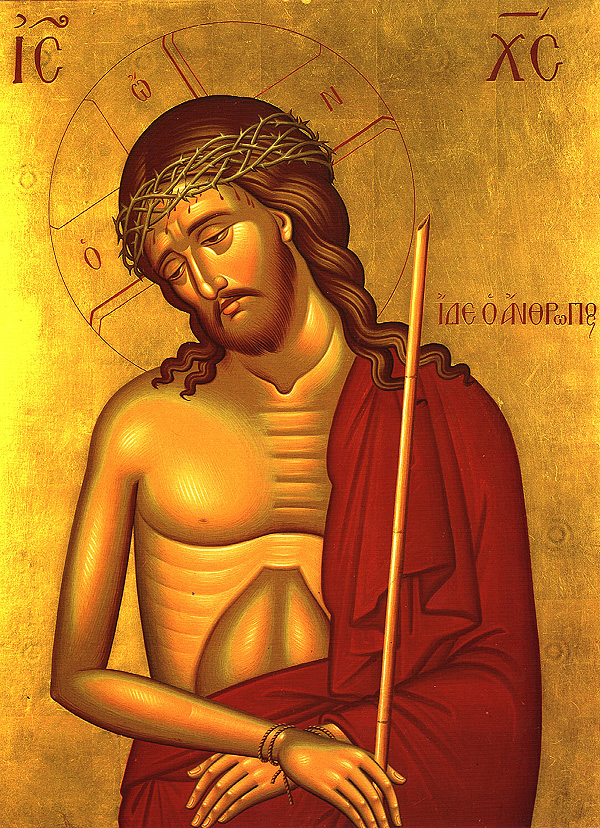
Holy Week: A Liturgical Explanation for the Days of Holy Week

3. MONDAY, TUESDAY, WEDNESDAY: THE END

These three days, which the Church calls Great and Holy have within the liturgical development of the Holy Week a very definite purpose. They place all its celebrations in the perspective of End Times; they remind us of the eschatological meaning of Pascha. So often Holy Week is considered one of the “beautiful traditions” or “customs,” a self-evident “part” of our calendar. We take it for granted and enjoy it as a cherished annual event which we have “observed” since childhood, we admire the beauty of its services, the pageantry of its rites and, last but not least, we like the fuss about the Paschal table. And then, when all this is done we resume our normal life. But do we understand that when the world rejected its Savior, when “Jesus began to be sorrowful and very heavy… and his soul was exceedingly sorrowful even unto death,” when He died on the Cross, “normal life” came to its end and is no longer possible. For there were “normal” men who shouted “Crucify Him” who spat at Him and nailed Him to the Cross. And they hated and killed Him precisely because He was troubling their normal life. It was indeed a perfectly “normal” world which preferred darkness and death to light and life…. By the death of Jesus the “normal” world, and “normal” life were irrevocably condemned. Or rather they revealed their true and abnormal inability to receive the Light, the terrible power of evil in them. “Now is the Judgment of this world” (John 12:31). The Pascha of Jesus signified its end to “this world” and it has been at its end since then. This end can last for hundreds of centuries, but this does not alter the nature of time in which we live as the “last time.” “The fashion of this world passeth away…” (I Cor. 7:31).

Pascha means passover, passage. The feast of Passover was for the Jews the annual commemoration of their whole history as salvation, and of salvation as passage from the slavery of Egypt into freedom, from exile into the promised land. It was also the anticipation of the ultimate passage—into the Kingdom of God. And Christ was the fulfillment of Pascha. He performed the ultimate passage: from death into life, from this “old world” into the new world into the new time of the Kingdom. And he opened the possibility of this passage to us. Living in “this world” we can already be “not of this world,” i.e. be free from slavery to death and sin, partakers of the “world to come.” But for this we must also perform our own passage, we must condemn the old Adam in us, we must put on Christ in the baptismal death and have our true life hidden in God with Christ, in the “world to come….”

And thus Easter is not an annual commemoration, solemn and beautiful, of a past event. It is this Event itself shown, given to us, as always efficient, always revealing our world, our time, our life as being at their end, and announcing the Beginning of the new life…. And the function of the three first days of Holy Week is precisely to challenge us with this ultimate meaning of Pascha and to prepare us to the understanding and acceptance of it.

1. This eschatological (which means ultimate, decisive, final) challenge is revealed, first, in the common troparion of these days:

Troparion—Tone 8

Behold the Bridegroom comes at midnight,
And blessed is the servant whom He shall find watching,
And again unworthy is the servant whom He shall find heedless.
Beware, therefore, O my soul, do not be weighed down with sleep,
Lest you be given up to death and lest you be shut out of the Kingdom.
But rouse yourself crying: Holy, Holy, Holy, are You, O our God!
Through the Theotokos have mercy on us!

Midnight is the moment when the old day comes to its end and a new day begins. It is thus the symbol of the time in which we live as Christians. For, on the one hand, the Church is still in this world, sharing in its weaknesses and tragedies. Yet, on the other hand, her true being is not of this world, for she is the Bride of Christ and her mission is to announce and to reveal the coming of the Kingdom and of the new day. Her life is a perpetual watching and expectation, a vigil pointed at the dawn of this new day. But we know how strong is still our attachment to the “old day,” to the world with its passions and sins. We know how deeply we still belong to “this world.” We have seen the light, we know Christ, we have heard about the peace and joy of the new life in Him, and yet the world holds us in its slavery. This weakness, this constant betrayal of Christ, this incapacity to give the totality of our love to the only true object of love are wonderfully expressed in the exapostilarion of these three days:

“Thy Bridal Chamber I see adorned, O my Savior
And I have no wedding garment that I may enter,
O Giver of life, enlighten the vesture of my soul
And save me.”

2. The same theme develops further in the Gospel readings of these days. First of all, the entire text of the four Gospels (up to John 13: 31) is read at the Hours (1, 3, 6 and 9). This recapitulation shows that the Cross is the climax of the whole life and ministry of Jesus, the Key to their proper understanding. Everything in the Gospel leads to this ultimate hour of Jesus and everything is to be understood in its light. Then, each service has its special Gospel lesson :

On Monday:

At Matins: Matthew 21: 18-43—the story of the fig tree, the symbol of the world created to bear spiritual fruits and failing in its response to God.

At the Liturgy of the Presanctified Gifts: Matthew 24: 3-35: the great eschatological discourse of Jesus. The signs and announcement of the End. “Heaven and earth shall pass away, but my words shall not pass away….”

“When the Lord was going to His voluntary Passion,
He said to His Apostles on the way:
Behold, we go up to Jerusalem,
And the Son of Man shall be delivered up
As it is written of Him.
Come, therefore, and let us accompany Him,
With minds purified from the pleasures of this life,
And let us be crucified and die with Him,
That we may live with Him,
And that we may hear Him say to us:
I go now, not to the earthly Jerusalem to suffer,
But unto My Father and your Father
And My God and your God,
And I will gather you up into the heavenly Jerusalem,
Into the Kingdom of Heaven….”
(Monday Matins)

by: The Very Reverend Alexander Schmemann

Martyr Terence and 40 others beheaded at Carthage
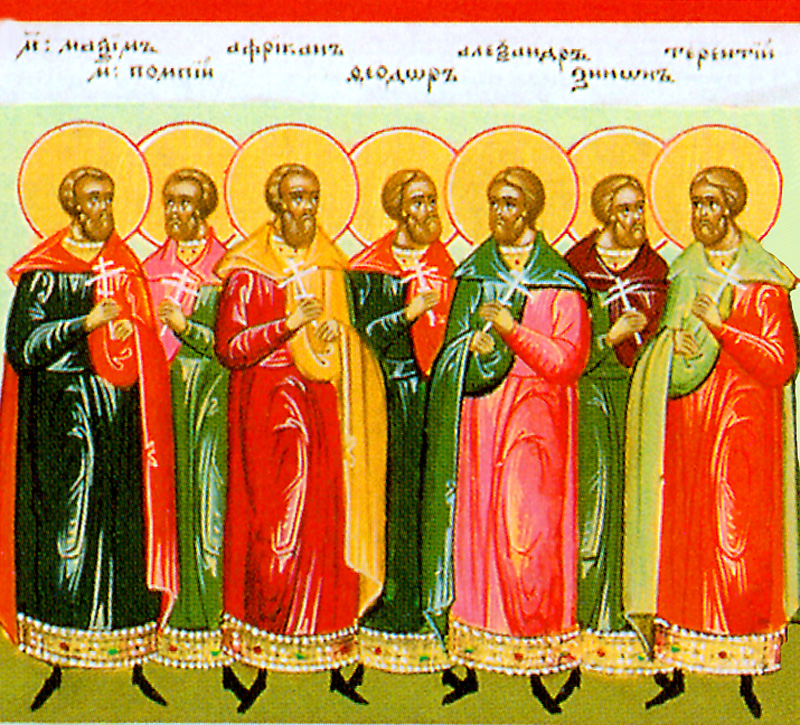
The Holy Martyr Terence and his companions suffered under the emperor Decius (249-251). The emperor issued an edict commanding all subjects to offer sacrifice to the pagan idols.

When the governor of Africa Fortunianus received this edict, he gathered the people into the city square, set out cruel instruments of torture and declared that everyone without exception had to offer the sacrifice to the idols.

Many, afraid of torture, complied. However, Saint Terence and forty other Christians bravely affirmed their faith in the Savior and ridiculed the idols. Fortunianus was amazed at their boldness and he asked how they as rational people, could confess as God, One Whom the Jews crucified as a malefactor.

Saint Terence answered that their belief was in the Savior, Who voluntarily endured death on the Cross and rose on the third day. Fortunianus saw that Terence inspired the others by his example, and so he ordered him to be isolated in prison with his three closest companions: Africanus, Maximus, and Pompeius. Fortunianus was determined to force the rest of the martyrs, including Zeno, Alexander and Theodore, to renounce Christ.

Neither threats nor terrible tortures could sway the holy martyrs. They burned them with red-hot iron, they poured vinegar on the wounds, they sprinkled on salt, and they raked them with iron claws. In spite of their sufferings, the saints did not weaken in their confession of Christ, and the Lord gave them strength.

Fortunianus gave orders to lead the martyrs into the pagan temple, and once again he urged them to offer sacrifice to the idols. The valiant warriors of Christ cried out, “O Almighty God, Who once sent down fire on Sodom for its iniquity, destroy this impious temple of idolatry.” The idols fell down with a crash, and then the temple lay in ruins. The enraged governor gave orders to execute them, and the martyrs, glorifying God, bowed their necks beneath the executioner’s sword.

After the execution of the thirty-six martyrs, Fortunianus summoned Terence, Maximus, Africanus and Pompeius before him. He showed them the martyrs’ bodies and again urged them to offer sacrifice to the idols. The martyrs refused. The governor put heavy chains on them, and gave orders to starve them to death. By night, an angel of the Lord removed the martyrs’ chains and fed them.

In the morning, the guards found the saints cheerful and strong. Then Fortunianus ordered sorcerers and conjurers to carry snakes and all kinds of poisonous creatures into the prison. The guards looked into the cell through an opening in the ceiling and saw the martyrs unharmed, praying, and the snakes crawling at their feet. When the sorcerers opened the door of the prison cell, the snakes bit them. The furious Fortunianus gave orders to behead the holy martyrs. Christians took up their holy bodies and buried them with reverence outside the city.

Martyrs James (Jacob) the Presbyter, and Azadanes and Abdicius, Deacons, of Persia
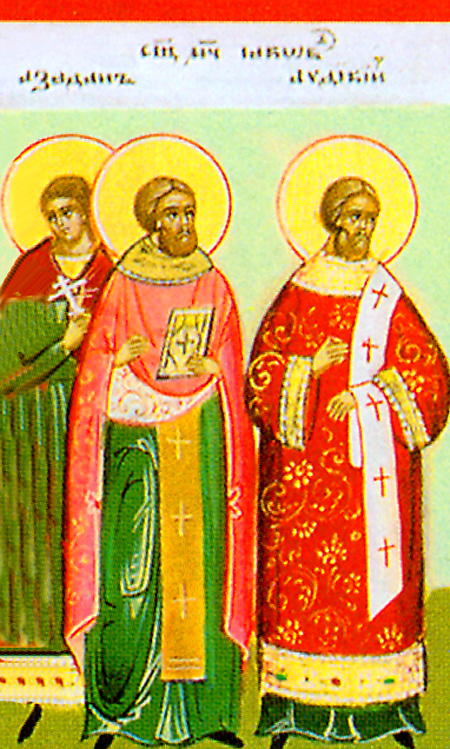
The Holy Martyrs James the Presbyter and the deacons Azadanes and Abdikius died in Persia under the emperor Sapor in about the year 380. They were arrested together with Bishop Akepsimas (November 3). Weak from hunger, the sufferers had mustard and vinegar inserted into their nostrils. Then they were stripped and led out to stand all night in the cold.

In the morning, after new torments, the martyrs were returned to prison and beheaded.

Martyrs of the Kvabtakhevi Monastery in Georgia

In the 14th century, during the reign of King Bagrat V (1360-1394), Timur (Tamerlane) invaded Georgia seven times. His troops inflicted irreparable damage on the country, seizing centuries-old treasures and razing ancient churches and monasteries.

Timur’s armies ravaged Kartli, then took the king, queen, and the entire royal court captive and sent them to Karabakh (in present-day Azerbaijan). Later Timur attempted to entice King Bagrat to renounce the Christian Faith in exchange for permission to return to the throne and for the release of the other Georgian prisoners.

For some time Timur was unable to subjugate King Bagrat, but in the end, being powerless and isolated from his kinsmen, the king began to falter. He devised a sly scheme: to confess Islam before the enemy, but to remain a Christian at heart. Satisfied with King Bagrat’s decision to “convert to Islam,” Timur permitted the king to return to the throne of Kartli. At the request of King Bagrat, Timur sent twelve thousand troops with him to complete Georgia’s forcible conversion to Islam.

When they were approaching the village of Khunani in southeastern Georgia, Bagrat secretly informed his son Giorgi of everything that had happened and called upon him and his army to massacre the invaders.

The news of Bagrat’s betrayal and the ruin of his army infuriated Timur, and he called for immediate revenge. At their leader’s command, his followers destroyed everything in their path, set fire to cities and villages, devastated churches, and thus forced their way through to Kvabtakhevi Monastery.

Monastics and laymen alike were gathered in Kvabtakhevi when the enemy came thundering in. Having forced open the gate, the attackers burst into the monastery, then plundered and seized all its treasures. They captured the young and strong, carrying them away.

The old and infirm were put to the sword. As the greatest humiliation, they mocked the clergy and monastics by strapping them with sleigh bells and jumping and dancing around them.

Already drunk on the blood they had shed, the barbarians posed an ultimatum to those who remained: to renounce Christ and live or to be driven into the church and burned alive.

Faced with these terms, the faithful cried out: “Go ahead and burn our flesh—in the Heavenly Kingdom our souls will burn with a divine flame more radiant than the sun!” And in their exceeding humility, the martyrs requested that their martyrdom not be put on display: “We ask only that you not commit this sin before the eyes of men and angels. The Lord alone knows the sincerity of our will and comforts us in our righteous afflictions!”

Having been driven like beasts into the church, the martyrs raised up a final prayer to God: “In the multitude of Thy mercy shall I go into Thy house; I shall worship toward Thy holy temple in fear of Thee. O Lord, guide me in the way of Thy righteousness; because of mine enemies, make straight my way before Thee (Ps. 5:6-7) that with a pure mind I may glorify Thee forever….”

The executioners hauled in more and more wood, until the flames enveloping the church blazed as high as the heavens and the echo of crackling timber resounded through the mountains. Ensnared in a ring of fire, the blissful martyrs chanted psalms as they gave up their spirits to the Lord.

The massacre at Kvabtakhevi took place in 1386. The imprints of the martyrs’ charred bodies remain on the floor of the church to this day.

Hieromartyr Patriarch Gregory V of Constantinople

The Holy Patriarch Gregory (George Angelopoulos in the world) was born in 1745 at Dēmētsána in the Pelopónnēsos. He began his education in the village schools, since his father could not afford to send him to better schools. In 1765, he went to Athens to study under the renowned teacher Dēmḗtrios Vodas, and in 1767, he went to Smyrna to attend an ecclesiastical school. Later, he went to Patmos for further study, and was ordained as a Deacon in 1775 at Smyrna. Soon after, he was ordained as a Hieromonk.

In 1785 he was consecrated as a Bishop, and was chosen as the Metropolitan of Smyrna. His ministry produced much spiritual fruit, and he edified his flock by his eloquent sermons, by building schools, and by writing books. On May 1,1797 he was elected as Patriarch of Constantinople. From that day forward, he concerned himself with the internal and external order of the Patriarchate. He established rules for his household and staff, called regular meetings, and set agendas for the Synod of Bishops.

In the early XIX century, Greece was suffering under the heavy Turkish yoke, though many Greek patriots hoped to regain their independence. They found support from the Holy Patriarch, whose connections with Greek patriots were revealed only after Alexander Ypsilantis crossed the Prut River with his army against Sultan Mahmud.

The Patriarch was an ascetic who kept the fasts and devoted himself to the unceasing Prayer of the Heart. Such traits did not endear him to everyone, and he had many enemies. The Saint's austerity annoyed some bishops, who slandered him, resulting in his removal and exile to Mount Athos from 1798-1806, where he lived in the Greatest Lavra.

His second tenure as Patriarch began amid political turmoil. Once more he began a program of building churches and schools. Turkey declared war in 1807 as the result of Russian activity in the Balkans. The Sultan ordered Saint Gregory to issue an encyclical against Russia in order to prevent the Greeks from cooperating with them. He bore no malice toward Russia, but he was trying to avoid massacres and insurrections. Three times during his second Patriarchate, Saint Gregory was forced to quell Greek attempts to revolt. Nevertheless, he was deposed and exiled to the Holy Mountain in 1808.

In January 1819, the Holy Hierarch ascended the Patriarchal throne for the final time. He established a fund to help the poor of Constantinople and reorganized the Patriarchal printing press, which published many spiritual books. In March, several bishops were imprisoned or executed because of the failed insurrection of Alexander Ypsilantis in Moldavia. When the Greek Revolution began on March 25, 1821, the Turks ordered the Patriarch and his Synod to issue an anathema against Ypsilantis and those who had cooperated with him. The anathema was ignored, because the Greeks knew that it had been issued under duress.

During that Lent, jailings and executions were common. One of the Patriarch's friends advised him to flee from Constantinople to the Morea. Saint Gregory replied: "I have a premonition that the fish of the Bosphorus will eat my body, but I will die calmly, for the sake of of saving my nation."

On Holy Pascha, April 10, 1821, the Patriarch was seized at 10:00 A.M. and hanged at the gate of the Patriarchate, and then his body was thrown into the sea. That gate has remained shut ever since.

Greek sailors noticed the place where the Hieromartyr's body was abandoned, and placed it on a ship from Kephalonia under the command of Captain Macri Sklavos, and then it was taken to Odessa under the Russian flag. The Hierarch's relics were buried in the Greek church of the Holy Trinity on June 19, 1821. Patriarchal vestments were sent from Moscow for the Saint's relics, as well as a mitre and a cross, which had belonged to His Holiness Patriarch Nikon (1652-1658). The Hieromartyr Gregory V of Constantinople, held the See of Constantinople three times (1797-1799, 1806-1808, 1819-1821).

In 1871, at the request of the Greek government, permission was granted to transfer Patriarch Gregory's relics from Odessa to Athens for the celebration of the fiftieth anniversary of Greek independence. A special Service was composed in Athens in honor of the Hierarch, whose martyrdom heralded the triumph of Christianity in Greece.

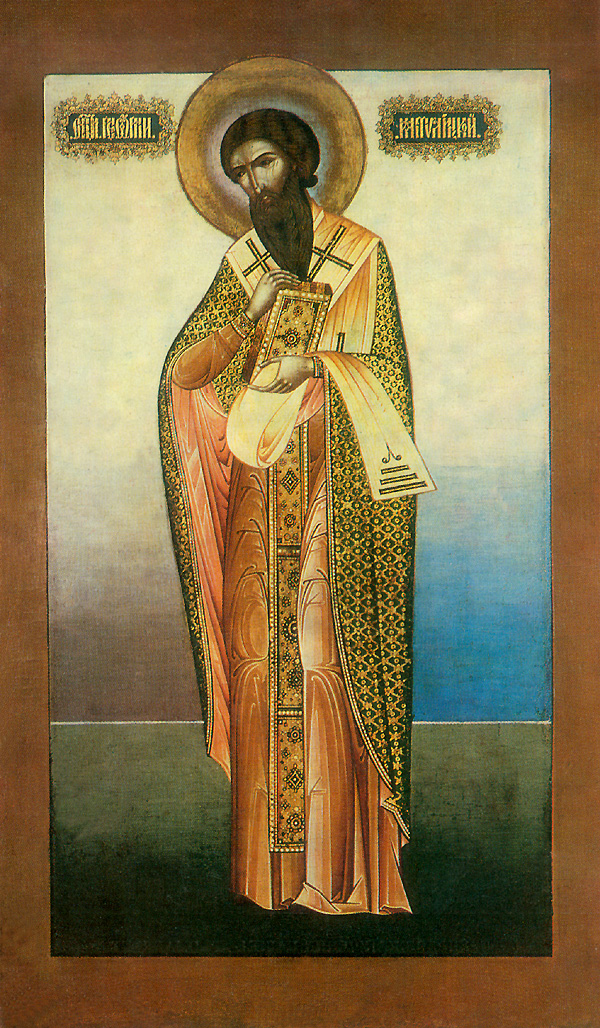
The Hieromartyr Gregory was glorified as a Saint in 1921. The scroll on his Icon reads: "For freedom Christ has set us free; stand fast therefore, and do not be entangled again with the yoke of slavery" (Galatians 5:1).

Daily Readings for Sunday, April 09, 2023

PALM SUNDAY

ABSTAIN FROM MEAT, DAIRY, EGGS

Palm Sunday, The Holy Martyr Eupsychius of Caesarea, Raphael, Nicholas, Irene, & Olympias of Mytilene, Vadim the Righteous of Persia

ST. PAUL’S LETTER TO THE PHILIPPIANS 4:4-9

BRETHREN, rejoice in the Lord always; again I will say, Rejoice. Let all men know your forbearance. The Lord is at hand. Have no anxiety about anything, but in everything by prayer and supplication with thanksgiving let your requests be made known to God. And the peace of God, which passes all understanding, will keep your hearts and your minds in Christ Jesus. Finally, brethren, whatever is true, whatever is honorable, whatever is just, whatever is pure, whatever is lovely, whatever is gracious, if there is any excellence, if there is anything worthy of praise, think about these things. What you have learned and received and heard and seen in me, do; and the God of peace will be with you.

JOHN 12:1-18

Six days before Passover, Jesus came to Bethany, where Lazaros was, whom Jesus had raised from the dead. There they made him a supper; Martha served, and Lazaros was one of those at table with him. Mary took a pound of costly ointment of pure nard and anointed the feet of Jesus and wiped his feet with her hair; and the house was filled with the fragrance of the ointment. But Judas Iscariot, one of his disciples (he who was to betray him), said "Why was this ointment not sold for three hundred denarii and given to the poor?" This he said, not that he cared for the poor but because he was a thief, and as he had the money box he used to take what was put into it. Jesus said, "Let her alone, let her keep it for the day of my burial. The poor you always have with you, but you do not always have me."
When the great crowd of the Jews learned that he was there, they came, not only on account of Jesus but also to see Lazaros, whom he had raised from the dead. So the chief priests planned to put Lazaros also to death, because on account of him many of the Jews were going away and believing in Jesus.
The next day a great crowd who had come to the feast heard that Jesus was coming to Jerusalem. So they took branches of palm trees and went out to meet him, crying, "Hosanna! Blessed is he who comes in the name of the Lord, even the King of Israel!" And Jesus found a young donkey and sat upon it; as it is written, "Fear not, daughter of Zion; behold, your king is coming, sitting on a donkey's colt!" His disciples did not understand this at first; but when Jesus was glorified, then they remembered that this had been written of him and had been done to him. The crowd that had been with him when he called Lazaros out of the tomb and raised him from the dead bore witness. The reason why the crowd went to meet him was that they heard he had done this sign.

Entry of Our Lord into Jerusalem (Palm Sunday)

Palm Sunday

Palm Sunday is the celebration of the triumphant entrance of Christ into the royal city of Jerusalem. He rode on a colt for which He Himself had sent, and He permitted the people to hail Him publicly as a king. A large crowd met Him in a manner befitting royalty, waving palm branches and placing their garments in His path. They greeted Him with these words: “Hosanna! Blessed is he who comes in the name of the Lord, even the King of Israel! (John 12:13).

This day together with the raising of Lazarus are signs pointing beyond themselves to the mighty deeds and events which consummate Christ’s earthly ministry. The time of fulfillment was at hand. Christ’s raising of Lazarus points to the destruction of death and the joy of resurrection which will be accessible to all through His own death and resurrection. His entrance into Jerusalem is a fulfillment of the messianic prophecies about the king who will enter his holy city to establish a final kingdom. “Behold, your king is coming to you, humble, and mounted on an ass, and on a colt, the foal of an ass” (Zech 9:9).

Finally, the events of these triumphant two days are but the passage to Holy Week: the “hour” of suffering and death for which Christ came. Thus the triumph in a earthly sense is extremely short-lived. Jesus enters openly into the midst of His enemies, publicly saying and doing those things which mostly enrage them. The people themselves will soon reject Him. They misread His brief earthly triumph as a sign of something else: His emergence as a political messiah who will lead them to the glories of an earthly kingdom.

Our Pledge

The liturgy of the Church is more than meditation or praise concerning past events. It communicates to us the eternal presence and power of the events being celebrated and makes us participants in those events. Thus the services of Lazarus Saturday and Palm Sunday bring us to our own moment of life and death and entrance into the Kingdom of God: a Kingdom not of this world, a Kingdom accessible in the Church through repentance and baptism.

On Palm Sunday palm and willow branches are blessed in the Church. We take them in order to raise them up and greet the King and Ruler of our life: Jesus Christ. We take them in order to reaffirm our baptismal pledges. As the One who raised Lazarus and entered Jerusalem to go to His voluntary Passion stands in our midst, we are faced with the same question addressed to us at baptism: “Do you accept Christ?” We give our answer by daring to take the branch and raise it up: “I accept Him as King and God!”

Thus, on the eve of Christ’s Passion, in the celebration of the joyful cycle of the triumphant days of Lazarus Saturday and Palm Sunday, we reunite ourselves to Christ, affirm His Lordship over the totality of our life, and express our readiness to follow Him to His Kingdom:

… that I may know him and the power of his resurrection, and may share his sufferings, becoming like him in his death, that if possible I may attain the resurrection from the dead (Philippians 3:10-11).

Very Rev. Paul Lazor

Martyr Eupsychius of Caesarea, in Cappadocia

The Holy Martyr Eupsychius was born in the city of Caesarea in Cappadocia and received a Christian upbringing by his illustrious parents.

During the reign of Julian the Apostate (361-363), Saint Eupsychius entered into a Christian marriage.

At Caesarea there was a pagan temple to the goddess Fortuna, whom Julian the Apostate revered. As Eupsychius was going to his wedding, the pagans were offering sacrifice to the goddess Fortuna.

Saint Eupsychius was filled with zeal for the Lord, and he destroyed the temple. He knew that this would inevitably result in his punishment. Saint Eupsychius distributed all his possessions to the poor and prepared himself for martyrdom.

The enraged emperor Julian loosed his wrath not only upon Saint Eupsychius, but against all the inhabitants of this city. Some of the citizens were executed, while the more respectable were sent into exile. Christian clergy were drafted into military service, and he looted the churches of anything valuable. The city was deprived of its title Caesarea [i.e. “Imperial”] and resumed its original name of Maza. He also imposed a severe tax on the inhabitants. The emperor threatened to annihilate the city altogether, if the people did not build a new pagan temple in place of the one destroyed.

Julian tried to compel Saint Eupsychius to offer sacrifice to idols. For many days they tormented the saint on a rack, and also with iron claws. But his faith was firm, and the judge sentenced the martyr to be beheaded with a sword.

Then Julian embarked on a campaign against the Persians, marching through Cappadocia and approaching Caesarea. Danger threatened the city, since the emperor intended to raze it to its foundations. But then Saint Basil the Great (January 1), showing Julian the proper respect as sovereign authority, came out to meet him carrying with him three loaves of barley bread, which he ate. The emperor ordered his retainers to take the loaves, and to give Saint Basil a pinch of hay saying, “You have given us barley, cattle fodder. Now receive hay from us in return.”

The saint answered, “O Emperor, we bring you that which we ourselves eat, and you give us cattle feed. You mock us, since you, by your might, are not able to transform hay into bread, the essential food of mankind.”

Julian angrily retorted, “I’ll shove this hay down your throat when I return here from Persia. I shall raze this city to its very foundations, and plow over this ground and turn it into a field. I know that it was on your advice that the people dared to destroy the statues and temple of Fortuna.”

After this the emperor continued on his way, but soon perished in his campaign against the Persians. He was struck down in the year 363 by the holy Great Martyr Mercurius (November 24).

After the emperor’s demise, the Christians of the city of Caesarea built a splendid church over the grave of Saint Eupsychius, and from his holy relics they received help and healing.

Hieromartyr Desan, Bishop in Persia, and 272 others with him

The Holy Martyrs Bishop Desan, Presbyter Mariabus, Abdiesus, and 270 others were put to death under the Persian emperor Sapor II. Imprisoned, they refused to turn away from the Christian Faith. In their number also was the Martyr Ia, who is commemorated also on September 11.

Monastic Martyr Bademus (Vadim) of Persia

Monk Martyr Archimandrite Bademus (Vadim) was born in the fourth century in the Persian city of Bithlapata, and was descended from a rich and illustrious family. In his youth, he was enlightened with the Christian teaching. The saint gave away all his wealth to the poor and withdrew into the wilderness, where he founded a monastery. He would go up on a mountain for solitary prayer, and once was permitted to behold the Glory of God.

During this period the Persian emperor Sapor (310-381) began to persecute Christians. They arrested Saint Bademus and his seven disciples, and tortured them in prison, hoping that they would renounce Christ and worship the sun and fire. But Saint Bademus and his disciples held firmly to the Christian Faith. The confessors spent four months in jail. All this time Saint Bademus was a spiritual leader and support for the Christians living in Persia.

One of the associates of the emperor Sapor, Nirsanes, was a Christian and suffered imprisonment for this. He did not hold up under torture and denied Christ, promising to fulfill whatever the emperor commanded. Sapor demanded that Nirsanes personally cut off the head of Saint Bademus. For this he was promised a reprieve and great rewards. Nirsanes was not able to overcome his fear of new tortures, and he agreed to follow the path of betrayal walked by Judas.

When they brought Saint Bademus to him, he took the sword and turned toward him, but overcome by conscience, he trembled and stood petrified. Saint Bademus said to him, “Has your wickedness now reached this point, Nirsanes, that you should not only renounce God, but also murder His servants? Woe to you, accursed one! What will you do on that day when you stand before the Dread Judgment Seat? What answer will you give to God? I am prepared to die for Christ, but I don’t want to receive death at your hands.”

Nirsanes struck with the sword, but his hands shook, and he could not behead the saint immediately, and the fire-worshippers began to call him a coward. The holy martyr Bademus stood motionless, enduring many terrible blows, until the murderer succeeded in cutting off his head.

The just punishment for his misdeeds were not slow in overtaking the hapless fellow. Tormented by his conscience, he did away with himself, throwing himself on a sword. After the death of the emperor Sapor, the seven disciples of Saint Bademus were released from prison.

Saint Eleni (also called Susanna), New Martyr of Lesbos

Saint Eleni (who was also called Susanna) is one of the New Martyrs of Lesbos who are commemorated on Bright Tuesday. She was Saint Irene’s older cousin, and suffered along with Saints Raphael, Nicholas, and Irene on April 9, 1463 (Bright Tuesday).

On November 12, 1961 Mrs. Basilike Rallis had a dream in which she saw herself by the church at Karyes near the town of Thermi on the Greek island of Lesbos. As she looked inside the church, she saw a young girl about fourteen or fifteen years old, with a dark complexion and dark hair. Since the girl was praying, Mrs Rallis also began to pray. The girl turned to her and said, “Do you know who I am? I am a martyr. Not like Renoula (a diminutive form of Irene), of course, but if you only knew what I endured! I lived with the mayor’s family, and I was also with them when the Turks tortured them here. They mistreated me and gave me such a horrible beating that I died from the pains. My name is Eleni.”

The saint also told Mrs Rallis about an icon of the Mother of God that she had been asking about, revealing to her the place where it would be found.

When she awoke, Mrs Rallis was reluctant to mention this dream to anyone. She said to herself, “If there really is another martyr named Eleni, I’ll see her again. Maybe someone else will see her, too, then I’ll tell. But who was this Eleni who lived with the mayor’s family? Perhaps she was their servant.”

The next night, she dreamed that she was in the village church. She saw three clerics coming out through the left door of the altar. She made the Sign of the Cross at once, for she thought that Satan might be tempting her. Then she saw the three clerics make the Sign of the Cross, too. They looked at her and smiled as they slowly proceeded to the center of the church.

“I recognized Saint Raphael and Saint Nicholas right away,” Mrs Rallis recalled, “but did not know the other saint. He was tall, middle-aged with a long grey beard and a lordly air about him.”

At that moment, a girl with a round face came out by the same door. She was beautiful, and she wore a rose-colored dress. Mrs Rallis approached her and, kneeling before her, she asked, “Are you also a saint?”

“Yes,” the girl replied. “Sit down beside me, watch quietly and I will explain some things to you.”

Then other people began to come out from the same door and approached the saints. First, a man of medium height with civilian clothes and a long grey jacket. The girl said to Mrs Rallis, “The teacher, Theodore.” He was followed by another well-formed man. The saint said, “The mayor, Basil (Saint Irene’s father).” Then a tall, stout woman of about forty came forth with two girls whom Mrs Rallis recognized at once.They were Saints Irene and Eleni, of whom she had dreamt the night before.

The unknown saint who had appeared with Saints Raphael and Nicholas identified the tall woman as Maria, the mayor’s wife, and the two girls as Renoula and Eleni. He asked Mrs Rallis, “Why, when you dreamed about her last evening, did you say that you would not say anything about it to anyone? Eleni is also a martyr, and she wishes to be remembered. She was not the mayor’s servant, but his orphaned niece who lived with them. Her proper name, which she signed on papers, was Eleni. However, they also called her Susanna. She also had that name.”

Mrs Rallis slowly approached Saint Irene. She embraced her and began to weep, saying, “O Renoula, my tortured little girl, how could these heartless evil-doers burn you?” Then Saint Irene also started to cry.

When Mrs Rallis woke up, her eyes were filled with tears, and she thought that she would faint. So powerful was the dream that she later said, “Ah, that tortured child! How I ached for her! Every time I go to Karyes I will sit by her little tomb and I will mourn as if she were my own child. Just think, they tortured the child in front of her father, in front of her mother who bore her. It seems to me that there does not exist a more terrible martyrdom for parents.”

The Newly-Appeared Martyrs of Lesbos are also commemorated on April 9. Detailed accounts of these saints may be found in A GREAT SIGN (in Greek) by Photios Kontoglou (Astir, 1964).

New Martyrs Raphael, Nicholas, and Irine of Lesbos

Newly-Appeared Martyrs of Lesbos, Saints Raphael, Nicholas and Irene were martyred by the Turks on Bright Tuesday (April 9, 1463) ten years after the Fall of Constantinople. For nearly 500 years, they were forgotten by the people of Lesbos, but “the righteous Judge… opened the things that were hid” (2 Macc. 12:41).

For centuries the people of Lesbos would go on Bright Tuesday to the ruins of a monastery near Thermi, a village northwest of the capital, Mytilene. As time passed, however, no one could remember the reason for the annual pilgrimage. There was a vague recollection that once there had been a monastery on that spot, and that the monks had been killed by the Turks.

In 1959, a pious man named Angelos Rallis decided to build a chapel near the ruins of the monastery. On July 3 of that year, workmen discovered the relics of Saint Raphael while clearing the ground. Soon, the saints began appearing to various inhabitants of Lesbos and revealed the details of their lives and martyrdom. These accounts form the basis of Photios Kontoglou’s 1962 book A GREAT SIGN (in Greek).

Saint Raphael was born on the island of Ithaka around 1410, and was raised by pious parents. His baptismal name was George, but he was named Raphael when he became a monk. He was ordained to the holy priesthood, and later attained the offices of Archimandrite and Chancellor.

In 1453, Saint Raphael was living in Macedonia with his fellow monastic, the deacon Nicholas, a native of Thessalonica. In 1454, the Turks invaded Thrace, so the two monks fled to the island of Lesbos. They settled in the Monastery of the Nativity of the Theotokos near Thermi, where Saint Raphael became the igumen.

In the spring of 1463, the Turks raided the monastery and captured the monks. They were tortured from Holy Thursday until Bright Tuesday. Saint Raphael was tied to a tree, and the ferocious Turks sawed through his jaw, killing him. Saint Nicholas was also tortured, and he died while witnessing his Elder’s martyrdom. He appeared to people and indicated the spot where his relics were uncovered on June 13, 1960.

Saint Irene was the twelve-year-old daughter of the village mayor, Basil. She and her family had come to the monastery to warn the monks of the invasion. The cruel Hagarenes cut off one of her arms and threw it down in front of her parents. Then the pure virgin was placed in a large earthen cask and a fire was lit under it, suffocating her within. These torments took place before the eyes of her parents, who were also put to death. Her grave and the earthen cask were found on May 12, 1961 after Saints Raphael, Nicholas and Irene had appeared to people and told them where to look.

Others who also received the crown of martyrdom on that day were Saint Irene’s parents Basil and Maria; Theodore, the village teacher; and Eleni, the fifteen-year-old cousin of Saint Irene.

The saints appeared separately and together, telling people that they wished to be remembered. They asked that their icon be painted, that a church service be composed for them, and they indicated the place where their holy relics could be found. Based on the descriptions of those who had seen the saints, the master iconographer Photios Kontoglou painted their icon. The ever-memorable Father Gerasimos of Little Saint Anne Skete on Mt Athos composed their church service.

Many miracles have taken place on Lesbos, and throughout the world. The saints hasten to help those who invoke them, healing the sick, consoling the sorrowful, granting relief from pain, and bringing many unbelievers and impious individuals back to the Church.

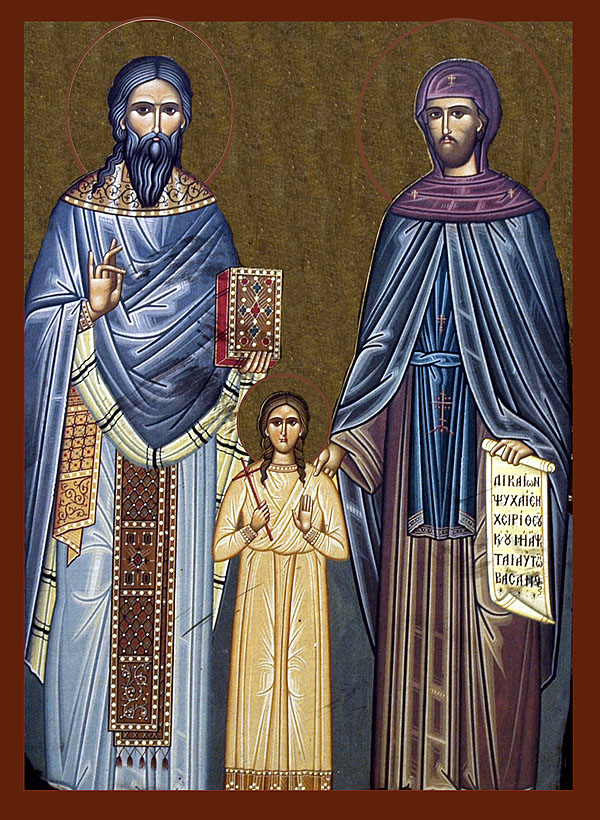
Saint Raphael is tall, middle-aged, and has a beard of moderate length. His hair is black with some grey in it. His face is majestic, expressive, and filled with heavenly grace. Saint Nicholas is short and thin, with a small blond beard. He stands before Saint Raphael with great respect. Saint Irene usually appears with a long yellow dress reaching to her feet. Her blonde hair is divided into two braids which rest on either side of her chest.

Saints Raphael, Nicholas, and Irene (and those with them) are also commemorated on Bright Tuesday. Dr. Constantine Cavarnos has given a detailed account of their life, miracles, and spiritual counsels in Volume 10 of his inspirational series Modern Orthodox Saints (Belmont, MA, 1990).

Daily Readings for Saturday, April 08, 2023

LAZARUS SATURDAY

ABSTAIN FROM MEAT, FISH, DAIRY, EGGS

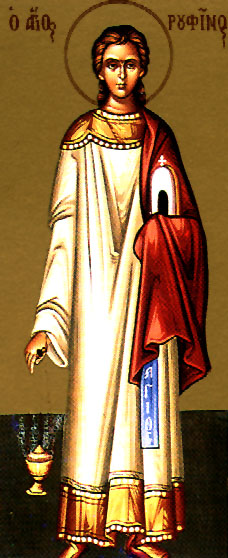
Lazarus Saturday, The Holy Apostles of the Seventy Herodion, Agabus, Rufus, Asyncritus, Phlegon, and Hermes, The Holy New Martyr John the Ship-Builder who was martyred in Kos, Rufus the Obedient of the Kiev Caves, Celestine, Pope of Rome

ST. PAUL’S LETTER TO THE HEBREWS 12:28-29; 13:1-8

BRETHREN, let us be grateful for receiving a kingdom that cannot be shaken, and thus let us offer to God acceptable worship, with reverence and awe; for our God is a consuming fire. Let brotherly love continue. Do not neglect to show hospitality to strangers, for thereby some have entertained angels unawares. Remember those who are in prison, as though in prison with them; and those who are ill-treated, since you also are in the body. Let marriage be held in honor among all, and let the marriage bed be undefiled; for God will judge the immoral and adulterous. Keep your life free from love of money, and be content with what you have; for he has said, ‘I will never fail you nor forsake you.’ Hence we can confidently say, ‘The Lord is my helper, I will not be afraid; what can man do to me?’ Remember your leaders, those who spoke to you the word of God; consider the outcome of their life, and imitate their faith. Jesus Christ is the same yesterday and today and for ever.

JOHN 11:1-45

At that time, a certain man was ill, Lazaros of Bethany, from the village of Mary and her sister Martha. It was Mary who anointed the Lord with ointment and wiped his feet with her hair, whose brother Lazaros was ill. So the sisters sent to him, saying, "Lord, he whom you love is ill." But when Jesus heard it he said, "This illness is not unto death; it is for the glory of God, so that the Son of God may be glorified by means of it."
Now Jesus loved Martha and her sister and Lazaros. So when he heard that he was ill, he stayed two days longer in the place where he was. Then after this he said to the disciples, "Let us go into Judea again." The disciples said to him, "Rabbi, the Jews were but now seeking to stone you, and are you going there again?" Jesus answered, "Are there not twelve hours in the day? If any one walks in the day, he does not stumble, because he sees the light of this world. But if any one walks in the night, he stumbles, because the light is not in him." Thus he spoke, and then he said to them, "Our friend Lazaros has fallen asleep, but I go to awake him out of sleep." The disciples said to him, "Lord, if he has fallen asleep, he will recover." Now Jesus had spoken of his death, but they thought that he meant taking rest in sleep. Then Jesus told them plainly, "Lazaros is dead; and for your sake I am glad that I was not there, so that you may believe. But let us go to him." Thomas, called the Twin, said to his fellow disciples, "Let us also go, that we may die with him."
Now when Jesus came, he found that Lazaros had already been in the tomb four days. Bethany was near Jerusalem, about two miles off, and many of the Jews had come to Martha and Mary to console them concerning their brother. When Martha heard that Jesus was coming, she went and met him, while Mary sat in the house. Martha said to Jesus, "Lord, if you had been here, my brother would not have died. And even now I know that whatever you ask from God, God will give you." Jesus said to her, "Your brother will rise again." Martha said to him, "I know that he will rise again in the resurrection at the last day." Jesus said to her, "I am the resurrection and the life; he who believes in me, though he die, yet shall he live, and whoever lives and believes in me shall never die. Do you believe this?" She said to him, "Yes, Lord; I believe that you are the Christ, the Son of God, he who is coming into the world."
When she had said this, she went and called her sister Mary, saying quietly, "The Teacher is here and is calling for you." And when she heard it, she rose quickly and went to him. Now Jesus had not yet come to the village, but was still in the place where Martha had met him. When the Jews who were with her in the house, consoling her, saw Mary rise quickly and go out, they followed her, supposing that she was going to the tomb to weep there. Then Mary, when she came where Jesus was and saw him, fell at his feet, saying to him, "Lord, if you had been here, my brother would not have died." When Jesus saw her weeping, and the Jews who came with her also weeping, he was deeply moved in spirit and troubled; and he said, "Where have you laid him?" They said to him, "Lord, come and see." Jesus wept. So the Jews said, "See how he loved him!" But some of them said, "Could not he who opened the eyes of the blind man have kept this man from dying?"
Then Jesus, deeply moved again, came to the tomb; it was a cave, and a stone lay upon it. Jesus said, "Take away the stone." Martha, the sister of the dead man, said to him, "Lord, by this time there will be an odor, for he has been dead four days." Jesus said to her, "Did I not tell you that if you would believe you would see the glory of God?" So they took away the stone. And Jesus lifted up his eyes and said, "Father, I thank you that you have heard me. I knew that you have heard me always, but I have said this on account of the people standing by, that they may believe that you did send me." When he had said this, he cried with a loud voice, "Lazaros, come out." The dead man came out, his hands and feet bound with bandages, and his face wrapped with a cloth. Jesus said to them, "Unbind him, and let him go." Many of the Jews therefore, who had come with Mary and had seen what he did, believed in him.

The Raising of Lazarus (Lazarus Saturday)

Lazarus Saturday and Palm Sunday

Visible triumphs are few in the earthly life of our Lord Jesus Christ. He preached a kingdom “not of this world.” At His nativity in the flesh there was “no room at the inn.” For nearly thirty years, while He grew “in wisdom and in stature, and in favor with God and man” (Luke 2:52), He lived in obscurity as “the son of Mary.” When He appeared from Nazareth to begin His public ministry, one of the first to hear of Him asked: “Can anything good come out of Nazareth?” (John 1:46). In the end He was crucified between two thieves and laid to rest in the tomb of another man.

Two brief days stand out as sharp exceptions to the above—days of clearly observable triumph. These days are known in the Church today as Lazarus Saturday and Palm Sunday. Together they form a unified liturgical cycle which serves as the passage from the forty days of Great Lent to Holy Week. They are the unique and paradoxical days before the Lord’s Passion. They are days of visible, earthly triumph, of resurrectional and messianic joy in which Christ Himself is a deliberate and active participant. At the same time they are days which point beyond themselves to an ultimate victory and final kingship which Christ will attain not by raising one dead man or entering a particular city, but by His own imminent suffering, death and resurrection.

By raising Lazarus from the dead before Thy Passion,
Thou didst confirm the universal resurrection, 0 Christ God!
Like the children with the palms of victory,
we cry out to Thee, 0 Vanquisher of Death:
Hosanna in the highest!
Blessed is He that comes in the name of the Lord!
(Troparion of the Feast, sung on both Lazarus Saturday and Palm Sunday)

Lazarus Saturday

In a carefully detailed narrative the Gospel relates how Christ, six days before His own death, and with particular mindfulness of the people “standing by, that they may believe that thou didst send me” (John 11:42), went to His dead friend Lazarus at Bethany outside of Jerusalem. He was aware of the approaching death of Lazarus but deliberately delayed His coming, saying to His disciples at the news of His friend’s death: “For your sake I am glad that I was not there, so that you may believe” (John 11:14).

When Jesus arrived at Bethany, Lazarus was already dead four days. This fact is repeatedly emphasized by the Gospel narrative and the liturgical hymns of the feast. The four-day burial underscores the horrible reality of death. Man, created by God in His own image and likeness, is a spiritual-material being, a unity of soul and body. Death is destruction; it is the separation of soul and body. The soul without the body is a ghost, as one Orthodox theologian puts it, and the body without the soul is a decaying corpse. “I weep and I wail, when I think upon death, and behold our beauty, fashioned after the image of God, lying in the tomb dishonored, disfigured, bereft of form.” This is a hymn of Saint John of Damascus sung at the Church’s burial services. This “mystery” of death is the inevitable fate of man fallen from God and blinded by his own prideful pursuits.

With epic simplicity the Gospel records that, on coming to the scene of the horrible end of His friend, “Jesus wept” (John 11:35). At this moment Lazarus, the friend of Christ, stands for all men, and Bethany is the mystical center of the world. Jesus wept as He saw the “very good” creation and its king, man, “made through Him” (John 1:3) to be filled with joy, life and light, now a burial ground in which man is sealed up in a tomb outside the city, removed from the fullness of life for which he was created, and decomposing in darkness, despair and death. Again as the Gospel says, the people were hesitant to open the tomb, for “by this time there will be an odor, for he has been dead four days” (John 11:39).

When the stone was removed from the tomb, Jesus prayed to His Father and then cried with a loud voice: “Lazarus, come out.” The icon of the feast shows the particular moment when Lazarus appears at the entrance to the tomb. He is still wrapped in his grave clothes and his friends, who are holding their noses because of the stench of his decaying body, must unwrap him. In everything stress is laid on the audible, the visible and the tangible. Christ presents the world with this observable fact: on the eve of His own suffering and death He raises a man dead four days! The people were astonished. Many immediately believed on Jesus and a great crowd began to assemble around Him as the news of the raising of Lazarus spread. The regal entry into Jerusalem followed.

Lazarus Saturday is a unique day: on a Saturday a Matins and Divine Liturgy bearing the basic marks of festal, resurrectional services, normally proper to Sundays, are celebrated. Even the baptismal hymn is sung at the Liturgy instead of Holy God: “As many as have been baptized into Christ, have put on Christ.”

Very Rev. Paul Lazor

Apostle Herodion of the Seventy, and those with Him

Saints Herodion (Rodion), Agabus, Asyncritus, Rufus, Phlegon and Hermes were among the Seventy Apostles, chosen by Christ and sent out by Him to preach (Synaxis of the Seventy Apostles: January 4).

The holy Apostle Herodion was a relative of Saint Paul, and his companion on many journeys. When Christianity had spread to the Balkan Peninsula, the Apostles Peter and Paul established Saint Herodion as Bishop of Patara. Saint Herodion zealously preached the Word of God and converted many of the Greek pagans and Jews to Christianity.

Enraged by the preaching of the disciple, the idol-worshippers and Jews with one accord fell upon Saint Herodion, and they began to beat him with sticks and pelt him with stones. One of the mob struck him with a knife, and the saint fell down. But when the murderers were gone, the Lord restored him to health unharmed.

Saint Herodion continued to accompany the Apostle Paul for many years. When the holy Apostle Peter was crucified (+ c. 67), Saint Herodion and Saint Olympos were beheaded by the sword at the same time.

The holy Apostle Agabus was endowed with the gift of prophecy. He predicted (Acts 11:27-28) the famine during the reign of the emperor Claudius (41-52), and foretold the suffering of the Apostle Paul at Jerusalem (Acts 21:11). Saint Agabus preached in many lands, and converted many pagans to Christ.

Saint Rufus, whom the holy Apostle Paul mentions in the Epistle to the Romans (Rom. 16:11-15), was bishop of the Greek city of Thebes. Saint Asyncritus (Rom. 16:14) was bishop in Hyrcania (Asia Minor). Saint Phlegon was bishop in the city of Marathon (Thrace). Saint Hermes was bishop in Dalmatia (there is another Apostle of the Seventy by the name of Hermas, who was bishop in the Thracian city of Philippopolis).

All these disciples for their intrepid service to Christ underwent fierce sufferings and were found worthy of a martyr’s crown.

Saint Niphon, Bishop of Novgorod

Saint Niphon was a monk of the Kiev Caves Monastery, where he struggled in asceticism. In imitation of the Holy Fathers, he uprooted the passions through fasting, vigil, and prayer, and adorned himself with every virtue. He was chosen as Bishop of Novgorod when Bishop John retired to a monastery after twenty-five years of episcopal service. Saint Niphon was consecrated bishop in Kiev by Metropolitan Michael and other hierarchs.

Saint Niphon embraced his archpastoral duties with great zeal, strengthening his flock in the Orthodox Faith, and striving to prevent them from becoming separated from the Church, which is the same as being separated from Christ Himself.

The saint was also zealous in building and repairing churches. He built a new stone church in the center of Novgorod, dedicating it to the Most Holy Theotokos. He repaired the roof of the church of Holy Wisdom (Christ, the Wisdom of God), and adorned the interior with icons.

When war broke out between Novgorod and Kiev, Saint Niphon showed himself to be a peacemaker. Meeting with the leaders of both sides, he was able to pacify them and avert the war. In the same way, he always tried to settle arguments and to reconcile those who were at enmity.

He instructed his flock in the law of God, preaching to them, reproving, rebuking, and exhorting them patiently and with sound doctrine (2 Timothy 4:2) so that they might obtain the salvation which is in Christ Jesus with eternal glory (2 Timothy 2:10).

When the people of Novgorod drove away their prince, Vsevolod, they invited Prince Svyatslav to govern them. The new prince wanted to enter into a marriage which was against the Church canons. Not only did Saint Niphon refuse to perform the ceremony, he also told his clergy to regard this betrothal as unlawful. Prince Svyatoslav brought priests in from elsewhere to perform the wedding, and the holy hierarch was not afraid to denounce his behavior.

After the death of Metropolitan Michael of Kiev, the Great Prince Isaiaslav wished to have the schemamonk Clement succeed him. However, he wanted to have Clement consecrated without the blessing of the Patriarch of Constantinople.

At a council of bishops, Saint Niphon declared that he would not approve the consecration without the permission of the Patriarch of Constantinople. He reminded the other bishops that this was contrary to the tradition of the Russian Church, for Russia had received the Orthodox Faith from Constantinople. Starting in 1448, however, the Russian Church began to elect its own primate without seeking confirmation from Constantinople.

The uncanonical consecration took place despite the objections of Saint Niphon. Metropolitan Clement tried to force the saint to serve the Divine Liturgy with him, but he refused. He called Clement a wolf rather than a shepherd, for he had unjustly assumed an office which he did not deserve. Saint Niphon refused to serve with Clement, or to commemorate him during the services.

In his fury, Clement would not permit Saint Niphon to return to Novgorod. Instead, he had the saint held under house arrest at the Kiev Caves Monastery. When Isaiaslav was defeated by Prince George, Saint Niphon returned to Novgorod, where the people welcomed him with great joy.

The Patriarch of Constantinople sent a letter praising Saint Niphon for his steadfast defense of church teachings. He also sent Metropolitan Constantine to Rus in order to depose Metropolitan Clement, and to assume the see of Kiev himself.

Saint Niphon again took up residence in the Kiev Caves Monastery, where he became ill. Thirteen days before his death, he revealed to the brethren that he had had a wondrous dream. Saint Theodosius (May 3) appeared to him and announced his imminent departure from this world.

Saint Niphon reposed in peace on April 8, 1156. Now he stands before the throne of God, interceding for us before the All-Holy Trinity, to Whom be all glory, honor, and worship forever.

Venerable Rufus the Obedient of the Kiev Far Caves

Saint Rufus the Obedient, Hermit of the Caves, lived at the Kiev Caves monastery during the fourteenth century. He was distinguished for his obedience and glorified as a lover of labor and fasting. He was buried in the Far Caves. He is celebrated a second time on August 28, the Synaxis of the Fathers of the Far Caves.

Martyr Pausilippus of Heraclea in Thrace

The Holy Martyr Pausilippus suffered under the emperor Hadrian (117-138). Denunced by the pagans, he was brought to trial before the emperor and staunchly declared himself a Christian.

They beat him with iron rods and handed over to the governor named Precius, who for a long time attempted to make the martyr offer sacrifice to idols. The martyr remained steadfast, and finally the governor gave orders to fetter him and execute him.

Along the way, Saint Pausilippus prayed fervently that the Lord would spare him from the hand of the executioner and grant him a quick death. The Lord heard him. The martyr, beaten up and weak, was suddenly filled with such strength that he shattered the iron fetters and freed himself. Tossing them aside, Saint Pausilippus thought to escape, but he died as he fled. Christians buried the body of the martyr with reverence.

Saint Celestine, Pope of Rome

Saint Celestine, Pope of Rome (422-432), a zealous champion of Orthodoxy, lived during the reign of the holy Emperor Theodosius the Younger (408-450). He received an excellent education, and he knew philosophy well, but most of all he studied the Holy Scripture and pondered over theological questions.

The virtuous life of the saint and his authority as a theologian won him the general esteem and love of the clergy and people. After the death of Saint Boniface (418-422), Saint Celestine was chosen to be the Bishop of Rome.

During this time, the heresy of Nestorius emerged. At a local Council in Rome in 430, Saint Celestine denounced this heresy and condemned Nestorius as a heretic. After the Council, Saint Celestine wrote a letter to Saint Cyril, Archbishop of Alexandria (January 18), stating that if Nestorius did not renounce his false teachings after ten days, then he should be deposed and excommunicated.

Saint Celestine also sent a series of letters to the churches in Constantinople and Antioch, in which he unmasked and denounced the Nestorian heresy.

For two years after the Council, Saint Celestine proclaimed the true teaching about Christ the God-Man, and he died in peace on April 6, 432.

“Spanish” Icon of the Mother of God

The Spanish Icon of the Most Holy Theotokos, which is one of the Panachranta type, depicts the Mother of God seated upon a throne.

Daily Readings for Friday, April 07, 2023

6TH FRIDAY OF LENT

ABSTAIN FROM MEAT, FISH, DAIRY, EGGS, WINE, OLIVE OIL

Calliopus and Akylina the Martyrs, George, Bishop of Mytilene, Gerasimos the God-Bearer of Byzantium, Righteous Father Savvas the New of Kalymnos, Tikhon, Patriarch of Moscow and Enlightener of North America

ISAIAH 66:10-24

Rejoice with Jerusalem, and be glad for her, all you who love her; rejoice with her in joy, all you who mourn over her; that you may suck and be satisfied with her consoling breasts; that you may drink deeply with delight from the abundance of her glory." For thus says the LORD: "Behold, I will extend prosperity to her like a river, and the wealth of the nations like an overflowing stream; and you shall suck, you shall be carried upon her hip, and dandled upon her knees. As one whom his mother comforts, so I will comfort you; you shall be comforted in Jerusalem. You shall see, and your heart shall rejoice; your bones shall flourish like the grass; and it shall be known that the hand of the LORD is with his servants, and his indignation is against his enemies. "For behold, the LORD will come in fire, and his chariots like the stormwind, to render his anger in fury, and his rebuke with flames of fire. For by fire will the LORD execute judgment, and by his sword, upon all flesh; and those slain by the LORD shall be many. "Those who sanctify and purify themselves to go into the gardens, following one in the midst, eating swine's flesh and the abomination and mice, shall come to an end together, says the LORD. "For I know their works and their thoughts, and I am coming to gather all nations and tongues; and they shall come and shall see my glory, and I will set a sign among them. And from them I will send survivors to the nations, to Tarshish, Put, and Lud, who draw the bow, to Tubal and Javan, to the coastlands afar off, that have not heard my fame or seen my glory; and they shall declare my glory among the nations. And they shall bring all your brethren from all the nations as an offering to the LORD, upon horses, and in chariots, and in litters, and upon mules, and upon dromedaries, to my holy mountain Jerusalem, says the LORD, just as the Israelites bring their cereal offering in a clean vessel to the house of the LORD. And some of them also I will take for priests and for Levites, says the LORD. "For as the new heavens and the new earth which I will make shall remain before me, says the LORD; so shall your descendants and your name remain. From new moon to new moon, and from sabbath to sabbath, all flesh shall come to worship before me, says the LORD. "And they shall go forth and look on the dead bodies of the men that have rebelled against me; for their worm shall not die, their fire shall not be quenched, and they shall be an abhorrence to all flesh.

GENESIS 49:33-50:26

When Jacob finished charging his sons, he drew up his feet into the bed, and breathed his last, and was gathered to his people. Then Joseph fell on his father's face, and wept over him, and kissed him. And Joseph commanded his servants the physicians to embalm his father. So the physicians embalmed Israel; forty days were required for it, for so many are required for embalming. And the Egyptians wept for him seventy days.
And when the days of weeping for him were past, Joseph spoke to the household of Pharaoh, saying, "If now I have found favor in your eyes, speak, I pray you, in the ears of Pharaoh, saying, My father made me swear, saying, 'I am about to die: in my tomb which I hewed out for myself in the land of Canaan, there shall you bury me.' Now therefore let me go up, I pray you, and bury my father; then I will return." And Pharaoh answered, "Go up, and bury your father, as he made you swear." So Joseph went up to bury his father; and with him went up all the servants of Pharaoh, the elders of his household, and all the elders of the land of Egypt, as well as all the household of Joseph, his brothers, and his father's household; only their children, their flocks, and their herds were left in the land of Goshen. And there went up with him both chariots and horsemen; it was a very great company. When they came to the threshing floor of Atad, which is beyond the Jordan, they lamented there with a very great and sorrowful lamentation; and he made a mourning for his father seven days. When the inhabitants of the land, the Canaanites, saw the mourning on the threshing floor of Atad, they said, "This is a grievous mourning to the Egyptians." Therefore the place was named Abelmizraim; it is beyond the Jordan. Thus his sons did for him as he had commanded them; for his sons carried him to the land of Canaan, and buried him in the cave of the field at Machpelah, to the east of Mamre, which Abraham bought with the field from Ephron the Hittite, to possess as a burying place. After he had buried his father, Joseph returned to Egypt with his brothers and all who had gone up with him to bury his father. When Joseph's brothers saw that their father was dead, they said, "It may be that Joseph will hate us and pay us back for all the evil which we did to him." So they sent a message to Joseph, saying, "Your father gave this command before he died, 'Say to Joseph, Forgive, I pray you, the transgression of your brothers and their sin, because they did evil to you.' And now, we pray you, forgive the transgression of the servants of the God of your father." Joseph wept when they spoke to him. His brothers also came and fell down before him, and said, "Behold, we are your servants." But Joseph said to them, "Fear not, for am I in the place of God? As for you, you meant evil against me; but God meant it for good, to bring it about that many people should be kept alive, as they are today. So do not fear; I will provide for you and your little ones." Thus he reassured them and comforted them.
So Joseph dwelt in Egypt, he and his father's house; and Joseph lived a hundred and ten years. And Joseph saw Ephraim's children of the third generation; the children also of Machir the son of Manasseh were born upon Joseph's knees. And Joseph said to his brothers, "I am about to die; but God will visit you, and bring you up out of this land to the land which he swore to Abraham, to Isaac, and to Jacob." Then Joseph took an oath of the sons of Israel, saying, "God will visit you, and you shall carry up my bones from here." So Joseph died, being a hundred and ten years old; and they embalmed him, and he was put in a coffin in Egypt.

PROVERBS 31:8-31

Open your mouth for the dumb, for the rights of all who are left desolate. Open your mouth, judge righteously, maintain the rights of the poor and needy. A good wife who can find? She is far more precious than jewels. The heart of her husband trusts in her, and he will have no lack of gain. She does him good, and not harm, all the days of her life. She seeks wool and flax, and works with willing hands. She is like the ships of the merchant, she brings her food from afar. She rises while it is yet night and provides food for her household and tasks for her maidens. She considers a field and buys it; with the fruit of her hands she plants a vineyard. She girds her loins with strength and makes her arms strong. She perceives that her merchandise is profitable. Her lamp does not go out at night. She puts her hands to the distaff, and her hands hold the spindle. She opens her hand to the poor, and reaches out her hands to the needy. She is not afraid of snow for her household, for all her household are clothed in scarlet. She makes herself coverings; her clothing is fine linen and purple. Her husband is known in the gates, when he sits among the elders of the land. She makes linen garments and sells them; she delivers girdles to the merchant. Strength and dignity are her clothing, and she laughs at the time to come. She opens her mouth with wisdom, and the teaching of kindness is on her tongue. She looks well to the ways of her household, and does not eat the bread of idleness. Her children rise up and call her blessed; her husband also, and he praises her: “Many women have done excellently, but you surpass them all.” Charm is deceitful, and beauty is vain, but a woman who fears the LORD is to be praised. Give her of the fruit of her hands, and let her works praise her in the gates.

Repose of Saint Tikhon, Patriarch of Moscow, Enlightener of North America

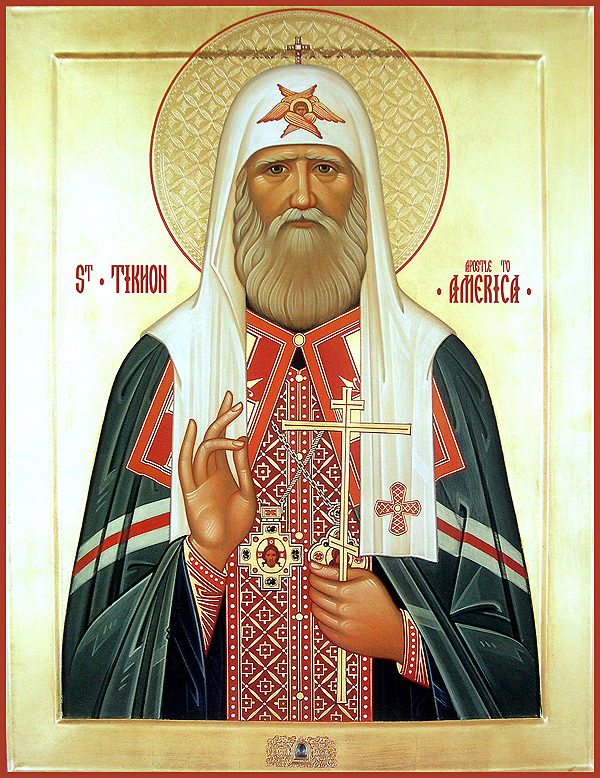
Saint Tikhon, Patriarch of Moscow and Apostle to America was born as Vasily Ivanovich Belavin on January 19, 1865 into the family of Ioann Belavin, a rural priest of the Toropetz district of the Pskov diocese. His childhood and adolescence were spent in the village in direct contact with peasants and their labor. From his early years he displayed a particular religious disposition, love for the Church as well as rare meekness and humility.

When Vasily was still a boy, his father had a revelation about each of his children. One night, when he and his three sons slept in the hayloft, he suddenly woke up and roused them. He had seen his dead mother in a dream, who foretold to him his imminent death, and the fate of his three sons. She said that one would be unfortunate throughout his entire life, another would die young, while the third, Vasily, would be a great man. The prophecy of the dead woman proved to be entirely accurate in regard to all three brothers.

From 1878 to 1883, Vasily studied at the Pskov Theological Seminary. The modest seminarian was tender and affectionate by nature. He was fair-haired and tall of stature. His fellow students liked and respected him for his piety, brilliant progress in studies, and constant readiness to help comrades, who often turned to him for explanations of lessons, especially for help in drawing up and correcting numerous compositions. Vasily was called “bishop” and “patriarch” by his classmates.

In 1888, at the age of 23, Vasily Belavin graduated from the Saint Petersburg Theological Academy as a layman, and returned to the Pskov Seminary as an instructor of Moral and Dogmatic Theology. The whole seminary and the town of Pskov became very fond of him. He led an austere and chaste life, and in 1891, when he turned 26, he took monastic vows. Nearly the whole town gathered for the ceremony. He embarked on this new way of life consciously and deliberately, desiring to dedicate himself entirely to the service of the Church. The meek and humble young man was given the name Tikhon in honor of Saint Tikhon of Zadonsk.

He was transferred from the Pskov Seminary to the Kholm Theological Seminary in 1892, and was raised to the rank of archimandrite. Archimandrite Tikhon was consecrated Bishop of Lublin on October 19, 1897, and returned to Kholm for a year as Vicar Bishop of the Kholm Diocese. Bishop Tikhon zealously devoted his energy to the establishment of the new vicariate. His attractive moral make-up won the general affection, of not only the Russian population, but also of the Lithuanians and Poles. On September 14, 1898, Bishop Tikhon was made Bishop of the Aleutians and Alaska. As head of the Orthodox Church in America, Bishop Tikhon was a zealous laborer in the Lord’s vineyard.

He did much to promote the spread of Orthodoxy, and to improve his vast diocese. He reorganized the diocesan structure, and changed its name from “Diocese of the Aleutians and Alaska” to “Diocese of the Aleutians and North America” in 1900. Both clergy and laity loved their archpastor, and held him in such esteem that the Americans made Archbishop Tikhon an honorary citizen of the United States.

On May 22, 1901, he blessed the cornerstone for Saint Nicholas Cathedral in New York, and was also involved in establishing other churches. On November 9, 1902, he consecrated the church of Saint Nicholas in Brooklyn for the Syrian Orthodox immigrants. Two weeks later, he consecrated Saint Nicholas Cathedral in NY.

In 1905, the American Mission was made an Archdiocese, and Saint Tikhon was elevated to the rank of Archbishop. He had two vicar bishops: Bishop Innocent (Pustynsky) in Alaska, and Saint Raphael (Hawaweeny) in Brooklyn to assist him in administering his large, ethnically diverse diocese. In June of 1905, Saint Tikhon gave his blessing for the establishment of Saint Tikhon’s Monastery.

In 1907, he returned to Russia, and was appointed to Yaroslavl, where he quickly won the affection of his flock. They came to love him as a friendly, communicative, and wise archpastor. He spoke simply to his subordinates, never resorting to a peremptory or overbearing tone. When he had to reprimand someone, he did so in a good-natured, sometimes joking manner, which encouraged the person to correct his mistakes.

When Saint Tikhon was transferred to Lithuania on December 22, 1913, the people of Yaroslavl voted him an honorary citizen of their town. After his transfer to Vilnius, he did much in terms of material support for various charitable institutions. There too, his generous soul and love of people clearly manifested themselves. World War I broke out when His Eminence was in Vilnius. He spared no effort to help the poor residents of the Vilnius region who were left without a roof over their heads or means of subsistence as a result of the war with the Germans, and who flocked to their archpastor in droves.

After the February Revolution and formation of a new Synod, Saint Tikhon became one of its members. On June 21, 1917, the Moscow Diocesan Congress of clergy and laity elected him as their ruling bishop. He was a zealous and educated archpastor, widely known even outside his country.

On August 15, 1917, a local council was opened in Moscow, and Archbishop Tikhon was raised to the dignity of Metropolitan, and then elected as chairman of the council. The council had as its aim to restore the life of Russian Orthodox Church on strictly canonical principles, and its primary concern was the restoration of the Patriarchate. All council members would select three candidates, and then a lot would reveal the will of God. The council members chose three candidates: Archbishop Anthony of Kharkov, the wisest, Archbishop Arseny of Novgorod, the strictest, and Metropolitan Tikhon of Moscow, the kindest of the Russian hierarchs.

On November 5, following the Divine Liturgy and a Molieben in the Cathedral of Christ the Savior, a monk removed one of the three ballots from the ballot box, which stood before the Vladimir Icon of the Mother of God. Metropolitan Vladimir of Kiev announced Metropolitan Tikhon as the newly elected Patriarch. Saint Tikhon did not change after becoming the primate of the Russian Orthodox Church. In accepting the will of the council, Patriarch Tikhon referred to the scroll that the Prophet Ezekiel had to eat, on which was written, “Lamentations, mourning, and woe.” He foresaw that his ministry would be filled with affliction and tears, but through all his suffering, he remained the same accessible, unassuming, and kindly person.

All who met Saint Tikhon were surprised by his accessibility, simplicity and modesty. His gentle disposition did not prevent him from showing firmness in Church matters, however, particularly when he had to defend the Church from her enemies. He bore a very heavy cross. He had to administer and direct the Church amidst wholesale church disorganization, without auxiliary administrative bodies, in conditions of internal schisms and upheavals by various adherents of the Living Church, renovationists, and autocephalists.

The situation was complicated by external circumstances: the change of the political system, by the accession to power of the godless regime, by hunger, and civil war. This was a time when Church property was being confiscated, when clergy were subjected to court trials and persecutions, and Christ’s Church endured repression. News of this came to the Patriarch from all ends of Russia. His exceptionally high moral and religious authority helped him to unite the scattered and enfeebled flock. At a crucial time for the church, his unblemished name was a bright beacon pointing the way to the truth of Orthodoxy. In his messages, he called on people to fulfill the commandments of Christ, and to attain spiritual rebirth through repentance. His irreproachable life was an example to all.

In order to save thousands of lives and to improve the general position of the church, the Patriarch took measures to prevent clergy from making purely political statements. On September 25, 1919, when the civil war was at its height, he issued a message to the clergy urging them to stay away from political struggle.

The summer of 1921 brought a severe famine to the Volga region. In August, Patriarch Tikhon issued a message to the Russian people and to the people of the world, calling them to help famine victims. He gave his blessing for voluntary donations of church valuables, which were not directly used in liturgical services. However, on February 23, 1922, the All-Russian Central Executive Committee published a decree making all valuables subject to confiscation.

According to the 73rd Apostolic Canon, such actions were regarded as sacrilege, and the Patriarch could not approve such total confiscation, especially since many doubted that the valuables would be used to combat famine. This forcible confiscation aroused popular indignation everywhere. Nearly two thousand trials were staged all over Russia, and more than ten thousand believers were shot. The Patriarch’s message was viewed as sabotage, for which he was imprisoned from April 1922 until June 1923.

His Holiness, Patriarch Tikhon did much on behalf of the Russian Orthodox Church during the crucial time of the so-called Renovationist schism. He showed himself to be a faithful servant and custodian of the undistorted precepts of the true Orthodox Church. He was the living embodiment of Orthodoxy, which was unconsciously recognized even by enemies of the church, who called its members “Tikhonites.”

When Renovationist priests and hierarchs repented and returned to the church, they were met with tenderness and love by Saint Tikhon. This, however, did not represent any deviation from his strictly Orthodox policy. “I ask you to believe me that I will not come to agreement or make concessions which could lead to the loss of the purity and strength of Orthodoxy,” the Patriarch said in 1924.

Being a good pastor, who devoted himself entirely to the church’s cause, he called upon the clergy to do the same: “Devote all your energy to preaching the word of God and the truth of Christ, especially today, when unbelief and atheism are audaciously attacking the Church of Christ. May the God of peace and love be with all of you!”

It was extremely painful and hard for the Patriarch’s loving, responsive heart to endure all the Church’s misfortunes. Upheavals in and outside the church, the Renovationist schism, his primatial labors, his concern for the organization and tranquility of Church life, sleepless nights and heavy thoughts, his confinement that lasted more than a year, the spiteful and wicked baiting of his enemies, and the unrelenting criticism sometimes even from the Orthodox, combined to undermine his strength and health.

In 1924, Patriarch Tikhon began to feel unwell. He checked into a hospital, but would leave it on Sundays and Feast Days in order to conduct services. On Sunday, April 5, 1925, he served his last Liturgy, and died two days later. On March 25/April 7, 1925 the Patriarch received Metropolitan Peter and had a long talk with him. In the evening, the Patriarch slept a little, then he woke up and asked what time it was. When he was told it was 11:45 P.M., he made the Sign of the Cross twice and said, “Glory to Thee, O Lord, glory to Thee.” He did not have time to cross himself a third time.

Almost a million people came to say farewell to the Patriarch. The large cathedral of the Donskoy Monastery in Moscow could not contain the crowd, which overflowed the monastery property into the square and adjacent streets. Saint Tikhon, the eleventh Patriarch of Moscow, was primate of the Russian Church for seven and a half years.

It would be difficult to imagine the Russian Orthodox Church without Patriarch Tikhon during those years. He did so much for the Church and for the strengthening of the Faith itself during those difficult years of trial. Perhaps his own words best sum up his life: “May God teach every one of us to strive for His truth, and for the good of the Holy Church, rather than something for our own sake.”

Saint Tikhon is also commemorated on September 26 / October 9 (the day of his glorification); October 5/18 (Synaxis of Moscow Saints); November 5/18 (his election to the Patriarchal throne); January 25 / February 7 (Synaxis of the New Martyrs and Confessors of Russia, if it is a Sunday, if not, then on the nearest Sunday to January 27; February 9/22 (the Discovery of his relics).

Saint George the Confessor, Bishop of Mytilene

Saint George, Metropolitan of Mytilene, from his youth led a monastic life, and was especially accomplished in the virtue of humility. In the reign of Leo the Isaurian (716-741) the saint underwent persecution from the iconoclasts and became a Confessor.

During the reign of the emperor Constantine Porphyrogenitos (780-797) Saint George was elevated to the archbishopal cathedra of the city of Mytilene on the island of Lesbos. His life was radiant with prudence and purity and resembled the life of angels. He possessed a gift of wonderworking, cast out unclean spirits and healed incurable diseases. The saint distinguished himself by his compassion, and he helped all the needy. In 815, during the reign of the iconoclast Leo the Armenian (813-820), the holy archpastor was banished and sent to Cherson, where he died after the year 820.

At the hour of his death a bright star shone in the heavens over the city of Mytilene.

Venerable Daniel, Abbot of Pereslavl-Zalessky

Saint Daniel of Pereslavl (in the world Demetrius) was born around 1460 in the city of Pereslavl-Zalessky. He was the son of pious and God-loving parents, Constantine and Theodosia, who later was tonsured as a nun with the name Thekla. Therefore, it is not surprising that from his childhood, Daniel had a great love for the monastic life. He learned a great deal about the angelic life from Igumen Jonah of the Monastery of Saint Nikḗtas the Stylite (May 24) at Pereyaslavl.

When Saint Daniel arrived at the Borov monastery in 1466, Saint Paphnutius (May 1) entrusted him to Elder Leucius of Volokolamsk (August 17), who was an experienced ascetic in the spiritual life. Saint Leucius was a disciple of Saint Paphnutius of Borov and an associate of Saint Joseph of Volokolamsk (September 9).Under his guidance, Saint Daniel reached his spiritual maturity.

Years later, Saint Daniel returned to Pereyaslavl, and there he demonstrated much love for his neighbor. He buried the neglected, the poor, and those without any family. The saint also founded a monastery on the site of the cemetery.

Anticipating the approach of death, Archimandrite Daniel was tonsured into the Great Schema. The blessed Elder reposed on April 7, 1540, in the 81st year of his life. His incorrupt relics were recovered in 1625.

The Lord glorified His saint with numerous miracles. Saint Daniel is also commemorated on December 30 and July 28.

Martyr Calliopius at Pompeiopolis in Cilicia

The Holy Martyr Calliopius was born in Perge, Pamphylia of the pious woman Theoklia, wife of a renowned senator. Theoklia was childless for a long time. She fervently prayed for a son, vowing to dedicate him to God.

Soon after the birth of her son Theoklia was widowed. When Saint Calliopius reached adolescence, a fierce persecution against Christians began. Theoklia, learning that her son would be denounced as a Christian, sent him to Cilicia in Asia Minor.

When the saint arrived at Pompeiopolis, Paphlagonia there was a celebration in honor of the pagan gods. They invited the youth to take part in the proceedings, but he said he was a Christian and refused. They reported this to the prefect of the city Maximus. Saint Calliopius was brought before him to be tried. At first, he attempted to persuade Calliopius to worship the gods, promising to give him his own daughter in marriage. After the youth rejected this offer, Maximus subjected him to terrible tortures. He ordered the martyr to be beaten on the back with iron rods, and on the stomach with ox-hide thongs. Finally, the prefect had him tied to an iron wheel, and he was roasted over a slow fire. After these tortures, they threw the martyr Calliopius into prison.

When Theoklia heard about the sufferings of her son, she wrote her last will, freed her slaves, distributed her riches to the poor, and hastened to Saint Calliopius. The brave mother gave money to the guard and got into the prison to see her son. There she encouraged him to endure suffering to the end for Christ.

When on the following day the saint refused to renounce Christ, Maximus gave orders to crucify the martyr. The day of execution happened to be Great Thursday, when the Savior’s last meal with His disciples is commemorated.

Theoklia begged the guard to crucify her son head downward, since she considered it unworthy for him to be crucified like the Lord. Her wish was granted. The holy martyr hung on the cross overnight and died on Great Friday in the year 304.

When the holy martyr was removed from the cross, Theoklia gave glory to the Savior. She embraced the lifeless body of her son and gave up her own spirit to God. Christians buried their bodies in a single grave.

Martyrs Rufinus the Deacon, Aquilina, and 200 soldiers with them at Sinope

After the Emperors Diocletian and Maximian abdicated in 305, Maximinus Daia was elevated to the rank of Caesar and was given the eastern provinces and Egypt to govern. He continued Diocletian's severe persecution of Christians, and in 306 he issued an edict requiring every man, woman, and child to offer sacrifice to the pagan "gods." Even babies were forced to eat the flesh of sacrificial victims, whose blood was sprinkled on every item sold in the markets.

When Maximinus became Emperor in 310, Rufinus, a deacon of the Church at Sinope (Σινώπη) on the Black Sea, was converting many people to Christianity. For this reason, he was arrested and imprisoned.

A noble Christian woman named Aquilina was also arrested and put in jail because she visited Rufinus and took care of him. Both Saints were brought before a judge, who ordered that they be subjected to horrible torments after they had confessed their faith in Christ. Finally, Saint Rufinus was beheaded, and Saint Aquilina received the crown of martyrdom by fire. Her hands were tied behind her back while her stomach was burned, thereby causing her death.

After witnessing the suffering and the miracles of Saints Rufinus and Aquilina, 200 soldiers were converted to Christ, by the grace of God. The infuriated ruler ordered that every one of them be put to death. They were bound and led to the place of execution, where all the martyrs were beheaded and received their incorruptible crowns of glory from the Lord.

Venerable Serapion of Egypt

Saint Serapion lived during the fifth century in Egypt. He was called the linen cloth-wearer (Sindonite) since he wore only a coarse linen garb called a “sindon.” From his youth the monk lived like the birds of the air, without a shelter.

For several days at a time he did not eat, not having the means to buy bread. He gave away his sindon to a beggar who was shivering from the cold, and he himself was naked.

A certain Greek philosopher, wishing to test the non-covetousness of the monk, gave him a gold coin and watched him. The saint went to the bakery, bought one loaf of bread, gave the merchant the gold coin and left, having no regard for the value of the money.

Saint Serapion led many on the way of salvation. Once, he was the servant of a Greek actor, whom he converted to Christ. The actor, imitating the example of the holy life of the saint, believed and was baptized together with all his family. He asked Saint Serapion to remain with him not as a servant, but as a guide and friend, but the monk went away, not taking any of the money offered him.

Traveling to Rome, Saint Serapion got on a ship, but paid nothing to the ship owners. At first they began to reproach him for this, but noticing that the Elder had gone five days already without eating, they began to feed him for the sake of God, and in this they fulfilled the command of the Lord.

At Rome, the saint continued to wander about, going from house to house, having nothing, accumulating only spiritual wealth for himself and for his neighbor.

Daily Readings for Thursday, April 06, 2023

6TH THURSDAY OF LENT

ABSTAIN FROM MEAT, FISH, DAIRY, EGGS, WINE, OLIVE OIL

Eutychius, Patriarch of Constantinople, 120 Martyrs of Persia, Gregory of Sinai, Platonis the Nun of Nisibis

ISAIAH 65:8-16

Thus says the LORD: “As the wine is found in the cluster, and they say, ‘Do not destroy it, for there is a blessing in it, ‘ so I will do for my servants’ sake, and not destroy them all. I will bring forth descendants from Jacob, and from Judah inheritors of my mountains; my chosen shall inherit it, and my servants shall dwell there. Sharon shall become a pasture for flocks, and the Valley of Achor a place for herds to lie down, for my people who have sought me. But you who forsake the LORD, who forget my holy mountain, who set a table for Fortune and fill cups of mixed wine for Destiny; I will destine you to the sword, and all of you shall bow down to the slaughter; because, when I called, you did not answer, when I spoke, you did not listen, but you did what was evil in my eyes, and chose what I did not delight in.” Therefore thus says the Lord GOD: “Behold, my servants shall eat, but you shall be hungry; behold, my servants shall drink, but you shall be thirsty; behold, my servants shall rejoice, but you shall be put to shame; behold, my servants shall sing for gladness of heart, but you shall cry out for pain of heart, and shall wail for anguish of spirit. You shall leave your name to my chosen for a curse, and the Lord GOD will slay you; but his servants he will call by a different name. So that he who blesses himself in the land shall bless himself by the God of truth, and he who takes an oath in the land shall swear by the God of truth; because the former troubles are forgotten and are hid from my eyes.

GENESIS 46:1-7

So Israel took his journey with all that he had, and came to Beersheba, and offered sacrifices to the God of his father Isaac. And God spoke to Israel in visions of the night, and said, “Jacob, Jacob.” And he said, “Here am I.” Then he said, “I am God, the God of your father; do not be afraid to go down to Egypt; for I will there make of you a great nation. I will go down with you to Egypt, and I will also bring you up again; and Joseph’s hand shall close your eyes.” Then Jacob set out from Beersheba; and the sons of Israel carried Jacob their father, their little ones, and their wives, in the wagons which Pharaoh had sent to carry him. They also took their cattle and their goods, which they had gained in the land of Canaan, and came into Egypt, Jacob and all his offspring with him, his sons, and his sons’ sons with him, his daughters, and his sons’ daughters; all his offspring he brought with him into Egypt.

PROVERBS 23:15-24:5

My son, if your heart is wise, my heart too will be glad. My soul will rejoice when your lips speak what is right. Let not your heart envy sinners, but continue in the fear of the LORD all the day. Surely there is a future, and your hope will not be cut off. Hear, my son, and be wise, and direct your mind in the way. Be not among winebibbers, or among gluttonous eaters of meat; for the drunkard and the glutton will come to poverty, and drowsiness will clothe a man with rags. Hearken to your father who begot you, and do not despise your mother when she is old. Buy truth, and do not sell it; buy wisdom, instruction, and understanding. The father of the righteous will greatly rejoice; he who begets a wise son will be glad in him. Let your father and mother be glad, let her who bore you rejoice. My son, give me your heart, and let your eyes observe my ways. For a harlot is a deep pit; an adventuress is a narrow well. She lies in wait like a robber and increases the faithless among men. Who has woe? Who has sorrow? Who has strife? Who has complaining? Who has wounds without cause? Who has redness of eyes? Those who tarry long over wine, those who go to try mixed wine. Do not look at wine when it is red, when it sparkles in the cup and goes down smoothly. At the last it bites like a serpent, and stings like an adder. Your eyes will see strange things, and your mind utter perverse things. You will be like one who lies down in the midst of the sea, like one who lies on the top of a mast. "They struck me, " you will say, "but I was not hurt; they beat me, but I did not feel it. When shall I awake? I will seek another drink." Be not envious of evil men, nor desire to be with them; for their minds devise violence, and their lips talk of mischief. By wisdom a house is built, and by understanding it is established; by knowledge the rooms are filled with all precious and pleasant riches. A wise man is mightier than a strong man, and a man of knowledge than he who has strength.

Saint Eutychius, Patriarch of Constantinople

Saint Eutychius, Archbishop of Constantinople, was born in a village called “Divine” in the province of Phrygia. His father Alexander was a soldier, and his mother Synesia was the daughter of the priest Hesychius of Augustopolis. Saint Eutychius received the first rudiments of his education and a Christian upbringing from his grandfather the priest.

Once, while playing a childhood game, the boy wrote his own name with the title of Patriarch. By this he seemed to predict his future service. He was sent to Constantinople at age twelve for further education. The youth persevered in his study of science and realized that human wisdom is nothing in comparison to the study of divine Revelation. Therefore, he decided to dedicate himself to monastic life. Saint Eutychius withdrew into one of the Amasean monasteries and received the angelic schema. For his strict life he was made archimandrite of all the Amasean monasteries, and in 552 was appointed to the Patriarchal throne.

When the Fifth Ecumenical Council prepared to assemble during the reign of the holy emperor Justinian (527-565), the Metropolitan of Amasea was ill and he sent Saint Eutychius in his place. At Constantinople the aged Patriarch Saint Menas (August 25) saw Saint Eutychius and predicted that he would be the next Patriarch. After the death of the holy Patriarch Menas, the Apostle Peter appeared in a vision to the emperor Justinian and, pointing his hand at Eutychius, said, “Let him be made your bishop.”

At the very beginning of his patriarchal service, Saint Eutychius convened the Fifth Ecumenical Council (553), at which the Fathers condemned the heresies cropping up and anathematized them. However, after several years a new heresy arose in the Church: Aphthartodocetism [asartodoketai] or “imperishability” which taught that the flesh of Christ, before His death on the Cross and Resurrection, was imperishable and not capable of suffering.

Saint Eutychius vigorously denounced this heresy, but the emperor Justinian himself inclined toward it, and turned his wrath upon the saint. By order of the emperor, soldiers seized the saint in the church, removed his patriarchal vestments, and sent him into exile to an Amasean monastery (565).

The saint bore his banishment with meekness, and lived at the monastery in fasting and prayer, and he worked many miracles and healings.

Thus, through his prayer the wife of a devout man, Androgenes, who had given birth only to dead infants, now gave birth to two sons who lived to maturity. Two deaf-mutes received the gift of speech; and two grievously ill children were restored to health. The saint healed a cancerous ulcer on the hand of an artist. The saint also healed another artist, anointing his diseased hand with oil and making over it the Sign of the Cross.

The saint healed not only bodily, but also spiritual afflictions: he banished the devil out of a girl that had kept her from Holy Communion; he expelled a demon from a youth who had fled from a monastery (after which the youth returned to his monastery); he healed a drunken leper, who stopped drinking after being cleansed of his leprosy.

During the Persian invasion of Amasea and its widespread devastation, they distributed grain to the hungry from the monastery granaries on the saint’s orders, and by his prayers, the stores of grain at the monastery were not depleted.

Saint Eutychius received from God the gift of prophecy. He revealed the names of two of Emperor Justinian’s successors: Justin (565-578) and Tiberias (578-582).

After the death of the holy Patriarch John Scholastikos, Saint Eutychius returned to the cathedra in 577 after his twelve year exile, and he again wisely ruled his flock.

Four and a half years after his return to the Patriarchal throne, in 582, Saint Eutychius gathered together all his clergy on Thomas Sunday, blessed them, and peacefully fell asleep in the Lord.

Saint Methodius, Equal of the Apostles, Archbishop of Moravia, Enlightener of the Slavs

Saint Methodius, Archbishop of Moravia, died on April 6 in the year 885. His Life is found on May 11, when he is commemorated with Saint Cyril, Teacher of the Slavs.

Saint Platonida of Nisibis, Syria

Saint Platonida (Platonis) was at first a deaconess, but afterwards withdrew into the Nisibis desert, where she organized a women’s monastery.

The Rule of her monastery was distinguished for its strictness. The sisters partook of food only once a day. When they were not praying, they spent their time in monastic labors and various obediences.

On Fridays, the day commemorating the sufferings of Christ the Savior on the Cross, all work stopped, and the nuns were in church from morning until evening, where between services they read from Holy Scripture and from commentaries on it.

Saint Platonida was for all the sisters a living example of strict monastic asceticism, meekness, and love for neighbor. Having reached a great old age, Saint Platonida died peacefully in the year 308.

120 Martyrs of Persia

The Holy 120 Martyrs suffered under the Persian emperor Sapor. They were taken into captivity during the reign of the Byzantine Emperor Constantios (337-361). They were consigned to the flames after firmly confessing their faith (c.344-347). Saint Shandulios (November 3) concealed their relics from desecration by the pagans. Among the holy martyrs were ten virgins, who had dedicated themselves to the service of God.

Martyrs Jeremiah and Presbyter Archilias

The Holy Martyrs Jeremiah and the Priest Archilius (Alchimius) suffered martyrdom in the third century. Saint Gregory Dialogus (March 12) mentions them.

Venerable Gregory the Byzantine

Saint Gregory was a native of Constantinople, and pursued an ascetic life on Mt. Athos in the Lavra of Saint Athanasius (July 5). He was the spiritual guide of Saint Gregory Palamas (November 14).

Monastic Martyr Gennadius of Dionysiou on Mount Athos

No information available at this time.