Monthly Archives: April 2023

Daily Readings for Tuesday, April 25, 2023

MARK THE APOSTLE AND EVANGELIST

NO FAST

Mark the Apostle and Evangelist

ST. PETER’S FIRST UNIVERSAL LETTER 5:6-14

BRETHREN, humble yourselves therefore under the mighty hand of God, that in due time he may exalt you. Cast all your anxieties on him, for he cares about you. Be sober, be watchful. Your adversary the devil prowls around like a roaring lion, seeking some one to devour. Resist him, first in your faith, knowing that the same experience of suffering is required of your brotherhood throughout the world. And after you have suffered a little while, the God of all grace, who has called you to his eternal glory in Christ, will himself restore, establish and strengthen you. To him be the dominion for ever and ever. Amen.By Silvanos, a faithful brother as I regard him, I have written briefly to you, exhorting and declaring that this is the true grace of God; stand fast in it. She who is at Babylon, who is likewise chosen, sends you greetings; and so does my son Mark. Greet one another with the kiss of love.Peace to all of you that are in Christ.

LUKE 10:16-21

The Lord said to his disciples, “He who hears you hears me, and he who rejects you rejects me, and he who rejects me rejects him who sent me.” The seventy returned with joy, saying, “Lord, even the demons are subject to us in your name!” And he said to them, “I saw Satan fall like lightning from heaven. Behold, I have given you authority to tread upon serpents and scorpions, and over all the power of the enemy; and nothing shall hurt you. Nevertheless do not rejoice in this, that the spirits are subject to you; but rejoice that your names are written in heaven.” In that same hour he rejoiced in the Holy Spirit and said, “I thank you, Father, Lord of heaven and earth, that you have hidden these things from the wise and understanding and revealed them to babes; yes, Father, for such was your gracious will.”

Day of Rejoicing

On Tuesday of Saint Thomas week we remember those Orthodox Christians from all ages who have died in faith, and in the hope of resurrection.

There are indications of this commemoration in the sermons of the Fathers of the Church. Saint John Chrysostom, for example, mentions it in his homily “On the Cemetery and the Cross.”

In pre-Revolutionary Russia bars remained closed and alcoholic beverages were not sold until this Day of Rejoicing so that the joy people felt would be because of the Resurrection, and not an artificial joy brought on by alcohol.

Today the Church remembers its faithful members at Liturgy, and koliva is offered in remembrance of those who have fallen asleep. Priests visit cemeteries to bless the graves of Orthodox Christians, and to share the paschal joy with the departed. It is also customary to give alms to the poor on this day.

Saint Basil of Poiana Marului

Saint Basil, the Elder of Saint Paisius Velichkovsky (November 15), was born toward the end of the seventeenth century. He received monastic tonsure at Dalhautsi-Focshani Skete in 1705 or 1706, laboring in asceticism with great fervor.

Saint Basil was ordained to the holy priesthood, and became igumen of Dalhautsi in 1715. He remained in that position for twenty years, and was a wise instructor of monks, teaching them obedience, humility, and the art of the Jesus Prayer.

The fame of this great spiritual Father began to spread, so that even Prince Constantine Mavrocordat heard of him. Saint Basil’s community became known as a spiritual school of hesychasm, based on the wisdom of the Holy Fathers. When the number of his disciples increased until there was no longer room for all of them at Dalhautsi, they settled in other Sketes in the area. In this way, his influence and teaching spread to other places, inspiring a spiritual renewal of Romanian monastic life in the eighteenth century.

Saint Basil renovated the Poiana Marului (Apple Orchard) Skete near the city of Romni-Sarat between 1730-1733, then moved there with twelve disciples. In addition to his duties as Igumen of Poiana Marului, Saint Basil was the spiritual guide of all the Sketes in the Buzau Mountains. One of his most famous disciples was Saint Paisius Velichkovsky, whom he tonsured on Mount Athos in 1750.

The holy Elder Basil also wrote introductions to the writings of Saints Gregory of Sinai, Nilus of Sora, and others who wrote about the spiritual life, guarding the mind, and on the Jesus Prayer. He taught that the Holy Scriptures are a “saving medicine” for the soul, and recommended reading the Holy Fathers in order to obtain a correct understanding of Scripture, and to avoid being led astray through misunderstanding. Saint Basil also warned against any inclination to excuse ourselves and our sins, for this hinders true repentance.

Saint Basil fell asleep in the Lord on April 25, 1767, leaving behind many disciples. His influence has been felt in other Orthodox countries beyond the borders of Romania.

Apostle and Evangelist Mark

The Holy Apostle and Evangelist Mark, also known as John Mark (Acts 12:12), was one of the Seventy Apostles, and was also a nephew of Saint Barnabas (June 11). He was born at Jerusalem. The house of his mother Mary adjoined the Garden of Gethsemane. As Church Tradition relates, on the night that Christ was betrayed he followed after Him, wrapped only in a linen cloth. He was seized by soldiers, and fled away naked, leaving the cloth behind (Mark 14:51-52). After the Ascension of the Lord, the house of his mother Mary became a place where Christians gathered, and a place of lodging for some of the Apostles (Acts 12:12).

Saint Mark was a very close companion of the Apostles Peter and Paul (June 29) and Barnabas. Saint Mark was at Seleucia with Paul and Barnabas, and from there he set off to the island of Cyprus, and he traversed the whole of it from east to west. In the city of Paphos, Saint Mark witnessed the blinding of the sorcerer Elymas by Saint Paul (Acts 13:6-12).

After working with the Apostle Paul, Saint Mark returned to Jerusalem, and then went to Rome with the Apostle Peter. From there, he set out for Egypt, where he established a local Church.

Saint Mark met Saint Paul in Antioch. From there he went with Saint Barnabas to Cyprus, and then he went to Egypt again, where he and Saint Peter founded many churches. Then he went to Babylon. From this city the Apostle Peter sent an Epistle to the Christians of Asia Minor, in which he calls Saint Mark his son (1 Pet 5:13).

When the Apostle Paul came to Rome in chains, Saint Mark was at Ephesus, where Saint Timothy (January 22) was bishop. Saint Mark went with him to Rome. There he also wrote his holy Gospel (ca. 62-63).

From Rome Saint Mark traveled to Egypt. In Alexandria he started a Christian school, which later produced such famous Fathers and teachers of the Church as Clement of Alexandria, Saint Dionysius of Alexandria (October 5), Saint Gregory Thaumatourgos (November 5), and others. Zealous for Church services, Saint Mark composed a Liturgy for the Christians of Alexandria.

Saint Mark preached the Gospel in the inner regions of Africa, and he was in Libya at Nektopolis.

During these journeys, Saint Mark was inspired by the Holy Spirit to go again to Alexandria and confront the pagans. There he visited the home of Ananias, and healed his crippled hand. The dignitary happily took him in, listened to his words, and received Baptism.

Following the example of Ananias, many of the inhabitants of that part of the city where he lived were also baptized. This roused the enmity of the pagans, and they wanted to kill Saint Mark. Having learned of this, Saint Mark made Ananias a bishop, and the three Christians Malchos, Sabinos, and Kerdinos were ordained presbyters to provide the church with leadership after his death.

The pagans seized Saint Mark when he was serving the Liturgy. They beat him, dragged him through the streets and threw him in prison. There Saint Mark was granted a vision of the Lord Jesus Christ, Who strengthened him before his sufferings. On the following day, the angry crowd again dragged the saint through the streets to the courtroom, but along the way Saint Mark died saying, “Into Your hands, O Lord, I commend my spirit.”

The pagans wanted to burn the saint’s body, but when they lit the fire, everything grew dark, thunder crashed, and there was an earthquake. The pagans fled in terror, and Christians took up the body of Saint Mark and buried it in a stone crypt. This was on April 4, 63. The Church celebrates his memory on April 25.

In the year 310, a church was built over the relics of Saint Mark. In 820, when the Moslem Arabs had established their rule in Egypt and oppressed the Christian Church, the relics of Saint Mark were transferred to Venice and placed in the church named for him.

In the ancient iconographic tradition, which adopted symbols for the holy Evangelists borrowed from the vision of Saint John the Theologian (Rev 4:7) and the prophecy of Ezekiel (Ez. 1:10), the holy Evangelist Mark is represented by a lion, symbolizing the might and royal dignity of Christ (Rev 5:5).

Saint Mark wrote his Gospel for Gentile Christians, emphasizing the words and deeds of the Savior which reveal His divine Power. Many aspects of his account can be explained by his closeness to Saint Peter. The ancient writers say that the Gospel of Mark is a concise record of Saint Peter’s preaching.

One of the central theological themes in the Gospel of Saint Mark is the power of God achieving what is humanly impossible. The Apostles performed remarkable miracles with Christ (Mark 16:20) and the Holy Spirit (Mark 13:11) working through them. His disciples were told to go into the world and preach the Gospel to all creatures (Mark 13:10, 16:15), and that is what they did.

Venerable Sylvester, Abbot of Obnora

Saint Sylvester of Obnora was a disciple and novice under Saint Sergius of Radonezh (September 25 and July 5). After completing his obedience at the Trinity monastery, Saint Sylvester received a blessing to live alone in the wilderness.

In the deep forest at the River Obnora, flowing into the River Kostroma, he set up a cross at his chosen spot and began his ascetical labors. For a long time no one knew about the holy hermit. His cell was discovered by a peasant who had lost his way. He told the distraught hermit that people had seen bright rays, and a pillar of cloud above his habitation. The monk shed tears of sorrow, because the place of his solitude had been discovered. The pilgrim besought the saint to tell about himself.

Saint Sylvester said that he had been living there a long time, and that he ate tree bark and roots. At first he became weak without bread, and fell on the ground from his weakness. Then an angel appeared to him in the guise of a wondrous man and touched his hand. From that moment Saint Sylvester did not experience any distress. Another time, the peasant came back to the saint and brought him bread and flour for reserve supply.

This one meeting was sufficient for the exploits of the hermit to become known to many. Soon peasants began to come to him from the surrounding settlements. Saint Sylvester allowed them to build cells near his.

When the brethren had gathered, Saint Sylvester went to Moscow and petitioned Saint Alexis (February 12) to bless the construction of a temple in honor of the Resurrection of Christ. The hierarch gave him an antimension (a cloth containing relics of martyrs, necessary for celebrating the Divine Liturgy), and made him igumen of the monastery.

With the construction of the church the number of brethren quickly grew, and the saint frequently withdrew for solitary prayer in the dense forest. This spot received the name “Commanded Grove,” since Saint Sylvester commanded that no trees should be cut there. In this grove he dug three wells, and a fourth on the side of a hill at the River Obnora. When the saint returned from his solitude, a number of people awaited him at the monastery, and each wanted to receive his blessing and hear his advice.

The saint fell into a fatal illness, and the brethren, who were distressed whenever he went into seclusion, were even more distressed about his approaching death. “Do not grieve about this, my beloved brethren,” he said to console them, “for everything is according to the will of God. Keep the commandments of the Lord and don’t be afraid to suffer misfortune in this life, so you may receive a reward in Heaven. If I have found boldness before the Lord and my life is pleasing to Him, then this holy place will not diminish after my departure. Pray to the Lord God and His All-Pure Mother, that you may be delivered from temptation.” Saint Sylvester died on April 25, 1479 and was buried on the right side of the wooden Resurrection church.

A record of the saint’s miracles has been preserved from the year 1645, in which twenty-three miracles are described. The saint healed twelve people from demonic possession and delirium, and six others from eye afflictions.

An edifying miracle occurred in 1645. The hieromonk Job of the monastery ordered peasants to cut down the forbidden forest grove for firewood, and he was struck blind. After four weeks he acknowledged his sin, repented and vowed not to act on his own will, but to follow the advice of the brethren. The hieromonk served a Molieben in church, after which he was brought to the reliquary of Saint Sylvester, and there he regained his sight.

Constantinople Icon of the Mother of God

The Constantinople Icon of the Theotokos is locally venerated at Moscow’s Dormition church on Malaya Dimitrovka. This image is different from the Constantinople Icon of the Most Holy Theotokos celebrated on September 17, although it appears to be a copy of it.

The wonderworking Constantinople Icon appeared on April 25, 1071.

Daily Readings for Monday, April 24, 2023

2ND MONDAY AFTER PASCHA

NO FAST

2nd Monday after Pascha, Elizabeth the Wonderworker, Savvas the General of Rome, Nicholas the New-Martyr of Magnesia, Mellitus, Archbishop of Canterbury

ACTS OF THE APOSTLES 3:19-26

In those days, Peter said to the people, “Repent and turn again, that your sins may be blotted out, that times of refreshing may come from the presence of the Lord, and that he may send the Christ appointed for you, Jesus, whom heaven must receive until the time for establishing all that God spoke by the mouth of his holy prophets from of old. Moses said, ‘The Lord God will raise up for you a prophet from your brethren as he raised me up. You shall listen to him in whatever he tells you. And it shall be that every soul that does not listen to that prophet shall be destroyed from the people.’ And all the prophets who have spoken, from Samuel and those who came afterwards, also proclaimed these days. You are the sons of the prophets and of the covenant which God gave to your fathers, saying to Abraham, ‘And in your posterity shall all the families of the earth be blessed.’ God, having raised up his servant, sent him to you first, to bless you in turning every one of you from your wickedness.”

JOHN 2:1-11

At that time, there was a wedding at Cana in Galilee, and the mother of Jesus was there; Jesus also was invited to the wedding, with his disciples. When the wine gave out, the mother of Jesus said to him, “They have no wine.” And Jesus said to her, “O woman, what have you to do with me? My hour has not yet come.” His mother said to the servants, “Do whatever he tells you.” Now six stone jars were standing there, for the Jewish rites of purification, each holding twenty or thirty gallons. Jesus said to them, “Fill the jars with water.” And they filled them up to the brim. He said to them, “Now draw some out, and take it to the steward of the feast.” So they took it. When the steward of the feast tasted the water now become wine, and did not know where it came from (though the servants who had drawn the water knew), the steward of the feast called the bridegroom and said to him, “Every man serves the good wine first; and when men have drunk freely, then the poor wine; but you have kept the good wine until now.” This, the first of his signs, Jesus did at Cana in Galilee, and manifested his glory; and his disciples believed in him.

Martyr Savva Stratelates “the General” of Rome, and 70 soldiers with him

Saint Savva Stratelates came from a Gothic tribe. For his bravery he attained the high rank of military commander or “stratelates,” and he served under the Roman emperor Aurelian (270-275).

From his youth, Savva was a Christian and he fervently followed the commands of Christ. He helped the needy, and visited Christians in prison. Because of his pure and virtuous life the saint received from the Lord the gift of wonderworking, healing the sick and casting out demons in the name of Christ.

When the emperor learned that Saint Savva was a Christian, he demanded that he apostasize. The martyr threw down his military belt and declared that he would not forsake his faith. They beat him, burned him with torches, and threw him into a cauldron with tar, but the martyr remained unharmed.

Looking on at his torments, seventy soldiers came to believe in Christ. They were beheaded by the sword. Saint Savva was thrown in prison. At midnight, while he was praying, Christ appeared to the martyr and shone on him the light of His Glory. The Savior bade him not to fear, but to stand firm. Encouraged, the Martyr Savva underwent new torture in the morning, and was drowned in a river in 272.

Venerable Savva the Recluse of the Kiev Far Caves

Saint Savva lived in the Near Caves of the Kiev Caves monastery during the thirteenth century. In the manuscripts, in the “Book of the Saints,” and in the Canon of the Services to the Fathers of the Kiev Caves, he is called a wonderworker.

His memory is celebrated on April 24 because of his namesake, the Holy Martyr Savva Stratelates. The memory of Saint Savva is also celebrated on the Synaxis of the Monastic Fathers of the Near Caves (September 28), and on the Synaxis of all the Wonderworkers of the Kiev Caves (Second Sunday of Great Lent).

Venerable Alexius the Recluse of the Kiev Far Caves

Saint Alexius lived a life of asceticism in the Near Caves of the Kiev Caves monastery during the thirteenth century. His relics were uncovered after 1675. The memory of Saint Alexius is celebrated on April 24, because his relics rest beside the relics of Saint Savva of Caves. His memory is also celebrated on the Synaxis of the Monastic Fathers of the Near Caves (September 28) and on the Synaxis of all the Wonderworkers of the Kiev Caves (Second Sunday of Great Lent).

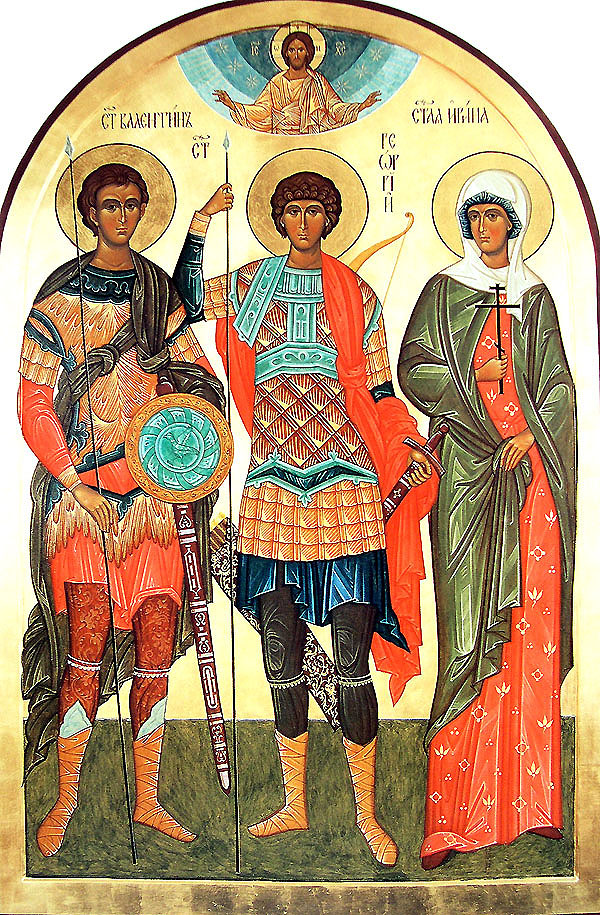
Martyrs Valentine and Pasikrates in Moesia, Bulgaria

The Martyrs Valentine and Pasikrates came from the city of Durostorum, Silistria (now Bulgaria) and were soldiers under the governor Absolanus. Pasikrates was twenty-two years old, and Valentine was thirty.

When a persecution against Christians began, Saints Pasikrates and Valentine openly confessed their faith in Christ. At the trial Pasikrates spit at the idol of Apollo, and refused to offer sacrifice.

The brother of Saint Pasikrates wept and urged him merely to appear to offer sacrifice to the idols. The martyr placed his hand on the sacrifice in the fire and said, “The body is mortal and burns in the fire, the soul, however, is immortal and is not harmed by these torments.” Saint Valentine also showed his readiness to suffer for Christ.

When they led the martyrs to execution, the mother of Saint Pasikrates followed them and exhorted her son not to fear death for Christ. Both martyrs were tortured and then beheaded in 288.

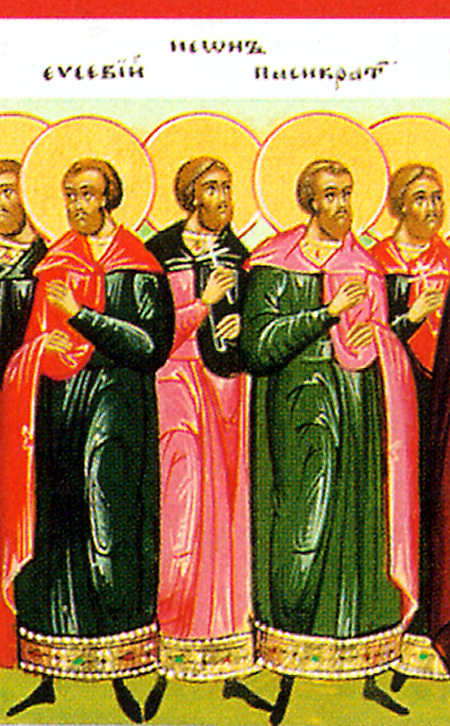
Martyrs Eusebius, Neon, Leontius, Longinus, and others, at Nicomedia

The Martyrs Eusebius, Neon, Leontius, Longinus, and 40 Others were present at the sufferings of the Great Martyr George (April 23), through which they came to believe in Christ. They were then locked up in prison. After the execution of Saint George, the emperor Diocletian (284-305) issued an edict stating that all the prisoners were to offer sacrifice to the idols. The martyrs refused. They were beaten with iron rods, almost exposing their inner organs, and then their heads were cut off with a sword.

Venerable Thomas the Fool of Syria

Saint Thomas the Fool-for-Christ was a monk in one of the monasteries in Caesarea of Cappadocia (Asia Minor). His obedience was to collect alms for the monastery. When the Blessed Thomas arrived in the city of Antioch, Syria he began his exploit of foolishness for the sake of Christ.

The steward of one of the churches, a certain Anastasius, became annoyed with the entreaties of Saint Thomas, and struck him on the cheek. Those present reproached Anastasius for his inappropriate manner of dealing with the fool, but Saint Thomas quieted them saying, “From this moment I shall accept nothing further from Anastasius, nor will Anastasius be able to give me anything further.” These words proved prophetic. Anastasius died the very next day, and the saint also died along the road to his monastery, at the church of Saint Euthymius in the suburb of Daphne. They buried him at a place set aside for the burial of strangers.

After a certain while they buried another stranger in the saint’s grave. After four hours the ground on the grave of the stranger was thrown aside. They again covered the grave, but in the morning the ground on the grave again lay open. They reburied the stranger in another place.

The same thing happened when they buried two women nearby. Everyone realized that Saint Thomas did not wish to have a woman buried over him. The occurrence was reported to Patriarch Domnus of Antioch (546-560). At his command the relics of Saint Thomas were transferred to Antioch and placed in a cemetery where the relics of many holy martyrs rested. A small church was built over these relics, from which many healings occurred.

Through the prayers of Saint Thomas a deadly plague ceased at Antioch. From that time the inhabitants began to honor the memory of Saint Thomas every year.

Saint Elizabeth, Wonderworker of Constantinople

Saint Elizabeth the Wonderworker was from Constantinople, and was chosen for the service of God at birth. It was revealed to her mother that the girl would become a chosen vessel of the Lord (Acts 9:15).

The parents sent their daughter to a monastery as a child. She grew up in an atmosphere of fasting and constant prayer, and received the gift of healing physical and spiritual infirmities.

The sisters chose her to be abbess of the Saints Cosmas and Damian Monastery. She wore a coarse hairshirt all year round. Her body was chilled in winter, but her spirit blazed with ardent love for God.

The saint’s asceticism was very strict. For many years she ate only grass and vegetables, but would not partake of bread, wine, or oil. Many times Saint Elizabeth ate nothing at all during the forty days of the Great Fast. Imitating the Publican in humility, for three years she did not lift up her eyes to the heavens, but she looked constantly to God with her spiritual eyes. At midnight prayers, the saint shone with a heavenly light.

Saint Elizabeth performed many miracles: a vicious serpent was killed by her prayer, she healed a woman with issue of blood who had been ill for many years, and she cast out unclean spirits from people. At her tomb many were healed of various illnesses, and the blind received their sight. Many were cured with just some earth from her grave.

Once, when the Divine Liturgy was being served, after the Cherubic Hymn, she saw an indescribable radiant light envelop the priest who stood before the Holy Table, and the All-Holy Spirit descended into the Altar. She was filled with astonishment and surprise. She did not tell anyone about this, however, until the day of her departure from this life drew near. As her time approached, she had a great desire to see her homeland once more. So she went to Heraclea and worshipped at the sacred churches of the Saints. And there, in the church of Mother of God, she had a vision of the All-Holy Virgin, who welcomed her. She recognized the face of the Theotokos from an icon she saw when she arrived at the church of the Holy Martyr Romanos. The voice of the Most Pure Virgin told her to return to her Monastery, because the time of her repose was near. So when Saint Elizabeth went back, she went to the Lord in peace. Her holy relics were buried in the church of Saint George, and remained whole and incorrupt.

We do not know exactly when Saint Elizabeth lived, but it was probably between the sixth and ninth centuries.

Saint Iorest, Metropolitan of Ardeal, Confessor of Romania

Saint Iorest the Confessor was born into a family of Transylvanian peasants and received the name Elias at Holy Baptism.

At a young age, he entered Puta Monastery and was tonsured with the name Iorest. Then, after completing the spiritual school at that Lavra, he made great progress in the monastic life. He was also a calligrapher and an iconographer. Because of the purity of his virtuous life, the Igoumen of the Monastery recommended him for ordination as a Hieromonk. Saint Iorest served in the altar with great compunction and in the fear of God, edifying others by his sermons.

Word of the Saint's spiritual stature reached Basil Lupu, the Voivode (military leader) of Moldova. So, after the repose of Metropolitan Gennádios of Transylvania in the autumn of 1640, Venerable Iorest of Putna was elected as the Primate of the Transylvanian Church, by God's will, After his consecration by the Metropolitan of the Romanian Land (Ţării Româneşti) in 1641, the gentle Hierarch Iorest was installed in the Metropolitan cathedral at Alba Iulia.

For three years, while shepherding the Church of Christ as a true Confessor, Saint Iorest defended the true Orthodox Faith from false Calvinist teachings, and from all the cunning snares of the devil. He traveled throughout his diocese, appointing energetic priests, consecrating churches, and instructing the people.

In 1643, Saint Iorest was thrown into prison because of his vehement opposition to the activities of foreign missionaries who wanted to convert the Orthodox faithful. He had to endure beatings and abuse, and he was prepared to suffer martyrdom and give his life in defense of the Orthodox Faith, and for the salvation of the flock which God had entrusted to him. After nine months, the true shepherd was released and forced to pay a fine. Arriving in Moldavia once again, between 1656–1657, he served as Bishop of Huşi. Here too, he shepherded the Church of Christ well, and labored for the salvation of his spiritual children.

Christ called Saint Iorest to Himself on April 24, 1657, and he was numbered among the Holy Confessors.

The Holy Hierarch Iorest was glorified by the Romanian Orthodox Church in 1955.

Saint Savva Brancovici, Metropolitan of Ardeal, Confessor of Romania

Saint Savva was born into an old Serbian family from Hertzegovina who took refuge near Arad in Transylvania at the end of the sixteenth century. The future saint was born at Inau around 1620, and received the name Simeon in Baptism. His parents were named John and Maria.

At first he was tutored at home, then he traveled in Hungary, Serbia and Bulgaria. After visiting his uncle, Metropolitan Longinus, at the Comana Monastery south of Bucharest, he decided to stay there to complete his education. The Metropolitan tutored him in religious and secular subjects. After completing his studies, Simeon returned home and got married at the age of thirty. He was ordained to the holy priesthood, but his wife died soon after this. Not long afterward, his mother became a nun. Father Simeon continued to serve in the Lord’s vineyard for ten years, converting many Moslems, and reconverting Christians who had embraced Islam.

In 1656, a council of clergy and laymen at Alba Iulia elected the widowed Father Simeon as Metropolitan of Ardeal in Transylvania (western Romania). He traveled to the cathedral in Tirgovishte in Wallachia, and there he received monastic tonsure with the name Savva. On September 16, 1656 he was consecrated as a bishop by Metropolitan Stephen of Wallachia.

Saint Savva’s episcopal service was plagued by the missionary activities of Calvinists who tried to convert the Orthodox, and who were supported by the princes of Transylvania. In addition, frequent wars threatened the stability of the area during his first years as Metropolitan. The saint, however, proved to be a faithful defender of the Church.

In the face of these difficulties, Saint Savva set up a print shop and published service books, manuals of instruction for clergy and laity, and a catechism. He also preached sermons based on the writings of Fathers, and using the Lives of the Saints as models for his flock.

Saint Savva was driven from his See between 1660-1662 because of his labors to strengthen his flock in Orthodoxy. Although he returned to his duties and served without interruption until 1680, Metropolitan Savva was often harassed because of his refusal to cooperate with the prince and the Calvinists.

In 1668 Metropolitan Savva journeyed to Russia seeking help. This led to his persecution by Prince Michael Apaffi and Protestant leaders, who did not appreciate his fierce opposition to their attempts to convert the Orthodox of Transylvania to Calvinism. In February of 1669 the prince issued a decree imposing many duties and restrictions on him.

Saint Savva convened a council at Alba Iulia in 1675. Among other things, the council decided to celebrate the Liturgy in the Romanian language rather than Slavonic, and to improve the spiritual and moral life of the clergy and laity.

In 1680 the Calvinist Superintendent of Transylvania made false accusations against Saint Savva and had him put on trial and thrown into prison. This effectively ended his career. Old and sickly, the Metropolitan endured three years of cruel torture in the Blaj Castle prison. He was finally released through the efforts of Prince Sherban of Wallachia, but died of his injuries on April 24, 1683.

Saint Savva served as Metropolitan for almost twenty-five years under very trying circumstances. In spite of this, he defended his clergy and his flock against the activities of the proselytizers. Since he endured all things with Christian patience, even the bitter sufferings to which he was subjected at the end of his life, Saint Savva is regarded as a martyr and a Confessor of the Orthodox Faith.

Saint Savva was glorified by the Church of Romania on October 21, 1955.

Hieromartyr and Confessor Elijah (Ilie) the Wallachian

No information available at this time.

Icon of the Mother of God of Molcha

There are, in fact, two wonderworking Icons called Molcha. One of them is located in the Molcha Sophroniev Nativity of the Theotokos men's Monastery. The other is in the women's Monastery of the Nativity of the Theotokos at Molcha. Both monasteries are located in the Putivl Konotop Diocese, in Ukraine (formerly Kursk province).

Tradition says that in the early XIV century, two monks moved into this area from the Tatar-ravaged city of Kiev. They settled in a cave on Wondrous Mountain not far from the Molcha swamp. These monks brought with them an Icon of the Most Holy Theotokos, before which they prayed. When the hermits departed to the Lord, they were gradually forgotten, and the place where they had lived became overgrown with dense forests.

On September 18, 1405, a beekeeper who was searching for wild bees in the forest, saw the Icon of the Theotokos in a linden tree, surrounded by a bright light, and he heard a voice say: "Let a church be built in this place, and dedicated to the Most Holy Theotokos."

The beekeeper hastened to Putivl with news of this unusual phenomenon. The clergy and many of the people went at once to the specified place, and they all saw the Icon shining with a wondrous radiance. A Moleben was served before it, and many people received healing from their various illnesses. Subsequently, the Molcha Nativity of the Theotokos men's Monastery was built on this site.

In 1605 the Monastery was plundered by the Poles, so the Igoumen and the brethren were forced to leave their ruined cloister and the Icon was transferred to the city's Putivl Monastery on April 24, 1605. Since the monks had brought the Molcha Icon with them, the Putivl Monastery was also called Molcha.

In 1653, the Nativity of the Theotokos Monastery was restored through the efforts of a certain builder named Sophronios, that is why the Monastery received yet another name – Sophroniev.

The wonderworking Icon was destroyed in a fire at the Monastery in 1752, but fortunately several ancient copies of the Icon were preserved, which were also renowned for their many miracles.

During the Soviet era, the monastery was destroyed and the Icon was believed to be lost. Both Molcha Monasteries were restored in the nineteen-nineties. A lost Icon was also found. It turned out that the Icon had been hidden by the residents in order to save it from being desecrated. On May 7, 1995 there was a Cross Procession to transfer the Icon to the Transfiguration of the Savior Cathedral of the Molcha Putivl Monastery.

There is also a wonderworking copy of the Molcha Icon of the Mother of God, which appeared in the village of Businovo near Moscow. Currently, this Molcha Icon of the Theotokos is located in the temple of Saint Sergius of Radonezh in Businov. According to Tradition, the Icon was brought to the temple in the XIX century by a blind girl who lived in the village of Businovo

Hieromartyr Branko (Dobrosavljevic) the Newmartyr

No information available at this time.

Saint Joseph the Confessor of Maramures

Saint Joseph was born in the seventeenth century, and was consecrated as a bishop in Moldavia (northern Romania) in 1690 by Metropolitan Dositheus. This was a period of great trials and sufferings for the people of Maramures (in northern Romania) because the Roman Catholic authorities wanted to wipe out Orthodoxy in the region.

St Joseph was a zealous defender of the Orthodox Faith, and therefore he was jailed by the civil authorities. He died in 1711 after suffering for the truth and defending his flock.

St Joseph the Confessor was glorified by the Orthodox Church of Romania in 1992.

Hieromartyr Branko, parish priest of Veljusa

No information available at this time.

Daily Readings for Sunday, April 23, 2023

THOMAS SUNDAY

NO FAST

Thomas Sunday, George the Great Martyr and Triumphant, Martyrs Emmanuel, Theodore, George, Michael and the other George of Samothrace

ACTS OF THE APOSTLES 12:1-11

About that time, Herod the king laid violent hands upon some who belonged to the church. He killed James the brother of John with the sword; and when he saw that it pleased the Jews, he proceeded to arrest Peter also. This was during the days of Unleavened Bread. And when he had seized him, he put him in prison, and delivered him to four squads of soldiers to guard him, intending after the Passover to bring him out to the people. So Peter was kept in prison; but earnest prayer for him was made to God by the Church.
The very night when Herod was about to bring him out, Peter was sleeping between two soldiers, bound with two chains, and sentries before the door were guarding the prison; and behold, an angel of the Lord appeared, and a light shone in the cell; and he struck Peter on the side and woke him, saying, "Get up quickly." And the chains fell off his hands. And the angel said to him, "Wrap your mantle around you and follow me." And he went out and followed him; he did not know that what was done by the angel was real, but thought he was seeing a vision. When they had passed the first and the second guard, they came to the iron gate leading into the city. It opened to them of its own accord, and they went out and passed on through one street; and immediately the angel left him. And Peter came to himself, and said, "Now I am sure that the Lord has sent his angel and rescued me from the hand of Herod and from all that the Jewish people were expecting.

JOHN 20:19-31

On the evening of that day, the first day of the week, the doors being shut where the disciples were for fear of the Jews, Jesus came and stood among them and said to them, “Peace be with you.” When He had said this, He showed them His hands and His side. Then the disciples were glad when they saw the Lord. Jesus said to them again, “Peace be with you. As the Father has sent Me, even so I send you.” And when He had said this, He breathed on them and said to them, “Receive the Holy Spirit. If you forgive the sins of any, they are forgiven; if you retain the sins of any, they are retained.” Now Thomas, one of the twelve, called the Twin, was not with them when Jesus came. So the other disciples told him, “We have seen the Lord.” But he said to them, “Unless I see in His hands the print of the nails, and place my finger in the mark of the nails, and place my hand in His side, I will not believe.” Eight days later, His disciples were again in the house, and Thomas was with them. The doors were shut, but Jesus came and stood among them and said, “Peace be with you.” Then He said to Thomas, “Put your finger here, and see My hands; and put out your hand, and place it in My side; do not be faithless, but believing.” Thomas answered Him, “My Lord and My God!” Jesus said to him, “Have you believed because you have seen Me? Blessed are those who have not seen and yet believe.” Now Jesus did many other signs in the presence of the disciples, which are not written in this book; but these are written that you may believe that Jesus is the Christ, the Son of God, and that believing, you may have life in His name.

Antipascha: Saint Thomas Sunday

Some icons depicting this event are inscribed “The Doubting Thomas.” This is incorrect. In Greek, the inscription reads, “The Touching of Thomas.” The Slavonic inscription is, “The Belief of Thomas.” When Saint Thomas touched the Life-giving side of the Lord, he no longer had any doubts.

This day is also known as “Antipascha.” This does not mean “opposed to Pascha,” but “in place of Pascha.” Beginning with this first Sunday after Pascha, the Church dedicates every Sunday of the year to the Lord’s Resurrection. Sunday is called “Resurrection” in Russian, and “the Lord’s Day” in Greek.

Greatmartyr, Victory-bearer, and Wonderworker George

The Holy Great Martyr George the Victory-Bearer, was a native of Cappadocia (a district in Asia Minor), and he grew up in a deeply believing Christian family. His father was martyred for Christ when George was still a child. His mother, owning lands in Palestine, moved there with her son and raised him in strict piety.

When he became a man, Saint George entered into the service of the Roman army. He was handsome, brave and valiant in battle, and he came to the notice of the emperor Diocletian (284-305) and joined the imperial guard with the rank of comites, or military commander.

The pagan emperor, who did much for the restoration of Roman might, was clearly concerned with the danger presented to pagan civilization by the triumph of the Crucified Savior, and intensified his persecution against the Christians in the final years of his reign. Following the advice of the Senate at Nicomedia, Diocletian gave all his governors full freedom in their court proceedings against Christians, and he promised them his full support.

Saint George, when he heard the decision of the emperor, distributed all his wealth to the poor, freed his servants, and then appeared in the Senate. The brave soldier of Christ spoke out openly against the emperor’s designs. He confessed himself a Christian, and appealed to all to acknowledge Christ: “I am a servant of Christ, my God, and trusting in Him, I have come among you voluntarily, to bear witness concerning the Truth.”

“What is Truth?” one of the dignitaries asked, echoing the question of Pontius Pilate. The saint replied, “Christ Himself, Whom you persecuted, is Truth.”

Stunned by the bold speech of the valiant warrior, the emperor, who had loved and promoted George, attempted to persuade him not to throw away his youth and glory and honors, but rather to offer sacrifice to the gods as was the Roman custom. The confessor replied, “Nothing in this inconstant life can weaken my resolve to serve God.”

Then by order of the enraged emperor the armed guards began to push Saint George out of the assembly hall with their spears, and they then led him off to prison. But the deadly steel became soft and it bent, just as the spears touched the saint’s body, and it caused him no harm. In prison they put the martyr’s feet in stocks and placed a heavy stone on his chest.

The next day at the interrogation, powerless but firm of spirit, Saint George again answered the emperor, “You will grow tired of tormenting me sooner than I will tire of being tormented by you.” Then Diocletian gave orders to subject Saint George to some very intense tortures. They tied the Great Martyr to a wheel, beneath which were boards pierced with sharp pieces of iron. As the wheel turned, the sharp edges slashed the saint’s naked body.

At first the sufferer loudly cried out to the Lord, but soon he quieted down, and did not utter even a single groan. Diocletian decided that the tortured one was already dead, and he gave orders to remove the battered body from the wheel, and then went to a pagan temple to offer thanks.

At this very moment it got dark, thunder boomed, and a voice was heard: “Fear not, George, for I am with you.” Then a wondrous light shone, and at the wheel an angel of the Lord appeared in the form of a radiant youth. He placed his hand upon the martyr, saying to him, “Rejoice!” Saint George stood up healed.

When the soldiers led him to the pagan temple where the emperor was, the emperor could not believe his own eyes and he thought that he saw before him some other man or even a ghost. In confusion and in terror the pagans looked Saint George over carefully, and they became convinced that a miracle had occurred. Many then came to believe in the Life-Creating God of the Christians.

Two illustrious officials, Saints Anatolius and Protoleon, who were secretly Christians, openly confessed Christ. Immediately, without a trial, they were beheaded with the sword by order of the emperor. Also present in the pagan temple was Empress Alexandra, the wife of Diocletian, and she also knew the truth. She was on the point of glorifying Christ, but one of the servants of the emperor took her and led her off to the palace.

The emperor became even more furious. He had not lost all hope of influencing Saint George, so he gave him over to new and fiercesome torments. After throwing him into a deep pit, they covered it over with lime. Three days later they dug him out, but found him cheerful and unharmed. They shod the saint in iron sandals with red-hot nails, and then drove him back to the prison with whips. In the morning, they led him back to the interrogation, cheerful and with healed feet, and the emperor asked if he liked his shoes. The saint said that the sandals had been just his size. Then they beat him with ox thongs until pieces of his flesh came off and his blood soaked the ground, but the brave sufferer, strengthened by the power of God, remained unyielding.

The emperor concluded that the saint was being helped by magic, so he summoned the sorcerer Athanasius to deprive the saint of his miraculous powers, or else poison him. The sorcerer gave Saint George two goblets containing drugs. One of them would have quieted him, and the other would kill him. The drugs had no effect, and the saint continued to denounce the pagan superstitions and glorify God as before.

When the emperor asked what sort of power was helping him, Saint George said, “Do not imagine that it is any human learning which keeps me from being harmed by these torments. I am saved only by calling upon Christ and His Power. Whoever believes in Him has no regard for tortures and is able to do the things that Christ did” (John 14:12). Diocletian asked what sort of things Christ had done. The Martyr replied, “He gave sight to the blind, cleansed the lepers, healed the lame, gave hearing to the deaf, cast out demons, and raised the dead.”

Knowing that they had never been able to resurrect the dead through sorcery, nor by any of the gods known to him, and wanting to test the saint, the emperor commanded him to raise up a dead person before his eyes. The saint retorted, “You wish to tempt me, but my God will work this sign for the salvation of the people who shall see the power of Christ.”

When they led Saint George down to the graveyard, he cried out, “O Lord! Show to those here present, that You are the only God in all the world. Let them know You as the Almighty Lord.” Then the earth quaked, a grave opened, the dead one emerged from it alive. Having seen with their own eyes the Power of Christ, the people wept and glorified the true God.

The sorcerer Athanasius, falling down at the feet of Saint George, confessed Christ as the All-Powerful God and asked forgiveness for his sins, committed in ignorance. The obdurate emperor in his impiety thought otherwise. In a rage, he commanded both Athanasius and the man raised from the dead to be beheaded, and he had Saint George again locked up in prison.

The people, weighed down with their infirmities, began to visit the prison and they there received healing and help from the saint. A certain farmer named Glycerius, whose ox had collapsed, also visited him. The saint consoled him and assured him that God would restore his ox to life. When he saw the ox alive, the farmer began to glorify the God of the Christians throughout all the city. By order of the emperor, Saint Glycerius was arrested and beheaded.

The exploits and the miracles of the Great Martyr George had increased the number of the Christians, therefore Diocletian made a final attempt to compel the saint to offer sacrifice to the idols. They set up a court at the pagan temple of Apollo. On the final night the holy martyr prayed fervently, and as he slept, he saw the Lord, Who raised him up with His hand, and embraced him. The Savior placed a crown on Saint George’s head and said, “Fear not, but have courage, and you will soon come to Me and receive what has been prepared for you.”

In the morning, the emperor offered to make Saint George his co-administrator, second only to himself. The holy martyr with a feigned willingness answered, “Caesar, you should have shown me this mercy from the very beginning, instead of torturing me. Let us go now to the temple and see the gods you worship.”

Diocletian believed that the martyr was accepting his offer, and he followed him to the pagan temple with his retinue and all the people. Everyone was certain that Saint George would offer sacrifice to the gods. The saint went up to the idol, made the Sign of the Cross and addressed it as if it were alive: “Are you the one who wants to receive from me sacrifice befitting God?”

The demon inhabiting the idol cried out, “I am not a god and none of those like me is a god, either. The only God is He Whom you preach. We are fallen angels, and we deceive people because we are jealous.”

Saint George cried out, “How dare you remain here, when I, the servant of the true God, have entered?” Then noises and wailing were heard from the idols, and they fell to the ground and were shattered.

There was general confusion. In a frenzy, pagan priests and many of the crowd seized the holy martyr, tied him up, and began to beat him. They also called for his immediate execution.

The holy empress Alexandra tried to reach him. Pushing her way through the crowd, she cried out, “O God of George, help me, for You Alone are All-Powerful.” At the feet of the Great Martyr the holy empress confessed Christ, Who had humiliated the idols and those who worshipped them.

Diocletian immediately pronounced the death sentence on the Great Martyr George and the holy Empress Alexandra, who followed Saint George to execution without resisting. Along the way she felt faint and slumped against a wall. There she surrendered her soul to God.

Saint George gave thanks to God and prayed that he would also end his life in a worthy manner. At the place of execution the saint prayed that the Lord would forgive the torturers who acted in ignorance, and that He would lead them to the knowledge of Truth. Calmly and bravely, the holy Great Martyr George bent his neck beneath the sword, receiving the crown of martyrdom on April 23, 303.

The pagan era was coming to an end, and Christianity was about to triumph. Within ten years, Saint Constantine (May 21) would issue the Edict of Milan, granting religious freedom to Christians.

Of the many miracles worked by the holy Great Martyr George, the most famous are depicted in iconography. In the saint’s native city of Beirut were many idol-worshippers. Outside the city, near Mount Lebanon, was a large lake, inhabited by an enormous dragon-like serpent. Coming out of the lake, it devoured people, and there was nothing anyone could do, since the breath from its nostrils poisoned the very air.

On the advice of the demons inhabiting the idols, the local ruler came to a decision. Each day the people would draw lots to feed their own children to the serpent, and he promised to sacrifice his only daughter when his turn came. That time did come, and the ruler dressed her in her finest attire, then sent her off to the lake. The girl wept bitterly, awaiting her death. Unexpectedly for her, Saint George rode up on his horse with spear in hand. The girl implored him not to leave her, lest she perish.

The saint signed himself with the Sign of the Cross. He rushed at the serpent saying, “In the Name of the Father and of the Son and of the Holy Spirit.” Saint George pierced the throat of the serpent with his spear and trampled it with his horse. Then he told the girl to bind the serpent with her sash, and lead it into the city like a dog on a leash.

The people fled in terror, but the saint halted them with the words: “Don’t be afraid, but trust in the Lord Jesus Christ and believe in Him, since it is He Who sent me to save you.” Then the saint killed the serpent with a sword, and the people burned it outside the city. Twenty-five thousand men, not counting women and children, were then baptized. Later, a church was built and dedicated to the Most Holy Theotokos and the Great Martyr George.

Saint George went on to become a talented officer and to amaze the world by his military exploits. He died before he was thirty years old. He is known as Victory Bearer, not only for his military achievements, but for successfully enduring martyrdom. As we know, the martyrs are commemorated in the dismissal at the end of Church services as “the holy, right victorious martyr….”

Saint George was the patron saint and protector of several of the great builders of the Russian state. Saint Vladimir’s son, Yaroslav the Wise (in holy Baptism George), advanced the veneration of the saint in the Russian Church. He built the city of Yuriev [i.e., “of Yurii.” “Yurii” is the diminutive of “George”, as “Ivan” is of “John”], he also founded the Yuriev monastery at Novgorod, and he built a church of Saint George the Victory Bearer at Kiev.

The day of the consecration of Saint George’s Church in Kiev, November 26, 1051 by Saint Hilarion, Metropolitan of Kiev and All Rus, has entered into the liturgical treasury of the Church as a special church feastday. Yuriev Day is beloved by the Russian people as an “autumn Feast of Saint George.”

The name of Saint George was also borne by the founder of Moscow, Yurii Dolgoruky (+ 1157), who was the builder of many churches dedicated to Saint George, and the builder of the city of Yuriev-Polsk. In the year 1238 the heroic fight of the Russian nation against the Mongol Horde was led by the Great Prince Yurii (George) Vsevolodovich of Vladimir (February 4), who fell at the Battle at the Sita River. His memory, like that of Igor the Brave, and defender of his land, was celebrated in Russian spiritual poems and ballads.

The first Great Prince of Moscow, when Moscow had become the center of the Russian Land, was Yurii Danilovich (+ 1325), the son of Saint Daniel of Moscow, and grandson of Saint Alexander Nevsky. From that time Saint George the Victory Bearer, depicted as a horseman slaying the serpent, appeared on Moscow’s coat of arms, and became an emblem of the Russian state. This has strengthened Russia’s connections with Christian nations, and especially with Iberia (Georgia, the Land of Saint George).

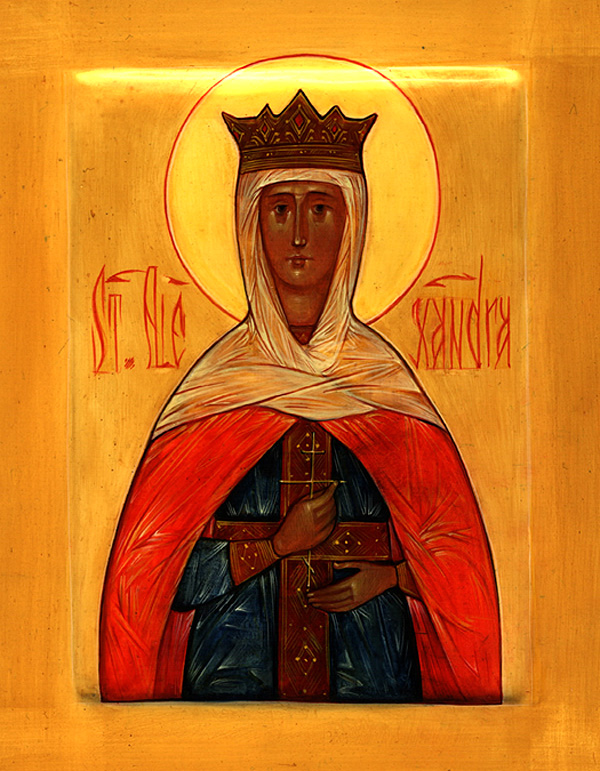
Martyr Alexandra the Empress, wife of Diocletian

The Holy Empress Alexandra was the wife of Diocletian (284-305). Her supposed death was described in the Martyrdom of Saint George, which was written immediately after his death. The empress, however, received the crown of martyrdom several years later, in 314.

Many events occurred during these years. In 305 the emperor Diocletian resigned the throne and power passed to his co-ruler Maximian Galerius (305-311), a fanatic pagan, as well as a coarse and fierce soldier. His wife was Saint Valeria, the daughter of the holy Empress Alexandra, whom Diocletian had given in marriage against her will.

Saint Alexandra raised her daughter in Christian piety. When Galerius died, the emperor Maximinus sought her hand in marriage. When he was refused, he banished Saint Valeria to Syria, where she lived with her mother.

After the death of Maximinus in 311 the mother and daughter arrived in Nicomedia, trusting in the mercy of the emperor Licinius (311-324). Together with Saint Constantine, he had subscribed to the Edict of Milan, which gave Christians the freedom of religion, but secretly he remained an enemy of Christianity. Licinius gave orders to execute the holy Empress Alexandra and her daughter Valeria. They were beheaded, and their bodies thrown into the sea.

Martyrs Anatolius and Protoleon, soldiers converted by witnessing the martyrdom of Saint George

Two illustrious officials, Saints Anatolius and Protoleon, who were secretly Christians, openly confessed Christ after seeing Saint George tortured, then miraculously healed of his wounds. Immediately, and without a trial, they were beheaded with the sword by order of the emperor.

New Martyr Lazarus of Bulgaria

The Holy New Martyr Lazarus was from Gabrovo, Bulgaria and he was born to devout and God-loving parents in 1774. At a young age he left Gabrovo and went to Soma in Asia Minor, near Pergamon, where he became a shepherd.

One day while tending his sheep in the fields, he sat down to rest, and fell asleep. Meanwhile, a Moslem woman passed by, and was attacked by the sheep dog. Awakened by the dog's barking, Lazarus hastened to save her. The dog was calmed down and the woman was unharmed, but her dress was somewhat torn. This infuriated the woman, who immediately went home and told her husband that she had been attacked by a Christian shepherd who attempted to molest her. The enraged husband went out to look for Lazarus, but since he did not know him, he mistook another man for Lazarus, and nearly beat him to death. In order to hide his mistake, the husband had his wife's relatives go before the Turkish judge and to charge Lazarus with attempted rape.

Although Lazarus was aware of what the woman's husband planned to do, he did not attempt to hide. He knew that he was innocent, and that running away would only make him appear guilty. Therefore, on April 7, 1802, he showed up in court, where he was charged and thrown into prison.

In the meantime, the woman's relatives insisted that Lazarus must either convert to Islam or be executed for the dishonor he had inflicted upon their relative. They offered the aga a thousand grosia if he succeeded in converting Lazarus; or if the Saint refused to deny Christ, he must be sentenced to death.

In prison, saints Lazarus was beaten continuously until April 22, in an attempt to force his conversion. Orthodox Christians came and visited Lazarus to give him support and encouragement, but he requested them to leave because they were placing themselves in danger. Meanwhile, the aga grew increasingly angry because Lazarus would not convert, and the one thousand grosia seemed to be slipping through his fingers. Saint Lazarus remained steadfast in the face of torture and flattery, and so the aga confiscated his herd of forty sheep.

On Tuesday of Saint Thomas week (April 22) the aga ordered more tortures for Lazarus. After his tormentors got drunk, they began applying red-hot irons to Lazarus' body. Then they placed heavy stones upon his chest, but Lazarus still refused to submit. Instead, Lazarus entreated the Lord to help him, and he also prayed to Saint George (April 23), asking for his assistance.

Then the torturers stretched out Lazarus' tongue and applied a hot iron to it, burning the front half and cauterizing the rest. Since Lazarus was now unable to speak, they told him to use sign language when he was ready to convert. They also placed a heated iron band around his head, causing him terrible pain.

At sunset, the merchant John from Zagora, who was also a medical doctor, went to see the aga, with whom he was acquainted, because he was the physician to the aga's household. John went to the window of the prison and was able to see Lazarus sitting on the floor. Not only did he seem to be well, but he was also able to speak normally. The doctor, who was an Orthodox Christian, encouraged Lazarus to persevere until the end, and to endure everything for the love of Christ. He spoke to Lazarus in Turkish, since he did not know Bulgarian and Lazarus did not understand Greek. Lazarus assured the doctor that he would not give in, but he was afraid that the Moslems would become tired of torturing him and would just stop instead of putting him to death.

When the aga learned that Lazarus could speak, he became angry with the torturers, whom he thought had deceived him. Yet when he saw the marks of torture on the Saint's body, he was convinced that the men had done their job. After trying once more to make Lazarus convert, he heard him reject all gifts, honors, and promises of wealth if he became a Moslem. Saint Lazarus told him, "I have one God in three persons, Whom I worship and adore. I was baptized as an Orthodox Christian, and I shall die as an Orthodox Christian." Then the aga ordered that he be hanged.

On the way to the place of his execution, many Moslems mocked Lazarus for being so foolish as to give up his life for Jesus Christ. When they arrived at their destination, Saint Lazarus voluntarily placed the rope around his own neck and stood on a basket, and then the executioner kicked it from under his feet. Thus the Holy New Martyr Lazarus endured martyrdom on April 23, 1802. He was twenty-eight years old when he departed from this temporal life, and inherited everlasting life. Now, in the Kingdom of Heaven, he joins the angels and all the Saints in glorifying the Father, and the Son, and the Holy Spirit throughout the ages.

A Church Service in honor of Saint Lazarus was composed by Saint Nikephoros of Chios (May 1). Portions of his relics can be venerated in Leimonos Monastery in Lesbos, and in the Chapel of Saint Xenia of Saint Petersburg at Mandra in Attica.

Daily Readings for Saturday, April 22, 2023

RENEWAL SATURDAY

NO FAST

Renewal Saturday, Theodore of Sykeon, Nathaniel, Luke, & Clemente the Apostles, Gregory Gravanos of Nisyros, Nearchos the Martyr

ACTS OF THE APOSTLES 3:11-16

In those days, while the healed lame man clung to Peter and John, all the people ran together to them in the portico called Solomon’s, astounded. And when Peter saw it he addressed the people, “Men of Israel, why do you wonder at this, or why do you stare at us, as though by our own power or piety we had made him walk? The God of Abraham and of Isaac and of Jacob, the God of our fathers, glorified his servant Jesus, whom you delivered up and denied in the presence of Pilate, when he had decided to release him. But you denied the Holy and Righteous One, and asked for a murderer to be granted to you, and killed the Author of life, whom God raised from the dead. To this we are witnesses. And his name, by faith in his name, has made this man strong whom you see and know; and the faith which is through him has given the man this perfect health in the presence of you all.”

JOHN 3:22-33

At that time, Jesus and his disciples went into the land of Judea; there He remained with them and baptized. John also was baptizing at Aenon near Salim, because there was much water there; and people came and were baptized. For John had not yet been put in prison.
Now a discussion arose between John's disciples and a Jew over purifying. And they came to John, and said to him, "Rabbi, he who was with you beyond the Jordan, to whom you bore witness, here he is, baptizing, and all are going to him." John answered, "No one can receive anything except what is given him from heaven. You yourselves bear me witness, that I said, I am not the Christ, but I have been sent before Him. He who has the bride is the bridegroom; the friend of the bridegroom, who stands and hears him, rejoices greatly at the bridegroom's voice; therefore this joy of mine is now full. He must increase, but I must decrease.
He who comes from above is above all; he who is of the earth belongs to the earth, and of the earth he speaks; he who comes from heaven is above all. He bears witness to what he has seen and heard, yet no one receives his testimony; he who receives his testimony sets his seal to this, that God is true.

Bright Saturday

The artos, which was blessed after the Liturgy of Pascha, is cut and distributed after Liturgy on Bright Saturday. The prayer read today speaks of Christ as the Bread of Life.

Saint Theodore the Sykeote, Bishop of Anastasiopolis

Saint Theodore the Sykeote was born in the mid-sixth century in the village of Sykeon, not far from the city of Anastasiopolis (in Galatia, Asia Minor), into a pious family. When his mother Maria conceived the Saint, she had a vision of a bright star shining over her womb. She consulted a clairvoyant Elder, who explained that this was the grace of God being poured forth upon her child.

When the boy reached the age of six, his mother presented him with a golden belt, since she wanted her son to become a soldier. That night the Holy Great Martyr George (April 23) appeared to Maria in a dream, and he told her not to seek a military career for her son, because the boy was destined to serve God. The Saint’s father, Cosmas, served as a messenger for Emperor Justinian the Great (527-565), but he died at a young age. The boy remained in the care of his mother Maria. His grandmother Elpidίa, his aunt Despoinίa, and his sister Blátta also lived with them.

In school, Saint Theodore displayed great apptitude in his studies, the most important being his rare gifts of reason and wisdom. He was quiet and mild, but he always knew how to calm his comrades, and he did not allow any fights or quarrels among them.

The pious Elder Stephen also lived at Maria’s house. At the age of eight, Saint Theodore started to imitate him, eating just a small morsel of bread in the evening during Great Lent. So that his mother would not force him to dine with everyone, the boy returned home from school only toward evening, after he had partaken of the Holy Mysteries with Elder Stephen. At Maria's request, the teacher began sending him home to supper at the end of his lessons. Saint Theodore, however, ran to the church of the Great Martyr George, where the Saint appeared to him in the form of a young man, and escorted him into the church.

When Saint Theodore turned ten, he fell deathly ill. He was brought to the church of Saint John the Baptist and was placed before the altar. The boy was healed by two drops of water which fell from the face of the Savior in the dome of the temple. At this time the Great Martyr George began appearing to him at night, and also leading him to his own temple to pray until morning. His mother, fearing the dangers of the forest, urged her son not to go out at night.

Once, when the boy had already left, Maria followed him to the church, dragged him out by his hair, and tied him to his bed. That very night Saint George appeared to her in a dream, and commanded her not to hinder the child from going to church. Both Elpidίa and Despoinίa had the same vision. It was then that the women recognized Saint Theodore’s special calling, and they hindered him no longer. Even his little sister Blátta began to emulate him.

When he was twelve years old, the Saint had a dream in which he saw Christ on the Throne of Glory, Who told him, “Struggle, Theodore, so that you may obtain a perfect reward in the Kingdom of Heaven. From that time, Saint Theodore began to intensify his labors. He spent both the First Week of Great Lent and the Week of the Veneration of the Cross in complete silence.

The devil set out to destroy him. He appeared to the Saint in the form of his classmate Gerontius, and urged him to jump off a precipice, but Saint George rescued him.

One another occasion, Saint Theodore went into the desert to obtain the blessing of the Elder Glykérios. There was a terrible drought throughout the land, and the Elder said, “Child, let us pray to the Lord on bended knee, asking Him to send rain. Then we shall learn whether our prayers are pleasing to the Lord.” The Elder and his disciple prayed, and all at once it started to rain. Then the Elder told Saint Theodore that the grace of God was upon him, and blessed him to enter a Monastery when the time came.

When he was fourteen, Saint Theodore left home and lived near the church of the Great Martyr George. His mother brought him food, but Saint Theodore left everything on the stones by the church, eating only a single prosphoron each day. Even at such a young age, Saint Theodore was granted the gift of healing. Through his prayers a demon-possessed youth was restored to his right mind.

Saint Theodore fled human glory and withdrew into complete solitude. Under a large boulder not far from the church of Saint George, he dug a cave and persuaded a certain deacon to cover the entrance with earth, leaving a small opening for air. The deacon brought him bread and water, but he told no one where the Saint had hidden himself. For two years Saint Theodore lived in seclusion and complete quietude. His relatives mourned him, thinking that he had been devoured by wild beasts.

At last, the deacon finally revealed his secret, since he feared that Saint Theodore would perish in the narrow cave, and he also felt pity for his mother Maria. Saint Theodore was removed from the cave, barely alive. His mother wished to take her son home and nurse him back to health, but the Saint remained by the church of Saint George, and after several days he was completely well.

News of the young man's exploits reached the local Bishop Theodosios, who ordained him to the diaconate, and later to the holy priesthood, even lthough the Saint was just seventeen years old. After a certain time had passed, Saint Theodore went to venerate the holy places in Jerusalem, and there at the Khozeba Lavra near the Jordan, he was tonsured as a monk.

When he returned to his native land, he continued to live near the church of Saint George. His grandmother Elpidίa, his sister Blátta, and his mother Maria entered a women’s monastery on the Saint’s advice. His aunt Despoinίa reposed there
in peace.

The ascetical life of the young Hieromonk attracted people who were seeking salvation. The Saint tonsured the young man Epiphánios, and later on a pious woman, whom the Saint healed of her sickness, brought her son Philoúmenos to him. Then the virtuous young man John also came to him. Thus, the brethren gradually gathered around the Saint.

Saint Theodore continued his strenuous ascetical labors. At his request a blacksmith made him an iron cage without a roof, so narrow that it was scarcely possible to stand. In this cage Saint Theodore wore heavy chains from Holy Pascha until the Nativity of Christ. From the Baptism of the Lord until Holy Pascha he secluded himself in his cave, from which he emerged only for Church Services on Saturdays and Sundays. Throughout the forty-day Fast the Saint ate only greens and bread on Saturdays and Sundays.

Living in such a manner, he received from the Lord the power over wild animals. Bears and wolves came to him and took food from his hand. By the Saint’s prayers, those afflicted with leprosy were healed, and demons were cast out from entire districts. In the nearby village of Magatia, when locusts threatened the crops, people turned to Saint Theodore for help. He told them to go to the church. After he served the Divine Liturgy for them, the villagers returned home and learned that all the locusts had died during the Service.

When the military commander Maurikios was returning to Constantinople by way of Galatia after fighting the Persians, the Saint predicted that he would become Emperor. His words came true, and Emperor Maurikios (582-602) granted the Saint’s request: he sent bread to the Monastery each year for the multitude of people who were being fed there.

The small temple of Saint George could not accommodate all those who wanted to pray in it. Then through the Saint's efforts, a beautiful new church was built. At that time, the Bishop of Anastasiopolis reposed. The people of the city asked Metropolitan Paul of Ancyra to install Saint Theodore as their bishop. So that the Saint would not resist, the Metropolitan's messengers and the people of Anastasiopolis dragged him out of his cell by force and carried him into the city.

As a Hierarch, Saint Theodore labored much for the welfare of the Church, but his soul yearned for solitary communion with God. After several years he went again to venerate the holy places in Jerusalem. And there, concealing his identity, he settled at the Lavra of Saint Savva, where he lived in solitude from the Nativity of Christ until Pascha. Then the Great Martyr George told him to return to Anastasiopolis.

Unknown enemies tried to poison the Saint, but the Mother of God gave him three small pieces of grain. Saint Theodore ate them and remained unharmed. Weighed down by the burden of being a bishop, Saint Theodore asked Patriarch Kyriakos of Constantinople (595-606) to release him to his own Monastery so that he might celebrate the services there.

Saint Theodore was venerated as a Saint, even during his lifetime. His sanctity was so evident that when he offered the Eucharist, the grace of the Holy Spirit appeared as a radiant purple light, shining on the Holy Gifts. Once, when the Saint elevated the diskos with the Holy Lamb and said: “Holy things are for the holy,” the Holy Lamb floated up in the air, and then settled upon the diskos once more.

In one of the cities of Galatia, a terrible event occurred: during a Church procession, the wooden crosses being carried began to strike each other by themselves. As a result, Patriarch Thomas (March 21) summoned Saint Theodore, asking him the meaning of this terrible portent. Having the gift of foresight, Saint Theodore explained that this indicated coming misfortunes for the Church of God (he was speaking of the future heresy of the Iconoclasts). In his grief the holy Patriarch Thomas begged the Saint to pray that he would soon repose, so that he would not have to witness the coming catastrophe.

In the year 610 the holy Patriarch Thomas reposed after asking for Saint Theodore's blessing. In that same year, Saint Theodore departed to the Lord.

Saint Theodore is also commemorated on June 15 (The Transfer of his relics).

Translation of the relics of Blessed Vsevolod (in Baptism Gabriel), Prince of Pskov

The Transfer of the Relics of Holy Prince Vsevolod-Gabriel of Pskov (1834): See February 11.

Apostle Nathaniel of the Seventy

Saint Nathanael, whose name means "the gift of God," was from Cana of Galilee (John 21:2). He was brought to the Savior by Phillip, as described in the Fourth Gospel (John 1:45-51). Christ calls him a true Israelite, which means "one who sees God." Nathanael was amazed when Christ says that He had seen him under the fig tree. Then He says that Nathanael will see even greater things; he will the heavens opened, and "the angels of God ascending and descending upon the Son of Man."

Saints John Chrysostom, Cyril of Alexandria, Epiphanios of Cyprus and other Fathers of the Church regard the Apostle Bartholomew (the son of Tholomai) as the same person as Nathanael. Thus, his name would be Nathanael, and his patronymic would be Bartholomew.

According to The Jerome Biblical Commentary (page 796), Nathanael was thought to be the same person as Bartholomew, because the latter's name followed Philip's in three lists of the Apostles (Matthew 10:2-5; Mark 3:14-19; and Luke 6:14-16). The Synoptic Gospels mention Bartholomew as one of the Twelve Apostles, but they do not mention Nathanael. On the other hand, Saint John's Gospel makes mention of Nathanael, but not of Bartholomew.

For the Life of Saint Bartholomew, see June 11.

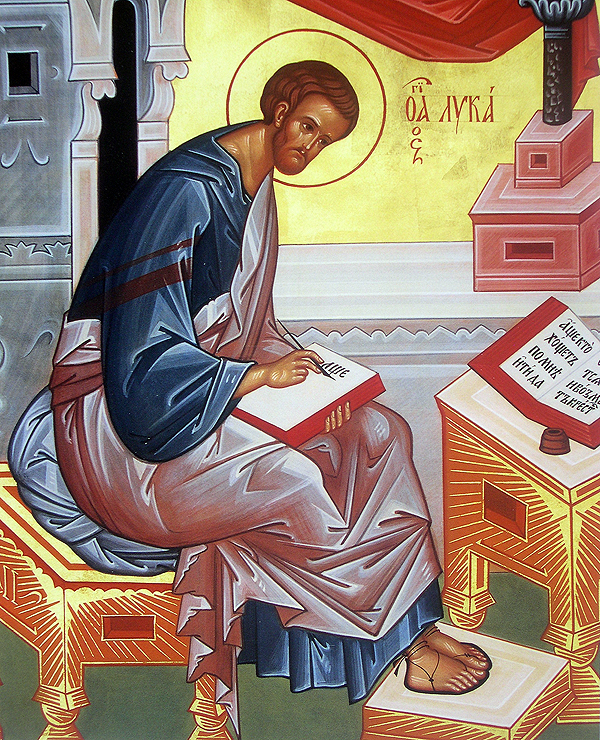
Apostle and Evangelist Luke of the Seventy

The Holy Apostle and Evangelist Luke, was a native of Syrian Antioch, a companion of the holy Apostle Paul (Phil.1:24, 2 Tim. 4:10-11), and a physician enlightened in the Greek medical arts. Hearing about Christ, Luke arrived in Palestine and fervently accepted the preaching of salvation from the Lord Himself. As one of the Seventy Apostles, Saint Luke was sent by the Lord with the others to preach the Kingdom of Heaven during the Savior’s earthly life (Luke 10:1-3). After the Resurrection, the Lord Jesus Christ appeared to Saints Luke and Cleopas on the road to Emmaus.

Luke accompanied Saint Paul on his second missionary journey, and from that time they were inseparable. When Paul’s coworkers had forsaken him, only Luke remained to assist him in his ministry (2 Tim. 4:10-11). After the martyric death of the First-Ranked Apostles Peter and Paul, Saint Luke left Rome to preach in Achaia, Libya, Egypt and the Thebaid. He ended his life by suffering martyrdom in the city of Thebes.

Tradition credits Saint Luke with painting the first icons of the Mother of God. “Let the grace of Him Who was born of Me and My mercy be with these Icons,” said the All-Pure Virgin after seeing the icons. Saint Luke also painted icons of the First-Ranked Apostles Peter and Paul. Saint Luke’s Gospel was written in the years 62-63 at Rome, under the guidance of the Apostle Paul. In the preliminary verses (1:1-3), Saint Luke precisely sets forth the purpose of his work. He proposes to record, in chronological order, everything known by Christians about Jesus Christ and His teachings. By doing this, he provided a firmer historical basis for Christian teaching (1:4). He carefully investigated the facts, and made generous use of the oral tradition of the Church and of what the All-Pure Virgin Mary Herself had told him (2:19, 51).

In Saint Luke’s Gospel, the message of the salvation made possible by the Lord Jesus Christ, and the preaching of the Gospel, are of primary importance.

Saint Luke also wrote the Acts of the Holy Apostles at Rome around 62-63 A.D. The Book of Acts, which is a continuation of the four Gospels, speaks about the works and the fruits of the holy Apostles after the Ascension of the Savior. At the center of the narrative is the Council of the holy Apostles at Jerusalem in the year 51, a Church event of great significance, which resulted in the separation of Christianity from Judaism and its independent dissemination into the world (Acts 15:6-29). The theological focus of the Book of Acts is the coming of the Holy Spirit, Who will guide the Church “into all truth” (John 16:13) until the Second Coming of Christ.

The holy relics of Saint Luke were taken from Constantinople and brought to Padua, Italy at some point in history. Perhaps this was during the infamous Crusade of 1204. In 1992, Metropolitan Hieronymus (Jerome) of Thebes requested the Roman Catholic bishop in Thebes to obtain a portion of Saint Luke’s relics for the saint’s empty sepulchre in the Orthodox cathedral in Thebes.

The Roman Catholic bishop Antonio Mattiazzo of Padua, noting that Orthodox pilgrims came to Padua to venerate the relics while many Catholics did not even know that the relics were there, appointed a committee to investigate the relics in Padua, and the skull of Saint Luke in the Catholic Cathedral of Saint Vico in Prague.

The skeleton was determined to be that of an elderly man of strong build. In 2001, a tooth found in the coffin was judged to be consistent with the DNA of Syrians living near the area of Antioch dating from 72-416 A.D. The skull in Prague perfectly fit the neck bone of the skelton. The tooth found in the coffin in Padua was also found to fit the jawbone of the skull.

Bishop Mattiazzo sent a rib from the relics to Metropolitan Hieronymus to be venerated in Saint Luke’s original tomb in the Orthodox cathedral at Thebes.

Saint Luke is also commemorated on October 18.

Holy Apostles of the 70 Apelles, Luke (Loukios), and Clement

Saint Apelles

Saint Apelles was an important figure in the early Church, who labored diligently to spread the message of the Gospel. His zeal led him to Rome, where he became a support for the faithful. He knew the Apostle Paul, who mentioned him in the Epistle to the Romans (16:10): "Greet Apelles, who is approved (or "has been tested") in Christ."

Saint Apelles is said to have died at Smyrna as a good soldier of Christ, laboring until his last breath to make firm the Gospel. Some say he was the Bishop of Heraklion in Trakhis.

Saint Luke (or Loukias)

Saint Luke, or Loukias (not the Evangelist), lived during the first century. Some lists of these Saints identify him as the Evangelist Luke, who was also one of the 70 Apostles, but Greek sources say he was someone other than the Evangelist Luke (άλλος του Ευαγγελιστή Λουκά). However, Saint Demetrios of Rostov, and Slavic Tradition say that he was the Evangelist Luke (See his Life on October 18).

Today's Saint was consecrated as the Bishop of Laodikeia in Syria, and completed the course of his life spreading the Gospel and caring for his flock, as a faithful servant of Jesus Christ.

Saint Clement

Saint Paul refers to Clement in his Epistle to the Phillipians (4:3). After mentioning the women Euodia and Syntykhe, who assisted him in proclaiming the Gospel, he speaks of Clement as one of his coworkers, "whose names are in the Book of Life."

Saint Clement later became a bishop at Sardika in Asia Minor. Eusebius mistakenly identified him with Clement of Rome (History of the Church 3. 15, 1). Today's Saint reposed after enduring many trials in order to strengthen his flock, and to hand down to them the truth of the Gospel.


Saints Apelles, Luke (Loukios), and Clement are also commemorated together on September 10.

Venerable Vitalius of Gaza

Saint Vitalius, a monk of the monastery of Saint Seridus, arrived in Alexandria when Saint John the Merciful (November 12) was Patriarch of Alexandria.

When he was sixty years old, undertook an extraordinary task: he wrote down from memory the names of all the prostitutes of Alexandria and he began to pray for them. He worked from morning to evening, earning twelve copper coins each day. In the evening the saint bought a single bean, which he ate after sunset. Then he would give the rest of the money to one of the harlots, whom he visited at night and said, “I beg you, take this money and do not sin with anyone tonight.” Then he stayed with the harlot in her room. While she slept, the Elder spent the whole night at prayer, reading the Psalms, and quietly left in the morning.

He did this each day, visiting all the harlots in turn, and he made them promise to keep the purpose of his visit secret. The people of Alexandria, not knowing the truth, became indignant over the the monk’s behavior, and they reviled him. However, he meekly endured their scorn, and he only asked that they not judge others.

The holy prayers of Saint Vitalius saved many fallen women. Some of them went to a monastery, others got married, and others found respectable work. But they were forbidden to tell anyone the reason why they had changed their life, and thereby stop the abuse heaped upon Saint Vitalius. They were bound by an oath they had made to the saint. When one of the women began to break her oath and stood up to defend the saint, she fell into a demonic frenzy. After this, the people of Alexandria had no doubt concerning the sinfulness of the monk.

Certain of the clergy, scandalized by the behavior of Saint Vitalius, reported him to the holy Patriarch John the Merciful. But the Patriarch did not believe the informers and he said, “Cease to judge, especially monks. Don’t you know what happened at the First Council of Nicea? Some of the bishops and the clergy brought letters of denunciation against each other to the emperor Saint Constantine the Great (May 21). He commanded that a burning candle be brought, and not even reading the letters, he burned them and said, ‘If I had seen with my own eyes a bishop sinning, or a priest, or a monk, then I would have veiled such with his garb, so that no one might see his sin.’” Thus the wise hierarch shamed the calumniators.

Saint Vitalius continued on with his difficult exploit: appearing himself before people under the guise of a sinner and a prodigal, he led the prodigal to repentance.

One time, emerging from an house of ill repute, the monk encountered a young man going there — a prodigal fellow, who with an insult struck him on the cheek and cried out, that the monk was a disgrace to the Name of Christ. The monk answered him: “Believe me, that after me, humble man that I be, thou also shalt receive such a blow on the cheek, that will have all Alexandria thronging to thine cry”.

A certain while afterwards Saint Vitalius settled into a small cell and in it at night he died. At that very hour a terrifying demon appeared before the youth who had struck the saint, and the demon struck the youth on the cheek and cried out: “Here is a knock from Saint Vitalius.” The youth went into a demonic madness. In a frenzy he thrashed about on the ground, tore the clothing from himself and howled so loudly, that a multitude of people gathered.

When the youth finally came to his senses after several hours, he then rushed off to the cell of the monk, calling out: “Have mercy on me, O servant of God, for I have sinned against thee.” At the door of the cell he came fully to his senses and he told those gathered there about his former encounter with Saint Vitalius. Then the youth knocked on the door of the cell, but he received no answer. When they broke in the door, they then saw that the monk was dead, on his knees before an icon. In his hand was a scroll with the words: “Men of Alexandria, judge not beforehand, til cometh the Lord, the Righteous Judge”.

At this moment there came up the demon-possessed woman, punished by the monk for wanting to violate the secret of his exploit. Having touched the body of the saint, she was healed and told the people about everything that had happened with her.

When the women who had been saved by Saint Vitalius learned about his death, they gathered together and told everyone about the virtues and mercy of the saint.

Saint John the Merciful also rejoiced, in that he had not believed the calumniators, and that a righteous man had not been condemned. And then together with the throng of repentant women, converted by Saint Vitalius, the holy Patriarch solemnly conveyed his remains throughout all the city and gave them reverent burial. And from that time many of the Alexandrian people made themselves a promise to judge no one.

Hieromartyr Savva (Trlajic) of Serbia

No information available at this time.

Hieromartyr Platon the Newmartyr of Banjaluka

No information available at this time.

Daily Readings for Friday, April 21, 2023

RENEWAL FRIDAY: THEOTOKOS OF THE LIFE-GIVING SPRING

NO FAST

Renewal Friday: Theotokos of the Life-giving Spring, The Holy Hieromartyr Januarius and Those With Him, Our Holy Father Maximian, Patriarch of Constantinople, Theodore the Holy Martyr & his mother Philippa of Perge, Alexandra the Martyr, Anastasios the Monk of Sinai, Beuno, Abbot of Clynnog

ACTS OF THE APOSTLES 3:1-8

In those days, Peter and John were going up to the temple at the hour of prayer, the ninth hour. And a man lame from birth was being carried, whom they laid daily at the gate of the temple which is called Beautiful to ask alms of those who entered the temple. Seeing Peter and John about to go into the temple, he asked for alms. And Peter directed his gaze at him, with John, and said, “Look at us.” And he fixed his attention upon them, expecting to receive something from them. But Peter said, “I have no silver and gold, but I give you what I have; in the name of Jesus Christ of Nazareth, walk.” And he took him by the right hand and raised him up; and immediately his feet and ankles were made strong. And leaping up he stood and walked and entered the temple with them, walking and leaping and praising God.

JOHN 2:12-22

At that time, Jesus came to Capernaum with his mother and his brothers and his disciples; and there they stayed for a few days.
The Passover of the Jews was at hand, and Jesus went up to Jerusalem. In the temple he found those who were selling oxen and sheep and pigeons, and the money-changers at their business. And making a whip of cords, he drove them all, with the sheep and oxen, out of the temple; and he poured out the coins of the money-changers and overturned their tables. And he told those who sold the pigeons, "Take these things away; you shall not make my Father's house a house of trade." His disciples remembered that it was written, "Zeal for your house will consume me." The Jews then said to him, "What sign have you to show us for doing this?" Jesus answered them, "Destroy this temple, and in three days I will raise it up." The Jews then said, "It has taken forty-six years to build this temple, and will you raise it up in three days?" But he spoke of the temple of his body. When therefore he was raised from the dead, his disciples remembered that he had said this; and they believed the scripture and the word which Jesus had spoken.

Bright Friday: The Life Giving Fountain of the Mother of God

Today we commemorate the Life-Giving Fountain of the Most Holy Theotokos.

There once was a beautiful church in Constantinople dedicated to the Mother of God, which had been built in the fifth century by the holy Emperor Leo the Great (January 20) in the Seven Towers district.

Before becoming emperor, Leo was walking in a wooded area where he met a blind man who was thirsty and asked Leo to help him find water. Though he agreed to search for water, he was unable to find any. Suddenly, he heard a voice telling him that there was water nearby. He looked again, but still could not find the water. Then he heard the voice saying “Emperor Leo, go into the deepest part of the woods, and you will find water there. Take some of the cloudy water in your hands and give it to the blind man to drink.Then take the clay and put it on his eyes. Then you shall know who I am.” Leo obeyed these instructions, and the blind man regained his sight. Later, Saint Leo became emperor, just as the Theotokos had prophesied.

Leo built a church over the site at his own expense, and the water continued to work miraculous cures. Therefore, it was called “The Life-Giving Fountain.”

After the Fall of Constantinople in 1453, the church was torn down by the Moslems, and the stones were used to build a mosque. Only a small chapel remained at the site of the church. Twenty-five steps led down into the chapel, which had a window in the roof to let the light in. The holy Fountain was still there, surrounded by a railing.

After the Greek Revolution in 1821, even this little chapel was destroyed and the Fountain was buried under the rubble. Christians later obtained permission to rebuild the chapel, and work began in July of 1833. While workmen were clearing the ground, they uncovered the foundations of the earlier church. The Sultan allowed them to build not just a chapel, but a new and beautiful church on the foundations of the old one.

Construction began on September 14, 1833, and was completed on December 30, 1834. Patriarch Constantine II consecrated the church on February 2, 1835, dedicating it to the Most Holy Theotokos.

The Turks desecrated and destroyed the church again on September 6, 1955. A smaller church now stands on the site, and the waters of the Life-Giving Fountain continue to work miracles.

There is also a Life-Giving Fountain Icon of the Most Holy Theotokos which is commemorated on April 4.

Appearance of the Icon of the Mother of God “The Footprint” at Pochaev

On Bright Friday we commemorate the Appearance of the Icon of the Mother of God “The Footprint” at Pochaev.

In the year 1340, two monks came and settled in a cave on the hill where the monastery is now located. After reading his usual Prayer Rule, one of them went to the top of the hill, and and suddenly he beheld the Theotokos standing on a rock and enveloped in flames. He summoned the other monk, who also witnessed the miracle. A third witness of the vision was the shepherd John Bosoy. He ran to the hill, and the three of them glorified God. The Most Holy Theotokos left the imprint of her right foot on the stone where she had stood, and this filled up with water. Since that time, many people have been healed at this miraculous spring.

Hieromartyr Januarius, Bishop of Benevento, and his companions, at Pozzuoli

Hieromartyr Januarius Bishop of Benevento, and the deacons Proculus, Sossius and Faustus, Desiderius the Reader, Eutychius and Acution suffered martyrdom for Christ about the year 305 during the persecution ordered by the emperor Diocletian (284-305).

They arrested Saint Januarius and led him to trial before Menignus, the governor of Campagna (central Italy). Because of his firm confession of Christianity, they threw the saint into a red-hot furnace. But like the Babylonian youths, he came out unharmed. Then at Menignus’s command, they stretched him out on a bench and beat him with iron rods until his bones were exposed.

In the crowd were Deacon Faustus and the Reader Desiderius, who wept at the sight of their bishop’s suffering. The pagans surmised that they were Christians, and threw them into prison with the hieromartyr Januarius, in the city of Puteolum. At this prison were two deacons who had been jailed for confessing Christ: Saints Sossius and Proculus, and also two laymen, Saints Eutychius and Acution.

On the following morning they led out all the martyrs into the circus to be torn to pieces by wild beasts, but the beasts would not touch them. Menignus claimed that all the miracles were due to sorcery on the part of the Christians, and immediately he became blinded and cried out for help. The gentle hieromartyr Januarius prayed for his healing, and Menignus recovered his sight. The torturer’s blindness of soul, however, was not healed. He accused the Christians of sorcery, and ordered the martyrs beheaded before the walls of the city (+ 305).

Christians from surrounding cities took up the bodies of the holy martyrs for burial, and those of each city took one, in order to have an intercessor before God. The inhabitants of Neapolis (Naples) took the body of the hieromartyr Januarius. With the body, they also collected his dried blood.

Since the fifteenth century, the blood liquifies when the container is placed near another relic, believed to be the martyr’s head. Many miracles proceeded from the relics of the hieromartyr Januarius. During an eruption of Vesuvius around 431, the inhabitants of the city prayed to Saint Januarius to help them. The lava stopped, and did not reach the city.

Hieromartyr Theodore of Perge in Pamphylia, his mother, Philippa, and Martyrs Dioscorus, Socrates, and Dionysius

The Holy Martyrs Theodore, his mother Philippa, Dioscorus, Socrates and Dionysius suffered during the reign of the emperor Antoninus Pius (138-161) in Perge, Pamphylia. When they were conscripting robust and healthy young men for military service, then they led the youth Theodore and the others to the military commander Theodotus.

The military commander ordered the youth to offer sacrifice to idols, but the martyr submitted neither to persuasion nor threats. Then the military commander had him placed on a red-hot plate and poured liquid tar on him. Suddenly, there was an earthquake, and a torrent of water gushed forth from the ground and extinguished the fire.

The martyr Theodore remained unharmed, and gave praise to God. The commander ascribed his deliverance to sorcery, so Saint Theodore suggested that he test the power of his gods by putting the pagan priest Dioscorus through the same trials.

The commander told Dioscorus to lie upon the red-hot plate, and call on the help of Zeus. Saint Dioscorus replied that he believed in Christ, and he was prepared to throw the idol of Zeus into the fire. Again the military commander commanded him to get on the heated plate. Saint Dioscorus fell at the knees of Saint Theodore, asking that he pray for him. Then he got onto the plate, crying out: “I thank You, Lord Jesus Christ, that You have numbered me among Your servants. Accept my soul in peace.” Then he died, having been delivered from terrible torment.

They continued to torture Saint Theodore. They tied him to wild horses, which began to run. But at the city walls the horses fell down and collapsed, and the martyr Theodore remained unharmed. Two soldiers, Socrates and Dionysius, saw how a fiery chariot came down from the heavens to Saint Theodore, on which the martyr was carried off.

The astonished soldiers shouted: “Great is the God of the Christians!” They seized them and on the next day threw them into a fiery furnace with the martyr Theodore. But a heavenly dew cooled the furnace, and the saints remained alive.

In the morning, the military commander ordered soldiers to look upon the burned bodies of the martyrs. The soldiers returned and reported that the three youths were unharmed. Saint Theodore’s mother, Philippa, encouraged the martyrs in their act.

The military commander told Saint Philippa to save her son, by urging him to offer sacrifice to the idols. Saint Philippa said that when her son was born it was revealed to her that he would be crucified for Christ. Hearing this, the military commander commanded them to crucify Saint Theodore, and to cut off the heads of the other martyrs. Saint Theodore hung on the cross for three days, offering prayers to God until he finally died.

Martyrs Isaac, Apollos, and Quadratus, of Nicomedia

The Holy Martyrs Isaac, Apollos and Quadratus were pagans who served at the court of the emperor Diocletian (284-305). They were among the spectators who witnessed the sufferings of the Holy Great Martyr George (April 23).

His faith, valor and miracles caused them to believe in Christ. The saints openly declared themselves Christians, and reproached the emperor for his impiety and cruelty. They were sentenced to death. The martyr Quadratus was beheaded with a sword, and the martyrs Apollos and Isaac perished by starvation (+ 303).

Saint Maximian, Patriarch of Constantinople

Saint Maximian (or Maximus) was born in Rome to wealthy and pious parents. He was a guiless man who preferred to live far from worldly vanity. He was also learned, intelligent, and was known for his many virtues, the integrity of his life, and his incomparable character. Because of his pure and holy life, Patriarch Sisinίos of Constantinople ordained him as a priest. At his own expense, Saint Maximian would pay for the burial of persons who were conspicuous for the holiness of their lives.

After the heresiarch Nestorios was deposed and exiled, Saint Maximian became Patriarch on October 25, 431, with the fervent support of both the reigning Emperor Theodosios the Younger (408-450), and the faithful people.

Saint Maximian reposed peacefully on April 21, 434 (Great and Holy Thursday).

The Recovery of the Relics of Saint Theodore of Sanaxar

The Relics of Hieromonk Theodore (Ushakov) the restorer of the Monastery, were recovered on April 21, 1999, and he was glorified for local veneration on June 28/July 11, 1999.

Present at the celebrations and the rite of canonization, which was performed by the ruling Bishop, His Grace Bishop Barsanuphios of Saransk and Mordovia, the Archimandrite of the Monastery, and ruling bishops from the neighboring dioceses: His Eminence Archbishop Seraphim of Penza and Kuznetsk, and His Eminence Archbishop Proklos of Simbirsk and Melekes.

Saint Theodore is commemorated on February 19, (the day of his blessed repose), on April 21/May 21 (the recovery of his holy relics), and on May 23/June 5 (the Synaxis of the Saints of Rostov and Yaroslavl).

The relics of Saint Theodore of Sanaxar now rest in the cathedral church of Saint John the Baptist.

Daily Readings for Thursday, April 20, 2023

RENEWAL THURSDAY

NO FAST

Renewal Thursday, Theodore the Trichinas, Zacchaeus the Apostle of Caesaria, Gregory & Anastasios, Patriarchs of Antioch, Athanasios, Founder of the Monastery of Meteora

ACTS OF THE APOSTLES 2:38-43

In those days, Peter said to the people, “Repent and be baptized every one of you in the name of Jesus Christ for the forgiveness of your sins; and you shall receive the gift of the Holy Spirit. For the promise is to you and to your children and to all that are far off, every one whom the Lord our God calls to him.” And he testified with many other words and exhorted them, saying, “Save yourselves from this crooked generation.” So those who received his word were baptized, and there were added that day about three thousand souls. And they devoted themselves to the apostles’ teaching and fellowship, to the breaking of bread and the prayers. And fear came upon every soul; and many wonders and signs were done through the apostles.

JOHN 3:1-15

At that time, there was a man of the Pharisees, named Nikodemos, a ruler of the Jews. This man came to Jesus by night and said to him, "Rabbi, we know that you are a teacher come from God; for no one can do these signs that you do, unless God is with him." Jesus answered him, "Truly, truly, I say to you, unless one is born from above, he cannot see the kingdom of God." Nikodemos said to him, "How can a man be born when he is old? Can he enter a second time into his mother's womb and be born?" Jesus answered, "Truly, truly, I say to you, unless one is born of water and the Spirit, he cannot enter the kingdom of God. That which is born of the flesh is flesh, and that which is born of the Spirit is spirit. Do not marvel that I said to you, 'You must be born from above.' The Spirit blows where it wills, and you hear the sound of it, and you do not know whence it comes or whither it goes; so it is with everyone who is born of the Spirit." Nikodemos said to him, "How can this be?" Jesus answered him, "Are you a teacher of Israel, and yet you do not understand this? Truly, truly, I say to you, we speak of what we know, and bear witness to what we have seen; but you do not receive our testimony. If I have told you earthly things and you do not believe, how can you believe if I tell you heavenly things? No one has ascended into heaven but he who descended from heaven, the Son of man who is in heaven. And as Moses lifted up the serpent in the wilderness, so must the Son of man be lifted up, that whoever believes in him may have eternal life.

Bright Thursday

On Bright Thursday the Gospel reading is John 3:1-15, which mentions the Pharisee Νikόdēmos who came by night to speak to Christ. The Lord told him that a man could not see the Kingdom of God unless he were born again. Νikόdēmos, taking Him much too literally, could not understand how such a thing was possible.

The Savior then clarified His words, saying that one must be born “of water and the Spirit” (John 3:5), referring to Baptism. Νikόdēmos, however, still found it difficult to understand Him.

The Lord said, “If I have told you of earthly things, and you believe not, how shall you believe if I tell you of heavenly things?” (John 3:12).

The reading from Acts 2:38-41 also speaks of Baptism. Saint Peter told the crowd, “Repent and be baptized, every one of you… and you shall receive the gift of the Holy Spirit” (Acts 2:38).

The main focus of today’s readings is on Baptism, but they also point to other things. We are to raise our mind and understanding from earthly to heavenly things, and to seek the gift of the Holy Spirit.

Venerable Theodore Trichinas “the Hair-Shirt Wearer” and Hermit Near Constantinople

Saint Theodore Trichinas was born in Constantinople, the son of wealthy and pious parents. From childhood Saint Theodore was inclined toward monasticism, so he left his home, family, and former life in order to enter a monastery in Thrace. There he began his arduous ascetic struggles. He dressed in a hair-shirt, from which he derived the name “Trichinas,” (or “Hair-Shirt Wearer”). He even slept on a stone in order avoid bodily comfort, and to prevent himself from sleeping too much.

His life was adorned with miracles, and he had the power to heal the sick. He reposed at the end of the fourth century, or the beginning of the fifth century. A healing myrrh flows from his relics.

The name of Saint Theodore Trichinas is one of the most revered in the history of Orthodox monasticism. Saint Joseph the Hymnographer (April 4) has composed a Canon to the saint.

Venerable Alexander, Abbot of Oshevensk

Saint Alexander of Oshevensk (+ 1479) was the founder of the Oshevensk Dormition Monastery and enlightener of the Kargopol area, and was tonsured in the White Lake Monastery. He appeared to Saint Diodorus of George Hill (November 27) in the seventeenth century when his Holy Trinity Monastery ran out of supplies, and the brethren complained because there was nowhere to buy food in the wilderness. Saint Alexander reminded Diodorus of how the Lord had fed the five thousand in the wilderness, and ordered him to go fishing. Saint Diodorus, fearing that the vision was a demonic delusion, ignored it. When Saint Alexander appeared a third time, Diodorus, wishing to test him, asked him to say a prayer. Saint Alexander recited “It is Truly Meet,” and his face shone with a radiant light. The saint revealed himself as Alexander, the igumen of Oshevensk Dormition Monastery, and repeated his order to go fishing. Obeying this command, the monks went out and caught many fish.

Childmartyr Gabriel of Bialystok

Child Martyr Gabriel of Bialystok (+ 1690) was killed in Poland when he was only six years old. One day when his parents were not home, he was lured out of his house by a man named Schutko, and then killed. After thirty years, the martyred child’s body was found to be incorrupt.

Blessed Gregory, Patriarch of Antioch

No information available at this time.

Venerable Anastasius, Abbot of Sinai

Saint Anastasius of Sinai lived in the seventh century, and was one of the great ascetics who flourished on Mt. Sinai.

From his youth, he was raised in great piety and love for God. When he reached manhood, Saint Anastasius left the world and entered a monastery to take upon himself the yoke of Christ (Mt.11:29). Wishing to perfect himself in virtue, he went to Saint Catherine’s Monastery on Mt. Sinai, where Saint John of the Ladder (March 30) was abbot. There he profited from the example of many holy men who were proficient in monasticism.

Because of his humility, Saint Anastasius received wisdom and spiritual discernment from God. He wrote the Lives of several holy Fathers, as well as other spiritually instructive books. In time, he was found worthy of ordination to the holy priesthood.

Following Saint John and his brother George, Saint Anastasius became abbot of Sinai. He was most zealous in his opposition to heresy, exposing it, refuting it, and covering its adherents with shame. He even traveled to Syria, Egypt, and Arabia to uproot heresy and strengthen the Church of Christ.

Saint Anastasius taught that God gives each Christian an angel to care for him throughout his life. However, we can drive our Guardian Angel away by our sins, just as bees are driven away by smoke. While the demons work to deprive us of the heavenly Kingdom, the holy angels guide us to do good. Therefore, only the most foolish individuals would drive away their Guardian Angel from themselves.

After a long life of faithfully serving God, Saint Anastasius fell asleep in the Lord in the year 685. He and the other ascetics of Mt. Sinai are also commemorated on Bright Wednesday, the Synaxis of the Monastic Fathers of Sinai.

Saint Betran, Bishop of Lesser Scythia

No information available at this time.

Saint Theotimus, Bishop of Lesser Scythia

Saint Theotimus the Scythian was Bishop of Tomis in Scythia. He was a native of Dacia Pontica, and was part Roman. He is believed to have been the teacher of Saint John Cassian (February 29) and Saint Germanus, because he was once living in the same monastery as they were.

Somewhere between 385-390, Saint Theotimus succeeded Saint Germanus as Bishop of Tomis. Saint Jerome mentions him in his book ON ILLUSTRIUS MEN. He describes Saint Theotimus as a good pastor, a wise theologian, and a talented writer. He also says that Saint Theotimus used to write short works in the form of dialogues, which reveal his training in rhetoric and philosophy.

In his writings, Saint Theotimus speaks of the role of the mind and the heart in prayer. Perhaps because of this he is considered to be the Father of the Romanian PHILOKALIA.

Saint Theotimus sometimes endured hardships from wandering barbarians, but he impressed them with the holiness of his life and the miracles he performed. He also had close ties with Saint John Chrysostom, and visited Constantinople at least twice.

Sometime around 410, Saint Theotimus fell asleep in the Lord. Ancient historians also refer to him as “the Philosopher.”

Translation of the relics of Saint Nikolai of Zhicha

No information available at this time.

Saint Joseph of Serbia

No information available at this time.

Apostle Zacchaeus

The holy Apostle Zacchaeus was a rich publican at Jericho. Since he was short of stature, he climbed a sycamore tree in order to see the Savior passing by. After the Ascension of the Lord, Saint Zacchaeus accompanied Saint Peter on his travels. Tradition says he became the Bishop of Caesarea in Palestine, where he died in peace.

The Gospel (Luke 19:1-10) describing Zacchaeus’ encounter with Christ is read on the Sunday before the Triodion begins.

Saint Athanasius of Meteora

Saint Athanasios, the son of wealthy parents, was born in 1302 at Hypátē, the well-known medieval town of New Patras, and was named Andronikos in Holy Baptism. His mother died during childbirth, and after a short time his father also reposed. Thus, young Andronikos lost both of his parents in a very early age. Then he found sympathy, affection, and love from his father's brother, who saw to his education, taking care of all his needs, and taught him to read and write.

After the capture of his hometown by the Catalans in 1318/19, the chief of the Franks took Andronikos into his home. At the first opportunity, Andronikos escaped and was free. He hastened to rejoin his uncle, who had been banished to a distant place. Andronikos found him, and the two booked passage on a ship bound for Thessaloniki. The godly uncle suffered from a chronic joint disease, however, and after some time, he reposed at Akapniou Monastery.

Andronikos then went to live with the imperial secretary of the military command, who became his guardian for a short time. Andronikos wanted to be trained in secular learning and classical studies. Since he had no money to pay the instructors, he would stand outside and listen while the students were being taught. Some of the school's philosophers noticed his love of learning and his eagerness, so they they taught him without asking for a fee.

After benefitting from his teachers' knowledge, Andronikos became quite educated and cultured. Then he decided to go on pilgrimage. When he was seventeen years old, Andronikos traveled to Mount Athos, where he conversed with many holy Fathers, seeking their prayers and blessings. The Athonite Fathers, however, refused to allow the boy to remain, since he was still a beardless youth.

Andronikos made his way to Constantinople, visiting churches, and venerating the relics of the Saints. While there he met several prominent and virtuous Fathers, such as Gregory of Sinai, the future Ecumenical Patriarch Isidore (1347-1350), who supported Saint Gregory Palamas, and then made him Metropolitan of Thessaloniki, Daniel the Hesychast, and other notable persons of the monastic community. With their help he was initiated into the secrets of the hesychastic life and, like a bee, he gathered whatever was useful and necessary to acquire virtue.

He traveled to Crete in 1325 where he stayed for a certain time and lived as an ascetic, receiving hospitality from a virtuous and charitable Cretan man. When he noticed this man was trying to lure him back into the world in order to marry his daughter, he decided to forsake the world. Therefore, he returned to Mount Athos in 1332, by which time he was approximately thirty years old. At Milea on the Holy Mountain he was accepted as a novice by two virtuous anchorites, Gregory and Moses, who had attained the heights of virtue. Subsequently, he was tonsured by Hieromonk Gregory, taking the name Anthony. He quickly distinguished himself and then received his new monastic name of Athanasios when he was tonsured into the Great Schema.

However, the predatory incursions of the Turks and the unfavorable circumstances prevailing at that time forced Saint Athanasios to leave Mount Athos together with his Spiritual Father Gregory, and another disciple, Gabriel. At Thessaloniki and Beroia many important men were willing to give them hospitality, but the two monks did not consent to stay because Athanasios had a great aversion to secular society and to the noise of the city.

So on the advice of Bishop Jacob of Servia (a city between northern Thessaly and southern Macedonia), they went to the Thessalian rocks of Stagoi, which the biographer of Athanasios describes as "the largest and highest rocks created by God since the beginning of the world." Following the bishop's advice they found the rocks, but there was nothing living on them but vultures and crows.

Hieromonk Gregory and Saint Athanasios settled on the rock of Stylos, which today is called the Rock of the Holy Spirit. Gregory remained there for an entire decade. After a certain period of time, Father Athanasios withdrew, with his mentor’s blessing, to a cave in the rock. There in prayer and solitude, he spent his time weaving baskets so that he was never idle, and so he was kept safe from the danger of falling into temptation.

Seeking even more seclusion and serenity, always with Elder Gregory’s blessing, he selected another rock, “a place for anchorites, a rock which rose high into the skies,” where he went around the year 1340, this time for good. The rock is the so-called Platylithos (Wide Rock), which Athanasios himself called Meteoron, a name that was preserved through the centuries, and applied, in general, to the whole complex of the surrounding monasteries which became famous far beyond the borders of Greece.

Equipped with the wings of the Holy Spirit, and with unwavering will and faith, the humble monk Athanasios almost flew, and at last stepped onto this sun-drenched rock, hitherto touched only by the rays of the sun, as it is mentioned in a sigillion (April 1580) of the Ecumenical Patriarch Mētrophánēs III: “Motivated by divine love, the holy monk Athanasios, taking the wings of the Holy Spirit, first flew to this sun-drenched rock which dominated in Stagoi, and justifiably called Meteoron, being the highest of all. There he found a holy place, a true paradise containing, instead of fruit-bearing trees, men who bore the divine fruits of the Holy Spirit."

There Athanasios built his ascetic refuge and organized the first systematic monastic community with a strict cenobitic Rule which he formulated himself. The brotherhood under Athanasios had fourteen members. Initially, the holy anchorite built the church of the Mother of God, to whom he also dedicated the Monastery, as he himself said to his fellow ascetics shortly before his death: “I entrust you to the protection of the Most Holy Theotokos and Ever-Virgin Mary, to whom this Monastery is dedicated.” He built another church in honor of the Transfiguration of Christ, which later became the katholikon of the Monastery and gave it its final name of Transfiguration Monastery, which is preserved until today.

Saint Athanasios made this steep and inaccessible rock into an easy path to our Lord, Who is the Cornerstone of our Church: "This hard stone, Father, you labored hard to make it a path to the Cornerstone."

Today as one climbs up the rocky stairway to the monastery, on the left just before the entrance, one can see the Hermitage of Saint Athanasios within the natural crevice in the rock arranged as a humble and basic dwelling with a small chapel. Here, according to tradition, the holy hermit first lived alone after he had climbed the Wide Rock, and before he built a church on the rocky ledge, with cells for the monks who began to gather there.

As humble as Athanasios had been all his life, he remained an ordinary monk. Perhaps due to his great humility, he did not leave any written texts, although he was very knowledgeable and well educated.

According to his biographer, he reposed peacefully after a brief illness (gall bladder and liver) at the age of seventy-eight, probably in the year 1380, on April 20th. Shortly before his death, Saint Athanasios chose Hieromonk Makarios to be the Spiritual Father of the Great Meteoron after his death: “I command that you have Hieromonk Makarios as the Protos and Spiritual Father. This is because, from the beginning, before I became ill, I entrusted him with the supervision of the daily and practical needs of the Monastery. Now it would be beneficial for him to guide and regulate your spiritual conduct."

Yet this only lasted a short time, since by November 1381 the former king John Urosh, and now the monk Joasaph, assumed the role as successor to Saint Athanasios, with his blessing while alive and with the mutual consent of the entire brotherhood, he became the second founder and builder of the Great Meteoron.

4/23 announcements

April 23, 2023


AntiPascha

Thomas Sunday

On the Sunday following Easter, we hear the story of Thomas and are reminded of the all-permeating presence of Christ and the faith of those who followed the disciples. Even as walls and doors proved no obstacle to His coming to His followers, so nothing can prevent His presence with us. Even as He commissioned them to be peaceful of themselves and to bear His peace and life to those about them, so He grants us peace for ourselves and those we touch. Even as Thomas turned from his doubt to faith, so let us bow before our Lord and God in acknowledgment and praise. With Thomas and all the faithful who sing in heavenly worship, let us raise our hymn of adoration and life to our risen Saviour.

Acts 5:12-20: In those days, many signs and wonders were done among the people by the hands of the Apostles. And they were all together in Solomon’s Portico. None of the rest dared join them, but the people held them in high honor. And more than ever believers were added to the Lord, multitudes of men and women, so that they even carried out the sick into the streets, and laid them on beds and pallets, that as Peter came by at least his shadow might fall on some of them. The people also gathered from the towns around Jerusalem, bringing the sick and those afflicted with unclean spirits, and they were healed.

But the high priest rose up and all who were with him, that is, the party of the Sadducees, and filled with jealousy they arrested the Apostles and put them in the common prison. But at night an angel of the Lord opened the prison doors and brought them out and said, Go and stand in the Temple and speak to the people all the words of this Life.”

John 20:19-31: On the evening of that day, the first day of the week, the doors being shut where the Disciples were, for fear of the Jews, Jesus came and stood among them and said to them, “Peace be with you.” When He had said this, He showed them His hands and His side. Then the Disciples were glad when they saw the Lord. Jesus said to them again, “Peace be with you. As the Father has sent me, even so I send you.” And when He had said this, He breathed on them, and said to them, “Receive the Holy Spirit. If you forgive the sins of any, they are forgiven; if you retain the sins of any, they are retained.” Now Thomas, one of the Twelve, called the Twin, was not with them when Jesus came. So the other Disciples told him, “We have seen the Lord.” But he said to them, “Unless I see in His hands the print of the nails, and place my finger in the mark of the nails, and place my hand in His side, I will not believe.” Eight days later, His Disciples were again in the house, and Thomas was with them. The doors were shut, but Jesus came and stood among them, and said, “Peace be with you.” Then He said to Thomas, “Put your finger here, and see My hands; and put out your hand, and place it in my side; do not be faithless, but believing.” Thomas answered Him, “My Lord and my God!” Jesus said to him, “Have you believed because you have seen Me? Blessed are those who have not seen and yet believe.” Now Jesus did many other signs in the presence of the Disciples, which are not written in this book; but these are written that you may believe that Jesus is the Christ, the Son of God, and that believing you may have life in His Name.

Troparion of Thomas Sunday: While the tomb was sealed, thou didst shine forth from it, O Light. While the doors were closed, thou didst come in to thy Disciples, O Christ God, Resurrection of all, renewing in us through them an upright spirit, according to the greatness of thy mercy.

Kontakion of Thomas Sunday: With his anxiously searching right hand, O Christ God, Thomas did probe your life-giving side; for when you did enter, the doors being shut, he shouted with the rest of the Disciples, crying, You are my Lord and my God.

CALENDAR

UNTIL FURTHER NOTICE: All services listed on the calendar will be available through streaming and webcast. (Instructions can be found on the parish website.)

Sunday, April 23 (Thomas Sunday)

8:50 a.m. — Orthros (webcast)

9:00 a.m. — Christian Education

10:00 a.m. — Divine Liturgy (webcast)

Monday, April 24

Father Herman off

Tuesday, April 25 (Holy Apostle Mark)

NO Services

1:00 p.m. — Ladies Lunch

Wednesday, April 26

6:30 p.m. — Daily Vespers

7:30 p.m. — Parish Council Meeting

Thursday, April 27

NO Services

Friday, April 28

NO Services

Saturday, April 29

6:00 p.m. — Great Vespers

Sunday, April 30 (Sunday of the Myrrh-bearers)

8:50 a.m. — Orthros (webcast)

9:00 a.m. — Christian Education

10:00 a.m. — Divine Liturgy (webcast)

SPECIAL ANNOUNCEMENTS

The Eucharist Bread …was offered by the Hendersons for the Divine Liturgy this morning.

Eucharist Bread Schedule:

Eucharist Bread Coffee Hour

April 23 Henderson Pigott/Stewart

April 30 Algood Schelver

May 7 Schelver D. Root/Baker

May 14 Morris Henderson/Jones

May 20 (Sat. p.m.) Baker (Artos Bread for Litia/Sts. Constantine & Helen)

May 21 Jones Dansereau/Alaeetawi

(Special Coffee Hour to honor High School Graduates)

May 24 (Wed. p.m.) Meadows Lockhart/Karam/Snell

(Feast of Ascension)

May 28 Davis POT LUCK MEAL

Lavric/Skirtech/Dabit

Schedule for Epistle Readers – Page numbers refer to the Apostolos (book of the Epistles) located on the Chanters’ stand at the front of the nave. Please be sure to use this book when you read.

Reader Reading Page#

April 23 Sam Habeeb Acts 5:12-20 32

April 30 Reader Basil Baker Acts 6:1-7 38

May 7 Walt Wood Acts 9:32-42 45

May 14 Brenda Baker Acts 11:19-30 52

May 21 Sh. Charlotte Algood Acts 26:1, 12-20 384

May 24 (Wed. p.m.) Kh. Sharon Meadows Acts 1:1-12 63

May 28 Ian Jones Acts 20:16-18, 28-36 66

Also, please remember that we still need your tithes and offerings which may be placed in the tray that is passed during the Divine Liturgy, in the tithe box at the back of the nave or be mailed to: St. Peter Orthodox Church, P.O. Box 2084, Madison, MS 39130-2084.

Please remember the following in your prayers: Aidan Milnor, the Milnor family; Lamia Dabit and her family; Mary Greene (Lee and Kh. Sharon’s sister); Jay and Joanna Davis; Fr. Leo and Kh. Be’Be’ Schelver and their family; Kathy Willingham; Marilyn (Kyriake) Snell; Jack and Jill Weatherly; Lottie Dabbs (Sh. Charlotte Algood’s mother), Sh. Charlotte and their family; Maria Costas (currently at St. Catherine’s Village); Reader Basil and Brenda Baker and their family; Buddy Cooper; Georgia and Bob Buchanan; Fr. Joseph Bittle; Anthony and Athena Zouboukos and Keri Waites.

Metropolitan SABA will be enthroned as Metropolitan of our Archdiocese on Saturday, May 13th at St. Nicholas Cathedral in Brooklyn, NY. May God grant him Many Years!

Luke Habeeb (Jackson Prep) and Cole Parker (MRA) will be graduating from high school in May. We will honor both of them with a special Coffee Hour on Sunday, May 21st. (Please disregard the notation for the Pot Luck Meal on the May calendar that was handed out previously.)

We will have our Monthly Pot Luck Meal for the month of May on Sunday, May 28th during Bishop NICHOLAS’ visit to St.Peter. (Again, please disregard the notation for the Pot Luck Meal on the May calendar that was handed out previously.)

April is Men’s Month in our Archdiocese. Please honor the men of our parish by allowing them to take communion first.

Tornado Relief: We recently raised $2,700 for the Mississippi Tornado Relief. We have rounded our contribution up to $3,000 to Mercy Chefs, an organization that travels to disaster areas and sets up kitchens to feed first responders and disaster victims.

Fasting Discipline for April

Following Bright Week, the traditional fasting discipline (no meat, dairy, eggs, fish, wine or oil) will once again be observed on Wednesdays and Fridays.

Major Commemorations for April

April 23 Thomas Sunday; Great-martyr George

April 25 Holy Apostle Mark

April 27 Sunday of the Holy Myrrh-bearers

Registration for the PLC is now open. This year the Parish Life Conference will hosted by St. George Cathedral in Coral Gables, FL on June 14-17. Father Herman sent an email with the link for registration, or you may also go to the Diocesan website DOMSE.org.

PARENTS, your help is needed in the following areas:

1) A problem has arisen due to the nursery room being left messy after Coffee Hour. No food of any kind should be taken into that room. Also, it is necessary for a parent to be in the room whenever their children are in there playing. Thank you for your assistance with this.

2) Please see that your children do not use the Sunday school rooms with the doors closed during Coffee Hour.

3) Please ask your children to not climb the trees in the front of the church. (The playground will be available again soon.)

Archdiocese Convention: The Biennial Antiochian Archdiocese Convention is being hosted by St. George Orthodox Church in Phoenix, Az on July 23-30. Information about the convention may be found at http://www.ac2023az.org.

Calendar Items:

* The men of the parish meet for lunch at 11:30 a.m. on the first Thursday of the month.

* The Ladies meet at the church at 10:00 a.m. on the second Saturday of the month to pray the Akathist to the Mother of God, Nurturer of Children on behalf of our children.

* The Ladies meet for lunch on the last Tuesday of the month.

* Stew Pot Dates for 2023 are Saturday, May 13th and Saturday, September 9th.

* Special Coffee Hour to honor High School Graduates, Luke Habeeb and Cole Parker on Sunday, May 21st.

* Mark your Calendars now! His Grace, Bishop NICHOLAS will be at St. Peter for his Archpastoral visit May 26-28. He will celebrate the Hierarchical Divine Liturgy with us on Sunday morning. We will also have our Monthly POT LUCK MEAL that Sunday.

Quotable: “The Orthodox phronema is a consistent attitude that has been known and experienced in the Church from the beginning and is unconcerned with conforming to the expectations of the world. Our phronema is the reason for the stability of Orthodoxy. It is why we are calm, confident, and comfortable with the assurance that we- as a Church and individuals- know who we are, what we believe, and where we stand. The Orthodox Church of one hundred years ago and one thousand years ago is the Orthodox Church of today. We know that it will also look, feel, and be the same Church one hundred years from now and up until Christ returns”

Dr. Eugenia Constantinou, Thinking Orthodox, Understanding and Acquiring

the Orthodox Christian Mind

Worship: Sunday, April 30, 2023 (Sunday of the Myrrh-bearers)

Scripture: Acts 6:1-7; Mark 15:43-16:8

Celebrant: Father Herman

Epistle Reader: Reader Basil Baker

Prosphora: Algood

Coffee Hour: Schelver