Monthly Archives: March 2023

Daily Readings for Friday, March 31, 2023

5TH FRIDAY OF LENT

ABSTAIN FROM MEAT, FISH, DAIRY, EGGS, WINE, OLIVE OIL

The Holy Hieromartyr Hypatius, Bishop of Gangra, Theophilos the Martyr and those with him, Innocent, Enlightener of Siberia & Alaska, Akakios the Confessor

ISAIAH 45:11-17

Thus says the LORD, the Holy One of Israel, and his Maker: “Will you question me about my children, or command me concerning the work of my hands? I made the earth, and created man upon it; it was my hands that stretched out the heavens, and I commanded all their host. I have aroused him in righteousness, and I will make straight all his ways; he shall build my city and set my exiles free, not for price or reward, ” says the LORD of hosts. Thus says the LORD: “The wealth of Egypt and the merchandise of Ethiopia, and the Sabeans, men of stature, shall come over to you and be yours, they shall follow you; they shall come over in chains and bow down to you. They will make supplication to you, saying: ‘God is with you only, and there is no other, no god besides him.'” Truly, thou art a God who hidest thyself, O God of Israel, the Savior. All of them are put to shame and confounded, the makers of idols go in confusion together. But Israel is saved by the LORD with everlasting salvation; you shall not be put to shame or confounded to all eternity.

GENESIS 22:1-18

After these things God tested Abraham, and said to him, “Abraham!” And he said, “Here am I.” He said, “Take your son, your only son Isaac, whom you love, and go to the land of Moriah, and offer him there as a burnt offering upon one of the mountains of which I shall tell you.” So Abraham rose early in the morning, saddled his ass, and took two of his young men with him, and his son Isaac; and he cut the wood for the burnt offering, and arose and went to the place of which God had told him. On the third day Abraham lifted up his eyes and saw the place afar off. Then Abraham said to his young men, “Stay here with the ass; I and the lad will go yonder and worship, and come again to you.” And Abraham took the wood of the burnt offering, and laid it on Isaac his son; and he took in his hand the fire and the knife. So they went both of them together. And Isaac said to his father Abraham, “My father! “And he said, “Here am I, my son.” He said, “Behold, the fire and the wood; but where is the lamb for a burnt offering?” Abraham said, “God will provide himself the lamb for a burnt offering, my son.” So they went both of them together. When they came to the place of which God had told him, Abraham built an altar there, and laid the wood in order, and bound Isaac his son, and laid him on the altar, upon the wood. Then Abraham put forth his hand, and took the knife to slay his son. But the angel of the LORD called to him from heaven, and said, “Abraham, Abraham!” And he said, “Here am I.” He said, “Do not lay your hand on the lad or do anything to him; for now I know that you fear God, seeing you have not withheld your son, your only son, from me.” And Abraham lifted up his eyes and looked, and behold, behind him was a ram, caught in a thicket by his horns; and Abraham went and took the ram, and offered it up as a burnt offering instead of his son. So Abraham called the name of that place The LORD will provide; as it is said to this day, “On the mount of the LORD it shall be provided.” And the angel of the LORD called to Abraham a second time from heaven, and said, “By myself I have sworn, says the LORD, because you have done this, and have not withheld your son, your only son, I will indeed bless you, and I will multiply your descendants as the stars of heaven and as the sand which is on the seashore. And your descendants shall possess the gate of their enemies, and by your descendants shall all the nations of the earth bless themselves, because you have obeyed my voice.”

PROVERBS 17:17-18:5

A friend loves at all times, and a brother is born for adversity. A man without sense gives a pledge, and becomes surety in the presence of his neighbor. He who loves transgression loves strife; he who makes his door high seeks destruction. A man of crooked mind does not prosper, and one with a perverse tongue falls into calamity. A stupid son is a grief to a father; and the father of a fool has no joy. A cheerful heart is a good medicine, but a downcast spirit dries up the bones. A wicked man accepts a bribe from the bosom to pervert the ways of justice. A man of understanding sets his face toward wisdom, but the eyes of a fool are on the ends of the earth. A foolish son is a grief to his father and bitterness to her who bore him. To impose a fine on a righteous man is not good; to flog noble men is wrong. He who restrains his words has knowledge, and he who has a cool spirit is a man of understanding. Even a fool who keeps silent is considered wise; when he closes his lips, he is deemed intelligent.
He who is estranged seeks pretexts to break out against all sound judgment. A fool takes no pleasure in understanding, but only in expressing his opinion. When wickedness comes, contempt comes also; and with dishonor comes disgrace. The words of a man's mouth are deep waters; the fountain of wisdom is a gushing stream. It is not good to be partial to a wicked man, or to deprive a righteous man of justice.

Repose of Saint Innocent, Metropolitan of Moscow, Enlightener of the Aleuts, Apostle to the Americas

Saint Innocent (Veniaminov), Metropolitan of Moscow and Kolomensk (August 26, 1797—March 31, 1879), was glorified by the Russian Orthodox Church on October 6, 1977. He was born in the village of Anginsk in the Irkutsk diocese. The Apostle of America and Siberia proclaimed the Gospel “even to the ends of the earth”: in the Aleutian islands (from 1823), in the six dialects of the local tribes on the island of Sitka (from 1834), among the Kolosh (Tlingit); in the remotest settlements of the extensive Kamchatka diocese (from 1853); among the Koryak, Chukchei, Tungus in the Yakutsk region (from 1853) and North America (in 1857); in the Amur and the Usuriisk region (from 1860).

Having spent a large part of his life in journeys, Saint Innocent translated a Catechism and the Gospel into the Aleut language. In 1833, he wrote in this language one of the finest works of Orthodox missionary activity INDICATION OF THE WAY TO THE KINGDOM OF HEAVEN.

In 1859, the Yakut first heard the Word of God and divine services in their native language. Twice (in 1860 and 1861) Saint Innocent met with Saint Nicholas the Apostle to Japan (February 3), sharing with him his spiritual experience.

A remarkable preacher, Saint Innocent said, “Whoever abounds in faith and love, can have mouth and wisdom, and the heart cannot resist their serving it.”

Having begun his apostolic work as a parish priest, Saint Innocent completed it as Metropolitan of Moscow (January 5, 1868—March 31, 1879). He obeyed the will of God all his life, and he left behind a theme for the sermon to be preached at his funeral: “The steps of a man are rightly ordered by the Lord” (Ps 36/37:23).

Saint Innocent is also commemorated on October 5 (Synaxis of the Moscow Hierarchs) and on October 6 (his glorification).

Saint Hypatius the Wonderworker, Bishop of Gangra

Hieromartyr Hypatius, Bishop of Gangra, was bishop of the city of Gangra in Paphlagonia (Asia Minor). In the year 325 he participated in the First Ecumenical Council at Nicea, at which the heresy of Arius was anathematized.

When Saint Hypatius was returning in 326 from Constantinople to Gangra, followers of the schismatics Novatus and Felicissimus fell upon him in a desolate place. The heretics ran him through with swords and spears, and threw him into a swamp. Like the Protomartyr Stephen, Saint Hypatius prayed for his murderers.

An Arian woman struck the saint on the head with a stone, killing him. The murderers hid his body in a cave, where a Christian who kept straw there found his body. Recognizing the bishop’s body, he hastened to the city to report this, and the inhabitants of Gangra piously buried their beloved archpastor.

After his death, the relics of Saint Hypatius were famous for numerous miracles, particularly for casting out demons and for healing the sick.

From of old the hieromartyr Hypatius was particularly venerated in the Russian land. Thus in the year 1330 the Ipatiev monastery was built at Kostroma, on the place where the Mother of God appeared with the Pre-eternal Christ Child, the Apostle Philip, and the hieromartyr Hypatius, Bishop of Gangra. This monastery later occupied a significant place in the spiritual and social life of the nation, particularly during the Time of Troubles.

The ancient copies of the Life of the hieromartyr Hypatius were widely distributed in Russian literature, and one of these was incorporated into THE READING MENAION of Metropolitan Macarius (1542-1564). In this Life there is an account of the appearance of the Savior to Saint Hypatius on the eve of the martyr’s death.

The entry for the saint’s Feast consists of his Life, some prayers, and words of praise and instruction. The pious veneration of Saint Hypatius was also expressed in Russian liturgical compositions. During the nineteenth century a new service was written for the hieromartyr Hypatius, distinct from the services written by Saint Joseph the Studite, contained in the March MENAION.

Repose of Saint Jonah, Metropolitan of Moscow and All Russia
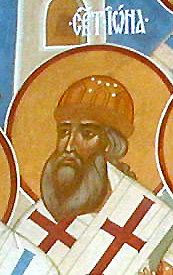
Saint Jonah, Metropolitan of Moscow and Wonderworker of All Russia, was born in the city of Galich into a pious Christian family. The father of the future saint was named Theodore. The youth received monastic tonsure in one of the Galich monasteries when he was only twelve years old. From there, he transferred to the Moscow Simonov monastery, where he fulfilled various obediences for many years.

Once, Saint Photius, Metropolitan of Moscow (May 27 and July 2), visited the Simonov monastery. After the Molieben, he blessed the archimandrite and brethren, and also wished to bless those monks who were fulfilling their obediences in the monastery.

When he came to the bakery, he saw Saint Jonah sleeping, exhausted from his work. The fingers of the saint’s right hand were positioned in a gesture of blessing. Saint Photius said not to wake him. He blessed the sleeping monk and predicted to those present that this monk would be a great hierarch of the Russian Church, and would guide many on the way to salvation.

The prediction of Saint Photius was fulfilled. Several years later, Saint Jonah was made Bishop of Ryazan and Murom.

Saint Photius died in 1431. Five years after his death, Saint Jonah was chosen Metropolitan of All Russia for his virtuous and holy life. The newly-elected Metropolitan journeyed to Constantinople in order to be confirmed as Metropolitan by Patriarch Joseph II (1416-1439). Shortly before this the nefarious Isidore, a Bulgarian, had already been established as Metropolitan. Spending a short time at Kiev and Moscow, Isidore journeyed to the Council of Florence (1438), where he embraced Catholicism.

A Council of Russian hierarchs and clergy deposed Metropolitan Isidore, and he was compelled to flee secretly to Rome (where he died in 1462). Saint Jonah was unanimously chosen Metropolitan of All Russia. He was consecrated by Russian hierarchs in Moscow, with the blessing of Patriarch Gregory III (1445-1450) of Constantinople. This was the first time that Russian bishops consecrated their own Metropolitan. Saint Jonah became Metropolitan on December 15, 1448. With archpastoral zeal he led his flock to virtue and piety, spreading the Orthodox Faith by word and by deed. Despite his lofty position, he continued with his monastic struggles as before.

In 1451 the Tatars unexpectedly advanced on Moscow; they burned the surrounding area and prepared for an assault on the city. Metropolitan Jonah led a procession along the walls of the city, tearfully entreating God to save the city and the people. Seeing the dying monk Anthony of the Chudov monastery, who was noted for his virtuous life, Saint Jonah said, “My son and brother Anthony! Pray to the Merciful God and the All-Pure Mother of God for the deliverance of the city and for all Orthodox Christians.”

The humble Anthony replied, “Great hierarch! We give thanks to God and to His All-Pure Mother. She has heard your prayer and has prayed to Her Son. The city and all Orthodox Christians will be saved through your prayers. The enemy will soon take flight. The Lord has ordained that I alone am to be killed by the enemy.” Just as the Elder said this, an enemy arrow struck him.

The prediction of Elder Anthony was made on July 2, on the Feast of the Placing of the Robe of the Most Holy Theotokos. Confusion broke out among the Tatars, and they fled in fear and terror. In his courtyard, Saint Jonah built a church in honor of the Placing of the Robe of the Most Holy Theotokos, to commemorate the deliverance of Moscow from the enemy.

Saint Jonah reposed in the year 1461, and miraculous healings began to take place at his grave.

In 1472 the incorrupt relics of Metropolitan Jonah were uncovered and placed in the Dormition Cathedral of the Kremlin (the Transfer of the holy Relics is celebrated May 27). A Council of the Russian Church in 1547 established the commemoration of Saint Jonah, Metropolitan of Moscow. In 1596, Patriarch Job added Saint Jonah to the Synaxis of the Moscow Hierarchs (October 5).

Venerable Hypatius the Healer of the Kiev Caves

Saint Hypatius the Healer of the Caves, attained glory through his severe fasting and prayerful vigilance. By night he stood at prayer, slept very little, and ate only bread and water.

Saint Hypatius devoted himself entirely to the service of the sick, and received from God the gift of healing. Those sick with various illnesses often hastened to his prayerful intercession.

The memory of Saint Hypatius is celebrated also on August 28, on the Synaxis of the Saints of the Far Caves.

Venerable Apollonius, Ascetic, of Egypt
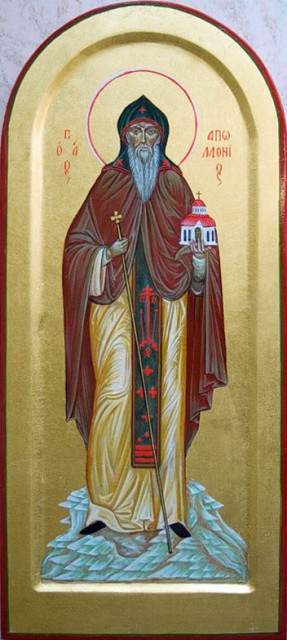
Saint Apollonius, when he was a fifteen-year-old youth, withdrew into the inner Thebaid desert (Lower Egypt), where he spent forty years in monastic struggles. Directed by God, he founded a monastery near Hermopolis, where eventually about five hundred monks gathered. Saint Apollonius was strict in fasting, only on Sundays did he eat cooked food, and on other days he ate wild plants.

All the monks followed the example of Saint Apollonius, engaging in spiritual struggles at the monastery. The holy ascetic died in the fourth century.

Hieromartyr Avdas, Bishop of Persia, and Martyr Benjamin the Deacon

Saint Avdas was Bishop of Bethchasar in Persia. He destroyed a temple of the fire-worshippers, and was brought to trial before the Persian emperor Izdegerd I (401-402), who ordered the saint to rebuild the temple. When Bishop Avdas refused, the emperor ordered soldiers to destroy all the Christian churches, persecute the Christians, and to torture them.

In 418, Saint Avdas was the first to be martyred. He was beheaded after lengthy tortures. After some time, the other martyrs were also executed. Among them was the deacon Benjamin, who suffered particularly cruel torments. They stuck sharp needles under his nails and impaled him on a spear.

The hieromartyrs died in the old Persian city of Suza.

Venerable Hypatius, Abbot of Rufinus in Chalcedon

Saint Hypatius, Igumen of Rufinus in Chalcedon was born in Phrygia (Asia Minor) into the family of a lawyer and he received a fine education. Once, when he was eighteen years old, his father punished him, after which the youth left home and went to Thrace (Balkans).

There he herded cattle for a time, and then he lived with a priest who taught him how to chant the Psalms. Soon the chosen one of God was tonsured in one of the monasteries. Struggling against the temptations of the flesh, the holy ascetic spent fifty days in a strict fast. One night, with the blessing of the igumen, he drank some wine and ate some bread in the presence of the brethren, and was healed of his passions.

In search of a new place for ascetic struggles, Saint Hypatius settled with two other monks in the neglected Rufinus monastery near Chalcedon (Asia Minor). The monastery was rebuilt and soon many monks gathered about the holy ascetic, and the monastery began to flourish spiritually once more.

At the age of forty, Saint Hypatius was chosen igumen and he guided the monastery for forty years. Many monks, imitating their guide, attained spiritual perfection. For his strict ascetic life and love for others, Saint Hypatius was granted the gifts of wonderworking and healing by the Lord. Through his holy prayers bread was multiplied at the monastery. Those afflicted with demons, and the blind, the withered and the hemorrhaging, came to the monastery and were healed.

Saint Hypatius reposed in 446, at eighty years of age. On the eve of his death, he predicted misfortunes to come: a devastating hailstorm, an earthquake, and Attila the Hun’s invasion of Thrace.

Appearance of the Ivḗron Icon of the Mother of God
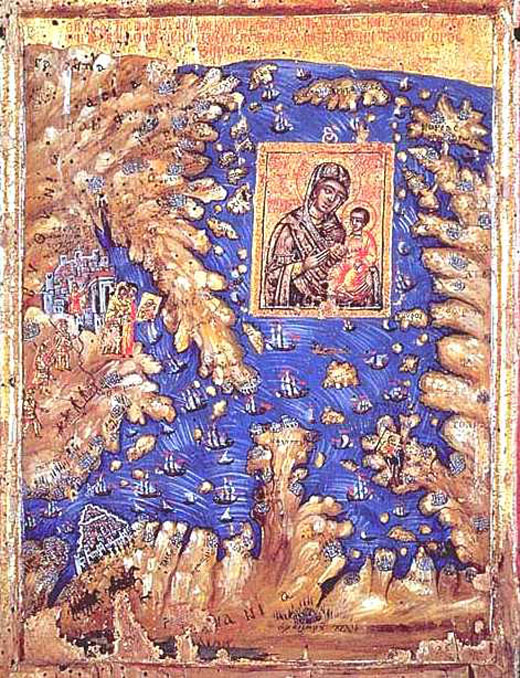
The Ivḗron Icon of the Mother of God (which is preserved on Mt. Athos) was kept in the home of a certain pious widow, who lived near Nicea. During the time of the emperor Theophilus, the Iconoclasts came to the house of this Christian, and one of the soldiers struck the image of the Mother of God with a spear. Blood flowed from the place where it was struck.

The widow, fearing its destruction, promised the imperial soldiers money and implored them not to touch the icon until morning. When the soldiers departed, the woman and her son (later an Athonite monk), sent the holy icon away upon the sea to preserve it. The icon, standing upright upon the water, floated to Athos.

For several days, the Athonite monks had seen a fiery pillar on the sea rising up to the heavens. They came down to the shore and found the holy image, standing upon the waters. After a Molieben of thanksgiving, a pious monk of the Ivḗron monastery, Saint Gabriel (July 12), had a dream in which the Mother of God appeared to him and gave him instructions. So he walked across the water, and taking up the holy icon, he placed it in the church.

On the following day, however, the icon was found not within the church, but on the gates of the monastery. This was repeated several times, until the Most Holy Theotokos revealed to Saint Gabriel Her will, saying that She did not want the icon to be guarded by the monks, but rather She intended to be their Protectress. After this, the icon was installed on the monastery gates. Therefore this icon came to be called “Portaitissa” or “Gate-Keeper” (October 13). This comes from the Akathist “Rejoice, O Blessed Gate-Keeper who opens the gates of Paradise to the righteous.”

There is a tradition that the Mother of God promised Saint Gabriel that the grace and mercy of Her Son toward the monks would continue as long as the Icon remained at the monastery. It is also believed that the disappearance of the Ivḗron Icon from Mt. Athos would be a sign of the end of the world.

The Ivḗron Icon is also commemorated on February 12, October 13 (its arrival in Moscow in 1648), and Bright Tuesday (commemorating the appearance of the Icon in a pillar of fire at Mt. Athos and its recovery by Saint Gabriel).

Saint Acacius the Confessor

Saint Acacius the Confessor lived during the Decian persecution, and was Bishop of Melitene, Armenia.

Arrested as a Christian, Saint Acacius was brought before the governor Marcianus, who ordered that he be tortured. He was not put to death, but was set free after a while, bearing the wounds of Christ on his body. He died in peace.

Saint Acacius the Confessor is also commemorated on September 15. He should not be confused with another Saint Acacius of Melitene (April 17) who lived in the fifth century.

Righteous Joseph the Patriarch

The Righteous Joseph the Fair was the son of the Old Testament Patriarch Jacob and his wife Rachel (Genesis 37:3). He had eleven brothers: Jacob's first wife Leah (the daughter of Laban) gave birth to six sons: 1) Reuben, 2) Simeon, 3) Levi, 4) Judah. Then Leah thought she could not have any more children. His second wife, Leah's sister Rachel, also seemed to be infertile, was jealous of Leah, so she gave her servant girl Bilhah to Jacob “so that she may give birth on my behalf” (Genesis 30:3). The concubine Bilhah bore two sons to Jacob: 5) Dan and 6) Naphtali.

In those days, when a wife could not bear children, it was not uncommon for a female servant to have the husband's child on behalf of the wife. The expression "she shall bear upon my knees and I shall have children by her" (Genesis 30:3) refers to the rite of adoption whereby the new-born child was placed on the lap of the adopting woman to indicate that she had legally borne the child. The fact that Rachel gives the name, rather than Bilhah, demonstrates that she is recognized as the child's mother. When Leah thought she could no longer give Jacob sons, she gave her servant, Zilpah to Jacob, who bore him 7) Gad and 8) Asher. These two, however, were legally Leah's sons when she adopted them, in the manner previously described.

After some time, Leah did conceive two more sons: 9) Issachar and 10) Zebulun, and a daughter: Dinah, who is first mentioned in Genesis 30:21 as the daughter of Leah and Jacob, born to Leah after she had borne six sons to Jacob. Finally, Rachel gave birth to 11) Joseph, and 12) Benjamin.

Joseph's brothers became jealous of him because their father loved him more than his other sons, since he was the son of his old age. They feared him because he revealed his dreams, which foretold his future greatness. One dream was that he and his brothers were binding sheaves in the field. Joseph's sheaf rose up, and the sheaves of his brothers arose and bowed down to it. In another dream the sun, the moon, and eleven stars bowed down to him. Jacob rebuked him for implying that his father, mother, and eleven brothers would also bow before him one day.

The brothers decided to kill Joseph, but the eldest son Reuben persuaded them not to do so. "Do not shed any blood. Cast him into this pit … but do not lay hands upon him" (Genesis 37:32). Reuben intended to come back later and rescue Joseph, but his plans were thwarted. They stripped Joseph of his coat and threw him into the pit, and then sold him for twenty gold coins to merchants who were traveling to Egypt in a caravan. After killing a goat, they smeared its blood on the coat and brought it to Jacob saying that they had found it on the ground. Jacob recognized the coat and concluded that a wild animal must have killed Joseph.

In Egypt Joseph was sold to Potiphar, a captain of the guards. Because his master saw that the Lord was with Joseph, and that he was a successful man, he made him the overseer of his house, placing him in charge of all his possessions. The Righteous Joseph was fair of countenance, and Potiphar's wife wanted him to lie with her. He would not consent to this, but the shameless woman continued pestering him. One day she repeated her request, and he fled from her. She seized his garment as he ran away, and showed it to her husband when he returned home. Out of malice and spite, Potiphar's wife slandered the Righteous Joseph before her husband, saying that he had attempted to rape her. Believing the lie, Potiphar confined the innocent young man in a prison. There, Saint Joseph the Fair gained fame when he interpreted the dreams of two men in the prison (Genesis chapter 40).

After Joseph interpreted Pharaoh's two dreams (Genesis chapter 41), predicting seven years of plenty, and seven years of famine and misfortune for Egypt, he advised Pharaoh to appoint overseers to store one fifth of the grain harvest each year, and to reserve it for the time of famine. The Righteous Joseph was set free and was given charge of Pharaoh's household, and became the Lord of Egypt. Pharaoh was still the ruler, but Joseph answered only to him.

When famine also struck his home in the land of Canaan, ten of Joseph's brothers were sent to Egypt by Jacob in order to buy some grain. Only Benjamin stayed at home with his father. Joseph recognized them, but they did not know him. He threw them into prison for three days, then released them. He gave them provisions and sent them on their way, ordering them to send him their youngest brother.

Later, Joseph revealed himself to them, and he wept. He told them to bring his father and his entire family to Egypt. After Jacob's death, Joseph's brothers feared that he would repay them for all the evil they had done to him, so they asked for forgiveness. He replied, "You meant evil against me, but God meant it for good" (Genesis 50:20).

Before his death around 1700 B. C., the Righteous Joseph ordered that his bones be taken from Egypt to the Promised Land, which was done in the time of the holy Prophet Moses (September 4), 1496 B.C. As the father of Manassah and Ephraim, Saint Joseph is placed at the head of two of the tribes of Israel.

Saint Joseph is also commemorated on the Sunday of the Holy Fathers, and on Great and Holy Monday.

4/2 announcements

April 2, 2023

Fifth Sunday of Great Lent

Commemoration of St. Mary of Egypt

The facts of the life of St. Mary of Egypt are vague and clouded by time and separation, but the spirit of her story is a clear call to repentance and devotion. According to tradition, Mary was from Alexandria, where she was an actress and courtesan, living a life of sin and infamy. When spiritual intervention forbade her entry to Holy Sepulchre in Jerusalem, she spent the night in penitent prayer. The following morning she was able to enter, whereupon she venerated the cross and immediately removed herself to the life of a penitent and solitary in the Palestinian desert. She remained in isolation for forty-seven years, aided only by monks of the region and God’s grace. Only at her death was she found and given communion by the priest Zosimus. On this last Sunday of Lent, as we prepare for Palm Sunday, Holy Week, and the Great Feast of the eighth and eternal day, we call to mind this holy woman, her fear of the all-powerful God, her recognition of her sin, her repentance, her humility, her faith, and her unwavering intent to seek righteousness and the courts of her King.

Hebrews 9:11-14: Brethren, Christ having appeared a High Priest of the good things to come, through the greater and more perfect tabernacle, not made with hands, that is to say, not of this creation; neither through the blood of goats and calves, but through His own blood, entered in once for all into the holy place, having found eternal redemption. For if the sprinkling of defiled persons with the blood of bulls and goats and with the ashes of a heifer sanctifies for the purification of the flesh, how much more shall the blood of Christ, who through the eternal Spirit offered Himself without blemish to God, purify your conscience from dead works to serve the living God?

Mark 10:32-45: At that time, Jesus took His twelve Disciples, and began to tell them what was to happen to Him, saying, “Behold, we are going up to Jerusalem. And the Son of man will be delivered to the chief priests and the scribes, and they will condemn Him to death, and deliver Him to the Gentiles. And they will mock Him, and scourge Him, and spit upon Him, and kill Him; and after three days He will rise.” And James and John, the sons of Zebedee, came forward to Him, and said to Him, “Teacher, we would that thou shouldest do for us whatsoever we shall desire” And Jesus said to them, “What do you want Me to do for you?” And they said to Him, “Grant us to sit, one at Thy right hand and one at Thy left, in Thy glory.” But Jesus said to them, “You do not know what you are asking. Are you able to drink the cup that I drink, or to be baptized with the baptism with which I am baptized?” And they said to Him, “We are able.” And Jesus said to them, “The cup that I drink you will drink; and with the baptism with which I am baptized, you will be baptized. But to sit at My right hand or at My left is not Mine to grant, but it is for those for whom it has been prepared.” And when the ten heard it, they began to be indignant at James and John. And Jesus called them to Him and said to them, “You know that those who are supposed to rule over the Gentiles lord it over them, and their great men exercise authority over them. But it shall not be so among you; but whoever would be great among you must be your servant, and whoever would be first among you must be servant of all. For the Son of man also came not to be served but to serve, and to give His life as a ransom for many.”

Troparion of the Resurrection: The stone being sealed by the Jews, and thy pure body being guarded by the soldiers, thou didst arise on the third day, O Saviour, granting life to the world. Wherefore, the heavenly powers acclaimed thee, O Giver of life, crying, Glory to thy Resurrection, O Christ! Glory to thy kingdom! Glory to thy gracious providence, O only Lover of mankind.

Troparion of St. Mary of Egypt: Through thee the divine likeness was securely preserved, O Mother Mary; for thou didst carry the cross and followed Christ. By example and precept thou didst teach us to ignore the body because it is perishable, and to attend to the concerns of the undying soul. Therefore, doth thy soul rejoice with the angels.

Troparion of the Chains of St. Peter: O Holy Apostle, Peter, thou dost preside over the Apostles by the precious chains which thou didst bear. We venerate them with faith and beseech thee that by thine intercessions we be granted the great mercy.

Kontakion of the Theotokos: O undisputed intercessor of Christians, O mediatrix, who is unrejected by the Creator, turn not away from the voice of our petitions though we be sinners; come to us in time, who cry to thee in faith, for thou art good. Hasten to us with intercessions, O Theotokos, who didst ever intercede for those who honor thee.

CALENDAR

UNTIL FURTHER NOTICE: All services listed on the calendar will be available through streaming and webcast. (Instructions can be found on the parish website.)

Sunday, April 2 (Commemoration of the St. Mary of Egypt)

8:50 a.m. — Orthros (webcast)

9:00 a.m. — Christian Education
10:00 a.m.

Daily Readings for Thursday, March 30, 2023

5TH THURSDAY OF LENT: THE GREAT CANON OF SAINT ANDREW OF CRETE

ABSTAIN FROM MEAT, FISH, DAIRY, EGGS

5th Thursday of Lent: The Great Canon of Saint Andrew of Crete, John Climacus the Righteous, author of The Divine Ladder of Ascent, Sosthenes, Apollos, Cephas, Caesar, & Epaphroditos, the Apostles of the 70, Zacharias the New Martyr

ISAIAH 42:5-16

Thus says God, the LORD, who created the heavens and stretched them out, who spread forth the earth and what comes from it, who gives breath to the people upon it and spirit to those who walk in it: "I am the LORD, I have called you in righteousness, I have taken you by the hand and kept you; I have given you as a covenant to the people, a light to the nations, to open the eyes that are blind, to bring out the prisoners from the dungeon, from the prison those who sit in darkness. I am the LORD, that is my name; my glory I give to no other, nor my praise to graven images. Behold, the former things have come to pass, and new things I now declare; before they spring forth I tell you of them." Sing to the LORD a new song, his praise from the end of the earth! Let the sea roar and all that fills it, the coastlands and their inhabitants. Let the desert and its cities lift up their voice, the villages that Kedar inhabits; let the inhabitants of Sela sing for joy, let them shout from the top of the mountains. Let them give glory to the LORD, and declare his praise in the coastlands. The LORD goes forth like a mighty man, like a man of war he stirs up his fury; he cries out, he shouts aloud, he shows himself mighty against his foes. For a long time I have held my peace, I have kept still and restrained myself; now I will cry out like a woman in travail, I will gasp and pant. I will lay waste mountains and hills, and dry up all their herbage; I will turn the rivers into islands, and dry up the pools. And I will lead the blind in a way that they know not, in paths that they have not known I will guide them. I will turn the darkness before them into light, the rough places into level ground. These are the things I will do, and I will not forsake them.

GENESIS 18:20-33

Then the LORD said, “Because the outcry against Sodom and Gomorrah is great and their sin is very grave, I will go down to see whether they have done altogether according to the outcry which has come to me; and if not, I will know.” So the men turned from there, and went toward Sodom; but Abraham still stood before the LORD. Then Abraham drew near, and said, “Wilt thou indeed destroy the righteous with the wicked? Suppose there are fifty righteous within the city; wilt thou then destroy the place and not spare it for the fifty righteous who are in it? Far be it from thee to do such a thing, to slay the righteous with the wicked, so that the righteous fare as the wicked! Far be that from thee! Shall not the Judge of all the earth do right?” And the LORD said, “If I find at Sodom fifty righteous in the city, I will spare the whole place for their sake.” Abraham answered, “Behold, I have taken upon myself to speak to the Lord, I who am but dust and ashes. Suppose five of the fifty righteous are lacking? Wilt thou destroy the whole city for lack of five?” And he said, “I will not destroy it if I find forty-five there.” Again he spoke to him, and said, “Suppose forty are found there.” He answered, “For the sake of forty I will not do it.” Then he said, “Oh let not the Lord be angry, and I will speak. Suppose thirty are found there.” He answered, “I will not do it, if I find thirty there.” He said, “Behold, I have taken upon myself to speak to the Lord. Suppose twenty are found there.” He answered, “For the sake of twenty I will not destroy it.” Then he said, “Oh let not the Lord be angry, and I will speak again but this once. Suppose ten are found there.” He answered, “For the sake of ten I will not destroy it.” And the LORD went his way, when he had finished speaking to Abraham; and Abraham returned to his place.

PROVERBS 16:17-17:17

The highway of the upright turns aside from evil; he who guards his way preserves his life. Pride goes before destruction, and a haughty spirit before a fall. It is better to be of a lowly spirit with the poor than to divide the spoil with the proud. He who gives heed to the word will prosper, and happy is he who trusts in the LORD. The wise of heart is called a man of discernment, and pleasant speech increases persuasiveness. Wisdom is a fountain of life to him who has it, but folly is the chastisement of fools. The mind of the wise makes his speech judicious, and adds persuasiveness to his lips. Pleasant words are like a honeycomb, sweetness to the soul and health to the body. There is a way which seems right to a man, but its end is the way to death. A worker's appetite works for him; his mouth urges him on. A worthless man plots evil, and his speech is like a scorching fire. A perverse man spreads strife, and a whisperer separates close friends. A man of violence entices his neighbor and leads him in a way that is not good. He who winks his eyes plans perverse things, he who compresses his lips brings evil to pass. A hoary head is a crown of glory; it is gained in a righteous life. He who is slow to anger is better than the mighty, and he who rules his spirit than he who takes a city. The lot is cast into the lap, but the decision is wholly from the LORD.
Better is a dry morsel with quiet than a house full of feasting with strife. A slave who deals wisely will rule over a son who acts shamefully, and will share the inheritance as one of the brothers. The crucible is for silver, and the furnace is for gold, and the LORD tries hearts. An evildoer listens to wicked lips; and a liar gives heed to a mischievous tongue. He who mocks the poor insults his Maker; he who is glad at calamity will not go unpunished. Grandchildren are the crown of the aged, and the glory of sons is their fathers. Fine speech is not becoming to a fool; still less is false speech to a prince. A bribe is like a magic stone in the eyes of him who gives it; wherever he turns he prospers. He who forgives an offense seeks love, but he who repeats a matter alienates a friend. A rebuke goes deeper into a man of understanding than a hundred blows into a fool. An evil man seeks only rebellion, and a cruel messenger will be sent against him. Let a man meet a she-bear robbed of her cubs, rather than a fool in his folly. If a man returns evil for good, evil will not depart from his house. The beginning of strife is like letting out water; so quit before the quarrel breaks out. He who justifies the wicked and he who condemns the righteous are both alike an abomination to the LORD. Why should a fool have a price in his hand to buy wisdom, when he has no mind? A friend loves at all times, and a brother is born for adversity.

Venerable John Climacus of Sinai, Author of “the Ladder”

Saint John of the Ladder is honored by Holy Church as a great ascetic and author of the renowned spiritual book called THE LADDER, from which he is also called “of the Ladder” (Climacus).

There is almost no information about Saint John’s origins. One tradition suggests that he was born in Constantinople around the year 570, and was the son of Saints Xenophon and Maria (January 26).

John went to Sinai when he was sixteen, submitting to Abba Martyrius as his instructor and guide. After four years, Saint John was tonsured as a monk. Abba Strategios, who was present at Saint John’s tonsure, predicted that he would become a great luminary in the Church of Christ.

For nineteen years Saint John progressed in monasticism in obedience to his spiritual Father. After the death of Abba Martyrius, Saint John embarked on a solitary life, settling in a wild place called Thola, where he spent forty years laboring in silence, fasting, prayer, and tears of penitence.

It is not by chance that in THE LADDER Saint John speaks about tears of repentance: “Just as fire burns and destroys the wood, so pure tears wash away every impurity, both external and internal.” His holy prayer was strong and efficacious, as may be seen from an example from the life of the God-pleasing saint.

Saint John had a disciple named Moses. Once, the saint ordered his disciple to bring dung to fertilize the vegetable garden. When he had fulfilled the obedience, Moses lay down to rest under the shade of a large rock, because of the scorching heat of summer. Saint John was in his cell in a light sleep. Suddenly, a man of remarkable appearance appeared to him and awakened the holy ascetic, reproaching him, “John, why do you sleep so heedlessly, when Moses is in danger?”

Saint John immediately woke up and began to pray for his disciple. When Moses returned in the evening, Saint John asked whether any sort of misfortune had befallen him.

The monk replied, “A large rock would have fallen on me as I slept beneath it at noon, but I left that place because I thought I heard you calling me.” Saint John did not tell his disciple of his vision, but gave thanks to God.

Saint John ate the food which is permitted by the monastic rule, but only in moderation. He did not sleep very much, only enough to keep up his strength, so that he would not ruin his mind by unceasing vigil. “I do not fast excessively,” he said of himself, “nor do I give myself over to intense all-night vigil, nor lay upon the ground, but I restrain myself…, and the Lord soon saved me.”

The following example of Saint John’s humility is noteworthy. Gifted with discernment, and attaining wisdom through spiritual experience, he lovingly received all who came to him and guided them to salvation. One day some envious monks reproached him for being too talkative, and so Saint John kept silence for a whole year. The monks realized their error, and they went to the ascetic and begged him not to deprive them of the spiritual profit of his conversation.

Concealing his ascetic deeds from others, Saint John sometimes withdrew into a cave, but reports of his holiness spread far beyond the vicinity. Visitors from all walks of life came to him, desiring to hear his words of edification and salvation. After forty years of solitary asceticism, he was chosen as igumen of Sinai when he was seventy-five. Saint John governed the holy monastery for four years. Toward the end of his life, the Lord granted him the gifts of clairvoyance and wonderworking.

At the request of Saint John, igumen of the Raithu monastery (Commemorated on Cheesefare Saturday), he wrote the incomparable LADDER, a book of instruction for monks who wished to attain spiritual perfection.

Knowing of the wisdom and spiritual gifts of Saint John of Sinai, the igumen of Raithu requested him to write down whatever was necessary for the salvation of those in the monastic life. Such a book would be “a ladder fixed on the earth” (Gen. 28:12), leading people to the gates of Heaven.

Saint John felt that such a task was beyond his ability, yet out of obedience he fulfilled the request. The saint called his work THE LADDER, for the book is “a fixed ladder leading from earthly things to the Holy of Holies….” The thirty steps of spiritual perfection correspond to the thirty years of the Lord’s age. When we have completed these thirty steps, we will find ourselves with the righteous and will not stumble. THE LADDER begins with renunciation of the world, and ends with God, Who is love (1 John 4:8).

Although the book was written for monks, any Christian living in the world will find it an unerring guide for ascending to God, and a support in the spiritual life. Saints Theodore the Studite (November 11 and January 26), Sergius of Radonezh (September 25 and July 5), Joseph of Volokolamsk (September 9 and October 18), and others relied on THE LADDER as an important guide to salvation.

The twenty-second step of THE LADDER deals with various forms of vainglory. Saint John writes: “When I fast, I am vainglorious; and when I permit myself food in order to conceal my fasting from others I am again vainglorious about my prudence. When I dress in fine clothing, I am vanquished by vanity, and if I put on drab clothing, again I am overcome by vanity. If I speak, vainglory defeats me. If I wish to keep silence, I am again given over to it. Wherever this thorn comes up, it stands with its points upright.

A vain person seems to honor God, but strives to please men rather than God.

People of lofty spirit bear insult placidly and willingly, but only the holy and righteous may hear praise without harm.

When you hear that your neighbor or friend has slandered you behind your back, or even to your face, praise and love him.

It is not the one who reproaches himself who shows humility, for who will not put up with himself? It is the one who is slandered by another, yet continues to show love for him.

Whoever is proud of his natural gifts, intelligence, learning, skill in reading, clear enunciation, and other similar qualities, which are acquired without much labor, will never obtain supernatural gifts. Whoever is not faithful in small things (Luke 16:10), is also unfaithful in large things, and is vainglorous.

It often happens that God humbles the vainglorious, sending a sudden misfortune. If prayer does not destroy a proud thought, we bring to mind the departure of the soul from this life. And if this does not help, let us fear the shame which follows dishonor. “For whoever humbles himself shall be exalted, and whoever exalts himself shall be humbled” (Luke 14:11). When those who praise us, or rather seduce us, start to praise us, let us recall our many sins, then we shall find that we are not worthy of what they say or do to honor us.”

In THE LADDER Saint John describes the ascent toward spiritual perfection, which is essential for anyone who wishes to save his soul. It is a written account of his thoughts, based on the collected wisdom of many wise ascetics, and on his own spiritual experience. The book is a great help on the path to truth and virtue.

The steps of THE LADDER proceed gradually from strength to strength on the path of perfection. The summit is not reached suddenly, but gradually, as the Savior says: “The Kingdom of Heaven suffers violence, and the violent take it by force” (Mt.11:12).

Saint John is also commemorated on the fourth Sunday of Great Lent.

Saint Sophronius, Bishop of Irkutsk

Saint Sophronius, Bishop of Irkutsk and Wonderworker of all Siberia, whose family name was Kristalevsky, was born in Malorussia in the Chernigov region in 1704. His father, Nazarius, was “a common man in his affairs,” and the saint was named Stephen, in honor of the protomartyr Saint Stephen. He had two brothers and a sister, Pelagia. The name of one brother was Paul. The name of the other older brother is unknown, but it is said that he was head of the Krasnogorsk Zolotonosh monastery.

Stephen’s childhood years were spent in the settlement of Berezan in the Pereyaslavl district of the Poltava governance, where the family settled after the father was discharged from service. When he came of age, Stephen entered the Kiev Theological Academy, where two other future hierarchs were studying: Joasaph, future Bishop of Belgorod (September 4 and December 10), and Paul, future Metropolitan of Tobolsk (June 10 and November 4).

After completing his religious education, Stephen entered the Krasnogorsk Transfiguration monastery [later renamed the Protection monastery. In 1789, it was transformed into a women’s monastery], where his elder brother already labored in asceticism. On April 23, 1730 he received monastic tonsure with the name of Sophronius, in honor of Saint Sophronius of Jerusalem (March 11).

On the night after his monastic tonsure, Saint Sophronius heard a Voice in the Protection church predicting his future service: “When you become bishop, build a church dedicated to All Saints.”

In 1732, he was summoned to Kiev. There he was ordained hierodeacon, and then hieromonk in the cathedral of Holy Wisdom. After Saint Sophronius had been a monk for two years, he became treasurer of the Zolotonosh monastery for two years, and then His Grace Bishop Arsenius (Berlov) of the Pereyaslavl diocese sent him into the house of his archbishop, where he was steward for eight years.

These facts testify to the connections of the saint with his original Protection monastery. During his obedience under the presiding hierarch at Pereyaslavl, he often visited his monastery, spending the day in quiet contemplation and work, serving as an example to the brethren.

When Hieromonk Sophronius traveled to the Holy Synod on behalf of his bishop, they paid close attention to him. In January 1742, the future saint was transferred to the Saint Alexander Nevsky Lavra in Saint Peterburg, the foremost monastery of the capital. A year later he was appointed treasurer of the monastery, and in 1746 he was appointed as Superior of the monastery.

He summoned his fellow countryman, the hieromonk Sinesios (Ivanoff), a native of the city of Priluki, and made him igumen of the Saint Sergius Hermitage, a dependancy of Saint Alexander Nevsky Lavra. From this time the friendship of the two ascetics, hieromonk Sophronius and hieromonk Sinesios, was strengthened by their joint pastoral effort, and they were inseparable until they died in Siberia.

During these years Saint Sophronius worked hard at managing the monastery and improvement of teaching at the seminary located nearby. He and Archbishop Theodosius made it their task to acquire more books for the monastic library.

Saint Sophronius built a two storey church: the upper church was dedicated to Saint Theodore, the older brother of Saint Alexander Nevsky; and the lower to Saint John Chrysostom.

Bishop Innocent II (Nerunovich) of Irkutsk died in 1747. For six years afterwards, the Irkutsk diocese remained without a spiritual head.

Finally, on February 23, 1753, the empress Elizabeth (1741-1761) recommended the pious Igumen Sophronius of the Alexander Nevsky monastery to the Holy Synod as “a person, not only worthy of episcopal rank, but also someone completely able to fulfill the wishes and the hopes of the state and the Synod, and take up the burden of episcopal service on the far frontier and satisfy the needs of his flock in that harsh land, among wild primitives and lawless people.”

On April 18, 1753, Thomas Sunday, Hieromonk Sophronius was consecrated Bishop of Irkutsk and Nerchinsk in the Dormition cathedral.

Foreseeing difficult service on the distant Siberian frontier, the new bishop did not immediately travel to the Irkutsk eparchy, but rather began to gather educated and spiritually experienced co-workers. During this period Saint Sophronius visited at his original Krasnogorsk monastery. At the holy places of Kiev, he also sought the blessings of the Kiev Caves Saints for his service. The constant companion of the saint, as had been before, was the hieromonk Sinesios, sharing in his friend’s work.

At Moscow, Archbishop Platon of Moscow and Sevsk provided him with further assistance. He gave him fatherly advice for his task, since he was quite familiar with the peculiarities of the Siberian religious life. He forewarned him about the self-willed local authorities, and advised him to surround himself with trustworthy helpers.

On March 20, 1754 the saint arrived at Irkutsk. He went first to the Ascension monastery, his predecessor’s residence, and prayed at the grave of Bishop Innocent (Kulchitz), asking his blessing as he took up his assignment.

Familiarizing himself with the state of affairs in the diocese, the saint began the reorganization of the Spiritual consistory, monasteries and parishes, and appealed to the Holy Synod to send worthy men to the Irkutsk eparchy for priestly service.

Before the arrival of Saint Sophronius, the Irkutsk monasteries had already a century-old history. The founders of these monasteries were motivated by a fervent desire for monastic life. The wise hierarch appointed people of piety, wisdom, virtue, and with great experience both of life and spiritual matters as heads of the monastic communities. In 1754, Bishop Sophronius elevated his friend and companion Hieromonk Sinesios to be Archimandrite of Ascension monastery. He served the monastery for thirty-three years until his blessed repose.

In September 1754, the bishop issued a decree in which he expressed concern for the education and upbringing of the children of the clergy. He wanted them to learn the HOROLOGION, the PSALTER, singing and letters, and this instruction “ought to be conducted with all industriousness and the utmost diligence, so that the children might be able to fulfill the responsibilities of sacristan and deacon.”

Studying both people and circumstances, the bishop in his sermons and conversations exhorted all to a higher moral ideal. He devoted particular attention to the reverent and correct performance of the divine services and the Holy Mysteries, and he also looked after the moral purity of laymen. He was concerned about the position of women in the family, and defended them against their unjust inequality. The bishop attempted to set straight the Rule of divine services, and so he summoned priests, deacons, subdeacons and sacristans, and those who sang in the choir during services.

Traveling about the diocese, the saint noticed that censing and the ringing of bells were not being done properly in all places, and therefore he issued a decree restoring the proper way of censing and bell-ringing.

Called to apostolic service in this frontier region, Saint Sophronius realized that his duty was to enlighten the Christians of the area, and also to convert the idol-worshippers, who were very numerous in Siberia.

It was difficult to bring pagans to the Church of Christ, especially because sometimes there was no one to serve in the churches, and to borrow priests for missionary activity only made matters worse. Knowing that the Church services would have a salutary effect on non-Russians, the saint not only served with reverence himself, but also required it of all his clergy.

Saint Sophronius also contributed to the development of a stable culture among the local people. He offered them monastic lands for settlements and in every way he endeavored to isolate them from the influence of paganism. A constant throng of visitors came from faraway places for his blessing.

Even with his many cares, he did not forget his own spiritual life and eternity. He also led an ascetical life. His cell-attendant said that the saint “used simple food in small quantities. He served often, spent the greater part of the night at prayer, sleeping on the floor under a sheepskin or a fur, a deerskin or bear hide, and a small simple pillow.”

The spirit of his ascetic life fit in with the general uplifting of the Christian spirit in Russia after the glorification of Saint Demetrius of Rostov (September 21), Theodosius of Chernigov (September 9), and the uncovering of the incorrupt relics of his predecessor, Saint Innocent of Irkutsk (February 9). This event inspired Saint Sophronius to greater efforts and encouraged him to ask for the help of Saint Innocent in his task of building up the diocese.

Until the end of his days Saint Sophronius kept his love for the Krasnogor Zolotonosh monastery, which had nurtured him in the days of his youth. He constantly contributed support for its upkeep, sending the necessary means for this.

Noticing a deterioration in his health, Saint Sophronius petitioned the Holy Synod to let him retire. The answer from Peterburg did not come right away, since it was difficult to choose a worthy successor.

The final days of Saint Sophronius’s life were spent in asceticism and prayer.

The light, which shone on the good deeds of Saint Sophronius, continues to the present time to testify to the glory of the Heavenly Father, “Who mercifully strengthens His saints.” Now the holy memory of Saint Sophronius is reverently preserved not only in Siberia at the place of his final deeds, but also at the place of his first deeds.

Saint Sophronius is also commemorated on June 30 (his glorification in 1918).

Prophet Joad

Holy Prophet Joad came from Samaria and prophesied during the tenth century before Christ (See 1/3 Kings 13). The prophet was sent by the Lord from Judea to Bethel to denounce the Israelite king Jereboam for polluting his nation with idol worship.

The Lord commanded the prophet, “Eat no bread, and drink no water, and do not return by the way you came” (1/3 Kings 13:9). The prophet Joad appeared to King Jereboam and prophesied to him concerning the wrath of the Lord. When the king tried to gesture with his hand to seize the prophet, his hand suddenly withered. The king entreated the prophet to pray to the Lord that his hand would be healed. By Joad’s prayer he received healing.

Deceived by the false prophet Emba of Bethel, Joad disobeyed the command given him by the Lord. The older man lied and told Joad that an angel had commanded him to bring him to his home and feed him. Because of his disobedience, the prophet Joad was killed by a lion. His body did not rest with his fathers, but was buried near the abode of the false prophet who led him astray.

Apostle Sosthenes of the Seventy

The Holy Apostles Sosthenes was head of the Corinthian synagogue before his conversion. The Apostle Paul converted him to Christianity and made him his helper in his work. In addressing the Corinthian church, Saint Paul sent greetings from both of them: “Paul, by the will of God called to be an apostle of Jesus Christ, and brother Sosthenes…” (1 Cor.1:1). Afterwards, Saint Sosthenes was made bishop at Colophon (Asia Minor).

Saint Sosthenes is also commemorated on December 8 and the Synaxis of the Seventy Apostles on January 4.

Apostle Apollos of the Seventy

In the Acts of the Holy Apostles we read the following: “A certain Jew named Apollos, born in Alexandria, eloquent and well-versed in the Scriptures, came to Ephesus. He was instructed in the way of the Lord; and being fervent in the spirit, he spoke and taught diligently the things of the Lord, knowing only the baptism of John. He began to speak boldly in the synagogue. Hearing him, Aquila and Priscilla took him and more precisely explained to him the way of the Lord. And when he resolved to go to Achaia, the brethren wrote and asked the disciples to receive him. When he got there, he greatly helped those who believed by grace, for he powerfully confounded the Jews in public, showing by the Scriptures that Jesus is the Christ” (Acts 18:24-28).

The Holy Apostle Apollos assisted the Apostle Paul. Saint Paul speaks about the spread of Christianity among the Corinthians, “I have planted, Apollos watered, but God gave the growth” (1 Cor.3:6). Saint Apollos was later bishop at Smyrna (Asia Minor).

Saint Apollos is also commemorated on December 8 and the Synaxis of the Seventy Apostles on January 4.

Apostle Cephas of the Seventy

According to Tradition, the Holy Apostle Cephas was Bishop of Iconium. No accounts of him have been preserved. It is assumed that he is the one who is mentioned by the Apostle Paul (1 Cor.15:5).

Saint Cephas is also commemorated on December 8 and the Synaxis of the Seventy Apostles on January 4.

Apostle Caesar of the Seventy

The Holy Apostle Caesar is also commemorated on December 8 and the Synaxis of the Seventy Apostles on January 4.

Apostle Epaphroditus of the Seventy

The Holy Apostle Epaphroditus was Bishop of Adrianium (Italy). He was also a companion of Saint Paul who sent him to the Christians of Philippi. Saint Paul speaks about his hard work in the vineyard of Christ: “I thought it necesary to send you Epaphroditus, my brother and coworker and fellow soldier, your messenger and minister to my needs… he was sick and near to death; but God had mercy on him, and not only him but also on me, lest I should have sorrow upon sorrow… Receive him in the Lord with all joy; and honor such men, for he almost died for the work of Christ, risking his life to complete your lack of service to me” (Phil 2: 25-30).

Saint Epaphroditus is also commemorated on December 8 and the Synaxis of the Seventy Apostles on January 4.

Saint Euboula, mother of Saint Panteleimon

Saint Euboula, Mother of the Great Martyr Panteleimon (July 27), died peacefully around 303, before the martyrdom of her son.

Venerable John the Silent of Saint Savva Monastery

Saint John the Silent Bishop of the city of Colonia, was a model of a good Christian life for his flock. Persecuted by the governor, he was deprived of the archbishop’s cathedra and went to the monastery of Saint Savva the Sanctified, where he was glorified in ascetic deeds of silence, prayer, and desert-dwelling. The monk died at age 104 (+ 558). See also December 3.

Saint Zosimus, Bishop of Syracuse

Saint Zosimus, Bishop of Syracuse, was born in answer to the fervent prayers of his parents, who were childless for a long time. When their son reached the age of seven, his parents sent him to a monastery to be educated. When the holy ascetic became an adult, he received monastic tonsure, and governed the monastery for forty years. Pope Theodore (641-649) consecrated him Bishop of Syracuse.

Saint Zosimus was distinguished by his charity and lack of avarice, and led his flock by word and by example. Toward the end of his life Saint Zosimus fell grievously ill, but endured his suffering with magnanimity and humility. He died in the year 662, after he had led his flock for thirteen years. Later, many of the sick received healing by merely touching his tomb.

The Meeting of the Mother of God and Saint Elizabeth

The Meeting of the Most Holy Theotokos and Saint Elizabeth. The establishment of this Feast and the composition of the Service are the work of Archimandrite Antonin Kapustin (+ 1894), head of the Russian Orthodox Mission in Jerusalem.

The Gorneye Convent in Jerusalem, built on the site of the Meeting of the Theotokos and Saint Elizabeth, celebrates this Feast on March 30. If March 30 should fall between Lazarus Saturday and Pascha, however, the Feast is transferred to Bright Friday.

Daily Readings for Wednesday, March 29, 2023

5TH WEDNESDAY OF LENT

ABSTAIN FROM MEAT, FISH, DAIRY, EGGS, WINE, OLIVE OIL

Mark, Bishop of Arethusa, Martyr Cyril the Deacon and Those with him, The Holy Martyrs Jonas and Barachesius, Eustathios the Confessor, Bishop of Bithynia

ISAIAH 41:4-14

Who has performed and done this, calling the generations from the beginning? I, the LORD, the first, and with the last; I am He. The coastlands have seen and are afraid, the ends of the earth tremble; they have drawn near and come. Every one helps his neighbor, and says to his brother, “Take courage!” The craftsman encourages the goldsmith, and he who smoothes with the hammer him who strikes the anvil, saying of the soldering, “It is good”; and they fasten it with nails so that it cannot be moved. But you, Israel, my servant, Jacob, whom I have chosen, the offspring of Abraham, my friend; you whom I took from the ends of the earth, and called from its farthest corners, saying to you, “You are my servant, I have chosen you and not cast you off”; fear not, for I am with you, be not dismayed, for I am your God; I will strengthen you, I will help you, I will uphold you with my victorious right hand. Behold, all who are incensed against you shall be put to shame and confounded; those who strive against you shall be as nothing and shall perish. You shall seek those who contend with you, but you shall not find them; those who war against you shall be as nothing at all. For I, the LORD your God, hold your right hand; it is I who say to you, “Fear not, I will help you.” Fear not, you worm Jacob, you men of Israel! I will help you, says the LORD; your Redeemer is the Holy One of Israel.

GENESIS 17:1-9

When Abram was ninety-nine years old the LORD appeared to Abram, and said to him, “I am God Almighty; walk before me, and be blameless. And I will make my covenant between me and you, and will multiply you exceedingly.” Then Abram fell on his face; and God said to him, “Behold, my covenant is with you, and you shall be the father of a multitude of nations. No longer shall your name be Abram, but your name shall be Abraham; for I have made you the father of a multitude of nations. I will make you exceedingly fruitful; and I will make nations of you, and kings shall come forth from you. And I will establish my covenant between me and you and your descendants after you throughout their generations for an everlasting covenant, to be God to you and to your descendants after you. And I will give to you, and to your descendants after you, the land of your sojournings, all the land of Canaan, for an everlasting possession; and I will be their God.”

PROVERBS 15:20-16:9

A wise son makes a glad father, but a foolish man despises his mother. Folly is a joy to him who has no sense, but a man of understanding walks aright. Without counsel plans go wrong, but with many advisers they succeed. To make an apt answer is a joy to a man, and a word in season, how good it is! The wise man’s path leads upward to life, that he may avoid Sheol beneath. The LORD tears down the house of the proud, but maintains the widow’s boundaries. The thoughts of the wicked are an abomination to the LORD, the words of the pure are pleasing to him. He who is greedy for unjust gain makes trouble for his household, but he who hates bribes will live. The mind of the righteous ponders how to answer, but the mouth of the wicked pours out evil things. The LORD is far from the wicked, but he hears the prayer of the righteous. The light of the eyes rejoices the heart, and good news refreshes the bones. He whose ear heeds wholesome admonition will abide among the wise. He who ignores instruction despises himself, but he who heeds admonition gains understanding. The fear of the LORD is instruction in wisdom, and humility goes before honor. The plans of the mind belong to man, but the answer of the tongue is from the LORD. All the ways of a man are pure in his own eyes, but the LORD weighs the spirit. Commit your work to the LORD, and your plans will be established. The LORD has made everything for its purpose, even the wicked for the day of trouble. Every one who is arrogant is an abomination to the LORD; be assured, he will not go unpunished. By loyalty and faithfulness iniquity is atoned for, and by the fear of the LORD a man avoids evil. When a man’s ways please the LORD, he makes even his enemies to be at peace with him. Better is a little with righteousness than great revenues with injustice. A man’s mind plans his way, but the LORD directs his steps.

Hieromartyr Mark, Bishop of Arethusa, who suffered under Julian the Apostate

Hieromartyr Mark, Bishop of Arethusa, suffered for his faith in Christ under the emperor Julian the Apostate (361-363). By order of the emperor Constantine (May 21), Saint Mark had once destroyed a pagan temple and built a Christian church.

When Julian came to the throne, he persecuted Christians and tried to restore paganism. Some citizens of Arethusa renounced Christianity and became pagans. Then Saint Mark’s enemies decided to take revenge on him. The old bishop hid himself from the persecutors at first, but then gave himself up when he learned that the pagans had tortured many people in their search for him.

The holy Elder was led through the city and given over to torture. They tore out his hair, slashed his body, dragged him along the street, dumped him in a swamp, tied him up, and cut him with knives.

The pagans demanded that the holy bishop pay them a large sum of money to rebuild the pagan temple, and he refused to do so. The persecutors invented several new torments: they squeezed the Elder in a foot-press, and they cut off his ears with linen cords. Finally, they smeared the holy martyr’s body with honey and grease, then hung him up in a basket in the hot mid-day sun to be eaten by bees, wasps, and hornets. Saint Mark did not seem to notice the pain, and this irritated the tormentor all the more.

The pagans kept lowering the price he had to pay for their temple, but Saint Mark refused to give them a single coin. Admiring him for his courage and endurance, the pagans stopped asking him for money and set him free. Many of them returned to Christ after hearing his talks.

Saint Gregory the Theologian (January 25) describes the sufferings of Saint Mark in his First Oration against Julian. Theodoritus of Cyrrhus also mentions him in his Church History (Book 3, Ch. 6)

Martyr Cyril the Deacon of Heliopolis, and those with him, who suffered under Julian the Apostate

The historian Theodoritus relates that during the reign of Saint Constantine the Great, Saint Cyril destroyed many idols and pagan temples in Heliopolis, Phoenicia. He was put to death for this during the reign of Julian the Apostate. Pagans cut open his stomach and, like wild beasts, they ate his liver and intestines, for which the Lord punished them with blindness, boils and other terrible afflictions.

During this time the pagans killed many Christians in the Palestinian cities of Ascalon and Gaza: priests, women and children who had dedicated themselves to God. The torturers cut up their bodies, covered them with barley and fed them to pigs.

The holy martyrs received crowns of victory in the Kingdom of Heaven, and the torturers also received their just recompense: eternal torment in Hell.

Venerable John the Anchorite of Egypt

Saint John the Anchorite: During a persecution against Christians, the devout widow Juliania of Armenia hid from pursuers together with her two young children John and Themistea. She taught her children to pray and to read the Holy Scriptures.

From time to time John secretly visited a nearby monastery, thereby placing himself in danger. Once, a pious old man advised him to find a more secluded place for prayer. Returning home, the saint told his mother that he was going to visit the Elder. Thinking that her son would soon return, she let him go.

John went to the desert-dweller Pharmutios and received his blessing to live alone in the wilderness. The young ascetic found an abandoned well, which was filled with snakes, scorpions and other vile creatures. He lowered himself into the well and lived there for ten years in fasting, vigil, and prayer.

The angel who brought food to the hermit Pharmutios also brought bread for Saint John. The angel did not bring the bread directly to John, however, lest the young ascetic become filled with pride. Food was sent to him through his spiritual Father, Pharmutios.

Saint John had many temptations from the devil to test him. Demons assumed the appearance of his mother, his sister, his relatives and acquaintances in order to sadden the ascetic and compel him to give up his ascetic struggles. With tears they approached the well one after the other, begging Saint John to leave with them. All this time the saint did not cease to pray. Finally he said, “Be gone from me,” and the demons vanished.

Saint John lived in the well until the time of his blessed repose. Through God’s providence Saint Chrysikhios, who had struggled in the desert for thirty years, came to bury him. On the eve of his repose, Saint John told Chrysikhios of his life and struggles for salvation. After his death, numerous miracles occurred at the place of his ascetic deeds.

Saint Eustathius (Eustace) the Confessor, Bishop of Bithynia

Saint Eustathius the Confessor, Bishop of Bithynia, was already at the beginning of his spiritual struggle a pious monk, meek and wise, filled with great faith and love for his neighbor. For his virtuous life he was made bishop of the city of Bithynia (a Roman province in northwest Asia Minor) and for many years he guided his flock, giving them an example of virtuous life and perfection.

During the Iconoclast heresy, Saint Eustathius boldly came out against the heretics and defended the veneration of holy icons. Iconoclasts denounced him to the emperor, and the saint suffered imprisonment and fierce beatings. Finally, they deprived Saint Eustathius of his See and sent him to prison.

The holy confessor died in exile during the ninth century, after suffering insults, deprivation, hunger, and want for three years.

Venerable Mark, Jonah, and Bassa of the Pskov Caves

Saints Mark, Jonah and Bassa are venerated as the founders of the Pskov Caves monastery.

It is not known exactly when the first hermit monks settled by the Kamenets stream in the natural caves of the hill, which the local inhabitants called “the holy hill.” The monastery Chronicle presents an account of eyewitnesses, hunter-trappers from Izborsk nicknamed Selishi: “We came with our father to the outlying hill where the church of the Mother of God is now, and heard what seemed to be church singing. They sang harmoniously and reverently, but the singers could not be seen, and the air was filled with the fragrance of incense.”

Of the first Elders of the Pskov Caves monastery only Mark is known by name. The Chronicle says of him: “In the beginning, a certain Elder was living at the Kamenets near the cave. Some fishermen saw him by the three rocks above the cave of the Most Holy Theotokos church, but they were unable to discover who he was, his lineage, how and from whence he came to this place, how long he dwelt there, or how he died.”

The second igumen of the Caves monastery is identified as Elder Mark in the monastery Synodikon. Saint Cornelius (February 20) doubted the veracity of this inscription and ordered that the name be removed from the Synodikon. Suddenly he became grievously ill and it was revealed to him that this was his punishment for ordering the name of Saint Mark to be stricken from the monastery diptychs.

After begging forgiveness at the grave of the Elder Mark, Igumen Cornelius restored his name. When the cave church of the Dormition of the Most Holy Theotokos was dug out and the burial caves expanded, the igumen Dorotheus found the grave of Saint Mark in a state of neglect, but his relics and clothing were preserved.

In the year 1472, the peasant Ivan Dementiev cut down the forest on the hill. One of the felled trees rolled down the hill, uprooting another tree from the ground. The slide opened up the entrance to a cave, over which was the inscription: “The cave built by God.” There is a tradition that Saint Barlaam, a fool-for-Christ, frequently came to the cave and wiped out this inscription, but it miraculously reappeared every time.

The priest John (nicknamed “Shestnik”) came to this holy spot, where the first ascetics prayed. He was a native of “the Moscow lands” and served as priest at Iuriev (now Tartu) in “a right-believing church, established by people from Pskov” and dedicated to Saint Nicholas and the Great Martyr George. He and the priest Isidore spiritually nourished the Russians living there.

In 1470, Father John was compelled to flee to Pskov with his family because of persecution by the German Catholics. When he learned of the martyric death of Saint Isidore (January 8), Father John decided to settle in the newly-appeared “cave built by God,” so that there, on the very boundary with the Livonians, he might found a monastery as an outpost of Orthodoxy.

Soon his wife fell ill and died after receiving monastic tonsure with the name Bassa. Her righteousness was evidenced immediately after her death. Her husband and her spiritual Father buried Saint Bassa (March 19) in the wall of “the cave built by God,” but at night her coffin was “taken from the ground by an invisible power of God.”

Father John and Saint Bassa’s Father Confessor were upset, thinking that this had occurred because they had not done the complete Service for the Departed. So they sang the funeral service a second time, and they buried the body again. In the morning, however, it was found above ground. Then it was clear that this was a sign from God, so they dug Saint Bassa’s grave on the left side of the cave. Shaken by the miracle, John became a monk with the name Jonah and devoted himself even more fervently to spiritual struggles.

He dug out the cave church and built two cells on pillars, then petitioned the clergy of the Pskov Trinity cathedral to consecrate it, but they decided not to do so at the time “because of its unusual location.” Then Saint Jonah sought the blessing of Archbishop Theophilus of Novgorod.

On August 15, 1473 the cave church was consecrated in honor of the Dormition of the Most Holy Theotokos. During the consecration there was a miracle from an icon of the Dormition of the Most Holy Theotokos:1 a blind woman “sent by the merciful God, beginning His great gifts to His All-Pure Mother” received her sight.

The date of the consecration of the cave church is regarded as the official date of the founding of the Pskov Caves monastery. Saint Jonah labored at the Cave monastery until 1480, then peacefully fell asleep in the Lord. Upon his death they discovered a chain mail coat on his body. This was hung over his grave as a sign of his secret asceticism, but it was stolen during a German invasion.

The relics of Saint Jonah rest in the Caves beside the relics of the Elder Mark and Saint Bassa. Once, when the monastery was besieged, the Livonian knights wanted to open the lid of Saint Bassa’s coffin with a sword, but fire spurted forth from the coffin. Traces of this punishing fire may still be seen on the coffin of Saint Bassa.


1 This icon, which they call the “old” to distinguish it from another wonderworking icon of the Dormition of the Most Holy Theotokos with scenes of Her life around the borders, was painted around 1421 by the Pskov iconographer Alexis Maly, and is now kept in the altar of the Dormition church. The icon with scenes around the border is the Cave church’s patronal icon.

Saint Nikḗtas of the Roslavl Forests

The holy Schema-monk Nikḗtas was born in the city of Orel in 1695. From childhood, he loved to go on pilgrimages to the holy places. As a youth, he left his parents and lived about a mile or so from the White Bluff (Beloberezhsk) Hermitage. It is not known when he received the monastic tonsure, or from whom. In 1780 he built a cell on a hillock, and he dug a well by the hill. He ate bread that passersby would leave in his basket, which hung by the roadside on a tree. This was in a dense part of the forest, and animals were often seen by the hermit’s cell. Mosquitoes bit him mercilessly, until he was covered in blood. They tormented him terribly, but Saint Nikḗtas bore everything with patience. He received the gift of tears from God, and he always shed tears for his own sins and for the sins of others.

Once, in March, he became ill, and lay down without moving. The day before the Feast of the Annunciation arrived. Father Nikḗtas lay there and heard the bells ringing in the Hermitage for the all-night service. He tried to sing the Troparion of the Feast, but being so weak, and because he had lost his voice, he was unable to do so. The Elder wept bitterly, heartbroken because he could not meet the Feast Day in an appropriate way. Suddenly, his cell became awash with light, and Nikḗtas saw the Most Holy Theotokos surrounded by angels. The Mother of God blessed him, and he began to sing the Troparion of the Feast feebly, but with an unearthly ecstasy. The angels joined him in the singing, and his cell was filled with the praises of the inhabitants of heaven. The vision ended, but Saint Nikḗtas remained under its impression for a long time.

As soon as he regained his health, he went to the White Bluff Hermitage for a time. When he got there, he found only ashes where his cell had once stood. Some evil person had burnt it down while the Elder was away. Father Nikḗtas sat down on the hillock weeping bitter tears. Later, he moved to the monastery, where he humbly fulfilled all the obediences that were laid upon him, serving the monks without sparing himself. Once, during a Church service, he fell on the floor from exhaustion. Hearing about the Roslavl solitaries, he moved in with them and lived there on the southern edge of Monks’ Gorge, near the village of Yakimovskoe (Akimovka) on the property of Alexandra Bronevskaya, a zealous protector of the hermits who lived on her lands in great numbers. She reposed in 1853, and was more than eighty years of age. Saint Nikḗtas lived there for over ten years, and again he moved to White Bluff Hermitage. In 1792, however, he wanted to return to his Hermitage before his death. At his request, the Roslavl hermit Father Dositheos rented a horse from a peasant, and in late 1792 he came over to the Hermitage for Father Nikḗtas, and found him very ill. Dositheos asked him to wait until summer, but the Elder was in a hurry to see his Hermitage.

Receiving the Superior’s blessing, Dositheos took Nikḗtas and laid him on the wagon, and covered him with a tarp and some straw. He took the ailing Elder some 90 miles to the Roslavl Forest. Here Nikḗtas lived for another six months, departing to the Lord on March 29, 1793. After preparing his body for burial, Father Dositheos put it into a beehive, called in the nearby priest and neighboring hermits, and they buried him near his cell. Since Monks’ Gorge always had water in it, Father Dositheos, after a certain revelation, dug up the grave of Elder Nikḗtas after seven years, in order to move it to higher ground. The beehive was whole, and the body and clothing of the Elder were incorrupt. Only a birch (linden?) bark shoe which was made by a disciple and not by the Elder himself was found to have rotted. The other shoe was whole.

When the beehive was opened, Father John from the village of Luga was there with other hermits. One of these, Father Arsenios, wanted to exchange his prayer ropes for those of the Elder. But no matter how hard he tried, he could not take them from Saint Nikḗtas’s hand. The body of Father Nikḗtas was taken out of the beehive and placed in a coffin. After a Memorial Service, he was buried on the hillock. At the burial there was a sick monk who suffered from a stomachache. He drank water from the grave site and was healed. About fifteen years after Elder Nikḗtas’s death, the coffin was opened again, and his body was found incorrupt just as before. On his grave were two memorial stones, and one was very large. Hermits came here on Pascha to sing the Paschal Canon. Elder Dositheos honored the memory of Schema-monk Nikḗtas until the time of his own death, and he always remembered him every year at Pascha.

Saint Nikḗtas was approved for local veneration in the Smolensk Diocese on August 31, 2017.

Daily Readings for Tuesday, March 28, 2023

5TH TUESDAY OF LENT

ABSTAIN FROM MEAT, FISH, DAIRY, EGGS, WINE, OLIVE OIL

Hilarion the New, Herodion the Apostle of the 70, Stephen the Wonderworker

ISAIAH 40:18-31

Thus says the LORD: To whom then will you liken God, or what likeness compare with him? The idol! a workman casts it, and a goldsmith overlays it with gold, and casts for it silver chains. He who is impoverished chooses for an offering wood that will not rot; he seeks out a skilful craftsman to set up an image that will not move. Have you not known? Have you not heard? Has it not been told you from the beginning? Have you not understood from the foundations of the earth? It is he who sits above the circle of the earth, and its inhabitants are like grasshoppers; who stretches out the heavens like a curtain, and spreads them like a tent to dwell in; who brings princes to nought, and makes the rulers of the earth as nothing. Scarcely are they planted, scarcely sown, scarcely has their stem taken root in the earth, when he blows upon them, and they wither, and the tempest carries them off like stubble. To whom then will you compare me, that I should be like him? Says the Holy One. Lift up your eyes on high and see: who created these? He who brings out their host by number, calling them all by name; by the greatness of his might, and because he is strong in power not one is missing. Why do you say, O Jacob, and speak, O Israel, “My way is hid from the LORD, and my right is disregarded by my God”? Have you not known? Have you not heard? The LORD is the everlasting God, the Creator of the ends of the earth. He does not faint or grow weary, his understanding is unsearchable. He gives power to the faint, and to him who has no might he increases strength. Even youths shall faint and be weary, and young men shall fall exhausted; but they who wait for the LORD shall renew their strength, they shall mount up with wings like eagles, they shall run and not be weary, they shall walk and not faint.

GENESIS 15:1-15

After these things the word of the LORD came to Abram in a vision, “Fear not, Abram, I am your shield; your reward shall be very great.” But Abram said, “O Lord GOD, what wilt thou give me, for I continue childless, and the heir of my house is Eliezer of Damascus?” And Abram said, “Behold, thou hast given me no offspring; and a slave born in my house will be my heir.” And behold, the word of the LORD came to him, “This man shall not be your heir; your own son shall be your heir.” And he brought him outside and said, “Look toward heaven, and number the stars, if you are able to number them.” Then he said to him, “So shall your descendants be.” And he believed the LORD; and he reckoned it to him as righteousness. And he said to him, “I am the LORD who brought you from Ur of the Chaldeans, to give you this land to possess.” But he said, “O Lord GOD, how am I to know that I shall possess it?” He said to him, “Bring me a heifer three years old, a she-goat three years old, a ram three years old, a turtledove, and a young pigeon.” And he brought him all these, cut them in two, and laid each half over against the other; but he did not cut the birds in two. And when birds of prey came down upon the carcasses, Abram drove them away. As the sun was going down, a deep sleep fell on Abram; and lo, a dread and great darkness fell upon him. Then the LORD said to Abram, “Know of a surety that your descendants will be sojourners in a land that is not theirs, and will be slaves there, and they will be oppressed for four hundred years; but I will bring judgment on the nation which they serve, and afterward they shall come out with great possessions. As for yourself, you shall go to your fathers in peace; you shall be buried in a good old age.

PROVERBS 15:7-19

The lips of the wise spread knowledge; not so the minds of fools. The sacrifice of the wicked is an abomination to the LORD, but the prayer of the upright is his delight. The way of the wicked is an abomination to the LORD, but he loves him who pursues righteousness. There is severe discipline for him who forsakes the way; he who hates reproof will die. Sheol and Abaddon lie open before the LORD, how much more the hearts of men! A scoffer does not like to be reproved; he will not go to the wise. A glad heart makes a cheerful countenance, but by sorrow of heart the spirit is broken. The mind of him who has understanding seeks knowledge, but the mouths of fools feed on folly. All the days of the afflicted are evil, but a cheerful heart has a continual feast. Better is a little with the fear of the LORD than great treasure and trouble with it. Better is a dinner of herbs where love is than a fatted ox and hatred with it. A hot-tempered man stirs up strife, but he who is slow to anger quiets contention. The way of a sluggard is overgrown with thorns, but the path of the upright is a level highway.

Venerable Hilarion the New, Abbot of Pelekete

Saint Hilarion the New, Igumen of Pelekete Monastery, from his youth devoted himself to the service of God and spent many years as a hermit. Because of his holy and blameless life he was ordained to the holy priesthood, and later he was made igumen of the Pelekete monastery (near the Dardanelles). Saint Hilarion was granted gifts of clairvoyance and wonderworking by the Lord.

Through prayer he brought down rain during a drought, and like the Prophet Elisha he separated the waters of a river, he drove harmful beasts from the fields, he filled the nets of fishermen when they had no success in fishing, and he did many other miracles. In addition to these things, he was able to heal the sick and cast out demons.

Saint Hilarion suffered on Great and Holy Thursday in the year 754, when the military commander Lakhanodrakon suddenly descended upon the Pelekete monastery in pursuit of icon-venerators, boldly forcing his way into the church, disrupting the service and throwing the Holy Gifts upon the ground. Forty-two monks were arrested, slapped into chains, sent to the Edessa district and murdered. The remaining monks were horribly mutilated: they beat them, they burned their beards with fire, they smeared their faces with tar and cut off the noses of some of the confessors. Saint Hilarion died for the veneration of icons during this persecution.

Saint Hilarion left behind spiritual works containing moral directives for spiritual effort. Saint Joseph of Volokolamsk (September 9 and October 18) was well acquainted with the work of Saint Hilarion, and he also wrote about the significance of monastic struggles in his own theological works.

Venerable Stephen, Wonderworker, Abbot of Triglia

Saint Stephen the Confessor, Igumen of Triglia Monastery, suffered under the iconoclast emperor Leo the Armenian (813-820). From a young age, the holy ascetic dedicated his life to God and received monastic tonsure. He later became head of the Triglia monastery near Constantinople.

When persecution again began against holy icons, the saintly igumen was summoned for questioning, and they tried to force him to sign a document rejecting the veneration of icons. Saint Stephen steadfastly refused to betray Orthodoxy and he boldly denounced the emperor for his impiety. They subjected the saint to cruel torments, after which they sent him to prison in the year 815. Weakened and sick, the holy Confessor Stephen soon died in prison from his sufferings.

Monastic Martyr Eustratius of the Kiev Near Caves

Martyr Eustratius of the Caves was born in the eleventh century at Kiev into a wealthy family. As an adult, he received monastic tonsure at the Kiev Caves monastery, after giving away all his possesions to the poor. Saint Eustratius humbly underwent obediences at the monastery, strictly fulfilling the rule of prayer and passing his days in fasting and vigilance.

In 1096 the Polovetsians captured Kiev and ravaged the monastery of the Caves, doing away with many of the monks. Saint Eustratius was taken into captivity, and was sold into slavery with thirty monastic laborers and twenty inhabitants of Kiev to a certain Jew living in Korsun.

The impious Jew tried to make the captives deny Christ, threatening to kill those who refused by starving them. Saint Eustratius encouraged and exhorted his brother Christians, “Brothers! Let none of us who are baptized and believe in Christ betray the vows made at Baptism. Christ has regenerated us through water and the Spirit. He has freed us from the curse of the Law by His Blood, and He has made us heirs of His Kingdom. If we live, we shall live for the Lord. If we die, we shall die in the Lord and inherit eternal life.”

Inspired by the saint’s words, the captives resolved to die of starvation, rather than renounce Christ, Who is the food and drink of Eternal Life. Exhausted by hunger and thirst, some captives perished after three days, some after four days, and some after seven days. Saint Eustratius remained alive for fourteen days, since he was accustomed to fasting from his youth. Suffering from hunger, he still did not touch food nor water. The impious Jew, seeing that he had lost the money he had paid for the captives, decided to take revenge on the holy monk.

The radiant Feast of the Resurrection of Christ drew near, and the Jewish slave owner was celebrating the Jewish Passover with his companions. He decided to crucify Saint Eustratius. The cruel tormentors mocked the saint, offering to let him share their Passover meal. The Martyr replied, “The Lord has now bestown a great grace upon me. He has permitted me to suffer on a cross for His Name just as He suffered.” The saint also predicted a horrible death for the Jew.

Hearing this, the enraged Jew grabbed a spear and stabbed Saint Eustratius on the cross. The martyr’s body was taken down from the cross and thrown into the sea. Christian believers long searched for the holy relics of the martyr, but were not able to find them. But through the Providence of God the incorrupt relics were found in a cave and worked many miracles. Later, they were transferred to the Near Caves of the Kiev Caves monastery.

The prediction of the holy Martyr Eustratius that his blood would be avenged was fulfilled soon after his death. The Byzantine Emperor issued a decree expelling all Jews from Korsun, depriving them of their property, and putting their elders to death for torturing Christians. The Jew who crucified Saint Eustratius was hanged on a tree, receiving just punishment for his wickedness.

Venerable Hilarion of Pskov, Lake Gdov

Saint Hilarion of Gdov and Pskov Lake, was a disciple of Saint Euphrosynus of Pskov (May 15). In 1460 on the banks of the River Zhelcha, not far from Gdov, he founded the Ozersk [Lake] Monastery of the Protection of the Mother of God. The monastery bordered the territory of the Livonian Knights, and the monks constantly suffered the incursions of that military order. Despite harsh conditions and insufficient means, Saint Hilarion maintained a high level of pious and ascetic life at the monastery, and made great efforts to adorn and build up the monastery.

Saint Hilarion reposed on March 28, 1476 and was buried in the church of the Protection of the Most Holy Theotokos in the monastery he founded. Afterwards, a church was built at the monastery in honor of the Nativity of Christ. The left chapel was dedicated to the founder of the Gdov monastery. Saint Hilarion of Gdov is also commemorated on October 21, on the Feast of his heavenly patron and namesake.

Martyred brothers Barachisius and Jonah, and those with them, in Persia

Saint Barachisius was the brother of Saint Jonah. They were Christians who lived in the village of Yasa in Persia during the time of the emperor Sapor (310-331), a fierce persecutor of Christians.

Learning that Christians were being tortured in the city of Baravokh, they went there to the prison where Saints Zanithas, Lazarus, Maruthas, Narses, Elias, Marinus, Habib, Sembeeth (Sivsithina), and Savva were being held.

They encouraged them to adhere to the Christian Faith until the very end. The holy brothers were arrested and brought to trial before the Persian princes Masdrath, Siroth and Marmis, who urged them to worship the sun, fire, and water. The holy martyrs firmly confessed their faith in Christ and would not agree to the demands of the pagans. Therefore, they were subjected to fierce torments and death.

Saint Jonah suffered first. They tied the holy martyr to a tree and beat him for a long time, then they dragged him across the ice of a frozen lake. They also cut off his fingers and toes, and cut out his tongue. Then they peeled the skin from his head, and finally sawed his body in half and threw it in a ditch.

They placed red-hot shackles on the wrists of Saint Barachisius, poured molten tin in his nose, ears and mouth, and they raked him with sharp instruments, after they tied him to a turning wheel. The holy martyr surrendered his soul to God after they poured boiling tar in his mouth.

The bodies of the holy martyrs Jonah, Barachisius and the other martyrs were buried by a pious Christian named Habdisotes.

Martyr Boyan, Prince of Bulgaria

The Holy Martyr Boyan, Prince of Bulgaria, suffered for Christ around the year 830. When his pagan brother Malomir [Vladimir] ascended the Bulgarian throne, Prince Boyan asked him to free the learned Christian Kinamon, who had been in prison for a long time for refusing to participate in pagan sacrifices under Prince Obrit (Krutogon), Prince Malomir’s predecessor.

Malomir consented and gave Kinamon to Prince Boyan as a slave. Kinamon spoke to Boyan about Christianity, telling him of the errors of paganism and that belief in Christ is necessary for salvation. At the end of their conversation he told the prince, “Without Jesus Christ there is no light for the mind, no life for the soul. He alone is the Teacher of mankind and our Savior. By His death, He has reconciled fallen mankind with God. If you do not wish to perish, believe in the Lord Jesus.” Prince Boyan recognized the truth of his words, and was inspired to ask for Baptism.

The newly-converted prince was filled with a love of prayer, fasting and contemplation of God. Malomir, learning about the conversion of his brother to Christianity, demanded that he renounce the Christian Faith and return to paganism. Instead, the holy Prince Boyan answered, “I despise the pagan idols and I revere Christ, the true God. No one shall separate me from the love of Christ.” Malomir, hearing his brother’s reply, sentenced him to death.

Before his martyric death, the holy martyr-prince declared: “The faith for which I now die will spread throughout the Bulgarian land. You vainly imagine that you will stop it by killing me. Temples to the true God will be built, and priests will offer Him true worship. The idols and their foul sacrifices, however, will vanish.” Then he said to his brother Malomir, “You will gain nothing from your cruelty, and death will soon overtake you.”

The holy martyr was killed by the sword, and his predictions to his brother were the first to be fulfilled. Malomir soon died, and since he had no heir, his elder brother Presian (836-852) succeeded to the throne. Prince Presian’s son, the holy Prince Boris, in holy Baptism Michael (May 2) later Christianized the Bulgarian nation. Thus the prophecy of the holy Martyr Prince Boyan was fulfilled.

Venerable John, Bishop of Manglisi

Saint John (Saakadze) of Manglisi was born in 1668 and spiritually nurtured in the Davit-Gareji Wilderness. Outstanding in virtue, John was quickly ordained a hieromonk, and soon after consecrated bishop of Manglisi.

In 1724 Saint John left Davit-Gareji for Derbend, Dagestan, where he constructed a wooden church and began to preach Christianity among the local people. He labored there with eleven other pious believers. Saint John’s humble life and the miracles he performed attracted the attention of the Muslim Dagestanis, and even the government took notice of his tireless evangelical activity.

At that time the Georgian King Vakhtang VI (1703-1724) and Tsar Peter the Great of Russia were corresponding regularly about the evangelization of the Caspian seacoast. Both kings recognized the importance of Saint John’s activity in regard to this matter, and they generously contributed to his efforts. With their help, Saint John built one church in honor of the Nativity of the Theotokos and another in honor of Great-martyr Catherine.

In 1737 John left his disciples in Dagestan and journeyed to Astrakhan, near the place where the Volga flows into the Caspian Sea. There he constructed a church in honor of Saint John the Evangelist, which was converted into a monastery in 1746. Archimandrite Herman, one of Saint John’s disciples, was elevated as abbot of this monastery.

While in Astrakhan, Saint John discovered that many ethnic Georgians were passing through the city of Kizliar in Ossetia, but they did not have a church in which to celebrate the divine services. So he traveled to Kizliar and, with help from his kinsmen, built a church and opened a preparatory school for clergy nearby.

On March 28, 1751, Saint John reposed in Kizliar at the age of eighty-three. He was buried in the church that he himself had constructed.

Later, by order of King Teimuraz II (1744-1761), the myrrh-streaming relics of Saint John were translated to Tbilisi and buried in Sioni Cathedral, in front of the Manglisi Icon of the Mother of God.

Daily Readings for Monday, March 27, 2023

5TH MONDAY OF LENT

ABSTAIN FROM MEAT, FISH, DAIRY, EGGS, WINE, OLIVE OIL

Martyr Matrona of Thessalonica, Paul, Bishop of Corinth

ISAIAH 37:33-38:6

Therefore thus says the LORD concerning the king of Assyria: He shall not come into this city, or shoot an arrow there, or come before it with a shield, or cast up a siege mound against it. By the way that he came, by the same he shall return, and he shall not come into this city, says the LORD. For I will defend this city to save it, for my own sake and for the sake of my servant David." And the angel of the LORD went forth, and slew a hundred and eighty-five thousand in the camp of the Assyrians; and when men arose early in the morning, behold, these were all dead bodies. Then Sennacherib king of Assyria departed, and went home and dwelt at Nineveh. And as he was worshiping in the house of Nisroch his god, Adrammelech and Sharezer, his sons, slew him with the sword, and escaped into the land of Ararat. And Esarhaddon his son reigned in his stead. In those days Hezekiah became sick and was at the point of death. And Isaiah the prophet the son of Amoz came to him, and said to him, "Thus says the LORD: Set your house in order; for you shall die, you shall not recover." Then Hezekiah turned his face to the wall, and prayed to the LORD, and said, "Remember now, O LORD, I beseech thee, how I have walked before thee in faithfulness and with a whole heart, and have done what is good in thy sight." And Hezekiah wept bitterly. Then the word of the LORD came to Isaiah: "Go and say to Hezekiah, Thus says the LORD, the God of David your father: I have heard your prayer, I have seen your tears; behold, I will add fifteen years to your life. I will deliver you and this city out of the hand of the king of Assyria, and defend this city.

GENESIS 13:12-18

Abram dwelt in the land of Canaan, while Lot dwelt among the cities of the valley and moved his tent as far as Sodom. Now the men of Sodom were wicked, great sinners against the LORD. The LORD said to Abram, after Lot had separated from him, “Lift up your eyes, and look from the place where you are, northward and southward and eastward and westward; for all the land which you see I will give to you and to your descendants for ever. I will make your descendants as the dust of the earth; so that if one can count the dust of the earth, your descendants also can be counted. Arise, walk through the length and the breadth of the land, for I will give it to you.” So Abram moved his tent, and came and dwelt by the oaks of Mamre, which are at Hebron; and there he built an altar to the LORD.

PROVERBS 14:27-15:4

The fear of the LORD is a fountain of life, that one may avoid the snares of death. In a multitude of people is the glory of a king, but without people a prince is ruined. He who is slow to anger has great understanding, but he who has a hasty temper exalts folly. A tranquil mind gives life to the flesh, but passion makes the bones rot. He who oppresses a poor man insults his Maker, but he who is kind to the needy honors him. The wicked is overthrown through his evil-doing, but the righteous finds refuge through his integrity. Wisdom abides in the mind of a man of understanding, but it is not known in the heart of fools. Righteousness exalts a nation, but sin is a reproach to any people. A servant who deals wisely has the king's favor, but his wrath falls on one who acts shamefully. A soft answer turns away wrath, but a harsh word stirs up anger. The tongue of the wise dispenses knowledge, but the mouths of fools pour out folly. The eyes of the LORD are in every place, keeping watch on the evil and the good. A gentle tongue is a tree of life, but perverseness in it breaks the spirit.

Martyr Matrona of Thessalonica

The Holy Martyr Matrona of Thessalonica suffered in the third or fourth century. She was a slave of the Jewish woman Pautila (or Pantilla), wife of one of the military commanders of Thessalonica. Pautila constantly mocked her slave for her faith in Christ, and tried to convert her to Judaism. Saint Matrona, who believed in Christ from her youth, still prayed to the Savior Christ, and secretly went to church unbeknownst to her vengeful mistress.

Pautila, learning that Saint Matrona had been to church, asked, “Why won’t you come to our synagogue, instead of attending the Christian church?” Saint Matrona boldly answered, “Because God is present in the Christian church, but He has departed from the Jewish synagogue.” Pautila went into a rage and mercilessly beat Saint Matrona, tied her up, and shut her in a dark closet. In the morning, Pautila discovered that Saint Matrona had been freed of her bonds by an unknown Power.

In a rage Pautila beat the martyr almost to death, then bound her even more tightly and locked her in the closet. The door was sealed so that no one could help the sufferer. The holy martyr remained there for four days without food or water, and when Pautila opened the door, she again found Saint Matrona free of her bonds, and standing at prayer.

Pautila flogged the holy martyr and left the skin hanging in strips from her body. The fierce woman locked her in the closet again, where Saint Matrona gave up her spirit to God.

Pautila had the holy martyr’s body thrown from the roof of her house. Christians took up the much-suffered body of the holy martyr and buried it. Later, Bishop Alexander of Thessalonica built a church dedicated to the holy martyr. Her holy relics, glorified by many miracles, were placed in this church.

The judgment of God soon overtook the evil Pautila. Standing on the roof at that very place where the body of Saint Matrona had been thrown, she stumbled and fell to the pavement. Her body was smashed, and so she received her just reward for her sin.

Martyrs Manuel and Theodosius

The Holy Martyrs Manuel and Theodosius suffered for their faith in Christ in 304 in Sirmium. Seeing how the pagans put Christians to death every day, they believed in Christ and resolved to suffer for their faith. They boldly confessed themselves as Christians before the governor. The governor and those around him marvelled at their bravery.

By order of the governor, Saints Manuel and Theodosius were thrown into prison, and a strict watch was set over them. After several days the governor gave orders to bring the saints from prison, and he urged them to renounce Christ and offer sacrifice to the idols. The holy martyrs, however, were steadfast in their confession.

Then the governor ordered Saints Manuel and Theodosius to be suspended from a tree, and scraped with sharp iron hooks. The martyrs were stabbed with a sharp trident, and then beheaded.

Venerable John the Clairvoyant, Anchorite, of Egypt

Saint John the Clairvoyant of Egypt was born at the beginning of the fourth century. He lived in the city of Likopolis (Middle Egypt) and was a carpenter. At the age of twenty-five he went to a monastery, where he received monastic tonsure.

For five years Saint John lived in various monasteries, and then wanting complete solitude, he went to the Thebaid and lived on Mount Bolcha. Saint John then spent many years in solitude, never leaving the spot. He conversed with visitors through a small window, through which he also received food and other necessities.

After thirty years of seclusion, Saint John received the gift of clairvoyance from God. He predicted to the emperor Theodosius the Great (379-395) victory over his adversaries Maximus and Eugenius, and a military victory over the Gauls. He also foretold future events in the lives of his visitors, and gave them guidance. The ascetic gave holy oil to the sick who visited him, and anointed them with it, healing them of various maladies.

Saint John predicted that the historian Palladius, who wrote his Life, would become a bishop. The prediction of the seer was fulfilled, and Palladius was made Bishop of Bithynia (Asia Minor).

Saint John in his instructions commanded first of all to have humility: “Imitate the virtuous life of the holy Fathers according to the measure of your strength and if you fulfill everything, do not become overconfident or praise yourself. For there are many people who reached perfection in virtue and became puffed up with pride, plunging from the heights into the abyss.

“Examine yourselves carefully to see if your conscience is pure, so that purity may not be driven from your mind. Do not allow your thoughts to wander during prayer. Do you, out of vanity, wish to gain a reputation for asceticism? Or do you wish to have only the appearance of asceticism? Take heed lest any passion overcome you. Take heed that thoughts of worldly things do not enter your mind during prayer, since there is nothing more foolish than to pray to God with your lips, while your thoughts are far from Him. This often happens with those who do not absolutely renounce the world, but rather seek approval from men. A man whose mind is given over to worldly and perishable things, cannot behold God with his spiritual eyes. It is fitting that one who seeks after God will remove his mind from every earthly thing, and direct the gaze of his understanding towards God. He who has attained a little knowledge of God (for no one can receive the whole of it), is able to acquire knowledge of many things, and will see the mysteries which the knowledge of God will show him. He sees future events before they happen, and like a saint he will receive glorious revelations. He will work miracles, and will receive everything that he asks from God.”

“Love silence, child, live always in divine contemplation and pray that God will grant you a pure mind, free from sinful thoughts. Worthy of praise is the ascetic who lives in the world, practices the virtues, renders kindness to strangers or distributes alms, or who helps others in their work, or lives without anger. Such a man is praiseworthy, since he dwells in virtue, fulfilling the commands of God, while not neglecting earthly affairs.”

“He who leaves the transitory things of this world to others is better and more worthy of praise, for he denies himself, takes up his cross, and cleaves to Christ. He constantly embraces the things of heaven, and escapes earthly things. He will not allow himself to be turned aside by any other cares. Such a man, through his good deeds and the praises which he offers to God, is free and unfettered by any ties whatsoever. He stands before God in security, and his mind is not distracted by any other cares. He who is in this condition continually converses with God.”

Saint John brought much spiritual benefit to people with these and similar salvific teachings, through his instructive discourses, and by his personal example in the angelic life.

Saint John of Egypt survived into old age and fell asleep in the Lord in 395, at the age of ninety.

Icon of the Mother of God of Mount Athos, “Sweet Kissing”

Like the Panagia Portaitissa, the Glykophilousa Icon is one of those which were saved during the iconoclastic period and brought miraculously to Mount Athos. It originally belonged to Victoria, the devout wife of the senator Symeon. Victoria was one who venerated the holy icons, especially that of the Most Holy Theotokos, before which she prayed each day. Her husband was an iconoclast who found her piety offensive, for he, like Emperor Theophilos (r. 829-842), found the veneration of icons distasteful. Symeon told his wife to give him her icon so that he could burn it. In order to save the icon from being destroyed, she threw it into the sea, and it floated away standing upright on the waves. After a few years, the icon appeared on the shores of Mount Athos near the Monastery of Philotheou, where it was received with great honor and rejoicing by the Abbot and Fathers of the Monastery, who had been informed of its impending arrival through a revelation of the Theotokos.

A spring of holy water sprouted forth on the very spot where they placed the icon on the shore. Every year on Monday of Bright Week there is a procession and blessing of water. Numerous miracles have occurred.

Although there are many miracles of the Glykophilousa Icon, we will mention only a few. In 1713, the Mother of God answered the prayers of the devout Ecclesiarch Ioannikios, who complained about the poverty of the monastery. She assured him that she would provide for the material needs of the monastery.

Another miracle took place in 1801. A pilgrim, after seeing the precious offerings having from the icon, planned to steal them. He stayed in the Temple after the Ecclesiarch closed it. Then he stole the offerings and left for the port of Ivḗron Monastery. There he found a boat that was leaving for Ierissos. After a while the ship sailed, but despite the excellent weather, it remained stationary in the sea. When the Ecclesiarch saw what had happened, the abbot sent monks out in various directions. Two went to the port of Ivḗron and when they saw the immobile ship, they realized what happened. The guilty man who committed this fearful sacrilege asked for forgiveness. The monks were magnanimous and did not want the thief to be punished.

A pilgrim from Adrianopolis visited Philotheou Monastery in 1830. He listened attentively to a monk tell the story of the holy Icon and the miracles associated with it, but he regarded the account as a fictitious tale which only a child might believe. The monk was grieved at the man’s unbelief, and tried to persuade him that everything he had said was absolutely true. The unfortunate pilgrim remained unconvinced.

That very day, as the pilgrim was walking on an upper balcony, he slipped and began to fall. He cried out, “Most Holy Theotokos, help me!” The Mother of God heard him and came to his assistance. The pilgrim landed on the ground completely unharmed.

The Glykophilousa Icon belongs to the Eleousa (the Virgin of Tenderness) category of icons, where the Mother accepts the affection shown by the Child Christ. The icon is commemorated by the Church on March 27 and also on Bright Monday. The icon depicts the Theotokos inclining toward Christ, Who embraces her. She seems to be embracing Him more tightly than in other icons, and her expression is more affectionate.

The Icon is located on a pillar on the left side of the katholikon (main church).

Icon of the Mother of God “of the Akathist”

There are other icons of this name which are commemorated on January 12 (Hilandar Icon “Of the Akathist”), and October 10 (Zographou Icon “Of the Akathist”).

Prophet Hanani

The Prophet Hanani (Ananias) lived during the thirty-sixth year of the Kingdom of Judah, counting from the start of Rehoboam's reign. He is mentioned in 2 Chronicles (Paraleipomenon) 16: 7-10.

There was an ongoing war between King Asa of Judah and King Baasha of Israel (ninth century B.C.). When King Baasha of Israel fortified Ramah, thereby isolating the territory of Judah, Asa made a treaty with the Syrian King Ben-Hadad I (ruled circa 900–860 B.C.). Asa took all the silver and gold from the treasures of the house of the Lord and from the king's house and sent his servants to deliver it to Ben Hadad. This was a bribe to make the Syrian King break his treaty with King Baasha, and ally himself with King Asa (3 Kings 15:16-21). Ben Hadad sent an army against Israel, and the forces of Judah took the supplies from Ramah and built up Geba and Mizpah. This treaty, however, was not pleasing to God (1/3 Kings 15:16–22; 2 Chronicles/Paraleipomenon 16:1–10).

The Prophet Hanani went before King Asa and rebuked him harshly for this, saying, "Because you put your trust in the King of Syria, and not in the Lord your God, therefore the army of Syria has escaped out of your hand. Were not the Ethiopians and the Libyans more numerous in chariots and in horsemen, and an exceedingly great multitude? Yet, because you trusted in the Lord, did He not deliver them into your hand? For the eyes of the Lord behold all the earth, and give strength to those who with a perfect heart trust in Him. But you have acted foolishly, therefore from this time wars shall arise against you."

Angered by these words, King Asa ordered that Hanani be thrown into prison. Later, the Prophet reposed in peace.

The name Hanani means "God has gratified me," or "God is gracious."