Here is the homily for Sunday, December 11, 2022.
You can also download the homily here .

SPYRIDON THE WONDERWORKER OF TRYMITHOUS
ABSTAIN FROM MEAT, FISH, DAIRY, EGGS
Spyridon the Wonderworker of Trymithous, Holy New Martyr Peter the Aleut, John (or Joachim), Bishop of Zichni
Brethren, walk as children of light (for the fruit of light is found in all that is good and right and true), and try to learn what is pleasing to the Lord. Take no part in the unfruitful works of darkness, but instead expose them. For it is a shame even to speak of the things that they do in secret; but when anything is exposed by the light it becomes visible, for anything that becomes visible is light. Therefore it is said, “Awake, O sleeper, and arise from the dead, and Christ shall give you light.” Look carefully then how you walk, not as unwise men but as wise, making the most of the time, because the days are evil. Therefore do not be foolish, but understand what the will of the Lord is. And do not get drunk with wine, for that is debauchery; but be filled with the Spirit, addressing one another in psalms and hymns and spiritual songs, singing and making melody to the Lord with all your heart.
The Lord said, "I am the door; if any one enters by me, he will be saved, and will go in and out and find pasture. The thief comes only to steal and kill and destroy; I came that they may have life, and have it abundantly. I am the good shepherd. The good shepherd lays down his life for the sheep. He who is a hireling and not a shepherd, whose own the sheep are not, sees the wolf coming and leaves the sheep and flees; and the wolf snatches them and scatters them. He flees because he is a hireling and cares nothing for the sheep. I am the good shepherd; I know my own and my own know me, as the Father knows me and I know the Father; and I lay down my life for the sheep. And I have other sheep, that are not of this fold; I must bring them also, and they will heed my voice. So there shall be one flock, one shepherd.

No information available at this time.
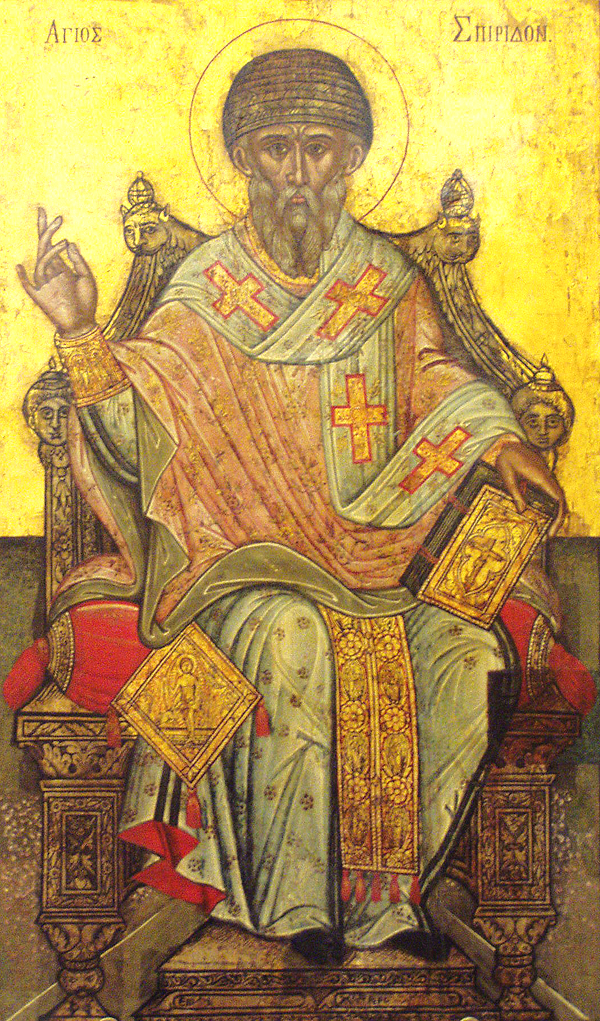
Saint Spyridon of Tremithus was born towards the end of the third century on the island of Cyprus. He was a shepherd, and had a wife and children. He used all his substance for the needs of his neighbors and the homeless, for which the Lord rewarded him with a gift of wonderworking. He healed those who were incurably sick, and cast out demons.
After the death of his wife, during the reign of Constantine the Great (306-337), he was made Bishop of Tremithus, Cyprus. As a bishop, the saint did not alter his manner of life, but combined pastoral service with deeds of charity.
According to the witness of Church historians, Saint Spyridon participated in the sessions of the First Ecumenical Council in the year 325. At the Council, the saint entered into a dispute with a Greek philosopher who was defending the Arian heresy. The power of Saint Spyridon’s plain, direct speech showed everyone the importance of God’s wisdom before human wisdom: “Listen, philosopher, to what I tell you. There is one God Who created man from dust. He has ordered all things, both visible and invisible, by His Word and His Spirit. The Word is the Son of God, Who came down upon the earth on account of our sins. He was born of a Virgin, He lived among men, and suffered and died for our salvation, and then He arose from the dead, and He has resurrected the human race with Him. We believe that He is one in essence (consubstantial) with the Father, and equal to Him in authority and honor. We believe this without any sly rationalizations, for it is impossible to grasp this mystery by human reason.”
As a result of their discussion, the opponent of Christianity became the saint’s zealous defender and later received holy Baptism. After his conversation with Saint Spyridon, the philosopher turned to his companions and said, “Listen! Until now my rivals have presented their arguments, and I was able to refute their proofs with other proofs. But instead of proofs from reason, the words of this Elder are filled with some sort of special power, and no one can refute them, since it is impossible for man to oppose God. If any of you thinks as I do now, let him believe in Christ and join me in following this man, for God Himself speaks through his lips.”
At this Council, Saint Spyridon displayed the unity of the Holy Trinity in a remarkable way. He took a brick in his hand and squeezed it. At that instant fire shot up from it, water dripped on the ground, and only dust remained in the hands of the wonderworker. “There was only one brick,” Saint Spyridon said, “but it was composed of three elements. In the Holy Trinity there are three Persons, but only one God.”
The saint cared for his flock with great love. Through his prayers, drought was replaced by abundant rains, and incessant rains were replaced by fair weather. Through his prayers the sick were healed and demons cast out.
A woman once came up to him with a dead child in her arms, imploring the intercession of the saint. He prayed, and the infant was restored to life. The mother, overcome with joy, collapsed lifeless. Through the prayers of the saint of God, the mother was restored to life.
Another time, hastening to save his friend, who had been falsely accused and sentenced to death, the saint was hindered on his way by the unanticipated flooding of a stream. The saint commanded the water: “Halt! For the Lord of all the world commands that you permit me to cross so that a man may be saved.” The will of the saint was fulfilled, and he crossed over happily to the other shore. The judge, apprised of the miracle that had occurred, received Saint Spyridon with esteem and set his friend free.
Similar instances are known from the life of the saint. Once, he went into an empty church, and ordered that the lampadas and candles be lit, and then he began the service. When he said, “Peace be unto all,” both he and the deacon heard from above the resounding of a great multitude of voices saying, “And with thy spirit.” This choir was majestic and more sweetly melodious than any human choir. To each petition of the litanies, the invisible choir sang, “Lord, have mercy.” Attracted by the church singing, the people who lived nearby hastened towards it. As they got closer and closer to the church, the wondrous singing filled their ears and gladdened their hearts. But when they entered into the church, they saw no one but the bishop and several church servers, and they no longer heard the singing which had greatly astonished them.
Saint Simeon Metaphrastes (November 9), the author of his Life, likened Saint Spyridon to the Patriarch Abraham in his hospitality. Sozomen, in his Church History, offers an amazing example from the life of the saint of how he received strangers. One time, at the start of the Forty-day Fast, a stranger knocked at his door. Seeing that the traveller was very exhausted, Saint Spyridon said to his daughter, “Wash the feet of this man, so he may recline to dine.” But since it was Lent there were none of the necessary provisions, for the saint “partook of food only on certain days, and on other days he went without food.” His daughter replied that there was no bread or flour in the house. Then Saint Spyridon, apologizing to his guest, ordered his daughter to cook a salted ham from their larder. After seating the stranger at table, he began to eat, urging that man to do the same. When the latter refused, calling himself a Christian, the saint rejoined, “It is not proper to refuse this, for the Word of God proclaims, ‘Unto the pure all things are pure’” (Titus 1:15).
Another historical detail reported by Sozomen, was characteristic of the saint. It was his custom to distribute one part of the gathered harvest to the destitute, and another portion to those having need while in debt. He did not take a portion for himself, but simply showed them the entrance to his storeroom, where each could take as much as was needed, and could later pay it back in the same way, without records or accountings.
There is also the tale by Socrates Scholasticus about how robbers planned to steal the sheep of Saint Spyridon. They broke into the sheepfold at night, but here they found themselves all tied up by some invisible power. When morning came the saint went to his flock, and seeing the tied-up robbers, he prayed and released them. For a long while he advised them to leave their path of iniquity and earn their livelihood by respectable work. Then he made them a gift of a sheep and sending them off, the saint said kindly, “Take this for your trouble, so that you did not spend a sleepless night in vain.”
All the Lives of the saint speak of the amazing simplicity and the gift of wonderworking granted him by God. Through a word of the saint the dead were awakened, the elements of nature tamed, the idols smashed. At one point, a Council had been convened at Alexandria by the Patriarch to discuss what to do about the idols and pagan temples there. Through the prayers of the Fathers of the Council all the idols fell down except one, which was very much revered. It was revealed to the Patriarch in a vision that this idol had to be shattered by Saint Spyridon of Tremithus. Invited by the Council, the saint set sail on a ship, and at the moment the ship touched shore and the saint stepped out on land, the idol in Alexandria with all its offerings turned to dust, which then was reported to the Patriarch and all the bishops.
Saint Spyridon lived his earthly life in righteousness and sanctity, and prayerfully surrendered his soul to the Lord. His relics repose on the island of Corfu (Kerkyra), in a church named after him (His right hand, however, is located in Rome).
His memory is also celebrated on Cheesefare Saturday.

Saint Therapon of Monza was a monk in the monastery of Saint Adrian (May 5) at the River Monza. The monk began his ascetic deeds in Moscow, and then transferred to the city of Kostroma at the Elevation of the Cross monastery, and was tonsured there.
The pious monks Adrian and Paphnutius, from the monastery of Saint Paul of Obnora (January 10), seeking solitude, moved to the Monza and founded a monastery 25 versts from Galich. Saint Therapon transferred to this monastery, where he labored in asceticism until the end of his life. Each day, with the blessing of the igumen, he withdrew into a forest thicket and prayed. By night he read and transcribed copies of spiritually useful books.
In his life he emulated Blessed Basil of Moscow (August 2), whom he called his friend, although personally he never saw him. Even during his life, Saint Therapon was glorified with a gift of wonderworking. Before his death he predicted a year of famine (1601). He surrendered his soul to God in the year 1597. The monastery at the River Monza was called after him the Theraponov.
The Hieromartyr Alexander, Bishop of Jerusalem, was a disciple of the great teacher and writer of the Church, Clement of Alexandria. At the beginning of the third century he was chosen bishop of Flavia, Cappadocia. He was arrested during the reign of the emperor Septimus Severus (193-211) and spent three years in prison.
After his release from prison he went to Jerusalem to venerate the holy places, and was told to remain there through a divine revelation. In 212 he was chosen as coadministrator with the elderly Patriarch Narcissus, an unusually rare occurrence in the ancient Church. Following the death of Saint Narcissus (August 7), Saint Alexander succeeded him and governed the Church of Jerusalem for thirty-eight years, working for the enlightenment of Christians. He also established the first library of Christian theological works at Jerusalem.
Saint Alexander was arrested during the persecution of the Church under the emperor Decius (249-251). The holy martyr was sent to Cappadocia, where he suffered many tortures. He was condemned to be eaten by wild beasts, but they did not harm him. Saint Alexander was cast into prison, where he surrendered his soul to God.
The hieromartyr Alexander is also commemorated on May 16.
The Holy Martyr Synetus (the name is derived from the Greek word meaning “man of reason”) was a Roman by birth, and was a reader in the Roman Church under Pope Sixtus (257-258). He was subjected to torture, and was beheaded for his brave confession of faith in the time of the emperor Aurelian (270-275).
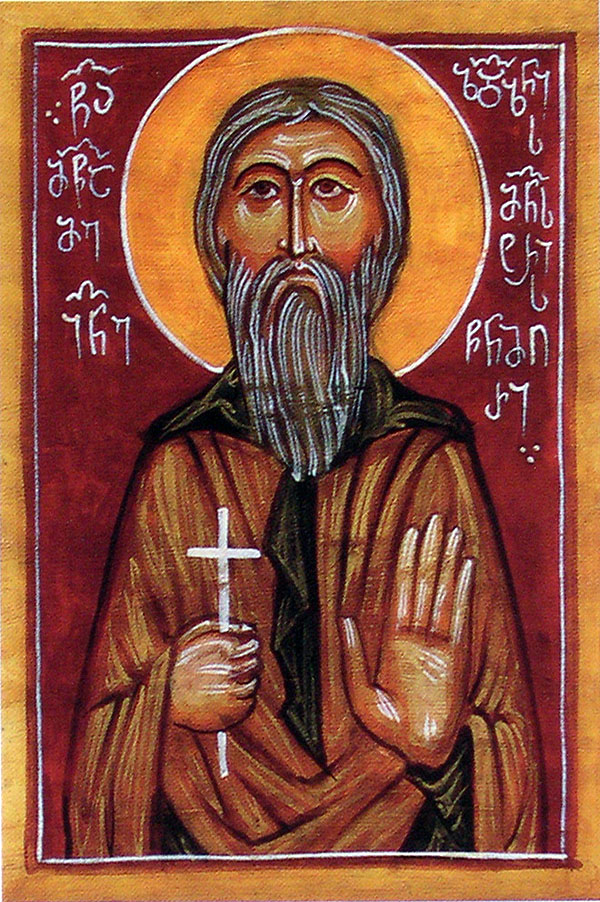
The life of the holy martyr John, Abbot of Zedazeni Monastery, has not been preserved, but the list recalling “the names of the holy fathers who reposed at Zedazeni Monastery after John of Zedazeni,” which was compiled by Catholicos Arsenius II, tells us that Abbot John was “murdered at Zedazeni by Muslims.” Saint John was martyred in the 9th century.
Here is the live stream for Orthros and Divine Liturgy – Sat 12/11/2022 If you need, here are instructions for accessing this content from your phone, tablet, computer, or TV.
11TH SUNDAY OF LUKE
ABSTAIN FROM MEAT, DAIRY, EGGS
11th Sunday of Luke, Daniel the Stylite of Constantinople, Luke the New Stylite of Chalcedon, Martyrs Acepsius and Aeithalas, Holy Martyrs Miracus and Barsabas, Leontios the Righteous of Monemvasia, The Glorious King Nikephoros Phokas
Brethren, when Christ who is our life appears, then you also will appear with him in glory. Put to death therefore what is earthly in you: fornication, impurity, passion, evil desire, and covetousness, which is idolatry. On account of these the wrath of God is coming upon the sons of disobedience. In these you once walked, when you lived in them. But now put them all away: anger, wrath, malice, slander, and foul talk from your mouth. Do not lie to one another, seeing that you have put off the old nature with its practices and have put on the new nature, which is being renewed in knowledge after the image of its creator. Here there cannot be Greek and Jew, circumcised and uncircumcised, barbarian, Scythian, slave, free man, but Christ is all, and in all.
The Lord said this parable: “A man once gave a great banquet, and invited many; and at the time of the banquet he sent his servant to say to those who had been invited, ‘Come; for all is now ready.’ But they all alike began to make excuses. The first said to him, ‘I have bought a field, and I go out and see it; I pray you, have me excused.’ And another said, ‘I have bought five yoke of oxen, and I must go to examine them; I pray you, have me excused.’ And another said, ‘I have married a wife, and therefore I cannot come.’ So the servant came and reported this to his master. Then the householder in anger said to his servant, ‘Go out quickly to the streets and lanes of the city, and bring in the poor and maimed and blind and lame.’ And the servant said, ‘Sir, what you commanded has been done, and there is still room.’ And the master said to the servant, ‘Go out to the highways and hedges, and compel people to come in, that my house may be filled. For I tell you, none of those men who were invited shall taste my banquet. For many are called, but few are chosen.'”

The Sunday that falls between December 11-17 is known as the Sunday of the Holy Forefathers. These are the ancestors of Christ according to the flesh, who lived before the Law and under the Law, especially the Patriarch Abraham, to whom God said, “In thy seed shall all of the nations of the earth be blessed” (Gen. 12:3, 22:18).
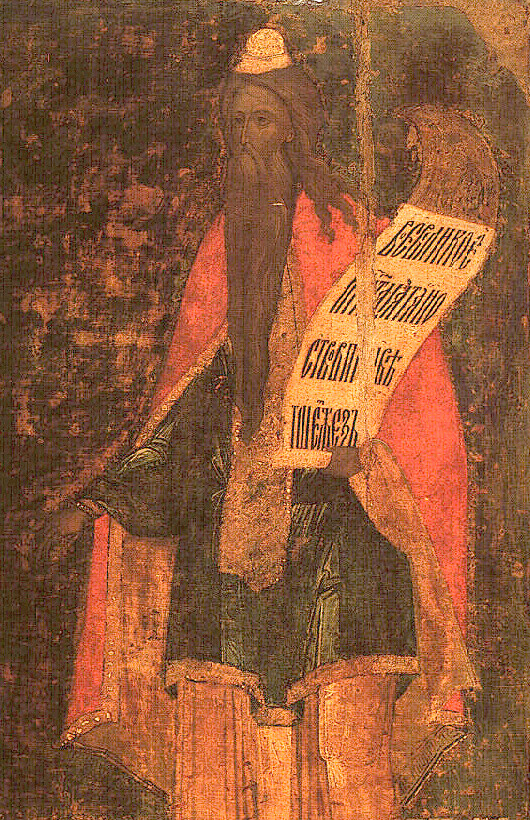
The Righteous Aaron was the son of Amram and Jochebed, and the elder brother of the Prophet Moses the God-seer, and also of Miriam. He was a direct descendent of Levi by both parents. God called him “the Levite” in Exodus 4:14, when He appointed Aaron to be the spokesman for Moses, who was “slow of speech,” before the people. Later, he would also speak on behalf of Moses before Pharaoh in Egypt (Ex. 4:30; 7:2). Aaron was married to Elisheba, the daughter of the Prince of Judah (Ex. 6:23), who bore him four sons.
Moses was eighty years old and Aaron was eighty-three when they spoke to Pharaoh and asked that the Hebrews be released from their slavery. The Lord told Moses that Pharaoh would ask them for a miracle, and that Aaron should throw down his rod before him, and it would become a serpent (Ex. 7:9). When Pharaoh would not allow the Hebrews to leave Egypt, God told Moses to have Aaron stretch forth his rod over the Nile River, and it would turn to blood.
Following a succession of plagues, Pharaoh relented and let the people go, then Moses led them on their long journey to the Promised Land. In Chapter 17 of Exodus, the Hebrews fought Amalek in a battle at Rephidim. Moses stood atop a hill with the rod of God in his hand. As long as he raised his hand, the Hebrews prevailed, but when he became tired and lowered it, Amalek prevailed. Aaron and Hur sat Moses on a rock and held up his hands, one on each side. This was a prefiguration of the suffering of Christ, because the arms of Moses formed a cross. In the Greek Septuagint, the names Aaron and Hur begin with the letters Alpha and Omega, another reference to Christ (Revelation 1:8).
Aaron and his sons were anointed and sanctified to serve God as priests (Exodus chapter 29). In chapter 32, Aaron fell into temptation when Moses went up on Mount Sinai to receive the Commandments. Since Moses was taking a long time, the people grew restless and asked Aaron to make them a golden idol in the form of a calf so that they could offer sacrifices. He gave into them, and Moses was angry when he returned and saw them dancing and singing before the calf. He threw down the tablets on which God had written the Ten Commandments, and then he burned the golden calf and ground it to powder. He scattered the powder on the water, and he made the people drink it. When Moses asked those who were on the Lord’s side to gather around him, the Levites came to him. He ordered them to take their swords and slay their sons, companions, and neighbors. About three thousand people were killed that day.
Later, Aaron and Miriam criticized Moses for marrying a Cushite woman (Num. 12:1). God was angry with them, so He punished Miriam with leprosy. She was healed by God seven days after Moses interceded for her.
In chapter 17 of Numbers, the people murmured against Moses and Aaron, so God commanded that the leaders of the twelve tribes should have their names inscribed on their rods and placed in the tent of testimony. God would reveal His choice to make the people cease their grumbling against Moses and his brother. Aaron’s rod bloomed miraculously in the tent of the testimony, to show that he had been chosen for this purpose.
Aaron reposed atop Mount Hor when he was one hundred and twenty-three years old. One of his descendants was Saint Elizabeth, the mother of Saint John the Baptist (Luke 1:5).

The youngest son of Jacob, he was called Benoni and then Benjamin (Genesis 35:16-18). Before his death Jacob blessed him in a seemingly backhanded way, saying that “Benjamin is a ravenous wolf, devouring his prey in the morning, and dividing the spoil in the evening” (Genesis 49:27). Commentators say this is not a reference to Benjamin himself, but to the warlike nature of the tribe of Benjamin.
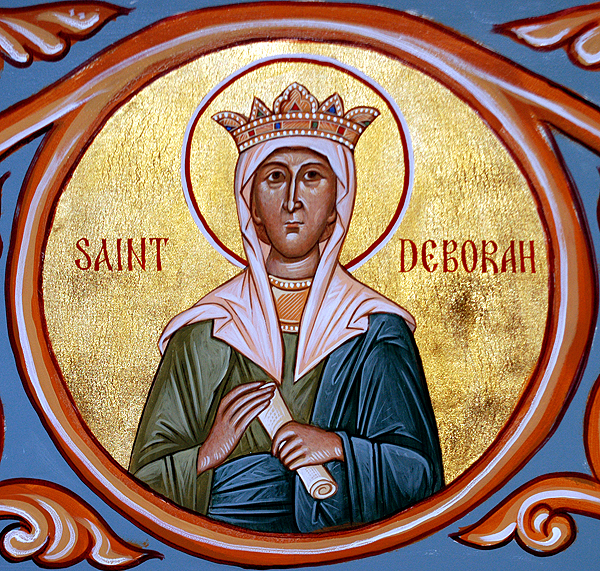
Information about the holy Prophetess and Judge Deborah may be found in the
Book of Judges 4:5-14, and also chapter 5.

The Righteous Hezron (Esrom, or Esron) is mentioned in the Old Testament genealogies: Genesis 46:12, Ruth 4:18, and 1 Chronicles 2:9 (LXX). He was the son of Perez (Phares) and the father of Aram (or Ioram), and an ancestor of the Prophet-King David.
According to the New Testament genealogies (Matthew 1:3; Luke 3:33), Phares begat Esrom; and Esrom begat Aram.

The Righteous Isaac was the second of the Old Testament Patriarchs, and the son of Abraham (Genesis 17:17-22). God tested Abraham to see if he would sacrifice his son (Genesis 22:1-13), and thus Isaac was a type of Christ. He was the husband of Rebecca (Genesis 24:67), and the father of Jacob and Esau (Genesis 25:19-26).
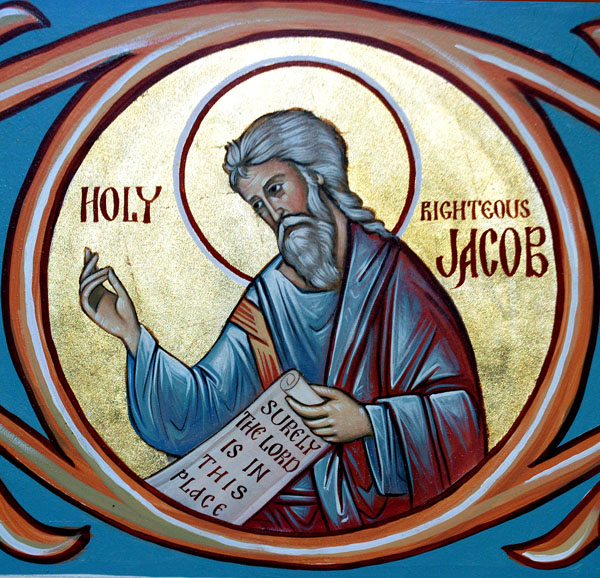
The Righteous Jacob is mentioned in the book of Genesis, chapters 25-50. He had a dream of a ladder (Genesis 28:12-17). Angels were ascending and descending the ladder, and the Lord was above the ladder (a type of the Mother of God, who united earth to Heaven when she consented to become the mother of the Messiah). Later, Jacob wrestled with God (Genesis 32:22-30), who appeared as a man, and Jacob prevailed. Then the Lord gave him the name Israel and blessed him. Jacob called that place Peniel (The face of God), and said, "I have seen God face to face, and yet my life is preserved."

Information about the Righteous Judith may be found in the Old Testament book
bearing her name.
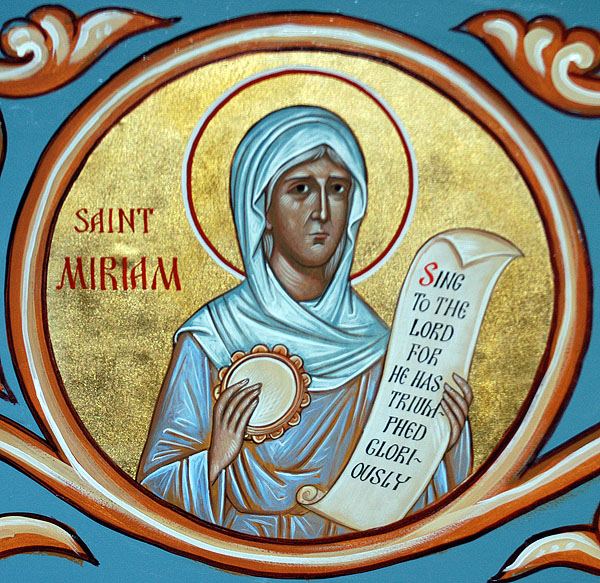
Saint Miriam, like her brothers Moses and Aaron, was descended from the tribe of Levi.
When Moses was an infant, the Hebrew midwives were ordered to kill any male child when they assisted at childbirths, but they refused to obey. Moses was hidden by his mother for three months, and then, when she could no longer do this, he was placed into a basket of reeds and set upon the waters of the Nile. Miriam watched in secret to see what would happen to him. When Pharaoh’s daughter found him, Miriam emerged from her place of concealment and offered to find a wet nurse from among the Hebrew women for the baby. Miriam went to get her mother, who raised her child until he was grown, and then returned him to Pharoah’s daughter (Exodus 2:10).
In the Torah, she is called “Miriam the Prophetess” (Exodus 15:20), while the Prophet Michah (6:4) has God say that He sent Moses, and Aaron, and Miriam before the Hebrews to lead them out of Egypt.
In Chapter 12 of the book of Numbers, Miriam and Aaron apparently criticize Moses for being married to a foreign woman of Cush (or an Ethiopian). This, however, was merely a pretext for their resentment. Actually, they were disturbed by Moses’ position as the sole mediator between God and the people. Miriam was a prophetess, after all. Miriam and Aaron questioned Moses, “Has the Lord spoken only to Moses? Has He not also spoken to us?” God then tells them that He speaks face to face with Moses, but only in visions to Miriam and Aaron while they are asleep. Then, for daring to speak against Moses, Miriam is punished with leprosy. Aaron pleads with Moses not to hold their sin against them, since they had acted out of ignorance. Even so, Miriam was set apart outside the camp for seven days, and then she was healed and allowed to come in.
In one of the stichera on the Praises for the Sunday before the Nativity, Sarah, Rebecca, Anna, and Miriam, “the glory of women,” are said to “exchange glad tidings.”

The Prophet Nathan was an advisor to King David and King Solomon. He is mentioned in the Prayer of Absolution in the Mystery of Confession: “It was God Who pardoned David through the Prophet Nathan when he had confessed his sin….” David had committed adultery with Uriah's wife Bathsheba, and had him killed. Then he took Bathsheba as his wife. David confessed his sin to Nathan (2 Samuel 12:13) and received pardon.

The Old Testament book of Nehemiah tells of how he returned from the Captivity in Babylon in the twentieth year of the Persian King Artaxerxes (445/444 B.C.) to rebuild Jerusalem and to govern the province. He and Ezra purified the Jewish people by making known the Law of Moses, and forcing the men to divorce their pagan wives.

The Righteous Noah is mentioned in the Book of Genesis (chapters 5-9).
Seeing the wicked deeds of men, God decided to destroy man from the earth, and even cattle, reptiles, and birds. But Noah found favor with the Lord, Who spared him, his sons and their wives. Therefore, God commanded Noah to build an ark and take two pairs of every creature into it. Then it rained for forty days and nights, and men and animals perished in the flood. The water remained on the earth for 150 days, then God blessed Noah and his sons, telling them to increase and multiply (Genesis 9:7).
Through Noah's sons Shem, Ham and Japheth, the earth was repopulated, and God promised not to destroy the world by water again. Noah reposed at the age of 950 (Genesis 9:29). The ark is a figure of the Church, which is called the Ark of Salvation.
While speaking about the end of the world, the Savior told His disciples: "As were the days of Noah, so will be the coming of the Son of man. For as in those days before the flood they were eating and drinking, marrying and giving in marriage, until the day when Noah entered the ark, and they did not know until the flood came and swept them all away, so will be the coming of the Son of man" (Matthew 24:37-39).
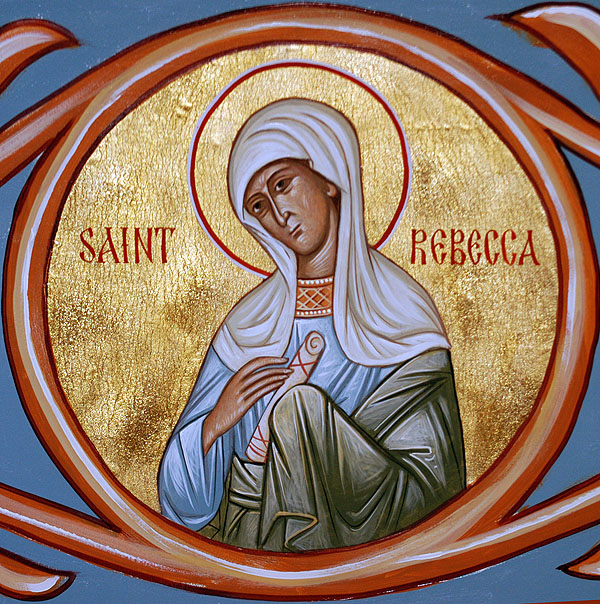
Rebecca was the wife of the Old Testament Patriarch Isaac, and the mother of Jacob and Esau. She is mentioned in Genesis 22:23; Chapters 24-28; and Chapter 49:31. Saint Paul also mentions her (Romans 9:10).

Sarah was the wife of the Old Testament Patriarch Abraham and the mother of Isaac. At first she was called Sarai, and her name was changed to Sarah (Genesis 17:15-16). The three men who visited Abraham at the oak of Mamre told her that she would conceive and have a son (Genesis 18:10). She did not believe them at first, since she and her husband were old, but they insisted that she would bear a son in the spring. Their prediction was fulfilled, and God did as He had promised (Genesis 21:1-3). Saint Andrew Rublev depicts the three men as angels in his most famous icon. Sarah is praised in the New Testament for her faith (Hebrews 11:11) and also for her obedience (I Peter 3:6).

The Prophet-King Solomon (ca. 972 – 932 B.C.) was the son of David and Bathsheba. He succeeded his father as King and reigned for forty years. He built the palace and the Temple at Jerusalem, and was renowned for his wisdom. The Old Testament books of Proverbs, the Song of Songs, and the Wisdom of Solomon are attributed to him. He may have written parts of these books, but much of the material was probably transmitted orally before it was written down.
In the Gospels, Christ mentions Solomon by name, citing his glory and wisdom (Matthew 6:29; 12:42).

The 64-verse story of Susanna is found in the Septuagint Greek as a Preamble to the Book of Daniel. The Latin Vulgate, however, places the story of Susanna at the end of the Book of Daniel, which constitutes the book's thirteenth chapter.
Information about the Righteous Ruth, the wife of Boaz, may be found in the Old Testament book bearing her name.
Saint Mary is the mother of Saint Anna, and the grandmother of the Theotokos.
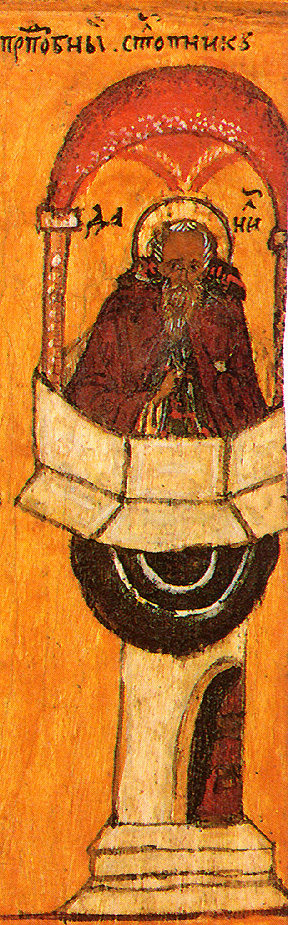
Saint Daniel the Stylite was born in the village of Bethara, near the city of Samosata in Mesopotamia. His mother Martha was childless for a long while and in her prayers she vowed that if she had a child, she would dedicate him to the Lord. Her prayers were heard, and Martha soon gave birth to a son, who was without a name until he was five years of age.
The boy’s parents desired that since he was born through the good-will of God, he should also receive his name from God. They took their son to a monastery located nearby and approached the igumen. The igumen gave orders to take down one of the service books, and unrolled it at random. He found the Prophet Daniel (December 17) mentioned in it. Thus did the boy receive his name. The parents asked that he might remain at the monastery, but the igumen would not accept him, since he was still only a small boy. At twelve years of age, saying nothing to anyone, the child left home for the monastery.
His parents were happy when they learned where their son was, and they went to the monastery. Seeing that he was still going about in his worldly clothes, they besought that the igumen should clothe him in the angelic garb. That Sunday the igumen fulfilled their request, but permitted them often to visit their son. The brethren of the monastery were astonished at the saint’s ascetical efforts.
Once, Saint Simeon the Stylite (September 1) visited the monastery. He foretold to the young monk that he too would undertake the feat of pillar-dwelling. Saint Daniel continued with his ascetic life in seclusion. When the place of a new exploit was revealed to him in a vision, he withdrew into the Thracian wilderness together with two disciples. They set up a pillar, upon which Saint Daniel dwelt for 33 years. People thronged to the pillar, the unfortunate and those who were sick, and all received help and healing from Saint Daniel. Byzantine emperors also sought the prayers of the holy ascetic. The most notable of the saint’s predictions was about a great fire in Constantinople. Saint Daniel possessed also the gift of gracious words. He guided many onto the path of correcting their lives. The monk reposed in his eightieth year.
Saint Nikon the Dry, the son of rich and illustrious parents, gave up everything for Christ and became a monk at the Kiev Caves monastery. In the year 1096, during the incursions of Khan Bonyak, he was taken into captivity with some other monks. The captors treated Saint Nikon harshly, while waiting for a ransom to be paid. When the saint refused to be ransomed, his masters began to torment him with hunger, and left him exposed in the heat of summer and the cold of winter. He was mistreated and beaten every day for about three years, for his captors thought he would change his mind and send word to his relatives, asking to be ransomed.
The saint gave thanks to God for everything, and once said to his tormentor that the Lord, through the prayers of Saints Anthony and Theodosius would return him to his monastery within three days, as Saint Eustratius (March 28) had predicted while appearing to him.
The captor cut the tendons in Saint Nikon’s legs and set a strong guard over him. But suddenly, on the third day at the sixth hour, the holy captive became invisible. At the moment the guard heard the words, “Praise the Lord from the Heavens” (Ps. 148).
Saint Nikon was transported to the Dormition church, where the Divine Liturgy was being served. The brethren surrounded him and began to ask how he got there. Saint Nikon wanted to conceal the miracle, but the brethren implored him to tell the truth.
Saint Nikon did not want to have his fetters removed, but the igumen said, “If the Lord had wanted you to remain fettered, He would not have delivered you from captivity.”
After a long while Saint Nikon’s former master came to the Kiev Caves monastery and recognized his former captive, who was withered from hunger and the loss of blood from his wounds. He came to believe in Christ, and accepted Baptism. After receiving monastic tonsure, he became a novice under Saint Nikon’s direction.
Saint Nikon died at the beginning of the twelfth century and was buried in the Near Caves. Though he did not enjoy good health in this life, his holy relics were glorified by incorruption. His memory is celebrated also on September 28 and on the second Sunday of Great Lent.
The Holy Martyr Mirax was born into a Christian family living in the city of Tanis (Egypt) during the seventh century. He was raised in piety, but yielded to demonic temptation and trampled on a cross. He went to the Emir, the ruler of Egypt, and taking his sword in hand, he declared himself a Moslem.
His parents, grieving over the terrible downfall of their son, incessantly prayed for him. And then the grace of God illumined the heart of the prodigal. He deeply repented and returned home. His parents counselled him to acknowledge his fall into darkness and to show his repentance. Saint Mirax obeyed them. He went before the Emir and announced that he had become a Christian once more. The ruler condemned him to tortures, after which the saint was beheaded and cast into the sea (this occurred around the year 640).

The Holy Martyrs Akepsimas and Aithalas were from Persia. Akepsimas was a pagan priest in the city of Arbel. Having received healing through the prayers of a Christian bishop, he was converted to the faith in Christ and boldly confessed it. For this they threw Saint Akepsimas into prison.
Soon after, Saint Aithalas, a deacon of the Arbel Church, was imprisoned with him. They brought the martyrs before the ruler, where they again confessed their faith and were beheaded.

Saint Luke the New Stylite was a soldier under the Byzantine emperor Constantine Porphyrogenitos (912-959). During a war with Bulgaria (917), Saint Luke remained unharmed through the Providence of God. After this he became a monk, and having succeeded in his efforts, was ordained as a presbyter. Striving for an even higher degree of perfection, the monk put chains upon himself and ascended a pillar.
After three years standing on the pillar, through divine inspiration, he went to Mount Olympos, and then to Constantinople, and finally to Chalcedon, where he chose a pillar upon which he remained for 45 years, manifesting a gift of wonderworking. He died in about the year 980.

Having examined the history of Georgia and the hagiographical treasures attesting to the faith of the Georgian nation, we become convinced that Heavenly Georgia— the legion of Georgian saints, extolling the Lord in the Heavenly Kingdom with a single voice—is infinitely glorious. It is unknown how many cleansed themselves of their earthly sins in merciless warfare with the enemy of Christ, or how many purified their souls in unheated cells through prayer, fasting, and ascetic labors.
To God alone are known the names of those ascetics, forgotten by history, who by their humble labors tirelessly forged the future of the Georgian Church and people.
St. George of the Holy Mountain wrote: “From the time we recognized the one true God, we have never renounced Him, nor have our people ever yielded to heresy.”
A decree of the Church Council of Ruisi-Urbnisi states: “We will not depart from thee, the Catholic Church which bore us in holiness, nor will we betray thee, our pride—Orthodoxy—to which we have always been faithful, for we have been granted the honor to know thee, the witness of the Truth Itself!” This relationship to Orthodoxy is the cornerstone of the life of every Georgian believer.
It is impossible to count the names of all those Christians who have been raised up from the earthly Church in Georgia to the heavens, let alone to describe all the godly deeds they have performed. For this reason December 11 has been set aside for the commemoration not only of the saints whose Lives are known to us but also of the nearly three hundred more whose names, but not stories, have been preserved as well.
Most Georgian people bear the name of a saint who is commemorated on this day, and they entreat the saint to intercede before the Lord in their behalf.
Here is the live stream for Great Vespers – Sat 12/10/2022 If you need, here are instructions for accessing this content from your phone, tablet, computer, or TV.
SATURDAY OF THE 12TH WEEK
ABSTAIN FROM MEAT, DAIRY, EGGS
Menas, Hermogenes, & Eugraphos, Martyrs of Alexandria, Thomas the Righteous of Bithynia
Brethren, the scripture, foreseeing that God would justify the Gentiles by faith, preached the gospel beforehand to Abraham, saying, “in you shall all the nations be blessed.” So then, those who are men of faith are blessed with Abraham who had faith. For all who rely on works of the law are under a curse; for it is written, “Cursed be every one who does not abide by all things written in the book of the law, and do them.” Now it is evident that no man is justified before God by the law; for “the righteous shall live by faith”; but the law does not rest on faith, for “He who does them shall live by them.”
The Lord said this parable, "The kingdom of God is like a grain of mustard seed which a man took and sowed in his garden; and it grew and became a tree, and the birds of the air made nests in its branches." And again he said, "To what shall I compare the kingdom of God? It is like leaven which a woman took and hid in three measures of flour, till it was all leavened." He went on his way through towns and villages, teaching, and journeying toward Jerusalem. And some one said to him, "Lord, will those who are saved be few?" And he said to them, "Strive to enter by the narrow door; for many, I tell you, will seek to enter and will not be able. When once the householder has risen up and shut the door, you will begin to stand outside and to knock at the door, saying, 'Lord, open to us.' He will answer you, 'I do not know where you come from.' Then you will begin to say, 'We ate and drank in your presence, and you taught in our streets.' But he will say, 'I tell you, I do not know where you come from; depart from me, all you workers of iniquity!' There you will weep and gnash your teeth when you see Abraham and Isaac and Jacob and all the prophets in the kingdom of God and you yourselves thrust out. And men will come from east and west, and from north and south, and sit at table in the kingdom of God.
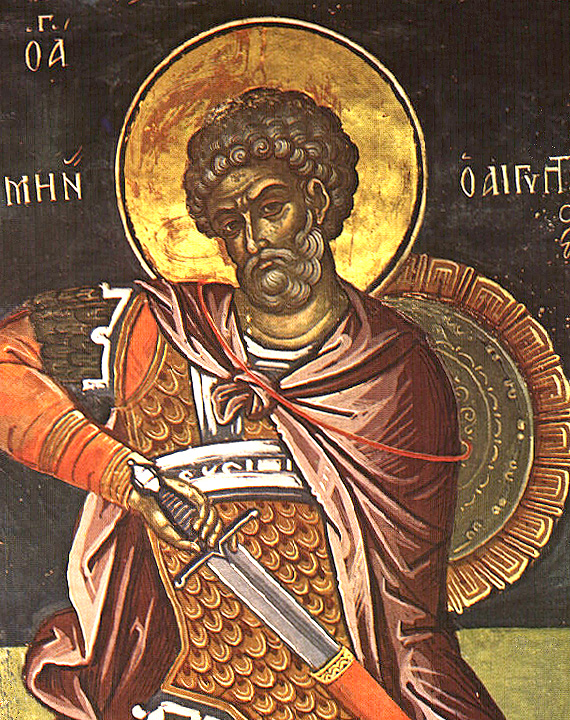
The Holy Martyrs Menas, Hermogenes, and Eugraphus suffered for their faith in Christ under the emperor Maximian (305-313).
Saint Menas was sent by the emperor from Athens to Alexandria to suppress the riots that had arisen between the Christians and the pagans. Distinguished for his gift of eloquence, Menas instead openly began to preach the Christian Faith and he converted many pagans to Christ. Learning of this, Maximian sent Hermogenes to Alexandria to place the saints on trial. Moreover, he gave orders to purge the city of Christians.

Hermogenes, although he was a pagan, was distinguished by his reverent bearing. And struck by the endurance of Saint Menas under torture and by his miraculous healing after the cruel torments, he also came to believe in Christ. Maximian himself then arrived in Alexandria. Neither the astonishing stoic endurance of Saints Menas and Hermogenes under torture, nor even the miracles manifested by God in this city, mollified the emperor. Instead, they vexed him all the more. The emperor personally stabbed Saint Eugraphus, the secretary of Saint Menas, who had declared himself a Christian upon witnessing the endurance of Saints Menas and Hermogenes; and then gave orders to behead the holy Martyrs Menas and Hermogenes.
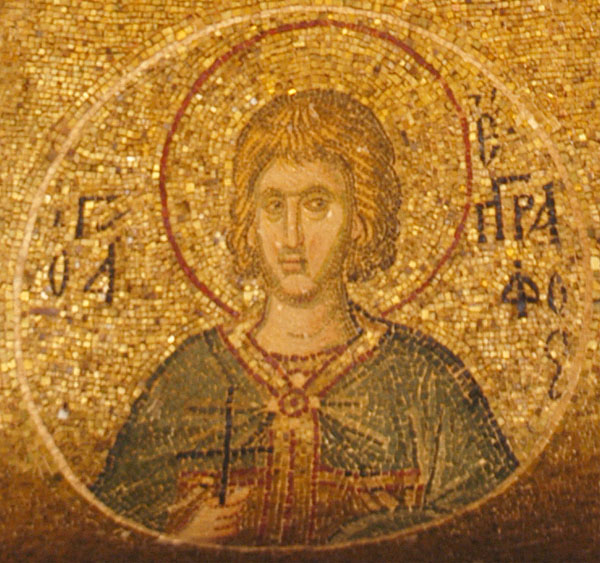
The relics of the holy martyrs, cast into the sea in an iron chest, were afterwards found (see February 17) and transferred to Constantinople in the ninth century. The emperor Justinian built a church in the name of the holy Martyr Menas of Alexandria. Saint Joseph the Hymnographer (April 4) composed a Canon in honor of these holy martyrs.

Saint Joasaph was born at Proluka, in the former Poltava governance, on September 8, 1705, the Feast of the Nativity of the Most Holy Theotokos. He was descended from the old and venerable Little Russian (Ukrainian) lineage of the Gorlenkovi. At Baptism he was named Joachim.
In 1712, his father enrolled the seven-year-old Joachim in the Kiev Spiritual Academy. Within the walls of the academy he felt attracted to monastic life. For seven years he studied it further, and finally revealed his intention to his parents.
For a long time his mother and father pleaded with their first-born son not to accept monastic tonsure. But in 1725, unknown to them, he became a “rasophore” (“robe-wearing novice”) with the name Hilarion at the Kiev Mezhigorsk monastery, and on 21 November 1727 he was tonsured in the mantya with the name Joasaph at the Kievo-Bratsk monastery. This event coincided with the completion of his studies at the spiritual academy.
After the death of His Grace Barlaam, the See of Kiev was governed by Archbishop Raphael Zaborovsky. Archbishop Raphael noticed the abilities of the young ascetic and assigned him to greater service to the Church. He was entrusted with the responsibility of the office of examiner of the Kiev archbishopric.
In November 1734, Archbishop Raphael ordained the hierodeacon Joasaph as hieromonk, and he was transferred from the Bratsk monastery school to the Kiev-Sophia archbishop’s house. At the same time, he was appointed a member of the Kiev religious consistory.
In fulfilling the office of examiner, he exerted much effort towards the correction of moral deficiencies among the parish clergy. The saint’s service in the consistory office enabled him to develop his administrative abilities. During this time, he made a good study of the needs of clergy-servers, noting both the good points and the failings of the diocese. His talent for administration was combined with his great spiritual effort. He quickly ascended the ladder of spiritual perfection, which can be seen in his work, “The Conflict of the Seven Venerable Virtues with the Seven Deadly Sins.”
On June 24, 1737 Hieromonk Joasaph was appointed head of the Holy Transfiguration Mgarsk monastery, and elevated to the rank of igumen. Here he worked with all his strength to put the monastery in good order, for it was an old bastion of Orthodoxy in the struggle with the Unia. In this monastery were relics of Saint Athanasius, Patriarch of Constantinople and Wonderworker of Lubny (May 2). Several times Saint Athanasius appeared to Igumen Joasaph, as a sign of his patronal protection.
In 1744 Metropolitan Raphael elevated Igumen Joasaph to the dignity of archimandrite. Towards the end of that same year he was called to Moscow and soon, at the direction of the Most Holy Synod, he was appointed vicar of the Holy Trinity Sergiev Lavra monastery. At this monastery of Saint Sergius he also unstintingly fulfilled obedience to the Church (this year required much exertion for the rebuilding of the monastery after a fire).
On June 2, 1748 at the Peter and Paul cathedral in Peterburg, Archimandrite Joasaph was ordained Bishop of Belgorod. Ascending the archbishop’s throne, Saint Joasaph strictly concerned himself with piety and the condition of the churches, with the proper celebration of divine services, and especially with the moral condition of his flock.
The saint devoted great attention to the education of the clergy, and the correct observance of churchly norms and traditions. Just as before, the saint worked with all his strength in his archpastoral service, without regard for his health.
On the eve of his repose, the saint forbade his cell attendant Stephen to aspire to the priesthood, and he predicted that if he did not obey him, he would meet with an untimely end. To another cell attendant Basil, the saint indicated that he would be a deacon, but would never become a priest. Later, this prediction was fulfilled. Saint Joasaph died on December 10, 1754, and was glorified on September 4, 1911.
The Holy Martyr Gemellus of Paphlagonia was subjected to cruel tortures for his staunch denunciation of the emperor Juilan the Apostate (361-363) in the city of Ancyra (Galatia). A red-hot iron belt was placed around his waist. Then he was ordered to accompany the impious Julian on his journey. When they reached Edessa in Mesopotamia, he was stretched out on the ground and his limbs were pierced with wooden stakes. Then he was hung on a post and mutilated.
Enduring the tortures, the saint continued to revile the emperor. After being subjected to even more horrible torments, they let him go. He was still able to walk and speak, so he went on his way until he met a priest. He entreated the priest to baptize him, and when he emerged from the water, his wounds were all healed.
Hearing of this miracle, Julian ordered that Saint Gemellus be crucified. The victorious athlete of Christ gave up his soul to God, and his body was secretly taken down and buried by Christians.
Saint Thomas Dephourkinos was born in Bithynia. From his youth he was fond of monastic life and entered one of the area monasteries. Later in his life, when the Byzantine official Galoliktos had founded a monastery at the River Sagarisa, Saint Thomas was already an experienced monk, and the brethren chose him as head of the new monastery.
From there Saint Thomas withdrew into the wilderness, where for a long time he labored in solitude. The monk overcame many snares of the devil in the wilderness. The Lord glorified him with the gift of healing and prophecy.
Once, the emperor Leo the Wise (886-911) came to the monastery to Saint Thomas for advice. Not finding the monk at the monastery, the emperor sent his messenger with a letter for him. And just as the messenger arrived at the the Elder’s hut, the saint carried out to him a sealed answer, resolving the emperor’s question. It is not known when Saint Thomas reposed.
The life of the Serbian ruler Stephen Brankovich and his family was filled with instability and misfortune. After Serbia was seized in 1457 by the Turks, the then Serbian ruler’s middle son, Stephen (October 9), distinguished by a meek disposition and fine knowledge of Holy Scripture, went to the capital of Turkey after his sister had been given to Sultan Murat in marriage. Learning that the Turks had burned the Mileshevsk monastery with fanatic cruelty, Saint Stephen rose up to defend Serbia from oppression.
When he married Angelina (July 30), the daughter of the Prince of Albania, the Turks threatened Saint Stephen and his family with punishment. With his wife and three children he was forced to hide first in Albania, and then in Italy, where he died.
Saint Angelina transferred the incorrupt relics of her spouse to Kupinovo. At the end of the fifteenth century a son of the Righteous Stephen and Angelina, Saint John, became ruler of Serbia. The incorrupt relics of Saint John and his parents were afterwards glorified by many miracles.
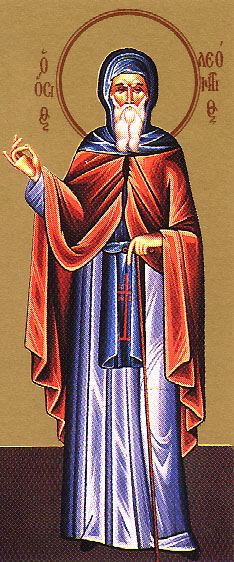
No information available at this time.
THE CONCEPTION BY ST. ANNA OF THE MOST HOLY THEOTOKOS
ABSTAIN FROM MEAT, FISH, DAIRY, EGGS, WINE, OLIVE OIL
The Conception by St. Anna of the Most Holy Theotokos, Hannah the Righteous, mother of Samuel the Prophet, Narses the Martyr of Persia, The Consecration of the Church of the Resurrection (Holy Sepulchre) in the Holy City of Jerusalem
Brethren, Abraham had two sons, one by a slave and one by a free woman. But the son of the slave was born according to the flesh, the son of the free woman through promise. Now this is an allegory: these women are two covenants. One is from Mount Sinai, bearing children for slavery; she is Hagar. Now Hagar is Mount Sinai in Arabia; she corresponds to the present Jerusalem, for she is in slavery with her children. But the Jerusalem above is free, and she is our mother. For it is written, “Rejoice, O barren one who does not bear; break forth and shout, you who are not in travail; for the children of the desolate one are many more than the children of her that is married.”
The Lord said, "No one after lighting a lamp covers it with a vessel, or puts it under a bed, but puts it on a stand, that those who enter may see the light. For nothing is hid that shall not be made manifest, nor anything secret that shall not be known and come to light. Take heed then how you hear; for to him who has will more be given, and from him who has not, even what he thinks that he has will be taken away.
Then his mother and his brothers came to him, but they could not reach him for the crowd. And he was told, "Your mother and your brothers are standing outside, desiring to see you." But he said to them, "My mother and my brothers are those who hear the word of God and do it.
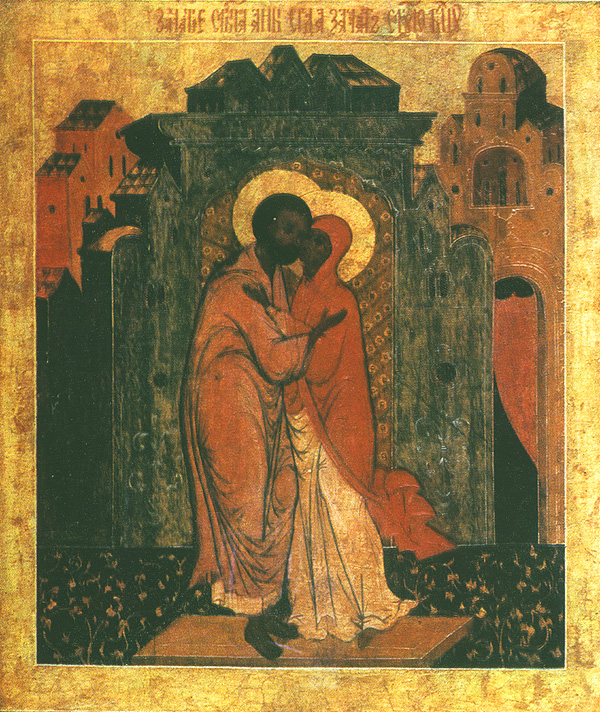
Saint Anna, the mother of the Virgin Mary, was the youngest daughter of the priest Nathan from Bethlehem, descended from the tribe of Levi. She married Saint Joachim (September 9), who was a native of Galilee.
For a long time Saint Anna was childless, but after twenty years, through the fervent prayer of both spouses, an angel of the Lord announced to them that they would be the parents of a daughter, Who would bring blessings to the whole human race.
The Orthodox Church does not accept the teaching that the Mother of God was exempted from the consequences of ancestral sin (death, corruption, sin, etc.) at the moment of her conception by virtue of the future merits of Her Son. Only Christ was born perfectly holy and sinless, as Saint Ambrose of Milan teaches in Chapter Two of his Commentary on Luke. The Holy Virgin was like everyone else in Her mortality, and in being subject to temptation, although She committed no personal sins. She was not a deified creature removed from the rest of humanity. If this were the case, She would not have been truly human, and the nature that Christ took from Her would not have been truly human either. If Christ does not truly share our human nature, then the possibility of our salvation is in doubt.
The Conception of the Virgin Mary by Saint Anna took place at Jerusalem. The many icons depicting the Conception by Saint Anna show the Most Holy Theotokos trampling the serpent underfoot.
“In the icon Saints Joachim and Anna are usually depicted with hands folded in prayer; their eyes are also directed upward and they contemplate the Mother of God, Who stands in the air with outstretched hands; under Her feet is an orb encircled by a serpent (symbolizing the devil), which strives to conquer all the universe by its power.”
There are also icons in which Saint Anna holds the Most Holy Virgin on her left arm as an infant. On Saint Anna’s face is a look of reverence. A large ancient icon, painted on canvas, is located in the village of Minkovetsa in the Dubensk district of Volhynia diocese. From ancient times this Feast was especially venerated by pregnant women in Russia.

The Holy Prophetess Hannah dwelt in marriage with Elkanah, but she was childless. Elkanah took to himself another wife, Phennena, who bore him children. Hannah grieved strongly over her misfortune, and every day she prayed for an end to her barrenness, and vowed to dedicate her child to God.
Once, as she prayed fervently in the Temple, the priest Heli thought that she was drunk, and he began to reproach her. But the saint poured out her grief, and after she received a blessing, she returned home. After this Hannah conceived and gave birth to a son, whom she named Samuel (which means “Asked from God”).
When the child reached the age of boyhood, the mother herself presented him to the priest Heli, and Samuel remained with him to serve before the Tabernacle (1 Kings/1 Samuel 2: 1-21).
Saint Sophronius, Archbishop of Cyprus, was born into a Christian family on Cyprus, and he studied many sciences, but most of all he devoted himself to the reading of Holy Scripture. He became so accomplished in piety and good works, that he was granted the gift of wonderworking by the Lord. Following the death of Saint Damian, bishop of Cyprus, Saint Sophronius was chosen to replace him. As bishop, he proved himself a true father to his flock.
Saint Stephen the “New Light” was born at Constantinople in 838 and received a fine education. Under Patriarch Methodius, Stephen received monastic tonsure and shut himself in a cell attached to the church of Saint Peter in Constantinople. Later he went into seclusion, and over fifty years he constantly increased his ascetic efforts.
Toward the end of his life the saint acquired great grace from the Lord, shining in the constellation of the saints like the ancient ascetics of the Orthodox Church, so that he came to be called the “New Light.” According to the Prologue, he died in the year 912 and was buried in the church of Saint Antipas.

The “Unexpected Joy” Icon of the Most Holy Theotokos is painted in this way: in a room is an icon of the Mother of God, and beneath it a youth is kneeling at prayer. The tradition about the healing of some youth from a bodily affliction through this holy icon is recorded in the book of Saint Demetrius of Rostov, The Fleece of Prayer [See Judges 6: 36-40].
The sinful youth, who was nevertheless devoted to the Theotokos, was praying one day before the icon of the All-Pure Virgin before going out to commit a sin. Suddenly, he saw that wounds appeared on the Lord’s hands, feet, and side, and blood flowed from them. In horror he exclaimed, “O Lady, who has done this?” The Mother of God replied, “You and other sinners, because of your sins, crucify My Son anew.” Only then did he realize how great was the depth of his sinfulness. For a long time he prayed with tears to the All-Pure Mother of God and the Savior for mercy. Finally, he received the unexpected joy of the forgiveness of his sins.
The “Unexpected Joy” icon is also commemorated on January 25 and May 1.
No information available at this time
THURSDAY OF THE 12TH WEEK
ABSTAIN FROM MEAT, FISH, DAIRY, EGGS
Forefeast of the Conception by St. Anna of the Most Holy Theotokos, Patapius the Righteous of Thebes, Sosthenes, Apollo, Cephas, Tychikos, Epaphroditos, Caesar, & Onesiphoros, Apostles of the 70
Timothy, my son, the saying is sure: If any one aspires to the office of bishop, he desires a noble task. Now a bishop must be above reproach, the husband of one wife, temperate, sensible, dignified, hospitable, an apt teacher, no drunkard, not violent but gentle, not quarrelsome, and no lover of money. He must manage his own household well, keeping his children submissive and respectful in every way; for if a man does not know how to manage his own household, how can he care for God’s church? He must not be a recent convert, or he may be puffed up with conceit and fall into the condemnation of the devil; moreover he must be well thought of by outsiders, or he may fall into reproach and the snare of the devil. Deacons likewise must be serious, not double-tongued, not addicted to much wine, not greedy for gain; they must hold the mystery of the faith with a clear conscience. And let them also be tested first; then if they prove themselves blameless let them serve as deacons. The women likewise must be serious, not slanderers, but temperate, faithful in all things. Let deacons be the husband of one wife, and let them manage their children and their households well; for those who serve well as deacons gain a good standing for themselves and also great confidence in the faith which is in Christ Jesus.
The Lord said to his disciples, "Look up and raise your heads, because your redemption is drawing near." And he told them a parable: "Look at the fig tree, and all the trees; as soon as they come out in leaf, you see for yourselves and know that the summer is already near. So also, when you see these things taking place, you know that the kingdom of God is near. Truly, I say to you, this generation will not pass away till all has taken place. Heaven and earth will pass away, but my words will not pass away.
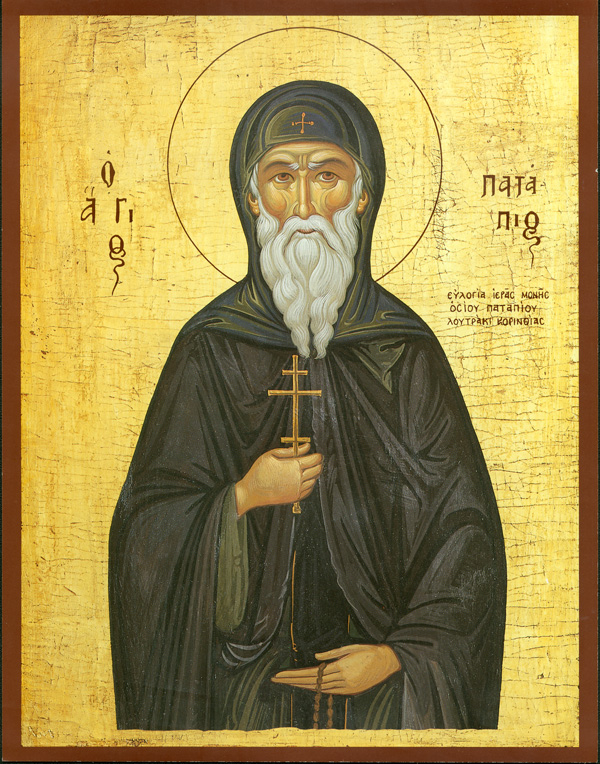
Saint Patapios was born at Thebes into a pious Christian family. Reaching the age of maturity, he scorned the vanity of this world, and so he went into the Egyptian desert where he became known for his ascetic deeds. Though he wished to live in silence, people began coming to him for advice.
To every tired pilgrim who visited his cell, he offered rest and hospitality, as well as spiritual instructions and profitable counsel for the salvation of one's soul. The Saint's reputation spread quickly, and every day many arrived at his cell in order to hear these beneficial instructions from his lips.
Later, he went to Constantinople, where he had a cell by the city wall, near the Blachernae church. But even here, he soon became known. The infirm started to gather around Patapios, and because he had been granted the gift of healing, he helped all those in need.
Once a certain woman was afflicted by the terrible disease of cancer, and worms came forth from her breasts. Not only did she suffer a great deal of pain in her chest, but throughout her entire body as well. She was in constant pain, and it reached her heart, so that she was near death. The doctors could not help her, and she felt she was wasting her money without obtaining relief. Therefore, she came to Saint Patapios and fell at his feet, begging him to heal her. The worms were devouring her flesh even before she was in the grave, causing her such pain that she longed for death.
The Saint answered, "If you have faith in the Lord, and have no doubt that you shall be healed, then let it be done according to your faith."
Sighing from the depths of her soul, she said, "I believe, O Lord that You know all things which are hidden and unknown, and that You are all-powerful. Therefore, have mercy on me and heal me."
Then the Saint asked the woman to let him see the effects of her distress. When he saw the ravages of the disease, he was struck with awe, saying, "Your affliction is indeed great, and difficult to cure. Go in peace, for you shall not suffer anymore."
As soon as he said this, the woman was healed and went home rejoicing and glorifying God. She told of this miracle everywhere, and praised Saint Patapios.
After a life adorned with virtue and miracles, Saint Patapios fell asleep in the Lord and was buried in the church of Saint John the Baptist.
Saint Cyril of Chelma Hill, Enlightener of the Chudian People, was born in the city of White Lake. He was tonsured at the monastery of Saint Anthony the Roman, where for six years he passed through various obediences. Then, after wandering through the wilderness for three years, he settled in a wild region of Kargopolsk. And here, by a command from on high, he chose Chelma Hill for his constant abode. Many of the afflicted from the Chud people came to see Saint Cyril, whose luminous ascetic life and kindly preaching moved many to accept holy Baptism.
Toward the end of his life, Saint Cyril established a monastery and church in honor of the Theophany of the Lord. The monk dwelt upon Chelma Hill for fifty-two years, and died at the advanced age of 82.
Saints Sosthenes, Apollos, Cephas, Tychicus, Epaphroditus, Caesar, Onesiphorus, Apostles of the 70 were chosen and sent by the Lord Jesus Christ Himself to preach. They were chosen some time after the selection of the Twelve Apostles (Luke 10:1-24).
Saint Sosthenes, before accepting Christianity, was head of the Jewish synagogue at Corinth. During a riot against the Apostle Paul, he too suffered a beating. He was converted by Paul to faith in Christ and afterwards became bishop at Caesarea.
Saint Apollos (September 10) was a native of Alexandria and was a man of erudition. The chief place of his service was at Corinth. He toiled there for a long time and converted many to Christ. Towards the end of his life he preached on the island of Crete and was Bishop of Caesarea.
Saint Cephas was bishop at Colophon, Pamphylia.
Saint Tychicus, a native of Asia Minor, was a disciple and companion of the holy Apostle Paul. During Saint Paul’s first imprisonment, he delivered the Epistles to the Ephesians and to the Colossians. He replaced Saint Sosthenes on the episcopal throne at Caesarea.
Saint Epaphroditus, one of the Apostle Paul’s closest assistants and companions, was bishop of the Thracian city of Adriaca.
Saint Caesar preached at and was bishop of Dyrrhachium, a district of the Peloponnesos in Greece.
Saint Onesiphorus was bishop at Colophon (Asia Minor), and later at Corinth. He died a martyr in the city of Parium (not far from Ephesus) on the shores of the Hellespont, where he had gone to proclaim Christ among the local pagans.
All of these saints are also commemorated on March 30. The Church also remembers Saint Onesiphorus (September 7) with them.
The Holy Martyr Anthusa, the wife of a Roman official, was baptized by Saint Ambrose of Milan (December 7). When the city prefect’s wife Sunilda suggested that Saint Anthusa be baptized by an Arian, she refused. So she was committed to the fire, and received the crown of martyrdom.
These faithful servants of Christ suffered martyrdom during the reign of Emperor Zeno (474-491). Guneric, the ruler of the Vandal Kingdom in North Africa, began a savage persecution of the Orthodox, at the instigation of the Arian bishops Cyril and Balinardēs.
The faithful had gathered secretly in one of the churches for the Divine Liturgy, when suddenly barbarian soldiers burst into the church. Some of the worshippers fled, but 300 remained voluntarily, and so they were tortured and beheaded. Of the 62 clergy, two were burnt alive, and sixty had their tongues cut out. By the miraculous power of God, they continued to preach and to refute the Arian heresy. Among them were old men, young men, and heads of families, but all of them remained faithful to Christ and His Holy Church. They were beheaded in the year 477.
In Slavic usage, these holy martyrs are commemorated on December 8; while in Greek usage, they are commemorated on December 7.
Here is the live stream for Advent Paraklesis – Wed 12/07/2022 If you need, here are instructions for accessing this content from your phone, tablet, computer, or TV.
WEDNESDAY OF THE 12TH WEEK
ABSTAIN FROM MEAT, FISH, DAIRY, EGGS, WINE, OLIVE OIL
Ambrose, Bishop of Milan, Athenodoros the Martyr of Mesopotamia, Righteous Father Gerasimus, Ascetic of Euboia
Timothy, my son, this charge I commit to you in accordance with the prophetic utterances which pointed to you, that inspired by them you may wage the good warfare, holding faith and a good conscience. By rejecting conscience, certain persons have made shipwreck of their faith, among them Hymenaios and Alexander, whom I have delivered to Satan that they may learn not to blaspheme. I desire then that in every place the men should pray, lifting holy hands without anger or quarreling; also that women should adorn themselves modestly and sensibly in seemly apparel, not with braided hair or gold or pearls or costly attire but by good deeds, as befits women who profess religion. Let a woman learn in silence with all submissiveness. I permit no woman to teach or to have authority over men; she is to keep silent. For Adam was formed first, then Eve; and Adam was not deceived, but the woman was deceived and became a transgressor. Yet woman will be saved through bearing children, if she continues in faith and love and holiness, with modesty.
At that time, as some spoke to Jesus of the temple, how it was adorned with noble stones and offerings, he said, "As for these things, which you see, the days will come when there shall not be left here one stone upon another that will not be thrown down." And they asked him, "Teacher, when will this be, and what will be the sign when this is about to take place?" And he said, "Take heed that you are not led astray; for many will come in my name, saying, 'I am he!' and, 'The time is at hand!' Do not go after them. And when you hear of wars and tumults, do not be terrified; for this must first take place, but the end will not be at once.
Then he said to them, "Nation will rise against nation, and kingdom against kingdom; there will be great earthquakes, and in various places famines and pestilences; and there will be terrors and great signs from heaven.
But when you see Jerusalem surrounded by armies, then know that its desolation has come near. Then let those who are in Judea flee to the mountains, and let those who are inside the city depart, and let not those who are out in the country enter it; for these are days of vengeance, to fulfill all that is written. Alas for those who are with child and for those who give suck in those days! For great distress shall be upon the earth and wrath upon this people; they will fall by the edge of the sword, and be led captive among all nations; and Jerusalem will be trodden down by the Gentiles, until the times of the Gentiles are fulfilled.
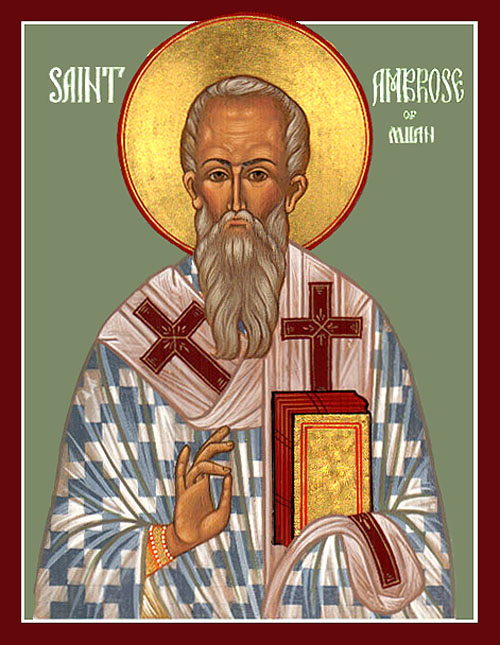
Saint Ambrose, Bishop of Milan, was born in the year 340 into the family of the Roman prefect of Gaul (now France). Even in the saint’s childhood there appeared presentiments of his great future. Once, bees covered the face of the sleeping infant. They flew in and out of his mouth, leaving honey on his tongue. Soon they flew away so high that they could no longer be seen. Ambrose’s father said that the child would become something great when he reached manhood.
After the death of the father of the family, Ambrose journeyed to Rome, where the future saint and his brother Satyrius received an excellent education. About the year 370, upon completion of his course of study, Ambrose was appointed to the position of governor (consular prefect) of the districts of Liguria and Aemilia, though he continued to live at Mediolanum (now Milan).
In the year 374 Auxentius, the Arian Bishop of Mediolanum, died. This led to complications between the Orthodox and the Arians, since each side wanted to have its own bishop. Ambrose, as the chief city official, went to the church to resolve the dispute.
While he was speaking to the crowd, suddenly a child cried out, “Ambrose for bishop!” The people took up this chant. Ambrose, who at this time was still a catechumen, considered himself unworthy, and tried to refuse. He disparaged himself, and even tried to flee from Mediolanum. The matter went ultimately before the emperor Valentinian the Elder (364-375), whose orders Ambrose dared not disobey. He accepted holy Baptism from an Orthodox priest and, passing through all the ranks of the Church clergy in just seven days, on December 7, 374 he was consecrated Bishop of Mediolanum. He dispersed all his possessions, money and property for the adornment of churches, the upkeep of orphans and the poor, and he devoted himself to a strict ascetic life.
Ambrose combined strict temperance, intense vigilance and work within the fulfilling of his duties as archpastor. Saint Ambrose, defending the unity of the Church, energetically opposed the spread of heresy. Thus, in the year 379 he traveled off to establish an Orthodox bishop at Sirmium, and in 385-386 he refused to hand over the basilica of Mediolanum to the Arians.
The preaching of Saint Ambrose in defense of Orthodoxy was deeply influential. Another noted Father of the Western Church, Saint Augustine (June 15), bore witness to this, having accepted holy Baptism in the year 387 by the grace of the preaching of the bishop of Mediolanum.
Saint Ambrose also actively participated in civil matters. Thus, the emperor Gracian (375-383), having received from him the “Exposition of the Orthodox Faith” (De Fide), removed, by decree of the saint, the altar of Victory from the halls of the Senate at Rome, on which oaths were wont to be taken. Displaying a pastoral boldness, Saint Ambrose placed a severe penance on the emperor Theodosius I (379-395) for the massacre of innocent inhabitants of Thessalonica. For him there was no difference between emperor and commoner. Though he released Theodosius from the penance, the saint would not permit the emperor to commune at the altar, but compelled him to do public penance.
The fame of Bishop Ambrose and his actions attracted to him many followers from other lands. From far away Persia learned men came to him to ask him questions and absorb his wisdom. Fritigelda (Frigitil), queen of the military Germanic tribe of the Markomanni, which often had attacked Mediolanum, asked the saint to instruct her in the Christian Faith. The saint in his letter to her persuasively stated the dogmas of the Church. And having become a believer, the queen converted her own husband to Christianity and persuaded him to conclude a treaty of peace with the Roman Empire.
The saint combined strictness with an uncommon kindliness. Granted a gift of wonderworking, he healed many from sickness. One time at Florence, while staying at the house of Decentus, he resurrected a dead boy.
The repose of Saint Ambrose, who departed to the Lord on the night of Holy Pascha, was accompanied by many miracles. He even appeared in a vision to the children being baptized that night. The saint was buried in the Ambrosian basilica in Mediolanum, beneath the altar, between the Martyrs Protasius and Gervasius (October 14).
A zealous preacher and valiant defender of the Christian Faith, Saint Ambrose received particular renown as a Church writer. In dogmatic compositions he set forth the Orthodox teaching about the Holy Trinity, the Sacraments, and Repentance: “Five Books on the Faith” (De Fide); “Explication of the Symbol of the Faith” (Explanatio Symboli); “On the Incarnation” (De Incarnationis); “Three Books on the Holy Spirit” (De Spiritu Sancto); “On the Sacraments” (De Sacramento); “Two Books on Repentance” (De Paenitentia). In writings about Christian morality, he explained the excellence of Christian moral teaching compared to pagan moral teaching.
A well-known work of Saint Ambrose, “On the Duties of the Clergy” (De Officiis Ministrorum) evidences his deep awareness of pastoral duty. He stresses that those who serve in the Church should have not only the proper knowledge of Church services, but also the proper knowledge of moral precepts.
Saint Ambrose was also a reformer of Church singing. He introduced antiphonal singing (along the Eastern or Syrian form) into the Western Church, which became known as “Ambrosian Chant.” He also composed twelve hymns which were used during his lifetime. The hymn, “Thee, O God, we praise” (Te Deum), attributed to Saint Ambrose, entered into the divine services of the Orthodox Church (Molieben).
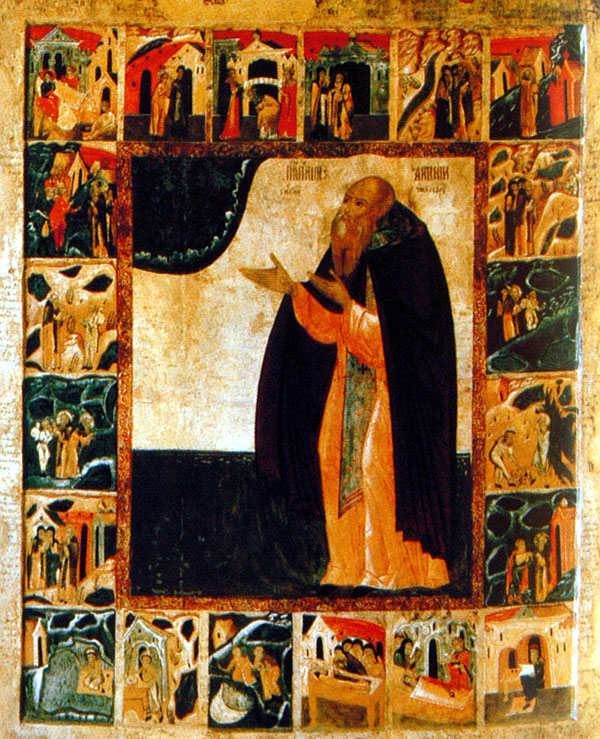
Saint Anthony of Siya, in the world Andrew, was born into a family of rich farmers in the village of Kekhta near the North Dvina river. In childhood he received a fine education, read much and learned iconography. After the death of his parents, Andrew went to Novgorod, and for five years worked for a boyar [nobleman] there. He later married, but his wife died after a year.
Then Andrew decided to devote himself to monasticism. He distributed his goods to the poor and as a wanderer came to the Pachomiev wilderness monastery at the River Kena. Saint Pachomius tonsured him with the name Anthony. Soon he was ordained a hieromonk, and Anthony, with the blessing of the igumen, celebrated the divine services by himself.
He went out with the other monks of the monastery to work for the monastery’s needs. Out of love for solitude Saint Anthony eventually left the Pachomiev wilderness, after choosing two companions from the monastic brethren, and he settled upon Mikhailov Island, on the one side washed by the River Sii, and on the other, by encircling lakes.
In this harsh frontier within the dense thickets Anthony built a chapel in 1520. But to clear the forest required difficult work, and Anthony’s companions began to grumble against him. Then quite unexpectedly an unknown man furnished them with the means of subsistence, offering money for good measure. The Siya monastery became famous, and inhabitants of surrounding villages often visited it. And again Saint Anthony, taking one disciple, withdrew to a still more remote place on Lake Palun. There, in a solitary cell, he dwelt for three years. When the igumen Theoctistus refused to guide the Siya monastery any longer, the brethren tried to persuade Saint Anthony to return to them. He finally acceded to the request of the monks, again became igumen and piously guided the monastery until his death in the year 1556, when he was seventy-nine years old.

Saint Nilus of Stolobnoye was born into a peasant family in a small village of the Novgorod diocese. In the year 1505 he was tonsured at the monastery of Saint Savva of Krypetsk (August 28) near Pskov. After ten years in ascetic life at the monastery he set out to the River Sereml, on the side of the city of Ostashkova; here for thirteen years he led a strict ascetic life in incessant struggle against the snares of the devil, who took on the appearance of reptiles and wild beasts. Many of the inhabitants of the surrounding area started coming to the monk for instruction, but this became burdensome for him and he prayed God to show him a place for deeds of quietude. Once, after long prayer he heard a voice saying, “Nilus! Go to Lake Seliger. There upon the island of Stolobnoye you can be saved!” Saint Nilus learned the location of this island from people who visited him. When he arrived there, he was astonished by its beauty.
The island, in the middle of the lake, was covered over by dense forest. Saint Nilus found a small hill and dug out a cave, and after a while he built a hut, in which he lived for twenty-six years. To his exploits of strict fasting and stillness [ie. hesychia] he added another—he never lay down to sleep, but permitted himself only a light nap, leaning on a prop set into the wall of the cell.
The pious life of the monk frequently roused the envy of the Enemy of mankind, which evidenced itself through the spiteful action of the local inhabitants. One time someone set fire to the woods on the island where stood the saint’s hut, but the flames went out in miraculous manner upon reaching the hill. Another time robbers forced their way into the hut. The monk said to them: “All my treasure is in the corner of the cell.” In this corner stood an icon of the Mother of God, but the robbers began to search there for money and became blinded. Then with tears of repentance they begged for forgiveness.
Saint Nilus performed many other miracles. He would refuse gifts if the conscience of the one offering it to him was impure, or if they were in bodily impurity.
Aware of his approaching end, Saint Nilus prepared a grave for himself. At the time of his death, an igumen from one of the nearby monasteries came to the island and communed him with the Holy Mysteries. Before the igumen’s departure, Saint Nilus prayed for the last time, censing around the holy icons and the cell, and surrendered his soul to the Lord on December 7, 1554. The translation of his holy relics (now venerated at the church of the Icon of the Mother of God “Of the Sign” in the city of Ostashkova) took place in the year 1667, with feastdays established both on the day of his death, and on May 27.
No information available at this time
The Holy Martyr Athenodorus, from Syrian Mesopotamia, led a monastic life from his youth. Denounced as a Christian, he was arrested and condemned to fierce tortures by the governor of the land, Eleusius. Miracles accompanied the martyrdom of the saint, which converted many of the pagans to the Christian Faith.
He was beheaded in the year 304.
We do not know when Saint Paul lived. There is only a short Life which says that he was the son of wealthy parents. He left secular life upon reaching maturity.
The appellation “Obedient” was bestowed upon the monk for his deep humility, and for the complete renunciation of his own will. Once, the monk stirred boiling tar with his hand, and received not the slightest burn from it. Some of the brethren regarded him as a God-bearing ascetic, but others became suspicious of him.
After fervent prayer, the monks received a unique vision proving that their brother was a true ascetic. By night they were all transported to Paradise and they conversed with Saint Paul, who permitted them to take a flower or twig with them as a remembrance. Awakening from sleep, they found in their hands the flowers and twigs from Paradise. After this Saint Paul went to Jerusalem, and then to Cyprus.
Having led a solitary life, he ended his life on Mount Paregoros [Mount Solace]. Before his death the voice of God said to him, “Ascend the mountain, Paul, and accept the end of life.”
Saint Philothea (Philofthea) of Argesh was born in Trnovo, the old capital of Bulgaria, around 1206. Her father was a farmer, and her mother was from Wallachia. She died when Philothea was still a child, and her father remarried.
The child was often punished by her stepmother, who accused her of being disobedient, and of giving their possesions away to the poor. Her father chastised her for this, but Philothea continued to attend church services and to do good to others, just as her mother had taught her. As she grew older, she was adorned with the virtues of prayer, virginity, and almsgiving.
Saint Philothea used to bring food to her father, who was out working in the fields. Not all of the food reached him, however, because the girl would give some of it to the poor children begging in the street. When he complained to his wife that she did not prepare enough food for him, she replied, “I send you plenty of food. Ask your daughter what she does with it.”
Becoming angry with Philothea, her father decided to spy on her to see what happened to the food. From a place of concealment, he saw her giving food to the poor children who came to her. In a violent rage, he took the axe from his belt and threw it at the twelve-year-old girl, hitting her in the leg. The wound was mortal, and she soon gave her pure soul into God’s hands.
The man was filled with fear and remorse, and tried to lift his daughter’s body from the ground, but it became as heavy as a rock. Then the wretch ran to the Archbishop of Trnovo to confess his sin and explain what had happened. The Archbishop and his clergy went with candles and incense to take up the martyr’s body and bring it to the cathedral, but even they were unable to lift it.
The Archbishop realized that Saint Philothea did not wish to remain in her native land, so he began to name various monasteries, churches, and cathedrals to see where she wished to go. Not until he named the Monastery of Curtea de Argesh in Romania were they able to lift her holy relics and place them in a coffin. The Archbishop wrote to the Romanian Voievode Radu Negru, asking him to accept the saint’s relics.
The Archbishop and his clergy carried the holy relics in procession as far as the Danube, where they were met by Romanian clergy, monastics, and the faithful. Then they were carried to the Curtea de Argesh Monastery.
Many people have been healed at the tomb of Saint Philothea in a small chapel in the belltower behind the monastery church, and those who entreat her intercession receive help from her. Each year on December 7 there is a festal pilgrimage to the Monastery, and people come from all over Romania. The relics of Saint Philothea are carried around the courtyard in procession, and there are prayers for the sick.
The holy Virgin Martyr Philothea is venerated in Romania, Bulgaria, and throughout the Orthodox world.
Saint Gregory of Mount Athos was born in Serbia, and pursued asceticism on Mt Athos. He built and dedicated the monastery of Saint Nicholas, which was later renamed Grigoriou in his honor.
In the records of Mt Athos the saint’s signature dating from 1405 was discovered. According to Tradition, the relics of Saint Gregory were taken from Athos by Serbian monks.

The Vladimir Icon of the Most Holy Theotokos of Seliger comes from the island of Seliger in the Tver Province of Russia.
 Saint Peter Antiochian Orthodox Church
You must be logged in to post a comment.