
Here is the live stream for Orthros and Divine Liturgy – Sun 12/18/2022 If you need, here are instructions for accessing this content from your phone, tablet, computer, or TV.
Monthly Archives: December 2022
Daily Readings for Sunday, December 18, 2022
SUNDAY BEFORE NATIVITY
ABSTAIN FROM MEAT, DAIRY, EGGS
Sunday before Nativity, Sebastian the Martyr & his Companions, Our Righteous Father Michael Syngellon the Confessor
ST. PAUL’S LETTER TO THE HEBREWS 11:9-10; 32-40
BRETHREN, by faith Abraham sojourned in the land of promise, as in a foreign land, living in tents with Isaac and Jacob, heirs with him of the same promise. For he looked forward to the city which has foundation, whose builder and maker is God.
And what more shall I say? For time would fail me to tell of Gideon, Barak, Samson, Jephthah, of David and Samuel and the prophets – who through faith conquered kingdoms, enforced justice, received promises, stopped the mouths of lions, quenched raging fire, escaped the edge of the sword, won strength out of weakness, became mighty in war, put foreign armies to flight. Women received their dead by resurrection. Some were tortured, refusing to accept release, that they might rise again to a better life. Others suffered mocking and scourging, and even chains and imprisonment. They were stoned, they were sawn in two, they were tempted, they were killed with the sword; they went about in skins of sheep and goats, destitute, afflicted, ill-treated – of whom the world was not worthy – wandering over deserts and mountains, and in dens and caves of the earth.
And all these, though well attested by their faith, did not receive what was promised, since God had foreseen something better for us, that apart from us they should not be made perfect.
MATTHEW 1:1-25
The book of the Genealogy of Jesus Christ, the son of David, the son of Abraham.
Abraham was the father of Isaac, and Isaac the father of Jacob, and Jacob the father of Judah and his brothers, and Judah the father of Perez and Zerah by Tamar, and Perez the father of Hezron, and Hezron the father of Aram, and Aram the father of Amminadab, and Amminadab the father of Nahshon, and Nahshon the father of Salmon, and Salmon the father of Boaz by Rahab, and Boaz the father of Obed by Ruth, and Obed the father of Jesse, and Jesse the father of David the king.
And David was the father of Solomon by the wife of Uriah, and Solomon the father of Rehoboam, and Rehoboam the father of Abijah, and Abijah the father of Asa, and Asa the father of Jehoshaphat, and Jehoshaphat the father of Joram, and Joram the father of Uzziah, and Uzziah the father of Jotham, and Jotham the father of Ahaz, and Ahaz the father of Hezekiah, and Hezekiah the father of Manasseh, and Manasseh the father of Amon, and Amon the father of Josiah, and Josiah the father of Jechoniah and his brothers, at the time of the deportation to Babylon.
And after the deportation to Babylon: Jechoniah was the father of Salathiel, and Salathiel the father of Zerubbabel, and Zerubbabel the father of Abiud, and Abiud the father of Eliakim, and Eliakim the father of Azor, and Azor the father of Zadok, and Zadok the father of Achim, and Achim the father of Eliud, and Eliud the father of Eleazar, and Eleazar the father of Matthan, and Matthan the father of Jacob, and Jacob the father of Joseph the husband of Mary, of whom Jesus was born, who is called Christ.
So all the generations from Abraham to David were fourteen generations, and from David to the deportation to Babylon fourteen generations, and from the deportation to Babylon to the Christ fourteen generations.
Now the birth of Jesus Christ took place in this way. When his mother Mary had been betrothed to Joseph, before they came together she was found to be with child of the Holy Spirit; and her husband Joseph, being a just man and unwilling to put her to shame, resolved to divorce her quietly. But as he considered this, behold, an angel of the Lord appeared to him in a dream, saying, "Joseph, son of David, do not fear to take Mary your wife, for that which is conceived in her is of the Holy Spirit; she will bear a son, and you shall call his name Jesus, for he will save his people from their sins." All this took place to fulfill what the Lord had spoken by the prophet: "Behold, a virgin shall conceive and bear a son, and his name shall be called Emmanuel" (which means, God with us). When Joseph woke from sleep, he did as the angel of the Lord commanded him; he took his wife, but knew her not until she had borne a son; and he called his name Jesus.
Sunday before the Nativity

Adam and Eve (the first-created), the righteous Abel, son of Adam, the righteous Seth, son of Adam, the righteous Enos,son of Seth, the righteous Kenan, son of Enos, the righteous Mehaliel (Maleleim), son of Kenan, the righteous Jared, son of Mehaliel, the righteous Enoch, son of Jared, the righteous Methuselah, son of Enoch, the righteous Lamech, son of Methuselah, the righteous Noah, son of Lamech, the righteous Shem, son of Noah, the righteous Japheth, son of Noah, the righteous Arphachshad, son of Shem, the righteous Canaan, son of Arphachshad (in some versions of the OT, Canaan is called the son of Ham), the righteous Shelah, son of Canaan (some versions of the OT call Shelah the son of Arphachshad), the righteous Eber (from whom the Hebrews take their name), son of Shelah, the righteous Peleg, son of Eber, the righteous Ragab (Reu), son of Peleg, the righteous Serug, son of Ragab, the righteous Nahor, son of Serug, the righteous Terah, son of Serug.
The holy Patriarchs: the righteous Patriarch Abraham, son of Terah, the righteous Patriarch Isaac, son of Abraham, the righteous Patriarch Jacob, son of Isaac, the righteous Patriarch Reuben, son of Jacob and Leah, the righteous Patriarch Simeon, son of Jacob and Leah, the righteous Patriarch Levi, son of Jacob and Leah, the righteous Patriarch Judah (Christ was of this tribe), the righteous Patriarch Zebulon, son of Jacob and Leah, the righteous Patriarch Issachar, son of Jacob and Leah, the righteous Patriarch Dan, son of Jacob and Bilhah (Rachel's maid), the righteous Patriarch Gad, son of Jacob and Zilpah (Leah's maid), the righteous Patriarch Asher, son of Jacob and Zilpah, the righteous Patriarch Naphthali, son of Jacob and Bilhah, the righteous Patriarch Joseph, son of Jacob and Rachel, the righteous Patriarch Benjamin, son of Jacob and Rachel.
The righteous Pharez and Zerah, twin sons of Judah, the righteous Hezron, son of Pharez, the righteous Aram, son of Hezron, the righteous Aminadab, son of Aram, the righteous Nahshon, son of Aminadab, the righteous Salmon, son of Nahshon, the righteous Boaz, son of Salmon, the righteous Obed, son of Boaz and Ruth, the righteous Jesse, son of Obed.
The holy Prophet-King David, son of Jesse, King Solomon, son of David, King Rehoboam, son of Solomon, King Abijah, son of Rehoboam, King Asa, son of Abijah, King Jehosaphat, son of Asa, King Joram (Jehoram, an evil king), son of Jehosaphat, King Ochoziah (Ahaziah), son of Joram, King Jotham, son of Uzziah (Oziah), King Ahaz (a faithless king), son of Jotham, King Hezekiah, son of Ahaz, King Manesseh, son of Hezekiah, King Amos (Ammon), son of Manesseh, King Josiah, son of Amos, King Jechoniah, son of Josiah.
Shealtiel, son of Jechoniah, Zerubbabel (who led captives back to Jerusalem, and laid the foundations of the new Temple), son of Shealtiel, Abiud, son of Zerubbabel, Eliachem, son of Abiud, Azor, son of Eliachem, Zadok, son of Azor, Achim, son of Zadok, Eliud, son of Achim, Eleazar, son of Eliud, Matthan, son of Eleazar, Jacob, son of Matthan, St Joseph the Betrothed, son of Jacob.
The righteous Melchizedek, King of Salem, the righteous Job, the holy Prophet Moses, the priests Hur and Aaron, Joshua, son of Nun.
The holy prophet Samuel, the holy prophet Nathan, the holy prophet Daniel, the three holy youths Hananiah, Mishael and Azariah.
The righteous Sarah, wife of Abraham, the righteous Rebecca, wife of Isaac, the righteous Leah, first wife of Jacob, the righteous Rachel, second wife of Jacob, the righteous Asineth, wife of Patriarch Joseph the all-comely, the righteous Miriam, sister of Moses, the righteous Deborah, Judge of Israel and prophetess, the righteous Ruth, wife of Boaz, the righteous woman of Zarephath, to whom Elias was sent (3 Kings 17), the righteous woman of Shunem, who was hospitable to Elisha (4 Kings 4), the righteous Judith, slayer of Holofernes, the righteous Esther, who delivered Israel from death, the righteous Hannah, mother of the prophet Samuel, the righteous Susanna.
Martyr Sebastian at Rome, and his companions

The Holy Martyr Sebastian was born in the city of Narbonum in Gaul (modern France), and he received his education at Mediolanum (now Milan). Under the co-reigning emperors Diocletian and Maximian (284-305) he occupied the position of head of the imperial guards. Saint Sebastian was respected for his authority, and was loved by the soldiers and those at court. He was a brave man filled with wisdom; his word was honest, his judgment just. He was insightful in advice and faithful in his service and in everything entrusted to him. He was a secret Christian, not out of fear, but so that he could provide help to the brethren in a time of persecution.
The noble Christian brothers Marcellinus and Mark had been locked up in prison, and at first they firmly confessed the true Faith. But under the influence of the tearful entreaties of their pagan parents (Tranquillinus and Marcia), and also their own wives and children, they began to waver in their intent to suffer for Christ. Saint Sebastian went to the imperial treasurer, at whose house Marcellinus and Mark were held in confinement, and addressed the brothers who were on the verge of yielding to the entreaties of their family.
“O valiant warriors of Christ! Do not cast away your everlasting crowns of victory because of the tears of your relatives. Do not remove your feet from the necks of your enemies who lie prostrate before you, lest they regain their strength and attack you more fiercely than before. Raise your banner high over every earthly attachment. If those whom you see weeping knew that there is another life where there is neither sickness nor death, where there is unceasing gladness and everything is beautiful, then assuredly they would wish to enter it with you. Anyone who fears to exchange this brief earthly life for the unending joys of the heavenly Kingdom is foolish indeed. For he who rejects eternity wastes the brief time of his existence, and will be delivered to everlasting torment in Hades.”
Then Saint Sebastian said that if necessary, he would be willing to endure torment and death in order to show them how to give their lives for Christ.
So Saint Sebastian persuaded the brothers to go through with their act of martyrdom, and his speech stirred everyone present. They saw how his face shone like that of an angel, and they saw how seven angels clothed him in a radiant garment, and heard a fair Youth say, “You shall be with Me always.”
Zoe, the wife of the jailer Nicostratus, had lost her ability to speak six years previously. She fell down at the feet of Saint Sebastian, by her gestures imploring him to heal her. The saint made the Sign of the Cross over the woman, and she immediately began to speak and she glorified the Lord Jesus Christ. She said that she had seen an angel holding an open book in which everything Saint Sebastian said was written. Then all who saw the miracle also came to believe in the Savior of the world. Nicostratus removed the chains from Marcellinus and Mark and offered to hide them, but the brothers refused.
Mark said, “Let them tear the flesh from our bodies with cruel torments. They can kill the body, but they cannot conquer the soul which contends for the Faith.” Nicostratus and his wife asked for Baptism, and Saint Sebastian advised Nicostratus to serve Christ rather than the Eparch. He also told him to assemble the prisoners so that those who believed in Christ could be baptized. Nicostratus then requested his clerk Claudius to send all the prisoners to his house. Sebastian spoke to them of Christ, and became convinced that they were all inclined to be baptized. He summoned the priest Polycarp, who prepared them for the Mystery, instructing them to fast in preparation for Baptism that evening.
Then Claudius informed Nicostratus that the Roman eparch Arestius Chromatus wanted to know why the prisoners were gathered at his house. Nicostratus told Claudius about the healing of his wife, and Claudius brought his own sick sons, Symphorian and Felix to Saint Sebastian. In the evening the priest Polycarp baptized Tranquillinus with his relatives and friends, and Nicostratus and all his family, Claudius and his sons, and also sixteen condemned prisoners. The newly-baptized numbered 64 in all.
Appearing before the eparch Chromatus, Nicostratus told him how Saint Sebastian had converted them to Christianity and healed many from sickness. The words of Nicostratus persuaded the eparch. He summoned Saint Sebastian and the presbyter Polycarp, and was enlightened by them, and became a believer in Christ. Nicostratus and Chromatus, his son Tiburtius and all his household accepted holy Baptism. The number of the newly-enlightened increased to 1400. Upon becoming a Christian, Chromatus resigned his office of eparch.
During this time the Bishop of Rome was Saint Gaius (August 11). He blessed Chromatus to go to his estates in southern Italy with the priest Polycarp. Christians unable to endure martyrdom also went with them. Father Polycarp went to strengthen the newly-converted in the Faith.
Tiburtius, the son of Chromatus, desired to accept martyrdom and he remained in Rome with Saint Sebastian. Of those remaining, Saint Gaius ordained Tranquillinus as a presbyter, and his sons Marcellinus and Mark were ordained deacons. Nicostratus, his wife Zoe and brother Castorius, and Claudius, his son Symphorian and brother Victorinus also remained in Rome. They gathered for divine services at the court of the emperor together with a secret Christian named Castulus, but soon the time came for them to suffer for the Faith.
The pagans arrested Saint Zoe first, praying at the grave of the Apostle Peter. At the trial she bravely confessed her faith in Christ. She died, hung by her hair over the foul smoke from a great fire of dung. Her body then was thrown into the River Tiber. Appearing in a vision to Saint Sebastian, she told him about her death.
The priest Tranquillinus was the next to suffer: pagans pelted him with stones at the grave of the holy Apostle Peter, and his body was also thrown into the Tiber.
Saints Nicostratus, Castorius, Claudius, Victorinus, and Symphorian were seized at the riverbank, when they were searching for the bodies of the martyrs. They were led to the eparch, and the saints refused his command to offer sacrifice to idols. They tied stones to the necks of the martyrs and then drowned them in the sea.
The false Christian Torquatus betrayed Saint Tiburtius. When the saint refused to sacrifice to the idols, the judge ordered Tiburtius to walk barefoot on red-hot coals, but the Lord preserved him. Tiburtius walked through the burning coals without feeling the heat. The torturers then beheaded Saint Tiburtius, and his body was buried by unknown Christians.
Torquatus also betrayed the holy Deacons Marcellinus and Mark, and Saint Castulus (March 26). After torture, they threw Castulus into a pit and buried him alive, but Marcellinus and Mark had their feet nailed to the same tree stump. They stood all night in prayer, and in the morning they were stabbed with spears.
Saint Sebastian was the last one to be tortured. The emperor Diocletian personally interrogated him, and seeing the determination of the holy martyr, he ordered him taken out of the city, tied to a tree and shot with arrows. Irene, the wife of Saint Castulus, went at night in order to bury Saint Sebastian, but found him alive and took him to her home.
Saint Sebastian soon recovered from his wounds. Christians urged him to leave Rome, but he refused. Coming near a pagan temple, the saint saw the emperors approaching and he publicly denounced them for their impiety. Diocletian ordered the holy martyr to be taken to the Circus Maximus to be executed. They clubbed Saint Sebastian to death, and cast his body into the sewer. The holy martyr appeared to a pious woman named Lucina in a vision, and told her to take his body and bury it in the catacombs. This she did with the help of her slaves. Today his basilica stands on the site of his tomb.
Venerable Sebastian, Abbot of Pshekhonye Monastery, Vologda
Saint Sebastian of Sokhota, Pshekhonye, founded a monastery in honor of the Transfiguration of the Lord, located at the River Sokhota, 90 versts from the city of Romanov (now Tutaev) in the Yaroslav district. The monks of the monastery themselves cultivated the soil and ate through the work of their own hands. The founder of the monastery taught the ascetics this by his own example and guidance. Saint Sebastian reposed about the year 1500.
The Transfiguration monastery on the River Sokhota was later annexed to the Cherepovets Ascension monastery, and in 1764 closed down. In the mid-nineteenth century a stone church was built over the relics of Saint Sebastian. The saint is also commemorated on February 26.
Righteous Simeon, Wonderworker of Verkhoturye

Saint Simeon of Verkhoturye was a nobleman, but he concealed his origin and led the life of a beggar. He walked through the villages and for free sewed half-coats and other clothes, primarily for the poor. While doing this he deliberately failed to sew something, either a glove, or a scarf, for which he endured abuse from his customers.
The ascetic wandered much, but most often he lived at a churchyard of the village of Merkushinsk not far from the city of Verkhoturye (on the outskirts of Perm). Saint Simeon loved nature in the Urals, and while joyfully contemplated its majestic beauty, he would raise up a thoughtful glance towards the Creator of the world. In his free time, the saint loved to go fishing in the tranquility of solitude. This reminded him of the disciples of Christ, whose work he continued, guiding the local people in the true Faith. His conversations were a seed of grace, from which gradually grew the abundant fruits of the Spirit in the Urals and in Siberia, where the saint is especially revered.
Saint Simeon of Verkhoturye died in 1642, when he was 35 years of age. He was buried in the Merkushinsk graveyard by the church of the Archangel Michael.
On September 12, 1704, with the blessing of Metropolitan Philotheus of Tobolsk, the holy relics of Saint Simeon were transferred from the church of the Archangel Michael to the Verkhoturye monastery in the name of Saint Nicholas.
Saint Simeon worked many miracles after his death. He frequently appeared to the sick in dreams and healed them, and he brought to their senses those fallen into the disease of drunkenness. A peculiarity of the saint’s appearances was that with the healing of bodily infirmities, he also gave instruction and guidance for the soul.
The memory of Saint Simeon of Verkhoturye is celebrated also on September 12, on the day of the translation of his relics (1704).
Saint Modestus, Archbishop of Jerusalem

Saint Modestus, Archbishop of Jerusalem, was born into a Christian family in Cappadocian Sebasteia (Asia Minor). From his youth he felt a strong attraction towards strict monastic life. Saint Modestus accepted monastic tonsure. Afterwards, he became head of the monastery of Saint Theodosius the Great in Palestine. At this time (the year 614), military forces of the Persian ruler Chosroes fell upon Syria and Palestine, killing ninety thousand Christians and destroying Christian churches. Patriarch Zacharias of Jerusalem and a multitude of Christians were taken into captivity, along with the Cross of the Lord. Saint Modestus was entrusted to govern the Jerusalem Church temporarily as locum tenens of the patriarchal cathedra.
With the help of Patriarch John the Merciful of Alexandria (November 12), Saint Modestus set about restoring devastated Christian shrines, among which was the Sepulchre of the Lord. He reverently buried the murdered monks from the monastery of Saint Savva the Sanctified.
After fourteen years, Patriarch Zacharias returned from captivity with the Cross of the Lord, and after his death Saint Modestus became Patriarch of Jerusalem. Saint Modestus died at age 97 in the year 634.
Saint Florus, Bishop of Amisus
Saint Florus, Bishop of Amisus, was the son of the Christians Florus and Euphemia, who provided him a fine education. He entered courtly service for the Byzantine Emperor and was elevated to the rank of patrician; he was also married and had children. After his wife and children died from smallpox, he left the world and withdrew to the outskirts of Constantinople, where he led a solitary and pious life. Later on he was chosen Bishop of Amisus (in Asia Minor). Saint Florus wisely guided his flock and died peacefully at the beginning of the seventh century.
Saint Michael the Confessor at Constantinople
Saint Michael the Confessor was born at Jerusalem into a family of zealous Christians and at an early age devoted himself to monastic life. After the death of his father, his mother and sisters went to a monastery, and Saint Michael was ordained as a priest. He was famed as a strong preacher, and therefore the Jerusalem Patriarch Thomas I took him under his wing and advanced him in the calling of “synkellos” (dealing in matters of church governance).
At this time there reigned the Iconoclast emperor Leo the Armenian (813-820). The patriarch sent Saint Michael to him, together with the holy brothers Saints Theodore (December 27) and Theophanes (October 11), with the hope that they might persuade the emperor to cease his persecution against the Orthodox. The emperor subjected Saint Michael to beatings and sent him off into exile.
Later having returned from exile, the monk again suffered for the veneration of holy icons under the emperor Theophilus (829-842). The companions of Saint Michael, Saints Theodore and Theophanes, were subjected to horrible torments: upon their faces was put red-hot brands with an inscription slandering them. They received the title “the Branded.” Again condemned, Saint Michael was sent with his disciple Job to the Pabeida monastery.
After the death of Theophilus, the empress Theodora (842-855) restored the veneration of holy icons, and ordered the return of Christians banished by the Iconoclasts. She made the offer that Saint Michael might occupy the patriarchal throne in place of the deposed iconoclast, Grammatikos. But the holy martyr declined this. Thus upon the patriarchal throne entered Saint Methodius.
Saint Michael the Confessor to the end of his days toiled in the position of “synkellos.” He died peacefully in about the year 845.
New Hieromartyr Archbishop Thaddeus of Tver

The New Hieromartyr Thaddeus (Uspensky) was the Archbishop of Tver. He was executed in 1937.
Venerable Daniel the Hesychast

Saint Daniel the Hesychast, the great wonderworker and instructor of monastics, was born in Moldavia at the beginning of the fifteenth century. He was baptized with the name Dumitru. When he was sixteen, he became a monk of the monastery of Saint Nicholas at Radauti and received the name David. His spiritual Father was Saint Leontius of Radauti (July 1). After many years of ascetical struggles, he became a chosen vessel of the Spirit and was ordained to the holy priesthood.
He lived for some years at the monastery of Saint Laurence in the Civoul de Sus district. There he fulfilled his obediences during the day, and at night he kept vigil, prayed, and wove baskets. He received the Great Schema and the new name Daniel. He obtained the igumen’s blessing to live in the wilderness in solitude, where he devoted himself to spiritual struggles. Around 1450, he lived near the Neamts Monastery by Secu creek for fourteen years. In time, people discovered where he lived and came to visit him. Longing for solitude, he moved to northern Moldavia and chiseled out a cell for himself in the face of a cliff near Putna creek. Next to it, he carved out a small chapel for prayer.
After his spiritual child Saint Stephen the Great (July 2) built the Putna Monastery, which was consecrated in 1470, Saint Daniel moved near the Voronets Monastery. Here too, he carved a small cell out of the rock under Soim (Falcon) Cliff and lived a God-pleasing life for the next twenty years. He guided many disciples in the principles of the spiritual life, and he also had the gift of healing the sick of their physical infirmities.
In 1488, when he was over eighty years old, Saint Daniel went to live at the Voronets Monastery, where he was chosen to be the igumen.
Saint Daniel was a great ascetic and wonderworker, wise and clairvoyant. People from near and far visited him seeking his spiritual advice, or to confess their sins. He died in 1496 and was buried at the Voronets Monastery, where people continue to venerate his tomb.
Saint Daniel was glorified by the Romanian Orthodox Church in 1992.
Great Vespers not streaming this evening Sat. 12/17/22
Great Vespers will not be streaming this evening due to schedules.
Daily Readings for Saturday, December 17, 2022
SATURDAY OF THE 13TH WEEK
ABSTAIN FROM MEAT, DAIRY, EGGS
Daniel the Prophet & Ananias, Azarias, & Misail, the Three Holy Youths, Dionysius of Zakynthos
ST. PAUL’S LETTER TO THE HEBREWS 11:33-40; 12:1-2
Brethren, all the saints through faith conquered kingdoms, enforced justice, received promises, stopped the mouths of lions, quenched raging fire, escaped the edge of the sword, won strength out of weakness, became mighty in war, put foreign armies to flight. Women received their dead by resurrection. Some were tortured, refusing to accept release, that they might rise again to a better life. Others suffered mocking and scourging, and even chains and imprisonment. They were stoned, they were sawn in two, they were tempted, they were killed with the sword; they went about in skins of sheep and goats, destitute, afflicted, ill-treated – of whom the world was not worthy – wandering over deserts and mountains and in dens and caves of the earth. And all these, though well attested by their faith, did not receive what was promised, since God had foreseen something better for us, that apart from us they should not be made perfect. Therefore, since we are surrounded by so great a cloud of witnesses, let us also lay aside every weight, and sin which clings so closely, and let us run with perseverance the race that is set before us, looking to Jesus the pioneer and perfecter of our faith.
LUKE 14:1-11
At that time, one sabbath when Jesus went to dine at the house of a ruler who belonged to the Pharisees, they were watching him. And behold, there was a man before him who had dropsy. And Jesus spoke to the lawyers and Pharisees, saying, "Is it lawful to heal on the sabbath, or not?" But they were silent. Then he took him and healed him, and let him go. And he said to them, "Which of you, having a son or an ox that has fallen into a well, will not immediately pull him out on a sabbath day?" And they could not reply to this. Now he told a parable to those who were invited, when he marked how they chose the places of honor, saying to them, "When you are invited by any one to a marriage feast, do not sit down in a place of honor, lest a more eminent man than you be invited by him; and he who invited you both will come and say to you, 'Give place to this man, ' and then you will begin with shame to take the lowest place. But when you are invited, go and sit in the lowest place, so that when your host comes he may say to you, 'Friend, go up higher'; then you will be honored in the presence of all who sit at table with you. For every one who exalts himself will be humbled, and he who humbles himself will be exalted.
Prophet Daniel

The Holy Prophet Daniel is the fourth of the major prophets.
In the years following 600 B.C. Jerusalem was conquered by the Babylonians, the Temple built by Solomon was destroyed, and many of the Israelite people were led away into the Babylonian Captivity. Among the captives were also the illustrious youths Daniel, Ananias, Azarias and Misael.
King Nebuchadnezzar of Babylon ordered that they be instructed in the Chaldean language and wisdom, and dressed them in finery. Handsome children of princely lineage were often chosen to serve as pages in the palace. For three years, they would be fed from food from the king’s table. After this they would be allowed to stand before his throne. Daniel was renamed Baltasar, Ananias was called Shadrach, Misael was called Mishach, and Azarias was known as Abednego. But they, cleaving to their faith, disdained the extravagance of court, refusing to defile themselves by eating from the king’s table and drinking his wine. Instead, they lived on vegetables and water.
The Lord granted them wisdom, and to Saint Daniel the gift of insight and the interpretation of dreams. The holy Prophet Daniel preserved his faith in the one God and trusted in His almighty help. He surpassed all the Chaldean astrologers and sorcerers in his wisdom, and was made a confidant to King Nebuchadnezzar.
Once, Nebuchadnezzar had a strange dream which terrified him (Daniel 2:1-6). He summoned magicians, sorcerers, and Chaldeans before him to interpret the dream. When they asked him what he had dreamt, the king refused to tell them. He said, “If you do not make known to me the dream and its interpretation, you shall be torn limb from limb, and your houses shall be laid in ruins.” The Babylonian wise men protested that no magician or sorcerer could be expected to do this. Only the gods could reveal the dream and its meaning, they told him.
The king ordered all the wise men of Babylon to be executed. When they sought Daniel and his companions to put them to death, Daniel asked that the king’s sentence not be carried out. He said that he could tell the king what he dreamt, for it had been revealed to him in a vision. Daniel was brought before the king and was able to reveal not only the content of the dream, but also its prophetic significance. After this, the king elevated Daniel to be ruler of the whole province of Babylon, and the chief of all the wise men.
During these times King Nebuchadnezzar ordered a huge statue to be made in his likeness. It was decreed that when people heard the sound of trumpets and other instruments, they should fall down and worship the golden idol. Because they refused to do this, the three holy youths Ananias, Azarias and Misael were cast into a fiery furnace. The flames shot out over the furnace forty-nine cubits, felling the Chaldeans standing about, but the holy youths walked in the midst of the flames, offering prayer and psalmody to the Lord (Daniel 3:26-90).
The Angel of the Lord appeared in the furnace and cooled the flames, and the young men remained unharmed. This “Angel of Great Counsel,” as he is called in iconography, is identified with the Son of God (Daniel 3:25, Isaiah 9:6). In the first Canon for the Nativity of the Lord (Ode 5), the Church sings: “Thou hast sent us Thine Angel of Great Counsel.” The emperor, upon seeing this, commanded them to come out, and was converted to the true God.
Under King Baltasar, Saint Daniel interpreted a mysterious inscription (“Mane, Thekel, Phares”), which had appeared on the wall of the palace during a banquet (Daniel 5:1-31), foretelling the downfall of the Babylonian kingdom. Under the Persian emperor Darius, Saint Daniel was slandered by his enemies, and was thrown into a den with hungry lions, but they did not touch him, and he was not harmed. The emperor Darius then rejoiced over Daniel and ordered people throughout his realm to worship the God of Daniel, “since He is the living and eternal God, and His Kingdom shall not be destroyed, and His dominion is forever” (Daniel 6:26).
The holy Prophet Daniel grieved deeply for his people, who then were undergoing righteous chastisement for a multitude of sins and offenses, for transgressing the laws of God, resulting in the grievous Babylonian Captivity and the destruction of Jerusalem: “My God, incline Thine ear and hearken; open Thine eyes and look upon our desolation and that of Thy city, in which Thy Name is spoken; for we do not make our supplication before Thee because of our own righteousness, but because of Thy great mercy” (Dan 9:18). Because of Daniel’s righteous life and his prayers for the people’s iniquity, the destiny of the nation of Israel and the fate of all the world was revealed to the holy prophet.
While interpreting the dream of King Nebuchadnezzar, the holy, glorious Prophet Daniel spoke of a great and final kingdom, the Kingdom of our Lord Jesus Christ (Dan 2:44). The prophetic vision about the seventy weeks (Dan 9:24-27) speaks about the signs of the First and the Second Comings of the Lord Jesus Christ, and is connected with those events (Daniel 12:1-12).
Saint Daniel interceded for his people before King Cyrus, who esteemed him highly, and who decreed freedom for the Israelite people. Daniel himself and his fellows Ananias, Azarias and Misael, all survived into old age, but died in captivity. According to the testimony of Saint Cyril of Alexandria (June 9), Saints Ananias, Azarias and Misael were beheaded on orders of the Persian emperor Chambyses.
Saint Daniel and the three holy youths are also commemorated on the Sunday of the Holy Forefathers, and on the Sunday of the Holy Fathers (Sunday before the Nativity).
The Three Holy Youths: Ananias, Azarias and Misael
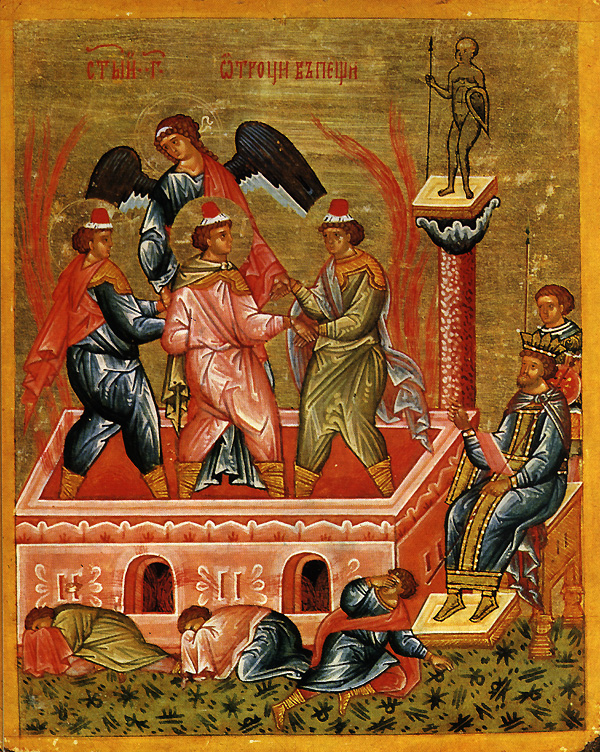
The Holy Youths Ananias (“God is gracious”), Azarias (“whom God helps”), and Misael (“Who is what God is?”) were companions of the Holy Prophet Daniel. They were chosen to serve in the king’s palace with Daniel (Daniel 1:6) and were all from the tribe of Judah. They gave Ananias the Chaldean name Shadrach (“royal”), Azarias the Chaldean name Abednego (“servant of Nego”), and Misael the Chaldean name Meshach (“guest”). They were thrown into a fiery furnace when they refused to worship the golden idol set up by King Nebuchadnezzar, but the angel of the Lord preserved them (Daniel 3:25).
The Seventh and Eighth Odes of the nine Biblical Odes at the back of the Psalter are taken from The Song of the Three Holy Youths (found in the Septuagint text of the Old Testament used by the Orthodox Church).
The Three Holy Youths and the Prophet Daniel are also commemorated on the Sunday of the Holy Forefathers and the Sunday of the Holy Fathers.
Venerable Daniel the Confessor (in Schema Stephen) of Spain, and Egypt
Saint Daniel the Confessor, (in the schema Stephen) lived in the tenth century. He was a Spanish dignitary, and prefect of the island of Niverta. Disdaining worldly glory, he became a monk in Rome and went on pilgrimage to the holy places at Constantinople and Jerusalem, where he received the Great Schema and the name Stephen. He received the crown of martyrdom after he refused the Saracens’ demand that he renounce Christ and become a Moslem.
Venerable Dionysius of Aegina

Saint Dionysius of Zakynthos, the Bishop of Aegina was born in 1547 on the island of Zakynthos. Though born into a noble family, he was determined to flee the world and set his mind upon heavenly things. He entered the monastery of Strophada, and after the prescribed time, he was clothed in the angelic schema by the abbot. Though young in years, he surpassed many of his elders in virtue, and was found worthy of ordination to the holy priesthood.
Although he protested his unworthiness, Saint Dionysius was consecrated Bishop of Aegina. In that office he never ceased to teach and admonish his flock, and many were drawn to him in order to profit from his wisdom. He feared the praise of men, lest he should fall into the sin of vainglory, so he resigned his See and returned to Zakynthos.
In 1579 the diocese of Zakynthos was widowed (when a bishop dies, his diocese is described as “widowed”), and Dionysius agreed to care for it until a new bishop could be elected. Then he fled from the worldly life which gave him no peace, and went to the Monastery of the Most Holy Theotokos Anaphonitria, twenty miles from the main village.
A certain stranger murdered the saint’s brother Constantine, an illustrious nobleman. Fearing his victim’s relatives, the stranger, by chance or by God’s will, sought refuge in the monastery where Saint Dionysius was the abbot. When the saint asked the fugitive why he was so frightened, he confessed his sin and revealed the name of the man he had murdered, asking to be protected from the family’s vengeance. Saint Dionysius wept for his only brother, as was natural. Then he comforted the murderer and hid him, showing him great compassion and love.
Soon the saint’s relatives came to the monastery with a group of armed men and told him what had happened. He pretended to know nothing about it. After weeping with them and trying to console them, he sent them off in the wrong direction. Then he told the murderer that he was the brother of the man he had killed. He admonished him as a father, and brought him to repentance. After forgiving him, Saint Dionysius brought him down to the shore and helped him to escape to another place in order to save his life. Because of the saint’s Christ-like virtue, he was granted the gift of working miracles.
Having passed his life in holiness, Saint Dionysius reached a great age, then departed to the Lord on December 17, 1624. Not only are the saint’s relics incorrupt, but he is also one of Greece’s “walking saints” (Saint Gerasimus and Saint Spyridon are the others). He is said to leave his reliquary and walk about performing miracles for those who seek his aid. In fact, the soles of his slippers wear out and must be replaced with a new pair from time to time. The old slippers are cut up, and the pieces are distributed to pilgims. On August 24, we celebrate the Transfer of his Holy Relics. Through the prayers of Saint Dionysius, may Christ our God have mercy upon us and save us.
Martyr Avakum the Deacon of Serbia

The holy New Martyr Avakum (Habakkuk) was born in Bosnia in 1794, and was named Lepoje by his parents. Lepoje’s father died when he was still a young boy, so his mother took him to the Mostanica monastery, where his uncle was the spiritual Father. He grew up in the monastery, and later became a monk with the name Avakum. When he was eighteen, he was ordained a deacon by Metropolitan Joseph (Sakabenta).
In 1809, the monks took part in an unsuccessful revolt against the Turks, and had to flee for their lives. They settled in the Annunciation monastery in Trnava near Cacak, where the igumen was Saint Paisius.
After the collapse of Karageorge’s revolt in 1813, the Turks began a reign of terror against the Serbs. Disease also swept the area because of the many bodies left unburied. The people attempted another revolt under Hadj-Prodan Gligorijevic, and the monks of Trnava became involved in it. The rebellion took place on the Feast of the Cross (September 14), but it was crushed by the Turks. Many people were captured, and some were executed on the spot as a warning to others.
Some of the prisoners were sent to Suleiman Pasha in Belgrade, among whom were Saints Paisius and Avakum. The holy deacon Avakum sang “God is with us” (from Compline) in the prison cell, while Saint Paisius prayed. The Turks offered to free anyone who would convert to Islam. Some of the prisoners agreed to this, but the majority refused to deny Christ, and so they were put to death.
The Turks tried to pressure Avakum to save himself by embracing their religion, but he refused even to consider it. His former spiritual Father, Gennadius, accepted the offer of the Turks and urged Avakum to follow his example. The courageous deacon declared that he was a warrior of Christ, and preferred to die rather than deny Christ.
Saint Avakum was sentenced to be impaled on a stake, which he was forced to carry to the place of execution. His own mother urged him to embrace Islam, then to seek forgiveness later because he had been forced into it. The saint thanked her for giving him life, but not for her advice.
At the place of execution, the Turks asked him one more time to consider his youth and not to die before his time. Avakum laughed and asked, “Don’t even Turks eventually die?”
They replied, “Of course they do.”
“Well then,” he said, “the sooner I die, the fewer sins I will have.”
Because of his courage and steadfastness in his faith, the Turks decided not to impale him. They killed him quickly by stabbing him in the heart with a sword on January 27, 1815.
Saint Avakum the deacon is commemorated on December 17 with Saint Paisius.
Saint Paisius
The holy New Martyr Paisius was igumen of the Annunciation monastery in Trnava near Cacak, Serbia. After the collapse of Karageorge’s revolt in 1813, the Turks began a reign of terror against the Serbs. Disease also swept the area because of the many bodies left unburied. The people attempted another revolt under Hadj-Prodan Gligorijevic, and the monks of Trnava became involved in it. The rebellion took place on the Feast of the Cross (September 14), but it was crushed by the Turks. Many people were captured, and some were executed on the spot as a warning to others.
Some of the prisoners were sent to Suleiman Pasha in Belgrade, among whom were Saints Paisius and Avakum. The holy deacon Avakum sang “God is with us” (from Compline) in the prison cell, while Saint Paisius prayed. The Turks offered to free anyone who would convert to Islam. Some of the prisoners agreed to this, but the majority refused to deny Christ, and so they were put to death.
Saint Paisius was taken from prison and forced to carry a stake to the place of execution. He was impaled, and the stake was set into the ground. The holy martyr exclaimed, “Glory to God.” Then the vizier clapped his hands to signal his soldiers to draw their swords and begin killing some of the other prisoners. Forty-eight people were killed, and their bodies were raised up on posts. After suffering for some time, Saint Paisius surrendered his soul to God, thereby obtaining the crown of martyrdom on December 17, 1814.
Daily Readings for Friday, December 16, 2022
FRIDAY OF THE 13TH WEEK
ABSTAIN FROM MEAT, FISH, DAIRY, EGGS, WINE, OLIVE OIL
The Holy Prophet Aggaeus (Haggai), Modestos, Archbishop of Jerusalem, Our Righeous Mother Blessed Empress Theophania, Nicholas Chrysoberges, Patriarch of Constantinople, Memnonus, Archbishop of Ephesus
ST. PAUL’S SECOND LETTER TO TIMOTHY 1:1-2; 8-18
Paul, an apostle of Christ Jesus by the will of God according to the promise of life which is in Christ Jesus,
To Timothy, my beloved child:
Grace, mercy, and peace from God the Father and Christ Jesus our Lord.
Do not be ashamed then of testifying to our Lord, nor of me his prisoner, but share in suffering for the gospel in the power of God, who saved us and called us with a holy calling, not in virtue of our works but in virtue of his own purpose and the grace which he gave us in Christ Jesus ages ago, and now has manifested through the appearing of our Savior Christ Jesus, who abolished death and brought life and immortality to light through the gospel. For this gospel I was appointed a preacher and apostle and teacher, and therefore I suffer as I do. But I am not ashamed, for I know whom I have believed, and I am sure that he is able to guard until that Day what has been entrusted to me. Follow the pattern of the sound words which you have heard from me, in the faith and love which are in Christ Jesus; guard the truth that has been entrusted to you by the Holy Spirit who dwells within us.
You are aware that all who are in Asia turned away from me, and among them Phygelos and Hermogenes. May the Lord grant mercy to the household of Onesiphoros, for he often refreshed me; he was not ashamed of my chains, but when he arrived in Rome he searched for me eagerly and found me – may the Lord grant him to find mercy from the Lord on that Day – and you well know all the service he rendered at Ephesos.
MARK 9:33-41
At that time, Jesus and his disciples came to Capernaum, and when he was in the house he asked them, “What were you discussing on the way?” But they were silent; for on the way they had discussed with one another who was the greatest. And he sat down and called the twelve; and he said to them, “If any one would be first, he must be last of all and servant of all.” And he took a child, and put him in the midst of them; and taking him in his arms, he said to them, “Whoever receives one such child in my name receives me; and whoever receives me, receives not me but him who sent me.” John said to him, “Teacher, we saw a man casting out demons in your name, and we forbade him, because he was not following us.” But Jesus said, “Do not forbid him; for no one who does a mighty work in my name will be able soon after to speak evil of me. For he that is not against us is for us. For truly, I say to you, whoever gives you a cup of water to drink because you bear the name of Christ, will by no means lose his reward.”
Prophet Haggai
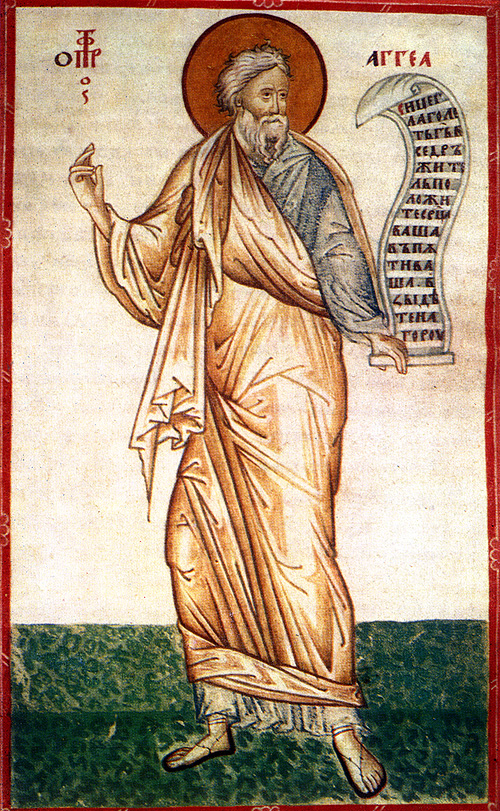
The Holy Prophet Haggai was the tenth of the Twelve Minor Prophets. He was of the Tribe of Levi and he prophesied during the times of the Persian emperor Darius Hystaspis (prior to 500 B.C.). Upon the return of the Jews from the Babylonian Captivity, he persuaded the people to build the Second Temple at Jerusalem, and he proclaimed that the Messiah would appear in this Temple in the last times.
It is believed that Haggai was buried with the priests at Jerusalem, since he was descended from Aaron.
Martyr Marinus of Rome

The Martyr Marinus was a soldier who suffered in Caesarea of Palestine in the third century. When he was about to be promoted to centurion, he refused to swear the customary oath invoking the pagan gods, or to offer sacrifice to idols. Saint Marinus was beheaded after cruel tortures, and buried by Saint Asterius (August 7).
Saint Theophanó the Wonderworker, wife of Emperor Leo the Wise

Saint Theophanó was a pious and virtuous Empress, who was greatly praised by the chroniclers of her time because of her evangelical life, her almsgiving, and her exceptional piety. She born in Constantinople, the daughter of Constantine Martinakios and his wife Anna, who raised their daughter with diligence. When she was of a marriageable age, Emperor Basil the Macedonian chose her to be the wife of his son Leo the Wise (886 – 912), with whom she dwelt in marital fidelity for twelve years.
The Holy Empress Theophanó and her husband Leo were imprisoned for three years, because Leo was falsely accused of plotting to assassinate his father, Emperor Basil. After obtaining her freedom,Theophanó spent her life in prayer and fasting, earnestly struggling for her salvation. She was recognized as a Saint and a wonderworker, even during her lifetime, because of the many good works which she performed out of love for her neighbor.
Though she lived in the world, she renounced everything worldly, and became a benefactor of the poor. She also built churches and monasteries, or restored those in need of repair. She was a true mother to her subjects, caring for widows and orphans, and consoling the sorrowful.
Despite all the grandeur and wealth surrounding her, she preserved her customary humility and modesty. She preferred to dress in simple clothing so that she would not recognized. Accompanied by two trusted servants, she would visit the homes of the poor and the persecuted, offering her assistance. Her faith was such that she was found worthy of the gift of performing miracles. When medical science gave up on a patient because it could not heal him, Saint Theophanó restored him to health. In spite of all the bitterness she had experienced in her life, Saint Theophanó could still sing praises to the Lord, according to the words of the Prophet King David: "Sing praises to the Lord, sing praises; sing praises to our King, sing praises" (Psalm 46/47:6).
Saint Theophanó reposed circa 893-894. Even before her death, her husband started to build a church, intending to dedicate it to Theophanó, but she forbade him to do so. It was Emperor Leo who decreed that the Sunday after Pentecost be dedicated to All Saints. Believing his wife to be one of the righteous, he knew that she would also be honored whenever the Feast of All Saints was celebrated.
The incorrupt relics of Saint Theophanó are preserved in the Patriarchal Church of Saint George, at the Phanar in Constantinople. A particle from her relics is in Dionysiou Monastery on Mount Athos.
Venerable Sophia of Suzdal, the Wonderworker
Saint Sophia (in the world Great Princess Solomonia Yurievna) was born around 1490, the daughter of the noble Yuri Saburov. Her mother died when she was young, and she was raised by her aunt Eudokia (her father's sister). In the year 1505 she was chosen as the bride of the heir to the throne, the future Great Prince Basil III. She was selected from among 500 girls from all over the country, who were presented at court for this purpose.
The wedding of Prince Basil and Solomonia took place on September 4, 1505, in the presence of the groom's father, Ivan III. Metropolitan Simon blessed the couple at the Dormition Cathedral in the Moscow Kremlin. When she married Basil, her father was raised to the rank of boyar. For the first time in Moscow's history, a Great Prince took neither a foreign princess nor a Russian princess as his wife, but a bride who came from a boyar family.
After twenty years, it became apparent that Solomonia was unable to conceive a child. Basil understood perfectly that if he died childless his brothers would inherit the throne. In order to preclude that possibility, they were imprisoned or forbidden to marry until his own son was born. In the end, this led to the extinction of the Rurikid dynasty, and to the succession crisis known as the Time of Troubles.
Despite her radiant beauty, exemplary morals, and mild character, Solomonia's failure to produce an heir must have weighed upon Basil's relations with his wife, who turned to foreign doctors for help. In 1525, the Great Prince decided to divorce Solomonia, with the approval of Metropolitan Daniel and the boyars, although other Church authorities declared the divorce was unlawful.
In order to obtain an heir, Great Prince Basil decided to marry Elena Glinska, the daughter of the Lithuanian prince Basil Glinsky. This action of the Great Prince Basil was condemned by all the Patriarchs, and Patriarch Mark of Jerusalem even predicted that of this second marriage a "cruel child" would be born, who would fill Russia with blood and horrors. Ivan the Terrible was born in 1530, and Basil's second son, Yuri, was feeble-minded. All the best Russian people of that time stood up for the blameless and miserable Great Princess: i.e. Metropolitan Barlaam, Saint Maximos the Greek (January 21) and others. But all their protests were in vain. For the first time in Russian history, a Great Prince removed a Metropolitan from office and imprisoned him in a monastery. Saint Maximos was not allowed to serve, and others were persecuted as well. Prince Andrew Kurbsky called Princess Solomonia "innocent and holy."
On November 25, 1525 Basil ordered Solomonia to become a nun. Forcibly tonsured with the name Sophia, she was sent under guard to the Nativity Monastery in Moscow. Later, she was moved to the Protection Monastery in Suzdal, one of the many churches established by Basil and his wife, where prayers were offered for the birth of an heir.
Through her ascetical struggles, Saint Sophia banished all worldly thoughts from her heart, and dedicated herself entirely to God. She reposed on December 18, 1542, after living as a nun for seventeen years.
Rumors concerning Sophia's holiness quickly spread throughout Russia. In a letter to Tsar Ivan, Prince Andrew Kurbsky calls the Right-believing Princess “a Monastic Martyr.” In a manuscript of the Lives of the Saints she is called “Holy Venerable Princess Sophia the Nun, the Wonderworker, who dwelt in the Protection Monastery.” In the reign of Tsar Theodore (the son of Ivan the Terrible) she was revered as a Saint. Tsaritsa Irene sent to Suzdal, “to the Great Princess Solomonia, also called Sophia, a velvet veil depicting the Savior and other Saints.” Patriarch Joseph wrote to Archbishop Serapion of Suzdal instructing him to have Panikhidas and Molebens served for the Nun Sophia.
The sacristan Ananias of Suzdal speaks of several miraculous cures at her grave. In 1609, during an invasion by the Poles, she saved Suzdal from destruction, appearing in a frightful form to the Polish military commander Lisovsky. Paralyzed with fear, he swore to spare the city and monastery. In 1610 a peasant woman named Theodosia was healed after being afflicted with blindness for a year and a half. In 1646 a girl, Irene Popova, was healed after being paralyzed for several years. That same summer a woman named Juliana was cured of amnesia. The Nun Theodora was healed in 1647 after being blind for two and a half months. That same year Julitta Ivanova, a resident of the village of Kideksha, was healed after being deaf for two years. Febronia of Suzdal was healed of paralysis in 1648 after several years. In 1649 the Nun Alexandra (Trusov) of the Protection Monastery was healed after losing her sight. Many other miracles took place, and continue to take place, through the intercession of Saint Sophia.
In 1650, Patriarch Joseph told the Archbishop of Suzdal to permit her local veneration as a Saint. In the middle of the XVIII century, the question of her canonization arose. Her icon, painted in the XVII century, has survived to this day and is considered a wonderworking icon. Finally, with the blessing of the Holy Synod, her name was included in the Orthodox Church Calendar in 1916. In 2007, her Church-wide veneration took place, and her Service was included in the Menaion.
Saint Sophia's tomb in the Protection Monastery was highly revered. On August 14, 1995, the solemn uncovering of her relics took place. On that day, a Moleben was served at her tomb. With the blessing of Metropolitan Eulogios, the Church Archaeological Commission made excavations, and the Saint's relics were found and transferred to the Protection Cathedral.
Saint Sophia is also commemorated on June 23, the Synaxis of the Saints of Vladimir.
Daily Readings for Thursday, December 15, 2022
ELEUTHERIOS THE HIEROMARTYR, BISHOP OF ILLYRICUM, AND HIS MOTHER ANTHIA
ABSTAIN FROM MEAT, FISH, DAIRY, EGGS
Eleutherios the Hieromartyr, Bishop of Illyricum, and his mother Anthia, The Martyr Susannah the Deaconess
ST. PAUL’S SECOND LETTER TO TIMOTHY 1:8-18
TIMOTHY, my son, do not be ashamed then of testifying to our Lord, nor of me his prisoner, but share in suffering for the gospel in the power of God, who saved us and called us with a holy calling, not in virtue of our works but in virtue of his own purpose and the grace which he gave us in Christ Jesus ages ago, and now has manifested through the appearing of our Savior Christ Jesus, who abolished death and brought life and immortality to light through the gospel. For this gospel I was appointed a preacher and apostle and teacher, and therefore I suffer as I do. But I am not ashamed, for I know whom I have believed, and I am sure that he is able to guard until that Day what has been entrusted to me. Follow the pattern of the sound words which you have heard from me, in the faith and love which are in Christ Jesus; guard the truth that has been entrusted to you by the Holy Spirit who dwells within us.You are aware that all who are in Asia turned away from me, and among them Phygelos and Hermogenes. May the Lord grant mercy to the household of Onesiphoros, for he often refreshed me; he was not ashamed of my chains, but when he arrived in Rome he searched for me eagerly and found me – may the Lord grant him to find mercy from the Lord on that Day and you well know all the service he rendered at Ephesos.
MARK 2:23-28; 3:1-5
At that time, Jesus was going through the grainfields; and as they made their way his disciples began to pluck heads of grain. And the Pharisees said to him, "Look, why are they doing what is not lawful on the sabbath?" And he said to them, "Have you never read what David did, when he was in need and was hungry, he and those who were with him: how he entered the house of God, when Abiathar was high priest, and ate the bread of the Presence, which it is not lawful for any but the priests to eat, and also gave it to those who were with him?" And he said to them, "The sabbath was made for man, not man for the sabbath; so the Son of man is lord even of the sabbath.
Again he entered the synagogue, and a man was there who had a withered hand. And they watched him, to see whether he would heal him on the sabbath, so that they might accuse him. And he said to the man who had the withered hand, "Come here." And he said to them, "Is it lawful on the sabbath to do good or to do harm, to save life or to kill?" But they were silent. And he looked around at them with anger, grieved at their hardness of heart, and said to the man, "Stretch it out, " and his hand was restored.
Hieromartyr Eleutherius, Bishop of Illyria, his mother, Martyr Evanthia, and Caribus the Eparch

Saint Eleutherius, the son of an illustrious Roman citizen, was raised in Christian piety by his mother. His virtue was such that at the age twenty, he had been elevated to bishop of Illyria. In the reign of the emperor Hadrian, Saint Eleutherius was tortured for his bold preaching about Christ, then was beheaded at Rome with his mother Evanthia. The Eparch Caribus, who had tortured Saint Eleutherius, also came to believe in Christ and was executed.
Venerable Paul of Latros
Saint Paul of Latros was a native of the city of Aelen in Pergamum. Early bereft of his father, he was educated at the monastery of Saint Stephen in Phrygia. After the death of his mother, he devoted himself completely to monastic deeds at a monastery on Mount Latra, near Miletos.
Seeking even loftier accomplishments, he secluded himself in a cave. For his ascetic deeds he gained the gifts of clairvoyance and wonderworking. The emperor Constantine VII Porphyrogenitos (912-959) often wrote to him, asking his prayers and counsel. Saint Paul twice withdrew to the island of Samos, where he established a monastery and restored three monasteries ravaged by the Hagarenes (Arabs). Foretelling his end, the monk reposed in the year 955.
Saint Stephen the Confessor, Archbishop of Sourozh, Crimea
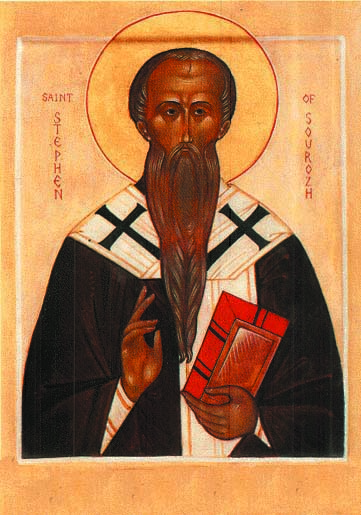
Saint Stephen the Confessor, Archbishop of Surrentium (Sourozh), was a native of Cappadocia and was educated at Constantinople. After receiving the monastic tonsure, he withdrew into the wilderness, where he lived for thirty years in ascetic deeds.
Patriarch Germanus of Constantinople (May 12) heard of Stephen’s humility and virtuous life, and wished to meet him. He was so impressed with Stephen that he consecrated him bishop of the city of Surrentium (presently the city of Sudak in the Crimea). Within five years, Saint Stephen’s ministry was so fruitful that no heretics or unbaptized pagans remained in Surrentium or its environs.
Saint Stephen opposed the iconoclasm of the emperor Leo III the Isaurian (716-741). Since he refused to obey the orders of the emperor and the dishonorable Patriarch Anastasius to remove the holy icons from the churches, he was brought to Constantinople. There he was thrown into prison and tortured. He was released after the death of the emperor. Already quite advanced in years, he returned to his flock in Surrentium, where he died.
There is an account of how the Russian prince Bravlin accepted Baptism at the beginning of the ninth century during a campaign into the Crimea, influenced by miracles at the saint’s crypt.
Venerable Tryphon, Abbot of Pechenga
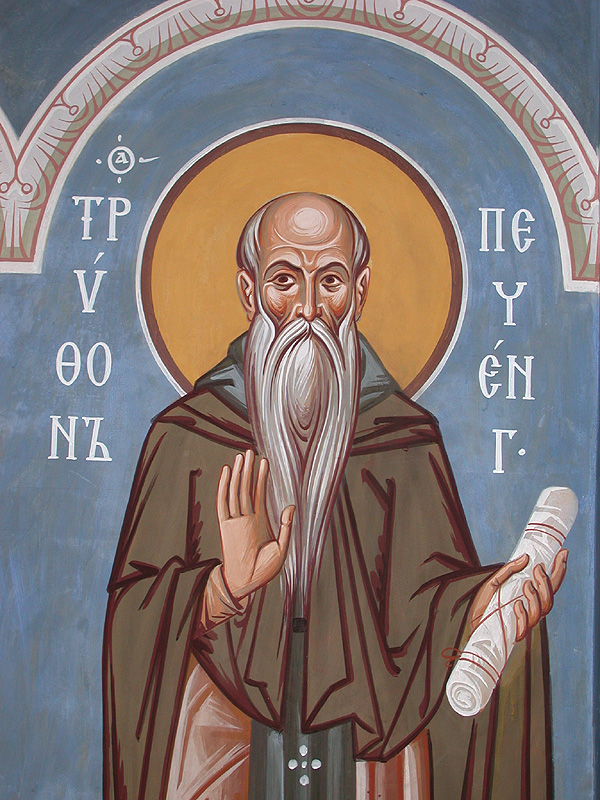
Saint Tryphon of Pechenga and Kola (Mētrophánēs in the world), was born in the Novgorod governia into a priestly family. The pious parents raised their son in the fear of God. From his early years Tryphon had resolved to devote his life to apostolic deeds and to go to the pagan Laplanders to proclaim the Gospel of Christ. He had heard of them only through the accounts of fish vendors.
Once, while praying in the forest he had heard a voice, “Tryphon, this is not your place. An inhospitable and thirsting land awaits you.” Forsaking his parental home, the Saint went out to the Kola Peninsula and halted on the banks of the Pechenga River, where the Lapps lived. There he began to trade with them. First the Saint acquainted himself with the pagan beliefs of those people and studied their language, and then he began to preach the Christian Faith to them. The Lapps listened to his words with great mistrust. He suffered many hardships, enduring hostility and even beatings. But gradually, through his wise and kindly words and meekness, many were converted to Christ.
With the blessing of Archbishop Makarios of Novogord, Saint Tryphon and Saint Theodóretos (August 17)
built a church for the new converts. In 1532 he founded the Pechenga-Trinity Monastery for those who were zealous for the monastic life, “on the cold sea, on the frontier of Murmansk.”
Tsar Ivan the Terrible helped him and richly endowed the Monastery. The Enlightener of the Lapps went to the Lord in 1583 at the age of 98, after living in Lapland for almost 70 years. Local veneration of Saint Tryphon began soon after his death.
In 1589, the Swedes destroyed the Pechenga monastery. Later, by order of Tsar Theodore, the Monastery was transferred to the Kola Peninsula. On the site of the restored Monastery a church was built and named for Saint Tryphon.
The Swedes destroyed Pechenga Monastery in 1589, but the Saint's burial place under the altar was not forgotten. In 1708-1709 the Sretensky church was built here, around which the Monastery was revived in 1886. The church was destroyed again in 1944, but after the restoration of the Monastery in 2009-2012 a new church was built over the Saint's relics.
Those who invoke Saint Tryphon with faith have received his miraculous help. Even during his lifetime he rescued shipwrecked sailors, calmed storms at sea, and healed those who suffered from deafness, blindness, and paralysis.
Martyr Jonah, disciple of Tryphon of Pechenga
Saint Jonah of Pechenga and Kola was, as tradition tells us, a priest in the city of Kola. After the death of his daughter and wife he went off to the Pechenga-Trinity monastery near Kola, and became a disciple of its founder, Saint Tryphon. After the death of his teacher, he settled in 1583 at the site of what was to become his grave in the neighboring Dormition wilderness, where he was killed by the Swedes in the year 1590.
Martyr Eleutherius at Constantinople

The Holy Martyr Eleutherius Cubicularius was an illustrious and rich chamberlain [“cubicularius”] at the Byzantine court. With all his courtly privileges, Eleutherius was not beguiled by worldly possessions and honors. Instead, he thought of imperishable and eternal things. Having accepted holy Baptism, he began daily to glorify God with psalmody and to adorn his life with virtuous deeds.
But one of his servants through diabolic promptings, informed against his master to the [then still pagan] emperor. The emperor tried to turn Eleutherius from his faith in Christ, but after the unsuccessful attempts the emperor gave orders to behead him, and to throw his body to be eaten by dogs and vultures. A certain Christian priest took up the saint’s body and buried it.
There is a second commemoration of the martyr on August 4.
Venerable Pardus the Hermit, of Palestine
Saint Pardus the Hermit, a Roman, was involved in his youth with the teamster’s craft. Once, when he traveled to Jericho, a boy accidentally fell under the legs of his camels. The camels trampled the boy to death. Shaken by this occurrence, Pardus became a monk and withdrew to Mount Arion.
Thinking himself as a murderer, and deserving of death, Saint Pardus entered the den of a lion. He poked the wild beast and prodded it with a spear so that the lion would tear him apart, but the creature would not touch the hermit. Saint Pardus then took off his clothes and lay down upon the path that the lion would take for water. But even here, the lion merely leaped over the hermit. And the Elder then understood that he had been forgiven by the Lord. Returning to his mountain, Saint Pardus dwelt there in fasting and prayer until the end of his days. He died in the sixth century.
Hieromartyr Hilarion, Archbishop of Verey

The holy New Martyr Archbishop Hilarion (Vladimir Alexievich Troitsky in the world), an outstanding theologian, an eloquent preacher, and a fearless defender of Christ’s holy Church, was born around 1885.
Vladika Hilarion wrote many books and articles on various topics, including “The Unity of the Church.” His Master’s thesis, “An Outline of the History of the Church’s Dogma,” was over five hundred pages long, and was a well-documented analysis of the subject.
During the Council of 1917 he delivered a brilliant address calling for the restoration of the Moscow Patriarchate, which had been dissolved by Tsar Peter I in the eighteenth century. When Saint Tikhon (April 7) was chosen as Patriarch, Saint Hilarion became his fervent supporter.
Saint Hilarion was consecrated as bishop on May 20, 1920, and so the great luminary was placed upon the lampstand (Luke 11:33). From that time, he was to know less than two years of freedom. He spent only six months working with Patriarch Tikhon.
Vladika was arrested and exiled in Archangelsk for a year, then he spent six years (1923-1929) in a labor camp seven versts from Solovki. There at the Filomonov Wharf he and at least two other bishops were employed in catching fish and mending nets. Paraphrasing the hymns of Pentecost, Archbishop Hilarion remarked, “Formerly, the fishermen became theologians. Now the theologians have become fishermen.”
Archbishop Hilarion was one of the most popular inmates of the labor camp. He is remembered as tall, robust, and with brownish hair. Personal possessions meant nothing to him, so he always gave his things away to anyone who asked for them. He never showed annoyance when people disturbed him or insulted him, but remained cheerful.
In the summer of 1925, Vladika was taken from the camp and placed in the Yaroslav prison. There he was treated more leniently, and received certain privileges. For example, he was allowed to receive religious books, and he had pleasant conversations with the warden in his office. Saint Hilarion regarded his time at the Yaroslav Isolated Detention Center as the best part of his imprisonment. The following spring he was back at Solovki.
In 1929 the Communists decided to exile Archbishop Hilarion to Alma-Atu in central Asia. During his trip southward from the far north, Saint Hilarion was robbed and endured many privations. When he arrived in Petrograd, he was ill with typhus, infested with parasites and dressed in rags. When informed that he would have to be shaved, he replied, “You may now do with me whatever you wish.” He wrote from the prison hospital, “My fate will be decided on Saturday, December 15. I doubt I will survive.”
Saint Hilarion died at the age of forty-four in the hospital of a Petrograd prison on December 15, 1929. His body was placed in a coffin hastily made from some boards, and then was released to his family. The once tall and robust Archbishop Hilarion had been transformed by his sufferings into a pitiful white-haired old man. One female relative fainted when she saw the body.
Metropolitan Seraphim (Chichagov) provided a set of white vestments for the late Archbishop. He was also placed in a better coffin.
Metropolitan Seraphim presided at the funeral of Saint Hilarion, assisted by six bishops and several priests. The saint was buried at Novodevichii Monastery.
Saint Hilarion is commemorated on December 15 (his repose in 1929); May 10 (his glorification in 1999); the Third Sunday after Pentecost (All Saints of St. Petersburg); July 11 (The Finding of his relics in 1998); and on the Sunday nearest to August 26 (All Saints of Moscow).
Saint Nectarius of Bitel
Saint Nectarius of Bitel was born in the small town of Bitel (or Butili) in Bulgaria. In the world he was named Nicholas. Before a Turkish invasion his mother had a vision: the Most Holy Virgin Herself appeared and told her to flee and go into hiding with her husband and children. Nicholas’s father, having taken the boy with him, withdrew to a monastery dedicated to the Holy Unmercenaries (Saints Cosmas and Damian), not far from Bitel, where he became a monk with the name Pachomius.
Nicholas, having reached adolescence, went on to Athos. The clairvoyant Elder Philotheus accepted him and tonsured him into the angelic schema with the name Nectarius. The monk suffered for a long time from the envy and spite of one of the novices, but he displayed complete humility. He was distinguished for his charity. Any money he obtained from his handicraft was distributed to the poor. Saint Nectarius died in the year 1500.
Paraklesis Service will not be streaming this evening
The Paraklesis Service will not be streaming this evening due to internet service being down.
Daily Readings for Wednesday, December 14, 2022
WEDNESDAY OF THE 13TH WEEK
ABSTAIN FROM MEAT, FISH, DAIRY, EGGS, WINE, OLIVE OIL
Martyrs Thyrsus, Leucius, and Callinicus of Asia Minor, and Philemon, Apollonius, and Arian of Alexandria
ST. PAUL’S FIRST LETTER TO TIMOTHY 5:22-25; 6:1-11
Timothy, my son, do not be hasty in the laying on of hands, nor participate in another man’s sins; keep yourself pure. No longer drink only water, but use a little wine for the sake of your stomach and your frequent ailments. The sins of some men are conspicuous, pointing to judgment, but the sins of others appear later. So also good deeds are conspicuous; and even when they are not, they cannot remain hidden. Let all who are under the yoke of slavery regard their masters as worthy of all honor, so that the name of God and the teaching may not be defamed. Those who have believing masters must not be disrespectful on the ground that they are brethren; rather they must serve all the better since those who benefit by their service are believers and beloved. Teach and urge these duties. If any one teaches otherwise and does not agree with the sound words of our Lord Jesus Christ and the teaching which accords with godliness, he is puffed up with conceit, he knows nothing; he has a morbid craving for controversy and for disputes about words, which produce envy, dissension, slander, base suspicions, and wrangling among men who are depraved in mind and bereft of the truth, imagining that godliness is a means of gain. There is great gain in godliness with contentment; for we brought nothing into the world, and we cannot take anything out of the world; but if we have food and clothing, with these we shall be content. But those who desire to be rich fall into temptation, into a snare, into many senseless and hurtful desires that plunge men into ruin and destruction. For the love of money is the root of all evils; it is through this craving that some have wandered away from the faith and pierced their hearts with many pangs. But as for you, man of God, shun all this.
MARK 8:30-34
At that time, Jesus charged his disciples to tell no one about him, that he is the Christ. And he began to teach them that the Son of man must suffer many things, and be rejected by the elders and the chief priests and the scribes, and be killed, and after three days rise again. And he said this plainly. And Peter took him, and began to rebuke him. But turning and seeing his disciples, he rebuked Peter, and said, “Get behind me, Satan! For you are not on the side of God, but of men.” And he called to him the multitude with his disciples, and said to them, “If any man would come after me, let him deny himself and take up his cross and follow me.”
Martyrs Thyrsos, Leukios, and Kallinikos

The Holy Martyrs Thyrsos, Leukios, and Kallinikos, suffered for Christ under Emperor Decius (249-251) at Caesarea in Bithynίa. When Saint Leukios reproached the prefect Cumbricius for his unjust persecution of Christians, he was tortured and then executed.
Saint Thyrsos, who was still a catechumen, was nonetheless eager for martyrdom. He was sentenced to cruel tortures after refusing to offer sacrifice to the idols. Citing the words of the Prophet Jeremiah (2:27), he ridiculed those who worshiped idols made of wood and stone.
The Saint’s arms and legs were pulled out of their sockets, his eyes were plucked out, and his teeth were smashed with a hammer. He was taken to a heathen temple, where, by his prayers, he toppled a statue of Apollo. Cumbricius was outraged by this, and he ordered even greater torments be devised for the athlete of Christ. Saint Thyrsos endured them all, then died after making the Sign of the Cross. The pagan priest Kallinikos, after witnessing the bravery of Saint Thyrsos and the miracle he performed, believed in Christ and boldly confessed the true Faith, for which he was beheaded.
Martyrs Philḗmon, Apollonios, Arrian, and Theonas of Alexandria

These Saints lived during the reign of Emperor Diocletian (ca. 290). Arrian, the ruler of Thebes in Egypt, arrested 37 Christians, including Saints Askalon and Leonidas (May 20). Arrian gave them the choice of sacrificing to the idols, or being tortured and executed. Most preferred to die rather than deny Christ. One of them, the Reader Apollonios, was afraid of being tortured, so his gave his clothes and four gold coins to a pagan musician named Philḗmon to offer sacrifice to the idols in his place. Philḗmon wore Apolonnios' clothes and covered his face. As he approached the altar, his heart was illumined with divine grace, and the eyes of his mind were opened. He made the Sign of the Cross and confessed Christ.
The ruler asked what this meant, and Philḗmon cried aloud, "I am a Christian, and the servant of Christ."
Then Arrian sent for Philḗmon to come and play his flute, in order to calm "Apollonios" so that he would be more inclined to worship idols. Arrian's servants could not find Philḗmon, so instead they brought his brother Theonas. Recognizing his disguised brother, Theonas laughed and said, "Philḗmon stands before you."
Arrian ordered Philḗmon's face to be uncovered, then told him to take off Apollonios' garments and to offer sacrifice with him. Instead, Philḗmon ridiculed the pagan "gods." He said that he had truly become a Christian, although he had not been baptized. Philḗmon prayed fervently, and suddenly a heavy rain fell, which was a Baptism for him.
Since it was Apollonios who caused Philḗmon to believe, Arrian brought him before him as well, and this time he confessed Christ. As a result, Arrian tortured them cruelly, and then beheaded them.
Immediately, Arrian was stricken with blindness. Saint Philḗmon appeared to him in a dream and told him to smear some dirt from his grave on his eyes, and he would be cured. That is exactly what happened. Then Arrian and his four bodyguards believed in Christ, and later they were all martyred together circa 305.
Saint Hilarion, Metropolitan of Suzdal and Yuriev
Saint Hilarion, Metropolitan of Suzdal and Yuriev (in the world John), was born November 13, 1631 into the family of the lower city priest Ananias. His father, famed for his piety and reading, was one of three candidates for the Patriarchal throne, together with the future Patriarch Nikon (1652-1658).
John entered a monastery in 1653. In 1655, he became founder and builder of the Phlorischev wilderness monastery not far from the city of Gorokhovetsa. In his monastic struggles, the saint wrestled with fleshly passions. When he fell down in exhaustion before the Vladimir Icon of the Mother of God beseeching Her help, the Mother of God shielded him with gracious power and calmed his spirit.
Once, when Saint Hilarion was serving Vespers together with a hierodeacon, robbers burst into the church. They killed the deacon and started to set Saint Hilarion on fire, asking him where the monastery treasure was hid. They did not believe that there was no gold in the monastery. Overcome by the pain, Saint Hilarion turned to the wonderworking icon and said, “O All-Pure Virgin Mary, Mother of our Lord Jesus Christ! If they injure me with the fire, I shall no longer have the ability to glorify Thy Son and Thee.” Suddenly the robbers heard the shouts of people searching for them, and they fled.
Another time, Saint Hilarion in passing by the church heard a voice: “I shall glorify thee throughout all the land.” He trembled, and going into the vestibule, he found no people there. On the portico he found only the Vladimir Icon of the Mother of God. The ascetic fell down before the image with tears and confessed his unworthiness.
Later on, when the saint had begun the construction of a stone church, he was very sad that concerns about the construction and disagreements among the workers were distracting him from prayer. While serving in church with the brethren, he was preoccupied by these thoughts and began to regret undertaking the work. With tears he besought the Mother of God not to abandon him and to deliver him from these worries.
When he finished his prayer, Saint Hilarion remained alone in church and began again to think about the construction. And so he fell asleep. In a dream the Mother of God appeared to him and said, “Transfer My icon, named the Vladimir, from this hot church and put it in the newly-built stone church, and I shall be your Helper there”.
Saint Hilarion awoke and ordered the large bell to be rung. The monks immediately assembled. All went to the hot church and, having prayed before the icon, solemnly transferred it from the portico into the temple. After serving the all night Vigil, Divine Liturgy and a Molieben, the saint told the brethren of his vision. Then in procession they transferred the icon to the church under construction, where they set it in the midst of the woods. From that time the construction went successfully and was soon completed. The saint wanted to dedicate the temple in honor of the icon, but he it was revealed to him in a vision that the temple was to be consecrated in honor of the Dormition of the Most Holy Theotokos.
In the wilderness monastery he maintained a very strict community rule. In 1694, the saint sent a letter to the Phlorischev monastery in which he reminisced about his own monastic Rule at this monastery: “Under me, a sinner, no one possessed anything of his own, but all was shared in common. Many of you may remember that former cenobitic community. And you also remember that I consigned to the fire those possessions which would destroy that cenobitic community.”
On December 11, 1681, the saint was consecrated as Archbishop of Suzdal and Yuriev, and in 1682 he was elevated to the dignity of Metropolitan and remained on the Suzda’ cathedra until February 1705. The saint died peacefully on December 14, 1707 and was buried in the Suzdal cathedral in honor of the Nativity of the Most Holy Theotokos. The saint was known for his unceasing concern for the poor. After his death they found only three coins.
The wonderworking Icon of the Mother of God of Vladimir-Phlorischev (August 26) had been painted by the renowned iconographer John Chirov in 1464 at Nizhni Novgorod in fulfillment of a vow of John Vetoshnikov.
12/18 announcements
December 11, 2022
Sunday before the Nativity of Christ
Hebrews 11:9-10, 32-40: Brethren, by faith Abraham sojourned in the land of promise, as in a foreign land, living in tents with Isaac and Jacob, heirs with him of the same promise. For he looked forward to the city which has foundations, whose builder and maker is God. And what more shall I say? For time would fail me to tell of Gideon, Barak, Samson, Jephthah, of David and Samuel and the prophets—who through faith conquered kingdoms, enforced justice, received promises, stopped the mouths of lions, quenched raging fire, escaped the edge of the sword, won strength out of weakness, became mighty in war, and put foreign armies to flight. Women received their dead by resurrection. Some were tortured, refusing to accept release, so that they might rise again to a better life. Others suffered mocking and scourging, and even chains and imprisonment. They were stoned, they were sawn in two, they were killed with the sword; they went about in skins of sheep and goats, destitute, afflicted, ill-treated—of whom the world was not worthy—wandering over deserts and mountains, and in dens and caves of the earth. And all these, though well attested by their faith, did not receive what was promised, since God had foreseen something better for us, that apart from us they should not be made perfect.
Matthew 1:1-25: The book of the genealogy of Jesus Christ, the son of David, the son of Abraham. Abraham was the father of Isaac, and Isaac the father of Jacob, and Jacob the father of Judah and his brothers, and Judah the father of Perez and Zerah by Tamar, and Perez the father of Hezron, and Hezron the father of Aram, and Aram the father of Amminadab, and Amminadab the father of Nahshon, and Nahshon the father of Salmon, and Salmon the father of Boaz by Rahab, and Boaz the father of Obed by Ruth, and Obed the father of Jesse, and Jesse the father of David the king. And David was the father of Solomon by the wife of Uriah, and Solomon the father of Rehoboam, and Rehoboam the father of Abijah, and Abijah the father of Asa, and Asa the father of Jehoshaphat, and Jehoshaphat the father of Joram, and Joram the father of Uzziah, and Uzziah the father of Jotham, and Jotham the father of Ahaz, and Ahaz the father of Hezekiah, and Hezekiah the father of Manasseh, and Manasseh the father of Amon, and Amon the father of Josiah, and Josiah the father of Jechoniah and his brothers, at the time of the deportation to Babylon. And after the deportation to Babylon: Jechoniah was the father of Shealtiel, and Shealtiel the father of Zerubbabel, and Zerubbabel the father of Abiud, and Abiud the father of Eliakim, and Eliakim the father of Azor, and Azor the father of Zadok, and Zadok the father of Achim, and Achim the father of Eliud, and Eliud the father of Eleazar, and Eleazar the father of Matthan, and Matthan the father of Jacob, and Jacob the father of Joseph the husband of Mary, of whom Jesus was born, Who is called Christ. So all the generations from Abraham to David were fourteen generations, and from David to the deportation to Babylon fourteen generations, and from the deportation to Babylon to the Christ were fourteen generations. Now the birth of Jesus Christ took place in this way. When His mother Mary had been betrothed to Joseph, before they came together she was found to be with child of the Holy Spirit; and her husband Joseph, being a just man and unwilling to put her to shame, resolved to divorce her quietly. But as he considered this, behold, an angel of the Lord appeared to him in a dream, saying, “Joseph, son of David, do not fear to take Mary your wife, for that which is conceived in her is of the Holy Spirit; she will bear a son, and you shall call His Name Jesus, for He will save His people from their sins.” All this took place to fulfill what the Lord had spoken by the prophet: “Behold, a virgin shall conceive and bear a son, and His Name shall be called Emmanuel” (which means, God with us). When Joseph woke from sleep, he did as the angel of the Lord had commanded him; he took his wife, but knew her not until she had borne a son; and he called His Name Jesus.
Troparion of the Resurrection: When thou, O immortal Life, didst humble thyself unto death, then didst thou destroy death by the brightness of thy Godhead; and when thou didst raise the bowels of the earth, then all the heavenly powers exclaimed, O Christ, thou art the Giver of life! Glory to thee, O our God!
Troparion of Sunday before the Nativity: Great are the accomplishments of faith; for the three holy youths rejoiced in the fountain of flames as though at waters of rest. And the Prophet Daniel appeared a shepherd to the lions as though they were sheep. Wherefore, by their pleadings, O Christ God, have mercy upon us.
Troparion of the Chains of St. Peter: O Holy Apostle, Peter, thou dost preside over the Apostles by the precious chains which thou didst bear. We venerate them with faith and beseech thee that by thine intercessions we be granted the great mercy.
Kontakion Preparatory for Nativity: Today the Virgin comes unto the cave to give birth in an ineffable manner to the Word before the ages. Rejoice, therefore, O universe, when you hear, and glorify with the angels and the shepherds him who shall appear by his own will as a new babe, being God before the ages.
CALENDAR
UNTIL FURTHER NOTICE: All services listed on the calendar will be available through streaming and webcast.
Sunday, December 18 (Sunday before the Nativity)
8:50 a.m. — Orthros (webcast)
9:00 a.m. — Christian Education
10:00 a.m. — Divine Liturgy (webcast)
Monday, December 19
Father Herman off
Tuesday, December 20 (Ignatius the God-bearer of Antioch)
NO Services
Wednesday, December 21
6:30 p.m. — Advent Paraklesis
Thursday, December 22
NO Services
Friday, December 23
7:00 a.m. — Royal Hours for the Feast of the Nativity of Christ
Saturday, December 24
5:30 p.m. — Festal Orthros followed by Divine Liturgy and Festal Meal
Sunday, December 25 (Nativity of our Lord and Saviour Jesus Christ)
NO Services
SPECIAL ANNOUNCEMENTS
The Eucharist Bread …was offered by the Schelvers for the Divine Liturgy this morning.
Eucharist Bread Schedule:
Eucharist Bread Coffee Hour
December 18 Schelver Lavric/Skirtech/Dabit
December 24 (Sat. p.m.) Morris Meadows/Pacurari/Cooper
Pigott/Stewart
December 31(Sat. p.m.) R. Root (Artos) No Coffee Hour
January 1 Jones Algood/Schelver
January 5 (Thurs. p.m.) Meadows Lasseter/Miller
(Feast of Theophany)
January 8 Davis D. Root/Baker
January 15 D. Root POT LUCK MEAL
(Chains of St. Peter) Henderson/Jones
January 22 Karam Dansereau/Alaeetawi
January 29 Brock Lockhart/Karam/Snell
Also, please remember that we still need your tithes and offerings which may be placed in the tray that is passed during the Divine Liturgy, in the tithe box at the back of the nave or be mailed to: St. Peter Orthodox Church, P.O. Box 2084, Madison, MS 39130-2084.
Schedule for Epistle Readers – Page numbers refer to the Apostolos (book of the Epistles) located on the Chanters’ stand at the front of the nave. Please be sure to use this book when you read.
Reader Reading Page#
December 18 Walt Wood Heb. 11:9-10, 32-40 348
December 24 (Sat. p.m.) Sam Habeeb Gal. 4:4-7 351
January 1 Sh. Charlotte Algood Col. 2:8-1 356
January 5 (Thurs. p.m.) Kh. Sharon Meadows Titus 2:11-14; 3:4-7 361
January 8 Ian Jones Eph. 4:7-13 364
January 15 Brenda Baker Acts12:1-11 50-51
January 22 Walt Wood I Tim. 4:9-15 252
January 29 Sam Habeeb II Cor. 6:16-7:1 173
Please remember the following in your prayers: Aidan Milnor, the Milnor family; Lamia Dabit and her family; Mary Greene (Lee and Kh. Sharon’s sister); Jay and Joanna Davis; Fr. Leo and Kh. Be’Be’ Schelver and their family; Kathy Willingham; Marilyn (Kyriake) Snell; Jack and Jill Weatherly; Lottie Dabbs (Sh. Charlotte Algood’s mother), Sh. Charlotte and their family; Maria Costas (currently at St. Catherine’s Village); Reader Basil and Brenda Baker and their family; Buddy Cooper; Georgia and Bob Buchanan.
Continue to pray for Metropolitan Paul (who is also the brother of our Patriarch) and the Syriac Archbishop John of Aleppo who were abducted while on a humanitarian mission in Syria.
Please remember Fr. Joseph and Kh. Joanna Bittle, and their daughter Abigail, in your prayers.
Instructions for streaming our services can be found on the parish website.
The Special Convention for the election of the New Metropolitan is scheduled to take place in Dallas, TX, on January 13, 2023. We will hold a special meeting at St. Peter’s once the candidates have been announced to make our selection. Father Herman will be sending out information on the candidates by email, once he has received it. If you have any questions about the process or the candidates, please reach out to Father Herman. There will also be time set aside at our special parish meeting to answer any questions that you may have.
Calendar Items:
* The men of the parish meet for lunch at 11:30 a.m. on the first Thursday of the month.
* The Ladies meet at the church at 10:00 a.m. on the second Saturday of the month to pray the Akathist to the Mother of God, Nurturer of Children on behalf of our children.
* The Ladies meet for lunch on the last Tuesday of the month.
* The Fast of the Nativity began on November 15th and runs through December 24th. As is our custom in the parish during this fast, we will celebrate the Advent Paraklesis service on Wednesday evenings instead of Daily Vespers.
* The Feast of the Nativity of our Lord and Saviour Jesus Christ will be celebrated with Royal Hours on Friday morning, December 23rd, beginning at 7:00 a.m. and Festal Orthros followed by the Divine Liturgy and our festal meal, beginning at 5:30 p.m. on Saturday evening, December 24th.
* Our festal meal for the Feast of the Nativity will once again be provided by Newk’s. A basket for donations will be placed on the serving table to cover the cost of the meal. We request that everyone please help with clean-up afterwards, just as we do with our monthly pot luck meals on Sundays.
Time Change for Liturgy for the Feast of the Nativity: We have been given permission to celebrate the liturgy for the Feast at an earlier time instead of the late-night service we have had in the past. This year Orthros will begin at 5:30 p.m. on December 24th followed by the Divine Liturgy around 6:30 p.m. We will have our festal meal afterwards and hope to be finished around 9:00 – 9:30 p.m.
Sunnybrook Children’s Home is beginning a Transitional Home for children aging out of foster care. Their goal is to make sure these children complete high school, and help them pursue further education and develop life skills to allow them to function well in their lives as adults. If you wish to make a donation to this worthwhile endeavor, please make your check out to St. Peter and be sure to mark “Sunnybrook” on the memo line. (This is separate from our annual St. Nicholas Offering.)
Winter Camp will be held at Camp St. Thekla on February 17-20, 2023 for ages 12-17. Registration for campers is available November 1 – December 15, 2022.
The DOMSE Annual Clergy and Winter Retreat will be held once more at St. Elias Church in Atlanta. The dates are as follows:
Clergy Retreat January 25-26, 2023
Winter Retreat January 27-28, 2023
Fasting Discipline for December
The Fast of the Nativity began on November 15th. During this time the traditional fasting discipline (no meat, dairy, eggs, fish, wine or oil) is observed on each day of the week. Note, however, through December 19th there is a katlysis on Tuesdays and Thursdays when wine and oil are permitted, and on Saturdays and Sundays when fish, wine and oil are permitted. There is no fasting of any kind from December 25th through January 4th.
Major Commemorations for December
December 20 Ignatios the God-bearer of Antioch
December 25 The Nativity of our Lord and Savior Jesus Christ
December 26 Synaxis of the Theotokos
December 27 Protomartyr Stephen
PARENTS, a problem has arisen due to the nursery room being left messy after Coffee Hour. No food of any kind should be taken into that room. Also, it is necessary for a parent to be in the room whenever their children are in there playing. Thank you for your assistance with this.
Quotable: “The soul leaves all surface appearances, not only those that can be grasped by the senses but also those which the mind itself seems to see, and it keeps going deeper until by the operation of the spirit it penetrates the invisible and incomprehensible, and it is there that it sees God. The true vision and the true knowledge of what we seek consists precisely in not seeing, in an awareness that our goal transcends all knowledge.”
+ St. Gregory of Nyssa
Worship: Sunday, December 25, 2022 (Feast of the Nativity of our Lord and Saviour Jesus Christ)
Scripture: Galatians 4:4-7; Matthew 2:1-12
Celebrant: Father Herman
Epistle Reader: Sam Habeeb
Prosphora: Morris
Coffee Hour: Meadows/Pacurari/Cooper
Pigott/Stewart
Daily Readings for Tuesday, December 13, 2022
TUESDAY OF THE 13TH WEEK
ABSTAIN FROM MEAT, FISH, DAIRY, EGGS
Martyrs Eustratius, Auxentius, Eugene, Mardarius, and Orestes of Greater Armenia, Lucia the Virgin-martyr, Herman the Wonderworker of Alaska & First Saint of America, Gabriel the Hieromartyr, Archbishop of Serbia
ST. PAUL’S FIRST LETTER TO TIMOTHY 5:11-21
Timothy, my son, refuse to enrol younger widows; for when they grow wanton against Christ they desire to marry, and so they incur condemnation for having violated their first pledge. Besides that, they learn to be idlers, gadding about from house to house, and not only idlers but gossips and busybodies, saying what they should not. So I would have younger widows marry, bear children, rule their households, and give the enemy no occasion to revile us. For some have already strayed after Satan. If any believing man or woman has relatives who are widows, let him assist them; let the church not be burdened, so that it may assist those who are real widows. Let the elders who rule well be considered worthy of double honor, especially those who labor in preaching and teaching; for the scripture says, “You shall not muzzle an ox when it is treading out the grain, ” and, “The laborer deserves his wages.” Never admit any charge against an elder except on the evidence of two or three witnesses. As for those who persist in sin, rebuke them in the presence of all, so that the rest may stand in fear. In the presence of God and of Christ Jesus and of the elect angels I charge you to keep these rules without favor, doing nothing from partiality.
MARK 8:22-26
At that time, Jesus came to Bethsaida. And some people brought to him a blind man, and begged him to touch him. And he took the blind man by the hand, and led him out of the village; and when he had spit on his eyes and laid his hands upon him, he asked him, "Do you see anything?" And he looked up and said, "I see men; but they look like trees, walking." Then again he laid his hands upon his eyes; and he looked intently and was restored, and saw everything clearly. And he sent him away to his home, saying, "Do not even enter the village.
Repose of Venerable Herman of Alaska, Wonderworker of All America

A spiritual mission was organized in 1793 with volunteers from the monks of the Valaam Monastery. They were sent to preach the Word of God to the native inhabitants of northwestern America, who had come under the sovereignty of Russia only ten years before. Saint Herman was one of the members of this mission.
Saint Herman came from a family of merchants of Serpukhov, a city of the Moscow diocese. His name before he was tonsured, and his family name are not known. There is a possibility, however, that his baptismal name was Gerasimus. He had a great zeal for piety from his youth, and he entered monastic life at sixteen. (This was in 1772, if we assume that Herman was born in 1756, although sometimes 1760 is given as the date of his birth.) First he entered the Trinity-Sergius Hermitage which was located near the Gulf of Finland on the Peterhof Road, about 15 versts (about 10 miles) from Saint Petersburg. He also spent time at at Sarov, where he first met Father Nazarius, who became his Elder at Valaam. Later, Saint Herman followed him to Sanaxar where Saint Theodore (February 19) was their igumen.
Miraculous Healing
At the Saint Sergius Hermitage there occurred the following incident to Father Herman. On the right side of his throat under his chin there appeared an abscess. The swelling grew rapidly, disfiguring his face. It became difficult for him to swallow, and the odor was unbearable. In this critical condition Father Herman awaited death. He did not appeal to a physician of this world, but locking his cell he fell before an icon of the Mother of God. With fervent tears he prayed, asking of Her that he might be healed. He prayed the whole night. Then he took a wet towel and with it wiped the face of the Most Holy Mother, and with this towel he covered the swelling. He continued to pray with tears until he fell asleep from sheer exhaustion on the floor. In a dream he saw the Virgin Mary healing him.
When Herman awoke in the morning, he found to his great surprise that he was fully healed. The swelling had disappeared, even though the abscess had not broken through, leaving behind but a small mark as though a reminder of the miracle. Physicians to whom this healing was described did not believe it, arguing that it was necessary for the abscess to have either broken through of its own accord or to have been cut open. But the words of the physicians were the words of human experience, for where the grace of God operates there the order of nature is overcome. Such occurrences humble human reason under the strong hand of God’s Mercy.
Life at Valaam
For five or six years Father Herman continued to live in the Saint Sergius Hermitage, and then he transferred to the Valaam Monastery, which was widely scattered on the large islands in the waters of the great Lake Ladoga. He came to love the Valaam haven with all his soul, as he came to love its unforgettable Superior, the pious Elder Nazarius, and all the brethren. He wrote to Father Nazarius later from America, “Your fatherly goodness to me, humble one, will be erased out of my heart neither by the terrible, unpassable Siberian lands, nor by the dark forests. Nor will it be wiped out by the swift flow of the great rivers; nor will the awful ocean quench these feelings. In my mind I imagine my beloved Valaam, looking to it beyond the great ocean.” He praised the Elder Nazarius in his letters as, “the most reverend, and my beloved father,” and the brethren of Valaam he called, “my beloved and dearest.” The place where he lived in America, deserted Spruce Island, he called “New Valaam.” And as we can see, he always remained in spiritual contact with his spiritual homeland, for as late as 1823, that is after thirty years of his life within the borders of America, he wrote letters to the successor of Father Nazarius, the lgumen Innocent.
Father Barlaam, later lgumen of Valaam, and a contemporary of Father Herman, who accepted his tonsure from Father Nazarius, wrote thus of the life of Father Herman.
“Father Herman went through the various obediences here, and being ‘well disposed toward everything’ was in the course of events sent to Serdobol to oversee there the work of quarrying marble. The Brothers loved Father Herman, and awaited impatiently his return to the cloisters from Serdobol. Recognizing the zeal of the young hermit the wise elder, Father Nazarius, released him to take abode in the wilderness. This wilderness was in the deep forest about a mile from the cloister: to this day this place has retained the name ‘Herman’s.’ On holy days, Father Herman returned to the monastery from the wilderness. Then it was that at Little Vespers he would stand in the choir and sing in his pleasant tenor the responses with the brethren from the Canon, ‘O Sweetest Jesus, save us sinners. Most Holy Theotokos, Save us,’ and tears would fall like hail from his eyes.”
The First Mission to America
In the second half of the 18th century the borders of Holy Russia expanded to the north. In those years Russian merchants discovered the Aleutian Islands which formed in the Pacific Ocean a chain from the eastern shores of Kamchatka to the western shores of North America. With the opening of these islands there was revealed the sacred necessity to illumine with the light of the Gospel the native inhabitants. With the blessing of the Holy Synod, Metropolitan Gabriel gave to the Elder Nazarius the task of selecting capable persons from the brethern of Valaam for this holy endeavor. Ten men were selected, and among them was Father Herman. The chosen men left Valaam for the place of their great appointment in 1793. (The members of this historical mission were: Archimandrite Joseph (Bolotoff), the Hieromonks, Juvenal, Macarius, Athanasius, Stephan and Nectarius, Hierodeacons, Nectarius and Stephen, and the monks Joasaph, and Herman.)
As a result of the holy zeal of the preachers the light of the evangelic sermon quickly poured out among the sons of Russia, and several thousand pagans accepted Christianity. A school for the education of newly-baptized children was organized, and a church was built at the place where the missionaries lived. But by the inscrutable providence of God the general progress of the mission was unsatisfactory. After five years of very productive labor, Archimandrite Joasaph, who had just been elevated to the rank of bishop, was drowned with his party. (This occurred on the Pacific Ocean between Kamchatka and the Aleutian Islands. The ship, Phoenix, one of the first sea-going ships built in Alaska, sailed from Okhotsk carrying the first Bishop for the American Mission and his party. The Phoenix was caught in one of the many storms which periodically sweep the northern Pacific, and the ship and all hands perished together with Bishop Joasaph and his party.) Before this the zealous Hieromonk Juvenal was granted the martyr’s crown. The others died one after another until in the end only Father Herman remained. The Lord permitted him to labor longer than any of his brethren in the apostolic task of enlightening the Aleutians.
The New Valaam — Spruce Island
In America, Father Herman chose as his place of habitation Spruce Island, which he called New Valaam. This island is separated by a strait about a mile and a quarter wide from Kodiak Island on which had been built a wooden monastery for the residence of the members of the mission, and a wooden church dedicated to the Resurrection of the Savior. (New Valaam was named for Valaam on Lake Ladoga, the monastery from which Father Herman came to America. It is interesting to note that Valaam is also located on an island, although, this island is in a fresh water lake, whereas, Spruce Island is on the Pacific Ocean, although near other islands and the Alaskan mainland.)
Spruce Island is not large, and is almost completely covered by a forest. Almost through its middle a small brook flows to the sea. Herman selected this picturesque island for the location of his hermitage. He dug a cave out of the ground with his own hands, and in it he lived his first full summer. For winter there was built for him a cell near the cave, in which he lived until his death. The cave was converted by him into a place for his burial. A wooden chapel, and a wooden house to be used as a schoolhouse and a guest house were built not too distant from his cell. A garden was laid out in front of his cell. For more than forty years Father Herman lived here.
Father Herman’s Way of Life
Father Herman himself spaded the garden, planted potatoes and cabbage and various vegetables in it. For winter, he preserved mushrooms, salting or drying them. The salt was obtained by him from ocean water. It is said that a wicker basket in which the Elder carried seaweed from the shore, was so large that it was difficult for one person to carry. The seaweed was used for fertilizing the soil. But to the astonishment of all, Father Herman carried a basket filled with seaweed for a long distance without any help at all. By chance his disciple, Gerasim, saw him one winter night carrying a large log which normally would be carried by four men; and he was bare footed. Thus worked the Elder, and everything that he acquired as a result of his immeasurable labors was used for the feeding and clothing of orphans and also for books for his students.
His clothes were the same for winter as for summer. He did not wear a shirt; instead he wore a smock of deer skin, which he did not take off for several years at a time, nor did he change it, so that the fur in it was completely worn away, and the leather became glossy. Then there were his boots or shoes, cassock (podrasnik), an ancient and faded out cassock (riasa) full of patchwork, and his headdress (klobuk). He went everywhere in these clothes, and at all times; in the rain, in snowstorms, and during the coldest freezing weather. In this, Father Herman followed the example of many Eastern Ascetic Fathers and Monks who showed the greatest concern for the welfare and needs of others. Yet, they themselves wore the oldest possible clothes to show their great humility before God, and their detachment from worldly things.
A small bench covered with a time-worn deerskin served as Father Herman’s bed. He used two bricks for a pillow; these were hidden from visitors by a skin or a shirt. There was no blanket. Instead, he covered himself with a wooden board which lay on the stove. This board Father Herman, himself called his blanket, and he willed that it be used to cover his remains; it was as long as he was tall. “During my stay in the cell of Father Herman,” writes the creole Constantine Larionov, “I, a sinner, sat on his ‘blanket’-and I consider this the acme of my fortune!” (‘creole’ is the name by which the Russians referred to the children of mixed marriages of native Indians of Alaska, Eskimo and Aleuts with Russians.)
On the occasions when Father Herman was the guest of administrators of the American Company and in the course of their soul-saving talks he sat up with them until midnight. He never spent the night with them, but regardless of the weather he always returned to his hermitage. If for some extraordinary reason it was necessary for him to spend the night away from his cell, then in the morning the bed which had been prepared for him would be found untouched; the Elder not having slept at all. The same was true in his hermitage where having spent the night in talks, he never rested.
The Elder ate very little. As a guest, he scarcely tasted the food, and remained without dinner. In his cell his dinner consisted of a very small portion of a small fish or some vegetables. His body, emaciated as a result of his labors, his vigils, and fasting, was crushed by chains which weighed about sixteen pounds. These chains are kept to this day in the chapel. Telling of these deeds of Father Herman, his disciple, the Aleut Ignaty Aligyaga, added, “Yes, Apa led a very hard life, and no one can imitate his life!” (The Aleutian word “Apa” means Elder or grandfather, and it is a name indicative of the great affection in which he was held).
Our writing of the incidents in the life of the Elder deal, so to speak, with the external aspects of his labor. “His most important works,” says the Bishop Peter, “were his exercises in spiritual endeavor in his isolated cell where no one saw him, but outside the cell they heard him singing and celebrating services to God according to the monastic rule.” This witness of the Bishop is supported by the following answers of Father Herman, himself, “How do you manage to live alone in the forest, Father Herman? Don’t you ever become lonesome?” He answered, “No I am not there alone! God is here, as God is everywhere. The Holy Angels are there. With whom is it better to talk, with people, or with Angels? Most certainly with Angels.”
Father Herman and the Native Alaskans
The way in which Father Herman looked upon the natives of America, how he understood his own relations with them, and how he was concerned for their needs he expressed himself in one of his letters to the former administrator of the colony, Simeon Yanovsky. He wrote, “Our Creator granted to our beloved homeland this land which like a newly-born babe does not yet have the strength for knowledge or understanding. It requires not only protection, because of its infantile weakness and impotence, but also his sustenance. Even for this it does not yet have the ability to make an appeal on its own behalf. And since the welfare of this nation by the Providence of God, it is not known for how long, is dependent on and has been entrusted into the hands of the Russian government which has now been given into your own power, therefore I, the most humble servant of these people, and their nurse (nyanka) stand before you in their behalf, write this petition with tears of blood. Be our Father and our Protector. Certainly we do not know how to be eloquent, so with an inarticulate infant’s tongue we say: Wipe away the tears of the defenseless orphans, cool the hearts melting away in the fire of sorrow. Help us to know what consolation means.”
The Elder acted the way he felt. He always interceded before the governors in behalf of those who had transgressed. He defended those who had been offended. He helped those who were in need with whatever means he had available. The Aleuts, men, women and children, often visited him. Some asked for advice, others complained of oppression, others sought out defense, and still others desired help. Each one received the greatest possible satisfaction from the Elder. He discussed their mutual difficulties, and he tried to settle these peacefully. He was especially concerned about reestablishing understanding in families. If he did not succeed in reconciling a husband and wife, the Elder prevailed upon them to separate temporarily. The need for such a procedure he explained thus, “it is better to let them live apart, or believe me, it can be terrible if they are not separated. There have been incidents when a husband killed his wife, or when a wife destroyed her husband.”
Father Herman especially loved children. He made large quantities of biscuits for them, and he baked cookies (krendelki) for them; and the children were fond of the Elder. Father Herman’s love for the Aleuts reached the point of self-denial.
An Epidemic Strikes
A ship from the United States brought to Sitka Island, and from there to Kodiak Island, a contagious disease, a fatal illness. It began with a fever, a heavy cold, and difficult respiration, and it ended with chills; in three days the victim died. On the island there was neither a doctor nor medicine. The illness spread rapidly through the village, and then throughout the nearby areas. The disease affected all, even infants. The fatalities were so great that for three days there was no one to dig graves, and the bodies remained unburied. An eyewitness said, “I cannot imagine anything more tragic and horrible than the sight which struck me when I visited an Aleutian ‘Kazhim’. This was a large building, or barracks, with dividing sections, in which the Aleuts lived with their families; it contained about 100 people. Here some had died, their cold bodies lay near the living; others were dying; there were groans and weeping which tore at one’s soul.”
“I saw mothers over whose bodies cold in death crawled a hungry child, crying and searching in vain for its food…My heart was bursting with compassion! It seemed that if anyone could paint with a worthy brush the full horror of this tragic scene, that he would have successfully aroused fear of death in the most embittered heart.” Father Herman, during this terrible sickness which lasted a whole month, gradually dying out towards the end, visited the sick, never tiring. He admonished them in their fear, prayed, brought them to penance, or prepared them for death. He never spared himself.
Father Herman as a Spiritual Teacher
The Elder was concerned in particular for the moral growth of the Aleuts. With this end in mind a school was built for children-the orphans of the Aleuts. He himself taught them the Law of God and church music. For this same purpose he gathered the Aleuts on Sunday and Holy Days for prayer in the chapel near his cell. Here his disciple read the Hours and the various prayers while the Elder himself read the Epistle and Gospel. He also preached to them. His students sang, and they sang very well. The Aleuts loved to hear his sermons, gathering around him in large numbers. The Elder’s talks were captivating, and his listeners were moved by their wonderous power. He himself writes of one example of the beneficial results of his words.
“Glory to the holy destinies of the Merciful God! He has shown me now through his unfathomable Providence a new occurrence which I, who have lived here for twenty years had never seen before on Kodiak,” he wrote. “Recently after Easter, a young girl about twenty years of age who knows Russian well, came to me. Having heard of the Incarnation of the Son of God and of Eternal Life, she became so inflamed with love for Jesus Christ that she does not wish to leave me. She pleaded eloquently with me. Contrary to my personal inclination and love for solitude, and despite all the hindrances and difficulties which I put forward before accepting her, she has now been living near the school for a month and is not lonesome. I, looking on this with great wonder, remembered the words of the Savior: ‘that which is hidden from the wise and learned is revealed to babes’” (Matthew 11:25).
This woman lived at the school until the death of the Elder. She watched for the good conduct of the children who studied in his school. Father Herman willed that after his death she was to continue to live on Spruce Island. Her name was Sophia Vlasova.
Yanovsky writes about the character and the eloquence of the talks of the Elder thus: “When I met Father Herman I was thirty years old. I must say that I was educated in the naval corps school; that I knew many sciences having read extensively. But to my regret, the Science of sciences, that is the Law of God, I barely remembered the externals—and these only theoretically, not applying them to life. I was a Christian in name only, but in my soul and in reality, I was a freethinker. Furthermore, I did not admit the divinity and holiness of our religion, for I had read through many atheistic works. Father Herman recognized this immediately and he desired to reconvert me. To my great surprise he spoke so convincingly, wisely—and he argued with such conviction—that it seemed to me that no learning or worldly wisdom could stand one’s ground before his words. We conversed with him daily until midnight, and even later, of God’s love, of eternity, of the salvation of souls, and of Christian living. From his lips flowed a ceaseless stream of sweet words! By these continual talks and by the prayers of the holy Elder the Lord returned me completely to the way of Truth, and I became a real Christian. I am indebted for all this to Father Herman he is my true benefactor.
“Several years ago,” continues Yanovsky, “Father Herman converted a certain naval captain G. to Orthodoxy from the Lutheran Faith. This captain was well educated. Besides many sciences, he was well versed in languages. He knew Russian, English, German, French, Italian and also some Spanish. But for all this he could not resist the convictions and proofs of Father Herman. He changed his faith and was united to the Orthodox Church through Chrismation. When he was leaving America, the Elder said to him while they were parting, “Be on guard, if the Lord should take your wife from you then do not marry a German woman under any circumstance. If you do marry a German woman, undoubtedly she will damage your Orthodoxy.” The Captain gave his word, but he failed to keep it. The warning of the Elder was prophetic. Indeed, after several years the Captain’s wife did die, and he married a German woman. There is no doubt that his faith weakened or that he left it; for he died suddenly without penance.”
Further on Yanovsky writes, “Once the Elder was invited aboard a frigate which came from Saint Petersburg. The Captain of the frigate was a highly educated man, who had been sent to America by order of the Emperor to make an inspection of all the colonies. There were more than twenty-five officers with the Captain, and they also were educated men. In the company of this group sat a monk of a hermitage, small in stature and wearing very old clothes. All these educated conversationalists were placed in such a position by his wise talks that they did not know how to answer him. The Captain himself used to say, ‘We were lost for an answer before him.’
“Father Herman gave them all one general question: ‘Gentlemen, What do you love above all, and what will each of you wish for your happiness?’ Various answers were offered … Some desired wealth, others glory, some a beautiful wife, and still others a beautiful ship he would captain; and so forth in the same vein. ‘It is not true,’ Father Herman said to them concerning this, ‘that all your various wishes can bring us to one conclusion—that each of you desires that which in his own understanding he considers the best, and which is most worthy of his love?’ They all answered, ‘Yes, that is so!’ He then continued, ‘Would you not say, Is not that which is best, above all, and surpassing all, and that which by preference is most worthy of love, the Very Lord, our Jesus Christ, who created us, adorned us with such ideals, gave life to all, sustains everything, nurtures and loves all, who is Himself Love and most beautiful of all men? Should we not then love God above every thing, desire Him more than anything, and search Him out?’
“All said, ‘Why, yes! That’s self-evident!’ Then the Elder asked, ‘But do you love God?’ They all answered, ‘Certainly, we love God. How can we not love God?’ ‘And I a sinner have been trying for more than forty years to love God, I cannot say that I love Him completely,’ Father Herman protested to them. He then began to demonstrate to them the way in which we should love God. ‘If we love someone,’ he said, ‘we always remember them; we try to please them. Day and night our heart is concerned with the subject. Is that the way you gentlemen love God? Do you turn to Him often? Do you always remember Him? Do you always pray to Him and fulfill His holy commandments?’ They had to admit that they had not! ‘For our own good, and for our own fortune,’ concluded the Elder, ‘let us at least promise ourselves that from this very minute we will try to love God more than anything and to fulfill His Holy Will!’ Without any doubt this conversation was imprinted in the hearts of the listeners for the rest of their lives.’
“In general, Father Herman liked to talk of eternity, of salvation of the future life, of our destinies under God. He often talked on the lives of the Saints, on the Prologue, but he never spoke about anything frivolous. It was so pleasant to hear him that those who conversed with him, the Aleuts and their wives, were so captivated by his talks that often they did not leave him until dawn, and then they left him with reluctance;” thus witnesses the Creole, Constantine Larionov.
A Description of Father Herman
Yanovsky writes a detailed description of Father Herman. “I have a vivid memory,” he said, “Of all the features of the Elder’s face reflecting goodness; his pleasant smile, his meek and attractive mien, his humble and quiet behavior, and his gracious word. He was short of stature. His face was pale and covered with wrinkles. His eyes were greyish-blue, full of sparkle, and on his head there were a few gray hairs. His voice was not powerful, but it was very pleasant.” Yanovsky relates two incidents from his conversations with the Elder. “Once,” he writes, “I read to Father Herman the ode, ‘God,’ by Derzhavin. The Elder was surprised, and entranced. He asked me to read it again. I read it once more, “Is it possible that a simple, educated man wrote this?” he asked. “Yes, a learned poet,” I answered. “This has been written under God’s inspiration,” said the Elder.
The Martyrdom of Peter
“On another occasion I was relating to him how the Spanish in California had imprisoned fourteen Aleuts, and how the Jesuits were forcing all of them to accept the Catholic Faith. But this Aleut would not agree under any circumstances, saying, ‘We are Christians.’ The Jesuits protested, ‘That’s not true; you are heretics and schismatics. If you do not agree to accept our faith then we will torture all of you.’ Then the Aleuts were placed in cells until evening; two to a cell. At night the Jesuits came to the prison with lanterns and lighted candles. They began to persuade the Aleuts in the cell once again to accept the Catholic Faith. ‘We are Christians,’ was the answer of the Aleuts, ‘and we will not change our Faith.’ Then the Jesuits began to torture them, at first the one while his companion was the witness. They cut the toes off his feet, first one joint and then the other joint. And then they cut the first joint on the fingers of the hands, and then the other joint. Afterwards they cut off his feet, and his hands; the blood flowed. The martyr endured all and steadfastly insisted on one thing: ’I am a Christian.’ In such suffering, he bled to death. The Jesuit promised to torture to death his comrades also on the next day…. But that night an order was received from Monterey stating that the imprisoned Aleuts were to be released immediately, and sent there under escort. Therefore, in the morning all were dispatched to Monterey with the exception of the martyred Aleut. This was related to me by a witness, the same Aleut who was the comrade of the tortured Aleut. Afterwards he escaped from imprisonment, and I reported this incident to the supreme authorities in Saint Petersburg. When I finished my story, Father Herman asked, ‘And how did they call the martyred Aleut?’ I answered, ‘Peter; I do not remember his family name.’ The Elder stood up before an icon reverently, made the sign of the Cross and pronounced, ’Holy newly-martyred Peter, pray to God for us!’”
The Spirit of Father Herman’s Teaching
In order to express the spirit of Father Herman’s teaching, we present here a quotation from a letter that was written by his own hand.
“The empty years of these desires separate us from our heavenly homeland, and our Love for these desires and our habits clothe us, as it were, in an odious dress; it is called by the Apostle ‘the external (earthy) man’ (1 Corinthians 15:47). We who are wanderers in the journey of this life call to God for aid. We must divest ourselves of this repulsiveness, and put on new desires, and a new love for the coming age. Thus, through this we will know either an attraction or a repulsion for the heavenly homeland. It is possible to do this quickly, but we must follow the example of the sick, who wishing for desired health, do not stop searching for means of curing themselves. But I am not speaking clearly.”
Not desiring anything for himself in life, when he first came to America, he refused in his humility the dignity of hieromonk and archimandrite, deciding to remain forever a common monk, Father Herman, without the least fear before the powerful, strove with all sincerity for God. With gentle love, and disregarding the person, he criticized many for intemperate living, for unworthy behavior, and for oppressing the Aleuts. Evil armed itself against him and gave him all sorts of trouble and sorrow. But God protected the Elder. The Administrator of the Colony, Yanovsky, not having yet seen Father Herman, after receiving one of those complaints, had already written to Saint Petersburg of the necessity of his removal. He explained that it seemed that he was arousing the Aleuts against the administration. But this accusation turned out to be unjust, and in the end Yanovsky was numbered among the admirers of Father Herman.
Once an inspector came to Spruce Island with the Administrator of the Colony and with company employees to search through Father Herman’s cell. This party expected to find property of great value in Father Herman’s cell. But when they found nothing of value, an employee of the American Company, Ponomarkhov, began to tear up the floor with an axe, undoubtedly with the consent of his seniors. Then Father Herman said to him, “My friend, you have lifted the axe in vain; this weapon shall deprive you of your life.” Some time later people were needed at Fort Nicholas, and for that reason several Russian employees were sent there from Kodiak; among them was Ponomarkhov; there the natives of Kenai cut off his head while he slept.
The Temptations of Father Herman
Many great sorrows were borne by Father Herman from evil spirits. He himself revealed this to his disciple, Gerasim. Once when he entered Father Herman’s cell without the usual prayer he received no answer from Father Herman to any of his questions. The next day Gerasim asked him the reason for his silence. On that occasion Father Herman said to him, “When I came to this island and settled in this hermitage the evil spirits approached me ostensibly to be helpful. They came in the form of a man, and in the form of animals. I suffered much from them; from various afflictions and temptations. And that is why I do not speak now to anyone who enters into my presence without prayer.” (It is customary among devout laymen, as well as clergy, to say out loud a prayer, and upon hearing a response ending with Amen, to enter and go to the icon in the room to reverence it, and to say a prayer before greeting the host).
Supernatural Gifts from God
Herman dedicated himself fully for the Lord’s service; he strove with zeal solely for the glorification of His Most Holy Name. Far from his homeland in the midst of a variety of afflictions and privations Father Herman spent several decades performing the noblest deeds of self-sacrifice. He was privileged to receive many supernatural gifts from God.
In the midst of Spruce Island down the hill flows a little stream into the sea. The mouth of this stream was always swept by surf. In the spring when the brook fish appeared the Elder raked away some of the sand at its mouth so that the fish could enter, and at their first appearance they rushed up the stream. His disciple, lgnaty, said, “it was so that if ‘Apa’ would tell me, I would go and get fish in the stream!” Father Herman fed the birds with dried fish, and they would gather in great numbers around his cell. Underneath his cell there lived an ermine. This little animal can not be approached when it has had its young, but the Elder fed it from his own hand. “Was not this a miracle that we had seen?” said his disciple, Ignaty. They also saw Father Herman feeding bears. But when Father Herman died the birds and animals left; even the garden would not give any sort of crops even though someone had willingly taken care of it, Ignaty insisted.
On Spruce Island there once occurred a flood. The inhabitants came to the Elder in great fear. Father Herman then took an icon of the Mother of God from the home where his students lived, and placed it on a “laida” (a sandy bank) and began to pray. After his prayer he turned to those present and said,“Have no fear, the water will not go any higher than the place where this holy icon stands.” The words of the Elder were fulfilled. After this he promised the same aid from this holy icon in the future, through the intercessions of the Mother of God. He entrusted the icon to his disciple Sophia; in case of future floods the icon was to be placed on the “laida.” This icon is preserved on the island to this day.
At the request of the Elder, Baron F. P. Wrangel wrote a letter to a Metropolitan (his name is not known) which was dictated by Father Herman. When the letter was completed and read, the Elder congratulated the Baron upon his attaining the rank of admiral. The Baron was taken aback. This was news to him. It was confirmed, but only after some time had passed, and just before he departed for Saint Petersburg.
Father Herman said to the administrator Kashevarov, from whom he accepted his son from the font (during the Sacrament of Baptism), “I am sorry for you, my dear ‘kum.’ It’s a shame; the change will be unpleasant for you.” In two years, during a change of administration, Kashevarov was sent to Sitka in chains.
Once, the forest on Spruce Island caught fire. The Elder, with his disciple Ignaty, in a thicket of the forest made a belt about a yard wide in which they turned over the moss. They extended it to the foot of the hill. The Elder said, “Rest assured, the fire will not pass this line.” On the next day, according to the testimony of Ignaty, there was no hope of salvation (from the fire) and the fire, pushed by a strong wind, reached the place where the moss had been turned over by the Elder. The fire ran over the moss and halted, leaving untouched the thick forest which was beyond the line.
The Elder often said that there would be a Bishop for America; this at a time when no one even thought of it, and there was no hope that there would be a Bishop for America. This was related by Bishop Peter, and his prophecy was fulfilled in time.
“After my death,” said Father Herman, “there will be an epidemic, many people shall die during it, and the Russians shall unite the Aleuts.” And so it happened. It seems that about a half a year after his passing, there was a smallpox epidemic; the death rate in America during the epidemic was tremendous. In some villages, only a few inhabitants remained alive. This led the administration of the colony to unite the Aleuts; the twelve settlements were consolidated into seven.
“Although a long time shall elapse after my death, I will not be forgotten” said Father Herman to his disciples. “My place of habitation will not remain empty. A monk like me, who will be escaping from the glory of men, will come and he will live on Spruce Island, and Spruce Island will not be without people.” (This prophecy has now been fulfilled in its entirety.) Just such a monk as Father Herman described lived on Spruce Island for many years; his name was Archimandrite Gerasim, who died on October 13, 1969. This monk took on himself the responsibility of taking care of the Chapel under which the Elder Herman was first buried. Metropolitan Leonty, soon after his elevation to the primacy of the Russian Orthodox Church in America, made a pilgrimage to Spruce Island, and the grave of Herman.
Prophecies for the Future
The Creole Constantine, when he was not more than twelve years old, was asked by Father Herman, “My beloved one, what do you think; this chapel which they are building now, will it ever stand empty?” The youngster answered, “I do not know, Apa.” “Indeed,” said Constantine, “I did not understand his question at that time, even though the whole conversation with the Elder remains vivid in my memory.” The Elder remained silent for some time, and then said, “My child, remember, in time there will be a monastery in this place.”
Father Herman said to his disciple the Aleut Ignaty Aligyaga, “Thirty years shall pass after my death, and all those living on Spruce Island will have died, but you alone will remain alive. You will be old and poor when I will be remembered.” And indeed after the death of Father Herman thirty years passed when they were reminded of him, and they began to gather information and facts about him, on the basis of which his Life was written. “It is amazing,” exclaims Ignaty, “how a man like us could know all this so long before it happened! However, no, he was no ordinary man! He knew our thoughts, and involuntarily he led us to the point where we revealed them to him, and we received counsel from him.”
“When I die,” the Elder said to his disciple, “you will bury me alongside Father Joasaph. You will bury me by yourself, for you will not wait for the priest. Do not wash my body. Lay it on a board. Clasp my hands over my chest, wrap me in my mantia (the monk’s outer cloak), and with its wings cover my face and place the klobuk (monastic head covering) on my head. If anyone wishes to bid farewell to me, let them kiss the Cross. Do not show my face to anyone….”
The Repose of Father Herman
The time of the Elder’s passing had come. One day he ordered his disciple Gerasim to light a candle before the Icons, and to read the Acts of the Holy Apostles. After some time his face glowed brightly and he said in a loud voice, “Glory to Thee, O Lord!” He then ordered the reading to be halted, and he announced that the Lord had willed that his life would now be spared for another week. A week later, again by his orders, candles were lit, and the Acts of the Holy Apostles were read. Quietly, the Elder bowed his head on Gerasim’s chest; the cell was filled with a sweet-smelling odor; and his face glowed, and Father Herman was no more! Thus he died in blessedness, he passed away in the sleep of a righteous man in the eighty-first year of his life of great labor the 25th day of December 1837. (It was the 13th of December according to the Julian Calendar, although there are some records which state that he died on November 28th and was buried on December 26th).
Those sent with the sad news to the harbor returned to announce that the administrator of the colony Kashevarov had forbidden the burial of the Elder until his own arrival. He also ordered that a finer coffin be made for Father Herman, and that he would come as soon as possible and would bring a priest with him. But then a great wind came up, a rain fell, and a terrible storm broke. The distance from the harbor to Spruce Island is not great—about a two hour journey—but no one would agree to go to sea in such weather. Thus it continued for a full month, and although the body lay in state for a full month in the warm house of his students, his face did not undergo any change at all, and not the slightest odor emanated from his body. Finally, through the efforts of Kuzma Uchilischev, a coffin was obtained. No one arrived from the harbor, and the inhabitants of Spruce Island alone buried the remains of the Elder in the ground. Thus the words which Father Herman uttered before his death were fulfilled. After this the wind quieted down, and the surface of the sea became as smooth as a mirror.
One evening, above the village Katani (on Afognak) an unusual pillar of light which reached up to heaven was seen above Spruce Island. Astonished by the miraculous appearance, experienced elders and the Creole Gerasim Vologdin and his wife Anna said, “It seems that Father Herman has left us,” and they began to pray. After a time, they were informed that the Elder had indeed passed away that very night. This same pillar was seen in various places by others. On the night of his death a vision was seen in another of the settlements on Afognak; it seemed as though a man was rising from Spruce Island into the clouds.
The disciples buried their father, and placed a wooden memorial marker above his grave. Father Peter Kashevarov, the priest on Kodiak, says, “I saw it myself, and I can say that today it seems as though it had never been touched by time; as though it had been cut this day.”
Having witnessed the life of Father Herman glorified by his zealous labors, having seen his miracles, and the fulfillment of his predictions, finally having observed his blessed falling asleep, “in general, all the local inhabitants,” Bishop Peter witnesses, “have the highest esteem for him, as though he was a holy ascetic, and they are fully convinced that he has found favor in the presence of God.”
In 1842, five years after the passing away of the Elder, Archbishop Innocent of Kamchatka and the Aleutians, was near Kodiak on a sailing vessel which was in great distress. He looked to Spruce Island, and said to himself, “If you have found favor in God’s presence, Father Herman then may the wind change.” It seems as though not more than fifteen minutes had passed, said the bishop, when the wind became favorable, and he successfully reached the shore. In thanksgiving for being saved, Archbishop Innocent himself conducted a Memorial Service (Panikhida) over the grave of the blessed Father Herman.
O Holy Father Herman of Alaska, pray unto God for us!
Select Related Resources
- Download a high resolution icon of Saint Herman
- A Chronology of Events on the Life of Saint Herman of Alaska
- Address of the Great Council of Bishops of March 11-13, 1969 concerning the Canonization of the Spiritual Father Herman of Alaska
- Photos of the Canonization of Saint Herman of Alaska
- Prayer to Saint Herman of Alaska
- Liturgical Music Downloads
Martyrs Eustratius, Auxentius, Eugene, Mardarius, and Orestes, at Sebaste

The Holy Martyrs Eustratius, Auxentius, Eugene, Mardarius, and Orestes (the Five Companions) suffered for Christ under the emperor Diocletian (284-305) at Sebaste, in Armenia.
Among the first Christians imprisoned and undergoing torture at that time was Saint Auxentius, a presbyter of the Arabian Church. One of those who witnessed the steadfastness of the Christians was the noble military commander Saint Eustratius, the city prefect of Satalios, and archivist of the province. He was secretly a Christian, and when he openly confessed his faith, he was subjected to torture. They beat him, and put iron sandals studded with sharp nails on his feet, then forced him to march to the city of Arabrak.
Witnessing the arrival of Saint Eustratius in Arabrak, one of the common people, Saint Mardarius, confessed that he was also a Christian like Saint Eustratius. He was arrested and cast into prison. Holes were drilled in his ankles, and ropes were passed through them. He was suspended upside down, then heated nails were hammered into his body. He died a short time later. To him is attributed the prayer “O Master Lord God, Father Almighty …” (which is read at the end of the Third Hour).
As for Saint Eugene, they ripped out his tongue, they cut off his hands and feet, and then they beheaded him with a sword. Saint Auxentius was also arrested and beheaded. The young soldier Saint Orestes confessed himself a Christian and stood trial for this “crime.” He was sentenced to be stretched out upon a red-hot iron bed, and became frightened when he approached it. Encouraged by Saint Eustratius, he made the Sign of the Cross and got onto the heated bed, where he surrendered his soul to God.
Saint Eustratius was sentenced to be burned alive on December 13. As he was being led to his death, he prayed aloud (“I magnify Thee exceedingly, O Lord, for Thou hast regarded my lowliness…”). This prayer is still read at the Saturday Midnight Office.
Virgin Martyr Lucy of Syracuse

Saint Lucy was born in Syracuse, Sicily during the reign of Diocletian. She distributed her wealth to the poor, and made a vow of virginity. Since she refused to marry him, a rejected suitor denounced her to the prefect Paschasius as a Christian, and she was arrested. She was sentenced to be defiled in a brothel, but with God’s help she preserved her purity.
Then the pagans attempted to burn her alive, but she was not harmed by the fire. Finally, she was killed by a sword thrust to the throat.
The name Lucy (Lucia) is derived for the Latin word for light (lux), and so she is often invoked for afflictions of the eyes. There is a tradition that she was blinded by her torturers, and the church of San Giovanni Maggiore in Naples even claims to possess her eyes.
Today’s saint should not be confused with Saint Lucy of Campania (July 6).
Venerable Arcadius of Novotorsk

The Venerable Arcadius was born at the beginning of the XI century in the city of Vyazma, and was a member of the Syreishchikov family of merchants, who were distinguished for their fervent piety. From a young age, and loving the Lord with all his heart and soul, he resolved to devote his entire life to His service, and to free his soul from worldly attachments. He was one of the earliest fools for the sake of Christ in Russia, and may have been inspired by reading the Lives of Greek fools such as Saint Symeon of Emesa (July 21) and Saint Andrew of Constantinople (October 2).
These holy fools for Christ tried to live according to the words of Christ: “Do not be anxious for your life, what you shall eat, or what you shall drink, nor for your body, what you shall put on. Is not life more than food, and the body more than clothing?” (Matthew 6:25). The holy fools were also mindful of Saint Paul’s words: “We are fools for Christ, but you are wise in Christ. We are weak, but you are strong. You are held in honor, but we are dishonored. Until the present hour we both hunger and thirst; we are naked and buffeted, and have no fixed abode; we labor with our own hands. When we are reviled, we bless; when persecuted, we endure. When we are maligned, we entreat. We have become as the refuse of the world, the offscouring of all things, until now” (I Corinthians 4:10-13).
During the day, Saint Arcadius concealed his exalted angelic life by foolish behavior, and people mocked his appearance, as well as his child-like simplicity, kindness, and ignorance of the necessities of life. This made him seem strange and incomprehensible to worldly individuals, and his conduct became more unusual with every passing day. At night, however, he devoted his time to prayer, standing atop a stone on a hill in the forest outside of town.
Although the venerable one’s love of solitude helped him to remain unknown for a time, people soon became aware of the Saint’s virtuous life. They noticed that when he prayed in church, his very appearance seemed to change. His face became radiant, and his attention was completely focused on the prayers. Sometimes he would weep, shedding tears of compunction and repentance. It never occurred to anyone who observed him at such times that he might be a madman. Furthermore, his advice always seemed to be good, and his predictions always came to pass. He spoke only rarely, however, preferring to remain silent.
Whenever there was a Cross Procession, Saint Arcadius would take a broom, and for two days ahead of time he swept the streets, starting from the cathedral to the church. In this way he demonstrated that one must have inner purity and keep God’s commandments, especially when preparing for a Church Feast.
At that time, Saint Ephraim of Novotorsk (January 28) would often travel to Kiev to visit the more experienced Elders. Once, on the way from Kiev, he stopped at Vyazma, where he heard about Arcadius. From that moment, the young ascetic became the disciple of Elder Ephraim, who helped him to avoid the spiritual dangers inherent in the difficult and unusual exploit of foolishness for the sake of Christ. Elder Ephraim taught him that being despised by others could lead the mind away from God, because knowing that one was suffering unjustly often leads to pride. Thus, such a way of life could also darken one’s mind and heart, instead of leading one to enlightenment and the renewal of the inner man (2 Corinthians 4:16).
Over time Arcadius strengthened himself by constant spiritual struggles. He joined his Spiritual Father in Novotorsk, where Saint Ephraim tonsured him into the angelic Schema. After this the people of Vyazma witnessed several miracles which were accomplished through the prayers of Blessed Arcadius, but he fled from worldly glory and went to a place along the upper Tvertsa River. Saint Arcadius also participated in founding a church and monastery dedicated to the royal Passion-Bearers Boris and Gleb (May 2).
After moving into the new monastery, Saint Arcadius cut off his own will and obeyed his Spiritual Father, Saint Ephraim, in all things. Saint Arcadius never missed a service; he and his spiritual guide were always the first to come to church for Matins.
After his Elder’s repose, the Venerable Arcadius continued to labor according to his precepts, living a life of prayer, fasting and quietude. When he had lived in the Monastery of Saints Boris and Gleb for several years, he departed peacefully to the Lord on December 13, 1077. His body was buried next to his Spiritual Father, Saint Ephraim.
The inhabitants of Torzhok and the surrounding areas frequently experienced the power of the grace-filled actions of the Venerable Arcadius, and clearly saw in them a sign of God’s favor. Whenever they turned to him with faith and prayer, they always received relief from their illnesses and deliverance from their sorrows through his intercession. The holy monk often appeared to the inhabitants of the city of Vyazma in dreams and visions and delivered them from troubles and sorrows. In their minds there was no doubt concerning his holiness.
The canonization of Saint Arcadius of Novotorsk for local veneration apparently took place around 1584-1587. In Vyazma’s church of the All-Merciful Savior (built in 1594), and a side chapel dedicated to Saint Arcadius was built soon after his glorification.
A combined celebration of Saints Arcadius and Ephraim was established by Metropolitan Dionysius sometime around 1584-1587.
The relics of Saint Arcadius, glorified by miracles of healing, were uncovered on June 11, 1572.
On July 11, 1677, with the blessing of Metropolitan Cornelius of Novgorod and Velikiy Luki, Archimandrite Eustathios of Novotorsk monastery solemnly recovered the incorrupt relics of the Venerable Arcadius of Novotorsk and transferred them to a crypt in Saints Boris and Gleb cathedral at Novotorsk (New Market); and in 1841, the left side chapel of Saints Boris and Gleb cathedral church was dedicated to Saint Arcadius.
On August 14, 1798 the Saint’s holy relics were placed in a stone coffin, which had served as the resting place of Saint Ephraim until 1572.
The solemn celebration of the 300th anniversary of the transfer of the holy relics of Saint Arcadius to the cathedral of Saints Boris and Gleb in 1677 took place in the city of Novotorsk in July of 1977.
On July 21, 2019, a portion of the relics of Saint Arcadius of Novotorsk were presented to the Cathedral church of Saints Boris and Gleb Monastery by Patriarch Kirill of Moscow and All Russia.
Saint Arcadius is also commemorated on August 14 (the day of his blessed repose), July 11 (the transfer of his relics in 1677), and June 11 (the discovery of his relics).
Venerable Mardarius the Recluse of the Kiev Caves
Saint Mardarius, Hermit of the Kiev Caves, lived as an ascetic in the Far Caves during the thirteenth century. In his Troparion and Kontakion he is called “non-covetous,” and by the inscription over his relics, “without a cell.” In the Seventh Ode of the Service of the Synaxis for the Fathers of the Far Caves (August 28) he is mentioned together with Saint Ammon (October 4), and he is called a “zealot of poverty.” He was buried in the Far Caves. His memory is celebrated also on August 28 and on the second Sunday of Great Lent.
Venerable Arsenius of Latros

Saint Arsenios lived in Constantinople during the VIII and IX centuries1 and was the son of wealthy, illustrious, and devout parents. He was made Patrician and General of the Kibyrraiote (Κιβυρραιωτῶν)2Military Theme.
Once, while traveling by sea with his soldiers, there was a storm and all the ships sank. Saint Arsenios was the only surviver. Afterward, he became a monk, and mortified his flesh by austere fasting, vigils, and hardships.
Later, he came to a certain place on Mount Latros (in Asia Minor), where he killed a poisonous viper by his prayers and by making the Sign of the Cross. Then he settled in the nearby Kelliboria Monastery (Μονὴ Κελλιβάρων) on the north side of the mountain, where he was chosen as Igoumen. Disturbed by many distractions and by people who wanted to see him, he longed for stillness. Therefore, Saint Arsenios left the Monastery and went to live in a cave, where he drove off the wild beasts with prayer. Saint Arsenios had attained such perfection that he was fed by an Angel. He was also granted the grace of performing miracles. For example, was able to stir bitter water with his staff and change it into sweet water.
The brethren of the Monastery begged him to come back to them. He did return, but not to live with the other monks. He lived alone in a small cell, and for six days of the week he did not eat any food, nor would he converse with anyone. Only on Sundays would he consent to see the brethren and eat with them.
Foreseeing the day of his repose, Saint Arsenios summoned all the monks of the Monastery, and after advising them to put aside all worldly cares and vanities, he went to the Lord in peace.
The Saint continues to work miracles even after his death.
1 Some sources say he reposed in the XI century.
2 The Byzantine Empire was divided into 29 Themes, or districts.
Saint Gabriel of Serbia
No information available at this time
Saint Νikόdēmos of Serbia
No information available at this time
 Saint Peter Antiochian Orthodox Church
You must be logged in to post a comment.