Here is the homily for Sunday, November 06, 2022.
You can also download the homily here .

MONDAY OF THE 8TH WEEK
NO FAST
33 Martyrs of Melitene, Lazarus the Wonderworker, Martyr Athenodorus, Alexander the Martyr of Thessaloniki
Brethren, you who were dead in trespasses and the uncircumcision of your flesh, Christ made alive together with him, having forgiven us all our trespasses, having canceled the bond which stood against us with its legal demands; this he set aside, nailing it to the cross. He disarmed the principalities and powers and made a public example of them, triumphing over them in him. Therefore let no one pass judgment on you in questions of food and drink or with regard to a festival or a new moon or a sabbath. These are only a shadow of what is to come; but the substance belongs to Christ. Let no one disqualify you, insisting on self-abasement and worship of angels, taking his stand on visions, puffed up without reason by his sensuous mind, and not holding fast to the Head, from whom the whole body, nourished and knit together through its joints and ligaments, grows with a growth that is from God. If with Christ you died to the elemental spirits of the universe, why do you live as if you still belonged to the world?
At that time, while Jesus was teaching, one of the multitude said to him, “Teacher, bid my brother divide the inheritance with me.” But he said to him, “Man, who made me a judge or divider over you?” And he said to them, “Take heed, and beware of all covetousness; for a man’s life does not consist in the abundance of his possessions. Therefore I tell you, do not be anxious about your life, what you shall eat, nor about your body, what you shall put on. For life is more than food, and the body more than clothing. Consider the ravens: they neither sow nor reap, they have neither storehouse nor barn, and yet God feeds them. Of how much more value are you than the birds! And which of you by being anxious can add a cubit to his span of life? If then you are not able to do as small a thing as that, why are you anxious about the rest? Consider the lilies, how they grow; they neither toil nor spin; yet I tell you, even Solomon in all his glory was not arrayed like one of these. But if God so clothes the grass which is alive in the field today and tomorrow is thrown into the oven, how much more will he clothe you, O men of little faith! And do not seek what you are to eat and what you are to drink, nor be of anxious mind. For all the nations of the world seek these things; and your Father knows that you need them. Instead, seek his kingdom, and these things shall be yours as well.”
The holy martyr Hieron was born in the city of Tiana in great Cappadocia. Raised by a pious mother, he was a kindly and good Christian.
The co-ruling emperors Diocletian (284-305) and Maximian (284-305) sent a large military detachment headed by Lysias to Cappadocia to eradicate Christianity there, and also to conscript healthy and strong men into the imperial army. Among those pressed into service, Lysias also ordered his men to draft Hieron, who was distinguished by his great physical strength and dexterity. But Hieron refused to serve emperors who persecuted Christians. When they attempted to seize him by force and bring him to Lysias, he took a stick and started beating the soldiers who had been sent to bring him. The soldiers scattered, ashamed of being defeated by a single man. Hieron then hid himself in a cave with eighteen other Christians. Lysias would not risk losing his soldiers by storming the cave.
Upon the advice of Cyriacus, one of Hieron’s friends, Lysias lifted the siege of the cave and withdrew his detachment. Then Cyriacus persuaded Hieron not to offer resistance to the authorities. He and the other new conscripts and accompanying soldiers were sent to the nearby city of Melitene.
Soon Hieron had a vision in his sleep, in which his impending martyrdom was foretold. Lysias told the soldiers gathered at Melitene to offer sacrifice to the pagan gods. Hieron and another thirty-two soldiers refused to do this, and openly confessed their faith in Christ. Then the persecutor gave orders to beat the martyrs, and to cut off Hieron’s arm at the elbow. After cruel tortures they threw the martyrs into prison barely alive, and they beheaded them four days later.
A certain rich and illustrious Christian by the name of Chrysanthus ransomed Hieron’s head from Lysias. When the persecutions finally ceased, he built a church on the place where they executed the holy martyrs, and he placed the venerable head in it. The bodies of all the executed saints were secretly buried by Christians. In reign of the emperor Justinian, during the construction of the church of Hagia Eirene (Holy Peace), the venerable relics were uncovered and found incorrupt.
The other martyrs are: Hesychius, Nicander, Athanasius, Mamas, Barachius, Callinicus, Theogenes, Nikon, Longinus, Theodore, Valerius, Xanthius, Theodoulus, Callimachus, Eugene, Theodochus, Ostrychius, Epiphanius, Maximian, Ducitius, Claudian, Theophilus, Gigantius, Dorotheus, Theodotus, Castrichius, Anicletus, Themelius, Eutychius, Hilarion, Diodotus and Amonitus.
Saint Lazarus the Wonderworker of Mt Galesius near Ephesus was born in Lydia, in the city of Magnesium. An educated young man who loved God, Lazarus became a monk at the monastery of Saint Savva, the founder of great ascetic piety in Palestine. He spent ten years within the walls of the monastery, winning the love and respect of the brethren for his intense monastic struggles.
Ordained to the holy priesthood by the Patriarch of Jerusalem, Saint Lazarus returned to his native country and settled near Ephesus, on desolate Mount Galesius. Here he saw a wondrous vision: a fiery pillar, rising up to the heavens, was encircled by angels singing, “Let God arise and let His enemies be scattered.”
On the place where the saint beheld this vision, he built a church in honor of the Resurrection of Christ and took upon himself the feat of pillar-dwelling. Monks soon began to flock to the great ascetic, thirsting for spiritual nourishment by the divinely-inspired words and blessed example of the saint, and a monastery was established there.
Having received a revelation about the day of his death, the saint told the brethren. Through the tearful prayers of all the monks, the Lord prolonged the earthly life of Saint Lazarus for another fifteen years.
Saint Lazarus died at 72 years of age, in the year 1053. The brethren buried the body of the saint at the pillar upon which he had struggled in asceticism. He was glorified by many miracles after his death.
Saint Lazarus is also commemorated on July 17.
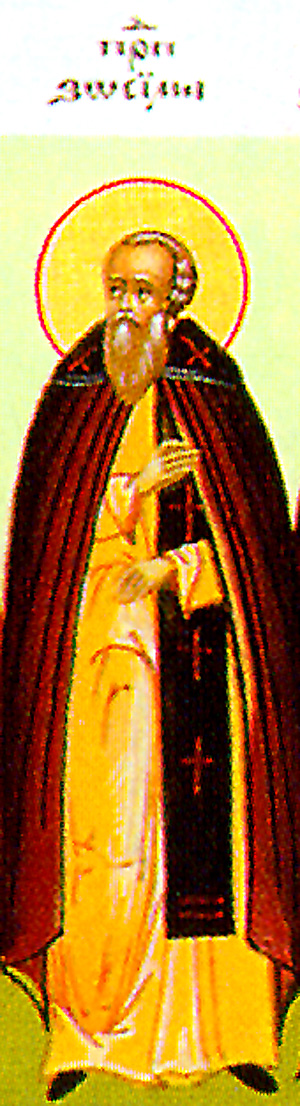
No information available at this time.

Saint Cyril the wonderworker of New Lake reposed on February 4, 1532.
In May 1648, during the reign of Alexei Mihailovich, a popular rebellion against Moscow broke out among some of those who were members of the Tsar's retinue. Peter Trahanitov, the head of the artillery, the Deacon Eleazar, and many others were killed and robbed. The rebellious crowd proceeded to the Beautiful Porch and demanded the extradition of the boyar Boris Morozov, the royal tutor and kinsman. They had already broken into his house and looted the property. The boyar, with some difficulty, managed to hide from the hands of the angry mob, and soon he took refuge in the Saint Cyril of White Lake Monastery. When Igoumen Amphilokhios and the brethren learned he would be staying with them, he sent the monk Jonah to him with the icon and the Life of Saint Cyril. The boyar graciously accepted the icon and was moved by the Saint's Life. After that, his soul was filled with joy and delight, but then his tormenting fears and grief returned, and he wanted to venerate Saint Cyril's grave.
After having a Moleben served at the grave and praying to the Saint with tears, the boyar said to the Igoumen and the brotherhood: "Holy Fathers, pray to God and His Most Pure Mother, and the venerable wonderworker Cyril for me. If God is merciful to me, by the prayers of Saint Cyril, and if I return to the royal city, and the great sovereign and his royal council take pity on me and restore me to my former rank, then I will build a stone church here in honor of the glorious Resurrection of Christ and in honor of Saint Cyril."
The delighted Igoumen and the brotherhood responded with their fervent good wishes. After distributing alms, the boyar returned to the Saint Cyril of White Lake Monastery. After a short time, after the excitement in Moscow subsided, the boyar was summoned by the Tsar and restored to his former position. The following year, in 1649, Morozov began to fulfill his promise. On September 4, at his orders, the Archimandrite Athanasios of the Saint Cyril of White Lake Monastery and the Elder Sabbatius Yushkov were at the foundation of the stone temple. In their presence they began to dig ditches, and when they came to the place where Saint Cyril's tomb was, a completely intact coffin was found among the roots of a tree.
Without a patriarchal decree and the blessing of the Metropolitan and the Archimandrite, Elder Sabbatius did not dare to take the coffin from the earth in order to open and to examine It. The coffin was placed on some boards, and the discovery was reported to Metropolitan Barlaam of Rostov, Patriarch Joseph, and the boyar Morozov. Mozarov, after receiving the news, told the Tsar all this and informed him about the Life and miracles of the venerable Cyril. In October, the Patriarch, at the Tsar's suggestion, sent Archbishop Marcellus of Vologda with a Gramota instructing him to go to New Lake and examine the relics of the Saint, and move the relics to a temporary room, arrange a celebration, and report everything to the Tsar and Patriarch.
Archbishop Marcellus arrived at New Lake Monastery with Archimandrite Athanasios of Saint Cyril of White Lake Monastery and, from the same monastery, the cellarer Sabbatius with the Elders of the cathedral. On November 7, Igoumen Amphilokhios ordered them to remove the coffin from the earth, and then open it in order to inspect the Saint's relics and clothing. After the hierarch completed his inspection he placed the relics in a new coffin and moved it into the wooden church of the Resurrection of Christ.
On the Feast of the Dormition of the Theotokos Vespers was served at the cathedral in the evening. In the morning, before the Liturgy, a Moleben to the All-Merciful Savior, the Theotokos, and All Saints was served, with the blessing of water. Many sick persons were healed at the celebration. People took pieces of wood from the old coffin and brought them home because they had faith in their healing power.
Saint Cyrill is commemorated on November 7 (the discovery of his relics), on January 23 (Synaxis of All Saints of Kostroma), and on the third Sunday after Pentecost (Synaxis of All Saints of Novgorod).

The Martyrs Melasippus and Karina and their son Antoninus, and 40 children converted by their martyrdom at Ancyra suffered during the reign of the emperor Julian the Apostate in the city of Ancyra in Phrygia in the year 363. The holy Martyrs Melasippus and Karina, lacerated by iron hooks and exhausted, died under torture.
Their son Antoninus, whom the persecutor forced to watch the torture of his parents, spat in the face of the apostate emperor. For this he was subjected to cruel tortures, but he remained unharmed, and then he was beheaded. Forty other youths, seeing that the Lord had preserved His confessor Antoninus unharmed by tortures, believed in Christ, and they openly confessed their faith and endured martyrdom..
Saints Auctus and Taurion suffered martyrdom with Saint Thessalonica, the daughter of a pagan priest. When the impious father learned that his daughter had become a Christian, he ruthlessly beat her and threw her out of the house, with no means of providing for herself. Saints Auctus and Taurion attempted to intercede for the girl, and to reason with the embittered father. The pagan priest denounced them both to the authorities, and they were arrested.
After confessing their faith in Christ before the torturers and undergoing cruel torments, the saints were then beheaded. Soon after their martyric death, Saint Thessalonica also died. Her body was reverently buried in the city of Amphypolis in Macedonia, together with the holy Martyrs Auctus and Taurion.

The “Joyful” (Взыграние) Icon of the Most Holy Theotokos appeared near Moscow on November 7, 1795. Nothing is known of the Icon's history, except that many miracles have taken place before it.
For many years, the Icon was one of the symbols of the Saint Nicholas – Ugresh Monastery (now called Dzerzhinsk). The history of the Monastery is associated with the name of the Holy Prince Dēmḗtrios of the Don, and the Battle of Kulikovo, 15 versts from Moscow. On his way there, he saw an icon of Saint Nicholas the Wonderworker in the branches of a tree. Not knowing where it came from, the Prince took it as a sign of God's blessing and vowed to establish a monastery on the site if he were victorious.
Thus, the Saint Nicholas – Ugresh Monastery was built, and also a cathedral church dedicated to Saint Nicholas, where the miraculous Icon of the Mother of God known as "Joyful" was later kept.
After the Revolution, the Icon disappeared when the Monastery was looted. By the mercy of God, one of the copies of the wonderworking Icon painted in 1814 has been preserved. Today, this ancient image is part of the collection of the Moscow State Museum.
However, in the Saint Nicholas – Ugresh Monastery there is another "Joyful" Icon of the Mother of God. At the beginning of the XXI century, believing Christians, who wished to remain anonymous, transferred a copy of that icon which they found at the Monastery in the 1990s. It belongs to the same iconographic type, but there are some differences from the original. There was Cross Procession as the brethren of the Monastery and its parishioners met the Icon at the gates, and it was placed in the Monastery's Holy Transfiguration Cathedral, where it is kept for the faithful to venerate.
Icons of this name are to be found in the Novodevichii Monastery in Moscow, and at Vatopedi Monastery on Mount Athos. In appearance, the “Joyful” Icon resembles the Πελαγονιτίσσα Icon, a variant of the Glykophylousa (“Sweet-Kissing”), or Eleousa (Merciful) type.
The Icon is sometimes called “Child Jumping for Joy.”
Saint Theodotus was an innkeeper. When seven virgins who lived near Corinth were drowned in a lake, he buried their bodies under the cover of night. For this reason, he was tortured and beheaded.
Here is the live stream for Orthros and Divine Liturgy – Sun 11/06/2022 If you need, here are instructions for accessing this content from your phone, tablet, computer, or TV.
7TH SUNDAY OF LUKE
NO FAST
7th Sunday of Luke, Paul the Confessor, Patriarch of Constantinople, Luke the Monk of Taormina
Brethren, knowing that a man is not justified by works of the law but through faith in Jesus Christ, even we have believed in Christ Jesus, in order to be justified by faith in Christ, and not by works of the law, because by works of the law shall no one be justified. But if, in our endeavor to be justified in Christ, we ourselves were found to be sinners, is Christ then an agent of sin? Certainly not! But if I build up again those things which I tore down, then I prove myself a transgressor. For I through the law died to the law, that I might live to God. I have been crucified with Christ; it is no longer I who live, but Christ who lives in me; and the life I now live in the flesh I live by faith in the Son of God, who loved me and gave himself for me.
At that time, there came to Jesus a man named Jairus, who was a ruler of the synagogue; and falling at Jesus’ feet he besought him to come to his house, for he had an only daughter, about twelve years of age, and she was dying. As he went, the people pressed round him. And a woman who had had a flow of blood for twelve years and had spent all her living upon physicians and could not be healed by anyone, came up behind him, and touched the fringe of his garment; and immediately her flow of blood ceased. And Jesus said, “Who was it that touched me?” When all denied it, Peter and those who were with him said, “Master, the multitudes surround you and press upon you!” But Jesus said, “Some one touched me; for I perceive that power has gone forth from me.” And when the woman saw that she was not hidden, she came trembling, and falling down before him declared in the presence of all the people why she had touched him, and how she had been immediately healed. And he said to her, “Daughter, your faith has made you well; go in peace.” While he was still speaking, a man from the ruler’s house came and said, “Your daughter is dead; do not trouble the Teacher any more.” But Jesus on hearing this answered him, “Do not fear; only believe, and she shall be well.” And when he came to the house, he permitted no one to enter with him, except Peter and John and James, and the father and mother of the child. And all were weeping and bewailing her; but he said, “Do not weep; for she is not dead but sleeping.” And they laughed at him, knowing that she was dead. But taking her by the hand he called, saying, “Child, arise.” And her spirit returned, and she got up at once; and he directed that something should be given her to eat. And her parents were amazed; but he charged them to tell no one what had happened.

Saint Paul the Confessor, Archbishop of Constantinople, was chosen to the patriarchal throne after the death of Patriarch Alexander (+ 340), when the Arian heresy had again flared up. Many of the Arians were present at the Council which selected the new Archbishop of Constantinople. They revolted in opposition to the choice of Saint Paul, but the Orthodox at the Council were in the majority.
The emperor Constantius, ruling over the Eastern half of the Roman Empire, was an Arian. He was not in Constantinople for the election of the Archbishop, and so it took place without his consent. Upon his return, he convened a council which illegally deposed Saint Paul, and the emperor banished him from the capital. In place of the saint they elevated Eusebius of Nicomedia, an impious heretic. Archbishop Paul withdrew to Rome, where other Orthodox bishops were also banished by Eusebius.
Eusebius did not rule the Church of Constantinople for long. When he died, Saint Paul returned to Constantinople, and was greeted by his flock with love. But Constantius exiled the saint a second time, and so he returned to Rome. The Western emperor Constans wrote a harsh letter to his Eastern co-ruler, which he sent to Constantinople along with the holy exiled archpastor. The threats worked, and Saint Paul was reinstated upon the archepiscopal throne.
But soon the pious emperor Constans, a defender of the Orthodox, was treacherously murdered during a palace coup. They again banished Saint Paul from Constantinople and this time sent him off in exile to Armenia, to the city of Cucusus, where he endured a martyr’s death.
When the Archbishop was celebrating the Divine Liturgy, Arians rushed upon him by force and strangled him with his own omophorion. This occurred in the year 350. In 381, the holy Emperor Theodosius the Great solemnly transferred the relics of Saint Paul the Confessor from Cucusus to Constantinople. In 1326, the relics of Saint Paul were transferred to Venice.
Saint Athanasius the Great, a contemporary of Saint Paul, writes briefly about his exiles, “Saint Paul the first time was sent by Constantine to Pontus, the second time he was fettered with chains by Constantius, and then he was locked up in Mesopotamian Syngara and from there moved to Emesus, and the fourth time to Cappadocian Cucusus in the Taurian wilderness.”

Saint Barlaam of Khutyn lived in the XII century, and was the son of a noble Novgorodian and spent his childhood in Novgorod. In his youth, retiring to the Lisich Monastery near the city, Barlaam was tonsured as a monk. Then he settled on a secluded hill above Volkhov, in an area called Khutyn, 10 versts from Novgorod. In his seclusion, Saint Barlaam led an austere solitary life, occupying himself with unceasing prayer, and keeping a very strict fast. He was a zealous ascetic in his labors: cutting timber in the forest, chopping firewood, and tilling the soil, fulfilling the words of the Holy Scriptures: "If anyone does not wish to work, neither let him eat" (2 Thessalonians 3:10).
Some of the inhabitants of Novgorod gathered around him, desiring to share the Saint's works and ascetical struggles. Instructing those who came to him, Saint Barlaam said, "My children, beware of all unrighteousness, and do not give in to envy or slander, don't be jealous, do not slander anyone. Refrain from anger, and do not practice usury. Beware of unjust judgment. Do not swear an oath falsely, but rather fulfill it. Do not indulge in carnal appetites. Always be meek and endure all things with love. This virtue is the beginning and the root of all goodness."
Soon a church was built in honor of the Transfiguration of the Lord, and a Monastery was founded. The Lord granted him the gift of miracles and clairvoyance in order to serve his neighbors. As Saint Barlaam’s life was drawing to a close, by God's will, Hieromonk Anthony came from Constantinople. He was the contemporary and friend of Saint Barlaam. The Saint turned to him and said, “My beloved brother, God’s blessings rest upon this Monastery. Now I leave it in your hands. Watch over it and care for it. Although in the body I am leaving you, I shall always be with you in spirit.”
After giving his final counsels to the brethren, commanding them to preserve the Orthodox Faith, and to abide in humility, Saint Barlaam fell asleep in the Lord on November 6, 1192.
The Church remembers Saint Barlaam three times during the year: on the day of his blessed repose (November 6), on the first Friday of the Apostles' Fast, and on the third Sunday after Pentecost (Synaxis of the Novgorod Saints).
In Slavonic practice, Saint Barlaam is commemorated during the Proskomedia along with the venerable God-bearing Fathers who have shone forth in asceticism (sixth particle).

No information available at this time.
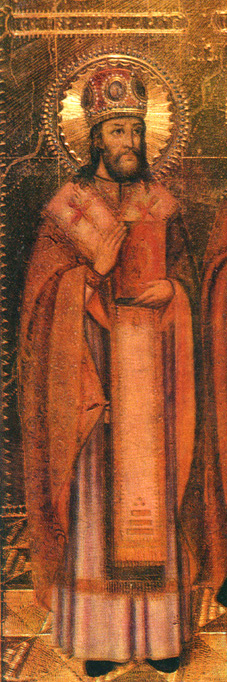
Saint Herman, Archbishop of Kazan, lived during the sixteenth century. He was born in the city of Staritsa, and was descended from the old boyar nobility of the Polevi. In his youth Gregory (his baptismal name) was tonsured at the Joseph-Volokolamsk monastery under Igumen Gurias, who later became Archbishop of Kazan (December 5). (Saint Gurias was head of the monastery from 1542 to 1551).
At the monastery Saint Herman occupied himself with copying books, and he was a close friend of Saint Maximus the Greek (January 21), who was living there in confinement. In 1551 the brethren of the Staritsa Dormition monastery, seeing his piety, chose him as their archimandrite.
Taking up the governance of this monastery with a pastoral zeal, Saint Herman concerned himself with its internal and external order, for he himself was a model of humility and meekness. He exhorted all to observe their monastic commitment strictly, and he introduced into his monastery the Rule of Saint Joseph of Volokolamsk (October 18).
But after two and a half years Archimandrite Herman left the Staritsa monastery, leaving its direction to the hieromonk Job (June 19), who afterwards was to become the first Patriarch of Moscow, and was an ascetic and sufferer for the Russian Land.
Saint Herman’s love for solitary struggles brought him to return to his original Volokolamsk monastery, where he strove toward salvation as a simple monk. However, when the new heretic Matthew Bashkin (who refused to acknowledge the Holy Mysteries and denied faith in the Holy Trinity) appeared at Moscow, Saint Herman and his own father (who had received tonsure at the Volokolamsk monastery with the name Philotheus) were summoned to the Moscow Council of 1553. The Council censured the heretic Bashkin and resolved to send him for correction to Saint Herman at the Volokolamsk monastery, since Saint Herman was known for his holy life and zeal for the faith in Christ.
In 1555, after the taking of Kazan, an archepiscopal See was established there. Saint Gurias, the former igumen of Volokolamsk monastery, was chosen as archbishop. He was entrusted with building the Dormition monastery in the city of Sviyazhsk for missionary purposes. By decree of Saint Gurias, Saint Herman was appointed as head of this new monastery in Sviyazhsk. A stone cathedral was built with a belltower and monastic cells. The igumen of the monastery lived very frugally in a cramped cell beneath the cathedral belltower. Saint Herman particularly concerned himself with acquiring a library for the monastery.
Soon his monastery became famous for its good works, and it became a center of enlightenment for the Kazan region.
On March 12, 1564, after the repose of Saint Gurias, Saint Herman was consecrated Bishop of Kazan. The short duration of his tenure there was marked nonetheless by his efforts to build churches and to enlighten the people of the region with the light of Christ.
In 1566, Ivan the Terrible summoned Saint Herman to Moscow and ordered that he be elected to the Metropolitan cathedra. At first, Saint Herman refused to have this burden imposed upon him. The Tsar would not tolerate any objection, however, and the saint was obliged to settle into the Metropolitan’s quarters until his elevation to the position of Metropolitan.
Seeing injustice among those of the Tsar’s inner circle, Saint Herman, true to his pastoral duty, attempted to admonish the Tsar. “You are not yet elevated to Metropolitan, and already you place constraints upon my freedom,” the Tsar told him through his aides. He ordered Saint Herman expelled from the Metropolitan’s quarters and that he be kept under surveillance.
The saint lived in disgrace for about two years, and died on November 6, 1567. They buried him in the church of Saint Nicholas the Hospitable. In 1595, at the request of the inhabitants of Sviyazhsk, the relics of the saint were transferred from Moscow to the Sviyazhsk Dormition monastery. Saint Hermogenes, then Metropolitan of Kazan, visited his grave.
Saint Herman is also commemorated on September 25 (first translation of his relics in 1595) and June 23 (second translation of his relics in 1714).
No information available at this time.
No information available at this time.

Saint Luke of Sicily was a native of the Sicilian city of Tauromenium. In his youth he left his parents and fiancée and went into the wilderness, where he spent many years in fasting and prayer. He lived the ascetic life at Mount Aetna.
Towards the end of his life Saint Luke, because of a revelation to him, founded a monastery. In order to become familiar with the rule and life of other monasteries, he visited many other cities. He died at Corinth in 820.
Here is the live stream for Great Vespers – Sat 11/05/2022 If you need, here are instructions for accessing this content from your phone, tablet, computer, or TV.
Here is the live stream for Orthros and Divine Liturgy – Saint Raphael – Sat 11/05/2022 If you need, here are instructions for accessing this content from your phone, tablet, computer, or TV.
SATURDAY OF THE 7TH WEEK
NO FAST
Bishop Raphael Hawaweeny of Brooklyn, Galaktion & his wife Episteme, the Martyrs of Emesa, Hermas, Patrobos, Gaios, Linos, & Philologos, Apostles of the 70
Brethren, since we have such a hope, we are very bold, not like Moses, who put a veil over his face so that the Israelites might not see the end of the fading splendor. But their minds were hardened; for to this day, when they read the old covenant, that same veil remains unlifted, because only through Christ is it taken away. Yes, to this day whenever Moses is read a veil lies over their minds; but when a man turns to the Lord the veil is removed. Now the Lord is the Spirit, and where the Spirit of the Lord is, there is freedom. And we all, with unveiled face, beholding the glory of the Lord, are being changed into his likeness from one degree of glory to another; for this comes from the Lord who is the Spirit.
At that time, Jesus called the twelve together and gave them power and authority over all demons and to cure diseases, and he sent them out to preach the kingdom of God and to heal. And he said to them, "Take nothing for your journey, no staff, nor bag, nor bread, nor money; and do not have two tunics. And whatever house you enter, stay there, and from there depart. And wherever they do not receive you, when you leave that town shake off the dust from your feet as a testimony against them." And they departed and went through the villages, preaching the gospel and healing everywhere.
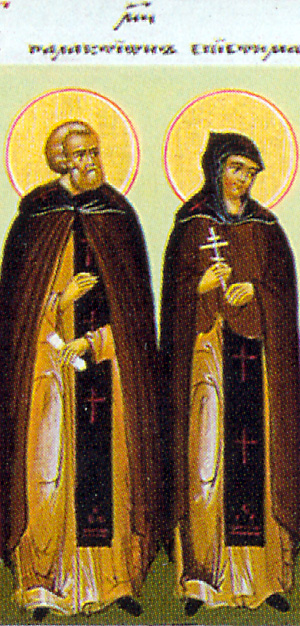
There was a rich and distinguished couple named Kletophon and Leukippe, who lived in the Syrian city of Emesa, and for a long time they were childless. They gave much gold to the pagan priests, but still they remained childless.
The city of Emesa was governed by a Syrian named Secundus, put there by the Roman Caesars. He was a merciless and zealous persecutor of Christians, and to intimidate them he ordered that the instruments of torture be displayed on the streets. The slightest suspicion of belonging to “the sect of the Galilean” (as thus Christians were called by the pagans), was enough to get a man arrested and handed over for torture. In spite of this, many Christians voluntarily surrendered themselves into the hands of the executioners, in their desire to suffer for Christ.
A certain old man by the name of Onuphrius concealed his monastic and priestly dignity beneath his beggar’s rags. He walked from house to house in Emesa, begging alms. At the same time, whenever he saw the possibility of turning people away from the pagan error, he preached about Christ.
Once, he came to the magnificent house of Leukippe. Accepting alms from her, he sensed that the woman was in sorrow, and he asked what was the cause of this sadness. She told the Elder about her familial misfortune. In consoling her, Onuphrius began to tell her about the one true God, about His omnipotence and mercy, and how He always grants the prayer of those turning to Him with faith. Hope filled the soul of Leukippe. She believed and accepted Holy Baptism. Soon after this it was revealed to her in a dream that she would give birth to a son, who would be a true follower of Christ. At first, Leukippe concealed her delight from her husband, but after the infant was born, she revealed the secret to her husband and also persuaded him to be baptized.
They named the baby Galaction and his parents raised him in the Christian Faith and provided him a fine education. He could make an illustrious career for himself, but Galaction sought rather an unsullied monastic life in solitude and prayer.
When Galaction turned twenty-four, his father resolved to marry him off and they found him a bride, a beautiful and illustrious girl by the name of Episteme. The son did not oppose the will of his father, but by the will of God, the wedding was postponed for a time. Visiting his betrothed, Galaction gradually revealed his faith to her. Eventually, he converted her to Christ and he secretly baptized her himself.
Besides Episteme he baptized also one of her servants, Eutolmius. The newly-illumined decided on the initiative of Galaction, to devote themselves to the monastic life. Leaving the city, they hid themselves away on Mount Publion, where there were two monasteries, one for men and the other for women. The new monastics had to take with them all the necessities for physical toil, since the inhabitants of both monasteries were both old and infirm.
For several years the monastics struggled in work, fasting and prayer. Once, Episteme had a vision in her sleep: she and Galaction stood in a wondrous palace before a radiant King, and the King bestowed golden crowns on them. This was a prefiguring of their impending martyrdom.
The pagans became aware of the existence of the monasteries, and a military detachment was sent to apprehend their inhabitants. But the monks and the nuns succeeded in hiding themselves in the hills. Galaction, however, had no desire to flee and so he remained in his cell, reading Holy Scripture. When Episteme saw that the soldiers were leading Galaction away in chains, she began to implore the Abbess to permit her to go also, since she wanted to accept torture for Christ together with her fiancé and teacher. The Abbess tearfully blessed Episteme to do so.
The saints endured terrible torments, while supplicating and glorifying Christ. Their hands and legs were cut off, their tongues were cut out, and then they were beheaded.
Eutolmius, the former servant of Episteme, and who had become her brother in Christ and fellow ascetic in monastic struggles, secretly buried the bodies of the holy martyrs. He later wrote an account of their virtuous life and their glorious martyrdom, for his contemporaries and for posterity.

Saint Jonah, Archbishop of Novgorod, in the world named John, was left orphaned early in life and was adopted by a certain pious widow living in Novgorod. She raised the child and sent him to school. Blessed Michael of Klops Monastery (January 11), who chanced to meet John on the street, foretold that he would become Archbishop of Novgorod. John received tonsure at the Otnya wilderness-monastery, 50 versts from the city, and he became igumen of this monastery. It was from here that the people of Novgorod chose him as their archbishop in 1458, after the death of Saint Euthymius (March 11).
Saint Jonah enjoyed great influence at Moscow, and during his time as hierarch, the Moscow princes did not infringe upon the independence of Novgorod. Saint Jonah, Metropolitan of Moscow (1449-1461), was a friend of the Novgorod Archbishop Saint Jonah, and wanted him to become his successor.
In 1463, Archbishop Jonah built the first church dedicated to Saint Sergius of Radonezh in the Novgorod region. Concerning himself over reviving traditions of the old days in the Novgorod Church, he summoned to Novgorod the renowned compiler of Saints’ Lives, Pachomius the Logothete, who wrote both the services and history of the best known Novgorod Saints, based on local sources.
And to this time period belongs also the founding of the Solovki monastery. Saint Jonah rendered much help and assistance in the organizing of the monastery. To Saint Zosimas he gave a special land-grant (in conjunction with the secular authorities of Novgorod), by which the whole of Solovki Island was granted to the new monastery.
The saint, after his many toils, and sensing the approach of his end, wrote a spiritual testament to bury his body at the Otnya monastery. On November 5, 1470, after he received the Holy Mysteries, the saint fell asleep in the Lord.
There has survived to the present day a Letter of Saint Jonah to Metropolitan Theodosius, written in 1464. The Life of the saint was written in the form of a short account in the year 1472 (included in the work, Memorials of Old Russian Literature, and also in the Great Reading Menaion of Metropolitan Macarius, under November 5). In 1553, after the uncovering of the relics of Archbishop Jonah, an account of this event was written by Saint Zenobius of Otnya (October 30). A special work relating the miracles of the saint is found in manuscripts of the seventeenth century.

Saints Patrobus, Hermes, Linus, Gaius, and Philologus, Apostles of the Seventy, preached the Gospel in various cities, each enduring various hardships in their service as bishops.
Saint Patrobus (Rom 16:14) was Bishop of Neopolis (now Naples) and Puteoli in Italy.
Saint Hermes was bishop in the city of Philippoplis where he died a martyr.
Saint Linus (2 Tim 4:21) was a successor to the Apostle Peter at Rome.
Saint Gaius (Rom 16:23), was Bishop of Ephesus after Saint Timothy.
The Apostle Andrew consecrated Saint Philologus (Rom 16:15) as bishop of the city of Sinope (in the Black Sea region).

Saint Gregory the Archbishop of Alexandria lived in the ninth century. He was flogged and thrown into prison in the reign of Leo the iconoclast. He was left in prison without food until he died.
FRIDAY OF THE 7TH WEEK
ABSTAIN FROM MEAT, FISH, DAIRY, EGGS, WINE, OLIVE OIL
Joannicius the Great, The Holy Hieromartyrs Nicander, Bishop of Myra, and Hermias the Presbyter, Porphyrios the Mime, Emperor John Batatze the Merciful, George Karslidis of Pontos
Brethren, I want you to know how greatly I strive for you, and for those at Laodicea, and for all who have not seen my face, that their hearts may be encouraged as they are knit together in love, to have all the riches of assured understanding and the knowledge of God’s mystery, of Christ, in whom are hid all the treasures of wisdom and knowledge. I say this in order that no one may delude you with beguiling speech. For though I am absent in body, yet I am with you in spirit, rejoicing to see your good order and the firmness of your faith in Christ. As therefore you received Christ Jesus the Lord, so live in him, rooted and built up in him and established in the faith, just as you were taught, abounding in thanksgiving.
The Lord said to his disciples, "Nothing is covered up that will not be revealed, or hidden that will not be known. Therefore whatever you have said in the dark shall be heard in the light, and what you have whispered in private rooms shall be proclaimed upon the housetops. I tell you, my friends, do not fear those who kill the body, and after that have no more that they can do. But I will warn you whom to fear: fear him who, after he has killed, has power to cast into Gehenna; yes, I tell you, fear him! Are not five sparrows sold for two pennies? And not one of them is forgotten before God. Why, even the hairs of your head are all numbered. Fear not; you are of more value than many sparrows. And I tell you, every one who acknowledges me before men, the Son of man also will acknowledge before the angels of God; but he who denies me before men will be denied before the angels of God. And every one who speaks a word against the Son of man will be forgiven; but he who blasphemes against the Holy Spirit will not be forgiven. And when they bring you before the synagogues and the rulers and the authorities, do not be anxious how or what you are to answer or what you are to say; for the Holy Spirit will teach you in that very hour what you ought to say.

No information available at this time.
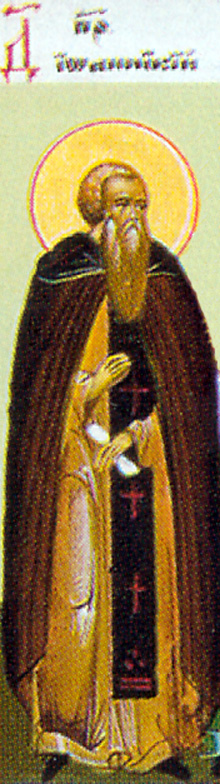
Saint Joannicius the Great was born in Bithynia in the year 752 in the village of Marikat. His parents were destitute and could not provide him even the basics of an education. From childhood he had to tend the family cattle, their sole wealth. Love for God and prayer completely dominated the soul of the child Joannicius. Often, having shielded the herd with the Sign of the Cross, he went to a secluded place and spent the whole day praying, and neither thieves nor wild beasts came near his herd.
By order of the emperor Leo IV (775-780), a multitude of officials went through the cities and towns to draft young men for military service. Young Joannicius was also drafted into the imperial army. He earned the respect of his fellow soldiers for his good disposition, but he was also a brave soldier who struck fear in the hearts of his enemies. Saint Joannicius served in the imperial army for six years. More than once he was rewarded by his commanders and the emperor. But military service weighed heavily on him; his soul thirsted for spiritual deeds and solitude.
Saint Joannicius, having renounced the world, longed to go at once into the wilderness. However, on the advice of an Elder experienced in monastic life, he spent a further two years at the monastery. Here the saint became accustomed to monastic obedience, to monastic rules and practices. He studied reading and writing, and he learned thirty Psalms of David by heart.
After this, commanded by God to go to a certain mountain, the monk withdrew into the wilderness. For three years he remained in deep solitude in the wilderness, and only once a month a shepherd brought him some bread and water. The ascetic spent day and night in prayer and psalmody. After each verse of singing the Psalms Saint Joannicius made a prayer, which the Orthodox Church keeps to this day in a somewhat altered form, “The Father is my hope, the Son is my refuge, the Holy Spirit is my protection.”
By chance, he encountered some of his former companions from military service. The saint fled the wilderness and withdrew to Mount Kountourea to hide himself from everyone. Only after twelve years of ascetic life did the hermit accept monastic tonsure. The saint spent three years in seclusion after being tonsured. Then he went to a place called Chelidon to see the great ascetic Saint George (February 21). The ascetics spent three years together. During this time Saint Joannicius learned the entire Psalter by heart. As he grew older, Saint Joannicius settled in the Antidiev monastery and dwelt there in seclusion until his death.
Saint Joannicius spent seventy years in ascetic deeds and attained to a high degree of spiritual perfection. Through the mercy of God the saint acquired the gift of prophecy, as his disciple Pachomius has related. The Elder also levitated above the ground when he prayed. Once, he crossed a river flooded to overflowing. The saint could make himself invisible for people and make others also hidden from sight.
Once, Saint Joannicius led Greek captives out of prison under the very eyes of the guards. Poison and fire, with which the envious wanted to destroy the saint, did him no harm, and predatory beasts did not touch him. He freed the island of Thasos from a multitude of snakes. Saint Joannicius also saved a young nun who was preparing to leave the monastery to marry; he took upon himself the agonized maiden’s suffering of passion, and by fasting and prayer, he overcame the seductive assault of the devil.
Foreseeing his death, Saint Joannicius fell asleep in the Lord on November 4, 846, at the age of 94.

The Hieromartyrs Nicander, Bishop of Myra, and Hermas the Presbyter, were disciples of the holy Apostle Paul’s follower and fellow ascetic, the holy Apostle Titus of the Seventy (August 25), and they were ordained by him to the priesthood.
Living the ascetic life amid incessant pastoral works, the saints converted many pagans to Christ. For this they were arrested and brought before the city prefect, Libanius. Neither flattery nor threats swayed the holy martyrs to renounce Christ. Then Libanius gave orders that they be tortured.
The saints endured fierce and inhuman torments: they were tied to horses and dragged over stones, their bodies were raked with iron hooks, and they were cast into a hot oven. The Lord helped them endure things that a mere man by his own strength could not endure. Towards the end, iron nails were hammered into their heads and hearts. They were thrown into a pit, then covered over with earth.
After enduring such a cruel death, now they live forever in the joy of the Lord (Mt. 25:21).
No information available at this time.
No information available at this time.

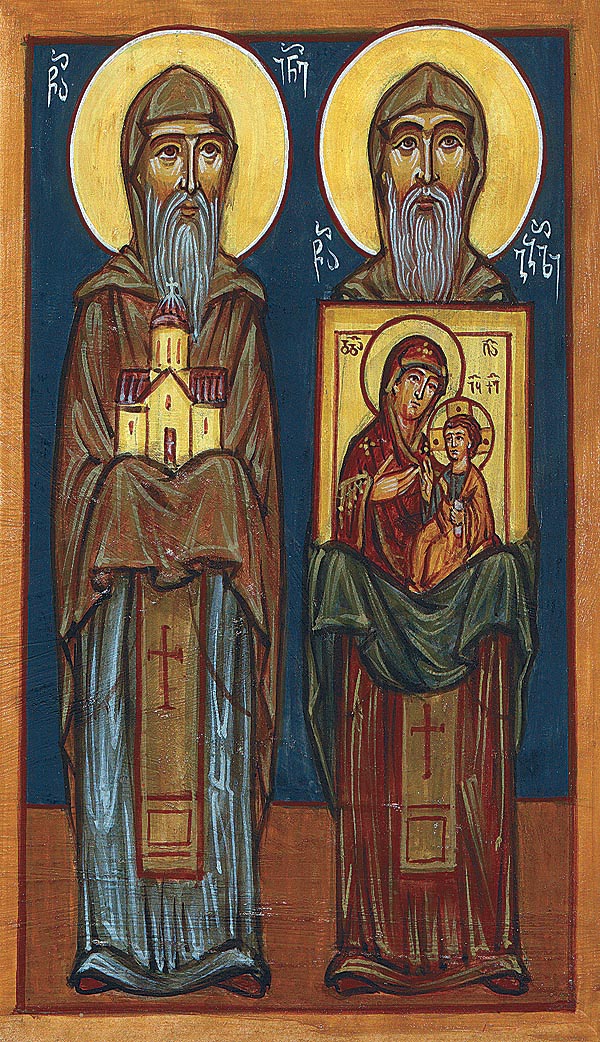
Among the multitude of saints we remember those Christians who dedicated their earthly lives to glorifying God and serving others. In a single lifetime they performed all the spiritual feats of the venerable and devout fathers, confessors, and martyrs.
Among the saints canonized by the Georgian Church, only four have been called “Righteous.” They are Saint Ilia Chavchavadze, well known as the “father” and “uncrowned king” of the Georgian nation, and Saints John, Steven, and Isaiah the Georgians.
It is believed that Holy John, Steven, and Isaiah lived in Jerusalem and guarded the Tomb of our Lord. It is probable that the Georgian Orthodox Church proclaimed them deserving of exceptional honor in recognition of their dedicated service at the Tomb of the Savior.
For several centuries the Georgian Church has glorified the Righteous John, Steven, and Isaiah and asked for their intercessions before the Lord.
Blessed Simon of Yurievets was born in the city of Yurievets in the Povolzhsk or Volga region. Forsaken by his parents, the saint took upon himself the exploit of foolishness for Christ. Both winter and summer he went barefoot, dressed only in a shirt, so that his skin became blackened and withered from fasting.
Thoughtless people often were cruel to him, sometimes beating him. The holy fool never complained, but prayed for those who mistreated him. Blessed Simon was fond of praying on the porches of various churches. The ascetic exploit of self-denial cleansed his soul, and he received from God the gift of clairvoyance: he foresaw many things and predicted the future. Contemporaries, mentioning his name, beheld various miraculous signs.
Just before his death, the saint went to the house of the military commander Theodore Petelin. He, not knowing the saint, in a fit of anger gave orders to beat him. Saint Simon fell grievously ill. He summoned a priest, made his confession, received the Holy Mysteries of Christ and commended his soul to God. The commander later repented of his sin.
The city gathered for the saint’s funeral, and the body of Blessed Simon was buried in Theophany monastery. This occurred on November 4, 1584. In the year 1635, Patriarch Joasaph ordered the Theophany monastery’s Igumen Dionysius to compile an account of the life and miracles of Blessed Simon and gave a blessing to paint his icon. The Feast of Blessed Simon was established in the year 1635.
No information available at this time.
THURSDAY OF THE 7TH WEEK
NO FAST
Acepsimas the Bishop, Joseph the Presbyter, & Aeithalas the Deacon, Martyrs of Persia, Dedication of the Temple of the Holy Great Martyr George in Lydda, George of Neapolis the New Martyr, Holy Father and New Hieromartyr Gregory of Neapolis, Theodore the Confessor, Bishop of Ancyra, Winifred of Treffynnon
Brethren, now I rejoice in my sufferings for your sake, and in my flesh I complete what is lacking in Christ’s afflictions for the sake of his body, that is, the church, of which I became a minister according to the divine office which was given to me for you, to make the word of God fully known, the mystery hidden for ages and generations but now made manifest to his saints. To them God chose to make known how great among the Gentiles are the riches of the glory of this mystery, which is Christ in you, the hope of glory. Him we proclaim, warning every man and teaching every man in all wisdom, that we may present every man mature in Christ. For this I toil, striving with all the energy which he mightily inspires within me. For I want you to know how greatly I strive for you.
The Lord said to the Jews who had come to him, "Woe to you! for you build the tombs of the prophets whom your fathers killed. So you are witnesses and consent to the deeds of your fathers; for they killed them, and you build their tombs. Therefore also the Wisdom of God said, 'I will send them prophets and apostles, some of whom they will kill and persecute, ' that the blood of all the prophets, shed from the foundation of the world, may be required of this generation, from the blood of Abel to the blood of Zacharias, who perished between the altar and the sanctuary. Yes, I tell you, it shall be required of this generation. Woe to you lawyers! for you have taken away the key of knowledge; you did not enter yourselves, and you hindered those who were entering." As he went away from there, the scribes and the Pharisees began to press him hard, and to provoke him to speak of many things, lying in wait for him, to catch at something he might say. In the meantime, when so many thousands of the multitude had gathered together that they trod upon one another, he began to say to his disciples first, "Beware of the leaven of the Pharisees, which is hypocrisy.

Martyrs Akepsimas the Bishop, Joseph the Presbyter and Aeithalás the Deacon of Persia were leaders of the Christian Church in the Persian city of Naesson. His flock devotedly loved their hierarch for his ascetic life and tireless pastoral work.
The emperor Sapor ordered his men to seek out and kill Christian clergy. Saint Akepsimas also was arrested, even though he was already an eighty-year-old man. They took him to the city of Arbela, where he came before the judge Ardarkh, a pagan priest of the sun god. The holy Elder refused to offer sacrifice to the Persian gods. For this he was fiercely beaten and thrown into prison, where on the following day the seventy-year-old priest Joseph and the deacon Aeithalás were severely beaten and thrown into jail with him. For three years the saints were held in confinement, and suffered from hunger and thirst.
Emperor Sapor came to the temple of the god of fire, located not far from Arbela, and wanted to take a look at the three holy martyrs. Exhausted and covered with festering wounds, the saints were brought before the emperor. When he asked them to worship the pagan gods they firmly refused, confessing their faith in Christ instead.
The holy bishop was beheaded, but the presbyter and deacon were taken into the city to be stoned.
The execution of the presbyter Joseph was prolonged for several hours. A guard was placed near the place of execution, so that Christians would not take the body of the holy martyr. On the fourth night a strong windstorm raged near the city, lightning killed the guard, the wind tossed stones about, and the body of Saint Joseph disappeared.
Deacon Aeithalás was taken to the village of Patrias, where he was stoned. Christians secretly buried his body. A tree grew on the saint’s grave, and its fruit brought healings.

Pious Christians built a new church in honor of Saint George at Lydda during the reign of Saint Constantine (305-337). When the church was consecrated, the relics of the holy Great Martyr George (April 23) were transferred there, and many miracles took place before them.
The glorious Martyrs Eudoxios, Agapios, Atticus, Marinus, Oceanus, Eustratios, Karterios, Nikopolitianos, Styrax, and Tobias were all soldiers in the city of Sebaste during the reign of Emperor Licinius. When they were examined by the lord of Seville, by Duke Marcellus, and also by Marcus Agricola, they boldly confessed that they were Christians, and were severely tortured in various ways. In the end they were thrown into the fire and burnt alive, thus they all received the unfading crown of martyrdom in the year 315.
These saints are commemorated on November 2 in Greek usage.
Saint Akepsimas, Hermit of Cyrrhus in Syria lived for sixty years in the desert, not far from Cairo. He devoted himself to fasting, silence and prayer. At the command of the patriarch, he came out of solitude and was consecrated a bishop. He died at a venerable old age.
Saint Snandulia of Persia is mentioned in the account of the martyrdom of Saints Joseph the priest and Aethalas the deacon. The historian Sozomen also describes their sufferings in his Church History (Book 2, ch. 13).
Snandulia was a devout Christian of the city of Arbela who visited those who suffered in prison for the sake of Christ. When she learned that Saints Joseph and Aethalas were in the prison, she went with her servants by night and bribed the guards with gold. They allowed her to take the saints to her home until daybreak. They were barely alive and unable to speak. She took them home and put them to bed, tending their wounds, and kissing their shattered hands and feet.
Saint Joseph recovered consciousness and saw Snandulia weeping. He told her that the compassion she had shown for him and for Aethalas was pleasing to God, but he thought that her bitter lamentations were contrary to Christian hope.
She replied, “When one is moved by compassion, it is natural to weep.”
“Nevertheless,” Saint Joseph said, “you should not weep for us, for tortures borne for the sake of Christ are followed by eternal joy.”
The two saints were returned to prison the next morning, as promised. After six months their wounds had healed to some extent. They could stand and walk a little, but Aethalas’s hands hung at his side limp and useless.
Zerothus was appointed as a judge, and he entered the city offering sacrifice to the gods in the various temples. Some of the priests told him about Saints Joseph and Aethalas, who had been tortured on the orders of Prince Ardasabor, the head of all the Magi of Persia. They explained to Zerothus that their execution was being delayed until they recovered from their wounds.
When he heard this, Zerothus ordered that the martyrs be brought before him. He used flattery and then threats in an attempt to persuade them to offer sacrifice to the pagan gods. When this proved unsuccessful, the judge had them beaten for a long time.
When they were brought before the judge again, Zerothus tried to get the saints to eat food which had been offered to the idols, but they refused. Then the judge had them beaten again, and ordered other Christians to stone them. Soldiers went to the homes of the Christians to force them to come to the judgment hall. They dug a hole and placed Saint Joseph in it, then put stones in the hands of the Christians and compelled them to stone him.
Saint Snandulia was among these Christians, but she refused to throw stones at the aged priest. Then they gave her a lance and told her to kill Saint Joseph. She said that she would rather drive the lance into her own heart than to wound the saint with it.
Saint Joseph was eventually killed by all the stones that were thrown at him, and the holy deacon Aethalas was also stoned in the same way.
Saint Snandulia stretched forth her arms to needful works and opened her hands to the needy (Proverbs 31:19-20), but she refused to lift her hands to do evil against Saint Joseph.

No information available at this time.
The Holy Princess Anna Vsevolodna was daughter of the Kievan Great Prince Vsevolod Yaroslavich (1078-1093) whose wife was daughter of the Byzantine Emperor Constantine Monomachos. She did not wish to marry, and as a virgin she took monastic tonsure in 1082 at the Andreiev Yanchinov monastery built for her at Kiev, but later destroyed under the Tatar invasion. The nun and princess Anna journeyed to Constantinople, from which she returned in the company of the newly-consecrated Metropolitan John the Eunuch. She died in the year 1112.

Saint Nicholas was the author of many church services, but little else about his life is known. He lived in the second half of the 13th century, and the last years of his life coincided with the reign of King Vakhtang III, the son of the holy king Demetre the Devoted.
Saint Nicholas was one of the greatest hymnographers and spiritual figures of his time, but few of his works have been preserved. Catholicos Anton I writes that Nicholas composed numerous canons and services, including a “Canon of Supplication for Rain.” Saint Nicholas enriched the spiritual literature of Georgia with his translations as well. Scholars and historians believe that, as the greatest liturgist of his time, he was probably asked to translate many prayers and services from Greek to Georgian.
Among them, they believe, was the “Canon for the Blessing of Holy Water.”
The famous 19th-century historian Platon Ioseliani writes that other church services belonging to the pen of Saint Nicholas are included among the manuscripts of the Ivḗron Monastery on Mt. Athos.
Saint Nicholas reposed peacefully in the year 1308.
Saint Akepsimas (Ἀκεψιμᾶς) lived in the IV century, during the reign of Emperor Theodosios the Great. After living a cenobitic life in which he was distinguished for his piety, he sought refuge in the desert. He made his home in a cave, and was fed by the meager gifts which nature provided. Sometimes pious people passed by and brought him food. The Saint kept a little, but only that which was necessary for his food, giving the rest to the poor. He would invite his benefactors into the cave where he lived. There he returned their kindness by teaching them the Word of God.
Saint Akepsimas performed many miracles, and departed peacefully to the Lord.
Here is the live stream for Daily Vespers – Wed 11/02/2022 If you need, here are instructions for accessing this content from your phone, tablet, computer, or TV.
 Saint Peter Antiochian Orthodox Church
You must be logged in to post a comment.