
Here is the live stream for Great Vespers with Litia and Artoklasia – Wed 9/7/2022 If you need, here are instructions for accessing this content from your phone, tablet, computer, or TV.
Monthly Archives: September 2022
Daily Readings for Wednesday, September 07, 2022
13TH WEDNESDAY AFTER PENTECOST
ABSTAIN FROM MEAT, FISH, DAIRY, EGGS, WINE, OLIVE OIL
The Forefeast of the Nativity of the Theotokos, Sozon the Martyr, Kassiani the Hymnographer, John and Sergios, Bishops of Lerna, Daniel Katounakiotis of Smyrna, Euodos and Onesiphoros, Apostles of the 70, John the Wonderworker of Novgorod
ST. PAUL’S SECOND LETTER TO THE CORINTHIANS 9:12-15; 10:1-7
Brethren, the rendering of this service not only supplies the wants of the saints but also overflows in many thanksgivings to God. Under the test of this service, you will glorify God by your obedience in acknowledging the gospel of Christ, and by the generosity of your contribution for them and for all others; while they long for you and pray for you, because of the surpassing grace of God in you. Thanks be to God for his inexpressible gift!
I, Paul, myself entreat you, by the meekness and gentleness of Christ – I who am humble when face to face with you, but bold to you when I am away! – I beg of you that when I am present I may not have to show boldness with such confidence as I count on showing against some who suspect us of acting in worldly fashion. For though we live in the world we are not carrying on a worldly war, for the weapons of our warfare are not worldly but have divine power to destroy strongholds. We destroy arguments and every proud obstacle to the knowledge of God, and take every thought captive to obey Christ, being ready to punish every disobedience, when your obedience is complete.
Look at what is before your eyes. If any one is confident that he is Christ's, let him remind himself that as he is Christ's, so are we.
MARK 3:20-27
At that time, Jesus came to a home, and the crowd came together again, so that they could not even eat. And when his family heard it, they went out to seize him, for people were saying, "He is beside himself." And the scribes who came down from Jerusalem said, "He is possessed by Beelzebul, and by the prince of demons he casts out the demons." And he called them to him, and said to them in parables, "How can Satan cast out Satan? If a kingdom is divided against itself, that kingdom cannot stand. And if a house is divided against itself, that house will not be able to stand. And if Satan has risen up against himself and is divided, he cannot stand, but is coming to an end. But no one can enter a strong man's house and plunder his goods, unless he first binds the strong man; then indeed he may plunder his house.
Forefeast of the Nativity of the Mother of God

The first lesson at Great Vespers (Genesis 28:10-17) describes Jacob’s dream of a ladder reaching from earth to heaven, and the angels ascending and descending upon it. The second lesson (Ezekiel 43:27-44:4) speaks of the gate of the sanctuary which faces east. God enters through this gate, which is shut so that no one else can enter by it. The third reading (Proverbs 9:1-11) talks about the house that Wisdom has built.
These readings are interpreted as prefiguring the Mother of God.
Martyr Sozon of Cilicia

Saint Sozon lived in the late III century. He was from Lykaonia in Cilicia, and originally his name was Tarasios. When he became a Christian, he was baptized and received the name Sozon. A shepherd by profession, he tried to imitate the meekness of the sheep, at which he marveled. “I am ashamed,” he said, “that I am inferior to sheep.”
He studied the Holy Scriptures attentively, and he also guided Christ‘s rational sheep to good pastures. One day, while watering his flock at a spring, Sozon fell asleep under an oak tree, where he had a vision which foretold his impending martyrdom for Christ. He was also informed that the spring would become a source of blessing and of healing for many, since it would be sanctified by God‘s grace. When he awakened, he entrusted his flock to another shepherd and journeyed to Pompeiopolis in Cilicia. Seeing what impiety there was in that city, his heart was profoundly grieved.
Entering one of the temples of the idolaters, he beheld a golden statue representing a pagan “god.” Then, with great courage, he broke off the statue‘s right hand with his shepherd‘s crook and smashed it into tiny pieces, which he distributed to the poor. This caused a great uproar in the city. Maximian, the governor of Cilicia, became very angry, and a search was made to find the culprit. Many innocent people were arrested and tortured in an attempt to force a confession from them.
When Saint Sozon heard about this, he could not permit others to suffer for something he had done. Therefore, he presented himself before the governor and responded to his threats in a calm manner, saying that the statue was not doing anyone much good inside the temple, and so he used the gold for the benefit of the poor.
Maximian asked the Saint how he dared to dishonor their “god” in such a way. Sozon replied, “I did this so that you might know that your ‘god’ is powerless. When I struck off his hand, he did not protest or make any attempt to stop me, nor did he cry out with pain. How could he? Your idol is deaf and dumb and without breath. It cannot see, hear, speak, or defend itself. If your ‘god’ was real, I would not have been permitted to break it.”
When Maximian heard these words, he ordered that Saint Sozon be tortured without mercy. He was suspended and his body was raked with iron claws. Then iron boots were nailed to the soles of his feet, and he was paraded through the city. Throughout his torments, he never ceased to glorify the Savior Christ. Once again he was suspended from a tree and beaten with iron rods, so that his body was mangled and his bones were broken. Amid such torture, the Saint surrendered his soul to God in the year 304.
Seeing that he was dead, the soldiers took him down from the tree and built a large fire to burn his body so that the Christians would not be able to claim it and venerate it. Suddenly, there was thunder and lightning, rain and hail, which put out the fire. The pagans fled in fear, and the holy relics were not damaged. The faithful came at midnight, when it was very dark. They were troubled because they could not find the relics, but a light from Heaven shone upon Christ‘s holy martyr to guide them. Gathering the Saint‘s relics, the Christians gave them an honorable burial.
Many miracles took place at the tomb, and also at the spring where the Saint had his vision under the oak tree. Later, a church was built by the spring, and was dedicated to Saint Sozon. In that holy place praise was offered to the one true God, the Father, and the Son, and the Holy Spirit, to Whom be glory throughout all the ages. Amen.
Saint John the Wonderworker, Archbishop of Novgorod
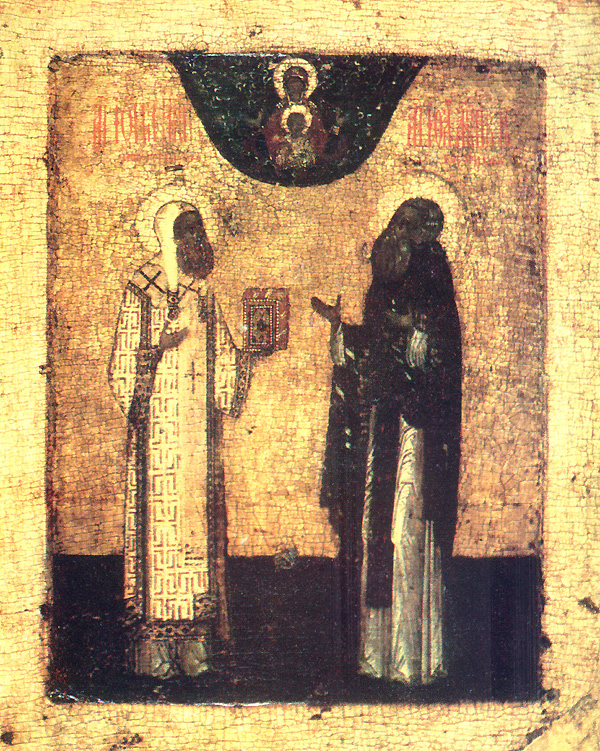
Saint John, Archbishop of Novgorod, was born at Novgorod of the pious parents Nicholas and Christina. He passed his childhood in quiet and peaceful surroundings.
After the death of their parents, John and his brother Gabriel decided to establish a small monastery in honor of the Annunciation of the Most Holy Theotokos with their inheritance.
At first they built a wooden church, but a short time later they also built a stone church. Their good intentions were not without difficulties. Before they finished construction on the stone temple, the brothers totally exhausted their means. Only their steadfast and living faith inspired them to continue what they had started. They turned for help with it to the Queen of Heaven, on Whose account this God-pleasing matter was begun.
Because of their unflagging faith and zeal, She manifested Her mercy to them. She told them in a dream that everything necessary for the completion of the temple would be provided. On the following morning, the brothers saw a splendid horse loaded with two sacks of gold. No one came for it, and when the brothers removed the sacks, the horse vanished. Thus did the Mother of God provide for the monastery.
Upon completion of the monastery construction, under the protection of the Mother of God, the brothers were clothed in the monastic schema. Saint John took the name of Elias, and Saint Gabriel took the name Gregory.
The chronicles speak of Saint John being made bishop under the entries for the year 1162. His first archpastoral letter was addressed to the clergy of his diocese. It was filled with an endearing concern about his flock, written in a spirit of fatherly guidance: “It has pleased God and the Most Holy Theotokos, through your prayers, that I, a mere man, should not refuse this high office, of which I am unworthy. Since you yourselves have encouraged me to this service, now listen to me …”
The saint spoke about the vocation of the pastor. He is concerned about his sheep, he not only chastizes, but also heals those who lead a sinful life. “At the beginning of my discourse I ask you not to be too much attached to this world, but rather be instructive to people. Look first of all, that they not give themselves over to drunkenness. You yourselves know, that through this vice most of all, not only do the simple people perish, but we also. When your spiritual children come to you in repentance, then question them with mildness. It is not seemly to impose harsh penances.Do not scorn the reading of books, since if we do not start doing this, then what will distinguish us from the simple unschooled people? … Do not impose penances upon orphans…. Let everything be seemly, for the yoke of Christ ought to be light.”
In the year 1165 Saint John was elevated to archbishop (from that time the Novgorod cathedra became an archbishopric).
The winter of 1170 was a very difficult time for Novgorod. Suzdal forces with their allies laid siege to the city for two days, since the Novgorod people would not accept Prince Svyatoslav. They also took the tribute-tax of the Dvina district which was not subject to them.
In grief the people of Novgorod prayed to God and the Most Holy Theotokos for the salvation of the city. On the third night, while he was praying before an icon of the Savior, Saint John heard a voice ordering him to go to the church of the Savior on Il’ina street, to take the icon of the Most Holy Theotokos and carry it out to the walls of the city.
In the morning the saint told the people about the command and sent his deacon with clergy to the church of the Savior for the icon. Going into the church, the archdeacon bowed down before the icon and wanted to take it, but the icon would not budge. The archdeacon returned to the archbishop and told him what had happened.
Then the saint with all the assembly went to the Il’ina church and on their knees began to pray before the icon. They began to sing a Molieben, and after the Sixth Ode at the kontakion “Protectress of Christians,” the icon itself moved from the place. The people with tears cried out: “Lord, have mercy!”
Then Saint John took the icon and together with two deacons carried it to the city walls. The Novgorodian people saw their doom, for the Suzdal forces and their allies were ready for pillage. In the sixth hour the assault began, and the arrows fell like rain. Then the icon turned its visage towards the city, and tears trickled down from the eyes of the Most Holy Theotokos, which the saint gathered on his phelonion.
A darkness covered the Suzdal forces, they became unable to see and they fell back in terror. This occurred on February 25, 1170. Saint John established a solemn feastday for Novgorod, the Sign of the Most Holy Theotokos (November 27).
The Suzdal army inflicted great harm on the Novgorod region. Here also the archpastor did not remain on the sidelines. He showed fatherly concern for devastated households suffering hunger, and he distributed aid to orphans. Just like other Russian hierarchs, he calmed and soothed the internecine strife in much-suffering Rus by his prayers and his virtue. In 1172, the archpastor journeyed to Vladimir to reconcile Prince Andrew Bogoliubsky with the Novgorod people.
The saint not only shared in the adversity of his people, but most of all he concerned himself with their spiritual enlightenment. Saint John devoted much attention to spiritual conversations, which often occurred in the circle of the clergy and the laypeople. There are preserved about 30 of his instructions concerning Baptism, Confession, the Holy Eucharist.
His Guidance for Monks is filled with spiritual grandeur: “Once having followed after Christ, monks as actualisers of spiritual life by the Cross ought to live in solitary places, separate from worldly folk. Let them steal nothing for themselves, and let them be wholly dedicated to God. A monk ought always to be a monk, at every time and at every place, both in asleep and awake he should preserve the memory of death, and be fleshless in the flesh.”
“Not for everyone does the monastery serve as a therapy for sensual love, just as silence is for anger, and non-acquisitiveness is for money, and the tomb is for avarice. Monastic life and worldly life are incompatible, just as one would not harness a camel and horse together. The monk bends his neck beneath the yoke of the Creator and ought to pull the plow in the valley of humility, in order to multiply the fine wheat by the warmth of the Life-giving Spirit and to sow the seeds of the reason of God. The black-robed is not his own master; being like gods, take care not to rot in likeness to people, nor fall from the heights like Lucifer… for haughty pride comes from human glory.”
The saint’s spiritual powers of grace were unusual. For his simplicity of soul and purity of heart God gave him power against demons. Once, when the saint prayed by night, as was his custom, he heard something splashing the water in the washbasin. Seeing that there was no one beside him, the saint realized that this was a demon trying to scare him.
The saint made the Sign of the Cross over the washbasin and restrained the devil. Soon the evil spirit could no longer bear the prayer of the saint, which scorched it like fire, and it began to beg to be released from the washbasin. The saint was agreeable, but ordered the demon to carry him from Novgorod to Jerusalem to the Sepulchre of the Lord and back, all in one night. The demon fulfilled the saint’s command, but asked him to tell no one about his shame.
In one of his conversations, the saint told his flock that he knew a man who visited the Holy Land in one night. The revenge of the evil spirit was not slow in coming. It began to scatter women’s things in his cell. Once, when people had gathered in Saint John’s cell, the devil transformed himself into a woman who ran in front of them as if fleeing from the cell.
The saint heard the racket and gently asked, “What has happened, my children, what is the noise all about?” The unruly crowd, shouting various charges of perverse life against the saint, dragged him to the River Volkhov. They put the saint on a raft and released it down along the current of the river. But the raft, contrary to expectation, sailed against the current straight to the Saint George men’s monastery, three versts from Novgorod.
Seeing this, people were ashamed and with weeping and shouts they went along the riverbank after the raft, beseeching the saint to forgive them and to return to the city. The heart of the simple archpastor was filled with joy, not only for himself, but for his flock: “Lord, do not hold this sin against them!” he prayed, and granted pardon to all.
This happened not long before the death of the saint. Sensing its approach, he put off the hierarch’s omophor and took the schema with the name John, the same name he had in his youth. He appointed his brother, Saint Gregory (May 24) as his successor. The saint died on September 7, 1186 and was buried in the church of Holy Wisdom.
In 1439, repairs were being made at the cathedral of Holy Wisdom (Hagia Sophia) through the zeal of Saint Euthymius; in the portico chapel of Saint John the Forerunner, a stone suddenly came loose and cracked the lid of the tomb standing there. Saint Euthymius gave orders to lift off the boards broken by the stone, and the temple was filled with fragrance.
In the tomb they beheld the incorrupt relics of the saint, but no one was able to identify who this archpastor was. In his cell, Saint Euthymius fervently began to pray for God to reveal to him the name of this saint.
That night a man appeared before him, clothed in the vestments of a hierarch, and said that he was Archbishop John, who was found worthy to serve the miracle of the Most Holy Theotokos in honor of Her Sign.
“I proclaim to you the will of God,” continued the saint, “to celebrate the memory of the archbishops and princes lying here, on October 4, and I shall pray Christ for all Christians.” His memory is also celebrated at the Synaxis of Novgorod hierarchs on February 10. In 1630, a feastday was also established for December 1.
Venerable Serapion of Spaso-Eleazar Monastery, Pskov
Saint Serapion of Pskov was born at Yuriev (now Tartu), which then was under the rule of Germans, who sought to stamp out Orthodoxy. His parents were parishioners of a Russian church in the name of Saint Nicholas.
Saint Serapion was well versed in the Holy Scripture, and more than once he entered into the defense of Orthodoxy. When they wanted to convert him by force to the foreign faith, he departed to the Tolvsk wilderness, not far from Pskov, where the Pskov ascetic monk Euphrosynus (May 15) began his prayerful work.
Under his nurturing, Saint Serapion began to acquire the wisdom of wilderness life. But soon he happened to undergo temptations. Without a blessing, he wanted to leave his guide and to live an ascetic life in complete solitude. But the Lord brought the inexperienced novice to his senses: after he seriously hurt his leg, he repented of his self-will and disobedience and returned to the Elder.
After he received the Great Schema, he dwelt constantly with Saint Euphrosynus for 55 years, strictly keeping the vow of silence. Brethren began gradually to gather around Saint Euphrosynus, for which the Elder built a temple in the name of the Three Hierarchs and gave a skete rule.
Saint Serapion zealously fulfilled everything commanded of him and was a role model for the monks. The monk so strictly fulfilled the monastic vow of uncovetousness, that a copyist of his life called him “an unburied corpse.” He bore every insult with extraordinary humility, always blaming himself alone, and he himself asked forgiveness of his insulter. The monk deeply sensed the power of communal prayers and he said that “the order of the twelve Psalms” sung alone in the cell cannot equal one “Lord, have mercy” sung in church.
Saint Serapion died on September 8, 1480, on the Feast of the Nativity of the Most Holy Theotokos. Since the day of repose of Saint Serapion coincides with one of the twelve Great Feasts, his commemoration is on September 7. A Troparion and Kontakion were composed for the saint.
Saint Euphrosynus himself committed the body of his disciple to the earth. By his fervent deeds he had transformed himself into mere “bones, covered by skin.” Saint Serapion was not separated from his spiritual Father even after death: their holy relics were placed beside each other. A common service was composed to Saints Euphrosynus and Serapion (15 May), wherein Saint Serapion is glorified as the first co-ascetic, “companion and friend” of Saint Euphrosynus.
Hieromartyr Macarius, Archimandrite of Kanev and Pereyaslavl

The Hieromartyr Macarius of Kanev lived in the seventeenth century. This was a most terrible time for Orthodox Christians in western Rus. The constant struggles of the Hieromartyr, were an attempt to defend the Orthodox Faith under difficult conditions, when it was possible only to defend the future of the Russian Orthodox Church, which was preserved from the brusque passing of the hurricane of the Unia, endured together with Tatar incursions.
The holy Hieromartyr Macarius was born in 1605 in the city of Ovruch in Volhynia into the illustrious Tokarevsky family, renowned adherents of Orthodoxy. In the years between 1614-1620 the saint studied at the Ovruch Dormition monastery, and upon the death of his parents he became a monk at this monastery, having begun his service as a novice.
In 1625 Saint Macarius, with the blessing of the archimandrite, left the Dormition monastery and was sent to the Pinsk bishop, Avramii, who assigned him to the Pinsk Kupyatichsk monastery. In 1630 he was ordained as hierodeacon, and in 1632 as hieromonk.
Fame about the excellence of the monastic life of the hieromonk Macarius spread beyond the bounds of the Kupyatichsk monastery, and in 1637 the brethren of the Bretsk Symonov monastery turned with a request to the igumen of the Kupyatichsk monastery, Hilarion (Denisevich), to send them Saint Macarius to be their head. But the Kupyatichsk igumen also had need of the hieromonk Macarius.
In 1637 the head of the Kupyatichsk monastery sent him to Metropolitan Peter Moghila of Kiev to hand over money collected by the brethren for the rebuilding of Kiev’s church of the Holy Wisdom, and for the solicitation of help for the construction and repair of damaged monastery churches. Seeing in the hieromonk Macarius a talented son of God’s Church, the Metropolitan issued him a certificate to collect offerings, and in 1638 appointed him head of the Kamenetsk Resurrection monastery (in Grodnensk district).
Until the pillaging and seizing of the monastery by the Uniates in 1642, Saint Macarius guided the brethren of the Resurrection monastery. In these harsh times the brethren of the Kupyatichsk monastery elected Saint Macarius as igumen, who led the monastery until 1656. From 1656 through 1659, Saint Macarius headed the Pinsk monastery, and from 1660 as archimandrite Saint Macarius guided the brethren of his original Ovruch Dormition monastery.
More than ten years passed in constant struggle with the Latin Poles in Ovruch. Nothing could compel the brethren to quit the monastery, neither the seizure of the farm lands belonging to the monastery by the Dominicans, nor the rapacious pillaging of moveable property, nor beatings. Only in the year 1671, after the devastation of Ovruch by the Tatars, did the holy archimandrite Macarius leave the monastery, in which there remained not a single monk, and he went to the Kiev Caves Lavra.
But the defenders of Orthodoxy, like Saint Macarius, were needed not only at Kiev, but even more outside of Kiev. Metropolitan Joseph (Neliubovich-Tukal’sky) assigned Archimandrite Macarius as head of the Kanev monastery. Thus, after thirty years of struggle with the Uniates, Saint Macarius was again on the front lines of battle for the Orthodox Faith.
In 1672 Yuri, the son of Bogdan Khmel’nitsky, sought shelter at the Kanev monastery. The hetman Doroshenko, petitioned Metropolitan Joseph for the assignment of Saint Macarius, and repeatedly visited Kanev monastery. In 1675, he switched his allegiance to Russia, after he renounced allegiance to the Turks, evidently, not without counsel from Saint Macarius.
In response the Turkish powers dispatched an army to Little Russia. On September 4, 1678, the aggressors rushed on the monastery. Saint Macarius met the enemy with cross in hand at the entrance to the church. The Turks demanded that the monk hand over to them the monastery treasury. Hearing the answer of the monk, that his treasure was in Heaven, the furious robbers hung the saint hand and foot between two posts.
After two days they beheaded the Hieromartyr on September 7, 1678. Witnesses to the martyric death of Archimandrite Macarius carried his body to the monastery church, in which they were hidden for safety. But the returning Turks placed firewood around the church and burned everything in the temple. When the surviving citizens of Kanev began removing the bodies of those who perished, then only one body was found whole and as though alive. This was the body of the Hieromartyr Macarius, attired in hairshirt, with a cross on his breast and another cross in his hand. The holy body was buried in this temple beneath the altar on September 8, 1678.
The holy Hieromartyr Macarius was a man of highly righteous and spiritual life, glorified while still alive by miracles and the gift of clairvoyance. At Kanev, he healed the blind and the dying.
In 1688, during renovation of the temple, the grave of the Hieromartyr was opened, and the incorrupt body of the saint was found. In connection with the danger of invasion for the Kanev monastery, on May 13, 1688 the holy relics were solemnly transferred to the Pereyaslavl regimental Resurrection church. There also they transferred the beloved book of the Hieromartyr, “Discourse of John Chrysostom on the 14 Epistles of the holy Apostle Paul” (Kiev edition 1621-23) with his signature on one of the pageleafs. Under Bishop Zachariah (Cornelovich) the relics were transferred in 1713 to a new-built temple of the Pereyaslavl Mikhailovsk monastery, and after its closing the relics rested at the Pereyaslavl Resurrection monastery from August 4, 1786.
In 1942, the relics were transferred to the Trinity church in the city of Cherkassa, and from 1965 they have been in the church of the Nativity of the Most Holy Theotokos in that same city.
The commemoration of the Hieromartyr Macarius is made twice: September 7, the day of his repose, and on May 13, the transfer of his holy relics.
Apostle Evodius (Euodias) of the Seventy

The Holy Apostle Evodius of the Seventy was, after the holy Apostle Peter, the first bishop in Syrian Antioch. His successor, the Hieromartyr Ignatius the God-Bearer (December 20), disciple of the holy Apostle John the Theologian, mentions him in his Letter to the Antiochians: “Remember your blessed father Evodus, who was made your first pastor by the Apostles.”
Saint Evodius served as bishop for 27 years and died as a martyr under the emperor Nero (54-68). Saint Evodus wrote several compositions. In one of them he writes that the Most Holy Virgin Mary gave birth to the Savior of the world at the age of fifteen.
Other writings of the saint have not survived. A book entitled THE STAR is mentioned by the fourteenth century church historian Nikēphóros Callistus. Saint Evodus received the crown of martyrdom in the year 66.
Apostle Onesiphorus of the Seventy
The Holy Apostle Onesiphorus of the Seventy Saint Paul writes of him: “God grant mercy to the house of Onesiphorus, for he often refreshed me, and was not ashamed of my bonds. When he was at Rome, he searched for me with great diligence, and found me. May the Lord grant him to find the mercy of the Lord on that day; and you know how much he served me at Ephesus.” (2 Tim 1:16-18).
Saint Onesiphorus was bishop at Colophon (Asia Minor), and later at Corinth. He died a martyr in the city of Parium (not far from Ephesus) on the shores of the Hellespont, where he had gone to proclaim Christ among the local pagans.
Martyr Eupsychius of Caesarea, in Cappadocia
The Holy Martyr Eupsychius was born in Caesaria, Cappadocia. In one of the Synaxaria he is called the son of a senator Dionysius. During a time of a persecution against Christians under Hadrian, he was arrested and tortured. After the torture they threw him into prison, where he was healed of his wounds by an angel.
When they set the martyr free, he distributed all his property to the poor. He gave away a certain portion even to his enemies, who had reported him and given him over to torture. Under a new governor, Saint Eupsychius was again arrested. They hung him up and cut his body with iron hooks, and then they cut off his head with a sword. The martyr died under the emperor Hadrian (117-138).
Venerable Luke, Abbot of Batheos Ryako
Saint Luke was a monk at the Deep Stream (Βαθέος Ρύακος) Monastery near Triglia, Lykaonia (in Asia Minor), and later became its third Igoumen, He reposed there in peace at the end of the X century.
The Monastery, dedicated to the Transfiguration of Christ. was famed for the strictness of the ascetic life of its monks. The first Igoumen and founder of the monastery was Saint Basil (July 1), and the second was Saint Ignatius (+ September 27, 970).1
According to the Hagiologion of Metropolitan Sophronios Eustratiadou, Saint Luke is commemorated on September 7. Only Saint Νikόdēmos of the Holy Mountain (July 14) lists his commemoration on December 27.
1 Some sources list Saint Peter (September 7) as the second Igoumen.
Venerable Cloud (Clodoald), Abbot-Founder of Nogent-Sur-Seine near Paris
Saint Cloud was born in 520. When his father was killed in battle in 524 he and his brothers were brought up by their grandmother Saint Clotilde (June 3). His brothers were murdered by their uncles Childebert and Clotaire to prevent them from succeeding to the Frankish throne. Saint Cloud escaped and lived as a hermit, renouncing any claim to the throne.
Later, Saint Cloud was ordained to the holy priesthood, and lived a life of virtue and good works. He died around 560.
Venerable Macarius of Optina
The future Saint Macarius was born in 1788 into the noble Ivanov family, and was baptized with the name Michael in honor of Saint Michael of Tver (November 22). His parents Nicholas and Elizabeth had an estate in the village of Shepyatino in the Dimitrov district in the Orel province. They also owned property in other provinces, including the village of Zhelezniki in Orel Province where they lived. The Ivanovs moved to Moscow in 1794 so Elizabeth could receive medical treatment for tuberculosis.
Michael’s beloved mother died on January 21, 1797, and was buried in the Saint Andronicus monastery. The nine-year-old Michael moved to the village of Karachev to live with his sister Daria and her husband Simeon Peredelsky, who had been elected to the District Court of Karachev. Michael received his primary education there in the local parish school.
Around 1801, Michael and his two brothers moved into the house of his aunt Anna M. Verevkina, where they were educated along with her own son. In 1802, when he was fourteen, Michael and his brother Alexis were hired as assistant bookkeepers in the District Treasury of Lgov. Although the job was difficult, Michael carried out his duties with precision and care that he attracted the attention of the provincial authorities.
In 1805 Michael was appointed as head of the Financial Board (Treasury) in Kursk. When he was not working, he liked to spend his time reading or playing the violin. Michael’s father died on March 17, 1806 after a long illness, and was buried near the parish church at Turischev.
Michael visited the Ploschansk Hermitage, twenty-four miles from his family’s estate in Schepyatino, in October of 1810. From there he wrote to his brothers saying that he was leaving the estate to them, for he intended to remain at the hermitage. His only condition was that they donate 1000 rubles to build a stone church at Turischev where their father was buried.
Those closest to Michael never knew whether his visit to Ploschansk was accidental or premeditated. He did seem inclined to the monastic life, but perhaps he did not make a final decision to become a monk until he had observed the monastic life at Ploschansk.
Michael entered the Ploschansk Hermitage of the Theotokos at the age of twenty-two. It had no large buildings, no great wealth, and was far from populated areas. Perhaps he was attracted by the unpretentiously humble circumstances of the place. There were fifty monks at the Hermitage, led by Hieromonk Joannicus.
Michael was enrolled as a novice a month after arriving at Ploschansk, and was tonsured as a rassophore on December 24, 1810 with the name Melchizedek. He did not mind the privation and hard work at the Hermitage, but there were no Elders there capable of offering spiritual guidance.
Hearing that Elders of lofty spiritual life were living in the forests of Bryansk, and in the monasteries of the Orel and Kursk dioceses, Father Melchizedek longed to meet them and profit from their teaching. However, the opportunity did not arise for some time.
In 1814, he went on pilgrimage to Kiev, where he venerated the relics of various saints. On the way back, he met some experienced Elders and was able to converse with them.
Father Paul, who came from a family of Rostov merchants, and who was tonsured on Mount Athos, became the new Superior of Ploschansk in 1815. He noticed Father Melchizedek’s zeal for the monastic life, and for fulfilling his obediences. On March 7, 1815 Father Paul tonsured him as a monk with the new name Macarius. A few days later, on March 12, Bishop Dositheus of Orel and Sevsk ordained Father Macarius as a hierodeacon.
Schemamonk Athanasius (Zakharov), a disciple of Saint Paisius Velichkovsky (November 15) was visiting Ploschansk in 1815. He had lived at White Bluff Monastery and Florischev Hermitage in the Vladimir Province. While at Ploschansk, Father Athanasius fell off a bench and dislocated a joint in his leg. He went to Cholnsk Monastery in 1816 and partially recovered, but he could no longer walk without a crutch. In 1817 he returned to Ploschansk, and Father Macarius moved to his cell to take care of him.
Elder Athanasius had a great influence on the spiritual development of Father Macarius, who revered him as his Father and teacher. For seven years he had lived in the Neamts Monastery, where he was tonsured by Saint Paisius Velichkovsky. Father Athanasius finished the course of his earthly life on October 17, 1825, and died in the arms of Father Macarius. He had lived at Ploschansk for ten years, and Father Macarius derived much benefit from his Elder’s example.
Father Athanasius had copies of the translations of the ascetical Fathers made by Saint Paisius, and he himself had translated the Life of Saint Gregory of Sinai, the Catechetical Homilies of Saint Theodore the Studite, the homilies of Saint Gregory Palamas, and many other profitable writings. Not only did Father Macarius read and copy these translations and absorb the wisdom contained in them, he later published them for the benefit of others.
Father Macarius was ordained to the holy priesthood by Bishop Dositheus of Orel and Sevsk on May 27, 1817. When Igumen Paul retired to the bishop’s residence at Kaluga in 1818, he was replaced by Hieromonk Seraphim, a disciple of Father Basil (Kishkin), the Superior of White Bluff Hermitage. Father Seraphim brought good order to Ploschansk, instructing the monks in the spiritual life.
With Father Seraphim’s blessing, Father Macarius made a pilgrimage to Kiev in 1819 with Hierodeacon Palladius. There they met Archimandrite Anthony, who later became Archbishop of Voronezh and Zadonsk. On the way back to Ploschansk, the two visited Glinsk Hermitage. Father Macarius became acquainted with Hierodeacon Samuel, who was experienced in mental prayer. Since Father Athanasius had never spoken to him of this activity, Father Macarius was gratified to meet someone who could speak about it from personal experience.
In 1824, Father Macarius went to Rostov to venerate the relics of Saint Demetrius (September 21 and October 28). On that same trip he visited Optina Monastery and its new Skete for the first time.
Two of Father Macarius’s spiritual guides passed away within a short time: Elder Athanasius in 1825, and Igumen Seraphim in 1826. Hieromonk Marcellinus was appointed as Superior of Ploschansk in addition to his duties as Bishop Gabriel’s steward. He continued to live at Orel for two years, while the Ploschansk Hermitage was administered by Father Anatole, the treasurer.
Father Macarius was made dean of the Hermitage on June 10, 1826. In January of 1827, he was assigned as confessor at the Holy Trinity Convent of Sevsk. This began his period of spiritual direction and spiritual correspondence which lasted until his death. He did not assume such a role on his own, but only in obedience to the will of the bishop.
In 1828 Father Leonid (Nagolkin) came to Ploschansk from the Saint Alexander of Svir Monastery with several disciples. Father Macarius thought that the arrival of Father Leonid was the answer to his prayers, for Father Leonid was a man of great spiritual wisdom. This holy Elder, who had struggled against many visible and invisible foes, was able to give useful advice to those who were experiencing temptations. He understood from personal experience that those who wish to serve the Lord must prepare their souls for temptation (Sirach 2:1). He agreed to Father Macarius’s repeated requests to accept him as a spiritual son and disciple. When Father Leonid moved to Optina in 1829, Father Macarius kept in touch with him through letters.
Father Macarius visited Optina and Father Leonid in 1831 on his way to Petersburg, where Bishop Νikόdēmos of Orel was serving his term in the Holy Synod. He appointed Father Macarius as treasurer and steward, much to the latter’s chagrin. Father Macarius did not care for the bustle of the city, and longed to return to the tranquility of the monastery, yet he remained in his position out of obedience to the bishop.
After serving for almost a year in Petersburg, Father Macarius returned to Ploschansk Hermitage. On the way back, he visited Father Leonid again at Optina. He also submitted a request to Father Moses to be admitted to the Skete at Optina as soon as this might be arranged. The desired transfer from Ploschansk to Optina did not take place until January 14, 1834.
Father Macarius had lived at Ploschansk for twenty-three years, and always retained a certain fondness for the place for the rest of his life. Father Macarius finally arrived at Optina on February 5, 1834.
At the age of forty-six, Father Macarius placed himself at the feet of Father Leonid, humbling himself and demonstrating complete obedience. At first, he helped the Elder with his correspondence, but later his responsibilities increased. In October of 1836 he was appointed as confessor for the monastery. After Father Anthony was assigned to Saint Nicholas Monastery in Maloyaroslavets as abbot, Father Macarius succeeded him as Superior of the Skete on December 1, 1839. Father Macarius’s relationship with Father Leonid did not change because of his new position. He never did anything without consulting Father Leonid, and always attributed any success he achieved to the blessing and prayers of his Elder.
Father Macarius remained humble and obedient to Father Leonid until the Elder’s death on October 11, 1841. Even when Father Leonid was transferred from the Skete to the Monastery in 1836, Father Macarius visited him every day to ask his advice on various matters.
During his final illness, Father Leonid told his spiritual children to go to Father Macarius for spiritual counsel. Seeing in Father Macarius the same spiritual gifts possessed by Father Leonid, people recommended him to their friends and acquaintances. As a result, the number of Father Macarius’s disciples grew larger every year. He was also assigned as instructor of the new novices, and of those who were about to be tonsured.
Father Macarius received visitors from morning until night, and also kept up an extensive spiritual correspondence. Sometimes he was exhausted by the crowds of people, and by the number of letters he had to write. His humility and love for people who were afflicted in body and in spirit would not permit him to curtail his activities, however.
Father Macarius had always loved reading and studying patristic literature. At Ploschansk, he had copied many translations done by Saint Paisius Velichkovsky which were in the possession of Schemamonk Athanasius. His knowledge and understanding of the Fathers increased at Optina under the guidance of Father Leonid, a disciple of Father Theodore of Svir, who was himself a disciple of Saint Paisius. Father Anthony, abbot of the Skete and Father Moses, abbot of the Monastery, both encouraged the study of patristic books. Conditions for the publication of these manuscripts, translated and corrected by Saint Paisius, were quite favorable, for Optina possessed the best copies of these writings.
In 1845, Ivan V. Kireyevsky, the editor of The Muscovite, asked Father Macarius to write a biography of Saint Paisius for his magazine. In 1846, Father Macarius was visiting the Kireyevskys at their estate, and the discussion turned to the lack of spiritual books offering instruction in the Christian life. Natalia Kireyevsky, the spiritual daughter of Father Macarius since 1838, happened to have some manuscripts of ascetical literature. They both asked Father Macarius, “What prevents us from offering these spiritual treasures to the world?”
At the beginning of 1847 a biography of Father Pasius Velichkovsky, with extracts from his writings, was published. Over the course of time, sixteen books of patristic literature were published under the Elder’s supervision, including works by Saint Nilus of Sora, Saints Barsanuphius and John, Saint Simeon the New Theologian, and Saint Isaac of Syria.
In 1853, Father Macarius resigned as Superior of the Skete of Saint John the Baptist, and was succeeded by Father Paphnutius. This took place on November 30, exactly fourteen years from the time Father Macarius had first assumed the office.
In 1859, one of Father Macarius’s spiritual daughters, was at the point of death. Maria asked Father Macarius to pray that God would spare her life so that she could see her son again. The Elder told her that she would recover, and that they would both die around the same time. The old woman told her friends of this prediction, saying, “Beware my death, for it is connected with the Elder’s death.” Maria died on August 23, 1860 in the presence of Father Macarius and Father Leonid Kavelin.
On August 26, the Elder became ill with ischuria. A doctor who happened to be at Optina saw him and treated him with drugs. Father Macarius felt worse that evening, and so they sent for a certain nobleman’s personal physician. That doctor was not available, so Father Kavelin went to another doctor to ask for advice. Father Macarius showed no improvement, so he received Holy Unction and the life-giving Mysteries of Christ. On September 2, he received two gifts which delighted him. One was an enamel icon of the Vladimir Mother of God from Metropolitan Philaret of Moscow, which he wore on his breast. The other was a cross containing a relic of the Cross of Christ.
The Elder felt weaker on September 4, and received Holy Communion after Vespers. During his illness the brethren who cared for him read the daily rule of prayer for him at the proper times. He also asked them to read certain portions of the writings of the holy Fathers.
On September 5, Father Macarius was moved from his small bedroom into the larger reception room where the air was fresher. During the night the ninety-year-old Schemamonk Hilarion reposed, and the church bell was rung three times according to the custom of the Monastery, indicating that one of the brethren had departed. Many of Father Macarius’s disciples and some visitors in the guesthouse thought that the bell tolled for him. They became alarmed until it was announced that Father Hilarion had passed away.
The Elder experienced shortness of breath on September 6. He received Communion, and was visited by two doctors, but there was nothing they could do for him. Father Macarius felt worse that evening, and received Holy Communion a second time around 8:00 P.M. Around midnight he talked with his confessor for about half an hour, receiving absolution and forgiveness of his sins.
Father Macarius asked to have the prayer for the dying read, which he heard while sitting in a chair. The Canon and Akathist to the Most Holy Theotokos were also read, and the Canon to the Sweetest Lord Jesus Christ was read during Matins. During these readings it appeared that the Elder’s sufferings were alleviated.
During the night Father Macarius asked to be moved several times from the bed to the chair. He was calm and peaceful, and thanked those around him for caring for him. At 6:00 the next morning he received Holy Communion for the last time.
At 7:00 on the morning of September 7, 1860, Father Macarius departed to the Lord while the Ninth Ode of the Canon for the Departure of the Soul from the Body was being read. Two years before his death, he was secretly tonsured into the Great Schema. Therefore, a schema which had been blessed on the Lord’s Sepulchre was placed on his body. Several Panikhidas were offered for his soul throughout the day.
Father Macarius was laid to rest on September 10, in a grave prepared for him opposite the altar of the Saint Nicholas chapel in the main church. He was buried to the right of the grave of Father Leonid, his friend and fellow ascetic.
The Moscow Patriarchate authorized local veneration of the Optina Elders on June 13,1996. The work of uncovering the relics of Saints Leonid, Macarius, Hilarion, Ambrose, Anatole I, Barsanuphius and Anatole II began on June 24/July 7, 1998 and was concluded the next day. However, because of the church Feasts (Nativity of Saint John the Baptist, etc.) associated with the actual dates of the uncovering of the relics, Patriarch Alexey II designated June 27/July 10 as the date for commemorating this event. The relics of the holy Elders now rest in the new church of the Vladimir Icon of the Mother of God.
The Optina Elders were glorified by the Moscow Patriarchate for universal veneration on August 7, 2000.
9/11 announcements
September 11, 2022
Sunday before the Elevation of the Holy Cross
After-feast of the Nativity of the Theotokos
Galatians 6:11-18: Brethren, see how large a letter I have written to you with my own hand. As many as desire to make a fair show in the flesh, they compel you to be circumcised, only that they may not be persecuted for the Cross of Christ. For not even those who are circumcised do themselves keep the Law; but they desire to have you circumcised, that they may boast in your flesh. But God forbid that I should boast, except in the Cross of our Lord Jesus Christ, through Whom the world is crucified to me, and I to the world. For in Christ Jesus, neither circumcision counts for anything, nor uncircumcision, but a new creation. And as many as walk according to this rule, peace be upon them, and mercy, and upon the Israel of God. Henceforth, let no one trouble me; for I bear in my body the brand-marks of the Lord Jesus. The grace of our Lord Jesus Christ be with your spirit, brethren. Amen.
John 3:13-17: The Lord said, “No one has ascended into heaven but He who descended from heaven, the Son of man. And as Moses lifted up the serpent in the wilderness, so must the Son of man be lifted up, that whoever believes in Him should not perish but have eternal life. For God so loved the world that He gave His only Son, that whoever believes in Him should not perish but have eternal life. For God sent His Son into the world, not to condemn the world, but that the world might be saved through Him.”
Troparion of the Resurrection: Having learned the joyful message of the Resurrection from the angel, the women Disciples cast from them their parental condemnation, and proudly broke the news to the Disciples, saying, Death has been spoiled. Christ God is risen, granting the world Great Mercy.
Troparion of the Nativity of the Theotokos: Thy nativity, O Theotokos, hath proclaimed joy to the whole universe; for from thee did shine forth the Sun of justice, Christ our God, annulling the curse, and bestowing the everlasting blessing, abolishing death and granting us life everlasting.
Troparion of the Chains of St. Peter: O Holy Apostle, Peter, thou dost preside over the Apostles by the precious chains which thou didst bear. We venerate them with faith and beseech thee that by thine intercessions we be granted the great mercy.
Kontakion of the Nativity of the Theotokos: By thy holy birth-giving, O pure one, Joachim and Anne were delivered from the reproach of barrenness; and Adam and Eve were delivered from the corruption of death; thy people do celebrate it, having been saved from the stain of iniquity, crying unto thee, The barren doth give birth to the Theotokos, who nourisheth our life.
CALENDAR
UNTIL FURTHER NOTICE: All services listed on the calendar will be available through streaming and webcast.
Sunday, September 11 (Sunday before the Elevation of the Holy Cross)
8:50 a.m. — Orthros (webcast)
9:00 a.m. — Christian Education
10:00 a.m. — Divine Liturgy (webcast)
12:00 p.m. — Pot Luck Meal
Monday, September 12
Father Herman off
Tuesday, September 13 (Dedication of the Church of the Anastasis)
6:00 p.m. — Orthros followed by Divine Liturgy
Wednesday, September 14 (Elevation of the Holy Cross)
This feast is celebrated as one of the most important in the Church Year because it commemorates two events of great significance. After St. Helena had found at Jerusalem the cross upon which Christ was crucified, she built a Church on Mount Calvary to hold the precious relic. The Christians held the Holy Cross in such high regard that they soon began to celebrate this feast in honor of the finding of the Cross.
In the year 614, the Persians invaded the Empire and took Jerusalem, and sent the case containing the Cross back to their country. For fifteen years the Greek Emperor Heraclius waged war against the Persians, and finally in 629 defeated them, forcing them to make peace, and to restore the Holy Cross to him. It is said that the case containing the sacred relics was returned to him with the seals still unbroken. The Relics were replaced in the Church with great rejoicing, and to the original Feast in honor of the finding of the Cross was added another, in honor of its safe return to Jerusalem.
A special feature of the Church Services on this day, is the procession in which the Cross is borne aloft on a tray of flowers and placed in the midst of the Church; the Priest then elevates it to the four corners of the compass, blessing thrice with it as he does so, and praying that God will protect and preserve the President and the Civil Authorities of our country and the Armed Forces, and guard and guide the Hierarchs and clergy of the Church, and protect and preserve all His faithful people from every evil.
[STRICT FAST DAY]
6:30 p.m. — Daily Vespers
7:15 p.m. — Chanters’ Practice
Thursday, September 15
NO Services
Friday, September 16
NO Services
Saturday, September 17
8:30 a.m. — Workday at the Church
6:00 p.m. — Great Vespers
Sunday, September 18 (Sunday after the Elevation of the Holy Cross)
8:50 a.m. — Orthros (webcast)
9:00 a.m. — Christian Education
10:00 a.m. — Divine Liturgy (webcast)
SPECIAL ANNOUNCEMENTS
The Eucharist Bread …was offered by the Dn. Richard Roots for the Divine Liturgy this morning. The Artos for the Litia and Artoklasia for the Feast of the Nativity of the Theotokos this past Wednesday evening was offered by the Meadows.
Eucharist Bread Schedule:
Eucharist Bread Coffee Hour
September 11 R. Root POT LUCK MEAL
Algood/Schelver
September 13 (Tues. .m.) Pacurari Lasseter/Pacurari/Miller
(Feast of the Exaltation of the Holy Cross)
September 18 Baker D. Root/Baker/Cooper
September 25 Henderson Henderson/Jones
Also, please remember that we still need your tithes and offerings which may be placed in the tray that is passed during the Divine Liturgy, in the tithe box at the back of the nave or be mailed to: St. Peter Orthodox Church, P.O. Box 2084, Madison, MS 39130-2084.
Schedule for Epistle Readers – Page numbers refer to the Apostolos (book of the Epistles) located on the Chanters’ stand at the front of the nave. Please be sure to use this book when you read.
Reader Reading Page#
September 11 Walt Wood Gal. 6:11-18 198
September 13 (Tues. p.m.) Kh. Sharon Meadows I Cor. 1:18-24 311-312
September 18 Sh. Charlotte Algood Gal. 2:16-20 193
September 25 Ian Jones II Cor. 4:6-15 163
Continue to pray for Metropolitan Paul (who is also the brother of our Patriarch) and the Syriac Archbishop John of Aleppo who were abducted while on a humanitarian mission in Syria.
Please remember Fr. Joseph and Kh. Joanna Bittle, and their daughter Abigail, in your prayers.
Please remember the following in your prayers: Aidan Milnor, the Milnor family; Lamia Dabit and her family; Mary Greene (Lee and Kh. Sharon’s sister); Jay and Joanna Davis; Fr. Leo and Kh. Be’Be’ Schelver and their family; Kathy Willingham; Marilyn (Kyriake) Snell; Jack and Jill Weatherly; Lottie Dabbs (Sh. Charlotte Algood’s mother), Sh. Charlotte and their family; Maria Costas (currently at St. Catherine’s Village); Reader Basil and Brenda Baker and their family; Buddy Cooper.
Calendar Items:
* The men of the parish meet for lunch at 11:30 a.m. on the first Thursday of the month.
* The Ladies meet at the church at 10:00 a.m. on the second Saturday of the month to pray the Akathist to the Mother of God, Nurturer of Children on behalf of our children.
* The Ladies meet for lunch on the last Tuesday of the month.
* The Feast of the Precious and Life-giving Cross will be celebrated with Orthros followed by Divine Liturgy on Tuesday evening, September 13th, beginning at 6:00 p.m.
Instructions for streaming our services can be found on the parish website.
PARENTS, a problem has arisen due to the nursery room being left messy after Coffee Hour. No food of any kind should be taken into that room. Also, it is necessary for a parent to be in the room whenever their children are in there playing. Thank you for your assistance with this.
Fasting Discipline for September
In September, the traditional fasting discipline (no meat, dairy, eggs, fish, wine or oil) is observed on all Wednesdays and Fridays of the month. The Feast of the Elevation of the Cross on September 14th is also a strict fast day.
Major Commemorations for September
September 13 Dedication of the Church of the Anastasis
September 14 Elevation of the Precious Life-giving Cross
September 23 Conception of the Forerunner
September 24 Proto-martyr Thekla
September 26 Apostle John the Theologian (repose)
Quotable: “The authority of the commandments of God is a living entity, not a theory. Thus, there is no reason to look for theories for why God’s laws are justified. If, for example, someone tells us that something is poison, we will believe them and not touch it. We won’t then proceed to try to figure out for ourselves if it’s really poison, we won’t do any chemical tests to try to decide for ourselves.”
Elder Sergei of Vanves
Worship: Sunday, September 18, 2022 (Sunday after the Elevation of the Holy Cross)
Scripture: Galatians 2:16-20; Mark 8:34-9:1
Celebrant: Father Herman
Epistle Reader: Sh. Charlotte Wood
Prosphora: Baker
Coffee Hour: D. Root/Baker/Cooper
Daily Readings for Tuesday, September 06, 2022
THE COMMEMORATION OF THE MIRACLE WROUGHT BY ARCHANGEL MICHAEL IN COLOSSAE (CHONAE)
NO FAST
The Commemoration of the Miracle Wrought by Archangel Michael in Colossae (Chonae), Holy Martyr Calodote
ST. PAUL’S LETTER TO THE HEBREWS 2:2-10
Brethren, if the message declared by angels was valid and every transgression or disobedience received a just retribution, how shall we escape if we neglect such a great salvation? It was declared at first by the Lord, and it was attested to us by those who heard him, while God also bore witness by signs and wonders and various miracles and by gifts of the Holy Spirit distributed according to his own will. For it was not to angels that God subjected the world to come, of which we are speaking. It has been testified somewhere, “What is man that thou art mindful of him, or the son of man, that thou carest for him? Thou didst make him for a little while lower than the angels, thou hast crowned him with glory and honor, putting everything in subjection under his feet.” Now in putting everything in subjection to him, he left nothing outside his control. As it is, we do not yet see everything in subjection to him. But we see Jesus, who for a little while was made lower than the angels, crowned with glory and honor because of the suffering of death, so that by the grace of God he might taste death for every one. For it was fitting that he, for whom and by whom all things exist, in bringing many sons to glory, should make the pioneer of their salvation perfect through suffering.
LUKE 10:16-21
The Lord said to his disciples, “He who hears you hears me, and he who rejects you rejects me, and he who rejects me rejects him who sent me.” The seventy returned with joy, saying, “Lord, even the demons are subject to us in your name!” And he said to them, “I saw Satan fall like lightning from heaven. Behold, I have given you authority to tread upon serpents and scorpions, and over all the power of the enemy; and nothing shall hurt you. Nevertheless do not rejoice in this, that the spirits are subject to you; but rejoice that your names are written in heaven.” In that same hour he rejoiced in the Holy Spirit and said, “I thank you, Father, Lord of heaven and earth, that you have hidden these things from the wise and understanding and revealed them to babes; yes, Father, for such was your gracious will.”
Commemoration of the Miracle of the Archangel Michael at Colossae

In Phrygia, not far from the city of Hieropolis, in a place called Cheretopos, there was a church named for the Archangel Michael, built over a miraculous spring.
This church was built by a certain inhabitant of the city of Laodicia in gratitude to God for healing his mute daughter. The holy Chief Commander Michael appeared to this man in a dream and revealed to him that his daughter would receive the gift of speech after drinking from the water of the spring. The girl actually did receive healing and began to speak. After this miracle, the father and his daughter and all their family were baptized. In fervent gratitude, the father built the church in honor of the holy Chief Commander Michael. Not only did Christians begin to come to the spring for healing, but also pagans. In so doing, many of the pagans turned from their idols and were converted to the faith in Christ.
At this church of the holy Chief Commander Michael, a certain pious man by the name of Archippus served for sixty years as church custodian. By his preaching and by the example of his saintly life he brought many pagans to faith in Christ. With the general malice of that time towards Christians, and especially against Archippus, the pagans thought to destroy the church in order to prevent people from coming to that holy place of healing, and at the same time kill Archippus.
Toward this end they made a confluence of the Lykokaperos and Kufos Rivers and directed its combined flow against the church. Saint Archippus prayed fervently to the Chief Commander Michael to ward off the danger. Through his prayer the Archangel Michael appeared at the temple, and with a blow of his staff, opened a wide fissure in a rock and commanded the rushing torrents of water to flow into it. The temple remained unharmed. Seeing such an awesome miracle, the pagans fled in terror. Archippus and the Christians gathered in church glorified God and gave thanks to the holy Archangel Michael for the help. The place where the rivers plunged into the fissure received the name “Chonae”, which means “plunging.”
The Chudov (“of the Miracle”) monastery in Moscow is named for this Feast.
Martyrs Eudoxius, Zeno, and Macarius
The Martyrs Eudoxius, Zeno, Macarius and their Companions received a martyric death for Christ under the emperor Maximian Galerius, the successor of the emperor Diocletian.
Saint Eudoxius held the high position of a military commander in the imperial armies. He was a Christian, as were his friend Zeno and his house steward Macarius. After the emperor Diocletian issued an edict that Christians who refused to offer sacrifice to idols were to be put to death, many people fled to various lands with their families to avoid torture and death. At this time Saint Eudoxius resigned his high position, and with his wife Saint Basilissa and all their family abandoned their property and went into hiding in the region of Armenian Melitene.
The governor of Melitene sent soldiers to search for Eudoxius. When they found Eudoxius, he was attired in white garb. Not recognising him, the soldiers began to question whether a certain military commander Eudoxius had come into these parts. Not revealing who he was, the saint invited the soldiers into his home, fed them and gave them lodging for the night.
Saint Eudoxius considered his encounter with the soldiers as a sign from the Lord of his impending death by martyrdom. In the morning, he disclosed to his guests that he was the one whom they were seeking. In gratitude for the hospitality, the soldiers offered to conceal from the authorities that they had found Saint Eudoxius. However, the saint would not consent to this.
Setting his affairs in order, he told his wife not to weep for him, but on the contrary to celebrate the day of his martyric death. Donning his military garb, he went with the soldiers to the governor. Saint Basilissa and his friends Saints Zeno and Macarius followed after Saint Eudoxius.
The governor tried to persuade Saint Eudoxius to offer sacrifice to the idols and by this safeguard his life, exalted rank and property. Saint Eudoxius firmly refused, denouncing the folly of anyone who would worship soulless idols. He removed his soldier’s belt, the emblem of his authority, and threw it in the governor’s face.
Soldiers present at this, secret Christians, did the same thing, and they numbered more than a thousand men. The embarrassed governor asked the emperor what he should do. He was ordered to try the ringleaders and set the others free.
After prolonged tortures, they led Saint Eudoxius forth to execution. Following after her husband, Saint Basilissa wept, and his friend Saint Zeno also wept for the martyr. Saint Eudoxius again urged his wife not to mourn him, but rather to rejoice that he was worthy of the crown of martyrdom. He asked that she bury his body in a place called Amimos.
To his weeping friend Saint Zeno Saint Eudoxius predicted that they would enter the Kingdom of Heaven at the same time. Emboldened by these words, Zeno loudly declared himself a Christian, for which he was immediately sentenced to death.
Later, Saint Basilissa took her husband’s body without hindrance, and buried it in the place where he had requested. After this, they arrested the saint and led her before the governor. Desiring to share the fate of her husband, she fearlessly denounced both the governor and his false gods, the idols. The governor, however, saw her intent and would not torture her, but instead sent her away. As she left, the saint said to him that God would see her intention to suffer for her faith and would accept this intent as an accomplished deed.
Seven days later, Saint Eudoxius appeared to his wife in a vision and bade her to inform his friend and house steward Macarius, that both he and Saint Zeno awaited the arrival of Macarius. Macarius immediately went to the governor and declared himself a Christian, for which he was sentenced to death and beheaded. Many Christians also suffered martyrdom during this time.
Saint Archippus of Herapolis
Saint Archippus, son of devout Christians from the city of Hieropolis, at age ten went to pray in the church of the holy Chief Commander Michael and he remained at this temple to serve as church caretaker. He led a strict and ascetic manner of life, constantly at fasting and prayer.
He persuaded many pagans who came to the holy spring to accept holy Baptism, to forsake pagan impiety, and to turn to the One True God and Savior Jesus Christ. Tenacious pagans headed by idolous priests repeatedly tried to kill Saint Archippus, but each time the Lord delivered him out of their hands.
Finally, the pagans devised a plan to destroy the church and at the same time kill also Archippus by flooding the spot where both the church and the curative spring stood. Seeing the preparations for this wicked deed, Saint Archippus firmly resolved not to abandon the holy place, and he prayed to God and to the Archangel Michael to preserve the church and the spring. The Lord heard his prayer, and the saint witnessed the great Miracle of the Chief Commander Michael at Colossae. Miraculously delivered from death, Saint Archippus lived at the church into his old age, and he died peacefully at the age of 70. Christians buried the saint at Colossae, at the place of his deeds.
Martyr Romulus and with him many others
The Martyr Romulus lived during the reign of the emperor Trajan (98-117) and was a confidant of the emperor by virtue of his office of military commander. At the time, Trajan was waging war in the East to put down uprisings against the Romans by the Iberians, Sarmatians, and Arabs.
In the year 107, and again a second time in 115, the emperor conducted a review of the military strength of his army, and found in his troops upwards of 11,000 Christians. Trajan immediately sent these Christians into exile in Armenia in disgrace. Saint Romulus, in view of this, reproached the emperor for his impiety and the sheer folly to diminish the army’s strength during a time of war. Saint Romulus, moreover, acknowledged that he himself was a Christian. The enraged Trajan had the holy martyr subjected to a merciless beating, after which Saint Romulus was beheaded.
The Christian soldiers sent into exile in Armenia were killed by various forms of execution.
Hieromartyr Cyril, Bishop of Gortyna
The Hieromartyr Cyril, Bishop of Gortyna, lived during the time of the emperor Diocletian and his co-emperor Maximian (284-305). As a Christian he was brought to trial before the governor Agrippina and after interrogation he was thrown into prison. One night the saint heard a voice commanding him to go to Rome.
In the morning the doors of the prison were open, and the idols overthrown and destroyed. On the road to Rome Saint Cyril had a vision: Saint Philoxenos appeared and said that he would receive two crowns, one of a hierarch and the other of a martyr.
At Rome, Saint Cyril rendered great help to the Church by his preaching. When a persecution against Christians started up, Saint Cyril went to Jerusalem to encourage the Christians living there. Along the way he had a vision and received a command not to neglect Crete.
When he arrived there, Saint Cyril was chosen bishop of the city of Gortyna. He was then 60 years of age. Still on the episcopal throne of Gortyna at age 95, Saint Cyril was brought to trial at the start of a new persecution against Christians and sentenced to death. He was beheaded with the sword in the vicinity of Raukos at the beginning of the fourth century.
Saint Cyril is commemorated on June 14 on the Greek calendar.
Martyrs Cyriacus, Faustus the Presbyter, Abibas the Deacon, and 11 others, at Alexandria
The Martyrs Cyriacus, Faustus the Presbyter, (Habib) Abibas the Deacon, and eleven other martyrs suffered martyrdom for Christ at Alexandria under the emperor Decius (249-251). During the persecution, they all steadfastly confessed themselves as Christians before the governor Valerius. They were beheaded by the sword, about the year 250. Their bodies were buried by Christians in Alexandria.
Saint David of Hermopolis, Egypt
Saint David of Egypt before his entry into a monastery was the leader of a band of bandits in Egypt, in the desert of Hermopolis. He had committed many murders and other wicked deeds. As he grew older, he contemplated his life and was filled with fear because of his past crimes. Leaving his gang of bandits, he went to the monastery intending to repent of his wickedness.
He begged the igumen to accept him as one of the brethren, but the igumen refused. He explained to David that their monastic life was very severe and would be beyond his strength. David persisted and finally, he revealed to the igumen, that he was the notorious robber David. He said that if they did not accept him, he would return to his former life, then come back and plunder the monastery and kill the monks.
Then the igumen allowed him into the monastery, and to the surprise of all, David became an excellent monk. By his severe efforts David surpassed all the monks. After a certain time the Lord sent the Archangel Gabriel to David to say that the Lord had forgiven him. Saint David, in his great humility, could not believe that the Lord would forgive such a great sinner as he was, in such a short time. The Archangel then said to him, that because of his doubt David would become speechless. David asked that he should be permitted to say his prayers, monastic rule and share in the church services. This was granted him, but the rest of the time he remained speechless. Towards the end of his life, Saint David received from God the power to perform miracles. He healed many of the sick and cast out evil spirits. Having lived in such manner for many years, he fell asleep in the Lord.
Hieromartyr Maxim Sandovich

Saint Maxim was born in 1886 in Zdynia in the Lemko region of Carpatho-Rus which was then a part of the Austro-Hungarian monarchy in present day Poland. His father, Tymofej, was the cantor of Zydnia’s Greek Catholic church. After completing his education in the nearby town of Jaslo and Nowy Sacz, he entered the Greek Catholic Basilian monastery in Krakow. Dissatisfied with the attempts to Latinize the Eastern rite to make it more acceptable to the Roman Catholic majority and also attempts to denationalize the Rusyns, he crossed the border into the Russian empire and entered the famed Orthodox monastery at Pochaev. It was while at the monastery that his outstanding potential attracted the attention of the illustrious Bishop Anthony (Khrapovitsky) who enrolled him in the Orthodox seminary in Zhitomir.
He completed his seminary studies in 1911 and that same year married Pelagia Grigoryuk and was ordained to the Holy Priesthood. At that time in the Lemko region there was a growing movement away from the Greek Catholic Church to the Orthodox Faith of their ancestors. Fr. Maxim returned home to serve the Orthodox faithful in the villages of Hrab, Vysovatka and Dovhe. After serving his first Divine Liturgy in Hrab on December 2, 1911, the Austrian authorities, suspicious of the Orthodox Faith for its alleged “Russian sympathies,” issued an order forbidding any further Orthodox services. Father Maxim ignored the order and continued to conduct services in village homes. He was repeatedly fined and held under temporary arrest. Before Pascha in 1912, he was again arrested with his friend and spiritual father, Father Ignatij Hudyma, and held in prison for two years in a Lviv prison until their trial began on March 9, 1914. After being found not guilty he immediately returned to his native village and continued minister to his Orthodox parishioners.
Martyrdom
With the outbreak of World War I, Father Maxim was again arrested and imprisoned on August 4, 1914 along with his entire family. Father Maxim, his father, mother, brother, and wife were forced to travel on foot to the prison while being prodded by the bayonets of the soldiers. In prison they were placed in separate cells and denied the opportunity to see each other. This time, however, there would be no court trial. On the morning of September 6, Father Maxim awoke in his cell and read his morning prayers as usual. Austrian soldiers led the twenty-eight year old priest from his cell to a wall in the prison courtyard where he was bound and blindfolded. As he was being led from his cell Father Maxim realized where they were taking him and humbly and with dignity asked, “Be so good as not to hold me. I will go peacefully wherever you wish.” There they ripped his priestly cross from his chest and threw it to the dirt, marking an “X” with chalk over his heart for a target. Before the command to execute the priest was given, Father Maxim was heard to shout: “Long live the Rus’ people, long live Orthodoxy!” As the shots rang out the martyr slumped to the ground. To assure that he was dead three more blasts of a revolver were emptied into his head. On September 12, Saint Maxim’s father, his pregnant wife, and brother were sent to the concentration camp at Talerhof in the far western part of the Austro-Hungarian Empire. While in the camp Pelagia gave birth to a son she named Maxim in honor of his father. Like his father, the younger Maxim also entered the priesthood serving the Lemko Rusyn people faithfully until his death in 1991.
His Canonization
In September 1994, the official glorification of Saint Maxim began in the courtyard of the Gorlice Court House where the saint had been martyred, where a bronze plaque marking the tragic event was placed on the wall. Following this service, a procession of hierarchs, including our Metropolitan Nicholas of blessed memory, clergy and faithful entered the Holy Trinity Church in Gorlice for the service of glorification.
For the glorification of a saint, ordinarily the saint’s relics would be exhumed from their grave and transferred in procession to the church. The bishops of the Orthodox Church of Poland decided to delay the transfer, fearing it would provoke the areas’ Roman Catholics who reluctantly tolerate the Orthodox presence. Finally on September 5-6, 2007, the martyr’s relics were transferred from the village cemetery in Zdynia to the Holy Trinity Church in Gorlice, Poland where they are enshrined on the right side of the icon screen.
The Witness of Martyrs
Our Lord said, “Do not fear those who kill the body but cannot kill the soul. But rather fear him who is able to destroy both soul and body in hell” (Matthew 10:28). The life of this new hieromartyr (priest-martyr) echo the words of Jesus. Saint Maxim had no fear of threats from the government, imprisonment, abuse, insults and even a firing squad. When this newly-ordained priest was arrested for serving an Orthodox Divine Liturgy his first action on being freed was to immediately return to his flock and resume his priestly ministry. The Lord’s words in the Book of Revelation apply well to Saint Maxim: “Be faithful unto death and I will give you the crown of life” (Revelation 2:10).
In my many years working as a hospice chaplain I have often been summoned by doctors and nurses to the bedside of a terminally ill patient who is fearful of his approaching death. These medical professionals assume, rightly so, that it is primarily an active faith that can help a person face this fear. The promise of the Lord Jesus to us is that if we believe in Him and our lives are joined to His we have nothing to fear in death. But while the death and resurrection of our Savior have removed our fear of death, Jesus does not desire that all of our fears vanish. He does want us to be afraid of something! He wants us to be afraid of the right things, to be fearful of things that should be fear: “…fear him who is able to destroy both soul and body in hell. What shall it profit a man if he gain the whole world and lose his soul?” (Matthew 16:26). The life of Saint Maxim Sandovich, faithful priest shines forth this truth!
— Father Edward Pehanich
Icon of the Mother of God of Kiev-Bratsk

The Kiev-Bratsk Icon of the Mother of God was at first in the church of Saints Boris and Gleb in the city of Vyshgorod (Kiev), where it miraculously appeared in the year 1654. In 1662, when Russia was at war with Poland (1659-1667), the city was dealt heavy losses by the Crimean Tatars fighting on the side of the Polish. The temple of the holy Passion-Bearers Boris and Gleb was destroyed and defiled. But the Providence of God preserved the holy wonderworking icon of the Mother of God, which was taken out of the church beforehand and set off along the Dniepr. The relics of the saints were hidden beneath a crypt.
The river carried the icon to the Podol section of Kiev, where it was joyfully taken up by the Orthodox and with due reverence transferred to the Bratsk (Brotherhood) monastery. The icon is described in the records of church property of the Kiev-Bratsk monastery, made in the year 1807.
There existed a “Song about the Wonderworking Kiev-Bratsk Icon of the Mother of God”, compiled soon after the year 1692. The Kiev-Bratsk Icon of the Mother of God is commemorated four times during the year: September 6, May 10, June 2, and on Saturday of the Fifth Week of Great Lent. All these days are dedicated to the miraculous appearance of the holy icon in 1654. The original icon has not been preserved. The copy was painted from it “measure for measure,” and is at present located in the Kiev monastery of the Protection of the Mother of God.
“Arapet” Icon of the Mother of God

The Arapet, or “Arabian” Icon of the Most Holy Theotokos appeared while the holy Apostle Thomas (October 6) was evangelizing Ethiopia, Arabia, and India.
Instead of the usual three stars (signifying the perpetual virginity of the Mother of God), the outer garment of the Theotokos has three circles with the head of an angel inside each one. In this feature, it resembles the icons “In Giving Birth you Preserved your Virginity” (“A Virgin Before and After Giving Birth”) (October 17) and “O All-Hymned Mother” (October 6).
Daily Readings for Monday, September 05, 2022
HOLY PROPHET ZACHARIAS, FATHER OF THE VENERABLE FORERUNNER
NO FAST
Holy Prophet Zacharias, Father of the Venerable Forerunner, Elizabeth, Mother of the Forerunner, Urban, Theodore, & Medimnos the Hieromartyrs and the 77 Companions at Nicomedea
ST. PAUL’S SECOND LETTER TO THE CORINTHIANS 8:7-15
Brethren, as you excel in everything in faith, in utterance, in knowledge, in all earnestness, and in your love for us see that you excel in this gracious work also.
I say this not as a command, but to prove by the earnestness of others that your love also is genuine. For you know the grace of our Lord Jesus Christ, that though he was rich, yet for your sake he became poor, so that by his poverty you might become rich. And in this matter I give my advice: it is best for you now to complete what a year ago you began not only to do but to desire, so that your readiness in desiring it may be matched by your completing it out of what you have. For if the readiness is there, it is acceptable according to what a man has, not according to what he has not. I do not mean that others should be eased and you burdened, but that as a matter of equality your abundance at the present time should supply their want, so that their abundance may supply your want, that there may be equality. As it is written, "He who gathered much has nothing over, and he who gathered little had no lack.
MATTHEW 23:29-39
The Lord said to the Jews who had come to him, "Woe to you, scribes and Pharisees, hypocrites! for you build the tombs of the prophets and adorn the monuments of the righteous, saying, 'If we had lived in the days of our fathers, we would not have taken part with them in shedding the blood of the prophets.' Thus you witness against yourselves, that you are sons of those who murdered the prophets. Fill up, then, the measure of your fathers. You serpents, you brood of vipers, how are you to escape being sentenced to hell? Therefore I send you prophets and wise men and scribes, some of whom you will kill and crucify, and some you will scourge in your synagogues and persecute from town to town, that upon you may come all the righteous blood shed on earth, from the blood of innocent Abel to the blood of Zacharias the son of Barachiah, whom you murdered between the sanctuary and the altar. Truly, I say to you, all this will come upon this generation.
O Jerusalem, Jerusalem, killing the prophets and stoning those who are sent to you! How often would I have gathered your children together as a hen gathers her brood under her wings, and you would not! Behold, your house is forsaken and desolate. For I tell you, you will not see me again, until you say, 'Blessed is he who comes in the name of the Lord.'
Holy Prophet Zachariah and Righteous Elizabeth, parents of Saint John the Baptist

The Holy Prophet Zachariah and the Righteous Elizabeth were the parents of the holy Prophet, Forerunner and Baptist of the Lord, John. They were descended from the lineage of Aaron: Saint Zachariah, son of Barach, was a priest in the Jerusalem Temple, and Saint Elizabeth was the sister of Saint Anna, the mother of the Most Holy Theotokos. The righteous spouses, “walking in all the commandments of the Lord” (Luke 1:6), suffered barrenness, which in those times was considered a punishment from God.
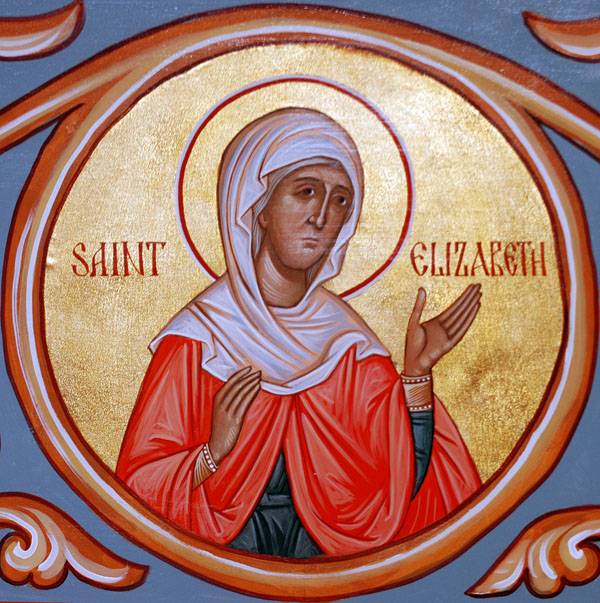
Once, during his turn of priestly service in the Temple, Saint Zachariah was told by an angel that his aged wife would bear him a son, who “will be great in the sight of the Lord” (Luke 1:15) and “will go before Him in the spirit and power of Elias” (Luke 1:17).
Zachariah doubted that this prediction would come true, and for his weakness of faith he was punished by becoming mute. When Elizabeth gave birth to a son, through the inspiration of the Holy Spirit she announced that his name was John, although no one in their family had this name.
They asked Zachariah and he also wrote the name John down on a tablet. Immediately the gift of speech returned to him, and inspired by the Holy Spirit, he began to prophesy about his son as the Forerunner of the Lord.
When King Herod heard from the Magi about the birth of the Messiah, he decided to kill all the infants up to two years old at Bethlehem and the surrounding area, hoping that the new-born Messiah would be among them.
Herod knew about John’s unusual birth and he wanted to kill him, fearing that he was the foretold King of the Jews. But Elizabeth hid herself and the infant in the hills. The murderers searched everywhere for John. Elizabeth, when she saw her pursuers, began to implore God for their safety, and immediately the hill opened up and concealed her and the infant from their pursuers.
In these tragic days Saint Zachariah was taking his turn at the services in the Temple. Soldiers sent by Herod tried in vain to learn from him the whereabouts of his son. Then, by command of Herod, they murdered this holy prophet, having stabbed him between the temple and the altar (MT 23: 35). Elizabeth died forty days after her husband, and Saint John, preserved by the Lord, dwelt in the wilderness until the day of his appearance to the nation of Israel.
On the Greek calendar, Saints Zachariah and Elizabeth are also commemorated on June 24, the Feast of the Nativity of Saint John the Baptist.
Martyr Athanasius, Abbot of Bretsk

The Hieromartyr Athansius of Bretsk was Belorussian and was born in about the year 1597 into a pious Christian family named Philippovich. He received a serious upbringing, and he knew the theological and historical literature, as is evidenced in the diary of the saint, which has been preserved.
In his youth, Saint Athanasius for a while was a teacher in the houses of Polish merchants. In the year 1627, he accepted tonsure under Igumen Joseph at the Vilensk monastery of the Holy Spirit. Saint Athanasius was ordained hieromonk in the year 1632, and made head of the Duboisk [Dubovsk] monastery near Pinsk.
Saint Athanasius, with a special blessing of the Theotokos, re-established Orthodoxy within the boundaries of the ancient Russian territories that had been seized by the Polish Reche. Between the years 1638-1648 Saint Athanasius fulfilled his obedience as igumen of the Bretsk-Simeonov monastery. The monk endured much abuse from the Uniates and illegal persecution from the civil authorities. Three times he endured being locked up in prison.
The saint was sent to the authorities at Kiev to appear before a religious tribunal, but he was acquitted, and returned to his own monastery. For ten years Saint Athanasius, finding himself among persons maliciously disposed towards him, led a constant struggle for Holy Orthodoxy, his faithfulness to which is evidenced by his sufferings.
Attempts to wear down the spiritual endurance of the saint were to no avail. He again went to trial, after which the monk was sentenced to death by execution, for his cursing of the Unia. Saint Athanasius died as a martyr on the night of September 4-5, 1648 (the Uncovering of Relics was on July 20, 1679).
Passion-Bearer Gleb (in Baptism David)
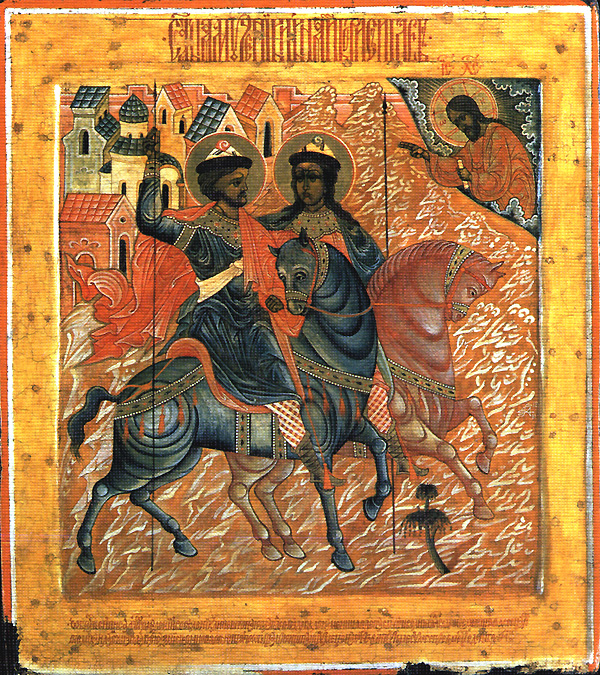
The Holy Prince Gleb, in Holy Baptism David, was one of the first Russian martyrs called “Passion-Bearers.” He suffered together with his brother Prince Boris (Roman in Holy Baptism). After the murder of Saint Boris, Svyatopolk the Accursed sent to his younger brother Prince Gleb a messenger with false information about their father, Great Prince Vladimir, who had died from illness, thereby using deceit to murder another possible claimant to the Kievan throne.
The deceived Prince Gleb hastened off to Kiev with a small company. His apprehensive brother Yaroslav, having caught up with him at Smolensk, was unable to delay the saint, who did not suspect such wickedness on the part of his brother Svyatopolk.
Not far from Smolensk the assassins came upon the boat of Saint Gleb, who made no resistance, but asked meekly that they should spare him because of his young age. At the command of the murderers Gleb’s cook slit his throat. The body of the prince was buried in a desolate place not far from Smolensk, “between two tree-trunks,” i.e., in a simple wooden coffin (+1015). In the year 1019-1020 his brother Yaroslav found the grave of Saint Gleb. The body, being incorrupt, was transferred to Vyshgorod near Kiev and buried beside holy Prince Boris.
Later on, the relics of the brothers were transferred (May 2) into the church of Saint Basil the Great, and there at the crypts of these holy Passion-Bearers many miracles were worked. Metropolitan John of Kiev compiled a service to the Passion-Bearer princes and also established a feastday for them together on July 24, which dates from the first half of the eleventh century.
The Russian Church from of old has venerated these brothers, who unceasingly have rendered prayerful assistance to their native land, particularly in years of grievous tribulation. Thus, just before the Battle of the Neva in 1240, the Passion-Bearers Boris and Gleb appeared in a vision to one of the soldiers of holy Prince Alexander Nevsky (November 23, August 30, and May 23), and they aided the Russians during the combat.
The chronicles are filled with the accounts of the various manifestations of mercy, witnessed at their tombs, and of the victories gained through their help. Many churches and monasteries were built throughout Russia in honor of the holy Passion-Bearers Boris and Gleb.
Martyr Tathuil, and his sister, Bebaia
The Martyrs Tathuil (Thiphael) and his sister Bebaia (or Thivea) suffered for their bold and effective preaching of Christianity among the pagans. After long and intense torture, the pagans suspended the holy Martyr Thiphael on a tree and cut him with a saw. His sister Saint Bebaia was killed with a spear thrust in the neck.
Martyr Sarbelus of Edessa
The Holy Martyr Sarbelus was a pagan priest who lived during the reign of the emperor Trajan (98-117) He and his sister Bebaia were converted by Saint Barsimaius, the Bishop of Edessa (January 29). They both received the crown of martyrdom.
This Saint Sarbelus appears to be the same one who is commemorated on January 29 and October 15.
Martyrs Juventinus and Maximus the soldiers, at Antioch
The martyred soldiers Juventinus and Maximus suffered during the reign of the emperor Julian the Apostate, whom they served as bodyguards. Once, while he was at Antioch, Julian decided to defile the food of the Christians by sprinkling all the food in the marketplaces with blood offered to idols. Saints Juventinus and Maximus openly condemned the emperor’s course of action and they boldly denounced him for his apostasy from the Christian Faith. After merciless beatings they were both put to death on orders of the impious emperor.
Martyrs Urban, Theodore, Medimnus, and 77 companions, at Nicomedia
The Martyrs Urban, Theodore, Medimnus and seventy-seven companions suffered at Nicomedia during the reign of the Arian emperor Valentus (Valens) (364-378 or 379). The Orthodox bishop Evagrius was banished from the Church of Constantinople, and Christians not wishing to accept the Arian heresy were locked up in prison and subjected to various outrages.
Driven to the point of despair, the Orthodox Christians decided to ask for protection from the emperor and they sent 80 chosen men of religious rank, headed by Saints Urban, Theodore and Medimnus.
Hearing their justified complaints, the emperor flew into a rage, but he knew how to hide his wrath. He quietly summoned the eparch Modestus and ordered him to put the delegates to death. Modestus put them upon a ship, telling them that they all would be sent to prison. Instead, he ordered the ship’s officers to burn the ship on the open sea. The ship was set afire and for a while, it floated upon the sea. Finally, reaching a place called Dakizis, the ship burned up with all the holy martyrs on board.
Martyr Abdias (Abidas) of Persia
The Martyr Abdias [or Abidas] suffered in Persia during the reign of the emperor Izdegerd I for his refusal to renounce Christ and instead worship the sun and fire. He died after many tortures, and until his final breath, he gave thanks to God for permitting His chosen one to die for His Holy Name.
Orthros and Hierarchical Divine Liturgy – Sun 9/4/2022
Here is the live stream for Orthros and Hierarchical Divine Liturgy – Sun 9/4/2022 If you need, here are instructions for accessing this content from your phone, tablet, computer, or TV.
Daily Readings for Sunday, September 04, 2022
12TH SUNDAY OF MATTHEW
NO FAST
12th Sunday of Matthew, Babylas the Holy Martyr, Moses the Prophet & Godseer, Our Righteous Father Anthimus of Coroucle in Cephallenia, Anthimos the new ascetic, Hermione the Martyr, daughter of St. Philip the Deacon
ST. PAUL’S FIRST LETTER TO THE CORINTHIANS 15:1-11
Brethren, I would remind you in what terms I preached to you the gospel, which you received, in which you stand, by which you are saved, if you hold it fast — unless you believed in vain. For I delivered to you as of first importance what I also received, that Christ died for our sins in accordance with the scriptures, that he was buried, that he was raised on the third day in accordance with the scriptures, and that he appeared to Cephas, then to the twelve. Then he appeared to more than five hundred brethren at one time, most of whom are still alive, though some have fallen asleep. Then he appeared to James, then to all the apostles. Last of all, as to one untimely born, he appeared also to me. For I am the least of the apostles, unfit to be called an apostle, because I persecuted the church of God. But by the grace of God I am what I am, and his grace toward me was not in vain. On the contrary, I worked harder than any of them, though it was not I, but the grace of God which is with me. Whether then it was I or they, so we preach and so you believed.
MATTHEW 19:16-26
At that time, a young man came up to Jesus, kneeling and saying, "Good Teacher, what good deed must I do, to have eternal life?" And he said to him, "Why do you call me good? One there is who is good. If you would enter life, keep the commandments." He said to him, "Which?" And Jesus said, "You shall not kill, You shall not commit adultery, You shall not steal, You shall not bear false witness, Honor your father and mother, and You shall love your neighbor as yourself." The young man said to him, "All these I have observed; what do I still lack?" Jesus said to him, "If you would be perfect, go, sell what you possess and give to the poor, and you will have treasure in heaven; and come, follow me." When the young man heard this he went away sorrowful; for he had great possessions.
And Jesus said to his disciples, "Truly, I say to you, it will be hard for a rich man to enter the kingdom of heaven. Again I tell you, it is easier for a camel to go through the eye of a needle than for a rich man to enter the kingdom of God." When the disciples heard this they were greatly astonished, saying, "Who then can be saved?" But Jesus looked at them and said to them, "With men this is impossible, but with God all things are possible.
Martyr Gorazd of Prague, Bohemia and Moravo-Cilezsk

“I am the good shepherd. The good shepherd gives His life for the sheep” [John 10:11].
“O Lord, make this man also, who has been proclaimed a steward of the episcopal grace, to be an imitator of You, the true Shepherd, Who laid down Your life for Your sheep….” [Prayer of Consecration of a Bishop]. On September 25, 1921, these words were prayed over Father Gorazd Pavlik as he was consecrated the Bishop of Moravia and Silesia. It is doubtful that anyone in attendance that day, including the new bishop, expected that he would be called upon to live that prayer in a literal way.
Matthias Pavlik was born in 1879 in the Moravian town of Hrubavrbka in what would later become the Czech Republic. He was born into a Roman Catholic family, completed the Roman Catholic seminary in Olomouc and was ordained a priest. With the end of World War I and the formation of the new nation of Czechoslovakia from the ruins of the Austro-Hungarian Empire, the laws requiring observance of the Catholic religion were loosened. Father Matthias, along with thousands of others left the Catholic Church with many seeking a home in the Orthodox Church, which in that region was then under the protection of the Orthodox Church of Serbia. Taking monastic vows, he assumed the name “Gorazd” who was a disciple of Saints Cyril and Methodius and who succeeded Saint Methodius as the bishop of Moravia. At the age of 42, Father Gorazd was consecrated an Orthodox bishop in Belgrade, Serbia by the Serbian Patriarch Dimitri along with the illustrious Metropolitan Anthony Khrapovitsky of Kiev and several other bishops, including Bishop Dositheus of Zagreb. Bishop Dositheus was a key figure in the re-birth of the Orthodox Church among Carpatho-Rusyns and was glorified as a saint of the Orthodox Church in May, 2000.
Bishop Gorazd immediately set to work building up the Orthodox Faith, building eleven churches and two chapels, translating service books into the Czech language. He paid particular attention to the Carpatho-Rusyns in the eastern part of the Czech Republic who were also returning to the Orthodox Faith of their ancestors. In that region, in 1934 he took part in the 20th anniversary commemoration of the Marmarosh-Sigotsky trial. This trial occurred in 1914 when 94 Carpatho-Rusyn Orthodox, together with their priest, Saint Alexis Kabaluk, were tried for treason for renouncing the Greek Catholic Faith and embracing Orthodoxy.
For twenty years, the bishop faithfully cared for his flock as a good shepherd. He remained faithful to the Orthodox Faith despite attempts by many Catholics to persuade him to renounce Orthodoxy. When many Roman Catholic priests rose up against him, the Catholic Bishop Stoian said, “Leave Pavlik alone, you are not worthy to tie his laces, it would be good if everyone were like Pavlik.”
When the German Nazis invaded and conquered Czechoslovakia in 1938, the Orthodox Church was placed under the Orthodox metropolitan of Berlin, Germany, Metropolitan Seraphim (Liade). The German ruler of Czechoslovakia, Reinhard Heydrich, was assassinated on May 27, 1942 by a group of Czech resistance fighters who then were allowed to hide in the crypt of Saints Cyril and Methodius Orthodox Cathedral. When Bishop Gorazd learned of this he realized what great danger he and his flock were in if the Nazis uncovered this hiding place. Before leaving for Berlin to take part in the consecration of Father Philip Gardner as a bishop, he insisted that the resistance fighters leave the Cathedral and find another place of refuge. But on June 18, the hiding place was revealed after a betrayal and torture, and all members of the group were killed.
The Nazis immediately began massive reprisals. The two Cathedral priests and senior lay officials were arrested. Bishop Gorazd, trying to save his people and his church from destruction, wrote letters to the Nazi authorities taking the blame for the actions in the Cathedral, in which he stated, “I am giving myself up to the authorities and am prepared to face any punishment, including death.”
Bishop Gorazd was arrested on June 27, 1942, tortured and executed by firing squad at the Kobylisz Shooting Range on September 4. He was 63 years old. The two Cathedral priests were also shot. Along with the priests and bishop, a total of 550 people were executed by the Nazis in reprisal for the assassination. In one particularly heinous act, the entire village of Lidice was exterminated. All of the men were executed, the women and children placed in labor camps, and all village dwellings destroyed. Following the martyrdom of the bishop, the Orthodox Church in Bohemia and Moravia was suppressed and all churches closed. Orthodox priests were exiled to forced labor camps in Germany.
Because Bishop Gorazd willingly laid down his life in order to protect his flock, he was recognized by the Orthodox Church of Serbia as a new martyr on May 4, 1961. On August 24, 1987 he was glorified in the Cathedral of Saint Gorazd in Olomouc, Moravia. His feast day is observed on the day of his martyrdom, September 4. Today, at the site of his martyrdom at the Kobylisz Shooting Range, a monument has been erected in his memory and those others who suffered at the hands of the Nazis.
Father Edward Pehanich
Posted with permission, the American Carpatho-Russian Orthodox Diocese, Johnstown, PA
Hieromartyr Babylas, Bishop of Antioch, and those with him

The Hieromartyr Babylas and with him the three youths Urban, Prilidian, Epolonius and their mother Christodoula died as martyrs under the emperor Decius (249-251). During his stay in their city of Antioch, the emperor arranged for a large festival in honor of the pagan gods.
At the same time, Babylas, the holy and God-fearing Bishop of Antioch, was serving the Divine Liturgy in church. He prayed for his flock and taught them to endure all tribulations for Christ with courage. The idolater Decius, curious to witness the Divine Mysteries, decided to enter the church.
News of this reached the bishop, so he went out to meet Decius and blocked the path to the church, for he was unwilling to permit impiety in the temple of God. When the emperor approached the church doors, Saint Babylas refused to let him enter, so the emperor had to abandon his intention. He wanted to take revenge on the saint right away, but when he saw the large throng of Christians, he feared they might riot.
The next day the angry emperor ordered that the church be set on fire, and for Bishop Babylas to be brought before him. When asked why he had insulted the imperial dignity by not allowing the emperor to enter the church, the holy bishop answered, “Anyone who would rise up against God and want to desecrate His sanctuary, is not worthy of respect, but has become the enemy of the Lord.”
Decius declared that the holy bishop must worship the idols in order to make up for his lack of respect for the emperor, or else face execution. After convincing himself that the martyr would remain steadfast in his faith, he commanded the military commander Victorinus to put him in heavy chains and lead him through the city in disgrace. The holy martyr replied, “Emperor, these chains are as venerable for me as your imperial crown is for you. For me, suffering for Christ is as desirable as the imperial power is for you. Death for the Immortal King is as precious to me as your life is to you.”
At the trial with Bishop Babylas were three young brothers, who did not forsake him even in this most difficult moment. Seeing them, the emperor asked, “Who are these children? “
“These are my spiritual children,” the saint replied, “and I have raised them in piety, I have given them an education, cultivated them with guidance, and here before you in a small body are these great young men and perfect Christians. Test them and see.”
The emperor tried in all sorts of ways to entice the youths and their mother Christodoula to renounce Christ, but in vain. Then, in a rage, he ordered each of them to be whipped with a number of blows corresponding to their age. The first received twelve blows, the second, ten, and the third, seven. Dismissing the mother and children, the torturer again summoned the bishop, telling him that the children had renounced Christ. He did not believe the lie, however.
Then he commanded all the martyrs be tied to a tree and burned with fire. Seeing the stoic bravery of the saints, the emperor finally condemned them to be beheaded with the sword.
Holy Prophet and God-seer Moses

The Holy Prophet and God-Seer Moses was of the tribe of Levi, the son of Abram and Jochabed (Exodus 6:20). His life is described in the Bible (Exodus 2 through Deuteronomy 34:12).
Moses was born in Egypt around 1689 B.C. When Pharaoh ordered all male children of the Hebrew slaves to be killed (Exodus 1:22), Moses’ mother placed him in a basket of papyrus coated with pitch, and set him adrift on the Nile. Pharaoh’s daughter found him and raised him as her own son.
At the age of eighty, Moses fled to Midian, where he spoke to God in the Burning Bush on Mt. Horeb (Exodus 3:2). God chose Moses to lead His people from the slavery of Egypt. They crossed the Red Sea as if it were dry land, and for forty years they wandered in the desert.
Arriving in the land of Moab, Moses went to the top of Mt. Nabau, or Nebo (Deuteronomy 32:49), which is called Phasga (Deut. 34:1). There, according to the will of God, he died in 1569 B.C. at the age of 120 without entering the Promised Land.
The first two Biblical Odes are attributed to Moses: “Let us sing to the Lord…” (Exodus 15:1-9), which was sung on the shores of the Red Sea after the Hebrews had crossed it. “Attend, O heaven…” (Deut. 32:1-43) was sung in the land of Moab, a few days before Moses’ death. He is also regarded as the author of the Pentateuch (the first five books of the Old Testament).
The holy Prophet Moses performed many miracles during his lifetime, and also after his death. He appeared on Tabor with the Prophet Elias at the Transfiguration of the Lord (August 6).
On the day that Saint John of the Ladder (March 30) was installed as abbot of Mt. Sinai, the Prophet Moses was seen going around and giving orders to the cooks, stewards, and servants. When the guests had gone and the monks were sitting at table, they wondered what had become of the stranger who had been giving orders. Saint John said, “Our Lord Moses does nothing strange by serving in the place which belongs to him.”
Uncovering of the relics of Saint Joasaph, Bishop of Belgorod

Saint Joasaph was born at Proluka, in the former Poltava governance, on September 8, 1705, the Feast of the Nativity of the Most Holy Theotokos. He was descended from the old and venerable Little Russian (Ukrainian) lineage of the Gorlenkovi. At Baptism he was named Joachim.
In 1712, his father enrolled the seven-year-old Joachim in the Kiev Spiritual Academy. Within the walls of the academy he felt attracted to monastic life.For seven years he studied it further, and finally revealed his intention to his parents.
For a long time his mother and father pleaded with their first-born son not to accept monastic tonsure. But in 1725, unknown to them, he became a “rasophore” (“robe-wearing novice”) with the name Hilarion at the Kiev Mezhigorsk monastery, and on 21 November 1727 he was tonsured in the mantya with the name Joasaph at the Kievo-Bratsk monastery. This event coincided with the completion of his studies at the spiritual academy.
After the death of His Grace Barlaam, the See of Kiev was governed by Archbishop Raphael Zaborovsky. Archbishop Raphael noticed the abilities of the young ascetic and assigned him to greater service to the Church. He was entrusted with the responsibility of the office of examiner of the Kiev archbishopric.
In November 1734, Archbishop Raphael ordained the hierodeacon Joasaph as hieromonk, and he was transferred from the Bratsk monastery school to the Kiev-Sophia archbishop’s house. At the same time, he was appointed a member of the Kiev religious consistory.
In fulfilling the office of examiner, he exerted much effort towards the correction of moral deficiencies among the parish clergy. The saint’s service in the consistory office enabled him to develop his administrative abilities. During this time, he made a good study of the needs of clergy-servers, noting both the good points and the failings of the diocese. His talent for administration was combined with his great spiritual effort. He quickly ascended the ladder of spiritual perfection, which can be seen in his work, “The Conflict of the Seven Venerable Virtues with the Seven Deadly Sins.”
On June 24, 1737 Hieromonk Joasaph was appointed head of the Holy Transfiguration Mgarsk monastery, and elevated to the rank of igumen. Here he worked with all his strength to put the monastery in good order, for it was an old bastion of Orthodoxy in the struggle with the Unia. In this monastery were relics of Saint Athanasius, Patriarch of Constantinople and Wonderworker of Lubny (May 2). Several times Saint Athanasius appeared to Igumen Joasaph, as a sign of his patronal protection.
In 1744 Metropolitan Raphael elevated Igumen Joasaph to the dignity of archimandrite. Towards the end of that same year he was called to Moscow and soon, at the direction of the Most Holy Synod, he was appointed vicar of the Holy Trinity Sergiev Lavra monastery. At this monastery of Saint Sergius he also unstintingly fulfilled obedience to the Church (this year required much exertion for the rebuilding of the monastery after a fire).
On June 2, 1748 at the Peter and Paul cathedral in Peterburg, Archimandrite Joasaph was ordained Bishop of Belgorod. Ascending the archbishop’s throne, Saint Joasaph strictly concerned himself with piety and the condition of the churches, with the proper celebration of divine services, and especially with the moral condition of his flock.
The saint devoted great attention to the education of the clergy, and the correct observance of churchly norms and traditions. Just as before, the saint worked with all his strength in his archpastoral service, without regard for his health.
On the eve of his repose, the saint forbade his cell attendant Stephen to aspire to the priesthood, and he predicted that if he did not obey him, he would meet with an untimely end. To another cell attendant Basil, the saint indicated that he would be a deacon, but would never become a priest. Later, this prediction was fulfilled. Saint Joasaph died on December 10, 1754, and was glorified on September 4, 1911.
Martyr Hermione, daughter of Saint Philip the Deacon

The Holy Martyr Hermione was a daughter of Saint Philip the Deacon (October 11). Wishing to see the holy Apostle John the Theologian, Hermione with her sister Eutychia went to Asia Minor in search of the saint. During their journey, they learned the saint had died. Continuing on, the sisters met a disciple of Saint Paul named Petronius, and imitating him in everything, they became his disciples. Saint Hermione, having mastered the healing arts, rendered help to many Christians and healed the sick by the power of Christ.
During this period, the emperor Trajan (98-117) waged war against the Persians and he came with his army through the village where the saint lived. When they accused Hermione of being a Christian, he gave orders to bring her to him.
At first the emperor, with casual admonitions, sought to persuade the saint to renounce Christ. When this did not succeed, he commanded that she should be struck on the face for several hours, but she joyfully endured this suffering. Moreover, she was comforted by a vision of the Lord, in the form of Petronius, sitting upon the throne of judgment. Convincing himself that she was steadfast in her faith, Trajan sent her away. Hermione later built a hospice in which she took in the sick, treating their infirmities both of body and soul.
Trajan’s successor, Hadrian, again commanded that the saint be brought to trial for confessing the Christian Faith. At first, the emperor commanded that she be beaten mercilessly, then they pierced the soles of her feet with nails, and finally they threw her into a cauldron with boiling tar, lead and sulphurous brimstone. The saint bore everything, giving thanks to God.
And the Lord granted her His mercy: the fire went out, the lead spilled out, and the saint remained unharmed. Hadrian in surprise went up to the place of torture and touched at the cauldron, to ascertain whether it had cooled. When he touched at the cauldron, he burned the skin on his hand, but even this did not dissuade the torturer.
He gave orders to heat a sort of skillet and put the holy martyr in it naked. Here again another miracle took place. An angel of the Lord scattered the hot coals and burned many who stood by the fire. The saint stood in the skillet, as though on green grass, singing hymns of praise to the Lord.
When she was removed from the skillet, the holy martyr seemed to be willing to offer sacrifice to the pagan god Hercules. The delighted emperor gave orders to take her off to the temple. When the saint prayed to God, a loud thunderclap was heard, and all the idols in the pagan temple fell and shattered.
In a rage, the emperor ordered that Hermione be led out of the city and beheaded. Two servants, Theodulus and Theotimos, were entrusted to carry out the execution. Since they were in such a hurry to execute the saint, not allowing her time for prayer, their hands withered. Then they believed in Jesus Christ and with repentance they fell at the feet of Saint Hermione. They besought her to pray that the Lord would call them to Himself before her. This is what transpired, through her prayers. After this, she also fell asleep in the Lord.
Martyr Babylas of Nicomedia and 84 children with him
The Martyr Babylas and 84 disciples with him suffered in the city of Nicomedia for confessing Christianity during the reign of the emperor Maximian (284-305). The emperor, who was then in Nicomedia, renewed the persecution against Christians.
Like many other believers, Saint Babylas was denounced as someone who was instructing children in Christian piety. When Babylas was brought before the emperor, and after his confession of faith in the true God, he was given over to many torments.
During his sufferings the holy martyr cried to God, “I thank You, O Lord, that You have made me, who am old and infirm, to be young and strong.” After being pelted with stones, he was clapped in irons and they took him to prison.
Then the saint ‘s young disciples were brought before the emperor. Neither flattery nor promise of gifts were able to alter the Christian convictions of the children. Two of them, Ammonias and Donatus, firmly declared, “We are Christians, and we will not offer sacrifice to deaf and dumb devils.”
The emperor flew into a rage over the unexpected and firm rebuke from the children. At first, he ordered them to be whipped, and later to be put to death by beheading, together with their teacher. On the way to execution, the holy Martyr Babylas quoted Isaiah, “Behold, I and the children which God has given me” (Isaiah 8:18). With spiritual rejoicing, first Saint Babylas, and then his 84 disciples, received the crown of martyrdom.
Martyrs Theodore, Mianus, Julian, Kion, and Centurionus, of Nicomedia
The Holy Martyrs Theodore, Mianus (Ammianus), Julian and Kion (Oceanus) lived during the reign of Maximian (284-305)and were from the village of Quandababa (near Nicomedia). For confessing faith in Christ they were arrested and given over to torture.
At first their bodies were torn with sharp iron hooks, and then they were locked into a hot and flooded bath-house. The doors were locked and sealed with the imperial signet ring so that they should not escape. An angel of the Lord freed them, however.
Soldiers arrested the martyrs again and led them outside the city for execution. The saints at their request were given time for prayer, and then they surrendered their souls to the Lord. Their bodies were hacked into pieces and thrown into a fire.
“Unburnt Bush” Icon of the Mother of God

One of the Old Testament prototypes pointing to the Mother of God is the Unburnt Bush – the Bush which Moses saw on Mount Horeb. It was on fire, but was not consumed (Exodus 3:2). This Bush signifies the Mother of God's sinless conception of Christ when the Holy Spirit came upon her and she was overshadowed by the power of the Most High (Luke 1:35). Thus the Angel "revealed the Holy Trinity by naming the Holy Spirit, the Power which is the Son (I Corinthians 1:24), and the Most High which is the Father" (Saint Theophylact, Commentary on the Holy Gospel According to St. Luke, chapter 1). The Theotokos was born into a fallen world, yet she was absolutely pure, and did not commit any personal sin. She remained a Virgin before, during, and after giving birth. "As the Bush burned and was not consumed, so the Virgin gave birth to Thee yet remained a Virgin" (Octoechos, Dogmatikon Tone 2, "The shadow of the Law").
An ancient Unburnt Bush Icon shows a bush engulfed in flames. The Virgin, with her Child in her arms, is seen above the Bush. This image is rare. Later Icons depict an octagonal star with the Mother of God in the center with a circle of Cherubim around her. She is shown holding Jacob's Ladder, for she calls us to ascend from earth to Heaven. Sometimes the gate and the rod are depicted as symbols of the Savior, Who in Church hymns is called "a rod from the root of Jesse."
The star is made up of two quadrangles. One is painted red, like a flame; the other is green, the color of the mysterious Bush seen by Moses. In the red points of the star there are four symbols of the Evangelists: a man (Matthew), a lion (Mark), an ox (Luke), and an eagle (John). Between the rays are eight Angels: 1) An Angel shows burning fire, for the earth will be destroyed by fire. 2) The Spirit of wisdom and of the knowledge of God – spring, summer, autumn, and winter. He created all things for man's benefit. 3) The Angel of Thunder shows Christ's second coming, for He shall come in thunder and lightning. 4) The Angel of the spirit of piety. The cutting off of those who proclaim things contrary to the Faith. He holds the cup of the bitterness of God's wrath. 5) The Spirit of the Lord for warmth amid winter, snow, frost, and ice. 6) The Spirit of purification which sends forth dew and mist and rain. 7) The Angel of Thunder and of the fear of God, revealing Christ's second coming, for He shall judge His servants at the end of the world. 8) The Angel of lightning and scorching, i.e. He shall be the righteous Judge, for the lightning shall find all.
In the four corners of the Icon are the Prophets who prefigure the Virgin: Moses and the Unburnt Bush (Exodus chapter 3); Isaiah with the Seraphim touching his lips with a live coal (Isaiah 6:6); Ezekiel's vision of the gate by which no one could enter except the Lord (Ezekiel 44:1), and Jacob's vision of the Ladder (Genesis 28:12-17).
According to popular belief, this Icon protects the homes of the faithful from fire. Once a man happened to witness a great fire which engulfed many buildings. Among them was a wooden house which did not burn. A woman stood there motionless, holding an icon of the Unburnt Bush in her hands. Tears ran down her cheeks, but her face expressed complete calm and unshakable faith. She did not seem to be worried about her home, but she wept for the misfortune of others. The fire was intense, but the woman would not move. The man left, marveling at her faith, but he expected her house to be reduced to ashes by the flames. The next day he returned to the spot. In the devastation of the fire only the woman's house remained standing, guarded by the power of the Icon.
One of the oldest icons of the Unburnt Bush is located in Moscow's Annunciation Cathedral. It was brought to Russia by Palestinian foreigners in 1390 and, according to tradition, it was painted on a piece of the rock where Moses beheld the mysterious Bush.
In the Moscow church of the Unburnt Bush at Khamovniki, there is an Icon which was once in the Palace. The ancient writing is beautiful. The size of the Icon measures 1 arshin 12 vershkov long, and 1 arshin 7 vershkov wide. This Icon is commemorated twice: on September 4, the Feast Day of the Prophet Moses, and on the sixth Sunday after Pascha (the Sunday of the Blind Man), because according to tradition, the Icon was transferred from the Kremlin to the newly-consecrated Khamovniki church on that day.
There was a wondrous event connected with the riza of this Icon, when Russia was attacked by Napoleon in 1812. Before leaving Moscow, a Polish soldier came to Father Alexei Vvedensky, the priest of the Novodevichii Monastery, and gave him the riza from the Unburnt Bush Icon, begging him to return it to the church from which it was taken. The soldier confessed that ever since he took the riza, he had been unable to find peace, and he was tormented by an unbearable melancholia.
In the same church there is an Icon of the Unburnt Bush (which was donated in 1835) and a smaller, especially revered Icon dating from 1837. It depicts someone praying before the Mother of God. In the church there is a special manuscript Service to the Icon with the note: "This Service is chanted on Holy Mount Sinai, whenever someone requests it, or whenever there is terrible lightning."
In 1822, in the city of Slavyansk, Kharkov gubernia, fires caused by arson became more frequent. The residents were at a loss about what to do. Then it was revealed in a dream to a pious old woman named Belnitskaya that if they painted an Icon of the Unburnt Bush, and served a Moleben before it, the fires would stop. Belnitskaya told the Archpriest about her dream, and the Icon was painted right away. After the Liturgy, a Moleben was served before it. On that very day, there was another fire, and the arsonist was caught. A crafty young woman named Maura had set all the fires. Then the fires ceased, and the grateful residents had a kiot made for the Icon with the inscription: "In remembrance of the city's deliverance from fire in 1822." The Icon is in the church of the Holy Trinity.
There is also a revered icon of the Unburnt Bush in the village of Kubenskoye, Vologda Province.
Second finding of the relics of Saint Metrophanes, Bishop of Voronezh
The Second finding of the relics of Saint Metrophanes of Voronezh took place in 1989. On March 22, 1998 Patriarch Alexei II of Moscow gave his blessing for the celebration of this Feast.
Hieromartyr Peter, Metropolitan of Serbia

No information available at this time.
Hieromartyr Peter, Metropolitan of Dabro-Bosnia
No information available at this time.
Venerable Parthenius, Igumen of Kiziltachsk

No information available at this time.
Venerable Simeon the Wonderworker
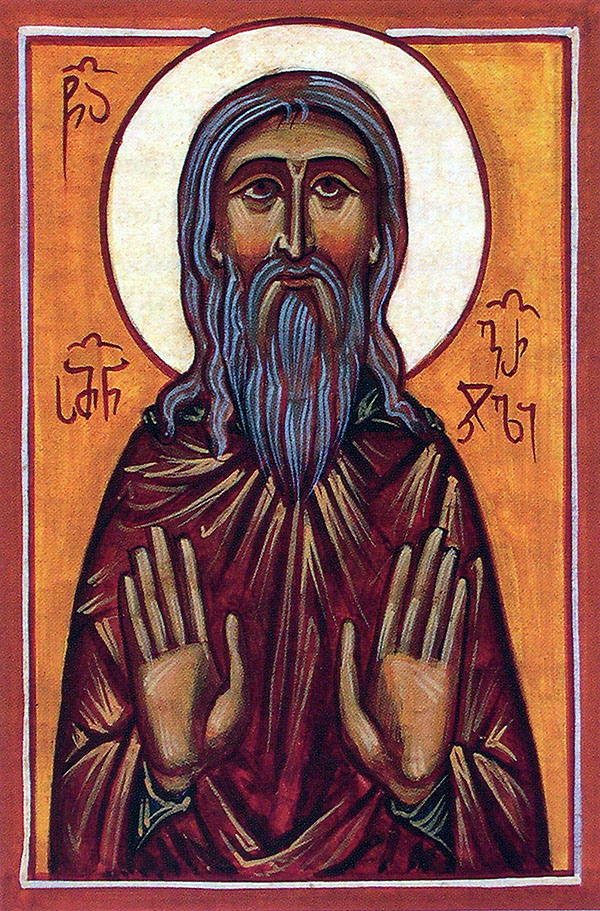
Saint Simeon was raised at Davit-Gareji Monastery. He labored as a simple monk until he reached an advanced age, and was chosen to be abbot. Outstanding in virtue and humility, Saint Simeon was endowed by the Lord with the ability to work miracles.
Once Saint Simeon became deathly ill and lay lifeless for more than an hour. Then, by Divine Providence, he arose and distributed all of his possessions to the fathers of the monastery to keep him in remembrance.
When Saint Serapion heard about this miracle, he hastened to Abbot Simeon, his spiritual father, and, enlightened with prophetic grace, comforted him: “O honorable Father, give me your holy hands that I may kiss them. How I desire for these hands to bury the dust of my worthless body—but now you are departing this world ahead of me. You will go, Father, but without you I will not remain long on this earth; soon I will follow after you!”
So the fathers bade him farewell for the last time.
Saint Simeon settled his affairs at the monastery, and in 1773 he reposed in peace, exactly one week after he had recovered from his deathly illness.
Many Years Tiffany and George!
Congratulations to Tiffany and George Mychaskiw on their marriage! May God grant you many many years!
Daily Readings for Saturday, September 03, 2022
12TH SATURDAY AFTER PENTECOST
NO FAST
Anthimus, Bishop of Nicomedea, Holy Father Theoctistus and his fellow struggler Euthymius the Great, Polydorus the Martyr of New Ephesus, Translation of the relics of St. Nectarius the Wonderworker, Bishop of Pentopolis, Chariton the Martyr, Phoebe the Deaconess
ST. PAUL’S FIRST LETTER TO THE CORINTHIANS 1:26-31; 2:1-5
Brethren, consider your call, not many of you were wise according to worldly standards, not many were powerful, not many were of noble birth; but God chose what is foolish in the world to shame the wise, God chose what is weak in the world to shame the strong, God chose what is low and despised in the world, even things that are not, to bring to nothing things that are, so that no human being might boast in the presence of God. He is the source of your life in Christ Jesus, whom God made our wisdom, our righteousness and sanctification and redemption; therefore, as it is written, “Let him who boasts, boast of the Lord.” When I came to you, brethren, I did not come proclaiming to you the testimony of God in lofty words or wisdom. For I decided to know nothing among you except Jesus Christ and him crucified. And I was with you in weakness and in much fear and trembling; and my speech and my message were not in plausible words of wisdom, but in demonstration of the Spirit and of power, that your faith might not rest in the wisdom of men but in the power of God.
MATTHEW 20:29-34
At that time, as Jesus went out of Jericho, a great crowd followed him. And behold, two blind men sitting by the roadside, when they heard that Jesus was passing by, cried out, "Have mercy on us, Son of David!" The crowd rebuked them, telling them to be silent; but they cried out the more, "Lord, have mercy on us, Son of David!" And Jesus stopped and called them, saying, "What do you want me to do for you?" They said to him, "Lord, let our eyes be opened." And Jesus in pity touched their eyes, and immediately they received their sight and followed him.
Hieromartyr Anthimus, Bishop of Nicomedia and those with him

The Hieromartyr Anthimus, Bishop of Nicomedia, and those with him suffered during the persecution against Christians under the emperors Diocletian (284-305) and Maximian (305-311). The persecution became particularly intense after a fire at the imperial court at Nicomedia. The pagans accused the Christians of setting the fire and reacted against them with terrible ferocity.
In Nicomedia alone, on the day of the Nativity of Christ, as many as twenty thousand Christians were burned inside a church. However, this monstrous inhumanity did not frighten the Christians, who firmly confessed their faith and endured martyrdom for Christ.
Saints Dorotheus, Mardonius, Migdonius, Peter, Indes and Gorgonius died during this period. One of them was beheaded by the sword, others perished by burning, or being buried alive, or by drowning in the sea. The soldier Zeno boldly denounced the emperor Maximian, for which he was stoned, and then beheaded.
Then the holy Virgin Martyr Domna, a former pagan priestess, perished at the hands of the pagans, and also Saint Euthymius, because of their concern that the bodies of the holy martyrs should be buried. Bishop Anthimus, who headed the Church of Nicomedia, hid himself in a village not far from Nicomedia at the request of his flock. From there he sent letters to the Christians, urging them to cleave firmly to the holy Faith and not to fear tortures.
One of his letters, sent with Deacon Theophilus, was intercepted and given to the emperor Maximian. Theophilus was interrogated and died under torture, without revealing to his torturers the whereabouts of Bishop Anthimus. After a while Maximian managed to learn where Saint Anthimus was, and sent a detachment of soldiers after him.
The bishop met them along the way, but the soldiers did not recognize the saint. He invited them to join him and provided a meal, after which he revealed that he was the one they sought. The soldiers did not know what to do. They wanted to leave him and tell the emperor that they had not found him. Bishop Anthimus was not one to tolerate a lie, and so he would not consent to this.
The soldiers came to believe in Christ and received holy Baptism. The saint ordered them to carry out the emperor’s instructions. When Bishop Anthimus was brought before the emperor, the emperor ordered that the instruments of execution be brought out and placed before him. “Do you think, emperor, to frighten me with these tools of execution?” asked the saint. “No indeed, you cannot frighten one who wishes to die for Christ! Execution is frightening only for the cowardly, for whom the present life is most precious.” The emperor then directed that the saint be fiercely tortured and beheaded by the sword.
Bishop Anthimus joyfully glorified God with his last breath, and received the crown of martyrdom. (See December 28 for another account of the Nicomedian martyrs.)
Venerable Theoctistus
Saint Theoctistus of Palestine was a great ascetic who lived in the Judean wilderness in the Wadi Mukellik. At first, he was the companion of Saint Euthymius the Great (January 20) in the ascetic lfe. So great was their mutual affection and oneness of mind that they seemed to live as one soul in two bodies. They were persons of similar virtue and holiness, and they encouraged one another in their struggles. Each year after the Leave-taking of Theophany, they would go into the desert to struggle and pray in solitude, returning to their cells on Palm Sunday.
After five years together, Saints Euthymius and Theoctistus went into the desert for Great Lent, and in a wadi they discovered a large cave which later became a church. They decided to remain there, believing that they had been led there by God. They ate wild herbs to sustain themselves, and met with no other people for some time.
The Lord did not wish these great luminaries to remain hidden, however. He wanted their wisdom and holiness of life to become known in order to benefit others. One day, shepherds from Bethany found the ascetics and went back to their village and told others about them. After that, many people came to hear of them, and monks came from other monasteries to visit them. Some even stayed there in order to be instructed by them.
So many monks gathered around them that they were obliged to build a lavra over the cave church. Saint Euthymius made Theoctistus the igumen of the lavra, while he himself lived in seclusion in the cave. The wise Theoctistus accepted all who came to him, confessing them and treating the infirmities of their wounded souls with appropriate spiritual remedies.
When he had reached an advanced old age, Saint Theoctistus became very ill. Saint Euthymius (who was ninety years old himself) visited him and took care of him. When Saint Theoctistus went to the Lord in 467, Patriarch Anastasius of Jerusalem came and presided at his burial service.
Saint Theoctistus of Palestine should not be confused with Saint Theoctistus of Sicily (January 4).
Holy Martyr Euthymius
No information available at this time.
Blessed John “the Hairy” and Fool-For-Christ at Rostov

Blessed John the Merciful of Rostov (also known as “the Hairy”) struggled at Rostov in the exploit of holy foolishness, enduring much deprivation and sorrow. He did not have a permanent shelter, and at times took his rest at the house of his spiritual Father, a priest at the church of the All-Holy, or with one of the aged widows.
Living in humility, patience and unceasing prayer, he spiritually nourished many people, among them Saint Irenarchus, Hermit of Rostov (January 13). After a long life of pursuing asceticism, he died on September 3, 1580 and was buried, according to his final wishes, beside the church of Saint Blaise beyond the altar.
He had “hair upon his head abundantly,” therefore he was called “Hairy.” The title “Merciful” was given to Blessed John because of the many healings that occurred at his grave, and also in connection with the memory of the holy Patriarch John the Merciful (November 12), whose name he shared.
Saint Phoebe the Deaconess at Cenchreae near Corinth
Saint Phoebe the Deaconess is mentioned by the holy Apostle Paul (Romans 16:1-2).
Martyr Basilissa of Nicomedia
The Martyr Basilissa of Nicomedia suffered for her faith in Christ under the emperor Diocletian. The Nicomedia governor Alexander gave orders to arrest the nine-year-old Basilissa and force her to renounce Christ. But the young maiden displayed unshakable firmness in fidelity to her Lord, and so she was subjected to protracted and intense torture.
Through the grace of God, the holy martyr remained alive and unharmed. This was evident to all those present as a manifestation of the power of God, and it so upset the governor Alexander, that he also came to believe in Christ and confessed himself a Christian.
Baptized later by Bishop Anthimus, he lived for a short while in deep repentance, and then departed peacefully to the Lord, as did Saint Basilissa some while after him. Her death was peaceful and accompanied by miraculous signs of God’s mercy.
Hieromartyr Aristion, Bishop of Alexandria
Saint Aristion was the bishop of lesser Alexandria in Cilicia (Asia Minor). He was born in the small town of Aribazo in the eparchy of Apamea, Syria at the beginning of the second century. His parents were pagans, and he spent his early years in an atmosphere of idolatry.
We do not know what sort of early education Saint Aristion received, nor where he studied, but it did not satisfy his search for the truth. A ten-year-old boy who lived in the same town, the future martyr Anthony, showed him the path which led to the truth. Anthony instructed him in the true Faith, and Aristion increased in piety and zeal for God.
It is significant that Anthony, despite the constant fear of persecution, exile and even danger to his own life, was not just a member of the local church, but also preached the Faith to others. It is certain that Aristion prayed for his young friend and remembered his courage and strength, for Anthony’s efforts to bring Aristion to the saving Faith had born fruit and were not in vain. Not only did Anthony give himself to the Church through his martyrdom at the age of twenty, he also gave it another saint and martyr: Saint Aristion
Years later, Saint Aristion was consecrated bishop for Isso in Cilicia, which is found in lesser Alexandria. He was a good shepherd to his flock, and cared diligently for their souls.
One day the ruler of Alexandria had Saint Aristion arrested because he was a Christian. Although he was placed on public trial, the holy bishop was calm and showed no fear. His whole demeanor made the Roman eparch realize that it would not easy to deal with this man who stood before him. He tried to turn Aristion from Christ through flattery and promises of reward, but the saint stood firm. Seeing that his words had no effect on the bishop, he threatened him with fierce tortures. He was not influenced by these threats, however.
Saint Aristion stood before the eparch and his counselors, gazing at them with love and concern for their salvation. Even in his weakness, this captive was stronger than his captors, and he refused to offer sacrifice to the pagan gods.
Before a multitude of idolaters, Saint Aristion spoke of the Triune God, by Whom all things were created. He also told them about the Incarnation of the Lord Jesus Christ, which was accomplished through God’s saving dispensation. He explained that Christ brings salvation to fallen man, thereby giving him another chance to attain the true purpose of his life—theosis.
“How poor these soulless statues of the gods are,” the bishop said, “and how helpless the eparch looks in his radiant apparel.”
All who heard the saint speak were amazed and asked one another where he got such courage. Aristion invited them to believe in the truth which he was revealing to them. Those who watched understood that this holy man was someone special, and they wanted to hear more about his beliefs.
The Roman eparch could not find any way to resist Aristion except through violence, so he sentenced him to death. He commanded his soldiers to prepare a large furnace and then throw him into the flames.The saint went to his martyrdom without resistance, remaining brave and strong until the end. The few Christians who were present tried not to weep.They whispered prayers for him, and were saddened because their father was leaving them. They knew, however, that their archpastor would not cease praying for them, especially now that he was going to Christ. They could hear Saint Aristion singing hymns in the fire until his last breath.
The eparch did not know what a terrible mistake he had made. He did not realize that death is not the end for men, nor for the truth. Nothing could separate Saint Aristion from the Fountain of Life, and so the Lord bestowed upon him an imperishable crown of glory.
After the flames died down, his spiritual children approached the furnace and collected as many of his bones as they could. With great reverence they put the holy relics in a secret place, which remains unknown to the present day.
A more detailed biography of the saint has been published (in Greek): THE HOLY HIEROMARTYR ARISTION, by John G. Thalassinos (Athens, 2003). This volume also contains the Service to the saint, which was composed by Hieromonk Athanasius of Simonopetra Monastery on Mt. Athos.
Saint Joannicius, first Patriarch of Serbia
Saint Joannicius, Patriarch of Serbia, was a native of the city of Prizren. At first, he was a secretary under King Karl (Charles) of Serbia, and later on from the year 1339, he guided the Church as Archbishop.
In the year 1346 a Council of all the Serbian archpastors, and including also the Patriarch of Bulgaria, at the wish of King Dushan, chose Archbishop Joannicius as Patriarch of the Serbian Orthodox Church. Saint Joannicius reposed on September 3, 1349 and was buried in the Pech monastery.
Icon of the Mother of God of Pisidia
The Pisidia Icon of the Mother of God was glorified by miracles in the city of Sozopolis, but its origin is unknown. Saint Germanus, the Patriarch of Constantinople (May 12), mentions “the icon of the All-Pure Virgin Mother of God at Pisidian Sozopolis” in his letters on the veneration of icons which were read at the Seventh Ecumenical Council. He said that “myrrh flowed from the hands,” and described the icon as “ancient.”
The miracles of the icon date back to the sixth century. One of the miracles was reported by the presbyter Eustathius, who was a contemporary of Patriarch Eutychius (April 6). At Amasea, near Sozopolis, there was a certain married couple, whose children were all stillborn. Grieving over their misfortune, they turned to Patriarch Eutychius for advice. Saint Eutychius prayed and anointed them with holy oil from the Cross of the Lord and from the holy icon of the Mother of God saying, “In the Name of our Lord Jesus Christ.”
“Name your child Peter, and he will live,” he said to them. Soon the couple gave birth to a son whom they did indeed name Peter. Later, they had a second son, whom they named John. The people of the city glorified God when they heard of this miracle.
For about 600 years myrrh flowed from the Pisidian Icon of the Mother of God – Eleusius, a disciple of Saint Theodore the Sykeote (April 22), was a witness to this. A copy of this ancient wonderworking icon was made in Russia in 1608, at Moscow’s Novospassky (New Monastery of the Transfiguration of the Savior) monastery. The Mother of God is depicted with the Divine Infant on Her left arm, and with Her right hand She gives a blessing.
Martyr Polydorus of Cyprus
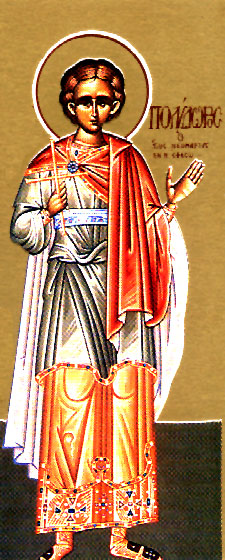
No information available at this time.
Daily Readings for Friday, September 02, 2022
12TH FRIDAY AFTER PENTECOST
ABSTAIN FROM MEAT, FISH, DAIRY, EGGS, WINE, OLIVE OIL
Mammas the Martyr, John the Abstainer, Patriarch of Constantinople, Paul, Patriarch of Constantinople, Cosmas the Hermit, Ammon & Aeithalas the Martyrs of Thrace
ST. PAUL’S LETTER TO THE ROMANS 8:28-39
Brethren, we know that everything works for good with those who love God, who are called according to his purpose. For those whom he foreknew he also predestined to be conformed to the image of his Son, in order that he might be the first-born among many brethren. And those whom he predestined he also called; and those whom he called he also justified; and those whom he justified he also glorified.
What then shall we say to this? If God is for us, who is against us? He who did not spare his own Son but gave him up for us all, will he not also give us all things with him? Who shall bring any charge against God's elect? It is God who justifies; who is to condemn? It is Christ Jesus, who died, yes, who was raised from the dead, who is at the right hand of God, who indeed intercedes for us. Who shall separate us from the love of Christ? Shall tribulation, or distress, or persecution, or famine, or nakedness, or peril, or sword? As it is written, "For thy sake we are being killed all the day long; we are regarded as sheep to be slaughtered." No, in all these things we are more than conquerors through him who loved us. For I am sure that neither death, nor life, nor angels, nor principalities, nor things present, nor things to come, nor powers, nor height, nor depth, nor anything else in all creation, will be able to separate us from the love of God in Christ Jesus our Lord.
MARK 2:18-22
At that time, John's disciples and the Pharisees were fasting; and people came and said to him, "Why do John's disciples and the disciples of the Pharisees fast, but your disciples do not fast? And Jesus said to them, "Can the wedding guests fast while the bridegroom is with them? As long as they have the bridegroom with them, they cannot fast. The days will come, when the bridegroom is taken away from them, and then they will fast in that day. No one sews a piece of unshrunk cloth on an old garment; if he does, the patch tears away from it, the new from the old, and a worse tear is made. And no one puts new wine into old wineskins; if he does, the wine will burst the skins, and the wine is lost, and so are the skins; but new wine is for fresh skins.
Venerable Anthony of the Kiev Far Caves

Saint Anthony of the Kiev Caves was born in the year 983 at Liubech, not far from Chernigov, and was named Antipas in Baptism. Possessing the fear of God from his youth, he desired to be clothed in the monastic schema. When he reached a mature age, he wandered until he arrived on Mt. Athos, burning with the desire to emulate the deeds of its holy inhabitants. Here he received monastic tonsure, and the young monk pleased God in every aspect of his spiritual struggles on the path of virtue. He particularly excelled in humility and obedience, so that all the monks rejoiced to see his holy life.
The igumen saw in Saint Anthony the great future ascetic, and inspired by God, he sent him back to his native land, saying, “Anthony, it is time for you to guide others in holiness. Return to your own Russian land, and be an example for others. May the blessing of the Holy Mountain be with you.”
Returning to the land of Rus, Anthony began to make the rounds of the monasteries about Kiev, but nowhere did he find that strict life which had drawn him to Mt. Athos.
Through the Providence of God, Anthony came to the hills of Kiev by the banks of the River Dnieper. The forested area near the village of Berestovo reminded him of his beloved Athos. There he found a cave which had been dug out by the Priest Hilarion, who later became Metropolitan of Kiev (October 21). Since he liked the spot, Anthony prayed with tears, “Lord, let the blessing of Mt. Athos be upon this spot, and strengthen me to remain here.” He began to struggle in prayer, fasting, vigil and physical labor. Every other day, or every third day, he would eat only dry bread and a little water. Sometimes he did not eat for a week. People began to come to the ascetic for his blessing and counsel, and some decided to remain with the saint.
Among Anthony’s first disciples was Saint Nikon (March 23), who tonsured Saint Theodosius of the Caves (May 3) at the monastery in the year 1032.
The virtuous life of Saint Anthony illumined the Russian land with the beauty of monasticism. Saint Anthony lovingly received those who yearned for the monastic life. After instructing them how to follow Christ, he asked Saint Nikon to tonsure them. When twelve disciples had gathered about Saint Anthony, the brethren dug a large cave and built a church and cells for the monks within it.
After he appointed Abbot Barlaam to guide the brethren, Saint Anthony withdrew from the monastery. He dug a new cave for himself, then hid himself within it. There too, monks began to settle around him. Afterwards, the saint built a small wooden church in honor of the Dormition of the Mother of God over the Far Caves.
At the insistence of Prince Izyaslav, the igumen Barlaam withdrew to the Dimitriev monastery. With the blessing of Saint Anthony and with the general agreement of the brethren, the meek and humble Theodosius was chosen as igumen. By this time, the number of brethren had already reached a hundred men. The Kiev Great Prince Izyaslav (+ 1078) gave the monks the hill on which the large church and cells were built, with a palisade all around. Thus, the renowned monastery over the caves was established. Describing this, the chronicler remarks that while many monasteries were built by emperors and nobles, they could not compare with those which are built with holy prayers and tears, and by fasting and vigil. Although Saint Anthony had no gold, he built a monastery which became the first spiritual center of Rus.
For his holiness of life, God glorified Saint Anthony with the gift of clairvoyance and wonderworking. One example of this occurred during the construction of the Great Caves church. The Most Holy Theotokos Herself stood before him and Saint Theodosius in the Blachernae church in Constantinople, where they had been miraculously transported without leaving their own monastery. Actually, two angels appeared in Constantinople in their forms (See May 3, the account of the Kiev Caves Icon of the Most Holy Theotokos). Having received gold from the Mother of God, the saints commissioned master architects, who came from Constantinople to the Russian land on the command of the Queen of Heaven to build the church at the Monastery of the Caves. During this appearance, the Mother of God foretold the impending death of Saint Anthony, which occurred on July 10, 1073.
Through Divine Providence, the relics of Saint Anthony remain hidden.
Venerable Theodosius of the Kiev Far Caves

Saint Theodosius of the Caves, was the Father of monasticism in Russia. He was born at Vasilevo, not far from Kiev. From his youth he felt an irresistible attraction for the ascetic life, and led an ascetic lifestyle while still in his parental home. He disdained childish games and attractions, and constantly went to church. He asked his parents to let him study the holy books, and through his ability and rare zeal, he quickly learned to read the books, so that everyone was amazed at his intellect.
When he was fourteen, he lost his father and remained under the supervision of his mother, a strict and domineering woman who loved her son very much. Many times she chastised her son for his yearning for asceticism, but he remained firmly committed to his path.
At the age of twenty-four, he secretly left his parents’ home and Saint Anthony at the Kiev Caves monastery blessed him to receive monastic tonsure with the name Theodosius. After four years his mother found him and with tearfully begged him to return home, but the saint persuaded her to remain in Kiev and to become a nun in the monastery of Saint Nicholas at the Askold cemetery.
Saint Theodosius toiled at the monastery more than others, and he often took upon himself some of the work of the other brethren. He carried water, chopped wood, ground up the grain, and carried the flour to each monk. On cold nights he uncovered his body and let it serve as food for gnats and mosquitoes. His blood flowed, but the saint occupied himself with handicrafts, and sang Psalms. He came to church before anyone else and, standing in one place, he did not leave it until the end of services. He also listened to the readings with particular attention.
In 1054 Saint Theodosius was ordained a hieromonk, and in 1057 he was chosen igumen. The fame of his deeds attracted a number of monks to the monastery, at which he built a new church and cells, and he introduced cenobitic rule of the Studion monastery, a copy of which he commissioned at Constantinople.
As igumen, Saint Theodosius continued his arduous duties at the monastery. He usually ate only dry bread and cooked greens without oil, and spent his nights in prayer without sleep. The brethren often noticed this, although the saint tried to conceal his efforts from others.
No one saw when Saint Theodosius dozed lightly, and usually he rested while sitting. During Great Lent the saint withdrew into a cave near the monastery, where he struggled unseen by anyone. His attire was a coarse hairshirt worn next to his body. He looked so much like a beggar that it was impossible to recognize in this old man the renowned igumen, deeply respected by all who knew him.
Once, Saint Theodosius was returning from visiting the Great Prince Izyaslav. The coachman, not recognizing him, said gruffly, “You, monk, are always on holiday, but I am constantly at work. Take my place, and let me ride in the carriage.” The holy Elder meekly complied and drove the servant. Seeing how nobles along the way bowed to the monk driving the horses, the servant took fright, but the holy ascetic calmed him, and gave him a meal at the monastery. Trusting in God’s help, the saint did not keep a large supply of food at the monastery, and therefore the brethren were in want of their daily bread. Through his prayers, however, unknown benefactors appeared at the monastery and furnished the necessities for the brethren.
The Great Princes, especially Izyaslav, loved to listen to the spiritual discourses of Saint Theodosius. The saint was not afraid to denounce the mighty of this world. Those unjustly condemned always found a defender in him, and judges would review matters at the request of the igumen. He was particularly concerned for the destitute. He built a special courtyard for them at the monastery where anyone in need could receive food and drink. Sensing the approach of death, Saint Theodosius peacefully fell asleep in the Lord in the year 1074. He was buried in a cave which he dug, where he had secluded himself during fasting periods.
The relics of the ascetic were found incorrupt in the year 1091, and Saint Theodosius was glorified as a saint in 1108. Of the written works of Saint Theodosius six discourses, two letters to Great Prince Izyaslav, and a prayer for all Christians have survived to our time.
The Life of Saint Theodosius was written by Saint Nestor the Chronicler (October 27), a disciple of the great Abba, only thirty years after his repose, and it was always one of the favorite readings of the Russian nation. Saint Theodosius is also commemorated on September 28 and May 3.
Martyr Mamas of Caesarea in Cappadocia
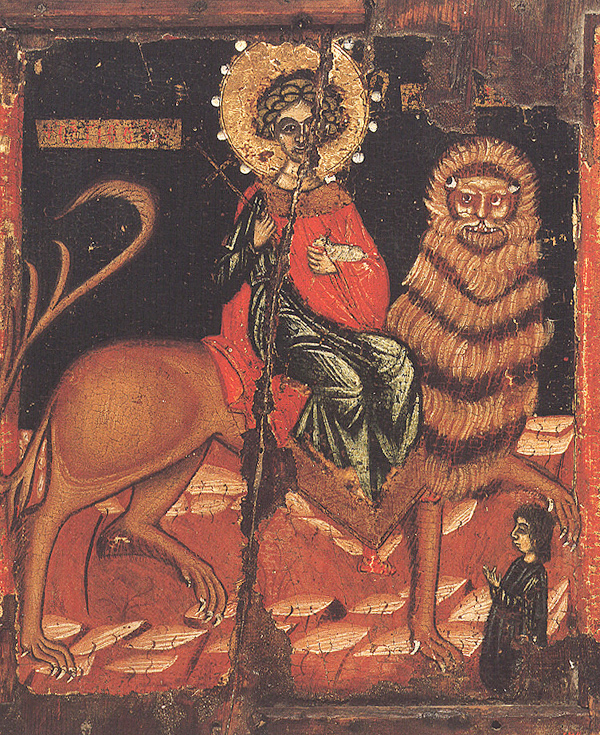
The Holy Great Martyr Mamas was born in Paphlagonia, Asia Minor in the third century of pious and illustrious parents, the Christians Theodotus and Rufina. The parents of the saint were arrested by the pagans for their open confession of their faith and locked up in prison in Caesarea in Cappadocia.
Knowing his own bodily weakness, Theodotus prayed that the Lord would take him before being subjected to tortures. The Lord heard his prayer and he died in prison. Saint Rufina died also after him, after giving birth to a premature son. She entrusted him to God, beseeching Him to be the Protector and Defender of the orphaned infant.
God heard the dying prayer of Saint Rufina: a rich Christian widow named Ammia reverently buried the bodies of Saints Theodotus and Rufina, and she took the boy into her own home and raised him as her own son. Saint Mamas grew up in the Christian Faith. His foster mother concerned herself with the developing of his natural abilities, and early on she sent him off to study his grammar.
The boy learned easily and willingly. He was not of an age of mature judgment but distinguished himself by maturity of mind and of heart. By means of prudent conversations and personal example young Mamas converted many of his own peers to Christianity.
The governor, Democritus, was informed of this, and the fifteen-year-old Mamas was arrested and brought to trial. In deference to his illustrious parentage, Democritus decided not to subject him to torture, but instead sent him off to the emperor Aurelian (270-275). The emperor tried at first kindly, but then with threats to turn Saint Mamas back to the pagan faith, but all in vain. The saint bravely confessed himself a Christian and pointed out the madness of the pagans in their worship of lifeless idols.
Infuriated, the emperor subjected the youth to cruel tortures. They tried to drown the saint, but an angel of the Lord saved Saint Mamas and bade him live on a high mountain in the wilderness, not far from Caesarea. Bowing to the will of God, the saint built a small church there and began to lead a life of strict temperance, in exploits of fasting and prayer.
Soon he received a remarkable power over the forces of nature: wild beasts inhabiting the surrounding wilderness gathered at his abode and listened to the reading of the Holy Gospel. Saint Mamas nourished himself on the milk of wild goats and deer.
The saint did not ignore the needs of his neighbors. Preparing cheese from this milk, he gave it away freely to the poor. Soon the fame of Saint Mamas’s life spread throughout all of Caesarea.
The governor sent a detachment of soldiers to arrest him. When they encountered Saint Mamas on the mountain, the soldiers did not recognize him, and mistook him for a simple shepherd. The saint then invited them to his dwelling, gave them a drink of milk and then told them his name, knowing that death for Christ awaited him. The servant of God told the servant of the Emperor to go on ahead of him into Caesaria, promising that he would soon follow. The soldiers waited for him at the gates of the city, and Saint Mamas, accompanied by a lion, met them there.
Surrendering himself into the hands of the torturers, Saint Mamas was brought to trial under a deputy governor named Alexander, who subjected him to intense and prolonged tortures. They did not break the saint’s will, however. He was strengthened by the words addressed to him from above: “Be strong and take courage, Mamas.”
When they threw Saint Mamas to the wild beasts, these creatures would not touch him. Finally, one of the pagan priests struck him with a trident. Mortally wounded, Saint Mamas went out beyond the city limits. There, in a small stone cave, he gave up his spirit to God, Who in the hearing of all summoned the holy Martyr Mamas into His heavenly habitation. He was buried by believers at the place of his death.
Christians soon began to receive help from him in their afflictions and sorrows. Saint Basil the Great speaks thus about the holy Martyr Mamas in a sermon to the people: “Remember the holy martyr, you who live here and have him as a helper. You who call on his name have been helped by him. Those in error he has guided into life. Those whom he has healed of infirmity, those whose dead children he has restored to life, those whose life he has prolonged: let us all come together as one, and praise the martyr!”
Martyrs Theodotus and Rufina of Caesarea, in Cappadocia
The holy martyrs Theodotus and Rufina were the parents of Saint Mamas. They came from patrician families, and were honored by all for their Christian piety. Alexander, the magistrate of the city of Gangra, summoned them because they refused to obey the imperial decree requiring all citizens to worship the pagan gods. Those who disobeyed would be tortured and put to death.
Since Theodotus refused to comply with this order, Alexander sent him to the governor Faustus in Caesarea of Cappadocia. Alexander could not torture or kill Theodotus because of his noble rank. Faustus, however, had no such scruples. He threw Theodotus into prison as soon as he arrived.
Even though she was pregnant at the time, Rufina followed her husband. She stayed in the prison with Theodotus, where they both suffered for Christ. Fearing that he would not be able to withstand the cruel tortures, Theodotus asked God to take his soul. The Lord heard his prayer and sent him a blessed repose, establishing his soul in the heavenly mansions.
Saint Rufina endured privations and sufferings in prison, and experienced great sorrow at the death of her husband. Because of these things, she gave birth to her child before the proper time. She prayed that God would permit her to follow her husband in death, and that He would also protect her child. Her prayer was also granted, and she gave her virtuous soul into God’s hands.
Saint Mamas was raised by a pious woman named Ammia, or Matrona, who became a second mother to him.
Saint John the Faster, Patriarch of Constantinople
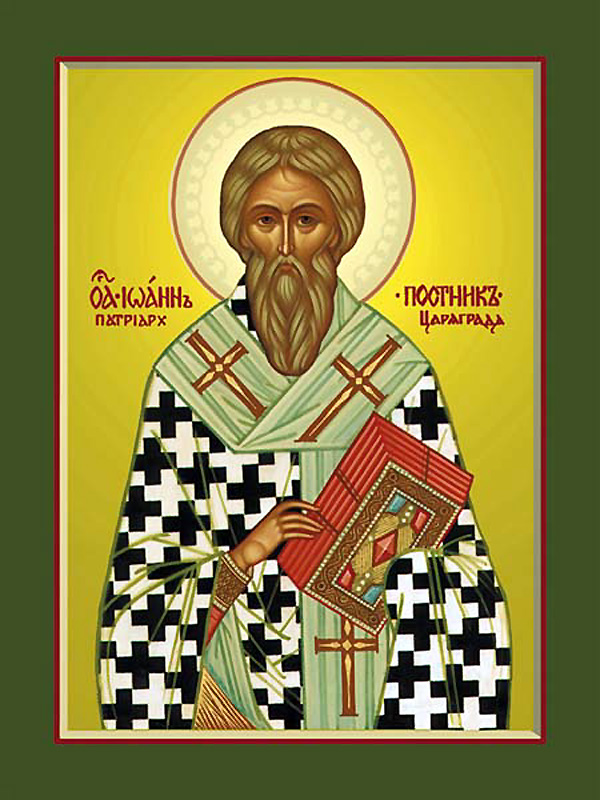
Our Holy Father John was born in Constantinople, the Queen of Cities. At first he worked as a goldsmith, and everyone expected him to continue in that occupation. From his youth, however, he was inclined toward the monastic life. He also possessed a rare gift for continence and a natural love for fasting, and thus he was known as “the Faster.” Because of his reputation for virtue, he was ordained as a deacon by Patriarch John III, and later he received the grace of the priesthood. Saint John was found worthy to behold a vision which showed that he would become be a worthy recipient of God’s grace, for the spiritual enlightenment of his flock. He read the Holy Scriptures and other ecclesiastical books every day, thereby enriching his knowledge.
Once, when he was a young man, John was walking with Eusebius, an old monk from Palestine. Suddenly, a bodiless voice spoke to Eusebius: “Abba, do not walk to the right of the great John.” It was the voice of God, foretelling the great service to which John would shortly be called.
After the death of Patriarch Eutychius, Saint John was chosen to succeed him. He did not want to accept the office, but he was frightened by a heavenly vision, and so he consented. By the example of his own life he taught all believers to restrain their capricious desires and to control themselves. The hierarch was unable to abide his flock’s blatant disregard for the institutions of the Church. When the citizens of Constantinople decided to give in to their passions by attending a horse show in the Hippodrome on eve of the Feast of Pentecost, the hierarch fell on his knees before God and fervently prayed that the Lord would thwart their impious intention. As soon as the people began to make their way to the Hippodrome, a terrible storm arose with thunder, rain and hailstones so that everyone dispersed in fear and came to realize the inappropriateness of such entertainment.
St John was Patriarch of Constantinople from 582 – 595, and was the first to use the title “Ecumenical Patriarch.”
He was a great faster, intercessor and wonderworker right up to the time of his death. Distinguished for his abstinence and prayer, Saint John had such a love for the poor that he refused them nothing from his estate. After his death, his only personal possessions were found to be a wooden spoon, a linen shirt and an old garment. His writings on repentance and Confession are well known.
After a virtuous life of piety, during which he performed many miracles, Saint John reposed on September 2, 595. His grace-filled relics were entombed in the Church of the Holy Apostles.
Saint John is also commemorated on August 30.
3,628 Martyrs who suffered at Nicomedia
The 3,628 Martyrs in Nicomedia suffered under the emperors Diocletian (284-305) and Maximian (305-311). These were Christians who had come from Alexandria. They had come to believe in Christ following the martyrdom of Saint Peter, Archbishop of Alexandria (November 25).
Taking their wives and children with them, they arrived in Nicomedia and voluntarily presented themselves for martyrdom, exclaiming, “We are Christians.” At first, Diocletian tried to persuade them to renounce Christ, but seeing their resolve, he ordered them all to be beheaded, and for their bodies to be thrown into a fiery pit.
Many years later, the relics of the holy martyrs were discovered through various manifestations of grace.
Icon of the Mother of God of Kaluga

The Kaluga Icon of the Mother of God appeared in 1748 in the village of Tinkova, near Kaluga, at the home of the landowner Basil Kondratevich Khitrov. Two servants of Khitrov were cleaning out junk from the attic of his home. One of them, Eudokia, noted for her temper, was given to rough and even indecorous language. Her companion was modest and serious.
They discovered a large package covered in a linen cloth. Undoing it, the girl saw the picture of a woman in dark garments with a book in her hands. Considering it to be the portrait of a woman monastic and wanting to bring Eudokia to her senses, she accused her of being disrespectful to the abbess.
Eudokia jeered at the scolding words of her companion, and becoming increasingly angry, she spit on the picture. Immediately, she became convulsed and fell down senseless. She also became blind and mute. Her frightened companion reported what had happened to the household.
The next night, the Queen of Heaven appeared to Eudokia’s parents and told them that their daughter had behaved impertinently toward Her and She ordered them to serve a Molieben before the insulted icon, then sprinkle the invalid with holy water at the Molieben.
After the Molieben Eudokia recovered, and Khitrov took the wonderworking icon into his own home, where it granted healing to those approaching it with faith. Later, the icon was placed in the parish temple of the Nativity of the Most Holy Theotokos in the village of Kaluga. At the present time it is located in the cathedral church of Kaluga.
Through this icon the Mother of God has repeatedly manifest Her protection of the Russian land during difficult times. The celebration of the Kaluga Icon on September 2 was established in remembrance of the deliverance from a plague in 1771. A second celebration was established October 12, in memory of the preservation of Kaluga from the French invasion of 1812. In 1898, a celebration was established on July 18 in gratitude to the Mother of God for protection against cholera. The icon is also commemorated on the first Sunday of the Apostles’ Fast.
 Saint Peter Antiochian Orthodox Church
You must be logged in to post a comment.