Monthly Archives: August 2022

Daily Readings for Thursday, August 04, 2022

8TH THURSDAY AFTER PENTECOST

ABSTAIN FROM MEAT, FISH, DAIRY, EGGS, WINE, OLIVE OIL

Seven Holy Youths of Ephesus

ST. PAUL’S FIRST LETTER TO THE CORINTHIANS 10:28-33; 11:1-8

Brethren, if someone says to you, “This has been offered in sacrifice, ” then out of consideration for the man who informed you, and for conscience’s sake – I mean his conscience, not yours – do not eat it. For why should my liberty be determined by another man’s scruples? If I partake with thankfulness, why am I denounced because of that for which I give thanks? So, whether you eat or drink, or whatever you do, do all to the glory of God. Give no offense to Jews or to Greeks or to the church of God, just as I try to please all men in everything I do, not seeking my own advantage, but that of many, that they may be saved. Be imitators of me, as I am of Christ. I commend you because you remember me in everything and maintain the traditions even as I have delivered them to you. But I want you to understand that the head of every man is Christ, the head of a woman is her husband, and the head of Christ is God. Any man who prays or prophesies with his head covered dishonors his head, but any woman who prays of prophesies with her head unveiled dishonors her head – it is the same as if her head were shaven. For if a woman will not veil herself, then she should cut off her hair, but if it is disgraceful for a woman to be shorn or shaven, let her wear a veil. For a man ought not to cover his head, since he is the image and glory of God; but woman is the glory of man. (For man was not made from woman, but woman from man.)

MATTHEW 16:24-28

The Lord said to his disciples, "If any man would come after me, let him deny himself and take up his cross and follow me. For whoever would save his life will lose it, and whoever loses his life for my sake will find it. For what will it profit a man, if he gains the whole world and forfeits his life? Or what shall a man give in return for his life? For the Son of man is to come with his angels in the glory of his Father and then he will repay every man for what he has done. Truly, I say to you, there are some standing here who will not taste death before they see the Son of man coming in his kingdom.

7 Holy Youths “Seven Sleepers” of Ephesus

The Seven Youths of Ephesus: Maximilian, Iamblicus, Martinian, John, Dionysius, Exacustodianus (Constantine) and Antoninus, lived in the third century. Saint Maximilian was the son of the Ephesus city administrator, and the other six youths were sons of illustrious citizens of Ephesus. The youths were friends from childhood, and all were in military service together.

When the emperor Decius (249-251) arrived in Ephesus, he commanded all the citizens to offer sacrifice to the pagan gods. Torture and death awaited anyone who disobeyed. The seven youths were denounced by informants, and were summoned to reply to the charges. Appearing before the emperor, the young men confessed their faith in Christ.

Their military belts and insignia were quickly taken from them. Decius permitted them to go free, however, hoping that they would change their minds while he was off on a military campaign. The youths fled from the city and hid in a cave on Mount Ochlon, where they passed their time in prayer, preparing for martyrdom.

The youngest of them, Saint Iamblicus, dressed as a beggar and went into the city to buy bread. On one of his excursions into the city, he heard that the emperor had returned and was looking for them. Saint Maximilian urged his companions to come out of the cave and present themselves for trial.

Learning where the young men were hidden, the emperor ordered that the entrance of the cave be sealed with stones so that the saints would perish from hunger and thirst. Two of the dignitaries at the blocked entrance to the cave were secret Christians. Desiring to preserve the memory of the saints, they placed in the cave a sealed container containing two metal plaques. On them were inscribed the names of the seven youths and the details of their suffering and death.

The Lord placed the youths into a miraculous sleep lasting almost two centuries. In the meantime, the persecutions against Christians had ceased. During the reign of the holy emperor Theodosius the Younger (408-450) there were heretics who denied that there would be a general resurrection of the dead at the Second Coming of our Lord Jesus Christ. Some of them said, “How can there be a resurrection of the dead when there will be neither soul nor body, since they are disintegrated?” Others affirmed, “The souls alone will have a restoration, since it would be impossible for bodies to arise and live after a thousand years, when even their dust would not remain.” Therefore, the Lord revealed the mystery of the Resurrection of the Dead and of the future life through His seven saints.

The owner of the land on which Mount Ochlon was situated, discovered the stone construction, and his workers opened up the entrance to the cave. The Lord had kept the youths alive, and they awoke from their sleep, unaware that almost two hundred years had passed. Their bodies and clothing were completely undecayed.

Preparing to accept torture, the youths once again asked Saint Iamblicus to buy bread for them in the city. Going toward the city, the youth was astonished to see a cross on the gates. Hearing the name of Jesus Christ freely spoken, he began to doubt that he was approaching his own city.

When he paid for the bread, Iamblicus gave the merchant coins with the image of the emperor Decius on it. He was detained, as someone who might be concealing a horde of old money. They took Saint Iamblicus to the city administrator, who also happened to be the Bishop of Ephesus. Hearing the bewildering answers of the young man, the bishop perceived that God was revealing some sort of mystery through him, and went with other people to the cave.

At the entrance to the cave the bishop found the sealed container and opened it. He read upon the metal plaques the names of the seven youths and the details of the sealing of the cave on the orders of the emperor Decius. Going into the cave and seeing the saints alive, everyone rejoiced and perceived that the Lord, by waking them from their long sleep, was demonstrating to the Church the mystery of the Resurrection of the Dead.

Soon the emperor himself arrived in Ephesus and spoke with the young men in the cave. Then the holy youths, in sight of everyone, lay their heads upon the ground and fell asleep again, this time until the General Resurrection.

The emperor wanted to place each of the youths into a jeweled coffin, but they appeared to him in a dream and said that their bodies were to be left upon the ground in the cave. In the twelfth century the Russian pilgrim Igumen Daniel saw the holy relics of the seven youths in the cave.

There is a second commemoration of the seven youths on October 22. According to one tradition, which entered into the Russian Prologue (of Saints’ Lives), the youths fell asleep for the second time on this day. The Greek Menaion of 1870 says that they first fell asleep on August 4, and woke up on October 22.

There is a prayer of the Seven Sleepers of Ephesus in the Great Book of Needs (Trebnik) for those who are ill and cannot sleep. The Seven Sleepers are also mentioned in the service for the Church New Year, September 1.

Martyr Eudokia of Persia

The Holy Martyr Eudokia was a native of Anatolia, living in the fourth century. The army of the Persian emperor Sapor took her into captivity with 9,000 Christians. Since she knew the Holy Scriptures well, she instructed the prisoners. The saint also preached to the Persian women and converted many of them to Christianity. For this she was subjected to lengthy and fierce tortures and then beheaded.

Martyr Eleutherius of Constantinople

The Holy Martyr Eleutherius served as the cubicularius (chamberlain) at the court of the emperor Maximian Hercules (284-305). When he accepted Christianity, he then settled on a country estate, and built a church at his home. One of the servants reported to the emperor that Eleutherius had become a Christian. The emperor ordered the saint to offer pagan sacrifice. The saint refused and for this he was beheaded. The relics of Saint Eleutherius were at Constantinople, and afterwards transferred to Italy, to the city of Theato.

8/7 announcements

August 7, 2022

Eighth Sunday after Pentecost

After-feast of the Transfiguration of Christ

I Corinthians 1:10-17: Brethren, I appeal to you, by the Name of our Lord Jesus Christ, that all of you agree and that there be no dissension among you, but that you be united in the same mind and the same judgment. For it has been reported to me by Chloe’s people that there is quarreling among you, my brethren. What I mean is that each one of you says, “I belong to Paul,” or “I belong to Apollos,” or “I belong to Cephas,” or “I belong to Christ.” Is Christ divided? Was Paul crucified for you? Or were you baptized in the name of Paul? I thank God that I baptized none of you except Crispos and Gaius; lest anyone should say that you were baptized in my name. (I did baptize also the household of Stephanas. Beyond that, I do not know whether I baptized anyone else.) For Christ did not send me to baptize but to preach the Gospel, and not with eloquent wisdom, lest the cross of Christ be emptied of its power.

Matthew 14:14-22: At that time, when Jesus went ashore he saw a great throng; and he had compassion on them, and healed their sick. When it was evening, the disciples came to Him and said, “This is a lonely place, and the day is now over; send the crowds away to go into the villages and buy food for themselves.” Jesus said, “They need not go away; you give them something to eat.” They said to Him, “We have only five loaves here and two fish.” And He said, “Bring them here to Me.” Then He ordered the crowds to sit down on the grass; and taking the five loaves and the two fish He looked up to Heaven, and blessed, and broke and gave the loaves to the disciples, and the disciples gave them to the crowds. And they all ate and were satisfied. And they took up twelve baskets full of the broken pieces left over. And those who ate were about five thousand men, besides women and children. Then Jesus made the disciples get into the boat and go before Him to the other side, while He dismissed the crowds.

Troparion of the Resurrection: Thou didst shatter death by thy Cross; thou didst open paradise to the thief; thou didst turn the mourning of the ointment-bearing women into joy, and didst bid thine Apostles proclaim warning that thou hast risen, O Christ, granting the world Great Mercy.

Troparion of the Transfiguration: When, O Christ our God, thou wast transfigured on the mountain, thou didst reveal thy glory to thy Disciples in proportion as they could bear it. Let thine everlasting light also enlighten us sinners, through the intercessions of the Theotokos, O Bestower of light, glory to thee.

Troparion of the Chains of St. Peter: O Holy Apostle, Peter, thou dost preside over the Apostles by the precious chains which thou didst bear. We venerate them with faith and beseech thee that by thine intercessions we be granted the great mercy.

Kontakion of the Transfiguration: Thou wast transfigured on the mount, and thy Disciples, in so far as they were able, beheld thy glory, O Christ our God; so that, when they should see thee crucified, they would remember that thy suffering was voluntary, and could declare to all the world that thou art truly the effulgent Splendor of the Father.

CALENDAR

UNTIL FURTHER NOTICE: All services listed on the calendar will be available through streaming and webcast.

Please continue to follow the CDC Guidelines to limit contagion and the spread of the COVID virus.

Sunday, August 7 (Eighth Sunday after Pentecost)

8:50 a.m. — Orthros (webcast)

10:00 a.m. — Divine Liturgy (webcast)

Monday, August 8

Father Herman off

6:30 p.m. — Paraklesis Service

Tuesday, August 9

NO Services

Wednesday, August 10

6:30 p.m. — Paraklesis Service

Thursday, August 11

NO Services

Friday, August 12

6:30 p.m. — Paraklesis Service

Saturday, August 13

10:00 a.m. — Ladies meet for Akathist


4:45 p.m. — Choir Practice

6:00 p.m. — Great Vespers

Sunday, August 14 (Dormition of the Theotokos [transferred from
August 15])

8:50 a.m. — Orthros (webcast)

10:00 a.m. — Divine Liturgy (webcast)

12:00 p.m. — Festal Pot Luck Meal

SPECIAL ANNOUNCEMENTS

The Eucharist Bread …was offered by the Schelvers for the Feast of the Transfiguration of our Lord yesterday morning and by the Morrises for the Divine Liturgy this morning.

Eucharist Bread Schedule:

Eucharist Bread Coffee Hour

August 7 Morris D. Root/Baker/Cooper

August 14 Jones POT LUCK MEAL

Henderson/Jones

August 21 D. Root Dansereau/Alaeetawi

August 28 Karam Ellis/Zouboukos/Waites

Schedule for Epistle Readers – Page numbers refer to the Apostolos (book of the Epistles) located on the Chanters’ stand at the front of the nave. Please be sure to use this book when you read.

Reader Reading Page#

August 7 Walt Wood I Cor. 1:10-17 124

August 14 Kh. Sharon Meadows I Cor. 3:9-17 130

August 21 Sh. Charlotte Algood I Cor. 4:9-16 135

August 28 Brenda Baker I Cor. 9:2-12 141

Also, please remember that we still need your tithes and offerings which may be placed in the tray that is passed during the Divine Liturgy, in the tithe box at the back of the nave or be mailed to: St. Peter Orthodox Church, P.O. Box 2084, Madison, MS 39130-2084.

Continue to pray for Metropolitan Paul (who is also the brother of our Patriarch) and the Syriac Archbishop John of Aleppo who were abducted while on a humanitarian mission in Syria.

Please remember Fr. Joseph and Kh. Joanna Bittle, and their daughter Abigail, in your prayers.

Please remember the following in your prayers: Aidan Milnor, the Milnor family; Lamia Dabit and her family; Mary Greene (Lee and Kh. Sharon’s sister); Jay and Joanna Davis; Fr. Leo and Kh. Be’Be’ Schelver and their family; Kathy Willingham; Marilyn (Kyriake) Snell; Jack and Jill Weatherly; Lottie Dabbs (Sh. Charlotte Algood’s mother), Sh. Charlotte and their family; Maria Costas (currently at St. Catherine’s Village); Reader Basil and Brenda Baker and their family; Buddy Cooper.

If you are not feeling well, PLEASE do not attempt to come to the services. This also includes anyone who may have been exposed to you during this time. Also, please let Fr. Herman know if you are not feeling well and have COVID like symptoms.

We will pray the Trisagion Prayers for the Departed this morning for the sixth year memorial for Stephen Chamblee.

We will be having a special Coffee Hour honoring Tiffany Strain on August the 21st. Tiffany will be moving to California following her September wedding. Please keep Tiffany and her finance’ George in your prayers and mark the date of August 21st on your calendar to celebrate with Tiffany. If you would like to help, please check with Sh. Charlotte Algood. (Tiffany is registered at theknot.com/tiffanyandgeorge22.)

His Grace Bishop NICHOLAS will be with us for the wedding of Tiffany Strain on September 3rd and will be serving Hierarchical Divine Liturgy that Sunday.

Father Herman will be on vacation the week of August 8-12. Father John will be covering for him that week.

We will celebrate the Feast of the Dormition of the Theotokos on Sunday, August 14th instead of Monday, August 15th. Please be aware of this transfer. Since we are celebrating the feast on that Sunday, our scheduled Pot Luck will be a festal and not a fasting meal.

Please mark your calendars now for this year’s Diocesan Fall Retreat. It will be hosted by St. Ignatius in Franklin, TN again this year, on September 9-10. Registration has been opened and necessary information has been emailed.

Calendar Items:

* The men of the parish meet for lunch at 11:30 a.m. on the first Thursday of the month.

* The Ladies meet at the church at 10:00 a.m. on the second Saturday of the month to pray the Akathist to the Mother of God, Nurturer of Children on behalf of our children.

* The Ladies meet for lunch on the last Tuesday of the month.

* The Fast of the Dormition began on August 1st and runs until the 15th. As is our custom during the fast, we will pray the Paraklesis service to the Theotokos on the Mondays, Wednesdays and Fridays of the first two weeks of August. We have been given permission to celebrate the Feast of the Dormition of the Theotokos on Sunday morning, August 14th since the feast falls on Monday this year.

* The remaining date for Stewpot for 2022 is Saturday, September 3rd.

* We will celebrate the Heirarchical Divine Liturgy with His Grace, Bishop NICHOLAS on Sunday, September 4th.

* Church School will resume on Sunday, September 11th at 9:00 a.m.

PARENTS, a problem has arisen due to the nursery room being left messy after Coffee Hour. No food of any kind should be taken into that room. Also, it is necessary for a parent to be in the room whenever their children are in there playing. Thank you for your assistance with this.

Fasting Discipline for August

The Fast of the Dormition begins tomorrow and runs through August 15th. During this time the traditional fasting discipline (no meat, dairy, eggs, fish, wine or oil) is observed on all days of the week, except Saturday and Sunday when wine and oil are allowed and August 6th (Feast of the Transfiguration) when fish, wine and oil are allowed. Following the 15th, the traditional fasting discipline is observed on the remaining Wednesdays and Fridays of the month. The feastday of the Beheading of the Forerunner on August 29th is a strict fast day.

Major Commemorations for August

August 15 Feast of the Dormition of the Theotokos

August 25 Apostles Bartholomew and Titus

August 29 Beheading of the Forerunner

August 31 Deposition of the Belt of the Theotokos

Instructions for streaming our services can be found on the parish website.

Quotable “The heart itself is but a small vessel, yet dragons are there, and there are also lions; there are poisonous beasts and all the treasures of evil. But there too is God, the angels, the life and the kingdom, the light and the apostles, the heavenly cities, and the treasuries of grace-all things are there.”

St. Macarius

Worship: Sunday, August 14, 2022 (Feast of the Dormition of the Theotokos – transferred from Monday, August 15)

Scripture: Philippians 2:5-11; Luke 10:38-42; 11:27-28

Celebrant: Father Herman

Epistle Reader: Kh. Sharon Meadows

Prosphora: Jones

Coffee Hour: FESTAL POT LUCK MEAL

Henderson/Jones

Daily Readings for Wednesday, August 03, 2022

8TH WEDNESDAY AFTER PENTECOST

ABSTAIN FROM MEAT, FISH, DAIRY, EGGS, WINE, OLIVE OIL

Isaacius, Dalmatus, & Faustus, Ascetics of the Dalmation Monastery, Salome the Holy Myrrhbearer, Theoctistus the Wonderworker

ST. PAUL’S FIRST LETTER TO THE CORINTHIANS 10:12-22

Brethren, let any one who thinks that he stands take heed lest he fall. No temptation has overtaken you that is not common to man. God is faithful, and he will not let you be tempted beyond your strength, but with the temptation will also provide the way of escape, that you may be able to endure it. Therefore, my beloved, shun the worship of idols. I speak as to sensible men: judge for yourselves what I say. The cup of blessing which we bless, is it not a communion in the blood of Christ? The bread which we break, is it not a communion in the body of Christ? Because there is one bread, we who are many are one body, for we all partake of the one bread. Consider Israel according to the flesh: are not those who eat the sacrifices partners in the altar? What do I imply then? That food offered to idols is anything, or that an idol is anything? No, I imply that what pagans sacrifice they offer to demons and not to God. I do not want you to be partners with demons. You cannot drink the cup of the Lord and the cup of the demons. You cannot partake of the table of the Lord and the table of the demons. Shall we provoke the Lord to jealousy? Are we stronger than he?

MATTHEW 16:20-24

At that time, Jesus strictly charged the disciples to tell no one that he was the Christ. From that time Jesus began to show his disciples that he must go to Jerusalem and suffer many things from the elders and chief priests and scribes, and be killed, and on the third day be raised. And Peter took him and began to rebuke him, saying, "God forbid, Lord! This shall never happen to you." But he turned and said to Peter, "Get behind me, Satan! You are a hindrance to me; for you are not on the side of God, but of men." Then Jesus told his disciples, "If any man would come after me, let him deny himself, and take up his cross and follow me.

Venerable Isaac the Ascetic of the Dalmatian Monastery at Constantinople

Saint Isaac (May 30) was a soldier before he became a monk. After he was tonsured, he attained such a degree of spiritual perfection that he was accounted worthy of beholding divine visions.

When Saint Isaac heard about how the Emperor Valens had fallen into the Arian heresy and was persecuting the Orthodox Christians, he left his monastery and traveled to Constantinople to confront the emperor. At that time Valens was planning a campaign against the Goths. Saint Isaac tried to change the emperor’s mind several times, but was unable to convince him. He prophesied that Valens would die in flames because of his actions. The emperor ordered that Saint Isaac be thrown into prison, and promised to deal with him when he returned from his expedition. On August 9, 378 Valens was defeated at Adrianople and died in a fire after hiding in a barn, just as the saint had predicted.

Emperor Theodosius the Great, who had a great love for the saint, released him from prison and banned Arianism. Saint Isaac attended the Second Ecumenical Council (381), where he defended the Orthodox Faith against the Arian heresy.

Saint Isaac hoped to return to his monastic life in the wilderness, but a wealthy man built a monastery for him at Constantinople, and he became its first igumen. The monastery was later named for his disciple Dalmatus.

When Saint Isaac was approaching the end of his earthly life, he named Saint Dalmatus to succeed him as igumen. He lived to a ripe old age and reposed in the year 383.

Venerable Dalmatus the Ascetic of the Dalmatian Monastery at Constantinople

Saint Dalmatus served in the army of the holy emperor Theodosius the Great (379-395) and attracted his notice. The saint was soon filled with the desire to dedicate himself to his Lord and Creator. Therefore, sometime between the years 381-383, he left the service of an earthly ruler in order to serve the King of Heaven. He went with his son Faustus to Saint Isaac’s monastery near Constantinople in order to speak with him. Saint Isaac (May 30) tonsured both father and son into monasticism, and they both began to lead a strict ascetic life.

Saint Dalmatus excelled all the other monks in virtue. Once, during Great Lent, Saint Dalmatus did not eat any food for the forty days. Later he regained his strength and was found worthy of a divine vision.

The holy ascetic was chosen to be the igumen after the death of the most devout Isaac. In fact, at the Third Ecumenical Council which met in Ephesus in 431 A. D. which condemned the heresy of Nestorius, Saint Dalmatus was honored for his defense of the Orthodox Faith.

After the Council the holy Fathers elevated Saint Dalmatus to be the archimandrite of his monastery, where he died peacefully at the age of ninety (after 446). He was succeeded by his son Faustus, who proved to be a worthy successor of his father.

Venerable Faustus the Ascetic of the Dalmatian Monastery at Constantinople

Saint Faustus and his father Dalmatus received the monastic tonsure from Saint Isaac (May 30) at his monastery near Constantinople.

Saint Faustus, like his father, had attained the heights of monasticism, and excelled at fasting. Following the death of his father, he succeeded him as igumen of the monastery. The details of his ascetical life are not known.

Venerable Anthony the Roman and Abbot of Novgorod

Saint Anthony the Roman was born at Rome in 1067 to rich parents who adhered to the Orthodox Faith, and they raised him in piety. After losing his parents at age 17, he took up the study of the Fathers in the Greek language. Afterwards, he distributed part of his inheritance to the poor, and the other portion he put into a wooden barrel and threw it into the sea. Then he was tonsured at one of the wilderness monasteries, where he lived for 20 years.

A persecution of the Latins against the Orthodox forced the brethren to separate. Saint Anthony wandered from place to place until he came upon a large rock upon the shore of the sea, where he lived for a whole year in fasting and prayer. On September 5, 1105 a terrible storm tore away the stone on which Saint Anthony stood, and threw it into the sea. By divine Providence, the stone floated to Novgorod. On the Feast of the Nativity of the Most Holy Theotokos, the stone halted 3 versts from Novgorod on the banks of the River Volkhov near the village of Volkhov. This event is testified to in the Novgorod Chronicles.

At this place the monk, with the blessing of Saint Nikḗtas the Hermit (May 14), founded a monastery in honor of the Nativity of the Most Holy Theotokos. In another year, fishermen recovered the barrel containing Saint Anthony’s inheritance, cast into the sea many years before. The saint recognized his barrel, but the fishermen did not want to give it to him. Before a judge, Saint Anthony described the contents of the barrel, and it was returned to him. The saint used the money to buy land for the monastery. Spiritual asceticism was combined at the monastery with intense physical labor.

Saint Anthony was concerned that help should be given to the needy, orphans and widows from monastery funds. In 1117, the saint built a stone church in honor of the Nativity of the Most Holy Theotokos. The church, built during the lifetime of Saint Anthony in the years 1117-1119 by the renowned Novgorod architect Peter, and adorned with frescoes in the year 1125, has been preserved to the present time. In 1131, Saint Niphon of Novgorod made Saint Anthony igumen of the monastery. He died on August 3, 1147 and was buried by Saint Niphon.

Saint Anthony was glorified in 1597. His memory is also celebrated (uncovering of his relics) on the first Friday after the Feast of the Foremost Apostles Peter and Paul (June 29), and on January 17, on the same day that Saint Anthony the Great is commemorated. The first Life of Saint Anthony the Roman was written soon after his death by his disciple and successor as igumen, the hieromonk Andrew. A Life, with an account of the uncovering of the relics, was written by a novice of the Antoniev monastery, the monk Niphon, in the year 1598.

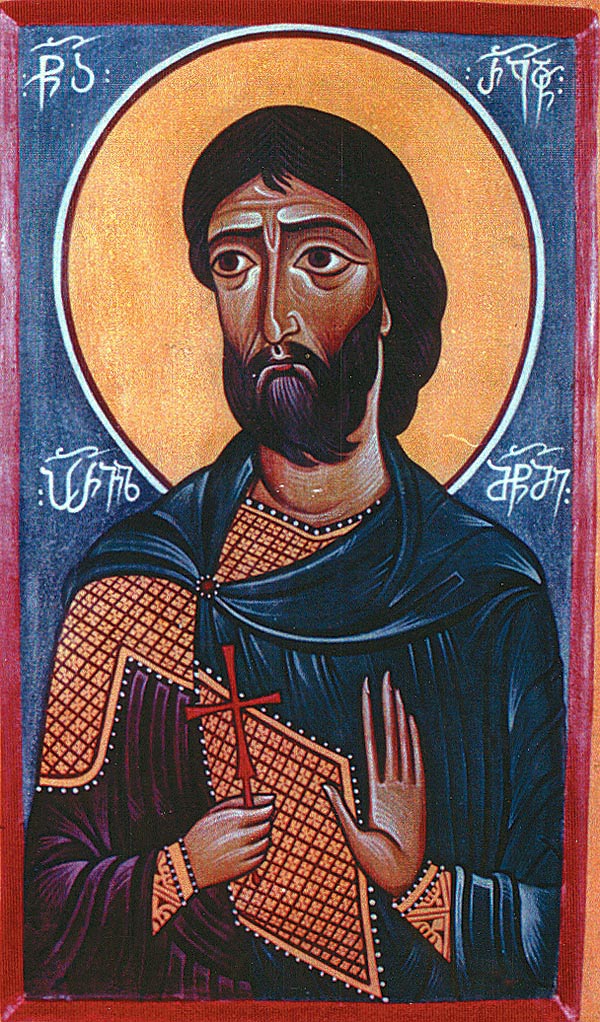
Martyr Razhden of Persia the Georgian

Saint Razhden the Protomartyr was descended from a noble Persian family. When Holy King Vakhtang Gorgasali married the daughter of the Persian king Hormuzd III Balunducht, the queen took Razhden with her to Georgia.

In Kartli Razhden converted to the Christian Faith, and King Vakhtang presented him with an estate and appointed him as a military adviser and commander.

At that time Georgia was under heavy political pressure from Persia. Enraged at King Vakhtang’s clearly Christian convictions, the Persian king Peroz (Son of Yazgard III.)(457-484) attacked Georgia with an enormous army. His accomplishments in this battle earned Razhden his distinction as a brave and virtuous warrior.

Before long the furious King Peroz ordered that “a certain Persian aristocrat who had converted to Christianity and survived the battle” be taken captive. The Persians surrounded Razhden, bound his hands and feet, and delivered him to their king. Peroz received him with feigned tenderness, saying, “Greetings, my virtuous Razhden! Peace be to you! Where have you been all this time, and for what reason have you turned from the faith of your fathers to confess a creed in which your fathers did not instruct you?”

Razhden fearlessly asserted that Christianity is the only true faith and that Christ is the only true Savior of mankind. King Peroz tried to conceal his anger and cunningly lure Razhden to his side, but his attempt was in vain. Convinced that his efforts were futile, Peroz finally ordered that the saint be beaten without mercy. The expert executioners trampled Saint Razhden, battered him, knocked out his teeth, dragged him across jagged cliffs, then chained him in heavy irons and cast him into prison.

When the news of Razhden’s suffering and captivity spread to Mtskheta, the Georgian nobility came to Peroz and requested that he free the holy man. Peroz consented to their request, but made Razhden vow to return.

Razhden arrived in Mtskheta, bid farewell to his family and the beloved king Vakhtang Gorgasali and, despite his loved ones’ admonitions to the contrary, returned to Peroz. The Persian king tried again to return Razhden to the religion of the fire-worshippers. But seeing that he would not be broken, Peroz instead ordered his exile to a military camp at Tsromi in central Georgia. Then he secretly ordered the chief of the Persian camp to turn him away from Christianity and to execute him if he refused. “Your flattery and bribes are insulting to me. With joy I am prepared to endure every suffering for the sake of Christ!”

Razhden replied to his appeals, “If he hopes in the Crucified One, then he also is fit to suffer crucifixion!” Such was the Persians’ verdict. They erected a cross, crucified Christ’s humble servant, and prepared to shoot at the pious man with bow and arrow. “Into Thy hands, O Lord, I commit my spirit!” were the last words of Saint Razhden.

That night a group of Christians stole the Persians’ cross, took the holy martyr’s body down from it, and buried his holy relics in secret. A few years later Vakhtang Gorgasali translated Saint Razhden’s relics from Tsromi to Nikozi (in central Georgia) and interred them in a cathedral that he had built there not long before. Holy King Vakhtang later erected churches in honor of Georgia’s first martyr in Ujarma and Samgori in eastern Georgia.

Venerable Cosmas the Eunuch and Hermit of Palestine

Saint Cosmas the Hermit lived during the sixth century in the Pharan wilderness of Palestine. An account of the Bikaneia presbyter Abba Basil about Saint Cosmas is located in the book Spiritual Meadow (Ch. 40) compiled by Saint John Moschus. He was strict of fasting, a firm defender of the Orthodox Faith and Church dogmas, and profoundly knowledgeable in Holy Scripture and the works of the Church Fathers.

Saint Cosmas particularly revered the works of Saint Athanasius the Great and told those to whom he spoke: “If you come across a word of Saint Athanasius and have no paper, write it upon your clothing.” He had the habit to stand at prayer all night Saturday through Sunday.

Having once come to Antioch, he died there, and the patriarch buried his body at his monastery. Abba Basil relates that when he came to venerate the grave of Saint Cosmas, he found there a beggar, who told him: “It is a great Elder whom you have buried here!” He explained that he had been paralyzed for twelve years, and received healing through the prayers of Saint Cosmas.

9 Kherkheulidze Brothers with their Mother and Sister and Nine Thousand Martyrs of Marabda

On the Feast of the Annunciation in the year 1625, the Georgians annihilated the army of the Persian shah Abbas I in the Battle of Martqopi. The victory unified Georgia’s eastern provinces of Kartli and Kakheti. It also instilled hope in other enslaved peoples of the Transcaucasus, and rebellions began to break out everywhere.

Soon the enraged Shah Abbas marched his finest and largest army toward Georgia under the leadership of Isa-Khan Qurchibash. A Georgian army of some twenty thousand men encamped near Kojori-Tabakhmela in preparation for the attack, while the enemy’s army, which numbered in excess of fifty thousand men, encamped at Marabda. According to tradition, the Georgian soldiers received Holy Communion at dawn before the battle.

Bishop Domenti (Avalishvili) of Ruisi prepared to serve the Holy Gifts to the soldiers but they cried out with a single voice: “If you will join us and take up your sword and fight, then do so. We can receive Holy Communion from another!”

Inspired by these words, the bishop joined in, proclaiming, “Today we will fight a battle for faith and for Christ; therefore my blood must be spilled before yours!” With his vestments as armor, the bishop blessed the soldiers and took his place in the front line.

The banner of the Georgian army was entrusted to the nine Kherkheulidze brothers.

The Persians panicked upon coming face-to-face with the courage and fortitude of the Georgian soldiers, but the experienced commander Isa-Khan Qurchibash would not yield in battle. Help arrived from Beglerbeg Shaybani-Khan, and with the extra forces the Persians soon gained the advantage over the Georgian army. The Georgian colonel Teimuraz Mukhranbatoni was fatally wounded, and rumors of his death threw the soldiers into a frenzy, since they erroneously believed that the dead man was King Teimuraz I of Kakheti, the commander of their army.

Believing that their leader had fallen, the Georgian soldiers became anxious and their army was enfeebled. Before long they recognized their mistake, but it was too late—the fate of the battle had already been decided.

The military leaders Davit Jandieri, Aghatang Kherkheulidze and Baadur Tsitsishvili and the bishops of Rustavi and Kharchasho all fell in the battle at Marabda. The nine banner-bearing Kherkheulidze brothers were also killed. When the banner that had led their army through the battles at Didgori and Basiani fell from the hands of the youngest brother, their sister grabbed hold of it immediately, and when she also fell, the banner and symbol of Georgian invincibility was raised up again by their mother.

King Teimuraz fought until sunset, when every sword he had held in his hands had been broken. Even his rings were broken in the combat. The uniform of the brilliant military leader Giorgi Saakadze was stained with blood from top to bottom. Atabeg Manuchar of Samtskhe and his sons also fought bravely in this battle.

Utterly exhausted and debilitated by the heat, the Georgians fought heroically to the last moment. But the battle that had begun at dawn finally ended late that night with the defeat of the Georgian army. Nine thousand Georgians gave their lives for Christ and their motherland on the battlefield at Marabda.

Venerable Theodora and her daughter Theopiste

Saint Theodora was born in Aegina. After her marriage, she and her husband moved to Thessaloniki because of the raids of the Saracens. After her husband's death she entered the Monastery of Saint Stephen with her daughter Theopiste. She lived a life of great virtue and reposed in the year 892.

Although the commemoration of these saints is on August 29, their celebration was moved to August 3 because of the Feast of the Beheading of Saint John the Baptist.

Daily Readings for Tuesday, August 02, 2022

TRANSLATION OF THE RELICS OF STEPHEN THE PROTOMARTYR

ABSTAIN FROM MEAT, FISH, DAIRY, EGGS, WINE, OLIVE OIL

Translation of the Relics of Stephen the Protomartyr, Holy Glorious New Martyr Theodore of Dardanelles, Phocas the Martyr, Plegmund, Archbishop of Canterbury

ACTS OF THE APOSTLES 6:8-15; 7:1-5, 47-60

In those days, Stephen, full of grace and power, did great wonders and signs among the people. Then some of those who belonged to the synagogue of the Freedmen (as it was called), and of the Cyrenians, and of the Alexandrians, and of those from Cilicia and Asia, arose and disputed with Stephen. But they could not withstand the wisdom and the Spirit with which he spoke. Then they secretly instigated men, who said, "We have heard him speak blasphemous words against Moses and God." And they stirred up the people and the elders and the scribes, and they came upon him and seized him and brought him before the council, and set up false witnesses who said, "This man never ceases to speak words against this holy place and the law; for we have heard him say that this Jesus of Nazareth will destroy this place, and will change the customs which Moses delivered to us." And gazing at him, all who sat in the council saw that his face was like the face of an angel.
And the high priest said, "Is this so?" And Stephen said: "Brethren and fathers, hear me. The God of glory appeared to our father Abraham, when he was in Mesopotamia, before he lived in Haran, and said to him, 'Depart from your land and from your kindred and go into the land which I will show you.' Then he departed from the land of the Chaldeans, and lived in Haran. And after his father died, God removed him from there into this land in which you are now living; yet he gave him no inheritance in it, not even a foot's length, but promised to give it to him in possession and to his posterity after him, though he had no child.
But it was Solomon who built a house for him. Yet the Most High does not dwell in houses made with hands; as the prophet says, 'Heaven is my throne, and earth my footstool. What house will you build for me, says the Lord, or what is the place of my rest? Did not my hand make all these things?'
You stiff-necked people, uncircumcised in heart and ears, you always resist the Holy Spirit. As your fathers did, so do you. Which of the prophets did not your fathers persecute? And they killed those who announced beforehand the coming of the Righteous One, whom you have now betrayed and murdered, you who received the law as delivered by angels and did not keep it.
Now when they heard these things they were enraged, and they ground their teeth against him. But he, full of the Holy Spirit, gazed into heaven and saw the glory of God, and Jesus standing at the right hand of God; and he said, "Behold, I see the heavens opened, and the Son of man standing at the right hand of God." But they cried out with a loud voice and stopped their ears and rushed together upon him. Then they cast him out of the city and stoned him; and the witnesses laid down their garments at the feet of a young man named Saul. And as they were stoning Stephen, he prayed, "Lord Jesus, receive my spirit." And he knelt down and cried with a loud voice, "Lord, do not hold this sin against them." And when he had said this, he fell asleep.

MARK 12:1-12

The Lord said this parable, "A man planted a vineyard, and set a hedge around it, and dug a pit for the wine press, and built a tower, and let it out to tenants, and went into another country. When the time came, he sent a servant to the tenants, to get from them some of the fruit of the vineyard. And they took him and beat him, and sent him away empty handed. Again he sent to them another servant, and they wounded him in the head, and treated him shamefully. And he sent another, and him they killed; and so with many others, some they beat and some they killed. He had still one other, a beloved son; finally he sent him to them, saying, 'They will respect my son.' But those tenants said to one another, 'This is the heir; come, let us kill him, and the inheritance will be ours.' And they took him and killed him, and cast him out of the vineyard. What will the owner of the vineyard do? He will come and destroy the tenants, and give the vineyard to others. Have you not read this scripture: 'The very stone which the builders rejected has become the head of the corner; this was the Lord's doing, and it is marvelous in our eyes'?" And they tried to arrest him, but feared the multitude, for they perceived that he had told the parable against them; so they left him and went away.

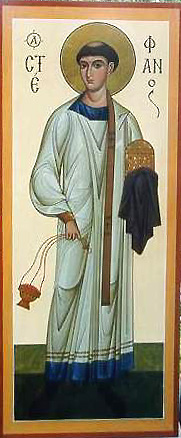
Translation of the relics of the Protomartyr and Archdeacon Stephen from Jerusalem to Constantinople

The Transfer of the Relics of the Holy Protomartyr Stephen from Jerusalem to Constantinople took place about the year 428.

After the holy Protomartyr Archdeacon Stephen was stoned by the Jews, they left his holy body unburied to be devoured by the beasts and birds. After a day and a night the renowned Jewish teacher of the Law, Gamaliel sent people to take up the body of the Protomartyr. Gamaliel buried him on his own property, in his own tomb, not far from Jerusalem.

When Lord’s secret disciple Νikόdēmos died, Gamaliel also buried him near the grave of Saint Stephen. Afterwards Gamaliel himself, who had been baptized with his son Abibas, was buried near the grave of the Protomartyr Stephen and Saint Νikόdēmos.

In the year 415 the relics of the saint were uncovered in a miraculous manner and solemnly transferred to Jerusalem by Bishop John and the bishops Eutonius of Sebaste and Eleutherius of Jericho. From that time healings took place from the relics.

Afterwards, during the reign of holy Emperor Theodosius the Younger (408-450), the relics of the holy Protomartyr Stephen were transferred from Jerusalem to Constantinople and placed in the church of the holy deacon Laurence (August 10). When a church dedicated to the Protomartyr Stephen was built, the relics were transferred there on August 2. Saint Stephen’s right hand is preserved in the Serapionov chamber of the Trinity-Sergius Lavra.

Finding of the relics of Righteous Saint Νikόdēmos

Saint Νikόdēmos was a prominent Pharisee who believed in Christ. The Savior explained to him how man is regenerated through Baptism, but he did not understand how a man could be born again. When the Lord reproved him for his ignorance, he accepted it with humility (John 3:1-21).

Νikόdēmos came back to Christ from time to time, defended Him to the Pharisees (John 7:50-52), and brought spices to anoint His body (John 19:39). After being cast out of the synagogue for his belief in Christ, Saint Νikόdēmos went to live with Saint Gamaliel at his country house, remaining there until his death.

The relics of Saints Stephen, Gamaliel, Abibas, and Νikόdēmos were transferred from Jerusalem to Constantinople in 428 and placed in the church of the holy deacon Laurence (August 10).

Finding of the relics of Saint Gamaliel

Saint Gamaliel was a Pharisee, a doctor of the Law (Acts 5:34), and the teacher of Saint Paul (Acts 22:3).

In the year 415, Saint Gamaliel appeared to a priest named Lucian. He was a tall, venerable man with a long white beard. He was dressed in white clothing which was edged with gold and marked with crosses, and held a gold wand in his hand.

Gamaliel called Father Lucian by name three times, then told him to go to Jerusalem and inform Bishop John to open the tomb where his relics and those of other saints were resting. The priest asked the stranger who he was.

“I am Gamaliel, who instructed the apostle Paul in the Law,” he replied. Then he told the priest where to find the relics of Saint Stephen. He also revealed that he had taken Saint Stephen’s body and laid it in his own tomb after it had been lying exposed for a day and a night.

Saint Gamaliel also mentioned that Saint Νikόdēmos was buried at the same spot. “I received him into my house in the country,” he said, “and maintained him there until the end of his life. After his death, I buried him honorably near Stephen.”

Saint Gamaliel informed the priest that he and his twenty-year-old son Abibas were also buried there. Father Lucian was afraid to believe this vision right away, lest it be a temptation from the Evil One. However, when Saint Gamaliel appeared again and commanded him to obey his instructions, he did so.

A monk named Migetius also had a vision of Saint Gamaliel and told Father Lucian to search for the relics in a place called Debatalia. When the relics were uncovered, an ineffable fragrance was noticed.

The relics of Saints Stephen, Gamaliel, Abibas, and Νikόdēmos were transferred from Jerusalem to Constantinople in 428 and placed in the church of the holy deacon Laurence (August 10).

Finding of the relics of Saint Abibas

Saint Abibas was the twenty-year-old son of Saint Gamaliel, who died before his father. His relics were uncovered along with those of Saints Stephen, Gamaliel, and Νikόdēmos in 415.

The relics of Saints Stephen, Gamaliel, Abibas, and Νikόdēmos were transferred from Jerusalem to Constantinople in 428 and placed in the church of the holy deacon Laurence (August 10).

Blessed Basil of Moscow the Fool-For-Christ

Saint Basil the Blessed, Wonderworker of Moscow, was born in December 1468 on the portico of the Elokhov church in honor of the Vladimir Icon of the Most Holy Theotokos outside Moscow. His parents were commoners and sent their son to be trained as a cobbler.

During Basil’s apprenticeship, the master happened to witness a remarkable occurrence, which showed him that his student was no ordinary man. A certain merchant had brought grain to Moscow on a barge and then went to order boots, specifying that they be made in a particular way, since he would not pick them up for a year. Blessed Basil wept and said, “I wish you would cancel the order, since you will never wear them.”

When the perplexed master questioned his apprentice he explained that the man would not wear the boots, for he would soon die. After several days the prediction came true.

When he was sixteen, the saint arrived in Moscow and began the difficult exploit of foolishness for Christ. In the burning summer heat and in the winter’s harsh frost, he walked about barefoot through the streets of Moscow. His actions were strange: here he would upset a stand with kalachi, and there he would spill a jug with kvas. Angry merchants throttled the blessed one, but he endured the beatings with joy and he thanked God for them. Then it was discovered that the kalachi were poorly cooked, and the kvas was badly prepared. The reputation of Saint Basil quickly grew, and people saw him as a holy fool, a man of God, and a denouncer of wrong.

A certain merchant wanted to build a stone church on Pokrovna in Moscow, but its arches collapsed three times. The merchant turned to the saint for advice, and he pointed him toward Kiev. “Find there John the Cripple,” he said. “He will advise you how to construct the church.”

Traveling to Kiev, the merchant sought out John, who sat in a poor hut and rocked an empty cradle. “Whom do you rock?” asked the merchant. “I weep for my beloved mother, who was made poor by my birth and upbringing.” Only then did the merchant remember his own mother, whom he had thrown out of the house. Then it became clear to him why he was not able to build the church. Returning to Moscow, he brought his mother home, begged her forgiveness, and built the church.

Preaching mercy, the blessed one helped those who were ashamed to ask for alms, but who were more in need of help than others. Once, he gave away a rich imperial present to a foreign merchant who was left without anything at all. Although the man had eaten nothing for three days, he was not able to beg for food, since he wore fine clothing.

The saint harshly condemned those who gave alms for selfish reasons, not out of compassion for the poor and destitute, but hoping for an easy way to attract God’s blessings upon their affairs. Once, the saint saw a devil in the guise of a beggar. He sat at the gates of the All-Pure Virgin’s church, and he gave speedy help in their affairs to everyone who gave alms. The saint exposed the wicked trick and drove the devil away.

For the salvation of his neighbor, Saint Basil also visited the taverns, where he tried to see a grain of goodness, even in people very much gone to ruin, and to strengthen and encourage them by kindness. Many observed that when the saint passed by a house in which they made merry and drank, he wept and clutched the corners of that house. They inquired of the fool what this meant, and he answered: “Angels stand in sorrow at the house and are distressed by the sins of the people, but I entreat them with tears to pray to the Lord for the conversion of sinners.”

Purified by great deeds and by the prayer of his soul, the saint was also given the gift of foreseeing the future. In 1547 he predicted the great fire of Moscow; through prayer he extinguished a fire at Novgorod; and once he reproached Tsar Ivan the Terrible, because during the divine services he was preoccupied with thoughts of building a palace on the Vorobiev hills.

Saint Basil died on August 2, 1557. Saint Macarius, Metropolitan of Moscow served the saint’s funeral with many clergy. His body was buried in the cemetery of Trinity church, where in 1554, the Protection cathedral was built in memory of the conquest of Kazan. His Holiness Patriarch Job glorified Saint Basil the Blessed at a Council on August 2, 1588.

In an early icon, Saint Basil is portrayed as old, with white hair curling at the ears, and a short, curly white beard. He is completely naked, and holds a handkerchief in his hand. The veneration of Saint Basil the Blessed was always so strong that the Trinity temple and the attached Protection church were renamed for him [the famous Saint Basil’s Cathedral in Moscow].

The saint’s chains are preserved at the Moscow Spiritual Academy.

Blessed Basil of Kubensk

Blessed Basil of Kubensk lived during the fifteenth century, was a monk at the Savior-Kamenny monastery, on an island of Lake Kuben (not far from Vologda). At the shrine of his relics, built afterwards in a church in honor of Saint Basil of Moscow, is a full-length icon of Saint Basil of Kubensk, with heavy iron chains and a cap of iron strips.

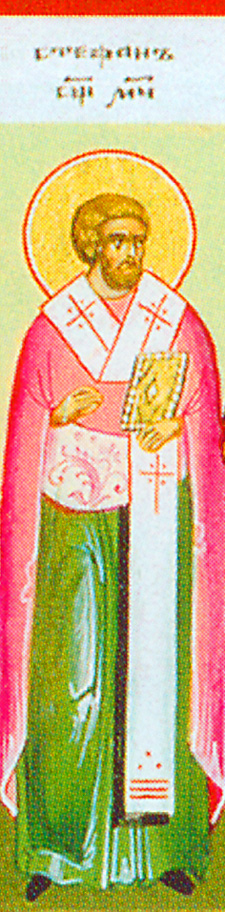
Hieromartyr Stephen, Pope of Rome, and those with him

The Hieromartyr Stephen, Pope of Rome, suffered in the year 257 during the reign of the emperor Valerian (253-259). Saint Stephen, occupying the throne (253-257) of the holy First Bishop of Rome, zealously contended against the heresy of Novatus, which taught that it is not proper to receive back those returning from heresy.

While hiding during a persecution against Christians, Saint Stephen baptized many pagans, including the military tribune Nemesius. He converted to Christ after the saint healed his daughter Lucilla. Nemesius, who was ordained as a deacon, was beheaded along with his daughter.

Their steward Symphronius was brought by the tribune Olympius into the temple of Mars for torture. His prayer shattered the golden idol, after which the tribune with his wife Exuperia and his son Theodolus believed and were baptized. They were all burned alive, and their remains were buried by holy Pope Stephen.

Then twelve of his clergy were beheaded: Bonus, Faustus, Maurus, Primitivus, Calumniosus, John, Exuperantus, Cyril, Theodore, Basil, Castelus, Honoratus and Tertullinus, all converted by Saint Stephen. Finally, Saint Stephen himself was led before the emperor Valerian (253-259) , who condemned him to beheading with a sword in the temple of Mars.

By the prayers of the saint, a large part of the pagan temple was destroyed, and the soldiers fled. The saint concealed himself in the catacombs (the resting place of Saint Lucina or Lucy), where he was later killed by soldiers while he was teaching Christians.

Daily Readings for Monday, August 01, 2022

THE HOLY SEVEN MACCABEE CHILDREN, SOLOMONE THEIR MOTHER, AND ELEAZAR THEIR TEACHER

ABSTAIN FROM MEAT, FISH, DAIRY, EGGS, WINE, OLIVE OIL

The Holy Seven Maccabee Children, Solomone Their Mother, and Eleazar Their Teacher, Procession of the Precious Cross, Timothy the Wonderworker, Archbishop of Priconissus, Elesa the Righteous-Martyr of Kythira

ST. PAUL’S LETTER TO THE HEBREWS 11:33-40; 12:1-2

Brethren, all the saints through faith conquered kingdoms, enforced justice, received promises, stopped the mouths of lions, quenched raging fire, escaped the edge of the sword, won strength out of weakness, became mighty in war, put foreign armies to flight. Women received their dead by resurrection. Some were tortured, refusing to accept release, that they might rise again to a better life. Others suffered mocking and scourging, and even chains and imprisonment. They were stoned, they were sawn in two, they were tempted, they were killed with the sword; they went about in skins of sheep and goats, destitute, afflicted, ill-treated – of whom the world was not worthy – wandering over deserts and mountains and in dens and caves of the earth. And all these, though well attested by their faith, did not receive what was promised, since God had foreseen something better for us, that apart from us they should not be made perfect. Therefore, since we are surrounded by so great a cloud of witnesses, let us also lay aside every weight, and sin which clings so closely, and let us run with perseverance the race that is set before us, looking to Jesus the pioneer and perfecter of our faith.

MATTHEW 10:16-22

The Lord said to his disciples, “Behold, I send you out as sheep in the midst of wolves; so be wise as serpents and innocent as doves. Beware of men; for they will deliver you up to councils, and flog you in their synagogues, and you will be dragged before governors and kings for my sake, to bear testimony before them and the Gentiles. When they deliver you up, do not be anxious how you are to speak or what you are to say; for what you are to say will be given to you in that hour; for it is not you who speak, but the Spirit of your Father speaking through you. Brother will deliver up brother to death, and the father his child, and children will rise against parents and have them put to death; and you will be hated by all for my name’s sake. But he who endures to the end will be saved.”

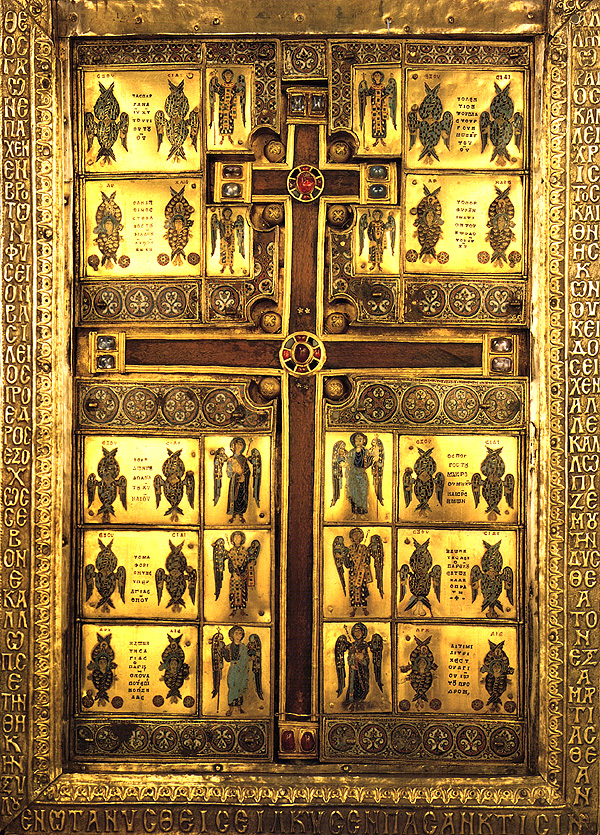
Procession of the Honorable Wood of the Life-Giving Cross of the Lord (First of the three “Feasts of the Savior” in August)

The origin of this Feast is explained in the Greek Horologion of 1897: “Because of the illnesses which occur during the month of August, it was customary at Constantinople to carry the Precious Wood of the Cross in procession throughout the city for its sanctification, and to deliver it from sickness.”

On the eve (July 31), the Cross was removed from the imperial treasury and placed it upon the Holy Table of the Great Church of Hagia Sophia (which is dedicated to Christ, the Wisdom of God). From August 1 until the Dormition of the Most Holy Theotokos, there was a procession throughout the entire the city, and then the Cross was placed where all the people could venerate it.

In the Russian Church this Feast is combined with the remembrance of the Baptism of Rus on August 1, 988. In the “The order of services for the holy, catholic, and apostolic Great Church of the Dormition,” which was compiled in 1627 by order of Patriarch Philaret of Moscow and All Rus, there is a similar explanation of the Feast: "On the day of the Procession of the Precious Cross there is a Cross Procession with the Sanctification of Water, for the enlightenment of the people, in all the towns and places."

Knowledge of the day of the actual Baptism of Rus is preserved in the Chronicles of the XVI century: “The Baptism of the Great Prince Vladimir of Kiev and of all Rus took place on August 1.”

In the current practice of the Russian Church, the service of the Lesser Sanctification of Water on August 1 takes place either before or after Liturgy. Because of the Blessing of Water, this first Feast of the Savior in August is sometimes called “the Savior of the Water.” Along with the Blessing of Water, there may also be a Blessing of Honey (thus it is also called “the Savior of the Honey),” because on this day, the newly-gathered honey is blessed and tasted.

7 Holy Maccabee Martyrs

The seven holy Maccabee martyrs Abim, Antonius, Gurias, Eleazar, Eusebonus, Alimus and Marcellus, their mother Solomonia and their teacher Eleazar suffered in the year 166 before Christ under the impious Syrian king Antiochus IV Epiphanes. This foolish ruler loved pagan and Hellenistic customs, and held Jewish customs in contempt. He did everything possible to turn people from the Law of Moses and from their covenant with God. He desecrated the Temple of the Lord, placed a statue of the pagan god Zeus there, and forced the Jews to worship it. Many people abandoned the God of Abraham, Isaac, and Jacob, but there were also those who continued to believe that the Savior would come.

A ninety-year-old elder, the scribe and teacher Eleazar, was brought to trial for his faithfulness to the Mosaic Law. He suffered tortures and died at Jerusalem.

The disciples of Saint Eleazar, the seven Maccabee brothers and their mother Solomonia, also displayed great courage. They were brought to trial in Antioch by King Antiochus Epiphanes. They fearlessly acknowledged themselves as followers of the True God, and refused to eat pig’s flesh, which was forbidden by the Law.

The eldest brother acted as spokesmen for the rest, saying that they preferred to die rather than break the Law. He was subjected to fierce tortures in sight of his brothers and their mother. His tongue was cut out, he was scalped, and his hands and feet were cut off. Then a cauldron and a large frying pan were heated, and the first brother was thrown into the frying pan, and he died.

The next five brothers were tortured one after the other. The seventh and youngest brother was the last one left alive. Antiochus suggested to Saint Solomonia to persuade the boy to obey him, so that her last son at least would be spared. Instead, the brave mother told him to imitate the courage of his brothers.

The child upbraided the king and was tortured even more cruelly than his brothers had been. After all her seven children had died, Saint Solomonia, stood over their bodies, raised up her hands in prayer to God and died.

The martyric death of the Maccabee brothers inspired Judas Maccabeus, and he led a revolt against Antiochus Epiphanes. With God’s help, he gained the victory, and then purified the Temple at Jerusalem. He also threw down the altars which the pagans had set up in the streets. All these events are related in the Second Book of Maccabees (Ch. 8-10).

Various Fathers of the Church preached sermons on the seven Maccabees, including Saint Cyprian of Carthage, Saint Ambrose of Milan, Saint Gregory Nazianzus and Saint John Chrysostom.

Martyr Solomonia, mother of the Holy Seven Maccabee Martyrs

Saint Solomonia was the mother of the seven Maccabee brothers. She encouraged her sons to remain faithful to the Law of God even when threatened with death.

This admirable mother is honored and remembered for her great courage, for she watched all seven of her sons die in a single day. May we also be faithful to God’s commandments and the traditions of the Church.

Martyr Eleazar the Teacher of the Holy Seven Maccabee Martyrs

Saint Eleazar lived in the second century before Christ, and was a scribe. At the age of ninety he voluntarily endured torture and death rather than violate the Law of God by eating swine’s flesh. By suffering death for the Law of Moses, he left young men, and the whole nation, an example of virtue and courage.

The story of Eleazar is found in II Maccabees, chapter 6.

Nine Martyrs of Perge in Pamphilia

During the reign of Diocletian (284-305) nine holy Martyrs, Leontios, Attos, Alexander, Kindeos, Mnesitheos, Kyriakos, Mineon and Eukles were put to death at Perge in Pamphilia. Eight of them were farmers by profession, but Mineon was a carpenter. They were Christians from their early childhood, and they remained so after reaching adulthood.

One evening, they all decided to suffer martyrdom for Christ, so they went to the pagan temple of Artemis and destroyed all the idols. After this they were arrested by the pagans, who questioned them and then tortured them. First they burned their sides, and then they scraped their flesh with iron claws. Finally, they took torches and stabbed them in the eyes. Then they were thrown into prison without any food or water. After a while, they were taken out and thrown into a cage of wild beasts in order to be devoured by them. Although the animals had not been fed, they sat calmly and did not approach the Saints. Those who saw this miraculous event were astonished and shouted: "Great is the God of the Christians."

Then a miracle occurred. Immediately, there was the sound of thunder, lightning flashed, and rain began to fall. At the same time a voice was heard, inviting the Saints to heaven. As soon as the Saints heard this voice, they rejoiced. After this, the tyrant became so angry that he ordered soldiers to behead them. In this manner the suffering of the nine Saints came to an end, and they entered into the eternal Kingdom.

"Foreteller" Icon of the Mother of God

The "Foreteller"1 Icon of the Mother of God is located in the katholikon (cathedral church) of Konstamonitou Monastery on Mount Athos, and it became famous in the following way.

On August 1, 1020, the eve of the monastery’s Feast Day (The Transfer of the Relics of the Protomartyr Stephen from Jerusalem to Constantinople), the Ecclesiarch Father Agathon, (Zacharias in the Schema) was overcome with great sorrow. The Monastery’s Altar Feast was approaching, and its supplies were so depleted that there was not enough oil to light the church lamps for the solemn celebration.

That night, Father Agathon prayed before the Icon of the Mother of God with fervent tears. So earnestly did he beg her to help the monastery that he became exhausted. Sitting down before the Icon, he fell asleep at once. In a dream he heard a voice coming from the holy Icon telling him not to grieve, because the church vessels were now filled with oil, and the pantries contained everything that was necessary for the monastery's continued existence.

When Father Agathon awoke, he wondered if what he had been told in his dream was true. Hastening to the vessel where the oil was stored, he was overjoyed when he saw that it was filled to the brim. At once, he reported his vision to Igoumen Hilarion, the Superior of Konstamonitou Monastery, and to all the brethren.

Everyone went to inspect the pantries and discovered that all the necessary supplies were there in abundance. They rejoiced because now, unexpectedly, they could light the church lamps for the service. Led by Igoumen Hilarion, they served the Vigil and sang praises to the Queen of Heaven for the miracle she had performed.

After this event, the wonderworking Icon of the Mother of God, before which Father Agathon had prayed, was known as the "Foreteller." Now she is placed in the Monastery's katholikon, on the wall, on the right hand side. Ever since this miracle took place, an "unsleeping" oil lamp remains lit before the Icon.

In his most informative book Bogomater (an account of the earthly life of the Mother of God, and of her wonderworking Icons), Eugene Poselyanin (+ February 13, 1931) states that there are two other Icons of the Theotokos on the Holy Mountain which are also called "Foreteller" – the "Paramythia," or "Consolation" Icon of Vatopaidi Monastery (January 21), and the Zographou Icon "Of the Akathist" (October 10).


1 In Greek: Παναγία η Αντιφωνήτρια. In Russian: Предвозвестительница