
Here is the live stream for Great Vespers – Sat 7/2/2022 If you need, here are instructions for accessing this content from your phone, tablet, computer, or TV.
Monthly Archives: July 2022
Daily Readings for Saturday, July 02, 2022
DEPOSITION OF THE PRECIOUS ROBE OF THE THEOTOKOS IN BLACHERNAE
NO FAST
Deposition of the Precious Robe of the Theotokos in Blachernae, Synaxis of the Most Holy Theotokos of the Orphan, Juvenal, Patriarch of Jerusalem, Juvenal the Protomartyr of America & Alaska, John Maximovitch, Archbishop of Shanghai and San Francisco
ST. PAUL’S LETTER TO THE HEBREWS 9:1-7
BRETHREN, the first covenant had regulations for worship and an earthly sanctuary. For a tent was prepared, the outer one, in which were the lampstand and the table and the bread of the Presence; it is called the Holy Place. Behind the second curtain stood a tent called the Holy of Holies, having the golden altar of incense and the ark of the covenant covered on all sides with gold, which contained a golden urn holding the manna, and Aaron’s rod that budded, and the tables of the covenant; above it were the cherubim of glory overshadowing the mercy seat. Of these things we cannot now speak in detail. These preparations having thus been made, the priests go continually into the outer tent, performing their ritual duties; but into the second only the high priest goes, and he but once a year, and not without taking blood which he offers for himself and for the errors of the people.
LUKE 1:39-49, 56
In those days, Mary arose and went with haste into the hill country, to a city of Judah, and she entered the house of Zacharias and greeted Elizabeth. And when Elizabeth heard the greeting of Mary, the babe leaped in her womb; and Elizabeth was filled with the Holy Spirit and she exclaimed with a loud cry, "Blessed are you among women, and blessed is the fruit of your womb! And why is this granted me, that the mother of my Lord should come to me? For behold, when the voice of your greeting came to my ears, the babe in my womb leaped for joy. And blessed is she who believed that there would be a fulfillment of what was spoken to her from the Lord." And Mary said, "My soul magnifies the Lord, and my spirit rejoices in God my Savior, for he has regarded the low estate of his handmaiden. For behold, henceforth all generations will call me blessed; for he who is mighty has done great things for me, and holy is his name." And Mary remained with her about three months, and returned to her home.
The Placing of the Honorable Robe of the Most Holy Mother of God at Blachernae
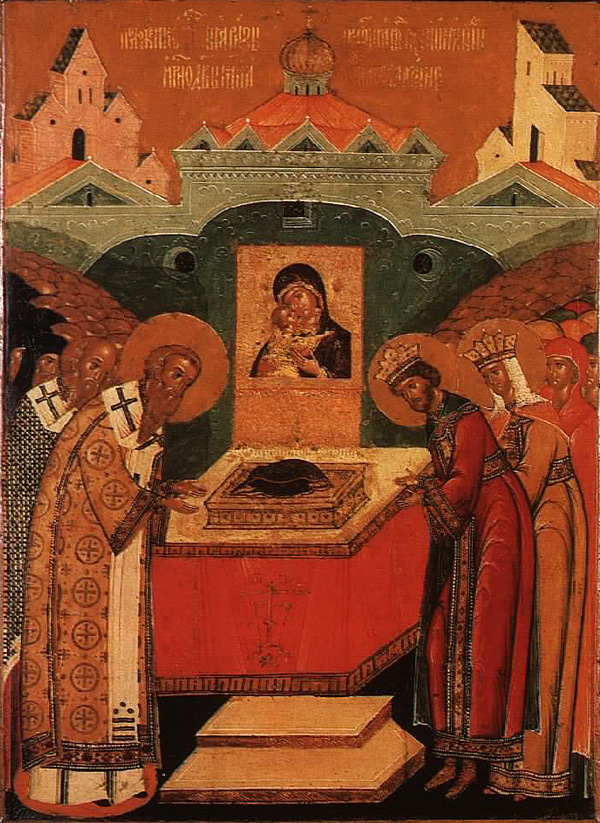
The Placing of the Venerable Robe of the Most Holy Theotokos at Blachernae: During the reign of the Byzantine Emperor Leo the Great (457-474), the brothers Galbius and Candidus, associates of the emperor, set out from Constantinople to Palestine to venerate the holy places. In a small settlement near Nazareth they stayed in the home of a certain old Jewish woman. In her house they noticed a room where many lamps were lit, incense burned, and sick people were gathered. When they asked her what the room contained, the pious woman did not want to give an answer for a long time. After persistent requests, she said that she had a very precious sacred item: the Robe of the Mother of God, which performed many miracles and healings. Before Her Dormition the Most Holy Virgin bequeathed one of her garments to a pious Jewish maiden, an ancestor of the old woman, instructing her to leave it to another virgin after her death. Thus, the Robe of the Mother of God was preserved in this family from generation to generation.
The jewelled chest, containing the sacred Robe, was transferred to Constantinople. Saint Gennadius, Patriarch of Constantinople (August 31), and the emperor Leo, having learned of the sacred treasure, were convinced of the incorrupt state of the holy Robe, and they certified its authenticity. At Blachernae, near the seacoast, a new church in honor of the Mother of God was constructed. On June 2, 458 Saint Gennadius transferred the sacred Robe into the Blachernae church with appropriate solemnity, placing it within a new reliquary.
Afterwards, the maphorion (i.e., the outer robe) of the Mother of God, and part of Her belt were also put into the reliquary with Her Robe. This circumstance also influenced the Orthodox iconography of the Feast, in connecting the two events: the Placing of the Robe, and the Placing of the Belt of the Mother of God in Blachernae. The Russian pilgrim Stephen of Novgorod, visiting Constantinople in about the year 1350, testifies: “We arrived at Blachernae, where the Robe lies upon an altar in a sealed reliquary.”
More than once, during the invasion of enemies, the Most Holy Theotokos saved the city to which She had given Her holy Robe. Thus it happened during the time of a siege of Constantinople by the Avars in 626, by the Persians in 677, and by the Arabs in the year 717. Especially relevant for us are events of the year 860, intimately connected with the history of the Russian Church.
On June 18, 860 the Russian fleet of Prince Askold, a force comprising more than 200 ships, laid waste the coastal regions of the Black Sea and the Bosphorus, then entered into the Golden Horn and threatened Constantinople. The Russian ships sailed within sight of the city, setting ashore troops who “proceeded before the city, stretching forth their swords.” The emperor Michael III (842-867), interrupted his campaign against the Arabs and returned to the capital. All night he prayed prostrated upon the stone tiles of the church of the Mother of God at Blachernae. The holy Patriarch Photius spoke to his flock, calling for tears of repentance to wash away sins, and to seek the intercession of the Most Holy Theotokos with fervent prayer.
The danger grew with each passing hour. “The city was barely able to stand against a spear,” says Patriarch Photius in another of his homilies. Under these conditions the decision was made to save the church’s sacred objects, especially the holy Robe of the Mother of God, which was kept in the Blachernae church, not far from the shore.
After serving an all-night Vigil, and taking it out from the Blachernae church, they carried the sacred Robe of the Mother of God in a procession around the city walls. They dipped its edge into the waters of the Bosphorus, and then they transported it to the center of Constantinople into the church of Hagia Sophia. The Mother of God protected the city and quelled the fury of the Russian warriors. An honorable truce was concluded, and Askold lifted the siege of Constantinople.
On June 25 the Russian army began to leave, taking with them a large tribute payment. A week afterwards, on July 2, the wonderworking Robe of the Mother of God was solemnly returned to its place in the reliquary of the Blachernae church. In remembrance of these events an annual feastday of the Placing of the Robe of the Mother of God was established on July 2 by holy Patriarch Photius.
Soon, in October-November of the year 860, a Russian delegation arrived in Constantinople to conclude a treaty “in love and peace.” Some of the conditions of the peace treaty included articles concerning the Baptism of Kievan Rus, the payment of an annual tribute by the Byzantines to the Russians, permission for them to serve with the Byzantine army, an agreement to trade in the territory of the Empire (primarily in Constantinople), and to send a diplomatic mission to Byzantium.
Most important was the point about the Baptism of Rus. The continuator of the Byzantine “Theophanes Chronicles” relates that “their delegation arrived in Constantinople with a request for them to receive holy Baptism, which also was fulfilled.” An Orthodox mission was sent to Kiev to fulfill this mutual wish of the Russians and the Greeks. Not very long before this (in 855) Saint Cyril the Philosopher (February 14 and May 11) had created a Slavonic alphabet and translated the Gospel. Saint Cyril was sent with his brother, Saint Methodius (April 6 and May 11), on a mission to Kiev with books translated into Slavonic. This was at the initiative of Saint Photius, whose student Saint Cyril was. The brothers spent the winter of 860/861 at Cherson, and in the spring of 861 they were at the River Dniepr, with Prince Askold.
Prince Askold was faced with a difficult choice, just as holy Prince Vladimir faced: both the Jews on the one hand, and the Moslems on the other, wanted him to accept their faith. But under the influence of Saint Cyril, the prince chose Orthodoxy. At the end of the year 861, Saints Cyril and Methodius returned to Constantinople and carried letters with them from Prince Askold to Emperor Michael III. Askold thanked the emperor for sending him “such men, who showed by both word and by example, that the Christian Faith is holy.” “Persuaded that this is the true Faith,” Askold further wrote, “we bid them to baptize in the hope that we may also attain sanctity. We are all friends of the Kingdom and prepared to be of service to you, as requested.”
Askold accepted holy Baptism with the name Nicholas, and many of his retinue were also baptized. Directly from Constantinople, the capital of Orthodoxy, through the efforts of the holy Apostles to the Slavs both the Slavonic divine services and the Slavonic written language arrived in Rus.
Saint Photius appointed Metropolitan Michael to Kiev, and the Russian metropolitan district was entered into the lists of dioceses of the Patriarchate of Constantinople. Patriarch Photius in an encyclical of the year 867 called the Baptism of the Bulgarians and the Russians as among the chief accomplishments of his archpastoral service. “The Russians, who lifted their hand against the Roman might,” he wrote, almost quoting literally from the missive of Askold, “have now replaced the impious teaching which they held to formerly, with the pure and genuine Christian Faith, and with love having established themselves in the array of our friends and subjects.” (The Byzantines counted as “subjects” all accepting Baptism from Constantinople and entering into military alliance with the Empire.) “The desire and zeal of faith has flared up within them to such an extent, that they have accepted bishops and pastors, and they embrace Christian sanctity with great zeal and fervor.”
The Feast of the Placing of the Robe of the Most Holy Theotokos in Blachernae also marks the canonical establishment of the Russian Orthodox metropolitanate in Kiev. By the blessing of the Mother of God and by the miracle from Her holy Robe not only was the deliverence of Constantinople from the most terrible siege in all its history accomplished, but also the liberation of the Russians from the darkness of pagan superstition to life eternal. Together with this, the year 860 brought recognition to Kievan Rus from Byzantium, and signified the emergence of the young Russian realm into the arena of history.
The attempt of Prince Askold to renew the Christian evangelization begun by the holy Apostle Andrew the First-Called, which he intended as a religious and state reform, ended unsuccessfully. The time for the spread of Christianity in the Russian Land had not yet come. The adherents of the old paganism were too strong, and the princely power was too weak. In the clash of Askold with the pagan Oleg in 882 the Kievans betrayed their prince. Askold, lured into the camp of his enemies for talks, received a martyr’s death at the hand of hired killers.
But the deed of Blessed Askold (the Ioakimov Chronicle calls him such) was not extinguished in the Russian Church. Oleg the Sage, who killed Askold, occupied the Kiev princedom after him, and called Kiev the “Mother of Russian Cities.”
The most ancient chronicles of Kiev preserved the grateful memory of the first Kievan Christian prince: the church of the Prophet of God Elias, built by Askold and later mentioned in Igor’s Treaty with the Greeks (in 944), is on the site where the present church of this name now stands, and there is also the church of Saint Nicholas the Wonderworker, built in the 950s by Saint Olga over Askold’s grave.
The most important achievement of Askold, entering forever into the Church inheritance not only of Rus, but of also all Orthodox Slavs, is the Slavonic Gospel and Slavonic services, translated by Saints Cyril and Methodius. Their apostolic activity among the Slavs began in Kiev at the court of Askold in 861, and continued afterwards in Moravia and Bulgaria. Following Blessed Askold, in the words of the ancient Alphabetic Prayers, “the Slavonic tribe now soars in flight, all striving toward Baptism.”
Several outstanding works of Byzantine Church hymnology and homiletics are connected with the miracle of the Robe of the Most Holy Theotokos at Blachernae. There are two homilies of Saint Photius, one of which he preached within days of the siege of Constantinople, and the other soon after the departure of the Russian forces. Also associated with the campaign of Askold against Constantinople is the composition of a remarkable “Akathist to the Most Holy Theotokos,” which certain Church histories ascribe also to holy Patriarch Photius. This Akathist forms an integral part of the services of Praise to the Most Holy Theotokos (i.e., the “Saturday of the Akathist,” Fifth Saturday of Great Lent).
It is not only Byzantine sources that relate the events of the year 860, but also Russian historical chronicles. Saint Nestor the Chronicler, stressing the significance of the Russian campaign against Constantinople, notes that from this time “it was begun to be called the Russian Land.” Certain of the chronicles, among them the Ioakimov and Nikonov, preserved accounts of the Baptism of Prince Askold and Kievan Rus after the campaign against Constantinople. The popular commemoration of this event is firmly associated with the names of the Kievan princes Askold and Dir, although in the opinion of historians, Dir was prince of Kiev somewhat earlier than Askold.
The veneration of the feast of the Placing of the Robe was long known in the Russian Church. Saint Andrew Bogoliubsky (July 4) built a church in honor of this feastday in the city of Vladimir at the Golden Gates. At the end of the fourteenth century, part of the Robe of the Mother of God was transferred from Constantinople to Rus by Saint Dionysius, Archbishop of Suzdal (June 26).
The holy Robe of the Mother of God, which previously saved Constantinople, later saved Moscow from hostilities. Tatars of the Horde of the princeling Mazovshi approached the walls of Moscow in the summer of 1451. Saint Jonah, Metropolitan of Moscow, with constant prayer and church services, encouraged the defenders of the capital. On the night of July 2, the Chronicle relates, great confusion occurred within the Tatar camp. The enemy abandoned their plundered goods and speedily departed in disarray. In memory of the miraculous deliverance of Moscow, Saint Jonah built the church of the Placing of the Robe in the Kremlin, making it his primary church. It burned, but in its place in the years 1484-1486 a new church, also dedicated to the Feast of the Placing of the Robe of the Mother of God, was built thirty years later. This temple, standing at present, continued to serve as the primary church of Russian metropolitans and patriarchs until the cathedral of the Twelve Apostles was built under Patriarch Nikon.
Saint Photius, Metropolitan of Kiev

Saint Photius, Metropolitan of Kiev and All Russia, was by birth a Greek from the Peloponnesian city of Monembasia (Malbasia). While still in his adolescence he entered a monastery and was tonsured under the Elder Acacius, a great ascetic (afterwards the Metropolitan of Monembasia). In 1408, when Photius was in Constantinople with the Patriarch on church matters, the question arose about a replacement for the Russian See after the death of Saint Cyprian (September 16). The choice of Patriarch Matthew (1397-1410) fell upon Photius, known for his learning and holiness of life. On September 1, 1408 Saint Photius was made Metropolitan and in the next year arrived in Rus.
He spent half a year at Kiev (September 1409-February 1410), concerning himself with settling affairs in the southern dioceses of the Russian Church, then included within the principality of Lithuania, or more precisely, of Lithuania and Russia. The saint perceived that the throne of the Metropolitan, the spiritual center of churchly life in Rus, could not remain in the Kiev lands, where everything increasingly fell under the dependence of Catholic Poland. On the day of Holy Pascha in 1410, Metropolitan Photius arrived in Moscow following the example of former Russian Metropolitans, who transferred their residence first to Vladimir, then to Moscow.
For 22 years the saint labored in the difficult service of archpastor of the Russian Church. In grievous conditions of war, fratricidal strife, and pillaging incursions of Tatars he knew how to highly advance the spiritual significance, the material prosperity and well-being of the churches under the See of Moscow.
Favorable conditions in the Church allowed Saint Photius to render great assistance to the increasingly impoverished Patriarch of Constantinople, and to strengthen the international position of the Russian Orthodox Church and the Russian realm.
The enemies of Orthodoxy tried to subvert the churchly-patriotic service of Saint Photius more than once. In the spring of 1410, when Saint Photius arrived in Vladimir from Moscow, Khan Edigei, having laid waste this portion of the Russian Land for two years, undertook a new campaign with the intent of capturing the Metropolitan himself. A Tatar detachment, headed by Prince Talychoi “the Exile,” suddenly and quickly took Vladimir, but God preserved His righteous saint.
The evening before, not suspecting danger, the saint had gone off to the Svyatoozersk (Holy Lake) monastery beyond the city. When the Tatars attempted pursuit, he concealed himself in a small settlement, surrounded by impassable swamps, at the River Senega. Unable to capture the Metropolitan, the rapacious Tatars plundered Vladimir, especially the Dormition cathedral church. The doorkeeper of the cathedral, Patrikii, endured terrible torments and accepted a martyr’s death from the plundering Tatars, but he did not reveal where the church sacred items and treasury were hidden.
Through the efforts of Metropolitan Photius the canonical unity of the Russian Church was restored. The separate Lithuanian metropolitanate, established by Prince Vitovt for the southern and western eparchies [dioceses], was abolished in 1420. In that same year the saint visited the returned eparchies and greeted the flock with an instructive encyclical. The wise and erudite pastor left behind many instructions and letters. Of great theological significance was his denunciation of the heresy of the Strigolniki, which had arisen at Pskov prior to his time. By his wise efforts the heresy was put to an end in 1427.
Important Church historical sources compiled by Saint Photius are his “Order of Selection and Installation of Bishops” (1423), “ Discourse on the Seriousness of the Priestly Office and the Obligations of Church Servers,” and also the “Spiritual Testament”, in which he tells of his life. Another great work of the saint was the compilation, under his guidance, of the Obscherussk (All-Russian) Chronicle (about 1423).
On April 20, 1430 the holy archpastor was informed by an angel of his approaching end, and he reposed peacefully on the Feast of the Placing of the Robe of the Most Holy Theotokos at Blachernae, on July 2, 1431. His relics were uncovered in the year 1471. Two sakkoi (robes) of Saint Photius are preserved in the Armory Palace of the Moscow Kremlin.
Saint Juvenal, Patriarch of Jerusalem
Saint Juvenal, Patriarch of Jerusalem, occupied the throne of the Holy City during the years 420-458. During this period great luminaries of the Church enlightened the world: Saints Euthymius the Great (January 20), Simeon the Stylite (September 1), Gerasimus of Jordan (March 4), and many others.
Saint Juvenal was a friend and converser with Saint Euthymius the Great. During Saint Juvenal’s archpastoral service, the Eastern Church was troubled by dangerous false teachings, which he opposed with a pastoral zeal, safeguarding the flock of Christ.
The Third Ecumenical Council was convened in the city of Ephesus in 431. It condemned the heresy of Nestorius, which was opposed to the Orthodox teaching of the divine nature of Jesus Christ. Saint Cyril of Alexandria (June 9) presided at this Council, and among his colleagues was Patriarch Juvenal.
In 451, the Fourth Ecumenical Council met in the city of Chalcedon. It condemned the Eutchian [Monophysite] heresy, which taught that the human nature in Christ was totally swallowed up and absorbed by the divine nature. The holy Fathers, among them Saint Juvenal, condemned the heresy of Eutychius and affirmed the Orthodox doctrine of the union of two natures in the Lord Jesus Christ, the divine and the human, without separation and without mixture. The heretics, however, continued to confuse the minds of Christians.
At the head of the heretics stood Theodosius, who lived at Jerusalem, and who had won over to his side Eudokia, the widow of the emperor Theodosius the Younger (+ 450), who lived at Jerusalem. He demanded that Patriarch Juvenal repudiate the Council of Chalcedon, that is, that he should renounce the Orthodox dogma of the two natures in Christ.
Saint Juvenal would not agree to embrace falsehood, and bravely confessed the Chalcedon doctrine before the heretics. Theodosius and his adherents then deposed Patriarch Juvenal from the patriarchal throne. The saint withdrew to Constantinople, to Patriarch Anatolius (July 3) and the emperor Marcian. The heretic Theodosius, under the patronage of Eudokia, occupied the patriarchal throne in Palestine, but only for twenty months. Emperor Marcian, holding Saint Juvenal in high esteem, placed him on the patriarchal throne once more, and so the holy confessor returned to Jerusalem.
The saint made many efforts to restore Church peace. At the suggestion of Saint Simeon the Stylite, the empress Eudokia repented before Saint Juvenal and returned to communion with the Orthodox. A large part of the Jerusalem flock, who had been led astray by the heretics, followed her. Having defeated the pernicious heresies, and having established oneness of mind and propriety, Patriarch Juvenal died peacefully among his faithful flock, after serving as a bishop for thirty-eight years.
Icon of the Mother of God of Akhtyr

The Akhtyr Icon of the Most Holy Theotokos appeared on July 2, 1739 in the village of Akhtyr in the area of Kharkov, east of Kiev.
Father Basil Danilov, a righteous man of strong faith, was the priest of the Dormition church in Akhtyr. He wanted to try out a new scythe, and so he went out to a field by the church. As he began to cut the tall grass, Father Basil noticed an icon of the Mother of God shining with a radiant light. Dropping the scythe, he fell to his knees and began to pray, then took the icon to his home.
The icon remained in the priest’s home for three years. No one could spend the night in the same room as the icon, because an inexplicable fear would force them to leave.
One night the Theotokos appeared to Father Basil in a dream, reproaching him because he had not cleaned the icon in the three years since he had found it. When he awoke, he dusted the icon off and washed it with water, then went back to sleep. That night he had another dream in which he saw himself going to the river in order to pour out the water he had used to wash the icon. The Mother of God appeared to him again and ordered him to return home with the water, explaining that it would cure people of malaria and fever.
When Father Basil’s daughter became ill with malaria, he gave her some of the water to drink and she was healed. Others also received healing in this way. The priest decided that the icon should not remain in his home, so he took it to the church.
An iconographer named John was commissioned to restore the icon. When his son was suffering from malaria, John remembered how the water used to wash the icon had cured people of that disease. Therefore, he washed the icon and gave his son some of the water to drink. The young man was healed at once, and there were many other miracles after this one.
The miracles of the Akhtyr Icon were investigated no less than three times. In 1751 the Holy Synod determined that reports of the miracles were true, and declared the icon to be wonderworking.
Empress Elizabeth had a stone church built in Akhtyr for the icon, and she personally donated two thousand rubles. Saint Joasaph of Belgorod (September 4 and December 10) blessed the cornerstone. The church was consecrated in the year 1768.
Tsar Nicholas I ordered that on the Saturday before Pentecost the Akhtyr Icon should be taken from the Protection Cathedral and carried in procession to the Akhtyr-Holy Trinity Monastery. The icon was brought back to the cathedral during the week of All Saints. Unfortunately, the icon was stolen from the Protection Cathedral on April 1, 1905. Many copies of the Akhtyr Icon were made before it was stolen.
On July 2 many churches bless water in remembrance of the healings which took place after the Mother of God ordered Father Basil Danilov to wash the icon.
The icon is rather unusual, and does not seem to have an earlier prototype. It is painted in a Western style, and shows the Theotokos with an uncovered head. The Crucifixion of Christ is depicted in much smaller proportions, and the Virgin seems to be gazing directly at the Cross. Her hands are held with the palms together, and the fingers pointing upward, which is not a typical gesture of prayer in Orthodox iconography.
Icon of the Mother of God of Pozhai
No information available at this time.
Icon of the Mother of God of Theodotiev
This icon is from Theodotiev (Feodotevo) in the Ryazan Province.
Saint Stephen the Great

Saint Stephen succeeded his father, Prince Bogdan II, as Prince of Moldavia on April 12, 1457 soon after the latter was murdered. He defended his country against the Turks, and he also built many churches and monasteries.
Saint Stephen the Great was a spiritual son of Saint Daniel the Hesychast (December 18), who told him that if he built a church after every battle he would be victorious in all his wars. Following Saint Daniel’s counsel, Saint Stephen won forty-seven battles and built forty-eight churches or monasteries. He also built the Putna Dormition Monastery in northern Moldavia in 1466 when Saint Daniel urged him to do so.
In 1476, Saint Stephen lost the battle of Razboieni to the Turks. He went to visit Saint Daniel at the Voronets Monastery to ask whether or not he should surrender the country to the Moslems. Saint Daniel told him not to surrender, because he would soon win a decisive victory. Saint Daniel also told him that after he had saved the nation, Stephen should build a monastery in honor of Saint George at that place. Having faith in Saint Daniel’s prophecy, Stephen went forth with his army and drove the Turks from the country.
Saint Stephen fell asleep in the Lord on July 2, 1504, and was buried at the Putna Monastery. He was glorified by the Orthodox Church of Romania in 1992.
Saint John [Maximovitch], Archbishop of Shanghai and San Francisco

Our Father among the Saints John (Maximovitch), Archbishop of Shanghai and San Francisco (1896-1966), was a diocesan bishop of the Russian Orthodox Church Outside Russia (ROCOR) who served widely from China to France to the United States.
Saint John departed this life on June 19 (O.S.) / July 2 (N.S.), 1966, and was officially glorified by the Russian Orthodox Church Abroad on July 2, 1994. His glorification was later recognized for universal veneration by the Patriarchate of Moscow on July 2, 2008.
Life
The future Saint John was born on June 4, 1896, in the village of Adamovka in Kharkiv province to pious aristocrats, Boris and Glafira Maximovitch. He was given the baptismal name of Michael, after the Holy Archangel Michael. In his youth, Michael was sickly and had a poor appetite, but he displayed an intense religious interest. He was educated at the Poltava Military School (1907-14); Kharkiv Imperial University, from which he received a law degree (in 1918); and the University of Belgrade (where he completed his theological education in 1925).
He and his family fled their country as the Bolshevik revolutionaries descended on the country, emigrating to Yugoslavia. There, he enrolled in the Department of Theology of the University of Belgrade. He was tonsured a monk in 1926 by Metropolitan Anthony (Khrapovitsky) of Kharkov (later the first primate of the Russian Orthodox Church Outside of Russia). Metropolitan Anthony later in 1926 ordained him hierodeacon. Bishop Gabriel of Chelyabinsk ordained him hieromonk on November 21, 1926. Subsequent to his ordination he began an active life of teaching in a Serbian high school and serving, at the request of local Greeks and Macedonians, in the Greek language. With the growth of his popularity, the bishops of the Russian Church Aboard resolved to elevate him to the episcopate.
Hieromonk John was consecrated bishop on May 28, 1934, with Metropolitan Anthony serving as principal consecrator, after which he was assigned to the Diocese of Shanghai. Twelve years later he was named Archbishop of China. Upon his arrival in Shanghai, Bishop John began working to restore unity among the various Orthodox nationalities. In time, he worked to build a large cathedral church that was dedicated to Surety of Sinners Icon to the Mother of God, with a bell tower and large parish house. Additionally, he inspired many activities: building of churches, hospitals, and orphanages among the Orthodox and Russians of Shanghai. He was intensely active, constantly praying and serving the daily cycle of services, while also visiting the sick with the Holy Gifts. He often would walk barefooted even in the coldest days. Yet to avoid the appearance of secular glory, he would pretend to act the fool.
With the end of World War II and the coming to power of the communists in China, Bishop John led the exodus of his community from Shanghai in 1949. Initially, he helped some 5,000 refugees to a camp on the island of Tubabao in the Philippines, while he travelled successfully to Washington, D.C., to lobby to amend the law to allow these refugees to enter the United States. It was while on this trip that Bishop John took time to establish a parish in Washington dedicated to Saint John the Forerunner.
In 1951, Archbishop John was assigned to the Archdiocese of Western Europe with his cathedra in Paris. During his time there, he also served as archpastor of the Orthodox Church of France, whose restored Gallican liturgy he studied and then celebrated. He was the principal consecrator of the Orthodox Church of France's first modern bishop, Jean-Nectaire (Kovalevsky) of Saint-Denis, and ordained to the priesthood the man who would become its second bishop, Germain (Bertrand-Hardy) of Saint-Denis.
In 1962, Archbishop John was assigned to the Diocese of San Francisco, succeeding his long time friend Archbishop Tikhon. Archbishop John's days in San Francisco were to prove sorrowful as he attempted to heal the great disunity in his community. He was able to bring peace such that the new cathedral, dedicated to the Joy of all Who Sorrow Icon of the Mother of God, was completed.
Deeply revering Saint John of Kronstadt, Archbishop John played an active role in preparation of his canonization.
He reposed during a visit to Seattle on July 2, 1966, while accompanying a tour of the Kursk-Root Icon of the Mother of God. He was laid to rest in a crypt chapel under the main altar of the new cathedral.
Daily Readings for Friday, July 01, 2022
COSMAS & DAMIAN THE HOLY UNMERCENARIES
ABSTAIN FROM MEAT, FISH, DAIRY, EGGS
Cosmas & Damian the Holy Unmercenaries, Constantine the New Martyr of Cyprus, Aaron and Julius the Martyrs of Caerelon, Germanus, Bishop of the Isle of Man
ST. PAUL’S FIRST LETTER TO THE CORINTHIANS 12:27-31; 13:1-8
Brethren, you are the body of Christ and individually members of it. And God has appointed in the church first apostles, second prophets, third teachers, then workers of miracles, then healers, helpers, administrators, speakers in various kinds of tongues. Are all apostles? Are all prophets? Are all teachers? Do all work miracles? Do all possess gifts of healing? Do all speak with tongues? Do all interpret? But earnestly desire the higher gifts. And I will show you a still more excellent way. If I speak in the tongues of men and of angels, but have not love, I am a noisy gong or a clanging cymbal. And if I have prophetic powers, and understand all mysteries and all knowledge, and if I have all faith, so as to remove mountains, but have not love, I am nothing. If I give away all I have, and if I deliver my body to be burned, but have not love, I gain nothing. Love is patient and kind; love is not jealous or boastful; it is not arrogant or rude. Love does not insist on its own way; it is not irritable or resentful; it does not rejoice at wrong, but rejoices in the right. Love bears all things, believes all things, hopes all things, endures all things. Love never ends.
MATTHEW 10:1, 5-8
At that time, Jesus called to him his twelve disciples and gave them authority over unclean spirits, to cast them out, and to heal every disease and every infirmity. These twelve Jesus sent out, charging them, “Go nowhere among the Gentiles, and enter no town of the Samaritans, but go rather to the lost sheep of the house of Israel. And preach as you go, saying, ‘The kingdom of heaven is at hand.’ Heal the sick, raise the dead, cleanse lepers, cast out demons. You received without paying, give without pay.”
Holy Wonderworking Unmercenary Physicians Cosmas and Damian at Rome

The Holy Martyrs, Wonderworkers and Unmercenary Physicians Cosmas and Damian were born at Rome, brothers by birth, and physicians by profession. They suffered at Rome in the reign of the emperor Carinus (283-284). Brought up by their parents in the rules of piety, they led strict and chaste lives, and they were granted by God the gift of healing the sick. By their generosity and exceptional kindness to all, the brothers converted many to Christ. The brothers told the sick, “It is not by our own power that we treat you, but by the power of Christ, the true God. Believe in Him and be healed.” Since they accepted no payment for their treatment of the infirm, the holy brothers were called “unmercenary physicians.”
Their life of active service and their great spiritual influence on the people around them led many into the Church, attracting the attention of the Roman authorities. Soldiers were sent after the brothers. Hearing about this, local Christians convinced Saints Cosmas and Damian to hide for a while until they could help them escape. Unable to find the brothers, the soldiers arrested instead other Christians of the area where the saints lived. Saints Cosmas and Damian then came out of hiding and surrendered to the soldiers, asking them to release those who had been arrested because of them.
At Rome, the saints were imprisoned and put on trial. Before the Roman emperor and the judge they openly professed their faith in Christ God, Who had come into the world to save mankind and redeem the world from sin, and they resolutely refused to offer sacrifice to the pagan gods. They said, “We have done evil to no one, we are not involved with the magic or sorcery of which you accuse us. We treat the infirm by the power of our Lord and Savior Jesus Christ and we take no payment for rendering aid to the sick, because our Lord commanded His disciples, ‘Freely have you received, freely give’ (Mt. 10: 8).”
The emperor, however, continued with his demands. Through the prayer of the holy brothers, imbued with the power of grace, God suddenly struck Carinus blind, so that he too might experience the almighty power of the Lord, Who does not forgive blasphemy against the Holy Spirit (Mt. 12:31). The people, beholding the miracle, cried out, “Great is the Christian God! There is no other God but Him!” Many of those who believed besought the holy brothers to heal the emperor, and he himself implored the saints, promising to convert to the true God, Christ the Savior, so the saints healed him. After this, Saints Cosmas and Damian were honorably set free, and once again they set about treating the sick.
But what the hatred of the pagans and the ferocity of the Roman authorities could not do, was accomplished by black envy, one of the strongest passions of sinful human nature. An older physician, an instructor, under whom the holy brothers had studied the art of medicine, became envious of their fame. Driven to madness by malice, and overcome by passionate envy, he summoned the two brothers, formerly his most beloved students, proposing that they should all go together in order to gather various medicinal herbs. Going far into the mountains, he murdered them and threw their bodies into a river.
Thus these holy brothers, the Unmercenary Physicians Cosmas and Damian, ended their earthly journey as martyrs. Although they had devoted their lives to the Christian service of their neighbors, and had escaped the Roman sword and prison, they were treacherously murdered by their teacher.
The Lord glorifies those who are pleasing to God. Now, through the prayers of the holy martyrs Cosmas and Damian, God grants healing to all who with faith have recourse to their heavenly intercession.
The Unmercenary Saints Cosmas and Damian of Rome should not be confused with the Unmercenary Saints Cosmas and Damian of Asia Minor (November 1), or the Unmercenary Saints Cosmas and Damian of Arabia (October 17).
Martyr Potitus at Naples
The Holy Martyr Potitus suffered under the emperor Antoninus Pius (reigned 138-161). Having become familiar with the Christian teaching, the young Potitus believed in the true God and accepted holy Baptism at thirteen years of age. When he learned of this, his pagan father was extremely upset and tried, first by endearments, and then by threats to dissuade his son from his faith in Christ the Savior, but his efforts were in vain. Impressed by the boy’s firmness of faith, the father also came to believe in the Son of God and became a Christian himself.
Saint Potitus traveled through many lands preaching about Christ, and by the power of God he worked wondrous miracles.
In the region of Epiros, lived the illustrious woman Kyriake, the wife of a senator; she was afflicted with leprosy. Hearing of Saint Potitus, she summoned him and asked him to heal her. The saint declared that if she believed in Christ, she would be healed. The woman accepted holy Baptism and was immediately made well. Seeing such a miracle, her husband and all their household believed in Christ and were baptized as well.
After this, the saint settled on Mount Garganus and lived in solitude, among the animals. He was found there by servants of the emperor Antoninus, whose daughter was possessed by a demon. Through the lips of the maiden, the devil said that he would come out of her only if Potitus should come. They brought the holy youth to the emperor, and through the prayers of Saint Potitus the demon released the girl. But instead of being grateful, the emperor treated the saint with inhuman cruelty. For his firm confession of faith in Christ the Savior, and for his refusal to offer sacrifice to the pagan gods, to whom the emperor imputed the healing of his daughter, he ordered that the saint’s tongue be torn out, and that he be blinded. After lengthy torture, Saint Potitus was finally beheaded.
Venerable Peter of Constantinople
Saint Peter was born into a patrician family at Constantinople at the end of the eighth century. During the reign of the Byzantine emperor Nikēphóros (802-811) Peter was commissioned as an officer and participated in the campaigns of the Greek army against Bulgaria. In one particular battle the emperor was mortally wounded, and Peter was one of many soldiers taken captive.
One night, while he was praying, the holy Evangelist John the Theologian appeared to him in a vision and released him from captivity. Having returned to Constantinople, Saint Peter left the world and withdrew into a monastery on Mount Olympus (in Asia Minor) and became a monk. There he passed his time in constant ascetic efforts for 34 years under the guidance of Saint Joannicius the Great (November 4). Saint Peter lived all his monastic life in strict fasting and constant vigil, wearing a prickly hair-shirt and going barefoot. He lived the final eight years of his life at Constantinople, where he founded a church and a monastery named for Saint Euandrus.
Saint Peter died in 854 in the seventieth year of his life, and was buried in his monastery.
Saint Angelina of Serbia
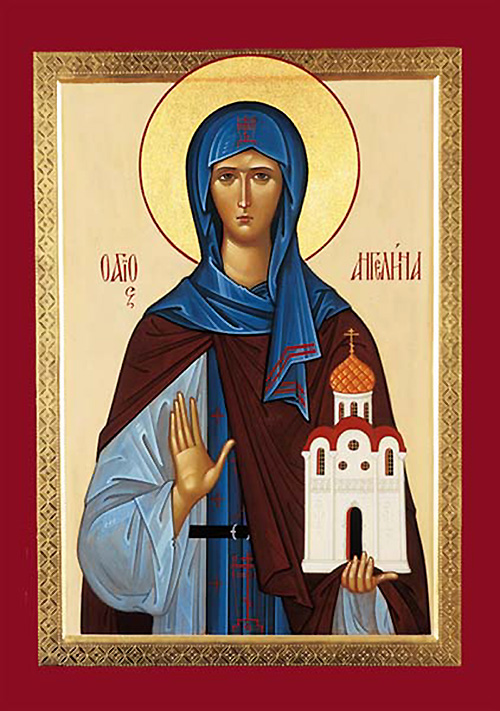
Saint Angelina was the daughter of Prince George Skenderbeg of Albania. Her mother’s name is not known, but she raised her daughter in Christian piety and taught her to love God.
Saint Stephen Brancovich (October 9 and December 10), the ruler of Serbia, had come to Albania to escape those who wished to kill him. Some time before he arrived in Albania, Saint Stephen was unjustly blinded by the Turkish Sultan for some perceived offense. Since he was innocent, he bore his affliction with courage.
Saint Stephen was not only Prince George’s guest, but he was also treated as a member of his family. Not surprisingly, Stephen and Angelina eventually fell in love. With her parents’ blessing, they were married in church. After a few years, they were blessed with two sons: George and John.
When the boys were grown, Saint Stephen and his family were forced to flee to Italy for their safety. At that time the Turks invaded Albania and began to slaughter men, women, and even children.
Saint Stephen died in 1468, leaving Angelina a widow. In her distress, she turned to the ruler of Hungary for help. He gave them the town of Kupinovo in Sirmie.
Saint Angelina left Italy with her sons in 1486, stopping in Serbia to bury Saint Stephen’s incorrupt body in his native land.
The children of these pious parents also became saints. George gave up his claim to the throne in favor of his brother John, then entered a monastery and received the name Maximus.
John was married, but had no sons. He died in 1503 at a young age, and many miracles took place before his holy relics.
Saint Angelina survived her husband and both of her sons. Mindful of her soul’s salvation, she entered a women’s monastery. She departed to the Lord in peace, and her body was buried in the same tomb as her sons in the monastery of Krushedol in Frushka Gora.
Saint Angelina is also commemorated on December 10 with her husband Saint Stephen and her son Saint John.
Translation of the relics of Venerable John of Rila from Trnovo to Rila
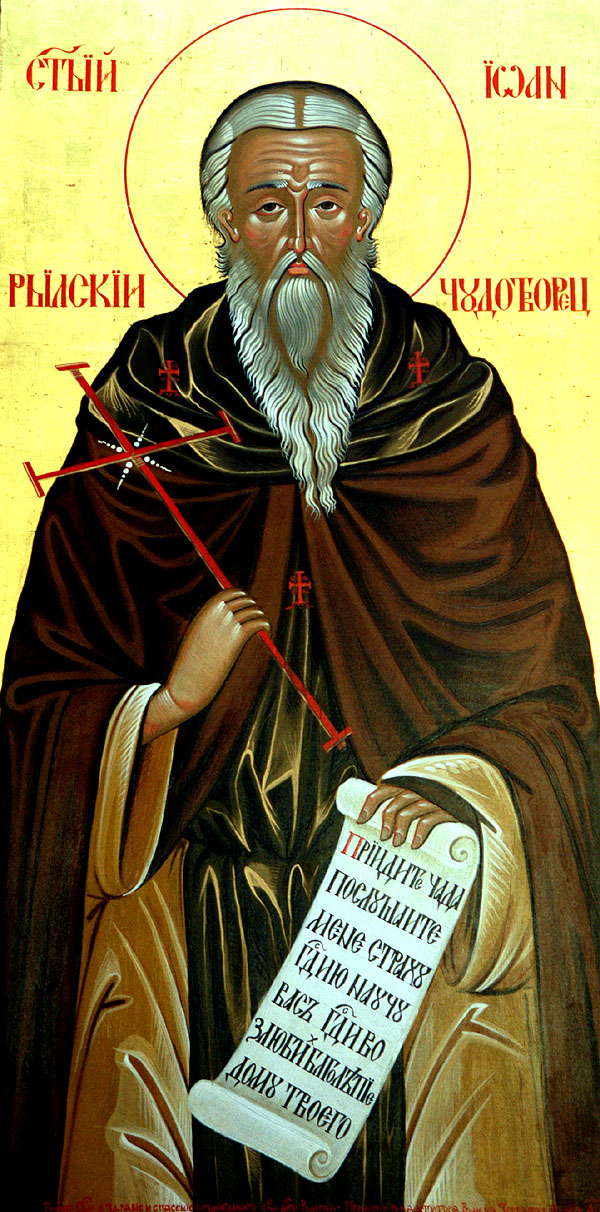
On October 19, 1238 the relics of Saint John of Rila were solemnly transferred to the new capital, Trnovo, and put in a church dedicated to the saint. Then on July 1, 1469 the holy relics of Saint John were returned to the Rila monastery, where they rest to the present day, granting grace-filled help to all the believers.
See his Life on August 18.
Saint Leontius of Rădăuţi
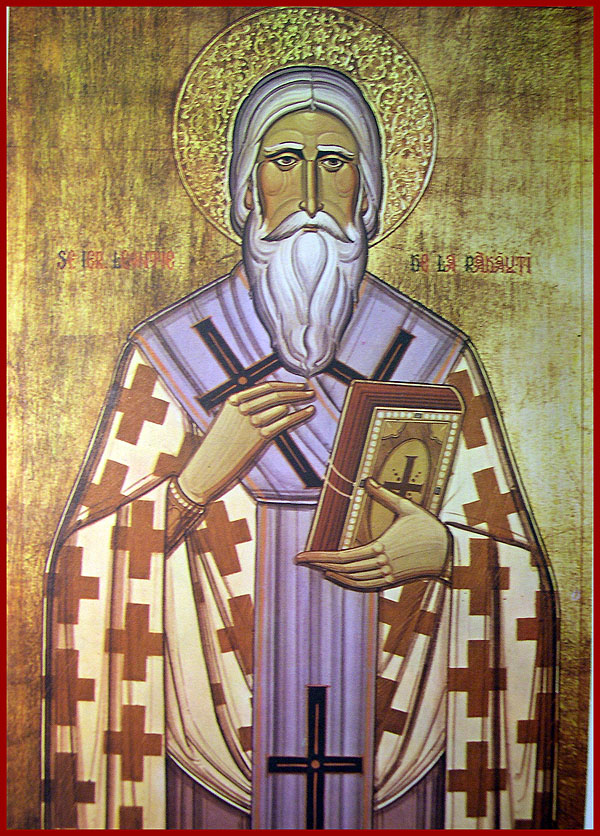
Saint Leontius was born in Rădăuţi, Moldavia in the fourteenth century. He was named Laurence when he received the monastic tonsure. In time he was found worthy of ordination to the holy priesthood, and founded a monastery near Rădăuţi, which later became known as Saint Laurence’s Monastery. Among his many disciples was Saint Daniel the Hesychast (December 18).
Because of his holy life, he received from God the grace of working miracles. Many sick people were healed by his prayers, and he became a father, teacher, and protector to all.
Prince Alexander the Good recommended that he be made Bishop of Rădăuţi. Saint Leontius led his flock with wisdom for many years, then retired to live alone in the wilderness. He received the Great Schema with the name of Leontius, and departed to the Lord soon afterward. His holy relics were found incorrupt, and many people received healing at his tomb.
Saint Leontius was glorified by the Orthodox Church of Romania in 1992.
 Saint Peter Antiochian Orthodox Church