Monthly Archives: July 2022

Daily Readings for Friday, July 08, 2022

THE HOLY GREAT MARTYR PROCOPIUS

ABSTAIN FROM MEAT, FISH, DAIRY, EGGS, WINE, OLIVE OIL

The Holy Great Martyr Procopius, Theophilos the Myrrhbearer of Pantokrator Monastery, Appearance of the Icon of the Most Holy Theotokos of Kazan

ST. PAUL’S FIRST LETTER TO TIMOTHY 4:9-15

Timothy, my son, the saying is sure and worthy of full acceptance. For to this end we toil and suffer reproach, because we have our hope set on the living God, who is the Savior of all men, especially of those who believe. Command and teach these things. Let no one despise your youth, but set the believers an example in speech and conduct, in love, in faith, in purity. Till I come, attend to the public reading of scripture, to preaching, to teaching. Do not neglect the gift you have, which was given you by prophetic utterance when the council of elders laid their hands upon you. Practice these duties, devote yourself to them, so that all may see your progress.

LUKE 6:17-19, 9:1-2, 10:16-21

At that time, a crowd of his disciples and a great multitude of people came to Jesus from all Judea and Jerusalem and the seacoast of Tyre and Sidon, who came to hear him and to be healed of their diseases; and those who were troubled with unclean spirits were cured. And all the crowd sought to touch him, for power came forth from him and healed them all. And he called the twelve together and gave them power and authority over all demons and to cure diseases, and sent them out to preach the kingdom of God and to heal, and He said to them: “He who hears you hears me, and he who rejects you rejects me, and he who rejects me rejects him who sent me.” The seventy returned with joy, saying, “Lord, even the demons are subject to us in your name!” And he said to them, “I saw Satan fall like lightning from heaven. Behold, I have given you authority to tread upon serpents and scorpions, and over all the power of the enemy; and nothing shall hurt you. Nevertheless do not rejoice in this, that the spirits are subject to you: but rejoice that your names are written in heaven.” In that same hour he rejoiced in the Holy Spirit and said, “I thank you, Father, Lord of heaven and earth, that you have hidden these things from the wise and understanding and revealed them to babes; yes, Father, for such was your gracious will.

“Our Lady of Sitka” Icon of the Mother of God
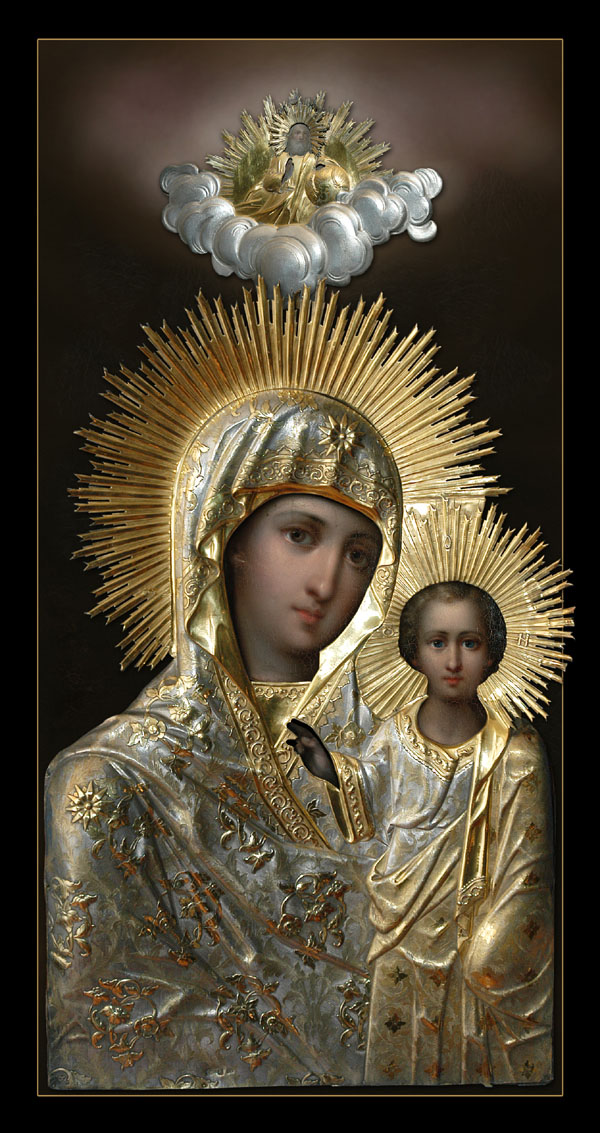
The Sitka Icon of the Mother of God

Located at the Cathedral of Saint Michael the Archangel in Sitka, Alaska is one of the most revered Icons in North America: the Sitka Mother of God.

This Icon has been attributed to a famous Iconographer, Vladimir Lukich Borovikovsky (1758-1826), a protégé of the Empress Catherine II who was instructed at the Academy of Arts in Saint Petersburg, Russia. In addition to being a great portrait painter, Borovikovsky also painted many of the Icons for the Cathedral of the Kazan Icon in Saint Petersburg.

Painted in the style of the Kazan Mother of God Icon, on canvas, the Sitka Mother of God Icon is 36 x 17-1/2 inches in size. An exceptionally beautiful and detailed riza of silver covers the Icon of the Theotokos and Christ child, and the Image of God the Father blessing from above.

The Cathedral received the Icon as a gift from the laborers of the Russian American Company in 1850, two years after the Cathedral was completed. Even with their meager wages, these men generously made their contribution to the Church.

Miracles have been attributed to the Sitka Mother of God Icon over the years. It is believed that the gaze of the eyes of the Theotokos have led to the restored health of those who prayed before the Icon.

Because of the peaceful gaze of the Theotokos, the Icon has been described as a “pearl of Russian ecclesiastical art of ineffable gentleness, purity and harmony….” And “…the most beautiful face of the Mother of God with the Divine Child in her arms is so delicately and artistically done that the more one looks at it the more difficult it is to tear one’s gaze away.”

Originally part of the main Iconostasis at the Cathedral of Saint Michael the Archangel in Sitka, Alaska, the Icon is now permanently located on the far left side of the Iconostasis in a special place of honor.

Greatmartyr Procopius of Caesarea, in Palestine
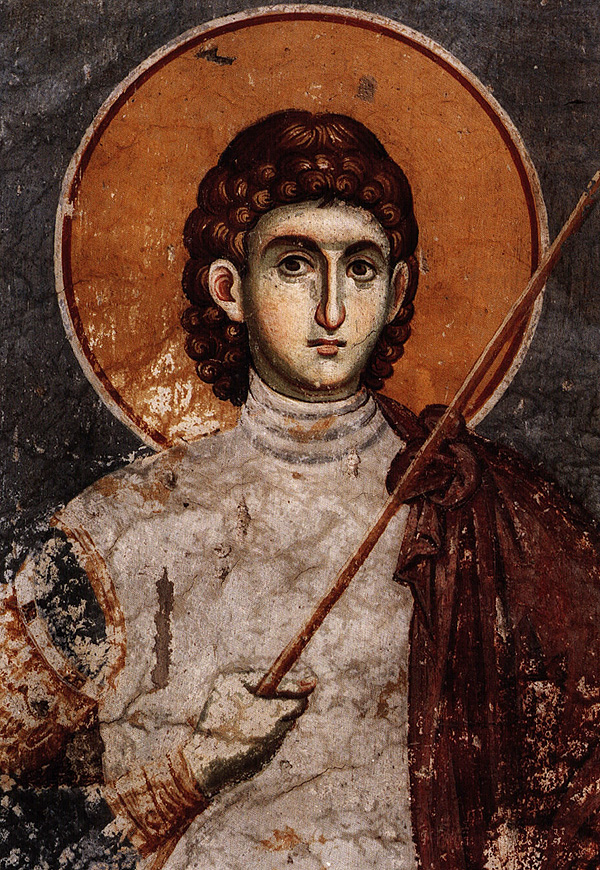
The Holy Great Martyr Procopius, in the world Neanius, a native of Jerusalem, lived and suffered during the reign of the emperor Diocletian (284-305). His father, an eminent Roman by the name of Christopher, was a Christian, but the mother of the saint, Theodosia, remained a pagan. He was early deprived of his father, and the young child was raised by his mother. Having received an excellent secular education, he was introduced to Diocletian in the very first year of the emperor’s accession to the throne, and he quickly advanced in government service. Towards the year 303, when open persecution against Christians began, Neanius was sent as a proconsul to Alexandria with orders to mercilessly persecute the Church of God.

On the way to Egypt, near the Syrian city of Apamea, Neanius had a vision of the Lord Jesus, similar to the vision of Saul on the road to Damascus. A divine voice exclaimed, “Neanius, why do you persecute Me?”

Neanius asked, “Who are you, Lord?”

“I am the crucified Jesus, the Son of God.”

At that moment a radiant Cross appeared in the air. Neanius felt an inexpressible joy and spiritual happiness in his heart and he was transformed from being a persecutor into a zealous follower of Christ. From this point in time Neanius became favorably disposed towards Christians and fought victoriously against the barbarians.

The words of the Savior came true for the saint, “A man’s foes shall be those of his own household” (Mt. 10:36). His mother, a pagan herself, went to the emperor to complain that her son did not worship the ancestral gods. Neanius was summoned to the procurator Judaeus Justus, where he was solemnly handed the decree of Diocletian. Having read through the blasphemous directive, Neanius quietly tore it up before the eyes of everyone. This was a crime, which the Romans regarded as an “insult to authority.” Neanius was held under guard and in chains sent to Caesarea of Palestine, where the Apostle Paul once languished. After terrible torments, they threw the saint into a dark prison. That night, a light shone in the prison, and the Lord Jesus Christ Himself baptized the suffering confessor, and gave him the name Procopius.

Repeatedly they led Saint Procopius to the courtroom, demanding that he renounce Christ, and they subjected him to more tortures. The stolidity of the martyr and his fiery faith brought down God’s abundant grace on those who witnessed the execution.

Inspired by the example of Procopius, many of the holy martyr’s former guards and Roman soldiers went beneath the executioner’s sword together with their tribunes Nikostrates and Antiochus. Twelve Christian women received martyr’s crowns, after they came to the gates of the Caesarea Praetorium.

Struck by the great faith and courage of the Christians, and seeing the firmness of her son in bearing terrible sufferings, Theodosia became repentant and stood in the line of confessors and was executed. Finally the new procurator, Flavian, convinced of the futility of the tortures, sentenced the holy Great Martyr Procopius to beheading by the sword. By night Christians took up his much-tortured body, and with tears and prayers, they committed it to the earth. This was the first martyrdom at Caesarea (303).

Righteous Procopius the Fool-For-Christ and Wonderworker of Ustya, Vologda

The incorrupt relics of Saint Procopius were uncovered during the eighteenth century near the Entry of the Theotokos parish church in Ustya (Vologda diocese) and placed in the church, where for two hundred years they remained in open view, a source of numerous healings. No account of the origin and life of the holy saint of God has been preserved. His name became known when he himself revealed it in a vision to a pious local inhabitant named Savela.

In connection with an increase in the number of miraculous healings, the relics of Saint Procopius were examined in 1696 (or 1645) and in 1739. After this a chapel in honor of the saint was consecrated in the church where his relics rest. His icon was painted, and a service to him was composed.

In 1818 the universal celebration of the saint was established.

Appearance of the Kazan Icon of the Mother of God

The Wonderworking Copy of the Kazan Icon of the Mother of God, found in 1579, is in the Kazan cemetery church named for the holy Prince Theodore and his sons David and Constantine. The holy icon is venerated by the residents of the city.

“Tenderness” Icon of the Mother of God in Novgorod
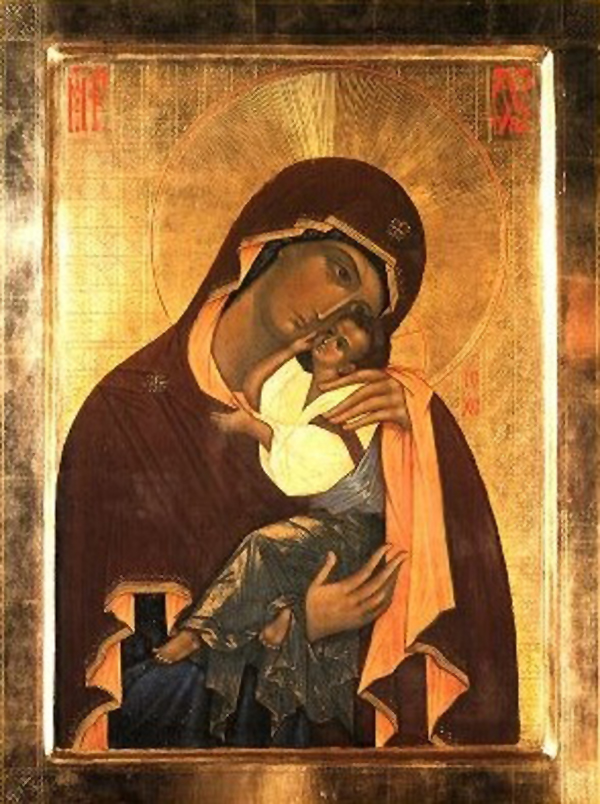
The Tenderness icon of the Mother of God belongs to the Eleousa (Umilenie) type.

On July 8, 1337 a caretaker in Holy Trinity Church in Novgorod heard a noise inside the church and went to investigate. He was astonished to see that the icon of the Mother of God from the second tier of icons above the northern door of the iconostasis had left its place and was floating in the air, and tears were flowing from the eyes of the Virgin.

Archbishop Alexis was notified, and he and his clergy came to the church with a large crowd of people. A special shrine was built for the icon, and July 8 was appointed as its date of commemoration.

That same year, a plague appeared in Novgorod. People flocked to pray before the wonderworking icon, and the plague was stopped. In 1352, Archbishop Basil ordered that an annual procession be made from the church of Holy Wisdom to Holy Trinity Church.

In the summer of 1366 Holy Trinity Church burned down, and the “Tender Feeling” Icon floated in the air above the flames. Archbishop Alexis came to the church to serve a Molieben, and the icon descended into his hands. The fire went out, but a burn mark seven inches long was left on the back of the icon.

Great Prince John III took the icon to Moscow in 1397, where it remained until 1508. At that time, the Mother of God appeared to Princess Maria in a dream and ordered that the icon be returned to Novgorod.

The “Tender Feeling” Icon is of the Umilenie, or Eleousa type.

Monastic Martyrs Epictetus and Astion, at Halmyris

The monastic martyrs Epictetus and Astion lived in Bithynia on the southwest coast of the Black Sea during the reign of the Roman emperor Diocletian (284-305). From his youth, Saint Epictetus had dedicated his life to God, and studied to acquire knowledge of the Gospel. He entered a monastery, and later was found worthy to be ordained to the holy priesthood. Proclaiming the Gospel of Christ, the saint converted many people to Christianity. God granted Epictetus the gift of wonderworking, and he healed many people troubled by unclean spirits, or afflicted with other maladies.

One day while out for a stroll, the illustrious youth Astion met Saint Epictetus. During a long conversation Saint Epictetus enlightened Astion, sowing the seed of God’s Word in the young man’s soul. He spoke to him about the only true God, about the great value of the immortal human soul, and about fleeting worldly pleasures.

Astion came to believe in Christ and was baptized. Soon after this, he also became a monk. Since Christians were being persecuted in Bithynia, he asked Saint Epictetus if they might travel together to some distant land where they could dedicate their lives completely to God. Boarding a ship, Saints Epictetus and Astion journeyed to Scythia and settled among the pagan Slavs near the Roman outpost of Halmyris in the province of Histria south of the mouth of the Danube. The city was the site of a military fort and a base for the Roman fleet which patrolled the Danube and the Black Sea.

When they arrived at Halmyris in 273, Saint Epictetus was forty-seven years old, and Saint Astion was only eighteen. During the next seventeen years, the saints spent their lives in prayer and fasting, and performed many miracles.

The God-pleasing lives of the monks could not remain hidden from others for very long. People afflicted by various illnesses or oppressed by evil spirits came to the saints seeking relief. Even pagans asked the holy ascetics for help, and after being healed of their afflictions, they embraced Christianity.

Saint Epictetus once healed a fifteen-year-old deaf and dumb boy by praying and breathing on him three times. More than a thousand people became Christians after witnessing this miracle. Saint Astion once cured a man whose legs and toes were crushed when he fell from a building.

Latronianus, the military commander of the district, arrived in Halmyris in 290 on an official visit of inspection. The pagan priests wasted no time in complaining to him about Saints Epictetus and Astion. They denounced the two men from Bithynia, accusing them of converting people to Christianity through sorcery, and persuading them not to offer sacrifice to the pagan gods.

The saints were arrested and interrogated by Latronianus, who tried to find out their names and where they were from. Their only reply was, “We are Christians.” Latronianus had them tortured in an effort to make them abandon their Christian beliefs.

After thirty days in prison without food and water, the holy martyrs Epictetus and Astion were once again brought before Latronianus. They remained steadfast and ready to endure even more suffering for Christ. The commander declared that Epictetus and Astion were traitors, and ordered them to be tortured and beheaded.

Saints Epictetus and Astion received the crown of martyrdom on July 8, 290. At first, they were buried in an unknown spot. Later, their holy relics were transferred into the basilica built in the fourth century by Saint Constantine the Great (May 21) at Halmyris.

Archaeologists discovered the holy relics of Saints Epictetus and Astion at Halmyris in 2001. The bones were scattered about in two rooms of a burial crypt, indicating that the tomb had been vandalized, perhaps in the sixth century. Scientific tests on the bones revealed that one of the men was approximately sixty-four years old, and the other about thirty-five. This is consistent with the ages of the two saints as given in the written accounts of their martyrdom. The bones also indicate that the two had been beheaded.

The holy relics of Saints Epictetus and Astion were reburied in 2001 by Archbishop Theodosius of Tomis (Romania).

Miracle of the Annunciation Icon of the Mother of God at Ustiug
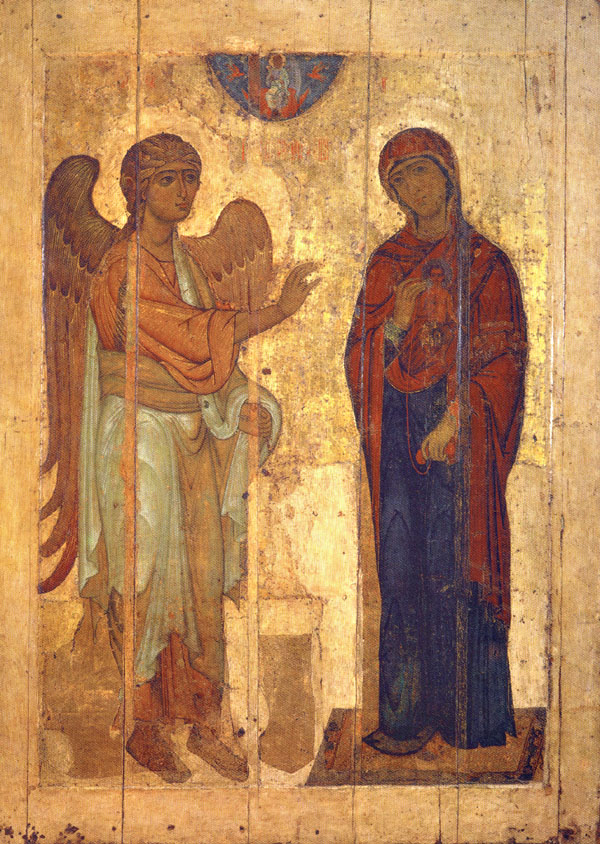
The Ustiug Annunciation Icon of the Mother of God The “Ustiug Annunciation” is a venerable icon, before which Saint Procopius, Fool-for-Christ (+ 1303) prayed with intense fervor on June 25, 1290 for the salvation of the city of Ustiug from the wrath of God.

The icon was painted by a Novgorod iconographer when the holy Prince Vsevolod-Gabriel (February 11) ruled in the city. In 1567, under Metropolitan Philip (January 9), the holy icon was transferred from Great Ustiug to Moscow and placed in the Dormition cathedral. At the present time it is located in the state Tretyakov gallery.

Venerable Theophilus the Myrrhgusher of Macedonia

Saint Theophilus was from Ziki in Macedonia, and lived during the sixteenth century. He had a very good education, but more importantly he dedicated himself to God, purifying himself from every soul-destroying passion, and acquiring every virtue which filled him with the grace of the All-Holy Spirit.

He travelled to Alexandria, at the request of Patriarch Niphon of Constantinople, in order to determine whether the stories about Patriarch Joachim being able to move mountains and to drink poison with no ill effects were true or not. After looking into the matter, he was able to verify that these stories were true.

After completing this work, Saint Theophilus went to struggle on the Holy Mountain, living first at Vatopedi, then at Ivḗron before settling at Saint Basil’s cell near Karyes. Although he did not seek the praise of men, the fame of the holy ascetic became known on Mount Athos, and in other places as well. His holy life and spiritual gifts could not be hidden, but were revealed by the Lord.

When the Archbishop of Thessalonica reposed, Saint Theophilus was nominated for this office. Out of humility, however, he declined to accept the position.

In 1548, as he felt the approach of death, Saint Theophilus told his disciple Isaac not to give him an honorable burial, but to tie a cord around his feet and drag him out of the monastery, and then to throw his body into a nearby stream.

When the saint fell asleep in the Lord on July 8, 1548, Isaac carried out the instructions of his Elder. Although he was reluctant to do this, he obeyed the saint just as he had always done when Saint Theophilus was alive.

By God’s will, the holy relics of Saint Theophilus were later found and brought to his cell. Then a fragrant myrrh began to flow from the saint’s incorrupt body, which was later enshrined at the Pantokrator Monastery.

Icon of the Mother of God of Tambov

The Annals of Tambov state that the Kazan Icon of the Mother of God was in the Transfiguration Cathedral of Tambov from the first years of the city’s existence (it had been founded in 1636), and it was the main shrine in the region of Tambov. According to the Annals, “on December 6, 1695, during the All Night Vigil in the wooden cathedral church, tears flowed from the eyes of the Kazan Icon of the Mother of God.” These tears were so abundant that they moistened the cloth beneath the Icon and the analogion, as well. This was the Icon’s first miracle. Hieromonk Gabriel, the Treasurer of the bishop’s household, recorded this event.

Since then, many who prayed before the Icon began to receive healing, including Saint Pitirim the Bishop of Tambov (+ July 28, 1698) himself. Saint Pitirim had a difficult time when he was first appointed to that See. The moral character of the citizens was very low, and he had to struggle to correct them, especially those who were recent arrivals. Therefore, he placed two Icons on the main gates of the city: one of the Crucifixion, and one of the Kazan Mother of God. This may have happened soon after the appearance of the tears. Many people came to venerate the Icon, entreating the Most Holy Theotokos to help them in their afflictions.

The priests from the Cathedral of the Savior were permitted to bring the Icon from the temple into the private homes of those who were sick so that prayers for their healing could be offered. According to one historian of the nineteenth century, the Icon “visited many houses in the city and outside the city, and dried the tears of many unfortunate people.” (Khitrov, G. Historical and Statistical Description of the Tambov Diocese, Tambov, 1861).

In the middle of the XIX century, the icon was placed under glass in a wooden carved frame and it had a silver and gold-plated riza, which was studded with precious stones: turquoise, amethysts, diamonds and topaz. The Cathedral of the Savior was closed in the 1930s, and the shrine was lost.

Since the Icon is of the Kazan type, its date of commemoration is July 8. In the upper church of the cathedral is another Tambov Icon, also known as Utkinskaya, which is an Icon of the Hodēgḗtria type. Its Feast Day is April 16.

Royal Martyr Mirdat, King of Kartli

King Mirdat (408-410), the son of Varaz-Bakur, was the first martyred king of Georgia. He was raised by his maternal grandfather, King Trdat.

The faithful grandfather taught the future king to love God and his nation, and the young prince mindfully preserved his grandfather’s wisdom throughout his life. Mirdat was endowed with the greatest of a nobleman’s virtues: wisdom, discretion, physical prowess, fearlessness, valor, and courage. He liberated Klarjeti from the Byzantines, abolished the tribute system (by which Georgia was required to pay taxes to Persia), and prepared for war against the Persians.

The Persian king gathered an enormous army to punish the Georgian nation, and King Mirdat courageously marched toward Gardabani (in eastern Georgia) with his much smaller army. But the selflessness and bravery of the Georgian soldiers were no match for the multitude of Persian warriors. The Georgians suffered defeat, and the Persian conquerors captured the young king.

The Persian king demanded that Mirdat renounce the Christian Faith, but he was firmly rebuffed. Neither intimidation nor fear of persecution would break the will of the king. After torturing him for his love of Christ, the Persians bound him in chains, tormented him almost to death, and cast him into prison, where he gave up his soul to the Lord.

The martyrdom of King Mirdat took place at the beginning of the 5th century, in the year 410.

Kazan-Yaroslavl Icon of the Mother of God

The Kazan-Yaroslavl Icon of the Most Holy Theotokos was found in the year 1588 by a man named Gerasimos, who had traveled to Kazan to pray before its famous Icon, because his right hand had become crippled. The Mother of God appeared to him and ordered him to go to a certain place, and then to take her Icon and bring it to the city of Romanov and place it in a church. After the man had followed these directives to the letter, his hand was healed.

The holy Kazan Icon remained at Romanov for twenty-one years, but on March 9,1609 the city was taken by the Polish-Lithuanian forces. A Lithuanian officer stole the Icon from the Kazan cathedral in Romanov. When it was learned that the holy Icon had been found in the officer's home, the citizens of Yaroslavl begged him to let their city have it. He said he would give it to them if they paid him a considerable sum of money. For a long time the officer rejected their offers, but then suddenly, on March 18, he brought it to one of Yaroslav's most honorable citizens – Basil Lytkin. The Icon was solemnly transferred to the country parish church of the "Laudation of the Virgin” Icon (Fifth Saturday of Great Lent). When the Polish-Lithuanian troops attacked Tver that year the holy Icon was taken into the city to the church of the Nativity of the Lord on the banks of the Volga. Then the Mother of God appeared twice to Deacon Eleazar, commanding him to build a new church to house the Icon.

The people of Yaroslavl placed the wonderworking Kazan Icon in that church, and many miracles occurred. They also worked most energetically to build a women's monastery for seventy-two sisters whose own monastery had been destroyed by the Polish-Lithuanian army.

In 1610, the residents of Romanov begged Tsar Basil IV Shuisky to allow the Icon to be taken from Yaroslavl and returned to Romanov. Then new healings took place before the Icon that same day. The nun Anysia, who was unable to move her hands or feet recovered, and a man named Constantine was delivered from his madness. In view of these miracles, the citizens of Yaroslavl, in their turn, asked the Tsar to let the Icon remain at Yaroslavl. From Moscow there came a request for detailed information about the Icon, and the Tsar decided that the Icon would remain at Yaroslavl. However, the people of Yaroslavl were ordered to make an exact copy of the Icon, and to adorn it with an oklad (metal cover), just like the one on the wonderworking Icon, and then send the copy to Romanov. All this was done. In 1611, the copy was taken to Romanov and it was placed in the Kazan church, where the wonderworking Icon had once stood. Every year the original wonderworking Icon was brought to the city of Romanov with great ceremony.

Daily Readings for Thursday, July 07, 2022

KYRIAKE THE GREAT MARTYR

NO FAST

Kyriake the Great Martyr, Thomas the Righteous of Malea, Akakios of Sinai, Willibald, Bishop of Eichstatt

ST. PAUL’S LETTER TO THE GALATIANS 3:23-29; 4:1-5

Brethren, before faith came, we were confined under the law, kept under restraint until faith should be revealed. So that the law was our custodian until Christ came, that we might be justified by faith. But now that faith has come, we are no longer under a custodian; for in Christ Jesus you are all sons of God, through faith. For as many of you as were baptized into Christ have put on Christ. There is neither Jew nor Greek, there is neither slave nor free, there is neither male nor female; for you are all one in Christ Jesus. And if you are Christ’s, then you are Abraham’s offspring, heirs according to promise. I mean that the heir, as long as he is a child, is no better than a slave, though he is the owner of all the estate; but he is under guardians and trustees until the date set by the father. So with us; when we were children, we were slaves to the elemental spirits of the universe. But when the time had fully come, God sent forth his Son, born of a woman, born under the law, to redeem those who were under the law, so that we might receive adoption as sons.

MARK 5:24-34

At that time, a great crowd followed Jesus and thronged about him. And there was a woman who had had a flow of blood for twelve years, and who had suffered much under many physicians, and had spent all that she had, and was no better but rather grew worse. She had heard the reports about Jesus, and came up behind him in the crowd and touched his garment. For she said, “If I touch even his garments, I shall be made well.” And immediately the hemorrhage ceased; and she felt in her body that she was healed of her disease. And Jesus, perceiving in himself that power had gone forth from him, immediately turned about in the crowd, and said, “Who touched my garments?” And his disciples said to him, “You see the crowd pressing around you, and yet you say, ‘Who touched me?'” And he looked around to see who had done it. But the woman, knowing what had been done to her, came in fear and trembling and fell down before him, and told him the whole truth. And he said to her, “Daughter, your faith has made you well; go in peace, and be healed of your disease.”

Venerable Thomas of Mount Maleon

Saint Thomas of Mt. Maleon was a military commander before he became a monk. Strong and brave, he had participated in many battles, and brought victory to his countrymen, for which he gained glory and esteem. But, striving with all his heart towards God, Thomas abandoned the world and its honors, and he took monastic vows.

With great humility he visited monastic Elders, asking for guidance in the spiritual life. After several years Thomas received the blessing for solitary wilderness life and, led by a pillar of fire at night by the holy Prophet Elias, he settled on Mount Maleon (on the eastern part of Athos). Dwelling in complete seclusion, Saint Thomas fought with invisible enemies with as much courage as he had displayed against the visible enemies of his country.

The life and deeds of Saint Thomas could not be concealed from the surrounding area. People began to flock to him seeking spiritual guidance, and even those suffering from sickness, since he received from God the blessing to heal infirmities.

Many believers received help through the prayers of the holy monk. Even after his death, he does not cease to heal those who seek his aid, from every passion and sickness.

Venerable Acacius of Sinai, who is mentioned in the Ladder

Saint Acacius of Sinai lived during the sixth century and was a novice at a certain monastery in Asia. The humble monk distinguished himself by his patient and unquestioning obedience to his Elder, a harsh and dissolute man. He forced his disciple to toil excessively, starved him with hunger, and beat him without mercy. Despite such treatment, Saint Acacius meekly endured the affliction and thanked God for everything. Saint Acacius died after suffering these torments for nine years.

Five days after Acacius was buried, his Elder told another Elder about the death of his disciple. The second Elder did not believe that the young monk was dead. They went to the grave of Acacius and the second Elder called out: “Brother Acacius, are you dead?” From the grave a voice replied, “No, Father, how is it possible for an obedient man to die?” The startled Elder of Saint Acacius fell down with tears before the grave, asking forgiveness of his disciple.

After this he repented, constantly saying to the Fathers, “I have committed murder.” He lived in a cell near the grave of Saint Acacius, and he ended his life in prayer and in meekness. Saint John Climacus (March 30) mentions Saint Acacius in THE LADDER (Step 4:110) as an example of endurance and obedience, and of the rewards for these virtues.

Saint Acacius is also commemorated on November 29.

Venerable Eudokia (in monasticism Euphrosynē), Grand Duchess of Moscow

Saint Euphrosynē, in the world Eudokia, was the daughter of the Suzdal prince Demetrius Constantovich (+ 1383), and from 1367 was the wife of the Moscow Great Prince Demetrius of the Don. Their happy union was for Russia a pledge of unity and peace between Moscow and Suzdal.

Saint Alexis, Metropolitan of Moscow, and even Saint Sergius of Radonezh, who baptized one of the sons of Demetrius and Eudokia, had a great influence upon the spiritual life of Princess Eudokia. Saint Demetrius of Priluki (February 11) was the godfather of another son.

The holy princess was a builder of churches. In 1387 she founded the Ascension women’s monastery in the Moscow Kremlin. In 1395, during Tamerlane’s invasion into the southern regions of Russia, the Vladimir Icon of the Mother of God was transferred to Moscow upon her advice, miraculously defending the Russian land. During Lent, the princess secretly wore chains beneath her splendid royal garb. By her patronage the famous icon of the Archangel Michael was painted, and later became the patronal icon of the Kremlin’s Archangel Cathedral.

After raising five sons (a sixth died in infancy), the princess was tonsured as a nun with the name Euphrosynē. She completed her earthly journey on July 7, 1407 and was buried in the Ascension monastery she founded.

An old Russian church poem has survived, the lament of the princess for her husband, who had died at the age of thirty-nine.

Saint Euphrosynē is also commemorated on May 17.

Martyrs Peregrinus, Lucian, Ompeius, Hesychius, Papius, Saturninus, and Germanus, of Dyrrachium in Macedonia

The Holy Martyrs Peregrinus, Lucian, Pompeius, Hesychius, Papius, Saturninus and Germanus were natives of Italy. They suffered for Christ under the emperor Trajan in the city of Dyrrachium, located at the shore of the Adriatic sea.

Witnessing the martyrdom of Bishop Astius, who was crucified by the Romans, they openly praised the courage and firmness of the holy confessor. Because of this, they were seized, and as confessors of faith in Christ, they were drowned in the sea. Their bodies, carried to shore by the waves, were hidden in the sand by Christians. The martyrs appeared to the Bishop of Alexandria ninety years later, ordering him to bury their bodies and to build a church over them.

Martyr Evangelicus, Bishop of Tomis, Constanța in Romania

Saint Evangelicus, a follower of the holy Apostle Andrew (November 30), is the first known bishop of the diocese of Tomis (Constanța, pronounced: Constantsa) in Dacia Pontica (Lesser Scythia, or Dobrogea). He was active around the mouths of the Danube toward the end of the third century.

Bishop Evangelicus converted many pagans of Dacia Pontica to Christianity. He is mentioned in the account of the martyrdom of Saints Epictetus and Astion (July 8), where he is described as the founder of churches in the province. The parents of these holy martyrs were baptized by Saint Evangelicus after being converted by the priest Bonosus.

It is believed that Saint Evangelicus suffered martyrdom during the persecution of Diocletian (284-305).

Martyr Kyriake of Nicomedia

Saint Kyriake was the only child of Dorotheus and Eusebia. Since she was born on a Sunday (Kyriake, in Greek), she was named Kyriake.

One day a wealthy magistrate wished to betroth Kyriake to his son. Not only was she young and beautiful, but her parents were wealthy, and the magistrate wished to control that wealth. The magistrate went to her parents to request her hand, but Saint Kyriake told him that she wished to remain a virgin, for she had dedicated herself to Christ.

The magistrate was angered by her words, so he went to the emperor Diocletian to denounce the saint and her parents as Christians who mocked the idols, and refused to offer sacrifice to them.

Diocletian sent soldiers to arrest the family and have them brought before him. He asked them why they would not honor the gods which he himself honored. They told him that these were false gods, and that Christ was the one true God.

Dorotheus was beaten until the soldiers grew tired and were unable to continue. Since neither flattery nor torment had any effect, Diocletian sent Dorotheus and Eusebia to Melitene on the eastern border between Cappadocia and Armenia. Then he sent Saint Kyriake to be interrogated by his son-in-law and co-ruler Maximian at Nicomedia.

Maximian urged her not to throw her life away, promising her wealth and marriage to one of Diocletian’s relatives if she would worship the pagan gods. Saint Kyriake replied that she would never renounce Christ, nor did she desire worldly riches. Enraged by her bold answer, Maximian had her flogged. The soldiers who administered this punishment became tired, and had to be replaced three times.

Shamed by his failure to overcome a young woman, Maximian sent Saint Kyriake to Hilarion, the eparch of Bithynia, at Chalcedon. He told Hilarion to either convert Kyriake to paganism, or send her back to him.

Making the same promises and threats that Diocletian and Maximian had made before, Hilarion was no more successful than they were. Saint Kyriake challenged him to do his worst, because Christ would help her to triumph. The saint was suspended by her hair for several hours, while soldiers burned her body with torches. Not only did she endure all this, she also seemed to become more courageous under torture. Finally, she was taken down and put into a prison cell.

That night Christ appeared to her and healed her wounds. When Hilarion saw her the next day, he declared that she had been healed by the gods because they pitied her. Then Hilarion urged her to go to the temple to give thanks to the gods. She told him that she had been healed by Christ, but agreed to go to the temple. The eparch rejoiced, thinking that he had defeated her.

In the temple, Saint Kyriake prayed that God would destroy the soulless idols. Suddenly, there was a great earthquake which toppled the idols, shattering them to pieces. Everyone fled the temple in fear, leaving Hilarion behind. Instead of recognizing the power of Christ, the eparch blasphemed the true God as the destroyer of his pagan gods. He was struck by a bolt of lightning and died on the spot.

Saint Kyriake was tortured again by Apollonius, who succeeded Hilarion as eparch. When she was cast into a fire, the flames were extinguished. When she was thrown to wild beasts, they became tame and gentle. Therefore, Apollonius sentenced her to death by the sword. She was permitted time to pray, so she asked God to receive her soul, and to remember those who honored her martyrdom.

Just as Saint Kyriake ended her prayer, angels took her soul before the soldiers could strike off her head. Pious Christians took her relics and buried them in a place of honor.

Translation of the “Blachernae” Icon of the Mother of God to Russia

The Blachernae Icon of the Mother of God was discovered at Jerusalem by the empress Eudokia during the time of Saint Juvenal, Patriarch of Jerusalem (July 2), and Saint Euthymius the Great (January 20). The holy icon was sent to Constantinople, where the empress Pulcheria placed it in the Blacernae Church, where the Venerable Robe of the Mother of God (July 2) was preserved.

This holy icon is also called the Hodēgḗtria, or “She who leads the way.” It was with this icon that Patriarch Sergius (610-631) made the rounds of the walls of Constantinople in the year 626 with Moliebens during a siege of the capital by the Avars. In memory of this and other victories, which were won thanks to the intercession of the Most Holy Theotokos, an annual celebration was established on Saturday of the Fifth Week of the Great Fast to offer Praises to the Most Holy Theotokos (Saturday of the Akathist). At first the celebration took place only at the Blachernae church in Constantinople. In the ninth century the Feast was included in the Typikon of Saint Savva the Sanctified, and in the Studite Rule. Later, it was included in the Lenten Triodion and made universal for all the Orthodox Church.

After the Fall of Constantinople in 1453, the Blachernae Icon was transferred to Mt. Athos, and in 1654 it was sent by the Athonite monks to Moscow as gift to the Tsar Aleksei Mikhailovich.

The Blachernae Icon is celebrated on July 2, and in the Fifth Week of Great Lent (Saturday of the Akathist).

Saint Prosper of Aquitaine

Saint Prosper (Prosper Tiro), "The Eradicator of Heresies," as Saint Photios (February 6) calls him, was born in the Aquitaine around the year 390. He was a renowned lay theologian, although few details of his life are known.

We know Saint Prosper chiefly from his writings. A contemporary writer described him as "a holy and venerable man." Many of Saint Prosper's writings echo the teaching of Saint Augustine (June 15) on grace. Like Saint Augustine, Saint Prosper was also an opponent of the Pelagian heresy. This wise man seems to have spent his life embroiled in controversies with heretics. For the semi-Pelagians in particular, Saint Prosper was one of their most fearsome adversaries.

In Saint Prosper, science was joined to virtue. It is evident that he applied himself to literature, and especially to acquiring knowledge of Holy Scripture. He was no less an expert in human sciences than he was in theology. He excelled particularly in mathematics, astronomy, and chronology. His great learning and holiness made him well known throughout the entire Church.

Saint Prosper has sometimes been identified, mistakenly, with Saint Paulinus of Reggio (June 25), who was a bishop. Everything we know about him leads us to believe that Saint Prosper was not a bishop, nor even a priest. In a poem to his wife he wrote: "Lift me up again if I fall; correct yourself if I point out some fault. Let it never be sufficient for us to be one body, let us also be one soul." By 428, Saint Prosper persuaded his wife to become a nun, and he entered a monastery at Marseilles. When Saint Leo the Great was chosen as the Bishop of Rome in 440, he sent for Prosper to become his secretary. Many historians believe that the admirable treatise "On the Incarnation of the Word," which is ascribed to Saint Leo, is actually the work of Saint Prosper. It is possible, however, that Saint Leo may have reworked it in his own style.

Saint Prosper reposed in Rome, sometime after 455.

The icon of Saint Prosper depicts him holding a scroll which reads: "The Orthodox Faith subdues the monster of heresy."

Daily Readings for Wednesday, July 06, 2022

4TH WEDNESDAY AFTER PENTECOST

ABSTAIN FROM MEAT, FISH, DAIRY, EGGS, WINE, OLIVE OIL

Sisoes the Great, Holy Apostles Archippus, Philemon and Onesimus, Loukia the Virgin-martyr, Rixios and the 24 Companion Martyrs, Juliana the Virgin-martyr

ST. PAUL’S LETTER TO THE ROMANS 11:2-12

Brethren, do you not know what the scripture says of Elijah, how he pleads with God against Israel? “Lord, they have killed thy prophets, they have demolished thy altars, and I alone am left, and they seek my life.” But what is God’s reply to him? “I have kept for myself seven thousand men who have not bowed the knee to Baal.” So too at the present time there is a remnant, chosen by grace. But if it is by grace, it is no longer on the basis of works; otherwise grace would no longer be grace. What then? Israel failed to obtain what it sought. The elect obtained it, but the rest were hardened, as it is written, “God gave them a spirit of stupor, eyes that should not see and ears that should not hear, down to this very day.” And David says, “Let their table become a snare and a trap, a pitfall and a retribution for them; let their eyes be darkened so that they cannot see, and bend their backs for ever.” So I ask, have they stumbled so as to fall? By no means! But through their trespass salvation has come to the Gentiles, so as to make Israel jealous. Now if their trespass means riches for the world, and if their failure means riches for the Gentiles, how much more will their full inclusion mean?

MATTHEW 11:20-26

At that time, the Lord began to upbraid the cities where most of his mighty works had been done, because they did not repent. “Woe to you, Chorazin! woe to you, Bethsaida! for if the mighty works done in you had been done in Tyre and Sidon, they would have repented long ago in sackcloth and ashes. But I tell you, it shall be more tolerable on the day of judgment for Tyre and Sidon than for you. And you, Capernaum, will you be exalted to heaven? You shall be brought down to Hades. For if the mighty works done in you had been done in Sodom, it would have remained until this day. But I tell you that it shall be more tolerable on the day of judgment for the land of Sodom than for you.” At that time Jesus declared, “I thank you, Father, Lord of heaven and earth, that you have hidden these things from the wise and understanding and revealed them to babes; yea, Father, so it was well pleasing before you.”

Venerable Sisoes the Great

Saint Sisoes the Great (+ 429) was a solitary monk, pursuing asceticism in the Egyptian desert in a cave sanctified by the prayerful labors of his predecessor, Saint Anthony the Great (January 17). For his sixty years of labor in the desert, Saint Sisoes attained to sublime spiritual purity and he was granted the gift of wonderworking, so that by his prayers he once restored a dead child back to life.

Extremely strict with himself, Abba Sisoes was very merciful and compassionate to others, and he received everyone with love. To those who visited him, the saint first of all always taught humility. When one of the monks asked how he might attain to a constant remembrance of God, Saint Sisoes remarked, “That is no great thing, my son, but it is a great thing to regard yourself as inferior to everyone else. This leads to the acquisition of humility.” Asked by the monks whether one year is sufficient for repentance if a brother sins, Abba Sisoes said, “I trust in the mercy of God that if such a man repents with all his heart, then God will accept his repentance in three days.”

When Saint Sisoes lay upon his deathbed, the disciples surrounding the Elder saw that his face shone like the sun. They asked the dying man what he saw. Abba Sisoes replied that he saw Saint Anthony, the prophets, and the apostles. His face increased in brightness, and he spoke with someone. The monks asked, “With whom are you speaking, Father?” He said that angels had come for his soul, and he was entreating them to give him a little more time for repentance. The monks said, “You have no need for repentance, Father.” Saint Sisoes said with great humility, “I do not think that I have even begun to repent.”

After these words the face of the holy abba shone so brightly that the brethren were not able to look upon him. Saint Sisoes told them that he saw the Lord Himself. Then there was a flash like lightning, and a fragrant odor, and Abba Sisoes departed to the Heavenly Kingdom.

Venerable Sisoes the Schemamonk of the Kiev Far Caves

Saint Sisoes, Schemamonk of the Kiev Caves (XIII), is commemorated in the general service of the Monastic Fathers of Kiev Caves whose relics rest in the Far Caves. He is mentioned together with Saint Gregory the Faster: “Sisoes the wondrous and Gregory, a name courageous, having by fasting both restrained their passions, humble the fierce lust of our flesh: for unto you is given the grace to help us in our passions” (5th Ode of the Canon).

Uncovering of the relics of Holy Princess Juliana Olshanskaya

Uncovering of the Relics of the Virgin Juliana, Princess of Olshansk. Saint Juliana lived during the first quarter of the sixteenth century. Her father, Prince Yurii Dubrovitsky-Olshansky, was one of the benefactors of the Kiev Caves Lavra. The God-pleasing virgin died at the age of sixteen. Her body, which was buried at the Kiev Caves Lavra near the great church, was found incorrupt during the time of Archimandrite Elisha Pletenets (1599-1624).

The holy relics were in a fire at the great church in the year 1718, and were put into a reliquary and placed in the church of the Near Caves.

Saint Juliana appeared to Archimandrite Peter Moghila (afterwards Metropolitan of Kiev) in a dream, reproaching him for the carelessness and lack of respect shown to her relics. He ordered a new reliquary to be made, for which a suitable covering was made by pious nuns. On the reliquary was the inscription: “By the will of the Creator of heaven and earth Juliana, patroness and great intercessor to Heaven, rests here for all time. Here are the bones … healing against all passions … You adorn Paradise, Juliana, like a beautiful flower …”

Many miracles have been worked by Saint Juliana, and she helps those who venerate her holy relics with piety and faith. She is also commemorated on October 10 with the seven saints of Volhynia.

Martyr Marinus, his wife Martha, their children, and those with them at Rome

The Holy Martyrs Marinus, Martha, Audifax, Habakkuk, Cyrenus, Valentinus the Presbyter, Asterius, and many others with them at Rome.

During the reign of the emperor Claudius II (268-270), Saint Marinus together with his wife Martha and their sons Audifax and Habakkuk journeyed from Persia to Rome, to pray at the graves of the holy Apostles Peter and Paul. During this time fierce persecutions and executions befell the Roman Church. Saint Marinus and his wife and sons helped Christians locked up in the prisons, and also requested the bodies of executed martyrs. At one of these jails they met a prisoner named Cyrenus and they helped him, since he had endured many torments for faith in Christ.

The persecution spread, and even more Christians were arrested. During this time 260 Christians, among whom was the tribune Vlastus, had been sent under the court sentence to dig ground along the Salerian Way, and were executed by archers. When they learned about this vicious murder, Marinus, his family, and the presbyter John went by night and took the bodies of the martyrs to be buried in the catacombs. They returned later to the prison where Saint Cyrenus was incarcerated, but did not find him. He had been executed the day before and his body was thrown into the Tiber River. Doing their holy duty, Saints Marinus and Martha and their sons took the body of the holy martyr from the river and committed it to the earth. The holy workers were among Christians, who continued secretly to perform the divine services under the leadership of the holy Bishop Callistus, and hid them from their pursuers.

In consummation of their great charitable deeds the holy family was deemed worthy to glorify the Lord by martyrdom. The pagans beheaded the courageous confessor Valentinus the Presbyter, and the imperial gardener Asterius who had been converted by him, and the holy ascetics from Persia were arrested and given over to torture. By order of the emperor, Saints Marinus, Audifax and Habakkuk were beheaded in the year 269, and Saint Martha was drowned in a river.

The relics of the holy saints are in Rome at the Church of Saint John the Hut-Dweller, and the relics of Saint Valentinus are in the Church of the holy Martyr Paraskevḗ.

Martyr Isaurius the Deacon of Apollonia in Macedonia and those with him

The Holy Martyrs Isaurius the Deacon, Innocent, Felix, Hermias, Basil, Peregrinus were Athenians, suffering for Christ in the Macedonian city of Apollonia under the emperor Numerian (283-284). Beheaded with them for believing in Christ were two city officials, Rufus and Ruphinus.

Martyr Cointus (Quintus) of Phrygia

No information available at this time.

Martyr Lucy, and those with her, at Rome

The Holy Martyrs Lucy (Lucia) the Virgin, Rexius, Antoninus, Lucian, Isidore, Dion, Diodorus, Cutonius, Arnosus, Capicus and Satyrus:

Saint Lucy, a native of the Italian district of Campania, from the time of her youth dedicated herself to God and lived in an austere and chaste manner. While still quite young, she was taken captive and carried off into a foreign land by Rexius, who had the title of Vicarius (a substitute for a dead or absent provincial governor). Rexius at first tried to compel Saint Lucy to sacrifice to idols but, she remained firm in her faith and was ready to accept torture for the sake of Christ. Rexius was inspired with profound respect for her and even permitted her and her servants the use of a separate house, where they lived in solitude, spending their time in unceasing prayer. Whenever he left to go on military campaigns, Rexius reverently asked for Saint Lucy’s prayers, and he returned victorious.

After 20 years Saint Lucy, having learned that the emperor Diocletian had begun a persecution against Christians, entreated Rexius to send her back to Italy. She wanted to glorify the Lord together with her fellow countrymen. Rexius, under the influence of Saint Lucy, had already accepted Christianity by this time, and even longed for martyrdom. Leaving behind his retinue and family, he went to Rome with Saint Lucy. The Roman prefect Aelius sentenced them to be beheaded with a sword. After them the holy martyrs Antoninus, Lucian, Isidore, Dion, Diodorus, Cutonis, Arnosus, Capicus and Satyrus were also beheaded. In all, twenty-four martyrs suffered with Saints Lucy and Rexius.

This Saint Lucy should not be confused with the Virgin Martyr Lucy of Syracuse (December 13).

Synaxis of the Saints of Radonezh

Abramius Igumen of Galich, or Chukhloma Lake, disciple of Saint Sergius of Radonezh (+1375). He is commemorated on July 20.

Alexander of Moscow, monk, disciple of Saint Sergius (+ after 1427). He is commemorated on June 13.

Alexander Peresbet, schema-monk, warrior, disciple of Saint Sergius (+1380). He is commemorated on September 7.

Andrew Oslyaba, warrior, schema-monk, disciple of Saint Sergius (+1380). He is commemorated on September 7.

Andrew Rublev, monk of Spaso-Andronikov Monastery, iconographer, disciple of Saint Sergius (+1430). He is commemorated on June 13 and July 4.

Andronicus of Moscow, Igumen, disciple of Saint Sergius (+1395). He is commemorated on June 13.

Anthony (Medvedev), Archimandrite (+1877). He is commemorated on May 12 and October 3.

Arsenius (Sakharov), Igumen of Komel, Vologda (+1550). He is commemorated on August 24.

Athanasius, Igumen of Vysokoe monastery in Serpukhov, disciple of Saint Sergius (+ after 1401). He is commemorated on September 12.

Athanasius the younger of Vysokoe monastery, disciple of Saint Sergius (+1395). He is also commemorated on September 12.

Athanasius, monk of Zhelezvy, Cherepovits, disciple of Saint Sergius (+ ca. 1388). He is commemorated on July 5, September 25, November 26.

Barnabas (Merkulov), Hieromonk, Elder of Gethsemane Skete of Saint Sergius Lavra (+1906). He is commemorated on February 17.

Bartholomew, monk, disciple of Saint Sergius (+ 14th century).He is commemorated on June 11.

Basil, monk, disciple of Saint Sergius (+ca. 1392). He is commemorated on January 1.

Bassian (Rylo), Archbishop of Rostov (+1481). He is commemorated on March 23.

Cassian, abbot of Avnezh, Vologda (+1392). Commemorated on June 15.

Cyril, Igumen of White Lake (Cosmas, in the world), (+1427). He is commemorated on June 9.

Cyril, Schema-monk, father of Saint Sergius (+ca. 1337). He is commemorated on January 18 and September 28.

Daniel the Black, monk, iconographer, disciple of Saint Sergius (+ca. 1426). He is commemorated on June 13.

Demetrius of the Don, Grand Duke (+1399). He is commemorated on May 19.

Demetrius, Igumen of Priluki, Vologda. (+1392). He is commemorated on February 11.

Dionysius Archimandrite of Radonezh (David Zobninovsky in the world, +1633). He is commemorated on May 12.

Dionysius Archbishop of Suzdal (+1385). He is commemorated on June 26 and October 15.

Dorotheus, monk, bookkeeper (+1622). He is commemorated on June 5.

Elias, monk, disciple of Saint Sergius (+1384). He is commemorated on May 29.

Elisei (Elisha), hierodeacon, disciple of Saint Sergius (+14th century). He is commemorated on June 14.

Epiphanius the wise, disciple of Saint Sergius (+ca. 1418-22). He is commemorated on May 12.

Eudokia (Euphrosynē in monasticism), Grand Duchess, wife of Saint Demetrius of the Don (+1407). She is commemorated on May 17 and July 7.

Euthymius, Archimandrite of Suzdal, wonderworker (+1404 or 1405). He is commemorated on April 1 and July 4.

Gregory (Avnezhsky), Igumen, hieromartyr (+1392). He is commemorated on June 15.

Gregory (Golutvin), monk disciple of Saint Sergius (+14th or 15th century). He is commemorated on January 25.

Ignatius, monk, disciple of Saint Sergius (+after 1392). He is commemorated on December 20.

Innocent, Metropolitan of Moscow (John Popov-Veniaminov in the world +1877). He is commemorated on March 31 and October 6 (his glorification in 1977).

Ioannicius, monk, disciple of Saint Sergius (+14th century). He is commemorated on November 4.

Irenarchus, monk, sacristan (+ 1621). He is commemorated on January 12 and November 28.

Isaac Molchanik, disciple of Saint Sergius (+1388).He is commemorated on May 30.

James of Zhelenzy Bor, disciple of Saint Sergius (+1442). He is commemorated on April 11 and May 5 (the uncovering of his relics in 1613).

James Stromynsk, Igumen, disciple of Saint Sergius (+14th century). He is commemorated on April 21.

James Yakut, monk, disciple of Saint Sergius (+14th century). He is commemorated on October 23.

Joasaph, Bishop of Belgorod (Joachim Andreevich Gorlenko in the world +1754). He is commemorated on December 10 and September 4 (the uncovering of his relics in 1911).

Joasaph (Borov) Archimandrite, hieromartyr (+1610). He is commemorated on January 12 and July 5.

Joasaph (Skripitsyn), Metropolitan of Moscow (+1555). He is commemorated on July 27.

Leontius (Stromynsky), monk, disciple of Saint Sergius (+ca. 1380). He is commemorated on July 20.

Macarius, monk, disciple of Saint Sergius (+ca. 1392). He is commemorated on January 19.

Maximus the Greek, monk (+1556). He is commemorated on January 21 and June 21 (the uncovering of his relics in 1996).

Maria, schema-nun, mother of Saint Sergius (+ca. 1337). She is commemorated on January 18 and September 28.

Martinian, Igumen of White Lake (+1423). He is commemorated on January 12, and October 7 (the uncovering of his relics in 1514).

Methodius, Igumen of Peshnosha, disciple of Saint Sergius (+1392). He is commemorated on June 4 and June 14.

Metrophanes, Igumen, Elder, disciple of Saint Sergius (+ca. 1392). He is commemorated on June 4.

Michael, Bishop of Smolensk (+1402). He is commemorated on November 28.

Micah, monk, disciple of Saint Sergius (+1385). He is commemorated on May 6.

Nahum, monk, disciple of Saint Sergius (+14th century). He is commemorated on December 1.

Nectarius, monk, disciple of Saint Sergius (+14th century). He is commemorated on November 29.

Nikḗtas of Borov, disciple of Saint Sergius (+after 1421). He is commemorated on May 1.

Nikephorus of Borov, monk, disciple of Saint Sergius (+ca. 1414). He is commemorated on February 9.

Nikon of Radonezh, Igumen, disciple of Saint Sergius (+1426). He is commemorated on November 17, July 7, and September 27.

Onesimus, monk, disciple of Saint Sergius (+14th century). He is commemorated on February 15.

Paul of Komel (Obnora), monk, disciple of Saint Sergius (1429). He is commemorated on January 10 and October 7.

Paul of Rostov, Igumen of Saints Boris and Gleb monastery (+after 1409). He is commemorated on October 22.

Romanus, Igumen of Kirzach, disciple of Saint Sergius (+1392). He is commemorated on July 29.

Savva of Moscow, monk, disciple of Saint Sergius (+1410). He is commemorated on June 13.

Savva, Igumen of Storozhev (Zvenigorod), disciple of Saint Sergius (+1406). He is commemorated on January 19, August 23 (second uncovering of his relics), and December 3.

Savva of Stromysk, monk, disciple of Saint Sergius (+1392). He is commemorated on July 20.

Serapion, Archbishop of Novgorod (+1516). He is commemorated on March 16 and April 7.

Sergius of Obnora, Nurom, Vologda, monk, disciple of Saint Sergius (+1412). He is commemorated on October 7.

Sergius, Igumen of Radonezh, wonderworker (+1392). He is commemorated on September 25 (repose), July 5 (uncovering of his relics in 1422), and on August 24 (commemoration of the appearance of the Most Holy Theotokos to Saint Sergius).

Simon, Archimandrite of Radonezh and Smolensk, disciple of Saint Sergius (+ca. 1392). He is commemorated on May 10.

Simon, ecclesiarch, disciple of Saint Sergius (+after 1392). He is commemorated on May 10.

Stephen, hieroschema-monk, Igumen of Makhrishche (+1406). He is commemorated on July 14.

Stephen of Moscow, monk, brother of Saint Sergius (+14-15 centuries) He is commemorated on July 14.

Stephen, Bishop of Perm (+1396). He is commemorated on April 26.

Sylvester of Obnora, monk, wonderworker (+1379). He is commemorated on April 25.

Theodore, Archbishop of Rostov, nephew of Saint Sergius (+1394). He is commemorated on November 28.

Theodore, Igumen of Rostov (+1409). He is commemorated on October 22.

Theodosius of Cherepovits, monk, disciple of Saint Sergius (+ca. 1388). He is commemorated on July 5, September 25, and November 26.

Therapon, Archimandrite, Igumen of White Lake, Mozhaisk and Luzhetsk, wonderworker (+1426). He is commemorated on May 27 and December 27.

Therapon, monk of Borov and Kaluga, disciple of Saint Sergius (+14th and 15th century). He is commemorated on May 27.

7/10 announcements

July 10, 2022

Fourth Sunday after Pentecost

Hieromartyr Joseph of Damascus and his Companions

II Timothy 2:1-10: Timothy, my son, be strong in the grace that is in Christ Jesus; and what you have heard from me before many witnesses entrust to faithful men who will be able to teach others also. Share in suffering as a good soldier of Christ Jesus. No soldier on service gets entangled in civilian pursuits, since his aim is to satisfy the one who enlisted him. An athlete is not crowned unless he competes according to the rules. It is the hard-working farmer who ought to have the first share of the crops. Think over what I say, for the Lord will grant you understanding in everything. Remember Jesus Christ, risen from the dead, descended from David, as preached in my gospel, the gospel for which I am suffering and wearing fetters like a criminal. But the word of God is not fettered. Therefore, I endure everything for the sake of the elect, that they also may obtain salvation in Christ Jesus with its eternal glory.

Matthew 8:5-13: At that time, as Jesus entered Capernaum, a centurion came forward to him, beseeching Him and saying, “Lord, my servant is lying paralyzed at home, in terrible distress.” And Jesus said to him, “I will come and heal him.” But the centurion answered Him, “Lord, I am not worthy to have you come under my roof; but only say the word, and my servant will be healed. For I am a man under authority, with soldiers under me; and I say to one, ‘Go,’ and he goes, and to another, ‘Come,’ and he comes, and to my slave, ‘Do this,’ and he does it.” When Jesus heard him, He marveled, and said to those who followed him, “Truly, I say to you, not even in Israel have I found such faith. I tell you, many will come from east and west and sit at table with Abraham, Isaac, and Jacob in the Kingdom of Heaven, while the sons of the kingdom will be thrown into the outer darkness; there men will weep and gnash their teeth.” And to the centurion Jesus said, “Go; be it done for you as you have believed.” And the servant was healed at that very moment.

Troparion of the Resurrection: Let the heavens rejoice and the earth be glad; for the Lord hath done a mighty act with his own arm. He hath trampled down death and become the First-born from the dead. He hath delivered us from the depths of hades, granting the world the Great Mercy.

Troparion of the Hieromartyr Joseph of Damascus: Come, ye faithful, let us honor the martyr of Christ, a priest of the Church of Antioch who by the word of the Word and by his blood and the blood of his companions baptized the land of Syria, its Church and its people. Being immersed in the light of the Gospel from his youth, he worked and taught and defended the Church of Christ and her flock. O Father Joseph of Damascus, be for us an example, defending us and interceding for us fervently before the Savior.

Troparion of the Chains of St. Peter: O Holy Apostle, Peter, thou dost preside over the Apostles by the precious chains which thou didst bear. We venerate them with faith and beseech thee that by thine intercessions we be granted the great mercy.

Kontakion of the Theotokos: O undisputed intercessor of Christians, O mediatrix, who is unrejected by the Creator, turn not away from the voice of our petitions though we be sinners; come to us in time, who cry to thee in faith, for thou art good. Hasten to us with intercessions, O Theotokos, who didst ever intercede for those who honor thee.

CALENDAR

UNTIL FURTHER NOTICE: All services listed on the calendar will be available through streaming and webcast.

Please continue to follow the CDC Guidelines to limit contagion and the spread of the COVID virus.

Sunday, July 10 (Fourth Sunday after Pentecost)

9:00 a.m. — Orthros (webcast)

10:00 a.m. — Divine Liturgy (webcast)

12:00 p.m. — POT LUCK MEAL

Monday, July 11 (Euphemia the All-praised)

Father Herman off

Tuesday, July 12

NO Services

Wednesday, July 13

6:30 p.m. — Daily Vespers

7:30 p.m. — Chanters’ Practice

Thursday, July 14

NO Services

Friday, July 15

NO Services

Saturday, July 16

4:45 p.m. — Choir Practice


6:00 p.m. — Great Vespers

Sunday, July 17 (Holy Fathers of the Fourth Ecumenical Council)

9:00 a.m. — Orthros (webcast)

10:00 a.m. — Divine Liturgy (webcast)

SPECIAL ANNOUNCEMENTS

The Eucharist Bread …was offered by the Pacuraris for the Divine Liturgy this morning.

Eucharist Bread Schedule:

Eucharist Bread Coffee Hour

July 10 Pacurari POT LUCK MEAL

Dansereau/Alaeetawi

July 17 Brock Ellis/Zouboukos/Waites

July 24 Henderson Meadows/Pigott

July 31 Algood Algood/Schelver

Also, please remember that we still need your tithes and offerings which may be placed in the tray that is passed during the Divine Liturgy, in the tithe box at the back of the nave or be mailed to: St. Peter Orthodox Church, P.O. Box 2084, Madison, MS 39130-2084.

Schedule for Epistle Readers – Page numbers refer to the Apostolos (book of the Epistles) located on the Chanters’ stand at the front of the nave. Please be sure to use this book when you read.

Reader Reading Page#

July 10 Ian Jones II Tim. 2:1-10 328

July 17 Kh. Sharon Meadows Titus 3:8-15 322

July 24 Ian Jones Rom. 12:6-14 113

July 31 Brenda Baker Rom. 15:1-7 119

Continue to pray for Metropolitan Paul (who is also the brother of our Patriarch) and the Syriac Archbishop John of Aleppo who were abducted while on a humanitarian mission in Syria.

Please remember Fr. Joseph and Kh. Joanna Bittle, and their daughter Abigail, in your prayers.

Please remember the following in your prayers: Aidan Milnor, the Milnor family; Lamia Dabit and her family; Mary Greene (Lee and Kh. Sharon’s sister); Jay and Joanna Davis; Fr. Leo and Kh. Be’Be’ Schelver and their family; Kathy Willingham; Marilyn (Kyriake) Snell; Jack and Jill Weatherly; Lottie Dabbs (Sh. Charlotte Algood’s mother), Sh. Charlotte and their family; Maria Costas (currently at St. Catherine’s Village); Reader Basil and Brenda Baker and their family; Buddy Cooper.

Congratulations to Sam and Dana Dabit on the birth of their daughter last week in Hattiesburg! Mother and daughter are doing well. May God grant them Many Years!

If you are not feeling well, PLEASE do not attempt to come to the services. This also includes anyone who may have been exposed to you during this time. Also, please let Fr. Herman know if you are not feeling well and have COVID like symptoms.

Calendar Items:

* The men of the parish meet for lunch at 11:30 a.m. on the first Thursday of the month.

* The Ladies meet at the church at 10:00 a.m. on the second Saturday of the month to pray the Akathist to the Mother of God, Nurturer of Children on behalf of our children.

* The Ladies meet for lunch on the last Tuesday of the month.

* The Clergy Symposium will be held at the Antiochian Village, July 18-23.

* Vacation Church School is scheduled for July 28-30. Parents, mark your calendar now.

* The remaining date for Stewpot for 2022 is Saturday, September 3rd.

Instructions for streaming our services can be found on the parish website.

Fasting Discipline for July

In July the traditional fasting discipline (no meat, dairy, eggs, fish, wine or oil) is observed on all Wednesdays and Fridays of the month.

Major Commemorations for July

July 11 Euphemia the all-praised

July 17 Great-martyr Marina

July 20 Prophet Elias

July 25 Dormition of Righteous Anna

July 27 Great-martyr Panteleimon

PARENTS, a problem has arisen due to the nursery room being left messy after Coffee Hour. No food of any kind should be taken into that room. Also, it is necessary for a parent to be in the room whenever their children are in there playing. Thank you for your assistance with this.

Quotable “The Word of God taking a portion of the newly created earth, has with his immortal hands fashioned our frame, and imparted life to it; since the spirit which he breathed into it, is an effluence of the invisible Divinity. Thus out of the dust, and out of the breath, man was created in the image of the Immortal, for in both the spiritual nature reigns supreme. That is why being but dust, I am bound to the life here below; having also a divine part I carry in my breast the longing for eternal life.”

St. Gregory Nazianzen

Worship: Sunday, July 17, 2022 (Holy Fathers of the Fourth Ecumenical Council; Fifth Sunday after Pentecost)

Scripture: Titus 3:8-15; Matthew 5:14-19

Celebrant: Father Herman

Epistle Reader: Kh. Sharon Meadows

Prosphora: Brock

Coffee Hour: Ellis/Zouboukos/Waites

Daily Readings for Tuesday, July 05, 2022

ATHANASIUS OF MOUNT ATHOS

NO FAST

Athanasius of Mount Athos, Righteous Father Lampadus the Wonderworker, Kyprianos the New Martyr of Koutloumousiou Monastery, Uncovering of the Holy Relics of Our Righteous Father Sergius of Radonezh

ST. PAUL’S LETTER TO THE GALATIANS 5:22-26; 6:1-2

Brethren, the fruit of the Spirit is love, joy, peace, patience, kindness, goodness, faithfulness, gentleness, self-control; against such there is no law. And those who belong to Christ Jesus have crucified the flesh with its passions and desires. If we live by the Spirit, let us also walk by the Spirit. Let us have no self-conceit, no provoking of one another, no envy of one another. Brethren, if a man is overtaken in any trespass, you who are spiritual should restore him in a spirit of gentleness. Look to yourself, lest you too be tempted. Bear one another’s burdens, and so fulfill the law of Christ.

MATTHEW 11:27-30

The Lord said to his disciples, "All things have been delivered to me by my Father; and no one knows the Son except the Father, and no one knows the Father except the Son and any one to whom the Son chooses to reveal him. Come to me, all who labor and are heavy laden, and I will give you rest. Take my yoke upon you, and learn from me; for I am gentle and lowly in heart, and you will find rest for your souls. For my yoke is easy, and my burden is light.

Venerable Athanasius, founder of the Great Lavra and Coenobitic Monasticism on Mount Athos, and his six disciples

Saint Athanasius of Athos, in holy Baptism named Abraham, was born in the city of Trebezond. He was orphaned at an early age, and being raised by a certain good and pious nun, he imitated his adoptive mother in the habits of monastic life, in fasting and in prayer. Doing his lessons came easily and he soon outpaced his peers in study.

After the death of his adoptive mother, Abraham was taken to Constantinople, to the court of the Byzantine emperor Romanus the Elder, and was enrolled as a student under the renowned rhetorician Athanasius. In a short while the student attained the mastery of skill of his teacher and he himself became an instructor of youths. Reckoning as the true life that of fasting and vigilance, Abraham led a strict and abstinent life, he slept little and then only sitting upon a stool, and barley bread and water were his nourishment. When his teacher Athanasius through human weakness became jealous of his student, blessed Abraham gave up his teaching position and went away.

During these days there had arrived at Constantinople Saint Michael Maleinos (July 12), igumen of the Kyminas monastery. Abraham told the igumen about his life, and revealed to him his secret desire to become a monk. The holy Elder, discerning in Abraham a chosen vessel of the Holy Spirit, became fond of him and taught him much in questions of salvation. One time during their spiritual talks Saint Michael was visited by his nephew, Nikēphóros Phocas, a military officer and future emperor. Abraham’s lofty spirit and profound mind impressed Nikēphóros, and all his life he regarded the saint with reverent respect and with love. Abraham was consumed by his zeal for the monastic life. Having forsaken everything, he went to the Kyminas monastery and, falling down at the feet of the holy igumen, he begged to be received into the monastic life. The igumen fulfilled his request with joy and tonsured him with the name Athanasius.

With long fasts, vigils, bending of the knees, with works night and day Athanasius soon attained such perfection, that the holy igumen blessed him for the exploit of silence in a solitary place not far from the monastery. Later on, having left Kyminas, he made the rounds of many desolate and solitary places, and guided by God, he came to a place called Melanos, at the very extremity of Athos, settling far off from the other monastic dwellings. Here the monk made himself a cell and began to live an ascetical life in works and in prayer, proceeding from exploit to exploit towards higher monastic attainment.

The enemy of mankind tried to arouse in Saint Athanasius hatred for the place chosen by him, and assaulted him with constant suggestions in thought. The ascetic decided to suffer it out for a year, and then wherever the Lord should direct him, he would go. On the last day of this year’s length of time, when Saint Athanasius set about to prayer, a heavenly light suddenly shone upon him, filling him with an indescribable joy, all the thoughts dissipated, and from his eyes welled up graced tears. From that moment Saint Athanasius received the gift of tenderness , and he became as strongly fond of the place of his solitude as he had formerly loathed it.

During this time Nikēphóros Phocas, having had enough of military exploits, remembered his vow to become a monk and from his means he besought Saint Athanasius to build a monastery, i.e., to build cells for him and the brethren, and a church where the brethren could commune of the Divine Mysteries of Christ on Sundays.

Tending to shun cares and worries, Saint Athanasius at first would not agree to accept the hateful gold, but seeing the fervent desire and good intent of Nikēphóros, and discerning in this the will of God, he set about the building of the monastery. He built a large church in honor of the holy Prophet and Forerunner of Christ, John the Baptist, and another church at the foot of a hill, in the name of the Most Holy Theotokos. Around the church were the cells, and a wondrous monastery arose on the Holy Mountain. In it were a trapeza (dining area), a hospice for the sick and for taking in wanderers, and other necessary structures.

Brethren flocked to the monastery from everywhere, not only from Greece, but also from other lands, simple people and illustrious dignitaries, desert-dwellers having labored in asceticism for long years in the wilderness, igumens from many monasteries and hierarchs wanting to become simple monks in the Athos Lavra of Saint Athanasius.

The saint established at the monastery a cenobitic monastic Rule on the model of the old Palestinian monasteries. Divine services were served with all strictness, and no one was so bold as to talk during the services, nor to come late or leave the church without necessity.

The Heavenly Patroness of Athos, the All-Pure Mother of God Herself, was graciously disposed towards the saint. Many times he was privileged to see Her with his own eyes. By God’s dispensation, there once occurred such a hunger, that the monks one after the other quit the Lavra. The saint remained all alone and, in a moment of weakness, he also considered leaving. Suddenly he beheld a Woman beneath an ethereal veil, coming to meet him. “Who are you and where are you going?” She asked quietly. Saint Athanasius from an innate deference halted. “I am a monk from here,” Saint Athanasius replied, and spoke about himself and his worries.

“Would you forsake the monastery which was intended for glory from generation unto generation, just for a morsel of dry bread? Where is your faith? Turn around, and I shall help you.” “Who are you?” asked Athanasius. “I am the Mother of the Lord,” She answered, and bid Athanasius to strike his staff upon a stone. From the fissure there gushed forth a spring of water, which exists even now, in remembrance of this miraculous visitation.

The brethren grew in number, and the construction work at the Lavra continued. Saint Athanasius, foreseeing the time of his departure to the Lord, prophesied about his impending end and besought the brethren not to be troubled over what he foresaw. “For Wisdom disposes otherwise than as people judge.” The brethren were perplexed and pondered the words of the saint. After giving the brethren his final guidance and comforting all, Saint Athanasius entered his cell, put on his mantiya and holy kukolion (head covering), which he wore only on great feasts, and emerged after prolonged prayer. Alert and joyful, the holy igumen went up with six of the brethren to the top of the church to inspect the construction. Suddenly, through the imperceptible will of God, the top of the church collapsed. Five of the brethren immediately gave up their souls to God. Saint Athanasius and the architect Daniel, thrown upon the stones, remained alive. All heard the saint call out to the Lord, “Glory to Thee, O God! Lord, Jesus Christ, help me!” The brethren with great weeping began to dig out their father from the rubble, but they found him already dead.

Uncovering of the relics of Venerable Sergius of Radonezh

The Uncovering of the Venerable Relics of Saint Sergius of Radonezh: The relics of the Saint Sergius (September 25) were uncovered on July 5, 1422 when Saint Nikon (November 17) was igumen. In the year 1408, when Moscow and its environs was invaded by the Tatar horde of Edigei, the Trinity monastery was devastated and burned, and the monks led by Saint Nikon hid themselves in the forests. They saved the icons, sacred vessels, books and other holy things connected with the memory of Saint Sergius.

In a vision on the eve of the Tatar incursion Saint Sergius informed his disciple and successor about the coming tribulations. He also said that the vexation would not be prolonged but that the monastery, arising from the ashes, would flourish and grow even more. Metropolitan Philaret wrote about this in his Life of Saint Sergius: “Just as it suited Christ to suffer, and through the Cross and death to enter into the glory of the Resurrection, so it also becomes everyone who would be blessed by Christ with length of days in glory, to be tested by one’s own cross and death.” Going through its own fiery cleansing, the monastery of the Life-Creating Trinity was resurrected unto length of days, and Saint Sergius himself rose up, so that his holy relics should dwell within it forevermore.

Before the beginning of construction of the new temple of the Life-Creating Trinity on the site of the former wooden one (which was consecrated on September 25, 1412), Saint Sergius appeared to a certain pious layman and bid him inform the igumen and the brethren: “Why do you leave me so long in the grave, covered by earth and in the water, constraining my body?” During the construction of the cathedral, when they dug the ditches for the foundations, the incorrupt relics of Saint Sergius were uncovered and brought up. All were astonished that not only his body, but also his clothing was undamaged, although there was water around the grave. Amidst a large throng of the devout and the clergy, in the presence of the son of Demetrius of the Don , the prince of Zvenigorod Yurii Dimitrievich (+ 1425), the holy relics were removed from the ground and placed temporarily in the wooden Trinity church (at this spot now stands the church of the Descent of the Holy Spirit). With the consecration of the stone Trinity cathedral in 1426, the relics were transferred into it, where they remain.

All the threads of the spiritual life of the Russian Church converge towards the great saint and wonderworker of Radonezh, and through all of Orthodox Rus the grace-filled, life-creating currents radiate outwards from the Trinity monastery he founded.

Naming a church for the Holy Trinity within the Russian land began with holy Equal of the Apostles Olga (July 11), who built the first Trinity temple at Pskov. Afterwards, similar churches were built in Great Novgorod and other cities.

The spiritual contribution of Saint Sergius in teaching the theology of the Holy Trinity is quite significant. The monk had profound insight into the secret mysteries of theology with the “spiritual eyes” of the ascetic, in prayerful ascent to the Tri-Hypostatic (i.e. in Three-Persons) God, and in the spiritual experience of communion with God and God-likeness.

“Coheirs of the perfect light and contemplation of the Most Holy and All-Sovereign Trinity,” explained Saint Gregory the Theologian, “are those which become perfectly co-united in the perfection of the Spirit.” Saint Sergius knew from personal experience the mystery of the Life-Creating Trinity, since in his life he became co-united with God, he became a communicant of the very life of the Divine Trinity, i.e. he attained as much as is possible on earth to the measure of “theosis” [“divinization”], becoming a “partaker of the Divine nature” (2 Pet 1:4). “If a man loves Me,” says the Lord, “he will keep My words; and My Father will love him, and We will come unto him and make our abode with him” (John 14:23).

Abba Sergius, in everything observing the commands of Christ, belongs to the rank of holy saints in the souls of whom the Holy Trinity “has made abode.” He fashioned himself into “an abode of the Holy Trinity,” and everyone with whom Saint Sergius associated, he elevated and brought into communion with the Holy Trinity.

The Radonezh ascetic, with his disciples and conversants, enriched the Russian and the universal Church with a new knowledge and vision of the Life-Creating Trinity, the Beginning and Source of life, manifesting Itself unto the world and to mankind in the “Sobornost’” [“Communality”] of the Church, with brotherly unity and the sacrificial redemptive love of its pastors and children.

In the spiritually symbolic gathering together of Rus in unity and love, the historical effort of the nation became a temple of the Life-Creating Trinity, built by Saint Sergius, “so that by constant attention to It would be conquered the fright of the hateful discord of this world.”

The worship of the Holy Trinity, in forms created and bequeathed by the holy Igumen Sergius of Radonezh, became one of the most profound and original of features of Russian ecclesiality. With Saint Sergius, in the Life-Creating Trinity there was posited not only the holy perfection of life eternal, but also a model for human life, a spiritual ideal toward which mankind ought to strive, since that in the Trinity as “Indivisible” (Greek “Adiairetos”) discord is condemned and “Sobornost’” [“Communality”] is blessed, and in the Trinity as “Inseparable” [“Akhoristos” — per the Fourth Ecumenical Council at Chalcedon in year 451] coercion is condemned and freedom blessed. In the teaching of Saint Sergius about the Most Holy Trinity the Russian nation sensed profoundly its own catholic and ecumenical vocation, and comprehending the universal significance of the Feast, the people embellished it with all the variety and richness of the ancient national custom and people’s verse. All the spiritual experience and spiritual striving of the Russian Church was embodied in the liturgical creativity of the Feast of the Holy Trinity, of trinitarian church rituals, icons of the Holy Trinity, and churches and monasteries of this name.

The theological insight of Saint Sergius in transformation was rendered as the wonderworking icon of the Life-Creating Trinity painted by the Saint Andrew of Radonezh, surnamed Rublev (July 4), a monastic iconographer, lived in the Trinity-Sergiev monastery, and painted with the blessing of Saint Nikon in praised memory to holy Abba Sergius. (At the Stoglav Council of 1551 this icon was affirmed as proper model for all successive church iconographic depiction of the Most Holy Trinity).

“The hateful discord,” quarrels and commotions of worldly life were surmounted by the monastic cenobitic life, planted by Saint Sergius throughout all Rus. People would not have divisions, quarrels and war, if human nature, created by the Trinity in the image of the Divine Tri-Unity, were not distorted and impaired by ancestral sin. Overcoming by his own co-crucifixion with the Savior the sin of particularity and separation, repudiating the “my own” and the “myself,” and in accord with the teachings of Saint Basil the Great, the cenobitic monks restore the First-created unity and sanctity of human nature. The monastery of Saint Sergius became for the Russian Church the model for renewal and rebirth. In it were formed holy monks, bearing forth thereof features of the true path of Christ to remote regions. In all their works and actions Saint Sergius and his disciples gave a churchly character to life, giving the people a living example of its possibility. Not for renouncing the earth, but rather for transfiguring it, they proclaimed ascent and they themselves ascended unto the Heavenly.

The school of Saint Sergius, through the monasteries founded by him, his disciples and the disciples of his disciples, embraces all the vastness of the Russian land and threads its way through all the remotest history of the Russian Church. One fourth a portion of all Russian monasteries, the strongholds of faith, piety and enlightenment, was founded by Abba Sergius or his disciples. The “igumen of the Russian land” was what people called the founder of the Domicile of the Life-Originating Trinity. The Monks Nikon and Mikhei of Radonezh, Sylvester of Obnora, Stephen of Makhrisch and Abraham of Chukhlom, Athanasius of Serpukhov and Nikḗtas of Borov, Theodore of Simonov and Therapon of Monzha (May 27), Andronicus of Moscow and Savva of Storozhevsk, Demetrius of Priluki and Cyril of White Lake — they were all disciples and conversers of “the wondrous Elder”, Sergius. The holy hierarchs Alexis and Cyprian — Metropolitans of Moscow, Dionysius Archbishop of Suzdal, and Stephen Bishop of Perm, were associated with him in spiritual closeness. The Patriarchs of Constantinople Callistus and Philotheus wrote letters to him and sent their blessings. Through Saints Nikḗtas and Paphnutius of Borov threads a spiritual legacy to Saint Joseph of Volokolamsk and others of his disciples, and through Cyril of White Lake to Nil Sorsky, to Herman, Sabbatius and Zosima of Solovki.

The Church venerates also disciples and co-ascetics of Saint Sergius, whose memories are not specifically noted within the “Mesyatseslov” lists of saints under their separate day. We remember that the first to arrive for Saint Sergius at Makovets was the Elder Basil the Gaunt (“Sukhoi”), called such because of his incomparable fasting. Second was the monk Yakuta, i.e. Yakov (James), of simple peasant stock, who without a murmur spent long years at the monastery on errands of drudgery and difficult obedience.

Among the other disciples of Saint Sergius were his fellow countrymen from Radonezh the Deacon Onesimus and his son Elisha. When twelve monks had gathered and the constructed cells were fenced in by an high enclosure, the abba appointed Deacon Onesimus as gate-keeper, since his cell was farthest from the entrance to the monastery. Under the protective shadow of the Holy Trinity monastery the igumen Metrophanes spent his final years. It was he who had tonsured Saint Sergius into the angelic schema and guided him in monastic efforts. The grave of the blessed Elder Metrophanes became the first in the monastery cemetery.

In the year 1357 Archimandrite Simon arrived at the monastery from Smolensk. He had resigned his venerable position as head of one of the Smolensk monasteries, to become a simple obedient of the God-bearing Radonezh igumen. In recompense for his great humility, the Lord granted him to share in the miraculous vision of Saint Sergius about the future increase of his monastic flock. With the blessing of the abba, the Blessed Elder Isaac the Silent took upon himself the deed of prayerful silence; his silence was more instructive than any words for the monks and those outside. Only one time after a year of silence did the monk Isaac open his mouth — to testify, how he had seen an angel of God serve together at the altar with Saint Sergius, during the Divine Liturgy.

An eyewitness of the grace of the Holy Spirit, co-effectualised for Saint Sergius, was also the ecclesiarch Simon, who once saw, how a heavenly fire came down upon the Holy Mysteries and that the saint of God “did commune the fire without being burned.” The Elder Epiphanius (+ 1420) was somewhat later, during the time of igumen Nikon, a priest of the Sergiev flock. The Church calls him Epiphanius the Wise for his deep learning and great spiritual talents. He is known as the compiler of the Life of Saint Sergius and of his conversant Saint Stephen of Perm in eulogy to them; he wrote also the “Account of the Life and Repose of Great Prince Demetrius of the Don.” The Life of Saint Sergius, compiled by Epiphanius 26 years after the death of the monk, i.e. in 1418, was later reworked by the hagiographer Pachomius the Serb, called the Logothete, who had come from Athos.

To Saint Sergius, as to an inexhaustible font of spiritual prayer and grace of the Lord, at all times came in veneration thousands of the people — for edification and for prayers, for help and for healing. And each of those having recourse with faith to his wonderworking relics he heals and renews, fills with power and with faith, transforms and guides upwards with his light-bearing spirituality.

But it was not only spiritual gifts and grace-filled healings bestown to all, approaching with faith the relics of Saint Sergius; God also gave him the grace to defend the Russian land from its enemies. The monk by his prayers was with the army of Demetrius of the Don at the Battle of Kulikovo Pole (“Field”), — he even blessed his own monks, Alexander Peresvet and Andrew Oslyab to serve in the army. He told Ivan the Terrible where to build the fortress of Sviyazhsk and helped in the victory over Kazan. During the Polish incursion Saint Sergius appeared in a dream to the Nizhni Novgorod citizen Cosmas Minin, ordering him to gather funds and equip an army for the liberation of Moscow and the Russian realm. And when in 1612 after a Molieben to the Holy Trinity the militia of Minin and Pozharsky moved towards Moscow, a propitious breeze fluttered the Orthodox standards, “as though from the grave of the Wonderworker Sergius himself.”

To the period of the Time of Troubles and the Polish incursion belongs the heroic “Trinity sitting-tight,” when many monks with the blessing of the igumen Saint Dionysius repeated the military holy deed of the Sergiev disciples Peresvyet and Oslyab. For one and a half years, from September 23, 1608 to January 12, 1610, the Polish laid siege to the monastery of the Life-Creating Trinity, hoping to plunder and destroy this sacred bulwark of Orthodoxy. But by the intercession of the Most Holy Theotokos, and through the prayers of Saint Sergius, “with much disgrace” they fled finally from the walls of the monastery, pursued by divine wrath, and soon even their leader Lisovsky perished in a cruel manner on the very day of Saint Sergius’s commemoration, September 25, 1617. In 1618 the son of the Polish king, Vladislav, came right up to the walls of the Holy Trinity monastery. But being powerless against the grace of the Lord guarding the monastery, he was compelled to conclude a peace treaty with Russia at the monastery village of Deulino. After this a church was built in the name of Saint Sergius.

In the year 1619, Patriarch Theophanes of Jerusalem visited the Lavra during his journey to Russia. He especially wanted to see those monks who in time of military danger made bold to put the chain-mail coat on over their monastic garb and with weapon in hand to go up onto the walls of the holy monastery, warding off the enemy. Saint Dionysius the igumen (May 12), in speaking about the defense, presented to the patriarch more than twenty monks.

The first of them was Athanasius (Oscherin), very up in years and with the yellowed greyness of an elder. The patriarch asked him: “Did you go to war and lead soldiers?” The Elder answered, “Yes, holy Master, it was made necessary by bloody tears.”

“What is most proper for a monk, prayerful solitude or military exploits before the people?”

Bowing low, Saint Athanasius replied: “Every thing and every deed has its own time. Here on my head is a Latin signature, from a weapon. There are six more memorials of lead in my body. Sitting in the cell at prayer, could I have found such inducements for moaning and groaning? I did all this not at my own pleasure, but for the blessing of the service of God sent us.” Touched by the wise answer of the humble monk, the Patriarch blessed and embraced him. He blessed also the other soldier-monks and expressed his admiration to all the brethren of the Lavra of Saint Sergius.

The deed of the monastery, during this grievous Time of Troubles for all the nation, was recorded by the steward Abraham (Palitsyn) in “An Account of the Events of the Time of Troubles,” and also by the steward Simon Azar’in in two hagiographic collections: “The Book of the Miracles of Saint Sergius,” and the Life of Saint Dionysius of Radonezh. In the year 1650 Simeon Shakhovsky wrote an Akathist to Saint Sergius, as “valiant voevod (military-leader)” of the Russian land, in memory of the deliverance of the Trinity monastery from the enemy siege. There is another Akathist to Saint Sergius composed in the eighteenth century, and its author is believed to be Metropolitan Platon (Levshin) of Moscow, who reposed in 1812.

In later times, the monastery continued to be an inextinguishable torch of spiritual life and church enlightenment. From its brethren many famed hierarchs of the Russian Church were chosen for service, one after another.

In the year 1744, for its service to the country and the Faith, the monastery was designated as a Lavra. In 1742 a religious seminary was established within its enclosure, and in the year 1814 the Moscow Spiritual Academy was transferred there.

And at present the Domicile of the Life-Creating Trinity serves as one of the primary centers of grace of the Russian Orthodox Church. Here at the promptings of the Holy Spirit the Local Councils of the Russian Church take place. At the monastery is a place of residence of His Holiness the Patriarch of Moscow and All Rus, which carries upon it the special blessing of Saint Sergius, in the established form, “Archimandrite of the Holy Trinity-Saint Sergius Lavra.”

The fifth of July, the day of the Uncovering of the relics of holy Abba Sergius, igumen of the Russian Land, is a crowded and solemn church feastday at the monastery.

Martyr Anna at Rome

No information available at this time.

Martyr Cyrilla of Cyrene in Libya, a widow

No information available at this time.

Hieromartyr Lampados of Irenopolis

Saint Lampados was from Irenopolis in Isauria and lived during the tenth century. While he was still in the world, he shone with the Christian virtues. He was distinguished for his wisdom, his exceeding goodness, controlling his tongue, his patience, his forbearance, his gentleness, and for his great love for the poor and the suffering.

Later he struggled in asceticism, and he was one of those ascetics who, by their holy life and the reputation of their virtue, are also profitable for the world. Many who came to his hermitage were led by Saint Lampados to the appropriate spiritual balsam, and they recovered their moral health, which the passions and the pleasures of the flesh had destroyed.

This monastic saint performed many miracles during his lifetime and after his repose.

Hieromartyr Cyprian of Mount Athos

No information available at this time.

“Economissa” Icon of the Mother of God

The Economissa (or Stewardess) Icon of the Most Holy Theotokos depicts the Mother of God seated on a throne, with Her Son on her left knee. Saint Athanasius of Mt Athos (July 5) stands on her right, holding a model of the Great Lavra. On her left is Saint Michael of Synnada (May 23). Two angels hold a crown above her head.

The Mother of God has been considered the Stewardess of the Holy Mountain ever since the tenth century when the Great Lavra was being built. Saint Athanasius of Mt Athos was abandoned by his monks because there was a shortage of food and money. He also left the half-built Lavra, and began walking toward Karyes, intending to ask for advice about whether or not to beg the emperor for the funds needed to complete the building. After about two hours, he saw a beautiful woman standing before him wearing a long blue veil.

“I know your sorrow,” She said, “and I would like to help. Where are you going?”

Saint Athanasius explained everything that had happened, and She asked, “Have you deserted your monastery for a morsel of bread? Go back! You will have everything you need in abundance, if you do not abandon your monastery.”

“Who are you?” the astonished saint inquired.

“I am the Mother of your Lord,” She replied.

Saint Athanasius hesitated to believe Her, afraid of being deceived by the Evil One. Then he asked Her how he could be sure that Her words were true.

“Do you see this rock?” she asked, pointing to the side of the path. “Strike it with your staff in the name of the Holy Trinity, and you will know who is speaking to you. Do not appoint a steward at any time, for from this time forward, I shall be the Stewardess of your monastery.”

Saint Athanasius did as he was told, and the rock split open. A stream of water began to flow out of the crack. When he turned to face the Mother of God and to ask forgiveness for his doubt, She had disappeared.

Returning to the monastery, Saint Athanasius found all the storerooms filled to capacity with food, wine, and oil. The building was completed, and soon the Lavra was filled with monks once again.

To this day, the Lavra does not have a steward. There is, however, a monk who serves as an assistant steward to the Mother of God. The Economissa Icon rests on a throne in the narthex of the main church, and She remains the Stewardess of the Lavra. Pilgrims venerate the Icon before entering the side chapel with the saint’s tomb.

The spring of Saint Athanasius still flows with healing water.

Daily Readings for Monday, July 04, 2022

4TH MONDAY AFTER PENTECOST

NO FAST

Andrew of Crete Author of the Great Canon, Martha, mother of St. Symeon Stylites the Younger, Asclepias the Wonderworker, Michael Choniates, Metropolitan of Athens

ST. PAUL’S LETTER TO THE ROMANS 9:18-33

Brethren, God has mercy on whomever he wills, and he hardens the heart of whomever he wills. You will say to me then, “Why does he still find fault? For who can resist his will?” But who are you, a man, to answer back to God? Will what is molded say to its molder, “Why have you made me thus?” Has the potter no right over the clay, to make out of the same lump one vessel for beauty and another for menial use? What if God, desiring to show his wrath and to make known his power, has endured with much patience the vessels of wrath made for destruction, in order to make known the riches of his glory for the vessels of mercy, which he has prepared beforehand for glory, even us whom he has called, not from the Jews only but also from the Gentiles? As indeed he says in Hosea, “Those who were not my people I will call ‘my people, ‘ and her who was not beloved I will call ‘my beloved.'” “And in the very place where it was said to them, ‘You are not my people, ‘ they will be called ‘sons of the living God.'” And Isaiah cries out concerning Israel: “Though the number of the sons of Israel be as the sand of the sea, only a remnant of them will be saved; for the Lord will execute his sentence upon the earth with rigor and dispatch.” And as Isaiah predicted, “if the Lord of hosts had not left us children, we would have fared like Sodom and been made like Gomorrah.” What shall we say, then? That Gentiles who did not pursue righteousness have attained it, that is, righteousness through faith; but that Israel who pursued the righteousness which is based on law did not succeed in fulfilling that law. Why? Because they did not pursue it through faith, but as if it were based on works. They have stumbled over the stumbling stone, as it is written, “Behold, I am laying in Zion a stone that will make men stumble, a rock that will make them fall; and he who believes in him will not be put to shame.”

MATTHEW 11:2-15

At that time, when John heard in prison about the deeds of the Christ, he sent word by his disciples and said to him, “Are you he who is to come, or shall we look for another?” And Jesus answered them, “Go and tell John what you hear and see: the blind receive their sight and the lame walk, lepers are cleansed and the deaf hear, and the dead are raised up, and the poor have good news preached to them. And blessed is he who takes no offense at me.” As they went away, Jesus began to speak to the crowds concerning John: “What did you go out into the wilderness to behold? A reed shaken by the wind? What then did you go out to see? A man clothed in soft raiment? Behold, those who wear soft raiment are in kings’ houses. What then did you go out to see? A prophet? Yes, I tell you, and more than a prophet. This is he of whom it is written, ‘Behold, I send my messenger before your face, who shall prepare your way before you.’ Truly, I say to you, among those born of women there has risen no one greater than John the Baptist; yet he who is least in the kingdom of heaven is greater than he. From the days of John the Baptist until now the kingdom of heaven has been coming violently and men of violence take it by force. For all the prophets and the law prophesied until John; and if you are willing to accept it, he is Elijah who is to come. He who has ears to hear, let him hear.”

Finding of the relics of Venerable Maximus the Greek (July 4, 1996)

In 1988, during the Millennial Celebration of the Baptism of Russia, the Jubilee Council of the Russian Orthodox Church met at Holy Trinity-Saint Sergius Lavra, and glorified several saints. Among these was Venerable Maximus the Greek (January 21), whom the Council described as "a holy man, a wonderworker, a venerable ascetic, and a master of the monastic life." Yet, because of the baseless slander of his enemies, he was thrown into prison for many years. Even so, he remained firm in his confession of the Orthodox Faith, and in his humility.

He was a learned man, and the author of many edifying works, defending Orthodox dogmas, and the traditions of the Holy Fathers. His glorification by the Council marked the end of centuries of unsuccessful attempts to exonerate him, and to prove that the accusations made against him during his lifetime were false. During the Saint's final years, he lived at Holy Trinity-Saint Sergius Lavra, where he was treated with respect and honor.

After his repose in 1556, several miracles occurred at his tomb, for those who sought his intercession. A Troparion and Kontakion were composed, as well as a Church Service. Later, iconographic representations of Saint Maximus began to appear. By the end of the sixteenth century, Saint Maximus the Greek was being venerated as a local saint.

There remained just one important question for the Jubilee Council of 1988: the whereabouts of the holy relics of Saint Maximus. The Acts of the Council state: "His honorable relics are buried by the northwestern wall of the Church of the Holy Spirit at Trinity-Saint Sergius Lavra." But from the moment the Council decided upon his canonization, until the start of the excavation of his grave site eight years later, there were no indications of any tomb on the surface of the ground. Perhaps by the end of the sixteenth century the first chapel had been built over the grave, which was frequently rebuilt and enlarged. It survived, in its altered form, until the 1930s.

Because there was no discernible burial site for Saint Maximus the Greek, or for several other newly-glorified saints, the Jubilee Council of 1988 restricted itself to the adoption of the following formula: "Their honorable remains, wherever they may be, are to be considered holy relics."

Since only the approximate location of Saint Maximus' grave was known, it was necessary to conduct archaeological excavations. Patriarch Alexei II, the Primate of the Russian Orthodox Church, gave his blessing for this.

Before the excavations began, on June 24,1996, a Moleben (Service of Prayer) to Saint Maximus was served in the Church of the Holy Spirit at the Lavra. The Service was performed by Archimandrite Kirill (Pavlov), the Spiritual Father of the Lavra, and the monks of the Lavra. Students of the Moscow Ecclesiastical schools, and the archaeologists also participated. Then the excavations began. Since part of the area had been paved with a sidewalk, the pavement had to be removed first. Then the site was prepared. To avoid any mistakes, a large area was excavated; about ten meters on the east-west axis, and six meters on the north-south axis.

During the excavation, the foundations of several structures were uncovered, most of them from the nineteenth century: a chapel and a representation church, built in 1867, along with a church dedicated to St. Philaretos the Merciful (December 1) on the south side of the church of the Holy Spirit.

A discovery was made by the northwest corner of the church of the Holy Spirit. Here the foundations of the first, or one of the first chapels erected over Maximus' grave, was uncovered. The site of these foundations, in relation to the church of the Holy Spirit, its dimensions and the corresponding area they enclosed, corresponded exactly to the chapel over the grave as indicated in the plan of 1745. As soon as these foundations were unearthed, work was concentrated in that area.

Around noon on June 30, a sweet fragrance was noticed, coming from the southern part of the excavation, and it lasted for several days. After some time, the head of Saint Maximus became visible. Work continued that night until almost 2:00 A.M. It was determined that the burial was on a wooden slab, which was completely preserved (about 15 cm. high), and that the holy remains were on the spot where, according to the plan of 1745, the grave was located. Except for the holy remains within the foundations of the chapel, there were no other bodies. After this, it became clear that the sacred remains which had been discovered belonged to Saint Maximus the Greek.

On July 1, a detailed report about the results of the work that had been conducted, and concerning the discovery of the holy relics of Saint Maximus the Greek, was made to the Patriarch. It was noted that the historical and archaeological evidence, as well as the distinct fragrance, bore witness to the fact that the remains were those of Saint Maximus.

The Partiarch gave his blessing for an anthropological examination of the preserved remains. That was done on July 2, by the chief anthropologists of the Russian Academy of Science. A written affidavit states that (1) the remains were those of one person; (2) this person was male; (3) he died around the age of 80. A comparison of the head with old depictions of Saint Maximus made by the anthropologists showed similarities. The expert opinion of the anthropologists confirmed the previous conclusion that the remains were those of Saint Maximus the Greek.

On that same day, the findings of the anthropologists were presented to Patriarch Alexei. He gave his blessing to remove the honorable relics on the following day, July 3, 1996. After this, the work continued literally uninterrupted until the Patriarch arrived. There was only a short break from five to eight A.M.

It was decided that not the slightest part of the sacred relics would remain in the earth, and that they would be removed as a single piece; that is, along with the slab and a layer of soil. For this it was necessary to dig out the soil under the slab, but the gray clay broke up very poorly, and for a long time this prevented the relics from being removed as a single item. Finally, by two in the afternoon, the relics of Saint Maximus were transferred to a temporary casket, prepared for removal, and they were covered with a monastic Schema. The casket remained on the site where the grave was found.

Then the sound of the bells announced the arrival of the Archimandrite of Holy Trinity-Saint Sergius Lavra, and of Patriarch Alexei II of Moscow and All Russia. As usual, the Patriarch began his visit at the Lavra by venerating the holy relics of Saint Sergius in Holy Trinity church. After leaving Holy Trinity church, he went to the church of the Holy Spirit to be vested. There the Archimandrite spoke with the superior and other residents of the Lavra, and learned about the progress of the excavations.

At 4:00 P. M. the Patriarch, with Bishop Alexis of Orekhovo-Zueva, Father Theognostos, the Superior of the Lavra, and other priests, among whom was Hieromonk Theoktistos, the Dean of the representation church of the Russian Monastery of Saint Panteleimon on Mount Athos, proceeded to the cathedral square. A Moleben to Saint Maximus the Greek was begun. After the reading of the Holy Gospel, the Patriarch and the priests approached the excavation, and the Service continued over the sacred relics of Saint Maximus.

At the end of the Moleben, which was read by the Patriarch, the Lavra choir under the direction of Archimandrite Matthew Mormyl, and the numerous pilgrims who attended the ceremony, began to sing the Magnification: "We magnify you, our Father Saint Maximus." During the Magnification, all the diggers lifted the casket containing the relics and placed it at the edge of the excavation,
where the brethren of the Lavra and the residents of the Moscow representation church of Saint Panteleimon of Mount Athos took it. As the singing continued, the casket was borne into the church of the Holy Spirit, where it was placed in a spot prepared in the center of the church.

The year 1996 marked the 440th anniversary of the death of Saint Maximus the Greek. Saint Maximus came to the Lavra of Saint Sergius as a humble monk. His glorification, and the discovery of his relics were a fitting recompense for the many sufferings he endured during his earthly life.

The discovery of the holy relics of Saint Maximus the Greek was a joyous event for both the Russian Orthodox Church and for all of Orthodoxy. Saint Maximus is honored by both the Patriarchate of Constantinople and the Orthodox Church of Greece.

Until recently, the relics of Venerable Maximus the Greek were kept in the Dormition Cathedral of the Lavra. On April 9, 2013, with the blessing of Patriarch Kyrill, their return to the church of the Holy Spirit occurred. A special shrine had been prepared for them, and so the Saint's relics were placed in the northern corner of the church.

Saint Maximus the Greek is also commemorated on January 21.

Saint Andrew, Archbishop of Crete

Saint Andrew, Archbishop of Crete, was born in the city of Damascus into a pious Christian family. Up until seven years of age the boy was mute and did not talk. However, after communing the Holy Mysteries of Christ he found the gift of speech and began to speak. And from that time the lad began earnestly to study Holy Scripture and the discipline of theology.

At fourteen years of age he went off to Jerusalem and there he accepted monastic tonsure at the monastery of Saint Savva the Sanctified. Saint Andrew led a strict and chaste life, he was meek and abstinent, such that all were amazed at his virtue and reasoning of mind. As a man of talent and known for his virtuous life, over the passage of time he came to be numbered among the Jerusalem clergy and was appointed a secretary for the Patriarchate — a writing clerk. In the year 680 the locum tenens of the Jerusalem Patriarchate, Theodore, included archdeacon Andrew among the representatives of the Holy City sent to the Sixth Ecumenical Council, and here the saint contended against heretical teachings, relying upon his profound knowledge of Orthodox doctrine. Shortly after the Council he was summoned back to Constantinople from Jerusalem and he was appointed archdeacon at the church of Hagia Sophia, the Wisdom of God. During the reign of the emperor Justinian II (685-695) Saint Andrew was ordained bishop of the city of Gortineia on the island of Crete. In his new position he shone forth as a true luminary of the Church, a great hierarch — a theologian, teacher and hymnographer.

Saint Andrew wrote many liturgical hymns. He was the originator of a new liturgical form — the canon. Of the canons composed by him the best known is the Great Penitential Canon, including within its 9 odes the 250 troparia recited during the Great Lent. In the First Week of Lent at the service of Compline it is read in portions (thus called “methymony”)1 many praises of the All-Pure Virgin Mary. To him are likewise ascribed: the Canon for the feast of the Nativity of Christ, three odes for the Compline of Palm Sunday and also in the first four days of Holy Passion Week, as well as verses for the feast of the Meeting of the Lord, and many other church hymns. His hymnographic tradition was continued by the churchly great melodists of following ages: Saints John of Damascus, Cosma of Maium, Joseph the Melodist, Theophan the Written-upon. There have also been preserved edifying Sermons of Saint Andrew for certain of the Church feasts.

Church historians are not of the same opinion as to the date of death of the saint. One suggests the year 712, while others — the year 726. He died on the island of Mytilene, while returning to Crete from Constantinople, where he had been on churchly business. His relics were transferred to Constantinople. In the year 1350 the pious Russian pilgrim Stephen Novgorodets saw the relics at the Constantinople monastery named for Saint Andrew of Crete.


1 Trans. note: from the useage in the service of Compline of the “God is with us”, in Slavonic the “S’nami Bog”, or in Greek “Meth’ Humon ho Theos”, from which derives “methymony”.

Venerable Andrew Rublev the Iconographer

Saint Andrew Rublev, Russia’s greatest iconographer, was born near Moscow sometime between 1360 and 1370. While still very young, he went to the Holy Trinity Monastery, and was profoundly impressed by Saint Sergius of Radonezh (September 25).

After the death of Saint Sergius in 1392, Saint Nikon (November 17) succeeded him as igumen. Saint Andrew became a novice in the monastery under Saint Nikon. Sometime before 1405 he moved to the Spaso-Andronikov Monastery founded by Saint Andronicus (June 13), with the blessing of Saint Nikon.There Saint Andrew received monastic tonsure and was taught iconography by Theophanes the Greek and the monk Daniel, Saint Andrew’s friend and fellow-ascetic.

Saint Andrew is first mentioned in the Chronicles in 1405, when he, Theophanes, and Prochorus painted the cathedral of the Annunciation. His next important project, which he undertook with the monk Daniel, was to paint the frescoes in the Dormition Cathedral in Vladimir in 1408.

Saint Nikon of Radonezh asked Saint Andrew and Daniel to paint the new church in the reconstructed monastery of the Holy Trinity, which had been destroyed by the Tatars in 1408. At this time Saint Andrew painted his most famous icon: the Holy Trinity (actually, the Hospitality of Abraham).

Saint Andrew fell asleep in the Lord between 1427-1430, and was buried in the Andronikov Monastery. He was over seventy years old at the time of his death. The monk Daniel, who died before Saint Andrew, appeared to his friend and urged him to join him in eternal blessedness.

Venerable Martha, mother of Venerable Simeon Stylites the Younger

Saint Martha, mother of Saint Simeon of Wonderful Mountain (May 24), lived during the sixth century and was a native of Antioch. From her early years she yearned for monasticism, but her parents persuaded her to marry. Her husband, John, soon died, and righteous Martha with all her strength devoted herself to the raising of her son. She was an example of high Christian temperament for her son. She often visited the temple of God, she attended church services attentively and with piety, and frequently received the Holy Mysteries of Christ.

Saint Martha rose up to pray each night, and her prayers were offered with heartfelt warmth and tears. She particularly venerated Saint John the Forerunner, who was for her a protector, frequently appearing to her in visions. Saint Martha was charitable towards the poor, she fed and clothed them, she visited the convalescent and she attended to the sick, she buried the dead, and for those preparing to receive holy Baptism she made the baptismal garments with her own hands.

Saint Martha was reserved, and no one heard from her a frivolous, false or vain word, no one saw her angry, nor fighting with anyone nor bitter. She was a model of chaste and pious life and by her example she guided many on the pathway to salvation. When her son, Saint Simeon, had become a renowned ascetic, she urged him not to exalt himself for his own efforts, but to thank God for everything.

The time of her death was revealed to Saint Martha. She beheld angels with candles saying that they would come for her in another year’s time. The saint was also granted visions of Paradise, and the All-Pure Virgin Herself showed to her the heavenly habitations prepared for the righteous.

Saint Martha’s death was peaceful, and her body was buried on Wonderful Mountain, at the place of the ascetic deeds of her son, Saint Simeon the Stylite.

Burial of Saint Andrew the Prince

Holy Prince Andrew Bogoliubsky (1110-1174), a grandson of Vladimir Monomakh, was the son of Yurii Dolgoruky and a Polovetsian princess (in holy Baptism Maria). While still in his youth he was called “Bogoliubsky” (“God-loving”) for his profound attention to prayer, his diligence for church services and “his adoption of secret prayers to God.” From his grandfather, Vladimir Monomakh, the grandson inherited great spiritual concentration, love for the Word of God and the habit of turning to the Scripture in all the circumstances of life.

A brave warrior [Andrew means “brave”], a participant in his military father’s many campaigns, more than once he came close to death in battle. But each time Divine Providence invisibly saved the princely man of prayer. Thus for example, on February 8, 1150, in a battle near Lutsk, Saint Andrew was saved from the spear of an enemy German by a prayer to the Great Martyr Theodore Stratelates, whose memory was celebrated that day.

The chronicles also stress Saint Andrew’s peace-making activity, a rare trait among the princes and military commanders of those harsh times. The combination of military valor with love for peace and mercy, of great humility with indomitable zeal for the Church were present in Prince Andrew in the highest degree. A responsible master of the land, and a constant coworker in the city construction and church building activity of Yurii Dolgoruky, he built with his father: Moscow (1147), Iuriev-Polsk (1152), Dmitrov (1154), and he also adorned the cities of Rostov, Suzdal’, and Vladimir with churches. In 1162 Saint Andrew could say with satisfaction, “I have built up white Rus with cities and settlements, and have rendered it with much populace.”

When Yurii Dolgoruky became Great Prince of Kiev in 1154, he gave his son Vyshgorod near Kiev as his appanage (land given by kings and princes to their younger children for their support), but God willed otherwise. One night in the summer of 1155, the wonderworking Icon of the Mother of God in the Vyshgorod church was removed. This icon was painted by the holy Evangelist Luke, and in some period before this had been transferred here from Constantinople. Later, it was called the Vladimir Icon of the Mother of God. On this night with the icon in hand, holy Prince Andrew left Vyshgorod going northwards to the Suzdal territory, secretly and without the blessing of his father, mindful only of the will of God.

The miracle of this holy icon, which occured on the way from Vyshgorod to Vladimir, was recorded by a clergyman of Prince Andrew, “the priest Mikula” [Nicholas], in his “Reports of the Miracles of the Vladimir Icon of the Mother of God.”

Ten versts before reaching Vladimir, the horse bearing the icon suddenly stopped. During the night the Mother of God appeared to Saint Andrew with a scroll in her hand and commanded, “I do not want you to take my icon to Rostov, but rather leave it in Vladimir. Build a stone church here in the name of My Nativity.” In memory of this miraculous event, Saint Andrew commissioned an iconographer to paint an icon of the Mother of God the way that the All-Pure Virgin had appeared to him. He established Feast of this icon as June 18. The icon, named the Bogoliubsk, was afterwards glorified by numerous miracles.

Upon the place decreed by the Queen of Heaven, Prince Andrew built (in 1159) the church of the Nativity of the Most Holy Theotokos. He also remained in the city of Bogoliubov, which became his constant dwelling and the place of his martyric end.

When his father Yurii Dolgoruky died (+ May 15, 1157), Saint Andrew did not take up his father’s throne at Kiev, but rather remained prince at Vladimir. During the years 1158-1160 was built the Dormition cathedral at Vladimir, and in it was placed the Vladimir Icon of the Mother of God. In the year 1164 the Golden Gates were set in place, over which was the church of the Placing of the Robe of the Mother of God, and also the church of the Savior at the princely court.

Thirty churches were built by Prince Andrew during the years of his rule. The finest of them is the Dormition cathedral. The richness and splendor of the church helped to spread Orthodoxy among the surrounding peoples and foreign merchants. Saint Andrew had directed that all travellers, whether Latins or pagans, were to be led into the churches he built and to have “true Christianity” pointed out to them. The chronicler writes: “Both Bulgars, and Jews, and every sort of common person, beholding the glory of God and churchly adornment, came to be baptized.”

The conquest of the great Volga journey-way became for Saint Andrew a fundamental task of his civil service to Russia. The Volga Bulgars from the time of the campaigns of Svyatoslav (+ 972) presented a serious danger to the Russian state. Saint Andrew continued with the initiatives of Svyatoslav.

A shattering blow was struck against the enemy in 1164, when Russian forces burned and destroyed several Bulgar fortresses. Saint Andrew took with him on this campaign the Vladimir Icon of the Mother of God and a two-sided icon, on one side was depicted the Icon of the Savior “Not-Made-by-Hands,” and the “Veneration of the Cross” on the opposite side. [At the present time both icons are in the Tretyakov State Gallery.]

A great miracle from the holy icons occurred for the Russian army on the day of the decisive victory over the Bulgars, August 1, 1164. After the destruction of the Bulgar army, the princes (Andrew, his brother Yaroslav, his son Izyaslav and others) returned towards the infantry standing by the princely standards with the Vladimir Icon, and they made a prostration before the Icon, “bestowing on it praise and song.” And then all beheld the blinding rays of light, issuing from the face of the Mother of God and the Savior Not-Made-by-Hands.

Remaining a faithful son of the Orthodox Church in all things, vigilant in belief and canons, Saint Andrew turned to the Patriarch of Constantinople with a filial request to establish a separate metropolitan for northeastern Rus. And with the prince’s letter of accord there journeyed to Byzantium the candidate chosen by the prince, Archimandrite Theodore of Suzdal. Patriarch Luke Chrysoverges, however, only agreed to consecrate Theodore as Bishop of Vladimir, but not as Metropolitan. Yet at the same time, wanting to uphold the position of Prince Andrew as the most powerful among the rulers of the Russian Land, the Patriarch honored Bishop Theodore with the right to wear the white klobuk [monastic head covering], which in ancient Rus was a distinctive sign of church autonomy. Such recognition (the white klobuk) was also granted to the Archbishop of Novgorod. Evidently, since the Russian chronicles speak of Bishop Theodore with the title of “White Klobuk”, much later historians sometimes call him “the bishop of an autonomous diocese.”

In the year 1167 Saint Rostislav died at Kiev. He was the twin brother of Andrew, and had been able to carry out compromise during the complicated political and churchly life of the time. But after this, there was dispatched from Constantinople a new metropolitan, Constantine II. The new metropolitan demanded that Bishop Theodore come before him to be confirmed in his position. Saint Andrew again went to Constantinople for the affirmation of the autonomous status of the Vladimir diocese and again he requested a separate metropolitanate. The letter of reply from Patriarch Luke Chrysoverges has been preserved. It contains a categorical refusal for establishing a new metropolitan, a demand to accept the expelled bishop Leo, and to submit to the Metropolitan of Kiev.

In fulfilling this churchly obedience, Saint Andrew urged Bishop Theodore to journey in repentance to Kiev for the restoration of canonical relations with the Metropolitan. The repentance of Bishop Theodore was not accepted. Without investigation by a council, and in accord with the Byzantine morals of the time, Metropolitan Constantine condemned him to a terrible execution. Saint Theodore’s tongue was cut out, they cut off his right hand, and then they gouged out his eyes. After this he was drowned by servants of the Metropolitan (by other accounts, he died in prison).

Not only the churchly, but also the political affairs of Southern Rus demanded the decisive response of the Great Prince of Vladimir. On 8 March 8, 1169 an army of allied princes with Andrew’s son Mstislav at the head conquered Kiev. The city was devastated and burned, and the Polovetsians participating in the campaign did not spare even the churchly treasures. The Russian chronicles viewed this event as something that was deserved: “These misfortunes were for their sins (the Kievans), especially for the outrage perpetuated by the Metropolitan.” In the same year (1169) the prince moved an army against unruly Novgorod, but they were repulsed by a miracle of the Novgorod Icon of the Mother of God of the Sign (November 27), which had been carried along the city walls by holy Archbishop John (September 7). But when the understandable wrath of the Great Prince gave way to mercy, and in peace he summoned the Novgorod people to him, the blessing of God returned to him. Novgorod accepted the prince appointed by Saint Andrew.

In such a manner, towards the end of 1170, Saint Andrew Bogoliubsky was able to attain the unity of the Russian Land under his rule.

In the winter of 1172 he sent a large army under the command of his son Mstislav against the Volga Bulgars. The Russian forces gained the victory, but their joy was overshadowed by the death of the valiant Mstislav (March 28, 1172).

On the night of June 30, 1174 holy Prince Andrew Bogoliubsky accepted a martyr’s death at the hands of traitors in his own household. The Tver Chronicle relates that Saint Andrew was murdered at the instigation of his second wife (a Volga Bulgar), who participated in the conspiracy. At the head of the conspiracy stood her brothers, the Kuchkovichi: “and they commited murder in the night, as did Judas against the Lord.” A throng of assassins, twenty men, burst in upon the court, they killed the few guards and stormed into the bedchamber of the unarmed prince. The sword of Saint Boris, which hung constantly over his bed, had been treacherously removed that night by the steward Anbal. The prince succeeded in pushing the first of his assailants down on the floor. The conspirators then mistakenly ran him through with their swords. Soon they realised their mistake, “and then they perceived the prince, and he fought much with them, for he was strong, and they did thrust with swords and sabres, and gave him copious wounds.” The forehead of the holy prince was struck on the side with a spear, while all the remaining blows from the cowardly assassins were dealt from behind. When the prince finally fell, they abruptly rushed out of the bedchamber, taking along their murdered accomplice.

The saint was still alive, however. With his final strength he lowered himself along the palace stairway, hoping to alert a guard. Instead, his groans were heard by the assassins and they turned back. The prince was able to hide himself in a niche below the stairway and so they passed by him. The conspirators rushed to the bedchamber but did not find the prince there. “Disaster stands before us, since the prince is alive,” the assassins cried out in terror. But all around it was quiet, and no one came to the aid of the suffering prince. Then the evil-doers again regained their boldness, they lit candles and followed the bloody trail to seek out their victim. Prayer was on the lips of Saint Andrew when the assassins again surrounded him.

The Russian Church remembers and venerates its martyrs and makers. A special place belongs to Saint Andrew Bogoliubsky. Having taken in his hands the wonderworking icon of the Vladimir Mother of God, the holy prince, as it were, blessed the major events of Russian history with it. In 1395 was the year of the transfer of the Vladimir Icon to Moscow and the deliverance of the capital from the invasion of Tamerlane (August 26); the year 1480 marks the salvation of Rus from the invasion of Khan Akhmat and the ultimate collapse of the Mongol Horde (June 23); in the year 1521 Moscow was saved from the invasion of the Crimean Khan Makhmet-Girei (May 21). Through the prayers of Saint Andrew, his fondest dreams for the Russian Church came true. In the year 1300, Metropolitan Maximus transferred the metropolitan See of All-Russia from Kiev to Vladimir, making the Dormition cathedral the foremost cathedral of the Russian Church. There rest the relics of Saint Andrew, and the Vladimir wonderworking Icon is its chief holy object.

Later on, when the center of the Russian Church was moved to Moscow, selections of the metropolitans and patriarchs of the Russian Church were made before the Vladimir Icon. In the year 1448, a Council of Russian bishops raised up the first metropolitan of the autocephalous Russian Church, Saint Jonah. On November 5, 1917, in front of it was made the selection of His Holiness Patriarch Saint Tikhon, the first such election after the restoration of the patriarchate in the Russian Church. And in 1971, on the Feast of the Vladimir Icon of the Mother of God, the enthronment of His Holiness Patriarch Pimen took place.

The liturgical activity of Saint Andrew was multi-faceted and fruitful. In 1162 the Lord granted the holy prince a great solace: in Rostov there was discovered the relics of Rostov saints — the holy hierarchs Isaiah and Leontius. The glorification of these Rostov saints throughout all the Church took place somewhat later, but Saint Andrew initiated their national veneration. In 1164 the military forces of Saint Andrew crushed their long-time enemy, the Volga Bulgars. The victories of the Orthodox nation were marked by a blossoming of liturgical creativity within the Russian Church.

In this same year of 1164, at the initiative of Saint Andrew, the Church established the Feast of the All-Merciful Savior and the Most Holy Theotokos on August 1 (venerated by the Russian people as “Savior of the First Honey”), in memory of the Baptism of Rus by holy Equal of the Apostles Vladimir and in memory of the victory over the Bulgars in 1164. The Feast of the Protection of the Mother of God on October 1 embodied in liturgical forms the faith of the holy prince and all the Orthodox nation in the acceptance by the Mother of God of Holy Rus beneath Her omophorion. The Protection of the Theotokos became one of the most beloved of Russian Church Feasts. The Protection is a Russian national holiday, unknown to the Latin West. It is a liturgical continuation and creative development of theological ideas inherent to the Feast of the Placing of the Robe of the Mother of God on July 2.

The first church consecrated to the new Feast was the Protection church at Nerla (1165), a remarkable monument of Russian Church architecture, built by the master artisans of Saint Andrew at the head-waters of the River Nerla, so that the prince could always see it from a window of his Bogoliubov garret.

Saint Andrew took an active part in the literary work of the Vladimir church writers. He participated in the compiling of the Service of the Protection (the most ancient copy is in the manuscript of a fourteenth century Psalter), and also a preface about the establishment of the Feast of the Protection in the Great Reading Menaion for October, as well as a “Discourse on the Protection.” He wrote an “Account of the Victory over the Bulgars and the Establishing of the Feast of the Savior in the Year 1164,” which in several of the old manuscripts is called, “Discourse concerning the Mercy of God by Great Prince Andrew Bogoliubsky.” The fate of Bogoliubsky is also noted in the Vladimir Chronicle entry for the year 1177, completed after the death of the prince by his confessor, the priest Mikula, who inserted his special “Account of the Murder of Saint Andrew.” To Saint Andrew’s time belongs also the final editing of the “Account of Boris and Gleb,” inserted into the “Dormition Sbornik” (“Compendium” or “Book of Collected Services” of these Rostov saints). The prince particularly venerated Saint Boris, and his chief household treasure was a cap belonging to Saint Boris. Saint Boris’s sword always hung over his bed. Another memorial of Saint Andrew’s prayerful inspiration is “A Prayer,” included in the chronicle under the year 1096 after the “Instructions of Vladimir Monomakh.”

Uncovering of the relics of Venerable Euthymius, Archimandrite of Suzdal

Uncovering of the Relics of Saint Euthymius the Wonderworker of Suzdal, who died on April 1, 1405, occurred in the year 1507 during the construction of a new stone church when the monastery was headed by the igumen Cyril (later Bishop of Rostov). The incorrupt relics were the source of numerous miracles, and they were placed in the Transfiguration cathedral of the monastery. In 1511 after its restorations, the church (a rare memorial of fourteenth century architecture) was consecrated in the name of Saint Euthymius.

Martyr Theodotus and Theodotia at Caesarea, in Cappadocia

Saints Theodotus and Theodotia suffered martyrdom during the reign of Trajan because they refused to sacrifice to idols.

Hieromartyr Theodore, Bishop of Cyrene in Libya, and those with him

The Hieromartyr Theodore, Bishop of Cyrene, lived during the reign of the emperor Diocletian (284-305). Skilled at writing, and having attained great skill in calligraphy, he transcribed many books for the churches. His son Leo denounced him to the district governor, Dignianus, saying that his father possessed Christian books and was turning people away from idol worship, and bringing them instead to faith in Christ the Savior. Saint Theodore was brought to trial. Many Christians followed after him, including the women Cyprilla, Lucia and Aroa. The holy bishop was ordered to surrender his books and renounce Christ, but he refused this demand. They beat him with rods, but Saint Theodore was not intimidated. With a fiery zeal for the truth he destroyed the pagan sacrificial offerings. They tortured him for a long while, cut out his tongue, and then threw him in prison where he died. Also put to death were the women Cyprilla, Lucia and Aroa, and all who had accepted holy Baptism from the holy bishop.

Venerable Tikhon, Vasily and Nikon, Monks of Solovki

No information available at this time.

Icon of the Mother of God of Galatea

The Galatea Icon of the Mother of God is found in Galatea (one of the districts of Constantinople), at Perge (in a tower). In honor of the holy icon a monastery was formed, which existed until the seventeenth century. An exact copy of the icon is located in Moscow, in the Church of Saint Tikhon, at the Arbat Gate.

The Galatea Icon is of the Hodēgḗtria type.

Hieromartyr Platon the Newmartyr of Banjaluka

No information available at this time.

Hieromartyr George

No information available at this time.

Saint Savva, Bishop of Gornjikarlovci

No information available at this time.

Daily Readings for Sunday, July 03, 2022

3RD SUNDAY OF MATTHEW

NO FAST

3rd Sunday of Matthew, Hyacinth the Martyr of Caesarea & Theodotos and Theodota the Martyrs, Anatolius, Patriarch of Constantinople, Gerasimos the Holy Martyr of Karenesi, Translation of the Holy Relics of our Father Among the Saints Philip, Metropolitan of Moscow

ST. PAUL’S LETTER TO THE ROMANS 5:1-10

Brethren, since we are justified by faith, we have peace with God through our Lord Jesus Christ. Through him we have obtained access by faith to this grace in which we stand, and we rejoice in our hope of sharing the glory of God. More than that, we rejoice in our sufferings, knowing that suffering produces endurance, and endurance produces character, and character produces hope, and hope does not disappoint us, because God’s love has been poured into our hearts through the Holy Spirit which has been given to us. While we were still weak, at the right time Christ died for the ungodly. Why, one will hardly die for a righteous man — though perhaps for a good man one will dare even to die. But God shows his love for us in that while we were yet sinners Christ died for us. Since, therefore, we are now justified by his blood, much more shall we be saved by him from the wrath of God. For if while we were enemies we were reconciled to God by the death of his Son, much more, now that we are reconciled, shall we be saved by his life.

MATTHEW 6:22-33

The Lord said, “The eye is the lamp of the body. So, if your eye is sound, your whole body will be full of light; but if your eye is not sound, your whole body will be full of darkness. If then the light in you is darkness, how great is the darkness! No one can serve two masters; for either he will hate the one and love the other, or he will be devoted to the one and despise the other. You cannot serve God and mammon. Therefore I tell you, do not be anxious about your life, what you shall eat or what you shall drink, nor about your body, what you shall put on. Is not life more than food, and the body more than clothing? Look at the birds of the air: they neither sow nor reap nor gather into barns, and yet your heavenly Father feeds them. Are you not of more value than they? And which of you by being anxious can add one cubit to his span of life? And why are you anxious about clothing? Consider the lilies of the field, how they grow; they neither toil nor spin; yet I tell you, even Solomon in all his glory was not arrayed like one of these. But if God so clothes the grass of the field, which today is alive and tomorrow is thrown into the oven, will he not much more clothe you, O men of little faith? Therefore do not be anxious, saying, ‘What shall we eat?’ or ‘What shall we drink?’ or ‘What shall we wear? For the Gentiles seek all these things; and your heavenly Father knows you need them all. But seek first his kingdom and his righteousness, and all these things shall be yours as well.”

Venerable Ananias the Iconographer

Saint Ananias was born in Russia and was tonsured in the monastery of Saint Antony the Roman at Novgorod. God endowed him with a gift for painting icons, and he exercised this talent for the glory of the Lord. The Venerable Ananias painted "marvelous icons of many holy wonderworkers." For thirty-three years, he never went beyond the fence of the monastery.

Historical records do not agree about the year of his repose. Some say that he went to the Lord in 1521, 1561, or 1581. His relics are buried in a hidden place at the Monastery.

Saint Ananias is commemorated on the third Sunday of Pentecost and on June 17.

Martyr Hyacinth of Caesarea, in Cappadocia, and those with him

Saint Hyacinth, a native of Caesarea in Cappadocia, was raised in a Christian family. The emperor Trajan made the boy his “cubicularius” (chamberlain), unaware that he was a secret Christian.

One day, while the emperor and his entourage were offering sacrifice to idols, the young Hyacinth remained at the palace, shut himself up in a small room, and prayed fervently to the Lord Jesus Christ. One of the servants overheard him praying and denounced him to the emperor. He said that although Hyacinth was entrusted with an imperial position, he did not honor the Roman gods, and was secretly praying to Christ.

Hyacinth was brought to trial before Trajan, who tried to persuade him to deny Christ and sacrifice to the deaf and dumb idols, but the holy martyr remained steadfast and declared that he was a Christian. He was whipped and thrown into prison, where the only food given to him was what had already been offered to the idols. They hoped that he would be overcome with hunger and thirst and eat it. Saint Hyacinth did not eat the food, and he died after thirty-eight days. When they came to torture him again, they found his dead body.

The jailer saw two angels in the cell. One covered the saint’s body with his own garment, and the other placed a crown of glory on his head.

The twelve-year-old Hyacinth suffered for Christ in the year 108 in the city of Rome. Later, the saint’s relics were transferred to Caesarea.

Saints Diomedes, Eulampius, Asclepiodotus, and Golinduc also suffered with Saint Hyacinth.

Translation of the relics of Hieromartyr Philip, Metropolitan of Moscow

The Transfer of the Relics of Saint Philip, Metropolitan of Moscow and Wonderworker of All Russia: After the martyric death of Saint Philip (January 9), his body was buried at the Otrocha monastery, in Tver. The monks of the Solovki monastery, where he was formerly igumen, in 1591 requested permission for the transfer of his relics to their monastery. The much-suffering and incorrupt body was placed in a grave, prepared by Saint Philip for himself while still alive, beneath the portico of a temple of Saints Zosima and Sabbatius of Solovki, nearby the grave of the Elder Jonah (Shamin), his beloved guide in monastic deeds.

On April 29, 1649 a grammota by Patriarch Joseph was sent to Elias, the igumen of the Solovki monastery, concerning the solemn uncovering of the relics of Saint Philip. On May 31 the relics were transferred into a new reliquary and placed in the Transfiguration cathedral.

In 1652 Nikon, then Metropolitan of Novgorod, proposed that the relics of the three martyred hierarchs: Metropolitan Philip, and Patriarchs Job and Hermogenes be transferred to Moscow. With the blessing of Patriarch Joseph, Metropolitan Nikon set off in 1652 to Solovki for the relics of Saint Philip and solemnly conveyed them to Moscow. Into the hand of the saint was put a document of repentance by Tsar Aleksei Mikhailovich, in which he asked the forgiveness of sins of his great-grandfather Ivan the Terrible, “transgressing” his own power afront the power of the Church. On July 3 the holy relics were met in Moscow: “a pastor, innocent and cast out, was returned to his own throne.” In the Dormition cathedral, “he stood in his own place for 10 days.” All day, from morning until night, the bells rang as if it were Pascha. Afterwards the holy relics were placed in the Dormition Cathedral at the south door of the altar.

At the place where the relics of Saint Philip were met in Moscow by clergy and people, a cross was set up, which gave its name to the Cross Tollgate in Moscow (at the Rizhsk rail-station).

Venerable Anatolius of the Kiev Near Caves

No information available at this time.

Venerable Anatolius the Recluse of the Kiev Far Caves

No information available at this time.

Saint Basil, Bishop of Ryazan

Saint Basil, Bishop of Ryazan and Murom: His memory is celebrated by the Church on June 10 and July 3 (the day of his death in 1295). On June 10, 1609 the holy relics of Bishop Basil at Ryazan were uncovered and transferred to the Dormition cathedral church.

Saint Basil I, Wonderworker of Ryazan, is mentioned in the Lavrentian Chronicles. In the ancient list of Ryazan hierarchs, he is mentioned as the fourth. (Basil II was consecrated as bishop in 1356 by Saint Alexis, Metropolitan of Moscow,). An older tradition connects with Saint Basil the transfer to Ryazan of the wonderworking Murom Icon of the Mother of God (April 12). Saint Basil was at first bishop of Murom. But by the slander of the spirit of evil, the citizens rose up against him, unjustly accusing him of transgressions unbecoming an archpastor. Then the saint, after prolonged prayer, left for the River Oka, and spreading out on the water his bishop’s mantiya he stood upon it, holding in his hands the icon of the Most Holy Theotokos of Murom. A strong wind carried him against the current and after several hours he reached Ryazan, where he was received with reverence by the prince and people of Ryazan.

Even during his lifetime Saint Basil was regarded a righteous and pious man. Long before his relics were uncovered at the beginning of the seventeenth century, the Ryazan people cherished his memory and called him “their constant intercessor, helper in sorrows and travail.” To him most often they turned before setting out on journeys: seeking his help against problems on dry land, and to protect them from drowning in the water.

In about the year 1540 the monk Erazm Ermolaev wrote “An Account of Basil, Bishop of Ryazan and Murom”.

Right-believing Princes Basil and Constantine Vsevolodovich of Yaroslavl

In their youth, holy Princes Basil and Constantine Vsevolodovich lost their father, Vsevolod, who fell in battle with the Tatars (Mongols). Saint Basil, the elder brother, succeeded to the throne. As prince, he had to face a multitude of concerns, tasks and sorrows. The city and the villages were devastated from the invasion of the Tatars, many households remained without shelter and food, and he had to concern himself about everything and about everyone. Besides this, it was necessary to gain the good will of the Tatar Khan, and the holy prince more than once journeyed for this reason to the Horde. He suffered also a family misfortune, the loss of his only son.

All his tribulations the holy prince suffered without complaint, and he ruled the princedom like a true Christian. He did not enter into disputes with other princes, he concerned himself with the unfortunate among his subjects, and he built churches. But soon his life, filled with many sorrows, exhausted the strength of the prince, and he took sick and died in the year 1249.

After him holy Prince Constantine succeeded to the throne. He strove to imitate his brother, but to his great dismay, everywhere he saw pillage and murdering done by the Tatars. In 1257 the Tatars fell upon Yaroslavl itself. The prince came out to fight the enemy, but here in this battle he gave up his life for his country. In the year 1501 the incorrupt relics of the holy princes were uncovered and now rest in the Yaroslavl cathedral.

Venerable John, Wonderworker of Yarenga, Solovki

No information available at this time.

Venerable Longinus, Wonderworker of Yarenga, Solovki

Saint Longinus, the wonderworker of Yarenga, is also commemorated on October 16.

Blessed John of Moscow the Fool-For-Christ

Blessed John, Fool-for-Christ, Wonderworker of Moscow, was born on the outskirts of Vologda. In his youth he toiled at a saltworks, where he was a water-carrier. The saint combined strict fasting and prayer with his heavy work. Later he moved on to Rostov, where he began his exploit of holy foolishness for the sake of Christ. He wore chains with heavy iron crosses, and on his head was a heavy iron cap, for which they called him “John Big-Cap”. In Moscow he went barefoot and almost naked in even the most severe frost, and he foretold the great misfortunes for Russia, the Time of Troubles and the incursion of the Poles, saying that “in Moscow will be many visible and invisible devils.”

He spoke the truth to everyone fearlessly, regardless of what position they might occupy. Even to Tsar Boris Godunov, he often said: “Clever mind, sort out the things of God. God waits for a long time. Yes, it hurts.”

Before his death Saint John indicated the place where he wanted to be buried: at the Protection church on Rva, which was later known as the cathedral of Saint Basil the Blessed (August 2). Preparing himself for burial, he removed the chains he had worn under his clothing and poured water over himself three times. Just before his repose (? 1589), the blessed one received the gift of healing. In Moscow, he was venerated as a great wonderworker and seer. On June 12, 1672, the relics of the blessed one were found resting under a crypt in one of the chapels of the Cathedral of St. Basil the Blessed. His Service and Life were preserved in Lists of the seventeenth century.

Venerable Νikόdēmos, Abbot of Kozhe Lake

Saint Νikόdēmos of Kozhe Lake (in the world Nikḗtas) was born in the village of Ivankovo near Rostov into a peasant family. When he was still a young man working with his father in the fields, he heard someone call, “Νikόdēmos! Νikόdēmos!” indicating his future monastic state.

After the death of his parents he learned the trade of blacksmith in Yaroslavl and then went to Moscow. One time, going past Kulishka, Nikḗtas stopped at the hut of the holy fool Elias, who upon seeing him cried out: “the Khuzyugsk ascetic has arrived.” These words made a strong impression upon Nikḗtas, and he perceived them as a call to the monastic life.

After giving away everything he owned, he went to Archimandrite Paphnutius of the Chudov (Miracle of the Archangel Michael) monastery, asking to be accepted as one of the brethren.

In this monastery he was tonsured with the name Νikόdēmos. For eleven years Saint Νikόdēmos was an example to the brethren in humility, obedience, non-covetousness and brotherly love. In 1602 the igumen of the monastery, Paphnutius, was made Metropolitan of Sarsk, and he took Νikόdēmos with him. But the saint wanted a solitary and ascetic life. A year afterwards, with the Metropolitan’s blessing, he traveled to the north and at first entered the cenobitic Kozhe Lake monastery, in which he spent a year and a half.

His desire for solitude led him to the Rivulet Khuzyuga, five versts from the Kozhe Lake monastery. There in a forest thicket he built a small cell and lived in it without emerging for thirty-five years, in imitation of Saint Paul of Thebes (January 15).

Saint Νikόdēmos fulfilled his Rule of prayer for the world in total quiet, far from the world. He shared with the brethren of the monastery the fruits of his labor, also the fish, which he loved to catch. Wild deer walked around his hermitage without fear. Saint Νikόdēmos spent the night in prayer, and only occasionally did he permit himself to sleep while sitting up.

Through his austere efforts he attained a high degree of spiritual perfection, acquiring the gift of tears and of unceasing prayer. God also granted him clairvoyance and the power to heal the sick.

Once two radiant men appeared to Saint Νikόdēmos: Saint Alexis, Metropolitan of Moscow (February 12), and Saint Dionysius, Archimandrite of the Holy Trinity Sergiev Lavra (May 12), in angelic (monastic) garb. They told him that he would depart to the Lord in forty days, on July 3, 1640.

The relics of Saint Νikόdēmos rest beneath a crypt in the Theophany church of the Kozhe Lake monastery. The Life of the saint was written by his disciple, the hieromonk James.

Martyrs Mark and Mocius

The Holy Martyrs Mocius and Mark were arrested as Christians and brought to trial by the governor Maximian. They refused to offer sacrifice to idols, for which they suffered death by beheading in the fourth century.

Saint Alexander, founder of the Monastery of the “Unsleeping Ones”

Saint Alexander, Founder of the Monastery of the “Unsleeping Ones,” was born in Asia and received his education at Constantinople. He spent some time in military service but, sensing a call to other service, he left the world and accepted monastic tonsure in one of the Syrian wilderness monasteries near Antioch, under the guidance of igumen Elias. He spent four years in strict obedience and monastic effort, after which he received from the igumen blessing to dwell in the desert. Going into the wilderness, the monk took with him nothing from the monastery, except the Gospel. The monk then struggled in the desert for seven years. Afterwards, the Lord summoned him to preach to pagans.

The saint converted to Christ the local city ruler named Rabul, who afterwards was consecrated a bishop and for 30 years occupied the bishop’s cathedra of the city of Edessa. Together with Rabul all the local inhabitants accepted Baptism, and before receiving the sacrament they burned their idols in the city square. Having confirmed the newly-converted in the Faith, Saint Alexander again went into the desert, where by chance he came upon a cave of robbers. Unafraid of the danger that threatened him, he preached the Gospel to them and urged them to repent. In fact, all the robbers did repent. They accepted holy Baptism, and they transformed their cave into a monastery, where they dwelt in prayer and penitence. Saint Alexander appointed an igumen for them, gave them a monastic rule, and he himself resettled still farther in the desert.

For several years he lived in complete solitude. But even there lovers of solitude began to flock to the monk. A monastery emerged, numbering 400 monks. Desiring at this monastery to establish uninterrupted praise to the Lord, the monk prayed for three years, that the Creator would reveal to him His will, and having then received the revelation, he initiated at the monastery the following order: all the monks were divided into 24 watches of prayer. Changing shifts each hour, day and night they sang in two choirs the Psalms of David, interrupting this only for the times of the divine services. The monastery received the name “ the Unsleeping Ones,” because the monks sang praise to God throughout the day and night.

Saint Alexander guided the monastery on the Euphrates for twelve years. Afterwards, leaving one of his disciples, the experienced Elder Trophimus as its igumen, he set out with some chosen brethren through the cities bordering on Persia, preaching the Gospel among the pagans. After this missionary journeying, Saint Alexander lived with his monks for a certain while at Antioch. There he built a church for the city-dwellers, and a home for the sick and homeless with the money that charitable Antiochians put at his disposal. However, through the intrigues of the jealous, Saint Alexander was compelled to move to Constantinople.

Here he founded a new monastery, in which he also initiated a monastic rule of “unceasing vigilance.” Saint Alexander and his monks suffered at Constantinople under the Nestorian heretics, enduring beatings and imprisonment. After this, when the storm of unrest abated, Saint Alexander spent the last days of his life at the Constantinople monastery he founded. He died in extreme old age in about the year 430, after 50 years of incessant monastic effort. He is also commemorated on February 23.

Saint Anatolius, Patriarch of Constantinople

Saint Anatolius, Patriarch of Constantinople, was born at Alexandria in the second half of the fourth century, at a time when many representatives of illustrious Byzantine families ardently strove to serve the Church of Christ armed with Greek philosophic wisdom. Having studied philosophy, Saint Anatolius was ordained a deacon by Saint Cyril of Alexandria (January 18). Anatolius was present at the Third Ecumenical Council at Ephesus in the year 431 (September 9), at which the holy Fathers condemned the false teaching of Nestorius.

Saint Anatolius remained a deacon at Alexandria after the death of Saint Cyril (+ 444), when the See of Constantinople was occupied by Dioscorus, a supporter of the heresy being spread by Eutyches, which said that the Divine nature in Christ had fully swallowed up and absorbed His human nature. This false teaching undermined the very basis of the Church’s teaching about the salvation and redemption of humankind [trans. note: Since “what is not assumed is not saved”, if Christ has only a Divine nature and not a human nature, then the salvation of humankind, and even the Incarnation of Christ would be rendered heretically docetic]. In the year 449 Dioscorus and his followers convened a heretical “Robber Council” at Ephesus, having received also the support of the emperor. The great advocate of Orthodoxy, Saint Flavian, the Patriarch of Constantinople, was deposed.

Elected to the See of Constantinople, Saint Anatolius zealously set about restoring the purity of Orthodoxy. In 450, at a local Council in Constantinople, Saint Anatolius condemned the heresy of Eutyches and Dioscorus. Having died in exile, the confessor Flavian was numbered among the saints and his relics were transferred to the capital.

In the following year, 451, with the active participation of Patriarch Anatolius, the Fourth Ecumenical Council was convened at Chalcedon. The Fathers of the Chalcedon Council affirmed the dogma about the worship of the Lord Jesus Christ, “perfect in divinity and perfect in humanity, true God and true man, made known in two natures without mingling, without change, indivisibly, inseparably” (Greek: “asynkhutos, atreptos, adiairetos, akhoristos”).

After a life of constant struggle against heresy and for truth, Patriarch Anatolius died in the year 458.

Among the canons enacted was the 28th Canon of the Fourth Ecumenical Council stating that the See of Constantinople is equal to the throne of Old Rome. The churches of Asia Minor, Greece and the Black Sea region, and all new churches that might arise in these regions were placed under the jurisdiction of the Patriarch of Constantinople, in accord with the 28th Canon.

Saint Anatolius also made a large contribution to the literary treasury of the Orthodox Church. He composed liturgical hymns for Sundays, for certain Feasts of the Lord (the Nativity and the Theophany of Christ), for the martyrs ( Saint Panteleimon the Healer, Saint George the Victory-Bearer, Saint Demetrius of Thessalonica). In the service books they are designated simply as “Anatolian” verses.

Monastic Martyr Gerasimus the New of Carpenision

No information available at this time.

Icon of the Mother of God the “Milk-Giver” of the Hilandar Monastery on Mount Athos

The “Milk-Giver” Icon of the Mother of God was originally located at the Lavra of Saint Savva the Sanctified near Jerusalem. Before his death, the holy founder of the Lavra foretold that a royal pilgrim having the same name as himself would visit the Lavra. Saint Savva told the brethren to give the wonderworking icon to that pilgrim as a blessing.

In the thirteenth century, Saint Savva of Serbia visited the Lavra. As he approached the reliquary of Saint Savva the Sanctified, the saint’s staff fell at his feet. The brethren asked the visitor his name, and he told them he was Archbishop Savva of Serbia. Obeying the instructions of their founder, the monks gave Saint Savva his staff, the “Milk-Giver” Icon, and the Icon “Of the Three Hands” (June 28 & July 12).

The holy archbishop took the icon to Hilandar on Mount Athos and put it on the right side of the iconostasis in the church of Saint Savva at the kellion of Karyes, which is attached to Hilandar. The icon was later named Typikonissa, since the Rule (Typikon) of Saint Savva was preserved there.

The Hilandar “Milk-Giver” Icon is also commemorated on January 12.

Saint George the God-Bearer

Saint George the God-bearer and Recluse labored in the Black Mountains near Antioch during a time when the churches and monasteries there flourished. Orthodox Christians from many parts of the world came to settle there, and as a result, tensions often arose between monks of different nationalities. In order to remain detached from the conflicts, Fr. George found refuge in an impregnable cleft of a very high mountain. For this reason he is also called Saint George the Recluse.

Nevertheless, the monks of the Black Mountains were well aware of the pious life led by George the Recluse. Venerable George of the Holy Mountain journeyed to the Black Mountains in search of a spiritual guide and, after praying in each and every monastery, finally asked Saint George the Recluse, “a man innocent as a dove,” to fill this role.

George the Recluse received the young ascetic and found a home for him in the monastery. His disciple remained with him for three years, leading the strictest ascetic life, until finally George the Recluse clothed him with the schema and “perfected him in the monastic life.”

Then, after sending him on a pilgrimage to Jerusalem, he blessed George to resettle at the Ivḗron Monastery on Mt. Athos and to continue the holy work of Saint Ekvtime of Mt. Athos.

George returned to the Holy Mountain but, instead of translating books as his spiritual father had advised him, he performed other obediences for seven years. When Saint George the Recluse heard this, he sent his disciple Theodore to Mt. Athos to rebuke him and remind him that he was sent there to translate theological texts from the Greek to the Georgian language. This time George of the Holy Mountain humbly obeyed the will of his teacher.

When he was not with George of the Holy Mountain, Saint George the Recluse confined himself to strict solitude and, like his spiritual son, dedicated much of his time to literary pursuits. He was closely acquainted with the writers of Ivḗron and other Georgian monasteries, and he encouraged his spiritual son to continue his labor of translating Orthodox theological literature.

Saint George the Recluse copied Davit Mtbevari’s translations of the Life of Martha (the mother of Simeon of the Wonderful Mountain) and the Life of Saint Barlaam (of the Syro-Caucasus). When George heard that no copies of these Lives existed on Mt. Athos, he transcribed the texts and sent them to the Athonites.

Saint George the God-bearer and Recluse reposed in 1068, after the death of his venerable disciple Saint George of the Holy Mountain.