
No Daily Vespers or streaming this evening due to Severe Weather Alert.
Monthly Archives: July 2022
Daily Readings for Wednesday, July 13, 2022
SYNAXIS OF ARCHANGEL GABRIEL
ABSTAIN FROM MEAT, FISH, DAIRY, EGGS, WINE, OLIVE OIL
Synaxis of Archangel Gabriel, Stephen of Mar Sabbas Monastery, Holy Martyr Golinduc, Marcian the Martyr of Iconium, Serapion the Martyr
ST. PAUL’S LETTER TO THE HEBREWS 2:2-10
Brethren, if the message declared by angels was valid and every transgression or disobedience received a just retribution, how shall we escape if we neglect such a great salvation? It was declared at first by the Lord, and it was attested to us by those who heard him, while God also bore witness by signs and wonders and various miracles and by gifts of the Holy Spirit distributed according to his own will. For it was not to angels that God subjected the world to come, of which we are speaking. It has been testified somewhere, “What is man that thou art mindful of him, or the son of man, that thou carest for him? Thou didst make him for a little while lower than the angels, thou hast crowned him with glory and honor, putting everything in subjection under his feet.” Now in putting everything in subjection to him, he left nothing outside his control. As it is, we do not yet see everything in subjection to him. But we see Jesus, who for a little while was made lower than the angels, crowned with glory and honor because of the suffering of death, so that by the grace of God he might taste death for every one. For it was fitting that he, for whom and by whom all things exist, in bringing many sons to glory, should make the pioneer of their salvation perfect through suffering.
LUKE 10:16-21
The Lord said to his disciples, “He who hears you hears me, and he who rejects you rejects me, and he who rejects me rejects him who sent me.” The seventy returned with joy, saying, “Lord, even the demons are subject to us in your name!” And he said to them, “I saw Satan fall like lightning from heaven. Behold, I have given you authority to tread upon serpents and scorpions, and over all the power of the enemy; and nothing shall hurt you. Nevertheless do not rejoice in this, that the spirits are subject to you; but rejoice that your names are written in heaven.” In that same hour he rejoiced in the Holy Spirit and said, “I thank you, Father, Lord of heaven and earth, that you have hidden these things from the wise and understanding and revealed them to babes; yes, Father, for such was your gracious will.”
Synaxis of the Archangel Gabriel

The Synaxis of the Archangel Gabriel is celebrated on the day after the Annunciation, and a second time on July 13. It was instituted in the ninth century, perhaps to celebrate the dedication of a church at Constantinople. Originally, the Feast was observed on October 16 (Juan Mateos, Le Typikon De La Grande Eglise).
An account of the Holy Archangel Gabriel is found under March 26 and November 8.
Venerable Stephen of Saint Savva Monastery

Saint Stephen of Saint Savva’s Monastery, the nephew of Saint John of Damascus (December 4), was born in the year 725. When he was ten years old he entered the Lavra of Saint Savva the Sanctified (December 5) and was tonsured as a monk. He spent his whole life at this monastery, sometimes going out into the desert to live in solitude and devote himself to spiritual struggles.
Saint Stephen’s holy life was so pleasing to God that he was given the gifts of wonderworking and clairvoyance. He also healed the sick, cast out devils, and was able to discern the thoughts of those who came to him for counsel. He fell asleep in the Lord in the year 794, foretelling in advance the day of his death. The Life of Saint Stephen was compiled by his disciple Leontius.
Today’s saint should not be confused with the other Saint Stephen of Saint Savva’s Monastery who is commemorated on October 28.
Saint Julian, Bishop of Cenomanis (Le Mans), Gaul

Saint Julian, Bishop of Cenomanis, was elevated to bishop by the Apostle Peter. Some believe that he is the same person as Simon the Leper (Mark 14:3), receiving the name Julian in Baptism.
The Apostle Peter sent Saint Julian to preach the Gospel in Gaul. He arrived in Cenomanis (the region of the River Po in the north of present day Italy) and settled into a small hut out beyond a city (probably Cremona), and he began to preach among the pagans. The idol-worshippers at first listened to him with distrust, but the preaching of the saint was accompanied by great wonders. By prayer Saint Julian healed many of the sick. Gradually, a great multitude of people began to flock to him, asking for help. In healing bodily infirmities, Saint Julian healed also the souls, enlightening those coming to him by the light of faith in Christ.
In order to quench the thirst of his numerous visitors, Saint Julian, having prayed to the Lord, struck his staff on the ground, and from that dry place there came forth a spring of water. This wonder converted many pagans to Christianity. One time the holy bishop wanted to see the local prince. At the gate of the prince’s dwelling there sat a blind man whom Saint Julian pitied, and having prayed, gave him his sight. The prince came out towards the holy bishop, and having only just learned that he had worked this miracle, he fell down at the feet of the bishop, requesting Baptism. Having catechized the prince and his family, Saint Julian imposed on them a three-day fast, and then he baptized them.
On the example of the prince, the majority of his subjects also converted to Christ. The prince donated his own home to the bishop to build a temple in it, and he provided the Church with means. Saint Julian fervently concerned himself with the spiritual enlightenment of his flock, and he healed the sick as before. Deeply affected by the grief of parents, the holy bishop prayed that God would restore their dead children to life. The holy Bishop Julian remained long on his throne, teaching his flock the way to Heaven. The holy bishop died in extreme old age. To the end of his days he preached about Christ and he completely eradicated idolatry in the land of Cenomanis.
Martyr Serapion
The Holy Martyr Serapion, suffered for Christ before the Emperor Severus (193-211). As a Christian he was brought to judgment before the governor Achilles. The holy martyr firmly proclaimed to the pagans his faith in Christ, and he was subjected to inhuman torments. Afterwards, he was thrown into prison.
Healed by the Lord Jesus Christ, he was brought to the judgment place and he presented himself before the judge completely healthy. The enraged pagans sentenced the saint to be burned alive. In the midst of the flames, he gave up his soul to God (+ ca. 205).
Martyr Marcian of Iconium
The Holy Martyr Marcian, a native of Lycian Iconium, while still at a youthful age converted many to Christ by his fiery preaching. For his zeal the idol-worshippers subjected the saint to bodily punishment, and then sent him to Cappadocia to the governor Perennias. By persuasion and threats, he attempted to turn the youth away from the Truth, Christ.
Saint Marcian fearlessly testified about the truthfulness of the Christian Faith, and he accused Perennias of worshipping inanimate idols. The enraged governor gave orders to subject the saint to severe torments, but in his sufferings the saint remained steadfast in his faithfulness to Christ. They cut off his head while he prayed, giving thanks to God for his fate (+258).
“It Is Truly Meet” (“Axion Estin”) Icon of the Mother of God

The “It is Truly Meet” Icon of the Mother of God is in the high place of the altar of the cathedral church of the Karyes monastery on Mount Athos.
One Saturday night an Elder went to Karyes for the all-night Vigil. He left, instructing his disciple to remain behind and read the service in their cell. As it grew dark, the disciple heard a knock on the door. When he opened the door, he saw an unknown monk who called himself Gabriel, and he invited him to come in. They stood before the icon of the Mother of God and read the service together with reverence and compunction.
During the Ninth Ode of the Canon, the disciple began to sing “My soul magnifies the Lord…” with the Irmos of Saint Cosmas the Hymnographer (October 14), “More honorable than the Cherubim….”
The stranger sang the next verse, “For He has regarded the low estate of His handmaiden….” Then he chanted something the disciple had never heard before, “It is truly meet to bless Thee, O Theotokos, ever-blessed and most pure, and the Mother of our God…” Then he continued with, “More honorable than the Cherubim….”
While the hymn was being sung, the icon of the Theotokos shone with a heavenly light. The disciple was moved by the new version of the familiar hymn, and asked his guest to write the words down for him. When the stranger asked for paper and ink, the disciple said that they did not have any.
The stranger took a roof tile and wrote the words of the hymn on its surface with his finger. The disciple knew then that this was no ordinary monk, but the Archangel Gabriel. The angel said, “Sing in this manner, and all the Orthodox as well.” Then he disappeared, and the icon of the Mother of God continued to radiate light for some time afterward.
The Eleousa Icon of the Mother of God, before which the hymn “It Is Truly Meet” was first sung, was transferred to the katholikon at Karyes. The tile, with the hymn written on it by the Archangel Gabriel, was taken to Constantinople when Saint Nicholas Chrysoberges (December 16) was Patriarch.
Numerous copies of the “It Is Truly Meet” Icon are revered in Russian churches. At the Galerna Harbor of Peterburg a church with five cupolas was built in honor of the Merciful Mother of God, and into it they put a grace-bearing copy of the “It Is Truly Meet” icon sent from Athos.
Saint Just of Penwith

No information available at this time.
Virgin Abbess Sarah of Sketis in Libya
It is written in The Paradise of the Fathers that Mother Sarah spoke these words: “If I were to ask God that all people might be built up through me, I would be found expressing contrition at the door of each one who repents. But I pray to God especially that my heart may be pure with Him and with everyone.”
Once two great Elders and anchorites left Mount Pelusium (in the northeastern Nile Delta) and went to see Amma Sarah. Speaking among themselves they said, “Let us humble this old woman.” When they came to her she said, “Be careful, you may be humbled by the words you have spoken. Behold, anchorites have come to one who is a woman. According to nature, I am a woman, but not according to my worth.”
Once she went to Sketis, and she was offered some food. She did not eat any of the best food however, she ate only the plain food. This was because she did not want to use her journey and her visit as an excuse to relax her fasting. Then they said to her, “Truly, you are like those who dwell at Sketis.”
It was said of Amma Sarah, the ascetic of Sketis, that the blessed one lived above a river for sixty years, but she never looked out from her abode to see it.
Mother Sarah said, “It is a good thing for a person to give alms, even if he does so in order to win the approval of others, because by doing this, he will come to do it for God’s sake.”
Saint Sarah brought many women to monasticism by the example of her holy and God-pleasing life. She reposed in peace in the year 370 at the age of eighty.
7/17 announcements
July 17, 2022
Fifth Sunday after Pentecost
Holy Fathers of the Fourth Ecumenical Council
Titus 3:8-15: Titus, my son, faithful is the saying, and concerning these things I desire you to affirm confidently, that those who have believed in God may be thoughtful of how to preside in honorable occupations. These things are good and profitable to men. But avoid foolish disputes, and genealogies, and contentions, and controversies about the Law; for they are unprofitable and vain. A man who is a heretic after the first and second admonition reject, knowing that such a one is subverted, and sins, being self-condemned. When I send Artemas to you, or Tychicós, give diligence to come to me to Nicopolis; for I have determined to winter there. Set forward Zenas the lawyer and Apollos on their journey diligently, that they may be lacking in nothing. And let our people also learn how to preside in honorable occupations, so as to help in cases of urgent need, that they should not be unfruitful. All who are with me salute you. Salute those who love us in the faith. Grace be with you all. Amen.
Matthew 5:14-19: The Lord said to His Disciples: “You are the light of the world. A city set on a hill cannot be hid. Nor do men light a lamp and put it under a bushel, but on a stand, and it gives light to all in the house. Let your light so shine before men, that they may see your good works and give glory to your Father Who is in heaven. Think not that I have come to abolish the law and the prophets; I have come not to abolish them, but to fulfill them. For truly, I say to you, until heaven and earth pass away, not an iota, not a dot, will pass from the law until all is accomplished. Whoever then relaxes one of the least of these commandments, and teaches men so, shall be called least in the kingdom of heaven; but he who does them and teaches them shall be called great in the kingdom of heaven.”
Troparion of the Resurrection: Having learned the joyful message of the Resurrection from the angel, the women Disciples cast from them their parental condemnation, and proudly broke the news to the Disciples, saying, Death has been spoiled. Christ God is risen, granting the world Great Mercy.
Troparion of the Holy Fathers: Thou, O Christ, art our God of exceeding praise who didst establish our holy Fathers as luminous stars upon earth, and through them didst guide us unto the true Faith, O most merciful One, glory to thee.
Troparion of Great-martyr Marina: O Lord Jesus, unto Thee Thy lamb doth cry with a great voice: O my Bridegroom, Thee I love; and seeking Thee, I now contest, and with Thy baptism am crucified and buried. I suffer for Thy sake, that I may reign with Thee; for Thy sake I die, that I may live with Thee: accept me offered out of longing to Thee as a spotless sacrifice. Lord, save our souls through her intercessions, since Thou art great in mercy.
Troparion of the Chains of St. Peter: O Holy Apostle, Peter, thou dost preside over the Apostles by the precious chains which thou didst bear. We venerate them with faith and beseech thee that by thine intercessions we be granted the great mercy.
Kontakion of the Theotokos: O undisputed intercessor of Christians, O mediatrix, who is unrejected by the Creator, turn not away from the voice of our petitions though we be sinners; come to us in time, who cry to thee in faith, for thou art good. Hasten to us with intercessions, O Theotokos, who didst ever intercede for those who honor thee.
CALENDAR
UNTIL FURTHER NOTICE: All services listed on the calendar will be available through streaming and webcast.
Please continue to follow the CDC Guidelines to limit contagion and the spread of the COVID virus.
Sunday, July 17 (Holy Fathers of the Fourth Ecumenical Council; Great-martyr Marina)
9:00 a.m. — Orthros (webcast)
10:00 a.m. — Divine Liturgy (webcast)
Monday, July 18
Father Herman off
Tuesday, July 19
NO Services
Wednesday, July 20 (Holy Prophet Elias)
6:30 p.m. — Daily Vespers
7:30 p.m. — Chanters’ Practice
Thursday, July 21
NO Services
Friday, July 22
NO Services
Saturday, July 23
Sunday, July 24 (Sixth Sunday after Pentecost)
9:00 a.m. — Orthros (webcast)
10:00 a.m. — Divine Liturgy (webcast)
SPECIAL ANNOUNCEMENTS
The Eucharist Bread …was offered by the Brocks for the Divine Liturgy this morning.
Eucharist Bread Schedule:
Eucharist Bread Coffee Hour
July 17 Brock Ellis/Zouboukos/Waites
July 24 Henderson Meadows/Pigott
July 31 Algood Algood/Schelver
August 6 (Sat. a.m.) Schelver Lasseter/Pacurari/Miller
August 7 Morris D. Root/Baker/Cooper
August 14 Jones POT LUCK MEAL
Henderson/Jones
August 15 (Mon a.m.) Davis Meadows
August 21 D. Root Dansereau/Alaeetawi
August 28 Karam Ellis/Zouboukos/Waites
Also, please remember that we still need your tithes and offerings which may be placed in the tray that is passed during the Divine Liturgy, in the tithe box at the back of the nave or be mailed to: St. Peter Orthodox Church, P.O. Box 2084, Madison, MS 39130-2084.
Schedule for Epistle Readers – Page numbers refer to the Apostolos (book of the Epistles) located on the Chanters’ stand at the front of the nave. Please be sure to use this book when you read.
Reader Reading Page#
July 17 Kh. Sharon Meadows Titus 3:8-15 322
July 24 Ian Jones Rom. 12:6-14 113
July 31 Brenda Baker Rom. 15:1-7 119
August 6 (Sat. a.m.) Walt Wood II Pet. 1:10-19 401
August 7 Sam Habeeb I Cor. 1:10-17 124
August 14 Sh. Charlotte Algood I Cor. 3:9-17 130
August 15 (Mon. a.m.) Kh. Sharon Meadows Phil. 2:5-11 403
August 21 Sh. Charlotte Algood I Cor. 4:9-16 135
August 28 Brenda Baker I Cor. 9:2-12 141
Continue to pray for Metropolitan Paul (who is also the brother of our Patriarch) and the Syriac Archbishop John of Aleppo who were abducted while on a humanitarian mission in Syria.
Please remember Fr. Joseph and Kh. Joanna Bittle, and their daughter Abigail, in your prayers.
Please remember the following in your prayers: Aidan Milnor, the Milnor family; Lamia Dabit and her family; Mary Greene (Lee and Kh. Sharon’s sister); Jay and Joanna Davis; Fr. Leo and Kh. Be’Be’ Schelver and their family; Kathy Willingham; Marilyn (Kyriake) Snell; Jack and Jill Weatherly; Lottie Dabbs (Sh. Charlotte Algood’s mother), Sh. Charlotte and their family; Maria Costas (currently at St. Catherine’s Village); Reader Basil and Brenda Baker and their family; Buddy Cooper.
If you are not feeling well, PLEASE do not attempt to come to the services. This also includes anyone who may have been exposed to you during this time. Also, please let Fr. Herman know if you are not feeling well and have COVID like symptoms.
Calendar Items:
* The men of the parish meet for lunch at 11:30 a.m. on the first Thursday of the month.
* The Ladies meet at the church at 10:00 a.m. on the second Saturday of the month to pray the Akathist to the Mother of God, Nurturer of Children on behalf of our children.
* The Ladies meet for lunch on the last Tuesday of the month.
* The Clergy Symposium will be held at the Antiochian Village, July 18-23.
* Vacation Church School is scheduled for July 28-30. Parents, mark your calendar now.
* The remaining date for Stewpot for 2022 is Saturday, September 3rd.
Instructions for streaming our services can be found on the parish website.
Fasting Discipline for July
In July the traditional fasting discipline (no meat, dairy, eggs, fish, wine or oil) is observed on all Wednesdays and Fridays of the month.
Major Commemorations for July
July 17 Great-martyr Marina
July 20 Prophet Elias
July 25 Dormition of Righteous Anna
July 27 Great-martyr Panteleimon
PARENTS, a problem has arisen due to the nursery room being left messy after Coffee Hour. No food of any kind should be taken into that room. Also, it is necessary for a parent to be in the room whenever their children are in there playing. Thank you for your assistance with this.
Quotable “God is, by His very nature, all the good it is possible to conceive; or rather He surpasses in goodness all that it is possible for our minds to understand or grasp. And His reason for creating human life is simply this-because He is good. Such being the nature of God, and such the one reason why He undertook the creation of man, there were to be no half measures when He set about to show forth the power of His goodness. He would not give a mere part of what was His own, and grudge to share the rest. The very perfection of goodness displayed in the fact that He brought man into being from nothing and showered all that is good on him. For this reason all are briefly summed up in this one phrase, that man was made in the image of God.”
St. Gregory of Nyssa
Worship: Sunday, July 24, 2022 (Sixth Sunday after Pentecost)
Scripture: Romans 12:6-14; Matthew 9:1-8
Celebrant: Father Herman
Epistle Reader: Ian Jones
Prosphora: Henderson
Coffee Hour: Meadows/Pigott
Daily Readings for Tuesday, July 12, 2022
5TH TUESDAY AFTER PENTECOST
NO FAST
Proclus & Hilary the Martyrs of Ancyra, Our Holy Father Michael of Maleinus, Gerasimos of Byzantium and Akakios the young ascetic, Paisios the Athonite, Veronica, the woman with the issue of blood who was healed by Jesus, Andre the Commander & his Companion Martyrs
ST. PAUL’S LETTER TO THE ROMANS 14:9-18
Brethren, to this end Christ died and lived again, that he might be Lord both of the dead and of the living. Why do you pass judgment on your brother? Or you, why do you despise your brother? For we shall all stand before the judgment seat of God; for it is written. “As I live, says the Lord, every knee shall bow to me, and every tongue shall give praise to God.” So each of us shall give account of himself to God. Then let us no more pass judgment on one another, but rather decide never to put a stumbling block or hindrance in the way of a brother. I know and am persuaded in the Lord Jesus that nothing is unclean in itself; but it is unclean for any one who thinks it unclean. If your brother is being injured by what you eat, you are no longer walking in love. Do not let what you eat cause the ruin of one for whom Christ died. So do not let your good be spoken of as evil. For the kingdom of God is not food and drink but righteousness and peace and joy in the Holy Spirit; he who thus serves Christ is acceptable to God and approved by men.
MATTHEW 12:14-16; 22-30
At that time, the Pharisees took counsel against Jesus, how to destroy him. Jesus, aware of this, withdrew from there. And many followed him, and he healed them all, and ordered them not to make him known.
Then a blind and dumb demoniac was brought to him, and he healed him, so that the dumb man spoke and saw. And all the people were amazed, and said, "Can this be the Son of David?" But when the Pharisees heard it they said, "It is only by Beelzebul, the prince of demons, that this man casts out demons." Knowing their thoughts, he said to them, "Every kingdom divided against itself is laid waste, and no city or house divided against itself will stand; and if Satan casts out Satan, he is divided against himself; how then will his kingdom stand? And if I cast out demons by Beelzebul, by whom do your sons cast them out? Therefore they shall be your judges. But if it is by the Spirit of God that I cast out demons, then the kingdom of God has come upon you. Or how can one enter a strong man's house and plunder his goods, unless he first binds the strong man? Then indeed he may plunder his house. He who is not with me is against me, and he who does not gather with me scatters.
Martyrs Proclus and Hilary of Ancyra
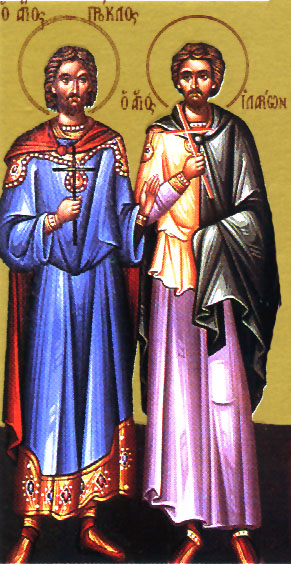
The Holy Martyrs Proclus and Hilarion were natives of the village of Kallippi, near Ancyra, and they suffered during the time of a persecution under the emperor Trajan (98-117). Saint Proclus was put under arrest first. Brought before the governor Maximus, he fearlessly confessed his faith in Christ. The governor decided to compel the saint to submit himself to the emperor and offer sacrifice to the pagan gods. During his tortures, the martyr predicted to Maximus that soon he himself would be compelled to confess Christ as the true God. They forced the martyr to run after the chariot of the governor, heading towards the village Kallippi. Exhausted, Saint Proclus prayed that the Lord would halt the chariot. By the power of God the chariot halted, and no force could move it from the spot. The dignitary sitting in it became petrified. The martyr told him that he would remain unmoving until such time as he would sign a document with a confession of Christ. Only after this could the chariot continue on its way with the governor.
The humiliated pagan took fierce revenge on Saint Proclus. He commanded that Proclus be led out beyond the city, tied to a pillar and shot with arrows. The soldiers, leading Saint Proclus to execution, told him to give in and save his life, but the saint said that they should follow their orders.
Along the way to the place of execution, they met Hilarion, the nephew of Saint Proclus, who with tears embraced his uncle and also confessed himself a Christian. The soldiers seized him, and he was thrown into prison. The holy Martyr Proclus prayed for his tormentors and surrendered his soul to God beneath a hail of arrows.
Saint Hilarion was brought to trial and, with the same courage as Saint Proclus, confessed himself a Christian. After tortures he was sentenced to death. They tied the martyr’s hands and dragged him by his feet through the city, wounded and bloody, and then they beheaded him three days after the death of his uncle, the holy Martyr Proclus. Christians buried them together in a single grave.
Venerable Michael Maleinos

Saint Michael lived during the reign of Emperor Constantine VI (913-959) until the reign of Basil II, the Bulgar-slayer (976 – 1025). He was born in Cappadocia to devout and wealthy parents, Eudókimos and Anastasó (Ἀναστασῶ). Eustáthios, his paternal grandfather, was a patrician; and his maternal grandfather, Adrálestos, held the rank of General of the East.
Manouḗl (the Saint's name in the world) was brought up in the east, but soon he realized the futility of worldly honors and goods. Around the year 925, he fled to Mount Kyminas (Όρος Κύμινας) in Bithynia. There he met a monk named John Heladites, an Elder of great virtue, and asked him if he might stay nearby. The Elder accepted him, but after a while, his father discovered where he was, and after many entreaties, he brought him home.
After a few months, however, and with this permission of his parents, he returned to his Elder, who received him with great joy. Soon he begged Father John to allow him to live alone in a cave, and the Elder blessed him to do this. For five days of the week he devoted himself to fasting, vigil, and prayer. On Saturday and Sunday he came to the monastery to participate in the Divine Services, and to partake of the Holy Mysteries.
After three years of probation, Manouḗl was tonsured as a monk with the name Michael. Later, after Elder John had reposed, Father Michael took the great inheritance he had received from his family and gave it away to the poor and the suffering.
Saint Michael was deemed worthy of ordination to the priesthood. From the Holy Scriptures, he showed how the priesthood ought to be combined with monasticism. He attained a high degree of dispassion, and he also received the gift of clairvoyance. He was very compassionate and kind toward people. He could not bear to let those who were in need or sorrow remain without help and consolation. By his ardent prayers, he performed many miracles.
Saint Michael also founded the famous Lavra of Kyminas, where many brethren received their spiritual formation. He had organized it as a cenobitic monastery, suffusing it with fraternal love. Many great ascetics passed through this Monastery, among whom was Saint Athanasios the Athonite (July 5), the founder of the Greatest Lavra (Μεγίστη Λαύρα) on the Holy Mountain. Kyminas Monastery was also renowned for its calligraphers, and for copying spiritual books.
Once the monastery was secure, Saint Michael went to an even more remote place, where he built a new monastery. By his efforts, the whole mountain of Kyminas was covered with monastic communities, where constant prayers were offered for the entire world before the Throne of the Most High.
At an advanced age, but still vigorous in faith and in spirit, Saint Michael surrendered his holy soul to God in the year 962.
Martyrs Theodore and his son, John, of Kiev
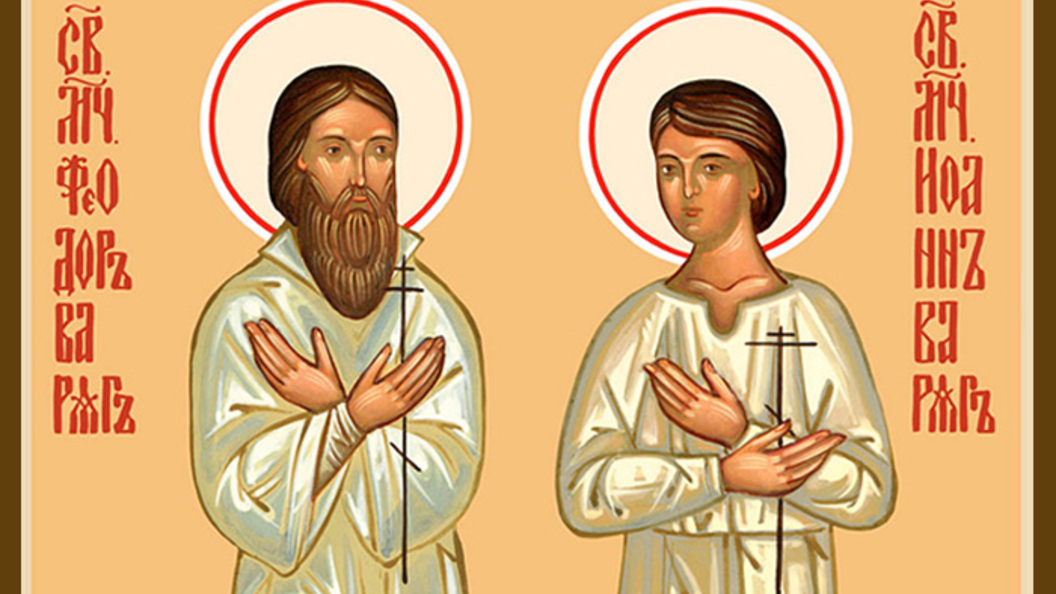
The Holy Martyrs Theodore the Varangian and his son John lived at Kiev in the tenth century, when the Varangians, ancestors of the present day Swedes and Norwegians took an active role in the governance and military life of Rus. Merchants and soldiers, they opened up new trade routes to Byzantium and to the East, they took part in campaigns against Constantinople, and they constituted a significant part of the populace of ancient Kiev and the princely mercenary retinues. The chief trade route of Rus, from the Baltic Sea to the Black Sea, was then called “the Way from the Varangians to the Greeks.”
The chieftains and organizers of the early Russian realm relied upon their Varangian retinues in their undertakings. Just like the Slavs, among whom they lived, many of the sea-faring newcomers under the influence of the Byzantine Church accepted holy Baptism. Kievan Rus stood between the pagan Scandinavians and the Orthodox Byzantines. Therefore, the spiritual life at Kiev was affected by the vivifying influence of the Christian Faith (under Saint Askold in the years 860-882, under Igor and Saint Olga in the years 940-950), and then by the destructive whirlwind of paganism, blowing down from the north from the Varangian Sea (under the reign of Oleg, killing Askold in 882; under the revolt of the Drevliani murdering Igor in 945; under Prince Svyatoslav, who refused to accept Baptism despite the insistence of his mother, Saint Olga).
When Svyatoslav was killed by the Pechenegs in 972 (other sources say in 970), the principality of Kiev was entrusted to his eldest son, Yaropolk. Oleg, the middle son, held the Drevlianian land, while Vladimir, the youngest son, held Novgorod. The reign of Yaropolk (970-978), just like that of his grandmother Olga, again became a time of predominating Christian influence in the spiritual life of Rus. Yaropolk himself, in the opinion of historians, confessed Christianity, although possibly of the Latin rite, and this did not correspond at all to the interests of the Scandinavian mercenary retinue. They were pagans, who were accustomed to consider Kiev a bulwark of their own influence in the Slavic lands. Their leaders strove to create discord between the brothers themselves. They incited a fratricidal war between Yaropolk and Oleg. After this when Oleg was killed, they supported Vladimir in a struggle against Yaropolk.
The future Baptizer of Rus started on his way as a convinced pagan and he relied upon the Varangians, especially those having come to him from over the sea, as his military force. His campaign against Kiev in 978, crowned with complete success, pursued not only military-political aims: it was also a religious campaign of Russo-Varangian paganism against the outgrowth of Kievan Christianity. On June 11, 978 Vladimir “sat on the throne of his father at Kiev,” and the hapless Yaropolk, invited by his brother for negotiations, was treacherously murdered when he arrived at the entrance hall by two Varangians who stabbed him with swords. In order to intimidate the Kievans, among whom were already many Christians both Russian and Varangian, to renew and strengthen with new idols, human sacrifices were made in the pagan sanctuary, a practice unknown to the Dniepr Slavs until then. The chronicles speak of Vladimir setting up idols: “And they brought them sacrifices, acclaiming them gods, and they brought to them their own sons and daughters, and these sacrifices went to the devils… both the Russian land and this hill were defiled with blood”.
The martyrdom of Saints Theodore and his son John may have taken place during this first period of the triumph of paganism at Kiev with Vladimir’s accession to power. In that case, the date might be July 12, 978. It is probable, however, that the exploit of the holy martyrs took place in the year 983, when the wave of pagan reaction rolled not only through Rus, but throughout all the Slavic-Germanic world. Almost simultaneously pagans rose up against Christ and the Church in Denmark, Germany, the Baltic Slavic principalities, and everywhere the unrest was accompanied by the destruction of churches, and by the killing of clergy and Christian confessors. This was the year Vladimir went on campaign against the Lithuanian tribe of the Yatvyagi, and gained victory over them. In recognition of this victory the Kievan pagan priests again decided to make a bloody sacrificial offering.
“Among the Kievans,” reports Saint Nestor the Chronicler, “lived a Varangian by the name of Theodore, who was in military service at Constantinople long before this, and was baptized there. His pagan name, preserved in the term ‘Turov pagan temple,’ was Tur (Scandinavian Thor) or Utor (Scandinavian Ottar), and this other signature is also found in the old manuscripts. Theodore had a son John, a devout and handsome youth, confessing Christianity like his father.”
“And the elders and boyars said: let us cast lots upon the boys and girls. Upon whichever one it falls, that one we shall slaughter in sacrifice to the gods.” The lots thrown by the pagan priests, evidently not by chance, fell upon the Christian John.
When the messengers told Theodore that his son “had been chosen by the gods themselves to be sacrificed to them,” the old warrior decisively answered: “This is not a god, but wood. Today it is, and tomorrow it rots. They do not eat, nor drink nor speak, but are crafted by human hands from wood. God however is One, and the Greeks serve and worship Him. He created heaven and earth, the stars and the moon, the sun and man, and foreordained him to live upon the earth. But these gods, what have they created? They themselves are made. I shall not give my son over to devils.”
This was a direct challenge by the Christian to the customs and beliefs of the pagans. An enraged crowd of pagans rushed at Theodore, smashed up his courtyard, and surrounded the house. Theodore, in the words of the chronicler, “stood at the entrance way with his son,” and with weapon in hand he bravely met the enemy. (The entrance way in old Russian houses as mentioned was set up on posts of a roofed gallery of the second storey, which was reached by a ladder). He calmly gazed upon the demon-possessed pagans and said: “If they are gods, let them send one of the gods to take my son.” Seeing that the brave and seasoned warriors Theodore and John could not be beaten in a fair fight, the besiegers knocked down the gallery posts. When they were broken, the crowd rushed upon the confessors and murdered them.
Already during the time of Saint Nestor, less than a hundred years after the confessor’s deed of the Varangians, the Russian Orthodox Church numbered them among the Saints. Theodore and John became the first martyrs for the holy Orthodox Faith in the Russian land. They were called the first “Russian citizens of the heavenly city” by the transcriber of the Kiev Caves Paterikon, the holy Bishop Simon of Suzdal (May 10). The last of the bloody pagan sacrifices at Kiev became the first holy Christian sacrifice with a co-suffering for Christ. The pathway “from the Varangians to the Greeks” became for Rus the pathway from paganism to Orthodoxy, from darkness to light.
On the place of the martyrdom of the Varangians, Saint Vladimir later built the Desyatin Church of the Dormition of the Most Holy Theotokos, consecrated on May 12, 996. The relics of Saint Olga were transferred into it in the year 1007.
Wondrous is God in His saints! Time does not spare stones and bronze, but the lower framework of the wooden house of the holy Varangrian martyrs, burned a thousand years before, has been preserved to our day. It was discovered in the year 1908 during the excavation of the altar of the Desyatin church at Kiev.
Saints Theodore and John are invoked by women who have miscarried.
Venerable Arsenius of Novgorod the Fool-For-Christ
No information available at this time.
Venerable Simon, Abbot of Volomsk

Hosiomartyr Simon of Volomsk, in the world Simon, son of the peasant Michael from the vicinity of Volokolamsk, was born in the year 1586. At 24 years of age, after long pilgrimage through Orthodox monasteries, he received monastic tonsure at the Pinegsk Makariev monastery. In the year 1613 he settled in the Volomsk forest, 80 versts to the southwest of Ustiug at the River Kichmenga. Here he spent five years alone, away from people. He nourished himself with vegetables which he himself cultivated, and sometimes asked for bread in some settlement.
When lovers of the quiet life began to gather to him, Saint Simon, through a grant of Tsar Michael Theodoreovich and with the blessing of the Rostov Metropolitan Barlaam, built a temple in honor of the Cross of the Lord, and in 1620 was made head of the monastery he founded. A strict ascetic, serving as an example to all in virtue, love of toil, fasting and prayer, he was wickedly murdered in his own monastery on July 12, 1641. The body of the venerable Simon was buried on the left side of the church he built.
Veneration of the saint began in 1646 after grace-filled miracles at his relics were attested. His Life was written in the seventeenth century.
Martyr Golinduc (in Baptism Mary), of Persia
The Holy martyr Golinduc, in Baptism Mary, lived in Persia during the reign of Chosroes I the Elder. She was the wife of the chief magician of the Persian empire. Endowed with a lucid mind, Golinduc perceived the falseness of the pagan wisdom, and she pondered much about what the true Faith might be. When she learned of Christianity, she very much wanted to know what it taught. Soon through the providence of God, her wish was fulfilled. In sleep an angel showed Golinduc the place of torment for sinners and the paradise in which dwell the believers in Christ, the true God. After this dream she began fervently to pray to the true God, so that He might help her become a Christian. The angel of God directed Golinduc to a Christian priest, from whom she received holy Baptism with the name Mary.
After Baptism she left her magician-husband, and he complained to the emperor Chosroes. The emperor himself, and dignitaries sent by him, and illustrious women all urged Golinduc to return to her husband. For her decisive refusal the emperor sentenced her to be imprisoned for life. In prison Saint Mary-Golinduc spent 18 years.
During the reign of Chosroes’ successor, his son Ormisdas, there arrived in Persia an ambassador of the Byzantine emperor Mauricius, named Aristobulus. Having learned that for many years Mary the Christian was languishing in prison, Aristobulus repeatedly visited her in prison with the permission of the emperor and taught her to sing the Psalms of David. After the departure of Aristobulus, Ormisdas gave orders to present Saint Mary-Golinduc before him and for a long time he tortured her, subjecting her to all sorts of beatings and torments. But in all the torments through the intercession of God the saint was preserved unharmed. When they gave her over for defilement, the Lord made her invisible to the impious and preserved her purity. Finally the emperor gave orders to cut off the martyr’s head, but the Lord sheltered her from the hand of the executioner and brought her to Christians living in concealment.
When the persecution against Christians in Persia ceased during the reign of Chosroes II, who occupied the throne with the help of the Byzantine emperor Mauricius, Saint Mary-Golinduc began openly to preach the Christian Faith.
At the end of her life Saint Mary made pilgrimage to Jerusalem, where she prayed at the tomb of the Lord and other holy places. On the return journey she died (+ 591) in the church of the holy Martyr Sergius at Nisibis.
Venerable John the Georgian of Mount Athos

Saint John was born the son of a nobleman during the reign of King Davit Kuropalates.
For his love of Christ he left his family and the world to be tonsured a monk. After informing the royal court of his decision, Saint John received a blessing from his spiritual father to travel to Greece, where he settled at a monastery on Mt. Olympus.
At that time, as a “sign of friendship,” the Byzantine emperor returned the Georgian lands he had conquered to King Davit Kuropalates, but as a “sign of dedication,” he demanded that children of the nobility be sent as surety. Among those sent to Byzantium was Saint John’s son, Ekvtime. Saint John begged the Byzantine emperor to release his son, and when Ekvtime was finally freed, John took him back with him to the Monastery of Saint Athanasius the Athonite (the Great Lavra).
At that time the famed Georgian military commander Tornike Eristavi came to visit Saint John. Tornike was soon tonsured a monk and given the new name John (the saint is commemorated as John-Tornike), and he settled at the Monastery of Saint Athanasius the Athonite as well.
Soon the Georgian faithful began to flock to the Monastery of Saint Athanasius, and John withdrew from the monastery to a more secluded place, where he constructed a cell and a church in honor of Saint John the Theologian. Two more churches were later built in that same area in honor of the Most Holy Theotokos and Saint John the Baptist. In such a way the celebrated Ivḗron Monastery of Mt. Athos was established, with Saint John as its first abbot.
After the repose of his faithful friend and assistant Saint John-Tornike, it became difficult for Saint John to continue to labor on the Holy Mountain. He and several of his disciples planned to leave Athos, but in the end they remained at the insistence of the Byzantine emperor.
John soon fell ill with gout and was bedridden for several years. Prior to his death he summoned his son, Ekvtime, confessed to him his sins, and designated him abbot of the Ivḗron Monastery. He told his son that Saint Giorgi (later “the Builder”) should succeed him as abbot, then blessed all the brothers and “fell asleep among the ranks of the righteous in the arms of his son.”
Saint Ekvtime robed the holy relics of his fleshly and spiritual father in costly linens and later erected a church in honor of the Archangels over his grave.
Venerable Gabriel the Georgian of Mount Athos

Saint Gabriel was a monk of the Ivḗron Monastery on Mt. Athos. In summer he would withdraw to the inaccessible cliffs, and in winter he would return to the monastery and observe a strict rule of silence. Clad in a coarse robe and eating nothing but roots and herbs, Saint Gabriel was truly a “heavenly man and an earthly angel.”
Once, at dusk, the monks of the monastery beheld a pillar of light shining forth upon the sea. The vision lasted for several days, and finally monks from every monastery on the Holy Mountain gathered and descended together to the sea.
They beheld an icon of the Mother of God shining brilliantly and floating upright upon the surface of the water. The fathers lowered a boat onto the water, hoping to bring the icon back with them to the shore, but each time their boat approached the icon, it drifted farther out to sea.
Finally the frustrated monks offered prayers and supplications to God in order to discern His will, and the Most Holy Theotokos appeared in a divine revelation and told them that the monk Gabriel alone was worthy to bring the icon bearing her image out from the sea. At the same time, she appeared to the God-fearing Gabriel and told him, “Enter onto the sea and walk out upon the waves with faith, and I will send my love and mercy upon all the monks of this monastery.”
The elders of Mt. Athos located the rocky dwelling of the hermit Gabriel not far from the Ivḗron Monastery. They brought Gabriel with them and went down to the sea with hymns and censing. Gabriel stepped out onto the water and, walking upon the waves as upon dry land, approached the icon. At the same time, the holy image drew nearer to him. Clutching the holy icon to his breast, Gabriel crossed back over the waves and delivered the icon safely to the shore. (The story of the miraculous Ivḗron Icon of the Theotokos is recounted in detail in the commemorations for February 12.)
Saint Gabriel reposed peacefully on Mt. Athos.
Icon of the Mother of God “of the Three Hands” on Mount Athos

The Icon of the Mother of God “Of the Three Hands”: The wonderworking icon, before which Saint John of Damascus (December 4) received healing of his amputated hand, was given by him to the Lavra of Saint Savva the Sanctified. In the thirteenth century the icon was in Serbia, and afterwards it was miraculously transported to Athos to the Hilandar monastery. A more detailed account about the icon is located under June 28.
In Greek usage, this Icon is commemorated on June 28, where a more detailed account is to be found.
Saint Veronica (Bernice), the woman with the issue of blood

The account of the woman with an issue of blood, who had the unusual name of Veronica, may be found in the Gospel according to Saint Matthew (9:20-22), in Saint Mark's Gospel (5:25-34), and also in Saint Luke's Gospel (8:43-49).
The Synaxaristes of Saint Νikόdēmos of the Holy Mountain states that this Saint was from the city of Paneada. When the Lord healed her issue of blood, she was very grateful, because for twelve years she had "suffered much under many physicians, and had spent all that she had, and nothing had helped, but instead she became worse" (Mark 5:26).
She had heard of Christ, and decided to go to Him, believing that she would be healed merely by touching His garment. When she did this, the Savior felt that power had gone forth from Him. Turning to the crowd, He asked who had touched His garment. His disciples were puzzled by the question, since many people were pressing Him on all sides. Saint Veronica came forward and fell down before Him in fear and trembling, and admitted what she had done. The Lord said, "Daughter, your faith has made you well; go in peace, and be healed of your affliction" (Mark 5:34).
In her gratitude, she made a statue of Him and placed it in front of her house, where everyone could venerate it. A healing plant grew at the base of the statue, which was able to cure various diseases.
Later, Saint Veronica became a member of the early Church. After living a life of holiness, she surrendered her soul to God.
Roman Catholics venerate a saint named Veronica, who is said to have wiped the Savior's face with her veil as He carried His Cross to Golgotha. She is not the saint who is commemorated by the Orthodox Church. That cloth was called the "Veronica," or true image (from vera and iconica) of Christ's face. Saint Gregory of Tours uses this word (Vita Patrum chapter 12) for an image (see the Greek word εικόνα). This incident, is not mentioned in the Gospels.
Some uninformed iconographers confuse these two women and depict our Saint Veronica holding a cloth with the imprint of Christ's face, which is not in accordance with Orthodox Tradition. On August 16, the Orthodox Church commemorates the Image not made by hands, the cloth which Christ sent to King Abgar with the imprint of His Face.
Saint Serapion the New
Saint Serapion (Σεραπίων) lived in Alexandria during the reign of Emperor Severus (222-235). He was a devout man who did whatever was beneficial. He was arrested by the archon Aquila, and when he was asked what religion he followed, he confessed courageously that he believed in Christ and honored Him.
The archon was furious when he heard the Saint's reply, and so he was thrown into a fire and was burnt alive, thereby receiving the incorruptible crown of martyrdom from the Lord.
Prodromitsa Icon of the Mother of God

This Icon is kept in the Moldavian Theophany (now Prodromou)1 Skete on Mount Athos, about an hour's walk from the Lavra of St. Athanasios.
In 1863, Igoumen Niphon, accompanied by several monks, went to Moldavia on the Monastery's business. Arriving at Iași, the capital of Moldavia, the Athonite monks decided to order an icon of the Mother of God for their Monastery, and began to look for a master, who would not only know his craft well, but at the same time he would lead a good life, have the fear of God, and who would be adorned with Christian piety. Soon they managed to find such a man at Iași, the aged painter, George Nikolaev (Iordache Nicolau), with whom they agreed that he should paint the icon only while fasting, before eating any food, and by himself, without the participation and assistance of others.
The old man, having agreed to these conditions, zealously set about his work. The work progressed quickly to its end: it remained only to paint the faces of the Mother of God and the Divine Child. But when the painter started to execute the last part of the work, he suffered a setback: he couldn't paint the faces correctly, despite all his efforts. He was upset and told the monks of his failure, and he even began to doubt himself, whether he had forgotten his art in his old age.
The painter increased his fasting and prayed with tears. Early one morning, after intensified fasting and fervent prayer, he entered his workroom to finish the task that had caused him so much grief and anxiety. Approaching the Icon and looking at it, he suddenly stopped, struck with amazement: from the canvas of the Icon the faces of the Mother of God and the Child looked at him, painted by an invisible hand and radiant with heavenly beauty and artistic expression. The painter was awestruck: the more he considered these faces, the more clearly he understood that a great and incomprehensible miracle of the Queen of Heaven had occurred, and that she had heard his humble and fervent prayers. Overcome with amazement, the artist did not dare to touch this Icon with his brush, but only covered it with varnish.
Rumors of this miracle quickly spread throughout the city, and many people gathered in the artist's home, so that the Athonite monks had great difficulty in moving the Icon from his house to their apartment. The miraculous event that had occurred was also made known to the local Metropolitan, His Grace Callinic (Miclescu), who at that time held the office of Metropolitan. He examined the Icon carefully and recognized the truth of the miracle. After that, a Moleben was served before the Icon, and only then were the people allowed to venerate the image of the Mother of God, which from that time began to be glorified by many miraculous signs.
A certain man had a large thorn in his eyes, and he could not see anything. He was brought in to venerate the Icon of the Mother of God and was given some Holy Water to drink, and to wash with it. He took some of it with him to his house. Three days later he received perfect sight, so that without the help of others he was able to come to give thanks to the Mother of God before her miraculous Icon for his healing.
A nobleman had a child who was unconscious for three days without any movement, so that only by the child's barely perceptible breath could one determine that a faint spark of life still remained. Despairing of saving his child from death by conventional medical means, the father turned to the Mother of God for help, praying fervently before her Icon. Taking some Holy Water to his house, he sprinkled the dying child and poured a few drops into his mouth. And a miracle occurred: the child had already died, but then he recovered.
Many other patients afflicted with various ailments received healing by praying before the Icon of the Mother of God. In view of the numerous miracles performed by the power of the Theotokos through her Holy Icon, not only did Orthodox Christians come to venerate her, but also schismatics, Armenians, and even Jews, for there was the case of a Jewish woman who received her gracious help, which was why she and her entire household were baptized.
The return of the Athonite monks with the Icon, from Iași to their Monastery on Athos, was also accompanied by many miracles.
When the monks arrived with the Icon in the city of Byrlad, the people's teacher in that city wished to receive the Holy Icon in his house, and for this purpose he sent people for it. The monks advised him to come to them if he wished to venerate the Icon, instead of bringing it to his home. But the teacher insisted on having his way. The monks decided to grant his wish. When two of them tried to lift the Icon, despite all their efforts, they could not do so. It took four monks to lift the icon, but only with great effort. When the Icon was brought to the carriage in order to put it in, a loud noise was heard, frightening everyone, both people and the horses. It turned out that the kiot containing the Icon had cracked. Then everyone knew that the Mother of God did not want to have her Icon brought to the teacher's house, and it was decided not to carry it to the teacher's home. Then a strange thing occurred: this time, two monks were able to lift the Icon without any difficulty.
A pious woman who lived outside the city of Byrlad beheld a vision in a dream telling her to go into the city to venerate the Icon. When she arrived, she recognized the very Icon that she had seen in the vision.
When the monks came to Galați there was a painter who, seeing a multitude of people flocking to venerate the Icon, began to mock it, urging people not to believe the miracle of how the faces had not been painted by any earthly artist. But when he gazed at the Icon of the Mother of God, the exression on her face seemed so fierce to him that he was struck with great horror. Then he became a zealous admirer of the wonderworking Icon.
By the time the monks arrived at their Skete on the Holy Mountain, there was a sick monk, who had not eaten any food for three weeks, nor did he speak. He was so weak that he did not move at all. Only by his breathing could anyone tell that he was still alive. When the monks arrived at the Skete, the patient seemed to awaken from a deep sleep and asked to be taken to venerate the Holy Icon. Presenting himself before the Icon, he turned to the Mother of God with this plea: "O Mother of God! You know my heart and you know my fate. If it would be good for me to live, then give me health. If, after I am healed of my illness, I do not behave better, then let me die: end my life here on earth, so that I do not suffer or endure torments there, in the grave." After praying this way, he returned to his cell, put on clean linen and his full monastic garb, and asked to partake of the Holy Mysteries of Christ. He seemed to have a clear premonition of his approaching death. And, indeed, less than an hour after receiving Communion, he departed peacefully and quietly to the Lord.
In this Skete there were even more cases of healings by the Icon of the Mother of God. The monk Sergius was healed from weakness in all his members, and from deafness, and one of the masters who worked in the same Skete was subjected to torments by an unclean spirit; as soon as he was brought to the Icon of the Mother of God, he was freed from the excruciating power of the Enemy.
In addition to the recorded accounts, many other wonderful signs took place on Mount Athos from the Moldavian Icon of the Mother of God, which continues to work miracles up to the present day.
1 The Romanian Skete of Saint John the Forerunner on Mount Athos.
Homily for Sunday, July 10, 2022
Daily Readings for Monday, July 11, 2022
EUPHEMIA THE GREAT MARTYR
NO FAST
Euphemia the Great Martyr, The All-Praised Olga, Equal-to-the-Apostles, Princess of Kiev, Nektarios the New Martyr, Sophrony the Athonite of Essex, Nicodemos the New Martyr of Mt. Athos
ST. PAUL’S SECOND LETTER TO THE CORINTHIANS 6:1-10
Brethren, working together with him, we entreat you not to accept the grace of God in vain. For he says, “At the acceptable time I have listened to you, and helped you on the day of salvation.” Behold, now is the acceptable time; behold, now is the day of salvation. We put no obstacle in any one’s way, so that no fault may be found with our ministry, but as servants of God we commend ourselves in every way: through great endurance, in afflictions, hardships, calamities, beatings, imprisonments, tumults, labors, watching, hunger; by purity, knowledge, forbearance, kindness, the Holy Spirit, genuine love, truthful speech, and the power of God; with the weapons of righteousness for the right hand and for the left; in honor and dishonor, in ill repute and good repute. We are treated as impostors, and yet are true; as unknown, and yet well known; as dying, and behold we live; as punished, and yet not killed; as sorrowful, yet always rejoicing; as poor, yet making many rich; as having nothing, and yet possessing everything.
LUKE 7:36-50
At that time, one of the Pharisees asked Jesus to eat with him, and he went into the Pharisee’s house, and took his place at table. And behold, a woman of the city, who was a sinner, when she learned that he was at table in the Pharisee’s house, brought an alabaster flask of ointment, and standing behind him at his feet, weeping, she began to wet his feet with her tears, and wiped them with the hair of her head, and kissed his feet, and anointed them with the ointment. Now when the Pharisee who had invited him saw it, he said to himself, “If this man were a prophet, he would have known who and what sort of woman this is who is touching him, for she is a sinner.” And Jesus answering said to him, “Simon, I have something to say to you.” And he answered, “What is it, Teacher?” “A certain creditor had two debtors; one owed five hundred denarii, and the other fifty. When they could not pay, he forgave them both. Now which of them will love him more?” Simon answered, “The one, I suppose, to whom he forgave more.” And he said to him, “You have judged rightly.” Then turning toward the woman he said to Simon, “Do you see this woman? I entered your house, you gave me no water for my feet, but she has wet my feet with her tears and wiped them with her hair. You gave me no kiss, but from the time I came in she has not ceased to kiss my feet. You did not anoint my head with oil, but she has anointed my feet with ointment. Therefore I tell you, her sins, which are many, are forgiven, for she loved much; but he who is forgiven little, loves little.” And he said to her, “Your sins are forgiven.” Then those who were at table with him began to say among themselves, “Who is this, who even forgives sins?” And he said to the woman, “Your faith has saved you; go in peace.”
Greatmartyr Euphemia the All-praised

The Miracle of Saint Euphemia the All-Praised: The holy Great Martyr Euphemia (September 16) suffered martyrdom in the city of Chalcedon in the year 304, during the time of the persecution against Christians by the emperor Diocletian (284-305). One and a half centuries later, at a time when the Christian Church had become victorious within the Roman Empire, God deigned that Euphemia the All-Praised should again be a witness and confessor of the purity of the Orthodox teaching.
In the year 451 in the city of Chalcedon, in the very church where the glorified relics of the holy Great Martyr Euphemia rested, the sessions of the Fourth Ecumenical Council (July 16) took place. The Council was convened for determining the precise dogmatic formulae of the Orthodox Church concerning the nature of the God-Man Jesus Christ. This was necessary because of the widespread heresy of the Monophysites [“mono-physis” meaning “one nature”], who opposed the Orthodox teaching of the two natures in Jesus Christ, the Divine and the Human natures (in one Divine Person). The Monophysites falsely affirmed that in Christ was only one nature, the Divine [i.e. that Jesus is God but not man, by nature], causing discord and unrest within the Church. At the Council were present 630 representatives from all the local Christian Churches. On the Orthodox side Anatolius, Patriarch of Constantinople (July 3), Juvenal, Patriarch of Jerusalem (July 2), and representatives of Saint Leo, Pope of Rome (February 18) participated in the conciliar deliberations. The Monophysites were present in large numbers, headed by Dioscorus, the Patriarch of Alexandria, and the Constantinople archimandrite Eutychius.
After prolonged discussions the two sides could not come to a decisive agreement.
The holy Patriarch Anatolius of Constantinople proposed that the Council submit the decision of the Church dispute to the Holy Spirit, through His undoubted bearer Saint Euphemia the All-Praised, whose wonderworking relics had been discovered during the Council’s discussions. The Orthodox hierarchs and their opponents wrote down their confessions of faith on separate scrolls and sealed them with their seals. They opened the tomb of the holy Great Martyr Euphemia and placed both scrolls upon her bosom. Then, in the presence of the emperor Marcian (450-457), the participants of the Council sealed the tomb, putting on it the imperial seal and setting a guard to watch over it for three days. During these days both sides imposed upon themselves strict fast and made intense prayer. After three days the patriarch and the emperor in the presence of the Council opened the tomb with its relics: the scroll with the Orthodox confession was held by Saint Euphemia in her right hand, and the scroll of the heretics lay at her feet. Saint Euphemia, as though alive, raised her hand and gave the scroll to the patriarch. After this miracle many of the hesitant accepted the Orthodox confession, while those remaining obstinant in the heresy were consigned to the Council’s condemnation and excommunication.
After an invasion by the Persians during the seventh century, the relics of Saint Euphemia were transferred from Chalcedon to Constantinople, into a newly built church dedicated to her. Many years later, during the period of the Iconoclast heresy, the reliquary with the relics of the saint was cast into the sea by order of the Iconoclast emperor Leo the Isaurian (716-741). The reliquary was rescued from the sea by the ship-owning brothers Sergius and Sergonos, who gave it over to the local bishop. The holy bishop ordered that the relics be preserved in secret, beneath a crypt, since the Iconoclast heresy was continuing to rage. A small church was built over the relics, and over the reliquary was put a board with an inscription stating whose relics rested within. When the Iconoclast heresy was finally condemned at the holy Seventh Ecumenical Council (in the year 787), during the time of Saint Tarasius, Patriarch of Constantinople (784-806) and the emperor Constantine VI (780-797) and his mother Saint Irene (797-802), the relics of the holy Great Martyr Euphemia were once again solemnly transferred to Constantinople.
Equal-to-the-Apostles Blessed Great Princess Olga (in Holy Baptism Helen)

Saint Olga, Equal of the Apostles, was the wife of the Kievan Great Prince Igor. The struggle of Christianity with paganism under Igor and Olga, who reigned after Oleg (+ 912), entered into a new phase. The Church of Christ in the years following the reign of Igor (+ 945) became a remarkable spiritual and political force in the Russian realm. The preserved text of a treaty of Igor with the Greeks in the year 944 gives indication of this: it was included by the chronicler in the “Tale of Bygone Years,” under the entry recording the events of the year 6453 (945).
The peace treaty had to be sworn to by both the religious communities of Kiev: “Baptized Rus”, i.e. the Christian, took place in the cathedral church of the holy Prophet of God Elias (July 20); “Unbaptized Rus”, i.e. the pagans, in turn swore their oath on their weapons in the sanctuary of Perun the Thunderer. The fact, that Christians are included in the document in the first place, indicates their significant spiritual influence in the life of Kievan Rus.
Evidently at the moment when the treaty of 944 was being drawn up at Constantinople, there were people in power in Kiev sympathetic to Christianity, who recognized the historical inevitability of involving Rus into the life-creating Christian culture. To this trend possibly belonged even prince Igor himself, whose official position did not permit him personally to go over to the new faith, nor at that time of deciding the issue concerning the Baptism of the whole country with the consequent dispersal throughout it of Orthodox Church hierarchs. The treaty therefore was drawn up in the circumspect manner of expression, which would not hinder the prince to ratify it in either the form of a pagan oath, or in the form of a Christian oath.
But when the Byzantine emissaries arrived in Kiev, conditions along the River Dneipr had essentially changed. A pagan opposition had clearly emerged, at the head of which stood the Varangian voevoda (military-leader) Svenel’d (or Sveinald) and his son Mstislav (Mtsisha) to whom Igor had given holdings in the Drevlyani lands.
Strong also at Kiev was the influence of the Khazar Jews, who could not but be displeased with the thought of the triumph of Orthodoxy in the Russian Land.
Unable to overcome the customary inertia, Igor remained a pagan and he concluded the treaty in the pagan manner, swearing an oath on his sword. He refused the grace of Baptism and was punished for his unbelief. A year later, in 945, rebellious pagans murdered him in the Drevlyanian land, cut down betwixt two trees. But the days of paganism and the lifestyle of the Slavic tribes basic to it were already numbered. The burden of government fell upon the widow of Igor — the Kiev Great-princess Olga, and her three-year-old son Svyatoslav.
The name of the future enlightener of the Russian Land and of her native region is first to be met with in the “Tale of Bygone Years,” in the phrase where it speaks about the marriage of Igor: “and they brought him a wife from Pskov, by the name of Olga.” She belonged, so specifies the Joakimov Chronicle, to the lineage of the Izborsk princes, — one of the obscure ancient-Russian princely dynasties, of which in Rus during the 10th-11th Centuries there numbered no less than twenty, but who were all displaced by the Rurikovichi or merged otherwise with them through marriage. Some of them were of local Slavic descent, others — Varangian new-comers. It is known, that the Scandinavian Viking “koenigs” (kinglets) called to become princes in the Russian cities — invariably assimilated to the Russian language, and often, they soon became genuinely Russian with Russian names and lifestyle, world-outlook and even physical appearance of attire.
Thus, Igor’s wife also had the Varangian name “Helga,” which in Russian is pronounced Olga. The feminine name Olga corresponds to the masculine name “Oleg” (Helgi), which means “holy” [from Germanic “heilig” for “holy”]. Although the pagan understanding of holiness was quite different from the Christian, it also presupposed within a man a particular frame of reference, of chastity and sobriety of mind, and of insight. The fact that people called Oleg the Wise-Seer (“Veschi”) and Olga the Wise (“Mudra”) shows the spiritual significance of names.
Rather later traditions regard her a native of a village named Vybuta, several kilometers from Pskov up along the River Velika. They still not so long ago used to point out at the river the Olga Bridge, the ancient fording place, where Olga was met by Igor. The Pskov geographic features have preserved several names connected with this great descendent of Pskov: the village of Ol’zhinets and Ol’gino Pole (Olga Field); the Olga Gateway, one of the branches of the River Velika; Olga Hill and the Olga Cross near Lake Pskov; and the Olga Stone at the village of Vybuta.
The beginning of the independent rule of Princess Olga is connected in the chronicles with the narrative about her terrible revenge on the Drevlyani, who murdered Igor. Having sworn their oaths on their swords and believing “only in their swords”, the pagans were doomed by the judgment of God to also perish by the sword (Mt. 26: 52). Worshipping fire among the other primal elements, they found their own doom in the fire. And the Lord chose Olga to fulfill the fiery chastisement.
The struggle for the unity of Rus, for the subordination to the Kievan center of mutually divisive and hostile tribes and principalities paved the way towards the ultimate victory of Christianity in the Russian Land. For Olga, though still a pagan, the Kiev Christian Church and its Heavenly patron saint the holy Prophet of God Elias [in icons depicted upon a fiery chariot] stood as a flaming faith and prayer of a fire come down from the heavens, and her victory over the Drevlyani—despite the severe harshness of her victory, was a victory of Christian constructive powers in the Russian realm over the powers of a paganism, dark and destructive.
The God-wise Olga entered into history as a great builder of the civil life and culture of Kievan Rus. The chronicles are filled with accounts of her incessant “goings” throughout the Russian land with the aim of the well-being and improvement of the civil and domestic manner of life of her subjects. Having consolidated the inner strengthening of the might of the Kiev great-princely throne, thereby weakening the influence of the hodge-podge of petty local princes in Rus, Olga centralized the whole of state rule with the help of the system of “pogosti” (administrative trade centers). In the year 946 she went with her son and retinue through the Drevlyani land, “imposing tribute and taxes”, noting the villages, inns and hunting places, liable for inclusion in the Kiev great-princely holdings. The next year she went to Novgorod, establishing administrative centers along the Rivers Msta and Luga, everywhere leaving visible traces of her activity. “Her lovischa (hunting preserves) were throughout all the land, the boundary signs, her places and administrative centers, wrote the chronicler, and her sleighs stand at Pskov to this very day, as are her directed places for snaring of birds along the Dneipr and the Desna Rivers; and her village of Ol’zhicha stands to the present day.”
The “pogosti” established by Olga, as financial-administrative and law-court centers, represented sturdy props of great-princely power in these places.
Being first of all, and in the actual sense of the word, centers of trade and exchange (the merchant as “guest”) gathered together and became organized around the settlements (and in place of the “humanly arbitrary” gathering of tribute and taxes, there now existed uniformity and order with the “pogosti” system). Olga’s “pogosti” became an important network of the ethnic and cultural unification of the Russian nation.
Later on, when Olga had become a Christian, they began to erect the first churches at the “pogosti”; from the time of the Baptism of Rus the “pogost” and church (parish) became inseparably associated. (It was only afterwards with the existence of cemeteries alongside churches that there developed the current meaning of the Russian word “pogost” to nowadays signify “parish graveyard”.)
Princess Olga exerted much effort to fortify the defensive might of the land. The cities were built up and strengthened, Vyshgorod (or Detintsa, Kroma) they enclosed with stone and oak walls (battlements), and they bristled them with ramparts and pallisades. Knowing how hostile many were to the idea of strengthening the princely power and the unification of Rus, the princess herself lived constantly “on the hill” over the Dneipr, behind the trusty battlements of Kievan Vyshgorod (“Verkhna-gorod” or “Upper-city”), surrounded by her faithful retainers. Two thirds of the gathered tribute, as the chroniclers testify, she gave over for the use of the Kiev “veche” (city-council), and the remaining one third went “to Olga, for Vyshgorod” — for the needs of building fortifications. And to the time period of Olga, historians note the establishment of the first state frontiers of Russia — to the west, with Poland. Heroic outposts to the south guarded the peaceful fields of the Kievans from the peoples of the Wild Plains. Foreigners hastened to Gardarika (“the land of cities”), as they called Rus, with merchandise and craftwares. Swedes, Danes, Germans all eagerly entered as mercenaries into the Russian army. The foreign connections of Kiev spread. This furthered the development of construction with stone in the city, the beginnings of which was initiated under Olga. The first stone edifices of Kiev — the city palace and Olga’s upper enclosure — were discovered by archaeologists only but in this century. (The palace, or more properly its foundations and remains of the walls were found in excavations during the years 1971-1972).
But it was not only the strengthening of the civil realm and the improvement of domestic norms of the manner of life for people that attracted the attention of the wise princess. Even more urgent for her was the fundamental transformation of the religious life of Rus, the spiritual transfiguration of the Russian nation. Rus had become a great power. Only two European realms could compare with it during these years in significance and might: in Eastern Europe — the ancient Byzantine empire, and in the West the kingdom of Saxony.
The experience of both empires, connected with the exaltation in spirit of Christian teaching, with the religious basis of life, showed clearly, that the way to the future greatness of Rus lay not through military means, but first of all and primarily through spiritual conquering and attainment. Having entrusted Kiev to her teenage son Svyatoslav, and seeking grace and truth, Great-princess Olga in the Summer of 954 set off with a great fleet to Constantinople. This was a peaceful “expedition”, combining the tasks of religious pilgrimage and diplomatic mission, but the political considerations demanded that it become simultaneously a display of the military might of Rus on the Black Sea, which would remind the haughty “Romaioi” [Byzantine Greeks] of the victorious campaigns of Askold and Oleg, who in the year 907 advanced in their shields “to the very gates of Constantinople.”
The result was attained. The appearance of the Russian fleet in the Bosphorus created the necessary effect for the developing of Russo-Byzantine dialogue. In turn, the southern capital struck the stern daughter of the north with its variety of beauty and grandeur of architecture, and its jumbled mixture of pagans and peoples from all over the world. But a great impression was produced by the wealth of Christian churches and the holy things preserved in them. Constantinople, “the city of the imperial Caesar,” the Byzantine Empire, strove in everything to be worthy of the Mother of God, to Whom the city was dedicated by Saint Constantine the Great (May 21) in 330 (see May 11). The Russian princess attended services in the finest churches of Constantinople: at Hagia Sophia, at Blachernae, and others.
In her heart the wise Olga found the desire for holy Orthodoxy, and she made the decision to become a Christian. The sacrament of Baptism was made over her by the Constantinople Patriarch Theophylactus (933-956), and her godfather was the emperor Constantine Porphyrogenitos (912-959). At Baptism she was given the name Helen in honor of the holy Equal of the Apostles Helen (May 21), the mother of Saint Constantine, and she also had been the discoverer of the Venerable Wood of the Cross of the Lord. In an edifying word spoken at the conclusion of the rite, the Patriarch said: “Blessed are you among Russian women, for you have forsaken the darkness and have loved the Light. The Russian people shall bless you in all the future generations, from your grandson and great-grandson to your furthermost descendants.” He instructed her in the truths of the Faith, the churchly rules and the rule of prayer, he explained the commands about fasting, chastity and charity. “She, however,” says the Monk Nestor, “bowed her head and stood, literally like a sponge absorbing water, listening to the teaching, and bowing down to the Patriarch, she said, “By your prayers, O Master, let me be preserved from the wiles of enemies”.
It is in precisely this way, with a slightly bowed head, that Saint Olga is depicted on one of the frescoes of the Kiev Sophia cathedral, and likewise on a Byzantine miniature contemporary to her, in a manuscript portrait of the Chronicles of John Scilitius in the Madrid National Library. The Greek inscription, accompanying the miniature, terms Olga “Archontissa (i.e. ruler) of Rus,” “a woman, Helga by name, who came to the emperor Constantine and was baptized”. The princess is depicted in special head attire, “as a newly-baptized Christian and venerable deaconess of the Russian Church.” Beside her in the same attire of the newly-baptized — is Malusha (+ 1001), the future mother of the Equal of the Apostles Saint Vladimir (July 15).
For one who had originally so disliked the Russians as did the emperor Constantine Porphyrigenitos, it was no trivial matter for him to become the godfather to the “Archontissa of Rus”. In the Russian chronicles are preserved narratives about this, how resolutely and on an equal footing Olga conversed with the emperor, amazing the Greeks by her spiritual depth and wisdom of governance, and displaying that the Russian nation was quite capable of accepting and assimilating the highest attainments of the Greek religious genius, the finest fruition of Byzantine spirituality and culture. And thus by a peaceful path Saint Olga succeeded in “taking Constantinople”, something which no other military leader before her had ever been able to do. According to the witness of the chronicles, the emperor himself had to admit, that Olga “had given him the slip” (had outwitted him), and the popular mind, jumbling together into one the traditions about Oleg the Wise and Olga the Wise, sealed in its memory this spiritual victory in the bylina or folk-legend entitled “Concerning the Taking of Constantinople by Princess Olga”.
In his work “About the Ceremonies of the Byzantine Court,” which has survived to the present day in just one copy, Constantine Porphyrigenitos has left us a detailed description of the ceremony surrounding the stay of Saint Olga at Constantinople. He describes a triumphant reception in the famed Magnaura palace, beneath the singing of bronze birds and the roars of copper lions, where Olga appeared with an impressive retinue of 108 men (not counting the men of Svyatoslav’s company). And there took place negotiations in the narrower confines of the chambers of the empress, and then a state dinner in the hall of Justinian. And here during the course of events, there providentially met together at one table the four “majestic ladies”: the grandmother and the mother of holy Equal of the Apostles Saint Vladimir (Saint Olga and her companion Malusha), and the grandmother and the mother of Saint Vladimir’s future spouse Anna (the empress Helen and her daughter-in-law Theophano). Slightly more than half a century would pass, and at the Desyatin church of the Most Holy Theotokos at Kiev would stand aside each other the marble tombs of Saint Olga, Saint Vladimir and “Blessed Anna”.
During the time of one of these receptions, as Constantine Porphyrogenitos relates, the Russian princess was presented a golden plate inset with jewels. Saint Olga offered it to the vestry of the Sophia cathedral, where at the beginning of the thirteenth century it was seen and described by the Russian diplomat Dobrynya Yadeikovich (who afterwards was to become the Novgorod archbishop Anthony): “The large golden official plate of Olga of Russia, when she took it as tribute, having come to Constantinople; upon the plate be precious stones, and upon it is written in these stones the name Christ”.
Moreover, the wily emperor, after reporting such details as would underscore how “Olga had given him the slip”, also presents a difficult riddle for historians of the Russian Church. This is it: Saint Nestor the Chronicler relates in the “Tale of Bygone Years” that the Baptism of Olga took place in the Biblical year 6463 (955 or 954), and this corresponds to the account of the Byzantine chronicles of Kedrinos. Another Russian Church writer of the eleventh century, Yakov Mnikh, in his work “Eulogy and Laudation to Vladimir… and how Vladimir’s Grandmother Olga was Baptized”, speaks about the death of the holy princess (+ 969) and he notes that she lived as a Christian for fifteen years, and he places the actual date of Baptism as the year 954, which corresponds within several months to the date indicated by Nestor. In contrast to this, describing for us the stay of Olga at Constantinople and providing the precise dates of the receptions given in her honor, Constantine Porphyrogenitos has us to understand in no uncertain terms that all this occurred in the year 957.
To reconcile the cited chronicles, on the one hand, with the testimony of Constantine on the other hand, Russian Church historians are led to suppose one of two things: either Saint Olga made a second journey to Constantinople in the year 957 to continue negotiations with the emperor, or she was not baptized at Constantinople, having previously been baptized at Kiev in 954, and that she was merely making a pilgrimage to Byzantium, since she was already a Christian. The first supposition is the more credible.
As for the immediate diplomatic outcome of the negotiations, there were basic matters for Saint Olga that had been left unsettled. She had gained success on questions concerning Russian trade within the territories of the Byzantine Empire, and also the reconfirmation of the peace accord with Byzantium, concluded by Igor in the year 944. But she had not been able to sway the emperor on two issues of importance to Rus: the dynastic marriage of Svyatoslav with a Byzantine princess, and the conditions for restoring an Orthodox metropolitan to Kiev as had existed at the time of Askold. The evidently inadequate outcome of her mission is detected in her answer, when she had already returned home, which was given to emissaries sent out by the emperor. To the emperor’s inquiry about promised military aid, Saint Olga curtly replied through the emissaries: “If you had spent time with me at Pochaina, as I did at the Court, then I would send the soldiers to help you.”
Amidst all this, in spite of her failed attempts at establishing the Church hierarchy within Rus, Saint Olga, after becoming a Christian, zealously devoted herself to efforts of Christian evangelization among the pagans, and also church construction: “demanding the distressing of demons and the beginning of life for Christ Jesus”. She built churches: of Saint Nicholas and the church of the Holy Wisdom at Kiev, of the Annunciation of the Most Holy Theotokos at Vytebsk, and of the Holy Life-Creating Trinity at Pskov. Pskov from that period has been called in the chronicles the Domicile of the Holy Trinity. The church, built by Olga at the River Velika at a spot pointed out to her from on high, according to the chronicler, by a “light-beam of the Thrice-Radiant Divinity”, stood for more than one and an half centuries. In the year 1137 holy Prince Vsevolod-Gabriel (February 11) replaced this wooden temple with one made of stone, which in turn in 1363 was rebuilt and replaced finally with the presently existing Trinity cathedral.
Another very important monument of Russian “Monument Theology”, as Church architecture frequently is termed, connected with the name of Saint Olga, is the temple of the Wisdom of God at Kiev, which was started soon after her return from Constantinople, and consecrated on May 11, 960. This day was afterwards observed in the Russian Church as a special Church feastday.
In the Mesyatseslov (calendar supplement)of a parchment Epistle-book from 1307, under May 11 is written: “On this day the consecration of Saint Sophia took place at Kiev in the year 6460.” The date is indicated in the so-called “Antiochian” rather than generally-accepted Constantinople chronology, and it corresponds to the year 960 from the Birth of Christ.
It was no mere coincidence that Saint Olga received in Baptism the name of Saint Helen, who found the Venerable Wood of the Cross at Jerusalem (March 6). The foremost sacred item in the newly built Kiev Sophia temple was a piece of the Holy Cross, brought by this new Helen from Constantinople, and received by her in blessing from the Constantinople Patriarch. The Cross, by tradition, was hewn out from an entire piece of the Life-Creating Wood of the Lord. Upon the Cross-Wood was inscribed: “The Holy Cross for the Regeneration of the Russian Land, Received by Noble Princess Olga.”
Saint Olga did much to memorialize the first Russian confessors of the Name of Christ: over the grave of Askold the Saint Nicholas church was built, where according to certain accounts, she herself was afterwards interred. Over the grave of Dir was built the afore-mentioned Sophia cathedral, which stood for half a century and burned in the year 1017. On this spot Yaroslav the Wise later on built a church of Saint Irene in 1050, but the sacred items of Olga’s Sophia temple were transferred into a stone church of the same name now standing as the Kiev Sophia, started in 1017 and consecrated about the year 1030. In the Prologue of the thirteenth century, it says about the Olga Cross: “for It is now at Kiev in Saint Sophia in the altar on the right side.” The plundering of Kiev’s holy things, which after the Mongols was continued by the Lithuanians who captured the city in 1341, did not spare even this. Under Jagiello in the period of the Liublin Unia, which in 1384 united Poland and Lithuania into one state, the Olga Cross was snatched from the Sophia cathedral and carried off by the Catholics to Lublin. Its further fate is unknown.
But even in Olga’s time there were at Kiev among the nobles and retainers no few people who, in the words of Solomon, “hated Wisdom”, and also Saint Olga, for having built Wisdom’s temple. Zealots of the old paganism became all the more emboldened, viewing with hope the coming of age of Svyatoslav, who decidedly spurned the urgings of his mother to accept Christianity, and even becoming angry with her over this. It was necessary to hurry with the intended matter of the Baptism of Rus. The deceit of Byzantium, at the time not wanting to promote Christianity in Rus, played into the hands of the pagans. In search of a solution, Saint Olga looked to the west. No contradiction here yet existed. Saint Olga (+ 969) belonged still to the undivided Church (i.e. before the Great Schism of 1054), and she had scant possibility to study the theological points involved between the Greek and Latin Creeds. The opposition of West and East presented itself to her first of all as a political rivalry, of secondary importance in comparison with her task, the establishment of the Russian Church and the Christian enlightenment of Rus.
Under the year 959, the German chronicler named “the Continuant of Reginon,” records: “to the king came emissaries of Helen, queen of the Russes, who was baptized in Constantinople, and who sought for their nation to have bishop and priests” King Otto, the future founder of the German Empire, willingly acceded to Olga’s request, but he urged that the matter not be decided in haste. It was only on Nativity of the following year 960, that there was established a Russian bishop Libutius, from the monastery brethren of Anatolius Alban am Mainz. But he soon died (March 15, 961). In his place was ordained Adalbert of Trier, whom Otto “generously furnishing all needs” finally sent to Russia. It is difficult to say what would have happened, had the king not delayed for so long a while, but when in 962 when Adalbert showed up at Kiev, he “did not succeed in the matter for which he had been sent, and did consider his efforts to be in vain.” Furthermore, on the return journey “certain of his companions were murdered, and the bishop himself did not escape mortal danger.”
It turned out that after the passage of years, as Olga indeed had foreseen, matters at Kiev had twisted ultimately in favor of paganism, and Rus having become neither Orthodox nor Catholic, had second thoughts about accepting Christianity. The pagan reaction thus produced was so strong, that not only did the German missionaries suffer, but also some of the Kiev Christians who had been baptized with Olga at Constantinople. By order of Svyatoslav, Saint Olga’s nephew Gleb was killed and some of the churches built by her were destroyed. It seems reasonable, that this transpired not without Byzantium’s secret diplomacy: given the possibility of a strengthened Rus in alliance with Otto, the Greeks would have preferred to support the pagans, with the consequent intrigues against Olga and various disorders.
The collapse of the mission of Adalbert had providential significance for the future Russian Orthodox Church, escaping papal dominion. Saint Olga was obliged to accede to the humiliation and to withdraw fully into matters of personal piety, handing over the reigns of governance to her pagan-son Svyatoslav. Because of her former role, all the difficult matters were referred over to her in her wisdom of governance. When Svyatoslav absented himself from Kiev on military campaigns and wars, the governance of the realm was again entrusted to his mother. But the question about the Baptism of Rus was for a while taken off the agenda, and this was ultimately bitter for Saint Olga, who regarded the good news of the Gospel of Christ as the chief matter in her life.
She meekly endured the sorrow and grief, attempting to help her son in civil and military affairs, and to guide matters with heroic intent. The victories of the Russian army were a consolation for her, particularly the destruction of an old enemy of the Russian state—the Khazar kaganate. Twice, in the years 965 and 969, the armies of Svyatoslav went through the lands of “the foolish Khazars,” forever shattering the might of the Jewish rulers of Priazovia and lower Povolzhia. A subsequent powerful blow was struck at the Mahometan Volga Bulgars, and then in turn came the Danube Bulgars. Eighteen years were spent on the Danube with the Kiev military forces. Olga was alone and in worry: it was as though, absorbed by military matters in the Balkans, Svyatoslav had forgotten about Kiev.
In the Spring of 969 the Pechenegs besieged Kiev: “and it was impossible to lead out the horses to water, for the Pechenegs stood at the Lybeda.” The Russian army was far away, at the Danube. Having sent off messengers to her son, Saint Olga herself headed the defense of the capital. When he received the news, Svyatoslav rode quickly to Kiev, and “he hugged his mother and his children and was distressed, with what had happened with them from the Pechenegs.” But after routing the nomads, the warrior prince began anew to say to his mother: “It does not please me to sit at Kiev, for I wish to live at Pereslavl’ on the Dunaj (Danube) since that is the center of my lands.”
Svyatoslav dreamed of creating a vast Russian holding from the Danube to the Volga, which would unite all Rus, Bulgaria, Serbia, the Near Black Sea region and Priazovia (Azov region), and extend his borders to those of Constantinople itself. Olga the Wise understood however, that all the bravery and daring of the Russian companies could not compare against the ancient Byzantine Empire, and that the venture of Svyatoslav would fail. But the son would not heed the admonitions of his mother. Saint Olga thereupon said, “You see that I am ill. Why do you want to forsake me? After you bury me, then go wherever you wish.”
Her days were numbered, and her burdens and sorrows sapped her strength. On July 11, 969 Saint Olga died: “and with great lament they mourned her, her son and grandsons and all the people.” In her final years, amidst the triumph of paganism, she had to have a priest by her secretly, so she would not evoke new outbursts of pagan fanaticism. But before death, having found anew her former firmness and resolve, she forbade them to make over her the pagan celebration of the dead, and she gave final instructions to bury her openly in accord with Orthodox ritual. Presbyter Gregory, who was with her at Constantinople in 957, fulfilled her request.
Saint Olga lived, died, and was buried as a Christian. “And thus having lived and well having glorified God in Trinity, Father and Son and Holy Spirit, having worshipped in the blessed faith, she ended her life in the peace of Christ Jesus, our Lord.” As her prophetic testament to succeeding generations, with deep Christian humility she confessed her faith concerning her nation: “God’s will be done! If it pleases God to have mercy upon my native Russian Land, then they shall turn their hearts to God, just as I have received this gift.”
God glorified the holy toiler of Orthodoxy, the “initiator of faith” in the Russian Land, by means of miracles and incorrupt relics. Yakov Mnikh (+ 1072), a hundred years after her death, wrote in his work “Memory and Laudation to Vladimir”: “God has glorified the body of His servant Olga, and her venerable body remains incorrupt to this day.”
Saint Olga glorified God with good deeds in all things, and God glorified her. Under holy Prince Vladimir, ascribed by some as occurring in the year 1007, the relics of Saint Olga were transferred into the Desyatin church of the Dormition of the Most Holy Theotokos and placed within a special sarcophagus, such as was customary to enclose the relics of saints in the Orthodox East. “And hear ye concerning a certain miracle about her: the grave of stone is small in the church of the Holy Mother of God, this church built by the blessed Prince Vladimir, and in the grave is the blessed Olga. And an opening was made in the tomb to behold Olga’s body lying there whole.” But not everyone was given to see this miracle of the incorrupt relics of the saint: “For whoever came with faith, the aperture opened up, and there the venerable body could be seen lying intact, and one would marvel at such a miracle — the body lying there for so many years without decay. Worthy of all praise is this venerable body: resting in the grave whole, as though sleeping. But for those who did not approach in faith, the grave aperture would not open up, and they would not see this venerable body, but only the grave.”
Thus even after death Saint Olga espoused life eternal and resurrection, filling believers with joy and confounding non-believers. She was, in the words of Saint Nestor the Chronicler, “a precursor in the Christian land, like the dawn before sunrise or the twilight before the light.”
The holy Equal of the Apostles Great Prince Vladimir, himself giving thanks to God on the day of the Baptism of Rus, witnessed before his countrymen concerning Saint Olga with the remarkable words: “The sons of Rus bless you, and also the generations of your descendants.”
Hieromartyr Kindeos the Presbyter of Pamphylia
The Hieromartyr Kindeos was a priest in the village of Talmenia (Sidḗ in Pamphylia) in Asia Minor. At that time Emperor Diocletian was persecuting the Christians. Even so, Saint Kindeos labored tirelessly to spread the message of the Gospel. For this reason, he was denounced to the eparch Stratónikos and condemned to be burnt alive.
As the soldiers were leading him to his death, they met a wood-cutter with a large bundle of firewood, which they confiscated to be used as kindling for the fire, and the Martyr paid the man 30 copper coins for it. On the way, the man with the wood suddenly became ill and fell down. The Saint took the burden upon his own shoulders and carried it to the place of execution.
Even in the fire, the Hieromartyr Kindeos, with God's help, remained a steadfast warrior of Christ. After he had been placed on the pyre, and before the flames enveloped him, he he found the strength to entreat the spectators to accept the true Faith and the Lord's grace. Then a powerful thunderstorm sprang up, and the fire went out. When the storm abated, the Holy Martyr surrendered his soul to Christ in the year 290.
A pagan priest who had heard the words of Saint Kiindeos was astonished by his courage in the face of death. The priest and his wife believed in Christ, and were baptized. It was they who arranged for the burial of the Holy Martyr.
Icon of the Mother of God of Rzhevsk
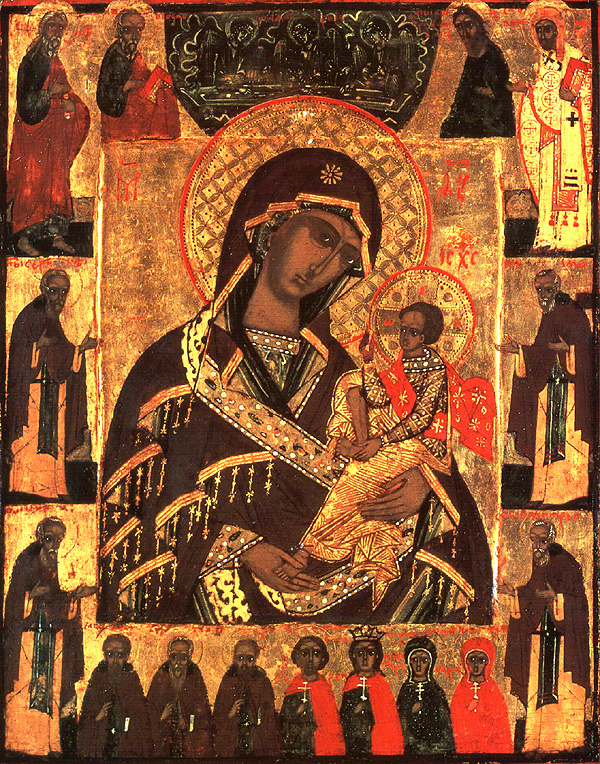
The Rzhevsk (or Okovetsk) Icon of the Mother of God is from the Rzhevets Monastery in Poltava. On May 26, 1539, on the day of the Descent of the Holy Spirit (Pentecost), in Tver diocese, in Vyryshensk town situated in a virgin forest on the bank of the rivulet Vyryshna in the Okovetsk district, not far from the city of Rzhev, at a crossroads for people from four surrounding villages, the monk Stephen made a discovery: fastened to a pine tree was a large iron cross and on another tree an old painted icon depicting the Mother of God with Child, and also Saint Nicholas the Wonderworker of Myra. With the discovery of the holy cross and the icon there shone an extraordinary light and healings occurred. From the Day of the Holy Spirit to the start of the Apostles’ Fast, 27 healings occurred.
The monk Stephen, and right after him the Rzhevsk priest Gregory Onisiphorov, journeyed to Moscow with reports of the appearance of the holy icon and cross and the healing that occurred. The then head of the Russian Church, Metropolitan Joasaph (1539-1541) of Moscow, gave thanks to the Lord, and after verifying the miracles of that place, gave blessing to erect there two churches: one dedicated to the Procession of the Venerable Wood of the Cross of the Lord, and the other in honor of the Hodēgḗtria Mother of God, having in it a chapel named for Saint Nicholas the Wonderworker. At the consecration of the churches a priest and deacon were sent from Moscow, together with church utensils, icons, vestments, books and bells.
In January 1541 the Rzhevsk icon was solemnly transferred to Moscow for the consecration of a church in honor of the Rzhevsk Icon of the Mother of God. After the consecration of the temple, the icon and cross were transferred to the Dormition cathedral, where they remained until July 11. On this day the Rzhevsk icon and cross were returned to the place of their miraculous appearance. The metropolitan together with all the assembled clergy of the capital, and with the young Tsar Ivan Vasilievich, and all the people, accompanied the icon from the Dormition cathedral to the church of the Rzhevsk Icon of the Mother of God, where a copy of this venerable icon was placed. In memory of this celebration the Feast of the Rzhevsk Icon of the Mother of God was established on July 11.
New Monastic Martyr Νikόdēmos of Albania
The New Monastic Martyr Νikόdēmos came from Elbasan, a town of Epirus (Albania) and was raised by devout parents. When he reached a suitable age, he married a Christian woman and they had several children. Since he associated with Turks, he was influenced by them and became a Moslem. He even forced his children to follow his example, except for one son, who was abducted by certain Christians and sent to Mount Athos. There he was tonsured as a monk.
Searching for the young man in order to convert him to Islam, the wretched father learned that he was on the Holy Mountain. He traveled to Athos in great anger, vowing to cause serious trouble for the monasteries if he found his son there. God, Who desires that all may be saved, effected his salvation in a marvelous way. Instead of finding his son and converting him, he himself came to his senses and repented. Forsaking both Islam and the world, he became a monk at the Skete of Saint Anne, in the Kalyva (isolated cell) of the Ascension, with the new name of Νikόdēmos.
His repentance was such that he kept a strict fast for three years, weeping and begging God to forgive his terrible sin of apostasy. One day he heard some of the Fathers saying that whoever denies Christ must go back to the same place and confess Him before men. From that moment, he burned with a desire for martyrdom. Therefore, he prepared himself through asceticism, fasting, and prayer.
Hearing of Saint Akakios (April 12) of the Skete of Kausokalyvia [Καυσοκαλύβια], Νikόdēmos visited him in order to receive his blessing and his instructions. As soon as Νikόdēmos beheld the Saint, he fell down at his feet and wept for a long time. Saint Akakios took him by the hand and addressed him by name, although he did not know him. Raising him up, he comforted him. Then he withdrew for a short distance and began to pray. Those who were present saw a light from Heaven, shining like a star, which illumined the Saint's face. Then he turned to Νikόdēmos and whispered something to him, and then the radiance disappeared.
Overcome with contrition and by divine grace, Νikόdēmos cried out with a loud voice. Then he went into the cave and wept for a considerable time. Later, he returned to Saint Akakios and asked for his blessing to go forth to martyrdom. Blessing him and placing a staff in his hand, the Saint said, "Take this staff and go before the pasha. By the power of God, you will complete your martyrdom well."
Νikόdēmos took the staff, and was ready to leave at once to achieve his goal. However, weakened by fasting, he was not capable of walking all the way back to Elbasan. Therefore, he asked Saint Akakios if he might break his fast in order to strengthen himself for the journey.
The Saint replied, "Now, more than ever, you must fast, Brother, for soon you will be struggling for Christ. Walk as much as you can, and the Lord Who said 'Man shall not live by bread alone, but by every word that proceeds from the mouth of God' (Matthew 4:4), shall strengthen you to walk with ease."
The Martyr answered, "O Father, by your prayers, may our Lord Jesus Christ have mercy on me, and enable me to confess the good confession (I Timothy 6:12). I fear the demons, however."
Saint Akakios chided him, "Fear God, Brother, and not the demons who have no authority of their own over us. Therefore, place all your hope in Christ, not only to vanquish the demons, but also to help you in bearing witness to Him."
Hearing this, Νikόdēmos wept tears of joy. Falling down to the ground and kissing the Saint's feet, he received his blessing and went on his way. While he was still on the Holy Mountain, the Lord appeared to Νikόdēmos and encouraged him. He revealed all the trials that he would face, and even the site of his execution.
Strengthened by Christ, Νikόdēmos arrived at Elbasan. There he was recognized by the Turks, arrested, and brought before the pasha, who tried to make him return to Islam. Νikόdēmos rejected the religion of the Turks and courageously confessed Christ. Then they took him to a high precipice and pushed him off. Miraculously, he floated down gently and landed on his feet.
Returning to the palace, he appeared before the pasha, who was terrified to see him alive. He almost released Νikόdēmos, but fearing the mob of Turks, he turned the Martyr over to them. They tortured him for three days and nights before leading him to the place of execution. Along the way, they made him kneel several times, as if they intended to behead him.
When they reached the place which the Lord had revealed to him, Christ's Martyr showed no sign of fear. He bent his neck and was beheaded with a sword, and his soul went to Heaven with the crown of martyrdom on July 11, 1722.
After the Saint's martyrdom, Christians buried him in the church of the Theotokos, where his incorrupt and fragrant relics are still preserved, working miracles for those who run to him with faith. A piece of his relics is also kept in the Skete of Saint Anne, where there is a manuscript with his Church Service. A new Service was composed by the monk John Danielidis and others.
Transfer of the Relics of Saint Barbara
In the VI century the relics of the Holy Great Martyr Barbara (December 4) were transferred from Heliopolis to Constantinople, and in the XII century Princess Barbara, the daughter of the Byzantine Emperor Alexios Komnenos (reigned 1081-1118) married the Russian Prince Michael Izyaslavich, bringing with her the relics of Saint Barbara. They remain in the cathedral of the Holy Prince Vladimir (July 15) up to the present day. An Akathist to Saint Barbara is served there every Tuesday.
The hand of Saint Barbara is kept in a special shrine at Saint Michael's Monastery in Kiev, on the left side of the church. The glove covering her hand is changed frequently, then the old glove is cut up and the pieces are distributed to pilgrims.
Venerable Arcadius of Novotorsk

Saint Arcadius of Vyazma and Novotorsk was from the city of Vyazma of pious parents, who from childhood taught him prayer and obedience. The gentle, perceptive, prudent and good youth chose for his ascetic feat of being a fool-for-Christ. He lived by alms, and slept wherever he found himself, whether in the forest, or on the church portico.
His blessed serenity and closeness to nature imparted to the figure of young Arcadius a peculiar spiritual aspect and aloofness from worldly vanity. In church, when absorbed in prayer, Saint Arcadius often wept tears of tenderness and spiritual joy. Though he seldom spoke, his advice was always good, and his predictions were fulfilled.
An experienced guide, Saint Ephraim the Wonderworker of Novotorsk (January 28), helped the young ascetic to avoid spiritual dangers while passing through the difficult and unusual exploit of foolishness. After this the people of Vyazma witnessed several miracles, worked through the prayers of Blessed Arcadius, but the saint fled human fame and traveled along the upper Tvertsa River. Here Saint Arcadius shared the work with his spiritual guide Saint Ephraim, and with him founded a church and monastery in honor of the holy Passion-Bearers Boris and Gleb (May 2).
Entering into the newly-built monastery, Saint Arcadius became a monk and took upon himself the exploit of full obedience to his spiritual Father, Saint Ephraim. Saint Arcadius never missed Liturgy and he was always the first to appear for Matins together with his spiritual guide. After Saint Ephraim’s repose (January 28, 1053), Saint Arcadius continued to pursue asceticism in accord with the last wishes of his Elder, dwelling in prayer, fasting and silence. After several years, he also fell asleep in the Lord (December 13, 1077).
In 1594, a chapel dedicated to Saint Arcadius was built in one of the churches of Vyazma. A combined celebration of Saints Arcadius and Ephraim was established by Metropolitan Dionysius in the years 1584-1587. The relics of Saint Arcadius, glorified by miracles of healing, were uncovered on June 11, 1572, and on July 11, 1677, they were placed in a stone crypt of Saints Boris and Gleb cathedral in the city of Novotorsk (New Market). In 1841, the left side chapel of Saints Boris and Gleb cathedral church was dedicated in honor of Saint Arcadius. The solemn celebration of the 300th anniversary of the uncovering of the holy relics of Saint Arcadius took place in the city of Novotorsk in July of 1977. He is also commemorated on August 14 and June 11 (Transfer of his relics).
Finding of the Relics of Saint Hilarion, Archbishop of Verey

The New Hieromartyr Hilarion (Troitsky) fell asleep in the Lord on December 15, 1929 after spending six years in labor camps. When Metropolitan Seraphim (Chichagov) of Leningrad obtained permission from the authorities to take Saint Hilarion's body from the prison hospital for burial, he vested him in white vestments and a mitre, and then brought him to the church at Novodevichii Monastery in Leningrad. When the Saint's relatives saw his body, they barely recognized him. His years in the labor camps had changed his appearance from that of a man of forty-four into a grey-haired old man.
Metropolitan Seraphim presided at the funeral service and burial, assisted by Archbishop Alexei (Simansky), the future Patriarch of Moscow, and five other hierarchs. Saint Hilarion was buried in the cemetery of Novodevichii Monastery in Leningrad.
The relics of Saint Hilarion were found on July 11, 1998.
On May 10, 1999, Saint Hilarion, the Archbishop of Verey, was glorified as a saint by the Russian Orthodox Church. On the eve of his canonization, the Holy Hieromartyr’s relics were uncovered and transferred from St. Petersburg to Moscow and were placed in the church of the Sretensky Monastery.
Saint Hilarion is commemorated on December 15 (his repose in 1929); May 10 (his glorification in 1999); the Third Sunday after Pentecost (All Saints of St. Petersburg); July 11 (The Finding of his relics in 1998); on the Sunday nearest to August 26 (All Saints of Moscow).
Orthros and Divine Liturgy – Sun 7/10/2022
Here is the live stream for Orthros and Divine Liturgy – Sun 7/10/2022 If you need, here are instructions for accessing this content from your phone, tablet, computer, or TV.
Daily Readings for Sunday, July 10, 2022
4TH SUNDAY OF MATTHEW
NO FAST
4th Sunday of Matthew, 45 Holy Martyrs of Nikopolis, Armenia, Our Holy Father Gregory, Bishop of Assa, Parthenios and Eumenios of Koudoumas, 10, 000 Fathers martyred in Egypt, Apollonios the Martyr, Deposition of the Precious Robe of Our Lord Jesus Christ in Moscow, Righteous Father Anthony of the Kiev Caves
ST. PAUL’S SECOND LETTER TO TIMOTHY 2:1-10
Timothy, my son, be strong in the grace that is in Christ Jesus, and what you have heard from me before many witnesses entrust to faithful men who will be able to teach others also. Share in suffering as a good soldier of Christ Jesus. No soldier on service gets entangled in civilian pursuits, since his aim is to satisfy the one who enlisted him. An athlete is not crowned unless he competes according to the rules. It is the hardworking farmer who ought to have the first share of the crops. Think over what I say, for the Lord will grant you understanding in everything.
Remember Jesus Christ, risen from the dead, descended from David, as preached in my gospel, the gospel for which I am suffering and wearing fetters like a criminal. But the word of God is not fettered. Therefore I endure everything for the sake of the elect, that they also may obtain salvation in Christ Jesus with its eternal glory.
MATTHEW 8:5-13
At that time, as Jesus entered Capernaum, a centurion came forward to him, beseeching him and saying, "Lord, my servant is lying paralyzed at home, in terrible distress." And he said to him, "I will come and heal him." But the centurion answered him, "Lord, I am not worthy to have you come under my roof; but only say the word, and my servant will be healed. For I am a man under authority, with soldiers under me; and I say to one, 'Go, ' and he goes, and to another, 'Come, ' and he comes, and to my slave, 'Do this, ' and he does it." When Jesus heard him, he marveled, and said to those who followed him, "Truly, I say to you, not even in Israel have I found such faith. I tell you, many will come from east and west and sit at table with Abraham, Isaac, and Jacob in the kingdom of heaven, while the sons of the kingdom will be thrown into the outer darkness; there men will weep and gnash their teeth." And to the centurion Jesus said, "Go; be it done for you as you have believed." And the servant was healed at that very moment.
Venerable Anthony of the Kiev Far Caves, Founder of Monasticism in Russia

Saint Anthony of the Kiev Caves was born in the year 983 at Liubech, not far from Chernigov, and was named Antipas in Baptism. Possessing the fear of God from his youth, he desired to be clothed in the monastic schema. When he reached a mature age, he wandered until he arrived on Mt. Athos, burning with the desire to emulate the deeds of its holy inhabitants. Here he received monastic tonsure, and the young monk pleased God in every aspect of his spiritual struggles on the path of virtue. He particularly excelled in humility and obedience, so that all the monks rejoiced to see his holy life.
The igumen saw in Saint Anthony the great future ascetic, and inspired by God, he sent him back to his native land, saying, “Anthony, it is time for you to guide others in holiness. Return to your own Russian land, and be an example for others. May the blessing of the Holy Mountain be with you.”
Returning to the land of Rus, Anthony began to make the rounds of the monasteries about Kiev, but nowhere did he find that strict life which had drawn him to Mt. Athos.
Through the Providence of God, Anthony came to the hills of Kiev by the banks of the River Dnieper. The forested area near the village of Berestovo reminded him of his beloved Athos. There he found a cave which had been dug out by the Priest Hilarion, who later became Metropolitan of Kiev (October 21). Since he liked the spot, Anthony prayed with tears, “Lord, let the blessing of Mt. Athos be upon this spot, and strengthen me to remain here.” He began to struggle in prayer, fasting, vigil and physical labor. Every other day, or every third day, he would eat only dry bread and a little water. Sometimes he did not eat for a week. People began to come to the ascetic for his blessing and counsel, and some decided to remain with the saint.
Among Anthony’s first disciples was Saint Nikon (March 23), who tonsured Saint Theodosius of the Caves (May 3) at the monastery in the year 1032.
The virtuous life of Saint Anthony illumined the Russian land with the beauty of monasticism. Saint Anthony lovingly received those who yearned for the monastic life. After instructing them how to follow Christ, he asked Saint Nikon to tonsure them. When twelve disciples had gathered about Saint Anthony, the brethren dug a large cave and built a church and cells for the monks within it.
After he appointed Abbot Barlaam to guide the brethren, Saint Anthony withdrew from the monastery. He dug a new cave for himself, then hid himself within it. There too, monks began to settle around him. Afterwards, the saint built a small wooden church in honor of the Dormition of the Mother of God over the Far Caves.
At the insistence of Prince Izyaslav, the igumen Barlaam withdrew to the Dimitriev monastery. With the blessing of Saint Anthony and with the general agreement of the brethren, the meek and humble Theodosius was chosen as igumen. By this time, the number of brethren had already reached a hundred men. The Kiev Great Prince Izyaslav (+ 1078) gave the monks the hill on which the large church and cells were built, with a palisade all around. Thus, the renowned monastery over the caves was established. Describing this, the chronicler remarks that while many monasteries were built by emperors and nobles, they could not compare with those which are built with holy prayers and tears, and by fasting and vigil. Although Saint Anthony had no gold, he built a monastery which became the first spiritual center of Rus.
For his holiness of life, God glorified Saint Anthony with the gift of clairvoyance and wonderworking. One example of this occurred during the construction of the Great Caves church. The Most Holy Theotokos Herself stood before him and Saint Theodosius in the Blachernae church in Constantinople, where they had been miraculously transported without leaving their own monastery. Actually, two angels appeared in Constantinople in their forms (See May 3, the account of the Kiev Caves Icon of the Most Holy Theotokos). Having received gold from the Mother of God, the saints commissioned master architects, who came from Constantinople to the Russian land on the command of the Queen of Heaven to build the church at the Monastery of the Caves. During this appearance, the Mother of God foretold the impending death of Saint Anthony, which occurred on July 10, 1073.
Through Divine Providence, the relics of Saint Anthony remain hidden.
45 Holy Martyrs at Nicopolis in Armenia

The Forty-five Martyrs of Nicopolis in Armenia suffered during the reign of Emperor Licinius (311-324), who was then co-regent with Saint Constantine the Great (May 21). Licinius, the ruler of the Eastern Empire, fiercely persecuted Christians and issued an edict to put to death any Christian who would not return to paganism. When the persecutions began at Nicopolis, more than forty of those being persecuted for Christ decided to appear voluntarily before their persecutors, to confess openly their faith in the Son of God, and to accept martyrdom. The holy confessors were headed by Leontius, Mauricius, Daniel, Anthony, Alexander, Sisinius, Meneus, and Belerad (Virilad), and they were distinguished by their virtuous life.
Lycias, the procurator of the Armenian district, before whom the holy confessors presented themselves, was amazed at the boldness and bravery of those who condemned themselves voluntarily to torture and death. He tried to persuade them to renounce Christ and offer sacrifice to the pagan gods, but the saints remained steadfast. They refuted all the ruler’s arguments, pointing out to him the falseness of their vile and vice-filled pagan gods, leading those who worship them to ruin. The procurator ordered the confessors to be beaten about the face with stones, and then to be shackled and imprisoned.
In the prison the saints rejoiced and sang the Psalms of David. Saint Leontius inspired and encouraged the brethren, preparing them to accept new tortures for the true Faith, and telling them of the bravery of all those who had suffered previously for Christ. In the morning, after repeated refusals to offer sacrifice to the idols, the saints were subjected to further tortures.
Saint Leontius, seeing the intense suffering of the martyrs, and fearful that some of them might falter and lose faith, prayed to God that these torments would end quickly for all of them.
When the holy martyrs were singing Psalms at midnight, an Angel of the Lord suddenly appeared to them, and the prison blazed with light. The Angel declared to the martyrs that their contest was coming to an end, and their names already were inscribed in Heaven. Two of the prison guards, Meneus and Virilad, saw what was happening and believed in Christ.
On the following morning, Lysias decided to ask them if they had changed their minds and were willing to worship the idols. With one mouth, the Saints replied: “We are Christians! We are Christians!” Insane with rage, Lysias ordered that their hands and feet be cut off, and then threw them into the fire. After this, their bones were tossed into a river. Later on, when freedom had been given to the Church of Christ, a church was built on the spot and was dedicated to the 45 Holy Martyrs of Nikopolis.
The Placing of the Honorable Robe of the Lord at Moscow
The Placing of the Precious Robe of Our Lord Jesus Christ at Moscow (1625): The Savior’s precious Robe [ Greek “himatia”, literally “over-garments”] is not identically the same thing as His seamless coat [Greek “khiton”, literally “under-garb tunic”]. They are clearly distinct within Holy Scripture. “Then the soldiers, when they had crucified Jesus, took His garments (ta himatia) and divided them into four parts, to every soldier a part, and the coat (kai ton khitona). Now the coat was without seam, woven whole from the top down. Therefore, they said among themselves, let us not tear it, but cast lots for it, whose it will become. Thus the saying in Scripture was fulfilled: they divided My raiment (ta imatia) among them, and upon My vesture (epi ton himatismon) did they cast lots” (John. 19: 23-24; Ps. 21 [22]: 18-19).
According to the tradition of the Georgian Orthodox Church, the Chiton of the Lord was carried by the Hebrew rabbi Elioz from Jerusalem to Mtsket and at present is beneath a crypt in the foundations of the Mtsket Patriarchal cathedral of Svetitskhoveli (the Feast in honor of the Chiton of the Lord is celebrated on October 1). None of the Mohammedan invaders ever ventured to encroach upon this spot, glorified with a sign by the mercy of God, the Life-Creating Pillar.
The Robe of the Lord, actually one of its four parts, the lower portion specifically (other parts of the Robe of the Lord are also known in Western Europe: in the city of Trier in Germany, and in Argenteuil near Paris in France), just like the Chiton of the Lord, came to be in Georgia. In contrast to the Chiton, the Robe portion was not kept underground, but was in the treasury of the Svetitskhoveli cathedral right up to the seventeenth century. Then the Persian Shah Abbas I, in devastating Georgia, along with other treasures also carried off the Robe of the Lord. In order to ingratiate himself with Tsar Michael Feodorovich, the Shah sent the Robe of the Lord as a gift to Patriarch Philaret (1619-1633) and Tsar Michael in 1625. The authenticity of the Robe was attested by Nectarius, Archbishop of Vologda, also by Patriarch Theophanes of Jerusalem, who had come from Byzantium, and by Joannicius the Greek, but especially also by the miraculous signs worked by the Lord through the venerable relic.
Afterwards two parts of the Robe came to be in Peterburg: one in the cathedral at the Winter Palace, and the other in Saints Peter and Paul cathedral. A portion of the Robe was also preserved at the Dormition cathedral in Moscow, and small portions at Kiev’s Sophia cathedral, at the Ipatiev monastery near Kostroma and at certain other old temples. At Moscow annually on July 10 the Robe of the Lord is solemnly brought out of a chapel named for the holy Apostles Peter and Paul at the Dormition cathedral, and it is placed on a stand for veneration during the time of divine services. After Liturgy they carry the Robe to its former place.
On this day a service to the Life-Creating Cross of the Lord is proper, since the Placing of the Robe in the Dormition cathedral in 1625 took place on March 29, which happened to be the Sunday of the Veneration of the Cross during the Great Fast.
Venerable Silvanus the Schemamonk of the Kiev Far Caves

The Holy Schemamonk Silvanus (Silouan) of the Kiev Caves, zealously preserved the purity of both soul and body, he subdued his flesh with fasting and vigils, and he cleansed his soul with prayer and meditation on God. The Lord granted him an abundance of spiritual gifts: a prayerful boldness towards God, constant joy in the Lord, clairvoyance and wonderworking. The monk lived at the end of the thirteenth and beginning of the fourteenth centuries. His relics rest in the Caves.
Martyr Apollonius of Sardis
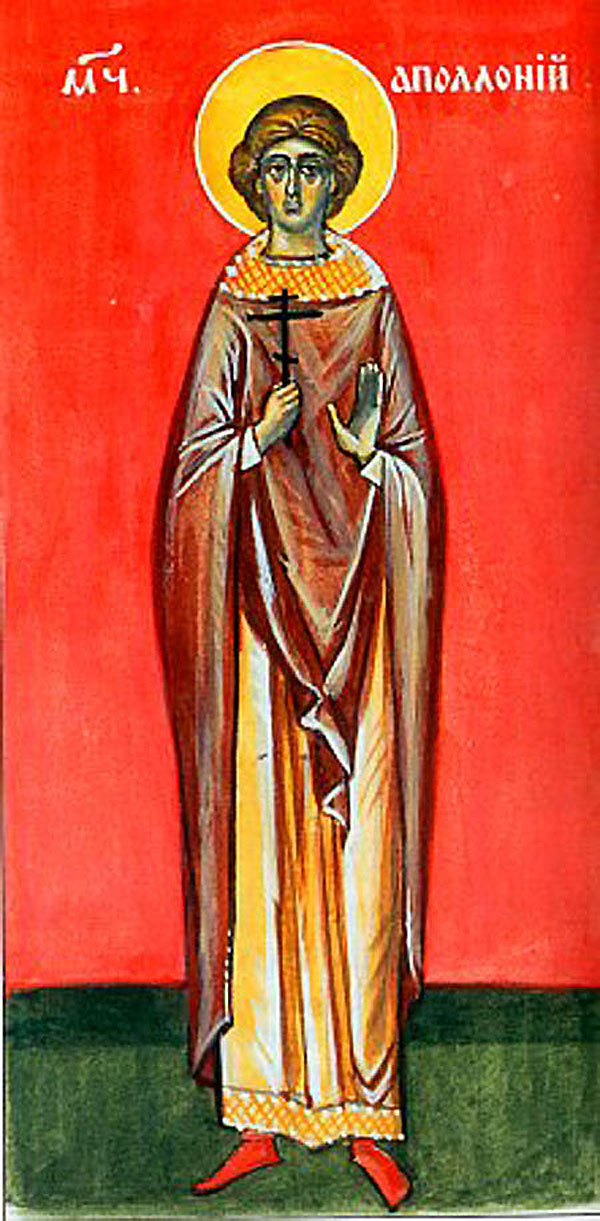
The Holy Martyr Apollonius came from the city of Sardis, located in Lydia (Asia Minor). He declared himself a Christian and was arrested. When they demanded that he swear an oath on the name of the emperor, he refused, saying that it was improper to swear on the name of a mortal man. They tortured Apollonius for a long time and then crucified him. This occurred at Iconium either under the emperor Decius (249-251) or the emperor Valerian (253-259).
Martyrs Bianor and Silvanus of Pisidia
Saint Bianor came from the Pisidia district of Asia Minor. As a confessor of Christianity they brought him to the prefect of the city of Isauria in Lykaonia, who demanded that Saint Bianor renounce Christ. The saint stood steadfast in the true Faith, in spite of the refined tortures. A man by the name of Silvanus beheld the suffering of the martyr. The endurance and bravery of Saint Bianor inspired the faith of Christ in Silvanus, and he openly declared this. They cut out his tongue and then cut off his head. Saint Bianor, after long torturing, was also beheaded.
The date of the suffering of the holy Martyrs Bianor and Silvanus is not precisely known. It is presumed that they died in Pisidia under the Roman emperor Diocletian (284-305).
10,000 Martyred Fathers of the Deserts and Caves of Scete by the Impious Patriarch Theophilus of Alexandria
These holy martyrs of Christ, who lived in the deserts and caves of the Nitrian desert, were delivered up by Patriarch Theophilus of Alexandria to face a bitter death. He falsely accused them of Origenism, but in fact they incurred the patriarch’s anger by giving shelter to the priest Isidore.
Martyr Νikόdēmos of Elbassan Albania
No information available at this time.
Monastic Martyr Nectarius of Saint Anne Skete on Mount Athos
No information available at this time.
Icon of the Mother of God of Konevits

The Konevits Icon of the Mother of God: It was with this icon of Greek origin that John, igumen of one of the Athonite monasteries, blessed Saint Arsenius, founder of the Konevits monastery (June 12). The holy icon was glorified by many miracles.
In the year 1610, during an invasion of the Swedes into the Novgorod territory, the icon was transferred from the Konevits monastery to the Novgorod Derevianits monastery with the blessing of Archbishop Isidore of Novgorod. Each year on July 10 a festal celebration of the Most Holy Theotokos took place at this monastery in honor of Her holy icon. In the year 1799, with the blessing of the Metropolitan Gabriel of Petersburg and Novgorod (+ January 26, 1801), the wonderworking icon was returned to the Konevits monastery. The return of the icon to the Konevits Monastery is celebrated on September 3.
Saint Joseph, and his companions, of Damascus

No information available at this time.
Great Vespers – Wed 7/9/2022
Here is the live stream for Great Vespers – Wed 7/9/2022 If you need, here are instructions for accessing this content from your phone, tablet, computer, or TV.
Daily Readings for Saturday, July 09, 2022
4TH SATURDAY AFTER PENTECOST
NO FAST
The Holy Hieromartyr Pancratius, Bishop of Tauromenium in Sicily, Dionysios the Orator, Metrophanes of Mount Athos, Methodios the Hieromartyr, Bishop of Lampis, Patermuthius the Monk, Euthymios of Karelia, Michael Paknanas the Gardener
ST. PAUL’S LETTER TO THE ROMANS 6:11-17
Brethren, you also must consider yourselves dead to sin and alive to God in Christ Jesus.
Let not sin therefore reign in your mortal bodies, to make you obey their passions. Do not yield your members to sin as instruments of wickedness, but yield yourselves to God as men who have been brought from death to life, and your members to God as instruments of righteousness. For sin will have no dominion over you, since you are not under law but under grace.
What then? Are we to sin because we are not under law but under grace? By no means! Do you not know that if you yield yourselves to any one as obedient slaves, you are slaves of the one whom you obey, either of sin, which leads to death, or of obedience, which leads to righteousness? But thanks be to God, that you who were once slaves of sin have become obedient from the heart to the standard of teaching to which you were committed.
MATTHEW 8:14-23
At that time, when Jesus entered Peter's house, he saw his mother-in-law lying sick with a fever; he touched her hand, and the fever left her, and she rose and served him. That evening they brought to him many who were possessed with demons; and he cast out the spirits with a word, and healed all who were sick. This was to fulfill what was spoken by the prophet Isaiah, "He took our infirmities and bore our diseases.
Now when Jesus saw great crowds around him, he gave orders to go over to the other side. And a scribe came up and said to him, "Teacher, I will follow you wherever you go." And Jesus said to him, "Foxes have holes, and birds of the air have nests; but the Son of man has nowhere to lay his head." Another of the disciples said to him, "Lord, let me first go and bury my father." But Jesus said to him, "Follow me, and leave the dead to bury their own dead." And when he entered the boat, his disciples followed him.
Hieromartyr Pancratius, Bishop of Taormina in Sicily

The Hieromartyr Pancratius, Bishop of Taormina, was born when our Lord Jesus Christ yet lived upon the earth.
The parents of Pancratius were natives of Antioch. Hearing the good news of Jesus Christ, Pancratius’ father took his young son with him and went to Jerusalem in order to see the great Teacher for himself. The miracles astonished him, and when he heard the divine teaching, he then believed in Christ as the Son of God. He became close with the disciples of the Lord, especially with the holy Apostle Peter. It was during this period that young Pancratius got to know the holy Apostle Peter.
After the Ascension of the Savior, one of the Apostles came to Antioch and baptized the parents of Pancratius together with all their household. When the parents of Pancratius died, he left behind his inherited possessions and went to Pontus and began to live in a cave, spendng his days in prayer and deep spiritual contemplation. The holy Apostle Peter, while passing through those parts, visited Pancratius at Pontus. He took him along to Antioch, and then to Sicily, where the holy Apostle Paul then was. There the holy Apostles Peter and Paul made Saint Pancratius Bishop of Taormina in Sicily.
Saint Pancratius toiled zealously for the Christian enlightenment of the people. In a single month he built a church where he celebrated divine services. The number of believers quickly grew, and soon almost all the people of Taormina and the surrounding cities accepted the Christian Faith.
Saint Pancratius governed his flock peacefully for many years. However, pagans plotted against the saint, and seizing an appropriate moment, they fell upon him and stoned him. Thus, Saint Pancratius ended his life as a martyr.
The saint’s relics are in the church named for him in Rome. He is also commemorated on February 9.
Hieromartyr Cyril, Bishop of Gortyna in Crete
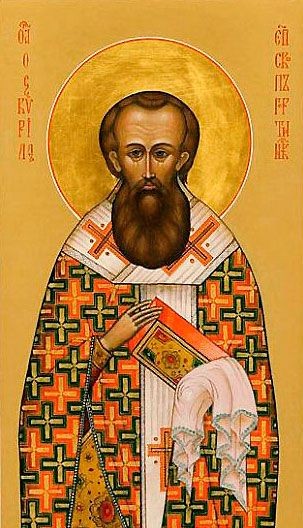
The Hieromartyr Cyril, Bishop of Gortyna, was bishop at Gortyna on the island of Crete for 50 years. He suffered either under the emperor Decius (249-251), or according to other historical sources, the emperor Maximian (284-305).
Brought to trial before a governor named Lucius, who demanded that he offer sacrifice to idols, the holy Elder steadfastly confessed his faith in Christ and refused to fulfill the soul-destroying command. The governor sentenced Saint Cyril to burning, but the flames did not touch him. Seeing this miracle, many pagans came to believe in Christ. Lucius himself offered up praise to the Christian God and set the saint free.
Saint Cyril continued with his preaching and led many pagans to Christ, but also he grieved that he had not been allowed to suffer for the Savior. It was reported to the governor that Saint Cyril would not cease his preaching, and that he continued to convert people from the darkness of paganism to the light of Christ. Hearing the sentence against him, Saint Cyril rejoiced that he was to be granted a martyr’s death for Truth, and the 84-year-old Elder willingly placed his head beneath the sword.
Martyrs Patermuthius, Coprius, and Alexander the Soldier, in Egypt
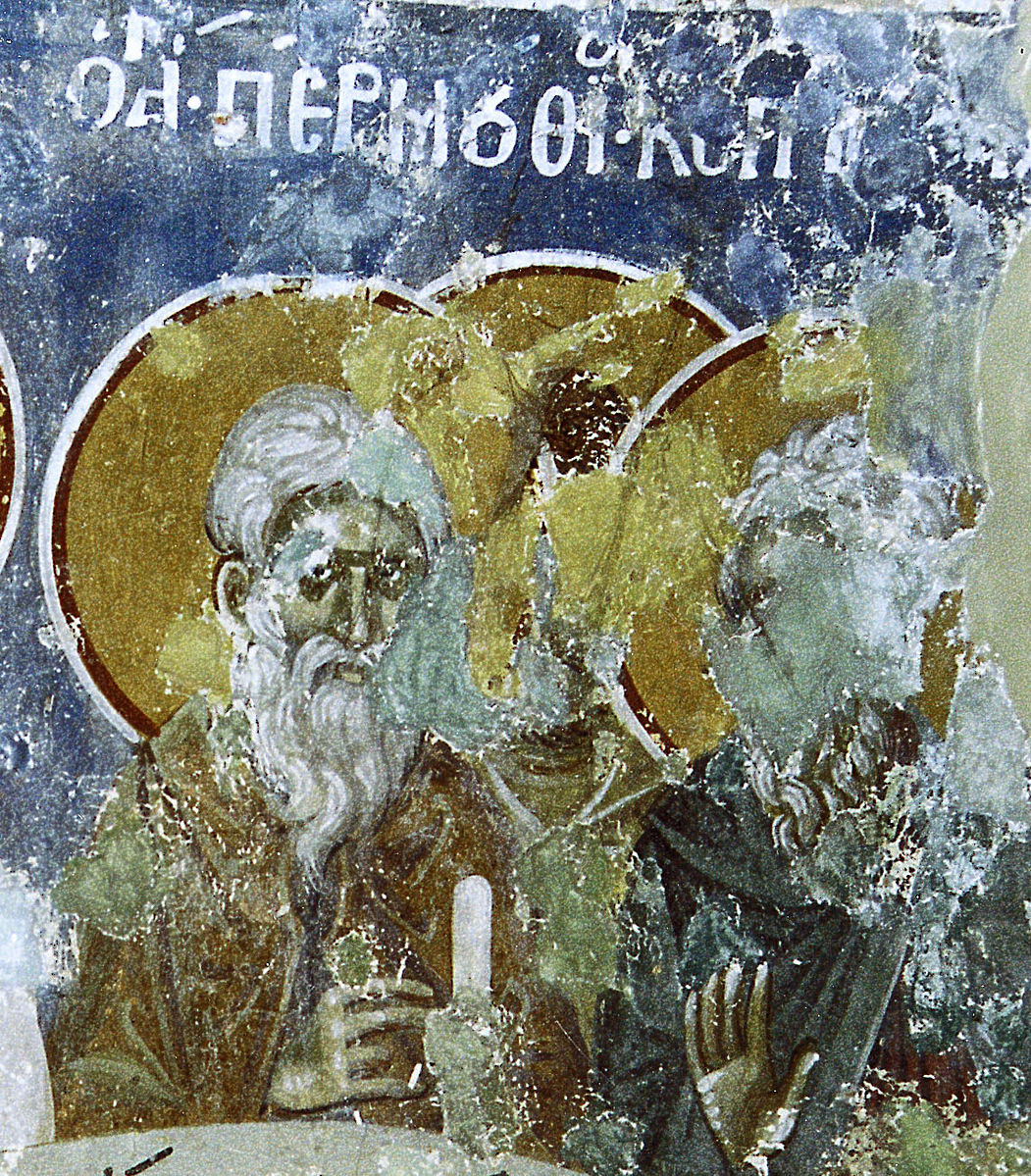
The Hosiomartyrs Patermuthius and Coprius, and the Martyr Alexander suffered under the emperor Julian the Apostate (361-363).
Patermuthius at first was a pagan and also the head of a band of robbers, but then he repented, was baptized and withdrew into the desert. The monk devoted all the rest of his life to attending the sick and burying the dead. For his love of toil and efforts, Patermuthius received from God the gift of wonderworking.
The priest Coprius was an eyewitness of the doings of the venerable Patermuthius and recorded his life and miracles. Saint Coprius narrated this Life to the presbyter Rufinus, who in turn transmitted it to Palladius, Bishop of Hellenopolis, who included the account in his book, the Lausiac History.
Once Saint Coprius entered into a debate with the heretic Manicheus, and seeing that he could not prevail against him in dispute, he suggested that a large fire be lit, and that they should go into it together. In this way, the Lord Himself would decide whose was the true Faith. Manicheus refused to go in first, but Coprius went into the fire, and standing in the midst of the flames, he remained unharmed. The people glorified the faith of Coprius, and they threw the heretic into the fire. He jumped out all scorched and tried to flee, but they caught him and again cast him into the flames. Saint Coprius then calmed the crowd and let Manicheus go.
When the emperor heard about the Egyptian hermits, he ordered them to be brought to him, and he tried to turn them to paganism. He said that he had formerly served Christ, but had learned that only the pagan gods could provide salvation.
Coprius was deceived by these words of the emperor and he denied Christ. By the prayers and tears of his Elder he came to understand what a mistake he had made. He repented and again confessed himself a Christian. The emperor became enraged and ordered that Coprius be tortured. Patermuthius encouraged his brother monk to be brave and endure. One of the soldiers, whose name was Alexander, saw the terrible sufferings of Coprius, and believed in Christ. He was sentenced to be burned alive. Saints Patermuthius and Coprius were beheaded by the sword.
Saint Theodore, Bishop of Edessa
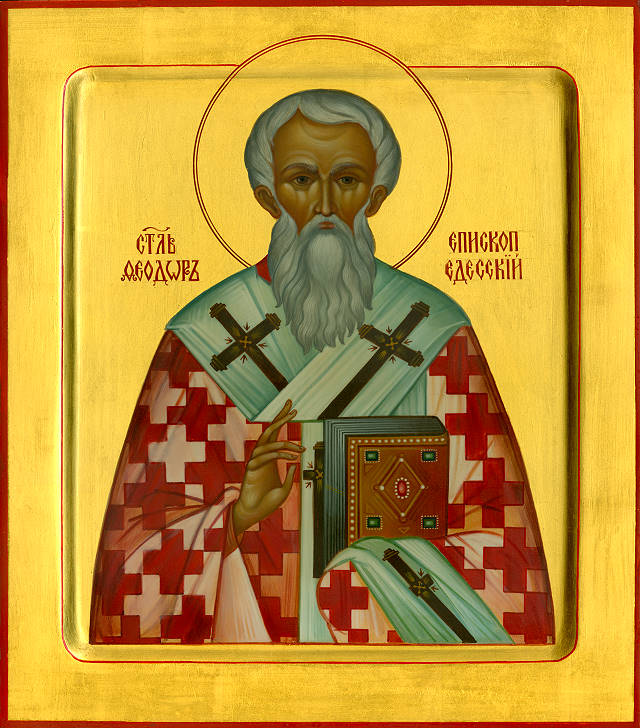
Saint Theodore, Bishop of Edessa, was born in the Syrian city of Edessa. All his life the holy saint was a bright witness of the great deeds of God, glorified in His Saints.
At twelve years of age, after he lost his parents and gave away his inheritance to the poor, he went to Jerusalem, where he was tonsured at the Lavra of the Saint Savva the Sanctified. After twelve years of fervent monastic obedience and then another twenty-four years of full seclusion and great abstinence, the Lord called the valiant ascetic to be a bishop, so that he might enlighten the world. After the death of the Bishop of Edessa, no worthier successor was found than Theodore, and with the mutual consent of the Patriarchs of Antioch and Jerusalem, and of the clergy and laity, this fine man was chosen bishop.
It was not easy for Saint Theodore to forsake his solitude, but he submitted himself to the will of God and undertook his pastoral guidance of the Edessa Church. This occurred during the reign of the Byzantine emperor Michael and his mother Theodora (842-855). At the time of Saint Theodore’s episcopal consecration, there occurred a great miracle. The people beheld a dove, white as snow, flying about beneath the cupola of the church, which then alit upon the head of the newly-made bishop.
Saint Theodore devoted all his abilities to the governance of his flock. He was a model for the faithful in word, in life, in love. By the good example of his holy ascetic life, he guided the flock entrusted to him by God, onto the path of salvation. Theodore exerted much effort in the struggle with heretics, and with a firm hand he guarded the Church from temptations and false teachings. By his consolation and support for Saint Theodore, the clairvoyant Elder Theodosius the Stylite also served the spiritual community while laboring in asceticism not far from the city, near the monastery of the holy Great Martyr George.
With the blessing of the Elder, Saint Theodore journeyed to Baghdad to the caliph Mavi to complain about unjust measures against the Orthodox. Having come to Mavi, the saint found him seriously ill. Calling on the help of the Lord, the holy bishop threw a bit of earth from the Sepulchre of the Lord into a vessel of water and gave it to the caliph to drink, and the sick one was healed. The grateful Mavi, favorably disposed towards the saint, happily heard his teachings. Finally, together with three close associates, he accepted holy Baptism with the name John.
Shortly afterwards for his open confession of faith in Christ before the Moslems, the caliph John was killed with his three associates. Having appeared in a dream simultaneously to Saint Theodore and to Theodosius the Stylite, he said that he had been granted to suffer for Christ, and was numbered among the ranks of the Martyrs. He promised that soon he would meet them in the Kingdom of Heaven. This was an indication to the saint of God that his own end was approaching. In 848, again in solitude at the Lavra of Saint Savva the Sanctified, he peacefully departed to the Lord. Saint Theodore has left Christians his edifying writings. The Life of Saint Theodore of Edessa was popular reading in Rus during the sixteenth and seventeenth centuries, and was preserved in many manuscripts.
Venerable Dionysius, Orator of Saint Anne Skete, Mount Athos, and his disciple, Venerable Metrophanes
Saint Dionysius the Rhetor and his disciple Saint Metrophanes lived toward the end of the sixteenth century and the beginning of the seventeenth century, but it is not known where they were born. Saint Dionysius received the monastic tonsure at the famous Studion Monastery in Constantinople, where he and Saint Metrophanes lived. Desiring a more intensive life of prayer and solitude, the two saints left the monastery of their repentance and journeyed to the peninsula of Athos, establishing themselves in a cell near Karyes. There they devoted themselves to prayer, fasting, and vigilance.
Saint Dionysius was distinguished for his virtue and wisdom, which drew many disciples to him. Training others in the monastic life left him with very little time for his own spiritual struggles, and with so many people around him his soul was not at peace. Therefore, Saint Dionysius and Saint Metrophanes proceeded into the desert of Mount Athos in search of even greater solitude. Somewhere between Saint Anne’s and Katounakia, they found a cave and made it their abode. This would be the future site of Little Saint Anne’s Skete, and they were the first to settle at this place. In that small and humble cave, they lived a godly life which was equal to that of the angels. In their spiritual struggles they fought against the stomach’s need for food, and against the body’s need for sleep. They restricted not only the types of food they ate, but also the amount they consumed at meals. By limiting the amount of time for sleep, they were able to devote themselves more to repentance and prayer.
Saint Dionysius and Saint Metrophanes were esteemed as learned men, but they attained even greater wisdom in the true philosophy of monasticism, which has been called “a life according to the Gospel.” They made such progress in the monastic life, excelling in virtue and holiness, that they became teachers of many holy ascetics.
By voluntarily humbling themselves, these saints were exalted by God, acquiring the richest spiritual gifts and the grace of the Holy Spirit. Just as no one lights a candle and then covers it, or puts it under a bed, “but sets it on a candlestick, that those who enter in may see the light” (Luke 8:16), so the Lord did not permit the virtue of these saints to remain hidden. The light of their holy life so shone before men that those who beheld it glorified God (Matt. 5:16). Like all-luminous lamps, the saints shone forth on the Holy Mountain with the radiance of their holiness.
Later, Saint Metrophanes, with the blessing of the Athonite Fathers and of his Elder Saint Dionysius, was asked to leave Mount Athos for a time in order to preach the Word of God in the neighboring villages. After he had fulfilled this obedience he returned to the Holy Mountain.
Saint Dionysius wrote a book called KOUVARAS, which was a guide on how to benefit and train the brethren. The manuscript is preserved in the Skete’s library. Saint Dionysius taught the art of inner attention and mental prayer, and was himself proficient in them. He rendered many writings of the Holy Fathers into a simpler form of Greek so that ordinary people could understand them. Some of these have been printed in Greek theological publications in modern times. Many of his writings still remain unpublished, however.
According to the ever-memorable Father Gerasimus of Little Saint Anne’s, the twentieth century hymnographer of the Great Church (Constantinople) who composed more than 2,000 services (including the service in honor of Saint Dionysius and Saint Metrophanes), Hieromonk Dionysius fell asleep in the Lord on October 6, 1606, and his disciple Saint Metrophanes reposed shortly thereafter. At Little Saint Anne’s, however, both Saint Dionysius and Saint Metrophanes are commemorated on July 9. A church was built in 1956 at the site of their cave, and was dedicated to these saints.
According to Tradition, Saint Dionysius the Rhetor is to be depicted with straight posture, a wide forehead, a large mustache, and a square beard.
Icon of the Mother of God of Koloch
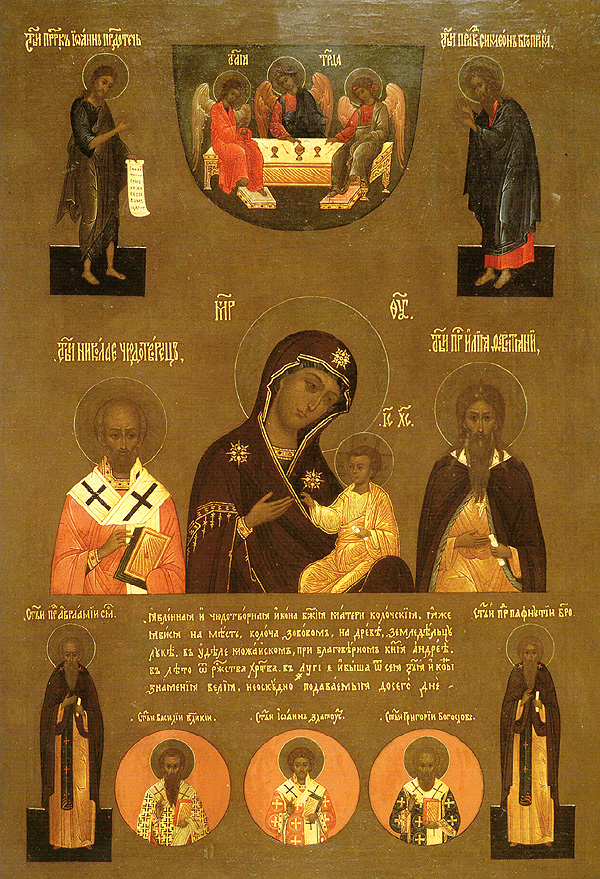
The Koloch Icon of the Mother of God manifested itself in the year 1413 during the reign of Basil I, 15 versts from the city of Mozhaisk, in the vicinity of Koloch in the Smolensk governia. A peasant of this village by the name of Luke found the holy icon and took it to his home. One of his household was paralyzed. The sick one put his forehead to the icon with faith and received complete healing.
This became known through the surrounding area, and many of the suffering began to flock to the wonderworking icon, and they received help from the Mother of God. Luke afterwards took the icon to Mozhaisk, and from there to Moscow. At the capital, Metropolitan Photius, together with a gathering of clergy and a multitude of the people, met the holy icon. As the icon was carried through Moscow many of the sick were healed of their infirmities. Later they returned the icon to Mozhaisk.
At the place where the icon appeared, a church was built in honor of the Mother of God. Here the holy icon was housed.
With the offerings of the peasant Luke and other Orthodox, Prince Andrew Dimitrievich built a monastery on this site called the Kolochsk or Mozhaisk.
Icon of the Mother of God of Cyprus

The Cyprus Icon of the Mother of God belongs to the Panachrana type. In this icon the Mother of God is depicted sitting on a throne with the Divine Infant in Her arms. On either side of Her is an angel.
The prototype of this holy icon manifested itself in the year 392 on the island of Cyprus at the tomb of Righteous Lazarus, the friend of Christ (October 17), and is kept there in a monastery. Renowned copies of the Cyprus Icon are at the Moscow’s Dormition Cathedral, and in the Nikolo-Golutvin church in the village of Stromyn, Moscow diocese (Commemorated on the Sunday of Orthodoxy).
During the week of the Triumph of Orthodoxy, the Greek Synaxarion has an account of an icon which is probably the Cyprus Icon. On the island of Cyprus a certain Arab was passing by a church dedicated to the Most Holy Theotokos. In order to display his hatred for Christianity, the man shot an arrow at an icon of the Mother of God which hung by the gate. The arrow struck the Virgin’s knee, from which blood began to flow. Overcome with fear, the Arab spurred his horse and rode for home, but was struck dead before he could get there. In this way, he was punished for his impiety.
Other days commemorating the Cyprus Icon are the Day of the Holy Spirit, and April 20. Some copies of the Cyprus Icon have additional names such as “Cleansing,” “Knife,” and “Hawk.”
The Cyprus Icon called “Hawk” was so named because of the way it was discovered. One day, the Christian ruler of Cyprus was hunting with his trained hawk. The hawk became tangled in a thicket while diving after another bird, and the ruler ordered the thicket to be cut away so that the hawk could be rescued. His servants rescued the hawk and also discovered an icon of the Mother of God in the thicket. The ruler later built a monastery on the site.
The “Cleansing” Cyprus Icon was in another monastery on Cyprus, and was famous for healing many people with diseases of the eyes.
The “Stromyn” Cyprus Icon became famous in 1841. An eighteen-year-old girl from Stromyn, a village not far from Moscow, was close to death from an illness. In a dream she saw the Cyprus Icon standing over the entrance to the church, and a voice came from the icon: “Take me into your home and have the priest serve a Molieben with the Blessing of Water, and you will be cured.”
The sick girl was brought to the church and finally located the icon after a long search. The girl obeyed the command of the Most Holy Theotokos, and after the Molieben she felt strong enough to carry the icon back to the church herself. Shortly thereafter, she was completely healed. The “Stromyn” Cyprus Icon continued to work miracles of healing, which the rector of the church reported to the holy Metropolitan Philaret of Moscow (November 19).
 Saint Peter Antiochian Orthodox Church
You must be logged in to post a comment.