Monthly Archives: July 2022

Daily Readings for Wednesday, July 20, 2022

THE GLORIOUS PROPHET ELIAS (ELIJAH)

ABSTAIN FROM MEAT, FISH, DAIRY, EGGS

The Glorious Prophet Elias (Elijah), Synaxis of the Russians who were perfected in France: Protopresbyter Alexios Mednedkov, Presbyter Dimitrii Klepinin, Mother Maria Skobtsova, her son Yuri Skobtsov, and Ilia Fondaminskii, Mother Maria Skobtsova, New-Martyr of France

ST. JAMES’ UNIVERSAL LETTER 5:10-20

BRETHREN, take as an example of suffering and patience the prophets who spoke in the name of the Lord. Behold, we call those happy who were steadfast. You have heard of the steadfastness of Job, and you have seen the purpose of the Lord, how the Lord is compassionate and merciful. But above all, my brethren, do not swear, either by heaven or by earth or with any other oath, but let your yes be yes and your no be no, that you may not fall under condemnation. Is any one among you suffering? Let him pray. Is any cheerful? Let him sing praise. Is any among you sick? Let him call for the elders of the church, and let them pray over him, anointing him with oil in the name of the Lord; and the prayer of faith will save the sick man, and the Lord will raise him up; and if he has committed sins, he will be forgiven. Therefore confess your sins to one another, and pray for one another, that you may be healed. The prayer of a righteous man has great power in its effects. Elijah was a man of like nature with ourselves and he prayed fervently that it might not rain, and for three years and six months it did not rain on the earth. Then he prayed again and the heaven gave rain, and the earth brought forth its fruit. My brethren, if any one among you wanders from the truth and some one brings him back, let him know that whoever brings back a sinner from the error of his way will save his soul from death and will cover a multitude of sins.

LUKE 4:22-30

At that time, the crowd wondered at the gracious words which proceeded out of the mouth of Jesus; and they said, “Is not this Joseph’s son?” And he said to them, “Doubtless you will quote to me this proverb, ‘Physician, heal yourself; what we have heard you did at Capernaum, do here also in your own country.'” And he said, “Truly, I say to you, no prophet is acceptable in his own country. But in truth, I tell you, there were many widows in Israel in the days of Elijah, when the heaven was shut up three years and six months, when there came a great famine over all the land; and Elijah was sent to none of them but only to Zarephath, in the land of Sidon, to a woman who was a widow. And there were many lepers in Israel in the time of the prophet Elisha; and none of them was cleansed but only Naaman the Syrian.” When they heard this, all in the synagogue were filled with wrath. And they rose up and put him out of the city, and led him to the brow of the hill on which their city was built, that they might throw him down headlong. But passing through the midst of them he went away.

Holy, Glorious Prophet Elijah
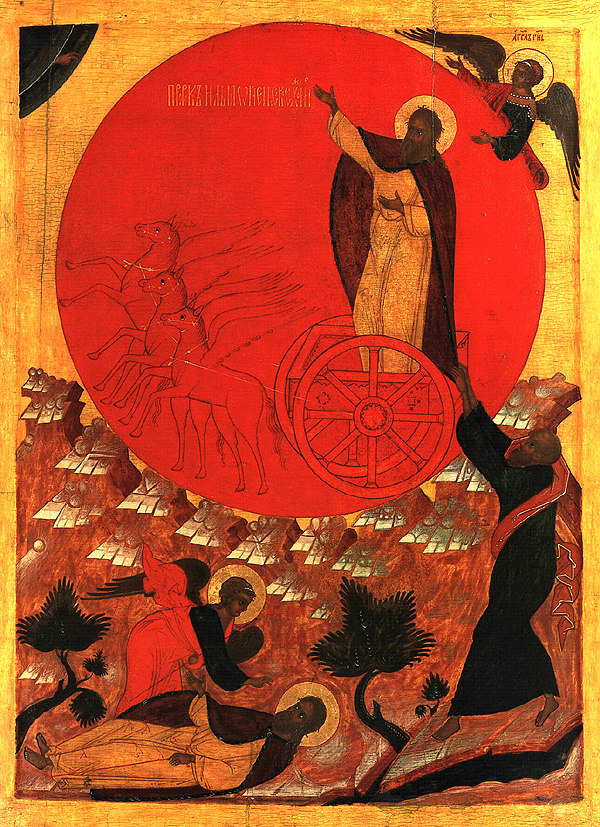
The Holy Prophet Elijah is one of the greatest of the prophets and the first dedicated to virginity in the Old Testament. He was born in Tishba of Gilead into the Levite tribe 900 years before the Incarnation of the Word of God.

Saint Epiphanius of Cyprus gives the following account about the birth of the Prophet Elijah: “When Elijah was born, his father Sobach saw in a vision angels of God around him. They swaddled him with fire and fed him with flames.” The name Elijah (the Lord’s strength) given to the infant defined his whole life. From the years of his youth he dedicated himself to the One God, settled in the wilderness and spent his whole life in strict fasting, meditation and prayer. Called to prophetic service, which put him in conflict with the Israelite king Ahab, the prophet became a fiery zealot of true faith and piety.

During this time the Israelite nation had fallen away from the faith of their Fathers, they abandoned the One God and worshipped pagan idols, the worship of which was introduced by the impious king Jereboam. Jezebel, the wife of king Ahab, was devoted to idol worship. She persuaded her husband to build a temple to the pagan god Baal, which led many Israelites away from the worship of the true God. Beholding the ruin of his nation, the Prophet Elijah began to denounce King Ahab for impiety, and exhorted him to repent and turn to the God of Israel. The king would not listen to him. The Prophet Elijah then declared to him, that as punishment there would be neither rain nor dew upon the ground, and the drought would cease only by his prayer. Indeed, the word of Elijah was a torch (Eccles. 48: 1). The heavens were closed for three and a half years, and there was drought and famine throughout all the land.

During this time of tribulation, the Lord sent him to a cave beyond the Jordan. There he was miraculously fed by ravens. When the stream Horath dried up, the Lord sent the Prophet Elijah to Sarephta to a poor widow, a Sidonian Gentile who suffered together with her children, awaiting death by starvation. At the request of the prophet, she prepared him a bread with the last measure of flour and the remainder of the oil. Through the prayer of the Prophet Elijah, flour and oil were not depleted in the home of the widow for the duration of the famine. By the power of his prayer the prophet also performed another miracle: he raised the dead son of the widow.

After the end of three years of drought the Merciful Lord sent the prophet to appear before King Ahab, and promised to send rain upon the earth. The Prophet Elijah told the king to order all of Israel to gather upon Mount Carmel, and also the priests of Baal. When the nation had gathered, the Prophet Elijah proposed that two sacrificial altars be built: one for the priests of Baal, and the other for the Prophet Elijah who served the True God.

The Prophet Elijah told them to call on their gods to consume the sacrificial animals with fire, and he would call on his. Whichever was first to send fire on the sacrifice would be acknowledged as the true God. The prophets of Baal called out to their idol from morning till evening, but the heavens were silent. Towards evening the holy Prophet Elijah built his sacrificial altar from twelve stones, the number of the tribes of Israel. He placed the sacrifice upon the wood, gave orders to dig a ditch around the altar and commanded that the sacrifice and the wood be soaked with water. When the ditch had filled with water, the prophet turned to God in prayer. Through the prayer of the prophet fire came down from heaven and consumed the sacrifice, the wood, and even the water. The people fell down to the ground, crying out: “Truly, the Lord is God!” Then the Prophet Elijah had all the pagan-priests of Baal put to death, and he began to pray for rain. Through his prayer the heavens opened and an abundant rain fell, soaking the parched earth.

King Ahab acknowledged his error and repented of his sins, but his wife Jezebel threatened to kill the prophet of God. The Prophet Elijah fled into the Kingdom of Judea and, grieving over his failure to eradicate idol worship, he asked God to let him die. An angel of the Lord came before him, strengthened him with food and commanded him to go upon a long journey. The Prophet Elijah traveled for forty days and nights and, having arrived at Mount Horeb, he settled in a cave.

The Lord told him that the next day Elijah would stand in His presence.There was a strong wind that crushed the rocks of the mountain, then an earthquake, and a fire, but the Lord was not in them. The Lord was in “a gentle breeze” (3 Kings 19: 12). He revealed to the prophet, that He would preserve seven thousand faithful servants who had not worshipped Baal.

Later, the Lord commanded Elijah to anoint Elisha into prophetic service. Because of his fiery zeal for the Glory of God the Prophet Elijah was taken up alive into Heaven in a fiery chariot. The Prophet Elisha received Elijah’s mantle, and a double portion of his prophetic spirit.

According to the Tradition of Holy Church, the Prophet Elijah will be the Forerunner of the Dread Second Coming of Christ. He will proclaim the truth of Christ, urge all to repentance, and will be slain by the Antichrist. This will be a sign of the end of the world.

The life of the holy Prophet Elijah is recorded in the Old Testament books (3 Kings; 4 Kings; Sirach/Ecclesiasticus 48: 1-15; 1 Maccabees 2: 58). At the time of the Transfiguration, the Prophet Elijah conversed with the Savior upon Mount Tabor (Mt. 17: 3; Mark 9: 4; Luke. 9: 30).

Orthodox Christians of all times, and in all places, have venerated the Prophet Elijah for centuries. The first church in Russia, built at Kiev under Prince Igor, was named for the Prophet Elijah. After her Baptism Saint Olga (July 11) built a temple of the holy Prophet Elijah in her native region, at the village of Vibuta.

In iconography the Prophet Elijah is depicted ascending to Heaven in a fiery chariot, surrounded with flames, and harnessed to four winged horses. We pray to him for deliverance from drought, and to ask for seasonable weather.

Repose of Venerable Abramius of Galich or Chukhloma Lake, disciple of Venerable Sergius of Radonezh

Saint Abraham of Galich (Chukhloma Lake), lived and pursued asceticism at the monastery of Saint Sergius of Radonezh during the fourteenth century. After long years as a novice, he was deemed worthy of the priesthood. Yearning after the perfection of silence, he asked for the blessing of Saint Sergius, and in the year 1350 settled in the Galich countryside, inhabited by foreign tribes of people.

Having settled in a remote place, Saint Abraham had a revelation to go up a mountain, where he found an icon of the Mother of God shining with an indescribable light. The appearance of the holy icon became known to Prince Demetrius of Galich, who entreated the monk to bring it to the city. Saint Abraham came with the icon to Galich, where he was met by the Prince and a throng of clergy. Numerous healings were worked through the icon of the Mother of God.

Prince Demetrius gave the monk the means to build a church and monastery near Chukhloma Lake, at the place of the appearance of the icon of the Mother of God. The church was built and dedicated in honor of the Dormition of the Most Holy Theotokos. The newly built monastery of Saint Abraham became a source of spiritual enlightenment for the local foreign peoples. When the monastery was built up, he established in his place as head his disciple Porphyrius, and he himself withdrew 30 versts away in search of a solitary place, but there also disciples found him.

Still another monastery was established with a temple in honor of the Placing of the Robe of the Mother of God, called “the great Abraham wilderness monastery.” Saint Abraham twice withdrew to a quiet place, after which there gathered about him anew the disquieters. Thus two more monasteries were founded. One was named in honor of the Synaxis of the Most Holy Theotokos, of which Saint Abraham made Porphyrius the igumen. The other was dedicated to the Protection of the Most Holy Theotokos, where Saint Abraham finished his earthly life. He died in 1375 A year before his death, he appointed his disciple Innocent to govern the monastery. Saint Abraham was an enlightener of the Galich land, having founded four monasteries dedicated to the Mother of God, who granted him Her icon at the beginning of his ascetical exploits.

Uncovering of the relics of Venerable Athanasius, Abbot of Brest-Litovsk

The Monastic Martyr Athanasius of Brest (Uncovering and Transfer of Relics 1649): The martyric death of the holy Passion-bearer Athanasius, igumen of Bretsk, occurred on September 5, 1648. For eight months the body of the sufferer for Orthodoxy lay in the ground without a church funeral. On May 1, 1649 a boy pointed out to the brethren of the Simeonov monastery the place of the igumen’s burial. The ground in which the martyr was buried belonged at the time to the Jesuits, and therefore they had to go to work secretly. At night the monks dug up the incorrupt body of the igumen and immediately took it off to another place. In the morning, they brought it to their monastery, where after several days, on May 8, they buried him with honor at the right kliros (choir) in the main church of the monastery dedicated to Saint Simeon the Stylite.

The earthly life of the monastic martyr Athanasius had come to an end, but the remembrance of him remained always alive and sacred among the Orthodox inhabitants of the west Russian frontier. His incorrupt relics, placed in a copper reliquary, were glorified by grace-filled gifts of wonderworking, and attracted a vast number of believers.

On November 8, 1815 at the time of a fire at the Bretsk Simeonov monastery, the wooden monastery church burned, and the copper reliquary, in which the relics of the martyr were kept, melted in the flames. The day following the fire, an unharmed portion of the relics were found by the priest Samuel of Lisovsk and placed by the pious inhabitants of the city of Brest beneath the altar of the monastery trapeza church. In the year 1823, with the blessing of Archbishop Anatolius of Minsk, the holy relics were placed in a wooden vessel by the head of the monastery and put in church for veneration.

Thus, it pleased God to preserve a portion of the relics of the holy Martyr Athanasius.

Rising up before us is this great champion of Orthodoxy, with his great faith and love of neighbor. Deeply religious, inexorably devoted to the faith of the holy Fathers, he became bold and expressed by word and by deed his priestly indignation against the oppression of Orthodox Christians by the haughty Uniates. With fervent faith in his calling by God, he entered into the struggle for his oppressed brethren. “I am not a prophet, but only a servant of God my Creator, sent because of the times, in order to speak the truth to everyone. He has sent me, so that I might proclaim beforehand the destruction of the accursed Unia.” Such were the words of the fervent, unyielding and inspired struggler for Orthodoxy, who deeply believed in the victorious power of the true Faith.

Saint Athanasius saw the complete affirmation of Orthodoxy and the final and total undoing of the Unia as his single goal. He dedicated his whole life to this end. Having submitted to the will of God, he had no thought of danger, nor did he consider the obstacles, in fulfilling his holy duty. Saint Athanasius used His daring, spiritually-inspired speeches and writings, his published grievances, and voluntary folly in Christ for the attainment of his sacred goal: the affirmation of Orthodoxy in the ancient Russian land.

Having repudiated the Unia, he was inspired with a deep sense of pity and love towards those who had become the victims of Uniate proselytism. The righteousness and sincerity of Saint Athanasius in relation to those nearby defined the course of all his deeds. By his existence in the solitary life, surrounded by open and hidden enemies, the holy ascetic remained a steadfast defender and pillar of Orthodoxy. He constantly repeated his prediction: “The Unia will die out, but Orthodoxy will flourish.”

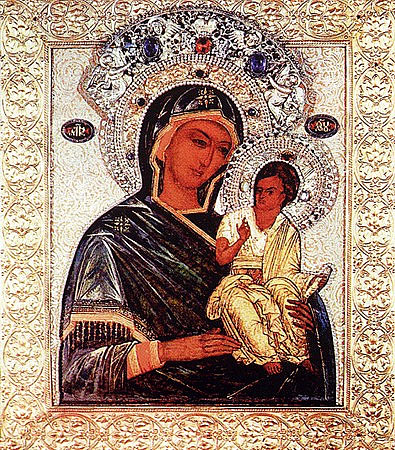
“Chukhloma” Icon of the Mother of God from Galich

The Chukhloma Icon of the Mother of God of Galich appeared in the year 1350 to Saint Abraham of Galich, who came there from the north for ascetical labors with the blessing of Saint Sergius of Radonezh. On the wild shores of the Galich lake near the large mountain, hidden in the dense forest, he turned with prayer to the Mother of God, asking Her blessing for his endeavors. After completing his prayer the saint sat down to rest, and suddenly a bright light appeared on the nearby mountainside and he heard a voice: “Abraham, come up the mountain, where there is an icon of My Mother.”

The monk went up the mountain where the light shone, and indeed found an icon of the Mother of God with the Infant on a tree. With tenderness and in gratitude to God, the holy ascetic took the revealed icon and, strengthened by prayers to the Most Holy Theotokos, he built a chapel at that place, in which he put the icon.

After a certain time the Galich prince Demetrius Feodorovich, learned about the Elder’s trip, and asked him to bring the icon. Saint Abraham rowed across the Galich lake in a boat and, accompanied by clergy and a throng of people, he took the wonderworking icon to the cathedral church of the city of Galich.

On this day a large number of the sick were healed by this icon. When Saint Abraham told about the appearance of the icon, the Prince offered money to build a monastery. Soon a church was built in honor of the Dormition of the Most Holy Theotokos, around which a monastery grew. Saint Abraham founded several more monasteries, the last being founded was the Chukhloma, not far from the city of Chukhloma, from the name of this monastery the ascetic was named “of Chukhloma,” and the wonderworking icon became known as the Chukhloma Icon of Galich.

The icon is also commemorated on May 28, July 4, and August 15.

Martyr Ilia Chavchavadze of Georgia

Saint Ilia, called the “Uncrowned King of Georgia,” the “Father of the Nation” and “the Righteous,” belonged to the noble family Chavchavadze. He was born on October 27, 1837, in the village of Qvareli in Kakheti. He received his primary education at home: his mother instructed him in reading and writing, prayer and the law of God. When he was eight years old, Ilia was sent to study with Archdeacon Nikoloz Sepashvili of Qvareli. The years he spent there left an indelible impression on this holy man’s life.

Ilia continued his education at a Tbilisi boarding school, and later at the court gymnasium (high school). His parents died at a young age, and the orphaned children were entrusted to the care of their aunt Macrina.

In 1857 Ilia enrolled in the law school at Saint Petersburg University. There he read a great deal and struggled to improve himself as an individual. He was fascinated by Georgian history and spent much of his time in the Saint Petersburg archives in search of old Georgian texts. His academic achievements were outstanding, but he was uninterested in receiving an official diploma from the school of law. In his fourth year he dropped out of the program and returned to Georgia.

Ilia was certain that a nation that forgets its own history “is like a beggar who knows neither his past nor where he is going.” For this reason he sought to inspire his fellow countrymen with the past glories of their nation and the loyalty of their forefathers to the Christian Faith and the Georgian nation.

The restoration of national independence and the autocephaly of the Georgian Church were the chief objectives toward which Saint Ilia strove in every aspect of his life. As a means by which to achieve these goals, Ilia took up the work of a historian: he conducted intensive research and exposed those who had falsified history and dishonored the Georgian nation.

This great philosopher, writer, and historian often repeated the statement “A nation whose language is corrupted can no longer exist as a nation.” He cared deeply about the Georgian language and fought to ensure that it remained the primary language taught in schools.

Ilia inspired many with his patriotic zeal, and he founded the Society for the Propagation of Literacy among the Georgians. He established a depository of Georgian manuscripts and antiquities. In addition he initiated a movement to document oral folk traditions and helped to found the Georgian Agrarian Bank.

Ilia the Righteous was often heard declaring, “We, the Georgian people, have inherited three divine gifts from our ancestors: our motherland, our language and our faith. If we fail to protect these gifts, what merit will we have as men?”

But Ilia’s righteous deeds were an affront and threat to those who adhered to the new atheist ideology, so they plotted to kill him. On August 30, 1907, Ilia Chavchavadze and his wife, Olga (Guramishvili), had just set off from Tbilisi for Saguramo when their carriage stopped abruptly outside of Mtskheta, near Tsitsamuri Forest.

They were awaited by a band of militant social democrats who attacked them and shot Ilia to death.

The Military Court of the Caucasus sentenced Ilia Chavchavadze’s murderers to death by hanging. But Ilia’s wife Olga requested that the governor-general pardon her husband’s murderers. She asserted that, if Ilia had survived, he would have done the same, since the killers were simply his “unlucky brothers gone astray.”

Indeed, Ilia had forgiven his murderers’ offense long before, in his prophetic poem “Prayer”:

Our Father Who art in Heaven!

With tenderness I stand before Thee on my knees;

I ask for neither wealth nor glory;

I won’t debase my holy prayer with earthly matters.

I would wish for my soul to rest in heaven,

My heart to be radiant with love heralded by Thee,

I would wish to be able to ask forgiveness of mine enemies,

Even if they pierce me in the heart:

Forgive them, Lord, for they know not what they do!

In 1987 the Holy Synod of the Georgian Orthodox Church considered the deeds of Ilia Chavchavadze before God and his country and decreed him worthy to be numbered among the saints. He was joyously canonized as Saint Ilia “the Righteous.”

Righteous Martyr Maria (Skobtsova)

Elizaveta Pilenko, the future Mother Maria, was born in 1891 in Riga, Latvia, then part of the Russian Empire, and grew up in the south of Russia on the shore of the Black Sea. Her father was mayor of the town of Anapa, while on her mother's side, she was descended from the last governor of the Bastille, the Parisian prison destroyed during the French Revolution.

Her parents were devout Orthodox Christians whose faith helped shape their daughter's values, sensitivities and goals. As a child she once emptied her piggy bank in order to contribute to the painting of an icon that would be part of a new church in Anapa. At seven she asked her mother if she was old enough to become a nun, while a year later she sought permission to become a pilgrim who spends her life walking from shrine to shrine.

At the age of 14, her father died, an event that seemed to her meaningless and unjust and led her to embrace atheism. "If there is no justice," she said, "there is no God." She decided God's nonexistence was well known to adults but kept secret from children. For her, childhood was over. When her widowed mother moved the family to Saint Petersburg in 1906, she found herself in the country's political and cultural center — also a hotbed of radical ideas and groups — and became part of radical literary circles that gathered around such symbolist poets as Alexander Blok, whom she first met at age 15. Like many of her contemporaries, she was drawn to the left, but was often disappointed at the radicals she encountered. Though regarding themselves as revolutionaries, they seemed to do nothing but talk. "My spirit longed to engage in heroic feats, even to perish, to combat the injustice of the world," she recalled. Yet no one she knew was actually laying down his or her life for others. Should her friends hear of someone dying for the Revolution, she noted, "they will value it, approve or not approve, show understanding on a very high level, and discuss the night away till the sun rises and it's time for fried eggs. But they will not understand at all that to die for the Revolution means to feel a rope around one's neck."

In 1910, she married Dimitri Kuzmin-Karaviev, a Bolshevik and part of a community of poets, artists and writers, but she later commented that it was a marriage born "more of pity than of love." In addition to politics and poetry, she and her friends also talked theology, but just as their political ideas had no connection at all to the lives of ordinary people, their theology floated far above the actual Church. There was much they might have learned, she reflected later in life, from "any old beggar woman hard at her Sunday prostrations in church." For many intellectuals, the Church was an idea or a set of abstract values, not a community in which one actually lives.

Though still regarding herself an atheist, gradually her earlier attraction to Christ revived and deepened, not yet Christ as God incarnate but Christ as heroic man. In time, she found herself drawn toward the religious faith she had abandoned after her father's death. She prayed and read the Gospel and the lives of saints and concluded that the real need of the people was not for revolutionary theories but for Christ. She wanted "to proclaim the simple word of God," she told Blok in a letter written in 1916. Desiring to study theology, she applied for admission to Saint Petersburg's Theological Academy of the Alexander Nevsky Monastery, in those days an entirely male school whose students were preparing for ordination. As surprising as her wanting to study there was the rector's decision that she could be admitted.

By 1913, her marriage collapsed. Later that year, her first child, Gaiana, was born. Just as World War I was beginning, she returned with her daughter to southern Russia, where her religious life grew more intense. For a time she secretly wore lead weights sewn into a hidden belt as a way of reminding herself both "that Christ exists" and also to be more aware that minute-by-minute many people were suffering and dying in the war. She realized, however, that the primary Christian asceticism was not self-mortification, but caring response to the needs of other people.

In October 1917, she was present in Saint Petersburg when Russia's Provisional Government was overthrown by the Bolsheviks. Taking part in the All-Russian Soviet Congress, she heard Lenin's lieutenant, Leon Trotsky, dismiss people from her party with the words, "Your role is played out. Go where you belong, into history's garbage can!" She grew to see how hideously different actual revolution was from the dreams of revolution that had once filled the imagination of so many Russians! In February 1918, she was elected deputy mayor of Anapa. Eventually, she was arrested, jailed, and put on trial for collaboration with the enemy. In court, she rose and spoke in her own defense: "My loyalty was not to any imagined government as such, but to those whose need of justice was greatest, the people. Red or White, my position is the same — I will act for justice and for the relief of suffering. I will try to love my neighbor." It was thanks to Daniel Skobtsov, a former schoolmaster who was now her judge, that she avoided execution. After the trial, she sought him out to thank him. Eventually they married.

As the course of the civil war was turning in favor of the Bolsheviks, the Skobtsovs fled to Georgia, where she gave birth to a son, Yura, in 1920. A year later, having relocated to Yugoslavia, she gave birth to Anastasia, Their long journey ended with their arrival in Paris in 1923, where to supplement their income she made dolls and painted silk scarves, often working ten or twelve hours a day.

A friend introduced her to the Russian Student Christian Movement, an Orthodox association founded in 1923. She began attending lectures and other activities and felt herself coming back to life spiritually and intellectually. In 1926, she grieved the death of her daughter Anastasia. She emerged from her mourning determined to seek a "new road before me and a new meaning in life, to be a mother for all, for all who need maternal care, assistance, or protection." She devoted herself to social work and theological writing. In 1927 two volumes, Harvest of the Spirit, were published, in which she retold the lives of many saints.

In 1930, she was appointed traveling secretary of the Russian Student Christian Movement, work which put her into daily contact with impoverished Russian refugees throughout France and neighboring countries. She often lectured, but she was quick to listen to others as they related some terrible grief that had burdened them for years. She took literally Christ's words, that He was always present in the least person. "Man ought to treat the body of his fellow human being with more care than he treats his own," she wrote. "Christian love teaches us to give our fellows material as well as spiritual gifts. We should give them our last shirt and our last piece of bread. Personal alms-giving and the most wide-ranging social work are both equally justified and needed."

In time, she began to envision a new type on community, "half monastic and half fraternal," that would connect spiritual life with service to those in need, in the process showing "that a free Church can perform miracles." Father Sergei Bulgakov, her confessor, was a source of support and encouragement, as was her bishop, Metropolitan Evlogy [Georgievsky], who was responsible from 1921 to 1946 for the many thousands of Russian expatriates scattered across Europe. Recognizing her devotion to social work, and knowing of her waning marriage, he suggested to her the possibility of becoming a nun. In time, Daniel came to accept the idea after meeting with Metropolitan Evlogy. In the spring of 1932, in the chapel at Paris' Saint Sergius Theological Institute, she was professed as a nun with the name Maria. She made her monastic profession, Metropolitan Evlogy recognized, "in order to give herself unreservedly to social service." Mother Maria called it simply "monasticism in the world." Intent "to share the life of paupers and tramps," she began to look for a house of hospitality and found it at 9 villa de Saxe in Paris, which she leased with financial assistance from Metropolitan Evlogy. She began receiving guests, mainly young Russian women without jobs, giving up her own room to house them while herself sleeping on a narrow iron bedstead in the basement. A room upstairs became a chapel — she painted the iconostasis icons — while the dining room doubled as a hall for lectures and dialogues.

In need of larger facilities, a new location was found two years later in an area of Paris where many impoverished Russian refugees had settled. While at the former address she could feed only 25, here she could feed a hundred. Here her guests could regain their breath "until the time comes to stand on their two feet again." Her credo was: "Each person is the very icon of God incarnate in the world." With this recognition came the need "to accept this awesome revelation of God unconditionally, to venerate the image of God" in her brothers and sisters. As her ministry evolved, she rented other buildings, one for families in need, and another for single men. A rural property became a sanatorium. By 1937, she housed several dozen women, serving up to 120 dinners every day. Every morning, she would beg for food or buy cheaply whatever was not donated.

Despite a seemingly endless array of challenges, Mother Maria was sustained chiefly by those she served — themselves beaten down, people in despair, cripples, alcoholics, the sick, survivors of many tragedies. But not all responded to trust with trust. Theft was not uncommon. On one occasion a guest stole 25 francs. Everyone guessed who the culprit was, a drug addict, but Mother Maria refused to accuse her. Instead she announced at the dinner table that the money had not been stolen, only misplaced, and she had found it. "You see how dangerous it is to make accusations," she commented. At once the girl who stole the money burst into tears.

Mother Maria and her collaborators would not simply open the door when those in need knocked, but would actively seek out the homeless. One place to find them was an all-night café at Les Halles where those with nowhere else to go could sit for the price of a glass of wine. Children also were cared for, and a part-time school was opened at several locations. Turning her attention toward Russian refugees who had been classified insane, Mother Maria began a series of visits to mental hospitals. In each hospital five to ten percent of the Russian patients turned out to be sane and, thanks to her intervention, were released. Language barriers and cultural misunderstandings had kept them in the asylum. In time, she and her associates helped establish clinics for TB sufferers and a variety of other ministries. Another landmark was the foundation in September 1935 of a group named "Orthodox Action" — a name proposed by her friend, philosopher Nicholas Berdyaev. Cofounders included Father Sergei Bulgakov, historian George Fedotov, the scholar Constantine Mochulsky, the publisher Ilya Fondaminsky, and her long-time coworker Fedor Pianov, with Metropolitan Evgoly serving as honorary president. With financial support from supporters across Europe and the United States, a wider range of projects and centers were made possible: hostels, rest homes, schools, camps, hospital work, help to the unemployed, assistance to the elderly, publication of books and pamphlets, etc. In all of these growing ministries, Mother Maria's driving concern was that it should never lose its personal or communal character.

In October 1939, Father Dimitri Klepinin, then 35 years old, began to assist Mother Maria as she began the last phase of her life — a series of responses to World War II and Germany's occupation of France. While Mother Maria could have fled Paris when the Germans were advancing, or even sought refuge in America, she would not budge. "If the Germans take Paris, I shall stay here with my old women. Where else could I send them?" She had no illusions about the Nazi threat, which to her represented a "new paganism" bringing in its wake disasters, upheavals, persecutions and wars. With defeat came greater poverty and hunger, and the local authorities in Paris declared her house an official food distribution point, where volunteers sold at cost price whatever food Mother Maria had bought in that morning.

Russian refugees were among the particular targets of the occupiers. In June 1941, a thousand were arrested, including several close friends and collaborators of Mother Maria and Father Dimitri, who launched an aid project for prisoners and their dependents. Early in 1942, their registration now underway, Jews began to knock at Mother Maria's door, asking Father Dimitri if he would issue baptismal certificates to them. The answer was always yes. The names of those "baptized" were also duly recorded in his parish register in case there was any cross-checking by the police or Gestapo, as indeed did happen. Father Dimitri was convinced that in such a situation Christ would do the same. When the Nazis issued special identity cards for those of Russian origin living in France, with Jews being specially identified, Mother Maria and Father Dimitri refused to comply, though they were warned that those who failed to register would be regarded as citizens of the USSR — enemy aliens — and be punished accordingly.

With the subsequent mass arrest of Jews — 12,884, of whom 6,900 (two-thirds of them children) were brought to the Velodrome d'Hiver sports stadium and held for five days before being sent to Auschwitz — Mother Maria entered the stadium and for three days offered comfort to the children and their parents, distributing what food she could bring in. She even managed to rescue a number of children by enlisting the aid of garbage collectors and smuggling them out in trash bins. Meanwhile, her house house was bursting with people, many of them Jews. "It is amazing," Mother Maria remarked, "that the Germans haven't pounced on us yet." Father Dimitri, Mother Maria and their coworkers set up routes of escape to the unoccupied south. It was complex and dangerous work. Forged documents had to be obtained. A local resistance group helped secure provisions for those Mother Maria's community was struggling to feed.

On February 8, 1943, while Mother Maria was traveling, Nazi security police entered the house and found a letter in her son Yura's pocket in which Father Dimitri was asked to provide a Jew with a false baptismal document. Yura, now actively a part of his mother's work, was taken to the office of Orthodox Action, soon after followed by his distraught grandmother, Sophia Pilenko. The interrogator ordered her to bring Father Dimitri. Once the priest was there, said the interrogator, they would let Yura go. His grandmother Sophia was allowed to embrace Yura and give him a blessing. It was last time she saw him in this world.

The following morning, after celebrating the Divine Liturgy, Father Dimitri set off for the Gestapo office, where he was interrogated for four hours, making no attempt to hide his beliefs. The next day, February 10, Mother Maria was arrested and her quarters were searched. Several others were called for questioning and then held by the Gestapo. She was confined with 34 other woman at the Gestapo headquarters in Paris. Her son Yura, Father Dimitri and their coworker of many years, Feodor Pianov, were held in the same building. Pianov later recalled witnessing Father Dimitri being prod and beaten by an SS officer while Yura stood by, weeping. Father Dimitri "began to console him, saying the Christ withstood greater mockery than this."

In April, the prisoners were transferred to Compiegne, where Mother Maria was blessed with a final meeting with Yura, who said his mother "was in a remarkable state of mind and told me … that I must trust in her ability to bear things and in general not to worry about her. Every day [Father Dimitri and I] remember her at the proskomidia … We celebrate the Eucharist and receive Communion each day." Hours after their meeting,Mother Maria was transported to Germany.

On December 16, Yura and Father Dimitri were deported to Buchenwald concentration camp in Germany, followed several weeks later by Pianov. In January 1944, Father Dimitri and Yura were sent to another camp, Dora. Within ten days of arrival, Yura contracted furunculosis. On February 6, "dispatched for treatment" — a euphemism for "sentenced to death." Four days later Father Dimitri, lying on a dirt floor, died of pneumonia. His body was disposed of in the Buchenwald crematorium.

Meanwhile, Mother Maria — now "Prisoner 19,263" — was sent in a sealed cattle truck to the Ravensbruck camp in Germany, where she endured for two years, an achievement in part explained by her long experience of ascetic life. She was assigned to Block 27 and befriended the many Russian prisoners who were with her. Unable to correspond with friends, little testimony in her own words has come down to us, but prisoners who survived the war remembered her. One of them, Solange Perichon, recalls: "She was never downcast, never. She never complained…. She was full of good cheer, really good cheer. We had roll calls which lasted a great deal of time. We were woken at three in the morning and we had to stand out in the open in the middle of winter until the barracks [population] was counted. She took all this calmly and she would say, 'Well that's that. Yet another day completed. And tomorrow it will be the same all over again.' … She allowed nothing of secondary importance to impede her contact with people."

Anticipating that her own exit point from the camp might be via the crematoria, Mother Maria asked a fellow prisoner whom she hoped would survive to memorize a message to be given at last to Father Sergei Bulgakov, Metropolitan Evlogy and her mother: "My state at present is such that I completely accept suffering in the knowledge that this is how things ought to be for me, and if I am to die, I see this as a blessing from on high." Her work in the camp varied. There was a period when she was part of a team of women dragging a heavy iron roller about the camp's pathways for 12 hours a day. In another period she worked in a knitwear workshop. Her legs began to give way. As her health declined, friends no longer allowed her to give away portions of her own food, as she had done in the past to help keep others alive.

With the Red Army approaching from the East, the concentration camp administrators further reduced food rations while greatly increasing the population of each block from 800 to 2,500. In serious decline, Mother Maria accepted a pink card freely issued to any prisoner who wished to be excused from labor because of age or ill health. In January 1945, those who had received such cards were transferred to what was called the Jugendlager — the "youth camp" — where the authorities said each person would have her own bed and abundant food. Mother Maria's transfer was on January 31. Here the food ration was further reduced and the hours spent standing for roll calls increased. Though it was mid-winter, blankets, coats and jackets were confiscated, and then even shoes and stockings. The death rate was at least fifty per day. Next all medical supplies were withdrawn. Those who still persisted in surviving now faced death by shootings and gas, the latter made possible by the construction of a gas chamber in March 1945, in which 150 were executed every day. Amazingly, Mother Maria survived five weeks in the "youth camp" before she was returned to the main camp on March 3. Though emaciated and infested with lice, with her eyes festering, she began to think she might actually live to return to Paris, or even go back to Russia.

Such was not to be the case. On March 30, 1945 — Great, Holy and Good Friday that year — Mother Maria was selected for the gas chambers, in which she perished the following day, on Great and Holy Saturday. Accounts are at odds about what happened. According to one, she was one of the many selected for death that day. According to another, she took the place of another prisoner, a Jew, who had been chosen. Although perishing in the gas chamber, she did not perish in the Church's memory. Survivors of the war who had known her would again and again draw attention to the ideas, insights and activities of the unusual nun who had spent so many years coming to the aid of people in desperate straits. Soon after the end of World War II, essays and books about her began to appear in France and Russia. A Russian film, "Mother Maria," was made in 1982. There have been two biographies in English and, little by little, the translation and publication in English of her most notable essays.

On January 18, 2004, the Holy Synod of the Ecumenical Patriarchate of Constantinople recognized Mother Maria Skobtsova as a saint, along with her son Yuri; the priest who worked closely with her, Fr. Dimitri Klépinin; and her close friend and collaborator Ilya Fondaminsky. Their glorification took place in Paris' Cathedral of Saint Alexander Nevsky.

Priestmartyr Demetrius (Klepinine)

No information available at this time.

Priestmartyr Alexei (Medvedkov)

No information available at this time.

Martyr Salome the Georgian

Very little information has come down to us about the holy martyr Salome of Jerusalem and Kartli, who lived in the XIII century at a women’s monastery in Jerusalem. She was arrested by the Persian Moslems because of her outspoken defense of Christ.

The Synaxarion of the Monastery of the Holy Cross in Jerusalem, where she was martyred, tells us that at first, she gave in to the threats of the Persians and denied Christ. Later, however, she repented and publicly confessed Christ as the Son of God and the Savior of the world.

Saint Salome was tortured by the Persians because of her faith in Christ. Finally, she was beheaded and her holy relics were thrown into the fire.

It is believed that she was executed after the martyrdom of Saint Luka of Jerusalem, which occurred on February 12, 1277.

7/24 announcements

July 24, 2022

Sixth Sunday after Pentecost

Romans 12:6-14: Brethren, having gifts that differ according to the grace given to us, let us use them: if prophecy, in proportion to our faith; if service, in our serving; he who teaches, in his teaching; he who exhorts, in his exhortation; he who contributes, in liberality; he who gives aid, with zeal; he who does acts of mercy, with cheerfulness. Let love be genuine; hate what is evil, hold fast to what is good; love one another with brotherly affection; outdo one another in showing honor. Never flag in zeal, be aglow with the Spirit, and serve the Lord. Rejoice in your hope, be patient in tribulation, be constant in prayer. Contribute to the needs of the saints, practice hospitality. Bless those who persecute you; bless and do not curse them.

Matthew 9:1-8: At that time, Jesus got into a boat, crossed over and came to His own city. And behold, they brought to Him a paralytic, lying on his bed; and when Jesus saw their faith He said to the paralytic, “Take heart, my son; your sins are forgiven.” And behold, some of the scribes said to themselves, “This man is blaspheming.” But Jesus, knowing their thoughts, said, “Why do you think evil in your hearts? For which is easier, to say, ‘Your sins are forgiven,’ or to say, ‘Rise and walk’? But that you may know that the Son of man has authority on earth to forgive sins”—He then said to the paralytic—“Rise, take up your bed and go home.” And he rose and went home. When the crowds saw it, they marveled, and they glorified God, Who had given such authority to men.

Troparion of the Resurrection: Let us believers praise and worship the Word, co-eternal with the Father and the Spirit, born of the Virgin for our salvation; for he took pleasure in ascending the Cross in the flesh, to suffer death, and to raise the dead by his glorious Resurrection.

Troparion of Great-martyr Christina: O Lord Jesus, unto Thee Thy lamb doth cry with a great voice: O my Bridegroom, Thee I love; and seeking Thee, I now contest, and with Thy baptism am crucified and buried. I suffer for Thy sake, that I may reign with Thee; for Thy sake I die, that I may live with Thee: accept me offered out of longing to Thee as a spotless sacrifice. Lord, save our souls through her intercessions, since Thou art great in mercy.

Troparion of the Chains of St. Peter: O Holy Apostle, Peter, thou dost preside over the Apostles by the precious chains which thou didst bear. We venerate them with faith and beseech thee that by thine intercessions we be granted the great mercy.

Kontakion of the Theotokos: O undisputed intercessor of Christians, O mediatrix, who is unrejected by the Creator, turn not away from the voice of our petitions though we be sinners; come to us in time, who cry to thee in faith, for thou art good. Hasten to us with intercessions, O Theotokos, who didst ever intercede for those who honor thee.

CALENDAR

UNTIL FURTHER NOTICE: All services listed on the calendar will be available through streaming and webcast.

Please continue to follow the CDC Guidelines to limit contagion and the spread of the COVID virus.

Sunday, July 24 (Sixth Sunday after Pentecost)

9:00 a.m. — Orthros (webcast)

10:00 a.m. — Divine Liturgy (webcast)

Monday, July 25 (Dormition of Righteous Anna)

Father Herman off

Tuesday, July 26

NO Services

1:00 p.m. — Ladies’ Lunch

Wednesday, July 27 (Great-martyr Panteleimon)

6:30 p.m. — Daily Vespers

7:15 p.m. — Chanters’ Practice

7:30 p.m. — Parish Council Meeting

Thursday, July 28

NO Services

[VACATION CHURCH SCHOOL BEGINS (July
28-30)]

Friday, July 29

NO Services

Saturday, July 30

4:45 p.m. — Choir Practice


6:00 p.m. — Great Vespers

Sunday, July 31 (Seventh Sunday after Pentecost)

9:00 a.m. — Orthros (webcast)

10:00 a.m. — Divine Liturgy (webcast)

SPECIAL ANNOUNCEMENTS

The Eucharist Bread …was offered by the Hendersons for the Divine Liturgy this morning.

Eucharist Bread Schedule:

Eucharist Bread Coffee Hour

July 24 Henderson Meadows/Lockhart

July 31 Algood Algood/Schelver

August 6 (Sat. a.m.) Schelver Lasseter/Pacurari/Miller

August 7 Morris D. Root/Baker/Cooper

August 14 Jones POT LUCK MEAL

Henderson/Jones

August 15 (Mon a.m.) Davis Meadows

August 21 D. Root Dansereau/Alaeetawi

August 28 Karam Ellis/Zouboukos/Waites

Also, please remember that we still need your tithes and offerings which may be placed in the tray that is passed during the Divine Liturgy, in the tithe box at the back of the nave or be mailed to: St. Peter Orthodox Church, P.O. Box 2084, Madison, MS 39130-2084.

Continue to pray for Metropolitan Paul (who is also the brother of our Patriarch) and the Syriac Archbishop John of Aleppo who were abducted while on a humanitarian mission in Syria.

Congratulations to Dorin and Carolina Lavric on the birth of their daughter Ilinca (7 pounds, 15 ounces) on Friday, July 15th. Mother and child are doing well. May God grant them all Many Years!

Schedule for Epistle Readers – Page numbers refer to the Apostolos (book of the Epistles) located on the Chanters’ stand at the front of the nave. Please be sure to use this book when you read.

Reader Reading Page#

July 24 Ian Jones Rom. 12:6-14 113

July 31 Brenda Baker Rom. 15:1-7 119

August 6 (Sat. a.m.) Walt Wood II Pet. 1:10-19 401

August 7 Walt Wood I Cor. 1:10-17 124

August 14 Sh. Charlotte Algood I Cor. 3:9-17 130

August 15 (Mon. a.m.) Kh. Sharon Meadows Phil. 2:5-11 403

August 21 Sh. Charlotte Algood I Cor. 4:9-16 135

August 28 Brenda Baker I Cor. 9:2-12 141

Please remember Fr. Joseph and Kh. Joanna Bittle, and their daughter Abigail, in your prayers.

Please remember the following in your prayers: Aidan Milnor, the Milnor family; Lamia Dabit and her family; Mary Greene (Lee and Kh. Sharon’s sister); Jay and Joanna Davis; Fr. Leo and Kh. Be’Be’ Schelver and their family; Kathy Willingham; Marilyn (Kyriake) Snell; Jack and Jill Weatherly; Lottie Dabbs (Sh. Charlotte Algood’s mother), Sh. Charlotte and their family; Maria Costas (currently at St. Catherine’s Village); Reader Basil and Brenda Baker and their family; Buddy Cooper.

If you are not feeling well, PLEASE do not attempt to come to the services. This also includes anyone who may have been exposed to you during this time. Also, please let Fr. Herman know if you are not feeling well and have COVID like symptoms.

Calendar Items:

* The men of the parish meet for lunch at 11:30 a.m. on the first Thursday of the month.

* The Ladies meet at the church at 10:00 a.m. on the second Saturday of the month to pray the Akathist to the Mother of God, Nurturer of Children on behalf of our children.

* The Ladies meet for lunch on the last Tuesday of the month.

* Vacation Church School is scheduled for July 28-30.

* The Fast of the Dormition begins on August 1st and runs until the 15th. As is our custom during the fast, we will pray the Paraklesis service to the Theotokos on the Mondays, Wednesdays and Fridays of the first two weeks of August. We will celebrate the Feast of the Dormition of the Theotokos on Monday morning, August 15th with Orthros followed by Divine Liturgy, beginning at 9:00 a.m.

* We will celebrate the Feast of the Transfiguration of our Lord with Orthros followed by Divine Liturgy on Saturday, August 6th, beginning at 9:00 a.m.

* The remaining date for Stewpot for 2022 is Saturday, September 3rd.

Instructions for streaming our services can be found on the parish website.

Fasting Discipline for July

In July the traditional fasting discipline (no meat, dairy, eggs, fish, wine or oil) is observed on all Wednesdays and Fridays of the month.

Major Commemorations for July

July 25 Dormition of Righteous Anna

July 27 Great-martyr Panteleimon

PARENTS, a problem has arisen due to the nursery room being left messy after Coffee Hour. No food of any kind should be taken into that room. Also, it is necessary for a parent to be in the room whenever their children are in there playing. Thank you for your assistance with this.

Quotable “The Human soul is a spirit created by God, and only in God, who has created it in His own image and likeness, can it find contentment and rest, peace, consolation and joy. Once separated from Him, it seeks for satisfaction among created things, and feeds itself on passions, on husks, food for pigs; but finding not its true repose, not its true satisfaction, it dies at length hunger. For spiritual food is a necessity to the soul.”

St. Tikhon Zadonsky

Worship: Sunday, July 31, 2022 (Seventh Sunday after Pentecost)

Scripture: Romans 15:1-7; Matthew 9:27-35

Celebrant: Father Herman

Epistle Reader: Brenda Baker

Prosphora: Algood

Coffee Hour: Algood/Schelver

Daily Readings for Tuesday, July 19, 2022

6TH TUESDAY AFTER PENTECOST

NO FAST

Macrina the Righteous, sister of St. Basil, Dius, Abbot of Antioch, Translation of the Holy Relics of Righteous Seraphim of Sarov, Saint Theodore, Bishop of Edessa

ST. PAUL’S FIRST LETTER TO THE CORINTHIANS 1:1-9

Paul, called by the will of God to be an apostle of Christ Jesus, and our brother Sosthenes, To the church of God which is at Corinth, to those sanctified in Christ Jesus, called to be saints together with all those who in every place call on the name of our Lord Jesus Christ, both their Lord and ours: Grace to you and peace from God our Father and the Lord Jesus Christ. I give thanks to my God always for you because of the grace of God which was given you in Christ Jesus, that in every way you were enriched in him with all speech and all knowledge – even as the testimony to Christ was confirmed among you – so that you are not lacking in any spiritual gift, as you wait for the revealing of our Lord Jesus Christ; who will sustain you to the end, guiltless in the day of our Lord Jesus Christ. God is faithful, by whom you were called into the fellowship of his Son, Jesus Christ our Lord.

MATTHEW 13:24-30

The Lord said this parable. "The kingdom of heaven may be compared to a man who sowed good seed in his field; but while men were sleeping, his enemy came and sowed weeds among the wheat, and went away. So when the plants came up and bore grain, then the weeds appeared also. And the servants of the householder came and said to him, 'Sir, did you not sow good seeds in your field? How then has it weeds?' He said to them, 'An enemy has done this.' The servants said to him, 'Then do you want us to go and gather them?' But he said, 'No; lest in gathering the weeds you root up the wheat along with them. Let both grow together until the harvest; and at harvest time I will tell the reapers, Gather the weeds first and bind them in bundles to be burned, but gather the wheat into my barn.'

Uncovering of the relics of Venerable Seraphim of Sarov

Uncovering of the Relics of Saint Seraphim, Wonderworker of Sarov: The glorification of Saint Seraphim of Sarov (January 2), took place in 1903, seventy years after his repose. On July 3, 1903 Metropolitan Anthony of Saint Petersburg, assisted by Bishop Nazarius of Nizhni-Novgorod and Bishop Innocent of Tambov, transferred the saint’s relics from their original burial place to the church of Saints Zosimus and Sabbatius. Tsar Nicholas II and Tsarina Alexandra provided a new cypress coffin to receive the relics. This cypress coffin was then placed inside an oak coffin and remained in the church until the day of the saint’s glorification.

At noon on July 16, the first day of the festivities, Metropolitan Anthony offered a Memorial Service for the ever-memorable Hieromonk Seraphim in the Dormition Cathedral. Services also took place in the monastery’s other churches.

The next day Metropolitan Anthony and Bishop Nazarius served a Memorial Liturgy in the Dormition Cathedral. At 5:00 that afternoon, the bells of Sarov began to ring, announcing the arrival of Tsar Nicholas and his family. Metropolitan Anthony greeted them and then led them to the Dormition Cathedral for a Service of Thanksgiving.

The royal family attended the early Liturgy on July 18th and received the Holy Mysteries. Later that morning, the final Memorial Service for the repose of Hieromonk Seraphim’s soul was offered in the Cathedral. These would be the last prayers offered for him as a departed servant of God. From that time forward, prayers would be addressed to him as a saint. At 6 P.M. the bells rang for Vigil, the first service with hymns honoring Saint Seraphim, and during which his relics would be exposed for public veneration.

At the time of the Litia during Vespers, the saint’s coffin was carried from the church of Saints Zosimus and Sabbatius and into the Dormition Cathedral. Several people were healed of various illnesses during this procession. During Matins, as “Praise ye the Name of the Lord” was sung, the coffin was opened. After the Gospel, Metropolitan Anthony and the other hierarchs kissed the holy relics. They were followed by the royal family, the officiating clergy, and all the people in the cathedral.

On July 19, the saint’s birthday, the late Liturgy began at 8 o’clock. At the Little Entrance, twelve Archimandrites lifted the coffin from the middle of the church, carried it around the altar, then placed it into a special shrine. The long awaited event was accompanied by numerous miraculous healings of the sick, who had gathered at Sarov in large numbers. More than 200,000 people came to Sarov from all across Russia.

The festivities at Sarov came to an end with the dedication of the first two churches to Saint Seraphim. The first church to be consecrated was over his monastic cell in Sarov. The second church was consecrated on July 22 at the Diveyevo convent.

In 1991, Saint Seraphim’s relics were rediscovered after being hidden in a Soviet anti-religious museum for seventy years. Widely esteemed in his lifetime, Saint Seraphim is one of the most beloved saints of the Orthodox Church.

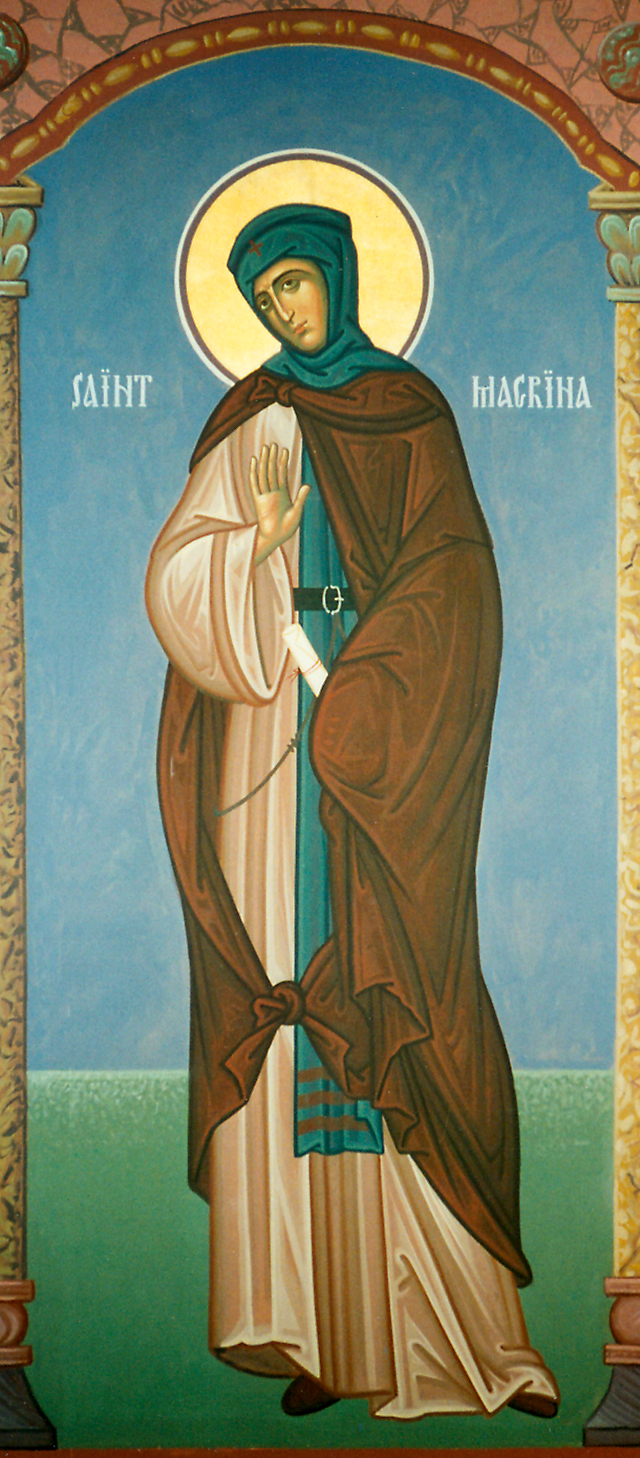
Venerable Macrina, sister of Saint Basil the Great

Saint Macrina was the sister of the holy hierarchs Basil the Great and Gregory of Nyssa, and was born in Cappadocia at the beginning of the fourth century. Her mother, Emilia, saw an angel in a dream, naming her unborn child Thekla, in honor of the holy Protomartyr Thekla. Saint Emilia (January 1) fulfilled the will of God and named her daughter Thekla. Another daughter was named Macrina, in honor of a grandmother, who suffered during the time of persecution under the emperor Maximian Galerius.

Besides Macrina, there were nine other children. Saint Emila herself guided the upbringing and education of her daughter Macrina. She taught her reading and writing in the Scriptural books and Psalms of David, selecting examples from the sacred books which spoke of a pious and God-pleasing life. Saint Emilia taught her daughter to pray and to attend church services. Macrina was also taught the proper knowledge of domestic governance and various handicrafts. She was never left idle and did not participate in childish games or amusements.

When Macrina grew up, her parents betrothed her to a certain pious youth, but the bridegroom soon died. Many young men sought marriage with her, but Macrina refused them all, having chosen the life of a virgin and not wanting to be unfaithful to the memory of her dead fiancé. Saint Macrina lived in the home of her parents, helping them fulfill the household tasks as an overseer together with the servants, and she helped with the upbringing of her younger brothers and sisters. After the death of her father she became the chief support for the family.

When all the children grew up and left the parental home, Saint Macrina convinced her mother, Saint Emilia, to leave the world, to set their slaves free, and to settle in a women’s monastery. Several of their servants followed their example. Having taken monastic vows, they lived together as one family, they prayed together, they worked together, they possessed everything in common, and in this manner of life nothing distinguished one from another.

After the death of her mother, Saint Macrina guided the sisters of the monastery. She enjoyed the deep respect of all who knew her. Strictness towards herself and temperance in everything were characteristic of the saint all her life. She slept on boards and had no possessions. Saint Macrina was granted the gift of wonderworking. There was an instance (told by the sisters of the monastery to Saint Gregory of Nyssa after the death of Saint Macrina), when she healed a girl of an eye-affliction. Through the prayers of the saint, there was no shortage of wheat at her monastery in times of famine.

Saint Macrina died in the year 380, after a final prayer of thanks to the Lord for having received His blessings over all the course of her life. She was buried in the same grave with her parents.

Venerable Dius, Abbot of Antioch

Saint Dius was born in Antioch, Syria towards the end of the fourth century into a pious Christian family. From his youth he was noted for his temperance. He ate food in small quantities, but not every day, and his flesh was humbled by vigil and unceasing prayer. For these deeds the Lord granted Saint Dius dispassion and the gift of wonderworking.

In a vision, the Lord ordered Saint Dius to go to Constantinople and there to serve both Him and the people. Saint Dius settled beyond the city in a solitary place, where people feared to live. Saint Dius bravely contended with the evil spirits which tried to expel him from this place. The Lord heard the prayer of His saint: his staff took root, began to grow and with time was transformed into an immense oak, which stood for a long time even after the death of Saint Dius.

The surrounding inhabitants began to come to the saint for advice and guidance, and they sought healing from illnesses of body and soul. Saint Dius doctored the infirm with prayer, and whatever was offered him he distributed to the poor, the homeless and the sick.

Reports of Saint Dius reached even the emperor Theodosius the Younger. He came to Saint Dius for a blessing together with Patriarch Atticus of Constantinople (406-425). The emperor wanted a monastery to be built on the place of Saint Dius’ efforts, and he provided the means for its construction. The Patriarch ordained the monk as a priest and made him the igumen. Soon numerous monastic brethren gathered to Saint Dius. The monastery was in need of a well, and they dug for a long time without success. Through the prayers of the monk the Lord brought forth a spring of pure water, which soon filled up the entire well. Once, through his prayers, the monk raised up a drowned man. The Lord worked many other miracles through His saint.

In extreme old age Saint Dius became grievously ill. He took his leave of the brethren, received the Holy Mysteries, and lay upon his cot like one dead. At the monastery His Holiness Patriarch Atticus (Comm. on Cheesefare Saturday) came for the funeral service and also Patriarch Alexander of Alexandria, who was then at Constantinople. The holy Elder unexpectedly rose up from his death bed and said, “The Lord has granted me fifteen more years of life.” Great was the joy of the brethren.

Saint Dius did live another fifteen years, helping all with guidance and counsel, healing the sick, and being concerned for the poor and homeless. Shortly before his death, a radiant man in priestly garb appeared to him in the altar of the church and told him of his impending death. Having given thanks to the Lord for this news, Saint Dius quietly died and was buried in his monastery.

Right-believing Prince Roman of Ryazan

The Holy Prince Roman Olegovich of Ryazan was from a line of princes, who during the time of the Tatar (Mongol) Yoke won glory as defenders of the Christian Faith and of their Fatherland. Both his grandfathers perished for the Fatherland in the struggle with Batu.

Raised to love the holy faith (the prince lived in tears and prayers) and his homeland, the prince with all his strength concerned himself about his devastated and oppressed subjects. He defended them from the coercion and plundering of the Khan’s “baskaki” (“tax-collectors”). The “baskaki” hated the saint and they slandered him before the Tatar Khan Mengu-Timur.

Roman Olegovich was summoned to the Horde, where Khan Mengu-Timur declared that he had to choose one of two things: either a martyr’s death or the Tatar faith. The noble prince said that a Christian cannot change from the true Faith to a false one. For his firmness in the confession of faith he was subjected to cruel torments: they cut out his tongue, gouged out his eyes, cut off his ears and lips, chopped off his hands and feet, tore off the skin from his head and, after beheading him, they impaled him upon a spear. This occurred in the year 1270.

The veneration of the royal martyr began immediately with his death. The chronicle says about the saint: “By your suffering, you have gained the Kingdom of Heaven, and a crown from the hand of the Lord, together with your kinsman Michael Vsevolodovich, co-sufferers with Christ for the Orthodox Christian Faith.”

Since 1854, there have been church processions and Moliebens at Ryazan on the Feast day of Saint Roman. A church was consecrated in honor of the holy Prince Roman at Ryazan in 1861.

Venerable Paisius of the Kiev Far Caves

Saint Paisius of the Caves was a monk of the Kiev Caves monastery. From the Canon to the Kiev Caves monks, venerated in the Far Caves, it is known that he was connected by oneness of mind and brotherly love with Saint Mercurius (November 24). Both saints were inseparable, they lived in the same cell, and after death were placed in the same grave. At the present time their relics rest in separate reliquaries.

Blessed Stephen, King of Serbia

Saint Stephen was the son of prince Saint Lazar of Serbia (June 15). In the terrible times of the Turkish Yoke Saint Stephen became the great benefactor of his enslaved countrymen. He built up the city, constructed churches and expended his treasury on the help of the needy. Saint Stephen exceeded many rulers in his wisdom, his charity and his faith. He died peacefully in the year 1427.

Holy Right-believing Princess Militsa of Serbia

Saint Militsa (Milica) was born in 1335, the daughter of Prince Vratko Nemanjić. In Holy Baptism she was named Euphrosynē. Later, she married the Holy Prince Lazarus (Lazar), who was killed during the great Battle of Kosovo (June 15, 1389), which was fought to defend the Holy Church against the Moslems. After her husband's death, she ruled Serbia until her son Stephen the Tall came of age. She also composed several prayers and religious poems, including "A Mother's Prayer" (Молитва матере) and a very touching poem of mourning for her husband, "The Bridegroom of my Widowhood" (Удовству мојему женик).

militsa

Saint Militsa founded Ljubostinja monastery around 1390, and there in 1393, she was tonsured as a nun with the name Eugenia. She was concerned about beginning her monastic life as a widow and about being accepted by the other nuns, whose husbands had also fallen on the battlefield. This inspired her to build and support many monasteries and churches.

At the end of her life, Mother Eugenia was tonsured into the Great Schema with the name Euphrosynē.

After her repose on November 11, 1405, Saint Militsa worked many miracles, and her myrrh-streaming relics healed many sick people.

The Russian Orthodox Church commemorates Saint Militsa on July 19, while the Church of Serbia commemorates her on August 30.

Saint Theodore of Edessa, Mesopotamia

The Saint’s father was named Symeon, and his mother’s name was Maria. He received a good education and was distinguished for his philosophical knowledge, as well as for rhetoric.

At the age of ten he was left as an orphan and gave half of his parents’ wealth to his sister, and kept the other half himself. Sharing this with the poor, he departed for Jerusalem. There he venerated the holy places and, when he was nineteen years old, he became a monk in the Lavra of Saint Savva.

Saint Theodore remained there for twenty-four years, leading an ascetic and virtuous life, and became a renowned ascetic. Hearing of his great virtues, the Patriarch of Jerusalem made him Bishop of Edessa in 836. He was an excellent Archpastor, with his vast theological knowledge, his many virtues, and above all, his great love, which he bestowed abundantly upon his flock. At that time Edessa was plagued with many heresies: Arian, Nestorian, Eutychian, etc. The holy hierarch instructed his flock in the Orthodox Faith in order to combat these errors. Saint Theodore also went to see the Persian king in Babylon, asking him to protect the Orthodox Christians of Edessa from the malevolence of the heretics.

The King was very sick, but the Saint healed him and spoke to him about Christ. After many days the King was baptized with the name John. After returning to Edessa, Saint Theodore was informed in a vision that King John and his three bodyguards, who had been baptized with him, proclaimed their faith openly and received the unfading crown of martyrdom.

Sensing the approach of death, Saint Theodore retired to the Lavra of Saint Savva. After calling the clergy and laity of Edessa together and blessing them, he surrendered his holy soul to the Heavenly Father in the year 848.

Bishop Basil of Emessa wrote the Saint’s life in Greek, which is preserved at the Ivḗron Monastery on Mount Athos.

Daily Readings for Monday, July 18, 2022

6TH MONDAY AFTER PENTECOST

NO FAST

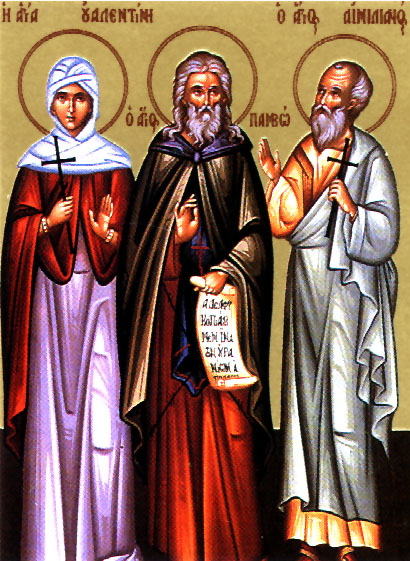
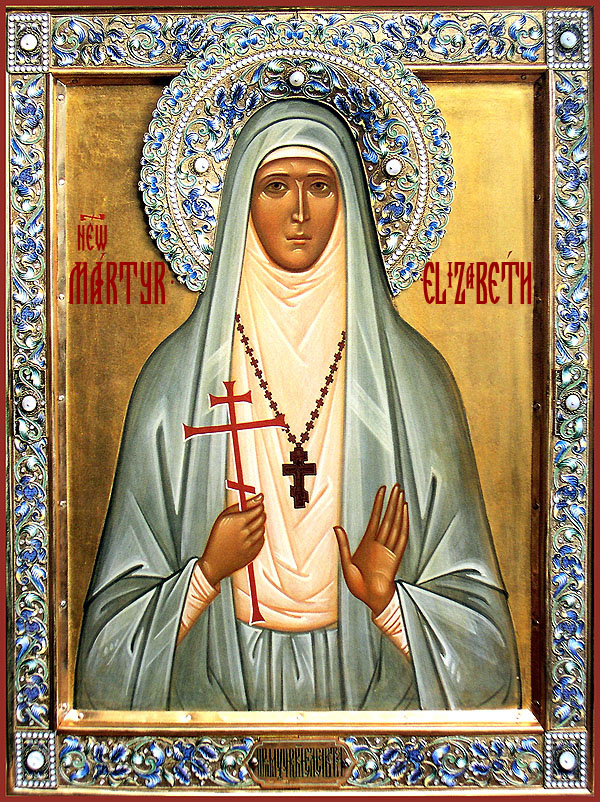
Holy Martyr Emilian, Holy Martyrs Paul, Thea and Valentine, Stephen, Archbishop of Constantinople, Our Holy Father John, Archbishop of Constantinople, Holy New Martyrs Elizabeth the Grand Duchess and the Novice Barbara, Theneva of Glasgow

ST. PAUL’S LETTER TO THE ROMANS 16:17-24

Brethren, I appeal to you to take note of those who create dissensions and difficulties, in opposition to the doctrine which you have been taught; avoid them. For such persons do not serve our Lord Christ, but their own appetites, and by fair and flattering words they deceive the hearts of the simple-minded. For while your obedience is known to all, so that I rejoice over you, I would have you wise as to what is good and guileless as to what is evil; then the God of peace will soon crush Satan under your feet. The grace of our Lord Jesus Christ be with you. Timothy, my fellow worker, greets you; so do Lucius and Jason and Sosipater, my kinsmen. I Tertius, the writer of this letter, greet you in the Lord. Gaius, who is host to me and to the whole church, greets you. Erastos, the city treasurer, and our brother Quartus, greet you. The grace of our Lord Jesus Christ be with you all. Amen.

MATTHEW 13:10-23, 43

At that time, the disciples of Jesus came to him and said to him, "Why do you speak to the crowds in parables?" And he answered them, "To you it has been given to know the secrets of the kingdom of heaven, but to them it has not been given. For to him who has will more be given, and he will have abundance; but from him who has not, even what he has will be taken away. This is why I speak to them in parables, because seeing they do not see, and hearing they do not hear, nor do they understand. With them indeed is fulfilled the prophecy of Isaiah which says: 'You shall indeed hear but never understand, and you shall indeed see but never perceive. For this people's heart has grown dull, and their ears are heavy of hearing, and their eyes they have closed, lest they should perceive with their eyes, and hear with their ears, and understand with their heart, and turn for me to heal them.' But blessed are your eyes, for they see, and your ears, for they hear. Truly, I say to you, many prophets and righteous men longed to see what you see, and did not see it, and to hear what you hear, and did not hear it.
Hear then the parable of the sower. When any one hears the word of the kingdom and does not understand it, the evil one comes and snatches away what is sown in his heart; this is what was sown along the path. As for what was sown on rocky ground, this is he who hears the word and immediately receives it with joy; yet he has no root in himself, but endures for a while, and when tribulation or persecution arises on account of the word, immediately he falls away. As for what was sown among thorns, this is he who hears the word, but the cares of the world and the delight in riches choke the word, and it proves unfruitful. As for what was sown on good soil, this is he who hears the word and understands it; he indeed bears fruit, and yields, in one case a hundredfold, in another sixty, and in another thirty. He who has ears to hear, let him hear.

Martyr Emilian of Silistria in Bulgaria

The Holy Martyr Emilian, who was a Slav, suffered for Christ during the reign of Emperor Julian the Apostate (361-363). Julian wanted to restore the cult of the pagan gods throughout the Roman Empire, and he issued an edict, according to which all Christians who failed to honor the pagan gods would be subject to death.

Saint Emilian lived in the Thracian city of Dorostolum on the banks of the River Dunaj (Danube).The imperial edict was read in the city square, but the people of Dorostolum declared that there were no Christians in the city.

Saint Emilian was a slave of a cruel and fanatical idolater, and was a secret Christian. Some sources state that he was the son of a local officer named Sabbatianus. When the father learned that Emilian believed in Christ, he was so enraged that he insulted him with vulgar words and had him whipped. He pointed out that he could expect even worse things to happen to him if he remained a Christian.

Instead of being intimidated by these threats, Saint Emilian’s faith in Christ was strengthened. The next day he went into a pagan temple and smashed the statues with a hammer.

An angry crowd started to beat a certain Christian, who was passing by. Saint Emilian then shouted out loudly that they should not harm that innocent man, since he himself was the one who had damaged the pagan temple.

The saint was seized and brought to Capitolinus the governor for judgment. In spite of further threats, Saint Emilian would not deny Christ. “He is my Lord, and I will never deny Him,” the martyr exclaimed. The governor ordered that Saint Emilian be beaten mercilessly, and then to be burned alive. He did not perish when he was thrown into the fire, but instead the flames consumed many of the pagans who were standing about. When the fire had gone out, Saint Emilian lay down upon the dying embers, and gave up his soul to the Lord. The wife of the pagan ruler was also a secret Christian, and she gathered up the saint’s relics and buried them. Afterward, a church dedicated to the holy Martyr Emilian was built at Constantinople, where his relics were transferred.

Martyr Hyacinthus of Amastridea

The Holy Martyr Hyacinthus was born into a pious Christian family in the city of Amastridea (now Amastra in Anatolia). An angel which appeared gave him his name. As a three-year-old boy Saint Hyacinthus asked God that a dead infant might be resurrected. The Lord hearkened to his childish prayer, and the dead one arose. Both lads afterwards grew up together, and they lived an ascetic life.

Saint Hyacinthus once noticed how the pagans were worshipping a tree, and so he chopped it down. For this they subjected him to harsh tortures. They smashed out all his teeth, and having bound him with rope, they dragged him along the ground and threw him in prison. It was there that the holy sufferer departed to the Lord.

Venerable John the Long-Suffering of the Kiev Near Caves

Saint John the Much-Suffering pursued asceticism at the Kiev Caves Lavra, accepting many sorrows for the sake of virginity.

The ascetic recalled that from the time of his youth he had suffered much, tormented by fleshly lust, and nothing could deliver him from it, neither hunger nor thirst nor heavy chains. He then went into the cave where the relics of Saint Anthony rested, and he fervently prayed to the holy Abba. After a day and a night the much-suffering John heard a voice: “John! It is necessary for you to become a recluse, in order to weaken the vexation by silence and seclusion, and the Lord shall help you by the prayers of His monastic saints.” The saint settled into the cave from that time, and only after thirty years did he conquer the fleshly passions.

Tense and fierce was the struggle upon the thorny way on which the monk went to victory. Sometimes the desire took hold of him to forsake his seclusion, but then he resolved on still greater effort. The holy warrior of Christ dug out a pit and with the onset of Great Lent he climbed into it, and he covered himself up to the shoulders with ground. He spent the whole of Lent in such a position, but the burning of his former passions did not leave him. The enemy of salvation brought terror upon the ascetic, wishing to expel him from the cave: a fearsome serpent, breathing fire and sparks, tried to swallow the saint. For several days these evil doings continued.

On the night of the Resurrection of Christ the serpent seized the head of the monk in its jaws. Then Saint John cried out from the depths of his heart: “O Lord my God and my Savior! Why have You forsaken me? Have mercy upon me, only Lover of Mankind; deliver me from my foul iniquity, so that I am not trapped in the snares of the Evil one. Deliver me from the mouth of my enemy: send down a flash of lightning and drive it away.” Suddenly a bolt of lightning flashed, and the serpent vanished. A Divine light shone upon the ascetic, and a Voice was heard: “John! Here is help for you. Be attentive from now on, that nothing worse happen to you, and that you do not suffer in the age to come.”

The saint prostrated himself and said: “Lord! Why did You leave me for so long in torment?” “I tried you according to the power of your endurance,” was the answer. “I brought upon you temptation, so that you might be purified like gold. It is to the strong and powerful servants that a master assigns the heavy work, and the easy tasks to the infirm and to the weak. Therefore pray to the one buried here (Moses the Hungarian), he can help you in this struggle, for he did greater deeds than Joseph the Fair” (March 31). The monk died in the year 1160, having acquired grace against profligate passions. His holy relics rest in the Caves of Saint Anthony.

We pray to Saint John for deliverance from sexual impurity.

Venerable Pambo the Recluse of the Kiev Far Caves

Hieromonk Pambo, Hermit of the Kiev Caves, was a confessor for the Faith. Captured while on a monastic obedience, he was taken off by Tatars and for many years suffered from them for his refusal to renounce the Christian Faith. The monk was afterwards miraculously transported from captivity and put within his own cell. He died in seclusion in 1241. His relics rest in the Caves of Saint Theodosius.

Venerable Pambo the Hermit of Egypt

Saint Pambo lived the ascetic life in the Nitrian desert in Egypt. Saint Anthony the Great (January 17) said, that the Monk Pambo by the fear of God inspired within himself the Holy Spirit. And the Monk Pimen the Great (August 27) said: “We beheld three things in Father Pambo: hunger every day, silence and handcrafts”. The Monk Theodore the Studite termed Saint Pambo “exalted in deed and in word.”

At the beginning of his monasticism, Saint Pambo heard the verses from the 38th [39th] Psalm of David: “preserve mine path, that I sin not by my tongue”. These words sank deep into his soul, and he attempted to follow them always. Thus, when they asked him about something, he answered only after long pondering and prayer. He would say, “I must think first, and perhaps I can, in time, give an answer, with God’s help.” Saint Pambo was a model of a lover of work for his disciples. Each day he worked until exhausted, and lived by the bread acquired by his own toil.

The disciples of Saint Pambo became great ascetics: Dioscorus, afterwards Bishop of Hermopolis (this Dioscorus, bishop of Hermopolis, is distinguished from another Dioscorus, an arch-heretic and Patriarch of Constantinople who lived rather later and was condemned by the Fourth Ecumenical Council), and also Ammonius, Eusebius and Euthymius, mentioned in the life of Saint John Chrysostom. One time Saint Melania the Younger (December 31) brought Saint Pambo a large amount of silver for the needs of the monastery, but he did not leave off from his work nor even glance at the money that was brought. Only after the incessant requests of Saint Melania did he permit her to give the alms to a certain monastic brother for distribution to the needs of the monastery. Saint Pambo was distinguished by his humility, but together with this he highly esteemed the vocation of monk and he taught the laypeople to be respectful of monastics, who often converse with God.

It was said that sometimes Saint Pambo’s face shone like lightning, as did the face of Moses. Yet, speaking to the brethren who stood about his deathbed, Saint Pambo said: “I go to the Lord as one who has not yet begun to serve Him.” He died at the age of 70.

Grand Duchess Elizabeth

Saint Elizabeth was the older sister of Tsarina Alexandra, and was married to the Grand Duke Sergius, the governor of Moscow. She converted to Orthodoxy from Protestantism of her own free will, and organized women from all levels of society to help the soldiers at the front and in the hospitals.

Grand Duke Sergius was killed by an assassin’s bomb on February 4, 1905, just as Saint Elizabeth was leaving for her workshops. Remarkably, she visited her husband’s killer in prison and urged him to repent.

After this, she began to withdraw from her former social life. She devoted herself to the Convent of Saints Martha and Mary, a community of nuns which focused on worshiping God and also helping the poor. She moved out of the palace into a building she purchased on Ordinka. Women from the nobility, and also from the common people, were attracted to the convent.

Saint Elizabeth nursed sick and wounded soldiers in the hospitals and on the battle front. On Pascha of 1918, the Communists ordered her to leave Moscow, and join the royal family near Ekaterinburg. She left with a novice, Sister Barbara, and an escort of Latvian guards.

After arriving in Ekaterinburg, Saint Elizabeth was denied access to the Tsar’s family. She was placed in a convent, where she was warmly received by the sisters.

At the end of May Saint Elizabeth was moved to nearby Alopaevsk with the Grand Dukes Sergius, John, and Constantine, and the young Count Vladimir Paley. They were all housed in a schoolhouse on the edge of town. Saint Elizabeth was under guard, but was permitted to go to church and work in the garden.

On the night of July 5, they were all taken to a place twelve miles from Alopaevsk, and executed. The Grand Duke Sergius was shot, but the others were thrown down a mineshaft, then grenades were tossed after them. Saint Elizabeth lived for several hours, and could be heard singing hymns.

The bodies of Saint Elizabeth and Saint Barbara were taken to Jerusalem in 1920, and buried in the church of Saint Mary Magdalene.

Nun-martyr Barbara

Saint Barbara died with Saint Elizabeth on July 5, 1918, the day after the murder of Tsar Nicholas and his family. The two nuns were thrown into a mineshaft, and grenades were tossed in after them. Saint Elizabeth remained alive for several hours, and could be heard singing hymns.

The bodies of Saint Barbara and Saint Elizabeth were taken to Jerusalem in 1920, and buried in the church of Saint Mary Magdalene.

Icon of the Mother of God of Tolga

The Tolga Icon of the Most Holy Theotokos appeared on August 8, 1314 to the Rostov hierarch Prochorus (Tryphon in schema). Going about his diocese, the saint visited the environs of White Lake and from there traveled along the banks of the Rivers Sheksna and Volga, to Yaroslavl. Having stopped with the approach of night 7 versts distant from Yaroslavl, at the right bank of the Volga River there flows opposite into it the River Tolga.

At midnight, when everyone was asleep, the saint awoke and saw a bright light illuminating the area. The light proceeded from a fiery column on the other bank of the river, to which there stretched a bridge. Taking up his staff, the saint went across to the other bank, and having approached the fiery column, he beheld on it the icon of the Most Holy Theotokos, suspended in the air. Astonished at the miracle, the saint prayed for a long time, and when he went back, he forgot to take his staff.

The next day, after serving Matins, when Saint Prochorus was preparing to continue his journey by boat, they began to search for his staff, but they were not able to find it anywhere. The saint then remembered that he had forgotten his staff on the other side of the river, where he had gone across on the miraculous bridge. He then revealed what had occurred, and sent servants across on a boat to the other shore. They came back and reported that in the forest they had seen an icon of the Mother of God suspended in the branches of a tree, next to his bishop’s staff.

The saint quickly crossed over with all his retinue to the opposite shore, and he recognized the icon that had appeared to him. Then after fervent prayer before the icon, they cleared the forest at that place, and put down the foundations of a church. When the people of Yaroslavl learned of this, they came out to the indicated spot. By midday the church was already built, and in the evening the saint consecrated it in honor of the Entrance into the Temple of the Most Holy Theotokos, and having installed the icon there he established a Feast on the day of its appearance. Saint Prochorus later built the Tolga monastery near this church. Saint Prochorus died on September 7, 1328.

The Tolga Icon of the Most Holy Theotokos is also commemorated on August 8.

Hieromartyr Kozman

Over the centuries the monastic complex founded by Saint David of Gareji became a spiritual and cultural center for all of Georgia. Many of the faithful flocked there with a desire to serve Christ.

Among them was the hieromonk Kozman, who would end his earthly life as a martyr.

Few details of the life of Holy Martyr Kozman have been preserved. According to the Georgian catholicos Anton, Saint Kozman was a learned and righteous ascetic, well-versed in the canons of the Orthodox Church.

Saint Kozman composed a set of “Hymns to the Great-Martyr Queen Ketevan” but his work has not been preserved. According to the 19th-century historian Platon Ioseliani, Hieromonk Kozman was taken captive and tortured to death in the year 1630, when the Dagestanis were carrying out a raid on the Davit-Gareji Wilderness.

Daily Readings for Sunday, July 17, 2022

SUNDAY OF THE HOLY FATHERS OF THE 4TH ECUMENICAL COUNCIL

NO FAST

Sunday of the Holy Fathers of the 4th Ecumenical Council, The Holy Great Martyr Marina (Margaret), Veronika & Speratos the Martyrs, Holy Royal Martyrs of Russia, Kenelm, Prince of Mercia

ST. PAUL’S LETTER TO TITUS 3:8-15

Titus, my son, the saying is sure. I desire you to insist on these things, so that those who have believed in God may be careful to apply themselves to good deeds; these are excellent and profitable to men. But avoid stupid controversies, genealogies, dissensions, and quarrels over the law, for they are unprofitable and futile. As for a man who is factious, after admonishing him once or twice, have nothing more to do with him, knowing that such a person is perverted and sinful; he is self-condemned.
When I send Artemas or Tychicos to you, do your best to come to me at Nicopolis, for I have decided to spend the winter there. Do your best to speed Zenas the lawyer and Apollos on their way; see that they lack nothing. And let our people learn to apply themselves to good deeds, so as to help cases of urgent need, and not to be unfruitful.
All who are with me send greeting to you. Greet those who love us in the faith. Grace be with you all. Amen.

MATTHEW 5:14-19

The Lord said to his disciples, “You are the light of the world. A city set on a hill cannot be hid. Nor do men light a lamp and put it under a bushel, but on a stand, and it gives light to all in the house. Let your light so shine before men, that they may see your good works and give glory to your Father who is in heaven. Think not that I have come to abolish the law and the prophets; I have come not to abolish them but to fulfill them. For truly, I say to you, till heaven and earth pass away, not an iota, not a dot, will pass from the law until all is accomplished. Whoever then relaxes one of the least of these commandments and teaches men so, shall be called least in the kingdom of heaven; but he who does them and teaches them shall be called great in the kingdom of heaven.”

Fathers of the First Six Councils

The Commemoration of the Holy Fathers of the First Six Ecumenical Councils.

In the Ninth Article of the Nicea-Constantinople Symbol of Faith proclaimed by the holy Fathers of the First and Second Ecumenical Councils, we confess our faith in “One, Holy, Catholic, and Apostolic Church.” By virtue of the catholic nature of the Church, an Ecumenical Council is the Church’s supreme authority, and possesses the competence to resolve major questions of church life. An Ecumenical Council is comprised of archpastors and pastors of the Church, and representatives of all the local Churches, from every land of the “oikumene” (i.e. from all the whole inhabited world).

The Orthodox Church acknowledges Seven Holy Ecumenical Councils:

The First Ecumenical Council (Nicea I) (May 29, and also on seventh Sunday after Pascha) was convened in the year 325 against the heresy of Arius, in the city of Nicea in Bithynia under Saint Constantine the Great, Equal of the Apostles.

The Second Ecumenical Council (Constantinople I) (May 22) was convened in the year 381 against the heresy of Macedonias, by the emperor Theodosius the Great.

The Third Ecumenical Council (Ephesus) (September 9) was convened in the year 431 against the heresy of Nestorius, in the city of Ephesus by the emperor Theodosius the Younger.

The Fourth Ecumenical Council (Chalcedon) (July 16) was convened in the year 451, against the Monophysite heresy, in the city of Chalcedon under the emperor Marcian.

The Fifth Ecumenical Council (Constnatinople II) (July 25) “Concerning the Three Chapters,” was convened in the year 553, under the emperor Justinian the Great.

The Sixth Ecumenical Council (Constantinople III) (January 23) met during the years 680-681, to fight the Monothelite heresy, under the emperor Constantine Pogonatos.

The fact that the Seventh Ecumenical Council (Nicea II) is not commemorated today testifies to the antiquity of today’s celebration. The Seventh Council, commemorated on the Sunday nearest to October 11, was convened at Nicea in the year 787 against the Iconoclast heresy, under the emperor Constantine and his mother Irene.

The Church venerates the Holy Fathers of the Ecumenical Councils because Christ has established them as “lights upon the earth,” guiding us to the true Faith. “Adorned with the robe of truth,” the doctrine of the Fathers, based upon the preaching of the Apostles, has established one faith for the Church. The Ecumenical Councils, are the highest authority in the Church. Such Councils, guided by the grace of the Holy Spirit, and accepted by the Church, are infallible.

The Orthodox Church’s conciliar definitions of dogma have the highest authority, and such definitions always begin with the Apostolic formula: “It seemed good to the Holy Spirit and to us…” (Acts 15: 28).

The Ecumenical Councils were always convened for a specific reason: to combat false opinions and heresies, and to clarify the Orthodox Church’s teaching. But the Holy Spirit has thus seen fit, that the dogmas, the truths of faith, immutable in their content and scope, constantly and consequently are revealed by the conciliar mind of the Church, and are given precision by the holy Fathers within theological concepts and terms in exactly such measure as is needed by the Church itself for its economy of salvation. The Church, in expounding its dogmas, is dealing with the concerns of a given historical moment, “not revealing everything in haste and thoughtlessly, nor indeed, ultimately hiding something” (Saint Gregory the Theologian).

A brief summary of the dogmatic theology of the First Six Ecumenical Councils is formulated and contained in the First Canon of the Council of Trullo (also known as Quinisext), held in the year 692. The 318 Holy Fathers of the First Ecumenical Council are spoken of in this Canon I of Trullo as having: “with unanimity of faith revealed and declared to us the consubstantiality of the three Persons of the Divine nature and, … instructing the faithful to adore the Father, Son, and Holy Spirit with one worship, they cast down and dispelled the false teaching about different degrees of Divinity.”

The 150 Holy Fathers of the Second Ecumenical Council left their mark on the theology of the Church concerning the Holy Spirit, “repudiating the teaching of Macedonius, as one who wished to divide the inseparable Unity, so that there might be no perfect mystery of our hope.”

The 200 God-bearing Fathers of the Third Ecumenical Council expounded the teaching that “Christ, the Incarnate Son of God is One.” They also confessed that “she who bore Him without seed was the spotless Ever-Virgin, glorifying her as truly the Mother of God.

The 630 Holy Fathers of the Fourth Ecumenical Council decreed that “the One Christ, the Son of God… must be glorified in two natures.”

The 165 God-bearing Holy Fathers of the Fifth Ecumenical Council “in synod anathematized and repudiated Theodore of Mopsuestia (the teacher of Nestorius), and Origen, and Didymus, and Evagrius, renovators of the Hellenic teaching about the transmigration of souls and the transmutation of bodies and the impieties they raised against the resurrection of the dead.”

The 170 Holy Fathers of the Sixth Ecumenical Council “taught that we ought to confess two natural volitions, or two wills [trans. note: one divine, and the other human], and two natural operations (energies) in Him Who was incarnate for our salvation, Jesus Christ, our true God.”

In decisive moments of Church history, the holy Ecumenical Councils promulgated their dogmatic definitions, as trustworthy delimitations in the spiritual battle for the purity of Orthodoxy, which will last until such time, as “all shall come into the unity of faith, and of the knowledge of the Son of God” (Eph. 4: 13). In the struggle with new heresies, the Church does not abandon its former dogmatic concepts nor replace them with some sort of new formulations. The dogmatic formulae of the Holy Ecumenical Councils need never be superseded, they remain always contemporary to the living Tradition of the Church. Therefore the Church proclaims:

“The faith of all in the Church of God hath been glorified by men, which were luminaries in the world, cleaving to the Word of Life, so that it be observed firmly, and that it dwell unshakably until the end of the ages, conjointly with their God-bestown writings and dogmas. We reject and we anathematize all whom they have rejected and anathematized, as being enemies of Truth. And if anyone does not cleave to nor admit the aforementioned pious dogmas, and does not teach or preach accordingly, let him be anathema” (Canon I of the Council of Trullo).

In addition to their dogmatic definitions, the Holy Fathers of the Ecumenical Councils exerted great efforts towards the strengthening of church discipline. Local Councils promulgated their disciplinary canons according to the circumstances of the time and place, frequently differing among themselves in various particulars.

The universal unity of the Orthodox Church required unity also in canonical practice, i.e. a conciliar deliberation and affirmation of the most important canonical norms by the Fathers of the Ecumenical Councils. Thus, according to conciliar judgment, the Church has accepted: 20 Canons from the First, 7 Canons from the Second, 8 Canons from the Third, and 30 Canons from the Fourth Ecumenical Synods. The Fifth and the Sixth Councils concerned themselves only with resolving dogmatic questions, and did not leave behind any disciplinary canons.

The need to establish in codified form the customary practices during the years 451-680, and ultimately to compile a canonical codex for the Orthodox Church, occasioned the convening of a special Council, which was wholly devoted to the general application of churchly rules. This was convened in the year 692. The Council “in the Imperial Palace” or “Under the Arches” (in Greek “en trullo”), came to be called the Council in Trullo. It is also called the “Quinisext” [meaning the “fifth and sixth”], because it is considered to have completed the activities of the Fifth and Sixth Councils, or rather that it was simply a direct continuation of the Sixth Ecumenical Council itself, separated by just a few years.

The Council in Trullo, with its 102 Canons (more than of all the Ecumenical Synods combined), had a tremendous significance in the history of the canonical theology of the Orthodox Church. It might be said that the Fathers of this Council produced a complete compilation of the basic codex from the relevant sources for the Orthodox Church’s canons. Listing through in chronological order, and having been accepted by the Church the Canons of the Holy Apostles, and the Canons of the Holy Ecumenical and the Local Councils and of the holy Fathers, the Trullo Council declared: “Let no one be permitted to alter or to annul the aforementioned canons, nor in place of these put forth, or to accept others, made of spurious inscription” (2nd Canon of the Council in Trullo).

Church canons, sanctified by the authority of the first Six Ecumenical Councils (including the rules of the Seventh Ecumenical Council in 787, and the Constantinople Councils of 861 and 879, which were added later under the holy Patriarch Photius), form the basis of THE RUDDER, or KORMCHAYA KNIGA (a canon law codex known as “Syntagma” or “Nomokanon” in 14 titles). In its repository of grace is expressed a canonical norm, a connection to every era, and a guide for all the local Orthodox Churches in churchly practice.

New historical conditions can lead to the change of some particular external aspect of the life of the Church. This makes creative canonical activity necessary in the conciliar reasoning of the Church, in order to reconcile the external norms of churchly life with historical circumstances. The details of canonical regulation are not fully developed for the various eras of churchly organization all at once. With every push to either forsake the literal meaning of a canon, or to fulfill and develop it, the Church again and again turns for reasoning and guidance to the eternal legacy of the Holy Ecumenical Councils, to the inexhaustable treasury of dogmatic and canonical truths.

Greatmartyr Marina (Margaret) of Antioch in Pisidia

The Holy Great Martyr Marina was born in Asia Minor, in the city of Antioch of Pisidia (southern Asia Minor), into the family of a pagan priest. In infancy she lost her mother, and her father gave her into the care of a nursemaid, who raised Marina in the Orthodox Faith. Upon learning that his daughter had become a Christian, the father angrily disowned her. During the time of the persecution against Christians under the emperor Diocletian (284-305), when she was fifteen years old, Saint Marina was arrested and locked up in prison. With firm trust in the will of God and His help, the young prisoner prepared for her impending fate.

The governor Olymbrios, charmed with the beautiful girl, tried to persuade her to renounce the Christian Faith and become his wife. But the saint, unswayed, refused his offers. The vexed governor gave the holy martyr over to torture. Having beaten her fiercely, they fastened the saint with nails to a board and tore at her body with tridents. The governor himself, unable to bear the horror of these tortures, hid his face in his hands. But the holy martyr remained unyielding. Thrown for the night into prison, she was granted heavenly aid and healed of her wounds. They stripped her and tied her to a tree, then burned the martyr with fire. Barely alive, the martyr prayed: “Lord, You have granted me to go through fire for Your Name, grant me also to go through the water of holy Baptism.”

Hearing the word “water”, the governor gave orders to drown the saint in a large cauldron. The martyr besought the Lord that this manner of execution should become for her holy Baptism. When they plunged her into the water, there suddenly shone a light, and a snow-white dove came down from Heaven, bearing in its beak a golden crown. The fetters put upon Saint Marina came apart by themselves. The martyr stood up in the fount of Baptism glorifying the Holy Trinity, Father, Son, and Holy Spirit. Saint Marina emerged from the fount completely healed, without any trace of burns. Amazed at this miracle, the people glorified the True God, and many came to believe. This brought the governor into a rage, and he gave orders to kill anyone who might confess the Name of Christ. 15,000 Christians perished there, and the holy Martyr Marina was beheaded. The sufferings of the Great Martyr Marina were described by an eyewitness of the event, named Theotimos.

Up until the taking of Constantinople by Western crusaders in the year 1204, the relics of the Great Martyr Marina were in the Panteponteia monastery. According to other sources, they were located in Antioch until the year 908 and from there transferred to Italy. Now they are in Athens, in a church dedicated to the holy Virgin Martyr. Her venerable hand was transferred to Mount Athos, to the Batopedi monastery.

Venerable Irenarchus, Abbot of Solovki

Saint Irenarchus of Solovki accepted tonsure at the Solovki monastery, and in his monastic life he zealously imitated the Monks Zosimus (April 17) and Sabbatius (September 27). In 1614, after the death of the igumen Anthony, Irenarchus became his successor. During these times the Solovki monastery held tremendous significance in the defense of Northern Russia from the Swedes and the Danes. The new igumen did much to fortify the monastery. Under the Monk Irenarchus there was constructed a stone wall with turrets, deep ditches dug, and with stones spread out.

Concerned about the external dangers to the monastery, the monk also devoted much attention to fortifying it inwardly and spiritually. Very humble and meek, constantly immersed in thoughts of God, he was zealous for supporting in the monks a true monastic spirit. Under the spiritual guidance of Saint Irenarchus at the Solovki monastery there matured many worthy ascetics. With the blessing of the igumen and under his assistant, Saint Eleazar (January 13), a friend and co-ascetic of the venerable Irenarchus, founded a skete monastery on Anzersk Island.

In an imperial document to the Solovki monastery in the year 1621, the monks were bidden “to live according to the rules of the holy Fathers… and in full obedience to their igumen (Irenarchus) and the elders”.

The last two years of the monk’s life were spent in silent prayer, and he reposed on July 17, 1628.

Translation of the relics of Venerable Lazarus of Mount Galesius near Ephesus

Saint Lazarus the Wonderworker of Mount Galesius near Ephesus was born in Lydia, in the city of Magnesia. An educated young man who loved God, Lazarus became a monk at the monastery of Saint Savva, the founder of great ascetic piety in Palestine. He spent ten years within the walls of the monastery, winning the love and respect of the brethren for his intense monastic struggles.

Ordained to the holy priesthood by the Patriarch of Jerusalem, Saint Lazarus returned to his native country and settled near Ephesus, on desolate Mount Galesius. Here he saw a wondrous vision: a fiery pillar, rising up to the heavens, was encircled by angels singing, “Let God arise and let His enemies be scattered.”

On the place where the saint beheld this vision, he built a church in honor of the Resurrection of Christ and took upon himself the feat of pillar-dwelling. Monks soon began to flock to the great ascetic, thirsting for spiritual nourishment by the divinely-inspired words and blessed example of the saint, and a monastery was established there.

Having received a revelation about the day of his death, the saint told the brethren. Through the tearful prayers of all the monks, the Lord prolonged the earthly life of Saint Lazarus for another fifteen years.

Saint Lazarus died at 72 years of age, in the year 1053. The brethren buried the body of the saint at the pillar upon which he had struggled in asceticism. He was glorified by many miracles after his death.

Saint Lazarus is also commemorated on November 7.

Royal Passionbearers Tsar Nicholas (Nikolai), Tsaritsa Alexandra, Tsarevich Aleksy, Grand Duchesses Olga, Tatiana, Maria, Anastasia

Saint Nicholas, the last Russian Tsar, was born in 1868. As a child, he was very religious, guileless and free from malice.

Nicholas II was crowned as Tsar in 1894, following the death of his father Tsar Alexander. He began his reign with lofty hopes for peace, urging other nations to reduce the size of their armies, and to seek the peaceful settlement of international disputes. The Peace Conference at the Hague in 1899 laid the groundwork for the League of Nations and the United Nations.

He married Princess Alice of Hesse, who converted to Orthodoxy and took the name Alexandra. Their children were Olga (1895), Tatiana (1897), Maria (1899), Anastasia (1901), and Alexis (1904).

The glorification of Saint Seraphim of Sarov took place on July 19, 1903, and Tsar Nicholas attended the ceremonies at Sarov with his family. At that time he was given a letter written by Saint Seraphim more than seventy years before, which seemed to disturb him. Although the Sovereign never revealed the letter’s contents, it is believed that it was a prophecy of the bloodshed that would engulf Russia in less than fifteen years.

Saint Nicholas was executed by the Bolsheviks at Ekaterinburg on July 4, 1918 along with his family and servants. The prisoners were awakened late at night and ordered to get dressed for travel. They went down to the cellar of the home in which they were being held, waiting for the word to leave. The Tsar sat on a chair in the middle of the room holding his son Alexis in his lap, while his wife and daughters stood around them.

The executioners entered the room and read out the order for their execution. Saints Nicholas and Alexandra died under the hail of bullets, but the children did not die right away. They were stabbed and clubbed with the butts of rifles. Their bodies were taken to an abandoned mine, cut into pieces, then piled in front of the mine. Sulphur and gasoline were poured on the bloody mound and set on fire. When the fire went out two days later, whatever remained of the bodies was thrown into the mine and grenades were tossed into it. Then the ground was plowed so that no trace of the disposal of the bodies remained.

Venerable Leonid of Ustnedumsk

Saint Leonid of Ustnedumsk lived in the Poshekhonsk district of Vologda, and he was a farmer by occupation. At age fifty, he saw the Mother of God in a dream, Who directed him to go to the River Dvina to the Morzhevsk Nikolaev hermitage. He was to take from there the Hodēgḗtria Icon of the Mother of God, and build a church for it at the River Luz and Mount Turin.

Saint Leonid decided not to follow the advice of this vision, thinking it simply a dream, and considering himself unworthy. He went to the Kozhe Lake monastery, accepting monastic tonsure there and spending about three years at work and ascetical efforts. From there he transferred to the Solovki monastery and labored there in the bakery.

The miraculous vision was repeated, and Saint Leonid was advised not to oppose God’s will. The venerable one then set off to the Morzhevsk hermitage, and after a year he told Igumen Cornelius (1599-1623) about the command of the Mother of God. Having received from the abbot both a blessing and the Hodēgḗtria icon, the monk reached the River Luz near Mount Turin, 80 versts from the city of Ustiug, and he built himself a hut from brushwood. The local people, fearing that their land would be taken from them for the saint’s monastery, compelled him to resettle up the river in a marshy wilderness spot.

At 30 versts from the city of Lalsk, the Elder constructed a cell and set about building a monastery. For draining the marshes, the ascetic dug three canals, about 2 kilometers in length, from the River Luz to Black Lake, and from Black Lake to Holy Lake, and from there to the Black Rivulet. During this time of heavy work he was bitten by a poisonous snake. Entrusting himself to the will of God, Saint Leonid decided not to seek medical treatment, nor did he think of the consequences. He went to sleep and woke up healthy. In gratitude to the Lord for His mercy, he called the canal the “Nedumaya Reka” (“Unplanned River”), and his monastery the “Ustnedumsk” (“the mouth of the Nedumaya”) monastery.

With the blessing of the Metropolitan Philaret of Rostov (afterwards the Patriarch of All-Russia, 1619-1633), Saint Leonid was ordained hieromonk in 1608. In the newly-built church in honor of the Entrance of the Most Holy Theotokos into the Temple, Hieromonk Leonid installed the Hodēgḗtria icon, as the Mother of God commanded him. Because of his difficult labors on the frontier, called the “Luzsk Permtsa”, which means “the pocket-land of the wild Permians”, it is fitting that Saint Leonid is venerated as one of the first enlighteners of these remote lands.

The monk had many struggles with the severe and inhospitable forces of nature. Although his canal-system had drained the marsh, in times of floodings the River Luz engulfed the monastery. Towards the end of his life the tireless worker undertook construction on a point of land at Black Lake. At the new site a church was built and consecrated in 1652. Saint Leonid died at age 100, on July 17, 1654. He was buried at the monastery church, where for a long time his coarse and heavy hair-shirt was preserved, a reminder of the ascetic toils of the holy saint.

There is a Troparion to Saint Leonid, and his holy icons are in churches at the places of his struggles.

Icon of the Mother of God of Sviatogorsk

The Sviatogorsk Icon of the Mother of God is from the Sviatogorsky Monastery in the province of Pskov. In the year 1563, during the time of Ivan the Terrible, in the environs of Pskov a “Tenderness” Icon of the Most Holy Theotokos appeared to a fifteen-year-old shepherd and fool named Timothy, not far from the stream Lugovitsa. This icon was thereafter situated in the Voronicha parish church of Saint George. The voice from the icon said that after six years the grace of God would shine forth upon this hill.

In 1569 to this same youth upon the Sinicha hill, there appeared a Hodēgḗtria icon of the Mother of God upon a pine tree. Timothy spent forty days at this place in fasting and prayer. The miraculous voice from the icon commanded that the clergy and the people should come to the Sinicha heights with the Tenderness icon on the Friday following the Sunday of All Saints.

When the church procession reached the hill and began the Molieben, a light suddenly shone during the reading of the Gospel. The air was filled with fragrance and everyone saw upon the pine tree the Hodēgḗtria icon. Both holy icons, the Hodēgḗtria and the Tenderness, were put into the church of the Great Martyr George. From them many miraculous signs and healings took place, about which reports were made to Tsar Ivan IV. Through his decree, upon the Sinicha Hill, called from that time the “Svyata” (“Holy”), a chapel was built, into which were transferred the wonderworking icons. But soon, on the Feast of the Protection of the Most Holy Theotokos, when a church procession with icons went to Holy Hill, the chapel suddenly burned that night. The fire destroyed everything else inside, but the holy things remained unharmed.

On this sacred spot they built a stone church in honor of the Dormition of the Most Holy Theotokos, the altar of which stood on the place where the Hodēgḗtria icon had appeared. Both glorified icons were placed into the lower tier of the iconostas: the Hodēgḗtria on the right side (a chapel in honor of which was built in 1770), and the Tenderness on the left (a chapel was built in 1776).

In that same year of 1569 on Holy Hill was founded the Sviatogorsk (“Holy Hill”) Dormition monastery.

Every year, on the first Friday of the Peter and Paul Fast, the icons are conveyed to the Trinity cathedral of the city of Pskov. On the following Sunday, a procession is made with them along the inner walls of the city.

The celebration in honor of the Tenderness icon is March 19, and on the ninth Friday after Pascha. The Hodēgḗtria icon is commemorated on July 17, and on the Feast of the Protection of the Most Holy Theotokos (October 1).

Daily Readings for Saturday, July 16, 2022

5TH SATURDAY AFTER PENTECOST

NO FAST

Athenogenes the Holy Martyr of Heracleopolis, Julia the Virgin-martyr of Carthage, 1, 015 Martyrs in Pisidia, Helier the Hermit, Martyr of Jersey

ST. PAUL’S LETTER TO THE ROMANS 8:14-21

Brethren, all who are led by the Spirit of God are sons of God.
For you did not receive the spirit of slavery to fall back into fear, but you have received the spirit of sonship. When we cry, "Abba! Father!" it is the Spirit himself bearing witness with our spirit that we are children of God, and if children, then heirs, heirs of God and fellow heirs with Christ, provided we suffer with him in order that we may also be glorified with him.
I consider that the sufferings of this present time are not worth comparing with the glory that is to be revealed to us. For the creation waits with eager longing for the revealing of the sons of God; for the creation was subjected to futility, not of its own will but by the will of him who subjected it in hope; because the creation itself will be set free from its bondage to decay and obtain the glorious liberty of the children of God.

MATTHEW 9:9-13

At that time, as Jesus passed on, he saw a man called Matthew sitting at the tax office; and he said to him, "Follow me." And he rose and followed him.
And as he sat at table in the house, behold, many tax collectors and sinners came and sat down with Jesus and his disciples. And when the Pharisees saw this, they said to his disciples, "Why does your teacher eat with tax collectors and sinners?" But when he heard it, he said, "Those who are well have no need of a physician, but those who are sick. Go and learn what this means, 'I desire mercy, and not sacrifice.' For I came not to call the righteous, but sinners to repentance.

Hieromartyr Athenogenes, Bishop of Heracleopolis, and his ten disciples

Hieromartyr Athenogenes and his Ten Disciples suffered for Christ during the persecution of Christians in the city of Sebastea in Cappadocia. The governor Philomachos arranged a large festival in honor of the pagan gods and called upon the citizens of Sebastea to offer sacrifice to the idols. Most of the inhabitants of Sebastea were Christians, and refused to participate in the impious celebration. Soldiers were ordered to kill those who resisted, and so many Christians received a martyr’s crown.

It came to the governor’s attention that Christianity was spreading because of the grace-filled preaching of Bishop Athenogenes. Soldiers were ordered to find the Elder and arrest him. Bishop Athenogenes and ten of his disciples lived in a small monastery not far from the city. The soldiers did not find the bishop there, so they arrested his disciples. The governor ordered that they be bound with chains and thrown into prison.

Saint Athenogenes was arrested when he came to Sebastea to inform the judge that those who had been jailed were innocent. While in prison, Saint Athenogenes encouraged his spiritual children for their impending struggle. Led forth to trial, all the holy martyrs confessed themselves Christians and refused to offer sacrifice to idols.

After undergoing fierce tortures, the disciples of the holy bishop were beheaded. After the execution of the disciples, the executioners were ordered to torture the bishop. Strengthened by the Lord, Saint Athenogenes underwent the tortures with dignity. His only request was that he be executed in the monastery.

Taken to his own monastery, the saint gave thanks to God, and he rejoiced in the sufferings that he had undergone for Him. Saint Athenogenes asked that the Lord would forgive the sins of all those who would remember both him and his disciples.

The Lord granted the saint to hear His Voice before death, announcing the promise given to the penitent thief: “Today you shall be with Me in Paradise.” The hieromartyr willingly bent his neck beneath the sword.

Martyrs Paul and two sisters, Chionia (Thea) and Alevtina (Valentina), at Cæsarea in Palestine

The Holy Martyrs Paul, Alevtina, and Chionia were from Egypt. During the persecution against Christians under the emperor Maximian (305-313), they were taken to Palestinian Caesarea. Without the slightest fear they confessed themselves as followers of Christ. In the year 308 the sisters Alevtina and Chionia were burned, and Paul was beheaded.

Martyr Antiochus the Physician of Sebaste

The Holy Martyr Antiochus, a native of Cappadocian Sebastea, was the brother of the holy Martyr Platon (November 18), and he was a physician. The pagans learned that he was a Christian, and they brought him to trial and subjected him to fierce tortures. Thrown into boiling water, the saint remained unharmed. He was then given over to be eaten by wild beasts, but they did not harm him. Instead, the beasts lay peacefully at his feet.

Through the prayers of the martyr many miracles were worked and the idols crumbled into dust. The pagans beheaded Saint Antiochus. Seeing the guiltless suffering of the saint, Cyriacus, a participant in the execution, was converted to Christ. He confessed his faith in front of everyone and was also beheaded. They buried the martyrs side by side.

Virgin Martyr Julia of Carthage

The Virgin Martyr Julia was born in Carthage into a Christian family. While still a girl she was captured by the Persians. They carried her off to Syria and sold her into slavery. Fulfilling the Christian commandments, Saint Julia faithfully served her master. She preserved herself in purity, kept the fasts and prayed much to God. No amount of urging by her pagan master could turn her to idolatry.

Once the master set off with merchandise for Gaul and took Saint Julia with him. Along the way the ship stopped over at the island of Corsica, and the master decided to take part in a pagan festival, but Julia remained on the ship. The Corsicans plied the merchant and his companions with wine, and when they had fallen into a drunken sleep, they took Julia from the ship. Saint Julia was not afraid to acknowledge that she was a Christian, and the savage pagans crucified her.

An angel of the Lord reported the death of the holy martyr to the monks of a monastery, located on a nearby island. The monks took the body of the saint and buried it in a church in their monastery.

In about the year 763 the relics of the holy Martyr Julia were transferred to a women’s monastery in the city of Breschia (historians give conflicting years of the death of the saint: as either the fifth or seventh century).

New Martyr John of Trnovo

No information available at this time.

Icon of the Mother of God of Chirsk-Pskov

In the XV century, in the territory of the Pskov principality, there was a certain village called Chirsk, or Chersk, where, in the church of the Nativity of Christ, there was a Hodēgḗtria Icon of the Mother of God. In 1420, during the reign of Tsar Basil I of Moscow, and when Archbishop Simeon occupied the See of Novgorod and Pskov, a great disaster broke out over the Pskov region – the plague. People were despondent and sought solace and comfort by praying to God and the Queen of Heaven for help.

On July 16, 1420, as a consolation for the faithful and the encouragement of the faint-hearted, a great Sign took place in the church of the Nativity of Christ at Chirsk: tears flowed from the eyes of the Mother of God on the Icon. News of the miracle spread quickly among the inhabitants of that region, and they began to flock in large numbers to venerate the newly glorified Icon.

Soon Prince Theodore of Pskov was informed of this, so he sent priests to Chirsk, along with many noble and devout persons, with orders to take this Icon and bring it to Pskov. With reverence and solemnity, they obeyed the command of their Prince. At Pskov, when it was learned that the holy Icon was nearing the city, Prince Theodore went out to meet it, with all the clergy and people.

This moment of the meeting was marked by an amazing new miracle: tears began to flow again from the eyes of the Mother of God, even more copiously than before, which was witnessed by all those who were present. The people, trembling at the sight, fell to the ground with tears, crying out: "Lord, have mercy! O Most Holy Sovereign Lady Theotokos, do not forsake us, but help us, your sinful and unworthy servants, and save us!"

The Cross Procession came to a halt, and the priests who carried the Icon served a Moleben of thanksgiving. This wonderworking Icon was brought into the city of Pskov and was placed in the cathedral church of the Life-Giving Trinity, where it remains to this day. Every year, on the Feast of Mid-Pentecost, the Icon is taken from Holy Trinity Cathedral and carried around the city.

The Holy Apostle and Evangelist Luke and Saint Theodosios of the Kiev Caves are depicted on the reverse of the Icon.

Daily Readings for Friday, July 15, 2022

THE HOLY MARTYRS CYRICUS AND HIS MOTHER JULITTA

ABSTAIN FROM MEAT, FISH, DAIRY, EGGS, WINE, OLIVE OIL

The Holy Martyrs Cyricus and His Mother Julitta, Vladimir, Equal-to-the-Apostles of Kiev, The Finding of the Head of St. Matrona of Chios, Donald and his Nine Daughters, Swithun, Bishop of Winchester

ST. PAUL’S FIRST LETTER TO THE CORINTHIANS 13:11-14; 14:1-5

BRETHREN, when I was a child, I spoke like a child, I thought like a child, I reasoned like a child; when I became a man, I gave up childish ways. For now we see in a mirror dimly, but then face to face. Now I know in part; then I shall understand fully, even as I have been fully understood. So faith, hope, love abide, these three; but the greatest of these is love. Make love your aim, and earnestly desire the spiritual gifts, especially that you may prophesy. For one who speaks in a tongue speaks not to men but to God; for no one understands him, but he utters mysteries in the Spirit. On the other hand, he who prophesies speaks to men for their upbuilding and encouragement and consolation. He who speaks in a tongue edifies himself, but he who prophesies edifies the church. Now I want you all to speak in tongues, but even more to prophesy. He who prophesies is greater than he who speaks in tongues, unless some one interprets, so that the church may be edified.

MATTHEW 17:24-27; 18:1-4

At that time, the collectors of the half-shekel tax went up to Peter and said, "Does not your teacher pay the tax?" He said, "Yes." And when he came home, Jesus spoke to him first, saying, "What do you think, Simon? From whom do kings of the earth take toll or tribute? From their sons or from others?" And when he said, "From others, " Jesus said to him, "Then the sons are free. However, not to give offense to them, go to the sea and cast a hook, and take the first fish that comes up, and when you open its mouth you will find a shekel; take that and give it to them for me and for yourself." At that time the disciples came to Jesus, saying, "Who is the greatest in the kingdom of heaven?" And calling to him a child, he put him in the midst of them, and said, "Truly, I say to you, unless you turn and become like children, you will never enter the kingdom of heaven. Whoever humbles himself like this child, he is the greatest in the kingdom of heaven.

Holy Great Prince Vladimir (Basil in Baptism), Equal of the Apostles, and Enlightener of Rus'

The Holy Equal of the Apostles and Great Prince Vladimir, the youngest son of Prince Svyatoslav of Kiev, was born in 963. He was only six years old when his grandmother, the Holy Princess Olga (July 11), who had raised him, reposed, and his father sent him to reign in Novgorod under the tutelage of the voivode Dobryn, his mother's brother. Princess Malusha, who still bore her Scandinavian name Malchrid, was a Christian. After Saint Vladimir converted to Christianity and founded the church of the Tithes at Kiev, she donated her estate to it.

Saint Olga's son Prince Svyatoslav was killed in battle with the Pechenegs three years after his mother's repose. Then his sons' tutors fought a war among themselves. Christian Kiev and pagan Novgorod struggled for supremacy. After the death of his father Svyatoslav in 972, Prince Vladimir of Novgorod was forced to flee to Scandinavia in 976, Vladimir's brother Yaropolk murdered his other brother Oleg of Drelinia and conquered Rus'. For the rest of his life Prince Vladimir mourned their deaths.

At the age of seventeen he began to rule on his own. He spent the first six years of his reign on military campaigns, leading his army personally, reconquering Novgorod from Yaropolk. By 980, Vladimir had consolidated the territory of Kievan Rus' from what is now Belarus, Russia, and Ukraine to the Baltic Sea. In addition, he strengthened the frontiers against the incursions of Bulgarians, Baltic tribes, and Eastern nomads.

All the Slavic tribes from the Carpathians and the Neman, and the city of Gorodyon (Grodno) to Beloozero, Anka and Volga united to form a single whole – the Russian land (Русскую землo), and they were called Russians. In gratitude for his victory at Kiev he set up idols of pagan gods – Perun and Beles – and offered them human sacrifices. In ancient times, the Slavs did not have idols and sacrifices, but adopted them much later from other pagan lands.

In the VI century, the Greeks said of them: "They recognize one God as the Ruler of the whole world." He was called Svarog, which means "blue sky." Perun, Veles, and other, lesser deities were thought to be his children. The Slavs believed in the immortality of the soul and in the afterlife, which predisposed them toward Christianity.

In the year 860 the Russians attacked Constantinople from the sea, but the Greeks immersed the robe of the Most Holy Theotokos in the ocean. The sea became agitated, and the Russian ships were swept away and retreated. After that, they sent an embassy to Constantinople to request Baptism. This was the first Baptism of Rus'.

Also in 860 Saint Cyril, the enlightener of the Slavs, baptized 200 families in the southern Russian steppes. He made his own translation of the Gospel and the Psalter. Metropolitan Michael was sent to care for the converts, and the Prince gathered the people and called them to be baptized. The elders agreed, but they demanded a miracle. They wanted a Gospel book to be thrown into the fire without being burnt. The Gospel was thrown in, the miracle occurred, and the people were baptized. This was the second Baptism of Rus'.

The third took place under Princess Olga. By that time, there were already many Christians in Kiev and there was a church dedicated to the Prophet Elijah. After Saint Olga's repose, the spread of Christianity was halted temporarily, but not for long. The time of Prince Vladimir had come.

In those days, Kiev was a large trading city. Merchants came from all over the world, as well as preachers of various religions. Saint Vladimir wanted to unite his people, not just under one government, but also under one Faith. The Prince sent envoys to various countries to see which religion would be most suitable for his people. When Vladimir's emissaries returned from Constantinople, they told him that when they stood in the church of Hagia Sophia (Holy Wisdom), they did not know "whether they were on earth or in heaven."

Kiev was located on a great waterway from the Varangian region to Constantinople; that is, from Scandinavia to the Byzantine Empire. The proximity of Orthodox Constantinople may have influenced Saint Vladimir, and the memory of Christianity, recently destroyed by Svyatoslav, was revived. According to the XI century writer Jacob Mnikh, the young Prince Vladimir remembered the example of his grandmother, Princess Olga, "the wisest of men," as she was called by her contemporaries. Furthermore, he could not help being influenced by the example of his mother, the Christian Princess Malusha, as well. The heroic death of Holy Protomartyrs Theodore and his son John (July 12) in 983 also made a lasting impression on him.

In one Icelandic saga it is said that in his youth, King Olaf of Norway had lived for a long time at the court of "the Gardarikian king Vol'demar" (Gardarika, that is, the land of cities. The Scandinavians called it Northwestern Russia). When he reached adulthood, he left there on military campaigns, according to the custom of the Scandinavians of that time. While upon the sea, he heard a heavenly voice calling him to Constantinople, where he would come to know the only true God. There he was baptized, and on the way back, he stopped to see King Vol'demar and urged him to convert to Christianity. When he returned from his campaign as a Christian, King Olaf encouraged his people to be baptized.

Prince Vladimir, however, was still a pagan, and he adhered to pagan customs. He also had five wives. How he was brought to Christ, and how his conversion was took place, remains a mystery.

Metropolitan Hilarion († 1053) in his "Word of Law and Grace," addressed the departed Great Prince Vladimir, saying, "How did you believe? How was your mind moved to love what is unseen, and to strive for heavenly things? You have not seen any Apostle who, after coming to your land, inclined your heart to humility. Guided only by your kind heart and sharp mind, you realized that there is one God."

He continued: "Upon him came a visitation of the Most High, and the eye of the All-Merciful God looked upon him; and a thought shone forth in his heart – he realized the futility of idol worship, and sought the one God, the Creator of all things, both visible and invisible. He had heard about the Orthodox, and the strong Christ-loving faith of the Byzantine Empire, who honor the one God in Trinity, and worship Him. When he heard all this, he was aflame in spirit, and with all his heart he longed to be a Christian, and to convert his entire land to Christianity."

As to the reason for the conversion of Saint Vladimir to Christ, another writer of the XI century, Saint Nestor the Chronicler (October 27) states in his Life of Saints Boris and Gleb: "In those years there was a Prince named Vladimir, who ruled the Russian land. He was righteous and merciful to the poor, to orphans, and to widows, but he was a pagan. God intervened and made him a Christian, just like Saint Eustathios Plakidas (September 20). So Prince Vladimir became a Christian, receiving the name Basil at his Baptism."

Although Venerable Nestor the Chronicler pointed out that the Holy Prince Vladimir's experience was similar to that of Saint Eustathios, the exact details are not known. Meanwhile, by the will of God, external events led Saint Vladimir to the fulfillment of his desire. The Byzantine Emperors Constantine and Basil asked Vladimir to help them put down the revolt of Phokas. Vladimir agreed, but asked for the hand of Princess Anna Porphyrogenita, in return. The Emperors agreed, and sent clergy and the sacred utensils required for the Baptism of Rus'.

But when Vladimir defeated Phokas, they did not fulfill their obligations. Then Vladimir conquered Korsun, thereby forcing the Emperors to keep their promise. He returned Korsun to the Greeks as a ransom for his bride. His army was baptized and, according to the "Tale of the Baptism of Russia," he himself was baptized. This was in 988, and the Chronicle says that before Baptism he became blind, but received his sight when he came out of the water. However, Jacob Mnikh (XI century) writes that Vladimir captured Korsun when he was already a Christian, and that he was baptized in 987 at his estate Vasiliev (now Vasilkov).

When Prince Vladimir returned to Kiev, the Orthodox priests who came with him were obviously Bulgarians (Bulgaria was then subject to the Byzantine Empire). They baptized the people of Kiev at the confluence of the river, then called Khreshchatyk, with the Dnieper. They brought with them liturgical books translated into Slavonic by Saints Cyril and Methodios (May 11), the enlighteners of the Slavs. With them was Metropolitan Michael of Kiev (June 15, September 30). At Kiev, where people had heard of Christianity, the Faith was quickly established. In the north, at Novgorod, Rostov, and Murom, paganism lasted longer, and it took a great deal of effort for princes and preachers to uproot it.

Prince Vladimir was twenty-five years old at the Baptism of Rus'. With all the fervor of youth, he began to fulfill the precepts of Christ, especially those about helping the poor, sick and disadvantaged. This assistance was provided on a large scale. Throughout Russia, the poor were sought and were given everything they needed, and the sick also received treatment. During Saint Vladimir's reign, the state served the people, which was very unusual in those days. In ancient times there was no death penalty in Russia. Instead, there was a "penalty," that is, a monetary fine. Saint Vladimir confirmed this custom, saying: "I am afraid of sin." This custom became law and entered the Code of Laws compiled under his son, Great Prince Yaroslav under the name "Russkaya Pravda."

The people loved their Prince, praising him in songs and epics, calling him the Red Sun. Saint Vladimir summoned the elders of the people from all over Russia for meetings and provided feasts for them. The memory of these feasts is also preserved in the epics. He built new cities, such as Volodymyr-Volynsky (where his palace once stood), Vladimir in the land of Suzdal, and others. He strengthened the boundaries of his possessions as a defense against the neighboring pagan tribes. In order to unite Russia, he sent his sons to rule in different cities: at Rostov, Murom, Novgorod, Polotsk, and other places. Soon the influence of the Varangians began to wane, and the importance of the Slavs increased. In Kiev, at the place where the Russian Protomartyrs Theodore and John were murdered, he built the church of the Tithes and dedicated it to the Dormition of the Most Holy Theotokos, donating a tenth of his income for its upkeep.

The Holy Prince Vladimir reposed on July 15, 1015 in his beloved village of Berestov and was buried in the church of the Tithes. A piece of his holy relics was kept in Holy Wisdom Cathedral, established by his son, Great Prince Yaroslav the Wise.

The Feast Day of Saint Vladimir was instituted by Saint Alexander Nevsky (November 23) after May 15, 1240, because of Saint Vladimir's help and intercession at Saint Alexander's renowned victory over the Crusaders at the Neva River. In Russia, the Church veneration of the Holy Prince began much earlier. In Saint Hilarion's "Word of Law and Grace," the holy Prince is called "an apostolic sovereign," similar to Saint Constantine (May 20); and his evangelization of the Russian land is likened to the preaching of the Gospel by the Holy Apostles.

Saint Vladimir is commemorated on July 15 (the day of his repose) and on the second Sunday of Great Lent, along with the Synaxis of the Venerable Fathers of the Kiev Caves, and all Saints who shone forth in Little Russia.

Martyr Cyricus (Quiricus) and his mother, Julitta, of Tarsus

The Holy Martyrs Cyricus and Julita lived in the city of Iconium in the province of Lykaoneia in Asia Minor. Saint Julita was descended from an illustrious family and was a Christian. Widowed early on, she raised her three-year old-son Cyricus (Quiricus). During the emperor Diocletian’s persecution of Christians, Saint Julita departed the city with her son and two trustworthy servants, leaving behind her home, property, and servants.

Concealing her noble rank, she hid out first at Seleucia, and then at Tarsus. There around the year 305 she was recognized, arrested and brought to trial before the governor, Alexander. Strengthened by the Lord, she fearlessly answered the judge’s questions, and firmly confessed her faith in Christ.

The governor gave orders to beat the saint with rods. During her torments Saint Julita kept repeating, “I am a Christian, and will not offer sacrifice to demons.”

The little boy Cyricus cried, seeing his mother being tortured, and wanted to go to her. The governor Alexander tried to sit him on his lap, but the boy broke free and shouted, “Let me go to my mother, I am a Christian.” The governor threw the boy down from the high tribunal and kicked him down the stone steps. The boy struck his head on the sharp edges and died.

Saint Julita, seeing her lacerated son, gave thanks to God that He had permitted her child to be perfected before her, and to receive the unfading crown of martyrdom. After many cruel tortures Saint Julita was beheaded with a sword.

The relics of Saints Cyricus and Julita were uncovered during the reign of Saint Constantine the Great (May 21). A monastery was built near Constantinople in honor of these holy martyrs, and a church was built not far from Jerusalem.

We pray to Saints Cyricus and Julita for family happiness, and the restoration of sick children to health.

Martyr Aboudimos of the Isle of Tenedos

This courageous soldier of Christ was from the island of Tenedos, which lies opposite the renowned city of Troy,
and he was one of the first Christians to be put to death during the persecution of the Church under Diocletian in the early IV century.

Since Saint Aboudimos would not agree to worship idols, or to eat any food which had been sacrificed to them, he was bound and severely beaten. All the while he kept shouting, “I am a Christian.” Then they broke his ribs with iron nails; and when he continued to confess Christ, they beheaded him.

The Saint’s holy relics were seen on the island of Tenedos at the beginning of the XII century by the Russian pilgrim Daniel.

Daily Readings for Thursday, July 14, 2022

5TH THURSDAY AFTER PENTECOST

NO FAST

Aquila the Apostle among the 70, Our Holy Father Joseph the Confessor, Archbishop of Thessalonica, Nicodemus the Righteous of Mount Athos, Peter the New Hieromartyr and the four New Martyrs of Melissourgeio Kissamos, Justus the Martyr

ST. PAUL’S LETTER TO THE ROMANS 16:1-16

Brethren, I commend to you our sister Phoebe, a deaconess of the church at Cenchreai, that you may receive her in the Lord as befits the saints, and help her in whatever she may require from you, for she has been a helper of many and of myself as well. Greet Prisca and Aquila, my fellow workers in Christ Jesus, who risked their necks for my life, to whom not only I but also all the churches of the Gentiles give thanks; greet also the church in their house. Greet my beloved Epainetos, who was the first convert in Asia for Christ. Greet Mary, who has worked hard among you. Greet Andronicos and Junias, my kinsmen and my fellow prisoners; they are men of note among the apostles, and they were in Christ before me. Greet Ampliatos, my beloved in the Lord. Greet Urbanus, our fellow worker in Christ, and my beloved Stachys. Greet Apelles, who is approved in Christ. Greet those who belong to the family of Aristobulos. Greet my kinsman Herodion. Greet those in the Lord who belong to the family of Narcissos. Greet those workers in the Lord, Tryphaina and Tryphosa. Greet the beloved Persis, who has worked hard in the Lord. Greet Rufus, eminent in the Lord, also his mother and mine. Greet Asyncritos, Phlegon, Hermes, Patrobas, Hermas, and the brethren who are with them. Greet Philologos, Julia, Nereus and his sister, and Olympas, and all the saints who are with them. Greet one another with a holy kiss. All the churches of Christ greet you.

MATTHEW 12:46-50; 13:1-3

At that time, while Jesus was speaking to the people, behold, his mother and his brothers stood outside, asking to speak to him. But he replied to the man who told him, "Who is my mother, and who are my brothers?" And stretching out his hand toward his disciples, he said, "Here are my mother and my brothers! For whoever does the will of my Father in heaven is my brother, and sister, and mother.
That same day Jesus went out of the house and sat beside the sea. And great crowds gathered about him, so that he entered a boat and sat there; and the whole crowd stood on the beach. And he told them many things in parables.

Apostle Aquila of the Seventy

Saint Aquila, Apostle of the 70: It is possible that he was a disciple of the Apostle Paul, a native of Pontus and a Jew, living in the city of Rome with his wife Priscilla (they are commemorated on February 13 on the Greek Calendar). During the reign of the emperor Claudius (41-54) all the Jews were banished from Rome, so Saint Aquilla and his wife were compelled to leave. They settled in Corinth. A short while later, the holy Apostle Paul arrived there from Athens preaching the Gospel. Having made the acquaintance of Aquila, he began to live at his house and labored together with him, making tents.

Having received Baptism from the Apostle Paul, Aquila and Priscilla bacame his devoted and zealous disciples. They accompanied the apostle to Ephesus. The Apostle Paul instructed them to continue the preaching of the Gospel at Ephesus, and he himself went to Jerusalem, in order to be present for the feast of Pentecost. At Ephesus, Aquila and Priscilla heard the bold preaching of a newcomer from Alexandria, the Jew Apollos. He had been instructed in the fundamentals of the Faith, but knew only the baptism of John the Forerunner. They called him over and explained more precisely about the way of the Lord.

After the death of the emperor Claudius, Jews were permitted to return to Italy, and Aquila and Priscilla then returned to Rome. The Apostle Paul in his Epistle to the Romans recalls his faithful disciples, “Greet Priscilla and Aquila, my coworkers in Christ Jesus, who put forth their heads for my soul, whom I do not alone thank, but also all the Church of the Gentiles and the church of their household” (Rom. 16: 3-4). Saint Aquila did not long dwell in Rome: the Apostle Paul made him a bishop in Asia. Saint Aquila zealously labored at preaching the Gospel in Asia, Achaia and Heraklia. He converted pagans to Christ, he confirmed newly-converted Christians in the faith, he established presbyters and destroyed idols. Saint Priscilla constantly assisted him in the apostolic work. Saint Aquila ended his life a martyr: pagans murdered him. According to the Tradition of the Church, Saint Priscilla was killed together with him.

Venerable Stephen, Abbot of Makhrishche, Vologda

Saint Stephen of Makhra (Makhrishche) was a native of Kiev. He accepted monasticism at the monastery of the Caves, where he spent several years in deeds of obedience and prayer. The oppressions of the Latins compelled him to journey on to Moscow, where Great Prince Ivan II (1353-1359) graciously received him, permitting him to settle in the locale of Makhra not far from Gorodisch, 35 versts from the Sergiev monastery.

Having built himself a cell and spending his life at ascetic labors, and esteeming silence, he did not accept those wishing to join him. But then he yielded to the requests, and in this way, in 1358 he founded a monastery, in which he was established as igumen.

Living near his monastery were the Yurkov brothers. Fearing that the land which they ruled might be given over to the monastery, they threatened to kill the holy ascetic. The admonitions of the monk did not help. Saint Stephen then moved to a different place. Sixty versts north of Vologda, at the River Avnezha, he founded with his disciple Gregory a monastery in the name of the Holy Trinity. Great Prince Demetrius Ioannovich sent books and other liturgical items to the Avnezhsk wilderness, but the venerable Stephen sent them in turn to the Makhra monastery. Having returned to his monastery, Saint Stephen ordered life in it according to a cenobitic Rule.

When Saint Sergius of Radonezh moved from his monastery, in order to find a place for his ascetic deeds, Saint Stephen then received him, and gave the great ascetic Sergius his own disciple Simon, who knew the surrounding area quite well. Saint Sergius settled together with Simon on the island of Kirzhach, where he founded a monastery.

Saint Stephen was strict with himself and indulgent towards others. He worked for the monastery the hardest of all, he zealously guided the brethren to the ways of salvation with gentle and quiet talks, and he wore very old and coarse clothing.

The monk lived to extreme old age, became a schemamonk and died in 1406 on July 14. In 1550 during the construction of a new stone church in the name of the Holy Trinity, his holy relics were found to be incorrupt. They were glorified by blessings of help in various sicknesses and misfortunes for all who called on the name of the saint.

Martyr Justus at Rome

The Holy Martyr Justus was a Roman soldier, to whom the Life-Creating Cross of the Lord appeared in a vision. Justus believed in Christ and gave away his possessions to the poor. By decree of the official of Magnesia, Justus was taken to trial as a Christian. After various tortures, the holy martyr was thrown into a fire and gave up his soul to God, but the flames did not harm his body.

Venerable Hellius of Egypt

Saint Hellius lived and died in the fourth century. He was sent to a monastery when he was still a child. There he was raised in piety, temperance and chastity.

When he grew up, he went into the Egyptian desert, where through his ascetical struggles he attained great proficiency in the spiritual life. He was endowed with the gift of clairvoyance, and he knew all the thoughts and disposition of the monks conversing with him.

Great faith, simplicity of soul and deep humility allowed Saint Hellius to command wild animals. Once, the saint became tired while carrying a heavy load to the monastery. He prayed and called a wild donkey to carry his burden. The donkey meekly carried the load to the place and was set free to return to the wilderness. Another time, when Saint Hellius needed to cross a river and there was no boat, he summoned a crocodile from the water and crossed to the opposite shore while standing on its back.

One of the young novices of the monastery, whom Saint Hellius visited, asked him to take him along into the far desert. Saint Hellius warned him about the great work, exploits and temptations which inevitably beset all the hermits, but since the novice continued fervently to ask, he took him along. On the first night the novice, frightened by terrible visions, ran to Saint Hellius. The monk comforted and calmed him down and ordered him to return. Tracing the Sign of the Cross over the cave, the monk told the young hermit not to fear, because he would not be disturbed by these apparitions any more. Trusting the word of the saint, the novice decided to remain in solitude and afterwards attained such perfection that he, like his teacher Hellius, received food from an angel.

Saint Hellius peacefully entered the heavenly mansions after reaching an advanced age.

Venerable Onesimus of Magnesia

Saint Onesimus the Wonderworker was born in Caesarea in Palestine at the beginning of the fourth century, and entered a monastery in Ephesus.

Later, he founded a monastery at Magnesia and remained there for the rest of his life. He performed many miracles.

Repose of Venerable Νikόdēmos the Hagiorite

Saint Νikόdēmos of the Holy Mountain was born on the Greek island of Naxos in the year 1748, and was named Nicholas at his Baptism. At the age of twenty-six, he arrived on Mount Athos and was tonsured at Dionysiou Monastery with the name Νikόdēmos.

As his first obedience, Father Νikόdēmos served as the monastery’s secretary. Two years after entering Dionysiou monastery, the Metropolitan of Corinth, Saint Makarios Notaras (April 17), arrived there, and assigned the young monk to edit the manuscript of the Philokalia, which he had found in 1777 at Vatopedi Monastery. Editing this book was the beginning of many years of literary activity for Saint Νikόdēmos. The young man soon moved to Pantokrator Skete, where he was under obedience to Elder Arsenios of the Peloponnesos, under whose guidance he studied Holy Scriptures and the writings of the Holy Fathers.

In 1783 Saint Νikόdēmos was tonsured into the Great Schema, and spent the next six years in complete silence. On his next visit to Mount Athos, Saint Makarios gave Νikόdēmos the obedience of editing of the writings of Saint Symeon the New Theologian. This meant giving up his silence and occupying himself once more with literary work. From that time until his death, he continued to devote himself to such endeavors.

Not long before his repose, Father Νikόdēmos, worn out by his literary work and ascetical struggles, went to live at the Skete of the iconographers Hieromonks Stephen and Neophytos Skourtaios, who were brothers by birth. He asked them to help with the publication of his works, because he was hindered by his infirmity. Saint Νikόdēmos reposed peacefully on July 14, 1809.

According to the testimony of his contemporaries, Venerable Νikόdēmos was a simple man, without malice, unassuming, and distinguished by his profound concentration. He possessed remarkable mental abilities: he knew the Holy Scriptures by heart, remembering even the chapter, verse and page, and he was able to recite long passages from the writings of the Holy Fathers from memory.

The literary work of Saint Νikόdēmos was multi-faceted. He wrote a preface to the Philokalia, and brief Lives of the ascetics. Among the Saint’s ascetical works, his edition of Lorenzo Scupoli’s book, Unseen Warfare, is well known, and has been translated into Russian, English, and other languages. A remarkable work of the ascetic was his Manual of Confession (Venice, 1794, 1804, etc.), summarized in his treatise, “Three Discourses on Repentance." His most edifying book, Christian Morality, was published in Venice in 1803.

The Saint also made great contributions by publishing liturgical books. Using materials from the manuscript collections of Mount Athos, he published sixty-two Canons to the Most Holy Theotokos under the title, New Theotokarion (Venice, 1796, 1849).

Saint Νikόdēmos prepared a new edition of the the Pedalion or Rudder, comprised of the canons of the Holy Apostles, those of the Holy Ecumenical and Local Synods, and of the Holy Fathers.

Saint Νikόdēmos had a particular love for hagiography, as attested by his work, New Eklogion (Venice, 1803), and his posthumous book, The New Synaxarion in three volumes (Venice, 1819). He completed a Modern Greek translation of a book by Saint Theophylact, the Archbishop of Bulgaria: Saint Paul's Fourteen Epistles in three volumes. Saint Νikόdēmos also wrote An Interpretation of the Seven Catholic Epistles (also published at Venice in 1806 and 1819).

The exceedingly wise Νikόdēmos is also known as the author and interpreter of hymns. His Canon in honor of the “Quick to Hear” Icon of the Mother of God (November 9) and his “Service and Encomium in Honor of the Fathers who Shone on the Holy Mountain of Athos” are used even beyond the Holy Mountain. Some of his other books include the Heortodromion, an interpretation of the Canons which are sung on Feasts of the Lord and of the Mother of God (Venice, 1836), and The New Ladder, an interpretation of the 75 Hymns of Degrees (Anabathmoi) of the liturgical book called the Oktoekhos (Constantinople, 1844).