Here is the homily for Sunday, July 24, 2022.
You can also download the homily here .

DORMITION OF ST. ANNA, MOTHER OF THE THEOTOKOS
NO FAST
Dormition of St. Anna, mother of the Theotokos, Olympias the Deaconess, Eupraxia & Julia the Righteous of Tabenna, Gregory Kallidis, Metropolitan of Heraclea, Memory of the Fifth Ecumenical Council in Constantinople (553)
Brethren, Abraham had two sons, one by a slave and one by a free woman. But the son of the slave was born according to the flesh, the son of the free woman through promise. Now this is an allegory: these women are two covenants. One is from Mount Sinai, bearing children for slavery; she is Hagar. Now Hagar is Mount Sinai in Arabia; she corresponds to the present Jerusalem, for she is in slavery with her children. But the Jerusalem above is free, and she is our mother. For it is written, “Rejoice, O barren one who does not bear; break forth and shout, you who are not in travail; for the children of the desolate one are many more than the children of her that is married.”
The Lord said, "No one after lighting a lamp covers it with a vessel, or puts it under a bed, but puts it on a stand, that those who enter may see the light. For nothing is hid that shall not be made manifest, nor anything secret that shall not be known and come to light. Take heed then how you hear; for to him who has will more be given, and from him who has not, even what he thinks that he has will be taken away.
Then his mother and his brothers came to him, but they could not reach him for the crowd. And he was told, "Your mother and your brothers are standing outside, desiring to see you." But he said to them, "My mother and my brothers are those who hear the word of God and do it.

Saint Anna was the daughter of the priest Matthan and his wife Mary. She was of the tribe of Levi and the lineage of Aaron. According to Tradition, she died peacefully in Jerusalem at age 79, before the Annunciation to the Most Holy Theotokos.
During the reign of Saint Justinian the Emperor (527-565), a church was built in her honor at Deutera. Emperor Justinian II (685-695; 705-711) restored her church, since Saint Anna had appeared to his pregnant wife. It was at this time that her body and maphorion (veil) were transferred to Constantinople.
Portions of Saint Anna’s holy relics may be found on Mount Athos: Stavronikita Monastery (part of her left hand), Saint Anna’s Skete (part of her incorrupt left foot), Koutloumousiou Monastery (part of her incorrupt right foot). Fragments of her relics may also be found in her Monastery at Lygaria, Lamia, and in the Monastery of Saint John the Theologian at Sourota. Part of the saint’s incorrupt flesh is in the collection of Saints’ relics of the International Catholic Crusaders. The church of Saint Paul Outside the Walls in Rome has one of the saint’s wrists.
Saint Anna is also commemorated on September 9.

Saint Olympias the Deaconess was the daughter of the senator Anicius Secundus, and by her mother she was the granddaughter of the noted eparch Eulalios (he is mentioned in the life of Saint Nicholas). Before her marriage to Anicius Secundus, Olympias’s mother had been married to the Armenian emperor Arsak and became widowed. When Saint Olympias was still very young, her parents betrothed her to a nobleman. The marriage was supposed to take place when Saint Olympias reached the age of maturity. The bridegroom soon died, however, and Saint Olympias did not wish to enter into another marriage, preferring a life of virginity.
After the death of her parents she became the heir to great wealth, which she began to distribute to all the needy: the poor, the orphaned and the widowed. She also gave generously to the churches, monasteries, hospices and shelters for the downtrodden and the homeless.
Holy Patriarch Nectarius (381-397) appointed Saint Olympias as a deaconess. The saint fulfilled her service honorably and without reproach.
Saint Olympias provided great assistance to hierarchs coming to Constantinople: Amphilochius, Bishop of Iconium, Onesimus of Pontum, Gregory the Theologian, Saint Basil the Great’s brother Peter of Sebaste, Epiphanius of Cyprus, and she attended to them all with great love. She did not regard her wealth as her own but rather God’s, and she distributed not only to good people, but also to their enemies.
Saint John Chrysostom (November 13) had high regard for Saint Olympias, and he showed her good will and spiritual love. When this holy hierarch was unjustly banished, Saint Olympias and the other deaconesses were deeply upset. Leaving the church for the last time, Saint John Chrysostom called out to Saint Olympias and the other deaconesses Pentadia, Proklia and Salbina. He said that the matters incited against him would come to an end, but scarcely more would they see him. He asked them not to abandon the Church, but to continue serving it under his successor. The holy women, shedding tears, fell down before the saint.
Patriarch Theophilus of Alexandria (385-412), had repeatedly benefited from the generosity of Saint Olympias, but turned against her for her devotion to Saint John Chrysostom. She had also taken in and fed monks, arriving in Constantinople, whom Patriarch Theophilus had banished from the Egyptian desert. He levelled unrighteous accusations against her and attempted to cast doubt on her holy life.
After the banishment of Saint John Chrysostom, someone set fire to a large church, and after this a large part of the city burned down.
All the supporters of Saint John Chrysostom came under suspicion of arson, and they were summoned for interrogation. They summoned Saint Olympias to trial, rigorously interrogating her. They fined her a large sum of money for the crime of arson, despite her innocence and a lack of evidence against her. After this the saint left Constantinople and set out to Kyzikos (on the Sea of Marmara). But her enemies did not cease their persecution. In the year 405 they sentenced her to prison at Nicomedia, where the saint underwent much grief and deprivation. Saint John Chrysostom wrote to her from his exile, consoling her in her sorrow. In the year 409 Saint Olympias entered into eternal rest.
Saint Olympias appeared in a dream to the Bishop of Nicomedia and commanded that her body be placed in a wooden coffin and cast into the sea. “Wherever the waves carry the coffin, there let my body be buried,” said the saint. The coffin was brought by the waves to a place named Brokthoi near Constantinople. The inhabitants, informed of this by God, took the holy relics of Saint Olympias and placed them in the church of the holy Apostle Thomas.
Afterwards, during an invasion of enemies, the church was burned, but the relics were preserved. Under the Patriarch Sergius (610-638), they were transferred to Constantinople and put in the women’s monastery founded by Saint Olympias. Miracles and healings occurred from her relics.

Saint Eupraxia was daughter of the Constantinople dignitary Antigonos, a kinsman of the holy Emperor Theodosius the Great (379-395).
Antigonus and his wife Eupraxia were pious and bestowed generous alms on the destitute. A daughter was born to them, whom they also named Eupraxia. Antigonos soon died, and the mother withdrew from the imperial court. She went with her daughter to Egypt, on the pretext of inspecting her properties. Near the Thebaid there was a women’s monastery with a strict monastic rule. The life of the inhabitants attracted the pious widow. She wanted to bestow aid on this monastery, but the abbess Theophila refused and said that the nuns had fully devoted themselves to God and that they did not wish the acquisition of any earthly riches. The abbess consented to accept only candles, incense and oil.
The younger Eupraxia was seven years old at this time. She liked the monastic way of life and she decided to remain at the monastery. Her pious mother did not stand in the way of her daughter’s wish. Taking leave of her daughter at the monastery, Eupraxia asked her daughter to be humble, never to dwell upon her noble descent, and to serve God and her sisters.
In a short while the mother died. Having learned of her death, the emperor Saint Theodosius sent Saint Eupraxia the Younger a letter in which he reminded her that her parents had betrothed her to the son of a certain senator, intending that she marry him when she reached age fifteen. The Emperor desired that she honor the commitment made by her parents. In reply, Saint Eupraxia wrote to the emperor that she had already become a bride of Christ, and she requested of the emperor to dispose of her properties, distributing the proceeds for the use of the Church and the needy.
Saint Eupraxia, when she reached the age of maturity, intensified her ascetic efforts all the more. At first she partook of food once a day, then after two days, three days, and finally, once a week. She combined her fasting with the fulfilling of all her monastic obediences. She toiled humbly in the kitchen, she washed dishes, she swept the premises and served the sisters with zeal and love. The sisters also loved the humble Eupraxia. But one of them envied her and explained away all her efforts as a desire for glory. This sister began to trouble and to reproach her, but the holy virgin did not answer her back, and instead humbly asked forgiveness.
The Enemy of the human race caused the saint much misfortune. Once,while getting water, she fell into the well, and the sisters pulled her out. Another time, Saint Eupraxia was chopping wood for the kitchen, and cut herself on the leg with an axe. When she carried an armload of wood up the ladder, she stepped on the hem of her garment. She fell, and a sharp splinter cut her near the eyes. All these woes Saint Eupraxia endured with patience, and when they asked her to rest, she would not consent.
For her efforts, the Lord granted Saint Eupraxia a gift of wonderworking. Through her prayers she healed a deaf and dumb crippled child, and she delivered a demon-possessed woman from infirmity. They began to bring the sick for healing to the monastery. The holy virgin humbled herself all the more, counting herself as least among the sisters. Before the death of Saint Eupraxia, the abbess had a vision. The holy virgin was transported into a splendid palace, and stood before the Throne of the Lord, surrounded by holy angels. The All-Pure Virgin showed Saint Eupraxia around the luminous chamber and said that She had made it ready for her, and that she would come into this habitation after ten days.
The abbess and the sisters wept bitterly, not wanting to lose Saint Eupraxia. The saint herself, in learning about the vision, wept because she was not prepared for death. She asked the abbess to pray that the Lord would grant her one year more for repentance. The abbess consoled Saint Eupraxia and said that the Lord would grant her His great mercy. Suddenly Saint Eupraxia sensed herself not well, and having sickened, she soon peacefully died at the age of thirty.

Our Venerable Father Makarios of Zheltovod and Unzha was born in the year 1349 at Nizhni-Novgorod into a pious family, and was baptized in the parish church of the Myrrh-bearing women. His secular name is unknown.
At the age of twelve, he left his parents' home, and was tonsured at the Nizhni-Novgorod Ascension Monastery of the Caves when Saint Dionysios (June 26) was the Igoumen.1 With all the intensity of his youthful soul, the future Saint devoted himself to the work of salvation. He attracted the notice of the brethren because of his very strict fasting and precise observance of the monastic Rule.
Only three years later did his parents learn where he had gone. His father went to him, tearfully begging his son to come out and see him. Makarios spoke to his father through the wall, saying that he would see him in the life to come.
“At least give me your hand," his distraught father said. The son acceded to his request, and after kissing his son's outstretched hand, the father returned home.
Finding his renown to be a burden, and disturbed by the many people who visited him, the humble Makarios moved to the shores of the Volga River, where he engaged in ascetic struggles near a place called Yellow Waters. With his firm determination and patience, he overcame the attacks of the Enemy of our salvation. Other lovers of solitude gathered around Saint Makarios, and he founded the Unzha Makariev-Trinity Monastery for them in 1435.
Later, with the permission of the local prince, and with the blessing of his Superior, he established a monastery on a tract called Yellow Waters. He was led there by the Great Prince Basil II the Dark of Moscow, who lived for some time at this monastery during his struggle with Prince Demetrios Shemyaka. There was a lake nearby, and the Saint baptized some local Finnish residents in it, enlightening them with the light of Christ's faith.
He began to preach Christ to the surrounding Cheremis and Chuvash peoples, and he baptized both Mohammedans and pagans in a lake. The Kazan Tatars destroyed the monastery in 1439, and took Saint Makarios captive. Out of respect for his piety and charity, the Khan released him from captivity and freed nearly 400 Christians along with him. In return, Saint Makarios promised not to settle at Yellow Waters.
The way back to their homeland took them through huge dense forests. Once, when the travelers were very tired and hungry, they caught an elk, and they wanted to kill it. However, Saint Makarios did not bless them to kill the elk, since it was during the Apostles' Fast. In order to identify the elk later, Saint Makarios told them to cut the tip of its ear. By the mercy of God, even the small children survived, after going without food until the Feast of the Apostles. On June 29, when the Fast ended, they encountered the same elk. The elk was killed, and the travelers regained their strength.
Saint Makarios buried those who had been killed at his monastery, and then he went 200 versts to the border of Galich. When he arrived at the city of Unzha, Saint Makarios set up a cross 15 versts from the city, and built a cell on the shores of Unzha Lake. There he started a new monastery.
During his fifth year at Unzha Lake, Saint Makarios became ill, and reposed at the age of 95. His holy relics rest there to this day.
After his death, the Tatars abducted a young woman on the very day of her wedding. They took her far away, and Saint Makarios appeared to her during the night. Miraculously, on that same night she found herself at the gates of her city, to the great joy of her young husband.
When he was still alive, Saint Makarios healed a blind and demon-possessed girl. After his repose in 1444, many people received healing from his relics. The monks built a church over his grave, and established a cenobitic Rule for the monastery.
In 1522, Tatars attacked Unzha and wanted to destroy the silver reliquary at the Makariev Monastery, but they were struck blind. Fleeing in a panic, many of them drowned in the Unzha River. In 1532, through the prayers of Saint Makarios, the city of Soligalich was saved from the Tatars. In gratitude, the inhabitants built a chapel in the cathedral church in honor of the Saint. By his prayers, more than 50 people received healing from grievous infirmities. This was confirmed by a commission which was sent to investigate by Patriarch Philaret in 1619.
Saint Makarios is commemorated on July 25, the day of his repose, and on October 12, the day when his relics were found in 1671, at the Unzha Makariev-Trinity Monastery which he had founded.
1 Later, he became the Archbishop of Suzdal.
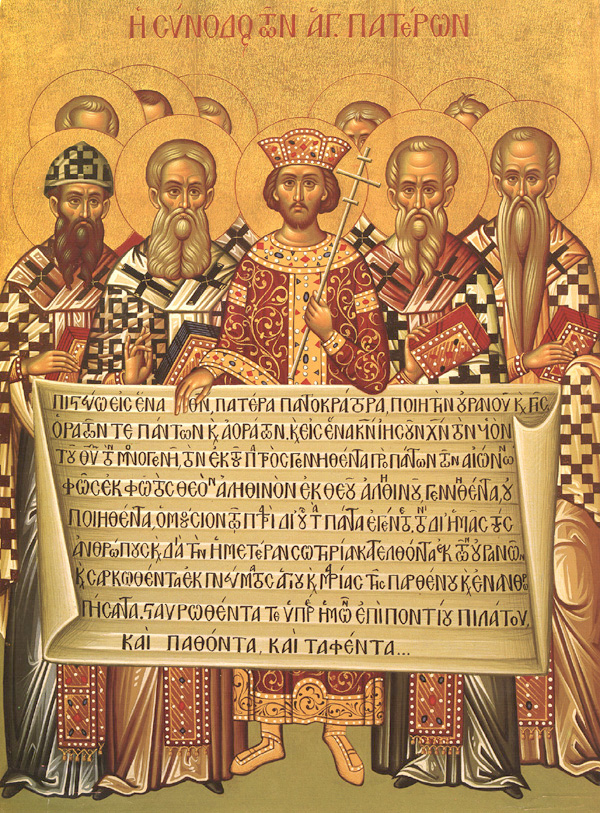
The Fifth Ecumenical Council (Constantinople II) was held at Constantinople, under the holy Emperor Saint Justinian I (527-565) in the year 553, to determine the Orthodoxy of three dead bishops: Theodore of Mopsuetia, Theodoret of Cyrrhus and Ibas of Edessa, who had expressed Nestorian opinions in their writings in the time of the Third Ecumenical Council (September 9).
These three bishops had not been condemned at the Fourth Ecumenical Council (July 16), which condemned the Monophysites, and in turn had been accused by the Monophysites of Nestorianism. Therefore, to deprive the Monophysites of the possibility of accusing the Orthodox of sympathy for Nestorianism, and also to dispose the heretical party towards unity with the followers of the Council of Chalcedon, the emperor Saint Justinian issued an edict. In it “the Three Chapters” (the three deceased bishops) were condemned. But since the edict was issued on the emperor’s initiative, and since it was not acknowledged by representatives of all the Church (particularly in the West, and in Africa), a dispute arose about the “Three Chapters.” The Fifth Ecumenical Council was convened to resolve this dispute.
165 bishops attended this Council. Pope Vigilius, though present in Constantinople, refused to participate in the Council, although he was asked three times to do so by official deputies in the name of the gathered bishops and the Emperor himself. The Council opened with Saint Eutychius, Patriarch of Constantinople (552-565, 577-582), presiding. In accordance with the imperial edict, the matter of the “Three Chapters” was carefully examined in eight prolonged sessions from May 4 to June 2, 553.
Anathema was pronounced against the person and teachings of Theodore of Mopsuetia. In the case of Theodore and Ibas, the condemnations were confined only to certain of their writings, while they personally had been cleared by the Council of Chalcedon, because of their repentance. Thus, they were spared from the anathema.
This measure was necessary because certain of the proscribed works contained expressions used by the Nestorians to interpret the definitions of the Council of Chalcedon for their own ends. But the leniency of the Fathers of the Fifth Ecumenical Council, in a spirit of moderate economy regarding the persons of Bishops Theodore and Ibas, instead embittered the Monophysites against the decisions of the Council. Besides which, the emperor had given the orders to promulgate the Conciliar decisions together with a decree of excommunication against Pope Vigilius, for being like-minded with the heretics. The Pope afterwards concurred with the mind of the Fathers, and signed the Conciliar definition. The bishops of Istria and all the region of the Aquilea metropolia, however, remained in schism for more than a century.
At the Council the Fathers likewise examined the errors of presbyter Origen, a renowned Church teacher of the third century. His teaching about the pre-existence of the human soul was condemned. Other heretics, who did not admit the universal resurrection of the dead, were also condemned.
It pleased the Lord that the Holy Spirit should inspire the Fathers of the Council in a further definition of Orthodoxy that preserves the integrity and dignity both of God and of mankind, without the distortion of either that occurs within the Nestorian or Monophysite heresies.

Here is the live stream for Orthros and Divine Liturgy – Sun 7/24/2022 If you need, here are instructions for accessing this content from your phone, tablet, computer, or TV.
6TH SUNDAY OF MATTHEW
NO FAST
6th Sunday of Matthew, Christina the Great Martyr of Tyre, Athenagorus the Apologist, Boris and Gleb, the Passion-bearers, Kapiton, Himenaos and Hermogenes, the Martyrs, Theophilos the New Martyr of Zakynthos
Brethren, having gifts that differ according to the grace given to us, let us use them: if prophecy, in proportion to our faith; if service, in our serving; he who teaches, in his teaching; he who exhorts, in his exhortation; he who contributes, in liberality; he who gives aid, with zeal; he who does acts of mercy, with cheerfulness. Let love be genuine; hate what is evil, hold fast to what is good; love one another with brotherly affection; outdo one another in showing honor. Never flag in zeal, be aglow with the Spirit, serve the Lord. Rejoice in your hope, be patient in tribulation, be constant in prayer. Contribute to the needs of the saints, practice hospitality. Bless those who persecute you; bless and do not curse them.
At that time, getting into a boat Jesus crossed over and came to his own city. And behold, they brought to him a paralytic, lying on his bed; and when Jesus saw their faith he said to the paralytic, “Take heart, my son; your sins are forgiven.” And behold, some of the scribes said to themselves, “This man is blaspheming.” But Jesus, knowing their thoughts, said, “Why do you think evil in your hearts? For which is easier, to say ‘Your sins are forgiven, ‘ or to say ‘Rise and walk?’ But that you may know that the Son of man has authority on earth to forgive sins” he then said to the paralytic — “Rise, take up your bed and go home.” And he rose and went home. When the crowds saw it, they were afraid, and they glorified God, who had given such authority to men.

Saints Boris and Gleb were sons of Saint Vladimir (July 15). Saint Boris was named Romanus and Saint Gleb was named David at their Baptism. After their father’s death the eldest son Sviatopolk planned to kill his brothers Boris, Gleb, and Yaroslav in order to seize power. He sent a message to Boris, pretending that he wished to live in peace with him, and to increase Boris’s land holdings inherited from their father.
Some of Vladimir’s advisers told Boris that he should take the army and establish himelf as ruler of Kiev. Saint Boris, however, said that he could never lift his hand against his own brother. Unfortunately, Sviatopolk was not so scrupulous. He came to the town of Vyshegorod to ask its leaders if they were loyal to him. They assured him that they were ready to die for him.
Sviatopolk sent assassins to the Alta to kill Boris, who already knew that his brother wanted him dead. When they arrived they heard him chanting psalms and praying before an icon of Christ. He asked the Lord to strengthen him for the suffering he was about to endure. He also prayed for Sviatopolk, asking God not to count this against him as sin.
Then he lay down upon his couch, and the assassins stabbed him with their lances, and also killed some of Boris’s servants. Wrapping Boris in a cloth, they threw him onto a wagon and drove off with him. When Sviatopolk saw that he was still breathing, he sent some men to finish him off with swords.
After Sviatopolk had killed Boris, he wondered, “Now how can I kill Gleb?” He sent him a message saying that their father was ill and wished to see him. As he was on his way, he received word from Yaroslav that their father had died and that Sviatopolk had murdered Boris.
Saint Gleb wept for his father and brother, and was lamenting them when the assassins arrived. They seized his boat and drew their weapons, but it was Gleb’s cook Torchin who stabbed him with a knife.
The martyr’s body was thrown onto the shore between two trees. Later, he was buried beside Saint Boris in the church of Saint Basil.
Saints Boris and Gleb received the crown of martyrdom in 1015. They became known as Passion-Bearers, since they did not resist evil with violence.
The holy martyrs Princes Boris and Gleb are also commemorated on May 2.

The Martyr Christina lived during the third century. She was born into a rich family, and her father was governor of Tyre. By the age of 11 the girl was exceptionally beautiful, and many wanted to marry her. Christina’s father, however, envisioned that his daughter should become a pagan priestess. To this end he placed her in a special dwelling where he had set up many gold and silver idols, and he commanded his daughter to burn incense before them. Two servants attended Christina.
In her solitude, Christina began to wonder who had created this beautiful world. From her room she was delighted by the stars of the heavens and she constantly came back to the thought about the Creator of all the world. She was convinced, that the voiceless and inanimate idols in her room could not create anything, since they themselves were created by human hands. She began to pray to the One God with tears, entreating Him to reveal Himself. Her soul blazed with love for the Unknown God, and she intensified her prayer all the more, and combined it with fasting.
One time Christina was visited by an angel, who instructed her in the true faith in Christ, the Savior of the world. The angel called her a bride of Christ and told her about her future suffering. The holy virgin smashed all the idols standing in her room and threw them out the window. In visiting his daughter Christina’s father, Urban, asked her where all the idols had disappeared. Christina was silent. Then, having summoned the servants, Urban learned the truth from them.
In a rage the father began to slap his daughter’s face. At first, the holy virgin remained quiet, but then she told her father about her faith in the One True God, and that she had destroyed the idols with her own hands. Urban gave orders to kill all the servants in attendance upon his daughter, and he gave Christina a fierce beating and threw her in prison. Having learned about what had happened, Saint Christina’s mother came in tears, imploring her to renounce Christ and to return to her ancestral beliefs. But Christina remained unyielding. On another day, Urban brought his daughter to trial and urged her to offer worship to the gods, and to ask forgiveness for her misdeeds. Instead, he saw her firm and steadfast confession of faith in Christ.
The torturers tied her to an iron wheel, beneath which they lit a fire. The body of the martyr, turning round on the wheel, was scorched on all sides. They then threw her into prison.
An angel of God appeared at night, healing her wounds and strengthening her with food. Her father, seeing her unharmed, gave orders to drown her in the sea. An angel sustained the saint while the stone sank down, and Christina miraculously came out of the water and reappeared before her father. In terror, her father imputed this to sorcery and decided to execute her in the morning. That night he himself suddenly died. Another governor, Dion, was sent in his place. He summoned the holy martyr and also tried to persuade her to renounce Christ, but seeing her unyielding firmness, he again subjected her to cruel tortures. The holy martyr was for a long while in prison. People began to flock to her, and she converted them to the true faith in Christ. Thus about 300 were converted.
In place of Dion, a new governor Julian arrived and resumed the torture of the saint. After various torments, Julian gave orders to throw her into a red-hot furnace and lock her in it. After five days they opened the furnace and found the martyr alive and unharmed. Seeing this miracle take place, many believed in Christ the Savior, and the torturers executed Saint Christina with a sword.
Saint Polycarp the Archimandrite entered the Kiev Caves Monastery, where he received monastic tonsure and struggled for the salvation of his soul.
Soon Polycarp (whose name means “much fruit”) began to bear fruits of repentance and virtue. His relative Saint Simon (May 10), who became Bishop of Vladimir and Suzdal, planted the seeds which Saint Polycarp developed. As the holy bishop taught Polycarp the principles of the spiritual life, the two became increasingly united in spirit, just as they were related by blood.
When Saint Simon left the Monastery of the Caves to assume his hierarchal responsibilities in Vladimir, he took Polycarp with him. Saint Polycarp wrote down the stories that Saint Simeon told him of the God-pleasing ascetics of the Kiev Caves so that others might also benefit from them. Therefore, he is also known as Saint Polycarp the Hagiologist. Although Saint Polycarp returned to the monastery, he always tried to live according to Saint Simeon’s instructions.
After the repose of Igumen Akindynus, the brethren chose Polycarp to succeed him as the Superior of the Lavra. He proved to be a skilled guide for the brethren in their struggle for salvation, and also for those outside the monastery.
The Great Prince Rostislav was one of many who profited from the teaching of Saint Polycarp, and asked that he be allowed to become a monk. Saint Polykarp told him, “God has appointed you to stand for the truth, to judge with justice, and to stand firmly before the Cross.”
Rostislav answered, “Holy Father, one cannot be a prince in this world without falling into sin. I am already exhausted and weakened by daily cares and labors. Now in my old age I would like to serve God and emulate those who have followed the narrow and sorrowful path and received the Kingdom of Heaven. I have heard of how Constantine (May 21), great among kings, appeared to a certain Elder and said, ‘If I had known what glory the monks receive in heaven… I would have taken off my crown and royal purple, and replaced them with the monastic garb’.”
Saint Polycarp told him, “If you desire this from your heart, then may it be God’s will.”
However, as the prince was passing through Smolensk, he fell ill and asked to be taken home to Kiev. Seeing how weak he was, his sister Rogneda urged him to remain in Smolensk and be buried in the church they had built there.
Rostislav would not accept this suggestion. He said, “If I do not make it back to Kiev, then let me be placed in the church my father built in the Monastery of Saint Theodore. If God delivers me from this illness and grants me health, then I vow to become a monk at the Monastery of the Caves under Polycarp.”
As he lay at death’s door, Rostislav said to the priest Simon, “You must answer before God since you hindered me from being tonsured by the holy one in the Caves Monastery, for I truly desired that. May the Lord not count it as a sin that I did not fulfill this.”
Saint Polycarp went to the Lord on July 24, 1182. After this, no successor was chosen for a long time. Although there were many worthy Elders in the Lavra, they all declined the office of igumen out of humility. The brethren realized that they could not remain for long without a shepherd. They assembled in the church and prayed to Saints Anthony and Theodosius and Saint Polycarp to help them find someone worthy to take his place.
Then a voice was heard saying, “Let us go to the priest Basil in Schekovitsa. Let him be our Superior and rule the monastery in the monastic rank.”
The monks went to the widowed priest Basil and asked him to be their Superior, but he refused for a long time. After many entreaties, he finally agreed and went with them to the monastery. He was tonsured as a monk and installed as igumen by Metropolitan Nikēphóros of Kiev, Bishops Laurence of Turov and Nicholas of Polotsk. Igumen Basil proved to be a model of virtues and a worthy successor to Saint Polycarp.
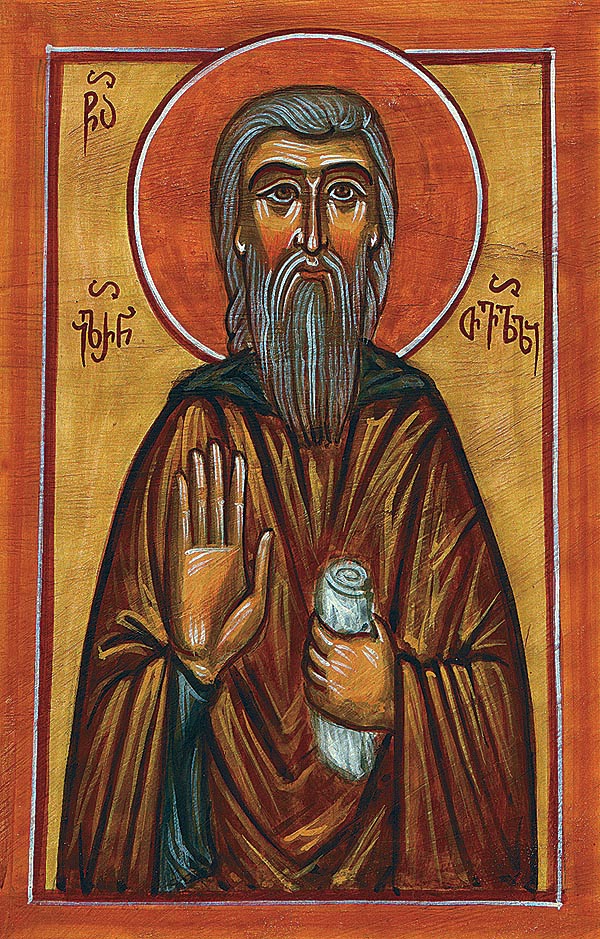
Saint Hilarion of Tvali (Tulashvili) served as abbot of Khakhuli Monastery in southwestern Georgia at the beginning of the 11th century.
In his work The Life of George of the Holy Mountain, George the Lesser writes that Venerable Hilarion was outstanding in virtue and celebrated for his sermons and ascetic labors.
Saint Hilarion raised the young George of the Holy Mountain to be a brilliant writer, translator, theologian and patriot. From him George also received a blessing to enter the monastic life.
According to the chronicle Life of Kartli, Saint Hilarion was a famous translator and writer and an eminent theologian.
Eventually Saint Hilarion moved from Khakhuli to Tvali Monastery, not far from Antioch, where he remained for the rest of his life. According to the 19th-century historian-iconographer Michael Sabinin, Saint Hilarion reposed in the year 1041.
Abramius the wonderworker. + August 21, ca. 1224.
Andrew, Prince. October 27(Uncovering of his relics) ca. 1390.
Anthony, Bishop of Vologda. + October 26, 1588 & January 17.
Arcadius, monk of Vyazma, disciple of Saint Ephraim of Novotorzhok. Ca. 1592. July 11, August 14 (translation of his relics in 1798), December 13.
Arcadius Dorogobuzhsky, disciple of Saint Gerasimus of Baldino. XVI century.
Constantine, Prince, son of Saint Theodore of Smolensk March 5 (translation of his relics), June 22, September 19.
David, prince and wonderworker, son of Theodore of Smolensk. March 5 (translation of his relics in 1321), June 22, September 9.
Ephraim of Novotorzhok + 1053. January 28, June 11 (translation of his relics in 1572).
Ephraim of Smolensk, disciple of Saint Abramius of Smolesk. + August 21, 1238.
Gerasimus of Baldino, + May 1, 1554.
Gleb (David in Baptism), prince and passion-bearer. May 2 (translation of his relics in 1115), July 24 (commemorated with Saint Boris), September 5 (his martyrdom in 1015). Gleb, prince of Smolensk, July 7 (XIV-XV century).
Ignatius, Bishop of Smolensk, wonderworker. + January 29, 1210.
Juliana, princess of Vyazma. June 2 (uncovering of her relics in 1819), December 21 (her martyrdom in 1406).
Macarius (Glukharov), Apostle to the Altai + May 15, 1847.
Mercurius, warrior and martyr + November 24, 1239.
Mercurius, Hieromartyr, Bishop of Smolensk. + August 7, 1238.
Michael, Bishop of Smolensk + November 28, 1402.
Michael, Prince, son of Saint Theodore of Smolensk. September 19, 1290.
Nicholas, Archbishop of Japan, equal of the Apostles (in the world Ivan Dimitrievich Kasatkin). + February 3, 1912.
Pitirim, Bishop of Tambov. + July 28, 1698.
Prochorus of the Kiev Caves, wonderworker. + February 10, 1107.
Rostislav (Michael in Baptism) Great Prince of Kiev. + 1167. March 14.
Simeon, Prince of Vyazma. + December 21, 1406.
Simeon, Metropolitan of Smolensk + January 4, 1699.
Simeon, disciple of Saint Sergius of Radonezh. + 1392.
Theodore, Prince and wonderworker + 1299. March 5 (translation of his relics in 1321), June 22, September 19.
Saint Athenogoras was a Christian philosopher and apologist of the second century A.D. He probably came from Athens where he studied Middle Platonism and Stoic philosophy. He flourished during the time of the Roman emperors Marcus Aurelius (161-180) and Commodus (180 – 192).
There are some basic facts about Saint Athenagoras, his formation and his work which are drawn from his two works, preserved in a codex from the year 914, which was produced in the literary workshop of Arethas: “Embassy (or Supplication) for the Christians" and "On the Resurrection of the dead.”
Saint Athenagoras stands out among the apologists of his day because of his literary excellence and his clear and eloquent style. His writings contain quotes from poets and philosophers, and from the rhythm of his sentences, and the arrangement of his material, we can deduce that he attended a school of rhetoric. In the field of theology he affirms Orthodox teachings about the Holy Trinity, the divine inspiration of the Holy Scriptures, and reveals a strict ascetical position concerning the moral life of Christians. His work has an important place in the ecclesiastical writings of the first two centuries.
Here is the live stream for Great Vespers – Sat 7/23/2022 If you need, here are instructions for accessing this content from your phone, tablet, computer, or TV.
6TH SATURDAY AFTER PENTECOST
NO FAST
Phocas the Holy Martyr, Bishop of Sinope, Ezekiel the Prophet, Pelagia the Righteous of Tinos, Trophimos & Theophilios and the 13 others martyred in Lycia, St. Anna of Levkadio, The Icons of the Most Holy Theotokos of Pochaev, Icon of the Mother of God
Brethren, I am speaking the truth in Christ, I am not lying; my conscience bears me witness in the Holy Spirit, that I have great sorrow and unceasing anguish in my heart. For I could wish that I myself were accursed and cut off from Christ for the sake of my brethren, my kinsmen by race. They are Israelites, and to them belong the patriarchs, and of their race, according to the flesh, is the Christ, who is God over all, blessed for ever. Amen.
At that time, a ruler came in and knelt before Jesus, saying, “My daughter has just died; but come and lay your hand on her, and she will live.” And Jesus rose and followed him, with his disciples. And behold, a woman who had suffered from a hemorrhage for twelve years came up behind him and touched the fringe of his garment; for she said to herself, “If I only touch his garment, I shall be made well.” Jesus turned, and seeing her he said, “Take heart, daughter; your faith has made you well.” And instantly the woman was made well. And when Jesus came to the ruler’s house, and saw the flute players, and the crowd making a tumult, he said, “Depart; for the girl is not dead but sleeping.” And they laughed at him. But when the crowd had been put outside, he went in and took her by the hand, and the girl arose. And the report of this went through all that district.
The Holy Martyrs Trophimus, Theophilus, and thirteen martyrs with them, suffered during the persecution against Christians under the emperor Diocletian (284-305). Brought to trial, they bravely confessed themselves Christians and refused to offer sacrifice to idols. After fierce tortures, they broke the legs of the holy martyrs and threw them into a fire. Strengthened by the Lord, they came out of the fire completely unharmed, and they glorified Christ all the more. Unable to break the will of the holy confessors, the torturers beheaded them.
Saint Apollinaris was a disciple of the Apostle Peter, whom he followed from Antioch to Rome sometime during the reign of the Roman emperor Claudius (41-54). Saint Peter appointed Apollinaris as Bishop of Ravenna. Arriving in Ravenna as a stranger, Saint Apollinaris asked shelter of a local inhabitant, the soldier Irenaeus, and during their conversation he revealed the purpose for which he had come.
Irenaeus had a blind son, whom Saint Apollinaris healed, after he had prayed to the Lord. The soldier Irenaeus and his family were the first people in Ravenna to believe in Christ. The saint stayed at the house of Irenaeus and preached about Christ to everyone who wished to hear his words. One of the miracles that Saint Apollinaris performed was the healing of Thekla, the incurably sick wife of the tribune. Through the prayers of the saint, she got up from her bed completely healthy. Not only did she believe in Christ, but so did her husband the tribune. In their house Saint Apollinaris set up a small church, where he celebrated the Divine Liturgy. Saint Apollinaris ordained two presbyters, Aderetus and Calocyrus, and also two deacons for the newly-baptized people of Ravenna.
Saint Apollinaris labored with great zeal, preaching the Gospel at Ravenna for twelve years, and the number of Christians steadily increased. Pagan priests complained about the bishop to the governor Saturninus. The hierarch was brought to trial and subjected to grievous tortures. Thinking that he had died, the torturers took him out of the city to the seacoast and threw him into the water. The saint, however, was still alive. A certain pious Christian widow helped him and gave him shelter in her home. Saint Apollinaris stayed with her for six months, and secretly continued to preach about Christ. The saint’s whereabouts became known when he restored the power of speech to an illustrious resident of the city named Boniface, whose wife had requested the saint to help her husband.
After this miracle many pagans were converted to Christ, and once again Saint Apollinaris was brought to trial and tortured. His bare feet were placed on red-hot coals. They expelled him from the city a second time, but the Lord again kept him alive. The saint did not cease preaching until he left the city. For a certain time Saint Apollinaris found himself elsewhere in Italy, where he continued to preach the Gospel as before. Returning to his flock in Ravenna, Saint Apollinaris went on trial yet again and was sentenced to banishment.
In heavy fetters, he was placed on a ship bound for Illyrica and the Danube River. Two soldiers were responsible for escorting him to his place of exile. Three of the clergy voluntarily followed their bishop into exile. Along the way the vessel was wrecked and everyone drowned, except for Saint Apollinaris, his clergy and the two soldiers. The soldiers, listening to Saint Apollinaris, believed in the Lord and were baptized. Not finding any shelter, the travelers came to Moisia in Thrace, where Saint Apollinaris healed a certain illustrious inhabitant from leprosy. Both he and his companions were given shelter at the man’s home. In this land Saint Apollinaris preached tirelessly about Christ and he converted many of the pagans to Christianity, for which he was subjected to persecution by the unbelievers. They beat the saint mercilessly, then they sent him back to Italy aboard a ship.
After a three year absence, Saint Apollinaris returned to Ravenna and was joyfully received by his flock. The pagans, however, entered the church where the saint was serving the Divine Liturgy, scattered those at prayer, and dragged the saint before the idolatrous priests at the pagan temple of Apollo. The idol fell and shattered to pieces just as the saint was brought in. The pagan priests brought Saint Apollinaris to Taurus, the new governor of the district for trial. Apollinaris performed a new miracle, healing the son of the governor, who had been blind from birth. In gratitude for the healing of his son, Taurus tried to protect Saint Apollinaris from the angry crowd. He sent him to his own estate outside the city. Although Taurus’s wife and son were baptized, he feared the anger of the emperor, and did not receive Baptism. However, he was filled with gratitude and love toward his benefactor.
Saint Apollinaris lived for five years at Taurus’s estate and preached without hindrance. During this time pagan priests sent letters of denunciation to Emperor Vespasian requesting a sentence of death or exile for the Christian “sorcerer” Apollinaris. But the emperor told the pagan priests that the gods were sufficiently powerful to take revenge for themselves, if they felt insulted. All the wrath of the pagans fell upon Saint Apollinaris: they seized him and beat him fiercely as he was leaving the city for a nearby settlement. Christians found him barely alive and took him to the settlement, where he lived for seven days. During his final illness the saint did not cease to teach his flock. He predicted that after the persecutions ended, Christians would enter upon better times when they could openly and freely confess their faith. After bestowing his archpastoral blessing upon those present, the hieromartyr Apollinaris fell asleep in the Lord. Saint Apollinaris was Bishop of Ravenna for twenty-eight years, and he reposed in the year 75.

The Icon of the Mother of God “Joy of All Who Sorrow” (With Coins) was glorified in the year 1888 in St. Petersburg, when during the time of a terrible thunderstorm lightning struck in a chapel. All was burned or singed, except for this icon of the Queen of Heaven. It was knocked to the floor, and the poor box broke open at the same time. Somehow, twelve small coins (half-kopeck pieces), became attached to the icon. A church was built in 1898 on the site of the chapel.

No information available at this time.

The Pochaev Icon of the Mother of God is among the most revered sacred objects of the Orthodox Church. Located in the Dormition Cathedral at Pochaev, Ukraine, the Icon is reknowned throughout the entire Slavic world, and is venerated in Russia, Bosnia, Serbia, Bulgaria, and in other places. Christians of other confessions also venerate the Pochaev Icon of the Most Holy Theotokos. The wonderworking Icon has been treasured at the Pochaev Lavra for over 400 years.
Numerous miracles have taken place before the holy Icon, and these are recorded in special books at the monastery. The books contain the personal testimonies of people who prayed before the Pochaev Icon and were healed of their illnesses, delivered from unclean spirits, or freed from captivity. Many sinners were also brought to repentance.
Today's Feast Day in honor of the Pochaev Icon of the Mother of God was appointed to commemorate the deliverance of the Dormition Lavra from a siege by the Turks on July 20-23, 1675.
In the summer of 1675 during the Zbarazhsk War with the Turks, in the reign of the Polish King Jan Sobesski (1674-1696), regiments composed of Tatars under the command of Khan Nurredin via Vishnevets fell upon the Pochaev monastery, surrounding it on three sides. The weak monastery walls and its stone buildings did not offer much protection against a siege. Igoumen Joseph Dobromirsky urged the brethren and laypeople to pray to their heavenly intercessors, the Most Holy Theotokos and Saint Job of Pochaev (October 28).
The monks and the people prayed fervently, prostrating themselves before the wonderworking Icon of the Mother of God, and the reliquary containing the relics of Saint Job. At sunrise on the morning of July 23, as the Tatars prepared to attack the monastery, the Igoumen ordered an Akathist to the Theotokos to be sung. At the opening words, “O Queen of the Heavenly Hosts,” the Mother of God suddenly appeared over the church, in “an unfurled radiant white omaphorion,” with angels holding unsheathed swords. Saint Job stood beside the Mother of God, bowing to her and beseeching her to defend the monastery.
The Tatars believed that the heavenly army was a vision, and in their confusion they started shooting arrows at the Most Holy Theotokos and Saint Job, but the arrows turned backwards and wounded those who shot them. The enemy, gripped by terror, fled in panic, trampling upon and killing each other. The defenders of the monastery pursued them and took many prisoners. Later, some of the prisoners converted to the Orthodox Faith and remained at the monastery thereafter.
In the year 1721, Pochaev was occupied by the Uniates. Even during this difficult time for the Lavra, the monastery Chronicle lists 539 miracles of the Pochaev Icon. In the second half of the eighteenth century, a Uniate nobleman, Count Nicholas Pototski, became a benefactor of the Pochaev Lavra through the following miraculous circumstance. After accusing his coachman of overturning the carriage with runaway horses, the Count took out a pistol to shoot him. The coachman, turning towards the mountain of Pochaev, stretched out his hands and cried: "Mother of God, depicted in the Pochaev Icon, save me!”
Several times Pototski tried to shoot the pistol, which had never failed him, but the weapon misfired and the coachman remained alive. Pototski went at once to the wonderworking Icon and resolved to devote himself and all his property to building up the monastery. With the money he contributed, the Dormition cathedral was built, as well as other buildings for the brethren.
The return of the Pochaev Monastery to the Orthodox Church in 1832 was marked by the miraculous healing of the blind maiden Anna Akimchukova, who had come on pilgrimage to the holy shrine along with her seventy-year-old grandmother from Kremenets-Podolsk, 200 versts away. In memory of this event, the Archbishop of Volhynia and Archimandrite Innocent of the Lavra (1832-1840) appointed that an Akathist be read on Saturdays before the wonderworking Icon. During the time of Archimandrite Agathangelus, Archbishop of Volhynia (1866-1876), a separate chapel was built in the galleries of the Holy Trinity church, which was dedicated on July 23, 1875 in memory of the victory over the Tatars.
The wonderworking Pochaev Icon is also commemorated on Friday of Bright Week, and on September 8.
Saint Anna (Susanna) of Leukadio (or Leukati) was born in Constantinople in 840 during the reign of Emperor Theophilos the iconoclast (829-842), and was the daughter of a wealthy and distinguished family. She had many physical and spiritual
gifts because she was raised “in the discipline and admonition of the Lord” (Ephesians 6:4).
After the death of her parents, she inherited her father’s estate, which she shared with the poor. This beautiful young woman was loved by a certain Hagarene1 who lived in Constantinople and asked her to marry him, and he obtained the consent of Emperor Basil I the Macedonian. Anna turned down the proposal, since she did not wish to marry him. The Hagarene tormented her and declared that he would have her as his wife, even if she did not wish it. The Saint tearfully entreated God to deliver her from this temptation. Indeed, the compassionate and righteous God heard her prayers. Punished for his impudence, the Hagarene was struck down by divine judgment and he died.
Around 896 Anna went to a certain church dedicated to the Mother of God in Constantinople. There she devoted herself to fasting, vigil, and prayer. For fifty years she lived in this angelic way. After a slight illness, she delivered her blessed soul to God. Years after her burial, her relics were found to be whole, incorrupt, and emitting a divine fragrance. By her grace-filled relics, demons were cast out, the blind received their sight, and the lame walked. So, in this manner, God glorifies those who glorify Him.
1 The Moslems were regarded as descendants of Hagar, Abraham's concubine (see Genesis, chapter 16).
MARY MAGDALENE, THE HOLY MYRRH-BEARER AND EQUAL TO THE APOSTLES
ABSTAIN FROM MEAT, FISH, DAIRY, EGGS, WINE, OLIVE OIL
Mary Magdalene, the Holy Myrrh-bearer and Equal to the Apostles, Markella, the Virgin-martyr of Chios
Brethren, you are the seal of my apostleship in the Lord. This is my defense to those who would examine me. Do we not have the right to our food and drink? Do we not have the right to be accompanied by a wife, as the other apostles and the brothers of the Lord and Cephas? Or is it only Barnabas and I who have no right to refrain from working for a living? Who serves as a soldier at his own expense? Who plants a vineyard without eating any of its fruit? Who tends a flock without getting some of the milk? Do I say this on human authority? Does not the law say the same? For it is written in the law of Moses, “You shall not muzzle an ox when it is treading out the grain.” Is it for oxen that God is concerned? Does he not speak entirely for our sake? It was written for our sake, because the plowman should plow in hope and the thresher thresh in hope of a share in the crop. If we have sown spiritual good among you, is it too much if we reap your material benefits? If others share this rightful claim upon you, do not we still more? Nevertheless, we have not made use of this right, but we endure anything rather than put an obstacle in the way of the gospel of Christ.
At that time Jesus went on through cities and villages, preaching and bringing the good news of the kingdom of God. And the twelve were with him, and also some women who had been healed of evil spirits and infirmities: Mary, called Magdalene, from whom seven demons had gone out, and Joanna, the wife of Chuza, Herod’s steward, and Susanna, and many others, who provided for him out of their means.
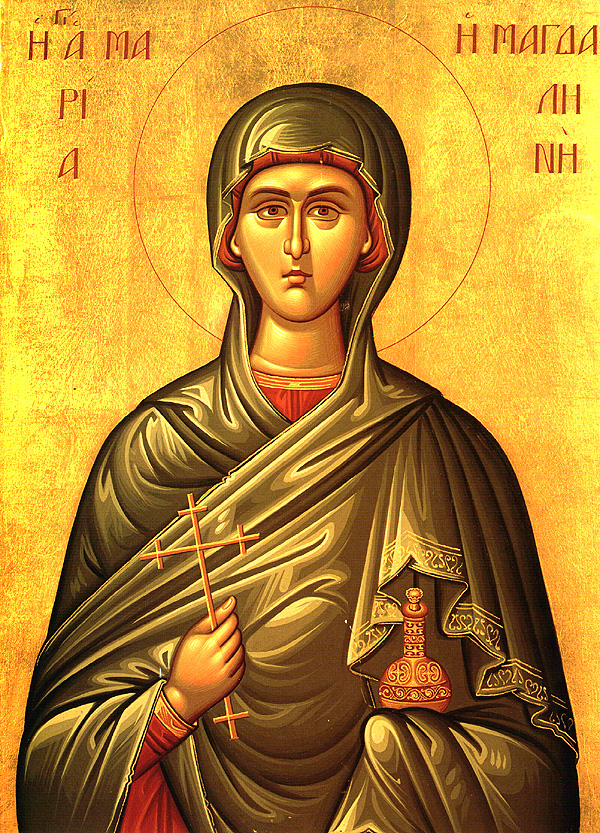
The Holy Myrrh-Bearer Equal of the Apostles Mary Magdalene. On the banks of Lake Genesareth (Galilee), between the cities of Capharnum and Tiberias, was the small city of Magdala, the remains of which have survived to our day. Now only the small village of Mejhdel stands on the site.
A woman whose name has entered forever into the Gospel account was born and grew up in Magdala. The Gospel tells us nothing of Mary’s younger years, but Tradition informs us that Mary of Magdala was young and pretty, and led a sinful life. It says in the Gospels that the Lord expelled seven devils from Mary (Luke. 8:2). From the moment of her healing Mary led a new life, and became a true disciple of the Savior.
The Gospel relates that Mary followed after the Lord, when He went with the Apostles through the cities and villages of Judea and Galilee preaching about the Kingdom of God. Together with the pious women Joanna, wife of Choza (steward of Herod), Susanna and others, she served Him from her own possessions (Luke 8:1-3) and undoubtedly shared with the Apostles the evangelic tasks in common with the other women. The Evangelist Luke, evidently, has her in view together with the other women, stating that at the moment of the Procession of Christ onto Golgotha, when after the Scourging He took on Himself the heavy Cross, collapsing under its weight, the women followed after Him weeping and wailing, but He consoled them. The Gospel relates that Mary Magdalene was present on Golgotha at the moment of the Lord’s Crucifixion. While all the disciples of the Savior ran away, she remained fearlessly at the Cross together with the Mother of God and the Apostle John.
The Evangelists also list among those standing at the Cross the mother of the Apostle James, and Salome, and other women followers of the Lord from Galilee, but all mention Mary Magdalene first. Saint John, in addition to the Mother of God, names only her and Mary Cleopas. This indicates how much she stood out from all the women who gathered around the Lord.
She was faithful to Him not only in the days of His Glory, but also at the moment of His extreme humiliation and insult. As the Evangelist Matthew relates, she was present at the Burial of the Lord. Before her eyes Joseph and Νikόdēmos went out to the tomb with His lifeless Body. She watched as they covered over the entrance to the cave with a large stone, entombing the Source of Life.
Faithful to the Law in which she was raised, Mary together with the other women spent the following day at rest, because it was the great day of the Sabbath, coinciding with the Feast of Passover. But all the rest of the peaceful day the women gathered spices to go to the Grave of the Lord at dawn on Sunday and anoint His Body according to the custom of the Jews.
It is necessary to mention that, having agreed to go on the first day of the week to the Tomb early in the morning, the holy women had no possibility of meeting with one another on Saturday. They went separately on Friday evening to their own homes. They went out only at dawn the following day to go to the Sepulchre, not all together, but each from her own house.
The Evangelist Matthew writes that the women came to the grave at dawn, or as the Evangelist Mark expresses, extremely early before the rising of the sun. The Evangelist John, elaborating upon these, says that Mary came to the grave so early that it was still dark. Obviously, she waited impatiently for the end of night, but it was not yet daybreak. She ran to the place where the Lord’s Body lay.
Mary went to the tomb alone. Seeing the stone pushed away from the cave, she ran away in fear to tell the close Apostles of Christ, Peter and John. Hearing the strange message that the Lord was gone from the tomb, both Apostles ran to the tomb and, seeing the shroud and winding cloths, they were amazed. They went and said nothing to anyone, but Mary returned to the tomb and stood about the entrance to the tomb and wept. Here in this dark tomb so recently lay her lifeless Lord.
Wanting proof that the tomb really was empty, she went down to it and saw a strange sight. She saw two angels in white garments, one sitting at the head, the other at the foot, where the Body of Jesus had been placed. They asked her, “Woman, why weepest thou?” She answered them with the words which she had said to the Apostles, “They have taken my Lord, and I do not know where they have laid Him.” At that moment, she turned around and saw the Risen Jesus standing near the grave, but she did not recognize Him.
He asked Mary, “Woman, why weepest thou? Whom dost thou seek?” She answered thinking that she was seeing the gardener, “Sir, if thou hast taken him, tell where thou hast put Him, and I will take Him away.”
Then she recognized the Lord’s voice. This was the voice she heard in those days and years, when she followed the Lord through all the cities and places where He preached. He spoke her name, and she gave a joyful shout, “Rabbi” (Teacher).
Respect and love, fondness and deep veneration, a feeling of thankfulness and recognition at His Splendor as great Teacher, all came together in this single outcry. She was able to say nothing more and she threw herself down at the feet of her Teacher to wash them with tears of joy. But the Lord said to her: “Touch me not; for I am not yet ascended to My Father; but go to My brethren and tell them: ‘I ascend to My Father, and your Father; to My God and to your God.’”
She came to herself and again ran to the Apostles, to do the will of Him sending her to preach. Again she ran into the house, where the Apostles still remained in dismay, and proclaimed to them the joyous message, “I have seen the Lord!” This was the first preaching in the world about the Resurrection.
The Apostles proclaimed the Glad Tidings to the world, but she proclaimed it to the Apostles themselves.
Holy Scripture does not tell us about the life of Mary Magdalene after the Resurrection of Christ, but it is impossible to doubt, that if in the terrifying minutes of Christ’s Crucifixion she was at the foot of His Cross with His All-Pure Mother and Saint John, she must have stayed with them during the happier time after the Resurrection and Ascension of Christ. Thus in the Acts of the Apostles Saint Luke writes that all the Apostles with one mind stayed in prayer and supplication, with certain women and Mary the Mother of Jesus and His brethren.
Holy Tradition testifies that when the Apostles departed from Jerusalem to preach to all the ends of the earth, then Mary Magdalene also went with them. A daring woman, whose heart was full of reminiscence of the Resurrection, she went beyond her native borders and went to preach in pagan Rome. Everywhere she proclaimed to people about Christ and His teaching. When many did not believe that Christ is risen, she repeated to them what she had said to the Apostles on the radiant morning of the Resurrection: “I have seen the Lord!” With this message she went all over Italy.
Tradition relates that in Italy Mary Magdalene visited Emperor Tiberias (14-37 A.D.) and proclaimed to him Christ’s Resurrection. According to Tradition, she brought him a red egg as a symbol of the Resurrection, a symbol of new life with the words: “Christ is Risen!” Then she told the emperor that in his Province of Judea the unjustly condemned Jesus the Galilean, a holy man, a miracleworker, powerful before God and all mankind, had been executed at the instigation of the Jewish High Priests, and the sentence confirmed by the procurator appointed by Tiberias, Pontius Pilate.
Mary repeated the words of the Apostles, that we are redeemed from the vanity of life not with perishable silver or gold, but rather by the precious Blood of Christ.
Thanks to Mary Magdalene the custom to give each other paschal eggs on the day of the Radiant Resurrection of Christ spread among Christians over all the world. In one ancient Greek manuscript, written on parchment, kept in the monastery library of Saint Athanasius near Thessalonica, is a prayer read on the day of Holy Pascha for the blessing of eggs and cheese. In it is indicated that the igumen in passing out the blessed eggs says to the brethren: “Thus have we received from the holy Fathers, who preserved this custom from the very time of the holy Apostles, therefore the holy Equal of the Apostles Mary Magdalene first showed believers the example of this joyful offering.”
Mary Magdalene continued her preaching in Italy and in the city of Rome itself. Evidently, the Apostle Paul has her in mind in his Epistle to the Romans (16: 6), where together with other ascetics of evangelic preaching he mentions Mary (Mariam), who as he expresses “has bestowed much labor on us.” Evidently, she extensively served the Church in its means of subsistence and its difficulties, being exposed to dangers, and sharing with the Apostles the labors of preaching.
According to Church Tradition, she remained in Rome until the arrival of the Apostle Paul, and for two more years following his departure from Rome after the first court judgment upon him. From Rome, Saint Mary Magdalene, already bent with age, moved to Ephesus where the holy Apostle John unceasingly labored. There the saint finished her earthly life and was buried.
Her holy relics were transferred in the ninth century to Constantinople, and placed in the monastery Church of Saint Lazarus. In the era of the Crusader campaigns they were transferred to Italy and placed at Rome under the altar of the Lateran Cathedral. Part of the relics of Mary Magdalene are said to be in Provage, France near Marseilles, where over them at the foot of a steep mountain a splendid church is built in her honor.
The Orthodox Church honors the holy memory of Saint Mary Magdalene, the woman called by the Lord Himself from darkness to light, and from the power of Satan to God.
Formerly immersed in sin and having received healing, she sincerely and irrevocably began a new life and never wavered from that path. Mary loved the Lord Who called her to a new life. She was faithful to Him not only when He was surrounded by enthusiastic crowds and winning recognition as a miracle-worker, but also when all the disciples deserted Him in fear and He, humiliated and crucified, hung in torment upon the Cross. This is why the Lord, knowing her faithfulness, appeared to her first, and esteemed her worthy to be first to proclaim His Resurrection.

The Transfer of the Relics of the Hieromartyr Phocas from Sinope to Constantinople occurred on July 22 in either the year 403 or 404. His life is found under September 22.
Saint Cornelius of Pereyaslavl, in the world Konon, was the son of a Ryazan merchant. In his youth he left his parental home and lived for five years as a novice of the Elder Paul in the Lukianov wilderness near Pereyaslavl. Afterwards the young ascetic transferred to the Pereyaslavl monastery of Saints Boris and Gleb on the Sands [Peskakh]. Konon eagerly went to church and unquestioningly did everything that they commanded him.
The holy novice did not sit down to eat in the trapeza with the brethren, but contented himself with whatever remained, accepting food only three times a week. After five years, he received monastic tonsure with the name Cornelius. From that time no one saw the monk sleeping on a bed. Several of the brethren scoffed at Saint Cornelius as foolish, but he quietly endured the insults and intensified his efforts. Having asked permission of the igumen to live as a hermit, he secluded himself into his own separately constructed cell and constantly practiced asceticism in fasting and prayer.
Once the brethren found him barely alive, and the cell was locked from within. Three months Saint Cornelius lay ill, and he could take only water and juice. The monk, having recovered and being persuaded by the igumen, stayed to live with the brethren. Saint Cornelius was the sacristan in church, he served in the trapeza, and also toiled in the garden. As if to bless the saint’s labors, excellent apples grew in the monastery garden, which he lovingly distributed to visitors.
The body of Saint Cornelius was withered up from strict fasting, but he did not cease to toil. With his own hands he built a well for the brethren. For thirty years Saint Cornelius lived in complete silence, being considered by the brethren as deaf and dumb. Before his death on July 22, 1693, Saint Cornelius made his confession to the monastery priest Father Barlaam, received the Holy Mysteries and took the schema.
He was buried in the chapel. Nine years later, during the construction of a new church, his relics were found incorrupt. In the year 1705, Saint Demetrius, Metropolitan of Rostov (October 28), saw the relics of Saint Cornelius, and they were in the new church in a secluded place. The holy bishop composed a Troparion and Kontakion to the saint.
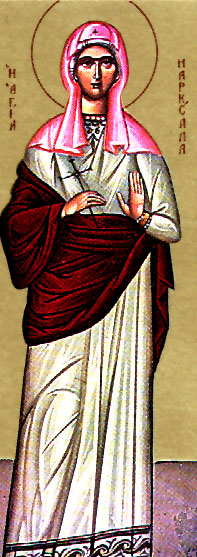
Saint Markella lived in the village of Volissos, Chios sometime after the middle of the fourteenth century. Her parents were Christians, and among the wealthiest citizens of Volissos. The saint’s mother died when she was young, and so her father, the mayor of the village, saw to her education.
She had been trained by her mother to be respectful and devout, and to guard her purity. She avoided associations with other girls who were more outgoing than she was so that she would not come to spiritual harm through such company. Her goal was to attain the Kingdom of Heaven, and to become a bride of Christ.
Saint Markella increased in virtue as she grew older, fasting, praying, and attending church services. She tried to keep the commandments and to lead others to God. She loved and respected her father, and comforted him in his sorrow. She told him she would take care of him in his old age, and would not abandon him.
As an adult, Saint Markella was loved by everyone for her beauty and for her spiritual gifts. The Enemy of our salvation tried to lure her into sin by placing evil thoughts in her mind. She resisted these temptations, and so the devil turned away from a direct confrontation with the young woman. Instead, he incited her father with an unnatural desire for his daughter.
Markella’s father changed in his behavior toward her. He became moody and depressed, forbidding her to go into the garden or to speak with the neighbors. Unable to understand the reason for this change, the saint went to her room and wept. She prayed before an icon of the Mother of God, asking Her to help her father. Soon she fell asleep, only to be awakened by her father’s shouting.
The unfortunate man had spent a long time struggling against his lust, but finally he gave in to it. At times he would speak to his daughter roughly, then later he would appear to be gentle. He wanted to be near her, and to stroke her hair. Unaware of her father’s intentions, Saint Markella was happy to see him emerge from his melancholy state, thinking that her prayer had been answered.
One day, her father openly declared the nature of his feelings for her. Horrified, the saint tried to avoid him as much as she could. Even the neighbors realized that there was something wrong with the man, so they stopped speaking to him.
A shepherd was tending his sheep near the beach one morning, and was leading them into the shade of a plane tree to avoid the hot July sun. Just as he was about to lie down, he heard a noise and looked up. He saw a young woman with a torn dress running down the hill. She hid in a nearby bush, ignoring its thorns.
The shepherd wondered who was chasing her, and how she had come to this spot. Then he heard the sound of a horse approaching, and recognized the mayor of the village. He asked the shepherd if he had seen his daughter. He said that he had not seen her, but pointed to her hiding place with his finger.
The mayor ordered Markella to come out of the bush, but she refused. Therefore, he set fire to the bush in order to force her out. She emerged on the side opposite her father, and ran toward the rocky shore, calling out to the Mother of God for help.
Markella continued to run, even though blood was flowing from her face and hands. Feeling a sharp pain in her leg, she saw that she had been shot with an arrow. She paused to pull it out, then took to flight once more. She scrambled over the rocks, staining them with her blood. Hearing her father getting closer, she prayed that the earth would open up and swallow her.
The saint sank to her knees, her strength all gone, and then a miracle took place. The rock split open and received her body up to the waist. Her father drew near with wild-eyed joy shouting, “I have caught you. Now where will you go?
Drawing his sword, he began to butcher his helpless daughter, cutting off pieces of her body. Finally, he seized her by the hair and cut off her head, throwing it into the sea. At once the calm sea became stormy, and large waves crashed to the shore near the murderer’s feet. Thinking that the sea was going to drown him because of his crime, he turned and fled. His ultimate fate has not been recorded.
In later years, pious Christians built a church on the spot where Saint Markella hid in the bush. The spot where she was killed became known as “The Martyrdom of Saint Markella,” and the rock that opened to receive her is still there. The rock appears to be a large stone that broke off from a mountain and rolled into the sea. Soil from the mountain covers the spot on the side facing the land. On the side facing the ocean is a small hole, about the size of a finger. A healing water flows from the opening, which cures every illness.
The flow of water is not due to the movements of the tide, because when the tide is out, there would be no water. This, however, is not the case. The water is clear, but some of the nearby rocks have been stained with a reddish-yellow color. According to tradition, the lower extremities of Saint Markella’s body are concealed in the rock.
The most astonishing thing about the rock is not the warmth of the water, nor the discoloration of the other rocks, but what happens when a priest performs the Blessing of Water. A sort of steam rises up from the water near the rock, and the entire area is covered with a mist. The sea returns to normal as soon as the service is over. Many miracles have occurred at the spot, and pilgrims flock there from all over the world.
6TH THURSDAY AFTER PENTECOST
NO FAST
John and Symeon the Fool for Christ, Parthenios, Bishop of Arta
Brethren, let no one deceive himself. If any one among you thinks that he is wise in this age, let him become a fool that he may become wise. For the wisdom of this world is folly with God. For it is written, “He catches the wise in their craftiness, ” and again, “The Lord knows that the thoughts of the wise are futile.” So let no one boast of men. For all things are yours, whether Paul or Apollos or Cephas or the world or life or death or the present or the future, all are yours; and you are Christ’s; and Christ is God’s.
At that time, as Jesus went into the house, his disciples came to him, saying, “Explain to us the parable of the weeds of the field.” He answered, “He who sows the good seed is the Son of man; the field is the world, and the good seed means the sons of the kingdom; the weeds are the sons of the evil one, and the enemy who sowed them is the devil; the harvest is the close of the age, and the reapers are angels. Just as the weeds are gathered and burned with fire, so will it be at the close of the age. The Son of man will send his angels, and they will gather out of his kingdom all causes of sin and all evildoers, and throw them into the furnace of fire; there men will weep and gnash their teeth. Then the righteous will shine like the sun in the kingdom of their Father. He who has ears to hear, let him hear.”
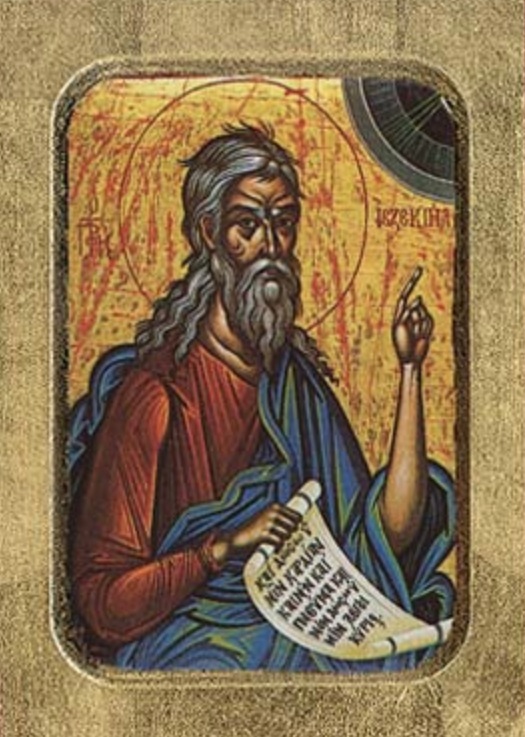
The Holy Prophet Ezekiel lived in the sixth century before the birth of Christ. He was born in the city of Sarir, and descended from the tribe of Levi; he was a priest and the son of the priest Buzi. Ezekiel was led off to Babylon when he was twenty-five years old together with King Jechoniah II and many other Jews during the second invasion of Jerusalem by the Babylonian king Nebuchadnessar.
The Prophet Ezekiel lived in captivity by the River Chebar. When he was thirty years old, he had a vision of the future of the Hebrew nation and of all mankind. The prophet beheld a shining cloud, with fire flashing continually, and in the midst of the fire, gleaming bronze. He also saw four living creatures in the shape of men, but with four faces (Ez. 1:6). Each had the face of a man in front, the face of a lion on the right, the face of an ox on the left, and the face of an eagle at the back (Ez. 1:10). There was a wheel on the earth beside each creature, and the rim of each wheel was full of eyes.
Over the heads of the creatures there seemed to be a firmament, shining like crystal. Above the firmament was the likeness of a throne, like glittering sapphire in appearance. Above this throne was the likeness of a human form, and around Him was a rainbow (Ez. 1:4-28).
According to the explanation of the Fathers of the Church, the human likeness upon the sapphire throne prefigures the Incarnation of the Son of God from the Most Holy Virgin Mary, who is the living Throne of God. The four creatures are symbols of the four Evangelists: a man (St Matthew), a lion (St Mark), an ox (St Luke), and an eagle (St John); the wheel with the many eyes is meant to suggest the sharing of light with all the nations of the earth. During this vision the holy prophet fell down upon the ground out of fear, but the voice of God commanded him to get up. He was told that the Lord was sending him to preach to the nation of Israel. This was the begining of Ezekiel’s prophetic service.
The Prophet Ezekiel announces to the people of Israel, held captive in Baylon, the tribulations it would face for not remaining faithful to God. The prophet also proclaimed a better time for his fellow-countrymen, and he predicted their return from Babylon, and the restoration of the Jerusalem Temple.
There are two significant elements in the vision of the prophet: the vision of the temple of the Lord, full of glory (Ez. 44:1-10); and the bones in the valley, to which the Spirit of God gave new life (Ez. 37:1-14). The vision of the temple was a mysterious prefiguring of the race of man freed from the working of the Enemy and the building up of the Church of Christ through the redemptive act of the Son of God, incarnate of the Most Holy Theotokos. Ezekiel’s description of the shut gate of the sanctuary, through which the Lord God would enter (Ez. 44: 2), is a prophecy of the Virgin giving birth to Christ, yet remaining a virgin. The vision of the dry bones prefigured the universal resurrection of the dead, and the new eternal life bestowed by the Lord Jesus Christ.
The holy Prophet Ezekiel received from the Lord the gift of wonderworking. He, like the Prophet Moses, divided the waters of the river Chebar, and the Hebrews crossed to the opposite shore, escaping the pursuing Chaldeans. During a time of famine the prophet asked God for an increase of food for the hungry.
Ezekiel was condemned to execution because he denounced a certain Hebrew prince for idolatry. Bound to wild horses, he was torn to pieces. Pious Hebrews gathered up the torn body of the prophet and buried it upon Maur Field, in the tomb of Sim and Arthaxad, forefathers of Abraham, not far from Baghdad. The prophecy of Ezekiel is found in the book named for him, and is included in the Old Testament.
St Demetrius of Rostov (October 28 and September 21) explains to believers the following concepts in the book of the Prophet Ezekiel: if a righteous man turns from righteousness to sin, he shall die for his sin, and his righteouness will not be remembered. If a sinner repents, and keeps God’s commandments, he will not die. His former sins will not be held against him, beause now he follows the path of righteousness (Ez. 3:20; 18:21-24).
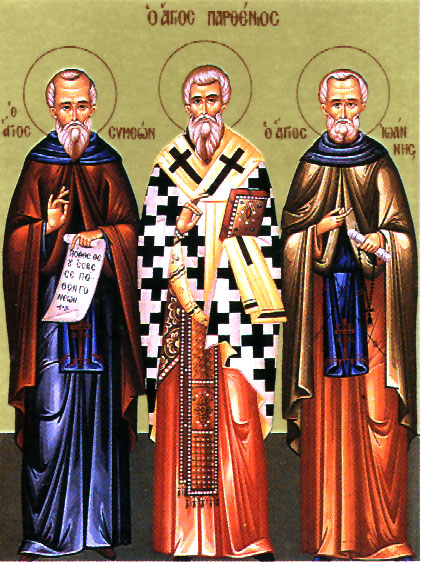
The Monks Simeon, Fool-for-Christ, and his Fellow-Ascetic John were Syrians, and they lived in the sixth century at the city of Edessa. From childhood they were bound by close ties of friendship. The older of them, Simeon, was unmarried and lived with his aged mother. John, however, although he was married, lived with his father (his mother was dead) and with his young wife. Both friends belonged to wealthy families. When Simeon was thirty years old, and John twenty-four, they made a pilgrimage to Jerusalem on the Feast of the Exaltation of the Venerable and Life-Creating Cross of the Lord. On the journey home the friends spoke of the soul’s path to salvation. Dismounting their horses, they sent the servants on ahead with the horses, while they continued on foot.
Passing through Jordan, they saw monasteries on the edge of the desert. Both of them were filled with an irrepressible desire to leave the world and spend their remaining life in monastic struggles. They turned off from the road, which their servants followed to Syria, and they prayed zealously that God would guide them to the monasteries on the opposite side. They besought the Lord to indicate which monastery they should choose, and they decided to enter whichever monastery had its gates open. At this time the Lord informed Igumen Nikon in a dream to open the monastery gates, so that the sheep of Christ could enter in.
In great joy the comrades came through the open gates of the monastery, where they were warmly welcomed by the igumen, and they remained at the monastery. In a short while they received the monastic tonsure.
After remaining at the monastery for a certain time, Simeon desired to intensify his efforts, and to go into the desert to pursue asceticism in complete solitude. John did not wish to be left behind by his companion, and he decided to share with him the work of a desert-dweller. The Lord revealed the intentions of the companions to Igumen Nikon, and on that night when Saints Simeon and John intended to depart the monastery, he himself opened the gates for them. He prayed with them, gave them his blessing and sent them into the wilderness.
When they began their life in the desert, the spiritual brothers at first experienced the strong assaults of the devil. They were tempted by grief over abandoning their families, and the demons tried to discourage the ascetics, subjecting them to weakness, despondency and idleness. The brothers Simeon and John remembered their monastic calling, and trusting in the prayers of their Elder Nikon, they continued upon their chosen path. They spent their time in unceasing prayer and strict fasting, encouraging one another in their struggle against temptation.
After a while, with God’s help, the temptations stopped. The monks were told by God that Simeon’s mother and John’s wife had died, and that the Lord had vouchsafed them the blessings of Paradise. After this Simeon and John lived in the desert for twenty-nine years, and they attained complete dispassion (apathia) and a high degree of spirituality. Saint Simeon, through the inspiration of God, considered that now it was proper for him to serve people. To do this, he must leave the desert solitude and go into the world. Saint John, however, believing that he had not attained such a degree of dispassion as his companion, decided not to leave the wilderness.
The brethren parted with tears. Simeon journeyed to Jerusalem, and there he venerated the Tomb of the Lord and all the holy places. By his great humility the holy ascetic entreated the Lord to permit him to serve his neighbor in such a way that they should not acknowledge him. Saint Simeon chose for himself the difficult task of foolishness for Christ. Having come to the city of Emesa, he stayed there and passed himself off as a simpleton, behaving strangely, for which he was subjected to insults, abuse and beatings. In spite of this, he accomplished many good deeds. He cast out demons, healed the sick, delivered people from immanent death, brought the unbelieving to faith, and sinners to repentance.
All these things he did under the guise of foolishness, and he never received praise or thanks from people. Saint John highly esteemed his spiritual brother, however. When one of the inhabitants of the city of Emesa visited him in the wilderness, asking for his advice and prayers, he would invariably direct them to “the fool Simeon”, who was better able to offer them spiritual counsel. For three days before his death Saint Simeon ceased to appear on the streets, and he enclosed himself in his hut, where there was nothing except for bundles of firewood. Having remained in unceasing prayer for three days, Saint Simeon fell asleep in the Lord. Some of the city poor, his companions, had not seen the fool for some time. They went to his hut and found him dead.
Taking up the dead body, they carried him without church singing to a place where the homeless and strangers were buried. While they carried the body of Saint Simeon, several of the inhabitants heard a wondrous church singing, but could not understand from whence it came.
After Saint Simeon died, Saint John also fell asleep in the Lord. Shortly before his death, Saint Simeon saw a vision of his spiritual brother wearing a crown upon his head with the inscription: “For endurance in the desert.”
The Monk Onuphrius the Silent of the Caves was an ascetic in the Near Caves of Saint Anthony in the twelfth century. He is also commemorated on September 28 (Synaxis of the Fathers of the Near Caves).
Venerable Onesimus the Recluse of the Kiev Caves (XII-XIII) was an ascetic in the Near Caves of Saint Anthony in the twelfth century. He is also commemorated on October 4, and again on September 28 (Synaxis of the Fathers of the Near Caves). The saint’s holy relics were buried at the place of his ascetic labors.
The Armatia Icon of the Mother of God was in Constantinople at the Armatian monastery. The place where the monastery was located, was called “Armation” or “of the Armatians” and received its name from the military magister Armatios, nephew of the tyrant Basiliscus, and a contemporary of the emperor Zeno (474-491).
The celebration of the wonderworking icon was established to commemorate deliverance from the Iconoclast heresy. The Seventh Ecumenical Council of 787 drew up dogmatic definitions about icon veneration based on Holy Scripture and Church Tradition.
The Armatia Icon of the Most Holy Theotokos is commemorated twice during the year, on July 21 and August 17.

The Holy right-believing Princess Anna of Kashin (Euphrosynē in monasticism) reposed on October 2, 1368.
On July 21, 1649, Archbishop Jonah of Kazan and some of the local clergy opened Saint Anna's tomb, and noticed that her relics were incorrupt. Several miracles of healing occurred at that time. The clergy and citizens of Kashin petitioned Tsar Alexei (reigned 1645-1676) to order an examination of Princess Anna's relics.
In 1650, a Council of the Russian Church met and decided to number Princess Anna among the Saints, ordering a Church Service to be composed for her, and that she be venerated throughout Russia. The solemn transfer of her relics from the wooden Dormition Cathedral to the stone Resurrection Cathedral took place on June 12, 1650.
In 1677 Patriarch Joachim proposed to the Moscow Council that Saint Anna's veneration throughout Russia should be discontinued because of the Old Believer Schism, which made use of her name for its own purposes. When she was buried, her hand was positioned to make the Sign of the Cross with two fingers, rather than three. Therefore, only her local veneration was permitted. However, the memory of Saint Anna, whom God had glorified, could not be erased by a decree. People continued to love and venerate her, and many miracles took place at her tomb.
Finally, the Church-wide veneration of Saint Anna was restored on June 12, 1909. During the Soviet period, however, the relics of Saint Anna were taken from the Cathedral and moved several times. Finally on June 25, 1993, her relics were returned to Kashin's Resurrection Cathedral.
Due to scheduling conflicts, there is no Vespers tonight, July 20th.
 Saint Peter Antiochian Orthodox Church
You must be logged in to post a comment.