
Here is the live stream for Great Vespers – 6/4/2022 If you need, here are instructions for accessing this content from your phone, tablet, computer, or TV.
Monthly Archives: June 2022
Daily Readings for Saturday, June 04, 2022
OUR FATHER METROPHANES, ARCHBISHOP OF CONSTANTINOPLE
NO FAST
Our Father Metrophanes, Archbishop of Constantinople, Mary & Martha, the sisters of Lazarus, Sophia of Thrace, The Mother of Orphans, Petroc, Abbot of Padstow
ST. PAUL’S LETTER TO THE HEBREWS 7:26-28; 8:1-2
Brethren, it was fitting that we should have such a high priest, holy, blameless, unstained, separated from sinners, exalted above the heavens. He has no need, like those high priests, to offer sacrifices daily, first for his own sins and then for those of the people; he did this once for all when he offered up himself. Indeed, the law appoints men in their weakness as high priests, but the word of the oath, which came later than the law, appoints a Son who has been made perfect for ever. Now the point in what we are saying is this: we have such a high priest, one who is seated at the right hand of the throne of the Majesty in heaven, a minister in the sanctuary and the true tent which is set up not by man but by the Lord.
JOHN 10:1-9
The Lord said to the Jews who had come to him, "Truly, truly, I say to you, he who does not enter the sheepfold by the door but climbs in by another way, that man is a thief and a robber; but he who enters by the door is the shepherd of the sheep. To him the gatekeeper opens; the sheep hear his voice, and he calls his own sheep by name and leads them out. When he has brought out all his own, he goes before them, and the sheep follow him, for they know his voice. A stranger they will not follow, but they will flee from him, for they do not know the voice of strangers." This figure Jesus used with them, but they did not understand what he was saying to them. So Jesus again said to them, "Truly, truly, I say to you, I am the door of the sheep. All who came before me are thieves and robbers; but the sheep did not heed them. I am the door; if any one enters by me, he will be saved, and will go in and out and find pasture.
Saint Metrophanes, first Patriarch of Constantinople

Saint Metrophanes, Patriarch of Constantinople, was a contemporary of Saint Constantine the Great (306-337). His father, Dometius, was a brother of the Roman emperor Probus (276-282). Seeing the falseness of the pagan religion, Dometius came to believe in Christ. During a time of terrible persecution of Christians at Rome, Saint Dometius set off to Byzantium with two of his sons, Probus and Metrophanes. They were instructed in the law of the Lord by Bishop Titus, a man of holy life. Seeing the ardent desire of Dometius to labor for the Lord, Saint Titus ordained him presbyter. After the death of Titus first Dometius (272-303) was elevated to the bishop’s throne, and thereafter his sons, Probus (303-315) and in 316 Saint Metrophanes.
The emperor Constantine once came to Byzantium, and was delighted by the beauty and comfortable setting of the city. And having seen the holiness of life and sagacity of Saint Metrophanes, the emperor took him back to Rome. Soon Constantine the Great transferred the capital from Rome to Byzantium and he brought Saint Metrophanes there. The First Ecumenical Council was convened in 325 to resolve the Arian heresy. Constantine the Great had the holy Fathers of the Council bestow upon Saint Metrophanes the title of Patriarch. Thus, the saint became the first Patriarch of Constantinople.
Saint Metrophanes was very old, and was not able to be present at the Council, and he sent in his place the chorepiscopos (vicar bishop) Alexander. At the close of the Council the emperor and the holy Fathers visited with the ailing Patriarch. At the request of the emperor, the saint named a worthy successor to himself, Bishop Alexander. He foretold that Paul (at that time a Reader) would succeed to the patriarchal throne after Alexander. He also revealed to Patriarch Alexander of Alexandria that his successor would be the archdeacon Saint Athanasius.
Saint Metrophanes reposed in the year 326, at age 117. His relics rest at Constantinople in a church dedicated to him.
It should be noted that the Canons to the Holy Trinity in the Midnight Office in the Octoechos were not composed by this Metrophanes, but by Bishop Metrophanes of Smyrna, who lived in the middle of the ninth century.
Righteous Martha and Mary, the sisters of Lazarus

The righteous sisters Martha and Mary were believers in Christ even before He raised their brother Saint Lazarus (October 17) from the dead. After the murder of the holy Archdeacon Stephen a persecution against the Jerusalem Church broke out, and Righteous Lazarus was cast out of Jerusalem. The holy sisters then assisted their brother in the proclaiming of the Gospel in various lands.
Saints Martha and Mary are also commemorated on the Sunday of the Myrrh-bearing Women.
Venerable Methodius, Abbot of Peshnosha, Disciple of Venerable Sergius of Radonezh
Saint Methodius, Igumen of Peshnosha was the founder of the Peshnosha monastery. In his youth he went to Saint Sergius of Radonezh and spent several years under his guidance. Later on, with the blessing of Saint Sergius, he withdrew to a solitary place and built himself a cell in the forest beyond the River Yakhroma. Soon several disciples came to him in this marshy place, wishing to imitate his life. Saint Sergius visited him and advised him to build a monastery and church. Saint Methodius himself toiled at the construction of the church and the cells, “on foot carrying” wood along the river, and from that time the monastery began to be called “the Peshnosha.”
In 1391 Saint Methodius became igumen of this monastery. At times he withdrew two versts from the monastery and struggled in prayer. Here also Saint Sergius came to him for spiritual conversation, therefore this spot became known as “Beseda” (“Conversation-place”).
Saint Methodius died in 1392 and was buried at the monastery he founded. A church dedicated to Saints Sergius of Radonezh and Methodius of Peshnosha was built over his relics in 1732. The beginning of his local veneration dates from the late seventeenth—early eighteenth centuries.
Saint Methodius is also commemorated on June 14.
Martyrs Frontasius, Severinus, Severian, and Silanus, of Gaul
The Holy Martyrs Frontasius, Severinus, Severian, and Silanus suffered for Christ under the emperor Claudius (41-54). They had been sent to preach the Word of God in southern Gaul (now France) by Bishop Frontonus of Petragorium. The governor, a pagan named Squiridonus, arrested them and demanded that they renounce Christ. But the martyrs firmly confessed their faith, saying they had but one desire, to either live or die for Christ. The enraged Squiridonus ordered that the saints be taken out before the city, tied to pillars, and have nails thrust into their heads like a crown of thorns. After this they were beheaded.
Tradition says that the holy martyrs continued to live by the power of God. They picked up their heads and went to the church of the Mother of God, where the holy bishop Frontonus, who had sent them preaching, was at prayer. Placing their heads at the feet of the bishop, they crossed themselves and died.
Martyr Concordius of Spoleto
The Holy Martyr Concordius, son of the presbyter Gordian, was raised in piety and faith in Christ, and therefore Bishop Pius of Rome made him a subdeacon. Together with his father, Saint Concordius fasted and prayed, and he generously distributed alms to the needy. With the permission of his father he settled not far from Rome with his kinsman Eutychius, spending his days in prayer and good deeds. The report of his pious life reached Torquatus, the head of the Tussa region. He summoned the saint and urged him to renounce Christ, promising to make him a priest of the pagan gods.
Saint Concordius in turn urged Torquatus to turn to the true God, Jesus Christ. They beat the martyr and threw him in prison. Bishop Anthimus, a friend of Torquatus, asked him to release the prisoner to him. Saint Concordius lived with him for a while and was ordained presbyter. When Torquatus again summoned the saint and asked him what he thought about his life, the saint replied that life, for him, is Christ. They bound him and locked him up in prison, chaining him to the wall by his neck and hands.
Three days later Torquatus sent his assistant to the prison, ordering the martyr to offer sacrifice to the gods, or be condemned to death. The saint cried out, “Glory to Thee, Lord Jesus Christ,” and spat on the idol of Zeus carried by the soldiers. For this, he was beheaded around the year 175. His relics rest in Italy, not far from the city of Spoleto.
Hieromartyr Astius, Bishop of Dyrrachium in Macedonia
The Hieromartyr Astius was bishop of the city of Dyrrachium (Macedonia) during the time of the emperor Trajan (98-117), a persecutor of Christians. The saint once had a dream, a foreboding of his impending suffering and death for Christ. He was arrested and beaten fiercely with leaden rods and oxhide whips, but Saint Astius did not renounce Christ. They smeared his body with honey, so as to increase his suffering with the stings of hornets and flies, and crucified him. The martyr’s body was reverently buried by Christians.
Venerable Father Zosima, Bishop of Babylon

Saint Zosima, Bishop of Babylon, was born in Cilicia (Asia Minor). While still a youth he left the world and settled on Mount Sinai, and later he withdrew to a more solitary place in Lebanon. One time he encountered an elderly ascetic, who foretold that he would be bishop in Babylon. When Zosima returned to Sinai, he was sent on an errand to Alexandria. The Patriarch of Alexandria made him Bishop of Babylon, and into old age he wisely guided his flock. Sensing the approach of death, he returned to Sinai and peacefully fell asleep in the Lord (5th century).
Venerable Sophia of Ainos

Our venerable Mother Sophia was born in the province of Ainos in southeastern Thrace , and was the daughter of pious Christian parents. When she was of age, her parents arranged for her to be married. She and her husband had six children. Though she was occupied with worldly cares and responsibilities, she still kept the commandments of God and lived a virtuous life. She loved to attend the Church services, and so she progressed in virtue.
After sickness carried off Sophia's husband and all her children in succession, she did not despair, but became even more devoted to God. Within a period of twenty years, she adopted one hundred children, and raised them to love God. Because of this, she is sometimes called Saint Sophia the Mother of Orphans. She sold her property and gave the proceeds to the poor and to widows. She led an austere life, eating nothing but bread and water. She preferred to do without the necessities of life herself rather than allow any poor person to leave her home empty-handed. The Psalms of the Prophet-King David were always on her lips, and tears flowed continuously from her eyes.
Because of her humility and her love for the poor, God blessed her in the following way. In her home there was a container of wine which she reserved for the poor. She noticed that no matter how much she took from the container, it remained full. However, as soon as she told someone about the miracle and glorified God, the container became empty. Saint Sophia became sorrowful, believing that the wine had failed because of her unworthiness. Therefore, she increased her ascetical labors until her health suffered.
Sensing that the end of her life was near, she received the monastic tonsure. From that time, she devoted herself completely to the worship of God. Saint Sophia reposed peacefully at the age of fifty-three. It is not known when she lived.
Hieromartyr Joannicius of Serbia
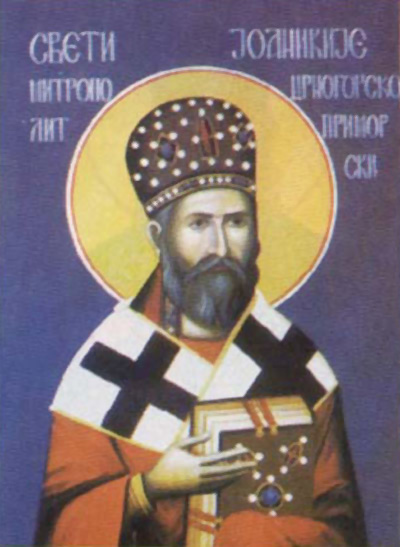
No information available at this time.
Hieromartyr George of Serbia
No information available at this time.
Martyrs of Niculitsel

The graves of Saints Zoticus, Atallus, Camisius and Philip were discovered in 1971.
Lesser Scythia (modern Romania), between the Danube and the Black Sea in the northeastern territory of the Roman Empire, was a place of exile or death for Christians who refused to worship the pagan gods. During the persecutions of Decius (249-251), Diocletian and Maximilian (284-305), and Licinius (308-324) thousands of people died there from cold, hunger, or torture. The relics of those who endured martyrdom because they openly proclaimed their faith in Christ were taken by Christians and buried in secret places. Accounts of the lives and sufferings of these holy martyrs were written and preserved so they would not be forgotten. When the persecutions ended, the relics were moved from their temporary resting places and placed in special crypts (martyria). Churches were built over these crypts, and the ruins of some of them may be seen today in Dobrogea.
In September 1971 a creek overflowed its banks near the village of Niculitsel in the county of Tulcea, revealing one of the oldest of these martyria. The crypt, which is made of bricks, is divided into two rooms, one on top of the other. In the upper room, the relics of four martyrs were found in a single wooden coffin. All had been decapitated. The heads of three martyrs were found atop their necks, while the head of the fourth martyr was resting on his chest. An inscription on the left wall reads: “Christ’s martyrs.” The names of the four martyrs (Zoticus, Attalus, Camasius, and Philip) were scratched into the right wall.
According to the records which have been preserved, these martyrs were tried by the Roman authorities of Noviodunum (modern Isaccea) and sentenced to death. They were beheaded, then buried at Niculitsel. The exact date of their martyrdom is not known. Some believe that they were slain early in the fourth century during the persecutions of Diocletian or Licinius. Others, however, think the four men may have been martyred north of the Danube during the persecution of the Gothic king Athanaric (370-372) against the Christians.
About a hundred fragments of the bones of two men (aged between 45-50) were found in the lower crypt. It is thought that they died during the persecution of Decius, and then their relics were reinterred at Niculitsel around 370-380. The names of these martyrs are not known.
The Syrian Martyrologion and Saint Jerome’s Martyrologion give June 4 as the date of the martyrs’ execution. The Synaxaria list these four martyrs along with six others: Eutychius, Quirinus, Julia, Saturninus, Ninita, Fortunio. Twenty-five others were also beheaded with these martyrs, but are not named.
The relics of these holy martyrs were moved to the Cocosh Monastery in 1971, where they are venerated by the faithful.
New Martyr Archbishop Andronicus of Perm
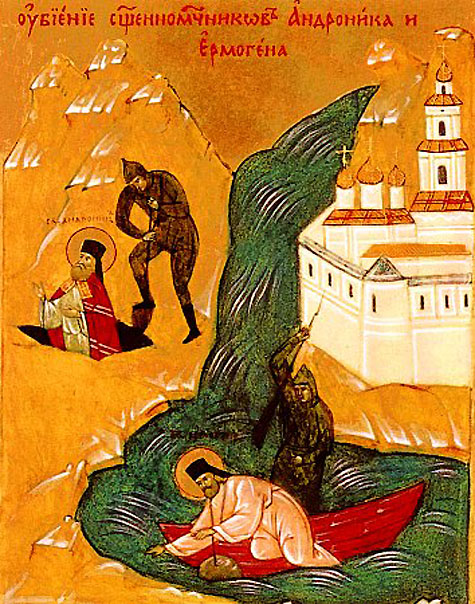
The holy New Martyr Archbishop Andronicus of Perm was an outspoken critic of the Communist decree which ordered the separation of Church and State. Upon reading the Moscow Overland Assembly’s instructions on the matter, Archbishop Andronicus ordered his archdeacon to anathematize the Communists. The Archbishop was arrested, shot by two members of the Perm CHEKA, then buried on the road from Perm to Motoviliha.
Bishop Theophanes, an assistant to Archbishop Andronicus, was also arrested about this time. He was then drowned in the River Kama. When they learned of the execution of the Perm bishops, the Moscow Church Assembly sent a special commission, headed by Bishop Basil of Chernigov, to investigate their murder. The Communists, however, took steps to conceal the facts from the investigators.
As the members of the commission were on their way back to Moscow, their train was attacked by Red soldiers somewhere between Perm and Viatka. Bishop Basil and the others were killed, and their bodies were thrown from the coach. The bodies were buried by peasants, but were later dug up and burned by the Communists when pilgrims began flocking to the graves.
Hieromartyr Joanicus, Metropolitan of Montenegro and the Coast
No information available at this time.
Hieromartyr Savva, Bishop of Upper Karlovac
No information available at this time.
Daily Readings for Friday, June 03, 2022
6TH FRIDAY AFTER PASCHA
ABSTAIN FROM MEAT, FISH, DAIRY, EGGS, WINE, OLIVE OIL
Lucillian of Byzantium, 4 martyred Youths and Paula the Virgin, Athanasios the Wonderworker, Kevin, Abbot of Glendalough
ACTS OF THE APOSTLES 19:1-8
In those days, while Apollos was at Corinth, Paul passed through the upper country and came to Ephesus. There he found some disciples. And he said to them, "Did you receive the Holy Spirit when you believed?" And they said, "No, we have never even heard that there is a Holy Spirit." And he said, "Into what then were you baptized?" They said, "Into John's baptism." And Paul said, "John baptized with the baptism of repentance, telling the people to believe in the one who was to come after him, that is, Jesus." On hearing this, they were baptized in the name of the Lord Jesus. And when Paul had laid his hands upon them, the Holy Spirit came on them; and they spoke with tongues and prophesied. There were about twelve of them in all. And he entered the synagogue and for three months spoke boldly, arguing and pleading about the kingdom of God.
JOHN 14:1-11
The Lord said to his disciples, "Let not your hearts be troubled; believe in God, believe also in me. In my Father's house there are many rooms; if it were not so, would I have told you that I go to prepare a place for you? And when I go and prepare a place for you, I will come again and will take you to myself, that where I am you may be also. And you know the way where I am going." Thomas said to him, "Lord, we do not know where you are going; how can we know the way?" Jesus said to him, "I am the way, and the truth, and the life; no one comes to the Father, but by me. If you had known me, you would have known my Father also; henceforth you know him and have seen him.
Philip said to him, "Lord, show us the Father, and we shall be satisfied." Jesus said to him, "Have I been with you so long, and yet you do not know me, Philip? He who has seen me has seen the Father; how can you say, 'Show us the Father?' Do you not believe that I am in the Father and the Father in me? The words that I say to you I do not speak on my own authority; but the Father who dwells in me does his works. Believe me that I am in the Father and the Father in me.
Martyr Lucillian and those who suffered with him at Byzantium
Saint Lucillian was a pagan priest during the reign of the Roman emperor Aurelian (270-275). In his old age he became persuaded of the falseness of the pagan religion, and with all his heart he turned to the faith in Christ the Savior, and was baptized.
Under the influence of his preaching many pagans were converted to Christianity. Then certain Jews, seeing that he was spreading faith in Christ Whom they crucified, reported Lucillian to the Nicomedia prefect Silvanus, who urged the old man to return to idol-worship. When he refused, they smashed the saint’s jawbone, beat him with rods and suspended him head downward, and then they locked him in prison. Here he met four youths who were confessors of Christianity: Claudius, Hypatius, Paul and Dionysius. Saint Lucillian urged them to stand firm in the Faith, and to fear neither tortures nor death.
After a while they brought them to trial and then threw them into a red-hot furnace. Suddenly, rain fell and extinguished the flames, and the martyrs remained unharmed. The governor sentenced them to death, sending them to Byzantium to be executed. The holy youths were beheaded by the sword, and the holy martyr Lucillian was nailed to a cross with many nails.
The holy virgin Paula witnessed the contest of the holy martyrs. She had dedicated herself to the service of those suffering for Christ. She provided food to Christian prisoners, washed their wounds, brought medications, and also buried the bodies of martyrs. After the death of Saint Lucillian and the four young men, she returned to Nicomedia and continued with her holy service. The holy virgin was arrested and cast into a furnace, but by the power of God she remained unharmed. Then they sent her off to Byzantium, where the holy martyr was beheaded.
Translation of the relics of slain Crown Prince Demetrius of Moscow

The Tsarevich Saint Demetrius, murdered on May 15, 1591, was glorified in the year 1606 “to stop lying lips and blind unbelieving eyes from saying that the Tsarevich had escaped alive from the hands of the murderers” after the appearance of a pretender, who declared himself to be the Tsarevich Demetrius.
The holy relics were solemnly transferred and placed in the Arkhangelsk cathedral of the Moscow Kremlin, “in the side altar of John the Forerunner, where his father and his brothers were buried.”
After numerous miracles of healing from the holy relics, three feastdays for the Tsarevich Demetrius were established during this same year of 1606, his birthday (October 19), his murder (May 15), and the transfer of his relics to Moscow (June 3).
Hieromartyr Lucian, Bishop of Beauvais, and those with him in France
The Hieromartyr Lucian lived in Rome, and his pagan name was Lucius. He was converted to Christ by the Apostle Peter, and was baptized. After Saint Peter’s death, Saint Lucian preached the Gospel in Italy. Saint Dionysius the Areopagite (October 3), a disciple of Saint Paul, arrived in Rome at this time. At the request of Saint Clement, Pope of Rome (November 25), he agreed to preach the Gospel in the West, and gathered companions and helpers for this task. Saint Clement consecrated Saint Lucian a bishop, then sent him off with Saint Dionysius, Saints Marcellinus and Saturninus, the Presbyter Maximian, and the Deacon Julian.
The holy preachers sailed from Italy to Gaul (modern France). Saint Marcellinus and those accompanying him continued on to Spain. Saint Saturninus went to Gaul, and Saint Dionysius and the others went to the region of Paris. From there Saint Lucian went to Belgium with Maximian and Julian.
Saint Lucian’s preaching was very successful. By the power of his words and the example of his life, he converted a large number of pagans to Christianity. Saint Lucian was a strict ascetic, and all day long he ate only a morsel of bread and some water. Towards the converted he was kindly, always joyful and cheerful of face. Soon almost all the settlements of Belgium were converted to Christ.
During this period, the Roman emperor Dometian (81-96) initiated a second persecution against Christians (after that of Nero, 54-68), and he issued an edict prescribing torture and execution for anyone who refused to offer sacrifice to the pagan gods.
Three officials were sent to Belgium to carry out the edict. The Lord revealed to Saint Lucian the ordeal facing him. He gathered the flock together, urging them not to fear threats, tortures or death, and then he gave thanks to God for granting him the possibility of joining the company of the holy martyrs. After praying, Saint Lucian and the priest Maximian and Deacon Julian withdrew to the summit of a hill, where he continued to teach the people who came with him.
Here the soldiers of the emperor came upon the saints and led them away for trial. Saints Maximian and Julian were urged to renounce Christ and offer sacrifice to idols, but both refused and were beheaded.
Then the judge began to interrogate Saint Lucian, accusing him of sorcery and disobedience to the emperor and Senate. The saint replied that he was not a sorcerer, but rather a servant of the true God, the Lord Jesus Christ, and he refused to offer sacrifice to idols made by human hands.
The saint was subjected to fierce beatings, during which he repeated, “Never will I cease to praise Christ, the Son of God, in my heart, and with my lips.” Then the holy martyr was beheaded. A heavenly light shone over his body, and the Voice of the Savior was heard, summoning the valiant sufferer into the heavenly Kingdom to receive the martyr’s crown. By the power of God the saint stood up, picked up his severed head, and crossed over the river. Reaching the burial spot he had chosen, he lay down upon the ground and reposed in peace.
Because of this great miracle about 500 pagans were converted to Christ. Later, a church was built over Saint Lucian’s grave, to which the relics of the martyrs Maximian and Julian were transferred.
Saint Kevin of Glendalough
Saint Kevin (Coemgen) was born in Leinster in the early decades of the sixth century, the age of Saints Columba (June 9), Columbanus of Luxeuil (November 21), Comgall of Bangor (May 10), Finnian of Clonard (December 12), Kieran of Clonmacnoise (September 9), and many other great saints.
This holy ascetic belonged to a noble family which had included several Kings of Leinster. He himself, however, was a model of humility and self-denial. There are several miraculous stories connected with his birth and childhood, but most are unreliable.
The holy youth was baptized by a priest named Cronan and was named Kevin, which means "fair-begotten." There are so many saints named Cronan that it is not clear which one baptized Saint Kevin. When he was seven years old, his parents sent him to be taught by Saint Petroc (June 4), who happened to be visiting Ireland at the time.
As a boy of twelve, Saint Kevin was placed in the charge of three holy Elders: Eogoin of Ardstraw (August 23), Lochan, and Enna. Little is known of these teachers or where their establishment was located. His secular studies were certainly enhanced by spiritual instruction. He learned to read the Holy Scriptures, and to profit from the example of the virtuous men and women of the Old and New Testaments.
Saint Kevin was so handsome that a young girl named Kathleen became inflamed with desire for him, but the holy youth resisted all her allurements. She pestered him so much with her attentions that he fled from her, just as Joseph fled from Potiphar's wife (Genesis 39:12). Kathleen followed him and found him alone in a field, so she approached him and threw her arms around him. Arming himself with the Sign of the Cross, and filled with the Holy Spirit, Saint Kevin broke away from her and ran into the woods. She soon discovered him hiding in a bed of nettles. Grabbing a bunch of nettles, the saint struck her about the face, hands and feet. Wounded by the nettles, the girl's passion quickly cooled. She fell on her knees in repentance, begged forgiveness from God and from Saint Kevin, and promised to become a nun.
After successfully resisting the temptations of the flesh, Saint Kevin continued to devote himself to his studies, and longed to live the monastic life as a hermit. This was a common practice in the Celtic Church, which was influenced by the lives of the Egyptian desert dwellers, and by monks who had come from Gaul. Saint Kevin was anxious to leave the monastery, but his three Elders would not let him go. However, he had acquired a reputation for holiness, and people from the surrounding area came to seek his advice. Desiring to flee from such unwelcome attention, he left the monastery in secret and went into the wilderness.
It is said that an angel led him to Glendalough (the Vale of the Two Lakes) where he lived in the hollow of a tree somewhere by the shores of the Upper Lake. The ascetic remained in this place for several days, living on wild herbs and water. A cow wandered off and came to the tree where the Saint was living, and began to lick his clothing. After some time had passed, the cow showed an unusual increase in its milk, so her owner told his herdsman follow the animal. She led him to Glendalough, and there the herdsman discovered Saint Kevin, weak with hunger, and hiding in the tree.
The herdsman had to remove Saint Kevin on a litter by force, since the holy ascetic did not wish to leave. As he was being carried off, the trees bent down to make way for them. Saint Kevin then bestowed his blessing on the forest.
News of Saint Kevin reached his three Elders, who came to bring him back to their monastery. Recognizing the holiness of his life, they understood that they had nothing more to teach him, so they blessed him to leave the monastery.
A certain Bishop Lugidus ordained Sain Kevin to the priesthood, and sent him and a few other monks to found a new church. He spent a little time converting people at Cluainduach, but later moved back to Glendalough.
Guided by an angel, Saint Kevin crossed the Wicklow Mountains and established a monastery in the lower part of the valley where two rivers flow together. Once the monastery was organized, he appointed one of the monks as abbot, and then he retired to the upper valley a mile away to resume his life of solitude. He built a small dwelling on a narrow place between the mountain and the lake, where there were dense woods and clear rivulets. Some sources say that Saint Kevin lived there for four years, while others say seven years.
During this period of his life, wild animals would come to drink water out of his hands. Once during Lent, Saint Kevin stood praying in his hut with his hand sticking out of the window. Just then a blackbird nested in his hand and laid an egg. So gentle and compassionate was the Saint that he remained in this position until the eggs hatched and the fledglings were able to fly away.
There is a small cave above the Upper Lake known as Saint Kevin's Bed. One year he retired there for Lent, and an angel came and told him he would have to move because a rock was about to fall on that spot. Saint Kevin told the angel he could not interrupt his Lenten struggles or leave that place. On the eve of Pascha the angel returned to take him away. The venerable one protested that he would like to remain there for the rest of his life. He was persuaded to go, however, by the angel's promise that great benefits would follow for all who would come there in the future, both to live in the monastic city and to be buried there. Just as he was leaving with the angel, the rock came tumbling down and landed on the very spot where he had been standing.
Crossing over the lake, they discussed the problem of finding sufficient space for so many people. The angel said that if Saint Kevin wished, God could transform the four mountains surrounding the valley to level fields, fruitful and easy to work. The holy ascetic replied that he would not want God's creatures to perish on his account. All of the animals of those mountains were tame and humble toward him, and they would be saddened by this proposal.
When they arrived at the chosen spot, Saint Kevin saw that the ground was rocky and unsuitable for burial. The angel fixed that by clearing all the stones away. The site is to the east of the smaller (Lower) lake. Saint Kevin told the local chieftain Dimma and his sons to cut away the thorns and thistles, and to make this a beautiful spot. It is not certain just where in the valley Saint Kevin fell asleep in the Lord. It was not at the hermitage, however, because he sent a party of monks there to pray for him. Local tradition says that Saint Kevin is buried in the church of the Mother of God in that vicinity.
Saint Kevin was succeeded as abbot by his nephew Molibba (Jan. 8), who seems to have been the first bishop there. According to the Annals of Ulster, the holy abbot and confessor Kevin departed to Christ on June 3, 618.
Daily Readings for Thursday, June 02, 2022
HOLY ASCENSION
NO FAST
Holy Ascension, Nicephorus the Confessor, Patriarch of Constantinople, Erasmos of Ochrid & his Companion Martyrs, Demetrios the New Martyr of Philadelphia, Constantine the New Martyr of the Hagarenes
ACTS OF THE APOSTLES 1:1-12
In the first book, O Theophilos, I have dealt with all that Jesus began to do and teach, until the day when he was taken up, after he had given commandment through the Holy Spirit to the apostles whom he had chosen. To them he presented himself alive after his passion by many proofs, appearing to them during forty days, and speaking of the kingdom of God. And while staying with them he charged them not to depart from Jerusalem, but to wait for the promise of the Father, which, he said, “you heard from me, for John baptized with water, but before many days you shall be baptized with the Holy Spirit.” So when they had come together, they asked him, “Lord, will you at this time restore the kingdom of Israel?” He said to them, “it is not for you to know times or seasons which the Father has fixed by his own authority. But you shall receive power when the Holy Spirit has come upon you; and you shall be my witnesses in Jerusalem and in all Judea and Samaria and to the end of the earth.” And when he had said this, as they were looking on, he was lifted up, and a cloud took him out of their sight. And while they were gazing into heaven as he went, behold, two men stood by them in white robes, and said, “Men of Galilee, why do you stand looking into heaven? This Jesus, who was taken up from you into heaven, will come in the same way as you saw him go into heaven.” Then they returned from the mount called Olivet, which is near Jerusalem, a sabbath day’s journey away.
LUKE 24:36-53
At that time, Jesus, having risen from the dead, stood in the midst of his disciples and said to them, "Peace to you." But they were startled and frightened, and supposed that they saw a spirit. And he said to them, "Why are you troubled, and why do questionings rise in your hearts? See my hands and feet, that it is I myself; handle me, and see; for a spirit has not flesh and bones as you see that I have." And when he said this, he showed them his hands and his feet. And while they still disbelieved for joy, and wondered, he said to them, "Have you anything here to eat?" They gave him a piece of broiled fish, and he took it and ate before them.
Then he said to them, "These are my words which I spoke to you, while I was still with you, that everything written about me in the law of Moses and the prophets and the psalms must be fulfilled. Then he opened their minds to understand the scriptures, and said to them, "Thus it is written, that the Christ should suffer and on the third day rise from the dead, and that repentance and forgiveness of sins should be preached in his name to all nations, beginning from Jerusalem. You are witnesses of these things. And behold, I send the promise of my Father upon you; but stay in the city, until you are clothed with power from on high.
Then he led them out as far as Bethany, and lifting up his hands, he blessed them. While he blessed them, he parted from them, and was carried up into heaven. And they worshiped him, and they returned to Jerusalem with great joy, and were continually in the temple blessing God.
The Ascension of our Lord

“AND ASCENDED INTO HEAVEN….”
V. Rev. George Florovsky, D.D.
“I ascend unto My Father and your Father, and to My God, and Your God” (John 20:17).
In these words the Risen Christ described to Mary Magdalene the mystery of His Resurrection. She had to carry this mysterious message to His disciples, “as they mourned and wept” (Mark 16:10). The disciples listened to these glad tidings with fear and amazement, with doubt and mistrust. It was not Thomas alone who doubted among the Eleven. On the contrary, it appears that only one of the Eleven did not doubt—Saint John, the disciple “whom Jesus loved.” He alone grasped the mystery of the empty tomb at once: “and he saw, and believed” (John 20:8). Even Peter left the sepulcher in amazement, “wondering at that which was come to pass” (Luke 24:12).
The disciples did not expect the Resurrection. The women did not, either. They were quite certain that Jesus was dead and rested in the grave, and they went to the place “where He was laid,” with the spices they had prepared, “that they might come and anoint Him.” They had but one thought: “Who shall roll away the stone from the door of the sepulcher for us?” (Mark 16:1-3; Luke 24:1). And therefore, on not finding the body, Mary Magdalene was sorrowful and complained: “They have taken away my Lord, and I know not where they have laid Him” (John 20:13). On hearing the good news from the angel, the women fled from the sepulchre in fear and trembling: “Neither said they anything to any man, for they were afraid” (Mark 16:8). And when they spoke no one believed them, in the same way as no one had believed Mary, who saw the Lord, or the disciples as they walked on their way into the country, (Mark 16:13), and who recognized Him in the breaking of bread. “And afterward He appeared unto the Eleven as they sat at meat, and upbraided them with their unbelief and hardness of heart, because they believed not them who had seen Him after He was risen” (Mark 16:10-14).
From whence comes this “hardness of heart” and hesitation? Why were their eyes so “holden,” why were the disciples so much afraid of the news, and why did the Easter joy so slowly, and with such difficulty, enter the Apostles’ hearts? Did not they, who were with Him from the beginning, “from the baptism of John,” see all the signs of power which He performed before the face of the whole people? The lame walked, the blind saw, the dead were raised, and all infirmities were healed. Did they not behold, only a week earlier, how He raised by His word Lazarus from the dead, who had already been in the grave for four days? Why then was it so strange to them that the Master had arisen Himself? How was it that they came to forget that which the Lord used to tell them on many occasions, that after suffering and death He would arise on the third day?
The mystery of the Apostles’ “unbelief” is partly disclosed in the narrative of the Gospel: “But we trusted that it had been He which should have redeemed Israel,” with disillusionment and complaint said the two disciples to their mysterious Companion on the way to Emmaus (Luke 24:21). They meant: He was betrayed, condemned to death and crucified. The news of the Resurrection brought by the women only “astonished” them. They still wait for an earthly triumph, for an exernal victory. The same temptation possesses their hearts, which first prevented them from accepting “the preaching of the Cross” and made them argue every time the Saviour tried to reveal His mystery to them. “Ought not Christ to have suffered these things and to enter into His glory?” (Luke 24:26). It was still difficult to understand this.
He had the power to arise, why did He allow what that had happened to take place at all? Why did He take upon Himself disgrace, blasphemy and wounds? In the eyes of all Jerusalem, amidst the vast crowds assembled for the Great Feast, He was condemned and suffered a shameful death. And now He enters not into the Holy City, neither to the people which beheld His shame and death, nor to the High Priests and elders, nor to Pilate—so that He might make their crime obvious and smite their pride. Instead, He sends His disciples away to remote Galilee and appears to them there. Even much earlier the disciples wondered, “How is it that Thou wilt manifest Thyself unto us, and not unto the world?” (John 14:22). Their wonder continues, and even on the day of His glorious Ascension the Apostles question the Lord, “Lord, wilt Thou at this time restore again the kingdom to Israel?” (Acts 1:6). They still did not comprehend the meaning of His Resurrection, they did not understand what it meant that He was “ascending” to the Father. Their eyes were opened but later, when “the promise of the Father” had been fulfilled.
In the Ascension resides the meaning and the fullness of Christ’s Resurrection.
The Lord did not rise in order to return again to the fleshly order of life, so as to live again and commune with the disciples and the multitudes by means of preaching and miracles. Now he does not even stay with them, but only “appears” to them during the forty days, from time to time, and always in a miraculous and mysterious manner. “He was not always with them now, as He was before the Resurrection,” comments Saint John Chrysostom. “He came and again disappeared, thus leading them on to higher conceptions. He no longer permitted them to continue in their former relationship toward Him, but took effectual measures to secure these two objects: That the fact of His Resurrection should be believed, and that He Himself should be ever after apprehended to be greater than man.” There was something new and unusual in His person (cf. John 21:1-14). As Saint John Chrysostom says, “It was not an open presence, but a certain testimony of the fact that He was present.” That is why the disciples were confused and frightened. Christ arose not in the same way as those who were restored to life before Him. Theirs was a resurrection for a time, and they returned to life in the same body, which was subject to death and corruption—returned to the previous mode of life. But Christ arose for ever, unto eternity. He arose in a body of glory, immortal and incorruptible. He arose, never to die, for “He clothed the mortal in the splendor of incorruption.” His glorified Body was already exempt from the fleshly order of existence. “It is sown in corruption, it is raised in incorruption. It is sown in dishonor, it is raised in glory. It is sown in weakness, it is raised in power. It is sown a natural body, it is raised a spiritual body” (I Cor. 15:42-44). This mysterious transformation of human bodies, of which Saint Paul was speaking in the case of our Lord, had been accomplished in three days. Christ’s work on earth was accomplished. He had suffered, was dead and buried, and now rose to a higher mode of existence. By His Resurrection He abolished and destroyed death, abolished the law of corruption, “and raised with Himself the whole race of Adam.” Christ has risen, and now “no dead are left in the grave” (cf. The Easter Sermon of Saint John Chrysostom). And now He ascends to the Father, yet He does not “go away,” but abides with the faithful for ever (cf. The Kontakion of Ascension). For He raises the very earth with Him to heaven, and even higher than any heaven. God’s power, in the phrase of Saint John Chrysostom, “manifests itself not only in the Resurrection, but in something much stronger.” For “He was received up into heaven, and sat on the right hand of God” (Mark 16:19).
And with Christ, man’s nature ascends also.
“We who seemed unworthy of the earth, are now raised to heaven,” says Saint John Chrysostom. “We who were unworthy of earthly dominion have been raised to the Kingdom on high, have ascended higher than heaven, have came to occupy the King’s throne, and the same nature from which the angels guarded Paradise, stopped not until it ascended to the throne of the Lord.” By His Ascension the Lord not only opened to man the entrance to heaven, not only appeared before the face of God on our behalf and for our sake, but likewise “transferred man” to the high places. “He honored them He loved by putting them close to the Father.” God quickened and raised us together with Christ, as Saint Paul says, “and made us sit together in heavenly places in Christ Jesus” (Ephes. 2:6). Heaven received the inhabitants of the earth. “The First fruits of them that slept” sits now on high, and in Him all creation is summed up and bound together. “The earth rejoices in mystery, and the heavens are filled with joy.”
“The terrible ascent….” Terror-stricken and trembling stand the angelic hosts, contemplating the Ascension of Christ. And trembling they ask each other, “What is this vision? One who is man in appearance ascends in His body higher than the heavens, as God.”
Thus the Office for the Feast of the Ascension depicts the mystery in a poetical language. As on the day of Christ’s Nativity the earth was astonished on beholding God in the flesh, so now the Heavens do tremble and cry out. “The Lord of Hosts, Who reigns over all, Who is Himself the head of all, Who is preeminent in all things, Who has reinstated creation in its former order—He is the King of Glory.” And the heavenly doors are opened: “Open, Oh heavenly gates, and receive God in the flesh.” It is an open allusion to Psalms 24:7-10, now prophetically interpreted. “Lift up your heads, Oh ye gates, and be lifted up, ye everlasting doors, and the King of Glory shall come in. Who is this King of glory? The Lord strong and mighty….” Saint Chrysostom says, “Now the angels have received that for which they have long waited, the archangels see that for which they have long thirsted. They have seen our nature shining on the King’s throne, glistening with glory and eternal beauty…. Therefore they descend in order to see the unusual and marvelous vision: Man appearing in heaven.”
The Ascension is the token of Pentecost, the sign of its coming, “The Lord has ascended to heaven and will send the Comforter to the world”
For the Holy Spirit was not yet in the world, until Jesus was glorified. And the Lord Himself told the disciples, “If I go not away, the Comforter will not come unto you” (John 16:7). The gifts of the Spirit are “gifts of reconciliation,” a seal of an accomplished salvation and of the ultimate reunion of the world with God. And this was accomplished only in the Ascension. “And one saw miracles follow miracles,” says Saint John Chrysostom, “ten days prior to this our nature ascended to the King’s throne, while today the Holy Ghost has descended on to our nature.” The joy of the Ascension lies in the promise of the Spirit. “Thou didst give joy to Thy disciples by a promise of the Holy Spirit.” The victory of Christ is wrought in us by the power of the Holy Spirit.
“On high is His body, here below with us is His Spirit. And so we have His token on high, that is His body, which He received from us, and here below we have His Spirit with us. Heaven received the Holy Body, and the earth accepted the Holy Spirit. Christ came and sent the Spirit. He ascended, and with Him our body ascended also” (Saint John Chrysostom). The revelation of the Holy Trinity was completed. Now the Spirit Comforter is poured forth on all flesh. “Hence comes foreknowledge of the future, understanding of mysteries, apprehension of what is hidden, distribution of good gifts, the heavenly citizenship, a place in the chorus of angels, joy without end, abiding in God, the being made like to God, and, highest of all, the being made God!” (Saint Basil, On the Holy Spirit, IX). Beginning with the Apostles, and through communion with them—by an unbroken succession—Grace is spread to all believers. Through renewal and glorification in the Ascended Christ, man’s nature became receptive of the spirit. “And unto the world He gives quickening forces through His human body,” says Bishop Theophanes. “He holds it completely in Himself and penetrates it with His strength, out of Himself; and He likewise draws the angels to Himself through the spirit of man, giving them space for action and thus making them blessed.” All this is done through the Church, which is “the Body of Christ;” that is, His “fullness” (Ephesians 1:23). “The Church is the fulfillment of Christ,” continues Bishop Theophanes, “perhaps in the same way as the tree is the fulfillment of the seed. That which is contained in the seed in a contracted form receives its development in the tree.”
The very existence of the Church is the fruit of the Ascension. It is in the Church that man’s nature is truly ascended to the Divine heights. “And gave Him to be Head over all things” (Ephesians 1:22). Saint John Chrysostom comments: “Amazing! Look again, whither He has raised the Church. As though He were lifting it up by some engine, He has raised it up to a vast height, and set it on yonder throne; for where the Head is, there is the body also. There is no interval of separation between the Head and the body; for were there a separation, then would the one no longer be a body, nor would the other any longer be a Head.” The whole race of men is to follow Christ, even in His ultimate exaltation, “to follow in His train.” Within the Church, through an acquisition of the Spirit in the fellowship of Sacraments, the Ascension continues still, and will continue until the measure is full. “Only then shall the Head be filled up, when the body is rendered perfect, when we are knit together and united,” concludes Saint John Chrysostom.
The Ascension is a sign and token of the Second Coming. “This same Jesus, which is taken up from you into heaven, shall so come in like manner as ye have seen Him go into heaven” (Acts 1:11).
The mystery of God’s Providence will be accomplished in the Return of the Risen Lord. In the fulfillment of time, Christ’s kingly power will be revealed and spread over the whole of faithful mankind. Christ bequeathes the Kingdom to the whole of the faithful. “And I appoint unto you a Kingdom as My Father has appointed unto me. That ye may eat and drink at My table in My Kingdom, and sit on thrones judging the twelve tribes of Israel” (Luke 22:29-30). Those who followed Him faithfully will sit with Him on their thrones on the day of His coming. “To him that overcomes will I grant to sit with Me in My throne, even as I also overcame, and am set down with My Father in His throne” (Rev. 3:21). Salvation will be consummated in the Glory. “Conceive to yourself the throne, the royal throne, conceive the immensity of the privilege. This, at least if we chose, might more avail to startle us, yea, even than hell itself” (Saint John Chrysostom).
We should tremble more at the thought of that abundant Glory which is appointed unto the redeemed, than at the thought of the eternal darkness. “Think near Whom Thy Head is seated….” Or rather, Who is the Head. In very truth, “wondrous and terrible is Thy divine ascension from the mountain, O Giver of Life.” A terrible and wondrous height is the King’s throne. In face of this height all flesh stands silent, in awe and trembling. “He has Himself descended to the lowest depths of humiliation, and raised up man to the height of exaltation.”
What then should we do? “If thou art the body of Christ, bear the Cross, for He bore it” (Saint John Chrysostom).
“With the power of Thy Cross, Oh Christ, establish my thoughts, so that I may sing and glorify Thy saving Ascension.”
Originally published in Saint Vladimir’s Seminary Quarterly, Vol. 2 # 3, 1954.
Used with permission.
Saint Nikēphóros the Confessor, Patriarch of Constantinople

Saint Nikēphóros was a dignitary at the court of the Empress Irene (797-802). After embracing monasticism, he became widely known for his piety. He assumed the Patriarchal Throne of Constantinople in 806 and became a zealous defender of the holy Icons. In 815, the Iconoclast Emperor Leo the Armenian (813-820) exiled him to Prokonnis, where he fell asleep in the Lord in 828.
Saint Nikēphóros left behind three writings against Iconoclasm.
In 846, the relics of Patriarch Nikēphóros were returned to Constantinople and placed in the Great Church of Hagia Sophia for one day before being transferred to and enshrined in the Church of the Holy Apostles.
New Martyr John the New of Sochi, who suffered at Belgrade
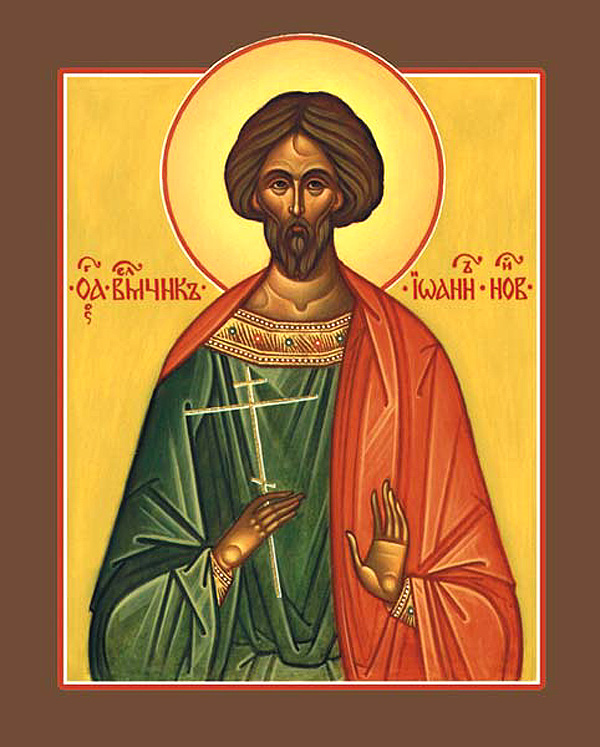
The Holy Great Martyr John the New of Sochi, lived in the fourteenth century in the city of Trebizond. He was a merchant, devout and firm in his Orthodoxy, and generous to the poor.
Once, he happened to be sailing on a ship while pursuing his trading activities. The captain of the ship was not Orthodox, but got into an argument about the Faith with Saint John. Having been vanquished by the saint’s words, the captain resolved to make trouble for him when they got to Belgrade. During the ship’s stay at Belgrade, the captain went to the city ruler, a fire-worshipper, and suggested that on his ship was a studious man who also desired to become a fire-worshipper.
The city ruler invited Saint John to join the fire-worshippers and renounce his faith in Christ.
The saint prayed secretly, calling on the help of Him Who said, “When they shall lead you, and deliver you up, take no thought beforehand what you shall speak, neither do you premeditate; but whatsoever will be given you in that hour, speak that, for it is not you that speaks, but the Holy Spirit” (Mark 13:11). And the Lord gave him the courage and understanding to counter all the claims of the impious and firmly confess himself a Christian. After this, the saint was so fiercely beaten with rods that his entire body was lacerated, and the flesh came off in pieces. The holy martyr thanked God for being found worthy to shed his blood for Him and thereby wash away his sins.
Afterwards they put him in chains and dragged him away to prison. In the morning the city ruler ordered the saint brought forth again. The martyr came before him with a bright and cheerful face. The intrepid martyr absolutely refused to deny Christ, denouncing the governor as a tool of Satan. Then they beat him again with rods, so that all his insides were laid bare.
The gathering crowd could not bear this horrible spectacle and they began to shout angrily, denouncing the governor for tormenting a defenseless man. The governor, having the beating stopped, gave orders to tie the Great Martyr to the tail of a wild horse to drag him by the legs through the streets of the city. Residents of the Jewish quarter particularly scoffed at the martyr and threw stones at him. Finally, someone took a sword and cut off his head.
Saint John’s body with his severed head lay there until evening, and none of the Christians dared to take him away. By night a luminous pillar was seen over him, and a multitude of burning lamps. Three light-bearing men sang Psalms and censed the body of the saint. One of the Jews, thinking that these were Christians coming to take up the remains of the martyr, grabbed a bow and tried to shoot an arrow at them, but he was restrained by the invisible power of God, and became rigid.
In the morning the vision vanished, but the archer continued to stand motionless. Having told the gathering inhabitants of the city about the vision and what was done to him by the command of God, he was freed from his invisible bonds. Having learned about the occurrence, the ruler gave permission to bury the body of the martyr in the local church. This occurred between the years 1330 and 1340. There is some question about the year of the saint’s martyrdom. Saint Νikόdēmos of the Holy Mountain gives the year as 1642, while others say it was 1492.
The captain who had betrayed Saint John repented of his deed, and decided secretly to convey the relics to his own country, but the saint appeared in a dream to the priest of the church, and prevented this. After seventy years the relics were transferred to Sochi, the capital of the Moldo-Valachian principality, and placed in the cathedral church.
Uncovering of the relics of Venerable Juliana, Princess of Vyazma
The relics of the holy Princess Juliana of Vyazma were uncovered in 1819.
Saint Juliana’s body was buried in the Torzhok cathedral on the right side by the south doors in 1407. Later, a tomb for her relics was built at the Savior-Transfiguration cathedral, where she healed many. In connection with the glorification of Saint Juliana on June 2, 1819 a chapel was built on the right-hand side, and dedicated to her
In 1906 church was built and dedicated to Saint Juliana at the cathedral of the Transfiguration of the Lord, where previously there had been a chapel over the saint’s grave.
Saint Juliana is also commemorated on December 21.
Icon of the Mother of God of Kiev-Bratsk

The Kiev-Bratsk Icon of the Mother of God is also commemorated on September 6, May 10, and on Saturday of the Fifth Week of Great Lent.
Venerable Erasmus of Ochrid

No information available at this time.
Festal Orthros and Divine Liturgy for Feast of the Ascension – 6/1/2022
Here is the live stream for Festal Orthros and Divine Liturgy for Feast of the Ascension – 6/1/2022 If you need, here are instructions for accessing this content from your phone, tablet, computer, or TV.
Daily Readings for Wednesday, June 01, 2022
APODOSIS OF PASCHA
NO FAST
Apodosis of Pascha, Justin the Philosopher and Martyr and his Companions, Pyrros the Hieromartyr
ACTS OF THE APOSTLES 18:22-28
IN THOSE DAYS, when Paul had landed at Caesarea, he went up and greeted the church, and then went down to Antioch. After spending some time there he departed and went from place to place through the region of Galatia and Phrygia, strengthening all the disciples. Now a Jew named Apollos, a native of Alexandria, came to Ephesos. He was an eloquent man, well versed in the scriptures. He had been instructed in the way of the Lord; and being fervent in the spirit, he spoke and taught accurately the things concerning Jesus, though he knew only the baptism of John. He began to speak boldly in the synagogue; but when Priscilla and Aquila heard him, they took him and expounded to him the way of God more accurately. And when he wished to cross to Achaia, the brethren encouraged him, and wrote to the disciples to receive him. When he arrived, he greatly helped those who through grace had believed, for he powerfully confuted the Jews in public, showing by the scriptures that the Christ was Jesus.
JOHN 12:36-47
The Lord said to the Jews who came to him, "While you have the light, believe in the light, that you may become sons of light. When Jesus had said this, he departed and hid himself from them. Though he had done so many signs before them, yet they did not believe in him; it was that the word spoken by the prophet Isaiah might be fulfilled: "Lord, who has believed our report, and to whom has the arm of the Lord been revealed?" Therefore they could not believe. For Isaiah again said, "He has blinded their eyes and hardened their heart, lest they should see with their eyes and perceive with their heart, and turn for me to heal them." Isaiah said this because he saw his glory and spoke of him. Nevertheless, many even of the authorities believed in him, but for fear of the Pharisees they did not confess it, lest they should be put out of the synagogue: for they loved the praise of men more than the praise of God.
And Jesus cried out and said, "He who believes in me, believes not in me but in him who sent me. And he who sees me sees him who sent me. I have come as light into the world, that whoever believes in me may not remain in darkness. If any one hears my sayings and does not keep them, I do not judge him; for I did not come to judge the world but to save the world.
Leavetaking of Pascha

On Wednesday of the sixth week of Pascha, we celebrate the Leavetaking of the Feast. While most Feasts have their Leavetaking on the eighth day, Pascha, the Feast of Feasts, has its Leavetaking on the thirty-ninth day. The fortieth day is the Feast of the Lord’s Ascension, which marks the end of the Lord’s physical presence on earth. He does not abandon us, however. He has promised to be with us always, even until the end of the age (MT 20:28). As we sing in the Kontakion for Ascension, “Thou didst ascend in glory, O Christ our God, not being parted from those who love Thee, but remaining with them and crying: I am with you and no one will be against you.” There is a similar thought expressed in the Troparion for the Dormition: “In falling asleep, you did not forsake the world, O Theotokos.”
The services today are celebrated just as on the day of Pascha itself. The daily readings from Holy Scripture, of course, will differ. After the Dismissal at Liturgy, the paschal hymns are no longer sung. The prayer “O Heavenly King” is not said or sung until Pentecost.The Winding Sheet (Plaschanitsa) is taken from the altar and is put in its proper place. Even though today is a Wednesday, fish, wine, and oil are permitted.
Today we also commemorate the Finding of the Icon of the Mother of God “Of the Meeting” in Kalamata in the Peloponnesus.
Martyr Justin the Philosopher and those with him at Rome
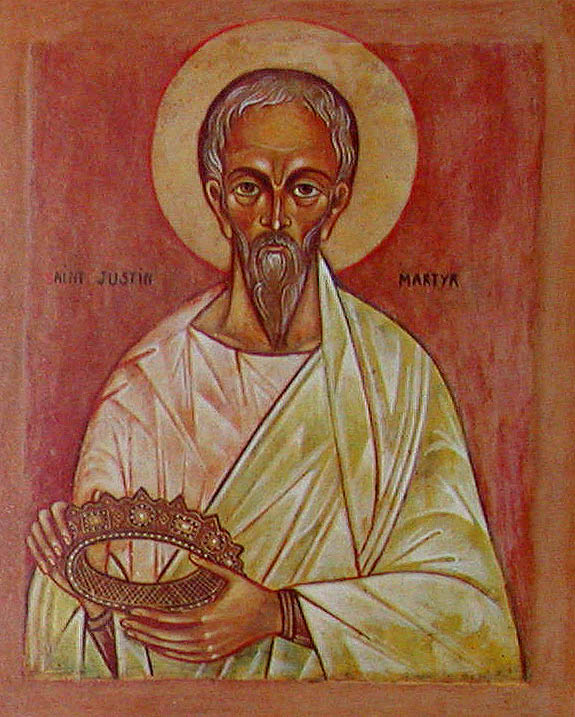
The Holy Martyr Justin the Philosopher was born around 114 at Sychem, an ancient city of Samaria. Justin’s parents were pagan Greeks. From his childhood the saint displayed intelligence, love for knowledge and a fervent devotion to the knowledge of Truth. When he came of age he studied the various schools of Greek philosophy: the Stoics, the Peripatetics, the Pythagoreans, the Platonists, and he concluded that none of these pagan teachings revealed the way to knowledge of the true God.
Once, when he was strolling in a solitary place beyond the city and pondering about where to seek the way to the knowledge of Truth, he met an old man. In the ensuing conversation he revealed to Justin the essential nature of the Christian teaching and advised him to seek the answers to all the questions of life in the books of Holy Scripture. “But before anything else,” said the holy Elder, “pray diligently to God, so that He might open to you the doors of Light. No one is able to comprehend Truth, unless he is granted understanding from God Himself, Who reveals it to each one who seeks Him in prayer and in love.”
In his thirtieth year, Justin accepted holy Baptism (between the years 133 and 137). From this time Saint Justin devoted his talents and vast philosophical knowledge to preaching the Gospel among the pagans. He began to journey throughout the Roman Empire, sowing the seeds of faith. “Whosoever is able to proclaim Truth and does not proclaim it will be condemned by God,” he wrote.
Justin opened a school of Christian philosophy. Saint Justin subsequently defended the truth of Christian teaching, persuasively confuting pagan sophistry (in a debate with the Cynic philosopher Crescentius) and heretical distortions of Christianity. He also spoke out against the teachings of the Gnostic Marcian.
In the year 155, when the emperor Antoninus Pius (138-161) started a persecution against Christians, Saint Justin personally gave him an Apology in defense of two Christians innocently condemned to execution, Ptolemy and Lucias. The name of the third remains unknown.
In the Apology he demonstrated the falseness of the slander against Christians accused unjustly for merely having the name of Christians. The Apology had such a favorable effect upon the emperor that he ceased the persecution. Saint Justin journeyed, by decision of the emperor, to Asia Minor where they were persecuting Christians with particular severity. He proclaimed the joyous message of the imperial edict throughout the surrounding cities and countryside.
The debate of Saint Justin with the Rabbi Trypho took place at Ephesus. The Orthodox philosopher demonstrated the truth of the Christian teaching of faith on the basis of the Old Testament prophetic writings. Saint Justin gave an account of this debate in his work Dialogue with Trypho the Jew.
A second Apology of Saint Justin was addressed to the Roman Senate. It was written in the year 161, soon after Marcus Aurelius (161-180) ascended the throne.
When he returned to Italy, Saint Justin, like the Apostles, preached the Gospel everywhere, converting many to the Christian Faith. When the saint arrived at Rome, the envious Crescentius, whom Justin always defeated in debate, brought many false accusations against him before the Roman court. Saint Justin was put under guard, subjected to torture and suffered martyrdom in 165. The relics of Saint Justin the Philosopher rest in Rome.
In addition to the above-mentioned works, the following are also attributed to the holy martyr Justin the Philosopher:
1) An Address to the Greeks
2) A Hortatory Address to the Greeks
3) On the Sole Government of God
Saint John of Damascus preserved a significant part of Saint Justin’s On the Resurrection, which has not survived. The church historian Eusebius asserts that Saint Justin wrote books entitled
The Singer
Denunciation of all Existing Heresies and
Against Marcian
In the Russian Church the memory of the martyr is particularly glorified in temples of his name. He is invoked by those who seek help in their studies.
The holy martyrs Justin, Chariton, Euelpistus, Hierax, Peonus, Valerian, Justus and the martyr Charito suffered with Saint Justin the Philosopher in the year 166. They were brought to Rome and thrown into prison. The saints bravely confessed their faith in Christ before the court of the prefect Rusticus. Rusticus asked Saint Justin, whether he really thought that after undergoing tortures he would go to heaven and receive a reward from God. Saint Justin answered, “Not only do I think this, but I know and am fully assured of it.”
The prefect proposed to all the Christian prisoners that they offer sacrifice to the pagan gods. When they refused he issued a sentence of death, and the saints were beheaded.
Venerable Dionysius, Abbot of Glushitsa, Vologda

Our holy Father Dionysius, a native of Vologda, was one of the greatest ascetics of Russia’s Northern Thebaid (See A. Muraviev, The Russian Thebiad of the North, Saint Petersburg, 1855), and had links to some of the most important figures of Russian monasticism, including Saint Cyril of White Lake (June 9), whose portrait he painted.
Saint Dionysius spread Saint Cyril’s tradition of inner spiritual activity and love for the poor throughout the northern regions of Russia. He also combined within himself the Athonite traditions of his Elder Saint Dionysius with those of Saint Sergius of Radonezh (September 25 & July 5).
His Spiritual Father was Saint Dionysius the Athonite (October 18) who later became the Archbishop of Rostov. It was this saint who tonsured the younger Dionysius as a monk at the Spasso-Kameni Island Monastery, bestowing his own name upon him because he had such a great love for him. After nine years he left the monastery, with the blessing of his Elder, and went with his disciple Pachomius to a remote area known as Saint Luke, because once there had been a monastery in that place which was dedicated to the holy Apostle and Evangelist Saint Luke (October 18).
The two monks built a church and dedicated it to Saint Nicholas (December 6). Desiring even greater solitude, Saint Dionysius left Pachomius at Saint Luke’s one day in 1393 and went deeper into the Vologda forest so that he might not be deprived of an opportunity for ascetical struggles. That evening, he decided to rest for the night by the Glushitsa River. As he slept he heard the ringing of bells, which he took as a sign that he should build a monastery there. Saint Dionysius made a crude shelter for himself near a bird-cherry tree. The small, black cherries contain tannin and have a bitter-sweet taste. For this reason they are sometimes known as choke cherries, or hackberries. Saint Dionysius used to give these cherries to those who were ill, and they would then become well.
Soon disciples began to gather around the saint, not only men, but also women who thirsted for God. As disciples began to gather around him it became necessary to build cells to accomodate them. A local prince ordered woodsmen to clear a spot for the building of a monastery. Monastic cells were built, and also a small church in honor of the Protection of the Most Holy Theotokos (October 1).
The number of monks increased, and one night Saint Dionysius had a dream where he saw a young man who told him to build a larger church. The man told him that he would always have the protection of the Mother of God.
In the morning, after Matins, he informed the brethren of his dream, and told them that they should obey the young man’s instructions. The church was built, and was adorned with icons painted by Saint Dionysius, who was an accomplished iconographer. His icon of the Dormition, which was a wonderworking icon, was given to the Monastery of the Seven Hills, which had been founded by the saint’s disciples, and was also located by the Glushitsa River.
In 1407, Prince George Boktiuzhinsky expressed his wish to donate funds for the foundation of the Glushitsa Monastery. Saint Dionysius would not allow him to do this, but he did bless him to provide food for the brethren.
When this monastery became too crowded, Saint Dionysius found an isolated place called Sosnovetsk (so named because of the large, very old pine tree which grew there) on the banks of the Glushitsa River. There he built a church in honor of Saint John the Baptist, and a few cells for those who also desired greater solitude.
The righteous one increased his ascetical efforts, standing in prayer all night, and living on bread and water. He even dug his own grave. Once he told the brethren that they were to remain at that place, but only if he was buried there. He assured them that if they stayed, they would have their reward from God. If he was not buried there, however, he declared that they should not remain. In time the Glushitsa Monastery was abandoned, but monks continued to live at the Sosnovetsk Monastery until recent times.
Saint Dionysius was the first to establish a women’s monastery with an Athonite Typikon. After a visit to Rostov, where his Elder Dionysius was now the Archbishop, he returned to his monastery and established a women’s monastery near him, dedicating it to Saint Leontius of Rostov (May 23). The monastery flourished and was a model of the monastic ideal for women.
During a time of famine, Saint Dionysius gave alms to all who came to the monastery for assistance. When the number of people increased, his alms-giving also increased. Once the steward informed him that the monastery’s supplies were almost depleted. Saint Dionysius rebuked him and said that their alms-giving would be a great help to the monks on the Day of Judgment. Giving to the poor, he said, was like lending to God Himself.
Before his death, he named his disciple Saint Amphilochius as his successor. He also heard the voice of the Mother of God, promising to protect the brethren of the monastery from every evil and necessity.
The saint’s final illness began on May 29, 1437 and it was revealed to him that he would die in three days. Early on the morning of June 1, he asked his disciple Saint Macarius to serve the Divine Liturgy so that he would be able to receive Holy Communion for the last time. After the service he called the brothers to him so that he might give them his final blessing and bid them farewell. At six A.M. his face shone with a divine radiance, and peacefully he surrendered his soul to God at the age of 74. The cell was filled with an ineffable fragrance, and Saint Amphilochius saw a crown on the head of his Spiritual Father.
Many of the disciples of Saint Dionysius also became Igumens of other monasteries. Among them are Saint Amphilochius of Glushitsa (October 12), who reposed in 1452, and Saint Gregory of Peshma (September 30), who reposed in 1451. He and Saint Dionysius had such mutual love that they seemed to be of one mind. Saint Dionysius told him, “Do good while you have the time, be true in glorifying God and doing His will.” Saint Macarius of Sosnovetsk (October 12 & May 13) was also a disciple. He completed the course of his God-pleasing life in 1480.
Saint Dionysius was buried at Sosnovetsk, in accordance with his desire. Through his holy prayers, may we also be found worthy of the Kingdom of Heaven.
Venerable Agapitus the Unmercenary Physician of the Kiev Near Caves

Saint Agapitus of the Caves. This holy Unmercenary Physician was born at Kiev. He was a novice and disciple of Saint Anthony of the Caves, and lived during the eleventh century. If any of the monastic brethren fell ill, Saint Agapitus came to him and selflessly attended to the sick one. He fed his patient boiled herbs which he himself prepared, and the person recovered through the prayers of the saint. Many laymen also turned to the monastic physician with the gift of healing.
In Kiev at this time was an experienced Armenian physician, who was able to diagnose the nature of the illness and even accurately determine the day of death just by looking at a patient. When one of these doomed patients turned to Saint Agapitus, the grace-bearing healer gave him some food from the monastery trapeza (dining area), and the patient became well. Enflamed with envy, the physician wanted to poison Saint Agapitus, but the Lord preserved him, and the poison had no effect.
Saint Agapitus healed Prince Vladimir Monomakh of Chernigov, the future Great Prince of Kiev (1114-1125), by sending him boiled herbs. The grateful prince went to the monastery and wanted to see his healer, but the humble ascetic hid himself and would not accept gifts.
When the holy healer himself became sick, that same Armenian physician came to him and after examining him, he said that he would die in three days. He swore to became an Orthodox monk if his prediction were not fulfilled. The saint said that the Lord had revealed to him that He would summon him only after three months.
Saint Agapitus died after three months (on June 1, not later than 1095), and the Armenian went to the igumen of the Caves monastery and received monastic tonsure. “It is certain that Agapitus was a saint of God,” he said. “I well knew, that it was impossible for him to last three days in his sickness, but the Lord gave him three months.” Thus did the monk heal sickness of the soul and guide to the way of salvation.
Martyrs Shio, David, Gabriel, and Paul of Akhalkalaki in Georgia

The holy monk-martyrs Shio the New, David, Gabriel and Paul labored in the David-Gareji Wilderness at the end of the 17th century.
Saint Shio was from the village of Vedzisi in the Kartli region. His parents, Papuna and Tamar, were wealthy and highly influential people. They had eight children: five sons and three daughters. After their parents died, Shio’s brothers quarreled so intensely over their inheritance that the eldest brother finally killed the youngest.
Deeply disturbed by this tragedy, blessed Shio sought to withdraw from the vanity of the world—a world in which brother can murder brother and a son can murder his father. Shio confessed his desire to his spiritual father, and he was advised to journey to the David-Gareji Monastery and be tonsured a monk. In fact, the abbot, Fr. Onopre (Machutadze), had invited Shio to the monastery several times before, saying, “Come, brother Shio, and let us finish our lives here.”
With great joy Onopre received Shio, who was already revered by many for his faith and chastity. He directed him to a cell and clothed him as a novice.
Blessed Shio’s tireless labors, humility, and manifest love for his brothers inspired many to seek his counsel. The abbot himself often trusted Shio to administer the affairs of the monastery in his absence.
Once Fr. Onopre departed to attend to some matters outside the monastery, leaving Shio in charge. After Vespers and a meal, the exhausted brothers were settling down to rest when a band of Dagestani robbers suddenly stormed the monastery grounds. They ransacked the monastery and captured Hieromonk Shio and the monks David, Gabriel and Paul and killed them. Some of the brothers who remained tried to flee, but they were caught and brutally slain.
The cells of the David-Gareji Monastery were soaked with blood. Then the Dagestanis, yet unsatisfied, seized and destroyed nearly all the monastery’s property. They stole some of the clerical vestments, and the rest they cut in pieces and tossed in a well. Then they hacked the holy icons to pieces with their axes.
With the blessing of the catholicos and by order of the king, the mutilated relics of the holy martyrs were buried in the courtyard south of the grave of Saint David of Gareji.
Paschal Vespers – 5/31/2022
Here is the live stream for Paschal Vespers – 5/31/2022 If you need, here are instructions for accessing this content from your phone, tablet, computer, or TV.
6/5 announcements
June 5, 2022
Sunday of the After-feast of the Ascension
Commemoration of the Holy Fathers of the First Ecumenical Council
Today is the Sunday of the Holy Fathers of Nicea. This day commemorates the Holy Fathers who sat in council at Nicea, the first of the ecumenical councils. Through them we see the commitment to the immutable truth of God for all the faithful, especially those who lead in the faith. The men of this council bear special note by the significance of their creed, for it is the fundamental statement of orthodox Christology and an enduring guide to our faith. The events of the ascension and the scriptures of this day emphasize to us the nature and action of Christ, and the history of these fathers puts us in mind of the work of the Holy Spirit in the church, work proclaimed by the glorious events which we now anticipate in the preparation for Pentecost.
Acts 20:16-18, 28-36: In those days, Paul was determined to sail past Ephesus, so that he might not have to spend time in Asia; for he was hastening, if possible, to be at Jerusalem on the Day of Pentecost. And from Miletus he sent to Ephesus and called to him the priests of the church. And when they came to him, he said to them: “Take heed to yourselves and to all the flock, in which the Holy Spirit has made you bishops, to shepherd the church of the Lord and God, which He purchased with His own blood. For I know that after my departure ravenous wolves will enter among you, not sparing the flock; and from among your own selves will arise men speaking perverse things, to draw away the disciples after them. Therefore, remain watchful, remembering that for three years I did not cease to admonish every one, night and day with tears. And now, brethren, I commend you to God and to the word of His grace, which is able to build you up and to give you the inheritance among all those who are sanctified. I coveted no one’s silver or gold or apparel. You yourselves know that these hands ministered to my necessities, and to those who were with me. In all things I have shown you that by such laboring we ought to help the weak, and to remember the words of the Lord Jesus, how He Himself said: ‘It is more blessed to give than to receive.’” And when he had spoken thus, he knelt down on his knees with them all, and prayed.
John 17:1-13: At that time, Jesus lifted up His eyes to heaven and said, “Father, the hour has come; glorify Thy Son that the Son may glorify Thee, since Thou hast given Him power over all flesh, to give eternal life to all whom Thou hast given Him. And this is eternal life, that they know Thee the only true God, and Jesus Christ Whom Thou hast sent. I glorified Thee on earth, having accomplished the work which Thou gavest Me to do; and now, Father, glorify Thou Me in Thy own presence with the glory which I had with Thee before the world was made. I have manifested Thy Name to the men whom Thou gavest Me out of the world; Thine they were, and Thou gavest them to Me, and they have kept Thy word. Now they know that everything that Thou hast given Me is from Thee; for I have given them the words which Thou gavest Me, and they have received them and know in truth that I came from Thee; and they have believed that Thou didst send Me. I am praying for them; I am not praying for the world but for those whom Thou hast given Me, for they are Thine; all Mine are Thine, and Thine are Mine, and I am glorified in them. And now I am no more in the world, but they are in the world, and I am coming to Thee. Holy Father, keep them in Thy Name, which Thou hast given Me, that they may be one, even as We are one. While I was with them, I kept them in Thy Name, which Thou have given Me; I have guarded them, and none of them is lost but the son of perdition, that the scripture might be fulfilled. But now I am coming to Thee; and these things I speak in the world, that they may have My joy fulfilled in themselves.”
Troparion of the Resurrection: When Mary stood at thy grave looking for thy sacred body, angelic powers shone above thy revered tomb, and the soldiers who were to keep guard became as dead men. Thou led hades captive and wast not tempted thereby. Thou didst meet the Virgin and didst give life to the world; O thou who art risen from the dead! O Lord, glory to thee.
Troparion of the Ascension: Thou hast ascended in glory, O Christ our God, and gladdened thy disciples with the promise of the Holy Spirit, having become confident of the blessing. Verily, thou art the Son of God, and Deliverer of the world.
Troparion of the Holy Fathers: Thou, O Christ, art our God of exceeding praise who didst establish our holy Fathers as luminous stars upon earth, and through them didst guide us unto the true Faith, O most merciful One, glory to thee.
Troparion of the Chains of St. Peter: O Holy Apostle, Peter, thou dost preside over the Apostles by the precious chains which thou didst bear. We venerate them with faith and beseech thee that by thine intercessions we be granted the great mercy.
Kontakion of the Ascension: When thou didst fulfill thy dispensation for our sakes, uniting the terrestrials with the celestials, thou didst ascend in glory, O Christ our God, inseparable in space, but constant without separation, and crying unto thy beloved, I am with you, and no one shall be against you.
CALENDAR
UNTIL FURTHER NOTICE: All services listed on the calendar will be available through streaming and webcast.
Please continue to follow the CDC Guidelines to limit contagion and the spread of the COVID virus.
Sunday, June 5 (Sunday of the Holy Fathers of Nicea)
9:00 a.m. — Orthros (webcast)
10:00 a.m. — Divine Liturgy (webcast)
12:00 p.m. — Coffee Hour honoring Brandon Strain
Monday, June 6
Father Herman off
Tuesday, June 7
No Services
Wednesday, June 8 (Theodore the General – transfer of relics)
6:30 p.m. — Daily Vespers
Thursday, June 9
NO Services
Friday, June 10
7:00 a.m. — Royal Hours
Saturday, June 11 (Saturday of the Souls)
9:00 a.m. — Orthros followed by Divine Liturgy
6:00 p.m. — Great Vespers
Sunday, June 12 (Pentecost)
9:00 a.m. — Orthros (webcast)
10:00 a.m. — Divine Liturgy (webcast)
12:00 p.m. — PICNIC POT LUCK MEAL
6:30 p.m. — Kneeling Vespers of Pentecost
SPECIAL ANNOUNCEMENTS
The Eucharist Bread …was offered by the Morrises for the Feast of the Ascension this past Wednesday evening and by the Joneses for the Divine Liturgy this morning.
Eucharist Bread Schedule:
Eucharist Bread Coffee Hour
June 5 Jones Ellis/Waites/Zouboukos
June 11 (Sat. a.m.) Meadows Ellis/Waites/Zouboukos
(Saturday of the Souls) Koliva: Karen Cooper
June 12 Davis PICNIC POT LUCK MEAL
(Feast of Pentecost) Meadows/Pigott
June 19 D. Root Algood/Schelver
June 26 Karam Lasseter/Pacurari/Miller
June 28 (Tues. p.m.) Brock D. Root/Baker/Cooper
Schedule for Epistle Readers – Page numbers refer to the Apostolos (book of the Epistles) located on the Chanters’ stand at the front of the nave. Please be sure to use this book when you read.
Reader Reading Page#
June 5 Sh. Charlotte Algood Acts 20:16-18, 28-36 66
June 11 (Sat. a.m.) Kh. Sharon Meadows I Thess. 4:13-17 412
June 12 Ian Jones Acts 2:1-11 77
June 19 Brenda Baker Heb. 11:33-12:2 84
June 26 Sam Habeeb Rom. 2:10-16 90
June 28 (Tues. p.m.) Walt Wood II Cor. 11:21-33; 12:6-9 389
Also, please remember that we still need your tithes and offerings which may be placed in the tray that is passed during the Divine Liturgy, in the tithe box at the back of the nave or be mailed to: St. Peter Orthodox Church, P.O. Box 2084, Madison, MS 39130-2084.
Continue to pray for Metropolitan Paul (who is also the brother of our Patriarch) and the Syriac Archbishop John of Aleppo who were abducted while on a humanitarian mission in Syria.
Please remember Fr. Joseph and Kh. Joanna Bittle, and their daughter Abigail, in your prayers.
Please remember the following in your prayers: Aidan Milnor, the Milnor family; Lamia Dabit and her family; Mary Greene (Lee and Kh. Sharon’s sister); Jay and Joanna Davis; Fr. Leo and Kh. Be’Be’ Schelver and their family; Kathy Willingham; Marilyn (Kyriake) Snell; Jack and Jill Weatherly; Lottie Dabbs (Sh. Charlotte Algood’s mother), Sh. Charlotte and their family; Maria Costas (currently at St. Catherine’s Village); Reader Basil and Brenda Baker and their family; Buddy Cooper.
If you are not feeling well, PLEASE do not attempt to come to the services. This also includes anyone who may have been exposed to you during this time. Also, please let Fr. Herman know if you are not feeling well and have COVID like symptoms.
PARENTS, a problem has arisen due to the nursery room being left messy after Coffee Hour. No food of any kind should be taken into that room. Also, it is necessary for a parent to be in the room whenever their children are in there playing. Thank you for your assistance with this.
Pentecost is June 12th this year. As is the custom in our parish, we will pray the Royal Hours on Friday morning, June 10th, beginning at 7:00 a.m. and we will have Orthos followed by Divine Liturgy for Saturday of the Souls on June 11th, beginning at 9:00 a.m. On Sunday we will have a PICNIC POT LUCK following the Divine Liturgy to celebrate the Feast. We will also pray the Kneeling Vespers service Sunday evening, beginning at 6:30 p.m.
Calendar Items:
* The men of the parish meet for lunch at 11:30 a.m. on the first Thursday of the month.
* The Ladies meet at the church at 10:00 a.m. on the second Saturday of the month to pray the Akathist to the Mother of God, Nurturer of Children on behalf of our children.
* The Ladies meet for lunch on the last Tuesday of the month.
* Father Herman will be helping to lead a retreat at the Antiochian Village, July 3-9.
* The Clergy Symposium will be held at the Antiochian Village, July 18-23.
* Vacation Church School is scheduled for July 28-30. Parents, mark your calendar now.
* The remaining date for Stewpot for 2022 is Saturday, September 3rd.
We will honor Brandon Strain at Coffee Hour this morning since we were unable to do so when he graduated because of the CoVid shut down.
Instructions for streaming our services can be found on the parish website.
Camp St. Thekla dates: The dates for Camp St. Thekla are: Session 1 is June 26 – July 2 and Session 2 is July 3 – 9. If you have a child registered for Camp, please see Daniel for information on scholarships available from the Order of St. Ignatius. If there is still a financial need, some additional funds may be available.
Fasting Discipline for June
There will be no fasting of any kind during the week following Pentecost (June 12th this year). Otherwise, the traditional fasting discipline (no meat, dairy, eggs, fish, wine or oil) is observed on the Wednesdays and Fridays of the month. This year, the Apostles’ Fast begins on Monday, June 20th and runs through June 28th. During this time, the traditional fasting discipline will be observed on each day of the week, except for Saturday and Sunday when fish, wine and oil are permitted.
Major Commemorations for June
June 5 Sunday of the Holy Fathers of Nicea
June 11 Saturday of the souls
June 12 Pentecost
June 19 Sunday of All Saints
June 24 Nativity of the Forerunner
June 29 Chief Apostles Peter and Paul
June 30 Synaxis of the Twelve Apostles
Quotable “The goal is to rise spiritually, not simply to avoid sin.”
St. Paisios the Athonite
Worship: Sunday, June 12, 2022 (Feast of Pentecost)
Scripture: Acts 2:1-11; John 7:37-52; 8:12
Celebrant: Father Herman
Epistle Reader: Ian Jones
Prosphora: Davis
Coffee Hour: PICNIC POT LUCK MEAL
Meadows/Pigott
 Saint Peter Antiochian Orthodox Church