Monthly Archives: June 2022

Daily Readings for Monday, June 13, 2022

MONDAY OF THE HOLY SPIRIT

NO FAST

Monday of the Holy Spirit, Aquilina the Martyr of Syria, Triphyllos the Bishop of Nicosia

ST. PAUL’S LETTER TO THE EPHESIANS 5:8-19

Brethren, walk as children of light (for the fruit of light is found in all that is good and right and true), and try to learn what is pleasing to the Lord. Take no part in the unfruitful works of darkness, but instead expose them. For it is a shame even to speak of the things that they do in secret; but when anything is exposed by the light it becomes visible, for anything that becomes visible is light. Therefore it is said, “Awake, O sleeper, and arise from the dead, and Christ shall give you light.” Look carefully then how you walk, not as unwise men but as wise, making the most of the time, because the days are evil. Therefore do not be foolish, but understand what the will of the Lord is. And do not get drunk with wine, for that is debauchery; but be filled with the Spirit, addressing one another in psalms and hymns and spiritual songs, singing and making melody to the Lord with all your heart.

MATTHEW 18:10-20

The Lord said, "See that you do not despise one of these little ones; for I tell you that in heaven their angels always behold the face of my Father who is in heaven. For the Son of man came to save the lost. What do you think? If a man has a hundred sheep, and one of them has gone astray, does he not leave the ninety-nine on the hills and go in search of the one that went astray? And if he finds it, truly, I say to you, he rejoices over it more than over the ninety-nine that never went astray. So it is not the will of your Father who is in heaven that one of these little ones should perish.
If your brother sins against you, go and tell him his fault, between you and him alone. If he listens to you, you have gained your brother. But if he does not listen, take one or two others along with you, that every word may be confirmed by the evidence of two or three witnesses. If he refuses to listen to them, tell it to the church; and if he refuses to listen even to the church, let him be to you as a Gentile and a tax collector. Truly, I say to you, whatever you bind on earth shall be bound in heaven, and whatever you loose on earth shall be loosed in heaven. Again I say to you, if two of you agree on earth about anything they ask, it will be done for them by my Father in heaven, for where two or three are gathered in my name, there am I in the midst of them.

Postfeast of Pentecost — Day of the Holy Spirit

On the day after every Great Feast, the Orthodox Church honors the one through whom the Feast is made possible. On the day following the Nativity of the Lord, for example, we celebrate the Synaxis of the Most Holy Theotokos (December 26). On the day after Theophany, we commemorate Saint John the Baptist (January 7), and so on.

Today we honor the all-Holy, good, and life-creating Spirit, Who descended upon the Apostles at Pentecost in the form of fiery tongues in fulfillment of the Lord’s promise to send the Comforter to His disciples (JN 14:16). That same Holy Spirit remains within the Church throughout the ages, guiding it “into all truth” (JN 16:13).

One of the hymns at Vespers on Saturday evening tells us that the Holy Spirit “provides all things. He gushes forth prophecy, He perfects the priesthood, … He holds together the whole institution of the Church.”

At Vespers on the day of Pentecost, we hear that the Holy Spirit is “the Fountain of goodness, through Whom the Father is known, and the Son is glorified.” He is “the living Fountain of spiritual gifts” Who “purifies us from our sins.” It is by the Holy Spirit that “the prophets, divine Apostles, and martyrs are crowned.” He is the source of life and of sanctification.

In the services of this day, we sing the same hymns as on Pentecost, except the Canon of the Holy Spirit, which is sung at Compline. The Vigil is not prescribed for the eve of today’s feast. We sing the Great Doxology at Matins, but not the Polyeleos. The Irmos of the Ninth Ode (“Hail, O Queen, glory of mothers and virgins…”) is sung in place of the Song of the Theotokos (“My soul magnifies the Lord…”).

At the Liturgy, the priest or deacon chants the Entrance Verse (“Be exalted in Thy strength, O Lord. We will sing and praise Thy power.”) as on the day of Pentecost. “Holy God” replaces “As many as have been baptized….” The dismissal of Pentecost is also used.

This whole week is fast-free, and the Leave-taking of Pentecost occurs on Saturday.

Martyr Aquilina of Byblos in Syria

The Holy Martyr Aquilina, a native of the Phoenician city of Byblos, suffered under the emperor Diocletian (284-305). Her parents raised her in Christian piety. When the girl was only twelve years old, she persuaded a pagan friend to convert to Christ. One of the servants of the imperial governor Volusian accused her of teaching others not to follow the religion of their fathers. The girl firmly confessed her faith in Christ before the governor and said that she would not renounce Him. Volusian tried to influence the young confessor through persuasion and by flattery, but seeing her confidence, he ordered her to be tortured.

They struck her upon the face, then they stripped her and beat her with whips. The torturer asked, “Where then is your God? Let Him come and take you out of my hands”.

The saint answered, “The Lord is here with me invisibly, and the more I suffer, the more strength and endurance will He give me.”

They drilled through the martyr’s ears with heated metal rods. The holy virgin fell down as if dead. The torturer thought that the girl had actually died, and he gave orders to throw her body outside the city to be eaten by dogs.

By night a holy angel appeared to Saint Aquilina, roused her and said, “Arise and be healed. Go and denounce Volusian, so that he and his plans may come to nothing.”

The martyr went to the court of the governor and stood before Volusian. Seeing Saint Aquilina, he called for his servants and ordered them to keep watch over her until morning.

In the morning he sentenced Saint Aquilina to death, saying that she was a sorceress who did not obey the imperial decrees. When they led the saint to execution, she prayed and gave thanks to God for allowing her to suffer for His Holy Name.

A voice was heard in answer to her prayer, summoning her to the heavenly Kingdom. Before the executioner could carry out the sentence, the martyr gave up her spirit to God (+ 293). The executioner feared to disobey the governor’s orders, so he cut off her head although she was already dead.

Christians piously buried the martyr’s body. Later, her relics were taken to Constantinople and placed in a church named for her.

Saint Triphyllius, Bishop of Leucosia (Nicosia), Cyprus

Saint Tryphillius, Bishop of Leukosia, was born in Constantinople, and he received his education at Berit (Beirut, in Lebanon). He was very intelligent and eloquent. In spite of this, the saint chose as his guide a man neither bookish nor learned, but one of conspicuous holiness: Saint Spyridon of Tremithos (December 12).

The emperor Constantine II (337-340) fell grievously ill, and receiving no help from the doctors, he turned to God. In a dream he saw an angel, directing him to a group of hierarchs. Pointing out two of them, the angel said that only through them could he receive healing.

Constantine issued an imperial edict, commanding the bishops to assemble. Saint Spyridon also received this order, and went to the emperor with his disciple Saint Tryphillius. The sick one immediately recognized them as the healers indicated by the angel. He bowed to them and asked them to pray for his health. Saint Spyridon with a prayer touched the head of the emperor, and he became well.

Saint Tryphillius was charmed by the beautiful palace, the majestic figure of the emperor, and the pomp of palace life. Saint Spyridon said, “Why are you astonished? Does all this make the emperor any more righteous? All of them, emperors and dignitaries alike, will die and stand together with the very poorest before the judgment seat of God. One should seek eternal blessings and heavenly glory.”

Soon Saint Tryphillius was made Bishop of Leukosia on Cyprus. He often visited with Saint Spyridon. Once, they passed through an area of vineyards and gardens of special beauty and abundance, named Parimnos. Saint Tryphillius, attracted by the beauty of nature, considered how they might explore this land. Saint Spyridon discerned the thoughts of Saint Tryphillius and said, “Why do you always think about earthly and transitory blessings? Our habitation and riches are in Heaven, for which we ought to strive.” Thus did Saint Spyridon lead his disciple toward spiritual perfection, which Saint Tryphillius attained through the prayers of his instructor. Saint Tryphillius had a charitable soul, a heart without malice, right faith and love towards all, and many other virtues.

Once, a Council of bishops assembled on Cyprus. The Fathers of the Council requested that Saint Tryphillius, known for his erudition and eloquence, address the people. Speaking about the healing of the paralytic by the Lord (Mark 2:11), in place of the word “cot” he used the word “bed”. Impatient with the imprecise rendering of the Gospel text, Saint Spyridon said to Saint Tryphillius, “Are you better than He who said “cot”, that you should be ashamed of His wording?” and abruptly he left the church.

In this way Saint Spyridon gave Saint Tryphillius a lesson in humility, so that he would not become proud of his own eloquence. Saint Tryphillius wisely shepherded his flock. From the inheritance left him by his mother, he built a monastery at Leukosia. The saint died in old age in about the year 370.

The Russian pilgrim Igumen Daniel saw the relics of Saint Tryphillius on Cyprus at the beginning of the twelfth century.

Venerable Andronicus, Abbot of Moscow, Disciple of Venerable Sergius of Radonezh

Saint Andronicus was born in Rostov, and was a disciple of Saint Sergius of Radonezh (September 25), and received the monastic tonsure from him. Adorned with every virtue, Saint Andronicus lived at Holy Trinity Monastery for many years.

One day, the holy Metropolitan Alexis (February 12) visited the monastery to speak with Saint Sergius about founding a monastery in fulfillment of a vow he had made when he was saved from shipwreck. Saint Alexis wished to establish a cenobitic monastery dedicated to the Icon of Christ Not-Made-By Hands (August 16), and he wanted Saint Andronicus to become the igumen. Saint Sergius agreed to this proposal, and the monastery was completed between 1358-1361.

Saint Andronicus governed the monastery for many years, attracting many monks to that place. Among the notable monks of that monastery was Saint Andrew Rublev (July 4).

Saint Andronicus fell asleep in the Lord in 1395, and was succeeded as igumen by his disciple Saint Savva of Moscow.

Venerable Savva, Abbot of Moscow

Saint Savva of Moscow succeeded Saint Andronicus as the igumen of the monastery of the Savior, dedicated to the Icon of Christ Not-Made-By Hands (August 16) in 1395. He died in 1410.

Martyr Antonina of Nicea

The Holy Martyr Antonina suffered during the third century under Diocletian (284-305) in the city of Nicea. They tortured her in various ways: they burned her with fire, they put her on a red-hot plate, they bored into her hands and feet with red-hot rods and they threw her in prison, where she languished for two days.

These torments did not break Saint Antonina’s spirit, and to her very death she confessed her faith in Christ. They threw the holy martyr into the sea.

Saint Anna and her son, Saint John, of Constantinople
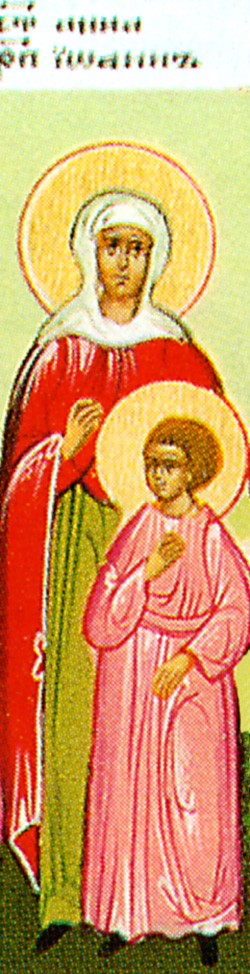
Saint Anna and her son Saint John lived in the ninth century. Saint Anna was the daughter of a deacon of the Blachernae church in Constantinople. After the death of her husband, she dressed in men’s clothing and called herself Euthymianus. She and her son Saint John lived in asceticism in one of the Bythinian monasteries near Olympus.

Saint Anna died in Constantinople in 826. Her memory is also celebrated on October 29.

Venerable James, who was deceived and worshiped the Antichrist

Saint James had so much love for Christ, and so little regard for the things of this world, that he sold all of all his possessions, and distributed the money to the poor, keeping none for himself. Unfortunately, he was overcome with pride. He said to himself, “Who knows better than I do, concerning my salvation?”

Following his own will and personal inclinations, he lived in solitude, undertaking difficult spiritual struggles without first seeking the advice of wiser, more experienced ascetics. Because of his pride, he fell away from God's grace. Therefore, Satan was able to enter his soul.

One day he was visited by a demon who had assumed the appearance of an Angel of light (2 Corinthians 11:14). He told James that Christ was very pleased by his labors, and would come that night to reward him. “Clean your cell,” he said, “and make ready by lighting the lamps and burning incense.”

James, blinded by his delusion, accepted these words without question. When the Antichrist appeared at midnight, James opened his door and fell down in worship before him. The devil struck him on the head, and then vanished. Only then did the deceived monk realize the truth.

He awoke at dawn and went to visit a certain Elder to tell him what had happened, and to ask how he might atone for his sin. Before James could utter a single word, the Elder said, “You must leave this place, for you have been deceived by Satan.”

James was heartbroken and wept bitter tears. The Elder advised him to go to a cenobitic monastery in order to acquire humility, the cornerstone of all the virtues. There he observed all the rules of the Monastery and persevered in his assigned obedience in the trapeza. Then for another seven years, he sat in his cell working at some handicraft, and performing his Prayer Rule.

After some time, Saint James was restored to grace, acquiring the gift of discernment, following God's straight and narrow path, and becoming a great worker of miracles. After living the rest of his life in all righteousness and humility, he reposed in peace. No one knows where he lived, or when.

Saint Antipater, Bishop of Bostra, Arabia

Saint Antipater’s life is not to be found in the Synaxaristes. From other sources, we know that he was the Bishop of Bostra in Arabia, and he lived in the second half of the fifth century. He was esteemed highly by his contemporaries. His best known work was a book refuting the doctrines of Origen, which has been lost, and only a few fragments of it have been preserved in the Acts of the Seventh Ecumenical Council. He is known to have composed a treatise against the Apollonarians, but we possess only a few fragments of it. Two of his sermons have survived, however: one on the Annunciation, and another on Saint John the Baptist.

Saint Antipater reposed in peace.

Saint Anthimus, Bishop of Georgia

Saint Anthimus of Iberia was one of the most highly educated people of his time. He was fluent in many languages, including Greek, Romanian, Old Slavonic, Arabic, and Turkish and well-versed in theology, literature, and the natural sciences. He was unusually gifted in the fine arts—in painting, engraving, and sculpture in particular. He was famed for his beautiful calligraphy. Finally, Saint Anthimus was a great writer, a renowned orator, and a reformer of the written Romanian language.

Little is known about the youth of Saint Anthimus. He was a native of the Samtskhe region in southern Georgia. His parents, John and Mariam, gave him the name Andria at Baptism. He accompanied King Archil to Russia and helped him to found a Georgian print shop there, but after he returned he was captured by Dagestani robbers and sold into slavery. Through the efforts of Patriarch Dositheus of Jerusalem, Anthimus was finally set free, but he remained in the patriarch’s service in order to further his spiritual education.

Already famed for his paintings, engravings, and calligraphy, Anthimus was asked by Prince Constantine Brincoveanu (1688-1714) of Wallachia (present-day Romania) to travel to his kingdom around the year 1691. After he had arrived in Wallachia, he began to manage a local print shop. The printing industry in that country advanced tremendously at that time, and the chief inspiration and driving force behind the great advances was the Georgian master Anthimus. He succeeded in making Wallachia a center of Christianity and a major publisher of books for all the East.

In 1694 Anthimus was enthroned as abbot of Snagov Monastery (in present-day Romania), where he soon founded a print shop. In the same year his new print shop published Guidelines for the Divine Services on May 21, All Saints’ Day. The book was signed by Subdeacon Michael Ishtvanovich, future founder of the first Georgian print shop.

In 1705 Anthimus, “the chosen among chosen abbots of Wallachia,” was consecrated bishop of Rimnicu Vilcea, and in 1708 he was appointed metropolitan of Hungro-Wallachia. The whole country celebrated his elevation. As one abbot proclaimed: “The divine Anthimus, a great man and son of the wise Iberian nation, has come to Wallachia and enlightened our land. God has granted him an inexhaustible source of wisdom, entrusted him to accomplish great endeavors, and helped to advance our nation by establishing for us a great printing industry.”

Under the direct leadership of Saint Anthimus, more than twenty churches and monasteries were erected in Wallachia. Of particular significance is All Saints’ Monastery, located in the center of Bucharest. The main gates of this monastery were made of oak and carved with traditional Georgian motifs by Saint Anthimus himself. The metropolitan also established rules for the monastery and declared its independence from the Church of Constantinople.

From the day of his consecration, Metropolitan Anthimus fought tirelessly for the liberation of Wallachia from foreign oppressors. On the day he was ordained he addressed his flock: “You have defended the Christian Faith in purity and without fault. Nevertheless, you are surrounded and tightly bound by the violence of other nations. You endure countless deprivations and tribulations from those who dominate this world…. Though I am unworthy and am indeed younger than many of you—like David, I am the youngest among my brothers— the Lord God has anointed me to be your shepherd. Thus I will share in your future trials and griefs and partake in the lot that God has appointed for you.”

His words were prophetic: In 1714 the Turks executed the Wallachian prince Constantine Brincoveanu, and in 1716 they executed Stefan Cantacuzino (1714-1716), the last prince of Wallachia.

In his place they appointed the Phanariote (a member of one of the principal Greek families of the Phanar, the Greek quarter of Constantinople, who, as administrators in the civil bureaucracy, exercised great influence in the Ottoman Empire after the Turkish conquest) Nicholas Mavrokordatos, who concerned himself only with the interests of the Ottoman Empire.

During this difficult time, Anthimus of Iberia gathered around him a group of loyal boyar patriots determined to liberate their country from Turkish and Phanariote domination. But Nicholas Mavrokordatos became suspicious, and he ordered Anthimus to resign as metropolitan. When Anthimus failed to do so, he filed a complaint with Patriarch Jeremiah of Constantinople.

Then a council of bishops, which did not include a single Romanian clergyman, condemned the “conspirator and instigator of revolutionary activity” to anathema and excommunication and declared him unworthy to be called a monk. But Nicholas Mavrokordatos was still unsatisfied and claimed that to deny Anthimus the title of Metropolitan of Hungro-Wallachia was insufficient punishment. He ordered Anthimus to be exiled far from Wallachia, to Saint Catherine’s Monastery on Mt. Sinai. Metropolitan Anthimus, beloved of the Romanian people, was escorted out of the city at night since the conspirators feared the reaction of the people.

But Metropolitan Anthimus never reached Mt. Sinai. On September 14, 1716, a band of Turkish soldiers stabbed Saint Anthimus to death on the bank of the Tundzha (Tunca) River where it flows through Adrianople, not far from Gallipoli, and cast his butchered remains into the river.

Thus ended the earthly life of one more Georgian saint—a man who had dedicated all of his strength, talent, and knowledge to the revival of Christian culture and the strengthening of the Wallachian people in the Orthodox Faith.

In 1992 the Romanian Church canonized Anthimus of Iberia and proclaimed his commemoration day to be September 14, the day of his repose. The Georgian Church commemorates him on June 13.

10,000 Martyrs

Today we also commemorate 10,000 Martyrs, beheaded by the sword for Christ. The year of their death is not known.

The Finding of the Holy Relics of Saint Nicholas the Deacon of Lesbos
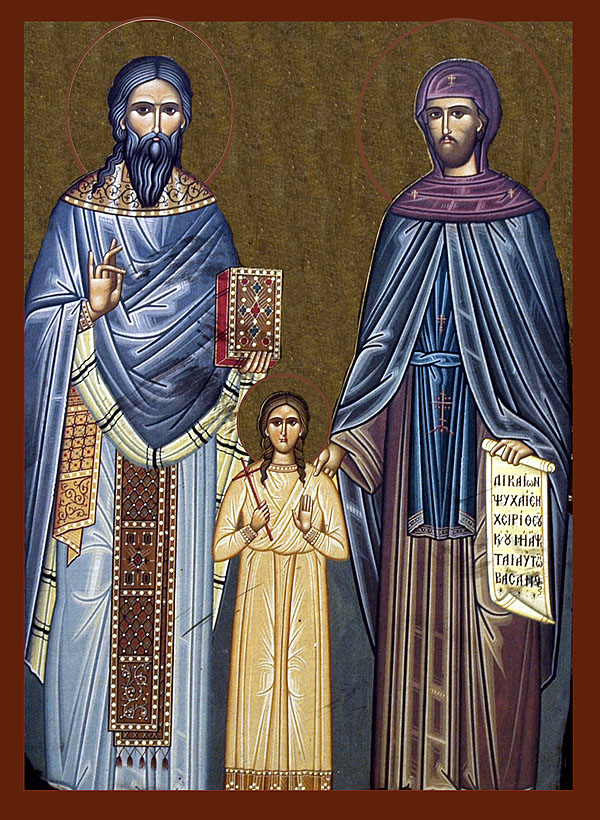
Today we commemorate the finding of the relics of Saint Nicholas the Deacon at Karyes Monastery on Lesbos on June 13, 1960.

In April of 1960 he appeared to three women in the town of Thermi, telling them where his relics were to be found. They hesitated to ask the Metropolitan of Mytilene for permission to dig, lest the tomb should not be found and they become objects of derision. Finally, they went and told the Metropolitan about seeing Saint Nicholas in their dreams, and the Hierarch blessed them to dig.

Doukas Tsolakis was asked to dig where the women told him. He dug a little, and then stopped because the ground was hard. That night Doukas saw Saint Nicholas in a dream, sitting at the very place where he had been digging. The Saint said, "I am Nicholas. Why do you doubt that my grave is here?" Then he told Doukas that he would be punished if he did not dig at the spot indicated by the women.

On June 13, 1960, Mr. Tsolakis was helped by another workman, and after some difficulties, the Martyr's relics were found. That day was one of great rejoicing for the pious people, for many miracles took place. On that same day, a round Patriarchal Privelege Seal was found. It was made of lead and silver, and was from the XIV century. One side depicted the Mother of God, and the Archangel Michael on the other.

Other persons also saw Deacon Nicholas in their dreams, and he told them that he was a native of Thessaloniki, from an aristocratic family, and he was ordained as a Deacon. In 1454, Saint Nicholas accompanied Saint Raphael to Lesbos after the Turks invaded Thrace.

In 1463, the Turks invaded the Karyes Monastery and captured the monks, subjecting them to various torments. Then the Turks dragged Archimandrite Raphael by his hair and beard, and tied him to a tree. They beat him and struck him with their heated weapons. Finally, they sawed through his mouth, separating the jaw and his head. This took place on Bright Tuesday (April 9, 1463). Saint Nicholas died of heart failure after witnessing Saint Raphael's martyrdom.

Saint Nicholas is short and thin, with a small blond beard. Sometimes he appears in his vestments, holding a censer. He always stands before Saint Raphael with great respect.

Read more about Saints Raphael, Nicholas, and Irene

Transfer of the relics of Saint Paraskevḗ the New

Daily Readings for Sunday, June 12, 2022

HOLY PENTECOST

NO FAST

Holy Pentecost, Onuphrius of Egypt, Peter the Athonite, Holy Martyr Antonine, John the Soldier of Egypt

ACTS OF THE APOSTLES 2:1-11

WHEN THE DAY of Pentecost had come, they were all together in one place. And suddenly a sound came from heaven like the rush of a mighty wind, and it filled all the house where they were sitting. And there appeared to them tongues as of fire, distributed and resting on each one of them. And they were all filled with the Holy Spirit and began to speak in other tongues, as the Spirit gave them utterance. Now there were dwelling in Jerusalem Jews, devout men from every nation under heaven. And at this sound the multitude came together, and they were bewildered, because each one heard them speaking in his own language. And they were amazed and wondered, saying, “Are not all these who are speaking Galileans? And how is it that we hear, each of us in his own native language? Parthians and Medes and Elamites and residents of Mesopotamia, Judea and Cappadocia, Pontos and Asia, Phrygia and Pamphylia, Egypt and the parts of Libya belonging to Cyrene, and visitors from Rome, both Jews and proselytes, Cretans and Arabians, we hear them telling in our own tongues the mighty works of God.”

JOHN 7:37-52; 8:12

On the last day of the feast, the great day, Jesus stood up and proclaimed, "If any one thirst, let him come to me and drink. He who believes in me, as the scripture has said, 'Out of his heart shall flow rivers of living water.'" Now this he said about the Spirit, which those who believed in him were to receive; for as yet the Spirit had not been given, because Jesus was not yet glorified.
When they heard these words, some of the people said, "This is really the prophet." Others said, "This is the Christ." But some said, "Is the Christ to come from Galilee? Has not the scripture said that the Christ is descended from David, and comes from Bethlehem, the village where David was?" So there was a division among the people over him. Some of them wanted to arrest him, but no one laid hands on him.
The officers then went back to the chief priests and Pharisees, who said to them, "Why did you not bring him?" The officers answered, "No man ever spoke like this man!" The Pharisees answered them, "Are you led astray, you also? Have any of the authorities or of the Pharisees believed in him? But this crowd, who do not know the law, are accursed." Nikodemos, who had gone to him before, and who was one of them, said to them, "Does our law judge a man without first giving him a hearing and learning what he does?" They replied, "Are you from Galilee too? Search and you will see that no prophet is to rise from Galilee." Again Jesus spoke to them, saying, "I am the light of the world; he who follows me will not walk in darkness, but will have the light of life.

Holy Pentecost

In the Church’s annual liturgical cycle, Pentecost is “the last and great day.” It is the celebration by the Church of the coming of the Holy Spirit as the end—the achievement and fulfillment—of the entire history of salvation. For the same reason, however, it is also the celebration of the beginning: it is the “birthday” of the Church as the presence among us of the Holy Spirit, of the new life in Christ, of grace, knowledge, adoption to God and holiness.

This double meaning and double joy is revealed to us, first of all, in the very name of the feast. Pentecost in Greek means fifty, and in the sacred biblical symbolism of numbers, the number fifty symbolizes both the fulness of time and that which is beyond time: the Kingdom of God itself. It symbolizes the fulness of time by its first component: 49, which is the fulness of seven (7 x 7): the number of time. And, it symbolizes that which is beyond time by its second component: 49 + 1, this one being the new day, the “day without evening” of God’s eternal Kingdom. With the descent of the Holy Spirit upon Christ’s disciples, the time of salvation, the Divine work of redemption has been completed, the fulness revealed, all gifts bestowed: it belongs to us now to “appropriate” these gifts, to be that which we have become in Christ: participants and citizens of His Kingdom.

THE VIGIL OF PENTECOST

The all-night Vigil service begins with a solemn invitation:

“Let us celebrate Pentecost, the coming of the Holy Spirit,
The appointed day of promise, and the fulfillment of hope,
The mystery which is as great as it is precious.”

In the coming of the Spirit, the very essence of the Church is revealed:

“The Holy Spirit provides all,
Overflows with prophecy, fulfills the priesthood,
Has taught wisdom to illiterates, has revealed fishermen as theologians,
He brings together the whole council of the Church.”

In the three readings of the Old Testament (Numbers 11:16-17, 24-29; Joel 2:23-32; Ezekiel 36:24-28) we hear the prophecies concerning the Holy Spirit. We are taught that the entire history of mankind was directed towards the day on which God “would pour out His Spirit upon all flesh.” This day has come! All hope, all promises, all expectations have been fulfilled. At the end of the Aposticha hymns, for the first time since Easter, we sing the hymn: “O Heavenly King, the Comforter, the Spirit of Truth…,” the one with which we inaugurate all our services, all prayers, which is, as it were, the life-breath of the Church, and whose coming to us, whose “descent” upon us in this festal Vigil, is indeed the very experience of the Holy Spirit “coming and abiding in us.”

Having reached its climax, the Vigil continues as an explosion of joy and light for “verily the light of the Comforter has come and illumined the world.” In the Gospel reading (John 20:19-23) the feast is interpreted to us as the feast of the Church, of her divine nature, power and authority. The Lord sends His disciples into the world, as He Himself was sent by His Father. Later, in the antiphons of the Liturgy, we proclaim the universality of the apostles’ preaching, the cosmical significance of the feast, the sanctification of the whole world, the true manifestation of God’s Kingdom.

THE VESPERS OF PENTECOST

The liturgical peculiarity of Pentecost is a very special Vespers of the day itself. Usually this service follows immediately the Divine Liturgy, is “added” to it as its own fulfillment. The service begins as a solemn “summing up” of the entire celebration, as its liturgical synthesis. We hold flowers in our hands symbolizing the joy of the eternal spring, inaugurated by the coming of the Holy Spirit. After the festal Entrance, this joy reaches its climax in the singing of the Great Prokeimenon:

“Who is so great a God as our God?”

Then, having reached this climax, we are invited to kneel. This is our first kneeling since Easter. It signifies that after these fifty days of Paschal joy and fulness, of experiencing the Kingdom of God, the Church now is about to begin her pilgrimage through time and history. It is evening again, and the night approaches, during which temptations and failures await us, when, more than anything else, we need Divine help, that presence and power of the Holy Spirit, who has already revealed to us the joyful End, who now will help us in our effort towards fulfillment and salvation.

All this is revealed in the three prayers which the celebrant reads now as we all kneel and listen to him. In the first prayer, we bring to God our repentance, our increased appeal for forgiveness of sins, the first condition for entering into the Kingdom of God.

In the second prayer, we ask the Holy Spirit to help us, to teach us to pray and to follow the true path in the dark and difficult night of our earthly existence. Finally, in the third prayer, we remember all those who have achieved their earthly journey, but who are united with us in the eternal God of Love.

The joy of Easter has been completed and we again have to wait for the dawn of the Eternal Day. Yet, knowing our weakness, humbling ourselves by kneeling, we also know the joy and the power of the Holy Spirit who has come. We know that God is with us, that in Him is our victory.

Thus is completed the feast of Pentecost and we enter “the ordinary time” of the year. Yet, every Sunday now will be called “after Pentecost”—and this means that it is from the power and light of these fifty days that we shall receive our own power, the Divine help in our daily struggle. At Pentecost we decorate our churches with flowers and green branches—for the Church “never grows old, but is always young.” It is an evergreen, ever-living Tree of grace and life, of joy and comfort. For the Holy Spirit—“the Treasury of Blessings and Giver of Life—comes and abides in us, and cleanses us from all impurity,” and fills our life with meaning, love, faith and hope.

Father Alexander Schmemann (1974)

Venerable Onuphrius the Great

Saint Paphnutius, who led an ascetical life in the Thebaid desert in Egypt, has left us an account of Saint Onuphrius the Great and the Lives of other fourth century hermits: Timothy the Desert Dweller, the abbas Andrew, Charalampus, Theophilus, and others.

It occurred to Saint Paphnutius to go to the inner desert in order to see if there were a monk who labored for the Lord more than he did. He took a little bread and water and went into the most remote part of the desert. After four days he reached a cave and found in it the body of an Elder who had been dead for several years. Having buried the hermit, Saint Paphnutius went on farther. After several more days he found another cave, and from the marks in the sand he realized that the cave was inhabited. At sundown he saw a herd of buffalo and walking among them a man. This man was naked, but was covered with long hair as if with clothing. This was Abba Timothy the Desert-Dweller.

Seeing a fellow man, Abba Timothy thought that he was seeing an apparition, and he began to pray. Saint Paphnutius finally convinced the hermit that he was actually a living man and a fellow Christian. Abba Timothy prepared food and water for him. He related that he had been living in the desert for thirty years, and that Saint Paphnutius was the first man he had seen. In his youth, Timothy had lived in a cenobitic monastery, but he wanted to live alone. Abba Timothy left his monastery and went to live near a city, sustaining himself by the work of his own hands (he was a weaver). Once a woman came to him with an order and he fell into sin with her. Having come to his senses, the fallen monk went far into the desert, where he patiently endured tribulation and sickness. When he was at the point of dying from hunger, he received healing in a miraculous manner.

From that time Abba Timothy had lived peacefully in complete solitude, eating dates from the trees, and quenching his thirst with water from a spring. Saint Paphnutius besought the Elder that he might remain with him in the wilderness. But he was told that he would be unable to bear the demonic temptations which beset desert-dwellers. Instead, the Elder supplied him with dates and water, and blessed him to go on his way.

Having rested at a desert monastery, Saint Paphnutius undertook a second journey into the innermost desert, hoping to find another holy ascetic who would profit his soul. He went on for seventeen days, until his supply of bread and water was exhausted. Saint Paphnutius collapsed twice from weakness, and an angel strengthened him.

On the seventeenth day Saint Paphnutius reached a hilly place and sat down to rest. Here he caught sight of a man approaching him, who was covered from head to foot with white hair and girded his loins with leaves of desert plants. The sight of the Elder frightened Abba Paphnutius, and he jumped up and fled up the hill. The Elder sat down at the foot of the hill. Lifting his head, he saw Saint Paphnutius, and called him to come down. This was the great desert-dweller, Abba Onuphrius. At the request of Saint Paphnutius, he told him about himself.

Saint Onuphrius had lived in complete isolation in the wilds of the wilderness for sixty years. In his youth he had been raised at the Eratus monastery near the city of Hermopolis. Having learned from the holy Fathers about the hardships and lofty life of the desert-dwellers, to whom the Lord sent help through His angels, Saint Onuphrius longed to imitate their exploits. He secretly left the monastery one night and saw a brilliant ray of light before him. Saint Onuphrius became frightened and decided to go back, but the voice of his Guardian Angel told him to go into the desert to serve the Lord.

After walking six or seven miles, he saw a cave. At that moment the ray of light vanished. In the cave was an old man. Saint Onuphrius stayed with him to learn of his manner of life and his struggle with demonic temptations. When the Elder was convinced that Saint Onuphrius had been enlightened somewhat, he then led him to another cave and left him there alone to struggle for the Lord. The Elder visited him once a year, until he fell asleep in the Lord.

At the request of Saint Paphnutius, Abba Onuphrius told him of his labors and ascetic feats, and of how the Lord had cared for him. Near the cave where he lived was a date-palm tree and a spring of pure water issued forth. Twelve different branches of the palm tree bore fruit each month in succession, and so the monk endured neither hunger nor thirst. The shade of the palm tree sheltered him from the noonday heat. An angel brought Holy Communion to the saint each Saturday and Sunday, and to the other desert-dwellers as well.

The monks conversed until evening, when Abba Paphnutius noticed a loaf of white bread lying between them, and also a vessel of water. After eating, the Elders spent the night in prayer. After the singing of the morning hymns, Saint Paphnutius saw that the face of the venerable Onuphrius had become transformed, and that frightened him. Saint Onuphrius said, “God, Who is Merciful to all, has sent you to me so that you might bury my body. Today I shall finish my earthly course and depart to my Christ, to live forever in eternal rest.” Saint Onuphrius then asked Abba Paphnutius to remember him to all the brethren, and to all Christians.

Saint Paphnutius wanted to remain there after the death of Abba Onuphrius. However, the holy ascetic told him that it was not God’s will for him to stay there; he was to return to his own monastery instead and tell everyone about the virtuous lives of the desert-dwellers. Having then blessed Abba Paphnutius and bid him farewell, Saint Onuphrius prayed with tears and sighs, and then he lay down upon the earth, uttering his final words, “Into Thy hands, my God, I commend my spirit,” and died.

Saint Paphnutius wept and tore off a portion of his garment, and with it covered the body of the great ascetic. He placed it in the crevice of a large rock, which was hollow like a grave, and covered it over with a multitude of small stones. Then he began to pray that the Lord would permit him to remain in that place until the end of his life. Suddenly, the cave fell in, the palm tree withered, and the spring of water dried up. Realising that he had not been given a blessing to remain, Saint Paphnutius set out on his return journey.

After four days Abba Paphnutius reached a cave, where he met an ascetic who had lived in the desert for more than 60 years. Except for the two other Elders, with whom he labored, this monk had seen no one in all that time. Each week these three had gone on their solitary paths into the wilderness, and on Saturday and Sunday they gathered for psalmody, and ate the bread which an angel brought them. Since it was Saturday, they had gathered together. After eating the bread provided by the angel, they spent the whole night at prayer. As he was leaving, Saint Paphnutius asked the names of the Elders, but they said, “God, Who knows everything, also knows our names. Remember us, that we may see one another in God’s heavenly habitations.”

Continuing on his way, Saint Paphnutius came upon an oasis which impressed him with its beauty and abundance of fruit-bearing trees. Four youths inhabiting this place came to him from out of the wilderness. The youths told Abba Paphnutius that in their childhood they had lived in the city of Oxyrhynchus (Upper Thebaid) and they had studied together. They had burned with the desire to devote their lives to God. Making their plans to go off into the desert, the young men left the city and after several days’ journey, they reached this place.

A man radiant with heavenly glory met them and led them to a desert Elder. “We have lived here six years already,” said the youths. “Our Elder dwelt here one year and then he died. Now we live here alone, we eat the fruit of the trees, and we have water from a spring.” The youths gave him their names, they were Saints John, Andrew, Heraklemon and Theophilus (Dec. 2).

The youths struggled separately the whole week long, but on Saturday and Sunday they gathered at the oasis and offered up common prayer. On these days an angel would appear and commune them with the Holy Mysteries. This time however, for Abba Paphnutius’ sake, they did not go off into the desert, but spent the whole week together at prayer. On the following Saturday and Sunday Saint Paphnutius together with the youths was granted to receive the Holy Mysteries from the hands of the angel and to hear these words, “Receive the Imperishable Food, unending bliss and life eternal, the Body and Blood of the Lord Jesus Christ, our God.”

Saint Paphnutius made bold to ask the angel for permission to remain in the desert to the end of his days. The angel replied that God had decreed another path for him. He was to return to Egypt and tell the Christians of the life of the desert-dwellers.

Having bid farewell to the youths, Saint Paphnutius reached the edge of the wilderness after a three day journey. Here he found a small skete, and the brethren received him with love. Abba Paphnutius related everything that he had learned about the holy Fathers whom he had encountered in the desert. The brethren wrote a detailed account of what Saint Paphnutius said, and deposited it in the church, where all who wished to do so could read it. Saint Paphnutius gave thanks to God, Who had granted him to learn about the exalted lives of the hermits of the Thebaid, and he returned to his own monastery.

Venerable Peter of Mount Athos

Saint Peter of Athos, a Greek by birth, served as a soldier in the imperial armies and he lived at Constantinople. In the year 667, during a war with the Syrians, Saint Peter was taken captive and locked up in a fortress in the city of Samara on the Euphrates River.

For a long time he languished in prison and he pondered over which of his sins had brought God’s chastisement upon him. Saint Peter remembered that once he had intended to leave the world and go to a monastery, but he had not done so. He began to observe a strict fast in the prison and to pray fervently, and he besought Saint Nicholas the Wonderworker to intercede before God for him.

Saint Nicholas appeared in a dream to Peter and advised him to call upon Saint Simeon the God-Receiver (Feb. 3) for help. Saint Nicholas appeared to him once more in a dream, encouraging the prisoner in patience and hope. The third time that he appeared it was not in a dream, but with Saint Simeon the God-Receiver. Saint Simeon touched his staff to the chains binding Saint Peter, and the chains melted away like wax. The doors of the prison opened, and Saint Peter was free.

Saint Simeon the God-Receiver became invisible, but Saint Nicholas conveyed Saint Peter to the borders of the Greek territory. Reminding him of his vow, Saint Nicholas became invisible. Saint Peter then journeyed to Rome to receive monastic tonsure at the tomb of the Apostle Peter. Even here Saint Nicholas did not leave him without his help. He appeared in a dream to the Pope of Rome and informed him of the circumstances of Saint Peter’s liberation from captivity, and he commanded the Pope to tonsure the former prisoner into monasticism.

On the following day, in the midst of a throng of the people who had gathered for divine services, the Pope loudly exclaimed, “Peter, you who are from the Greek lands, and whom Saint Nicholas has freed from prison in Samara, come here to me.” Saint Peter stood in front of the Pope, who tonsured him into monasticism at the tomb of the Apostle Peter. The Pope taught Saint Peter the rules of monastic life and kept the monk by him. Then with a blessing, he sent Saint Peter to where God had appointed him to journey.

Saint Peter boarded a ship sailing to the East. The shipowners, after going ashore, besought Saint Peter to come and pray at a certain house, where the owner and all the household lay sick. Saint Peter healed them through his prayer.

The Most Holy Theotokos appeared in a dream to Saint Peter and indicated the place where he should live til the very end of his days: Mount Athos. When the ship arrived at Athos, it then halted of its own accord. Saint Peter realized that this was the place he was meant to go, and so he went ashore. This was in the year 681. Peter then dwelt in the desolate places of the Holy Mountain, not seeing another person for fifty-three years. His clothing had become tattered, but his hair and beard had grown out and covered his body in place of clothes.

At first Saint Peter was repeatedly subjected to demonic assaults. Trying to force the saint to abandon his cave, the demons sometimes took on the form of armed soldiers, and at other times of fierce beasts and vipers that seemed ready to tear the hermit apart. Saint Peter overcame the demonic attacks through fervent prayer to God and His Holy Mother. Then the enemy resorted to trickery. Appearing under the guise of a lad sent to him from his native home, he besought the monk with tears to leave the wilderness and return to his own home. The saint wept, but without hesitation he answered, “Here have the Lord and the Most Holy Theotokos led me. I will not leave here without Her permission.” Hearing the Name of the Mother of God, the demon vanished.

After seven years the devil came to Saint Peter in the guise of a radiant angel and said that God was commanding him to go into the world for the enlightenment and salvation of people in need of his guidance. The experienced ascetic again replied that without the permission of the Mother of God he would not forsake the wilderness. The devil disappeared and did not bother to come near the saint anymore. The Mother of God appeared to Saint Peter in a dream with Saint Nicholas and told the brave hermit that after he had fasted for forty days, an angel would bring him heavenly manna. Saint Peter fasted, and on the fortieth day he fortified himself with the heavenly manna, receiving the strength for another forty-day fast.

Once, a hunter chasing after a stag saw the naked man, covered with hair and girded about the loins with leaves. He was afraid and was about to flee, but Saint Peter stopped him and told him of his life. The hunter asked to remain with him, but the saint sent him home. Saint Peter gave the hunter a year for self-examination and forbade him to tell anyone about meeting him.

A year later the hunter returned with his brother, who was afflicted with a demon, and several other companions. When they entered the Saint Peter’s cave, they saw that he had already reposed. The hunter, with bitter tears, told his companions of the life of Saint Peter. His brother, after merely touching the saint’s body, received healing. Saint Peter died in the year 734. His holy relics were on Athos at the monastery of Saint Clement. During the Iconoclast period the relics were hidden away, and in the year 969 they were transferred to the Thracian village of Photokami.

Saint Peter once saw the Mother of God in a vision, and she spoke of Her earthly domain, Mount Athos: “I have chosen this mountain… and have received it from My Son and God as an inheritance, for those who wish to forsake worldly cares and strife…. Exceedingly do I love this place. I will aid those who come to dwell here and who labor for God… and keep His commandments…. I will lighten their afflictions and labors, and shall be an invincible ally for the monks, invisibly guiding and guarding them….”

Generations of Orthodox monks can attest to the truth of these words. The Mother of God is regarded as the Abbess of the Holy Mountain, not just in name, but in actual fact. For this reason, Mt. Athos is known as the “Garden of the Theotokos.”

Second glorification of the Holy Right-Believing Princess Anna of Kashin

In 1677 Patriarch Joachim proposed to the Moscow Council that the veneration of Saint Anna of Kashin (October 2) throughout Russia should be discontinued because of the Old Believers Schism, which made use of the name of Saint Anna of Kashin for its own purposes. When she was buried her hand had been positioned to make the Sign of the Cross with two fingers, rather than three. Therefore, only local veneration of Saint Anna was permitted.

However, the memory of Saint Anna, who had received a crown of glory from Christ, could not be erased by decree. People continued to love and venerate her, and many miracles took place at her tomb.

On June 12, 1909 her second glorification took place, and her universally observed Feast day was established. Her Life describes her as a model of spiritual beauty and chastity, and an example to future generations.

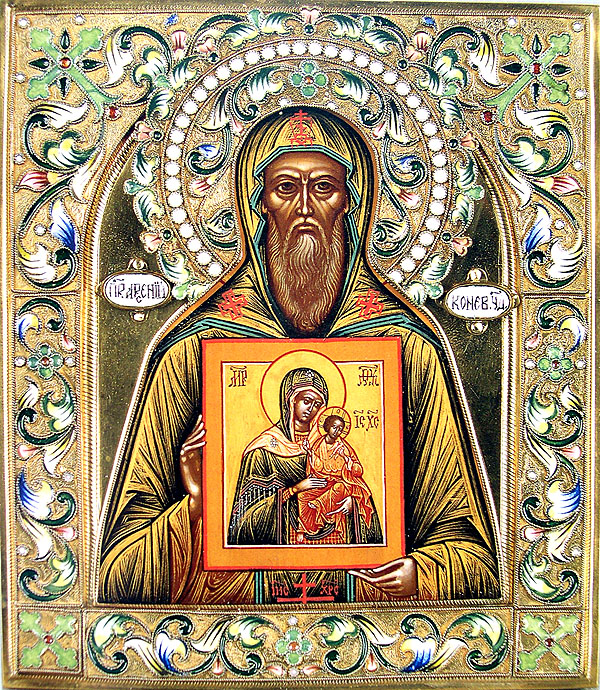
Venerable Arsenius, Abbot of Konevits

Saint Arsenius of Konevits was a native of Novgorod, a coppersmith by trade. The saint accepted tonsure at the Lisich monastery near Novgorod, where he spent eleven years. He went to Mount Athos in 1373, and there he spent three years, dwelling in prayer and making copper vessels for the brethren.

In the year 1393, Saint Arsenius returned to Russia and brought with him an icon of the Mother of God, which was later called the Konevits Icon. Saint Arsenius went with this icon to the island of Konevets on Lake Ladoga, where he spent five years in solitude.

In 1398, with the blessing of Archbishop John of Novgorod, Saint Arsenius laid the foundations of a cenobitic monastery dedicated to the Nativity of the Most Holy Theotokos. He visited Athos a second time, and asked the holy Fathers for their prayers and a blessing for his monastery.

In 1421 the lake flooded, destroying the monastery structures. This forced Saint Arsenius to relocate the monastery to a new site on the island. Saint Arsenius died in 1447, and was buried in the monastery church. His Life was written in the sixteenth century by Igumen Barlaam of Konevits. The Life of Saint Arsenius was published in 1850, together with the Service and Akathist in his honor

Venerable Onuphrius, Abbot of Malsk, Pskov

Saint Onuphrius of Mala and Pskov [Izborsk] founded a monastery in honor of the Nativity of the Mother of God at Mala, four versts from Izborsk and 56 versts from Pskov. The saint died on June 12, 1592 and was buried in the Nativity church, in a chapel named for him. The memory of Saint Onuphrius is also celebrated on the so-called “Malsk Sunday,” the first Sunday after the Peter and Paul Fast.

Venerable Bassian of Pertomsk, Solovki

No information on the life of this saint is available at this time.

Venerable Onuphrius of Vologda

No information on the life of this saint is available at this time.

Venerable Auxentius of Vologda

No information on the life of this saint is available at this time.

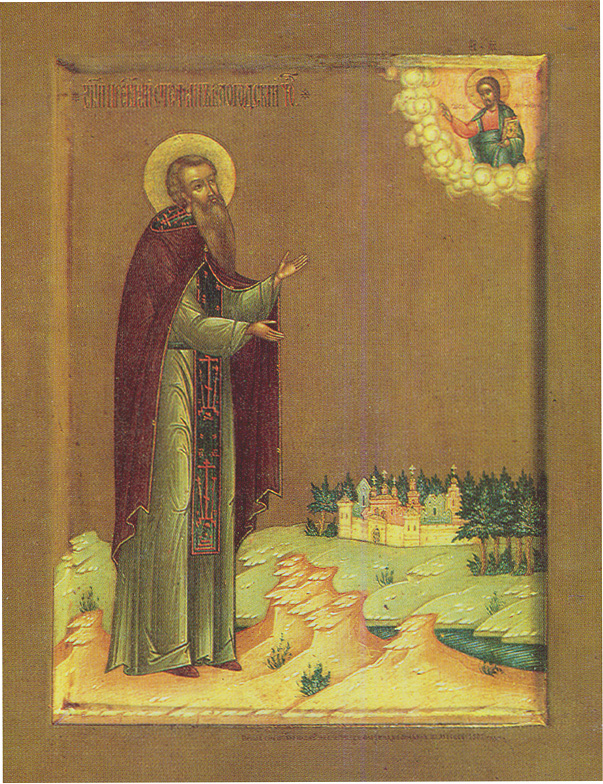
Venerable Stephen of Komel, Abbot of Ozersk Monastery, Vologda

No information available at this time.

Venerable John, Andrew, Heraclemon, and Theophilus, Hermits, of Egypt

Saints Andrew, John, Heraclemon, and Theophilus lived in Egypt in the fourth century, and is mentioned in the Life of Saint Onuphrius.

After he had buried Saint Onuphrius, Saint Paphnutius came upon an oasis which impressed him with its beauty and abundance of fruit-bearing trees. Four youths inhabiting this place came to him from out of the wilderness. The youths told Abba Paphnutius that in their childhood they had lived in the city of Oxyrhynchus (Upper Thebaid) and they had studied together. They had burned with the desire to devote their lives to God. Making their plans to go off into the desert, the young men left the city and after several days’ journey, they reached this place.

A man radiant with heavenly glory met them and led them to a desert Elder. “We have lived here six years already,” said the youths. “Our Elder dwelt here one year and then he died. Now we live here alone, we eat the fruit of the trees, and we have water from a spring.” The youths gave him their names, they were Saints John, Andrew, Heraclemon and Theophilus (Dec. 2).

The youths struggled separately the whole week long, but on Saturday and Sunday they gathered at the oasis and offered up common prayer. On these days an angel would appear and commune them with the Holy Mysteries. This time however, for Abba Paphnutius’ sake, they did not go off into the desert, but spent the whole week together at prayer. On the following Saturday and Sunday Saint Paphnutius together with the youths was granted to receive the Holy Mysteries from the hands of the angel and to hear these words, “Receive the Imperishable Food, unending bliss and life eternal, the Body and Blood of the Lord Jesus Christ, our God.”

Saint Paphnutius made bold to ask the angel for permission to remain in the desert to the end of his days. The angel replied that God had decreed another path for him. He was to return to Egypt and tell the Christians of the life of the desert-dwellers.

Having bid farewell to the youths, Saint Paphnutius reached the edge of the wilderness after a three day journey. Here he found a small skete, and the brethren received him with love. Abba Paphnutius related everything that he had learned about the holy Fathers whom he had encountered in the desert. The brethren wrote a detailed account of what Saint Paphnutius said, and deposited it in the church, where all who wished to do so could read it. Saint Paphnutius gave thanks to God, Who had granted him to learn about the exalted lives of the hermits of the Thebaid, and he returned to his own monastery.

Saint John is also commemorated on December 2

Saint (John) Tornike of Mount Athos

Tornike Eristavi1 (later John of Mt. Athos) was a Georgian army commander famed for his victories in war and a favorite of King David Kuropalates. Eventually he abandoned his worldly glory and set off in search of his spiritual father, Saint John, on Mt. Olympus. There he learned that Saint John had moved to Mt. Athos, so he journeyed there and settled with him in a monastery headed by Saint Athanasius the Athonite. He was tonsured a monk and given the new name John.

Soon many Georgians became thirsty for the ascetic life and arrived to labor on the Holy Mountain. To serve the young community, Saint John built a church in honor of Saint John the Theologian and constructed cells nearby. In such a way, the first Georgian community on Mt. Athos was established.

At that time, Bardas Sclerus, commander of the army of Asia Minor, led a revolt against Basil and Constantine, the young Byzantine emperors. The dowager empress Theophania, hoping to receive assistance from Georgia, requested that John-Tornike travel to his homeland, inform the king about the difficult situation in Byzantium, and rally the Georgian armies for support. At first John-Tornike refused, doubting his preparedness to return to life in the world. But after the other brothers pleaded with him and he received Saint Athanasius’ blessing, he returned to Georgia and delivered Theophania’s letter to King David Kuropalates. The king was overjoyed at the sight of his favorite military leader, and he consented to the empress’ request, provided John-Tornike would command the army. The king was resolute and John-Tornike was compelled to honor his will. With God’s help and under the wise leadership of John-Tornike, twelve thousand Georgian soldiers defeated the army of the godless Bardas Sclerus, banishing the conspirator from Byzantium (ca. 979).

After this great victory John-Tornike returned immediately to Mt. Athos. The brothers met him with great joy and gave thanks to God for returning him safely to the monastery.

Saint John-Tornike was a perfect example of humility. He renounced his own will completely and would do nothing without a blessing from his spiritual father. “I entrust myself and my will to you. Save me according to your will!” he would tell Saint John.

The brothers of the monastery often asked John-Tornike to recount his military glories, and he was obliged to recall his past. Once Saint John requested that he share his memories with a certain Elder Gabriel, a man who spoke not a single vain word. John-Tornike agreed, and after he had narrated his glorious past to the elder, he ceased speaking entirely. He spent the rest of his life in silence, hoping in God, and reposed peacefully.


1A Georgian title, meaning literally “head of the army.” An eristavi was the ruler or governor of his province and a pillar of the Georgian monarchy. During certain periods of Georgian history the title was hereditary. The title is equivalent to a European duke.

Venerable Jonah of Pertomsk, Solovki

No information on the life of this saint is available at this time.

Transfer of the relics of the Right-Believing Anna of Kashin

The Holy Right-Believing Princess Anna of Kashin died on October 2, 1338. A Church council decided to glorify the holy Princess Anna as a saint, and her holy relics were uncovered on July 21, 1649. The solemn transfer of her relics from the wooden Dormition cathedral into the stone Resurrection church took place on June 12, 1650.