
Here is the live stream for Orthros and Divine Liturgy – Sunday 6/19/2022 If you need, here are instructions for accessing this content from your phone, tablet, computer, or TV.
Monthly Archives: June 2022
Daily Readings for Sunday, June 19, 2022
THE SUNDAY OF ALL SAINTS
NO FAST
The Sunday of All Saints, Thaddeus (Jude) the Apostle & Brother of Our Lord, Holy Martyr Zosima, Our Righteous Father Zenonus, Paisius the Great of Egypt
ST. PAUL’S LETTER TO THE HEBREWS 11:33-40; 12:1-2
Brethren, all the saints through faith conquered kingdoms, enforced justice, received promises, stopped the mouths of lions, quenched raging fire, escaped the edge of the sword, won strength out of weakness, became mighty in war, put foreign armies to flight. Women received their dead by resurrection. Some were tortured, refusing to accept release, that they might rise again to a better life. Others suffered mocking and scourging, and even chains and imprisonment. They were stoned, they were sawn in two, they were tempted, they were killed with the sword; they went about in skins of sheep and goats, destitute, afflicted, ill-treated – of whom the world was not worthy – wandering over deserts and mountains and in dens and caves of the earth. And all these, though well attested by their faith, did not receive what was promised, since God had foreseen something better for us, that apart from us they should not be made perfect. Therefore, since we are surrounded by so great a cloud of witnesses, let us also lay aside every weight, and sin which clings so closely, and let us run with perseverance the race that is set before us, looking to Jesus the pioneer and perfecter of our faith.
MATTHEW 10:32-33; 37-38; 19:27-30
The Lord said to his disciples, “Every one who acknowledges me before men, I also will acknowledge before my Father who is in heaven; but whoever denies me before men, I also will deny him before my Father who is in heaven. He who loves father or mother more than me is not worthy of me; and he who loves son or daughter more than me is not worthy of me; and he who does not take his cross and follow me is not worthy of me.” Then Peter said in reply, “Lo, we have left everything and followed you. What then shall we have?” Jesus said to them, “Truly, I say to you, in the new world, when the Son of man shall sit on his glorious throne, you who have followed me will also sit on twelve thrones, judging the twelve tribes of Israel. And every one who has left houses or brothers or sisters or father or mother or children or lands, for my name’s sake, will receive a hundredfold, and inherit eternal life. But many that are first will be last, and the last first.”
Synaxis of All Saints
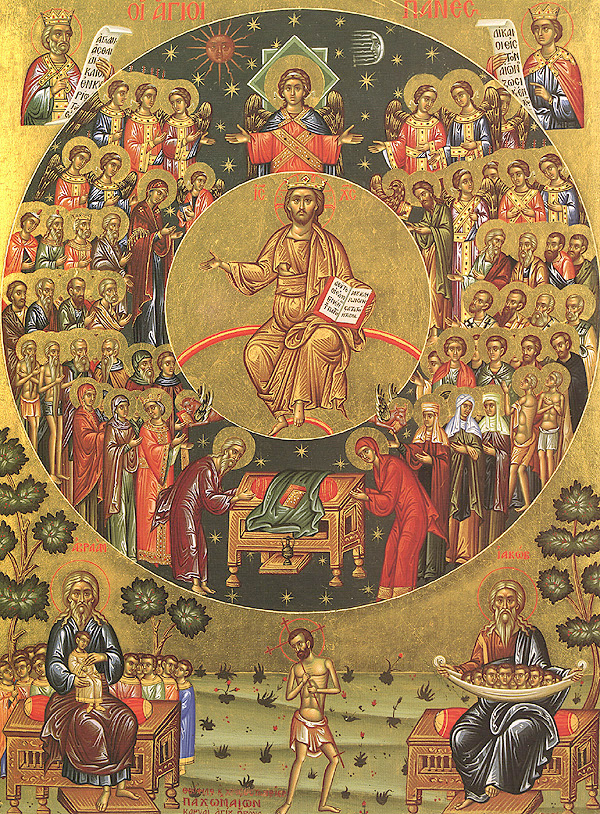
The Sunday following Pentecost is dedicated to All Saints, both those who are known to us, and those who are known only to God. There have been saints at all times, and they have come from every corner of the earth. They were Apostles, Martyrs, Prophets, Hierarchs, Monastics, and Righteous, yet all were perfected by the same Holy Spirit.
The Descent of the Holy Spirit makes it possible for us to rise above our fallen state and to attain sainthood, thereby fulfilling God’s directive to “be holy, for I am holy” (Lev. 11:44, 1 Peter 1:16, etc.). Therefore, it is fitting to commemorate All Saints on the first Sunday after Pentecost.
This feast may have originated at an early date, perhaps as a celebration of all martyrs, then it was broadened to include all men and women who had borne witness to Christ by their virtuous lives, even if they did not shed their blood for Him.
Saint Peter of Damascus, in his “Fourth Stage of Contemplation,” mentions five categories of saints: Apostles, Martyrs, Prophets, Hierarchs, and Monastic Saints (Philokalia [in English] Vol. 3, p.131). He is actually quoting from the Octoechos, Tone 2 for Saturday Matins, kathisma after the first stichology.
Saint Νikόdēmos of the Holy Mountain (July 14) adds the Righteous to Saint Peter’s five categories. The list of Saint Νikόdēmos is found in his book The Fourteen Epistles of Saint Paul (Venice, 1819, p. 384) in his discussion of I Corinthians 12:28.
The hymnology for the feast of All Saints also lists six categories: “Rejoice, assembly of the Apostles, Prophets of the Lord, loyal choirs of the Martyrs, divine Hierarchs, Monastic Fathers, and the Righteous….”
Some of the saints are described as Confessors, a category which does not appear in the above lists. Since they are similar in spirit to the martyrs, they are regarded as belonging to the category of Martyrs. They were not put to death as the Martyrs were, but they boldly confessed Christ and came close to being executed for their faith. Saint Maximus the Confessor (January 21) is such a saint.
The order of these six types of saints seems to be based on their importance to the Church. The Apostles are listed first, because they were the first to spread the Gospel throughout the world.
The Martyrs come next because of their example of courage in professing their faith before the enemies and persecutors of the Church, which encouraged other Christians to remain faithful to Christ even unto death.
Although they come first chronologically, the Prophets are listed after the Apostles and Martyrs. This is because the Old Testament Prophets saw only the shadows of things to come, whereas the Apostles and Martyrs experienced them firsthand. The New Testament also takes precedence over the Old Testament.
The holy Hierarchs comprise the fourth category. They are the leaders of their flocks, teaching them by their word and their example.
The Monastic Saints are those who withdrew from this world to live in monasteries, or in seclusion. They did not do this out of hatred for the world, but in order to devote themselves to unceasing prayer, and to do battle against the power of the demons. Although some people erroneously believe that monks and nuns are useless and unproductive, Saint John Climacus had a high regard for them: “Angels are a light for monks, and the monastic life is a light for all men” (LADDER, Step 26:31).
The last category, the Righteous, are those who attained holiness of life while living “in the world.” Examples include Abraham and his wife Sarah, Job, Saints Joachim and Anna, Saint Joseph the Betrothed, Saint Juliana of Lazarevo, and others.
The feast of All Saints achieved great prominence in the ninth century, in the reign of the Byzantine Emperor Leo VI the Wise (886-911). His wife, the Holy Empress Theophano (December 16) lived in the world, but was not attached to worldly things. She was a great benefactor to the poor, and was generous to the monasteries. She was a true mother to her subjects, caring for widows and orphans, and consoling the sorrowful.
Even before the death of Saint Theophano in 893 or 894, her husband started to build a church, intending to dedicate it to Theophano, but she forbade him to do so. It was this emperor who decreed that the Sunday after Pentecost be dedicated to All Saints. Believing that his wife was one of the righteous, he knew that she would also be honored whenever the Feast of All Saints was celebrated.
Icon of the Mother of God “The Unbreakable Wall”
The “Unbreakable (or “Indestructible”) Wall” Icon of the Most Holy Theotokos is commemorated on the Sunday of All Saints. It is an XI century mosaic icon of the Blachernae type, above the main altar of Kiev's Holy Wisdom Cathedral. The Mother of God is depicted against a golden background, standing with upraised hands on a quadrangular gold platform.
In some Icons of this type [but not in the mosaic Icon], Christ is depicted within a mandorla, an oval or circle, symbolizing the glory of Heaven, or the Divine Light.
The Icon is called the "Unbreakable Wall" because for ten centuries it has remained intact, in spite of the fact that both Kiev's Holy Wisdom Cathedral and the city have been damaged several times. An ancient description of this Icon has been preserved: "A gigantic full-length portrait of the Theotokos…. She stands upon a gold stone, as an unshakable foundation for all who resort to her protection. Her chiton is blue, and she wears a scarlet belt. Hanging from it is an embroidered cloth with which she wipes away so many tears.
There are several possible sources for this Icon's title:
- The Prophet-King David wrote "God is in the midst of her (i. e. the city of God); she shall not be moved: God shall help her with his countenance" (Psalm 45/46:5).
- "Thus the Lord showed me; and behold, he stood upon a wall of adamant…" (Amos 7:7, LXX).
- The Akathist to the Mother of God, Ikos 12. "Rejoice, indestructible wall of kingdoms" – Ikos XII).
According to Kievan tradition, the wall of the church will not perish while the hands of the Mother of God are extended over it.
Apostle Jude the Brother of the Lord

The Holy Apostle Jude, one of the twelve apostles of Christ, is descended from King David and Solomon, and was the son of Righteous Joseph the Betrothed (Sunday after the Nativity of the Lord) by his first wife.
The Holy Apostle John the Theologian writes in his Gospel, “… neither did his brethren believe in Him” (John. 7:5). Saint Theophylact, Archbishop of Bulgaria, explains this passage. He says that at the beginning of the Lord Jesus Christ’s earthly ministry, Joseph’s sons, Jude among them, did not believe in His divine nature. Tradition says that when Saint Joseph returned from Egypt, he began to divide his possessions among his sons. He wanted to allot a share to Christ the Savior, born miraculously and incorruptibly from the All-Pure Virgin Mary. The brothers were opposed to this because Jesus was born of another mother. Only James, later called “The Brother of God,” offered to share his portion with Him.
Jude came to believe in Christ the Savior as the awaited Messiah, and he followed Him and was chosen as one of the twelve Apostles. Mindful of his sin, the Apostle Jude considered himself unworthy to be called the Lord’s brother, and in his Epistle he calls himself merely the brother of James.
The Holy Apostle Jude also had other names: the Evangelist Matthew terms him “Lebbaeus, whose surname was Thaddeus” (Mt. 10:3). The Holy Evangelist Mark also calls him Thaddeus (Mark 3:18), and in the Acts of the Holy Apostles he is called Barsabas (Acts 15: 22). This was customary at that time.
After the Ascension of the Lord Jesus Christ, Saint Jude traveled about preaching the Gospel. He propagated the faith in Christ at first in Judea, Galilee, Samaria and Idumaia, and later in the lands of Arabia, Syria and Mesopotamia. Finally, he went to the city of Edessa. Here he finished the work that was not completed by his predecessor, Saint Thaddeus, Apostle of the Seventy (August 21). There is a tradition that Saint Jude went to Persia, where he wrote his catholic Epistle in Greek. In the Epistle much profound truth was expressed in a few words.
Saint Jude’s Epistle speaks about the Holy Trinity, about the Incarnation of the Lord Jesus Christ, about the good and bad angels, and about the dread Last Judgment. The Apostle urges believers to guard themselves against fleshly impurity, to be diligent in prayer, faith and love, to convert the lost to the path of salvation, and to guard themselves from the teachings of heretics. He also says that it is not enough just to be converted to Christianity, but faith must be demonstrated by good works. He cites the rebellious angels and men punished by God (verse 6) to support this.
The Holy Apostle Jude died as a martyr around the year 80 near Mt. Ararat in Armenia, where he was crucified and pierced by arrows.
Venerable Barlaam of Shenkursk

Saint Varlaam was known as Vasily Stepanovich Svoezemtsev in life, in monasticism he was given the name Varlaam Vazhsky.
Vasily Stepanovich was born around 1390 into the family of the Novgorod Boyar (his father was Stepan Vasilyevich). At baptism he received the name Vasily. He was married and had two sons, Ivan and Semyon. According to another version of his life, he had two daughters and eight sons. Vasily served as mayor of Novgorod until 1445. He also served as a representative of the Boyar family of Svoezemtsev, Novgorod.
In 1426, he founded Varlaamiev Vazhsky Monastery, where subsequently the town of Pinezhsky was founded. In 1456, Vasily Stepanovich was tonsured a monk and given the name Barlaam Vazhsky by the first Hegumen of St. John Theological Monastery. Saint Varlaam lived as a monastic for six years, and upon his death on June 19, 1462, he was buried next to the church of John the Theologian, which he had built.
Martyr Zosimus the Soldier at Antioch, in Pisidia

The Martyr Zosimus lived in the city of Apollona (Thrace) during the reign of Trajan (89-117), the persecutor of Christians. The saint was consumed with the desire to become a Christian. When he heard about the start of a persecution of Christians, he left military service, was baptized, and devoted himself to prayer and good deeds.
It was reported to the prefect Domitianus of Antioch that Zosimus had betrayed the emperor by taking off his military insignia and attaching himself to Christians. At the trial, Saint Zosimus confessed his faith in Christ and refused to offer sacrifice to the pagan gods. He was subjected to fierce torments but, strengthened by the grace of God, he did not feel the pain. The prefect gave orders to heat a copper bed red-hot and to put the saint on it. The martyr made the Sign of the Cross, laid down on the bed, but remained unharmed.
Departing the city, Domitianus gave orders to place iron sandals with sharp nails in the soles on the martyr’s feet, and to have Zosimus follow after him. The Lord gave Saint Zosimus the strength to follow after the horses.
The martyr was locked in prison, where they tormented him with hunger and thirst, but an angel of the Lord fortified him with bread and water. Saint Zosimus still refused to offer sacrifice to the pagan gods. Finally, he was beheaded, and surrendered his soul to God.
Venerable Paisius the Great
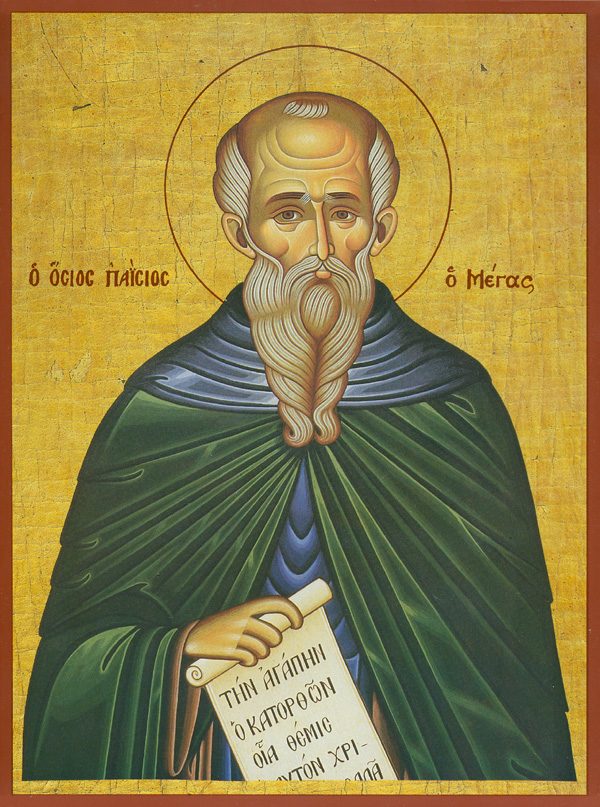
Saint Paisius the Great lived in Egypt. His parents, Christians, distributed generous alms to all the needy.
After the death of her husband his mother, on the suggestion of an angel, gave her young son Paisius to the clergy of the church.
The youth Paisius loved monastic life and spent his time in one of the Egyptian sketes. Renouncing his own will, he lived under the spiritual guidance of Saint Pambo (July 18), finishing all the tasks assigned him. The Elder said that a new monk in particular needs to preserve his sight, in order to guard his senses from temptation. Paisius, heeding the instruction, went for three years with his eyes cast downwards. The saintly ascetic read spiritual books, and he was known for his ascetic fasting and prayer. At first he did not eat any food for a week, then two weeks. Sometimes, after partaking of the Holy Mysteries of Christ, he survived without food for seventy days.
Saint Paisius went into the Nitrian desert in search of solitude. There he lived in a cave carved out by his own hands. The saint was granted a wondrous vision: the Lord Jesus Christ revealed to him that through his labors the Nitrian wilderness would become inhabited by ascetics. He asked the Lord where the monks would obtain the necessities of life in the desert. The Lord said that if they would fulfill all His commandments, He Himself would provide all their necessities, and would deliver them from demonic temptations and cunning.
In time, a number of monks and laymen gathered around Saint Paisius, and a monastery was established. The most important rule of Saint Paisius was that no one would do anything by his own will, but in all things would fulfill the will of his elders.
Since his tranquility was being disturbed by so many people, the saint withdrew to another cave farther away. Once, he was transported to a paradisical monastery and partook of the immaterial divine food. After his ascetic labors for salvation, the Lord granted His saint the gift of prescience and healing the souls of men.
One of his disciples, with the saint’s blessing, went to sell his handicrafts in Egypt. On the way he encountered a Jew, who told the simple-minded monk that Christ the Savior is not the Messiah, and that another Messiah will come. Confused, the monk said, “Maybe what you say is true,” but he did not attribute any particular significance to his words. When he returned, he saw that Saint Paisius would not acknowledge his arrival, and he asked the reason for his anger. The saint said, “My disciple was a Christian. You are not a Christian, for the grace of Baptism has departed from you.” The monk repented with tears, and begged to have his sin forgiven. Only then did the holy Elder pray and ask the Lord to forgive the monk.
A certain monk on his own initiative left the desert and moved near a city. There he had encounters with a woman, who hated and blasphemed Christ the Savior. Under her influence, he not only left the monastery, but also scorned faith in Christ, and finally he reached a state of total disbelief.
Once, through the blessed Providence of God, Nitrian monks came by his home. Seeing them, the sinner remembered his own former life and he asked the monks to ask Saint Paisius to pray for him to the Lord. On hearing the request, the saint prayed fervently, and his prayer was heard. The Lord, appearing to His saint, promised to forgive the sinner. Soon the seduced monk’s woman companion died, and he returned to the desert where, weeping and distressed for his sins, he began to labor at deeds of repentance.
Saint Paisius distinguished himself by his great humility, and performed ascetic deeds of fasting and prayer, but he concealed them from others as far as possible. When the monks asked which virtue is the highest of all, the saint replied, “Those which are done in secret, and about which no one knows.”
Saint Paisius died in the fifth century at a great old age, and he was buried by the monks. After some time his relics were transferred by Saint Isidore of Pelusium (February 4) to his own monastery and placed beside the relics of his friend Saint Paul, with whom Saint Paisius was particularly close during his life.
Saint John the Solitary of Jerusalem
Saint John the Hermit was an ascetic in Palestine. He passed his days in fasting and prayer in a cave near Jerusalem. The uncovetous ascetic had only an icon of the Most Holy Theotokos, before which a lampada was always lit.
The holy Elder often visited the holy places of Jerusalem, and Mount Sinai, and he went to pray at the graves of the holy martyrs and ascetics. Whenever he went out, the saint left the lampada burning before the icon of the Queen of Heaven and he asked Her blessing for the journey. When he returned after a month, or even after six months, the Elder found the lampada burning and filled with oil.
Once, he happened to go on a narrow trail, with two sides so overgrown with bushes, that it was impossible for two people on foot to pass each other. Suddenly, the saint saw a lion coming toward him. The beast stood up on its hind legs and cleared the way for the saint.
Once, a monk came to the cave to visit Saint John. Since he did not notice even the bare necessities, he asked Abba John why he lived in such poverty. The holy Elder said that his cave contained spiritual riches greater than any earthly treasures.
Saint John the Hermit reposed in the sixth century in extreme old age, and was numbered with the saints.
Venerable Paisius of Hilandar, Bulgaria
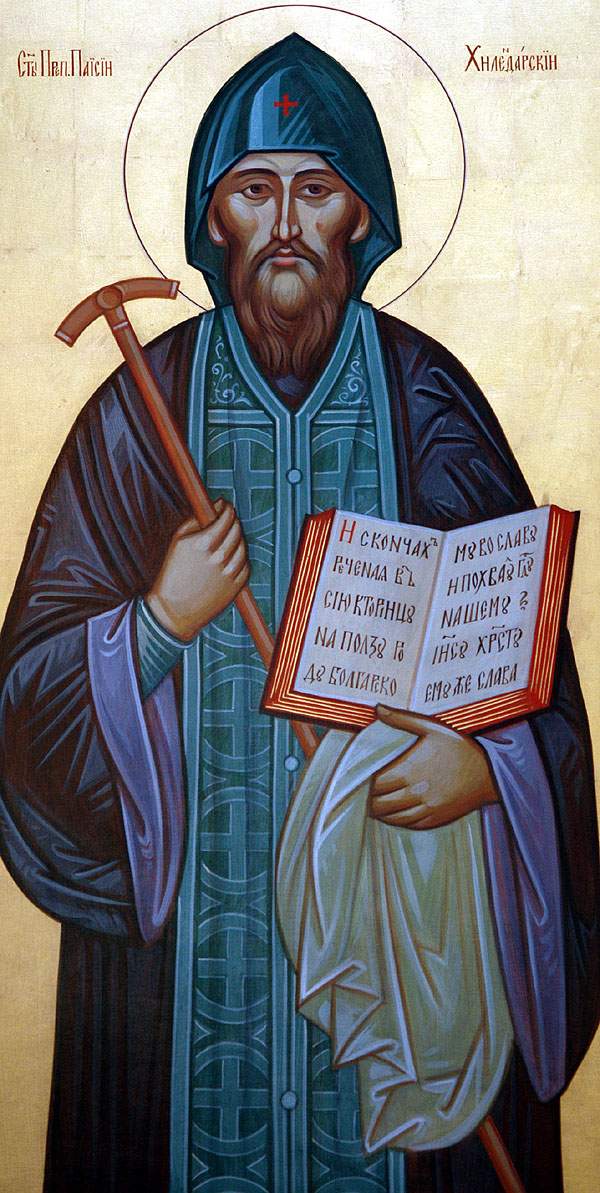
Saint Paisius of Hilandar was born in the year 1722 in Bansko into a pious family. One of his brothers, Laurence, was igumen of Hilandar Monastery, and another was noted as a generous benefactor of Orthodox temples and monasteries. Saint Paisius himself went through his obedience at Rila Monastery.
In 1745 at age twenty-three, Saint Paisius went to his brother in the Hilandar Monastery on Mount Athos, where he received monastic tonsure. The ascetic matured spiritually on the Holy Mountain. He studied Holy Scripture and he was found worthy of ordination to the holy priesthood.
In the year 1762 Saint Paisius wrote The History of the Slavo-Bulgarians, a book upholding the Christian Faith and awakening the national self-awareness of the subjugated Bulgarian nation.
Amid the darkness of foreign oppression the saint rekindled the lamp of Orthodoxy, lit formerly by Saints Cyril and Methodius (May 11). The time and place of the saint’s blessed end is unknown.
On June 26, 1962 the Holy Synod of the Bulgarian Orthodox Church under the presidency of His Holiness Patriarch Cyril, and with the participation of all the Metropolitans, expressed the indebtedness of the Church and country to Saint Paisius. They decreed that Paisius of Hilandar and Bulgaria be glorified as a saint, and directed that his memory be celebrated on June 19, “when, according to the Orthodox calendar, Saint Paisius the Great is commemorated.”
The name of Saint Paisius is borne by a state university in Plovdiv, and by many institutes and schools in other cities and villages of Bulgaria. This testifies to the deep veneration of the saint by the Bulgarian nation.
Repose of Saint Job, Patriarch of Moscow and all Russia

Saint Job, the first Patriarch of Moscow, was born into the family of pious tradesmen in Staritsa near Tver in the 1530s. His baptismal name was John.
After his death in 1607, the relics of Patriarch Job were buried by the western doors of the Dormition Church of the monastery in Staritsa. Many miracles took place at his grave.
In 1652, on the recommendation of Metropolitan Nikon of Novgorod, Tsar Alexei ordered that the relics of Saint Job and Saint Philip (January 9) be transferred to Moscow.
Metropolitan Barlaam of Rostov presided at the uncovering of Saint Job’s relics in Staritsa. The Patriarch’s incorrupt and fragrant relics became the source of healing for many who were afflicted by physical and mental illnesses.
On March 27 a procession set off for Moscow with the relics. On Monday of the sixth week of Lent (April 5), the relics of Patriarch Job were brought to the Passions Monastery. From there, the procession proceeded to the Kremlin, and the relics of the saint were placed in the Dormition cathedral. A few days later, Patriarch Joseph died and was buried next to Saint Job.
Saint Job has long been revered as a worker of miracles. The Altar Crosses in the churches of the Staritsa monastery and the Tver cathedral contained particles of his holy relics.
Great Vespers – Saturday 6/18/2022
Here is the live stream for Great Vespers – Saturday 6/18/2022 If you need, here are instructions for accessing this content from your phone, tablet, computer, or TV.
Daily Readings for Saturday, June 18, 2022
THE APODOSIS OF HOLY PENTECOST
NO FAST
The Apodosis of Holy Pentecost, Leontius, Hypatius, & Theodulus the Martyrs of Syria, Leontios the Myrrh-Streamer of Argos, Aitherios the Martyr of Nicomedia
ST. PAUL’S LETTER TO THE ROMANS 1:7-12
Brethren, grace to you and peace from God our Father and the Lord Jesus Christ. First, I thank my God through Jesus Christ for all of you, because your faith is proclaimed in all the world. For God is my witness, whom I serve with my spirit in the gospel of his Son, that without ceasing I mention you always in my prayers, asking that somehow by God’s will I may now at last succeed in coming to you. For I long to see you, that I may impart to you some spiritual gift to strengthen you, that is, that we may be mutually encouraged by each other’s faith, both yours and mine.
MATTHEW 5:42-48
The Lord said, "Give to him who begs from you, and do not refuse him who would borrow from you. You have heard that it was said, 'You shall love your neighbor and hate your enemy.' But I say to you, Love your enemies and pray for those who persecute you, so that you may be sons of your Father who is in heaven; for he makes his sun rise on the evil and on the good, and sends rain on the just and on the unjust. For if you love those who love you, what reward have you? Do not even the tax collectors do the same? And if you salute only your brethren, what more are you doing than others? Do not even the Gentiles do the same? You, therefore, must be perfect, as your heavenly Father is perfect.
Martyrs Leontius, Hypatius, and Theodulus at Tripoli in Syria
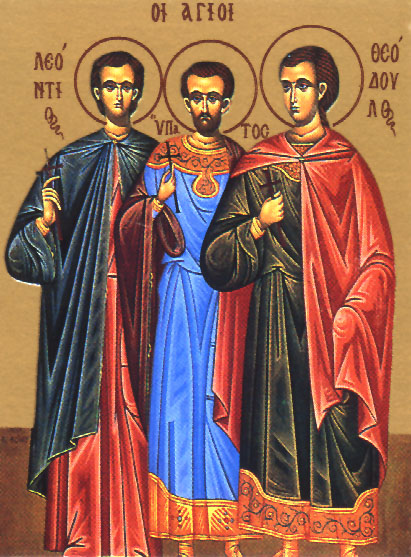
The Holy Martyrs Leontius, Hypatius, and Theodulus were Roman soldiers. The holy Martyr Leontius, a Greek by origin, served as a military-chief in the imperial army in the Phoenician city of Tripoli during the reign of Vespasian (70-79). Leontius was distinguished for his bravery and good sense, and the people of Tripoli held him in deep respect because of his virtue.
The emperor appointed the Roman senator Adrian as governor of the Phoenician district, with full powers to hunt out Christians, and in case of their refusal to offer sacrifice to the Roman gods, to give them over to torture and death. And on his way to Phoenicia Adrian received a report that Saint Leontius had turned many away from worshipping the pagan gods. The governor sent the tribune Hypatius with a detachment of soldiers to Tripoli so as to find and arrest the Christian Leontius. Along the way the tribune Hypatius fell seriously ill, and being near death, he saw in a dream an angel, which said: “If you wish to be healed, you and your soldiers should say three times: ‘God of Leontius, help me.’”
Opening his eyes Hypatius beheld the angel and said: “I was sent to arrest Leontius, how is it that I should appeal to his God?” At this moment the angel became invisible. Hypatius told his dream to the soldiers, among whom was his friend Theodulus, and all of them together asked for help from the God Whom Saint Leontius confessed. Hypatius was immediately healed to the great joy of his soldiers, but only Theodulus sat aside, pondering the miracle. His soul was filled with love for God, and he told Hypatius to proceed twice as quickly to the city in search of Saint Leontius.
Upon their arrival in the city, a stranger met them and invited them to his house, where he lavishly hosted the travellers. Learning that their hospitable host was Saint Leontius, they fell on their knees and asked him to enlighten them with faith in the True God. They were baptized here, and when Saint Leontius prayed over them calling on the Name of the Most Holy Trinity, a luminous cloud overshadowed the newly-baptized and poured forth rain. The remaining soldiers in search of their commander arrived in Tripoli, where the governor Adrian had also arrived. Learning what had happened, he ordered Saints Leontius, Hypatius, and Theodulus to be brought to him. After threatening them with torture and death, he demanded that they renounce Christ and offer sacrifice to the Roman gods.
All the martyrs firmly confessed their faith in Christ. Saint Hypatius was put under a column and raked with iron claws, and Saint Theodulus was mercilessly beaten with rods. Seeing the steadfastness of the saints, they beheaded them. And after torture, they sent Saint Leontius to prison. In the morning he came before the governor. Adrian tried to entice the holy martyr with honors and rewards, and accomplishing nothing, he gave him over to new tortures. The holy martyr was suspended head downwards from a pillar with a heavy stone about his neck, but nothing could make him renounce Christ. The governor gave orders to beat the sufferer with rods until he died. They then threw the body of the holy Martyr Leontius outside the city, but Christians reverently gave it burial near Tripoli. The death of the holy martyrs occurred between 70-79.
The accusation against Saint Leontius, and his sufferings and death are recorded on tin tablets prepared by the court scribe [commentarisius]. These tablets were placed at the grave of the holy martyr.
Venerable Leontius of the Kiev Far Caves
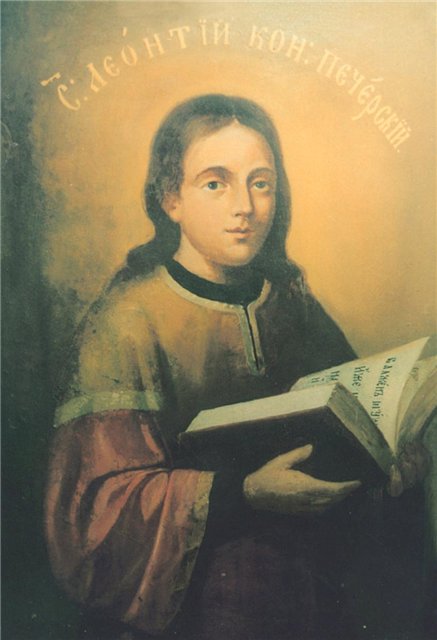
Saint Leontius, Canonarch of the Kiev Caves In his youth he entered the Kiev Caves monastery, where he received tonsure. He was endowed with a fine voice, and when he learned his letters, he fulfilled the obedience of canonarch (leader of church singing). Saint Leontius died at a young age in the fourteenth century. He was glorified by the Lord for his selfless deeds with the gift of miracles. The relics of the holy ascetic are located in the Far Caves, and he is also commemorated on August 28, the Synaxis of the Saints of the Kiev Caves.
Venerable Leontius the Hagiorite
Saint Leontius the Clairvoyant of Mt. Athos, was born in Peloponnesian Argos. He labored on Mount Athos for a long time at the monastery of Dionysiou. He spent sixty years at the monastery, and not once did the holy ascetic leave the monastery. For his deep faith and deeds God granted him the gift of clairvoyance and prophecy.
St Leontius departed to the Lord on March 16, 1605 at age 85. The saint’s holy relics were glorified by a flow of healing myrrh.
“Bogolyubov” Icon of the Mother of God

The Bogolyubov Icon of the Mother of God, one of the most ancient wonderworking icons of Russia, was painted in the twelfth century at the request of Prince Andrew Bogolyubsky (July 4), to commemorate the appearance of the Mother of God to him. Painted on cypress wood, the Icon is remarkable because of its large size.
In the year 1131, an Icon was sent from Constantinople to the Holy Prince Mstislav (Theodore in Baptism, commemorated April 15) in Russia, and was placed in the Devichii monastery in Vyshgorod, the ancient appanage (land given by kings and princes to their younger children for their support) city of Saint Olga (July 11).
One night in the summer of 1155, Prince Andrew secretly removed the wonderworking Icon of the Mother of God from the Vyshgorod church without the blessing of his father, Prince George Dolgoruky, and started northward toward Suzdal'. Some sources say that his father bequeathed the Icon to Prince Andrew. Later, this Icon would be known as the Vladimir Icon (August 26, June 23, May 21). Tradition says it was one of the Icons painted by the Holy Evangelist Luke (October 18), or a copy made from the original.
Seven versts from Vladimir, the cart carrying the wonderworking Icon stopped and could not be moved from that spot. Prince Andrew asked the priest Nicholas, who accompanied him, to serve a Moleben before the Icon. For a long time Andrew prayed before the holy image with tears. Later, he went into his tent and continued his fervent prayers. The Most Holy Theotokos appeared to him holding a small scroll in her right hand, and said: "I do not wish you to take my Icon to Rostov, but to the city of Vladimir. Here, in this place (the site of her miraculous appearance), you shall build a stone church and a monastery in honor of my Nativity."
Then the All-Holy Virgin lifted one hand toward Heaven, and received a blessing from Christ the Savior, and the vision ended.
In obedience to the will of the Mother of God, Prince Andrew built a stone church dedicated to her Nativity, as well as a monastery. After this, the Prince commissioned skilled iconographers to depict the All-Holy Virgin just as he had seen her in his vision: in full stature, with a scroll1 in her right hand, and her face turned toward the Savior in the upper right hand corner. When the church was completed, the Icon he had commissioned was placed inside, and June 18 was designated as the annual commemoration of the appearance of the Mother of God. The Icon depicting the appearance of the Most Holy Theotokos remained at Bogolyubov and was called the Bogolyubov Icon.
Saint Andrew named both the monastery and the city which sprang up around it Bogolyubov because as he himself said, "the Mother of God loves this place." The Prince also became known as Bogolyubsky ("the lover of God"). The Vladimir Icon remained in the convent until work was completed on the Dormition Cathedral at Vladimir, then it was solemly transferred to the cathedral.
The Bogolyubov Icon of the Mother of God has been glorified by countless miracles, and over the course of many centuries she has consoled the pious Christians of Russia, and has healed their infirmities. The fame of the miracles which took place before her Icon have inspired the faithful in many places to make copies of this holy Icon, some of which are also wonderworking.
The Moscow Bogolyubov Icon (1157) shows several saints gathered before the Theotokos: the Metropolitans of Moscow Peter, Alexis, Jonah, and Philip; The blessed Basil and Maxim, fools for Christ; Venerable Paraskeve; Saint Basil the Great; Saint Alexis the Man of God; Symeon, the kinsman of the Lord; the Apostle Peter; the monastic martyr Eudokia; and the Martyr Paraskeve. In some variants of the Icon the following Saints are also included: Saint Onouphrios, Venerable Mary of Egypt, Zosimas and Sabbatius, and the Great Martyrs Barbara and Katherine.
In 1771 an annual feast day was established in in honor of the Bogolyubov Icon to commemorate the deliverance of the city of Vladimir and the surrounding area from plague. As soon as the Icon was brought to Vladimir, the plague disappeared. It became customary to bring the Icon from Bogolyubovo to Vladimir on May 21. As many people as possible took turns in carrying the Icon at different times to and from Vladimir Province. The Icon stayed at Bogolyubovo Monastery, 10 versts from the city. In 1820, the inhabitants of the city of Vladimir adorned the Icon with an expensive riza.
Before the Bolshevik Revolution, the Icon was customarily brought to the city of Vladimir on May 21, where it remained until July 16, when it was returned to the monastery.
1 The scroll on the Icon reads: O Most Gracious Master, Lord Jesus Christ, my Son and my God, hear the prayer of Your Mother, for she is praying for the world.
Daily Readings for Friday, June 17, 2022
1ST FRIDAY AFTER PENTECOST
NO FAST
1st Friday after Pentecost, Isaurus the Holy Martyr & his Companions of Athens, Manuel, Sabel, & Ishmael the Martyrs of Persia, Righteous Father Botolph, Abbot of the Monastery of Ikanhoe
ST. PAUL’S LETTER TO THE ROMANS 2:14-28
Brethren, when Gentiles who have not the law do by nature what the law requires, they are a law to themselves, even though they do not have the law. They show that what the law requires is written on their hearts, while their conscience also bears witness and their conflicting thoughts accuse or perhaps excuse them on that day when, according to my gospel, God judges the secrets of men by Christ Jesus. But if you call yourself a Jew and rely upon the law and boast of your relation to God and know his will and approve what is excellent, because you are instructed in the law, and if you are sure that you are a guide to the blind, a light to those who are in darkness, a corrector of the foolish, a teacher of children, having in the law the embodiment of knowledge and truth – you then who teach others, will you not teach yourself? While you preach against stealing, do you steal? You who say that one must not commit adultery, do you commit adultery? You who abhor idols, do you rob temples? You who boast in the law, do you dishonor God by breaking the law? For, as it is written, “The name of God is blasphemed among the Gentiles because of you.” Circumcision indeed is of value if you obey the law; but if you break the law, your circumcision becomes uncircumcision. So, if a man who is uncircumcised keeps the precepts of the law, will not his uncircumcision be regarded as circumcision? Then those who are physically uncircumcised but keep the law will condemn you who have the written code and circumcision but break the law. For he is not a real Jew who is one outwardly, nor is true circumcision something external and physical.
MATTHEW 5:33-41
The Lord said, “You have heard that it was said to the men of old, ‘You shall not swear falsely, but shall perform to the Lord what you have sworn.’ But I say to you, Do not swear at all, either by heaven, for it is the throne of God, or by the earth, for it is his footstool, or by Jerusalem, for it is the city of the great King. And do not swear by your head, for you cannot make one hair white or black. Let what you say be simply ‘Yes’ or ‘No’; anything more than this comes from evil. You have heard that it was said, ‘An eye for an eye and a tooth for a tooth.’ But I say to you, Do not resist one who is evil. But if any one strikes you on the right cheek, turn to him the other also; and if any one would sue you and take your coat, let him have your cloak as well; and if any one forces you to go one mile, go with him two miles.”
Martyrs Manuel, Sabel, and Ismael, of Persia
The Holy Martyrs Manuel, Sabel and Ismael, brothers by birth, were descended from an illustrious Persian family. Their father was a pagan, but their mother was a Christian, who baptized the children and raised them with a firm faith in Christ the Savior.
When they reached adulthood, the brothers entered military service. Representing the Persian King Alamundar, they were his emissaries in concluding a peace treaty with Emperor Julian the Apostate (361-363). Julian received them with due honor and showed them his favor. However, when the brothers refused to take part in a pagan sacrifice, Julian became angry. He annulled the treaty and incarcerated the ambassadors of a foreign country like common criminals.
At the interrogation he told them that if they scorned the "gods" he worshipped, it would be impossible to reach any peace or accord between the two sides. The holy brothers answered that they were sent as emissaries of their King on matters of state, and not to argue about “gods.” Seeing their firmness of faith, the Emperor ordered the brothers to be tortured.
The hands and feet of the Holy Martyrs were nailed to trees. Later, they drove iron spikes into their heads, and wedged sharp splinters under their fingernails and toenails. During their torments, the Saints glorified God and prayed as though they did not feel the tortures.
Finally, the Holy Martyrs were beheaded, and Julian ordered their bodies to be burned. Suddenly, there was an earthquake. The ground opened up and the bodies of the Saints disappeared into the abyss. After Christians prayed fervently for two days, the earth gave up the bodies of the holy brothers, from which a sweet fragrance issued forth. Many of the pagans who had witnessed the miracle, came to believe in Christ and were baptized. This was in the year 362.
Christians reverently buried the bodies of the Holy Martyrs Manuel, Sabel and Ismael. Since that time the relics of the Holy Passion-Bearers have been glorified with miracles.
The following year, when he heard about the murder of his emissaries, and that Julian was marching against him with a vast army, the Persian King Alamundar mustered his army and started for the border of his domain. The Persians vanquished the Greeks in a great battle.
At this time, Saint Basil the Great (January 1) was praying before an icon of the Most Holy Theotokos, upon which Saint Merkourios (November 24)1 was depicted as a soldier holding a spear. He asked God not to allow Emperor Julian to return from his war against the Persians, and resume his oppression of Christians. Suddenly, the image of the Holy Great Martyr Merkourios on the icon, next to the image of the Most Holy Theotokos, became invisible. Later, the image of Saint Merkourios reappeared with a bloodied spear.
As it happened, Julian was wounded by the spear of an unknown soldier, who disappeared. As he lay dying, the mortally wounded Julian cried out, “Thou hast conquered, O Galilean!”
The solemn commemoration of these saints is very ancient. In 395, thirty-three years after their death, Emperor Theodosios the Great built a church in honor of the Holy Martyrs at Constantinople, and Hieromonk Germanos (May 12), who later became the Patriarch of Constantinople, composed a Canon in honor of the holy brothers.
1 November 25 in Greek usage.
Martyr Nectan of Hartland

Saint Nectan was born in Wales and lived in the sixth century, but we know few details about his life. He was the oldest of the twenty-four children of Saint Brychan of Brecknock (April 6). While he was still living in Wales, God inspired him to imitate the example of Saint Anthony (January 17) and other ascetics, and to embrace the monastic life.
Seeking greater solitude, Saint Nectan and his companions left Wales, intending to settle wherever their boat happened to land. Divine providence brought them to the northern coast of Devonshire at Hartland, where they lived for several years in a dense forest. The saint’s family would visit him there on the last day of the year. Later, he relocated to a remote valley with a spring.
Once, Saint Nectan found a stray pig and returned it to its owner. In gratitude, the swineherd gave Saint Nectan two cows. The saint accepted the gift, but the cows were soon stolen by two robbers. Saint Nectan found the thieves who took the animals, and tried to preach to them about Christ. They became angry and cut off his head. Then the saint picked up his head and carried it for half a mile, laying it down near the spring by his cell. Seeing this, the man who killed Saint Nectan went out of his mind, but the other thief buried the Saint. From that time, miracles began to take place at Saint Nectan’s tomb.
In 937, on the eve of the Battle of Brunanburgh, a young man from Hartland who was in a tent near King Athelstan’s pavilion suddenly felt himself afflicted with the plague which was then destroying the English army. The young man wept and called upon God and Saint Nectan to help him. His cries were so loud that he woke the king and others around him.
Saint Nectan came to the young man just after midnight and touched the afflicted area of his body, healing him. In the morning, he was brought before the king and admitted that it was he who had disturbed Athelstan’s sleep. The king asked gently why he had been crying out during the night.
The young man explained that he felt himself stricken with the plague, and was afraid that he would die. Therefore, he entreated God and Saint Nectan to help him, and his prayer was answered.
Athelstan asked for more information about the life and martyrdom of Saint Nectan, which the young man provided. He also urged the king to turn to Saint Nectan with faith, promising that he would be victorious in battle if he did so.
The king promised to honor God and Saint Nectan, and so his faith was rewarded. Not only did he win the battle, but the plague disappeared and his soldiers recovered. The first time that King Athelstan visited Hartland in Devonshire, he donated property to the saint’s church. For the rest of his life, the king placed great confidence in the intercession of Saint Nectan.
Saint Nectan is the patron of Hartland, Devonshire. The fullest surviving Life dates from the twelfth century (See Vol. 5 of THE SAINTS OF CORNWALL by G. H. Doble for an English translation).
There is an Orthodox house chapel (Russian diocese of Sourozh) dedicated to Saint Simeon and Saint Anna at Combe Martin, N. Devon where Saint Nectan is venerated.
Saint Shalva of Akhaltsikhe
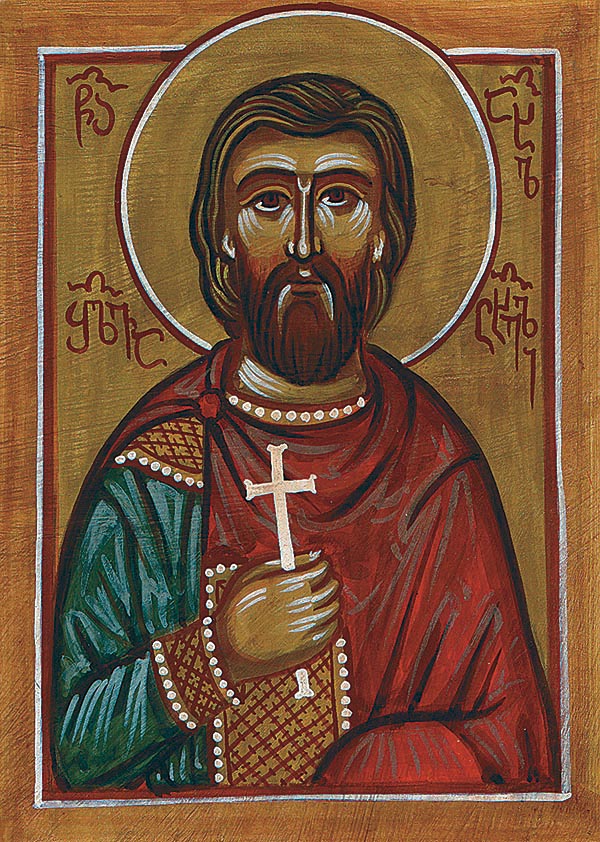
Saint Shalva of Akhaltsikhe was a brilliant military commander in the army of Queen Tamar and the prince of Akhaltsikhe. After his victory at Shamkori in the Ganja region, Shalva carried with him the flag of the caliph, as a sign of the invincibility of the Christian Faith, and conferred it, along with the wealth he had won, as an offering to the Khakhuli Icon of the Theotokos. For his selfless service, Queen Tamar honored him with the rank of commander-in-chief of the Georgian army.
During the reign of Queen Tamar’s daughter Rusudan (1222-1245), the armies of Sultan Jalal al-Din stormed into Georgia. Rusudan rallied the Georgian forces and appointed a new commander-in-chief by the name of John Atabeg.
Six thousand Georgians confronted a Muslim army of two hundred thousand near the village of Garnisi. Command of the advance guard was entrusted to the brave and valorous brothers Shalva and John of Akhaltsikhe, while John Atabeg remained with the main body of the army for the decisive battle.
The advance guard fought fearlessly, though the enemy’s army greatly surpassed it in number. The brothers fought with great devotion, hoping for support from the commander-in-chief, but John Atabeg was seized with envy—rather than fear—and never offered them his help. “O envy, source of every evil!” wrote one chronicler of the incident.
The enemy devastated the Georgian army, killing four thousand of its most valiant soldiers. Among them was John of Akhaltsikhe, whose brother Shalva was captured and delivered as a slave to Jalal al-Din.
Jalal al-Din was overjoyed to have the famed soldier and military leader brought before him. He received him with proper honor, offered him cities of great wealth, and promised him more if he agreed to convert to Islam.
Jalal al-Din sought with great persistence to convert Shalva to Islam, but his efforts were in vain—Shalva would not be converted, and nothing in the world would change his mind. So the sultan ordered that he be tortured to death.
After hours of torment failed to kill him, Jalal al-Din’s servants cast the half-dead martyr in prison, where he later reposed.
Venerable Botolph of Iken
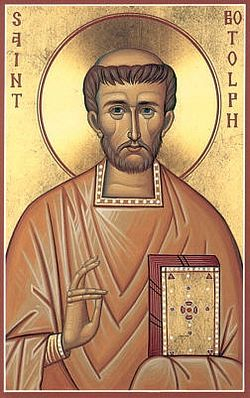
No information available at this time.
Saint Hervius of Plouvien
No information available at this time.
Venerable Ananias the Iconographer
Saint Ananias was born in Russia and was tonsured in the monastery of Saint Antony the Roman at Novgorod. God endowed him with a gift for painting icons, and he exercised this talent for the glory of the Lord. The Venerable Ananias painted "marvelous icons of many holy wonderworkers." For thirty-three years, he never went beyond the fence of the monastery.
Historical records do not agree about the year of his repose. Some say that he went to the Lord in 1521, 1561, or 1581. His relics are buried in a hidden place at the Monastery.
Saint Ananias is commemorated on June 17, and on the third Sunday of Pentecost.
Daily Readings for Thursday, June 16, 2022
1ST THURSDAY AFTER PENTECOST
NO FAST
1st Thursday after Pentecost, Tychon the Wonderworker, 40 Martyrs of Rome, Mark the Just of Apollonia
ST. PAUL’S LETTER TO THE ROMANS 1:28-32; 2:1-9
Brethren, since the ungodly did not see fit to acknowledge God, God gave them up to a base mind and to improper conduct. They were filled with all manner of wickedness, evil, covetousness, malice. Full of envy, murder, strife, deceit, malignity, they are gossips, slanderers, haters of God, insolent, haughty, boastful, inventors of evil, disobedient to parents, foolish, faithless, heartless, ruthless. Though they know God’s decree that those who do such things deserve to die, they not only do them but approve those who practice them. Therefore you have no excuse, O man, whoever you are, when you judge another; for in passing judgment upon him you condemn yourself, because you, the judge, are doing the very same things. We know that the judgment of God rightly falls upon those who do such things. Do you suppose, O man, that when you judge those who do such things and yet do them yourself, you will escape the judgment of God? Or do you presume upon the riches of his kindness and forbearance and patience? Do you not know that God’s kindness is meant to lead you to repentance? But by your hard and impenitent heart you are storing up wrath for yourself on the day of wrath when God’s righteous judgment will be revealed. For he will render to every man according to his works; to those who by patience in well-doing seek for glory and honor and immortality, he will give eternal life; but for those who are factious and do not obey the truth, but obey wickedness, there will be wrath and fury. There will be tribulation and distress for every human being who does evil, the Jew first and also the Greek.
MATTHEW 5:27-32
The Lord said, "You have heard that it was said, 'You shall not commit adultery.' But I say to you that every one who looks at a woman lustfully has already committed adultery with her in his heart. If your right eye causes you to sin, pluck it out and throw it away; it is better that you lose one of your members than that your whole body be thrown into Gehenna. And if your right hand causes you to sin, cut it off and throw it away; it is better that you lose one of your members than that your whole body go into Gehenna. It was also said, 'Whoever divorces his wife, let him give her a certificate of divorce.' But I say to you that every one who divorces his wife, except on the ground of unchastity, makes her an adulteress; and whoever marries a divorced woman commits adultery.
Icon of the Mother of God “the Surety of Sinners” in Koretsk
The ancient Koretsk "Surety of Sinners" Icon of the Mother of God of had been kept in a castle for a long time, and was called "blessed."
After the death of Samuel, the last Orthodox Prince of Koretsk, his brother John offered to let his sister Igoumeness Serapima take the Icon from the Prince's chapel to Holy Resurrection Koretsk Maidens' Monastery. The ceremonial transfer of the holy image took place in 1622, on Thursday of Pentecost week. The annual commemoration in honor of the "Surety of Sinners" Icon of Koretsk was appointed for that day.
On August 12, 1880, the icon was transferred and returned to the Holy Trinity monastery church and placed in a carved wooden kiot near the left front column.
More than once, the wonderworking Icon was a blessed help to the suffering – in 1923, on the Feast of the Holy Trinity, a young man who was possessed by an unclean spirit, received healing before the Icon. The following year, between the Feast of the Ascension of the Lord and Thursday of Pentecost week, there were incessant downpours at Volhynia. Miraculously, after a procession around the church with the Icon, the rain began to subside.
Many believers who turn to the Queen of Heaven for her help and intercession when they experience disturbances, family troubles, and especially anguish of the soul, indicate that after praying before the Icon they receive spiritual relief and solace, for she is truly the "Surety of Sinners."
In the Icon the Mother of God is depicted with the Divine Child on her left hand, Who holds her right hand with both His hands, so that her thumb is in His right hand, and her small finger in His left hand. This is the gesture of one who gives surety for another.
The inscription reads: “I am the Surety of sinners for my Son Who has entrusted me to hear them, and through me, those who bring me the joy of hearing them shall receive everlasting joy."
On August 17, 1998, the Superior of Holy Trinity Koretsk women's monastery, Igoumeness Natalia (Ilchuk) petitioned Patriarch Alexei II of Moscow and All Russia to add the Koretsk Icon to the list of wonderworking Icons of the Mother of God on the Patriarchal Church Calendar. With the Patriarch's blessing, the celebration in honor of the Koretsk Icon was approved.
In November 2001, an attempt was made to steal the Icon, but the attackers only managed to carry off its valuable frame. People donated money for a new riza to be made, a copy of the the one which was lost.
The Koretsk "Surety of Sinners" Icon is also commemorated on March 7.
Saint Tikhon, Bishop of Amathus in Cyprus

Saint Tikhon, Bishop of Amathus, was born in the city Amathus on the island of Cyprus. His parents raised their son in Christian piety, and taught him the reading of sacred books. It is said that the gift of wonderworking appeared in Saint Tikhon at quite a young age.
His father was the owner of a bakery, and whenever he left his son alone in the shop, the holy youth would give free bread to those in need. Learning of this, his father became angry, but the son said that he had read in the Scriptures, that in giving to God one receives back a hundredfold. “I,” said the youth, “gave to God the bread which was taken,” and he persuaded his father to go to the place where the grain was stored. With astonishment the father saw that the granary, which formerly was empty, was now filled to overflowing with wheat. From that time the father did not hinder his son from distributing bread to the poor.
A certain gardener brought the dried prunings of vines from the vineyard. Saint Tikhon gathered them, planted them in his garden and besought the Lord that these branches might take root and yield fruit for the health of people. The Lord did so through the faith of the holy youth. The branches took root, and their fruit had a particular and very pleasant taste. It was used during the lifetime of the saint and after his death for making wine for the Mystery of the Holy Eucharist.
They accepted the pious youth into the church clergy, made him a reader. Later, Mnemonios, the Bishop of Amathus ordained him a deacon. After the death of Bishop Mnemonios, Saint Tikhon by universal agreement was chosen as Bishop of Amathus. Saint Epiphanius, Bishop of Cyprus (May 12), presided at the service.
Saint Tikhon labored zealously to eradicate the remnants of paganism on Cyprus; he destroyed a pagan temple and spread the Christian Faith. The holy bishop was generous, his doors were open to all, and he listened to and lovingly fulfilled the request of each person who came to him. Fearing neither threats nor tortures, he firmly and fearlessly confessed his faith before pagans.
In the service to Saint Tikhon it is stated that he foresaw the time of his death, which occurred in the year 425.
The name of Saint Tikhon of Amathus was greatly honored in Russia. Temples dedicated to the saint were constructed at Moscow, at Nizhni Novgorod, at Kazan and other cities. But he was particularly venerated in the Voronezh diocese, where there were three archpastors in succession sharing the name with the holy hierarch of Amathus: Saint Tikhon I (Sokolov) (+ 1783, August 13), Tikhon II (Yakubovsky, until 1785) and Tikhon III (Malinin, until 1788).
Venerable Tikhon of Kaluga Or Medin

Saint Tikhon of Medin and Kaluga, in his youth received monastic tonsure at the Chudov monastery in Moscow, but through his love for solitude he settled at an isolated spot near Maloyaroslavl. He lived in asceticism in a deep dense forest, on the bank of the River Vepreika, in the hollow of an ancient giant oak. Once, during a hunt, Prince Basil Yaroslavich (grandson of Vladimir the Brave), came upon Saint Tikhon, angrily ordered him to leave his property immediately, and dared to raise his whip against the monk. At once, the hand of the prince grew numb. Taken aback by such punishment, the prince repented of his conduct and with humility asked forgiveness.
He received healing through the prayer of Saint Tikhon. The prince entreated the monk to remain always on his property and to build a monastery there for monks, promising to provide it with everything necessary. Saint Tikhon built a monastery in honor of the Dormition of the Most Holy Theotokos, which he headed. He guided the monastery until he reached a great old age, and he died in the year 1492, after receiving the great schema.
Saint Tikhon’s body was buried at the cathedral church of the monastery he founded. The celebration of Saint Tikhon was established at the Council of 1584.
Venerable Tikhon of Luchov, Kostroma

Saint Tikhon of Lukhov, and Kostroma (in the world Timothy), was born within the bounds of the Lithuanian princedom and was in military service there. In the year 1482, not wanting to accept Uniatism, he went from Lithuania to Russia. The saint gave away everything that he had, accepted monastic tonsure with the name Tikhon, and settled in the Kostroma diocese in the Lukhov region. The city of Lukh was at that time given to Prince Theodore Belsky, with whom Saint Tikhon had come from Lithuania. On the banks of the boundary of the Kopitovka Saint Tikhon built his cell. When two monks, Photius and Gerasimus, came to him in the wilderness, because of them Tikhon moved three versts from the Koptovka to a more satisfactory location.
The monks earned their living by the work of their hands. Saint Tikhon copied books with skill, and was a fine lathe turner. Out of humility he did not become a priest. Saint Tikhon died on June 16, 1503 in such poverty that his disciples did not know how they would bury him. But to their comfort the Archbishop of Suzdal sent a monastic burial shroud, in which to bury him. Soon after his death, at the place of his labors, a monastery was built in honor of Saint Nicholas the Wonderworker.
Saint Tikhon is also commemorated on June 26. (the uncovering of his holy relics in 1569).
Martyrs Tigrius the Presbyter and Eutropius the Reader, of Constantinople

Hieromartyr Tigrius the Presbyter and the Martyr Eutropius the Reader were contemporaries of Saint John Chrysostom (November 13) and were among his clergy. The holy presbyter Tigrius was a mild and kindly pastor, and Saint Eutropius was distinguished for his prudence and purity of life. When Saint John Chrysostom was banished from Constantinople in 404, Saint Tigrius and the reader Eutropius were arrested as his partisans and were accused of setting fire to churches and buildings belonging to the opponents of Saint John Chrysostom.
Saint Tigrius was put to torture, beaten with leather and banished to Mesopotamia, where he was imprisoned and died. Saint Eutropius was flogged, suspended, struck with iron rods, and thrown into prison. When the torments were repeated, he died. His body, which had been thrown to the dogs, was taken by night and buried by Christians. As they took his body for burial, angelic singing was heard in the sky above them.
Saint Kaikhosro the Georgian

The life of Saint Kaikhosro the Georgian has been passed down to our century in the works of Archbishop Timote (Gabashvili), a famous Church figure and historian of the 18th century.
In a passage describing the frescoes and commemoration books of the Holy Cross Monastery in Jerusalem, Bishop Timote writes that an image of Saint Kaikhosro the Georgian is among the sacred frescoes.
According to the commemoration books of the Holy Cross Monastery, Saint Kaikhosro the Georgian was tortured to death by Shah Abbas I in 1612 for his pious veneration of the holy icons.
Venerable Moses of Optina

Saint Moses (Putilov) was born on January 15, 1782 in the city of Borisogleb in the Yaroslavl province, and was baptized with the name Timothy. His siblings were called Jonah, Basil, Cyril, Anysia, and Alexander. John Putilov named all his children after the saint commemorated on the eighth day after their birth, so the future Saint Moses was named for the holy Apostle Timothy of the Seventy (January 22). The children were educated at home, since their parents feared they would be corrupted in some way if they were sent away to school.
When Timothy was nineteen, his father sent him and his younger brother Jonah to work in Moscow. While in Moscow they met the Elders Alexander and Philaret of the Novospassky Monastery, who had spiritual ties to Saint Paisius Velichkovsky (November 15). Through their aquaintance with these two ascetics of piety, the brothers decided that they also wished to become monks. In May of 1805 they visited the Sarov monastery (which their widowed brother-in-law Cosmas Krundishev had entered in November 1804) and spoke with Saint Seraphim (January 2). The brothers remained at Sarov for two and a half years. At first they were assigned to the bakery, and then to other obediences.
In 1811, following the advice of Hieromonk Alexis of Moscow’s Simonov Monastery, Timothy went to live with the hermits of the Roslavl forests. There he was placed under the guidance of Elder Athanasius, a disciple of Saint Paisius Velichkovsky. In time, he received the monastic tonsure from Father Athanasius and was named Moses. His sponsor at his tonsure was Elder Dositheus, who had lived in the Rostov forests for forty years.
Alexander, the youngest brother of Father Moses, came to the Roslavl forest on January 15, 1816 to share the life of the monks. Four years later, he was tonsured with the name Anthony. He was placed in the care of Father Moses, to whom he remained obedient for the rest of his life.
In 1821 Bishop Philaret of Kaluga (later Metropolitan of Kiev) suggested that the Putilov brothers move to the Optina Hermitage with a few monks and establish a skete near the monastery, where they could live in greater solitude. Saints Moses and Anthony arrived at Optina on July 6, 1822 to begin their labors. Their first task was to clear away some trees from the place they had chosen, and to uproot the stumps. They built a small cell and enclosed it with a fence, and also built a church dedicated to Saint John the Baptist.
Bishop Philaret suggested that Father Moses be ordained, but he absolutely refused to consider it. The bishop said, “If you do not agree to this, I will call you to account for it at the Dread Judgment of the Lord.” Only then would Father Moses consent. He was ordained as a deacon on December 22, 1822, and to the holy priesthood on December 25. At the same time, he was appointed Father Confessor for the whole monastery.
Father Moses was chosen to be the Superior of Optina Hermitage in 1826 when he was forty-three, serving in this capacity for thirty-seven years. He was prepared for this service by his years of living in the wilderness under the guidance of his Elder, and by his study of patristic writings. He was mature in years, and he had also acquired a spiritual maturity through his patient endurance of tribulations and acceptance of God’s will in all things.
Optina underwent many changes during this time, and the number of monks increased. The size of the monastery’s property was doubled, orchards of fruit trees and berry bushes were planted, a library was established, and many buildings were constructed, including a cathedral and two churches.
Saint Moses did not have the money for all these projects, but he undertook them anyway, trusting in God to provide the means. Sometimes he would even travel to Moscow to solicit donations to the monastery. When people asked if he had enough money for his projects, he would show them a few roubles. Someone would say, “Father, that is nothing!” Then Father Moses would reply, “Are you forgetting about God? I may have nothing, but He has everything.”
During a time of famine there was scarcely enough food to feed the monks. It was just then that Father Moses began the construction of guest houses on the monastery grounds and hired people from the neighboring towns and villages to do the work. The monastery not only paid their wages, but also fed their families. One of the monks was concerned that the coming famine would force them to postpone the construction and lay off the workers. Saint Moses told him that the people would not starve, because as long as God sent gifts to the monastery they would share them with the people.
Though he was short-tempered by nature, Saint Moses struggled to acquire patience and meekness. If he felt himself becoming angry, he would leave to pray by himself for a while. Once he had calmed down, he would return. He would also advise people to keep the rule of Saint Dorotheus (June 5) for being at peace: “Do not desire that things turn out the way you would like, but desire whatever happens. That way you will be at peace” (Seventeenth Instruction).
Saint Moses did not sleep much. He would arise before midnight, and usually came to church for Matins. He said that the Bloodless Sacrifice was offered for us at Liturgy, and so the monk should sacrifice his own rest at Matins.
During Father Moses’ time the monastery published sixteen volumes of patristic writings under the direction of Saint Macarius (September 7). Saint Moses would send these books free of charge to various monasteries and individuals for their spiritual benefit.
Although Saint Moses concerned himself with every aspect of the monastery’s life, his greatest achievement was to establish eldership at Optina. He received Saint Leonid (October 11) and Saint Macarius into the monastery, yet he submitted his will to them. He made no decisions, and would not tonsure any monk without first seeking their counsel. Saint Moses had the gift of eldership himself, but preferred not to offer spiritual counsel to the brethren. He left this to Father Leonid or Father Macarius.
The saint endeavored to hide his spiritual gifts from others, but people knew that he was clairvoyant, and that his holy prayers were answered by God. Whenever anyone praised him for anything, he would smile and say, “I do not agree with you. I have my doubts.”
On June 15, 1862 Father Archimandrite Moses became very weak, and had to be supported by others when he received Holy Communion because he did not wish to partake of the Holy Mysteries of Christ while lying down. That evening he listened as the Gospel according to Saint John was being read for him. At midnight he received Holy Communion again, although this time he received lying down.
A few hours later, Saint Moses raised his right hand and those in the room came to receive his blessing. He continued to bless, even when there was no one there. Evidently, he was blessing people he knew in other places. Later the monastery received a letter from a person in Saint Petersburg who said that he had seen Saint Moses in a dream at the very hour when he was dying and blessing those who were absent. He seemed to see the Elder lying on a bed and blessing each individual member of this person’s family.
Then it was decided to resume reading the Gospel over Father Moses. The monks took turns reading until about ten o’clock when the Elder breathed a little sigh and surrendered his soul to God. At that very moment, the monk who was reading reached the end of the sixtenth chapter of the Gospel of Saint Matthew: “For the Son of man shall come in the glory of his Father with his angels; and then he shall reward every man according to his works. Truly I say unto you, there are some standing here who shall not taste of death until they see the Son of man coming in his kingdom.” (Matthew 16:27-28).
Early in his life, when he visited the Sarov monastery and saw the life of the monks there, he resolved not to possess anything during his life. Ironically, he was forced to deal with raising money for building projects, and with paying the workers at Optina. After his death the money coffer in which he kept the monastery funds was opened. Inside they found a single ten kopek coin stuck between the bottom and side of the chest. His brother Saint Anthony remarked, “Father Moses probably did not notice it, otherwise he would have spent it.”
Several years after his death, the holy relics of Saint Moses were found to be incorrupt.
The Moscow Patriarchate authorized local veneration of the Optina Elders on June 13,1996. The work of uncovering the relics of Saints Leonid, Macarius, Hilarion, Ambrose, Anatole I, Barsanuphius and Anatole II began on June 24/July 7, 1998 and was concluded the next day. However, because of the church Feasts (Nativity of Saint John the Baptist, etc.) associated with the actual dates of the uncovering of the relics, Patriarch Alexey II designated June 27/July 10 as the date for commemorating this event. The relics of the holy Elders now rest in the new church of the Vladimir Icon of the Mother of God.
The Optina Elders were glorified by the Moscow Patriarchate for universal veneration on August 7, 2000.
Daily Readings for Wednesday, June 15, 2022
1ST WEDNESDAY AFTER PENTECOST
NO FAST
1st Wednesday after Pentecost, Amos the Prophet, Our Righteous Father Hieronymus, Augustine the Blessed, Bishop of Hippo, Jerome the Righteous, Achikos, Stephanas, & Fortuanatos the Apostles, Father among the Saints Jonas, Metropolitan of Kiev, Lazar of Serbia
ST. PAUL’S LETTER TO THE ROMANS 1:18-27
Brethren, the wrath of God is revealed from heaven against all ungodliness and wickedness of men who by their wickedness suppress the truth. For what can be known about God is plain to them, because God has shown it to them. Ever since the creation of the world his invisible nature, namely, his eternal power and deity, has been clearly perceived in the things that have been made. So they are without excuse; for although they knew God they did not honor him as God or give thanks to him, but they became futile in their thinking and their senseless minds were darkened. Claiming to be wise, they became fools, and exchanged the glory of the immortal God for images resembling mortal man or birds or animals or reptiles. Therefore God gave them up in the lusts of their hearts to impurity, to the dishonoring of their bodies among themselves, because they exchanged the truth about God for a lie and worshiped and served the creature rather than the Creator, who is blessed for ever! Amen. For this reason God gave them up to dishonorable passions. Their women exchanged natural relations for unnatural, and the men likewise gave up natural relations with women and were consumed with passion for one another, men committing shameless acts with men and receiving in their own persons the due penalty for their error.
MATTHEW 5:20-26
The Lord said to his disciples, “Unless your righteousness exceeds that of the scribes and Pharisees, you will never enter the kingdom of heaven. You have heard that it was said to the men of old, ‘You shall not kill; and whoever kills shall be liable to judgment.’ But I say to you that every one who is angry with his brother without cause shall be liable to judgment; whoever insults his brother shall be liable to the council, and whoever says, ‘You fool!’ shall be liable to the hell of fire. So if you are offering your gift at the altar, and there remember that your brother has something against you, leave your gift there before the altar and go; first be reconciled to your brother, and then come and offer your gift. Make friends quickly with your accuser, while you are going with him to court, lest your accuser hand you over to the judge, and the judge to the guard, and you be put in prison; truly, I say to you, you will never get out till you have paid the last penny.”
Prophet Amos
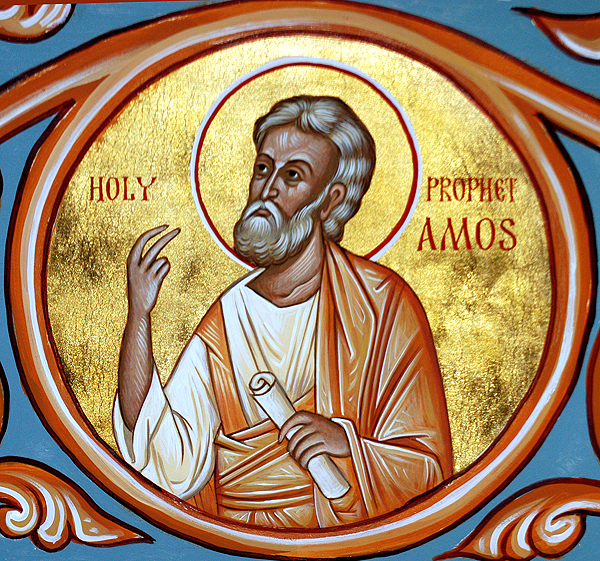
The Holy Prophet Amos, the third of the Twelve Minor Prophets,1 lived during the eighth century before Christ. He was from Judah, and was born at Tekoah in the land of Zebulon, six miles south of Bethlehem.
At that time, the Hebrew nation was divided into two Kingdoms: Judah in the south, and Israel in the north. King Uzziah ruled in Jerusalem, but the other ten tribes of Israel were ruled by Jeroboam II, who was an idolater. At Bethel he set up an idol in the shape of a golden calf, which the people worshipped, turning away from the true God.
Simple and uneducated, yet fervent in his faith and zealous for the glory of God, this former shepherd of sheep and goats, and dresser of sycamore trees (Amos 7:14-15) was chosen by the Lord for prophetic service. He was sent to the Kingdom of Israel to denounce King Jeroboam's impiety, as well as that of the Israelites. The Prophet predicted great misfortunes which would befall Israel because of its ungodliness. As a result of his denunciations, Amos repeatedly endured beatings and torture.
Amaziah, the chief priest of the royal sanctuary at Bethel, hated Amos, who predicted that the Gentiles would conquer Israel; that they will slay the King, as well as Amaziah's children; that Amaziah's wife would become a harlot; and that Amaziah himself would die in a pagan land, because he led the people into adultery with idols (7:17). Amaziah became furious and had Amos beaten, but all of these prophecies were fulfilled.
According to a later tradition, Uzziah, the son of Amaziah, struck the Prophet Amos with a club, seriously wounding him. He was taken to his native village of Tekoah in Judah, and died there after two days (circa 787 B.C.) He should not be confused with Amoz, the father of the Prophet Isaiah.
In iconography Amos is depicted as an old man with a pointed beard. His scroll reads: It is he who builds his ascent up to Heaven (Amos 9:6).
1 The terms major and minor Prophets refer to the length of their books, not to their individual prominence. Although Amos is ranked third, his prophecy was the first to be recorded.
Saint Jonah, Metropolitan of Moscow

Saint Jonah, Metropolitan of Moscow and Wonderworker of All Russia, was born in the city of Galich into a pious Christian family. The father of the future saint was named Theodore. The youth received monastic tonsure in one of the Galich monasteries when he was only twelve years old. From there, he transferred to the Moscow Simonov monastery, where he fulfilled various obediences for many years.
Once, Saint Photius, Metropolitan of Moscow (May 27 and July 2), visited the Simonov monastery. After the Molieben, he blessed the archimandrite and brethren, and also wished to bless those monks who were fulfilling their obediences in the monastery.
When he came to the bakery, he saw Saint Jonah sleeping, exhausted from his work. The fingers of the saint’s right hand were positioned in a gesture of blessing. Saint Photius said not to wake him. He blessed the sleeping monk and predicted to those present that this monk would be a great hierarch of the Russian Church, and would guide many on the way to salvation.
The prediction of Saint Photius was fulfilled. Several years later, Saint Jonah was made Bishop of Ryazan and Murom.
Saint Photius died in 1431. Five years after his death, Saint Jonah was chosen Metropolitan of All Russia for his virtuous and holy life. The newly-elected Metropolitan journeyed to Constantinople in order to be confirmed as Metropolitan by Patriarch Joseph II (1416-1439). Shortly before this the nefarious Isidore, a Bulgarian, had already been established as Metropolitan. Spending a short time at Kiev and Moscow, Isidore journeyed to the Council of Florence (1438), where he embraced Catholicism.
A Council of Russian hierarchs and clergy deposed Metropolitan Isidore, and he was compelled to flee secretly to Rome (where he died in 1462). Saint Jonah was unanimously chosen Metropolitan of All Russia. He was consecrated by Russian hierarchs in Moscow, with the blessing of Patriarch Gregory III (1445-1450) of Constantinople. This was the first time that Russian bishops consecrated their own Metropolitan. Saint Jonah became Metropolitan on December 15, 1448. With archpastoral zeal he led his flock to virtue and piety, spreading the Orthodox Faith by word and by deed. Despite his lofty position, he continued with his monastic struggles as before.
In 1451 the Tatars unexpectedly advanced on Moscow; they burned the surrounding area and prepared for an assault on the city. Metropolitan Jonah led a procession along the walls of the city, tearfully entreating God to save the city and the people. Seeing the dying monk Anthony of the Chudov monastery, who was noted for his virtuous life, Saint Jonah said, “My son and brother Anthony! Pray to the Merciful God and the All-Pure Mother of God for the deliverance of the city and for all Orthodox Christians.”
The humble Anthony replied, “Great hierarch! We give thanks to God and to His All-Pure Mother. She has heard your prayer and has prayed to Her Son. The city and all Orthodox Christians will be saved through your prayers. The enemy will soon take flight. The Lord has ordained that I alone am to be killed by the enemy.” Just as the Elder said this, an enemy arrow struck him.
The prediction of Elder Anthony was made on July 2, on the Feast of the Placing of the Robe of the Most Holy Theotokos. Confusion broke out among the Tatars, and they fled in fear and terror. In his courtyard, Saint Jonah built a church in honor of the Placing of the Robe of the Most Holy Theotokos, to commemorate the deliverance of Moscow from the enemy.
Saint Jonah reposed in the year 1461, and miraculous healings began to take place at his grave.
In 1472 the incorrupt relics of Metropolitan Jonah were uncovered and placed in the Dormition Cathedral of the Kremlin (the Transfer of the holy Relics is celebrated May 27). A Council of the Russian Church in 1547 established the commemoration of Saint Jonah, Metropolitan of Moscow. In 1596, Patriarch Job added Saint Jonah to the Synaxis of the Moscow Hierarchs (October 5).
Saint Jonah, Metropolitan of Moscow is also commemorated on March 31.
Venerable Cassian and Gregory, Abbots of Avnezh, Vologda

Saints Gregory and Cassian of Avnezh lived in asceticism at the River Sukhona in the Vologda land. On June 15, 1392 they died as martyrs at Avnezh monastery during an incursion by Tatars.
The relics of the monastic martyrs were uncovered in the year 1524. In 1560, with the blessing of Macarius, Metropolitan of Moscow and All Russia (+ 1564), Barlaam, the Igumen of Makrisch monastery, wrote an account of these holy martyrs.
Martyrs Modestus, Crescentia, and Vitus, at Lucania
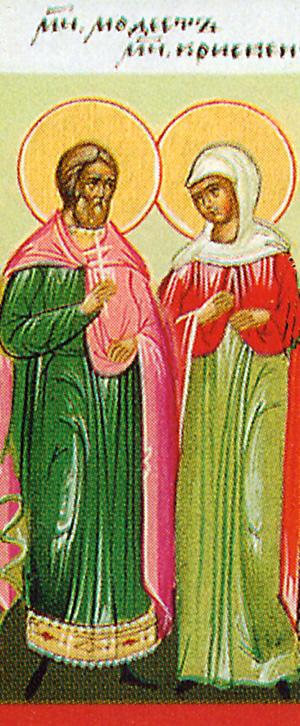
Saint Crescentia suffered for Christ during the reign of Emperor Diocletian (284-305) with the holy martyrs Vitus and Modestus. She was the governess of Saint Vitus, and tried to save the boy when his father wanted to kill him because he would not abandon his faith in Christ.
Saint Crescentia and the boy’s tutor Saint Modestus, who were Christians, secretly took him from his parental home. They found a boat at the river, and an angel entered the boat with them. They reached the Italian district of Lucanium, where the saints lived quietly, hiding from those who would persecute them. The holy youth continued to heal the sick and convert pagans to Christianity. His fame soon spread throughout the region.

Saints Vitus and Modestus were arrested and thrown into prison, then Diocletian had them tortured. Saint Crescentia came out of the crowd of spectators and confessed herself a Christian. She reproached the emperor for his cruelty, and he also sentenced her to torture.
Saint Vitus called out to God, “O God, save us by Thy power and deliver us.” Then an earthquake struck, and many pagans perished beneath the collapsed buildings. Diocletian fled to his chambers in fear. An angel released the martyrs from the pillars and took them to Lucanium.
Saint Vitus prayed that God would accept their souls in peace and not deprive those who kept their memory of His benefaction. A Voice came from Heaven, “Thy prayer is heard.” Then the saints joyfully surrendered their souls to God.
Saint Crescentia is also commemorated on May 16.
Martyr Doulas of Cilicia

The Holy Martyr Doulas was a pious Christian from the city of Praetoriada. At the height of a persecution against Christians under Maximian (305-313) they arrested him and sent him to trial under the Cilicia district governor Maximus. Before the beginning of the trial the saint firmly besought the Lord to grant him the words to denounce idol-worship.
At his interrogation, the holy martyr bravely confessed Christ and forcefully denounced the false religion of the pagans and their gods with their shameful human vices and passions. The governor tried to confute his faith in Christ, but he was not able to resist against the grace-filled words of Saint Doulas. The governor flew into a rage, tortured him without pity and after interrogation sent him back to prison. At each new interrogation the saint appeared strong in spirit and body, prepared for new torture. At the final interrogation of Saint Doulas, they broke his lower jaw, they broke his knees, and they bound him to the chariot of the governor and dragged him about. In this way the holy martyr died, having signed himself with the Sign of the Cross.
They untied his body from the chariot and threw it into the river. The current carried the relics of the holy martyr to his native city. Dogs of shepherds discovered the holy body. One of them sat and guarded the body of the saint from birds, and another brought a shepherd’s robe in its teeth and covered up the body of the saint. The shepherds led Christians to the body of Saint Doulas, who then buried it with reverence.
Saint Doulas, Passion-Bearer of Egypt

Saint Doulas the Passion-Bearer was a monk at one of the Egyptian monasteries. He distinguished himself by his meekness, humility and obedience. For twenty years he endured the mockery, abuse and contempt of several of the monastic brethren. At first it was difficult for him to bear up and humbly endure the insult, but eventually he reached such a degree of passionlessness (apatheia), that he pitied his detractors and prayed for them with all his heart.
At the end of his life Saint Doulas underwent temptation. A certain monk stole some church vessels and hid them. When the Igumen and elders of the monastery started to investigate the theft, they accused Saint Doulas of this sin, because on that day he had not appeared at the Vigil service. Saint Doulas had always come to church before this, but he had been ill that day, and was unable to attend the service. They led Saint Doulas to the elders, to whom he protested his innocence, but his enemies slandered him, saying that they were witnesses of his sin. When he saw that they did not believe his words, Saint Doulas did not argue but said, “Forgive me, holy Fathers, I am a sinner.” The Igumen ordered that the innocent Doulas be stripped of his monastic garb and dressed in secular clothes. Sobbing bitterly, Saint Doulas prayed, “Lord Jesus Christ, Son of God, because of Thy Holy Name I clothed myself in monastic garb, but now, through my sins, it is stripped from me.”
Saint Doulas was placed in chains, and the steward demanded to know where the church vessels were hidden, but the innocent passion-bearer only repeated, “Forgive me, I have sinned.”
Then they turned him over to the civil authorities for trial and subjected him to torture, but the saint repeated, “I have neither silver, nor the lost vessels.” The city eparch asked the monks what to do with him, since they had delivered him over to the secular court. They answered, “Do with him as the laws prescribe.” The saint was sentenced to have both his hands cut off. Before the execution of the sentence the governor said, “Tell us where the vessels are and you shall go free.” The saint answered, “Governor, do you want me to confess something that I did not do? I do not want to tell lies about myself, since every lie is from the devil.” They took the saint to the place of execution. Finally, the perpetrator of the theft experienced remorse and went to the Igumen to confess that he had committed the crime.
After twenty years of exile and humiliation, Saint Doulas was allowed to return to the monastery. The monks began to ask forgiveness of the saint. Not only did he not bear them malice, but he was even grateful that they had given him the opportunity to wipe out his sins by enduring guiltless suffering. The saint asked the Lord to pardon his accusers.
After three days they found the saint had departed to the Lord while kneeling at prayer. His body was locked in the cathedral, and burial was delayed until the arrival of the Igumen and brethren of a nearby monastery. When everyone had gathered and gone into the church, the body of the innocent passion-bearer was not in the cathedral. Only his clothes and sandals remained.
Thus, those who had accused Saint Doulas of sin, were shown to be unworthy of burying his holy body.
Saint Jerome (Hieronymus) of Stridon
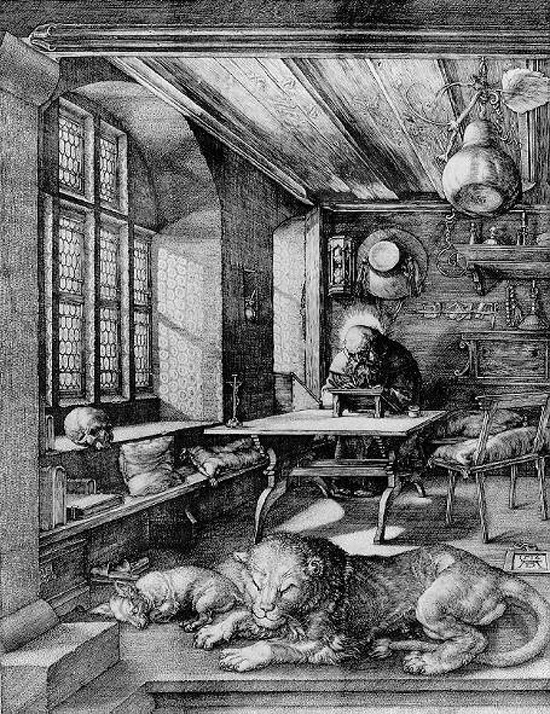
Saint Jerome of Stridon was born into a Christian family in the city of Stridon located on the border between Dalmatia and Pannonia. His full name is Eusebius Hieronymos Sophronius. His parents sent him to Rome, where he studied the secular sciences. At the beginning of his life in the capital, the youth was captivated by worldly vanities and fell into temptation. At the end of his time in Rome, Jerome resolved to change his life and to live in goodness and purity. When the youth was about 20 years old, he accepted holy Baptism. After this he visited in Gaul (France). Then Saint Jerome decided to dedicate himself totally to God, and to become a monk.
In about the year 372 Saint Jerome returned to his native city, but his parents had already departed this life. On him fell the responsibility of raising his younger sisters and his brother Paulinian. These cares forced him to put aside his plans to enter a monastery, at least for a time.
Having made arrangements for the care of his siblings, he journeyed to the East with several of his friends. In 374, he decided to dwell in the desert of Chalcis southeast of Antioch. There he remained for about 5 years, combining work on the Holy Scriptures with austere ascetic deeds. Besides this, Saint Jerome mastered the Hebrew and Chaldean languages. During this period he began his correspondence with numerous persons upon a variety of questions. About 120 letters, considered as authentically written by Saint Jerome, have been preserved.
At the beginning of the 360s there arose a controversy between the proponents of bishops Meletius, Paulinos and Vitalis. The controversy also reached the monastery where Saint Jerome toiled. In consequence, the disputes caused him to leave the monastery and go to Antioch. Here Bishop Paulinos ordained him to the priesthood. Afterwards, Saint Jerome visited Constantinople and conversed with the holy hierarchs Gregory the Theologian and Gregory of Nyssa In the year 381 he set off for Rome. At Rome he continued his studies. The holy Pope Damasus I (366-384), who also devoted much of his time to the study of Holy Scripture, made Jerome his secretary.
But because the saint denounced the morals of the contemporary Christian society, a whole party of those bearing malice towards the saint came forward to spread slanders about him. After a three year stay at Rome, Saint Jerome felt compelled to abandon this city for good. Together with his brother Paulinian and friends, Saint Jerome visited the Holy Land, and also the monks of the Nitria wilderness monastery. In the year 386 he settled into a cave at Bethlehem near the cave where Christ was born, and there he began a life of austere asceticism.
This was the period of blossoming of his creative activity. Attending to the studies of his time, Saint Jerome left to the Church a rich written legacy: collections of dogmatic-polemic works, moral-ascetic works, commentaries on Scripture, and historical works. But the most important of his works was a new translation the books of the Old and New Testaments into the Latin language. This Latin translation is called the “Vulgate,” and it passed into general use throughout the Western Church.
Saint Jerome lived through the fall of his beloved city Rome, which was sacked by the Goths in the year 410. In the year 411 a new ordeal beset the saint, Bethlehem was invaded by wild Bedouin Arabs. Only through the mercy of God was the community of the aged ascetic saved from complete destruction. He finished his life at the cave in Bethlehem. Saint Jerome is believed to have reposed in 420. His relics were transferred from Bethlehem to Rome in 642, but their present location is unknown. His hand is enshrined in a church near Rome’s Piazza Farnese.
Translation of the relics of Saint Theodore the Sykeote
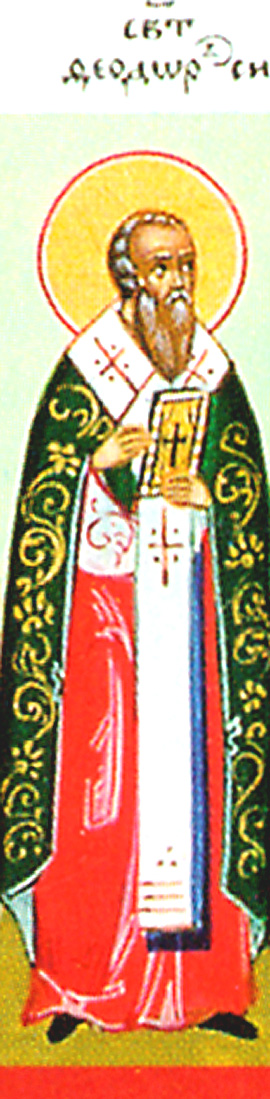
The Relics of Saint Theodore the Sykeote, Bishop of Anastasioupolis were transferred from Galatea to Constantinople in the ninth century. His relics were seen in the year 1200 by the Russian pilgrim Anthony at the monastery of Saint George.
St Theodore of Sykeon is also commemorated on April 22.
Right-believing Prince Lazarus the Great Martyr of Serbia

The Holy Prince Lazar of Serbia lived during the fourteenth century at a time when the Turks, having conquered neighboring lands, were preparing to invade Serbia.
Saint Lazar was raised at the court of the holy King Dushan, and was appointed governor of one of the Serbian districts. In the year 1371 he was chosen King of all Serbia and he toiled much at strengthening the condition of the country. He pacified neighboring princes, who had wronged or plundered Serbian settlements. He was concerned also for the Christian enlightenment of the nation, he built churches, supported the monasteries and charitable establishments. In 1380 the saint established the monastery at Rovanetz. Saint Lazar petitioned the Patriarch of Constantinople to remove the anathema from the people of Serbia. During the course of the ten years of his rule, Serbia was at peace.
Afterwards there began war with the Turks. At the time of the Battle of Kosovo, the wounded king was taken prisoner. On the orders of Sultan Bayazet, he was beheaded with a sword on June 15, 1389. The body of the holy King Lazar was buried at a nearby church. In 1391 his incorrupt relics were transferred to the Ravanica monastery. The monastery was destroyed by the Turks in 1683, and the relics of King Lazar were transferred to the monastery of New Ravanica on Mount Thruzh. He was the founder of the Monastery of Saint Panteleimon on the Holy Mountain, as well as numerous other monasteries and churches.
Saint Ephraim the Bulgarian, Patriarch of Serbia
Saint Ephraim, Patriarch of Serbia, lived in asceticism on Mount Athos, and afterwards became Igumen of the Serbian Ivḗron monastery. After the death of Patriarch Savva III in 1376, he was chosen to the patriarchal throne. Aspiring to silence, the saint left the throne and for nine years dwelt at the Archangel-Dushanov monastery. After the Battle of Kosovo he returned to the throne. He died peacefully at age 88 in the year 1400, and was buried in the Patriarchal church at Pec.
Blessed Augustine, Bishop of Hippo

Saint Augustine was born in the city of Thagaste in northern Africa. He was raised by his mother, Saint Monica (May 4), and he received his education at Carthage. In the capacity of professor of rhetoric, Augustine arrived at Milan, Italy where Saint Ambrose (December 7) was bishop. Under the guidance of Saint Ambrose, Augustine studied the Holy Scriptures. The Word of God produced in his soul a radical crisis; he accepted holy Baptism, gave all his wealth to the poor and was tonsured as a monk.
In the year 391 Valerian, Bishop of Hippo, ordained Saint Augustine a priest, and in 395, appointed him vicar bishop of the see of Hippo. After the death of Bishop Valerian, Saint Augustine took his place.
During his 35 years as bishop, Saint Augustine wrote many works devoted to combating the Donatist, Manichaean and Pelagian heresies.
Saint Augustine wrote many works (according to his student and biographer Possidias, the number approached 1030). Of his works the best known are: The City of God (De civitate Dei), The Confessions, 17 Books against the Pelagians and Handbook of Christian Knowledge (The Enchiridion). Saint Augustine was concerned above all else that his writings be intelligent and edifying. “It is better,” he said, “for them to condemn our grammar, than for people not to understand.” Saint Augustine died on August 28, 430.
“Marianica” Icon of the Mother of God
No information available at this time.
Saint Michael, first Metropolitan of Kiev

Based on certain Russian sources, Saint Michael is remembered as the first Metropolitan of Kiev and all Russia (988-992). He began his missionary work in Kiev, Suzdal, Novgorod, and Rostov, as well as in other cities. He built the first wooden church of the Dormition of the Theotokos at Rostov, and installed Theodore the Greek there as bishop.
The largest church in Kiev was the one dedicated to the Dormition of the Most Holy Theotokos, which was adorned with icons, crosses and Church utensils, brought from Korsun by Saint Michael. Saint Vladimir moved the coffin containing the relics of Saint Olga, Equal-of-the-Apostles († 969) to that church. When Saint Michael fell asleep in the Lord on June 15, 992, he was also buried there.1
The First Hierarch of the See of Kiev left behind a good memory. At the Synods held in the Holy Wisdom cathedrals of Kiev and Novgorod, he is forever described as "the first beginning of the hierarchy in Russia."
Saint Michael was distinguished for his wisdom, kindness and his strictness, and he was succeeded by Leo.
About the year 1103, the Saint's body was transferred to the katholikon in the Near Caves of Saint Anthony by Igoumen Theóktistos.2
Saint Michael is also commemorated on September 30 (the Transfer of his relics).
1 Saint Vladimir set aside a tithe of his income and property to pay for the church's construction and maintenance, which gave the church its popular name: 'the church of the Tithes."
2 Saint Theóktistos (August 5) later became Bishop of Chernigov. He reposed in 1123.
Saint Theophanes of the Roslavl Forests
The holy Schema-monk Theophanes (in the world, Theodore Talunin) was from Vladimir Province. He served in the Black Sea Cossack army until 1791. After his discharge, he lived at Sophroniev Hermitage for a time, and then he went to Moldavia, where he lived at Neamts Monastery under obedience to Saint Paisios Velichkovsky (Nov. 15) for three years. After the death of Elder Paisios, he returned to Russia and was accepted into the brotherhood of Optina Hermitage in 1800, and he was tonsured there in 1801.
Saint Moses of Optina has provided most of the information about Schema-monk Theophanes, and has related the following: “He zealously pursued the active virtues of fasting, prayer, and prostrations with extreme non-acquisitiveness and meekness of spirit. During the first and last weeks of Great Lent, he ate nothing at all; and during the other fasting periods he ate only every third day. This zeal for fasting made him take up the great measure of fasting beyond the bounds of nature.”
Saint Theophanes often went from Optina to the Roslavl Forest to see Fathers Athanasios and Moses. In 1819, when Fathers Moses and Anthony came to look over Optina Hermitage, he told them that he would come to visit them for the entire period of Great Lent. “You are most welcome, please come,” the hermits told him. He came to them before the beginning of Great Lent in 1819, and he announced that he intended to pass the entire Fast without eating. “I have faith that I will not die from fasting,” he said.
“Let it be according to your faith,” they answered, not daring to dissuade him. He moved in with them, and brought along his icon of the Crucifixion painted on linen, before which he prayed. Saint Theophanes decided not to eat, and not to lie down to sleep. In addition to his usual Prayer Rule, he also made 800 prostrations.
When he prayed, he wore special cuffs with cords which were tied to the hooks on the wall where the icon was hanging. In this way, he was able to stand at prayer all night without falling from exhaustion. In addition, he heated his own cell, helped to sing at Church services, and he appeared cheerful. He ate nothing during the entire Fast, and once a week he drank some water mixed with vinegar, because the dryness of his mouth. Once, seeing his thinness, Saint Moses said, “Father, you have worn yourself out.” Father Theophanes replied, “No. Christ my Savior has poured out all His blood to the last drop for my sake. There is plenty of blood left in me yet.”
After the Fast, which he endured until the end, he partook of the Holy Mysteries of Christ. Later, he wanted to repeat this struggle, but because of the cold he fell ill with a terrible cough. He became very weak, and gradually wasted away, departing to the Lord on June 15, 1819.
A few moments before Father Theophanes died, Father Moses asked, “Is your soul at peace? Do you fear anything at this hour of death?” He replied, “With joy I desire to be released from this life.” At that moment, he passed away. He had just started to make the Sign of the Cross upon himself, and gave up his soul to God. He is buried in the wilderness.
Father Anthony, in whose arms Father Theophanes died, said that he forgot to ask him for his prayers at his death. On the fortieth day after death, the Elder appeared to him. “Batiushka,” said Father Anthony, “I wanted to ask you for your prayers for me when you come before the throne of God, and I did not do it.” Father Theophanes said, “I always pray to God for you. Saint Basil the Great says, ‘He who prays for others, prays for himself.’”
According to Father Anthony, this Elder had such a radiant face when he was still alive, that one could not look directly at it, but only small glances from the side. His grave is on the edge of a ravine by the Florovka creek, and is revered by pilgrims to this day.
Saint Theophanes was approved for local veneration in the Smolensk Diocese on August 31, 2017.
Apostles Fortunatus, Akhaikos, and Stephanas of the 70
Saints Fortunatus, Akhaikos and Stephanas of the 70 Apostles were coworkers of the Apostle Paul, who, with all their heart and soul, helped to spread the Gospel among the nations. Saint Paul mentions these three men in his first Epistle to the Corinthians (16:17): "Now I rejoice in the presence of Stephanas, Fortunatus, and Akhaikos, because they have supplied what was lacking on your part; for they refreshed my spirit as well as yours. Therefore, give recognition to such men."
The household of Stephanas were among the first fruits of the province of Akhaia ( I Corinthians 16:15), and were baptized by Saint Paul, who declares that they devoted themselves to serving the saints.
Fortunatus is perhaps the Latin name of Tykhikos (Τυχικός), mentioned in the Acts of the Holy Apostles, which state that he came from Asia and accompanied Paul, along with others (Acts 20:5). This man Tykikos delivered two of Saint Paul's Epistles (see Ephesians 6:21-22; Colossians 4:7). It is not certain, however, that Fortunatus and Tykikos are the same individual.
6/19 announcements
June 19, 2022
First Sunday after Pentecost
All Saints Sunday
The Church commemorates and remembers all of its saints at three times during the year; in anticipation of Christmas, at the beginning of Lent, and immediately after Pentecost. On all three days we are reminded of the unified body of God’s people and of the holiness they have achieved and for which we strive. These two things are not abnormal and removed from us; they are truth and reality. On this day we are especially reminded of the strength of the saints and their victories, and we move from the day of Pentecost, the empowering presence of the Holy Spirit, to join God’s people in our victorious procession, through purifying trial and sacrifice, to the Day of the Lord.
Hebrews 11:33-12:2: Brethren, all the saints through faith subdued kingdoms, worked righteousness, obtained promises, stopped the mouths of lions, quenched the power of fire, escaped the edge of the sword, from weakness were made strong, became mighty in war, and turned to flight armies of the aliens. Women received their dead by resurrection, and others were tortured, not accepting their deliverance, that they might obtain a better resurrection. And others suffered mocking and scourging, and even chains and imprisonment. They were stoned, they were sawn asunder, they were tempted, they were slain with the sword; they went about in skins of sheep and goats, being destitute, afflicted, tormented (of whom the world was not worthy), wandering in deserts and mountains, and in dens and caves of the earth. And all these, having obtained a witness through their faith, did not receive the promise, since God had foreseen something better for us, that apart from us they should not be made perfect. Therefore, since we are surrounded by so great a cloud of witnesses, let us also lay aside every weight, and sin which does so easily beset us, and let us run with patience the race that is set before us, looking to Jesus the Author and Perfecter of our faith.
Matthew 10:32-33, 37-38; 19:27-30: The Lord said to His disciples, “Everyone who acknowledges Me before men, I also will acknowledge before my Father Who is in heaven; but whoever denies Me before men, I also will deny before My Father Who is in heaven. He who loves father or mother more than Me is not worthy of Me; and he who loves son or daughter more than Me is not worthy of Me; and he who does not take his cross and follow Me is not worthy of Me.” Then Peter said in reply, “Lo, we have left everything and followed Thee. What then shall we have?” Jesus said to them, “Truly, I say to you, in the New World, when the Son of Man shall sit on His glorious throne, you who have followed Me will also sit on twelve thrones, judging the twelve tribes of Israel. And every one who has left houses or brothers or sisters or father or mother or wife or children or lands, for My Name’s sake, will receive a hundred fold, and inherit eternal life. But many that are first will be last, and the last first.”
Troparion of the Resurrection: O compassionate One, thou didst descend from the heights; thou didst submit to the three-day burial, that thou might deliver us from passion. Thou art our Life and our Resurrection, O Lord, glory to thee.
Troparion of All Saints: Thy Church, O Christ God, hast regaled herself in the blood of thy Martyrs throughout all the world, as in porphyry and purple. Through them she lifts her voice, crying, Turn with thy compassion to thy people, and grant peace to thy city, and to the souls the Great Mercy.
Troparion of the Chains of St. Peter: O Holy Apostle, Peter, thou dost preside over the Apostles by the precious chains which thou didst bear. We venerate them with faith and beseech thee that by thine intercessions we be granted the great mercy.
Kontakion of All Saints: To thee, O Lord and Author of all creation, the universe offers as first-fruits of nature the divinity-bearing Martyrs. Wherefore, by their imploring preserve thy Church in perfect safety, for the sake of the Theotokos, O most Merciful.
CALENDAR
UNTIL FURTHER NOTICE: All services listed on the calendar will be available through streaming and webcast.
Please continue to follow the CDC Guidelines to limit contagion and the spread of the COVID virus.
Sunday, June 19 (Sunday of All Saints)
9:00 a.m. — Orthros (webcast)
10:00 a.m. — Divine Liturgy (webcast)
Monday, June 20
Father Herman off
Tuesday, June 21
No Services
Wednesday, June 22
6:30 p.m. — Daily Vespers
7:30 p.m. — Parish Council meeting
Thursday, June 23
NO Services
Friday, June 24 (Nativity of the Forerunner)
NO Services
Saturday, June 25
Sunday, June 26 (Second Sunday after Pentecost)
9:00 a.m. — Orthros (webcast)
10:00 a.m. — Divine Liturgy (webcast)
SPECIAL ANNOUNCEMENTS
The Eucharist Bread …was offered by the Daniel Roots Divine Liturgy this morning.
Eucharist Bread Schedule:
Eucharist Bread Coffee Hour
June 19 D. Root Algood/Schelver
June 26 Karam Lasseter/Pacurari/Miller
June 28 (Tues. p.m.) Brock D. Root/Baker/Cooper
July 3 R. Root Henderson/Jones
July 10 Pacurari POT LUCK MEAL
Dansereau/Alaeetawi
July 17 Baker Ellis/Zouboukos/Waites
July 24 Henderson Meadows/Pigott
Schedule for Epistle Readers – Page numbers refer to the Apostolos (book of the Epistles) located on the Chanters’ stand at the front of the nave. Please be sure to use this book when you read.
Reader Reading Page#
June 19 Brenda Baker Heb. 11:33-12:2 84
June 26 Sam Habeeb Rom. 2:10-16 90
June 28 (Tues. p.m.) Walt Wood II Cor. 11:21-33; 12:6-9 389
July 3 Sam Habeeb Rom. 5:1-10 96
July 10 Sh. Charlotte Algood II Tim. 2:1-10 328
July 17 Kh. Sharon Meadows Titus 3:8-15 322
July 24 Ian Jones Rom. 12:6-14 113
July 31 Brenda Baker Rom. 15:1-7 119
Also, please remember that we still need your tithes and offerings which may be placed in the tray that is passed during the Divine Liturgy, in the tithe box at the back of the nave or be mailed to: St. Peter Orthodox Church, P.O. Box 2084, Madison, MS 39130-2084.
Continue to pray for Metropolitan Paul (who is also the brother of our Patriarch) and the Syriac Archbishop John of Aleppo who were abducted while on a humanitarian mission in Syria.
Please remember Fr. Joseph and Kh. Joanna Bittle, and their daughter Abigail, in your prayers.
Please remember the following in your prayers: Aidan Milnor, the Milnor family; Lamia Dabit and her family; Mary Greene (Lee and Kh. Sharon’s sister); Jay and Joanna Davis; Fr. Leo and Kh. Be’Be’ Schelver and their family; Kathy Willingham; Marilyn (Kyriake) Snell; Jack and Jill Weatherly; Lottie Dabbs (Sh. Charlotte Algood’s mother), Sh. Charlotte and their family; Maria Costas (currently at St. Catherine’s Village); Reader Basil and Brenda Baker and their family; Buddy Cooper.
If you are not feeling well, PLEASE do not attempt to come to the services. This also includes anyone who may have been exposed to you during this time. Also, please let Fr. Herman know if you are not feeling well and have COVID like symptoms.
PARENTS, a problem has arisen due to the nursery room being left messy after Coffee Hour. No food of any kind should be taken into that room. Also, it is necessary for a parent to be in the room whenever their children are in there playing. Thank you for your assistance with this.
Instructions for streaming our services can be found on the parish website.
Camp St. Thekla dates: The dates for Camp St. Thekla are: Session 1 is June 26 – July 2 and Session 2 is July 3 – 9.
Calendar Items:
* The men of the parish meet for lunch at 11:30 a.m. on the first Thursday of the month.
* The Ladies meet at the church at 10:00 a.m. on the second Saturday of the month to pray the Akathist to the Mother of God, Nurturer of Children on behalf of our children.
* The Ladies meet for lunch on the last Tuesday of the month.
* We will celebrate the Feastday of the Holy Apostles Peter and Paul with Orthros followed by Divine liturgy on Tuesday evening, June 28th, beginning at 6:00 p.m.
* Father Herman will be helping to lead a retreat at the Antiochian Village, July 3-9.
* The Clergy Symposium will be held at the Antiochian Village, July 18-23.
* Vacation Church School is scheduled for July 28-30. Parents, mark your calendar now.
* The remaining date for Stewpot for 2022 is Saturday, September 3rd.
Fasting Discipline for June
There will be no fasting of any kind during the week following Pentecost (June 12th this year). Otherwise, the traditional fasting discipline (no meat, dairy, eggs, fish, wine or oil) is observed on the Wednesdays and Fridays of the month. This year, the Apostles’ Fast begins on Monday, June 20th and runs through June 28th. During this time, the traditional fasting discipline will be observed on each day of the week, except for Saturday and Sunday when fish, wine and oil are permitted.
Major Commemorations for June
June 19 Sunday of All Saints
June 24 Nativity of the Forerunner
June 29 Chief Apostles Peter and Paul
June 30 Synaxis of the Twelve Apostles
Quotable “We have the power of the Holy Cross, our holy symbol, the divine grace of Christ, only as long as we have the holy marking of the Holy Baptism, meaning we have denied the devil and sided with Christ, and received the Holy Marking, the seal of the Gift of the Holy Spirit.”
St. Paisios the Athonite
Worship: Sunday, June 26, 2022 (Second Sunday after Pentecost)
Scripture: Romans 2:10-16; Matthew 4:18-23
Celebrant: Father Herman
Epistle Reader: Sam Habeeb
Prosphora: Karam
Coffee Hour: Lasseter/Pacurari/Miller
Daily Readings for Tuesday, June 14, 2022
1ST TUESDAY AFTER PENTECOST
NO FAST
1st Tuesday after Pentecost, The Holy Prophet Elisseus (Elisha), Methodius the Confessor, Patriarch of Constantinople, Cyril, Bishop of Gortyna, The Holy Martyrs of Estonia: the Priests Basil, John, John, Artemios, and Nicholas; the Deacons Vasili and Peter; the Presytera Martha; and John, Theodor, and Anna.
ST. PAUL’S LETTER TO THE ROMANS 1:1-7, 13-17
Paul, a servant of Jesus Christ, called to be an apostle, set apart for the gospel of God which he promised beforehand through his prophets in the holy scriptures, the gospel concerning his Son, who was descended from David according to the flesh and designated Son of God in power according to the Spirit of holiness by his resurrection from the dead, Jesus Christ our Lord, through whom we have received grace and apostleship to bring about the obedience of faith for the sake of his name among all the nations, including yourselves who are called to belong to Jesus Christ; To all God’s beloved in Rome, who are called to be saints: Grace to you and peace from God our Father and the Lord Jesus Christ. I want you to know, brethren, that I have often intended to come to you (but thus far have been prevented), in order that I may reap some harvest among you as well as among the rest of the Gentiles. I am under obligation both to Greeks and to barbarians, both to the wise and to the foolish: so I am eager to preach the gospel to you also who are in Rome. For I am not ashamed of the gospel: it is the power of God for salvation to every one who has faith, to the Jew first and also to the Greek. For in it the righteousness of God is revealed through faith for faith; as it is written, “The righteous shall live by faith.”
MATTHEW 4:23-25;5:1-13
At that time, Jesus went about all Galilee, teaching in their synagogues and preaching the gospel of the kingdom and healing every disease and every infirmity among the people. So his fame spread throughout all Syria, and they brought him all the sick, those afflicted with various diseases and pains, demoniacs, epileptics, and paralytics, and he healed them. And great crowds followed him from Galilee and the Dekapolis and Jerusalem and Judea and from beyond the Jordan.
Seeing the crowds, he went up on the mountain, and when he sat down his disciples came to him. And he opened his mouth and taught them, saying:
Blessed are the poor in spirit, for theirs is the kingdom of heaven.
Blessed are those who mourn, for they shall be comforted.
Blessed are the meek, for they shall inherit the earth.
Blessed are those who hunger and thirst for righteousness, for they shall be satisfied.
Blessed are the merciful, for they shall obtain mercy.
Blessed are the pure in heart, for they shall see God.
Blessed are the peacemakers, for they shall be called sons of God.
Blessed are those who are persecuted for righteousness' sake, for theirs is the kingdom of heaven.
Blessed are you when men revile you and persecute you and utter all kinds of evil against you falsely on my account. Rejoice and be glad, for your reward is great in heaven, for so men persecuted the prophets who were before you.
You are the salt of the earth; but if salt has lost its taste, how shall its saltness be restored? It is no longer good for anything except to be thrown out and trodden under foot by men.
Postfeast of Pentecost — 3rd Day of the Trinity
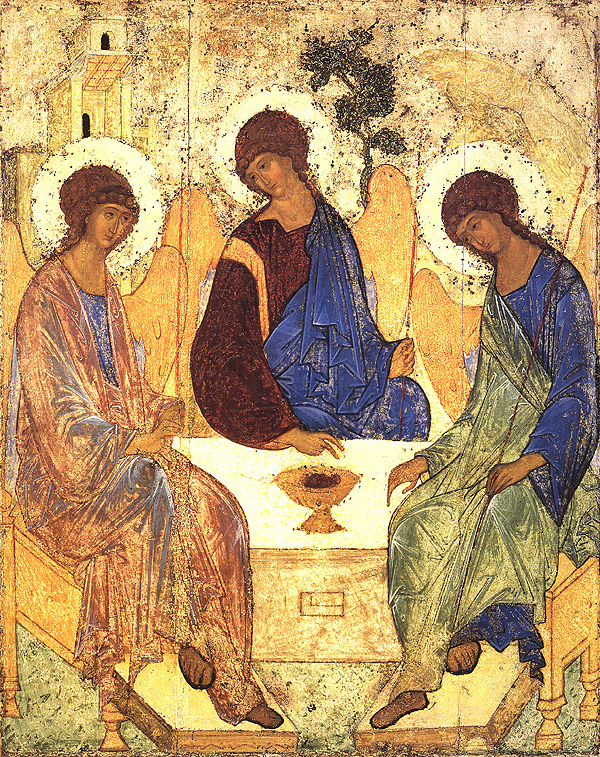
Many of the hymns of Pentecost are repeated in the postfestal services of this week, and references to the Holy Spirit, and to fire, abound. In particular, we are reminded of the Unburnt Bush (Exodus 3:2), the zealous Prophet Elias who ascended to Heaven in a chariot of fire, the three youths in the fiery furnace, and the Lord descending on Mt. Sinai in fire (Exodus 19:18).
As we commemorate the Holy Spirit this week, we look forward to the Sunday of All Saints, those righteous men and women of all nations and in every age, who were perfected and sanctified by the same Holy Spirit.
Glorification of Saint John of Kronstadt
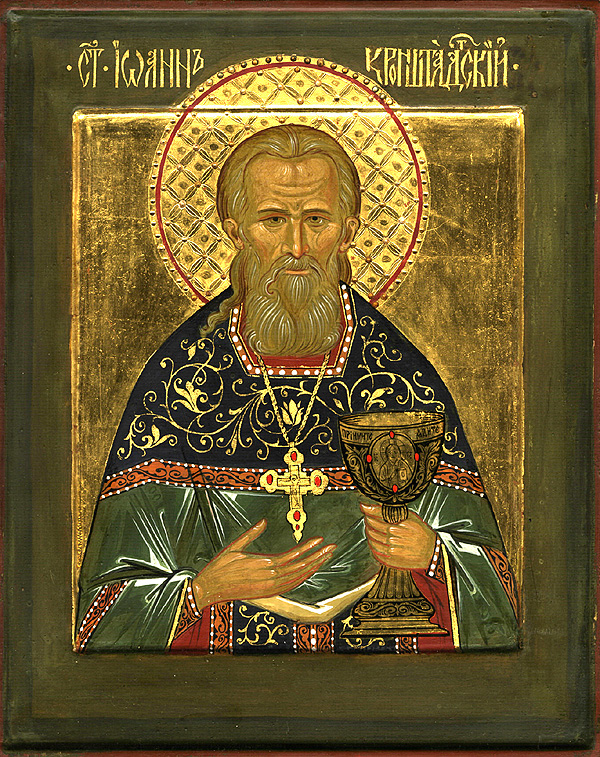
Saint John of Kronstadt was glorified by the Russian Orthodox Church in 1990. He is also commemorated on December 20.
Prophet Elisha

The Holy Prophet Elisha lived in the ninth century before the Birth of Christ, and was a native of the village of Abelmaum, near Jordan. By the command of the Lord he was called to prophetic service by the holy Prophet Elias (July 20).
When it became time for the Prophet Elias to be taken up to Heaven, he said to Elisha, “Ask what shall I do for you, before I am taken from you.” Elisha boldly asked for a double portion of the grace of God: “Let there be a double portion of your spirit upon me.” The Prophet Elias said, “You have asked a hard thing; if you see me when I am taken from you, then so shall it be for you; but if you do not see me, it will not be so” (4 [2] Kings 2: 10). As they went along the way talking, there appeared a fiery chariot and horses and separated them both. Elisha cried out, “My father, my father, the chariot of Israel and its horsemen!” (4 Kings 2: 12). Picking up the mantle of his teacher which fell from the sky, Elisha received the power and prophetic gift of Elias. He spent more than 65 years in prophetic service, under six Israelite kings (from Ahab to Joash). While Elisha lived, he did not tremble before any prince, and no word could overcome him (Sirach 48: 13 [“Sirach” is called “Ecclesiasticus” in Catholic Bibles ]).
The holy prophet worked numerous miracles. He divided the waters of the Jordan, having struck it with the mantle of the Prophet Elias; he made the waters of a Jericho spring fit for drinking; he saved the armies of the kings of Israel and Judah that stood in an arid wilderness by bringing forth abundant water by his prayer; he delivered a poor widow from death by starvation through a miraculous increase of oil in a vessel. This Shunamite woman showing hospitality to the prophet was gladdened by the birth of a son through his prayer, and when the child died, he was raised back to life by the prophet. The Syrian military-commander Namaan was healed from leprosy but the prophet’s servant Gehazi was afflicted since he disobeyed the prophet and took money from Namaan.
Elisha predicted to the Israelite king Joash the victory over his enemies, and by the power of his prayer he worked many other miracles (4 Kings 3-13). The holy Prophet Elisha died in old age at Samaria. “In his life he worked miracles, and at death his works were marvellous” (Sir. 48: 15). A year after his death, a corpse was thrown into the prophet’s grave. As soon as the dead man touched Elisha’s bones, he came to life and stood up (4 Kings 13: 20-21). The Prophet Elisha and his teacher, the Prophet Elias, left no books behind them, since their prophetic preaching was oral. Jesus, son of Sirach, praised both great prophets (Sir. 48:1-15).
John of Damascus composed a canon in honor of the Prophet Elisha, and at Constantinople a church was built in his honor.
Julian the Apostate (361-363) gave orders to burn the relics of the Prophet Elisha, Abdia (Obadiah) and John the Forerunner, but the holy relics were preserved by believers, and part of them were transferred to Alexandria.
In the twentieth century, the humble priest Nicholas Planas had a great veneration for the Prophet Elisha, and was accounted worthy to see him in visions.
Saint Methodius, Patriarch of Constantinople

Saint Methodius, Patriarch of Constantinople, was born in Sicily into a rich family. Having a vocation to serve God, he went while still in his youth off to a monastery on the island of Chios and renovated it with his means. During the reign of the iconoclast Leo the Armenian (813-820), Methodius held the high position of “apokrisiaros” (“advocate for Church matters”) under the holy Patriarch Nikēphóros (June 2). He was dispatched by the patriarch to Rome on a mission to the papacy and he remained there. During this period Leo the Armenian removed Nikēphóros from the patriarchal throne and put on it the iconoclast Theodotus of Melissinea, given the nickname “Kassiter” (“Tinman”) (815-822). After the death of Leo the Armenian, Saint Methodius returned, and in the dignity of presbyter he struggled incessantly against the Iconoclast heresy.
The emperor Michael the Stammerer (820-829) at first was noted for his benevolence and he set free many imprisoned by his predecessor for their veneration of icons, but after a while he renewed the persecution against Orthodoxy. Saint Methodius was locked up in prison in Akrita. After the death of Michael the Stammerer, the ruler was Theophilus (829-842), who also was an iconoclast. More refined a man than his father, he set free Saint Methodius, who likewise was a man of learning, superbly skilled in matters not only ecclesial, but also civil. Having received his freedom, Saint Methodius renewed the struggle with the heretics, and for a while the emperor tolerated this.
But after defeat in a war with the Arabs, Theophilus vented his anger against Methodius, saying, that God had punished him because he had let an “icon-worshipper” come close to him. Methodius objected, saying that the Lord was angry with him for the insults upon His holy icons. They gave the saint over to tortures, and struck him much about the face, from which his jaw was broken. Ugly scars remained on his face. Methodius was sent off to the island of Antigonos and he was locked up there with two robbers in a deep cave. In this dark prison where the light of day did not penetrate, Methodius languished for 7 years until the death of the emperor Theophilus.
During this time, the holy Confessors Theodore and Theophanes the Branded (December 27), who had also been sent to prison, sent Methodius greetings in verse, and the prisoner replied with greetings in verse, as well.
After the death of Theophilus, his son Michael III (842-867) began to rule, but not being of mature age, the Byzantine Empire was actually ruled by his mother, the empress Theodora, a venerater of icons.
The empress tried to extirpate the Iconoclast heresy, and gave orders to free the confessors imprisoned for icon veneration. The heretic Annios occupying the patriarchal throne was banished, and Saint Methodius chosen in his place. At Constantinople was convened a local Council with Saint Methodius presiding (842). The Council restored icon veneration and established an annual celebration of the triumph of Orthodoxy. The “Synodikon of Orthodoxy” compiled by Saint Methodius is read on the First Sunday of Great Lent.
Attempting to undermine the authority of Saint Methodius, and also the love and esteem of his flock for him, the heretics slandered him as having transgressed chastity. The slander was exposed as such, and the enemies of the saint put to shame. The final years of the saint passed peacefully, he toiled much, wisely guided the Church and his flock, renovated temples ruined by the heretics, gathered up the relics of saints scattered about by the heretics, and transferred the relics of Patriarch Nikēphóros from the place of his imprisonment back to Constantinople. Saint Methodius died in the year 846. He was spiritually close to Ioannikos (4 November), who had foretold that he would become patriarch and also the time of his death. Besides the “Synodikon of Orthodoxy,” the holy hierarch also compiled a rule for those converted to the Faith, three rites of marriage and several pastoral sermons and church hymns.
Saint Mstislav (George), Prince of Novgorod

No information available at this time.
Venerable Methodius, Abbot of Peshnosha

According to an old manuscript calendar, “The Monk Methodios, the Igumen (and founder) of Peshnosha Monastery, the disciple of Saint Sergius the wonderworker, reposed in the summer of 6900 (1392), on the fourteenth day of June.”
Saint Methodios was regarded as a saint at Peshnosha from the day of his death, and his memory was celebrated at the monastery and in the surrounding villages on June 14, on the same day as Saint Methodios, Patriarch of Constantinople.
According to other sources, Saint Methodios reposed on June 4, 1392.
Saint Methodios was numbered among the saints at the Moscow Council of 1549.
Venerable Elisha of Suma, Solovki

Saint Elisha of Suma was a monk at the Solovki monastery, and was occupied with the weaving of fishing nets. Before his death he became a schemamonk. In 1688 miracles began from the saint’s grave in a crypt in the Nikolsk church of the city of Suma, Archangelsk diocese.
Venerable Niphon of Mount Athos
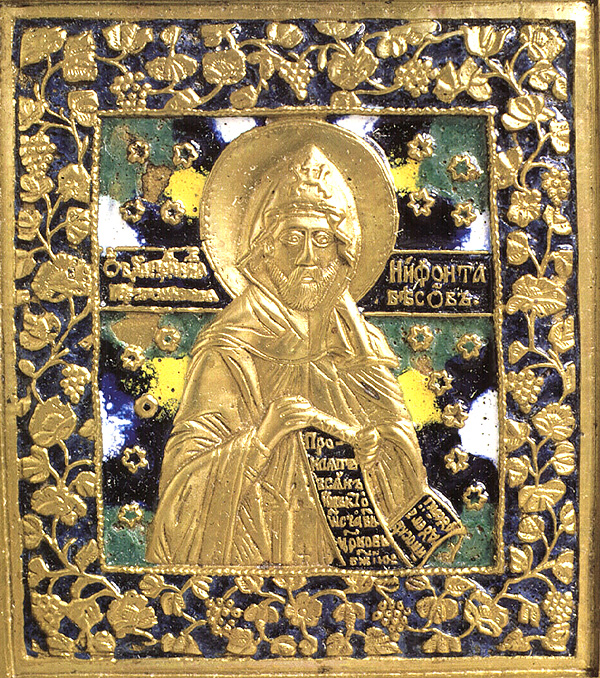
Saint Niphon of Athos lived in the fourteenth century, and was the son of a priest. From childhood he was raised under the principles of strict Christian morality. Upon taking monastic tonsure he soon was ordained to the holy priesthood. But the thirst for perfect stillness and solitary labors led the monk to the Holy Mountain. There he struggled for many years with the renowned Athonite Elder Saint Maximus Kavsokalyvites (“the Hut-burner,” January 13). Saint Niphon died at age 96, glorified by gifts of wonderworking and clairvoyance.
Synaxis of the Saints of Belarus

No information available at this time.
Synaxis of the Saints of Diveyevo
The Holy Trinity St. Seraphim-Diveyevo Convent was founded in 1760 when the Mother of God appeared in a dream to a woman named Agatha in the village of Diveyevo and promised that she would build a great women's monastery there. Agatha also built a church in honor of the Kazan Icon of the Most Holy Theotokos on the spot where she had appeared. Later, Agatha received the monastic tonsure and the new name Alexandra, and she became the first Igoumeness of the new Convent.
The Most Holy Theotokos chose Diveyevo as her "fourth portion in the inhabited world." The others are Mount Athos, Georgia, and Kiev's Holy Trinity Lavra of the Caves. She also promised that God's mercy and grace would be gathered there from the other three portions.
Venerable Alexandra Mel'gunova (+ June 13, 1789)
Martyr Daria Slushinskaya (+ August 5/18,1919)
Martyr Daria Timagina (+ August 5/18,1919)
Venerable Elena Manturova (+ May 28, 1832)
Martyr Eudokia Shikova (+ August 5/18,1919)
Martyr Jacob Gusev (+ December 16/29 1937)
Martyr Maria of Puzo (+ August 5/18,1919)
Blessed Maria Ivanovna Fedina, Fool for Christ (+ August 26/ September 8, 1937)
Martyr Maria Neizvestnaya, Suborovskaya (+ August 5,1919)
Martyr Michael Gusev (+ December 16/29 1937)
Venerable Martha Milyukova (+ August 21,1829)
Martyr Pelagia Testova (+ October 21/November 3, 1944)
Confessor Matrona (Vlasova) of Diveevo, (+ October 25/November 7, 1963)
Blessed Natalia Dmitrievna-“Natashenka” of Diveevo (+ February 22/March 7, 1900
Blessed Paraskeve (Pasha) Ivanovna Semyonovna, Fool for Christ (+ September 22, 1915)
Blessed Pelagia Ivanovna Semyonovna (+ January 30, 1884)
Pelagia (Testova) of Diveevo (+1944) Commemorated on October 21/November 3
Venerable Seraphim of Sarov (January 2 and July 19)
Hieromartyr Seraphim (Chichagov (+ November 28, 1937)
Hieromartyr Seraphim of Dmitrov (+ August 13/26, 1937)
Martyr Xenia Cherlina-Brailovskaya (+ September 2/15,1937)
 Saint Peter Antiochian Orthodox Church
You must be logged in to post a comment.