
Here is the live stream for Orthros and Divine Liturgy – 5/8/2022 If you need, here are instructions for accessing this content from your phone, tablet, computer, or TV.
Monthly Archives: May 2022
Great Vespers – Saturday 5/7/2022
Here is the live stream for Great Vespers – Saturday 5/7/2022 If you need, here are instructions for accessing this content from your phone, tablet, computer, or TV.
Daily Readings for Saturday, May 07, 2022
2ND SATURDAY AFTER PASCHA
NO FAST
2nd Saturday after Pascha, Commemoration of the Precious Cross that appeared in the sky over Jerusalem in 351 A.D., Cyril, Archbishop of Jerusalem, Akakios the Centurion of Byzantium, Repose of St. Nilus, abbot of Sora, Pachomios the New Martyr of Patmos
ACTS OF THE APOSTLES 26:1, 12-20
IN THOSE DAYS, King Agrippa said to Paul, "You have permission to speak for yourself." Then Paul stretched out his hand and made his defense: "I journeyed to Damascus with the authority and commission of the chief priests. At midday, O king, I saw on the way a light from heaven, brighter than the sun, shining round me and those who journeyed with me. And when we had all fallen to the ground, I heard a voice saying to me in the Hebrew language, 'Saul, Saul, why do you persecute me? It hurts you to kick against the goads.' And I said, 'Who are you, Lord?' And the Lord said, 'I am Jesus whom you are persecuting. But rise and stand upon your feet; for I have appeared to you for this purpose, to appoint you to serve and bear witness to the things in which you have seen me and to those in which I will appear to you, delivering you from the people and from the Gentiles-to whom I send you to open their eyes, that they may turn from darkness to light and from the power of Satan to God, that they may receive forgiveness of sins and a place among those who are sanctified by faith in me.' "Wherefore, O King Agrippa, I was not disobedient to the heavenly vision, but declared first to those at Damascus, then at Jerusalem and throughout all the country of Judea, and also to the Gentiles, that they should repent and turn to God and perform deeds worthy of their repentance."
JOHN 6:14-27
At that time, when the people saw the sign which Jesus had done, they said, "This is indeed the prophet who is to come into the world!
Perceiving then that they were about to come and take him by force to make him king, Jesus withdrew again to the mountain by himself.
When evening came, his disciples went down to the sea, entered a boat, and started across the sea to Capernaum. It was now dark, and Jesus had not yet come to them. The sea rose because a strong wind was blowing. When they had rowed about three or four miles, they saw Jesus walking on the sea and drawing near to the boat. They were frightened, but he said to them, "It is I; do not be afraid." Then they were glad to take him into the boat, and immediately the boat was at the land to which they were going.
On the next day the people who remained on the other side of the sea saw that there had been only one boat there, and that Jesus had not entered the boat with his disciples, but that his disciples had gone away alone. However, boats from Tiberias came near the place where they ate the bread after the Lord had given thanks. So when the people saw that Jesus was not there, nor his disciples, they themselves entered the boats and went to Capernaum, seeking Jesus.
When they found him on the other side of the sea, they said to him, "Rabbi, when did you come here?" Jesus answered them, "Truly, truly, I say to you, you seek me, not because you saw signs, but because you ate your fill of the loaves. Do not labor for the food which perishes, but for the food which endures to eternal life which the Son of man will give to you; for on him has God the Father set his seal.
Commemoration of the Apparition of the Sign of the Precious Cross Over Jerusalem, in 351 AD
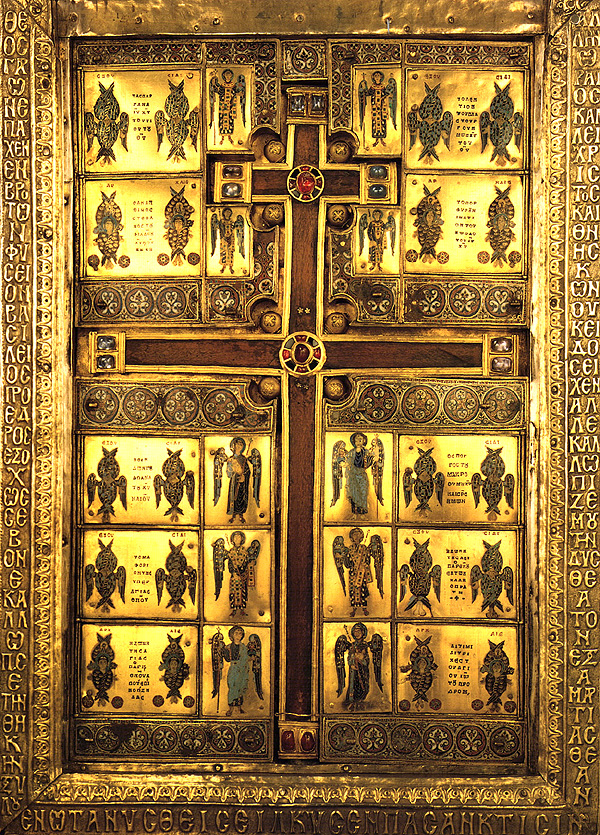
The Precious Cross appeared in the sky over Jerusalem on the morning of May 7, 351 during the reign of the emperor Constantius, the son of Saint Constantine (May 21).
At that time the heresy of Arianism, which taught that Christ was merely a creature and not God, was causing great turmoil and division throughout the Empire. Even after the First Ecumenical Council at Nicea in 325, many people were drawn to this false teaching, and the Orthodox found themselves in the minority in many places.
Constantius, the ruler of the eastern part of the Empire, was a fervent supporter of Arianism. His brothers Constantine II and Constans, who were pious Orthodox Christians, ruled in the west. They were both killed in separate battles around 350, leaving Constantius as sole ruler. Also in 350, Saint Cyril (March 18) became Patriarch of Jerusalem and began his zealous struggle against Arianism.
In May of 351 a luminous Cross appeared over Jerusalem, stretching from Golgotha to the Mount of Olives, a distance of about five and a half miles. The Cross was wide as it was long, and shone more brightly than the sun. Many people left their homes and workplaces to gather in the church and glorify Christ. The historian Sozomen says that this wondrous sign led to the conversion of multitudes of pagans and Jews to Christianity.
A letter from Saint Cyril to the emperor describing this phenomenon, and admonishing him to become Orthodox, has been preserved. The apparition of the Cross remained over the city for a whole week.
The vision of the Cross over Jerusalem strengthened the Orthodox faithful and contributed to the return of many Arians to the Church. It is also a reminder of the awesome Second Coming of Christ, when “the sign of the Son of man shall appear in heaven” (Matthew 24:30).
Repose of Saint Alexis Toth, Confessor and Defender of Orthodoxy in America
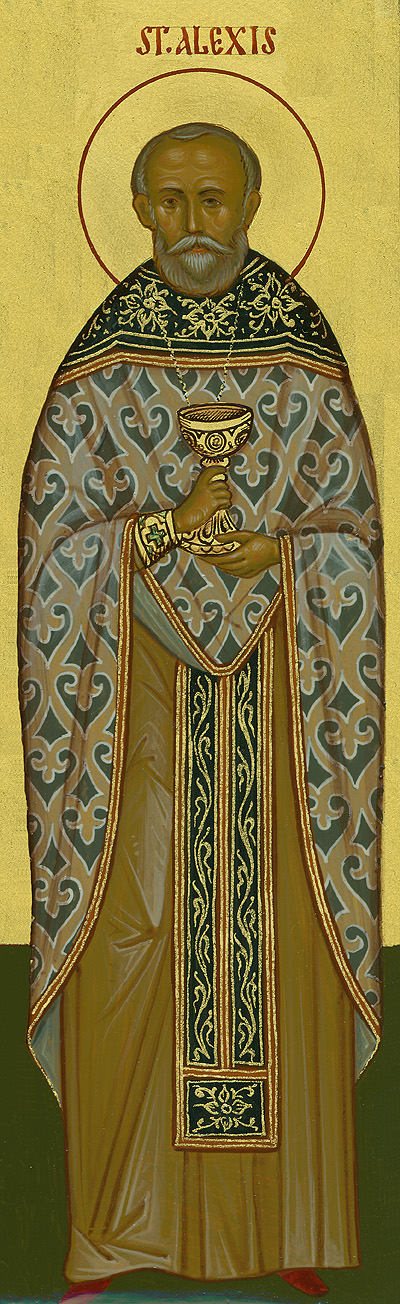
Our holy Father Alexis, the defender of the Orthodox Faith and zealous worker in the Lord’s vineyard, was born in Austro-Hungary on March 18, 1854 into a poor Carpatho-Russian family. Like many others in the Austro-Hungarian empire, the Toths were Eastern Rite Catholics. Alexis’ father and brother were priests and his uncle was a bishop in the Uniate church. He received an excellent education and knew several languages (Carpatho-Russian, Hungarian, Russian, German, Latin, and a reading knowledge of Greek). He married Rosalie Mihalich, a priest’s daughter, and was ordained on April 18, 1878 to serve as second priest in a Uniate parish. His wife died soon afterwards, followed by their only child—losses which the saint endured with the patience of Job.
In May, 1879, Father Alexis was appointed secretary to the Bishop of Presov and also Administrator of the Diocesan Administration. He was also entrusted with the directorship of an orphanage. At Presov Seminary, Father Toth taught Church History and Canon Law, which served him well in his later life in America. Saint Alexis did not serve long as a professor or an administrator, for the Lord had a different future planned for him. In October, 1889 he was appointed to serve as pastor of a Uniate parish in Minneapolis, Minnesota. Like another Abraham, he left his country and his relatives to fulfill the will of God (Gen 12:1).
Upon his arrival in America, Father Alexis presented himself to the local Roman Catholic diocesan authority, Archbishop John Ireland, since there was no Uniate bishop in America at that time. Archbishop Ireland belonged to the party of American Catholics who favored the “Americanization” of all Roman Catholics. His vision for the future was founded on a common faith, customs, and the use of the English language for everything except liturgical celebrations. Naturally, ethnic parishes and non-Latin rite clergy did not fit into this vision. Thus, when Father Toth came to present his credentials, Archbishop Ireland greeted him with open hostility. He refused to recognize him as a legitimate Catholic priest or to grant permission for him to serve in his diocese.
As a historian and professor of Canon Law, Father Toth knew his rights under the terms of the Unia and would not accept Archbishop Ireland’s unjust decisions. In October of 1890, there was a meeting of eight of the ten Uniate priests in America at Wilkes-Barre, Pennsylvania under the chairmanship of Father Toth. By this time the American bishops had written to Rome demanding the recall to Europe of all Uniate priests in America, fearing that Uniate priests and parishes would hinder the assimilation of immigrants into American culture. Uniate bishops in Europe refused to listen to the priests’ pleas for help.
Archbishop Ireland sent a letter to his parishes ordering their members not to attend Father Toth’s parish nor to accept any priestly ministrations from him. Expecting imminent deportation, Father Toth explained the situation to his parishioners and suggested it might be best for him to leave and return to Europe.
“No,” they said. “Let’s go to the Russian bishop. Why should we always submit ourselves to foreigners?” It was decided to write to the Russian consul in San Francisco in order to ask for the name and address of the Russian bishop. Ivan Mlinar went to San Francisco to make initial contact with Bishop Vladimir; then in February, 1891 Father Toth and his church warden, Paul Podany, also made the journey. Subsequently, Bishop Vladimir came to Minneapolis and on March 25, 1891 received Father Toth and 361 parishioners into the Orthodox Church of their ancestors. The parishioners regarded this event as a new Triumph of Orthodoxy, crying out with joy: “Glory to God for His great mercy!”
This initiative came from the people themselves, and was not the result of any coercion from outsiders. The Russian Orthodox Church was unaware of the existence of these Slavic Uniate immigrants to America, but responded positively to their petition to be reunited to the Orthodox Church.
The example of Saint Alexis and his parish in returning to Orthodoxy was an encouragement to hundreds of other Uniates. The ever-memorable one was like a candle upon a candlestick giving light to others (Mt.5:15), and his flock may be likened to the leaven mixed with meal which leavened the whole (Mt.13:33). Through his fearless preaching he uprooted the tares which had sprung up in the wheat of true doctrine, and exposed the false teachings which had led his people astray. Although he did not hesitate to point out errors in the doctrines of other denominations, he was careful to warn his flock against intolerance. His writings and sermons are filled with admonitions to respect other people and to refrain from attacking their faith.
While it is true that he made some strong comments, especially in his private correspondence with the church administration, it must be remembered that this was done while defending the Orthodox Church and the American Mission from unfounded accusations by people who used much harsher language than Father Toth. His opponents may be characterized by intolerance, rude behaviour, unethical methods and threats against him and his parishioners. Yet, when Father Alexis was offended or deceived by other people he forgave them, and he would often ask his bishop to forgive his omissions and mistakes.
In the midst of great hardships, this herald of godly theology and sound doctrine poured forth an inexhaustible stream of Orthodox writings for new converts, and gave practical advice on how to live in an Orthodox manner. For example, his article “How We should Live in America” stresses the importance of education, cleanliness, sobriety, and the presence of children in church on Sundays and Holy Days.
Although the Minneapolis parish was received into the Orthodox Church in March, 1891, it was not until July, 1892 that the Holy Synod of Russia recognized and accepted the parish into the Diocese of Alaska and the Aleutians. This resolution reached America only in October, 1892. During that time there was a climate of religious and ethnic hostility against the new converts. Father Alexis was accused of selling out his own Carpatho-Russian people and his religion to the “Muscovites” for financial gain.
In reality he did not receive any financial support for a long time, for his parish was very poor. Until his priestly salary began to arrive from Russia, the righteous one was obliged to work in a bakery in order to support himself. Even though his funds were meager, he did not neglect to give alms to the poor and needy. He shared his money with other clergy worse off than himself, and contributed to the building of churches and to the education of seminarians in Minneapolis. He was not anxious about his life (Mt.6:25), what he would eat or drink or wear. Trusting in God to take care of him, Saint Alexis followed the admonition of Our Savior to “seek first the kingdom of God and His righteousness, and all these things shall be added to you” (Mt.6:33). So he bore the tribulation, slander, and physical attacks with patience and spiritual joy, reminding us that “godliness is stronger than all” (Wisdom of Solomon 10:12).
Bishops Vladimir, Nicholas, Saint Tikhon, and Platon recognized the special gifts of Father Toth, so they often sent him forth to preach and teach wherever there were people of Slavic background. Even though he was aware of his shortcomings and inadequacies, yet he was obedient to the instructions of the bishops. He did not hesitate or make excuses, but went immediately to fulfill his mission. Saint Alexis visited many Uniate parishes, explaining the differences between Orthodoxy, Protestantism, Roman Catholicism and Uniatism, stressing that the true way to salvation is in Orthodoxy.
Like Josiah, “he behaved himself uprightly in the conversion of his people” (Sir 49:2). He was instrumental in the formation or return of seventeen parishes, planting a vineyard of Christ in America, and increasing its fruitful yield many times over. By 1909, the time of his blessed repose, many thousands of Carpatho-Russian and Galician Uniates had returned to Orthodoxy. This was a major event in the history of the North American Mission, which would continue to shape the future of Orthodoxy in this country for many generations to come. Any future growth or success may truly be regarded as the result of Father Toth’s apostolic labors.
Who can tell of the saint’s spiritual struggles? Who can speak of the prayers which his pious soul poured forth unto God? He did not make a public display of his piety, but prayed to God in secret with all modesty, with contrition and inward tears. God, Who sees everything done in secret, openly rewarded the saint (Mt.6:6). It is inconceivable that Saint Alexis could have accomplished his apostolic labors unless God had blessed and strengthened him for such work. Today the Church continues to reap the fruits of his teaching and preaching.
Father Toth’s efforts did not go unrecognized in his own lifetime. He received a jeweled miter from the Holy Synod, as well as the Order of Saint Vladimir and the Order of Saint Anna from Czar Nicholas II for distinguished service and devotion to God and country. In 1907, he was considered as a candidate for the episcopal office. He declined this honor, however, humbly pointing out that this responsibility should be given to a younger, healthier man.
At the end of 1908, Saint Alexis’ health began to decline due to a complication of illneses. He went to the seashore in southern New Jersey in an attempt to regain his health, but soon returned to Wilkes-Barre, where he was confined to bed for two months. The righteous one reposed on Friday, May 7, 1909 (April 24 on the Old Calendar), the feast of Saints Savva and Alexius the Hermit of the Kiev Caves. Saint Alexis’ love and concern for his spiritual children did not cease with his death. Before closing the account of his life, it would be most appropriate to reveal but one example of his heavenly intercession:
In January, 1993 a certain man prayed to Saint Alexis to help him obtain information about his son from whom he had been separated for twenty-eight years. Placing his confidence in the saint’s boldness before God, he awaited an answer to his prayer. The very next day the man’s son telephoned him. It seems the young man was in church when he was suddenly filled with an overwhelming desire to contact his father. He had been taken to another state by his mother, and she changed his name when he was a child. This is why his father was unable to locate him. Having learned from his mother that his father was an Orthodox Christian, he was able with the help of an Orthodox priest to obtain his father’s phone number in a distant city. As a result of that telephone call, the young man later visited his father, who rejoiced to see what sort of man his son had become. The father gave thanks to God and to Saint Alexis for reuniting him with his son.
Saint Alexis was a true man of God who guided many Carpatho-Russian and Galician immigrants through the dark confusion of religious challenges in the New World and back to the unity of the Orthodox Church through his grace-filled words and by his holy example. In his last will and testament Saint Alexis commended his soul to God’s mercy, asking forgiveness from everyone and forgiving everybody. His holy relics now rest at Saint Tikhon Monastery in South Canaan, Pennsylvania where the faithful may come to venerate them and to entreat Saint Alexis’ intercessions on their behalf.
Martyr Acacius the Centurion at Byzantium
The Holy Martyr Acacius, who lived mostly in the third century, was born at Cappadocia and was a centurion of the Martesian regiment under the military officer Firmus. When the persecution against Christians began on orders from the emperor Maximian Galerius (305-311), Firmus interrogated his soldiers one after the other about their faith. Saint Acacius firmly and openly confessed himself a Christian. Seeing the steadfastness of Saint Acacius, Firmus sent him to his superior officer, who was named Vivianus. Vivianus gave the saint over to fierce torture.
After the tortures they put him in heavy chains and locked him up in prison. A while later they led the martyr and other prisoners to Byzantium, to the prefect. The soldiers marched quickly, showing the prisoners no mercy. Saint Acacius weakened along the way from his wounds, from his chains, and from hunger and thirst. When finally they halted for the night, Saint Acacius offered thanks to God, for permitting him to suffer for His holy Name. As he prayed the saint heard a voice from the heavens, “Courage, Acacius, and be strong!” This voice was heard also by the other prisoners, and many of them believed in Christ and asked the saint to instruct them in the Christian Faith.
At Byzantium they placed the holy martyr in jail, while the other prisoners were held under less severe conditions. At night the other prisoners saw how radiant youths appeared to Saint Acacius and attended to him, washing his wounds and bringing him food. After seven days, Vivianus again summoned Saint Acacius before him and was struck by his fresh appearance. Supposing that the prison guard was bribed to give the prisoner both respite and food, he summoned the guard to question him. Since he did not believe his answers, Vivianus had the guard severely beaten. Saint Acacius himself then answered Vivianus, “My power and strength are given me by the Lord Jesus Christ, Who has healed my wounds.” Vivianus gave orders to beat the martyr about the face and to smash his teeth for his words.
Determined to intensify and prolong the torture of Saint Acacius, Vivianus sent him to the prefect Flaccinus with a letter. When he read the letter, Flaccinus became annoyed that Vivianus had tortured a centurion for so long and so cruelly, and he gave orders to behead the martyr without further delay.
At the place of execution Saint Acacius lifted up his eyes to the heavens, giving thanks to God for being granted a martyr’s death for His sake. Then he bowed his head beneath the sword. This occurred in the year 303.
Under Constantine the Great the relics of the holy martyr Acacius rested at Constantinople in a church built in his honor, and later they were transferred to Calabria, to the city of Scillatio. The holy martyr Acacius particularly helps those who struggle against temptations of the flesh, as attested by Saint Epiphanius, a disciple of Saint Andrew the Fool-for-Christ.
Repose of Venerable Nilus, Abbot of Sora

Saint Nilus of Sora, a great ascetic of the Russian Church, was descended from the Maikov nobility. He accepted monasticism at the monastery of Saint Cyril of White Lake (June 9). Here he made use of the counsels of the pious Elder Paisius Yaroslavov, who was afterwards igumen of the Trinity-Sergiev Lavra.
Saint Nilus journeyed much through the East, studying the monastic life in Palestine and on Mt. Athos. Returning to Rus, he withdrew to the River Sora in the Vologda lands, and built a cell and a chapel, where there soon grew up a monastery with a new (for that time in Rus) skete Rule adopted by Saint Nilus from Mt. Athos. Following the command of Saint Nilus, the monks had to sustain themselves by the work of their own hands, to accept charity only in extreme need, and to shun the love of things and splendor even in church. Women were not permitted in the skete, monks was not allowed to leave the skete under any pretext, and the possession of lands or estates was forbidden.
The monks lived in the forest around the small church in honor of the Meeting of the Lord, in separate cells of one or two but not more than three men. They gathered together in church for divine services. Moreover, readings from the holy Fathers were prescribed at the All-Night Vigil, which actually lasted the whole night. On other days, each one prayed and worked in his own cell.
The saint struggled constantly with his own thoughts and passions. Then peace would be born in his soul, clarity in his mind, contrition and love in his heart. In his written works, “A Tradition for my Disciple, Wishing to Live in the Wilderness,” and the “Rule,” Saint Nilus describes the steps of this salvific mental activity in detail. The first step is renunciation of the world, particularly, from every worldly distraction. The second is unceasing prayer, accompanied by the remembrance of death.
The saint was distinguished for his non-possessiveness and love for work. He dug a pond and a well, whose water had healing power. For his sanctity of life the Elder Nilus was deeply venerated by the Russian hierarchs of his time. He participated in the Councils of 1490 and 1503. Disdaining the honors and glories of this world, he told his disciples before his death either to throw his body to be eaten by beasts and birds, or to bury it without honor at the place of his struggles.
The saint died in his seventy-sixth year of life, on May 7, 1508. His relics, buried in the monastery he founded, were glorified by many miracles. The Russian Church has numbered him among the saints.
[In English, fragments of his “Tradition” and “Rule” may be found in G. Fedotov’s TREASURY OF RUSSIAN SPIRITUALITY.]
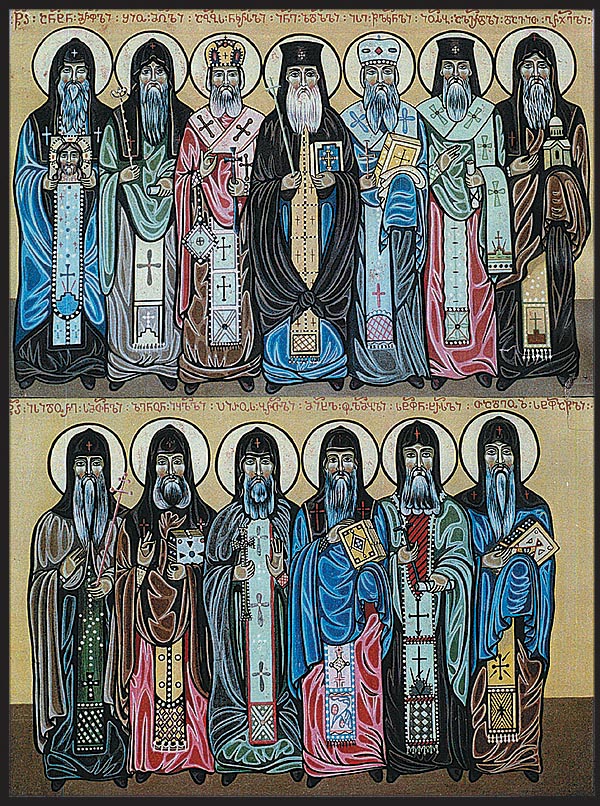
Saint John Zedazeni of Zaden, Georgia, with his 12 disciples
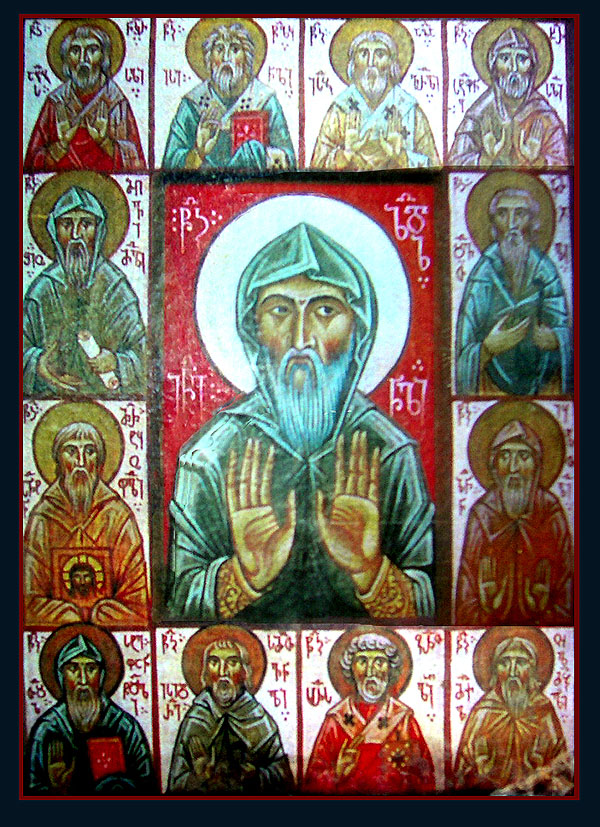
Our Holy Father John of Zedazeni and his twelve disciples, Abibus of Nekresi, Anthony of Martqopi, David of Gareji, Zenon of Iqalto, Thaddeus of Stepantsminda, Jesse of Tsilkani, Joseph of Alaverdi, Isidore of Samtavisi, Michael of Ulumbo, Pyrrhus of Breti, Stephen of Khirsa, and Shio of Mgvime, were Syrian ascetics and the founding fathers of Georgian monastic life.
Saint John received his spiritual education in Antioch. Early in his youth he was tonsured a monk and withdrew to the wilderness. The Lord, recognizing his humility, diligence in fasting, and devout watchfulness, blessed His faithful servant with the gift of healing the sick and casting out demons. Saint John was celebrated for his holy deeds and miracles. Curious crowds would swarm around him, and after some time he found it necessary to withdraw into even deeper seclusion.
Taking with him several of his disciples, he chose a remote area, fashioned for himself a cell, and began to labor as a hermit. Once the Most Holy Theotokos appeared to Saint John and told him, “Take twelve monks and go with them to Georgia, the nation enlightened by the Equal-to-the-Apostles Nino, and strengthen the Christian soul of its people.”
Saint John related the vision to his disciples, and after much fasting and prayer he chose twelve of them: Abibus, Anthony, David, Zenon, Thaddeus, Isidore, Joseph, Jesse, Michael, Pyrrhus, Stephen, and Shio. He left his remaining disciples in the wilderness in the care of the abbot, the blessed elder Euthymius, and set off for Georgia with the twelve he had chosen.
By divine revelation the Georgian king Parsman and Catholicos Evlavios received the good news that the venerable fathers were in Mesopotamia, on their way to Georgia, and they hurried to greet them with the proper honors. King Parsman and Catholicos Evlavios met the holy fathers as they were approaching Mtskheta.
The holy fathers venerated the myrrh-streaming wood of the Living Pillar and the Robe of Christ at Svetitskhoveli Cathedral. From there Saint John and his disciples traveled throughout Georgia, visiting its many holy sites.
With the blessing of Catholicos Evlavios, Saint John and his disciples settled on Zedazeni Mountain, where a pagan temple to the idol Zadeni had previously stood. The monks lived in wretched cells, eating only plants and praying ceaselessly.
Having heard of the spiritual endeavors of Saint John and his disciples, Christian believers began to flock to Zedazeni Mountain. Many burned with longing for the monastic life, and some abandoned the world to join the holy fathers at Zedazeni. In such a way, Zedazeni Mountain was transformed into an abode of hermits.
One night the Most Holy Theotokos appeared again to Saint John and instructed him to send his disciples throughout the country to preach the Word of God. In the morning, having related the vision to his disciples, Saint John advised them: “Our Lord Jesus Christ sent us to perform good deeds for this country and its people, for they are newly planted seeds in the Christian Faith. Therefore, let us go forth, each in his own direction, to preach the Word of God!”
Saint John remained at Zedazeni and went about his usual labors in the company of the Deacon Ilia. Zedazeni Mountain was without water, but Saint John prayed to God for a spring, and the Lord sent him a healing spring at the mountain’s peak. Through Saint John’s holy prayers, a bear that often came to the spring to drink was tamed and became a guard and protector of Zedazeni Monastery.
(To this day, the beasts of Zedazeni forest have never disturbed a single soul). Through Saint John’s intercessions, a man mute and paralyzed from his childhood began to speak and walk.
After earnestly serving God for many years, Saint John received a sign that his death was approaching. He called his disciples, blessed them, bade them farewell, and left them to bury him in the cave where he had dwelt. After receiving Holy Communion, Saint John beheld the heavens open and the incorporeal powers with the armies of saints shining forth.
The Lord called Saint John to Himself, saying: “I am the Lord, the God of your father Abraham. Come and I will give you rest from your labors.”
The holy father prayed and gave up his soul to the Lord. After his repose Saint John’s disciples reasoned among themselves that a dismal cave was unfit to serve as their holy father’s burial place, and with great reverence they buried his remains in a church at the foot of the mountain. But suddenly a violent earthquake shook the ground where they stood. The earth ceased to quake only after the frightened disciples remembered their shepherd’s will and realized that the tremors were a sign from God. So the disciples, a priest, and a deacon uncovered the holy relics and reburied Saint John according to his will. While they were being translated, Saint John’s holy relics healed many sick and demon-possessed people.
In the 10th century, during the time of Catholicos Clement (908-923), a church in honor of Saint John the Baptist was built on the south side of Saint John’s cave. The holy father’s grave is located near the altar of this church.
The Holy Martyr Abibus of Nekresi was consecrated bishop of Nekresi at the request of Parsman VI, King of Kartli, and Catholicos Evlavios. Filled with holy zeal, Bishop Abibus converted many pagans to the Christian Faith.
In the 6th century the Persians forced many Georgians to deny Christ and worship fire in accordance with their own custom. When Saint Abibus poured water on their altar of sacrifice to extinguish the “holy fire,” the enraged Persians beat him cruelly, then stoned him to death.
By order of the marzban (Persian viceroy), the holy relics of Martyr Abibus remained for three days under the open sky. But to the marzban’s great amazement, neither beast nor bird would touch them.
On the fourth night, monks from Rechi Monastery arrived and translated the holy relics to Samtavisi Monastery for proper burial. Later, by order of Stepanoz (600-619), the rightful ruler of Kartli, the holy relics of Saint Abibus were translated again, to Samtavro Monastery in Mtskheta, and buried in the sanctuary under the altar table.
Saint Anthony of Martqopi always carried with him an icon of the Savior “Not-Made-By-Hands” which he had brought from Edessa in Asia Minor.
A lover of solitude, Saint Anthony settled in Lonoati Gorge, but the many curious Christians, drawn by his prayers and miracles, disturbed his seclusion. So the holy father built a monastery for his faithful followers, withdrew in reclusion beyond the Alazani River, and later settled on Akriani Mountain. In his new hermitage, he ate mostly plants and the bark of trees, and God sent a bear to bring him food. Later Saint Anthony erected a pillar at the top of the mountain and dwelt upon it for eighteen years.
The venerable father received a sign from God when his death was imminent, and at the moment of his repose he was kneeling in prayer before the icon of the Savior. His disciples carried his holy relics down from the pillar and buried them in the monastery he had founded, in front of the icon of the Mother of God.
Saint David of Gareji first settled in the outskirts of Tbilisi, the new capital of Georgia. Through his wondrous preaching, Saint David converted many fire-worshippers and brought people of many creeds to the Christian Faith.
One day the fire-worshippers took revenge: they bribed a pregnant woman to agree to their scheme and accuse Saint David of adultery. But the wonderworker Saint David touched his staff to the woman’s womb and said, “In the name of the Lord Jesus Christ, I command you, infant, tell us who your real father is!” The infant uttered the name of his true father from inside his mother’s womb. The crowd of bystanders was outraged and began to stone the pagan slanderers.
Deeply disturbed by the rioting and unable to stop the bloodshed, Saint David departed with his disciple Lukiane.
Saints David and Lukiane settled in the Gareji Wilderness in southeastern Georgia. The Lord provided them with food in abundance: every day, except Wednesdays and Fridays, a herd of deer came to visit them. Lukiane milked the animals, and when David made the sign of the Cross over the milk, it was miraculously transformed into cheese.
News of the wonders performed by the holy fathers spread quickly, and soon the Gareji Wilderness became a refuge for the many Christians who hungered to lead a true ascetic life.
After some time a pious monk called Dodo came from Ninotsminda, a village in eastern Georgia, and, having received a blessing from his spiritual father, established the Monastery of the Most Holy Theotokos on the eastern side of the Gareji mountains. Since that time the eastern range has been called “Dodo’s Range.”
Saint David went to Jerusalem on pilgrimage, but when he arrived there, he suddenly judged himself unworthy and dared not enter the gates of the city. He prayed fervently before the city gates, then, in his profound humility, chose three stones to take with him as treasures and departed. That same night an angel appeared to Patriarch Elias of Jerusalem and told him that a monk named David, who had arrived from Georgia, was taking away all the grace of the Holy Land. The patriarch’s messengers found Saint David and seized from him two of the stones. The third stone he carried back to Gareji Monastery.
Having served the Lord his whole life, through much suffering and many tribulations, the God-pleasing Saint David reposed peacefully and was buried at David-Gareji Monastery.
Saint Jesse of Tsilkani was consecrated bishop of Tsilkani by Catholicos Evlavios, at the suggestion of Saint John of Zedazeni. The holy father preached to many crowds and converted many unbelievers. Before long, many followers had gathered around him. Saint Jesse, like Saint John’s other disciples, was endowed with the ability to work miracles.
Once Saint John decided to test the faith of his disciples, and he required each of them to perform a miracle. When it was Saint Isidore’s turn, he descended to the Ksani River, crossed over it, then touched his staff to the water and cried out, “In the name of the Lord, I command you to follow me!” Immediately the river began to flow in the opposite direction, and it followed every move of the venerable father’s staff. Saint Isidore led the river to Tsilkani Monastery.
Having witnessed this miracle, many people were converted to the true Faith.
Saint Isidore received a sign from heaven when his repose was near. He partook of the Holy Gifts and prayerfully gave up his soul to God. Saint Isidore is buried in the Tsilkani Church of the Most Holy Theotokos.
Saint Joseph of Alaverdi always carried with him a cross that had been formed from the wood of the Life-giving Cross of our Savior. With the blessing of his teacher, Saint Joseph preached the Gospel of Christ throughout the region of Kartli in eastern Georgia and later settled in the Alaverdi wilderness.
Once Saint Joseph encountered a pagan nobleman and preached to him the Word of God. Deeply inspired by Fr. Joseph’s grace-filled preaching, the nobleman founded a monastery in Alaverdi. Villagers from the surrounding region heard about the holy father’s great spiritual feats, and many of them left the world to labor with him. The number of ascetics in the region began to increase steadily from that time.
When his long and labor-filled life was drawing to an end, Saint Joseph appointed a new abbot for the monastery and reposed peacefully in the Lord. To this day many miracles have taken place over his grave at Alaverdi Monastery.
From his youth Saint Shio of Mgvime (of the cave) was a disciple of Saint John of Zedazeni, and he followed him to Georgia. Saint Shio settled in Sarkineti, a region northwest of Mtskheta. The Most Holy Theotokos blessed the monk, and he carried out his labors in accordance with her revelations.
A dove would bring food to the blessed father, and Saint Evagre (at that time the ruler of Tsikhedidi) witnessed this miracle one day while hunting in the area. Deeply inspired by his unceasing labors, the prince left the world to become Saint Shio’s disciple. It was not long before Saint Shio’s wilderness was filled with people who longed for the ascetic life. Saint Shio founded a monastery in Sarkineti, gathered nearly two thousand monks to labor there with him, and instructed them in a strict ascetic life.
Having performed countless miracles, Saint Shio finally vowed to God that he would spend the remainder of his life in a well that he had dug for himself. He appointed Evagre abbot of the monastery and went into reclusion at the bottom of the well. There he spent fifteen years and reposed peacefully in the Lord. Saint Shio’s holy relics are buried in that well, and to this day many miracles have taken place over his grave.
Saint Pyrrhus of Breti, called the “Divine Image of Repentance,” founded a monastery in Breti, on the bank of the Jvaristsqali River. His holy relics are buried in the church at that monastery.
Saint Isidore of Samtavisi preached the Christian Faith in Kartli for many years, in accordance with his teacher’s instruction. On the eastern bank of the Rekhula River, he founded Samtavisi Monastery of the Icon of the Savior “Not-Made-By-Hands.” He reposed and was buried at that monastery.
Saint Thaddeus of Stepantsminda first preached in Mtskheta, and later he founded a monastery at the foot of Zedazeni Mountain. After Saint John’s repose, Saint Thaddeus continued to preach throughout Kartli and erected many new churches. Among them, the Church of the Protomartyr Stephen in Urbnisi is a glorious example. Near the end of his life Saint Thaddeus withdrew to a cave at Tsleva Mountain not far from the city of Kaspi. He reposed peacefully and is buried in that place.
Saint Stephen of Khirsa and his companions preached throughout the region of Kakheti in eastern Georgia. Later Saint Stephen founded Khirsa Monastery near Kharnabuji Castle. He is buried in the sanctuary of the Church of the Protomartyr Stephen at Khirsa.
Saint Zenon of Iqalto preached the Christian Faith in northern Kakheti and founded Iqalto Monastery. He reposed peacefully, after accomplishing many good works on behalf of the true Faith. Saint Zenon is buried at Iqalto in the Church of the Icon of the Savior “Not-Made-By-Hands.”
Saint Michael of Ulumbo preached the Christian Faith in northern Kartli and Ossetia. He founded a monastery in the Ulumbo area (named after Mt. Olympus, a center of monasticism in Bythinia, Asia Minor), where his wonderworking relics were later buried.
Many Georgian children have been raised at the monasteries founded by the Thirteen Syrian Fathers. For centuries the Divine grace of the holy ascetics has spread among the Georgian people and throughout their land.
These monasteries and the holy fathers who founded them continue to protect the Georgian people against all manner of sin and unbelief.
Venerable Nilus the Myrrhgusher of Lavra of Mount Athos
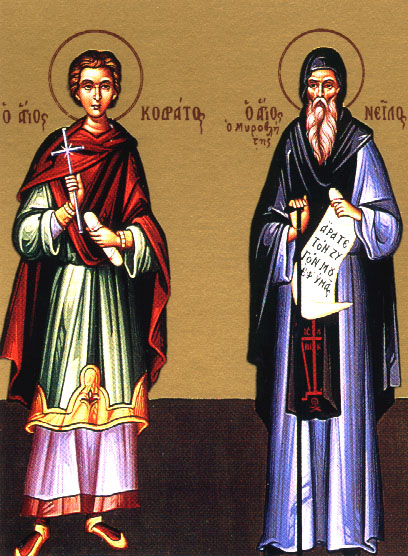
Today we commemorate the uncovering of the relics of Saint Nilus in 1815.
On his deathbed, Saint Nilus told his disciples to bury his body in a small cave beneath the cave where he lived, sternly forbidding anyone to disturb his body. Although the saint did not seek human glory during his life or after his death, the Lord glorified him in the following way. From his grave, a fragrant myrrh began to flow through a small opening in the cave and down the side of the cliff into the sea. Soon this miracle became widely known, and ships would come to collect the myrrh. The myrrh had curative properties, and many people were healed of their illnesses.
Once, two monks came to the cave and tried to find the relics of Saint Nilus. While they were digging, a large rock fell from above, crushing the foot of one monk. Unable to help his companion, the other monk went to get a mule and someone to help him carry the injured brother from that place.
As he lay there in agony, the monk saw Saint Nilus before him. He asked the monk what was the matter. The monk explained what they intended to do and how he had been injured. The saint said, “How dare you, poor man, attempt something so dangerous without the saint’s express wish? Take care in future that you do not attempt a task beyond your ability, and without the will of God.”
Saint Nilus touched the monk’s leg, and he was made well. With great joy he started back to his cell. On the way, he met his companion who was leading a mule. The monk who was healed told the other how he had been healed by Saint Nilus. Then they both glorified God and Saint Nilus. After this, no one dared to disturb the saint’s relics.
In 1815, a certain monk called “Prisoner” was troubled by a demon, and he also had a hernia. Saint Nilus appeared to him several times and healed him. The saint predicted the Greek Revolution (1821), and many dangers which the Holy Mountain would face from the Turks. Then Saint Nilus told him he wanted a path made to his cave so that monks could go there to pray. He also wanted the Liturgy to be served in the cave church he himself had built.
When the Fathers heard this, they wished to build a new church in honor of Saint Nilus. As they were digging the foundation, they found the saint’s grave. From his relics an ineffable fragrance came forth. This took place on May 7, 1815.
Then the monks informed the Fathers of the Great Lavra of their discovery. They came and transferred the relics to the Lavra, leaving only a portion of the saint’s jaw at the cave to be venerated by those who came there.
See November 12 for the Life of Saint Nilus.
Monastic Martyr Pachomius of Mount Athos
The holy New Martyr Pachomius was from Little Russia, and was captured by Moslem Tatars who made him a slave. He was taken to Usaki, near the ancient city of Philadelphia in Asia Minor, where he was sold to a Moslem tanner.
While teaching Pachomius his occupation, the tanner also tried to instruct the young man in the Islamic religion and convert him. Although Pachomius was eager to learn his new master’s trade, he had no desire to become a Moslem. Since he would not deny Christ, he was sometimes beaten and denied food.
This faithful warrior of Christ lived for twenty-seven years as a slave, working for his master in the tannery. The tanner was so pleased by the work of his servant that he offered to give him his own daughter in marriage and make him his heir, even though the righteous one would not convert to Islam. Since he would have to become a Moslem in order to marry the tanner’s daughter and to inherit anything from him, Pachomius declined the offer. Impressed by the principled stand of his servant, the tanner freed the Saint and told him that he could go wherever he wished.
Saint Pachomius became ill just before he was to leave his master. Some Moslems spread the rumor that he had already denied Christ and accepted their religion. Due to his illness they did not circumcise him, but dressed him in green clothing such as Moslems wear. Christians were not permitted to wear green. When he recovered Pachomius traveled to Smyrna and became a merchant.
After some time had passed, the saint discarded his Moslem clothes and went to Saint Paul’s Monastery on Mount Athos. There he met Hieromonk Joseph, confessed the secrets of his heart to him, and told him he wished to become a monk. He lived with Elder Joseph for the next twelve years living the monastic life, and acquiring the virtues.
After hearing of Saint Acacius of Kavsokalyvia (April 12), he transferred to that monastery and became a disciple of Elder Acacius. For six years he devoted himself to the life of unceasing prayer, and became the very type and paradigm of a virtuous monk.
Day by day, the desire to become a martyr for Christ grew within him, because he feared that he might have spoken a careless word and denied the Lord when he was sick and not in his right mind. Saint Acacius tried to persuade him not to follow this course, because he thought that this desire might have arisen from Pachomius’s pride.
Saint Acacius did not want to let Pachomius go, and so he decided to test his resolve. For the next year, he imposed various rules and obediences on him, and both of them prayed that God would make His will known to them. They also consulted the most virtuous Fathers on the Holy Mountain, who all agreed that Pachomius should be blessed to leave the monastery and to seek martyrdom. He removed his monastic garb and dressed in the clothes of an ordinary Christian. He did this so that his actions would not lead to reprisals against the Athonite monasteries.
Accompanied by Elder Joseph, Pachomius returned to Usaki, the site of his supposed denial of Christ. Elder Joseph stayed at an inn, while Pachomius went to the home of his former master, and then walked through the marketplace, hoping to be recognized. It did not take long for him to be arrested and brought before the kadi. He was charged with accepting Islam, and then returning to the Christian faith, a “crime” which was punishable by death. His accusers pointed to the saint’s Christian clothing as evidence. “Behold what sort of garments he is wearing,” they shouted.
The kadi told Pachomius that he was not allowed to wear Christian garb, because he had previously denied Christ. He urged Pachomius to go back to being a Moslem, or to be put to death. With resolute courage, Saint Pachomius replied that he abhorred their religion, and that he would never deny the Savior. Furthermore, he declared that he was quite willing to endure any torture, and to die for Christ many times over, if such a thing were possible.
The holy one was thrown into prison, where he was deprived of food, sleep, and also of any sort of comfort. During this time he was sustained only by his trust in the Lord. After three days, he was sentenced to death. The martyr rejoiced, and told the kadi to carry out the sentence without delay.
Bound and dragged to the place of execution, Saint Pachomius was cursed and spat upon by some of the Turks in the crowd, while others urged him to return to Islam. As the holy athlete of Christ knelt for his beheading, even the executioner entreated him to save himself accepting the Moslem religion. Saint Pachomius remained firm in his resolve, and told the executioner to do as he was ordered without delay. The victorious martyr was beheaded on May 7, 1730 (which happened to be the Feast of the Ascension), thereby receiving an incorruptible crown from Christ.
The body of Saint Pachomius remained exposed to the elements for three days, and then the Orthodox were granted permission to bury him. After the burial, the executioner was possessed by demons, and ran through the city, shouting and foaming at the mouth. He died a few days afterward.
Elder Joseph left the inn where he was hiding, and went to the place where the saint’s body was. He spoke to Saint Pachomius as if he were still alive. “My dear Pachomius”, he said, “you have achieved what you desired. Intercede with the Lord for me, and for all who call upon you.”
Father Joseph was troubled at the thought of trying to leave the area without being captured. Saint Pachomius appeared to him in a dream and said, “Do not be afraid, O Elder, for no harm shall come to you.” Trusting in the words of the saint, he left the city and went back to the Holy Mountain without any trouble.
A local Christian woman, who had been suffering from severe headaches for many years, prayed to Saint Pachomius and asked for his help. She placed some of his blood on her head, and she was healed. She wrote to the monks on Mount Athos, asking them to paint an icon of the martyr for her. Since they had known him when he lived there, they remembered how he looked, and were able to paint the icon. The woman received the icon, and reverently honored the memory of Saint Pachomius every year on the anniversary of his martyrdom.
Later, his holy relics were taken to the Monastery of Saint John on the island of Patmos. On January 26, 1953 the Monastery of Saint John gave a piece of the relics of Saint Pachomius to the Monastery of Saint Paul on Mount Athos, where the saint had lived for a time.
Through the prayers of the holy New Martyr Pachomius, may we also be accounted worthy of the Kingdom of Heaven.
Icon of the Mother of God of Zhirovits

The Zhirovits Icon of the Mother of God appeared in the year 1470 in the vicinity of Zhirovits on the Grodnensk frontier. In the forest, belonging to the Orthodox Lithuanian dignitary Alexander Solton, shepherds beheld an extraordinarily bright light, while peering through the branches of a pear tree that stood over a brook at the foot of a hill. The shepherds came closer and saw a radiant icon of the Mother of God on the tree. With reverence, the shepherds took the icon to Alexander Solton. Alexander Solton did not pay any attention to the report of the shepherds, but he took the icon and placed it in a chest.
On the following day Solton had guests, and he wanted to show them what had been found. To his amazement, he did not find the icon in the chest, although he had seen it shortly before this. After a certain time the shepherds again found the icon in the same place, and again they brought it to Alexander Solton. This time, however, he received the icon with great reverence and vowed to build a church in honor of the Most Holy Theotokos at the place of the icon’s discovery. Around the wooden church a settlement soon gathered and a parish was formed.
Around the year 1520 the church was completely burned, despite the efforts of the inhabitants to extinguish the blaze and save the icon. Everyone thought that the icon had been destroyed. However, some peasant children returning from school beheld a miraculous vision. The Virgin, extraordinarily beautiful and radiant, sat upon a stone at the burned church, and in Her hands was the icon which everyone believed had been destroyed. The children did not dare approach Her, but they hastened to tell their relatives and acquaintances about the vision.
Everyone accepted the story about the vision as a divine revelation and they went to the hill with the priest.The Zhirovits Icon of the Mother of God, totally unharmed by the fire, stood on a stone with a burning candle before it. For awhile they placed the icon in the priest’s house, and the stone was fenced in. When they built a stone church, they placed the wonderworking icon there. A men’s monastery later grew up around the church. Its brethren headed the struggle for Orthodoxy against the Unia and Latinism.
In 1609, the monastery was seized by the Uniates and remained in their hands until 1839. During this time the Zhirovits Icon of the Mother of God was venerated by both Uniates and Catholics. In 1839, the monastery was returned to the Orthodox and became the first place where Orthodox services were restored on the West Russian frontier.
During the First World War, they brought the Zhirovits Icon of the Mother of God to Moscow, and at the beginning of the 1920s it was returned to the monastery. At present it is in the Dormition cathedral of the Zhirovits monastery, Minsk diocese, and it is deeply revered for its grace-filled help. The icon was carved in stone and measured 43×56 cm.
Icon of the Mother of God of Lubech
The Lubech Icon of the Mother of God received its name from the city of Lubech, on the outskirts of Chernigov. The icon manifested itself during the eleventh century. The miracles of this icon were described by Saint Demetrius of Rostov. In 1653, when an invasion of the Poles against Lubech was imminent, they sent the icon to Kiev. In 1701 after the restoration, they returned the icon to the Lubech church in honor of the Resurrection of Christ, and an exact copy was left in the cathedral of Holy Wisdom (Hagia Sophia) in Kiev.
Saint Akaki Asistavi of Georgia
No information available at this time.
Martyr Quadratus and his companions
No information available at this time.
Daily Readings for Friday, May 06, 2022
2ND FRIDAY AFTER PASCHA
NO FAST
2nd Friday after Pascha, Job the Prophet, Our Holy Father Seraphim the Struggler of Mt. Domvu, Sophia of Kleisoura
ACTS OF THE APOSTLES 5:1-11
In those days, a man named Ananias with his wife Sapphira sold a piece of property, and with his wife’s knowledge he kept back some of the proceeds, and brought only a part and laid it at the apostles’ feet. But Peter said, “Ananias, why has Satan filled your heart to lie to the Holy Spirit and to keep back part of the proceeds of the land? While it remained unsold, did it not remain your own? And after it was sold, was it not at your disposal? How is it that you have contrived this deed in your heart? You have not lied to men but to God.” When Ananias heard these words, he fell down and died. And great fear came upon all who heard of it. The young men rose and wrapped him up and carried him out and buried him. After an interval of about three hours his wife came in, not knowing what had happened. And Peter said to her, “Tell me whether you sold the land for so much.” And she said, “Yes, for so much.” But Peter said to her, “How is it that you have agreed together to tempt the Spirit of the Lord? Hark, the feet of those that have buried your husband are at the door, and they will carry you out.” Immediately she fell down at his feet and died. When the young men came in they found her dead, and they carried her out and buried her beside her husband. And great fear came upon the whole church, and upon all who heard of these things.
JOHN 5:30-47; 6:1-2
The Lord said to the Jews who came to him: "I can do nothing on my own authority; as I hear, I judge; and my judgment is just, because I seek not my own will but the will of the Father who sent me. If I bear witness to myself, my testimony is not true; there is another who bears witness to me, and I know that the testimony which he bears to me is true. You sent to John, and he has borne witness to the truth. Not that the testimony which I receive is from man; but I say this that you may be saved. He was a burning and shining lamp, and you were willing to rejoice for a while in his light. But the testimony which I have is greater than that of John; for the works which the Father has granted me to accomplish, these very works which I am doing, bear me witness that the Father has sent me. And the Father who sent me has himself borne witness to me. His voice you have never heard, his form you have never seen; and you do not have his word abiding in you, for you do not believe him whom he has sent. You search the scriptures, because you think that in them you have eternal life; and it is they that bear witness to me; yet you refuse to come to me that you may have life. I do not receive glory from men. But I know that you have not the love of God within you. I have come in my Father's name, and you do not receive me; if another comes in his own name, him you will receive. How can you believe, who receive glory from one another and do not seek the glory that comes from the only God? Do not think that I shall accuse you to the Father; it is Moses who accuses you, on whom you set your hope. If you believed Moses, you would believe me, for he wrote of me. But if you do not believe his writings, how will you believe my words?
After this Jesus went to the other side of the Sea of Galilee, which is the Sea of Tiberias. And a multitude followed him, because they saw the signs which he did on those who were diseased.
Righteous Job the Long-Suffering
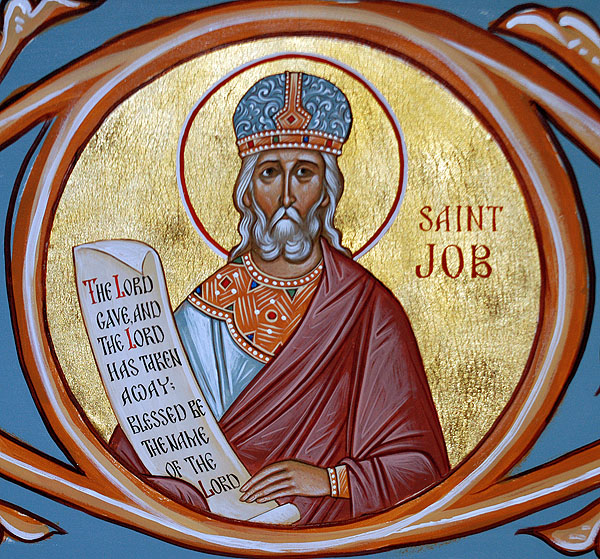
The righteous Job (whose name means “persecuted”), God’s faithful servant, was the perfect image of every virtue. The son of Zarah and Bossorha (Job 42), Job was a fifth-generation descendent of Abraham. He was a truthful, righteous, patient and pious man who abstained from every evil thing. Job was very rich and blessed by God in all things, as was no other son of Ausis (his country, which lay between Idoumea and Arabia). However, divine condescension permitted him to be tested.
Job lost his children, his wealth, his glory, and every consolation all at once. His entire body became a terrible wound covered with boils. Yet he remained steadfast and patient in the face of his misfortune for seven years, always giving thanks to God.
Later, God restored his former prosperity, and he had twice as much as before. Job lived for 170 years after his misfortune, completing his earthly life in 1350 B.C. at the age of 240. Some authorities say that Job’s afflictions lasted only one year, and that afterwards he lived for 140 years, reaching the age of 210.
Job’s explanations are among the most poetic writings in the Old Testament book which bears his name. It is one of the most edifying portions of Holy Scripture. Job teaches us that we must endure life’s adversities patiently and with trust in God. As Saint Anthony the Great (January 17) says, without temptations, it is impossible for the faithful to be saved.
The Orthodox Church reads the book of Job, the first of the seven wisdom books of the Old Testament, during Holy Week, drawing a parallel between Job and Christ as righteous men who suffered through no fault of their own. God allowed Satan to afflict Job so that his faithfulness would be proven. Christ, the only sinless one, suffered voluntarily for our sins. The Septuagint text of Job 42:17 says that Job “will rise again with those whom the Lord raises up.” This passage is read on Great and Holy Friday, when the composite Gospel at Vespers speaks of the tombs being opened at the moment the Savior died on the Cross, and the bodies of the saints were raised, and they appeared to many after Christ’s Resurrection (Mt.27:52)
Venerable Micah, disciple of Venerable Sergius of Radonezh
Saint Micah of Radonezh was one of the first disciples of Saint Sergius of Radonezh, and lived with him in the same cell, and under his guidance he attained a high degree of spiritual perfection. For his meekness of soul and purity of heart, Saint Micah was permitted to witness the appearance of the Mother of God to his great teacher. Once, after Saint Sergius had completed the morning Rule of prayer, he sat down to rest for awhile; but suddenly he said to his disciple, “Be alert, my child, for we shall have a wondrous visitation.”
Hardly had he uttered these words when a voice was heard, “The All-Pure One draws near.” Suddenly there shone a light brighter than the sun. Saint Micah fell down upon the ground in fear, and lay there as if he were dead. When Saint Sergius lifted up his disciple, he asked, “Tell me, Father, what is the reason for this wondrous vision? My soul has nearly parted from my body from fright.” Saint Sergius then informed his disciple about the appearance of the Most Holy Theotokos.
Saint Micah fell asleep in the Lord in the year 1385.
Saint Micah’s relics rest in a crypt at the Trinity-Sergiev Lavra. On December 10, 1734, over Saint Micah’s tomb, a church was consecrated in honor of the Appearance of the Most Holy Theotokos and the Holy Apostles Peter and John the Theologian to Saint Sergius of Radonezh.
Martyr Barbarus the Soldier, and those with him, in Morea
The Holy Martyrs Barbarus the Soldier, Bacchus, Callimachus and Dionysius lived during the fourth century and served in the army of the emperor Julian the Apostate.
Saint Barbarus was secretly a Christian, and in a war with the Franks he gained victory in single combat against a mighty enemy soldier. For this he received great honor in the army and the acclamation of the emperor, and was given the title of comitus (imperial bodyguard).
After the victory over the Franks, Bacchus wanted to offer sacrifice to the pagan gods, and he deferred to Barbarus as the victor, allowing him to have the honor of making the first sacrificial offering.
Saint Barbarus openly confessed himself a Christian and refused to offer the sacrifice. He was subjected to much torture for this, by order of Julian the Apostate. They suspended the saint and tore his body until his insides were falling out. Saint Barbarus called out to the Lord for help, and then an angel of God appeared and healed his wounds, so that not a trace of them remained.
Seeing this miracle, the military commander Bacchus and two soldiers, Callimachus and Dionysius, believed in Christ and repudiated the pagan gods. For this, they were immediately beheaded. They continued to torture Saint Barbarus. They tied him to a wheel and lit a fire under it, and they sprinkled the body of the sufferer with oil. But here also the power of God preserved the holy martyr unharmed. The fire burned many of the torturers, however, killing two. After this they continued to torment the holy Martyr Barbarus for another seven days.
Through miraculous help from on high, the saint remained unharmed. Seeing in this miracle the manifest power of God, many pagans were converted to the true God. Saint Barbarus finally completed his glorious endeavor by being beheaded by the sword in the year 362. The martyr’s body was buried in the city of Methona in the Peloponnesus by the pious Bishop Philikios.
Martyr Barbarus in Thessaly, who was a robber
The Holy Martyr Barbarus, formerly a robber, lived in Greece and for a long time he committed robberies, extortions and murders. But the Lord, Who does not desire the death of a sinner, turned him to repentance. Once, when Barbarus was sitting in a cave and gazing upon his stolen possessions, the grace of God touched his heart. He thought about the inevitability of death, and about the dread Last Judgment. Pondering over the multitude of his wicked deeds, he was distressed in his heart and he decided to make a beginning of repentance, saying, “The Lord did not despise the prayer of the robber hanging beside Him. May He spare me through His ineffable mercy.”
Barbarus left all his treasures behind in the cave and he went to the nearest church. He did not conceal his wicked deeds from the priest, and he asked to be accepted for repentance. The priest gave him a place in his own home, and Saint Barbarus followed him, going about on his hands and knees like a four-legged animal, since he considered himself unworthy to be called a man. In the household of the priest he lived with the cattle, eating with the animals and considering himself more wicked than any creature. Having received absolution from his sins from the priest, Barbarus went into the woods and lived there for twelve years, naked and without clothing, suffering from the cold and heat. His body became dirty and blackened all over.
Finally, Saint Barbarus received a sign from on high that his sins were forgiven, and that he would die a martyr’s death. Once, merchants came to the place where Saint Barbarus labored. In the deep grass before them they saw something moving. Thinking that this was an animal, they shot several arrows from their bows. Coming closer, they were terrified to see that they had mortally wounded a man. Saint Barbarus begged them not to grieve. He told them about himself and he asked that they relate what had happened to the priest at whose house he had once lived.
After this, Saint Barbarus yielded up his spirit to God. The priest, who had accepted the repentance of the former robber, found his body shining with a heavenly light. The priest buried the body of Saint Barbarus at the place where he was killed. Afterwards, a curative myrrh began to issue forth from the grave of the saint, which healed various maladies. His relics are located at the monastery of Kellios in Thessaly, near the city of Larissa.
Translation of the relics of Saint Savva, first Archbishop of Serbia

No information available at this time.
Saint Seraphim of Labodeia
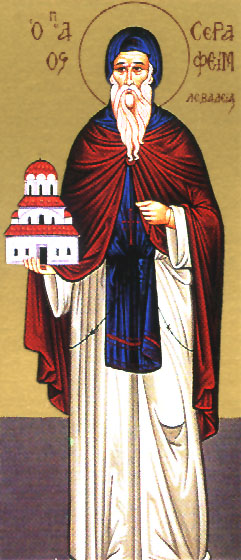
Saint Seraphim, who struggled on Dobou mountain in Lebadeia in central Greece, was born in the village of Zeli in Boeotia in 1527, and his name in the world was Sotiris. He was the son of pious and virtuous parents, who nurtured him with the living water of the Gospel (John 4:10). From the time he was very little, he was inclined toward the study of the Holy Scriptures and toward the ascetic life. At an early age and despite the temporary refusal of his parents to give their blessing, he went to the monastery of the Prophet Elias on Mount Karkaras, where he built a church dedicated to the Savior Christ, and lived a life of asceticism.
The Saint’s reputation spread quickly, and there were frequent visits by his parents, his friends, and other pious believers, who sought him out so that he might counsel and help them. Because of these distractions, he was obliged to abandon his beloved cave, and so he went to the monastery of the Holy Unmercenaries.
He soon left this monastery as well, and went to the Monastery of the Transfiguration of the Savior on Mount Sagmation, between Boeotia and Euboia. There he quickly shone forth as a spiritual star of the first magnitude, and the igumen tonsured him as a monk with the name Seraphim. Later, he was ordained as a deacon and then as a priest.
Shortly afterward, in order to avoid vanity because of his reputation for virtue, St. Seraphim asked for the Igumen’s blessing to live elsewhere. He left the monastery of his repentance and arrived west of Helicon, at Dobou, where he built a church of the Savior, a few cells, and then he called some monks to dwell near him. He struggled there for ten years, teaching the other monks the saving precepts of the monastic life.
Saint Seraphim reposed in a godly manner at the age of 75, on May 6, 1602, on the Feast of Mid-Pentecost, at 6 o’clock in the afternoon, after foreseeing his own death and partaking of the spotless Mysteries. He performed many miracles during his lifetime.
The Saint’s head and a portion of his holy relics are found in the Monastery of Boeotia which is named for him. Another portion of the Saint's holy relics is honored at the Agathonos Monastery at Phthiotis in central Greece.
Daily Readings for Thursday, May 05, 2022
2ND THURSDAY AFTER PASCHA
NO FAST
2nd Thursday after Pascha, Irene the Great Martyr, Neophytos, Gaius, & Caianus the Monk-martyrs, The Righteous Martyr Ephraim the Younger, Euthymios the Wonderworker, Bishop of Madytos
ACTS OF THE APOSTLES 4:23-31
In those days, when the apostles were released they went to their friends and reported what the chief priests and the elders had said to them. And when they heard it, they lifted their voices together to God and said, “Sovereign Lord, who didst make the heaven and the earth and the sea and everything in them, who by the mouth of our father David, thy servant, didst say by the Holy Spirit, ‘Why did the Gentiles rage, and the peoples imagine vain things? The kings of the earth set themselves in array, and the rulers were gathered together, against the Lord and against his Anointed’- for truly in this city there were gathered together against thy holy servant Jesus, whom thou didst anoint, both Herod and Pontius Pilate, with the Gentiles and the peoples of Israel, to do whatever thy hand and thy plan had predestined to take place. And now, Lord, look upon their threats, and grant to thy servants to speak thy word with all boldness, while thou stretchest out thy hand to heal, and signs and wonders are performed through the name of thy holy servant Jesus.” And when they had prayed, the place in which they were gathered together was shaken; and they were all filled with the Holy Spirit and spoke the word of God with boldness.
JOHN 5:24-30
The Lord said to the Jews who came to him, “Truly, truly, I say to you, he who hears my word and believes him who sent me, has eternal life; he does not come into judgment, but has passed from death to life. Truly, truly, I say to you, the hour is coming, and now is, when the dead will hear the voice of the Son of God, and those who hear will live. For as the Father has life in himself, so he has granted the Son also to have life in himself, and has given him authority to execute judgment, because he is the Son of man. Do not marvel at this; for the hour is coming when all who are in the tombs will hear his voice and come forth, those who have done good, to the resurrection of life, and those who have done evil, to the resurrection of judgment. I can do nothing on my own authority; as I hear, I judge; and my judgment is just, because I seek not my own will but the will of the Father who sent me.”
Great Martyr Irene
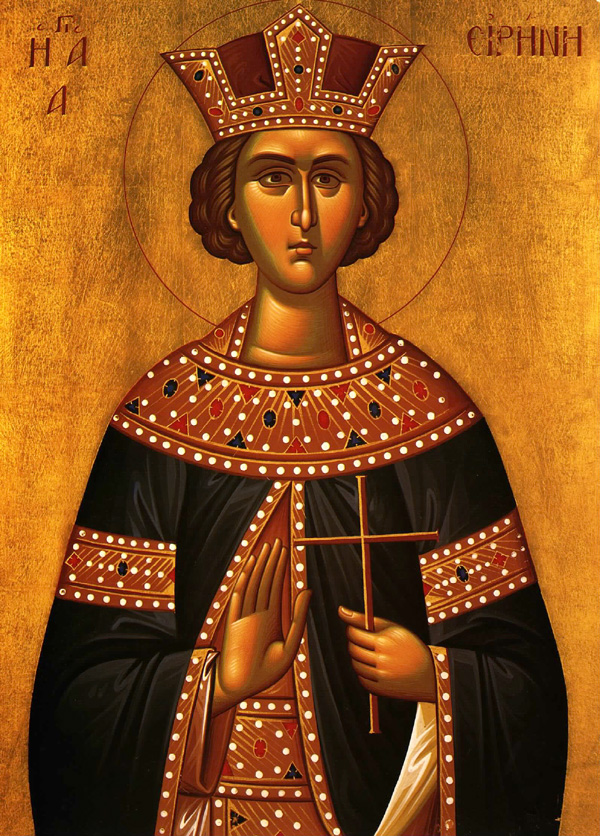
The holy Great Martyr Irene was born in the city of Magedon in Persia during the fourth century. She was the daughter of Licinius, the pagan ruler of a certain small kingdom, and his wife Licinia, and at birth her parents named her Penelope.
Penelope was very beautiful, and her father kept her isolated in a high tower from the time she was six so that she would not be exposed to Christianity. He also placed thirteen young maidens in the tower with her. An old tutor by the name of Apellian was appointed to give her the best possible education. Apellian was a Christian, and during her lessons, he told the girl about Christ the Savior and taught her about the Christian Faith and Christian virtues.
When Penelope reached adolescence, her parents began to think about her marriage. One night Penelope beheld the following vision: a dove entered the tower with an olive branch in its beak, depositing it on the table. An eagle also flew in carrying a wreath of flowers, and left it on the table. Then a raven flew in through another window and dropped a snake on the table. In the morning Penelope woke up and wondered about the meaning of the things she had seen. She related them to her tutor Apellian and he explained that the dove symbolized her superior education, and that the olive branch represented the grace of God which is received in Baptism. The eagle and the olive branch indicated success in her future life. The snake signified that she would experience suffering and sorrow.
At the end of the conversation Apellian said that the Lord wished to betroth her to Himself and that Penelope would undergo much suffering for her heavenly Bridegroom. After this Penelope refused marriage, was baptized by the priest Timothy, and he named her Irene (peace). She even urged her own parents to become Christians. Shortly after being baptized, she smashed all her father’s idols to pieces.
Since Saint Irene had dedicated herself to Christ, she refused to marry any of the suitors her father had chosen for her. When Licinius learned that his daughter refused to worship the pagan gods, he was furious. He attempted to turn her from Christ by having her tortured. She was tied up and thrown beneath the hooves of wild horses so that they might trample her to death, but the horses remained motionless. Instead of harming the saint, one of the horses charged Licinius, seized his right hand and tore it from his arm. Then it knocked Licinius down and began to trample him to death. This caused a great deal of confusion among the people there but Irene consoled them with the words of Christ: “All things are possible to the one who believes” (Mark 9: 23). And indeed, with wondrous faith, she prayed and through her prayers Licinius rose unharmed in the presence of many eyewitnesses with his hand intact. Then, Licinius and his wife were baptized as Christians, along with almost 3000 others who turned away from the worship of inanimate idols. Licinius abandoned his domain and lived in the tower he had built for his daughter. There he spent the rest of his life in repentance.
Saint Irene lived in the house of her teacher Apellian, and she began to preach Christ among the pagans, leading them to the path of salvation.
When Sedekias (Yesdegerd), the new prefect of the city, heard of the miracles performed by the saint, he summoned Apellian and questioned him about Irene’s manner of life. Apellian replied that Irene, like other Christians, lived in strict temperance, devoting herself to constant prayer and reading holy books. Sedekias summoned the saint to him and urged her to stop preaching about Christ. He also attempted to force her to sacrifice to the idols. Saint Irene staunchly confessed her faith before the prefect, not fearing his wrath, and prepared to undergo suffering for Christ. By order of Sedekias she was thrown into a pit filled with vipers and serpents. The saint spent ten days in the pit and remained unharmed, for an angel of the Lord protected her and brought her food. Sedekias ascribed this miracle to sorcery, and he subjected Saint Irene to many other tortures, but she remained unharmed. Under the influence of her preaching and miracles even more people were converted to Christ, and turned away from the worship of inanimate idols.
Sedekias was deposed by his son Sapor, who persecuted Christians with an even greater zeal than his father had done. Saint Irene went to her home town of Magedon in Persia to meet Sapor and his army, and ask him to end the persecution. When he refused, Saint Irene prayed and his entire army was blinded. She prayed again and they received their sight once more. In spite of this, Sapor refused to recognize the power of God. Because of his insolence, he was struck and killed by a bolt of lightning.
After this, Saint Irene walked into the city and performed many miracles. She returned to the tower built by her father, accompanied by the priest Timothy. Through her teaching, she converted five thousand people to Christ.
Next, the saint went to the city of Callinicus, or Callinicum (possibly on the Euphrates River in Syria). The ruler of that place was King Numerian, the son of Sebastian. When she began to teach about Christ, she was arrested and tortured by the pagan authorities. They enclosed her inside three bronze oxen, one after another, which were heated until they were red-hot. When the Great Martyr was placed within the third ox, it began to walk about, and then it split asunder. Saint Irene emerged from it as if from the fires of hell. This resulted in thousands of souls converting to the faith of Christ.
Sensing the approach of death, Numerian instructed his eparch Babdonus to continue torturing the saint in order to force her to sacrifice to idols. Once again, the tortures were ineffective, and many people turned to Christ.
Christ’s holy martyr then traveled to the city of Constantina, forty miles northeast of Edessa. By 330, the Persian king Sapor II (309-379) had heard of Saint Irene’s great miracles. To prevent her from winning more people to Christ, she was arrested, beheaded, and then buried. However, God sent an angel to raise her up again, and she went into the city of Mesembria. After seeing her alive and hearing her preach, the local king was baptized with many of his subjects.
Wishing to convert even more pagans to Christianity, Saint Irene went to Ephesus, where she taught the people and performed many miracles. The Lord revealed to her that the end of her life was approaching. Then Saint Irene left the city accompanied by six people, including her former teacher Apellian. On the outskirts of the town, she found a new tomb in which no one had ever been buried. After making the Sign of the Cross, she went inside, directing her companions to seal the entrance to the cave with a large stone, which they did. She also told them that that no one should move the stone until four days had passed.
Apellian returned after only two days, and found that the stone had been rolled away and the tomb was empty. There are conflicting accounts about her holy relics being taken to Constantinople and other places, including Patras, Samos, and Patmos. According to the Western Martyrologies, Saint Irene was martyred in Thessaloniki after being thrown into the fire, while according to the Menologion of Emperor Basil II, Saint Irene completed her martyric contest by being beheaded.
Saint Irene led thousands of people to Christ through her preaching, and by her example. The Church continues to honor her memory and to seek her heavenly intercession. She is invoked by those wishing to effect a swift and happy marriage. In Greece, she is also the patron saint of policemen. Saint Irene is also one of the twelve Virgin Martyrs who appeared to Saint Seraphim of Sarov (January 2) and the Diveyevo nun Eupraxia on the Feast of the Annunciation in 1831. By her holy prayers, may the Lord have mercy upon us and save us. Amen.
Uncovering of the relics of Venerable James, Abbot of Zhelezny Bor
Saint James of Zhelezny Bor. Today we celebrate the Uncovering of the Relics of the Kostroma Wonderworker. See his Life under April 11, the day of his repose.
New Martyr Ephraim

The holy New Martyr and wonderworker Ephraim was born in Greece on September 14, 1384. His father died when the saint was young, and his pious mother was left to care for seven children by herself.
When Ephraim reached the age of fourteen, the all-good God directed his steps to a monastery on the mountain of Amoman near Nea Makri in Attica. The monastery was dedicated to the Annunciation and also to Saint Paraskevḗ. Here he took on his shoulders the Cross of Christ, which all His followers must bear (Matt. 16:24). Being enflamed with love for God, Saint Ephraim eagerly placed himself under the monastic discipline. For nearly twenty-seven years he imitated the life of the great Fathers and ascetics of the desert. With divine zeal, he followed Christ and turned away from the attractions of this world. By the grace of God, he purified himself from soul-destroying passions and became an abode of the All-Holy Spirit. He was also found worthy to receive the grace of the priesthood, and served at the altar with great reverence and compunction.
On September 14, 1425, the barbarous Turks launched an invasion by sea, destroying the monastery and and looting the surrounding area. Saint Ephraim was one of the victims of their frenzied hatred. Many of the monks had been tortured and beheaded, but Saint Ephraim remained calm. This infuriated the Turks, so they imprisoned him in order to torture him and force him to deny Christ.
They locked him in a small cell without food or water, and they beat him every day, hoping to convince him to become a Moslem. For several months, he endured horrible torments. When the Turks realized that the saint remained faithful to Christ, they decided to put him to death. On Tuesday May 5, 1426, they led him from his cell. They turned him upside down and tied him to a mulberry tree, then they beat him and mocked him. “Where is your God,” they asked, “and why doesn’t he help you?” The saint did not lose courage, but prayed, “O God, do not listen to the words of these men, but may Thy will be done as Thou hast ordained.”
The barbarians pulled the saint’s beard and tortured him until his strength ebbed. His blood flowed, and his clothes were in tatters. His body was almost naked and covered with many wounds. Still the Hagarenes were not satisfied, but wished to torture him even more. One of them took a flaming stick and plunged it violently into the saint’s navel. His screams were heart-rending, so great was his pain. The blood flowed from his stomach, but the Turks did not stop. They repeated the same painful torments many times. His body writhed, and all his limbs were convulsed. Soon, the saint grew too weak to speak, so he prayed silently asking God to forgive his sins. Blood and saliva ran from his mouth, and the ground was soaked with his blood. Then he lapsed into unconsciousness.
Thinking that he had died, the Turks cut the ropes which bound him to the tree, and the saint’s body fell to the ground. Their rage was still not diminished, so they continued to kick and beat him. After a while, the saint opened his eyes and prayed, “Lord, I give up my spirit to Thee.” About nine o’clock in the morning, the martyr’s soul was separated from his body.
These things remained forgotten for nearly 500 years, hidden in the depths of silence and oblivion until January 3, 1950. By then a women’s monastery had sprung up on the site of the old monastery. Abbess Makaria (+ April 23, 1999) was wandering through the ruins of the monastery, thinking of the martyrs whose bones had been scattered over that ground, and whose blood had watered the tree of Orthodoxy. She realized that this was a holy place, and she prayed that God would permit her to behold one of the Fathers who had lived there.
After some time, she seemed to sense an inner voice telling her to dig in a certain spot. She indicated the place to a workman whom she had hired to make repairs at the old monastery. The man was unwilling to dig there, for he wanted to dig somewhere else. Because the man was so insistent, Mother Makaria let him go where he wished. She prayed that the man would not be able to dig there, and so he struck rock. Although he tried to dig in three or four places, he met with the same results. Finally, he agreed to dig where the abbess had first indicated.
In the ruins of an old cell, he cleared away the rubble and began to dig in an angry manner. The abbess told him to slow down, for she did not want him to damage the body that she expected to find there. He mocked her because she expected to find the relics of a saint. When he reached the depth of six feet, however, he unearthed the head of the man of God. At that moment an ineffable fragrance filled the air. The workman turned pale and was unable to speak. Mother Makaria told him to go and leave her there by herself. She knelt and reverently kissed the body. As she cleared away more earth, she saw the sleeves of the saint’s rasson. The cloth was thick and appeared to have been woven on the loom of an earlier time. She uncovered the rest of the body and began to remove the bones, which appeared to be those of a martyr.
Mother Makaria was still in that holy place when evening fell, so she read the service of Vespers. Suddenly she heard footsteps coming from the grave, moving across the courtyard toward the door of the church. The footsteps were strong and steady, like those of a man of strong character. The nun was afraid to turn around and look, but then she heard a voice say, “How long are you going to leave me here?”
She saw a tall monk with small, round eyes, whose beard reached his chest. In his left hand was a bright light, and he gave a blessing with his right hand. Mother Makaria was filled with joy and her fear disappeared. “Forgive me,” she said, “I will take care of you tomorrow as soon as God makes the day dawn.” The saint disappeared, and the abbess continued to read Vespers.
In the morning after Matins, Mother Makaria cleaned the bones and placed them in a niche in the altar area of the church, lighting a candle before them. That night Saint Ephraim appeared to her in a dream. He thanked her for caring for his relics, then he said, “My name is Saint Ephraim.” From his own lips, she heard the story of his life and martyrdom.
Since Saint Ephraim glorified God in his life and by his death, the Lord granted him the grace of working miracles. Those who venerate his holy relics with faith and love have been healed of all kinds of illnesses and infirmities, and he is quick to answer the prayers of those who call upon him.
Saint Ephraim is also commemorated on January 3.
Icon of the Mother of God “the Inexhaustible Chalice”
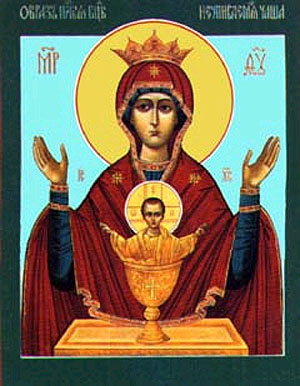
The “Inexhaustible Chalice” Icon of the Most Holy Theotokos was revealed in Russia in 1878. A retired soldier from Tula had spent his pension on alcohol, ruining his health. Though he was no longer able to walk, he continued to drink.
One night the holy Elder Barlaam of Serpukhov appeared to him in a dream and told him to go to the Serpukhov Monastery of the Entry of the Most Holy Mother of God into the Temple. “Have a Molieben served before her Icon ‘The Inexhaustible Chalice.’” Since he had no money and could not walk, the man paid no attention to the dream. Then the Elder appeared a second and third time, speaking to him with increasing severity.
Crawling on all fours, the man reached the next village and stayed in the home of an old woman. She rubbed his legs, and he began to feel better. The next day, he resumed his journey with two canes, then with one, until he arrived at the monastery.
He described his dreams to the monks, but none of them had ever heard of “The Inexhaustible Chalice” Icon. Finally, one of them remembered an icon on which a chalice was depicted. On the back of the icon was an inscription, “The Inexhaustible Chalice.” After the Molieben, the peasant returned home restored to health, and cured of his alcoholism.
News of the miracle spread, and many alcoholics and their families came to pray before the Icon. Many of them came back to thank the Mother of God for answering their prayers. Every Sunday in the Serpukhov-Vyotsk monastery a Molieben with an Akathist is served before the Icon for those who are addicted to alcohol.
Venerable Barlaam of Serpukhov
No information available at this time.
Daily Vespers – Wednesday 5/4/2022
Here is the live stream for Daily Vespers – Wednesday 5/4/2022 If you need, here are instructions for accessing this content from your phone, tablet, computer, or TV.
5/8/announcements
May 8, 2022
The Holy Myrrh-bearing Women
Pious Joseph of Arimathea & Righteous Nicodemus
About the beginning of His thirty-second year, when our Lord was going throughout Galilee, preaching and working miracles, many women who had received of His beneficence left their homeland and from then on followed after Him. They ministered unto Him out of their own possessions, even until His crucifixion and entombment; and afterwards, neither losing faith in Him after His death, nor fearing the wrath of the Jewish rulers, they came to His sepulcher, bearing the myrrh-oils they had prepared to anoint His body. It is because of the myrrh-oils that these God-loving women brought to the tomb that they are called the Myrrh-bearers. Of those whose names are known are the following: first of all the most holy Virgin Mary, who in Matthew 27:56 and Mark 15:40 is called the mother of James and Joses (these are the sons of Joseph by a previous marriage, and she was therefore their step-mother); Mary Magdalene; Mary, the wife of Cleopas; Joanna, wife of Chouza, a steward of Herod Antipas; Salome, the mother of the sons of Zebedee; Mary and Martha, the sisters of Lazarus; and Susanna. As for the names of the rest of them, the evangelists have kept silence.
On this day we also make commemoration of Joseph of Arimathea, who was a secret disciple, and also of Nicodemus, who was a disciple by night. Joseph went boldly to Pilate and asked for the body of Jesus, and together with Nicodemus, he gave Him burial out of reverence and love.
John 1:1-7: That which was from the beginning, which we have heard, which we have seen with our eyes, which we have looked upon and touched with our hands, concerning the Word of life—the Life was made manifest, and we saw it, and testify to it, and proclaim to you the Eternal Life which was with the Father and was made manifest to us—that which we have seen and heard we proclaim also to you, so that you may have fellowship with us; and our fellowship is with the Father and with His Son Jesus Christ. And we are writing this that our joy may be complete. This is the message we have heard from Him and proclaim to you, that God is light and in Him is no darkness at all. If we say we have fellowship with Him while we walk in darkness, we lie and do not live according to the truth; but if we walk in the light, as He is in the light, we have fellowship with one another, and the blood of Jesus Christ His Son cleanses us from all sin.
Mark 15:43-16:8: At that time, Joseph of Arimathea, a respected member of the council, who was also himself looking for the Kingdom of God, took courage and went to Pilate, and asked for the body of Jesus. And Pilate wondered if He were already dead; and summoning the centurion, he asked him whether Jesus was already dead. And when he learned from the centurion that He was dead, he granted the body to Joseph. And he bought a linen shroud, and taking Him down, wrapped Him in the linen shroud, and laid Him in a tomb, which had been hewn out of the rock; and he rolled a stone against the door of the tomb. Mary Magdalene and Mary the mother of Joses saw where He was laid. And when the Sabbath was past, Mary Magdalene, and Mary the mother and James, and Salome, bought spices, so that they might go and anoint Jesus. And very early in the morning, on the first day of the week, they came to the tomb at the rising of the sun. And they were saying to one another, “Who will roll away the stone for us from the door of the tomb?” And looking up, they saw that the stone was rolled back – it was very large. And entering the tomb, they saw a young man sitting on the right side, dressed in a long white robe; and they were amazed. And he said to them, “Do not be amazed; you seek Jesus of Nazareth, Who was crucified. He is risen; He is not here; see the place where they laid Him. But go, tell His disciples and Peter that He is going before you to Galilee; there you will see Him, as He told you.” And they went out quickly and fled from the tomb; for trembling and astonishment had come upon them; and they said nothing to anyone, for they were afraid.
Troparion of the Resurrection: When thou, O immortal Life, didst humble thyself unto death, then didst thou destroy death by the brightness of thy Godhead; and when thou didst raise the bowels of the earth, then all the heavenly powers exclaimed, O Christ, thou art the Giver of life! Glory to thee, O our God!
Troparia of the Holy Myrrh-Bearers: The pious Joseph, having brought down thy pure body from the Tree, wrapped it in fine linen, embalmed it with ointment, provided for it, and laid it in a new tomb. But thou didst truly rise, after three days, O Lord, granting the world the Great Mercy.
Verily, the angel came to the tomb and said to the ointment-bearing women, The ointment is meet for the dead, but Christ is shown to be remote from corruption. But cry ye, The Lord is risen, granting the world the Great Mercy.
Troparion of St. John the Evangelist: O Apostle John, beloved of Christ our God, hasten to deliver a defenseless people. He that allowed thee to recline on His breast, receiveth thee bowing in intercession. Implore Him, O Theologian, to dispel the persistent cloud of the heathen, and ask for us His peace and great mercy.
Troparion of the Chains of St. Peter: O Holy Apostle, Peter, thou dost preside over the Apostles by the precious chains which thou didst bear. We venerate them with faith and beseech thee that by thine intercessions we be granted the great mercy.
Kontakion of Pascha: When Thou didst descend into the grave, O Immortal, Thou didst destroy the power of Hades. In victory didst Thou arise, O Christ God, proclaiming Rejoice! to the myrrh-bearing women, granting peace to Thine apostles and bestowing resurrection on the fallen.
CALENDAR
UNTIL FURTHER NOTICE: All services listed on the calendar will be available through streaming and webcast.
Please continue to follow the CDC Guidelines to limit contagion and the spread of the COVID virus.
Sunday, May 8 (Sunday of the Holy Myrrh-bearers)
9:00 a.m. — Orthros (webcast)
9:00 a.m. — Christian Education
10:00 a.m. — Divine Liturgy (webcast)
Monday, May 9
Father Herman off
Tuesday, May 10 (Apostle Simon the Zealot)
NO Services
Wednesday, May 11
6:30 p.m. — Daily Vespers
Thursday, May 12
NO Services
Friday, May 13
NO Services
Saturday, May 14
10:00 a.m. — Ladies meet for Akathist
6:00 p.m. — Great Vespers with Litia and Artoklasia
Sunday, May 15 (Sunday of the Paralytic)
9:00 a.m. — Orthros (webcast)
9:00 a.m. — Christian Education
10:00 a.m. — Divine Liturgy (webcast)
12:00 p.m. — Pot Luck Meal & Coffee Hour honoring our High School Graduates
SPECIAL ANNOUNCEMENTS
The Eucharist Bread …was offered by the Bakers for the Divine Liturgy this morning. The Artos for the Litia and Artoklasia last night for the Feastday of St. John the Theologian was offered by the Pacuraris.
Eucharist Bread Schedule:
Eucharist Bread Coffee Hour
May 8 Baker Lasseter/Pacurari/Miller
May 15 Henderson POT LUCK MEAL
Algood/Schelver
May 22 Algood D. Root/Pigott
May 29 Schelver Meadows/Baker/Cooper
Schedule for Epistle Readers – Page numbers refer to the Apostolos (book of the Epistles) located on the Chanters’ stand at the front of the nave. Please be sure to use this book when you read.
Reader Reading Page#
May 8 Kh. Sharon Meadows I John 1:1-7 382
May 15 Ian Jones Acts 9:32-42 45
May 22 Brenda Baker Acts 11:33-12:2 52
May 29 Sam Habeeb Acts 16:16-34 58
Also, please remember that we still need your tithes and offerings which may be placed in the tithe box at the back of the nave or be mailed to: St. Peter Orthodox Church, P.O. Box 2084, Madison, MS 39130-2084.
Continue to pray for Metropolitan Paul (who is also the brother of our Patriarch) and the Syriac Archbishop John of Aleppo who were abducted while on a humanitarian mission in Syria.
Please remember Fr. Joseph and Kh. Joanna Bittle, and their daughter Abigail, in your prayers.
Please remember the following in your prayers: Aidan Milnor, the Milnor family; Lamia Dabit and her family; Mary Greene (Lee and Kh. Sharon’s sister); Jay and Joanna Davis; Fr. Leo and Kh. Be’Be’ Schelver and their family; Kathy Willingham; Marilyn (Kyriake) Snell; Jack and Jill Weatherly; Lottie Dabbs (Sh. Charlotte Algood’s mother), Sh. Charlotte and their family; Maria Costas (currently at St. Catherine’s Village); Reader Basil and Brenda Baker and their family; Buddy Cooper.
If you are not feeling well, PLEASE do not attempt to come to the services. This also includes anyone who may have been exposed to you during this time. Also, please let Fr. Herman know if you are not feeling well and have COVID like symptoms.
Women of the Parish: You are invited to attend a Baby Shower in Dana Dabit’s honor on Sunday, May 22nd at St. Peter’s in the Fellowship Hall from 3-5 p.m.
Calendar Items:
* The men of the parish meet for lunch at 11:30 a.m. on the first Thursday of the month.
* The Ladies meet at the church at 10:00 a.m. on the second Saturday of the month to pray the Akathist to the Mother of God, Nurturer of Children on behalf of our children.
* The Ladies meet for lunch on the last Tuesday of the month.
* We will have Paschal Vespers, marking the Leave-taking of PASCHA, on Tuesday evening, May 31st, beginning at 6:30 p.m.
* Orthros and Divine Liturgy for the Feast of the Ascension will be celebrated on Wednesday, June 1st, beginning at 6:00 p.m.
* Father Herman will be helping to lead a retreat at the Antiochian Village, July 3-9.
* The Clergy Symposium will be held at the Antiochian Village, July 18-23.
* Vacation Church School is scheduled for July 28-30. Parents, mark your calendar now.
* The dates for Stewpot for 2022 are Saturday, May 7th and Saturday, September 3rd.
Diocese of Miami and the Southeast Parish Life Conference: Registration is now open for the Parish Life Conference to be hosted June 15-18 by St. John Orthodox Church in Memphis. More information may be found on the Diocesan website at DOMSE.org.
Luke Habeeb will be graduating from High School this month. We will honor him at our Pot Luck Meal next Sunday, May 15th. We will also honor Brandon Strain at that time since because of the CoVid shut down we were unable to do so when he graduated.
Camp St. Thekla dates: The dates for Camp St. Thekla are: Session 1 is June 26 – July 2 and Session 2 is July 3 – 9. If you have a child registered for Camp, please see Daniel for information on scholarships available from the Order of St. Ignatius. If there is still a financial need, some additional funds may be available.
Instructions for streaming our services can be found on the parish website.
Fasting Discipline for May
There will be no fasting on Wednesdays and Fridays until the Feast of Ascension (June 2nd this year), for the full forty days, as decided by the Holy Synod of the Church of Antioch in 1997. (This is a departure from what we have done in the past, but is what we have been directed to do by the Archdiocese.)
Major Commemorations for May
May 8 Sunday of the Holy Myrrh-bearers;
Apostle and Evangelist, John the Theologian
May 10 Simon the Zealot
May 15 Sunday of the Paralytic
May 21 Constantine and Helen
May 22 Sunday of the Samaritan Woman
May 25 The Forerunner (3rd Discovery)
May 29 Sunday of the Blind Man
Quotable “Live simply and without thinking too much, like a child with his father. Faith without too much thinking works wonders. The logical mind hinders the Grace of God and miracles. Practice patience without judging with the logical mind.”
St. Paisios the Athonite
Worship: Sunday, May 15, 2022 (Sunday of the Paralytic)
Scripture: Acts 9:32-42; John 5:1-15
Celebrant: Father Herman
Epistle Reader: Ian Jones
Prosphora: Henderson
Coffee Hour: POT LUCK MEAL
Algood/Schelver
Daily Readings for Wednesday, May 04, 2022
2ND WEDNESDAY AFTER PASCHA
NO FAST
2nd Wednesday after Pascha, Pelagia the Nun-martyr of Tarsus, Hilary the Wonderworker, Euthemios, Bishop of Madytos, Athanasios, Bishop of Corinth
ACTS OF THE APOSTLES 4:13-22
In those days, when the Jews saw the boldness of Peter and John, and perceived that they were uneducated, common men, they wondered; and they recognized that they had been with Jesus. But seeing the man that had been healed standing beside them, they had nothing to say in opposition. But when they had commanded them to go aside out of the council, they conferred with one another, saying, “What shall we do with these men? For that a notable sign has been performed through them is manifest to all the inhabitants of Jerusalem, and we cannot deny it. But in order that it may spread no further among the people, let us warn them to speak no more to any one in this name.” So they called them and charged them not to speak or teach at all in the name of Jesus. But Peter and John answered them, “Whether it is right in the sight of God to listen to you rather than to God, you must judge; for we cannot but speak of what we have seen and heard.” And when they had further threatened them, they let them go, finding no way to punish them, because of the people; for all men praised God for what had happened. For the man on whom the sign of healing was performed was more than forty years old.
JOHN 5:17-24
The Lord said to the Jews who came to him: "My Father is working still, and I am working." This was why the Jews sought all the more to kill him, because he not only broke the sabbath but also called God his own Father, making himself equal with God.
Jesus said to them, "Truly, truly, I say to you, the Son can do nothing of his own accord, but only what he sees the Father doing; for whatever he does, that the Son does likewise. For the Father loves the Son, and shows him all that he himself is doing; and greater works than these he will show him, that you may marvel. For as the Father raises the dead and gives them life, so also the Son gives life to whom he will. The Father judges no one, but has given all judgment to the Son, that all may honor the Son, even as they honor the Father. He who does not honor the Son does not honor the Father who sent him. Truly, truly, I say to you, he who hears my word and believes him who sent me, has eternal life; he does not come into judgment, but has passed from death to life.
New Martyr Archpriest Vasily Martysz

The holy New Martyr Archpriest Vasily Martysz was born on February 20, 1874 in Tertyn, in the Hrubieszow region of southeastern Poland. His father Alexander was a judge in Molczyce near Pinsk. After his retirement, he was ordained a priest and became rector of a local parish.
EDUCATION
In 1884, at the age of ten, Vasily made a brief trip to New York with his father. His beautiful singing during a church service attracted the attention of Bishop Vladimir. The hierarch prophesied that young Vasily would become a priest, and promised that he would invite him to his diocese in America once he was ordained. After returning to his country, he remembered the bishop’s words, and decided to follow in his father’s footsteps and become a priest. He began his theological education at the seminary in Chelm, where the rector was Bishop Tikhon (Belavin), the future Patriarch of Moscow.
Immediately after graduating in July 1899, Vasily married Olga Nowik, and was ordained a deacon. On December 10, 1900 he was ordained a priest. That same month he left Breman for America. The young couple expected to be assigned to a parish in New York, but instead he was appointed to a parish in Alaska. Together with the newly-appointed Bishop Tikhon, he began his missionary service in the land of Saint Herman.
AMERICA
Orthodoxy had arrived in Alaska with the coming of the monastic mission from Valaam in 1794. At the start of the twentieth century, climatic and social conditions in this vast territory remained difficult. In his pastoral work, Father Vasily met Russian settlers and indigenous inhabitants of the region, Eskimos and Aleuts. He also encountered gold rush pioneers quite often..
Father Vasily’s first parish was extensive. He was headquartered on Afognak, but he was also responsible for the people on Spruce and Woody Islands near Kodiak. There were several small wooden chapels scattered on these islands. In 1901, as a result of his efforts, the church of the Nativity of the Most Holy Virgin was built at Afognak. Although the village was completely destroyed in the earthquake and tidal wave of 1964, the church building survives to this day.
Because of the long distances and severe climate, Father Vasily’s priestly work was extremely difficult and required many sacrifices. Often he would leave home for several weeks, in order to celebrate the services, to confess, baptize, marry the living, and to bury the dead, while traveling in a specially constructed kayak.
Even when he was at home, Father Vasily had very little time to devote to his dear family. Besides celebrating the services in church and serving the needs of his parishioners, he taught in the parish school and worked in two church homes for the poor. His family bore the arduous conditions, especially the climate, with difficulty. His wife Olga, who had given birth to two daughters, stayed home. The older daughter, Vera, was born at Afognak in 1902. Their second daughter was born two years later, after they had moved to Kodiak.
During his missionary service in Alaska, Father Vasily kept a diary. It has survived to this day as one of the few records of his personal life. Fragments have been translated from Russian and published in Polish.
Because of the severe Alaskan climate, which especially affected Matushka Olga, and out of concern for the education of their children, the Martysz family transferred to the continental United States in 1906. As a farewell statement from Alaska that year, Father Vasily wrote an article for the Russian Orthodox American Messenger, “The Voice from Alaska,” in which he appealed to Orthodox faithful across the USA to support the building of Orthodox churches in Alaska.
The family settled in Osceola Mills in central Pennsylvania. Their first son, Vasily, was born that same year, and their youngest child Helen was born in 1908, soon after they moved to Old Forge, PA. Father Vasily’s work took him to Waterbury, CT, to West Troy, NY, and finally to Canada. He was assigned to Edmonton and then to Vostok, where he became Dean of the provinces of Alberta and Manitoba. In 1910, he celebrated his tenth anniversary in the priesthood. His prolific and loving pastoral activity endeared him to his flock. Church authorities considered him a very effective, devoted and talented priest, while the faithful loved him sincerely, valuing his modesty and kindness.
Despite their comfortable lifestyle and the relatively large Orthodox community they served in western Canada, the couple longed for their homeland. They feared the loss of their ancestral identity and requested permission to return to Poland. After serving nearly twelve years in America, Father Martysz left the New World and returned to Europe in 1912.
RETURN
Initially, Father Vasily and his family lived with relatives in Sosnowiec, where he eventually became rector of the parish and instructor in Religious Education at the local girls’ high school. The peaceful life they enjoyed there lasted barely one year, since the outbreak of the First World war disrupted the lives of thousands. Clergy were considered civil servants who were ordered to evacuate their homes, and move to safety inside Russia. At this critical time, Bishop Vladimir, their Archpastor and friend from Alaska, offered the Martysz family refuge in a small apartment within the Saint Andronicus Monastery in Moscow. From here, Father Vasily commuted daily to the distant parish at Valdai, where he taught religious education classes. When the Bolsheviks seized power, he lost this job and was forced to earn a living unloading railroad cars. His own life was endangered because Red Army soldiers often treated clergy with distinct brutality.
In 1919, at the end of the war, Polish refugees were granted permission to return to their former residences. Father Vasily and his family took this opportunity to return to Sosnowiec. They moved back into their former apartment, which had survived the devastation of the war. They did not remain long, however, for that September Father Vasily was assigned to a position in the newly organized Polish Army, in charge of Orthodox Affairs in the Religious Ministry of the War Department. The whole family relocated to Warsaw. Father Vasily started the wearisome but important work of forming an Orthodox military chaplaincy. In 1921, he was promoted to the rank of colonel, and assumed responsibility as the head of the Orthodox military chaplaincy. At this time, the church elevated him to the rank of Archpriest. Father Vasily served as chief of Orthodox chaplains for the next twenty-five years. Within the Ministry of the Interior, he had his own cabinet, and was directly responsible to the Minister himself.
AUTOCEPHALY
Father Vasily was also a chief advisor and close colleague of Metropolitan George (Jaroszewski) of Warsaw and all Poland. He participated in preparing all the meetings of the Holy Synod, and assisted Metropolitan George in his effort to obtain autocephaly for the Polish Orthodox Church. He accompanied the Metropolitan on the tragic day of February 8, 1923, when he was assassinated. The assassin had also planned to kill Father Vasily as well, but he was captured before he could succeed. Father Vasily remained under police protection for some time, but attended to all the details of the Metropolitan’s funeral, in which the First Regiment of the Szwolezers Regiment participated under orders from Marshal Jozef Pilsudski.
Father Vasily zealously participated in the subsequent process of obtaining autocephaly for the Orthodox Church in Poland, which was granted during the tenure of Metropolitan Dionysius (Walednski) in 1925. Father Vasily became the Metropolitan’s closest advisor and confidant. He often accompanied the Metropolitan and acted as liaison with the Polish Head of State, Marshal Pilsudski. He was often invited to attend cabinet meetings at Belvedere, the Royal Castle, where he regularly signed the guest book on holidays.
In addition to his work as chief military chaplain, Father Vasily devoted much time to organizing pastoral ministry in the Ukrainian internment camps. In February 1921, Father Vasily appointed Father Peter Biton as chaplain for the camp in Aleksandrow Kujawski. He visited the Ukrainian internees himself and helped arrange camp churches. On July 8, 1921, he celebrated the Divine Liturgy in the Ukrainian language for over 5,000 prisoners, while visiting this camp. His sermon, delivered in Ukrainian, greatly improved their morale. He also assisted in organizing chaplains’ training courses in other Ukrainian army camps.
The Polish Secretary of the Army, Lucjan Zeligowski sent a congratulatory letter to Father Vasily on the occasion of the twenty-fifth anniversary of his ordination, December 7, 1925, stating “The virtues of this remarkably talented, conscientious and diligent servant, completely devoted to the Polish nation, expressed in his receiving a high distinction, the Order of Polonia Restituta, which is conferred upon him for his efforts in securing the Autocephaly of the Orthodox Church in Poland.”
Father Vasily retired from his government position in 1936. The couple decided to leave Warsaw and return to their home region, Hrubieszowszczna. They built two houses in Teratyn, one for themselves and another for their widowed mothers. They did not enjoy this peaceful life for very long, because in 1939 the German Army invaded Poland. The village gradually declined. Both of their mothers died. Matushka herself did not live to see the end of the war, but died in 1943. Then Father Vasily’s youngest daughter, Helen, moved into his house with her husband and daughter in order to support him.
Father Martysz spent the difficult war years in Teratyn. On May 4, 1945 (Great and Holy Friday), a few days before the surrender of Nazi Germany, his house was attacked. A female acquaintance warned him of the danger, but he replied, “I have done no harm to anyone and I will not run away from anyone. Christ did not run away.” Father Vasily did not fear and did not flee from his tormentors. He faced them bravely, in a Christ-like way, accepting the crown of martyrdom. The villains, seeking gold and money, had no respect for his uniform as a colonel in the Polish Army, nor for his priestly vestments.
MARTYRDOM
The bandits broke into the house by breaking a window. With callous cruelty they tortured Father Vasily though his only crime was that he was an Orthodox priest. They beat his pregnant daughter Helen, causing her to miscarry. They beat Father Vasily for four hours, reviving him by throwing water on him when he lost consciousness. Horribly tortured, he was finally murdered by a gun shot. The criminals threatened to shoot Helen as well, When she knelt before the icon of Christ and began to pray, the executioner’s aim and resolve weakened. They left, threatening to return and kill her as well.
On Great and Holy Saturday, Father John Lewczuk celebrated the burial rites for Father Vasily in Chelm. He was buried at the local cemetery in Teratyn.
In October 1963, the earthly remains of Father Vasily Martysz were brought to Warsaw and solemnly reinterred in the Orthodox cemetery in the Wola district, next to his wife and mother-in-law. At the beginning of 2003, his holy relics were uncovered and placed in the church of Saint John Climacus in Warsaw. The Holy Synod of the Autocephalous Orthodox Church of Poland promulgated the official Act of Canonization on March 20, 2003, and the rites glorifying Saint Vasily Martysz were celebrated in Chelm on June 7-8.
Orthodox Christians in the Polish Army have taken Saint Vasily Martysz as their heavenly patron. The martyrdom of Saint Vasily was the crowning accomplishment of his pious and dedicated life, a testimony to his amazing courage. He carried his cross to the end without complaint, accepting the crown of martyrdom as he had dedicated his life to Christ and the Holy Orthodox Faith.
Written by Jaroslaw Charkiewicz
Virgin Martyr Pelagia of Tarsus, in Asia Minor

Saint Pelagia of Tarsus in Cilicia (southeastern Asia Minor) lived in the third century, during the reign of Diocletian (284-305), and was the daughter of illustrious pagans. When she heard about Jesus Christ from her Christian friends, she believed in Him and desired to preserve her virginity, dedicating her whole life to the Lord.
Emperor Diocletian’s heir (a boy he adopted), saw the maiden Pelagia, was captivated by her beauty and wanted her to be his wife. The holy virgin told the youth that she was betrothed to Christ the Immortal Bridegroom, and had renounced earthly marriage.
Pelagia’s reply greatly angered the young man, but he decided to leave her in peace for awhile, hoping that she would change her mind. At the same time, Pelagia convinced her mother to let her visit the nurse who had raised her in childhood. She secretly hoped to find Bishop Linus of Tarsus, who had fled to a mountain during a persecution against Christians, and to be baptized by him. She had seen the face of Bishop Linus in a dream, which made a profound impression upon her. The holy bishop told her to be baptized. Saint Pelagia traveled in a chariot to visit her nurse, dressed in rich clothes and accompanied by a whole retinue of servants, as her mother wished.
Along the way Saint Pelagia, by the grace of God, met Bishop Linus. Pelagia immediately recognized the bishop who had appeared to her in the dream. She fell at his feet, requesting Baptism. At the bishop’s prayer a spring of water flowed from the ground.
Bishop Linus made the Sign of the Cross over Saint Pelagia, and during the Mystery of Baptism, angels appeared and covered the chosen one of God with a bright mantle. After giving the pious virgin Holy Communion, Bishop Linus offered a prayer of thanksgiving to the Lord with her, and then sent her to continue her journey. She then exchanged her expensive clothing for a simple white garment, and distributed her possessions to the poor. Returning to her servants, Saint Pelagia told them about Christ, and many of them were converted and believed.
She tried to convert her own mother to Christ, but the obdurate woman sent a message to Diocletian’s son that Pelagia was a Christian and did not wish to be his wife. The youth realized that Pelagia was lost to him, and he fell upon his sword in his despair. Pelagia’s mother feared the emperor’s wrath, so she tied her daughter up and led her to Diocletian’s court as a Christian who was also responsible for the death of the heir to the throne. The emperor was captivated by the unusual beauty of the virgin and tried to turn her from her faith in Christ, promising her every earthly blessing if she would become his wife.
The holy virgin refused the emperor’s offer with contempt and said, “You are insane, Emperor, saying such things to me. I will not do your bidding, and I loathe your vile marriage, since I have Christ, the King of Heaven, as my Bridegroom. I do not desire your worldly crowns which last only a short while. The Lord in His heavenly Kingdom has prepared three imperishable crowns for me. The first is for faith, since I have believed in the true God with all my heart; the second is for purity, because I have dedicated my virginity to Him; the third is for martyrdom, since I want to accept every suffering for Him and offer up my soul because of my love for Him.”
Diocletian sentenced Pelagia to be burned in a red-hot bronze bull. Not permitting the executioners to touch her body, the holy martyr signed herself with the Sign of the Cross, and went into the brazen bull and her flesh melted like myrrh, filling the whole city with fragrance. Saint Pelagia’s bones remained unharmed and were removed by the pagans to a place outside the city. Four lions then came out of the wilderness and sat around the bones letting neither bird nor wild beast get at them. The lions protected the relics of the saint until Bishop Linus came to that place. He gathered them up and buried them with honor. Later, a church was built over her holy relics.
The Service to the holy Virgin Martyr Pelagia of Tarsus says that she was “deemed worthy of most strange and divine visions.” She is also commemorated on October 7.
During the reign of Emperor Constantine (306-337), when the persecutions against Christians had stopped, a church was built at Saint Pelagia’s burial place.
Venerable Alphan, with his brothers, of Novgorod, founders of the Sokolnitzky Monastery
The Alfanov Brothers Saints Nikḗtas, Cyril, Nikēphóros, Clement, and Isaac lived during the fourteenth century at Novgorod. They led a righteous life and founded the Sokolnitsky monastery. As the chronicles relate, “A wooden church dedicated to Saint Nicholas was built on the Sokol hill and a monastery was founded” in 1389.
The righteous Alfanov (Sokolnitskyie) brothers were kinsmen according to the chronicler James Anphalov [or Alfanov], who fled to the Dvina to avoid pursuit because of his dealings with Moscow.
The righteous ones were subjected to misfortune because they were related to James, and they purified themselves through their innocent suffering. In the Tale of the brothers, a miracle took place at their relics.
Their memory is celebrated on May 4 and June 17. As the result of a fire which destroyed the Sokolnitsky monastery, their holy relics were transferred to the Antoniev monastery on May 4, 1775.
Holy Confessor Erasmus, Bishop of Formia in Campania
Saint Erasmus zealously served the Lord from his youth. In his mature years he was consecrated as Bishop of Formium, Italy. During the persecution against Christians under the emperors Diocletian (284-305) and Maximian Hercules (284-305), Saint Erasmus left his diocese and went to Mount Libanus, where he hid for seven years. Once, however, an angel appeared to him and said, “Erasmus! No one vanquishes enemies if he is asleep. Go to your own city, and you shall vanquish your enemies.” Heeding the voice of the angel, Saint Erasmus left his seclusion.
The first ones who asked him about his faith were soldiers who met him along the way. Saint Erasmus confessed himself a Christian. They brought him to trial at Antioch before the emperor Diocletian. The saint fearlessly confessed his faith in Christ and denounced the emperor for his impiety.
Saint Erasmus was subjected to fearsome tortures, but remained unbending. After the tortures the saint was bound in iron chains and thrown into prison, where an angel appeared in miraculous form, saying, “Follow after me, I will lead you to Italy. There you shall bring many people to salvation.” Saint Erasmus preached boldly to the people about Christ and raised up the son of an illustrious citizen of Lycia.
After this miracle at Lycia 10,000 men were baptized. The emperor of the Western half of the Roman Empire, Maximian Hercules, gave orders to seize the saint and bring him to trial. Saint Erasmus also confessed his faith before this emperor. They beat him and threatened him with crucifixion if he did not renounce Christ. They forced him to go to a temple of the idol, but along the saint’s route all the idols fell and were destroyed, and from the temple there came fire which fell upon many of the pagans.
After being set free, Saint Erasmus baptized many pagans, and later went to the city of Sirmium, where he was seized and subjected to torture. They seated him in a red-hot oven, but he remained alive and unharmed. This miracle amazed so many people that the emperor, fearing civil unrest, retired into his own chambers. The angel freed Saint Erasmus from his fetters and took him to the city of Formium, i.e. to his own diocese, where the saint baptized many more people. The saint died there in 303. Christians buried the relics of the holy confessor with honor.
Hieromartyr Albian, Bishop of Anaea in Asia Minor
Saint Albian was bishop of the city of Aneium in the Aseian district, and suffered for Christ about the year 304 in a persecution against Christians under the emperor Diocletian and his co-ruler Maximian. Saint Albian was ordered to offer sacrifice to idols under the threat of death, but he confessed his faith in Christ and refused to serve idols. They tortured him with red-hot irons and beat him mercilessly, but he remained unyielding.
They tortured his disciple with him, and he also remained faithful to the Lord Jesus Christ. Both holy martyrs were sentenced to death and thrown into a red-hot oven, in which they died, receiving the crowns of martyrdom.
Hieromartyr Silvanus, Bishop of Gaza, and 40 Martyrs with him
Saint Silvanus came from the vicinity of the city of Gaza, and was a soldier. Desiring to serve the heavenly King, he became a priest, and was consecrated Bishop of Gaza. Saint Silvanus converted many pagans to Christ. During the persecution against Christians under the emperor Diocletian he was taken for trial to the city of Caesarea. He underwent torture and bravely endured it, and was then sentenced to harsh labor in the copper mines.
The holy bishop was exhausted by this work, but remained cheerful of spirit. He incessantly preached Christ to all those around him. This angered the pagans, who beheaded him.
Forty holy martyrs, who believed in Christ after hearing the words of the bishop, were also martyred with him. Their death followed in the year 311.
Venerable Nikēphóros of Mount Athos

Saint Nikēphóros was the teacher of Saint Gregory Palamas (November 14). He grew up as a Roman Catholic, but he journeyed to the Byzantine Empire and became Orthodox. Saint Nikēphóros lived as an ascetic on Mount Athos, and died before the year 1300. His treatise “On Watchfulness and the Guarding of the Heart” is found in the fourth volume of the English Philokalia.
“Staro Rus” Old Russian Icon of the Mother of God

The Staro Rus (Old Russian) Icon of the Mother of God was so named because for a long time it was in Staro Rus, where it had been brought by the Greeks from Olviopolis during the very first period of Christianity in Russia. The icon was in Staro Rus until the seventeenth century. In 1655 during a plague it was revealed to a certain inhabitant of the city of Tikhvin that the pestilence would cease if the wonderworking Staro Rus Icon were transferred there, and the Tikhvin Icon sent to Staro Rus.
After the transfer of the icons the plague ceased, but the people of Tikhvin did not return the icon and only in the eighteenth century did they give permission to make a copy of the Staro Rus Icon, which on May 4, 1768 was sent to Stara Russa. A feast was established in honor of this event. On September 17, 1888 the original was also returned to Staro Rus and a second Feast day established.
Saint Monica

Saint Monica, the mother of Saint Augustine of Hippo (June 15), was born in 322 in Tagaste, North Africa. Her parents were Christians, but little is known of her early life. Most of our information about her comes from Book IX of her son’s Confessions.
Saint Monica was married to a pagan official named Patritius, who had a short temper and lived an immoral life. At first, her mother-in-law did not like her, but Monica won her over by her gentle disposition.
Saint Monica and Patritius had three children: Saint Augustine, Navigius and Perpetua. It was a source of great sorrow to her that Patritius would not permit them to be baptized. She worried about Augustine, who lived with a young woman in Carthage and had an illegitimate son with her. Her constant prayers and tears for her son had the effect of converting her husband to Christ before his death. Augustine, however, continued on the path that led away from Christ.
While in Carthage, Augustine fell under the influence of the heretical Manichean sect. His mother was horrified and tried to turn him away from his error. She had a dream in which she was told to be patient and gentle with her son. Augustine, however, paid little attention to her arguments, and remained in his delusion for nine years. Saint Monica must have felt disheartened and disappointed, but she never gave up on him. She even tried to enlist the help of a bishop who had once been a Manichean himself, but he would not dispute with Augustine. He said he couldn’t reason with the young man, because he was still attracted by the novelty of the heresy. He did reassure her saying, “Go on your way, and God bless you, for it is not possible that the son of these tears should be lost.”
Saint Monica went to Rome with Augustine when he lectured there in 383. Later, he received an appointment to Milan, where he met Saint Ambrose (December 7) and was greatly impressed by his preaching. Bishop Ambrose came to have a high regard for Saint Monica, and often congratulated Augustine on having such a virtuous mother.
One day Augustine was reading the New Testament in a garden, and came to Romans 13:12-14. There and then Augustine decided to “cast off the works of darkness,” and to “put on the Lord Jesus Christ.” He was baptized on the eve of Pascha in 387.
After his baptism, Augustine and his mother planned to return to Africa. They stopped to rest in Ostia, where Saint Monica fell asleep in the Lord at the age of fifty-six. She was buried at Ostia, and her holy relics were transferred to the crypt of a church in the sixth century. Nine centuries later, Saint Monica’s relics were translated to Rome.
In the West, Saint Monica is considered the patron saint of wives and mothers whose husbands or sons have gone astray.
Daily Readings for Tuesday, May 03, 2022
2ND TUESDAY AFTER PASCHA
NO FAST
2nd Tuesday after Pascha, The Holy Martyrs Timothy and Maura, Peter the Wonderworker, Theophan, Bishop of Peritheorion, Xenia of Kalamata the Great Martyr, Father Theodosius, Abbot of Kiev Caves Lavra, Ahmet the Calligrapher & Martyr, Oikoumenios the Wonderworker, Bishop of Trikka
ACTS OF THE APOSTLES 4:1-10
In those days, while the apostles were speaking to the people, the priests and the captain of the temple and the Sadducees came upon them, annoyed because they were teaching the people and proclaiming in Jesus the resurrection from the dead. And they arrested them and put them in custody until the morrow, for it was already evening. But many of those who heard the word believed; and the number of the men came to about five thousand.
On the morrow their rulers and elders and scribes were gathered together in Jerusalem, with Annas the high priest and Caiaphas and John and Alexander, and all who were of the high-priestly family. And when they had set them in the midst, they inquired, "By what power or by what name did you do this?" Then Peter, filled with the Holy Spirit, said to them, "Rulers of the people and elders, if we are being examined today concerning a good deed done to a cripple, by what means this man has been healed, be it known to you all, and to all the people of Israel, that by the name of Jesus Christ of Nazareth, whom you crucified, whom God raised from the dead, by him this man is standing before you well.
JOHN 3:16-21
The Lord said to his disciples: “God so loved the world that he gave his only Son, that whoever believes in him should not perish but have eternal life. For God sent the Son into the world, not to condemn the world, but that the world might be saved through him. He who believes in him is not condemned; he who does not believe is condemned already, because he has not believed in the name of the only Son of God. And this is the judgment, that the light has come into the world, and men loved darkness rather than light, because their deeds were evil. For every one who does evil hates the light, and does not come to the light, lest his deeds should be exposed. But he who does what is true comes to the light, that it may be clearly seen that his deeds have been wrought in God.”
Day of Rejoicing

On Tuesday of Saint Thomas week we remember those Orthodox Christians from all ages who have died in faith, and in the hope of resurrection.
There are indications of this commemoration in the sermons of the Fathers of the Church. Saint John Chrysostom, for example, mentions it in his homily “On the Cemetery and the Cross.”
In pre-Revolutionary Russia bars remained closed and alcoholic beverages were not sold until this Day of Rejoicing so that the joy people felt would be because of the Resurrection, and not an artificial joy brought on by alcohol.
Today the Church remembers its faithful members at Liturgy, and koliva is offered in remembrance of those who have fallen asleep. Priests visit cemeteries to bless the graves of Orthodox Christians, and to share the paschal joy with the departed. It is also customary to give alms to the poor on this day.
Martyr Timothy the Reader and his wife, Maura, in Egypt
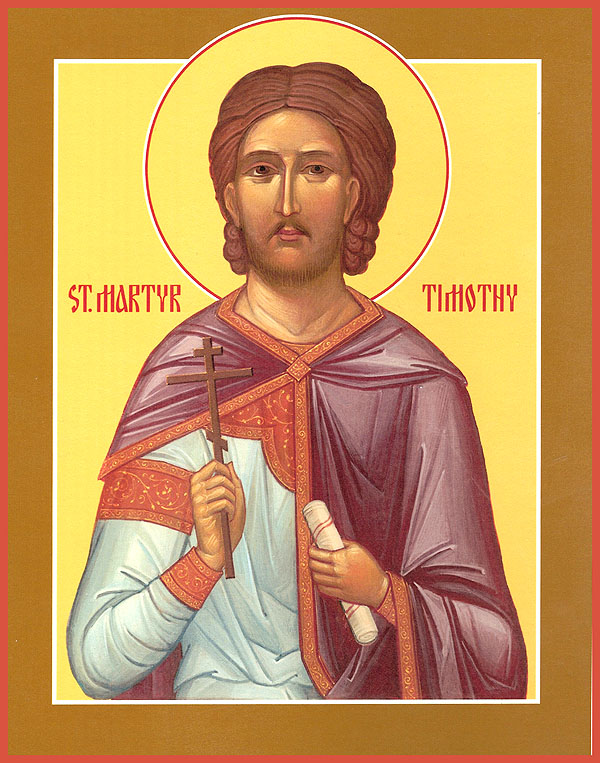
Saints Timothy and Maura suffered for the faith during the persecution under the emperor Diocletian (284-305). Saint Timothy came from the village of Perapa (Egyptian Thebaid), and was the son of a priest named Pikolpossos. He was made a reader among the church clergy, and also a keeper and copyist of divine service books. Saint Timothy was denounced as a keeper of Christian books, which the emperor ordered to be confiscated and burned. They brought Saint Timothy before the governor Arian, who demanded that he hand over the sacred books. They subjected the saint to horrible tortures for his refusal to obey the command. They shoved two red-hot iron rods into his ears, from which the sufferer lost his eyesight and became blind.
Saint Timothy bravely endured the pain and he gave thanks to God, for granting him to suffer for Him. The torturers hung the saint head downwards, putting a piece of wood in his mouth, and they tied a heavy stone to his neck. Saint Timothy’s suffering was so extreme, that even those who tortured him implored the governor to ease up on the torture.
About this time they informed Arian that Timothy had a young wife named Maura, whom he had married only twenty days before. Arian ordered Maura to be brought, hoping that with her present, they could break Saint Timothy’s will. Saint Timothy urged his wife not to fear the tortures, but to follow his path. Saint Maura answered, “I am prepared to die with you,” and she boldly confessed herself a Christian. Arian commanded that the hair be torn from her head, and to cut the fingers off her hands.
Saint Maura underwent the torment with joy and even thanked the governor for the torture, which she endured so that her sins might be forgiven. Then Arian gave orders to throw Saint Maura into a boiling cauldron, but she did not feel any pain, and she remained unharmed. Suspecting that the servants had filled the cauldron with cold water out of sympathy for the martyr, Arian went up and ordered the saint to splash him on the hand with water from the cauldron. When the martyr did this, Arian screamed with pain and drew back his scalded hand. Then, momentarily admitting the power of the miracle, Arian confessed God in Whom Maura believed as the True God, and he ordered her to be released. But the devil still held great power over the governor, and soon he again began to urge Saint Maura to offer sacrifice to the pagan gods. Having gotten nowhere, Arian was overcome all the more by a satanic rage and he came up with new tortures. Then the people began to murmur and demand a stop to the abuse of this innocent woman. But Saint Maura, turning to the people, said, “Let no one defend me. I have one Defender, God, in Whom I trust.”
Finally, after torturing them for a long time, Arian ordered the martyrs to be crucified. For ten days they hung on crosses facing each other.
On the tenth day of martyrdom the saints offered up their souls to the Lord. This occurred in the year 286. Later, a solemn celebration of the holy martyrs Timothy and Maura was instituted at Constantinople, and a church was built in their honor.
Venerable Theodosius, Abbot of the Kiev Far Caves Monastery, and Founder of Coenobitic Monasticism in Russia

Saint Theodosius of the Caves, was the Father of monasticism in Russia. He was born at Vasilevo, not far from Kiev. From his youth he felt an irresistible attraction for the ascetic life, and led an ascetic lifestyle while still in his parental home. He disdained childish games and attractions, and constantly went to church. He asked his parents to let him study the holy books, and through his ability and rare zeal, he quickly learned to read the books, so that everyone was amazed at his intellect.
When he was fourteen, he lost his father and remained under the supervision of his mother, a strict and domineering woman who loved her son very much. Many times she chastised her son for his yearning for asceticism, but he remained firmly committed to his path.
At the age of twenty-four, he secretly left his parents’ home and Saint Anthony at the Kiev Caves monastery blessed him to receive monastic tonsure with the name Theodosius. After four years his mother found him and with tearfully begged him to return home, but the saint persuaded her to remain in Kiev and to become a nun in the monastery of Saint Nicholas at the Askold cemetery.
Saint Theodosius toiled at the monastery more than others, and he often took upon himself some of the work of the other brethren. He carried water, chopped wood, ground up the grain, and carried the flour to each monk. On cold nights he uncovered his body and let it serve as food for gnats and mosquitoes. His blood flowed, but the saint occupied himself with handicrafts, and sang Psalms. He came to church before anyone else and, standing in one place, he did not leave it until the end of services. He also listened to the readings with particular attention.
In 1054 Saint Theodosius was ordained a hieromonk, and in 1057 he was chosen igumen. The fame of his deeds attracted a number of monks to the monastery, at which he built a new church and cells, and he introduced cenobitic rule of the Studion monastery, a copy of which he commissioned at Constantinople.
As igumen, Saint Theodosius continued his arduous duties at the monastery. He usually ate only dry bread and cooked greens without oil, and spent his nights in prayer without sleep. The brethren often noticed this, although the saint tried to conceal his efforts from others.
No one saw when Saint Theodosius dozed lightly, and usually he rested while sitting. During Great Lent the saint withdrew into a cave near the monastery, where he struggled unseen by anyone. His attire was a coarse hairshirt worn next to his body. He looked so much like a beggar that it was impossible to recognize in this old man the renowned igumen, deeply respected by all who knew him.
Once, Saint Theodosius was returning from visiting the Great Prince Izyaslav. The coachman, not recognizing him, said gruffly, “You, monk, are always on holiday, but I am constantly at work. Take my place, and let me ride in the carriage.” The holy Elder meekly complied and drove the servant. Seeing how nobles along the way bowed to the monk driving the horses, the servant took fright, but the holy ascetic calmed him, and gave him a meal at the monastery. Trusting in God’s help, the saint did not keep a large supply of food at the monastery, and therefore the brethren were in want of their daily bread. Through his prayers, however, unknown benefactors appeared at the monastery and furnished the necessities for the brethren.
The Great Princes, especially Izyaslav, loved to listen to the spiritual discourses of Saint Theodosius. The saint was not afraid to denounce the mighty of this world. Those unjustly condemned always found a defender in him, and judges would review matters at the request of the igumen. He was particularly concerned for the destitute. He built a special courtyard for them at the monastery where anyone in need could receive food and drink. Sensing the approach of death, Saint Theodosius peacefully fell asleep in the Lord in the year 1074. He was buried in a cave which he dug, where he secluded himself during fasting periods.
The relics of the ascetic were found incorrupt, and he was glorified as a saint in 1108. Of the written works of Saint Theodosius six discourses, two letters to Great Prince Izyaslav, and a prayer for all Christians have survived to our time.
The Life of Saint Theodosius was written by Saint Nestor the Chronicler (October 27), a disciple of the great Abba, only thirty years after his repose, and it was always one of the favorite readings of the Russian nation. Saint Theodosius is also commemorated on September 2 and 28.
Saint Peter the Wonderworker, Bishop of Argos

Saint Peter the Wonderworker, Bishop of Argos in the Peloponnesos, lived during the ninth and early tenth centuries, and was raised by pious parents. Saint Peter’s parents, and later his brothers Paul, Dionysius, Platon and Saint Peter himself, all became monks. Saint Peter zealously devoted himself to monastic labors, and he excelled all his fellows. This came to the attention of the Italian bishop Nicholas (who from 895 was Patriarch of Constantinople), who wanted to elevate him to the rank of bishop. Saint Peter declined, accounting himself unworthy of such honor.
Bishop Nicholas consecrated Paul, Saint Peter’s brother, as Bishop of Corinth, and Saint Peter went to his brother and lived with him, taking upon himself the spiritual struggle of silence. After a year emissaries came to Bishop Paul from the city of Argos, where the bishop had died, and they asked for Saint Peter as their bishop. After long and intense entreaties, Saint Peter finally gave his consent. As bishop, Saint Peter toiled zealously in guiding his flock. He was extraordinarily compassionate, concerning himself with those in need, especially orphans and widows.
The saint fed the hungry in years of crop failure. Through his prayers the food set aside for the hungry never ran out. The saint also ransomed captives, healed the sick and the afflicted, and possessed the gift of insight. The saint predicted the day of his death, and departed to the Lord at the age of seventy. His relics were transferred from Argos to Nauplos in 1421, exuding myrrh, and working miracles and healings.
“Svenskaya” Icon of the Mother of God

The Sven Caves Icon of the Mother of God was painted by Saint Alypius of the Caves (August 17). On the icon the Mother of God is depicted sitting upon a throne, and with the Divine Infant on Her knees. Saint Theodosius is on the right side of the throne, and Saint Anthony of the Caves on the left. Until the year 1288 it was in the Kiev Caves monastery, where it was glorified by miracles. In 1288 it was transferred to the Briansk-Svensk monastery, which is dedicated to the Dormition of the Most Holy Theotokos.
Prince Roman of Chernigov, then at Briansk, became blind. Hearing about the miracles worked by the icon of Saint Alypius, the prince sent a courier to the monastery requesting that the icon be sent to him at Briansk. They sent a priest with the icon along the River Desna. After the voyage the boat landed on the right bank of the River Svena. After lodging for the night they went to the boat to pray before the icon, but they did not find it there. They saw it on a hill on the opposite bank, resting in the branches of an oak tree. News of this reached Prince Roman, and they led him to the icon on foot.
The prince prayed fervently before the icon and vowed to build a monastery on that spot, donating all the land which could be seen from the hill. After the prayer the prince regained his sight. First he saw the footpath, then nearby objects, and finally all the surroundings.
After making a shrine for the icon, the prince had a Molieben served, and then they laid the foundations for a wooden church in honor of the Dormition of the Most Holy Theotokos. The tree on which the icon rested was cut up and used as wood for other icons. The Feast day of the Sven Icon of the Mother of God was set for May 3. It is also commemorated on August 17 (the day of the repose of Saint Alypius the Iconographer).
The icon was glorified by healings of the blind and of the possessed, and has long been regarded as a protector from enemies.
Translation of the Dormition Icon of the Mother of God from Constantinople to the Kiev Caves, Far Caves

The Kiev Caves Icon of the Dormition of the Most Holy Theotokos is one of the most ancient icons in the Russian Orthodox Church. The Mother of God entrusted it to four Byzantine architects, who in 1073 brought the icon to Saints Anthony and Theodosius of the Caves. The architects arrived at the monks’ cave and asked, “Where do you want to build the church?” The saints answered, “Go, the Lord will point out the place.”
“How is it that you, who are about to die, have still not designated the place?” the architects wondered. “And they gave us much gold.”
Then the monks summoned all the brethren and they began to question the Greeks, saying, “Tell us the truth. Who sent you, and how did you end up here?”
The architects answered, “One day, when each of us was asleep in his own home, handsome youths came to us at sunrise, and said, ‘The Queen summons you to Blachernae.’ We all arrived at the same time and, questioning one another we learned that each of us had heard this command of the Queen, and that the youths had come to each of us. Finally, we beheld the Queen of Heaven with a multitude of warriors. We bowed down to Her, and She said, ‘I want to build Myself a Church in Rus, at Kiev, and so I ask you to do this. Take enough gold for three years.’”
“We bowed down and asked, ‘Lady Queen! You are sending us to a foreign land. To whom are we sent?’ She answered, ‘I send you to the monks Anthony and Theodosius.’”
“We wondered, ‘Why then, Lady, do You give us gold for three years? Tell us that which concerns us, what we shall eat and what we shall drink, and tell us also what You know about it.’”
“The Queen replied, ‘Anthony will merely give the blessing, then depart from this world to eternal repose. The other one, Theodosius, will follow him after two years. Therefore, take enough gold. Moreover, no one can do what I shall do to honor you. I shall give you what eye has not seen, what ear has not heard, and what has not entered into the heart of man (1 Cor.2:9). I, Myself, shall come to look upon the church and I shall dwell within it.’”
“She also gave us relics of the holy martyrs Menignus, Polyeuctus, Leontius, Acacius, Arethas, James, and Theodore, saying, ‘Place these within the foundation.’ We took more than enough gold, and She said, ‘Come out and see the resplendent church.’ We went out and saw a church in the air. Coming inside again, we bowed down and said, ‘Lady Queen, what will be the name of the church?’”
“She answered, ‘I wish to call it by My own name.’ We did not dare to ask what Her name was, but She said again, ‘It will be the church of the Mother of God.’ After giving us this icon, She said, ‘This will be placed within.’ We bowed down to Her and went to our own homes, taking with us the icon we received from the hands of the Queen.”
Having heard this account, all glorified God, and Saint Anthony said, “My children, we never left this place. Those handsome youths summoning you were holy angels, and the Queen in Blachernae was the Most Holy Theotokos. As for those who appeared to be us, and the gold they gave you, the Lord only knows how He deigned to do this with His servants. Blessed be your arrival! You are in good company: the venerable icon of the Lady.” For three days Saint Anthony prayed that the Lord would show him the place for the church.
After the first night there was a dew throughout all the land, but it was dry on the holy spot. On the second morning throughout all the land it was dry, but on the holy spot it was wet with dew. On the third morning, they prayed and blessed the place, and measured the width and length of the church with a golden sash. (This sash had been brought long ago by the Varangian Shimon, who had a vision about the building of a church.) A bolt of lightning, falling from heaven by the prayer of Saint Anthony, indicated that this spot was pleasing to God. So the foundation of the church was laid.
The icon of the Mother of God was glorified by numerous miracles. Two friends, John and Sergius, sealed their friendship before it. After many years John fell mortally ill. He gave part of his wealth to the the Caves monastery, and he gave Sergius the portion for his five-year-old son for safekeeping. He also entrusted his son Zachariah to his guardianship. When Zachariah turned fifteen, he asked for his inheritance, but Sergius persisted in saying that John had distributed everything to the poor. He even went into the Dormition church and swore before the wonderworking icon that he had taken nothing.
When he attempted to kiss the icon, he was not able to come near it. He went to the doors and suddenly shouted, “Saints Anthony and Theodosius! Let me not be struck down for my dishonesty. Entreat the Most Holy Theotokos to drive away the multitude of demons which torment me. Let the gold and silver be taken away. It is sealed up in my granary.” Zachariah gave away all his inheritance to the Caves monastery, where he also himself was tonsured a monk. From that time, no one would take oaths before the wonderworking icon (March 24).
More than once the icon defended the land from enemy invasion. In 1677, when the Turks laid siege to Chigirin and danger threatened Kiev, they carried the icon around the city for almost the entire day of August 27. The Mother of God blessed Russian armies going to the Battle of Poltava (1709). In 1812 they carried the icon around Kiev again. The icon is commemorated twice during the year: May 3 and August 15 .
Saint Mamai, Catholicos of Georgia
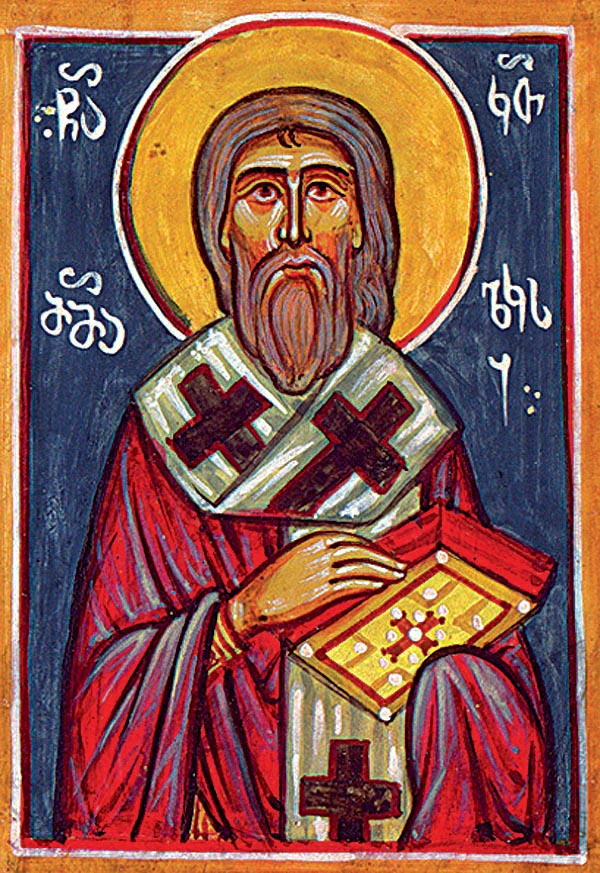
Saint Mamai served as chief shepherd of the Georgian faithful from 731 to 744.
The information we have about his life is scarce, but it is known that Saint Mamai was abbot of Zedazeni Monastery and died a martyr for Christ.
Outstanding in his achievements and endowed with profound spiritual wisdom, Saint Mamai was enthroned as Catholicos of Georgia at a time when the catholicos and the Georgian king were frequently the first victims of invading armies.
Saints Michael and Arsenius of Ulompo, Georgia
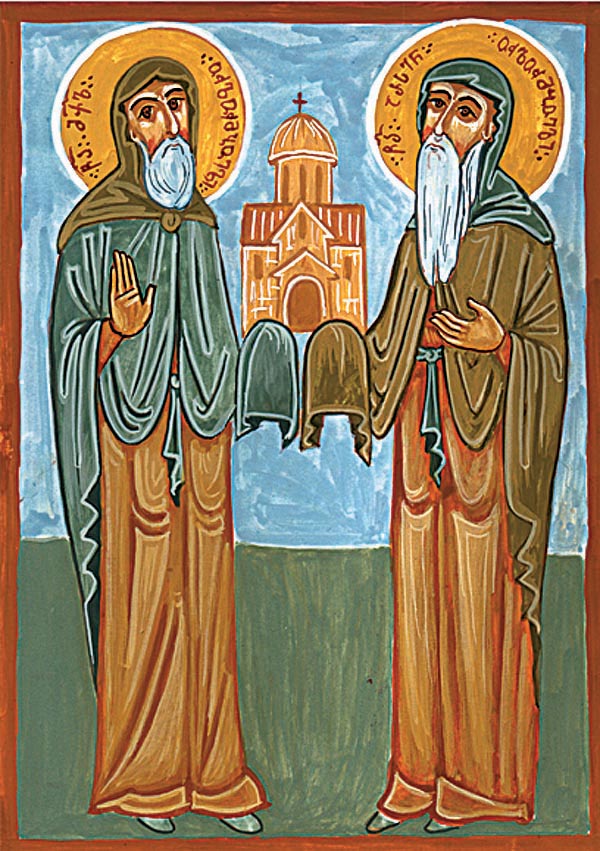
The biographies of Saints Michael and Arsenius the Georgians have unfortunately not been preserved.
It is believed that at some point Arsenius moved from Khandzta Monastery to Palestine and labored there with a certain Macarius of Leteti. Afterward, Saint Arsenius founded a Georgian monastery on Mt. Olympus in Asia Minor. Twenty years later, Venerable Ilarion the Georgian arrived on Mt. Olympus and found three Georgian monks who were almost certainly disciples of Michael and Arsenius.
It is known that they were contemporaries of Patriarch Sergius of Jerusalem (843-859). The following entry is recorded in the synodicon of Jerusalem’s Holy Cross Monastery: “Our Holy Fathers Michael and Arsenius, founders of Olympus.” The record indicates that Saints Arsenius and Michael established Georgian monasticism on Mt. Olympus.
Located in Bythinia of Asia Minor, southeast of Prousa, Mt. Olympus was an important monastic center from the 5th to the 14th centuries. The monasteries of Olympus came to include the monastic communities on the plain of Prousa. The number of monasteries in the region is numbered at around fifty, their apogee occurring between the 8th and 10th centuries, when Olympus occupied the first place in the list of holy mountains. Monasteries in the region included Atroa, Chenolakkos, Medikion, and Pelekete.
According to Paul Ingorokva, a scholar of the Georgian Middle Ages, Arsenius was probably a disciple of Saint Grigol of Khandzta. Ingorokva calls Arsenius “a handsome gentleman, a kind monk full of wisdom, the son of a great nobleman, and a relative of Saint Ephraim, bishop of Atsquri.”
Saint Ecumenius, Wonderworker of Trikala
No information available at this time.
Holy Great Martyr Xenίa of Kalamata
The Holy Great Martyr Xenίa was born in Kalamata in 291 to devout and God-loving parents, Nicholas and Despina, who were from the eastern part of Italy. Because of the persecution of Christians at that time, they fled to Kalamata in the Peloponnesos, where they had a farm outside the city, because her father was a farmer.
From a young age Saint Xenίa adorned her soul with fasting, temperance, silence, unceasing prayer, tears, vigils, and charity. When Dometian, the eparch of that region, happened to meet the Saint, he was dazzled by her beauty and wanted to make her his wife. Saint Xenίa absolutely refused to change her faith, or to become the wife of an idolater. Then Dometian had her arrested. The Saint was tortured mercilessly and then beheaded in 318. Thus, she entered into the joy of her Lord and received an unfading crown of glory from Christ God.
Father George Nasis, the rector of Annunciation Greek Orthodox Church in New York City from 1942-1967 was praying one day when a beautiful woman appeared to him. She said her name was Xenίa, a martyr who had been forgotten for almost 1700 years. She asked him to paint an icon, depicting her holding a cross.
At first Father George did not mention this to anyone, thinking that perhaps people would mock him. Then he decided to inform the Archbishop. Researchers tried to find references to Saint Xenίa of Kalamata, but they were not successful. Finally, they found her name in a list of Saints, where she is described as a young woman with blonde hair and blue eyes.
By God's grace, the Saint has worked many miracles after her death.
In 1993, a new parish church of the Holy Trinity was built in the western part of Kalamata, which has a chapel dedicated to Saint Xenia.
 Saint Peter Antiochian Orthodox Church
You must be logged in to post a comment.