Monthly Archives: April 2022

Daily Readings for Thursday, April 07, 2022

5TH THURSDAY OF LENT: THE GREAT CANON OF SAINT ANDREW OF CRETE

ABSTAIN FROM MEAT, FISH, DAIRY, EGGS

5th Thursday of Lent: The Great Canon of Saint Andrew of Crete, Calliopus and Akylina the Martyrs, George, Bishop of Mytilene, Gerasimos the God-Bearer of Byzantium, Righteous Father Savvas the New of Kalymnos, Tikhon, Patriarch of Moscow and Enlightener of North America

ISAIAH 42:5-16

Thus says God, the LORD, who created the heavens and stretched them out, who spread forth the earth and what comes from it, who gives breath to the people upon it and spirit to those who walk in it: "I am the LORD, I have called you in righteousness, I have taken you by the hand and kept you; I have given you as a covenant to the people, a light to the nations, to open the eyes that are blind, to bring out the prisoners from the dungeon, from the prison those who sit in darkness. I am the LORD, that is my name; my glory I give to no other, nor my praise to graven images. Behold, the former things have come to pass, and new things I now declare; before they spring forth I tell you of them." Sing to the LORD a new song, his praise from the end of the earth! Let the sea roar and all that fills it, the coastlands and their inhabitants. Let the desert and its cities lift up their voice, the villages that Kedar inhabits; let the inhabitants of Sela sing for joy, let them shout from the top of the mountains. Let them give glory to the LORD, and declare his praise in the coastlands. The LORD goes forth like a mighty man, like a man of war he stirs up his fury; he cries out, he shouts aloud, he shows himself mighty against his foes. For a long time I have held my peace, I have kept still and restrained myself; now I will cry out like a woman in travail, I will gasp and pant. I will lay waste mountains and hills, and dry up all their herbage; I will turn the rivers into islands, and dry up the pools. And I will lead the blind in a way that they know not, in paths that they have not known I will guide them. I will turn the darkness before them into light, the rough places into level ground. These are the things I will do, and I will not forsake them.

GENESIS 18:20-33

Then the LORD said, “Because the outcry against Sodom and Gomorrah is great and their sin is very grave, I will go down to see whether they have done altogether according to the outcry which has come to me; and if not, I will know.” So the men turned from there, and went toward Sodom; but Abraham still stood before the LORD. Then Abraham drew near, and said, “Wilt thou indeed destroy the righteous with the wicked? Suppose there are fifty righteous within the city; wilt thou then destroy the place and not spare it for the fifty righteous who are in it? Far be it from thee to do such a thing, to slay the righteous with the wicked, so that the righteous fare as the wicked! Far be that from thee! Shall not the Judge of all the earth do right?” And the LORD said, “If I find at Sodom fifty righteous in the city, I will spare the whole place for their sake.” Abraham answered, “Behold, I have taken upon myself to speak to the Lord, I who am but dust and ashes. Suppose five of the fifty righteous are lacking? Wilt thou destroy the whole city for lack of five?” And he said, “I will not destroy it if I find forty-five there.” Again he spoke to him, and said, “Suppose forty are found there.” He answered, “For the sake of forty I will not do it.” Then he said, “Oh let not the Lord be angry, and I will speak. Suppose thirty are found there.” He answered, “I will not do it, if I find thirty there.” He said, “Behold, I have taken upon myself to speak to the Lord. Suppose twenty are found there.” He answered, “For the sake of twenty I will not destroy it.” Then he said, “Oh let not the Lord be angry, and I will speak again but this once. Suppose ten are found there.” He answered, “For the sake of ten I will not destroy it.” And the LORD went his way, when he had finished speaking to Abraham; and Abraham returned to his place.

PROVERBS 16:17-17:17

The highway of the upright turns aside from evil; he who guards his way preserves his life. Pride goes before destruction, and a haughty spirit before a fall. It is better to be of a lowly spirit with the poor than to divide the spoil with the proud. He who gives heed to the word will prosper, and happy is he who trusts in the LORD. The wise of heart is called a man of discernment, and pleasant speech increases persuasiveness. Wisdom is a fountain of life to him who has it, but folly is the chastisement of fools. The mind of the wise makes his speech judicious, and adds persuasiveness to his lips. Pleasant words are like a honeycomb, sweetness to the soul and health to the body. There is a way which seems right to a man, but its end is the way to death. A worker's appetite works for him; his mouth urges him on. A worthless man plots evil, and his speech is like a scorching fire. A perverse man spreads strife, and a whisperer separates close friends. A man of violence entices his neighbor and leads him in a way that is not good. He who winks his eyes plans perverse things, he who compresses his lips brings evil to pass. A hoary head is a crown of glory; it is gained in a righteous life. He who is slow to anger is better than the mighty, and he who rules his spirit than he who takes a city. The lot is cast into the lap, but the decision is wholly from the LORD.
Better is a dry morsel with quiet than a house full of feasting with strife. A slave who deals wisely will rule over a son who acts shamefully, and will share the inheritance as one of the brothers. The crucible is for silver, and the furnace is for gold, and the LORD tries hearts. An evildoer listens to wicked lips; and a liar gives heed to a mischievous tongue. He who mocks the poor insults his Maker; he who is glad at calamity will not go unpunished. Grandchildren are the crown of the aged, and the glory of sons is their fathers. Fine speech is not becoming to a fool; still less is false speech to a prince. A bribe is like a magic stone in the eyes of him who gives it; wherever he turns he prospers. He who forgives an offense seeks love, but he who repeats a matter alienates a friend. A rebuke goes deeper into a man of understanding than a hundred blows into a fool. An evil man seeks only rebellion, and a cruel messenger will be sent against him. Let a man meet a she-bear robbed of her cubs, rather than a fool in his folly. If a man returns evil for good, evil will not depart from his house. The beginning of strife is like letting out water; so quit before the quarrel breaks out. He who justifies the wicked and he who condemns the righteous are both alike an abomination to the LORD. Why should a fool have a price in his hand to buy wisdom, when he has no mind? A friend loves at all times, and a brother is born for adversity.

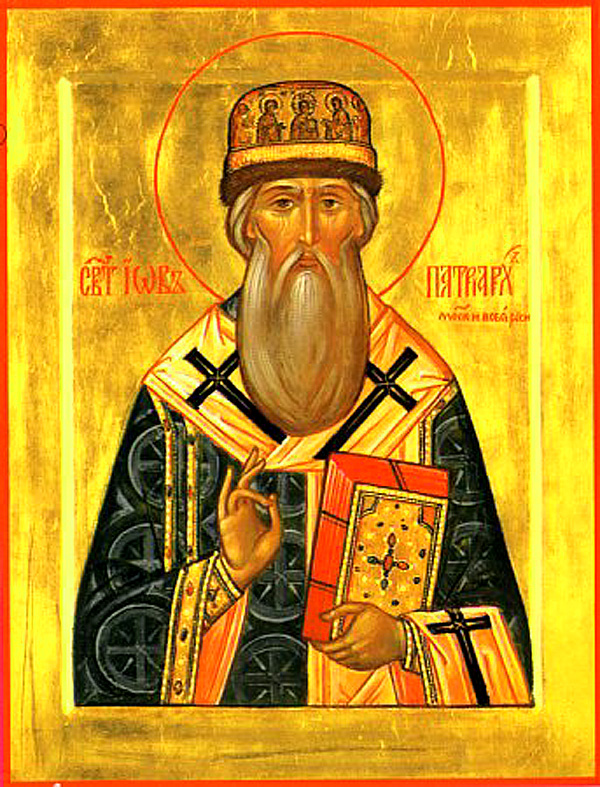
Repose of Saint Tikhon, Patriarch of Moscow, Enlightener of North America
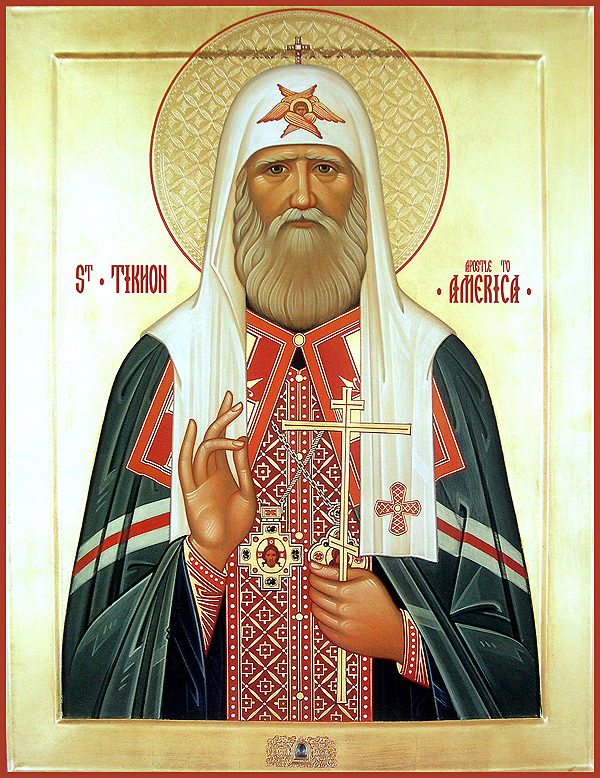
Saint Tikhon, Patriarch of Moscow and Apostle to America was born as Vasily Ivanovich Belavin on January 19, 1865 into the family of Ioann Belavin, a rural priest of the Toropetz district of the Pskov diocese. His childhood and adolescence were spent in the village in direct contact with peasants and their labor. From his early years he displayed a particular religious disposition, love for the Church as well as rare meekness and humility.

When Vasily was still a boy, his father had a revelation about each of his children. One night, when he and his three sons slept in the hayloft, he suddenly woke up and roused them. He had seen his dead mother in a dream, who foretold to him his imminent death, and the fate of his three sons. She said that one would be unfortunate throughout his entire life, another would die young, while the third, Vasily, would be a great man. The prophecy of the dead woman proved to be entirely accurate in regard to all three brothers.

From 1878 to 1883, Vasily studied at the Pskov Theological Seminary. The modest seminarian was tender and affectionate by nature. He was fair-haired and tall of stature. His fellow students liked and respected him for his piety, brilliant progress in studies, and constant readiness to help comrades, who often turned to him for explanations of lessons, especially for help in drawing up and correcting numerous compositions. Vasily was called “bishop” and “patriarch” by his classmates.

In 1888, at the age of 23, Vasily Belavin graduated from the Saint Petersburg Theological Academy as a layman, and returned to the Pskov Seminary as an instructor of Moral and Dogmatic Theology. The whole seminary and the town of Pskov became very fond of him. He led an austere and chaste life, and in 1891, when he turned 26, he took monastic vows. Nearly the whole town gathered for the ceremony. He embarked on this new way of life consciously and deliberately, desiring to dedicate himself entirely to the service of the Church. The meek and humble young man was given the name Tikhon in honor of Saint Tikhon of Zadonsk.

He was transferred from the Pskov Seminary to the Kholm Theological Seminary in 1892, and was raised to the rank of archimandrite. Archimandrite Tikhon was consecrated Bishop of Lublin on October 19, 1897, and returned to Kholm for a year as Vicar Bishop of the Kholm Diocese. Bishop Tikhon zealously devoted his energy to the establishment of the new vicariate. His attractive moral make-up won the general affection, of not only the Russian population, but also of the Lithuanians and Poles. On September 14, 1898, Bishop Tikhon was made Bishop of the Aleutians and Alaska. As head of the Orthodox Church in America, Bishop Tikhon was a zealous laborer in the Lord’s vineyard.

He did much to promote the spread of Orthodoxy, and to improve his vast diocese. He reorganized the diocesan structure, and changed its name from “Diocese of the Aleutians and Alaska” to “Diocese of the Aleutians and North America” in 1900. Both clergy and laity loved their archpastor, and held him in such esteem that the Americans made Archbishop Tikhon an honorary citizen of the United States.

On May 22, 1901, he blessed the cornerstone for Saint Nicholas Cathedral in New York, and was also involved in establishing other churches. On November 9, 1902, he consecrated the church of Saint Nicholas in Brooklyn for the Syrian Orthodox immigrants. Two weeks later, he consecrated Saint Nicholas Cathedral in NY.

In 1905, the American Mission was made an Archdiocese, and Saint Tikhon was elevated to the rank of Archbishop. He had two vicar bishops: Bishop Innocent (Pustynsky) in Alaska, and Saint Raphael (Hawaweeny) in Brooklyn to assist him in administering his large, ethnically diverse diocese. In June of 1905, Saint Tikhon gave his blessing for the establishment of Saint Tikhon’s Monastery.

In 1907, he returned to Russia, and was appointed to Yaroslavl, where he quickly won the affection of his flock. They came to love him as a friendly, communicative, and wise archpastor. He spoke simply to his subordinates, never resorting to a peremptory or overbearing tone. When he had to reprimand someone, he did so in a good-natured, sometimes joking manner, which encouraged the person to correct his mistakes.

When Saint Tikhon was transferred to Lithuania on December 22, 1913, the people of Yaroslavl voted him an honorary citizen of their town. After his transfer to Vilnius, he did much in terms of material support for various charitable institutions. There too, his generous soul and love of people clearly manifested themselves. World War I broke out when His Eminence was in Vilnius. He spared no effort to help the poor residents of the Vilnius region who were left without a roof over their heads or means of subsistence as a result of the war with the Germans, and who flocked to their archpastor in droves.

After the February Revolution and formation of a new Synod, Saint Tikhon became one of its members. On June 21, 1917, the Moscow Diocesan Congress of clergy and laity elected him as their ruling bishop. He was a zealous and educated archpastor, widely known even outside his country.

On August 15, 1917, a local council was opened in Moscow, and Archbishop Tikhon was raised to the dignity of Metropolitan, and then elected as chairman of the council. The council had as its aim to restore the life of Russian Orthodox Church on strictly canonical principles, and its primary concern was the restoration of the Patriarchate. All council members would select three candidates, and then a lot would reveal the will of God. The council members chose three candidates: Archbishop Anthony of Kharkov, the wisest, Archbishop Arseny of Novgorod, the strictest, and Metropolitan Tikhon of Moscow, the kindest of the Russian hierarchs.

On November 5, following the Divine Liturgy and a Molieben in the Cathedral of Christ the Savior, a monk removed one of the three ballots from the ballot box, which stood before the Vladimir Icon of the Mother of God. Metropolitan Vladimir of Kiev announced Metropolitan Tikhon as the newly elected Patriarch. Saint Tikhon did not change after becoming the primate of the Russian Orthodox Church. In accepting the will of the council, Patriarch Tikhon referred to the scroll that the Prophet Ezekiel had to eat, on which was written, “Lamentations, mourning, and woe.” He foresaw that his ministry would be filled with affliction and tears, but through all his suffering, he remained the same accessible, unassuming, and kindly person.

All who met Saint Tikhon were surprised by his accessibility, simplicity and modesty. His gentle disposition did not prevent him from showing firmness in Church matters, however, particularly when he had to defend the Church from her enemies. He bore a very heavy cross. He had to administer and direct the Church amidst wholesale church disorganization, without auxiliary administrative bodies, in conditions of internal schisms and upheavals by various adherents of the Living Church, renovationists, and autocephalists.

The situation was complicated by external circumstances: the change of the political system, by the accession to power of the godless regime, by hunger, and civil war. This was a time when Church property was being confiscated, when clergy were subjected to court trials and persecutions, and Christ’s Church endured repression. News of this came to the Patriarch from all ends of Russia. His exceptionally high moral and religious authority helped him to unite the scattered and enfeebled flock. At a crucial time for the church, his unblemished name was a bright beacon pointing the way to the truth of Orthodoxy. In his messages, he called on people to fulfill the commandments of Christ, and to attain spiritual rebirth through repentance. His irreproachable life was an example to all.

In order to save thousands of lives and to improve the general position of the church, the Patriarch took measures to prevent clergy from making purely political statements. On September 25, 1919, when the civil war was at its height, he issued a message to the clergy urging them to stay away from political struggle.

The summer of 1921 brought a severe famine to the Volga region. In August, Patriarch Tikhon issued a message to the Russian people and to the people of the world, calling them to help famine victims. He gave his blessing for voluntary donations of church valuables, which were not directly used in liturgical services. However, on February 23, 1922, the All-Russian Central Executive Committee published a decree making all valuables subject to confiscation.

According to the 73rd Apostolic Canon, such actions were regarded as sacrilege, and the Patriarch could not approve such total confiscation, especially since many doubted that the valuables would be used to combat famine. This forcible confiscation aroused popular indignation everywhere. Nearly two thousand trials were staged all over Russia, and more than ten thousand believers were shot. The Patriarch’s message was viewed as sabotage, for which he was imprisoned from April 1922 until June 1923.

His Holiness, Patriarch Tikhon did much on behalf of the Russian Orthodox Church during the crucial time of the so-called Renovationist schism. He showed himself to be a faithful servant and custodian of the undistorted precepts of the true Orthodox Church. He was the living embodiment of Orthodoxy, which was unconsciously recognized even by enemies of the church, who called its members “Tikhonites.”

When Renovationist priests and hierarchs repented and returned to the church, they were met with tenderness and love by Saint Tikhon. This, however, did not represent any deviation from his strictly Orthodox policy. “I ask you to believe me that I will not come to agreement or make concessions which could lead to the loss of the purity and strength of Orthodoxy,” the Patriarch said in 1924.

Being a good pastor, who devoted himself entirely to the church’s cause, he called upon the clergy to do the same: “Devote all your energy to preaching the word of God and the truth of Christ, especially today, when unbelief and atheism are audaciously attacking the Church of Christ. May the God of peace and love be with all of you!”

It was extremely painful and hard for the Patriarch’s loving, responsive heart to endure all the Church’s misfortunes. Upheavals in and outside the church, the Renovationist schism, his primatial labors, his concern for the organization and tranquility of Church life, sleepless nights and heavy thoughts, his confinement that lasted more than a year, the spiteful and wicked baiting of his enemies, and the unrelenting criticism sometimes even from the Orthodox, combined to undermine his strength and health.

In 1924, Patriarch Tikhon began to feel unwell. He checked into a hospital, but would leave it on Sundays and Feast Days in order to conduct services. On Sunday, April 5, 1925, he served his last Liturgy, and died two days later. On March 25/April 7, 1925 the Patriarch received Metropolitan Peter and had a long talk with him. In the evening, the Patriarch slept a little, then he woke up and asked what time it was. When he was told it was 11:45 P.M., he made the Sign of the Cross twice and said, “Glory to Thee, O Lord, glory to Thee.” He did not have time to cross himself a third time.

Almost a million people came to say farewell to the Patriarch. The large cathedral of the Donskoy Monastery in Moscow could not contain the crowd, which overflowed the monastery property into the square and adjacent streets. Saint Tikhon, the eleventh Patriarch of Moscow, was primate of the Russian Church for seven and a half years.

It would be difficult to imagine the Russian Orthodox Church without Patriarch Tikhon during those years. He did so much for the Church and for the strengthening of the Faith itself during those difficult years of trial. Perhaps his own words best sum up his life: “May God teach every one of us to strive for His truth, and for the good of the Holy Church, rather than something for our own sake.”

Saint Tikhon is also commemorated on September 26 / October 9 (the day of his glorification); October 5/18 (Synaxis of Moscow Saints); November 5/18 (his election to the Patriarchal throne); January 25 / February 7 (Synaxis of the New Martyrs and Confessors of Russia, if it is a Sunday, if not, then on the nearest Sunday to January 27; February 9/22 (the Discovery of his relics).

Saint George the Confessor, Bishop of Mytilene
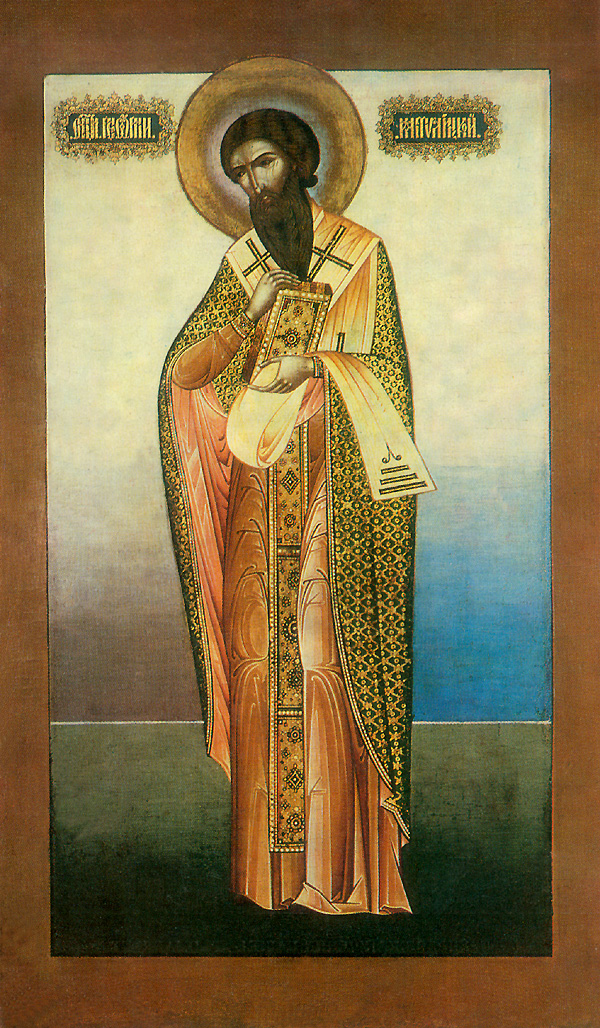
Saint George, Metropolitan of Mytilene, from his youth led a monastic life, and was especially accomplished in the virtue of humility. In the reign of Leo the Isaurian (716-741) the saint underwent persecution from the iconoclasts and became a Confessor.

During the reign of the emperor Constantine Porphyrogenitos (780-797) Saint George was elevated to the archbishopal cathedra of the city of Mytilene on the island of Lesbos. His life was radiant with prudence and purity and resembled the life of angels. He possessed a gift of wonderworking, cast out unclean spirits and healed incurable diseases. The saint distinguished himself by his compassion, and he helped all the needy. In 815, during the reign of the iconoclast Leo the Armenian (813-820), the holy archpastor was banished and sent to Cherson, where he died after the year 820.

At the hour of his death a bright star shone in the heavens over the city of Mytilene.

Venerable Daniel, Abbot of Pereslavl-Zalessky
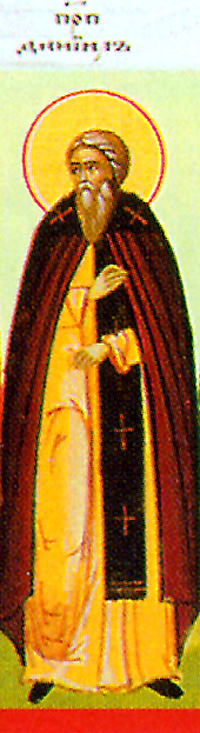
Saint Daniel of Pereslavl (in the world Demetrius) was born around 1460 in the city of Pereslavl-Zalessky. He was the son of pious and God-loving parents, Constantine and Theodosia, who later was tonsured as a nun with the name Thekla. Therefore, it is not surprising that from his childhood, Daniel had a great love for the monastic life. He learned a great deal about the angelic life from Igumen Jonah of the Monastery of Saint Nikḗtas the Stylite (May 24) at Pereyaslavl.

When Saint Daniel arrived at the Borov monastery in 1466, Saint Paphnutius (May 1) entrusted him to Elder Leucius of Volokolamsk (August 17), who was an experienced ascetic in the spiritual life. Saint Leucius was a disciple of Saint Paphnutius of Borov and an associate of Saint Joseph of Volokolamsk (September 9).Under his guidance, Saint Daniel reached his spiritual maturity.

Years later, Saint Daniel returned to Pereyaslavl, and there he demonstrated much love for his neighbor. He buried the neglected, the poor, and those without any family. The saint also founded a monastery on the site of the cemetery.

Anticipating the approach of death, Archimandrite Daniel was tonsured into the Great Schema. The blessed Elder reposed on April 7, 1540, in the 81st year of his life. His incorrupt relics were recovered in 1625.

The Lord glorified His saint with numerous miracles. Saint Daniel is also commemorated on December 30 and July 28.

Martyr Calliopius at Pompeiopolis in Cilicia

The Holy Martyr Calliopius was born in Perge, Pamphylia of the pious woman Theoklia, wife of a renowned senator. Theoklia was childless for a long time. She fervently prayed for a son, vowing to dedicate him to God.

Soon after the birth of her son Theoklia was widowed. When Saint Calliopius reached adolescence, a fierce persecution against Christians began. Theoklia, learning that her son would be denounced as a Christian, sent him to Cilicia in Asia Minor.

When the saint arrived at Pompeiopolis, Paphlagonia there was a celebration in honor of the pagan gods. They invited the youth to take part in the proceedings, but he said he was a Christian and refused. They reported this to the prefect of the city Maximus. Saint Calliopius was brought before him to be tried. At first, he attempted to persuade Calliopius to worship the gods, promising to give him his own daughter in marriage. After the youth rejected this offer, Maximus subjected him to terrible tortures. He ordered the martyr to be beaten on the back with iron rods, and on the stomach with ox-hide thongs. Finally, the prefect had him tied to an iron wheel, and he was roasted over a slow fire. After these tortures, they threw the martyr Calliopius into prison.

When Theoklia heard about the sufferings of her son, she wrote her last will, freed her slaves, distributed her riches to the poor, and hastened to Saint Calliopius. The brave mother gave money to the guard and got into the prison to see her son. There she encouraged him to endure suffering to the end for Christ.

When on the following day the saint refused to renounce Christ, Maximus gave orders to crucify the martyr. The day of execution happened to be Great Thursday, when the Savior’s last meal with His disciples is commemorated.

Theoklia begged the guard to crucify her son head downward, since she considered it unworthy for him to be crucified like the Lord. Her wish was granted. The holy martyr hung on the cross overnight and died on Great Friday in the year 304.

When the holy martyr was removed from the cross, Theoklia gave glory to the Savior. She embraced the lifeless body of her son and gave up her own spirit to God. Christians buried their bodies in a single grave.

Martyrs Rufinus the Deacon, Aquilina, and 200 soldiers with them at Sinope
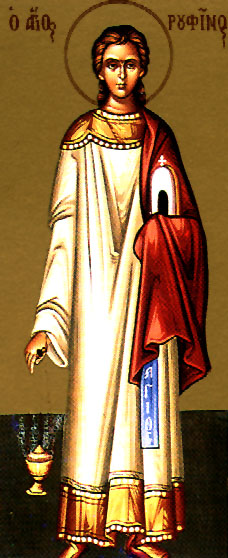
After the Emperors Diocletian and Maximian abdicated in 305, Maximinus Daia was elevated to the rank of Caesar and was given the eastern provinces and Egypt to govern. He continued Diocletian's severe persecution of Christians, and in 306 he issued an edict requiring every man, woman, and child to offer sacrifice to the pagan "gods." Even babies were forced to eat the flesh of sacrificial victims, whose blood was sprinkled on every item sold in the markets.

When Maximinus became Emperor in 310, Rufinus, a deacon of the Church at Sinope (Σινώπη) on the Black Sea, was converting many people to Christianity. For this reason, he was arrested and imprisoned.

A noble Christian woman named Aquilina was also arrested and put in jail because she visited Rufinus and took care of him. Both Saints were brought before a judge, who ordered that they be subjected to horrible torments after they had confessed their faith in Christ. Finally, Saint Rufinus was beheaded, and Saint Aquilina received the crown of martyrdom by fire. Her hands were tied behind her back while her stomach was burned, thereby causing her death.

After witnessing the suffering and the miracles of Saints Rufinus and Aquilina, 200 soldiers were converted to Christ, by the grace of God. The infuriated ruler ordered that every one of them be put to death. They were bound and led to the place of execution, where all the martyrs were beheaded and received their incorruptible crowns of glory from the Lord.

Venerable Serapion of Egypt

Saint Serapion lived during the fifth century in Egypt. He was called the linen cloth-wearer (Sindonite) since he wore only a coarse linen garb called a “sindon.” From his youth the monk lived like the birds of the air, without a shelter.

For several days at a time he did not eat, not having the means to buy bread. He gave away his sindon to a beggar who was shivering from the cold, and he himself was naked.

A certain Greek philosopher, wishing to test the non-covetousness of the monk, gave him a gold coin and watched him. The saint went to the bakery, bought one loaf of bread, gave the merchant the gold coin and left, having no regard for the value of the money.

Saint Serapion led many on the way of salvation. Once, he was the servant of a Greek actor, whom he converted to Christ. The actor, imitating the example of the holy life of the saint, believed and was baptized together with all his family. He asked Saint Serapion to remain with him not as a servant, but as a guide and friend, but the monk went away, not taking any of the money offered him.

Traveling to Rome, Saint Serapion got on a ship, but paid nothing to the ship owners. At first they began to reproach him for this, but noticing that the Elder had gone five days already without eating, they began to feed him for the sake of God, and in this they fulfilled the command of the Lord.

At Rome, the saint continued to wander about, going from house to house, having nothing, accumulating only spiritual wealth for himself and for his neighbor.

Daily Readings for Wednesday, April 06, 2022

5TH WEDNESDAY OF LENT

ABSTAIN FROM MEAT, FISH, DAIRY, EGGS, WINE, OLIVE OIL

Eutychius, Patriarch of Constantinople, 120 Martyrs of Persia, Gregory of Sinai, Platonis the Nun of Nisibis

ISAIAH 41:4-14

Who has performed and done this, calling the generations from the beginning? I, the LORD, the first, and with the last; I am He. The coastlands have seen and are afraid, the ends of the earth tremble; they have drawn near and come. Every one helps his neighbor, and says to his brother, “Take courage!” The craftsman encourages the goldsmith, and he who smoothes with the hammer him who strikes the anvil, saying of the soldering, “It is good”; and they fasten it with nails so that it cannot be moved. But you, Israel, my servant, Jacob, whom I have chosen, the offspring of Abraham, my friend; you whom I took from the ends of the earth, and called from its farthest corners, saying to you, “You are my servant, I have chosen you and not cast you off”; fear not, for I am with you, be not dismayed, for I am your God; I will strengthen you, I will help you, I will uphold you with my victorious right hand. Behold, all who are incensed against you shall be put to shame and confounded; those who strive against you shall be as nothing and shall perish. You shall seek those who contend with you, but you shall not find them; those who war against you shall be as nothing at all. For I, the LORD your God, hold your right hand; it is I who say to you, “Fear not, I will help you.” Fear not, you worm Jacob, you men of Israel! I will help you, says the LORD; your Redeemer is the Holy One of Israel.

GENESIS 17:1-9

When Abram was ninety-nine years old the LORD appeared to Abram, and said to him, “I am God Almighty; walk before me, and be blameless. And I will make my covenant between me and you, and will multiply you exceedingly.” Then Abram fell on his face; and God said to him, “Behold, my covenant is with you, and you shall be the father of a multitude of nations. No longer shall your name be Abram, but your name shall be Abraham; for I have made you the father of a multitude of nations. I will make you exceedingly fruitful; and I will make nations of you, and kings shall come forth from you. And I will establish my covenant between me and you and your descendants after you throughout their generations for an everlasting covenant, to be God to you and to your descendants after you. And I will give to you, and to your descendants after you, the land of your sojournings, all the land of Canaan, for an everlasting possession; and I will be their God.”

PROVERBS 15:20-16:9

A wise son makes a glad father, but a foolish man despises his mother. Folly is a joy to him who has no sense, but a man of understanding walks aright. Without counsel plans go wrong, but with many advisers they succeed. To make an apt answer is a joy to a man, and a word in season, how good it is! The wise man’s path leads upward to life, that he may avoid Sheol beneath. The LORD tears down the house of the proud, but maintains the widow’s boundaries. The thoughts of the wicked are an abomination to the LORD, the words of the pure are pleasing to him. He who is greedy for unjust gain makes trouble for his household, but he who hates bribes will live. The mind of the righteous ponders how to answer, but the mouth of the wicked pours out evil things. The LORD is far from the wicked, but he hears the prayer of the righteous. The light of the eyes rejoices the heart, and good news refreshes the bones. He whose ear heeds wholesome admonition will abide among the wise. He who ignores instruction despises himself, but he who heeds admonition gains understanding. The fear of the LORD is instruction in wisdom, and humility goes before honor. The plans of the mind belong to man, but the answer of the tongue is from the LORD. All the ways of a man are pure in his own eyes, but the LORD weighs the spirit. Commit your work to the LORD, and your plans will be established. The LORD has made everything for its purpose, even the wicked for the day of trouble. Every one who is arrogant is an abomination to the LORD; be assured, he will not go unpunished. By loyalty and faithfulness iniquity is atoned for, and by the fear of the LORD a man avoids evil. When a man’s ways please the LORD, he makes even his enemies to be at peace with him. Better is a little with righteousness than great revenues with injustice. A man’s mind plans his way, but the LORD directs his steps.

Saint Eutychius, Patriarch of Constantinople

Saint Eutychius, Archbishop of Constantinople, was born in a village called “Divine” in the province of Phrygia. His father Alexander was a soldier, and his mother Synesia was the daughter of the priest Hesychius of Augustopolis. Saint Eutychius received the first rudiments of his education and a Christian upbringing from his grandfather the priest.

Once, while playing a childhood game, the boy wrote his own name with the title of Patriarch. By this he seemed to predict his future service. He was sent to Constantinople at age twelve for further education. The youth persevered in his study of science and realized that human wisdom is nothing in comparison to the study of divine Revelation. Therefore, he decided to dedicate himself to monastic life. Saint Eutychius withdrew into one of the Amasean monasteries and received the angelic schema. For his strict life he was made archimandrite of all the Amasean monasteries, and in 552 was appointed to the Patriarchal throne.

When the Fifth Ecumenical Council prepared to assemble during the reign of the holy emperor Justinian (527-565), the Metropolitan of Amasea was ill and he sent Saint Eutychius in his place. At Constantinople the aged Patriarch Saint Menas (August 25) saw Saint Eutychius and predicted that he would be the next Patriarch. After the death of the holy Patriarch Menas, the Apostle Peter appeared in a vision to the emperor Justinian and, pointing his hand at Eutychius, said, “Let him be made your bishop.”

At the very beginning of his patriarchal service, Saint Eutychius convened the Fifth Ecumenical Council (553), at which the Fathers condemned the heresies cropping up and anathematized them. However, after several years a new heresy arose in the Church: Aphthartodocetism [asartodoketai] or “imperishability” which taught that the flesh of Christ, before His death on the Cross and Resurrection, was imperishable and not capable of suffering.

Saint Eutychius vigorously denounced this heresy, but the emperor Justinian himself inclined toward it, and turned his wrath upon the saint. By order of the emperor, soldiers seized the saint in the church, removed his patriarchal vestments, and sent him into exile to an Amasean monastery (565).

The saint bore his banishment with meekness, and lived at the monastery in fasting and prayer, and he worked many miracles and healings.

Thus, through his prayer the wife of a devout man, Androgenes, who had given birth only to dead infants, now gave birth to two sons who lived to maturity. Two deaf-mutes received the gift of speech; and two grievously ill children were restored to health. The saint healed a cancerous ulcer on the hand of an artist. The saint also healed another artist, anointing his diseased hand with oil and making over it the Sign of the Cross.

The saint healed not only bodily, but also spiritual afflictions: he banished the devil out of a girl that had kept her from Holy Communion; he expelled a demon from a youth who had fled from a monastery (after which the youth returned to his monastery); he healed a drunken leper, who stopped drinking after being cleansed of his leprosy.

During the Persian invasion of Amasea and its widespread devastation, they distributed grain to the hungry from the monastery granaries on the saint’s orders, and by his prayers, the stores of grain at the monastery were not depleted.

Saint Eutychius received from God the gift of prophecy. He revealed the names of two of Emperor Justinian’s successors: Justin (565-578) and Tiberias (578-582).

After the death of the holy Patriarch John Scholastikos, Saint Eutychius returned to the cathedra in 577 after his twelve year exile, and he again wisely ruled his flock.

Four and a half years after his return to the Patriarchal throne, in 582, Saint Eutychius gathered together all his clergy on Thomas Sunday, blessed them, and peacefully fell asleep in the Lord.

Saint Methodius, Equal of the Apostles, Archbishop of Moravia, Enlightener of the Slavs

Saint Methodius, Archbishop of Moravia, died on April 6 in the year 885. His Life is found on May 11, when he is commemorated with Saint Cyril, Teacher of the Slavs.

Saint Platonida of Nisibis, Syria

Saint Platonida (Platonis) was at first a deaconess, but afterwards withdrew into the Nisibis desert, where she organized a women’s monastery.

The Rule of her monastery was distinguished for its strictness. The sisters partook of food only once a day. When they were not praying, they spent their time in monastic labors and various obediences.

On Fridays, the day commemorating the sufferings of Christ the Savior on the Cross, all work stopped, and the nuns were in church from morning until evening, where between services they read from Holy Scripture and from commentaries on it.

Saint Platonida was for all the sisters a living example of strict monastic asceticism, meekness, and love for neighbor. Having reached a great old age, Saint Platonida died peacefully in the year 308.

120 Martyrs of Persia

The Holy 120 Martyrs suffered under the Persian emperor Sapor. They were taken into captivity during the reign of the Byzantine Emperor Constantios (337-361). They were consigned to the flames after firmly confessing their faith (c.344-347). Saint Shandulios (November 3) concealed their relics from desecration by the pagans. Among the holy martyrs were ten virgins, who had dedicated themselves to the service of God.

Martyrs Jeremiah and Presbyter Archilias

The Holy Martyrs Jeremiah and the Priest Archilius (Alchimius) suffered martyrdom in the third century. Saint Gregory Dialogus (March 12) mentions them.

Venerable Gregory the Byzantine

Saint Gregory was a native of Constantinople, and pursued an ascetic life on Mt. Athos in the Lavra of Saint Athanasius (July 5). He was the spiritual guide of Saint Gregory Palamas (November 14).

Monastic Martyr Gennadius of Dionysiou on Mount Athos

No information available at this time.

4/10 announcements

April 10, 2022

Fifth Sunday of Great Lent

Commemoration of St. Mary of Egypt

The facts of the life of St. Mary of Egypt are vague and clouded by time and separation, but the spirit of her story is a clear call to repentance and devotion. According to tradition, Mary was from Alexandria, where she was an actress and courtesan, living a life of sin and infamy. When spiritual intervention forbade her entry to Holy Sepulchre in Jerusalem, she spent the night in penitent prayer. The following morning, she was able to enter, whereupon she venerated the cross and immediately removed herself to the life of a penitent and solitary in the Palestinian desert. She remained in isolation for forty-seven years, aided only by monks of the region and God’s grace. Only at her death was she found and given communion by the priest Zosimus. On this last Sunday of Lent, as we prepare for Palm Sunday, Holy Week, and the Great Feast of the eighth and eternal day, we call to mind this holy woman, her fear of the all-powerful God, her recognition of her sin, her repentance, her humility, her faith, and her unwavering intent to seek righteousness and the courts of her King.

Hebrews 9:11-14: Brethren, Christ having appeared a High Priest of the good things to come, through the greater and more perfect tabernacle, not made with hands, that is to say, not of this creation; neither through the blood of goats and calves, but through His own blood, entered in once for all into the holy place, having found eternal redemption. For if the sprinkling of defiled persons with the blood of bulls and goats and with the ashes of a heifer sanctifies for the purification of the flesh, how much more shall the blood of Christ, who through the eternal Spirit offered Himself without blemish to God, purify your conscience from dead works to serve the living God?

Mark 10:32-45: At that time, Jesus took His twelve Disciples, and began to tell them what was to happen to Him, saying, “Behold, we are going up to Jerusalem. And the Son of man will be delivered to the chief priests and the scribes, and they will condemn Him to death, and deliver Him to the Gentiles. And they will mock Him, and scourge Him, and spit upon Him, and kill Him; and after three days He will rise.” And James and John, the sons of Zebedee, came forward to Him, and said to Him, “Teacher, we would that thou shouldest do for us whatsoever we shall desire” And Jesus said to them, “What do you want Me to do for you?” And they said to Him, “Grant us to sit, one at Thy right hand and one at Thy left, in Thy glory.” But Jesus said to them, “You do not know what you are asking. Are you able to drink the cup that I drink, or to be baptized with the baptism with which I am baptized?” And they said to Him, “We are able.” And Jesus said to them, “The cup that I drink you will drink; and with the baptism with which I am baptized, you will be baptized. But to sit at My right hand or at My left is not Mine to grant, but it is for those for whom it has been prepared.” And when the ten heard it, they began to be indignant at James and John. And Jesus called them to Him and said to them, “You know that those who are supposed to rule over the Gentiles lord it over them, and their great men exercise authority over them. But it shall not be so among you; but whoever would be great among you must be your servant, and whoever would be first among you must be servant of all. For the Son of man also came not to be served but to serve, and to give His life as a ransom for many.”

Troparion of the Resurrection: The stone being sealed by the Jews, and thy pure body being guarded by the soldiers, thou didst arise on the third day, O Saviour, granting life to the world. Wherefore, the heavenly powers acclaimed thee, O Giver of life, crying, Glory to thy Resurrection, O Christ! Glory to thy kingdom! Glory to thy gracious providence, O only Lover of mankind.

Troparion of St. Mary of Egypt: Through thee the divine likeness was securely preserved, O Mother Mary; for thou didst carry the cross and followed Christ. By example and precept thou didst teach us to ignore the body because it is perishable, and to attend to the concerns of the undying soul. Therefore, doth thy soul rejoice with the angels.

Troparion of the Chains of St. Peter: O Holy Apostle, Peter, thou dost preside over the Apostles by the precious chains which thou didst bear. We venerate them with faith and beseech thee that by thine intercessions we be granted the great mercy.

Kontakion of the Theotokos: O undisputed intercessor of Christians, O mediatrix, who is unrejected by the Creator, turn not away from the voice of our petitions though we be sinners; come to us in time, who cry to thee in faith, for thou art good. Hasten to us with intercessions, O Theotokos, who didst ever intercede for those who honor thee.

CALENDAR

UNTIL FURTHER NOTICE: All services listed on the calendar will be available through streaming and webcast.

Please continue to follow the CDC Guidelines to limit contagion and the spread of the COVID virus.

Sunday, April 10 (Commemoration of St. Mary of Egypt)

8:50 a.m. — Orthros (webcast)

9:00 a.m. — Christian Education

10:00 a.m. — Divine Liturgy (webcast)

Monday, April 11

Father Herman off

Tuesday, April 12

NO Services

Wednesday, April 13

6:30 p.m. — Pre-sanctified Liturgy with Soup Supper

Thursday, April 14

NO Services

Friday, April 15

6:30 p.m. — Small Compline with the Canon of St. Lazarus

Saturday, April 16 (Lazarus Saturday)

9:00 a.m. — Orthros followed by Divine Liturgy


12:00 p.m. — Making arrangements with large palms and dyeing red eggs

3:45 p.m. — Choir Practice

6:00 p.m. — Great Vespers

Sunday, April 17 (Palm Sunday)

8:50 a.m. — Orthros (webcast)

9:00 a.m. — Christian Education

10:00 a.m. — Divine Liturgy (webcast)

12:00 p.m. — Fish Fry Meal

SPECIAL ANNOUNCEMENTS

The Eucharist Bread …was offered by the Joneses for last Sunday’s Divine Liturgy and by the Morrises for the Divine Liturgy this morning.

Eucharist Bread Schedule:

Eucharist Bread Coffee Hour

April 10 Morris Lasseter/Pacurari/Miller

April 16 (Sat. a.m.) Meadows Henderson/Jones

(Lazarus Saturday)

April 17 (Palm Sunday) Davis D. Root/Baker

April 21 (Thurs. a.m.) D. Root Meadows

April 23 (Sat. a.m.) Karam Dansereau/Alaeetawi

April 23 (Sat. p.m.) Brock

Schedule for Epistle Readers – Page numbers refer to the Apostolos (book of the Epistles) located on the Chanters’ stand at the front of the nave. Please be sure to use this book when you read.

Reader Reading Page#

April 10 Ian Jones Heb. 9:11-14 290

April 16 (Sat. a.m.) Brenda Baker Heb. 12:28-13:8 291

April 17 Sam Habeeb Phil. 4:4-9 294

April 21 (Thurs. a.m.) Ian Jones I Cor. 11:23-32 295

April 23 (Sat. a.m.) Reader Basil Baker Rom. 6:3-11 300

April 23 (Sat. p.m.) Walt Wood Acts 1:1-8 25

Also, please remember that we still need your tithes and offerings which may be placed in the tithe box at the back of the nave or be mailed to: St. Peter Orthodox Church, P.O. Box 2084, Madison, MS 39130-2084.

Continue to pray for Metropolitan Paul (who is also the brother of our Patriarch) and the Syriac Archbishop John of Aleppo who were abducted while on a humanitarian mission in Syria.

Please remember Fr. Joseph and Kh. Joanna Bittle, and their daughter Abigail, in your prayers.

Please remember the following in your prayers: Aidan Milnor, the Milnor family; Lamia Dabit and her family; Mary Greene (Lee and Kh. Sharon’s sister); Jay and Joanna Davis; Fr. Leo and Kh. Be’Be’ Schelver and their family; Kathy Willingham; Marilyn (Kyriake) Snell; Jack and Jill Weatherly; Lottie Dabbs (Sh. Charlotte Algood’s mother), Sh. Charlotte and their family; Maria Costas (currently at St. Catherine’s Village); Reader Basil and Brenda Baker; Buddy Cooper.

If you are not feeling well, PLEASE do not attempt to come to the services. This also includes anyone who may have been exposed to you during this time. Also, please let Fr. Herman know if you are not feeling well and have COVID like symptoms.

Anthony Johnson, son of former members Cain (Joshua) and Taylor Johnson, will be baptized during the Vesperal Divine Liturgy of Great and Holy Saturday on the morning of April 23rd. Simon and Rola Karam will be his godparents. Please keep all of them in your prayers.

On April 10th we will celebrate a Forty Day Memorial for Galina Singletary’s mother, Valentina, who passed away recently in Russia.

Calendar Items:

* The Ladies will meet at the church at 10:00 a.m. on the second Saturday of the month to pray the Akathist to the Mother of God, Nurturer of Children on behalf of our children.

* The Ladies will meet for lunch on the last Tuesday of the month.

* We will have our last Pre-sanctified Liturgy on Wednesday evening, April 13th, beginning at 6:30 p.m. (There will be a Soup Supper afterwards, although one was not listed on the April Calendar.)

* The dates for Services of Palm Sunday and Holy Week are as follows:

Friday, April 15 — Small Compline with the Canon of St. Lazarus at 6:30 p.m.

Saturday, April 16 (Lazarus Saturday) — Orthros followed by Divine Liturgy at 9:00 a.m.

Sunday, April 17 (Palm Sunday) — morning services at usual Sunday times

(Sunday evening) — Bridegroom Matins, at 6:30 p.m.

Monday, April 18 (Great and Holy Monday)

Daily Readings for Tuesday, April 05, 2022

5TH TUESDAY OF LENT

ABSTAIN FROM MEAT, FISH, DAIRY, EGGS, WINE, OLIVE OIL

Monk-Martyrs Claudius, Diodore, Victor, Victorinus, Pappias, Nicephorus, and Serapion, Theodora the Righteous of Thessaloniki, Agathopodes and Theodulos the Martyrs, George the new Martyr

ISAIAH 40:18-31

Thus says the LORD: To whom then will you liken God, or what likeness compare with him? The idol! a workman casts it, and a goldsmith overlays it with gold, and casts for it silver chains. He who is impoverished chooses for an offering wood that will not rot; he seeks out a skilful craftsman to set up an image that will not move. Have you not known? Have you not heard? Has it not been told you from the beginning? Have you not understood from the foundations of the earth? It is he who sits above the circle of the earth, and its inhabitants are like grasshoppers; who stretches out the heavens like a curtain, and spreads them like a tent to dwell in; who brings princes to nought, and makes the rulers of the earth as nothing. Scarcely are they planted, scarcely sown, scarcely has their stem taken root in the earth, when he blows upon them, and they wither, and the tempest carries them off like stubble. To whom then will you compare me, that I should be like him? Says the Holy One. Lift up your eyes on high and see: who created these? He who brings out their host by number, calling them all by name; by the greatness of his might, and because he is strong in power not one is missing. Why do you say, O Jacob, and speak, O Israel, “My way is hid from the LORD, and my right is disregarded by my God”? Have you not known? Have you not heard? The LORD is the everlasting God, the Creator of the ends of the earth. He does not faint or grow weary, his understanding is unsearchable. He gives power to the faint, and to him who has no might he increases strength. Even youths shall faint and be weary, and young men shall fall exhausted; but they who wait for the LORD shall renew their strength, they shall mount up with wings like eagles, they shall run and not be weary, they shall walk and not faint.

GENESIS 15:1-15

After these things the word of the LORD came to Abram in a vision, “Fear not, Abram, I am your shield; your reward shall be very great.” But Abram said, “O Lord GOD, what wilt thou give me, for I continue childless, and the heir of my house is Eliezer of Damascus?” And Abram said, “Behold, thou hast given me no offspring; and a slave born in my house will be my heir.” And behold, the word of the LORD came to him, “This man shall not be your heir; your own son shall be your heir.” And he brought him outside and said, “Look toward heaven, and number the stars, if you are able to number them.” Then he said to him, “So shall your descendants be.” And he believed the LORD; and he reckoned it to him as righteousness. And he said to him, “I am the LORD who brought you from Ur of the Chaldeans, to give you this land to possess.” But he said, “O Lord GOD, how am I to know that I shall possess it?” He said to him, “Bring me a heifer three years old, a she-goat three years old, a ram three years old, a turtledove, and a young pigeon.” And he brought him all these, cut them in two, and laid each half over against the other; but he did not cut the birds in two. And when birds of prey came down upon the carcasses, Abram drove them away. As the sun was going down, a deep sleep fell on Abram; and lo, a dread and great darkness fell upon him. Then the LORD said to Abram, “Know of a surety that your descendants will be sojourners in a land that is not theirs, and will be slaves there, and they will be oppressed for four hundred years; but I will bring judgment on the nation which they serve, and afterward they shall come out with great possessions. As for yourself, you shall go to your fathers in peace; you shall be buried in a good old age.

PROVERBS 15:7-19

The lips of the wise spread knowledge; not so the minds of fools. The sacrifice of the wicked is an abomination to the LORD, but the prayer of the upright is his delight. The way of the wicked is an abomination to the LORD, but he loves him who pursues righteousness. There is severe discipline for him who forsakes the way; he who hates reproof will die. Sheol and Abaddon lie open before the LORD, how much more the hearts of men! A scoffer does not like to be reproved; he will not go to the wise. A glad heart makes a cheerful countenance, but by sorrow of heart the spirit is broken. The mind of him who has understanding seeks knowledge, but the mouths of fools feed on folly. All the days of the afflicted are evil, but a cheerful heart has a continual feast. Better is a little with the fear of the LORD than great treasure and trouble with it. Better is a dinner of herbs where love is than a fatted ox and hatred with it. A hot-tempered man stirs up strife, but he who is slow to anger quiets contention. The way of a sluggard is overgrown with thorns, but the path of the upright is a level highway.

Martyrs Agathopodes the Deacon and Theodulus the Reader at Thessalonica

The Holy Martyrs Agathopodes the Deacon and Theodulus the Reader lived in Thessalonica during the reign of the emperor Diocletian (284-305) and Maximian (284-305) and were among the church clergy. The holy Deacon Agathopodes was very old, and Saint Theodulus very young.

Both distinguished themselves by righteous life and piety. Once, Saint Theodulus had a vision in his sleep, in which an unknown person in radiant garb placed some object in his hand. When he awoke, he saw in his hand a beautiful ring with the image of the Cross and he realized that this was a sign of his future martyrdom. By the power of the Cross depicted on the ring, the saint healed many of the sick and converted pagans to faith in Christ the Savior.

When the emperor Diocletian issued an edict of a persecution against Christians (303), many attempted to hide themselves from pursuit, but Saints Agathopodes and Theodulus fearlessly continued to proclaim the Gospel.

Governor Faustinus of Thessalonica heard of this, and gave orders to bring them to him for trial. Seeing the youth and excellence of Saint Theodulus, Faustinus attempted flattery to persuade him to renounce Christianity and to offer sacrifice. Saint Theodulus replied that he had long ago renounced error and that he pitied Faustinus, who by embracing paganism had condemned himself to eternal death. The governor offered the martyr a choice: the fortunes of life, or immediate death. The saint said that he would certainly choose life, but life eternal, and that he did not fear death.

When Faustinus saw that he would not persuade Theodulus, he began to talk with Saint Agathopodes. The governor attempted to deceive him and said that Saint Theodulus had already agreed to offer sacrifice to the gods. But Agathopodes did not believe this. He was convinced that Saint Theodulus was prepared to offer his life for the Lord Jesus Christ.

Not having any success, Faustinus commanded the martyrs to be taken to prison. The holy martyrs prayed fervently and boldly preached the Word of God to the imprisoned, so that many were converted to Christianity. Eutinios, the head of the prison, reported this to the governor.

Faustinus again summoned them to trial and again he urged them to renounce Christ. Before the eyes of Saint Theodulus they brought forth some who had been Christians, but betrayed the Faith. “You have conquered the weak, but you will never conquer the strong warriors of Christ, even if you invent greater torments,” exclaimed Saint Theodulus. The governor commanded the martyr to produce the Christian books. “Here, is my body given for torture,” he answered, “do with it what you wish; torture me fiercely, but I shall not hand over the sacred writings to be mocked by the impious!”

Faustinus gave orders to bring Saint Theodulus to the place of execution, where an executioner readied a sword in order to cut off his head. The martyr bravely and with joy cried out, “Glory to You, O God, the Father of my Lord Jesus Christ, Who deigned to suffer for us. Here, by His grace, I am coming to You, and with joy I die for You!”

Then Faustinus halted the execution and again locked up the martyrs in prison. There the holy martyrs prayed fervently and both had the same dream. They were sailing in a ship, which was in danger of being wrecked in a storm. The waves cast them up on shore, arrayed in radiant white clothing. The saints told each other about the vision, and they gave thanks to God for their impending martyrdom.

In the morning, when the martyrs were again brought to Faustinus, they declared to him: “We are Christians and we are prepared to undergo any suffering for Christ.” Faustinus gave orders to cast them into the sea. The waves carried Saint Agathopodes to the rocks, and he loudly exclaimed, “This shall be for us a second Baptism, which will wash away our sins, and we shall come to Christ in purity.” Saint Theodulus was also cast into the sea (+ 303).

The bodies of the saints were washed up on shore. They were dressed in radiant garb, but the ropes and stones used to weight them down were gone. Christians took their holy bodies and gave them reverent burial.

Venerable Publius of Egypt

Saint Publius lived a life of asceticism in the Egyptian desert during the reign of the emperor Julian the Apostate (361-363). Before a military campaign against the Persians, the emperor sent a devil to explore the way for the army to go. The venerable Publius foresaw the intent of the emperor. He stood in prayer with upraised hands, praying day and night, and blocked the path of the devil.

For ten days the evil spirit waited until the monk concluded his prayer. Unable to proceed, he returned to the emperor and reported that he had been thwarted. In a rage against Saint Publius, Julian the Apostate vowed to avenge himself on the saint upon his return from the campaign. He did not fulfill this oath, since he soon perished.

After the death of Julian, one of his military commanders distributed his effects and received monastic tonsure at the hand of Saint Publius.

Saint Theonas of Egypt

No information available at this time.

Saint Simeon of Egypt

No information available at this time.

Saint Phorbinus of Egypt

No information available at this time.

Venerable Mark the Anchorite of Athens

Saint Mark was born in Athens. He related his life to Abba Serapion who, by the will of God, visited him before his death.

He had studied philosophy in his youth. After the death of his parents, Saint Mark withdrew into Egypt and settled into a cave of Mount Trache (in Ethiopia). He spent ninety-five years in seclusion and during this time not only did he not see a human face, but not even a beast or bird.

The first thirty years were the most difficult for Saint Mark. Barefoot and bedraggled, he suffered from the cold in winter, and from the heat in summer. The desert plants served him for food, and sometimes he had to eat the dust and drink bitter sea water. Unclean spirits chased after Saint Mark, promising to drown him in the sea, or to drag him down from the mountain, shouting, “Depart from our land! From the beginning of the world no one has come here. Why have you dared to come?”

After thirty years of tribulation, divine grace came upon the ascetic. Angels brought him food, and long hair grew on his body, protecting him from the cold and heat. He told Abba Serapion, “I saw the likeness of the divine Paradise, and in it the prophets of God Elias and Enoch. The Lord sent me everything that I sought.”

During his conversation with Abba Serapion, Saint Mark inquired how things stood in the world. He asked about the Church of Christ, and whether persecutions against Christians still continued. Hearing that idol worship had ceased long ago, the saint rejoiced and asked, “Are there now in the world saints working miracles, as the Lord spoke of in His Gospel, ‘If ye have faith even as a grain of mustard seed, ye will say to this mountain, move from that place, and it will move, and nothing shall be impossible for you’ (Mt.17:20)?”

As the saint spoke these words, the mountain moved from its place 5,000 cubits (approximately 2.5 kilometers) and went toward the sea. When Saint Mark saw that the mountain had moved, he said, “I did not order you to move from your place, but was conversing with a brother. Go back to your place!” After this, the mountain actually returned to its place. Abba Serapion fell down in fright. Saint Mark took him by the hand and asked, “Have you never seen such miracles in your lifetime?”

“No, Father,” Abba Serapion replied. Then Saint Mark wept bitterly and said, “Alas, today there are Christians in name only, but not in deeds.”

After this, Saint Mark invited Abba Serapion to a meal and an angel brought them food. Abba Serapion said that never had he eaten such tasty food nor drunk such sweet water. “Brother Serapion,” answered Saint Mark, “did you see what beneficence God sends His servants? In all my days here God sent me only one loaf of bread and one fish. Now for your sake He has doubled the meal and sent us two loaves and two fishes. The Lord God has nourished me with such meals ever since my first sufferings from evil.”

Before his death, Saint Mark prayed for the salvation of Christians, for the earth and everything in the world living upon it in the love of Christ. He gave final instructions to Abba Serapion to bury him in the cave and to cover the entrance. Abba Serapion was a witness of how the soul of the one-hundred-thirty-year-old Elder Mark was taken to Heaven by angels.

After the burial of the saint, two angels in the form of hermits guided Abba Serapion into the inner desert to the great Elder John. Abba Serapion told the monks of this monastery about the life and death of Saint Mark.

Saint Plato the Confessor of Studion

Saint Plato was born in the year 735 into a pious Christian family of the parents, Sergius and Euphemia. Orphaned early on, the boy was taken to be raised by relatives, who gave him a fine education. When he grew up, he began life on his own. The saint occupied himself in the first years in the management of the property which his parents had left him upon their death. He was very temperate and hard-working and acquired great wealth by his toil. However, the future monk’s heart blazed with love for Christ. He gave away all his property, set his servants free and withdrew into a monastery named Symbolon near Mount Olympos.

His prayerful zeal, love of work and geniality won him the love of the brethren. When he was not praying he copied service books, and compiled anthologies from the works of the holy Fathers.

When the head of the monastery Theoctistus died in 770, the brethren chose Saint Plato as igumen, even though he was only thirty-five years old. After the death of the emperor Constantine Kopronymos (775), Saint Plato went to Constantinople. Patriarch Paul wanted to make him Bishop of Nicomedia, or the Igumen of one of the monasteries in Constantinople; but such was the saint’s humility, that he hastened back to the Symbolon Monastery. In 782, he withdrew to the desolate place of Studion with his nephews Saints Theodore (November 11) and Joseph (January 26). On the mount they built a church in honor of the holy Apostle John the Theologian, and founded a monastery, whose Superior was Saint Plato.

When Saint Tarasius and the empress Irene convened the Seventh Ecumenical Council in Nicea in 787, Saint Plato took an active part in its work. Being learned in Holy Scripture, he successfully unmasked the error in the Iconoclast heresy and defended the veneration of holy icons. When Saint Plato approached old age, he transferred the administration of the monastery to Saint Theodore.

In 795 the emperor Constantine VI (78-797) forced his wife to become a nun, and he married one of his relatives, Theodota.

Even though the holy Patriarch Tarasius condemned this marriage, Joseph, a prominent priest of Constantinople, violated the Patriarch’s prohibition and celebrated the marriage of the emperor.

When they learned of this, Saints Plato and Theodore excommunicated the emperor from the Church and sent a letter about this to all the monks. The enraged emperor gave orders to lock Saint Plato in prison and to banish Saint Theodore to Thessalonica. Only after the death of the emperor in 797 did they receive their freedom. Saint Theodore settled in Constantinople and became igumen of the Studion monastery. Saint Plato lived as a simple monk at this monastery under obedience to his nephew.

When the new emperor Nikēphóros (802-811) returned the excommunicated priest Joseph to the Church on his own authority, Saints Plato and Theodore again came forward denouncing the unlawful activities of the emperor. For this the brave confessors were again subjected to punishment in 807. They were jailed for four years. Saint Plato was freed from imprisonment in 811 after the death of the emperor, and he returned to the Studion monastery.

He lived three more years at work and prayer, and departed to the Lord on Lazarus Saturday at age 79, on April 8, 814. Saint Plato is honored as a Confessor because of his fearless defense of the holy icons.

Venerable Theodora of Thessalonica

Saint Theodora of Thessalonica. We have no information about Saint Theodora’s birthplace or early life. From a young age, she loved Christ and turned away from worldly pursuits. She entered a women’s monastery, where she struggled in asceticism and adorned her soul with virtues. Regarding the other sisters as worthy of honor, she was obedient to all, especially to the abbess. Even after her death, Saint Theodora was a model for the nuns of a pure and blameless life.

Years after the saint’s blessed repose, the abbess also departed to the heavenly habitations. When they dug the grave to bury the abbess, they uncovered the relics of Saint Theodora. Just as though she were still alive, she moved over in order to make room for the abbess. When those present witnessed this remarkable event they cried, “Lord, have mercy!”

Many miracles were worked through Saint Theodora’s holy relics. Those who came to venerate her were healed of all manner of diseases, or freed from the power of demons. Therefore, the faithful continue to celebrate her memory.

Saint Theodora should not be confused with the other Saint Theodora of Thessalonica who is commemorated on August 29.

Translation of the relics of Saint Job, Patriarch of Moscow and All Russia

After his death in 1607, the relics of Patriarch Job were buried by the western doors of the Dormition Church of the monastery in Staritsa. Many miracles took place at his grave.

In 1652, on the recommendation of Metropolitan Nikon of Novgorod, Tsar Alexei ordered that the relics of Saint Job and Saint Philip (January 9) be transferred to Moscow.

Metropolitan Barlaam of Rostov presided at the uncovering of Saint Job’s relics in Staritsa. The Patriarch’s incorrupt and fragrant relics became the source of healing for many who were afflicted by physical and mental illnesses.

On March 27 a procession set off for Moscow with the relics. On Monday of the sixth week of Lent (April 5), the relics of Patriarch Job were brought to the Passions Monastery. From there, the procession proceeded to the Kremlin, and the relics of the saint were placed in the Dormition cathedral. A few days later, Patriarch Joseph died and was buried next to Saint Job.

Saint Job has long been revered as a worker of miracles. The Altar Crosses in the churches of the Staritsa monastery and the Tver cathedral contained particles of his holy relics.

Saint Job is commemorated on June 19, and also (in the Tver diocese) on the first Sunday after the Feast of Saints Peter and Paul.

Icon of the Mother of God of Kasperov

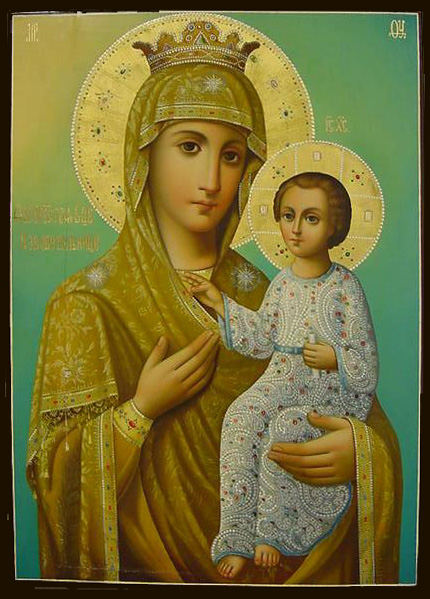
The Kasperov Icon of the Most Holy Theotokos. Tradition says that this holy icon had been brought to Cherson from Transylvania by a Serb at the end of the sixteenth century. Passing down from parent and child, the icon had come to a certain Mrs. Kasperova of Cherson in 1809.

One night in February of 1840 she was praying, seeking consolation in her many sorrows. Looking at the icon of the Virgin, she noticed that the features of the icon, darkened by age, had suddenly become bright. Soon the icon was glorified by many miracles, and people regarded it as wonderworking.

During the Crimean War (1853-1856), the icon was carried in procession through the city of Odessa, which was besieged by enemy forces. On Great and Holy Friday, the city was spared. Since that time, an Akathist has been served before the icon in the Dormition Cathedral of Odessa every Friday.

The icon is painted with oils on a canvas mounted on wood. The Mother of God holds Her Son on her left arm. The Child is holding a scroll. Saint John the Baptist (Janurary 7) is depicted on one border of the icon, and Saint Tatiana (January 12) on the other. These were probably the patron saints of the original owners of the icon.

The Kasperov Icon is commemorated on October 1, June 29, and Bright Wednesday.

Martyr Claudius and those with him

Saints Claudius, Diodoros, Victor, Victorinus, Pappios, Serapion, and Nikephoros are most probably the same saints who are commemorated on January 31. See their Life on that date.

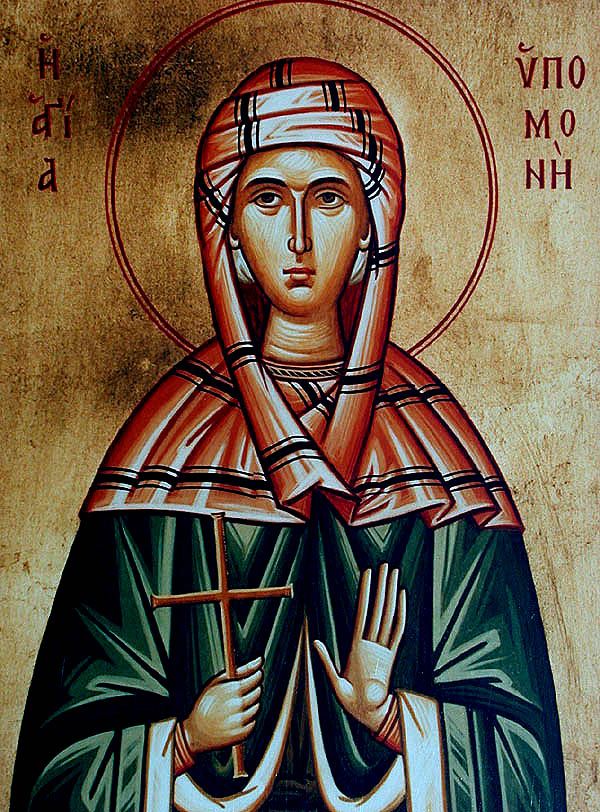
Martyr Hypomone

Saint Hypomone (Αγία Υπομονή), who suffered during the pre-Nicene persecutions, is not mentioned in the Synaxaristes of Saint Νikόdēmos (July 14), nor in the printed Menaia, but she is mentioned in Vatican Codex 1104 f. 986, which contains her Service, composed by Saint Theophanes (October 11). The acrostic of the Canon is: "I marvel at your sufferings, Hypomone." Her name means "patience."

Daily Readings for Monday, April 04, 2022

5TH MONDAY OF LENT

ABSTAIN FROM MEAT, FISH, DAIRY, EGGS, WINE, OLIVE OIL

George the Righteous of Maleon, Righteous Plato the Studite, Theonas, Archbishop of Thessaloniki, Founder and Renovator of the Sacred Monastery of Saint Anastasia of Pharmakolytria, Halkidiki, Nicetas the Hieromartyr, Struggler of Serrai (1808), Theodoulos and Agathopous of Thessaloniki, Righteous Zosimas

ISAIAH 37:33-38:6

Therefore thus says the LORD concerning the king of Assyria: He shall not come into this city, or shoot an arrow there, or come before it with a shield, or cast up a siege mound against it. By the way that he came, by the same he shall return, and he shall not come into this city, says the LORD. For I will defend this city to save it, for my own sake and for the sake of my servant David." And the angel of the LORD went forth, and slew a hundred and eighty-five thousand in the camp of the Assyrians; and when men arose early in the morning, behold, these were all dead bodies. Then Sennacherib king of Assyria departed, and went home and dwelt at Nineveh. And as he was worshiping in the house of Nisroch his god, Adrammelech and Sharezer, his sons, slew him with the sword, and escaped into the land of Ararat. And Esarhaddon his son reigned in his stead. In those days Hezekiah became sick and was at the point of death. And Isaiah the prophet the son of Amoz came to him, and said to him, "Thus says the LORD: Set your house in order; for you shall die, you shall not recover." Then Hezekiah turned his face to the wall, and prayed to the LORD, and said, "Remember now, O LORD, I beseech thee, how I have walked before thee in faithfulness and with a whole heart, and have done what is good in thy sight." And Hezekiah wept bitterly. Then the word of the LORD came to Isaiah: "Go and say to Hezekiah, Thus says the LORD, the God of David your father: I have heard your prayer, I have seen your tears; behold, I will add fifteen years to your life. I will deliver you and this city out of the hand of the king of Assyria, and defend this city.

GENESIS 13:12-18

Abram dwelt in the land of Canaan, while Lot dwelt among the cities of the valley and moved his tent as far as Sodom. Now the men of Sodom were wicked, great sinners against the LORD. The LORD said to Abram, after Lot had separated from him, “Lift up your eyes, and look from the place where you are, northward and southward and eastward and westward; for all the land which you see I will give to you and to your descendants for ever. I will make your descendants as the dust of the earth; so that if one can count the dust of the earth, your descendants also can be counted. Arise, walk through the length and the breadth of the land, for I will give it to you.” So Abram moved his tent, and came and dwelt by the oaks of Mamre, which are at Hebron; and there he built an altar to the LORD.

PROVERBS 14:27-15:4

The fear of the LORD is a fountain of life, that one may avoid the snares of death. In a multitude of people is the glory of a king, but without people a prince is ruined. He who is slow to anger has great understanding, but he who has a hasty temper exalts folly. A tranquil mind gives life to the flesh, but passion makes the bones rot. He who oppresses a poor man insults his Maker, but he who is kind to the needy honors him. The wicked is overthrown through his evil-doing, but the righteous finds refuge through his integrity. Wisdom abides in the mind of a man of understanding, but it is not known in the heart of fools. Righteousness exalts a nation, but sin is a reproach to any people. A servant who deals wisely has the king's favor, but his wrath falls on one who acts shamefully. A soft answer turns away wrath, but a harsh word stirs up anger. The tongue of the wise dispenses knowledge, but the mouths of fools pour out folly. The eyes of the LORD are in every place, keeping watch on the evil and the good. A gentle tongue is a tree of life, but perverseness in it breaks the spirit.

Venerable Joseph the Hymnographer

Saint Joseph the Hymnographer, “the sweet-voiced nightingale of the Church,” was born in Sicily around the turn of the 9th century into a pious Christian family. His parents, Plotinos and Agatha, moved to the Peloponnesos to save themselves from barbarian invasions. When he was fifteen, Saint Joseph went to Thessalonica and entered the monastery of Latomos. He was distinguished by his piety, his love for work, and his meekness; and he gained the good will of all the brethren of the monastery. He was later ordained as a priest.

Saint Gregory the Dekapolite (November 20) visited the monastery and took notice of the young monk, taking him along to Constantinople, where they settled together near the church of the holy Martyrs Sergius and Bacchus. This was during the reign of the emperor Leo the Armenian (813-820), a time of fierce iconoclast persecution.

Saints Gregory and Joseph fearlessly defended the veneration of holy icons. They preached in the city squares and visited in the homes of the Orthodox, encouraging them against the heretics. The Church of Constantinople was in a most grievous position. Not only the emperor, but also the patriarch were iconoclast heretics.

At that time the Roman bishops were in communion with the Eastern Church, and Pope Leo III, who was not under the dominion of the Byzantine Emperor, was able to render great help to the Orthodox. The Orthodox monks chose Saint Joseph as a steadfast and eloquent messenger to the Pope. Saint Gregory blessed him to journey to Rome and to report on the plight of the Church of Constantinople, the atrocities of the iconoclasts, and the dangers threatening Orthodoxy.

During the journey, Saint Joseph was captured by Arab brigands who had been bribed by the iconoclasts. They took him to the island of Crete, where they handed him over to the iconoclasts, who locked him up in prison. Bravely enduring all the deprivations, he encouraged the other prisoners. By his prayers, a certain Orthodox bishop who had begun to waver was strengthened in spirit and courageously accepted martyrdom.

Saint Joseph spent six years in prison. On the night of the Nativity of Christ in 820 he was granted a vision of Saint Nicholas of Myra, who told him about the death of the iconoclast Leo the Armenian, and the end of the persecution.

Saint Nicholas gave him a paper scroll and said, “Take this scroll and eat it.” On the scroll was written: “Hasten, O Gracious One, and come to our aid if possible and as You will, for You are the Merciful One.” The monk read the scroll, ate it and said, “How sweet are Thine oracles to my throat” (Ps 118/119:103). Saint Nicholas bade him to sing these words. After this the fetters fell off the saint, the doors of the prison opened, and he emerged from it. He was transported through the air and set down on a large road near Constantinople, leading into the city.

When he reached Constantinople, Saint Joseph found that Saint Gregory the Dekapolite was no longer among the living, leaving behind his disciple John (April 18), who soon died. Saint Joseph built a church dedicated to Saint Nicholas and transferred the relics of Saints Gregory and John there. A monastery was founded near the church.

Saint Joseph received a portion of the relics of the Apostle Bartholomew from a certain virtuous man. He built a church in memory of the holy apostle. He loved and honored Saint Bartholomew, and he was distressed that there was no Canon glorifying the holy Apostle. He desired to adorn the Feast of Saint Bartholomew with hymns, but he did not dare to compose them himself.

For forty days Saint Joseph prayed with tears, preparing for the Feast of the holy apostle. On the eve of the Feast the Apostle Bartholomew appeared to him in the altar. He pressed the holy Gospel to Joseph’s bosom, and blessed him to write church hymns with the words, “May the right hand of the Almighty God bless you, may your tongue pour forth waters of heavenly wisdom, may your heart be a temple of the Holy Spirit, and may your hymnody delight the entire world.” After this miraculous appearance, Saint Joseph composed a Canon to the Apostle Bartholomew, and from that time he began to compose hymns and Canons in honor of the Mother of God, of the saints, and in honor of Saint Nicholas, who liberated him from prison.

During the revival of the iconoclast heresy under the emperor Theophilus (829-842), Saint Joseph suffered a second time from the heretics. He was exiled to Cherson [Chersonessus] for eleven years. The Orthodox veneration of holy icons was restored under the holy empress Theodora (February 11) in 842, and Saint Joseph was made keeper of sacred vessels at Hagia Sophia in Constantinople. Because of his bold denunciation of the brother of the empress, Bardas, for unlawful cohabitation, the saint was again sent into exile and returned only after Bardas died in 867.

Patriarch Photius (February 6) restored him to his former position and appointed him Father-confessor for all the clergy of Constantinople.

Having reached old age, Saint Joseph fell ill. On Great and Holy Friday, the Lord informed him of his approaching demise in a dream. The saint made an inventory of the church articles in Hagia Sophia, which were under his official care, and he sent it to Patriarch Photius.

For several days he prayed intensely, preparing for death. He prayed for peace for the Church, and the mercy of God for his soul. Having received the Holy Mysteries of Christ, Saint Joseph blessed all who came to him, and with joy he fell asleep in the Lord in 886 (some sources say in 883). The choirs of the angels and the saints, whom Saint Joseph had glorified in his hymnology, carried his soul to Heaven in triumph.

In 890, his biographer John the deacon of the Great Church wrote about the spirit and power of Saint Joseph’s Canons: “When he began to write verses, then the hearing was taken with a wondrous pleasantness of sound, and the heart was struck by the power of the thought. Those who strive for a life of perfection find a respite here. Writers, having left off with their other versification, from this one treasure-trove, from the writings of Saint Joseph, began to scoop out his treasure for their own songs, or better to say, daily they scoop them out.

“And finally, all the people carry it over into their own language, so as to enlighten with song the darkness of night, or staving off sleep, to continue with the vigil until sunrise. If anyone were to peruse the life of a saint of the Church on any given day, they would see the worthiness of Saint Joseph’s hymns and acknowledge his glorious life. Actually, since the lives and deeds of almost every saint are adorned with praises, is not he worthy of immortal glory, who has worthily and exquisitely known how to glorify them?

“Now let some saints glorify his meekness, and others his wisdom, and others his works, and all together glorify the grace of the Holy Spirit, Who so abundantly and immeasurably has bestown his gifts on him.”

Most of the Canons in the MENAION are Saint Joseph’s work. His name may be found in the Ninth Ode as an acrostic. He also composed many of the hymns in the PARAKLETIKE.

Venerable George of Mount Maleon in the Peloponnesus

Saint George lived during the ninth century. His parents arranged a marriage for him, but he refused to marry the woman they had chosen. He entered the monastery on Mount Maleon in the Peloponnesus, and many disciples gathered around him. He was able to see the future, and predicted his own death three years before it occurred.

In the service to him, Saint George is called an earthly angel and a wonderworker.

Venerable Joseph the Much-Ailing, of the Kiev Far Caves

Saint Joseph the Much-Ailing lived during the fourteenth century. In his grievous illness he turned to God with prayer and vowed that if the Lord granted him health, he would then serve the brethren of the Kiev Caves monastery until the end of his days.

After his return to health, he entered the Kiev Caves monastery, received monastic tonsure, and began to work at deeds of fasting and prayer, and to serve the brethren with love. After his death Saint Joseph was buried in the Far Caves (his memory is likewise celebrated on the Synaxis of the Saints of the Far Caves on August 28).

Venerable Zosimas, Abbot of Vorbozomsk

Saint Zosimas of Vorbozomsk was the founder of a monastery dedicated to the Annuniciation of the Most Holy Theotokos on an island in Lake Vorbozoma, twenty-three versts south of White Lake. The monastery was founded in the fifteenth century. In 1501, the head of the monastery was Igumen Jonah, a disciple of Saint Zosimas.

The monastery was one of the numerous wilderness-monasteries modeled after the so-called “Trans-Volga” monasteries, which were scattered around the Saint Cyril of White Lake monastery. Saint Zosimas died in the first half of the sixteenth century. The saint wrote counsels and letters to his spiritual daughter Anastasia.

Venerable Zosimas of Palestine

Saint Zosimas was born near the end of the fifth century, and lived in a monastery by the Jordan River. He met Saint Mary of Egypt (April 1), gave her Holy Communion, then buried her.

Saint Zosimas lived to be one hundred years old, then fell asleep in the Lord around 560.

Virgin Martyr Pherbutha (Phermoutha) of Persia, with her sister, and servant

The Holy Martyr Pherbutha (Phermoutha) and her sister and servants were martyred for Christ between the years 341 and 343. Saint Pherbutha and her sister were sisters of Bishop Simeon of Seleucia, who suffered for Christ under the Persian emperor Sapor between the years 341-344.

Both sisters and their servants had been brought to the court by the empress to attend her. Saint Pherbutha was distinguished by her extraordinary beauty, and the empress suggested that she marry in order to gain high position. The saint refused, since she had made a vow of virginity and total service to God.

Soon the empress fell ill. The sorcerers who were brought in to treat the empress, saw Saint Pherbutha and were struck by her extraordinary beauty. One of them asked her to become his wife. The saint answered that she was a Christian and had vowed to remain a bride of Christ.

The offended sorcerer reported to the emperor that the sickness of the empress was caused by poison given her by servants. By order of the emperor Saint Pherbutha, and her sister and servants were brought to trial.

At the trial the holy martyrs fearlessly declared that they were innocent of any crime, and that they were prepared to accept death for Christ.

The chief judge, the sorcerer Mauptis, was captivated by the beauty of the holy virgin Pherbutha, and he secretly sent his servant to her in the prison offering to free her and her companions, if only she would consent to become his wife. The two other judges secretly made similar offers to the holy virgin, one after the other.

Saint Pherbutha resolutely refused all these offers, saying that she was a bride of Christ and could never consent to an earthly marriage.

After this, the martyrs were found guilty of being Christians and of working magic in poisoning the empress, and they were sentenced to death. The pagan priests said that the bodies of the Christians should be cut into pieces. They placed three pieces on one side, and three pieces on the other side. Then they told the empress to walk between the body parts in order to receive healing. The bodies of the holy martyrs were thrown into a ditch, from which Christians secretly retrieved them and buried them.

New Martyr Nikḗtas of Pojani and Serres

The holy New Martyr Nikḗtas was a Slav from Albania, but we know nothing of his family or his early life. He lived on Mount Athos in the Russian monastery of Saint Panteleimon, then lived in the Skete of Saint Anne. Burning with a desire for martyrdom, he decided to travel to Serres. He arrived on March 30, 1808 (Great and Holy Monday) and stopped at a local monastery. In speaking to the igumen, he revealed that he was a hieromonk from Mt. Athos. At midnight, the igumen was making his customary rounds of the monastery when he saw someone standing in the moonlight praying on the church porch.

As he came closer, he could see that it was Father Nikḗtas, who revealed his intention to shed his blood for Christ. After speaking with the saint for a while, the igumen continued his rounds and left Father Nikḗtas to pray.

In the morning, Father Nikḗtas received Communion from the Presanctified Gifts, then went to a mosque outside the city. There he debated religion with a Moslem teacher and his disciples. Saint Nikḗtas approached one of them, noticing that he was lame.

The saint asked the man why he did not seek healing from his infirmity. The man said that it was impossible for him to be cured, since he had been born this way.

The monk replied that the man could be cured easily, if he would agree to obey him. The afflicted man looked at him with amazement and asked, “How must I obey you?”

“Believe in Jesus Christ as the one true God. If you are baptized, I promise you that you will be healthy and no trace of your lameness will remain.”

The man said nothing, but went to his teacher to report what the monk had said to him. The teacher questioned Saint Nikḗtas about where he had come from, and what he had said to his disciple.

Fearlessly, the warrior of Christ told him he was from Albania and had come to preach Christianity. Feeling pity for the lame man, he had advised him to believe in Christ so that he might receive his bodily health and the Kingdom of Heaven after death.

The teacher sent word to the mayor that a monk had come to their city and was speaking against their religion. Saint Nikḗtas was locked up in prison for the night, and the next day he was interrogated by Moslem religious leaders. Since they could not defeat him with reason, they tortured him and hanged him in the evening of Great and Holy Saturday in 1808. He was left hanging until Bright Tuesday, when Christians were given permission to take his body and bury it.

Saint Nikḗtas is revered as the patron saint of Serres, the place of his martyrdom. He is also commemorated on the Sunday of Saint Thomas.

Two separate services have been composed in honor of Saint Nikḗtas, one in Slavonic and the other in Greek. A comparison of the two services reveals a difference of opinion about the saint’s national origin.

Saint Isidore, Bishop of Seville

Saint Isidore was born in the middle of the sixth century, and was related to the Visigoth royal family who converted to Orthodoxy from Arianism during his lifetime.

Saint Isidore was the brother of three saints: Saint Leander (February 27), Saint Fulgentius, and Saint Florentina. Orphaned at an early age, he was educated by his older brother Leander. The range of his knowledge was extensive, and included the study of Hebrew and Greek. He also wrote biographies of biblical figures and other illustrious men.

A prollific writer, Saint Isidore wrote on religious, historical and scientific topics. His ETYMOLOGIES (or ORIGINS) was a compendium of the knowledge of his time, and was used through the Middle Ages. Today, however, his history of the Goths and Vandals is of greater interest. He even composed a monastic Rule, although he was not a monk.

The tireless bishop also composed treatises refuting the Arian and Monophysite heresies. He participated in a council at Toledo in 610, and presided at the second Council of Seville in 618 or 619.

Saint Isidore fell asleep in the Lord in 636, and his holy relics were later transferred to Leon. Dante mentions him in his PARADISO (X, 130).

Venerable Theonas, Archbishop of Thessalonica

Saint Theonas was a disciple of Saint James of Kastoria (November 1), and lived at the beginning of the sixteenth century. He lived for some time in the Pantocrator and Simonopetra Monasteries on Mt. Athos. He founded the Monastery of Saint Anastasia, and was consecrated as Archbishop of Thessalonica. He died in peace.

Saint George Mtsire of Georgia

No information available at this time.

“Deliverer” Icon of the Mother of God

At the beginning of the XIX century the remarkable ascetic Constantine Theodoulos was loving as a monk on Mount Athos. This Elder had a wonderworking Icon of the Theotokos, which had been painted about 150 years before. After this ascetic's repose, the Icon was passed on to Constantine's disciple, Schema-monk Martinian, who arrived on Mount Athos from Greece in 1821.

Early in 1841 Father Martinian left the Holy Mountain and went to the town of Mavrovonē in the diocese of Sparta, where many miracles were about to take place.

The residents of that place were afflicted by a terrible disaster: their fields, forests and almost all the vegetation was devastated by locusts. Moving forward in a solid mass, they destroyed everything in their path. Their flight took them right to the city of Marathon. The local authorities drove the residents out of their homes into the fields, forcing them to collect the destructive insects, dump them into pits, and then burn them, but all these measures were ineffective. It seemed that the more locusts they killed, the more their numbers increased.

People lost all hope for human assistance, so they chanted a Moleben, but the disaster did not end. Terrified, the villagers turned to Father Alexis, a man of God, who lived in a monastery near that unfortunate district. Taking some holy relics, this God-pleaser advised them to have a Moleben with a Cross Procession to their fields. The locusts, as if irritated by such actions, focused their attention on the worshippers. Countless insects attacked people, especially in their eyes. Both the residents and priests fled to their homes in horror.

Elder Martinian also learned about this disaster. After serving a Moleben, he spoke to the villagers: "Is our faith so weak that we cannot ask the Lord to help us? Let us intensify our prayers; at least let us gather the old men, and we will resort to the powerful intercession of the Queen of Heaven and Earth. Let us take her holy Icon and pray together, trusting in the Lord. He will not reject our humble prayer to Him, and, through the intercessions of His Mother, He will save this district from a great calamity."

The inhabitants followed the pious Elder's suggestion, with confidence in the merciful intercession of the Mother of God, they gathered not only old men, but also husbands, wives and even children. There were also four priests. The Cross Procession followed the Elder, who carried the holy Icon, and went into the field. There Father Martinian placed the Icon on the ground, and all the villagers bowed before it in supplication. The Sovereign Lady did not reject the prayers of the faithful servants of her Son and our God. She drove the locusts away. Suddenly, a great flock of birds appeared, rushing swiftly at the insects. The locusts rose from the fields and flew in such a thick mass that they obscured the sunlight.

Later, in the village of Mavrovonē there was a boy who was very sick, and his illness was getting worse. His parents asked the priest to bring him Communion. For some reason, however, the visiting priest did not hurry, and he did not arrive for a long time. He took the Holy Gifts and went to the boy's house. He had invited Elder Martinian to come with him. When they arrived at the house, they were shocked by the news that boy was already dead. The priest was filled with deep remorse, since his procrastination had deprived the child of his final spiritual consolation. The only hope left to them was to trust in God's mercy.

The priest asked Father Martinian to bring his Icon so they could pray to the Queen of Heaven for the boy. The Elder, seeing the deep faith of the priest and the devastated parents, took out the holy Icon which he always kept with him and placed it over the child's bed. Confident that nothing is impossible for the Sovereign Lady, the Elder, the priest, and parents bowed before the Icon, begging her to restore the child to life. After praying for a time, the Elder touched the dying boy three times with the Icon, and suddenly the child opened his eyes. At Father Martinian's request, the boy was given Holy Communion, and then got up perfectly well. The next day he went to school, where he had been sent shortly before this for his primary education. Later, the boy who returned to life was tonsured in a foreign country with the name Alexis, and for a long time he lived an ascetical life on Mount Athos.

News of this glorious miracle spread far through the neighborhood. Many people who suffered from physical and spiritual infirmities flocked to the Icon of the Mother of God with faith. The Elder's tiny home was always crowded with people and he decided to hide from them, but they found him again.

Father Martinian would not have minded visiting the sick with the Icon if their reverence for the Mother of God had not been mixed with a desire to glorify the Elder as well. He thought he should retire to a place where no one would find him. Therefore, he went by the sea shore and soon, above the ocean, he found a sheer rock with a cave, which was quite suitable for his ascetical struggles. Father Martinian thought he was completely secluded there. However, the good will of the Most Pure Virgin had arranged things otherwise.

One night the ascetic was praying in the cave. Suddenly, he heard a voice ordering him not to hide the Icon, but to minister to the needs of others. He tried to protest his unworthiness, and his infirmity, but the voice told him even more insistently to be obedient, saying that all this was for the glory of the Mother of God. When the Elder had finished his prayer, he decided to rest for a short time. Suddenly, at that moment, the cave was illumined with an extraordinary light. Surprised, the Elder came out onto the rock, desiring to know the source of such extraordinary radiance. The ascetic beheld a wondrous sight. He saw a pillar of light stretching from the sky to the ground, and in doing so, he heard again the same voice commanding him to leave his solitude and to go serve his neighbors. Thus, the ascetic opened his door to the residents of that vicinity.

There was a possessed woman named Elena, who used to shout all the time that she knew where the Elder was hiding. At the same time, she declared that only his Icon could heal her. The demon who possessed the woman was very fierce. He exposed the secret sins of all those who came to see Elena. One devout priest decided to read the prayers of exorcism over her no matter what happened. For that reason he went to Elena's house. Immediately, the woman attacked the priest and began to vilify the one who served at the altar, saying: "Aha! So you want to expel me? Are you thinking of casting me out? No, you cannot expel me, you will never drive me out. Look to yourself!"

Despite all the demon's words the priest continued to read the prayers, and asked the demon possessing the woman to reveal who could banish him. Against his will, the impure spirit spoke of a solitary Elder with an Icon, calling the ascetic a ragamuffin, an evil monk, and so on. Then the priest asked the demon where he might find this Elder. Then the demon, forced by the priest's prayers and by the power of God, revealed where Father Martinian was hiding.

The morning after the vision the Elder heard the sound of a large crowd of people gathered before the rock and begging him to come down to them to help the suffering. Seeing God's will in all this, the Elder obeyed and went to the homes of the villagers. First of all, he went to see Elena. As he approached her dwelling, she fell down unconscious and began to scream. When the Elder entered the house, he put down the Icon of the Mother of God and bowed before the Icon. At once, the demon came out of the woman with great moaning. She returned to her senses and fervently thanked the Theotokos. After this she felt quite well. Many other demoniacs were also healed by praying before her Icon.

Because of all the miracles taking place before the Icon, people were always in Father Martinian's home. The Elder finally decided to return to his monastery. When the people learned of his departure, they followed him for some distance. With a great cry they parted from the Elder as he walked away from them, carrying the Icon of the Mother of God, who had poured forth so much grace on their district.

In 1884, soon after he arrived on the Holy Mountain and entered the monastery of the Great Martyr Panteleimon, Father Martinian went to the Lord. Then the holy Icon of the Mother of God became the monastery's precious heritage. The revered Icon remained there until July 20, 1889, when Archimandrite Makarios, the Superior of Saint Panteleimon's Monastery, gave the Deliverer Icon as a blessing to the newly-built New Athos Monastery of Saint Simon the Canaanite in the Caucasus The Icon has been there from 1889 until the present day.

The first celebration of the transfer of the Icon to New Athos Monastery took place on October 17, 1889. That is why the Feast Day in honor of this Icon was established on this day. About that time a storm cast more than a ton of fish ashore at the monastery.

In this Icon the Most Holy Theotokos holds the Divine Child on her right arm, and He blesses with His right hand.

The Deliverer Icon of the Mother of God is commemorated on October 17, and on April 4.

The Life Giving Fountain of the Mother of God

The appearance of the Mother of God to Emperor Leo Marcellus occurred on April 4, 450. In addition to this day, on Friday of Bright Week, the Church remembers the rebuilding of the church of the Life-giving Fountain at Constantinople, and the great miracles which took place in that church in the past.

“Deliverer” Icon of the Mother of God

At the beginning of the XIX century the remarkable ascetic Constantine Theodoulos was loving as a monk on Mount Athos. This Elder had a wonderworking Icon of the Theotokos, which had been painted about 150 years before. After this ascetic's repose, the Icon was passed on to Constantine's disciple, Schema-monk Martinian, who arrived on Mount Athos from Greece in 1821.

Early in 1841 Father Martinian left the Holy Mountain and went to the town of Mavrovonē in the diocese of Sparta, where many miracles were about to take place.

The residents of that place were afflicted by a terrible disaster: their fields, forests and almost all the vegetation was devastated by locusts. Moving forward in a solid mass, they destroyed everything in their path. Their flight took them right to the city of Marathon. The local authorities drove the residents out of their homes into the fields, forcing them to collect the destructive insects, dump them into pits, and then burn them, but all these measures were ineffective. It seemed that the more locusts they killed, the more their numbers increased.

People lost all hope for human assistance, so they chanted a Moleben, but the disaster did not end. Terrified, the villagers turned to Father Alexis, a man of God, who lived in a monastery near that unfortunate district. Taking some holy relics, this God-pleaser advised them to have a Moleben with a Cross Procession to their fields. The locusts, as if irritated by such actions, focused their attention on the worshippers. Countless insects attacked people, especially in their eyes. Both the residents and priests fled to their homes in horror.

Elder Martinian also learned about this disaster. After serving a Moleben, he spoke to the villagers: "Is our faith so weak that we cannot ask the Lord to help us? Let us intensify our prayers; at least let us gather the old men, and we will resort to the powerful intercession of the Queen of Heaven and Earth. Let us take her holy Icon and pray together, trusting in the Lord. He will not reject our humble prayer to Him, and, through the intercessions of His Mother, He will save this district from a great calamity."

The inhabitants followed the pious Elder's suggestion, with confidence in the merciful intercession of the Mother of God, they gathered not only old men, but also husbands, wives and even children. There were also four priests. The Cross Procession followed the Elder, who carried the holy Icon, and went into the field. There Father Martinian placed the Icon on the ground, and all the villagers bowed before it in supplication. The Sovereign Lady did not reject the prayers of the faithful servants of her Son and our God. She drove the locusts away. Suddenly, a great flock of birds appeared, rushing swiftly at the insects. The locusts rose from the fields and flew in such a thick mass that they obscured the sunlight.

Later, in the village of Mavrovonē there was a boy who was very sick, and his illness was getting worse. His parents asked the priest to bring him Communion. For some reason, however, the visiting priest did not hurry, and he did not arrive for a long time. He took the Holy Gifts and went to the boy's house. He had invited Elder Martinian to come with him. When they arrived at the house, they were shocked by the news that boy was already dead. The priest was filled with deep remorse, since his procrastination had deprived the child of his final spiritual consolation. The only hope left to them was to trust in God's mercy.

The priest asked Father Martinian to bring his Icon so they could pray to the Queen of Heaven for the boy. The Elder, seeing the deep faith of the priest and the devastated parents, took out the holy Icon which he always kept with him and placed it over the child's bed. Confident that nothing is impossible for the Sovereign Lady, the Elder, the priest, and parents bowed before the Icon, begging her to restore the child to life. After praying for a time, the Elder touched the dying boy three times with the Icon, and suddenly the child opened his eyes. At Father Martinian's request, the boy was given Holy Communion, and then got up perfectly well. The next day he went to school, where he had been sent shortly before this for his primary education. Later, the boy who returned to life was tonsured in a foreign country with the name Alexis, and for a long time he lived an ascetical life on Mount Athos.

News of this glorious miracle spread far through the neighborhood. Many people who suffered from physical and spiritual infirmities flocked to the Icon of the Mother of God with faith. The Elder's tiny home was always crowded with people and he decided to hide from them, but they found him again.

Father Martinian would not have minded visiting the sick with the Icon if their reverence for the Mother of God had not been mixed with a desire to glorify the Elder as well. He thought he should retire to a place where no one would find him. Therefore, he went by the sea shore and soon, above the ocean, he found a sheer rock with a cave, which was quite suitable for his ascetical struggles. Father Martinian thought he was completely secluded there. However, the good will of the Most Pure Virgin had arranged things otherwise.

One night the ascetic was praying in the cave. Suddenly, he heard a voice ordering him not to hide the Icon, but to minister to the needs of others. He tried to protest his unworthiness, and his infirmity, but the voice told him even more insistently to be obedient, saying that all this was for the glory of the Mother of God. When the Elder had finished his prayer, he decided to rest for a short time. Suddenly, at that moment, the cave was illumined with an extraordinary light. Surprised, the Elder came out onto the rock, desiring to know the source of such extraordinary radiance. The ascetic beheld a wondrous sight. He saw a pillar of light stretching from the sky to the ground, and in doing so, he heard again the same voice commanding him to leave his solitude and to go serve his neighbors. Thus, the ascetic opened his door to the residents of that vicinity.

There was a possessed woman named Elena, who used to shout all the time that she knew where the Elder was hiding. At the same time, she declared that only his Icon could heal her. The demon who possessed the woman was very fierce. He exposed the secret sins of all those who came to see Elena. One devout priest decided to read the prayers of exorcism over her no matter what happened. For that reason he went to Elena's house. Immediately, the woman attacked the priest and began to vilify the one who served at the altar, saying: "Aha! So you want to expel me? Are you thinking of casting me out? No, you cannot expel me, you will never drive me out. Look to yourself!"

Despite all the demon's words the priest continued to read the prayers, and asked the demon possessing the woman to reveal who could banish him. Against his will, the impure spirit spoke of a solitary Elder with an Icon, calling the ascetic a ragamuffin, an evil monk, and so on. Then the priest asked the demon where he might find this Elder. Then the demon, forced by the priest's prayers and by the power of God, revealed where Father Martinian was hiding.

The morning after the vision the Elder heard the sound of a large crowd of people gathered before the rock and begging him to come down to them to help the suffering. Seeing God's will in all this, the Elder obeyed and went to the homes of the villagers. First of all, he went to see Elena. As he approached her dwelling, she fell down unconscious and began to scream. When the Elder entered the house, he put down the Icon of the Mother of God and bowed before the Icon. At once, the demon came out of the woman with great moaning. She returned to her senses and fervently thanked the Theotokos. After this she felt quite well. Many other demoniacs were also healed by praying before her Icon.

Because of all the miracles taking place before the Icon, people were always in Father Martinian's home. The Elder finally decided to return to his monastery. When the people learned of his departure, they followed him for some distance. With a great cry they parted from the Elder as he walked away from them, carrying the Icon of the Mother of God, who had poured forth so much grace on their district.

In 1884, soon after he arrived on the Holy Mountain and entered the monastery of the Great Martyr Panteleimon, Father Martinian went to the Lord. Then the holy Icon of the Mother of God became the monastery's precious heritage. The revered Icon remained there until July 20, 1889, when Archimandrite Makarios, the Superior of Saint Panteleimon's Monastery, gave the Deliverer Icon as a blessing to the newly-built New Athos Monastery of Saint Simon the Canaanite in the Caucasus The Icon has been there from 1889 until the present day.

The first celebration of the transfer of the Icon to New Athos Monastery took place on October 17, 1889. That is why the Feast Day in honor of this Icon was established on this day. About that time a storm cast more than a ton of fish ashore at the monastery.

In this Icon the Most Holy Theotokos holds the Divine Child on her right arm, and He blesses with His right hand.

The Deliverer Icon of the Mother of God is commemorated on October 17, and on April 4.

Daily Readings for Sunday, April 03, 2022

SUNDAY OF ST. JOHN CLIMACUS

ABSTAIN FROM MEAT, FISH, DAIRY, EGGS

Sunday of St. John Climacus, Nicetas, Abbot of the Monastery of Medicium, Joseph the Hymnographer, Theodosia and Irene the Martyrs

ST. PAUL’S LETTER TO THE HEBREWS 6:13-20

BRETHREN, when God made a promise to Abraham, since he had no one greater by whom to swear, he swore to himself, saying, "Surely I will bless you and multiply you." And thus Abraham, having patiently endured, obtained the promise. Men indeed swear by a greater than themselves, and in all their disputes an oath is final for confirmation. So when God desired to show more convincingly to the heirs of the promise the unchangeable character of his purpose, he interposed with an oath, so that through two unchangeable things, in which it is impossible that God should prove false, we who have fled for refuge might have strong encouragement to seize the hope set before us. We have this as a sure and steadfast anchor of the soul, a hope that enters into the inner shrine behind the curtain, where Jesus has gone as a forerunner on our behalf, having become a high priest for ever after the order of Melchizedek.

MARK 9:17-31

At that time, a man came to Jesus kneeling and saying: "Teacher, I brought my son to you, for he has a dumb spirit; and wherever it seizes him it dashes him down; and he foams and grinds his teeth and becomes rigid; and I asked your disciples to cast it out, and they were not able." And he answered them, "O faithless generation, how long am I to be with you? How long am I to bear with you? Bring him to me." And they brought the boy to him; and when the spirit saw him, immediately it convulsed the boy, and he fell on the ground and rolled about, foaming at the mouth. And Jesus asked his father, "How long has he had this?" And he said, "From childhood. And it has often cast him into the fire and into the water, to destroy him; but if you can do anything, have pity on us and help us." And Jesus said to him, "If you can! All things are possible to him who believes." Immediately the father of the child cried out and said, "I believe; help my unbelief!" And when Jesus saw that a crowd came running together, he rebuked the unclean spirit, saying to it, "You dumb and deaf spirit, I command you, come out of him, and never enter him again." And after crying out and convulsing him terribly, it came out, and the boy was like a corpse; so that most of them said, "He is dead." But Jesus took him by the hand and lifted him up, and he arose. And when he had entered the house, his disciples asked him privately, "Why could we not cast it out?" And he said to them, "This kind cannot be driven out by anything but prayer and fasting." They went on from there and passed through Galilee. And he would not have any one know it; for he was teaching his disciples, saying to them, "The Son of man will be delivered into the hands of men, and they will kill him; and when he is killed, after three days he will rise.

4th Sunday of Great Lent: St John Climacus (of the Ladder)

The Fourth Sunday of Lent is dedicated to Saint John of the Ladder (Climacus), the author of the work, The Ladder of Divine Ascent. The abbot of Saint Catherine’s Monastery on Mount Sinai (6th century) stands as a witness to the violent effort needed for entrance into God’s Kingdom (Mt.10: 12). The spiritual struggle of the Christian life is a real one, “not against flesh and blood, but against … the rulers of the present darkness … the hosts of wickedness in heavenly places …” (Eph 6:12). Saint John encourages the faithful in their efforts for, according to the Lord, only “he who endures to the end will be saved” (Mt.24:13).

Venerable Nikḗtas the Confessor, Abbot of Medikion

Saint Nikḗtas the Confessor was born in Bithynian Caesarea (northwest Asia Minor) of a pious family. His mother died eight days after his birth, and his father Philaretos became a monk. The child remained in the care of his grandmother, who raised him in a true Christian spirit. From his youth Saint Nikḗtas attended church and was a disciple of the hermit Stephanos. With his blessing, Saint Nikḗtas set off to the Mydicia monastery, where Saint Nikēphóros (March 13) was the igumen.

After seven years of virtuous life at the monastery, famed for its strict monastic rule, Saint Nikḗtas was ordained presbyter. Saint Nikēphóros, knowing the holy life of the young monk, entrusted to him the guidance of the monastery when he himself became ill.

Not wanting power, Saint Nikḗtas devoted himself to the enlightenment and welfare of the monastery. He guided the brethren by his own example. Soon the fame of the lofty life of its inhabitants of the monastery attracted many seeking salvation. After several years, the number of monks had increased to one hundred.

When Saint Nikēphóros departed to the Lord in his old age, the brethren unanimously chose Saint Nikḗtas as igumen.

The Lord granted Saint Nikḗtas the gift of wonderworking. Through his prayer a deaf-mute child received the gift of speech; two demon-possessed women were healed; he restored reason to one who had lost his mind, and many of the sick were healed of their infirmities.

During these years under the emperor Leo the Armenian (813-820), the Iconoclast heresy resurfaced and oppression increased. Orthodox bishops were deposed and banished. At Constantinople a council of heretics was convened in 815, at which they deposed the holy Patriarch Nikēphóros (806-815), and in his place they chose the heretical layman Theodotus. They also installed heretics in place of exiled and imprisoned Orthodox bishops.

The emperor summoned all the heads of the monasteries and tried to bring them over to the Iconoclast heresy. Among those summoned was Saint Nikḗtas, who stood firmly for the Orthodox confession. Following his example, all the igumens remained faithful to the veneration of holy icons. Therefore, they threw him into prison. Saint Nikḗtas bravely underwent all the tribulations and encouraged firmness of spirit in the other prisoners.

Then the emperor and the false patriarch Theodotus attempted to trick those who remained faithful to Orthodox teaching. They promised that the emperor would give them their freedom and permit the veneration of the icons on one condition: that they take Communion from the pseudo-patriarch Theodotus.

For a long time the saint had doubts about entering into communion with a heretic, but other prisoners begged him to go along with them. Acceding to their entreaties, Saint Nikḗtas went into the church, where icons were put out to deceive the confessors, and he accepted Communion.

But when he returned to his monastery and saw that the persecution against icons was continuing, he then repented of his deed, returned to Constantinople and fearlessly denounced the Iconoclast heresy. He ignored all the emperor’s threats.

Saint Nikḗtas was again locked up in prison for six years until the death of the emperor Leo the Armenian. Enduring hunger and travail, Saint Nikḗtas worked miracles by the power of his prayers: through his prayer the Phrygian ruler released two captives without ransom; three shipwrecked men for whom Saint Nikḗtas prayed, were thrown up on shore by the waves.

Saint Nikḗtas reposed in the Lord in 824. The saint’s body was buried at the monastery with reverence. Later, his relics became a source of healing for those coming to venerate the holy confessor.

Virgin Martyr Theodosia of Tyre

Once, during a persecution against Christians, which had already lasted for five years, the seventeen-year-old Saint Theodosia visited condemned Christian prisoners in the Praetorium in Caesarea, Palestine. It was the day of Holy Pascha, and the martyrs spoke about the Kingdom of God. Saint Theodosia asked them to remember her before the Lord, when they should come to stand before Him.

Soldiers seized her and led her before the governor Urban after seeing the maiden bow to the prisoners. The governor advised her to offer sacrifice to the idols but she refused, confessing her faith in Christ. Then they subjected the saint to cruel tortures, raking her body with iron claws until her bones were exposed.

The martyr was silent and endured the sufferings with a happy face, and when the governor told her again to offer sacrifice to the idols she answered, “You fool, I have been granted to join the martyrs!” They threw the maiden with a stone about her neck into the sea, but angels rescued her. Then they threw the martyr to the wild beasts to be eaten by them. Seeing that the beasts would not touch her, they cut off her head.

By night Saint Theodosia appeared to her parents, who had tried to talk their daughter out of her intention to suffer for Christ. She was in bright garb with a crown upon her head and a luminous gold cross in her hand, and she said, “Behold the great glory of which you wanted to deprive me!”

The Holy Martyr Theodosia of Tyre suffered in the year 307. She is also commemorated on May 29 (the transfer of her relics to Constantinople, and later to Venice).

Martyr Irene

No information available at this time.

Saint Illyricus of Mount Myrsinon in the Peloponnesus

Saint Illyricus the Wonderworker devoted himself to ascetic struggles on Mount Myrsinon in the Peloponnesus. The dates of his birth and death are unknown.

Martyrs Elpidephorus, Dius, Bithonius, and Galycus

The Holy Martyrs Elpidephorus, Dius, Bithonius, and Galycus suffered for their faith in Jesus Christ. They cut off the head of Saint Elpidephorus with a sword, Saint Dius was executed by stoning, Saint Bithonius was drowned in the sea, and Saint Galycus was condemned to be eaten by wild beasts.

“Unfading Flower” Icon of the Mother of God

The "Unfading Flower" Icon depicts the Theotokos holding her Divine Son on her right arm, and in her left hand is a bouquet of white lilies. The lilies symbolize the unfading flower of virginity and purity of the Mother of God, to whom the Church sings: “You are the root of virginity and the Unfading Flower of purity.”

In Moscow there are two churches with Icons with this name: the church of the Dormition at Mogil'tsy (December 31), and the Alexeyev Monastery. Other icons of this name are in Kungur (Perm Gubernia); in the former town of Kadome of Tambov Province, namely, in the Merciful Theotokos womens' monastery; and in the Nativity of the Theotokos church of Voronezh.

There is a similar Icon in the church of Saint Nicholas in the village of Budishch (Poltava Gubernia). It resembles a number of very old icons which are also revered in that place. Every year on April 3, many people gather in the village of Budishch to venerate this Icon, along with a copy of the Vladimir Icon of the Mother of God. Several miraculous healings of the sick have occurred before this Icon.

Daily Readings for Saturday, April 02, 2022

FOURTH SATURDAY OF LENT

ABSTAIN FROM MEAT, FISH, DAIRY, EGGS

Fourth Saturday of Lent, Titus the Wonderworker, Theodora the Virgin-martyr of Palestine, Amphianos & Aedesios the Martyrs of Lycia

ST. PAUL’S LETTER TO THE HEBREWS 6:9-12

BRETHREN, we feel sure of better things that belong to salvation. For God is not so unjust as to overlook your work and the love which you showed for his sake in serving the saints, as you still do. And we desire each one of you to show the same earnestness in realizing the full assurance of hope until the end, so that you may not be sluggish, but imitators of those who through faith and patience inherit the promises.

MARK 7:31-37

At that time, Jesus returned from the region of Tyre, and went through Sidon to the Sea of Galilee, through the region of Dekapolis. And they brought to him a man who was deaf and had an impediment in his speech; and they besought him to lay his hand upon him. And taking him aside from the multitude privately, he put his fingers into his ears, and he spat and touched his tongue; and looking up to heaven, he sighed, and said to him, "Ephphatha, " that is, "Be opened." And his ears were opened, his tongue was released, and he spoke plainly. And he charged them to tell no one; but the more he charged them, the more zealously they proclaimed it. And they were astonished beyond measure, saying, "He has done all things well: he even makes the deaf hear and the dumb speak.

4th Saturday of Great Lent: Memorial Saturday

Saturday is the day which the Church has set aside for the commemoration of Orthodox Christians departed this life in the hope of resurrection and eternal life. Since the Divine Liturgy cannot be served on weekdays during Great Lent, the second, third, and fourth Saturdays of the Fast are appointed as Soul Saturdays when the departed are remembered at Liturgy.

In addition to the Liturgy, kollyva (wheat or rice cooked with honey and mixed with raisins, figs, nuts, sesame, etc.) is blessed in church on these Saturdays. The kollyva reminds us of the Lord’s words, “Unless a grain of wheat falls into the earth and dies, it remains alone; but if it dies, it bears much fruit” (John 12:24).The kollyva symbolizes the future resurrection of all the dead. As Saint Simeon of Thessalonica (September 15) says, man is also a seed which is planted in the ground after death, and will be raised up again by God’s power. Saint Paul also speaks of this (I Cor. 15:35-49).

It is also customary to give alms in memory of the dead. The angel who spoke to Cornelius testifies to the efficacy of almsgiving, “Your prayers and your alms have ascended as a memorial before God” (Acts 10:4).

Memorial services for the dead may be traced back to ancient times. Chapter 8 of the Apostolic Constitutions recommends memorial services with Psalms for the dead. It also contains a beautiful prayer for the departed, asking that their voluntary and involuntary sins be pardoned, that they be given rest with the Patriarchs, Prophets, and Apostles in a place where sorrow, suffering, and sighing have fled away (Isaiah 35:10). Saint John Chrysostom mentions the service for the dead in one of his homilies on Philippians, and says that it was established by the Apostles. Saint Cyprian of Carthage (Letter 37) also speaks of our duty to remember the martyrs.

The holy Fathers also testify to the benefit of offering prayers, memorial services, Liturgies, and alms for the dead (Saint John Chrysostom, Saint Cyril of Jerusalem, Saint John of Damascus, etc.). Although both the righteous and those who have not repented and corrected themselves may receive benefit and consolation from the Church’s prayer, it has not been revealed to what extent the unrighteous receive this solace. It is not possible, however, to transfer a soul from a state of evil and condemnation to a state of holiness and blessedness through the Church’s prayer. Saint Basil the Great points out that the time for repentance and forgiveness of sins is during the present life, while the future life is a time for righteous judgment and retribution (Moralia 1). Saint John Chrysostom, Saint Gregory the Theologian, and other patristic writers concur with Saint Basil’s statement.

By praying for others, we bring benefit to them, and also to ourselves, because “God is not so unjust as to forget your work and the love which you showed for His sake in serving the saints…” (Heb. 6:10).

Venerable Titus the Wonderworker

Saint Titus the Wonderworker displayed zeal for the monastic life from his youth. He pursued asceticism in the ninth century at the Studion monastery near Constantinople. By his deeds of fasting, purity of life and mild disposition, Saint Titus gained the love of the brethren, and at their request he was ordained priest.

Fervent of faith, the saint stood up for the Orthodox veneration of icons during the Iconoclast persecution. Because of his virtuous life, God granted him the gift of wonderworking. The saint was translated to the Lord in his old age.

Martyrs Amphianus and Edesius of Lycia

The Holy Martyrs Amphianus (Apphianus) and Edesius (Aidesius) were brothers. They lived in the city of Patara (province of Lycia) in the family of the pagan governor. They went to the city of Beirut to study the pagan sciences. There they became ardent followers of Christ.

The holy brothers left their pagan parents and went to Alexandrian Caesarea, where they found an instructor, Saint Pamphilius (February 16), and under his guidance they became accomplished in the spiritual life, spending their time in prayer and the study of sacred books.

By decree of the emperor Maximian (305-313), a zealous pagan and cruel persecutor of Christians, all the inhabitants of Caesarea were required to offer public sacrifice. Many Christians, including Saints Amphianus and Edesius, had to hide in order to avoid sacrificing to idols.

When the city prefect of Caesarea was about to offer sacrifice to idols, Saint Amphianus boldly went into the temple, took the prefect’s hand, and urged him to abandon his error and believe in Christ.

By order of the governor, soldiers seized Saint Amphianus, fiercely beat him and then threw him in prison. Two days later they led him to trial, where they beat him with iron rods and burned his body with bundles of flax soaked in oil.

The brave youth, steadfastly confessing his faith in Christ, was then thrown into the sea with a stone about his neck. Suddenly a storm arose, and the waves carried the martyr’s body to shore, where it was buried by Christians.

After a while they freed Saint Edesius and sent him to Alexandria. There he boldly denounced the governor Hierokles for his extreme cruelty towards Christians. Saint Edesius was tortured and then drowned.

Martyr Polycarp of Alexandria

The Holy Martyr Polycarp was killed after he denounced the impious Emperor Maximian (305-313) for shedding the blood of innocent Christians in the city of Alexandria. As a devout Christian who was filled with zeal for God, he could not simply stand by when every day he saw many of the faithful being tortured because they refused to deny Christ.

One day Saint Polycarp saw the ruler sitting in his chair and watching as the blood of Christians flowed like water. The Saint stood before him and questioned him saying, "Why have you so forgotten human nature, you insatiable dog, that you cut down your relatives and fellow countrymen with swords like wood, because they proclaim the one true God and refute the error of idolatry; just as I do, who am a servant of Christ?"

Because he angered the ruler by saying such things, Saint Polycarp was arrested and tortured. Finally, he was beheaded, dying with the name of Christ on his lips. By being cut down like a vine-branch, he offered much fruit to Christ, and received the crown of martyrdom.

Saint George Matskevereli of Georgia

A few biographical details about Saint George of Atsquri have been preserved in the writings of the famous 10th-century Georgian hagiographers George Merchule and Basil of Zarzma.

Saint George of Atsquri lived at the end of the 9th and the beginning of the 10th centuries. A member of the aristocratic and pious Shuartqeli family, Saint George was raised and educated in the environs of Georgia’s renowned Opiza Monastery in Klarjeti.

Four years after the death of the great feudal lord George Chorchaneli, Saint George succeeded him as ruler of the Samtskhe region. At that time a bitter conflict arose over who was the rightful heir to Chorchaneli’s inheritance.

While serving as the chief political leader of Samtskhe, Saint George also directed the region’s spiritual life, wisely administering the ancient Atsquri diocese for many years. According to tradition, the diocese of Atsquri was founded by the holy Apostle Andrew the First-called, who left there the “Not-Made-By-Hands” icon of the Most Holy Theotokos (known as the Atsquri Icon of the Mother of God) as an offering to the Georgian Church.

Though his literary works have not been preserved, Saint George is also commemorated as a great writer of the Church.

In his book The Life of Saint Grigol of Khandzta, Saint George Merchule notes that Saint George of Atsquri made some of the most significant contributions to the biographical writings on Saint Grigol of Khandzta. Saint George of Atsquri was a close companion of Saint Serapion of Zarzma. He was present at his burial and contributed much to the hagiographical writings on his life and works.

Virgin Martyr Theodora of Tyre

Saint Theodora came from Tyre in Phoenicia. When she was seventeen years of age, she was brought before Urban, the ruler of Palestine, who asked her if she really believed in Christ. With remarkable courage, the holy virgin confessed that she truly believed. Then they flayed her sides and her breasts. Afterward, they threw her into the sea, where she surrendered her soul to God, thereby receiving a martyr's crown.

Saint Νikόdēmos of the Holy Mountain thought it very likely that this Saint is the same as Saint Theodosia (May 29), because their Lives are almost identical.